
ACT on Payment Services 1 ) 2 ) of 19 August Part 1 General Provisions
|
|
|
- Grace Morgan
- 10 years ago
- Views:
Transcription
1 ACT on Payment Services 1 ) 2 ) of 19 August 2011 Part 1 General Provisions Article 1. This Act sets out rules for the provision of payment services, including: 1) the conditions for provision of payment services, in particular regarding the transparency of contractual regulations and requirements regarding the provision of information about payment services; 2) the rights and obligations of parties arising out of contracts for the provision of payment services and also the extent of providers responsibilities in respect of payment services; and 3) principles of conduct of the business of payment institutions and payment service offices, including through the intermediation of agents of these entities, and the principles of exercising supervision of these entities. Article 2. For the purposes of this Act, the following definitions shall apply: 1) agent means a natural person or a legal person or an organisational unit that is not a legal person on which the law confers legal capacity, which acts for and on behalf of a payment institution or a payment service office in providing payment services; 2) reference interest rate means an interest rate which comes from publicly available sources which can be verified by both parties to a contract for the provision of payment services; 3) close ties means close ties within the meaning of Article 4 paragraph 1 point 15 of the Banking Law of 29 August 1997 (Journal of Laws 2002 No. 72 item 665, as amended 3) ), referred to hereinafter as the Banking Law"; 4) value date means a reference point in time from which or up to which a provider calculates interest on funds debited from or credited to a payment account; 5) business day means a business day respectively for the payer s provider or the payee s provider; 6) host Member State means a Member State other than the home Member State in which a payment service provides payment services, including through an agent engaged in business in that state or through a branch in the state; 7) group means a) a parent undertaking together with its subsidiaries and: - an entity in which the parent undertaking or its subsidiary has a shareholding or
2 - a joint subsidiary, b) entities that are linked in such a way that more than half the members of the managing, supervisory or administrative bodies of one entity simultaneously perform managerial functions or are members of the supervisory or the administrative body of another entity, or c) entities that are linked in such a way that one entity influences the financial and operating policies of another entity; 8) hybrid payment service office means an office providing payment services which in addition to payment services is also engaged in other commercial activities; 9) hybrid payment institution means a payment institution which in addition to payment services is also engaged in other commercial activities; 10) payment instrument means any personalised device or set of procedures agreed by a user and a provider which is used by the user to place a payment order; 11) payment institution means a domestic payment institution or an EU payment institution; 12) entity means an entity within the meaning of Article 3 paragraph 1 item 1 of the Act on Accounting of 29 September 1994 (Journal of Laws 2009 No. 152 item 1223, as amended 4) ), referred to hereinafter as "the Act on Accounting"; 13) parent entity means a parent entity within the meaning of Article 3 paragraph 1 point 37 of the Act on Accounting; 14) joint subsidiary means a joint subsidiary within the meaning of Article 3 paragraph 1 point 40 of the Act on Accounting; 15) subsidiary means a subsidiary within the meaning of Article 3 paragraph 1 point 39 of the Act on Accounting; 16) domestic payment institution means a legal person who under Article 60 paragraph 1 has been authorised to conduct business as a payment institution; 17) home Member State means the Member State in which the registered office of a payment service provider is situated or, if the provider has under its national law no registered office, the Member State in which its head office is situated; 18) payee means a natural person, a legal person or an organisational unit that is not a legal person on which the law confers legal capacity which is the recipient of funds that are the subject of a payment transaction; 19) branch means a branch within the meaning of Article 5 point 4 of the Act on Freedom of Economic Activity of 2 July 2004 (Journal of Laws 2010 No. 220 item 1447, as amended 5) ), referred to hereinafter as the "Act on Freedom of Economic Activity", while in the case of an EU payment institution all of its branches located oin the territory of the Republic of Poland shall be regarded as a single branch; 20) managing person means a member of the management board of a payment institution or payment service office, or if an institution or office does not have a management board the person responsible for the management of that institution or office who is not subordinate to another person, and in the case of a hybrid payment institution or a hybrid payment service office the member of the management board or the person responsible for the management of the institution or office as regards payment services; 21) Member State means a Member State of the European Union or a Member State of the European Free Trade Agreement (EFTA) or a party to the agreement on the European Economic Area;

3 22) payer means a natural person, a legal entity or an organisational unit that is not a legal person on which the law confers legal capacity who places a payment order; 23) single payment transaction means a payment transaction which is not covered by a framework contract; 24) entrepreneur means is an entrepreneur within the meaning of the Act on Freedom of Economic Activity; 25) payment account means an account maintained for one or more users for the execution of payment transactions, with payment account being understood to mean a bank account or an account of a member of a cooperative savings and credit union if those accounts are used for the execution of payment transactions; 26) reference exchange rate means an exchange rate provided by a payment service provider or coming from a publicly available source; 27) payment system means a system for the transfer of funds which is based on formal and standardised arrangements and common rules for the processing, clearing and/or settlement of payment transactions, and in particular a system of authorisation and settlement within the meaning of Article 2 point 17 of the Act on Electronic Payment Instruments of 12 September 2002 (Journal of Laws No. 169 item 1385, as amended 6) ), referred to hereinafter as the "Act on Electronic Payment Instruments", and a payment system within the meaning of Article 1 point 1 of the Act on Finality of Settlement in Payment Systems and Securities Settlement Systems and the Principles of Supervision of Such Systems of 24 August 2001 (Journal of Laws 2010 No. 112 item 743), referred to hereinafter as the Act on Finality of Settlement"; 28) means of distance communication means instruments which do not require the simultaneous presence of a provider and a user which may be used for the conclusion of a payment services contract; 29) payment transaction means an act initiated by a payer or by a payee of placing, transferring or withdrawing funds; 30) durable medium means any medium which enables the user to store information addressed to him in a way that makes it accessible for a period which is appropriate, given the purposes for which the information has been prepared, and which allows the unchanged reproduction of the information stored; 31) framework contract means a payment service contract which regulates the execution of individual payment transactions and which may contain regulations for the conduct of a payment account; 32) EU payment institution means a legal person to which the competent supervisory authorities have issued an authorisation to provide payment services; 33) unique identifier means a combination of letters, numbers or symbols specified by a provider for a user, which is supplied by one user in order to identify unambiguously the other user involved in a payment transaction or his payment account; 34) user means a natural person, a legal entity or an organisational unit that is not a legal person on which the law confers legal capacity who makes use of payment services either as payer or as payee; 35) competent supervisory authorities means authorities of Member States other than the Republic of Poland that are empowered by regulations in force in those States to issue authorisations for the performance of payment services by EU payment institutions;

4 36) payment instruction means a declaration directed by the payer or payee to its provider that contains an instruction to execute a payment transaction; 37) significant shareholding means shares in an amount: a) that means the possession by an entity directly or indirectly of at least 10% of the capital of another entity, b) that entitles the entity to exercise the rights derived from at least 10% of the votes in an organ of another entity, or c) giving other rights to the capital of an entity in such a way as to influence the management of its financial and operational policy. Article By payment services is meant activities consisting of: 1) accepting cash deposits into and making cash withdrawals from a payment account as well as all the operations required for the maintenance of an account; 2) execution of payment transactions, including transfer of funds to a payment account with the user s provider or with another provider: a) execution of direct debits, including one-off direct debits, b) execution of transactions through a payment card or similar payment instrument, and c) execution of transfers services, including standing orders; 3) execution of the payment transactions listed in point 2, where the funds made available to the user derive from credit, and in the case of a payment institution from a credit as spoken of in Article 74 paragraph 3; 4) the issuing of payment instruments; 5) the conclusion of contracts with businesses for the acceptance of payments using payment instruments; 6) the provision of money remittance services; and 7) execution of payment transactions where the consent of the payer to execute a transaction is given by means of any telecommunication, digital or IT device and the payment is transferred only to an intermediary between the user instructing the payment transaction and the payee. 2. Direct debit means a payment service consisting of debiting by a specified amount a payer s payment account so as to effect a payment transaction initiated by the payee which is executed on the basis of consent extended by the payer to the payee, the payee s provider or the payer's provider. 3. Money remittance means a payment service provided without the intermediation of a payment account maintained for the payer that consists of the transfer to the payee or to another provider accepting funds for the payee of funds received from the payer or consisting of the acceptance of funds for the payee and their release to the payee. Article Operations in the area of provision of payment services may be performed only by payment service providers, referred to hereinafter as "providers". 2. A provider may only be:

5 1) a domestic bank within the meaning of Article 4 paragraph 1 point 1 of the Banking Law; 2) a branch of a foreign bank within the meaning of Article. 4 paragraph 1 point 20 of the Banking Law; 3) a credit institution within the meaning of Article 4 paragraph 1 point 17 of the Banking Law or a branch of a credit institution within the meaning of Article 4 paragraph 1 point 18 of the Banking Law; 4) an electronic money institution within the meaning of Article 2 point 5 of the Act on Electronic Payment Instruments; 5) a branch of an entity that provides in a Member State other than the Republic of Poland, in accordance with the law of that state, postal payment services and is authorised in accordance with the law of that state to provide payment services and also Poczta Polska Spółka Akcyjna [the Polish Post Office] insofar as separate regulations authorise it to provide payment services; 6) a payment institution; 7) the European Central Bank, the National Bank of Poland, referred to hereinafter as the "NBP", and the central bank of another Member State if they are not acting in their capacity as monetary authority or organ of public administration; 8) an organ of public administration; 9) a cooperative savings and credit union or the National Cooperative Savings and Credit Union within the meaning of the Act on Cooperative Savings and Credit Unions of 14 December 1995 (Journal of Laws 1996 No. 1 item 2, as amended 7) ), referred to hereinafter as the "Act on Cooperative Savings and Credit Unions insofar as separate regulations authorise them to provide payment services, referred to hereinafter as "savings and credit unions ; 10) a payment service office. 3. Domestic payment institutions, payment service office, agents and branches of such entities, as well as savings and credit unions and their affiliates, are subject to registration in the registry of domestic payments institutions and other providers, referred to hereinafter as the register". 4. The expression "payment services" as description of business undertaken, including as part of a name (or brand) or in advertising, may be used only by payment service providers. 5. The only entities allowed to use in their name (or brand) the expressions 1) "payment institution" - are payment institutions; 2) "payment service office" are payment service offices. Article The regulations of the Act apply to payment services provided on the territory of the Republic of Poland or in commerce with other Member States. 2. The regulations of Parts I to III, with the exception of Article 59, and the regulations of Part IX shall apply only in cases where: 1) both the payer s provider and the payee s provider of or the sole provider in a payment transaction is engaged in business on the territory of the Republic of Poland or

6 2) one provider is engaged in business on the territory of the Republic of Poland and the second is engaged in business in another Member State. 3. The regulations of Parts I III and Part IX shall apply to payment services performed in euro, in Polish currency or in the currency of another Member State. 4. The regulations of the Act apply to the issue and use of the electronic payment instruments spoken of in the Act on Electronic Payment Instruments, in each currency. 5. In matters that are not regulated by the Act payment services shall be governed by the regulations of the Civil Code of 23 April 1964 (Journal of Laws 1996 No. 1 item 93, as amended), the Banking Law, the Act on Electronic Payment Instruments and the Act on Cooperative Savings and Credit Unions. Article 6. The regulations of the Act do not apply to: 1) payment transactions executed exclusively in cash directly between the payer and the payee; 2) payment transactions between the payer and the payee made through the intermediation of a person performing actions aimed at conclusion by the payer and the payee of a specified agreement or concluding such an agreement in the name of or on behalf of the payer or the payee; 3) transport of banknotes and coins, and in particular their reception, processing and delivery; 4) payment transactions carried out as part of the non-professional collection and delivery of cash in the course of unpaid activity, and in particular the collection and disbursement of cash in public fundraising activities; 5) services, under which the payee, at the payer s request, made before a payment transaction to make payment for purchased goods or services, as part of the payment transaction pays cash to the payer ( cash back" services); 6) the exchange of foreign currency cash into cash without the involvement of a payment account; 7) payment transactions based on one of the following documents in paper form issued to a provider with the objective of placing funds at the payee s disposal: a) a cheque issued in accordance with the Convention on a Uniform Act on Cheques (Journal of Laws 1937 No. 26 item 181), b) a cheque similar to the cheque spoken of in letter a which is subject to the regulations of Member States that are not parties to the convention referred to in letter a, c) a bill of exchange drawn in accordance with the Convention on a Uniform Law for Bills of Exchange and Loan Notes (Journal of Laws 1937 No. 26 item 175), d) a bill of exchange similar to the bill of exchange spoken of in letter c which is subject to the regulations of Member States that are not parties to the convention referred to in letter c, e), a mark of entitlement, including vouchers, f) a traveller s cheque, or g) a postal order within the meaning of the acts of the Universal Postal Union; 8) payment transactions executed within a payment system or a securities settlement system as spoken of in Article 4 1 point 2 of the Act on Finality of Settlement
7 executed through settlement agents, central counterparties, clearing houses, central banks, other system participants or providers, 9) payment transactions executed in connection with the servicing of financial instruments and rights derived from them, including dividends and other income, and transactions executed in connection with the sale or redemption of securities, in particular those executed by the entities listed in point 8 or by entities that are subject to supervision under the Act on Financial Market Supervision of 21 July 2006 (Journal of Laws No. 157 item 1119, as amended 9) ), referred to hereinafter as the "Act on Financial Market Supervision"; 10) services provided by technical service providers in support of the provision of payment services if they do not come into possession of the funds that are the subject of the payment transaction, and in particular data processing and storage services, trust services and protection of privacy, services of transferring information about a payment transaction between the payer and the payee, authentication of data and entities, provision of IT and communication networks, and the supply and maintenance of terminals and devices used in the provision of payment services; 11) services based on instruments that can be used: a) to purchase goods or services only in the premises of the issuers of such instruments or the premises of third-party entities that are linked to the issuer by a commercial contract other than a contract on the acceptance of payments made using payment instruments spoken of in Article 3 paragraph 1 point 5, b) within a limited network of service providers, or c) in relation to a limited range of goods or services; 12) payment transactions executed using telecommunication, digital or IT devices in which the goods or services purchased are supplied to a telecommunication, digital or IT device and are to be used with the device if the agent also provides other services, and, in particular, if the agent provides tools for access, distribution or searches; 13) payment transactions executed between providers, their agents or their branches for their own account; 14) payment transactions executed between a parent entity and a subsidiary or between subsidiaries of the same parent entity in which a provider belonging to the same group participates; 15) cash withdrawal services using ATMs provided by providers acting on behalf of one or more issuer of payment instruments that are not party to a framework contract with the person withdrawing the money from a payment account using an ATM if the providers do not provide other payment services; or 16) services performed exclusively with the use of paper passbooks where all transactions are recorded only in those books. Article Funds received by payment institutions and payment service offices from users in connection with the provision of payment services shall not constitute a deposit or other repayable funds within the meaning of Article 726 of the Civil Code of 23 April Payment institutions and payment service offices may not conduct the business of taking deposits or other repayable funds within the meaning of the Banking Law.

8 3. Funds placed in a payment account in a payment institution may not bear interest and may not bring any other benefits. Article The regulations of contracts for payment services may not be less beneficial to users than the regulations of the Act, unless the Act provides otherwise. 2. Regulations of contracts for payment services that are less favourable for the user than the regulations of the Act are invalid; in their place the relevant regulations of the Act shall apply. Article Arrangements for access to payment systems for providers should be determined according to objective, fair and proportionate criteria, and restrictions on access to these systems may not be larger than is necessary for protection against specific risks such as settlement risk, operational risk and business risk and for protection of the financial and operational stability of a payment system. 2. Payment systems may not introduce: 1) restrictions on effective participation in other payment systems; 2) rules that would introduce a differences in treatment between: a) the providers listed in Article 4 paragraph 2 points 1-8 or b) providers entered in the register that do not hold the authorisation spoken of in Article 60 paragraph 1; 3) limitations because of the type of entity or the legal form in which it conducts business. 3. The regulations of paragraphs 1 and 2 do not apply to: 1) payment systems within the meaning of Article 1 point 1 of the Act on the Finality of Settlement spoken of in Article 15 of this Act, 2) payment systems which involving only providers that belong to a group of entities that are linked by shareholdings in which one of the related entities exercises control over the other affiliated entities, or 3) payment systems in which the only provider who takes part as a single entity or as a group: a) acts or may act as a provider to both a payer and a payee, and bears exclusive responsibility for management of the system, and b) extends to other providers authorisations to participate in the system. 4. In the circumstances spoken of in paragraph 3 point 3 letter b, providers may not negotiate among themselves fees regarding the payment system but they may determine their own pricing regarding payers and payees. 5. Application of the principles specified in paragraphs 1 and 2 by an entity that intends to maintain a payment system within the meaning of the Act on Finality of Settlement or by an entity that already maintains such a system shall be assessed by the President of the NBP during proceedings for the issue of the consent spoken of in Article 16 paragraphs 1 and 3 of the Act on Finality of Settlement.

9 Article 10. Providers and operators of payment systems may process personal data to the extent necessary to prevent fraud associated with the execution of payment services or with the operation of a payment system and the investigation and detection of this type of fraud by the competent authorities, with the exception of the data spoken of in Article 27 paragraph 1 of the Act on Protection of Personal Data of 29 August 1997 (Journal of Laws 2002 No. 101 item 926 as amended 10) ) Article In their role as providers the following must maintain professional secrecy about the activities spoken of in Article 3 paragraph 1: 1) managers and other persons who belong to the statutory organs of a provider; 2) persons who are bound to a provider by an employment relationship; 3) persons or entities that are bound to a provider by an order or by another legal relationship of a similar nature, including agents of the provider and entities that execute certain actions on the basis of a contract as spoken of in Article 86 paragraph 1; and 4) persons or entities that are bound by employment, an order or another relationship of a similar nature to an entity that is in the relationship with a provider spoken of in point The obligation to maintain professional secrecy persists after the end of performance of the functions or the end of the legal relations spoken of in paragraph The obligation to maintain professional secrecy within the meaning of paragraph 1 shall cover information about the user in connection with payment services rendered to him or with a credit, as spoken of in Article 74 paragraph 3, granted to him, including identification of a user s payment account or the state of that account and also other information related to payment transactions and contracts concluded with the user if unauthorised disclosure of that information could cause damage to the legally protected interests of the user to whom the information relates. Article The professional secrecy obligation shall not be deemed to be breached by the disclosure of information covered by that obligation: 1) to an authority that is supervising or inspecting a provider in connection with actions undertaken in the field of supervision or inspection; 2) in the exercise of rights or obligations specified in separate regulations; 3) to other providers or users as part of the provision of payment services in accordance with a payment order that has been received or an agreement that has been concluded; and 4) at the express written consent of the user to whom the information relates. 2. The persons specified in paragraph 1 points 3 and 4 may use information they have collected only in accordance with the purpose for which it was provided. Article 13.

10 If separate regulations specify different rules for the protection of information that constitutes a professional secret in accordance with Article 11 paragraph 3 then those separate regulations apply to protection of the information. Article Supervision of the implementation by providers identified in Article 4 paragraph 2 points 1-5 and 9 of activities in the area of payment services in accordance with the Act, and of payment services in euro also in accordance with Regulation (EC) No 924/2009 of the European Parliament and Council of 16 September 2009 on Cross-border Payments in the Community and Repealing Regulation (EC) No 2560/2001 (Official Journal of the European Union L 226, 9 October 2009 p. 11) is exercised by the authorities competent to exercise of supervision over those entities. 2. Supervision of the implementation by providers identified in Article 4 paragraph 2 points 6 and 10 of activities in the area of payment services in accordance with the Act, and of payment services in euro also in accordance with Regulation (EC) No 924/2009 of the European Parliament and Council of 16 September 2009 on Cross-Border Payments in the Community and Repealing Regulation (EC) No 2560/2001, is exercised by the Polish Financial Supervision Authority, referred to hereinafter as the PFSA. Article A user may lodge a complaint with a supervisory authority against the behaviour of the provider or his agent, if that behaviour violates the law. 2. The entitlement spoken of in paragraph 1 shall apply also to individuals, legal persons and organisational units that are not legal persons on which the law confers legal capacity who have been refused the provision of payment services and also to consumer organisations. 3. The organ spoken of in paragraph 1, in replying to a complaint concerning a dispute under civil law, shall provide the complainant with information about non-judicial procedures for the resolution of disputes between a user and a provider and identifying the competent arbitration tribunals. 4. If it is not possible to determine which supervisory authority is relevant in relation to a particular provider a complaint shall be lodged directly with the provider, with the regulations of paragraph 3 applying mutatis mutandis. 5. The regulations of Part VIII of the Code of Administrative Procedure of 14 June 1960 (Journal of Laws 2000 No. 98, item 1071, as amended 11 ) shall not apply to the complaints spoken of in paragraphs 1-4. Part II Informational Obligations Regarding the Provision of Payment Services Section 1 General Provisions Article 16. A provider and a user who is not a consumer may agree that the regulations of this Part shall not apply in whole or in part.

11 Article A provider may not charge a user a fee for the provision of information required under the regulations of this Part. 2. A provider and a user may agree on fees for: 1) transfer at the user s request of information other than that required under the regulations of this Part, 2) a greater frequency of transfer of information than that required under the regulations of this Part, or 3) the provision of information required under the regulations of this Part by means of communication other than those specified in a framework contract. 3. If a provider, in accordance with paragraph 2, is entitled to collect fees for the transfer of information then those fees should reflect the amount of work required to provide information for which a fee is charged and the costs actually incurred by the provider. Article 18. The burden of proving compliance by the provider with the requirements for transfer to a user of information specified in the regulations of this Part lies with the provider. Article In the case of payment instruments which in accordance with a framework contract allow for the execution of individual payment transactions for an amount not exceeding the equivalent in Polish currency of EUR 30, or which have a limit on outgoings not exceeding the equivalent in Polish currency of EUR 150, or which are used for storing funds in an amount not exceeding at any time the equivalent in Polish currency of EUR 150 calculated using the mid exchange rate announced by the NBP that applies on the date of conclusion of the contract: 1) the provider shall supply the payer only with information about the main characteristics of the payment service and other basic information that is needed to make a decision, including: a) possible ways of using the payment instrument, b) the extent of the responsibility for the execution of services borne by the provider, c) the fees charged, and d) the place where one can easily access the information spoken of in Article 27; 2) the parties may agree that Article. 29 shall not apply, and that the provider shall have no obligation to propose amendments to the regulations of the framework contract in the manner specified in Article 26 paragraph 1; 3) the parties may agree that after execution of a payment transaction: a) the provider shall provide the user only with information that makes it possible to identify the payment transaction, its amount and the fees charged and in the case of several payment transactions of the same kind in which payment is made to the same payee with information about the total amount of the payment transactions and the fees charged for them, b) the provider shall not be obliged to disclose the information spoken of in letter a if the payment instrument is used anonymously or if for other reasons the
12 provider is not technically in a position to provide it; the provider shall ensure, however, that the payer is able to check the amount of funds held. 2. In the case of payment transactions specified in paragraph 1 that are executed entirely within the territory of the Republic of Poland the amounts that allow limitation of the informational obligations in accordance with paragraph 1 points 1-3 may be increased by 100% in a framework contract. 3. In relation to the prepaid payment instruments in the area of payment transactions spoken of in paragraph 1 that are performed in their entirety within the territory of the Republic of Poland the amounts that allow limitation of the informational obligations in accordance with paragraph 1 points 1-3 shall be the equivalent in Polish currency of EUR 500 as calculated by application of the mid exchange rate announced by the NBP that applies on the date of conclusion of the contract. Article If a payee requires payment of a fee or offers a reduction if a particular payment instrument is used then the payee must inform the payer of this prior to commencement of the payment transaction. 2. If the provider or another entity participating in the payment transaction requires fees for the use of a given payment instrument, then it is required to inform the user of this prior to commencement of the payment transaction. 3. In the event of failure to provide information about fees the payer or the user as appropriate is not obliged to pay them. In the event of failure to provide information about an offered discount the agreement is deemed to be concluded with the discount offered by the payee being taken into account. Section 2 Individual Payment Transactions Article 21. Where a payment order for a single payment transaction is transferred by a payment instrument covered by a framework contract the provider is not obliged to provide or make available information that the user has already received under a framework contract concluded with another provider or which he will receive on the basis of the framework contract. Article A provider must ensure that a user has easy access to the information spoken of in Article 23 paragraph 1 Article 24 and Article 25 and, at the request of the user must supply him with that information on paper or on another durable information medium. This information is to be expressed in a clear and readable manner. 2. The provider must make the information spoken of in Article 23 paragraph 1 available to the user when submitting proposals for the conclusion of a contract or when offering to execute a single payment transaction.if a contract for a single payment transaction has been concluded at the request of a user who makes use of means of communicating at a distance that do not allow the provider to fulfil this obligation then the provider shall fulfil this obligation without delay after the execution of the payment transaction. If a user requests provision of information in paper form or on another durable information

13 medium the provider shall implement this obligation without delay after execution of the payment transaction. 3. The provider may fulfil the obligation spoken of in paragraph 2 by providing, at least in electronic form, a model agreement for a single payment transaction or a form for a payment order that contains the information spoken of in Article 23 paragraph If the provider fails to meet the obligation spoken of in paragraph 1 or paragraph 2 the user shall be freed from the obligation to pay fees; the regulation of Article 52 paragraph 4 shall apply mutatis mutandis. Article A provider must make available to a user: 1) details of the information which must be supplied by the user so that a payment order can be properly executed, or information that is sufficient to provide a unique identifier; 2) information about the maximum time that execution of the payment service provided may take; 3) information about all and any fees due to the provider from the user, including details of the amounts of such fees; and 4) information about the exchange rate, including the reference exchange rate, which will be applied to a payment transaction if the payment transaction involves conversion of currency. 2. If the parties agree that the provider must make available to the user other information as well, including the information specified in Article 27, the provider must ensure that the user has easy access to that information. Article 24. Immediately after receipt of a payment order the payer s provider shall provide the payer with information: 1) that enables the payer to identify the payment transaction and with information about the payee; 2) about the amount of the payment transaction in the currency used in the payment order; 3) about any fees due from the payer in respect of the payment transaction, including a list of the amounts of such fees; 4) about the exchange rate used in the payment transaction by the payer s provider and the amount of the payment transaction after currency conversion if the payment transaction entailed conversion of currency; and 5) about the date on which the payment order was received. Article 25. After execution of a payment transaction the payee s provider shall provide the payee without delay with information: 1) that enables the payee to identify the payment transaction and, where appropriate, the payer, and all and any other information provided to the payee in connection with the execution of the payment transaction;
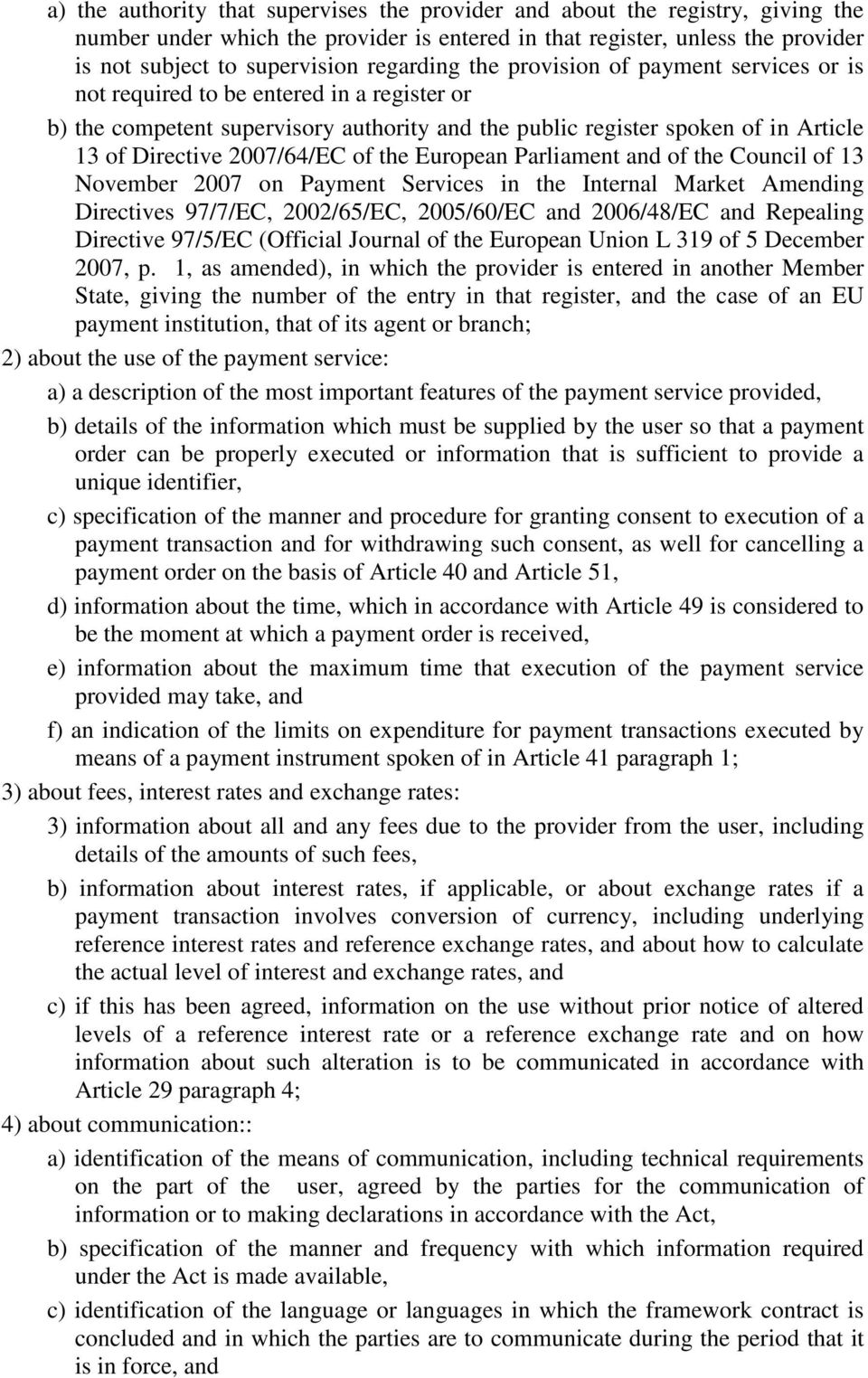
14 2) about the amount of the payment transaction in the currency in which funds are made available to the payee; 3) about all and any fees due from the payee in respect of the payment transaction, including where appropriate details of the amounts of such fees; 4) about the exchange rate used in the payment transaction by the payee s provider and the amount of the payment transaction before currency conversion if the payment transaction entails conversion of currency; and 5) about the value date used in crediting the account. Section 3 Framework Contract on Payment Service Article A provider must provide the user with the information specified in Article 27, Article 29 paragraphs 1 and 5, Article 31 paragraph 1 and Article 32 paragraph 1 on paper or on another durable information medium, but must send the information by only at the request of the user. The information should be formulated in a clear and readable manner. 2. The provider must provide the user with the information specified in Article 27 in good time before conclusion of a framework contract. With the user s consent the provider may execute this obligation by placing information on a website if the site makes possible access to the information for a period that is appropriate to the aims of provision of the information and allows reproduction in unaltered form of the information stored. 3. If a framework contract is concluded at the request of a user who makes use of means of communication at a distance the provider must provide the user with the information specified in Article 27 without delay after the conclusion of the framework contract, if it was not possible to deliver it within the period specified in paragraph The provider may fulfil the obligation spoken of in paragraphs 1, 2 or 3 in relation to provision of the information specified in Article 27 by providing a draft framework contract that contains the information. 5. The user may withdraw from a framework contract concluded in breach of the regulations of paragraphs 1-3 or 4 at any time but no later than 30 days after receipt of the information specified in Article 27 in the manner spoken of in paragraph The regulation of Article 22 paragraph 4 shall apply to individual payment transactions executed on the basis of the framework contract prior to fulfilment by the provider of the obligation specified in paragraphs 1-3 or paragraph 4. Article 27. A provider shall provide a user with the following information: 1) the forename and surname or company name (or brand) of the provider and his residential address and the address of his principal place of business, his address and, if use is being made of the services of an agent or of a branch in a Member State in which the payment service in question is offered, the address of the agent or branch, as well as any other addresses that are significant for the purposes of communication with the provider, including identification of all the places in which business is conducted, together with information about:

15 a) the authority that supervises the provider and about the registry, giving the number under which the provider is entered in that register, unless the provider is not subject to supervision regarding the provision of payment services or is not required to be entered in a register or b) the competent supervisory authority and the public register spoken of in Article 13 of Directive 2007/64/EC of the European Parliament and of the Council of 13 November 2007 on Payment Services in the Internal Market Amending Directives 97/7/EC, 2002/65/EC, 2005/60/EC and 2006/48/EC and Repealing Directive 97/5/EC (Official Journal of the European Union L 319 of 5 December 2007, p. 1, as amended), in which the provider is entered in another Member State, giving the number of the entry in that register, and the case of an EU payment institution, that of its agent or branch; 2) about the use of the payment service: a) a description of the most important features of the payment service provided, b) details of the information which must be supplied by the user so that a payment order can be properly executed or information that is sufficient to provide a unique identifier, c) specification of the manner and procedure for granting consent to execution of a payment transaction and for withdrawing such consent, as well for cancelling a payment order on the basis of Article 40 and Article 51, d) information about the time, which in accordance with Article 49 is considered to be the moment at which a payment order is received, e) information about the maximum time that execution of the payment service provided may take, and f) an indication of the limits on expenditure for payment transactions executed by means of a payment instrument spoken of in Article 41 paragraph 1; 3) about fees, interest rates and exchange rates: 3) information about all and any fees due to the provider from the user, including details of the amounts of such fees, b) information about interest rates, if applicable, or about exchange rates if a payment transaction involves conversion of currency, including underlying reference interest rates and reference exchange rates, and about how to calculate the actual level of interest and exchange rates, and c) if this has been agreed, information on the use without prior notice of altered levels of a reference interest rate or a reference exchange rate and on how information about such alteration is to be communicated in accordance with Article 29 paragraph 4; 4) about communication:: a) identification of the means of communication, including technical requirements on the part of the user, agreed by the parties for the communication of information or to making declarations in accordance with the Act, b) specification of the manner and frequency with which information required under the Act is made available, c) identification of the language or languages in which the framework contract is concluded and in which the parties are to communicate during the period that it is in force, and
16 d) information about the user s right to receive the regulations of the framework contract and information in accordance with Article 28; 5) about protective and repair measures: a) a description of the measures which should be taken by the user for safekeeping of a payment instrument and information about how the provider will make announcements in accordance with Article 42 paragraph 1 point 2, b) if this has been agreed, the conditions under which the provider reserves the right to block a payment instrument in accordance with Article 41, c) information about the payer s liability in accordance with Article 46 paragraphs 2-5, including information on the amount of a unauthorised payment transaction that is to be reimbursed, d) specification of the manner in which the user must notify the provider about cases of unauthorised or incorrectly executed payment transactions in accordance with Article 44 and indication of the time within which notification should be given as well as information about liability for unauthorised payment transactions on the basis of Article 46 paragraphs 1 and 2, e) information about the provider s liability for the execution of payment transactions on the basis of Article , and f) information about the conditions for obtaining, in accordance with Article 47 and Article 48, reimbursement of the amount of an authorised payment transaction initiated by the payee or through his intermediation which has already been executed; 6) about amendments to and termination of the framework contract: a) insofar as, in accordance with Article 29 paragraph 2, this has been agreed, information that if, before the proposed date of entry into force of amendments to the framework contract, the user does not notify the provider of his opposition to the changes, the user is deemed to have expressed his consent to them, b) information about the period for which the framework contract will be in force, and c) information about the user s right to terminate the framework contract and other arrangements relating to the termination of the contract in accordance with Article 29 paragraphs 1 and 2 and Articles 35 and 37; 7) about procedures for the resolution of disputes: a) information about all and any contractual clauses that apply to the framework contract, and in particular about those that concern governing law and competent court, and b) information about non-judicial procedures for lodging the complaints spoken of in Article 15 and about non-judicial procedures available to the user for resolution of disputes. Article During the period that a framework contract is in force, the user has the right to require delivery to him of the regulations of the contract and the information specified in Article 27 on paper or on another durable information medium. With the user s consent, this information may be supplied by ; the regulation of Article 26 paragraph 2 second sentence shall apply mutatis mutandis.
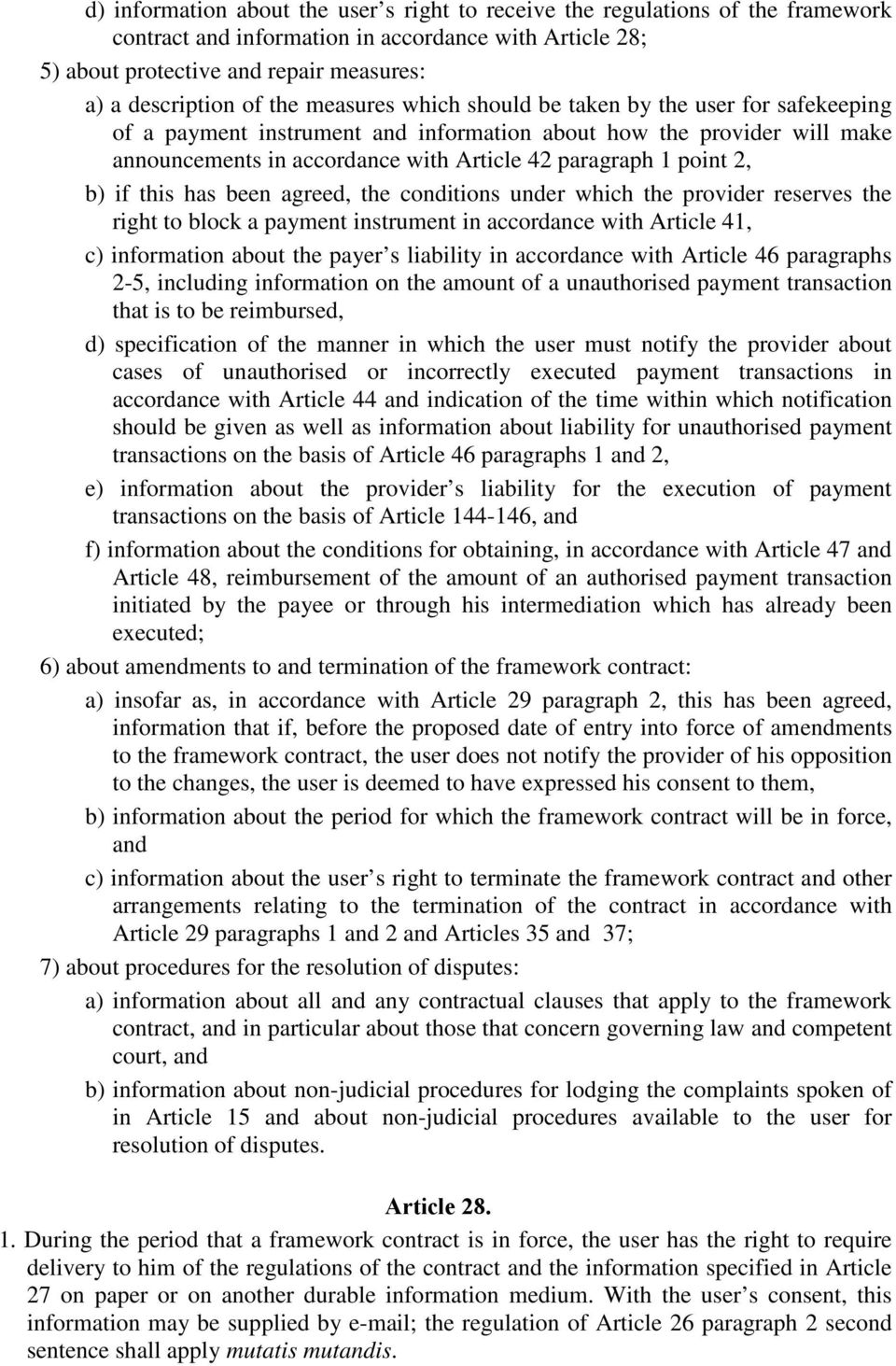
17 2. Subject to the reservation of Article 17 paragraph 2, during the period for which the framework contract is in force the provider shall, at any time that he is requested to do so by the user, supply him in a mutually agreed manner with information about the payment account and payment transactions executed. Article A provider shall provide information about proposed amendments to contractual regulations no later than two months before the date on which it is proposed that they should come into effect. 2. If the framework contract provides that failure of the user to declare his objection to proposed amendments is deemed to be equivalent to an expression of consent to them, then the provider when providing information about the changes spoken of in paragraph 1 must inform the user that: 1) if prior to the proposed date of entry into force of the amendments the user does not declare his opposition to the amendments the user is deemed to have expressed his consent to them; 2) the user has the right, prior to the date on which it is proposed that the amendments should enter into force, to terminate the framework contract with immediate effect without incurring any charges; and 3) if the user declares his opposition in accordance with point 1 but fails to terminate the framework contract, the agreement will expire on the day before the entry into force of the proposed amendments, without any charges being incurred. 3. The regulation of Article 26 paragraph 1 shall apply mutatis mutandis to the provision of information in accordance with paragraph Changes may be made to interest rates or exchange rates without prior notice, provided that they are favourable to users or: 1) the framework contract provides for this and 2) the changes are the result of changes to reference interest rates or reference exchange rates the use of which is provided for by the framework contract. 5. The provider shall inform the user about changes to the interest rate without undue delay, unless the framework contract specifies a fixed frequency or manner of delivery of or making available information about changes in interest rates. 6. The provider may not discriminate against individual users for any reason when making changes to the interest rates or exchange rates used in payment transactions. Article 30. In the case of an individual payment transaction executed under a framework contract and initiated by the payer, the provider, before execution of an individual payment transaction at the payer s request and with respect to the particular payment transaction, shall supply accurate information about the maximum period its execution may take and the fees payable by the payer, including a list of the amounts of all and any fees. Article After debiting a payer's payment amount by the amount of an individual payment transaction and, if the payer does not use a payment account, after receiving a payment order, the payer s provider must provide the payer immediately with information:

18 1) that makes it possible to identify the payment transaction and where appropriate the payee; 2) about the amount of the payment transaction in the currency in which the payer's payment account was debited or in the currency in which the payment order was made; 3) the amount of all and any fees for the payment transaction and, where appropriate, details of them or information about interest due from the payer; 4) about the exchange rate used in the payment transaction by the payer s provider and the amount of the payment transaction after currency conversion if the payment transaction entailed conversion of currency; and 5) about the value date used in debiting the account or the date of receipt of the payment order. 2. The parties may agree in the framework contract that the information spoken of in paragraph 1 is to be supplied by the payer s provider periodically at intervals of no more than a month, in a mutually agreed manner that makes it possible for the payer to store and recover the information in its original state. Article After execution of an individual payment transaction the payee s provider must provide the payee immediately with information: 1) that makes it possible for the payee to identify the payment transaction and, where appropriate, the payer and also all and any other information provided to the payee in connection with execution of the payment transaction; 2) about the amount of the payment transaction in the currency in which the payee s payment account was credited; 3) about the amount of all and any fees for the payment transaction and, where appropriate, details of them or information about interest due from the payee; 4) about the exchange rate used in the payment transaction by the payee s provider and the amount of the payment transaction before currency conversion if the payment transaction entailed conversion of currency; and 5) about the value date used in crediting the account. 2. The parties may agree in the framework contract that the information spoken of in paragraph 1 is to be supplied by the payee s provider periodically at intervals of no more than a month, in a mutually agreed manner that makes it possible for the payee to store and recover the information in its original state. Part III Rights and Responsibilities Regarding the Provision of Payment Services and Making Use of Them Section 1 General Provisions Article 33.

19 A provider and a user who is not a consumer may agree that the regulations of Article 34-37, Article 40 paragraphs 3 and 4, Article 45, Article 46 paragraphs 2-5, Article 47, Article 48, Article 51 and Articles shall not apply in whole or in part and may agree on a period for notifying the provider of unauthorised, unexecuted or improperly executed transactions other than that specified in Article 44 paragraph 2. Article 34. Payments shall be made in the currency mutually agreed by the provider and the user. Article A user may terminate a framework contract at any time with immediate effect, unless the framework contract provides for a period of notice. The contractual period of notice may not exceed one month. 2. A provider may terminate a framework contract concluded for an indefinite period by giving at least two months' notice; the regulation of Article 26 paragraph 1 shall apply mutatis mutandis. Article A provider may not collect from a user fees for the provision of information and the application of the security and repair measures spoken of in the regulations of this Part apart from the fees spoken of in Article 50 paragraph 3 and Article 51 paragraph The amount and basis for charging the fees spoken of in Article 50 paragraph 3 and Article 51 paragraph 6 should be mutually agreed between the user and the provider and should take into account both the amount of work required to execute a service for which a fee is charged and the costs actually borne by the provider. Article 37. Fees charged for the provision of payment services that are collected periodically shall be due to provider only for the period during which a framework contract is in force. Fees paid in advance shall be reimbursed proportionally. Article 38. If a payment transaction does not entail conversion of currency the payer and the payee shall pay the fees specified in the agreement that each of them has concluded with his provider. Article In the case of payment instruments which, in accordance with a framework contract permit the execution of individual payment transactions for an amount not exceeding the equivalent in Polish currency of EUR 30 or which have a spending limit amounting to the equivalent in Polish currency of EUR 150 euros, or which are used for storing of funds in an amount not exceeding at any time the equivalent in Polish currency of EUR 150, calculated using the mid exchange rate announced by the NBP that applies on the date of conclusion of the contract, the provider and the user may agree that: 1) the regulations of Article 42 paragraph 1 point 2, Article 43 paragraph 1 points 3 5 and Article 46 paragraphs 4 and 5 shall not apply if the payment instrument cannot be blocked or its further use prevented in some other way;

20 2) the regulations of Article 45 and Article 46 paragraphs 1-3 shall not apply if the payment instrument is used anonymously or if the provider for other reasons that are intrinsic to the payment instrument is not in a position to prove that the transaction was authorised 3) the provider shall not be required to notify the user of refusal to execute a payment order, if it is clear from the circumstances that the order has not been executed; in this case the regulations of Article 50 paragraphs 1-3 shall not apply; 4) the payer may not revoke a payment order after transfer to the payee of the payment order or if the payee has given his consent to execution of the payment transaction; in this case, the regulation of Article 51 shall not apply; and 5) the periods for crediting the payee s provider s account with the amount of the payment transaction and for the payee s provider s placing the amount of the transaction at the payee s disposal specified in Article 54, Article 56 and Article 57 shall not apply. 2. In the case of payment transactions that are executed entirely within the territory of the Republic of Poland the amount specified in paragraph 1 may be increased in the framework contract by 100%. 3. In relation to prepaid payment instruments used in payment transactions performed in their entirety within the territory of the Republic of Poland the amounts spoken of in paragraph 1 amount to the equivalent in Polish currency of EUR 500 as calculated by application of the mid exchange rate announced by the NBP that applies on the date of conclusion of the agreement. Section 2 Authorisation of Payment Transactions Article A payment transaction is deemed to be authorised if the payer has expressed his consent, in the manner provided for in the contract between the payer and his provider, to execution of the payment transaction. This consent may also apply to a series of payment transactions. 2. Permission should be granted by the payer prior to execution of a payment transaction or a series of payment transactions, unless the payer and his provider have agreed that consent may also be granted after their execution. 3. The payer may withdraw consent at any time, but no later than the point at which, in accordance with Article 51, the payment order becomes irrevocable. 4. If the agreement relates to a series of payment transactions, the payer, when withdrawing his consent, may stipulate that the withdrawal affects all payment transactions that have not yet been executed. Article If a specified payment instrument is used to express consent, the payer and his provider may agree on limits on outgoings for payment transactions executed using this payment instrument. 2. In a framework contract the provider may reserve the right to block a payment instrument: 1) for justified reasons connected with the security of a payment instrument,
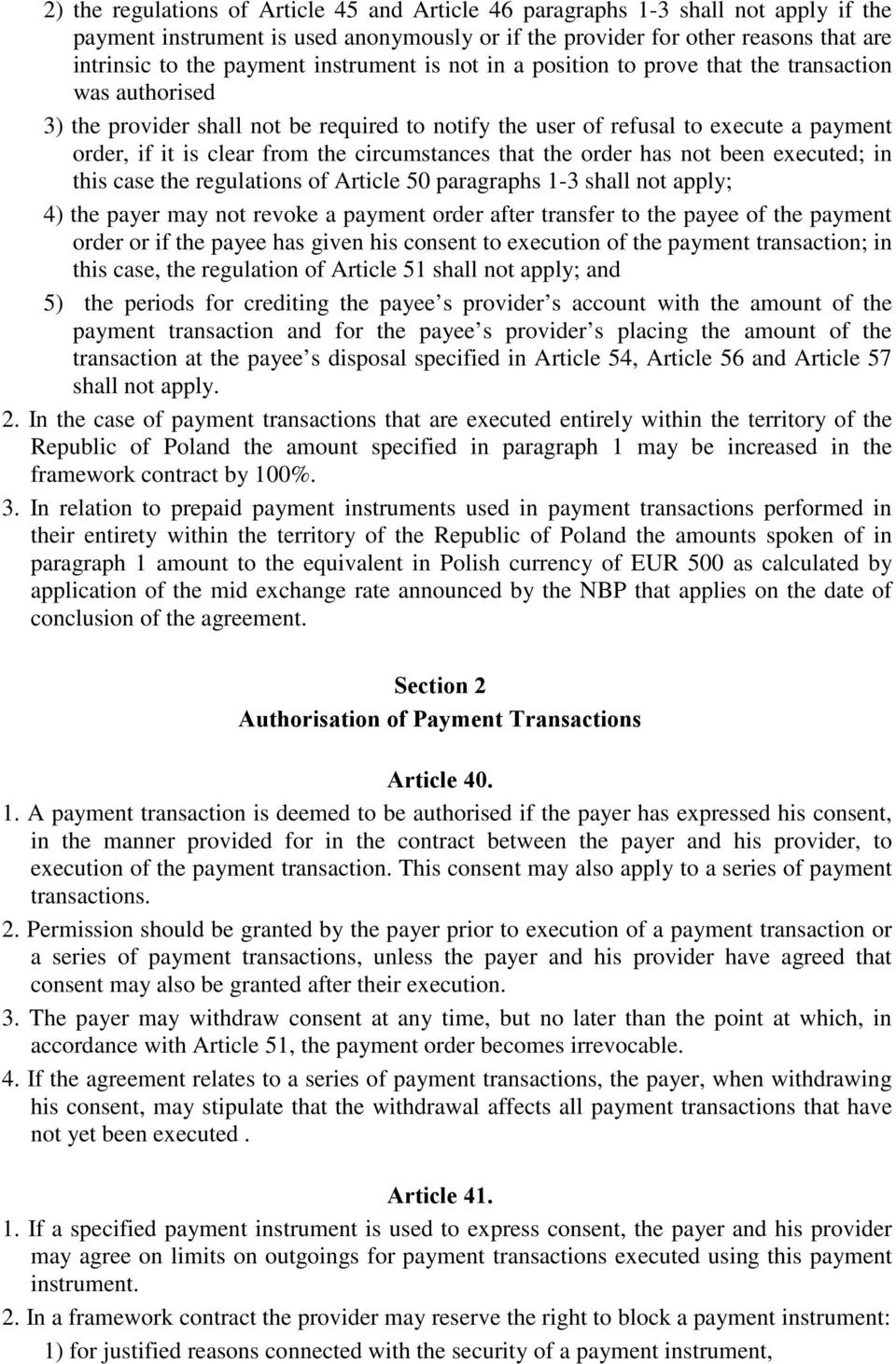
21 2) in connection with a suspicion of unauthorised use of a payment instrument or of intent to cause an unauthorised payment transaction, or 3) because of increased risk of the payer's losing the credit capacity required for a given payment instrument if use of the payment instrument is related to the payer s use of a credit granted to him. 3. The provider should inform the payer, in the agreed manner, about the blocking of a payment instrument before blocking the instrument and, if it that not possible, as soon as it is blocked. This does not apply to circumstances in which the transfer of information about the blocking of the instrument would be unreasonable for reasons of security or would be prohibited by separate regulations. 4. The provider shall unblock the payment instrument or replace it with a new one if the reasons for maintenance of the blockade cease to exist. Article A user who is authorised to use a payment instrument must: 1) make use of the payment instrument in accordance with the framework contract and 2) notify the provider or an entity designated by the provider without delay of the loss, theft, misappropriation or unauthorised use of the payment instrument or of unauthorised access to the instrument. 2. In order to meet the obligation spoken of in paragraph. 1 point 1, the user, from the point at which he receives a payment instrument must take the necessary measures to prevent breach of the various security features of the instrument, and in particular must store the payment instrument with due care and not make it available to unauthorised persons. Article When issuing a payment instrument a provider must: 1) ensure that the individual security features of a payment instrument are not available to persons other than the user who is authorised to use the instrument, 2) not send out an unsolicited payment instrument, except in situations where a payment instrument that the user has already received needs to be replaced, 3) ensure the continuing availability of adequate resources to enable the user to make a notification in accordance with Article 42 paragraph 1 point 2 or to make a request for unblocking or the replacement of a blocked payment instrument with a new one in accordance with Article 41 paragraph 4, 4) provide procedures that allow it to be proved that the notification spoken of in Article 42 paragraph 1 point 2 has been made, at the user s request for 18 months from the date of making the notification, and 5) prevent the use of a payment instrument after notification is made in accordance with Article 42 paragraph 1 point The provider bears the risk associated with sending to a payer a payment instrument or his individual security measures. Article A user must notify his provider immediately of detected unauthorised, unexecuted or improperly executed payment transactions.
22 2. If a user fails to make the notification spoken of in paragraph 1, then the provider s claims related to unauthorised, unexecuted or improperly executed payment transactions shall expire 13 months after the date of debiting the payment account or after the date on which the transaction was to have been executed. 3. If the user does not use a payment account the period spoken of in paragraph 2 is calculated from the date of execution of unauthorised or improperly executed payment transactions or from the date on which the payment transaction was to be executed. 4. The regulation of paragraph 2 does not apply if the provider did not make information about the payment transaction available in accordance with the regulations of Part II. Article The burden of proof that a payment transaction was authorised by the user or that it was executed correctly rests on the user s provider. 2. Demonstration by a provider of registered use of a payment instrument is not sufficient to prove that the payment transaction was authorised by the user. The provider must demonstrate the existence of other circumstances indicating authorisation of the payment transaction by the payer or of circumstances that indicate that the payer deliberately caused an unauthorised payment transaction or that he deliberately or by gross negligence caused a breach of one or more of the obligations spoken of in Article 42. Article Subject to the reservation of Article 44 paragraph 2, in the event of an unauthorised payment transaction s taking place, the payer s provider must promptly reimburse to the payer the amount of the unauthorised payment transaction without delay and, if the payer makes use of a payment account, must restore the debited payment account to the state in which it would have been if the unauthorised payment transaction had not taken place. 2. The payer is responsible for unauthorised payment transactions up to the equivalent in Polish currency of EUR 150, calculated using the mid exchange rate announced by the NBP that applies on the day on which the transactions were executed if an unauthorised transaction is the result of: 1) use of a payment instrument lost by the payer or stolen from the payer or 2) misappropriation of the payment instrument or its unauthorised use as a result of breach by the payer of the obligation spoken of in Article 42 paragraph The payer is responsible for the full amount of unauthorised transactions if he caused them to take place deliberately or as a result of a breach, deliberate or resulting from gross negligence, of one or more of the obligations spoken of in Article After making a notification in accordance with Article 42 paragraph 1 point 2 the payer is not responsible for unauthorised payment transactions, unless the player has deliberately caused an unauthorised transaction. 5. If the provider, contrary to the obligation spoken of in Article 43 paragraph 1 point 3 does not ensure the availability of adequate resources for making at any time the notification spoken of in Article 42 paragraph 1 point 2 the payer is not responsible for unauthorised payment transactions, unless the player has deliberately caused an unauthorised transaction. 6. The regulations of paragraphs 1 to 5 do not apply to electronic money within the meaning of Article 2 point 10 of the Act on Electronic Payment Instruments if the payer s provider is unable to block the payment instrument or the payment account.
23 Article A payer may demand of his provider reimbursement of the amount of an authorised payment transaction initiated by the payee or through his intermediation which has already been executed if; 1) at the time of the authorisation the exact amount of the payment transaction had not been specified and 2) the amount of the payment transaction is higher than the amount which the payer could expect, taking into account the type and value of the payer s earlier transactions, the regulations of the framework contract and circumstances that are relevant to the matter. 2. If requested to do so by the payer the provider must present the factual circumstances that demonstrate that the conditions specified in paragraph 1 have been met. 3. Reimbursement covers the full amount of the payment transaction executed. 4. If the framework contract between the payer and his provider provides for the execution of payment order services the parties may provide in the framework contract that the payer is entitled to receive from his provider reimbursement of the amounts of authorised transactions, even if the conditions spoken of in paragraph 1 are not met. 5. The payer may not rely on grounds relating to the conversion of currency to demonstrate that the condition spoken of in paragraph 1 point 2 has been met if the reference exchange rate agreed with the provider was used to determine the exchange rate 6. The framework contract between the payer and his provider may provide that the payer does not have the right to reimbursement of the amount of authorised transactions initiated by the payee if: 1) the payer has given consent to execution of a payment transaction directly to his provider or 2) information about a future payment transaction has been given to the payer by the provider or the payee, in the mutually agreed manner, at least four weeks before the date of execution of the order or was made available to the payee by the provider or payee, in the mutually agreed manner, for a period of at least four weeks before the date of execution of the order. Article The payer may seek the reimbursement spoken of Article 47 during a period of eight weeks after the date on which the payment account is debited and, if a payment account is not used, after the date on which the payment transaction was executed. 2. Within 10 business days of the date of receipt of a demand for reimbursement the provider shall reimburse the full amount of the payment transaction or provide grounds for a refusal to make a reimbursement and identify the body to which the payer may appeal in accordance with Article 15 if he does not agree with the grounds presented. In the circumstances specified in Article 47 paragraph 4 the provider may not refuse to make the reimbursement. 3. If the payer s provider is the NBP it may make the reimbursement spoken of in Article 47 conditional on receipt of funds from the payee s provider.
24 Section 3 Payment Orders and the Amount of Payment Transactions Article The time of receipt of a payment order is the time at which an order transmitted directly by the payer or indirectly by the payee or through his intermediation is received by the payer s provider. Where the payer s provider receives a payment order on a date which is not a business day for the provider the order shall be deemed to have been received on the first business day after that day. 2. A provider may set a time at the end of the business day after which payment orders received are deemed to have been received on the next business day. 3. If a user initiating a payment order and his provider agree that execution of a payment order is to begin: 1) on a specific date, 2) at the end of a specified period, or 3) on the date on which the payer places at his provider s disposal the funds for the execution of a payment order for the purposes of Article 54 the time of receipt of an order shall be deemed to be the beginning of the day spoken of in point 1 or the last day of the period spoken of in point 2 or the date spoken of in point If the date spoken of in paragraph 3 point 1 or 3 or the last day of the period spoken of in paragraph 3 point 2 is not a business day for the provider the order shall be deemed to have been received on the first business day after that day. Article A payer s provider may not refuse to execute an authorised payment order initiated by the payer or payee or through his intermediation unless the payer has not fulfilled the provisions of the agreement between the payer and the provider or the obligation to refuse execution arises from separate regulations. 2. If a provider refuses to execute a payment order, he must notify the user as soon as possible, and no later than within time limits set in accordance with Article 54 and Article 56: 1) of the refusal, 2) if possible, of the reasons for the refusal, and 3) if possible, of the procedure for rectifying the errors that caused the refusal unless such notification is not allowed under separate regulations. 3. The parties may stipulate in the agreement that the provider has the right to charge a fee for the notification spoken of in paragraph 2 if the refusal to execute the payment order was justified. 4. For the purposes spoken of in Article 54 and Article 56 and Articles a payment order execution of which has been refused shall be deemed to not have been received. Article A user may not revoke a payment order after its receipt by the payer s provider.
25 2. If the payment transaction is initiated by the payee or through his intermediation the payer may not revoke a payment order after sending of the payment order to the payee or after the payer gives the payee consent to execution of the payment transaction. 3. In the case of a direct debit payer may revoke a payment order, while keeping the right to reimbursement of the amount of the payment transaction, no later than the end of the business day preceding the agreed day for debiting of the payer s account. 4. In the circumstances spoken of in paragraph 49 paragraph 3 the user may revoke the payment order no later than the end of the business day preceding the agreed day. 5. After the times spoken of in paragraphs 1-4 a payment order may be cancelled only by mutual agreement between the user and his provider. In the circumstances spoken of in paragraphs 2 and 3 the consent of the payee is also required. 6. If this has been agreed in the contract, the provider may charge a fee for cancellation of the order. Article The payer s provider, the payee s provider and other entities that intermediate in the execution of a payment transaction may not reduce the amount of a payment transaction by a fee due for its execution or by other amounts due. 2. A contract between a payee and his provider may provide that the provider is to make available to the payee the amount of a payment transaction less fees charged. The provider is then obliged to provide information about the payment transaction, the full amount of the payment transaction and the fees charged. 3. The regulations of paragraph 1 and 2 do not preclude the admissibility of deduction by the provider from the amount of a payment transaction of the amount of tax liabilities and health insurance contributions related to the payment transaction. 4. If any charges other than those specified in paragraphs 2 or 3 are deducted from the amount of a payment transaction initiated by a payer the payer s provider must ensure that the payee receives the full amount of the payment transaction. In the case of payment transactions initiated by the payee or through his intermediation this obligation rests with the payee s provider. 5. Guided in particular by the need to transfer the full amount of sums due under public law into the designated bank account and taking into account the specific nature of these payments, the minister responsible for public finances may specify, by issuing a regulation, the detailed conditions for the levying of charges for the acceptance of payments of amounts due under public law that constitute the revenue of the state budget or of local government units made using a credit card or a similar payment instrument. Section 4 Time for Execution of a Payment Transaction and Value Date Article The regulations of this Section apply to: 1) payment transactions in euro; 2) payment transactions executed wholly on the territory of the Republic of Poland in Polish currency; and
26 3) payment transactions involving no more than one conversion of currency between: a) the euro and Polish currency if the conversion of currency is executed in the Republic of Poland, b) the euro and the currency of a Member State other than the Republic of Poland which is outside the euro area if the conversion of currency is executed in that Member State, or c) the euro and Polish currency or the euro and the currency of a Member State other than the Republic of Poland outside the euro area, executed in a Member State that is in the euro area, in the case of cross-border transfers initiated in euro. 2. The regulations of this Section also apply to the payment transactions spoken of in Article 5 paragraph 3 other than those identified in paragraph A user and his provider may agree that the regulations of this Section should not apply to the payment transactions spoken of in Article 5 paragraph 3 other than those identified in paragraph 1. The parties may not, however, agree to exclude the application of Article 59 and, in the case of payment transactions executed on the territory of one or more Member States, may not agree a time limit as spoken of in Article 54 longer than four business days from the time of receipt of the payment order. Article The payer s provider must ensure that the payment account of the payee s provider is credited with the amount of a payment transaction initiated by a payer no later than the end of the next business day after receipt of the order. 2. The period specified in paragraph 1 may be extended by one business day if the payer s provider received the payment order on paper. Article Article 54 paragraph 2 shall not apply to payment transactions that are undertaken wholly on the territory of the Republic of Poland in Polish currency which relate to liabilities to which the regulations of the Tax Ordinance Act of 29 August 1997 (Journal of Laws 2005 No. 8 item 60, as amended 12) ), referred to hereinafter as the Tax Ordinance and Council Regulation (EEC) No 2913/92 of 12 October 1992 establishing the Community Customs Code (Official Journal of the European Union L 302 of 19 October 1992 p. 1, as amended; Journal of Laws EU Polish Special Edition, Section 2 vol. 4, p. 307, as amended). 2. In the event of failure to keep to the due date of execution of a payment transaction spoken of in Article 54 paragraph 1 in respect of the liabilities spoken of in paragraph 1, the provider must pay to the State Treasury or the appropriate local government unit in the amount statutory interest in the amount set for interest on late payment of tax liabilities. 3. The regulations of the Tax Ordinance relating to the tax liability of a collector apply mutatis mutandis to the provider s liability for failure to comply with the obligation set out in article 54 paragraph 1 concerning the liabilities spoken of in paragraph 1. Article A payee s provider is to send a payment order initiated by the payee or through his intermediation to the payer s provider within a period agreed between the payee and his
27 provider that in the case of a direct debit transaction makes possible settlement of the transaction within the agreed time of payment. 2. The regulation of paragraph 1 shall apply mutatis mutandis to payment transactions by payment card or by a similar payment instrument initiated by the payee. Article 57. If a payee does not have a payment account with his provider, the funds are to be made available to the payee by the provider who receives funds for the payee within the period specified in Article 54 and Article 56 paragraph 1. Article 58. Where cash is placed on the payer-in s own or another person's payment account with the provider who maintains this payment account in the currency of the payment account it is to be made available on the account without delay after the receipt of the funds, no later than on the same business day, and is value dated immediately after the funds are paid in but if the payment is made by a non-consumer the funds must be made available on the account and value dated no be later than the next business day after receipt of the funds. Article A payee s provider shall credit the payee s payment account with the amount of a payment transaction with a value date of the business day on which the payee s provider s account was credited with the amount of the payment transaction. 2. The payee s provider shall make the amount of the payment transaction available to the payee without delay after the crediting with that amount of the payee s provider s account. 3. Debiting of the payer s payment account by the amount of the payment transaction shall take place with a value date no earlier than the point in time at which this account was actually debited by the amount of the payment transaction. 4. The payee s provider or of the payee may agree to a longer period than that specified in paragraph 2 for payment transactions that are initiated by the payee or through his intermediation. Part IV Domestic Payment Institutions Section 1 Taking Up and Pursuit of Business by Domestic Payment Institutions Article The provision of payment services as a domestic payment institution requires the authorisation of the PFSA. 2. Authorisation may be granted to a legal person with its registered office on the territory of the Republic of Poland, upon its application. Article 61.
28 1. An applicant tor the authorisation spoken of in Article 60 paragraph 1 shall append to its application: 1) up-to-date information about the number of its entry in the National Court Register; 2) its statutes or memorandum and Articles of incorporation; 3) a schedule of the payment services that it intends to operate; 4) a programme of operations and a financial plan for a period of at least three years; 5) documents that confirm the possession of funds allocated to own funds; 6) a description of solutions for governance and internal control mechanisms concerning duties related to the prevention of money laundering and the financing of terrorism, in accordance with the Act on Countering Money Laundering and the Financing of Terrorism of 16 November 2000 (Journal of Laws 2010 No. 46 item 276 and No. 182 item 1228 and 2011 No. 134 item. 779), referred to hereinafter as the "Act on Countering Money Laundering"; 7) a description of the organisational arrangements spoken of in Article 64 paragraph 1 points 3 and 4; 8) information that makes it possible to establish the identity of persons who directly or indirectly have a significant shareholding in the company or cooperative that intends to perform payment services, indicating the size of their holdings, and documents that confirm that these persons ensure sound and prudent management of the payment institution; 9) information that allows the identification of managers and documents that make it possible to assess whether these people ensure sound and prudent management of the payment institution, including whether they have the education and professional experience necessary for the management of operations in the area of the provision of payment services; 10) information that allows the identification of auditors and others authorised to audit accounts. 2. The applicant and the payment institution, after obtaining authorisation, shall inform the PFSA promptly of each change that affects the up-to-dateness of the information and documents appended to the application in accordance with paragraph The minister responsible for financial institutions shall determine, by issuing a regulation, the detailed scope of the information and the nature and form of the documents spoken of in paragraph 1 points 4-10, bearing in mind the need to verify whether the applicant meets the conditions necessary to obtain the authorisation spoken of in Article 60 paragraph 1 and the completeness and reliability of the documents appended to the application. Article In the course of proceedings on issue of the authorisation spoken of in Article 60 paragraph 1 the PFSA: 1) shall call on the applicant to add material to its application if the application does not conform to the requirements specified in Article 61 paragraph 1; and 2) may request supplementary information or documents that are needed to resolve the matter.
29 2. The PFSA shall issue a decision on the authorisation within three months of the date of receipt of the application or of the supplementary information spoken of in paragraph 1 point 1. Article 63. In the authorisation spoken of in Article 60 paragraph 1, the PFSA shall specify the payment services which the payment institution is authorised to provide. Article The authorisation spoken of in Article 60 paragraph 1 may be issued to entities: 1) with initial capital amounting at least to the equivalent in Polish currency of: a), the amount of EUR 125,000 if the applicant intends to provide all or several of the payment services listed in Article 3, b) the amount of EUR 50,000 if the applicant wishes to provide only the payment service spoken of in Article 3 paragraph 1 point 7, and b) the amount of EUR 20,000 if the applicant wishes to provide only the payment service of money remittance; 2) that possess funds dedicated to own funds of the required amount; 3) that ensure prudent and sound management of operations in the area of the provision of payment services by having organisational arrangements which are adequate given the type of payment services, their scale and their complexity, including: a) effective procedures for identifying, managing, monitoring and reporting risk to which the applicant is or may be exposed, b), an organisational structure with transparent and consistent lines of responsibility c) adequate internal control mechanisms, including administrative and accounting procedures and procedures for countering money laundering and the financing of terrorism; and 4) which have organisational arrangements designed to protect users funds in accordance with Article The equivalent in Polish currency given in paragraph 1 point 1 of the euro amount is to be calculated using the mid exchange rate announced by the NBP that applies on the date of issue of the authorisation. 3. Funds to cover the initial capital of a payment institution must not come: 1) from a loan or credit or be otherwise encumbered; or 2) from illegal or undisclosed sources. Article 65. The PFSA shall refuse to issue the authorisation spoken of in Article 60 paragraph 1 if: 1) the persons spoken of in Article 61 paragraph 1 points 8 and 9 does not ensure sound and prudent management of the payment institution, 2) the applicant does not have initial capital of the amount specified in Article 64 paragraph 1 point 1 or does not have the required amount of funds allocated to own funds,
30 3) the organisational arrangements spoken of in Article 64 paragraph 1 point 3 do not ensure sound and prudent management of operations in the area of the provision of payment services, 4) the funds to cover initial capital come from a loan or credit or are otherwise encumbered or come from illegal or undisclosed sources, 5) the financial plan or programme of operations do not ensure the ability of the domestic payment institution to perform the obligations arising from the provision of payment services, 6) close links between the applicant and another entity constitute an obstacle to the effective exercise of supervision over the domestic payment institution, or 7) the regulations of the law of a state other than a Member State apply to one or more natural or legal person with whom the applicant has close links or difficulties with the enforcement of those regulations would prevent the effective exercise of supervision over the domestic payment institution. Article A change in the payment services specified in the authorisation spoken of in Article 60 paragraph 1 that a payment institution is authorised to provide requires amendment of that authorisation; the regulations of Articles apply mutatis mutandis. 2. In place of the information and documents spoken of in Article 61 paragraph 1 a statement may be lodged about the up-to-dateness of the information contained in relevant documents that were submitted by the domestic payment institution together with its application for the issue of the authorisation spoken of in Article 60 paragraph 1. Article An authorisation to operate as a domestic payment institution lapses if the domestic payment institution: 1) does not commence operations in the area of payment services within 12 months of the date of issuance of the authorisation, with the date of commencement of operations in the area of payment services being deemed to be the date of execution of the first payment transaction; or 2) does not conduct operations in the area of payment services for a period of more than six consecutive months. 2. In the circumstances spoken of in paragraph 1 the PFSA shall issue a decision stating that the authorisation has expired. Article If the operations of a hybrid payment institution in an area that does not consist of the provision of payment adversely affect or may adversely affect the financial stability of the payment institution, or would restrict ability to exercise supervision, the PFSA may, by issuing a decision, instruct the hybrid payment institution to separate legally and organisationally its activities in the area of payment services by creating a new entity that will manage those activities. 2. In the decision spoken of in paragraph 1 the PFSA:
31 1) shall specify the period within which a new entity should be created to manage operations in the area of payment services, that period being no less than three months; and 2) may specify conditions relating to the separation of activities in the area of payment services. 3. The entity created in implementing the decision spoken of in paragraph 1 shall inform the PFSA of its being entered in the commercial register within seven days of that entry being made. 4. It shall append to the notification spoken of in paragraph 3 the information and the documents spoken of in Article 61 paragraph 1 points 1, 2 and 4-10, concerning the entity that was created in implementation of the decision spoken of in paragraph. 1. A statement about the up-to-dateness of the information contained in the relevant documents submitted by the hybrid payment institution may be lodged in place of the information and documents spoken of in Article 61 paragraph 1 points 4 and 6-10, this statement being deemed then to have been lodged by the entity. The regulations of Article 62 apply mutatis mutandis. 5. In the case of specification of the conditions spoken of in paragraph 2 point 2, the hybrid payment institution or the entity created in implementation of the decision spoken of in paragraph 1, no later than on the date of submitting the notification spoken of in paragraph 3, shall supply the PFSA with information and documents that confirm that these conditions have been met. 6. The authorisation spoken of in Article 60 paragraph 1 given to a hybrid payment institution shall be transferred to the entity created in implementation of the decision spoken of in paragraph 1 one month after the date of receipt by the PFSA of the notification spoken of in paragraph 3 or material supplementary to it if the requirements set out in paragraph 4 or 5 have not been met unless within that period the PFSA has declared its opposition to transfer of the authorisation. 7. The PFSA, by issuing a decision: 1) shall declare the objection spoken of in paragraph 6 if the circumstances spoken of in Article 65 are present; or 2) may declare the objection spoken of in paragraph 6 if the conditions spoken of in paragraph 2 point 2 have not been met. 8. From the date of transfer of the authorisation spoken of in Article 60 paragraph 1 the entity created in implementation of the decision spoken of in paragraph 1 shall take over the rights and obligations of the hybrid payment institution in the area of provision of payment services. 9. The authorisation spoken of in Article 60 paragraph 1 issued to a hybrid payment institution shall expire: 1) if the decision spoken of in paragraph 1 is not implemented within the period spoken of in paragraph 2 point 1; or 2) after the passage of three months from the date on which the decision on refusal spoken of in paragraph 6 becomes final. 10. In the circumstances spoken of in paragraph 9 the PFSA shall issue a decision stating that the authorisation has expired. 11. Within seven days of the date of the transfer of the authorisation spoken of in Article 60 paragraph 1 given to a hybrid payment institution to the entity created in implementation
32 of the decision spoken of in paragraph 1 or the issue of the decision spoken of in paragraph 10 the PFSA shall make amendments to the register. Article The PFSA may withdraw the authorisation spoken of in Article 60 paragraph 1 if: 1) the payment institution obtained the authorisation by submitting false information or in another unlawful manner; 2) the payment institution has ceased to meet requirements on which issue of the authorisation depended; 3) the payment institution carries out operations in violation of the authorisation or suffers a permanent loss of its capacity to fulfil its obligations; 4) the payment institution, in continuing operations in the area of payment services, would become a threat to the stability of a payment system; 5) persons who directly or indirectly possess a significant shareholding in the payment institution do not ensure sound and prudent management of the payment institution; 6) a manager does not ensure sound and prudent management of the payment institution; 7) close links between the domestic payment institution and other entities might make impossible effective exercise of supervision of the domestic paying institution; 8) the regulations of the law of a state other than a Member State that apply to one or more natural or legal persons with which the domestic payment institution has close links, or difficulties with the enforcement of those regulations, could make impossible the effective exercise of supervision of the institution; or 9) the payment institution, which does not apply the measures to protect users funds spoken of in Article 78 paragraph 1, has not concluded on time a bank or insurance guarantee agreement or the insurance policy spoken of in Article 78 paragraph A decision to withdraw authorisation shall take effect immediately. 3. If users interests so require, the PFSA may specify in the decision to withdraw authorisation the timing of and conditions for the payment institution s ceasing to provide payment services. Article The PFSA may withdraw an authorisation at the request of the payment institution. 2. Proceedings on the withdrawal of an authorisation at the request of the payment institution shall not be initiated if: 1) an inspection as spoken of in Article 103 is under way in the payment institution or the payment institution has been notified of intent to carry out such an inspection; or 2) proceedings have been initiated which may lead to the imposition on the payment institution of the penalty spoken of in Article 105 paragraph 1 point Proceedings that have been initiated shall be suspended until the date on which the decision on imposition of the penalty becomes final. 4. The regulation of Article 69 paragraph 3 shall apply to a decision to withdraw an authorisation at the payment institution s request. Article 71.
33 1. Within seven days of the date of the decision, the PFSA shall publish information about the revocation or the expiry of the authorisation spoken of in Article 60 paragraph 1 and shall give the reasons for the revocation or withdrawal of the authorisation. 2. The PFSA shall inform the European Commission of each case of revocation or withdrawal of the authorisation spoken of in Article 60 paragraph 1. Article 72. In the event of merger or division of the payment institution or the acquisition of its business the authorisation spoken of in Article 60 paragraph 1 shall not be transferred to the acquiring entity or the newly created entity formed by the merger or division or to the purchaser, subject to the reservation of Article 68 paragraph 6. Article 73. Information about a payment institution and about the payment services that it provides, including advertising, that is published by the payment institution, on the order of the payment institution or for the payment institution should be presented in a fair and understandable manner. Article A domestic payment institution, apart from providing payment services, may also: 1) provide additional services that are closely linked to the provision of payment services, such as: a) currency exchange services, b) secure storage services for funds received in order to carry out a payment transaction, and c) data storage and processing services. 2) manage payment systems; and 3) engage in other commercial business. 2. The provision, as part of the execution of payment transactions, by a domestic payment institution of currency exchange services does not constitute foreign exchange bureau operations within the meaning of the Currency Law of 27 July 2002 (Journal of Laws No. 141 item 1178 as amended 13) ) 3. In connection with the execution of payment services a payment institution may grant a credit for the execution of a payment transaction (a payment loan) only for the purpose of providing the payment services spoken of in Article 3 paragraph 1 points 2-6 and provided that the credit is not granted: 1) for a period longer than 12 months; or 2) from funds received or held for the purpose of undertaking a payment transaction. Article 75. A domestic payment institution is required to store documents related to the provision of payment services for a period of at least five years from the date of their generation or receipt. Section 2 Own Funds and Financial Management of Domestic Payment Institutions
34 Article A domestic payment institution is obliged to possess at all times own funds that are appropriate to the size of the business conducted and the type of payment services which may be provided on the basis of the authorisation. 2. The own funds of a domestic payment institution comprise: 1) initial capital of the payment institution; 2) revaluation reserves; and 3) retained profit from previous years. 3. Own funds are reduced by: 1) shares in the payment institution that are held by the payment institution itself, valued at the carrying amount net of write-downs due to impairment of their value, 2) all liabilities arising from preference shares; 3) intangible assets valued at the carrying amount; 4) losses from previous years; 5) losses during the course of approval; and 6) net losses for the current period. 4. The amount of a domestic payment institution s own funds may not be less than the higher of: 1) the minimum value of initial capital required in accordance with Article 64 paragraph 1 point 1 and 2) the amount calculated in accordance with regulations issued on the basis of paragraph If the payment institution provides the payment credits spoken of in Article 74 paragraph 3 then the requirement spoken of in paragraph 4 is increased by 5% of the total value of loans granted during the last financial year. 6. The minister responsible for financial institutions, after consulting the PFSA, shall determine, by issuing a regulation, the method to be used for calculating the amounts spoken of in paragraph 4 point 2, taking into account the total value of payment transactions performed during the last financial year by a domestic payment institution and the type of payment services that the domestic payment institution may provide on the basis of the authorisation it holds. 7. The PFSA may, by issuing a decision, on the basis of risk analysis and assessment of the risk management processes and internal control mechanisms of a domestic payment institution: 1) require the domestic payment institution to increase its own funds but not to more than 120% of the amount spoken of in paragraph 4 point 2; or 2) permit the domestic payment institution to reduce the amount of its own funds but not to less than 80% of the amount spoken of in paragraph 4 point 2. Article When calculating the own funds of a domestic payment institution which: 1) belongs to the same group as another domestic payment institution, a domestic bank, a branch of a foreign bank, a branch of credit institution, an electronic money
35 institution, an investment firm, an asset management entity or an insurance undertaking, or 2) engages in business as a hybrid payment institution funds which were included in the own funds of another group entity or of a hybrid payment institution that were calculated in relation to capital requirements arising from separate regulations may not be in any way included in the calculation. 2. Guided by the need to ensure maintenance of the real level of capital requirements specified in the Act, the minister responsible for financial institutions, after consulting the PFSA, may, by issuing a regulation, specify means of counteracting the multiple inclusion of the same items in own funds in the circumstances spoken of in paragraph 1. Article If a domestic payment institution accepts funds from users for execution of payment transactions, either directly or through the intermediation of another provider, it must keep them safely in accordance with the following principles: 1) funds which are accepted for the execution of payment transactions in the amount to be transferred to another payee or to a provider for transfer to the payee may not at any time during their safekeeping be combined with funds held by the domestic payment institution for other purposes; 2) funds which are accepted for the execution of payment transactions that have not been transferred to the payee or to another provider by the end of the business day following the date of receipt of those funds shall be, in at least as much as the amount to be transferred to the payee or to another provider for transfer to the payee,: a) placed in a separate bank account established for this purpose in a domestic bank, a credit institution or a branch of a foreign bank, or b) invested in safe, liquid low-risk assets that are deposited in a separate account established for this purpose. 2. The regulation of paragraph 1 shall not apply if the funds accepted for the execution of payment transactions are covered by a bank guarantee or insurance contract or by an insurance policy concluded with an insurance undertaking, a domestic bank, a branch of a foreign bank or a credit institution which does not belong to the same group as the domestic payment institution, for an amount equal to the amount which, if the principles spoken of in paragraph 1 applied would be subject to separation from other funds held by the domestic payment institution and placing on a separate bank account or invested. 3. The bank or insurance guarantee or insurance policy should cover the payment by the guarantor or the insurance undertaking of funds from the guarantee or the provision of compensation in the event of the domestic payment institution s failure to comply with obligations arising from contracts for the provision of payment services, and in particular of the obligation to refund payments made by users in the event of the domestic payment institution s failure to perform or improper performance of its obligations to users. 4. The bank or insurance guarantee contract should include authorisation for the PFSA to direct payment by the guarantor or the insurance undertaking of funds from the guarantee. 5. A domestic payment institution applying the requirements specified in paragraph 2 must submit to the PFSA the originals of documents that confirm that the next guarantee or insurance contract has been concluded prior to the expiry of the period of validity of the previous contract. The contract should cover the entire range of the institution s business.
36 6. In the case of domestic payment institutions that are commencing operations the amount spoken of in paragraph 2 shall be determined on the basis of the programme of operations and financing plan spoken of in Article 61 paragraph 1 point If the value of funds destined for execution of future payment transactions is variable or unknown in advance the PFSA may consent to application of the requirements specified in paragraph 2 on the basis of a representative amount if it considers that such a representative amount can be estimated on the basis of existing information. 8. The PFSA is authorised to act on behalf of users in handling the payment of funds from a bank guarantee contract or an insurance guarantee contract on the bases specified in those contracts. Article 79. The minister responsible for financial institutions shall specify, by issuing a regulation, the categories of assets spoken of in Article 78 paragraph 1 point 2 letter b and the maximum proportion of funds that may be invested in various categories of assets, with a view to appropriate security for user s funds, including reduction of investment risk. Article In the event of bankruptcy proceedings being commenced against a domestic payment institution the funds held on the accounts spoken of in Article 78 paragraph 1 shall be exempt from seizure on the basis of judicial or administrative execution. 2. In the event of a domestic payment institution being declared bankrupt the funds held on the accounts spoken of in Article 78 paragraph 1 shall be excluded from the estate in bankruptcy. 3. The exemption spoken of in paragraph 1 does not cover users claims against domestic payment institutions arising from non-implementation or improper implementation of payment orders by a domestic payment institution or against entities for which the institution bears liability to the user, within the limits of liability of a domestic payment institution specified in Articles Section 3 Reporting Requirements of Domestic Payment Institutions Article 81. A domestic payment institution shall submit to the PFSA annual financial statements drawn up in accordance with the Act on Accounting and also annual consolidated financial statements if there is an obligation to prepare such accounts. The reports shall be delivered together with the audit report and the opinion of an entity authorised to audit financial statements and a copy of the resolution or decisions of the body approving the financial reports no later than 15 days after the approval of the annual financial report by the entity s approving organ and of the annual consolidated financial reports by the parent entity s approving organ. Article 82. The entity authorised to audit financial statements must inform the PFSA immediately about circumstances and events confirmed during the audit process that constitute grounds for the
37 issue of a qualified opinion, a negative opinion or a refusal to express an opinion or that point to a violation of the regulations specifying the conditions for the issue of an authorisation to domestic payment institutions or regulating the conduct of domestic payment institutions operations or to a threat to the institution s continuing operations. Article A domestic payment institution submits to the PFSA quarterly and additional annual financial and statistical statements that cover: 1) the value of liquid funds held; 2) information about the credits spoken of in Article 74 paragraph 3 granted in the quarter or year, including their number, their value and the period for which they were granted; 3) information about payment transactions undertaken, including their value, number and currency structure; 4) a schedule of own funds together with an indication of their individual components and specification of their amounts; and 5) information about the nature and scope of the operations spoken of in Article 74 paragraph If requested to do so by a domestic payment institution, the PFSA, by issuing a decision, may in justified circumstances exempt it from the obligations spoken of in paragraph 1 or reduce their extent. 3. The minister responsible for financial institutions, after consulting the PFSA, shall specify, by issuing a regulation, the detailed scope, form and manner of drawing up the reports spoken of in paragraph 1 and the dates by which they must be submitted to the PFSA, taking into account the need to ensure that the PFSA has access to information that affects its assessment of the financial situation of the domestic payment institution, including information about the nature and extent of other business undertaken by the payment institution spoken of in Article 74 paragraph 1. Section 4 Use by a Domestic Payment Institution of the Services of Agents and the Outsourcing of the Performance of Certain Operational Functions to Other Entities Article A domestic payment institution may provide payment services through the intermediation of agents. 2. A contract between an agent and a domestic payment institution shall be concluded in writing or is otherwise invalid. Article A domestic payment institution shall notify the PFSA in writing of its intent to provide payment services through the intermediation of an agent and shall submit a request for entry of the agent in the register. 2. The notification spoken of in paragraph 1 should include: 1) the forename and surname or name (or brand) of the agent;
38 2) the registered office and address or place of residence and address and the address of the principal place of business of the agent; 3) a description of the internal control mechanisms related to the prevention of money laundering and the financing of terrorism in accordance with the Act on Combating Money Laundering; and 4) the names, surnames and functions of the persons responsible for management of the agent. Article A domestic payment institution may, on the basis of a contract concluded in writing with another entrepreneur, outsource to that entrepreneur the performance of specific operational functions related to the provision of payment services. 2. A domestic payment institution shall keep records of the contracts spoken of in paragraph 1 that contain the identity of the entrepreneur, the scope of the functions outsourced to him, the place where they will be performed and the duration of the contract. 3. If the contract spoken of in paragraph 1 provides for the outsourcing of important operational functions, the domestic payment institution shall notify the PFSA payment of its intent to conclude such a contract and of any amendment to it, its termination or its expiry at least 14 days prior to its conclusion, amendment, termination or expiry. 4. An operational function shall be regarded as important if a defect or failure in its performance could materially impair the continuing compliance of a domestic payment institution with the requirements on which the issuing of its authorisation depended or with other responsibilities imposed on the payment institution by the Act or would threaten its financial results or the reliability or continuity of the payment services that it provides. 5. A domestic payment institution may outsource to another entrepreneur the performance of important operational functions if this outsourcing of the performance of functions will not adversely affect the conduct by the domestic payment authority of operations in accordance with the regulations of the law and the authorisation issued to it and the prudent and stable management of the domestic payment institution and: 1) the entrepreneur is authorised to perform functions in the area of the subject matter of the contract if the regulations of the law create an obligation to possess such authorisation or he deals professionally with the performance of these activities; 2) the entrepreneur has the necessary knowledge and experience and ensures the technical and organisational conditions necessary for the proper performance of the contract spoken of in paragraph 1; 3) the entrepreneur s financial situation allows for the proper performance of the contract spoken of in paragraph 1; 4) the entrepreneur facilitates effective supervision by the domestic payment institution of the performance of the tasks outsourced to him and the management of the risk associated with the outsourced functions and the domestic payment institution possesses knowledge that enables effective supervision of performance of the outsourced functions and the management of risk; 5) the domestic payment institution will have access to information and documents related to the performance of the functions outsourced to the entrepreneur, in particular where the provision of these data takes place as a response to a request by the PFSA;
39 6) the domestic payment institution and the entrepreneur will have operating plans to ensure the continuous, safe and undisturbed conduct of operations in the field covered by the contract, including in the case of termination of the contract, as well as action plans that provide ways of recovering data that protect against their loss caused by fortuitous events. 6. Outsourcing the performance of operational functions may not: 1) lead to cessation of the actual provision of payment services by the domestic payment institution; or 2) include the right to represent the payment institution or to manage the payment institution within the meaning of Article and Article of the Commercial Companies Code of 15 September 2000 (Journal of Laws No. 94 item 1037, as amended 14) ) and Article 48 1 of the Cooperative Law of 16 September 1982 (Journal of Laws 2003 No. 188 item 1848, as amended 15 ). Article The PFSA may require a domestic payment institution that outsources operational functions to other businesses, in particular: 1) to submit a copy of the contract spoken of in Article 86 paragraph 1; 2) to provide explanations about the implementation of the agreement spoken of in Article 86 paragraph 1; and 3) to submit documents that specify the status of the entrepreneur with which the domestic payment institution has concluded a contract, and in the case of outsourcing the performance of important operational functions also the documents needed for assessment of the entrepreneur s compliance with the requirements laid down in Article 86 paragraph The PFSA, by issuing a decision, shall instruct a domestic payment institution to make amendments to or to terminate the contract spoken of in Article 86 paragraph 1 within a designated period if: 1) performance of the contract threatens the sound and prudent management of the domestic payment institution; or 2) an entrepreneur who is a party to the contract loses the authorisation needed for performance of the contract. 3. The domestic payment institution may appeal to the administrative court against the PFSA s decision spoken of in paragraph 2 within 14 days of being notified of the decision; the regulation of Article of the Code of Administrative Procedure of 14 June 1960 shall not apply. Lodging an appeal shall not delay enforcement of the decision. 4. The PFSA may take the measures spoken of in Article 105 paragraph 1 if the domestic payment institution does not ensure that the contract spoken of in Article 86 paragraph 1 is not amended or terminated within the designated period. Article In the field of provision of payment services a national payment institution shall be liable to users for the acts of its agents or of entities performing operational functions on the basis of a contract as spoken of in Article 86 paragraph 1 as though they were its own. 2. Subject to the reservation of Article 149, the liability spoken of in paragraph 1 may not be excluded or limited.
40 3. The liability of an agent or entity that performs operational functions under the contract spoken of in Article 86 paragraph 1 to a payment institution for damage caused to users as a result of failure to perform or improper performance of the contract spoken of in Article 84 paragraph 2 or in Article 86 paragraph 1 may not be excluded or limited. Article 89. Domestic payment institutions shall ensure that the branches through which they conduct business and the agents through the intermediation of which they provide payment services inform users honestly about this fact. Article 90. An agent must clearly identify, stating the registration number, the payment institution in the name of which and on behalf of which he acts in each contract concluded with a user. Part V The Taking Up and Conduct of Business in the Territory of a Host Country by a Payment Institution Article 91. A domestic payment institution may perform payment services under the authorisation spoken of in Article 60 paragraph 1 on the territory of another Member State through a branch, in the course of cross-border business or through the intermediation of an agent. Article A domestic payment institute shall inform the PFSA in writing of its intention to provide payment services on the territory of another Member State through a branch or through the intermediation of an agent and shall at the same time request entry of the branch or agent in the register. 2. The notification spoken of in paragraph 1 shall contain: 1) the name of the Member State on the territory of which the domestic payment institution intends to provide payment services through a branch or through the intermediation of an agent; 2) the name (or brand) and the registered office and address of the domestic payment institution; 3) the name (or brand) and address of the branch or the forename and surname or the name (or brand) of the agent and the registered office and address or place of residence and address and the address of the principal place of business; 4) a description of the organisational structure of the branch; 5) a description of the internal control mechanisms related to the prevention of money laundering and the financing of terrorism in accordance with the Act on Combating Money Laundering; 6) the forenames and surnames of those responsible for management of the branch or of the business of an agent, and
41 7) a list of the payment services which the domestic payment institution intends to provide on the territory of the Member State spoken of in point 1 through a branch or through the intermediation of an agent; 3. The PFSA shall call on the applicant to supplement the notification spoken of in paragraph 1 within a prescribed period, if the notification does not meet the requirements set out in paragraph Within one month of the date of receipt of the notification spoken of in paragraph 1, or of the supplementary information, the PFSA shall forward to the competent supervisory authorities of the host Member State the notification spoken of in paragraph 1 or, by issuing a decision, shall refuse to forward it. 5. The PFSA shall refuse to send the notification spoken of in paragraph 1 if: 1) the notice does not meet the requirements spoken of in paragraph 2 and supplementary information was not provided within the designated period; 2) the organisational structure of the branch of the domestic payment institution is inadequate for the intended activities; 3) the intended business of the branch or performance of services through the intermediation of an agent would violate the regulations of the law; 4) it possesses, or has obtained from the competent supervisory authorities of the host state in which the domestic payment institution intends to perform payment services, information which suggests that there are reasonable grounds to suspect that this activity is connected to the committing of an offence or to an offence that has been committed, that offence being spoken of in Article 165a or Article 299 of the Penal Code of 6 June 1997 (Journal of Laws No. 88 item 553, as amended 16) ), referred to hereinafter as the "Penal Code", or an attempt to commit such an offence has been made or committing such an offense is intended, or the commencement of the provision of services by a branch or through the intermediation of an agent could increase the risk of money laundering or financing of terrorism. Article If, within 30 days of the date of forwarding of the notifications spoken of in Article 92 paragraph 1, objections have not been raised by the competent authorities of the host state, the PFSA shall enter the branch or the agent in the register. If objections are received, the PFSA may refuse to make an entry in the register. 2. The PFSA shall inform the interested domestic payment institution about the registration. 3. The PFSA may refuse to make an entry in the register in relation to an agent or branch of a payment institution if it obtains from the competent supervisory authorities of the host country in which the payment institution intends to provide services through an agent or a branch any information that indicates that there are reasonable grounds to suspect that this activity is connected to the committing of an offence or to an offence that has been committed, that offence being spoken of in Article 165a or Article 299 of the Penal Code, or an attempt to commit such an offence has been made or committing such an offense is intended, or the commencement of the provision of services by an agent or the establishment of a branch could increase the risk of money laundering or financing of terrorism. Article 94.
42 A domestic payment institution shall inform the PFSA and the competent authorities of a host Member State in writing if it intends to alter the information spoken of in Article 92 paragraph 2 points 2-7 and shall do so at least one month before the alteration is made; the regulations of Article 92 paragraphs 3-5 and Article 93 shall apply mutatis mutandis. Article A domestic payment institute shall inform the PFSA of its intention to engage in crossborder activities. The notification should identify each payment service that the payment institution intends to perform and identify the Member States in which the payment institution intends to conduct cross-border activities. 2. The PFSA shall forward the notification spoken of in paragraph 1 to the competent supervisory authorities of the host Member State within one month of its receipt and shall inform the interested domestic payment institution that it has done so. Article 96. An EU payment institution may perform payment services on the territory of the Republic of Poland, through a branch, as cross-border activity or through the intermediation of an agent, in the area covered by the authorisation issued by the competent supervisory authorities. Article An EU payment institution may commence performing payment services on the territory of the Republic of Poland through a branch or through the intermediation of an agent one month after the date of receipt by the PFSA from the competent supervisory authorities of the home Member State of the following information: 1) the name (or brand) of the branch or the forename and surname or names (or brand) and address on Polish territory of the agent at which it will be possible to obtain documents concerning its activities; 2) a description of the organisational structure of the branch and a description of internal control mechanisms concerning obligations relating to the branch s or the agent s combatting money laundering and the financing of terrorism; 3) the forenames and surnames of those responsible for management of the branch or of the business of an agent, and 4) a schedule of the payment services which the EU payment institution intends to provide on the territory of the Republic of Poland. 2. An EU payment institution shall notify the PFSA of its intention to alter the information spoken of in paragraph 1 at least one month before the alteration is made. Alterations are binding from the date of receipt by the PFSA from the competent supervisory authorities of the home state of notification that confirms that those authorities have been notified of the alterations being made. 3. The PFSA shall inform the competent supervisory organs of the home Member State if the PFSA has reasonable grounds to suspect that the intended provision of services by an EU payment institution through the branch or through an agent is connected to the commission of an offence or to an offence that has been committed, that offence being spoken of in Article 165a or Article 299 of the Penal Code, or an attempt to commit such an offence has been made or committing such an offense is intended, or the commencement of the provision of services by the branch or through the intermediation of an agent could increase the risk of money laundering or financing of terrorism.
43 Article 98. An EU payment institution may begin cross-border activity on the territory of the Republic of Poland after receipt by the PFSA from the competent supervisory authorities of the home state of a notification that contains the name, the registered office and the address of the EU payment institution and a schedule of the payment services that the institution intends to perform as cross-border activities. Part VI Supervision of Domestic Payment Institutions and of Branches of EU Payment Institutions Article Activities in the field of payment services conducted by domestic payment institutions, including through their agents, and entities performing certain operational functions on the basis of an agreement as spoken of in Article 86 paragraph 1 are subject to supervision exercised by the PFSA in the area and on the principles set out in this Act and in the Act on Financial Market Supervision, hereinafter referred to as "supervision". 2. The purpose of this supervision is: 1) ensuring the financial security of domestic payment institutions; 2) ensuring the conformity of the activities of domestic payment institutions, including those performed by their agents and by entities performing certain operational functions on the basis of an agreement as spoken of in Article 86 paragraph 1 with the regulations of the Act and of Regulation (EC) No 924/2009 of the European Parliament and the Council of 16 September 2009 on Cross-border Payments in the Community and Repealing Regulation (EC) No 2560/2001 and of the authorisation spoken of in Article 60 paragraph 1; and 3) protection of the interests of users. Article 100. Activities undertaken as part of supervision consist in particular of: 1) assessing the financial situation of a domestic payment institution 2) studying the quality of the management system of a domestic payment institution, including the system of internal control; and 3) study of the correctness of operational functions connected with the provision of payment services. Article 101. The PFSA and persons performing supervisory activities shall not be liable for damages that result from actions or omissions in accordance with the regulations of the Act which are connected with supervision exercised by the PFSA. Article The PFSA may as part of the exercise of supervision:
44 1) call on a domestic payment institution to forward within a prescribed period all and any information that is needed to achieve the objectives of supervision spoken of in Article 99 paragraph 2; 2) require periodic reporting by a domestic payment institution of specified information that is needed for assessment of the financial situation of the domestic payment institution; 3) make recommendations to a domestic payment institution regarding: a) ensuring the conformity of the activities of the domestic payment institution with the regulations of the Act and of Regulation (EC) No 924/2009 of the European Parliament and the Council of 16 September 2009 on Cross-border Payments in the Community and Repealing Regulation (EC) No 2560/2001, b) increasing own funds if their amount is less than would result from the regulations of the Act or of the decision spoken of in Article 76 paragraph 7, c) the taking of measures needed to achieve and abide by the standards spoken of in Article 64 paragraph 1 point 1 and Article 76, d) the development and application of procedures to ensure the maintenance and ongoing monitoring of the level of own funds, and e) the taking of measures needed to prevent violations of the interests of users; 4) instruct a domestic payment institution to cease the distribution of profits or to cease the creation of new organisational units pending attainment of the standards spoken of in Article 64 paragraph 1 point 1 and Article 76; and 5) instruct a domestic payment institution to develop and implement a plan for the restoration of correct financial relations. 2. Taking into account protection of the interests of users, the PFSA may issue recommendations regarding good practices in prudent and stable management of domestic payment institutions. Article The PFSA may conduct an inspection of the activities and the financial situation of a domestic payment institution. 2. As part of the inspection spoken of in paragraph 1 the PFSA may also perform an assessment of the activities and the financial situation of an agent through the intermediation of which the payment institution provides payment services or of an entity that carries out operational functions on the basis of a contract as spoken of in Article 86 paragraph 1. If the inspection spoken of in paragraph 1 does not make it possible to establish everything that is necessary for assessment of the activities or the financial situation of an agent or an entity that carries out operational functions on the basis of a contract as spoken of in Article 86 paragraph 1, then inspection operations may be conducted directly in the agent or the entity that carries out operational functions on the basis of a contract as spoken of in Article 86 paragraph 1 as part of a separate inspection. 3. Control operations shall be performed by employees of the Office of the PFSA after presentation of a PFSA identification card and service of an authorisation issued by the Chairman of the PFSA or by a person authorised by him. 4. The employees spoken of in paragraph 3, in the area specified in the authorisation, shall have the right to: 1) enter the premises of the entity being inspected; 2) free access to separate office accommodation and to communications facilities;
45 3) examine documents of the entity being inspected and to require the making of copies and extracts from those documents; and 4) examine data contained in the IT system of the entity being inspected and require the making of copies or extracts from those data, including in the form of electronic documents. 5. The regulations of Section 5 of the Act on Freedom of Economic Activity apply to an inspection of the entrepreneur s commercial activity. Article The PFSA on each occasion shall inform the competent supervisory body of the host Member State of its intension to perform an inspection at the premises of an entity being inspected on the territory of the host Member State. 2. The PFSA may delegate to the competent supervisory authorities of the host Member State the task of carrying out inspections at the premises of the entities spoken of in Article The regulations of Article 103 shall apply to branches of EU payment institutions and their agents operating within the territory of the Republic of Poland if it is agreed with the competent supervisory authorities of the home Member State that an inspection is to be carried out by the PFSA. Article If it is determined that a domestic payment institution is not meeting or is improperly meeting its obligation to supply the information spoken of in Article 102 paragraph 1 point 1 or to supply the information spoken of in Article 102 paragraph 1 point 2 has not implemented within the prescribed period the recommendations spoken of in Article 102 paragraph 1 point 3, is making it difficult or impossible to carry out an inspection as spoken of in Article 103, or is not implementing the instructions specified in Article 102 paragraph 1 points 4 and 5, and also if the business of a domestic payment institution is conducted in violation of the law or threatens the interests of users, the PFSA, subject to Article 106, may: 1) request that an organ of the domestic payment institution dismiss the manager who is directly responsible for the irregularities found; 2) suspend the exercise of his functions by the manager spoken of in point 1, pending the adoption by the domestic payment institution s organ at its next meeting of a resolution on the request for his dismissal; suspension of the exercise of his functions means exclusion from the making of decisions for the domestic payment institution in regard of its ownership rights and obligations; 3) limit the area of activities of the domestic payment institution or of its organisational units; 4) impose on the manager who is directly responsible for the irregularities found a monetary penalty of up to three times the gross monthly remuneration of that person, calculated on the basis of his average gross remuneration for the last three months before the imposition of the penalty; 5) impose on the domestic payment institution a monetary penalty of up to PLN 1,000,000; or 6) withdraw the authorisation spoken of in Article 60 paragraph 1.
46 2. In setting the amount of the penalty spoken of in paragraph 1 point 5 the PFSA shall take into account in particular the nature and the gravity of the infringement, the size of business conducted and the financial situation of the domestic payment institution. 3. The regulation of Article 2 shall apply mutatis mutandis to setting the amount of the penalty spoken of in paragraph 1 point Application of the measures spoken of in paragraph 1 points 2-6 shall take place by the issue of a decision. Decisions in the matters spoken of in paragraph 1 points 2, 3 and 6 shall take effect immediately. 5. A decision by the PFSA to limit the area of activities may include conditions and time limits and a decision to impose a monetary penalty shall set a time limit for payment of the penalty. 6. The PFSA may also suspend the exercise of his functions by a manager if: 1) he is charged with a crime or with a tax offence; or 2) he causes significant losses to the domestic payment institution. 7. The PFSA shall immediately inform the competent supervisory authorities of a Member State in which the domestic payment institution conducts cross-border activities or operates through an agent or a branch if it withdraws the authorisation spoken of in Article 60 paragraph 1. Article If dissemination of the information spoken of in Article 73 is misleading or may be misleading the PFSA may: 1) issue the recommendation to a payment institution spoken of in Article 102 paragraph 1 point letter a concerning cessation of the information s distribution and not apply the regulations of Article 105 paragraph 1 points 1 3 and 6; 2) order, by issuing a decision, publication of a correction in a specified form and within a specified period; when ordering publication of a correction the PFSA may specify its contents. 2. If the order spoken of in paragraph 1 point 2 is not complied with the PFSA may, by issuing a decision: 1) impose on the manager who is directly responsible for failure to comply with the order a monetary penalty of up to three times the gross monthly remuneration of that person, calculated on the basis of his average gross remuneration for the last three months before the imposition of the penalty; or 2) impose on the payment institution a monetary penalty of up to PLN 1,000, The regulations of Article 105 paragraphs 2, 4 and 5 shall apply mutatis mutandis to the imposition of the penalties spoken of in paragraph 2. Article If an EU payment institution or its agent, conducting business on the territory of the Republic of Poland, breaches the regulations of Polish law the PFSA: 1) shall call on the institution in writing to comply with the regulations of Polish law and set a time limit for rectification of irregularities that have been found; and 2) if the time limit set in the call spoken of in paragraph 1 expires without effect, shall notify the competent supervisory authorities of the home Member State of the irregularities found.
47 2. If the breach of the regulations of Polish law concerns the regulations of parts II and III, then after the expiry without effect of the time limit set in the call spoken of in paragraph 1 point 1, the PFSA may apply the measures spoken of in Article 105 paragraph points 1 and 3, and notify the competent supervisory authorities of the home Member State of the irregularities found and the measures taken. 3. If, despite the application of supervisory measures by the competent supervisory authorities of the home Member State, an EU payment institution or its agent conducting business on the territory of the Republic of Poland still does not comply with the regulations of the Act, the PFSA may apply mutatis mutandis the measures spoken of in Article 105 paragraph 1 points 1, 3 and The regulation of Article 3 shall also apply in cases where: 1) the measures taken by the competent supervisory authorities of the home Member State prove insufficient given the infringements or impossible to apply on the territory of the Republic of Poland; or 2) the competent supervisory authorities of the home Member State, without justification, refuse to apply supervisory measures or unreasonably delay their application. 5. If application of the procedure spoken of in paragraph 1 would result in excessive delay which could directly endanger significant interests of users, the PFSA may apply mutatis mutandis the measures spoken of in Article 105 paragraph 1 points 1, 3 and 4 while omitting that procedure. 6. In the circumstances spoken of in paragraphs 3 and 5 the PFSA shall notify the competent supervisory authorities of the home Member State of the supervisory measures taken. 7. The regulations of Article of the Code of Administrative Procedure of 14 June 1960 shall not apply to decisions of the PFSA issued on the basis of paragraphs An EU payment institution may appeal to the administrative court against the decision of the PFSA spoken of in paragraphs 2-5 within seven days of being notified of the decision. Article In order to carry out the tasks arising from the Act the PFSA cooperates with competent supervisory authorities and other authorities or organs, and in particular with: 1) the European Central Bank; 2) the NBP and the central banks of other Member States; and 3) public authorities in other Member States that are responsible for supervising payment systems; 2. The PFSA may conclude agreements on cooperation in the area of supervision with competent supervisory authorities. Article 109. In order to perform the activities specified in Article 107 in relation to an EU payment institution and also in Articles in relation to a domestic payment institution providing payment services on the territory of a host Member State through the intermediation of an agent or through a branch or with the participation of an entity performing operational functions on the basis of the contract spoken of in Article 86 paragraph 1, the PFSA shall cooperate with the competent supervisory authorities of the home or the host Member State as appropriate.
48 Article 110. The PFSA shall transfer to the competent supervisory body of a host Member State, on request or on its own initiative, the information needed for purposes of the cooperation spoken of in Article 109, in particular in cases where it has confirmed or suspects breaches of the law by an agent, a branch or an entity performing operational functions on the basis of the contract spoken of in Article 86 paragraph 1. Article The PFSA may provide information obtained in connection with the exercise of its functions under the Act: 1) to competent supervisory authorities in the circumstances spoken of in Article 110; 2) to central banks of other Member States or other institutions of Member States carrying out tasks in the area of monetary policy and other public authorities of other Member States carrying out tasks in the area of supervision of payment systems; and 3) to authorities and institutions of the European Union that are competent in the area of matters relating to supervision of payment institutions or other providers or to supervision of payment systems. 2. Provision of the information spoken of in paragraph 1, shall take place if: 1) it is certain that the information provided will be used solely for the purpose of the exercise by those authorities of tasks in the area of supervision of providers, supervision of payment systems or tasks in the area of monetary policy; 2) it is guaranteed that the transfer of information beyond these bodies is possible only after obtaining the prior consent of the PFSA; and 3) this does not breach the principles of protection of information arising from separate regulations. Article Information obtained or generated in connection with the exercise of supervision the provision, disclosure or confirmation of which could infringe the interests protected by law of the entities that the information directly or indirectly concerns or could hinder the exercise of supervision of payment institutions, is protected by professional secrecy in accordance with the regulations of Article 16 of the Act on Supervision of Financial Markets. 2. The obligation to maintain confidentiality spoken of in paragraph 1 is not infringed by: 1) the provision of information in the situations spoken of in Article 111 paragraph 1; 2) the submission of a report that commission of an offence is suspected; or 3) the transfer of information to a person, an authority or another entity on the basis of separate regulations 3. In the case of information protected under separate regulations transfer by the PFSA of the information spoken of in paragraph 1 may not infringe the principles of protection set out in those regulations. Article Domestic payment institutions must pay contributions to cover the costs of supervision. Subject to the reservations of paragraphs 2 and 3, the contributions shall be paid in an
49 amount that is the product of the total amount of payment transactions carried out by a domestic payment institution, including by its agents, and a rate not exceeding 0.075%. 2. A rate not exceeding 0.05% shall apply to the payment transactions of payment institutions providing the payment service spoken of in Article 3 paragraph 1 point 6 and the payment service spoken of in Article 3 paragraph 1 point A rate not exceeding % shall apply to the provision of the payment services spoken of in Article 3 paragraph 1 points 4 and The total amount of payment transactions spoken of in paragraph 1 does not include payment transactions of a domestic payment institution undertaken in performance of functions excluded by point 6 regardless of whether the exclusion depends on the provision of other services. 5. The contributions spoken of in paragraph 1 are subject to enforcement in the manner set out in the regulations of the Act on Enforcement Proceedings in Administration of 17 June 1966 (Journal of Laws 2005 No. 229 item 1954, as amended 17) ), hereinafter referred to as the "Act on Enforcement Proceedings in Administration. Article Fees shall be paid for: 1) issue or amendment of the authorisation spoken of in Article 60 paragraph 1, except where the amendment consists only of limitation of the types of payment services that a payment institution is authorised to provide; 2) making an entry in the register, with the exception of an entry related to the issue or amendment of the authorisation spoken of in Article 60 paragraph The fees spoken of in paragraph 1 may not be higher than the equivalent in Polish currency of EUR 1,500, calculated using the mid exchange rate announced by the NBP that applies on the date of issue or amendment of the authorisation or the making of an entry in the register. 3. The fees spoken of in paragraph 1 are intended to cover the cost of supervision. The total of fees charged in a given year by payment institutions is deducted from the total amount payable by the institutions in accordance with Article 113 to cover the costs of supervision. 4. The fees spoken of in paragraph 1 are subject to enforcement in the manner set out in the regulations of the Act on Enforcement Proceedings in Administration. Article 115. The President of the Council of Ministers shall specify, by issuing a resolution: 1) the periods within which payment must be made and the amount and method of calculation of the payments spoken of in Article 113 paragraph 1, 2) the manner and periods for settlement of the payments spoken of in Article 113 paragraph 1; and 3) the amount and also the manner and periods for payment of the fees spoken of in Article 114 taking into account the nature of the functions which involve the obligation to pay fees and the need to ensure the effectiveness of the exercise of supervision, and also taking into account that the amount of payments to cover the costs of supervision and of fees should not significantly increase the operating costs of the entities obliged to pay them.
50 Article Proceedings regarding the imposition of the penalties spoken of in Article 105 paragraph 1 points 4 and 5 and in Article 106 paragraph 2 may not be begun more than six months from the date that the PFSA receives information about circumstances which may give rise to the imposition of a penalty or if more than two years have passed since the action in question. 2. The proceeds from the monetary penalties spoken of in Article 105 paragraph 1 points 4 and 5 and in Article 106 paragraph 2 constitute income of the state budget. Amounts due as monetary penalties are subject to enforcement in the manner set out in the regulations of the Act on Enforcement Proceedings in Administration. Article The regulations of Article 142 and Article e of the Banking Law shall apply mutatis mutandis to recovery proceedings and liquidation of a domestic payment institution and of branches of payment institutions. 2. The PFSA also has the right to lodge a motion for the declaration of the bankruptcy of a domestic payment institution. Part VII Payment Services Offices and Savings and Credit Unions Article A natural person, legal person or organisational unit that is not a legal person on which the law confers legal capacity may carry out the activities in the field of payment services spoken of in Article 3 paragraph 1 point 6 as a payment service office. This activity is a regulated activity within the meaning of the regulations of the Act on Freedom of Economic Activity. 2. The activities spoken of in paragraph 1 may be performed only on the territory of the Republic of Poland. 3. The average of the total amount of payment transactions in the previous 12 months performed by a payment service office, including by agents through the intermediation of which it provides payment services, may not exceed the amount of EUR 500,000 per month. 4. The average of the total amount of payment transactions for the month spoken of in paragraph 3 is calculated using the mid exchange rate announced by the NBP that applies on the last day of the month preceding that month. 5. A payment service office may conduct other business than the provision of payment services. Article 119. Activities in the area of payment services as a payment service office may be performed after obtaining an entry to the registry. Article Activities as a payment service office may be performed on condition that:
51 1) the office has organisational arrangements that make possible: a) calculation of the total monthly amount of payment transactions, and b) fulfilment of obligations related to the prevention of money laundering and the financing of terrorism, in accordance with the Act on Combating Money Laundering; and 2) the person managing the office is not a person who has been convicted of an offence against business transactions, an offence against transactions in money and securities, the offence spoken of Article 165a of the Criminal Code or a tax offence. 2. A payment service office must have a programme of operations and a financial plan for the first 12 months of business that takes into account the requirement specified in Article 118 paragraph The regulation of Article 73 shall apply mutatis mutandis to payment service offices. Article 121. A payment service office may provide payment services through the intermediation of an agent and may outsource to another entrepreneur the performance of specific operational functions related to the provision of payment services; the regulations of Articles apply mutatis mutandis. Article An application for entering a payment service office in the register shall contain information about: 1) the applicant: a) the name (or brand), b), the number in the commercial register or number of the entry in the Central Register and Information Record on Commercial Activity, and c) the registered office and address or place of residence and address and the address of the principal place of business; 2) the applicant's agents : a) the forename and surname or name (or brand), and b) the registered office and address or place of residence and address and the address of the agent s principal place of business; and 3) branches of the applicant: a) the name (or brand) of the branch, and b) the address of the branch. 2. The application for making an entry in the register spoken of in paragraph 1 shall be accompanied by a statement reading as follows: "I declare that: 1) the information contained in the application is complete and truthful; and 2) the conditions for the performance of commercial activities as a payment service office spoken of in the Act on Payment Services of 19 August 2011 (Journal of Laws No. item ) are known to me and I meet them. Article 123. A payment service office shall notify the PFSA of its intention to cease business or activities as a payment service office, giving the date on which activities are to cease.
52 Article 124. The regulations of the Act on Freedom of Economic Activity shall apply to matters concerning the taking up, pursuit and cessation of activities in the area of payment services as a payment service office, including cases of refusal to make an entry in the register, the issue of a decision prohibiting the conduct of business and the cancellation of an entry in the register, that are not regulated by the Act. Article A payment service office is obliged to protect the funds received from users, including through the intermediation of an agent or another provider, in order to carry out payment transactions. 2. A payment service office fulfils the obligation spoken of in paragraph 1 by concluding with a domestic bank, a credit institution, a branch of foreign bank or an insurance undertaking which does not belong to the same group as the payment service office in question a bank guarantee or insurance contract or an insurance policy. 3. The bank or insurance guarantee contract or insurance policy should cover the payment by the guarantor or the insurance undertaking of funds from the guarantee or the provision of compensation if the payment service office is unable to meet its obligations arising from contracts for the provision of payment services, and in particular the obligation to refund payments made by users in the event of the payment service office s failure to perform or improper performance of its obligations to users. 4. The bank or insurance guarantee contract should include authorisation for the PFSA to instruct payments by the guarantor of funds from the guarantee. 5. The guarantee or insurance contract spoken of in paragraph 2 may not be concluded for a period of less than 12 months. 6. A payment service office must submit to the PFSA the original of the document that confirms the conclusion of the first bank or insurance contract or first insurance policy within seven days of the date of its conclusion and then submit to the PFSA the originals of documents that confirm the conclusion of each successive guarantee or insurance contract before the expiry of the period of validity of the previous contract within seven days of the date of conclusion of the contract. 7. In the event of breach of the obligation spoken of in paragraph 5 the PFSA may impose on a payment service office a monetary penalty not exceeding PLN 500 for each day of delay but no more than PLN 100,000; the regulations of Article 105 paragraphs 2, 4 and 5 and Article 116 apply mutatis mutandis. 8. The minister responsible for financial institutions shall specify, by issuing a regulation, the minimum sum of the guarantee spoken of in Article 2 and the date from which the obligation to conclude a guarantee contract applies, taking into account the amounts of payment transactions. 9. The minister responsible for financial institutions shall specify, by issuing a regulation, the detailed scope of the insurance spoken of in paragraph 2 and the date from which the obligation to effect insurance applies and the minimum sum of the guarantee, taking into account the amount of payment transactions. 10. The PFSA is authorised to act on behalf of users in handling the payment of funds from a bank guarantee contract or an insurance guarantee contract on the principles specified in those agreements.
53 Article A payment service office must notify the PFSA: 1) each time the level of EUR 500,000 is exceeded by: a) the total amount of payment transactions, including by agents through the intermediation of which it provides payment services, in a given month, or b) the average monthly amount of payment transactions, including those performed by agents through the intermediation of which the payment service office provides payment services for each period of the last three months and the last 12 months; or 2) of the commencement of criminal proceedings regarding an offence spoken of in Article 120 paragraph 1 point 2 or of proceedings regarding a tax offence against the manager of the office. 2. The regulation of Article 118 paragraph 4 shall apply mutatis mutandis to calculation of the amount of payment transactions spoken of in paragraph 1 point The notification spoken of in paragraph 1 should be made within 14 days of the date: 1) of expiry of the periods spoken of in paragraph 1 point 1; or 2) on which the office becomes aware of the commencement of proceedings spoken of in paragraph 1 point In the event of a breach of the obligation spoken of in paragraph 1 the PFSA may impose on a payment service office a monetary penalty not exceeding PLN 500 for each day of delay but no more than PLN 100,000; the regulations of Articles 105 paragraphs 2, 4 and 5 and Article 116 shall apply mutatis mutandis. Article If the average total amount of payment transactions spoken of in Article 118 paragraph 3 is exceeded a payment service office, regardless of the obligation to make the notification spoken of in Article 126 paragraph 1 point 1 letter b must adjust the size of the business conducted in the area of payment services to meet the requirement spoken of in Article 118 paragraph 3 within three months of the end of the period in which the requirement was exceeded. 2. If together with the notification spoken of in Article 126 paragraph 1 point 1 letter b the payment service office lodges an application for issue of the authorisation spoken of in Article 60 paragraph 1 the regulations of paragraph 1 shall not apply prior to consideration of the application. In the event of refusal to issue the authorisation spoken of in Article 60 paragraph 1 or discontinuance of proceedings, the time limit spoken of in paragraph 1 shall run from the date on which that decision becomes final. Article A payment service office must submit to the PFSA information about the total amount and the number of payment transactions undertaken, including through its agents: 1) in a given quarter, by the end of the first month of the following quarter; 2) in a given year, no later than by 31 January of the following year; and 3) in a given month during the period spoken of in Article 127 paragraph 1 and in the second sentence of paragraph 2 no later than by the 15th day of the following month.
54 2. The PFSA shall inform the European Commission of the number of payment service offices and the total amount of payment transactions carried out in a given year by payment service offices, including by their agents. Article Activities in the area of payment services conducted by payment service offices are subject to the exercise of supervision by the PFSA to the extent and under the conditions set out in this Act and in the Act on Supervision of Financial Markets. 2. The purpose of supervision of payment service offices is to ensure that the activities of payment service offices comply with the regulations of the law and to protect the interests of users of payment services. 3. The regulations of Article 100, Article 102 paragraphs 1, 2 and 5, Article 103, Article 106 paragraph 1 and Article 112 shall apply mutatis mutandis to supervision of payment service offices. 4. As part of supervision the PFSA may issue recommendations to payment service offices on: 1) ensuring compliance of an office s activities with the regulations of the law; and 2) the adoption of measures needed to prevent violation of users interests. 5. If it is determined that a payment service office is not meeting or is improperly meeting its obligation to supply the information spoken of in Article 102 paragraph 1 point 1 and to transfer the information spoken of in Article 102 paragraph 1 point 2, has not implemented within the specified period recommendations as spoken of in Article 4 or an instruction as spoken of in Article 102 paragraph 1 point 5, is making it difficult or impossible to carry out an inspection as spoken of in Article 103, or if the activities of a payment service office are performed in breach of the law or pose a threat to the interests of users, the PFSA may apply the measures spoken of in Article 105 paragraph 1 points In the circumstances spoken of in paragraph 5 the PFSA may also: 1) impose on the manager who is directly responsible for the irregularities found a monetary penalty of up to three times the gross monthly remuneration of that person, calculated on the basis of his average gross remuneration for the last three months before the imposition of the penalty; or 2) impose on the payment service office a monetary penalty of up to PLN 500, The monetary penalties spoken of in paragraph 6 may also be imposed by the PFSA in the event of failure to implement the recommendations or instructions spoken of in Article 106 paragraph The regulations of Article 105 paragraphs 2, 4 and 5 and Article 116 shall apply mutatis mutandis to the imposition of the penalties spoken of in paragraph 6. Article Payment services offices must pay contributions to cover the costs of supervision in an amount that constitutes the product of the total amount of payment transactions performed by an office, including through its agents, and a rate of no more than 0.025%. 2. The contributions spoken of in paragraph 1 are subject to enforcement in the manner set out in the regulations of the Act on Enforcement Proceedings in Administration. 3. The President of the Council of Ministers shall specify, by issuing a resolution:
55 1) the periods within which payment must be made and the amount and method of calculation of the payments spoken of in Article 1; and 2) the manner and periods for settlement of the payments spoken of in Article 1 taking into account the nature of the functions which involve the obligation to pay fees and the need to ensure the effectiveness of the exercise of supervision, and also taking into account that the amount of payments to cover the costs of supervision and of fees should not significantly increase the operating costs of the entities obliged to pay them. Article A savings and credit union shall notify the PFSA of its commencement of activities in the area of provision of payment services within 30 days of the date of commencement of activities, indicating: 1) its name (or brand) and the registered office and address; 2) its number in the commercial register; 3) a schedule of the payment services provided; and 4) the names and addresses of branches of the union. 2. The National Cooperative Savings and Credit Union shall inform the PFSA of the cessation of activities by a savings and credit union within 14 days of receiving such information, indicating the date of which the savings and credit union is to cease its activities. Article 132. The regulations of Article 81 and Article 82 shall apply mutatis mutandis to savings and credit unions. Part VIII The Register of Domestic Payment Institutions and Other Providers Article The PFSA shall maintain a register in an IT system. 2. The register shall be public and accessible to third parties through the website of the PFSA. 3. The register shall consist of parts relating to: 1) domestic payment institutions, their agents and their branches; 2) savings and credit unions and their branches; and 3) payment service offices, their agents and branches. Article 134. An entry in the register in the part spoken of in Article 133 paragraph 3 point 1 shall contain: 1) the number of the entry in the register; 2) information on the domestic payment institution, including: a) its name (or brand), b) its number in the commercial register; and
56 c) its registered office and address; 3) information about the payment services that the domestic payment institution is authorised to provide, including: a) the date of issue of the authorisation spoken of in Article 60 paragraph 1 and of amendments to it, and b) a schedule of the payment services falling within the scope of the authorisation spoken of in Article 4 60 paragraph 1; 4) information about the domestic payment institution s agents, including: a) the forename and surname or name (or brand) of each agent, and b) the registered office and address or place of residence and address and the address of each agent s principal place of business; 5) information on branches of the domestic payment institution, including: a) the name (or brand) of each branch, and b) the address of each branch. 6) information on the payment services performed by the national institution payment in another Member State, including: a) a schedule of the states in which the domestic payment institution provides payment services, b) the information specified in point 4 or point 5 concerning the entity through which the domestic payment institution provides payment services in another Member State, and c) a schedule of the payment services provided. Article 135. An entry in the register in the part spoken of in Article 133 paragraph 3 point 2 shall contain: 1) the number of the entry in the register; 2) data regarding the savings and credit union, including: a) its name (or brand), b) its number in the commercial register; and c) its registered office and address; 3) a schedule of payment services provided; and 4) data regarding branches of the savings and credit union, including: a) the name (or brand) of each branch, and b) the address of each branch. Article 136. An entry in the register in the part spoken of in Article 133 paragraph 3 point 3 shall contain: 1) the number of the entry in the register; 2) information about the payment service office, including: a) its name (or brand), b), the number in the commercial register or number of the entry in the Central Register and Information Record on Commercial Activity, and c) the registered office and address or place of residence and address and the address of the principal place of business;
57 3) information about the agents of the payment service office, including: a) the forename and surname or name (or brand) of each agent, and b) the registered office and address or place of residence and address and the address of each agent s principal place of business; 4) information about the branches of the payment service office, including: a) the name (or brand) of each branch, and b) the address of each branch. Article An entry in the register and cancellation of an entry in the register shall be made on request, unless the Act provides otherwise. 2. By an entry in the register is understood also an amendment to an entry. 3. The PFSA on its own initiative shall correct entries in the register that contain clerical errors or obvious mistakes. Article Entry of a domestic payment institution in the register and entry of an amendment to the range of services provided by a payment service provider shall be made at the PFSA s own initiative, within 14 days of the date of issue of the authorisation spoken of in Article 60 paragraph 1 or of amendments to it. 2. Entry of a savings and credit union in the register shall be made by the PFSA on its own initiative within 14 days of the date of receipt of the notification spoken of in Article 131 paragraph 1. Article Domestic payment institutions, payment service offices and savings and credit unions are obliged to ensure the conformity of information entered at their request with the factual state of affairs. 2. The entities spoken of in paragraph 1 are obliged to inform the PFSA about every change in the information contained in an entry in the register no later than 14 days after the date on which they obtain information about the change, by submitting an appropriate request. 3. In the event of a breach of the obligation spoken of in paragraph 2 the PFSA may impose on the entity spoken of in paragraph 1 a monetary penalty not exceeding PLN 500 for each day of delay and of no more than PLN 100,000; the regulations of Article 105 paragraphs 2, 4 and 5 and Article 116 apply mutatis mutandis. Article 140. Refusal to make an entry in the register occurs by way of administrative decision. Article The PFSA may refuse to make an entry in the register if the application is incomplete and if supplementary information has not been supplied within the time limit set or the information contained in the application is inconsistent with the facts. 2. The PFSA shall refuse to make an entry in the register of a natural person who has been barred by law from engaging in business in the area covered by the entry.
58 Article The PFSA shall cancel an entry in the register on its own initiative in the event of: 1) revocation or expiry of the authorisation spoken of in Article 60 paragraph 1; 2) cessation of operations by a savings and credit union, on the basis of the notification spoken of in Article 131 paragraph 2; 3) cessation by a payment service office of operations as a payment service office, on the basis of the notification spoken of in Article 123, no earlier than on the date given in the notification; or 4) a final and binding judgement against a natural person entered in the register that bars him from engaging in business in the area covered by the entry. 2. The PFSA may on its own initiative cancel an entry in the register concerning an agent or a branch of a domestic payment institution if it receives from the competent supervisory authorities of a host Member State in which the domestic payment institution provides payment services through a particular agent or a particular branch information that indicates that there are reasonable grounds to suspect that, in connection with that activity a criminal offence spoken of in Article 165a or Article 299 of the Criminal Code is being committed or has been committed, or an attempt to commit such an offence has been made or committing such an offense is intended, or the provision of services by the agent or the activities of the branch could increase the risk of money laundering or financing of terrorism. Cancellation of an entry in the register takes place by adoption of a decision. Part IX Civil and Criminal Liability Section 1 Liability for the Execution of Payment Transactions Article A payment order shall be deemed to have been made to the proper payee if it was made in accordance with the information spoken of in Article 23 paragraph 1 point 1 or in Article 27 point 2 letter b and in the case of inclusion of a unique identifier in the body of a payment order if it was made in accordance with the unique identifier regardless of any other additional information provided by the user. 2. If the unique identifier given by the user is incorrect, the provider shall not bear liability on the basis of Articles The payer s provider must, however, take action to recover the amount of the payment transaction. The parties may stipulate in a contract that the provider has the right to collect from the user a fee for recovery of the funds; the regulation of Article 36 paragraph 2 shall apply mutatis mutandis. 3. When executing payment transactions using a bank account the unique identifier shall be the number of the bank account unless the parties agree in a framework agreement on another unique identifier.
59 Article Where a payment order is initiated by the payer, his provider shall be liable to the payer for failure to execute or improper execution of a payment transaction, subject to the reservation of Article 44 paragraph 2, Article 143 paragraph 2 and Article 149, unless it proves that the payee s provider s account was credited in accordance with Article If the payer s provider bears liability in accordance with paragraph 1, it shall reimburse to the payer without delay the amount of the unexecuted or improperly executed payment transaction or, if the payer uses a payment account, restore the debited payment account to the condition it would have been in if failure to execute or improper execution of the payment transaction had not occurred. 3. If the payee s provider s account was credited in accordance with Article 54 the payee s provider shall be liable to the payee for the failure to execute or improper execution of the payment transaction. 4. If the payee s provider bears liability in accordance with paragraph 3 it shall place at the payee s disposal without delay the amount of the payment transaction or, if the payee uses a payment account, credit the payee s payment account with the appropriate amount so as to place the payment account in the condition it would have been in if failure to execute or improper execution of the payment transaction had not occurred. Article Where a payment order is initiated by the payee or through his intermediation, subject to the reservation of Article 44 paragraph 2, Article 143 paragraph 2 and Article 149, his provider shall be liable to the payee for the correct transfer of the payment order to the payer s provider in accordance with Article If the payee s provider is liable in accordance with paragraph 1 it shall forward the payment order without delay once again to the payer s provider. 3. Subject to the reservation of Article 44 paragraph 2, Article 143 paragraph 2 and Article 149 the payee s provider shall be liable to the payee for failure to execute or improper execution of the payment transaction in the event of a breach of Article If the payee s provider is liable in accordance with paragraph 3 it shall make the amount of the payment transaction available to the payee without delay after it is credited to the payee s provider s account. 5. In the event of failure to execute or improper execution of the payment transaction for which the payee s provider is not liable in accordance with paragraphs 1 and 3 liability to the payee shall be borne by the payer s provider; in this case Article 144 paragraph 2 shall apply. Article In the case of failure to execute or improper execution of a payment transaction: 1) initiated by the payer, his provider, irrespective of the liability borne under Article 144 paragraph 1 shall, at the request of the payer, take without delay measures to trace the payment transaction and notify the payer about their outcome; 2) initiated by the payee or through his intermediation, his provider, irrespective of the liability borne under Article 145 paragraphs 1 and 3 shall, at the request of the payee, take without delay measures to trace the payment transaction and notify the payee about their outcome.
60 2. The liability of the provider specified in Article 144 and Article 145 also covers fees and interest that was charged to the user as a result of failure to execute or improper execution of the payment transaction. Article 147. The liability of the provider specified in Articles does not exclude the user's claims arising from a contract concluded with the provider and from the regulations of the law applicable to that contract. Article 148. Where failure to execute or improper execution of a payment transaction is the result of an act or omission of a provider other than the payer s or the payee s provider of or other entity intermediating in the execution of a payment transaction, the payer s or the payee s provider may demand from it reimbursement of the sums paid in accordance with Articles ; the regulation of Article 147 shall apply mutatis mutandis. Article 149. Liability for failure to execute or improper execution of a payment transaction is excluded in the event of force majeure or if the failure to execute or improper execution of a payment order results from other legal regulations. Section 2 Penal Provisions Article A person who engages in activities in the area of provision of payment services without being a provider shall be subject to a fine of up to PLN 5,000,000 or to imprisonment for up to two years or to both penalties together. 2. An unauthorised person who uses in his name (or brand) or to specify the commercial activity performed or in advertising the terms "payment services", "payment service office" or "payment institution" shall be subject to the same penalty. 3. A person who commits the offence specified in paragraphs 1 or 2 in the name of or for the benefit of a natural person, a legal person or an organisational unit that is not a legal person on which the law confers legal capacity shall be subject to the same penalty. Article A person who is not authorised to do so by a provider who concludes in the provider s name or on the provider s behalf a contract about a payment service shall be subject to a fine of up to PLN 3,000,000 or to imprisonment for two years or to both penalties together. 2. A person who commits the offence specified in paragraphs 1 in the name of or for the benefit of a natural person, a legal person or an organisational unit that is not a legal person on which the law confers legal capacity shall be subject to the same penalty.
61 Article A person who, while being responsible in a payment institution or a payment service office for supplying information to the Polish Financial Supervision Authority, supplies information that is inconsistent with the actual facts or otherwise misleads the authority shall be subject to a fine of up to PLN 1,000,000 or to imprisonment for up to two years or to both penalties together. 2. If the perpetrator acts unintentionally he shall be subject to a fine of up to PLN 500,000 or to imprisonment for up to a year or to both penalties together. Article A person who is obliged to preserve the confidentiality of information spoken of in Article 11 paragraph 3 who discloses it in a manner contrary to the authorisation specified in the Act shall be subject to a fine of PLN 500,000 or to imprisonment for up to two years or to both penalties together.2. If the perpetrator commits the offence spoken of in paragraph 1 so as to obtain financial or personal benefits, he shall be liable to a fine of up to PLN 1,000,000 or a penalty of imprisonment of up to three years, or to both these penalties together. Part X Amendments to Legislation Currently in Force Article 154. In the Act on Accounting of 29 September 1994 (Journal of Laws 2009 No. 152 item 1223, as amended 18) )in Article 82 in point 4 the full stop is replaced by a semi-colon and point 5 is added with the following wording: "5) after consulting the Chairman of the Polish Financial Supervision Authority, to specify the detailed principles of accounting by domestic payment institutions, including the range of information reported in financial statements and in the consolidated financial statements of a capital group and reports on activities". Article 155. In the law of 14 December 1995 on Cooperative Savings and Credit Unions (Journal of Laws 1996 No. 1 item 2, as amended 19) ) is amended as follows: 1) to Article 3 there is added paragraph 3 with the following wording: "3. Unions shall be subject to entry in the register of domestic payment institutions and other providers spoken of in the Act on Payment Services of 19 August 2011 (Journal of Laws No. item...). ; 2) Article 32 is repealed. Article 156. In the Tax Ordinance of 29 August 1997 (Journal of Laws 2005 No. 8 item 60, as amended 20) )the following amendments are made: 1) in Article 60: a) 1 and 1a are amended to read as follows: " 1. The date of payment of tax shall be deemed to be:
62 1) when paying in cash the date of payment of the amount of the tax at the tax authority s cash-desk or into that authority s account in a bank, in a post office, in a cooperative savings and credit union, in a payment service office or in a payment institution or the date of collection of the tax by the payer or collector; and 2) if paying other than in cash, the date of debiting the taxpayer s bank account or the taxpayer s account in a cooperative savings and credit union or the taxpayer s payment account in a payment institution on the basis of a payment order. 1a. In the case of a payment order from the taxpayer's bank account in a bank or credit institution or payment institution or from the taxpayer s payment account in an EU payment institution within the meaning of Article 2 point 32 of the Act on Payment Services of 19 August 2011 (Journal of Laws No. item ), that does not have a registered office or branch on the territory of the Republic of Poland the date of payment of tax shall be deemed to be the date on which that account is debited if the amount paid will be credited to the tax authority s bank account within the period specified in Article 54 of the Act on Payment Services of 19 August 2011 (Journal of Laws No. item...). If that period is not kept to the date of payment shall be deemed to be the date of crediting of the tax authority s bank account.", b) 4 is amended to read as follows: " 4. Payment orders in favour of tax authorities may be lodged also in the form of an electronic document using software provided by banks or by another provider of payment services within the meaning of the Act on Payment Services of 19 August 2011 which is authorised to accept payment orders or in another manner that has been agreed with the bank or other provider of payment services that accepts the order. ; 2) in Article 61a 2 is amended to read as follows: " 2. In the circumstances identified in 1 the date of payment of tax shall be deemed to be the date of debiting of the bank account of the taxpayer, payer or collector or of the account of the taxpayer, payer or collector in a cooperative savings and credit union or the account of the taxpayer, payer or collector in a payment institution.". Article 157. In the Banking Law of 29 August 1997 (Journal of Laws 2002 No. 72 item 665, as amended 21) ) the following amendments are made: 1) in Article 4 in paragraph 1: a) points 4 and 5 are amended to read as follows: 4) payment card a payment card within the meaning of the Act on Electronic Payment Instruments of 12 September 2002 (Journal of Laws No. 169 item 1385, as amended 22) ), 5) electronic money electronic money within the meaning of the Act on Electronic Payment Instruments of 12 September 2002,, b) in point 7 letters e and f are amended to read as follows: e) provision of payment services in accordance with the Act on Payment Services of 19 August 2011 (Journal of Laws No. item...),
63 f) issuing of payment instruments and administration of them in the area not regulated in the Act on Payment Services of 19 August 2011,"; 2) to Article 52 paragraph 4 is added with the following wording: 4. In the case of a contract concerning a bank account that fulfils the function of payment account spoken of in Article 2 point 25 of the Act on Payment Services of 19 August 2011, the regulations of paragraphs 1 and 2 do not apply. ; 3) Article 63c is amended to read as follows: Article 63c A payment order is an instruction given to a bank by a debtor to debit his account by a specified amount and to credit with that amount the creditor s account. The bank shall execute the debtor s instruction in the manner provided for in the contract concerning the bank account. ; 4) to Article 63d there is added paragraph 9 with the following wording: 9. The regulations of paragraphs 1-8 shall not apply to payment order transactions to which the Act on Payment Services of 19 August 2011 applies."; 5) Article 63g is repealed; 6) in Article 64 the existing text is designated paragraph 1 and there is added to it paragraph 2 with the following wording: 2. The regulation of paragraph 1 shall not apply to payment services regulated by the Act on Payment Services of 19 August 2011."; 7) in Article 111 in paragraph 1 point 7 is repealed; 8) Article 112a is repealed; 9) in Article 141a: after paragraph 2 there is added paragraph 2a with the following wording: 2a. If a credit institution conducting business on the territory of the Republic of Poland through a branch fails to comply with the regulations of Sections II or III of the Act on Payment Services of 19 August 2011, the Polish Financial Supervisory Authority: 1) shall call on the institution in writing to comply with these regulations and set an appropriate time limit for rectification of irregularities that have been found; and 2) after expiry without result of the time limit spoken of in point 1, may apply appropriately the measures spoken of in Article 138 paragraph 3 points 1, 3 and 3a and notify the supervisory authorities of the home Member State competent for the institution of the irregularities found and the measures taken., b) paragraphs 4 and 5 are amended to read as follows: "4. The regulation of Article of the Code of Administrative Procedure shall not apply to decisions of the Polish Financial Supervisory Authority issued in the manner prescribed by paragraphs 2, 2a and A credit institution may appeal to the administrative court against a decision of the Polish Financial Supervisory Authority as spoken of in paragraphs 2, 2a and 3 within seven days of the date of the decision s delivery."; 10) in Article 159 in paragraph 1 point 1 is amended to read as follows: "1) does not settle its liabilities, with the exception of those related to the bearing of reasonable expenses of current activity, and does not engage
64 in banking activities apart from the recovery of debts and the execution of orders for transfers to the accounts of tax authorities in settlement of the amounts due spoken of in Article 55 paragraph 1 of the Act on Payment Services of 19 August Article 158. In the Act on the Social Insurance System of 13 October 1998 (Journal of Laws 2009 No. 205 item 1585, as amended 23) ) in Article 47: 1) paragraph 4b is amended to read as follows: 4b A payer of contributions must pay amounts due as the contributions spoken of in paragraph 4 other than in cash by debiting the contribution payer s bank account or debiting the payer s payment account in a payment institution within the meaning of the Act on Payment Services of 19 August 2011 (Journal of Laws No. item...). ; 2) paragraph 4e is amended to read as follows: 4e. A payer of contributions who is a microentrepreneur within the meaning of the Act on Freedom of Economic Activity of 2 July 2004 (Journal of Laws 2010 No. 220 item 1447, as amended 24) ) may pay amounts due as contributions also in the form of a post office transfer order or in the form of a transfer of funds through the intermediation of a payment institution or of a payment service office within the meaning of the Act on Payment Services of 19 August 2011.". Article 159. In the Act on the Protection of Certain Consumer Rights and Liability for Damage Caused by a Dangerous Product of 2 March 2000 (Journal of Laws No. 22 item 271, as amended 25) ) the following amendments are made: 1) Article 14 is repealed; 2) to Article 16a there is added paragraph 4 with the following wording: 4. The regulations of Article 16b paragraph points 1-5, 12, 14, 15 and shall not apply to payment services within the meaning of the Act on Payment Services of 19 August 2011 (Journal of Laws No. item...).. Article 160. In the Act on Countering Money Laundering and Terrorist Financing of 16 November 2000 (Journal of Laws 2010 No. 46 item 276 and No. 182 item 1228 and 2011 No. 134 item. 779) the following amendments are made: 1) in Article 2: a) in point 1 in letter t the semicolon is replaced by a comma and letter u is added with the following wording: "u) payment institutions, branches of EU payment institutions, payment service offices and their agents within the meaning of the Act on Payment Services of 19 August 2011 (Journal of Laws No. item...);, b) point 4 is amended to read as follows: 4) by account is meant a bank account, an account maintained in a financial institution, a payment account in a payment institution, an account
65 maintained in a credit institution, an account in a cooperative savings and credit union, a securities account and a monetary account used to service it, a register of participants in a fund or records of participants in an investment fund; ; 2) in Article 9d in paragraph 1 in point 2 in letter d the full stop is replaced by a comma and letter e is added with the following wording: "e) transaction where the payee s payment services provider is able with the help of an individual reference number to follow back to the payer payment orders from a legal person, an organisational unit which does not have legal personality or a natural person who has concluded with the payee a contract for the supply of goods and services, and also if the amount of the transaction does not exceed the equivalent of EUR 1,000."; 3) in Article 33 in paragraph 2 point 2 is amended to read as follows: "2) The Chairman of the Polish Financial Supervision Authority or a person authorised by him, exclusively in matters relating to the performance of banking supervision, in matters related to the exercise of supervision over insurance activities and in relation to investment firms and custodian banks within the meaning of the Act on Trading in Financial Instruments of 29 July 2005 and the entities spoken of in Article 71 paragraph 1 of that act, foreign legal persons engaged on the territory of the Republic of Poland in broking activities in the area of commodity trading, commodity brokerages within the meaning of the Act of 26 October 2000 on commodity exchanges, investment funds, investment fund management companies and Krajowy Depozyt Papierów Wartościowych S.A. [the National Securities Depository] and in relation to payment institutions, branches of EU payment institutions, and payment service offices and their agents within the meaning of the Act on Payment Services of 19 August 2011;". Article 161. In the Act on Finality of Settlement in Payment Systems and Securities Settlement Systems and the Principles of Supervision of Such Systems of 24 August 2001 (Journal of Laws 2010 No.112 item 743 the following amendments are made: 1) in Article 1: a) in point 5 letter c is amended to read as follows: "c) a domestic bank, a branch of a foreign bank, a credit institution and a branch of a credit institution within the meaning of the Banking Law of 29 August 1997 (Journal of Laws 2002 No. 72 item 665, as amended 26) ), a cooperative savings and credit union or the National Cooperative Savings and Credit Union in the meaning of the Act on Cooperative Savings and Credit Unions of 14 December 1995 (Journal of Laws 1996 No. 1 item 2, as amended 27) ),, a) points 13 and 14 are amended to read as follows: "13) foreign insolvency proceedings judicial or administrative proceedings conducted on the basis of the law of another Member State, including proceedings to secure claims, as part of which the property of a participant in a system or an entity the registered office of which is on
66 the territory of the Republic of Poland which is a participant in a payment or securities settlement system governed by the laws of another Member State is placed under the control or management of a court or other authority if the effect of these proceedings is the suspension of the implementation of settlement or the imposition on it of restrictions; 14) declaration of bankruptcy: a) in the case of an entity that has its registered office on the territory of the Republic of Poland and is a participant in a payment system or a securities settlement system, including those subject to the laws of another Member State in accordance with the Bankruptcy and Recovery Law of 28 February 2003 (Journal of Laws 2009 No. 175 item 1361, as amended 28) ), declaration of bankruptcy issued by the court that is competent in matters of insolvency, b) in the case of an entity that has its registered office outside the territory of the Republic of Poland and is a participant in a payment system or securities settlement system, resolutions or decisions issued by a foreign court or foreign authority by which the participant is deprived of the rights to manage his property or his rights to manage his property are restricted or the property of the participant is subjected to an inspection for the purpose of reorganisation or liquidation of the participant in the proceedings spoken of in point 13;"; 2) Article 4 is amended to read as follows: "Article The regulations of the Act and the regulations of Article 66, Article 67, Article 80 and Articles 135 to 137 of the Bankruptcy and Recovery Law of 28 February 2003 concerning the effects of the declaration of bankruptcy by an entity that has its registered office on the territory of the Republic of Poland and is a participant in a payment system or securities settlement system shall apply mutatis mutandis in the event of the issue of a judgement or decision about the liquidation, suspension or limitation of the conduct of business by a participant, and also in the event of other legal measures being adopted regarding a participant which result in the suspension or restriction of the execution in the system of this participant s settlement orders. 2. The regulations of the Act and the regulations of Article 66, Article 67, Article 80 and Articles of the Bankruptcy and Recovery Law of 28 February 2003, concerning the effects of the declaration of the bankruptcy of an entity that has its registered office outside the territory of the Republic of Poland and is a participant in a payment system or securities settlement system shall apply mutatis mutandis in the event of bankruptcy proceedings being commenced against this foreign entity. ; 3) Article 6 and Article 7 are amended to read as follows: "Article 6. The principles for the functioning of the system shall determine the moment when a settlement order is placed in the system and the moment after which a settlement order may not be cancelled. Article 7. In the area regulated by the Act the effects of declaration of the bankruptcy of a participant in the system shall arise upon receipt by the NBP of notification of the declaration of bankruptcy, the issue of a judgement or decision about liquidation, suspension or limitation of the conduct of business of a participant, or of information about the taking of other legal measures regarding the
67 participant which result in the suspension or restriction of the execution in the system of this participant s settlement orders. ; 4) in Article 13: a) paragraphs 1 and 2 are amended to read as follows: "1. Upon the announcement of the bankruptcy of an entity that has its registered office on the territory of the Republic of Poland that is a participant subject to Polish law or the law of another Member State in a payment system or in a securities settlement system the court shall notify the NBP on the day that it issues a resolution on the declaration of bankruptcy, indicating the time of issue of the resolution. 2. The obligation to notify the NBP spoken of in paragraph 1 shall also apply to the courts and competent authorities in the event of the issue of a judgement, resolution or decision on the liquidation, suspension or limitation of the conduct of business by an entity that has its registered office on the territory of the Republic of Poland that results in the suspension or limitation of the execution of settlement orders relating to that entity which is subject to Polish law or to the law of another Member State, the payment system or the securities settlement system.", b) after paragraph 2 there is added paragraph 2a with the following wording: 2a. The obligation to notify spoken of in paragraphs 1 and 2 also apply to indirect participants if they have been recognised as participants in accordance with Article 2a. : c) in paragraph 3 the introduction to the enumeration is amended to read as follows: "After being informed of the issue of the judgement, resolution or decision spoken of in paragraph 1, 2 or 2a, the NBP shall give information about this without delay:"; 5) in Article 14 the existing text is designated paragraph 1 and there is added to it paragraph 2 with the following wording: 2. The regulation of Article 1 shall apply mutatis mutandis to entities that have their registered offices on the territory of the Republic of Poland that are participants in payment systems and securities settlement systems subject to the laws of another Member State. ; 6) in Article 17: a) paragraph 3 is amended to read as follows: "3. Furthermore the application shall be accompanied by a list of participants in the system. The list should also include indirect participants if they were recognised as participants in accordance with Article 2a., b) after paragraph 3 there are added paragraphs 3a and 3b worded as follows: 3a. If an entity that intends to operate a system acts in the form of a limited liability company or of a joint stock company the application for issue of consent to the operation of the system should have appended to it a list of shareholders that shows the percentages of share capital that each holds if that exceeds a threshold of 5%. 3b. A person who has taken up or acquired shares that constitute together with shares subscribed to or acquired earlier a packet that causes the reaching of or exceeding of a threshold of 10%, 20%, one-third or 50% of the votes at a general meeting of shareholders in an entity operating a system the
68 operation of which requires a consent or authorisation shall be required on each occasion to notify the NBP without delay in the case of a payment system or the PFSA in the case of a securities settlement system.", c) paragraph 4 is amended to read as follows: 4. Entities operating information systems shall inform the authority that issues consents of changes in the list of participants in the system spoken of in paragraph 3 without delay and no later than within seven days of the date on which a change occurs."; 7) in Article 18 there are added paragraphs 4 and 5 worded as follows: "4. In order to assess the proper functioning of the system in terms of fulfilment of the criteria spoken of in paragraph 2 the entity operating the system must submit, when required to do so by the authority that issues consent to operation of the system, necessary information in the area covered by Article 17 paragraph 2 within two weeks of being required to do so. 5. In order to assess the proper functioning of the system spoken of in Article 2 paragraph 1, in terms of fulfilment of the criteria spoken of in paragraph 2 an entity that has created the legal connections that make up such a system must submit, when required to do so by the NBP, necessary information in the area covered by Article 17a within two weeks of being required to do so. ; 8) Article 21 is repealed; 9) Article 22 is amended to read as follows: "Article The NBP shall maintain and publish on its website the list of systems and the list of participants in systems spoken of in article Entities other than NBP that operate the securities settlement systems spoken of in Article 15 shall supply the NBP with a list of participants in those systems. The list should also include indirect participants if they have been recognised as participants in accordance with Article 2a. 3. Entities other than NBP that operate the securities settlement systems spoken of in Article 15 shall inform the NBP of each change in the list of participants in such systems. 4. The information spoken of in paragraph 2 and 3 shall be supplied in writing or by means of electronic communication.". Article 162. In the Currency Law of 27 July 2002 (Journal of Laws No. 141 item 1178, as amended 29) ) the following amendments are made: 1) in Article 3 paragraph 3 is amended to read as follows: "3. The Restrictions specified in Article 9 shall not apply to currency trading undertaken with the participation of banks, payment institutions or other entities that have their registered offices in Poland in the area of activities subject to banking, insurance or payment supervision, supervision of payment institutions or supervision of the capital market exercised on the basis of separate regulations carried out by those entities for their own account or for the account of third parties authorised on the basis of the Act or by a foreign exchange licence to engage in currency trading subject to those restrictions.";
69 2) Article 25 is amended to read as follows: "Article Residents and non-residents must perform transfers of funds abroad and domestic settlements related to currency trading through the intermediation of: 1) authorised banks or 2) domestic payment institutions or branches of EU payment institutions within the meaning of Article 2 point 32 of the Act on Payment Services of 19 August 2011 (Journal of Laws No. item ) if the amount of the transfer or settlement exceeds the equivalent of EUR 15, The obligation to perform settlements in accordance with paragraph 1 shall not apply to cases in which a party to the settlement is an authorised bank, a national bank, a payment institution or a branch of an EU payment institution.. Article 163. In the Act on Electronic Payment Instruments of 12 September 2002 (Journal of Laws No. 169 item 1385, as amended 30) ) the following amendments are made: 1) in Article 1: a) paragraph 1 is amended to read as follows: "1. This Act defines the rules for the issue and use of electronic payment instruments, including electronic money instruments, and the rights and obligations of parties to agreements on the electronic payment instrument in the area left unregulated by the Act on Payment Services of 19 August 2011 (Journal of Laws No. item...)., b) after paragraph 1 there is added paragraph 1a with the following wording: 1a. The Act also specifies the rules for the creation, organisation, activities, supervision and liquidation of electronic money institutions. ; 2) in Article 2: a) point 1 is amended to read as follows: "1) settlement agent a bank or credit institution engaged in the activities spoken of in Article 3 paragraph 1 point 5 of the Act on Payment Services of 19 August 2011 or a payment institution within the meaning of the Act on Payment Services of 19 August 2011 that has been authorised to engage in such activity;", b) point 5 is amended to read as follows: "5) electronic money institution a legal person other than a bank established and operating on the basis of authorisation by the competent authority or of regulations of the law whose business is the conduct in its own name and for its own account of activity consisting of the issue of orders for the sale and purchase of electronic money and the settlement of transactions made using electronic money instruments;", a) point 7 is amended to read as follows: "7) payment card a card that identifies the issuer and the authorised cardholder, authorising the withdrawal of cash or the making of a payment and, in the case of cards issued by the bank or by an institution
70 that is legally authorised to grant credit, also for the withdrawal of cash or the making of a payment making use of credit;", d) point 8 is repealed, e) points 10 and 11 are amended to read as follows: "10) electronic money monetary value that is the electronic equivalent of monetary symbols and meets all the following conditions: a) it is stored electronically, including magnetically, b) it is issued on the basis of a contract in return for cash with a nominal value no less than this value, c) it is accepted as a means of payment by undertakings other than the one that issues it, and d) it is expressed in monetary units; 11) holder a natural person, legal person or other entity which has concluded an agreement on the issue of electronic money with an issuer of electronic money;"; 3) Articles 3-5 are repealed; 4) Articles 7 and 8 are repealed; 5) in Article 9 the introduction to the enumeration is amended to read as follows: Refusal to accept payment by an acceptor in particular in the case of:"; 6) in Article 10: a) in paragraph 2 the introduction to the enumeration is amended to read as follows: "The acceptor may stop an electronic payment instrument in the case of:", b) paragraph 3 is amended to read as follows: "3. The acceptor and the settlement agent are required to establish and comply with security procedures, in particular the acceptor must not make available data about the holder or the user to unauthorised persons and must prevent the misuse or copying of an electronic payment instrument."; 7) Article 12 is amended to read as follows: Article 12. A settlement agent operating a system of authorisations and settlements shall consider complaints concerning operations that are questioned by the issuer. In the case of transactions performed on the territory of the Republic of Poland consideration of complaints by a settlement agent may not take more than 90 days."; 8) in Article 14) paragraphs 2 and 3 are repealed; 9) in Article 15) paragraphs 1-3 are repealed; 10) article 16 is repealed; 11) article 19 is repealed; 12) Article 21 and Article 22 are repealed; 13) Article 24 and Article 25 are repealed; 14) Articles are repealed; 15) Article 36 is amended to read as follows: Article An electronic money institution may be established and may conduct business as a legal person, which has received authorisation to conduct business as an electronic money institutions.
71 2. Supervision of electronic money institutions shall be exercised by the PFSA on the bases specified in this Section. 3. An authorisation for the establishment and conduct of business by an electronic money institution may set conditions under which it is valid. 4. When issuing the authorisation spoken of in paragraph 3 the PFSA shall be guided by concern to protect the interest of clients of the electronic money institution or the branch of a foreign electronic money institution concerned, and in particular by the need to ensure the safe and stable management of the institution."; 16) Article 37 is repealed; 17) in Article 38 paragraph 1 is repealed; 18) Article 39 and Article 40 are amended to read as follows: "Article 39. In the area relating to the taking up and pursuit of the business of electronic money institution that is not regulated by this Act the regulations of Part IV Section 1 of the Act on Payment Services of 19 August 2011 shall apply mutatis mutandis. Article 40. The initial capital paid in by the founders of an electronic money institution may not be less than the equivalent in zlotys of EUR 350,000, calculated at the mid exchange rate announced by the NBP which applies on the date of issue of the authorisation."; 19) Article 44 is amended to read as follows: "Article In the event of a failure to comply with recommendations relating to the conduct of business in breach of the law or statutes, the PFSA may, by adopting a decision: 1) impose on the member of the Management Board of an electronic money institution who is directly responsible for the irregularities found a monetary penalty of up to three times the gross monthly remuneration of that person, calculated on the basis of his average gross remuneration for the last three months before the imposition of the penalty; or 2) impose on the electronic money institution a financial penalty of up to PLN 1,000, In the event of failure to comply with recommendations relating to the conduct of business in breach of the regulations of Parts II or III of the Act on Payment Services of 19 August 2011 by a branch of a foreign electronic money institution engaged in business on the territory of the Republic of Poland, the PFSA may: 1) impose on the manager of the branch of the electronic money institution who is directly responsible for the irregularities found a monetary penalty of up to three times the gross monthly remuneration of that person, calculated on the basis of his average gross remuneration for the last three months before the imposition of the penalty; or 2) impose on the branch of a foreign electronic money institution the financial penalty spoken of in paragraph 1 point The penalty spoken of in paragraph 1 point 1 and paragraph 2 point 1 may not be imposed if more than six months have passed since the PFSA received information about the performance of activities in in breach of the
72 law or the statutes or if more than two years have passed since the offence was committed. 4. The monetary penalties spoken of in paragraph 1 and 2 shall constitute income of the state budget and shall be enforceable in the manner of the regulations of the Act on Enforcement Proceedings in Administration of 17 June 1966 (Journal of Laws 2005 No. 229 item 1954, as amended 31) ). ; 20) Article 45 is amended to read as follows: "Article 45. An electronic money institution, in the area of commercial activity other than issuance of electronic money, may: 1) provide financial and non-financial services that are closely connected to the issuance of electronic money, such as the execution of operational and other ancillary functions, and may also issue and administer other means of payment; 2) provide payment services within the meaning of the Act on Payment Services of 19 August 2011, subject to meeting the capital requirements and prudential rules spoken of in that Act; 3) store data on IT data media on behalf of other entities or public institutions; 4) grant credits exclusively for the purpose of providing the payment services spoken of in Article 3 paragraph 1 points 2 6 of the Act on Payment Services of 19 August 2011, subject to the reservation of Article 75 paragraph 3 of that Act; and 5) engage in other commercial business. ; 21) in Article 50 the introduction to the enumeration is amended to read as follows: "The regulations of this Section, in the area of exercise of supervision, shall not apply to an electronic money institution if the maximum amount placed on an electronic money instrument does not exceed the equivalent in zlotys of EUR 75, calculated according to the mid exchange rate announced by the NBP applying on the date that it is issued, and the total financial liabilities of the electronic money institution, including issued electronic money that has not been bought back, does not exceed at any time the equivalent in zlotys of EUR 1,000,000 and one of the following conditions is met: ; 22) Articles are repealed; 23) Article 60 is amended to read as follows: "Article During the period for which a contract for the issue of electronic money remains in force, a holder may at any time require the issuer to buy back electronic money held at par value. 2. A contract for the issue of electronic money shall unambiguously and in an understandable manner specify the conditions for buying back electronic money, including any related costs."; 24) Articles are repealed;25) Article 65 is repealed;; 26) in Article 67: a) paragraph 2 is amended to read as follows: "2. The regulations of Section 3, with the exception of Article 17 paragraphs 3 and 4, and the regulations of Article 20 and Article 27 of the Act on Finality of Settlement in Payment and Systems Securities Settlement Systems and the
73 Principles of Supervision of Such Schemes of 24 August 2001 (Journal of Laws 2010 No. 112 item 743) in the area of supervision of payment systems exercised by the President of the NBP shall apply mutatis mutandis to authorisation and settlement systems operated by settlement agents that are not banks. ; b) paragraph 3 is repealed, c) paragraph 4 is amended to read as follows: " 4. A programme of operations of the settlement agent for a period of at least three years, which shows that it will be able to meet its obligations towards acceptors, shall be appended to the application spoken of in article 17 paragraph 1 of the Act spoken of in paragraph 2.", d) after paragraph 4 there are added paragraphs 4a and 4b with the following wording: 4a. The NBP shall maintain and publish on its website a list of entities which operate authorisation and settlement systems. This list shall contain the name and registered office of each of these entities and, if they have names, the name of the system operated by each entity. 4b. The regulations of paragraph 1, 2 and 4 shall apply mutatis mutandis to authorisation and settlement systems operated by an EU payment institution within the meaning of the regulation of Article 2 point 32 of the Act on Payment Services of 19 August 2011 which holds a licence to engage in the activities spoken of in Article 3 paragraph 1 point 5 of the Act on Payment Services of 19 August 2011., e) paragraphs 5 7 are repealed; 27) Article 69 is repealed; 28) After Article 72 there is added Article 72a with the following wording: Article 72a. A person who operates an authorisation and settlement system without the required consent to operate the system or consent to making changes to the rules of the system shall be subject to a fine of up to PLN 5,000,000."; 29) Article 73 is repealed; Article 164. In the Bankruptcy and Recovery Law of 28 February 2003 (Journal of Laws 2009 No. 175 item 1361, as amended 32) ) the following amendments are made: 1) in Article 22 in paragraph 1 point 4 is amended to read as follows: 4') information as to whether the debtor is a participant subject to Polish law or to the law of another Member State in a payment system or securities settlement system within the meaning of the Act of 24 August 2001 on the Finality of Settlement in Payment and Securities Settlement Systems and the Principles of Supervision of Such Systems (Journal of Laws 2010 No. 112 item 743); ; 2) Article 137 is amended to read as follows: Article 137. If the settlement order spoken of in Article 136, was placed in the system after the declaration of bankruptcy and is executed on the date of the declaration the legal consequences that arise from its being placed in the system shall be unquestionable and binding on third parties only if after the
74 settlement date a settlement agent, a central counterparty or a clearing house indicates that it does not know and could not know about the bankruptcy.". Article 165. In the Act on Freedom of Economic Activity of 2 July 2004 (Journal of Laws 2010 No. 220 item 1447, as amended 33) ) the following amendments are made: 1) in Article 22) paragraph 3 is repealed; 2) in article 75 in paragraph 1 in point 29 the full stop is replaced by a semicolon and point 30 is added worded as follows: 30) the Act on Payment Services of 19 August (Journal of Laws No.... item...). ; 3) Article 84 is amended to read as follows: Article 84. The regulations of Article 82 and Article 83 do not apply to the activities of entrepreneurs in the area covered by: 1) the supervision spoken of in Article 1 paragraph 2 of the Act on Financial Market Supervision of 21 July 2006 (Journal of Laws No. 157 item 1119, as amended 34) ); or 2) sanitary supervision on the basis of the Act on the State Sanitary Inspection of 14 March 1985 (Journal of Laws 2006 No. 122 item 851, as amended 35) ) and the Act on Food and Nutrition Safety of 25 August 2006 (Journal of Laws 2010 No. 136 item 914, as amended 36) ) in the area of food safety.". Article 166. In the Act on the on Financial Market Supervision of 21 July 2006 (Journal of Laws No. 157 item 1119, as amended 37) ) the following amendments are made: 1) in Article 1 in paragraph 2 after point 5a is added point 5b worded as follows: 5b) supervision of payment institutions and payment service offices, exercised in accordance with the regulations of the Act on Payment Services of 19 August 2011 (Journal of Laws No...., item... ); ; 2) Article 2 is amended to read as follows: "Article 2 The purpose of financial market supervision is to ensure the proper functioning of the market, its stability, security and transparency, confidence in the financial market and protection of the interests of market participants by achieving the objectives set out in particular in the Banking Law of 29 August 1997, the Act on Insurance and Pension Supervision and the Insurance Ombudsman of 22 May 2003, the Act on Capital Market Supervision of 29 July 2005, the Act on Electronic Payment Instruments of 12 September 2002, the Act on Supplementary Supervision of Credit Institutions, Insurance Undertakings, Reinsurance Undertakings and Investment Firms that are Members of a Financial Conglomerate of 15 April 2005, and the Act on Payment Institutions of 19 August 2011."; 3) Article 6 is amended to read as follows: "Article The Chairman of the Authority exercises the powers of a prosecutor arising from the regulations of the Code of Civil Procedure of 17 November 1964 (Journal of Laws No. 43 item 296, as amended 38) ) in civil matters arising
75 from relations connected with participation in trading on financial markets or concerning entities that execute functions in these markets. 2. In criminal matters: 1) specified in the Banking Law of 29 August 1997, the Act on the Organisation and Functioning of Pension Funds of 28 August 1997, the Act on Occupational Pension Schemes of 20 April 2004, the Act on Individual Retirement Accounts of 20 April 2004, the Act on Insurance Activity of 22 May 2003, the Act on Insurance Brokerage of 22 May 2003, the Act on Trading in Financial Instruments of 29 July 2005, the Act on Public Offerings, Conditions Governing the Introduction of Financial Instruments to Organised Trading, and Public Companies of 29 July 2005, the Act on Investment Funds of 27 May 2004, the Act on Commodity Exchanges of 26 October 2000, the Act on Electronic Payment Instruments of 12 September 2002, the Act of 21 November 2008 on Capital Pensions and the Act on Payment Services of 19 August 2011, 2) concerning acts directed against the interests of market participants, in connection with the activities of entities engaged in activities in these markets The Chairman of the Authority, if he so decides, exercises the rights of a victim in criminal proceedings.'; 4) to Article 8 there are added paragraphs 3 and 4 with the following wording: "3. If the term of office of the Chairman of the Authority expires, then, pending the appointment of a new Chairman of the Authority, his duties are fulfilled by the Deputy Chairman designated by the President of the Council of Ministers. 4. The regulation of Article (3) shall apply mutatis mutandis, if the President of the Authority is temporarily unable to perform his duties and none of the Deputy Presidents has been authorised by him. In this case the Deputy Chairman designated by the President of the Council of Ministers shall be Acting President until the Chairman of the Authority resumes his duties. ; 5) in Article 11: a) paragraphs 2 and 3 are amended to read as follows: "2. The Authority shall adopt resolutions by a simple majority in open voting, in the presence of at least four of its members, including the Chairman or his Deputy; in the event of a tie, the vote of the Chairman of the Authority shall decide and if he is absent the vote of the Deputy Chairman who has been authorised to direct the work of the Authority shall decide. 3. Resolutions shall be signed on behalf of the Authority by the Chairman or a Deputy Chairman.", b) there are added paragraphs 7-9 with the following wording: 7. The Chairman of the Authority shall decide on exclusion of a Deputy Chairman or of members of the Authority from participation in proceedings in the circumstances specified in Article 24 3 of the Code of Administrative Procedure of 14 June 1960 at the request of a party, the Deputy Chairman, a Member of the Authority or on his own initiative.
76 8. The Authority, meeting without the Chairman of the Authority, shall decide by resolution on the exclusion of the Chairman from participation in proceedings in the circumstances specified in Article 24 3 of the Code of Administrative Procedure of 14 June 1960 at the request of a party, the Chairman of the Authority, the Deputy Chairman or a Member of the Authority. 9. If a result of exclusion of its members the Authority is unable to resolve a matter the President of the Council of Ministers shall designate another public administrative authority to resolve the matter."; 6) in Article 12 in paragraph 2: a) in point 1 letter zb is amended to read as follows. zb) application of the measures spoken of in Article 141a paragraphs 2 3 of the Banking Law, ; 2) in point 4 w letter y the full stop is replaced by a semicolon and points 5 and 6 are added with the following wording: "5) supervision of payment institutions in respect of: a) the issue of authorisation to conduct business as a domestic payment institution, b) the issue of the instructions spoken of in Article 68 and Article 102 paragraph 1 point 4 of the Act on Payment Services of 19 August 2011, c) the withdrawal of authorisation to conduct business as a domestic payment institution, 3) the limitation of the area of activity of a domestic payment institution or of its organisational units, e) imposition of the monetary penalties spoken of in Article 105 paragraph 1 points 4 and 5 and Article 106 paragraph 2 of the Act on Payment Services of 19 August 2011; 6) supervision of payment service offices in respect of: a) refusal to enter a payment service office in the register and prohibition of performance of the activities covered by entry in the register, and b) imposition of monetary penalties in the circumstances spoken of in Article 129 paragraphs 5 7 of the Act on Payment Services of 19 August ; 7) in Article 16) the existing text is designated paragraph 1 and there are added paragraphs 2 4 worded as follows: "2. the Chairman of the Authority, his Deputy and the members of the Authority may exchange information, including information that is protected under separate acts, to the extent necessary for proper achievement of the purposes of financial market supervision. 3. The members of the Authority may make information obtained in connection with their participation in the work of the Authority, including information that is protected under separate legislation, available to employees of the personal office of of the minister responsible for financial institutions, the office of the minister responsible for social insurance, the National Bank of Poland and the Chancellery of the President of the Republic of Poland, to
77 the extent necessary for the preparation of opinions or position papers that are directly connected with the work of the Authority. 4. The employees of the institutions spoken of in paragraph 3 must not divulge information made available to them by members of the Authority. This obligation persists also after termination of the employment relationship."; 8) to Article 19 there are added paragraphs 4 and 5 with the following wording: 4. Payments due to be paid by supervised entities become unenforceable three years after the date by which they were due to be paid. 5. The regulations of Part III of the Tax Ordinance of 29 August 1997 (Journal of Laws 2005 No 8 item 60, as amended 39) ) apply to the payments spoken of in paragraph 1.. Article 167. In the Act on Amendment of Certain Acts Connected with the Functioning of the Social Insurance System (Journal of Laws No. 75 item 398) in Article 15 point 2 is amended to read as follows: 2) in Article 6 in paragraph 2 point 1 is amended to read as follows: 1) specified in the Act on the Organisation and Functioning of Pension Funds of 28 August 1997, the Banking Law of 29 August 1997, the Act on Commodity Exchanges of 26 October 2000, the Act on Electronic Payment Instruments of 12 September 2002, the Act on Insurance Activity of 22 May 2003, the Act on Insurance Brokerage of 22 May 2003, the Act on Occupational Pension Schemes of 20 April 2004, the Act on Individual Pension Accounts and Individual Pension Insurance Accounts of 20 April 2004, the Act on Investment Funds of 27 May 2004, the Act on Trading in Financial Instruments of 29 July 2005, the Act on Public Offerings, Conditions Governing the Introduction of Financial Instruments to Organised Trading, and Public Companies of 29 July 2005, the Act on Capital Pensions of 21 November 2008 and the Act on Payment Services of 19 August Part XI Transitional and Final Provisions Article 168. Providers who on the date that this Act enters into force are engaged in business in the area of payment services must adjust their activities in the area of payment services to meet the regulations of Parts II and III within a period of no more than 12 months from the date that this Act enters into force. Article 169. Consent to a payment order as spoken of in Article 63d paragraph 2 point 2 of the Banking Law of 29 August 1997 (Journal of Laws 2002 No. 72 item 665, as amended 40) ) given before the date on which this Act enters into force shall be binding in relation to payment orders executed on the bases set out in this Act unless the payer declares withdrawal of his consent. The declaration of withdrawal of consent spoken of in Article 63d paragraph 2 point 2 of the Banking Law of 29 August shall be effective with respect to payment transactions in which the date of debiting an account would be the day following the date on which the declaration is made.
78 Article The payer and his provider may agree that until 1 January 2012 the term for crediting the payment account of the payee s provider shall be different from that specified in Article 54 paragraph 1 but by no more than three business days and in the circumstances spoken of in Article 54 paragraph 2 by no more than four business days. 2. Natural persons, legal persons, and organisational units that are not legal persons on whom the law confers legal capacity, other than providers, which at the date on which this Act enters into force are engaged in business in the area of issuance of electronic money may continue with this activity on the territory of the Republic of Poland without having to obtain the authorisation spoken of in Article 36 of the Act on Electronic Payment Instruments, but for no more than 12 months from the date of entry into force of this Act. 3. Until 1 January 2012 providers are required to execute payment transactions executed entirely on the territory of the Republic of Poland in Polish currency and relating to amounts due that are covered by the regulations of the Tax Ordinance of 29 August 1997 (Journal of Laws 2005 No. 8 item 60 as amended 41) ) and of the Regulation of the Council (EEC) No 2913/92 of 12 October 1992 establishing the Community Customs Code (Official Journal of the European Union L 302 of 19 October 2007, p. 1 as amended; Official Journal of the European Union Polish Special Edition, Section 2, vol. 4, p. 307, as amended) no later than two business days after receipt of the order; the regulation of Article 55 shall apply mutatis mutandis. 4. An entity specified in paragraph 2 which within the period specified in this regulation submits an application for the issue of authorisation may continue activity on the territory of the Republic of Poland without this authorisation pending examination of the application. Article Natural persons, legal persons and organisational units that are not legal persons on whom the law confers legal capacity, other than a provider, which at the date of entry into force of this Act engage in commercial activity in the area of payment services may continue this activity on the territory of the Republic of Poland without needing to obtain the authorisation spoken of in Article 60 paragraph 1 or to be entered in the register but for no longer than six months from the date of entry into force of this Act. 2. An entity specified in paragraph 1 which within the time limit specified in this regulation submits an application for the issue of the authorisation spoken of in Article 60 paragraph 1 or an application for the making of an entry in the register may continue activity on the territory of the Republic of Poland without this authorisation or entry in the register pending examination of the application. Article 172. Savings and Credit Unions that at the date that this Act enters into force are engaged in activity in the area of provision of payment services are required to submit the notification spoken of in Article 131 paragraph 1 within 30 days of the date of entry into force of this Act. Article The regulations of Article 67 of the Act of 2 July 2004 on Freedom of Economic Activity (Journal of Laws 2010 No. 220 item 1447, as amended 42) ) shall not apply to applications
79 for making an entry of a payment service office in the register submitted within nine months of the date of entry into force of this Act. 2. In the circumstances spoken of in paragraph 1 the Polish Financial Supervisory Authority shall make an entry in the register within 60 days of the date of submission of a complete application including the declaration spoken of in Article 122 paragraph 2, subject to the reservation of Article 174 paragraph If the Polish Financial Supervisory Authority does not make the entry in the register spoken of in paragraph 2, the entrepreneur may commence activities in the area of payment services as a payment service office after notifying in writing the Polish Financial Supervisory Authority. This does not apply if the Polish Financial Supervisory Authority has called on the company to supplement the information in its application for registration no later than 30 days after the date of the application s receipt. In that situation the period spoken of in paragraph 2 shall run from the date of provision of the supplementary information. Article An application for the issue of the authorisation spoken of in Article 60 paragraph 1 made within a period of six months from the date of entry into force of this Act shall be accompanied additionally by a current extract from the National Court Register. 2. An application for registration made within a period of six months from the date of entry into force of this Act shall be accompanied additionally, subject to the reservation of paragraph 3, by a current extract from the National Court Register issued no earlier than three months before the date of submission of the application for registration or a certificate of registration in the registry of commercial activity issued no earlier than three months before the date of submission of the application for registration. 3. The following documents shall be appended additionally to an application as spoken of in Article 122 paragraph 1 within a period of six months from the date of entry into force of this Act. 1) a current extract from the National Court Register or a certificate from the Central Register and Information Record on Commercial Activity; and 2) the memorandum and articles of incorporation or statutes and in the case of a natural person a copy of a document that confirms his identity. Article 175. A payment service office must conclude the agreement spoken of in Article 125 paragraph 2 within three months of the date of entry into force of this Act. Article Financial institutions within the meaning of Article 4 paragraph 1 point 7 of the Banking Law of 29 August 1997 which before 25 December 2007 conducted activities in the area of money transmission services and were covered by consolidated supervision on the basis of the regulations of the Banking Law of 29 August 1997 and at the date of entry into force of this Act continue to conduct such activities and are subject to consolidated supervision may continue this activity as payment institutions. 2. The institutions spoken of in paragraph 1 shall be exempt from the requirement to obtain the authorisation spoken of in Article 60 paragraph 1, on condition that they notify the Polish Financial Supervisory Authority in writing within three months of the date of entry
80 into force of this Act of their intention to continue their activities in the area of money transfer services. 3. In the notification spoken of in paragraph 2 the financial institution shall supply the data and information spoken of in Article 61 paragraph 1 points 1, 4 and 6-10 and documents that confirm fulfilment of the conditions spoken of in paragraph 1. The regulation of Article 62 paragraph 1 shall apply mutatis mutandis. 4. Within three months of the date of receipt of the notification spoken of in paragraph 2 or of supplementary information the Polish Financial Supervisory Authority shall enter the financial institution in the register as a domestic payment institution. Article 177. Entities that operate payment systems or securities settlement systems the operation of which requires consent or authorisation in accordance with Article 16 of the Act identified in Article 161 within 30 days of the date of entry into force of this Act shall supply the information specified in Article 17 paragraph 3a of the Act identified in Article 161 in the wording given by this Act, to: 1) the National Bank of Poland, as regards payment systems; and 2) the Polish Financial Supervisory Authority, as regards securities settlement systems. Article 178. Settlement agents that operate an authorisation and settlement system and are not banks shall supply the National Bank of Poland with the information specified in Article 17 paragraph 3a of the Act identified in Article 161 in the wording given by this Act within 30 days of the date of entry into force of this Act. Article 179. The regulation of Article 19 paragraph 4 of the Act identified in Article 166, in the wording given by this Act, shall apply to amounts due the period for payment of which expires after the date of entry into force of this Act. Article The maximum limit of outgoings of the state budget for the years amounts to PLN 73,010,730 and in particular years to: 1) 2011 PLN 6,150,000; 2) 2012 PLN 6,396,000; 3) 2013 PLN 6,632,650; 4) 2014 PLN 6,891,330; 5) 2015 PLN 7,166,980; 6) 2016 PLN 7,432,160; 7) 2017 PLN 7,692,280; 8) 2018 PLN 7,953,820; 9) 2019 PLN 8,216,300; and 9) 2020 PLN 8,479, If the limit on expenditure spoken of in paragraph 1 is in danger of being broken then for the financial year in question, then a corrective mechanism will be used that is based on:
81 1) limiting the material costs of the Polish Financial Supervisory Authority related to implementation of tasks that arise from the exercise of supervision of payment institutions and payment service offices or 2) rationalisation of the frequency of performing operations as part of the supervision exercised by the Polish Financial Supervisory Authority of payment institutions and payment service offices. 3. The authority responsible for putting into effect the corrective mechanism spoken of in paragraph 2 is, respectively, the Polish Financial Supervisory Authority and the Office of the Polish Financial Supervisory Authority. 4. The authority responsible for monitoring the use made of the limit on expenditure spoken of in paragraph 1 is the minister responsible for financial institutions. Article 181. This Act enters into force 30 days after the date of is publication, with the exception of: 1) Article 159, which enters into force on 18 December 2011; and 2) Article 167, which enters into force on 1 January ) This Act in the area of its regulation implements Directive 2007/64/EC of the European Parliament and of the Council of 13 November 2007 on Payment Services in the Internal Market Amending Directives 97/7/EC, 2002/65/EC, 2005/60/EC and 2006/48/EC and Repealing Directive 97/5/EC (Official Journal of the European Union L 319 of 5 December 2007, p. 1, as amended). 2) This Act amends the following Acts: the Act on Accounting of 29 September 1994, the law of 14 December 1995 on Cooperative Savings and Credit Unions, the Tax Ordinance of 29 August 1997, the Banking Law of 29 August 1997, the Act on the Social Insurance System of 13 October 1998, the Act on the Protection of Certain Consumer Rights and Liability for Damage Caused by a Dangerous Product of 2 March 2000, the Act on Countering Money Laundering and Financing of Terrorism of 16 November 2000,, the Act on Finality of Settlement in Payment Systems and Securities Settlement Systems and the Principles of Supervision of Such Systems of 24 August 2001, the Currency Law of 27 July 2002, the Act on Electronic Payment Instruments of 12 September 2002, the Bankruptcy and Recovery Law of 28 February 2003, the Act on Freedom of Economic Activity of 2 July 2004, the Act on the on Financial Market Supervision of 21 July 2006, and the Act on Amendment of Certain Acts Connected with the Functioning of the Social Insurance System. 3) Amendments to the uniform text of this Act were published in Journal of Laws 2002 No. 126 item 1070, No. 141 item 1178, No. 144 item 1208, No. 153 item 1271, No. 169 items 1385 and 1387 and No. 241 item 2074, 2003 No. 50 item 424, No. 60 item 535, No. 65 item 594, No. 228 item 2260 and No. 229 item 2276, 2004 No. 64 item 594, No. 68 item 623, No. 91 item 870, No. 96 item 959, No. 121 item 1264, No. 146 item 1546 and No. 173 item 1808, 2005 No. 83 item 719, No. 85 item 727, No. 167 item 1398 and No. 183 item 1538, 2006 No. 104 item 708, No. 157 item 1119, No. 190 item 1401 and No. 245 item 1775, 2007 No. 42 item 272 and No. 112 item 769, 2008 No. 171 item 1056, No. 192 item 1179, No. 209 item 1315 and No. 231 item 1546, 2009 No. 18 item 97, No. 42 item 341, No. 65 item 545, No. 71 item
82 609, No. 127 item 1045, No. 131 item 1075, No. 144 item 1176, No. 165 item 1316, No. 166 item 1317, No. 168 item 1323 and No. 201 item 1540, 2010 No. 40 item 226, No. 81 item 530, No. 126 item 853, No. 182 item 1228 and No. 257 item 1724 and 2011 No. 72 item 388, No. 126 item 715, No. 131 item 763 and No. 134 items 779 and ) Amendments to the uniform text of this Act were published in Journal of Laws 2009 No. 157 item 1241 and No. 165 item 1316, 2010 No. 47 item 278 and 2011 No. 102 item ) Amendments to the uniform text of this Act were published in Journal of Laws 2010 No. 239 item 1593 and 2011 No. 85 item 459, No. 106 item 622, No. 112 item 654, No. 120 item 690, No. 131 item 764, No. 132 item 766 and No. 153 item ) Amendments to this Act were published in Journal of Laws 2004 No. 91 item 870 and No. 96 item 959, 2006 No. 157 item 1119, 2008 No. 171 item 1056 and 2009 No. 18 item 97. 7) Amendments to this Act were published in Journal of Laws 1999 No. 101 item 1178, 2001 No. 8 item 64 and No. 100 item 1081, 2002 No. 169 item 1387 and No. 241 item 2074, 2004 No. 68 item 623 and No. 146 item 1546, 2006 No. 183 item 1354, 2009 No. 50 item 403 and No. 127 item 1045 and 2011 No. 126 item 715 and No. 134 item ) Amendments to this Act were published in Journal of Laws 1971 No. 27 item 252, 1976 No. 19 item 122, 1982 No. 11 item 81, No. 19 item 147 and No. 30 item 210, 1984 No. 45 item 242, 1985 No. 22 item 99, 1989 No. 3 item 11, 1990 No. 34 item 198, No. 55 item 321 and No. 79 item 464, 1991 No. 107 item 464 and No. 115 item 496, 1993 No. 17 item 78, 1994 No. 27 item 96, No. 85 item 388 and No. 105 item 509, 1995 No. 83 item 417, 1996 No. 114 item 542, No. 139 item 646 and No. 149 item 703, 1997 No. 43 item 272, No. 115 item 741, No. 117 item 751 and No. 157 item 1040, 1998 No. 106 item 668 and No. 117 item 758, 1999 No. 52 item 532, 2000 No. 22 item 271, No. 74 items 855 and 857, No. 88 item 983 and No. 114 item 1191, 2001 No. 11 item 91, No. 71 item 733, No. 130 item 1450 and No. 145 item 1638, 2002 No. 113 item 984 and No. 141 item 1176, 2003 No. 49 item 408, No. 60 item 535, No. 64 item 592 and No. 124 item 1151, 2004 No. 91 item 870, No. 96 item 959, No. 162 item 1692, No. 172 item 1804 and No. 281 item 2783, 2005 No. 48 item 462, No. 157 item 1316 and No. 172 item 1438, 2006 No. 133 item 935 and No. 164 item 1166, 2007 No. 80 item 538, No. 82 item 557 and No. 181 item 1287, 2008 No. 116 item 731, No. 163 item 1012, No. 220 items 1425 and 1431 and No. 228 item 1506, 2009 No. 42 item 341, No. 79 item 662 and No. 131 item 1075, 2010 No. 40 item 222 and No. 155 item 1037 and 2011 No. 80 item 432 and No. 85 item ) Amendments to this Act were published in Journal of Laws 2007 No. 42 item 272 and No. 49 item 328, 2008 No. 209 item 1317, No. 228 item 1507 and No. 231 item 1546, 2009 No. 42 item 341, No. 77 item 649 and No. 165 item 1316, 2010 No. 126 item 853 and 2011 No. 75 item 398 and No. 131 item ) Amendments to the uniform text of this Act were published in Journal of Laws 2002 No. 153 item 1271, 2004 No. 25 item 219 and No. 33 item 285, 2006 No. 104 items 708 and 711, 2007 No. 165 item 1170 and No. 176 item 1238 and 2010 No. 41 item 233, No. 182 item 1228 and No. 229 item ) Amendments to the uniform text of this Act were published in Journal of Laws 2001 No. 49 item 509, 2002 No. 113 item 984, No. 153 item 1271 and No. 169 item 1387, 2003 No. 130 item 1188 and No. 170 item 1660, 2004 No. 162 item 1692, 2005 No. 64 item 565, No. 78 item 682 and No. 181 item 1524, 2008 No. 229 item 1539, 2009 No. 195 item 1501 and No. 216 item 1676, 2010 No. 40 item 230, No. 167 item 1131, No. 182 item 1228 and No. 254 item 1700 and 2011 No. 6 item 18, No. 34 item 173 and No. 106 item ) Amendments to the uniform text of this Act were published in Journal of Laws 2005 No. 85 item 727, No. 86 item 732 and No. 143 item 1199, 2006 No. 66 item 470, No. 104 item
83 708, No. 143 item 1031, No. 217 item 1590 and No. 225 item 1635, 2007 No. 112 item 769, No. 120 item 818, No. 192 item 1378 and No. 225 item 1671, 2008 No. 118 item 745, No. 141 item 888, No. 180 item 1109 and No. 209 items 1316, 1318 and 1320, 2009 No. 18 item 97, No. 44 item 362, No. 57 item 466, No. 131 item 1075, No. 157 item 1241, No. 166 item 1317, No. 168 item 1322, No. 213 item 1652 and No. 216 item 1676, 2010 No. 40 item 230, No. 57 item 355, No. 127 item 858, No. 167 item 1131, No. 182 item 1228 and No. 197 item 1306 and 2011 No. 34 item 173, No. 75 item 398, No. 106 item 622 and No. 134 item ) Amendments to this Act were published in Journal of Laws 2003 No. 228 item 2260, 2004 No. 91 item 870 and No. 173 item 1808, 2006 No. 157 item 1119, 2007 No. 61 item 410, 2008 No. 228 item 1506 and 2009 No. 18 item 97 and No. 69 item ) Amendments to this Act were published in Journal of Laws 2001 No. 102 item 1117, 2003 No. 49 item 408 and No. 229 item 2276, 2005 No. 132 item 1108, No. 183 item 1538 and No. 184 item 1539, 2006 No. 133 item 935 and No. 208 item 1540, 2008 No. 86 item 524, No. 118 item 747, No. 217 item 1381 and No. 231 item 1547, 2009 No. 13 item 69, No. 42 item 341 and No. 104 item 860 and 2011 No. 92 item 531, No. 102 item 585, No. 106 item 622 and No. 133 item ) Amendments to the uniform text of this Act were published in Journal of Laws 2004 No. 99 item 1001, 2005 No. 122 item 1024, 2006 No. 94 item 651, 2007 No. 125 item 873, 2008 No. 163 item 1014, 2009 No. 77 item 649 and 2011 No. 106 item 622 and No. 133 item ) Amendments to this Act were published in Journal of Laws 1997 No. 128 item 840, 1999 No. 64 item 729 and No. 83 item 931, 2000 No. 48 item 548, No. 93 item 1027 and No. 116 item 1216, 2001 No. 98 item 1071, 2003 No. 111 item 1061, No. 121 item 1142, No. 179 item 1750, No. 199 item 1935 and No. 228 item 2255, 2004 No. 25 item 219, No. 69 item 626, No. 93 item 889 and No. 243 item 2426, 2005 No. 86 item 732, No. 90 item 757, No. 132 item 1109, No. 163 item 1363, No. 178 item 1479 and No. 180 item 1493, 2006 No. 190 item 1409, No. 218 item 1592 and No. 226 item 1648, 2007 No. 89 item 589, No. 123 item 850, No. 124 item 859 and No. 192 item 1378, 2008 No. 90 item 560, No. 122 item 782, No. 171 item 1056, No. 173 item 1080 and No. 214 item 1344, 2009 No. 62 item 504, No. 63 item 533, No. 166 item 1317, No. 168 item 1323, No. 190 item 1474, No. 201 item 1540 and No. 206 item 1589, 2010 No. 7 item 46, No. 40 items 227 and 229, No. 98 items 625 and 626, No. 125 item 842, No. 127 item 857, No. 152 items 1018 and 1021, No. 182 item 1228, No. 225 item 1474 and No. 240 item 1602 and 2011 No. 17 item 78, No. 24 item 130, No. 39 item 202, No. 48 item 245, No. 72 item 381, No. 94 item 549, No. 117 item 678 and No. 133 item ) Amendments to the uniform text of this Act were published in Journal of Laws 2006 No. 104 items 708 and 711, No. 133 item 935, No. 157 item 1119 and No. 187 item 1381, 2007 No. 89 item 589, No. 115 item 794, No. 176 item 1243 and No. 192 item 1378, 2008 No. 209 item 1318, 2009 No. 3 item 11, No. 39 item 308, No. 131 item 1075, No. 157 item 1241 and No. 201 item 1540, 2010 No. 28 item 143, No. 40 item 229, No. 75 item 474, No. 122 item 826, No. 152 item 1018 and No. 229 item 1497 and 2011 No. 85 item ) Amendments to the uniform text of this Act were published in Journal of Laws 2009 No. 157 item 1241 and No. 165 item 1316, 2010 No. 47 item 278 and 2011 No. 102 item ) Amendments to this Act were published in Journal of Laws 1999 No. 101 item 1178, 2001 No. 8 item 64 and No. 100 item 1081, 2002 No. 169 item 1387 and No. 241 item 2074, 2004 No. 68 item 623 and No. 146 item 1546, 2006 No. 183 item 1354, 2009 No. 50 item 403 and No. 127 item 1045 and 2011 No. 126 item 715 and No. 134 item ) Amendments to the uniform text of this Act were published in Journal of Laws 2005 No. 85 item 727, No. 86 item 732 and No. 143 item 1199, 2006 No. 66 item 470, No. 104 item 708, No. 143 item 1031, No. 217 item 1590 and No. 225 item 1635, 2007 No. 112 item 769,
84 No. 120 item 818, No. 192 item 1378 and No. 225 item 1671, 2008 No. 118 item 745, No. 141 item 888, No. 180 item 1109 and No. 209 items 1316, 1318 and 1320, 2009 No. 18 item 97, No. 44 item 362, No. 57 item 466, No. 131 item 1075, No. 157 item 1241, No. 166 item 1317, No. 168 item 1323, No. 213 item 1652 and No. 216 item 1676, 2010 No. 40 item 230, No. 57 item 355, No. 127 item 858, No. 167 item 1131, No. 182 item 1228 and No. 197 item 1306 and 2011 No. 34 item 173, No. 75 item 398, No. 106 item 622 and No. 134 item ) Amendments to the uniform text of this Act were published in Journal of Laws 2002 No. 126 item 1070, No. 141 item 1178, No. 144 item 1208, No. 153 item 1271, No. 169 items 1385 and 1387 and No. 241 item 2074, 2003 No. 50 item 424, No. 60 item 535, No. 65 item 594, No. 228 item 2260 and No. 229 item 2276, 2004 No. 64 item 594, No. 68 item 623, No. 91 item 870, No. 96 item 959, No. 121 item 1264, No. 146 item 1546 and No. 173 item 1808, 2005 No. 83 item 719, No. 85 item 727, No. 167 item 1398 and No. 183 item 1538, 2006 No. 104 item 708, No. 157 item 1119, No. 190 item 1401 and No. 245 item 1775, 2007 No. 42 item 272 and No. 112 item 769, 2008 No. 171 item 1056, No. 192 item 1179, No. 209 item 1315 and No. 231 item 1546, 2009 No. 18 item 97, No. 42 item 341, No. 65 item 545, No. 71 item 609, No. 127 item 1045, No. 131 item 1075, No. 144 item 1176, No. 165 item 1316, No. 166 item 1317, No. 168 item 1323 and No. 201 item 1540, 2010 No. 40 item 226, No. 81 item 530, No. 126 item 853, No. 182 item 1228 and No. 257 item 1724 and 2011 No. 72 item 388, No. 126 item 715, No. 131 item 763 and No. 134 items 779 and ) Amendments to this Act were published in Journal of Laws 2004 No. 91 item 870 and No. 96 item 959, 2006 No. 157 item 1119, 2008 No. 171 item 1056 and 2009 No. 18 item ) Amendments to the uniform text of this Act were published in Journal of Laws 2009 No. 218 item 1690, 2010 No. 105 item 668, No. 182 item 1228, No. 225 item 1474, No. 254 item 1700 and No. 257 item 1725 and 2011 No. 45 item 235, No. 75 item 398 and No. 138 item ) Amendments to the uniform text of this Act were published in Journal of Laws 2010 No. 239 item 1593 and 2011 No. 85 item 459, No. 106 item 622, No. 112 item 654, No. 120 item 690, No. 131 item 764, No. 132 item 766 and No. 153 item ) Amendments to this Act were published in Journal of Laws 2002 No. 144 item 1204, 2003 No. 84 item 774 and No. 188 item 1837, 2004 No. 96 item 959 and No. 116 item 1204, 2005 No. 122 item 1021, 2008 No. 171 item 1056, 2009 No. 201 item 1540 and 2011 No. 80 item 432 and No. 126 item ) Amendments to the uniform text of this Act were published in Journal of Laws 2002 No. 126 item 1070, No. 141 item 1178, No. 144 item 1208, No. 153 item 1271, No. 169 items 1385 and 1387 and No. 241 item 2074, 2003 No. 50 item 424, No. 60 item 535, No. 65 item 594, No. 228 item 2260 and No. 229 item 2276, 2004 No. 64 item 594, No. 68 item 623, No. 91 item 870, No. 96 item 959, No. 121 item 1264, No. 146 item 1546 and No. 173 item 1808, 2005 No. 83 item 719, No. 85 item 727, No. 167 item 1398 and No. 183 item 1538, 2006 No. 104 item 708, No. 157 item 1119, No. 190 item 1401 and No. 245 item 1775, 2007 No. 42 item 272 and No. 112 item 769, 2008 No. 171 item 1056, No. 192 item 1179, No. 209 item 1315 and No. 231 item 1546, 2009 No. 18 item 97, No. 42 item 341, No. 65 item 545, No. 71 item 609, No. 127 item 1045, No. 131 item 1075, No. 144 item 1176, No. 165 item 1316, No. 166 item 1317, No. 168 item 1323 and No. 201 item 1540, 2010 No. 40 item 226, No. 81 item 530, No. 126 item 853, No. 182 item 1228 and No. 257 items 1724 and 2011 No. 72 item 388, No. 126 item 715, No. 131 item 763 and No. 134 items 779 and ) Amendments to this Act were published in Journal of Laws 1999 No. 101 item 1178, 2001 No. 8 item 64 and No. 100 item 1081, 2002 No. 169 item 1387 and No. 241 item 2074, 2004 No. 68 item 623 and No. 146 item 1546, 2006 No. 183 item 1354, 2009 No. 50 item 403 and No. 127 item 1045 and 2011 No. 126 item 715 and No. 134 item 779.
85 28) Amendments to the uniform text of this Act were published in Journal of Laws 2009 No. 191 item 1481, 2010 No. 155 item 1037, No. 230 item 1509 and No. 257 item 1724 and 2011 No. 85 item 458, No. 106 item 622, No. 138 item 810 and No. 142 item ) Amendments to this Act were published in Journal of Laws 2003 No. 228 item 2260, 2004 No. 91 item 870 and No. 173 item 1808, 2006 No. 157 item 1119, 2007 No. 61 item 410, 2008 No. 228 item 1506 and 2009 No. 18 item 97 and No. 69 item ) Amendments to this Act were published in Journal of Laws 2004 No. 91 item 870 and No. 96 item 959, 2006 No. 157 item 1119, 2008 No. 171 item 1056 and 2009 No. 18 item ) Amendments to the uniform text of this Act were published in Journal of Laws 2006 No. 104 items 708 and 711, No. 133 item 935, No. 157 item 1119 and No. 187 item 1381, 2007 No. 89 item 589, No. 115 item 794, No. 176 item 1243 and No. 192 item 1378, 2008 No. 209 item 1318, 2009 No. 3 item 11, No. 39 item 308, No. 131 item 1075, No. 157 item 1241 and No. 201 item 1540, 2010 No. 28 item 143, No. 40 item 229, No. 75 item 474, No. 122 item 826, No. 152 item 1018 and No. 229 item 1497 and 2011 No. 85 item ) Amendments to the uniform text of this Act were published in Journal of Laws 2009 No. 191 item 1481, 2010 No. 155 item 1037, No. 230 item 1509 and No. 257 item 1724 and 2011 No. 85 item 458, No. 106 item 622, No. 138 item 810 and No. 142 item ) Amendments to the uniform text of this Act were published in Journal of Laws 2010 No. 239 item 1593 and 2011 No. 85 item 459, No. 106 item 622, No. 112 item 654, No. 120 item 690, No. 131 item 764, No. 132 item 766 and No. 153 item ) Amendments to this Act were published in Journal of Laws 2007 No. 42 item 272 and No. 49 item 328, 2008 No. 209 item 1317, No. 228 item 1507 and No. 231 item 1546, 2009 No. 42 item 341, No. 77 item 649 and No. 165 item 1316, 2010 No. 126 item 853 and 2011 No. 75 item 398 and No. 131 item ) Amendments to the uniform text of this Act were published in Journal of Laws 2006 No. 104 item 708, No. 143 item 1032, No. 170 item 1217, No. 171 item 1225 and No. 220 item 1600, 2007 No. 176 item 1238, 2008 No. 227 item 1505 and No. 234 item 1570, 2009 No. 18 item 97, No. 20 item 106, No. 92 item 753 and No. 157 item 1241, 2010 No. 21 item 105, No. 81 item 529, No. 130 item 871, No. 182 item 1228 and No. 213 item 1396 and 2011 No. 63 item 322, No. 112 item 654 and No. 113 item ) Amendments to the uniform text of this Act were published in Journal of Laws 2010 No.182 item 1228 and No. 230 item 1511 and 2011 No. 106 item 622 No. 122 item 696 and No.171 item ) Amendments to this Act were published in Journal of Laws 2007 No. 42 item 272 and No. 49 item 328, 2008 No. 209 item 1317, No. 228 item 1507 and No. 231 item 1546, 2009 No. 42 item 341, No. 77 item 649 and No. 165 item 1316, 2010 No. 126 item 853 and 2011 No. 75 item 398 and No. 131 item ) Amendments to this Act were published in Journal of Laws 1965 No. 15 item 113, 1974 No. 27 item 157 and No. 39 item 231, 1975 No. 45 item 234, 1982 No. 11 item 82 and No. 30 item 210, 1983 No. 5 item 33, 1984 No. 45 items 241 and 242, 1985 No. 20 item 86, 1987 No. 21 item 123, 1988 No. 41 item 324, 1989 No. 4 item 21 and No. 33 item 175, 1990 No. 14 item 88, No. 34 item 198, No. 53 item 306, No. 55 item 318 and No. 79 item 464, 1991 No. 7 item 24, No. 22 item 92 and No. 115 item 496, 1993 No. 12 item 53, 1994 No. 105 item 509, 1995 No. 83 item 417, 1996 No. 24 item 110, No. 43 item 189, No. 73 item 350 and No. 149 item 703, 1997 No. 43 item 270, No. 54 item 348, No. 75 item 471, No. 102 item 643, No. 117 item 752, No. 121 items 769 and 770, No. 133 item 882, No. 139 item 934, No. 140 item 940 and No. 141 item 944, 1998 No. 106 item 668 and No. 117 item 757, 1999 No. 52 item 532, 2000 No. 22 items 269 and 271, No. 48 items 552 and 554, No.
86 55 item 665, No. 73 item 852, No. 94 item 1037, No. 114 items 1191 and 1193 and No. 122 items 1314, 1319 and 1322, 2001 No. 4 item 27, No. 49 item 508, No. 63 item 635, No. 98 items 1069, 1070 and 1071, No. 123 item 1353, No. 125 item 1368 and No. 138 item 1546, 2002 No. 25 item 253, No. 26 item 265, No. 74 item 676, No. 84 item 764, No. 126 items 1069 and 1070, No. 129 item 1102, No. 153 item 1271, No. 219 item 1849 and No. 240 item 2058, 2003 No. 41 item 360, No. 42 item 363, No. 60 item 535, No. 109 item 1035, No. 119 item 1121, No. 130 item 1188, No. 139 item 1323, No. 199 item 1939 and No. 228 item 2255, 2004 No. 9 item 75, No. 11 item 101, No. 68 item 623, No. 91 item 871, No. 93 item 891, No. 121 item 1264, No. 162 item 1691, No. 169 item 1783, No. 172 item 1804, No. 204 item 2091, No. 210 item 2135, No. 236 item 2356 and No. 237 item 2384, 2005 No. 13 item 98, No. 22 item 185, No. 86 item 732, No. 122 item 1024, No. 143 item 1199, No. 150 item 1239, No. 167 item 1398, No. 169 items 1413 and 1417, No. 172 item 1438, No. 178 item 1478, No. 183 item 1538, No. 264 item 2205 and No. 267 item 2258, 2006 No. 12 item 66, No. 66 item 466, No. 104 items 708 and 711, No. 186 item 1379, No. 208 items 1537 and 1540, No. 226 item 1656 and No. 235 item 1699, 2007 No. 7 item 58, No. 47 item 319, No. 50 item 331, No. 99 item 662, No. 106 item 731, No. 112 items 766 and 769, No. 115 item 794, No. 121 item 831, No. 123 item 849, No. 176 item 1243, No. 181 item 1287, No. 192 item 1378 and No. 247 item 1845, 2008 No. 59 item 367, No. 96 items 609 and 619, No. 110 item 706, No. 116 item 731, No. 119 item 772, No. 120 item 779, No. 122 item 796, No. 171 item 1056, No. 220 item 1431, No. 228 item 1507, No. 231 item 1547 and No. 234 item 1571, 2009 No. 26 item 156, No. 67 item 571, No. 69 items 592 and 593, No. 131 item 1075, No. 179 item 1395 and No. 216 item 1676, 2010 No. 3 item 13, No. 7 item 45, No. 40 item 229, No. 108 item 684, No. 109 item 724, No. 125 item 842, No. 152 item 1018, No. 155 item 1037, No. 182 item 1228, No. 197 item 1307, No. 215 item 1418, No. 217 item 1435 and No. 241 item 1621 and 2011 No. 34 item 173, No. 85 item 458, No. 87 item 482, No. 92 item 531, No. 112 item 654, No. 129 item 735, No. 138 items 806 and 807, No. 144 item 854 and No. 149 item ) Amendments to the uniform text of this Act were published in Journal of Laws 2005 No. 85 item 727, No. 86 item 732 and No. 143 item 1199, 2006 No. 66 item 470, No. 104 item 708, No. 143 item 1031, No. 217 item 1590 and No. 225 item 1635, 2007 No. 112 item 769, No. 120 item 818, No. 192 item 1378 and No. 225 item 1671, 2008 No. 118 item 745, No. 141 item 888, No. 180 item 1109 and No. 209 items 1316, 1318 and 1320, 2009 No. 18 item 97, No. 44 item 362, No. 57 item 466, No. 131 item 1075, No. 157 item 1241, No. 166 item 1317, No. 168 item 1323, No. 213 item 1652 and No. 216 item 1676, 2010 No. 40 item 230, No. 57 item 355, No. 127 item 858, No. 167 item 1131, No. 182 item 1228 and No. 197 item 1306 and 2011 No. 34 item 173, No. 75 item 398, No. 106 item 622 and No. 134 item ) Amendments to the uniform text of this Act were published in Journal of Laws 2002 No. 126 item 1070, No. 141 item 1178, No. 144 item 1208, No. 153 item 1271, No. 169 items 1385 and 1387 and No. 241 item 2074, 2003 No. 50 item 424, No. 60 item 535, No. 65 item 594, No. 228 item 2260 and No. 229 item 2276, 2004 No. 64 item 594, No. 68 item 623, No. 91 item 870, No. 96 item 959, No. 121 item 1264, No. 146 item 1546 and No. 173 item 1808, 2005 No. 83 item 719, No. 85 item 727, No. 167 item 1398 and No. 183 item 1538, 2006 No. 104 item 708, No. 157 item 1119, No. 190 item 1401 and No. 245 item 1775, 2007 No. 42 item 272 and No. 112 item 769, 2008 No. 171 item 1056, No. 192 item 1179, No. 209 item 1315 and No. 231 item 1546, 2009 No. 18 item 97, No. 42 item 341, No. 65 item 545, No. 71 item 609, No. 127 item 1045, No. 131 item 1075, No. 144 item 1176, No. 165 item 1316, No. 166 item 1317, No. 168 item 1323 and No. 201 item 1540, 2010 No. 40 item 226, No. 81 item 530, No. 126 item 853, No. 182 item 1228 and No. 257 item 1724 and 2011 No. 72 item 388, No. 126 item 715, No. 131 item 763 and No. 134 items 779 and 781.
87 41) Amendments to the uniform text of this Act were published in Journal of Laws 2005 No. 85 item 727, No. 86 item 732 and No. 143 item 1199, 2006 No. 66 item 470, No. 104 item 708, No. 143 item 1031, No. 217 item 1590 and No. 225 item 1635, 2007 No. 112 item 769, No. 120 item 818, No. 192 item 1378 and No. 225 item 1671, 2008 No. 118 item 745, No. 141 item 888, No. 180 item 1109 and No. 209 items 1316, 1318 and 1320, 2009 No. 18 item 97, No. 44 item 362, No. 57 item 466, No. 131 item 1075, No. 157 item 1241, No. 166 item 1317, No. 168 item 1323, No. 213 item 1652 and No. 216 item 1676, 2010 No. 40 item 230, No. 57 item 355, No. 127 item 858, No. 167 item 1131, No. 182 item 1228 and No. 197 item 1306 and 2011 No. 34 item 173, No. 75 item 398, No. 106 item 622 and No. 134 item ) Amendments to the uniform text of this Act were published in Journal of Laws 2010 No. 239 item 1593 and 2011 No. 85 item 459, No. 106 item 622, No. 112 item 654, No. 120 item 690, No. 131 item 764, No. 132 item 766 and No. 153 item 902..
DECISION PROMULGATING THE PAYMENT SYSTEM ACT
 THE CROATIAN PARLIAMENT 3247 Pursuant to Article 88 of the Constitution of the Republic of Croatia, I hereby issue the DECISION PROMULGATING THE PAYMENT SYSTEM ACT I hereby promulgate the Payment System
LAW ON PAYMENT SERVICES
 LAW ON PAYMENT SERVICES Part I INTRODUCTORY PROVISIONS Subject matter Article 1 This Law regulates the conditions and manner of providing payment services, electronic money, payment systems and supervision
PAYMENT SERVICES AND SYSTEMS ACT (ZPlaSS) CHAPTER 1 GENERAL PROVISIONS SUBCHAPTER 1 CONTENT OF THE ACT. Article 1. (scope)
 Legal notice All effort has been made to ensure the accuracy of this translation, which is based on the original Slovenian text. All translations of this kind may, nevertheless, be subject to a certain
UNOFFICIAL CONSOLIDATION AND TRANSLATION OF LAWS 128(I) OF 2009 AND 52(I) OF 2010 THE PAYMENT SERVICES LAWS OF 2009 TO 2010
 UNOFFICIAL CONSOLIDATION AND TRANSLATION OF LAWS 128(I) OF 2009 AND 52(I) OF 2010 THE PAYMENT SERVICES LAWS OF 2009 TO 2010 This translation and consolidation of laws is not official. It has been prepared
Act on Payment Services
 Act on Payment Services No. 120 27 September 2011 Entered into force 1 December 2011. EEA Agreement: Annex IX, Directive 2007/64/EC. Amended by Act No. 17/2013 (entered into force on 1 April 2013; EEA
ACT ON PAYMENT SERVICES
 492 ACT ON PAYMENT SERVICES The full text of Act No 492/2009 Coll. on payment services and on amendments to certain laws, as amended by Act No 130/2011 Coll., Act No 394/2011 Coll., Act No 520/2011 Coll.,
(Unofficial translation by the Financial and Capital Market Commission)
 1 (Unofficial translation by the Financial and Capital Market Commission) Law on Payment Services and Electronic Money (Title of the Law in the wording of the Law of 17 March 2011 that is in effect as
PAYMENT TRANSACTIONS ACT (PTA)
 PAYMENT TRANSACTIONS ACT (PTA) Published in the Official Gazette of the Republic of Slovenia No. 30 on 5 April 2002 All effort has been made to ensure the accuracy of this translation, which is based on
The Banking Act of 29 August 1997 (Journal of Laws of 2015, item 128) (consolidated version) CHAPTER 1 GENERAL PROVISIONS
 The Banking Act of 29 August 1997 (Journal of Laws of 2015, item 128) (consolidated version) CHAPTER 1 GENERAL PROVISIONS Article 1 The present Act lays down the principles of carrying out banking activity,
Act on Insurance Mediation and Reinsurance Mediation
 Act on Insurance Mediation and Reinsurance Mediation The full wording of Act No. 340/2005 Coll. dated 23 June 2005 on insurance mediation and resinsurance mediation and on amendments to certain laws, as
ACT of 27 May 2004 on Investment Funds 1. Part I General Provisions
 The present English text is furnished for information purposes only. The original Polish text published in the Journal of Laws is binding in all respects. ACT of 27 May 2004 on Investment Funds 1 Part
Swedbank, AB payment services provision conditions
 Swedbank, AB payment services provision conditions 1. TERMS 1.1. Terms used in these Swedbank, AB Payment Services Provision Regulations have the following meanings: 1.1.1. Personal Data means any information
Act LXXXV of 2009. on the Pursuit of the Business of Payment Services
 Act LXXXV of 2009 on the Pursuit of the Business of Payment Services Chapter I INTRODUCTORY PROVISIONS Scope Section 1 (1) This Act applies to payment services provided in the territory of Hungary. (2)
TERMS AND CONDITIONS OF THE CURRENT ACCOUNT AGREEMENT
 1. Terms and General Provisions 1.1. Business Day is a day when the Bank is open for making a respective payment transaction. The Bank may have different business days for different types of payment transactions.
RULES FOR PROVIDING PAYMENT SERVICES AND MANAGEMENT OF BANK ACCOUNT AND PAYMENT CARD ACCOUNT
 RULES FOR PROVIDING PAYMENT SERVICES AND MANAGEMENT OF BANK ACCOUNT AND PAYMENT CARD ACCOUNT Valid from 19 April 2015 1. INTRODUCTION 1.1. The Rules for Providing Payment Services and Management of Bank
THE INVESTMENT FUNDS AND MANAGEMENT COMPANIES ACT - 1. Ljubljana, 2003
 THE INVESTMENT FUNDS AND MANAGEMENT COMPANIES ACT - 1 (published in the Official Gazette of the Republic of Slovenia - no. 110 on December 2002) Ljubljana, 2003 The original text of this act is written
PART I GENERAL. Chapter 1. General provisions. Section 1. General scope of application of the Act
 1(49) Unofficial translation Amendments up to 258/2013 included 746/2012 Issued in Helsinki on 14 December 2012 Securities Markets Act Pursuant to the decision of Parliament, the following is enacted:
INFORMATION AND CONDITIONS CONCERNING THE USE OF PAYMENT SERVICES ACCORDING TO THE PAYMENT SERVICES LAW OF 2009 (L.128(I)/2009)
 INFORMATION AND CONDITIONS CONCERNING THE USE OF PAYMENT SERVICES ACCORDING TO THE PAYMENT SERVICES LAW OF 2009 (L.128(I)/2009) The Payment Services law is applied to payment services provided in EURO
Act on Investment Firms 26.7.1996/579
 Please note: This is an unofficial translation. Amendments up to 135/2007 included, May 2007. Act on Investment Firms 26.7.1996/579 CHAPTER 1 General provisions Section 1 Scope of application This Act
ACT. of 22 May 2003. on insurance mediation 1. Chapter 1. General Provisions
 Kancelaria Sejmu Page 1 of 29 ACT of 22 May 2003 on insurance mediation 1 Chapter 1 General Provisions Article 1. This Act lays down rules for pursuing insurance mediation in the field of life and non
TERMS AND CONDITIONS OF CASH TRANSACTIONS IN DOMESTIC TRANSACTIONS AT PKO BP SA BANK
 TERMS AND CONDITIONS OF CASH TRANSACTIONS IN DOMESTIC TRANSACTIONS AT PKO BP SA BANK TABLE OF CONTENTS Section 1... 1 GENERAL PROVISIONS... 1 I. Acceptance and execution of the payment order by the Bank...
RULES. MultiCash Electronic Customer Service System
 RULES MultiCash Electronic Customer Service System Warsaw May 2015 Table of Contents CHAPTER 1 GENERAL PROVISIONS... 3 CHAPTER 2 CONDITIONS FOR MAKING THE MULTICASH SYSTEM AVAILABLE... 4 CHAPTER 3 MAKING
THE FOREIGN EXCHANGE ACT
 THE FOREIGN EXCHANGE ACT The full wording of Act of the National Council of the Slovak Republic No. 202/1995 Coll. dated 20 September 1995, the Foreign Exchange Act and the act amending and supplementing
How To Decide If A Bank Can Be A Successful Bank
 Legal notice All effort has been made to ensure the accuracy of this translation, which is based on the original Slovenian text. All translations of this kind may, nevertheless, be subject to a certain
Law on Investment Management Companies
 (Unofficial translation) Published in the newspaper Latvijas Vēstnesis1 No. 342/346 on 30 December 1997, taking effect on 1 July 1998. As amended by: Law of 01.06.2000 (L.V., 20 June, No. 230/232; Ziņotājs,
CHAPTER I I. Formation of a limited liability company CHAPTER I. GENERAL PROVISIONS
 Law of the Republic of Kazakhstan dated April 22, 1998 220-I On limited liability companies and additional liability companies (with alterations and amendments as of 29.12.2014) CHAPTER I. General provisions
REGULATIONS FOR SAVINGS ACCOUNT AND ELECTRONIC BANKING SERVICES IN PKO BANK POLSKI SA
 REGULATIONS FOR SAVINGS ACCOUNT AND ELECTRONIC BANKING SERVICES IN PKO BANK POLSKI SA Table of Contents PART I GENERAL PROVISIONS... 1 SUBJECT OF THE REGULATIONS AND DEFINITIONS... 1 PART II ACCOUNT...
CZECH REPUBLIC ACT ON BONDS
 CZECH REPUBLIC ACT ON BONDS Important Disclaimer This translation has been generously provided by the Czech National Bank. This does not constitute an official translation and the translator and the EBRD
RULES. The Central Securities Depository of Poland (KDPW) CHAPTER I GENERAL PROVISIONS
 rules_ of The Central Securities Depository of Poland (KDPW) Valid as of 3 February, 2014 RULES Of The Central Securities Depository of Poland (KDPW) CHAPTER I GENERAL PROVISIONS 1 1. The Rules of the
GENERAL TERMS OF ORDERS AND DEFINITIONS FOR A PROFESSIONAL INVESTOR. April 2007
 1 I. SCOPE OF APPLICATION OF THE GENERAL TERMS OF ORDERS AND DEFINITIONS 1 Purpose and scope of application of the Terms of Orders These Terms of Orders shall be applied to the Order Relationship on the
RAIFFEISEN BANK POLSKA SPÓŁKA AKCYJNA. Rules and regulations for opening and maintaining bank accounts for domestic and foreign banks
 RAIFFEISEN BANK POLSKA SPÓŁKA AKCYJNA Rules and regulations for opening and maintaining bank accounts for domestic and foreign banks Warsaw, 2012 1 Table of contents: Chapter 1 General provisions 3 Chapter
TERMS AND CONDITIONS OF AGREEMENT FOR CREDIT CARD WITH FIXED PAYMENT Valid as of 01.01.2012
 1. GENERAL PROVISIONS 1.1 Agreement for credit card with fixed payment (hereinafter the Agreement) regulates the rights and obligations for using a credit card issued by (hereinafter the Bank). 1.2 A credit
THE STOCK EXCHANGE ACT
 THE STOCK EXCHANGE ACT Complete wording of the Act on the Stock Exchange of 18 June 2002 No 429/2002 Coll. as results from amendments made by Act No 594/2003 Coll., Act No 635/2004 Coll., Act No 43/2004
LAW ON THE PROTECTION OF FINANCIAL SERVICES CONSUMERS
 LAW ON THE PROTECTION OF FINANCIAL SERVICES CONSUMERS Chapter I GENERAL PROVISIONS Subject matter Article 1 This Law shall regulate the rights of consumers of financial services provided by banks, financial
Terms of Cooperation
 Terms of Cooperation 1 Definitions The following terms used in the Terms of Cooperation shall have the meanings assigned to them herein: 1) Company COLWAY INTERNATIONAL Spółka Akcyjna with its registered
1 The Extraordinary General Meeting hereby elects as the Chairperson of the Meeting.
 RESOLUTION NO. 1 OF THE EXTRAORDINARY GENERAL MEETING OF ALIOR BANK SPÓŁKA AKCYJNA, WITH ITS REGISTERED OFFICE IN WARSAW DATED 23 JANUARY 2014 Regarding the election of the Chairperson of the Extraordinary
SERVICE OF PAYMENT CARDS ON THE INTERNET (E-COMMERCE) ( date ) Bank. SWEDBANK AS Registry code: 10060701 Address/postal code: Liivalaia 8, 15040
 SERVICE OF PAYMENT CARDS ON THE INTERNET (E-COMMERCE) Bank SWED AS Registry code: 10060701 Address/postal code: Liivalaia 8, 15040 Town/County: Phone: 6 132 222 Bank's representative: Service Provider
PRINCIPLES OF CORPORATE GOVERNANCE FOR SUPERVISED INSTITUTIONS
 PRINCIPLES OF CORPORATE GOVERNANCE FOR SUPERVISED INSTITUTIONS Content of principles I. ORGANISATION AND ORGANISATIONAL STRUCTURE 1. 1 The organisation of a supervised institution should enable meeting
How To Write A Bank Account Agreement
 Regulations on Opening, Holding and Closing Bank Accounts at mbank S.A. Warsaw, November 2013 mbank.pl Table of contents: CHAPTER 1 General Provisions...3 CHAPTER 2 Current and Auxiliary Bank Accounts...3
ACT ON BANKS. The National Council of the Slovak Republic has adopted this Act: SECTION I PART ONE BASIC PROVISIONS. Article 1
 ACT ON BANKS The full wording of Act No. 483/2001 Coll. dated 5 October 2001 on banks and on changes and the amendment of certain acts, as amended by Act No. 430/2002 Coll., Act No. 510/2002 Coll., Act
Current Account Conditions and AccounT Information.
 Current Account Conditions and AccounT Information. If you open an account with us it will be with Yorkshire Building Society (trading as Norwich & Peterborough Building Society, Norwich & Peterborough
A Guide to the Payment Services Regulations in Ireland
 A Guide to the Payment Services Regulations in Ireland 0 Contents Heading Contents Heading Page x PART I - BACKGROUND - Single Market in Payment Services Page 3 - Main Initiatives of the PSD Page 3 - Scope
GENERAL CONDITIONS FOR PROVIDING PAYMENT SERVICES TO PRIVATE INDIVIDUALS, ENTREPRENEURS AND AGRICULTURISTS
 This English translation is provided for your convenience only. In the event of discrepancies the Serbian original text shall prevail over the English translation. GENERAL CONDITIONS FOR PROVIDING PAYMENT
Regulations on Opening, Holding and Closing an Integrated Bank Account at mbank S.A.
 Regulations on Opening, Holding and Closing an Integrated Bank Account at mbank S.A. Warsaw, November 2013 mbank.pl Part I Current and Auxiliary Bank Account Cash Deposits and Withdrawals Term Deposits
BULLETIN ON PAYMENT SERVICE
 1 st. of April 2016 This bulletin contains general advance information on payment services which the Bank must provide to a consumer customer before entering into a master agreement (hereinafter the "Bulletin
TERMS AND CONDITIONS OF PAYMENT ORDER IN FOREIGN EXCHANGE TRANSACTIONS AT PKO BP SA BANK
 TERMS AND CONDITIONS OF PAYMENT ORDER IN FOREIGN EXCHANGE TRANSACTIONS AT PKO BP SA BANK TABLE OF CONTENTS SECTION 1 General provisions... 1 I. General rules for payment execution in foreign exchange transactions...
365 Phone, Online and Mobile Banking Terms and Conditions - Republic of Ireland Effective from 25 th November 2013
 365 Phone, Online and Mobile Banking Terms and Conditions - Republic of Ireland Effective from 25 th November 2013 1.0 Definitions of Terms used in this Document 2.0 Accounts 3.0 Mandates 4.0 SEPA Transfers
Act means the Electronic Transfer of Funds Crime Act, No. 87 of 2000 of the laws of the Republic of Trinidad and Tobago.
 SCOTIACARD CARDHOLDER AGREEMENT 1. DEFINITIONS Definitions you need to know: Act means the Electronic Transfer of Funds Crime Act, No. 87 of 2000 of the laws of the Republic of Trinidad and Tobago. Automated
Law Governing Framework Conditions for Electronic Signatures and Amending Other Regulations
 Law Governing Framework Conditions for Electronic Signatures and Amending Other Regulations inofficial version for industry consultation for official German text please refer to the Official Journal (Bundesgesetzblatt
LITHUANIA LAW ON COMPANIES
 LITHUANIA LAW ON COMPANIES Important Disclaimer This translation has been generously provided by the Lithuanian Securities Commission. This does not constitute an official translation and the translator
ACT ON COLLECTIVE INVESTMENT
 ACT ON COLLECTIVE INVESTMENT The full wording of Act No. 594/2003 Coll. on collective investment, as amended by Act No. 635/2003 Coll., Act No. 747/2004 Coll., Act No. 213/2006 Coll., Act No. 209/2007
Credit Card Contract
 Credit Card Contract Credit Card Booklet Cardholder enquiries & Lost and stolen cards Telephone : (679) 321 4300 Facsimile : (679) 330 3738 BSP/SecDocTemp006 Page 1 of 21 Template Issue No.3 reviewed 19032012
David Jones Storecard and David Jones American Express Card Member Agreement, Financial Services Guide and Purchase Protection. Terms and Conditions
 David Jones Storecard and David Jones American Express Card Member Agreement, Financial Services Guide and Purchase Protection Terms and Conditions Issued May 2016 DAVID JONES STORECARD AND DAVID JONES
The basic regulations concerning insurance contract are formulated in the following acts:
 Warsaw, 15 th May 2016 INFORMATION ON THE RULES OF THE GENERAL GOOD Introduction: This information intended for insurance companies from the EU Member States, as well as from the EFTA Member States the
Russian Federation Federal Law No. 161-FZ of June 27, 2011, "On the National Payment System" Chapter 1. General Provisions
 Russian Federation Federal Law No. 161-FZ of June 27, 2011, "On the National Payment System" Adopted by the State Duma on June 14, 2011 Approved by the Federation Council on June 22, 2011 Chapter 1. General
FOR INFORMATION PURPOSES ONLY
 On December 23, 2013, the debtor Metropolitní spořitelní družstvo v likvidaci, having its registered office at Balbínova 404/22, Prague 2, Postal Code 120 00, Identification Number: 255 71 150, registered
Stocks & Shares ISA Transfer form Cazenove Investment Fund Company - B Class shares
 Stocks & Shares ISA Transfer form Cazenove Investment Fund Company - B Class shares For your own benefit and protection you should read carefully Cazenove Investment Fund Company s Key Investor Information
ct A Insolvency Act Insolvency ISBN 978-80-7357-681-3
 Insolvency Act Insolvency Act Insolvency Act Example of quotation: Insolvency Act. Prague : Wolters Kluwer ČR, a. s., 2011, p. 216. Legal state of the publication as of 31 th August 2011. Updated version
ACT. on the amendment of the Gambling Law and some other Acts 1
 Journal of Laws No. 134, item 779 ACT of 26 May 2011 on the amendment of the Gambling Law and some other Acts 1 Article 1 The following amendments are made to the Gambling Law of 19 November 2009 (Journal
Act amending Insurance Mediation Law * )
 Act amending Insurance Mediation Law * ) 19 December 2006 With the assent of the Federal Assembly, the German Federal Parliament has adopted the following Act: Article 1 Amendment of the Trade Regulations
STATUTORY INSTRUMENTS. CENTRAL BANK (SUPERVISION AND ENFORCEMENT) ACT 2013 (SECTION 48(1)) CLIENT ASSET REGULATIONS 2015 FOR INVESTMENT FIRMS
 STATUTORY INSTRUMENTS. S.I. No. )04, of 2015 CENTRAL BANK (SUPERVISION AND ENFORCEMENT) ACT 2013 (SECTION 48(1)) CLIENT ASSET REGULATIONS 2015 FOR INVESTMENT FIRMS S.I. No. (74 of 2015 CENTRAL BANK (SUPERVISION
EXCHANGE RULES, SECTION XII. Conditions for Admission of Collective Investment Securities to Trading on the Regulated Market of the Exchange
 EXCHANGE RULES, SECTION XII. Conditions for Admission of Collective Investment Securities to Trading on the Regulated Market of the Exchange PART I. GENERAL Article 1 Subject Matter and Definitions (1)
Rules of Alternative Trading System organised by the BondSpot S.A.
 Rules of Alternative Trading System organised by the BondSpot S.A. The Rules adopted by the Management Board by Resolution No. 103/2009 dated 4 November 2009, as amended by the Management Board: by Resolution
first direct credit card terms
 first direct credit card terms 1 Definitions These are the definitions used in this Agreement: : a transfer to the Account of an amount you owe to another lender (who is not a member of the HSBC Group)
1.2 Business Day means any day other than a Saturday, a Sunday or a public or bank holiday in England and Wales.
 Skrill Prepaid MasterCard Terms and Conditions These Terms and Conditions apply to your Skrill Card in addition to the Terms of Use and Privacy Policy governing your Skrill Account Terms of Use (https://www.skrill.com/en/siteinformation/terms-conditions/).
Article 2 Definition of Basic Terms
 GENERAL BUSINESS TERMS AND CONDITIONS FOR PERFORMACE OF BANKING DEALS PART ONE GENERAL PROVISIONS Article 1 Initial Provisions 1. The present General Business Terms and Conditions for Performance of Banking
LAW FOR THE ELECTRONIC DOCUMENT AND ELECTRONIC SIGNATURE
 LAW FOR THE ELECTRONIC DOCUMENT AND ELECTRONIC SIGNATURE Prom. SG. 34/6 Apr 2001, amend. SG. 112/29 Dec 2001, amend. SG. 30/11 Apr 2006, amend. SG. 34/25 Apr 2006, amend. SG. 38/11 May 2007, amend. SG.
TERMS AND CONDITIONS FOR PAYMENT CARDS SERVICING
 TERMS AND CONDITIONS FOR PAYMENT CARDS SERVICING 1. TERMS AND DEFINITIONS 1.1. Authorisation is a query to check Card validity and availability of corresponding funds on the Card s account. 1.2. Card means
Table of commissions and fees for bank services rendered to Individuals (pursuing no business activity)
 Table of commissions and fees for bank services rendered to Individuals (pursuing no business activity) dated 1 April 2015 Table of commissions and fees for bank services rendered to Individuals (pursuing
ESTONIA MONEY LAUNDERING AND TERRORISM FINANCING PREVENTION ACT
 ESTONIA MONEY LAUNDERING AND TERRORISM FINANCING PREVENTION ACT Important Disclaimer This translation has been generously provided by the Estonian Financial Supervision Authority. This does not constitute
186 ACT. of 24 April 2009
 186 ACT of 24 April 2009 on Financial Intermediation and Financial Counselling and on amendments and supplements to certain laws The National Council of the Slovak Republic has adopted the following Act:
STATUTORY INSTRUMENTS. S.I. No. 281 of 2010 EUROPEAN COMMUNITIES (CONSUMER CREDIT AGREEMENTS) REGULATIONS 2010
 STATUTORY INSTRUMENTS. S.I. No. 281 of 2010 EUROPEAN COMMUNITIES (CONSUMER CREDIT AGREEMENTS) REGULATIONS 2010 (Prn. A10/0843) 2 [281] S.I. No. 281 of 2010 EUROPEAN COMMUNITIES (CONSUMER CREDIT AGREEMENTS)
LAW OF THE REPUBLIC OF TAJIKISTAN ON LIMITED LIABILITY COMPANIES
 LAW OF THE REPUBLIC OF TAJIKISTAN ON LIMITED LIABILITY COMPANIES CHAPTER 1. GENERAL PROVISIONS CHAPTER 2. FOUNDATION OF LIMITED LIABLITY COMPANY CHAPTER 3.AUTHORIZED CAPITAL OF A COMPANY CHAPTER 4. PROPERTY
Heslop & Platt Solicitors Limited
 TERMS OF BUSINESS Heslop & Platt Solicitors Limited 1. Introduction and Definitions 1.1 In these terms of business, the following words and phrases have the following meanings: Initial Client Letter Client
Explanatory notes VAT invoicing rules
 Explanatory notes VAT invoicing rules (Council Directive 2010/45/EU) Why explanatory notes? Explanatory notes aim at providing a better understanding of legislation adopted at EU level and in this case
Regulations on bank accounts for individual customers at BNP Paribas Bank Polska SA
 I. PRELIMINARY PROVISIONS 1. SCOPE OF THE REGULATIONS 1. The Regulations specify the conditions on which the Bank maintains Accounts for Customers and renders electronic banking services. 2. The Bank maintains,
TERMS AND CONDITIONS APPLICABLE TO CREDIT INSTITUTIONS
 ERSTE BANK HUNGARY ZRT TERMS AND CONDITIONS APPLICABLE TO CREDIT INSTITUTIONS Effective from: 01 September 2014 1. General Provisions 1.1. These Terms and Conditions (hereinafter TC ) apply to all correspondent
ATM/Debit Terms and conditions
 ATM/Debit Terms and conditions www.bankofireland.com Bank of Ireland is regulated by the Central Bank of Ireland. 37-1108R (11/11) Terms and Conditions ATM Card and Visa Debit Card 1.0 Definitions of Terms
S.I. No. 421 of 2001 PART 1 PRELIMINARY
 S.I. No. 421 of 2001 SOLICITORS ACCOUNTS REGULATIONS, 2001 The Law Society of Ireland, in exercise of the powers conferred on them by sections 4, 5, 66 (as substituted by section 76 of the Solicitors (Amendment)
II. Contract conclusion, contracting parties, limitation of contractual liability and limitation period
 General Terms and conditions I. Scope of application 1. These terms and conditions shall apply to any rental provision of hotel rooms for accommodation purposes and to any further services provided by
.eu Domain Name Registration. Terms and Conditions
 .eu Domain Name Registration Terms and Conditions 1/15 TABLE OF CONTENTS Table of Contents... 2 Definitions...... 3 Object and Scope... 5 Section 1. Eligibility Requirements... 5 Section 2. First Come,
How To Pay A Customer In European Currency (European)
 International Money Transfer Service Terms and Conditions Article 1 (Scope of Application) The International Money Transfer Service offered by Seven Bank (hereinafter referred to as the Bank ) shall be
Companies Law of the People's Republic of China
 Companies Law of the People's Republic of China Order of the President of the People s Republic of China No. 42 The Companies Law of the People s Republic of China has been revised and adopted at the 18th
Rules of Alternative Trading System organised by the BondSpot S.A.
 Rules of Alternative Trading System organised by the BondSpot S.A. text according to legal condition at 1 January 2013 Only the Polish version of these documents is legally binding. This translation is
Bank of Scotland Private Banking Savings Accounts
 Bank of Scotland Private Banking Savings Accounts Terms and Conditions Applicable to: Premier Investment Account Premier Reserve Account (for Personal Customers) Premier Reserve Account (for Trusts) 3
SPECIFIC TERMS APPLICABLE TO YOUR HIGH YIELD CHECKING ACCOUNT
 SPECIFIC TERMS APPLICABLE TO YOUR HIGH YIELD CHECKING ACCOUNT Variable Rate information. This account is subject to a Variable Rate. The interest rate and annual percentage yield (APY) may change at any
Table of Commissions and Fees for Enterprises
 Table of Commissions and Fees for Enterprises Effective as of 16 December 2013 scan 1/7 9230 I. BANK ACCOUNTS any in PLN 1. Maintenance of each account (monthly) PLN 100.00 2. Maintenance of a progressive
GENERAL TERMS AND CONDITIONS
 GENERAL TERMS AND CONDITIONS OF: Europe Retail Packing BV ABC Westland 315 2685 DD Poeldijk hereinafter to be referred to as: ERP Article 1 Definitions 1. In the present general terms and conditions, the
Kingdom of the Netherlands
 Kingdom of the Netherlands GENERAL GOVERNMENT PURCHASING CONDITIONS 2014 (ARIV 2014) Adopted by order of the Prime Minister, Minister of General Affairs, of 26 March 2014, no. 3132081 I General Article
General Protocol relating to the collaboration of the insurance supervisory authorities of the Member States of the European Union March 2008
 CEIOPS-DOC-07/08 General Protocol relating to the collaboration of the insurance supervisory authorities of the Member States of the European Union March 2008 CEIOPS e.v. - Westhafenplatz 1 60327 Frankfurt
MODEL CONTRACTS FOR SMALL FIRMS LEGAL GUIDANCE FOR DOING INTERNATIONAL BUSINESS
 MODEL CONTRACTS FOR SMALL FIRMS LEGAL GUIDANCE FOR DOING INTERNATIONAL BUSINESS International Trade Centre, August 2010 Contents Foreword Acknowledgements Introduction Chapter 1 International Contractual
NATIONAL PAYMENT SYSTEM ACT
 LAWS OF KENYA NATIONAL PAYMENT SYSTEM ACT No. 39 of 2011 Revised Edition 2012 [2011] Published by the National Council for Law Reporting with the Authority of the Attorney-General www.kenyalaw.org [Rev.
United Nations Convention on the Assignment of Receivables in International Trade
 United Nations Convention on the Assignment of Receivables in International Trade UNITED NATIONS UNITED NATIONS CONVENTION ON THE ASSIGNMENT OF RECEIVABLES IN INTERNATIONAL TRADE UNITED NATIONS New York,