
LONDON BOROUGH OF BARNET SERVICE SPECIFICATION
|
|
|
- Derrick Booker
- 10 years ago
- Views:
Transcription
1 LONDON BOROUGH OF BARNET SERVICE SPECIFICATION Generic Floating Support Ref: INTRODUCTION

2 The London Borough of Barnet is seeking a service provider to deliver a generic housing related floating support service, which will also include a specialist mental health floating support component for people within in-patient mental health settings and hospitals and patients in recovery centres 1.1 Background Barnet currently has two housing related floating support services: - Generic Floating Support which is delivered by Outreach Barnet and has been operating since May Mental Health Floating Support delivered by One Housing Group and has been operating since April 2003 These floating support services, and particularly the generic service is used by the following services across the Council: - Adults and Communities - Children s Service - Health - Housing - Mental Health - Drugs and Alcohol The new service will build on the success of the current floating support services which is recognised as being a crucial preventative service for the community. Statistics show that many Barnet residents have been supported to maintain their tenancy; 1015 Barnet residents were supported by the generic floating support service in and 82 people were supported by the mental health floating support service. Appendix 1 sets out further details about the current services. As the contracts for the current services come to an end the Council has reviewed its requirements and this specification sets out the Council s vision for the new service. Further information about the Council s requirements is set out in the Market Position Statement. 1.2 The intended floating support service The Council intends to commission a single organisation or consortium to deliver housing related floating support. The service will need to respond innovatively and creatively in supporting people and by working in partnership with service users, family/carers, housing and other providers and other strategic partners who work across prevention services. Housing related Floating Support aims to enable people to sustain their tenancy or home and reduces the need for more intensive support at a later stage. The service also aims to help people maintain their independence and encourages people to settle back into the community and promotes self-reliance. The support will be solution focussed aimed at resolving issues and preventing crisis. 2

3 The generic floating support service will work across all housing tenures and deliver a preventative service to people living in any type of housing tenure in the community and to people who have been assessed by the Provider (s) as requiring housing- related support. They may be living within the London Borough of Barnet or in temporary accommodation outside the borough that has been arranged by the Council or Barnet Homes Included within this generic service will be a specialist mental health floating support component for people within in-patient mental health settings and hospitals and patients in recovery centres. The aim is to ensure that any housing related problems are dealt with as early as possible, minimising re-admission into hospitals, residential care and other intuitional settings and helping individuals to settle into the community and reduce social isolation. The aim is to help clients with mental health needs to: maintain their tenancies move on to more appropriate accommodation and services prevent individuals situations from reaching a crisis point and helping stabilise crisis situations. This preventative service is available to all adults in the community, free of charge and does not require service users to be FACS eligible. Barnet is a culturally diverse borough and the service must be culturally sensitive -meeting the needs of people from Black & Minority Ethnic, faith, LGBT (Lesbian, Gay, Bisexual and Transgender) communities, older people and carers. The floating support service will provide flexible and time-limited support to people with housing related support needs. The service will need to respond to make reasonable adjustments to ensure appropriate access and effective support to people especially those who are vulnerable, in particular people with mental ill health, autism-asperger s and older adults with dementia. It is intended to prevent and/or reduce the need for long term care and support. We want the service to be outcomes focused; taking a person-centred approach to recognise that each individual is unique and will have different requirements. Furthermore this will give providers the opportunity to organise service delivery in a range of ways that will achieve the desired outcomes for service users. Appendix 2 sets out an overview of the intended floating support service. 1.3 Contract Value and length The value of the contract for the generic floating support service including a specialist mental health component service will be up to 1.2 million per annum. We expect that through a competitive tender process we will be able to achieve the best value for money. The new contract is to be awarded for 3 years with an opportunity to extend the period for a further 2 years. 3
4 2. STRATEGIC CONTEXT 2.1 National Context Commissioning of the service is informed by key national policies including, but not limited to: The health and social care white paper: Caring for our future reforming care and support ; the vision from this is: Our vision is one that promotes people s independence and wellbeing by enabling them to prevent and postpone the need for care and support. We will also transform the system to put people s needs, goals and aspirations at the centre of care and support, supporting people to make their own decisions, to realise their potential, and to pursue life opportunities. The Adult Social Care Outcomes Framework , which sets out the following overarching outcomes: - Enhancing the quality of life for people with care and support needs - Delaying and reducing the need for care and support - Ensuring that people have a positive experience of care and support - Safeguarding adults whose circumstances make them vulnerable and protecting from avoidable harm No Health Without Mental Health a cross government mental health outcomes strategy for people of all ages. This sets out the Government s ambition to mainstream mental health in England, improve services for people with mental health problems, address the broader underlying causes of mental ill health, improve outcomes for people of all ages, promote good mental health and intervening early to prevent mental illness from developing The Mental Capacity Act 2005 a framework intended to protect people who lack capacity to make particular decisions, but also to maximise their ability to make decisions, or to participate in decision-making, as far as they are able to do so. Personalisation there is a national focus on offering personalised services and empowering people to take control and to self-direct the support they need. These strategies highlight the need to support people to become and remain independent while assuring the safety, health and wellbeing of people, in particular vulnerable people. This includes collaborating with a range of health and social care partners as well as mainstream providers to ensure that people have access to the same opportunities available to all citizens. 2.2 Local Context The re-commissioning of this service is guided by the following local drivers in Barnet: Barnet s Corporate Plan , in particular the following corporate priorities: 4

5 - To maintain the right environment for a strong and diverse local economy - To create better life chances for children and young people across the borough - To sustain a strong partnership with the local NHS so that families and individuals can maintain and improve their physiological and mental health - To promote a healthy, active, independent and informed over 55 population in the borough so that Barnet is a place that encourages and supports residents to age well - To promote family and community wellbeing and encourage engaged, cohesive and safe communities Barnet s Health and Wellbeing Strategy which focuses on how more people can 'Keep Well' and 'Keep Independent' by reducing health inequalities in a borough that is growing and changing, with less public money available to spend. Contributing to health and well-being services by supporting service users independence through self-management. Barnet s Joint Strategic Needs Assessment which shows that there are significant differences in health and well-being across Barnet, between places and between different demographic groups this represents a challenge for Barnet. Barnet s Sustainable Community Strategy this strategy sets out how local organisations and agencies will work together to improve the economic, social and environmental wellbeing of their areas. Barnet s Housing Strategy ; key priorities include: - reducing the number of people in temporary accommodation and reducing homelessness - providing housing related support options that maximise the independence of residents Barnet s Autism Self-Assessment indicates that the Council needs to do more work to improve the experiences of people with autism in Barnet, in particular, people who are not FACs eligible Contributing to the following priorities for the Children s service: - Intervening early improves outcomes for children, young people and families, enabling them to thrive - Targeted, personalised support for those most at risk of not achieving their potential, helping to reduce inequalities Aligning the service with the vision of Barnet s Adults and Communities Delivery Unit Business plan which states: 5
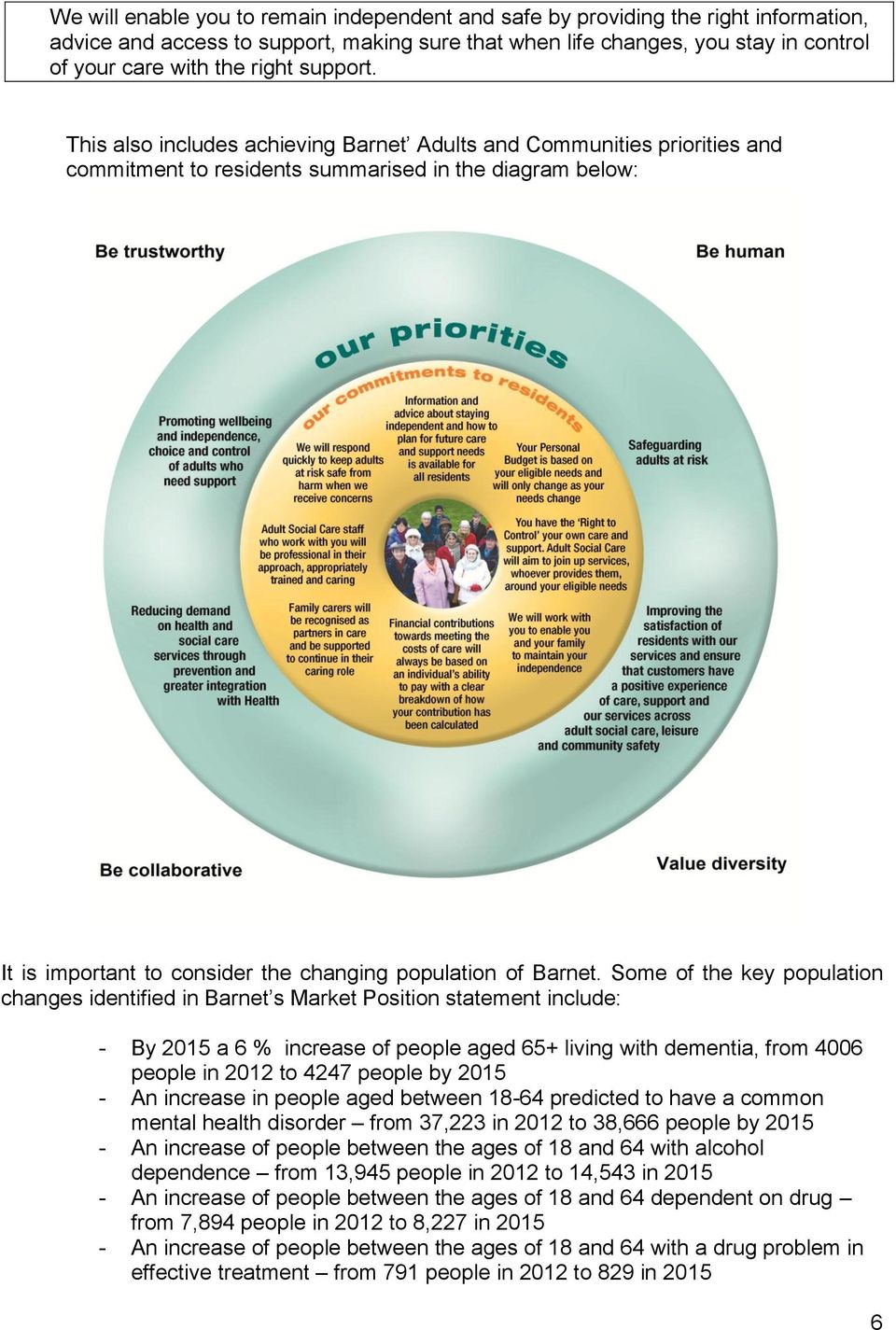
6 We will enable you to remain independent and safe by providing the right information, advice and access to support, making sure that when life changes, you stay in control of your care with the right support. This also includes achieving Barnet Adults and Communities priorities and commitment to residents summarised in the diagram below: It is important to consider the changing population of Barnet. Some of the key population changes identified in Barnet s Market Position statement include: - By 2015 a 6 % increase of people aged 65+ living with dementia, from 4006 people in 2012 to 4247 people by An increase in people aged between predicted to have a common mental health disorder from 37,223 in 2012 to 38,666 people by An increase of people between the ages of 18 and 64 with alcohol dependence from 13,945 people in 2012 to 14,543 in An increase of people between the ages of 18 and 64 dependent on drug from 7,894 people in 2012 to 8,227 in An increase of people between the ages of 18 and 64 with a drug problem in effective treatment from 791 people in 2012 to 829 in
7 Barnet s Joint Strategic Needs Assessment (JSNA) sets our further information about the local population. 2.3 Emerging Trends As well as continuing financial challenges within the public sector and the Council s ability to spend on services, the impact of the economic downturn and welfare reform is having an impact on individuals many of whom require advice and support in this area. The requirement for floating support services to help people maximise income, work towards employment and sustain tenancies remains paramount. Barnet remains an attractive borough to live in and is popular with all areas of the population, meaning the private rented sector is buoyant, impacting on Barnet s ability to help people find accommodation locally. Pressures on these areas within the borough mean that the pathways to housing and employment are becoming even more complex. Two key adult social care demographics are rising, meaning increased numbers of older people in Barnet, and children with disabilities and complex needs surviving to adulthood, placing pressure on adult social care resources. A focus on prevention across the board is crucial, enabling people to plan for later life, and take up opportunities to improve their health and wellbeing. Barnet has implemented and is planning further key prevention initiatives to enable people to get the right information and advice, and the right intervention of support at the right time, thereby preventing crisis at a later date. Where formal support is required, enablement approaches with a focus on choice and control when planning support will be utilised, helping people get back to independence. Floating support will therefore play a significant part in Barnet s prevention and enablement agendas. Lastly, a focus on what people themselves wish to see in services means that Barnet has revisited its expectations in terms of user involvement and how the user voice drives the delivery and improvement of services. Providers are expected, alongside the Council, to move on from satisfaction and user involvement mechanisms to a position where people are able to genuinely influence and contribute to the design of services the concept of coproduction. Alongside initiatives such as Healthwatch, Barnet is keen to listen and respond to what people think about adult social care and health services, including floating support. All of these factors pose a challenge to Barnet; this Service will need to respond to the changing landscape and respond to the needs of Barnet s citizens. For this Floating Support service to be a success it must be a service that is flexible and responsive enough to work within the changing landscape. Every pound that the public sector in Barnet spends has to be spent as efficiently as possible. This means providing services in increasingly innovative ways and will mean that the Authority and its partners will have to organise in different ways internally and build a new relationship with citizens where we share opportunities and share responsibilities. It also means increasing independence and maximising the use of mainstream services, supporting those in need of this service through targeted services and signposting people for specific health and social care support. 2.4 Social Value 7

8 Providers will be required to demonstrate how fulfilment of this contract will contribute to wider social value. It is recognised that the aim of the floating support service is to help people maintain existing and establish new support structures and avoid homelessness or housing crises. The Public Services (Social Value) Act 2012 requires us to consider more widely the economic, environmental and social benefits of service procurement. Bidders are therefore requested to set out in their method statement their approach to ensure that additional social value can be gained from the contract. For example how the service itself will contribute to local employment and how employment and volunteering opportunities will be made available to people with disabilities, to help them gain experience and confidence. A further example could be the co-design and production of the service with service users and how this will contribute to building knowledge and skills. We also want to maximise the wider social impact of the service; for example how families and carers will be impacted by service delivery, not solely the service user. 3. AIMS AND OBJECTIVES The service is for people age 16+ who have housing related support needs and for carers They may be leaving hospital or recovery homes, registered care, be homeless, threatened with homelessness or living in accommodation that is not meeting their identified needs. The service will be also used as a step up or step down from other supported accommodation, where appropriate. The principal aims of the service are to provide housing related support to: Enhancing the quality of life for people with care and support needs Delaying and reducing the need for care and support Ensuring that people have a positive experience of care and support Increase an individual s ability to maintain their tenancy and meet occupancy obligations Assist an individual to reconnect to their home area, where appropriate Minimise the use of all crisis/emergency services Enable individuals to move on in a planned way into a range of accommodation options Maximise social inclusion and reduce social isolation Improve an individual s access to education, training and employment and engagement in meaningful activities Contribute to ensuring timely discharges from hospitals and recovery centres and 8

9 return patients back home Improve access to health services and achieve improved health outcomes for individuals Safeguarding adults whose circumstances make them vulnerable and protecting from avoidable harm Assist individuals and their dependents to maintain personal safety and security Increase awareness and understanding of health needs and support individuals in developing self-management skills 4. PRINCIPLES FOR SUPPORT 4.1 Our Vision In common with all of the Council s adult social care and prevention services, the Provider will be expected to own and demonstrate commitment to the vision shared by all key public and voluntary sectors agencies in Barnet for supporting citizens to live independent and fulfilling lives. The Provider will provide the Service detailed in this specification and incorporate the following general principles: People are individuals and have the right to dignity, privacy and independence. All those involved in providing the service should acknowledge and respect people s gender, sexual orientation, disability, age, race, religion, culture, lifestyle and values. People should be encouraged and enabled to exercise control over the service they receive. Services should be supportive and involve the people who use the service and their Family/Carers in the design and delivery of services. Services are able to respond sensitively and flexibly to a person s changing needs. The service will contribute to the Adult Social Care Outcomes Framework and the NHS Outcome Framework. 5. THE SERVICE 5.1 Eligibility Criteria and Service Access The service will be for service users living in any housing tenure within the London Borough of Barnet, or live outside of the borough but have local links to Barnet or have been placed by the Council in temporary accommodation outside the borough, subject to the following eligibility criteria: Age of 16 years and over 9

10 Have a demonstrable need for housing related support to enable access to housing and set up, maintain or prevent loss of their accommodation and independence Are willing to engage with the service Support needs of service users may include: A history of homelessness, rough sleeping or tenancy breakdown Self-harm Physical health needs Depression or other mental health needs, including dementia Substance misuse Being at risk of, or already engaging in offending behaviour Being unmotivated or having a chaotic lifestyle Presenting challenging and/or anti-social behaviour Being at risk of exploitation or harm from others, including domestic violence/abuse Autism-Asperger s Multiple needs Teenage pregnancy or parenthood Having a learning disability Having literacy difficulties or ESOL Requiring timely and safe discharge from hospitals and recovery centres. Families should be supported, in particular those experiencing complex problems with the aim of preventing their problems escalating into chaotic situations, requiring greater and more expensive intervention at a later date. Carers should also be supported, including formal, informal and young Carers. Providing the right type of support to carers is important to help them in their caring role. 5.2 Client Group The Generic Floating Support service will provide support to people with housing related support needs that include but are not restricted to the following client group areas: Generic / complex needs People with multiple needs People with mental health problems People with substance misuse needs Alcohol misuse problems Drugs misuse problems Older people with support needs including dementia and mental health problems People with learning disabilities People with autism People with physical disabilities and/or sensory impairments People with dementia Single homeless with support needs 10

11 Homeless families with support needs Offenders, ex-offenders or people at risk of offending Teenage parents People at risk of domestic violence or abuse People with HIV Young people leaving care Gypsies and travellers with support needs The specialist mental health component will target: - people in in-patient mental settings and hospitals - patients in recovery centres The Provider will be expected to work with the Council to further define and agree definitions within the generic client category. The provider will also be expected to work with the welfare reform task group. 5.3 Length of Support Period and Throughput Generic Floating Support The Generic Floating Support Service is a short term service providing support to service users for up to 4 months. It is recognised that a small number of service users may need support for a longer period and therefore extensions will be agreed on a case by case basis. Additionally service users should be able to be re-referred back into the service to receive further periods of support. The number of support hours to each service user will be variable and dependent on the needs of each individual; as an indication, it is anticipated that 2.5 hours of support will be provided, per person per week. Over the duration of support actual hours will vary over time in response to levels of risk and need. Specialist mental health component for people within in-patient mental health settings and hospitals and patients in recovery centres The specialist support for people within in-patient mental health settings and hospitals and patients in recovery centres is intended to be provided for up to 9 months however where individuals require a longer period of support, extensions will be agreed on a case by case basis. Additionally service users should be able to be re-referred back into the service to receive further periods of support. It is anticipated that the level of intensive support provided will help service users achieve their outcomes. This duration of support intended for this service is as follows: No. of visits per week Frequency Target number of weeks for support to be provided Week no. 3 weekly 4 weeks weekly 6 weeks No. of support hours per week 11

12 1 weekly 6 weeks fortnightly 7 weeks fortnightly 12 weeks Total number of support hours over 9 months 135 The above table sets out an indicative breakdown of support hours to be provided at different intervals. However the service is a flexible service and it is intended that the service user will have choice over how their agreed support hours are used and the frequency of support. 5.4 Capacity of Service It is expected that there will continue to be high demand for the service. We will expect it to continue to be delivered to approximately 1300 service users each year, this includes no less than 115 service users accessing the specialist mental health component each year. 5.5 Referrals There will be many referral routes into the service, self-referrals will continue. This includes (but not limited to): - Self-referrals - Voluntary and community groups - Care case managers from the London Borough of Barnet - Multi-disciplinary teams The Provider will be expected to develop a clear referral process, including criteria for accepting referrals, to be agreed with the Council. The Provider will record all new referrals and service outcomes will be identified with the service user. The Provider will be expected to note when a service user has been assessed as ineligible for the service, they may be sign-posted / referred to another appropriate agency. 5.5 Key Activities The key activities of the Generic Floating Support Service and the specialist mental health component are set out below. This list is not exhaustive and the successful provider will be expected to work with the Council to further define the key activities. Key Activity Specific target user (in addition to client group mentioned in section 5.2 Referrals Receive and assess referrals in line with borough procedures Clients who have not been Carry out needs and risk assessments, develop and review of goal-oriented support plans for all individuals banded because they do not have sufficient housing 12
13 Support and support planning, including providing time-limited support (up to 4 months) Provide flexible, person-centred support to enable the individual to maintain their accommodation and independence Provide a preventative service by engaging with people as early as possible Supporting service users to maintain their tenancy by abiding by the tenancy conditions and paying the rent Support individuals to manage their tenancy and maintain their home Assist individuals to develop life and social skills as identified in their support plans Support young people moving home Housing Completing a support plan and participate in housing assessment processes, where appropriate Working closely with the housing needs officers; their role is to identify support needs of housing applicants through the holistic assessment process and refer on to the floating support service. Housing officers may come across existing council tenants who may require support and signpost for support. Increasing awareness of housing options in and out of borough Where tenancies are at risk of breaking down or have broken down - signposting individuals to relevant services who can help with such problems to move on (e.g. acute care, home treatment team, recovery home, early intervention and prevention) Assist an individual to reconnect to their former home area, where appropriate Provide time-limited resettlement support to individuals moving onto independent accommodation, where required Assist in re-settlement in a new area permanent or temporary When supporting people out of borough, make links with out of borough services and services that help people settling to a new area Provide crisis intervention support, which will include responding to problems that pose an immediate risk e.g. eviction notices, harassment /anti-social behaviour, loss of amenities. This includes supporting people at the point at which a household is actually homeless and requires emergency accommodation. Support needs should be identified through the logistic assessment which decides which priority band, if any, a household is allocated to. This may help prevent a household from becoming homeless and requiring emergency accommodation. Housing advice and support for young people in transition from children s to adults services Finances Provide welfare benefit advice; make claims for benefits and grants, and help with appeals needs Clients in long-term temporary accommodation may not have required additional support when they were placed in their accommodation but may now require some support and approach their housing needs officer Households who have not been housed through the housing service but may be vulnerable and on benefits People living in private rented sector affected by the overall benefit cap People placed out of borough in temporary or permanent housing. (Out of borough support will be needed however this will mainly be within the North London area). Young people in transition from children s to adults services People with mental health problems and living in any housing tenure including: People leaving temporary accommodation and moving into new accommodation. People who have left a shared home to set up a new home. People living alone Patients in mental health settings and hospitals Patients in recovery centres 13

14 Training and employment Social inclusion and community participation Health Advice on debt management and management of benefits in relation to this (e.g. minimise the risk of people using housing benefits to pay off non-priority debts) Clearly communicate changes of the benefits system to service users Advice on Discretionary Housing Benefits Support with managing rent arrears Help find training, education, employment and leisure opportunities maintain links with family, friends and support services Support individuals to get on with neighbours and the local community and assist in disputes or cases of harassment Support individuals to maximise social inclusion and reduce social isolation Proactively engage with the hard to reach Identify changes in health and seek appropriate help. Advocacy Advocate on behalf of service users in way that appropriately promotes the needs of the customer and collaboratively work with referring organisations Advocacy with the landlord to build trust and confidence that the tenancy will not fail Safeguarding Ensure that safeguarding requirements are adhered to and Children s service Carers Drugs and Alcohol Partnership working adopted in all service areas Participate in whole family approach recognising needs of the whole family, including children and other household members Supplement and work with the Council s young people homelessness prevention and mediation service Support carers to help them maintain their accommodation and therefore caring role and prevent their needs escalating which may later require intensive support. Supporting carers through the hospital discharge process and following discharge of the patient and close working with the Hospital Discharge Co-ordinator Supporting the cared for to stay at home / sustain their accommodation by working with families and carers, preventing hospital re-admissions Support young carers who care for people with mental ill health Signposting to the Carers Emergency Planning service Provide early and timely interventions for people with drugs and substance misuse problems. Target by setting up local housing clinics in conjunction with other services (e.g. Westminster Drugs Project and Barnet Drugs and Alcohol Service) Signposting to appropriate services (internal and external) All Recognising and understanding the role of the different All All Carers, including informal carers. 14

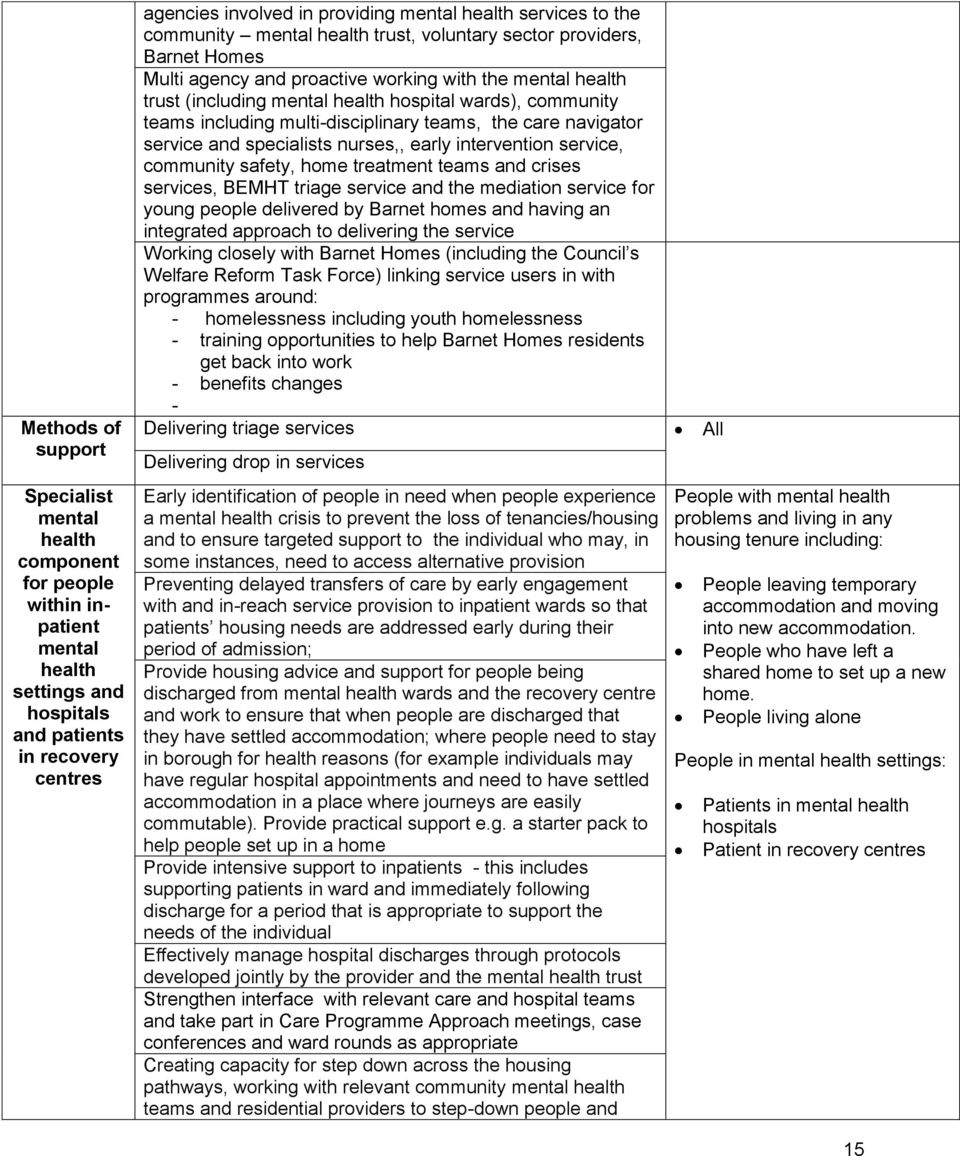
15 Methods of support Specialist mental health component for people within inpatient mental health settings and hospitals and patients in recovery centres agencies involved in providing mental health services to the community mental health trust, voluntary sector providers, Barnet Homes Multi agency and proactive working with the mental health trust (including mental health hospital wards), community teams including multi-disciplinary teams, the care navigator service and specialists nurses,, early intervention service, community safety, home treatment teams and crises services, BEMHT triage service and the mediation service for young people delivered by Barnet homes and having an integrated approach to delivering the service Working closely with Barnet Homes (including the Council s Welfare Reform Task Force) linking service users in with programmes around: - homelessness including youth homelessness - training opportunities to help Barnet Homes residents get back into work - benefits changes - Delivering triage services All Delivering drop in services Early identification of people in need when people experience a mental health crisis to prevent the loss of tenancies/housing and to ensure targeted support to the individual who may, in some instances, need to access alternative provision Preventing delayed transfers of care by early engagement with and in-reach service provision to inpatient wards so that patients housing needs are addressed early during their period of admission; Provide housing advice and support for people being discharged from mental health wards and the recovery centre and work to ensure that when people are discharged that they have settled accommodation; where people need to stay in borough for health reasons (for example individuals may have regular hospital appointments and need to have settled accommodation in a place where journeys are easily commutable). Provide practical support e.g. a starter pack to help people set up in a home Provide intensive support to inpatients - this includes supporting patients in ward and immediately following discharge for a period that is appropriate to support the needs of the individual Effectively manage hospital discharges through protocols developed jointly by the provider and the mental health trust Strengthen interface with relevant care and hospital teams and take part in Care Programme Approach meetings, case conferences and ward rounds as appropriate Creating capacity for step down across the housing pathways, working with relevant community mental health teams and residential providers to step-down people and People with mental health problems and living in any housing tenure including: People leaving temporary accommodation and moving into new accommodation. People who have left a shared home to set up a new home. People living alone People in mental health settings: Patients in mental health hospitals Patient in recovery centres 15
16 also providing resettlement support to those moving into their homes from supported living services. Further guidance on the type of activities is contained in Appendix Availability of the Service The Provider will be expected to propose the actual location of the service, method of delivery of service and have procedures in place for dealing with emergency situations. The service should operate Monday to Friday 9 am 5 pm but the service should be flexible to meet service user needs for example at weekends or evenings if needed. The provider will be expected to make arrangements for out of hour s enquiries telephone line, voice mail, . The Provider will also be required to deliver services to residents outside of the borough and will be required to show how this will be carried out including what links will be made with services outside of the borough. The Provider will need to ensure that any premises they operate from should be accessible to Barnet residents and that services will be delivered in the borough. Venues of premises should be easily accessible by public transport and meet all relevant disability access standards. 5.7 Communication The provider is responsible for regularly publicising and promoting the services to people in borough and out of borough, who are assessed as needing the service, including family/carers and relevant agencies including the production and circulation of posters, leaflets and brochures and the production of web-based information and other digital channels (new media). These will need to be agreed by the Council. The service will be required to ensure wide hours of information regarding the service in various settings including libraries, GP surgeries and landlords. In relation to periodic events and activities, the provider will be required to prepare and implement specific promotion plans setting out the target populations and the methods to achieve desired levels of participation. The provider will need to ensure there is regular updated accessible information on the support available to the learning disabled population and people with autism. The Council expects to work with providers to build a map of agencies within the borough highlighting links and responsibilities and areas of expertise available to support vulnerable people in the borough. This will be delivered within 6 months of contract start. As well as contributing to a joint understanding of referral pathways, this will assist with the targeting of communications and ensure prevention services are fully joined up. 5.8 Other income and Charging The Council does not intend to levy charges for people using the services to be provided under this contract. 16

17 The Provider can seek funding from additional sources to complement and supplement the service. 5.9 Equalities and Diversity The Council is keen to build local delivery capacity with the skills and experience necessary to respond to the wide diversity of specialist needs and preferences. The general population in Barnet is very diverse in terms of age, faith, ethnicity, culture, language, gender, sexuality and carers. Providers are expected to develop a diverse workforce and be part of networks which promote sensitive and appropriate service delivery. The providers will be expected to demonstrate a commitment to ensuring that their services meet the diverse needs of their target client group. The provider will ensure, at a minimum, the following good practice: Steps to ensure that the workforce is reflective of the service s target group and that recruitment and retention policies are appropriately developed to ensure that the workforce is diverse. All staff are required to attend diversity training and that they are sufficiently skilled to carry out their tasks in a culturally sensitive manner and able to put equal opportunities policies into practice. Prominent display of anti-discriminatory and confidentiality messages with clear actions for service users to take if they feel these are breached. Buildings and communications are fully accessible to all, interpreting and translation services are available in compliance with disability discrimination legislation. Care is taken to ensure that all reception areas and other areas feel welcoming and secure and that there are appropriate levels of privacy. Service user involvement policies are designed to ensure the inclusion of all service users. Complaints are monitored and corrective action taken as necessary. Equality Assessments are conducted where appropriate on any significant changes to service delivery Exclusions As a rule the provider of the service must not operate any blanket exclusions from the services. Service users must not be excluded from the services by reason of, e.g. illegal activity. In general any exclusion must be agreed on a case-by-case basis 6. SERVICE MODEL 6.1 Outcomes This service specification is outcome-focused and therefore does not tightly prescribe how and what a provider should do to achieve the specified outcomes. Providers must demonstrate through the selection process how the service will achieve the outcomes which the performance of the service will be measured against. 17

18 Outcome-focused services aim to achieve the goals, aspirations or priorities of the individuals they serve. The service should be delivered in a way that is right for the individual and designed to achieve what the person desires. Outcome-focused services are fundamentally person-centred in approach, recognising that each individual is unique and will have different requirements. The outcomes for each service are based around the following domains: Achieve Economic Wellbeing; Enjoy and Achieve; Be Healthy; Stay Safe and Make a Positive Contribution. Every individual is unique. So, although this specification defines the individual outcome domains, services are expected to be driven by the needs and requirements that each individual identifies as right for them. These outcomes will be specified in individual support plans but linked to the housing related support outcome domains outlined in the table below: 6.2 Table FLOATING SUPPORT SERVICE OUTCOMES: Guide to outcomes table: i. Key service activities: These describe the types of tasks and activities required to deliver the outcomes specified. ii. Individual Outcomes: iii. Service Level Outcomes: iv. Strategic Outcomes: Targets: These are the outcomes that the service must support individuals to achieve. Individuals outcomes will be specified in their support plans, however as these are housing-related support services, it is anticipated that these will fall within the areas identified in the table below. These are the outcomes that the service and its impact must achieve. These are outcomes linked to the Council s strategic plans and policies. Providers should refer to relevant documents available on the Council s website. Targets for these outcomes will be agreed with the provider or established by the Council within 3 months of contract initiation, and will be subject to annual review through which they may be amended by agreement or through decision by the Council. Key Service activities Individual Outcomes Service Level Outcomes Strategic Outcomes Achieve Economic Well Being Support individuals to maximise their income and manage their finances on a dayto-day basis. Improved economic wellbeing through: Maximising income Reducing debt Obtaining paid Improved levels of life skills that support the move towards independence. Prevention of: Homelessness Access to higher threshold services 18
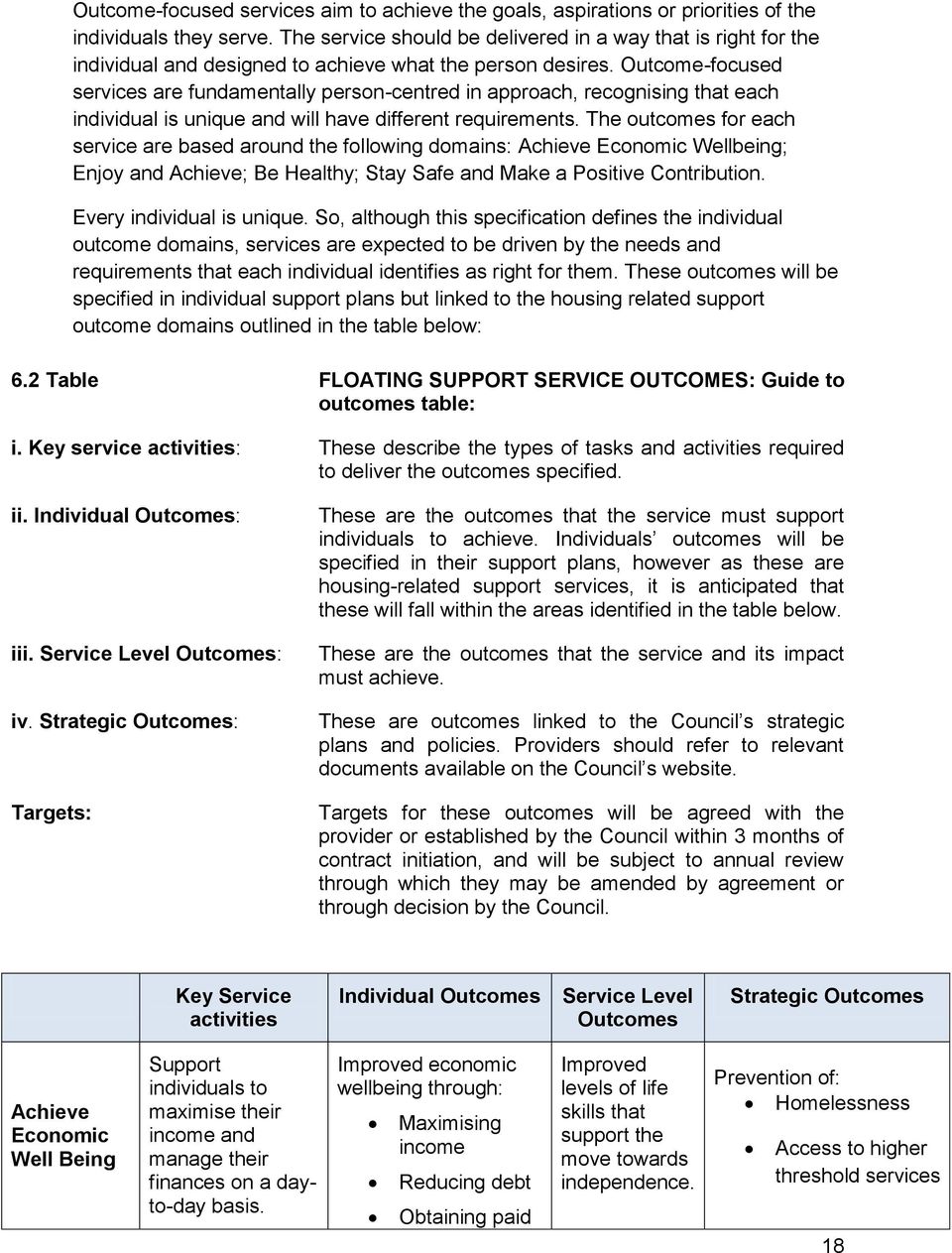
19 work Enjoy and Achieve Assist individuals to develop their support networks; Support individuals to access and maintain meaningful activities including employment, training, education and leisure opportunities. Improved enjoyment and achievement through: Participating in training and/or education Participating in cultural, leisure and faith activities Participating in work-life activities Increased levels of participation in meaningful activities. Prevention of: Homelessness Access to higher threshold services Establishing contact with external service groups, friends and/or family Be Healthy Support individuals to access appropriate physical and mental health services and develop healthy lifestyles; Assist individuals to minimise substance misuse. Support individuals within in-patient mental health wards and recovery centres Improved health through: Better managing physical health Better managing mental health Better managing substance misuse Use of assistive technology and aids Reduced levels of risky behaviours and/or unhealthy activities. Contribute to the reduction of readmission rates Increase links with the recovery pathway Improved mediation process Prevention of: Homelessness Access to higher threshold services Risk of institutionalisation Delayed discharges Stay Safe Assist individuals to develop the life skills they require to live independently; Improved safety through: Maintaining accommodatio Better inpatient and recovery experience Reduction in and prevention of incidences of anti-social Prevention of: Homelessness Access to higher 19

20 Support individuals to establish and maintain personal safety; Assist individuals to develop harm reduction strategies; Assist individuals to identify realistic opportunities for move on accommodation and make appropriate referrals/enquiries; n and avoiding eviction Complying with statutory orders Better managing selfharm Avoiding harm to others Minimising harm/risk of harm from others behaviour from individuals in the service. Contribute to the reduction ` in the need for registered care placements threshold services Implement effective strategies to deal with anti-social behaviour; Make a positive contribution Support individuals to reduce offending behaviour. Involve individuals in determining the types of services they receive. Increased positive contribution through: More confidence and ability to have a greater choice and/or control and/or involvement Examples of service users positively shaping the service they receive. Prevention of: Homelessness Access to higher threshold services 7. STAFFING REQUIREMENTS 7.1 Service Resources The Provider must provide, employ or have access to appropriate resources to deliver the Service defined in this Specification. The Provider must ensure that there is management availability to provide supervision and guidance to support workers at all times. 20

21 Suitable accessible premises, facilities and equipment must be available to staff, including provision for staff meetings, training and one-to-one staff appraisal, and record-keeping and back-office administration. For the purposes of this section of the Specification, the term staff should be interpreted to include paid staff, peer leaders and volunteers unless otherwise indicated 7.2 Staff Recruitment All Provider staff must have clearly defined job descriptions outlining roles and responsibilities. All staff should be fully aware of their own and others roles and responsibilities within the organisation and must familiarise themselves with relevant social services staffing structures. Providers should involve Service Users in staff recruitment, induction and appraisal processes wherever practicable. Providers should ensure that the staff team reflects the cultural and gender mix of Service Users whenever possible. Providers must ensure that there are robust contingency and business continuity plans to cover unexpected staff shortages. A minimum of two satisfactory written references (including one from the most recent employer) should be routinely obtained before new employees commence work. Providers must undertake Disclosure and Barring Service (DBS) checks for all employees and volunteers employed by the service and comply with its duties to refer information to the Independent Safeguarding Authority ( ISA ) under the Safeguarding Vulnerable Groups Act The Provider will ensure that the DBS checks are regularly updated in line with statutory requirements. 7.3 Deployment of staff across the service The Provider will ensure that there will be sufficient staff team to deliver the generic service and the specialist mental health component for people within in-patient mental health settings and hospitals and patients in recovery centres. Staff will be multiskilled/experienced to reflect the diverse range of support needs of the customer group, including specialist skills in relation to people with particular support needs or complex needs for example people with Autism-Asperger s, carers needs, mental health. See staff competencies at 7.7 below. 7.4 Peer Support Leaders, Volunteers and Agency Staff We recognise the value of volunteer contributions and providers should maximise the involvement of peer leaders and volunteers in service delivery in a way that is consistent with best practice. It is expected that volunteers will be appropriately recruited, trained and supervised and that providers must not under any circumstances use volunteers to cover hours or services that are specified in the contract for delivery by paid staff. The Council and the Provider may however agree contractual variations that reduce the requirement for paid staff through increased social capital inputs such as volunteers. The provider will be 21
22 expected to set out how it will involve and utilise peer leaders and volunteers as part of service provision in its tender application Volunteers and agency workers must be subject to the same DBS check arrangements as the Provider s employees as specified above. 7.5 Policies, Procedures and Codes of Practice The Provider must have sufficient written policies, procedures and codes of practice in place to ensure that instruction and guidance for the Provider s staff are available in relation to the functions and activities described in the this Specification The policies, procedures and codes of practice must be accessible at all times by staff and must also be readily available to Service Users, and should form the basis of staff induction and training, Policies and procedures and codes of practice must include: Equalities standards - covering the ways in which the Provider will promote equality of opportunity and prevent discrimination A recruitment and selection policy including the Provider s approach to promoting diversity in the workforce, the recruitment of people who are or have been users of social care and support services, and Service User s participation in staff recruitment and development Arrangements for staff induction and appraisal, and for staff training and development A code of conduct for staff setting out their responsibilities and the standards expected of staff A robust code of practice concerning, staff rota systems, cover for foreseen and unforeseen staff absence, managerial responsibilities and availability Contingency and Business Continuity arrangements in case of foreseen and unforeseen restrictions of the Service Safeguarding Vulnerable Adults, including indicators of possible abuse, responsibilities for recording and reporting suspected abuse and the rights of whistle-blowers Recruitment and use of volunteers. Risk assessment and management, including communication and joint working with the Council and other relevant agencies, and staff lone working Complaints by service users including the procedure for escalation to the Council in the case of unresolved complaints The Provider s staff should demonstrate understanding of and compliance with the Provider s policies, procedures and codes of conduct in their everyday work and that upon commencement of a support worker s employment this has been outlined to them and a signed copy kept on file The Provider will demonstrate good practice as an employer of disabled people. The Provider must ensure that suitable arrangements are in place and evidenced to strengthen staff skills and knowledge in order to meet the needs of individuals and in all respects comply with the requirements of this Specification. 22
23 The Provider will ensure that: Staff have an identified line manager who provides regular one-to-one supervision and keeps written records that are held in an individual staff file. Staff performance is monitored with regular supervision sessions with an identified senior staff member no less frequently than on a 4-weekly basis Signed training records are available for each staff member showing that all staff receive induction training, and that appropriate general and specialist training requirements have been identified and either met or are in process. Staff have the opportunity, through supervision and direct approach, to highlight areas where additional or expert guidance and training is suitably actioned. Staff have a written appraisal not less than annually, which reviews past performance, identifies training needs and sets out objectives for future development. Individual staff members personal development/action plans are recorded and reviewed on a regular basis. There is a programme of access for staff to funding and opportunities for certified training courses and qualifications e.g. NVQ. There are regular minuted team meetings to ensure shared communication and opportunity for discussion of policy and operational practice and resolution of issues. 7.6 Staff and Volunteer Training Training programmes should display a range of up-to-date perspectives of knowledge and best practice in all specialist areas from statutory and voluntary sector sources. The Provider must collate the training needs identified through staff and volunteer induction and appraisal into a training needs analysis and training plan for the Service. The Provider will maintain a collated record of staff and volunteer training planned and completed and will make this available for inspection on request by the Council. Training must meet the current requirements for workers in the social care sector with specific reference to staff working with vulnerable adults, including but not limited to: Barnet s Multi-agency Policy and Procedures for Safeguarding Adults Mental Capacity Act 2005 Safeguarding Vulnerable Groups Act 2006 Services and resources in the community Quality monitoring and quality assurance Health and Safety, accidents and incidents, safe working practice Complaints/Contract compliance Substance misuse Confidentiality Equal opportunities including disability equality and cultural diversity Housing legislation 7.7 Competencies expected of support workers 23
24 Support workers will have a working knowledge of national health and statutory social care frameworks and systems with which service users may be involved including: Welfare benefits, Housing Benefit Housing and Homelessness Care Planning and the Care Programme Approach Criminal justice administration Offender management including MAPPA Landlord and tenant Safeguarding for adults services and children s services Support workers will be familiar with relevant local systems and processes operated in Barnet by agencies from which service users may be receiving services, including Social housing applications and lettings including the Housing Allocations Scheme and Placements Policy Housing options and private sector tenancy facilitation Social housing tenancy management Social work and care coordination MDT CNS Access to primary and secondary health care Access to education, training and employment Domestic violence and harassment services Drug and alcohol services Specialist services relating to specific vulnerabilities and customer groups Mental Health services Voluntary sector advice and support services, including the services provided by the 5 Adults and Communities voluntary sector Lead Providers: - Information, Advice, Advocacy and Brokerage (Barnet Centre for Independent Living - BCIL). (NB: this contract will be retendered in and therefore the floating support provider will be expected to work with the new provider of the service). - Carers Support Service (Barnet Carers Centre) - Mental Health Day Opportunities (Richmond Fellowship) - Older Adults Day Opportunities (Age UK Barnet) - Learning Disabilities Support Service (Dimensions) Additionally support workers delivering the specialist mental health service for people in inpatient mental health wards must be able to demonstrate knowledge of the following (in addition to the above): Risk assessments Dual diagnosis Care of people with mental health problems and people in mental health settings Working with aggressive behaviour Deliberate self-harm Working with families Mental health legislation and best practice 24
25 The provider will provide access to specialist or technical knowledge and skills for use by the staff team in response to service users needs that fall outside the mainstream or that present specific complexities. The provider may do so for example by employing specialist staff to act on a consultancy basis or by designating staff managers to lead on particular areas of knowledge The service must demonstrate high-level staff competencies in support delivery including: skills in interaction with service users, for example assertion, negotiating, listening, building trust and empathy, judgement about people oral and written communication skills, for example input to case conferences and statutory care plan reviews, advocacy to professionals on behalf of the service user skills in risk assessment and management in complex situations Support workers must be able to demonstrate a developed knowledge of the full range of vulnerabilities that service users may experience, including relevant behaviours, risks and treatments 7.8 General Conduct The Provider will ensure that identified Service Users are treated with courtesy and respect at all times and in a way that promotes dignity and self respect. Services will be delivered in a non-discriminatory and professional manner by experienced, well-trained and courteous staff. In the event of an allegation of misconduct of an inappropriate nature, the Authorised Officer should be informed immediately of such allegations, and will advise on the action to be taken. Any employee of the Provider whose behaviour or actions are, in the opinion of the Authorised Officer, in breach of the Contract Conditions or Service Specification may upon the request of the Authorised Officer, be removed from contact with any Service User. 7.9 Disclosure and Barring Service The provider will ensure that all staff (paid and unpaid) who will be in contact with service users are DBS checked in accordance with current national and local requirements. Any costs associated with this will be borne by the provider. Where the DBS check does not provide a 100% clearance and, should the provider proceed with employment, an appropriate risk management plan must be completed and be made available to the commissioner on request Employment of staff Where it is fair and reasonable to do so, the Commissioner retains the right to refuse the use of any individual staff member on this contract at any point in time. 8. PERFORMANCE MANAGEMENT 25
26 8.1 Information sharing The Provider, consortium and/or contract delivery partners will be expected to implement and maintain a unified database and information system in order to provide sufficient assurance of the quality of the services and the performance being reported, the provider will make available any information as may reasonably be required by the Council. The provider will ensure that appropriate consents are agreed with all service users to enable commissioners access to the provider s records concerning individual service users for the purposes of contract management, including periodic sample audit of support planning and outcomes achieved. The provider will need to ensure there is sharing of data with sub-contractor and that this information can be made available to the Council. The provider must adhere to the Data Protection Act 1998 and this includes information sharing between Council, provider and other 3 rd party providers. 8.2 Reporting Systems The data will be used by the Council to monitor: the people who are accessing the service the duration of support for service users utilisation and throughput the numbers of people supported by floating support the outcomes staffing inputs The provider will ensure that all performance returns; can be evidenced from the provider s databases, and that audit trails are demonstrable to the Council on request are authorised by an appropriate manager before submission to the Council are made within the timescales specified by the Council The provider will cooperate with the Council s arrangements and with HealthWatch Barnet for periodic audit and sample validation of data, including provision of access on reasonable notice to relevant databases and other information systems maintained by the provider. Healthwatch Barnet is part of a new national network, led by Healthwatch England. It is part of the Health and Social Care Act 2012 and will give patients and users of health and social care services a powerful voice locally and nationally. The aim is to take local experiences and use them to influence national policy. Healthwatch Barnet established in April 2013 is the independent voice for the residents of Barnet who use health and social care services. Healthwatch Barnet liaises with the health and social care providers to develop good quality services in Barnet. As a result Healthwatch may want to visit the Provider to find out more about the service and they may also exercise their authority enter and view the service. 8.3 Data Protection and Information Sharing The Provider must have in place systems to secure client consent to enable sharing of information to access support within and without the service. 26
27 The Provider will implement an Information Sharing Agreement with the Council and delivery partners including governing how information will be collected, stored, used and disseminated in line with the Data Protection and Freedom of Information Acts. The Council will organise quarterly meetings with the provider to discuss the service provision, targets and quality assurance. The meetings will be minuted with agreed actions. The Council will be entitled to introduce, or change, any systems of contract monitoring and quality control as the Council sees fit, with prior notification to the Provider and Authorised Representative. 8.4 Client Record and Outcomes Data The Council continues to fund the Centre for Housing Research at St Andrews University (CHR) to collect, validate and analyse the Supporting People client record and outcomes data. Providers are required to complete and submit electronically to CHR a client record form for every new service user entering the service (excluding older people in sheltered accommodation). Providers are also required to complete and submit electronically to CHR an outcomes form, short term or long term according to the service type and duration. A short term outcomes form will be completed at the point of exit from the service. The long term outcomes form to be completed for a sample of service users as determined by the Council. Details of the required outcomes are described in the Outcomes Table at 6.1 above. Providers will be expected to adhere to any future changes to the national and local client record and outcomes frameworks or local performance information that the Council should require. Providers should ensure that client information recorded includes the full range of equalities and diversity characteristics of service users and that all necessary consents are in place to ensure that this information can be made available to the Council when requested. 8.5 Service User Satisfaction The Provider must arrange 6-monthly service user groups which focus on service user satisfaction. The Council may wish to have discussions with the service user groups as part of service users and the Provider will be required to facilitate this. The Provider must complete an annual survey of participants satisfaction with the floating support services and must be organised or facilitated by the Provider Survey questionnaires must be designed to obtain participant opinions and comments on the extent to which the activities and events: Were relevant to their needs Met the stated objectives Could be improved or developed in the future programme The Survey Questionnaire must also obtain Service User s opinions and comments concerning the quality of the support service and the content of the survey to be agreed with the Council. The Council may in future provide a model Questionnaire and require its use by all Providers to enable consistency across the sector. 27
28 The Provider must complete an analysis of each annual survey and make this available to the Council on request. 9. QUALITY ASSURANCE 9.1 Continuous Improvement in Service Quality and Outcomes The Provider must achieve continuous improvement in the quality of service as measured by internal review, reviews by the Council, feedback from past and present Service Users. The Council will set targets for performance directly, or may request the provider to propose targets for the Councils approval. Targets will be reviewed annually, or more frequently as necessary in response to performance issues. 9.2 Service Review To demonstrate continuous improvement and the achievement of targets: The Provider will be required to: submit quarterly activity and performance data to the Council as detailed in this specification and agreed as part of the tender process; produce an annual report summarising the performance data and an annual service delivery. develop and agree a service improvement plan with the Council to address any underperformance identified as part of the contract monitoring and review processes; involve Service Users and family carers in serviced reviews and in the production of the annual report and service improvement plan. Both documents must be available to Service Users and other stakeholders The Council will: convene quarterly and annual formal contract monitoring meeting with the Provider to consider the Provider s performance returns, the annual report, progress on the previous service delivery and improvement plan targets, and the updated plan; specify additional action points, targets and reporting arrangements proportionate to any under-performance; conduct a periodic comprehensive review of the service involving interviews with Service Users, managers and support workers and inspection of the Provider s files and other records concerning Service Users and staffing. individual service areas will also hold regular caseload meetings and the provider will be expected to participate in these. 9.3 Service Targets An outcomes framework for the service including targets will be developed, based on the successful bidders submission made during the tendering phase and, once the contract has been awarded, will be implemented as a performance measurement tool to track progress towards outcomes. 9.4 Complaints 28
29 The Provider will make available to the Service Users a copy of its complaints procedure at the commencement of the Service. The complaints procedure should be available in the main Barnet community languages and where appropriate in Braille, large print or on tape. The Service Users have the right to make a complaint directly to the Authorised Officer or to the Council, independent of the Provider, and this mustbe made clear to Service Users. The Authorised Officer and/or the Council have the right to investigate a complaint at any stage. The Provider will maintain a written record of all complaints and outcomes in an agreed format with the Council. The provider will indicate how any complaints and outcomes have been used to improve the service. These will be made available upon request from the Authorised Officer, for monitoring purposes. The Authorised Officer must be made aware of any serious complaint immediately, and the Authorised Officer will decide on the appropriate action to be taken. 9.5 Safeguarding This part of the Specifications sets out basic requirements for the protection of Service Users. The Provider must ensure that: there are written procedures that define roles and accountabilities for each team within the Provider s staff group safeguarding awareness is to be included in induction arrangements for new staff, agency workers and volunteers appropriate training is provided to all staff to ensure all staff are aware of their roles and accountabilities general report, record keeping, audit processes and records should be available to the Council on request 9.6 Barnet s Multi-Agency Policy and Procedures for Safeguarding Adults and Pan-London Safeguarding Policies The Council has agreed with other statutory authorities a multi-agency policy and procedures to protect vulnerable adults from abuse. The Provider must follow the policy and procedures if abuse is identified or if the Provider has grounds to believe that abuse may have taken place. The Provider will be required to prepare its own internal guidelines to protect adults from abuse. These must be consistent with the Multi-Agency and pan-london Policy and Procedures. 9.7 Whistle Blowing The Public Interest Disclosure Act 1998 provides for the protection of individuals who make certain disclosures of information in the public interest and to allow such individuals to bring action in respect of victimisation following such a disclosure. The Provider must produce internal guidelines for staff setting out that: It is the responsibility of all staff to act on any suspicion or evidence of abuse or neglect and to pass their information to the responsible person /agency; 29
30 Whistle blowers will receive support and protection in accordance with the Act; Staff can contact the Council or a relevant regulatory body (such as the Care Quality Commission) in situations where they have concerns about operations and the Service provided. 9.8 Confidentiality Providers must have a Confidentiality Policy and must provide a copy to the Council upon request. The Policy must also be available to service users/family/carers in an information pack in an appropriate format. Service users and staff should be advised of the type of information the Provider keeps on record, what can or must be disclosed without their consent, when their consent is needed for disclosure and their rights to see information recorded about them. The confidentiality policy should set out areas where information will be shared and under what circumstances and serves as a record of their consent within these areas. In other cases, the service users consent must be obtained as the need arises. This includes passing information to other agencies. A person should not be asked to sign a blanket, wide-ranging consent to disclosure. The Confidentiality Policy must set out the Council s requirements concerning its access to the Provider s records relating to individual carers. The Provider must ensure that everyone engaged in the support service with access to personal information understands their responsibilities and can demonstrate evidence of compliance with their procedures. This includes employees, volunteers, self-employed workers, consultants or contractors. The procedure must comply with the Data Protection Act 1998 and any contractual requirements. It should also cover accuracy and consistency of record keeping, security of data, information to service users, and consent for disclosure requirements and identify responsible persons. Contracts of employment, volunteering agreements, contracts with consultants and others should include a clause making explicit the person s responsibilities for confidentiality and data protection. The policy should also cover actions to be taken if a staff member breaches confidentiality. 10. CHANGES TO THE SERVICE 10.1 Bidders should refer to the draft terms and conditions of the contract for further details but should note that the Provider will be required not to terminate, suspend or change any part of the Service without the agreement of the Council. Any proposed change in the Service must be in consultation with agreement by the Council. The Provider must ensure written records are kept and these must be made available to the Authorised Officer for monitoring purposes. 30
31 10.2 Exit Strategy Where an extension to the contract is not agreed, or where the contract is terminated through default or mutual agreement or where disaster renders the full service inoperable, the contractor will work with the Council and with other providers to ensure that service users continue to receive a support service, on a risk assessed basis, and that all service users are kept informed of the situation APPENDIX 1 - Information about the current Floating Support Services Outreach Barnet One Housing Service purpose To provide housing related support to vulnerable people; to maintain people s independence and tenancy within their home, develop independent living skills and link them into Housing related floating support for homeless people in temporary housing. The service provides service to vulnerable people to live independently in the accommodation or to gain access to accommodation appropriate services Service description Generic Floating Support Mental Health Floating Support Lead Provider Notting Hill Housing One Housing Sub-contractors Genesis Housing and Homeless N / A Action in Barnet Contract Date May 2010 March 2014 April 2003 March 2014 Annual contract value 1,328,063 pa Pooled budget 276,340 pa Adults and Communities: 49.60% Children s Service: 27.12% Health: 4.92% Housing: 18.35% Support hours per week Quotas Drug problem 20 None Homeless families in need 60 Older people 80 Young People leaving care - 40 Capacity 526 service users supported at 100 service users supported at any one any one time time Hours input Average of 2.5 hours per week Varies, dependent on needs of customer Service user profile Vulnerable adults Primary group: people with mental health problems. Single homeless with support needs All ages Customer s needs level Low level which can be met through short term support. Service users must be willing to Variable Duration of support engage with the service Short term three to six months. Longer term support subject to individual and agreement. Up to 2 years, but aim to have a 50% throughput so aim for 9 months 1 year 31
32 Tenures Service works with all housing tenures including people preparing to move from supported housing, residential care and hospital. support. This also depends on need as the provider we will do short term support and one-off support if needed. Works with all housing tenures; client must be resident in Barnet Charging Free service to all service users Free service to all service users Access/operating times Premises in Barnet. Monday to Friday 9am to 5pm Referral sources Self-referrals Social Care Direct Children s and Family services Mental health teams Voluntary agencies (e.g. BCIL, Solace) Housing (Barnet Homes) Prison services: Staffing Notting Hill - 2 Team Leaders, 14 staff Genesis - 2 Team Leaders, 14 staff HAB - 1 Team Leader, 7 staff Volunteers are also used Service users People aged 16 or over who are single or a member of a larger household and who: - Have housing related support needs and are: homeless, or failing to manage and at risk of losing their home, or moving on to more independent living, e.g. from a family home or registered care home or supported housing and are unlikely to sustain their independence without support - are vulnerable. Families, particularly those experiencing complex problems Carers Primary need group Monday to Friday 9am - 5pm (but provider works on weekends or late nights if needed, depending on customer s needs) Social Services Self referrals via Barnet Housing Needs Community Mental Health Team GPs Probation services Drug services Primary Care Mental Health Teams Community Support and Rehab Team BDAS Early Intervention and Prevention Team Right to Control Team 1 Senior Manager, 1 Team Manager and 5 Support Officers Each support officer is responsible for 20 service users each See service user profile above. 32
33 categories Service users who are likely to benefit from this service. Current Service User Profile This section provides a profile of the existing service provision including people who have benefitted from the service. User Profile Ethnicity Profile 4% 19% Outreach Barnet Ethnicity of service users supported during % 0% 4% 4%1% 8% 4% 2% 0% 2% 0% 2% 3% 1% 3% 1% Asian/Asian British: Bangladeshi Asian/Asian British: Chinese Asian/Asian British: Indian Asian/Asian British: Other Asian/Asian British: Pakistani Black/Black British: African Black/Black British: Caribbean Black/Black British: Other Gypsy/Romany/Irish Traveller Missing Mixed: Other Mixed: White & Asian Mixed: White & Black African Mixed: White & Black Caribbean Other ethnic group: Arab Other ethnic group: Other Refused White: British White: Irish White: Other 33
34 3% Outreach Barnet Ethnicity of service users supported during , Quarters 1 and 2 Asian/Asian British: Bangladeshi 19% 43% 1%0%3% 7% 3% 5% 4% 1% 2% 1% 2% 2% 2% 2% 1% Asian/Asian British: Chinese Asian/Asian British: Indian Asian/Asian British: Other Asian/Asian British: Pakistani Black/Black British: African Black/Black British: Caribbean Black/Black British: Other Gypsy/Romany/Irish Traveller Missing Mixed: Other Mixed: White & Asian Mixed: White & Black African Mixed: White & Black Caribbean Other ethnic group: Arab Other ethnic group: Other Refused White: British White: Irish White: Other 46% 2% One Housing Ethnicity of service users supported during % 9% 6% 6% 10% 4% 6% 1% 1% 2% 1% Asian/Asian British: Bangladeshi Asian/Asian British: Chinese Asian/Asian British: Indian Asian/Asian British: Other Asian/Asian British: Pakistani Black/Black British: African Black/Black British: Caribbean Black/Black British: Other Gypsy/Romany/Irish Traveller Missing Mixed: Other Mixed: White & Asian Mixed: White & Black African Mixed: White & Black Caribbean Other ethnic group: Arab Other ethnic group: Other Refused White: British White: Irish White: Other 34
35 Gender Profile Gender Outreach Barnet One Housing Quarters 1 & Quarters 1 & 2 Male Female Missing 2 TOTAL Age Profile 35
36 Care Group Care Group Outreach Barnet One Housing Qtrs 1 & Qtrs 1 & 2 Older people with support needs Older people with dementia and mental health problems: Frail Elderly Mental health problems Learning disabilities Physical or sensory disability:
37 Single homeless with support needs Alcohol misuse problems Drug misuse problems Offenders or at risk of offending Mentally disordered offenders Young people at risk Young people leaving care People at risk of domestic violence People with HIV/AIDS Homeless families with support needs Refugees Teenage parents Rough sleeper Gypsies & travellers with support needs Generic/Complex needs TOTAL Location / Residence of service users 37
38 38
39 39
40 APPENDIX 2 Overview of the intended Floating Support service. As part of the new contract, the service will be expected to deliver on (but not limited to) the following: Work across all housing tenures and deliver a preventative service to people living in any type of housing tenure in the community and to people who have been assessed as requiring housing- related support. They may be living within the London Borough of Barnet or in accommodation outside the borough that has been arranged by the Council. Provide intensive support to people in inpatient mental health wards, to help these service users to return home, move to a new home and settle back into the community Provide service users with the opportunity to re-integrate effectively back into the community. The service will address service users needs in regards to accommodation, promoting works and employment, benefit maximisation, obtaining bank accounts, building positive relationships, addressing health needs, substance misuse and alcohol issues. Work with a varying level, variety and complexity of needs to provide support that is appropriate to clients needs and aspirations. Help clients through the assessment process to engage with support and to move on to an independent tenancy or a move-on supported accommodation service, preventing premature departures and chaotic abandonment. Helping service users to engage with individually tailored life skills programmes to enable social inclusion, independence, choice and control over their lives, with a particular, but not exclusive, focus on enabling them to access and sustain accommodation, maintain health, maximise their finances, develop domestic and social skills and meet their potential and aspirations. Focus on the prevention of repeat offending and the loss of independence through tenancy breakdown, hospital admission, reduce re-offending custody or other forms of institutionalised care. Support service users to access specialist services including health, substance misuse and benefits services and voluntary organisations, training and work opportunities as appropriate according to individual need. Work in partnership with the move on accommodation Support Providers, the Authority s Housing Service, private Landlords, social enterprise organisations and other stakeholders. Provide focussed, short term floating support services that enables individually tailored life skills programmes to be developed for Clients with any risk Working with and supporting carers by supporting the cared for to help them maintain their accommodation and independence and help prevent escalating needs Supporting service users to gain settled accommodation Supporting services users to access employment, employment support services and activities which can lead to employment Assisting service users accessing Primary and Secondary services to have their physical health needs assessed and met 40
41 APPENDIX 3 Traditional Housing Related Support The table below outlines the traditional range of housing-related support which users of the service may require in order to achieve the outcomes set out in section 6.1 of the specification. Activity Counselling and emotional support Support planning Welfare benefits Help in establishing personal security Life skills budgeting and managing finances Life skills cooking Life skills laundry Life skills cleaning Self Management Social skills Help in developing social contacts Helping Service Users engage in appropriate Guidance on housing related support General counselling and emotional support can be provided as part of a support service. Specialist therapeutic counselling provided by a qualified counsellor is not support Preparing and agreeing a support plan with a service user (the support plan must be recorded). Some aspects of a care plan may be subsumed within a support plan (where a care plan refers to housing related support activities). Support the service user to claim welfare benefits, and assist and enable the individual to continue to receive eligible benefits and deal with relevant agencies Assist the service user to maintain the security of their flat e.g. explaining how to lock up and manage appropriate access Assist service users to live within their budget and advise them on how to manage their finances on a day-to-day basis Encourage and motivate service users to prepare and cook meals safely Provision of advice and practical assistance to enable the service user to deal with their laundry e.g. how to operate a washing machine by themselves Encourage and motivate the service user to keep their home clean Encourage and motivate the service user to maintain any appointments relevant to improving their ability to manage themselves in their accommodation Encouraging and motivating the service user to develop social skills Encourage and motivate service users to develop social contacts Assist service users to access leisure and other activities and encourage and motivate service users 41
42 leisure activities Help gaining access to other services Accompanying/motivating employment and training courses Attending Care Programme Approach (CPA) meetings to make appropriate use of such activities Support a service user to access services, in agreement with the service user, as part of the support planning process. Support to enable a service user to access appropriate education, training and/or employment opportunities. Attendance at CPA and other meetings, where appropriate Move on and permanent housing Aids and Adaptations Police and courts Occasional help with daily living activities Giving advice relating to move on and permanent housing opportunities Advice to users on A&A Giving advice on dealing with the police and courts where this relates to housing matters Occasional temporary help with matters such as; shopping, errands and getting around. 42
2. The Aims of a Dual Diagnosis Accommodation Based Support Service
 SERVICE SPECIFICATION FOR: Dual Diagnosis Mental Health and Substance Misuse Supported Housing Service The specification describes the Service to be delivered under the Steady State Contract for Provision
SERVICE SPECIFICATION
 SERVICE SPECIFICATION Provision of a Service for Young Carers Wokingham Borough Council OFFICIAL - SENSITIVE Page 1 1. Introduction This is the service specification for the provision of a Young Carers
Quality Assessment Framework Core Service Objectives
 Quality Assessment Framework Core Service Objectives NIHE Supporting People Contents C1.1 Assessment and Support Planning...3 C1.2 Security, Health and Safety..11 C1.3 Safeguarding and Protection from
Purpose of Guidance. The Aim
 Joint Procedure between Housing and Children s Services for the Assessment of Housing and Support needs of Homeless or likely to become homeless 16- and 17- year-olds York Children s Services and Housing
CSCI Regional Office Caledonia House 223 Pentonville Road London, N1 9NG
 CSCI Regional Office Caledonia House 223 Pentonville Road London, N1 9NG Tel: 020 7239 0330 Fax: 020 7239 0318 Email: [email protected] Web: www.csci.org.uk Ms Irene Findlay (OBE) Adult Social
Sanctuary Housing Association Accommodation based services in Adur and Arun Service Specification for a Housing Support Contract
 Sanctuary Housing Association Accommodation based services in Adur and Arun Service Specification for a Housing Support Contract Aims To provide a housing support service to customers for the purpose of
Sheffield City Council Draft Commissioning Strategy for services for people with a learning disability and their families September 2014
 Sheffield City Council Draft Commissioning Strategy for services for people with a learning disability and their families September 2014 1 Sheffield City Council: Draft Commissioning Strategy for services
Draft Special Educational Needs (SEN) Code of Practice: for 0 to 25 years
 Draft Special Educational Needs (SEN) Code of Practice: for 0 to 25 years Statutory guidance for organisations who work with and support children and young people with SEN October 2013 Contents 1 Introduction
Human Services Quality Framework. User Guide
 Human Services Quality Framework User Guide Purpose The purpose of the user guide is to assist in interpreting and applying the Human Services Quality Standards and associated indicators across all service
Job Description. BRANCH Integrated Services GRADE JM2
 DIRECTORATE People and Communities JOB TITLE Consultant Social Work Practitioner Job Description BRANCH Integrated Services GRADE JM2 SECTION Community Family Service Main Purpose of the Job To operate
National Standards for the Protection and Welfare of Children
 National Standards for the Protection and Welfare of Children For Health Service Executive Children and Family Services July 2012 About the Health Information and Quality Authority The (HIQA) is the independent
Below you will find information relevant to CCPS members which has been taken from the Single Outcome Agreement published in June 2009.
 East Ayrshire Below you will find information relevant to CCPS members which has been taken from the Single Outcome Agreement published in June 2009. Information is ordered in the following topic groups:
Performance Evaluation Report 2013 14. The City of Cardiff Council Social Services
 Performance Evaluation Report 2013 14 The City of Cardiff Council Social Services October 2014 This report sets out the key areas of progress and areas for improvement in The City of Cardiff Council Social
Simon Community Northern Ireland welcomes the opportunity to respond to the Alcohol and Drug Commissioning Framework for Northern Ireland 2013-2016
 Simon Community Northern Ireland welcomes the opportunity to respond to the Alcohol and Drug Commissioning Framework for Northern Ireland 2013-2016 About the Simon Community Simon Community Northern Ireland
National Standards for Disability Services. DSS 1504.02.15 Version 0.1. December 2013
 National Standards for Disability Services DSS 1504.02.15 Version 0.1. December 2013 National Standards for Disability Services Copyright statement All material is provided under a Creative Commons Attribution-NonCommercial-
PROTOCOL FOR DUAL DIAGNOSIS WORKING
 PROTOCOL FOR DUAL DIAGNOSIS WORKING Protocol Details NHFT document reference CLPr021 Version Version 2 March 2015 Date Ratified 19.03.15 Ratified by Trust Protocol Board Implementation Date 20.03.15 Responsible
General Guidance on the National Standards for Safer Better Healthcare
 General Guidance on the National Standards for Safer Better Healthcare September 2012 About the Health Information and Quality Authority The (HIQA) is the independent Authority established to drive continuous
INTRODUCTION 1 STRUCTURE AND APPROACH 1 CONTEXT AND PURPOSE 2 STATEMENT OF PURPOSE 3
 June 2007 Table of Contents INTRODUCTION 1 STRUCTURE AND APPROACH 1 CONTEXT AND PURPOSE 2 STATEMENT OF PURPOSE 3 3 Standard 1: Statement of purpose 3 Standard 2: Written guide to the adoption service for
National Standards for Safer Better Healthcare
 National Standards for Safer Better Healthcare June 2012 About the Health Information and Quality Authority The (HIQA) is the independent Authority established to drive continuous improvement in Ireland
The National Occupational Standards. Social Work. Topss UK Partnership
 The National Occupational Standards for Social Work Topss UK Partnership May 2002.doc &.pdf files edition Every effort has been made to keep the file sizes of this document to a manageable size. This edition
SCDLMCB2 Lead and manage service provision that promotes the well being of individuals
 Lead and manage service provision that promotes the well being of Overview This standard identifies the requirements associated with leading and managing practice that supports the health and well being
CDC 502 Support policies, procedures and practice to safeguard children and ensure their inclusion and well-being
 Child Care Occupational Standard MQF Level 5 CDC 501 Establish and develop working relationships CDC 502 Support policies, procedures and practice to safeguard children and ensure their inclusion and well-being
Photography and video film consent form
 Your guide to obtaining consent for someone appearing in a photograph or video that will be used to publicise Barnardo s. Policy statement It is Barnardo s policy that where we are planning to use an image
Nursing Agencies. Minimum Standards
 Nursing Agencies Minimum Standards 1 Contents Page Introduction 3 Values underpinning the standards 6 SECTION 1 - MINIMUM STANDARDS Management of the nursing agency 1. Management and control of operations
Statement of Purpose. Supported Living Service
 Statement of Purpose Supported Living Service April 2013* * See Contents Page for Document Information Oak Tree Care Services, Central House, 62 64 Bounces Road, London N9 8JS Web: www.ot-cs.com Tel: 020
A place to call home : Housing and Homelessness Strategy 2014 2019. Action Plan for Objective 4 support independence and prevent homelessness
 A place to call home : Housing and Homelessness Strategy 2014 2019 Action Plan for Objective 4 support independence and prevent homelessness A: Prepare people for independent living, and help them maintain
nationalcarestandards
 nationalcarestandards dignity privacy choice safety realising potential equality and diversity SCOTTISH EXECUTIVE Making it work together nationalcarestandards dignity privacy choice safety realising potential
Rachael Shimmin, Corporate Director of Adults, Wellbeing and Health. Councillor Morris Nicholls, Portfolio Holder for Adult Services
 Cabinet 24 July 2012 Local HealthWatch Transition Plan including NHS Complaints Advocacy Service [Key Decision AWH 03/12] Report of Corporate Management Team Rachael Shimmin, Corporate Director of Adults,
JOB DESCRIPTION. Chief Nurse
 JOB DESCRIPTION Chief Nurse Post: Band: Division: Department: Responsible to: Responsible for: Chief Nurse Executive Director Trust Services Trust Headquarters Chief Executive Deputy Chief Nurse Head of
Performance Summary Report of 2007-08 Annual Performance Assessment of Social Care Services for Adults Services London Borough of Bexley
 CSCI Regional Office Caledonia House 223 Pentonville Road London N1 9NG Tel: 020 7239 0330 Fax: 020 7239 0318 Email: [email protected] Web: www.csci.org.uk Mark Charters Director of Adult & Community
Job Description. Job Title: Social Worker Intake Team
 Job Description Job Title: Social Worker Intake Team Grade: SWMS 33 40: The pay scale for qualified Social Workers ranges from 29898 through to 35772 and there is an additional 100 monthly supplement for
Criminal justice policy and the voluntary sector
 Criminal justice policy and the voluntary sector Criminal justice policy and the voluntary sector Involving the voluntary sector 5 Reducing re-offending 5 Listening and responding to people with lived
Somerset Skills & Learning Community Learning Partnership (CLP) Fund Application Form 2013 14
 Somerset Skills & Learning Community Learning Partnership (CLP) Fund Application Form 2013 14 Before you apply please ensure you understand the following: If you are successful with your application to
Information Pack for Individuals & Referral Agencies
 Information Pack for Individuals & Referral Agencies Information Pack for Individuals & Referral Agencies The following information pack has been designed for agencies who work with our service users and
London Borough of Lewisham. Children s Social Care Placements & Procurement Strategy. LAC Commissioning Plan 2014 2016
 London Borough of Lewisham Children s Social Care Placements & Procurement Strategy LAC Commissioning Plan 2014 2016 Reviewed December 2014 Page 1 Contents 1. Summary 3 2. Purpose..3 3. Local policy Context.3
Team Nurse Job Description Job Reference: E106/15
 Team Nurse Job Description Job Reference: E106/15 Location: Responsible to: Salary: Working Hours: Special Conditions: Edinburgh ARBD Service Manager 22,047 to 28,103 per annum Full and part time applications
Adult Learning Disabilities in Kent
 Adult Learning Disabilities in Kent Kent and Medway NHS and Social Care Partnership Trust Kent Community Health NHS Trust We provide an integrated service to people with a learning disability in Kent.
HARP (Horton Addiction Recovery Programme) 14 Edmund Street Bradford BD5 0BH. Selection and Allocation Policy
 HARP (Horton Addiction Recovery Programme) 14 Edmund Street Bradford BD5 0BH Selection and Allocation Policy HARP (Horton Addiction Recovery Programme) will endeavour to ensure that its services are allocated
Learning Disabilities Nursing: Field Specific Competencies
 Learning Disabilities Nursing: Field Specific Competencies Page 7 Learning Disabilities Nursing: Field Specific Competencies Competency (Learning disabilities) and application Domain and ESC Suitable items
Conwy Children and Young People s Plan Priority Areas
 Conwy Children and Young People s Plan Priority Areas Priority areas as updated in the October 2009 plan review (new and changed priorities are highlighted in blue). For a full copy of the Conwy Children
LEICESTERSHIRE COUNTY COUNCIL PERMANENCE POLICY 2013
 LEICESTERSHIRE COUNTY COUNCIL PERMANENCE POLICY 2013 1. PURPOSE 1.1 This Permanence Policy updates Leicestershire County Council s response to the requirement of the Children Act 1989 that local authorities
Working Together to Safeguard Children
 Working Together to Safeguard Children A guide to inter-agency working to safeguard and promote the welfare of children March 2013 Contents Summary 5 About this guidance 5 What is the status of this guidance?
Management Information. Chief Social Work Officer
 Management Information Lead Officer Name: Paul Woolrich Designation: Service Improvement Manager Tel: 58462 (0131 553 8462) Lead Service Area Support to Children & Young People Last Review Date December
JOB DESCRIPTION. The Richmond Community Rehabilitation Service sits at the heart of integrated health and social care in Richmond.
 JOB DESCRIPTION POST: BAND: ACCOUNTABLE TO: Occupational Therapist seconded to HRCH PO2 Assistant Team Manager (HRCH) CONTEXT The Richmond Community Rehabilitation Service sits at the heart of integrated
A Health and Wellbeing Strategy for Bexley Listening to you, working for you
 A Health and Wellbeing Strategy for Bexley Listening to you, working for you www.bexley.gov.uk Introduction FOREWORD Health and wellbeing is everybody s business, and our joint aim is to improve the health
JOB DESCRIPTION. Community Mental Health Services Sector Manager
 JOB DESCRIPTION Title of Post: Support Worker, Mental Health Grade/ Band: Band 3 Directorate: Reports to: Accountable to: Initial Location: Hours: Adult Services, Mental Health Programme Team Leader Community
Domiciliary Care Agencies. Minimum Standards
 Domiciliary Care Agencies Minimum Standards Updated August 2011 CONTENTS Page Introduction 3 Values underpinning the standards 6 SECTION 1 - MINIMUM STANDARDS Quality Care 1. Service users involvement
Northern Ireland Framework Specification for the Degree in Social Work
 Northern Ireland Framework Specification for the Degree in Social Work Department of Health, Social Services and Public Safety & Northern Ireland Social Care Council Published September 2014 (Amended October
CARDIFF COUNCIL. Equality Impact Assessment Corporate Assessment Template
 Policy/Strategy/Project/Procedure/Service/Function Title: Proposed Council budget reductions to grant funding to the Third Sector Infrastructure Partners New Who is responsible for developing and implementing
Reparation Protocol i
 Reparation Protocol i ii Contents: Aims and Objectives of Reparation 5 1 Health and Safety 6 2 Risk Management 6 3 Safeguarding 6 4 Code of Conduct 7 5 Information Sharing 8 6 Reparation Process 8 7 Expectation
Day Care Settings. Minimum Standards
 Day Care Settings Minimum Standards January 2012 CONTENTS Introduction 3 Values underpinning the standards 6 How the standards and regulations work together 8 SECTION 1 MINIMUM STANDARDS Quality Care 10
Strategic plan. Outline
 Strategic plan Outline 1 Introduction Our vision Our role Our mandate 2 About us Our governance Our structure 3 Context Our development Camden 4 Resources Funding Partners 5 Operating model How we will
Personal Services Coordinator Scunthorpe, North Lincolnshire Services
 Ref: 6254 Personal Services Coordinator Scunthorpe, North Lincolnshire Services Dear Applicant Thank you for your interest in the above post, please find the specific role requirements and duties for this
Milton Keynes Drug and Alcohol Strategy 2014-17
 Health and Wellbeing Board Milton Keynes Drug and Alcohol Strategy 2014-17 www.milton-keynes.gov.uk 2 Contents Foreword 4 Introduction 5 National context 6 Local context 7 Values and principles 9 Priorities
Guide to the National Safety and Quality Health Service Standards for health service organisation boards
 Guide to the National Safety and Quality Health Service Standards for health service organisation boards April 2015 ISBN Print: 978-1-925224-10-8 Electronic: 978-1-925224-11-5 Suggested citation: Australian
The Recovery Pathway Service forms a key component of the Sunderland Integrated Substance Misuse Service, as illustrated below:
 SERVICE SPECIFICATION LOT 1 RECOVERY PATHWAY 1.0 SERVICE MODEL The Recovery Pathway Service forms a key component of the Sunderland Integrated Substance Misuse Service, as illustrated below: Recovery Outcomes
SUBJECT: Procurement Strategy for Substance Misuse Residential Detox and Rehabilitation Services
 Housing and Adult Social Services 7 Newington Barrow Way, London, N7 7EP Report of: Executive Member for Health and Well-Being Meeting of: Date Ward(s) Executive 16 July 2015 All Delete as appropriate
Westminster Health & Wellbeing Board
 Westminster Health & Wellbeing Board Date: 20 November 2014 Classification: Title: Report of: Wards Involved: Policy Context: Financial Summary: Report Author and Contact Details: General Release School
Care and Support Statutory Guidance. Issued under the Care Act 2014
 Care and Support Statutory Guidance Issued under the Care Act 2014 June 2014 Contents Introduction 3 General responsibilities and universal services 1. Promoting wellbeing 5 2. Preventing, reducing or
Self Assessment STANDARDS
 Self Assessment STANDARDS www.wellbeingcharter.org.uk This pack contains an overview of the Workplace Wellbeing Charter, including the Charter Framework, the Assessment Standards and other useful information.
Making the components of inpatient care fit
 Making the components of inpatient care fit Named nurse roles and responsibillities booklet RDaSH Adult Mental Health Services Contents 1 Introduction 3 2 Admission 3 3 Risk Assessment / Risk Management
A - DASH 15 Forest Lane Shenley, Nr Radlett Hertfordshire WD7 9HQ 01923 427 288 [email protected]
 A-DASH is commissioned by the Joint Commissioning Group for Young People s Substance Misuse, a sub group of Hertfordshire Children s Trust Partnership. The service is based within Hertfordshire Partnership
CHILDREN AND YOUNG PEOPLE SERVICE ALCOHOL, DRUG OR OTHER SUBSTANCE MISUSE OR ABUSE POLICY
 CHILDREN AND YOUNG PEOPLE SERVICE ALCOHOL, DRUG OR OTHER SUBSTANCE MISUSE OR ABUSE POLICY KirkleesEdnet/Management/HumanResources APRIL 2008 Prepared by: Human Resources Strategy Unit Revised: November
JOB DESCRIPTION. Job Title: Macmillan Integrated Palliative Social Worker. Day Therapy department, Outpatient Service & Community
 JOB DESCRIPTION Job Title: Macmillan Integrated Palliative Social Worker Reports to: Day Unit Therapy Lead Location: Salary: Hours of work Annual Leave: Day Therapy department, Outpatient Service & Community
Role Profile. Support Assistant (Community Services) Second Step
 (Community Services) Second Step 9 Brunswick Square Bristol BS2 8PE June 2012 1. JOB DESCRIPTION The job description does not describe a comprehensive list of duties, rather a broader range of accountabilities
Rent Payments and Arrears Recovery Policy
 Issue No: 2 Issue Date: 10 March 2008 Originator Title: Kevin Powe 1.0 Introduction Rent Payments and Arrears Recovery Policy 1.1 The effective operation of this policy is fundamental to our ability to
Children Looked After Strategy
 Children Looked After Strategy 2014-17 Contents 1. Introduction 2. Vision 3. Strategy Aims and Objectives 4. What children and young people say 5. Legislation 6. Sufficiency Duty 7. Local Context 8. Corporate
Big Chat 4. Strategy into action. NHS Southport and Formby CCG
 Big Chat 4 Strategy into action NHS Southport and Formby CCG Royal Clifton Hotel, Southport, 19 November 2014 Contents What is the Big Chat? 3 About Big Chat 4 4 How the event worked 4 Presentations 5
Services for children and young people in North Ayrshire 28 October 2013. Report of a pilot joint inspection
 Services for children and young people in North Ayrshire 28 October 2013 Report of a pilot joint inspection Contents 1. Introduction 1 2. Background 1 3. The Community Planning Partnership area 2 4. Particular
Your local specialist mental health services
 Your local specialist mental health services Primary Care Liaison Service B&NES Primary Care Mental Health Liaison service is a short-term support service to help people with mental health difficulties
Annex 5 Performance management framework
 Annex 5 Performance management framework The Dumfries and Galloway Integration Joint Board (IJB) will be responsible for planning the functions given to it and for making sure it delivers them using the
2. Contribution to fairness agenda
 Islington Law Centre Submission to the Fairness Commission October 2010 1. Introduction Islington Law Centre (ILC) welcomes the work of the Fairness Commission, and its commitment to look at solutions-focused
Department of Communities Child Safety and Disability Services. Human Services Quality Standards. Great state. Great opportunity.
 Department of Communities Child Safety and Disability Services Human Services Quality Standards Great state. Great opportunity. a Human Services Quality Standards Overview The Human Services Quality Framework
Workforce capacity planning model
 Workforce capacity planning model September 2014 Developed in partnership with 1 Workforce capacity planning helps employers to work out whether or not they have the right mix and numbers of workers with
Customer Service Strategy 2010-2013
 Service Strategy 2010-2013 Introduction Our vision for customer service is: Oxfordshire County Council aims to deliver excellent customer service by putting our customers at the heart of everything we
NMC Standards of Competence required by all Nurses to work in the UK
 NMC Standards of Competence required by all Nurses to work in the UK NMC Standards of Competence Required by all Nurses to work in the UK The Nursing and Midwifery Council (NMC) is the nursing and midwifery
Professional Capability Framework - Senior Social Worker
 Professional Capability Framework - Senior Social Worker Experienced Social Worker Professionalism Social workers are members of an internationally recognised profession, a title protected in UK law. Social
Team Manager & Assistant Team Manager
 SUPPORT WORKER - JOB DESCRIPTION Accountable to: Responsible for: Main Objectives: Limits of Authority: Team Manager & Assistant Team Manager Offering a high quality support service to adults with learning
Working together to improve outcomes for children and families. Needs, thresholds and pathways Guidance for Camden s children s workforce
 Working together to improve outcomes for children and families Needs, thresholds and pathways Guidance for Camden s children s workforce Universal, and Specialist Services: responding to the needs of Camden
Delivering Local Health Care
 Delivering Local Health Care Accelerating the pace of change Delivering Local Integrated Care Accelerating the Pace of Change WG 17711 Digital ISBN 978 1 0496 0 Crown copyright 2013 2 Contents Joint foreword
Targeted health interventions for each individual school. Develop health needs assessment for each secondary and primary school
 School profiles Aim Targeted health interventions for each individual school Develop health needs assessment for each secondary and primary school Work with school to develop a school action plan based
Tier 3/4 Social Work Services
 Children s Services key guidelines 2010 Information from Southampton City Council The threshold criteria for accessing Tier 3/4 Social Work Services Introduction Information sharing is as important as
Level 8 - Job description for an advanced nurse practitioner in general practice
 Level 8 - Job description for an advanced nurse practitioner in general practice Title: Advanced nurse practitioner in general practice Agenda for Change (AfC) banding: 8 Hours of duty: Responsible to:
Leeds Drug and Alcohol Strategy and Action Plan (2013 2016)
 1 Leeds Drug and Alcohol Strategy and Action Plan (2013 2016) Leeds is a city that promotes a responsible attitude to alcohol and where individuals, families and communities affected by the use of drugs
Complaints, Comments & Compliments Policy
 Complaints, Comments & Compliments Policy 1. INTRODUCTION We welcome our customers views and will use them to improve our services. The purpose of this policy is to provide a framework for dealing with
Nursing & Midwifery Learning Disability Liaison Nurse Acute Services Band 7 subject to job evaluation. Trustwide
 PLYMOUTH HOSPITALS NHS TRUST JOB DESCRIPTION Job Group: Job Title: Existing Grade: Directorate/Division: Unit: E.g., Department, Area, District Location: Reports to: Accountable to: Job Description last