
Waverley Council Strategic Asset Management Plan (SAMP4) MARCH 2013
|
|
|
- Melvyn Conley
- 10 years ago
- Views:
Transcription
1 Waverley Council Strategic Asset Management Plan (SAMP4) MARCH 2013
2 WAVERLEY COUNCIL Asset Management Policy March 2013 Waverley Council is committed to ensuring that: Waverley s assets are well maintained for their current purpose and for future generations. Source: Direction G6, Waverley Council Community Strategic Plan, Waverley Together 3 Council will strive within an Integrated Planning & Reporting framework to provide sound: leadership, strategic planning, systems, processes and knowledge, human resources, and financial resources to achieve business excellence in the management of our Council controlled assets. These assets will be maintained to a standard sufficient to maximise the Waverley community s chances of achieving sustainable quadruple bottom line social, environmental, economic and good governance outcomes for enhanced quality of life. Our objectives for achieving sustainable asset management are: Stewardship To ensure the protection of assets for current and future generations. Optimisation To ensure the asset portfolio maximises desired social, environmental and economic outcomes for the community at least cost, risk and impact in a sound governance and open decision making framework. Relevance To continuously improve the contribution of assets to enhanced service delivery and maintain the relevance of assets as service demands change. Our performance in meeting these objectives will be monitored regularly through our integrated planning framework reporting process. We will: ensure we properly understand community preferences for service levels from assets through our comprehensive Community Engagement Strategies; complete regular reviews of our Strategic Asset Management Plans to determine necessary works and life cycle costs for cost effective Asset Management Plans that match preferred service levels; reflect the resources needed for adopted Asset Management Plans in our Long Term Financial Plans and Workforce Plans, ensure that funded actions arising from Asset Management Plans are translated into Delivery Programs and Operational Plans, and regularly assess performance against the targets of our adopted Community Strategic Plans to achieve sustainable asset management. Staff are accountable for implementing Asset Management Policies, Strategies and Plans as follows: General Manager: Responsible for ensuring the development and resourcing of Council s strategic asset management plans and processes and for their integration with Council s Integrated Planning & Reporting framework under the Local Government Act. Directors: Responsible for development and implementation of Council s strategic asset management plans and processes and for their integration with Council s Integrated Planning & Reporting framework under the Local Government Act. Divisional Managers: Responsible for implementation of Council s strategic asset management plans and processes and for reporting on performance in delivery. Managers: Responsible for implementation of activities in the plans. Through this process, we aim to achieve our specified best practice targets for asset management.
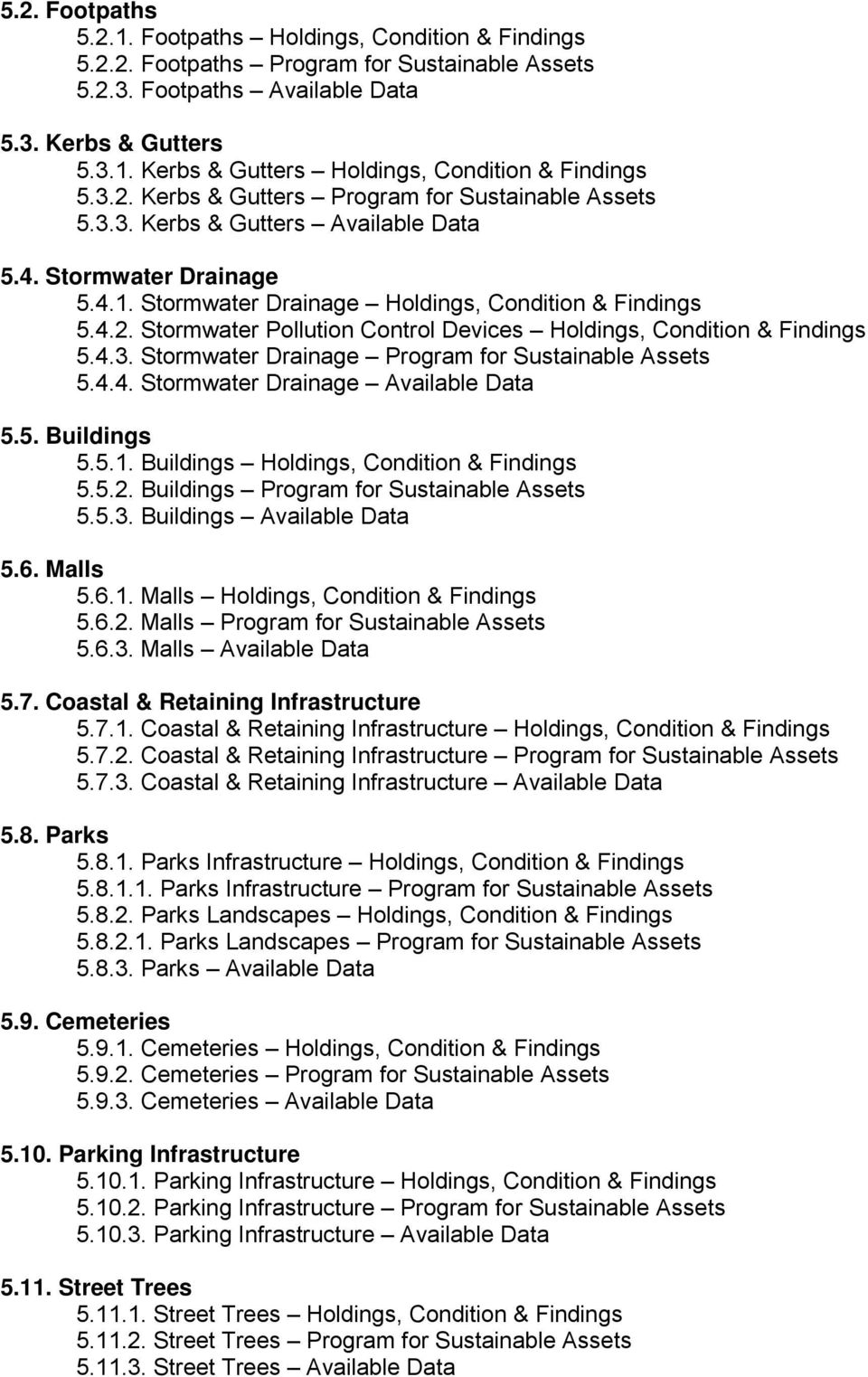
3 STRATEGIC ASSET MANAGEMENT PLAN 4 TABLE OF CONTENTS EXECUTIVE SUMMARY 1. INTRODUCTION 1.1. Introduction 1.2. Coverage 1.3. Methodology 1.4. Purpose of the Strategic Asset Management Plan Towards Sustainability in Asset Management 2. STRATEGIC ASSET MANAGEMENT PLANNING 2.1. Strategic Approach 2.2. Activities Extending the Strategic Approach Investment Strategy 2.3. Continuous Improvement of the Strategic Approach Department of Local Government Proposals for Strategic Asset Management Improvement Program to Move Toward Best Practice in Asset Management Integrating Strategic Asset Management Planning with Financial Planning Integrating Strategic Asset Management Planning with Community Planning 2.4. General Outline 3. POLICY & OBJECTIVES 3.1. Asset Management Policy 3.2. Objectives 3.3. Measures and Targets 3.4. Consultation 4. STRATEGY 4.1. Current Condition of Assets 4.2. Preferred Minimum Asset Condition Targets for SAMP Movement Towards or Away from Sustainable Assets Capacity to Enhance Assets and Service Levels 4.3. Program to Achieve Targets 4.4. Supporting the Strategy Increasing our Capacity 4.5. Monitoring Performance and Review of the Plan Strategic Asset Management Planning Group SAMPG Assessment of Performance in a Business Excellence Framework 5. ASSET MANAGEMENT PLAN 5.1. Roads Roads Holdings, Condition & Findings Roads Program for Sustainable Assets Roads Available Data

4 5.2. Footpaths Footpaths Holdings, Condition & Findings Footpaths Program for Sustainable Assets Footpaths Available Data 5.3. Kerbs & Gutters Kerbs & Gutters Holdings, Condition & Findings Kerbs & Gutters Program for Sustainable Assets Kerbs & Gutters Available Data 5.4. Stormwater Drainage Stormwater Drainage Holdings, Condition & Findings Stormwater Pollution Control Devices Holdings, Condition & Findings Stormwater Drainage Program for Sustainable Assets Stormwater Drainage Available Data 5.5. Buildings Buildings Holdings, Condition & Findings Buildings Program for Sustainable Assets Buildings Available Data 5.6. Malls Malls Holdings, Condition & Findings Malls Program for Sustainable Assets Malls Available Data 5.7. Coastal & Retaining Infrastructure Coastal & Retaining Infrastructure Holdings, Condition & Findings Coastal & Retaining Infrastructure Program for Sustainable Assets Coastal & Retaining Infrastructure Available Data 5.8. Parks Parks Infrastructure Holdings, Condition & Findings Parks Infrastructure Program for Sustainable Assets Parks Landscapes Holdings, Condition & Findings Parks Landscapes Program for Sustainable Assets Parks Available Data 5.9. Cemeteries Cemeteries Holdings, Condition & Findings Cemeteries Program for Sustainable Assets Cemeteries Available Data Parking Infrastructure Parking Infrastructure Holdings, Condition & Findings Parking Infrastructure Program for Sustainable Assets Parking Infrastructure Available Data Street Trees Street Trees Holdings, Condition & Findings Street Trees Program for Sustainable Assets Street Trees Available Data
5 6. FINANCE Other Infrastructure Other Infrastructure Holdings, Condition & Findings Other Infrastructure Program for Sustainable Assets Other Infrastructure Available Data 5.13 Plant & Equipment Plant & Equipment Holdings, Condition & Findings Plant & Equipment Program for Sustainable Assets Plant & Equipment Available Data 5.14 Information Technology Information Technology Holdings, Condition & Findings Information Technology Program for Sustainable Assets Information Technology Available Data 6.1. Asset Maintenance and Renewal Estimating Methodology 6.2. Asset Maintenance and Renewal Cost Estimates Backlog costs 6.3. Variations from SAMP3 to SAMP Conclusion APPENDICES APPENDIX 1 Investment Strategy Implementation Progress APPENDIX 2 Asset Management Continuous Improvement Program APPENDIX 3 Asset Management Policy APPENDIX 4 SAMP4 Works Program Costings APPENDIX 5 Asset Management Performance Score Matrix APPENDIX 6 Asset Maintenance Estimating Methodology

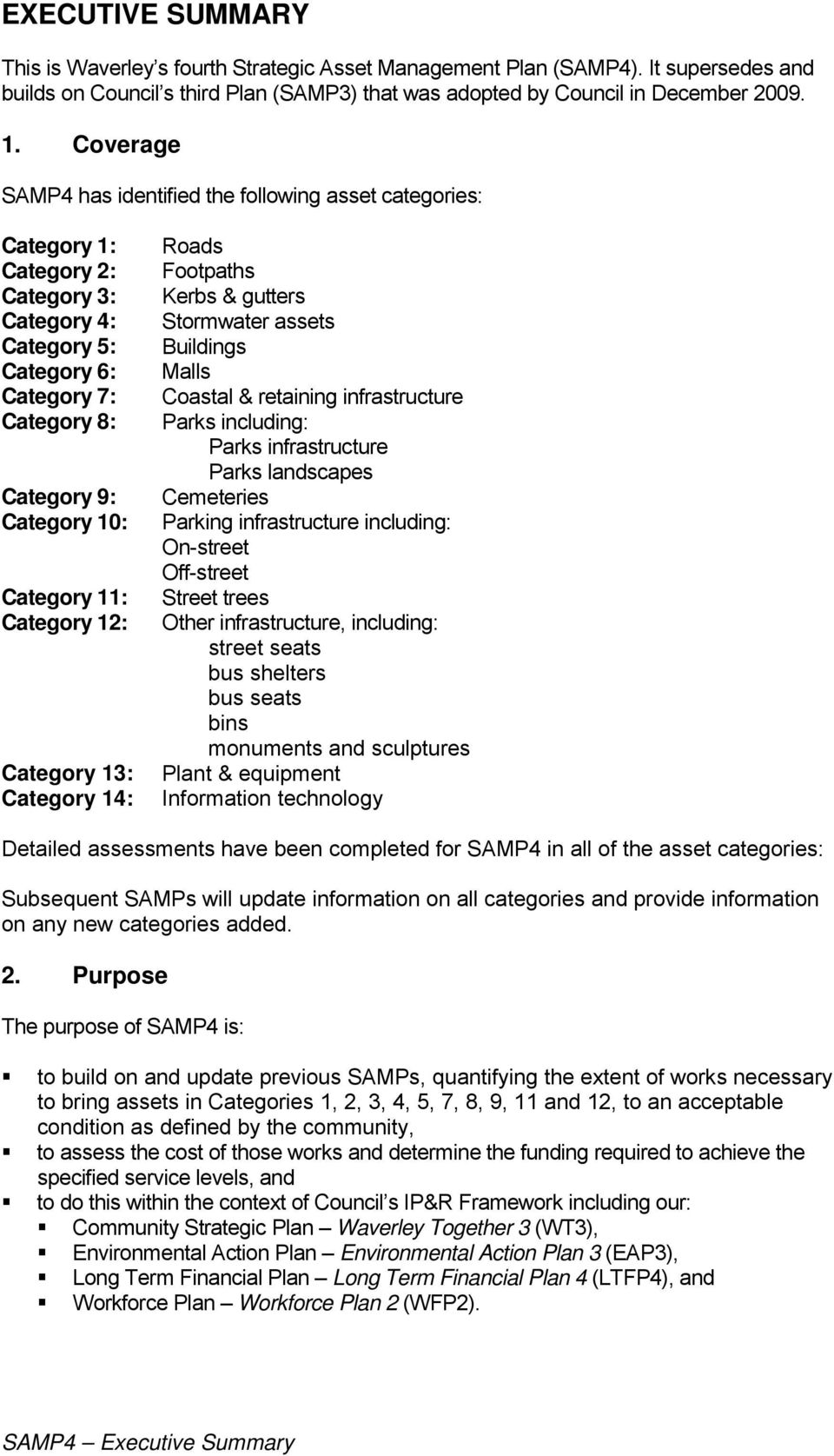
6 EXECUTIVE SUMMARY This is Waverley s fourth Strategic Asset Management Plan (SAMP4). It supersedes and builds on Council s third Plan (SAMP3) that was adopted by Council in December Coverage SAMP4 has identified the following asset categories: Category 1: Category 2: Category 3: Category 4: Category 5: Category 6: Category 7: Category 8: Category 9: Category 10: Category 11: Category 12: Category 13: Category 14: Roads Footpaths Kerbs & gutters Stormwater assets Buildings Malls Coastal & retaining infrastructure Parks including: Parks infrastructure Parks landscapes Cemeteries Parking infrastructure including: On-street Off-street Street trees Other infrastructure, including: street seats bus shelters bus seats bins monuments and sculptures Plant & equipment Information technology Detailed assessments have been completed for SAMP4 in all of the asset categories: Subsequent SAMPs will update information on all categories and provide information on any new categories added. 2. Purpose The purpose of SAMP4 is: to build on and update previous SAMPs, quantifying the extent of works necessary to bring assets in Categories 1, 2, 3, 4, 5, 7, 8, 9, 11 and 12, to an acceptable condition as defined by the community, to assess the cost of those works and determine the funding required to achieve the specified service levels, and to do this within the context of Council s IP&R Framework including our: Community Strategic Plan Waverley Together 3 (WT3), Environmental Action Plan Environmental Action Plan 3 (EAP3), Long Term Financial Plan Long Term Financial Plan 4 (LTFP4), and Workforce Plan Workforce Plan 2 (WFP2). SAMP4 Executive Summary
7 3. Aim Towards Sustainability The intent of this and future SAMPs is ultimately to achieve sustainability in asset management. We define sustainable asset management as everything we have to do to make sure our assets are maintained at a satisfactory standard in a quadruple bottom line sense. It is: The amount and timing of investment in resources and systems necessary to make sure our assets can make the social, economic and environmental contribution that we need or want at the least cost, risk and impact in a sound governance and decision making framework. SAMP4 will summarise the actions required to progress towards sustainability in asset management. It will provide an Asset Management Plan of: actions necessary to bring various assets to the standard deemed to be satisfactory by Council and the Waverley Community to meet the levels of service we require, processes required to fill any further knowledge gaps, and the current estimated cost of achieving satisfactory levels of service. 4. Approach Since SAMP2, we have completed some major projects consistent with the activities prescribed above. These have further enhanced our capacity to achieve business excellence in asset management and to meet the objectives of our SAMP as described in Chapter 3. Key activities undertaken are detailed in Table 1, Chapter 2, including activities to: maintain data on assets, understand their condition, assess their suitability for use, assess their risks, impacts and benefits, revise the composition of the asset portfolio, develop maintenance plans, and plan for acquisition and allocation of resources. 4.1 Continuous Improvement of the Strategic Approach SAMP4 takes into account the requirements of the IP&R amendments to the Local Government Act. Hence SAMP4 includes: an Asset Management Policy, an Asset Management Strategy, an Asset Management Plan, and an Asset Management Continuous Improvement Program. See Table 2, Chapter 2 for a summary on Council s compliance with the IP&R legislation. SAMP4 Executive Summary

8 5. Policy & Objectives Waverley Council is committed to ensuring that: Council s assets are well maintained for their current purpose and for future generations. Source: Direction G6, Waverley Council Community Strategic Plan, Waverley Together The objectives of the plan are: Stewardship Optimisation Relevance To ensure the protection of assets for current and future generations. To ensure the asset portfolio maximises desired social, environmental and economic outcomes for the community at least cost, risk and impact in a sound governance and open decision making framework. To continuously improve the contribution of assets to enhanced service delivery and maintain the relevance of assets as service demands change. 6. Main Findings 6.1 Current Condition of Assets The condition of assets covered within the plan has been assessed using the same 5- point rating system used in previous SAMPs as follows: Condition Rating 1 - Good Condition Condition Rating 2 - Minor Deterioration Condition Rating 3 - Medium Deterioration Condition Rating 4 - Major Deterioration Condition Rating 5 - Unserviceable The proportion of assets in each condition in SAMP4 is summarised in Table 4, Chapter 4. When comparing asset condition ratings in SAMP3 to those in SAMP4, we can note that: The proportion of assets in Categories 1, 2, and 3 Roads, Footpaths and Kerbs & Gutters in conditions 1 and 2 has increased slightly; The condition of assets in Category 4 Stormwater Drainage has remained the same; The proportion of assets in Category 5 Buildings that are rated as condition 1, 2 or 3 has reduced slightly; The condition of assets in Category 7 Coastal & Retaining Infrastructure has remained the same; The condition of assets in Category 8 Parks Infrastructure has remained the same; In Category 9 Cemeteries, Waverley Cemetery is still in relatively poor condition overall and from a cost point of view is increasing; SAMP4 Executive Summary
9 The condition of assets in Category 10 Parking Infrastructure has reduced slightly overall; In Category 11, the proportion of street trees in satisfactory condition has reduced from 94% to 87%; The condition of assets in Category 12 Other Infrastructure has increased slightly. The proportion of assets in Condition 5 across all asset categories has not changed. Most of these assets are located in Waverley Cemetery. The remaining assets in Condition 5 account for 1% or less of assets in their respective category. 6.2 Preferred Asset Condition Targets SAMP4 re-affirms the principles established in SAMP3 that targets for the minimum condition of our overall asset base are set with the purpose of ensuring that satisfactory service levels can be achieved, and achievement of these targets would represent achievement of a satisfactory standard for our assets. The preparation of Waverley Together 2 and Waverley Together 3 has enabled Council to confirm what our community thinks is a satisfactory standard for assets in Categories 1, 2, 3, 4, 5, 7, 8, 9, 11 and 12. SAMP4 has therefore set asset condition targets which reflect asset priorities for the community, while continuing to support service provision. These targets are shown in Table 6, Chapter 4. It is generally agreed by the community, councillors as a whole and Council officers that: Our roads, kerbs & gutters and street trees are in acceptable condition overall. The condition of our footpaths should be improved slightly, from 75% in Conditions 1 and 2, to 80% in Conditions 1 and 2, as there is a gap between their current condition and the target. Stormwater assets require the establishment of a reserve fund which should be built up and used as needed in addition to the current annual maintenance program to keep all drainage in Conditions 1 3. Some building assets require capital improvements to improve their overall standard from Conditions 4 and 5 to Conditions 1 3 as a minimum. Parks infrastructure assets must all be upgraded or maintained to a satisfactory condition. All Waverley Cemetery assets must be upgraded to ensure they are in an acceptable condition, to a minimum standard of Condition 2 with the exception of its retaining walls, which must be kept at Condition 3 or above. No asset will be allowed to slip into Condition 5 (Unserviceable) unless Council has decided to decommission the asset (the future of some Condition 5 assets such as the Boot Factory building in Bondi Junction requires determination by Council). In general it is agreed that satisfactory and in fact very good service levels can be achieved by having assets in the conditions set out in Table 6, Chapter 4. SAMP4 Executive Summary
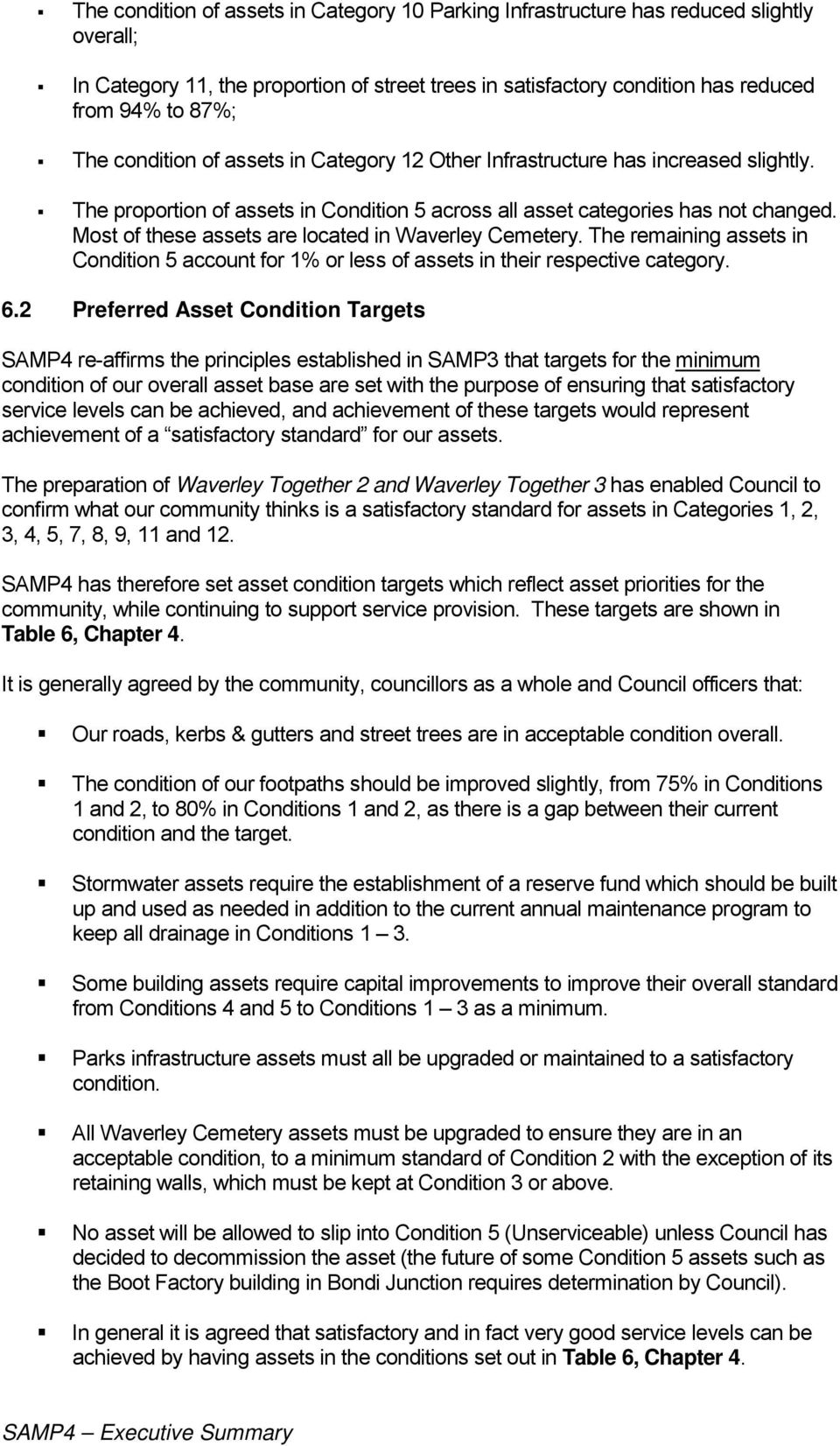
10 6.3 Program to Achieve Targets The cost over 11 years, from 2013/14 to 2023/24, to meet the asset condition targets is shown in the table below: Cost over 11 years to meet Asset Condition Targets No. Asset Category Asset type Cost 1 Roads Roads $19,377,613 2 Footpaths Footpaths $21,058,114 3 Kerb and Gutters Kerb & gutters $10,608,338 4 Stormwater Drainage Stormwater drainage $12,787,362 5 Buildings Buildings $27,623,809 6 Malls Malls $8,419,162 7 Coastal and Retaining Infrastructure 8.1 Parks Infrastructure 8.2 Parks Landscape 9 Cemeteries Pools Stairs Fences & bollards Retaining walls Sea walls Furniture Lighting Fences & bollards Footpaths Irrigation Retaining Walls Stairs Signs Play equipment Trees Garden beds Turf Roads Footpaths Kerb & gutters Fencing (internal) Fencing (perimeter) Stormwater & drainage Retaining Walls $19,716,571 $11,271,328 $7,822,016 $9,953, Parking Infrastructure Parking meters Parking signs Off-street parking $10,656, Street Trees Street trees $1,544, Other Infrastructure 13 Plant and Equipment 14 Information Technology Bus shelters Bus seats Street seats Street bins Monuments & sculptures Passenger Vehicle Small Plant Light Commercial Vehicle Light Omnibus Truck Fleet Major Fleet Specialised Equipment Software Servers $3,184,975 $18,650,784 $11,243,000 SAMP4 Executive Summary
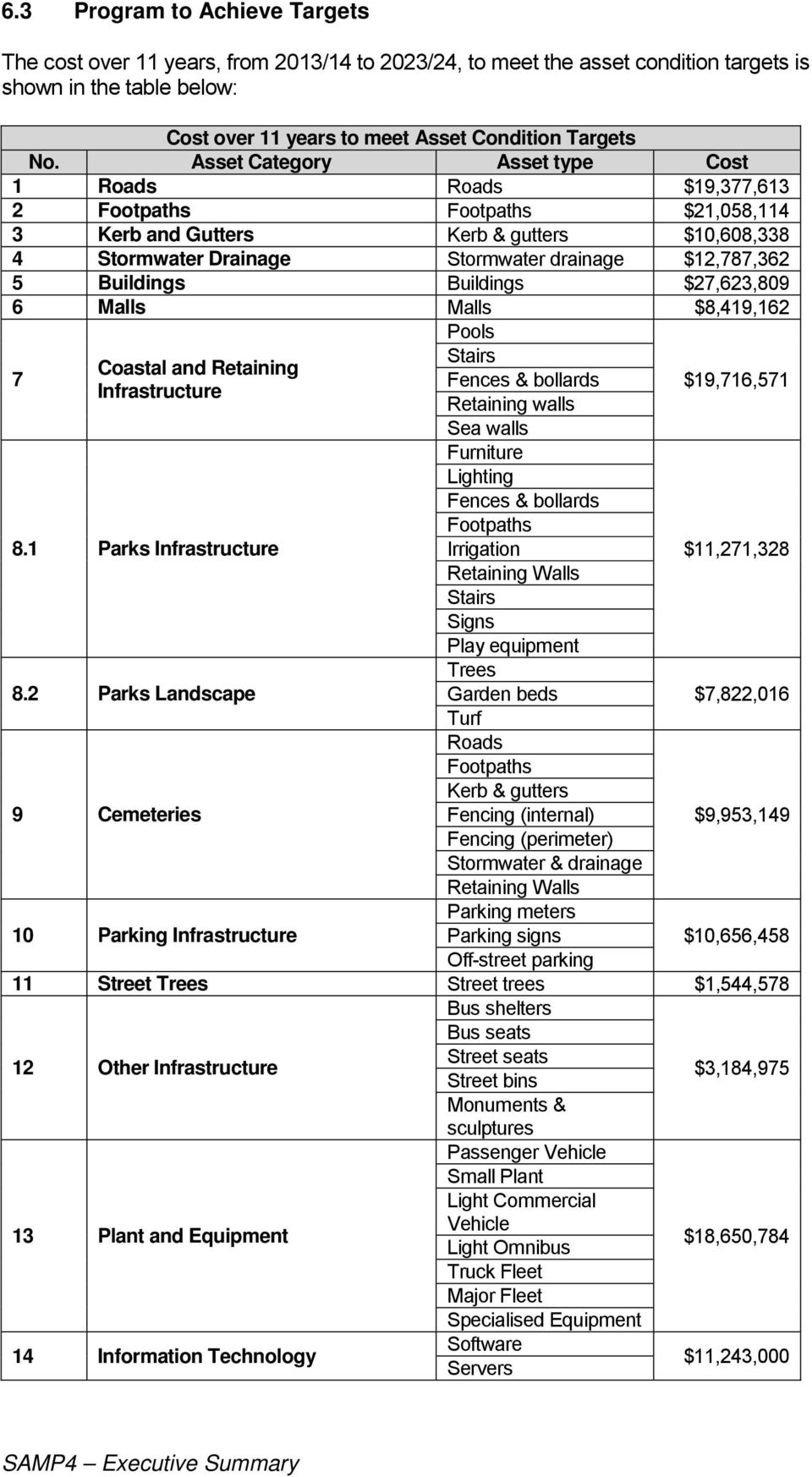
11 Cost over 11 years to meet Asset Condition Targets No. Asset Category Asset type Cost PCs Laptops Printers Data & Telephony Library RFID Chapter 5 shows a breakdown of the individual works within the Program. 7. Finance 7.1 Asset Maintenance and Renewal Estimating Methodology Since 2004 Waverley Council has been at the forefront of developing and verifying methods of accurately calculating the cost to maintain and renew assets to a standard considered satisfactory by the community. In 2010 Council received the Federal Government s National Award for Local Government in Asset and Financial Management for its work in this area. Asset backlog renewal and maintenance cost estimates quoted in SAMP4 have been calculated based on the method outlined in Appendix 6. This has resulted in a significant reduction of estimates to bring assets to a satisfactory standard and maintain them, compared to the estimates published in 2004 in Schedule 7 of Council s Annual Financial Statements. Key features of the Waverley estimating method which will produce different, and in Waverley s case, lower estimates of asset renewal bills include adoption of principles that: assets do not have to be maintained in top condition all of the time to deliver acceptable levels of service; it is not always necessary, particularly in the case of roads, footpaths kerbs and gutters, drains, and retaining walls to completely rebuild an asset (foundations and all) at the end of a notional life cycle and appropriate maintenance regimes can avoid the need for reconstruction; if the designated proportions of each asset category are kept in the top condition ratings (see Chapter 4 Table 6 for designated minimum proportions for SAMP4), this will deliver desired service levels; and floor expenditure levels for maintenance are set at the minimum deemed necessary to reduce risk of asset failure and to maintain/renew the assets at the lowest long run cost. It is contended that methodologies which assume invariably that there will be a need to completely rebuild assets at the end of their life cycle (known as full life cycle costing ) will tend to overstate the cost to deliver service when the asset base in question is comprised of well built assets designed originally to have a long life (eg., a well constructed road in an established metropolitan area as opposed to, say, a gravel road in a rural area). The Waverley method contemplates that assets that are well built and properly maintained will in certain asset categories have a life that extends beyond the notional planning period life or beyond the life span used for depreciation purposes. For a history of the evolution of this method see SAMP2 Appendix B5. An up to date summary of how the Waverley method works in the context of Integrated Planning & Reporting is provided in SAMP4 Appendix 6. SAMP4 Executive Summary

12 7.2 Asset Maintenance and Renewal Cost Estimates Taking the above principles and the methodology adopted by Waverley into account, the costs to bring assets to an acceptable standard for service delivery as outlined in Table 6 of Chapter 4 are as follows: Asset Group Asset Maintenance Costs Projected in SAMP4 Cost to bring to a satisfactory condition (backlog) Cost to maintain at a satisfactory standard 2013/14 Roads $0 $1,436,300 Footpaths $919,616 $1,519,439 Kerbs & Gutters $0 $786,197 Stormwater Assets $0 $300,000 Buildings $3,877,116 $1,823,701 Malls $0 $667,550 Coastal & Retaining Infrastructure $955,400 $435,853 Parks Infrastructure $1,772,842 $753,129 Parks Landscapes $0 $677,012 Waverley Cemetery $7,262,743 $555,389 South Head Cemetery $1,693,433 $37,678 On Street Parking Infrastructure $0 $72,467 Street Trees $374,444 $92,779 Other Infrastructure $86,334 $245,689 Total $16,941,929 $9,403, Conclusion Council s asset estimating methodology and risk management approach have allowed us to reduce the cost of meeting targets for sustainable assets both in terms of the backlog and the ongoing maintenance. Compared to 2004, the backlog expenditure to bring the five main reportable categories of assets (roads, footpaths, kerbs & gutters, drainage, and buildings) to a satisfactory condition has dropped by 95% and the cost to maintain those assets has dropped by 33%. See the following tables. SAMP4 Executive Summary

13 Waverley Council Asset Maintainence Costs Reported June 2004 Asset Category Cost to bring to a satisfactory condition Cost to maintain at a satisfactory standard Roads $31,950,000 $2,555,000 Footpaths $12,950,000 $1,850,000 Kerbs & gutters $5,900,000 $1,180,000 Stormwater assets $37,200,000 $1,800,000 Buildings $5,235,000 $1,353,000 Total $93,235,000 $8,738,000 Waverley Council Asset Maintainence Costs SAMP4 Asset Category Cost to bring to a satisfactory condition Cost to maintain at a satisfactory standard Roads $0 $1,436,300 Footpaths $919,616 $1,519,439 Kerbs & gutters $0 $786,197 Stormwater assets $0 $300,000 Buildings $3,877,116 $1,823,701 Total $4,796,732 $5,865,637 Waverley Council Asset Maintainence Costs SAMP4 Asset Category Cost to bring to a satisfactory condition Cost to maintain at a satisfactory standard Reported 2003/04 $93,235,000 $8,738,000 Reported SAMP $4,796,732 $5,865,637 Reduction 95% 33% However, the total backlog cost of $16,941,929, combined with ongoing maintenance bills of $9,403,183 for the categories Table 24 of Chapter 6 plus the ongoing maintenance bills averaging $2,598,197 over the next 11 years for plant & equipment and information technology, make the task of financing adequate assets for service delivery a sizeable challenge. This equates to a total of: Asset Maintenance and Renewal Costs Over 11 years from 2013/14 to 2023/24 Funding type $ expenditure over 11 years Capital maintenance $142,116,268 Backlog renewal $16,941,929 Recurrent maintenance $166,188,834 Total $325,247,031 Reliable finance to sustain this level of expenditure will be sought through a variety of means including loans, business development, operational efficiency, asset sales and, if necessary, a rate rise at a time to be determined. SAMP4 Executive Summary

14 1. INTRODUCTION 1.1 Introduction This is Waverley s fourth Strategic Asset Management Plan, SAMP4. It supersedes and builds on previous plans: SAMP1 adopted by Council in March 2006, SAMP2 adopted by Council in December 2007, and SAMP3 adopted by Council in December Waverley was the second Sydney suburb to become a municipality on 13 June In 2009 Waverley LGA celebrated its 150 th anniversary. It is now the most densely populated local government area in Australia. Waverley's high population density, together with its attraction of high numbers of both local and overseas visitors, continues to place considerable pressure on all its non-current assets. The future strategic management of these assets is a matter of vital concern for Council and the community. Non-current assets may be either a physical item (such as land or buildings), or intangible (such as intellectual property). This strategic plan deals only with physical assets. The plan is designed to assist Council to ensure that assets are maintained to a standard that supports the delivery of services by Council to residents of and visitors to Waverley. 1.2 Coverage SAMP1 identified 10 asset categories and successive SAMPs have refined and expanded these categories. Identified asset categories as at SAMP4 are: Category 1: Category 2: Category 3: Category 4: Category 5: Category 6: Category 7: Category 8: Category 9: Category 10: Category 11: Category 12: Category 13: Roads Footpaths Kerbs & gutters Stormwater drainage Buildings Malls Coastal & retaining infrastructure Parks comprising: Parks infrastructure Parks landscapes Cemeteries Parking infrastructure comprising: On-street Off-street Street trees Other infrastructure comprising: street seats bus shelters bus seats bins monuments and sculptures Plant & equipment SAMP4 Chapter 1 Introduction

15 Category 14: Information technology Like SAMPs 1, 2 and 3, SAMP4 is prepared in recognition of Council s obligations under the Charter for Local Government (Section 8 Local Government Act 1003, as amended). Council is the custodian of public assets in Waverley and SAMP4 addresses the sorts of challenges that Waverley and all councils face in management of diverse public assets on a large scale. SAMP4 also continues to respond to concerns raised by the various State Governments and more lately the Federal Government on the challenges of infrastructure management facing Local Government. In NSW these concerns relate primarily to the varying capacity of different councils to finance infrastructure renewal at an appropriate pace. In responding to these concerns, all Waverley Council s SAMPs have used an approach to asset management that is based less on the traditional accounting standards that have been used for planning purposes in the past, and more on ongoing condition-based assessments of assets combined with consultation with the community about preferred levels of service. Generally, the recommendation of this plan is to use up to date information about: the current actual condition of assets, and future demands for their use to achieve a portfolio of assets that can be maintained to a standard sufficient to: meet the stated needs of users in the most cost-efficient and effective manner, minimise risk and threats to safety, minimise impacts on the environment and use of resources, and achieve quadruple bottom line (QBL) sustainability for social, economic, environmental outcomes in a good governance framework. 1.3 Methodology In recent years there has been considerable discussion at the state and local government levels across Australia as to the most effective methodology for predicting, planning and amassing the expenditure necessary to ensure public assets are maintained to a satisfactory standard. In September 2004 the Premier of New South Wales released a paper titled Structural Reform of Local Government in New South Wales. Prepared by the Department of Local Government, the paper focussed on the varying financial capacities of councils to manage their infrastructure and building assets. The paper expressed substantial concern about the way in which councils maintain their assets based on the published figures from councils of the costs to bring their assets to a satisfactory standard. These figures vary widely across councils, partly because liabilities naturally differ but also because of the widely varying approach among councils to the use of applicable accounting standards in defining the cost of maintaining assets to a satisfactory standard. This variation is inevitable because accounting standards don t (and can t) define what constitutes a "satisfactory" standard for an asset at least not in common terms because service preferences differ between LGAs. Decisions by individual councils and their communities as to what constitutes satisfactory are therefore essentially inconsistent. As such, the comparison of the costs between councils to bring assets to a satisfactory standard, using any one of a number of valuation and depreciation methods, is more likely than not to be misleading. These methods are moving SAMP4 Chapter 1 Introduction

16 towards standardisation with development of manuals to assist councils, for example the IPWEA s Road Fair Value Valuation Guide. Regardless of the accounting method chosen, for each individual council it is very important to determine these costs and calculate depreciation realistically, especially if more attempts are going to be made by councils to fully fund depreciation, a practice not currently implemented by quite a lot of councils including Waverley. The realistic approach is also important if the estimates derived are to be used as a reliable indicator of the relative financial sustainability of councils. For this purpose, more detailed asset review, cost estimation and consultation is required than many councils have had the resources to undertake to date. To improve the accuracy of total estimates and decide what really should be put aside to fund proper and timely asset renewal, it is necessary to physically assess the condition of each individual asset and then consult with the community about what constitutes an acceptable level of service from that asset. Waverley Council s SAMP process progressively devises and improves the use of this approach. The advantages include: providing a finer focus on exactly where funds should be spent and in what order, not just on the total quantum that may need notionally to be put aside as assets are consumed, providing a language and means by which a meaningful discussion can be had with the community about which condition level for an asset will deliver the minimum acceptable level of service, and generally providing greater flexibility to asset managers to select cost effective investment programs, avoid over-servicing, and at the same time prevent the cost increases that arise when asset renewal is delayed too long. Our general experience is that this approach also changes perceptions of appropriate depreciation rates for assets. In Waverley s case it has resulted in substantially lower estimates of cost to bring assets to a satisfactory standard than costs published in Schedule 7 of our Annual Statements of Accounts prior to the adoption of the new methodology. While the approach has required fairly substantial investment in asset condition assessments, there has been a good return for this investment and the task of renewing assets to acceptable standards is achievable. The method used in our SAMPs is consistent with the recently proclaimed amendments to the NSW Local Government Act 1993 which introduce a compulsory framework for Integrated Planning & Reporting (IP&R) to develop and finance asset renewal programs. Details of how the methodology has been applied and how it s consistent with the IP&R requirements are provided in Chapter 2. In 2010 Waverley Council won the Federal Government s National Award for Local Government in Asset and Financial Management for developing the SAMP estimating and community consultation methodology. Implementation and validation of our methodology has led to it being the subject of significant interest by the local government sector across Australia, and Council has addressed various industry forums on its implementation (for an example see paper presented to the Western Australian Local SAMP4 Chapter 1 Introduction

17 Government Managers Association Finance Professionals Conference at data/assets/pdf_file/0008/35288/pres175- AssetPlanningWALGMA-Feb2012-f-handouts.pdf). 1.4 Purpose of the Strategic Asset Management Plan 4 (SAMP4) The purpose of SAMP4 is: to build on and update previous SAMPs, quantifying the extent of works necessary to bring assets in all Categories to an acceptable condition as defined by the community, to assess the cost of those works, and to do this within the context of Council s IP&R Framework including our: Community Strategic Plan Waverley Together 2 and Waverley Together 3 (WT2, WT3), Environmental Action Plan Environmental Action Plan 2 and Environmental Action Plan 3 (EAP2, EAP3), Long Term Financial Plan Long Term Financial Plan 4 (LTFP4), and Workforce Plan Workforce Plan 1 and Workforce Plan 2 (WFP1, WFP2). In general the purpose of past, present and future SAMPs is ultimately to achieve sustainability in asset management. 1.5 Towards Sustainability in Asset Management We define sustainable asset management as everything we have to do to make sure our assets are maintained at a satisfactory standard in a quadruple bottom line sense. It is: The amount and timing of investment in resources and systems necessary to make sure our assets can make the social, economic and environmental contribution that we need or want at the least cost, risk and impact in a sound governance and decision making framework. SAMP4 will summarise the actions required to continue with our progress towards sustainability in asset management. It will provide an Asset Management Plan of: actions and investments necessary to maintain various assets to the standard deemed to be satisfactory by Council and the Waverley Community to meet the levels of service we require, processes required to fill any further knowledge gaps, and the current estimated cost of achieving satisfactory levels of service. Achieving sustainable asset management requires Council to integrate its strategic asset planning with its financial planning. The IP&R Framework provides the means of achieving this integration. Targets for asset condition have been checked with the Waverley Community through the compulsory community engagement process required under the IP&R legislation. The agreed targets have then been incorporated into the Waverley Together 3 Community Strategic Plan (WT3) under Direction G6 Waverley s assets are well maintained for their current purpose and for future generations. SAMP4 Chapter 1 Introduction

18 2. STRATEGIC ASSET MANAGEMENT PLANNING 2.1 Strategic Approach Waverley s SAMPs involve standard activities that will need to be undertaken regularly to improve the effectiveness and cost-efficiency of maintenance programs for the very wide array of assets for which Council is the custodian. These activities consist in ensuring that we do the following as a minimum: Maintain data on assets: Consolidate and maintain up to date knowledge of our assets and their features within a comprehensive data base. Understand their condition: Survey the condition of assets in each category at specified regular intervals to suit effective planning timeframes for each asset category. Assess their suitability for use: Implement processes to periodically assess and review the relevance of assets in terms of their current and continuing capacity to service customer and community needs. Assess their risks, impacts and benefits: Assess and register risks associated with assets and factor key risks into maintenance plans. Assess any environmental, social and financial impacts of operation of assets. Revise the composition of the asset portfolio: Use all the knowledge gathered above and recommendations of other relevant plans such as the Investment Strategy to revise and confirm an optimum set of assets to be retained, disposed of and/or modified for use. Develop maintenance plans: Devise annual maintenance plans based on condition survey results taking into account: recommendations arising from strategic and direction-setting plans such as the Community Strategic Plan for Waverley and the Investment Strategy, and budget constraints. Plan for acquisition and allocation of resources: Prepare financial and human resource plans to support the delivery of maintenance programs. The strategic approach is to base decisions on relevant knowledge about assets in addition to more traditional accounting approaches. Establishment of this cycle of activities effectively changes Council s operational processes for asset management from an uncoordinated approach to a business excellence approach focussing on: conducting condition assessments, SAMP4 Chapter 2 Strategic Asset Management Planning

19 integrating decisions with other plans and continually assessing the role of assets in achieving Council s Vision and priorities, performance measurement, and continuous improvement. 2.2 Activities Extending the Strategic Approach Since SAMP1, we have completed some major projects consistent with the activities prescribed above. These have further enhanced our capacity to achieve business excellence in asset management and to meet the objectives of our SAMP as described in Chapter 3. Key activities undertaken are: Table 1 Strategic Projects and Activities Undertaken for SAMPs Prescribed Activity Projects Undertaken Maintain data on assets: Condition data for Categories 1, 2, 3, 4, 5, 6, 7, 8, 9, 10, 12 and 13 has been entered into our Geographical Information System (GIS) and other relevant data bases. Staff are updating data within Mapinfo and accessing information via Exponare. This centralises and preserves knowledge of our assets. Further process improvement is required in this area via the introduction of a new works and assets module in our finance system. This is scheduled under our Asset Management Continuous Improvement Program for installation in 2013/14. Understand their condition: Up to date condition data is now available as a result of the completion of: Categories 1, 2 and 3 Condition data surveys of the road pavements, footpaths and kerbs & gutters were undertaken in October Category 4 A project to map stormwater drainage systems was completed in July 2007 and modelling was completed which defined effective programs to optimise the capacity of the stormwater systems. Further investigation of the drainage system was undertaken for SAMP3 using CCTV in selected high risk parts of the system to develop a program for rectification of structural issues in drains and extrapolate the cost of a progressive renewal program over 7 years. Category 5 Asset Condition Surveys for Buildings was completed and received in March Ongoing asset condition surveys are conducted within a risk-based framework in between scheduled condition assessments. Category 6 General condition assessments have been undertaken for the pedestrian malls (Oxford Street, Roscoe Street and Waverley Street). All malls are relatively new and can be maintained to the required standard using existing maintenance budgets. Category 7 Visual condition assessments have been completed for SAMP4 of retaining infrastructure including retaining walls, fences, pools and cliff and coastal walks. Category 8 Assessments of trees, garden beds, turf, SAMP4 Chapter 2 Strategic Asset Management Planning

20 Table 1 Strategic Projects and Activities Undertaken for SAMPs Prescribed Activity Projects Undertaken furniture, lighting, fences, stairs, retaining walls, playground equipment, irrigation and other miscellaneous assets have been completed for SAMP4. Category 9 A full assessment of the condition of infrastructure assets in Waverley Cemetery was completed for SAMP3 and in South Head Cemetery for SAMP4. There has been no assessment undertaken of monuments within the cemeteries. Category 10 On-street parking infrastructure is inspected and maintained on a daily basis. Total renewal of the parking meters is budgeted to occur every 5-7 years and funds are reserved for this purpose. Traffic and parking signs are generally maintained by Roads and Maritime Services. Off-street parking access infrastructure is inspected routinely and funds are provided for replacement every 7 to 10 years. Category 11 A condition assessment of 8.5% of street trees was completed for SAMP4. Category 12 Condition assessments of bus shelters, bus seats. Street seats and street bins have been undertaken for SAMP4. An inventory of monuments, sculptures and artworks in the public domain has been compiled and their condition assessed for SAMP4. Category 13 A plant and equipment asset renewal schedule is in place and is included in SAMP4. Category 14 A information technology asset renewal schedule is in place and is included in SAMP4. Assess their The Investment Strategy was completed and adopted by Council suitability for use: in September 2007 resulting in a rationalisation of assets for service delivery and community use. Consultation with the community has provided data for SAMP3 about the community views on the fitness of assets for purpose and the need for particular service levels from assets that are to be retained. These views were confirmed by the community as part of the consultation for Waverley Together 3. Assess their risks, impacts and benefits: Category 5 An evaluation of the importance and capacity of various building assets to help us meet desired social and environmental outcomes has been conducted through the process of the Investment Strategy, the Waverley Together strategic planning process, and the SAMP process itself. This has confirmed the benefits of retaining and renewing large key assets such as the Bondi Pavilion and the Waverley Pavilion and diverse other assets such as child care centres and affordable housing. Categories 5 and 12 Development of Council s second Environmental Action Plan, EAP3, has provided a program for investment in buildings and street lighting to reduce their environmental impacts arising from energy and water SAMP4 Chapter 2 Strategic Asset Management Planning

21 Table 1 Strategic Projects and Activities Undertaken for SAMPs Prescribed Activity Projects Undertaken consumption. Category 9 Asset condition surveys have highlighted potential business, service and environmental risks in Waverley Cemetery. The Coastal Risks and Hazards Vulnerability Study 2011 commissioned by Council has identified the area of landfill in the cemetery as a considerable pollution and public liability risk if it is undermined, hence the funding estimate shown in Chapter 5.9, Table 19. Revise the Investment Strategy 2 was adopted in 2007 and resulted in composition of the subsequent resolutions to optimise Council s property portfolio asset portfolio: by sale of: the Waverley/Woollahra processing plant Council s depot at Waterloo, and various other pieces of closed road within the LGA This asset disposal has provided finance for the creation of a new set of assets to enable Council to accommodate staff, deliver services and support community projects more efficiently and at less cost than would have been the case with the old asset portfolio. New assets include offices and commercial space at Eastgate in Bondi Junction, a new child care centre, a new works depot and sub-depots, a new customer centre, a renovated Council Chamber and a new Waverley Pavilion. The result of the above is an optimised portfolio consistent with our objectives as stated in Chapter 3. The optimised portfolio is capable of making a significantly greater contribution than the previous portfolio to the Vision for Waverley as expressed in Waverley Together 3. Investment Strategy 3 is currently in preparation and will be presented to council for consideration in late It is anticipated that Investment Strategy 3 will focus on redevelopment and rationalisation of assets in Bondi Junction which have recently been up-zoned in the Waverley LEP. This strategy has the potential to provide a significant increase in Council s capacity to deliver service cost-effectively from a newly optimised portfolio. Develop maintenance plans: Plan for acquisition and allocation of resources: Annual Maintenance Plans have been prepared for infrastructure and buildings. These have contributed to our ability to assess funding gaps for asset maintenance into the future. Business plans are bring developed for Waverley Cemetery to extend its capacity for financial sustainability after the Cemetery runs out of accessible or saleable grave space expected within 10 years with current patterns of consumption and demand. Depending on approval for implementation and confirmation of key capital costs, business models have been identified which can help the Cemetery achieve ongoing financial sustainability over the next 100 years and to maintain its assets after the major current backlog of infrastructure renewal has been cleared. SAMP4 Chapter 2 Strategic Asset Management Planning
22 Two of the most critical projects affecting future efficiency and productivity have been the development of the Investment Strategy and Asset Management Continuous Improvement Program. Details of these are contained in the subsequent sections Investment Strategy Waverley has a significant portfolio of physical assets which it owns or controls. The total value of infrastructure, property, plant and equipment held as at 30 June 2012 is $637 million. Additionally, Waverley is fortunate enough to own an investment property portfolio valued at in excess of $117 million. Operational assets currently held for sale with a value of more than $44 million. Highly valuable investment assets and potentially liquid operational assets on operational land (as defined in Chapter 6 Part 2 of the Local Government Act) include: substantial multi-storey car parks in the Bondi Junction CBD, multi-storey commercial premises in the Bondi Junction CBD, and a substantial works depot in Waterloo which occupies a central part of the Green Square redevelopment site within the City of Sydney, the value of which has been enhanced recently as a result of the gazettal of the Green Square LEP, effectively changing the zoning from industrial to residential. Other highly valuable assets on community land (as defined in Chapter 6 Part 2 of the Local Government Act) or on roads include: the 16 hectare Waverley Cemetery, and of course parking system infrastructure which supplies well in excess of 20,000 parking opportunities a day in the commercial and tourist areas of Bondi Beach and Bondi Junction, and a high level of otherwise unattainable opportunities for parking in residential areas. The capacity of these assets, especially the roads and the parking infrastructure, to provide continuous economic stimulus and returns to the Waverley area could be fairly said to be enormous. The Investment Strategy adopted by Council in September 2007 investigated the potential of investment assets and potentially liquid operational assets to provide returns and deliver services cost-effectively into the future. The overarching aim of the resultant Strategy is to provide a flexible blueprint for dealing with key Council assets over a 10-year period to maximise their performance and achieve a number of social, environmental, economic, accommodation and financial objectives. A report on progress of implementation of the Investment Strategy is at Appendix 1. The Investment Strategy established a program for disposal of assets and reinvestment in new and existing assets to create an optimised portfolio of buildings and facilities which will enable Council to deliver increased services and meet community needs at less cost and impact than would otherwise have been the case. The revised portfolio will also generate greater financial returns and an ongoing stream of income to the Council. The quantum of contribution made by this Investment Strategy has been updated in LTFP4. SAMP4 Chapter 2 Strategic Asset Management Planning
23 Future Investment Strategies are scheduled to be developed in Successive revision of Investment Strategies, probably at 3 to 5 year intervals, will be a consistent part of the process of strategic asset management planning and long term financial planning at Waverley. 2.3 Continuous Improvement of the Strategic Approach Department of Local Government Requirements for Strategic Asset Management SAMP4 takes into account the requirements of the 2009 IP&R amendments to the Local Government Act. Hence SAMP4 includes: an Asset Management Policy, an Asset Management Strategy, an Asset Management Plan, and an Asset Management Continuous Improvement Program. Compliance with the requirements of the IP&R legislation has been achieved as set out in Table 2 below: Table 2 Strategic Asset Management Planning Legislative Requirements and Compliance in SAMP4 Requirement Account for and plan for all existing and any new assets proposed in the Community Strategic Plan An Asset Management Strategy with a time frame of at least 10 years An Asset Management Plan with a time frame of at least 10 years Compliance All assets are accounted for in Schedule 7 of Council s Annual Statements of Accounts. New assets being created under Council s adopted Capital Works Program 2012/16. Waverley Together 3, SAMP4 and the LTFP4 cover a period of 12 years from 2012 to Chapter 4 of SAMP4 outlines Council s Asset Management Strategy. Chapter 5 is the Asset Management Plan. It has a time frame of 12 years from 2012 to Asset Management Policy The Asset Management Policy is at Chapter 3. This Policy has been adopted after community consultation through Council s Community Engagement Strategy for Waverley Together 3. Asset Management Strategy must identify all assets that are critical to Council s operations and outline risk management strategies for these The revised Policy takes a quadruple bottom line approach to asset management. The Asset Management Strategy identifies 14 Categories of Assets: 1. Roads 2. Footpaths 3. Kerbs & gutters 4. Stormwater drainage 5. Buildings 6. Malls 7. Coastal & retaining infrastructure SAMP4 Chapter 2 Strategic Asset Management Planning
24 Table 2 Strategic Asset Management Planning Legislative Requirements and Compliance in SAMP4 Requirement Compliance 8. Parks comprising: Parks infrastructure Parks landscapes 9. Cemeteries 10. Parking infrastructure comprising: On-street parking Off-street parking 11. Street trees 12. Other infrastructure comprising: street seats bus seats bus shelters bins monuments and sculptures 13. Plant & equipment 14. Information technology The Asset Management Plan and Asset Management Continuous Improvement Program set out activities and process improvement to ensure continuous improvement in asset standards at minimised risk and impact. Asset Management Strategy must include specific actions required to improve council s asset management capability Asset Management Strategy must include specific actions required to resource requirements and timeframes The asset management plan must identify service standards The Asset Management Continuous Improvement Program provides a 3-year program for continuous improvement in asset management and planning to achieve agreed levels of performance in a business excellence framework under key result areas of: leadership, strategy & planning, knowledge & information, people, community focus & delivery, innovation quality & improvement, and sustainability. The Asset Management Continuous Improvement Program sets out resources necessary to deliver the Asset Management Strategy and Plan. Most of these resources have been established in a major review of structure. SAMP4 identifies service standards and the asset conditions necessary to deliver them using the agreed portfolio of assets. These service standards have been confirmed with the community through the Community Engagement Strategy for Waverley Together 2. Waverley Together 3 summarises the standards under Targets and Indicators for community and SAMP4 Chapter 2 Strategic Asset Management Planning
25 Table 2 Strategic Asset Management Planning Legislative Requirements and Compliance in SAMP4 Requirement Compliance The asset management plan must contain long term projections of asset maintenance rehabilitation and replacement costs. Councils must report on the condition of their assets Corporate Governance Direction G6. The Asset Management Plan sets out maintenance and renewal costs for assets for the planning period Costs for asset maintenance and renewal have been integrated into Council s LTFP4 in the: Base Layer (cost of maintaining existing programs for asset renewal), the Investment Strategy Layer (cost of creation and maintenance plus returns to Council for selected new assets financed by sale of underperforming assets), the Sustainable Assets Layer (costs to cover backlogs of maintenance of existing assets not currently funded in the Base Layer), the Sustainable Environment Layer (costs to improve the environmental impact or QBL performance of existing Council assets), and in the Capital Improvements layer (costs of capital upgrades of existing assets to be retained). SAMP4 reports of the condition of assets using a 5- point rating scale. Annual Financial Statements also shows the same 5- point rating scale. Council has reported on the condition of its assets in the End of Term Report for Waverley Together 2 Waverley strongly supports the IP&R requirements. They provide a sound framework for protection of assets and maximisation of their contribution to desired QBL outcomes as expressed in Waverley Together 2 and 3. We have endeavoured to achieve a high level of compliance with the legislation as the best governance approach to sustainable asset management Improvement Program to Move Towards Best Practice in Asset Management In June 2006 Council commissioned Morrison Low to complete a study of Council s capacity to manage assets. This facilitated the development of defined benchmarks Waverley will strive to meet in terms of best practice in asset management. Part of the study process was to provide examples of best practice in asset management in terms of each element of the business excellence framework. Morrison Low reported that while few if any councils in New South Wales could be said to have reached best practice in all elements of the business excellence framework, there are several examples of councils in NSW and other states and in New Zealand that have achieved excellence in one or more aspects of the framework. Morrison Low described what these councils were doing to warrant recognition for best practice in those elements and then facilitated a workshop with Waverley SAMP4 Chapter 2 Strategic Asset Management Planning
26 staff to help us decide what level of practice we might want to achieve in relation to each element. Participating staff did not think it feasible or necessary to achieve best practice in all elements in the first 3-year period of the continuous improvement program. In developing an improvement program, Council chose to focus on certain priority areas. In selecting the levels of desired excellence we did not propose to achieve a uniform standard of excellence and did not target an outcome of achieving best practice in any aspect of the framework within the 3-year period. The effort required to achieve best practice was thought to be intense, potentially beyond the resources that may be available to us and probably beyond the real needs of the Council at this stage. The resultant improvement program was considered to be a reasonable stretch over the first three years. Appendix 2 provides a progress report on implementation of the Asset Management Continuous Improvement Program SAMPG has monitored implementation of this plan in its quarterly meetings since SAMP2 was adopted and has revised and updated the plan. Progress with implementation of the Asset Management Continuous Improvement Program is on track Integrating Strategic Asset Management Planning with Financial Planning Knowledge gained from all the above studies, projects and activities has allowed Council to consolidate more accurately than ever before the cost to bring assets to a satisfactory standard. This knowledge has been shared with Councillors and the community in the Waverley Together 2 community consultation process. Through this process Councillors and the community have actively assisted officers to define what constitutes a satisfactory standard for Categories 1, 2, 3, 4, 5, 7, 8, 9, 11 and 12. The standard is defined in terms of: acceptable condition ratings for assets, and in terms of the target for the proportion of total assets in each category that should be in various condition ratings at any one time. The standards and targets that have been chosen in SAMP4 are agreed by councillors and the community as being capable of delivering acceptable levels of service from our assets. The standards have been set as shown in Chapter 4 and costs to meet them within the next twelve years have been factored into the financial model of the LTFP4 as shown in Chapter 5. Chapter 6 summarises the financial impact of this and shows the proposed financing strategy for works necessary to meet the agreed satisfactory standard. When defining satisfactory standard at Waverley we talk in terms of the proportion of assets we are prepared to accept in each condition rating across a period. We have adopted a 5-point scale for describing condition ratings consistent with the requirements of the IP&R framework. The scale is: Condition 1: Good condition Condition 2: Minor deterioration Condition 3: Medium deterioration SAMP4 Chapter 2 Strategic Asset Management Planning
27 Condition 4: Major deterioration Condition 5: Unserviceable Descriptors on these vary in a minor way from the descriptors suggested under the IP&R framework manual but the ranking system and results it produces will be the same as would have occurred using the IP&R descriptors. Descriptors have not been changed since SAMP2 as they were used in the Waverley Together 2 Community Engagement Strategy and work well to help distribute various types of assets (physical or biological) into the correct condition ratings. In adopting SAMP1, 2 and 3 Council adopted a general aim that the proportion of assets in Condition Ratings 3, 4 and 5 should not increase from the proportions as they were at March As a result of community feedback in the Waverley Together 2 Community Engagement Strategy, targets for some asset categories have been tightened but the general basic principle of not letting the proportion of assets in poorer condition ratings increase remains in place as a floor. Key assets categories where the floor has been lifted, as it were, include: Category 2: Category 5: Category 8: Category 9: Category 12: Footpaths Buildings Parks including: Parks infrastructure play equipment Cemeteries Other infrastructure, including: street seats bus seats bus shelters bins The standard for footpaths has been raised after community feedback about the importance of mobility and the role of safe footpaths in facilitating access and preventing social isolation. Standards for other items have been raised due to the necessity for risk management. It has been determined that in order to achieve acceptable levels of risk associated with these assets, the proportion of assets in the poorer condition ratings of 3, 4 or 5 needs to decrease. The cost estimates shown in SAMP4 to bring assets in all Categories to the standard accepted as satisfactory by councillors and the community constitute the Sustainable Assets Layer and Capital Enhancements Layer of the LTFP4. These costs require ongoing revision and certain minor gaps in the estimates will need to be filled in future SAMPs and LTFPs The LTFP will be revised annually and as each SAMP provides finer detail about the cost to bring assets to a satisfactory standard Integrating Strategic Asset Management Planning with Community Planning In Waverley Together 2 the key direction for asset management was ultimately adopted as: Council assets are well maintained for their current purpose and for future generations. SAMP4 Chapter 2 Strategic Asset Management Planning
28 Council s Asset Management Policy includes objectives to support this. These objectives were based on 3 strategic themes of: stewardship optimisation, and relevance. Further detail on objectives is set out in Chapter General Outline SAMP4 includes: up to date condition rating for assets in: Category 1: Roads Category 2: Footpaths Category 3: Kerbs & gutters Category 4: Stormwater drainage Category 5: Buildings Category 6: Malls Category 7: Coastal & retaining infrastructure Category 8: Parks assets comprising: Parks infrastructure Parks landscapes Category 9: Cemeteries Category 10: Parking infrastructure comprising: On-street Off-street Category 11: Street trees Category 12: Other infrastructure comprising: street seats bus shelters bus seats bins monuments and sculptures Category 13: Plant & equipment Category 14: Information technology an updated program of works required for assets to achieve the minimum standards adopted in SAMP4 over the planning period from 2012 to 2024; a revision of estimates of funds required for the above; a revised assessment of Council s performance on asset management within a business excellence framework. Actions arising from SAMP4 will be fed into, and monitored through, annual reviews of the Asset Management Continuous Improvement Plan. SAMP4 Chapter 2 Strategic Asset Management Planning
29 3. POLICY & OBJECTIVES 3.1 Asset Management Policy Waverley Council is committed to ensuring that: Council s assets are well maintained for their current purpose and for future generations. Source: Direction G6, Waverley Together It is anticipated that this overall policy commitment will remain the same in Waverley Together 3. Our Asset Management Policy is to strive within an Integrated Planning & Reporting framework to provide sound: leadership, strategic planning, systems, processes & knowledge, human resources, and financial resources to achieve business excellence in the management of our public assets. Assets will be maintained to a standard sufficient to maximise the Waverley community s chances of achieving sustainable quadruple bottom line social, environmental, economic and good governance outcomes for enhanced quality of life. The full text of this Policy is provided at Appendix Objectives To translate Direction G6 of Waverley Together 2 and Waverley Together 3 into action, we have developed Asset Management Policy Objectives within three strategic theme areas of: stewardship, optimisation, and relevance. Our adopted objectives for strategic asset management are therefore: Stewardship To ensure the protection of assets for current and future generations. Optimisation To ensure the asset portfolio maximises desired social, environmental and economic outcomes for the community at least cost, risk and impact in a sound governance and open decision making framework. Relevance To continuously improve the contribution of assets to enhanced service delivery and maintain the relevance of assets as service SAMP4 Chapter 3 Policy & Objectives
30 demands change. 3.3 Measures and Targets Ultimately the extent to which we have met the objectives of this plan and complied with the Policy will be measured by the condition of the assets relative to the overall standards that we consider satisfactory. Chapter 4 sets out our Asset Management Strategy for achieving the Asset Condition Targets necessary to ensure that services can be safely delivered via our assets at the level demanded by the community. Table 6 in Chapter 4 summarises the Targets considered capable of achieving these service levels and appropriate risk management. These Targets correspond with those proposed to be adopted in Waverley Together 3 for Direction G6. The condition of assets in relation to these Targets will be monitored regularly through implementation of our Asset Management Continuous Improvement Program and other Integrated Planning & Reporting processes including our End of Term Report. This Asset Management Continuous Improvement Program has numerous measures of performance to track progress. Council s 4 year Delivery Program, required under the IP&R framework, provides summarised indications of progress against the objectives of SAMP4 and the revised Strategies anticipated to be adopted in Waverley Together 3 which can be reported on annually. These indications are shown in Table 3 below. 3.4 Consultation Consultation on asset management standards and targets will be conducted as appropriate as part of the Integrated Planning & Reporting process. The views of the Waverley community arising from Waverley Together 2 and Waverley Together 3 have been taken into account to revise this Policy. The Policy has also been revised to comply with the requirements of the Integrated Planning & Reporting framework and now reflects the need to achieve sustainability in asset management at the quadruple bottom line. Waverley is confident that its: Asset Management Policy, Asset Management Strategy, Asset Management Plan, and Asset Management Continuous Improvement Program provide a reliable Strategic Plan for achievement of QBL sustainability in so far as assets can contribute to this outcome. SAMP4 Chapter 3 Policy & Objectives
31 Table 3 Proposed Delivery Program 2013/2017 Measures of Performance for Asset Management Direction: G6 Waverley s assets are well maintained for their current purpose and for future generations Strategy (WT3) Deliverables Desired Outcomes Measures of Progress Responsibility G6a G6b G6c Regularly revise Strategic Asset Management Plans (SAMPs) and integrate with financial planning processes Implement adopted Asset Management Plans Implement the adopted Asset Management Continuous Improvement Plan Cost effective SAMPs that are compliant with legislative requirements Long Term Financial Plans (LTFPs) that reflect the full assessed cost of adopted Asset Management Plans A program of capital works An annual asset maintenance program On-track delivery of 80% of scheduled activities in adopted Asset Management Continuous Improvement Plan each year Asset Management Plans are fully funded The proportion of residents in Council s next community survey who are satisfied with the maintenance of Council assets is steady or increasing Council assets are capable of delivering the desired levels of service Agreed benchmarks are met for each element of the Business Excellence Framework for Asset Management Survey results from community survey in relation to maintenance of Council s assets SAMPs updated regularly Asset maintenance and renewal estimates are shown in LTFPs and reported to Council each year The proportion of assets in Condition Ratings 1, 2 and 3 increases until adopted targets for the condition of assets in WT3 are achieved On-time and on budget delivery of priority capital works On-time and on budget delivery of the adopted annual maintenance programs On-going improvement in self-assessed scores on meeting agreed Business Excellence Framework benchmarks for asset management Director, Corporate & Technical Services Divisional Manager, Technical Services Divisional Manager, Technical Services SAMP4 Chapter 3 Policy & Objectives
32 4. STRATEGY 4.1 Current Condition of Assets Waverley Council s asset management system is based on a five point rating system for assets. The ratings are: Condition 1 Good Condition Condition 2 Minor Deterioration Condition 3 Medium Deterioration Condition 4 Major Deterioration Condition 5 Unserviceable The proportion of assets in each condition in SAMP4 is summarised in Table 4: Asset Category 1. Roads (% of area) 2. Footpaths (% of area) 3. Kerbs & Gutters (% of length) 4. Drainage (% of length) 5. Buildings (% of buildings) 6. Malls (% of listed assets) 7. Coastal & Retaining Infrastructure (% of listed assets) 8. Parks - Infrastructure (% of listed assets) 8. Parks - Landscape (% of listed assets) 9. Cemeteries Waverley Cemetery (% of listed assets) 9. Cemeteries South Head Cemetery (% of listed assets) 10. Parking Infrastructure Onstreet (% of listed assets) 10. Parking Infrastructure Offstreet (% of listed assets) SAMP4 Chapter 4 Strategy Table 4 Assessment of Asset Condition as at SAMP4 Asset Condition Good Minor Medium Major Condition Deterioration Deterioration Deterioration 5 Unserviceable <
33 Asset Category 11. Street trees (% of listed assets) 12. Other infrastructure (% of listed assets) 13. Plant & Equipment (% of listed assets) 14. Information Technology (% of listed assets) Table 4 Assessment of Asset Condition as at SAMP4 Asset Condition Good Minor Medium Major Condition Deterioration Deterioration Deterioration 5 Unserviceable < < Waverley Cemetery remains the asset in the poorest condition. A more detailed breakdown of Waverley Cemetery and its infrastructure is featured below: Table 5 Assessment of Waverley Cemetery Asset Condition as at SAMP4 Asset Category Asset Condition Roads % of area Footpaths % of area Kerbs & Gutters % of length Drainage % of length Fencing (internal) % of length Fencing (perimeter) % of length Retaining Walls % of walls 1 Good Condition 2 Minor Deterioration 3 Medium Deterioration 4 Major Deterioration Unserviceable When comparing asset condition ratings in SAMP3 to those in SAMP4, we can note that: The proportion of assets in Categories 1, 2, and 3 Roads, Footpaths and Kerbs & Gutters in conditions 1 and 2 has increased slightly; The condition of assets in Category 4 Stormwater Drainage has remained the same; The proportion of assets in Category 5 Buildings that are rated as condition 1, 2 or 3 has reduced slightly; The condition of assets in Category 7 Coastal & Retaining Infrastructure has remained the same; SAMP4 Chapter 4 Strategy
34 The condition of assets in Category 8 Parks Infrastructure has remained the same; In Category 9 Cemeteries, Waverley Cemetery is still in relatively poor condition overall and from a cost point of view is increasing; The condition of assets in Category 10 Parking Infrastructure has reduced slightly overall; In Category 11, the proportion of street trees in satisfactory condition has reduced from 94% to 87%; The condition of assets in Category 12 Other Infrastructure has increased slightly. The proportion of assets in Condition 5 across all asset categories has not changed. Most of these assets are located in Waverley Cemetery. The remaining assets in Condition 5 account for 1% or less of assets in their respective category. It is generally agreed by the community, councillors as a whole and Council officers that: Our roads, kerbs & gutters and street trees are in acceptable condition overall. The condition of our footpaths should be improved slightly, from 75% in Conditions 1 and 2, to 80% in Conditions 1 and 2, as there is a gap between their current condition and the target. Stormwater assets require the establishment of a reserve fund which should be built up and used as needed in addition to the current annual maintenance program to keep all drainage in Conditions 1 3. Some building assets require capital improvements to improve their overall standard from Conditions 4 and 5 to Conditions 1 3 as a minimum. Parks infrastructure assets must all be upgraded or maintained to a satisfactory condition. All Waverley Cemetery assets must be upgraded to ensure they are in an acceptable condition, to a minimum standard of Condition 2 with the exception of its retaining walls, which must be kept at Condition 3 or above. No asset will be allowed to slip into Condition 5 (Unserviceable) unless Council has decided to decommission the asset (the future of some Condition 5 assets such as the Boot Factory building in Bondi Junction requires determination by Council). In general it is agreed that satisfactory and in fact very good service levels can be achieved by having assets in the conditions set out in Table Preferred Minimum Asset Condition Targets for SAMP4 The preferred minimum asset condition targets for SAMP 4 are detailed in Table 6 below (for details about target variations from SAMP3 to SAMP4 see Chapter 6) The framework for defining what condition ratings are acceptable for each category has been determined by: SAMP4 Chapter 4 Strategy
35 Technical and financial investigations which have established a floor expenditure level for each asset category that must be sustained annually if we are to prevent risk of asset failure and maintain the asset portfolio at the lowest long run cost. Community views and attitudes on whether they would prefer to spend more than the floor expenditure to achieve an increase in the proportion of assets in the better condition ratings (above what would be provided by the floor) and thereby achieve a higher level of service than would be delivered by the floor expenditure. The community views on the asset categories requiring higher levels of expenditure than the floor are detailed in the outcome of the community survey conducted in 2009 by Hunter Valley Research Foundation (HVRF) for Waverley Together 2 and for the community survey conducted in 2010 by HVRF for Funding the Future (Effectively the only asset category for which the community has signalled a desire to spend more than the floor expenditure is footpaths). Table 6 Preferred Minimum Asset Condition Targets SAMP4 Minimum and Maximum Proportions of Assets Preferably Permitted in Each Condition Rating Preferred Asset Preferred Minimum Proportion Maximum No. Asset Category Asset type Conditions 1 & 2 Conditions 1, 2 & 3 Proportion Conditions 3 &/or 4 1 Roads Roads 79% 21% 2 Footpaths Footpaths 80% 20% 3 Kerb and Gutters Kerb & gutters 73% 27% 4 Stormwater Drainage Stormwater and drainage 88% 5 Buildings Buildings 100% 6 Malls Malls 100% Pools 100% Stairs 90% 7 Coastal and Retaining Infrastructure Fences and bollards 90% Retaining walls 90% Sea walls 90% Furniture 95% Lighting 94% Fences and bollards 90% Footpaths 80% 8.1 Parks Infrastructure Irrigation 97% Retaining walls 90% Stairs 100% Signs 90% Play equipment 100% 8.2 Parks Landscape Trees 90% Garden beds 90% SAMP4 Chapter 4 Strategy
36 Table 6 Preferred Minimum Asset Condition Targets SAMP4 Minimum and Maximum Proportions of Assets Preferably Permitted in Each Condition Rating Preferred Asset Preferred Minimum Proportion Maximum No. Asset Category Asset type Conditions 1 & 2 Conditions 1, 2 & 3 Turf 100% Roads 100% Footpaths 100% Kerb and gutters 100% Proportion Conditions 3 &/or 4 9 Cemeteries 10 Parking Infrastructure Fencing (internal) 100% Fencing (perimeter) 100% Stormwater and drainage 100% Retaining walls 100% Traffic and parking signs 90% Parking meters 100% Off-street parking 100% 11 Street Trees Street trees 94% Bus shelters 97% Bus seats 90% 12 Other Infrastructure 13 Plant and Equipment Street seats 90% Street bins 98% Monuments and sculptures 99% Passenger vehicle 100% Small plant 100% Light commercial vehicle 100% Light omnibus 100% Truck fleet 100% Major fleet 100% Specialised equipment 100% Software 100% Servers 100% 14 Information Technology PCs and laptops 100% Printers 100% Data and telephony 100% Library RFID 100% SAMP4 Chapter 4 Strategy
37 4.2.1 Movement Towards or Away from Sustainable Assets Waverley Together 2 and Waverley Together 3 assumes that acceptable service levels will be delivered from our assets as long as we are able to keep a certain proportion of each asset category in the top 2 or 3 condition ratings as set out in Table 6 above. The required proportions vary slightly as do the asset renewal intervals. However, this method is considered to be the best means of ensuring assets can be renewed sustainably and at the lowest long run cost. The following graphs from the End of Term Report for Waverley Together 2 (September 2012) show how we have progressed towards achieving the asset condition targets in SAMP 3. SAMP4 Chapter 4 Strategy
38 Waverley Together 2 Performance against targets for sustainable assets For assets that can deliver acceptable service levels by being maintained in Condition 1 or 2 Roads Footpaths Kerbs & gutters Stairs Fences & bollards Bus shelters Bus seats Street seats In parks - footpaths In parks - fences and bollards In parks - stairs In parks - playground equipment In parks - signs In Waverley Cemetery - roads In Waverley Cemetery - paths In Waverley Cemetery - gutters In Waverley Cemetery - drains In Waverley Cemetery - fencing internal In Waverley Cemetery - fencing external 2% 2% 21% 21% 39% 39% 79% 81% 79% 80% 75% 73% 73% 74% 73% 100% 69% 72% 100% 74% 72% 100% 97% 95% 100% 79% 82% 100% 84% 83% 100% 82% 87% 100% 79% 80% 100% 84% 85% 100% 65% 61% 100% 90% 90% 100% 100% 59% 52% 100% 65% 65% 100% 57% 57% 100% 100% 0% 20% 40% 60% 80% 100% 120% Target for % of assets in Condition 1 & 2 on an annual basis Final % of assets in Condition 1 & 2 in 2012 Baseline % of assets in Condition 1 & 2 in 2009 SAMP4 Chapter 4 Strategy
39 Waverley Together 2 Performance against targets for sustainable assets For assets that can deliver acceptable service levels by being maintained in Condition 1, 2 or 3 Buildings Pools Drains length Retaining walls in streets Sea walls Street bins Parking signs In parks - furniture In parks - lighting In parks - retaining walls In parks - irrigation Street trees In Waverley Cemetery - retaining walls 100% 93% 91% 100% 100% 100% 100% 88% 88% 100% 94% 93% 100% 90% 85% 100% 98% 95% 100% 90% 90% 100% 95% 95% 100% 94% 95% 100% 93% 85% 100% 97% 97% 94% 87% 94% 100% 90% 90% 0% 20% 40% 60% 80% 100% 120% Target for % of assets in Condition 1, 2 &3 on an annual basis Final % of assets in Condition 1, 2 & 3 in 2012 Baseline % of assets in Condition 1,2 & 3 in 2009 Based on the above, the asset with the biggest gap between required condition ratings and actual ratings is Waverley Cemetery, followed closely by some infrastructure assets in parks, and stair, fences and bus seats in the street domain. The gap per asset category as at SAMP3 and Waverley Together 2 is shown in the following graph. SAMP4 Chapter 4 Strategy
40 SAMP 3 and Waverley Together 2 Performance against targets for sustainable assets Gap to target for asset sustainability Roads Kerbs & gutters Pools 2% 1% 0% Street bins In parks - irrigation Bus shelters In parks - furniture Footpaths Retaining walls in streets In parks - lighting Buildings In parks - retaining walls Street trees Sea walls Parking signs In Waverley Cemetery - retaining walls In parks - signs Drains length Street seats In parks - stairs In parks - footpaths Bus seats In parks - fences and bollards Fences & bollards Stairs In parks - playground equipment In Waverley Cemetery - kerbs & gutters In Waverley Cemetery - paths In Waverley Cemetery - drains -2% -3% -3% -5% -5% -6% -6% -7% -7% -7% -10% -10% -10% -10% -12% -16% -16% -18% -21% -21% -26% -31% -35% -35% -41% -43% In Waverley Cemetery - fencing internal -61% In Waverley Cemetery - fencing external -79% In Waverley Cemetery - roads -98% -120% -100% -80% -60% -40% -20% 0% 20% % of asset category meeting (green) or not meeting (red) target SAMP4 Chapter 4 Strategy
41 4.2.2 Capacity to Enhance Assets and Service Levels Notwithstanding the targets set as a minimum above it is recognised that Waverley should continue to maximise its capacity to achieve enhanced levels of service from selected priority assets as demand from the community grows. Community demand for enhanced levels of service from assets is measured every four years through the process of consultation for the development of the Community Strategic Plan. Recent consultation for Waverley Together 3 suggests there may be some increase in demand for enhanced streetscape presentation via tree planting. Council will consider the affordability of this and other required infrastructure investment during the LTFP planning process. It should be noted that Council has been allocating funds from its adopted Investment Strategy 2 (2007) for expenditure on some major assets to enhance service levels and is disposing of assets deemed not capable of providing services in the most cost effective manner. In addition to helping us enhance the service levels provided by these assets, this rationalisation has had the effect of optimising our total portfolio so that more services should now be able to be delivered by the whole asset base, per unit of cost. Property investment strategies of this kind allow Council to tap into sources of sunk capital to finance renewal of assets which deliver a higher level of social, environmental and local economic return as well as improved financial returns to the Council. A new Investment Strategy 3 for increasing output from the total property portfolio is currently under development. This will ensure that the proportion of buildings in the better Condition Ratings (1,2 and 3) continues to grow in the next ten years and that Council continues to deliver services with the highest possible efficiency and QBL returns. Council s Long Term Financial Plans (LTFP) detail estimates of costs for enhancement of assets to meet the community s preferred service levels. These costs are outlined in the Sustainable Assets and Capital Improvements Layers of LTFPs. The LTPFs are reviewed annually. The costs outlined should cover additional capital enhancements of existing assets and creation of new ones. Costs to achieve the service levels set out in Table 6 are summarised in Chapter Program to Achieve Targets Table 6 above showed asset condition targets for individual categories of assets. The cost over 11 years, from 2013/14 to 2023/24, to meet these targets is shown below in Table 7. Table 7 Cost over 11 years to meet Asset Condition Targets No. Asset Category Asset type Cost 1 Roads Roads $19,377,613 2 Footpaths Footpaths $21,058,114 3 Kerb and Gutters Kerb & gutters $10,608,338 4 Stormwater Drainage Stormwater drainage $12,787,362 5 Buildings Buildings $27,623,809 6 Malls Malls $8,419,162 7 Coastal and Retaining Infrastructure 8.1 Parks Infrastructure SAMP4 Chapter 4 Strategy Pools Stairs Fences & bollards Retaining walls Sea walls Furniture Lighting $19,716,571 $11,271,328
42 Table 7 Cost over 11 years to meet Asset Condition Targets No. Asset Category Asset type Cost Fences & bollards Footpaths Irrigation Retaining Walls Stairs Signs Play equipment 8.2 Parks Landscape Trees Garden beds Turf $7,822,016 9 Cemeteries Roads Footpaths Kerb & gutters Fencing (internal) Fencing (perimeter) Stormwater & drainage Retaining Walls $9,953, Parking Infrastructure Parking meters Parking signs Off-street parking $10,656, Street Trees Street trees $1,544, Other Infrastructure Bus shelters Bus seats Street seats Street bins Monuments & sculptures $3,184, Plant and Equipment Passenger Vehicle Small Plant Light Commercial Vehicle Light Omnibus Truck Fleet Major Fleet Specialised Equipment $18,650, Information Technology Software Servers PCs Laptops Printers Data & Telephony Library RFID $11,243,003 The annual cost to meet the targets are shown in the graph below (for detailed costings see APPENDIX 4). SAMP4 Chapter 4 Strategy
43 4.4 Supporting the Strategy Increasing Our Capacity The Asset Management Continuous Improvement Program sets out our current plan for continuing process improvement in asset management and planning. At present it is considered that Council has sufficient human resources in place to develop effective Asset Management Plans. The important thing is to retain these resource levels, continuously develop skills and ensure access to the knowledge base being created via our SAMP processes. Regular monitoring and revision of these processes and progress with Asset Management Plans will be undertaken by SAMPG, chaired by the Divisional Manager Technical Services (see Section below). 4.5 Monitoring of Performance and Review of the Plan Monitoring performance in achievement of the targets of this SAMP will be undertaken through Council s usual process of translating key performance measures into Waverley Together 3 and into annually revised Operational Plans required under the IP&R framework. Supervision of this task and oversight of performance reporting will be undertaken by the Divisional Manager Technical Services, who will also monitor and report on achievement of outcomes of the Capital Works Plan and other related plans as prescribed from time to time. SAMP4 Chapter 4 Strategy
44 4.5.1 Strategic Asset Management Planning Group SAMPG The Divisional Manager Technical Services will be assisted in this role by the Strategic Asset Management Planning Group (SAMPG). This group comprises: Divisional Manager, Technical Services (Chair) Director, Corporate and Technical Services Director Public Works & Services Divisional Manager, Finance & Information Systems & Services Divisional Manager, Environmental Services Divisional Manager, Businesses, Services & Property Divisional Manager, Parks & Open Space Operations Divisional Manager, Maintenance & Construction Manager, Strategic Asset Management Unit Executive Officer, Technical Services SAMPG contains the bulk of Council's asset planning and management leadership expertise. It will also be responsible for ensuring the preparation of costed inspection and maintenance schedules and condition surveys for all assets, and for the regular assessment of the cost implications of the SAMP, feeding these into annual planning processes for asset maintenance and capital works Assessment of Performance in a Business Excellence Framework Waverley is one of many agencies embarking on a path of strategic asset management planning. Some agencies engaged in this are developing models to track and rate their performance in achieving best practice in asset management processes. The Business Excellence Framework, already adopted at Waverley, is being used more frequently by major asset managers to assess performance in this. In SAMP1 we used a framework developed by Main Roads Western Australia as a self-diagnosis or selfassessment kit to assess our achievement in excellence in asset management (see SAMP1 Appendix B.2). The self assessment consisted of a list of 50 questions addressing seven key elements of the Business Excellence Framework: 1. Agency Objectives and Stakeholder Requirements 2. Strategy and Planning Process 3. Data, Information and Knowledge 4. Business Results 5. People 6. Leadership 7. Audit and Review. Results of the self assessment can be scored to determine performance. The initial selfassessment of our performance conducted for SAMP1 indicated that Waverley was achieving a systematic approach to asset management with its scores falling into the range of In SAMP2, consultants assessed Waverley s asset management performance according to the Morrison Low Study. See SAMP2 Appendix A.12 for the results of this assessment. The Main Roads Western Australia self-assessment survey was conducted again for SAMP3 and SAMP4. In this kit, application of the scoring system provides the following indications of performance levels: SAMP4 Chapter 4 Strategy
45 Score Indicates: Best Practice in Asset Management The agency has a well established asset management process in place that is periodically audited, reviewed and improved Competence in Asset Management A good process is in place but audits and reviews are required to identify areas for improvement A Systematic Approach to Asset Management The agency is in the process of developing the process. There are several good initiatives, however not fully deployed Early Phase of Development of Asset Management Several concepts being developed, however not yet deployed Basic Understanding of the Process Some initiatives at the conceptual level being developed Lack of Understanding of the Process For both SAMP3 and SAMP4 the results of the self-assessment for asset management indicated that Waverley has achieved Competence in Asset Management, with its scores falling within the range. In the areas of community consultation, strategy and planning and leadership Waverley s performance is considered to have strong features of best practice in asset management. The results of the self-assessment completed for SAMP4 are included at Appendix5. SAMP4 Chapter 4 Strategy
46 5. ASSET MANAGEMENT PLAN This Chapter details the specific actions proposed to set Council on a course to achieve the objectives, measures and targets set out in Chapters 3 and 4 of the Plan above. The Asset Management Plan provides: descriptions of assets and services delivered, information available on the existing condition and service levels of individual assets, processes for achieving continuous improvement in asset management (the Asset Management Continuous Improvement Program) and maintenance, renewal and enhancement programs for all Categories consistent with the targets for Sustainable Assets as at SAMP4. The Asset Management Plan also shows, in maps and other forms, the specific assets that are scheduled for maintenance within the defined planning period in certain categories. Maintenance Plans based on the Asset Management Plan will be put to Council annually for adoption, subject to availability of funding. Council s capacity to keep to the Asset Management Plan is discussed in the Long Term Financial Plan 4 (LTFP4). Financial resources are not yet secured for the programs. The assumed life cycles for the assets vary by category and by type, as shown in Table 8. Medium term works programs have been developed for a number of the asset categories. Extending programs too far into the future becomes meaningless as there are always going to be unforseen external influences that cause the assets to deteriorate at either a faster or slower rate than predicted. It is important to note that while the assumed life cycle of an asset equates generally to a planned period of life and renewal for the asset, it is not intended to imply there will be a definite need to renew the asset by full re-construction at the end of that period. Waverley s method of life cycle costing does not uniformly assume across all asset categories that if an asset is maintained properly it will need to be reconstructed, as it were, from the ground up, at the end of a defined period. On the contrary, maintenance levels have generally been set to avoid the need for full reconstruction and extend the life of the asset beyond the planning period. Where an asset is considered to be one that will be required indefinitely for purposes of service delivery (eg. all our roads, footpaths, kerbs, drains, retaining infrastructure, parks infrastructure and the like), those assets are constructed and maintained so as to extend their life beyond the life cycle assumed for planning purposes. Waverley contends that this is cheaper in the long run and spreads the burden of asset maintenance more fairly across generations. Obviously this does not apply for short lived assets such as parking meters which in general are fully replaced by new machines at the end of a life cycle. Aside from forming a planning horizon for each asset category, the assumed life cycles listed in Table 8 will also generally equate to the life cycles used for purposes of calculating depreciation annually. However, Waverley Council has recently held discussions with auditors on this issue and is considering developing an alternative approach to the calculation of depreciation for certain categories of assets. Waverley contends that the current method used by councils to calculate depreciation is flawed and will overstate the necessary depreciation expense for long lived, well constructed assets typically found in established cities. This overstatement of the depreciation expense will be likely to occur if valuations for SAMP4 Chapter 5 Asset Management Plan
47 certain categories of assets invariably assume full reconstruction at the end of a notional lifecycle. Depending on the asset category and location of the asset, Waverley will be likely in future to subtract the reconstruction cost from any valuation and in calculating depreciation may also consider varying the assumed life cycle of the asset compared to that shown in Table 8 below. This will be done to ensure there are no double counts in the depreciation calculation and to ensure that the asset renewal ratios (of depreciation $ to maintenance $) reaches an equilibrium of approximately 1:1 without loss of asset service capacity. Table 8 Assumed Asset Life Cycle Length for Asset Maintenance Category Asset Assumed Asset Life Cycle (years) 1 Roads asphalt - 30 concrete Footpaths asphalt - 20 concrete - 35 segmental Kerbs & gutters concrete sandstone Stormwater assets Buildings 50 6 Malls 20 7 Coastal & retaining infrastructure comprising: pools retaining walls stairs fences seawalls Parks comprising: furniture lighting fences footpaths stairs retaining walls signs playground equipment irrigation trees garden beds turf (low use) (high use) 9 Cemeteries comprising: roads kerbs & gutters footpaths drainage fencing retaining walls SAMP4 Chapter 5 Asset Management Plan
48 Table 8 Assumed Asset Life Cycle Length for Asset Maintenance 10 Parking infrastructure comprising: On-street Off-street Street trees Other infrastructure comprising: bus shelters bus seats street seats bins monuments and sculptures Plant & equipment Information technology 3-5 SAMP4 Chapter 5 Asset Management Plan
49 5.1 Roads Roads Holdings, Condition & Findings Holdings kilometres of road comprising: Available Data Last Condition Survey 1,022,310m 2 of road pavement (local and regional roads). - 93,341m 2 of road pavement (state road and freeway) kilometres of local road kilometres of regional road kilometres of state road kilometres of freeway. Council is responsible for the maintenance of all local and regional roads ( kilometres). See Section below for the following data: 5.1 Map 1 Road pavement treatment dates. 5.1 Map 2 Road pavement treatments. 5.1 Map 3 Present condition of road network in June 2012 (conditions 1-5). 5.1 Map 4 Present condition of road network in June 2012 (conditions 3-5). 5.1 Map 5 12 year road works program (at March 2013 funding level). 5.1 Map 6 Predicted condition of road network in 2016 (at March 2013 funding level). 5.1 Map 7 Predicted condition of road network in 2020 (at March 2013 funding level). 5.1 Map 8 Predicted condition of road network in 2024 (at March 2013 funding level). 5.1 Photo Reference Roads Photograph indications of features of roads in each condition rating. Road pavement condition data was last collected in October SAMP4 condition rating is based upon road condition at 30 June 2012 after the completion of 2011/12 upgrade and maintenance programs. SAMP4 Chapter 5.1 Roads
50 General Assessment of Condition Condition Rating % of Road Pavement Area 1 Good condition 45 2 Minor deterioration 36 3 Medium deterioration 12 4 Major deterioration 7 5 Unserviceable 0 Main Findings 81% of our roads have been maintained in an acceptable condition. Asset Condition Target Programs to meet Asset Condition Target Budget Allocation to meet Asset Condition Target None are currently unserviceable. The percentage of roads in categories 3 and 4 has been reduced from 21% to 19% since SAMP3. A minimum 79% of roads in Condition Ratings 1 and 2. See 5.1 Map 5 for 12 year road works program (based on funding as at March 2013). Table 9 shows the budget allocation as at March 2013 for repairs and maintenance and capital works as well as the funding provided and expenditure required to meet the Asset Condition Target. There are no budget implications to maintain our roads at their current conditions. The current program as detailed in SAMP4 has sufficient funds to ensure that the % of roads in categories 1 and 2 remains at a minimum of 79%. SAMP4 Chapter 5.1 Roads
51 5.1.2 Roads - Program for Sustainble Assets Table 9 shows the budget allocation as at March 2013 for repairs and maintenance and capital works as well as the funding provided and expenditure required to meet the Asset Condition Target. Table 9 Budget Allocation as at March / / / / / / / / / / / /24 Roads Repairs & Maintenance Wages & Salaries 351, , , , , , , , , , , ,016 Temporary Staff 10,000 Signs 25,000 20,000 20,540 21,095 21,665 22,250 22,851 23,468 24,102 24,753 25,421 26,107 Concrete Purchases 18,000 18,000 18,486 18,985 19,498 20,024 20,565 21,120 21,690 22,276 22,877 23,495 Contractors 1,421,000 38,000 39,026 40,080 41,163 42,274 43,415 44,587 45,791 47,027 48,296 49,600 Waste Disposal 2,500 2,500 2,568 2,637 2,708 2,781 2,856 2,933 3,012 3,093 3,177 3,263 Stores & Materials 19,000 18,000 18,486 18,985 19,498 20,024 20,564 21,119 21,689 22,274 22,875 23,493 Total Roads Repairs & Maintenance $1,847,344 $498,547 $519,125 $540,702 $562,501 $583,824 $605,447 $627,636 $648,182 $669,405 $691,327 $713,974 Capital Works Roads Related Oxford Street East streetscape upgrade 1,000,000 1,000,000 Investigate the feasibility of light rail to service the key transport routes 100,000 of Waverley LGA Implement the Waverley Transport Plan , , , , , , , , , ,542 School Zone safety program 100, , , ,000 Tamarama/Bronte 40km/hr zone Undertake traffic and pedestrian counts between Bronte Beach and 550,000 Tamarama to enable application for a local traffic zone Wairoa Ave & Blair St intersection treatment 200,000 Albion St & Bronte Rd investigation for traffic lights 500,000 Arden St & Macpherson St investigation for roundabout 100,000 Park Parade traffic calming & parking 250,000 Penkivil St & Martins Ave investigation for roundabout 150,000 Fletcher St & Sandridge St investigation for roundabout 200,000 Military Road intersection treatments & traffic calming 500, ,000 Bronte Rd, Ebley St, Hollywood Ave & Waverley St link road circulation, 3,500,000 3,500,000 traffic improvements & road Road safety & traffic calming 200, , , , ,000 Bike Plan Implementation 50, , , , , , , , , , ,000 Total Capital Works Roads Related $150,000 $2,063,000 $3,018,000 $1,326,586 $635,404 $4,444,460 $653,760 $5,463,312 $673,121 $983,195 $693,542 Capital funding provided to meet SAMP4 Asset Condition Target $1,436,300 $1,475,080 $1,514,907 $1,555,809 $1,597,816 $1,640,957 $1,685,263 $1,730,765 $1,777,496 $1,825,488 $1,874,776 Capital expenditure required to meet SAMP4 Asset Condition Target $1,436,300 $1,475,080 $1,514,907 $1,555,809 $1,597,816 $1,640,957 $1,685,263 $1,730,765 $1,777,496 $1,825,488 $1,874,776
52 5.1.3 Roads Available Data Available Data Available data comprises: 5.1 Map 1 Road pavement treatment dates. 5.1 Map 2 Road pavement treatments. 5.1 Map 3 Present condition of road network in June 2012 (conditions 1-5). 5.1 Map 4 Present condition of road network in June 2012 (conditions 3-5). 5.1 Map 5 12 year road works program (at March 2013 funding level). 5.1 Map 6 Predicted condition of road network in 2016 (at March 2013 funding level). 5.1 Map 7 Predicted condition of road network in 2020 (at March 2013 funding level). 5.1 Map 8 Predicted condition of road network in 2024 (at March 2013 funding level). 5.1 Photo Reference Roads Photograph indications of features of roads in each condition rating. SAMP4 Chapter 5.1 Roads
53 5.1 Map 1 - Road Pavement Treatment Dates (as at 30/06/2012) July 1992 to June 1996 July 1996 to June 2000 July 2000 to June 2004 July 2004 to June 2008 July 2008 to June 2012
54 5.1 Map 2 - Road Pavement Treatments (as at 30/06/2012) Asphalt Overlay Flush Seal Mill & Asphalt Resheet Mill & Asphalt Resheet (recycled glass)
55 5.1 Map 3 - Present Condition of Road Network (as at 30 June 2012) Condition 1 Condition 2 Condition 3 Condition 4 Condition 5
56 5.1 Map 4 - Present Condition of Road Network (conditions 3,4,5 - as at 30 June 2012) Condition 3 Condition 4 Condition 5
57 5.1 Map 5-12 Year Roads Works Programme July 2012 to June 2016 July 2016 to June 2020 July 2020 to June 2024
58 5.1 Map 6 - Predicted Future Condition of Road Network in 2016 (as at 30 June 2016) Condition 1 Condition 2 Condition 3 Condition 4 Condition 5
59 5.1 Map 7 - Predicted Future Condition of Road Network in 2020 (as at 30 June 2020) Condition 1 Condition 2 Condition 3 Condition 4 Condition 5
60 5.1 Map 8 - Predicted Future Condition of Road Network in 2024 (as at 30 June 2024) Condition 1 Condition 2 Condition 3 Condition 4 Condition 5
61 5.1 Photo Reference Roads Condition 1 Near perfect condition Very little cracking Smooth even surface
62 Condition 2 Good condition Some cracking though generally cracks are not wide Reasonably smooth surface with only slight undulations (roughness)
63 Condition 3 Fair condition Some wide cracking with potholes starting to appear Riding quality of surface starting to deteriorate
64 Condition 4 Poor condition Significant amount of cracking with the majority of cracks being wide resulting in large numbers of potholes Noticeably rough surface for motorists Pavement starting to fail
65 Condition 5 Unserviceable condition All pavement cracked and potholed to such an extent that it is unsafe for a vehicle to use
66 5.2 Footpaths Footpaths Holdings, Condition & Findings Holdings 352,008 m 2 of footpath pavement in total. Available Data Last Condition Survey General Assessment of Condition See Section below for the following data: 5.2 Map 1 Present condition of footpath network in June 2012 (conditions 1 5). 5.2 Map 2 Present condition of footpath network in June 2012 (conditions 3 5). 5.2 Map 3 12 year footpath works program (at March 2013 funding level). 5.2 Map 4 Predicted future condition of footpath network in 2016 (at March 2013 funding level). 5.2 Map 5 Predicted future condition of footpath network in 2020 (at March 2013 funding level). 5.2 Map 6 Predicted future condition of footpath network in 2024 (at March 2013 funding level). 5.2 Photo Reference Footpaths Photograph indications of features of footpaths in each condition rating. SAMP4 condition rating is based upon road condition at 30 June 2012 after the completion of 2011/12 upgrade and maintenance programs. Footpath condition data was collected in October Condition Rating % of Area 1 Good condition 40 2 Minor deterioration 35 3 Medium deterioration 23 4 Major deterioration 2 5 Unserviceable 0 Main Findings 75% of our footpaths have been maintained in acceptable condition. Asset Condition Target None are currently unserviceable. The % of footpath assets in the poorer condition ratings of 3 and 4 has decreased slightly compared to the condition assessment conducted for SAMP3. A minimum 80% of footpaths in Condition Ratings 1 and 2. SAMP4 Chapter 5.2 Footpaths
67 Programs to meet Asset Condition Target Budget allocation to meet Asset Condition Target See 5.2 Map 3 for 12-year footpath works program (based on funding as at March 2013). Table 10 shows the budget allocation as at March 2013 for repairs and maintenance and capital works as well as the funding provided and expenditure required to meet the Asset Condition Target. Community surveys have revealed that the community places a high importance upon the condition of footpaths. The community has indicated that they feel Council should increase the funding, upgrades and maintenance to footpaths to increase the % of footpaths in an acceptable condition (categories 1 and 2). Councillors and SAMPG determined that increasing the footpaths in conditions 1 and 2 from 75% to 80% by An increase to the existing funding is required to ensure the proportion of assets in the acceptable condition ratings increase to a total of 80%. SAMP4 Chapter 5.2 Footpaths
68 5.2.2 Footpaths - Program for Sustainble Assets Table 10 shows the budget allocation as at March 2013 for repairs and maintenance and capital works as well as the funding provided and expenditure required to meet the Asset Condition Target. Table 10 Budget Allocation as at March / / / / / / / / / / / /24 Footpaths Repairs & Maintenance Wages & Salaries 396, , , , , , , , , , , ,254 Temporary Staff 5,000 Maintenance Internal 59,450 58,900 60,490 62,123 63,800 65,523 67,292 69,109 70,975 72,891 74,859 76,880 Concrete Purchases 40,000 65,000 66,755 68,558 70,408 72,308 74,260 76,265 78,325 80,440 82,611 84,841 Contractors 381, , , , , , , , , , , ,769 Plant Hire External 1,500 1,500 1,541 1,583 1,626 1,670 1,715 1,761 1,809 1,858 1,908 1,960 Waste Disposal 18,500 17,000 17,459 17,931 18,414 18,910 19,420 19,944 20,483 21,037 21,604 22,187 Stores & Materials 58,000 30,000 30,810 31,642 32,496 33,373 34,274 35,199 36,149 37,125 38,127 39,157 Total Footpaths Repairs & $960,111 $984,594 $1,019,943 $1,056,795 $1,094,191 $1,131,290 $1,169,052 $1,207,813 $1,244,860 $1,283,057 $1,322,438 $1,363,048 Maintenance Capital Works Footpath Related BB PAMP Development & Implementation 200, , , , ,000 BJ PAMP Implementation 550, , , ,000 Undertake selected Green Links Projects 107, ,000 85,582 Local Village DCP Streetscape Improvements 1,000,000 1,000,000 1,000,000 1,000,000 1,000,000 Upgrade Rose Bay Village streetscape 75,000 75,000 Improve Murriverie Road Shops streetscape 150,000 Streetscape improvements works Bondi Road Stage 2 - south side, Avoca St to Denham St. North side Bondi Rd from Castlefield St to 515, ,000 Denham St to be completed in 2014/15 Streetscape improvements works Bondi Road Stage 3 - north side, 10, ,000 Penkivil to Wellington Streets Footpath upgrade of Military Road east side adjacent to bus terminus 100,000 Undertake minor footpath adjustments to improve disability 24,369 25,000 25,000 25,000 25,000 25,000 access Total Capital Works Footpath Related $731,526 $665,000 $1,100,582 $1,000,000 $25,000 $750,000 $525,000 $1,000,000 $1,075,000 $1,000,000 $1,525,000 $2,050,000 Capital funding provided to meet SAMP4 Asset Condition Target Capital expenditure required to meet SAMP4 Asset Condition Target $1,703,571 $1,749,568 $1,796,806 $1,645,867 $1,690,305 $1,735,943 $1,782,814 $1,830,950 $1,880,386 $1,931,156 $1,983,297 $1,703,571 $1,749,568 $1,796,806 $1,645,867 $1,690,305 $1,735,943 $1,782,814 $1,830,950 $1,880,386 $1,931,156 $1,983,297
69 5.2.3 Footpaths Available Data Available Data Available data comprises: 5.2 Map 1 Present condition of footpath network in June 2012 (conditions 1 5). 5.2 Map 2 Present condition of footpath network in June 2012 (conditions 3 5). 5.2 Map 3 12 year footpath works program (at February 2013 funding level). 5.2 Map 4 Predicted future condition of footpath network in 2016 (at March 2013 funding level). 5.2 Map 5 Predicted future condition of footpath network in 2020 (at March 2013 funding level). 5.2 Map 6 Predicted future condition of footpath network in 2024 (at March 2013 funding level). 5.2 Photo Reference Footpaths Photograph indications of features of footpaths in each condition rating. SAMP4 Chapter 5.2 Footpaths
70 5.2 Map 1 - Present Condition of Footpath Network (as at 30 June 2012) Condition 1 Condition 2 Condition 3 Condition 4 Condition 5
71 5.2 Map 2 - Present Condition of Footpath Network (conditions 3,4,5 - as at 30 June 2012) Condition 3 Condition 4 Condition 5
72 5.2 Map 3-12 Year Footpath Works Programme July 2012 to June 2016 July 2016 to June 2020 July 2020 to June 2024
73 5.2 Map 4 - Predicted Future Condition of Footpath Network in 2016 (as at 30 June 2016) Condition 1 Condition 2 Condition 3 Condition 4 Condition 5
74 5.2 Map 5 - Predicted Future Condition of Footpath Network in 2020 (as at 30 June 2020) Condition 1 Condition 2 Condition 3 Condition 4 Condition 5
75 5.2 Map 6 - Predicted Future Condition of Footpath Network in 2024 (as at 30 June 2024) Condition 1 Condition 2 Condition 3 Condition 4 Condition 5
76 5.2 Photo Reference Footpaths Condition 1 Near perfect condition Very little cracking No trip hazards
77 Condition 2 Good condition Some cracking in footpath slabs Some minor height trip hazards
78 Condition 3 Fair condition Some cracking and movement of footpath slabs Number and size of trip hazards increasing
79 Condition 4 Poor condition Cracked and broken slabs and large height trip hazards over a significant area of footpath pavement
80 Condition 5 Unserviceable condition Large areas of footpath cracked with significant numbers of large trip hazards resulting in a footpath pavement that it is unsafe for a pedestrian to use
81 5.3 Kerbs and Gutters Kerbs and Gutters Holdings, Condition & Findings Holdings 235 kilometres in total. Available Data Last Condition Survey General Assessment of Condition See Section below for the following data: 5.3 Map 1 Present condition of kerb & gutter network in June 2012 (conditions 1 5). 5.3 Map 2 Present condition of kerb & gutter network in June 2012 (conditions 3 5). 5.3 Map 3 12 year kerb & gutter works program (at March 2013 funding level). 5.3 Map 4 Predicted future condition of kerb & gutter network in Map 5 Predicted future condition of kerb & gutter network in Map 6 Predicted future condition of kerb & gutter network in Photo Reference Kerbs and Gutters Photograph indications of features of kerbs and gutters in each condition rating Kerb and gutter condition data was last collected in October SAMP4 condition rating is based upon kerb and gutter condition at 30 June 2012 after the completion of 2011/12 upgrade and maintenance programs. Condition Rating % of Length 1 Good condition 39 2 Minor deterioration 35 3 Medium deterioration 19 4 Major deterioration 7 5 Unserviceable 0 Main Findings 74% of our kerbs and gutters are maintained in an acceptable condition. None are currently unserviceable. This remains the same as SAMP3. The % of kerb and gutter assets in the poorer condition ratings of 3 and 4 remains the same as SAMP3. SAMP4 Chapter 5.3 Kerbs & Gutters
82 Asset Condition Target Programs to meet Asset Condition Target Budget allocation to meet Asset Condition Target A minimum 73% of kerb and gutters in Condition Ratings 1 and 2. See 5.3 Map 3 for 12-year kerb and gutter works program (based on funding as at March 2013). Table 11 shows the budget allocation as at March 2013 for repairs and maintenance and capital works as well as the funding provided and expenditure required to meet the Asset Condition Target. SAMP4 Chapter 5.3 Kerbs & Gutters
83 5.3.2 Kerbs and Gutters - Program for Sustainable Assets Table 11 shows the budget allocation as at March 2013 for repairs and maintenance and capital works as well as the funding provided and expenditure required to meet the Asset Condition Target. Table 11 Budget Allocation as at March / / / / / / / / / / / /24 Kerbs and Gutters Repairs & Maintenance Wages & Salaries 33,503 34,154 35,681 37,287 38,905 40,477 42,068 43,700 45,186 46,722 48,311 49,954 Concrete Purchases 3,000 2,000 2,054 2,109 2,166 2,224 2,284 2,346 2,409 2,474 2,541 2,610 Contractors 15,000 20,000 20,540 21,095 21,665 22,250 22,851 23,468 24,102 24,753 25,421 26,107 Waste Disposal 10,000 7,500 7,703 7,911 8,125 8,344 8,569 8,800 9,038 9,282 9,533 9,790 Stores & Materials 5,000 5,000 5,135 5,274 5,416 5,562 5,712 5,866 6,024 6,187 6,354 6,526 Total Kerbs and Gutters Repairs & Maintenance $66,503 $68,654 $71,113 $73,676 $76,277 $78,857 $81,484 $84,180 $86,759 $89,418 $92,160 $94,987 Total Capital Works Kerbs and Gutters Related $0 $0 $0 $0 $0 $0 $0 $0 $0 $0 $0 $0 Capital funding provided to meet SAMP4 Asset Condition Target $786,197 $807,425 $829,225 $851,614 $874,608 $898,222 $922,474 $947,381 $972,960 $999,230 $1,026,209 Capital expenditure required to meet SAMP4 Asset Condition Target $786,197 $807,425 $829,225 $851,614 $874,608 $898,222 $922,474 $947,381 $972,960 $999,230 $1,026,209
84 5.3.3 Kerbs & Gutters Available Data Available Data Available data comprises: 5.3 Map 1 Present condition of kerb & gutter network in June 2012 (conditions 1 5). 5.3 Map 2 Present condition of kerb & gutter network in June 2012 (conditions 3 5). 5.3 Map 3 12 year kerb & gutter works program (at March 2013 funding level). 5.3 Map 4 Predicted future condition of kerb & gutter network in Map 5 Predicted future condition of kerb & gutter network in Map 6 Predicted future condition of kerb & gutter network in Photo Reference Kerbs and Gutters Photograph indications of features of kerbs & gutters in each condition rating. SAMP4 Chapter 5.3 Kerb and Gutters
85 5.3 Map 1 - Present Condition of Kerb and Gutter Network (as at 30 June 2012) Condition 1 Condition 2 Condition 3 Condition 4 Condition 5
86 5.3 Map 2 - Present Condition of Kerb and Gutter Network (conditions 3,4,5 - as at 30 June 2012) Condition 3 Condition 4 Condition 5
87 5.3 Map 3-12 Year Kerb and Gutter Works Programme July 2012 to June 2016 July 2016 to June 2020 July 2020 to June 2024
88 5.3 Map 4 - Predicted Future Condition of Kerb & Gutter Network 2016 (as at 30 June 2016) Condition 1 Condition 2 Condition 3 Condition 4 Condition 5
89 5.3 Map 5 - Predicted Future Condition of Kerb & Gutter Network 2020 (as at 30 June 2020) Condition 1 Condition 2 Condition 3 Condition 4 Condition 5
90 5.3 Map 6 - Predicted Future Condition of Kerb & Gutter Network 2024 (as at 30 June 2024) Condittion 1 Condittion 2 Condittion 3 Condittion 4 Condittion 5
91 5.3 Photo Reference Kerbs and Gutters Condition 1 Near perfect condition Very little cracking No displacement of the kerb and gutter
92 Condition 2 Good condition Minor cracking Minor displacement of the kerb and gutter
93 Condition 3 Fair condition Some cracking and broken and chipped kerbs No displacement of the kerb and gutter
94 Condition 4 Poor condition Large amount of cracked and broken kerbs Significant length of kerb displaced
95 Condition 5 Unserviceable condition Large lengths of kerb and gutter broken and displaced such that the kerb and gutter is no longer serving its original purpose.
96 5.4 Stormwater Drainage Stormwater Drainage Holdings, Condition & Findings Holdings kilometres of stormwater drains in Waverley. Available Data Last Condition Survey kilometres owned by and responsibility of Council km of drains with diameter greater than 600mm km of drains with diameter less than 600mm 5.8 kilometres owned by and responsibility of Sydney Water all greater than 600mm in diameter Several Sub-catchments served: - North Bondi - Bellevue Hill - Wallis Parade - Penkivil Street - Mill Pond See Section below for the following data: 5.4 Map 1 Stormwater system pipe diameters. 5.4 Map 2 Ownership of stormwater pipes. 5.4 Map 3 Major stormwater ponding basins. 5.4 Map 4 Stormwater system pipe capacities (sufficient capacity for 1 in 10 year storm). 5.4 Map 5 Stormwater system pipe capacities (insufficient capacity for 1 in 10 year storm). 5.4 Map 6 Stormwater inlet pit capacities (sufficient capacity for 1 in 10 year storm). 5.4 Map 7 Stormwater inlet pit capacities (insufficient capacity for 1 in 10 year storm). 5.4 Map 8 Peak overland flow rates. 5.4 Map 9 Stormwater pipes inspected by CCTV. 5.4 Map 10 4 year stormwater pit amplification program. 5.4 Map 11 Present condition of inspected stormwater pipes. 5.4 Photo Reference Stormwater pipes Photograph indications of features of stormwater pipes in each condition rating. CCTV program of drains under critical infrastructure and private property (approx 6km) completed in CCTV program of drains within road reserve (approx 1 km) SAMP4 Chapter 5.4 Stormwater Drainage
97 General Assessment of Condition undertaken from 30 June 2010 to 30 June Total system mapping completed June Condition and capacity of pits assessed June Capacity of drains assessed June CCTV surveys at some 36 locations undertaken Note: Condition ratings are based on an extrapolation of the findings from the CCTV footage of drains under critical infrastructure and private property. Condition Rating % of Length 1 Good condition 30 2 Minor deterioration 45 3 Medium deterioration 13 4 Major deterioration 11 5 Unserviceable 1 Main Findings It is estimated that 88% of stormwater assets are in an acceptable Asset Condition Target Programs to meet Asset Condition Target condition. Only 11% of stormwater assets are in condition 4, with 1% in Condition 5. A minimum 88% of stormwater drainage assets in Condition Ratings 1, 2 and 3. See 5.4 Map 10 for 4-year pit amplification program. Budget allocation to meet Asset Condition Target Table 12 shows the budget allocation as at March 2013 for repairs and maintenance and capital works as well as the funding provided and expenditure required to meet the Asset Condition Target. SAMP4 Chapter 5.4 Stormwater Drainage
98 5.4.2 Stormwater Pollution Control Devices Holdings, Condition & Findings Holdings Gross Pollutant Traps (GPT) are located in: - Bronte Park (2 traps). - Upper Tamarama Park. - Bondi Park North. - Oceanview Avenue, Vaucluse. - Hunter Park (NetTech device). Sydney Water has 2 GPTs in Bondi Park. Centennial Parklands has 1 GPT opposite Queens Park Road, Queens Park. Available Data See Section 5.4.4, 5.4 Map 12 for the mapped locations of the Last Condition Survey General Assessment of Condition main Council, Sydney Water and Centennial Parklands stormwater pollution control devices. All Council owned devices have been installed within the last 11 years. No specific condition surveys have been undertaken to date other than those occurring during routine maintenance. Condition Rating % of Devices 1 Good condition 85 2 Minor deterioration 0 3 Medium deterioration 15 4 Major deterioration 0 5 Unserviceable 0 Main Findings Asset Condition Target Being all quite new, the devices are considered to be mainly in good condition. They are cleaned and maintained on a regular basis to ensure optimum efficiency and risk minimisation. Operation of the devices over the last 9 years has shown all other devices to be operating effectively according to design. A NetTech device was installed in Marks Park (eastern end of Fletcher Street) in the 2011/12 year. A minimum 88% of stormwater drainage assets in Condition Ratings 1, 2 and 3. SAMP4 Chapter 5.4 Stormwater Drainage Page 3
99 Budget allocation to achieve Asset Condition Target A replacement schedule for the GPTs will be devised and costed in a future SAMP. SAMP4 Chapter 5.4 Stormwater Drainage Page 4
100 5.4.3 Stormwater Drainage - Program for Sustainable Assets Table 12 shows the budget allocation as at March 2013 for repairs and maintenance and capital works as well as the funding provided and expenditure required to meet the Asset Condition Target. Table 12 Budget Allocation as at March / / / / / / / / / / / /24 Stormwater Drainage Repairs & Maintenance Wages & Salaries 193, , , , , , , , , , , ,395 Wages & Salaries Overtime 1,000 1,000 1,027 1,055 1,083 1,112 1,142 1,173 1,205 1,238 1,271 1,305 Temporary Staff 9,000 Contractors 143, , , , , , , , , , , ,210 Plant Hire External 1,000 1,000 1,027 1,055 1,083 1,112 1,142 1,173 1,205 1,238 1,271 1,305 Waste Disposal 37,000 30,000 30,810 31,642 32,497 33,374 34,275 35,200 36,151 37,127 38,129 39,158 Stores & Materials 16,000 20,000 20,540 21,095 21,664 22,249 22,850 23,467 24,100 24,751 25,419 26,106 Total Stormwater Drainage Repairs & Maintenance $400,015 $408,116 $423,049 $438,631 $454,431 $470,074 $485,990 $502,325 $517,868 $533,899 $550,429 $567,479 Total Capital Works Stormwater Drainage Related $0 $0 $0 $0 $0 $0 $0 $0 $0 $0 $0 $0 Capital funding provided to meet SAMP4 Asset Condition $300,000 $308,100 $316,418 $324,962 $333,736 $342,747 $352,001 $361,506 $371,265 $381,290 $391,585 Target Transfer to Reserve $713,902 $733,177 $752,973 $773,303 $794,182 $815,625 $837,647 $860,263 $883,491 $907,345 $931,843 Capital expenditure required to meet SAMP4 Asset Condition Target $1,013,902 $1,041,277 $1,069,392 $1,098,265 $1,127,918 $1,158,372 $1,189,648 $1,221,768 $1,254,757 $1,288,635 $1,323,428
101 5.4.4 Stormwater Drainage Available Data Available Data Available data comprises: 5.4 Map 1 Stormwater system pipe diameters. 5.4 Map 2 Ownership of stormwater pipes. 5.4 Map 3 Major stormwater ponding basins. 5.4 Map 4 Stormwater system pipe capacities (sufficient capacity for 1 in 10 year storm). 5.4 Map 5 Stormwater system pipe capacities (insufficient capacity for 1 in 10 year storm). 5.4 Map 6 Stormwater inlet pit capacities (sufficient capacity for 1 in 10 year storm). 5.4 Map 7 Stormwater inlet pit capacities (insufficient capacity for 1 in 10 year storm). 5.4 Map 8 Peak overland flow rates. 5.4 Map 9 Stormwater pipes inspected by CCTV. 5.4 Map 10 4 year stormwater pit amplification program. 5.4 Map 11 Present condition of inspected stormwater pipes. 5.4 Map 12 Stormwater Pollution Control Devices by Ownership. 5.4 Photo Reference Stormwater pipes Photograph indications of features of stormwater pipes in each condition rating. SAMP4 Chapter 5.4 Stormwater Drainage
102 5.4 Map 1 - Stormwater System Pipe Diameters (as at 30/06/2012) 100mm to 300mm 375mm to 450mm 525mm to 600mm 675mm to 900mm 975mm to 2440mm
103 5.4 Map 2 - Ownership of Stormwater Pipes (as at 30/06/2012) Waverley Council Sydney Water Randwick Council Woollahra Council private
104 5.4 Map 3 - Major Stormwater Ponding Basins 1 in 5 year storm 1 in 100 year storm
105 5.4 Map 4 - Stormwater System Pipe Capacities Stormwater pipes with sufficient capacity for up to a 1 in 10 year storm
106 5.4 Map 5 - Stormwater System Pipe Capacities Stormwater pipes with insufficient capacity for a 1 in 10 year storm
107 5.4 Map 6 - Stormwater Pit Capacities Stormwater pits with sufficient inlet capacity in a 1 in 10 year storm
108 5.4 Map 7 - Stormwater Pit Capacities Stormwater pits without sufficient inlet capacity in a 1 in 10 year storm
109 5.4 Map 8 - Peak Overland Flow Rates (during a 1 in 10 year storm) Up to 250 litres/ second Greater than 250 litres/ second
110 5.4 Map 9 - Stormwater Pipes Inspected by CCTV (as at 30 June 2012) through private properties through drainage reserves adjacent to important infrastructure through a park within a road reserve
111 5.4 Map 10 - Stormwater Pit Amplification Programme 2012/ /2014
112 5.4 Map 11 - Present Condition of CCTV Inspected Stormwater Pipes (as at 30/06/2012) Condition 1 Condition 2 Condition 3 Condition 4 Condition 5
113 5.4 Map 12 - Stormwater Pollution Control Devices by Ownership Centennial Park and Moore Park Trust Sydney Water Waverley Council
114 5.4 Photo Reference Stormwater Pipes Condition 1 Excellent alignment No cracking in pipework No opening at joints
115 Condition 2 Minor deviations in alignment Slight opening at joints
116 Condition 3 Moderate deformation of pipes Moderate cracking in pipes Moderate opening at joints
117 Condition 4 Significant misalignment of pipes Significant cracking in pipes Significant opening at joints
118 Condition 5 Structurally failed Unable to convey stormwater
119 5.5 Buildings Buildings Holdings, Condition & Findings Holdings 5 administration and service centres Available Data Last Condition Survey 12 commercially leased premises 70 premises for various community uses including: - 20 units of affordable housing owned in perpetuity (and another 7 under lease for various terms) - 5 blocks of social accommodation (45 units) Council owned - 3 blocks of social accommodation (14 units) owned with Dept. of Housing - 6 amenities blocks - 3 centres for arts & culture - 9 centres providing child care and related services - 9 community services centres - 2 kiosk - 3 sporting facilities - 4 surf clubs 13 service delivery facilities, including: - 2 Heritage Tram Sheds (used as bus shelters) - 2 cemeteries - 3 depots (including an SES facility) - 1 library & theatrette - 2 life guard towers Total assessed value of our building portfolio for insurance purposes as at June 2012 was $335m. See Section below for the following data: 5.5 Table 1 full list of buildings and their Condition Rating. A comprehensive asset condition survey for buildings was completed in Bondi Pavilion comprehensive condition survey was completed in Asset condition surveys on 6 child care centres, the Customer Service Centre and Technical Services offices were completed in SAMP4 Chapter 5.5 Buildings
120 General Assessment of Condition Condition Rating % of Buildings 1 Good condition 50 2 Minor deterioration 28 3 Medium deterioration 11 4 Major deterioration 8 5 Unserviceable 3 Main Findings 89% of our buildings are maintained in Condition Ratings 1, 2 and 3. Asset Condition Target Budget allocation to meet Asset Condition Target This is the same as assessments conducted for SAMP3. Three buildings have been rated as Condition 5. Council has resolved to decommission or remediate these assets by various means, to be completed by 2013/ % of buildings in Condition Ratings 1, 2 and 3. Table 13 below shows the amount budgeted as at March 2013 for repairs and maintenance and capital works as well as the expenditure required to meet the Asset Condition Target. SAMP4 Chapter 5.5 Buildings
121 5.5.2 Buildings - Programs for Sustainable Assets Table 13 shows the budget allocation as at March 2013 for repairs and maintenance and capital works as well as the expenditure required to meet the Asset Condition Target Table 13 Budget Allocation as at March / / / / / / / / / / / /24 Buildings Repairs & Maintenance Contractor 25,000 28,000 28,756 29,532 30,329 31,148 31,989 32,853 33,740 34,651 35,586 36,547 Strata Levy 107,204 98, , , , , , , , , , ,048 Mtce General 658, , , , , , , , , , , ,894 Mtce-Mech/Elec 228, , , , , , , , , , , ,411 Mtce-fire Service 96, , , , , , , , , , , ,037 Asset Renewal 357, , , , , , , , , , ,892 43,754 Total Buildings Repairs and 1,474,081 1,741,590 1,919,853 1,801,305 1,611,641 1,904,647 1,556,055 1,569,341 1,837,934 1,662,553 1,788,073 1,669,691 Maintenance Capital Works Building Related Undertake works arising from Bondi Pavilion asset condition report and 545, , , , , , , ,000 purpose statement Public Toliet Upgrade - Bronte Community Centre, Bronte Surf, 300,000 1,000,000 Bondi Beach North & South Renewal/Uplifting works on condition 4 & 5 buildings - Spotlight/Metro, Bondi Beach 1,120,000 Cottage and 91 O'Brien Street Bondi Park sub-depot 1,000,000 Undertake internal refurbishment and major maintenance works to 82,111 School of Arts Upgrade the Tamarama Life Guards Facilities and Kiosk 575,000 Waverley Pavilion Amenities Block 150, ,000 Undertake a water efficiency building retrofit (of assets not 150,000 already retrofitted) Energy & Water Saving Retrofit projects - Building Assets 700, ,000 Hugh Bamford Parks Upgrade to building and fields 200, , ,000 Eastgate Façade Upgrade 3,000,000 Purchase of land and construction of new Council depot 12,000,000 10,500,000 Satellite sub depots within LGA 183, , ,000 1,000,000 Conversion of surplus carparking at Eastgate to commercial space 100,000 2,600,000 5,200,000 Zetland Depot Sale 102, ,500 Architectural plans, scope of works and cost estimates to improve the Tamarama Surf Life Saving Club 682,116 clubhouse. Boot Factory 28, ,000 Rodney Reserve - Sportsfield, fencing, lighting, amenities block, irrigation, resurfacing, upgrade to 300, , ,000 parking, goal posts Total Capital Works Building $13,264,890 $15,721,727 $4,645,000 $9,650,000 Related $500,000 $1,720,000 $745,000 $1,345,000 $1,100,000 $500,000 $500,000 $500,000 Capital expenditure required to meet SAMP4 Asset Condition Target $4,475,817 $3,286,590 $1,919,853 $1,801,305 $2,731,641 $2,449,647 $2,101,055 $2,069,341 $2,337,934 $2,162,553 $2,288,073
122 5.5.3 Buildings Available Data Available Data Available data comprises: 5.5 Table 1 Full list of buildings and their Condition Rating. SAMP4 Chapter 5.5 Buildings
123 5.5 Table 1 - Buildings - Condition & Service Rating Legend for Condition Ratings Rating Condition Assets in Rating 1 Good condition 50% 2 Minor deterioration 28% 3 Medium deterioration 11% 4 Major deterioration 8% 5 Unserviceable 3% Function Use Building Condition Rating Admin / Service Admin Offices & Chamber Community Use Affordable Housing Environmental Performance Rating Service Performance Rating Financial Performance Rating (ROI) Chambers 1 Good Good Good 16/7 Newland Street, Bondi Junction 1 Good Good Fair Community Use Affordable Housing Community Use Affordable Housing Community Use Affordable Housing Community Use Affordable Housing Community Use Affordable Housing Community Use Affordable Housing 17/ Blair Street, Bondi Beach 3/270 Bondi Road, Bondi 4/14-16 Liverpool Street, Rose Bay 5/1 Isabel Avenue, Vaucluse 5/17-23 Newland Street, Bondi Junction 505/78 Ebley Street, Bondi Junction 1 Good Good Fair 1 Good Good Fair 1 Good Good Fair 1 Good Good Fair 1 Good Good Fair 1 Good Good Fair Community Use Affordable Housing 7/17-23 Newland 1 Good Good Fair Street, Bondi Junction Community Use Affordable Housing 7/66 Beach Road, 1 Good Good Fair Bondi Beach Community Use Affordable Housing 9/30 Fletcher Street 1 Good Good Fair Community Use Affordable Housing Community Use Affordable Housing Community Use Affordable Housing Community Use Affordable Housing Community Use Affordable Housing Community Use Affordable Housing Community Use Affordable Housing Community Use Affordable Housing Community Use Affordable Housing Community Use Affordable Housing 6/65-75 Brighton Boulevard, Bondi 7/65-75 Brighton Boulevard, Bondi 32/ Bronte Road, Queens Park 12/9A-11 Flood Street, Bondi 4/26-30 Ocean Street, Bondi 8/30-34 Penkivil Street, Bondi 19/ Bronte Rd, Queens Park 9/ Francis Street, Bondi 18/7-11 Henderson Street, Bondi 2/64 Penkivil Street, Bondi 1 Good Good Fair 1 Good Good Fair 1 Good Good Fair 1 Good Good Fair 1 Good Good Fair 1 Good Good Fair 1 Good Good Fair 1 Good Good Fair 1 Good Good Fair 1 Good Good Fair
124 Function Use Building Condition Rating Environmental Performance Rating Service Performance Rating Financial Performance Rating (ROI) Community Use Aged accommodation 158 Carrington Rd 1 Good Good Good Bronte Community Use Aged accommodation Ocean St, Bondi 1 Good Good Good (with DOH) Community Use Child Care Gardiner EEC 1 Fair Good - Fair Fair Community Use Child Care Grace CCC 1 Fair Good - Fair Fair Community Use Child Care Waverley EEC 1 Fair Good Fair Community Use Child Care Bondi Junction Early Childhood Centre 1 Fair Poor Fair Community Use Child Care Kindamindi 1 Fair Fair Fair Community Use Child Care Mill Hill Early Learning Centre Commercial Community Services 1 Spring Street - Use Shop 1 in Library Forecourt Commercial Community Services 1 Spring Street - Use Shop 2 in Library Forecourt Community Use Community Services WAYS Youth Centre Tiffany Building 1 Good Good Good 1 Fair Good Fair 1 Fair Good Fair 1 Fair Good Fair Community Use Community Services 1A Newland Street 1 Fair Good Fair (ESBEC), Bondi Junction Service Delivery Depot State Emergency 1 Fair Fair Fair Services Commercial Leased retail X 5 Bondi Pavilion 1 Fair Good Good Use commercial section Service Delivery Library & Theatrette Ron Lander Library 1 Fair Good-Fair Fair Service Delivery Life Guard Tower Tamarama Beach 1 Good Good Good Life Guard Tower Admin / Service Offices Bondi Junction 1 Good Good Fair Customer Service & Town Centre Mgt Office 55 Spring Street Admin / Service Offices Technical Services 1 Good Good Fair Office Level 5 Eastgate Carpark Admin / Service Offices Cemetery Office 1 Fair Good Good Community Use Social accommodation Newland 1 Fair Fair Fair Street Bondi Community Use Sporting facilities Waverley Pavilion 1 Good Good Good Service Delivery Undercover Car Park Hollywood Avenue 1 Fair Fair Poor Car Park Service Delivery Undercover Car Park Waverley Library Car 1 Fair Fair Poor Park Service Delivery Undercover Car Park Ocean St Car Park 1 Good Good Fair Community Use Aged accommodation 141 Bronte Road, Queens Park 2 Fair - Poor Fair Fair
125 Function Use Building Condition Rating Community Use Aged accommodation Victoria Street, Queens Park Environmental Performance Rating Service Performance Rating Financial Performance Rating (ROI) 2 Fair - Poor Fair Fair Community Use Amenities & Community Services Community Use Amenities blocks Community Use Amenities blocks Community Use Arts & Culture Bronte Park Pavilion and Community Centre Marks Park Amenities Block Waverley Park Amenities Block Bondi Pavilion South Courtyard Building 2 Fair Fair Fair 2 Poor Fair - Poor Fair 2 Poor Fair Fair 2 Fair Good Good Service Delivery Bus Shelter Former Tram Shed 2 Good Good Fair Bondi Road Service Delivery Bus Shelter Former Tram Shed 2 Good Good Fair Bronte Beach Community Use Child Care Bronte EEC 2 Fair Good Fair Community Use Child Care Wairoa Early 2 Fair Poor Poor Childhood Centre Admin / Service Community Services Mill Hill Centre 2 Fair Good Fair Community Use Community Services Junction House 2 Fair Fair Good Community Centre Community Use Community Services Kimberley Park 2 Fair Good Good Community Centre Community Use Community Services WAYS Youth Centre 2 Fair Fair Fair Bondi Community Use Community Services 74 Newland St Bondi 2 Fair Good Fair Junction Community Use Community Services & Family Day Care 2 Fair Good Fair Child Care Commercial Leased retail Hole in the Wall (Mill 2 Fair Good Good Use Hill Centre) Commercial Leased retail Ebley Street - 2 Fair Good Good Use Officeworks Commercial Leased retail 1 Bondi Rd 2 Fair Good Good Use Service Delivery Life Guard Tower Bondi Beach Life 2 Good Good Good Guard Tower Community Use Sporting facilities Hugh Bamford 2 Poor Fair - Poor Fair Reserve Clubroom Community Use Sporting facilities Ben Buckler Fishing 2 Fair Good Fair Club Community Use Surf Club Bondi Surf Club 2 Fair Good Fair Community Use Surf Club Bronte Surf Club 2 Good Good Good Service Delivery Undercover Car Park Eastgate Car Park 2 Good Good Fair Community Use Aged accommodation 2A Edmund Street, 3 Fair - Poor Fair - Poor Fair Queens Park Community Use Amenities blocks Bondi Beach 3 Poor Fair - Poor Fair Amenities Block (North) Community Use Arts & Culture Bondi/Waverley 3 Poor Fair - Poor Poor School of Arts Community Use Arts & Culture Bondi Pavilion 3 Poor Fair Fair - Poor
126 Function Use Building Condition Rating Environmental Performance Rating Service Performance Rating Financial Performance Rating (ROI) Community Use Community Services Thomas Hogan 3 Fair Fair Fair Reserve Hall Service Delivery Depot 83a Blair Street 3 Fair Fair Good Bondi (Rangers) Community Use Kiosk Bronte Kiosk 3 Fair Fair Good Commercial Use Leased retail 276 Bronte Road - Shops Service Delivery Toolshed & staff Waverley Cemetery amenities Toolshed & staff room Service Delivery Toolshed & staff South Head amenities Cemetery toolroom and staff amenties Commercial Use Leased retail Community Use Aged accommodation 65 Ebley St Bondi Junction - Spotlight/ Metro O'Brien Street, Bondi Beach 3 Fair Good Fair 3 Poor Fair Fair 3 Poor Fair Fair 4 Fair Fair Good 4 Fair - Poor Fair - Poor Fair Community Use Amenities blocks Bondi Beach 4 Poor Fair - Poor Fair Amenities Block (South) Community Use Amenities blocks Bronte Beach 4 Fair - Poor Fair - Poor Fair Amenities Block Community Use Community Services Bondi Beach 4 Poor Fair - Poor Poor Cottage Service Delivery Depot Main Council Depot 4 Fair Fair - Poor Fair Community Use Surf Club Tamarama Surf Club 4 Poor Poor Poor Community Use Amenities blocks Tamarama Beach 5 Poor Fair - Poor Fair Amenities Block Community Use Community Services Boot Factory 5 Poor Poor Poor Commercial Leased kiosk Tamarama Kiosk 5 Poor Poor Fair Use Community Use Surf Club North Bondi Surf Club New premises under constructio n NA NA NA
127 TAB 5.6 MALLS
128 5.6 Malls Malls Holdings, Condition & Findings Holdings Carl Jeppesen Place - Roscoe Street Mall, Bondi Beach. Available Data Last Condition Survey General assessment of condition Oxford Street Mall, Bondi Junction. Sir William Aston Place - Waverley Street Mall, Bondi Junction. See Section below for the following data: 5.6 Table 1 full list of Malls and their Condition Ratings. The condition data of the various pieces of infrastructure within the malls was collected in Condition Rating % of Assets 1 Good condition Minor deterioration 0 3 Medium deterioration 0 4 Major deterioration 0 5 Unserviceable 0 Main Findings Asset Condition Target Budget allocation to meet Asset Condition Target Major upgrades of Oxford Street Mall and Waverley Street Mall were undertaken in A major upgrade and landscape improvements of Roscoe Street Mall was completed in June A minimum of 100% of Malls in Condition Ratings 1, 2 and 3. Table 14 below shows the amount budgeted as at March 2013 for repairs and maintenance and capital works as well as the funding provided and expenditure required to meet the Asset Condition Target. SAMP4 Chapter 5.6 Malls
129 5.6.2 Malls - Program for Sustainable Assets Table 14 shows the budget allocation as at March 2013 for repairs and maintenance and capital works as well as the funding provided and expenditure required to meet the Asset Condition Target. Table 14 Budget Allocation as at March 2013 Malls Repairs & Maintenance 2012/ / / / / / / / / / / /24 Contractors 275, , , , , , , , , , , ,606 Stores & Materials 11,000 11,000 11,297 11,602 11,915 12,237 12,567 12,906 13,254 13,612 13,980 14,357 Total Malls Repairs and Maintenance $286,500 $286,500 $294,236 $302,180 $310,339 $318,718 $327,323 $336,160 $345,236 $354,558 $364,132 $373,963 Total Capital Works Malls Related $0 $0 $0 $0 $0 $0 $0 $0 $0 $0 $0 $0 Capital funding provided to meet SAMP4 Asset Condition Target (Transfer to Reserve) $667,550 $685,574 $704,084 $723,095 $742,618 $762,669 $783,261 $804,409 $826,128 $848,433 $871,341 Capital expenditure required to meet SAMP4 Asset Condition Target $667,550 $685,574 $704,084 $723,095 $742,618 $762,669 $783,261 $804,409 $826,128 $848,433 $871,341
130 5.6.3 Malls Available Data Available Data Available data comprises: 5.6 Table 1 full list of Malls and their Condition Ratings. SAMP4 Chapter 5.6 Malls
131 5.6 Table 1 - Malls - Condition and Service Rating Legend for Condition Ratings Rating Condition Assets in Rating 1 Good condition 100% 2 Minor deterioration 0% 3 Medium deterioration 0% 4 Major deterioration 0% 5 Unserviceable 0% Function Use Asset Condition Rating Malls / Major Street Spaces Restaurants, Fairs & Seating Oxford Street Mall 1 Malls / Major Street Spaces Malls / Major Street Spaces Restaurants, Fairs & Seating Thoroughfare and gateway Carl Jeppesen Place - Roscoe Street Mall Sir William Aston Place - Waverley Street Mall 1 1
132 5.7 Coastal & Retaining Infrastructure Coastal & Retaining Infrastructure Holdings, Condition & Findings Holdings 3 ocean pools: Available Data Last Condition Survey - Bronte Baths - North Bondi children s pool - Wally Weekes bathing pool 3 sea walls: - Bondi sea wall - Bronte sea wall - Tamarama sea wall 3 promenades: - Bondi - Bronte - Tamarama 442 staircases km fencing m 2 of retaining walls. See Section below for the following data: 5.7 Table 1 for list of ocean pools and their condition ratings. 5.7 Map 1 Fences by type. 5.7 Map 2 Present condition of fences in June Map 3 Stairs by type. 5.7 Map 4 Present condition of stairs in June Map 5 Retaining walls by type. 5.7 Map 6 Present condition of retaining walls in June Photo Reference Fences Photograph indications of features of fences in each condition rating. 5.7 Photo Reference Stairs Photograph indications of features of fences in each condition rating. 5.7 Photo Reference Retaining Walls Photograph indications of features of fences in each condition rating. Condition data for assets in this category was last collected in SAMP4 Chapter 5.7 Coastal & Retaining Infrastructure
133 General Assessment of Condition Condition Rating % of Assets 1 Good condition 17 2 Minor deterioration 39 3 Medium deterioration 38 4 Major deterioration 5 5 Unserviceable <1 Main Findings Asset Condition Targets Budget allocation to meet Asset Condition Target Assessments have shown that almost 6% of assets are rated as Condition 4 and 5. Repairs to sections of the Campbell Parade retaining wall and Queen Elizabeth Drive tunnels and wall are scheduled for 2013/14 and 2014/15 respectively. Asset type Conditions 1 & 2 Conditions 1, 2 & 3 Pools 100% Stairs 90% Fences & bollards 90% Retaining walls 90% Sea walls 90% Table 15 below shows the amount budgeted as at March 2013 for repairs and maintenance and capital works as well as the funding provided and expenditure required to meet the Asset Condition Target. Renewal funding requirements for coastal infrastructure, particularly retaining walls and sea walls, are substantial. SAMP4 Chapter 5.7 Coastal & Retaining Infrastructure
134 5.7.2 Coastal & Retaining Infrastructure Program for Sustainable Assets Table 15 shows the budget allocation as at March 2013 for repairs and maintenance and capital works as well as the funding provided and expenditure required to meet the Asset Condition Target. Table 15 Budget Allocation as at March / / / / / / / / / / / /24 Coastal & Retaining Infrastructure Repairs & Maintenance Wages & Salaries 113, , , , , , , , , , , ,936 Wages & Salaries Overtime 24,904 24,526 25,188 25,868 26,567 27,284 28,020 28,776 29,553 30,350 31,170 32,011 Maintenance Internal 10,000 15,000 15,405 15,821 16,248 16,687 17,138 17,601 18,076 18,564 19,065 19,580 Contractors 80,000 75,000 77,025 79,105 81,241 83,434 85,687 88,000 90,376 92,817 95,323 97,897 Plant Hire External 4,000 Waste Disposal 15,000 15,000 15,405 15,821 16,248 16,687 17,138 17,601 18,076 18,564 19,065 19,580 Stores & Materials 20,500 25,500 26,189 26,896 27,622 28,368 29,134 29,920 30,728 31,557 32,409 33,284 Total Coastal & Retaining Infrastructure Repairs & Maintenance $268,269 $276,688 $286,312 $296,331 $306,510 $316,642 $326,965 $337,560 $347,764 $358,279 $369,117 $380,288 Capital Works Coastal & Retaining Infrastructure Related Implement the recommendations of the Waverley Coastal Risk & 105, ,000 Hazards Vulnerability Campbell Parade Retaining Wall adjacent to Park Drive 264,183 Tamarama promenade & sea walls 1,000,000 Structural renewal of Bronte Promenade & sea walls 2,000,000 Structural renewal of Bondi Promenade & sea walls 5,000,000 5,000,000 Total Capital Works Coastal & Retaining Infrastructure $369,183 $100,000 $2,000,000 $1,000,000 $5,000,000 $5,000,000 Related Capital funding provided to meet SAMP4 Asset Condition $251,862 $258,662 $265,646 $272,818 $280,184 $287,749 $295,518 $151,879 $155,979 $160,191 $164,516 Target Transfer to Reserve $309,814 $318,179 $326,770 $335,593 $344,654 $353,959 $363,516 $373,331 $383,411 $393,763 $404,395 Capital expenditure required to meet SAMP4 Asset Condition Target $825,859 $576,841 $592,415 $608,411 $624,838 $641,708 $2,659,035 $1,525,210 $5,539,390 $5,553,954 $568,911
135 5.7.3 Coastal and Retaining Infrastructure Available Data Available Data Available data comprises: 5.7 Table 1 Ocean pools and their condition ratings. 5.7 Map 1 Fences by type. 5.7 Map 2 Present condition of fences in June Map 3 Stairs by type. 5.7 Map 4 Present condition of stairs in June Map 5 Retaining walls by type. 5.7 Map 6 Present condition of retaining walls in June Photo Reference Fences Photograph indications of features of fences in each condition rating. 5.7 Photo Reference Stairs Photograph indications of features of fences in each condition rating. 5.7 Photo Reference Retaining Walls Photograph indications of features of fences in each condition rating. SAMP4 Chapter 5.7 Coastal and Retaining Infrastructure
136 5.7 Table 1 - Coastal & Retaining Infrastructure - Condition and Service Ratings Legend for Condition Ratings Rating Condition Assets in Rating 1 Good condition 17% 2 Minor deterioration 39% 3 Medium deterioration 38% 4 Major deterioration 5% 5 Unserviceable 1% Function Use Asset Condition Rating Ocean Pool Public pool Bronte Ocean pool 1 Ocean Pool Children's pool North Bondi children's pool 2 Ocean Pool Babies' pool Wally Weekes pool 3
137 5.7 Map 1 - Fences by Type aluminium/steel fence decorative fence guard rail masonary fence timber fence
138
139 5.7 Map 3 - Stairs by Type brick stairs concrete stairs sandstone stairs
140 5.7 Map 4 Present Condition of Stairs (as at 30/06/2012) Condition 1 Condition 2 Condition 3 Condition 4 Condition 5
141 5.7 Map 5 - Retaining Walls by Type brick wall concrete wall sandstone wall other wall types
142 5.7 Map 6 - Present Condition of Retaining Walls (as at 30/06/2012) Condition 1 Condition 2 Condition 3 Condition 4 Condition 5
143 5.7 Map 7 Present Condition of Seawalls (as at 30/06/2012) Condition 1 Condition 2 Condition 3 Condition 4 Condition 5
144 5.7 Photo Reference Fences Condition 1 No movement in fence components (Structurally sound) Materials are structurally sound Provides an effective barrier
145 Condition 2 Minor movement in fence components (Structurally good) Materials showing minor deterioration Provides a good barrier
146 Condition 3 Possible moderate movement in fence components (Structurally satisfactory) Materials showing moderate deterioration Provides a satisfactory barrier
147 Condition 4 Structurally unsound Materials showing major deterioration Provides ineffective barrier
148 Condition 5 Structurally failed Provides no barrier
149 5.7 Photo Reference Stairs Condition 1 Structurally in excellent condition Step treads consistent and well aligned
150 Condition 2 Structurally in good condition Minor deterioration of materials Step treads reasonably consistent and aligned
151 Condition 3 Structurally in reasonable condition Signs of movement (cracking, unevenness in step treads) Step treads moderately inconsistent or misaligned
152 Condition 4 Losing structural integrity Signs of movement (cracking, unevenness in step treads) Step treads significantly inconsistent or misaligned
153 Condition 5 Structurally failed Unusable
154 5.7 Photo Reference Retaining Walls Condition 1 Structurally in excellent condition No signs of movement or distress
155 Condition 2 Structurally in good condition Minor deterioration in materials Minor movement (cracking, rotating, bulging) of wall
156 Condition 3 Structurally in reasonable condition Moderate deterioration of materials Some movement (cracking, rotating, bulging) of wall
157 Condition 4 Losing structural integrity Significant deterioration of materials Significant movement (cracking, rotating, bulging) of wall
158 Condition 5 Structurally failed Unable to retain land
159 5.8 Parks Parks Infrastructure Holdings, Condition & Findings Holdings 28 parks Available Data Last Condition Survey General Assessment of Condition 44 reserves 7 road closures maintained as park/reserves See Section below for the following data: 5.8 Table 1 Full list of assets (furniture, lighting, fences and bollards, footpaths, irrigation, retaining walls, stairs, signs, play equipment) by location and their condition ratings. 5.8 Map 1 Parks and Reserves by location. Asset condition survey of parks infrastructure was completed during Condition Rating % of Assets 1 Good condition 51 2 Minor deterioration 31 3 Medium deterioration 13 4 Major deterioration 5 5 Unserviceable <1 Main Findings Parks infrastructure has been assessed as being among our best maintained assets, with 95% of assets rated as Condition 1, 2 or 3. Within each park, the condition of the asset sub-groups of infrastructure (furniture, fencing, footpaths, retaining walls etc) varies markedly. Maintenance of the parks and reserves is regular and frequent and most assets are in reasonable condition. SAMP4 Chapter Parks Infrastructure
160 Council has carried out considerable upgrades of parks infrastructure over the last 12 months, including: - Upgrade of Waverley Pavilion and surrounding landscaping including turf, gardens, trees, irrigation and pathways. - Upgrade of Waverley Oval and No 2 & 3 playing fields. - Bronte Park Playground upgrade. - Lower Tamarama Park playground and surrounding landscape upgrade and new picnic shelters installed. - Dudley Page Reserve bike path installed and upgrade of fitness area. - Wairoa Reserve playground upgrade. As demand for open space and active recreation is growing, it is appropriate for all assets in this category to be upgraded and maintained in a satisfactory condition. Asset Condition Targets Budget allocation to meet Asset Condition Target Asset type Conditions 1 & 2 Conditions 1, 2 & 3 Furniture 95% Lighting 94% Fences & bollards 90% Footpaths 80% Irrigation 97% Retaining Walls 90% Stairs 100% Signs 90% Play equipment 100% Table 16 below shows the amount budgeted as at March 2013 for repairs and maintenance and capital works as well as the funding provided and expenditure required to meet the Asset Condition Target. A significant increase to the existing parks infrastructure budget is required to ensure that all assets in this category are in a satisfactory condition. SAMP4 Chapter Parks Infrastructure
161 Parks Infrastructure Program for Sustainable Assets Table 16 shows the budget allocation as at March 2013 for repairs and maintenance and capital works as well as the funding provided and expenditure required to meet the Asset Condition Target. Table 16 Budget Allocation as at March / / / / / / / / / / / /24 Parks Infrastructure Repairs & Maintenance Wages & Salaries 181, , , , , , , , , , , ,917 Wages & Salaries Overtime 9,217 9,217 9,466 9,722 9,984 10,254 10,531 10,815 11,107 11,407 11,715 12,031 Signs 6,150 6,150 6,316 6,487 6,662 6,842 7,027 7,217 7,412 7,613 7,818 8,029 Contractors 79,500 79,500 81,646 83,851 86,115 88,439 90,827 93,279 95,797 98, , ,767 Trees & Turf Supplies 7,100 8,000 8,216 8,438 8,665 8,899 9,139 9,386 9,639 9,900 10,167 10,442 Waste Bin Purchases 5,110 5,110 5,248 5,390 5,535 5,685 5,838 5,996 6,158 6,325 6,496 6,671 Stores & Materials 38,800 42,500 43,648 44,827 46,037 47,280 48,556 49,867 51,213 52,595 54,015 55,474 Total Parks Infrastructure Repairs & Maintenance $327,666 $391,093 $405,912 $421,399 $437,082 $452,556 $468,282 $484,423 $499,657 $515,378 $531,596 $548,331 Capital Works Parks Infrastructure Related Bondi Park PoM - completion of plan of management, undertake 109, , , , , , , ,574 works identified QED Tunnels Remediation and Storage Space 124,382 1,750,000 2,000,000 Bronte Replace Picnic Shelters, southern park entry, playground upgrade, promenade works, 88, , , ,000 redesign of bear pit, lighting, irrigation. Tamarama PoM Works - Paths, playground, BBQs, landscaping, returfing, access issues, storage 285, , , ,000 under the ramp. Waverley Park PoM - undertake works identified in plan of 99, , , ,000 management Investigate the feasibility of and implement (where feasibility) recycled water systems for Marks 50, , , ,000 Park, Tamarama Park and Hugh Barnford Reserve Playground Enhancements 144, ,000 Total Capital Works Parks Infrastructure Related $728,019 $738,682 $2,903,571 $1,253,571 $1,088,571 $428,571 $2,528,571 $728,571 $528,574 $390,000 Capital funding provided to meet SAMP4 Asset Condition Target $986,606 $1,013,244 $1,040,602 $1,068,698 $1,097,553 $1,127,187 $1,157,621 $907,533 $932,036 $957,201 $983,046 Capital expenditure required to meet SAMP4 Asset Condition Target $986,606 $1,013,244 $1,040,602 $1,068,698 $1,097,553 $1,127,187 $1,157,621 $907,533 $932,036 $957,201 $983,046
162 5.8 Parks Parks Landscapes Holdings, Condition & Findings Holdings 28 parks Available Data Last Condition Survey General Assessment of Condition 44 reserves 7 road closures maintained as park/reserves See Section below for the following data: 5.8 Table 1 Full list of assets (trees, garden beds and turf) by location and their condition ratings. Condition assessment surveys were carried out on parks landscapes assets in 2008/09. Condition Rating % of Assets 1 Good condition 1 2 Minor deterioration 17 3 Medium deterioration 58 4 Major deterioration 24 5 Unserviceable 0 Main Findings Based on the condition assessments completed in 2012, 76% of parks landscapes assets are in an acceptable condition (Conditions 1-3). Parks and reserves are subject to operational maintenance activities (such as mowing, weeding and irrigation) on a regular basis, generally every 6 weeks. Inspections of the parks landscapes assets are also carried out regularly. Community surveys reveal that Waverley residents are overall satisfied with the condition of parks and reserves landscapes. Asset Condition Target Asset type Conditions 1 & 2 Conditions 1, 2 & 3 Trees 90% Garden beds 90% Turf 100% SAMP4 Chapter Parks Landscapes
163 Budget allocation to meet Asset Condition Target Table 17 below shows the amount budgeted as at March 2013 for repairs and maintenance and capital works as well as the funding provided and expenditure required to meet the Asset Condition Target. An increase in funding for turf maintenance is appropriate due to the overall average condition of turfed areas in parks. This funding is specifically for turfing, fertilising, watering and weeding. SAMP4 Chapter Parks Landscapes
164 Parks Landscapes Program for Sustainable Assets Table 17 shows the budget allocation as at March 2013 for repairs and maintenance and capital works as well as the funding provided and expenditure required to meet the Asset Condition Target. Table 17 Budget Allocation as at March / / / / / / / / / / / /24 Parks Landscapes Repairs & Maintenance Wages & Salaries 2,375,584 2,560,984 2,675,460 2,795,856 2,917,197 3,035,051 3,154,329 3,276,717 3,388,126 3,503,322 3,622,434 3,745,596 Wages & Salaries Casuals 247, , , , , , , , , , , ,620 Wages & Salaries Overtime 107,192 92,449 94,945 97, , , , , , , , ,672 Signs 2,610 2,610 2,681 2,753 2,828 2,904 2,983 3,064 3,146 3,231 3,318 3,408 Contractors 382, , , , , , , , , , , ,018 Trees & Turf Supplies 20,420 24,520 25,182 25,862 26,560 27,276 28,012 28,768 29,543 30,341 31,159 32,002 Plant Hire External 3,140 3,140 3,225 3,312 3,401 3,493 3,587 3,684 3,783 3,885 3,990 4,098 Mtce General 5,410 5,410 5,556 5,706 5,860 6,018 6,180 6,347 6,518 6,694 6,875 7,061 Mtce - Mech/Elec 3,000 10,000 10,270 10,547 10,832 11,124 11,424 11,732 12,049 12,374 12,708 13,051 Stores & Materials 93,970 97, , , , , , , , , , ,227 Total Parks Landscapes Repairs & Maintenance $3,241,524 $3,421,503 $3,563,033 $3,711,452 $3,861,377 $4,008,015 $4,156,709 $4,309,297 $4,450,515 $4,596,395 $4,747,085 $4,902,753 Capital Works Parks Landscapes Related Land Acquisition for Open Space - 5 Bondi Rd & 2A Waverley Crescent Total Capital Works Parks Landscapes Related Capital funding provided to meet SAMP4 Asset Condition Target Capital expenditure required to meet SAMP4 Asset Condition Target 1,850,000 1,850,000 $1,850,000 $1,850,000 $167,216 $677,012 $695,291 $714,064 $733,343 $753,144 $773,479 $794,363 $815,810 $837,837 $860,459 $167,216 $677,012 $695,291 $714,064 $733,343 $753,144 $773,479 $794,363 $815,810 $837,837 $860,459
165 5.8.3 Parks Available Data Available Data Available data comprises: 5.8 Table 1 Full list of assets and their Condition Ratings. 5.8 Map 1 Parks and Reserves by location. SAMP4 Chapter 5.8 Parks
166 5.8 Table 1 - Parks - Parks and Reserves Condition Ratings Park Name Garden Beds Turf Trees Playgrounds Furniture Irrigation Lighting Fences & Bollards Footpaths Stairs Retaining Walls Signage Andrew Street Reserve Ashley Street & Thompson Street Reserve Barracluff Park Beach Road Reserve Belgrave Street Reserve Biddigal Reserve Blair Street & Wairoa Avenue Reserve Blair Street Median Islands Bondi Park - Dolphin & Main Park Bondi Park - Gym Area Bondi Park - North Bondi Park - Rear of Pavilion Bondi Park - South Boondi Reserve Brighton Boulevarde Reserve Bronte Cutting 4 Bronte Park Caffyn Park Calga Reserve Chaleyer Street Reserve Clarke Street Reserve Clementson Park Cox Avenue Road Closure Craig Avenue Reserve Cuthbert Fitzgerald Street Cuthbert Street Reserve 4 3 Diamond Bay Reserve Dickson Park Dickson Street Reserve Dover Road Road Closure Split Level Dudley Page Reserve Eastern Avenue Reserve Edward Street Road Closure Eora Reserve Faith Patterson Reserve Fingleton Reserve Fletcher Street Reserve Fletcher Street Reserve a Fletcher Street Reserve b Forest Knoll Reserve Francis Street Reserve Gaerloch Reserve Gibson Street Reserve Gilgandra Reserve Glen Street Reserve Hal Lashwood Reserve
167 Park Name Garden Beds Turf Trees Playgrounds Hewlett Street Bends Hewlett Street Closure Hewlett Street Reserve Hugh Bamford Reserve Hunter Park Jensen Avenue Reserve Jessie Street Reserve Kimberley Reserve Macpherson Park Marks Park Marlborough Reserve Murriverie Road & Glenayr Avenue Reserve Murriverie Road Reserve New Street Reserve Niblick Street Reserve O'Donnell Street Reserve Onslow Street Reserve Onslow Street Roundabout Sir Thomas Mitchell Reserve Palmerston Avenue Reserve Raleigh Street Reserve Ray O'Keefe Reserve Rodney Reserve Rowland Fletcher Street Scarborough Crescent Bank Scott Street Reserve Simpson Park St James Road Reserve Stephen Street Reserve Tamarama Park - Lower Tamarama Park - Upper Thomas Hogan Reserve Tipper Avenue Reserve Varna Park Victoria Park Wairoa Reserve Warners Avenue Median Islands Warren Zines Reserve Waverley Park - Chambers area & Bondi Rd frontage Waverley Park - No3 sports field & Birrell St frontage Waverley Park - Waverley Oval Waverley Park - No 2 sports field Waverley Park - Reservoir Hill Waverley Park - North of St Mary's Avenue Weonga Reserve Wonderland Fletcher Street Sam Fiszman Reserve Furniture Irrigation Lighting Fences & Bollards Footpaths Stairs Retaining Walls Signage
168 5.8 Map 1 - Parks & Reserves by Location Park_ID Park_Name a 2c 2b d a 1b e c 89 64a 64b a48b
169 5.9 Cemeteries Waverley Cemetery Holdings, Condition & Findings Holdings - 16 hectares of land Available Data Last Condition Survey km of road - 17,800 m 2 of road pavement km of footpath km of kerb & gutter - 2km of drainage - 50 drainage pits, 5 outlets - 5,272 m 2 of retaining walls (2,280 linear metres) - 1,074 metres of fencing - 7 shelters - 1 Amenities building - 1 Cemetery Residence - 6 toilets (4 public, 2 staff) - 1 Staff shower - 46,000 burial plots (including 4,867 vault sized plots) - 6,423 memorial garden locations - 2 memorial walls each with 100 interment niches See Section for the following data. 5.9 Map 1 Waverley Cemetery & surrounds. 5.9 Map 2 Waverley Cemetery roads (as at June 2012). 5.9 Map 3 Waverley Cemetery footpaths (as at June 2012). 5.9 Map 4 Waverley Cemetery kerb and gutters (as at June 2012). 5.9 Map 5 Waverley Cemetery fences, rails and gates (as at June 2012). 5.9 Map 6 Waverley Cemetery retaining walls (as at June 2012). 5.9 Map 7 Waverley Cemetery stormwater drainage (as at June 2012). Integrated Plan for Infrastructure Renewal and Asset Management for Waverley Cemetery was completed in 2009, including: - Surveys of roads, footpaths, kerbs & gutters and drainage completed October Surveys of retaining walls completed October 2007 with SAMP4 Chapter 5.9 Cemeteries
170 General Assessment of Condition further monitoring recommended. - Surveys of gates, fences and rails completed November Surveys of buildings completed as part of the Buildings Asset Condition Survey November Condition Rating % of Assets 1 Good condition 7 2 Minor deterioration 34 3 Medium deterioration 27 4 Major deterioration 24 5 Unserviceable 8 Condition Rating by sub-category Asset % Assets in Each Condition Rating Roads (m 2 ) Kerb & Gutters (m) Footpaths (m 2 ) Drainage (m) Fencing (internal m) Fencing (perimeter m) Retaining Walls (m 2 ) Main Findings Asset Condition Target A major infrastructure upgrade of Waverley Cemetery is required to prevent further assets from falling into Conditions 4 and 5 and to continue to support Cemetery business services. - The poor condition of some retaining walls has resulted in emergency repairs being undertaken to the south eastern retaining wall. 100% of retaining walls in Condition Ratings 1, 2 and 3 and 100% of all other assets in Condition Ratings 1 and 2. Programs to meet Asset Condition Target Refer to the adopted Integrated Plan for Infrastructure Renewal and Asset Management in Waverley Cemetery (2009). SAMP4 Chapter 5.9 Cemeteries
171 Budget allocation to meet Asset Condition Target Table 18 below shows the amount budgeted as at March 2013 for repairs and maintenance and capital works as well as the funding provided and expenditure required to meet the Asset Condition Target. A significant increase to the existing cemetery maintenance funding is required to ensure the proportion of assets in the poorer condition ratings does not increase. Assets in the cemetery require substantial maintenance to restore their service levels. Important Note: Waverley Cemetery reserves have been depleting due to the cost of infrastructure repairs. The increase required to bring the cemetery assets to a satisfactory condition will not be able to be financed by Waverley Cemetery reserves. If Waverley Cemetery can implement a business plan to raise more budget surpluses, then once the infrastructure upgrade (as detailed below) has been completed the Cemetery should be able to provide sufficient funding for the continued maintenance of its assets. SAMP4 Chapter 5.9 Cemeteries
172 5.9 Cemeteries South Head Cemetery Holdings, Condition & Findings Holdings hectares of land - 0 km of road - 0 m 2 of road pavement km of footpath - 0 km of kerb & gutter - 0 km of drainage m 2 of retaining walls m of internal fencing; m of external fencing - 2 Amenities buildings - 1 Staff toilet - 1 Staff shower allotments accommodating 2 and up to 3 cremation internments each. Current occupancy rate niche wall with 220 individual locations Available Data See Section for the following data. 5.9 Map 8 South Head Cemetery and surrounds. 5.9 Map 9 South Head Cemetery footpaths (as at June 2012). 5.9 Map 10 South Head Cemetery fences, rails and gates (as at June 2012). 5.9 Map 11 South Head Cemetery retaining walls (as at June 2012). Last Condition Survey General Assessment of Condition Condition surveys of footpaths, fencing, retaining walls and stairs were completed in August Condition Rating % of Assets 1 Good condition 0 2 Minor deterioration 33 3 Medium deterioration 42 4 Major deterioration 25 5 Unserviceable 0 SAMP4 Chapter 5.9 Cemeteries
173 Condition Rating by sub-category Asset % Assets in Each Condition Rating Footpaths (m 2 ) Fencing (internal m) Fencing (perimeter m) Retaining Walls (m 2 ) Stairs Main Findings Asset Condition Target Budget allocation to meet Asset Condition Target The retaining wall along the Burge Street frontage, which also acts as a perimeter fence, has collapsed in a number of places. Remediation of the wall, including tree planting, is being undertaken in stages due for completion early in % of retaining walls in Condition Ratings 1, 2 and 3 and 100% of all other assets in Condition Ratings 1 and 2. Table 18 below shows the amount budgeted as at March 2013 for repairs and maintenance and capital works as well as the funding provided and expenditure required to meet the Asset Condition Target. SAMP4 Chapter 5.9 Cemeteries
174 Cemeteries Program for Sustainable Assets Table 18 shows the budget allocation for Waverley Cemetery and South Head Cemetery as at March 2013 for repairs and maintenance and capital works as well as the funding provided and expenditure required to meet the Asset Condition Targets for each cemetery. Table 18 Budget Allocation as at March / / / / / / / / / / / /24 Cemeteries Repairs & Maintenance Signs 3,000 5,000 5,135 5,274 5,416 5,562 5,712 5,866 6,024 6,187 6,354 6,526 Contractors 10,000 4,500 4,622 4,747 4,875 5,007 5,142 5,280 5,423 5,569 5,720 5,874 Trees & Turf Supplies 5,500 5,500 5,649 5,802 5,958 6,119 6,284 6,453 6,627 6,806 6,990 7,179 General Expenses 10, Mtce General 19,584 22,000 22,594 23,204 23,830 24,474 25,135 25,814 26,511 27,227 27,962 28,717 Mtce - Mech/Elec 4,500 2,500 2,568 2,637 2,708 2,781 2,856 2,933 3,012 3,093 3,177 3,263 Mtce - Fire Services 416 2,000 2,054 2,110 2,166 2,224 2,284 2,346 2,410 2,476 2,542 2,610 Asset Renewal 24,000 Stores & Materials 12,500 12,500 12,838 13,185 13,541 13,907 14,282 14,667 15,063 15,470 15,888 16,317 Urgent repairs to retaining wall South Head Cemetery 400,000 Total Cemeteries Repairs & Maintenance $65,500 $478,500 $55,974 $57,487 $59,036 $60,631 $62,267 $63,946 $65,673 $67,447 $69,269 $71,139 Waverley Cemetery Capital Works Waverley Cemetery Related Cemetery Pavilion Construction 3,100,000 Cemetery gully remediation works & retaining wall 4,500,000 Wav Cemetery external perimeter fencing & retaining structure 4,710,000 Waverley Cemetery internal fencing & retaining structure 2,148,000 Total Capital Works Waverley Cemetery Related $4,710,000 $4,500,000 $3,100,000 $2,148,000 Capital funding provided to meet SAMP4 Asset Condition Target (Waverley Cemetery) $72,629 $74,590 $76,604 $78,673 $1,361,614 $1,398,378 $555,389 $570,384 $585,785 $601,601 Transfer to Reserve $1,099,057 $1,128,731 $1,159,207 $1,190,506 Capital expenditure required to meet SAMP4 Asset Condition Target (Waverley Cemetery) Capital funding provided to meet SAMP4 Asset Condition Target (South Head Cemetery) $1,171,686 $1,203,322 $1,235,811 $1,269,178 $1,361,614 $1,398,378 $555,389 $570,384 $585,785 $601,601 South Head Cemetery $35,959 $36,931 $37,928 $38,951 $40,003 $196,450 $201,754 $207,202 $212,796 $218,541 $224,442 Transfer to Reserve $135,990 $139,661 $143,432 $147,305 $151,282 Capital expenditure required to meet SAMP4 Asset Condition Target (South Head Cemetery) $171,949 $176,592 $181,360 $186,256 $191,285 $196,450 $201,754 $207,202 $212,796 $218,541 $224,442
175 5.9.3 Cemeteries Available Data Available Data Available data comprises: 5.9 Map 1 Waverley Cemetery & surrounds. 5.9 Map 2 Waverley Cemetery roads (as at June 2012). 5.9 Map 3 Waverley Cemetery footpaths (as at June 2012). 5.9 Map 4 Waverley Cemetery kerb and gutters (as at June 2012). 5.9 Map 5 Waverley Cemetery fences, rails and gates (as at June 2012). 5.9 Map 6 Waverley Cemetery retaining walls (as at June 2012). 5.9 Map 7 Waverley Cemetery stormwater drainage (as at June 2012). 5.9 Map 8 South Head Cemetery and surrounds. 5.9 Map 9 South Head Cemetery footpaths (as at June 2012). 5.9 Map 10 South Head Cemetery fences, rails and gates (as at June 2012). 5.9 Map 11 South Head Cemetery retaining walls (as at June 2012). SAMP4 Chapter 5.9 Cemeteries
176 5.9 Map 1 - Waverley Cemetery & Surrounds
177 5.9 Map 2 - Waverley Cemetery Roads - Present Condition (including work scheduled for completion before 30/06/2013) Condition 1 Condition 2 Condition 3 Condition 4 Condition 5
178 5.9 Map 3 - Waverley Cemetery Footpaths - Present Condition (includes work scheduled for completion before 30/06/2013) Condition 1 Condition 2 Condition 3 Condition 4 Condition 5
179 5.9 Map 4 - Waverley Cemetery Kerbs & Gutters - Present Condition (includes work scheduled for completion before 30/06/2013) Condition 1 Condition 2 Condition 3 Condition 4 Condition 5
180 5.9 Map 5 - Waverley Cemetery Fences, Rails & Gates - Present Condition (includes work scheduled for completion before 30/06/2013) Condition 1 Condition 2 Condition 3 Condition 4 Condition 5
181 ######## ######## ######## ######## ######## ######## ######## ######## ######## ######## ######## ######## 5.9 Map 6 - Waverley Cemetery Retaining Walls - Present Condition (includes work scheduled for completion before 30/06/2013) Condition 1 Condition 2 Condition 3 Condition 4 Condition 5
182 5.9 Map 7 Waverley Cemetery Stormwater Drainage! stormwater pit stormwater pipes inspected by cctv
183 5.9 Map 8 - South Head Cemetery & Surrounds
184 5.9 Map 9 - South Head Cemetery Footpaths - Present Condition (includes work scheduled for completion before 30/06/2013) Condition 1 Condition 2 Condition 3 Condition 4 Condition 5
185 5.9 Map 10 - South Head Cemetery Fences, Rails & Gates - Present Condition (includes work scheduled for completion before 30/06/2013) Condition 1 Condition 2 Condition 3 Condition 4 Condition 5
186 5.9 Map 11 - South Head Cemetery Retaining Walls - Present Condition (includes work scheduled for completion before 30/06/2013) Condition 1 Condition 2 Condition 3 Condition 4 Condition 5
187 5.10 Parking Infrastructure Parking Infrastructure Holdings, Condition & Findings Holdings Available Data Last Condition Survey General Assessment of Condition On-Street Parking Infrastructure on-street parking meters traffic and parking signs Off-Street Parking Infrastructure 4 under-cover car parks: - Eastgate Shopping Centre Car Park - Waverley Library Car Park - Hollywood Avenue Car Park - Wellington Place Car Park 5 open-air car parks: - Bronte Beach Car Park - Hugh Bamford Reserve Car Park - Queen Elizabeth Drive, Bondi Beach - Park Drive Car Park, Bondi Beach - Victoria Street Car Park, Charing Cross See Section below for the following data: 5.10 Table 1 Condition ratings of car park equipment, parking meters and traffic and parking signage Map 1 Parking meter locations. None undertaken. On-Street Parking Infrastructure (Parking Meters) Condition Rating % of Assets 1 Good condition 20 2 Minor deterioration 40 3 Medium deterioration 40 4 Major deterioration 0 5 Unserviceable 0 Off-Street Parking Infrastructure (Car Parks) Condition Rating % of Assets 1 Good condition 60 SAMP4 Chapter 5.10 Parking Infrastructure
188 2 Minor deterioration 0 3 Medium deterioration 40 4 Major deterioration 0 5 Unserviceable 0 Main Findings The condition of parking meters is overall satisfactory. Asset Condition Target Budget allocation to meet Asset Condition Target Parking meters are being replaced and upgraded by 2013/14 to meet Euro Mastercard Visa compliance. Maintenance of parking meters is included in the contract for parking meters. 90% of traffic and parking signs have a Condition Rating of 1, 2 or 3. Queen Elizabeth Drive and Bronte Beach car park equipment needs replacing and options are being examined. Asset type Conditions 1 & 2 Conditions 1, 2 & 3 Traffic & parking signs 90% Parking meters 100% Off-street parking 100% infrastructure Table 19 and 19A below shows the amount budgeted as at March 2013 for repairs and maintenance and capital works as well as the funding provided and expenditure required to meet the Asset Condition Target for on- and off-street parking infrastructure respectively. SAMP4 Chapter 5.10 Parking Infrastructure
189 Parking Infrastructure Program for Sustainable Assets Table 19 shows the budget allocation for on-street parking infrastructure as at March 2013 for repairs and maintenance and capital works as well as the funding provided and expenditure required to meet the Asset Condition Target. Table 19 On-Street Parking Infrastructure Program for Sustainable Assets Budget Allocation as at March / / / / / / / / / / / /24 On-Street Parking Infrastructure Repairs & Maintenance Signs 40, , ,080 42,189 43,328 44,498 45,699 46,933 48,200 49,502 50,838 52,211 General Expenses 1,000 1,000 1,027 1,055 1,083 1,112 1,142 1,173 1,205 1,238 1,271 1,305 Mtce General 550, , , , , , , , , , , ,907 Stores & Materials 20,000 20,000 20,540 21,095 21,665 22,250 22,851 23,468 24,102 24,753 25,421 26,107 Two Way Radio Expenses 125,000 30,000 30,810 31,642 32,496 33,373 34,274 35,199 36,149 37,125 38,127 39,156 Total On-Street Parking Infrastructure Repairs & Maintenance $736,000 $791,000 $808,307 $676,082 $694,336 $713,083 $732,336 $752,109 $772,416 $793,273 $814,690 $836,686 Total Capital Works On- Street Parking Infrastructure Related $0 $0 $0 $0 $0 $0 $0 $0 $0 $0 $0 Capital funding provided to meet SAMP4 Asset Condition Target $4,122,467 $74,424 $76,433 $78,497 $80,616 $82,793 $4,627,528 $87,324 $89,682 $92,103 $94,590 Capital expenditure required to meet SAMP4 Asset Condition Target $4,122,467 $74,424 $76,433 $78,497 $80,616 $82,793 $4,627,528 $87,324 $89,682 $92,103 $94,590
190 Parking Infrastructure Program for Sustainable Assets Table 19A shows the budget allocation for off-street parking infrastructure as at March 2013 for repairs and maintenance and capital works as well as the funding provided and expenditure required to meet the Asset Condition Target. Table 19A Off-Street Parking Infrastructure Program for Sustainable Assets Budget Allocation as at March / / / / / / / / / / / /24 Off-Street Parking Infrastructure Repairs & Maintenance Signs 16,100 16,100 10,886 11,181 11,482 11,792 12,110 12,437 12,772 13,118 13,472 13,837 Strata Levy 316, , , , , , , , , , , ,110 General Expenses 2,000 2,000 1,028 1,056 1,084 1,114 1,144 1,174 1,206 1,238 1,272 1,306 Mtce General 190, , , , , , , , , , , ,610 Mtce - Mech/Elec 81,000 85,000 75,998 78,051 80,157 82,321 84,544 86,828 89,172 91,580 94,052 96,591 Mtce - Fire Services 60,750 60,900 62,134 63,812 65,535 67,304 69,121 70,987 72,904 74,872 76,893 78,969 Stores & Materials Total Off-Street Parking Infrastructure Repairs & Maintenance $666,430 $573,880 $514,118 $528,001 $542,253 $556,893 $571,928 $587,370 $603,230 $619,518 $636,244 $653,423 Capital Works Off-Steet Parking Infrastructure Related Replace off street parking equipment - access and payment equipment Total Capital Works Off- Street Parking Infrastructure Related Capital expenditure required to meet SAMP4 Asset Condition Target 1,150,000 $1,150,000 $1,150,000
191 Parking Infrastructure Available Data Available Data Available data comprises: 5.10 Table 1 Condition ratings of car park equipment, parking meters and traffic and parking signage Map 1 Parking meter locations. SAMP4 Chapter 5.10 Parking Infrastructure
192 Table 1 - Parking Infrastructure - Condition Ratings Condition Ratings for Off-Street Parking Infrastructure Rating Condition Assets in Rating 1 Good condition 60% 2 Minor deterioration 0% 3 Medium deterioration 40% 4 Major deterioration 0% 5 Unserviceable 0% Function Use Asset Condition Rating Commercial Under cover car park Eastgate Car Park equipment 1 Commercial Under cover car park Waverley Library Car Park 1 equipment Commercial Under cover car park Hollywood Avenue Car Park 1 equipment Commercial Open-air car park Queen Elizabeth Drive Car 3 Park Commercial Open-air car park Bronte Beach Car Park 3 Note - the summary above does not include car parks without equipment Condition Ratings for On-Street Parking Infrastructure Parking Meters Rating Condition Assets in Rating 1 Good condition 20% 2 Minor deterioration 40% 3 Medium deterioration 40% 4 Major deterioration 0% 5 Unserviceable 0% Condition Ratings for On-Street Parking Infrastructure Traffic and Parking Signage Rating Condition Assets in Rating 1 Good condition 60% 2 Minor deterioration 22% 3 Medium deterioration 8% 4 Major deterioration 8% 5 Unserviceable 2%
193 5.10 Map 1 - Parking Meter Locations (as at 30/06/2012) Commercial Meters (permit holders not exempt from restrictions) Residential Meters (permit holders exempt from restrictions)
194 5.11 Street Trees Street Trees Holdings, Condition & Findings Holdings Available Data Last Condition Survey General Assessment of Condition 9667 street trees throughout road reserves in Waverley. See Section below for the following data: 5.11 Table 1 Condition ratings. Condition assessment survey of street trees was conducted in Condition Rating % of trees 1 Good condition 35 2 Minor deterioration 37 3 Medium deterioration 15 4 Major deterioration 13 5 Unserviceable <1 Main Findings 87% of street trees are in Conditions 1, 2 and 3 a decrease of 7% since the initial survey in Asset Condition Target Budget allocation to meet Asset Condition Target 94% of street trees in Condition Ratings 1, 2 and 3. Table 20 below shows the amount budgeted as at March 2013 for repairs and maintenance and capital works as well as the funding provided and expenditure required to meet the Asset Condition Target. SAMP4 Chapter 5.11 Street Trees
195 Street Trees Program for Sustainable Assets Table 20 shows the budget allocation as at March 2013 for repairs and maintenance and capital works as well as the funding provided and expenditure required to meet the Asset Condition Target. Table 20 Budget Allocation as at March / / / / / / / / / / / /24 Street Trees Repairs & Maintenance Wages & Salaries 498, , , , , , , , , , , ,241 Wages & Salaries Overtime 3,269 4,358 4,476 4,597 4,721 4,848 4,979 5,113 5,251 5,393 5,539 5,689 Temporary Staff 40,000 Signs 1,550 1,550 1,592 1,635 1,679 1,724 1,771 1,819 1,868 1,918 1,970 2,023 Contractors 241, , , , , , , , , , , ,328 Trees & Turf Supplies 19,000 19,000 19,513 20,040 20,580 21,136 21,706 22,292 22,894 23,513 24,148 24,799 Plant Hire External 2,550 2,550 2,619 2,690 2,763 2,838 2,915 2,994 3,075 3,158 3,243 3,331 Stores & Materials 27,800 31,800 32,659 33,541 34,446 35,376 36,330 37,311 38,319 39,354 40,417 41,508 Total Street Trees Repairs & $834,430 $913,646 $949,609 $987,248 $1,025,326 $1,062,748 $1,100,743 $1,139,737 $1,176,225 $1,213,893 $1,252,778 $1,292,919 Maintenance Total Capital Works Street Trees Related Capital funding provided to meet SAMP4 Asset Condition Target Capital expenditure required to meet SAMP4 Asset Condition Target $0 $0 $0 $0 $0 $0 $0 $0 $0 $0 $0 $122,469 $125,775 $129,171 $132,659 $136,241 $139,919 $143,697 $147,576 $151,561 $155,653 $159,856 $122,469 $125,775 $129,171 $132,659 $136,241 $139,919 $143,697 $147,576 $151,561 $155,653 $159,856
196 Street Trees Available Data Available Data Available data comprises: 5.11 Table 1 Condition ratings by tree height. SAMP4 Chapter 5.11 Street Trees
197 Table 1 - Street Trees - Condition Ratings Legend for Condition Ratings Rating Condition Assets in Rating 1 Good condition 35% 2 Minor deterioration 37% 3 Medium deterioration 15% 4 Major deterioration 13% 5 Unserviceable <1
198 5.12 Other Infrastructure Other Infrastructure Holdings, Condition & Findings Holdings 87 bus shelters (44 owned by Waverley Council) Available Data Last Condition Survey 67 bus seats 168 street seats 177 street bins 20 monuments 18 sculptures 49 public artworks See Section below for the following data: 5.12 Table 1 Individual condition ratings for each sub-category Table 2 Inventory in monuments, sculptures and public artworks Map 1 Present bus shelter Condition Ratings. Condition data for assets within this category was last collected in General Assessment of Condition Condition Rating % of Assets 1 Good condition 65 2 Minor deterioration 22 3 Medium deterioration 11 4 Major deterioration 1 5 Unserviceable <1 Main Findings Other infrastructure is one of Waverley s best maintained asset categories with 87% of assets in Conditions 1 & 2. Maintenance and upgrading of bus shelters, seats and bins is completed on a regular basis, including an annual bus shelter replacement program. Less than 2% of assets are rated as Conditions 4 and 5. The increasing importance on streetscapes, including bins and facilities for pedestrians and public transport users means that it is important for all assets within Category 12 to be in a satisfactory condition. SAMP4 Chapter 5.12 Other Infrastructure
199 Asset Condition Target Budget allocation to meet Asset Condition Target Asset type Conditions 1 & 2 Conditions 1, 2 & 3 Bus shelters 97% Bus seats 90% Street seats 90% Street bins 98% Monuments & sculptures 99% Table 21 below shows the amount budgeted as at March 2013 for repairs and maintenance and capital works as well as the funding provided and expenditure required to meet the Asset Condition Target. SAMP4 Chapter 5.12 Other Infrastructure
200 Other Infrastructure Program for Sustainable Assets Table 21 shows the budget allocation as at March 2013 for repairs and maintenance and capital works as well as the funding provided and expenditure required to meet the Asset Condition Target. Table 21 Budget Allocation as at March / / / / / / / / / / / /24 Other Infrastructure Repairs & Maintenance Wages & Salaries 103, , , , , , , , , , , ,070 Wages & Salaries Overtime 61,692 61,692 63,358 65,069 66,826 68,630 70,483 72,386 74,340 76,347 78,408 80,525 Temporary Staff 9,000 Signs 16,000 41,500 42,621 43,772 44,953 46,167 47,413 48,693 50,008 51,358 52,744 54,167 Concrete Purchases 3,000 Container Purchases 185, , , , , , , , , , , ,243 Mtce General 22,000 22,000 22,594 23,204 23,831 24,474 25,135 25,814 26,511 27,227 27,962 28,717 Minor Equipment Purchases 14,000 14,000 14,378 14,766 15,165 15,574 15,994 16,426 16,870 17,325 17,793 18,273 Stores & Materials 13,000 15,000 15,405 15,820 16,247 16,685 17,135 17,599 18,073 18,561 19,062 19,578 Contractors 157, , , , , , , , , , , ,298 Total Other Infrastructure Repairs & Maintenance $584,264 $596,591 $615,194 $634,452 $654,104 $673,913 $694,160 $714,953 $735,516 $756,678 $778,457 $800,871 Capital Works Other Infrastructure Related Undertake an energy efficiency retrofit of Council owned public lighting Identify opportunities to and incorporate electric car recharge points into Council infrastructure Review and implement energy efficient street lighting opportunities following completion of the LED street light trial Total Capital Works Other Infrastructure Related Capital funding provided to meet SAMP4 Asset Condition Target Capital expenditure required to meet SAMP4 Asset Condition Target 130,000 40, ,000 $170,000 $200,000 $57,500 $257,059 $264,000 $271,128 $278,448 $285,966 $293,687 $301,617 $296,060 $304,053 $312,263 $320,694 $257,059 $264,000 $271,128 $278,448 $285,966 $293,687 $301,617 $296,060 $304,053 $312,263 $320,694
201 Other Infrastructure Available Data Available Data Available data comprises: 5.12 Table 1 Individual condition ratings for each sub-category Table 2 Inventory in monuments, sculptures and public artworks Map 1 Present bus shelter Condition Ratings. SAMP4 Chapter 5.12 Other Infrastructure
202 5.12 Table 1 - Other Infrastructure - Condition Ratings Legend for Condition Ratings Rating Condition Assets in Rating 1 Good condition 65% 2 Minor deterioration 22% 3 Medium deterioration 11% 4 Major deterioration 1% 5 Unserviceable <1% % Assets in Each Condition Rating Asset type Condition 1 Condition 2 Condition 3 Condition 4 Condition 5 Bus shelters 61% 36% 3% 0% 0% Bus seats 58% 21% 19% 2% 0% Street seats 54% 30% 11% 5% 0% Bins 53% 33% 11% 3% 0% Monuments 65% 20% 10% 5% 0% Sculptures 67% 11% 22% 0% 0% Public artworks 100% 0% 0% 0% 0%
203 5.12 Table 2 - Other Infrastructure - Inventory in Monuments, Sculptures and Public Artworks Asset No Title Replacement Cost Useful Life (years) Campbell Stores - Judy Cassab Local branches Bondi Estate, Sunbather Time Walk Survival Day Rondel Bondi Ladies Swimming Club Badge Fisherman Heads Together Time Walk Boondi Bondi Pirate Lifesaving Reel Bates' Milk Bar World War II Sea of Hands The Homestead - Francis O'Brien Time Walk South Pacific Festival 1997 Rondel Jack Platt Shark Fisherman Dominoes The View Before Us Princess Margaret's visit to Bondi Beach Artist Credits - gramophone Century of lifesaving Mural, Sand, Dust and Dry Earth Horse Trough Horse trough with dedication to Amelia Hall Horse Trough with dedication to Amelia Hall Bondi Junction gateway signage WW2 memorial WW1 Memorial Park Life Surf Life Saver Dolphin Bondi Beach Lifeguard Station Royal Surf Carnival Human Sundial Nov-Dec Human Sundial Sept-Oct Human Sundial June-July Human Sundial Jan to Feb Human Sundial March-May Human Sundial Acknowledgement of Country Human Sundial August Human Sundial Six Seasons Story Human Sundial Pippis and Oysters Story Human Sundial Koo-ee Yuranganaba Family Human Sundial Garrigarrang Sea Human Sundial Pippi Human Sundial Mud Oyster Human Sundial Fishing Story Human Sundial Magura Fish
204 Human Sundial Mullet Human Sundial Bream Human Sundial Flathead Human Sundial Fish Scales Human Sundial Nuwi Canoe Human Sundial Poddy Mullet Human Sundial Shoal of Fish Human Sundial Garungan Angel Wings Human Sundial Collecting Shells Story Human Sundial Shell Human Sundial Starfish Human Sundial Mutteni Abalone Human Sundial Lobster Human Sundial See Weed Human Sundial Damara Hand Human Sundial Kelp Story Fantasy Aquatic Creatures Starfish Bronte: what lies beneath Epic journey (whales) Life Teeming Life Teaming Radio Astronomy at Dover Heights Fantasy Aquatic Creatures Sea Serpent Fantasy Aquatic Creatures Puffer Fish Fantasy Aquatic Creatures Octopus Boy Smith + Robert Bellear Diamond Bay What harm can dog poo do + A hunting ground Life's a Beach Stick Man View with a room Chapel for Sydney Homes and Habitat Hidden half of Bondi
205 5.12 Map 1 - Present Condition of Bus Shelters (as at 30/06/2012) Condition 1 Condition 2 Condition 3 Condition 4 Condition 5
206 5.13 Plant & Equipment Plant & Equipment Holdings, Condition & Findings Holdings Available Data Last Condition Survey Replacement and Upgrade Schedule 30 Passenger vehicles 80 Small plant 3 Light commercial vehicle 1 Light omnibus 17 Truck fleet 18 Major fleet 70 Specialised equipment See Section below for the following data: 5.13 Table 1 Replacement schedule/upgrade for each category of asset. November 2012 represents the first iteration of the Plant & Equipment Replacement & Upgrade Schedule. Asset Category Years/mileage 1 Passenger Vehicle 3 Yrs / 70,000 2 Small Plant 2 Yrs 3 Light Commercial Vehicle 7 Yrs 4 Light Omnibus 7 Yrs 5 Truck Fleet 7 Yrs 6 Major Fleet 7 Yrs 7 Specialised Equipment 7 Yrs Main Findings Asset Condition Target The current condition of assets in this category is more than adequate to meet Council s day-to-day operations Asset type Conditions 1 & 2 Conditions 1, 2 & 3 Passenger Vehicle 100% Small Plant 100% Light Commercial Vehicle 100% Light Omnibus 100% Truck Fleet 100% Major Fleet 100% Specialised Equipment 100% SAMP4 Chapter 5.13 Plant & Equipment
207 Programs to meet Asset Condition Target Budget allocation to meet Asset Condition Target See 5.13 Table 1 for replacement and upgrade schedule. Table 22 below shows the funding provided and expenditure required as at March 2013 to meet the Asset Condition Target. The expenditure required to achieve the Asset Condition Target is fully funded. SAMP4 Chapter 5.13 Plant & Equipment
208 Plant & Equipment Program for Sustainable Assets Table 22 below shows the funding provided and expenditure required as at March 2013 to meet the Asset Condition Target. Table 22 Budget Allocation as at March / / / / / / / / / / / /24 Capital funding provided to meet SAMP4 Asset Condition Targets $2,783,797 $1,500,879 $1,624,465 $803,157 $4,557,494 $951,041 $1,353,602 $5,003,121 $3,202,392 $1,724,878 $1,231,923 Capital Expenditure to Meet SAMP4 Asset Condition Targets Light commercial vehicles 35, ,077 63, , , ,716 Light omnibus Major fleet 1,497, ,954, ,234,294 1,736, Passenger vehicles 223, , , , , , , , , , ,818 Small plant 181,393 27,845 61, , ,287 92, ,361 57, , ,494 79,617 Specialised equipment 246, , , ,993 35, , , , ,730 26,393 Truck fleet 334, , , , , , , , , ,619 Minor equipment 265, , , , , , , , , , ,761 Residual value (disposal of plant) $446,823 $426,379 $502,009 $158,466 $1,105,026 $358,129 $249,518 $1,205,684 $855,478 $322,536 $455,917 Total capital expenditure required to meet SAMP4 Asset Condition Targets $2,336,973 $1,074,500 $1,122,456 $644,691 $3,452,468 $592,912 $1,104,084 $3,797,437 $2,346,915 $1,402,343 $776,006
209 Plant and Equipment Available Data Available Data Available data comprises: 5.13 Table 1 Replacement schedule/upgrade for each category of asset. SAMP4 Chapter 5.13 Plant and Equipment
210 5.13 Table 1 Plant Replacement Schedule Plant Replacement Schedule Quantity Costs Quantity Costs Quantity Costs Quantity Costs Quantity Costs Quantity Costs Quantity Costs Quantity Costs Quantity Costs Quantity Costs Quantity Costs Passenger Vehicle 6 $223, $586, $690,093 4 $167, $692, $659,340 6 $251, $658, $775,550 4 $188, $777,818 Small Plant 15 $181,393 5 $27,845 8 $61,868 8 $151,919 9 $147,287 5 $92, $203,361 5 $57, $208, $104,494 9 $79,617 Light Commercial Vehicle 1 $35, $35,077 2 $63, $38, $107, $42,716 Truck Fleet 5 $334,450 2 $100,548 2 $284,915 3 $148,788 3 $262, $108,971 5 $381,273 2 $114,625 2 $324,803 3 $169,619 Major Fleet 4 $1,497, $2,954, $3,234,294 4 $1,736, Specialised Equipment 2 $246,284 5 $668,935 4 $433, $377,993 1 $35,444 5 $512,864 2 $434,756 2 $235,970 5 $823,730 1 $26, $2,518, $1,383, $1,505, $531, $4,434, $825, $1,076, $4,873, $3,071, $1,441, $1,096,162
211 5.14 Information Technology Information Technology Asset Replacement & Upgrade Schedule Holdings Available Data Last Condition Survey Replacement & Upgrade Schedule 22 software applications 41 servers 397 PCs/laptops 75 printers See Section below for the following data: 5.14 Table 1 Replacement schedule/upgrade for each category of asset. November 2012 represents the first iteration of the IT Asset Replacement & Upgrade Schedule. Asset Category Years 1 Software 3-5 years 2 Servers 5 years 3 Computers 4 years 4 Printers 4 years 5 Data & Telephony 10 years 6 Library RFID 4 years Main Findings Generally speaking Waverley Council has managed to provide a relatively high level of IT service through a relatively small outlay of money. Asset Condition Targets Programs to meet Asset Condition Target Budget allocation to meet Asset Condition Target Asset type Conditions 1 & 2 Conditions 1, 2 & 3 Software 100% Servers 100% PCs Laptops 100% Printers 100% Data & Telephony 100% Library RFID 100% See 5.14 Table 1 for replacement and upgrade schedule. Table 23 below shows the amount budgeted as at March 2013 for repairs and maintenance and capital works as well as the funding provided and expenditure required to meet the Asset Condition Target. SAMP4 Chapter 5.14 Information Technology
212 Information & Technology Program for Sustainable Assets Table 23 shows the amount budgeted as at March 2013 for repairs and maintenance and capital works as well as the funding provided and expenditure required to meet the Asset Condition Target. Table 23 Budget Allocation as at March / / / / / / / / / / / /24 Information Technology Repairs & Maintenance Computer Leasing 68,595 70,447 72,349 74,302 76,308 78,368 80,484 82,657 84,889 87,181 89,535 Software Licence & Mtce 854, , , , , ,216 1,002,575 1,029,648 1,057,450 1,086,001 1,115,323 Lan/Network Data Charges 213, , , , , , , , , , ,134 Mtce Computer Equipment 44,500 45,702 46,936 48,203 49,505 50,842 52,215 53,625 55,073 56,559 58,086 Total Information Technology $1,180,634 $1,212,515 $1,245,259 $1,278,877 $1,313,407 $1,348,869 $1,385,289 $1,422,694 $1,461,112 $1,500,561 $1,541,078 Repairs & Maintenance Capital funding provided to meet SAMP4 Asset Condition Targets $358,556 $368,237 $378,179 $388,390 $398,877 $409,646 $420,707 $432,066 $443,732 $455,713 $468,017 Capital Works Information Technology Related IT Asset Replacement & Upgrade Schedule - TopUp Total Capital Works Information Technology Related 868, , , , , , , , ,368 21, ,400 $868,112 $704,920 $396,227 $500,461 $300,973 $554,271 $172,001 $601,740 $245,368 $21,238 $726,400 Capital Expenditure to Meet SAMP4 Asset Condition Targets Software 701, , , , , , , , , , ,300 Servers 87,268 47,507 57,256 57,001 8,750 80,017 56,758 55,256 49,750 18,001 78,017 PCs & Laptops 84, , ,200 84, , ,200 84, , ,200 84, ,200 Printers 28,900 21,900 23,900 22,300 28,900 21,900 23,900 22,300 28,900 21,900 23,900 Data & Telephony 325,000 75,000 75,000 75, ,000 75,000 75, ,000 Library RFID 200, ,000 Total Capital Expenditure to Meet SAMP4 Asset Condition Targets $1,226,668 $1,073,157 $774,406 $888,851 $699,850 $963,917 $592,708 $1,033,806 $689,100 $476,951 $1,194,417
213 Information Technology Available Data Available Data Available data comprises: 5.14 Table 1 Asset Replacement and Upgrade Schedule SAMP4 Chapter 5.14 Information Technology
214 5.14 Table 1 - Information Technology - Asset Replacement and Upgrade Schedule IT Asset Replacement & Upgrade Schedule 2013/ / / / / / / / / / / /25 TOTAL CPI 2.7% 2.7% 2.7% 2.7% 2.7% 2.7% 2.7% 2.7% 2.7% 2.7% 2.7% 2.7% Existing Budget - IT Asset Replacement & Upgrade 358, , , , , , , , , , , ,653 5,002,773 Proposed IT Asset Replacement & Upgrade Schedule Sub - Category 2013/ / / / / / / / / / / /25 TOTAL Software 701, , , , , , , , , , , ,550 6,069,700 Servers 87,268 47,507 57,256 57,001 8,750 80,017 56,758 55,256 49,750 18,001 78,017 49, ,088 PC's Laptops 84, , ,200 84, , ,200 84, , ,200 84, , ,200 1,905,600 Printers 28,900 21,900 23,900 22,300 28,900 21,900 23,900 22,300 28,900 21,900 23,900 22, ,000 Data & Telephony 325,000 75,000 75,000-75, ,000 75,000-75, ,000-1,050,000 Library RFID , , , ,000 Total 1,226,668 1,073, , , , , ,708 1,033, , ,951 1,194, ,557 10,561,388 Funding Shortfall 2013/ / / / / / / / / / / /25 TOTAL Total 868, , , , , , , , ,368 21, , ,904 5,558,615
215 6. FINANCE 6.1 Asset Maintenance and Renewal Estimating Methodology Since 2004 Waverley Council has been at the forefront of developing and verifying methods of accurately calculating the cost to maintain and renew assets to a standard considered satisfactory by the community. In 2010 Council received the Federal Government s National Award for Local Government in Asset and Financial Management for its work in this area. Asset backlog renewal and maintenance cost estimates quoted in SAMP4 have been calculated based on the method outlined in Appendix 6. This has resulted in a significant reduction of estimates to bring assets to a satisfactory standard and maintain them, compared to the estimates published in 2004 in Schedule 7 of Council s Annual Financial Statements. Key features of the Waverley estimating method which will produce different, and in Waverley s case, lower estimates of asset renewal bills include adoption of principles that: assets do not have to be maintained in top condition all of the time to deliver acceptable levels of service; it is not always necessary, particularly in the case of roads, footpaths kerbs and gutters, drains, and retaining walls to completely rebuild an asset (foundations and all) at the end of a notional life cycle and appropriate maintenance regimes can avoid the need for reconstruction; if the designated proportions of each asset category are kept in the top condition ratings (see Chapter 4 Table 6 for designated minimum proportions for SAMP4), this will deliver desired service levels; and floor expenditure levels for maintenance are set at the minimum deemed necessary to reduce risk of asset failure and to maintain/renew the assets at the lowest long run cost. It is contended that methodologies which assume invariably that there will be a need to completely rebuild assets at the end of their life cycle (known as full life cycle costing ) will tend to overstate the cost to deliver service when the asset base in question is comprised of well built assets designed originally to have a long life (eg., a well constructed road in an established metropolitan area as opposed to, say, a gravel road in a rural area). The Waverley method contemplates that assets that are well built and properly maintained will in certain asset categories have a life that extends beyond the notional planning period life or beyond the life span used for depreciation purposes. For a history of the evolution of this method see SAMP2 Appendix B5. An up to date summary of how the Waverley method works in the context of Integrated Planning & Reporting is provided in SAMP4, Appendix Asset Maintenance and Renewal Cost Estimates Taking the above principles and the methodology adopted by Waverley into account, the costs to bring assets to an acceptable standard for service delivery as outlined in Table 6, Chapter 4 are as follows: SAMP4 Chapter 6 Finance
216 Asset Group Table 24 Asset Maintenance Costs Projected in SAMP4 Cost to bring to a satisfactory condition (backlog) Cost to maintain at a satisfactory standard /14 2 Roads $0 $1,436,300 Footpaths $919,616 3 $1,519,439 Kerbs & Gutters $0 $786,197 Stormwater Assets $0 $300,000 4 Buildings $3,877,116 5 $1,823,701 Malls $0 $667,550 6 Coastal & Retaining $955,400 7 $435,853 Infrastructure Parks Infrastructure $1,772,842 8 $753,129 Parks Landscapes $0 $677,012 9 Waverley Cemetery $7,262, $555, South Head Cemetery $1,693, $37,678 On Street Parking Infrastructure $0 $72, Street Trees $374, $92,779 Other Infrastructure $86, $245,689 Total $16,941,929 $9,403,183 Notes to Table 24 1 The costs to maintain assets at a satisfactory standard are the equivalent to the floor or minimum expenditure necessary to prevent risks associated with asset decline or failure on agreed service levels. 2 Costs to maintain assets at a satisfactory standard are for 2013/14, unless otherwise stated. Escalations at CPI apply thereafter. 3 Assumes expenditure on footpaths will need to be increased for 4 years (above the floor maintenance level) to lift the proportion of footpath assets in Conditions 1 & 2 from 75% in 2012/13 to 80% in 2015/16. 4 Represents the annual maintenance cost for drainage. Escalations at CPI apply thereafter. However, in addition to this maintenance expenditure, transfers of funds to a reserve are being made to ensure funds are available in the event of major unforseen structural issues. See Table 27 below. 5 Assumes expenditure on buildings will need to be increased over 5 years (above the floor maintenance level) to lift the proportion of building assets in Conditions 1, 2 & 3 from 89% in 2012/13 to 100% in 2017/18. 6 Transfer to reserve to be used for renewal of mall assets in 20 year cycles. CPI escalations in subsequent years apply. 7 Assumes expenditure on stairs and fences will need to be increased for 7 years (above the floor maintenance level): to lift the proportion of stair assets in Conditions 1 & 2 from 69% in 2012/13 to 90% in 2019/20; and to lift the proportion of fence assets in Conditions 1 & 2 from 74% in 2012/13 to 90% in 2019/20. SAMP4 Chapter 6 Finance
217 8 Assumes expenditure on stairs, fences and playground equipment in parks will need to be increased for 7 years (above the floor maintenance level): to lift the proportion of parks stair assets in Conditions 1 & 2 from 84% in 2012/13 to 100% in 2019/20; to lift the proportion of parks fence assets in Conditions 1 & 2 from 79% in 2012/13 to 90% in 2019/20; and to lift the proportion of parks playground assets in Conditions 1 & 2 from 65% in 2012/13 to 100% in 2019/20. 9 Parks landscapes maintenance on trees and garden beds commences at $167,215 in 2013/14. The addition of turfing replacement commencing in 2014/15 raises the annual maintenance to $ CPI escalations apply thereafter. 10 Assumes expenditure on Waverley Cemetery roads, footpaths, kerbs & gutter, drains, fences and retaining walls will need to be increased for 7 years (above the floor maintenance level): to lift the proportion of road assets in Conditions 1 & 2 from 2% in 2012/13 to 100% in 2019/20; to lift the proportion of kerb & gutter assets in Conditions 1 & 2 from 65% in 2012/13 to 100% in 2019/20; to lift the proportion of footpath assets in Conditions 1 & 2 from 59% in 2012/13 to 100% in 2019/20; to lift the proportion of drainage assets in Conditions 1 & 2 from 57% in 2012/13 to 100% in 2019/20; to lift the proportion of internal fencing assets in Conditions 1 & 2 from 39% in 2012/13 to 100% in 2019/20; to lift the proportion of external fencing assets in Conditions 1 & 2 from 21% in 2012/13 to 100% in 2019/20; and to lift the proportion of retaining wall assets in Conditions 1, 2 & 3 from 91% in 2012/13 to 100% in 2019/ Represents maintenance costs commencing in 2020/21 after Waverley Cemetery infrastructure assets have been brought to satisfactory condition. Annual maintenance funds prior to 2020/21 are likely to be used for reactive maintenance or transferred to a reserve for replacement of assets. 12 Assumes expenditure on South Head Cemetery roads, footpaths, kerbs & gutter, drains, fences and retaining walls will need to be increased for 11 years (above the floor maintenance level): to lift the proportion of footpath assets in Conditions 1 & 2 from 34% in 2012/13 to 100% in 2023/24; to lift the proportion of stair assets in Conditions 1 & 2 from 59% in 2012/13 to 100% in 2023/24; and to lift the proportion of retaining wall assets in Conditions 1, 2 & 3 from 11% in 2012/13 to 100% in 2023/ Covers maintenance of signs. Meter replacement will occur in 2013/14 at a cost of $4,050, Assumes expenditure on street trees will need to be increased for 7 years (above the floor maintenance level): to lift the proportion of street trees in Conditions 1, 2 & 3 from 87% in 2012/13 to 94% in 2019/ Assumes expenditure on other infrastructure will need to be increased for 7 years (above the floor maintenance level): to lift the proportion of bus seats in Conditions 1,& 2 from 79% in 2012/13 to 90% in 2019/20; and to lift the proportion of street seats in Conditions 1,& 2 from 84% in 2012/13 to 90% in 2019/20. SAMP4 Chapter 6 Finance
218 6.2.1 Backlog costs SAMP4 incorporates estimates for three extra asset categories of: South Head Cemetery, Plant & equipment, and Information technology. In the case of plant & equipment and information technology there is no backlog. However, they are both expensive items to maintain and the following costs will be built into the Long Term Financial Plan 4 (LTFP4): Table 25 - Asset Maintenance Costs Projected in SAMP4 Asset Category Cost to maintain to a satisfactory standard 2013/ / / / / / / / / / /24 Plant & equipment $2,336,973 $1,074,500 $1,122,456 $644,691 $3,452,468 $592,912 $1,104,084 $3,797,437 $2,346,915 $1,402,343 $776,006 Information technology $1,259,788 $1,131,891 $838,842 $988,806 $799,572 $1,131,000 $714,222 $1,279,388 $875,792 $622,556 $1,601,146 Total $3,596,761 $2,206,391 $1,961,298 $1,633,497 $4,252,040 $1,723,912 $1,818,306 $5,076,825 $3,222,707 $2,024,899 $2,377,152 In the case of South Head Cemetery, backlog and maintenance costs are summarised in Table 24. Backlog expenditure totals in Table 24 are based on the patterns shown below: Footpaths backlog Total Footpaths $352,172 $184,132 $189,103 $194,209 $0 $0 $0 $919,616 Total $919,616 Buildings backlog Total Spotlight / Metro $0 $0 $0 $0 $600,000 $0 $0 $600,000 Bondi Beach Cottage $0 $0 $0 $0 $400,000 $0 $0 $400, O'Brien Street (aged accommodation) $0 $0 $0 $0 $120,000 $0 $0 $120,000 Bondi Beach Amenities Block (south) $300,000 $0 $0 $0 $0 $0 $0 $300,000 Bondi Beach Amenities Block (north) $0 $500,000 $0 $0 $0 $0 $0 $500,000 Bronte Beach & Marks Park Amenities Blocks $0 $500,000 $0 $0 $0 $0 $0 $500,000 Tamarama Surf Club $682,116 $0 $0 $0 $0 $0 $0 $682,116 Tamarama Beach Amenities $575,000 $0 $0 $0 $0 $0 $0 $575,000 Tamarama Beach Kiosk $0 $0 $0 $0 $0 $0 $0 $0 Boot Factory $200,000 $0 $0 $0 $0 $0 $0 $200,000 Total $3,877,116 Coastal & retaining infrastructure backlog Total Stairs $44,969 $46,183 $47,430 $48,711 $50,026 $51,377 $52,764 $341,461 Fences $80,854 $83,037 $85,279 $87,581 $89,946 $92,374 $94,869 $613,939 Total $955,400 Parks infrastructure backlog Total Parks fences $59,120 $60,717 $62,356 $64,039 $65,769 $67,544 $69,368 $448,913 Parks stairs $37,263 $38,269 $39,302 $40,363 $41,453 $42,572 $43,722 $282,943 Parks playgrounds $137,094 $140,796 $144,597 $148,501 $152,511 $156,629 $160,858 $1,040,986 Total $1,772,842 Waverley Cemetery backlog Total 2012/13 Allocation Roads $0 $73,494 $75,479 $77,517 $79,610 $81,759 $83,967 $471,826 $71,562 Kerbs & gutters $0 $367,678 $377,605 $387,801 $398,271 $409,025 $420,068 $2,360,448 $358,012 Footpaths $0 $9,198 $9,446 $9,701 $9,963 $10,232 $10,508 $59,048 $8,956 Drainage $0 $50,971 $52,348 $53,761 $55,212 $56,703 $58,234 $327,229 $49,631 Retaining walls $0 $249,292 $256,022 $262,935 $270,034 $277,325 $284,813 $1,600,421 $242,738 Fencing internal (replacing like with like) $166,428 $170,921 $175,536 $180,276 $185,143 $190,142 $195,276 $1,263,721 $0 Fencing external (replacing like with like) $155,408 $159,604 $163,914 $168,339 $172,885 $177,553 $182,346 $1,180,050 $0 Total $7,262,743 $730,899 South Head Cemetery backlog Total Footpaths $9,460 $9,716 $9,978 $10,247 $10,524 $10,808 $11,100 $11,400 $11,708 $12,024 $12,348 $119,312 Retaining walls $123,813 $127,156 $130,589 $134,115 $137,736 $141,455 $145,274 $149,197 $153,225 $157,362 $161,611 $1,561,534 Stairs $998 $1,025 $1,053 $1,081 $1,110 $1,140 $1,171 $1,203 $1,235 $1,268 $1,303 $12,587 Total $1,693,433 SAMP4 Chapter 6 Finance
219 Street trees backlog Total Street trees $29,690 $30,491 $31,314 $32,160 $33,028 $33,920 $34,836 $35,776 $36,742 $37,734 $38,753 $374,444 Total $374,444 Other infrastructure backlog Total Bus seats $2,202 $2,261 $2,322 $2,385 $2,449 $2,516 $2,584 $16,719 Street seats $9,168 $9,416 $9,670 $9,931 $10,199 $10,474 $10,757 $69,615 Total $86,334 Achievement of these expenditure patterns is obviously subject to available funding. At present, due to IPART s decision on the rate rise in 2011, funding shortfalls may be likely if investment patterns cannot be effectively managed (eg., due to unforseen risks such as larger than assumed drainage failures). See discussion of risks being taken on below. 6.3 Variations from SAMP3 to SAMP4 In calculating necessary maintenance and renewal expenditures for SAMP4, adjustments have been made to assumptions made in SAMP 3 and Waverley Together 2 about the necessary floor expenditure and target condition ratings for certain categories of assets. Adjustments have not occurred in relation to asset categories on which the community has been consulted as to their preferred service levels. As shown in Appendix 6, the Waverley asset estimating methodology assumes consultation will occur with the IP&R community engagement process on preferred service levels for roads, footpaths, kerbs & gutters, buildings, parks landscapes and trees. Consultation need not occur in other categories where Council will instead take a leadership and custodial position to determine the safe floor expenditure for assets and the minimum proportion (%) of assets that should be kept in the top condition ratings (1, 2 & 3), consistent with the principles of the adopted Asset Management Policy. For SAMP4, revisions have been undertaken in some asset categories where custodial responsibilities under the Policy, and not community consultation, are the decision driver. This has resulted in a reduction in targets for the proportion of assets to be kept in the better condition ratings in some categories. The asset categories affected by the reduction in targets are shown in Table 26 below. Table 26 - Asset Target Condition Ratings Asset Category Target % of assets in top condition ratings - SAMP3 Target % of assets in top condition ratings - SAMP4 Drains length 100% 88% In parks - fences and bollards 100% 90% In parks - signs 100% 90% In parks - lighting 100% 94% In parks - furniture 100% 95% In parks - irrigation 100% 97% In parks - footpaths 100% 80% In parks - retaining walls 100% 90% Retaining walls in streets 100% 90% Stairs 100% 90% Fences & bollards 100% 90% Sea walls 100% 90% Parking signs 100% 90% Bus seats 100% 90% Street seats 100% 90% Bus shelters 100% 97% Street bins 100% 98% SAMP4 Chapter 6 Finance
220 These adjustments have been made taking into account risk. The reduction in the floor expenditure effectively means Council is taking on a slightly higher risk in the above asset categories than was thought prudent or sustainable in SAMP3 and Waverley Together 2. For most assets the risk associated with the reduced target is negligible or zero. Where the risk is slightly above negligible, a management regime to prevent risk getting out of hand has been adopted as follows: Table 27 Risk management planning approach for assets as at SAMP4 Asset Category Management approach For drainage Cyclic maintenance will be undertaken as normal where local need is determined, based on CCTV assessments and other reported malfunctions. Pit amplification works will proceed if a need is identified in future SAMPs and will be the means of ensuring flood management. At present no flood mitigation activities are required. A reserve will be set aside for reactive structural work in the event of a drainage collapse. This approach is to avoid unnecessary structural works which, due to Waverley s heavily built environment, can create significant side effects of undermining built form if they are undertaken in the wrong way at the wrong time or before being absolutely necessary. Ongoing monitoring of risk on drainage will occur via use of CCTV. For sea walls Capital works funds are organised for renewal major structures within the 10 year plan (assuming funding is available). Minor structures will be monitored to prevent them slipping into Condition 5. For other retaining Monitoring of movement in or undermining of walls in lower infrastructure condition ratings will be regular. Major structures will be kept in condition ratings 1, 2 or 3. Minor structures will be monitored to prevent them slipping into Condition 5. All assets All assets will be prevented from slipping into Condition 5 as per the Policy. Taking into account the above reductions in the target proportion of assets to be kept in the top condition ratings, the gap between the current asset condition ratings and the target asset condition ratings has narrowed in some asset categories compared to SAMP3 and the End of Term Report for Waverley Together 2. The following chart shows the gaps to target as at SAMP4 and Waverley Together 3. This chart includes South Head Cemetery which was not in SAMP3 or Waverley Together 2. However, it does not include the new categories of plant & equipment and information technology as these have no gap to target. The Chart obviously shows an improvement in the proportion of assets meeting the target compared to the position as shown in the End of Term Report on Waverley Together 2. See Chapter 4 for the comparison chart. The improvement is the natural upshot of Council s having taken on more risk with the safety net of management regimes and planned funding described in Table 27. SAMP4 Chapter 6 Finance
221 Waverley Together 3 - SAMP4 Performance against targets for sustainable assets Gap to target for asset sustainability Retaining walls in streets In parks - retaining walls Roads In parks - footpaths Kerbs & gutters Pools Street bins In parks - irrigation Bus shelters In parks - furniture In parks - lighting Sea walls Parking signs In parks - signs Drains length In South Head Cemetery - fences 4% 3% 2% 2% 1% 0% 0% 0% 0% 0% 0% 0% 0% 0% 0% 0% Street trees Footpaths Street seats In parks - stairs In Waverley Cemetery - retaining walls Buildings Bus seats In parks - fences and bollards Fences & bollards Stairs In parks - playground equipment -7% -5% -6% -6% -9% -11% -11% -11% -16% -21% -25% In Waverley Cemetery - kerbs & gutters In South Head Cemetery - stairs In Waverley Cemetery - paths In Waverley Cemetery - drains -35% -41% -41% -43% In Waverley Cemetery - fencing internal In South Head Cemetery - footpaths -66% -61% In Waverley Cemetery - fencing external -79% In South Head Cemetery - retaining walls -89% In Waverley Cemetery - roads -98% -120% -100% -80% -60% -40% -20% 0% 20% % of asset category meeting (green) or not meeting (red) target SAMP4 Chapter 6 Finance
222 The cost to bridge the above displayed gaps between the current condition and the target condition ratings equates to the total backlog of $16,941,929 shown in Table 24 above. On a per category basis the costs to bridge gaps to target are shown in the following chart. Waverley Together 3 - SAMP4 Performance against targets for sustainable assets Cost to bridge gap between current condition and target for asset sustainability Street trees Footpaths Street seats In parks - stairs $374,444 $919,616 $69,615 $282,943 In Waverley Cemetery - retaining walls $1,600,422 Buildings $3,877,116 Bus seats In parks - fences and bollards Fences & bollards Stairs In parks - playground equipment $16,719 $448,913 $613,939 $341,461 $1,040,986 In Waverley Cemetery - kerbs & gutters $2,360,448 In South Head Cemetery - stairs In Waverley Cemetery - paths In Waverley Cemetery - drains $12,587 $59,048 $327,230 In Waverley Cemetery - fencing internal $1,180,050 In South Head Cemetery - footpaths $119,312 In Waverley Cemetery - fencing external In South Head Cemetery - retaining walls $1,263,721 $1,561,534 In Waverley Cemetery - roads $471,825 $0 $1,000,000 $2,000,000 $3,000,000 $4,000,000 $5,000,000 $ cost of bridging gap (backlog asset renewal cost estimate) 6.4 Conclusion Council s asset estimating methodology and risk management approach have allowed us to reduce the cost of meeting targets for sustainable assets both in terms of the backlog and the ongoing maintenance. Compared to 2004, the backlog expenditure to bring the five main reportable categories of assets (roads, footpaths, kerbs & gutters, drainage, and buildings) to a satisfactory condition has dropped by 95% and the cost to maintain those assets has dropped by 33%. See the following tables. SAMP4 Chapter 6 Finance
223 Waverley Council Asset Maintainence Costs Reported June 2004 Asset Category Cost to bring to a satisfactory condition Cost to maintain at a satisfactory standard Roads $31,950,000 $2,555,000 Footpaths $12,950,000 $1,850,000 Kerbs & gutters $5,900,000 $1,180,000 Stormwater assets $37,200,000 $1,800,000 Buildings $5,235,000 $1,353,000 Total $93,235,000 $8,738,000 Waverley Council Asset Maintainence Costs SAMP4 Asset Category Cost to bring to a satisfactory condition Cost to maintain at a satisfactory standard Roads $0 $1,436,300 Footpaths $919,616 $1,519,439 Kerbs & gutters $0 $786,197 Stormwater assets $0 $300,000 Buildings $3,877,116 $1,823,701 Total $4,796,732 $5,865,637 Waverley Council Asset Maintainence Costs SAMP4 Asset Category Cost to bring to a satisfactory condition Cost to maintain at a satisfactory standard Reported 2003/04 $93,235,000 $8,738,000 Reported SAMP $4,796,732 $5,865,637 Reduction 95% 33% However, the total backlog cost of $16,941,929, combined with ongoing maintenance bills of $9,403,183 for the categories in Table 24 plus the ongoing maintenance bills averaging $2,598,197 over the next 11 years for plant & equipment and information technology, make the task of financing adequate assets for service delivery a sizeable challenge. Capital maintenance costs programmed in the LTFP4 are shown in the following table. Table 28 - Asset Maintenance Costs Projected in SAMP4 Asset Category Cost to maintain to a satisfactory standard 2013/ / / / / / / / / / /24 1. Roads $1,436,300 $1,475,080 $1,514,907 $1,555,809 $1,597,816 $1,640,957 $1,685,263 $1,730,765 $1,777,496 $1,825,488 $1,874, Footpaths $1,519,439 $1,560,464 $1,602,597 $1,645,867 $1,690,305 $1,735,943 $1,782,814 $1,830,950 $1,880,386 $1,931,156 $1,983, Kerbs & Gutters $786,197 $807,425 $829,225 $851,614 $874,608 $898,222 $922,474 $947,381 $972,960 $999,230 $1,026, Stormwater Assets $300,000 $308,100 $316,419 $324,962 $333,736 $342,747 $352,001 $361,505 $371,266 $381,290 $391, Buildings $1,823,701 $1,741,590 $1,919,853 $1,801,305 $1,611,641 $1,904,647 $1,556,055 $1,569,341 $1,837,934 $1,662,553 $1,788, Malls $667,550 $685,574 $704,084 $723,095 $742,618 $762,669 $783,261 $804,409 $826,128 $848,433 $871, Coastal & Retaining Infrastructure $435,853 $447,621 $459,706 $472,118 $484,866 $497,957 $511,402 $525,210 $539,390 $553,954 $568, Parks Infrastructure $753,129 $773,463 $794,347 $815,794 $837,821 $860,442 $883,674 $907,533 $932,036 $957,201 $983, Parks Landscapes $167,215 $677,012 $695,291 $714,064 $733,343 $753,144 $773,479 $794,363 $815,810 $837,837 $860, Waverley Cemetery $0 $421,054 $432,422 $444,097 $456,088 $526,570 $540,788 $555,389 $570,384 $585,785 $601, South Head Cemetery $37,678 $38,695 $39,740 $40,813 $41,915 $43,047 $44,209 $45,402 $46,628 $47,887 $49, On Street Parking Infrastructure $72,467 $74,424 $76,433 $78,497 $80,616 $82,793 $85,028 $87,324 $89,682 $92,103 $94, Street Trees $92,779 $95,284 $97,857 $100,499 $103,213 $105,999 $108,861 $111,800 $114,819 $117,919 $121, Other Infrastructure $245,689 $252,323 $259,136 $266,132 $273,318 $280,697 $288,276 $296,060 $304,053 $312,263 $320,694 Subtotal $8,337,997 $9,358,108 $9,742,017 $9,834,667 $9,861,903 $10,435,835 $10,317,585 $10,567,432 $11,078,974 $11,153,101 $11,534, Plant & equipment $2,336,973 $1,074,500 $1,122,456 $644,691 $3,452,468 $592,912 $1,104,084 $3,797,437 $2,346,915 $1,402,343 $776, Information technology $1,259,788 $1,131,891 $838,842 $988,806 $799,572 $1,131,000 $714,222 $1,279,388 $875,792 $622,556 $1,601,146 Subtotal $3,596,761 $2,206,391 $1,961,298 $1,633,497 $4,252,040 $1,723,912 $1,818,306 $5,076,825 $3,222,707 $2,024,899 $2,377,152 Total $11,934,759 $11,564,498 $11,703,316 $11,468,163 $14,113,943 $12,159,746 $12,135,890 $15,644,256 $14,301,680 $13,177,999 $13,912,018 SAMP4 Chapter 6 Finance
224 This equates to a total of: Table 29 Asset Maintenance and Renewal Costs Over 11 years from 2013/14 to 2023/24 Funding type $ expenditure over 11 years Capital maintenance $142,116,268 Backlog renewal $16,941,929 Recurrent maintenance $166,188,834 Total $325,247,031 Programmed spending patterns for capital maintenance (excluding recurrent maintenance and backlog) are shown in the following chart. Waverley Council SAMP4 - Annual Asset Capital Maintenance Costs $18,000,000 $16,000,000 $14,000,000 $12,000,000 $10,000,000 $8,000,000 $6,000,000 $4,000,000 $2,000,000 $0 2013/ / / / / / / / / / /24 Asset Categories 1 to 12 Asset Categories 13 & 14 Total Reliable finance to sustain this level of expenditure will be sought through a variety of means including loans, business development, operational efficiency, asset sales and, if necessary, a rate rise at a time to be determined. SAMP4 Chapter 6 Finance
225 Investment Strategy Implementation Progress March 2013 APPENDIX 1 Waverley Council has a significant portfolio of property assets which it owns or controls. Following a successful strategy implemented in the 1990s, Council began, in mid 2005, developing a new strategy to maximise the performance of these properties. This is consistent with the objectives of Council s Asset Management Policy contained within the SAMPs. The result was the development of the Investment Strategy, which is a flexible blueprint for dealing with key Council assets over a 10-year period. The Strategy aims to maximise the performance of Council s properties and to achieve a number of social, environmental, accommodation and financial objectives. The Investment Strategy was adopted by Council in September 2007 and is being progressively implemented. Key Investment Strategy projects and their progress is as follows: Investment Strategy Major Project Status as at SAMP4 Sales Projects Project Status Sale of the Waverley/Woollahra Processing Completed. Plant. Sale of industrial units at Burrows Road, Completed. Alexandria. Sale of Arnold Street property to provide Completed. funding for the Green Links program and other programs. Sale of Council s current main depot at Green Square. Expected to be completed in May Investment Strategy Major Project Status as at SAMP4 Expenditure Projects Project Status New works depot at Hugh Bamford Reserve. Project abandoned due to resident opposition. New and re-fitted depot facilities for plant Completed. and equipment (Syd Einfeld Drive and Hollywood Avenue). A new depot outside the LGA for waste management plant and services. Site acquired in Alexandria and calling of construction tenders commenced. New child care and family day care facilities. Completed in May New Customer Service Centre in Bondi Completed. Junction and new premises for the Bondi Junction Town Centre Office. A re-fitted Bondi Pavilion. Completed. New Waverley Pavilion. Completed and opened in June 2012 New commercial and staff accommodation premises within Eastgate Car Park and Now at PDG stage.
226 APPENDIX 1 Investment Strategy Major Project Status as at SAMP4 Expenditure Projects Project Status upgrade of Spring Street facade. Preparation of a Waverley Park precinct master plan. Completed. The Investment Strategy financial model, adopted in 2007, aimed to liquidate underperforming or surplus assets to finance the above projects and to ensure the overall portfolio of assets and investments provides an improved return in terms of social, environmental and local economic capacity. The Council is confident that the exchange of assets under this program will achieve this objective. The success of the Investment Strategy is dependent upon realising in excess of $50 million in sales of assets and at least a further $8 million over the planning period in improved returns from the newly created assets. Costs in income from the Investment Strategy have been factored into the Investment Strategy Layer of LTFP4. The Strategy is a vital piece of the financial model contributing substantially to the efficiency of service delivery via assets.
227 APPENDIX 2 Waverley Council Asset Management Continuous Improvement Program Implementation Progress Report as at SAMP4 Waverley Council s Asset Management Continuous Improvement Program is set up to achieve business excellence in asset planning, processes, systems, scheduling and funding. Processes scheduled in this Program ensure quality asset management and drive continuing integration of asset planning processes with other elements of Council s Integrated Planning & Reporting (IP&R) Framework, consistent with the requirements of the Local Government Act. Excellence in asset management is to be achieved through continuous improvement in all elements of the Business Excellence Framework including: Leadership Strategy and planning Knowledge and systems People Community focus and delivery Innovation, quality and improvement Sustainability Waverley Council s performance in meeting industry best practice in asset management has progressed steadily from SAMP1 in March As at SAMP4 (March 2013) Council s performance was rated using a self assessment against the Business Excellence Framework as Competent a good system in place but could be improved. Asset planning as applied in SAMP3 (2009) and Waverley Council s alternative method of developing accurate estimates for infrastructure renewal won Waverley Council the Federal Government s 2010 National Award for Local Government in Asset and Financial Management. Progress with implementation of the plan is reviewed regularly by Council s peak steering committee for asset management, SAMPG, chaired monthly by the Divisional Manager Technical Services. The plan was last revised by SAMPG in March Item No 1.01 LEADERSHIP Activity Who Priority Prepare an in depth analysis on the main reasons for non completeness of the Capital Works Program adopted annually by Council to ensure all the allocated budgets to these projects are being spent efficiently and accordingly. Review annually and report to SAMPG. Progress Report Directors CTS & PWS and DMs TS & MC High (ongoing) On track. Analysis reviewed by SAMPG. Timing 2013/ / /16 J A S O N D J F M A M J J A S O N D J F M A M J J A S O N D J F M A M J 1.02 Develop and implement asset rationalisation processes and undertake a high level asset GMU High
228 Item No rationalisation review. Progress Report Activity Who Priority Timing 2013/ / /16 J A S O N D J F M A M J J A S O N D J F M A M J J A S O N D J F M A M J On track. Asset rationalisation program developed via the Investment Strategy, adopted by Council September There are ongoing reviews of implementation of the Investment Strategy. A second Investment Strategy was developed in Council has resolved to commence a third Investment Strategy development process. Regular reviews of progress with implementation of the Asset Management Strategy and Asset TS High Management Plan for each asset Category. Progress Report On track. Progress reviewed in SAMPG. Regular reviews of progress with implementation of the Asset Management Continuous SAMPG High Improvement Program. Progress Report On track. Progress reviewed in SAMPG. Ensure SAMP programs are translated into Management Plan and Budget. Progress Report Review SAMPs in line with review of Vision for Waverley in Waverley Strategic Plan. Progress Report TS, BSP and RCPP High On track. Expenditures for SAMP programs for Asset Categories 1, 2, 3, 4, and 5 have been factored into the 2009/13 budget and Base Layer of the Long Term Financial Strategy 1 (LTFS1) and into the 2010/14 budget and the Long Term Financial Plan 2 (LTFP2). Expenditures for Asset Categories 1, 2, 3, 4, 5 and 10 are being factored into the 2012/13 budget and the Long Term Financial Plan 3.1 (LTFP3.1). SAMP4 programs for all Asset Categories are being factored into the 2013/14 budget and Long Term Financial Plan 4 (LTFP4). This process will be ongoing. Director CTS; and TS Med/High On track. SAMPs are fully integrated within our Integrated Community Planning Framework. Targets for asset renewal have been factored into Council s 12-Year Community Strategic Plan, Waverley Together 3 (WT3) and into LTFP SAMP4. TS High Progress Report On track. SAMP4 adopted by Council in June Consult with Councillors about direction of SAMPs, EAPs and LTFPs and preferred financing to achieve quadruple bottom line outcomes. Progress Report GM and Director CTS High On track. Consultation programs for SAMPs 1, 2, 3 and 4, all involved substantial consultation with councillors. Councillors formed a Councillor Officer Working Group for this purpose. Targets for asset renewal were agreed on through this process and fed into WT3. Preferred financing is under discussion. Council applied for a special variation to rates for asset renewal and service delivery under Section 508(A) of the Local Government Act approval has been given approval commencing 11/12. STRATEGY & PLANNING 2.01 Develop a Long Term Financial FISS High Strategy. Progress Report On track. LTFS1 was adopted in December LTFP2 was approved in December LTFP3.1 was adopted in March LTFP4 adopted by Council in June KEY: Milestone Estimate length of task 2
229 Item No Activity Who Priority Timing 2013/ / /16 J A S O N D J F M A M J J A S O N D J F M A M J J A S O N D J F M A M J 2.02 Develop maintenance plans for each TS, BSP, POSO High asset category. Progress Report On Track. Annual maintenance for all 14 asset categories will be incorporated into Annual Asset Maintenance Plans for Council consideration Review and implement asset TS, BSP Med condition survey programs set up for SAMP. Progress Report On track. Ongoing asset condition surveys are completed each year for targeted buildings and road reserve infrastructure with reports becoming the base for future planning and works. SAMPG has decided not to proceed with the implementation of the works and assets module. However, PW&S are proceeding with the implementation of a works module Develop, review, implement and BSP High monitor business plans for assets supporting key income generating businesses operated by Council. Progress Report On track. A Waverley Cemetery Business Plan is under development. Councillors have considered optional business models for the Cemetery. A preferred model with financial projections will be considered in New business model proposals for operation of Eastgate Car Park are under development as part of the Investment Strategy Develop user needs studies for RCPP, BSP Med selected assets. On track. Staff Accommodation Needs Study completed. Recreation Needs Study for open space and other facilities completed. User needs studies for Rodney Reserve, Waverley Progress Report Pavilion and the new Depot at Alexandria completed and Bondi Park and Pavilion commenced. Other user needs studies are developed in association with individual works as funds for those works become available Develop POMs for identified RCPP Med community assets: - Waverley Cemetery - Bondi Park Achieved. Tamarama Park POM was adopted by Council in June Waverley Cemetery POM adopted by Council in November Waverley Park Master Plan adopted by Council Progress Report in October Waverley Park POM adopted by Council in June Waverley Cemetery Master Plan and Bondi Park POM are currently being prepared Develop purpose statements for selected assets as necessary. RCPP Med Progress Report On track. Progress reviewed in SAMPG. KNOWLEDGE & SYSTEMS 3.01 Define the organisation's information requirements for asset management. TS Med/High (ongoing) Progress Report Achieved. SAMPs 1, 2, 3 and 4 document defined information requirements Develop and review a standardised system to identify assets including unique asset IDs. TS & FISS Med / High SEE 3.05 Progress Report Achieved. Standardised identifiers have been developed for all road reserve infrastructure ie Categories 1, 2, 3, 4, 6, 7, 8.1, 9, 10 (on street meters only) and 12. Identifiers for other asset categories will be progressively developed Progressively consolidate and/or link asset data bases to hold data on: FISS & BSP Med/High KEY: Milestone Estimate length of task 3
230 Item No Activity Who Priority location of assets, categorisation of land, zoning, size/area/floor space, permitted FSR, asset value, asset attributes, condition ratings, environmental performance, assumed remaining asset life span, efficiency ratings, vital asset priority rating, and any other vital data. Progress Report Timing 2013/ / /16 J A S O N D J F M A M J J A S O N D J F M A M J J A S O N D J F M A M J On track. Council s GIS holds consolidated data on location, condition and other attributes of Asset Categories Information is is also stored in Excel spreadsheets located on the Junction file server( storage\junction\home\techserv\assets). Council s PMS holds condition rating and attribute data for all road pavements. Review to be completed Map asset information. TS / BSP assisted by SLUP Progress Report On track. See 3.03 above Med/High (ongoing) 3.05 Establish new asset management FISS, TS, M&C, Med / High module in Finance1. BSP & POSO Progress Report On track. Project work has commenced to procure a works and assets module in Council s system. Funds are available 3.06 Introduce hand held data collection devices to record asset information and maintenance works completed. Progress Report FISS, TS, M&C, BSP & POSO On track. See 3.05 above. Med SEE Progressively improve reporting from TS & FISS Med data bases. Progress Report On track. SAMPs 2, 3 and 4 are based on detailed analysis of reports from data bases. Reporting on works performance is being developed as part of the program to introduce a works and assets module Revise capital works project GMU / TS High management systems and processes. Achieved. A detailed review of Guidelines for Capital Works Delivery was completed and adopted in The Guidelines are available on Controlled Documents in Lotus Notes. A review Progress Report of progress with and compliance in implementation of the procedures was completed in September 2009 along with a workshop to refresh training and seek comment on organisational structure issues affecting implementation. Quality of implementation of the procedures is still variable across the organisation. Training is ongoing Review Capital Works Guidelines High including DLG requirements. Report TS on changes and review compliance with the current guidelines. Progress Report On target. Review and report to be considered by SAMPG Road Reserve Infrastructure Capital High Works Program spreadsheet TS & MC prepared by TS will be updated monthly by TS and MC. Progress Report On target. Progress reviewed in SAMPG. KEY: Milestone Estimate length of task 4
231 Item No PEOPLE 4.01 Review resources levels necessary to support capital works and maintenance program delivery. Progress Report Activity Who Priority ET with M&C, TS, BSP and POSO (or SAMPG) High Timing 2013/ / /16 J A S O N D J F M A M J J A S O N D J F M A M J J A S O N D J F M A M J On Target. A review of success in implementation of the Capital Works Guidelines in September 2009 highlighted the need for continuing skill development across the organisation in this area. Resource levels are considered appropriate but ongoing training is required to achieve continuous improvement. Refresher workshops to check compliance and review systems are undertaken by Technical Services as required Embed new capital works project management process in operations and review performance/compliance. Progress Report TS On target. See 3.08 and 4.03 above. High (ongoing) COMMUNITY FOCUS & DELIVERY 5.01 Design and deliver community consultation program on preferred service levels / standards for assets, as detailed in Waverley Together and aligned with SAMPs, EAPs and LTFPs. Progress Report Director CTS with DM GAES / DM FISS High On target. An Integrated Community Engagement Strategy for WT4 is to be designed and implemented in 2015/16 and results to be published in a public report to Council. Community views to be taken into account in development of service levels and corresponding standards for assets. These are to be fed into the next SAMP and LTFP Feed outcomes of community consultation on preferred service levels into SAMPs, EAPS and LTFPs. Progress Report Director CTS, FISS, TS On target. See 5.01 above. High 5.03 Report to community on progress TS Med / High with implementation of asset plans. Progress Report On target. Reports are being provided in SAMPs Ensure community views on asset DM LCS High priorities are surveyed in the 4-year customer survey. On target. A 4-yearly survey to be completed and results to be reported to Council in September The survey is to provide community views on service priorities for asset groups. Progress Report Service levels will also be checked via Study Groups, a web forum and a community open day, all conducted as parts of the Integrated Community Engagement Strategy for WT4. A further customer satisfaction survey will be undertaken in INNOVATION, QUALITY & IMPROVEMENT 6.01 Ensure appropriate confidence levels for asset data, depending on criticality of asset. Progress Report TS / BSP / POSO Med / High (ongoing) On track. Confidence levels are supported by scheduling of asset condition surveys. These are being delivered on time and will be ongoing. Confidence levels have progressively improved KEY: Milestone Estimate length of task 5
232 Item No Timing Activity Who Priority 2013/ / /16 J A S O N D J F M A M J J A S O N D J F M A M J J A S O N D J F M A M J since SAMP1. SAMP3 won the Federal Government s 2010 National Award for Local Government in Asset and Financial Management Regularly monitor performance of this Asset Management Continuous Improvement Plan. SAMPG Progress Report On track. See 1.04 above Scan technological developments in asset management, construction or operations to improve contribution of assets to sustainability. TS / BSP / ES Progress Report On track. Ongoing. Med (ongoing) Med / High (ongoing) SUSTAINABILITY 7.01 Identify opportunities for improvements in environmental sustainability across the asset base and program priority works or activities. Progress Report TS / BSP / ES High (ongoing) Achieved. EAP3 has identified a wide range of sustainability opportunities for Council assets utilising our environmental data management system and other research initiatives such as the Waverley flora and fauna surveys, the Waverley Coastal Vulnerability and Risk Study and detailed water and energy audits of our highest water and energy consuming facilities. Works and operational programs necessary to achieve the identified opportunities have been factored into the Base Layer, the Sustainable Assets Layer, the Environmental Improvements Layer, the Operational Improvements Layer and the Capital Improvements Layer of LTFP4. There is a funding shortfall for a substantial proportion of these works and operational programs Implement energy consumption BSP / ES Med reduction programs. (ongoing) On track, subject to funding. EAP3 has identified energy reduction programs for Council assets utilising the environmental data management model. The model will be used on an ongoing basis to refine selection of projects to achieve the most in Greenhouse Gas Reduction for the least cost. Works and operational programs necessary to achieve the identified Progress Report opportunities have been factored into the Base Layer and the Environmental Improvements Layer of LTFP4. Partial funding is available in Base Layer of the LTFP but there is a funding shortfall for a substantial proportion of these works and operational programs. The shortfall has been factored in the Environmental Improvements Layer of LTFP4. Funding has been allocated to implement the Energy Savings Action Plan and retrofit Council's major energy using sites to increase efficiency Implement water consumption BSP / ES Med reduction programs. (ongoing) On track, subject to funding. EAP3 has identified water use reduction programs for Council assets utilising the environmental data management model. Works and operational programs necessary to achieve the identified opportunities have been factored into the Base Layer and the Environmental Improvements Layer of LTFP4. Partial funding is available in Base Layer of Progress Report the LTFP but there is a funding shortfall for a substantial proportion of these works and operational programs. The shortfall has been factored in the Environmental Improvements Layer of LTFP4. Council completed the Bondi Stormwater Harvesting Project in 2011/12 which will significantly reduce water usage at Bondi Pavilion and Park. Funding has also been allocated to implement the Water Savings Action Plan and retrofit Council's major water using sites to increase efficiency Ensure value management studies on capital works projects consider environmental and social improvement opportunities alongside financial considerations and that designs include features which will help improve the contribution of the asset to QBL sustainability of the entire asset base. TS / BSP / RCPP, M&C, ES Med / High (ongoing) KEY: Milestone Estimate length of task 6
233 Item No Timing Activity Who Priority 2013/ / /16 J A S O N D J F M A M J J A S O N D J F M A M J J A S O N D J F M A M J On track. Assessment of the entire Asset Management Plan for its capacity to contribute to quadruple bottom line outcomes is undertaken through the SAMP and EAP processes. In Progress Report addition, value management studies and/or consultation programs on individual major works are conducted to ensure design incorporates features to maximise social, environmental and economic outcomes in a sound decision making framework Identify heritage protection priorities as assets are renewed. Progress Report 7.06 Take a risk based approach to asset planning and procurement. Progress Report TS / BSP / SLUP/ RCPP, M&C, ES Med / High (ongoing) On track. Heritage assessment is included in assessments of the social contribution made by assets to QBL outcomes using the processes described in 7.04 above. TS / BSP / Risk & Safety Manager Med / High (ongoing) On track. Ongoing condition assessments for assets are set up to allow officers to isolate potential risks and seek deeper assessments. In this process risk assessments are conducted on request by Council s Risk & Safety Unit and wherever necessary, detailed engineering reports are sought. Risk arises principally from failure to renew assets at the appropriate time, usually due to lack of funding. The total funding required to bring existing assets to a satisfactory condition is shown in LTFP4 and is substantial. Condition assessments which identify any asset in Condition 5 result in action being taken immediately to secure the asset until consultation can occur on renewal and funding arranged. Condition assessments which identify assets in Conditions 3 and 4 result in those assets being scheduled for renewal in the Asset Management Plan, subject to funding. The approach taken in our SAMPs to selection of time intervals for renewal of assets will prevent future occurrences of the backlog that causes these risks, unless funding is not supplied to renew assets according to the timeframes adopted in SAMPs Ensure Business Continuity Plans Risk & Safety Med / High are developed for key assets. Manager (ongoing) Progress Report On track. A business continuity draft plan was developed in However improvement is needed in this area. Council s Operational Risk Plan is being reviewed by the Manager Improve sustainability of assets by developing business plans which enhance financial performance of assets and their capacity to support agreed business and service objectives. Progress Report BSP and FISS Med / High (ongoing) On track. See 2.04 above. A Waverley Cemetery Business Plan is under development. Councillors have considered optional business models for the Cemetery. New business model proposals for operation of Eastgate Car Park are under development as part of the Investment Strategy. A working Party has been established for the development of a business plan for Waverley Council. KEY: Milestone Estimate length of task 7
234 Waverley Council Asset Management Policy March 2013 Waverley Council is committed to ensuring that: APPENDIX 3 Waverley s assets are well maintained for their current purpose and for future generations. This is consistent with the community s adopted Direction for management of Waverley s public assets. Source: Direction G6, Waverley Council Community Strategic Plan, Waverley Together 3 Council will strive within an Integrated Planning & Reporting framework to provide sound: leadership, strategic planning, systems, processes & knowledge, human resources, and financial resources to achieve business excellence in the management of our Council controlled assets. These assets will be maintained to a standard sufficient to maximise the Waverley community s chances of achieving sustainable "quadruple bottom line social, environmental, economic and good governance outcomes for enhanced quality of life. Our objectives for achieving sustainable asset management are: Stewardship To ensure the protection of assets for current and future generations. Optimisation To ensure the asset portfolio maximises desired social, environmental and economic outcomes for the community at least cost, risk and impact in a sound governance and open decision making framework. Relevance To continuously improve the contribution of assets to enhanced service delivery and maintain the relevance of assets as service demands change. Our performance in meeting these objectives will be monitored regularly through our integrated planning framework reporting process. We will: ensure we properly understand community preferences for service levels from assets through our comprehensive Community Engagement Strategies; complete regular reviews of our Strategic Asset Management Plans to determine necessary works and life cycle costs for cost effective Asset Management Plans that match preferred service levels;
235 APPENDIX 3 reflect the resources needed for adopted Asset Management Plans in our Long Term Financial Plans and Workforce Plans, ensure that funded actions arising from Asset Management Plans are translated into Delivery Programs and Operational Plans, and regularly assess performance against the targets of our adopted Community Strategic Plans to achieve sustainable asset management. Staff are accountable for implementing Asset Management Policies, Strategies and Plans as follows: General Manager: Directors: Divisional Managers: Managers: Responsible for ensuring the development and resourcing of Council s strategic asset management plans and processes and for their integration with Council s Integrated Planning & Reporting framework under the Local Government Act. Responsible for development and implementation of Council s strategic asset management plans and processes and for their integration with Council s Integrated Planning & Reporting framework under the Local Government Act. Responsible for implementation of Council s strategic asset management plans and processes and for reporting on performance in delivery. Responsible for implementation of activities in the plans. Through this process, we aim to achieve our specified best practice targets for asset management.
236 APPENDIX 4 27/08/2013 ($ include 2.7% CPI, all % improves commence in 2013/2014) Long Term Target 2012/ / / / / / / / / / / /2024 Total expenditure required to meet and maintain the long term target until 30 June Roads roads (81% in 1,2) 79% in 1,2 $1,262,956 $1,436,300 $1,475,080 $1,514,907 $1,555,809 $1,597,816 $1,640,957 $1,685,263 $1,730,765 $1,777,496 $1,825,488 $1,874,776 $19,377,613 plus % improve each year $0 $0 $0 $0 $0 $0 $0 $0 $0 $0 $0 $0 $0 TOTAL $1,262,956 $1,436,300 $1,475,080 $1,514,907 $1,555,809 $1,597,816 $1,640,957 $1,685,263 $1,730,765 $1,777,496 $1,825,488 $1,874,776 $19,377, Footpaths footpaths (75% in 1,2) 80% in 1,2 $975,279 $1,519,439 $1,560,464 $1,602,597 $1,645,867 $1,690,305 $1,735,943 $1,782,814 $1,830,950 $1,880,386 $1,931,156 $1,983,297 $20,138,497 plus improve to 80% in 4 years $352,172 $184,132 $189,103 $194,209 $0 $0 $0 $0 $0 $0 $0 $0 $919,616 TOTAL $1,327,451 $1,703,571 $1,749,568 $1,796,806 $1,645,867 $1,690,305 $1,735,943 $1,782,814 $1,830,950 $1,880,386 $1,931,156 $1,983,297 $21,058, Kerbs and Gutters kerbs and gutters (74% 1,2) 73% in 1,2 $692,793 $786,197 $807,425 $829,225 $851,614 $874,608 $898,222 $922,474 $947,381 $972,960 $999,230 $1,026,209 $10,608,338 plus % improve each year $0 $0 $0 $0 $0 $0 $0 $0 $0 $0 $0 $0 $0 TOTAL $692,793 $786,197 $807,425 $829,225 $851,614 $874,608 $898,222 $922,474 $947,381 $972,960 $999,230 $1,026,209 $10,608, Stormwater Drainage stormwater pipes (88% 1,2,3) 88% in 1,2,3 $0 $300,000 $308,100 $316,419 $324,962 $333,736 $342,747 $352,001 $361,505 $371,266 $381,290 $391,585 $3,783,611 (into a reserve for major upgrades/failures) $0 $713,902 $733,177 $752,973 $773,303 $794,182 $815,625 $837,647 $860,263 $883,491 $907,345 $931,843 $9,003,751 TOTAL $0 $1,013,902 $1,041,277 $1,069,392 $1,098,265 $1,127,918 $1,158,372 $1,189,648 $1,221,768 $1,254,757 $1,288,635 $1,323,428 $12,787, Buildings buildings (89% in 1,2,3) 100% in 1,2,3 Recurrently funded maintenance $0 $1,741,590 $1,741,590 $1,919,853 $1,801,305 $1,611,641 $1,904,647 $1,556,055 $1,569,341 $1,837,934 $1,662,553 $1,788,073 $19,134,582 Capital Maintenance School of Arts $0 $82,111 $0 $0 $0 $0 $0 $0 $0 $0 $0 $0 $82,111 Capital Enhancement Bondi Pavilion (1st 2 years funded by Investment Strategy 2) $0 $545,000 $545,000 $0 $0 $0 $545,000 $545,000 $500,000 $500,000 $500,000 $500,000 $4,180,000 Waverley Park Amenities Block (Capital Enhancements Layer - new) $0 $350,000 $0 $0 $0 $0 $0 $0 $0 $0 $0 $0 $350,000 plus backlog (lifting Condition 4 & 5 buildings into Condition 3 or above) 100% in 1,2,3 Spotlight / Metro $0 $0 $0 $0 $0 $600,000 $0 $0 $0 $0 $0 $0 $600,000 Bondi Beach Cottage $0 $0 $0 $0 $0 $400,000 $0 $0 $0 $0 $0 $0 $400, O'Brien Street (aged accommodation) $0 $0 $0 $0 $0 $120,000 $0 $0 $0 $0 $0 $0 $120,000 Bondi Beach Amenities Block (south) $0 $300,000 $0 $0 $0 $0 $0 $0 $0 $0 $0 $0 $300,000 Bondi Beach Amenities Block (north) $0 $0 $500,000 $0 $0 $0 $0 $0 $0 $0 $0 $0 Bronte Beach (north and south) & Marks Park Amenities Blocks $0 $0 $500,000 $0 $0 $0 $0 $0 $0 $0 $0 $0 $500,000 Tamarama Surf Club (assume contribution to Club works) $0 $682,116 $0 $0 $0 $0 $0 $0 $0 $0 $0 $0 $682,116 Tamarama Beach Amenities (assume amenities completed early 2013/14) $0 $575,000 $0 $0 $0 $0 $0 $0 $0 $0 $0 $0 $575,000 Tamarama Kiosk (assume Kiosk completed early 2013/14) $0 $0 $0 $0 $0 $0 $0 $0 $0 $0 $0 $0 $0 Boot Factory (assume demolition cost) $0 $200,000 $0 $0 $0 $0 $0 $0 $0 $0 $0 $0 $200, Malls $0 $4,475,817 $3,286,590 $1,919,853 $1,801,305 $2,731,641 $2,449,647 $2,101,055 $2,069,341 $2,337,934 $2,162,553 $2,288,073 $27,623,809 Oxford Street $0 $410,800 $421,892 $433,283 $444,981 $456,996 $469,335 $482,007 $495,021 $508,386 $522,113 $536,210 $5,181,023 Waverley Street $0 $128,375 $131,841 $135,401 $139,057 $142,811 $146,667 $150,627 $154,694 $158,871 $163,160 $167,566 $1,619,070 Roscoe Street $0 $128,375 $131,841 $135,401 $139,057 $142,811 $146,667 $150,627 $154,694 $158,871 $163,160 $167,566 $1,619,070 TOTAL (into a reserve fund over 20 years to reconstruct each mall) $0 $667,550 $685,574 $704,084 $723,095 $742,618 $762,669 $783,261 $804,409 $826,128 $848,433 $871,341 $8,419,162 (No works programmed before 2023/24) 5.7 Coastal and Retaining pools (100% in 1,2,3) 100% in 1,2,3 Bronte Baths $0 $12,838 $13,184 $13,540 $13,906 $14,281 $14,667 $15,063 $15,469 $15,887 $16,316 $16,757 $161,907 North Bondi Children's Pool $0 $12,838 $13,184 $13,540 $13,906 $14,281 $14,667 $15,063 $15,469 $15,887 $16,316 $16,757 $161,907 (into a reserve fund over 20 years to refurbish each pool) retaining walls (94% in 1,2,3) 90% in 1,2,3 $0 $284,139 $291,811 $299,690 $307,781 $316,091 $324,626 $333,391 $342,392 $351,637 $361,131 $370,882 $3,583,571 (into a reserve fund over 20 years to refurbish each wall) plus % improve each year $0 $0 $0 $0 $0 $0 $0 $0 $0 $0 $0 $0 $0 Campbell Parade retaining wall $264,183 $0 $0 $0 $0 $0 $0 $0 $0 $0 $0 $264,183 stairs (69% in 1,2) 90% in 1,2 over 7 years $0 $26,197 $26,904 $27,630 $28,376 $29,143 $29,929 $30,738 $31,567 $32,420 $33,295 $34,194 $330,394 plus 3% improve each year $0 $44,969 $46,183 $47,430 $48,711 $50,026 $51,377 $52,764 $0 $0 $0 $0 $341,461 fences (74% in 1,2) 90% in 1,2 over 7 years $0 $99,842 $102,538 $105,306 $108,149 $111,069 $114,068 $117,148 $120,311 $123,560 $126,896 $130,322 $1,259,209 plus 2.28% improve each year $0 $80,854 $83,037 $85,279 $87,581 $89,946 $92,374 $94,869 $0 $0 $0 $0 $613,939
237 APPENDIX 4 sea walls (90% in 1,2,3) 90% in 1,2,3 $0 $0 $0 $0 $0 $0 $0 $0 $0 $0 $0 $0 $0 plus % improve each year $0 $0 $0 $0 $0 $0 $0 $0 $0 $0 $0 $0 $0 Bondi Promenade $0 $0 $0 $0 $0 $0 $0 $0 $0 $5,000,000 $5,000,000 $0 Bronte Promenade $0 $0 $0 $0 $0 $0 $0 $2,000,000 $0 $0 $0 $0 Tamarama Promenade $0 $0 $0 $0 $0 $0 $0 $0 $1,000,000 $0 $0 $0 TOTAL $0 $825,859 $576,841 $592,415 $608,411 $624,838 $641,708 $2,659,035 $1,525,210 $5,539,390 $5,553,954 $568,911 $19,716, Parks Infrastructure parks furniture (95% in 1,2,3) 95% in 1,2,3 $0 $130,818 $134,350 $137,978 $141,703 $145,529 $149,458 $153,494 $157,638 $161,894 $166,266 $170,755 $1,649,884 plus % improve each year $0 $0 $0 $0 $0 $0 $0 $0 $0 $0 $0 $0 $0 parks lighting (94% in 1,2,3) 94% in 1,2,3 $0 $59,207 $60,805 $62,447 $64,133 $65,865 $67,643 $69,469 $71,345 $73,271 $75,250 $77,281 $746,715 plus % improve each year $0 $0 $0 $0 $0 $0 $0 $0 $0 $0 $0 $0 $0 parks fences (79% in 1,2,) 90% in 1,2 over 7 years $0 $109,211 $112,160 $115,188 $118,298 $121,492 $124,773 $128,141 $131,601 $135,155 $138,804 $142,551 $1,377,375 plus 1.57% improve each year $0 $59,120 $60,717 $62,356 $64,039 $65,769 $67,544 $69,368 $0 $0 $0 $0 $448,913 parks footpaths (82% in 1,2) 80% in 1,2 $0 $115,319 $118,432 $121,630 $124,914 $128,287 $131,750 $135,308 $138,961 $142,713 $146,566 $150,524 $1,454,404 plus % improve each year $0 $0 $0 $0 $0 $0 $0 $0 $0 $0 $0 $0 $0 parks stairs (84% in 1,2) 100% in 1,2 over 7 years $0 $30,225 $31,041 $31,879 $32,739 $33,623 $34,531 $35,464 $36,421 $37,405 $38,414 $39,452 $381,194 plus 2.29% improve each year $0 $37,263 $38,269 $39,302 $40,363 $41,453 $42,572 $43,722 $0 $0 $0 $0 $282,943 parks retaining walls (93% in 1,2,3) 90% in 1,2,3 $0 $243,940 $250,527 $257,291 $264,238 $271,372 $278,699 $286,224 $293,952 $301,889 $310,040 $318,411 $3,076,582 plus % improve each year $0 $0 $0 $0 $0 $0 $0 $0 $0 $0 $0 $0 $0 parks signs (90% in 1,2) 90% in 1,2 $0 $4,677 $4,803 $4,933 $5,066 $5,203 $5,343 $5,488 $5,636 $5,788 $5,944 $6,105 $58,986 plus % improve each year $0 $0 $0 $0 $0 $0 $0 $0 $0 $0 $0 $0 $0 parks playground equipment (65% in 1,2) 100% in 1,2 over 7 years $0 $32,864 $33,751 $34,663 $35,599 $36,560 $37,547 $38,561 $39,602 $40,671 $41,769 $42,897 $414,482 plus 5.00% improve each year $0 $137,094 $140,796 $144,597 $148,501 $152,511 $156,629 $160,858 $0 $0 $0 $0 $1,040,986 parks irrigation (97% in 1,2,3) 97% in 1,2,3 $0 $26,868 $27,594 $28,339 $29,104 $29,890 $30,697 $31,526 $32,377 $33,251 $34,149 $35,071 $338,865 plus % improve each year $0 $0 $0 $0 $0 $0 $0 $0 $0 $0 $0 $0 $0 TOTAL $0 $986,606 $1,013,244 $1,040,602 $1,068,698 $1,097,553 $1,127,187 $1,157,621 $907,533 $932,036 $957,201 $983,046 $11,271, Parks Landscapes parks trees (98% in 1,2,3) 90% in 1,2,3 $0 $52,778 $54,203 $55,666 $57,169 $58,713 $60,298 $61,926 $63,598 $65,315 $67,078 $68,890 $665,632 plus % improve each year $0 $0 $0 $0 $0 $0 $0 $0 $0 $0 $0 $0 $0 parks garden beds (91% in 1,2,3) 90% in 1,2,3 $0 $114,438 $117,527 $120,701 $123,960 $127,306 $130,744 $134,274 $137,899 $141,622 $145,446 $149,373 $1,443,291 plus % improve each year $0 $0 $0 $0 $0 $0 $0 $0 $0 $0 $0 $0 $0 parks turf (based on high use (30 years)/ low use (60 years) locations) $0 $0 $505,282 $518,924 $532,935 $547,324 $562,102 $577,279 $592,865 $608,873 $625,312 $642,196 $5,713,093 plus % improve each year $0 $0 $0 $0 $0 $0 $0 $0 $0 $0 $0 $0 $0 TOTAL $0 $167,215 $677,012 $695,291 $714,064 $733,343 $753,144 $773,479 $794,363 $815,810 $837,837 $860,459 $7,822, / / / / / / / / / / / /2024 Total expenditure required to meet and maintain the long term target until 30 June Cemeteries (Waverley) (complete improvements 1 July 2013 to 30 June over 7 years) (includes 15% accessibility allowance on $ unit rates) waverley cemetery roads (2% 1,2) 100% in 1,2 over 7 years $0 $0 $17,498 $17,970 $18,455 $18,954 $19,466 $19,991 $20,531 $21,085 $21,655 $22,239 $197,843 plus 14% improve each year $0 $0 $73,494 $75,479 $77,517 $79,610 $81,759 $83,967 $0 $0 $0 $0 $471,826 (all into reserve fund for expenditure commencing in 5 years) waverley cemetery kerb and gutter (65% 1,2) 100% in 1,2 over 7 years $0 $0 $90,467 $92,910 $95,418 $97,994 $100,640 $103,358 $106,148 $109,014 $111,958 $114,981 $1,022,888 plus 5% improve each year $0 $0 $367,678 $377,605 $387,801 $398,271 $409,025 $420,068 $0 $0 $0 $0 $2,360,448 (all into reserve fund for expenditure commencing in 5 years) waverley cemetery footpaths (59% 1,2) 100% in 1,2 over 7 years $0 $0 $3,431 $3,524 $3,619 $3,717 $3,817 $3,920 $4,026 $4,135 $4,247 $4,361 $38,798 plus 5.86% improve each year $0 $0 $9,198 $9,446 $9,701 $9,963 $10,232 $10,508 $0 $0 $0 $0 $59,048 waverley cemetery drainage (57% 1,2) 100% in 1,2 over 7 years $0 $0 $8,288 $8,512 $8,742 $8,978 $9,220 $9,469 $9,725 $9,987 $10,257 $10,534 $93,711 plus 6.15% improve each year $0 $0 $50,971 $52,348 $53,761 $55,212 $56,703 $58,234 $0 $0 $0 $0 $327,229 (all into reserve fund for expenditure commencing in 5 years) waverley cemetery fencing - internal (39% 1,2) 100% in 1,2 over 7 years $0 $0 $0 $0 $0 $0 $58,168 $59,739 $61,352 $63,008 $64,709 $66,457 $373,433 assumes all replaced in 2017/18 for $2,148,000 with useful life of 40 years $0 $0 $0 $0 $0 $0 $0 $0 $0 $0 $0 $0 $0 waverley cemetery fencing external (21% 1,2) 100% in 1,2 over 7 years $0 $0 $60,000 $61,620 $63,284 $64,993 $66,748 $68,550 $70,401 $72,301 $74,254 $76,258 $678,409 assumes all replaced in 2013/14 for $4,710,000 with useful life of 50 years $0 $0 $0 $0 $0 $0 $0 $0 $0 $0 $0 $0 $0 waverley cemetery retaining walls (91% 1,2,3) 100% in 1,2,3 over 7 years $0 $0 $241,369 $247,886 $254,579 $261,452 $268,511 $275,761 $283,207 $290,853 $298,706 $306,771 $2,729,096 plus 1.29% improve each year $0 $0 $249,292 $256,022 $262,935 $270,034 $277,325 $284,813 $0 $0 $0 $0 $1,600,421
238 APPENDIX 4 (all into reserve fund for expenditure commencing in 5 years) TOTAL $0 $0 $1,171,686 $1,203,322 $1,235,812 $1,269,178 $1,361,614 $1,398,378 $555,389 $570,384 $585,785 $601,601 $9,953, Cemeteries (South Head) (complete improvements 1 July 2013 to 30 June over 7 years) (includes 15% accessibility allowance on $ unit rates) south head cemetery footpaths (34% 1,2) 100% in 1,2 over 7 years $0 $2,009 $2,063 $2,119 $2,176 $2,235 $2,295 $2,357 $2,421 $2,486 $2,553 $2,622 $25,337 plus 9.42% improve each year $0 $9,460 $9,716 $9,978 $10,247 $10,524 $10,808 $11,100 $11,400 $11,708 $12,024 $12,348 $119,312 south head cemetery fences (100% 1,2) 100% in 1,2 over 7 years $0 $23,371 $24,002 $24,650 $25,315 $25,999 $26,701 $27,422 $28,162 $28,922 $29,703 $30,505 $294,751 plus % improve each year $0 $0 $0 $0 $0 $0 $0 $0 $0 $0 $0 $0 $0 south head cemetery retaining walls (11% 1,2,3) 100% in 1,2,3 over 7 years $0 $12,177 $12,505 $12,843 $13,190 $13,546 $13,912 $14,287 $14,673 $15,069 $15,476 $15,894 $153,572 (all into reserve fund for expenditure commencing in 5 years) $0 $123,813 $127,156 $130,589 $134,115 $137,736 $141,455 $145,274 $149,197 $153,225 $157,362 $161,611 $1,561,534 south head cemetery stairs (59% 1,2) 100% in 1,2 over 7 years $0 $122 $125 $128 $132 $135 $139 $143 $147 $151 $155 $159 $1,534 plus 5.85% improve each year $0 $998 $1,025 $1,053 $1,081 $1,110 $1,140 $1,171 $1,203 $1,235 $1,268 $1,303 $12,587 TOTAL $0 $171,949 $176,592 $181,360 $186,256 $191,285 $196,450 $201,754 $207,202 $212,796 $218,541 $224,442 $2,168, On Street Parking Infrastructure parking meters (100% in 1,2,3) 100% in 1,2,3 $0 $4,050,000 $0 $0 $0 $0 $0 $4,542,500 $0 $0 $0 $0 $8,592,500 plus % improve each year $0 $0 $0 $0 $0 $0 $0 $0 $0 $0 $0 $0 $0 traffic & parking signs (90% in 1,2,3) 90% in 1,2,3 $0 $72,467 $74,424 $76,433 $78,497 $80,616 $82,793 $85,028 $87,324 $89,682 $92,103 $94,590 $913,958 plus % improve each year $0 $0 $0 $0 $0 $0 $0 $0 $0 $0 $0 $0 $0 TOTAL $0 $4,122,467 $74,424 $76,433 $78,497 $80,616 $82,793 $4,627,528 $87,324 $89,682 $92,103 $94,590 $9,506, Off Street Parking Infrastructure Off-street access equipment replacement (100% in 1,2,3) 100% in 1,2,3 $0 $0 $0 $0 $0 $0 $1,150,000 $0 $0 $0 $0 $0 $1,150,000 plus % improve each year $0 $0 $0 $0 $0 $0 $0 $0 $0 $0 $0 $0 $0 $0 $0 $0 $0 $0 $0 $1,150,000 $0 $0 $0 $0 $0 $1,150, Street Trees street trees (87% in 1,2,3) 94% in 1,2,3 $0 $92,779 $95,284 $97,857 $100,499 $103,213 $105,999 $108,861 $111,800 $114,819 $117,919 $121,103 $1,170,134 plus 0.42% improve each year $0 $29,690 $30,491 $31,314 $32,160 $33,028 $33,920 $34,836 $35,776 $36,742 $37,734 $38,753 $374,444 TOTAL $0 $122,469 $125,775 $129,171 $132,659 $136,241 $139,919 $143,697 $147,576 $151,561 $155,653 $159,856 $1,544, Other Infrastructure bus shelters (97% in 1,2) 97% in 1,2 $0 $40,310 $41,398 $42,516 $43,664 $44,843 $46,053 $47,297 $48,574 $49,885 $51,232 $52,616 $508,388 plus % improve each year $0 $0 $0 $0 $0 $0 $0 $0 $0 $0 $0 $0 $0 bus seats (79% in 1,2) 90% in 1,2 over 7 years $0 $10,609 $10,895 $11,190 $11,492 $11,802 $12,121 $12,448 $12,784 $13,129 $13,484 $13,848 $133,800 plus 1.57% improve each year $0 $2,202 $2,261 $2,322 $2,385 $2,449 $2,516 $2,584 $0 $0 $0 $0 $16,719 street seats (84% in 1,2) 90% in 1,2 over 7 years $0 $48,926 $50,247 $51,604 $52,997 $54,428 $55,898 $57,407 $58,957 $60,549 $62,184 $63,863 $617,060 plus 0.85% improve each year $0 $9,168 $9,416 $9,670 $9,931 $10,199 $10,474 $10,757 $0 $0 $0 $0 $69,615 street bins (98% in 1,2,3) 98% in 1,2,3 $0 $28,373 $29,139 $29,926 $30,734 $31,564 $32,416 $33,291 $34,190 $35,113 $36,061 $37,035 $357,840 plus % improve each year $0 $0 $0 $0 $0 $0 $0 $0 $0 $0 $0 $0 $0 monuments sculptures artworks (99% in 1,2) 99% in 1,2 $0 $117,471 $120,643 $123,900 $127,246 $130,681 $134,210 $137,833 $141,555 $145,377 $149,302 $153,333 $1,481,552 plus % improve each year $0 $0 $0 $0 $0 $0 $0 $0 $0 $0 $0 $0 $0 TOTAL $0 $257,059 $264,000 $271,128 $278,448 $285,966 $293,687 $301,617 $296,060 $304,053 $312,263 $320,694 $3,184, Plant & Equipment light commercial vehicles $0 $35,302 $0 $35,077 $63,720 $0 $38,833 $0 $107,402 $0 $0 $42,716 $323,049 light omnibus $0 $0 $0 $0 $0 $0 $0 $0 $0 $0 $0 $0 $0 major fleet $0 $1,497,135 $0 $0 $0 $2,954,204 $0 $0 $3,234,294 $1,736,677 $0 $0 $9,422,310 passenger vehicles $0 $223,532 $586,076 $690,093 $167,561 $692,106 $659,340 $251,315 $658,588 $775,550 $188,348 $777,818 $5,670,327 small plant $0 $181,393 $27,845 $61,868 $151,919 $147,287 $92,360 $203,361 $57,638 $208,263 $104,494 $79,617 $1,316,046 specialised equipment $0 $246,284 $668,935 $433,213 $0 $377,993 $35,444 $512,864 $434,756 $235,970 $823,730 $26,393 $3,795,582 truck fleet $0 $334,450 $100,548 $284,915 $148,788 $262,812 $0 $108,971 $381,273 $114,625 $324,803 $169,619 $2,230,803 minor equipment $0 $265,700 $117,476 $119,300 $271,169 $123,090 $125,064 $277,090 $129,170 $131,308 $283,504 $135,761 $1,978,632
239 APPENDIX 4 (purchase costs) $0 $2,783,797 $1,500,879 $1,624,465 $803,157 $4,557,494 $951,041 $1,353,602 $5,003,121 $3,202,392 $1,724,878 $1,231,923 $24,736,749 (residual value) (disposal of plant) $0 $446,823 $426,379 $502,009 $158,466 $1,105,026 $358,129 $249,518 $1,205,684 $855,478 $322,536 $455,917 $6,085,965 TOTAL (purchase costs - residual value) $0 $2,336,973 $1,074,500 $1,122,456 $644,691 $3,452,468 $592,912 $1,104,084 $3,797,437 $2,346,915 $1,402,343 $776,006 $18,650, Information Technology data and telephony $0 $333,775 $79,105 $81,241 $0 $85,687 $117,334 $90,376 $0 $95,322 $0 $335,131 $1,217,971 library RFID $0 $0 $0 $0 $222,491 $0 $0 $0 $247,510 $0 $0 $0 $470,001 pc's and laptops $0 $86,268 $134,162 $287,266 $93,446 $145,325 $311,169 $101,221 $157,417 $337,060 $109,644 $170,515 $1,933,493 printers $0 $29,680 $23,099 $25,889 $24,808 $33,018 $25,696 $28,800 $27,597 $36,731 $28,586 $32,039 $315,943 servers $0 $89,624 $50,107 $62,020 $63,411 $9,997 $93,887 $68,394 $68,382 $63,231 $23,496 $104,584 $697,133 software $0 $720,441 $845,418 $382,426 $584,650 $525,545 $582,914 $425,431 $778,482 $343,448 $460,830 $958,877 $6,608,462 TOTAL $0 $1,259,788 $1,131,891 $838,842 $988,806 $799,572 $1,131,000 $714,222 $1,279,388 $875,792 $622,556 $1,601,146 $11,243,003
240 ASSET MANAGEMENT PERFORMANCE SELF ASSESSMENT SCORES (SAMP4 February 2013) APPENDIX 5 KEY ELEMENTS OF THE ASSET MANAGEMENT PLANNING PROCESS SELF ASSESSMENT SCORES: AGENCY OBJECTIVES AND STAKEHOLDER REQUIREMENTS BK DJ IM RE GW MW ES MK 1.1 Stakeholder consultation is fundamental to effective asset management. Community consultation improves the decision making process and facilitates the responsiveness to the needs of road users. Agency has developed, endorsed and implemented corporate guidelines for community consultation. 1.2 Agency conducts stakeholder consultation on a regular basis and on a formal and consistent manner, according to corporate guidelines, in order to identify stakeholders requirements. 1.3 Agency uses a range of stakeholder consultation techniques such as surveys, reference groups, media releases, newsletters, telephone hotline, newsletters, etc. 1.4 Key Result Areas (KRAs) are areas that have been identified to be of importance to Agency stakeholders, and hence, areas in which the performance of the asset management process is to be measured. These KRAs can be, for instance, safety, economic, environment, social equity etc. Agency has identified its corporate objectives in regard to each KRA and set targets for each objective. 1.5 Agency recognises that stakeholder requirements may not always be complementary (eg freight development and environmental). Through its corporate objectives, the Agency endeavours to balance these requirements within the the asset management planning framework. 1.6 Corporate objectives and targets are communicated within and outside Agency STRATEGY AND PLANNING PROCESS BK DJ IM RE GW MW ES MK 2.1 Agency uses a consistent and systematic process for identifying asset requirements and developing an investment plan. This process includes all, or some of the following phases: Use of community consultation for defining organisational objectives, Development of asset strategies and plans, Identification of asset requirements, Development of an investment plan and works program, and Audit and review of the process. 2.2 Agency has developed a set of Asset Strategies defining the organisation's approach towards road safety, traffic management, travel demand management, freight efficiency, road maintenance, cycling and pedestrian needs, transport equity, heritage conservation etc. 2.3 Agency has a clear, systematic and consistent process in place for identifying road network development (eg new links, roads, bypasses) requirements
241 ASSET MANAGEMENT PERFORMANCE SELF ASSESSMENT SCORES (SAMP4 February 2013) APPENDIX Level of Service is a term used to describe the quality of services provided by the asset under consideration. Agency recognises a Level of Service hierarchy for each asset category that is used to determine network needs. The Level of Service hierarchy may be based on road usage (eg traffic volume and tonnage), or other criteria (eg road function). 2.5 For each Level of Service a set of Intervention Standards are identified in terms of road configuration (eg seal width, formation width) condition (eg roughness, rutting, strength), or other attributes. The Level of Service and the associated Intervention Standards provide tangible measurements to determine road configuration and condition requirements in terms of capital investment and the upgrading of the existing road infrastructure. This approach recognises the fact that roads with high traffic volume and percentage of heavy vehicles require a higher level of service than the ones with low traffic volumes, and therefore a higher cost to maintain. Agency employs a similar approach for determining at what level of service the road network should be maintained, upgraded and developed. 2.6 Intervention Standards are developed based on the principle of optimising the total transportation cost (road user costs and agency costs), also on best practice and engineering experience and consider the costs over the whole life of the asset. 2.7 The Level of Service hierarchy and the Intervention Standards are reviewed every year at the beginning of the asset management planning process to ensure it reflects any changes in road usage and stakeholder and Agency objectives. 2.8 Agency has developed a Road Asset Plan containing relevant Government policies and initiatives, trends in state demographics, freight developments etc, and how they are reflected in the Agency corporate objectives and Asset Strategies. 2.9 Agency identifies 'gaps' in network performance and projects to fill the gaps by comparing the actual and future (predicted) configuration and condition with the target condition/configuration The gap analysis is at the core of the asset management planning process and is applied over a period of time ranging from 5 to 10 years The result of the gap analysis is a list of projects addressing network requirements over the analysis period. It is expected that due to resource constraints, only a portion of these projects will receive funding. To ensure an
242 ASSET MANAGEMENT PERFORMANCE SELF ASSESSMENT SCORES (SAMP4 February 2013) APPENDIX 5 equitable allocation of resources and to achieve its objectives, the Agency uses a prioritisation methodology. This methodology may be via a value for money ranking incorporating economic benefits including optimisation to minimise Life Cycle Cost (LCC), Road User Costs and other Agency costs, and an adjustment for factors such as economic, environmental, safety and social, eg. a Multi- Criteria Analysis The list of prioritised projects within the budget constraint constitutes the Works Program. The Investment Plan is a corporate document used by the Agency to obtain funding from the Government. The Investment Plan identifies the Agency's corporate objectives and targets and presents how the Works Program supports these targets The development of an Investment Plan and a Works Program is an iterative process that takes into account existing commitments (eg projects that have been signed or are under construction), project flow requirements, regional development issues, intermodal funding considerations, community and government feedback, and should represent the optimal match between available funding, road investment and business resources. 3 DATA, INFORMATION AND KNOWLEDGE BK DJ IM RE GW MW ES MK 3.1 The implementation of the asset management framework requires a significant amount of information and data that is accurate and up to date. Agency has a corporate road data information system that stores, as a minimum, road asset inventory information, road condition, road usage information and financial information. 3.2 The corporate road data information system is based on an unique reference system that enables the identification and location of individual components on the road network. 3.3 The corporate road information data is annually updated in order to reflect changes in network configuration (as per the Works program implemented in current year) and pavement condition (as per condition surveyed periodically). 3.4 Agency conducts pavement condition surveys (eg to monitor pavement condition such as roughness/evenness, rutting, texture, strength, skid resistance), at network level, periodically (at least every three years). 3.5 Road use data is fundamental to the asset management planning process. Agency has developed a corporate policy for monitoring road use data. The policy identifies what road use data is required (eg volume, by vehicle class, tonnage, growth rate etc), how data is collected (permanent and short term
243 ASSET MANAGEMENT PERFORMANCE SELF ASSESSMENT SCORES (SAMP4 February 2013) APPENDIX 5 count sites), and defines the rationale for site location. 3.6 Agency has a standard costing framework, that determine the cost per unit of work for all works type including capital, operations, maintenance and improvement works, across all regional areas and road types. 3.7 Agency has a pavement management system that enables network modelling of the road asset condition and configuration, the identification of gaps in network performance, projects to fill the gaps and the prioritisation of projects within the budget constraints. 3.8 The asset management system contains pavement condition deterioration models that may be consistent to international deterioration models such as HDM models, and are customised to reflect specific network conditions (eg climatic, soil type, road usage). 3.9 The asset management planning process is documented and implemented consistently across Agency The asset management planning process guidelines, as well as the Level of Service framework and Intervention Standards are controlled documents and are available to all staff (eg on line documents) The asset management planning process is a cyclic and continual process. Agency has identified milestones in the process (eg review of stakeholder requirements, Level of Service and Intervention Standards, development of asset strategies and plans, network performance analysis, development of the works program, implementation of works program, review and audit of the process), and these milestones are communicated across the organisation The Level of Service framework, Intervention Standards and the Standard Costing framework are endorsed by Agency Executives and any changes are subject to their approval Agency has a Risk Assessment framework that is used in the process of identifying and prioritising projects to address network deficiencies within the budget constraints. 4 BUSINESS RESULTS BK DJ IM RE GW MW ES MK 4.1 Key Performance Indicators (KPIs) are the measures of the quality of service, efficiency, productivity or cost efficiency of an activity. Agency has developed quantitative and qualitative KPIs relevant for its corporate objectives. 4.2 Agency has identified targets for KPIs. Targets are set using estimates of current measures, assessing trends where possible, and reflect stakeholder requirements
244 ASSET MANAGEMENT PERFORMANCE SELF ASSESSMENT SCORES (SAMP4 February 2013) APPENDIX Agency has documented and endorsed a methodology for the calculation of KPIs, inclusive of data collection requirements, responsibility area, timeframe Some KPIs are consistent to international performance indicators (eg International Roughness Index) that enable the Agency to benchmark its performance. 4.5 Except for changes generated by technology development or operational improvements, the KPIs calculation methodology has been consistently employed over the last few years, in order to monitor trends in performance. 4.6 Agency undertakes road asset valuations annually. Asset valuations are performed and reported in accordance with national standards (eg Accounting Standards and Government Audit Office requirements) 5 PEOPLE BK DJ IM RE GW MW ES MK 5.1 Guidelines for the asset management planning process are developed, endorsed by the Executives and implemented across the organisation. In order to ensure employee ownership, they incorporate feed back from all levels in the organisation. The Guidelines provide employees with a clear, step by step description of the process, ensuring consistence in the decision making process and establishing clear responsibilities and accountabilities in the process. 5.2 Agency has developed and implemented a Calendar for the asset management planning process detailing process milestones, as well as the officers responsible for each milestone. 5.3 Agency has identified core competencies required for the successful implementation of the asset management planning process and has implemented a training program that enable the employees to acquire these competencies. 5.4 Agency encourages a learning climate by organising periodically seminars on asset management, participation to conferences, inter-agency partnerships etc LEADERSHIP BK DJ IM RE GW MW ES MK 6.1 Agency has identified asset management as one of its core processes with full support from the Executives Agency functional structure supports the asset management process by having designated an area/directorate as the owner of the process, with full responsibility for process development, documentation, deployment, improvement and audit and review, and a supporting structure at regional level (eg asset managers in each regional office)
245 ASSET MANAGEMENT PERFORMANCE SELF ASSESSMENT SCORES (SAMP4 February 2013) APPENDIX Agency corporate objectives are reflected at all levels in the organisation through the Business Plans for the Directorates, Sections, and at the individual level through performance agreements. 6.4 Agency has identified and documented the interface between the asset management planning process and other corporate processes (eg delivery process) to ensure efficient and effective integration of its corporate processes. 7 AUDIT AND REVIEW BK DJ IM RE GW MW ES MK 7.1 Audit of the asset management planning process consists in identifying if the asset management planning process is clearly documented and if the implementation reflects the process guidelines. Agency conducts periodic audits of the process, according to an audit plan endorsed by the Executives. 7.2 Audit of the asset management planning process is integrated into the Agency quality assurance system. 7.3 The asset management planning process should continue beyond the implementation of the Works Program. Agency uses a number of feedback loops to ensure the cyclical nature of the process. For example, road network performance after the implementation of the Works Program is assessed against the performance expected to be delivered by the Works Program. The outcomes of the review may determine changes to asset strategies, intervention standards and/or prioritisation methodology. 7.4 Agency undertakes periodic reviews of its functional structure and employee competencies in order to ensure full support for the asset management planning process TOTAL OVERALL SCORE 193 GUIDE TO PERFORMANCE BY SCORE OVERALL SCORE Best practice continuous improvement phase Excellence A good system in place but can be improved Competence Undergoing development with knowledge of the correct process Systematic approach Still developing Development Basic understanding only Awareness Lack of understanding of the process Innocence
246 APPENDIX 6 Methodology for Calculating Costs of Asset Maintenance In preparing SAMP1 in 2004, two significant research activities were undertaken by Waverley Council which in turn led to a review of assumptions held in the past about asset liabilities and the cost implications of an adequate program for maintenance of assets. These research activities were: an assessment of the options for estimating the cost of maintaining assets to a satisfactory standard, including an assessment of the suitability of using various accounting methods of valuation and depreciation as a guide for determining the necessary level of investment in assets; and a review of various alternative approaches to asset management planning in local government. This research resulted in proposal to use an alternative methodology for calculating the cost to bring assets to a satisfactory standard. The approach differed from the asset valuation and depreciation method and in effect excluded the use of depreciation as a guide to the amount that should be invested in maintaining assets and ensuring their serviceable life. Instead the method was based on: using condition-based assessments to estimate the cost of bringing assets to a satisfactory standard; integrating decision making processes on asset investment and maintenance with recommendations of other key plans (eg., property investment strategies) to determine which assets should be invested in and why; ensuring performance is regularly assessed using meaningful measures and targets (namely those now set every 4 years in the SAMP and the Community Strategic Plan); and applying improvements to both the system of planning and the assets themselves to ensure assets do in fact deliver agreed service levels. In 2009, the Waverley alternative approach was augmented and strengthened by the introduction of the Integrated Planning & Reporting (IP&R) Reforms under the Local Government Act. The requirement to use community engagement to determine service levels for assets under the IP&R reforms added an extra dimension to the condition based assessments approach and helped confirm the accuracy of cost estimates for bringing assets to a level of condition considered suitable by the Waverley community for their desired service levels. For its use of this methodology of condition assessment and community engagement on service levels, Waverley Council won the Federal Government s National Award for Local Government in Asset and Financial Management in Use of the methodology also provided a win for the Waverley community in terms of a major reduction in the previously assumed estimates of the cost to bring their assets up to a level where they could be relied on to deliver satisfactory service. The win for the Waverley community is that they will now not be asked to put aside unnecessarily large sums of money to cover the notional depreciation or consumption of assets. Instead they will be able to plan funding programs that are neither more nor less than they really need and spend those funds at the right time to avoid long run cost increases.
247 APPENDIX 6 In four successive SAMPs, Waverley Council has continued to use, refine and verify the proper application of this alternative methodology for estimating asset maintenance and renewal costs and confidence has increased that we are applying the method in the most appropriate way for the categories of assets to which it should apply. This confidence has been reinforced via independent audits of the method undertaken by external consultants, Morrison Low, in 2011 and NSW Treasury Corp in In its 2011 audit, Morrison Low confirmed that the Waverley SAMP estimating methodology is reasonable and further suggested that the resultant reduced estimates for asset renewal should translate into a reduction of depreciation costs in future. Work is yet to be done to revise depreciation bills to bring them more into line with the lower cost estimates for asset maintenance derived from our methodology. The Treasury Corp audit in 2012 provided further assurance that the methodology used by Waverley is producing reasonable estimates of maintenance liabilities. See extracts below. Extracts from NSW Treasury Corp s Report: Waverley Council, Financial Assessment and Benchmarking, September The Council reported $28.7m of Infrastructure Backlog in 2011 with an infrastructure asset value of $426.3m. This is a relatively small backlog compared to other NSW councils. Other observations include: The Council s infrastructure backlog is on a downward trend. Council s methodology for measuring the backlog is ahead of most NSW councils. The Council is constantly refining estimates of costs to bring assets to satisfactory condition, which has resulted in the backlog estimate being revised downwards. A significant portion of the backlog, 56%, is related to other structures. Other structures consist of items such as land improvement, sports fields, and miscellaneous structures. Council has a relatively low Infrastructure Backlog ratio of 0.07x compared to many councils which have ratios of over 0.20x. The quality of management plans, asset management plans, and the long term financial plan also suggest that Council are well managed and resourced. Council has a relatively small infrastructure backlog at $28.7m that equates to only 0.7% of total IPP&E. Council has been proactive in measuring the backlog since 2004 and completed three asset management plans, so is well aware of the status of the backlog and how best to manage it. Council is among the most compliant and up to date councils TCorp have analysed in regard to the IP&R framework indicating a strong management focus on planning in respect of their finances, assets and services. Independent corroboration from external auditors notwithstanding, the most reliable indication that the estimating method is accurate consists in whether assets continue to be maintained in the target condition ratings when maintenance expenditures are made at the level stipulated necessary by the SAMP. These resultant asset condition ratings are reported every 4 years in the End of Term Report on the Waverley Community Strategic Plan. The End of Term Report on Waverley Together 2 showed that in asset categories where expenditure was maintained at the level deemed
248 APPENDIX 6 necessary in SAMP3, namely roads and kerbs & gutters, those assets did indeed achieve the condition ratings necessary to deliver the service levels requested by the community. If anything, a little too much was spent on roads and kerbs & gutters, as indicated by the fact that at the end of the 4 year period the proportion of roads and kerbs in condition ratings 1 and 2 slightly exceeded the target. This indicates a need to slightly shave back some of the expenditure on roads in the next planning period and divert funds to other asset categories which have not as yet reached the desired condition ratings. Council s prospects of being able to ensure all assets ultimately meet the targets rest heavily on continued availability of funding. With the local community s support, Waverley Council applied for a special rate variation in 2011 to provide funding to bring the remaining categories of assets up to the target condition ratings on an annual basis. It is regrettable that the Independent Pricing & Regulatory Tribunal (IPART) did not see fit to grant all of this rate rise, despite the community s support for it. Because of IPART s decision, Waverley Council does not at this time have all the funds necessary to bring the other asset categories fully up to standard. As shown in the graph there is still a gap between the current condition of the assets (except roads and kerbs & gutters) and the target condition rating. Retaining walls in streets In parks - retaining walls Waverley Together 3 - SAMP4 Performance against targets for sustainable assets Gap to target for asset sustainability For the majority of the In South Head Cemetery - footpaths -66% assets the gap is relatively In Waverley Cemetery - fencing external -79% small and may be bridged In South Head Cemetery - retaining walls -89% in the next 4 to 7 years. However, for asset categories such as Waverley Cemetery, the In Waverley Cemetery - roads -98% gap is large in both the percent of assets not meeting the target and the dollar value of investment necessary to reach the target. Alternative funding plans are being developed to bridge some of this gap. These plans may include a rate rise at some Roads In parks - footpaths Kerbs & gutters Pools Street bins In parks - irrigation Bus shelters In parks - furniture In parks - lighting Sea walls Parking signs In parks - signs Drains length In South Head Cemetery - fences Street trees Footpaths Street seats In parks - stairs In Waverley Cemetery - retaining walls Buildings Bus seats In parks - fences and bollards Fences & bollards Stairs In parks - playground equipment In Waverley Cemetery - kerbs & gutters In South Head Cemetery - stairs In Waverley Cemetery - paths In Waverley Cemetery - drains In Waverley Cemetery - fencing internal -61% -41% -41% -43% -35% -21% -25% -16% -9% -10% -11% -11% -120% -100% -80% -60% -40% -20% 0% 20% -7% -5% -6% -6% % of asset category meeting (green) or not meeting (red) target 2% 2% 1% 0% 0% 0% 0% 0% 0% 0% 0% 0% 0% 0% 4% 3%
249 APPENDIX 6 time in the future. SAMP4 Chapter 6 shows the current cost estimates to bridge the gap between the current condition of the assets and the target condition ratings. Method Description The Waverley asset maintenance estimating method has the following main features: 1. Accurate assessments of current condition The method looks at the actual physical condition of assets, instead of making assumptions about their condition, or their remaining life, based on their age. Desktop condition reviews are considered unreliable. The practice of determining replacement values for various parts of an asset (eg., the different layers of a road) is considered useful perhaps for accounting purposes but somewhat irrelevant for purposes of developing maintenance plans. See below for further explanation. 2. Establishment of a floor expenditure to prevent risk and cost increases The method uses technical knowledge of unit costs to achieve increments of improvement (or reduction) in asset condition to set a floor for the minimum expenditure necessary to achieve safe and least cost asset renewal cycles. The floor expenditure equals the cost to achieve the target proportion (%) of assets in the top condition ratings on an annual basis. For example: if an asset category has no backlog expenditure required, such as roads in Waverley s case, then the floor expenditure in SAMP4 for roads, will equal the annual cost to ensure we keep 79% of roads in Condition 1 or 2, as per the target; or if the community deems the assets are not delivering acceptable service levels (ie., there is a backlog as there is currently in, say, footpaths in Waverley s case), then the floor expenditure for footpaths will equal the one-off cost to increase the proportion of footpaths in Condition 1 or 2 from 75% to the target 80% plus the annual cost to ensure 80% of footpaths will remain in Condition 1 or 2 on an annual basis thereafter. In this system, the target proportion of assets in Condition 1 will rarely, if ever, equal 100%. 3. Community engagement on service levels within an integrated planning process The method requires entry into dialogue with the community in the normal round of IP&R community engagement to see whether they will insist on more than the minimum expenditure necessary to achieve what technical assessments would suggest is a safe level of expenditure to prevent risk and long run cost increases. Council in effect can set this level of expenditure as a draft floor which the community may then seek to raise if they deem it will not result in a sufficient proportion of an asset category achieving the condition rating necessary to deliver desired service levels. However, in this system the draft floor, derived by technical assessment, will always remain as the minimum and community consultation should not lead to a situation where Council spends less than the draft floor expenditure as this, by definition, will result in unacceptable risk of failure and/or an increase in long run cost. In the IP&R community engagement process, consultation on preferences for spending more than the draft floor expenditure will occur for roads, footpaths, kerbs
250 APPENDIX 6 & gutters, buildings, parks landscapes and trees. Consultation may or may not occur on other categories. In general Council will set the floor expenditure on the other categories by taking a leadership and custodial stance consistent with the adopted Asset Management Policy. In other words, offers of discretionary spending above the floor will generally not be made in the case of these other assets and risk based management decisions will prevail. Assets that will typically fall within this other class include drainage, retaining walls, parking infrastructure, plant & equipment, information technology, cemeteries, parks infrastructure, coastal infrastructure and other miscellaneous infrastructure items. Floor expenditures should be reviewed every 4 years. For advice on how unit costs are derived for each asset category to meet the targets, contact Waverley Council s Technical Services division. Waverley Council uses a variety of methods and systems (eg., pavement management systems) for developing these estimates depending on the asset category. Divergence from other methods It is important to note that Waverley s alternative methodology for estimating asset maintenance and renewal costs jettisons some assumptions inherent in current thinking on asset economics and accounting. In particular it jettisons the concepts: that economic life can be measured by age; and that once an asset has been in use for a certain number of years it can no longer deliver acceptable service without being entirely replaced. In place of these assumptions the Waverley method assumes that: there is no need to have all assets in top condition all of the time to deliver acceptable levels of service; keeping all assets in top condition all the time and setting aside funds for that purpose will be over-servicing ; and assets do not necessarily need to be entirely replaced at the end of their notional fully depreciated life cycle by complete reconstruction and if maintained properly, some assets may be considered to have an indefinite life for planning purposes (if not for accounting purposes). In effect in the Waverley alternative methodology, accounting methods of valuation and depreciation are not considered the most effective guide to planning. Once the Waverley assumptions are accepted, it becomes apparent that asset renewal estimation and depreciation methods which rely on valuations that include full replacement costs at the end of a notional life cycle will be very likely to overstate the asset maintenance and renewal costs for certain types of well built long lived assets in established areas. That being the case, Waverley Council is likely to depart from currently documented valuation methods for calculating depreciation in its next Annual Financial Statements for 2012/13. We are also likely to report significant reductions of costs to bring assets to a satisfactory standard (ie., backlog costs) compared to figures reported in previous years.
Campbelltown City Council Asset Management Strategy 2012-2022
 Campbelltown City Council Asset Management Strategy 2012-2022 Disclaimer This document was first published on 1 July 2012. The information contained in this document is to be considered general in nature
ASSET MANAGEMENT STRATEGY
 City of Salisbury ASSET MANAGEMENT STRATEGY Version 6 June 2015 City of Salisbury Asset Management Strategy Document Control Document Control NAMS.PLUS Asset Management www.ipwea.org/namsplus Document
4 Adoption of Asset Management Policy and Strategy
 4 Adoption of Asset Management Policy and Strategy Abstract The report recommends the adoption of an updated Asset Management Policy 2014 and an Asset Management Strategy 2014-2019. Both documents are
Asset Management. Framework and Guidelines. Part 2 - Asset Management Guidelines for Western Australian Local Governments p1.
 Asset Management Framework and Guidelines Part 2 - Asset Management Guidelines for Western Australian Local Governments p1. Contents Foreword 4 Part 1 Asset Management Framework 5 1. Introduction 7 2.
ASSET MANAGEMENT STRATEGY
 ASSET MANAGEMENT STRATEGY Adopted May 2011 Table of Contents Page 1. Introduction 3 2. Purpose 4 3. Asset Register System 4 4. Asset Management Working Group 4 5. Asset Management Plans 5 6. Condition
Glenorchy City Council Asset Management Strategy for Infrastructure Assets
 Glenorchy City Council Asset Strategy for Infrastructure Assets 2014/15 to 2017/18 Version 1.3 June 2014 Glenorchy City Council Asset Strategy for Infrastructure Assets Document Control Document Control
Page 1 of 24. To present the Asset Management Policy 2014 for Council adoption.
 Page 1 of 24 COMMUNITY AND SERVICES SPECIAL COMMITTEE REPORT 9 DECEMBER 2104 AGENDA ITEM 6.1 ASSET MANAGEMENT POLICY 2014 REVIEW Director: Manager: Ian Butterworth Director Infrastructure and Engineering
1. INTRODUCTION... 1 2. PURPOSE OF THE ASSET MANAGEMENT STRATEGY... 2 3. ASSET MANAGEMENT... 3
 ASSET MANAGEMENT STRATEGY 2010-2020 November 2009 1. INTRODUCTION... 1 2. PURPOSE OF THE ASSET MANAGEMENT STRATEGY... 2 3. ASSET MANAGEMENT... 3 4. WESTERN AUSTRALIAN ASSET MANAGEMENT IMPROVEMENT PROGRAM
GLAMORGAN SPRING BAY COUNCIL. Asset Management Strategy
 GLAMORGAN SPRING BAY COUNCIL Asset Management Strategy Table of Contents Introduction... 3 Vision... 3 Objective of the Asset Management Strategy... 4 Aim of the Asset Management Strategy... 4 Links to
CGAM022.1/12/10. Asset Management Improvement Strategy 2010
 Asset Management Improvement Strategy 2010 Version Control Version No. Date Details Author/s 1.0 July 2009 Adopted Strategy 2.0 October 2010 Update TABLE OF CONTENTS OF CONTENTS 4 OF THE ASSET MANAGEMENT
ASSET MANAGEMENT STRATEGY
 ASSET MANAGEMENT STRATEGY Version 3 - Final Adopted 19 February 2013 NAMS.PLUS Burnie City Council Asset Strategy Document Control Document Control NAMS.PLUS Asset www.ipwea.org.au/namsplus Document ID:
Willoughby City Council Asset Management Improvement Strategy
 Page 1 of 102 Willoughby City Council Asset Management Improvement Strategy Contents: 1 Executive summary...4 2 Introduction... 5 3 Purpose...5 4 Asset Management Framework...6 4.1 Purpose of Asset Management...6
City of Canning. Asset Management Strategy 2015 2018
 City of Canning Asset Management Strategy 2015 2018 Document Control Version No Version Date Description TRIM Reference 1.0 11 December 2012 Asset Management Strategy D12/68776 2.0 23 September 2015 Updated
ASSET MANAGEMENT STRATEGY
 ASSET MANAGEMENT STRATEGY 2015-2019 The Darebin City Council acknowledges that the general format of this strategy and some content has been developed by the Cardinia Shire Council in their Asset Management
ASSET CAPITALISATION AND MATERIALITY THRESHOLDS Financial Management Policy
 ASSET CAPITALISATION AND MATERIALITY THRESHOLDS Financial Management Policy Policy classification Statutory Policy number: 7.29 Responsible Manager/ Department Manger, Finance & Customer Service Policy
Plant Equipment and Emergency Services Asset Management Plan
 Kyogle Council Plant Equipment and Emergency Services Asset Management Plan Version 2.01 May 2012 Document Control Plant Equipment and Emergency Services Asset Management Plan Document ID: kyogle_plant_amp_v2
ASSET MANAGEMENT STRATEGY
 Wattle Range Council ASSET MANAGEMENT STRATEGY Version February 2014 V1 Wattle Range Council Asset Management Strategy Document Control Document Control NAMS.PLUS Asset Management www.ipwea.org.au/namsplus
Asset Management Plan Overview
 Council Strategy Asset Management Plan Overview City of Albany 2013 File Ref: CM.STD.6 Synergy Ref: NMP1331749 102 North Road, Yakamia WA 6330 Version: 25/06/2013 PO Box 484, ALBANY WA 6331 Tel: (08) 9841
Asset Management Policy
 Asset Policy DETAILS Council Admin Effective from: July 2015 Contact officer: Executive Coordinator Strategic Asset, Corporate Asset Next review date: June 2017 File reference: LG343/1045/03/01 ispot #
ASSET MANAGEMENT STRATEGY
 ASSET MANAGEMENT STRATEGY Transport and Highways June 2013 Asset Management Strategy (June 2013) Page 1 of 10 CONTENTS INTRODUCTION 3 SECTION 1: WHY ASSET MANAGEMENT 4 1.1 Background 4 1.2 Strategic Framework
Asset Management Strategy. High-performing and sustainable assets
 Asset Management Strategy High-performing and sustainable assets DISTRIBUTION SCHEDULE Revision No. Date Distribution Reference R1.0 19 September 2012 R1.1 25 September 2012 Issued to KPMG for review R1.2
Long-Term Asset Management Plan 2011-2021
 Long-Term Asset Management Plan 2011-2021 Contents Introduction...3 A shared vision...4 Strategic planning to achieve our goals...4 Towards 2031...5 A long-term vision, communicated by our community...5
STRATEGIC ASSET MANAGEMENT PLAN
 STRATEGIC ASSET MANAGEMENT PLAN (As at ) Strategic Asset Management Plan Version 7 Document Control Document ID: Rev No Date Revision Details Author Reviewer Approver 1 April 2010 Draft Asset and Infrastructure
Infrastructure Asset Management Strategy
 Infrastructure Asset Management Strategy Strategy Owner Manager Parks and Assets Engineering and Infrastructure Creation Date 27 March 2006 Revision Date 4 March 2015 Please check Council s Intranet to
ASSET CAPITALISATION AND MATERIALITY THRESHOLD POLICY
 ASSET CAPITALISATION AND MATERIALITY THRESHOLD POLICY Rev 02 (12 th May 2015) 1 of 5 1. PREAMBLE An outlay of expenditure may meet the definition of an asset, in accordance with Accounting Standards, however
Long Term Financial Planning
 Long Term Financial Planning Framework and Guidelines Long Term Financial Planning Framework and Guidelines for Western Australian Local Governments p1. Contents Foreword 4 1. Introduction 7 2. Purpose
HORNSBY SHIRE COUNCIL LONG TERM FINANCIAL PLAN 2014/15-2023/24 HORNSBY SHIRE COUNCIL LONG TERM FINANCIAL PLAN 2014/15-2023/24 SECTION INTRODUCTION
 HORNSBY SHIRE COUNCIL LONG TERM FINANCIAL PLAN 2014/15-2023/24 HORNSBY SHIRE COUNCIL LONG TERM FINANCIAL PLAN 2014/15-2023/24 SECTION INTRODUCTION P1 P2 CONTENTS Executive Summary Financial Results Future
Lake Macquarie City Council Asset Management Strategy and Asset Management Plans. Table of Contents
 Lake Macquarie City Council Asset Management Strategy and Asset Management Plans Table of Contents 1. Lake Macquarie Asset Management Strategy 2010-2020- Version 3, April 2013 2. Roads and Infrastructure
Asset Management Policy
 Printed copies of this document are uncontrolled. Before using this printed copy, check Council's Intranet to verify that this is a current copy. Asset Management Policy Reference Number: 4.7 Classification:
Asset Management Strategy
 Asset Management Strategy File Ref: CM.STD.6 Synergy Ref: NMP1331737 Version: 25/06/2013 City of Albany 2013 102 North Road, Yakamia WA 6330 PO Box 484, ALBANY WA 6331 Tel: (08) 9841 9333 Fax: (08) 9841
2017 19 TasNetworks Regulatory Proposal Expenditure Forecasting Methodology
 2017 19 TasNetworks Regulatory Proposal Expenditure Forecasting Methodology Version Number 1 26 June 2015 Tasmanian Networks Pty Ltd (ACN 167 357 299) Table of contents 1 Introduction... 1 2 Meeting our
Asset Management Policy
 Asset Management Policy Reference Number: 6.9 12/270470 Type: Category: Council Asset Management Relevant Community Plan Outcome: Demonstrate effective leadership with strong community collaboration Build
LONG TERM FINANCIAL PLAN 2011/2012 2020/2021
 LONG TERM FINANCIAL PLAN 2011/2012 2020/2021 INDEX TO CONTENTS 1. Long Term Financial Planning Defined 1.1 Purpose 1.2 Principles 1.3 CEO Statement on Financial Sustainability 2. Impacts upon the Current
Asset Management Plan
 Wandering Shire Council Roads Asset Management Plan TABLE OF CONTENTS 1 Executive Summary... 2 Context... 2 Questions you may have... 4 2. INTRODUCTION... 5 2.1 Background... 5 2.2 Goals and objectives
ASSET MANAGEMENT STRATEGY
 ASSET MANAGEMENT STRATEGY Page 1 of 15 TABLE OF CONTENTS 1. INTRODUCTION...3 2. THE ASSET LIFECYCLE...3 2.1 Asset Planning...5 2.2 Asset Creation / Acquisition...6 2.3 Asset Operations...7 2.4 Asset Maintenance...7
City of Bunbury Asset Management Plan 2015/16 2023/24
 City of Bunbury Asset Management Plan 2015/16 2023/24 BLECONTENTS 1 2 Executive Summary Asset Management and Local Government Financial Sustainability 5 7 3 The City s Asset Portfolio 8 4 The City s Planning
ASSET MANAGEMENT STRATEGY
 SHIRE OF BODDINGTON ASSET MANAGEMENT STRATEGY Version 1 January 2014 Asset Management Strategy Document Control Rev No Date Revision Details Author Reviewer Approver 1 January 2014 Draft Strategy T McCarthy
Asset Management Policy
 Asset Management Policy Our policy To set guidelines for implementing consistent asset management processes throughout Woollahra Municipal Council. Objective To ensure adequate provision is made for the
Asset Management Strategy
 Asset Management Strategy City of Stonnington April 2011 Odysseus-imc Pty Ltd APPROVAL FUNCTION NAME DATE Checked by S. Muir 4 Mar 2011 Reviewed by T. Griffin 6 Mar 2011 Approved by S. Muir 4 April 2011
LONG TERM FINANCIAL PLAN (INTERIM) 2012/13 to 2022/23
 LONG TERM FINANCIAL PLAN (INTERIM) 2012/13 to 2022/23 INTRODUCTION Long term financial planning is a key element of the Integrated Planning and Reporting Framework. It is the mechanism that enables local
Executive Summary. Purpose of the Long Term Financial Plan. General assumptions. Objectives of Long Term Financial Plan. Assumptions and forecasts
 Contents Executive Summary... 1 Purpose of Long Term Financial Plan... 1 Objectives of Long Term Financial Plan... 1 Assumptions and forecasts... 1 General assumptions... 1 Revenue Forecasts... 3 Rates
CORPORATE ASSET MANAGEMENT PLAN 2015-2025 Page 1
 CORPORATE ASSET MANAGEMENT PLAN 2015-2025 Page 1 Contents 1. Executive Summary... 3 2. Introduction... 6 3. Asset Management Governance... 10 4. Asset Inventory... 16 5. Asset Valuation... 20 6. Life Cycle
16. ASSET MANAGEMENT POLICY
 16. ASSET MANAGEMENT POLICY Asset Management Policy Document No.: WT-HRM-16.00 Approved By: Council Issue No.: 1.00 Approved On: 10 June 2014 Responsibility: Infrastructure Services Department Review Date:
City Planning - Council's Improvement Strategy
 Warringah Council Policy Policy No. Number 1 Purpose of Policy The purpose of this policy is to establish the strategic financial planning and sustainability framework to guide Council when developing
ROADS ALLIANCE ASSET MANAGEMENT COMMUNIQUÉ AUGUST 2010 LOCAL GOVERNMENT ASSOCIATION OF QUEENSLAND LTD
 ROADS ALLIANCE ASSET MANAGEMENT COMMUNIQUÉ AUGUST 2010 LOCAL GOVERNMENT ASSOCIATION OF QUEENSLAND LTD Contents 4 Glossary 6 Background 9 Purpose of Communiqué 9 Australian and State Government Drivers
Practical Working Example of Asset Management
 Practical Working Example of Asset Management campbelltown city council Garry Mitchell, Assets and Supply Manager Today s s Presentation Overview of Campbelltown City s s Asset Management system Benefits
Integrated Planning and Reporting
 Government of Western Australia Department of Local Government Integrated Planning and Reporting Abridged Model - Long Term Financial Plan for reporting to local government councillors and the community
Asset Management Plan. High-performing and sustainable assets
 Asset Management Plan High-performing and sustainable assets DISTRIBUTION SCHEDULE Revision No. Date Distribution Reference R1.4 18 October 2012 Issued to KPMG R1.5 19 October 2012 Issued to KPMG R1.6
LONDON BOROUGH OF HAVERING
 LONDON BOROUGH OF HAVERING CORPORATE ASSET MANAGEMENT PLAN 2015-2019 Sections LONDON BOROUGH OF HAVERING CORPORATE ASSET MANAGEMENT PLAN CONTENTS 1 Introduction and Context 2 Corporate Vision 3 Policy
Rate Setting, Asset Management and Financial Sustainability. A guide for local governments June 2013
 Rate Setting, Asset Management and Financial Sustainability A guide for local governments June 2013 1 Rate Setting, Asset Management and Financial Sustainability A guide for local governments June 2013
10.0 ASSET MANAGEMENT PRACTICES. Table of Contents
 10.0 ASSET MANAGEMENT PRACTICES Table of Contents 10.0 ASSET MANAGEMENT PRACTICES... 119 10.1 Current Asset Management Practices... 120 10.2 Asset Management Processes... 120 10.2.1 Attribute data collection
Asset Management Plan
 BUILDING Asset Management Plan Version 1 May 2013 Document Control Document ID: Buildings AMP 2013 Rev No Date Revision Details Author Reviewer Approver 1 22 May 2013 JN RG WI Copyright 2012 All rights
A Guide For Preparing The Financial Information Component Of An Asset Management Plan. Licensing, Monitoring and Customer Protection Division
 A Guide For Preparing The Financial Information Component Of An Asset Management Plan Licensing, Monitoring and Customer Protection Division July 2006 Contents 1 Important Notice 2 2 Scope and purpose
State of Queensland. Published by the Department of Infrastructure and Planning, September 2010, 100 George Street, Brisbane Qld 4000.
 Looking forward. Delivering now. The Department of Infrastructure and Planning leads a coordinated Queensland Government approach to planning, infrastructure and development across the state. State of
TITLE C171 ASSET MANAGEMENT POLICY DEPARTMENT. Engineering Services POLICY DIRECTIVE
 TITLE C171 ASSET MANAGEMENT POLICY DEPARTMENT Engineering Services POLICY DIRECTIVE This Asset Management policy will ensure that Asset Management is clearly recognised by Council and community in accordance
10.0 ASSET MANAGEMENT PRACTICES
 10.0 ASSET MANAGEMENT PRACTICES 10.1 Current Asset Management Practices This section outlines the decision making tools Taupo District Council (TDC) currently uses to determine long term maintenance, renewal
Asset Management Plan
 City of Mitcham Stormwater Asset Management Plan Scenario 1 Version 8 June 2015 FINAL City of Mitcham STORMWATER ASSET MANAGEMENT PLAN Document Control Document ID : Mitcham SW AMP Dec14.doc Rev No Date
SOL PLAATJE LOCAL MUNICIPALITY
 SOL PLAATJE LOCAL MUNICIPALITY LONG TERM FINANCIAL PLANNING POLICY 1 P a g e TABLE OF CONTENTS TABLE OF CONTENTS... A 1. INTRODUCTION...1 2. PURPOSE OF THIS DOCUMENT...1 3. DEFINITIONS... 2 4. OBJECTIVES...
10.0 ASSET MANAGEMENT PRACTICES
 10.0 ASSET MANAGEMENT PRACTICES 10.1 Current Asset Management Practices This section outlines the decision making tools Taupō District Council (TDC) currently uses to determine long term maintenance, renewal
LEETON SHIRE COUNCIL
 LEETON SHIRE COUNCIL LONG TERM FINANCIAL PLAN 2012-2022 Leeton Shire Council 23 25 Chelmsford Place LEETON NSW 2705 Phone (02) 69530911 Fax (02) 69533337 [email protected] www.leeton.nsw.gov.au
Building Infrastructure Asset Management Plan
 Building Infrastructure Asset Management Plan Version 1.1 Building Infrastructure Asset Management Plan (Version 1.1) Page 1 of 19 Document Control Council policy documents change from time to time and
INTEGRATED PLANNING AND REPORTING
 Government of Western Australia Department of Local Government INTEGRATED PLANNING AND REPORTING Framework and Guidelines Integrated Planning and Reporting Framework and Guidelines p1. Contents Foreword
Timaru District Council. Land Transport. Lifecycle Management Strategy
 Timaru District Council Land Transport Lifecycle Management Strategy Quality Record Sheet Timaru District Council Land Transport Lifecycle Management Strategy Issue Information Issue Purpose Final Issue
Footpath Seating for Restaurants
 Waverley Development Control Plan 2010 E3 Footpath Seating for Restaurants Contents 1.0 Introduction............................................. 2 1.1 Designated Areas for Footpath Restaurants................
CITY OF VINCENT. Audit Completion Report to the Audit Committee For the Year Ended 30 June 2015
 CITY OF VINCENT Audit Completion Report to the Audit Committee For the Year Ended 30 June 2015 20 November 2015 Table of Contents 1. Executive Summary... 1 1.1 Status of Audit... 1 1.2 Deliverables...
Preparing a Green Wedge Management Plan
 Preparing a Green Wedge Management Plan Planning Practice Note 31 JUNE 2015 This practice note provides a guide for the preparation of Green Wedge Management Plans and sets out the general requirements
Contents Part 1 Introduction Part 2 Principles Part 3 Provision of Affordable Housing Part 4 Administration and Management Appendices
 Contents Page Part 1 Introduction 3 1.1 About this plan 5 1.2 Aims of this plan 5 1.3 Relationship to other plans 5 1.4 Definitions 5 1.5 How to use this plan 6 1.6 Development applications 6 Part 2 Principles
Guidelines for Minimum Standards Property Management Planning. Financial Management Module
 Guidelines for Minimum Standards Property Management Planning Financial Management Module June 2011 June 2011 Acknowledgements All stakeholders who contributed to the development of the Financial Management
Slough Borough Council. Highway Asset Management Strategy
 Slough Borough Council Highway Asset Management Strategy OUR AMBITION USING RESOURCES WISELY By 2019 the Council s income and the value of its assets will be maximised 1 Key Priorities 1.1 We understand
Financial Management (Sustainability) Guideline 2013 Version 1.1
 Financial Management (Sustainability) Guideline 2013 Version 1.1 For the purposes of explaining the concept of sustainability and to provide guidance for calculating the relevant financial sustainability
10.0 ASSET MANAGEMENT PRACTICES
 10.0 ASSET MANAGEMENT PRACTICES 10.1 Current Asset Management Practices This section outlines the decision making tools Taupō District Council (TDC) currently uses to determine long term maintenance, renewal
Quick Guide: Meeting ISO 55001 Requirements for Asset Management
 Supplement to the IIMM 2011 Quick Guide: Meeting ISO 55001 Requirements for Asset Management Using the International Infrastructure Management Manual (IIMM) ISO 55001: What is required IIMM: How to get
Building Infrastructure Asset Management: Australian Practices
 Building Infrastructure Asset Management: Australian Practices Session CIB T2S5 Facilities management and maintenance Mr. Ashish Shah* B.E. (Civil), M.E. (I.T.) RMIT University, Melbourne, Australia Mr.
Roads and Footpaths Infrastructure Asset Management Plan
 Roads and Footpaths Infrastructure Asset Management Plan Version 2a November 2012 This page is left blank intentionally Prepared By: Rob Damhuis Senior Transport Asset Management Consultant Opus International
Revenue and Financing Policy
 Revenue and Financing Policy The Revenue and Financing Policy explains how the Council funds each activity it is involved in and why. Council provides a number of distinct activities and services to its
CORPORATE PERFORMANCE MANAGEMENT GUIDELINE
 -001 CORPORATE PERFORMANCE MANAGEMENT GUIDELINE -001 TABLE OF CONTENTS 1 Introduction... 3 1.1 Scope... 3 1.2 Purpose... 3 2 Performance Management Framework Overview... 4 3 Performance Management Framework...
STATEMENT OF PROPOSAL - REVENUE AND FINANCING POLICY
 STATEMENT OF PROPOSAL - REVENUE AND FINANCING POLICY Summary The Revenue and Financing Policy states Council s policies on funding operating expenses and capital expenditure. The possible sources for funding
Information Paper 10. Debt Management
 Information Paper 10 Debt Management February 2007 Introduction Local Government financial statements, like those of other spheres of government and the corporate sector, include a good many items of considerable
QUT Digital Repository: http://eprints.qut.edu.au/ This is the author version published as:
 QUT Digital Repository: http://eprints.qut.edu.au/ This is the author version published as: Jordan, Graham and Kumar, Arun and Koronios, Andy (2009) Service driven asset management. In: Proceedings of
Overall Asset Management Plan
 Overall Asset Management Plan Adopted by Council 17 August 2009 TABLE OF CONTENTS EXECUTIVE SUMMARY... 3 1 INTRODUCTION... 4 1.1 Legislative Basis for the Plan... 4 1.2 Purpose of the Asset Management
The Town of Fort Frances POLICY SECTION ACCOUNTING FOR TANGIBLE CAPITAL ASSETS. ADMINISTRATION AND FINANCE NEW: May 2009 1. PURPOSE: 2.
 The Town of Fort Frances ACCOUNTING FOR TANGIBLE CAPITAL ASSETS SECTION ADMINISTRATION AND FINANCE NEW: May 2009 REVISED: POLICY Resolution Number: 05/09 Consent 156 Policy Number: 1.18 PAGE 1 of 11 Supercedes