
Saint George s School International Baccalaureate Diploma Programme (IBDP): Student and Parent Guide
|
|
|
- Hugo Parks
- 10 years ago
- Views:
Transcription
1 Saint George s School International Baccalaureate Diploma Programme (IBDP): Student and Parent Guide IBO public website Joe Kennedy, Head of School [email protected] Russell Werkman, Assistant Head of School for Secondary Education [email protected] Elizabeth Tender, IB Diploma Coordinator (IBDC) [email protected] Portions of information in this booklet were obtained from various International Baccalaureate Organization (IBO) sources including, but not limited to, the IBO website ( and the Handbook of Procedures. Hence, some words are spelled with the British spelling. Copyrighted information is reprinted here with permission from the IBO. Information contained here is subject to change. Please refer to the IBO website or contact the SGS IBDC for the latest information. 1
2 2

3 Table of Contents Questions and Answers... 4 The International Baccalaureate: An Introduction... 6 The IB Diploma Curriculum CORE DP Grading and Assessment: DP Subject Offerings at Saint George s School Saint George s School Graduation College and University Recognition of the IB Diploma Appendix Terminology IBO International Baccalaureate Organization IB International Baccalaureate IBDP International Baccalaureate Diploma Programme DP Diploma Programme SGS Saint George s School HL Higher Level SL Standard Level CAS Creativity, Activity, Service TOK Theory of Knowledge EE Extended Essay 3

4 Questions and Answers Is the IB Diploma necessary for graduation from SGS? No. The Saint George s Diploma and the IB Diploma are separate credentials; you can earn one without the other. However, at Saint George s, we encourage all students to consider going for the IB Diploma. When are Diploma Programme courses offered at Saint George s? The courses are offered during Junior and Senior years. Are there online Diploma Programme courses? Yes, an online option is available through Pamoja for an additional expense. Why should I attempt the IB Diploma? Colleges love the IB programme. One of the curriculum questions on the Common Application for college counselors is, Is the applicant an IB Diploma candidate? The average acceptance rate of IB students into a university or college is 22% higher than the average acceptance rate of the total population.* The 2011 study of IB students experiences after high school found that IB students graduated from college at higher rates, with 81% of IB students graduating within six years of enrolling fulltime at a four-year institution, compared to the national average of 57%. Some colleges and universities give credit for the diploma. What are the benefits of the IB Programme? The Programme: Creates independent learners who feel prepared. Is an international qualification. Encourages critical thinking. Assesses more than examination techniques. Teaches subjects in conjunction with related courses; subjects aren t taught in isolation. Will colleges accept me based on me being an IB candidate without knowing if I have received the IB Diploma? Yes. When do I find out if I receive the IB Diploma? Notification is sent out in July after Senior year. What happens if I do not receive the IB Diploma but have been accepted to college? You will receive certificates for all exams on which you scored a 4 or higher. These may count for college credit. American colleges will not revoke your admittance if you do not receive the IB Diploma. 4

5 How do I earn the IB Diploma? A student must have a minimum of 3 HL courses and 3 SL courses. A student may take more than 6 IB exams; however, the additional exams will be considered extra. IB exams are scored on a scale of 1 7. A score of 4 is considered passing. Students are required to earn a minimum score of 24 points to receive the IB Diploma. A student must complete the CORE (CAS, EE, and TOK). They may earn a maximum of 3 bonus points for EE and TOK. The highest number of points a student can earn is 45 (42 exam points + 3 bonus). How do the expectations for Standard Level (SL) courses differ from Higher Level (HL) courses? It varies. See the Appendix for details on individual courses. *Source: IBDP Graduate Destinations Survey 2011/2012 conducted by i-graduate International Insight 5

6 The International Baccalaureate: An Introduction Background The IB was launched in 1962 at the International School of Geneva. Among the founders was Kurt Hahn who also initiated the Duke of Edinburgh Award Scheme. From the outset, the IB Diploma was designed as a comprehensive two-year programme which strives to maintain a balance between the breadth and depth found in other educational systems. In order to prevent the students being split between the two cultures of science versus the arts and humanities, the IB diploma does not allow the students to opt out from either at the age of 16. This philosophy is underpinned by the broad-based curriculum through which the students take six examination subjects. A student s programme must include their native language, at least one foreign language, mathematics at a suitable level, at least one science, one social science and the option to take either a creative subject or an extra academic subject. The philosophy of the Diploma Programme is embodied by three other compulsory nonexamination components: the Creativity, Activity, and Service programme, where students participate in extra-curricular activities that enrich both their own lives and the community around them, the Theory of Knowledge course in which students are encouraged to question the basis of their own knowledge and perception of the world, and the Extended Essay which gives student an experience of academic research. The programme aims to give the students a multicultural perspective of the world while respecting the student s own culture and background. For this reason, the syllabi and examinations are not biased towards one culture s perspective and all students, irrespective of their background, have an equal opportunity to succeed. The first three universities to recognise the IB diploma were Oxford, Harvard and the Sorbonne. Since then its recognition has grown and its successful graduates have studied at the most prestigious universities in the world. In the UK IB diploma candidates are highly prized by university admissions tutors and any universities in North America value IB graduates to the extent of offering very lucrative scholarships to successful candidates. IB Mission Statement ( The International Baccalaureate aims to develop inquiring, knowledgeable and caring young people who help to create a better and more peaceful world through intercultural understanding and respect. To this end, the organization works with schools, governments and international organizations to develop challenging programmes of international education and rigorous assessment. These programmes encourage students across the world to become active, compassionate and lifelong learners who understand that other people, with their differences, can also be right. 6

7 10 reasons why the IB DP Programme is ideal for preparation for University ( It offers academic breadth and depth We know graduates do well. In 2011, figures from the UK s Higher Education Statistics Agency found that IB graduates were much more likely to be enrolled at one of the top 20 higher education institutions than entrants holding other qualifications. Studying six subjects means students aren t forced to narrow their choices while still at school, and can keep university options open. That doesn t come at the expense of academic rigour, though. IB Diploma Programme students follow three subjects at Higher Level, where they receive 240 teaching hours in each. Learning a second language has been linked in studies to a higher level of achievement at both school and university. Graduates care about more than just results The creativity, activity, service (CAS) requirement in the Diploma Programme encourages experiential learning acquiring knowledge through direct experience. That could mean anything from building new homes in Africa to creating a newspaper for your local community. It gives students a perspective on the world, and the drive to plan their own activities all skills that help distinguish IB alumni in the university admissions process. As IB graduate Gregoire-Francois Legault, now studying at McGill University in Canada, puts it: While some see [CAS] at first as a pain, most do way more than the 150 required hours. It creates independent learners who feel prepared Every Diploma Programme graduate will have written an Extended Essay an immersive research paper of up to 4,000 words that requires independent research and excellent organizational skills. A 2011 survey of university admissions staff undertaken by Cardiff University, UK found they valued the Extended Essay s role in developing cognitive, research, writing and communication skills. Dr David Conley, Professor of Educational Policy and Leadership in the College of Education at the University of Oregon and founder of the Educational Policy Improvement Center, says the IB exceeds standards in critical thinking and research skills required for college-readiness in the USA. Many Extended Essays are presented at admissions interviews, to demonstrate students analytical skills. Perhaps all that college-readiness is why research by SRI International found the graduation rate for IB alumni after four and six years studying in US universities was higher than the national average. It s a genuinely international qualification Major global challenges require global solutions and the Diploma Programme aims to balance local and national identity with an international mindset as part of its commitment to building a better future. Students learn to see the world from different cultural perspectives, while learning another language that will help them communicate with peers from different backgrounds. Like all IB programmes, the Diploma Programme aims to encourage students to become internationally minded people who recognize their common humanity and shared guardianship of the planet, explains Robert Harrison, Curriculum Manager for Continuum 7

8 Development. IB World Schools help students engage in inquiry, action and reflection on locally and globally significant issues across the curriculum. And fittingly, the qualification is internationally benchmarked, allowing graduates to continue their studies anywhere in the world. Universities recognize it-and give credit for it The number of higher education institutions recognizing the Diploma Programme grew 21 percent in 2011, backed by a proactive campaign of engagement, including a range of professional materials made available on the official IB website ( IB students are at an advantage with elite institutions; in the United States, IB graduates are 21.4 percent more likely to be admitted into 10 of the country s most prestigious universities, including Harvard, Princeton, Yale and Stanford. The IB encourages critical thinking Students learn to look beyond the facts: to analyze sources, link one subject to another and question the consensus. Inquisitiveness and interpretation are among the key cognitive properties of an IB education: a 2012 study of Diploma Programme students in Chicago found strong academic skills, especially related to analytical writing. Leading thinkers such as Professor Howard Gardner have identified the ability to reflect and critique as vital to effective 21st century learners. You ll never need to learn time management All that rigorous, independent study leads to vital organizational techniques that only become more important when students reach university. Developing good study habits early create learners who hit the ground running in higher education. The 2012 Chicago study of Diploma Programme students found that they were able to set aside time for homework and resist going out with their friends when they needed to study. It assesses more than examination techniques Diploma Programme assessments are summative, largely taking place over the two years of the programme, focusing on what students have learned and their abilities, rather than what they haven t learned or can t do. Testing is rigorous, backed by high level evidence and is based on performance against set standards. As well as helping give a true picture of student performance, it also assists universities in the admissions process; with no grade inflation for more than 30 years, the Diploma Programme is a reliable and internationally consistent measure of academic excellence. Subjects aren t taught in isolation One of the main differences between the Diploma Programme and other curricula is Theory of Knowledge (TOK) classes that encourage students to make connections between subjects and gain the skills they need to become critical thinkers and more effective learners, rather than simply repositories of knowledge. But TOK is only part of the picture: teachers in IB World Schools are encouraged to plan interdisciplinary classes. Seeing connections between subjects also helps prepare students for higher education studies, where learning is becoming less compartmentalized. 8
9 IB Learner Profile ( The aim of all IB programmes is to develop internationally minded people who, recognizing their common humanity and shared guardianship of the planet, help to create a better and more peaceful world. IB learners strive to be: Inquirers They develop their natural curiosity. They acquire the skills necessary to conduct inquiry and research and show independence in learning. They actively enjoy learning and this love of learning will be sustained throughout their lives. Knowledgeable They explore concepts, ideas and issues that have local and global significance. In so doing, they acquire in-depth knowledge and develop understanding across a broad and balanced range of disciplines. Thinkers They exercise initiative in applying thinking skills critically and creatively to recognize and approach complex problems, and make reasoned, ethical decisions. Communicators They understand and express ideas and information confidently and creatively in more than one language and in a variety of modes of communication. They work effectively and willingly in collaboration with others. Principled They act with integrity and honesty, with a strong sense of fairness, justice and respect for the dignity of the individual, groups and communities. They take responsibility for their own actions and the accompanying consequences. Open-minded They understand and appreciate their own cultures and personal histories, and are open to the perspectives, values and traditions of other individuals and communities. They are accustomed to seeking and evaluating a range of points of view, and are willing to grow from the experience. Caring They show empathy, compassion and respect towards the needs and feelings of others. They have a personal commitment to service, and act to make a position difference to the lives of others and to the environment. Risk-takers They approach unfamiliar situations and uncertainty with courage and forethought, and have the independence of spirit to explore new roles, ideas and strategies. They are brave and articulate in defending their beliefs. Balanced They understand the importance of intellectual, physical and emotional balance to achieve personal well-being for themselves and others. Reflective They give thoughtful consideration to their own learning and experience. They are able to assess and understand their strengths and limitations in order to support their learning and personal development. 9

10 The IB Diploma Curriculum The International Baccalaureate Organization's educational aims are embodied in the structure and content of the programme itself. The requirements of the IB diploma is represented by a circle divided into six segments one for each academic area surrounding the core. Subjects are studied concurrently and students are exposed to the two great traditions of learning: the humanities and the sciences. Students take six subjects, comprising of one subject from each subject group above, of which three are taken at Higher Level (HL) and three at Standard Level (SL). Additionally, four HL and two SL subjects can be taken. HL courses cover a few more topics and go deeper. By arranging work in this fashion, students are able to explore some subjects in depth and some more broadly over the two-year period. This is a deliberate compromise between the early specialization preferred in some national systems and the breadth found in others. This method ensures that the science-oriented student is challenged to learn a foreign language and that the natural linguist becomes familiar with science. While overall balance is maintained, flexibility in choosing higher level specializations allows the student to pursue areas of personal interest and to meet special requirements for university entrance. All diploma candidates must also participate in Creativity, Activity and Service (CAS), Theory of Knowledge and undertake an Extended Essay. 10

11 Group 1: language A1 Group 1 consists of literature courses in a student s first language. The courses introduce students to literature from a variety of periods, genres and styles. Students refine their skills in writing, speaking and analysis, and learn techniques of literary criticism. The courses help students maintain strong ties to their own culture while giving them an international perspective through the study of literature from around the world. Group 2: second language (language ab initio, language B, language A2, classical languages) The acquisition of a second language carries great importance in the DP. Students learn to understand and use the language, and gain insights into the cultures of the countries where the language is spoken. This subject group includes courses for beginners (language ab initio, classical languages), second-language learners with previous experience with the language (language B), and bilingual students with a high level of fluency (language A2). Group 3: individuals and societies This group includes nine subjects: economics, geography, history, philosophy, psychology, social and cultural anthropology, business and management, Islamic history, and information technology in a global society. By studying human experience and behaviour, as well as economic and social environments and institutions, students gain an appreciation of diverse perspectives and values. They learn to analyse concepts and theories, and to use quantitative and qualitative methods of data collection and analysis. Group 4: experimental sciences The sciences offered in this group are biology, chemistry, physics, environmental systems and design technology. Students become familiar with the body of knowledge, methods and techniques that characterize science and technology, and learn practical laboratory skills. Group 5: mathematics and computer science This group includes courses designed for a range of abilities and interests. Some are aimed at students who wish to study mathematics in depth, while others are for those who need mathematics to enhance their understanding of other subjects. The courses seek to provide students with mathematical knowledge and principles. They help students develop logical and creative thinking in mathematics and use abstraction and generalization to reach conclusions. All students must follow a course in mathematics, and may also elect to study computer science. Group 6: the arts The arts group includes visual arts, music and theatre arts. The emphasis is on making art. That is, students gain an understanding of the arts and learn to express themselves artistically by creating, producing or performing works of art. In addition, they explore art forms from different cultures throughout the world. 11

12 CORE (TOK, CAS, EE) Theory of Knowledge (TOK) is a required interdisciplinary course intended to stimulate critical reflection upon the knowledge and experience gained inside and outside the classroom. Through a series of stimulating and hopefully entertaining lessons, involving debate, role play, interactive games and lectures, TOK challenges students to question the bases of knowledge, to be aware of subjective and ideological biases, and to develop a personal mode of thought based on analysis of evidence expressed in rational argument. The key element in the IBO's educational philosophy, Theory of Knowledge seeks to develop a coherent approach to learning which transcends and unifies the academic subjects and encourages appreciation of other cultural perspectives. The course is covered across the two years and is assessed through an essay and a presentation. In conjunction with the Extended Essay the students can earn up to three bonus diploma points. Failure to complete the TOK assessment would disqualify them from the award of the diploma; however, the main aim of the course is not the points gain but the chance for students to discuss, debate and enjoy some of the great issues in areas such as philosophy, logic, ethics, politics, science, linguistics, mathematics, art and history, thereby providing a stimulating and mind- opening experience. Creativity, Activity, Service is known by its acronym CAS and is a fundamental part of the diploma curriculum. The CAS requirement takes seriously the importance of life outside the world of scholarship, providing a refreshing counterbalance to the academic selfabsorption some may feel within a demanding school programme. Participation in theatre productions, sports, adventure and community service activities encourages young people to share their energies and special talents while developing awareness, concern and the ability to work cooperatively with others. The goal of educating the whole person and fostering a more compassionate citizenry comes alive in an immediate way when students reach beyond themselves and their books. For student development to occur, CAS should involve: Real, purposeful activities, with significant outcomes. Personal challenge tasks must extend the student and be achievable in scope. Thoughtful consideration, such as planning, reviewing progress, reporting. Reflection on outcomes and personal learning. All proposed CAS activities need to meet these four criteria. It is also essential that they do not replicate other parts of the student s Diploma Programme work. Concurrency of learning is important in the Diploma Programme. Therefore, CAS activities should continue on a regular basis for as long as possible throughout the programme, and certainly for at least 18 months. Successful completion of CAS is a requirement for the award of the IB diploma. CAS is not formally assessed but students 12

13 need to document their activities and provide evidence that they have achieved eight key learning outcomes. Extended Essay: Diploma candidates are required to undertake original research and write an extended essay of some 4000 words. This project offers the opportunity to investigate a topic of special interest and acquaints students with the kind of independent research and writing skills expected at university. There are currently 60 subjects, including more than 35 languages, in which the essay may be written. The students are assigned an essay supervisor to guide them although the responsibility for the production of the essay lies very much with the individual student. Depending on the nature of the research area, students will engage in literature searching, empirical surveys or individual laboratory work. The topic is chosen by the student and could be a development of a long standing personal interest or the chance to investigate a topic in the academic field that the student wishes to pursue in the future. In conjunction with the TOK assessments, the students can earn up to three bonus diploma points from their Extended Essay. 13
14 DP Grading and Assessment ( The IB uses both external and internal assessment in the DP. Conventional external written examinations are complemented by internal assessment of coursework by the teachers responsible for evaluating students over the two-year period. External assessment Examinations form the basis of the assessment for most courses. This is because of their high levels of objectivity and reliability. They include: essays structured problems short-response questions data-response questions text-response questions case-study questions multiple-choice questions though these are rarely used. Internal assessment Teacher assessment is also used for most courses. This includes: oral work in languages fieldwork in geography laboratory work in the sciences investigations in mathematics artistic performances. The DP core The theory of knowledge (TOK) and extended essay (EE) components are awarded individual grades and, collectively, can contribute up to 3 additional points towards the overall Diploma score. Creativity, Action, Service the remaining element in the DP core does not contribute to the points total but authenticated participation is a requirement for the award of the diploma. 14
15 Higher level and standard level courses The IB awards the same number of points for higher level (HL) and standard level (SL) courses, reflecting the IB s belief in the importance of achievement across a broad range of academic disciplines. HL and SL courses differ in scope but are assessed against the same grade descriptors, with HL candidates expected to demonstrate the various elements of the grade descriptors across a greater body of knowledge, understanding and skills. How DP assessment is scored One of the features of the IB Diploma Program is its criterion-referenced, externally marked examinations which count for 70-80% of the score in an IB course % of the score is derived from the teacher; these grades are externally moderated by the IBO, meaning they are reviewed for grading accuracy. Typically, a student will take her examinations in two-year courses in May of her senior year. Occasionally, a standard level (SL) examination may be given in May of the junior year-- candidates taking such exams are called anticipated candidates--but a student may take no more than two such examinations. No higher level examination may be taken during the junior year. A student s final Diploma result score is made up of the combined scores for each subject. Exams are marked on a scale of 1 through 7, with 7 being the highest. A maximum of three points may also be awarded for exceptional performance in the extended essay and the Theory of Knowledge prescribed topic essays. This allows a maximum of 45 points. The minimum score required for receipt of the diploma is 24 points, provided the following conditions have been met: No score of 1 has been received on an HL exam A candidate with 24, 25, 26, or 27 points does not have a failing condition (see below) A candidate with 28 or more points has no more than one failing condition The candidate has not been found guilty of malpractice, defined as the attempt by the candidate to gain unfair advantage in any assessment component. The IBO defines a failing condition as any of the following: A grade of elementary on the TOK prescribed essay or the extended essay A grade of 2 in any HL subject Each grade of 3 in an HL subject not compensated by a grade of 5 in another HL subject A grade of 1 in any SL subject Two grades of 2 or below on any SL subjects Four grades of 3 or below Two grades of 3 or below with a grade of 2 or below on any SL exam. 15

16 Recap of the key aspects of the grading system: Each subject is awarded a grade from 1 (very low achievement) to 7 (excellence). No extra weighting is given to higher level subjects. A maximum of 3 bonus points is available from the combined assessment of Theory of Knowledge and the Extended Essay. Failure to complete Extended Essay, CAS or Theory of Knowledge components automatically disqualifies the student from a diploma award. The maximum diploma score is 45 points (42 points from six subjects plus 3 points from the TOK and EE assessments). The diploma may be awarded with a minimum of 24 points (certain conditions have to be met). To earn the diploma, a candidate with 28 or more points may have no more than one failing condition. To earn the Diploma, no score of 1 can be received on an HL exam. If student fails to pass the diploma, he/she receive individual certificates in subjects where he/she achieved a grade 4 or better. 16

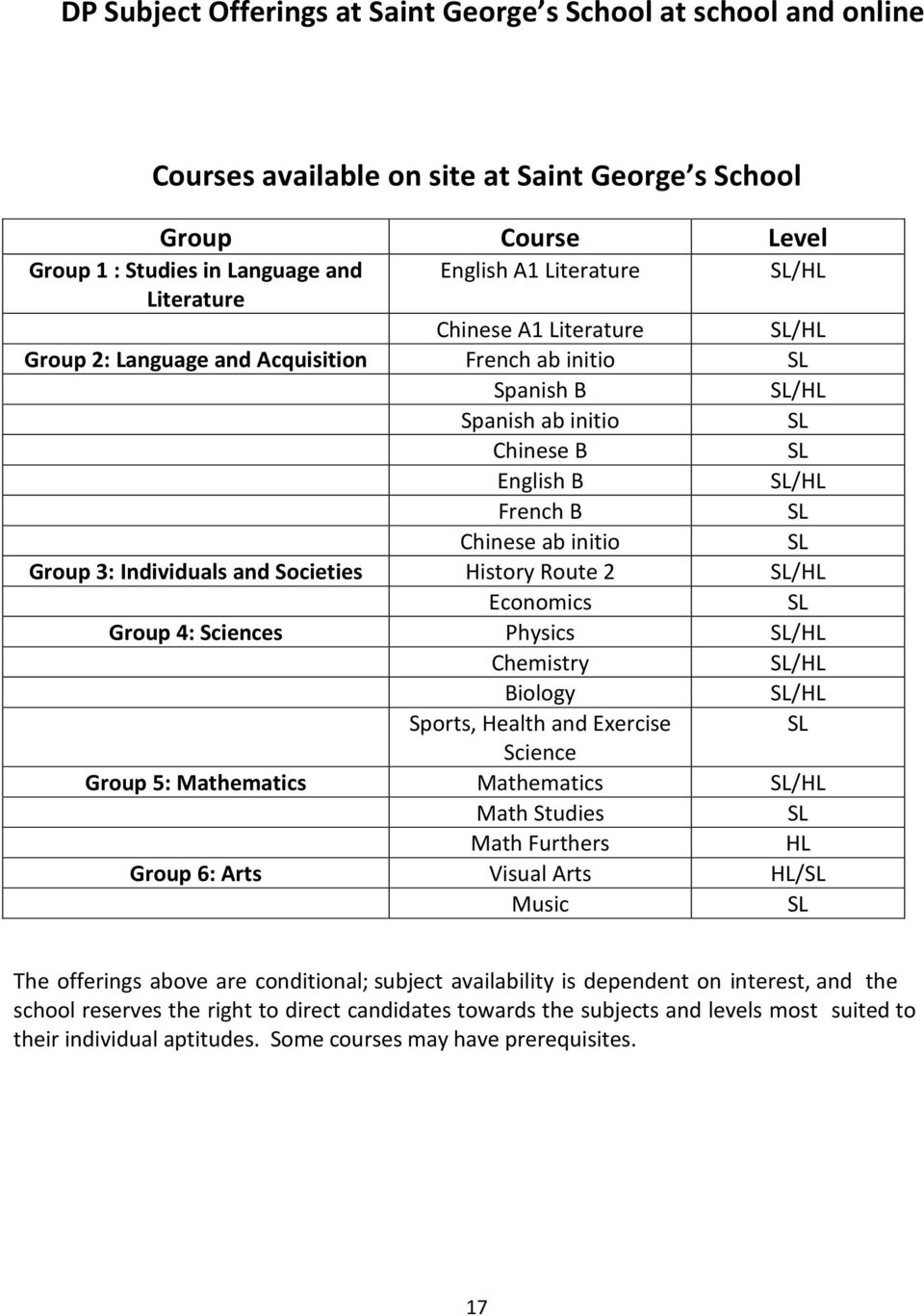
17 DP Subject Offerings at Saint George s School at school and online Courses available on site at Saint George s School Group Course Level Group 1 : Studies in Language and English A1 Literature SL/HL Literature Chinese A1 Literature SL/HL Group 2: Language and Acquisition French ab initio SL Spanish B SL/HL Spanish ab initio SL Chinese B SL English B SL/HL French B SL Chinese ab initio SL Group 3: Individuals and Societies History Route 2 SL/HL Economics SL Group 4: Sciences Physics SL/HL Chemistry SL/HL Biology SL/HL Sports, Health and Exercise SL Science Group 5: Mathematics Mathematics SL/HL Math Studies SL Math Furthers HL Group 6: Arts Visual Arts HL/SL Music SL The offerings above are conditional; subject availability is dependent on interest, and the school reserves the right to direct candidates towards the subjects and levels most suited to their individual aptitudes. Some courses may have prerequisites. 17
18 Working in close cooperation with the International Baccalaureate, Pamoja Education ( continues to expand its range of top quality online IB courses, with new courses added each academic year. The online courses, available through Pamoja Education, are offered to SGS students for an additional expense. Financial aid is not available for these online courses. Students must get IBDC and Administrator approval before registering for online courses. Online courses offered through Pamoja (as of February, 2015) Group Course Level Group 2: Language and Acquisition French ab initio SL Mandarin ab inito SL Spanish ab initio SL Spanish B SL Group 3: Individuals and Societies Business Management SL/HL Economics SL/HL ITGS SL/HL Philosophy SL Psychology SL/HL Group 5: Mathematics Mathematics SL/HL Group 6: Arts Film SL 18

19 Saint George s School Graduation All students, IB Diploma candidates or not, may receive a Saint George s Diploma. To graduate from SGS, all students must participate in CAS. IB DIPLOMA/ SGS DIPLOMA SGS DIPLOMA Six DP subjects 6 in grade 11; 4 or 5 or 6 in grade 12 3 at higher level 3 at standard level Courses based on requirements as set by SGS CAS (Creativity, Activity, Service) Theory of Knowledge Extended Essay Examinations in all 6 subjects that include: Internal Assessments External Assessments Reduced internal assessment Saint George s Diploma IB Diploma Note: If a student fails to pass the diploma, he/she receives individual certificates in subjects where he/she achieved grade 4 or better. 19

20 College and University Recognition of the IB Diploma Understanding how the IBDP is recognized in North America is a primary concern for students, parents and counselors. Well over half of the students worldwide who graduate with IB credentials each year enter post-secondary institutions in the USA or Canada. One of the first questions on the Common App is: Is this applicant an IB Diploma Candidate? Many North American colleges and universities have exemplary IB recognition policies. Through their policies, these institutions show that they appreciate the IB student and the IB Diploma Programme. To see which universities around the world offer scholarships for IB diploma holders, please view the Universities individual websites. To view the IB diploma policy and contact information of a university, search the IBO databases via these website addresses. Some words from college admissions about the IB: Bryn Mawr University IB diploma students are superbly prepared for Bryn Mawr. We offer a full year s credit to students with a score of 30 or above. The IB diploma is something more than the sum of its parts in a way that three or four APs are not. It ensures breadth, coherence, basic writing, research and analytic skills. Connecticut College, Martha Merrill, Dean of Admission and Financial Aid Connecticut College highly values the IB programme as it prepares students for the liberal arts in ways that few secondary school curriculums can... Students who have graduated from schools with the IB curriculum are extremely well prepared when they arrive on our campus. Duke University, Christoph Guttentag, Director of Admissions We know the quality of IB courses, and we think the IB curriculum is terrific. Harvard University, Marlyn McGrath Lewis, Assistant Dean of Admissions IB is well known to us as excellent preparation. Success in an IB programme correlates well with success at Harvard. We are pleased to see the credential of the IB Diploma Programme on the transcript. Macalester College, Lorne Robinson, Dean of Admission and Financial Aid We respect the IB programme for its academic rigour and the dedication it requires of students to earn the diploma. Over the years, we have found IB students to be exceptionally well-prepared for a challenging college experience. Princeton University, Fred Hargadon, Director of Undergraduate Admissions The IB is a firstrate programme, one we are familiar with, and it prepares students well for a university like ours. 20
21 Sarah Lawrence College, Thyra L. Briggs, Dean of Enrollment In our minds, there is no more challenging curriculum than the IB curriculum. Not only does it prepare students for a demanding college programme, but the IB curriculum also instills in students a love of learning and an understanding of the truly interdisciplinary nature of education. Instead of working on each subject in a vacuum, IB students are shown how each of their classes connects both with the other classes and with the world around them. William and Mary College, Allison Jesse, former Associate Dean of Admissions The rigour of IB Diploma requirements meets our recommendation for the strongest high school preparation possible. In sum, the IB diploma candidate who has met the challenge successfully receives strong consideration from the William & Mary admission committee. University of British Columbia, Canada, The IBO and UBC share a common vision that global perspectives are key to education. Of all the universities in the world, UBC is one of the top three choices for IB diploma graduates. At UBC, we are committed to helping IB students find the best way to qualify for admission, scholarships and first- year credit. University of California (Berkeley, Davis, Los Angeles, San Francisco, San Diego, Irvine, Santa Cruz, etc.) Students completing the IB diploma with a score of 30 or above receive 30 quarter units (20 semester units) toward their UC undergraduate degree. 21
22 Appendix Courses offered on site at SGS (Organized by Groups 1-6) (Please note: Teachers decided on formatting, which may look different for each group) GROUP 1 (LANGUAGE A) English A1: Literature SL/HL There are few differences between SL and HL: 1. SL students read 10 works (i.e. book, play, or equivalent) over 4 semesters, whereas HL students read 13 over the same period. 2. The SL Internal assessment for Part 2 ( Detailed Study ) consists of a 10-minute commentary on a passage of any of the works; the HL Internal assessment for Part 2 specifies that the 10-minute commentary address poetry and adds to the oral discussion based on one of the other two works studied (i.e. a novel or play). 3. Paper 1 on the exam for both levels is a literary analysis of a previously unseen passage, but SL students will be able to respond to one of two guiding questions whereas HL students must invent their own question. 4. External assessment criteria (i.e. the rubrics) for both exam essays are more challenging for HL students, expecting deeper understanding, greater analytical ability, better organization, and more thorough development. The above are differences dictated by the IB. In addition, Saint George s HL students should expect to write one more formal paper for each semester credit. SL External Assessment Component 70% Paper 1: Guided literary analysis The paper consists of two passages: one prose and one poetry. Students choose one 20% and write a guided literary analysis in response to two questions. Paper 2: Essay The paper consists of three questions for each literary genre. In response to one question students write an essay based on at least two works 25% studied in part 3. Written Assignment Students submit a reflective statement and literary essay on one work studied in part 1. The reflective statement must be words in length. The essay must be between 1,200-1,500 words in length. 25% 22
23 SL Internal Assessment Component 30% Alternative oral examination (20 minutes) This component consists of two compulsory oral activities that are externally assessed by the IB. Section 1: Individual oral commentary (10 minutes). 15% Students present a formal oral commentary on an extracts from a work studied in part 2. 15% Section 2: Individual oral presentation (10 minutes) Students make a presentation on two works studied in part 4. HL External Assessment Component 70% Paper 1: Literary Commentary 20% The paper consists of two passages: one prose and one poetry. Students choose one and write a literary commentary. Paper 2: Essay 25% The paper consists of three questions for each literary genre. In response to one question students write an essay based on at least two works studied in part 3. Written Assignment Students submit a reflective statement and literary essay on one work studied in part 1. 25% The reflective statement must be words in length. The essay must be between 1,200-1,500 words in length. HL Internal Assessment Component 30% This component is internally assessed by the teacher and externally moderated by the IB at the end of the course. Individual oral commentary and discussion: (20 minutes) 15% Formal oral commentary on poetry studied in part 2 with subsequent questions (10 minutes) followed by a discussion based on one of the other part 2 works (10 minutes). Individual oral presentation: (10-15 minutes) The presentation is based on works studied in part 4. It is internally assessed externally moderated through the part 2 internal assessment task. 15% 23
24 Chinese A1: Literature SL/HL Across the syllabus as a whole, 10 works in total at standard level (SL) and 13 at higher level (HL) are chosen. Of these, 2 works at SL and 3 works at HL will be selected from the PLT list as set out in the table below. Part of the course SL HL Part 1: Works in translation Part 2: Detailed study Part 3: Literary genres Part 4: Options Study of two works in translation from the PLT list Study of two works, each of a different genre, chosen from the PLA Study of three works of the same genre, chosen from the PLA Study of three works freely chosen Study of three works in translation from the PLT list Study of three works, each of a different genre (one of which must be poetry), chosen from the PLA Study of four works of the same genre, chosen from the PLA Study of three works freely chosen Definition of a work Where more than one text is studied as a work, the undertaking for the student must be comparable to studying a full length major work, and texts must be from the same author. Therefore, a work is defined as follows: 1 single major work, such as a novel, autobiography or biography 2 or more shorter texts such as novellas 5 10 short stories 5 8 essays letters A substantial section or the whole of a long poem (at least 600 lines) or shorter poems Genre Across the syllabus as a whole, choose works from at least three genres at SL and at least four genres at HL, as categorized by this PLT list and the PLAs. Please note that in the Short story and Poetry sections specific collections are not included so as to allow teachers to use the collections that they feel are most appropriate. 24
25 GROUP 2 (LANGUAGE B) The aims of the language B courses are defined within the parameters of the language B syllabus. The range of contexts, purposes, language skills and texts to be taught are listed in Syllabus content. The use of appropriate language and the breadth of intercultural understanding to be demonstrated are also defined within the syllabus content (pg. 9, Language B Guide). Three levels are offered in Language B (ab initio, SL, and HL). All final decisions on the appropriateness of the course for which students are entered are taken by coordinators in liaison with teachers, using their experience and professional judgment to guide them. Ab Initio (Spanish, French, Chinese) SL The language ab initio course is designed for students with little or no prior experience of the language they wish to study. Ab Initio External Assessment Component 75% Paper 1: Receptive skills: Understanding of four written texts. Text-handling exercises. Paper 2: Productive skills: Two compulsory writing exercises. Section A: One question to be answered from a choice of two. Section B: One question to be answered from a choice of three. Written assignment: Receptive and productive skills: A piece of writing, words, demonstrating intercultural understanding and written in the target language. Ab Initio Internal Assessment Component 25% Individual oral: Three-part oral internally assessed by the teacher and externally moderated by the IB towards the end of the course. Part 1: Presentation of a visual stimulus (from a choice of two) by the student. Part 2: Follow-up questions on the visual stimulus. Part 3: General conversation including at least two questions on the written assignment. 25
26 Spanish B SL, Chinese B SL, English B SL, French B SL Core topics: Communication and media, Global issues, Social relationships PLUS two options: Cultural diversity, Customs and traditions, Health, Leisure, or Science and technology. SL External Assessment Component 70% Paper 1: Receptive skills: Text-handling exercises on four written texts, based on the core words, plus a 100-word rationale. Paper 2: Written productive skills: One writing exercise of words from a choice of five, based on the options. Minimum of 250 words. Written assignment: Receptive and written productive skills: Intertextual reading followed by a written exercise of words plus a 100-word rationale, based on the core. SL Internal Assessment Component 30% Internally assessed by the teacher and externally moderated by the IB. Individual oral (8 10 minutes): Based on the options: 15 minutes preparation time and a 10- minute (maximum) presentation and discussion with the teacher. Interactive oral activity: Based on the core: Three classroom activities assessed by the teacher. 26
27 English B HL and Spanish B HL Core topics: Communication and Media, Global Issues, Social Relationships PLUS two options: Cultural diversity, Customs and traditions, Health, Leisure, or Science and technology Reading literature in the target language can be an enjoyable journey into the culture(s) studied. It will help students to broaden their vocabulary and to use language in a more creative manner, developing fluent reading skills, promoting interpretative and inferential skills, and contributing to intercultural understanding. Students should understand the works in some depth (see Assessment objectives number 6), but literary criticism as such is not an objective of the language B course at HL. Students are required to read two works of literature originally written in the target language. These works may be from any genre, or may both be of the same genre. They do not need to be linked in any way (by author, theme, or period). HL External Assessment Component 70% Paper 1: Receptive skills: Text-handling exercises on five written texts, based on the core words, plus a 100-word rationale. Paper 2: Written productive skills: Two compulsory writing exercises. Section A: One task of words, based on the options, to be selected from a choice of five. The paper must be a minimum of 250 words. Section B: Response of words to a stimulus text, based on the core. The paper must be a minimum of 150 words. Written assignment: Creative Writing: Word limit of words, plus a 150 word rationale. HL Internal Assessment Component 30% Internally assessed by the teacher and externally moderated by the IB. Individual oral (8 10 minutes): Based on the options: 15 minutes preparation time and a 10- minute (maximum) presentation and discussion with the teacher. Interactive oral activity: Based on the core: Three classroom activities assessed by the teacher 27
28 GROUP 3 (INDIVIDUALS AND SOCIETY) IB History SL/HL The major difference between SL and HL IB History is in the amount of material that students will be required to retain for the IB Exam. This course includes History of the Americas, which students take their junior year, and 20 th Century World History, which students will take their senior year. HL History is a two year course and therefore will require students to review material from both History of the Americas and 20 th Century World History. The SL IB Exam will only test students on material that they have covered in 20 th Century World History, but some of the information and skills from junior year will work toward preparing students for the SL Exam. Here is a brief overview of the two IB Exams: SL External Assessment Component 75% Paper 1: Document analysis relating to material from 20 th Century World History. Students will need to answer four short answer questions on the documents. Paper 2: Two extended-response questions from a list of five prescribed topics. SL Internal Assessment Component 25% Internally assessed by the teacher and externally moderated by the IB. Students will write a 2000 word research paper that will be graded by their SGS teacher and submitted to the IB for moderation. This means that scores could be slightly adjusted by the IB. Historical investigation on any area of the syllabus. Approximately 20 hours. Students who want to take History as an HL are STRONGLY suggested to have maintained at least a B+ in ALL of their previous history classes. HL and SL students will be in the same room, but we expect HL students to take a more active role in the class and they may be assigned additional readings periodically. Although HL students will need to retain more content, both HL and SL students will practice essential skills, including writing, research, predatory reading, and critical thinking. 28
29 HL External Assessment Component 80% Paper 1: Document analysis relating to material from 20 th Century World History. Students will need to answer four short answer questions on the documents. Paper 2: Two extended-response questions from a list of five prescribed topics. Paper 3: Students write three extended-response questions from a list of topics from the course History of the Americas taken their Junior year. HL Internal Assessment Component 20% Internally assessed by the teacher and externally moderated by the IB. Students will write a 2000 word research paper that will be graded by their SGS teacher and submitted to the IB for moderation. This means that scores could be slightly adjusted by the IB. Historical investigation on any area of the syllabus. Approximately 20 hours. IB Economics SL In their senior year, students will have the option of taking a one-year IB Economics course at the SL level. IB Economics covers four major areas: Microeconomics, Macroeconomics, International Economics and Developmental Economics. This course does not replace the need for either IB History or US History. The most common path to IB Economics is through taking US History (as their Group 3 course) OR a science SL (as their Group 6 course) as a junior and then switching to IB Economics as a senior. SL External Assessment Component Paper 1: From a list of topics students must answer one question from Micro and one from Macro. Paper 2: Students must answer two data response questions from a list of trade and development topics. Paper 3: SL students do not take Paper 3, which involves high level mathematical calculations. SL Internal Assessment Component Four internal assessments will be done, one on each of the four topics. Three of these will be submitted to the IB for moderation. These involve 750 word written commentaries on current news articles using economic analysis and terminology. 29
30 GROUP 4 (EXPERIMENTAL SCIENCES) All Sciences: Distinction between SL and HL: Group 4 students at standard level (SL) and higher level (HL) undertake a common core syllabus, a common internal assessment (IA) scheme and have some overlapping elements in the option studied. They are presented with a syllabus that encourages the development of certain skills, attributes and attitudes, as described in the Assessment objectives section of this guide. While the skills and activities of group 4 science subjects are common to students at both SL and HL, students at HL are required to study some topics in greater depth, in the additional higher level (AHL) material and in the common options. The distinction between SL and HL is one of breadth and depth. Practical (Internal) Assessment (20%): The internal assessment requirements are the same for biology, chemistry and physics. The internal assessment, worth 20% of the final assessment, consists of one scientific investigation. The individual investigation should cover a topic that is commensurate with the level of the course of study. Student work is internally assessed by the teacher and externally moderated by the lb. The performance in internal assessment at both SL and HL is marked against common assessment criteria, with a total mark out of 24. The internal assessment task will be one scientific investigation taking about 10 hours and the write up should be about 6 to 12 pages long. Investigations exceeding this length will be penalized in the communication criterion as lacking in conciseness. The practical investigation, with generic criteria, will allow a wide range of practical activities satisfying the varying needs of biology, chemistry and physics. The investigation addresses many of the learner profile attributes well. See section on "Approaches to the teaching of chemistry" for further links. The task produced should be complex and commensurate with the level of the course. It should require a purposeful research question and the scientific rationale for it. The marked exemplar material in the teacher support materials will demonstrate that the assessment will be rigorous and of the same standard as the assessment in the previous courses. Some of the possible tasks include: a hands-on laboratory investigation using a spreadsheet for analysis and modelling extracting data from a database and analysing it graphically 30
31 producing a hybrid of spreadsheet/database work with a traditional hands-on investigation using a simulation provided it is interactive and open-ended. Some tasks may consist of relevant and appropriate qualitative work combined with quantitative work. The tasks include the traditional hands-on practical investigations as in the previous course. The depth of treatment required for hands-on practical investigations is unchanged from the previous internal assessment and will be shown in detail in the teacher support materials. In addition, detailed assessment of specific aspects of hands-on practical work will be assessed in the written papers as detailed in the relevant topic(s) in the "Syllabus content" section of the guide. The task will have the same assessment criteria for SL and HL. The five assessment criteria are personal engagement, exploration, analysis, evaluation and communication. The Group 4 project: All IB science students must complete a collaborative project with students from other science disciplines in which they work together on a scientific or technological topic, allowing for concepts and perceptions from across the disciplines to be shared in line with aim 10 that is, to develop an understanding of the relationships between scientific disciplines and their influence on other areas of knowledge. The project can be practically or theoretically based. Collaboration between schools in different regions is encouraged. The Group 4 project allows students to appreciate the environmental, social and ethical implications of science and technology. It may also allow them to understand the limitations of scientific study, for example, the shortage of appropriate data and/or the lack of resources. The emphasis is on interdisciplinary cooperation and the processes involved in scientific investigation, rather than the products of such investigation. 31
32 Biology SL/HL Classroom Experience Both SL and HL will be taught in the same class. For the first year, the distinction will be negligible. There may be some instances when HL students are expected to put in extra time to go into more depth. In the second year, the HL students will be covering several additional topics and will be required to go into more depth. This is reflected on the difference in the exams each level takes. The HL has 90 minutes more time to complete their IB papers (exams), reflecting the need to know more topics and have more depth of knowledge in those topics. Students may opt to take only one year of IB Biology to fulfill their SGS biology requirement so long as they earn at least two science credits total in their last two years of high school. Student who choose the one-year option may be able to sit for the Biology SL exam if they are willing to undertake extra individual study. Students choosing to take Chemistry SL as a junior may pair it with one year of Biology SL in their senior year. Topics: SL and HL: Cell Biology, Molecular Biology, Genetics, Ecology, Evolution, Human Physiology, plus Biotechnology and Bioinformatics, Human Physiology, or Ecology and Conservation HL Only: Nucleic Acids, Metabolism, Plant Biology, Genetics and Evolution, Animal Physiology SL External Assessment Component Component Overall weighting Approximate weighting of Duration (hours) (%) objectives (%) Paper /4 Paper /4 Paper Internal Assessment 20 Covers objectives 1,2,3 and 4 10 HL External Assessment Component Component Overall weighting Approximate weighting of Duration (hours) (%) objectives (%) Paper Paper /4 Paper /4 Internal Assessment 20 Covers objectives 1,2,3 and
33 Chemistry SL/HL SL (Standard Level) chemistry will be a one-year course. The prerequisite is a year of Sophomore chemistry. All IB chemistry students will be in the SL course during their first year of IB chemistry (Junior year.) SL chemistry will cover all 11 of the core topics (Quantitative Chemistry, Atomic Structure, Periodicity, Bonding, Energetics, Kinetics, Equilibrium, Acids and Bases, Oxidation and reduction, Organic Chemistry, Measurement and Data Processing) as well as the two optional topics (Human Biochemistry and Industrial Chemistry). SL Examinations and Assessments will be taken at the end of Junior year for SL students. SL External Assessment Component Paper 1 (20%): Consists of 30 multiple choice questions. Calculators are not allowed. A periodic table is provided. Paper 2 (40%): Paper 3 (20%): Consists of some structured questions and a choice of one from three longer answer questions. Calculators are allowed and a data booklet is provided. Consists of two questions from each of two selected options. The paper presents eight option choices. Calculators are allowed and data booklets are provided. HL (Higher Level) chemistry students will continue for another year after the first year of SL chemistry. The HL curriculum requires greater depth in the core topics and the optional topics. HL Examinations will be taken at the end of the second year of IB chemistry. HL External Assessment Component Paper 1 (20%): Consists of 40 multiple choice questions. Calculators are not allowed. A periodic table is provided. Paper 2 (36%): Paper 3 (20%): Consists of five structured questions. Also a choice of two from four longer answer questions. Calculators are allowed and a data booklet is provided. Consists of three questions from each of two selected options. The paper presents eight option choices. Calculators are allowed and data booklets are provided. 33
34 Physics SL/HL Core topics for Physics (SL and HL): Measurements and Uncertainty, Mechanics, Thermal Physics, Waves, Electricity and magnetism, Circular motion and gravitation, Atomic, nuclear and particle physics, Energy production, PLUS Relativity, Engineering physics, Imaging, or Astrophysics. Additional higher level topics: Wave phenomena, Fields, Electromagnetic induction, Quantum and nuclear physics. Examination (SL): This will be taken at the end of the Junior year of IB Physics. SL External Assessment Component Paper 1 (20%): Consists of 30 multiple choice questions on core, about 15 of which are common with HL. No penalty for wrong answers. Calculators are not allowed. Physics data booklet provided. Paper 2 (40%): Consists of short-answer and extended-response questions on core material. Calculators are allowed and a data booklet is provided. Paper 3 (20%): Consists of questions on core and SL optional material. Two sections. Section A: one data-based questions and several short answer questions on experimental work. Section B: short-answer and extended-response questions from one option. Calculators are allowed and a data booklet is provided. Examination (HL): This will be taken at the end of the second year of IB Physics. HL External Assessment Component Paper 1 (20%): Consists of 40 multiple choice questions on core and AHL, about 15 of which are common with SL. No penalty for wrong answers. Calculators are not allowed. Physics data booklet provided. Paper 2 (36%): Consists short-answer and extended-response questions on the core and AHL material. Calculators are allowed and a data booklet is provided Paper 3 (24%): Consists of questions on core, AHL, and optional material. Two sections. Section A: one data-based questions and several short answer questions on experimental work. Section B: short-answer and extended-response questions from one option. Calculators are allowed and a data booklet is provided. 34
35 Sports, Exercise and Health Science SL What is Sport, Exercise and Health Science? The course incorporates the traditional disciplines of Anatomy, Physiology, Biomechanics, Psychology and Nutrition and will be studied in the context of Sport, Exercise and Health. Students will study a range of core and option topics. They will undertake practical (experimental) investigations in both laboratory and field settings. This will provide an opportunity to acquire the knowledge and understanding necessary to apply scientific principles and critically analyze human performance. Where relevant, the course will address issues of internationalism and ethics by considering Sport, Exercise and Health relative to the individual and in a global context. Why should I study Sports, Exercise and Health Science? You enjoy science. You enjoy sport and exercise. You want to learn more about sport, exercise and health. You wish to complete some of your work in a practical setting. You want to work towards a world-wide recognized qualification in a number of health related fields. What does the course consist of? Anatomy, Exercise Physiology, Energy Systems, Movement Analysis, Skill in Sport and Measurement and Evaluation of Human Performance SL External Assessment Component 76% Paper 1: Multiple choice on core topics Paper 2 : Section A- One data based question and several short answer questions. Section B One extended response question. Both on core topics Paper 3: Short answer questions on two options. SL Internal Assessment Component 24% This is done through Practical Scheme of Work (PSOW). Criteria Aspects: Design, data collection and processing, conclusion and evaluation, manipulative skills, and personal skills. 35
36 GROUP 5 (MATHEMATICS) Math Studies SL This is a two year math course taken during junior and senior years. SL External Assessment Component Paper Exam 1 15 short-response questions based on the whole syllabus. Paper Exam 2 6 compulsory extended-response questions based on the whole syllabus. SL Internal Assessment Component This component is internally assessed by the teacher and externally moderated by the IB at the end of the course. Project The project is an individual piece of work involving the collection of information or the generation of measurements, and the analysis and evaluation of the information or measurements. Syllabus Topic 1 Number and algebra Topic 2 Descriptive statistics Topic 3 Logic, sets and probability Topic 4 Statistical applications Topic 5 Geometry and trigonometry Topic 6 Mathematical models Topic 7 Introduction to differential calculus 36
37 Math SL This is a two year math course taken during junior and senior years. SL External Assessment Component Paper Exam 1 No calculator allowed. Section A: Short-response questions based on the whole syllabus Section B: Extended-response questions based on the whole syllabus. Paper Exam 2 Graphic display calculator required. Section A: Short-response questions based on the whole syllabus. Section B: Extended-response questions based on the whole syllabus. SL Internal Assessment Component This component is internally assessed by the teacher and externally moderated by the IB at the end of the course. Mathematical exploration Internal assessment in mathematics SL is an individual exploration. This is a piece of written work that involves investigating an area of mathematics. Syllabus Topic 1 Algebra Topic 2 Functions and equations Topic 3 Circular functions and trigonometry Topic 4 Vectors Topic 5 Statistics and probability Topic 6 Calculus Topic 7 Introduction to differential calculus 37
38 Math HL This is a two year math course taken during junior and senior years. HL External Assessment Component Paper Exam 1 No calculator allowed. Section A: Short-response questions based on the whole syllabus Section B: Extended-response questions based on the whole syllabus. Paper Exam 2 Graphic display calculator required. Section A: Short-response questions based on the whole syllabus. Section B: Extended-response questions based on the whole syllabus. Paper Exam 3 Graphic display calculator required. Extended-response questions based mainly on the syllabus options. HL Internal Assessment Component This component is internally assessed by the teacher and externally moderated by the IB at the end of the course. Mathematical exploration Internal assessment in mathematics HL is an individual exploration. This is a piece of written work that involves investigating an area of mathematics. (20 marks). Syllabus Topic 1 : Algebra Topic 2 : Functions and equations Topic 3: Circular functions and trigonometry Topic 4 : Vectors Topic 5: Statistics and probability Topic 6 : Calculus Topic 7 : Introduction to differential calculus Option syllabus content: Students must study all the sub-topics in one of the following options as listed in the syllabus details. Topic 7 : Statistics and probability Topic 8 : Sets, relations and groups Topic 9 : Calculus Topic 10 : Discrete mathematics 38
39 Furthers Math HL This is a two year math course taken during junior and senior years. HL External Assessment Component Paper Exam 1 Graphic display calculator required Compulsory short- to medium-response questions based on the whole syllabus. Paper Exam 2 Syllabus Topic 1 Linear algebra Topic 2 Geometry Topic 3 Statistics and probability Topic 4 Sets, relations and groups Topic 5 Calculus Topic 6 Discrete mathematics Graphic display calculator required. Compulsory medium- to extended-response questions based on the whole syllabus. 39
40 GROUP 6 (ARTS) Music SL Student Expectations/ Responsibilities in class IB Expectations Group/Solo Performance Assigned Work SL Music Student Syllabus Keep a traditional notebook of the pertinent information covered throughout the course of study. Demonstrate your understanding of music by performing in a school musical group over the course of the year. Demonstrate your understanding of music by using appropriate language and terminology in analyzing musical works from many cultures through the ages. Show your musical skills through comprehensive exams, and small group projects. Musical Perception and Analysis. Study of Prescribed Works. Study of Musical Genres and Styles including: Fundamental Music Theory and vocabulary Melody, Rhythm, Harmony, Style and Form Music History Middle Ages to the 20th Century World Musical Styles All regions of the world Popular Musical Styles Jazz, Rock and Popular Styles Be active contributing members of a school musical ensemble. Conduct a sustained, independent investigation as an extension of the work involved in Musical Perception and Analysis. This investigation will explore the relationships between pieces of music from two distinct music cultures. The investigation will compare and analyze one or more pieces of music from each musical culture. The investigation will be no more than 2000 words in length and written as a media script. 40
41 Visual Arts SL/HL SL External Assessment Component Process Portfolio 40% Students submit 9-18 screens which evidence their sustained experimentation, exploration, manipulation and refinement of a variety of art-making activities. For SL students the submitted work must be in at least two art-making forms each from separate columns of the art-making forms table. Students submit a list of sources used. SL External Assessment Component Comparative Study 20% Students submit screens which examine and compare at least three artworks, at least two of which should be by different artists. The work selected for comparison and analysis should come from contrasting contexts (local, national, international and/or intercultural). Students submit a list of sources used. SL Internal Assessment Component 40% This task is internally assessed by the teacher and externally moderated by the IB at the end of the course. Part 3: Exhibition Students at SL submit for assessment a selection of resolved artworks for their exhibition. The selected pieces should show evidence of their technical accomplishment during the visual arts course and an understanding of the use of materials, ideas and practices appropriate to visual communication. SL students submit a curatorial rationale that does not exceed 400 words. SL students submit 4-7 artworks. SL students submit exhibition text (stating the title, medium, size and intention) for each selected artwork. SL students may submit two photographs of their overall exhibition. These exhibition photographs provide an understanding of the context of the exhibition and the size and scope of the works. While the photographs will not be used to assess individual artworks, they may give the moderator insight into how a candidate has considered the overall experience of the viewer in their exhibition. 41
42 HL External Assessment Component Comparative Study 20% Students submit screens which examine and compare at least three artworks, at least two of which need to be by different artists. The works selected for comparison and analysis should come from contrasting contexts (local, national, international and/or intercultural). HL External Assessment Component Process Portfolio 40% Students submit screens which evidence their sustained experimentation, exploration, manipulation and refinement of a variety of art-making activities. For HL students the submitted work must have been created in at least three art-making forms, selected from a minimum of two columns of the art-making forms table. HL Internal Assessment Component 40% This task is internally assessed by the teacher and externally moderated by the IB at the end of the course. Part 3: Exhibition Students at SL submit for assessment a selection of resolved artworks for their exhibition. The selected pieces should show evidence of their technical accomplishment during the visual arts course and an understanding of the use of materials, ideas and practices appropriate to visual communication. SL students submit a curatorial rationale that does not exceed 700 words. SL students submit 8-11 artworks. SL students submit exhibition text (stating the title, medium, size and intention) for each selected artwork. SL students may submit two photographs of their overall exhibition. These exhibition photographs provide an understanding of the context of the exhibition and the size and scope of the works. While the photographs will not be used to assess individual artworks, they may give the moderator insight into how a candidate has considered the overall experience of the viewer in their exhibition. 42
43 Internal Assessment Timeline (please note this is subject to change) 43
44 2929 W. Waikiki Road Spokane, WA (509)
Diploma Programme. The unique benefits of the DP
 Diploma Programme The unique benefits of the DP Contents IB mission statement Learner profile What is the IB Diploma Programme? Diploma Programme curriculum Subjects Curriculum contents Assessment University
International Baccalaureate Area V. Henry Wise Wood High School IB Information Night December 3, 2014
 International Baccalaureate Area V Henry Wise Wood High School IB Information Night December 3, 2014 International Baccalaureate Mission Statement The International Baccalaureate aims to develop inquiring,
So You Want to Be an IB?
 International Baccalaureate Program Hanover County Public Schools Wendy Edelman, AHS Jessica Orth, HHS Lesa Berlinghoff, LDHS Micah Eads, PHHS IB Coordinators Points of Discussion 1. What is IB? 2. Why
Quarry Lane IB Information Night. November 18, 2015
 Quarry Lane IB Information Night November 18, 2015 The IB program at The Quarry Lane School Quarry Lane is the only private school in the East Bay offering the IB Diploma Programme US: Only 850 IB world
Aims and Objectives. Course Description. Introduction nature of business and management
 Business and Management Course Outline 2014/2015 Course Description Introduction nature of business and management Business and management is a rigorous and dynamic discipline that examines business decisionmaking
What is an IB education?
 The IB programme continuum of international education This document is provisional pending review of the IB learner profile. Additional resources to support and communicate What is an IB Education? will
International Baccalaureate
 Preparation for International Baccalaureate Camdenton High School 2007-2008 Frequently Asked Questions Who should attempt to earn the IB Diploma? Students seeking the International Baccalaureate should
International Baccalaureate
 International Baccalaureate Information Meeting September 28, 2011 Introductions Bob Behnke Assistant Superintendent for Instructional Services Nhu Do IB Administrator IB Teacher Northville Resident Jennifer
Riverdale High School. International Baccalaureate Diploma Programme. Special Educational Needs and Inclusion Policy 2014-2015
 Riverdale High School International Baccalaureate Diploma Programme Special Educational Needs and Inclusion Policy 2014-2015 INTRODUCTION AND PURPOSE The purpose of this document is to 1. Communicate to
IB Diploma. & Course Descriptions 2015-2016
 IB Diploma & Course Descriptions 2015-2016 Busan International Foreign School Guiding Statements Vision Our students will develop and pursue their passions, be successful and contribute to a positive global
Nefertari International Schools IBDP Candidate School Whole School Language Policy
 Nefertari International Schools IBDP Candidate School Whole School Language Policy Release Date: September 2014 To be Reviewed: September 2019 Introduction Before framing the language policy for the International
IB learner profile booklet. Diploma Programme, Middle Years Programme and Primary Years Programme
 Diploma Programme, Middle Years Programme and Primary Years Programme International Baccalaureate Organization Buenos Aires Cardiff Geneva New York Singapore Published March 2006 International Baccalaureate
York Catholic District School Board. 320 Bloomington Rd. Aurora, Ontario L4G 0M1. Phone: 905-713-2711 www.ycdsb.ca
 York Catholic District School Board 320 Bloomington Rd. Aurora, Ontario L4G 0M1 Phone: 905-713-2711 www.ycdsb.ca IB Mission Statement The International Baccalaureate aims to develop inquiring, knowledgeable
Programme Specification 2015/16
 Programme Specification 2015/16 1. Awarding body University of Surrey 2. Teaching institution (if different) As above 3. Final award Master of Business (MBus) 4. Programme title/route/pathway MBus International
Guide for IB students applying to US institutions
 Guide for IB students applying to US institutions This guide provides a brief introduction to the US higher education system and its application process, as well as information specifically relevant to
IB&AP. International Baccalaureate Advanced Placement Program
 IB&AP International Baccalaureate Advanced Placement Program What is the International Baccalaureate Diploma Programme? The International Baccalaureate Diploma Programme (IB ) is a rigorous preuniversity
International Baccalaureate Diploma Program
 International Baccalaureate Diploma Program Oakmont High School Home of the Vikings 1710 Cirby Way Roseville, CA 95661 2014-2015 school year http://oakmont.org/ib Table of Contents The International Baccalaureate
Advanced Placement Program International Baccalaureate
 & IB AP Advanced Placement Program International Baccalaureate What is the Advanced Placement Program? The Advanced Placement Program (AP ) is a challenging academic program designed to provide motivated
Frequently Asked Questions
 Frequently Asked Questions What is International Baccalaureate Organization? Founded in 1968, the International Baccalaureate Organization (IBO) is a non-profit educational organization based in Geneva,
The International Baccalaureate Middle Years Programme
 The International Baccalaureate Middle Years Programme AES Briefing No.3 September 2012 AES Briefing Paper No.3 The Anglo European School has been an IB World School with the Diploma Programme in the Sixth
IB Diploma Programme. International Baccalaureate
 2016 IB Diploma Programme International Baccalaureate IB Mission Statement The International Baccalaureate aims to develop inquiring, knowledgeable and caring young people who help to create a better and
Cambridge AICE Diploma A passport to success in education, university and work
 Cambridge AICE Diploma A passport to success in education, university and work Revised for first award in June 2017 The Cambridge approach supports schools to develop learners who are: confident in working
Language A: literature subject outline
 Diploma Programme Language A: literature subject outline First examinations 2013 This document explains the major features of the course, and outlines the syllabus and assessment requirements. More detailed
Secondary School Language Policy
 Secondary School Policy Philosophy In the Secondary School section of the International School of Toulouse (IST) we understand that all learning involves learning languages, learning about languages, and
Program. ofstudies 2014-2015 HIGH SCHOOL. The Anglo-American School of Moscow www.aas.ru
 Program HIGH SCHOOL ofstudies 2014-2015 The Anglo-American School of Moscow www.aas.ru The Anglo-American School of Moscow #1, Beregovaya Street Moscow 125367, Russia www.aas.ru Position Contact E-Mail
ST JOSEPH S INSTITUTION
 ST JOSEPH S INSTITUTION SJI Senior School International Baccalaureate Diploma Programme SJI Senior School International Baccalaureate Diploma Programme ABOUT ST JOSEPH S INSTITUTION Founded by the De La
AVID National Conference
 AVID National Conference The International Baccalaureate College Ready Students Orlando December 2011 International Baccalaureate Organization The IB builds on the most important knowledge, wisdom and
IB Student Handbook, Torsbergsgymnasiet
 IB Student Handbook, Torsbergsgymnasiet English version Welcome to the IB program You have chosen an international line of study with high academic standards that will give you excellent knowledge in your
The IB continuum of international education
 The IB continuum of international education Education for a better world What is an IB education? The IB continuum of international education for 3-19 year olds is unique because of its academic and personal
Quality for All and All for Quality
 Quality for All and All for Quality The motto above, Quality for All and All for Quality, was designed to represent all we stand for and value. It is the essence of our mission statement which itself encompasses
Mathematics SL subject outline
 Diploma Programme Mathematics SL subject outline First examinations 2014 This document explains the major features of the course, and outlines the syllabus and assessment requirements. More detailed information
2015-2016 Articulation Manual
 2015-2016 Articulation Manual Ringling College of Art and Design For more information please visit: www.ringling.edu Mission Ringling College of Art and Design recognizes that artists and designers play
How To Take A Minor
 Make a Major difference to your degree. Flexible Learning at Southampton 2 Studying a Minor subject allows you to broaden your educational experience Make a Major difference to your degree by choosing
International Baccalaureate Diploma Programme: Examining college readiness. 1 College persistence was defined as graduation within five years or
 RESEARCH SUMMARY International Baccalaureate Diploma Programme: Examining college readiness Based on a research report prepared for the IB by: David Conley, PhD, Charis McGaughy, PhD, Whitney Davis-Molin,
Research on the Impact of IB Programmes. The Florida League of IB Schools Quarterly Meeting
 Research on the Impact of IB Programmes The Florida League of IB Schools Quarterly Meeting Research across the IB Page 2 Research Support - International Education Research Database (IERD) - Jeff Thompson
Diploma Programme. The Diploma Programme: A basis for practice
 Diploma Programme The Diploma Programme: A basis for practice Diploma Programme The Diploma Programme: A basis for practice Diploma Programme The Diploma Programme: A basis for practice Published January
IBDP at ANATOLIA COLLEGE. Special Educational Needs Policy
 IBDP at ANATOLIA COLLEGE May 2013 1 IB mission statement The International Baccalaureate aims to develop inquiring, knowledgeable and caring young people who help to create a better and more peaceful world
Graduation Requirements
 Graduation Requirements PROGRAMS OF INSTRUCTION The Lone Star College System offers courses and programs to suit the needs of individual students. In keeping with the mission of a community college, the
The IB Career - related Programme
 The IB Career - related Programme The International Baccalaureate: A Continuum of international education for the 21 st Century The IB continuum of international education IB mission statement IB learner
The General Education Program at Sweet Briar College
 The General Education Program at Sweet Briar College Introduction The purpose of the General Education Program at Sweet Briar College is to provide all students with a common pattern of skills, experiences
International Baccalaureate Diploma Assessment Policy Holy Heart of Mary High School
 International Baccalaureate Diploma Assessment Policy Holy Heart of Mary High School Philosophy Assessment is the process of collecting information from a variety of sources to measure student attainment
Mode of Study The MPH course will be delivered full-time and part-time on campus at the Kedleston Road site
 PROGRAMME SPECIFICATION DOCUMENT SECTION ONE: GENERAL INFORMATION Programme Title/ Subject Title: Master of Public Health Award title and Interim awards: Postgraduate Certificate in Public Health Postgraduate
International Baccalaureate (IB) Programme Update
 International Baccalaureate (IB) Programme Update Derick Kiger Director Research, Technology and Assessment Stephanie Leonard-Witte Director Curriculum and Instruction Joseph Moylan Principal Oconomowoc
GRANADA HILLS CHARTER HIGH SCHOOL IB DIPLOMA PROGRAMME
 GRANADA HILLS CHARTER HIGH SCHOOL IB DIPLOMA PROGRAMME What is IB? Academics Research and Service College Applications Success in an IB programme correlates well with success at Harvard. We are pleased
PROGRAMME SPECIFICATION UNDERGRADUATE PROGRAMMES. Cass Business School Department or equivalent UG Programme (Cass Business School) UCAS Code
 PROGRAMME SPECIFICATION UNDERGRADUATE PROGRAMMES KEY FACTS Programme name Business Studies Award BSc (Hons) School Cass Business School Department or equivalent UG Programme (Cass Business School) UCAS
Application for authorization:
 Diploma Programme Application for authorization: Diploma Programme Name of the school School code Date of submission International Baccalaureate Organization 2015 Note to the user 1. This application form
Section 2: Program Summary Economics (CA): Secondary Major and Minor
 Section 2: Program Summary Economics (CA): Secondary Major and Minor The University Detroit Mercy (UDM), a Catholic institution whose mission flows from the educational traditions of the Sisters of Mercy
PROGRAMME SPECIFICATION UNDERGRADUATE PROGRAMMES KEY FACTS. School of Arts and Social Sciences Department or equivalent Department of Psychology
 PROGRAMME SPECIFICATION UNDERGRADUATE PROGRAMMES KEY FACTS Programme name Psychology Award BSc (Hons) School School of Arts and Social Sciences Department or equivalent Department of Psychology UCAS Code
Special Needs Policy International Baccalaureate Diploma Programme Washington-Lee High School Last Revised July 2015
 Special Needs Policy International Baccalaureate Diploma Programme Washington-Lee High School Last Revised July 2015 Introduction and Purpose The purpose of this document is to Communicate to all stakeholders
Liberal Arts with an Emphasis in Arts and Humanities Associate in Arts Degree
 Liberal Arts with an Emphasis in Arts and Humanities Associate in Arts Degree The A.A. in Liberal Arts with an emphasis in Arts and Humanities provides students with a broad perspective on culture and
Studies PROGRAM OF AMERICAN SCHOOL OF BOMBAY 2015-2016 1
 Studies PROGRAM OF AMERICAN SCHOOL OF BOMBAY 2015-2016 1 ! AMERICAN SCHOOL OF BOMBAY February 2015 Dear Students, The following document has been prepared to help you make appropriate decisions regarding
International Baccalaureate Diploma Programme Subject Brief
 International Baccalaureate Diploma Programme Subject Brief Sciences: Biology Higher level First s 2016 Last s 2022 The IB Diploma Programme (DP) is a rigorous, academically challenging and balanced programme
MASTER OF EDUCATION 1. MASTER OF EDUCATION DEGREE (M.ED.) (845) 575-3028 [email protected]
 MASTER OF EDUCATION 1 MASTER OF EDUCATION DEGREE (M.ED.) (845) 575-3028 [email protected] MISSION AND OBJECTIVES The Teacher Education programs offered by Marist College are integrally linked
Graduation Diploma and Certificate Requirements
 Nova Scotia Public Education System Graduation Diploma and Certificate Requirements 1 Revision Date: Contents 1. Diplomas...3 1.1. NS High School Graduation Diploma English and French...3 1.1.1. Language,
PROGRAMME SPECIFICATION UNDERGRADUATE PROGRAMMES KEY FACTS. School of Arts and Social Sciences Department or equivalent Department of Psychology
 PROGRAMME SPECIFICATION UNDERGRADUATE PROGRAMMES KEY FACTS Programme name Psychology Award BSc (Hons) School School of Arts and Social Sciences Department or equivalent Department of Psychology UCAS Code
Section 4 GRADUATION AND DEGREE REqUIREMENTS
 Section 4 GRADUATION and DEGREE Requirements 42 Catalog Rights marin.edu Catalog Rights The catalog sets forth graduation requirements for achieving an associate degree, and these requirements may change
Economics and Business Management. BA Programme Handbook 2015 2016
 Economics and Business Management BA Programme Handbook 2015 2016 Contents The Degree Programme: Aims, Objectives and Outcomes The Degree Programme Structure The Degree Programme Regulations Strategies
Learning Goals and Assessment Methods: Undergraduate Academic Programs (Non-Accredited)
 September 2012 and s: Undergraduate Academic Programs (Non-Accredited) Accounting 1) The knowledge and tools needed to obtain meaningful employment and have successful careers directly or indirectly involving
Academic Year: 2015-16. Student s Name:
 Application Form Academic Year: 2015-16 To be submitted by: March 2 nd 2015 Student s Name: ACS Athens 129 Aghias Paraskevis Str & Kazantzaki, Halandri, GREECE www.acs.gr [email protected] Tel: +30 210 6393200
Journals for Scholarship of Teaching and Learning in Higher Education
 Journals for Scholarship of Teaching and Learning in Higher Education Accounting Advances in Accounting Education - refereed annual focusing on pedagogy of accounting. Issues in Accounting Education -
Programme Specification 2015/16
 Programme Specification 2015/16 1. Awarding body University of Surrey 2. Teaching institution (if different) N/A 3. Final award Master of Business (MBus) 4. Programme title/route/pathway MBus Business
LIBERAL STUDIES MAJOR TRANSFER REQUIREMENTS
 LIBERAL STUDIES MAJOR TRANSFER REQUIREMENTS The following requirements are subject to change without notice. To ensure that this information is current, you should consult with a Liberal Studies counselor
EDUCATION FOR A BETTER WORLD
 EDUCATION FOR A BETTER WORLD THE INTERNATIONAL BACCALAUREATE: ONE MISSION FOUR CHALLENGING PROGRAMMES PROVIDING A CONTINUUM OF EDUCATION FOR CHILDREN FROM 3-19 YEARS OVER 3,600 IB WORLD SCHOOLS IMPLEMENTING
SECTION 5: MASTER OF EDUCATION DEGREE
 SECTION 5: MASTER OF EDUCATION DEGREE Beginning with the summer session in 1954, a fifth-year program of teacher education leading to the degree Master of Teaching was instituted at Northwestern Oklahoma
UNIVERSITY OF ULSTER: COLERAINE PROGRAMME SPECIFICATION. COURSE TITLE: B.Sc. (HONS) SOCIAL PSYCHOLOGY/ B.Sc. (HONS) SOCIAL PSYCHOLOGY with DPP
 25 UNIVERSITY OF ULSTER: COLERAINE PROGRAMME SPECIFICATION COURSE TITLE: B.Sc. (HONS) SOCIAL PSYCHOLOGY/ B.Sc. (HONS) SOCIAL PSYCHOLOGY with DPP PLEASE NOTE: This specification provides a concise summary
Programme Specification
 LOUGHBOROUGH UNIVERSITY Programme Specification Information Technology & Physics Please note: This specification provides a concise summary of the main features of the programme and the learning outcomes
PROGRAMME SPECIFICATION POSTGRADUATE PROGRAMMES
 PROGRAMME SPECIFICATION POSTGRADUATE PROGRAMMES KEY FACTS Programme name Criminal Litigation Award LLM School The City Law School Department or equivalent Professional Courses Programme code PSCRML Type
Faculty of Education, Health and Sciences. PROGRAMME SPECIFICATION BSc Psychology Online. Valid from September 2012. 1 www.derby.ac.
 Faculty of Education, Health and Sciences PROGRAMME SPECIFICATION BSc Online Valid from September 2012 1 www.derby.ac.uk/ehs CONTENTS SECTION ONE: GENERAL INFORMATION... 1 SECTION TWO: OVERVIEW AND PROGRAMME
An Introduction to Cambridge International Examinations Board Examination System. Sherry Reach Regional Manager, Americas
 An Introduction to Cambridge International Examinations Board Examination System Sherry Reach Regional Manager, Americas Cambridge Assessment A department of the University of Cambridge We are Europe s
Primary Years Programme, Middle Years Programme and Diploma Programme. Towards a continuum of international education
 Primary Years Programme, Middle Years Programme and Diploma Programme Towards a continuum of international education Primary Years Programme, Middle Years Programme and Diploma Programme Towards a continuum
How To Get A Social Work Degree In Hku.Hku.Hk
 FACULTY OF SOCIAL 93 SOCIAL DEGREES OFFERED Website: http://www.hku.hk/socsc/ Title Abbreviation to be used JUPAS Code in the application form Bachelor of Social Sciences BSS 6717 BSocSc Bachelor of Social
INTERNATIONAL BACCALAUREATE MAGNET PROGRAM
 INTERNATIONAL BACCALAUREATE MAGNET PROGRAM Course Selection Guidelines for 2015-2016 Grades 10-12 Richard Montgomery High School 1 MAGNET COURSE SEQUENCE Grade 9 Grade 10 Grade 11 Grade 12 English Magnet
Banking and International Finance
 PROGRAMME SPECIFICATION KEY FACTS Programme name Award School Department or equivalent UCAS Code Programme code Type of study Banking and International Finance BSc (Hons) Cass Business School UG Programme
MA EDUCATION MA Education: Childhood and Youth Studies MA Education: Higher Education MA Education: Leadership and Management MA Education: TESOL
 Programme Specification MA EDUCATION MA Education: Childhood and Youth Studies MA Education: Higher Education MA Education: Leadership and Management MA Education: TESOL PGCert Artist Teacher PGCert Challenging
Programme standards and practices. For use from 1 January 2014
 For use from 1 January 2014 For use from 1 January 2014 Primary Years Programme, Middle Years Programme, Diploma Programme and IB Career-related Certificate Published January 2014 Published on behalf
The UCSC Master of Arts in Education and Teacher Credential Program Philosophy of the Master of Arts in Education/ Teacher Credential Program
 " The UCSC Master of Arts in Education and Teacher Credential Program prepares teachers for California's underserved students. Through a combination of coursework, classroom placements and research projects,
California Schools and Transfer
 Updated 8/2012 California Schools and Transfer Over the past few years it has increasingly become more difficult to transfer to schools in California. Even some students at California community colleges
College of Arts and Sciences
 Stetson University College of Arts and Sciences From its founding in 883, the College of Arts and Sciences has offered an energetic and imaginative approach to education in the liberal arts and sciences.
How To Get A College Degree In North Carolina
 HIGH SCHOOL OPTIONS FAQ s High School Options - Quick Glance: pg 1 International Baccalaureate Program: pg 2 Health Sciences Academy: pg 3 Phoenix STEM Academy: pg 4 Rockingham Early College High: pg 5
PROGRAMME SPECIFICATION UNDERGRADUATE PROGRAMMES
 PROGRAMME SPECIFICATION UNDERGRADUATE PROGRAMMES KEY FACTS Programme name Electrical & Electronic Engineering/ Electrical & Electronic Engineering with Placement Award MEng School School of Engineering
New Perspectives Developments in IB programmes
 New Perspectives Developments in IB programmes Judith Fabian, The Hague, October 2011 New perspectives: our new homes AEM Global Centre Americas Global Centre Strategic plan 2011-2016 Why the IB exists
Curriculum Handbook. 7. General Education Requirements
 Curriculum Handbook 7. General Education Requirements Overview This section outlines the standards for courses proposed to meet General Education Requirements for: Napa Valley College General Education
PROGRAMME SPECIFICATION Postgraduate Diploma / Master of Science Psychology
 Faculty of Education, Health and Sciences PROGRAMME SPECIFICATION Postgraduate Diploma / Master of Science Psychology Valid from September 2012 www.derby.ac.uk/ehs 1 CONTENTS SECTION ONE: GENERAL INFORMATION...
Explore our online global classroom
 Explore our online global classroom Online IB Diploma Programme courses Brenda O Connor, Regional Development Consultant www.pamojaeducation.com 1 Creating an online global classroom Students interact
National Qualifications Framework for Higher Education in Thailand IMPLEMENTATION HANDBOOK
 National Qualifications Framework for Higher Education in Thailand IMPLEMENTATION HANDBOOK November 2006 National Qualifications Framework for Higher Education in Thailand Implementation Handbook Table
The advanced study of organisations, their management and the changing external context in which they operate.
 PROGRAMME SPECIFICATION 1 Awarding Institution Newcastle University 2 Teaching Institution Newcastle University 3 Final Award Master of Business Administration 4 Programme Title Master of Business Administration
A. Bachelor of Arts Degree
 A. Bachelor of Arts Degree The University offers a Major or Honours programme within the Bachelor of Arts Degree. Both programmes have the following basic requirements: 1. Successful completion of 120
Programme Specification
 Programme Specification Title: Master of Business Final Award: Master of Business Administration (MBA) With Exit Awards at: Postgraduate Certificate in Management (CMS) Postgraduate Diploma (PG Dip) Master