
MODEL CURRICULUM FOR PHARMACY TECHNICIAN EDUCATION AND TRAINING PROGRAMS
|
|
|
- Ada Richardson
- 10 years ago
- Views:
Transcription
1 MODEL CURRICULUM FOR PHARMACY TECHNICIAN EDUCATION AND TRAINING PROGRAMS THIRD EDITION American Society of Health-System Pharmacists 7272 Wisconsin Avenue Bethesda, MD Copyright, 2013 American Society of Health-System Pharmacists. All rights reserved. The ASHP name and logo are federally registered trademarks of the American Society of Health-System Pharmacists, Inc.

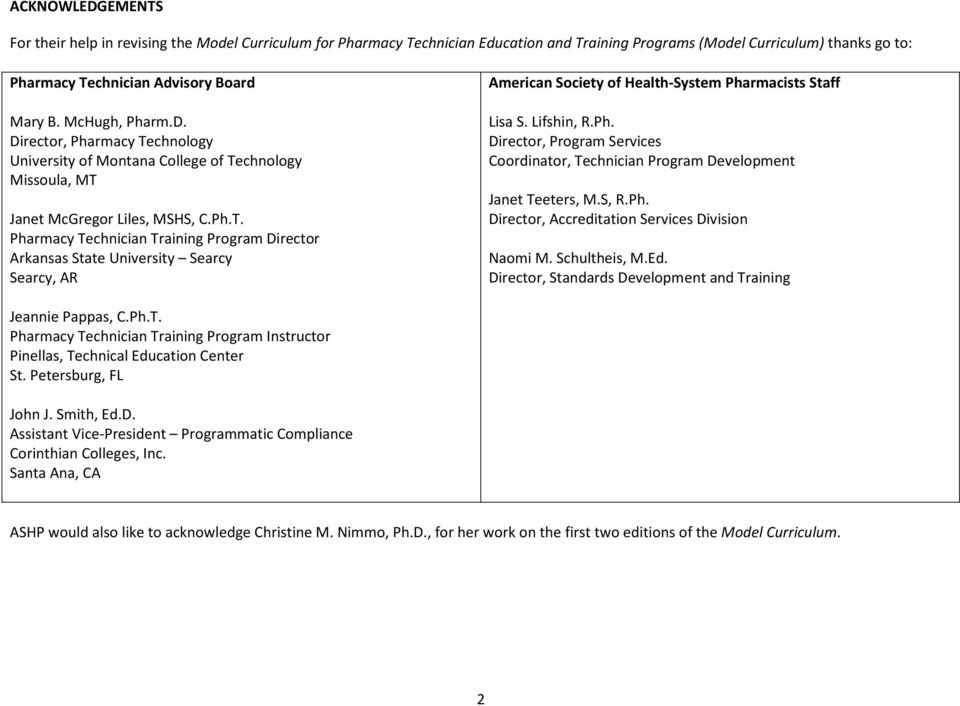
2 ACKNOWLEDGEMENTS For their help in revising the Model Curriculum for Pharmacy Technician Education and Training Programs (Model Curriculum) thanks go to: Pharmacy Technician Advisory Board Mary B. McHugh, Pharm.D. Director, Pharmacy Technology University of Montana College of Technology Missoula, MT Janet McGregor Liles, MSHS, C.Ph.T. Pharmacy Technician Training Program Director Arkansas State University Searcy Searcy, AR American Society of Health-System Pharmacists Staff Lisa S. Lifshin, R.Ph. Director, Program Services Coordinator, Technician Program Development Janet Teeters, M.S, R.Ph. Director, Accreditation Services Division Naomi M. Schultheis, M.Ed. Director, Standards Development and Training Jeannie Pappas, C.Ph.T. Pharmacy Technician Training Program Instructor Pinellas, Technical Education Center St. Petersburg, FL John J. Smith, Ed.D. Assistant Vice-President Programmatic Compliance Corinthian Colleges, Inc. Santa Ana, CA ASHP would also like to acknowledge Christine M. Nimmo, Ph.D., for her work on the first two editions of the Model Curriculum. 2
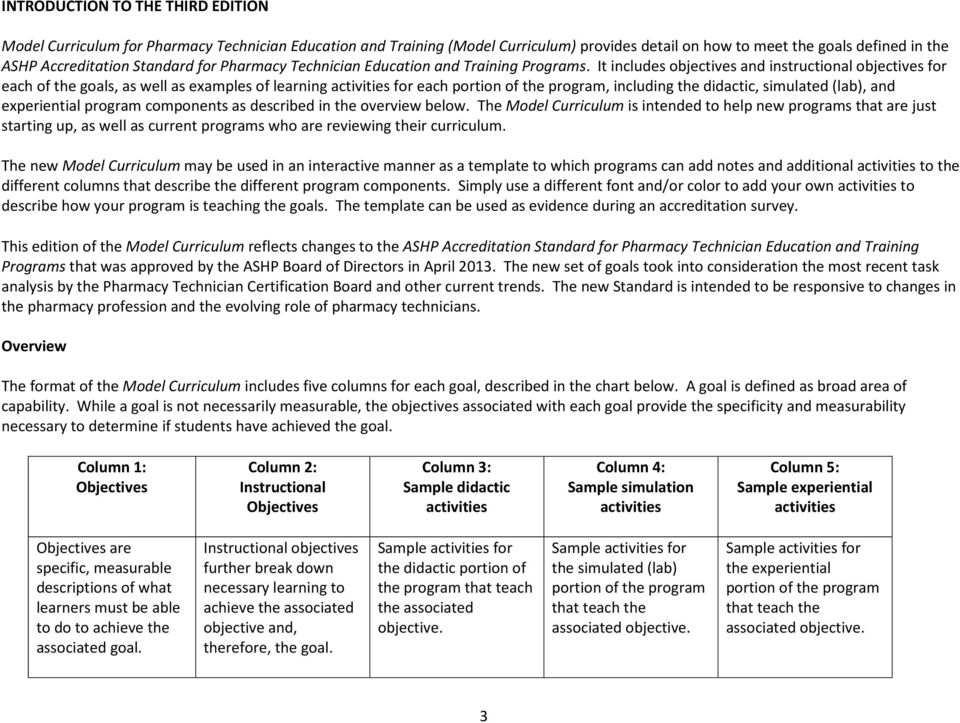
3 INTRODUCTION TO THE THIRD EDITION Model Curriculum for Pharmacy Technician Education and Training (Model Curriculum) provides detail on how to meet the goals defined in the ASHP Accreditation Standard for Pharmacy Technician Education and Training Programs. It includes objectives and instructional objectives for each of the goals, as well as examples of learning activities for each portion of the program, including the didactic, simulated (lab), and experiential program components as described in the overview below. The Model Curriculum is intended to help new programs that are just starting up, as well as current programs who are reviewing their curriculum. The new Model Curriculum may be used in an interactive manner as a template to which programs can add notes and additional activities to the different columns that describe the different program components. Simply use a different font and/or color to add your own activities to describe how your program is teaching the goals. The template can be used as evidence during an accreditation survey. This edition of the Model Curriculum reflects changes to the ASHP Accreditation Standard for Pharmacy Technician Education and Training Programs that was approved by the ASHP Board of Directors in April The new set of goals took into consideration the most recent task analysis by the Pharmacy Technician Certification Board and other current trends. The new Standard is intended to be responsive to changes in the pharmacy profession and the evolving role of pharmacy technicians. Overview The format of the Model Curriculum includes five columns for each goal, described in the chart below. A goal is defined as broad area of capability. While a goal is not necessarily measurable, the objectives associated with each goal provide the specificity and measurability necessary to determine if students have achieved the goal. Column 1: Objectives Column 2: Instructional Objectives Column 3: Sample didactic activities Column 4: Sample simulation activities Column 5: Sample experiential activities Objectives are specific, measurable descriptions of what learners must be able to do to achieve the associated goal. Instructional objectives further break down necessary learning to achieve the associated objective and, therefore, the goal. Sample activities for the didactic portion of the program that teach the associated objective. Sample activities for the simulated (lab) portion of the program that teach the associated objective. Sample activities for the experiential portion of the program that teach the associated objective. 3
4 The Model Curriculum goals are categorized into the following areas. Goal Categories Personal/Interpersonal Knowledge and Skills Foundational Professional Knowledge and Skills Processing and Handling of Medications and Medication Orders Sterile and Nonsterile Compounding Procurement, Billing, Reimbursement and Inventory Management Patient- and Medication-Safety Technology and Informatics Regulatory Issues Quality Assurance The goals are listed by category below. Goals Personal/Interpersonal Knowledge and Skills (1) Demonstrate ethical conduct in all job-related activities. (2) Present an image appropriate for the profession of pharmacy in appearance and behavior. (3) Communicate clearly when speaking and in writing. (4) Demonstrate a respectful attitude when interacting with diverse patient populations. (5) Apply self-management skills, including time management, stress management, and adapting to change. (6) Apply interpersonal skills, including negotiation skills, conflict resolution, and teamwork. (7) Apply critical thinking skills, creativity, and innovation to solve problems. Foundational Professional Knowledge and Skills (8) Demonstrate understanding of healthcare occupations and the health care delivery system. (9) Demonstrate understanding of wellness promotion and disease prevention concepts, such as use of health screenings; health practices and environmental factors that impact health; and adverse effects of alcohol, tobacco, and legal and illegal drugs. (10) Demonstrate commitment to excellence in the pharmacy profession and to continuing education and training. (11) Demonstrate knowledge and skills in areas of science relevant to the pharmacy technician s role, including anatomy/physiology and pharmacology. (12) Perform mathematical calculations essential to the duties of pharmacy technicians in a variety of contemporary settings. (13) Demonstrate understanding of the pharmacy technician s role in the medication-use process. 4

5 (14) Demonstrate understanding of major trends, issues, goals, and initiatives taking place in the pharmacy profession. (15) Demonstrate understanding of nontraditional roles of pharmacy technicians. (16) Identify and describe emerging therapies. Processing and Handling of Medications and Medication Orders (17) Assist pharmacists in collecting, organizing, and recording demographic and clinical information for direct patient care and medicationuse review. (18) Receive and screen prescriptions/medication orders for completeness, accuracy, and authenticity. (19) Assist pharmacists in the identification of patients who desire/require counseling to optimize the use of medications, equipment, and devices. (20) Prepare non-patient-specific medications for distribution (e.g., batch, stock medications). (21) Distribute medications in a manner that follows specified procedures. (22) Practice effective infection control procedures, including preventing transmission of blood borne and airborne diseases. (23) Assist pharmacists in preparing, storing, and distributing medication products requiring special handling and documentation (e.g., controlled substances, immunizations, chemotherapy, investigational drugs, drugs with mandated Risk Evaluation and Mitigation Strategies [REMS]). (24) Assist pharmacists in the monitoring of medication therapy. (25) Prepare patient-specific medications for distribution. (26) Maintain pharmacy facilities and equipment, including automated dispensing equipment. (27) Use material safety data sheets (MSDS) to identify, handle, and safely dispose of hazardous materials. Sterile and Nonsterile Compounding (28) Prepare medications requiring compounding of sterile products. (29) Prepare medications requiring compounding of nonsterile products. (30) Prepare medications requiring compounding of chemotherapy/hazardous products. Procurement, Billing, Reimbursement and Inventory Management (31) Initiate, verify, and assist in the adjudication of billing for pharmacy services and goods, and collect payment for these services. (32) Apply accepted procedures in purchasing pharmaceuticals, devices, and supplies. (33) Apply accepted procedures in inventory control of medications, equipment, and devices. (34) Explain pharmacy reimbursement plans for covering pharmacy services. 5

6 Patient- and Medication-Safety (35) Apply patient- and medication-safety practices in all aspects of the pharmacy technician s roles. (36) Verify measurements, preparation, and/or packaging of medications produced by other healthcare professionals (e.g., tech-checktech). (37) Explain pharmacists roles when they are responding to emergency situations and how pharmacy technicians can assist pharmacists by being certified as Basic Life Support (BLS) Healthcare Providers. (38) Demonstrate skills required for effective emergency preparedness. (39) Assist pharmacists in medication reconciliation. (40) Assist pharmacists in medication therapy management. Technology and Informatics (41) Describe the use of current technology in the healthcare environment to ensure the safety and accuracy of medication dispensing. Regulatory Issues (42) Compare and contrast the roles of pharmacists and pharmacy technicians in ensuring pharmacy department compliance with professional standards and relevant legal, regulatory, formulary, contractual, and safety requirements. (43) Maintain confidentiality of patient information. Quality Assurance (44) Apply quality assurance practices to pharmaceuticals, durable and nondurable medical equipment, devices, and supplies. (45) Explain procedures and communication channels to use in the event of a product recall or shortage, a medication error, or identification of another problem. To help in the transition to the new Model Curriculum, Appendix A provides a table of the current (Third Edition) goal numbers with their corresponding (where possible) previous, Second Edition numbers. 6

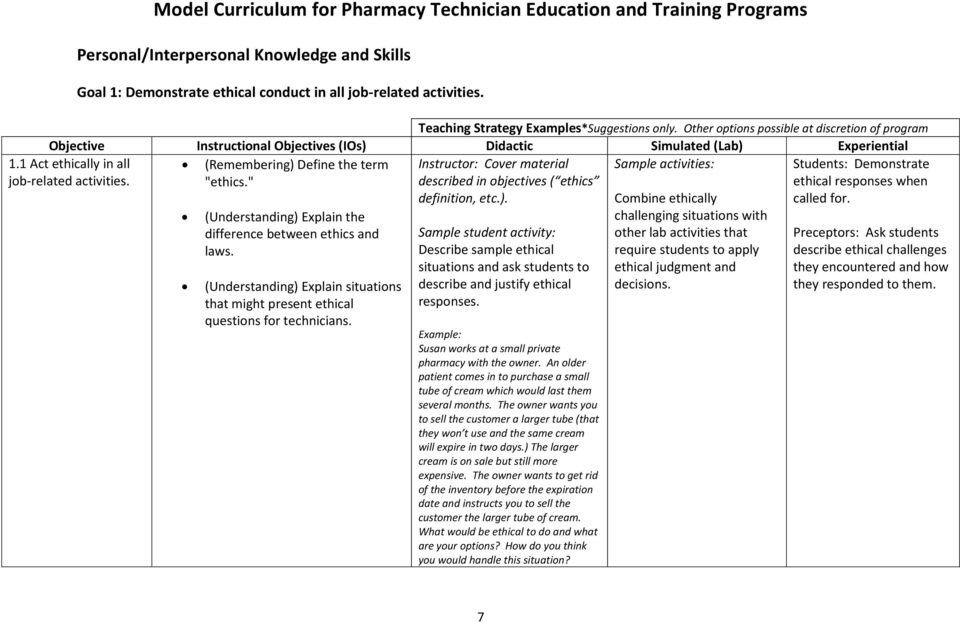
7 1.1 Act ethically in all job-related activities. Model Curriculum for Pharmacy Technician Education and Training Programs Personal/Interpersonal Knowledge and Skills Goal 1: Demonstrate ethical conduct in all job-related activities. (Remembering) Define the term Sample activities: "ethics." difference between ethics and laws. (Understanding) Explain situations that might present ethical questions for technicians. described in objectives ( ethics definition, etc.). Describe sample ethical situations and ask students to describe and justify ethical responses. Example: Susan works at a small private pharmacy with the owner. An older patient comes in to purchase a small tube of cream which would last them several months. The owner wants you to sell the customer a larger tube (that they won t use and the same cream will expire in two days.) The larger cream is on sale but still more expensive. The owner wants to get rid of the inventory before the expiration date and instructs you to sell the customer the larger tube of cream. What would be ethical to do and what are your options? How do you think you would handle this situation? Combine ethically challenging situations with other lab activities that require students to apply ethical judgment and decisions. Students: Demonstrate ethical responses when called for. Preceptors: Ask students describe ethical challenges they encountered and how they responded to them. 7
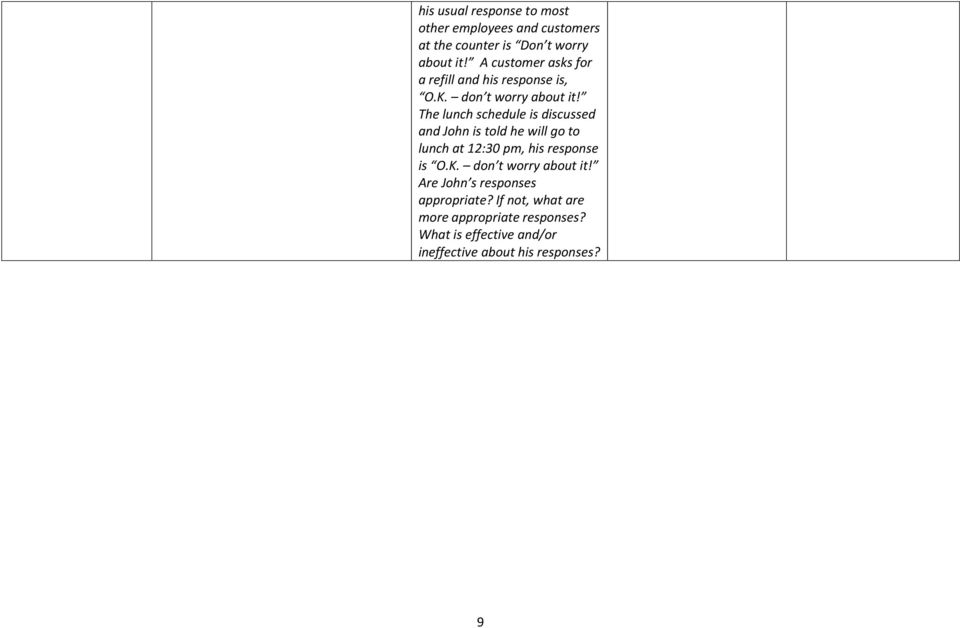
8 Goal 2: Present an image appropriate for the profession of pharmacy in appearance and behavior. (Understanding) Discuss what is Sample activities: Exhibit appropriate dress, appropriate for a technician to hygiene and behavior at wear to work. the 2.1 (Applying) Apply skills for presenting a professional image in appearance (including dress and hygiene) and behavior. (Understanding) Discuss the importance of personal hygiene in technicians work. (Understanding) Explain typical situations that may challenge selfcontrol in technicians work. (Understanding) Explain techniques for maintaining selfcontrol in challenging situations. (Understanding) Differentiate professional and informal communication. described in objectives (appropriate attire/hygiene challenging situations, etc.). Sample student activities: Show or describe various appearances of technicians and ask if they are acceptable, why or why not and how unacceptable appearances can be improved. Have students describe how they would respond professionally in challenging situations. Give examples of professional and informal communications and ask students which are appropriate. Have them translate informal communications into a professional communication style. Example: John works with you in the pharmacy. He is easy-going and Have students dress the way they would on a job and give constructive feedback as needed. Role-play challenging situations and how to professionally handle them. Preceptors: Ask students to describe challenging situations they encounter. Have them describe how they handled the situation and discuss ways it might have been handled more effectively, if needed. 8

9 his usual response to most other employees and customers at the counter is Don t worry about it! A customer asks for a refill and his response is, O.K. don t worry about it! The lunch schedule is discussed and John is told he will go to lunch at 12:30 pm, his response is O.K. don t worry about it! Are John s responses appropriate? If not, what are more appropriate responses? What is effective and/or ineffective about his responses? 9
10 Goal 3: Communicate clearly when speaking and in writing. (Applying) Pronounce technical Sample activities: terms accurately. 3.1 (Applying) Apply effective verbal and written communication skills. (Applying) Communicate effectively with patients who are non-english speakers or who have other special needs, such as vision or hearing problems, low reading level, difficulty understanding instructions). (Understanding) Explain ways to assess if a listener understood a verbal or written communication (e.g., repeating back). described in objectives (how to pronounce technical terms accurately, etc.) Instructor correctly and incorrectly pronounces terms. Have students identify when terms are correctly pronounced. If incorrect, ask them to say them correctly. Have student give common verbal and written communications. Have other students and/or instructor give feedback about if they clearly understood them and/or how they could be improved. Example: When individuals don t understand directions being given, there may be a tendency to talk louder, instead of remaining calm and making another, more effective, attempt to explain. Consider role playing this situation where one individual is giving directions and the other person doesn t understand. 10 Simulate common spoken and written communications. Preceptor: Give feedback if verbal communications are unclear and how they can be improved. Preceptor: Review selected written communications with students and provide constructive feedback.

11 3.2 (Applying) Use listening skills effectively. (Understanding) Explain nonverbal aspects of listening skills, such as body language. (Understanding) Explain verbal aspects of listening skills, such as acknowledging and reflecting back. described in objectives (body language, etc.) Instructor role-play a patient giving a common communication. Ask students to respond with effective listening skills (examples: leaning forward, nodding, acknowledging ( uh-huh, I see, I understand, repeating back: Let me see if I understand you correctly ; empathetic response, such as, That sounds very difficult. ). Preceptor: Give feedback to students on how well their listening skills come across to patients and team members. 3.3 (Applying) Use effective strategies for communicating with patients who are non- English speakers or who have other special needs, such as vision or hearing problems, low reading level, difficulty understanding instructions). (Remembering) Identify types of patients who require special communication strategies (e.g., vision or hearing problems, low reading level, difficulty understanding instructions). (Understanding) Explain how communication strategies can be adapted when needed. described in objectives (special communication strategies, etc.) Discuss relevant situations and how communication could be adapted to be effective. Apply skills as needed at the 11

12 Goal 4: Demonstrate a respectful attitude when interacting with diverse patient populations. Demonstrate a respectful importance of demonstrating a described in objectives attitude when interacting respectful attitude when (respectful vs disrespectful with diverse patient interacting with diverse patient actions, etc.) populations at the populations. 4.1 Demonstrate a respectful attitude when interacting with diverse patient populations. (Understanding) Identify types of diverse populations, such as diversity of culture, religion, race, age, gender, sexual orientation, transgender, disability, economic status. (Understanding) Describe actions that convey respect or disrespect. Group discussion about possible challenges with diverse populations and how to respond. Preceptors: Give feedback to students about how well they communicate respect and care verbally and nonverbally to all patients. 12

13 Goal 5: Apply self-management skills, including time management, stress management, and adapting to change. (Understanding) Explain how Preceptors: Ask students to common technician tasks are described in objectives (STAT vs discuss issues of scheduling typically prioritized and scheduled. PRN, prioritizing tasks, etc.) and prioritizing as needed. 5.1 (Applying) Apply time and workflow management skills. difference in priority to be given a STAT versus a PRN order. Give a fictional but typical list of tasks to be completed in a specified amount of time and ask students to prioritize and schedule the list. Discuss how well the priorities were selected and how realistic the schedule is. Ask students to perform tasks in a predetermined amount of time. 5.2 (Applying) Apply stress management skills. (Understanding) Identify common sources of stress in a pharmacy technician s job. (Understanding) Describe stress management techniques that can be used in a pharmacy technician s job when needed. described in objectives (sources of stress, ways to manage stress, etc.) Sample student activities: Invite a panel of experienced pharmacy technicians to come and discuss sources of stress on their job, how they deal with it and answer questions from students. Preceptors: Have students describe stressful situations they encounter at the experiential site, how they dealt with them and discuss other strategies that could also be applied. Describe stressful scenarios and ask students to discuss effective ways to deal with 13

14 them. 5.3 (Applying) Apply change management skills. (Understanding) Explain why dealing with change is an important skill for pharmacy technicians. described in instructional objectives (principles of change management, etc.) Apply change management skills as needed at the (Understanding) Explain principles of change management. Goal 6: Apply interpersonal skills, including negotiation skills, conflict resolution, and teamwork. (Understanding) Identify and describe interpersonal skills described in objectives needed to work effectively with (interpersonal and teamwork health care teams. skills) 6.1 (Applying) Apply effective interpersonal and teamwork skills in work with healthcare teams. Sample student activities: Have a class discussion about the characteristics of effective working relationships. Have students give examples of working relationships that have worked well or not and what made them that way. Give students scenarios describing types of interactions that occur in the work of the pharmacy technician. Ask them what interpersonal skills are required to handle them 14 Role-play typical interpersonal situations that may be challenging, such as an uncooperative or disrespectful member of the health care team that the technician must interact with in a professional manner. Preceptors: Ask students to describe some challenging situations requiring effective interpersonal skills and that they encounter at the Discuss how they handled them and other strategies that might have been used.

15 effectively and what they would do in those situations. 6.2 (Applying) Resolve conflicts effectively. (Understanding) Explain effective conflict management skills, including negotiation skills. described in objectives (conflict resolution, negotiation skills). Describe sample conflict situations and ask students to discuss how they would handle them to resolve the conflict. Role-play conflict situations that may occur in a technician s job. Handle conflicts effectively at the Example: Susan takes an hour for lunch each day at the busiest time of the day. This puts a burden on you and it is making you more angry each day. Your coworker, Anne, confronted Susan and the verbal exchange was heated, loud and uncomfortable. Now Susan and Anne are not speaking to each other and the situation is preventing work form being accomplished. How can you resolve this conflict in a more effective manner than Anne did? 15

16 Goal 7: Apply critical thinking skills, creativity, and innovation to solve problems. kinds of problems that can occur in a technician s work. 7.1 (Applying) Apply critical thinking skills to solve problems common in a pharmacy technician s work. (Understanding) Explain how critical thinking skills can be used to solve problems. described in objectives (types of problems, critical thinking skills.) Sample student activities: Describe typical problems that may come up in a pharmacy technician s job. Ask students to discuss how critical thinking skills can be applied to solve the problems. Present a simulated problem requiring the student to apply critical thinking skills to solve. Example: Your department is under a very tight deadline to complete a project. Your supervisor has asked that the project be completed by the end of the week. You have several employees who have asked for the next few days off who have been working on the project. How could you apply critical thinking skills to handle this situation? Discuss possible options. Preceptors: Ask students to discuss how critical thinking skills were applied to problems encountered at the 7.2 (Applying) Apply creativity and innovation to solve problems common in a pharmacy technician s work. (Understanding) Describe how creativity can be used to solve problems. (Understanding) Describe how innovation can be used to solve problems. described in objectives (creativity and innovation). Sample student activities: Discuss how creativity and innovation can be applied to Present a simulated problem and ask students to use creativity and innovative thinking to solve the problem. Preceptors: Ask students to discuss how creativity and innovation were, or could be, applied to problems encountered at the 16

17 solve problems pharmacy technicians may encounter during their jobs, using examples. Example: You have a staff of five technicians. On the day of the flu clinic when one technician was to manage the forms, a large drug order has come in that must be unpacked and placed on the shelves before the regional managers and CEO of the company arrive. In addition, the pharmacy is busier than normal that morning. How could you apply creativity and innovation to ensure all activities are covered? Discuss possible options. Foundational Professional Knowledge and Skills Goal 8: Demonstrate understanding of healthcare occupations and the health care delivery system. (Understanding) Identify and describe healthcare occupations. 8.1 (Understanding) Describe how different healthcare occupations interact in the healthcare delivery system. (Understanding) Explain how patient care is delivered in the health care system. described in objectives (healthcare occupations, healthcare delivery system) 17

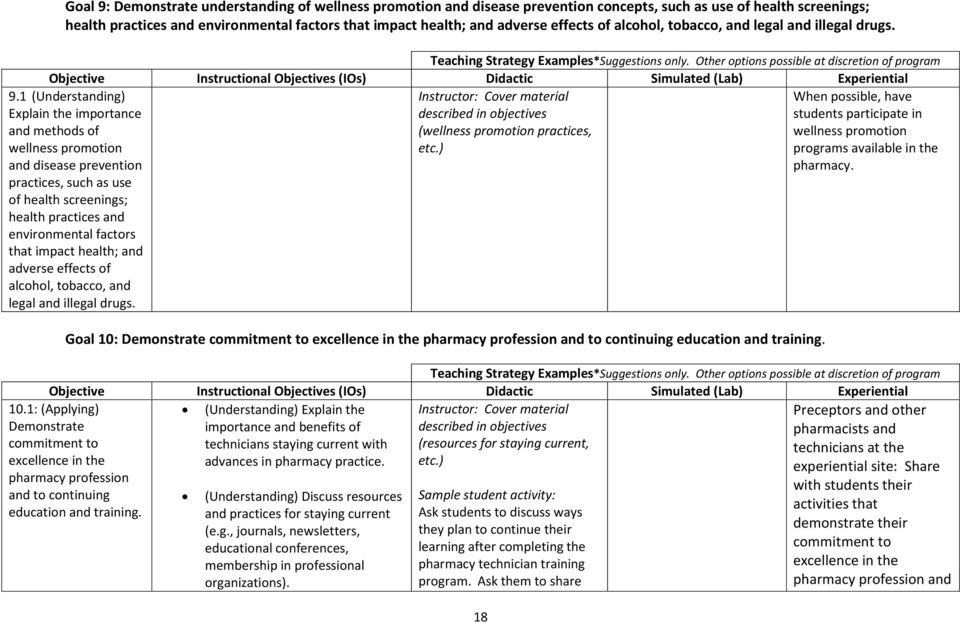
18 Goal 9: Demonstrate understanding of wellness promotion and disease prevention concepts, such as use of health screenings; health practices and environmental factors that impact health; and adverse effects of alcohol, tobacco, and legal and illegal drugs. 9.1 (Understanding) Explain the importance and methods of wellness promotion and disease prevention practices, such as use of health screenings; health practices and environmental factors that impact health; and adverse effects of alcohol, tobacco, and legal and illegal drugs. described in objectives (wellness promotion practices, etc.) When possible, have students participate in wellness promotion programs available in the pharmacy. Goal 10: Demonstrate commitment to excellence in the pharmacy profession and to continuing education and training. importance and benefits of described in objectives technicians staying current with (resources for staying current, advances in pharmacy practice. etc.) 10.1: (Applying) Demonstrate commitment to excellence in the pharmacy profession and to continuing education and training. (Understanding) Discuss resources and practices for staying current (e.g., journals, newsletters, educational conferences, membership in professional organizations). Ask students to discuss ways they plan to continue their learning after completing the pharmacy technician training program. Ask them to share 18 Preceptors and other pharmacists and technicians at the experiential site: Share with students their activities that demonstrate their commitment to excellence in the pharmacy profession and
19 (Understanding) Define technician certification (vs licensure and registration), its benefits, and the process for attaining. any past or current experiences with any activities discussed in the content covered. continuing education and training. Ask students to discuss which seem most appropriate for them and which they are most interested in pursuing. Goal 11: Demonstrate understanding and skills in areas of science relevant to the pharmacy technician s role, including anatomy/physiology and pharmacology. (Remembering) State definitions of commonly used medical terms (Remembering) State the definitions of medical terms commonly used in the range of patient care settings. (Remembering) Identify the correct medical term for given abbreviations. described in objectives (define medical terms). Ask students to complete a matching activity during which they match medical terms with their definition. Ask students to complete a matching activity during which they match medical terms with their abbreviations. Give students a list of commonly used medical terms and ask them to write the accepted abbreviation for each. 19

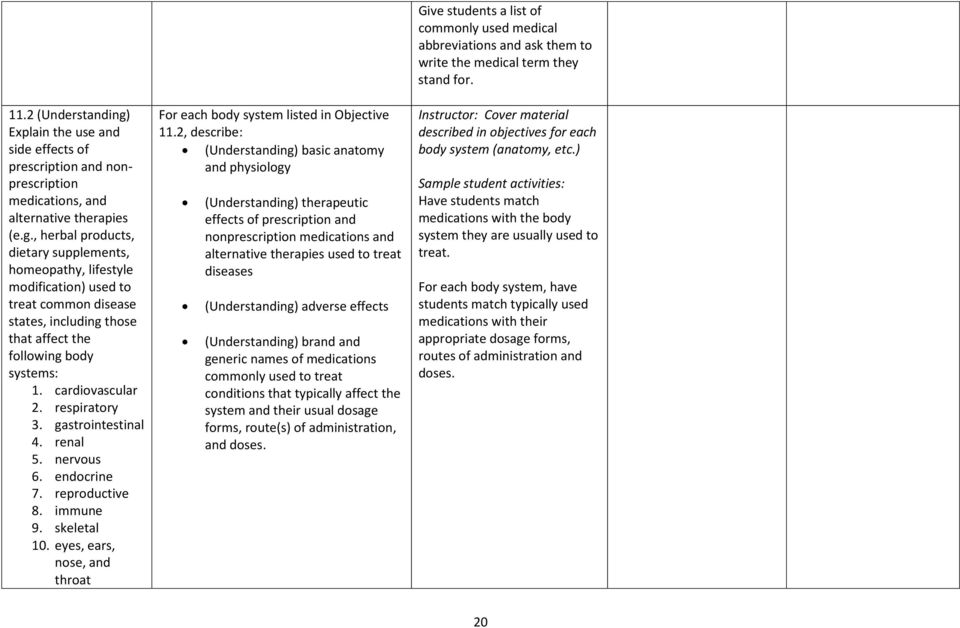
20 11.2 (Understanding) Explain the use and side effects of prescription and nonprescription medications, and alternative therapies (e.g., herbal products, dietary supplements, homeopathy, lifestyle modification) used to treat common disease states, including those that affect the following body systems: 1. cardiovascular 2. respiratory 3. gastrointestinal 4. renal 5. nervous 6. endocrine 7. reproductive 8. immune 9. skeletal 10. eyes, ears, nose, and throat For each body system listed in Objective 11.2, describe: (Understanding) basic anatomy and physiology (Understanding) therapeutic effects of prescription and nonprescription medications and alternative therapies used to treat diseases (Understanding) adverse effects (Understanding) brand and generic names of medications commonly used to treat conditions that typically affect the system and their usual dosage forms, route(s) of administration, and doses. Give students a list of commonly used medical abbreviations and ask them to write the medical term they stand for. described in objectives for each body system (anatomy, etc.) Sample student activities: Have students match medications with the body system they are usually used to treat. For each body system, have students match typically used medications with their appropriate dosage forms, routes of administration and doses. 20
21 11. dermatologic 12. hematologic 13. muscular 11.3 (Understanding) Explain the role of the FDA in regulating herbal products and dietary supplements. described in objectives (relevant regulations, etc.) Preceptor: Explain the role of the FDA in how they handle herbal products and dietary supplements in their pharmacy. Goal 12: Perform mathematical calculations essential to the duties of pharmacy technicians in a variety of contemporary settings. Perform calculations as use of Roman numerals, Arabic described in objectives (types of needed during duties at the numbers, fractions, decimals, and calculations, when used, how to apothecary symbols perform, practice) 12.1 (Applying) Perform mathematical calculations frequently needed in a pharmacy technician s work. (Applying): Demonstrate how to convert weights and measures, and direct ration and proportion. (Applying) Demonstrate how to reduce and enlarge formulas. (Applying) Demonstrate how to solve problems involving specific gravity, percent strength, weightin-volume, weight-in-weight and volume-in-volume. Sample student activities: Perform each type of calculation in relevant assignments and assessments. Perform each type of calculation in situations that simulate tasks that occur as a part of typical pharmacy technician jobs. Examples: Ask students to calculate the total amount of a suspension if the patient must take 10 ml every 8 hours for 7 days, followed by 10 ml every 12 hours for 5 days, followed by 5 ml every 12 hours for 2 days. (Applying) Demonstrate how to perform ratio Ask students to calculate the total number of tablets 21
22 strength\calculations for pharmaceutical preparations. (Applying) Demonstrate how to perform dilution and concentration calculations, including using the alligation method. needed if the patient is to take two tablets every 4 hours for 15 days, followed by two tablets every 6 hours for 10 days, followed by one tablet every 12 hours for another 10 days and then one tablet for 3 days. (Applying) Demonstrate use of milliequivalents. (Applying) Accurately determine the correct volume to be added to compounded products requiring overfill. (Understanding) Identify and explain the types of situations in which the various types of calculations will be necessary. Goal 13: Demonstrate understanding of the pharmacy technician s role in the medication-use process. Teaching Strategy Examples* (Understanding) Explain how the medication-use process differs in described in objectives different patient-care settings. (technician role, etc.) 13.1 (Understanding) Explain the pharmacy technician s role in the medication-use process. (Understanding) Discuss the role of the technician in the medication use process. 22
23 Goal 14: Demonstrate understanding of major trends, issues, goals, and initiatives taking place in the pharmacy profession. (Understanding) Describe the PPMI initiative and its impact on described in objectives the pharmacy profession. (initiatives, trends) 14.1 (Understanding) Identify and describe major trends, issues, goals, and initiatives taking place in the pharmacy profession. (Understanding) Describe other major trends, issues, goals and initiatives taking place in the pharmacy profession. Preceptors: Discuss with students what initiatives, trends, etc. are impacting the experiential site and how they are impacting it. Goal 15: Demonstrate understanding of nontraditional roles of pharmacy technicians (Understanding) Identify and explain nontraditional roles of pharmacy technicians. described in objective (nontraditional roles) Goal 16: Identify and describe emerging therapies (Understanding) Identify and describe emerging therapies. described in objectives (identification and description of emerging therapies) 23
24 Processing and Handling of Medications and Medication Orders Goal 17: Assist pharmacists in collecting, organizing, and recording demographic and clinical information for direct patient care and medication-use review (Applying) Act in accordance with state laws and regulations regarding collection of patient specific information. (Understanding) Explain how state laws and regulations determine what activities regarding collection of patient specific information can be delegated to technicians. described in objectives (relevant state laws, etc.) Act in accordance with relevant laws at the 17.2 (Applying) Collect needed patient information from the medical chart, patient profile, or medical record when needed. purposes for collecting patientspecific information by pharmacists. organization of patient medical charts or records and patient profiles. described in objectives (pertinent patient information, etc.) Have students collect appropriate information in given cases. Collect patient information appropriately as needed at the (Applying) Locate needed information in patient medical charts, records, and patient profiles (Applying) Effectively interview patients, their representatives, or described in objectives (effective interviewing) Role-play interview with patient, their Conduct interviews as needed at the experiential site. 24
25 their caregivers to obtain needed patient information. Sample student activities: Role-play interview with patient, their representatives, or their caregivers. (can be done in didactic or simulated portion of program). representatives, or their caregivers. (can be done in didactic or simulated portion of program) 17.4 (Applying) Obtain required patient information from other members of the health care team when needed. described in objectives (types on information that may be needed from health care team and how to obtain it). In simulations, determine what members of the health care team may have needed information. Obtain information as needed at the experiential site (Applying) Follow an established system for organizing collected patient-specific information in a useful electronic or manual format. described in objectives (formats for organizing information). Ask students to organize given patient-specific information into a specified template. Accurately use the system(s) at the 17.6 (Evaluating) When collecting patientspecific information, identify situations where the patient requires the attention of the pharmacist. described in objectives (when patients require pharmacist attention). Describe scenarios in which patients need or don t need the pharmacists attention. Ask students to identify those in which the patient needs the Identify patients needing pharmacist attention as needed at the experiential site. 25
26 pharmacist s attention and explain why (Applying) Appropriately collect data for the pharmacist s use in a medication-use review. purpose of a medication-use review. structure of a medication-use review. described in objectives (how to collect data for a medication use review, etc.) Collect data as requested at the 17.8 (Applying) Appropriately collect data for the pharmacist s use in managing pharmacy services. (Remembering) State the types of information the pharmacist might request to assist in managing pharmacy services. use of productivity data in contemporary pharmacy practice. described in objectives (how to collect data for use in managing pharmacy services, etc.) Collect data as requested at the (Understanding) Compare and contrast the functions and applications of several currently used pharmacy productivity measurement systems. (Understanding) Explain technicians potential roles in establishing, maintaining, and participating in a pharmacy productivity measurement system. 26
27 Goal 18: Receive and screen prescriptions/medication orders for completeness, accuracy, and authenticity (Applying) Act in accordance with state laws and regulations related to receiving and screening of medication orders. (Understanding) Explain how state laws and regulations determine what activities regarding receiving and screening prescription/medication orders for completeness and authenticity can be delegated to technicians. described in objective (laws and regulations). Comply with state laws and regulations when receiving and screening medication orders during duties at the 18.2 (Applying) Assess prescription/medication orders for completeness and authenticity when receiving orders via paper or electronic systems. (Remembering) State the components of a complete prescription/medication order including prescription/medication orders for controlled substances. (Remembering) When given an abbreviated instruction for medication use, state the full wording of the instruction. described in objectives (how to assess for completeness and authenticity, etc.) Give students prescriptions and medication orders, some of which contain errors in completeness or authenticity. Ask them to determine if they are complete and/or authentic. Sample activities: Simulate receiving prescriptions/medication orders. Simulate assessing for completeness and authenticity. Use paper and electronic systems to receive prescription/medication orders at the experiential site. Assess prescriptions/medication orders for completeness and authenticity at the 27
28 (Remembering) State the schedule for controlled substances and commonly used medications that fall into each category. procedure to verify the validity of a prescriber s DEA number. (Understanding) Explain techniques for detecting forged or altered prescriptions. importance of alerting the pharmacist if a prescription/medication order appears to be illegitimate (Applying) Efficiently obtain information to complete a prescription/medication order. (Understanding) Explain methods for obtaining missing pieces of information in a prescription/medication order. described in objectives (how to obtain information). Give students incomplete medication orders and ask how they would obtain the missing information. (can be done in didactic or simulated portion of program) Give students incomplete medication orders and ask how they would obtain the missing information. (can be done in didactic or simulated portion of program) Obtain information to complete a prescription/medication order as needed at the 18.4 (Analyzing) Identify situations when screening (Understanding) Explain common situations when described in objectives (how to Identify refills and renewals for which they should notify 28
29 refills and renewals when the technician should notify the pharmacist of potential inappropriateness. screening refills and renewals when the technician should notify the pharmacist of potential inappropriateness. identify possibly inappropriate refills and renewals) Give students sample refill or renewals and ask if they should notify the pharmacist of potential inappropriateness and why. Include refill and renewal orders that are inappropriate during simulated activities. Students should correctly identify these. the pharmacist of potential inappropriateness at the Goal 19: Assist pharmacists in the identification of patients who desire/require counseling to optimize the use of medications, equipment, and devices. OBJ 19.1 (Applying) Act in accordance with state laws and regulations regarding patient counseling. (Remembering) Describe the legal obligations for patient counseling, including documentation, as specified in OBRA 90 and in state laws and regulations. described in objectives (laws and regulations, etc.) Act in accordance with relevant state laws at the (Understanding) Explain how state laws and regulations determine what activities regarding patient counseling can be delegated to technicians. OBJ 19.2 (Applying) Use effective communication skills to determine if a patient or caregiver would like pharmacist counseling on the use of medications. importance of counseling patients in the use of medications. (Understanding) Explain how to described in objectives (importance of counseling, etc.) Determine if patients would like pharmacist counseling at the 29
30 question patients to determine if they would like pharmacist counseling. Goal 20: Prepare non-patient-specific medications for distribution (e.g., batch, stock medications) (Applying) Act in accordance with state laws and regulations regarding preparing medications for distribution. (Understanding) Explain how state laws and regulations determine what activities regarding preparing medications for distribution can be delegated to technicians. described in objectives (state laws, etc.) Act in accordance with relevant state laws at the (Understanding) Explain why it is important to notify the pharmacist when a nonformulary medication has been ordered. (Understanding) Explain one s own state laws governing pharmacist review of medications prior to distribution (Applying) Follow established laws and protocols to select the appropriate product. (Understanding) Explain federal and state laws governing the substitution of medication products. described in objectives (purpose and use of a formulary, etc.) Practice appropriate selection of products in the simulated setting. Act in accordance with relevant state laws at the 30
31 purpose and use of a formulary (e.g., state, health system, buying group). influence that the formulary and/or policies of third-party payers have on the selection of products. function of an NDC number (Applying) Appropriately obtain prescribed medications or devices from inventory. (Understanding) Explain typical storage arrangements for medications and devices. importance of the way medications and devices are typically arranged. described in objectives (typical storage arrangements). Describe a hypothetical technician obtaining a medication from inventory, who makes a mistake while doing so. Ask students what the mistake is and what should be done instead. Use appropriate processes to obtain prescribed medications or devices from inventory in a simulated setting. Use appropriate processes to obtain prescribed medications or devices from inventory at the experiential site (Applying) Follow safety policies and procedures in the preparation of all medications. importance of following safety policies and procedures when preparing medications. (Remembering) Describe standard safety policies and procedures for preparing described in objectives (safety policies and procedures, etc.). Describe a hypothetical technician preparing a medication, who makes a Follow safety procedures during simulated activities. Follow the experiential site s safety policies and procedures when preparing medications. 31
32 20.5 (Applying) Package the product in the appropriate type and size of container using a manual or automated system. medications. need for packaging products in the appropriate type and size of container. (Remembering) Describe the various sizes and types of containers for the packaging of pharmaceuticals in different pharmacy settings. (Remembering) Describe options for the packaging of products for children and patients who are the physically challenged or aged. mistake in safety procedures while doing so. Ask students what the mistake is and what should be done instead. Ask the potential impact of the mistake and who it may impact (e.g., self, co-workers, patients). described in objectives (product packaging options, etc.) Describe a hypothetical technician packaging a product, who makes a mistake while doing so. Ask students what the mistake is and what should be done instead. Appropriately package products in a simulated setting. Appropriately package products at the experiential site. (Complex overt response) Skillfully operate automated packaging equipment (Applying) Follow an established procedure to generate accurate and complete product labels. importance of accurate labeling of pharmaceuticals. (Remembering) Describe the information in a complete product label. described in objectives (information needed on label) Describe a hypothetical technician labeling a product, Appropriately generate labels in a simulated setting. Appropriately generate labels at the experiential site. 32
33 who makes a mistake while doing so. Ask students what the mistake is and what should be done instead (Applying) Affix the appropriate primary and auxiliary labels to containers. (Remembering) State categories of medications that require auxiliary labels and what those labels are. importance of placing labels so that all information on all labels is visible. described in objectives (categories of medications requiring auxiliary labels) Have students observe classmates or the instructor placing auxiliary labels on a product. Ask students critique what they observe and identify any mistakes and how to correct them. Appropriately affix auxiliary labels in a simulated setting. Appropriately affix auxiliary labels at the experiential site (Applying) Follow established policies and procedures for recording preparation of bulk, unit dose, and special doses of medications for immediate or anticipated future use. (Understanding) Discuss the importance of documenting preparation of bulk, unit dose, and special doses of medications for immediate or anticipated future use. (Remembering) Describe categories of information to be recorded at the time of preparation of bulk, unit dose, and special doses of medications prepared for immediate or anticipated future use. described in objectives (recording procedures, etc.) Describe a hypothetical technician recording preparations of different types, who makes mistakes while doing so. Ask students what the mistake is and what should be done instead. Properly record preparations in a simulated setting. Properly record preparations at the 33
34 20.9 (Applying) Follow established policies and procedures for recording the preparation of controlled substances. (Remembering) State the meaning of the term "controlled substance." (Remembering) State legal obligations regarding recording the preparation of controlled substances. described in objectives (relevant policies and procedures, etc.) Describe a hypothetical technician recording the preparation of a controlled substance, who makes a mistake while doing so. Ask students what the mistake is and what should be done instead. Properly record preparations of controlled substances in a simulated setting. Properly record preparations of controlled substances at the (Applying) Follow the manufacturer's recommendation and/or the pharmacy's guidelines for storage of medications prior to distribution. importance of proper storage of medications. storage requirements for different medication products. described in objectives (relevant recommendations and guidelines, etc.) Describe a hypothetical technician storing a medication, who makes a mistake while doing so. Ask students what the mistake is and what should be done instead. Properly store medications in a simulated setting. Properly store medications at the Goal 21: Distribute medications in a manner that follows specified procedures (Applying) Efficiently deliver the correct medication, equipment, importance of getting the right medication, equipment, device, described in objectives (systems for distributing medications, Simulate distribution, Distribute medications as needed at the experiential site. 34
35 device, or supplies to the correct patient or their representative. or supplies to the patient or their representative. (Remembering) Describe the various systems used to distribute medications. etc.) Discuss how distribution systems vary based on the type of medication, including controlled substances. including documentation, of a variety of medications, including use of automated distribution systems (or mock-ups of automated distribution systems) (Applying) Follow established policies and procedures to record the distribution of prescription medications. described in objectives (relevant policies and procedures, etc.) Simulate recording the distribution of prescription medications. Appropriately record the distribution of prescription of medications at the 21.3 (Applying) Follow established policies and procedures to record the distribution of controlled substances (Evaluating) Monitor medication use to assure it is consistent with the prescription/medication order for the patient. (Complex overt response) Skillfully operate automated distribution systems. (Remembering) Describe standard policies and procedures for recording the distribution of controlled substances. described in objectives (relevant policies and procedures, etc.) described in objectives (how to monitor for proper use). Simulate recording the distribution of controlled substances. Record the distribution of controlled substances at the Monitor medication use to assure it is consistent with the prescription/medication order for the patient as needed at the experiential site. 35
36 Goal 22: Practice effective infection control procedures, including preventing transmission of blood borne and airborne diseases. need for sanitation management in the pharmacy setting (Applying) Follow policies and procedures for infection control (e.g., protective clothing, handwashing). (Remembering) Define "infection control." (Understanding) Explain OSHA regulations regarding pharmacy practice, including regulations for blood-borne pathogens. (Understanding) Explain state regulations regarding infection control. (Understanding) Explain institutional policies and procedures regarding infection control. described in objectives (infection control definition, OSHA and state regulations, etc.) Give descriptions of infection control situations, some using appropriate procedures and others not. Ask the students to differentiate if proper procedures are being used or not and how to correct the situations in which they are not. Simulate appropriate use of protective clothing and other infection control methods. Follow policies and procedures for infection control at the experiential site. 36
37 Goal 23: Assist pharmacists in preparing, storing, and distributing medication products requiring special handling and documentation (e.g., controlled substances, immunizations, chemotherapy, investigational drugs, drugs with mandated Risk Evaluation and Mitigation Strategies [REMS]) (Understanding) Explain special procedures pharmacy technicians will be responsible for regarding preparing, storing and distributing controlled substances. described in objectives (e.g., procedure for preparing, storing and distributing controlled substances, etc.) 23.2 (Applying) Act in accordance with state laws and regulations regarding the technician s role in immunizations. (Understanding) Explain how state laws and regulations determine what activities regarding immunizations can be delegated to technicians. described in objectives (relevant state laws, etc.) Act in accordance with state laws and regulations regarding the technician s role in immunizations at the 23.3 (Applying) Apply special procedures technicians will be responsible for regarding preparing, storing and distributing controlled substances and chemotherapy agents. described in objectives (relevant special procedures). Ask students to identify errors in scenarios involving special procedures for controlled substances and chemotherapy agents. Practice special procedures in a simulated setting. Follow relevant special procedures at the 23.4 (Applying) Apply special procedures pharmacy technicians will described in objectives (relevant special procedures). Practice special Follow relevant special procedures regarding investigational drug at the 37
38 be responsible for regarding preparing, storing, and distributing investigational drugs. Ask students to identify errors in scenarios involving special procedures for investigational drugs. procedures regarding investigational drugs in a simulated setting. experiential site, if needed (Applying) Apply special handling procedures for drugs with mandated Risk Evaluation and Mitigation Strategies (REMS). (Remembering) Define Risk Evaluation and Mitigation Strategies (REMS) and its importance. described in objectives (special handling procedures). Practice special procedures in a simulated setting. Follow special handling procedures for drugs with mandated Risk Evaluation and Mitigation Strategies (REMS) at the experiential site (Applying) Follow the established protocol for the preparation, storage and recording of an investigational medication product. described in objectives (relevant special procedures) Ask students to identify errors in scenarios involving protocols for investigational drugs. Practice protocols for investigational drugs in a simulated setting. Follow the established protocol for the preparation, storage and recording of investigational medication products at the experiential site. 38
39 Goal 24: Assist pharmacists in the monitoring of medication therapy (Applying) Act in accordance with state laws and regulations regarding technician s role in monitoring of medication therapy. (Understanding) Explain how state laws and regulations determine what activities regarding monitoring of medication therapy can be delegated to technicians. described in objectives (e.g., relevant state laws, monitoring procedures) Practice relevant monitoring procedures. Act in accordance with relevant laws and regulations when assisting in monitoring procedures at the 24.2 (Understanding) Explain the purpose of monitoring a patient's medication therapy. described in instructional objectives (purpose of monitoring, etc.) 24.3 (Complex Overt Response) Demonstrate skill in monitoring selected procedures (e.g., fingerstick blood draw for glucose monitoring and cholesterol screening, blood pressure, pulse). (Remembering) Describe the equipment and supplies used to perform selected procedures and their limitations. reasons for the steps in the selected procedures. described in instructional objectives (equipment, supplies, reasons for procedures, etc.) Have students match monitoring procedures with information gained from the procedure and/or what condition or disease usually calls for the procedure. Simulate monitoring selected procedures. Monitor procedures as needed at the experiential site. 39
40 Goal 25: Prepare patient-specific medications for distribution (Applying) Act in accordance with state laws and regulations regarding technician s role in preparing medications for distribution. (Understanding) Explain how state laws and regulations determine what activities regarding preparing medications for distribution can be delegated to technicians. described in objectives (state laws and regulations). Follow relevant state laws and regulations at the (Understanding) Explain why it is important for the technician to notify the pharmacist when screening of the prescription/medication order reveals a non-formulary medication has been ordered. (Understanding) Explain one s own state laws governing pharmacist review of medications prior to distribution (Applying) Accurately create a new, or enter data into an existing, patient profile according to an established procedure. (Applying) Accurately use the following systems for inputting prescription/medication order information: metric, avoirdupois, household, and apothecary systems. described in objectives (systems for inputting prescription/medication order information). Practice using each system in the simulated setting. Accurately create a new, or enter data into an existing, patient profile using the established procedures of the 25.3 (Applying) Accurately count or measure finished dosage forms as specified (Applying) Accurately use the following systems to count and measure: metric, avoirdupois, described in objectives (counting, measuring, etc.) Practice counting, Count, weigh and measure finished dosage forms at the 40
41 by the prescription/medication order. household system (e.g. teaspoon, tablespoon) and apothecary. (Complex Overt Response) Accurately operate common pharmaceutical measurement and weighing devices. weighing and measuring finished dosage forms in the simulated setting. (Applying) Accurately convert from one measurement system to another as needed (Applying) Follow protocol to assemble appropriate patient information materials. (Remembering) Describe pharmacist obligations for counseling as required in OBRA '90. importance of including written patient information at the time of dispensing. described in objectives (patient information materials). Have students match different types of dispensed products with written information that would need to go with it. Have students include appropriate written materials with simulated dispensed products in the lab setting. Follow the experiential site s protocols to assemble appropriate patient information materials. (Remembering) Describe the types of written information that are typically included with dispensed products. 41
42 Goal 26: Maintain pharmacy facilities and equipment, including automated dispensing equipment. need for sanitation management in the pharmacy (Applying) Follow policies and procedures for sanitation management and hazardous waste handling (e.g., needles). (Remembering) Define "hazardous waste." (Understanding) Explain state regulations regarding handling hazardous waste. (Understanding) Explain institutional policies and procedures regarding hazardous waste management. described in objectives (policies and procedures for sanitation management, etc.). Give descriptions of sanitation management and hazardous waste handling, some using appropriate procedures and others not. Ask the students to differentiate if proper procedures are being used or not and how to correct the situations in which they are not. Practice procedures for maintaining pharmacy facilities and equipment, such as automated dispensing equipment, laminar flow biological safety cabinets and equipment requiring calibration. Follow policies and procedures for sanitation management and hazardous waste handling at the 26.2 (Applying) Apply appropriate techniques to clean laminar flow biological safety cabinets (Applying) Maintain a clean and neat work environment. reasons for the procedures for cleaning a laminar flow biological safety cabinet. importance of maintaining a clean and neat work described in objectives (appropriate techniques for cleaning laminar flow biological safety cabinets). described in objectives (importance of maintaining a Simulate cleaning laminar flow biological safety cabinets using appropriate techniques. Clean laminar flow biological safety cabinets at the experiential site using appropriate technique. Maintain a clean and neat work environment at the 42
43 26.4 (Applying) Accurately calibrate weighing or counting devices, fluid compounders, or syringe pumps. environment. clean and neat work environment). (Remembering) Describe the equipment and pharmacy devices described in objectives (how to common to pharmacy practice. calibrate). (Remembering) Describe the term "calibration" as it refers to the equipment commonly used in pharmacy practice. Sample activities: Practice calibrating weighing and counting devices, fluid compounders and syringe pumps in a simulated setting. Accurately calibrate weighing or counting devices, fluid compounders, or syringe pumps at the experiential site. (Applying) Accurately calibrate syringe pumps and devices for weighing, counting, and compounding. role of electronic devices in the delivery of direct patient care (Applying) Follow manufacturers' guidelines in troubleshooting, maintaining, and repairing electronic devices used in preparing and dispensing medications. (Understanding) Explain how to update and maintain information systems for pricing updates and report generation. described in objectives (sample guidelines for trouble shooting, maintain and repairing electronics relevant devices). Practice or simulate practice of appropriately troubleshooting, maintaining and/or repairing selected devices. Follow manufacturers' guidelines in troubleshooting, maintaining, and repairing electronic devices used in preparing and dispensing medications. 43
44 Goal 27: Use material safety data sheets (MSDS) to identify, handle, and safely dispose of hazardous materials. Teaching Strategy Examples* (Understanding) Define and Accurately follow explain the purpose and described in objectives (MSDS, instructions on material importance of material safety etc.) safety data sheets at the data sheets (MSDS) (Applying) Accurately follow instructions on material safety data sheets (MSDS). (Understanding) Describe examples of instructions on a material safety data sheet. Simulate following instructions on a material safety data sheet. Sterile and Nonsterile Compounding Goal 28: Prepare medications requiring compounding of sterile products (Understanding) Define and explain key elements of USP 797. described in objectives (USP 797) (Applying) Collect the correct ingredients for sterile products requiring compounding. (Remembering) Define the term "compounding." (Understanding) Explain why some medications require compounding. described in objectives (procedures for maintaining sterility while collecting materials for compounding, etc.) Collect ingredients in the simulated setting. Collect the correct ingredients for sterile products requiring compounding at the (Remembering) Define the terms 44
45 "sterile" and "nonsterile" in pharmacy. (Understanding) Explain why some medications must be sterile. (Applying) Demonstrate the proper procedure for maintaining the sterility of materials being collected for compounding a sterile product (Applying) Accurately determine the correct amounts of ingredients for a compounded product. (Applying) Correctly solve mathematical problems using Roman numerals, Arabic numbers, fractions, apothecary symbols, and decimals. (Applying) Correctly solve mathematical problems involving conversion of weights and measures and direct ratio and proportion. described in objectives (methods for determining amounts). Sample student activities: Solve each type of problem listed in the instructional objectives. Determine the correct amounts of ingredients for a compounded product in the simulated setting. Determine the correct amounts of ingredients for compounded products at the (Applying) Correctly solve mathematical problems involving reducing and enlarging formulas. (Applying) Correctly solve mathematical problems involving specific gravity, percent strength, weight-in-volume, weight-inweight, and volume-in-volume. 45
46 (Applying) Correctly solve mathematical problems involving ratio strength calculations for pharmaceutical preparations. (Applying) Correctly solve mathematical problems involving dilution and concentration. (Applying) Correctly solve mathematical problems involving dilution and concentration using the alligation method. (Applying) Correctly solve mathematical problems involving milliequivalents. (Applying) Solve for the correct volume to be added for compounded products that require an overfill (Complex Overt Response) Compound sterile products using appropriate techniques, equipment, and devices. (Remembering) State one s state regulations regarding technician compounding of sterile products. reason for each step of aseptic technique. (Understanding) Explain therapeutic, pharmaceutical, and described in objectives (sterile compounding techniques). Sample student activities: Present enactments or descriptions of sterile compounding and ask students to identify errors and how they Sample activities: Practice sterile compounding technique in the simulated setting. Compound sterile products using appropriate techniques, equipment and devices at the experiential site. 46
47 chemical incompatibility. (Understanding) Explain how the effects of incompatibilities can be overcome when compounding sterile products. should be corrected. Show videos that demonstrate correct technique. uses of horizontal and vertical laminar flow hoods. (Complex Overt Response) Demonstrate the proper use of equipment and devices used in compounding sterile products. Goal 29: Prepare medications requiring compounding of nonsterile products. (Remembering) State one s state Compound nonsterile regulations regarding technician described in objectives (relevant products using appropriate compounding of nonsterile state regulations, nonsterile technique at the products. technique, etc.) (Complex Overt Response) Compound nonsterile products using appropriate technique. reasons for the steps of nonsterile technique. (Understanding) Explain how the effects of incompatibilities can be overcome when compounding nonsterile products. Practice compounding nonsterile products in the simulated setting. 47
48 Goal 30: Prepare medications requiring compounding of chemotherapy/hazardous products. (Remembering) State one s state Practice compounding regulations regarding technician described in objectives (relevant cytotoxic and other compounding of cytotoxic and state regulations, risks, steps in hazardous medication other hazardous medication preparation, etc.). products at the experiential products. site (Complex Overt Response) Compound cytotoxic and other hazardous medication products using appropriate technique. (Understanding) Explain risks involved in the preparation and handling of cytotoxic and other hazardous medication products. reasons for the steps in cytotoxic or other hazardous medication product preparation technique. Practice compounding cytotoxic and other hazardous medication products in the simulated setting (Applying) Follow safety policies and procedures when disposing of hazardous and nonhazardous wastes. (Remembering) Describe standard safety policies and procedures when disposing of hazardous and nonhazardous wastes. described in objectives (relevant safety policies and procedures). Practice following safety policies and procedures during simulations of disposing of hazardous and nonhazardous wastes. Follow safety policies and procedures when disposing of hazardous and nonhazardous wastes at the 30.3 (Applying) Follow policies and procedures for sanitation management, need for sanitation management in the pharmacy setting. described in objectives (relevant policies and procedures). Simulate handling of Follow the experiential site s policies and procedures for sanitation management, 48
49 hazardous waste handling (e.g., needles), and infection control (e.g., protective clothing). (Remembering) Define "hazardous waste". (Remembering) Define "infection control". hazardous waste. hazardous waste handling and infection control. (Understanding) Explain OSHA regulations regarding pharmacy practice, including regulations for blood-borne pathogens. (Understanding) Explain state regulations regarding the handling of hazardous waste and infection control. (Understanding) Explain institutional policies and procedures regarding hazardous waste management and infection control (Complex Overt Response) Demonstrate skill in cleaning up a cytotoxic or other hazardous medication product spill using the accepted procedure. (Understanding) Explain processes for cleaning up a cytotoxic or other hazardous medication product spill. described in objectives (how to clean up a hazardous spill) Clean up a cytotoxic or other hazardous medication product spill using the accepted procedure in a simulated setting. Clean up a cytotoxic or other hazardous medication product spill using the accepted procedure if needed at the experiential site. 49
50 Procurement, Billing, Reimbursement and Inventory Management Goal 31: Initiate, verify, and assist in the adjudication of billing for pharmacy services and goods, and collect payment for these services. (Remembering) Describe the Obtain needed information possible methods of payment for described in objectives from the customer/patient at a prescription/medication order (obtaining needed information) the and associated services (Applying) Effectively obtain needed information from the customer/patient, including method of payment for a prescription/medication order and patient-specific information. Role-play scenarios in which the student must obtain method of payment and/or patient-specific information (Analyzing) Verify and accurately input third-party coverage for a prescription/medication order. (Understanding) Describe how to verify third-party coverage. described in objectives (verifying third-party coverage, etc.) Simulate actions needed to verify and accurately input third party coverage for a prescription/medication order. Verify and accurately input third-party coverage for a prescription/medication order at the 31.3 (Applying) When a claim is rejected, identify the reason. (Understanding) Describe ways to determine reasons for a rejected claim. described in objectives (rejected claims) Identify reasons for rejected claims at the 31.4 (Applying) Appropriately communicate third-party (Understanding) Explain ways to communicate third-party payer responses that are sensitive to described in objectives (communication of third-party Role-play scenarios in Communicate third-party payment coverage information and further action 50
51 payment coverage information and further action to be taken to customers/patients. customer/patient concerns and are clearly understood. (Applying) Use effective communication techniques for diffusing strong emotional reactions to third-party payment response. payment coverage information, etc.). which the student must communicate thirdparty payment coverage information. to be taken to customers/patients as needed at the 31.5 (Applying) Accurately complete third-party claims forms. described in objectives (thirdparty claim forms) Accurately complete thirdparty claims forms at the Practice completing sample third party claims forms (Applying) Accurately record the receipt of payment for pharmaceutical goods and services. (Applying) Accurately assess a prescription transmission adjudication for appropriate payment. (Applying) Using cost analysis methods, verify that the submitted medication has been paid for by the third-party insurance. described in instructional objectives (recording receipt of payment) Practice recording receipt of payments. Accurately record the receipt of payment for pharmaceutical goods and services at the experiential site. (Applying) When a judgment decision is required, alert the pharmacist to determine proper prescription adjudication (Complex Overt (Understanding) Explain Effectively use the cash 51
52 Response) Demonstrate skill in the operation of a cash register. different types of payment (e.g., debit, credit, cash, certificates, coupons) and how each is entered in the cash register. (Complex Overt Response) Exercise skill in replacing cash register tapes and ribbons. described in instructional objectives (how to perform tasks on the cash register) Operate or simulate operation of a cash register in a simulated setting. register at the experiential site. (Understanding) Explain how to void transactions on the cash register. concept of departmental codes and how they are entered in the cash register (Applying) Accurately make change. described in objectives (how to make change). Describe scenarios in which change must be given and have student calculate the amount. Accurately make change during simulated transactions. Accurately make change at the 31.9 (Applying) Determine items that are taxable. (Remembering) Describe the concepts of taxable and nontaxable. (Remembering) Describe the legal obligation to tax required items. described in objectives (distinguishing taxable from nontaxable items) Have students identify items in Accurately determine which items are taxable during simulated transactions. Accurately determine which items are taxable at the 52
53 a given list as taxable or nontaxable (Applying) Determine payment due the health system for medication orders. (Remembering) Describe common pricing and billing systems. (Remembering) Describe common systems for tracking medication billing to patients. described in objectives (pricing, billing and tracking systems) Accurately determine payment due the health system during simulated transactions. Determine payment due the health system for medication orders when needed at the Goal 32: Apply accepted procedures in purchasing pharmaceuticals, devices, and supplies (Applying) Follow an established procedure for purchasing pharmaceuticals, devices, (Remembering) Describe typical procedures for purchasing pharmaceuticals, devices, and supplies. described in objectives (purchasing procedures) Follow the experiential site s procedures for purchasing pharmaceuticals, devices, and supplies. and supplies. (Remembering) Describe typical procedures used to expedite emergency orders/prescriptions. (Remembering) Describe typical procedures used for the purchase of atypical products (e.g., biologics, interferons, HIV medications, investigational medications, non-formulary products). 53
54 Goal 33: Apply accepted procedures in inventory control of medications, equipment, and devices (Applying) Apply accepted procedures of inventory control (e.g., prime vendor, just-in-time). (Remembering) Describe the various methods of inventory control (e.g., prime vendor, justin-time). described in objectives (methods of inventory control, etc.) Give descriptions of a hypothetical technician handling inventory, sometimes using appropriate procedures and other times not. Ask the students to differentiate if proper procedures are being used or not and how to correct the situations in which they are not. Simulate inventory control procedures. Apply accepted procedures in inventory control at the Example: Scenario: Lisa receives a shipment of OxyContin for the pharmacy, which she previously ordered. She verifies that it is complete and intact before putting it into storage. What is a potential problem with this scenario? (Answer: A different person should order and receive a controlled substance.) 33.2 (Applying) Follow (Remembering) Describe the Follow the experiential site s 54
55 established policies and procedures verifying specifications on the original order when receiving inventory. general tasks involved in receiving and verifying the order of inventory. (Remembering) Describe methods for handling back ordered medications. described in objectives (ways to verify specifications, etc.). policies and procedures verifying specifications on original orders when receiving inventory (Applying) Follow established policies and procedures for placing pharmaceuticals, durable medical equipment, devices, and supplies in inventory under proper storage conditions. described in objectives (putting inventory in storage). Provide simulated materials for students to practice properly placing into storage (Applying) Follow established policies and procedures for removing from inventory expired/discontinued pharmaceuticals, durable medical equipment, devices, supplies, or recalled items in these same categories. (Remembering) Define the terms "expired," "discontinued," and "recalled" as used in pharmacy. (Remembering) Describe common reasons for discontinuing or recalling items. (Understanding) Explain a standard procedure for inspecting nursing units for expired, discontinued, or recalled medications. described in objectives (definition of terms, etc.) Provide simulated materials for students to review and identify which need to be removed. Have them give the reason and follow proper documentation procedures. Follow established policies and procedures for removing from inventory as needed at the (Understanding) Explain a standard procedure for reviewing, removing, and 55
56 handling pharmaceuticals, equipment, devices, and supplies that have expired, been recalled, or are otherwise unfit for patient utilization. various levels of recall and the associated responsibilities for each level. importance to cash flow of returning expired or excess inventory goods (Applying) Follow established policies and procedures for documenting repackaging or the removal from inventory of expired/discontinued pharmaceuticals, durable medical equipment, devices, supplies, or recalled items in these same categories. importance of maintaining an inventory system through accurate documentation. described in objectives (documentation importance and procedures when repackaging or removing inventory, etc.) Provide simulated materials for students to repackage or remove as appropriate and complete needed documentation. Follow established policies and procedures for documenting repackaging or the removal from inventory at the 33.6 (Analyzing) Identify pharmaceuticals, durable medical equipment, devices, and supplies to be ordered. importance of maintaining an adequate supply of pharmaceuticals, durable medical equipment, devices, and described in objectives (items to be ordered, etc.) Provide simulated materials for students to review to 56
57 supplies. problems associated with an excessive supply of pharmaceuticals, durable medical equipment, devices, and supplies. determine what needs to be ordered (Understanding) Explain alternative ways of obtaining a pharmacy item that is not available (Understanding) Explain methods for communicating changes in product availability to patients, caregivers, and/or healthcare professionals. role that judgment plays in supplementing an automated system for determining the timing and amount of pharmaceuticals, durable medical equipment, devices, and supplies to order. (Remembering) State categories of alternative sources of items not available from the primary vendor at time of need. importance of evaluating the cost of obtaining a needed item from an alternative source. described in objectives (alternate sources, etc.) Have students discuss scenarios in which a needed pharmacy item is not available and what they would do. described in objectives (product availability communication methods, etc.) 57
58 33.9 (Applying) Follow established policies and procedures for prevention of theft and/or medication diversion. difference between tolerance and physical dependence. (Remembering) Describe common methods for preventing theft and/or medication diversion. Have students describe actions they would take if specified product availability were interrupted. described in objectives (policies and procedures to deter theft, etc.) Follow the experiential site s policies and procedures to deter theft and/or medication diversion. (Remembering) Describe methods of reporting theft and/or medication diversion (Applying) Follow established policies and procedures to maintain a record of controlled substances received, stored, and removed from inventory. (Remembering) State the legal requirements for recording controlled substances received, stored, and removed from inventory. (Remembering) State procedures for destroying controlled substances. described in instructional objectives (policies and procedures for recording controlled substances, etc.) Have students simulate recording of controlled substances received, stored, and removed from inventory. Follow the experiential site s policies and procedures to maintain a record of controlled substances received, stored, and removed from inventory. 58
59 Goal 34: Explain pharmacy reimbursement plans for covering pharmacy services (Understanding) Explain pharmacy reimbursement plans for covering pharmacy services. described in objective (pharmacy reimbursement plans). Patient- and Medication-Safety Goal 35: Apply patient- and medication-safety practices in all aspects of the pharmacy technician s roles. Teaching Strategy Example*Suggestions only. Other options possible at discretion of program (Understanding) Explain ways pharmacy technicians can help prevent medication errors (Understanding) Describe common factors of an effective pharmacy department approach to preventing medication errors. role of multiple checks in avoiding medication errors. (Understanding) Explain agerelated medication errors that may be detected by technicians. (Remembering) Define the term high alert. described in objectives (technician tasks to prevent medication errors, types of medication errors). Flag high alert medications in the mock lab. Preceptors: Explain the experiential site s approach to preventing medication errors. 59
60 35.2 (Understanding) Explain the programs currently in place for reporting medication errors on a global and institutional level (Understanding) Explain the technician s (Understanding) Identify the role and limitations of the FDA MedWatch program in error reporting. role of ISMP in preventing medication errors. (Understanding) Identify the role and limitations of the ISMP Medication Errors Reporting Program (MERP). (Understanding) Explain how calculations, use of zeros and decimals, abbreviations, illegible handwriting, missing information, drug product characteristics, preparation, labeling, work environment, and personnel impact medication errors. (Remembering) Define the term failure mode and effects analysis (FMEA). (Understanding) Identify situations where patient counseling may prevent medication errors. (Remembering) Identify the term root cause analysis. described in objectives (programs for reporting medication errors). described in objectives 60
61 role in preventing and detecting medication errors. (Remembering) Identify five steps of root cause analysis. (technician s role) (Analyzing) When a clinically significant adverse medication event (ADE) is identified, participate in determining the presence of any similar potential ADEs. described in objective (how to determine the presence of similar ADE s). If a clinically significant adverse medication event (ADE) is identified at the experiential site, participate in determining the presence of any similar potential ADE s, if possible (Analyzing) When a clinically significant ADE is identified, participate in formulating a strategy for preventing its recurrence. (Understanding) From a pharmacy department perspective, explain the role that automation and information technology play in preventing medication errors. described in objectives (role of automation in medication errors). If a clinically significant ADE is identified at the experiential site, participate in formulating a strategy for preventing its reoccurrence, if possible. (Understanding) From a pharmacy department perspective, explain the potential for contribution to the occurrence of medication errors by the use of automation and information technology. (Analyzing) Identify trends of medication errors in hypothetical cases. importance of sharing trends of medication errors with staff. 61
62 Goal 36: Verify measurements, preparation, and/or packaging of medications produced by other healthcare professionals (e.g., tech-check-tech). described in objectives (state laws) (Understanding) Explain how state laws and regulations determine what activities regarding verifying the measurements, preparation, and/or packaging of medications produced by other technicians can be delegated to technicians. Have students use the pharmacy law book and other State Board of Pharmacy resources to illustrate how state law regulates the scope of practice for technicians. 36.2: (Evaluating) Accurately assess the correctness of medications produced by other technicians, including measurements, preparation technique, and packaging. (Understanding) Explain federal/local laws and institutional policies/procedures governing under what circumstances technician verification of the work performed by other technicians may be performed. described in objectives (methodical approach to check other s work). Have students check each other s work in the lab. Check colleagues work at the experiential site, if possible. (Understanding) Identify federal/local laws and institutional policies/procedures governing what level of pharmacist verification of technician work must occur before medications are ready for distribution. 62
63 (Understanding) Describe a methodical approach for technicians checking other technicians work. Goal 37: Explain pharmacists roles when they are responding to emergency situations and how pharmacy technicians can assist pharmacists by being certified as a Basic Life Support (BLS) Healthcare Provider (Understanding) Explain technicians roles when they are responding to emergency situations. described in objectives (technicians roles when responding to emergency situations) (Applying) Achieve certification as a Basic Life Support (BLS) Healthcare Provider. (Understanding) Explain how pharmacy technicians can assist pharmacists by being certified as Basic Life Support (BLS) Healthcare Providers. described in objectives (how being BLS certified is helpful). Simulate collaboratively assisting in emergency situations with other allied health students (EMT/paramedic, nursing, etc.) Assist in emergency situations if needed at the 63
64 Goal 38: Demonstrate skills required for effective emergency preparedness. (Understanding) Explain skills required for effective emergency described in objectives preparedness. (emergency preparedness skills) (Applying) Demonstrate skills required for effective emergency preparedness. Simulate an emergency preparedness situation in which students practice required skills. Preceptors: Inform students of emergency preparedness policies and procedures at your site. Students: Demonstrate skills required for effective emergency preparedness if such a situation occurs at the Goal 39: Assist pharmacists in medication reconciliation. (Remembering) Define medication reconciliation (Applying) Apply skills required to assist pharmacists in medication reconciliation. (Understanding) Describe benefits of medication reconciliation. (Understanding) Describe the process of medication reconciliation. described in objectives (definition and description of medication reconciliation). Simulate medication reconciliation responsibilities technicians may be asked to perform. Assist with medication reconciliation at the 64
65 Goal 40: Assist pharmacists in medication therapy management. (Remembering) Define medication therapy management (Applying) Demonstrate skills needed to assist pharmacists in medication therapy management. (Understanding) Explain medication therapy management processes. (Understanding) Explain ways pharmacy technicians may assist pharmacists in medication therapy management. described in objectives (technician role in medication therapy management) Simulate medication therapy tasks in cases in the lab setting. Assist pharmacists in medication therapy management at the Technology and Informatics Goal 41: Describe the use of current technology in the healthcare environment to ensure the safety and accuracy of medication dispensing. (Understanding) Explain how medical information systems are described in objectives (medical used in pharmacy practice information systems) activities (Understanding) Describe the use of current technology in the healthcare environment to ensure the safety and accuracy of medication dispensing. type of data collected, transmitted, and stored by Preceptors: Explain and demonstrate technology used at the experiential site for ensuring safety and accuracy of medication dispensing. 65
66 pharmacy information systems. impact on quality of decision making of valid, reliable, and consistent data entered into medical information systems (Applying) Demonstrate proficiency with word processing, spreadsheets, and databases. (Understanding) Explain characteristics of typical databases used in both acute and nonacute care pharmacy practice settings. described in objectives (characteristics of databases). Use word processing, spread sheet, and database software to simulate processes that pharmacy technicians typically use in their jobs. Use word processing, spreadsheet, and database software at the experiential site (Applying) Demonstrate skill in using the internet, , and electronic medication information databases. described in objectives (internet, use in the pharmacy, etc.) Use the internet, e- mail, and electronic medication information databases to simulate processes that pharmacy technicians typically use in their jobs. Use the internet, , and electronic medication information databases at the 41.4 (Understanding) Explain currently emerging technologies that may impact the practice of pharmacy. described in objective (emerging technologies). 66
67 41.5 (Applying) Demonstrate the ability to use technologies frequently used in the pharmacy setting, including bar-coding and automated dispensing technology, and unit-dose packaging and reporting. (Applying) Demonstrate use of bar-coding technology. (Applying) Demonstrate use of automated dispensing technology. (Applying) Demonstrate use of unit-dose packaging and reporting. described in objective (how to use bar-coding and automated dispensing technology and unitdose packaging and reporting) Use, or simulate use of, bar-coding and automated dispensing technology, and unitdose packaging and reporting in the lab setting. Use bar-coding and automated dispensing technology, and unit-dose packaging and reporting in the lab setting as needed at the Regulatory Issues Goal 42: Compare and contrast the roles of pharmacists and pharmacy technicians in ensuring pharmacy department compliance with professional standards and relevant legal, regulatory, formulary, contractual, and safety requirements. importance and role of federal, state, and local laws; regulations; and professional standards (Understanding) Describe policies and procedures for monitoring the practice site and/or service area for compliance with federal, state, and local laws; regulations; and professional standards. described in objective(s) (laws, regulations, standards) Have students use electronic resources to identify federal, state, and local laws, regulations and professional standards, such as USP, FDA, DEA, NABP, ASHP, APhA. Preceptors: Describe policies and procedures in place at the experiential site for monitoring compliance with federal, state, and local laws; regulations; and professional standards. 67
68 Goal 43: Maintain confidentiality of patient information (Applying) Observe legal and ethical guidelines for safeguarding the confidentiality of patient (Understanding) Explain types of patient information that should and should not be shared with third party payers. described in objective(s) (confidentiality guidelines) Simulate patient confidentiality Observe legal and ethical guidelines for safeguarding the confidentiality of patient information at the information. situations. (Understanding) Explain patient confidentiality issues related to data collection, transmission, and storage by pharmacy information systems and electronic medical records. Quality Assurance Goal 44: Apply quality assurance practices to pharmaceuticals, durable and nondurable medical equipment, devices, and supplies. (Remembering) Define quality assurance (Applying) Apply quality assurance practices to technician activities, including handling of pharmaceuticals, durable and nondurable medical equipment, devices, and supplies. (Understanding) Describe prospective and retrospective approaches to quality assurance. (Understanding) Describe technician tasks that require quality assurance procedures. described in objective(s) (quality assurance definition, etc.) Practice quality assurance processes during activities in the simulated setting. Apply quality assurance practices at the experiential site. 68
69 (Understanding) Describe quality assurance methods related to pharmaceuticals, durable and nondurable medical equipment, devices, and supplies. Goal 45: Explain procedures and communication channels to use in the event of a product recall or shortage, a medication error, or identification of another problem (Applying) Apply appropriate procedures and communication channels to use in the event of a product recall. (Remembering) Identify the three classifications of pharmacy recalls. (Remembering) Identify how products may be withdrawn from the market absent a recall. described in objective(s) (relevant procedures and communication channels, etc.) Simulate a product recall and ask students to respond. Follow applicable procedures at the experiential site in the event of a product recall. (Understanding) Explain procedures and communication channels to use in the event of a product recall (Applying) Apply appropriate procedures and communication channels in the event of a product shortage. (Understanding) Explain procedures and communication channels to use in the event of a product shortage. described in objectives (procedures during shortage). Simulate a product shortage and ask students to respond. Follow applicable procedures at the experiential site in the event of a product shortage. 69
70 45.3 (Applying) Apply appropriate procedures and communication channels in the event of a medication error. (Understanding) Explain procedures and communication channels to use in the event of a medication error. described in objectives (procedures if medication error). Simulate a medication error and ask students to respond. Follow applicable procedures at the experiential site in the event of a medication error (Applying) Apply appropriate procedures and communication channels in the event of other problems that may occur. (Remembering) Identify other problems that may occur that a pharmacy technician may help in resolving. (Understanding) Explain procedures and communication channels to use in the event of other problems that may occur. described in objectives (types of other problems that may occur and procedures used). Follow applicable procedures at the experiential site in the event of problem other than a recall, shortage or error. Endorsed by the ASHP Board of Directors September 20, Endorsed by the ASHP Commission on Credentialing August 18, Copyright 2013, American Society of Health-System Pharmacists, Inc. All rights reserved. 70
71 Appendix A Goal Numbers: Model Curriculum, Third Edition, and Corresponding Second Edition Numbers Current Goal Number (Model Curriculum, Third Edition) Previous Goal Number (Model Curriculum, Second Edition) , 31, ,
72 23 6, ,
Pharmacy Technician Apprenticeship
 Pharmacy Technician Apprenticeship Pharmacy technicians, under the supervision of a licensed pharmacist, provide medication and other health care products to patients and consumers. Technicians perform
Accreditation Standards for Pharmacy Technician Education and Training Programs
 Accreditation Standards for Pharmacy Technician Education and Training Programs Introduction These standards have been developed to: protect the public, serve as a guide for pharmacy technician education
New ASHP Accreditation Standard for Pharmacy Technician Education and Training Programs. What you need to know
 New ASHP Accreditation Standard for Pharmacy Technician Education and Training Programs What you need to know Overview Review: Standard update process How the standard has changed Related Materials Commission
PRE-SURVEY QUESTIONNAIRE AND SELF-ASSESSMENT CHECKLIST FOR ACCREDITATION OF PHARMACY TECHNICIAN EDUCATION AND TRAINING PROGRAMS
 PRE-SURVEY QUESTIONNAIRE AND SELF-ASSESSMENT CHECKLIST FOR ACCREDITATION OF PHARMACY TECHNICIAN EDUCATION AND TRAINING PROGRAMS PURPOSE The pre-survey questionnaire serves to maximize the effectiveness
West Los Angeles College Pharmacy Technician Program
 West Los Angeles College Pharmacy Technician Program I. STERILE PRODUCTS EXTERNSHIP - 2.25 Unit(s) Phrmctk 38 Section: 1632 II. PREPARED BY: Pharmacy Technician Adjunct Faculty III. REVISED FOR: Spring
June G. Javier, PharmD, BCPS Friday, April 17, 2015
 June G. Javier, PharmD, BCPS Friday, April 17, 2015 June Javier declares no conflicts of interest, real or apparent, and no financial interests in any company, product, or service mentioned in this program,
ASHP ACCREDITATION STANDARD FOR PHARMACY TECHNICIAN TRAINING PROGRAMS
 ASHP ACCREDITATION STANDARD FOR PHARMACY TECHNICIAN TRAINING PROGRAMS Part I----Administrative Responsibility for the Training Program A. Pharmacy technician training programs may be conducted by health
Pharmacy Technology Program Information and Application
 Pharmacy Technology Program Information and Application 2015 Thank you for your interest in the Pharmacy Technology Program of Jones County Junior College. The following information will guide you through
8/24/2015. Objectives. The Scope of Pharmacy Technician Practice. Role of a Technician. Pharmacy Technician. Technician Training
 Objectives The Scope of Pharmacy Technician Practice Sara Vander Ploeg, PharmD Northwestern Memorial Hospital The speaker has no actual or potential conflicts of interest as it relates to this presentation.
Educational Outcomes for Pharmacy Technician Programs in Canada
 Canadian Pharmacy Technician Educators Association (CPTEA) Educational Outcomes for Pharmacy Technician Programs in Canada March 2007 Educational Outcomes for Pharmacy Technician Page 1 of 14 Framework
ExCPT Certified Pharmacy Technician (CPhT) Detailed Test Plan* 100 scored items, 20 pretest items Exam time: 2 hours 10 minutes
 ExCPT Certified Pharmacy Technician (CPhT) Detailed Test Plan* 100 scored items, 20 pretest items Exam time: 2 hours 10 minutes # scored items 1. Regulations and Pharmacy Duties 35 A. Overview of technician
The Pharmacy Technician
 The Pharmacy Technician 1 Chapter Outline Define the role and responsibilities of the technician! Identify permitted and prohibited functions the technician may perform! Know what the technician must do
Licensed Pharmacy Technician Scope of Practice
 Licensed Scope of Practice Adapted from: Request for Regulation of s Approved by Council April 24, 2015 Definitions In this policy: Act means The Pharmacy and Pharmacy Disciplines Act means an unregulated
NEW BRUNSWICK GRADUATION REQUIREMENTS PROGRAM OBJECTIVES PROGRAM OVERVIEW CAREER OPPORTUNITIES PREREQUISITES
 NEW BRUNSWICK *Please scroll to see other provinces. PHARMACY TECHNICIAN PROGRAM OBJECTIVES The Pharmacy Technician diploma program will provide the student with the required knowledge base and practical
UNIVERSITY OF WISCONSIN HOSPITAL AND CLINICS DEPARTMENT OF PHARMACY SCOPE OF PATIENT CARE SERVICES FY 2014 October 1 st, 2014
 UNIVERSITY OF WISCONSIN HOSPITAL AND CLINICS DEPARTMENT OF PHARMACY SCOPE OF PATIENT CARE SERVICES FY 2014 October 1 st, 2014 Department Name: Department of Pharmacy Department Director: Steve Rough, MS,
Pharmacy Technology. Program Information and. Application
 Pharmacy Technology Program Information and Application 1 Thank you for your interest in the Pharmacy Technology Program of Jones County Junior College. The following information will guide you through
Pharmacy Technician Structured Practical Training Program Logbook
 Pharmacy Technician Structured Practical Training Program Logbook This logbook outlines the activities that pharmacy technician learners are required to complete in order to demonstrate competencies as
EDUCATOR S LESSON PLAN
 EDUCATOR S LESSON PLAN Pharmacy Technician Training Program Student Version Orientation Orientation introduces the student to basic terms and definitions. An introduction to the Pharmacy Technician Certification
Pharmacy Technician Training Program. Minimum Competencies
 1. Pharmacy Practice Pharmacy Technician Training Program Minimum Competencies 1.1 The candidate shall be familiar with the mission of pharmacy and the various permitted pharmacy practice sites. The candidate
PHARMACY TECHNICIAN CCAPP Accredited Program Provisional Status
 PHARMACY TECHNICIAN CCAPP Accredited Program Provisional Status Program Overview As a result of pharmacists taking a more active role in clinical drug therapy and the counselling of their patients, the
Pharmacy Technician Syllabus 14152
 Pharmacy Technician Syllabus 14152 Dianne Rider 43745 180 th Street Hazel, SD 57242 Instructor Home Phone (605) 628-2103 Cell Phone (605) 881-3973 Email: [email protected] Course Description Aim:
Pharmacy Technician Certificate Program with Clinical Externship
 University of Texas at El Paso Professional and Public Programs 500 W. University Kelly Hall Ste. 212 & 214 El Paso, TX 79968 http://www.ppp.utep.edu/ Contact: Sylvia Monsisvais 915-747-7578; [email protected]
Medical/Clinical Assistant CIP 51.0801 Task Grid
 1 Secondary Task List 100 PHARMACOLOGY 101 Measure drug dosages using droppers, medicine cups, syringes, and other specialized devices. 102 Utilize correct technique to administer medications using the
ASHP/ACPE Accredited Pharmacy Technician Programs: Leveraging Available Technician Resources
 ASHP/ACPE Accredited Pharmacy Technician Programs: Leveraging Available Technician Resources PRESENTED BY LIANNE C. BROWN, PHTR AT THE TEXAS SOCIETY OF HEALTH SYSTEM PHARMACISTS ANNUAL SEMINAR APRIL 24,
Unit/Standard Number. Proficiency Level Achieved: (X) Indicates Competency Achieved to Industry Proficiency Level
 1 Secondary Task List 100 INTRODUCTION TO HEALTHCARE 101 Identify the roles and educational/credentialing requirements of various health care practitioners. 102 Describe the 's job description, personal
Technician Training and Roles in Institutional Pharmacy Practice
 Technician Training and Roles in Institutional Pharmacy Practice Cindy Wilson, Pharm.D. Harborview Medical Center Learning Objectives Understand laws regarding technician training, certification, licensure,
PHARMACY TECHNICIAN STRUCTURED PRACTICAL TRAINING (SPT) - GUIDE
 PHARMACY TECHNICIAN STRUCTURED PRACTICAL TRAINING (SPT) - GUIDE Goals This structured practical training program is intended to ensure candidates understand and meet the competencies and standards of practice
Pharmacy Technician Certificate Program with Clinical Externship
 Columbia Southern University Dept. of Continuing Education 21982 University Lane Orange Beach, AL 36561 http://www.columbiasouthern.edu/ Contact: Laurie Coleman 800.977.8449 x1840 [email protected]
Health Professions Act BYLAWS SCHEDULE F. PART 2 Hospital Pharmacy Standards of Practice. Table of Contents
 Health Professions Act BYLAWS SCHEDULE F PART 2 Hospital Pharmacy Standards of Practice Table of Contents 1. Application 2. Definitions 3. Drug Distribution 4. Drug Label 5. Returned Drugs 6. Drug Transfer
PHARMACY TECHNICIAN CERTIFICATION PREPARATION Course Syllabus
 6111 E. Skelly Drive P. O. Box 477200 Tulsa, OK 74147-7200 PHARMACY TECHNICIAN CERTIFICATION PREPARATION Course Syllabus Course Number: THRP-0423 OHLAP Credit: No OCAS Code: None Course Length: 30 Hours
How To Be A Pharmacy Technician
 Skills Standards PHARMACY TECHNICIAN OD38616 ALIGNED WITH PHARMACY TECHNICIAN CERTIFICATION EXAM (PCTE) COMPETENCY-BASED EDUCATION: OKLAHOMA S RECIPE FOR SUCCESS BY THE INDUSTRY FOR THE INDUSTRY Oklahoma
Pharmacy Technician Certificate Program with Clinical Externship
 Testing Services and Programs 1200 N. DuPont Highway Dover, DE 19901 http://www.desu.edu/academics/university-testing-services-and-programs Contact: Amystique Harris-Church 302.857.6143 [email protected]
Understanding Alberta s Drug Schedules
 Understanding Alberta s Drug Schedules Preface In May 2002, the provincial drug schedules to the Pharmaceutical Profession Act were amended. In April 2007, the Alberta Regulation 66/2007 to the Pharmacy
Pharmacy Technician. P r o g r a m S y l l a b u s
 Pharmacy Technician P r o g r a m S y l l a b u s i n b r i e f The Pharmacy Technician program prepares students for employment as a pharmacy technician in either a retail or health-system pharmacy. It
Administrative Policies and Procedures for MOH hospitals /PHC Centers. TITLE: Organization & Management Of Medication Use APPLIES TO: Hospital-wide
 Administrative Policies and Procedures for MOH hospitals /PHC Centers TITLE: Organization & Management Of Medication Use APPLIES TO: Hospital-wide NO. OF PAGES: ORIGINAL DATE: REVISION DATE : السیاسات
Pharmacy Technician Program
 Pharmacy Technician Program Information Packet Contact Information: Health Programs Admissions Office 850-484-2210 [email protected] Jennifer Moore, Program Director 850-484-2346 [email protected]
SAULT COLLEGE OF APPLIED ARTS AND TECHNOLOGY SAULT STE. MARIE, ONTARIO COURSE OUTLINE
 SAULT COLLEGE OF APPLIED ARTS AND TECHNOLOGY SAULT STE. MARIE, ONTARIO COURSE OUTLINE COURSE TITLE: Institutional Pharmacy Dispensing Lab CODE NO. : PTN302 SEMESTER: 3 PROGRAM: AUTHOR: Pharmacy Technician
PROGRAM OUTLINE. Program Objectives. Program Modules Pharmacy Technician. Career Opportunities. Prerequisites. Some Highlights of the Program
 Program Objectives PROGRAM OUTLINE The objective of this course is to give the student hands-on skills necessary to be employed as a Pharmacy Assistant in community and hospital pharmacies. Students gain
Complete Pharmacy Technician Certificate Program 230 clock hours
 Complete Pharmacy Technician Certificate Program 230 clock hours Course Description Our Pharmacy Technician Career Training Program will give the pharmacy technician the knowledge to achieve the competencies
PHARMACY TECHNICIAN COURSE DESCRIPTIONS
 PHARMACY TECHNICIAN COURSE DESCRIPTIONS OCCUPATIONAL COMPLETION POINTS AND PROGRAM LENGTH: * Basic Healthcare Worker OCP A 90 Hours (COURSE #HSC 0003) * Community Pharmacy Technician OCP B 360 Hours (COURSE
Health Science Career Cluster Surgical Technician I Course Number: 25.44700
 Health Science Career Cluster Surgical Technician I Course Number: 25.44700 Course Description: The goal of this course is to provide fundamental surgical technician skills and knowledge to include the
Expanding the Role of Pharmacy Technicians
 Expanding the Role of Pharmacy Technicians Jenni Buu, PharmD PGY2 Ambulatory Care Resident Boise VA Medical Center April 13, 2014 2 Objectives Review historical changes in the pharmacy technician profession
National Health Care. Foundation Standards and Accountability Criteria NCHSE-2012
 National Health Care Foundation Standards and Accountability Criteria NCHSE-2012 This document describes the correlation between curriculum, supplied by Applied Educational Systems, and the National Health
Institutional Pharmacy Advance Practice Experience Transcript
 Institutional Pharmacy Advance Practice Experience Transcript Student name UM Professional Ability-Based Outcomes 1a. Collect and organize patient data, medical records, interviews, and psychomotor evaluations
Technician Training and Roles in Institutional Pharmacy Practice
 Technician Training and Roles in Institutional Pharmacy Practice Joshua DeSilvey, Pharm.D., M.S. University of Washington Medical Center January 23, 2007 Learning Objectives Understand laws regarding technician
PHARMACY TECHNICIAN FREQUENTLY ASKED QUESTIONS
 PHARMACY TECHNICIAN FREQUENTLY ASKED QUESTIONS What is a pharmacy technician? Pharmacy technicians assist pharmacists with various tasks including the preparation and distribution of medications. Technicians
DISTRICT OF COLUMBIA MUNICIPAL REGULATIONS FOR PHARMACY TECHNICIANS
 Title 17 District of Columbia Municipal Regulations DISTRICT OF COLUMBIA MUNICIPAL REGULATIONS FOR PHARMACY TECHNICIANS Effective CHAPTER 99 PHARMACY TECHNICIANS Secs. 9900 General Provisions 9901 Term
COURSE OUTLINE. PROGRAM: Pharmacy Technician Bridging Education Program. COURSE NAME: Management of Drug Distribution. COURSE DURATION: 39 hrs.
 COURSE OUTLINE PROGRAM: Pharmacy Technician Bridging Education Program COURSE NAME: Management of Drug Distribution COURSE DURATION: 39 hrs. PRIOR LEARNING ASSESSMENT AND RECOGNITION: CH Exam Portfolio
Medical Clinical Assistant
 Medical Clinical Assistant Pennsylvania CIP 51.0801 This document describes the correlation between curriculum, supplied by Applied Educational Systems, and the Medical Clinical Assistant standard, published
PHARMACY TECHNICIAN TRAINING REQUIREMENT. (Guidance Document) Effective January 1, 2014, the Board will not renew the registration of a pharmacy
 PHARMACY TECHNICIAN TRAINING REQUIREMENT (Guidance Document) Introduction Effective January 1, 2014, the Board will not renew the registration of a pharmacy technician who was initially registered after
MINISTRY OF HIGHER EDUCATION UNIVERSITY OF HAIL COLLEGE OF PHARMACY
 MINISTRY OF HIGHER EDUCATION UNIVERSITY OF HAIL COLLEGE OF PHARMACY Academic Reference Standards of Pharm.-D Program College of Pharmacy-University of Hail May The Major shift in the health-care system
Standards of Practice for Pharmacists and Pharmacy Technicians
 Standards of Practice for Pharmacists and Pharmacy Technicians Introduction These standards are made under the authority of Section 133 of the Health Professions Act. They are one component of the law
SaskTech (Guidance Document) An Evaluation and Monitoring Tool For Pharmacy Assistants
 SaskTech (Guidance Document) An Evaluation and Monitoring Tool For Pharmacy Assistants September 2007 1 TABLE OF CONTENTS Page Introduction...3 Pharmacy Assistant/Technician Training Programs... 4 Pharmacy
Care Definition, Practice Foundations, and Ability-Based Outcomes Updated May 23, 2013
 University of Washington School of Pharmacy Care Definition, Practice Foundations, and Ability-Based Outcomes The pharmacist graduating from the University of Washington School of Pharmacy promotes the
PHARMACY TECHNICIAN. Program Length: 46 weeks (11.5 months) Monday thru Friday- 9:00am. 1:00pm / 6:00pm-10:00 pm (20 hours per week)
 Program Objective/Description: PHARMACY TECHNICIAN The Pharmacy Technician program provides instruction in how to assist the pharmacist in the packing and distribution of medication. Graduates can find
REGULATION 3 PHARMACY TECHNICIANS
 REGULATION 3 PHARMACY TECHNICIANS 03-00 PHARMACY TECHNICIANS REGISTRATION/PERMIT REQUIRED 03-00-0001 DEFINITIONS (a) Pharmacy technician means those individuals, exclusive of pharmacy interns, who assist
Clock Hours I General Concepts of Pharmacy 1-4 80. III Pharmacy Billing, Repacking and Compounding 9-12 80
 PHARMACY TECHNICIAN (PHT) 720 clock hours/ 9 months (Total time to complete the program may vary based on school holidays and breaks) 28 weeks Theory/Lab (20 hours per week) + 8 weeks externship (20 hours
Advanced Pharmacy Technician Practice Model Case Study
 Advanced Pharmacy Technician Practice Model Case Study Froedtert Hospital, Milwaukee, Wisconsin Discharge Pharmacy Technician Lindsey Clark, Pharm.D. PGY2 Health-System Pharmacy Administration Resident
5) How many years of study are required at an accredited college of pharmacy for a PharmD degree? A) 2 B) 3 C) 4 D) 6 Answer: C Page: 15
 The Pharmacy Technician: Foundations & Practices (Johnston) Chapter 2: The Professional Pharmacy Technician 1) Pharmacy, which evolved from the profession of medicine, is the profession of: A) Prescribing
Course Title: Introduction to Pharmacy
 Course Title: Introduction to Pharmacy Unit:1 Career Opportunities Content Standard(s) and 1. Trace the development of pharmaceuticals. Demonstrating the use of pharmaceutical resources Examples: Physicians
GUIDELINES FOR NUCLEAR PHARMACY TECHNICIAN TRAINING PROGRAMS
 GUIDELINES FOR NUCLEAR PHARMACY TECHNICIAN TRAINING PROGRAMS Prepared by Ad Hoc Committee on Nuclear Pharmacy Technicians Nuclear Pharmacy Section Academy of Pharmacy Practice and Management American Pharmaceutical
- 1 - First Time Pharmacy Managers (Revised 02/02/2011)
 State of Connecticut Department of Consumer Protection Commission of Pharmacy 165 Capitol Avenue, Room 147 Hartford, CT 06106 - Telephone: 860-713-6070 ALL FIRST-TIME PHARMACY MANAGERS ARE REQUIRED TO
National Certificate in Pharmacy (Technician) (Level 5) with strands in Community, and Hospital Level 5
 NZQF NQ Ref 0423 Version 7 Page 1 of 8 National Certificate in Pharmacy (Technician) (Level 5) with strands in Community, and Hospital Level 5 Credits 131 or 139 This qualification has been reviewed. The
How To Complete A Medical Assisting Course
 Medical Assisting Catalog Course Description Effective 8/1/2014 Medical Assisting Course Description EDUCATIONAL OBJECTIVES The educational objective of this program is to provide the graduate with the
Professional Standards and Guidance for the Sale and Supply of Medicines
 Professional Standards and Guidance for the Sale and Supply of Medicines About this document The Code of Ethics sets out seven principles of ethical practice that you must follow as a pharmacist or pharmacy
A: Nursing Knowledge. Alberta Licensed Practical Nurses Competency Profile 1
 A: Nursing Knowledge Alberta Licensed Practical Nurses Competency Profile 1 Competency: A-1 Anatomy and Physiology A-1-1 A-1-2 A-1-3 A-1-4 A-1-5 A-1-6 A-1-7 A-1-8 Identify the normal structures and functions
Agency # 070.00 REGULATION 9 PHARMACEUTICAL CARE/PATIENT COUNSELING
 Agency # 070.00 REGULATION 9 PHARMACEUTICAL CARE/PATIENT COUNSELING 09-00: PATIENT COUNSELING 09-00-0001--PATIENT INFORMATION, DRUG USE EVALUATION, AND PATIENT COUNSELING The intent of this regulation
Florida Department of Education Curriculum Framework PSAV
 Florida Department of Education Curriculum Framework 2015 2016 Program Title: Program Type: Career Cluster: Pharmacy Technician (Postsecondary) Career Preparatory Health Science Program Number H170500
How To Become A Pharmacist
 Dear Student, Thank you for your interest in the Vernon College Pharmacy Technician Program. This program will prepare you to take the Pharmacy Technician Certification Board (PTCB) exam. The next available
Educational Outcomes, Goals, and Objectives for Postgraduate Year Two (PGY2) Health-System Pharmacy Administration Residency Programs
 Educational Outcomes, Goals, and Objectives for Postgraduate Year Two (PGY2) Health-System Pharmacy Administration Residency Programs Overview of PGY2 Health-System Pharmacy Administration Residencies
TITLE 15 LEGISLATIVE RULE WEST VIRGINIA BOARD OF PHARMACY SERIES 7 REGISTRATION OF PHARMACY TECHNICIANS
 TITLE 15 LEGISLATIVE RULE WEST VIRGINIA BOARD OF PHARMACY SERIES 7 REGISTRATION OF PHARMACY TECHNICIANS 15-7-1. General. 1.1. Scope. -- To establish standards for the training and regulation of pharmacy
Chapter. History and Traditional Technician Roles
 Chapter 1 History and Traditional Technician Roles 1 9781449629823_CH01_001_014.indd 1 2 History and Traditional Technician Roles Case Study for Discussion Would it be helpful if pharmacists and pharmacy
Standardization of Technician Education Want it? Need it? Janet Teeters, M.S., R.Ph. Director of Accreditation Services ASHP
 Standardization of Technician Education Want it? Need it? Janet Teeters, M.S., R.Ph. Director of Accreditation Services ASHP Disclosure Director of Accreditation Services Standardized Technician Education
PHARMACY TECHNICIAN STRUCTURED PRACTICAL TRAINING PROGRAM
 PHARMACY TECHNICIAN STRUCTURED PRACTICAL TRAINING PROGRAM 1. Welcome Welcome to the Alberta College of Pharmacists Pharmacy Technician Structured Practical Training (SPT) program. The Pharmacists and Pharmacy
Sean Parsons, CPhT. March 2012 CURRICULUM VITAE. 328 Janice Drive, Pittsburgh, PA 15235 Tel: 412.398.2704 Email: sparsons@mcg-btc.
 CURRICULUM VITAE Sean Parsons, CPhT 328 Janice Drive, Pittsburgh, PA 15235 Tel: 412.398.2704 Email: [email protected] March 2012 PROFILE I am currently teaching at Bidwell Training Center, Inc. and
Pharmacy Leadership. Preceptors: Richmond, Michele; Gierhart, Kent; Hitzke, Ron
 Pharmacy Leadership PGY1 - Pharmacy (45002) Preceptors: Richmond, Michele; Gierhart, Kent; Hitzke, Ron Description: Pharmacy Leadership is a yearlong, required longitudinal learning experience with the
Health Professions Act BYLAWS SCHEDULE F. PART 3 Residential Care Facilities and Homes Standards of Practice. Table of Contents
 Health Professions Act BYLAWS SCHEDULE F PART 3 Residential Care Facilities and Homes Standards of Practice Table of Contents 1. Application 2. Definitions 3. Supervision of Pharmacy Services in a Facility
South Texas College Division of Nursing/Allied Health Occupational Therapy Assistant Program Master Syllabus Fall 2006
 As of 8/28/06 Chair's Information: South Texas College Division of Nursing/Allied Health Occupational Therapy Assistant Program Master Syllabus Fall 2006 1. Name of Chair: Esperanza J. Brattin, OTR 2.
American Psychological Association D esignation Criteria for Education and
 American Psychological Association D esignation Criteria for Education and Training Programs in Preparation for Prescriptive Authority Approved by APA Council of Representatives, 2009 Criterion P: Program
Pharmacy Technician. Interpersonal Skills Physical Effort Concentration Complexity
 Job Class Profile: Pharmacy Technician Pay Level: CG-27 Point Band: 534-577 Accountability & Decision Making Development and Leadership Environmental Working Conditions Factor Knowledge Interpersonal Skills
GUIDELINES ON PREVENTING MEDICATION ERRORS IN PHARMACIES AND LONG-TERM CARE FACILITIES THROUGH REPORTING AND EVALUATION
 GUIDELINES GUIDELINES ON PREVENTING MEDICATION ERRORS IN PHARMACIES AND LONG-TERM CARE FACILITIES THROUGH REPORTING AND EVALUATION Preamble The purpose of this document is to provide guidance for the pharmacist
West Virginia University School of Pharmacy Educational Outcomes Professional Curriculum Approved by the Faculty: October 11, 2013
 West Virginia University School of Pharmacy Educational Outcomes Professional Curriculum Approved by the Faculty: October 11, 2013 1 Preamble The School of Pharmacy s educational outcomes (EOs) are designed
The Pharmacy Technician Program PRECEPTOR HANDBOOK
 The Pharmacy Technician Program PRECEPTOR HANDBOOK P a g e 2 Table of Contents Pharmacy Technician Program Goals p. 4 Pharmacy Technician: Entry-Level Proficiencies p. 6 Professional Ethics p. 7 Attendance
TABLE OF CONTENTS CHAPTER 3 PHARMACY INTERNSHIP REGULATIONS
 TABLE OF CONTENTS CHAPTER 3 PHARMACY INTERNSHIP REGULATIONS Section 1. Authority.... 1 Section 2. Interns in Pharmacy.... 1 Section 3. Internship Training Requirements.... 2 Section 4. Intern Training....
Management Solutions
 Pharmaceutical Waste Management Solutions Wisconsin H2E April 9 th, 2009 MaryAnn Jensen Account Executive PharmEcology 414-292-3959 [email protected] Partner With the Leaders! Identification PharmEcology: