
How To Connect Ipv4 To Ipv6 On A Ipv2 (Ipv4) On A Network With A Pnet 2.5 (Ipvin4) Or Ipv3 (Ip V6) On An Ipv5
|
|
|
- Kristopher Adams
- 5 years ago
- Views:
Transcription
1 The case for IPv6-only data centres...and how to pull it off in today's IPv4-dominated world Tore Anderson Redpill Linpro AS RIPE64, Ljubljana, April 2012

2 IPv6 deployment approaches 0) Traditional IPv4-only DC environment IPv4-only websrv1 filesrv load-balancer Internet websrv2 dbsrv

3 IPv6 deployment approaches 1) IPv4-only + IPv6 via NAT or proxy IPv4-only websrv1 filesrv load-balancer Internet IPv6- only NAT/proxy websrv2 dbsrv

4 IPv6 deployment approaches 2) Dual-stacked public front-end, IPv4 BE Dual-stack IPv4-only websrv1 filesrv load-balancer Internet websrv2 dbsrv

5 IPv6 deployment approaches 3) Full dual-stack Dual-stack websrv1 filesrv load-balancer Internet websrv2 dbsrv

6 IPv6 deployment approaches 4) Dual-stacked public front-end, IPv6 BE Dual-stack IPv6-only websrv1 filesrv load-balancer Internet websrv2 dbsrv

7 IPv6 deployment approaches 5) IPv6-only + IPv4 via NAT or proxy IPv6-only websrv1 filesrv load-balancer Internet IPv4- only NAT/proxy websrv2 dbsrv

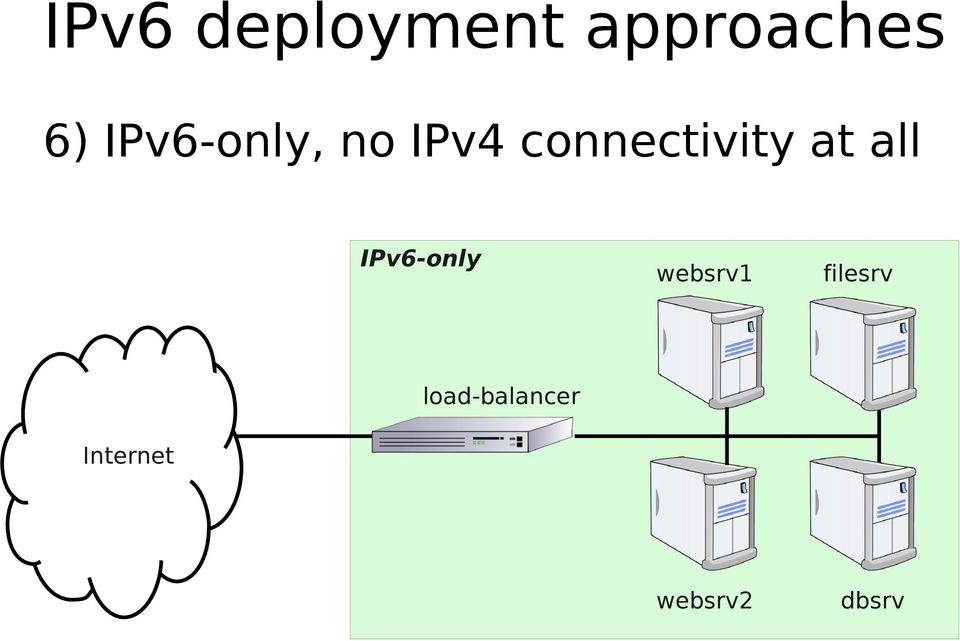
8 IPv6 deployment approaches 6) IPv6-only, no IPv4 connectivity at all IPv6-only websrv1 filesrv load-balancer Internet websrv2 dbsrv
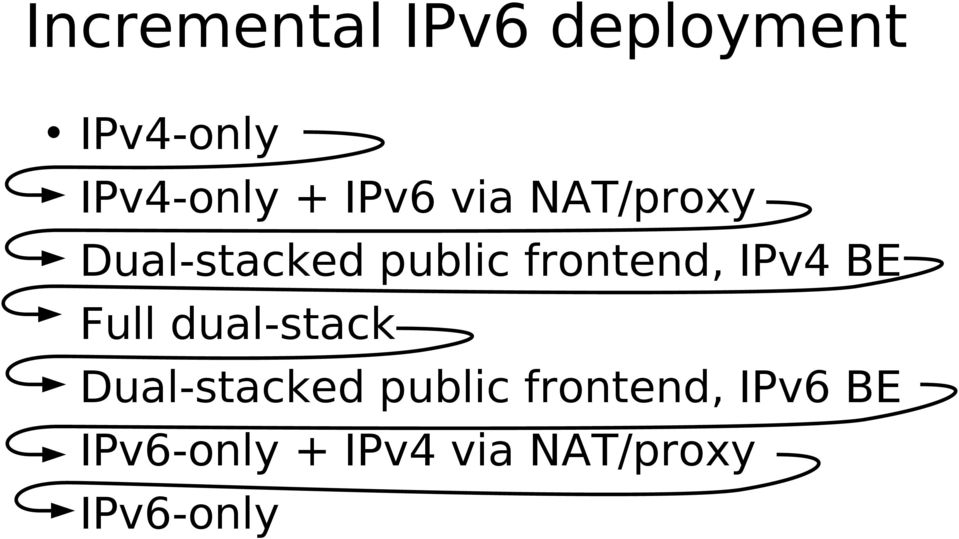
9 Incremental IPv6 deployment IPv4-only IPv4-only + IPv6 via NAT/proxy Dual-stacked public frontend, IPv4 BE Full dual-stack Dual-stacked public frontend, IPv6 BE IPv6-only + IPv4 via NAT/proxy IPv6-only
10 What's possible today? IPv4-only IPv4-only + IPv6 via NAT/proxy Dual-stacked public frontend, IPv4 BE Full dual-stack Dual-stacked public frontend, IPv6 BE IPv6-only + IPv4 via NAT/proxy IPv6-only < 1% of end-users world-wide have IPv6
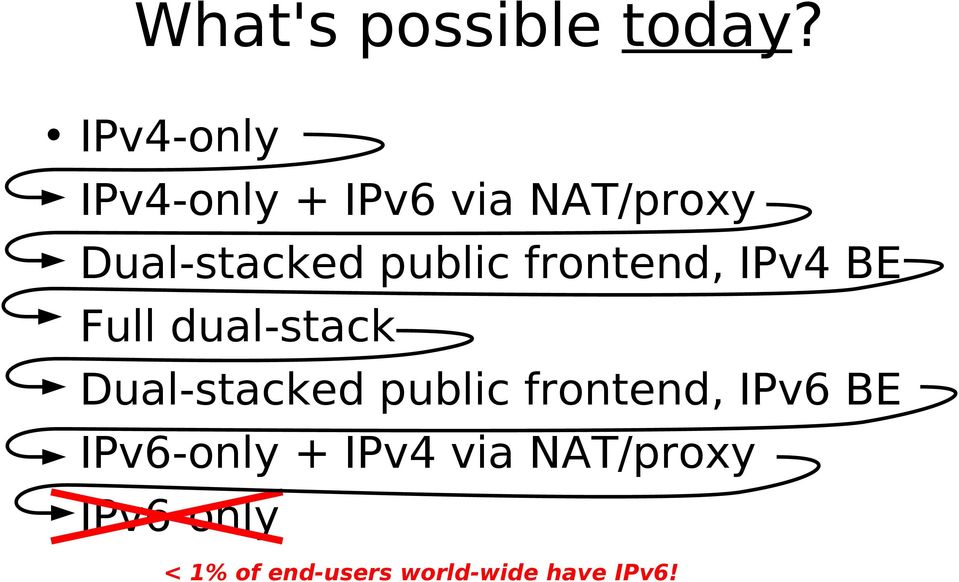
11 Let's take a shortcut... IPv4-only IPv4-only + IPv6 via NAT/proxy Dual-stacked public frontend, IPv4 BE Full dual-stack Dual-stacked public frontend, IPv6 BE IPv6-only + IPv4 via NAT/proxy IPv6-only

12 Why skip dual-stack? DS implies lots of unwanted complexity More ACLs, monitoring, troubleshooting, possible failures, training, documentation,... Saves lots of precious IPv4 addresses 1 IPv4 per service, rather than 1+ per server Forces sysadmins to learn and use IPv6 They resist change and new technologies Provision dual-stack and they'll use IPv4 only Perform a single IPv6 migration project

13 Stateless IP/ICMP Translation (SIIT) RFCs 6052, 6145 (Also known as Stateless NAT64 and IVI)

14 SIIT in a nutshell Maps the entire IPv4 address space into an IPv6 prefix from the SP's address space Translates IPv4/ICMPv4 headers into IPv6/ICMPv6 headers, and vice versa IPv /0 IPv6-mapped IPv4 2001:db8:: /96 IPv6 ::/0 (not to scale)

15 SIIT theory IPv4-only IPv6-only :db8:: (2001:db8::c633:a) An IPv4-translatable IPv6 address from a pre-defined /96 prefix (that represents the IPv4 internet) is configured on the server This address is routed to the server using regular IPv6 routing techniques

16 An IPv4 client connecting IPv4-only SRC: DST: HTTP GET /foo [...] IPv6-only :db8:: (2001:db8::c633:a) The IPv4 service address is published as a regular A record for the service in DNS It's routed to the provider's SIIT gateways using standard IPv4 routing techniques IPv4 clients connect to it in a normal way

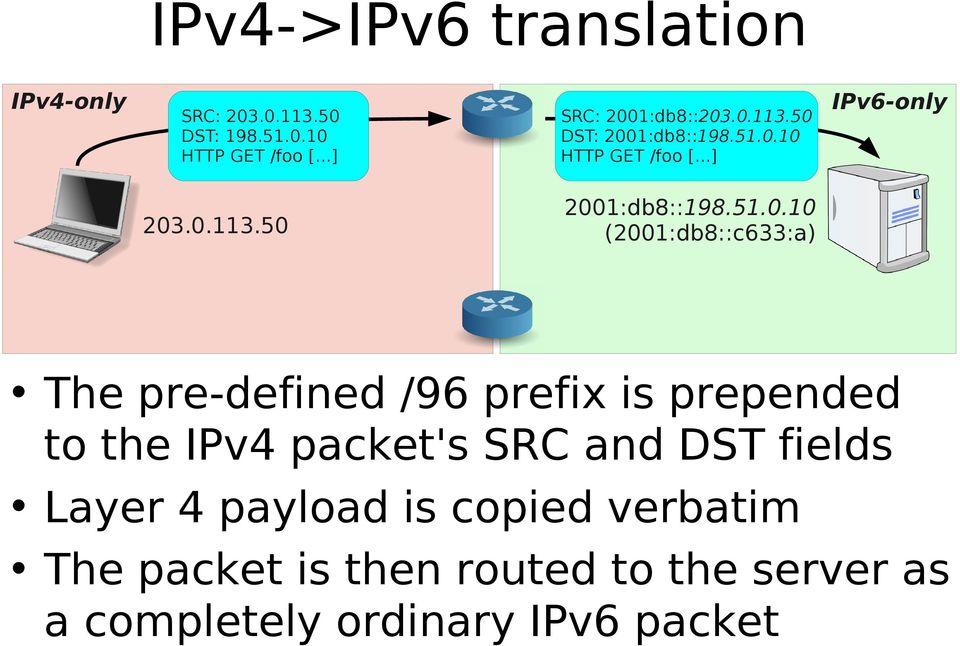
17 IPv4->IPv6 translation IPv4-only SRC: DST: HTTP GET /foo [...] SRC: 2001:db8:: DST: 2001:db8:: HTTP GET /foo [...] IPv6-only :db8:: (2001:db8::c633:a) The pre-defined /96 prefix is prepended to the IPv4 packet's SRC and DST fields Layer 4 payload is copied verbatim The packet is then routed to the server as a completely ordinary IPv6 packet
18 IPv6 server processing IPv4-only SRC: DST: HTTP GET /foo [...] SRC: 2001:db8:: DST: 2001:db8:: HTTP GET /foo [...] IPv6-only :db8:: (2001:db8::c633:a) SRC: 2001:db8:: DST: 2001:db8:: HTTP 200 OK [...] The server responds to the packet just as it would with any other IPv6 packet The original IPv4 source address isn't lost The /96 prefix (equivalent to the IPv4 default route) is routed to a SIIT gateway

19 IPv6->IPv4 translation IPv4-only SRC: DST: HTTP GET /foo [...] SRC: 2001:db8:: DST: 2001:db8:: HTTP GET /foo [...] IPv6-only :db8:: (2001:db8::c633:a) SRC: DST: HTTP 200 OK [...] DST: SRC: 2001:db8:: SRC: DST: 2001:db8:: HTTP 200 OK [...] The /96 prefix is stripped from the IPv6 packet's SRC and DST fields Layer 4 payload is untouched The resulting IPv4 packet is returned to the client which processes it normally
![..] DST: SRC: 2001:db8::198.51.0.10 SRC: DST: 2001:db8::203.0.113.50 HTTP 200 OK [.](/docs-images/41/4870761/images/page_19.jpg "..] The /96 prefix is stripped from the IPv6 packet's SRC and DST fields Layer 4 payload is untouched The resulting IPv4 packet is")
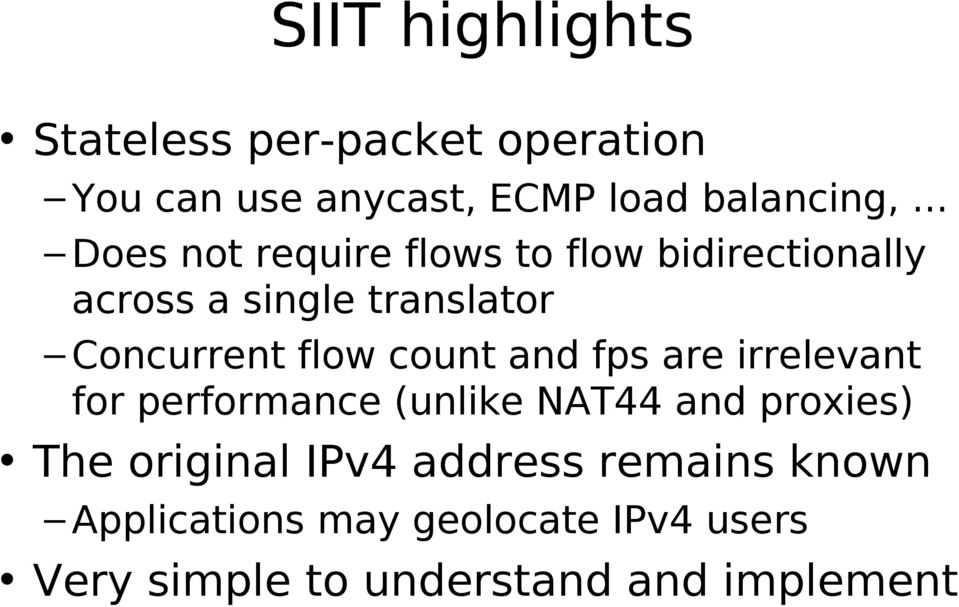
20 SIIT highlights Stateless per-packet operation You can use anycast, ECMP load balancing,... Does not require flows to flow bidirectionally across a single translator Concurrent flow count and fps are irrelevant for performance (unlike NAT44 and proxies) The original IPv4 address remains known Applications may geolocate IPv4 users Very simple to understand and implement
21 Applicability If the application doesn't work through NAT44, it will likely not work with SIIT e.g., FTP (uses IP literals in Layer 7 payload) implementations might provide ALGs though If the application does work with NAT44, it will likely work with SIIT as well e.g., HTTP and HTTPS The server software must support IPv6
22 Overriding the address mapping With plain SIIT, servers must have the IPv4-translatable IPv6 address assigned Means /128s must be carried in the IPv6 IGP Extra work for the systems administrators Better: Statically map IPv4 addresses to arbitrary IPv6 addresses (and vice versa) No extra IPv6 routes or addresses required The sysadmin must only request a public IPv4 frontend for the server's primary IPv6 address Vendor extension (on the Cisco ASR roadmap)
23 Appendix A MTU considerations
24 IP header size difference 1500 bytes (Standard Ethernet MTU) Packet size IPv4 header (20 bytes) Payload (1480 bytes) (not to scale) IPv4-IPv6 translation IPv6 header (40 bytes) Payload (1480 bytes) (not to scale) 0 The IPv6 header is (usually) 20 bytes larger than the IPv4 header Assuming identical MTUs, full-sized IPv4 packets cannot fit in a single IPv6 packet This is generally not a problem for TCP applications, because the IPv6 server will advertise a Maximum Segment Size of 1440 bytes, which in turn limits the TCP Protocol Data Unit to 1460 bytes (and thus the IPv4 packet size to 1480 bytes) IPv4 packets larger than 1480 bytes with the Don't Fragment flag set will cause the translator to return an ICMPv4 Need To Fragment advertising a Path MTU of 1480 At the time of writing, this is buggy in the Cisco ASR implementation (CSCtw77053) Non-DF IPv4 packets >1480 bytes must be split into two IPv6 fragments by the translator Fragments can be avoided completely by running the data centre with MTU >= 1520
25 IPv6 PMTUD with PMTU < 1280 IPv4-only 2) IPv4 data DF = 1 (1260 bytes) 1) IPv6 data no Frag header (1280 bytes) IPv6-only MTU=1000 IPv4 router SIIT gateway 3) ICMPv4 Frag Needed MTU = ) ICMPv6 Packet Too Big MTU = 1020 A link in the IPv4 path towards the client may have an IPv4 MTU smaller than 1260 bytes This translates into an IPv6 Path MTU smaller than 1280 bytes According to RFC 2460, an IPv6 node receiving an ICMPv6 Packet Too Big indicating a Path MTU smaller than 1280 bytes has two choices on how to deal with it: a) limit the size of subsequent packets to the indicated Path MTU, or b) limit the size of subsequent packets to exactly 1280 bytes, and also include a Fragmentation header. The Fragmentation header instructs the translator to clear the DF flag in the translated IPv4 packet, and provides the Identification value. This allows the IPv4 router to fragment the packet as it is being forwarded onto the link with the small MTU The Linux kernel takes the second approach, but it is at the time of writing buggy: &
26 Appendix B Cisco ASR1K configuration example
27 Basic IPv4/IPv6 connnectivity interface GigabitEthernet0/0/0 description IPv4 uplink interface ip address nat64 enable interface GigabitEthernet0/0/1 description IPv6 uplink interface ipv6 address 2A02:C0:1:102::2/64 nat64 enable nat64 settings mtu minimum 1500 ip route ipv6 route 2A02:C0::46:0:57EE:3D80/121 2A02:C0:1:102::1 nat64 prefix stateless 2A02:C0:0:0:46::/96 nat64 settings fragmentation header disable nat64 route /25 GigabitEthernet0/0/1 The SIIT gateway needs full connectivity to the IPv4 internet In this case I use a static default route to the upstream IPv4 router (connected to Gi0/0/0) However, the necessary IPv4 connectivity could just as well have been provided by a default route learned from an interior gateway protocol, or from a full BGP feed It also needs to be connected to the provider's IPv6 network A default IPv6 route is not necessary (but doesn't cause any problems either)
28 Basic SIIT configuration interface GigabitEthernet0/0/0 description IPv4 uplink interface ip address nat64 enable interface GigabitEthernet0/0/1 description IPv6 uplink interface ipv6 address 2A02:C0:1:102::2/64 nat64 enable nat64 settings mtu minimum 1500 ip route ipv6 route 2A02:C0::46:0:57EE:3D80/121 2A02:C0:1:102::1 nat64 prefix stateless 2A02:C0:0:0:46::/96 nat64 settings fragmentation header disable nat64 route /25 GigabitEthernet0/0/1 NAT64 functionality (which includes stateless translation) is enabled on both the IPv4 and the IPv6 uplink interface An IPv6 prefix for stateless translation is chosen and configured on the translator This prefix can have any of the following prefix lengths: /32, /40, /48, / 56, /64, or /96 (cf. RFC 6052 section 2.2) When using a /96, the embedded IPv4 addresses will occupy the last 32 bits of the resulting IPv6 address The prefix should be taken from the operator's public IPv6 pool and be globally reachable The reason for this is that the servers will be configured with addresses from within the translation prefix, and could potentially attempt to use them as source addresses when establishing connections to native IPv6 destinations off-net
29 The IPv4 service address prefix interface GigabitEthernet0/0/0 description IPv4 uplink interface ip address nat64 enable interface GigabitEthernet0/0/1 description IPv6 uplink interface ipv6 address 2A02:C0:1:102::2/64 nat64 enable nat64 settings mtu minimum 1500 ip route ipv6 route 2A02:C0::46:0:57EE:3D80/121 2A02:C0:1:102::1 nat64 prefix stateless 2A02:C0:0:0:46::/96 nat64 settings fragmentation header disable nat64 route /25 GigabitEthernet0/0/1 An IPv4 prefix is allocated from the operator's public address pool (in this example /25) and configured as a nat64 route The mandatory interface parameter is meaningless unless you're configuring nat64 prefix at the interface level, in which case the parameter determines which nat64 prefix that gets used The prefix contains the IPv4 service addresses IPv4 clients will make connections to (that will in turn be translated to IPv6) The gateway must also have a specific IPv6 route to the translated destination prefixes Without it, the translated IPv6 packets would have followed the /96 route and loop back into the NAT64 function In this example I use a static route to 2a02:c0::46:0:57ee:3d80/121 (the translated equivalent of /25) to the uplink router on Gi0/0/1, but /128s learned from the IGP would also work
30 Preventing unnecessary frags 1 interface GigabitEthernet0/0/0 description IPv4 uplink interface ip address nat64 enable interface GigabitEthernet0/0/1 description IPv6 uplink interface ipv6 address 2A02:C0:1:102::2/64 nat64 enable nat64 settings mtu minimum 1500 ip route ipv6 route 2A02:C0::46:0:57EE:3D80/121 2A02:C0:1:102::1 nat64 prefix stateless 2A02:C0:0:0:46::/96 nat64 settings fragmentation header disable nat64 route /25 GigabitEthernet0/0/1 The RFC takes a conservative approach by default, and assumes that the IPv6 Path MTU is 1280 bytes Inbound IPv4 w/df=0 packets that would result in IPv6 packets exceeding 1280 bytes in size will instead be split in two fragments (both smaller than 1280) In a data centre environment, however, we usually know that IPv6 Path MTU between the translator and the servers is (at least) 1500 bytes, so this behaviour is not necessary nat64 settings mtu minimum 1500 tells the translator that the Path MTU between itself and the IPv6 servers (behind Gi0/0/1) is at least 1500 bytes, this avoiding fragmentation of DF=0 IPv4 packets exceeding 1260 bytes However, IPv4 packets exceeding 1480 bytes will still be fragmented (as they translate into IPv6 packets exceeding 1500 bytes) You can avoid all IPv6 fragmentation by increasing both the IPv6 Interface and Path MTU to at least 1520 bytes
31 Preventing unnecessary frags 2 interface GigabitEthernet0/0/0 description IPv4 uplink interface ip address nat64 enable interface GigabitEthernet0/0/1 description IPv6 uplink interface ipv6 address 2A02:C0:1:102::2/64 nat64 enable nat64 settings mtu minimum 1500 ip route ipv6 route 2A02:C0::46:0:57EE:3D80/121 2A02:C0:1:102::1 nat64 prefix stateless 2A02:C0:0:0:46::/96 nat64 settings fragmentation header disable nat64 route /25 GigabitEthernet0/0/1 A translator will by default add an IPv6 Fragmentation header when translating any IPv4 packet with the Don't Fragment flag unset This happens even though the resulting IPv6 packet does not exceed the IPv6 Path MTU, and therefore aren't actually fragmented According to RFC 6145, it is done in order «to indicate that the sender allows fragmentation» This behaviour can be avoided by configuring nat64 settings fragmentation header disable Note that the translator will still insert Fragmentation headers when it is actually fragmenting, i.e., when it is translating an IPv4 packet which would exceed the configured IPv6 Path MTU
32 Questions? Thank you for listening Further reading: RFC IPv6 Addressing of IPv4/IPv6 Translators RFC IP/ICMP Translation Algorithm RFC The China Education and Research Network (CERNET) IVI - My personal home page (contact info, social media links, slides from this and earlier talks) - My employer and sponsor of this project Note: IPv4 traffic to both of the above URLs is routed through a SIIT gateway (eating my own dog food)
SIIT-DC: IPv4 Service Continuity for IPv6 Data Centres. Tore Anderson Redpill Linpro AS RIPE69, London, November 2014
 SIIT-DC: IPv4 Service Continuity for IPv6 Data Centres Tore Anderson Redpill Linpro AS RIPE69, London, November 2014 Stop Thinking IPv4; IPv6 is Here IPv4 is a dying and cramped protocol IPv6 is the exact
SIIT-DC: Stateless IP/ICMP Translation for IPv6 Data Centre Environments & SIIT-DC: Dual Translation Mode
 SIIT-DC: Stateless IP/ICMP Translation for IPv6 Data Centre Environments & SIIT-DC: Dual Translation Mode Tore Anderson Redpill Linpro AS RIPE 91, Honolulu, November 2014 An IPv6 data centre The IPv6 Internet
SIIT-DC: IPv4 Service Continuity for IPv6 Data Centres. Tore Anderson Redpill Linpro AS 8th Belgian IPv6 Council, Bruxelles, November 2015
 SIIT-DC: IPv4 Service Continuity for IPv6 Data Centres Tore Anderson Redpill Linpro AS 8th Belgian IPv6 Council, Bruxelles, November 2015 Why build IPv6-only data centres? IPv4 scarcity - we can no longer
IPv4 and IPv6 Integration. Formation IPv6 Workshop Location, Date
 IPv4 and IPv6 Integration Formation IPv6 Workshop Location, Date Agenda Introduction Approaches to deploying IPv6 Standalone (IPv6-only) or alongside IPv4 Phased deployment plans Considerations for IPv4
IPv6 Fundamentals: A Straightforward Approach
 IPv6 Fundamentals: A Straightforward Approach to Understanding IPv6 Rick Graziani Cisco Press 800 East 96th Street Indianapolis, IN 46240 IPv6 Fundamentals Contents Introduction xvi Part I: Background
Firewalls und IPv6 worauf Sie achten müssen!
 Firewalls und IPv6 worauf Sie achten müssen! Pascal Raemy CTO Asecus AG [email protected] Asecus AG Asecus AG Security (Firewall, Web-Gateway, Mail-Gateway) Application Delivery (F5 Neworks with BIGIP)
TR-296 IPv6 Transition Mechanisms Test Plan
 Technical Report TR-296 IPv6 Transition Mechanisms Test Plan Issue:1 Issue Date: November 2013 The Broadband Forum. All rights reserved. Notice The Broadband Forum is a non-profit corporation organized
Introduction to IP v6
 IP v 1-3: defined and replaced Introduction to IP v6 IP v4 - current version; 20 years old IP v5 - streams protocol IP v6 - replacement for IP v4 During developments it was called IPng - Next Generation
IPv6 Associated Protocols
 IPv6 Associated Protocols 1 New Protocols (1) New features are specified in IPv6 Protocol -RFC 2460 DS Neighbor Discovery (NDP) -RFC 4861 DS Auto-configuration : Stateless Address Auto-configuration -RFC
IPv4/IPv6 Translation: Framework. Li, Bao, and Baker
 IPv4/IPv6 Translation: Framework Li, Bao, and Baker Outcome from the Montreal Interim Basically, merging NAT64 and IVI to produce a common translation technology Not to exclude other documents, but these
How will the Migration from IPv4 to IPv6 Impact Voice and Visual Communication?
 How will the Migration from IPv4 to IPv6 Impact Voice and Visual Communication? Nick Hawkins Director, Technology Consulting Polycom, Inc. All rights reserved. Agenda Introduction & standards Requirements
Configuring Network Address Translation (NAT)
 8 Configuring Network Address Translation (NAT) Contents Overview...................................................... 8-3 Translating Between an Inside and an Outside Network........... 8-3 Local and
VDE Tagung Mobilkommunikation 2014, Osnabruck 22.05.2014
 Gabriel Bertram, Detecon International GmbH, Cologne Andreas Grebe, Cologne University of Applied Sciences, Computer Networks Research Group Holger Metschulat, Deutsche Telekom Technik GmbH, Darmstadt
IPv6-Only. Now? Sites. Deutscher IPv6 Kongress 2013. June 6/7, 2013 Fr ankfur t /Ger many. [email protected]
 IPv6-Only Sites Now? Deutscher IPv6 Kongress 2013 June 6/7, 2013 Fr ankfur t /Ger many [email protected] 2013:6:6:15:4::14:1 Holger Zuleger HZNET > c IPv6 Transition: Dual Stack or IPv6-only Many
Getting started with IPv6 on Linux
 Getting started with IPv6 on Linux Jake Edge LWN.net [email protected] LinuxCon North America 19 August 2011 History and Motivation IPng project July 1994 IPv6 - RFC 2460 December 1998 IPv5 - Internet Stream
IPv6 Security from point of view firewalls
 IPv6 Security from point of view firewalls János Mohácsi 09/June/2004 János Mohácsi, Research Associate, Network Engineer NIIF/HUNGARNET Contents Requirements IPv6 firewall architectures Firewalls and
Basic IPv6 WAN and LAN Configuration
 Basic IPv6 WAN and LAN Configuration This quick start guide provides basic IPv6 WAN and LAN configuration information for the ProSafe Wireless-N 8-Port Gigabit VPN Firewall FVS318N. For complete IPv6 configuration
IPv6 Fundamentals Ch t ap 1 er I : ntroducti ti t on I o P IPv6 Copyright Cisco Academy Yannis Xydas
 IPv6 Fundamentals Chapter 1: Introduction ti to IPv6 Copyright Cisco Academy Yannis Xydas The Network Today The Internet of today is much different that it was 30, 15 or 5 years ago. 2 Technology Tomorrow
Chapter 3. TCP/IP Networks. 3.1 Internet Protocol version 4 (IPv4)
 Chapter 3 TCP/IP Networks 3.1 Internet Protocol version 4 (IPv4) Internet Protocol version 4 is the fourth iteration of the Internet Protocol (IP) and it is the first version of the protocol to be widely
IPv6 Security Best Practices. Eric Vyncke [email protected] Distinguished System Engineer
 IPv6 Best Practices Eric Vyncke [email protected] Distinguished System Engineer security 2007 Cisco Systems, Inc. All rights reserved. Cisco CPub 1 Agenda Shared Issues by IPv4 and IPv6 Specific Issues
Internet Peering, IPv6, and NATs. Mike Freedman V22.0480-005 Networks
 Internet Peering, IPv6, and NATs Mike Freedman V22.0480-005 Networks Internet Peering Review: Routing Internet has a loose hierarchy of domains Hosts now local router Local routers know site routers Site
IPv6 Hardening Guide for Windows Servers
 IPv6 Hardening Guide for Windows Servers How to Securely Configure Windows Servers to Prevent IPv6-related Attacks Version: 1.0 Date: 22/12/2014 Classification: Public Author(s): Antonios Atlasis TABLE
We will give some overview of firewalls. Figure 1 explains the position of a firewall. Figure 1: A Firewall
 Chapter 10 Firewall Firewalls are devices used to protect a local network from network based security threats while at the same time affording access to the wide area network and the internet. Basically,
Campus IPv6 connection Campus IPv6 deployment
 Campus IPv6 connection Campus IPv6 deployment Campus Address allocation, Topology Issues János Mohácsi NIIF/HUNGARNET Copy Rights This slide set is the ownership of the 6DISS project via its partners The
464XLAT in mobile networks
 STRATEGIC WHITE PAPER IPv6 migration strategies for mobile networks To cope with the increasing demand for IP addresses, most mobile network operators (MNOs) have deployed Carrier Grade Network Address
IPv6 in Axis Video Products
 TECHNICAL NOTE REFERENCE DOCUMENT IPv6 in Axis Video Products Created: 2006-01-31 Last updated: 2006-05-29 TABLE OF CONTENTS DOCUMENT HISTORY... 2 1 IPV6 IN GENERAL... 3 1.1 The IPv6 address... 3 1.1.1
Internet Firewall CSIS 4222. Packet Filtering. Internet Firewall. Examples. Spring 2011 CSIS 4222. net15 1. Routers can implement packet filtering
 Internet Firewall CSIS 4222 A combination of hardware and software that isolates an organization s internal network from the Internet at large Ch 27: Internet Routing Ch 30: Packet filtering & firewalls
Guide to Network Defense and Countermeasures Third Edition. Chapter 2 TCP/IP
 Guide to Network Defense and Countermeasures Third Edition Chapter 2 TCP/IP Objectives Explain the fundamentals of TCP/IP networking Describe IPv4 packet structure and explain packet fragmentation Describe
About the Technical Reviewers
 About the Author p. xiii About the Technical Reviewers p. xv Acknowledgments p. xvii Introduction p. xix IPv6 p. 1 IPv6-Why? p. 1 IPv6 Benefits p. 2 More Address Space p. 2 Innovation p. 3 Stateless Autoconfiguration
3URMHFW1XPEHU /DERUDWRULHV2YHU1H[W *HQHUDWLRQ1HWZRUNV 3URMHFW7LWOH IST-1999-20393/ PTIN /WP2.1/DS/P/1/01 &(&'HOLYHUDEOH1XPEHU
 3URMHFW1XPEHU 3URMHFW7LWOH 'HOLYHUDEOH7\SH,67 /DERUDWRULHV2YHU1H[W *HQHUDWLRQ1HWZRUNV 3±SXEOLF &(&'HOLYHUDEOH1XPEHU IST-1999-20393/ PTIN /WP2.1/DS/P/1/01 &RQWUDFWXDO'DWHRI'HOLYHU\WRWKH &(& $FWXDO'DWHRI'HOLYHU\WRWKH&(&
ProCurve Networking IPv6 The Next Generation of Networking
 ProCurve Networking The Next Generation of Networking Introduction... 2 Benefits from... 2 The Protocol... 3 Technology Features and Benefits... 4 Larger number of addresses... 4 End-to-end connectivity...
IPv6-only hosts in a dual stack environnment
 IPv6-only hosts in a dual stack environnment using Free Software Frédéric Gargula, Grégoire Huet Background on IPv4 and IPv6 usage IPv4 addresses depletion doesn't need to be reminded No straight way exists
IPv6 Trace Analysis using Wireshark Nalini Elkins, CEO Inside Products, Inc. [email protected]
 1 IPv6 Trace Analysis using Wireshark Nalini Elkins, CEO Inside Products, Inc. [email protected] Agenda What has not changed between IPv4 and IPv6 traces What has changed between IPv4 and
Boosting Capacity Utilization in MPLS Networks using Load-Sharing MPLS JAPAN 2007. Sanjay Khanna Foundry Networks skhanna@foundrynet.
 Boosting Capacity Utilization in MPLS Networks using Load-Sharing MPLS JAPAN 2007 Sanjay Khanna Foundry Networks [email protected] Agenda Why we need Load-Sharing Methods to boost capacity Trunks/Link
Firewalls. Ahmad Almulhem March 10, 2012
 Firewalls Ahmad Almulhem March 10, 2012 1 Outline Firewalls The Need for Firewalls Firewall Characteristics Types of Firewalls Firewall Basing Firewall Configurations Firewall Policies and Anomalies 2
Bell Aliant. Business Internet Border Gateway Protocol Policy and Features Guidelines
 Bell Aliant Business Internet Border Gateway Protocol Policy and Features Guidelines Effective 05/30/2006, Updated 1/30/2015 BGP Policy and Features Guidelines 1 Bell Aliant BGP Features Bell Aliant offers
IPv4 and IPv6: Connecting NAT-PT to Network Address Pool
 Available online www.jocpr.com Journal of Chemical and Pharmaceutical Research, 2014, 6(5):547-553 Research Article ISSN : 0975-7384 CODEN(USA) : JCPRC5 Intercommunication Strategy about IPv4/IPv6 coexistence
Network Address Translation (NAT)
 Network Address Translation (NAT) Relates to Lab 7. Module about private networks and NAT. Taken from http://www.cs.virginia.edu/~itlab/ book/slides/module17-nat.ppt 1 Private Network Private IP network
IP - The Internet Protocol
 Orientation IP - The Internet Protocol IP (Internet Protocol) is a Network Layer Protocol. IP s current version is Version 4 (IPv4). It is specified in RFC 891. TCP UDP Transport Layer ICMP IP IGMP Network
Skip the Transitions, Jump Straight into IPv6
 Skip the Transitions, Jump Straight into IPv6 Ivan Pepelnjak (@ioshints, [email protected]) NIL Data Communications Presentation @ 7. Slovenian IPv6 Summit organized by go6.si Who is Ivan Pepelnjak (@ioshints)
Availability Digest. www.availabilitydigest.com. Redundant Load Balancing for High Availability July 2013
 the Availability Digest Redundant Load Balancing for High Availability July 2013 A large data center can comprise hundreds or thousands of servers. These servers must not only be interconnected, but they
NAT and Firewall Traversal with STUN / TURN / ICE
 NAT and Firewall Traversal with STUN / TURN / ICE Simon Perreault Viagénie {mailto sip}:[email protected] http://www.viagenie.ca Credentials Consultant in IP networking and VoIP at Viagénie.
Residential IPv6 IPv6 a t at S wisscom Swisscom a, n an overview overview Martin Gysi
 Residential IPv6 at Swisscom, an overview Martin Gysi What is Required for an IPv6 Internet Access Service? ADSL L2 platform, IPv6 not required VDSL Complex Infrastructure is Barrier to Cost-efficient
OLD VULNERABILITIES IN NEW PROTOCOLS? HEADACHES ABOUT IPV6 FRAGMENTS
 OLD VULNERABILITIES IN NEW PROTOCOLS? HEADACHES ABOUT IPV6 FRAGMENTS Eric Vyncke (@evyncke) Cisco Session ID: ARCH W01 Session Classification: Advanced Agenda Status of WorldWide IPv6 Deployment IPv6 refresher:
DirectAccess in Windows 7 and Windows Server 2008 R2. Aydin Aslaner Senior Support Escalation Engineer Microsoft MEA Networking Team
 DirectAccess in Windows 7 and Windows Server 2008 R2 Aydin Aslaner Senior Support Escalation Engineer Microsoft MEA Networking Team 0 Introduction to DirectAccess Increasingly, people envision a world
Ensuring a Smooth Transition to Internet Protocol Version 6 (IPv6)
 WHITE PAPER www.brocade.com APPLICATION DELIVERY Ensuring a Smooth Transition to Internet Protocol Version 6 (IPv6) As IPv4 addresses dwindle, companies face the reality of a dual-protocol world The transition
Strategies for Getting Started with IPv6
 Strategies for Getting Started with IPv6 IPv6 Transition Acceleration Options for Web Applications and Services By Scott Hogg GTRI - Director of Technology Solutions CCIE #5133, CISSP #4610 IPv6 Transition
Presentation_ID. 2001, Cisco Systems, Inc. All rights reserved.
 Presentation_ID 2001, Cisco Systems, Inc. All rights reserved. 1 IPv6 Security Considerations Patrick Grossetete [email protected] Dennis Vogel [email protected] 2 Agenda Native security in IPv6 IPv6 challenges
Proxy Server, Network Address Translator, Firewall. Proxy Server
 Proxy Server, Network Address Translator, Firewall 1 Proxy Server 2 1 Introduction What is a proxy server? Acts on behalf of other clients, and presents requests from other clients to a server. Acts as
Configuring Network Address Translation
 CHAPTER5 Configuring Network Address Translation The information in this chapter applies to both the ACE module and the ACE appliance unless otherwise noted. This chapter contains the following major sections
Chapter 12 Supporting Network Address Translation (NAT)
 [Previous] [Next] Chapter 12 Supporting Network Address Translation (NAT) About This Chapter Network address translation (NAT) is a protocol that allows a network with private addresses to access information
gianluca.verin verin@libero. @libero.itit Vicenza.linux.it\LinuxCafe 1
 gianluca.verin verin@libero. @libero.itit Vicenza.linux.it\LinuxCafe 1 Agenda IPv6 Basics Connecting to 6Bone Why do we need IPv6? IPv6 Introduction-Transition IPv6 and open source community Future applications
Transition to IPv6 in Service Providers
 Transition to IPv6 in Service Providers Jean-Marc Uzé Director Product & Technology, EMEA [email protected] UKNOF14 Workshop Imperial college, London, Sept 11 th, 2009 1 Agenda Planning Transition Transition
Internet Protocol: IP packet headers. vendredi 18 octobre 13
 Internet Protocol: IP packet headers 1 IPv4 header V L TOS Total Length Identification F Frag TTL Proto Checksum Options Source address Destination address Data (payload) Padding V: Version (IPv4 ; IPv6)
Configuring a Load-Balancing Scheme
 This module contains information about Cisco Express Forwarding and describes the tasks for configuring a load-balancing scheme for Cisco Express Forwarding traffic. Load-balancing allows you to optimize
21.4 Network Address Translation (NAT) 21.4.1 NAT concept
 21.4 Network Address Translation (NAT) This section explains Network Address Translation (NAT). NAT is also known as IP masquerading. It provides a mapping between internal IP addresses and officially
CS 457 Lecture 19 Global Internet - BGP. Fall 2011
 CS 457 Lecture 19 Global Internet - BGP Fall 2011 Decision Process Calculate degree of preference for each route in Adj-RIB-In as follows (apply following steps until one route is left): select route with
Network Security TCP/IP Refresher
 Network Security TCP/IP Refresher What you (at least) need to know about networking! Dr. David Barrera Network Security HS 2014 Outline Network Reference Models Local Area Networks Internet Protocol (IP)
Enabling NAT and Routing in DGW v2.0 June 6, 2012
 Enabling NAT and Routing in DGW v2.0 June 6, 2012 Proprietary 2012 Media5 Corporation Table of Contents Introduction... 3 Starting Services... 4 Distinguishing your WAN and LAN interfaces... 5 Configuring
his document discusses implementation of dynamic mobile network routing (DMNR) in the EN-4000.
 EN-4000 Reference Manual Document 10 DMNR in the EN-4000 T his document discusses implementation of dynamic mobile network routing (DMNR) in the EN-4000. Encore Networks EN-4000 complies with all Verizon
Exam 1 Review Questions
 CSE 473 Introduction to Computer Networks Exam 1 Review Questions Jon Turner 10/2013 1. A user in St. Louis, connected to the internet via a 20 Mb/s (b=bits) connection retrieves a 250 KB (B=bytes) web
APNIC IPv6 Deployment
 APNIC IPv6 Deployment Ulaanbaatar, Mongolia 19 October 2015 Issue Date: Revision: Overview Deployment motivation Network deployment IPv6 Services deployment IPv6 Anycast service IPv6 Cloud service Summary
Transport and Network Layer
 Transport and Network Layer 1 Introduction Responsible for moving messages from end-to-end in a network Closely tied together TCP/IP: most commonly used protocol o Used in Internet o Compatible with a
Leveraging Advanced Load Sharing for Scaling Capacity to 100 Gbps and Beyond
 Leveraging Advanced Load Sharing for Scaling Capacity to 100 Gbps and Beyond Ananda Rajagopal Product Line Manager Service Provider Solutions Foundry Networks [email protected] Agenda 2 Why Load
The Internet. Internet Technologies and Applications
 The Internet Internet Technologies and Applications Aim and Contents Aim: Review the main concepts and technologies used in the Internet Describe the real structure of the Internet today Contents: Internetworking
IPv4/IPv6 Transition Mechanisms. Luka Koršič, Matjaž Straus Istenič
 IPv4/IPv6 Transition Mechanisms Luka Koršič, Matjaž Straus Istenič IPv4/IPv6 Migration Both versions exist today simultaneously Dual-stack IPv4 and IPv6 protocol stack Address translation NAT44, LSN, NAT64
Network Security. Chapter 3. Cornelius Diekmann. Version: October 21, 2015. Lehrstuhl für Netzarchitekturen und Netzdienste Institut für Informatik
 Network Security Chapter 3 Cornelius Diekmann Lehrstuhl für Netzarchitekturen und Netzdienste Institut für Informatik Version: October 21, 2015 IN2101, WS 15/16, Network Security 1 Security Policies and
Technical Support Information Belkin internal use only
 The fundamentals of TCP/IP networking TCP/IP (Transmission Control Protocol / Internet Protocols) is a set of networking protocols that is used for communication on the Internet and on many other networks.
464XLAT: Breaking Free of IPv4. Cameron.Byrne @ T-Mobile.com NANOG 61 June 2014
 464XLAT: Breaking Free of IPv4 Cameron.Byrne @ T-Mobile.com NANOG 61 June 2014 1 Goals of Talk 1. Declare victory for IPv6 2. Explain IPv6-only approach at T-Mobile US 3. Discuss risks related to IPv4-only
IPv6 Deployment Strategies
 Version History Version Number Date Notes 1 10/15/2001 This document was created. 2 11/13/2001 Update to the explanation of NAT along tunnel paths. 3 03/08/2002 Update to the Related Documents section.
Chapter 3 Configuring Basic IPv6 Connectivity
 Chapter 3 Configuring Basic IPv6 Connectivity This chapter explains how to get a ProCurve Routing Switch that supports IPv6 up and running. To configure basic IPv6 connectivity, you must do the following:
How To Understand Bg
 Table of Contents BGP Case Studies...1 BGP4 Case Studies Section 1...3 Contents...3 Introduction...3 How Does BGP Work?...3 ebgp and ibgp...3 Enabling BGP Routing...4 Forming BGP Neighbors...4 BGP and
IP address format: Dotted decimal notation: 10000000 00001011 00000011 00011111 128.11.3.31
 IP address format: 7 24 Class A 0 Network ID Host ID 14 16 Class B 1 0 Network ID Host ID 21 8 Class C 1 1 0 Network ID Host ID 28 Class D 1 1 1 0 Multicast Address Dotted decimal notation: 10000000 00001011
NAT and Firewall Traversal with STUN / TURN / ICE
 NAT and Firewall Traversal with STUN / TURN / ICE Simon Perreault Viagénie {mailto sip}:[email protected] http://www.viagenie.ca Credentials Consultant in IP networking and VoIP at Viagénie.
Network layer" 1DT066! Distributed Information Systems!! Chapter 4" Network Layer!! goals: "
 1DT066! Distributed Information Systems!! Chapter 4" Network Layer!! Network layer" goals: "! understand principles behind layer services:" " layer service models" " forwarding versus routing" " how a
IPv6 Transition Work in the IETF
 IPv6 Transition Work in the IETF Ralph Droms, Internet Area Director Thanks to Jari Arkko, Fred Baker and many others for contributions to these slides 1 IPv6 Transition Work in the IETF Outline of Presentation
IPv4/IPv6 Transition Using DNS64/NAT64: Deployment Issues
 IPv4/IPv6 Transition Using DNS64/NAT64: Deployment Issues Enis Hodzic BH Telecom.d.o.o Sarajevo, Bosnia & Herzegovina [email protected] Sasa Mrdovic Faculty of Electrical Engineering University
Configuring a Load-Balancing Scheme
 Configuring a Load-Balancing Scheme Finding Feature Information Configuring a Load-Balancing Scheme Last Updated: August 15, 2011 This module contains information about Cisco Express Forwarding and describes
Load Balancing. Final Network Exam LSNAT. Sommaire. How works a "traditional" NAT? Un article de Le wiki des TPs RSM.
 Load Balancing Un article de Le wiki des TPs RSM. PC Final Network Exam Sommaire 1 LSNAT 1.1 Deployement of LSNAT in a globally unique address space (LS-NAT) 1.2 Operation of LSNAT in conjunction with
ITL BULLETIN FOR JANUARY 2011
 ITL BULLETIN FOR JANUARY 2011 INTERNET PROTOCOL VERSION 6 (IPv6): NIST GUIDELINES HELP ORGANIZATIONS MANAGE THE SECURE DEPLOYMENT OF THE NEW NETWORK PROTOCOL Shirley Radack, Editor Computer Security Division
IPv6/IPv4 Automatic Dual Authentication Technique for Campus Network
 IPv6/IPv4 Automatic Dual Authentication Technique for Campus Network S. CHITPINITYON, S. SANGUANPONG, K. KOHT-ARSA, W. PITTAYAPITAK, S. ERJONGMANEE AND P. WATANAPONGSE Agenda Introduction Design And Implementation
Network Address Translation (NAT) Adapted from Tannenbaum s Computer Network Ch.5.6; computer.howstuffworks.com/nat1.htm; Comer s TCP/IP vol.1 Ch.
 Network Address Translation (NAT) Adapted from Tannenbaum s Computer Network Ch.5.6; computer.howstuffworks.com/nat1.htm; Comer s TCP/IP vol.1 Ch.20 Long term and short term solutions to Internet scalability
Course Overview: Learn the essential skills needed to set up, configure, support, and troubleshoot your TCP/IP-based network.
 Course Name: TCP/IP Networking Course Overview: Learn the essential skills needed to set up, configure, support, and troubleshoot your TCP/IP-based network. TCP/IP is the globally accepted group of protocols
Address Resolution Protocol (ARP), Reverse ARP, Internet Protocol (IP)
 Tik-110.350 Computer Networks (3 cr) Spring 2000 Address Resolution Protocol (ARP), Reverse ARP, Internet Protocol (IP) Professor Arto Karila Helsinki University of Technology E-mail: [email protected]
Understanding and Configuring NAT Tech Note PAN-OS 4.1
 Understanding and Configuring NAT Tech Note PAN-OS 4.1 Revision C 2012, Palo Alto Networks, Inc. www.paloaltonetworks.com Contents Overview... 3 Scope... 3 Design Consideration... 3 Software requirement...
E6998-02: Internet Routing
 E6998-02: Internet Routing Lecture 13 Border Gateway Protocol, Part II John Ioannidis AT&T Labs Research [email protected] Copyright 2002 by John Ioannidis. All Rights Reserved. Announcements Lectures
ClusterLoad ESX Virtual Appliance quick start guide v6.3
 ClusterLoad ESX Virtual Appliance quick start guide v6.3 ClusterLoad terminology...2 What are your objectives?...3 What is the difference between a one-arm and a two-arm configuration?...3 What are the
NAT TCP SIP ALG Support
 The feature allows embedded messages of the Session Initiation Protocol (SIP) passing through a device that is configured with Network Address Translation (NAT) to be translated and encoded back to the
Interconnecting IPv6 Domains Using Tunnels
 Interconnecting Domains Using Tunnels Version History Version Number Date Notes 1 30 July 2002 This document was created. 2 19 May 2003 Updated the related documents section. This document describes how
Steve Worrall Systems Engineer. [email protected]
 Steve Worrall Systems Engineer [email protected] Agenda 100GbE Load sharing/link aggregation Foundry Direct Routing 2 100 Gigabit Ethernet 3 Current Status PAR approved, 802.3ba task force set up
NAT & IP Masquerade. Internet NETWORK ADDRESS TRANSLATION INTRODUCTION. NAT & IP Masquerade Page 1 of 5. Internal PC 192.168.0.25
 NAT & IP Masquerade Page 1 of 5 INTRODUCTION Pre-requisites TCP/IP IP Address Space NAT & IP Masquerade Protocol version 4 uses a 32 bit IP address. In theory, a 32 bit address space should provide addresses
Improving DNS performance using Stateless TCP in FreeBSD 9
 Improving DNS performance using Stateless TCP in FreeBSD 9 David Hayes, Mattia Rossi, Grenville Armitage Centre for Advanced Internet Architectures, Technical Report 101022A Swinburne University of Technology
Network Agent Quick Start
 Network Agent Quick Start Topic 50500 Network Agent Quick Start Updated 17-Sep-2013 Applies To: Web Filter, Web Security, Web Security Gateway, and Web Security Gateway Anywhere, v7.7 and 7.8 Websense
How To Balance A Load Balancer On A Server On A Linux (Or Ipa) (Or Ahem) (For Ahem/Netnet) (On A Linux) (Permanent) (Netnet/Netlan) (Un
 Super/Ultra-Basic Load-Balancing Introduction For AFNOG 2012 Joel Jaeggli 1 What is Load-balancing The act of dividing a workload between N > 1 devices capable for performing a task. Multiple contexts