
Managing Data Center Power and Cooling
|
|
|
- Roland Hodge
- 10 years ago
- Views:
Transcription
1 White PAPER Managing Data Center Power and Cooling Introduction: Crisis in Power and Cooling As server microprocessors become more powerful in accordance with Moore s Law, they also consume more power and generate more heat. Similar geometric improvement in disk storage technology has driven rapid growth of online data, using mass storage systems that often consume as much power as the servers themselves. With the rapid growth in computing power and storage capacity, typical data center power consumption (kwh) and power density (kwh/sq. ft.) are both spiraling upward, placing a strain on many existing data center power distribution and cooling systems. Each watt of power consumed in the data center requires BTU/hour of cooling capacity to remove the associated heat. Depending on climate factors, removing heat at the rate of BTU/hour requires an additional watts of electrical power. According to HP, data center power densities have grown from 2.1 kwh/rack in 1992 to 14 kwh/rack in 2006, requiring cooling systems that can deal with local "hot spots" within the computer room. A Ziff-Davis Survey conducted in November 2005 found that 71% of IT decision makers are dealing with or tracking issues related to power consumption and cooling, while 63% are increasing electrical power capacity or expanding the size of the data center. A similar survey by IDC in May 2006, found that power provisioning and power consumption are among the top three issues in the data center. Another aspect of the power problem is the growing cost of electricity. Currently the 3-year costs of power and cooling in the U.S. are roughly equivalent to the acquisition cost of data center capital equipment, according to IDC. With the demand for computing power and the cost of electrical power continuing to escalate, power can be expected to consume a larger share of IT budgets, possibly as much as 50% in the next few years. As these trends continue to unfold, data center managers will need to give careful consideration to the impact of each investment on the power and cooling profile of their facility. In addition, the life cycle costs of power and cooling will become increasingly important factors in TCO calculations used to guide selection among competing solutions. Aiding this analysis is an emerging set of data center and server power efficiency metrics being developed by the EPA and industry consortia. In the long run, the EPA hopes that manufacturers of data center equipment will publish EnergyStar metrics to help customers better manage power consumption. The key power efficiency metrics coming out of this and similar efforts are expected to be application workload/watt for servers, GB/watt for storage, and Gbps/watt for networking. In parallel with standards efforts, end users can readily develop their own power efficiency metrics and calculations. For example, for compute power efficiency, one can focus on the performance benchmarks that are meaningful for critical applications and divide by the corresponding power consumption in watts. For High Performance Computing, Mflops/watt is a popular power efficiency metric. For databases application workloads, TPC-H Composite Queries-per-Hour per watt (QpHH/watt) for a given size of database is one possible power efficiency metric. There are a number of potential benefits that can be derived from an increased focus on power consumption and power efficiency: Extending the life of existing data centers and minimizing retrofits Gaining at least partial control of growing expenses for power and cooling Optimizing new data center designs 2007 FORCE10 NETWORKS, INC. [ P AGE 1 OF 5 ]

2 Managing Data Center Power and Cooling Optimizing the overall power efficiency of the data center requires a comprehensive approach that focuses on technologies and strategies to minimize power consumption and maximize power efficiency at every level within the infrastructure, including CPU chips, power supplies, servers, storage devices, and networking equipment. In addition to measures that maximize power efficiency for hardware devices, there are also software strategies, such as server virtualization, that can play a significant role in reducing power consumption. CPU chips: At a given level of compute performance, the basic architecture of the CPU chip can have a significant impact on power consumption. For example, integrated memory controllers on the CPU can reduce overall power consumption of the chip set. Many server manufacturers offer a fairly wide choice of CPUs in a given model of server, allowing power efficiency to be considered when making product selections and tradeoffs. Beyond architectural differences, all leading-performance CPU chips have reached levels of power consumption that prevent tracking Moore s Law simply by increasing clock speed. As shown in Figure 2, the geometric growth in transistors per chip is expected to continue unabated through 2010, while power per chip and clock speed are being forced to level off significantly. These technology trends have led chip manufacturers to turn to multi-core chips to take advantage of continued growth in transistor densities. For example, dual-core CPUs can deliver higher performance than single-core CPUs because scaling back clock frequency by only ~15-20% can cut power consumption by ~40%, allowing two cores per die. Over the remainder of this decade we can expect Moore s Law at the transistor level to drive a doubling in the number of cores per chip every months. The applications that benefit the most from multi-core chip architectures include multi-threaded applications (such as cluster computing), transaction processing, and multi-tasking. For applications such as these, a Figure 1. Growth trends in transistors/chip, clock speed, and power/chip 2007 FORCE10 NETWORKS, INC. [ P AGE 2 OF 5 ]

3 dual core processor can deliver >60% higher performance than a single core processor dissipating the same power. However, single core processors will offer better performance for I/O intensive, single-threaded applications because multiple cores have to contend for memory and I/O bandwidth. From both a performance and a power perspective, the trend to multi-core CPUs should drive a higher priority on multi-threaded programming models for new applications. A second chip level technique to improve power efficiency is with dynamic Clock Frequency and Voltage Scaling (CFVS). CFVS provides performance-on-demand by dynamically adjusting CPU performance (via clock rate and voltage) to match the workload. With CFVS, the CPU runs at the minimum clock speed (and power level) needed by the current workload. Clock frequency and voltage are controlled by the operating system s power management utility via industrystandard Advanced Configuration and Power Interface (ACPI) calls. Figure 2. Effect of CFVS on power consumption and power efficiency The benefits of CFVS are depicted conceptually in the charts of Figure 2. In the chart on the left, power consumption is shown as a function of utilization, both with and without CFVS. CFVS can deliver up to 75% power savings at idle and 40-70% power savings for utilization in the 20-80% range. In the chart on the right, power efficiency in workload units per watt is shown as a function of utilization. Because CPU performance is not degraded by CFVS, dramatic improvements in power efficiency are possible with CFVS, as depicted in the chart. Server Packaging: Rack-optimized servers and blade servers can share a number of components, including higher efficiency power supplies and cooling subsystems. Compared to traditional servers, blade servers can reduce power consumption by as much as 20-50%, while also consuming less floor space. The result is lower overall power consumption but higher power densities measured in terms of watts/rack. The higher power densities (in the range of >12-15 kwh/rack) may require special cooling capabilities, such as local liquid cooling of blade server racks. Irrespective of server packaging choices, server power supplies (as well as the power supplies of all data center devices) should be selected, wherever possible, for high power conversion efficiencies (e.g., conversion efficiency in excess of 80% and power factors approaching 1.0). Server Virtualization: Server virtualization allows applications to be consolidated on a smaller number of servers, through elimination of many low utilization servers dedicated to single applications or operating system versions. Reducing the number of servers can bring power savings of up to 50% depending on the application mix. Server virtualization is attractive because it can be deployed on existing servers, minimizes disruption of existing applications, and has many other TCO benefits besides power conservation. Storage: For storage devices, power is consumed primarily by spindle motors, which means that power consumption is relatively independent of the capacity of the disk. Therefore, storage power efficiency (measured in GBytes/watt) is maximized by deploying the highest capacity disks that have I/O characteristics compatible with the applications being served. Currently, large drives (~500 GB) are often deployed for less demanding applications, such as data mining, while drives with capacities >100 GB are used for applications requiring higher performance I/O, such as for database applications. Storage virtualization technologies and large-scale tiered storage are strategies that offer the potential to maximize power efficiency by minimizing storage over-provisioning. Switched Network Infrastructure: Power efficiency for switches and routers is measured by throughput efficiency in Gbps/watt. For high-density, chassisbased switch/routers required for large data centers, power efficiency largely depends on the power characteristics of the device s backplane. In addition to providing the physical connectivity for the switching fabric carrying data between line cards, the backplane serves as the grid that distributes power to the line cards and control modules of the switch. For passive copper backplanes, power efficiency is primarily a 2007 FORCE10 NETWORKS, INC. [ P AGE 3 OF 5 ]
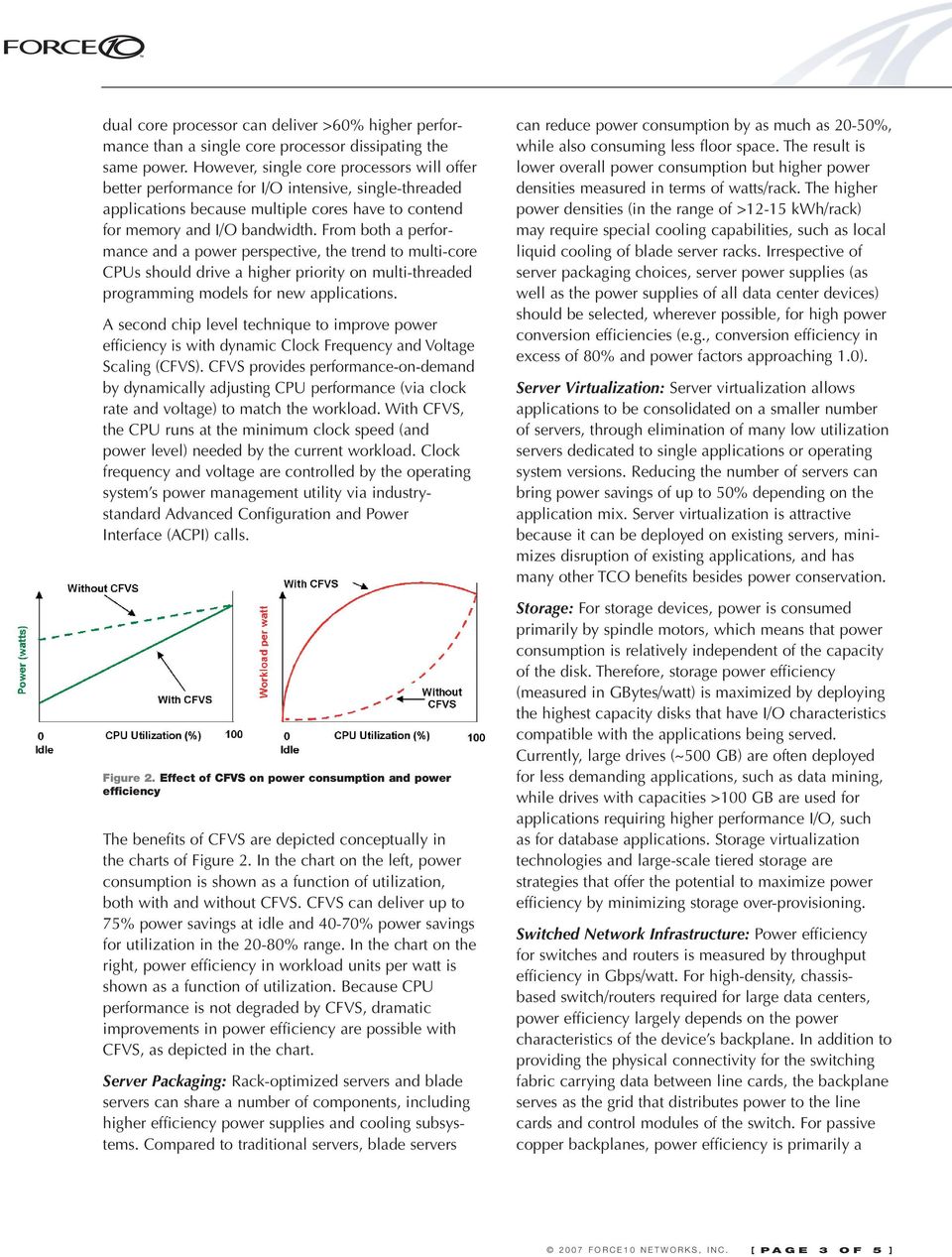
4 function of the resistance of the copper traces. For example, the Force10 E-Series switch/router uses a patented 4 layer, 4 ounce copper backplane to minimize resistance and power consumption. As a result, the E-Series backplane itself has a power efficiency of 4.5 Gbps/watt. As shown in Figure 3 (which is an excerpt from Force10 s power and power efficiency modeling tool) the E1200 switch/router fully configured with 1000Base-T GbE interfaces running at line rate (LR) has a system-level power efficiency of Gbps/watt (8 watts per 1000Base-T port). 1.Switch Consolidation: consolidating a number of low density switches into a large, high density switch with shared redundant power offers power savings analogous to that of the blade server vs. traditional servers. High density also allows the traditional access and aggregation/distribution layers of switching to be collapsed into a single layer of switching that performs both of these functions. The scalability/density of the Force10 E-Series often enables network consolidations with a >3:1 reduction in the number of data center switches. This high reduction factor is due to the combination of the following factors: Elimination of a distinct access switching layer (i.e., 2-Tier switching vs. 3-Tier switching) More servers per aggregation switch, resulting in fewer aggregation switches More aggregation switches per core switch, resulting in fewer core switches Figure 3. Power Consumption of a E1200 with 672 Line-Rate GbE Ports * This power consumption table uses the maximum power draw in calculating each element in the E-Series system. Actual average power draw will typically be 10-25% more efficient. In similar fashion, an E1200 fully configured with 4 port 10 GbE XFP line cards running at line rate has a system level power efficiency of 0.12 Gbps/watt (83 watts per 10 GbE port). The high reserve capacity of the E-Series backplane will allow future improvements in line card port densities to be achieved on the same power budget. This means that system-level power efficiency improvement will track port densities. For example, when GbE port density is doubled, the system power efficiency will also nearly double. Ultra high density, power-efficient switch/routers with carrier-class reliability, such as the Force10 E-Series, can be leveraged in two additional ways to further reduce data center power consumption. 2.Unified Switch Fabric: With the advent of intelligent Ethernet NICs that reduce both host-based latency and CPU utilization for network transfers, Ethernet is well-positioned to function as a unified, or converged, switching fabric that provides LAN connectivity, storage networking, and cluster interconnect across the data center. With a unified Ethernet fabric, power is conserved because only one network adapter is needed for each server and no additional sets of switches are required for specialized fabrics. Virtual Data Center: Another approach to reducing power consumption in the data center is to move away from a model based on static, dedicated physical resources for each application toward a virtualized model where each application draws on a shared pool of resources in order to satisfy workload requirements. Since workloads of various applications peak at different times in the business cycle, the shared resource model can do the same job with far fewer resources, resulting in far lower power consumption. Server virtualization, in conjunction with automated system management and a unified Ethernet switching fabric, constitutes a significant step toward a virtualized data center architecture that offers optimized resource utilization and minimal power consumption. A detailed discussion of the Force10 Networks blueprint for the design of a power-efficient Virtual Data Center is available on the Force10 website FORCE10 NETWORKS, INC. [ P AGE 4 OF 5 ]

5 Conclusion Until now, IT staff has typically focused on the escalation of computing power and storage capacity, coupled with smaller form factors for servers and storage devices, and the strains they are placing on the power and cooling facilities of the data center. However, according to the Ethernet Alliance, inefficient networking could also be wasting as much as $450m a year, or 5.8 TW-h, in the United States, and potentially three times that much, worldwide. To address network energy efficiency, the IEEE has decided to form a study group to scope standards pertaining to Energy Efficient Ethernet (EEE). This group will work to ensure maximum efficiency under normal use scenarios and develop designs for lower energy use at lower utilization and for minimum energy usage over the operational lifetime of networking platforms. In addition to industry alliance and standards efforts, there are a number of technologies and strategies available to allow data center managers to improve the power efficiency of existing data centers and optimize the power and cooling designs of new data centers. The benefits of focusing on power efficiency metrics and power conservation at every level within the data center infrastructure minimizes the cost of physical plants, as well as the recurring cost of electrical power, an increasingly important component of TCO and of overall IT budgets. Force10 Networks, Inc. 350 Holger Way San Jose, CA USA PHONE FACSIMILE 2007 Force10 Networks, Inc. All rights reserved. Force10 Networks and E-Series are registered trademarks, and Force10, the Force10 logo, P-Series, S-Series, TeraScale and FTOS are trademarks of Force10 Networks, Inc. All other company names are trademarks of their respective holders. Information in this document is subject to change without notice. Certain features may not yet be generally available. Force10 Networks, Inc. assumes no responsibility for any errors that may appear in this document. WP v FORCE10 NETWORKS, INC. [ P AGE 5 OF 5 ]

OPTIMIZING SERVER VIRTUALIZATION
 OPTIMIZING SERVER VIRTUALIZATION HP MULTI-PORT SERVER ADAPTERS BASED ON INTEL ETHERNET TECHNOLOGY As enterprise-class server infrastructures adopt virtualization to improve total cost of ownership (TCO)
FTOS: A Modular and Portable Switch/Router Operating System Optimized for Resiliency and Scalability
 White PAPER FTOS: A Modular and Portable Switch/Router Operating System Optimized for Resiliency and Scalability Introduction As Ethernet switch/routers continue to scale in terms of link speed and port
10GBASE T for Broad 10_Gigabit Adoption in the Data Center
 10GBASE T for Broad 10_Gigabit Adoption in the Data Center Contributors Carl G. Hansen, Intel Carrie Higbie, Siemon Yinglin (Frank) Yang, Commscope, Inc 1 Table of Contents 10Gigabit Ethernet: Drivers
Overview of Requirements and Applications for 40 Gigabit and 100 Gigabit Ethernet
 Overview of Requirements and Applications for 40 Gigabit and 100 Gigabit Ethernet Version 1.1 June 2010 Authors: Mark Nowell, Cisco Vijay Vusirikala, Infinera Robert Hays, Intel 1. This work represents
Green Data Center and Virtualization Reducing Power by Up to 50% Pages 10
 Green Data Center and Virtualization Reducing Power by Up to 50% Pages 10 Issue August 2007 Contents Executive Summary 2 Blade for Blade, Power is the Same 3 PAN Lowers Power by Reducing Server/CPU Count
Low Latency 10 GbE Switching for Data Center, Cluster and Storage Interconnect
 White PAPER Low Latency 10 GbE Switching for Data Center, Cluster and Storage Interconnect Introduction: High Performance Data Centers As the data center continues to evolve to meet rapidly escalating
Michael Kagan. [email protected]
 Virtualization in Data Center The Network Perspective Michael Kagan CTO, Mellanox Technologies [email protected] Outline Data Center Transition Servers S as a Service Network as a Service IO as a Service
Broadcom 10GbE High-Performance Adapters for Dell PowerEdge 12th Generation Servers
 White Paper Broadcom 10GbE High-Performance Adapters for Dell PowerEdge 12th As the deployment of bandwidth-intensive applications such as public and private cloud computing continues to increase, IT administrators
White Paper Solarflare High-Performance Computing (HPC) Applications
 Solarflare High-Performance Computing (HPC) Applications 10G Ethernet: Now Ready for Low-Latency HPC Applications Solarflare extends the benefits of its low-latency, high-bandwidth 10GbE server adapters
Server Consolidation and Remote Disaster Recovery: The Path to Lower TCO and Higher Reliability
 Server Consolidation and Remote Disaster Recovery: The Path to Lower TCO and Higher Reliability Executive Summary: To minimize TCO for server / data center consolidation and optimize disaster recovery
WHITE PAPER Addressing Enterprise Computing Storage Performance Gaps with Enterprise Flash Drives
 WHITE PAPER Addressing Enterprise Computing Storage Performance Gaps with Enterprise Flash Drives Sponsored by: Pliant Technology Benjamin Woo August 2009 Matthew Eastwood EXECUTIVE SUMMARY Global Headquarters:
1-Gigabit TCP Offload Engine
 White Paper 1-Gigabit TCP Offload Engine Achieving greater data center efficiencies by providing Green conscious and cost-effective reductions in power consumption. June 2009 Background Broadcom is a recognized
Dell Force10. Data Center Networking Product Portfolio. Z-Series, E-Series, C-Series, and S-Series
 Dell Force10 Data Center Networking Product Portfolio Z-Series, E-Series, C-Series, and S-Series Dell Force10 Solutions High-performance solutions for the data center and beyond The Dell Force10 product
All-Flash Arrays Weren t Built for Dynamic Environments. Here s Why... This whitepaper is based on content originally posted at www.frankdenneman.
 WHITE PAPER All-Flash Arrays Weren t Built for Dynamic Environments. Here s Why... This whitepaper is based on content originally posted at www.frankdenneman.nl 1 Monolithic shared storage architectures
10GBASE-T for Broad 10 Gigabit Adoption in the Data Center
 WHITE PAPER 10GBASE-T Ethernet Network Connectivity 10GBASE-T for Broad 10 Gigabit Adoption in the Data Center The increasing use of virtualization and unified networking places extreme I/O demands on
Cisco for SAP HANA Scale-Out Solution on Cisco UCS with NetApp Storage
 Cisco for SAP HANA Scale-Out Solution Solution Brief December 2014 With Intelligent Intel Xeon Processors Highlights Scale SAP HANA on Demand Scale-out capabilities, combined with high-performance NetApp
Unified Computing Systems
 Unified Computing Systems Cisco Unified Computing Systems simplify your data center architecture; reduce the number of devices to purchase, deploy, and maintain; and improve speed and agility. Cisco Unified
Solving I/O Bottlenecks to Enable Superior Cloud Efficiency
 WHITE PAPER Solving I/O Bottlenecks to Enable Superior Cloud Efficiency Overview...1 Mellanox I/O Virtualization Features and Benefits...2 Summary...6 Overview We already have 8 or even 16 cores on one
Cisco Nexus 5000 Series Switches: Decrease Data Center Costs with Consolidated I/O
 Cisco Nexus 5000 Series Switches: Decrease Data Center Costs with Consolidated I/O Introduction Data centers are growing at an unprecedented rate, creating challenges for enterprises. Enterprise-level
THE PATH TO A GREEN DATA CENTER. Hitachi Data Systems and Brocade. Joint Solution Brief
 THE PATH TO A GREEN DATA CENTER Hitachi Data Systems and Brocade Joint Solution Brief Hitachi Data Systems The Growing Need for Green Data Center Solutions 50 percent of data centers worldwide will have
Oracle Database Scalability in VMware ESX VMware ESX 3.5
 Performance Study Oracle Database Scalability in VMware ESX VMware ESX 3.5 Database applications running on individual physical servers represent a large consolidation opportunity. However enterprises
Juniper Networks QFabric: Scaling for the Modern Data Center
 Juniper Networks QFabric: Scaling for the Modern Data Center Executive Summary The modern data center has undergone a series of changes that have significantly impacted business operations. Applications
Solve your IT energy crisis WITH An energy SMArT SoluTIon FroM Dell
 Solve your IT energy crisis WITH AN ENERGY SMART SOLUTION FROM DELL overcome DATA center energy challenges IT managers share a common and pressing problem: how to reduce energy consumption and cost without
3G Converged-NICs A Platform for Server I/O to Converged Networks
 White Paper 3G Converged-NICs A Platform for Server I/O to Converged Networks This document helps those responsible for connecting servers to networks achieve network convergence by providing an overview
Simplifying the Data Center Network to Reduce Complexity and Improve Performance
 SOLUTION BRIEF Juniper Networks 3-2-1 Data Center Network Simplifying the Data Center Network to Reduce Complexity and Improve Performance Challenge Escalating traffic levels, increasing numbers of applications,
Visibility in the Modern Data Center // Solution Overview
 Introduction The past two decades have seen dramatic shifts in data center design. As application complexity grew, server sprawl pushed out the walls of the data center, expanding both the physical square
Removing Performance Bottlenecks in Databases with Red Hat Enterprise Linux and Violin Memory Flash Storage Arrays. Red Hat Performance Engineering
 Removing Performance Bottlenecks in Databases with Red Hat Enterprise Linux and Violin Memory Flash Storage Arrays Red Hat Performance Engineering Version 1.0 August 2013 1801 Varsity Drive Raleigh NC
David Lawler Vice President Server, Access & Virtualization Group
 Data Center & Cloud Computing David Lawler Vice President Server, Access & Virtualization Group 2009 Cisco Systems, Inc. All rights reserved. 1 We Are Facing Unparalleled Growth 1.7 billion+ people on
Clusters: Mainstream Technology for CAE
 Clusters: Mainstream Technology for CAE Alanna Dwyer HPC Division, HP Linux and Clusters Sparked a Revolution in High Performance Computing! Supercomputing performance now affordable and accessible Linux
Simplifying Data Center Network Architecture: Collapsing the Tiers
 Simplifying Data Center Network Architecture: Collapsing the Tiers Abstract: This paper outlines some of the impacts of the adoption of virtualization and blade switches and how Extreme Networks can address
Cisco, Citrix, Microsoft, and NetApp Deliver Simplified High-Performance Infrastructure for Virtual Desktops
 Cisco, Citrix, Microsoft, and NetApp Deliver Simplified High-Performance Infrastructure for Virtual Desktops Greater Efficiency and Performance from the Industry Leaders Citrix XenDesktop with Microsoft
Virtualizing the SAN with Software Defined Storage Networks
 Software Defined Storage Networks Virtualizing the SAN with Software Defined Storage Networks Introduction Data Center architects continue to face many challenges as they respond to increasing demands
IT@Intel. Comparing Multi-Core Processors for Server Virtualization
 White Paper Intel Information Technology Computer Manufacturing Server Virtualization Comparing Multi-Core Processors for Server Virtualization Intel IT tested servers based on select Intel multi-core
Oracle Virtual Networking Overview and Frequently Asked Questions March 26, 2013
 Oracle Virtual Networking Overview and Frequently Asked Questions March 26, 2013 Overview Oracle Virtual Networking revolutionizes data center economics by creating an agile, highly efficient infrastructure
Green HPC - Dynamic Power Management in HPC
 Gr eenhpc Dynami cpower Management i nhpc AT ECHNOL OGYWHI T EP APER Green HPC Dynamic Power Management in HPC 2 Green HPC - Dynamic Power Management in HPC Introduction... 3 Green Strategies... 4 Implementation...
Block based, file-based, combination. Component based, solution based
 The Wide Spread Role of 10-Gigabit Ethernet in Storage This paper provides an overview of SAN and NAS storage solutions, highlights the ubiquitous role of 10 Gigabit Ethernet in these solutions, and illustrates
MaxDeploy Ready. Hyper- Converged Virtualization Solution. With SanDisk Fusion iomemory products
 MaxDeploy Ready Hyper- Converged Virtualization Solution With SanDisk Fusion iomemory products MaxDeploy Ready products are configured and tested for support with Maxta software- defined storage and with
Best Practices. Server: Power Benchmark
 Best Practices Server: Power Benchmark Rising global energy costs and an increased energy consumption of 2.5 percent in 2011 is driving a real need for combating server sprawl via increased capacity and
PROPRIETARY CISCO. Cisco Cloud Essentials for EngineersV1.0. LESSON 1 Cloud Architectures. TOPIC 1 Cisco Data Center Virtualization and Consolidation
 Cisco Cloud Essentials for EngineersV1.0 LESSON 1 Cloud Architectures TOPIC 1 Cisco Data Center Virtualization and Consolidation 2010 Cisco and/or its affiliates. All rights reserved. Cisco Confidential
SQL Server Consolidation Using Cisco Unified Computing System and Microsoft Hyper-V
 SQL Server Consolidation Using Cisco Unified Computing System and Microsoft Hyper-V White Paper July 2011 Contents Executive Summary... 3 Introduction... 3 Audience and Scope... 4 Today s Challenges...
I D C T E C H N O L O G Y S P O T L I G H T. I m p r o ve I T E f ficiency, S t o p S e r ve r S p r aw l
 I D C T E C H N O L O G Y S P O T L I G H T Optimizing Blade Ser ve r s f o r V irtualization: I m p r o ve I T E f ficiency, S t o p S e r ve r S p r aw l August 2011 Adapted from IDC Blade Market Survey:
Simplify Data Management and Reduce Storage Costs with File Virtualization
 What s Inside: 2 Freedom from File Storage Constraints 2 Simplifying File Access with File Virtualization 3 Simplifying Data Management with Automated Management Policies 4 True Heterogeneity 5 Data Protection
The Future of Computing Cisco Unified Computing System. Markus Kunstmann Channels Systems Engineer
 The Future of Computing Cisco Unified Computing System Markus Kunstmann Channels Systems Engineer 2009 Cisco Systems, Inc. All rights reserved. Data Centers Are under Increasing Pressure Collaboration
10 Gigabit Ethernet Virtual Data Center Architectures
 White PAPER 10 Gigabit Ethernet Virtual Data Center Architectures Introduction Consolidation of data center resources offers an opportunity for architectural transformation based on the use of scalable,
ethernet alliance Overview of Requirements and Applications for 40 Gigabit and 100 Gigabit Ethernet Version 1.0 August 2007 Authors:
 Overview of Requirements and Applications for 40 Gigabit and 100 Gigabit Ethernet Version 1.0 August 2007 Authors: Mark Nowell, Cisco Vijay Vusirikala, Infinera Robert Hays, Intel ethernet alliance p.o.
Intel Data Direct I/O Technology (Intel DDIO): A Primer >
 Intel Data Direct I/O Technology (Intel DDIO): A Primer > Technical Brief February 2012 Revision 1.0 Legal Statements INFORMATION IN THIS DOCUMENT IS PROVIDED IN CONNECTION WITH INTEL PRODUCTS. NO LICENSE,
IBM System x Enterprise Servers in the New Enterprise Data
 IBM System x Enterprise Servers in the New Enterprise Data IBM Virtualization and Consolidation solutions beat the competition and save you money! 118% better performance 36% better performance 40% lower
Doubling the I/O Performance of VMware vsphere 4.1
 White Paper Doubling the I/O Performance of VMware vsphere 4.1 with Broadcom 10GbE iscsi HBA Technology This document describes the doubling of the I/O performance of vsphere 4.1 by using Broadcom 10GbE
Accelerating High-Speed Networking with Intel I/O Acceleration Technology
 White Paper Intel I/O Acceleration Technology Accelerating High-Speed Networking with Intel I/O Acceleration Technology The emergence of multi-gigabit Ethernet allows data centers to adapt to the increasing
Next Gen Data Center. KwaiSeng Consulting Systems Engineer [email protected]
 Next Gen Data Center KwaiSeng Consulting Systems Engineer [email protected] Taiwan Update Feb 08, kslai 2006 Cisco 2006 Systems, Cisco Inc. Systems, All rights Inc. reserved. All rights reserved. 1 Agenda
IBM BladeCenter H with Cisco VFrame Software A Comparison with HP Virtual Connect
 IBM BladeCenter H with Cisco VFrame Software A Comparison with HP Connect Executive Overview This white paper describes how Cisco VFrame Server Fabric ization Software works with IBM BladeCenter H to provide
EMC XTREMIO EXECUTIVE OVERVIEW
 EMC XTREMIO EXECUTIVE OVERVIEW COMPANY BACKGROUND XtremIO develops enterprise data storage systems based completely on random access media such as flash solid-state drives (SSDs). By leveraging the underlying
New Cluster-Ready FAS3200 Models
 New Cluster-Ready FAS3200 Models Steven Miller Senior Technical Director and Platform Architect NetApp recently introduced two new models in the FAS3200 series: the FAS3220 and the FAS3250. Our design
The virtualization of SAP environments to accommodate standardization and easier management is gaining momentum in data centers.
 White Paper Virtualized SAP: Optimize Performance with Cisco Data Center Virtual Machine Fabric Extender and Red Hat Enterprise Linux and Kernel-Based Virtual Machine What You Will Learn The virtualization
Power efficiency and power management in HP ProLiant servers
 Power efficiency and power management in HP ProLiant servers Technology brief Introduction... 2 Built-in power efficiencies in ProLiant servers... 2 Optimizing internal cooling and fan power with Sea of
Leveraging Radware s ADC-VX to Reduce Data Center TCO An ROI Paper on Radware s Industry-First ADC Hypervisor
 Leveraging Radware s ADC-VX to Reduce Data Center TCO An ROI Paper on Radware s Industry-First ADC Hypervisor Table of Contents Executive Summary... 3 Virtual Data Center Trends... 3 Reducing Data Center
Accelerating Enterprise Applications and Reducing TCO with SanDisk ZetaScale Software
 WHITEPAPER Accelerating Enterprise Applications and Reducing TCO with SanDisk ZetaScale Software SanDisk ZetaScale software unlocks the full benefits of flash for In-Memory Compute and NoSQL applications
Flash Memory Arrays Enabling the Virtualized Data Center. July 2010
 Flash Memory Arrays Enabling the Virtualized Data Center July 2010 2 Flash Memory Arrays Enabling the Virtualized Data Center This White Paper describes a new product category, the flash Memory Array,
Improving Economics of Blades with VMware
 Improving Economics of Blades with VMware Executive Summary Today IT efficiency is critical for competitive viability. However, IT organizations face many challenges, including, growing capacity while
OBJECTIVE ANALYSIS WHITE PAPER MATCH FLASH. TO THE PROCESSOR Why Multithreading Requires Parallelized Flash ATCHING
 OBJECTIVE ANALYSIS WHITE PAPER MATCH ATCHING FLASH TO THE PROCESSOR Why Multithreading Requires Parallelized Flash T he computing community is at an important juncture: flash memory is now generally accepted
Data Centers. Mapping Cisco Nexus, Catalyst, and MDS Logical Architectures into PANDUIT Physical Layer Infrastructure Solutions
 Data Centers Mapping Cisco Nexus, Catalyst, and MDS Logical Architectures into PANDUIT Physical Layer Infrastructure Solutions 1 Introduction The growing speed and footprint of data centers is challenging
A 10 GbE Network is the Backbone of the Virtual Data Center
 A 10 GbE Network is the Backbone of the Virtual Data Center Contents... Introduction: The Network is at the Epicenter of the Data Center. 1 Section II: The Need for 10 GbE in the Data Center 2 Section
Top of Rack: An Analysis of a Cabling Architecture in the Data Center
 SYSTIMAX Solutions Top of Rack: An Analysis of a Cabling Architecture in the Data Center White paper Matthew Baldassano, Data Center Business Unit CommScope, Inc, June 2010 www.commscope.com Contents I.
Managing the Real Cost of On-Demand Enterprise Cloud Services with Chargeback Models
 Managing the Real Cost of On-Demand Enterprise Cloud Services with Chargeback Models A Guide to Cloud Computing Costs, Server Costs, Pricing Plans, and Chargeback Implementation and Systems Introduction
Evaluation Report: HP Blade Server and HP MSA 16GFC Storage Evaluation
 Evaluation Report: HP Blade Server and HP MSA 16GFC Storage Evaluation Evaluation report prepared under contract with HP Executive Summary The computing industry is experiencing an increasing demand for
An Oracle White Paper July 2011. Oracle Primavera Contract Management, Business Intelligence Publisher Edition-Sizing Guide
 Oracle Primavera Contract Management, Business Intelligence Publisher Edition-Sizing Guide An Oracle White Paper July 2011 1 Disclaimer The following is intended to outline our general product direction.
How To Connect Virtual Fibre Channel To A Virtual Box On A Hyperv Virtual Machine
 Virtual Fibre Channel for Hyper-V Virtual Fibre Channel for Hyper-V, a new technology available in Microsoft Windows Server 2012, allows direct access to Fibre Channel (FC) shared storage by multiple guest
An Oracle White Paper November 2010. Oracle Real Application Clusters One Node: The Always On Single-Instance Database
 An Oracle White Paper November 2010 Oracle Real Application Clusters One Node: The Always On Single-Instance Database Executive Summary... 1 Oracle Real Application Clusters One Node Overview... 1 Always
Advanced Core Operating System (ACOS): Experience the Performance
 WHITE PAPER Advanced Core Operating System (ACOS): Experience the Performance Table of Contents Trends Affecting Application Networking...3 The Era of Multicore...3 Multicore System Design Challenges...3
June 2009. Blade.org 2009 ALL RIGHTS RESERVED
 Contributions for this vendor neutral technology paper have been provided by Blade.org members including NetApp, BLADE Network Technologies, and Double-Take Software. June 2009 Blade.org 2009 ALL RIGHTS
Power Consumption and Cooling in the Data Center: A Survey
 A M a r k e t A n a l y s i s Power Consumption and Cooling in the Data Center: A Survey 1 Executive Summary Power consumption and cooling issues in the data center are important to companies, as evidenced
HP ProLiant Gen8 vs Gen9 Server Blades on Data Warehouse Workloads
 HP ProLiant Gen8 vs Gen9 Server Blades on Data Warehouse Workloads Gen9 Servers give more performance per dollar for your investment. Executive Summary Information Technology (IT) organizations face increasing
Optimizing Large Arrays with StoneFly Storage Concentrators
 Optimizing Large Arrays with StoneFly Storage Concentrators All trademark names are the property of their respective companies. This publication contains opinions of which are subject to change from time
Achieving Real-Time Business Solutions Using Graph Database Technology and High Performance Networks
 WHITE PAPER July 2014 Achieving Real-Time Business Solutions Using Graph Database Technology and High Performance Networks Contents Executive Summary...2 Background...3 InfiniteGraph...3 High Performance
Introduction. Need for ever-increasing storage scalability. Arista and Panasas provide a unique Cloud Storage solution
 Arista 10 Gigabit Ethernet Switch Lab-Tested with Panasas ActiveStor Parallel Storage System Delivers Best Results for High-Performance and Low Latency for Scale-Out Cloud Storage Applications Introduction
LS-DYNA Best-Practices: Networking, MPI and Parallel File System Effect on LS-DYNA Performance
 11 th International LS-DYNA Users Conference Session # LS-DYNA Best-Practices: Networking, MPI and Parallel File System Effect on LS-DYNA Performance Gilad Shainer 1, Tong Liu 2, Jeff Layton 3, Onur Celebioglu
SummitStack in the Data Center
 SummitStack in the Data Center Abstract: This white paper describes the challenges in the virtualized server environment and the solution that Extreme Networks offers a highly virtualized, centrally manageable
Data Center Networking Designing Today s Data Center
 Data Center Networking Designing Today s Data Center There is nothing more important than our customers. Data Center Networking Designing Today s Data Center Executive Summary Demand for application availability
From Ethernet Ubiquity to Ethernet Convergence: The Emergence of the Converged Network Interface Controller
 White Paper From Ethernet Ubiquity to Ethernet Convergence: The Emergence of the Converged Network Interface Controller The focus of this paper is on the emergence of the converged network interface controller
Upgrading Data Center Network Architecture to 10 Gigabit Ethernet
 Intel IT IT Best Practices Data Centers January 2011 Upgrading Data Center Network Architecture to 10 Gigabit Ethernet Executive Overview Upgrading our network architecture will optimize our data center
White Paper. Advanced Server Network Virtualization (NV) Acceleration for VXLAN
 White Paper Advanced Server Network Virtualization (NV) Acceleration for VXLAN August 2012 Overview In today's cloud-scale networks, multiple organizations share the same physical infrastructure. Utilizing
New Features in SANsymphony -V10 Storage Virtualization Software
 New Features in SANsymphony -V10 Storage Virtualization Software Updated: May 28, 2014 Contents Introduction... 1 Virtual SAN Configurations (Pooling Direct-attached Storage on hosts)... 1 Scalability
Navigating the Pros and Cons of Structured Cabling vs. Top of Rack in the Data Center
 May 2013 Navigating the Pros and Cons of Structured Cabling vs. Top of Rack in the Data Center Executive Summary There is no single end-all cabling configuration for every data center, and CIOs, data center
Cloud-ready network architecture
 IBM Systems and Technology Thought Leadership White Paper May 2011 Cloud-ready network architecture 2 Cloud-ready network architecture Contents 3 High bandwidth with low latency 4 Converged communications
Isilon IQ Network Configuration Guide
 Isilon IQ Network Configuration Guide An Isilon Systems Best Practice Paper August 2008 ISILON SYSTEMS Table of Contents Cluster Networking Introduction...3 Assumptions...3 Cluster Networking Features...3
Multi-core and Linux* Kernel
 Multi-core and Linux* Kernel Suresh Siddha Intel Open Source Technology Center Abstract Semiconductor technological advances in the recent years have led to the inclusion of multiple CPU execution cores