
CA ARCserve Backup. Client Agents Guide. r16
|
|
|
- Juniper Hawkins
- 10 years ago
- Views:
Transcription

1 CA ARCserve Backup Client Agents Guide r16

2 This Documentation, which includes embedded help systems and electronically distributed materials, (hereinafter referred to as the Documentation ) is for your informational purposes only and is subject to change or withdrawal by CA at any time. This Documentation may not be copied, transferred, reproduced, disclosed, modified or duplicated, in whole or in part, without the prior written consent of CA. This Documentation is confidential and proprietary information of CA and may not be disclosed by you or used for any purpose other than as may be permitted in (i) a separate agreement between you and CA governing your use of the CA software to which the Documentation relates; or (ii) a separate confidentiality agreement between you and CA. Notwithstanding the foregoing, if you are a licensed user of the software product(s) addressed in the Documentation, you may print or otherwise make available a reasonable number of copies of the Documentation for internal use by you and your employees in connection with that software, provided that all CA copyright notices and legends are affixed to each reproduced copy. The right to print or otherwise make available copies of the Documentation is limited to the period during which the applicable license for such software remains in full force and effect. Should the license terminate for any reason, it is your responsibility to certify in writing to CA that all copies and partial copies of the Documentation have been returned to CA or destroyed. TO THE EXTENT PERMITTED BY APPLICABLE LAW, CA PROVIDES THIS DOCUMENTATION AS IS WITHOUT WARRANTY OF ANY KIND, INCLUDING WITHOUT LIMITATION, ANY IMPLIED WARRANTIES OF MERCHANTABILITY, FITNESS FOR A PARTICULAR PURPOSE, OR NONINFRINGEMENT. IN NO EVENT WILL CA BE LIABLE TO YOU OR ANY THIRD PARTY FOR ANY LOSS OR DAMAGE, DIRECT OR INDIRECT, FROM THE USE OF THIS DOCUMENTATION, INCLUDING WITHOUT LIMITATION, LOST PROFITS, LOST INVESTMENT, BUSINESS INTERRUPTION, GOODWILL, OR LOST DATA, EVEN IF CA IS EXPRESSLY ADVISED IN ADVANCE OF THE POSSIBILITY OF SUCH LOSS OR DAMAGE. The use of any software product referenced in the Documentation is governed by the applicable license agreement and such license agreement is not modified in any way by the terms of this notice. The manufacturer of this Documentation is CA. Provided with Restricted Rights. Use, duplication or disclosure by the United States Government is subject to the restrictions set forth in FAR Sections , , and (c)(1) - (2) and DFARS Section (b)(3), as applicable, or their successors. Copyright 2011 CA. All rights reserved. All trademarks, trade names, service marks, and logos referenced herein belong to their respective companies.

3 CA Technologies Product References This document references the following CA Technologies products: BrightStor Enterprise Backup CA Antivirus CA ARCserve Assured Recovery CA ARCserve Backup Agent for Advantage Ingres CA ARCserve Backup Agent for Novell Open Enterprise Server for Linux CA ARCserve Backup Agent for Open Files on Windows CA ARCserve Backup Client Agent for FreeBSD CA ARCserve Backup Client Agent for Linux CA ARCserve Backup Client Agent for Mainframe Linux CA ARCserve Backup Client Agent for UNIX CA ARCserve Backup Client Agent for Windows CA ARCserve Backup Enterprise Option for AS/400 CA ARCserve Backup Enterprise Option for Open VMS CA ARCserve Backup for Linux Enterprise Option for SAP R/3 for Oracle CA ARCserve Backup for Microsoft Windows Essential Business Server CA ARCserve Backup for UNIX Enterprise Option for SAP R/3 for Oracle CA ARCserve Backup for Windows CA ARCserve Backup for Windows Agent for IBM Informix CA ARCserve Backup for Windows Agent for Lotus Domino CA ARCserve Backup for Windows Agent for Microsoft Exchange Server CA ARCserve Backup for Windows Agent for Microsoft SharePoint Server CA ARCserve Backup for Windows Agent for Microsoft SQL Server CA ARCserve Backup for Windows Agent for Oracle CA ARCserve Backup for Windows Agent for Sybase CA ARCserve Backup for Windows Agent for Virtual Machines CA ARCserve Backup for Windows Disaster Recovery Option CA ARCserve Backup for Windows Enterprise Module

4 CA ARCserve Backup for Windows Enterprise Option for IBM 3494 CA ARCserve Backup for Windows Enterprise Option for SAP R/3 for Oracle CA ARCserve Backup for Windows Enterprise Option for StorageTek ACSLS CA ARCserve Backup for Windows Image Option CA ARCserve Backup for Windows Microsoft Volume Shadow Copy Service CA ARCserve Backup for Windows NDMP NAS Option CA ARCserve Backup for Windows Storage Area Network (SAN) Option CA ARCserve Backup for Windows Tape Library Option CA ARCserve Backup Patch Manager CA ARCserve Backup UNIX and Linux Data Mover CA ARCserve Central Host-Based VM Backup CA ARCserve Central Protection Manager CA ARCserve Central Reporting CA ARCserve Central Virtual Standby CA ARCserve D2D CA ARCserve D2D On Demand CA ARCserve High Availability CA ARCserve Replication CA VM:Tape for z/vm CA 1 Tape Management Common Services etrust Firewall Unicenter Network and Systems Management Unicenter Software Delivery Unicenter VM:Operator

5 Contact CA Contact CA Support For your convenience, CA Technologies provides one site where you can access the information that you need for your Home Office, Small Business, and Enterprise CA Technologies products. At you can access the following resources: Online and telephone contact information for technical assistance and customer services Information about user communities and forums Product and documentation downloads CA Support policies and guidelines Other helpful resources appropriate for your product Providing Feedback About Product Documentation If you have comments or questions about CA Technologies product documentation, you can send a message to [email protected]. To provide feedback about CA Technologies product documentation, complete our short customer survey which is available on the CA Support website at

6 Documentation Changes The following documentation updates have been made since the last release of this documentation: Rebranded to CA Technologies. This release of CA ARCserve Backup no longer includes client agent support for NetWare platforms. All topics referencing NetWare platforms were updated or removed. Updated to include user feedback, enhancements, corrections, and other minor changes to help improve the usability and understanding of the product or the documentation itself.

7 Contents Chapter 1: Introducing the Client Agents 9 Introduction... 9 Benefits of Using a Client Agent... 9 Supported Client Systems Access the Backup Agent Admin Chapter 2: Installing the Client Agents 13 Installation Considerations Client Agent for Windows Enterprise Option for OpenVMS Communication Requirements for Client Agents Installed on UNIX, Linux, and Mainframe Linux Platforms Install the Client Agents Common Agent Automatic Installation Installation Directories for the Common Agent and Client Agents Chapter 3: Adding and Configuring the Client Agents 17 Adding Client Agents How to Add, Import, and Export Agents and Nodes Manually Add Client Agents Windows Client Agent Configuration Windows-Related Configuration Notes Security Configuration Options Backup Priority and Restore/Compare Priority Options Multiple Concurrent Restore or Compare Backup and Restore Execution Options Use the Backup Agent Admin to Set Windows Parameters Configure Password Security View Configuration Selections Enable Raw Backup and Restore Configure Windows Network Communication Set a Workstation Password Create Windows Access Control List Enable Virus Scanning Customizable Local Options How the Client Agent for Windows Excludes Database Application Files from Backups Contents 7

8 UNIX, Linux, and Mac OS X Client Agent Configuration UNIX, Linux, and Mac OS X Configuration Considerations UNIX, Linux, and Mac OS X Client Agent Control Files Common Agent Configuration File for UNIX, Linux, and Mac OS X Snapshot and Direct I/O Support for UNIX UNIX, Linux, and Mac OS X Access Control Lists AS/400 Enterprise Option Configuration Configure Start Preferences Performance Configuration Configure Stop Preferences OpenVMS Enterprise Option Configuration Configure Port Address TCP/IP Stack Optimization Trace Levels for the OpenVMS Enterprise Option Chapter 4: Using the Client Agents 57 Runtime Statistics View Runtime Statistics for the Client Agent for Windows Activity Logs View Activity Logs on a Windows Server View Activity Logs on a UNIX, Linux, or Mac OS X Client Agent Machine Activity Logs on Computers Running the AS/400 Enterprise Option Activity Logs on Computers Running the OpenVMS Enterprise Option Delete Client Agent Log Files Back Up Windows Network Server Data Client Agent Start and Stop Procedures Windows Start and Stop Requirement UNIX, Linux, and Mac OS X Client Agents Start and Stop Requirement Enterprise Option for AS/400 Start and Stop Requirement Enterprise Option for OpenVMS Start and Stop Requirement Glossary 65 Index 67 8 Client Agents Guide
9 Chapter 1: Introducing the Client Agents This section contains the following topics: Introduction (see page 9) Benefits of Using a Client Agent (see page 9) Supported Client Systems (see page 10) Access the Backup Agent Admin (see page 12) Introduction CA ARCserve Backup is a comprehensive storage solution for applications, databases, distributed servers, and file systems. It provides backup and restore capabilities for databases, business-critical applications, and network clients. Among the compatible agents CA ARCserve Backup offers are a specific set of operating-system-based client agents. The client agents are separate software packages installed on network computers to supply a network interface between the computer and CA ARCserve Backup. In addition to enabling connectivity, the client agents share data storage tasks with the backup servers in your network. You may need multiple client agents, depending on the number and variety of network machines that require regular data backup and restore functionality. This guide provides information on installing, configuring, and adding client agents for all workstations and servers in your network storage environment. Benefits of Using a Client Agent CA ARCserve Backup client agents are designed for organizations that need to preserve network resources by offloading tasks onto centralized backup servers and media. Among other functions, the client agents serve to: Minimize the load on your communications network Increase the efficiency of your CA ARCserve Backup servers by offloading the preprocessing of archive data to the client machine Supply detailed file and directory information about the remote client to the CA ARCserve Backup server Communicate with the server and let you browse and select backup components Chapter 1: Introducing the Client Agents 9

10 Supported Client Systems Assist with monitoring the progress of backup jobs Maintain and monitor backup logs with the status of backup and restore activities Facilitate backup of applications or file systems Client agents can also augment data protection for all client computers from a single CA ARCserve Backup server in the network. With client agents installed on your network computers, a single CA ARCserve Backup server can perform data backup and restore operations on multiple computers and operating systems. Supported Client Systems CA ARCserve Backup offers client agents that support the following platforms: Note: For a detailed description of supported operating systems and versions, see the Client Agents Readme file located on the CA ARCserve Backup installation media. CA ARCserve Backup Client Agent for Windows. This client agent supports the following: Windows Server 2008 Windows Server 2008 R2 Windows 7 Windows Vista Windows XP Windows Server 2003 Windows Small Business Server (Windows 2003) CA ARCserve Backup Client Agent for UNIX. This client agent supports the following: AIX HP-UX Solaris Tru64 FreeBSD 10 Client Agents Guide

11 Supported Client Systems CA ARCserve Backup Client Agent for Linux. This client agent supports the following: Red Hat SuSE Turbo Debian RedFlag Miracle Linux Asianux CA ARCserve Backup Client Agent for Mainframe Linux. This client agent supports the following: Red Hat Enterprise Server SLES CA ARCserve Backup Enterprise Option for AS/400 CA ARCserve Backup Client Agent for Mac OS X CA ARCserve Backup Enterprise Option for OpenVMS Chapter 1: Introducing the Client Agents 11
12 Access the Backup Agent Admin Access the Backup Agent Admin The Backup Agent Admin allows you to configure various agents and set multiple options. You can view data about the agent desktop regarding the local system, connections, agent status, and configuration options. The following options are available using the Backup Agent Admin: Services (see page 60) Network Configuration (see page 29) Access Control List (see page 32) Delete Client Agent Log Files (see page 59) AD Object Level Restore Utility To access the Backup Agent Admin: 1. From the Windows Start menu, select All Programs, CA, ARCserve Backup, Backup Agent Admin. The ARCserve Backup Agent Admin dialog opens. 2. Select one of the following agents to configure from the drop-down list: Agent for Microsoft Exchange Agent for Microsoft SharePoint Agent for Microsoft SQL Server Agent for Virtual Machines Client Agent (see page 23) 3. Click the Configuration icon. The appropriate configuration dialog opens. 4. Complete the fields and click OK. The selected agent is configured. 12 Client Agents Guide

13 Chapter 2: Installing the Client Agents To perform a backup or restore job, you must install and start the appropriate CA ARCserve Backup client agent software. The client agent provides communication between a workstation and the CA ARCserve Backup server. This chapter describes how to install client agents. This section contains the following topics: Installation Considerations (see page 13) Install the Client Agents (see page 15) Common Agent Automatic Installation (see page 15) Installation Directories for the Common Agent and Client Agents (see page 16) Installation Considerations The following sections include information you should review before installing the client agents. Client Agent for Windows Before you install or run the client agent for Windows, your computer must be configured to communicate using one or more of the following network protocols: Transmission Control Protocol/Internet Protocol (TCP/IP) Windows Socket (WinSock) Direct Chapter 2: Installing the Client Agents 13
14 Installation Considerations Enterprise Option for OpenVMS Before installing the enterprise option for OpenVMS, review the following considerations. A computer running the supported Alpha and VAX operating systems can use either TCP or User Data Protocol (UDP) with any of the following communications software: Compaq UCX 4.2 eco 3 (on Alpha) Compaq UCX 3.3 eco 13 (on VAX) Compaq TCP/IP Versions 5.0 through 5.3 Process Software Multinet Version 4.1B (with patches) through Version 4.4 Process Software TCPWARE Versions 5.3 and 5.4 Important! If necessary, you can install two or more of these communications packages on the same computer; however, you can run only one package at a time. Do not run two or more of these communications packages simultaneously on the same computer. Note: If you change OpenVMS TCP/IP stacks at any time, you must reinstall the OpenVMS Enterprise Option. You should back up your OpenVMS system disk before installing the OpenVMS Enterprise Option. Ensure that you have at least 10 blocks of free space for setup file. Communication Requirements for Client Agents Installed on UNIX, Linux, and Mainframe Linux Platforms To help ensure that CA ARCserve Backup primary servers and member servers can communicate with the CA ARCserve Backup agents that are installed on UNIX, Linux, and Mainframe Linux computers, you must allow CA ARCserve Backup to communicate with the agent through the firewall, if any, that is configured on the agent computers. You can allow CA ARCserve Backup to communicate with the agent computers by adding CA ARCserve Backup to the firewall exceptions list on the agent computers. As a best practice, you should add CA ARCserve Backup to the firewall exceptions list on the agent computers before you install the agents. 14 Client Agents Guide
15 Install the Client Agents This requirement affects the following CA ARCserve Backup components: Client Agent for UNIX Client Agent for Linux Client Agent for Mainframe Linux Oracle Agent on UNIX platforms Oracle Agent on Linux platforms UNIX and Linux Data Mover For information about how to configure the firewall on the agent computers, see the platform-specific documentation. Note: By default, CA ARCserve Backup communicates using port Install the Client Agents To install a windows client agent or a cross-platform agent, use the CA ARCserve Backup for Windows DVD. For more information about installing CA ARCserve Backup client agents, click the following links on the CA ARCserve Backup installation browser: Installation Instructions for CA ARCserve Backup Client Agents for non-windows platforms. Installation Instructions for CA ARCserve Backup UNIX and Linux Data Mover. Common Agent Automatic Installation When you install the client agent for UNIX, Linux, or Mac OS X, the CA ARCserve Backup Common Agent is automatically installed. Chapter 2: Installing the Client Agents 15

16 Installation Directories for the Common Agent and Client Agents Installation Directories for the Common Agent and Client Agents The following table describes the default installation paths for the CA ARCserve Backup Common Agent and the CA ARCserve Backup Client Agents for UNIX and Linux platforms. Platform Version Common Agent / Agent Configuration File Client Agent (File System Agent) AIX /opt/ca/abcmagt /opt/ca/abuagent HP /opt/ca/abcmagt /opt/ca/abuagent Solaris SPARC 8, 10 x86 /opt/ca/babcmagt /opt/ca/babuagent Solaris SPARC 9, 10 /opt/ca/abcmagt /opt/ca/abuagent Linux SUSE /opt/ca/abcmagt /opt/ca/abuagent Redhat Linux-OES Asianux Miracle Red Flag Turbo Linux Mainframe Linux Red Hat SUSE /opt/ca/babcmagt /opt/ca/babuagent FreeBSD /opt/ca/babcmagt /opt/ca/babuagent Debian /opt/ca/abcmagt /opt/ca/abuagent ESX /opt/ca/abcmagt /opt/ca/abuagent Tru64 /opt/ca/babcmagt /opt/ca/babuagent Note: The above directories also appear in the Common Agent configuration file (agent.cfg) along with other related configuration files for the file system agents and the Agent for Oracle. For a complete list of supported versions of operating systems, see the Client Agents Readme file located on the CA ARCserve Backup installation media. 16 Client Agents Guide

17 Chapter 3: Adding and Configuring the Client Agents After installing CA ARCserve Backup and its various client agents, you must add and configure each client agent machine in your network to the backup server. This chapter discusses the procedures for adding and configuring client agents. This section contains the following topics: Adding Client Agents (see page 17) Windows Client Agent Configuration (see page 21) UNIX, Linux, and Mac OS X Client Agent Configuration (see page 35) AS/400 Enterprise Option Configuration (see page 53) OpenVMS Enterprise Option Configuration (see page 54) Adding Client Agents If you have CA ARCserve Backup installed on a Windows server, you can add client agents from your network using the Add, Import, Export Node feature or you can add client agents manually. The following sections include information on each of these methods. How to Add, Import, and Export Agents and Nodes Setting up a job in an environment with many agents and nodes can be a time-consuming and tedious task. If you have multiple agents and nodes to back up, it may take time to add the agents and nodes to the Backup Manager one at a time. The Add, Import, and Export Agents and Add, Import, and Export Nodes features let you add multiple nodes and agents using the CA ARCserve Backup user interface, whether the nodes and agents will be backed up. Note: The Central Agent Admin also lets you add, import, or export agents and nodes. Chapter 3: Adding and Configuring the Client Agents 17
18 Adding Client Agents You can use the Add, Import, and Export Nodes feature to add multiple nodes and agents into the system in either of the following ways: Add multiple agents and nodes using the user interface 1. From the Backup Manager Source Tab or the Restore Manager Destination Tab, select a node. 2. Use the Add/Import/Export Nodes dialog to manually enter the names of all the nodes and agents or select the nodes from the left-pane list of nodes and agents detected by auto-discovery. 3. Specify a user name and password for the nodes. 4. Save the information in the CA ARCserve Backup database. 5. View the nodes and agents in the Backup Manager Source tree or the Central Agent Admin. Add multiple nodes and agents using a.csv and.txt file 1. From the Backup Manager Source Tab or the Restore Manager Destination Tab, select a node. 2. Use the Import function on the Add/Import/Export Nodes dialog and specify the name of the.csv or.txt file from the user interface. The node and agent names are imported from the.csv or.txt file and are added into the system. 3. Specify a user name and password for the nodes and agents. 4. View the nodes and agents in the Backup Manager Source tree. Manually Add Client Agents If Auto Discovery does not detect all client agents in your network for some reason or if you want to add a particular client agent, you can manually add a client agent to a Windows server using the Windows manager interface. To manually add a client agent, whether it's through Group View or Classic View, you must add each client agent machine to the Backup Manager. To manually add client agents in a Group View 1. Open the Backup Manager and click the Source tab. The Source directory tree appears. 2. Select Group View from the drop-down list. 3. Right-click the appropriate client agent object, such as Client Agent. 18 Client Agents Guide


19 Adding Client Agents 4. Select Add Machine/Object. The Add Agent dialog appears. 5. Enter the name of the computer in the Host Name field. 6. Select the protocol you want to use to connect to the computer. Select TCP/IP and, if you are adding a Windows client agent, select Use Computer Name Resolution. Computer name resolution lets the local Windows computer automatically detect the remote Windows machine's IP address when connecting for backup and restore operations. This is the recommended method and works even if you do not know the computer's IP address. Note: If the target Windows computer has a dynamic IP address, using computer name resolution is preferable. If you are not adding a Windows client agent, if computer name resolution fails because of various DNS server or network configuration issues, or the target computer has multiple IP addresses and you want to be certain that a specific address is used, ensure that Use Computer Name Resolution is not selected and enter an IP address. Chapter 3: Adding and Configuring the Client Agents 19


20 Adding Client Agents 7. Enter the Username and Password for the computer in the Security Information section. 8. Click OK. The client agent is added to the server. To manually add client agents in a Classic View 1. Open the Backup Manager and click the Source tab. The Source directory tree appears. 2. Select Classic View from the drop-down list. 3. Right-click the appropriate client agent object, such as Windows Systems. 4. Select Add Machine/Object. The Add Agent dialog appears. 5. Enter the name of the computer in the Host Name field. 6. Select the protocol you want to use to connect to the computer. Select TCP/IP and, if you are adding a Windows client agent, select Use Computer Name Resolution. Computer name resolution lets the local Windows computer automatically detect the remote Windows machine's IP address when connecting for backup and restore operations. This is the recommended method and works even if you do not know the computer's IP address. Note: If the target Windows computer has a dynamic IP address, using computer name resolution is preferable. If you are not adding a Windows client agent, if computer name resolution fails because of various DNS server or network configuration issues, or the target computer has multiple IP addresses and you want to be certain that a specific address is used, ensure that Use Computer Name Resolution is not selected and enter an IP address. 7. Click Add. The client agent is added to the server. 20 Client Agents Guide

21 Windows Client Agent Configuration Windows Client Agent Configuration The following sections discuss the Windows client agent configuration options. Windows-Related Configuration Notes General information pertaining to the configuration of the Windows client agent includes: Restoring System State The System State supports the Restore to Original Location option. Note: The System State also supports restoring to an alternate location, but it will not recreate an operational system since the files are placed in default directories created by the agent at the time of restore. Shares Support When the use agent option is selected, the client agent backs up shares selected from the Preferred Shares/Machines object in the Backup Manager by converting the share name to the real path. Note: On Windows platforms, the client agent does not restore shares or support shares as a destination except for administrative shares. Restoration of the System Hive The KeysNotToRestore feature is designed to protect sensitive system registry keys during a regular restore of the client agent system hive. However, this feature is unavailable when you use the Client Agent Registry session to restore individual system keys. Security Configuration Options The Client Agent for Windows security options are defined on the Configuration dialog. Select one of the following types of security: System Security Lets you use Windows security to perform backup, compare, and restore operations. The client agent impersonates the active network user; that is, the client agent uses the user name and password to log on. This ID and password should identify a valid user in the local user database or in the domain database if the workstation is a member of a domain. Chapter 3: Adding and Configuring the Client Agents 21
22 Windows Client Agent Configuration Password Security Lets you set individual passwords for security. This setting enables the client agent to run under the local system account. Password Security is disabled by default. Note: If password security is selected, and DSA-based database agents (such as Sybase, Informix, and so on) are installed on the machine, whole node backup is not supported. To back up databases only, you must change the security information in the Security and Agent Information dialog, to the system security before submitting the job. Backup Priority and Restore/Compare Priority Options The Client Agent for Windows process priority is defined on the Configuration dialog. Select one of the following settings for Backup Priority and Restore/Compare Priority: High Normal Low Foreground processing performs client agent functions before other processes. Standard processing performs client agent functions without special status. Standard processing performs client agent functions when other processes are idle. Multiple Concurrent Restore or Compare The Client Agent for Windows simultaneous restore and compare is enabled on the Configuration dialog. Enable the Allow multiple simultaneous restore or compare jobs check box on the Configuration dialog if you want the Windows client agent to accept multiple concurrent restore or compare jobs. 22 Client Agents Guide
23 Windows Client Agent Configuration Backup and Restore Execution Options The Client Agent for Windows execution options are defined on the Configuration dialog. Select the pre-execution programs, post-execution programs, and define the execution delay. Pre-execution Enter or select the name of any batch programs (for example, C:\WINAGENT\PRE.CMD) that you want to automatically execute before the backup or restore operation. Post-execution Enter or select the name of any batch programs (for example, C:\WINAGENT\POST.CMD) that you want to automatically execute after the backup or restore operation. Execution Delay Select the number of seconds that you want the client agent to wait before or after executing the batch job. Use the Backup Agent Admin to Set Windows Parameters To use the Backup Agent Admin to set Windows parameters 1. Access the Agent Admin by clicking Start, Programs or All Programs, CA Technologies, ARCserve Backup Agents, Backup Agent Admin. Note: The window contents may differ slightly for each client agent, depending on the specific operating system in use. Chapter 3: Adding and Configuring the Client Agents 23

24 Windows Client Agent Configuration 2. From the Agent Admin, select the Options tab. The Configuration dialog opens. 24 Client Agents Guide
25 Windows Client Agent Configuration You can define the following settings using the Configuration dialog: Security Type Specification--Select one of the following types of security: System Security--Select this Security option to use Windows security to perform backup, compare, and restore operations. The client agent impersonates the active network user; that is, the client agent uses the user name and password to log on. This ID and password should identify a valid user in the local user database or in the domain database if the workstation is a member of a domain. Note: If you select System Security, Exchange Server 2010 database files are not backed up (that is, they are skipped) when you use the client agent to select partitions, folders or files for backup when the client agent backup account is a domain account with View Only Organization Management role or higher privileges. Exchanger Server 2010 database files are not skipped if you select Password Security, or if you use some other account role, such as local administrator or domain account without View-only Organization Management privileges. The system displays a warning when these database files are in use. Password Security--Select this Security option to set an individual password for security. This setting enables the client agent to run under the local system account. Password Security is disabled by default. Setting Process Priority--These settings determine the priority given to the processes needed for the backup, restore, or compare operations. Select one of the following settings for Backup Priority and Restore/Compare Priority: High--Foreground processing performs client agent functions before other processes. Normal--Standard processing performs client agent functions without special status. Low--Standard processing performs client agent functions when other processes are idle. Allow multiple simultaneous restore or compare jobs--enable this if you want the Windows client agent to accept multiple concurrent restore or compare jobs. Note: By default, this option is disabled to ensure that new backup or restore jobs of the same data set are not accidentally launched during a running restore job. If this does occur, the agent denies the new job's request and reports that the client agent is busy to the CA ARCserve Backup server. Enable physical disk/volume backup and restore--lets you perform raw backups and restores on physical disks and volumes. Note: For more information, see the Administration Guide. Chapter 3: Adding and Configuring the Client Agents 25
26 Windows Client Agent Configuration Log--The Log file is stored in the following path: <ARCserve_HOME>\ARCserve Backup Client Agent for Windows\ntagent.log. The log for every job that runs is stored in this log file. Keep Log For--Specifies the number of days (the default is 60 days) to keep the agent log. After the specified number of days has elapsed the log will be deleted when the next agent backup, restore, or compare job runs. Pre-Execution and Post-Execution Programs--Select the following execution options: Pre-execution--Enter or select the name of any batch programs (for example, C:\WINAGENT\PRE.CMD) that you want to automatically execute before the backup operation. Post-execution--Enter or select the name of any batch programs (for example, C:\WINAGENT\POST.CMD) that you want to automatically execute after the backup operation. Execution Delay--Select the amount of seconds that you want the client agent to wait before or after the execution of the batch job. Generate stub file for archived files--select this option to generate files that contain information about the data included in an archive job. 3. Click OK to save your changes and exit the dialog. Note: To change your configuration later, you must return to the Configuration dialog. 26 Client Agents Guide
27 Windows Client Agent Configuration Configure Password Security The client agent service uses the node (machine) user name and assigned password to log on to the CA ARCserve Backup network. To set password security for the client agent 1. Start the Backup Manager, and then right-click the machine name. A pop-up menu appears. 2. Choose Security from the pop-up menu to open the Security dialog. The User Name field should already contain the client agent s assigned user name. 3. Enter the password for the client agent. Note: The user name and password should identify a valid user in the local machine s database or in the domain database, if the workstation is a member of a domain. Also, when you specify the account to use, it may be necessary to distinguish between two accounts that use the same name (such as Administrator) by indicating where Windows can find each account. You can identify the client object s location by using tree name formats when identifying the user name. For example, for a domain named NTDEV containing a workstation named ENGINEER, the respective administrators are: NTDEV\Administrator ENGINEER\Administrator View Configuration Selections Before making changes to your configuration settings, you should verify your current configuration. To view your configuration selections 1. Open the Backup Agent Admin. Chapter 3: Adding and Configuring the Client Agents 27
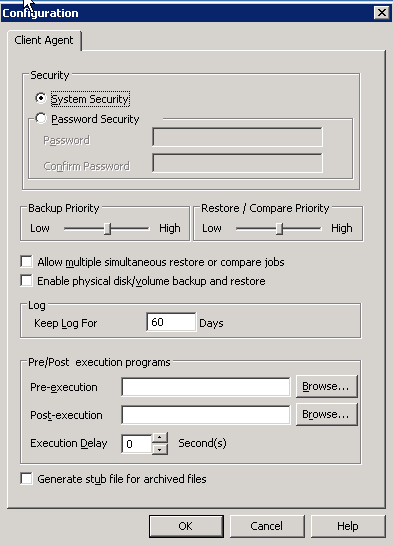
28 Windows Client Agent Configuration 2. Expand Options and then select Configuration. The current settings are displayed. Enable Raw Backup and Restore You can use CA ARCserve Backup to perform raw backup and restore of physical disks and volumes. The capability to perform raw backup and restore of physical disks and volumes is disabled by default. You must enable the option for each agent. To enable raw backup and restore of a physical disk or volume 1. From the Windows Start menu, click Start, Programs, CA, ARCserve Backup, and Backup Agent Admin. The ARCserve Backup Agent Admin window appears. 28 Client Agents Guide

29 Windows Client Agent Configuration 2. Click Options, Configuration. The Configuration window appears. 3. Click Enable physical disk/volume backup and restore. 4. Click OK. The raw backup and restore feature is enabled for the agent. For more information on how you can perform raw backup and restore, see the Administration Guide. Configure Windows Network Communication CA ARCserve Backup client agent services are shared across all configured client agents. By default, Windows client agents use TCP/UDP port You can change this behavior by using the Network Configuration menu in the Backup Agent Admin. To configure Windows network communication 1. Open the Backup Agent Admin. 2. From the Options menu, select Network Configuration. Chapter 3: Adding and Configuring the Client Agents 29
30 Windows Client Agent Configuration 3. Using this dialog, set the following network parameters for the client agent: Specify Port Number--Accept the defaults or enter the port values you want CA ARCserve Backup to use. If you want to use the original default port, click the Reset button. The updated port information will be saved in the local PortsConfig.cfg file located in \Program Files\CA\SharedComponents\ARCserve Backup. Note: Updated port information must be registered with the CA ARCserve Backup server component. To do this, you must modify the remote server PortsConfig.cfg file. For more information on port configuration, see the Implementation Guide. Select IP Address--The Windows client agent supports the use of multiple network interface cards (NICs). For computers with more than one network card, the agent checks all enabled NICs in the machine. You can manually override this selection by choosing the IP address of the NIC that you want to dedicate for backup purposes. When you define this configuration, the client agent will listen using only this interface card. All other NICs are ignored and you will not be able to use their IP addresses to connect to the client agent. Any updated information also needs to be modified in the Windows CAPortConfig.cfg file and copied to the CA ARCserve Backup home directory. Example: #Hostname IP address (optional) TCP port UDP port #myhost nnn.nnn.nnn.nnn mymachine nnn.nnn.nnn.nn Client Agents Guide

31 Windows Client Agent Configuration Set a Workstation Password If you selected password security when configuring the Windows client agent from the Backup Agent Admin, you must specify the same password in CA ARCserve Backup. To set a workstation password 1. From the Backup Manager, right-click the name of the client agent. 2. Choose Security from the pop-up menu. 3. Enter the local Windows user account name or enter the Windows domain account using the tree format. 4. Enter the password and click OK. Note: If you use a client agent to perform remote client backups and restores, the password you set for the client agent overrides any shared password set for the workstation. If you do not use client agent software for your backup jobs, you must specify share-level passwords on the Backup Manager window. Make sure that the password on the Backup Manager and the share-level password are the same. Chapter 3: Adding and Configuring the Client Agents 31
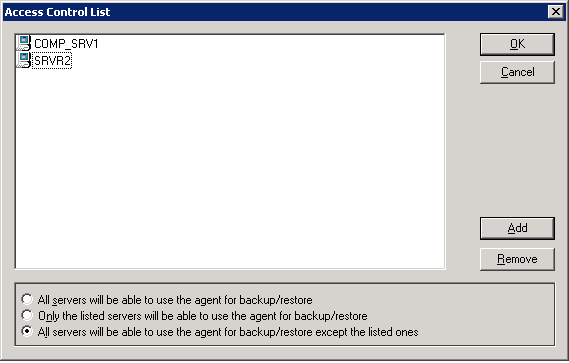
32 Windows Client Agent Configuration Create Windows Access Control List You can limit the servers authorized to perform backups on a Windows client agent object by generating an access control list (ACL). This feature is defined through the Backup Manager and the Backup Agent Admin. By creating an access control list and defining its type, you can restrict data backup and restore to a specific group of CA ARCserve Backup servers for the particular client agent. The ACL type can be: No ACL used No list is specified; this is the default. Include list A list of servers allowed to access the client agent machine for backup and restore options. Exclude list A list of servers that are not allowed to access the client agent machine for backup and restore options. All other servers in the network can access the client object. To create a Windows access control list 1. Open the Backup Agent Admin. 2. From the Options menu, select Access Control List. 32 Client Agents Guide
33 Windows Client Agent Configuration 3. When the Access Control List dialog appears, the default is to not use ACL and the setting All servers will be able to use the agent for backup/restore is selected. To create an ACL, select one of the following choices: Only the listed servers will be able to use the agent for backup/restore All servers will be able to use the agent for backup/restore except the listed ones 4. Click Add to add client agent names to the access control list, including as many names as you need for the ACL. If you want to remove client agents from the list, click Remove for each client agent being removed. 5. Click OK when you finish adding or removing client agent names. Enable Virus Scanning CA Anti-Virus software offers extra protection for your critical data, securing it from virus threats even during backup and restore activities. Using this option, you can configure the Windows client agent to automatically detect and repair viruses during a backup, copy, count, or restore operation. To enable virus scanning 1. Open the Backup Manager or the Restore Manager. 2. From the toolbar, click the Options button to display the Global Options dialog. 3. Click the Virus tab. 4. Select Enable Virus Scanning. 5. Click the virus scanning options that you want to apply to the client agent. Available options include: Skip Rename Do not back up or restore an infected file. Rename the infected files with the extension x.avb (for example, 0.AVB, 1.AVB, 2.AVB). If a file with the same name and the extension AVB exists, the system will name the file with a numeric version of that extension, for example, AV0, AV1, AV2. Chapter 3: Adding and Configuring the Client Agents 33
34 Windows Client Agent Configuration Delete Cure Delete the infected file. CA Anti-Virus cures the files that have been found to be infected. With the Cure option, infected files are automatically repaired during a backup without user intervention. 6. If you want each archive s component files individually verified, enable Scan Compressed Files. Note: This option may reduce backup or restore performance. Customizable Local Options When you explicitly select a parent object (in a parent-child database configuration), you can right-click a client agent object to customize local backup options. For more information on explicit job packaging see the Implementation Guide, and for more information on how to select sources when customizing local options see the Administration Guide. How the Client Agent for Windows Excludes Database Application Files from Backups The Client Agent for Windows can exclude database and log files from backups of database applications, such as Microsoft Exchange and Microsoft SQL Server, when performing backups. During the backup job, the Client Agent for Windows communicates with the database agent to obtain a list of files that the backup job should exclude from the file system backup. The Client Agent for Windows then excludes files from the file system backup based on the response received from the database agent. If the database agent is offline, the Client Agent assumes all files should be backed up and the file system backup job proceeds accordingly. Example: When you select a Microsoft Exchange server directory as the backup source and perform file system backup using the Client Agent for Windows, the following exclusion behavior occurs: If the Exchange Information Store is online, the Agent for Microsoft Exchange Server provides a list of the Exchange databases and log files that should be excluded from the backup job. As a result, CA ARCserve Backup skips the excluded files and completes the file system backup. 34 Client Agents Guide
35 UNIX, Linux, and Mac OS X Client Agent Configuration If the Exchange Information Store is offline, the Agent for Microsoft Exchange Server provides an empty list of Exchange databases and log files that should be excluded from the backup job. As a result, CA ARCserve Backup does not skip the Exchange server files and includes all files during the file system backup. UNIX, Linux, and Mac OS X Client Agent Configuration The UNIX, Linux, and Mac OS X client agent configuration file, uag.cfg, is located on the remote client workstation in the client agent home directory. This file, which is scanned for entries whenever a job is submitted to the workstation, can be used to set multiple options associated with the client agent. Important! Do not change any of the variables in the agent configuration unless instructed to do so by a representative of CA Technologies Technical Support. UNIX, Linux, and Mac OS X Configuration Considerations The following list describes issues that you should be aware of when configuring the client agent on the UNIX, Linux, and Mac OS X platforms. Session passwords Session passwords cannot be longer than 22 bytes for UNIX, Linux, and Mac OS X sessions. Single character directory names You may experience display issues in restore views when restoring single character directory names. The data appears correctly in the database view. Traverse Symbolic Links and Traverse NFS The options Traverse Symbolic Links and Traverse Network File System (NFS) are not supported for restore operations. Note: If a configuration discrepancy exists in the CA ARCserve Backup option definitions for these client agents, the options that were set through the Backup Manager always take precedence over the options manually entered in the uag.cfg configuration file. Chapter 3: Adding and Configuring the Client Agents 35
36 UNIX, Linux, and Mac OS X Client Agent Configuration UNIX, Linux, and Mac OS X Client Agent Control Files The UNIX, Linux, and Mac OS X client agent control files specify which directories, file systems, or file system types are to be excluded from backup operations on a specific workstation. In particular, the following packages must be installed with the UNIX, Linux, and Mac OS X client agents: The Common Agent The Universal Agent (uagent) Note: You must install the Common Agent before you install the uagent. The control files installed for both packages include: Directory Control file Use the Directory Control file, uag.cntl, to list all directories or file systems (or both) that you want to exclude from backup operations on a workstation. To specify directories and file systems in this file, enter a slash (/) followed by a one line, complete path name. For example: /opt/account1 Note: The Directory Control file is stored on the client agent workstation in the uagent home directory. File System Control file The File System Control file, fs.cntl lists the file system types on a particular workstation that are to be excluded from backup operations. To exclude a particular file system type, enter the type on a separate line in the fs.cntl file. Note: The File System file is stored on the client agent workstation in the uagent home directory. Browser Configuration File The Browser Configuration file, cabr.cfg, enables raw devices to be viewed with the browser. You must ensure that you have entered the absolute name of the raw device on a separate line in the cabr.cfg file. Common Agent Configuration File The Common Agent configuration file, agent.cfg, keeps track of each UNIX, Linux, or Mac OS X client agent installed on your system. This script is run automatically after the uagent is installed. Note: Only a system administrator can edit the Directory and File System control files. However, other users may be able to append the files, depending on the file access rights the system administrator has assigned to the file. 36 Client Agents Guide
37 UNIX, Linux, and Mac OS X Client Agent Configuration Common Agent Configuration File for UNIX, Linux, and Mac OS X The Common Agent (caagentd binary) is a standard component for all UNIX, Linux, and Mac OS X client agents. It is installed automatically during the first installation of UNIX, Linux, or Mac OS X client agent. The Common Agent resides in the /opt/ca/babcmagt directory. It keeps track of the client agents that are installed on the system in a configuration file named agent.cfg, which also resides in the /opt/ca/babcmagt directory. Note: CA ARCserve Backup installs related configuration files for the Common Agent, the file system agents, and the Agent for Oracle in different directories on the various UNIX and Linux platforms. For more information, see Installation Directories for the Common Agent and Client Agent For UNIX and Linux (see page 16). During the installation of a new client agent, the agent.cfg file is updated with the new client agent s information. You will seldom need to modify this configuration file. Manual modification of this file is required only to enable some debugging messages or to change the default TCP/IP port on which the Common Agent runs. A sample agent.cfg file with a client agent installed is as follows: [0] #[ABagntux] NAME ABagntux VERSION nn.nn.nn HOME /opt/ca/abuagent ENV CA_ENV_DEBUG_LEVEL=4:$CA_ENV_DEBUG_LEVEL ENV LD_LIBRARY_PATH=/opt/CA/CAlib:/opt/CA/ABcmagt:$LD_LIBRARY_PATH ENV SHLIB_PATH=/opt/CA/CAlib:/opt/CA/ABcmagt:$SHLIB_PATH ENV LIBPATH=/opt/CA/CAlib:/opt/CA/ABcmagt:$LIBPATH BROWSER cabr AGENT uagentd MERGE umrgd VERIFY umrgd [36] DISABLED #[ABcmagt] #NAME ABcmagt #HOME /opt/ca/abcmagt #TCP_PORT 6051 #UDP_PORT 6051 Common Agent Configuration File Structure Each section of the agent.cfg file contains groups of fields that directly correspond to an installed client agent on a UNIX, Linux, or Mac OS X device in the backup network. Except for the agent home directory location, all fields in the file are predetermined. Chapter 3: Adding and Configuring the Client Agents 37
38 UNIX, Linux, and Mac OS X Client Agent Configuration The environment variable field (ENV) contents are also determined during client agent installation and configuration. However, if required, you can enter values for this variable into the file manually. You should modify the agent.cfg only in certain circumstances; for example, if you wanted to associate an additional environment field with a particular database. Note: Modifications to the agent.cfg file take effect only after the client agent machine is started (or stopped and restarted). An example of the agent.cfg file is shown in the following table, with a description of each agent field. File Contents Field Description [0] Object type, a predefined number of a specific client agent in the network for UNIX and Linux [4] Object type, a predefined number of a specific client agent in the network for Mac OS X NAME ABagntux VERSION nn.n HOME /opt/ca/abuagent #ENV CA_ENV_DEBUG_LEVEL=4 #ENV CAAGPERF_ENABLE=1 ENV LD_LIBRARY_PATH ENV SHLIB_PATH ENV LIBPATH BROWSER cabr AGENT uagentd MERGE umrgd VERIFY umrgd Name of the client agent Release and version number of the client agent Default home directory for the client agent Environment variable passed to the client agent Enables the features Snapshot and Direct I/O on Solaris and HP. For more information, see the section Configure Snapshot and Direct I/O Shared library search path for Sun, Linux, Tru64, and Mac OS X Shared library search path for HP Shared library search path for AIX Browser module for the client agent Backup module for the client agent daemon Merge daemon Scan daemon 38 Client Agents Guide
39 UNIX, Linux, and Mac OS X Client Agent Configuration Client Agent Home Directory Common Agent Components The default client agent home directory, ABuagent, is automatically defined during installation and setup. If required, however, you can specify a different home directory. To locate the name of the home directory, look in the agent.cfg file under the ABagntux section of the file. The name of the client agent home directory is defined by the HOME variable. The Common Agent runs at all times as a daemon listening for requests on behalf of all the UNIX, Linux, and Mac OS X client agents that are installed on the system. During each client agent s installation, the BROWSER, AGENT, MERGE, and VERIFY components are registered with the Common Agent in a separate section. Not all client agents have all of these components. For example, in the following sample configuration file, you can see the BROWSER component cabr, the AGENT component uagentd, and the MERGE and VERIFY component umrgd in the section for the UNIX, Linux, or Mac OS X client agent. Similarly, other client agents use other BROWSER and AGENT components. [0] #[ABagntux] NAME VERSION HOME ENV ENV ENV ENV BROWSER AGENT MERGE VERIFY ABagntux nn.nn.nn /opt/ca/abuagent CA_ENV_DEBUG_LEVEL=4:$CA_ENV_DEBUG_LEVEL LD_LIBRARY_PATH=/opt/CA/CAlib:/opt/CA/ABcmagt:$LD_LIBRARY_PATH SHLIB_PATH=/opt/CA/CAlib:/opt/CA/ABcmagt:$SHLIB_PATH LIBPATH=/opt/CA/CAlib:/opt/CA/ABcmagt:$LIBPATH cabr uagentd umrgd umrgd Chapter 3: Adding and Configuring the Client Agents 39
40 UNIX, Linux, and Mac OS X Client Agent Configuration Port Address Configuration The default port for TCP and UDP is The TCP port is used for communication and data transfer between the backup server and the client agent. The Backup Manager user interface uses the UDP port to browse hosts. If you want to configure either the TCP port or the UDP port, or both, you must modify the configuration files on both the CA ARCserve Backup server and the client agent so that their values match. The names of the configuration files are as follows: CAPortConfig.cfg for CA ARCserve Backup Windows servers agent.cfg for client agents Note: See UNIX, Linux, and Mac OS X Client Agent Control Files for important information about the UNIX, Linux, and Mac OS X configuration files. This example shows the Windows server configuration file (CAPortConfig.cfg): #Hostname IP address (optional) TCP port UDP port #myhost xxx.xxx.xxx.xxx This example shows the syntax for the client agent configuration file (agent.cfg): [36] NAME HOME ABcmagt TCP_PORT 7090 UDP_PORT 7085 Common Agent Port Numbers /opt/ca/abcmagt By default, the Common Agent uses port number 6051 for both TCP and UDP. To change the default port, you must modify the ABcmagt section of the agent.cfg file with the new port numbers, and then restart the Common Agent by issuing the caagent stop command, followed by the caagent start command. Do not use the caagent update command after modifying port numbers. Note: Under normal conditions, do not use this method to start or stop the Common Agent. Instead, you should run the Start and Stop scripts of the individual UNIX, Linux, and Mac OS X client agents installed on the system. 40 Client Agents Guide
41 UNIX, Linux, and Mac OS X Client Agent Configuration The following sample shows the configuration file before and after the script changes are made. Before the change: [36] #[ABcmagt] #NAME ABcmagt #HOME /opt/ca/abcmagt #TCP_PORT 6051 #UDP_PORT 6051 After the change: [36] #[ABcmagt] NAME ABcmagt HOME /opt/ca/abcmagt TCP_PORT 9051 UDP_PORT 9051 Host Equivalence User Credentials The port changes take effect only after you restart the Common Agent. If you configure the Common Agent to run on a port other than the default port, you should also configure the CA ARCserve Backup server to access this Common Agent. You can do this by making an entry for the client agent in the port.cfg file. This file is in the config subdirectory under the home directory $BAB_HOME/config/port.cfg on the backup server. By default, the Common Agent uses another UDP port, 0xA234 (41524), to receive CA ARCserve Backup requests for the Auto Discovery of UNIX, Linux, and Mac OS X client agents. This port is not configurable. When the Common Agent checks user credentials, it gives preference to host equivalence settings of the system. A UNIX, Linux, or Mac OS X system can be set up to grant access for specific users on specific hosts without requiring the user to provide credentials. You can grant this access by adding the specific user IDs to the /etc/hosts.equiv or.rhosts file. By default, the Common Agent follows these rules, then checks the user s password for authorization. To disable host equivalence checking, define the NO_HOSTS_EQUIV=1 environment variable in the agent.cfg file, as shown in the following example: Chapter 3: Adding and Configuring the Client Agents 41
42 UNIX, Linux, and Mac OS X Client Agent Configuration [36] #[ABcmagt] NAME HOME ENV ABcmagt /opt/ca/abcmagt NO_HOSTS_EQUIV=1 You can place the Common Agent in No Password mode or Single User mode with a set of access control lists if necessary. For more information about ACLs, see UNIX, Linux, and Mac OS X Access Control Lists (see page 50). How Common Agent Connection Requests Work Configurable Options To initiate a client agent session, the CA ARCserve Backup server requests a connection for a UNIX, Linux, or Mac OS X client agent to use a specific backup component (such as BROWSER, BACKUP, or RESTORE). When it receives the request, the Common Agent accepts the connection and verifies the user s credentials for the system. Upon user validation, the Common Agent checks the agent.cfg file for an entry corresponding to that particular client agent and the specified component. Only after it has validated both the client agent and the requested component does the Common Agent activate the client agent and the component. The Common Agent then returns to a state of waiting for additional requests. Options are used to optimize and customize the operation of the client agent. However, none of these options are required for the client agent to run. A complete list of options are available for use when starting the UNIX, Linux, or Mac OS X client agents as shown in the following table. Note: These options should be carefully set by administrators having UNIX, Linux, or Mac OS X knowledge. If you do not understand what an option or parameter means, do not set the feature unless instructed to do so by a CA Technologies Technical Support representative. Option -ALLOW <network address> <host address> Description Use this option with Single User mode, with the -S or -NOPASSWORD option, to define the IP addresses of computers that are authorized to access the client agents without requiring validation. 42 Client Agents Guide
43 UNIX, Linux, and Mac OS X Client Agent Configuration -ALLOW N: ( ) H: In this example, N denotes a network address and H denotes a host IP address. You can set an optional subnet mask. Option Description -b bufsize Defines the disk I/O buffer size in bytes. Options are to bytes; the default is bytes. -c n Specifies the sleep time while waiting, in milliseconds (ms). Options are zero (0) to 1000 ms; the default is 50 ms. -CAUSER USER Defines Single User mode. Used with the -S or NOPASSWORD option to set the Allow or Deny list on a per-user basis. For example: -CAUSER A: USER1 N: USER2 In this example, A means ALLOW and N corresponds to -DENY. Option -DENY <network address> <host address> Description Use this option with Single User mode, with the -S or NOPASSWORD option, to define the IP addresses that are not allowed access to the client agents. For example: -DENY N: ( ) H: In this example, N denotes a network address and H denotes a host s IP address. You can set an optional subnet mask. Option Description -l Causes the client agent to check for advisory locks. The default is mandatory locks only. -m maxbuf Sets the number of buffers allocated for I/O. Options are 2 to 1024 buffers; the default is NOPASSWORD Specify this option if you need to use either the -ALLOW, -DENY, or -CAUSER options. This option is the same as the -S option in Single User mode with no password required. Chapter 3: Adding and Configuring the Client Agents 43
44 UNIX, Linux, and Mac OS X Client Agent Configuration Option Description -P n Specifies the default time out, followed by a variable number (n), which is user-defined and measured in minutes (0 to 10). The default is 5 minutes. For example, the option -P 10 assigns a wait time period for the backup or restore pre-script of 10 minutes. Note: An error occurs if you use the -P option without defining a number n. Option -Prebackup filename -Postbackup filename -Prerestore filename -Postrestore filename Description Executes the default pre-scripts and post-scripts associated with the type of backup or restore job being run. The filename is optional and if is not specified, uag_pre_backup will be treated as the filename. -S Enables the Single User mode option. In Single User mode, user credentials are not checked against valid user IDs and passwords. Instead, access is granted based on the -ALLOW, -DENY, or -CAUSER options. For more information see the specific option. -s async nonblocking Sets socket I/O to asynchronous, nonblocking mode. -s bufsize Specifies the size of the socket buffer. Options are 4096 to The default is system dependent. -s SocketMode Specifies to use socket mode for backup operations. -sparse -verbose or -v Differentiates between sparse file and regular file operations.this option increases the efficiency of sparse file backups and restores. Note: Quota files are always treated as sparse files in backup and restore operations, regardless of whether you specify sparse. Places the system in verbose mode to enable the entry of detailed debugging messages at the console. 44 Client Agents Guide
45 UNIX, Linux, and Mac OS X Client Agent Configuration Snapshot and Direct I/O Support for UNIX UNIX client agents support the Snapshot and Direct I/O features. To take advantage of these features, one of the following environments must exist on the machine running the UNIX client agent: Feature Platform Software Requirements Snapshot Solaris UFS file system with the fssnap package installed (Solaris 8 and 9) or the advanced version of VxFS file system. Snapshot HP-UX 11.0 Advanced version of VxFS file system or Online Journaling File System (JFS). Direct I/O Solaris UFS file system or VxFS file system. Direct I/O HP-UX 11.0 Advanced version of VxFS file system or Online JFS. Snapshot and Direct I/O Descriptions With Direct I/O, the client agent takes a snapshot on advanced versions of VxFS, Online JFS (HP-UX), and UFS with fssnap installed on Solaris. The client agent mounts the snapshot to a temporary directory created in the root volume, and then generates the snapshot backup. After the snapshot backup is complete, the client agent dismounts from the temporary directory and deletes the snapshot. To perform a snapshot backup, you must specify a snapshot buffer. A snapshot buffer is the disk space used to store the original data before it is overwritten in the snapped volume. Remember these considerations when using the snapshot buffer: The snapshot buffer needs to be large enough to store all the data that changes in the snapped volume for the duration of the backup. If the snapshot buffer runs out of space, the snapshot becomes invalid and the backup fails. The snapped volume and the snapshot buffer should not be on the same file system. For better performance, the snapped volume and the snapshot buffer should be on separate physical disks. For UFS on the Solaris platform (using fssnap), the snapshot buffer can be a file name, a directory name, or a raw partition. Chapter 3: Adding and Configuring the Client Agents 45
46 UNIX, Linux, and Mac OS X Client Agent Configuration Configure Snapshot and Direct I/O For a Direct I/O backup or restore, you need to check the client environment and edit the caagperf.cfg configuration file. You can view Snapshot and Direct I/O on the file systems in the caagperf.cfg file by executing the mount command at the command line after submitting the backup or restore job. For Snapshot, the output that appears after executing the mount command is a new, read-only file system with the mount point starting with the prefix SNAP_HOME_. A Direct I/O user can observe the changes in the mount options on that particular file system. You can also see the detailed messages in the caagperf.log file if you enabled the logging flag in the caagperf.cfg file. The following sections describe how to configure a UNIX client agent to use these features. To configure the Snapshot and Direct I/O features, follow these steps: 1. Enable the environment variable CAAGPERF_ENABLE by adding the following line in the agent.cfg file: ENV CAAGPERF_ENABLE=1 Note: The agent.cfg file is in the /opt/ca/abcmagt directory. After you enable this environment variable, the client agent section of the agent.cfg file looks like this: [0] NAME VERSION HOME ENV ENV ABagentux nn.nn.nn /opt/ca/uagent LD_LIBRARY_PATH=/usr/local/Calib:/opt/CA/ABcmagt CAAGPERF_ENABLE=1 2. Prepare the configuration file named caagperf.cfg in the /opt/ca/abcmagt directory. You need to specify the types of operations to be completed on the specified file systems in the caagperf.cfg file. 46 Client Agents Guide
47 UNIX, Linux, and Mac OS X Client Agent Configuration Configuration Table Parameters and Values The format of the configuration file is similar to a Windows.inf file. It has sections and key value pairs. The section names are the names inside the square brackets, and the key value pairs are in KEY=VALUE format with one pair on each line. All the entries in the configuration file are case-sensitive. The key value pairs are under the volumes to which they belong, and the section names are the names of those volumes. Two examples of the syntax of the section name in the caagperf.cfg file are [/] or [/export/home]. If a volume has multiple entries, the behavior of the client agent is undefined. The key value pairs are used to set parameters for the volume under which they belong. By default, all options are disabled. If no special processing is needed for a volume, that volume should not be in the caagperf.cfg file. The keys and their values are described in the following table: Key DOSNAP SNAPSHOTBUFFER Value Enables the Snapshot feature on a volume. The value should be BACKUP, meaning that a snapshot should be taken during the backup operation. Specifies the buffer used for storing original data before it is overwritten in the snapped volume. The value should be a file name or partition. The file can be a file or a directory from a different volume. The value of this field depends on the file system type. For the advanced version of VxFS or Online JFS, the value is the name of an empty partition. For UFS, the value is a file name, a directory name, or a partition name. DOUBIO Enables the Direct I/O feature on a volume. Values are BACKUP, RESTORE, and BACKUP_RESTORE. The value of this field depends on your backup or restore requirements. Chapter 3: Adding and Configuring the Client Agents 47
48 UNIX, Linux, and Mac OS X Client Agent Configuration Configuration Files for UNIX Systems The following are examples of different variations of UNIX systems configuration files. Example: Solaris 8 or Solaris 9 operating system with a UFS file system with fssnap installed The first line of the file is a debugging flag. The three sections that follow the debug entry correspond to the /opt, /export/home, and / volumes on the disk. The sections for /opt and /export/home have Snapshot enabled during backup, and the / section has Direct I/O enabled for backup and restore. ##DEBUG [/opt] DOSNAP=BACKUP SNAPSHOTBUFFER=/garbage/snapbufferfile_1 [/export/home] DOSNAP=BACKUP SNAPSHOTBUFFER=/garbage/snapbufferfile_2 [/] DOUBIO=BACKUP_RESTORE Example: Solaris 8 operating system with the advanced version of the VxFS file system installed The file contains three sections. The first line of the file is a debugging flag. The three sections in the file are /opt, /export/home, and / volume. Sections for /opt and /export/home have Snapshot enabled during backup, and the / volume has Direct I/O enabled for backup and restore. T##DEBUG [/opt] DOSNAP=BACKUP SNAPSHOTBUFFER=/dev/dsk/c0t0d0s4 [/export/home] DOSNAP=BACKUP SNAPSHOTBUFFER=/dev/dsk/c0t0d0s4 [/] DOUBIO=BACKUP_RESTORE 48 Client Agents Guide
49 UNIX, Linux, and Mac OS X Client Agent Configuration Example: HP-UX operating system having either an advanced version of the VxFS file system or the online JFS file system installed The file contains four sections. The first line of the file is a debugging flag. The sections in the file are the /, /var, /usr, and /export volumes. In this file the / volume is enabled for Direct I/O during backup and restore and the other volumes are enabled for Snapshot during backup. ##DEBUG [/] DOUBIO=BACKUP_RESTORE [/var] DOSNAP=BACKUP SNAPSHOTBUFFER=/dev/vg00/lvol7 [/usr] DOSNAP=BACKUP SNAPSHOTBUFFER=/dev/vg00/lvol7 [/export] DOSNAP=BACKUP SNAPSHOTBUFFER=/dev/vg00/lvol7 Trace Levels for the AS/400 Enterprise Option Occasionally, based on instructions from CA Technologies Technical Support, you may need to change the level of activity that is logged for the AS/400 Enterprise Option. Because tracing levels can affect backup performance, do not change the values unless you receive specific instructions from CA Technologies Technical Support. The following table shows all of the AS/400 Enterprise Option trace levels: Level ASO$TRACE ASO$TRACE_AST ASO$TRACE_IDENT ASO$TRACE_DATA Description This controls the trace depth of the client agent. Valid values are -1 and 0 to 0xFFFFFFFF. Setting the ASO$TRACE value to 1 logs the most detail. This is a toggle. If defined, Asynchronous System Traps (ASTs) are traced. This is a formatting parameter. The recommended value is between 0 and 5. The default is 3. This controls the number of bytes in each packet that is logged. The range is unlimited and starts at 0. The default is 300. Chapter 3: Adding and Configuring the Client Agents 49
50 UNIX, Linux, and Mac OS X Client Agent Configuration UNIX, Linux, and Mac OS X Access Control Lists For UNIX, Linux, and Mac OS X client agents, ACLs are supported in Single User mode only. This is also known as No Password mode. A UNIX, Linux, and Mac OS X client agent or database backup agent can be put into Single User mode by specifying a NOPASSWORD entry in its corresponding section in the Common Agent configuration file, agent.cfg, located in /opt/ca/abcmagt. A UNIX, Linux, and Mac OS X client agent can also be put into Single User mode by specifying the -S or -NOPASSWORD option in the uag.cfg. You can use two types of ACLs with the UNIX, Linux, or Mac OS X client agent: Example: Allow or Deny Users An access control list can deny or allow specific users to perform backups or restores. For example, a part of the agent.cfg file is shown in the following sample. You need to make similar changes for other client agent sections if you want to apply ACLs to those client agents too. [0] NAME ABagentux VERSION nn.n.n HOME /opt/ca/abuagent NOPASSWORD CAUSER A:CAUSER1 N:CAUSER2 NOPASSWORD enables Single User mode, and CAUSER specifies the users for whom permission is being granted or denied. (A stands for ALLOW and N stands for DENY.) A:CAUSER1 enables CAUSER1 to perform jobs, and N:CAUSER2 denies access to CAUSER2. Note: For UNIX and Linux client agents, the object type is [0]. For the Mac OS X client agent, the object type is [4]. 50 Client Agents Guide
51 UNIX, Linux, and Mac OS X Client Agent Configuration Example: Access the System with IP Addresses An access control list can determine whether specific IP addresses can access the system. For example, a part of the agent.cfg file is shown in the following sample. You must make similar changes for other client agent sections of the file if you want to apply ACLs to those client agents too. [0] NAME ABagentux VERSION nn.n.n HOME /opt/ca/abuagent NOPASSWORD ALLOW N: ( ) H: DENY N: ( ) H: NOPASSWORD enables the Single User mode, and ALLOW and DENY specify whether a particular network or IP address is allowed to access the system. N denotes a network address and H denotes a host s IP address. Note: An optional subnet mask can follow a network address; subnet masks are shown in parentheses. For UNIX, Linux, and Mac OS X client agents, the specific type of ACL can be specified in uag.cfg, or you can specify them using the -S, -NOPASSWORD, -CAUSER, -ALLOW, and -DENY options. For more information about these options, see the section Configurable Options. You can apply both types of ACLs concurrently. In each case, DENY takes precedence over ALLOW. In the Single User mode, all operations on the client agent are performed with superuser privileges. The caagentd.log contains information about the users, IP addresses, and network addresses denied during Single User mode. Backup and Restore Access Control List Support for UNIX and Linux Verify ACL Libraries CA ARCserve Backup Client Agent for UNIX, CA ARCserve Backup Client Agent for Linux, and CA ARCserve Backup Client Agent for Mainframe Linux back up and restore the access control list (ACL) for files and directories on a Linux system that have been backed up using the Linux client agent. The extended attributes for Linux are also backed up. ACL gives administrators finer control over files and directory access. The Linux client agent can read and set the ACL for each file and directory. To check that you have the required ACL libraries installed, run the following command: >rpm -qa grep libacl If the libacl-devel-* or libacl-* packages are not listed, you must install them. Chapter 3: Adding and Configuring the Client Agents 51
52 UNIX, Linux, and Mac OS X Client Agent Configuration Install ACL Library Packages To install ACL library packages 1. Copy the ACL library packages from the CD image, or download them from the internet to your Linux system: -libacl package (such as libacl rpm) -libacl-devel package (such as libacl-devel rpm) 2. To install the packages, run the following commands: rpm -ivh <libacl-package-name> rpm -ivh <libacl-devel-package-name> Example: >rpm -ivh libacl rpm >rpm -ivh libacl-devel rpm This step installs the libacl.so library into your Linux system. Verify the Linux ACL Library Version If the Linux client agent is running on a 32-bit Linux system, ACL support is now enabled. If the Linux client agent is running on a 64-bit Linux system, you must ensure that the libacl.so library is a 32-bit version. You can check the version and create a link to a 32-bit library if necessary. To check the version, go to the directory where libacl.so is installed. Verify the Linux ACL library version Create Link to 32-bit Linux ACL Library 1. Run ls l. /libacl.so to display the libacl.so linking target library file. 2. Run file libacl.so<-linking-target-library> using the library file name. The result will show whether libacl.so points to a 32-bit or 64-bit version. If libacl.so points to a 64-bit library, you must create a link from the 32-bit library to libacl.so. The following example shows how to create the link on a 64-bit Mainframe Linux platform: > cd /lib > ln -sf libacl.so.1 libacl.so Use the appropriate link command for your 64-bit Linux system. 52 Client Agents Guide
53 AS/400 Enterprise Option Configuration AS/400 Enterprise Option Configuration The AS/400 Enterprise Option start and stop preferences are configured using STRASO and ENDASO. Configure Start Preferences Library Level Backup preferences can be configured to enhance the AS/400 Enterprise Option. To configure start preferences 1. From the command line, type: straso 2. Press F4. The available options display. 3. Type your preferences and press Enter. Note: You can configure the preferences for Library Level Backup and Use QaneSava. These preferences enhance performance. For more information, see Performance Configuration (see page 53). Performance Configuration By default, both Use QaneSava and Library Level Backup are set to *ON. These settings increase the performance of the agent for library level backups. Use the Use QaneSava flag to toggle between *ON and *OFF. With the Use QaneSava flag set to *ON back ups are executed without creating a temporary SAVF file. By setting the flag to *OFF, backups are executed and will create a temporary SAVF file. Use the Library level backup flag to control the backup of libraries. When the Library level backup flag is set to *ON, the SAVLIB command is applied to library objects. The SAVLIB command improves performance because it saves both library information and all files inside a library in one backup. The Library Level Backup feature is especially useful when performing multiple library backups. By setting the flag to *OFF, the SAVOBJ command is used to back up each file inside a library separately. Use this approach if you are not intending to do Library Level Backups. Note: The Library Level Backup feature does not support incremental and differential backups. Chapter 3: Adding and Configuring the Client Agents 53
54 OpenVMS Enterprise Option Configuration Configure Stop Preferences If necessary, you can set stop preferences for the AS/400 Enterprise Option. To configure stop preferences 1. From the command line, type: endaso 2. Press F4. The options display on the configuration screen. 3. Type your preferences and press Enter. OpenVMS Enterprise Option Configuration Other than the port address, the OpenVMS Enterprise Option does not require additional configuration after installation. Configure Port Address The default TCP and UDP port addresses are both The TCP port is used for communication and data transfer between the process and the client agent. CA ARCserve Backup uses the UDP port to browse the hosts. If you want to configure the TCP port or the UDP port, include the following command in the bab$startup.com file: DEFINE /SYSTEM ASO$PORT_NUMBER nnnn In this example, nnnn is the port number of the Backup Manager. Important! OpenVMS requires that both the UDP and TCP ports be assigned the same port number. TCP/IP Stack Optimization The configuration of the TCP/IP stack can affect client agent performance. Typically, the TCP Send and Receive quotas are set to Set these values to the largest value allowed by the specific stack installed on the OpenVMS system. 54 Client Agents Guide
55 OpenVMS Enterprise Option Configuration Trace Levels for the OpenVMS Enterprise Option Occasionally, based on instructions from CA Technologies Technical Support, you may need to change the level of activity that is logged for the OpenVMS Enterprise Option. Because tracing levels can affect backup performance, do not change the values unless you receive specific instructions from CA Technologies Technical Support. Level ASO$TRACE ASO$TRACE_AST ASO$TRACE_IDENT ASO$TRACE_DATA Description This controls the trace depth of the client agent. Valid values are -1 and 0 to 0xFFFFFFFF. Setting the ASO$TRACE value to 1 logs the most detail. This is a toggle. If defined, Asynchronous System Traps (ASTs) are traced. This is a formatting parameter. The recommended value is between 0 and 5. The default is 3. This controls the number of bytes of each packet that is logged. The range is unlimited and starts at 0. The default is 300. Chapter 3: Adding and Configuring the Client Agents 55
56
57 Chapter 4: Using the Client Agents This chapter includes details such as how you can start and stop client agents, and how you can schedule or initiate backup and restore jobs of client agents in a standard backup environment. This section contains the following topics: Runtime Statistics (see page 57) Activity Logs (see page 58) Back Up Windows Network Server Data (see page 59) Client Agent Start and Stop Procedures (see page 60) Runtime Statistics The client agent runtime components for Windows provide real-time statistics and displays the progress of backup and restore jobs as they are being processed. Note: Runtime statistics apply only to Windows. View Runtime Statistics for the Client Agent for Windows CA ARCserve Backup lets you view runtime statistics for computers running the Client Agent for Windows. To view runtime statistics for the Client Agent for Windows 1. From the Windows Start Menu, select Programs, CA, ARCserve Backup, and click Backup Agent Admin. The Backup Agent Admin opens. 2. Select Connections. CA ARCserve Backup displays the last 32 jobs processed. If the job is still active, you can click the job to display its current runtime statistics. If the job has completed, completed statistics for that job are displayed. Note: The statistics are stored in memory. Therefore, if you close the Backup Agent Admin and the Universal Agent service, the connection statistics will be lost. However, you will still be able to view the results of the job in the Activity Log. Chapter 4: Using the Client Agents 57
58 Activity Logs Activity Logs The server-based CA ARCserve Backup system generates an activity log, which displays information about all the jobs that the client agent processes. The following sections explain how to display the activity log for each client agent from the server side and from the client agent side. View Activity Logs on a Windows Server To view the activity log on a Windows CA ARCserve Backup server 1. From the Quick Start menu on the CA ARCserve Backup Manager Console, select Job Status. The Job Status Manager opens. 2. Click the Activity Log tab to view a list of logs. 3. From the Job Status menu, select Activity Log and click Print Preview. The print preview output of a client agent activity log file appears. View Activity Logs on a UNIX, Linux, or Mac OS X Client Agent Machine As soon as the UNIX, Linux, or Mac OS X client agent begins running, an activity log file called uag.log is created and stored in the logs directory. The logs directory resides under the client agent home directory. The uag.log file records all activities and errors that occur during machine backup and restore jobs. Each job is identified numerically in sequence, as well as by date and time, in the log display. On the client agent machine, you can view the contents of these logs using the print filename command. Note: All log messages relating to the Common Agent are located in the /opt/ca/abcmagt/logs/caagentd.log file. Activity Logs on Computers Running the AS/400 Enterprise Option The Enterprise Option for AS/400 creates a log file in the CA ARCserve Backup library. The two file members are: AGENT.MBR, which records the activities and errors relating to agent operations ASBR.MBR, which records information on CA ARCserve Backup browsing activities 58 Client Agents Guide
59 Back Up Windows Network Server Data Activity Logs on Computers Running the OpenVMS Enterprise Option As soon as the agent begins running on the server, CA ARCserve Backup generates an activity log file named aso$agent_<nodename>.log, and stores it in the logs directory. A new log file identified by sequential job number, date, and time is created for each job and every subsequent startup of the agent. The content of each log file is determined by the level of tracing enabled on the agent. Delete Client Agent Log Files For UNIX, Linux, and Mac OS X client agents, delete log files from the client machine the same way you would delete any file on that machine. For example, run: $>rm uag.log For Windows client agent, use the Backup Agent Admin to delete log files. In the Options menu, select Delete Client Agent Log Files. Select the log files you want to delete and click Delete. Back Up Windows Network Server Data If you installed a client agent on a Windows server, you can back up the server data through the client agent. To back up Windows network server data 1. Open the Backup Manager. 2. Click the Source tab. 3. Expand the Network object, and then expand the Windows Systems network object until you locate the client machine. 4. Right-click the client machine. Choose Use Agent from the pop-up menu. 5. Check the Use Agent check box. 6. Select a protocol. Either select TCP/IP and enter the address for the client computer or select Use Computer Name Resolution, to specify that the client agent should determine an IP network address using the Dynamic Host Configuration Protocol. 7. Click OK. The client agent is now selected. 8. If you are prompted for security, enter the appropriate security for your environment. Chapter 4: Using the Client Agents 59
60 Client Agent Start and Stop Procedures Client Agent Start and Stop Procedures The following sections describe the procedures for starting and stopping the various client agents. Note: If the client agent is stopped at any time during a backup or restore job, the job will fail and must be restarted. Windows Start and Stop Requirement Start or Stop the Windows Client Agent The Windows client agent uses a common component called the Universal Agent. This component is installed or updated during installation. The Universal Agent is registered as a service that starts automatically and runs under the local system account by default. When the service starts, the Windows client agent is loaded. The Windows client agent is available even when no users are logged into the system. Use the Backup Agent Admin to start or stop the Windows client agent. The Backup Agent Admin monitors the client agent activity and protects against accidental job failures if the Universal Agent service stops. To start or stop a Windows client agent 1. Open the Backup Agent Admin. 2. From the Options menu, select Services. 3. (Optional) If you do not want the client agent to start automatically each time you start the computer, clear the option, Start the backup agent service as the system starts. 4. Click the arrow to start the service or the red dot to stop the service. Note: Stopping the service affects other components that use the Universal Agent. 5. Close the Backup Agent Service Manager. UNIX, Linux, and Mac OS X Client Agents Start and Stop Requirement Before starting the client agent, ensure that it has been configured. If the client agent has not been configured, run the following script: #abuagent/uagentsetup In this example, abuagent represents the full path name of the agent home directory. The default path is /opt/ca/abuagent. 60 Client Agents Guide
61 Client Agent Start and Stop Procedures Start the UNIX, Linux, or Mac OS X Client Agent After installing a UNIX, Linux, or Mac OS X client agent, the agent is started automatically. To check the status of the agent, type the following command at the command line: # uagent status To start the agent, type the following command at the command line: # uagent start If the agent is not enabled, run the configuration script, uagentsetup. Stop the UNIX, Linux, or Mac OS X Client Agent To stop the UNIX, Linux, or Mac OS X client agent, log in as root and type the following command at the command line: # uagent stop Common Agent Start and Stop Status Whenever a client agent is started or stopped, the UNIX, Linux, or Mac OS X system scripts modify the agent.cfg file by marking the client agent entry in the file as enabled or disabled. The scripts also notify the Common Agent of the change. The Common Agent then determines whether to continue running, depending on the number of entries in the configuration file that are still enabled. For example, issuing uagent stop for a UNIX client marks the ABagntux section disabled. If ABagntux is the only section of the file (that is, there is only one CA ARCserve Backup client agent installed), the Common Agent stops. You would then need to issue uagent start to enable the ABagntux section of the agent.cfg file. When you enter the uagent start command, the Common Agent status changes from disabled to enabled. In summary, when a particular client agent is started or stopped, the scripts modify the agent.cfg file accordingly, and notify the Common Agent. At that point, the Common Agent decides whether to continue running, depending on the number of sections in the configuration file that are still enabled. Chapter 4: Using the Client Agents 61
62 Client Agent Start and Stop Procedures Check the Status of the UNIX, Linux, and Mac OS X Client Agents To check the status of a UNIX, Linux, or Mac OS X client agent, log in as root and issue the following command at the command line: # uagent status If this command fails, the client agent may need to be configured. To configure the client agent, run the following script: #abuagent/uagentsetup In this example, abuagent represents the full path name of the agent home directory. The default path is /opt/ca/abuagent. Enterprise Option for AS/400 Start and Stop Requirement You must have *JOBCTL (job control) authority to start or stop the client agent. Start the Client Agent for Enterprise Option for AS/400 To start the agent, log on to AS/400 and issue the following command at the command line: straso Stop the Client Agent for Enterprise Option for AS/400 To stop the agent, log on to AS/400 and issue the following command at the command line: endaso Enterprise Option for OpenVMS Start and Stop Requirement Ensure that you have the appropriate network credentials to operate the OpenVMS machine on which the client agent resides. Start the Client Agent for the Enterprise Option for OpenVMS To start the agent, log in as system and issue the following command at the command 62 Client Agents Guide
63 Client Agent Start and Stop Procedures Stop the Client Agent for the Enterprise Option the OpenVMS To stop the agent, log in as system and issue the following command at the command Check the Status of the Client Agent for the Enterprise Option OpenVMS To check the status of the client agent, log in and issue the following command at the command line: show sys /proc=aso$* Chapter 4: Using the Client Agents 63
64
65 Glossary access control list activity log client agents An access control list (ACL) is a list of access control entries (ACE). Each ACE in an ACL identifies a trustee and specifies the access rights allowed, denied, or audited for that trustee. An activity log is a log file that displays information about all the jobs that the client agent processes. The client agents are separate software packages installed on network computers to supply a network interface between the computer and CA ARCserve Backup. In addition to enabling connectivity, the client agents share data storage tasks with the backup servers in your network. Glossary 65
66
67 Index A ABuagent/uagentsetup command 61 access control lists (ACL) for UNIX, Linux, Mac OS X 50 ACL library 32-bit Linux 51 Linux libacl.so 51 packages 51 requirements 51 activity log about 58 AS/400 trace levels 49 sample 58 viewing 58 add a client agent manually to a Windows server 18 add or auto discover Client Agents 17 agent.cfg client agent configuration file 40 AS/400 configuration 53 endaso command 54 job control authority 62 Library Level Backup feature 53 straso command 62 B bab$shutdown.com OpenVMS command 63 bab$startup.com OpenVMS command 62 Backup Agent Admin 23 Browser Configuration file 36 C caagent start command 40 stop command 40 update command 40 caagentd binary for Common Agent 37 log file for Common Agent 58 caagperf.cfg configuration file 45, 46 caagperf.log file 45 cabr.cfg Browser Configuration file 36 CAPortConfig.cfg configuration file 40 example 29 check agent status OpenVMS 63 UNIX, Linux, Mac OS X 61 commands $>rm uag.log 59 ABuagent/uagentsetup 61 bab$shutdown.com OpenVMS 63 bab$startup.com OpenVMS 62 caagent 40 endaso AS/ mount 45 print filename to view logs 58 straso AS/ uagent status 61 Common Agent agent.cfg 37 automatic installation 15 caagentd binary 37 configuration file 37 connecting 42 directory 37 host equivalence user access 41 port numbers 40 use start and stop scripts 40 computer name resolution select protocol 59 configuration files agent.cfg 40 caagperf.cfg 45, 47 CAPortConfig.cfg 29, 40 port.cfg 40 PortsConfig.cfg 29 Solaris sample 48 configuring AS/ OpenVMS 54 Snapshot and Direct I/O 46 UNIX, Linux, and Mac OS X client agent 35 Windows client agent 21 Windows network communication 29 Windows security options 27 control files 36 cprocess 40 Index 67
68 create link from 32-bit library to libacl.so 52 D Direct I/O about 45 UNIX support 45 Directory Control file 36 E endaso AS/400 command 62 environment variable (ENV) 37 F File System Control file 36 fs.cntl File System Control file 36 fssnap 45 H home directory 39 host equivalence user access 41 I install ACL libraries 51 client agent for Windows 15 installation considerations OpenVMS 14 Windows 13 IP address UNIX, Linux, and Mac OS X ACLs 50 J job control authority for AS/ job packaging 34 L libacl.so ACL library 51 Library Level Backup feature 53 Linux 32-bit ACL library 51 link to 32-bit ACL Library 52 verify ACL library version 52 log files activity 58 caagperf.log 45 deleting 59 M manager interface for Windows 18 N network interface cards (NIC) IP address 29 O OpenVMS bab$shutdown.com command 63 bab$startup.com command 62 configuration 54 show sys /proc=aso$* command 63 TCP/IP stack optimization 54 P password, Windows 31 port address configuration 40 port numbers, Common Agent 40 port.cfg about UNIX and Linux configuration file 40 for Common Agent 40 PortsConfig.cfg configuration file 29 print filename command 58 protocol 18 R runtime statistics 57 S scripts uagentsetup 60, 61 use to modify agent.cfg file 61 show sys /proc=aso$* OpenVMS command 63 single user mode 50 Snapshot about 45 buffer 45 features 45 output 45 UNIX support 45 starting client agents 60 stopping client agents 60 straso AS/400 command Client Agents Guide
69 T trace levels AS/ OpenVMS 55 U uag.cfg 35 uag.cntl Directory Control file 36 uag.log activity log file 58 uagent command 61 uagentsetup script 60 UDP port, Common Agent 40 user access, Common Agent 41 V virus scanning 33 W Windows Backup Agent Admin 23 enable virus scanning 33 IP address 29 password security 23 port number 29 process priority 23 shares support 21 system hive restore 21 system state restore 21 Index 69
CA ARCserve Backup. Client Agents Guide. r15
 CA ARCserve Backup Client Agents Guide r15 This documentation and any related computer software help programs (hereinafter referred to as the "Documentation") are for your informational purposes only and
CA ARCserve Backup for Windows
 CA ARCserve Backup for Windows Agent for Microsoft SharePoint Server Guide r15 This documentation and any related computer software help programs (hereinafter referred to as the "Documentation") are for
CA ARCserve Backup for Windows
 CA ARCserve Backup for Windows Agent for Sybase Guide r16 This Documentation, which includes embedded help systems and electronically distributed materials, (hereinafter referred to as the Documentation
CA ARCserve Backup for Windows
 CA ARCserve Backup for Windows Agent for Sybase Guide r16.5 This Documentation, which includes embedded help systems and electronically distributed materials, (hereinafter referred to as the Documentation
CA ARCserve Backup. UNIX and Linux Data Mover Guide. r16
 CA ARCserve Backup UNIX and Linux Data Mover Guide r16 This Documentation, which includes embedded help systems and electronically distributed materials, (hereinafter referred to as the Documentation )
CA ARCserve Backup for Windows
 CA ARCserve Backup for Windows Enterprise Option for SAP R/3 for Oracle Guide r15 This documentation and any related computer software help programs (hereinafter referred to as the "Documentation") are
CA ARCserve Backup for Windows
 CA ARCserve Backup for Windows NDMP NAS Option Guide r16 This Documentation, which includes embedded help systems and electronically distributed materials, (hereinafter referred to as the Documentation
CA ARCserve Backup. UNIX and Linux Data Mover Guide. r15
 CA ARCserve Backup UNIX and Linux Data Mover Guide r15 This documentation and any related computer software help programs (hereinafter referred to as the "Documentation") are for your informational purposes
How To Use An Npm Npm Option 17.3.3 (Npm) On A Network With A Npm And Npm On A Npa Server
 CA ARCserve Backup for Windows NDMP NAS Option Guide r16.5 This Documentation, which includes embedded help systems and electronically distributed materials, (hereinafter referred to as the Documentation
How To Backup An Org Database On An Org Server On A Pc Oracle Server On Anorora (Orora) With A Backup And Restore Option On A Windows 7.5.2 (Ororora).Org (Orroboron
 CA ARCserve Backup for Windows Enterprise Option for SAP R/3 for Oracle Guide r16 This Documentation, which includes embedded help systems and electronically distributed materials, (hereinafter referred
BrightStor ARCserve Backup for Linux
 BrightStor ARCserve Backup for Linux Agent for MySQL Guide r11.5 D01213-2E This documentation and related computer software program (hereinafter referred to as the "Documentation") is for the end user's
BrightStor ARCserve Backup for Windows
 BrightStor ARCserve Backup for Windows Serverless Backup Option Guide r11.5 D01182-2E This documentation and related computer software program (hereinafter referred to as the "Documentation") is for the
CA ARCserve Backup for Windows
 CA ARCserve Backup for Windows NDMP NAS Option Guide r15 This documentation and any related computer software help programs (hereinafter referred to as the "Documentation") are for your informational purposes
CA ARCserve Backup for Windows
 CA ARCserve Backup for Windows Disaster Recovery Option Guide r16 This Documentation, which includes embedded help systems and electronically distributed materials, (hereinafter referred to as the Documentation
CA ARCserve Backup for Windows
 CA ARCserve Backup for Windows Agent for Open Files Guide r16 This Documentation, which includes embedded help systems and electronically distributed materials, (hereinafter referred to as the Documentation
Upgrade Guide. CA Application Delivery Analysis 10.1
 Upgrade Guide CA Application Delivery Analysis 10.1 This Documentation, which includes embedded help systems and electronically distributed materials, (hereinafter referred to as the Documentation ) is
CA ARCserve Backup for Windows
 CA ARCserve Backup for Windows Agent for Open Files Guide r15 This documentation and any related computer software help programs (hereinafter referred to as the "Documentation") are for your informational
CA ARCserve Backup for Windows
 CA ARCserve Backup for Windows Agent for VMware Guide r12 This documentation and any related computer software help programs (hereinafter referred to as the Documentation ) is for the end user s informational
Arcserve Backup for Windows
 Arcserve Backup for Windows Agent for Microsoft Exchange Server Guide r16.5 This Documentation, which includes embedded help systems and electronically distributed materials (hereinafter referred to as
CA ARCserve Backup for Windows
 CA ARCserve Backup for Windows Disaster Recovery Option Guide r15 This documentation and any related computer software help programs (hereinafter referred to as the "Documentation") are for your informational
CA ARCserve Backup for Windows
 CA ARCserve Backup for Windows Release Summary r15 This documentation and any related computer software help programs (hereinafter referred to as the "Documentation") are for your informational purposes
CA ARCserve Backup for Windows
 CA ARCserve Backup for Windows Agent for Microsoft Exchange Server Guide r16 This Documentation, which includes embedded help systems and electronically distributed materials, (hereinafter referred to
CA ARCserve Backup for Windows
 CA ARCserve Backup for Windows Agent for Microsoft Exchange Server Guide r15 This documentation and any related computer software help programs (hereinafter referred to as the "Documentation") are for
How To Install Caarcserve Backup Patch Manager 27.3.2.2 (Carcserver) On A Pc Or Mac Or Mac (Or Mac)
 CA ARCserve Backup Patch Manager for Windows User Guide r16 This Documentation, which includes embedded help systems and electronically distributed materials, (hereinafter referred to as the Documentation
CA XOsoft Replication for Windows
 CA XOsoft Replication for Windows Microsoft SQL Server Operation Guide r12.5 This documentation and any related computer software help programs (hereinafter referred to as the Documentation ) is for the
CA ARCserve Backup for Windows
 CA ARCserve Backup for Windows Disaster Recovery Option Guide r12.5 This documentation and any related computer software help programs (hereinafter referred to as the Documentation ) is for the end user
BrightStor ARCserve Backup for Windows
 BrightStor ARCserve Backup for Windows Agent for Microsoft SQL Server r11.5 D01173-2E This documentation and related computer software program (hereinafter referred to as the "Documentation") is for the
Arcserve Cloud. Arcserve Cloud Getting Started Guide
 Arcserve Cloud Arcserve Cloud Getting Started Guide This Documentation, which includes embedded help systems and electronically distributed materials, (hereinafter referred to as the Documentation ) is
BrightStor ARCserve Backup for UNIX
 BrightStor ARCserve Backup for UNIX Disaster Recovery Option Guide r11.5 D01200-1E This documentation and related computer software program (hereinafter referred to as the "Documentation") is for the end
CA ARCserve Backup for Windows
 CA ARCserve Backup for Windows Agent for Microsoft Exchange Server Guide r15 This documentation and any related computer software help programs (hereinafter referred to as the "Documentation") are for
BrightStor ARCserve Backup for Windows
 BrightStor ARCserve Backup for Windows Tape RAID Option Guide r11.5 D01183-1E This documentation and related computer software program (hereinafter referred to as the "Documentation") is for the end user's
CA Unified Infrastructure Management Server
 CA Unified Infrastructure Management Server CA UIM Server Configuration Guide 8.0 Document Revision History Version Date Changes 8.0 September 2014 Rebranded for UIM 8.0. 7.6 June 2014 No revisions for
CA ARCserve Backup for Windows
 CA ARCserve Backup for Windows Agent for Microsoft SQL Server Guide r16 This Documentation, which includes embedded help systems and electronically distributed materials, (hereinafter referred to as the
CA ARCserve Replication and High Availability for Windows
 CA ARCserve Replication and High Availability for Windows Microsoft SQL Server Operation Guide r15 This documentation and any related computer software help programs (hereinafter referred to as the "Documentation")
CA ARCserve Backup for Windows
 CA ARCserve Backup for Windows Agent for Microsoft Exchange Guide r12.5 This documentation and any related computer software help programs (hereinafter referred to as the Documentation ) is for the end
CA VPN Client. User Guide for Windows 1.0.2.2
 CA VPN Client User Guide for Windows 1.0.2.2 This Documentation, which includes embedded help systems and electronically distributed materials, (hereinafter referred to as the Documentation ) is for your
CA Cloud Service Delivery Platform
 CA Cloud Service Delivery Platform Customer Onboarding Version 01.0.00 This Documentation, which includes embedded help systems and electronically distributed materials, (hereinafter referred to as the
Arcserve Backup for Windows
 Arcserve Backup for Windows Agent for Microsoft SharePoint Server Guide r16 Pre-release Document, only for reference This Documentation, which includes embedded help systems and electronically distributed
CA ARCserve Backup for UNIX and Linux
 CA ARCserve Backup for UNIX and Linux Enterprise Option for SAP R/3 for Oracle Guide r16.5 This Documentation, which includes embedded help systems and electronically distributed materials, (hereinafter
CA ARCserve Backup for Windows
 CA ARCserve Backup for Windows Agent for Microsoft SQL Server Guide r15 This documentation and any related computer software help programs (hereinafter referred to as the "Documentation") are for your
CA Spectrum and CA Service Desk
 CA Spectrum and CA Service Desk Integration Guide CA Spectrum 9.4 / CA Service Desk r12 and later This Documentation, which includes embedded help systems and electronically distributed materials, (hereinafter
BrightStor ARCserve Backup for Laptops & Desktops
 BrightStor ARCserve Backup for Laptops & Desktops Server Administrator and Expert User Guide 11.0 C00027-1E This documentation and related computer software program (hereinafter referred to as the Documentation
CA ARCserve Replication and High Availability for Windows
 CA ARCserve Replication and High Availability for Windows Microsoft Exchange Server Operation Guide r15 This documentation and any related computer software help programs (hereinafter referred to as the
CA Workload Automation Agent for Remote Execution
 CA Workload Automation Agent for Remote Execution Release Notes r11.3.1 This Documentation, which includes embedded help systems and electronically distributed materials, (hereinafter referred to as the
Unicenter NSM Integration for BMC Remedy. User Guide
 Unicenter NSM Integration for BMC Remedy User Guide This documentation and any related computer software help programs (hereinafter referred to as the Documentation ) is for the end user s informational
CA Spectrum. Microsoft MOM and SCOM Integration Guide. Release 9.4
 CA Spectrum Microsoft MOM and SCOM Integration Guide Release 9.4 This Documentation, which includes embedded help systems and electronically distributed materials, (hereinafter referred to as the Documentation
CA Spectrum and CA Embedded Entitlements Manager
 CA Spectrum and CA Embedded Entitlements Manager Integration Guide CA Spectrum Release 9.4 - CA Embedded Entitlements Manager This Documentation, which includes embedded help systems and electronically
CA NetQoS Performance Center
 CA NetQoS Performance Center Install and Configure SSL for Windows Server 2008 Release 6.1 (and service packs) This Documentation, which includes embedded help systems and electronically distributed materials,
BrightStor ARCserve Backup for Windows
 BrightStor ARCserve Backup for Windows NDMP NAS Option Guide r11.5 D01180-2E This documentation and related computer software program (hereinafter referred to as the "Documentation") is for the end user's
CA Nimsoft Monitor. Probe Guide for Lotus Notes Server Monitoring. notes_server v1.5 series
 CA Nimsoft Monitor Probe Guide for Lotus Notes Server Monitoring notes_server v1.5 series Legal Notices This online help system (the "System") is for your informational purposes only and is subject to
CA ARCserve Backup for Windows
 CA ARCserve Backup for Windows Agent for Virtual Machines Guide r16.5 This Documentation, which includes embedded help systems and electronically distributed materials, (hereinafter referred to as the
etrust Audit Using the Recorder for Check Point FireWall-1 1.5
 etrust Audit Using the Recorder for Check Point FireWall-1 1.5 This documentation and related computer software program (hereinafter referred to as the Documentation ) is for the end user s informational
CA ARCserve Backup for Windows
 CA ARCserve Backup for Windows Agent for Virtual Machines Guide r16 This Documentation, which includes embedded help systems and electronically distributed materials, (hereinafter referred to as the Documentation
CA ARCserve Backup for Windows
 CA ARCserve Backup for Windows Agent for Microsoft SQL Server Guide r15 This documentation and any related computer software help programs (hereinafter referred to as the "Documentation") are for your
BrightStor ARCserve Backup for Windows
 BrightStor ARCserve Backup for Windows Enterprise Option for Microsoft SQL Using HP-XP Snap-Shot Guide r11.5 D01190-2E This documentation and related computer software program (hereinafter referred to
CA APM Cloud Monitor. Scripting Guide. Release 8.2
 CA APM Cloud Monitor Scripting Guide Release 8.2 This Documentation, which includes embedded help systems and electronically distributed materials, (hereinafter referred to as the Documentation ) is for
Nimsoft Monitor. dns_response Guide. v1.6 series
 Nimsoft Monitor dns_response Guide v1.6 series CA Nimsoft Monitor Copyright Notice This online help system (the "System") is for your informational purposes only and is subject to change or withdrawal
CA Nimsoft Monitor. Probe Guide for URL Endpoint Response Monitoring. url_response v4.1 series
 CA Nimsoft Monitor Probe Guide for URL Endpoint Response Monitoring url_response v4.1 series Legal Notices This online help system (the "System") is for your informational purposes only and is subject
CA Change Manager Enterprise Workbench r12
 CA Change Manager Enterprise Workbench r12 Database Support for Microsoft SQL Server 2008 This documentation and any related computer software help programs (hereinafter referred to as the "Documentation")
CA Nimsoft Monitor. Probe Guide for Active Directory Response. ad_response v1.6 series
 CA Nimsoft Monitor Probe Guide for Active Directory Response ad_response v1.6 series Legal Notices This online help system (the "System") is for your informational purposes only and is subject to change
BrightStor ARCserve Backup for Linux
 BrightStor ARCserve Backup for Linux Enterprise Option for Advantage Ingres Guide r11.5 D01220-1E This documentation and related computer software program (hereinafter referred to as the "Documentation")
CA arcserve Unified Data Protection Agent for Linux
 CA arcserve Unified Data Protection Agent for Linux User Guide Version 5.0 This Documentation, which includes embedded help systems and electronically distributed materials, (hereinafter referred to as
WANSync SQL Server. Operations Guide
 WANSync SQL Server Operations Guide This documentation and any related computer software help programs (hereinafter referred to as the Documentation ) is for the end user s informational purposes only
CA Performance Center
 CA Performance Center Single Sign-On User Guide 2.4 This Documentation, which includes embedded help systems and electronically distributed materials, (hereinafter referred to as the Documentation ) is
CA ARCserve Replication and High Availability
 CA ARCserve Replication and High Availability Installation Guide r16 This documentation, which includes embedded help systems and electronically distributed materials, (hereinafter referred to as the Documentation
CA XOsoft High Availability for Windows
 CA XOsoft High Availability for Windows Microsoft File Server Operation Guide r12.5 This documentation and any related computer software help programs (hereinafter referred to as the Documentation ) is
CA Nimsoft Monitor. Probe Guide for CA ServiceDesk Gateway. casdgtw v2.4 series
 CA Nimsoft Monitor Probe Guide for CA ServiceDesk Gateway casdgtw v2.4 series Copyright Notice This online help system (the "System") is for your informational purposes only and is subject to change or
CA Nimsoft Monitor. Probe Guide for E2E Application Response Monitoring. e2e_appmon v2.2 series
 CA Nimsoft Monitor Probe Guide for E2E Application Response Monitoring e2e_appmon v2.2 series Copyright Notice This online help system (the "System") is for your informational purposes only and is subject
CA Nimsoft Monitor. Probe Guide for Internet Control Message Protocol Ping. icmp v1.1 series
 CA Nimsoft Monitor Probe Guide for Internet Control Message Protocol Ping icmp v1.1 series CA Nimsoft Monitor Copyright Notice This online help system (the "System") is for your informational purposes
BrightStor ARCserve Backup. Best Practices Guide for VMware ESX Server Backup
 BrightStor ARCserve Backup Best Practices Guide for VMware ESX Server Backup This documentation and any related computer software help programs (hereinafter referred to as the Documentation ) is for the
CA Technologies SiteMinder
 CA Technologies SiteMinder Agent for Microsoft SharePoint r12.0 Second Edition This Documentation, which includes embedded help systems and electronically distributed materials, (hereinafter referred to
Unicenter Patch Management
 Unicenter Patch Management Best Practices for Managing Security Updates R11 This documentation (the Documentation ) and related computer software program (the Software ) (hereinafter collectively referred
CA ARCserve Replication and High Availability
 CA ARCserve Replication and High Availability Installation Guide r15 This documentation and any related computer software help programs (hereinafter referred to as the "Documentation") are for your informational
CA Workload Automation Agent for Databases
 CA Workload Automation Agent for Databases Implementation Guide r11.3.4 This Documentation, which includes embedded help systems and electronically distributed materials, (hereinafter referred to as the
CA ARCserve Backup r16.x Professional Exam (CAT-360) Study Guide Version 1.1
 (CAT-360) Version 1.1 - PROPRIETARY AND CONFIDENTIAL INFORMATION - These educational materials (hereinafter referred to as the Materials ) are for the end user s educational purposes only and are subject
CA Nimsoft Service Desk
 CA Nimsoft Service Desk Single Sign-On Configuration Guide 6.2.6 This Documentation, which includes embedded help systems and electronically distributed materials, (hereinafter referred to as the Documentation
CA Nimsoft Monitor. Probe Guide for Performance Collector. perfmon v1.5 series
 CA Nimsoft Monitor Probe Guide for Performance Collector perfmon v1.5 series CA Nimsoft Monitor Copyright Notice This online help system (the "System") is for your informational purposes only and is subject
CA Workload Automation Agent for Microsoft SQL Server
 CA Workload Automation Agent for Microsoft SQL Server Release Notes r11.3.1, Second Edition This Documentation, which includes embedded help systems and electronically distributed materials, (hereinafter
CA Cloud Service Delivery Platform
 CA Cloud Service Delivery Platform Service Level Manager Version 01.0.00 This Documentation, which includes embedded help systems and electronically distributed materials, (hereinafter referred to as the
CA Process Automation
 Communications Release 04.1.00 This Documentation, which includes embedded help systems and electronically distributed materials, (hereinafter referred to as the Documentation ) is for your informational
CA Nimsoft Monitor. Probe Guide for DNS Response Monitoring. dns_response v1.6 series
 CA Nimsoft Monitor Probe Guide for DNS Response Monitoring dns_response v1.6 series Legal Notices This online help system (the "System") is for your informational purposes only and is subject to change
CA Clarity Project & Portfolio Manager
 CA Clarity Project & Portfolio Manager Using CA Clarity PPM with Open Workbench and Microsoft Project v12.1.0 This documentation and any related computer software help programs (hereinafter referred to
CA Nimsoft Monitor Snap
 CA Nimsoft Monitor Snap Configuration Guide for IIS Server Monitoring iis v1.5 series Legal Notices This online help system (the "System") is for your informational purposes only and is subject to change
DevTest Solutions. Local License Server. Version 2.1.2
 DevTest Solutions Local License Server Version 2.1.2 This Documentation, which includes embedded help systems and electronically distributed materials (hereinafter referred to as the Documentation ), is
CA ARCserve Replication and High Availability
 CA ARCserve Replication and High Availability Installation Guide r16 This Documentation, which includes embedded help systems and electronically distributed materials, (hereinafter referred to as the Documentation
CA Performance Center
 CA Performance Center Release Notes Release 2.3.3 This Documentation, which includes embedded help systems and electronically distributed materials, (hereinafter referred to as the Documentation ) is for
Unicenter Service Desk
 Unicenter Service Desk ITIL User Guide r11.2 This documentation (the Documentation ) and related computer software program (the Software ) (hereinafter collectively referred to as the Product ) is for
Attix5 Pro Server Edition
 Attix5 Pro Server Edition V7.0.3 User Manual for Linux and Unix operating systems Your guide to protecting data with Attix5 Pro Server Edition. Copyright notice and proprietary information All rights reserved.
CA ARCserve Replication and High Availability
 CA ARCserve Replication and High Availability Microsoft SharePoint Server Operation Guide r16.5 This Documentation, which includes embedded help systems and electronically distributed materials, (hereinafter
CA Nimsoft Unified Management Portal
 CA Nimsoft Unified Management Portal HTTPS Implementation Guide 7.6 Document Revision History Document Version Date Changes 1.0 June 2014 Initial version for UMP 7.6. CA Nimsoft Monitor Copyright Notice
CA Nimsoft Monitor. Probe Guide for Microsoft Exchange Server Response Monitoring. ews_response v1.1 series
 CA Nimsoft Monitor Probe Guide for Microsoft Exchange Server Response Monitoring ews_response v1.1 series CA Nimsoft Monitor Copyright Notice This online help system (the "System") is for your informational
CA Unified Infrastructure Management
 CA Unified Infrastructure Management Probe Guide for IIS Server Monitoring iis v1.7 series Copyright Notice This online help system (the "System") is for your informational purposes only and is subject
CA ARCserve Backup for Windows
 CA ARCserve Backup for Windows Disaster Recovery Option Guide r16.5 This Documentation, which includes embedded help systems and electronically distributed materials, (hereinafter referred to as the Documentation
CA ARCserve D2D for Linux
 CA ARCserve D2D for Linux User Guide r16.5 This Documentation, which includes embedded help systems and electronically distributed materials, (hereinafter referred to as the Documentation ) is for your
Chapter 1: How to Register a UNIX Host in a One-Way Trust Domain Environment 3
 Contents Chapter 1: How to Register a UNIX Host in a One-Way Trust Domain Environment 3 Introduction... 3 How to Register a UNIX Host in a One-Way Trust Domain Environment... 4 Creating a Windows Agentless
Dell Statistica 13.0. Statistica Enterprise Installation Instructions
 Dell Statistica 13.0 2015 Dell Inc. ALL RIGHTS RESERVED. This guide contains proprietary information protected by copyright. The software described in this guide is furnished under a software license or
CA Nimsoft Monitor. Probe Guide for iseries System Statistics Monitoring. sysstat v1.1 series
 CA Nimsoft Monitor Probe Guide for iseries System Statistics Monitoring sysstat v1.1 series Legal Notices This online help system (the "System") is for your informational purposes only and is subject to