
UNIVERSITY OF ABERDEEN SCHOOL OF ENGINEERING
|
|
|
- Alexander Paul
- 10 years ago
- Views:
Transcription
1 UNIVERSITY OF ABERDEEN SCHOOL OF ENGINEERING UNDERGRADUATE STUDENT HANDBOOK Booklet revised as at Updates will be posted on School of Engineering website.

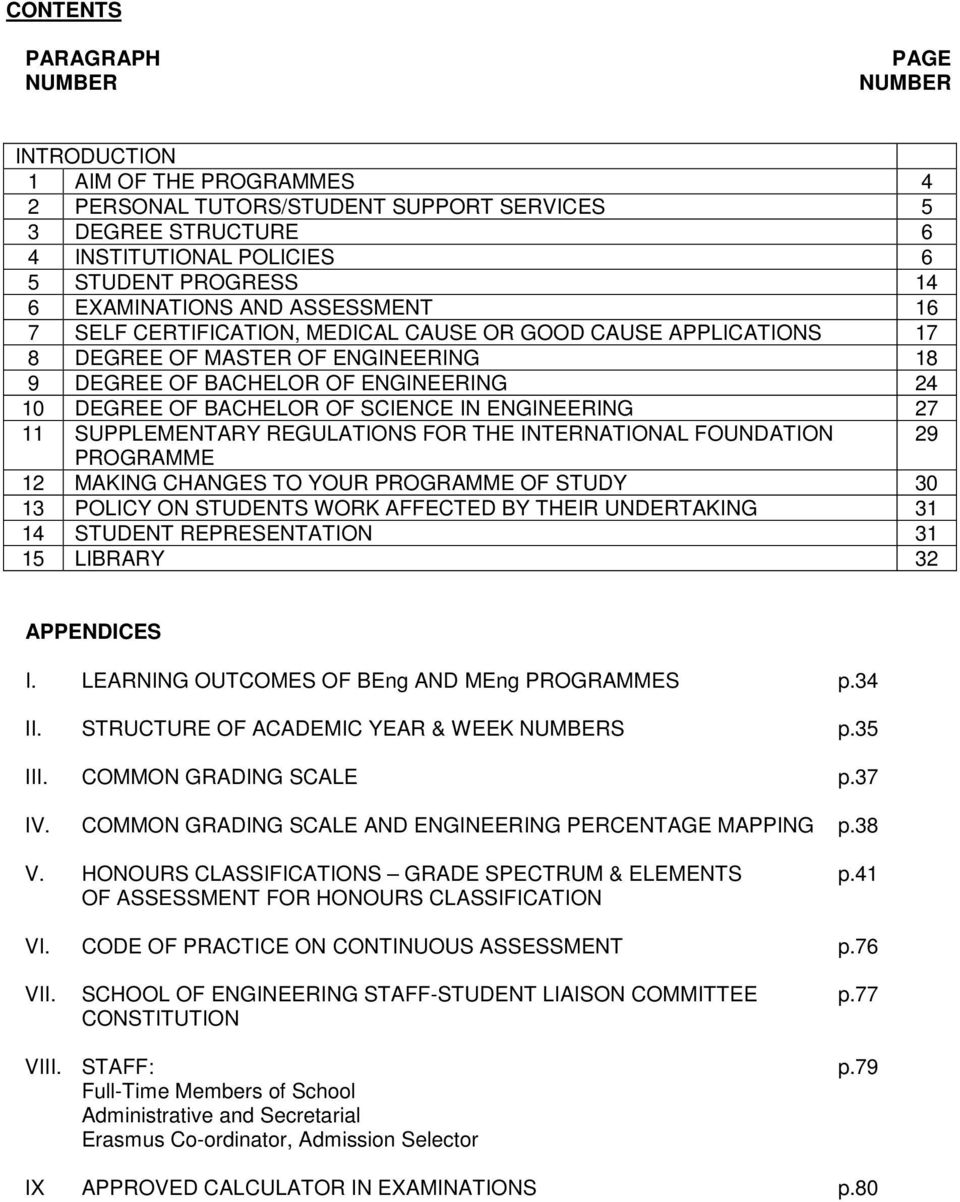
2 CONTENTS PARAGRAPH NUMBER PAGE NUMBER INTRODUCTION 1 AIM OF THE PROGRAMMES 4 2 PERSONAL TUTORS/STUDENT SUPPORT SERVICES 5 3 DEGREE STRUCTURE 6 4 INSTITUTIONAL POLICIES 6 5 STUDENT PROGRESS 14 6 EXAMINATIONS AND ASSESSMENT 16 7 SELF CERTIFICATION, MEDICAL CAUSE OR GOOD CAUSE APPLICATIONS 17 8 DEGREE OF MASTER OF ENGINEERING 18 9 DEGREE OF BACHELOR OF ENGINEERING DEGREE OF BACHELOR OF SCIENCE IN ENGINEERING SUPPLEMENTARY REGULATIONS FOR THE INTERNATIONAL FOUNDATION 29 PROGRAMME 12 MAKING CHANGES TO YOUR PROGRAMME OF STUDY POLICY ON STUDENTS WORK AFFECTED BY THEIR UNDERTAKING STUDENT REPRESENTATION LIBRARY 32 APPENDICES I. LEARNING OUTCOMES OF BEng AND MEng PROGRAMMES p.34 II. STRUCTURE OF ACADEMIC YEAR & WEEK NUMBERS p.35 III. COMMON GRADING SCALE p.37 IV. COMMON GRADING SCALE AND ENGINEERING PERCENTAGE MAPPING p.38 V. HONOURS CLASSIFICATIONS GRADE SPECTRUM & ELEMENTS p.41 OF ASSESSMENT FOR HONOURS CLASSIFICATION VI. CODE OF PRACTICE ON CONTINUOUS ASSESSMENT p.76 VII. SCHOOL OF ENGINEERING STAFF-STUDENT LIAISON COMMITTEE p.77 CONSTITUTION VIII. STAFF: p.79 Full-Time Members of School Administrative and Secretarial Erasmus Co-ordinator, Admission Selector IX APPROVED CALCULATOR IN EXAMINATIONS p.80
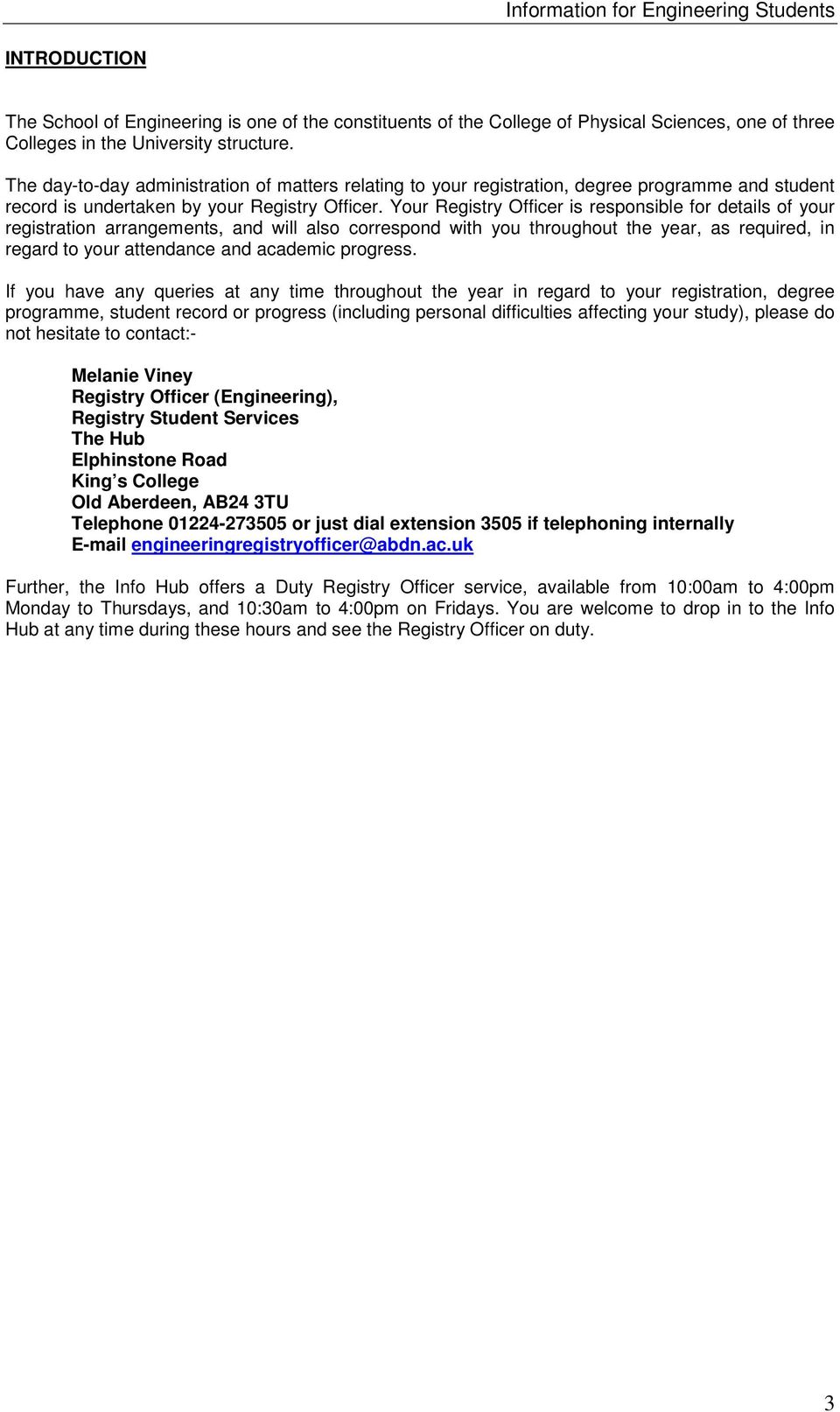
3 INTRODUCTION The School of Engineering is one of the constituents of the College of Physical Sciences, one of three Colleges in the University structure. The day-to-day administration of matters relating to your registration, degree programme and student record is undertaken by your Registry Officer. Your Registry Officer is responsible for details of your registration arrangements, and will also correspond with you throughout the year, as required, in regard to your attendance and academic progress. If you have any queries at any time throughout the year in regard to your registration, degree programme, student record or progress (including personal difficulties affecting your study), please do not hesitate to contact:- Melanie Viney Registry Officer (Engineering), Registry Student Services The Hub Elphinstone Road King s College Old Aberdeen, AB24 3TU Telephone or just dial extension 3505 if telephoning internally [email protected] Further, the Info Hub offers a Duty Registry Officer service, available from 10:00am to 4:00pm Monday to Thursdays, and 10:30am to 4:00pm on Fridays. You are welcome to drop in to the Info Hub at any time during these hours and see the Registry Officer on duty. 3
4 1. AIM OF THE PROGRAMMES The aim of the School of Engineering is to provide a distinctive, high-quality research driven experience for all of our students and to foster in our students reasoning, communication, entrepreneurial and analytical skills that will enable them to adapt to change throughout their lives. The detailed aims and benchmarks of the degrees are laid out in Appendix I. Broadly speaking, the aims and objectives of all our programmes are as follows. Aims To educate students to the highest standards, and encourage in them the enterprise competencies of innovative and independent thinking. Learning Outcomes Students will: Acquire the necessary engineering knowledge, understanding and skills for a successful professional career in industry or research; Acquire the necessary practical and intellectual skills so that they are able to identify and apply relevant quantitative methods and computer software to the analysis of engineering problems, and design and conduct experiments for understanding the performance of engineering systems; Develop transferrable and personal skills so that they are able to work effectively both individually and as part of a group to successfully implement engineering projects and communicate findings to a wide audience; Appreciate and understand the social, health and safety, sustainability and environmental constraints associated with their chosen engineering discipline, as well as the role of engineers in society; Graduate with increased depth of knowledge and understanding of their chosen engineering discipline so that they are able to apply them effectively to the development and implementation of complex engineering projects (MEng); and Develop imaginative, creative, innovative, management and leadership skills so that they are ready soon after graduation to take up a position of technical leadership with full appreciation of commercial and industrial constraints in the development of new technologies (MEng). All the undergraduate Engineering programmes are available on the web at: A Note About Courses Courses taken within the School of Engineering will consist of any combination of lectures, tutorials, and design or laboratory sessions. Attendance is expected at all classes (see Section 6 on Class Certificates for further information). Note that all tutorial questions must be attempted prior to the tutorial rather than during it. The purpose of the tutorial sessions is to discuss any problems you may have had with the work, and for you to be able to ask for feedback on your progress. 4

5 2. PERSONAL TUTORS/STUDENT SUPPORT SERVICES 2.1 Personal Tutors Information for Engineering Students Each student on joining the School will also be allocated a Personal Tutor. Your tutor will meet with you several times throughout each year of study, possibly individually, possibly in groups. The role of the tutor is to provide pastoral support, and to guide you towards others who might be able to help you. The tutor will also work with you in ensuring that you gain as much as you can from your time at the university in terms of achieving graduate attributes, pursuing co-curricular opportunities, reviewing and learning from feedback, exam preparation and considering your career, including providing references. A structured programme is provided, yet students should take a proactive approach in engaging with the opportunities it provides. The Senior Personal Tutor in the School of Engineering is Dr John Cavanagh. If you have significant concerns about the manner in which the Personal Tutor system is progressing for you, please contact him on [email protected]. 2.2 Student Support Services This is the umbrella organisation for various areas: University Counselling Service; University Chaplaincy; Wardennial staff and the Student Advice and Support Office. The latter office has staff including the Student Support Officer, the Disability Adviser, the International Students Adviser, and the Student Support Adviser. Further details about Student Support Services can be found at: Student Learning Service If, at any stage of your academic career, you wish to enhance your study skills effective listening and reading, note taking, assignment/essay writing, presentation skills, exam preparation etc. you can meet with an Academic Skills Adviser to discuss such concerns and develop a plan of action. Further details can be found at: Procedures Relating to Students with Disabilities If you have a disability such as a hearing or visual impairment, dyslexia or any other condition which may affect your studies or your performance in continuously assessed work and in examinations, you should notify the Disability Adviser (tel +44 (0) , [email protected]) at the earliest opportunity. You may also contact the School s Disability Co-ordinator, Dr Srinivas Sriramula, [email protected]. Documentary evidence of any arrangements to support you in your studies and any medical evidence you provide will be filed under confidential cover in Student Support Services. A form indicating the provisions you require will be circulated to the relevant Schools/Departments in which you will be studying but will also be treated confidentially. Students with dyslexia must submit an assessment that has been carried out within the last two years. Assessments can be arranged through Student Support Services. It is University policy to take specific disabilities into account when assessing students performance. The onus is, however, on students to notify the University of such difficulties at the earliest opportunity. Please contact the Disability Adviser in the first instance. If you have a disability and are sponsored by the SAAS or an LEA, you may be eligible for a Disabled Students Allowance. The Allowance is intended to cover extra expenditure incurred because of needs arising from your disability, for example, special equipment. Details of this allowance can be obtained from the Disability Adviser, who will also be glad to answer any other query regarding disabilities and support arrangements. 2.5 Student Accommodation If you wish information or need advice on living in Halls of Residence contact the Accommodation Office by dropping into the Info Hub or via 5

6 3. DEGREE STRUCTURE 3.1 The Academic Year (see Appendix II) Term dates for Academic Year can be accessed at: The academic year is divided into two half-sessions. Most courses are of one half-session s duration and comprise eleven teaching weeks, followed first by a revision week and then by an assessment period. Apart from those courses which are specifically described in the Course Catalogue as yearlong, all courses taught during the first half-session are assessed in December (weeks 22 and 23), courses in the second half-session are assessed in May (weeks 43 to 45). There is a further opportunity of assessment for all non-honours courses (the resit diet ) in July. 3.2 Course Choice and Degree Structure In order to be eligible to graduate, you must earn a minimum number of credits overall, with more detailed requirements at each level (see the Supplementary Regulations for the Degrees in Engineering). You cannot simply choose any courses you like in order to make up your degree. Each degree has a specific programme of study that has been carefully thought out. Degree programmes normally consist of compulsory courses, some choice between set options and some completely free choice. For information on courses available, please consult the Catalogue of Courses which is on the worldwide web at: The University Calendar which contains all degree regulations and the prescriptions for all degrees offered by the University can be accessed on the world-wide web at the web address below INSTITUTIONAL POLICIES Students are asked to make themselves familiar with the information on key institutional policies which have been made available within MyAberdeen: These policies are relevant to all students and will be useful to you throughout your studies. They contain important information and address issues such as what to do if you are absent, how to raise an appeal or a complaint and how seriously the University takes your feedback. These institutional policies should be read in conjunction with this programme and/or course handbook, in which School and College specific policies are detailed. Further information can be found on the University s Infohub webpage or by visiting the Infohub. The information included in the institutional area for 2014/15 includes the following: Absence Academic Appeals & Complaints Common Grading Scale Codes of Practice on Student Discipline (Academic and Non-Academic) Class Certificates Transcripts MyAberdeen TurnitinUK Feedback Framework Communication 6

7 Aberdeen Graduate Attributes The Co-Curriculum 4.1 Absence The University places a high value on the health and wellbeing of all its students. The University is keen to ensure that appropriate arrangements are in place to maximise the welfare of students but also to limit the consequences for students when genuine absences do occur. The University s policy on requiring a medical or self-certificate for absence on medical grounds or other good cause can be found at: You are strongly advised to make yourself fully aware of your responsibilities if absent due to illness or other good cause. In particular, you are asked to note when self-certification of absence is permitted or if you are required to submit a medical certificate. All absences (medical or otherwise) should be reported through MyAberdeen, where you can access a student absence form for completion. MyAberdeen will allow you to upload any required supporting documentation, such as a medical certificate. The University expects that you will normally attend all classes. Some teaching sessions (e.g. tutorials, seminars and laboratories) are compulsory. You are required to attend all examinations that contribute to summative assessment. Please familiarise yourself with the University s absence policy available at: 4.2 Academic Appeals & Complaints staffnet/teaching/aqh/appendix7x5.pdf The University operates a Policy on Academic Appeals and a Complaints Handling Procedure, providing frameworks through which you can formalise any concerns you may have about aspects of your academic or non-academic experience. These processes have been designed to ensure that lodging an appeal or a complaint is accessible and simple and that robust, fair mechanisms exist for their consideration. A major feature of both processes is the emphasis placed on early or informal resolution. You should note that there is an expectation under both processes that you will take responsibility for seeking resolution of any academic or non-academic concerns they may have. You are encouraged to do this by raising and discussing them at the earliest possible stage with the relevant individuals in an academic school or administrative service. Further information on both processes and the steps to take should you wish to pursue an academic appeal or a complaint can be found here: Both policies are also available in the Academic Quality Handbook. 4.3 Common Grading Scale CGS and Classification from September 2014: Undergraduate levels 1-3 The University s Common Grading Scale (CGS) provides a common, alpha-numeric marking scale which is used across the University. This enables students to compare their performance in different disciplines and courses and ensures consistency in assessment. 7

8 Grade Band Descriptor Honours Class Grade Point A1, A2, A3, A4, A5 Excellent First 22, 21, 20, 19, 18 B1, B2, B3 Very Good Upper Second 17,16,15 C1, C2, C3 Good Lower Second 14, 13, 12 D1, D2, D3 Pass Third 11, 10, 9 (pass grade = D3) E1, E2, E3 Marginal Fail Below Third Class 8,7,6 Honours F1, F2, F3 Fail Below Third Class 5,4,3 G1, G2, G3 Fail, Token, or no Submission Honours Below Third Class Honours The Scale comprises 23 discrete Grades grouped into seven Bands with an associated Grade Point for each grade. These Grade Points are used for the purposes of aggregation to (i) determine the overall course mark from a number of components (e.g. end of course exam and essay mark) and (ii) determine overall honours degree classification. Each band has associated Descriptors; in looking at the Grade received, students should refer to these descriptors to help them understand their Grade. 2,1,0 The Common Grading Scale in full, with associated detailed descriptors, is available at: NB: For students in level 2 and above, their student record and transcript will reflect both the CAS marks and CGS grades that they have received. There will be an explanatory note on transcripts regarding the change from CAS marks to CGS grades. Honours Classification Honours degree classification is determined by the calculation of an aggregate Grade Point Average (GPA). The GPA and hence the honours degree classification that should be awarded is determined by aggregating the Grade Points for each course taking account of the relative course weightings in terms of both credit and level of study. Only level 3 and above courses will count towards honours classification. Details of the GPA bands associated with each honours degree classification are provided below: Grade Point Average Degree Classification First Class greater than 17.0, less than 18.0 Borderline First / Upper Second Class Upper Second Class greater than 14.0, less than 15.0 Borderline Upper Second / Lower Second Class Lower Second Class greater than 11.0, less than 12.0 Borderline Lower Second / Third Class Third Class greater than 8.0, less than 9.0 Borderline Third Class / Fail Fail Where the overall GPA for the award falls within a borderline zone, Examiners will examine the overall Grade Profile, unrounded GPA and, if applicable, any mitigating circumstances that may have impaired a student s performance in order to determine final classification. For further details please see: Resit examinations Students who fail, or who fail to attend or complete, a course for whatever reason and who wish to be awarded credit for the relevant course will be required to resit. In order to be eligible to take a resit examination, a candidate must hold a valid class certificate. The validity of a class certificate is limited to the academic year in which it is awarded and to the academic 8

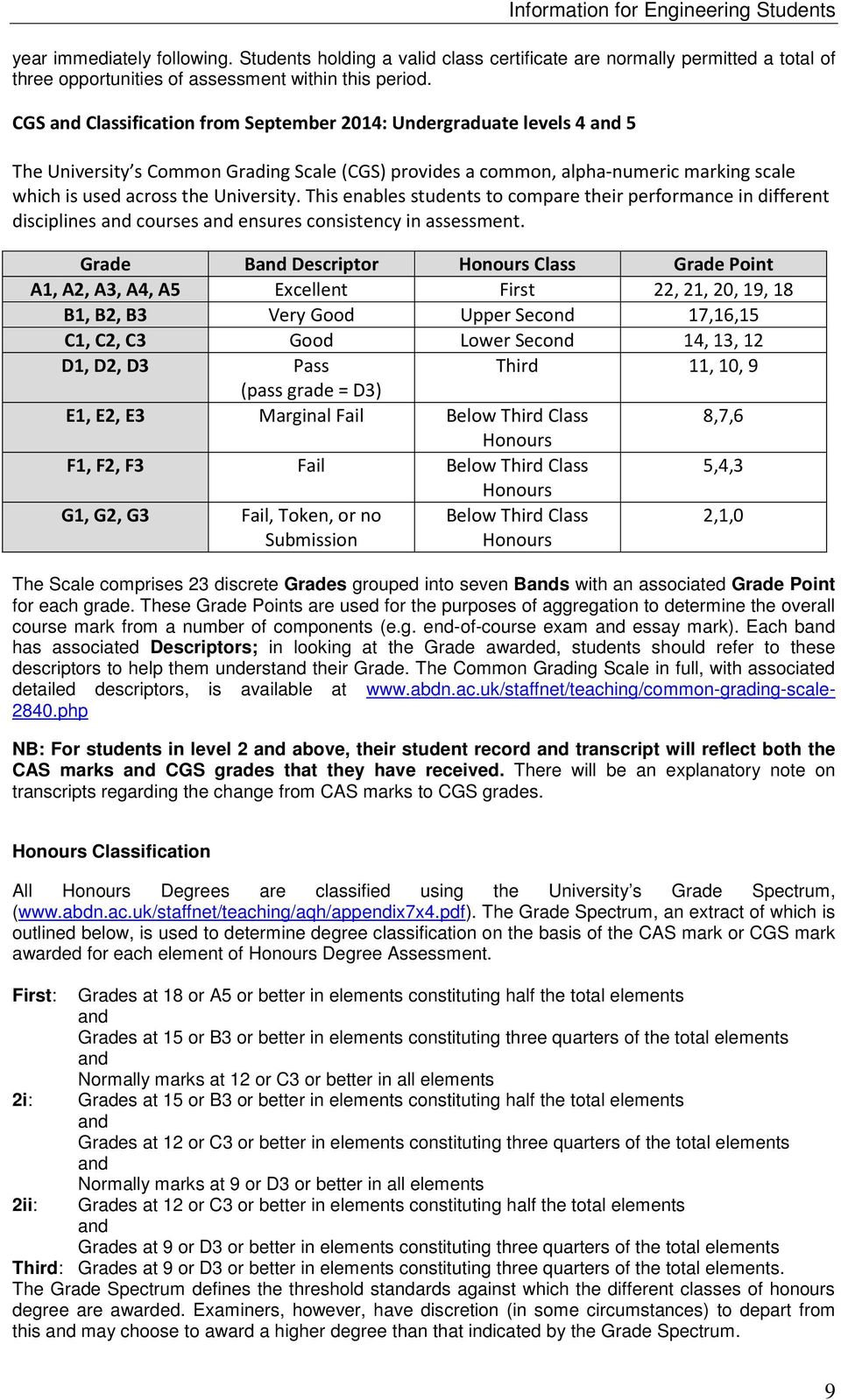
9 year immediately following. Students holding a valid class certificate are normally permitted a total of three opportunities of assessment within this period. CGS and Classification from September 2014: Undergraduate levels 4 and 5 The University s Common Grading Scale (CGS) provides a common, alpha-numeric marking scale which is used across the University. This enables students to compare their performance in different disciplines and courses and ensures consistency in assessment. Grade Band Descriptor Honours Class Grade Point A1, A2, A3, A4, A5 Excellent First 22, 21, 20, 19, 18 B1, B2, B3 Very Good Upper Second 17,16,15 C1, C2, C3 Good Lower Second 14, 13, 12 D1, D2, D3 Pass Third 11, 10, 9 (pass grade = D3) E1, E2, E3 Marginal Fail Below Third Class 8,7,6 Honours F1, F2, F3 Fail Below Third Class 5,4,3 G1, G2, G3 Fail, Token, or no Submission Honours Below Third Class Honours The Scale comprises 23 discrete Grades grouped into seven Bands with an associated Grade Point for each grade. These Grade Points are used for the purposes of aggregation to determine the overall course mark from a number of components (e.g. end-of-course exam and essay mark). Each band has associated Descriptors; in looking at the Grade awarded, students should refer to these descriptors to help them understand their Grade. The Common Grading Scale in full, with associated detailed descriptors, is available at php NB: For students in level 2 and above, their student record and transcript will reflect both the CAS marks and CGS grades that they have received. There will be an explanatory note on transcripts regarding the change from CAS marks to CGS grades. 2,1,0 Honours Classification All Honours Degrees are classified using the University s Grade Spectrum, ( The Grade Spectrum, an extract of which is outlined below, is used to determine degree classification on the basis of the CAS mark or CGS mark awarded for each element of Honours Degree Assessment. First: Grades at 18 or A5 or better in elements constituting half the total elements and Grades at 15 or B3 or better in elements constituting three quarters of the total elements and Normally marks at 12 or C3 or better in all elements 2i: Grades at 15 or B3 or better in elements constituting half the total elements and Grades at 12 or C3 or better in elements constituting three quarters of the total elements and 2ii: Normally marks at 9 or D3 or better in all elements Grades at 12 or C3 or better in elements constituting half the total elements and Grades at 9 or D3 or better in elements constituting three quarters of the total elements Third: Grades at 9 or D3 or better in elements constituting three quarters of the total elements. The Grade Spectrum defines the threshold standards against which the different classes of honours degree are awarded. Examiners, however, have discretion (in some circumstances) to depart from this and may choose to award a higher degree than that indicated by the Grade Spectrum. 9
10 Further information is available from: Resits Students who fail, or who fail to attend or complete, a course for whatever reason and who wish to be awarded credit for the relevant course will be required to resit. In order to be eligible to take a resit examination, a candidate must hold a valid class certificate. The validity of a class certificate is limited to the academic year in which it is awarded and to the academic year immediately following. Students holding a valid class certificate are normally permitted a total of three opportunities of assessment within this period. For candidates in the final year of an Honours programme, there are three categories of exception: Candidates who achieve a Grade of E1, E2 or E3 in courses at level 4 or above taken as part of an Honours programme may be eligible for the award of compensatory level 1 credit to a maximum of 30 credit points. Such compensatory credit can only be awarded where the candidate has already achieved 90 Credit points at level 4 including passes in compulsory courses. A pass at the first attempt in certain courses may be stipulated as a requirement for achieving the award in question. Candidates who fail such a compulsory course will not be eligible to resit the course and would not be eligible to receive the Honours degree concerned. Where a candidate has achieved a Grade of F1 or below in a course at level 4 or above, they may elect, subject to having achieved 90 credit points at level 4, to take an alternative course or courses of the same credit value at a lower level to make up their credit shortfall rather than resitting the failed course(s). 4.4 Codes of Practice on Student Discipline (Academic and Non-Academic) Code of Practice on Student Discipline (Non-Academic) The University operates two codes of practice on student discipline, which set out the procedures to be followed in the case of disciplinary offences by students. These may be Academic or Non- Academic and are defined as such. Disciplinary offences are defined in academic and non-academic terms. Non-academic offences include, for instance, damaging University property. The University s Code of Practice on Student Discipline (Non-Academic) can be found at: Code of Practice on Student Discipline (Academic) Academic offences include, for instance, plagiarism. The definition of Plagiarism is the use, without adequate acknowledgement, of the intellectual work of another person in work submitted for assessment. A student cannot be found to have committed plagiarism where it can be shown that the student has taken all reasonable care to avoid representing the work of others as his or her own. The University s Code of Practice on Student Discipline (Academic) which covers issues including plagiarism can be found at: 10

11 4.5 Class Certificates If you attend and complete the work required for a course, you will be considered to have been awarded a Class Certificate. Being in possession of a valid Class Certificate for a course entitles you to sit the examination(s) for that course. Class certificates are valid for two years and usually permit a total of three attempts at the required assessment within the two year period i.e. the first attempt plus up to two resit examinations. Through non-attendance or a failure to submit coursework, it is possible to lose your class certificate and therefore, your right to sit an exam. You may hear this referred to as a C7. Your programme/course handbook(s) will provide further information on the attendance requirements for your programme/course. 4.6 Transcripts at Graduation Students who commenced their studies in, or after, 2009/10, will receive a more detailed transcript of their studies on graduation. The increased details will include a record of all examination results attained. For students graduating after 2012/13, transcripts will show details of all CAS marks awarded, including marks which are fails. Where a resit examination has been required as a result of medical circumstances or other good cause (MC/GC) this will not be shown, but all other circumstances (i.e. No Paper NP ) will be included. For students graduating after 2013/14, transcripts will show details of all CAS marks and CGS grades awarded, including those which are fails. There will also be an explanatory note regarding the change from CAS marks to CGS grades. Students graduating from July 2014 will receive a transcript which will include recognition of certain co-curricular activities. The University recognises student activities outside the academic curriculum which broaden knowledge, enhance career development learning and contribute to the University community. All activities enable students to develop Aberdeen Graduate Attributes. Co-curricular student roles or achievements that the University verifies and records on the transcript include: Accredited or assessed performance in non-academic contexts, e.g. the STAR (Students Taking Active Roles) Award, University of Aberdeen Internship. Other activities not formally accredited or assessed by the University, e.g. Students Association roles, Class Representatives. Institutional prizes and awards in academic and non-academic contexts. 4.7 MyAberdeen MyAberdeen is the University of Aberdeen s Virtual Learning Environment. This is where you will find learning materials and resources associated with the courses you are studying. MyAberdeen also provides direct access to TurnitinUK, an originality checking service, through which you may be asked to submit completed assignments. You can log in to MyAberdeen by going to and entering your University username and password (which you use to access the University network). Further information on MyAberdeen including Quick Guides, Video Tutorials, Frequently Asked Questions (FAQs), along with information about TurnitinUK, can be found in the Help tab of MyAberdeen: 11

12 Information about academic writing and how to avoid plagiarism can be found at: TurnitinUK TurnitinUK is an online service which compares student assignments with online sources including web pages, databases of reference material, and content previously submitted by other users across the UK. The software makes no decision as to whether plagiarism has occurred; it is simply a tool which highlights sections of text that have been found in other sources thereby helping academic staff decide whether plagiarism has occurred. For most courses, TurnitinUK is accessed directly through MyAberdeen. Advice about avoiding plagiarism, the University s Definition of Plagiarism, a Checklist for Students, Referencing and Citing guidance, and instructions for TurnitinUK, can be found in the following area of the Student Learning Service website: 4.9 Feedback Framework Feedback on Assessment The University acknowledges that feedback on pieces of work is important and valuable to you and that it must be clear, full and helpful. FAQs, guidance and resources about feedback can be found on the University s Enhancing Feedback website at: In acknowledging that effective feedback is crucial to improving student performance and to sustaining student morale, the University has developed a Feedback Framework detailing what you can expect from the University in terms of feedback. The University has also developed a website for students on feedback. Feedback and You The University also recognises the importance of enabling you to voice views on your learning experience through channels such as Student Course Evaluation Forms (SCEFs) and Class Representatives. The You Said, We Did tab in MyAberdeen provides an area for the University to respond to the feedback received from you, and to outline the actions taken by the University in response to this feedback. A key forum for student feedback is the Staff-Student Liaison Committee (SSLC). SSLCs meet at least once each half-session and aim to consider any issues arising from the previous half-session s Student Course Evaluation Form Exercise, SCEF and annual course review. Your route to provide feedback to the SSLC is via the Class representative for your course or programme or level of study. You can access the minutes of the SSLC meetings for your School(s) through the SSLC minutes tab in MyAberdeen. 12

13 4.10 Communication You will receive a University account when you register with the University. The University will use to communicate with you during term-time. It is your responsibility to check your on a regular (at least weekly) basis and to tidy the contents of your inbox. You should note that failure to check your or failure to receive an due to being over quota or due to non-delivery of an forwarded to a non-university account will not be accepted as grounds for appeal Aberdeen Graduate Attributes Graduate Attributes are a wide-ranging set of qualities which you will develop during your time at Aberdeen in preparation for employment, further study and citizenship. There are four main areas of the Graduate Attributes: Academic excellence Critical thinking and communication Learning and personal development Active citizenship You will have many opportunities to develop and achieve these attributes. These include learning experiences on credit-bearing courses and co-curricular activities such as work placements, study abroad and volunteering. In accordance with the University s commitment to Equality and Diversity, you can request support with any aspect of the Graduate Attributes framework. The ACHIEVE website offers resources to enable you to assess and reflect upon your present skills and development needs. The website also contains resources to help you to improve your skills and links to a range of University services such as the Careers Service and the Student Learning Service The Co-Curriculum The co-curriculum provides opportunities for students to enhance their employability and develop and achieve Aberdeen Graduate Attributes. Co-curricular activities include: work placements, study abroad, enterprise and entrepreneurship activities, volunteering, the BP Student Tutoring Scheme, career mentoring and the STAR (Students Taking Active Roles) Award initiative. A range of approved co-curricular activities are now included on the University s graduate transcript. Co-curricular recognition via the transcript is intended to help students demonstrate their wider University learning and achievements to employers and postgraduate recruiters. A number of co-curricular activities are credit-bearing, namely: Erasmus: An exchange programme funded by the European Commission which enables students to study or work in another European country as part of their degree programme. Students receive a grant to help with extra costs while abroad and a number of our partner institutions teach through English. The University also has opportunities for students to study in a non-european country as part of their degree through the International Exchange Programme. International partners include universities and colleges in North America, Hong Kong and Japan. The University aims to ensure full academic recognition for study periods abroad, therefore the credits gained from study abroad count towards the Aberdeen degree programme for students participating in both Erasmus and the International Exchange Programme. Work placements: These can form an integral part of a degree programme and attract academic credit. Placements are available locally, nationally and internationally, lasting from a few weeks to a full year and are generally paid. Visit the Careers Service website for further placement information and to find available work placements. 13

14 5 STUDENT PROGRESS 5.1 Monitoring Students Progress The University operates a system for monitoring students progress to identify students who may be experiencing difficulties in a particular course and who may be at risk of losing their class certificate. Set criteria are used to determine when a student should be reported via the monitoring system. You will be reported through the monitoring system: either (i) if you are absent from two tutorials or other small group sessions (such as labs) without good cause being reported; or (ii) if you fail to submit a piece of summative (e.g. class test) or a substantial piece of formative (e.g. essay, presentation) in-course assessment by the stated deadline. If the School has concerns about your attendance and/or performance, the Registry will be informed and you will be issued with a C6. The Registry will then you to ask you to contact the School in the first instance. If you fail to respond within the prescribed timescale (as set out in the ), your Class Certificate(s) for the course(s) concerned will be refused (this shows as a C7 in your Student Portal). This means that you have been formally withdrawn from this/these course(s). You will no longer have access to the course materials available through MyAberdeen and will not be eligible for the degree examinations or assessments (including resit examinations and reassessments) for the course(s) concerned. As a result you may have to re-take the whole course(s) in the next academic year, if it is permitted. If you wish to discuss your situation and try to have the refusal overturned, you should contact the Head of School, via the School Office, as soon as possible and no later than 8 days from the date of the you receive. Unless your class certificate is reinstated on to the course by the Head of School you will not receive marks for the assessment or credit points for completing the course. 5.2 Degree Examinations (i) (ii) The degree examination is the concluding examination of most law courses (for Honours see below). It is a Pass in this examination which normally certifies that a student has successfully completed a course and that its credit point value may now be counted towards the total number of credit points required for the award of the degree. For credit accumulation and values see Supplementary Regulations 2 and 3 for the Degrees in Law (as printed in the University Calendar). For each degree examination there are internal examiners and an external examiner. The internal examiners are the lecturers who have taught the course, and the external examiner is an expert in the subject from outside the University, either an academic or someone in legal practice. The role of the external examiner is to ensure that standards of marking are fair, and in particular, to adjudicate on borderline or difficult cases. In order to obtain a Pass in a degree examination a student has to obtain at least a mark of D3 on the Common Grading Scale. The mark is the numerical expression of an assessment, not a mathematically derived figure. Consequently, the final assessment of a paper is not a simple average of marks of the separate questions, but an assessment of that paper as a whole, that decision being taken by the external and internal examiners. Students who fail to attend without good cause (see section 7) will automatically be awarded a result of No Paper. For the marking scales and Guidance Note see Appendix III. (iii) Merit certificates will be awarded to those who achieve a high standard in the appropriate assessment in non-honours courses. A First Class Merit Certificate will be awarded to those obtaining an A Grade on the Common Grading Scale (see Appendix III), and a Second Class Merit Certificate to those obtaining a B Grade. Merit Certificates are not physically issued, but are noted on a student s academic transcript, available from the University Registry upon completion of their studies. Class Prizes are awarded in many subjects; details can be found in the University Calendar. 14
15 (iv) (v) (vi) (vii) If a student fails to secure a Pass in the first degree examination in a particular non-honours course, whether that degree examination took place in December or May, there is an opportunity to re-sit the examination in June/July. Students must register for resits with the University Registry. A resit fee is payable unless the reason for failure is recorded as Good Cause or Medical Certificate. University policy is that all class and degree exam marks are to be disclosed to students. In the case of level 4 courses taking place in the first half-session, the mark disclosed may be provisional and subject to alteration by the external examiners at the end of the academic year. Marks are made available on Student Portals ( as they are not confirmed by Schools/Departments and are not obtainable from Course Coordinators or Personal Tutors. University policy is that all class and degree exam course marks are to be disclosed to students. In the case of level 4 and 5 courses taking place in the first half-session, the mark disclosed may be provisional and subject to alteration by the external examiners at the end of the academic year. Course marks are made available on Student Portals ( as they are confirmed by Schools/Departments and are not obtainable from Course Co-ordinators or Personal Tutors. Assessment marks however, in line with the University s policy on feedback, will be communicated to you via MyAberdeen or from the School. Passes in degree examinations and their credit points are important in determining whether a student will be permitted to proceed to the next year of the degree programme. The Supplementary Regulations for the Degrees in Engineering provide that a student must obtain at least 105 credit points (120 credit points for the Master of Engineering degree) in order to proceed from programme year 1 to programme year 2 and 240 credit points to proceed from programme year 2 to 3. A student needs 240 credit points including all compulsory courses at the end of year 2 for entry to Honours. General Regulation 17.1 requires that students must achieve: (a) (b) (c) a total of 120 credit points within 4 half sessions of full-time study or the equivalent from their first entry to programme year 1 of the degree for which they are currently registered; 240 credit points within 4 half sessions of full-time study or the equivalent from their first entry to programme year 2 of the degree for which they are currently registered, and the non-honours requirements within 4 half sessions or their equivalent from their first entry to programme year 3 of the degree for which they are currently registered. 5.3 Premature Termination of Studies (i) (ii) The third stage at which progress and performance is monitored is designed to permit the termination of studies of extremely unsatisfactory students at any stage before the completion of the academic year. Regulation 18 of the General Regulations for First Degrees gives the Senatus Academicus power, to terminate, during the session, the studies of candidates who persistently fail to attend, or perform the required work of, the course for which they are registered. This regulation is aimed primarily at the student who, having matriculated and registered for classes, is not prepared to attend classes or perform the other required work of the class. The studies of such a student may be terminated at any time during the course of the session. It must be stressed that this rarely exercised power is not intended to operate in the case of a student who is genuinely attempting to perform the work of the class, but is experiencing difficulty in coping with it. 15

16 6. EXAMINATIONS AND ASSESSMENTS 6.1 Entry for Examinations If you are registered for, and attending, a course for the first time, you will automatically be entered for your first attempt at the degree exam there is no need for you to take any further action in that respect. If, however, you have to re-sit an exam either at a second diet of examinations in the same session, or at a diet in a later session you have formally to enter for that exam, by filling in a form and paying the appropriate exam fee. If you withdraw from your studies, and decided to sit exams as an external candidate, you have again to register for those exams, and pay the appropriate fees which include a registration fee. Information on resit examinations, and procedures for applying are available through the Info Hub. 6.2 Attention is drawn in particular to the following rules for the conduct of examinations: Candidates will not be admitted to an examination hall after the examination has been in progress for thirty minutes. Candidates will not be permitted to leave during the first thirty minutes and the last thirty minutes of their examination. (i) (ii) Candidates must bring their student identity cards to the examination. Candidates may not take any materials into an examination hall unless it has previously been advertised by the School/Department and it is stated in the rubric to the question paper that such material may be used. 6.3 Cheating and Plagiarism The rules approved by the University for the conduct of examinations are set out in a separate document entitled Rules for the Conduct of Written Examinations for Degrees and Diplomas which can be found at: Where there is reason to believe that cheating in a prescribed degree assessment has occurred this will be dealt with in accordance with the Code of Practice on Student Discipline, which can be found at: The Senate approved definition of Plagiarism is the use, without adequate acknowledgement, of the intellectual work of another person in work submitted for assessment. A student cannot be found to have committed plagiarism where it can be shown that the student has taken all reasonable care to avoid representing the work of others as his or her own. 6.4 Examination Results Examination results are made available on Student Portals as they are confirmed by Schools/Departments ( They are not available from Course Coordinators, Office Staff or Personal Tutors before then. 16

17 7 SELF CERTIFICATION, MEDICAL CAUSE OR GOOD CAUSE APPLICATIONS The School s policy is that examinations are marked by the Internal Examiner without reference to Medical Certificates or extenuating circumstances. Once the marking process is complete, such matters are considered and decisions made to allow Medical Cause (MC) or Good Cause (GC) as appropriate. Where an MC or GC is permitted the student is allowed a further opportunity to take the assessment. In the case where the retaken assessment is at Honours level, it will be considered as a first attempt. In all instances at every level, such occurrences may affect student progression and graduation. School approval of such circumstances will only result in marks being set aside altogether with Good Cause or Medical Cause. If candidates believe that illness and/or other personal circumstances may have affected their performance in an examination, or they have been unable to attend an examination, they must submit details through MyAberdeen Absence Reporting on the day of the exam and certainly no later than three days following the date of which they were expected to appear for the exam concerned. This is as per the University s Policy and Procedure of Student Absence ( and the University s Aberdeen Assessment and Examination Policies and Practices: Taught Courses and Programmes ( section ) Please note that, subject to the advice below, the three day time limit will be strictly applied. Examination rules are available on the University s website at: In order to comply with this policy, you are advised of the following procedure: 7.1 Self Certification, Medical Circumstances or Good Cause For Students and Courses at Levels 1 and 2: If illness, injury, or any other condition prevents you from sitting an examination or, having taken the exam, you consider that it may have detrimentally affected your performance, you must: i) Complete the relevant aspects of the Absence Form in MyAberdeen ( ii) Immediately prior to or following the exam concerned, advise the School Office and the relevant course coordinator(s) that an application will be forthcoming. The time limit will be strictly applied and will be waived only if a student is able to demonstrate that, as a direct consequence of the nature of their condition, it was not reasonably practicable for them to submit the required documentation within three days. Your should be copied to the appropriate School Secretary (Level 1 students; Avril Rossiter, Level 2 students, Amanda Rae) and sent to [email protected]. You should be aware that if you fail to follow this procedure, there is a risk that the relevant circumstances may not be taken into account. 7.2 For Students and Courses at Levels 3, 4 and 5: If illness, injury, or any other condition prevents you from sitting an examination or, having taken the exam, you consider that it may have detrimentally affected your performance, you must: i) Complete the relevant aspects of the Absence Form in MyAberdeen ( and ensure you attach evidence of your circumstances. If you do not have evidence within three days of your exam, please input the form and indicate evidence is forthcoming. Please note that your application will not be processed without the evidence. ii) Immediately prior to or following the exam concerned, you advise the School Office and the relevant course coordinator(s) that an application will be forthcoming. 17

18 The time limit will be strictly applied and will be waived only if a student is able to demonstrate that, as a direct consequence of the nature of their condition, it was not reasonably practicable for them to submit the required documentation within three days. Your should be sent to [email protected]. You should be aware that if you fail to follow this procedure, there is a risk that the relevant circumstances may not be taken into account. If you require any further advice, please do not hesitate to contact the School Office or Registry Officer for the School of Engineering for information. You are strongly advised to make yourself fully aware of your responsibilities if absent due to illness or other good cause. 8. DEGREE OF MASTER OF ENGINEERING RESOLUTION The degree of Master of Engineering (MEng) is conferred in accordance with Resolution No. 183 of 1995, which was approved by the University Court and came into force on 12 December REGULATIONS 1. The Degree of Master of Engineering (MEng) may be conferred as a first degree but only following the completion of an Honours programme. The examiners may recommend that a candidate who has failed to achieve the standard for the award of the Degree with Honours be awarded the Degree of Bachelor of Engineering, or the Degree of Bachelor of Science in Engineering, in accordance with the Supplementary Regulations governing those degrees. 2. Studies for the MEng are organised in five programme years. A full-time student carries out the studies of each programme year within one session. In each programme year the minimum curriculum which must be studied amounts to 120 credit points. Programme years one and two may be undertaken by part-time study, in which case the studies of each of those programme years would normally be spread over two sessions. 3. The courses for the degree are those contained in the Programme Prescription annexed to these regulations; only passes in those courses are recognised for the purpose of these regulations and the award of the degree. Passes obtained under previous versions of the Programme Prescriptions will continue to be valid. 4. All candidates who are admitted to the degree or to the Honours programme must be registered for one of the following degree programmes: Engineering Chemical Engineering Civil and Environmental Engineering Civil and Structural Engineering Civil Engineering Civil Engineering with Management Civil Engineering with Subsea Technologies Electrical and Electronic Engineering Electrical and Electronic Engineering with European Studies Mechanical and Electrical Engineering Mechanical Engineering Mechanical Engineering with European Studies Mechanical Engineering with Management Mechanical Engineering with Subsea Technologies Petroleum Engineering The requirements of the individual degree programmes are set out in the Programme Prescriptions. The Professional Engineering Institutions, in accrediting the degree programme for registration and membership purposes, have accepted the degree programmes as indicated in the Programme Prescriptions. 18

19 5. The Honours programme of the degree comprises programme years 3, 4 and In the case of exemption being granted by the Senatus Academicus, where a candidate is seeking study abroad, the period of study at the University of Aberdeen must be at least four sessions full-time, or the equivalent if part-time study is involved. Study abroad may only be undertaken on presentation of a curriculum of study approved by the Admissions Selector. In the case of candidates who do not follow and achieve the approved curriculum, they will be required to repeat their programme year. 6.2 In the case of exemption being granted by the Senatus Academicus, where a candidate is permitted to enter the programme at the beginning of Level 2, the minimum period of study must be not less than four full-time sessions, or the part-time equivalent. 6.3 In the case of exemption being granted by the Senatus Academicus, where a candidate is permitted to enter the programme at the beginning of Level 3, the minimum period of study must be not less than three full-time sessions, or the part-time equivalent. 6.4 In cases where the Senatus Academicus has approved arrangements made with other specific institutions for Honours projects abroad, candidates may attend courses taken at one of these institutions and these courses may be regarded as part of the Honours programmes. Such courses may not contribute more than one half session of the Honours programme. Such courses may NOT be taken at level 1 for any candidate. Such courses may not be taken at level 2 for any candidate entering the programme at the beginning of level Credit points awarded as part of studies in programme years 1, 2, 3 and 4 of the BEng degree at the University of Aberdeen may be recognised for the purposes of the MEng degree. 8.1 In terms of General Regulation for First Degrees 16.1, except with the permission of the Senatus Academicus, candidates may not progress from programme year 1 to programme year 2 unless they have accumulated by award or recognition, at least 120 credit points, and passed all courses prescribed for their particular degree programme. 8.2 In terms of General Regulations for First Degrees 16.1 and 16.4, except with the permission of the Senatus Academicus, candidates may not proceed to the Honours programme unless they have accumulated by award or recognition, at least 240 credit points and passed all courses prescribed for their particular degree programme. 8.3 In terms of General Regulations for First Degrees 16.3, candidates who do not satisfy the progression requirements in 8.1 or 8.2 above, and who wish to continue study, will normally be required by the Senatus Academicus to transfer to the appropriate programme year of either the Degree of Bachelor of Engineering (BEng) or the Degree of Bachelor of Science in Engineering (BSc Eng), in accordance with the Supplementary Regulations which govern those degrees. 9.1 In terms of General Regulations for First Degrees 16.1(f) and 16.4, except with the permission of the Senatus Academicus, candidates may not progress from programme year 3 to programme year 4 unless they have accumulated by award of recognition, at least 360 credit points from courses attended and passed all courses prescribed for their particular degree programme. (i) Candidates who have achieved the required credit points but not reached the required standard of performance, but who are given the permission of the Senatus Academicus to progress from programme year 3 to programme year 4, will do so provisionally, and the situation will be reviewed following receipt of results for the first half session. 9.2 In terms of General Regulations for First Degrees 16.1(f) and 16.4, except with the permission of the Senatus Academicus, candidates may not progress from programme year 4 to programme year 5 unless they have accumulated by award of recognition, at least 480 credit points and passed all courses prescribed for their particular degree programme. 19
20 9.3 Every candidate for the Degree of Master of Engineering first enrolled in or after Academic year must obtain a minimum of 600 credit points, including 120 at Level 5, and including passes at first attempt in Individual Project or Individual Project Abroad, and all required courses as stipulated by Annex A. 9.4 The situation of students who are in programme year 3 will be reviewed following receipt of the results for the second half-session. The situation of students who are in programme year 4 will be reviewed following receipt of the results for the first and second half-session. Those students deemed by the Head of Engineering not to have reached a sufficiently high level of performance may be required to transfer to the Degree of Bachelor of Engineering or the Degree of Bachelor of Science in Engineering. The level of performance which will be expected by the Head of Engineering will be made publicly available to students in the School of Engineering Undergraduate Student Handbook. 10. In determining the award of the degree, the examiners will take into account the candidate s performance in the first opportunity for the degree assessment for courses in Programme Years 3, 4 and 5, unless General Regulation 21 (a) applies. In addition, consideration may be given to the performance in such other tests and assessment of a candidate s previous work as the examiners, with the approval of the Senatus Academicus, may from time to time require. 11. In terms of General Regulations for First Degrees 21(a), MEng candidates who fail to complete satisfactorily an element of Honours degree assessment would not normally be awarded compensatory credit, as per the requirements of Supplementary Regulation Certain variants of the Master of Engineering programmes require students to pass specified compulsory course elements, as stipulated in Annex A. ANNEX A Candidates who are admitted directly into Programme Year 2 will be given exemption or recognition for all or most of the courses in Programme Year 1. Candidates who have not been given exemption or recognition will be required to register for the course(s) that they are missing. Candidates who are admitted directly into Programme Year 3 will be given exemption or recognition for all or most of the courses in Programme Years 1 & 2. Candidates who have not been given exemption or recognition will be required to register for the course(s) that they are missing. ACCREDITATION REQUIREMENTS OF SPECIALISED DEGREE PROGRAMMES Students registered for specialised programmes must pass the compulsory courses at Level 4 and Level 5 as specified below and in the programme prescription to be awarded the Degree. Failure to pass the specified courses, as per Regulation 13, will result in an inability to graduate from the specified programme. Degree of Master of Engineering in Chemical Engineering EG 40HA Chemical Reaction Engineering EG 40HC Process Control EG 5565 MEng Group Design Degree of Master of Engineering in Civil and Structural Engineering EG 40JG Advanced Structural Design EG 40JH Advanced Structural Analysis Degree of Master of Engineering in Civil and Structural Engineering with European Studies EG 40JG Advanced Structural Design EG 40JH Advanced Structural Analysis Degree of Master of Engineering in Civil and Environmental Engineering EG 40JI Environmental Engineering 20

21 Degree of Master of Engineering in Civil and Environmental Engineering with European Studies EG 40JI Environmental Engineering Degree of Master of Engineering in Electronic Engineering with Communications EG 40GD Communications Engineering 2 Degree of Master of Engineering in Electronic and Computer Engineering EG 40GA Computer and Software Engineering Degree of Master of Engineering in Mechanical and Electrical Engineering EG 40FD Electrical Machines and Drives Degree of Master of Engineering in Mechanical Engineering with Materials EG 40JL Advanced Engineering Materials REQUIREMENTS OF INDIVIDUAL DEGREE PROGRAMMES In addition to the above there are further requirements for individual degree programmes which affect only the Honours Programme. These are set out in the programme prescriptions. The information in the programme prescriptions also shows for each degree programme the engineering institution(s) that accredit the particular programme. Students successfully completing a programme thus accredited and awarded class II (ii) or better will meet the educational requirements of chartered engineer status obtained through the institution named. The accrediting institutions listed are as follows: ICE refers to the Institution of Civil Engineers IChemE refers to the Institution of Chemical Engineers IET refers to the Institution of Engineering and Technology IHE refers to the Institute of Highway Engineers (IHE) IMechE refers to the Institution of Mechanical Engineers IStructE refers to the Institution of Structural Engineers CIHT refers to the Chartered Institution of Highways & Transportation EI refers to the Energy Institute 21
22 REQUIREMENTS FOR PROGRESSION ON THE MENG The Master of Engineering degrees are what is called an Integrated Masters degree programme. The MEng programmes are very prestigious and competitive, and students are required to attain a certain standard in order to remain on these degrees. The standards required are implemented at third and fourth year level and are outlines below. MENG LEVEL 3 PROGRESSION REQUIREMENTS Scenario Credit Point Total Achieved Courses A Aggregates at CGS C3 or above B Aggregate at CGS C3 or above 1 Aggregate at CGS D1 or above C Aggregate at CGS B3 or above 1 Aggregate at CGS D2-D3 D aggregate at CGS C3 or above 1 Aggregate at CGS D2 or less Academic Performance at first attempt All courses passed One or more fails, no more than three One or more fails, no more than three All courses passed at first attempt Progression Outcome Progress to Level 4 of the MEng. Progress to Level 4 of the MEng. Required to achieve at least C3 in the three 10 credit point Engineering courses in first half session, with a maximum of 3 fails at first attempt in Level 3 and Level 4. Progress to Level 4 of the MEng. Required to achieve at least C3 in the three 10 credit point Engineering courses in first half session, with a maximum of 3 fails at first attempt in Level 3 and Level 4. Progress to Level 4 on the BEng. E 359 or less n/a n/a Repeat Level 3 on the BScEng degree or take a year out 22
23 MEng Level 4 Progression Requirements Your progression requirements for Level 4 depend on the scenario you were in at the end of your third year, as per the table on the previous page. Please refer to that table, get your alphanumeric scenario, then apply that to the below table for the requirements you need to meet to remain on the MEng after the December exam results. Scenario From Level 3 on previous table Credit Point Total Achieved Courses A 405+ D1 or above in the three 10 credit point Engineering courses in first half session B 405+ C3 or above in the three 10 credit point Engineering courses in first half session C 405+ C3 or above in the three 10 credit point Engineering courses in first half session Academic Performance at first attempt Maximum of 1 fail in Level 4 A maximum of 3 fails at first attempt in Level 3 and Level 4. A maximum of 3 fails at first attempt in Level 3 and Level 4. Progression Outcome Remain on MEng. Remain on MEng. Remain on MEng. Further to the above, any student who does not meet the requirements as laid out above, or who receives a result of CGS E1 or below for EG40XX, will be required to transfer to the BEng programme with a view to graduating that academic year. 23
24 9. DEGREE OF BACHELOR OF ENGINEERING REGULATIONS 1. The degree of Bachelor of Engineering (BEng) may be conferred under these Supplementary Regulations only following the completion of one of the Honours programmes listed in Supplementary Regulation 4, below. The examiners may recommend that a candidate who has failed to achieve the standard for the award of the Degree with Honours be awarded the Degree of Bachelor of Science in Engineering, in accordance with the Supplementary Regulations governing that degree. 2. Studies for the BEng are organised in four programme years. A full-time student carries out the studies of each programme year within one session. In each programme year the minimum curriculum that must be studied amounts to 120 credit points. Programme years one and two may be undertaken by part-time study, in which case the studies of each of those programme years would normally be spread over two sessions. 3. The courses for the degree are those contained in the programme prescriptions annexed to these regulations. Only passes in these courses are recognised for the purpose of these regulations and for the award of the degree. Passes obtained under previous versions of the programme prescriptions will continue to be valid. 4. All candidates who are admitted to the degree or to the Honours Programme must be registered for one of the following degree programmes: Engineering Chemical Engineering Engineering (Civil) Engineering (Civil with European Studies) Engineering (Civil and Structural) Engineering (Civil and Environmental) Engineering (Electrical and Electronic) Engineering (Mechanical) Engineering (Mechanical with European Studies) Engineering (Mechanical and Electrical) Engineering (Mechanical with Oil and Gas Studies) Petroleum Engineering The requirements of the individual degree programmes are set out in the programme prescriptions. The Professional Engineering Institutions in accrediting the degree programmes for registration and membership purposes have accepted the degree programmes as indicated in the programme prescriptions. 5. The Honours programme of the degree comprises programme years 3 and In the case of exemption being granted by the Senatus Academicus, where a candidate is seeking study abroad, the period of study at the University of Aberdeen must be at least three sessions full-time, or the equivalent if part-time study is involved. Study abroad may only be undertaken on presentation of a curriculum of study approved by the Admissions Selector. In the case of candidates who do not follow and achieve the approved curriculum, they will be required to repeat their programme year. 6.2 In the case of exemption being granted by the Senatus Academicus, where a candidate is permitted to enter the programme at the beginning of level 2, the minimum period of study must be not less than three full-time sessions, or the part-time equivalent. 6.3 In the case of exemption being granted by the Senatus Academicus, where a candidate is permitted to enter the programme at the beginning of Level 3, the minimum period of study must be not less than two full-time sessions, or the part-time equivalent. 24
25 6.4 In cases where the Senatus Academicus has approved arrangements made with other specific institutions for Honours Project Abroad, candidates may attend courses taken at one of these institutions and these courses may be regarded as part of the Honours programmes. Such courses may not contribute more than one half session of the Honours programme. Such courses may NOT be taken at level 1 for any candidate. Such courses may not be taken at level 2 for any candidate entering the programme at the beginning of level Credit points awarded as part of studies in programme years 1, 2, 3 and 4 of the MEng degree at the University of Aberdeen may be recognised for the purposes of the BEng degree. 8.1 In terms of General Regulations for First Degrees 16.1, except with the permission of the Academic Standards Committee (Undergraduate), candidates may not progress from programme year 1 to programme year 2 unless they have accumulated by award or recognition, at least 105 credit points from the courses prescribed for programme year In terms of General Regulations for First Degrees 16.1, except with the permission of the Senatus Academicus candidates may not proceed to the Honours programme unless they have accumulated by award or recognition, at least 240 credit points and passed all prescribed courses for programme years 1 and In terms of Supplementary Regulation for the Degrees in Bachelor of Engineering 8.2, candidates who have been granted permission by the Senatus Academicus to progress to Level 3 with a shortfall of credit points or compulsory courses will be required to follow the Honours programme on the Degree of Bachelor of Science in Engineering. Candidates who do not meet the requirements of Supplementary Regulation 8.4 in their first attempt should refer to General Regulation In terms of General Regulations for First Degrees 16.1(f), except with the permission of the Senatus Academicus, candidates may not progress from programme year 3 to programme year 4 unless they have accumulated by award of recognition, at least 360 credit points from courses attended and passed all courses prescribed for their particular degree programme. (i) Candidates who have achieved the required credit points but not reached the required standard of performance required of an MEng candidate may be given the permission of the Senatus Academicus to provisionally follow the Honours course programme of the equivalent MEng. Formal transfer to the degree of MEng will be reviewed following receipt of results for the first half session. 8.5 Every candidate for the Degree of Bachelor of Engineering first enrolled in or after Academic year must obtain a minimum of 480 credit points, including 90 at Level 4, and including passes at first attempt in Individual Project or Individual Project Abroad, and all required courses as stipulated by Annex B. 9 In determining the award of the degree, the examiners will take into account the candidate s performance in the first opportunity for the degree assessment for courses in programme years 3 and 4, unless General Regulation 21 (a) applies. In addition, consideration may be given to the performance in such other tests and assessment of a candidate s previous work as the examiners, with the approval of the Senatus Academicus, may from time to time require. 10. Notwithstanding the provisions of General Regulation 21, candidates who fail to complete satisfactorily an element of Honours degree assessment would not normally be awarded more than 20 credits of unnamed specific credit at level 1. 25
26 11. Certain variants of the Bachelor of Engineering programmes require students to pass specified compulsory course elements, as stipulated in Annex B. Notwithstanding the provisions of General Regulation 21, students failing these courses with a CGS E3, E2 or E1 would not be eligible for compensatory credit. ANNEX B Candidates who are admitted directly into Programme Year 2 will be given exemption or recognition for all or most of the courses in Programme Year 1. Candidates who have not been given exemption or recognition will be required to register for the course(s) that they are missing. Candidates who are admitted directly into Programme Year 3 will be given exemption or recognition for all or most of the courses in Programme Years 1 & 2. Candidates who have not been given exemption or recognition will be required to register for the course(s) that they are missing. ACCREDITATION REQUIREMENTS OF SPECIALISED DEGREE PROGRAMMES Students registered for specialised programmes must pass the compulsory courses at Level 4 as specified below and in the programme prescription to be awarded the Degree. Failure to pass the specified courses, as per Regulation 13, will result in an inability to graduate from the specified programme. Degree of Bachelor of Engineering in Chemical Engineering EG 402A Process Safety EG 40HC Process Control EG 4578 Group Design Project (BEng) Degree of Bachelor of Engineering in Civil and Structural Engineering EG 40JG Advanced Structural Design EG 4526 Advanced Structural Analysis Degree of Bachelor of Engineering in Civil and Environmental Engineering EG 4527 Environmental Engineering Degree of Bachelor of Engineering in Electronic Engineering with Communications EG 4546 Communications Engineering 2 Degree of Bachelor of Engineering in Mechanical and Electrical Engineering EG 40FD Electrical Machines and Drives REQUIREMENTS OF INDIVIDUAL DEGREE PROGRAMMES In addition to the above there are further requirements for individual degree programmes which affect only the Honours Programme. These are set out in the programme prescriptions. The information in the programme prescriptions also shows for each degree programme the engineering institution(s) that accredit the particular programme. Students who are awarded a BEng honours degree after should note that this degree alone will not meet the educational requirements of chartered engineer status. Students may be able to complete further study in order to satisfy in full the educational requirements of chartered engineer status. The accrediting institutions listed are as follows: ICE refers to the Institution of Civil Engineers IChemE refers to the Institution of Chemical Engineers IET refers to the Institution of Engineering and Technology IHE refers to the Institute of Highway Engineers (IHE) IMechE refers to the Institution of Mechanical Engineers IStructE refers to the Institution of Structural Engineers CIHT refers to the Chartered Institution of Highways & Transportation EI refers to the Energy Institute 26
27 10. DEGREE OF BACHELOR OF SCIENCE IN ENGINEERING REGULATIONS Information for Engineering Students 1. The degree of Bachelor of Science in Engineering (BSc Eng) may be conferred by the University of Aberdeen. 2. Studies for the BSc Eng are organised in three programme years, programme year 1, 2 and 3, each occupying one session for a full-time student. Candidates with suitable qualifications may be admitted directly to programme year 2 or 3. All programme years may be undertaken by part-time study, in which case the studies of each programme year would normally be spread over two sessions. 3. The courses for the degree are those contained in the Programme Prescriptions annexed to these regulations; only passes in those courses are recognised for the purpose of these regulations and for the award of the degree. Candidates must follow the prescriptions given in the Programme Prescriptions. Passes obtained under previous versions of the Programme Prescriptions will continue to be valid. 4. All candidates must be registered for one of the following degree programmes: Engineering (Civil) Engineering (Electrical and Electronic) Engineering (General) Engineering (Mechanical) The requirements of the individual degree programmes are set out in the Programme Prescriptions. 5. In terms of General Regulations 14, any such exemptions and credit points awarded will be limited to courses at Levels 1 and Credit points awarded as part of the studies in programme years 1, 2 and 3 of the degrees of MEng or BEng at the University of Aberdeen may be recognised for the purposes of the BSc Eng degree. 7. To be eligible for the award of the degree a candidate must: (a) (b) have obtained, by award or recognition, at least 360 credit points including all compulsory courses in programme year 1 and 2 and at least 60 credit points from programme year 3, as specified in the programme prescription, have obtained at least 120 credit points by successful completion of assessments relating to courses specified in the programme prescription while registered and attending at the University of Aberdeen, 8 In terms of General Regulation 16.1, except with the permission of the Senatus Academicus, candidates may not progress: (a) (b) from programme year 1 to programme year 2, unless they have accumulated, by award or recognition, at least 90 credit points from the courses prescribed for programme year 1 from programme year 2 to programme year 3, unless they have accumulated, by award or recognition, at least 225 credit points from the courses prescribed for programme years 1 and 2 27
28 ANNEX C Direct entrants to programme years 2 and 3 Candidates who are admitted directly into Level 2 will be given exemption or recognition for all or most of the courses in Programme Year 1. Candidates who have not been given exemption or recognition will be required to register for the course(s) that they are missing. Candidates who are admitted directly into Level 3 will be given exemption or recognition for all or most of the courses in Programme Years 1 & 2. Candidates who have not been given exemption or recognition will be required to register for the course(s) that they are missing at those levels. Requirements of Individual Degree Programmes (For non direct entrants to Programme Year 3) The requirements of the individual degree programmes are set out in the appended programme prescriptions. 28
29 11. SUPPLEMENTARY REGULATIONS FOR THE INTERNATIONAL BACHELOR OF SCIENCE FOUNDATION PROGRAMME REGULATIONS 1 The International Bachelor of Science Foundation Programme will be available in Biological Science, Chemistry, Computing Science, Mathematics, Medical Sciences and Psychology. The Bachelor of Engineering (International Foundation) Programme will be available in Civil Engineering, Electrical Engineering, Mechanical Engineering and Petroleum Engineering. 2 Every candidate for the International Bachelor of Science Foundation Programme or Bachelor of Engineering (International Foundation) Programme must have registered and paid fees as a Foundation student for one full time session. 3 Successful completion of the initial programme year(s) will require passes in the minimum subject courses as detailed in the programme prescription, together with the successful completion of the English Language programme, unless exempted by the (area) Admissions Selector from this requirement on the grounds of prior learning. 4 Candidates who successfully complete the initial programme year, on application, may be awarded an Undergraduate Certificate in Higher Education (UgCertHE). Candidates who successfully complete the second programme year of the Bachelor of Engineering (International Foundation) Programme may, on application, be awarded an Undergraduate Diploma in Higher Education (UgDipHE). 5 Candidates who do not complete the requirements for the International Bachelor of Science Foundation Programme or Bachelor of Engineering (International Foundation) Programme, as listed in the programme prescription, shall be entitled to one repeat attempt of the International Bachelor of Science Foundation Programme or Bachelor of Engineering (International Foundation) Programme year one, and one repeat attempt of the or Bachelor of Engineering (International Foundation) Programme year two, and shall be required to resit all courses in that academic year in their entirety. 6 Candidates who fail to complete the requirements in a repeat year shall be required to discontinue their studies, except under exceptional circumstances of health or personal issues, which must be notified to the Programme Coordinator and substantiated by documentary evidence within seven days of any formal assessment. Retrospective claims will not be acceptable. 7 Candidates who do not complete the requirements for the International Bachelor of Science Foundation Programme or Bachelor of Engineering (International Foundation) Programme, as listed in the programme prescription, and who choose not to repeat study, will have their studies terminated and will not be entitled to continue study within the University of Aberdeen. 8 Successful completion of the International Bachelor of Science Foundation Programme (Biological Science, Chemistry, Computing Science, Mathematics, Medical Sciences, Psychology) will entitle candidates to be awarded 120 Level 1 credit points and direct entrance to Level 2 of their nominated BSc programmes as indicated in the programme prescriptions. Successful completion of the Bachelor of Engineering (International Foundation) Programme will entitle candidates to be awarded 120 Level 1 and 120 level 2 credit points and direct entrance to Level 3 of their nomination BEng programme as indicated in the programme prescription. 9 Candidates for Biological Science, Chemistry, Computing Science, Mathematics, Medical Sciences and Psychology will be given exemption from the compulsory courses required for Level 1 of their chosen degree area on successful completion of the Programme. Candidates for the Bachelor of Engineering (International Foundation) Programme will be given exemption from the compulsory courses required for Level 1 and Level 2 of their chosen degree area on successful completion of the Programme. 29
30 10 Candidates who successfully complete the requirements of the International Bachelor of Science Foundation Programme or Bachelor of Engineering (International Foundation) Programme will, on progression, be required to comply with the regulations for their chosen BEng or BSc programme. 12. MAKING CHANGES TO YOUR PROGRAMME OF STUDY 12.1 Changes of Curriculum Any change in curriculum must be checked with the Engineering Registry Officer. It is generally not possible for a student to be admitted to a course once one-sixth of the teaching (equal to two weeks in most courses) has been completed, unless appropriate permission is obtained. It may be possible to consider applications from students to join second half-session courses later than the date which would otherwise be permitted, where they have genuine grounds for changing their course or choice of courses following publication of the first half-session examination results. If a student wishes to move to another Degree Programme (e.g. MA), he/she should contact the Infohub who will advise on the necessary steps to be taken Exemptions and Recognitions The University, where appropriate, will give students recognition for previous studies successfully undertaken in Higher or Advanced Further Education. Credit is awarded as either an exemption or a recognition. Applications for exemptions and recognitions are made to the Engineering Admissions Selector at the point of entry Withdrawal from Study If you are considering withdrawing from the University, either temporarily or permanently, for whatever reason, you should first discuss your position with your Personal Tutor or a Registry Officer. Forms for withdrawal can be obtained from the Info Hub, either in person on online. Students who suspend their studies are eligible to apply for registration as an Associate Student. Registration as an Associate Student costs in the region of 120 per annum and will allow you to keep in touch with the University while your studies are suspended and gain access to the following: Receipt of an ID card Access to the Library and borrowing rights Access to the Computing Centre and an account Access to student welfare/support facilities. However, Associate Students are not entitled to a student loan or to exemption from Council Tax payment. Students who withdraw during an Academic Year will automatically be entitled to Associate Student Status for the remainder of that Academic Year, without charge, if their tuition fees have already been paid in full for that Academic Year. Forms for Associate Student Status can be obtained from the Info Hub, either in person on online Readmission to Study If you are seeking readmission to the University to complete your studies, you should complete the Application for Readmission to Study Form, available from the Info Hub, either in person on online. 30
31 The form will be passed to the relevant Admissions Selector who will consider the application and, if appropriate, make an offer of readmission. Students will then receive a letter notifying them of the offer. The offer for readmission may be unconditional or there may be conditions which must be met before readmission. Students will be asked to confirm whether or not they accept the offer. Near to commencement of study, students who have accepted the offer and have met any conditions will be sent details of the arrangements for Advising and Registration. Students are normally readmitted in September. However, it is possible to be readmitted at the start of the second halfsession depending on academic standing. If you have any queries in regard to readmission, please contact the Admissions Selector. 13. POLICY ON STUDENT S WORK AFFECTED BY THEIR UNDERTAKING PAID EMPLOYMENT Your attention is drawn to the following University statement:- The University acknowledges the financial burden placed upon students and sympathises with those who encounter financial difficulties. It recognises that many full-time students have to undertake parttime paid employment to provide financial support for their studies. The University s guideline is that full-time students should spend no more than 15 hours per week undertaking employment during term-time. Where a potential conflict may arise in regard to fulfilling the attendance and/or performance requirements of a particular course, students should seek advice from the relevant Course Co-ordinator or Head of School/Department, as appropriate, at the earliest opportunity. Notwithstanding this, academic standards cannot be compromised and students first priority must be to fulfil the academic obligations of their studies. Consequently, students must ensure that their employment commitments do not conflict with the requirements of their studies. 14. STUDENT REPRESENTATION We value students opinions in regard to enhancing the quality of teaching and its delivery; therefore in conjunction with the Students Association we support the operation of a Class Representative system. The students within each course, year, or programme elect representatives by the end of the fourth week of teaching within each half-session. In this School we operate a system of year and discipline representatives. Any student registered within a discipline that wishes to represent a given group of students can stand for election as a class representative. You will be informed when the elections for class representative will take place. What will it involve? It will involve speaking to your fellow students about the discipline and year you represent, and taking note of any comments that they may have. You will attend a Staff-Student Liaison Committee and you should represent the views and concerns of the students within this meeting. As a representative you will also be able to contribute to the agenda. You will then feedback to the students after this meeting with any actions that are being taken. Training Training for class representatives will be run by the Students Association. Training will take place in the fourth or fifth week of teaching each half-session. For more information about the Class representative system visit or the VP Education & Employability [email protected]. Class representatives are also eligible to undertake the STAR (Students Taking Active Roles) Award, further information about the co-curricular award is available at: 31
32 15. UNIVERSITY LIBRARY AND HOURS OF OPENING Information for Engineering Students Please note that the Library does not carry sufficient numbers of recommended textbooks to supply every student taking a particular course, and it is inevitable that many of you will not be able to immediately access a text for reference. We do recommend that you purchase texts which are required for courses and many can be found in very good condition being sold second-hand by previous students. There is also the option of recalling a book on loan, however, this may only allow you access to it for a few days before it is recalled back from you again. Up to date hours of opening can be found at 32
33 APPENDICES I. LEARNING OUTCOMES OF BEng AND MEng PROGRAMMES p.34 II. STRUCTURE OF ACADEMIC YEAR & WEEK NUMBERS p.35 III. COMMON GRADING SCALE p.37 IV. COMMON GRADING SCALE AND ENGINEERING PERCENTAGE MAPPING p.38 V. HONOURS CLASSIFICATIONS GRADE SPECTRUM & ELEMENTS p.39 OF ASSESSMENT FOR HONOURS CLASSIFICATION VI. CODE OF PRACTICE ON CONTINUOUS ASSESSMENT p.74 VII. SCHOOL OF ENGINEERING STAFF-STUDENT LIAISON COMMITTEE p.75 CONSTITUTION VIII. STAFF: p.77 Full-Time Members of School Administrative and Secretarial Erasmus Co-ordinator, Admission Selector IX APPROVED CALCULATOR IN EXAMINATIONS p.78 33
34 APPENDIX I Intended Learning Outcomes for BEng and MEng Programmes Generic Learning Outcomes of the BEng Programmes On successful completion of the programme the new graduate engineer should: Be able to complete, with the aid of further learning, the training and experience required for chartered engineer status. Additional Generic Learning Outcomes of the MEng Programmes Be able to complete the training and gain the experience required for chartered engineer status. Have Knowledge and Understanding of: The engineering and physical sciences principles which underpin a range of engineering disciplines; engineering design methods; development of engineering design methods and ability to adapt them to unfamiliar project situations; aspects of their chosen engineering discipline to aspects of chosen relevant topics to near a depth suitable for professional practice; research level; social, political, legal, management, health and safety, and environmental issues and their relation to professional engineering practice; mathematics as a method of communicating results, concepts and ideas; the methods of applying engineering principles to create products, systems and services; the constraints in applying technology to create products, systems and services; the non-technical requirements demanded of engineers; manufacturing processes and their capabilities and limitations; quality management of engineering systems; Safety, legal, statutory and contractual obligations; risk and reliability analysis; management issues in modern industry and management of innovation; technology. methods of advanced mathematical and computational analysis, and their limitations. Have developed Intellectual Ability in: Creation and innovation; solving problems of a non-routine nature; evaluation and derivation of useful results from data, & the application of such results to design improvements; the application of techniques of project & risk management, & assessment of environmental impact; application of mathematical and computational methods as a tool for solving problems. creating suitable mathematical and computational methods as required for specific problems, and in assessing the limitations of such methods. Have Transferrable Skills that allow: Appreciation of the financial, economic, social & environmental factors & their significance to engineering; appreciation of the broader obligations of engineers to society; effective management of people, resources, time and projects; effective communication with clients, colleagues and the public; working in a multi-disciplinary team. development of leadership skills for such a team; taking individual responsibility for project development from specification to delivery. Have developed Practical Skills to be able to: Identify and safely use appropriate laboratory equipment for specified engineering tasks; use IT effectively; apply selected relevant CAD tools to problems. develop CAD techniques and assess their limitations. 34
35 APPENDIX II Term Dates Students for all First Degrees (except MB ChB and BSc Med Sci) and for Taught Postgraduate Programmes (unless otherwise specified) FIRST HALF-SESSION Term Opens Tuesday 9 September 2014 Teaching commences Monday 15 September 2014 First Written Examination Saturday 6 December 2014 Term Closes Friday 19 December 2014 Term Opens Tuesday 9 September 2014 SECOND HALF-SESSION Teaching commences Monday 19 January 2015 Spring break commences Friday 3 April 2015 Spring break ends Monday 27 April 2015 First Written Examination Saturday 2 May 2015 Term Closes Friday 22 May 2015 Graduation Ceremonies Winter Graduation Ceremonies: 27 and 28 November 2014 Summer Graduation Ceremonies: June
36 Week Numbers Academic Year Week 1 14 July July 2014 Resit exams start Saturday 19th July Week 2 21 July July 2014 Resit exams Week 3 28 July August 2014 Resit exams Week 4 04 August August 2014 Week 5 11 August August 2014 Result deadline Wednesday 13th August Week 6 18 August August 2014 Week 7 25 August August 2014 Week 8 01 September September 2014 Week 9 08 September September 2014 Freshers week Week September September st half session teaching starts Week September September 2014 Week September October 2014 Week October October 2014 Week October October 2014 Week October October 2014 Week October October 2014 Week November November 2014 Week November November 2014 Week November November 2014 Week November November 2014 Week December December 2014 Structured Revision week Week December December 2014 Exams Week December December 2014 Exams Week December December 2014 Holidays Week December January Holidays Week January January 2015 Holidays Week January January 2015 Week January January nd half session teaching starts Week January January 2015 Week February February 2015 Week February February 2015 Week February February 2015 Week February February 2015 Week March March 2015 Week March March 2015 Week March March 2015 Week March March 2015 Week March April 2015 Week April April 2015 Holidays Week April April 2015 Holidays Week April April 2015 Holidays Week April May 2015 Revision week Week May May 2015 Exams Week May May 2015 Exams Week May May 2015 Exams Week May May 2015 Week June June 2015 Week June June 2015 Week June June 2015 Graduation Week June June 2015 Week June July 2015 Week July July
37 APPENDIX III COMMON GRADING SCALE Further information on the Common Grading Scale can be found at: 37
38 APPENDIX IV COMMON GRADING SCALE AND ENGINEERING PERCENTAGE MAPPING Please see pages to follow for further details of how Engineering results map onto the CGS 38
39 UNIVERSITY OF ABERDEEN COMMON GRADING SCALE (CGS) (predominantly numerical-based courses) STEP 1 Based on descriptors assess the band into which the work falls (A-G) Band Descriptor Band Grade Engineering CGS -- % STEP 2 STEP 3 AWARD L5 & PG GRADE Honours POINT % Range. % Equiv. % Equiv. PGT Award Class A % 98% Work, which is largely and predominately characterised by evidence of the following: Outstanding knowledge and understanding of concepts and theories Superior skill and judgement in solving problems. A consistently high standard of accuracy in reasoning and calculation Ability to express arguments with a high level of precision. Possibly signs of creative ability. A % 92% Excellent A3 A3 First Distinction % 88% A % 85% A % 81% B % 78% Work, which is largely and predominately characterised by evidence of the following: Sound knowledge and understanding of most concepts and theories. Ability to solve problems similar in general character to ones seen previously. Reasoning and calculation generally accurate and correctly presented. Very Good B2 Upper B2 Merit % 75% Second B % 71% Work, which is largely and predominately characterised by evidence of the following: Competence in understanding central concepts and theories. Ability to produce standard lines of argument and calculations in problem solving. Few totally fallacious arguments or inaccurate calculations. Good C2 C % 68% C2 Lower Second Pass % 65% C % 61% D % 58% Work, which is largely and predominately characterised by the following: Ability shown in performing routine calculations and producing short logically correct arguments in familiar situations Limited understanding of the theory. Pass D2 Third Pass % 55% D2 D % 51% E % 48% Work, which is largely and predominately characterised by the following: An insecure grasp of basic concepts leading to nonsensical reasoning. Ability to calculate correctly only in very restricted areas. Work, which is largely and predominately characterised by the following: Weak (may be eligible for compensatory credit) E2 E2 Fail Fail % 45% E % 41% F % 36% A lack of knowledge and understanding of the basic theory thus making it impossible to produce reasoned argument or accurate calculations. Poor F2 F2 Fail Fail % 28% F % 20% G % 12% Token or no submission. Very Poor G2 Fail Fail % 4% G2 G
40 UNIVERSITY OF ABERDEEN COMMON GRADING SCALE (CGS) (predominantly essay-based courses) STEP 1 Based on descriptors assess the band into which the work falls (A-G) Band Descriptor Band Engineering CGS -- % STEP 2 STEP 3 AWARD L5 & PG GRADE Honours POINT % Range. % Equiv. % Equiv. Grade PGT Award Class Work, which is largely and predominately characterised by evidence of the following: Outstanding ability and critical thought. Evidence of extensive reading / research. Superior understanding showing significant signs of originality and an in-depth understanding of the topics covered (in particular in relation to the comprehension and analysis of relevant legal theories and legal argument). Use of new information, new methodology or new theory. Original insight and power of analysis in which arguments are cogent and well supported in almost all respects or demonstrate creativity or originality. Excellent grasp of appropriate critical concepts. Excellence in understanding and critical analytical ability. Evidence of wide reading and discriminating use of relevant literature sources and work experience where appropriate. A firm sense of relevance. Illuminating and intelligent use of quotation or other illustrative material. Ability to present well-structured and persuasive argument. A superior and effective command of English. No significant deficiencies within the context of the assessment format. Consistently high standard of presentation. Excellent A3 A % 98% A % 92% A3 First Distinction % 88% A % 85% A % 81% Work, which is largely and predominately characterised by evidence of the following: Able to argue logically and organise answers well. Shows a thorough grasp of concepts. Good use of examples to illustrate points and justify arguments. Evidence of reading and wide appreciation of subject Good understanding of critical concepts. Ability to distinguish and deploy relevant material. Accurate and effective use of quotation or other illustrative material (e.g., well organised use of secondary material). Orderly / effective presentation of arguments which are mostly well supported. Clear and effective expression. Develops and analyses the core issues covered by the assessment while dealing with some advanced aspects of the assessment topic and shows an ability to engage in debate on relevant material. Highly competent work demonstrating clear understanding of the issues. Some signs of presenting information in a new light or drawing strands together in a new framework. Very Good B2 B % 78% B2 Upper Second Merit % 75% B % 71% Work, which is largely and predominately characterised by evidence of the following: Repetition of lecture / seminar notes without evidence of further appreciation of subject. Lacking illustrative examples and originality. Basic / clear level of understanding of the relevant concepts. Knowledge of a sufficient number of core materials / ideas to substantiate general statements. Appropriate use of quotation or other illustrative material. Ability to recognise core issues and to construct a coherent answer which keeps these in view. Arguments are well constructed but omit or do not develop sufficiently some significant issues. Clear and grammatical style. Develops and analyses the core issues covered by the assessment to a limited extent but shows understanding of relevant material. Satisfactory presentation. Good C2 C % 68% C2 Lower Second Pass % 65% C % 61% Work, which is largely and predominately characterised by evidence of the following: Limited ability to argue logically and organise answers. Failure to develop or illustrate points. Some knowledge of a restricted range of issues related to the assessment suggesting a lack of understanding of some key concepts Limited understanding of relevant issues or technical terms. Presentation of material which shows only a limited ability to understand and correctly deploy the work of others. Identifies and states accurately relevant principles but fails to develop or analyse the core issues covered by the assessment. o Shows limited understanding of relevant material. o Arguments are badly constructed or superficial. o Contains flaws in logic or methodology or both. o Limited use of relevant literature sources and (where appropriate to the assignment) work experience. o Weak/simplistic presentation. Pass D2 D % 58% D2 Third Pass % 55% D % 51% Work, which is largely and predominately characterised by evidence of the following: Poor / inappropriate / inaccurate presentation. Tendency to irrelevance. Some attempt at an answer but seriously lacking in content and or ability to organise thoughts Little evidence of coherent thinking or organisation. Inability to identify or state accurately even basic ideas relevant to the core issues covered by the assessment; Reproduces in an inappropriate or incorrect manner the work of others; Significant errors or misconceptions in respect of a core issue covered by the assessment which indicate a serious misunderstanding of the assessment topic; o Deficiencies in structure, presentation and formulation of arguments which are sufficiently serious to indicate a serious lack of understanding of the assessment topic. o Fails to meet the required standard. Work, which is largely and predominately characterised by evidence of the following: No appreciable evidence of coherent thinking or organisation Contains major errors or misconceptions which indicate a fundamental misunderstanding of the assessment topic. Deficiencies in structure, presentation and formulation of arguments which are sufficiently serious to indicate a fundamental lack of understanding of the assessment topic. Consistently poor presentation. Token or no submission. Very Poor G2 Weak (may be eligible for compensatory credit) Poor E2 F2 E % 48% E2 Fail Fail % 45% E % 41% F % 36% F2 Fail Fail % 28% F % 20% G % 12% G2 Fail Fail % 4% G
41 APPENDIX V HONOURS CLASSIFICATIONS Students entering Honours (Level 3) in or after have their Honours degree classification determined by the calculation of an aggregate Grade Point Average. Further information is available at: Students entering honours (Level 3) prior to (i.e., students in Level 4 and 5 in 2014/2015) will have their honours degree classified using the Grade Spectrum. Further information is available at: Please find to follow, tables demonstrating which course results are included as elements of assessment in the Classification of your Degree under the Grade Spectrum. 41
42 The below tables apply only to students studying in programme year 4 in 2014/2015 DEGREE OF BACHELOR OF ENGINEERING IN CHEMICAL ENGINEERING (07H81352) Both Year Four Options courses Taken at Level One or Two EG30YY (Aggregate) 2 EG35YY (Aggregate) 2 EG40YY (EG4016,EG402A,EG40HC) 2 EG EG EG Total 10 taken to be five elements of assessment. The stated requirements of three quarters will be taken to be seven elements of assessment. Both Year Four Options courses Taken at Level Three or Four EG30YY (Aggregate) 2 EG35YY (Aggregate) 2 EG40YY (EG4016,EG402A,EG40HC) 2 EG EG EG Total 12 taken to be six elements of assessment. The stated requirements of three quarters will be taken to be nine elements of assessment. One Year Four Option course Taken at Level Three or Four EG30YY (Aggregate) 2 EG35YY (Aggregate) 2 EG40YY (EG4016,EG402A,EG40HC) 2 EG EG EG Total 11 taken to be five elements of assessment. The stated requirements of three quarters will be taken to be eight elements of assessment. 42
43 DEGREE OF BACHELOR OF ENGINEERING (CIVIL) (07H20052) Both Year Four Options courses Taken at Level One or Two EG30YY (Aggregate) 2 EG35YY (Aggregate) 2 EG40YY (EG4016, EG402A, EG40HC) 2 EG EG EG4526 OR EG4527 OR EG Total 10 taken to be five elements of assessment. The stated requirements of three quarters will be taken to be seven elements of assessment. Both Year Four Options courses Taken at Level Three or Four EG30YY (Aggregate) 2 EG35YY (Aggregate) 2 EG40YY (EG 4016, EG402A, EG40HC) 2 EG EG EG4526 OR EG4527 OR EG Total 12 taken to be six elements of assessment. The stated requirements of three quarters will be taken to be nine elements of assessment. One Year Four Option course Taken at Level Three or Four EG30YY (Aggregate) 2 EG35YY (Aggregate) 2 EG40YY (EG4016, EG402A, EG40HC) 2 EG EG EG4526 OR EG4527 OR EG Total 11 taken to be five elements of assessment. The stated requirements of three quarters will be taken to be eight elements of assessment. 43
44 DEGREE OF BACHELOR OF ENGINEERING (CIVIL AND STRUCTURAL) (07H22052) Both Year Four Options courses Taken at Level One or Two EG30YY (Aggregate) 2 EG35YY (Aggregate) 2 EG40YY (EG4016, EG402A, EG40HC) 2 EG EG EG Total 10 taken to be five elements of assessment. The stated requirements of three quarters will be taken to be seven elements of assessment. Both Year Four Options courses Taken at Level Three or Four EG30YY (Aggregate) 2 EG35YY (Aggregate) 2 EG40YY (EG4016, EG402A, EG40HC) 2 EG EG EG Total 12 taken to be six elements of assessment. The stated requirements of three quarters will be taken to be nine elements of assessment. One Year Four Option course Taken at Level Three or Four EG30YY (Aggregate) 2 EG35YY (Aggregate) 2 EG40YY (EG4016, EG402A, EG40HC) 2 EG EG EG Total 11 taken to be five elements of assessment. The stated requirements of three quarters will be taken to be eight elements of assessment. 44
45 DEGREE OF BACHELOR OF ENGINEERING (CIVIL AND ENVIRONMENTAL) (07H25052) Both Year Four Options courses Taken at Level One or Two EG30YY (Aggregate) 2 EG35YY (Aggregate) 2 EG40YY (EG40JE, EG40JF, EG40JG) 2 EG EG EG Total 10 taken to be five elements of assessment. The stated requirements of three quarters will be taken to be seven elements of assessment. Both Year Four Options courses Taken at Level Three or Four EG30YY (Aggregate) 2 EG35YY (Aggregate) 2 EG40YY (EG40JE, EG40JF, EG40JG) 2 EG EG EG Total 12 taken to be six elements of assessment. The stated requirements of three quarters will be taken to be nine elements of assessment. One Year Four Option course Taken at Level Three or Four EG30YY (Aggregate) 2 EG35YY (Aggregate) 2 EG40YY (EG40JE, EG40JF, EG40JG) 2 EG EG EG Total 11 taken to be five elements of assessment. The stated requirements of three quarters will be taken to be eight elements of assessment. 45
46 DEGREE OF BACHELOR OF ENGINEERING (ELECTRICAL AND ELECTRONIC) (07H50052) Both Year Four Options courses Taken at Level One or Two EG30YY (Aggregate) 2 EG35YY (Aggregate) 2 EG40YY (EG4017, EG40FD, EG40GA) 2 EG EG EG Total 10 taken to be five elements of assessment. The stated requirements of three quarters will be taken to be seven elements of assessment. Both Year Four Options courses Taken at Level Three or Four EG30YY (Aggregate) 2 EG35YY (Aggregate) 2 EG40YY (EG4017, EG40FD, EG40GA) 2 EG EG EG Total 12 taken to be six elements of assessment. The stated requirements of three quarters will be taken to be nine elements of assessment. One Year Four Option course Taken at Level Three or Four EG30YY (Aggregate) 2 EG35YY (Aggregate) 2 EG40YY (EG4017, EG40FD, EG40GA) 2 EG EG EG Total 11 taken to be five elements of assessment. The stated requirements of three quarters will be taken to be eight elements of assessment. 46
47 DEGREE OF BACHELOR OF ENGINEERING (ELECTRICAL & ELECTRONIC WITH EUROPEAN STUDIES) (07H50252) Both Year Four Options courses Taken at Level One or Two EG30YY (Aggregate) 2 EG35YY (Aggregate) 2 EG40YY (EG4017, EG40FD, EG40GA) 2 EG Total 10 taken to be five elements of assessment. The stated requirements of three quarters will be taken to be seven elements of assessment. Both Year Four Options courses Taken at Level Three or Four EG30YY (Aggregate) 2 EG35YY (Aggregate) 2 EG40YY (EG4017, EG40FD, EG40GA) 2 EG Total 12 taken to be six elements of assessment. The stated requirements of three quarters will be taken to be nine elements of assessment. One Year Four Option course Taken at Level Three or Four EG30YY (Aggregate) 2 EG35YY (Aggregate) 2 EG40YY (EG4017, EG40FD, EG40GA) 2 EG Total 11 taken to be five elements of assessment. The stated requirements of three quarters will be taken to be eight elements of assessment. 47
48 DEGREE OF BACHELOR OF ENGINEERING (ELECTRONIC WITH COMMUNICATIONS) (07H62052) Both Year Four Options courses Taken at Level One or Two EG30YY (Aggregate) 2 EG35YY (Aggregate) 2 EG40YY (EG4017, EG40FD, EG40GA) 2 EG EG EG Total 10 taken to be five elements of assessment. The stated requirements of three quarters will be taken to be seven elements of assessment. Both Year Four Options courses Taken at Level Three or Four EG30YY (Aggregate) 2 EG35YY (Aggregate) 2 EG40YY (EG4017,EG40FD,EG40GA) 2 EG EG EG Total 12 taken to be six elements of assessment. The stated requirements of three quarters will be taken to be nine elements of assessment. One Year Four Option course Taken at Level Three or Four EG30YY (Aggregate) 2 EG35YY (Aggregate) 2 EG40YY (EG4017,EG40FD,EG40GA) 2 EG EG EG Total 11 taken to be five elements of assessment. The stated requirements of three quarters will be taken to be eight elements of assessment. 48
49 DEGREE OF BACHELOR OF ENGINEERING (MECHANICAL) (07H30052) Both Year Four Options courses Taken at Level One or Two EG30YY (Aggregate) 2 EG35YY (Aggregate) 2 EG40YY (EG40JJ, EG40JK, EG40JM) 2 EG EG EG Total 10 taken to be five elements of assessment. The stated requirements of three quarters will be taken to be seven elements of assessment. Both Year Four Options courses Taken at Level Three or Four EG30YY (Aggregate) 2 EG35YY (Aggregate) 2 EG40YY (EG40JJ, EG40JK, EG40JM) 2 EG EG EG Total 12 taken to be six elements of assessment. The stated requirements of three quarters will be taken to be nine elements of assessment. One Year Four Option course Taken at Level Three or Four EG30YY (Aggregate) 2 EG35YY (Aggregate) 2 EG40YY (EG40JJ, EG40JK, EG40JM) 2 EG EG EG Total 11 taken to be five elements of assessment. The stated requirements of three quarters will be taken to be eight elements of assessment. 49
50 DEGREE OF BACHELOR OF ENGINEERING (MECHANICAL WITH EUROPEAN STUDIES) (07H30252) Both Year Four Options courses Taken at Level One or Two EG30YY (Aggregate) 2 EG35YY (Aggregate) 2 EG40YY (EG40JJ,EG40JK,EG40JM) 2 EG Total 10 taken to be five elements of assessment. The stated requirements of three quarters will be taken to be seven elements of assessment. Both Year Four Options courses Taken at Level Three or Four EG30YY (Aggregate) 2 EG35YY (Aggregate) 2 EG40YY (EG40JJ,EG40JK,EG40JM) 2 EG Total 12 taken to be six elements of assessment. The stated requirements of three quarters will be taken to be nine elements of assessment. One Year Four Option course Taken at Level Three or Four EG30YY (Aggregate) 2 EG35YY (Aggregate) 2 EG40YY (EG40JJ,EG40JK,EG40JM) 2 EG Total 11 taken to be five elements of assessment. The stated requirements of three quarters will be taken to be eight elements of assessment. 50
51 DEGREE OF BACHELOR OF ENGINEERING (MECHANICAL & ELECTRICAL) (07HH3552) Both Year Four Options courses Taken at Level One or Two EG30YY (Aggregate) 2 EG35YY (Aggregate) 2 EG40YY (EG40FD,EG40JJ,EG40JM) 2 EG EG EG Total 10 taken to be five elements of assessment. The stated requirements of three quarters will be taken to be seven elements of assessment. Both Year Four Options courses Taken at Level Three or Four EG30YY (Aggregate) 2 EG35YY (Aggregate) 2 EG40YY (EG40FD,EG40JJ,EG40JM) 2 EG EG EG Total 12 taken to be six elements of assessment. The stated requirements of three quarters will be taken to be nine elements of assessment. One Year Four Option course Taken at Level Three or Four EG30YY (Aggregate) 2 EG35YY (Aggregate) 2 EG40YY (EG40FD,EG40JJ,EG40JM) 2 EG EG EG Total 11 taken to be five elements of assessment. The stated requirements of three quarters will be taken to be eight elements of assessment. 51
52 DEGREE OF BACHELOR OF ENGINEERING (MECHANICAL WITH OIL AND GAS STUDIES) (07H3H852) Both Year Four Options courses Taken at Level One or Two EG30YY (Aggregate) 2 EG35YY (Aggregate) 2 EG40YY (EG4018,EG40JJ,EG40JM) 2 EG EG EG Total 10 taken to be five elements of assessment. The stated requirements of three quarters will be taken to be seven elements of assessment. Both Year Four Options courses Taken at Level Three or Four EG30YY (Aggregate) 2 EG35YY (Aggregate) 2 EG40YY (EG4018,EG40JJ,EG40JM) 2 EG EG EG Total 12 taken to be six elements of assessment. The stated requirements of three quarters will be taken to be nine elements of assessment. One Year Four Option course Taken at Level Three or Four EG30YY (Aggregate) 2 EG35YY (Aggregate) 2 EG40YY (EG4018,EG40JJ,EG40JM) 2 EG EG EG Total 11 taken to be five elements of assessment. The stated requirements of three quarters will be taken to be eight elements of assessment. 52
53 DEGREE OF BACHELOR OF ENGINEERING IN PETROLEUM ENGINEERING (07H85152) Both Year Four Options courses Taken at Level One or Two EG30YY (Aggregate) 2 EG35YY (Aggregate) 2 EG40YY (EG4015,EG4018,EG40J19) 2 EG EG EG Total 10 taken to be five elements of assessment. The stated requirements of three quarters will be taken to be seven elements of assessment. Both Year Four Options courses Taken at Level Three or Four EG30YY (Aggregate) 2 EG35YY (Aggregate) 2 EG40YY (EG4015,EG4018,EG40J19) 2 EG EG EG Total 12 taken to be six elements of assessment. The stated requirements of three quarters will be taken to be nine elements of assessment. One Year Four Option course Taken at Level Three or Four EG30YY (Aggregate) 2 EG35YY (Aggregate) 2 EG40YY (EG4015,EG4018,EG40J19) 2 EG EG EG Total 11 taken to be five elements of assessment. The stated requirements of three quarters will be taken to be eight elements of assessment. 53
54 DEGREE OF MASTER OF ENGINEERING IN CHEMICAL ENGINEERING (07H81054) Both Year Four Options courses Taken at Level One or Two EG40XX (Aggregate) (EG4016, EG402A & EG40HC) 2 EG EG Level 5 Courses To Be Taken in Total 18 taken to be nine elements of assessment. The stated requirements of three quarters will be taken to be thirteen elements of assessment. Both Year Four Options courses Taken at Level Three or Four EG40XX (Aggregate) (EG4016, EG402A & EG40HC) 2 EG EG Level 5 Courses To Be Taken in Total 20 taken to be ten elements of assessment. The stated requirements of three quarters will be taken to be fifteen elements of assessment. One Year Four Option course Taken at Level Three or Four EG40XX (Aggregate) (EG4016, EG402A & EG40HC) 2 EG EG Level 5 Courses To Be Taken in Total 19 taken to be nine elements of assessment. The stated requirements of three quarters will be taken to be fourteen elements of assessment. 54
55 DEGREE OF MASTER OF ENGINEERING IN CIVIL ENGINEERING (07H20554) Both Year Four Options courses Taken at Level One or Two EG40XX (Aggregate) (EG40JE,EG40JF,EG40JG) 2 EG EG4526 OR EG4527 OR EG Level 5 Courses To Be Taken in Total 18 taken to be nine elements of assessment. The stated requirements of three quarters will be taken to be thirteen elements of assessment. Both Year Four Options courses Taken at Level Three or Four EG40XX (Aggregate) (EG40JE,EG40JF,EG40JG) 2 EG EG4526 OR EG4527 OR EG Level 5 Courses To Be Taken in from Level 5 Total 20 taken to be ten elements of assessment. The stated requirements of three quarters will be taken to be fifteen elements of assessment. One Year Four Option course Taken at Level Three or Four EG40XX (Aggregate) (EG40JE,EG40JF,EG40JG) 2 EG EG4526 OR EG4527 OR EG Level 5 Courses To Be Taken in Total 19 taken to be nine elements of assessment. The stated requirements of three quarters will be taken to be fourteen elements of assessment. 55
56 DEGREE OF MASTER OF ENGINEERING IN CIVIL ENGINEERING WITH MANAGEMENT (07H80254) Both Year Four Options courses Taken at Level One or Two EG40XX (Aggregate) (EG40JE,EG40JF,EG40JG) 2 EG PC Level 5 Courses To Be Taken in s from Level 5 Total 18 taken to be nine elements of assessment. The stated requirements of three quarters will be taken to be thirteen elements of assessment. Both Year Four Options courses Taken at Level Three or Four EG40XX (Aggregate) (EG40JE,EG40JF,EG40JG) 2 EG PC Level 5 Courses To Be Taken in Total 20 taken to be ten elements of assessment. The stated requirements of three quarters will be taken to be fifteen elements of assessment. One Year Four Option course Taken at Level Three or Four EG40XX (Aggregate) (EG40JE,EG40JF,EG40JG) 2 EG PC Level 5 Courses To Be Taken in Total 19 taken to be nine elements of assessment. The stated requirements of three quarters will be taken to be fourteen elements of assessment. 56
57 DEGREE OF MASTER OF ENGINEERING IN CIVIL & STRUCTURAL ENGINEERING (07H22554) Both Year Four Options courses Taken at Level One or Two EG40XX (Aggregate) (EG40JE,EG40JF,EG40JG) 2 EG EG Level 5 Courses To Be Taken in Total 18 taken to be nine elements of assessment. The stated requirements of three quarters will be taken to be thirteen elements of assessment. Both Year Four Options courses Taken at Level Three or Four EG40XX (Aggregate) (EG40JE,EG40JF,EG40JG) 2 EG EG Level 5 Courses To Be Taken in Total 20 taken to be ten elements of assessment. The stated requirements of three quarters will be taken to be fifteen elements of assessment. One Year Four Option course Taken at Level Three or Four EG40XX (Aggregate) (EG40JE,EG40JF,EG40JG) 2 EG EG Level 5 Courses To Be Taken in Total 19 taken to be nine elements of assessment. The stated requirements of three quarters will be taken to be fourteen elements of assessment. 57
58 DEGREE OF MASTER OF ENGINEERING IN CIVIL & ENVIRONMENTAL ENGINEERING (07H25554) Both Year Four Options courses Taken at Level One or Two EG40XX (Aggregate) (EG40JE,EG40JF,EG40JG) 2 EG EG Level 5 Courses To Be Taken in Total 18 taken to be nine elements of assessment. The stated requirements of three quarters will be taken to be thirteen elements of assessment. Both Year Four Options courses Taken at Level Three or Four EG40XX (Aggregate) (EG40JE,EG40JF,EG40JG) 2 EG EG Level 5 Courses To Be Taken in Total 20 taken to be ten elements of assessment. The stated requirements of three quarters will be taken to be fifteen elements of assessment. One Year Four Option course Taken at Level Three or Four EG40XX (Aggregate) (EG40JE,EG40JF,EG40JG) 2 EG EG Level 5 Courses To Be Taken in Total 19 taken to be nine elements of assessment. The stated requirements of three quarters will be taken to be fourteen elements of assessment. 58
59 DEGREE OF MASTER OF ENGINEERING IN CIVIL & ENVIRONMENTAL ENGINEERING WITH EUROPEAN STUDIES (07H25654) Both Year Four Options courses Taken at Level One or Two EG40XX (Aggregate) (EG40JE,EG40JF,EG40JG) 2 EG Level 5 Courses To Be Taken in Total 18 taken to be nine elements of assessment. The stated requirements of three quarters will be taken to be thirteen elements of assessment. Both Year Four Options courses Taken at Level Three or Four EG40XX (Aggregate) (EG40JE,EG40JF,EG40JG) 2 EG Level 5 Courses To Be Taken in Total 20 taken to be ten elements of assessment. The stated requirements of three quarters will be taken to be fifteen elements of assessment. One Year Four Option course Taken at Level Three or Four EG40XX (Aggregate) (EG40JE,EG40JF,EG40JG) 2 EG Level 5 Courses To Be Taken in Total 19 taken to be nine elements of assessment. The stated requirements of three quarters will be taken to be fourteen elements of assessment. 59
60 DEGREE OF MASTER OF ENGINEERING IN ELECTRICAL & ELECTRONIC ENGINEERING (07H50554) Both Year Four Options courses Taken at Level One or Two EG40XX (Aggregate) (EG4017,EG40FD,EG40GA) 2 EG EG Level 5 Courses To Be Taken in Total 18 taken to be nine elements of assessment. The stated requirements of three quarters will be taken to be thirteen elements of assessment. Both Year Four Options courses Taken at Level Three or Four EG40XX (Aggregate) (EG4017,EG40FD,EG40GA) 2 EG EG Level 5 Courses To Be Taken in Total 20 taken to be ten elements of assessment. The stated requirements of three quarters will be taken to be fifteen elements of assessment. One Year Four Option course Taken at Level Three or Four EG40XX (Aggregate) (EG4017,EG40FD,EG40GA) 2 EG EG Level 5 Courses To Be Taken in Total 19 taken to be nine elements of assessment. The stated requirements of three quarters will be taken to be fourteen elements of assessment. 60
61 DEGREE OF MASTER OF ENGINEERING IN ELECTRICAL & ELECTRONIC ENGINEERING WITH EUROPEAN STUDIES (07H50654) Both Year Four Options courses Taken at Level One or Two EG40XX (Aggregate) (EG4017,EG40FD,EG40GA) 2 EG Level 5 Courses To Be Taken in Total 18 taken to be nine elements of assessment. The stated requirements of three quarters will be taken to be thirteen elements of assessment. Both Year Four Options courses Taken at Level Three or Four EG40XX (Aggregate) (EG4017,EG40FD,EG40GA) 2 EG Level 5 Courses To Be Taken in Total 20 taken to be ten elements of assessment. The stated requirements of three quarters will be taken to be fifteen elements of assessment. One Year Four Option course Taken at Level Three or Four EG40XX (Aggregate) (EG4017,EG40FD,EG40GA) 2 EG Level 5 Courses To Be Taken in Total 19 taken to be nine elements of assessment. The stated requirements of three quarters will be taken to be fourteen elements of assessment. 61
62 DEGREE OF MASTER OF ENGINEERING IN MECHANICAL ENGINEERING (07H30554) Both Year Four Options courses Taken at Level One or Two EG40XX (Aggregate) (EG40JJ,EG40JK,EG40JM) 2 EG EG Level 5 Courses To Be Taken in Total 18 taken to be nine elements of assessment. The stated requirements of three quarters will be taken to be thirteen elements of assessment. Both Year Four Options courses Taken at Level Three or Four EG40XX (Aggregate) (EG40JJ,EG40JK,EG40JM) 2 EG EG Level 5 Courses To Be Taken in Total 20 taken to be ten elements of assessment. The stated requirements of three quarters will be taken to be fifteen elements of assessment. One Year Four Option course Taken at Level Three or Four EG40XX (Aggregate) (EG40JJ,EG40JK,EG40JM) 2 EG EG Level 5 Courses To Be Taken in Total 19 taken to be nine elements of assessment. The stated requirements of three quarters will be taken to be fourteen elements of assessment. 62
63 DEGREE OF MASTER OF ENGINEERING IN MECHANICAL ENGINEERING WITH MANAGEMENT (07H80354) Both Year Four Options courses Taken at Level One or Two EG40XX (Aggregate) (EG40JJ,EG40JK,EG40JM) 2 EG PC Level 5 Courses To Be Taken in Total 18 taken to be nine elements of assessment. The stated requirements of three quarters will be taken to be thirteen elements of assessment. Both Year Four Options courses Taken at Level Three or Four EG40XX (Aggregate) (EG40JJ,EG40JK,EG40JM) 2 EG PC Level 5 Courses To Be Taken in Total 20 taken to be ten elements of assessment. The stated requirements of three quarters will be taken to be fifteen elements of assessment. One Year Four Option course Taken at Level Three or Four EG40XX (Aggregate) (EG40JJ,EG40JK,EG40JM) 2 EG PC Level 5 Courses To Be Taken in Total 19 taken to be nine elements of assessment. The stated requirements of three quarters will be taken to be fourteen elements of assessment. 63
64 DEGREE OF MASTER OF ENGINEERING IN MECHANICAL ENGINEERING WITH EUROPEAN STUDIES (07H30654) Both Year Four Options courses Taken at Level One or Two EG40XX (Aggregate) (EG40JJ,EG40JK,EG40JM) 2 EG Level 5 Courses To Be Taken in Total 18 taken to be nine elements of assessment. The stated requirements of three quarters will be taken to be thirteen elements of assessment. Both Year Four Options courses Taken at Level Three or Four EG40XX (Aggregate) (EG40JJ,EG40JK,EG40JM) 2 EG Level 5 Courses To Be Taken in Total 20 taken to be ten elements of assessment. The stated requirements of three quarters will be taken to be fifteen elements of assessment. One Year Four Option course Taken at Level Three or Four EG40XX (Aggregate) (EG40JJ,EG40JK,EG40JM) 2 EG Level 5 Courses To Be Taken in Total 19 taken to be nine elements of assessment. The stated requirements of three quarters will be taken to be fourteen elements of assessment. 64
65 DEGREE OF MASTER OF ENGINEERING IN MECHANICAL & ELECTRICAL ENGINEERING (07HH3M54) Both Year Four Options courses Taken at Level One or Two EG40XX (Aggregate) (EG40FD,EG40JJ,EG40JM) 2 EG EG Level 5 Courses To Be Taken in Total 18 taken to be nine elements of assessment. The stated requirements of three quarters will be taken to be thirteen elements of assessment. Both Year Four Options courses Taken at Level Three or Four EG40XX (Aggregate) (EG40FD,EG40JJ,EG40JM) 2 EG EG Level 5 Courses To Be Taken in Total 20 taken to be ten elements of assessment. The stated requirements of three quarters will be taken to be fifteen elements of assessment. One Year Four Option course Taken at Level Three or Four EG40XX (Aggregate) (EG40FD,EG40JJ,EG40JM) 2 EG EG Level 5 Courses To Be Taken in Total 19 taken to be nine elements of assessment. The stated requirements of three quarters will be taken to be fourteen elements of assessment. 65
66 DEGREE OF MASTER OF ENGINEERING IN MECHANICAL ENGINEERING WITH SUBSEA TECHNOLOGY (07H34154) Both Year Four Options courses Taken at Level One or Two EG40XX (Aggregate) (EG40JJ,EG40JK,EG40JM) 2 EG EG Level 5 Courses To Be Taken in Total 18 taken to be nine elements of assessment. The stated requirements of three quarters will be taken to be thirteen elements of assessment. Both Year Four Options courses Taken at Level Three or Four EG40XX (Aggregate) (EG40JJ,EG40JK,EG40JM) 2 EG EG Level 5 Courses To Be Taken in Total 20 taken to be ten elements of assessment. The stated requirements of three quarters will be taken to be fifteen elements of assessment. One Year Four Option course Taken at Level Three or Four EG40XX (Aggregate) (EG40JJ,EG40JK,EG40JM) 2 EG EG Level 5 Courses To Be Taken in Total 19 taken to be nine elements of assessment. The stated requirements of three quarters will be taken to be fourteen elements of assessment. 66
67 DEGREE OF MASTER OF ENGINEERING IN PETROLEUM ENGINEERING (07H85054) Both Year Four Options courses Taken at Level One or Two EG40XX (Aggregate) (EG4015,EG4018,EG4019) 2 EG EG Level 5 Courses To Be Taken in Total 18 taken to be nine elements of assessment. The stated requirements of three quarters will be taken to be thirteen elements of assessment. Both Year Four Options courses Taken at Level Three or Four EG40XX (Aggregate) (EG4015,EG4018,EG4019) 2 EG EG Level 5 Courses To Be Taken in Total 20 taken to be ten elements of assessment. The stated requirements of three quarters will be taken to be fifteen elements of assessment. One Year Four Option course Taken at Level Three or Four EG40XX (Aggregate) (EG4015,EG4018,EG4019) 2 EG EG Level 5 Courses To Be Taken in Total 19 taken to be nine elements of assessment. The stated requirements of three quarters will be taken to be fourteen elements of assessment. 67
68 The below tables apply only to students studying in programme year 5 in 2014/2015 Students entering honours prior to will have their honours degree classified using the Grade Spectrum. Further information is available at: 68
69 The MEng degree consists of 20 elements of assessment, dependent on the programme under study, weighted as follows: DEGREE OF MASTER OF ENGINEERING IN CHEMICAL ENGINEERING (07H81054) EG35XX (Aggregate 2 EG40XX (Aggregate) 4 EG EG4515 (Individual Project) 3 EG5565 (Group Design) 2 EG EG EG EG EG Total 20 DEGREE OF MASTER OF ENGINEERING IN CIVIL ENGINEERING (07H20554) EG35XX (Aggregate 2 EG40XX (Aggregate) 4 EG EG4515 (Individual Project) 3 EG5565 (Group Design) 2 EG EG EG EG EG5598/EG55F2/EG55F6 1 Total 20 DEGREE OF MASTER OF ENGINEERING IN CIVIL ENGINEERING WITH EUROPEAN STUDIES (07H25654) EG35XX (Aggregate 2 EG40XX (Aggregate) 4 EG EG4513 (Individual Project Abroad) 3 EG5565 (Group Design) 2 EG EG EG EG EG5598/EG55F2/EG55F6 1 Total 20 69
70 DEGREE OF MASTER OF ENGINEERING IN CIVIL ENGINEERING WITH MANAGEMENT (07H80254) EG35XX (Aggregate 2 EG40XX (Aggregate) 4 EG EG4515 (Individual Project) 3 EG5565 (Group Design) 2 EG EG EG EG EG5598/EG55F2/EG55F6 1 Total 20 DEGREE OF MASTER OF ENGINEERING IN CIVIL AND STRUCTURAL ENGINEERING (07H22554) EG35XX (Aggregate 2 EG40XX (Aggregate) 4 EG EG4515 (Individual Project) 3 EG5565 (Group Design) 2 EG EG EG EG EG5598/EG55F2/EG55F6 1 Total 20 DEGREE OF MASTER OF ENGINEERING IN CIVIL AND ENVIRONMENTAL ENGINEERING (07H25554) EG35XX (Aggregate 2 EG40XX (Aggregate) 4 EG EG4515 (Individual Project) 3 EG5565 (Group Design) 2 EG EG EG EG EG5598/EG55F2/EG55F6 1 Total 20 70
71 DEGREE OF MASTER OF ENGINEERING IN CIVIL AND ENVIRONMENTAL ENGINEERING WITH EUROPEAN STUDIES (07H25654) EG35XX (Aggregate 2 EG40XX (Aggregate) 4 EG4513 (Individual Project Abroad) 4 EG5565 (Group Design) 2 EG EG EG EG EG5598/EG55F2/EG55F6 1 Total 20 DEGREE OF MASTER OF ENGINEERING IN ELECTRICAL AND ELECTRONIC ENGINEERING (07H50554) EG35XX (Aggregate 2 EG40XX (Aggregate) 4 EG EG4515 (Personal Project) 3 EG5565 (Group Design) 2 EG EG EG EG EG Total 20 DEGREE OF MASTER OF ENGINEERING IN ELECTRICAL AND ELECTRONIC ENGINEERING WITH EUROPEAN STUDIES (07H50654) EG35XX (Aggregate 2 EG40XX (Aggregate) 4 EG4513 (Project Abroad) 4 EG5565 (Group Design) 2 EG EG EG EG EG Total 20 71
72 DEGREE OF MASTER OF ENGINEERING IN ELECTRICAL AND ELECTRONIC ENGINEERING WITH EUROPEAN STUDIES (07H50654) EG35XX (Aggregate 2 EG40XX (Aggregate) 4 EG4513 (Project Abroad) 4 EG5565 (Group Design) 2 EG EG EG EG EG Total 20 DEGREE OF MASTER OF ENGINEERING IN ELECTRONIC ENGINEERING WITH COMMUNICATIONS (07H62554) EG35XX (Aggregate 2 EG40XX (Aggregate) 4 EG EG4515 (Personal Project) 3 EG5565 (Group Design) 2 EG EG EG EG EG Total 20 DEGREE OF MASTER OF ENGINEERING IN ELECTRONIC ENGINEERING WITH COMMUNICATIONS AND PROJECT ABROAD EG35XX (Aggregate 2 EG40XX (Aggregate) 4 EG4513 (Project Abroad) 4 EG5565 (Group Design) 2 EG EG EG EG EG Total 20 72
73 DEGREE OF MASTER OF ENGINEERING IN ELECTRONIC AND COMPUTER ENGINEERING (07H6GP54) EG35XX (Aggregate 2 EG40XX (Aggregate) 4 EG EG4515 (Personal Project) 3 EG5565 (Group Design) 2 EG EG EG EG EG Total 20 DEGREE OF MASTER OF ENGINEERING IN MECHANICAL ENGINEERING (07H30554) EG35XX (Aggregate 2 EG40XX (Aggregate) 4 EG EG4515 (Personal Project) 3 EG5565 (Group Design) 2 EG EG EG EG EG5598 or EG55F2 or EG55F6 1 Total 20 DEGREE OF MASTER OF ENGINEERING IN MECHANICAL ENGINEERING WITH MANAGEMENT (07H80354) EG35XX (Aggregate 2 EG40XX (Aggregate) 4 EG EG4515 (Personal Project) 3 EG5565 (Group Design) 2 EG EG EG EG EG5598 or EG55F2 or EG55F6 1 Total 20 73
74 DEGREE OF MASTER OF ENGINEERING IN MECHANICAL ENGINEERING WITH EUROPEAN STUDIES (07H30654) EG35XX (Aggregate 2 EG40XX (Aggregate) 4 EG4513 (Project Abroad) 4 EG5565 (Group Design) 2 EG EG EG EG EG5598 or EG55F2 or EG55F6 1 Total 20 DEGREE OF MASTER OF ENGINEERING IN MECHANICAL AND ELECTRICAL ENGINEERING (07HH3M54) EG35XX (Aggregate 2 EG40XX (Aggregate) 4 EG EG4515 (Personal Project) 3 EG5565 (Group Design) 2 EG EG5046 or EG EG EG EG5598 or EG55F2 or EG55F6 1 Total 20 DEGREE OF MASTER OF ENGINEERING IN MECHANICAL ENGINEERING WITH SUBSEA TECHNOLOGY (07H34154) EG35XX (Aggregate 2 EG40XX (Aggregate) 4 EG EG4515 (Personal Project) 3 EG5565 (Group Design) 2 EG EG EG5090 OR EG55F9 1 EG EG55F2 or EG55F6 1 Total 20 74
75 DEGREE OF MASTER OF ENGINEERING IN PETROLEUM ENGINEERING (07H85054) EG35XX (Aggregate 2 EG40XX (Aggregate) 4 EG Personal Project 3 EG EG EG EG5565 (Group Design) 2 EG EG Total 20 75
76 APPENDIX VI CODE OF PRACTICE ON CONTINUOUS ASSESSMENT Continuous assessment is playing an increasing role in Engineering courses. Staff and students need to be made aware of the requirements which it places on them. Consequently, the School of Engineering has adopted a Code of Practice on Continuous Assessment which counts towards the overall mark for a course. The following points should be noted by students: 1 The Course Handout will inform students of the nature of the assessment exercise(s), the submission date(s), and the weight given to such exercise(s) in the overall assessment. 2 Students will receive feedback on their performance during the course. 3 The equal availability of the resources required for the completion of assessment exercises will be ensured as far as possible. 4 Staff will not assist students to complete assessment exercises. 5 Late submission. Students must seek the permission of the Course Co-ordinator, in advance where possible, for an extension to a submission date. Where the Co-ordinator is satisfied that there is good cause for late submission of assessed work, no penalty is imposed but where the Co-ordinator is not satisfied, the final mark will be down-graded by two points on the CGS for up to ONE week late, and three CGS points for up to TWO weeks late. No mark will be awarded for work which is more than TWO weeks late. An appeal against the decision of the Co-ordinator lies in the first instance to the Head of the School of Engineering and thereafter to the Director of Undergraduate Programmes (Engineering). 6 Where a student fails a course, the right to re-sit applies only to the examination. The continuous assessment mark will be carried forward. 7 Plagiarism is regarded as cheating and may result in action under the Code of Practice on Student Discipline. The University has adopted the following definition of plagiarism: Plagiarism is the use, without adequate acknowledgement, of the intellectual work of another person in work submitted for assessment. A student cannot be found to have committed plagiarism where it can be shown that the student has taken all reasonable care to avoid representing the work of others as his or her own. [Code of Practice on Student Discipline (University Court Resolution No 232 of 2003), para 2.1.1(h)] 8 Systems for ensuring equitable and consistent marking are in place. Continuous assessment will be marked anonymously where possible. Assessment exercises must be available for scrutiny by the External Examiner. Consequently, all continuous assessment work must be retained by the School; in the instance of, for example, lab books where the book is required to be returned to the student for further use, it is the responsibility of that student to ensure it is within the School s possession by the close of the term. (The above guidelines do not apply to the Honours Dissertation which counts as a course in its own right. Further information is available in the handout for that course.) 76
77 APPENDIX VII SCHOOL OF ENGINEERING STAFF-STUDENT LIAISON COMMITTEE CONSTITUTION A Scope The Committee shall be free to discuss a wide range of issues affecting students participation in the courses offered by the School, including academic content of courses, teaching and examination accommodation, and results of course evaluations, but excluding personal matters. B (i) Composition Staff Representation The staff representatives shall be the Co-ordinators for Levels 1-5, the Head of School of Engineering and the Senior Secretary. Should any member be unable to be present at a particular meeting, he or she may nominate a representative from the School. (ii) Student Representation The student representatives shall be one student representative, nominated by the Undergraduate cohort, for each of the five undergraduate years and for each Engineering discipline. Should any member be unable to be present at a particular meeting, he or she may nominate a representative from the School. One representative will be nominated to clerk the meeting. C (i) (ii) (iii) (iv) (v) (vi) Organisation The Committee shall meet at least once in each half-session. Other meetings shall be held within fourteen days of the receipt by the Clerk of a written request by any two members of the committee. Agendas for meetings shall be drawn up in consultation with student members, who shall have the right to place items on the agenda. The agenda for each meeting shall include reports from the Head of School relative to courses offered in the preceding half-session. Such reports shall be based upon the return of course evaluation forms, but may also include such other matters as the Head deems appropriate. At each meeting the Head shall also report on such issues as were specifically referred to him/her at the previous meeting. The agenda shall be pre-circulated to allow the opportunity for the student representatives to canvass fellow students views before discussion. Minutes of each meeting shall be made by the Clerk and distributed to all committee members. They are to be publicised by the placing of a copy on the School of Engineering website. 77
78 INFORMATION SHEET ON STUDENT REPRESENTATION IN THE SCHOOL OF ENGINEERING Year Reps They are elected at the beginning of every academic year. There are class reps for first year, second, third, fourth and fifth year students. Post-graduate students also have their own reps and a separate Committee. They are elected at an election held in class sometime during the first few weeks of term. The year reps sit on the Staff Student Liaison Committee which discusses issues relating to courses. If the Year Reps are given a problem that is either too big and/or will compromise their position if they try to tackle it then they can go to either a trusted member of School staff, or the SA President if the problem is very sensitive. Other Sources of help? Other students, possibly those in upper years, who have been through the courses themselves. Your Personal Tutor he/she can help you if you have a problem and should be contacted if any problem is likely to affect your work. The Level Co-ordinator who is in charge of the relevant Level of study. The Course Co-ordinator who is in charge of the individual course. 78
79 APPENDIX VIII SCHOOL STAFF Head of School Prof. Igor Guz Deputy Head of School Dr Alfred Akisanya Convener of the Students Progress Committee (Engineering) Dr David Hendry Director of Undergraduate Teaching Dr Paul Davidson Examinations Officer Dr David Hendry Admissions Selector Dr Andrew Starkey ERASMUS Coordinator Dr Peter Hicks Undergraduate Level Coordinators Level 1 Level 2 Level 3 Level 4 Level 5 Dr Kaliyaperumal Nakkeeran Dr Andrew Starkey Dr Oleksandr Menshykov Prof. Maria Kashtalyan Prof. Maria Kashtalyan Undergraduate Programme Leaders Chemical Engineering Civil Engineering Electrical & Electronic Engineering Mechanical Engineering Petroleum Engineering Dr Euan Bain Dr Ana Ivanovic Dr Kaliyaperumal Nakkeeran Dr Oleksandr Menshykov Dr Alfred Akisanya Academic Staff An Updated list of all academic staff is available at Administrative Staff School Administrative Offier PA to the Head of School Level 1 Secretary Level 2 Secretary Level 3 Secretary Level 4 Secretary Level 5 Secretary Joyce Clark Susan Somner Avril Rossiter Candace Boamah Amanda Rae Candace Boamah Angela Henderson 79
80 APPENDIX IX APPROVED CALCULATOR IN EXAMINATIONS Starting in academic year , the School of Engineering list of approved calculators for use in examinations will consist of a single calculator, the Casio FX-991 ES PLUS. So from September 2014 the only calculator that you may take to your desk in an examination is this Casio calculator. Note that examiners will be aware of the capabilities of the machine and will assume that you are able to operate this calculator in an examination. All students should ensure that they have such a calculator and that they are familiar with its operation. 80
Supplementary Regulations for the International Bachelor of Science Foundation Programme
 1 Supplementary Regulations for the International Bachelor of Science Foundation Programme REGULATIONS 1 The International Bachelor of Science Foundation Programme will be available in Biological Science,
Programme name Civil Engineering, Civil Engineering with Industrial Placement
 PROGRAMME SPECIFICATION KEY FACTS Programme name Civil Engineering, Civil Engineering with Industrial Placement Award BEng (Hons) School School of Mathematics, Computer Science and Engineering Department
Calendar 2010-11 DEGREES, DIPLOMAS AND CERTIFICATES AWARDED IN CONJUNCTION WITH THE GLASGOW SCHOOL OF ART
 Calendar 2010-11 DEGREES, DIPLOMAS AND CERTIFICATES AWARDED IN CONJUNCTION WITH THE GLASGOW SCHOOL OF ART Contents Page Appeals 4 Introduction.. 4 Degrees of Bachelor of Arts in Design and Bachelor of
FACULTY OF MEDICINE: NURSING & HEALTH CARE
 Calendar 2009-10 FACULTY OF MEDICINE: NURSING & HEALTH CARE DATES OF SEMESTERS Semester 1: 21st September 2009-18th December 2009 Christmas Vacation: 1st Year, 2nd Year and 3rd Year: 21st December 2009-8th
FACULTY OF LAW & FINANCIAL STUDIES
 Calendar 2003-04 UNIVERSITY of GLASGOW FACULTY OF LAW & FINANCIAL STUDIES DEAN: Professor Noreen Burrows LLB PHD Senior Adviser of Studies (Accountancy): Margaret Milner BA MAcc Senior Adviser of Studies
How To Write A Degree Degree
 TAUGHT DEGREE REGULATIONS These regulations apply to programmes of study leading to undergraduate awards and taught postgraduate awards at Master s Level except in cases where professional body requirements
FACULTY OF ENGINEERING
 Calendar 2003-04 UNIVERSITY of GLASGOW FACULTY OF ENGINEERING DEAN: Professor John W Hancock BSc PHD DATES OF SEMESTERS Semester 1: 30th September 2003-23rd January 2004 Christmas Vacation: 22nd December
FACULTY OF ENGINEERING
 Calendar 2004-05 UNIVERSITY of GLASGOW FACULTY OF ENGINEERING DEAN: Professor John W Hancock BSc PhD DATES OF SEMESTERS Semester 1: 28th September 2004-21st January 2005 Christmas Vacation: 20th December
Calendar 2014-15 DEGREES, DIPLOMAS AND CERTIFICATES AWARDED IN CONJUNCTION WITH THE GLASGOW SCHOOL OF ART
 Calendar 2014-15 DEGREES, DIPLOMAS AND CERTIFICATES AWARDED IN CONJUNCTION WITH THE GLASGOW SCHOOL OF ART CONTENTS LIST Page Appeals by Students... 4 Introduction... 4 Degrees of Bachelor of Arts in Design,
How To Study At Newcastle University Business School
 Operations and Supply Chain Management MSc/MSc (Dual Award) Programme Handbook 2014 2015 Newcastle University Business School: Postgraduate Handbook 2014 2015 Summary of programme commitments The University
Calendar 2012-13 DEGREES, DIPLOMAS AND CERTIFICATES AWARDED IN CONJUNCTION WITH THE GLASGOW SCHOOL OF ART
 Calendar 2012-13 DEGREES, DIPLOMAS AND CERTIFICATES AWARDED IN CONJUNCTION WITH THE GLASGOW SCHOOL OF ART CONTENTS LIST Page Appeals by Students... 4 Introduction... 4 Degrees of Bachelor of Arts in Design,
SOAS (University of London) GUIDANCE NOTES, PROCEDURES, AND CLASSIFICATION SCHEMES RELATING TO TAUGHT MASTERS PROGRAMMES
 SOAS (University of London) July 2013 GUIDANCE NOTES, PROCEDURES, AND CLASSIFICATION SCHEMES RELATING TO TAUGHT MASTERS PROGRAMMES 1 Registration, enrolment and re-enrolment Before beginning their programmes
Regulations for Bachelors and Integrated Masters Awards 2015
 Regulations for Bachelors and Integrated Masters Awards 2015 CONTENTS 1 SCOPE OF THESE REGULATIONS... 2 2 GENERAL PRECONDITIONS TO AN AWARD... 2 3 COURSE REQUIREMENTS... 2 4 DURATION OF COURSE... 4 5 MODULE
PROGRAMME SPECIFICATION POSTGRADUATE PROGRAMMES. Programme name MSc Project Management, Finance and Risk
 PROGRAMME SPECIFICATION POSTGRADUATE PROGRAMMES KEY FACTS Programme name MSc Project Management, Finance and Risk Award MSc School School of Mathematics, Computer Science and Engineering Department or
FACULTY OF EDUCATION. DEAN: Dr Hirek Kwiatkowski MA MEd PhD Chief Adviser of Studies: Kevin Clancy MA MLitt MEd DATES OF SEMESTERS
 Calendar 2004-05 UNIVERSITY of GLASGOW FACULTY OF EDUCATION DEAN: Dr Hirek Kwiatkowski MA MEd PhD Chief Adviser of Studies: Kevin Clancy MA MLitt MEd DATES OF SEMESTERS Semester 1: 28th September 2004-21st
ACADEMIC REGULATIONS 2013/14
 ACADEMIC REGULATIONS 2013/14 For degrees and diplomas of the University of London offered at Heythrop College and for College awards for students commencing studies in 2010-11 and later Updated October
Mathematics, Computer Science and Engineering Department or equivalent Computer Science
 PROGRAMME SPECIFICATION POSTGRADUATE PROGRAMMES KEY FACTS Programme name MSc Health Informatics Award MSc School Mathematics, Computer Science and Engineering Department or equivalent Computer Science
Calendar 2011-12 DEGREES, DIPLOMAS AND CERTIFICATES AWARDED IN CONJUNCTION WITH THE GLASGOW SCHOOL OF ART
 Calendar 2011-12 DEGREES, DIPLOMAS AND CERTIFICATES AWARDED IN CONJUNCTION WITH THE GLASGOW SCHOOL OF ART CONTENTS LIST Page Appeals by Students... 4 Introduction... 4 Degrees of Bachelor of Arts in Design,
Strategic Planning and Investment MSc
 Strategic Planning and Investment MSc Programme Handbook 2013 2014 Newcastle University Business School: Postgraduate Handbook 2013 2014 Summary of programme commitments The University s Student Charter
Programme name Mathematical Science with Computer Science Mathematical Science with Computer Science with Placement
 PROGRAMME SPECIFICATION KEY FACTS Programme name Mathematical Science with Computer Science Mathematical Science with Computer Science with Placement Award BSc (Hons) School School of Mathematics, Computer
Undergraduate Degree Regulations (including Integrated Masters) C. Accreditation of Prior and Experiential Learning (AP(E)L)
 CONTENTS: (VERSION: Senate May 12) Undergraduate Degree Regulations (including Integrated Masters) A. Credit and Award Framework B. Title of Taught Awards C. Accreditation of Prior and Experiential Learning
Regulations for Degrees, Diplomas and Certificates Awarded Jointly by the University of Sussex and the University of Brighton
 Regulations for Degrees, Diplomas and Certificates Awarded Jointly by the University of Sussex and the University of Brighton General 1. These Regulations shall apply to every student who is taking a programme
School of Informatics Department or equivalent Department of Computer Science Programme code
 PROGRAMME SPECIFICATION POSTGRADUATE PROGRAMMES KEY FACTS Programme name E-Business Systems Award MSc School School of Informatics Department or equivalent Department of Computer Science Programme code
Programme name Engineering with Management and Entrepreneurship
 PROGRAMME SPECIFICATION KEY FACTS Programme name Engineering with Management and Entrepreneurship Award BEng (Hons) School School of Mathematics Computer Science and Engineering Department or equivalent
School of Biological & Chemical Sciences
 School of Biological & Chemical Sciences Programme Specification Programme Leader: Programme Title: Awarding Institution: Teaching Institutions: Duration of Study: Final Award: Programme Code: Relevant
Advanced International Business Management MA/MSc (Dual Award)
 Advanced International Business Management MA/MSc (Dual Award) Programme Handbook 2014 2015 Newcastle University Business School: Postgraduate Handbook 2014 2015 Summary of programme commitments The University
PROGRAMME SPECIFICATION MSc Psychology
 PROGRAMME SPECIFICATION MSc Psychology 1. Awarding institution/body University of Worcester 2. Teaching institution University of Worcester 3. Programme accredited by British Psychological Society 4. Final
Arts, Humanities and Social Science Faculty
 MA in Public Policy (full-time) For students entering in 2014/5 Awarding Institution: Teaching Institution: Relevant QAA subject Benchmarking group(s): Faculty: Programme length: Date of specification:
ll. Undergraduate Progress Regulations
 ll. Undergraduate Progress Regulations These regulations apply to all undergraduate students registered in academic year 2010/11 (or in the case of C. General Entrance Requirements, are applying during
Programme Specification for the MSc in Computing Science
 Programme Specification for the MSc in Computing Science PLEASE NOTE. This specification provides a concise summary of the main features of the programme and the learning outcomes that a typical student
University of Aberdeen School of Education
 University of Aberdeen School of Education BA CHILDHOOD PRACTICE PROGRAMME HANDBOOK September 2011 www.abdn.ac.uk www.abdn.ac.uk/bacp Contents Introduction 4 Programme Aims 5 The BACP Structure and Content
PROGRAMME SPECIFICATION UNDERGRADUATE PROGRAMMES
 PROGRAMME SPECIFICATION UNDERGRADUATE PROGRAMMES KEY FACTS Programme name Electrical & Electronic Engineering/ Electrical & Electronic Engineering with Placement Award MEng School School of Engineering
How To Get A Human Resource Management Masters Degree At Newcastle University Business School
 Human Resource Management MA Programme Handbook 2014 2015 Newcastle University Business School: Postgraduate Handbook 2014 2015 Summary of programme commitments The University s Student Charter is available
Henley Business School. Henley Business School at Univ of Reading. Henley Business School Board of Studies for
 BA Accounting and Business For students entering Part 1 in 2012/3 Awarding Institution: Teaching Institution: Relevant QAA subject Benchmarking group(s): Faculty: Programme length: Date of specification:
PROGRAMME SPECIFICATION UNDERGRADUATE PROGRAMMES. Programme name Mechanical Engineering with Foundation
 PROGRAMME SPECIFICATION UNDERGRADUATE PROGRAMMES KEY FACTS Programme name Mechanical Engineering with Foundation Award BEng (Hons) School School of Engineering and Mathematical Science Department or equivalent
Regulatory Framework for Undergraduate Awards: Two Year Degrees (Amendments since 2014/15 shown in bold and underlined)
 These regulations apply to students at Plymouth University sites of delivery and in all UK and international partnerships, unless exceptions to regulations have been formally approved. Plymouth University
Programme Specification for the MSc in Computing (<Specialism>)
 Programme Specification for the MSc in Computing () include: Artificial Intelligence; Computational Management Science; Distributed Systems; Software Engineering and Visual Information
FACULTY OF LAW, BUSINESS AND SOCIAL SCIENCES
 Calendar 2005-06 UNIVERSITY of GLASGOW FACULTY OF LAW, BUSINESS AND SOCIAL SCIENCES DEAN: Professor Noreen Burrows LLB PhD FRSA Chief Adviser of Studies (Social Sciences): Mr John W Lewis MSc Senior Adviser
PROGRAMME SPECIFICATION POSTGRADUATE PROGRAMMES
 PROGRAMME SPECIFICATION POSTGRADUATE PROGRAMMES KEY FACTS Programme name Library Science Award MSc/MA School Mathematics, Computer Science and Engineering Department or equivalent Department of Library
Quality Handbook. Part D: Regulations. Section 16c: Taught postgraduate courses. Section16c. Nottingham Trent University
 Nottingham Trent University Quality Handbook Part D: Regulations Section 16c: Taught postgraduate courses Contents Preface... 4 1. Scope of the regulations... 5 2. Changes to the regulations... 5 3. Consultation...
Awarding Institution: Institute of Education, University of London. Teaching Institutions: Institute of Education, University of London
 PROGRAMME SPECIFICATION MA Education and Technology Awarding Institution: Institute of Education, University of London Teaching Institutions: Institute of Education, University of London Name of final
Programme Specification and Regulations
 Programme Specification and Regulations 2013 2014 Economics, Management, Finance and Social Sciences Programmes (New Regulations) (BSc, Diploma for Graduates, Diplomas in Economics and Social Sciences)
Henley Business School. Henley Business School at Univ of Reading. Henley Business School Board of Studies for
 BA Accounting and Business For students entering Part 1 in 2014/5 Awarding Institution: Teaching Institution: Relevant QAA subject Benchmarking group(s): Faculty: Programme length: Date of specification:
IV. Masters Degree Progress Regulations, Taught and Research (excluding MPhil programmes)
 IV. Masters Degree Progress Regulations, Taught and Research (excluding MPhil programmes) These regulations shall be understood in conjunction with requirements laid down in the General Regulations and
University of Kent Academic Regulations. Regulations for Taught Programmes of Study
 1 Definition of Terms 1.1 Wherever in these regulations the word `Faculty' appears, it shall be read as referring also to other institutions offering programmes of study which lead to an award of the University.
PROGRAMME SPECIFICATION POSTGRADUATE PROGRAMMES KEY FACTS. Criminology and Criminal Justice
 PROGRAMME SPECIFICATION POSTGRADUATE PROGRAMMES KEY FACTS Programme name Criminology and Criminal Justice Award MSc School School of Arts and Social Sciences Department or equivalent Department of Sociology
Postgraduate Taught Degree Regulations 2014-2015
 Postgraduate Taught Degree Regulations 2014-2015 These regulations must be read in conjunction with the General Regulations for Students, the Postgraduate Taught Degree Classification Scheme and the Postgraduate
continue to advance their Manufacturing Management knowledge and understanding, and develop new skills to a high level;
 PROGRAMME SPECIFICATION COURSE TITLES: PgD Manufacturing Management MSc Manufacturing Management PgC Engineering (Exit award only) PLEASE NOTE: This specification provides a concise summary of the main
PROGRAMME SPECIFICATION POSTGRADUATE PROGRAMMES. Programme name Project Management, Finance and Risk
 PROGRAMME SPECIFICATION POSTGRADUATE PROGRAMMES KEY FACTS Programme name Project Management, Finance and Risk Award MSc School School of Engineering and Mathematical Sciences Department or equivalent School
REGULATION 18: DEGREES, DIPLOMAS AND CERTIFICATES AWARDED JOINTLY BY THE UNIVERSITY OF SUSSEX AND THE UNIVERSITY OF BRIGHTON
 82 REGULATION 18: DEGREES, DIPLOMAS AND CERTIFICATES AWARDED JOINTLY BY THE UNIVERSITY OF SUSSEX AND THE UNIVERSITY OF BRIGHTON General 1. This Regulation applies to every student who is taking a course
MSc Strategic Marketing
 Programme Specification (Master s Level) This document provides a definitive record of the main features of the programme and the learning outcomes that a typical student may reasonably be expected to
Programme Specification PG Cert/ PG Dip/ MA Integrative Counselling
 Programme Specification PG Cert/ PG Dip/ MA Integrative Counselling 1. Awarding institution/body University of Worcester 2. Teaching institution The Iron Mill Institute, Exeter PCI College, Dublin 3. Programme
FACULTY OF ENGINEERING
 Calendar 2001^02 FACULTY OF ENGINEERING DEAN: Professor John W Hancock BSc PhD DATES OF TERMS Martinmas: For students in the 5th year of the curriculum for the degree of MEng(European) in Electronics and
PROGRAMME SPECIFICATION UNDERGRADUATE PROGRAMMES
 PROGRAMME SPECIFICATION UNDERGRADUATE PROGRAMMES KEY FACTS Programme name BEng Electrical & Electronic Engineering / BEng Electrical & Electronic Engineering with Placement Award BEng (Hons) School School
PROGRAMME SPECIFICATION MA/MSc Psychology of Education and the MA Education (Psychology)
 PROGRAMME SPECIFICATION MA/MSc Psychology of Education and the MA Education (Psychology) Awarding Institution: Institute of Education, University of London Teaching Institution: Institute of Education,
School of Mathematics, Computer Science and Engineering Department or equivalent School of Engineering and Mathematical Sciences Programme code
 PROGRAMME SPECIFICATION KEY FACTS Programme name Systems and Control Award MSc School School of Mathematics, Computer Science and Engineering Department or equivalent School of Engineering and Mathematical
ll. Undergraduate Progress Regulations
 ll. Undergraduate Progress Regulations These regulations apply to all undergraduate students registered in academic year 2015/16 (or in the case of C. General Entrance Requirements, are applying during
Teaching Institutions: Institute of Education, University of London
 PROGRAMME SPECIFICATION MA Higher and Professional Education Awarding body: Institute of Education, University of London Teaching Institutions: Institute of Education, University of London Name of final
REGULATIONS: SCHOOL OF NURSING AND MIDWIFERY FREMANTLE AND BROOME
 REGULATIONS: SCHOOL OF NURSING AND MIDWIFERY FREMANTLE AND BROOME Purpose: These School Regulations apply to all students in the courses and units offered by the Schools of Nursing and Midwifery at the
General Regulations 2015 16
 General Regulations 2015 16 Important document please read This document contains important information that governs your registration, assessment and programme of study Contents Important information
1. Awarding Institution: Imperial College London. 2. Teaching Institution: Imperial College London
 Programme Specification for the MSc in Mathematics and Finance PLEASE NOTE. This specification provides a concise summary of the main features of the programme and the learning outcomes that a typical
PROGRAMME SPECIFICATION UNDERGRADUATE PROGRAMMES. Programme name BEng Electrical & Electronic Engineering with Foundation Year
 PROGRAMME SPECIFICATION UNDERGRADUATE PROGRAMMES KEY FACTS Programme name BEng Electrical & Electronic Engineering with Foundation Year Award BEng (Hons) School School of Engineering and Mathematical Sciences
Calendar 2011-12 DEGREES AWARDED IN CONJUNCTION WITH THE SCOTTISH AGRICULTURAL COLLEGE
 Calendar 2011-12 DEGREES AWARDED IN CONJUNCTION WITH THE SCOTTISH AGRICULTURAL COLLEGE CONTENTS LIST Page Appeals by Students... 4 Introduction... 4 Undergraduate Degrees of Bachelor of Arts (Scottish
Finance and Law with Islamic Finance MSc
 Finance and Law with Islamic Finance MSc Programme Handbook 2014 2015 Newcastle University Business School: Postgraduate Handbook 2014 2015 Summary of programme commitments The University s Student Charter
PROGRAMME SPECIFICATION POSTGRADUATE PROGRAMMES
 PROGRAMME SPECIFICATION POSTGRADUATE PROGRAMMES KEY FACTS Programme name Economic Evaluation in Healthcare Award MSc School School of Arts and Social Sciences Department or equivalent Department of Economics
University of Aberdeen ACADEMIC QUALITY HANDBOOK SECTION 8 RESEARCH STUDENTS
 University of Aberdeen ACADEMIC QUALITY HANDBOOK SECTION 8 RESEARCH STUDENTS This Section of the Academic Quality Handbook should be of particular interest to research students, Supervisors and Heads of
Programme Specification for MSc Applied Sports Performance Analysis
 PROGRAMME SPECIFICATION Postgraduate Courses Programme Specification for MSc Applied 1. Awarding institution/body University of Worcester 2. Teaching institution University of Worcester 3. Programme accredited
Finance & Accounting
 Programme Specification (Master s Level) MSc Finance & Accounting This document provides a definitive record of the main features of the programme and the learning outcomes that a typical student may reasonably
Operations, Logistics and Supply Chain Management MSc
 Operations, Logistics and Supply Chain Management MSc Programme Handbook 2014 2015 Newcastle University Business School: Postgraduate Handbook 2014 2015 Summary of programme commitments The University
PROGRAMME SPECIFICATION POSTGRADUATE PROGRAMMES. Programme name Clinical Engineering with Healthcare Technology
 PROGRAMME SPECIFICATION POSTGRADUATE PROGRAMMES KEY FACTS Programme name Clinical Engineering with Healthcare Technology Award MSc School School of Engineering and Mathematical Sciences Department or equivalent
Economics Department Induction Talk
 Economics Department Induction Talk September 2015 Dr. Hui-Fai Shing Academic Coordinator, Economics Department These slides will be made available online the Economics Department Website. Good News 2015
ACADEMIC AWARD REGULATIONS Framework and Regulations for Professional Doctorates. Approval for this regulation given by :
 ACADEMIC AWARD REGULATIONS Framework and Regulations for Professional Doctorates Name of regulation : Purpose of regulation : Approval for this regulation given by : Responsibility for its update : Regulation
Quality Handbook. Part D: Regulations. Section 16A: Common Assessment Regulations for Bachelor s and Integrated Master s degrees.
 Nottingham Trent University Quality Handbook Part D: Regulations Section 16: Common ssessment Regulations for Bachelor s and Integrated Master s degrees Contents 1. Principles behind the regulations...
Programme Specification (Master s Level) Executive MBA
 Programme Specification (Master s Level) This document provides a definitive record of the main features of the programme and the learning outcomes that a typical student may reasonably be expected to
Calendar 2014-15 DEGREES AWARDED IN CONJUNCTION WITH SRUC (SCOTLAND S RURAL COLLEGE)
 Calendar 2014-15 DEGREES AWARDED IN CONJUNCTION WITH SRUC (SCOTLAND S RURAL COLLEGE) CONTENTS LIST Page Appeals by Students... 4 Introduction... 4 Undergraduate Degrees of Bachelor of Arts (SRUC) and Bachelor
Programme Advisor: Post-experience Postgraduate Programmes
 Flexible Executive MBA (Henley based) (part-time) For students entering in 2013/4 Awarding Institution: Teaching Institution: Relevant QAA subject Benchmarking group(s): Faculty: Programme length: Date
Management. Imperial College Business School. Total Credits ECTS: 90 CATS: 180. 2 nd cycle. Veronica Russell Teaching & Quality Manager
 MSc Management This document provides a definitive record of the main features of the programme and the learning outcomes that a typical student may reasonably be expected to achieve and demonstrate if
PROGRAMME SPECIFICATION POSTGRADUATE PROGRAMMES. Masters in Innovation, Creativity and Leadership (MICL) MSc/MA/MInnov
 PROGRAMME SPECIFICATION POSTGRADUATE PROGRAMMES KEY FACTS Programme name Award School Department or equivalent Programme code Type of study Total UK credits 180 Total ECTS 90 PROGRAMME SUMMARY Masters
PROGRAMME SPECIFICATION UNDERGRADUATE PROGRAMMES. Cass Business School Department or equivalent UG Programme (Cass Business School) UCAS Code
 PROGRAMME SPECIFICATION UNDERGRADUATE PROGRAMMES KEY FACTS Programme name Business Studies Award BSc (Hons) School Cass Business School Department or equivalent UG Programme (Cass Business School) UCAS
Operations Management, Logistics and Accounting MSc
 Operations Management, Logistics and Accounting MSc Programme Handbook 2014 2015 Newcastle University Business School: Postgraduate Handbook 2014 2015 Summary of programme commitments The University s
Course Regulations for Degrees of Bachelor and Integrated Master
 Course Regulations for Degrees of Bachelor and Integrated Master Version No. Description Author Approval Effective Date 2.0 Course Regulations for Degrees of Bachelor and Integrated Master 2013-14 J Kyle
Quantitative Finance and Risk Management MSc
 Quantitative Finance and Risk Management MSc Programme Handbook 2014 2015 Newcastle University Business School: Postgraduate Handbook 2014 2015 Summary of programme commitments The University s Student
COLLEGE OF MEDICAL, VETERINARY & LIFE SCIENCES
 Calendar 2010-11 COLLEGE OF MEDICAL, VETERINARY & LIFE SCIENCES HEAD OF COLLEGE: Professor Anna Dominiczak Dean of Graduate Studies: Professor Mandy McLean Dean of Learning & Teaching: Professor Jill Morrison
Programme name International Business Law (distance learning)
 PROGRAMME SPECIFICATION POSTGRADUATE PROGRAMMES KEY FACTS Programme name International Business Law (distance learning) Award LLM School The City Law School Department or equivalent Academic Courses Programme
Henley Business School at Univ of Reading. Chartered Institute of Management Accounting (CIMA) Certificate Level (C01 to C05)
 MSc Accounting and International Management (full-time) For students entering in 2015/6 Awarding Institution: Teaching Institution: Relevant QAA subject Benchmarking group(s): Faculty: Programme length:
Programme Specification and Curriculum Map for MSc Electronic Security and Digital Forensics
 Programme Specification and Curriculum Map for MSc Electronic Security and Digital Forensics 1. Programme title Electronic Security and Digital Forensics 2. Awarding institution Middlesex University 3.
UNIVERSITY OF BRADFORD School of Computing Informatics and Media Department of Computing Programme/course title: Computing
 UNIVERSITY OF BRADFORD School of Computing Informatics and Media Department of Computing Programme/course title: Computing Awarding and teaching institution: Teaching institute: University of Bradford
Henley Business School at Univ of Reading. Post-Experience Postgraduate Programmes
 MBA (full-time) For students entering in 2014/5 Awarding Institution: Teaching Institution: Relevant QAA subject Benchmarking group(s): Faculty: Programme length: Date of specification: Programme Director:
Programme name Mathematical Science with Computer Science Mathematical Science with Computer Science with Placement
 PROGRAMME SPECIFICATION KEY FACTS Programme name Mathematical Science with Computer Science Mathematical Science with Computer Science with Placement Award MMath School School of Mathematics, Computer
Assessment Regulations for Undergraduate Taught Studies
 UNIVERSITY OF BEDFORDSHIRE ACADEMIC REGULATIONS 2014/15 SECTION 5a Assessment Regulations for Undergraduate Taught Studies 1 5a.1 Introduction 5a.1.1 The University of Bedfordshire s Academic Regulations
Investment and Wealth Management
 Programme Specification (Master s Level) MSc Investment and Wealth Management This document provides a definitive record of the main features of the programme and the learning outcomes that a typical student
Programme Specification for the MSc Surgical Technology
 Programme Specification for the MSc Surgical Technology PLEASE NOTE. This specification provides a concise summary of the main features of the programme and the learning outcomes that a typical student
In line with the QAA criminology benchmark statements on learning outcome thresholds the programme aims to:
 Course Record Information Name and Level of final and Intermediate Awards Awarding Body Location of Delivery Mode of Study UW Course Code JACS Code UCAS Code QAA Subject Benchmarking Group Professional
Undergraduate Regulations
 Undergraduate Regulations Admission to the College Registration and Enrolment Programmes and Awards Courses Assessment Progression Within Programmes Consideration for the Award Termination of Registration
MSc International Health Management
 Programme Specification (Master s Level) This document provides a definitive record of the main features of the programme and the learning outcomes that a typical student may reasonably be expected to