
Chronic diseases in Australia: the case for changing course Background and policy paper
|
|
|
- Julie Gilmore
- 10 years ago
- Views:
Transcription
1 Chronic diseases in Australia: the case for changing course Background and policy paper Background and policy paper No. 02/2014 October 2014 Sharon Willcox
2 Acknowledgements The Mitchell Institute sincerely thanks the members of the Expert Advisory Group on Preventable Chronic Diseases who contributed to the development of this report. The members are: Professor Rosemary Calder, (Chair) Director Health Policy, Mitchell Institute Professor Alex Brown, Deputy Director, South Australian Health and Medical Research Institute Professor Rob Carter, Director, Deakin Economics, Deakin University Professor Max de Courten, Director, Centre of Chronic Disease Prevention and Management, Victoria University Professor James Dunbar, Director, Greater Green Triangle University, Department of Rural Health, Flinders University and Deakin University Dr Erin Lalor, CEO, National Stroke Foundation Professor Rob Moodie, Professor of Public Health, School of Population and Global Health, University of Melbourne Professor Ian Olver, CEO, Cancer Council Australia Mr Colin Sindall, Director, Prevention and Population Health, Department of Health, Victoria Professor Helena Teede, Director Monash Centre for Health Research and Implementation, School of Public Health and Preventive Medicine, Monash University About the author Dr Sharon Willcox is the Director of Health Policy Solutions and Adjunct Associate Professor in the Department of Epidemiology and Preventive Medicine, Monash University. She has held senior roles in the development and implementation of major health system reforms including as a Commissioner on the National Health and Hospitals Reform Commission. She is co author of the textbook, The Australian Health Care System. About the Mitchell Institute for Health and Education Policy The Mitchell Institute is an independent research and policy institute that works to improve the connection between evidence based research and public policy reform. The Institute was founded on the principle that health and education are critical components of the development and progress of an economically and socially prosperous society. This is reflected in its focus on disadvantaged communities and the transformational change effective education and good health can deliver. The Mitchell Institute was established in 2013 through the generous financial support of the Harold Mitchell Foundation and Victoria University, Melbourne. i P age

3 Foreword This report, Chronic diseases in Australia: the case for changing course, by Dr Sharon Willcox, is a foundation piece in the Mitchell Institute s health policy program. The Institute s work is dedicated to exploring health and education policy challenges, understanding and leveraging the linkages between the two, and advancing policy reform. We do this with the aim of contributing to greater economic and social prosperity in Australia, and we know that success lies in policies that promote equity of opportunity. Reflecting international trends in policy thinking, our formative work has a strong focus on understanding the circumstances of communities, local innovation, and how system reform can help success to spread. We have a focus on working with socially and economically disadvantaged communities, and a developing relationship with the west of Melbourne. Mitchell Institute is looking at how public policy can ensure that everyone has access to the opportunities that good health and quality education provide. Our focus is on three linked streams of work: Transforming health and education for young people Policy initiatives that promote a population wide approach to preventing chronic disease Measuring health and education outcomes for people and communities Chronic diseases the case for changing course Diseases such as cancer, mental illness, cardiovascular disease, respiratory disorders and diabetes, have major long term impacts on individuals, their families and their communities. The burden of chronic disease in Australia threatens to overwhelm the health budget, the capacity of health services and the health workforce. Much of that burden is preventable or capable of reduction through effective, evidence based changes to policy. Yet Australia s health policy priorities continue to focus on treating illness rather than preventing it, with investment in the prevention of chronic diseases lower than the OECD average. This investment is inadequate given the impact that preventable chronic diseases are having, and are expected to have in the future, on our economy and our population. Furthermore, while a range of national and state policies and programs focused on chronic diseases have been put in place over decades, they are often fragmented, concentrating on specific diseases or individual behaviours, rather than adopting a cohesive and integrated approach to prevention and effective management. This paper, written by Dr Sharon Willcox with the Mitchell Institute and a national expert advisory group, summarises the evidence and provides the case for changing course in Australian policies, to address the health and non health factors contributing to the prevalence of chronic diseases. Four major directions for change are put forward. We anticipate that this paper will promote debate in the policy community and encourage new action on chronic disease. Mark Burford Executive Director Mitchell Institute for Health and Education Policy ii P age

4 Table of Contents Foreword... ii Executive summary... iv 1. Introduction The social, economic and health costs of chronic diseases to the Australian community Chronic diseases are causing more illness, disability and premature deaths Chronic diseases are an important driver of health system utilisation and costs Chronic diseases cause significant productivity losses due to reduced workforce participation Chronic diseases are caused by many factors, not just health behaviours Chronic diseases can be prevented through cost effective population health approaches There are many opportunities or levels at which prevention can occur Preventing chronic diseases involves starting early to reduce exposure to risks Preventive strategies can be directed towards populations and individuals Many interventions are cost effective in preventing chronic diseases The ACE Prevention study provides a robust framework for tackling chronic diseases Actions required to prevent chronic diseases Australia has signed up to the WHO Global Action Plan for chronic disease There is no integrated, public performance reporting on Australia s progress in preventing chronic diseases Action on preventing chronic diseases has been two steps forward, one step back in recent years Identifying key directions for acting on prevention is a vital first step Achieving change in preventing and reducing chronic diseases for Australia s health Epilogue Acronyms References iii P age

5 Executive summary Australia has a strong track record in tackling some of the risk factors that contribute to the onset of chronic diseases. A comprehensive approach to tobacco control has resulted in a major reduction in adult smoking rates from 35 per cent in 1980 to 13 per cent in This reduction, since its peak in the mid 1970s, has contributed to the achievement of declining death rates from coronary heart disease and stroke over the past thirty years. While we should celebrate such successes, this is no time for complacency or inaction. Chronic diseases are steadily rising in prevalence and they are the predominant cause of illness, premature mortality and health system utilisation, as well as having a major adverse impact on Australia s economic prosperity. We cannot afford a business as usual approach that is mainly directed towards the effective management and treatment of specific chronic diseases in sick individuals. Chronic diseases are highly preventable The World Health Organization (WHO) has estimated that at least 80 per cent of all heart disease, stroke and diabetes cases, and 40 per cent of all cancers, are preventable. The compelling evidence is that many chronic diseases share common causes a set of behavioural risk factors, biomedical factors and social determinants that increase the likelihood of developing chronic diseases. This creates enormous potential to transform prevention efforts and move beyond a narrow, disease specific approach to incorporate a comprehensive, population based approach that tackles concurrently the root causes of many chronic diseases. There is expert consensus on the value of adopting a life course approach to preventing chronic disease. This involves acting early and taking advantage of strategic opportunities to prevent the onset of chronic diseases while simultaneously reducing or eliminating behavioural risk factors and other social and environmental determinants that contribute to chronic diseases. The scope of action and range of preventive interventions is broad. Prevention can be targeted at individuals, at communities and at whole populations. Health professionals, especially those in the primary health care sector, play a key role in the prevention and management of chronic disease among high risk individuals. However, a population based approach to prevention can achieve increased reach and provides the opportunity for action by governments, industry, non government organisations, consumers and other groups. The success in tobacco control illustrates the value of multi sectoral action that is sustained and delivered on many fronts including regulation, fiscal policy, social marketing and education. Chronic diseases harm individuals, the health system and the economy Chronic diseases are responsible for nine out of every ten deaths in Australia. Four disease groups cardiovascular disease, cancer, chronic obstructive pulmonary disease and diabetes account for three quarters of all deaths due to chronic diseases. However, many chronic diseases wield their most enduring impact through reducing quality of life and functioning abilities. Mental health conditions, respiratory diseases (such as asthma) and musculoskeletal conditions (such as arthritis) result in poor quality life experiences and lost opportunities for many people. Increasingly, cancer and kidney disease are chronic treatable diseases that do not kill quickly, but diminish the quality of life for some people over many decades. Of course, all these impacts extend well beyond individuals living and dying with chronic diseases to their families, friends and carers. Chronic diseases are the major driver of health system utilisation and costs. Cancer is responsible for about one in every ten hospital admissions while dialysis accounts for about one in every eight hospital admissions. iv P age
6 Chronic diseases generate billions of dollars in avoidable health expenditure every year. The Business Council of Australia (BCA) has estimated that if chronic diseases were totally eliminated, workforce productivity could increase by 10 per cent. A more conservative estimate is that opportunity cost savings of about $2.3 billion could be released, based on achievable reductions in six behavioural risk factors (smoking, high risk alcohol use, physical inactivity, intimate partner violence, obesity and inadequate diet). This includes savings generated in the health sector and as a result of improved workforce participation and productivity. There is robust evidence on cost effective interventions to prevent chronic diseases Too often, the claim is made that we don t know what works in preventing chronic diseases. While it is true that there are fewer published studies evaluating the impact of preventive interventions than curative interventions, there is now a solid (and growing) core of robust evidence about cost effective preventive interventions. The Assessing Cost Effectiveness (ACE) Prevention study provides a treasure trove of Australian evidence, amassed over five years, on more than 150 preventive health interventions. It provides: evidence on the interventions that have the largest population health impact (through reducing the burden of disease); a ranking of interventions on their cost effectiveness (including whether they result in cost savings to the health system); and evidence on how to combine and sequence preventive interventions for important health priority areas to achieve the greatest bang for buck. The ACE Prevention study found that many preventive interventions have very strong cost effectiveness credentials. It identified 43 preventive interventions that were either cost saving or cost less than $10,000 per disability adjusted life year (DALY) prevented. For example, some population based preventive interventions that are strongly cost effective include tax increases on tobacco (30 per cent), alcohol (30 per cent) and unhealthy foods (10 per cent), as well as mandatory salt limits on processed foods. Together, these four interventions would result in 650,000 fewer years lived with a disability for the Australian population and generate $6 billion of net savings to the health system. In a climate of concern about health system sustainability, it is inherently unethical not to take action on such win win preventive interventions that both improve the Australian population s health and save money. Australia has a mixed scorecard in implementing a comprehensive approach to preventing chronic diseases The Australian success in tobacco control is internationally applauded and much copied. However, there has not been a matching commitment and concerted effort by governments to take action on other risk factors and determinants of chronic diseases, such as unhealthy use of alcohol and the factors contributing to obesity. Moving beyond the remit of the National Preventative Health Taskforce (NPHT), there has been even less action on other preventable chronic diseases including mental health conditions and some types of cancers. Past and future progress in preventing chronic diseases can be evaluated against four domains. National commitment given force through public accountability: Australia has developed a series of national strategies and agreements relating to chronic disease, commencing with the 2005 National Chronic Disease Strategy. However, most effort under this strategy was focussed on improving service delivery for patients already diagnosed with specific chronic diseases. The Australian Government s response to the NPHT s National Preventative Health Strategy included its 2010 framework report, Taking Preventative Action, the establishment of the Australian National Preventive Health Agency (ANPHA) and the National Partnership Agreement (NPA) on Preventive Health. Together, these initiatives were developed to promote the implementation of programs and strategies to reduce risk factors and v P age

7 prevent chronic diseases. However, these initiatives are no longer operational, meaning that there is no existing multilateral commitment by Australian governments to a systematic approach to preventing chronic diseases. Turning to public accountability, the NPA on Preventive Health included measurable targets for reducing some risk factors for chronic diseases. However, there was no requirement for regular public reporting against these targets. The status and commitment of governments to these targets is now uncertain given the cessation of funding through the NPA. In addition, the ANPHA and the Council of Australian Governments (COAG) Reform Council, each of which contributed to reporting on progress on preventing chronic disease and risk factor targets, have been discontinued. Despite this mixed record, there is now a real opportunity to reinvigorate reporting on, and accountability for, preventing chronic diseases. The Australian Government is a signatory to the WHO Global Action Plan for the prevention and control of non communicable diseases This plan commits countries to achieve a 25 per cent reduction in premature mortality from non communicable diseases (NCDs) by 2025 (with 2010 as the baseline and intermediate monitoring in 2015 and 2020). This overarching objective of a 25 per cent reduction in chronic disease mortality is underpinned by the expectation that each signatory country will set its own specific targets for a range of specified risk factors (including harmful use of alcohol, physical inactivity, salt intake, tobacco use, raised blood pressure, diabetes and obesity). Australia has (or had through the NPA on Preventive Health) measurable targets for some of these risk factors. In order to give full effect to Australia s commitment to the Global Action Plan, Australian governments would need to agree and implement measurable targets across all these risk factors including new targets for tackling harmful alcohol use, reducing salt intake and reducing blood pressure. Dedicated funding for prevention of chronic diseases: With the cessation of the NPA on Preventive Health, there is no longer dedicated national funding that is specifically tied to the prevention of chronic diseases. It is difficult to track how much is spent on preventing chronic diseases. While expenditure on public health is often used as a proxy for preventive health expenditure, the scope of public health extends beyond preventing chronic diseases. Data on public health spending reported by the Australian Institute of Health and Welfare (AIHW) indicate that public health spending was about 1.8 to 2.0 per cent of total recurrent health spending from the late 1990s to the mid 2000s. Public health spending peaked at 2.22 per cent of total recurrent health spending in , but has declined significantly since that time. In spending on public health was only 1.54 per cent of total recurrent health spending. This indicates that spending on public health (and hence prevention) has increasingly been given a lower priority in Australia than spending on health service delivery. OECD data suggest that Australia is at the low end in spending on prevention and public health services relative to many comparable countries. In 2011 the OECD reported that Australian spending on prevention and public health as a share of total recurrent health spending was 2.0 per cent, much lower than New Zealand (6.4 per cent), Finland (6.1 per cent), Canada (5.9 per cent), Sweden (3.9 per cent), the United States (3.1 per cent) and Japan (2.9 per cent). Adoption of a broad, multifaceted approach to prevention across multiple sectors and partners: The NPHT highlighted the value of a broad, multifaceted and coordinated strategy over a sustained period with partnerships between health and other portfolios and industry sectors, and between government, business and community groups. This ideal is commonly accepted, but has proved more challenging to achieve in practice. The approach to tackling smoking has many of the desired hallmarks of a successful preventive approach. This includes the use of a broad range of complementary interventions (tax, product labelling, social marketing and regulation on smoking in different settings), as well as having the support of many different agencies (governments, major non government organisations such as the Cancer Council and National Heart Foundation, vi P age

8 and health professional and community groups). The NPA on Preventive Health provided financial support for expanding prevention activities into diverse settings including schools and workplaces, but this has now been discontinued. National infrastructure, research and evaluation of progress in preventing chronic diseases: There has been some investment in expanding and updating core national datasets that are vital to monitoring progress on chronic disease prevention (such as the expanded Australian Health Survey and the Burden of Disease study). However, the development of this core intelligence infrastructure occurs on an ad hoc basis, with no public commitment by governments (or relevant statistical and data agencies) to prioritise the national datasets required for surveillance, monitoring and evaluation of chronic disease prevention. State governments have made an important contribution through their development and maintenance of population health datasets over several decades. The National Health and Medical Research Council (NHMRC) funding of the five year ACE Prevention study represented an important step in building the evidence base, but further sustained investment in research on preventing chronic disease is required. The development of a national action plan on preventing chronic diseases through a broad based expert coalition The Mitchell Institute is proposing to work with an expert coalition on the development of a national action plan for chronic disease prevention guided by four key directions: 1. Promote and implement interventions that impact early in life, as well as target high risk populations 2. Invest in cost effective prevention, while innovating and building the evidence base on what works to reduce chronic diseases 3. Measure progress on reducing chronic diseases and engender accountability for action 4. Recognise that many of the levers to prevent chronic diseases involve changes outside the health system, creating healthier environments at a whole of population level. vii P age

9 1. Introduction In the words of John Lennon, Imagine: It is For the first time, the number of annual road deaths in Australia exceeds 3,000 people. There has been a 50 per cent increase over the past decade associated with rising rates of car ownership. In the United States (US), Ralph Nader does not publish his groundbreaking book, Unsafe at any speed. The concept of designing in safety does not come into existence and the car industry of the future does not invest in head restraints, airbags and crumple zones. It is The Royal Australasian College of Surgeons does not establish a Road Trauma Committee. Road deaths and injuries are viewed as inevitable accidents, rather than as a preventable public health problem. Orthopaedic surgeons have instead pioneered new approaches to treating the victims of road accidents. There is a severe shortage of orthopaedic surgeons. It is Australian governments have unofficially adopted the Live free or die philosophy (copying the US state motto of New Hampshire). Brief public debate on legislating for compulsory wearing of seat belts and motor cycle helmets fizzled before it started. The new Action on Road Safety Association has fewer members than the Anti Football League. It is The Victorian Government does not establish the Transport Accident Commission. Innovative road safety educational campaigns (If you drink then drive, you re a bloody idiot; Don t fool yourself, speed kills; and Knock off five) are not created. Ten years hence, Tourism Australia s campaign (Where the bloody hell are you?) receives international advertising awards for its edgy language, but brickbats from grammar pedants. It is Reduced speed limits for roads near schools are not introduced. Governments argue that parents and children need to take responsibility for their behaviours and not put themselves in danger. The term nanny state is unknown and is not used by tobacco companies in 2011 to challenge advertising bans. People continue to think fondly of nannies and remember watching Mary Poppins at the movies. It is The number of road deaths and injuries has kept pace with population growth and car ownership. Every public and private hospital now has its own road trauma ward and most communities have rehabilitation hospitals. Shares in private sector companies that provide wheelchairs, aids and appliances represent blue chip investments. 1 P age
10 Over two generations, road safety efforts have transformed Australian society. Many lives have been saved due to actions on many fronts by many groups. This report presents the case for an equally transformative approach to preventing chronic diseases in Australia. The Mitchell Institute believes that we need to change course now so that we do not look back in one or two generations and imagine what we could have done to avoid the devastation that chronic diseases have inflicted on our society. We present, in Chapter 2, data on the magnitude of the challenges we are already facing today due to the growth in chronic diseases. This includes the influence of chronic diseases on how we live and die, their impact on health system use and costs, and the associated losses to productivity and economic growth. In Chapter 3 we demonstrate that chronic diseases can be prevented. Early intervention and population based approaches to prevention make good sense and represent sound investments. There is robust Australian research and evidence on the best buys for prevention to guide resource allocation and the introduction of policies and programs to create healthier environments and reduce risk factors. In Chapter 4 we provide a high level report card of recent Australian successes and existing gaps in action to prevent chronic diseases. Finally, we outline the proposal by the Mitchell Institute to develop a national action plan for chronic disease prevention, supported and informed by health and other experts, and evidence based research. 2 P age

11 2. The social, economic and health costs of chronic diseases to the Australian community Australia is a wealthy country with one of the longest life expectancies in the world. However, our failure to prevent the growing burden of chronic diseases threatens both our future economic prosperity and our probability of healthy life expectancies (years lived without disease or disability). The burden of chronic diseases is a major public policy challenge that extends beyond its impact on the health of individuals or health system costs. It is the impact of chronic diseases on reducing workplace productivity, on decreasing rates of workforce participation and on limiting economic growth that has attracted the attention of groups such as the Business Council of Australia (BCA) (2009), the Committee for Economic Development of Australia (2013) and the Productivity Commission (2007). This chapter examines the impact of chronic diseases, commencing with health impacts and health system costs and then analysing its broader social and economic consequences. To set the scene for taking action, a framework for understanding the determinants of chronic diseases is also presented. 2.1 Chronic diseases are causing more illness, disability and premature deaths The dominant role of chronic diseases in influencing how we live and die is evident in the Australian Institute of Health and Welfare s (AIHW) most recent biennial report card on the health of the Australian population (AIHW 2014a). Some of the key findings from the AIHW and other reports include: Most deaths are due to chronic diseases: In 2011, nine of every ten Australian deaths were due to chronic disease. Four disease groups cardiovascular disease, cancer, chronic obstructive pulmonary disease and diabetes account for three quarters of all deaths due to chronic diseases. However, there have been some significant changes in the patterns of death rates of different chronic diseases (see Figure 2.1). Agestandardised death rates from coronary heart disease and cerebrovascular disease (e.g. strokes) have each declined by about 70 per cent since In contrast, age standardised death rates from diabetes have increased by 11 per cent. This changing pattern reflects some success in reducing risk factors (such as smoking), but also the earlier onset and mortality from diabetes. Australians are dying from multiple chronic diseases: In 2011 coronary heart disease was the underlying or main cause of death in both men (15.6 per cent) and women (13.7 per cent). However, it was an associated (or contributory) cause of death for about one half (51 per cent) of deaths due to diabetes, over one quarter (28 per cent) of deaths due to chronic and unspecified kidney failure and approximately one fifth (19 per cent) of deaths due to chronic obstructive pulmonary disease. While kidney failure was not the direct cause of many deaths (less than 2 per cent), it was an associated cause for one quarter (26 per cent) of deaths due to diabetes. 3 P age

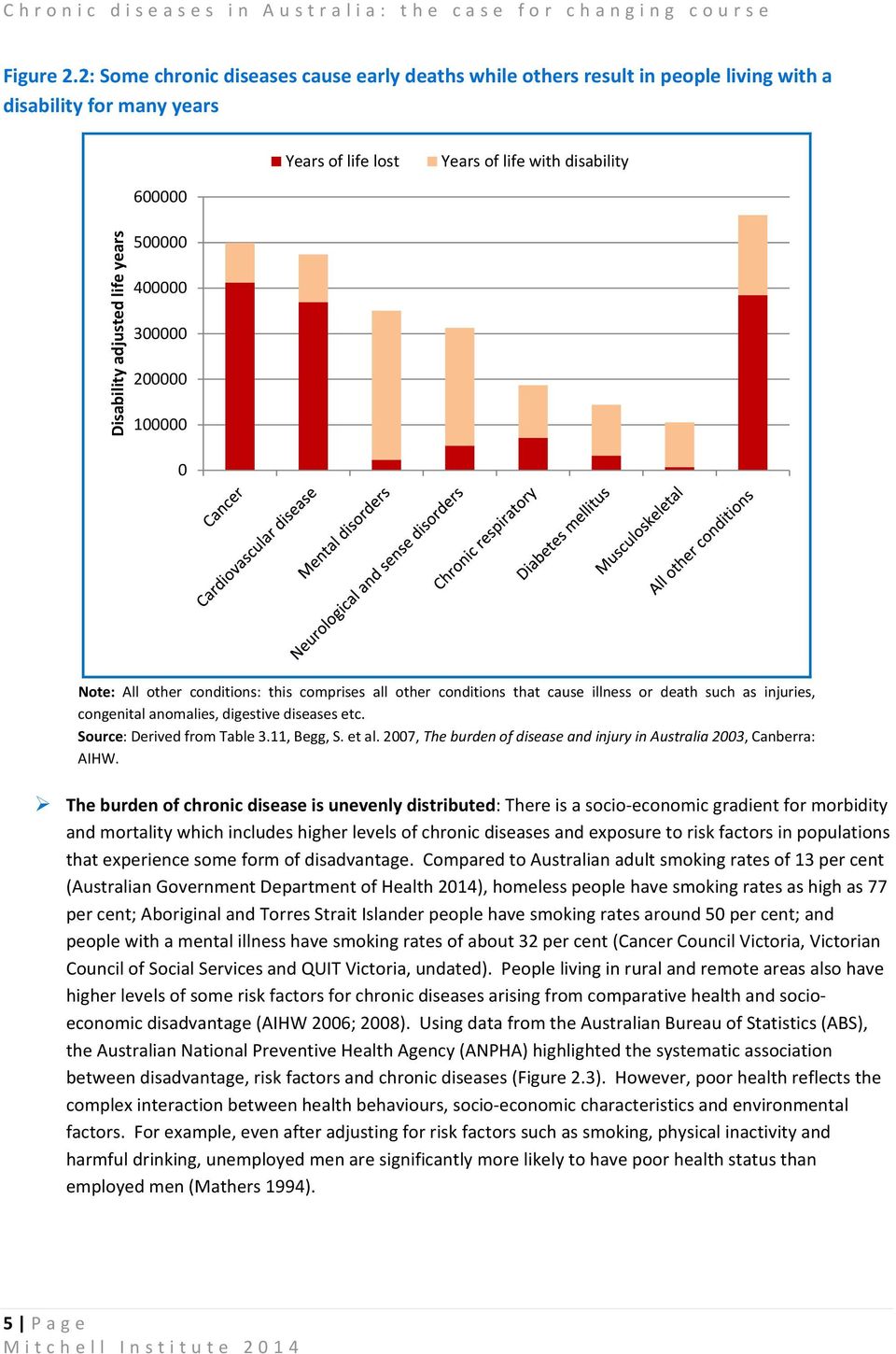
12 Figure 2.1: The patterns of chronic disease deaths have changed over the past thirty years 350 Deaths per 100,000 population Notes: COPD is chronic obstructive pulmonary disease Source: Derived from Figure 4.2, Australian Institute of Health and Welfare 2014, Australia s health 2014, Canberra: AIHW. Australians are living with multiple chronic diseases: In one in 50 people reported having four or more chronic health conditions (including asthma, Type 2 diabetes, coronary heart disease, cerebrovascular disease, arthritis, osteoporosis, chronic obstructive pulmonary disease, depression and high blood pressure). This proportion increased with age eight per cent of people aged 65 or older had four or more of these chronic diseases. Australians experienced an increase in life expectancy between 1998 and 2009, however, this went hand in hand with an increase in the years lived with a severe or profound disability plus years with a lesser profound disability. Many chronic diseases do not result in premature deaths but reduce the quality of life: The Australian Burden of Disease study measures the impact of disease on premature mortality (years of life lost) and quality of life (years lived with disability). Figure 2.2 shows the impact of these two measures for different chronic diseases. About 80 per cent of the burden of disease for cancer and cardiovascular disease is associated with premature deaths. The converse is true for mental disorders where 91 per cent of the burden is associated with years lived with a disability. Neurological and sensory disorders (including dementia, hearing loss, vision loss, Parkinson s disease and epilepsy) are similar, with 83 per cent of the burden of disease due to years lived with a disability. 4 P age

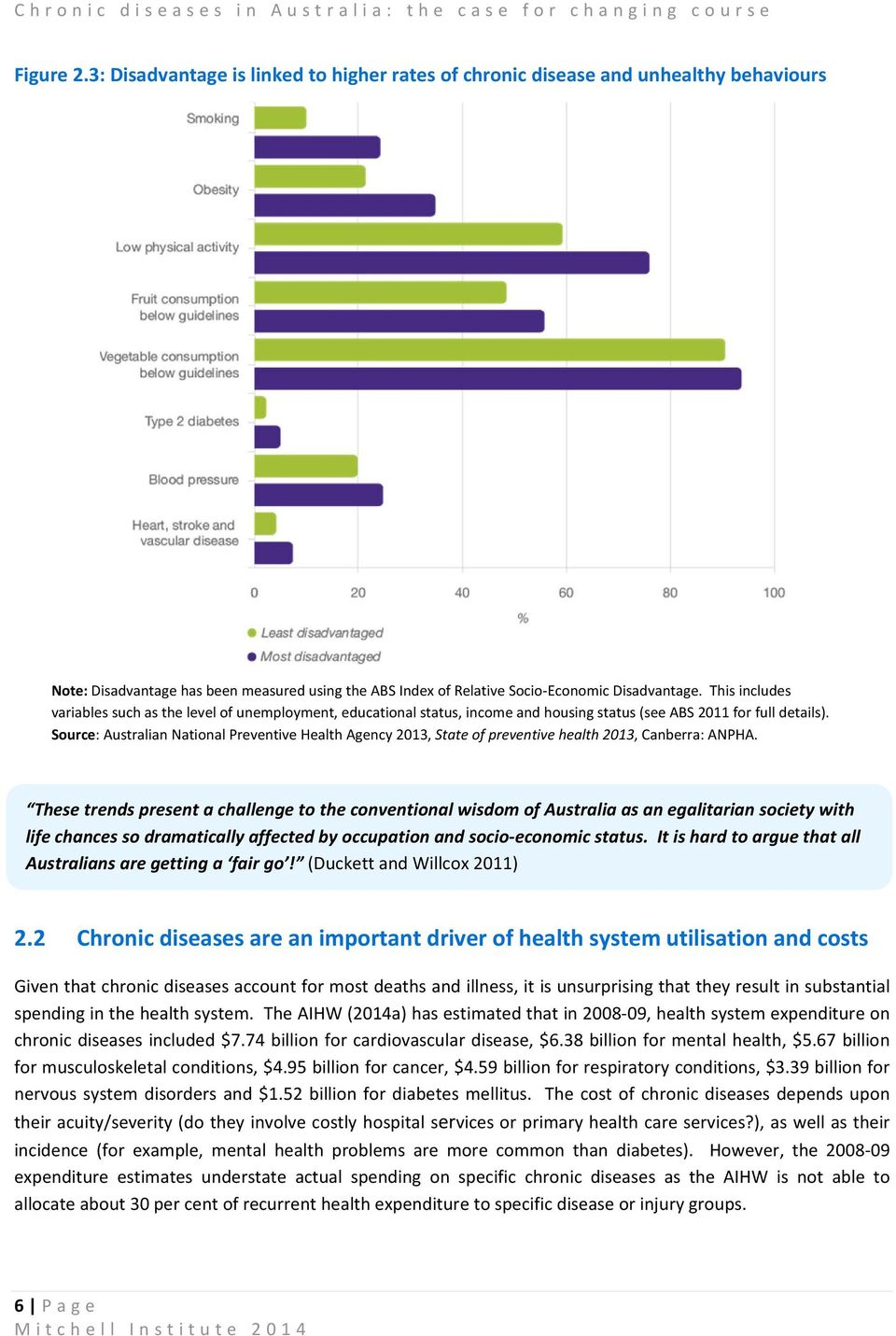
13 Figure 2.2: Some chronic diseases cause early deaths while others result in people living with a disability for many years Years of life lost Years of life with disability Disability adjusted life years Note: All other conditions: this comprises all other conditions that cause illness or death such as injuries, congenital anomalies, digestive diseases etc. Source: Derived from Table 3.11, Begg, S. et al. 2007, The burden of disease and injury in Australia 2003, Canberra: AIHW. The burden of chronic disease is unevenly distributed: There is a socio economic gradient for morbidity and mortality which includes higher levels of chronic diseases and exposure to risk factors in populations that experience some form of disadvantage. Compared to Australian adult smoking rates of 13 per cent (Australian Government Department of Health 2014), homeless people have smoking rates as high as 77 per cent; Aboriginal and Torres Strait Islander people have smoking rates around 50 per cent; and people with a mental illness have smoking rates of about 32 per cent (Cancer Council Victoria, Victorian Council of Social Services and QUIT Victoria, undated). People living in rural and remote areas also have higher levels of some risk factors for chronic diseases arising from comparative health and socioeconomic disadvantage (AIHW 2006; 2008). Using data from the Australian Bureau of Statistics (ABS), the Australian National Preventive Health Agency (ANPHA) highlighted the systematic association between disadvantage, risk factors and chronic diseases (Figure 2.3). However, poor health reflects the complex interaction between health behaviours, socio economic characteristics and environmental factors. For example, even after adjusting for risk factors such as smoking, physical inactivity and harmful drinking, unemployed men are significantly more likely to have poor health status than employed men (Mathers 1994). 5 P age
14 Figure 2.3: Disadvantage is linked to higher rates of chronic disease and unhealthy behaviours Note: Disadvantage has been measured using the ABS Index of Relative Socio Economic Disadvantage. This includes variables such as the level of unemployment, educational status, income and housing status (see ABS 2011 for full details). Source: Australian National Preventive Health Agency 2013, State of preventive health 2013, Canberra: ANPHA. These trends present a challenge to the conventional wisdom of Australia as an egalitarian society with life chances so dramatically affected by occupation and socio economic status. It is hard to argue that all Australians are getting a fair go! (Duckett and Willcox 2011) 2.2 Chronic diseases are an important driver of health system utilisation and costs Given that chronic diseases account for most deaths and illness, it is unsurprising that they result in substantial spending in the health system. The AIHW (2014a) has estimated that in , health system expenditure on chronic diseases included $7.74 billion for cardiovascular disease, $6.38 billion for mental health, $5.67 billion for musculoskeletal conditions, $4.95 billion for cancer, $4.59 billion for respiratory conditions, $3.39 billion for nervous system disorders and $1.52 billion for diabetes mellitus. The cost of chronic diseases depends upon their acuity/severity (do they involve costly hospital services or primary health care services?), as well as their incidence (for example, mental health problems are more common than diabetes). However, the expenditure estimates understate actual spending on specific chronic diseases as the AIHW is not able to allocate about 30 per cent of recurrent health expenditure to specific disease or injury groups. 6 P age
15 People with chronic diseases make frequent use of hospital services as shown by the following examples: Cardiovascular disease: In cardiovascular disease was the main cause for 475,000 hospitalisations and played a secondary role in about another 800,000 admissions (AIHW 2011a). This is equivalent to one in every 16 hospital admissions having a principal diagnosis of cardiovascular disease and one in ten with cardiovascular disease as an additional diagnosis. Cancer: In cancer was responsible for about 880,000 hospital admissions, equal to about one in every ten hospital admissions. Three quarters of these hospital admissions were for same day care, mainly chemotherapy (AIHW & Australasian Association of Cancer Registries 2012). Kidney disease: Between 1991 and 2009, the number of people receiving dialysis or a kidney transplant almost tripled, from 6,643 to 18,267 (AIHW 2012). Much of the growth in kidney disease is due to an increase in diabetes related cases. In there were over 1.1 million hospital admissions for regular dialysis, an increase of 92 per cent from In dialysis accounted for between one in every seven to eight hospital admissions. Projections are that the prevalence of treated endstage kidney disease (with diabetes as a primary cause) will further double between 2011 and 2020 (AIHW 2014b). The projected increase in the prevalence of treated end stage kidney disease has significant implications for health service planning and resource allocation in the future, including the probable increasing need for dialysis services and kidney transplants. However, these results also highlight the ongoing need to prevent chronic kidney disease and the progression of chronic kidney disease to end stage kidney disease, by eliminating or reducing modifiable risk factors such as high blood pressure, tobacco smoking and obesity. (AIHW 2014b) 2.3 Chronic diseases cause significant productivity losses due to reduced workforce participation The impacts of chronic diseases on health system costs are borne mainly by governments, private health insurers and individuals (through out of pocket costs). In addition, the business sector is not immune to the growing burden of chronic diseases, with its impact on reducing workforce participation and productivity. Measuring the impact of reductions in risk factors and/or chronic diseases on workforce productivity and economic growth is complex. Different studies can produce wide ranging estimates depending upon the assumptions used. In 2007 the Productivity Commission attempted to model the impact on reductions in the prevalence of chronic diseases on workforce participation and productivity. This modelling was done in the context of the National Reform Agenda agreed to by the Council of Australian Governments (COAG) in February The Productivity Commission estimated that the health initiatives being considered as part of the National Reform Agenda could increase the rate of workforce participation by about 0.6 of a percentage point (equivalent to about 175,000 individuals) by This relatively modest impact on workforce participation reflected a range of conservative assumptions by the Productivity Commission (for example, it adjusted downwards the results of published studies showing improved outcomes to allow for non compliance for lifestyle programs in real world situations). The Productivity Commission also noted that it was challenging to model the workforce impact as at 7 P age

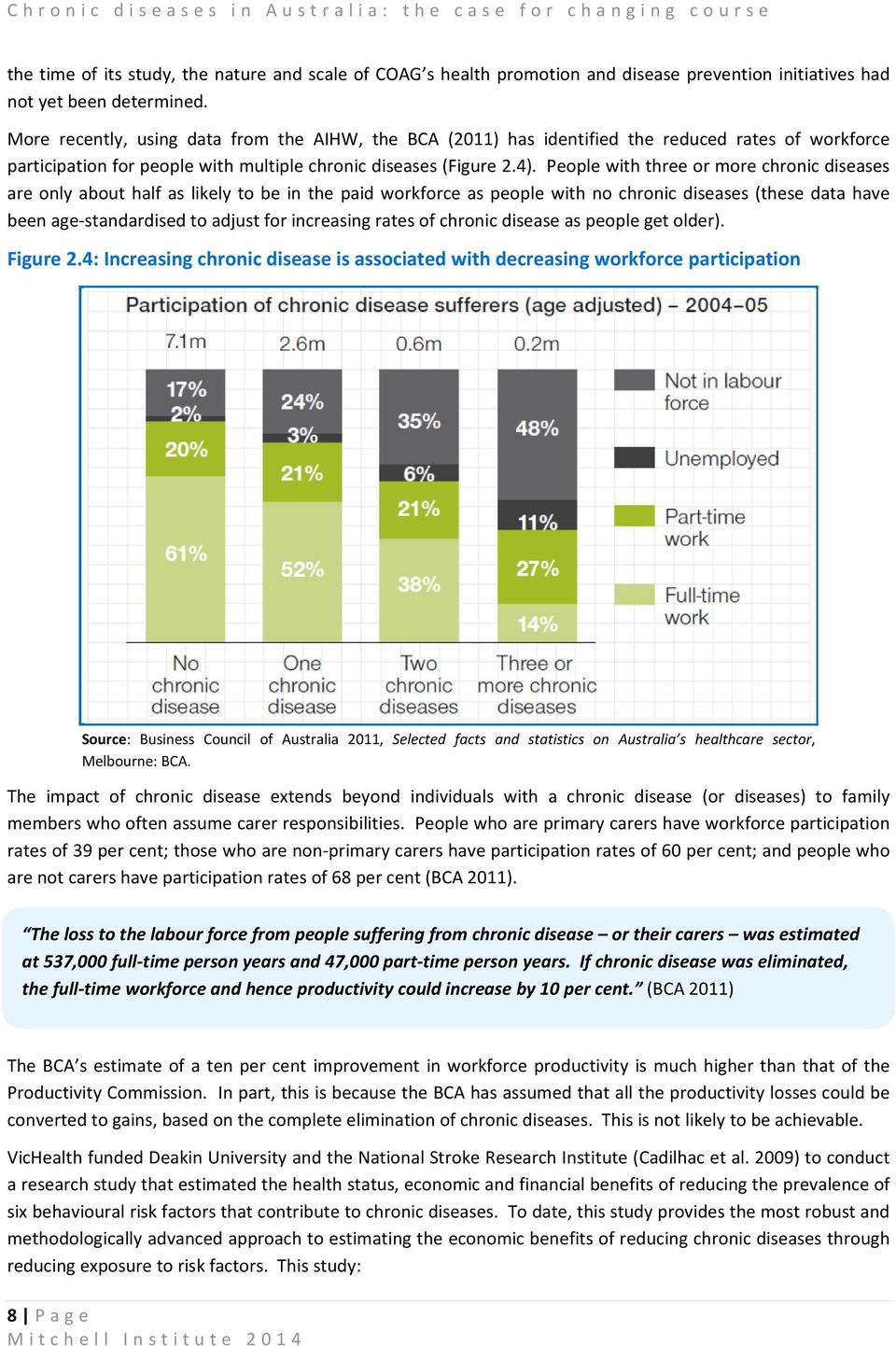
16 the time of its study, the nature and scale of COAG s health promotion and disease prevention initiatives had not yet been determined. More recently, using data from the AIHW, the BCA (2011) has identified the reduced rates of workforce participation for people with multiple chronic diseases (Figure 2.4). People with three or more chronic diseases are only about half as likely to be in the paid workforce as people with no chronic diseases (these data have been age standardised to adjust for increasing rates of chronic disease as people get older). Figure 2.4: Increasing chronic disease is associated with decreasing workforce participation Source: Business Council of Australia 2011, Selected facts and statistics on Australia s healthcare sector, Melbourne: BCA. The impact of chronic disease extends beyond individuals with a chronic disease (or diseases) to family members who often assume carer responsibilities. People who are primary carers have workforce participation rates of 39 per cent; those who are non primary carers have participation rates of 60 per cent; and people who are not carers have participation rates of 68 per cent (BCA 2011). The loss to the labour force from people suffering from chronic disease or their carers was estimated at 537,000 full time person years and 47,000 part time person years. If chronic disease was eliminated, the full time workforce and hence productivity could increase by 10 per cent. (BCA 2011) The BCA s estimate of a ten per cent improvement in workforce productivity is much higher than that of the Productivity Commission. In part, this is because the BCA has assumed that all the productivity losses could be converted to gains, based on the complete elimination of chronic diseases. This is not likely to be achievable. VicHealth funded Deakin University and the National Stroke Research Institute (Cadilhac et al. 2009) to conduct a research study that estimated the health status, economic and financial benefits of reducing the prevalence of six behavioural risk factors that contribute to chronic diseases. To date, this study provides the most robust and methodologically advanced approach to estimating the economic benefits of reducing chronic diseases through reducing exposure to risk factors. This study: 8 P age
17 Used databases from the ABS and the 2003 Australian Burden of Disease study to ensure consistent national data inputs for each risk factor; Included estimates for realistic changes in risk factor prevalence based on a detailed literature review and consultation with experts; Adjusted for the joint effects of multiple risk factors to avoid over estimating the economic benefits; and Developed decision analytic models on workforce productivity, household production and leisure time costs. The household production element examined the unpaid financial benefits of home based work (such as cooking, cleaning and caring for children) and how these are impacted by the six risk factors. The six behavioural risk factors examined were smoking, high risk alcohol use, physical inactivity, intimate partner violence, obesity and inadequate diet which, together, contributed about 16 per cent to the burden of disease in Australia. Figure 2.5 shows the distribution of potential cost savings for each risk factor across workforce productivity losses, household and leisure costs and health sector costs. The study quantified the financial benefits that could be achieved through realistic reductions in the prevalence of the six behavioural risk factors. The opportunity cost savings were conservatively estimated to be $2.334 billion over the lifetime of the 2008 Australian adult population. This comprised $1.504 billion in health sector offsets and $0.830 billion in financial benefits associated with total production. These estimates are conservative as they are based on preventing new cases of disease over the lifetime of the 2008 population, and do not count recurrent events that may occur in people who already have a chronic disease (such as a second stroke or heart attack). Figure 2.5: Reducing risk factors will produce gains in workforce productivity, household and leisure savings and health sector savings Note: IPV is intimate partner violence; BMI is body mass index Source: Cadilhac, D.A. et al. 2009, The health and economic benefits of reducing disease risk factors, Melbourne: Deakin University & National Stroke Research Institute. Achieving realistic targets in the prevention of behavioural risk factors has implications beyond health and is a core outcome for the whole of government...as the report highlights, we are all beneficiaries when it comes to reducing the prevalence of these six behavioural risk factors. (Cadilhac et al. 2009) 9 P age

18 2.4 Chronic diseases are caused by many factors, not just health behaviours Many chronic diseases share common risk factors. For example, tobacco use is a risk factor for cardiovascular disease, stroke, asthma and other respiratory conditions, diabetes and a range of cancers. The commonality of risk factors across chronic diseases explains the increasing incidence of people living with multiple chronic diseases. In recent years there has been a growing policy focus on so called lifestyle behaviours (smoking, alcohol use, physical activity, nutrition) in tackling chronic diseases. However, Figure 2.6 shows that the causes of chronic diseases are multifactorial and extend beyond individual behaviours to include many external factors such as social, environmental and socio economic characteristics of the communities in which people live. Other important contributors that impact on individuals include genetics, epigenetics (including the antenatal environment) and levels of health literacy. A broad social determinants of health perspective (shown in Figure 2.6 and defined further below) has important implications for actions required to prevent chronic disease. It moves the focus beyond the behaviour of individuals (whether they smoke and/or drink) to identify how to reduce exposure to risk factors at different stages of life and in different settings. Figure 2.6: Health status (including chronic disease) is determined by many factors Note: Blue shading highlights selected social determinants of health Source: Australian Institute of Health and Welfare 2014, Australia s health 2014, Canberra: AIHW. 10 P age

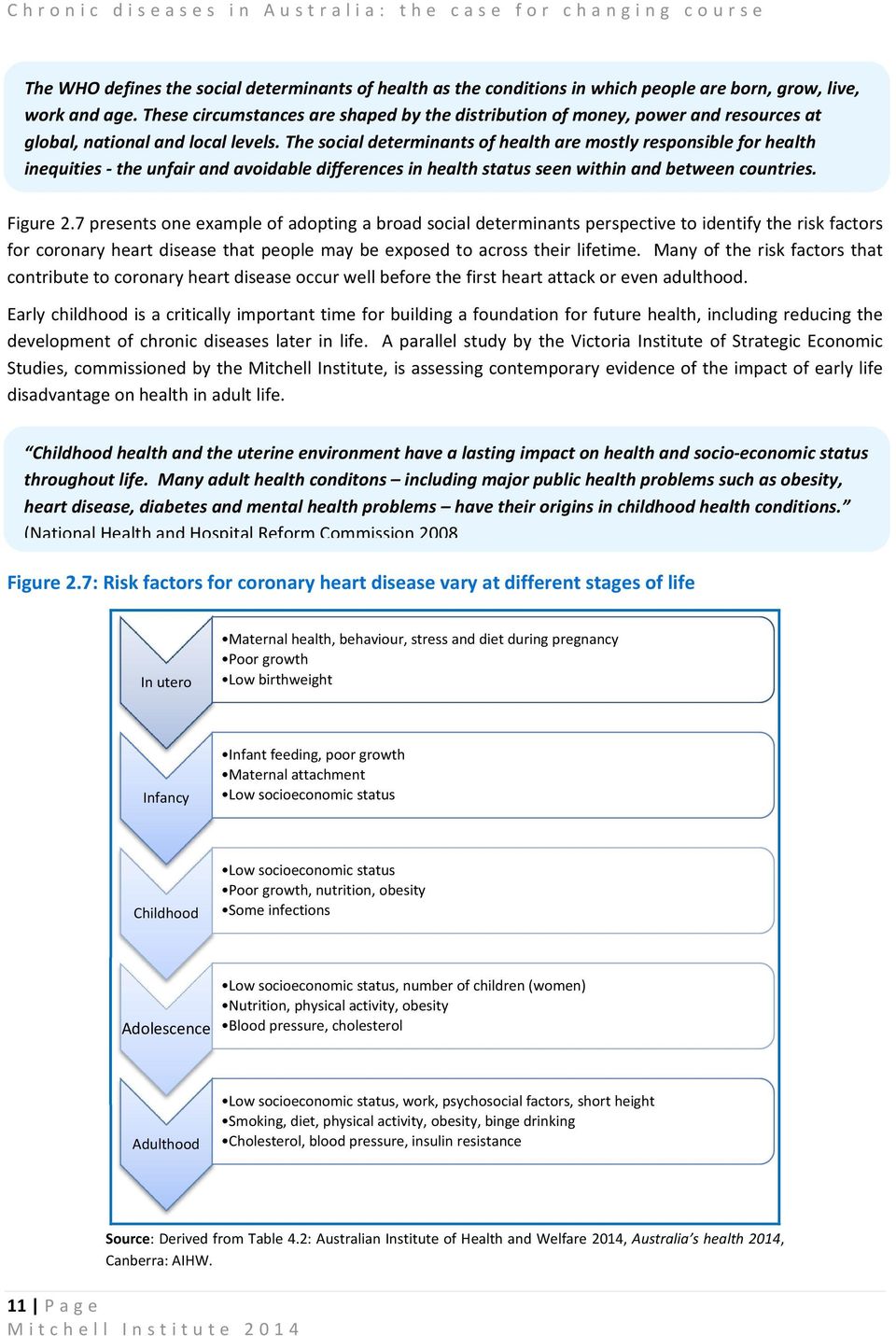
19 The WHO defines the social determinants of health as the conditions in which people are born, grow, live, work and age. These circumstances are shaped by the distribution of money, power and resources at global, national and local levels. The social determinants of health are mostly responsible for health inequities the unfair and avoidable differences in health status seen within and between countries. Figure 2.7 presents one example of adopting a broad social determinants perspective to identify the risk factors for coronary heart disease that people may be exposed to across their lifetime. Many of the risk factors that contribute to coronary heart disease occur well before the first heart attack or even adulthood. Early childhood is a critically important time for building a foundation for future health, including reducing the development of chronic diseases later in life. A parallel study by the Victoria Institute of Strategic Economic Studies, commissioned by the Mitchell Institute, is assessing contemporary evidence of the impact of early life disadvantage on health in adult life. Childhood health and the uterine environment have a lasting impact on health and socio economic status throughout life. Many adult health conditons including major public health problems such as obesity, heart disease, diabetes and mental health problems have their origins in childhood health conditions. (National Health and Hospital Reform Commission 2008 Figure 2.7: Risk factors for coronary heart disease vary at different stages of life In utero Maternal health, behaviour, stress and diet during pregnancy Poor growth Low birthweight Infancy Infant feeding, poor growth Maternal attachment Low socioeconomic status Childhood Low socioeconomic status Poor growth, nutrition, obesity Some infections Adolescence Low socioeconomic status, number of children (women) Nutrition, physical activity, obesity Blood pressure, cholesterol Adulthood Low socioeconomic status, work, psychosocial factors, short height Smoking, diet, physical activity, obesity, binge drinking Cholesterol, blood pressure, insulin resistance Source: Derived from Table 4.2: Australian Institute of Health and Welfare 2014, Australia s health 2014, Canberra: AIHW. 11 P age
20 Obesity is another area where there is a strong tendency to attribute causality (and blame) to individual behaviours. Typically, the causes of obesity are portrayed as an energy imbalance too much food in and not enough physical activity out. However, the NPHT (2009) identified that health behaviours or choices that result in obesity are influenced by a complex web of individual and environmental factors (see Figure 2.8). Individual behaviours are mediated through the environment. For example, food choices depend upon the balance of environmental factors, including: access to affordable and nutritious foods; the increase in fast food outlets; widespread access to highly processed foods; trends in portion sizes of food and drinks; marketing and advertising of unhealthy foods; and access to food labelling information on ingredients. Figure 2.8: Body weight is influenced by individual, behavioural and environmental factors Source: National Preventative Health Taskforce 2009, Australia: The healthiest country by 2020 the roadmap for action, Canberra: Commonwealth of Australia. In conclusion, the evidence on the need to take action on preventing chronic diseases is compelling. Nine in ten deaths in Australia have chronic disease as an underlying cause. In addition, the burden of chronic diseases threatens the sustainability of our health system and our future economic prosperity by reducing the participation and productivity of our workforce. Given the magnitude of these problems, the next chapter examines the evidence on preventing chronic diseases. The evidence on where to focus effort to prevent and reduce the impact of chronic diseases is becoming much better established. 12 P age

21 3. Chronic diseases can be prevented through cost effective population health approaches The increase in chronic diseases is frequently described in threatening terms as a tsunami or epidemic that will wreak havoc on our health system and our economy. Implicit in this language is that although we might be able to predict the upsurge in the prevalence of chronic diseases, there is little we can do to prevent its occurrence. That is far from the truth. The WHO has estimated that at least 80 per cent of all heart disease, stroke and diabetes are preventable, as are 40 per cent of all cancers. (WHO 2005) This chapter examines the evidence on preventability and how best to prevent chronic diseases. While Australia has made substantial progress in reducing death rates from cardiovascular and other chronic diseases, much more could be achieved through smart investment in cost effective prevention strategies. First, however, it is important to define what we mean by prevention. 3.1 There are many opportunities or levels at which prevention can occur The concept and scope of what constitutes prevention has evolved significantly over time. Starfield and colleagues (2008) have described how the concept of prevention has expanded from its original public health meaning (with a strong focus on populations and upstream action) to include the prevention of risk factors in individuals and the management of chronic diseases by clinicians (equivalent to downstream action). The Mitchell Institute uses a typology of prevention that was adopted in Australia by the National Public Health Partnership (2006). This defines the levels of prevention according to a stages of disease continuum, with the typology comprising the following four levels of prevention: Primordial prevention: this refers to preventing the emergence of predisposing social and environmental conditions that can lead to causation of disease. It can also include population based interventions to prevent the development of risk factors that lead to chronic diseases. Examples of primordial prevention include interventions to decrease the number of children who take up smoking, such as regulation of age eligibility for purchase of cigarettes and plain packaging of tobacco. Primary prevention: the next stage in the intervention chain is to limit the incidence (development of new cases) of chronic diseases through eliminating or reducing specific risk factors and other determinants, while promoting factors that are protective of health. Examples of primary prevention include urban design that provides safe environments for walking, cycling and other physical activities to encourage active lifestyles. Secondary prevention: this involves reducing the progression of chronic diseases through early detection (usually by screening at an asymptomatic stage) and early intervention. An example of secondary prevention is dietary management and the promotion of physical activity for people at risk of diabetes to reduce or delay the onset of that disease. 13 P age
22 Tertiary prevention: this involves improving function and minimising the impact of established disease. It also includes preventing or delaying complications through effective management and rehabilitation. An example of tertiary prevention is cardiac rehabilitation for people who have established cardiovascular disease and have suffered a heart attack. The categories in this (or any) typology of prevention are not absolute. There is inevitably blurring across the spectrum of prevention categories. A particular preventive intervention may be classified differently by different stakeholders. However, this typology serves the purpose of defining what the Mitchell Institute means in discussing the scope of prevention of chronic diseases. Two further concepts are next introduced, namely: The value of a life course approach to preventing chronic diseases; and The range of preventive interventions that can be used which include targeting individuals, communities or entire populations. 3.2 Preventing chronic diseases involves starting early to reduce exposure to risks Most health systems respond to chronic diseases through attempting to identify individuals at high risk of chronic diseases and encouraging them to reduce their risk factors, usually late in life. That is the rationale, for example, behind Medicare s health check for people aged 45 to 49 years who are at risk of developing chronic diseases. But there is widespread recognition that the development of chronic diseases is based on modifiable risks to which people are exposed much earlier in life (Figure 3.1). Taking a life course approach to preventing chronic diseases involves reducing risks at each stage of life including early childhood (and in utero), adolescence and early adulthood, well before the onset of many chronic diseases. A population based approach to prevention that reduces risk factors at each stage of life will need to be balanced with preventive strategies for high risk populations. (The latter will involve secondary prevention services delivered by primary health care and other health professionals focused on preventing chronic disease through individually based risk factor reduction). The Queensland Chief Health Officer (2008) proposed that the three messages that are critical in adopting a life course approach to the prevention of chronic diseases are: 1. The earlier the intervention the better 2. Intervene at strategic points in time; and 3. Intervene whenever there is an effective intervention. 14 P age
23 Figure 3.1: The risks of chronic disease accumulate over a lifetime Source: World Health Organization (2005), Preventing chronic diseases: A vital investment, Geneva: WHO. Opportunities to prevent chronic diseases over the life course are outlined in Table 3.1. Table 3.1: There are many opportunities to prevent chronic disease before its onset Before birth Early childhood Adolescence Improving nutritional status of mothers Reducing exposure to tobacco smoke Promoting healthy weight and physical activity Reducing maternal smoking Enhancing children s mental Discouraging the uptake of Improving access to health illicit drugs and harmful use antenatal services Addressing overweight and of alcohol obesity Reducing the uptake of Improving nutrition smoking Increasing physical activity Providing safe and Encouraging sun safe behaviour supportive environments for young people at risk of anxiety and depression Source: Based upon: Queensland Health (2008), The health of Queenslanders: Prevention of chronic disease, Brisbane: Queensland Health A relevant example of the importance of adopting a life course approach to preventing chronic diseases relates to the rapid increase in, and consequences of, childhood obesity (see Box 3.1). 15 P age
24 Box 3.1: Childhood obesity the importance of early intervention Risk factors for chronic diseases emerge and are already evident in childhood and adolescence. These include obesity, high blood pressure, raised cholesterol levels and impaired glucose tolerance. Of particular concern is that obesity in children appears to play a critical role and trigger the development of the other risk factors (Aboderin et al. 2001). Figure 3.2 shows the comparatively high rates of overweight and obesity for Australian boys and girls measured in the recent Australian Health Survey. The same survey found that while high blood pressure increases with age, it is already present in some young people. About one in 20 young men and women aged years had measured high blood pressure (140/90mmHg or higher) (ABS 2013). Figure 3.2: About one in four Australian children are overweight or obese 30 Per cent of children years 5 7 years 8 11 years year years Overweight Obese Source: ABS 2012, Australian Health Survey: First Results, , Canberra: ABS Until the early 1970s, Type 2 diabetes was almost exclusively a disease that affected adults. However, the international trend of increased rates of obesity and overweight in children has seen Type 2 diabetes now imposing a significant burden of disease on younger people. By 2005 almost one half (45 per cent) of all newonset cases of diabetes among children and adolescents were of Type 2 diabetes (WHO 2005). In Australia, over 1,500 adolescents (aged from years) were diagnosed with Type 2 diabetes between and (AIHW 2014c). The management of Type 2 diabetes is more challenging in young people than adults, as well as increasing the risk of complications due to the longer exposure to the disease. 16 P age
25 3.3 Preventive strategies can be directed towards populations and individuals The typology of prevention (primordial, primary, secondary and tertiary) highlights that taking preventive action on chronic diseases can occur in different settings (such as a GP clinic or through local council planning guidelines). Prevention can be targeted at individuals (whether healthy, at risk, symptomatic or with established chronic diseases), at communities (including geographically based communities or specific population groups such as Indigenous people or parents with young children) and at the total population. Secondary and tertiary prevention activities are usually targeted at individuals (mainly at high risk individuals who have multiple risk factors for chronic diseases), while primordial and primary prevention activities can influence the total population or specific communities, as well as individuals. By definition, population based prevention activities have greater reach and coverage than prevention activities targeted at individuals (Figure 3.3). Figure 3.3: Prevention strategies that tackle the determinants and risk factors for chronic diseases at an environmental level have greater reach than individually based prevention Individuals (e.g dietary advice for people with high blood pressure) Communities (e.g. exercise programs for targeted groups) Total population (e.g. national salt reduction targets) A population based approach to prevention provides scope for multi sectoral action involving many groups (e.g. governments, industry and manufacturers, non government organisations, health professionals) and many settings (e.g. the workplace, community and sporting clubs, schools, health services). Such an approach can complement the role of health professionals who will undertake prevention and management of high risk individuals. 17 P age
26 The National Preventative Health Taskforce (2009) identified principles for prevention including: Shared responsibility: Develop strategic partnerships at all levels of government, industry, business, unions, the non government sector, research institutions and communities; and Engaging communities: Act and engage with people where they live, work and play; at home, in schools, workplaces and the community. Inform, enable and support people to make healthy choices. The relative cost effectiveness of population based and individually targeted prevention interventions has been examined in a recent American study (Chokshi & Farley 2012). Using the Boston Tufts Medical Center Cost Effectiveness Registry, the researchers extracted all studies on prevention interventions which they classified into three groups: Environmental prevention: equivalent to population based prevention, 31 studies (an example is increasing fresh food availability in low income areas); Clinical person directed prevention: forms part of individual prevention, 401 studies (an example is cancer screening); or Non clinical person directed prevention: forms part of individual prevention but interventions are delivered in non clinical settings, 37 studies (an example is school based smoking prevention programs). All the prevention interventions were then examined to identify their cost effectiveness ratio, which was defined as the cost ($) per improved outcome as measured by quality adjusted life years (QALYs). Some interventions were cost saving (the cost per QALY was below zero), while other interventions required additional investment to generate improved outcomes. The researchers found that environmental prevention interventions were generally more cost effective than person directed prevention interventions (including both clinical and non clinical interventions) (Figure 3.4). A much higher share of the environmental preventive interventions (46 per cent) were cost saving, compared to clinical interventions targeted at individuals (16 per cent) or non clinical interventions targeted at individuals (13 per cent). The researchers identified two factors that are likely to contribute to environmental interventions being generally more cost effective, as follows: Environmental interventions are likely to incur initial establishment costs but produce ongoing benefits, whereas person directed interventions are more likely to have ongoing costs associated with preventing disease in high risk individuals; and The costs of environmental interventions are shared across the whole population. Small improvements in health gain can translate to substantial improvements at a whole of population level, resulting in many of these interventions being relatively cost effective. Figure 3.4 also illustrates that not all population based interventions are cost effective and individually based clinical interventions can be more cost effective than population based interventions in some cases. Australian studies have also confirmed the value in preventive strategies that blend population based and high risk approaches (Vartiainen et al. 2011). Hence, the evidence on whether specific preventive interventions work needs to be examined for each intervention. 18 P age
27 Figure 3.4: Environmental (population based) prevention interventions are generally more costeffective than prevention interventions targeted at individuals Source: Chokshi, D. A. and Farley T. A. 2012, The cost effectiveness of environmental approaches to disease prevention, New England Journal of Medicine 347(4): Many interventions are cost effective in preventing chronic diseases The ACE Prevention study was a major five year study undertaken by the Centre for Burden of Disease and Cost Effectiveness at the University of Queensland and Deakin Health Economics at Deakin University, with funding from the NHMRC. It evaluated the cost effectiveness of 150 preventive health interventions (both populationwide and individual in nature) including areas such as mental health, diabetes, tobacco use, alcohol use, nutrition, body weight, physical activity, blood pressure, blood cholesterol and bone mineral density. In commenting on the ACE Prevention report, Professor Mike Daube and Todd Harper recognised that the Australian ACE Prevention study is the largest and most rigorous evaluation of preventive strategies undertaken anywhere in the world. The study s methodology has now been adopted by researchers and funders in other countries including the Harvard School of Public Health Prevention Research Center (which is examining the cost effectiveness of obesity strategies for the American population) and by the New Zealand Health Research Council with research undertaken at the University of Otago, Wellington in partnership with the University of Queensland and the New Zealand Ministry of Health. The Australian ACE Prevention study provides a sound evidence base, identifying what works and what doesn t work, to guide future investment in preventing chronic diseases (Box 3.2 provides an outline of the key features of the study). 19 P age
28 Box 3.2: Understanding and using the ACE Prevention study The ACE Prevention study applied standardised evaluation methods to assess the comparative costeffectiveness of 123 preventive and 27 treatment interventions. Key elements of the methodology included: Health sector perspective: The assessment of costs and benefits included the impact on governments and individuals (such as out of pocket costs, travel costs, time costs and carer costs). This was broader than many cost effectiveness analyses which only examined the costs and benefits to governments as funders. The primary analysis did not include production gains and losses in the wider economy and other non health sector impacts. However, when non health sector impacts were relevant to particular interventions, sensitivity analysis was undertaken to assess the significance of adopting a broader perspective. Population under review: The study assessed the impact of the interventions on the Australian population (or relevant sub populations) using data on disease and mortality rates from the 2003 Australian Burden of Disease study. This means that while some of the evidence on the interventions examined was from international studies, they were reinterpreted to identify the specific impacts for the Australian population. Measurement of outcomes: The study assessed the costs to avoid a DALY. The analysis compared each intervention against current practice or do nothing scenarios. More DALYs saved means a longer life, a life with less disability, or a combination of these factors. The costs and outcomes were modelled based on realistic expectations of how interventions would be implemented under routine health service conditions in Australia (that is, real world conditions). The analysis in the ACE Prevention study can be used to map preventive interventions on a cost effectiveness plane, as shown in Figure 3.5. Mapping was on the basis of each intervention s incremental cost effectiveness ratio (ICER), which is the ratio of net costs to net benefits of the intervention versus the current practice comparator. The preventive interventions were mapped to one of four quadrants: South East Quadrant: The most favourable interventions (the no brainer accept ) are described as dominant they improve health outcomes and achieve cost savings; North West Quadrant: The least favourable interventions (the no brainer reject ) are described as dominated they are less effective and result in additional costs; North East Quadrant: These interventions produce improved health outcomes but at a higher cost than the comparator; South West Quadrant: These interventions are less effective but they are less costly than the comparator. Among the interventions that generated net costs, the thresholds used in the study were that interventions were assessed as cost effective if they had a cost of $10,000 $50,000/DALY, or as very cost effective if they had a cost of less than $10,000/DALY. 20 P age
29 Figure 3.5: Interventions can be mapped as to their relative cost effectiveness Source: Vos et al. 2010, Assessing cost effectiveness in prevention (ACE Prevention) Final Report, University of Queensland, Brisbane and Deakin University, Melbourne. The ACE Prevention study provides a huge menu of options about how to intervene successfully, and at relatively low cost, to reduce the incidence and impact of chronic diseases. There are many ways in which the evidence can be used to aid decision making about investing in interventions, such as: Interventions can be selected based on those that have the largest population health impact (avoiding the largest number of DALYs); or Interventions can be selected on the basis that they are cost saving they produce measurable improvements in health outcomes (avoiding DALYs) at the same time as resulting in cost savings to the health system; or Interventions can be selected for particular health priority areas (e.g. cancer) or where there is political and community support to tackle specific risk factors. There are no technically right answers. The ACE Prevention study recognises that the evidence on costeffectiveness will be only one element of decision making about how best to prevent chronic diseases. Other factors (referred to as second stage filters in the ACE Prevention study) will need to be incorporated into decision making such as political and community acceptability, feasibility and sustainability. However, the ACE Prevention study highlights some of the as yet untaken opportunities (discussed in the following sections) to reduce risk factors and lessen the burden of chronic diseases through investing in prevention. 21 P age
30 Gains from implementing interventions that are the most cost effective and have the largest population health impact Implementation of a limited number of cost effective interventions would have a large impact on population health, with each intervention preventing in excess of 100,000 DALYs. Table 3.2 lists these interventions (grouped according to their mode of action) and shows the health gains (DALYs prevented) and costs/savings. The table shows, for example, that a 10 per cent tax on unhealthy foods would save almost $3.5 billion in health system costs and produce a health gain of 170,000 DALYs prevented. Table 3.2: Impact of implementing the most cost effective preventive interventions that also have the largest population health impact Intervention DALYs prevented Intervention costs (A$ billion) Cost offsets (A$ billion) Net costs (A$ billion) Cost/DALY Taxation Tobacco tax 30% increase 270, Savings Alcohol tax 30% increase 100, Savings Alcohol volumetric tax 10% 110, Savings cent above current excise on spirits Unhealthy foods tax 10% 170, Savings cent Regulation Mandatory salt limits on 110, Savings processed food Preventive treatments Three blood pressure 20, Savings lowering drugs to replace current practice of preventive drug treatments Polypill to replace current 60, # Savings practice Laparoscopic gastric 140, # $5,700/DALY banding (body mass index > 35) Health promotion Intensive SunSmart 120, $14,000/DALY Notes: # The current practice of blood pressure and cholesterol lowering treatments is inefficient and hence the intervention costs are negative (there will be cost savings if replaced by more efficient treatment). Source: Based upon Table 0.1 in: Vos et al. 2010, Assessing cost effectiveness in prevention (ACE Prevention) Final Report, University of Queensland, Brisbane and Deakin University, Melbourne. Gains from implementing interventions for particular risk factors or chronic diseases The ACE Prevention study also supports consideration of staging of different preventive interventions for particular risk factors or chronic diseases. That is, it allows decision makers to consider where to start based on the biggest bang for your buck through implementing the intervention with the lowest incremental costeffectiveness ratio first, then the intervention with the next lowest ratio and so on. Figure 3.6 provides an example of such a pathway for alcohol interventions, comprising seven preventive interventions and one intervention to treat alcohol dependence. Most of the health gain (DALYs prevented) would be achieved by a 30 per cent tax on alcohol. A volumetric tax on alcohol has a far lower impact on health gains than a general tax increase. 22 P age
31 Figure 3.6: Implementation pathway for alcohol interventions Notes: RBT = Random breath testing; Res. Treat = Residential treatment Source: Vos et al. 2010, Assessing cost effectiveness in prevention (ACE Prevention) Final Report, University of Queensland, Brisbane and Deakin University, Melbourne. The study concluded that a package of seven preventive interventions could achieve a 31 per cent reduction in the harmful health effects of alcohol. Taxation, advertising bans, and an increase in minimum legal drinking age to 21 are cost saving interventions, as indicated by the downward slope in the pathway above (Figure 3.6). Brief intervention by a GP, licensing controls, drink driving mass media, and the current practice of random breathtesting are cost effective additions to the pathway. The slope of the line to residential treatment is very steep; its inclusion in the pathway is not cost effective. Some of the key take home messages from the ACE Prevention study for other risk factors and chronic diseases are summarised below. These are derived from the ACE Prevention pamphlets available at Overweight and obesity The study examined four interventions two preventive interventions (a low fat diet or a diet and exercise program) and two treatment interventions (Orlistat or Sibutramine) all of which were targeted at overweight and obese adults. Neither of the treatment interventions was cost effective. The preventive interventions were initially assessed as reasonably cost effective (median costs per DALY of around $30,000 to $40,000). However, the inclusion of participant costs for time and travel in the analysis resulted in the preventive interventions being assessed as no longer cost effective. 23 P age
32 The ACE Prevention study concluded that: Diet and exercise interventions can be reasonably cost effective but are insufficient to substantially reduce the burden due to overweight and obesity. In order to address the growing problem of obesity, there is an urgent need to assess the (cost ) effectiveness of interventions that change the obesogenic environment and target populations rather than individuals. Physical activity interventions The study examined six preventive interventions four of which were population based (a mass media based campaign, an active transport program called Travel Smart, a community program encouraging the use of pedometers, and internet access to information on physical activity and advice); and two individually based interventions (physical activity prescriptions by GPs, and GP referral to an exercise physiologist). The study concluded that: The pedometer and mass media based community campaigns and GP referral are very likely to lead to a health gain at a cost saving to the health sector. The internet based intervention program, the GP physical activity program, and the program to encourage more active transport are less likely to be costsaving, but still have a high probability of being under a A$50,000 per DALY threshold. Taken as a package of interventions, all six physical activity interventions could lead to a substantial improvement in population health at a cost saving to the health sector. It is important to note, however, that the evidence around physical activity interventions is relatively weak. There is uncertainty around measures of intervention effect (particularly around sustainability of effects over the long term) and uncertainty around the applicability of evidence from trials to the context of routine health care delivery. Careful evaluation is recommended if these interventions are implemented on a larger scale in the Australian health system. Interventions to increase consumption of fruit and vegetables The ACE Prevention study examined 23 interventions for promoting fruit and vegetable intake across four settings (the general population, supermarkets, workplaces and health care settings) and for one specified population group (low income people). Twenty two of the interventions aimed to change individual behaviour, with only one intervention adopting a whole of community approach. The study concluded that: None of the 23 interventions are currently in place in Australia. Only five out of 23 programs evaluated for promoting fruit and vegetable intake are effective or cost effective measures for improving population health and those that are cost effective would only have a small impact on population health. Instead, we recommend more investment in evaluating interventions that target the whole population or whole communities, such as changes to policies that influence fresh food prices or availability, to see if these approaches can provide more effective and cost effective incentives for improving fruit and vegetable intake. 24 P age
33 Type 2 diabetes prevention The study identified interventions that prevent or delay the onset of Type 2 diabetes in people with prediabetes. It analysed three pharmaceutical and three lifestyle intervention programs for cost effectiveness. The study concluded that: Screening for pre diabetes followed by diet and exercise or metformin is cost effective and should be considered for incorporation into current practice. Workforce capacity of dietitians and exercise physiologists to deliver lifestyle change interventions will need to be increased to appropriately support the intervention. This analysis was also undertaken separately for the Indigenous population and resulted in similar recommendations. However, it was recommended that screening in the Indigenous population be targeted at younger ages due to the earlier onset of Type 2 diabetes in Indigenous Australian populations. Preventive interventions for adult depression The study examined three individually based interventions comprising: brief bibliotherapy; group based psychological therapy; and group based therapy specifically for post natal depression. All three interventions were relatively cost effective, with costs/daly under $50,000. The study concluded that: Screening in general practice for early signs of depression followed by brief interventions is cost effective and could avert up to 20 per cent of the burden of depression...the current analyses do not include all potential benefits of such interventions, such as detecting untreated cases of a full blown depressive disorder, or impact on other mental disorders such as anxiety, so may be considered a conservative estimate of cost effectiveness. Prevention of depression is still an emerging field of research and hence the evidence base is not yet fully developed. There is enough evidence to recommend implementing these interventions in pilot studies accompanied by evaluation to examine whether the benefits we have modelled can be realised. Preventive interventions to reduce salt intake Box 3.3 explores in more detail some of the issues in implementing preventive interventions to reduce salt intake, one of the other risk factors examined in the ACE Prevention study. Box 3.3: Salt a major risk factor that is not yet on the public radar Despite the recent release of the New York Times best seller Salt, Sugar and Fat: How the food giants hooked us (Moss 2013), it would be fair to say that there is only limited public recognition of salt s significant contribution to chronic diseases. Moreover, Australia is lagging behind several other countries in taking effective action to reduce salt intake in the general population. Australians, similar to people in most other countries, consume salt that is considerably in excess of daily requirements. Most of this salt is invisible to consumers: studies have shown that about 75 per cent of all salt consumed is included in processed foods, 10 per cent in fresh foods and only 15 per cent is added through cooking or at the table (Beard 2004). Almost two thirds of strokes (62 per cent) and one half (49 per cent) of coronary heart disease events are attributable to high blood pressure (Cappuccio and Capewell 2010). There is strong evidence of the link between increased salt intake and raised blood pressure at the population level, with salt being a major contributor to cardiovascular disease including stroke. 25 P age
34 The ACE Prevention study examined the cost effectiveness of four preventive interventions to reduce salt intake comprising: The Tick program: The National Heart Foundation s (NHF) Tick program encourages voluntary reduction of salt in breads (<450mg sodium/100g), margarines (<400mg sodium/100g) and cereals (<400mg sodium/100g). This program is essentially current practice. Mandatory limits: This intervention would involve legislation and enforcement so that all bread, margarine and cereal products met the limits in the Tick program. Dietary advice (for people with BP >140mmHg): Individual and group counselling. Dietary advice (for people with BP > 115mmHg): Individual and group counselling. The ACE Prevention study found that there is zero probability of dietary advice being cost saving or costeffective, even when targeted at people with hypertension. It also determined that while the current Tick program is effective, making salt restrictions mandatory for manufacturers could achieve twenty times the population health gain. Table 3.2 showed that mandatory salt limits would achieve savings to the health system of $1.43 billion and result in major health gains (110,000 DALYs prevented). Mandatory limits on salt in bread, cereals and margarine was one of the interventions classified by the authors of the ACE Prevention study as having such strong cost effectiveness credentials that it should not be ignored without compelling reasons. Through the Australian Dietary Guidelines, the National Health and Medical Research Council advises that people need to choose foods and drinks more wisely. The specific guideline for salt is to limit intake of foods and drinks containing added salt, with the recommendation that people choose foods with less than 120mg of sodium/100g (NHMRC 2013a; 2013b). Choosing wisely is easier said than done. The NHMRC guidelines (120mg sodium/100g) are considerably lower than those used in the NHF Tick program, which itself is voluntary. This means that there are many food groups (for example, bread and cheese) where there are essentially no available products that meet the NHMRC definitions of low salt products. In 2009 the National Preventative Health Taskforce recommended the introduction of food labelling on the front of packs and menus including salt, energy, sugar and fats. This has not yet been implemented. Other countries (including England and New Zealand) have introduced national salt reduction targets and/or food labelling that has created an incentive for manufacturers to reformulate their products (NPHT 2009). 3.5 The ACE Prevention study provides a robust framework for tackling chronic diseases The ACE Prevention study is a rich resource that can be used by stakeholders to take action to prevent chronic diseases. It can influence resource allocation through: directing available funding towards the most costeffective services; modifying the approach to service provision to improve cost effectiveness; and disinvesting in services that are not cost effective. 26 P age
35 In summary, the ACE Prevention study concludes: Many interventions for prevention have very strong cost effectiveness credentials (43 that are either dominant or cost less than $10,000 per DALY prevented). Such interventions should only be ignored if decision makers have very serious reservations about the evidence base or are facing insurmountable problems in relation to stakeholder acceptability or feasibility of implementation. Another group of interventions (31) are good value for money compared to the decision threshold of less than $50,000 per DALY prevented. Many interventions for prevention have poor cost effectiveness credentials (38); an insufficient evidence base (4); are associated with more harm than benefit ( dominated : 2); or are dominated by more cost effective alternatives (2). It is vital to recognise that prevention is not always value for money and is not always better than cure. These interventions should only be implemented if there are compelling social justice reasons to do so (e.g. the rule of rescue or special equity needs) or, for dominated interventions, an important clinical place rationale can be demonstrated. 27 P age
36 4. Actions required to prevent chronic diseases Over the last two decades there has been a strong focus on developing strategic frameworks and plans to tackle chronic diseases, both in Australia and internationally. This chapter first examines the WHO Global Action Plan for the prevention and control of non communicable diseases , together with recent progress and the current status of Australian efforts to prevent chronic disease. It then outlines the Mitchell Institute s commitment to developing a national action plan for chronic disease prevention. This would be supported by a national coalition of health experts and scientists, informed by evidence based research, and guided by key directions about how to best prevent chronic diseases. 4.1 Australia has signed up to the WHO Global Action Plan for chronic disease The WHO Global Action Plan was adopted by the World Health Assembly in May This followed in principle agreement by member countries in 2011 to update the previous Global Action Plan and to progress global monitoring of non communicable diseases. The Australian Government made submissions contributing to the development of the Global Action Plan and has provided information in 2010 and 2014 on its capacity to address non communicable diseases. The Global Action Plan provides a road map and menu of policy options to reduce the global burden of chronic diseases. It includes a global monitoring framework to track progress, with the framework comprising a set of nine voluntary global targets and 25 indicators (see Figure 4.1 for the targets). The overall objective is to achieve a 25 per cent reduction in premature mortality from non communicable diseases by 2025 (known as the 25 x 25 target) (Beaglehole et al. 2014), with intermediate monitoring in 2015 and Figure 4.1: There are measurable global targets to reduce chronic disease Source: WHO 2011, NCD global monitoring framework, Geneva: WHO. Within the context of global targets, the WHO has urged governments to set national targets for noncommunicable disease for 2025 based on national circumstances. The baseline against which performance on the targets is to be measured is P age
37 As part of developing the Global Action Plan, the WHO invited countries to assess their capacity to tackle noncommunicable diseases. Country profiles were then produced by the WHO for each country in 2010 and Figure 4.2 shows the WHO profile of Australia s mortality and risk factors related to NCDs, while Figure 4.3 provides the self reported assessment by Australia of its readiness to address and respond to NCDs. Figure 4.2: Australia has performed well in reducing NCD mortality rates but NCDs are still the major cause of death Source: WHO (2014), Non Communicable Disease Country profiles, Geneva: WHO. 29 P age
38 Figure 4.3: In 2014 Australia s self assessed capacity to respond to chronic diseases was relatively strong National systems response to NCDs Has an operational NCD unit/branch or department within the Ministry of Health, or equivalent Has an operational multisectoral national policy, strategy or action plan that integrates several NCDs and shared risk factors Has an operational policy, strategy or action plan to reduce the harmful use of alcohol Has an operational policy, strategy or action plan to reduce physical inactivity and/or promote physical activity Has an operational policy, strategy or action plan to reduce the burden of tobacco use Has an operational policy, strategy or action plan to reduce unhealthy diets and/or promote healthy diets Has evidence based national guidelines/protocols/standards for the management of major NCDs through a primary care approach Has an NCD surveillance and monitoring system in place to enable reporting against the nine global NCD targets Has a national, population based cancer registry Source: WHO (2014), Non Communicable Disease Country profiles, Geneva: WHO. Yes Yes Yes Yes Yes Yes No No Yes The WHO Global Action Plan provides a broad framework against which Australian progress can be measured. Its approach is to measure progress against three domains national systems response; risk factors; and morbidity and mortality (these are broadly equivalent to measuring progress on indicators of process, inputs and outcomes). Recognising that the focus of this report is on the prevention of chronic diseases (while the WHO Global Action Plan covers both prevention and management), the three critical issues that are examined in the remainder of this chapter are: 1. How effectively does Australia measure progress in preventing chronic diseases? 2. What are the recent successes and gaps in building the capacity to prevent chronic diseases? 3. Based on the first two issues, what are the broad directions that could help guide future action in preventing chronic diseases? 4.2 There is no integrated, public performance reporting on Australia s progress in preventing chronic diseases Each year, the Australian Medical Association (AMA) releases its report card on public hospitals. This is one of at least half a dozen reports on public hospital performance that have been issued annually (by bodies including the AIHW, the Productivity Commission, the National Health Performance Authority and the COAG Reform Council), with most of these reports receiving extensive media coverage. When it comes to the question of how well Australia is tracking in preventing chronic diseases, there is only limited public reporting. Most media coverage implicitly blames individuals for so called lifestyle choices and poor health outcomes including smoking, physical inactivity and obesity. It does not assess whether governments and the private sector have been successful in their stewardship of preventing and reducing the burden of chronic diseases. While there is widespread recognition and debate on hospital targets (such as the four hour emergency department target), there is limited awareness of preventive health targets and where accountability sits for efforts to prevent chronic diseases. 30 P age
39 Australia has had two main sets of targets and/or indicators that cover issues related to preventing chronic diseases: 1. The NPA on Preventive Health: This NPA was specifically established to address the rising prevalence of lifestyle related chronic diseases. It specified outcomes, benchmarks and indicators to measure progress in preventing chronic diseases. 2. The Performance and Accountability Framework: This framework identifies indicators against which the performance of public hospitals and primary health care organisations are measured. Some of the indicators relate to risk factors for chronic diseases. Table 4.1 maps the targets included in the NPA on Preventive Health and the Performance and Accountability Framework against those specified in the WHO Global Action Plan. Based on this table (and the implementation/reporting arrangements for the NPA on Preventive Health and the Performance and Accountability Framework), the Mitchell Institute has evaluated Australia s work towards measuring progress in preventing chronic diseases. We conclude that: Australia is focussing on a narrow suite of indicators to measure the prevention of chronic diseases The WHO Global Action Plan includes measurable targets in six risk factor prevention domains (this is effectively seven domains as diabetes and obesity can be assessed as separate targets notwithstanding their aggregation in the WHO plan). The Australian indicators provide a more limited coverage of risk factors, focussing on only smoking, physical activity, body weight and consumption of fruits and vegetables. Australia has not established measurable targets for tackling harmful alcohol use, reducing salt intake or reducing blood pressure. Australian governments have also not yet committed to measurable targets related to the desired outcomes of reduced mortality from (or even reduced prevalence of) chronic diseases. While the Australian targets are narrow in scope, they are challenging relative to the WHO targets and their achievement would represent considerable progress in preventing chronic diseases The targets in the NPA on Preventive Health used different baselines and measurement points than those included in the WHO Global Action Plan. Nonetheless, the NPA did include genuine stretch targets that would represent meaningful improvements in risk factor reduction. The AIHW (2014) has reported that the daily smoking rate in Australia in 2010 (the baseline year for the WHO targets) was 16 per cent for adults. Hence, the NPA target of reducing the daily smoking rate to 10 per cent would represent a 60 per cent reduction from 2010 to be achieved by 1 January This is more challenging than the WHO target of a 30 per cent reduction by 2025, particularly given that Australian smoking rates are already among the lowest in the world. However, Australia is making good progress, with the most recent National Drug Strategy Household Survey (Australian Government Department of Health 2014) reporting adult smoking rates of 13.3 per cent in P age
40 Table 4.1: Australia has measurable targets to prevent chronic diseases for some risk factors specified by the WHO Domain WHO Global Action Plan National Partnership Agreement on Preventive Health Performance and Accountability Framework Alcohol use Target: 10% reduction in harmful use Outcome: reduce the harmful and hazardous consumption of alcohol Not included in Framework of alcohol between 2010 and 2025 Indicator: no indicators specified Physical inactivity Target: 10% reduction in physical Outcome: increase the proportion of children and adults meeting national guidelines for healthy Not included in Framework inactivity between 2010 and 2025 eating and physical activity by 15 per cent within six years (by 1 January 2015) Performance benchmark: increase in proportion of children participating in at least 60 minutes of moderate physical activity every day from baseline for each state by five per cent by 2013; by 15 per cent by 2015 Performance benchmark: increase in proportion of adults participating in at least 30 minutes of moderate physical activity on five or more days of the week of 5 per cent from baseline for each state by 2013; 15 per cent from baseline by 2015 Salt Target: 30% reduction in salt/sodium intake between 2010 and 2025 Objective: work with the food supply and the food service sectors towards offering healthy choices and minimising choices high in fat, sugar or salt Not included in Framework Tobacco use Target: 30% reduction in tobacco use between 2010 and 2025 Blood pressure Target: 25% reduction in raised blood pressure between 2010 and 2025 Diabetes/obesity Target: 0% increase in diabetes / obesity between 2010 and 2025 Mortality Target: 25% reduction in premature mortality from NCDs between 2010 and 2025 Outcome: reduce the proportion of Australian adults smoking daily to 10 per cent within ten years (by 1 January 2019) Indicator: reduction in state baseline for proportion of adults smoking daily commensurate with a two percentage point reduction in smoking from 2007 national baseline by 2011 and a 3.5 percentage point reduction from 2007 national baseline by 2013 Not included in Agreement Diabetes: not included in Agreement; Obesity several benchmarks Outcome: increase the proportion of children and adults at healthy body weight by 3 percentage points within ten years (by 1 January 2019) Performance benchmark: increase in proportion of children/adults at unhealthy weight held at less than five per cent from baseline for each state by 2013; proportion of children/adults at healthy weight returned to baseline level by 2015 Performance benchmark: increase in mean number of daily serves of fruits and vegetables consumed by children/adults by at least 0.2 for fruits and 0.5 for vegetables from baseline for each state by 2013; 0.6 for fruits and 1.5 for vegetables from baseline by 2015 Not included in Agreement Population health outcome measure: Prevalence of smoking Not included in Framework Population health outcome measure: Prevalence of diabetes Population health outcome measure: Prevalence of overweight and obese status Indicator: Age standardised mortality of potentially avoidable deaths 32 P age
41 Similarly, the NPA obesity related targets aimed to essentially slow the increase in unhealthy weight so that by 2015 the proportion of children/adults at unhealthy weight is brought back to 2007 levels and that subsequently the proportion of children/adults at healthy body weight increases by 1 January Again, these targets appear to have been more challenging than the WHO target to have zero increase in obesity by The NPA targets on physical activity and consumption of fruit and vegetables are also meaningful and are more clearly specified than the targets in the WHO Global Action Plan. ~ The National Partnership Agreement on Preventive Health included measurable targets, whereas the Performance and Accountability Framework does not set targets related to the prevention of chronic diseases The NPA on Preventive Health provided better coverage of risk factors for chronic diseases than the Performance and Accountability Framework (which is to be expected, given their individual remits). Equally importantly, the NPA on Preventive Health included measurable targets for reducing risk factors for chronic diseases. (The NPA did not actually use the language of targets, but instead used a hierarchy of outcomes, outputs and performance benchmarks. The performance benchmarks in the NPA were measurable, as were some of the outcomes). In contrast, the Performance and Accountability Framework does not include targets for reducing chronic disease mortality or risk factors. Instead, most of the risk factor measures are included to provide context for the interpretation of Medicare Local performance indicators. While their inclusion would allow trends to be monitored, there is no benchmark or target against which performance will be assessed. There is no regular public reporting against chronic disease prevention targets One major gap in the commitment of Australian governments is that there is effectively no regular public reporting against the chronic disease prevention targets. The NPA on Preventive Health required states and territories to provide reports outlining performance against benchmarks as at 30 June 2013 and 31 December 2014, but there was and is no requirement for these reports to be made public. This significantly reduced accountability for the targets. More broadly, the COAG Reform Council had responsibility for monitoring the performance of various national agreements and national partnership agreements. It published reports analysing performance against three other health related NPAs (Improving Public Hospital Services; Essential Vaccines; and the Elective Surgery Waiting List Reduction Plan), but it did not publish any analysis of performance under the NPA on Preventive Health. The COAG Reform Council (2014) did take the opportunity in its penultimate health report, Healthcare in Australia : Five years of performance, to report more generally on chronic diseases including the prevalence of risk factors and the prevalence and incidence of several chronic diseases. However, data was only publicly reported for two of the performance benchmarks in the NPA on Preventive Health. 33 P age
42 The COAG Reform Council (2014) reported on performance against two of the risk factor performance benchmarks included in the NPA on Preventive Health. Daily smoking rates There was a significant fall from 19.1 per cent in to 16.3 per cent in While the national smoking rate has fallen over time, it may need to fall faster to meet the benchmark set by COAG to reduce the rate to 10 per cent by Health body weight for adults and children There was no significant change in the proportion of adults or children at a healthy body weight between and In , 69.8 per cent of children were normal weight, up from 67.7 per cent in The 2018 target is 72.7 per cent. In , 35.7 per cent of adults were normal weight, down from 36.9 per cent in The 2018 target is 41.9 per. The COAG Reform Council concluded that progress on smoking rates is positive but not necessarily sufficient, and the lack of significant progress in improving healthy body weight and tackling obesity is of concern as it may result in an increase in the incidence of Type 2 diabetes. In summary, while Australia has developed measurable targets, there has been no comprehensive, regular reporting of how Australia is tracking in preventing chronic diseases. There is no ongoing commitment to measure progress on preventing chronic diseases with the cessation of the NPA on Preventive Health and the COAG Reform Council Government infrastructure for funding and measuring progress on preventing chronic diseases has now ceased to exist. The National Healthcare Agreement (the umbrella or framework agreement for all the partnership agreements) includes two of the performance benchmarks (daily smoking rates and healthy body weight) that were included in the former NPA on Preventive Health. (It also includes a performance benchmark to reduce the age adjusted prevalence rate for Type 2 diabetes to 2000 levels by 2023). However, the funding vehicle for driving these improvements was the NPA on Preventive Health with its tied funding for investing in programs to reduce the prevalence of chronic disease risk factors (programs included workplace based, community based and those that targeted specific populations, such as children). The abolition of the COAG Reform Council means that there is no ongoing commitment to national reporting on targets for the prevention of chronic diseases through any of the intergovernmental agreements. 4.3 Action on preventing chronic diseases has been two steps forward, one step back in recent years The second issue that is critical in determining where to next is having a clear understanding of recent successes and gaps in our capacity to prevent chronic diseases. In 2014 the Australian Government Department of Health provided a fairly positive self assessment to the WHO of Australia s capacity to address NCDs (as shown earlier in Figure 4.3). That assessment was based on: the 34 P age
43 existence of operational policies, strategies or action plans for NCDs and risk factors; nominated responsibility for NCDs within the Commonwealth Department of Health; and the existence of a national, population based cancer registry. Notably, in its self assessment, the Australian Government indicated that it did not have two key elements in place, namely: Evidence based national guidelines/protocols/standards for the management of major NCDs through a primary care approach; and An NCD surveillance and monitoring system to enable reporting against the nine global NCD targets. The Mitchell Institute has built upon the WHO assessment framework to identify four domains against which progress in preventing chronic diseases can be evaluated. The domains are: 1. A national commitment to preventing chronic diseases (given force through a national strategy, action plan or agreement with identified responsibilities and public accountability); 2. Backed up by dedicated funding to allow investment in evidence based primary prevention of chronic disease interventions; 3. Given effect by a broad multi faceted approach to prevention that includes an array of approaches (such as pricing, regulation, social marketing, education) for use in a variety of sectors (such as transport and urban planning), settings (such as workplace and local communities) and population groups (such as targeting across the life course or disadvantaged groups); and 4. Underpinned by national infrastructure, research and evaluation capabilities (including the existence of core national datasets to monitor progress on risk factors, chronic diseases and their economic impacts; and a commitment to investing in research to evaluate and monitor the effectiveness of prevention interventions). Using the above framework and the preliminary progress report provided below, the Mitchell Institute will seek advice from relevant experts as to the opportunities that might be leveraged to strengthen prevention activities for chronic diseases. ~ There is a preventative health strategy, but there is no clear pathway for ongoing action In 2005 Australia had a National Chronic Disease Strategy with five supporting national service improvement frameworks (asthma; cancer; diabetes; heart, stroke and vascular disease; and osteoarthritis, rheumatoid arthritis and osteoporosis). This reflected commitment by all Australian Health Ministers to an action agenda for the prevention and treatment of chronic diseases (National Health Priority Action Council 2005). The National Chronic Disease Strategy is no longer operational. In 2014 the closest equivalent to an overarching strategy for the prevention of chronic diseases is the National Preventative Health Strategy (National Preventative Health Taskforce 2009). However, in terms of agreed commitments, the effective strategy is Taking Preventative Action the Australian Government s response to the work of the NPHT (Australian Government 2010). As already noted, these frameworks focus mainly on risk factors related to tobacco, alcohol and obesity. There are specific strategies or frameworks for some other chronic diseases (such as the Roadmap for national mental health reform ), although it is not always evident that these strategies remain operational in guiding actions. The implementation of the Australian Government s response to the work of the NPHT was to be driven and nationally coordinated through the ANPHA with funding under the NPA on Preventive Health. For example, ANPHA had responsibility for the National Binge Drinking Strategy. Following the abolition of ANPHA and the 35 P age
44 cessation of the NPA, some of ANPHA s functions are being transferred to the Australian Government Department of Health. In the absence of ANPHA and the NPA, there is no clear pathway under which the Australian, state and territory governments have shared objectives and goals that reflect the evidence of population health and national economic benefit identified in the National Preventative Health Strategy. There is no longer identified funding for the prevention of chronic diseases nor ongoing reporting on expenditure on public health and prevention The NPA on Preventive Health provided just over $870 million in funding from to , and included the introduction of new programs to reduce risk factors and prevent chronic diseases in schools, workplaces and in the community. The Australian Government Budget indicated that there would be savings of $368 million over the four years from to arising as a result of the cessation of the NPA on Preventive Health. The Budget indicated that these savings would be invested by the Australian Government in the Medical Research Future Fund. As already indicated, the cessation of the NPA on Preventive Health means that there is no longer tied funding for the delivery of programs to prevent chronic diseases. Until 2011 the AIHW published detailed annual reports tracking expenditure by the Australian and State governments on public health (comprising immunisation, screening, health promotion, environmental health, food standards, drug use prevention, communicable disease control and public health research). Expenditure on public health as a share of all recurrent health expenditure reached a peak of 2.22 per cent in under the previous Public Health Outcome Funding Agreements (after averaging between 1.8 to 2.0 per cent for much of the previous decade) (AIHW 2011b). The most recent expenditure data from the AIHW is for , during which public health accounted for only 1.54 per cent of total recurrent health expenditure (AIHW 2014d). The cessation of detailed reporting by the AIHW on public health expenditure coincided with the completion of the Public Health Outcome Funding Agreements. By international standards, Australian spending on prevention is low. The OECD reports expenditure on prevention and public health services using data reported from each country. Although there may be issues with comparability of how expenditure data are classified and reported between countries, the OECD data provides some ballpark comparisons of Australia s relative investment in prevention. The OECD (2014) reported that in 2011 Australian expenditure on prevention and public health services as a share of total recurrent health expenditure was 2.0 per cent. This was considerably lower than many other countries including New Zealand (6.4 per cent), Finland (6.1 per cent), Canada (5.9 per cent), Sweden (3.9 per cent), the United States (3.1 per cent) and Japan (2.9 per cent). Countries with similar shares of expenditure on public health to Australia included France (2.0 per cent), Luxembourg (2.0 per cent), Poland (2.1 per cent) and Portugal (2.1 per cent). Some valuable interventions have been introduced to prevent chronic diseases, with prevention programs also implemented in a wide range of settings. In response to the work of the NPHT, the Australian Government has introduced interventions including: Pricing: an increase of 25 per cent in tobacco excise from April 2010 and harmonising tax rates for alcopops with other spirit based drinks; Regulation: the introduction of plain packaging for tobacco products with full implementation from 1 December 2012; 36 P age
45 Food labelling: a front of package food labelling system known as the Health Star rating was introduced in June 2014 on a voluntary basis for five years. A review of the progress of implementation is due in two years (June 2016); Programs targeting particular populations: the first major program to reduce smoking in Indigenous communities was introduced; and Social marketing and education: there has been significant investment through the NPA on Preventive Health on educational campaigns relating to risk factors for chronic diseases. In considering the entirety of the NPHT recommendations, it appears as if the most robust interventions by government have been directed towards tobacco (where there has already been considerable success), while softer interventions (e.g. educational campaigns) have been used for other risk factors such as obesity. However, many of the NPHT s recommendations have not been implemented including: greater restrictions on promoting alcohol at times or locations (e.g. sporting events) that have high exposure to young people; the introduction of health impact assessments by governments across all policies; and the phasing out of marketing of energy dense, nutrient poor foods and beverages. ~ There has been some investment in new research and expanded datasets, but research and evaluation of policies and programs to prevent chronic diseases is still under developed The NHMRC funding of research by the University of Queensland and Deakin University to produce the ACE Prevention study is the undoubted highlight of recent investment in national intelligence for preventive health. The expansion of the Australian Health Survey in to include additional data on nutrition, physical activity and biomedical measures was also welcomed by many researchers. However, this was long overdue, given that the previous National Nutrition Survey was undertaken in Another example of important research intelligence is the Australian Burden of Disease study which was last published in 2007 based on 2003 data. Updated estimates on the burden of disease are not expected to be released until late 2015, meaning that there are no current estimates or recent trend data on the morbidity and mortality rates associated with chronic diseases in Australia. Australian researchers and performance agencies (including the COAG Reform Council and the National Health Performance Agency) have been critical of the absence (or too infrequent collection) of vital data on health outcomes. These data gaps are even more pronounced in being able to assess health outcomes for specific population groups (for example, Indigenous populations). Governments committed through the NPA on Preventive Health to invest in the evidence base necessary for effective prevention by establishing national programs in chronic disease risk factor surveillance, translational research and evaluation. The ANPHA commenced implementation of the $13.1 million National Preventive Health Research Fund in 2011, but the ongoing status of this research fund is unclear given the cessation of the agency. ANPHA s National Preventive Health Research Strategy (ANPHA 2013b) identified the value of a range of longitudinal studies and data collections both inside and outside the health system (such as the Longitudinal Study of Indigenous Children and the Household, Income and Labour Dynamics in Australia survey). 4.4 Identifying key directions for acting on prevention is a vital first step To recap, there have been some important successes in the past few years, as preventive health has gained unparalleled prominence (a major government inquiry, a national agency, an intergovernmental funding agreement, a set of targets to improve health and reduce chronic diseases). Australia s introduction of plain 37 P age
46 packaging for tobacco products has been internationally acclaimed by public health experts and health ministries in many countries. While some of these gains have now been overturned, the reality is that, like stopping smoking, achieving these successes the first time paves the way for future positive actions to prevent chronic diseases. A changed political climate emphasising a more modest and non duplicative role for the Australian government creates fresh opportunities for non government organisations, businesses, community groups, academic researchers, policy think tanks and state governments to develop innovative approaches to tackling chronic diseases. New partnerships and alliances can be formed, reflecting the dictum of the National Preventative Health Taskforce that preventive health is everybody s business. The ANPHA developed a framework for achieving a systematic approach to preventive health (see Figure 4.4). This organisation highlighted the context in which action to prevent chronic diseases should be taken, as follows: Recognising that health is determined by a complex mix of biological, behavioural, socioeconomic, societal and environmental factors that interact to shape health means answers to reducing the risk factors that contribute to chronic disease are likely to be complex and multifaceted. Action is needed on a number of fronts; and it needs to be coordinated, sequenced and connected. Experience has consistently shown that preventive health effort requires a broad, multifaceted and coordinated strategy over a sustained period with partnerships between health and other portfolios and industry sectors, and between government, business and community group. (ANPHA 2013a) 38 P age
47 Figure 4.4: ANPHA has developed a framework for taking action on preventing chronic diseases Source: Australian National Preventive Health Agency 2013, State of preventive health 2013, Canberra: ANPHA. Based on the ANPHA s framework, our study into the impact of childhood disadvantage on health outcomes, and our evaluation of recent successes and still to be realised opportunities, the Mitchell Institute is proposing that a national action plan for chronic disease prevention could be guided by four key directions: 1. Promote and implement interventions that impact early in life, as well as targeting high risk populations We must change the mindset that accepts the inevitability of a future where trends in obesity and overweight in Australian children lead to reductions in life expectancy of the next generation (Holman & Smith 2008); where children are increasingly being sentenced to a lifetime of ill health with a diagnosis of Type 2 diabetes (AIHW 2014c); and where young people have risk factors including high blood pressure or harmful use of alcohol that predispose them to the early onset of chronic diseases (ABS 2013). We must dispel the myth that preventing chronic diseases is simply about adults taking responsibility for making healthy lifestyle choices. Preventive health requires intervening early to protect the health of vulnerable children. Current advertising of unhealthy food and beverages normalises unhealthy behaviours for children. We now find jarring the scenes in the television series, Mad Men, where young children are unrestrained in cars 39 P age
48 and pregnant women smoke. Similar societal and cultural shifts will be required to tackle obesity and other risk factors for chronic diseases. The evidence on chronic diseases and social disadvantage is equally damning (ANPHA 2013a). Higher risk factors and chronic disease rates are associated with disadvantage across multiple domains income level, living in areas of socio economic disadvantage, level of educational achievement and employment status (Duckett and Willcox 2011). Speaking at the Oceania Tobacco Control Conference in 2011, Professor Ron Borland warned: There is a lot of death and suffering ahead of us, but it will be concentrated among those already suffering the most. (Cancer Council Victoria et al. undated) Individuals whose life circumstances include socio economic disadvantage are exposed to environments and influences that increase their health risks through their opportunities and behaviours. A social determinants of health perspective requires that programs and policies be designed to address disadvantage across populations as early in life as possible. Prevention programs also have to be targeted to population groups at the highest risk of exposure to chronic diseases. 2. Invest in cost effective prevention, while innovating and building the evidence base on what works to reduce chronic diseases Australia has a strong track record of using economic data to drive resource allocation in health. This includes the use of cost effectiveness analyses for listing new pharmaceuticals and new medical procedures on the Pharmaceutical Benefits Scheme (PBS) and Medical Benefits Scheme (MBS) respectively, as well as promoting debate on disinvestment for clinically ineffective or cost ineffective services (Elshaug et al. 2012). The ACE Prevention study provides a similarly robust evaluation of the cost effectiveness of preventive health interventions to allow evidence based decision making. This resource can be used by funders and regulators at national, state and community levels to inform best buys for preventing chronic diseases, to cease programs that do not represent value for money, and to guide the development of fiscal and regulatory policies. The redirection of funding from the NPA on Preventive Health to the Medical Research Future Fund provides another rationale for investing in research on preventive health. Relative to clinically based interventions that focus on secondary and tertiary prevention of chronic disease for individuals, population based approaches are currently under represented in evaluation studies. This evidence base needs to be strengthened including through research supported by the Medical Research Future Fund, the NHMRC and, indeed, by research funding outside the health system. 3. Measure progress on reducing chronic diseases and engender accountability for action We need to foster a culture of public reporting and accountability for preventing chronic diseases. There is not much value in counting the number of public hospital beds or performance against four hour emergency department waiting time targets if we do not know whether smoking rates are being cut in disadvantaged populations or whether we are achieving success in reducing prevalence and rates of premature mortality from diabetes. What counts (and should be counted) are the health outcomes for the Australian population, while how we use our health resources is very much a second order issue. 40 P age
49 There is an opportunity to reinvigorate reporting on preventing chronic diseases. The requirement for Australia to report against the WHO Global Action Plan provides a fresh prospect, outside the previous infrastructure of the intergovernmental agreements, to recommit to measurable improvement in preventing chronic diseases. In addition, the non government sector could mirror the AMA s success in highlighting public hospital performance by creating and publishing regular reports on Australian progress in preventing chronic diseases. The WHO assessment approach provides one possible model. Reporting could include quantitative trends in behavioural and biomedical risk factors, the prevalence of chronic diseases and rates of premature mortality, as well as qualitative assessments on the infrastructure required to prevent chronic diseases (public commitments, funding, the range of interventions including future priorities for action). State governments have been vitally important guardians in establishing and maintaining health surveillance databases over the past ten to twenty years (examples include the WA Health and Wellbeing Surveillance system and the NSW Population Health Survey), as well as publishing regular reports on the health status of their populations (Queensland Health 2012; Tomlin and Joyce 2013). Data on population health deserve media analysis. Reporting needs to celebrate public health successes, as well as identifying future opportunities and accountability for actions required to prevent chronic diseases. 4. Recognise that many of the levers to prevent chronic diseases involve changes outside the health system that create healthier environments at a whole of population level There is no better illustration of the value of multi sectoral action utilising a wide array of interventions than the history of Australian success in smoking control (Figure 4.5). We don t need to reinvent the wheel in determining how to reduce the harm arising from unhealthy foods and beverages and excessive use of alcohol. Many of the lessons and policy levers of successful tobacco control can be applied to reduce other risk factors for chronic diseases. Changes outside the health system (such as fiscal policy, regulation and addressing environmental factors) are more likely to be cost effective as they achieve greater reach and can impact before the onset of chronic diseases. In its submission to the development of a National Urban Policy for Australia, the Australian Chronic Disease Prevention Alliance argued that: The design of our neighbourhoods and cities has a major impact on the health and wellbeing of individuals and communities. In particular there is strong and growing evidence that the way streets, neighbourhoods, towns and cities are planned, designed and built affects how people use these spaces and places and their levels of physical activity. There is also increasing evidence that the built environment influences obesity rates. 41 P age
50 Figure 4.5: Success in reducing Australian smoking rates has been achieved through action on many fronts Source: Australian National Preventive Health Agency 2013, State of preventive health 2013, Canberra: ANPHA 42 P age
51 4.5 Achieving change in preventing and reducing chronic diseases for Australia s health Australia has significant expertise in different areas of the chronic disease prevention and management jigsaw (Figure 4.6). Much work has been done, by people with an enormous commitment to both improved health, and increased social and economic participation for all Australians. Drawing on the best evidence and expertise in relevant fields of investigation, it is time to develop a national action plan for chronic disease prevention for Australia. Figure 4.6: Chronic diseases jigsaw Health Policies Sports & Recreation Urban Planning Food Policy Education Policy Transport Policy Workplace Policies Pricing Policy 43 P age
52 5. Epilogue We need to take action now to ensure that the following future scenario does not become a reality: It is The voluntary Health Star food labelling system that was introduced in 2014 has only been implemented by a few local muesli producers. Governments decide to scrap food labelling, as well as portion sizes and advertising controls on health claims that can be made on food products. The 42 oz (1.24 litres) supersize soft drinks that were phased out by McDonalds in the US in 2004 have been introduced to Australia. It is Telecommuting is now standard practice, courtesy of success in finally achieving national coverage of a fast speed broadband network. While digital connectivity is widespread with the use of Google glasses, there is increasing social isolation and lack of human connectivity. Rates of depression, alcoholism and suicide have increased. It is Following the cessation of all government funding in Australia for preventive health and health promotion, many prevention experts emigrated to the United States. On the advice of these Australian experts, the American President has introduced physical activity programs in all schools, used pricing incentives and/or subsidies to promote production of, and affordable access to, healthier foods; and has supported local government in changes to reduce sedentary behaviour and increase physical activity. Australia now outranks the United States as the most obese country in the world. It is Australia has failed to meet most of the targets in the WHO Global Action Plan including the 25 per cent reduction in mortality from non communicable diseases. Its previous success in reducing tobacco smoking has been overturned by the failure of governments to regulate e cigarettes. The Australian branch of the European Free Vaping Initiative was instrumental in lobbying government through its hands off free vaping campaign, despite the emergence of new studies in the early 2020s demonstrating the health risks of e cigarettes. It is The nation has gone into mourning following the screening of the final (twentieth) season of Game of Thrones. High levels of sedentary behaviour have resulted in bariatric surgery being the most common elective surgery procedure, now also frequently performed on primary school children. Health costs have exceeded the Australian Institute of Health and Welfare s estimate of 12.4 per cent of GDP in 2032 due to the failure to tackle risk factors and the broad environmental determinants of chronic diseases. Over the past thirty years, health costs have increased by over 430 per cent for treating diabetes, over 200 per cent for respiratory disease and over 140 per cent for cardiovascular disease (AIHW 2009). This has been partly offset by reductions in the cost of treating people with dementia due to earlier premature deaths from other chronic diseases. 44 P age
53 Acronyms ACE AIHW ANPHA BCA COAG COPD DALY GP ICER NCD NHF NHMRC NPA NPHT OECD QALY VISES WHO Assessing Cost Effectiveness Australian Institute of Health and Welfare Australian National Preventive Health Agency Business Council of Australia Council of Australian Governments Chronic Obstructive Pulmonary Disease Disability Adjusted Life Year General Practitioner Incremental Cost Effectiveness Ratio Non Communicable Diseases National Heart Foundation National Health and Medical Research Council National Partnership Agreement National Preventative Health Taskforce Organisation for Economic Co operation and Development Quality Adjusted Life Year Victoria Institute of Strategic Economic Studies World Health Organization 45 P age
54 References Aboderin, J., Kalache, A., Ben Shlomo, Y., Lynch, J.W., Yajnik, C. S., Kuh, D. and Yach, D. 2001, Life course perspectives on coronary heart disease, stroke and diabetes: key issues and implications for research, Geneva: WHO. Australian Bureau of Statistics 2011, Census of population and housing: Socio economic indexes for areas, Australia, 2011, Cat. No , Canberra: ABS. Australian Bureau of Statistics 2012, Australian Health Survey: First results, , Cat. No , Canberra: ABS. Australian Bureau of Statistics 2013, Australian Health Survey: Updated results, , Cat. No , Canberra: ABS. Australian Chronic Disease Prevention Alliance undated, Submission to Our Cities Building a productive sustainable future, at: Australian Government 2010, Taking preventative action: A response to Australia: the healthiest country by 2020, Canberra: Commonwealth of Australia. Australian Government Department of Health 2014, Tobacco: key facts and figures (Findings from the 2013 National Drug Strategy Household Survey), at: kff Australian Institute of Health and Welfare 2006, Chronic diseases and associated risk factors in Australia, Cat. No. PHE 81, Canberra: AIHW. Australian Institute of Health and Welfare 2008, Rural, regional and remote health: Indicators of health status and determinants of health, Cat. No. PHE 97, Canberra: AIHW. Australian Institute of Health and Welfare 2009, Estimating the impact of selected National Health and Hospitals Reform Commission (NHHRC) reforms on health care expenditure, 2003 to 2033, Cat. No. HWE 45, Canberra: AIHW. Australian Institute of Health and Welfare 2011a, Cardiovascular disease: Australian facts 2011, Cat. No. CVD 53, Canberra: AIHW. Australian Institute of Health and Welfare 2011b, Public health expenditure in Australia , Cat. No. HWE 52, Canberra: AIHW. Australian Institute of Health and Welfare 2012, Dialysis and kidney transplantation in Australia , Cat. No. PHE 162, Canberra: AIHW. Australian Institute of Health and Welfare 2014a, Australia s Health 2014, Cat. No. AUS 178, Canberra: AIHW. Australian Institute of Health and Welfare 2014b, Projections of the prevalence of treated end stage kidney disease in Australia , Cat. No. PHE 176, Canberra: AIHW. Australian Institute of Health and Welfare 2014c, Type 2 diabetes in Australia's children and young people: A working paper (Diabetes Series No 21), Canberra: AIHW. 46 P age
55 Australian Institute of Health and Welfare 2014d, Health expenditure Australia , Cat. No. HWE 61, Canberra: AIHW. Australian Institute of Health and Welfare and Australasian Association of Cancer Registries 2012, Cancer in Australia: an overview, Cat. No. CAN 70, Canberra: AIHW. Australian National Preventive Health Agency 2013a, State of preventive health 2013, Canberra: ANPHA. Australian National Preventive Health Agency 2013b, National preventive health research strategy : Building knowledge for a healthy Australia, Canberra: ANPHA. Beard, T. 2004, Salt matters: the killer condiment, Sydney: Hachette Australia. Beaglehole, R., Bonita, R., Ezzati, M., Alleyne, G., Dain, K., Kishore, S.P. and Horton, R. 2014, NCD Countdown 2025: Accountability for the 25 x 25 NCD mortality reduction target, The Lancet 384: Begg, S., Vos, T., Barker, B., Stevenson, C., Stanley L. and Lopez, A. D. 2007, The burden of disease and injury in Australia 2003, Cat. No. PHE 82, Canberra: AIHW. Business Council of Australia 2009, Fit for the job: Adapting to Australia s new healthcare challenges, Melbourne: BCA. Business Council of Australia 2011, Selected facts and statistics on Australia s healthcare sector, Melbourne: BCA. Cadilhac, D.A., Magnus, A., Cumming, T., Sheppard, L., Pearce D. and Carter, R. 2009, The health and economic benefits of reducing disease risk factors, Melbourne: Deakin University & National Stroke Research Institute. Cancer Council Victoria, Victorian Council of Social Service and Quit Victoria, Supporting disadvantaged people to stop smoking, at: Cappuccio, F.P. and Capewell, S. 2010, How to cut down salt intake in populations, Heart 96(23): Chokshi, D. A. and Farley, T. A. 2012, The cost effectiveness of environmental approaches to disease prevention, New England Journal of Medicine 347(4): Committee for Economic Development of Australia 2013, Australia adjusting: Optimising national prosperity, Melbourne: CEDA. Duckett, S and Willcox S. 2011, The Australian health care system, Melbourne: Oxford University Press. Elshaug, A., Watt, A., Mundy L. and Willis, C. 2012, Over 150 potentially low value health care practices: an Australian study, Medical Journal of Australia 197(10): Holman, C. D. J. and Smith, F. 2008, Implications of the obesity epidemic for the life expectancy of Australians Report to the Western Australian Institute for Public Health Advocacy, Perth: Public Health Advocacy Institute of Western Australia. Mathers, C. 1994, Health differentials among adult Australians aged years, Canberra: AIHW. Moss, M. 2013, Salt, sugar and fat: how the food giants hooked us, New York: Random House. National Health and Hospitals Reform Commission 2008, A healthier future for all Australians: Interim report, Canberra: Commonwealth of Australia. 47 P age
56 National Health and Medical Research Council 2013a, Eat for health: Australian dietary guidelines summary, Canberra: Commonwealth of Australia. National Health and Medical Research Council 2013b, Eat for health: Australian dietary guidelines (Providing the scientific evidence for healthier Australian diets), Canberra: Commonwealth of Australia. National Health Priority Action Council 2005, National Chronic Disease Strategy, Canberra: Australian Government Department of Health and Ageing. National Preventative Health Taskforce 2009, Australia: The healthiest country by 2020 the roadmap for action, Canberra: Commonwealth of Australia. National Public Health Partnership 2006, The language of prevention, Melbourne: National Public Health Partnership. Organisation for Economic Co operation and Development 2014, OECD health statistics 2014 (online database), accessed 26 September 2014, at: systems/health data.htm Productivity Commission 2007, Potential benefits of the national reform agenda: Report to the Council of Australian Governments, Canberra: Commonwealth of Australia. Queensland Health 2008, The health of Queenslanders: Prevention of chronic disease, second report of the Chief Health Officer Queensland, Brisbane: Queensland Health. Queensland Health 2012, The health of Queenslanders 2012: Advancing good health, fourth report of the Chief Health Officer Queensland, Brisbane: Queensland Health. Starfield, B., Hyde, J., Gervas, J. and Heath, I. 2008, The concept of prevention: a good idea gone astray?, Journal of Epidemiology and Community Health 62: Tomlin, S. and Joyce, S. 2013, The health and wellbeing of children in Western Australia in 2012, overview and trends, Perth: Department of Health, Western Australia. Vartiainen, E., T. Laatikainen, B. Philpot, E. Janus, N. Davis Lameloise and J. Dunbar 2011, The projected impact of population and high risk strategies for risk factor control on coronary heart disease and stroke events, Medical Journal of Australia 194(1): Vos, T., Carter, R., Barendregt, J., Mihalopoulos, C., Veerman, L., Magnus, A., Cobiac, L., Bertram, M. and Wallace, A. 2010, Assessing cost effectiveness in prevention (ACE Prevention) Final Report, University of Queensland, Brisbane and Deakin University, Melbourne. World Health Organization 2005, Preventing chronic diseases: A vital investment, Geneva: WHO. World Health Organization 2013, Global action plan for the prevention and control of non communicable diseases , Geneva: WHO. World Health Organization 2014, Non communicable diseases country profiles, at: 48 P age
57 Mitchell Institute for Health and Education Policy 300 Queen Street, Melbourne, Victoria t e. [email protected] w. mitchellinstitute.org.au 49 Page
Southern Grampians & Glenelg Shires COMMUNITY PROFILE
 Southern Grampians & Glenelg Shires COMMUNITY PROFILE Contents: 1. Health Status 2. Health Behaviours 3. Public Health Issues 4. References This information was last updated on 14 February 2007 1. Health
The cost of physical inactivity
 The cost of physical inactivity October 2008 The cost of physical inactivity to the Australian economy is estimated to be $13.8 billion. It is estimated that 16,178 Australians die prematurely each year
HSE Transformation Programme. to enable people live healthier and more fulfilled lives. Easy Access-public confidence- staff pride
 HSE Transformation Programme. to enable people live healthier and more fulfilled lives Easy Access-public confidence- staff pride The Health Service Executive 4.1 Chronic Illness Framework July 2008 1
NATIONAL STRATEGY FOR FOOD SECURITY IN REMOTE INDIGENOUS COMMUNITIES
 NATIONAL STRATEGY FOR FOOD SECURITY IN REMOTE INDIGENOUS COMMUNITIES Council of Australian Governments A Strategy agreed between: the Commonwealth of Australia and the States and Territories, being: the
Key Priority Area 1: Key Direction for Change
 Key Priority Areas Key Priority Area 1: Improving access and reducing inequity Key Direction for Change Primary health care is delivered through an integrated service system which provides more uniform
Submission by the Australian College of Midwives (Inc.) in relation to The Australian Safety and Quality Goals for Health Care
 Submission by the Australian College of Midwives (Inc.) in relation to The Australian Safety and Quality Goals for Health Care The Consultation Paper titled Australian Safety and Quality Goals for Health
The benefits of prevention: healthy eating and active living
 The benefits of prevention: healthy eating and active living A Summary of Findings By increasing the proportion of the NSW population who are a healthy weight by 2018 (so that one in two adults are of
Comorbidity of mental disorders and physical conditions 2007
 Comorbidity of mental disorders and physical conditions 2007 Comorbidity of mental disorders and physical conditions, 2007 Australian Institute of Health and Welfare Canberra Cat. no. PHE 155 The Australian
Part 4 Burden of disease: DALYs
 Part Burden of disease:. Broad cause composition 0 5. The age distribution of burden of disease 6. Leading causes of burden of disease 7. The disease and injury burden for women 6 8. The growing burden
Chronic Disease and Nursing:
 Chronic Disease and Nursing: A Summary of the Issues What s the issue? Chronic diseases are now the major global disease problem facing the world and a key barrier to development, to alleviating poverty,
Towards an Aboriginal Health Plan for NSW
 Submission Towards an Aboriginal Health Plan for NSW June 2012 beyondblue PO Box 6100 HAWTHORN WEST VIC 3122 Tel: (03) 9810 6100 Fax: (03) 9810 6111 www.beyondblue.org.au beyondblue Towards an Aboriginal
Dementia: a major health problem for Australia
 Dementia: a major health problem for Australia Position Paper 1 September 2001 Professor Anthony Jorm Director, Centre for Mental Health Research, Australian National University Dementia is one of the
Against the Growing Burden of Disease. Kimberly Elmslie Director General, Centre for Chronic Disease Prevention
 Kimberly Elmslie Director General, Centre for Chronic Disease Prevention Chronic diseases are an increasing global challenge Most significant cause of death (63%) worldwide 1 Chronic diseases cause premature
The National Health Plan for Young Australians An action plan to protect and promote the health of children and young people
 The National Health Plan for Young Australians An action plan to protect and promote the health of children and young people Copyright 1997 ISBN 0 642 27200 X This work is copyright. It may be reproduced
How To Plan Healthy People 2020
 Healthy California 2020 Initiative: Consensus Building on Top Priority Areas for CDPH Public Health Advisory Committee April 30, 2010 Introducing the CDPH Decision Framework Responding to public health
Queensland Strategy. Chronic Disease. for 2005-2015. promoting a healthier Queensland. a partnership approach. Queensland
 Queensland Strategy for Chronic Disease 2005-2015 promoting a healthier Queensland a partnership approach Queensland Queensland Strategy for Chronic Disease 2005-2015 A partnership approach The Queensland
What are the PH interventions the NHS should adopt?
 What are the PH interventions the NHS should adopt? South West Clinical Senate 15 th January, 2015 Debbie Stark, PHE Healthcare Public Health Consultant Kevin Elliston: PHE Consultant in Health Improvement
Rural and remote health workforce innovation and reform strategy
 Submission Rural and remote health workforce innovation and reform strategy October 2011 beyondblue PO Box 6100 HAWTHORN WEST VIC 3122 Tel: (03) 9810 6100 Fax: (03) 9810 6111 www.beyondblue.org.au Rural
South Australian Women s Health Policy
 South Australian Women s Health Policy 1 2 South Australian Women s Health Policy To order copies of this publication, please contact: Department of Health PO Box 287 Rundle Mall Adelaide SA 5000 Telephone:
A Route Map to the 2020 Vision for Health and Social Care
 A Route Map to the 2020 Vision for Health and Social Care 02 A Route Map to the 2020 Vision for Health and Social Care Introduction This paper sets out a new and accelerated focus on a number of priority
First Global Ministerial Conference on Healthy Lifestyles and Noncommunicable Disease Control Moscow, 28-29 April 2011 MOSCOW DECLARATION PREAMBLE
 First Global Ministerial Conference on Healthy Lifestyles and Noncommunicable Disease Control Moscow, 28-29 April 2011 MOSCOW DECLARATION PREAMBLE We, the participants in the First Global Ministerial Conference
Tackling Chronic Disease
 Tackling Chronic Disease A Policy Framework for the Management of Chronic Diseases Hawkins House Dublin 2 Teach Haicin Baile Átha Cliath 2 Telephone (01) 6354000 www.dohc.ie ISBN: 978-1-40642135-4 Tackling
Healthy ageing and disease prevention: The case in South Africa and The Netherlands
 Healthy ageing and disease prevention: The case in South Africa and The Netherlands Sebastiana Kalula, 1 Ger Tielen 2 and Monica Ferreira 1 Medical advances, improved health care and prudent health behaviour
Best Buys & Trained Monkeys
 & Trained Monkeys Associate Professor Ian Anderson Director Research Cooperative Research Centre Aboriginal Health Director: Centre for the Study of Health and Society & VicHealth Koori Health Research
Adolescence (13 19 years)
 AUSTRALIAN INSTITUTE OF HEALTH AND WELFARE This section focuses on adolescents (13 19 year olds). Teenagers are in transition between childhood and adulthood, and their increasing independence brings about
Aligning action with aims: Optimising the benefits of workplace wellness
 Aligning action with aims: Optimising the benefits of workplace wellness Dr Michael McCoy Medibank Health Solutions Strategy & Corporate Development Health & Wellbeing September 2011 Aligning action with
How To Write Long Term Care Insurance
 By Lori Boyce, AVP Risk Management and R&D Underwriting long term care insurance: a primer Every day Canadians die, are diagnosed with cancer, have heart attacks and become disabled and our insurance solutions
Australian heart disease statistics 2014
 Australian heart disease statistics 214 Mortality Morbidity Treatment Smoking Diet Physical activity Alcohol Cholesterol Blood pressure Mental health Diabetes Overweight and obesity Australian heart disease
NORTHERN TERRITORY VIEWS ON CGC STAFF DISCUSSION PAPER 2007/17-S ASSESSMENT OF ADMITTED PATIENT SERVICES FOR THE 2010 REVIEW
 NORTHERN TERRITORY VIEWS ON CGC STAFF DISCUSSION PAPER 2007/17-S ASSESSMENT OF ADMITTED PATIENT SERVICES FOR THE 2010 REVIEW OCTOBER 2007 ADMITTED PATIENT SERVICES Key Points: The Territory supports the
Australian Federation of AIDS Organisations (AFAO) Primary Health Care Reform
 Australian Federation of AIDS Organisations (AFAO) Primary Health Care Reform 27 February 2009 1 Introduction The Australian Federation of AIDS Organisations (AFAO) is the peak body for Australia s community
Evidence-Based Practice for Public Health Identified Knowledge Domains of Public Health
 1 Biostatistics Statistical Methods & Theory Evidence-Based Practice for Public Health Identified Knowledge Domains of Public Health General Public Health Epidemiology Risk Assessment Population-Based
Submission by the Irish Pharmacy Union to the Department of Health on the Scope for Private Health Insurance to incorporate Additional Primary Care
 Submission by the Irish Pharmacy Union to the Department of Health on the Scope for Private Health Insurance to incorporate Additional Primary Care Services January 2015 1 IPU Submission to the Department
NHS outcomes framework and CCG outcomes indicators: Data availability table
 NHS outcomes framework and CCG outcomes indicators: Data availability table December 2012 NHS OF objectives Preventing people from dying prematurely DOMAIN 1: preventing people from dying prematurely Potential
State Health Assessment Health Priority Status Report Update. June 29, 2015 Presented by UIC SPH and IDPH
 State Health Assessment Health Priority Status Report Update June 29, 2015 Presented by UIC SPH and IDPH 1 Health Priority Presentation Objectives 1. Explain context of how this discussion fits into our
Southern NSW Local Health District: Our Population s Health
 Page 1 of 5 This Factsheet summarises a selection of health indicators (health behaviours & risk factors, hospitalisations and deaths) for the of the Southern NSW Local Health District (LHD). Health services
Healthy People in Healthy Communities
 Healthy People 2020 Alaska Hawaii American Samoa U.S. Virgin Islands Federated States of Micronesia Republic of Marshall Islands Commonwealth of Northern Mariana Islands Puerto Rico Palau Guam www.healthypeople.gov
Healthy People in Healthy Communities
 Healthy People 2020 Alaska Hawaii American Samoa U.S. Virgin Islands Federated States of Micronesia Republic of Marshall Islands Commonwealth of Northern Mariana Islands Puerto Rico Palau Guam www.healthypeople.gov
Risk factors and public health in Denmark Summary report
 Risk factors and public health in Denmark Summary report Knud Juel Jan Sørensen Henrik Brønnum-Hansen Prepared for Risk factors and public health in Denmark Summary report Knud Juel Jan Sørensen Henrik
The Global Economic Cost of Cancer
 The Global Economic Cost of Cancer About the Global Economic Cost of Cancer Report Cancer is taking an enormous human toll around the world and is a growing threat in low- to middle-income countries.
Health, history and hard choices: Funding dilemmas in a fast-changing world
 Health, history and hard choices: Funding dilemmas in a fast-changing world Thomson Prentice Global Health Histories Health and Philanthropy: Leveraging change University of Indiana, August 2006 An embarrassment
NATIONAL HEALTHCARE AGREEMENT 2012
 NATIONAL HEALTHCARE AGREEMENT 2012 Council of Australian Governments An agreement between the Commonwealth of Australia and the States and Territories, being: t t t t t t t t the State of New South Wales;
WHO Consultation on the Zero Draft Global Mental Health Action Plan 2013-2020 International Diabetes Federation (IDF) Submission
 WHO Consultation on the Zero Draft Global Mental Health Action Plan 2013-2020 International Diabetes Federation (IDF) Submission The International Diabetes Federation (IDF), an umbrella organisation of
Maternal and Child Health Service. Program Standards
 Maternal and Child Health Service Maternal and Child Health Service Program Standards Contents Terms and definitions 3 1 Introduction 6 1.1 Maternal and Child Health Service: Vision, mission, goals and
Sick at Work. The cost of presenteeism to your business and the economy. July 2011 Part of the Medibank research series
 Sick at Work The cost of presenteeism to your business and the economy. July 2011 Part of the Medibank research series In 2009/10, the total cost of presenteeism to the Australian economy was estimated
Analysis of Healthcare IT Spending in Australia
 Analysis of Healthcare IT Spending in Australia An Already Sophisticated Market is Driving Innovation by Vendors 9AB9-48 March 2015 Contents Section Slide Number Executive Summary 3 Healthcare Industry
Care, Fairness & Housing Policy Development Panel 21 November 2005
 Agenda Item No: 6 Developing a Corporate Health & Well-being Strategy Head of Environmental Services Summary: This report proposes the development of a health & well-being strategy for the Council, which
The cost of physical inactivity What is the lack of participation in physical activity costing Australia?
 The cost of physical inactivity What is the lack of participation in physical activity costing Australia? August 2007 Physically inactive Australian adults are costing the healthcare system an avoidable
Physical activity: a major public health priority. Professor Brian Oldenburg School of Public Health & Preventive Medicine, Monash University
 Physical activity: a major public health priority Professor Brian Oldenburg School of Public Health & Preventive Medicine, Monash University What is health? Health is a state of complete physical, mental,
Social Care and Obesity
 Social Care and Obesity A discussion paper Health, adult social care and ageing Introduction The number of obese people in England has been rising steadily for the best part of 20 years. Today one in four
ECONOMIC COSTS OF PHYSICAL INACTIVITY
 ECONOMIC COSTS OF PHYSICAL INACTIVITY This fact sheet highlights the prevalence and health-consequences of physical inactivity and summarises some of the key facts and figures on the economic costs of
Population Health Priorities for NSW
 Population Health Priorities for NSW 2012 2017 POPULATION AND PUBLIC HEALTH DIVISION NSW Ministry of Health Locked Mail Bag 961 North Sydney NSW 2059 Copyright NSW Ministry of Health 2012 This work is
ACT Primary Health Care Strategy 2011 2014
 Strategy & Corporate Policy & Government Relations ACT Primary Health Care Strategy 2011 2014 Foreword by Katy Gallagher Minister for Health The ACT currently has the best health status of any jurisdiction
Shaping our future: a call to action to tackle the diabetes epidemic and reduce its economic impact
 Shaping our future: a call to action to tackle the diabetes epidemic and reduce its economic impact Task Force for the National Conference on Diabetes: The Task Force is comprised of Taking Control of
Nursing and midwifery actions at the three levels of public health practice
 Nursing and midwifery actions at the three levels of public health practice Improving health and wellbeing at individual, community and population levels June 2013 You may re-use the text of this document
Mr Tom Wise Clerk of Committees Legislative Council Parliament House HOBART TAS 7000. Dear Mr Wise
 Postal address: GPO Box 646 Hobart TAS 7001 Phone: 1800 252 476 Fax: (03) 6233 5800 Email: [email protected] Enquiries: Michelle Morgan Phone: (03) 6233 5625 E-mail: [email protected]
Principles on Health Care Reform
 American Heart Association Principles on Health Care Reform The American Heart Association has a longstanding commitment to approaching health care reform from the patient s perspective. This focus including
Public Health Association of Australia: Policy-at-a-glance Alcohol Policy
 Key message: Public Health Association of Australia: Policy-at-a-glance Alcohol Policy 1. Alcohol is responsible for a substantial burden of death, disease and injury in Australia. Alcohol-related harm
Australia s primary health care system: Focussing on prevention & management of disease
 Australia s primary health care system: Focussing on prevention & management of disease Lou Andreatta PSM Assistant Secretary, Primary Care Financing Branch Australian Department of Health and Ageing Recife,
2.2 How much does Australia spend on health care?
 2.2 How much does Australia spend on health care? Health expenditure occurs where money is spent on health goods and services. Health expenditure data includes health expenditure by governments as well
Public health: an ethical imperative?
 Public health: an ethical imperative? Hugh Whittall Director, Nuffield Council on Bioethics (UK) The Nuffield Council on Bioethics Established in 1991 Independent body that examines ethical questions raised
HEALTH CARE COSTS 11
 2 Health Care Costs Chronic health problems account for a substantial part of health care costs. Annually, three diseases, cardiovascular disease (including stroke), cancer, and diabetes, make up about
Measures for the Australian health system. Belinda Emms Health Care Safety and Quality Unit Australian Institute of Health and Welfare
 Measures for the Australian health system Belinda Emms Health Care Safety and Quality Unit Australian Institute of Health and Welfare Two sets of indicators The National Safety and Quality Indicators Performance
COOPERATIVE RESEARCH CENTRES PROGRAMME REVIEW
 COOPERATIVE RESEARCH CENTRES PROGRAMME REVIEW Submission by November 2014 Page 1 ABOUT RESEARCH AUSTRALIA is an alliance of 160 members and supporters advocating for health and medical research in Australia.
Butler Memorial Hospital Community Health Needs Assessment 2013
 Butler Memorial Hospital Community Health Needs Assessment 2013 Butler County best represents the community that Butler Memorial Hospital serves. Butler Memorial Hospital (BMH) has conducted community
PROMOTING HEALTHY AGEING IN AUSTRALIA
 PRIME MINISTER S SCIENCE, ENGINEERING AND INNOVATION COUNCIL PROMOTING HEALTHY AGEING IN AUSTRALIA This paper was prepared by an independent working group of PMSEIC. Table of Contents Executive Summary.i
Burden of Obesity, Diabetes and Heart Disease in New Hampshire, 2013 Update
 Burden of Obesity, Diabetes and Heart Disease in New Hampshire, 2013 Update Background Overweight and obesity have greatly increased among all age groups and regardless of income and education. Contributing
Health Policy, Administration and Expenditure
 Submission to the Parliament of Australia Senate Community Affairs Committee Enquiry into Health Policy, Administration and Expenditure September 2014 Introduction The Australian Women s Health Network
BENEFITS TO BUSINESS: THE EVIDENCE FOR INVESTING IN WORKER HEALTH AND WELLBEING
 BENEFITS TO BUSINESS: THE EVIDENCE FOR INVESTING IN WORKER HEALTH AND WELLBEING Good work is good for you. Strong evidence shows that good employee health and wellbeing boosts organisational health. There
Children s Health and Nursing:
 Children s Health and Nursing: A Summary of the Issues What s the issue? The foundation for healthy growth and development in later years is established to a large degree in the first six years of life.
Improving the Health Care Journey to Cardiac Rehabilitation for Victorian Aboriginal Patients
 Improving the Health Care Journey to Cardiac Rehabilitation for Victorian Aboriginal Patients Lorraine Parsons, Manager Programs Raelene Lesniowska, Senior Metropolitan ICAP Project Officer Aboriginal
No. prev. doc.: 8770/08 SAN 64 Subject: EMPLOYMENT, SOCIAL POLICY, HEALTH AND CONSUMER AFFAIRS COUNCIL MEETING ON 9 AND 10 JUNE 2008
 COUNCIL OF THE EUROPEAN UNION Brussels, 22 May 2008 9636/08 SAN 87 NOTE from: Committee of Permanent Representatives (Part 1) to: Council No. prev. doc.: 8770/08 SAN 64 Subject: EMPLOYMENT, SOCIAL POLICY,
Health Summary NHS East and North Hertfordshire Clinical Commissioning Group January 2013
 Appendix A Health Summary NHS East and North Clinical Commissioning Group January 213 NHS East and North CCG Royston area has been shaded North East The five constituent districts of NHS East and North
Progress Towards the 2020 target
 Progress Towards the 2020 target I ISBN 978-0-478-41778-4 (online) March 2014 Crown Copyright 2014 The material contained in this report is subject to Crown copyright protection unless otherwise indicated.
Australian Institute of Health and Welfare Canberra Cat. no. IHW 97
 Australian Institute of Health and Welfare Canberra Cat. no. IHW 97 Healthy for Life Aboriginal Community Controlled Health Services Report Card Key findings We have done well in: Increasing the proportion
On behalf of the Association of Maternal and Child Health Programs (AMCHP), I am
 Christopher Kus, M.D., M.P.H. Association of Maternal and Child Health Programs, Public Witness Testimony House Labor, Health and Human Services and Education Appropriations Subcommittee March 13, 2013
NCDs POLICY BRIEF - INDIA
 Age group Age group NCDs POLICY BRIEF - INDIA February 2011 The World Bank, South Asia Human Development, Health Nutrition, and Population NON-COMMUNICABLE DISEASES (NCDS) 1 INDIA S NEXT MAJOR HEALTH CHALLENGE
Diabetes. C:\Documents and Settings\wiscs\Local Settings\Temp\Diabetes May02revised.doc Page 1 of 12
 Diabetes Introduction The attached paper is adapted from the initial background paper on Diabetes presented to the Capital and Coast District Health Board Community and Public Health Advisory Committee
Australian Work Health and Safety Strategy 2012 2022. Healthy, safe and productive working lives
 Australian Work Health and Safety Strategy 2012 2022 Healthy, safe and productive working lives Creative Commons ISBN 978-0-642-78566-4 [PDF online] ISBN 978-0-642-78565-7 [Print] With the exception of
Income is the most common measure
 Income Goal A healthy standard of living for all Income is the most common measure of socioeconomic status, and a strong predictor of the health of an individual or community. When assessing the health
CRITICAL SKILLS FOR OPTIMUM PATIENT CARE: Care Coordination and Health Literacy
 Thursday, August 20, 2015 CRITICAL SKILLS FOR OPTIMUM PATIENT CARE: Care Coordination and Health Literacy Contributors to the Presentation: Steven A. Estrine, PhD, President & CEO Loan Mai, PhD, Director
Prevention and Public Health Fund: Community Transformation Grants to Reduce Chronic Disease
 Prevention and Public Health Fund: Community Transformation Grants to Reduce Chronic Disease The Affordable Care Act created Community Transformation Grants aimed at helping communities implement projects
information CIRCULAR Coronary heart disease in Queensland Michael Coory, Health Information Centre, Information & Business Management Branch Summary
 21 Queensland Government Queensland Health Health Information Centre information CIRCULAR Coronary heart disease in Queensland Michael Coory, Health Information Centre, Information & Business Management
Wasteful spending in the U.S. health care. Strategies for Changing Members Behavior to Reduce Unnecessary Health Care Costs
 Strategies for Changing Members Behavior to Reduce Unnecessary Health Care Costs by Christopher J. Mathews Wasteful spending in the U.S. health care system costs an estimated $750 billion to $1.2 trillion
Aboriginal health in Victoria
 Aboriginal health in Victoria Research summary Identifying the determinants of physical and mental health VicHealth is committed to helping close the health gap between Aboriginal and non-aboriginal Victorians.