
Child Welfare Workforce Demographics ( ): Snapshot of the Frontline Child Welfare Caseworker
|
|
|
- Ralf Lindsey
- 10 years ago
- Views:
Transcription
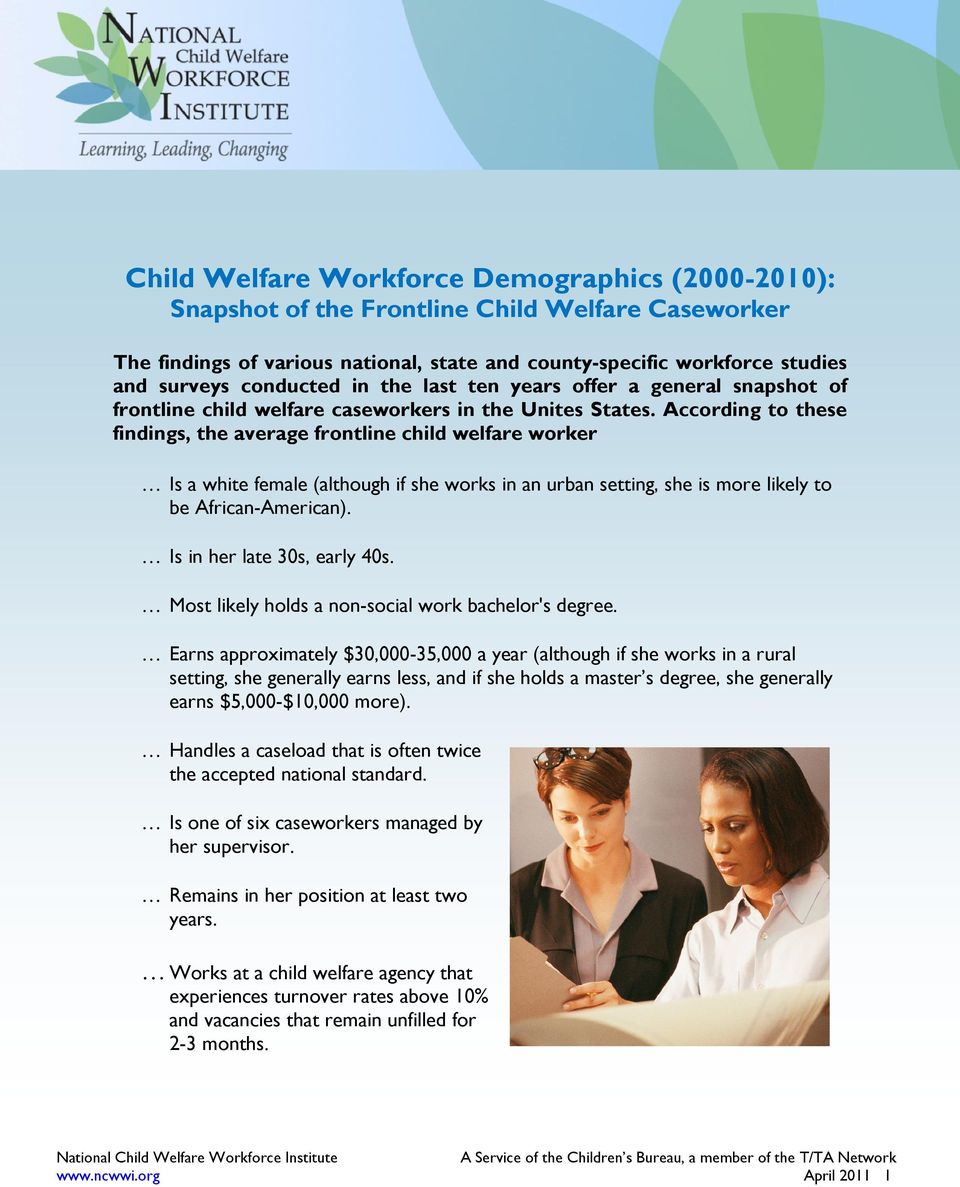
1 Child Welfare Workforce Demographics ( ): Snapshot of the Frontline Child Welfare Caseworker The findings of various national, state and county-specific workforce studies and surveys conducted in the last ten years offer a general snapshot of frontline child welfare caseworkers in the Unites States. According to these findings, the average frontline child welfare worker Is a white female (although if she works in an urban setting, she is more likely to be African-American). Is in her late 30s, early 40s. Most likely holds a non-social work bachelor's degree. Earns approximately $30,000-35,000 a year (although if she works in a rural setting, she generally earns less, and if she holds a master s degree, she generally earns $5,000-$10,000 more). Handles a caseload that is often twice the accepted national standard. Is one of six caseworkers managed by her supervisor. Remains in her position at least two years. Works at a child welfare agency that experiences turnover rates above 10% and vacancies that remain unfilled for 2-3 months. April
2 Workforce Demographic Indicator Gender Age Race/Ethnicity Educational Attainment & Requirements National Findings 72% female (AECF, 2003) 81% female (Barth et al, 2008) 84% female (NASW, 2004) Median age 41 (NASW, 2004) Median age 43 (Center for Health Workforce Studies & Center for Workforce Studies, 67% White (Barth et al, 2008) 77% White, 14% African American, 5% Hispanic/Latino (NASW, 2004) 49% hold a non-social work bachelor's degree (Barth et al, 2008) 40% hold BSW/MSW degree (Barth et al) Bachelor's degree required (AECF, 2003) Bachelor's degree required (APHSA, 2005) Less than 15% require BSW/MSW (US GAO, 2003) 75% MSW, 25% BSW (NASW, 2004) Most likely to have no SW degree (12%), and likely to have a BSW as their highest social work degree (24%) (Center for Health Workforce Studies & Center for Workforce Studies, State/County-Specific Findings Maryland: 86% female (Hopkins et al, Michigan: 82% female (Faller et al, 2010) Missouri: 81% female (Drake & Yadama, 1996) New York: 81% female (Strolin et al, 2008) Oregon: 84% female (Sage, 2010) California: mean age 41; median age 38 (Clark et al, 2009); mean age 43 (Nissly et al, 2005) Maryland: mean age 45 (Hopkins et al, New York: mean age 40 (Strolin, et al, 2008); 2/3 over the age of 40 (SWEC, Oregon: Mean age 41, median age 38 (Sage, 2010) California: Caucasian most prevalent (Clark et al, 2009); 31% African American, 26% Latino (Nissly et al, 2005) Maryland: 40% White, 53% Black (Hopkins et al, Michigan: 60% White (Faller et al, 2010) California: 34.3% MSWs (Clark et al, 2009); 51% hold Graduate degrees (Nissly et al, 2005) Georgia: BSW, 13.5%; MSW, 6.1% (Ellett et al, 2003) District of Columbia: Of 309 caseworkers, 285 had MSWs and 24 had BSWs (US GAO, 2004) Michigan: Bachelor's degree in human service field (Faller et al, 2010) Oregon: AA: 2%; BA: 45%; BSW: 28%; MA: 10%; MSW: 13% (Sage, 2010) South Carolina: Bachelor's Degree (South Carolina Legislative Audit Council,. Salary Mean public agency CPS: $33,400; Mean public agency, Non-CPS: $32,900; Mean private agency, CPS: $28,700; Mean private agency, Non-CPS: $29,200 (AECF, 2003) Mean of $33,436 for public agency workers and $28,646 for private agency workers (CWLA, ACF & APHSA, 2001) Average salaries: CPS workers $35,553; inhome workers $34,929; foster care & adoption workers $35,911; multiple program workers $36,136 (APHSA, 2005) $43,000 median salary (NASW, 2004) $44,000 (Center for Health Workforce Studies & Center for Workforce Studies, Maryland: Mean salary $44,997 (Hopkins et al, Milwaukee County: Public agency staff start at $31,825 annually while private agency staff start at $30,171, $27,000, and $27,789 (Flower, McDonald & Sumski, 2005) New York: 75% have salary between $25,000-$35,000/year 9SWEC, Oregon: Mean of $41,562, median of $41,000 (Sage, 2010) April

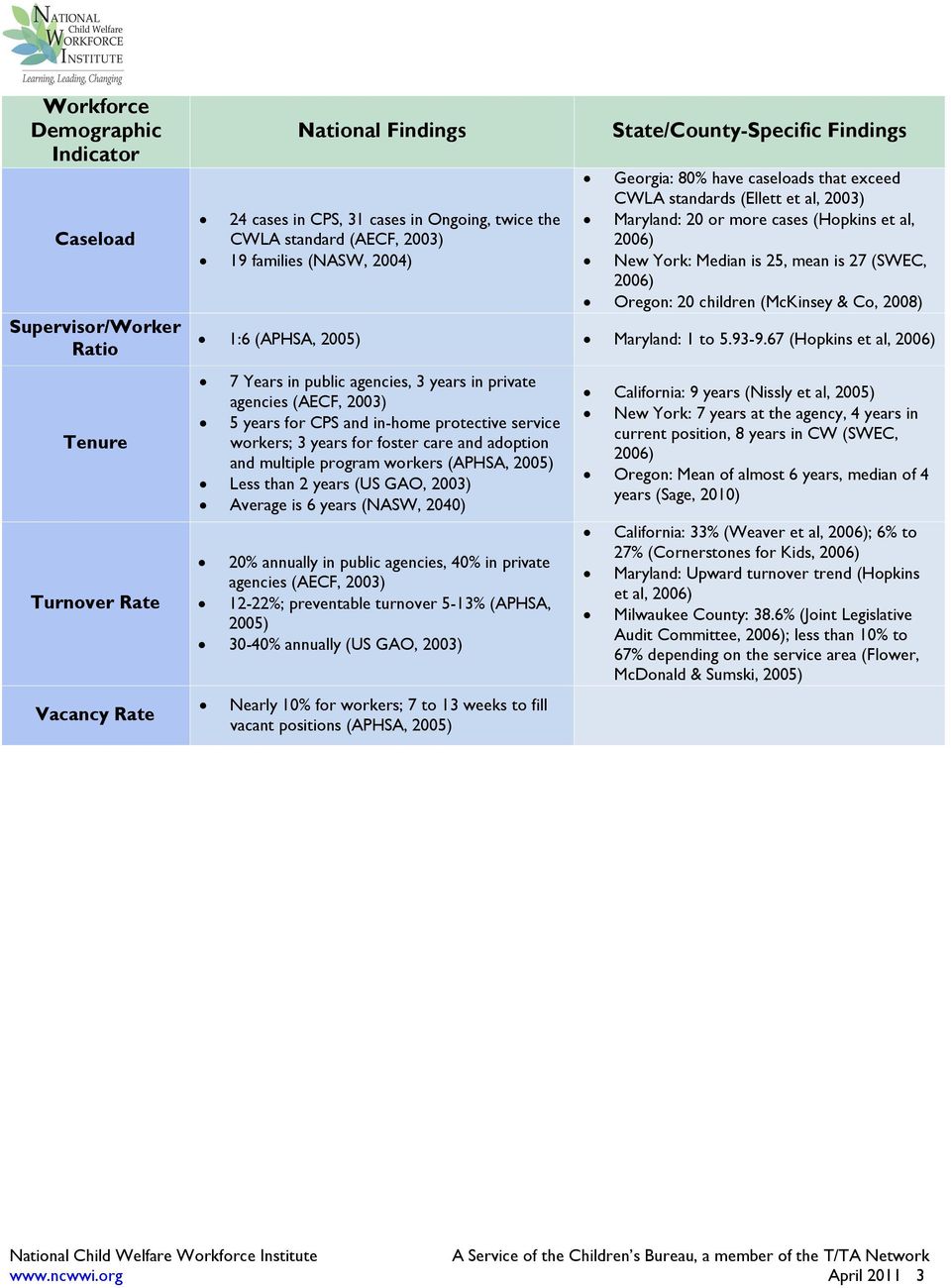
3 Workforce Demographic National Findings State/County-Specific Findings Indicator Georgia: 80% have caseloads that exceed CWLA standards (Ellett et al, 2003) 24 cases in CPS, 31 cases in Ongoing, twice the Maryland: 20 or more cases (Hopkins et al, Caseload CWLA standard (AECF, 2003) 19 families (NASW, 2004) New York: Median is 25, mean is 27 (SWEC, Oregon: 20 children (McKinsey & Co, 2008) Supervisor/Worker Ratio 1:6 (APHSA, 2005) Maryland: 1 to (Hopkins et al, Tenure Turnover Rate Vacancy Rate 7 Years in public agencies, 3 years in private agencies (AECF, 2003) 5 years for CPS and in-home protective service workers; 3 years for foster care and adoption and multiple program workers (APHSA, 2005) Less than 2 years (US GAO, 2003) Average is 6 years (NASW, 2040) 20% annually in public agencies, 40% in private agencies (AECF, 2003) 12-22%; preventable turnover 5-13% (APHSA, 2005) 30-40% annually (US GAO, 2003) Nearly 10% for workers; 7 to 13 weeks to fill vacant positions (APHSA, 2005) California: 9 years (Nissly et al, 2005) New York: 7 years at the agency, 4 years in current position, 8 years in CW (SWEC, Oregon: Mean of almost 6 years, median of 4 years (Sage, 2010) California: 33% (Weaver et al, ; 6% to 27% (Cornerstones for Kids, Maryland: Upward turnover trend (Hopkins et al, Milwaukee County: 38.6% (Joint Legislative Audit Committee, ; less than 10% to 67% depending on the service area (Flower, McDonald & Sumski, 2005) April
4 References American Public Human Services Association. (2005). Report from the 2004 child welfare workforce survey: State agency findings. Washington, DC: Author. Retrieved from Annie E. Casey Foundation. (2003). The unsolved challenge of system reform: The condition of the frontline human services workforce. Retrieved from Barth, R. P., Lloyd, E. C., Christ, S. L., Chapman, M. V., & Dickinson, N. (2008). Child welfare worker characteristics and job satisfaction: A national study. Social Work, 53(3), Center for Health Workforce Studies & Center for Workforce Studies. (. Licensed social workers in the U.S., Rensselaer, NY & Washington, DC: School of Public Health, University at Albany and National Association of Social Workers. Retrieved from Child Welfare League of America, Alliance for Children and Families, and American Public Human Services Association. (2001). The child welfare workforce challenge: Results from a preliminary study. Retrieved from Clark, S., Smith, R., & Mathais, C. (2009) California public child welfare workforce study report. Berkeley, CA: California Social Work Education Consortium. Retrieved from Cornerstones for Kids. ( Relationship between staff turnover, child welfare system functioning, and recurrent child abuse. Retrieved from Ellett, A.J., Ellett, C. D., & Rugutt, J. K. (2003). A study of personal and organizational factors contributing to employee retention and turn over in child welfare in Georgia: Executive summary. Retrieved from swe/documents/execsummary.pdf Faller, K.C., Grabarek, M., & Ortega, R.M. (2010). Commitment to child welfare work: What predicts leaving and staying? Children & Youth Services Review, 32, April
5 Flower, C, McDonald, J., & Sumski, M. (2005). Review of turnover in Milwaukee county private agency child welfare ongoing case management staff. Retrieved from Hopkins, K. M., Cohen-Callow, A., Golden, G., Barnes, G.J., Salliey, A. & Morton, C. (2007). Maryland child welfare workforce recruitment, selection and retention study: Executive summary. Retrieved from uct_files/final_reports/marylandcwworkforcestudyexecutivesummary.pdf Joint Legislative Audit Committee. (. Milwaukee County child welfare: Finances and staffing. Report 06-2, Department of Health and Family Services. Retrieved from McKinsey & Company. (2008). Transformation Roadmap: DHS Retrieved from National Association of Social Workers. (2004). "If you're right for the job, it's the best job in the world": The National Association of Social Worker's Child Welfare Specialty Practice Section members describe their experiences in child welfare. Washington, DC: author. Retrieved from Nissly, J. A., Mor Barak, M. E., & Levin, A. (2005). Stress, support, and workers intentions to leave their jobs in public child welfare. Administration in Social Work, 29(1), Sage, M.D. (2010). Child welfare workforce turnover: Frontline workers experiences with organizational culture and climate, and implications for organizational practice. Unpublished dissertation, School of Social Work, Portland State University, Portland, OR. Retrieved from _10079.pdf?sequence=1 Social Work Education Consortium. (. Workforce Retention Study: Executive Summary. Albany, NY: Author. Retrieved from %20Workforce%20Retention%20Study.pdf Strolin, J.S., McCarty, M., Lawson, H., Smith, B., Caringi, J., & Bronstein, L. (2008). Should stay or Should I go?: A comparison study of intention to leave among public child welfare systems with high and low turnover rates. Albany, NY: Social Work Education Consortium. Retrieved from fare.pdf April
6 South Carolina Legislative Audit Council. (. A Review of the Child Protective Services Program at the Department of Social Services. Report to the General Assembly. Retrieved from U.S. General Accounting Office. (2003). GAO Child welfare: HHS could play a greater role in helping child welfare agencies recruit and retain staff. Washington, DC: author. retrieved from U.S. Government Accountability Office. (2004). GAO DC Child and Family Services Agency: More focus needed on human capital management issues for caseworkers and foster parent recruitment and retention. Washington, DC: author. Retrieved from Weaver, D., Chang, J., & Gil de Gibaja, M. (. The Retention of Public Child Welfare Workers. Berkeley, CA: California Social Work Education Center. Retrieved from April

Professional Social Workers in the Child Welfare Workforce: Findings from NASW
 Journal of Family Strengths Volume 12 Issue 1 Special Issue: Centennial of the Children's Bureau Article 8 12-1-2012 Professional Social Workers in the Child Welfare Workforce: Findings from NASW Tracy
Factors Influencing Retention of Child Welfare Staff: A Systematic Review of Research
 Factors Influencing Retention of Child Welfare Staff: A Systematic Review of Research A Report from the Institute for the Advancement of Social Work Research EXECUTIVE SUMMARY Supported by a Grant from
NCWWI Reference List
 American Public Human Services Association. (2005). Report from the 2004 Child Welfare Workforce Survey: State agency findings. Washington, DC: American Public Human Services Association. The Annie E.
LICENSED SOCIAL WORKERS IN THE UNITED STATES, 2004 SUPPLEMENT. Chapter 2 of 5. Who Are Licensed Social Workers?
 LICENSED SOCIAL WORKERS IN THE UNITED STATES, 2004 SUPPLEMENT Chapter 2 of 5 Who Are Licensed Social Workers? Prepared by Center for Health Workforce Studies School of Public Health, University at Albany
LICENSED SOCIAL WORKERS IN THE UNITED STATES, 2004. Chapter 2 of 4. Demographics
 LICENSED SOCIAL WORKERS IN THE UNITED STATES, 2004 Chapter 2 of 4 Demographics Prepared by Center for Health Workforce Studies School of Public Health, University at Albany Rensselaer, NY and NASW Center
AZ Division of Children, Youth and Families External Data Questions
 AZ Division of Children, Youth and Families External Data Questions Goals: What do we A. What is the unemployment rate by district, county and statewide Unemployment rates: Each county: State: Aggregate
More Money Less Money:
 NASW More Money Less Money: Factors Associated with the Highest and Lowest Social Work Salaries NATIONAL ASSOCIATION OF SOCIAL WORKERS Elvira Craig de Silva, DSW, ACSW NASW President Elizabeth J. Clark,
Evidence-Based Implementation of a. Child Welfare Informatics (CWI) System
 Evidence-Based Implementation of a Child Welfare Informatics (CWI) System Loc H. Nguyen, Dr.P.H., M.S.W. Nguyen Page 1 Introduction Child Welfare Informatics (CWI) is the integration of child welfare practice
LICENSED SOCIAL WORKERS IN THE UNITED STATES, 2004. Chapter 1 of 4. Overview
 LICENSED SOCIAL WORKERS IN THE UNITED STATES, 2004 Chapter 1 of 4 Overview Prepared by Center for Health Workforce Studies School of Public Health, University at Albany Rensselaer, NY and NASW Center for
If You re Right for the Job, It s the Best Job in the World
 If You re Right for the Job, It s the Best Job in the World The National Association of Social Workers Child Welfare Specialty Practice Section Members Describe their Experiences In Child Welfare June
Summary of the State Elder Abuse. Questionnaire for West Virginia
 Summary of the State Elder Abuse Questionnaire for West Virginia A Final Report to: Department of Health and Human Services February 2002 Prepared by Researchers at The University of Iowa Department of
Summary of the State Elder Abuse. Questionnaire for Vermont
 Summary of the State Elder Abuse Questionnaire for Vermont A Final Report to: Vermont Adult Protective Services February 2002 Prepared by Researchers at The University of Iowa Department of Family Medicine
Policy Actions to Reduce Racial Disproportionality and Disparities in Child Welfare. A Scan of Eleven States
 Policy Actions to Reduce Racial Disproportionality and Disparities in Child Welfare A Scan of Eleven States A paper prepared by the Alliance for Racial Equity in Child Welfare October 2009 (amended June
Summary of the State Elder Abuse. Questionnaire for Ohio
 Summary of the State Elder Abuse Questionnaire for Ohio A Final Report to: Department of Human Services February 2002 Prepared by Researchers at The University of Iowa Department of Family Medicine 2 Grant,
Summary of the State Elder Abuse. Questionnaire for Alabama
 Summary of the State Elder Abuse Questionnaire for Alabama A Final Report to: Department of Human Resources Office of Adult Services February 2002 Prepared by Researchers at The University of Iowa Department
How To Build A Child Welfare Workforce
 COMPONENTS OF AN EFFECTIVE CHILD WELFARE WORKFORCE TO IMPROVE OUTCOMES FOR CHILDREN AND FAMILIES: WHAT DOES THE RESEARCH TELL US? AUGUST 2006 This report is part of a project entitled Promoting Child Welfare
VITAE. 301 Richardson Hall 518/ 442-5338 (Work) EDUCATION AND CERTIFICATES
 VITAE Mary L. McCarthy, Ph.D., LMSW 518/ 487-1678 (Cell) 301 Richardson Hall 518/ 442-5338 (Work) Albany, NY [email protected] EDUCATION AND CERTIFICATES Ph.D. Memorial University of Newfoundland May
Social Work Salaries by Race & Ethnicity
 N A S W C e n t e r f o r W o r k f o r c e S t u d i e s & S o c i a l W o r k P r a c t i c e Social Work Salaries by Race & Ethnicity occupational profile 2011 National Association of Social Workers.
CASSANDRA J. BOWERS, Ph.D.,LMSW
 School of Social Work 4756 Cass Avenue Thompson Home Rm. 236 Detroit, Michigan 48202 (313) 577-4433 [email protected] CASSANDRA J. BOWERS, Ph.D.,LMSW EDUCATION Doctor of Philosophy,, 1999 Master of Social
GAO NURSING WORKFORCE. Multiple Factors Create Nurse Recruitment and Retention Problems. Testimony
 GAO For Release on Delivery Expected at 10:00 a.m. Wednesday, June 27, 2001 United States General Accounting Office Testimony Before the Subcommittee on Oversight of Government Management, Restructuring
REPORT OF FINDINGS NURSING FACILITY STAFFING SURVEY 2010
 REPORT OF FINDINGS NURSING FACILITY STAFFING SURVEY 2010 October, 2011 ABSTRACT Approximately 2 million workers were employed at nursing facilities across the United States in 2010. 1.3 million nursing
FRAMEWORK FOR PRACTICE CASEWORKER COMPETENCE. in a specific environmental setting, and at a particular developmental stage. 2
 be safely reunited with his or her family, CPS must implement the alternative permanency plan. FRAMEWORK FOR PRACTICE This section explains how practitioners apply the philosophical tenets described above
Assuring the Sufficiency of a Frontline Workforce:
 Assuring the Sufficiency of a Frontline Workforce: A National Study of Licensed Social Workers SPECIAL REPORT: SOCIAL WORK SERVICES FOR CHILDREN & FAMILIES Assuring the Sufficiency of a Frontline Workforce
Nuclear Engineering Enrollments and Degrees Survey, 2014 Data
 Nuclear Engineering Enrollments and Degrees Survey, 2014 Data Number 74 Oak Ridge Institute for Science and Education 2015 SURVEY UNIVERSE The 2014 survey includes degrees granted between September 1,
December, 2009. Salary, Education, Benefits, and Job Descriptions of Nurses, Teachers, and Social Workers: A Comparative Analysis
 December, 2009 Salary, Education, Benefits, and Job Descriptions of Nurses, Teachers, and Social Workers: A Comparative Analysis Contents Introduction 3 Problem Statement 3 Social Work within the Texas
Social Work Salaries by Gender
 N A S W C e n t e r f o r W o r k f o r c e S t u d i e s & S o c i a l W o r k P r a c t i c e Social Work Salaries by Gender occupational profile 2011 National Association of Social Workers. All Rights
Demand for Social Workers in California
 Demand for Social Workers in California By Prof. Eileen Mayers Pasztor, DSW Department of Social Work [email protected] 562-985-7775 Prof. Michelle Saint-Germain, Ph.D. Chair, Graduate Center for Public
The State of Peer Support Services 2015. Allen S. Daniels, Ed.D Peter Ashenden
 The State of Peer Support Services 2015 Allen S. Daniels, Ed.D Peter Ashenden Introduction and Overview 1. Training and Certification 2. Understanding Peer Roles 3. Medicaid Billing and Reimbursement for
Changes in Self-Employment: 2010 to 2011
 Changes in Self-Employment: 2010 to 2011 American Community Survey Briefs By China Layne Issued January 2013 ACSBR/11-21 INTRODUCTION From December 2007 to June 2009, the United States experienced an economic
Glenn Maynard, LPC 319 SW Washington, Suite 1015 Portland, OR 97204 (503) 916-8186 Fax: (503) 227-2561 E-mail: [email protected]
 Glenn Maynard, LPC 319 SW Washington, Suite 1015 97204 (503) 916-8186 Fax: (503) 227-2561 E-mail: [email protected] EDUCATION: M.Ed. Counseling, Lewis & Clark College 1977 BS Sociology, Portland State
Ken K. Nakamura, MSW LCSW
 Ken K. Nakamura, MSW LCSW ABBREVIATED VITAE EDUCATION University of California, Berkeley, Graduate School of Social Welfare 09/81-06/83 Master of Social Welfare Emphasis: Children and Families University
Mary Jo Stahlschmidt. Patricia L. Kohl 314-935-7438 [email protected]. [c] 314-223-3450 [e] [email protected]. Dissertation Chair.
![Mary Jo Stahlschmidt. Patricia L. Kohl 314-935-7438 pkohl@wustl.edu. [c] 314-223-3450 [e] mstahlschmidt@hotmail.com. Dissertation Chair.](/thumbs/25/5418408.jpg "Mary Jo Stahlschmidt. Patricia L. Kohl 314-935-7438 pkohl@wustl.edu. [c] 314-223-3450 [e] mstahlschmidt@hotmail.com. Dissertation Chair.") [c] 314-223-3450 [e] [email protected] The goal of s research is to improve child welfare services by examining how institutional and organizational factors impact frontline service delivery and
[c] 314-223-3450 [e] [email protected] The goal of s research is to improve child welfare services by examining how institutional and organizational factors impact frontline service delivery and
Research Brief. Do Parents Feel More Aggravated These Days? MARCH 2014 Publication #2014-14 PARENTAL AGGRAVATION IN THE U.S., 1997 TO 2012 OVERVIEW
 MARCH 2014 Publication #2014-14 Do Parents Feel More Aggravated These Days? PARENTAL AGGRAVATION IN THE U.S., 1997 TO 2012 David Murphey, Ph.D., Tawana Bandy, B.S., Kristin Anderson Moore, Ph.D., & P.
ANTHONY P. CARNEVALE NICOLE SMITH JEFF STROHL
 State-Level Analysis HELP WANTED PROJECTIONS of JOBS and EDUCATION REQUIREMENTS Through 2018 JUNE 2010 ANTHONY P. CARNEVALE NICOLE SMITH JEFF STROHL Contents 1 Introduction 3 U.S. Maps: Educational concentrations
Curriculum Vitae Fred Buttell March, 2015
 Curriculum Vitae Fred Buttell March, 2015 I. CONTACT INFORMATION Professor, Tulane University School of Social Work 127 Elks Place New Orleans, LA 70112 Phone: 504-862.3486 E-mail: [email protected] II.
Poverty and Health of Children from Racial/Ethnic and Immigrant Families
 Poverty and Health of Children from Racial/Ethnic and Immigrant Families Jean Kayitsinga Julian Samora Research Institute, Michigan State University [email protected] Cambio De Colores: Latinos in the Heartland,
PROGRAM SUMMARY: http://www.uky.edu/socialwork/trc/indexqic.html 1/20/05 1
 PROGRAM SUMMARY: Testing the Impact of Structured Clinical Supervision in Frontline Public Child Welfare on Organizational, Worker Practice and Case Outcomes University of Kentucky College of Social Work
Adoption Disruption and Dissolution
 NUMBERS AND TRENDS June 2012 Adoption Disruption and Dissolution Definitions What is disruption? The term disruption is used to describe an adoption process that ends after the child is placed in an adoptive
DUAL DEGREE PROGRAMS* (Listed by Program)
 Augsburg College Baylor University Boston College Boston University Case Western Reserve University Catholic University College of St. Catherine/ University of St. Thomas Columbia University M. Theology
The So cial Services Block Grant
 The So cial Services Block Grant April 13, 2015 Dear Member of Congress: Representing a diverse coalition of groups serving vulnerable populations, the undersigned organizations support continued funding
Adoption Disruption and Dissolution
 Numbers and trends December 2004 Adoption Disruption and Dissolution Definitions What is disruption? The term disruption is used to describe an adoption process that ends after the child is placed in an
2013-2016 NASW CA STRATEGIC PLAN MISSION STATEMENT
 MISSION STATEMENT To promote the quality, effectiveness and image of the social work profession and to promote social change and social justice in order to improve the well being of all residents of California.
REPORT OF FINDINGS 2008 NURSING FACILITY STAFF VACANCY, RETENTION AND TURNOVER SURVEY
 REPORT OF FINDINGS 2008 NURSING FACILITY STAFF VACANCY, RETENTION AND TURNOVER SURVEY American Health Care Association Department of Research October, 2010 ABSTRACT Approximately 2 million workers were
RECONNECTING OPPORTUNITY YOUTH
 RECONNECTING OPPORTUNITY YOUTH Data Reference Guide March 2015 Patrick Sims Opportunity Youth Opportunity youth are young adults aged 16-24 years who are neither connected to school nor work. These young
N A T I O N A L A S S O C I A T I O N O F S O C I A L W O R K E R S. S t a n d a r d s f o r S o c i a l W o r k P r a c t i c e i n.
 N A T I O N A L A S S O C I A T I O N O F S O C I A L W O R K E R S N A S W S t a n d a r d s f o r S o c i a l W o r k P r a c t i c e i n Child Welfare N A S W S t a n d a r d s f o r S o c i a l W
THE FUTURE OF HIGHER EDUCATION IN TEXAS
 THE FUTURE OF HIGHER EDUCATION IN TEXAS WOODY L. HUNT, CHAIRMAN HIGHER EDUCATION STRATEGIC PLANNING COMMITTEE September 17, 2015 1 Let s talk about higher education in Texas and the educational competitiveness
Radiologic Sciences Staffing and Workplace Survey 2015
 Radiologic Sciences Staffing and Workplace Survey 2015 Reproduction in any form is forbidden without written permission from publisher. 1 Table of Contents Executive Summary... 3 Staffing Levels... 3 Longitudinal
BEYOND THE LESSON PLAN: SCHOOL-BASED MENTAL HEALTH SERVICES
 BEYOND THE LESSON PLAN: SCHOOL-BASED MENTAL HEALTH SERVICES Mark Sander, PsyD, LP Senior Clinical Psychologist Mental Health Coordinator Hennepin County/Minneapolis Public Schools Racine, WI Community
REBECCA BURGESS BRIGHAM
 REBECCA BURGESS BRIGHAM Campus Box 3550 The University of North Carolina at Chapel Hill School of Social Work Chapel Hill, North Carolina, 27599-3550 (919)962-6532 [email protected] EDUCATION Master
OKLAHOMA S C H I L D R E N
 OKLAHOMA S C H I L D R E N 1 State Population 2. 3,791,508 Population, Children Under 18 3.935,633 State Poverty Rate 4. 17.2% CHILD ABUSE AND NEGLECT Oklahoma s Children At a Glance 1 Poverty Rate, Children
23 rd Child Maltreatment 2012
 23 rd Child Maltreatment 2012 Y E A R OF R E P O RTI N G U.S. Department of Health & Human Services Administration for Children and Families Administration on Children, Youth and Families Children s Bureau
The Performance and State Policies Of Higher Education in Illinois: Insights from a Five- State Policy Review Project
 The Performance and State Policies Of Higher Education in Illinois: Insights from a Five- State Policy Review Project Laura W. Perna Joni Finney Patrick Callan With Assistance from: Michael Armijo, Jamey
CURRICULUM VITAE. 1990 AAS Northern Virginia Community College, Alexandria, Virginia General Studies Specialization in Emergency Medicine Technology
 CURRICULUM VITAE LAURA ANN LOGIE, PHD University of Maryland Consortium on Race, Gender and Ethnicity www.crge.umd.edu 1208 Cole Student Activities Building College Park, MD 20742 (301) 405-1651 (301)
And in rural areas. Chart 3: Median number of days to fill vacant RN positions in urban and rural areas
 RN Shortages in Hospitals March 1999, Vol. 1, No. 2 Nurses comprise the largest sector of the healthcare workforce and the majority of nurses work in hospitals. Because of the prominence and importance
2011 Dashboard Indicators
 211 Dashboard Indicators Rutgers The State University of New Jersey 211 Dashboard Indicators OVERVIEW OF THE 211 EDITION OF THE RUTGERS DASHBOARD INDICATORS Dashboard indicators for institutions of higher
Summary Enrollment Report, which can be accessed at http://aspe.hhs.gov/health/reports/2014/marketplaceenrollment/apr2014/ib_2014apr_enrollment.pdf.
 ASPE ISSUE BRIEF HEALTH INSURANCE MARKETPLACE 2015 OPEN ENROLLMENT PERIOD: JANUARY ENROLLMENT REPORT For the period: November 15, 2014 January 16, 2015 1 January 27, 2015 The Health Insurance Marketplace