
Security Implementation Guide
|
|
|
- MargaretMargaret Cooper
- 10 years ago
- Views:
Transcription

1 Security Implementation Guide Version 35.0, Winter Last updated: October 2, 2015
2 Copyright salesforce.com, inc. All rights reserved. Salesforce is a registered trademark of salesforce.com, inc., as are other names and marks. Other marks appearing herein may be trademarks of their respective owners.

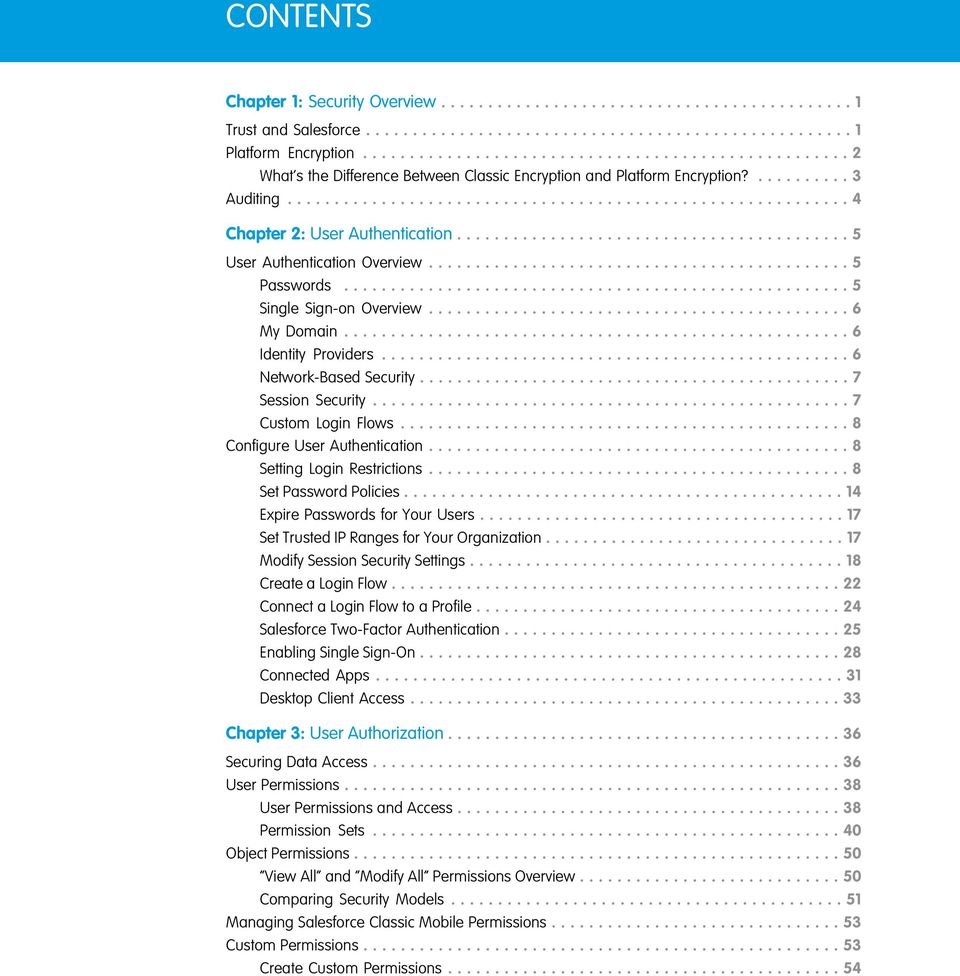
3 CONTENTS Chapter 1: Security Overview Trust and Salesforce Platform Encryption What s the Difference Between Classic Encryption and Platform Encryption? Auditing Chapter 2: User Authentication User Authentication Overview Passwords Single Sign-on Overview My Domain Identity Providers Network-Based Security Session Security Custom Login Flows Configure User Authentication Setting Login Restrictions Set Password Policies Expire Passwords for Your Users Set Trusted IP Ranges for Your Organization Modify Session Security Settings Create a Login Flow Connect a Login Flow to a Profile Salesforce Two-Factor Authentication Enabling Single Sign-On Connected Apps Desktop Client Access Chapter 3: User Authorization Securing Data Access User Permissions User Permissions and Access Permission Sets Object Permissions View All and Modify All Permissions Overview Comparing Security Models Managing Salesforce Classic Mobile Permissions Custom Permissions Create Custom Permissions
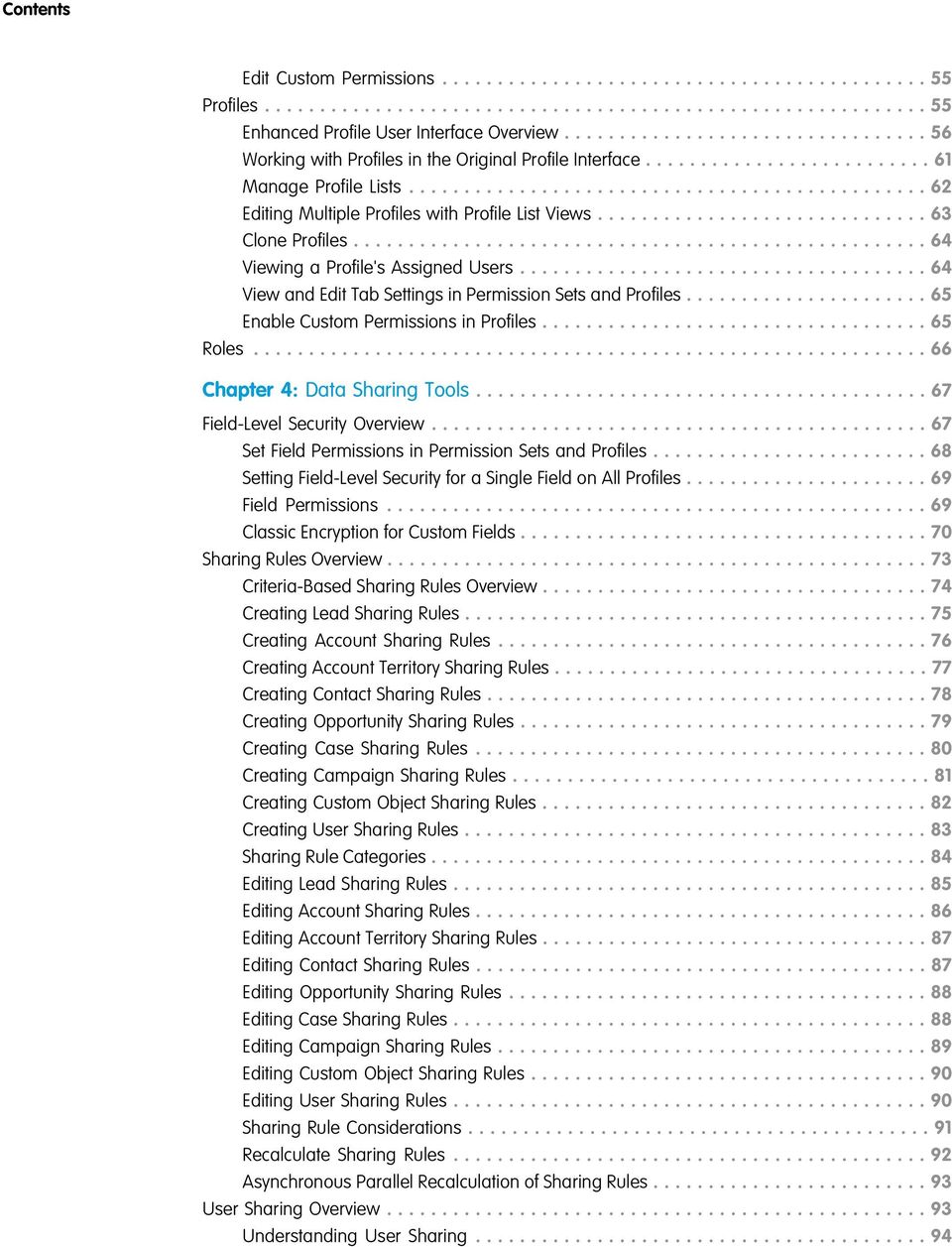
4 Contents Edit Custom Permissions Profiles Enhanced Profile User Interface Overview Working with Profiles in the Original Profile Interface Manage Profile Lists Editing Multiple Profiles with Profile List Views Clone Profiles Viewing a Profile's Assigned Users View and Edit Tab Settings in Permission Sets and Profiles Enable Custom Permissions in Profiles Roles Chapter 4: Data Sharing Tools Field-Level Security Overview Set Field Permissions in Permission Sets and Profiles Setting Field-Level Security for a Single Field on All Profiles Field Permissions Classic Encryption for Custom Fields Sharing Rules Overview Criteria-Based Sharing Rules Overview Creating Lead Sharing Rules Creating Account Sharing Rules Creating Account Territory Sharing Rules Creating Contact Sharing Rules Creating Opportunity Sharing Rules Creating Case Sharing Rules Creating Campaign Sharing Rules Creating Custom Object Sharing Rules Creating User Sharing Rules Sharing Rule Categories Editing Lead Sharing Rules Editing Account Sharing Rules Editing Account Territory Sharing Rules Editing Contact Sharing Rules Editing Opportunity Sharing Rules Editing Case Sharing Rules Editing Campaign Sharing Rules Editing Custom Object Sharing Rules Editing User Sharing Rules Sharing Rule Considerations Recalculate Sharing Rules Asynchronous Parallel Recalculation of Sharing Rules User Sharing Overview Understanding User Sharing
5 Contents Set the Org-Wide Sharing Defaults for User Records Share User Records Restoring User Visibility Defaults What Is a Group? Create and Edit Groups Group Member Types Viewing All Users in a Group Granting Access to Records About Organization-Wide Sharing Defaults Set Your Organization-Wide Sharing Defaults External Organization-Wide Defaults Overview Chapter 5: Monitoring Your Organization's Security Monitor Login History Track Field History Track Field History for Standard Objects Track Field History for Custom Objects Disable Field History Tracking Field Audit Trail Monitor Setup Changes Chapter 6: Security Tips for Apex and Visualforce Development Cross-Site Scripting (XSS) Formula Tags Cross-Site Request Forgery (CSRF) SOQL Injection Data Access Control Index

6

7 CHAPTER 1 Security Overview Understand how Salesforce security works and what tools are available to protect your organization and its data. Salesforce is built with security to protect your data and applications. You can also implement your own security scheme to reflect the structure and needs of your organization. Protecting your data is a joint responsibility between you and Salesforce. The Salesforce security features enable you to empower your users to do their jobs safely and efficiently. Salesforce limits exposure of data to the users that act on it. Implement security controls that you think are appropriate for the sensitivity of your data. Your data is protected from unauthorized access from outside your company. Also safeguard it from inappropriate usage by your users. The Security Implementation Guide is divided into chapters to help you set up security from beginning to end. Security Overview Understand how Salesforce security works and what tools are available to protect your organization and its data. User Authentication Authentication is the process of confirming the truth of each logged in user s identity to prevent unauthorized access to your organization or its data. User Authorization Ensure that each user only has access to the data and tools that you specify. Data Sharing Tools Give specific object or field access to selected groups or profiles. Monitoring Your Organization's Security Track login and field history and monitor setup changes. Security Tips for Apex and Visualforce Development Understand and guard against vulnerabilities as you develop custom applications. Please read each section and follow the steps in order to ensure that you make appropriate decisions about all the security settings that are available to you. The following videos provide additional information about security. Introduction to the Salesforce Security Model Workshop: What's Possible with Salesforce Data Access and Security Security and the Salesforce Platform: Patchy Morning Fog Clearing to Midday Understanding Multitenancy and the Architecture of the Salesforce Platform Trust and Salesforce Trust starts with transparency. That s why Salesforce displays real-time information on system performance and security on the trust site at This site provides live data on system performance, alerts for current and recent phishing and malware attempts, and tips on best security practices for your organization. The Security tab on the trust site includes valuable information that can help you to safeguard your company's data. In particular, phishing and malware are Internet scams on the rise. Phishing is a social engineering technique that attempts to acquire sensitive information such as usernames, passwords and credit card details by masquerading as a trustworthy entity in an electronic communication. Phishers often direct users to enter details at a fake website whose URL and look-and-feel are almost identical to the legitimate one. As the Salesforce community grows, it has become an increasingly appealing target for phishers. You will never get an or a phone call from a Salesforce employee asking you to reveal a password, so you should refuse to reveal it to anyone. You can report any suspicious activities by clicking the Report a Suspicious link under the Trust tab at 1

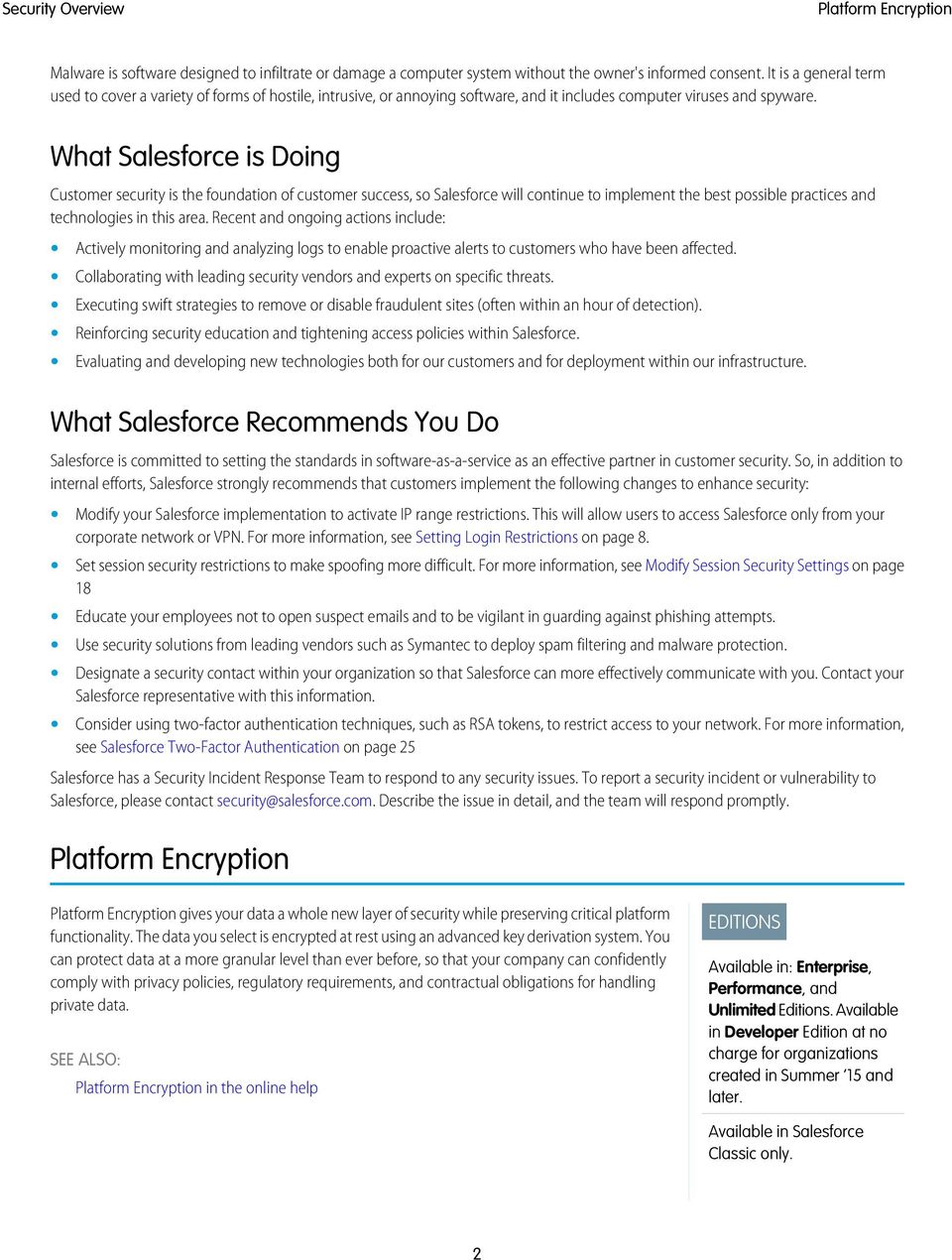
8 Security Overview Platform Encryption Malware is software designed to infiltrate or damage a computer system without the owner's informed consent. It is a general term used to cover a variety of forms of hostile, intrusive, or annoying software, and it includes computer viruses and spyware. What Salesforce is Doing Customer security is the foundation of customer success, so Salesforce will continue to implement the best possible practices and technologies in this area. Recent and ongoing actions include: Actively monitoring and analyzing logs to enable proactive alerts to customers who have been affected. Collaborating with leading security vendors and experts on specific threats. Executing swift strategies to remove or disable fraudulent sites (often within an hour of detection). Reinforcing security education and tightening access policies within Salesforce. Evaluating and developing new technologies both for our customers and for deployment within our infrastructure. What Salesforce Recommends You Do Salesforce is committed to setting the standards in software-as-a-service as an effective partner in customer security. So, in addition to internal efforts, Salesforce strongly recommends that customers implement the following changes to enhance security: Modify your Salesforce implementation to activate IP range restrictions. This will allow users to access Salesforce only from your corporate network or VPN. For more information, see Setting Login Restrictions on page 8. Set session security restrictions to make spoofing more difficult. For more information, see Modify Session Security Settings on page 18 Educate your employees not to open suspect s and to be vigilant in guarding against phishing attempts. Use security solutions from leading vendors such as Symantec to deploy spam filtering and malware protection. Designate a security contact within your organization so that Salesforce can more effectively communicate with you. Contact your Salesforce representative with this information. Consider using two-factor authentication techniques, such as RSA tokens, to restrict access to your network. For more information, see Salesforce Two-Factor Authentication on page 25 Salesforce has a Security Incident Response Team to respond to any security issues. To report a security incident or vulnerability to Salesforce, please contact [email protected]. Describe the issue in detail, and the team will respond promptly. Platform Encryption Platform Encryption gives your data a whole new layer of security while preserving critical platform functionality. The data you select is encrypted at rest using an advanced key derivation system. You can protect data at a more granular level than ever before, so that your company can confidently comply with privacy policies, regulatory requirements, and contractual obligations for handling private data. SEE ALSO: Platform Encryption in the online help Enterprise, Performance, and Unlimited Editions. Available in Developer Edition at no charge for organizations created in Summer 15 and later. Available in Salesforce Classic only. 2
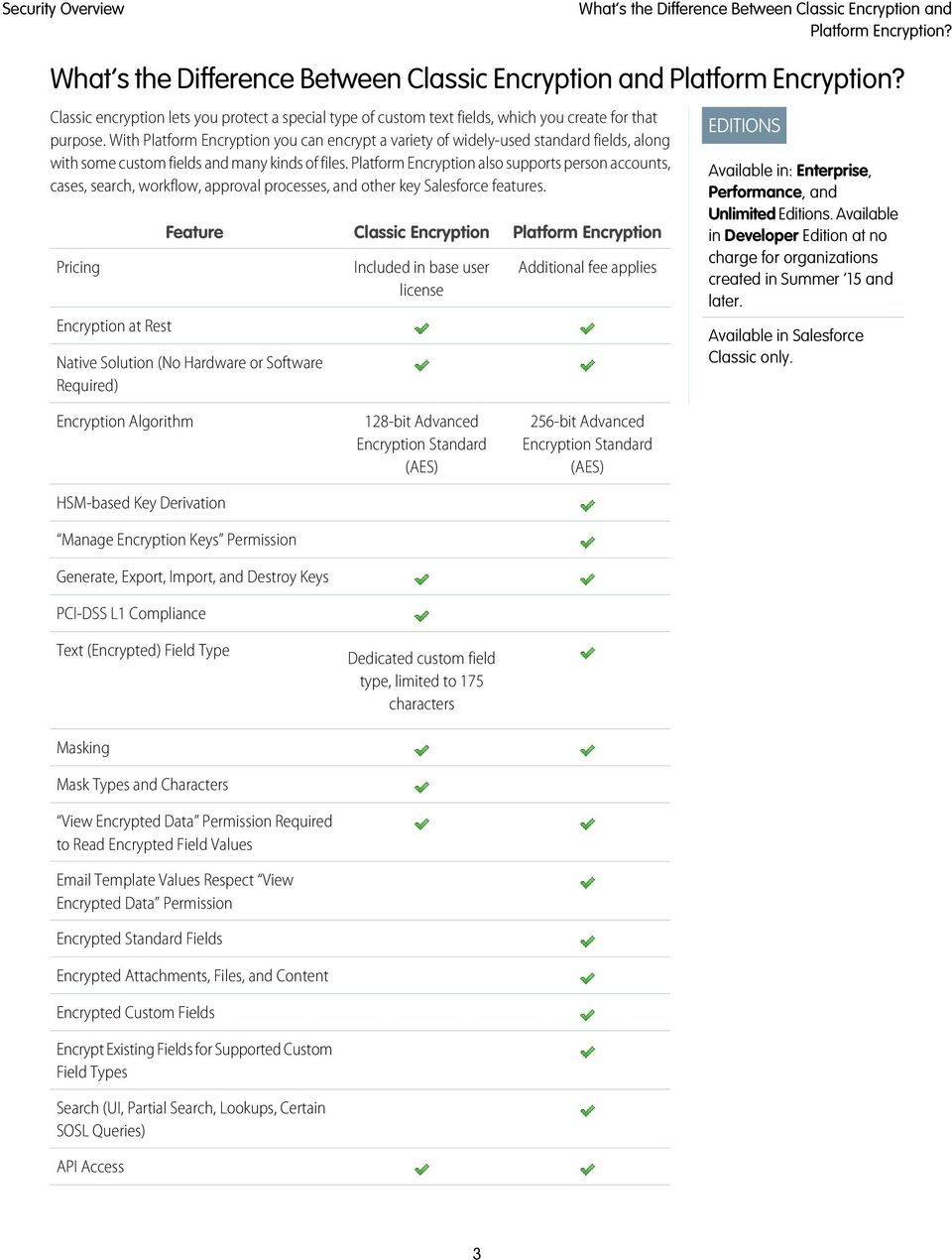
9 Security Overview What s the Difference Between Classic Encryption and Platform Encryption? What s the Difference Between Classic Encryption and Platform Encryption? Classic encryption lets you protect a special type of custom text fields, which you create for that purpose. With Platform Encryption you can encrypt a variety of widely-used standard fields, along with some custom fields and many kinds of files. Platform Encryption also supports person accounts, cases, search, workflow, approval processes, and other key Salesforce features. Pricing Encryption at Rest Feature Native Solution (No Hardware or Software Required) Classic Encryption Included in base user license Platform Encryption Additional fee applies Enterprise, Performance, and Unlimited Editions. Available in Developer Edition at no charge for organizations created in Summer 15 and later. Available in Salesforce Classic only. Encryption Algorithm HSM-based Key Derivation Manage Encryption Keys Permission Generate, Export, Import, and Destroy Keys PCI-DSS L1 Compliance Text (Encrypted) Field Type Masking Mask Types and Characters View Encrypted Data Permission Required to Read Encrypted Field Values Template Values Respect View Encrypted Data Permission Encrypted Standard Fields Encrypted Attachments, Files, and Content Encrypted Custom Fields Encrypt Existing Fields for Supported Custom Field Types Search (UI, Partial Search, Lookups, Certain SOSL Queries) API Access 128-bit Advanced Encryption Standard (AES) Dedicated custom field type, limited to 175 characters 256-bit Advanced Encryption Standard (AES) 3
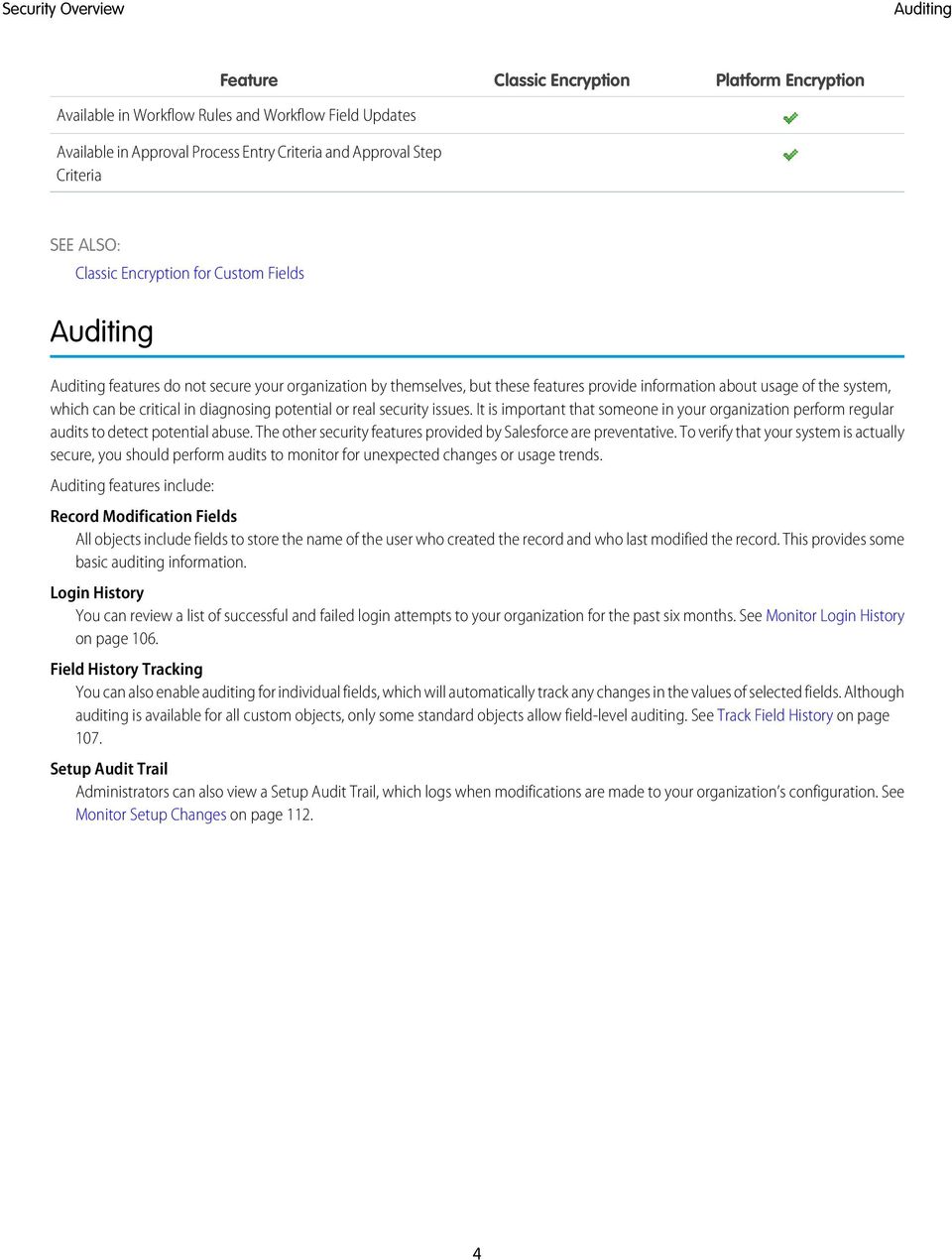
10 Security Overview Auditing Feature Available in Workflow Rules and Workflow Field Updates Available in Approval Process Entry Criteria and Approval Step Criteria Classic Encryption Platform Encryption SEE ALSO: Classic Encryption for Custom Fields Auditing Auditing features do not secure your organization by themselves, but these features provide information about usage of the system, which can be critical in diagnosing potential or real security issues. It is important that someone in your organization perform regular audits to detect potential abuse. The other security features provided by Salesforce are preventative. To verify that your system is actually secure, you should perform audits to monitor for unexpected changes or usage trends. Auditing features include: Record Modification Fields All objects include fields to store the name of the user who created the record and who last modified the record. This provides some basic auditing information. Login History You can review a list of successful and failed login attempts to your organization for the past six months. See Monitor Login History on page 106. Field History Tracking You can also enable auditing for individual fields, which will automatically track any changes in the values of selected fields. Although auditing is available for all custom objects, only some standard objects allow field-level auditing. See Track Field History on page 107. Setup Audit Trail Administrators can also view a Setup Audit Trail, which logs when modifications are made to your organization s configuration. See Monitor Setup Changes on page
11 CHAPTER 2 User Authentication Authentication is the process of confirming the truth of each logged in user s identity to prevent unauthorized access to your organization or its data. Read the sections in this chapter to learn what tools are available to you for user authentication. User Authentication Overview Salesforce provides each user in your organization with a unique username and password that must be entered each time a user logs in. Salesforce issues a session cookie only to record encrypted authentication information for the duration of a specific session. The session cookie does not include either the username or password of the user. Salesforce does not use cookies to store other confidential user and session information, but instead implements more advanced security methods based on dynamic data and encoded session IDs. Passwords As an administrator, you can configure several settings to ensure that your users passwords are strong and secure. Password policies Set various password and login policies, such as specifying an amount of time before all users passwords expire and the level of complexity required for passwords. See Set Password Policies on page 14. User password expiration Expire the passwords for all users in your organization, except for users with Password Never Expires permission. See Expire Passwords for Your Users on page 17. User password resets Reset the password for specified users. See Reset Passwords for Your Users in the Salesforce Help. Login attempts and lockout periods If a user is locked out of Salesforce because of too many failed login attempts, you can unlock them. See Edit Users in the Salesforce Help. Password Requirements A password can t contain a user s username and can t match a user s first or last name. Passwords also can t be too simple. For example, a user can t change their password to password. For all editions, a new organization has the following default password requirements. You can change these password policies in all editions, except for Personal Edition. A password must contain at least eight characters, including one alphabetic character and one number. The security question s answer can t contain the user s password. When users change their password, they can t reuse their last three passwords. both Salesforce Password policies available in: All Editions To set password policies: Manage Password Policies To reset user passwords and unlock users: Reset User Passwords and Unlock Users 5

12 User Authentication Single Sign-on Overview Single Sign-on Overview Salesforce has its own system of user authentication, but some companies prefer to use an existing single sign-on capability to simplify and standardize their user authentication. You have two options to implement single sign-on federated authentication using Security Assertion Markup Language (SAML) or delegated authentication. Federated authentication using Security Assertion Markup Language (SAML) allows you to send authentication and authorization data between affiliated but unrelated Web services. This enables you to sign on to Salesforce from a client application. Federated authentication using SAML is enabled by default for your organization. Delegated authentication single sign-on enables you to integrate Salesforce with an authentication method that you choose. This enables you to integrate authentication with your LDAP (Lightweight Directory Access Protocol) server, or perform single sign-on by authenticating using a token instead of a password. You manage delegated authentication at the permission level, allowing some users to use delegated authentication, while other users continue to use their Salesforce-managed password. Delegated authentication is set by permissions, not by organization. The primary reasons for using delegated authentication include: Using a stronger type of user authentication, such as integration with a secure identity provider Making your login page private and accessible only behind a corporate firewall Differentiating your organization from all other companies that use Salesforce in order to reduce phishing attacks You must request that this feature be enabled by Salesforce. Contact Salesforce to enable delegated authentication single sign-on for your organization. Authentication providers let your users log in to your Salesforce organization using their login credentials from an external service provider. Salesforce supports the OpenId Connect protocol that allows users to log in from any OpenID provider such as Google, Paypal, LinkedIn and other services supporting OpenID Connect. When authentication providers are enabled, Salesforce does not validate a user s password. Instead, Salesforce uses the user s login credentials from the external service provider to establish authentication credentials. My Domain Using My Domain, you can define a custom Salesforce domain name. A custom domain name helps you better manage login and authentication for your organization in several key ways. Highlight your business identity with your unique domain URL. Brand your login screen and customize right-frame content. Block or redirect page requests that don t use the new domain name. Access increased support for single sign-on. My Domain is required to use some Salesforce Identity features, such as authentication providers and identity providers. Set custom login policy and determine how users are authenticated. Let users select an alternate identity provider from the login page. For more information, see My Domain Overview in the Salesforce online help. Identity Providers An identity provider is a trusted provider that enables you to use single sign-on to access other websites. A service provider is a website that hosts applications. You can enable Salesforce as an identity provider, then define one or more service providers, so your users can access other applications directly from Salesforce using single sign-on. This can be a great help to your users: instead of having to remember many passwords, they will only have to remember one. Plus, the applications can be added as tabs to your Salesforce organization, which means users won t have to switch between programs. 6

13 User Authentication Network-Based Security For more information, see About Identity Providers and Service Providers in the Salesforce online help. Network-Based Security User authentication determines who can log in, while network-based security limits from where users can log in and access, and when. Use network-based security to limit the window of opportunity for an attacker by restricting the origin of user access requests. Network-based security can also make it more difficult for an attacker to use stolen credentials. To enhance network-based security, you can restrict the hours during which users can log in. You can also restrict the range of IP addresses from which users can log in and access Salesforce. If IP address restrictions are defined for a user s profile and a login originates from an unknown IP address, Salesforce does not allow the login. These restrictions help protect your data from unauthorized access and phishing attacks. To set the organization-wide list of trusted IP addresses from which users can always log in without a login challenge, see Set Trusted IP Ranges for Your Organization on page 17. To restrict login hours by profile, or to restrict login and access requests by IP addresses for specific profiles, see Setting Login Restrictions on page 8. CAPTCHA Security for Data Exports By request, Salesforce can also require users to pass a user verification test to export data from Salesforce. This simple, text-entry test helps prevent malicious programs from accessing your organization s data, as well as reducing the risk of automated attacks. CAPTCHA is a type of network-based security. To pass the test, users must type two words displayed on an overlay into the overlay s text box field, and click a Submit button. Salesforce uses CAPTCHA technology provided by recaptcha to verify that a person, as opposed to an automated program, has correctly entered the text into the overlay. CAPTCHA stands for Completely Automated Public Turing test to tell Computers and Humans Apart. Session Security After logging in, a user establishes a session with the platform. Use session security to limit exposure to your network when a user leaves their computer unattended while still logged on. It also limits the risk of internal attacks, such as when one employee tries to use another employee s session. You can control the session expiration time window for user logins. Session expiration allows you to select a timeout for user sessions. The default session timeout is two hours of inactivity. When the session timeout is reached, users are prompted with a dialog that allows them to log out or continue working. If they do not respond to this prompt, they are automatically logged out. Note: When a user closes a browser window or tab they are not automatically logged off from their Salesforce session. Please ensure that your users are aware of this, and that they end all sessions properly by clicking Your Name > Logout. By default, Salesforce uses TLS (Transport Layer Security) and requires secure connections (HTTPS) for all communication. The Require secure connections (HTTPS) setting determines whether TLS (HTTPS) is required for access to Salesforce, apart from Force.com sites, which can still be accessed using HTTP. If you ask Salesforce to disable this setting and change the URL from to you can still access the application. However, you should require all sessions to use TLS for added security. See Modify Session Security Settings on page 18. You can restrict access to certain types of resources based on the level of security associated with the authentication (login) method for the user s current session. By default, each login method has one of two security levels: Standard or High Assurance. You can change the session security level and define policies so specified resources are only available to users with a High Assurance level. For details, see Session-level Security on page 21. 7

14 User Authentication Custom Login Flows Custom Login Flows Login flows allow administrators to build post-authentication processes to match their business practices, associate the flow with a user profile, and send the user through that flow when logging in. Use login flows to collect registration information from users, provide a terms of service acceptance form, prompt the user for a second factor of authentication, and other customization. Use the Flow Designer to create login flows, and then associate those flows with specific profiles in your organization. You can connect the same flow to multiple profiles. Users with the profile are directed to the login flow after they authenticate, but before the user is directed to the organization s content. The login flow screens are embedded within the standard Salesforce login page for an integrated user login experience. both Salesforce Login flows support all the Salesforce user interface authentication methods, including username and password, delegated authentication, SAML single sign-on, and social sign-on through a third-party authentication provider. You can apply login flows to Salesforce organizations, communities, and portals. Note: You can t apply login flows to API logins or when sessions are passed to the UI through frontdoor.jsp from a non-ui login process. Only flows of type Flow are supported. Configure User Authentication Choose login settings to ensure that your users are who they say that they are. Read the sections below to configure user authentication. Setting Login Restrictions To help protect your organization s data against unauthorized access, you have several options for setting login and access restrictions. Login Hours For each profile, you can set the hours when users can log in. See: View and Edit Login Hours in the Enhanced Profile User Interface View and Edit Login Hours in the Original Profile User Interface both Salesforce Available in all editions Two-Factor Authentication for User Interface Logins For each profile, you can require users to enter a time-based token as a second form of authentication when they log in via the user interface. See Set Two-Factor Authentication Login Requirements on page 26. 8

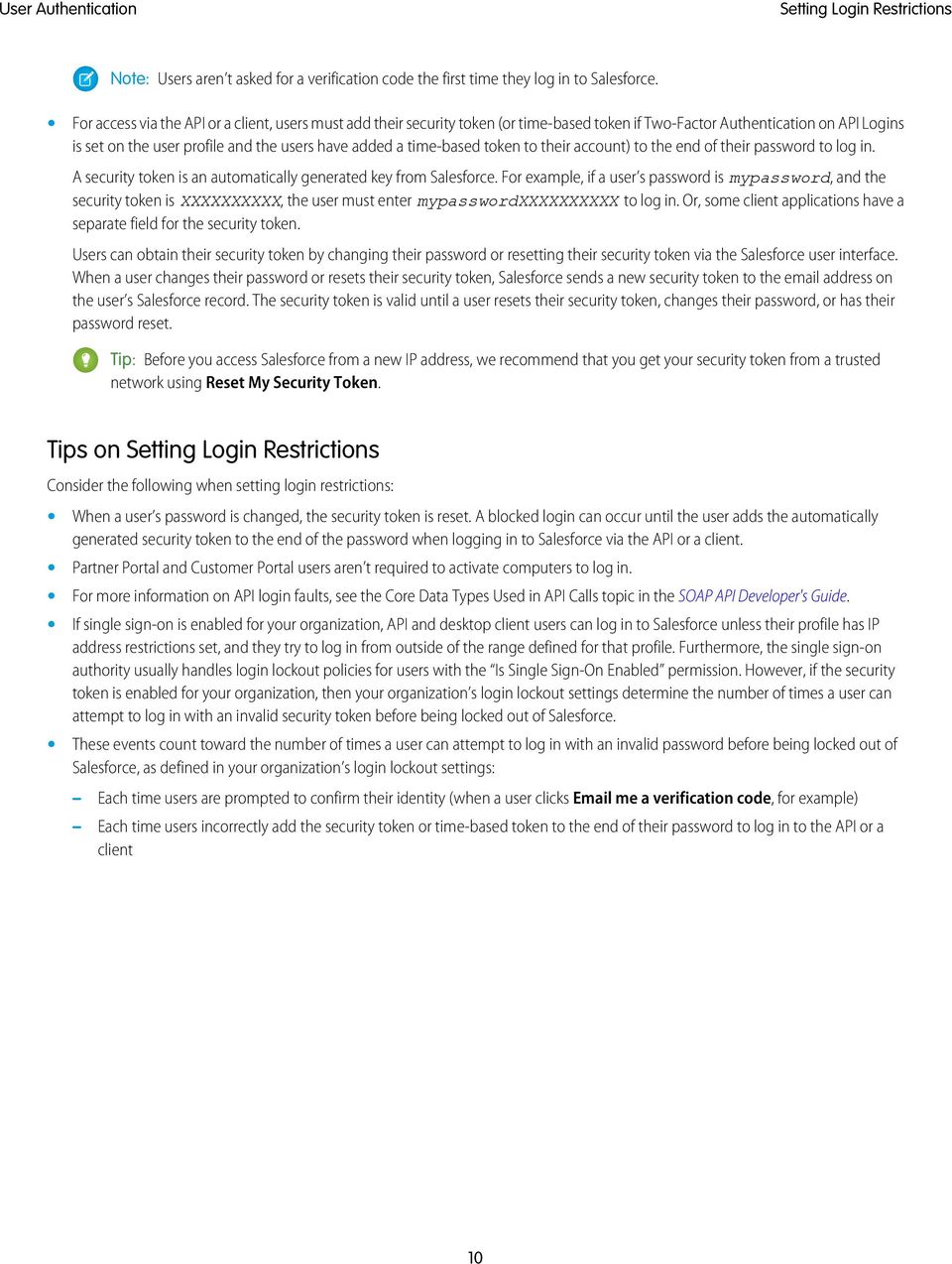
15 User Authentication Setting Login Restrictions Two-Factor Authentication for API Logins For each profile, you can allow the use of a time-based token to access the service instead of the standard security token. If users add a time-based token to their account and this permission is enabled, they must use this token instead of the standard security token whenever it s requested, such as when resetting the account s password. See Set Two-Factor Authentication Requirements for API Access on page 27. Login IP Address Ranges For Enterprise, Performance, Unlimited, Developer, and Database.com editions, you can set the Login IP Range addresses from which users can log in on an individual profile. Users outside of the Login IP Range set on a profile can t access your Salesforce organization. See: Restricting Login IP Ranges in the Enhanced Profile User Interface Restrict Login IP Addresses in the Original Profile User Interface For Contact Manager, Group, and Professional Editions, set the Login IP Range. From Setup, enter Session Settings in the Quick Find box, then select Session Settings. Login IP Address Range Enforcement for All Access Requests You can restrict all access to Salesforce to the IP addresses included in Login IP Ranges in users profiles. For example, suppose a user logs in successfully from an IP address defined in Login IP Ranges. The user then moves to a different location and has a new IP address that is outside of Login IP Ranges. When the user refreshes the browser or tries to access Salesforce, including access from a client application, the user is denied. To enable this option, from Setup, enter Session Settings in the Quick Find box, select Session Settings, and then select Enforce login IP ranges on every request. This option affects all user profiles that have login IP restrictions. Organization-Wide Trusted IP Ranges For all users, you can set a list of IP address ranges from which they can always log in without receiving a login challenge. These users can log in to your organization once they provide the additional verification. See Set Trusted IP Ranges for Your Organization. When users log in to Salesforce, either via the user interface, the API, or a desktop client such as Salesforce for Outlook, Connect Offline, Connect for Office, or the Data Loader, Salesforce confirms that the login is authorized as follows: 1. Salesforce checks whether the user s profile has login hour restrictions. If login hour restrictions are specified for the user s profile, any login outside the specified hours is denied. 2. If the user has the Two-Factor Authentication for User Interface Logins permission, Salesforce prompts the user for a time-based token (which the user may also be prompted to create if it hasn t already been added to the account) upon logging in. 3. If the user has the Two-Factor Authentication for API Logins permission and a time-based token has been added to the account, Salesforce returns an error if a time-based token is not used to access the service in place of the standard security token. 4. Salesforce then checks whether the user s profile has IP address restrictions. If IP address restrictions are defined for the user s profile, any login from an undesignated IP address is denied, and any login from a specified IP address is allowed. If the Enforce login IP ranges on every request session setting is enabled, the IP address restrictions are enforced for each page request, including requests from client applications. 5. If profile-based IP address restrictions are not set, Salesforce checks whether the user is logging in from an IP address they have not used to access Salesforce before: If the user s login is from a browser that includes a Salesforce cookie, the login is allowed. If the user previously used the browser to log in to Salesforce and has not cleared the browser cookies, the browser has the Salesforce cookie. If the user s login is from an IP address in your organization s trusted IP address list, the login is allowed. If the user s login is not from a trusted IP address or a browser with a Salesforce cookie, the login is blocked. Whenever a login is blocked or returns an API login fault, Salesforce must verify the user s identity: For access via the user interface, the user is prompted to enter a token (also called a verification code) to confirm the user s identity. 9
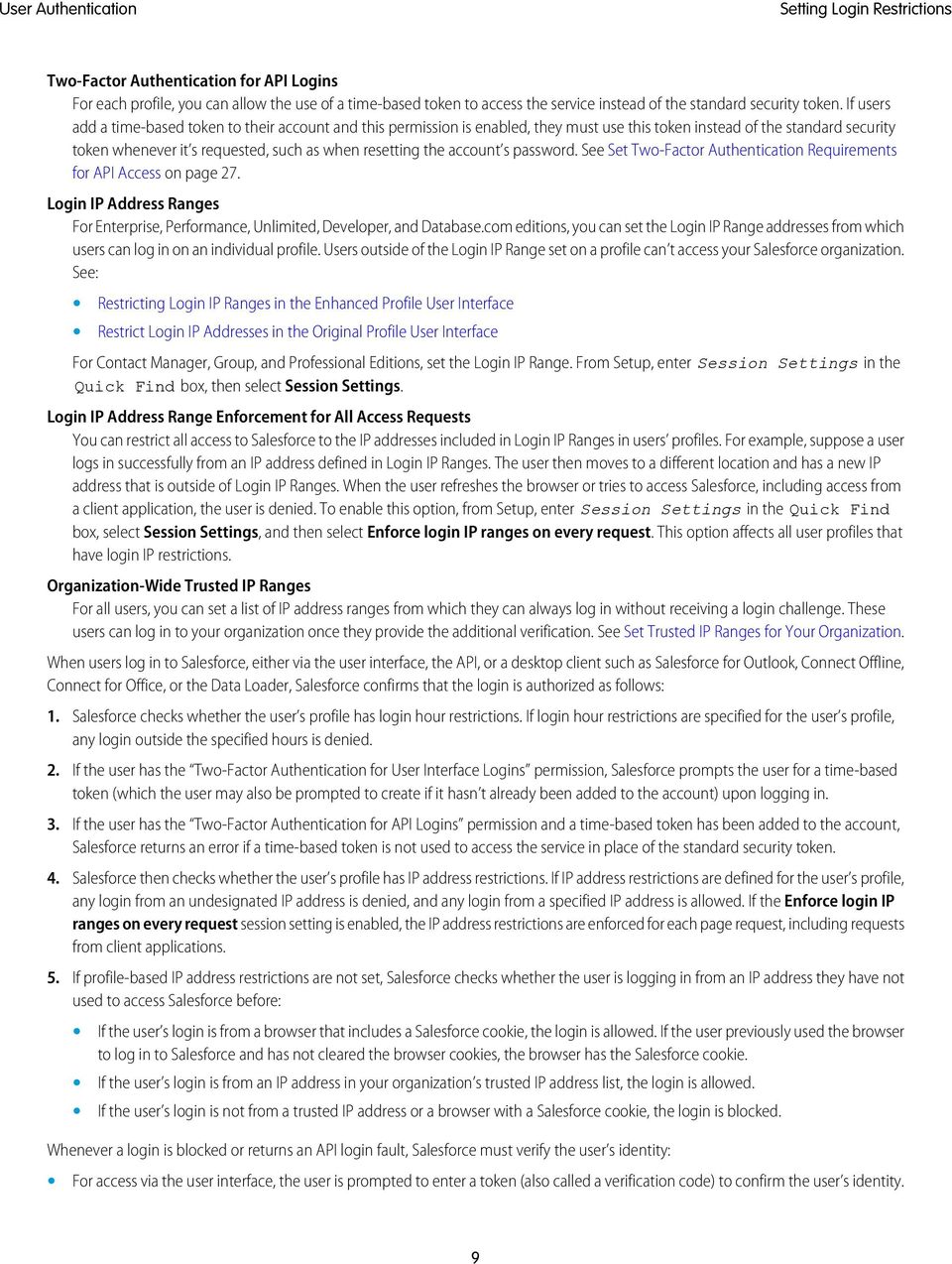
16 User Authentication Setting Login Restrictions Note: Users aren t asked for a verification code the first time they log in to Salesforce. For access via the API or a client, users must add their security token (or time-based token if Two-Factor Authentication on API Logins is set on the user profile and the users have added a time-based token to their account) to the end of their password to log in. A security token is an automatically generated key from Salesforce. For example, if a user s password is mypassword, and the security token is XXXXXXXXXX, the user must enter mypasswordxxxxxxxxxx to log in. Or, some client applications have a separate field for the security token. Users can obtain their security token by changing their password or resetting their security token via the Salesforce user interface. When a user changes their password or resets their security token, Salesforce sends a new security token to the address on the user s Salesforce record. The security token is valid until a user resets their security token, changes their password, or has their password reset. Tip: Before you access Salesforce from a new IP address, we recommend that you get your security token from a trusted network using Reset My Security Token. Tips on Setting Login Restrictions Consider the following when setting login restrictions: When a user s password is changed, the security token is reset. A blocked login can occur until the user adds the automatically generated security token to the end of the password when logging in to Salesforce via the API or a client. Partner Portal and Customer Portal users aren t required to activate computers to log in. For more information on API login faults, see the Core Data Types Used in API Calls topic in the SOAP API Developer's Guide. If single sign-on is enabled for your organization, API and desktop client users can log in to Salesforce unless their profile has IP address restrictions set, and they try to log in from outside of the range defined for that profile. Furthermore, the single sign-on authority usually handles login lockout policies for users with the Is Single Sign-On Enabled permission. However, if the security token is enabled for your organization, then your organization s login lockout settings determine the number of times a user can attempt to log in with an invalid security token before being locked out of Salesforce. These events count toward the number of times a user can attempt to log in with an invalid password before being locked out of Salesforce, as defined in your organization s login lockout settings: Each time users are prompted to confirm their identity (when a user clicks me a verification code, for example) Each time users incorrectly add the security token or time-based token to the end of their password to log in to the API or a client 10
17 User Authentication Setting Login Restrictions Restricting Login IP Ranges in the Enhanced Profile User Interface You can control login access on a user s profile by specifying a range of IP addresses. When you define IP address restrictions for a profile, any login from a restricted IP address is denied. 1. From Setup, enter Profiles in the Quick Find box, then select Profiles. 2. Select a profile and click its name. 3. In the profile overview page, click Login IP Ranges. 4. Use any of these methods to change login IP address ranges for the profile. If you want to add ranges, click Add IP Ranges. Enter a valid IP address in the IP Start Address and a higher IP address in the IP End Address field. The start and end addresses define the range of allowable IP addresses from which users can log in. To allow logins from a single IP address, enter the same address in both fields. For example, to allow logins from only , enter as both the start and end addresses. If you want to edit or remove ranges, click Edit or Delete for that range. Optionally, enter a description for the range. If you maintain multiple ranges, use the Description field to provide details, such as which part of your network corresponds to this range. Both IP addresses in a range must be either IPv4 or IPv6. In ranges, IPv4 addresses exist in the IPv4-mapped IPv6 address space ::ffff:0:0 to ::ffff:ffff:ffff, where ::ffff:0:0 is and ::ffff:ffff:ffff is A range can t include IP addresses inside of the IPv4-mapped IPv6 address space if it also includes IP addresses outside of the IPv4-mapped IPv6 address space. Ranges such as to ::1:0:0:0 or :: to ::1:0:0:0 are not allowed. You can Database.com To view login IP ranges: View Setup and Configuration To edit and delete login IP ranges: Manage Profiles and Permission Sets set up IPv6 addresses in all organizations, but IPv6 is only enabled for login in sandbox organizations from the Spring 12 release and later. Important: Partner User profiles are limited to five IP addresses. If you want to increase this limit, contact Salesforce. The Salesforce Classic Mobile app can bypass IP range definitions set up for profiles. Salesforce Classic Mobile initiates a secure connection to Salesforce over the mobile carrier s network, but the mobile carrier s IP addresses might be outside of the IP ranges allowed on the user s profile. To prevent bypassing IP definitions set on a user s profile, disable Salesforce Classic Mobile in the Salesforce Help for that user. Note: You can limit all access to Salesforce to only those IPs in Login IP Ranges. For example, suppose a user logs in successfully from an IP address defined in Login IP Ranges. The user then moves to a different location and has a new IP address that is outside of Login IP Ranges. When the user tries to access Salesforce, including access from a client application, the user is denied. To enable this option, in Setup, enter Session Settings in the Quick Find box, then select Session Settings and select Enforce login IP ranges on every request. This option affects all user profiles that have login IP restrictions. 11

18 User Authentication Setting Login Restrictions Restrict Login IP Addresses in the Original Profile User Interface You can control login access on a user s profile by specifying a range of IP addresses. When you define IP address restrictions for a profile, any login from a restricted IP address is denied. 1. The procedure you use to restrict the range of valid IP addresses on profiles depends on your Edition. If you re using Enterprise, Unlimited, Performance, or Developer editions, from Setup, enter Profiles in the Quick Find box, then select Profiles, and select a profile. If you re using Professional, Group, or Personal editions, from Setup, enter Session Settings in the Quick Find box, then select Session Settings. Available in all editions 2. Click New in the Login IP Ranges related list. 3. Enter a valid IP address in the IP Start Address and a higher IP address in the IP End Address field. The start and end addresses define the range of allowable IP addresses from which users can log in. To allow logins from a single IP address, enter the same address in both fields. For example, to allow logins from only , enter as both the start and end addresses. Partner User profiles are limited to five IP addresses. If you want to increase this limit, contact Salesforce. To view login IP ranges: View Setup and Configuration To edit and delete login IP ranges: Manage Profiles and Permission Sets The Salesforce Classic Mobile app can bypass IP range definitions set up for profiles. Salesforce Classic Mobile initiates a secure connection to Salesforce over the mobile carrier s network, but the mobile carrier s IP addresses might be outside of the IP ranges allowed on the user s profile. To prevent bypassing IP definitions set on a user s profile, disable Salesforce Classic Mobile in the Salesforce Help for that user. 4. Optionally, enter a description for the range. If you maintain multiple ranges, use the Description field to provide details, such as which part of your network corresponds to this range. 5. Click Save. Both IP addresses in a range must be either IPv4 or IPv6. In ranges, IPv4 addresses exist in the IPv4-mapped IPv6 address space ::ffff:0:0 to ::ffff:ffff:ffff, where ::ffff:0:0 is and ::ffff:ffff:ffff is A range can t include IP addresses inside of the IPv4-mapped IPv6 address space if it also includes IP addresses outside of the IPv4-mapped IPv6 address space. Ranges such as to ::1:0:0:0 or :: to ::1:0:0:0 are not allowed. You can set up IPv6 addresses in all organizations, but IPv6 is only enabled for login in sandbox organizations from the Spring 12 release and later. Note: Cache settings on static resources are set to private when accessed via a Force.com site whose guest user's profile has restrictions based on IP range or login hours. Sites with guest user profile restrictions cache static resources only within the browser. Also, if a previously unrestricted site becomes restricted, it can take up to 45 days for the static resources to expire from the Salesforce cache and any intermediate caches. Note: You can limit all access to Salesforce to only those IPs in Login IP Ranges. For example, suppose a user logs in successfully from an IP address defined in Login IP Ranges. The user then moves to a different location and has a new IP address that is outside of Login IP Ranges. When the user tries to access Salesforce, including access from a client application, the user is denied. To enable this option, in Setup, enter Session Settings in the Quick Find box, then select Session Settings and select Enforce login IP ranges on every request. This option affects all user profiles that have login IP restrictions. 12
19 User Authentication Setting Login Restrictions View and Edit Login Hours in the Enhanced Profile User Interface For each profile, you can specify the hours when users can log in. 1. From Setup, enter Profiles in the Quick Find box, then select Profiles. 2. Select a profile and click its name. 3. In the profile overview page, scroll down to Login Hours and click Edit. 4. Set the days and hours when users with this profile can log in to the organization. To allow users to log in at any time, click Clear all times. To prohibit users from using the system on a specific day, set the start and end times to the same value. If users are logged in when their login hours end, they can continue to view their current page, but they can t take any further action. Database.com Note: The first time login hours are set for a profile, the hours are based on the organization s Default Time Zone as specified on the Company Information page in Setup. After that, any changes to the organization s Default Time Zone won t change the time zone for the profile s login hours. As a result, the login hours are always applied at those exact times even if a user is in a different time zone or if the organization s default time zone is changed. Depending on whether you re viewing or editing login hours, the hours may appear differently. On the Login Hours edit page, hours are shown in your specified time zone. On the profile overview page, they appear in the organization s original default time zone. To view login hour settings: View Setup and Configuration To edit login hour settings: Manage Profiles and Permission Sets View and Edit Login Hours in the Original Profile User Interface Specify the hours when users can log in based on the user profile. 1. From Setup, enter Profiles in the Quick Find box, then select Profiles, and select a profile. 2. Click Edit in the Login Hours related list. 3. Set the days and hours when users with this profile can use the system. To allow users to log in at any time, click Clear All Times. To prohibit users from using the system on a specific day, set the start and end times to the same value. If users are logged in when their login hours end, they can continue to view their current page, but they can t take any further action. 4. Click Save. Note: The first time login hours are set for a profile, the hours are based on the organization s Default Time Zone as specified on the Company Information page in Setup. After that, any changes to the organization s Default Time Zone won t change the time zone for the profile s login hours. As a result, the login hours are always applied at those exact times even if a user is in a different time zone or if the organization s default time zone is changed. Depending on whether you re viewing or editing login hours, the hours appear differently. On the profile detail page, hours are shown in your specified time zone. On the Login Hours edit page, they appear in the organization s default time zone. Database.com To set login hours: Manage Profiles and Permission Sets 13
20 User Authentication Set Password Policies Set Password Policies For your organization s security, you can set various password and login policies. Note: User passwords cannot exceed 16,000 bytes. Logins are limited to 3,600 per hour per user. This limit applies to organizations created after Summer From Setup, enter Password Policies in the Quick Find box, then select Password Policies. 2. Customize the password settings. Field User passwords expire in Enforce password history Description The length of time until user passwords expire and must be changed. The default is 90 days. This setting isn t available for Self-Service portals. This setting doesn t apply to users with the Password Never Expires permission. Save users previous passwords so that they must always reset their password to a new, unique password. Password history is not saved until you set this value. The default is 3 passwords remembered. You cannot select No passwords remembered unless you select Never expires for the User passwords expire in field. This setting isn t available for Self-Service portals. both Salesforce Contact Manager Group Professional Database.com To set password policies: Manage Password Policies Minimum password length Password complexity requirement The minimum number of characters required for a password. When you set this value, existing users aren t affected until the next time they change their passwords. The default is 8 characters. The requirement for which types of characters must be used in a user s password. Complexity levels: No restriction allows any password value and is the least secure option. Must mix alpha and numeric characters requires at least one alphabetic character and one number, which is the default. Must mix alpha, numeric, and special characters requires at least one 14

21 User Authentication Set Password Policies Field Description alphabetic character, one number, and one of the following characters:! # $ % - _ = + < >. Must mix numbers and uppercase and lowercase letters requires at least one number, one uppercase letter, and one lowercase letter. Must mix numbers, uppercase and lowercase letters, and special characters requires at least one number, one uppercase letter, and one lowercase letter, and one of the following characters:! # $ % - _ = + < >. Password question requirement Maximum invalid login attempts Lockout effective period The values are Cannot contain password, meaning that the answer to the password hint question cannot contain the password itself; or None, the default, for no restrictions on the answer. The user s answer to the password hint question is required. This setting is not available for Self-Service portals, Customer Portals, or partner portals. The number of login failures allowed for a user before they become locked out. This setting isn t available for Self-Service portals. The duration of the login lockout. The default is 15 minutes. This setting isn t available for Self-Service portals. Note: If users are locked out, they must wait until the lockout period expires. Alternatively, a user with the Reset User Passwords and Unlock Users permission can unlock them from Setup by entering Users in the Quick Find box, then selecting Users, selecting the user, then clicking Unlock. This button is only available when a user is locked out. Obscure secret answer for password resets This feature hides answers to security questions as you type. The default is to show the answer in plain text. Note: If your organization uses the Microsoft Input Method Editor (IME) with the input mode set to Hiragana, when you type ASCII characters they re converted into Japanese characters in normal text fields. However, the IME does not work properly in fields with obscured text. If your organization s users cannot properly enter their passwords or other values after enabling this feature, disable the feature. Require a minimum 1 day password lifetime When you select this option, a password can t be changed more than once in a 24-hour period. 15
22 User Authentication Set Password Policies 3. Customize the forgotten password and locked account assistance information. Note: This setting is not available for Self-Service portals, Customer Portals, or partner portals. Field Message Help link Description If set, this message appears in the We can t reset your password that users receive when they lock themselves out by trying to reset their password too many times. The text also appears at the bottom of the Answer Your Security Question page when users reset their passwords. You can tailor the text to your organization by adding the name of your internal help desk or a system administrator. For the , the message appears only for accounts that need an administrator to reset them. Lockouts due to time restrictions get a different system message. If set, this link displays with the text defined in the Message field. In the We can t reset your password , the URL displays just as it is typed in the Help link field, so the user can see where the link goes. This URL display format is a security feature, because the user is not within a Salesforce organization. On the Answer Your Security Question page, the Help link URL combines with the text in the Message field to make a clickable link. Security isn t an issue, because the user is in a Salesforce organization when changing passwords. Valid protocols: http https mailto 4. Specify an alternative home page for users with the API Only User permission. After completing user management tasks such as resetting a password, API-only users are redirected to the URL specified here, rather than to the login page. 5. Click Save. 16
23 User Authentication Expire Passwords for Your Users Expire Passwords for Your Users As an administrator, you can expire passwords for all users any time you want to enforce extra security for your organization. To expire passwords for all users, except those users with the Password Never Expires permission: 1. From Setup, enter Expire All Passwords in the Quick Find box, then select Expire All Passwords. 2. Select Expire all user passwords. 3. Click Save. The next time users log in, they are prompted to reset their password. Considerations When Expiring Passwords Users might need to activate their computers to log in to Salesforce. Expire all user passwords doesn t affect Self-Service portal users, because they aren t direct Salesforce users. both Salesforce Professional Database.com To expire all passwords: Manage Internal Users Set Trusted IP Ranges for Your Organization Trusted IP Ranges define a list of IP addresses from which users can log in without receiving a login challenge for verification of their identity, such as a code sent to their mobile phone. Note: Who Sees What: Organization Access Watch how you can restrict login through IP ranges and login hours. To help protect your organization s data from unauthorized access, you can specify a list of IP addresses from which users can log in without receiving a login challenge. However, this does not restrict access, entirely, for users outside of the Trusted IP Range. After these users complete the login challenge (usually by entering a code sent to their mobile device or address), they can log in. 1. From Setup, enter Network Access in the Quick Find box, then select Network Access. 2. Click New. 3. Enter a valid IP address in the Start IP Address field and a higher IP address in the End IP Address field. both Salesforce Available in all editions To view network access: Login Challenge Enabled To change network access: Manage IP Addresses The start and end addresses define the range of allowable IP addresses from which users can log in, including the start and end values. If you want to allow logins from a single IP address, enter the same address in both fields. For example, to allow logins from only , enter as both the start and end addresses. The start and end IP addresses must be in an IPv4 range and include no more than 33,554,432 addresses (2 25, a /7 CIDR block). 4. Optionally, enter a description for the range. For example, if you maintain multiple ranges, enter details about the part of your network that corresponds to this range. 5. Click Save. 17
24 User Authentication Modify Session Security Settings Note: For organizations that were activated before December 2007, Salesforce automatically populated your organization s trusted IP address list in December 2007, when this feature was introduced. The IP addresses from which trusted users had already accessed Salesforce during the past six months were added. Modify Session Security Settings You can modify session security settings to specify connection type, timeout settings, and more. 1. From Setup, enter Session Settings in the Quick Find box, then select Session Settings. 2. Customize the session security settings. Both Salesforce Field Timeout value Disable session timeout warning popup Force logout on session timeout Description Length of time after which the system logs out inactive users. For Portal users, the timeout is between 10 minutes and 12 hours even though you can only set it as low as 15 minutes. Select a value between 15 minutes and 12 hours. Choose a shorter timeout period if your organization has sensitive information and you want to enforce stricter security. Note: The last active session time value isn t updated until halfway through the timeout period. So if you have a 30-minute timeout, the system doesn t check for activity until 15 minutes have passed. For example, if you update a record after 10 minutes, the last active session time value isn t updated because there was no activity after 15 minutes. You re logged out in 20 more minutes (30 minutes total), because the last active session time wasn t updated. Suppose that you update a record after 20 minutes. That s 5 minutes after the last active session time is checked. Your timeout resets, and you have another 30 minutes before being logged out, for a total of 50 minutes. Determines whether the system prompts inactive users with a timeout warning message. Users are prompted 30 seconds before timeout as specified by the Timeout value. Requires that when sessions time out for inactive users, current sessions become invalid. The browser refreshes and returns to the login page. To access the organization, the user must log in again. Note: Do not select Disable session timeout warning popup when enabling this option. The Lock sessions to the IP address from which they originated setting is available in: Enterprise, Performance, Unlimited, Developer, and Database.com Editions All other settings available in: Personal, Contact Manager, Group, Professional, Enterprise, Performance, Unlimited, Developer, and Database.com Editions To modify session security settings: Customize Application 18
25 User Authentication Modify Session Security Settings Field Lock sessions to the IP address from which they originated Description Determines whether user sessions are locked to the IP address from which the user logged in, helping to prevent unauthorized persons from hijacking a valid session. Note: This option can inhibit various applications and mobile devices. Lock sessions to the domain in which they were first used Require secure connections (HTTPS) Associates a current UI session for a user, such as a community user, with a specific domain to help prevent unauthorized use of the session ID in another domain. This preference is enabled by default for organizations created with the Spring 15 release or later. Determines whether HTTPS is required to log in to or access Salesforce, apart from Force.com sites, which can still be accessed using HTTP. This option is enabled by default for security reasons. Note: The Reset Passwords for Your Users page can only be accessed using HTTPS. Force relogin after Login-As-User Require HttpOnly attribute Determines whether an administrator who is logged in as another user is returned to their previous session after logging out as the secondary user. If the option is enabled, an administrator must log in again to continue using Salesforce after logging out as the user; otherwise, the administrator is returned to the original session after logging out as the user. This option is enabled by default for new organizations beginning with the Summer 14 release. Restricts session ID cookie access. A cookie with the HttpOnly attribute is not accessible via non-http methods, such as calls from JavaScript. Note: If you have a custom or packaged application that uses JavaScript to access session ID cookies, selecting Require HttpOnly attribute breaks your application because it denies the application access to the cookie. If Require HttpOnly attribute is selected, the AJAX Toolkit debugging window is not available. Use POST requests for cross-domain sessions Sets the organization to send session information using a POST request, instead of a GET request, for cross-domain exchanges, such as when a user is using a Visualforce page. In this context, POST requests are more secure than GET requests, because POST requests keep the session information in the body of the request. However, if you enable this setting, embedded content from another domain, such as: <img src=" might not display. Enforce login IP ranges on every request Restricts the IP addresses from which users can access Salesforce to only the IP addresses defined in Login IP Ranges. If this option is enabled, login IP ranges are enforced on each page request, including requests from client 19
26 User Authentication Modify Session Security Settings Field Description applications. If this option is not enabled, login IP ranges are enforced only when a user logs in. This option affects all user profiles that have login IP restrictions. Enable caching and password autocomplete on login page Enable the SMS method of identity confirmation Allows the user s browser to store usernames. If enabled, after an initial login, usernames are auto-filled into the User Name field on the login page. This preference is selected by default and caching and autocomplete are enabled. Allows users to receive a one-time PIN delivered via SMS. If this option is selected, administrators or users must verify their mobile phone number before taking advantage of this feature. This setting is selected by default for all organizations. Require security tokens for API logins from callouts (API version 31.0 and earlier) Requires the use of security tokens for API logins from callouts, such as Apex callouts or callouts using the AJAX proxy, in API version 31.0 and earlier. In API version 32.0 and later, security tokens are required by default. Login IP Ranges (for Contact Manager, Group, and Professional Editions) Enable clickjack protection for Setup pages Enable clickjack protection for non-setup Salesforce pages Enable clickjack protection for customer Visualforce pages with standard headers Enable clickjack protection for customer Visualforce pages with headers disabled Specifies a range of IP addresses users must log in from (inclusive), or the login fails. To specify a range, click New and enter a Start IP Address and End IP Address to define the range, which includes the start and end values. This field is not available in Enterprise, Unlimited, Performance, and Developer Editions. In those editions, you can specify a valid Login IP Range in the user profile settings. Protects against clickjack attacks on setup Salesforce pages. Clickjacking is also known as a user interface redress attack. (Setup pages are available from the Setup menu.) Protects against clickjack attacks on non-setup Salesforce pages. Clickjacking is also known as a user interface redress attack. Setup pages already include protection against clickjack attacks. (Setup pages are available from the Setup menu.) This setting is selected by default for all organizations. Protects against clickjack attacks on your Visualforce pages with headers enabled. Clickjacking is also known as a user interface redress attack. Warning: If you use custom Visualforce pages within a frame or iframe, you might see a blank page or the page may display without the frame. For example, Visualforce pages in a page layout do not function when clickjack protection is on. Protects against clickjack attacks on your Visualforce pages with headers disabled when setting showheader="false" on the page. Clickjacking is also known as a user interface redress attack. Warning: If you use custom Visualforce pages within a frame or iframe, you might see a blank page or the page may display without the frame. For example, Visualforce pages in a page layout do not function when clickjack protection is on. 20
27 User Authentication Modify Session Security Settings Field Enable CSRF protection on GET requests on non-setup pages Enable CSRF protection on POST requests on non-setup pages Logout URL Description Protects against Cross Site Request Forgery (CSRF) attacks by modifying non-setup pages to include a random string of characters in the URL parameters or as a hidden form field. With every GET and POST request, the application checks the validity of this string of characters and doesn t execute the command unless the value found matches the expected value. This setting is selected by default for all organizations. Redirects users to a specific page after they log out of Salesforce, such as an authentication provider s page or a custom-branded page. This URL is used only if no logout URL is specified in the identity provider, SAML single sign-on, or external authentication provider settings. If no value is specified for Logout URL, the default is unless MyDomain is enabled. If My Domain is enabled, the default is 3. Click Save. Session Security Levels You can restrict access to certain types of resources based on the level of security associated with the authentication (login) method for the user s current session. By default, each login method has one of two security levels: Standard or High Assurance. You can change the session security level and define policies so specified resources are only available to users with a High Assurance level. The different authentication methods are assigned these security levels, by default. Username and Password Standard Delegated Authentication Standard Two-Factor Authentication High Assurance Authentication Provider Standard SAML Standard Note: The security level for a SAML session can also be specified using the SessionLevel attribute of the SAML assertion sent by the identity provider. The attribute can take one of two values, STANDARD or HIGH_ASSURANCE. To change the security level associated with a login method: 1. From Setup, enter Session Settings in the Quick Find box, then select Session Settings. 2. Under Session Security Levels, select the login method. 3. Click the Add or Remove arrow to move it to the proper category. Currently, the only features that use session-level security are reports and dashboards in Salesforce Reports and Dashboards, and connected apps. You can set policies requiring High Assurance on these types of resources and specify an action to take if the session used to access the resource is not High Assurance. The supported actions are: Block Blocks access to the resource by showing an insufficient privileges error. Raise session level Prompts users to complete two-factor authentication. When users authenticate successfully, they can access the resource. For reports and dashboards, you can apply this action when users access reports or dashboards, or just when they export and print them. 21
28 User Authentication Create a Login Flow Warning: Raising the session level to high assurance by redirecting the user to complete two-factor authentication is not a supported action in Lightning. If your org has Lightning enabled, and you set a policy that requires a high assurance session to access reports and dashboards, Lightning users with a standard assurance session are blocked from reports and dashboards. Also, they don t see the icons for these resources in the navigation menu. As a workaround, users with a standard assurance session can log out and log in again using an authentication method that is defined as high assurance by their org. They then have access to reports and dashboards. Alternatively, they can switch to Salesforce Classic, where they are prompted to raise the session level when they attempt to access reports and dashboards. To set a High Assurance required policy for accessing a connected app: 1. From Setup, enter Connected Apps in the Quick Find box, then select the option for managing connected apps. 2. Click Edit next to the connected app. 3. Select High Assurance session required. 4. Select one of the actions presented. 5. Click Save. To set a High Assurance required policy for accessing reports and dashboards: 1. From Setup, enter Access Policies in the Quick Find box, then select Access Policies. 2. Select High Assurance session required. 3. Select one of the actions presented. 4. Click Save. The session levels have no impact on any resources in the app other than connected apps, reports, and dashboards for which explicit security policies have been defined. Create a Login Flow Use the Cloud Flow Designer to build a login flow process, then associate the finished flow with a profile. When a user s profile is associated with a login flow, the user is directed to the flow as part of the authentication process. The login flow screens are embedded in the standard Salesforce login page. During the authentication process, these users have restricted access to the login flow screens. At the end of a successful authentication and completion of the login flow, the user is redirected to the organization. Otherwise, an explicit action can be defined within the flow to deny access. For example, an administrator can create a login flow that implements a custom two-factor authentication process to add a desired security layer. A flow like this uses Apex methods to get the session context, extract the user s IP address, and verify if the request is coming from a Trusted IP Range. (To find or set the Trusted IP Range, from Setup, enter Network Access in the Quick Find box, then select Network Access.) If the request is coming from within a Trusted IP Range address, Salesforce skips the flow and logs the user into the organization. Otherwise, Salesforce invokes the flow providing one of three options. 1. Direct the user to log in with additional credentials, such as a time-based one-time password (TOTP). 2. Force the user to log out. 3. Direct the user to a page with more options. both Salesforce To open, edit, or create a flow in the Cloud Flow Designer: Manage Force.com Flow 22
29 User Authentication Create a Login Flow You can also build login flows that direct users to customized pages, such as forms to gather more information, or pages providing users with additional information. Build Your Own Login Flow Use the following process to build your own login flow. 1. Create a new flow using the Flow Designer and Apex. For example, you can design a custom IP-based two-factor authentication flow that requires a second factor of authentication only if the user is logging in from outside of the corporate Trusted IP Range. (To find or set the Trusted IP Range, from Setup, enter Network Access in the Quick Find box, then select Network Access.) Note: Do not set the Login IP Ranges directly in the user profile. The Login IP Ranges set directly in a profile restrict access to the organization for users of that profile who are outside that range, entirely, and those users cannot enter the login flow process. The flow should contain the following. a. A new Apex class defining an Apex plugin that implements from the (Process.Plugin) and uses the Auth.SessionManagement class to access the time-based one-time password (TOTP) methods and services. The new Apex class for the plugin generates a time-based key with a quick response (QR) code to validate the TOTP provided by the user against the TOTP generated by Salesforce. b. A screen element to scan a QR code. c. A decision element to handle when the token is valid and when the token is invalid. Within the flow, you can set input variables. If you use the following specified names, these values will be populated for the flow when it starts. Name LoginFlow_LoginType LoginFlow_IpAddress LoginFlow_LoginIpAddress LoginFlow_UserAgent LoginFlow_Platform LoginFlow_Application LoginFlow_Community Value Description The user type, such as Chatter Community external user The user s current IP address The user s IP address used during login, which can change after authentication The user agent string provided by the user s browser The operating system for the user Application used to request authentication Current Community, if this login flow applies to a Community 23
30 User Authentication Connect a Login Flow to a Profile Name LoginFlow_SessionLevel LoginFlow_UserId Value Description The current session security level, Standard or High Assurance The user s 18-character ID. During the flow, you can assign the following, pre-defined variables values for specific behavior. Note: The flow loads these values only after a UI screen is refreshed (a user clicking a button does not load the values, a new screen must be added to the flow for the values to be loaded). Name LoginFlow_FinishLocation LoginFlow_ForceLogout Value Description A Text value. Provide a string that defines where the user goes after completing the login flow. The string should be a valid Salesforce URL (the user cannot leave the organization and stay in the flow) or relative path. A Boolean value. Set this variable to true to log the user out, immediately, and force the user to exit the flow. 2. Save the flow. 3. Activate the flow. 4. Connect the login flow to a profile. Connect a Login Flow to a Profile After you create a login flow in Flow Designer and activate the flow, you associate it with a profile in your organization. Users with that profile are then directed to the login flow. 1. From Setup, enter Login Flows in the Quick Find box, then select Login Flows. 2. Click New. 3. Enter a name to reference the login flow association when you edit or delete it. The name doesn t need to be unique. 4. Select the login flow for the profile. The drop-down list includes all the available flows saved in the Flow Designer. Only active flows of type Flow are supported. 5. Select a user license for the profile to which you want to connect the flow. The profile list then shows profiles with that license. 6. Select the profile to connect to the login flow. 7. Click Save. Users of the profile are now directed to the login flow. both Salesforce After you associate the login flow, you can edit or delete the flows listed on this login flows page. You can associate a login flow with one or more profiles. However, a profile can t be connected to more than one login flow. 24
31 User Authentication Salesforce Two-Factor Authentication Salesforce Two-Factor Authentication Salesforce admins can enhance security by requiring a second level of authentication on every login, called two-factor authentication (2FA). You can also require two-factor authentication when a user meets certain criteria, such as attempting to view reports or logging in from an unrecognized IP address. Basic Identity Confirmation When a user logs in, Salesforce considers the user s geographic location and browser. If they re not recognized, Salesforce prompts the user to verify their identity using the highest-priority verification method available for that user. The following is the order of priority for verification methods. 1. Verification code generated by a mobile authenticator app connected to the user s account 2. Verification code sent via SMS to the user s verified mobile device 3. Verification code sent via to the user s address Both Salesforce Database.com The user enters the code as a secondary verification of their identity. After verification, the user doesn t need to provide this information again, unless they log in from a browser or location that isn t verified by Salesforce. How Two-Factor Authentication Works For stronger identity verification, you can require a second level of authentication on every login, or every login through the API (for developers and client applications), or for access to specific features. Two-factor authentication leverages an authentication service, such as the Salesforce Authenticator app, the Google Authenticator app, or another supported authentication service. The service provides a code, called the time-based one-time password (TOTP) or time-based token, which users specify (in addition to their password) when they log in. Admins enable two-factor authentication through permissions. Users add the authenticator service s one-time password generator app or device through their own personal settings. Configuring Two-Factor Authentication Salesforce admins customize the circumstances that prompt users for a second factor of authentication in the following ways. Require it for every login. Set the two-factor login requirement for every time the user logs in to Salesforce. You can also enable this feature for API logins. For more information, see Set Two-Factor Authentication Login Requirements or Set Two-Factor Authentication Requirements for API Access. Use stepped up authentication (also known as high assurance authentication). Sometimes you don t need two-factor authentication for every user s login, but you want to secure certain resources. If the user tries to use a connected app or access reports, then Salesforce prompts the user to enter a verification code. For more information, see Session Security Levels. Use login flows. Login flows leverage the Flow Designer and profiles so you can build post-authentication requirements as the user logs in, including custom two-factor authentication processes. For more information, see the following examples. Login Flows Implementing SMS-based Two-factor Authentication Enhancing Security with Two Factor Authentication Users have to connect an authenticator app, which generates the verification code, to their Salesforce accounts. For more information, see Connect a One-Time Password Generator App or Device. 25
32 User Authentication Salesforce Two-Factor Authentication IN THIS SECTION: Set Two-Factor Authentication Login Requirements Salesforce admins can require users to enter a time-based one-time password (TOTP) generated from an authenticator app when they log in to Salesforce. Set Two-Factor Authentication Requirements for API Access Salesforce admins can set the Two-Factor Authentication for API Logins permission to allow using a second authentication challenge for API access to Salesforce. Connect a One-Time Password Generator App or Device You can connect a one-time password generator app, such as Salesforce Authenticator or Google Authenticator, to your account. If your administrator requires a verification code when you log in for increased security (called two-factor authentication ), use the code generated by the app. You can also use a code generated by the app whenever we have to verify your identity. Remove or Reset a User s One-Time Password Generator App Only one mobile app that generates one-time passwords can be connected to a user s account. If the user loses access to the app, such as when the user replaces or loses a mobile device, the app must be disconnected from the user s account. Then a new app can be connected, if desired. Set Two-Factor Authentication Login Requirements Salesforce admins can require users to enter a time-based one-time password (TOTP) generated from an authenticator app when they log in to Salesforce. To require this authentication every time a user logs in to Salesforce, select the Two-Factor Authentication for User Interface Logins permission in the user profile or permission set. Enhancing Security with Two-Factor Authentication (6:56 minutes) See a demonstration of Two-Factor Authentication for Salesforce, and when to use it. Users must enter the code generated by the authenticator app every time they log in to Salesforce. After two-factor authentication is enabled, it applies to users logging in to Salesforce, including organizations with custom domains created using My Domain. The basic implementation of two-factor authentication doesn t apply to users of the following authentication methods. You can enforce two-factor authentication for these users with custom login flows. SAML for single sign-on Social sign-on in to organizations or Communities Username and password authentication in to Communities Both Salesforce Contact Manager, Database.com, Developer, Enterprise, Group, Performance, Professional, and Unlimited and Editions To edit profiles and permission sets: Manage Profiles and Permission Sets 26
33 User Authentication Salesforce Two-Factor Authentication Set Two-Factor Authentication Requirements for API Access Salesforce admins can set the Two-Factor Authentication for API Logins permission to allow using a second authentication challenge for API access to Salesforce. The Two-Factor Authentication for User Interface Logins permission is a prerequisite for Two-Factor Authentication for API Logins. So, once these permissions are enabled, users must enter a second authentication value when logging in to Salesforce through the user interface. This second factor of authentication is also called a time-based one-time password (TOTP) or time-based token. Users can connect an authenticator app to their account to generate the time-based one-time password. Both Salesforce Contact Manager Database.com Group Professional To edit system permissions in profiles: Manage Profiles and Permission Sets To enable this feature: Two-Factor Authentication for User Interface Logins Connect a One-Time Password Generator App or Device You can connect a one-time password generator app, such as Salesforce Authenticator or Google Authenticator, to your account. If your administrator requires a verification code when you log in for increased security (called two-factor authentication ), use the code generated by the app. You can also use a code generated by the app whenever we have to verify your identity. This additional level of security is a second factor of authentication. If your administrator has set this requirement, you have to configure this additional factor (usually an authenticator app that displays a code, such as Salesforce Authenticator or Google Authenticator) for your account. This additional factor of authentication generates your verification code, also called a time-based Both Salesforce Available in all editions one-time password (usually a numeric code). Once you connect the one-time password generator to your account, you re prompted to enter the code from the authenticator app whenever you log in to Salesforce. 1. Download the supported authenticator app for the type of device you use. You can use any authenticator app that supports the time-based one-time password (TOTP) algorithm ( IETF RFC 6238), such as Salesforce Authenticator for ios, Salesforce Authenticator for Android, and Google Authenticator. 2. From your personal settings, enter Advanced User Details in the Quick Find box, then select Advanced User Details. No results? Enter Personal Information in the Quick Find box, then select Personal Information. 3. Find App Registration: One-Time Password Generator and click Connect. 4. For security purposes, you re prompted to log in to your account. 27
34 User Authentication Enabling Single Sign-On 5. Scan the QR code with the authenticator app on your mobile device. Alternatively, you can manually enter your username and the key displayed when you click I Can t Scan the QR Code into the app. 6. Enter the code generated by the authenticator app into the Verification Code field in Salesforce. The authenticator app generates a new verification code, periodically. Enter the current code. 7. Click Connect. SEE ALSO: Salesforce Help: Find Your Personal Settings Remove or Reset a User s One-Time Password Generator App Only one mobile app that generates one-time passwords can be connected to a user s account. If the user loses access to the app, such as when the user replaces or loses a mobile device, the app must be disconnected from the user s account. Then a new app can be connected, if desired. Users and Salesforce admins can remove the user s existing configuration. On the user s Advanced User Details page, find App Registration: One-Time Password Generator and click Disconnect. Both Salesforce Available in all editions Enabling Single Sign-On Salesforce offers several ways to use single sign-on: Federated authentication using Security Assertion Markup Language (SAML) allows you to send authentication and authorization data between affiliated but unrelated Web services. This enables you to sign on to Salesforce from a client application. Federated authentication using SAML is enabled by default for your organization. Delegated authentication single sign-on enables you to integrate Salesforce with an authentication method that you choose. This enables you to integrate authentication with your LDAP (Lightweight Directory Access Protocol) server, or perform single sign-on by authenticating using a token instead of a password. You manage delegated authentication at the permission level, allowing some users to use delegated authentication, while other users continue to use their Salesforce-managed password. Delegated authentication is set by permissions, not by organization. The primary reasons for using delegated authentication include: Using a stronger type of user authentication, such as integration with a secure identity provider Making your login page private and accessible only behind a corporate firewall Differentiating your organization from all other companies that use Salesforce in order to reduce phishing attacks You must request that this feature be enabled by Salesforce. Contact Salesforce to enable delegated authentication single sign-on for your organization. Authentication providers let your users log in to your Salesforce organization using their login credentials from an external service provider. Salesforce supports the OpenId Connect protocol that allows users to log in from any OpenID provider such as Google, Paypal, LinkedIn and other services supporting OpenID Connect. When authentication providers are enabled, Salesforce does not validate a user s password. Instead, Salesforce uses the user s login credentials from the external service provider to establish authentication credentials. Benefits of Single Sign-On Implementing single sign-on can offer the following advantages to your organization: 28
35 User Authentication Enabling Single Sign-On Reduced Administrative Costs: With single sign-on, users only need to memorize a single password to access both network resources or external applications and Salesforce. When accessing Salesforce from inside the corporate network, users are logged in seamlessly, without being prompted to enter a username or password. When accessing Salesforce from outside the corporate network, the users corporate network login works to log them in. With fewer passwords to manage, system administrators receive fewer requests to reset forgotten passwords. Leverage Existing Investment: Many companies use a central LDAP database to manage user identities. By delegating Salesforce authentication to this system, when a user is removed from the LDAP system, they can no longer access Salesforce. Consequently, users who leave the company automatically lose access to company data after their departure. Time Savings: On average, a user takes five to 20 seconds to log in to an online application; longer if they mistype their username or password and are prompted to reenter them. With single sign-on in place, the need to manually log in to Salesforce is avoided. These saved seconds add up to increased productivity. Increased User Adoption: Due to the convenience of not having to log in, users are more likely to use Salesforce on a regular basis. For example, users can send messages that contain links to information in Salesforce such as records and reports. When the recipients of the message click the links, the corresponding Salesforce page opens automatically. Increased Security: Any password policies that you have established for your corporate network will also be in effect for Salesforce. In addition, sending an authentication credential that is only valid for a single use can increase security for users who have access to sensitive data. Delegated Authentication Best Practices Consider the following best practices when implementing delegated authentication single sign-on for your organization. Your organization s implementation of the Web service must be accessible by Salesforce servers. This means you must deploy the Web service on a server in your DMZ. Remember to use your server s external DNS name when entering the Delegated Gateway URL in the Delegated authentication section in Salesforce (from Setup, enter Single Sign-On Settings in the Quick Find box, then select Single Sign-On Settings). If Salesforce and your system cannot connect, or the request takes longer than 10 seconds to process, the login attempt fails. An error is reported to the user indicating that his or her corporate authentication service is down. Namespaces, element names, and capitalization must be exact in SOAP requests. Wherever possible, generate your server stub from the WSDL to ensure accuracy. For security reasons, you should make your Web service available by TLS. You must use a certificate from a trusted provider, such as Verisign or Thawte. For a full list of trusted providers, contact Salesforce. The IP address that originated the login request is sourceip. Use this information to restrict access based on the user s location. Note that the Salesforce feature that validates login IP ranges continues to be in effect for single sign-on users. For more information, see Setting Login Restrictions on page 8. You may need to map your organization s internal usernames and Salesforce usernames. If your organization does not follow a standard mapping, you may be able to extend your user database schema (for example, Active Directory) to include the Salesforce username as an attribute of a user account. Your authentication service can then use this attribute to map back to a user account. We recommend that you do not enable single sign-on for system administrators. If your system administrators are single sign-on users and your single sign-on server has an outage, they have no way to log in to Salesforce. System administrators should always be able to log in to Salesforce so they can disable single sign-on in the event of a problem. We recommend that you use a Developer Edition account or a sandbox when developing a single sign-on solution before implementing it in your organization. To sign up for a free Developer Edition account, go to developer.salesforce.com. Make sure to test your implementation with Salesforce clients such as Salesforce for Outlook, Connect for Office, and Connect Offline. For more information, see Single Sign-On for Salesforce clients. 29
36 User Authentication Enabling Single Sign-On Federated Authentication using SAML Best Practices Consider the following best practices when implementing federated single sign-on with SAML for your organization. Obtain the Salesforce Login URL value from the Single Sign On Settings configuration page and put it in the corresponding configuration parameter of your Identity Provider (sometimes called the Recipient URL ). Salesforce allows a maximum of three minutes for clock skew with your IDP server; make sure your server s clock is up-to-date. If you are unable to log in with SAML assertion, always check the login history and note the error message. Use the SAML Assertion Validator on the Single Sign On Settings configuration page to troubleshoot. You need to map your organization s internal usernames and Salesforce usernames. You have two choices to do this: add a unique identifier to the FederationIdentifier field of each Salesforce user, or extend your user database schema (for example, Active Directory) to include the Salesforce username as an attribute of a user account. Choose the corresponding option for the SAML User ID Type field and configure your authentication service to send the identifier in SAML assertions. Before allowing users to log in with SAML assertions, enable the SAML organization preference and provide all the necessary configurations. Use the My Domain feature to prevent users from logging in to Salesforce directly, and gives administrators more control over login policies. You can use the URL parameters provided in the Salesforce Login URL value from the Single Sign-On Settings configuration page with your custom domain. For example, if the Salesforce Login URL is you can use We recommend that you use Developer Edition account or a sandbox when testing a SAML single sign-on solution. To sign up for a free Developer Edition account, go to developer.salesforce.com. Sandbox copies are made with federated authentication with SAML disabled. Any configuration information is preserved, except the value for Salesforce Login URL. The Salesforce Login URL is updated to match your sandbox URL, for example after you re-enable SAML. To enable SAML in the sandbox, from Setup, enter Single Sign-On Settings in the Quick Find box, then select Single Sign-On Settings; then click Edit, and select SAML Enabled. Your identity provider must allow you to set the service provider s audience URL. The value must match the Entity ID value in the single sign-on configuration. The default value is Single Sign-On for Portals Best Practices Customer Portals and partner portals are not available for new organizations in the Summer 13 release or later. Use Communities instead. For more information about single sign-on and SAML for Communities, see Configuring SAML for Communities in Getting Started With Communities. If you continue to use portals, note the following information. Only SAML version 2.0 can be used with portals. Only Customer Portals and partner portals are supported. Service provider initiated login is not supported. Both the portal_id and organization_id attributes are required for single sign-on for portals. If only one is specified, the user receives an error. If both the portal_id and organization_id attributes are populated in the SAML assertion, the user is directed to that portal login. If neither is populated, the user is directed to the regular SAML Salesforce login. More than one portal can be used with a single organization. 30
37 User Authentication Connected Apps Connected Apps A connected app integrates an application with Salesforce using APIs. Connected apps use standard SAML and OAuth protocols to authenticate, provide Single Sign-On, and provide tokens for use with Salesforce APIs. In addition to standard OAuth capabilities, connected apps allow administrators to set various security policies and have explicit control over who may use the corresponding applications. A developer or administrator defines a connected app for Salesforce by providing the following information. Name, description, logo, and contact information A URL where Salesforce can locate the app for authorization or identification The authorization protocol: OAuth, SAML, or both Optional IP ranges where the connected app might be running Optional information about mobile policies the connected app can enforce There are two deployment modes: The app is created and used in the same organization. This is a typical use case for IT departments, for example. The app is created in one organization and installed on other organizations. This is how an entity with multiple organizations or an ISV would use connected apps. Administrators can install the connected app into their organization, enable SAML authentication, and use profiles, permission sets, and IP range restrictions to control which users can access the application. They can set the connected app to be exposed as a canvas app for tighter integration with the Salesforce UI. Administrators can also uninstall the connected app and install a newer version when a developer updates the remote app and notifies administrators that there is a new version available. Note: In a Group Edition organization, you can t manage individual user access using profiles. However, you can set policies when you edit an OAuth connected app s settings in a Group Edition organization to control access to the connected app for all users. And, Salesforce-managed connected apps packages like those for the Salesforce1 downloadable apps can t be uninstalled. They are automatically updated when the next user s session refreshes. Connected apps can be added to managed packages, only. Connected apps are not supported for unmanaged packages. User Provisioning for Connected Apps To read: To create, update, or delete: To update all fields except Profiles, Permission Sets, and Service Provider SAML Attributes: To update Profiles, Permission Sets, and Service Provider SAML Attributes: Customize Application Customize Application AND either Modify All Data OR Manage Connected Apps Customize Application Customize Application AND Modify All Data both Salesforce Connected Apps can be created in: Group, Professional, Enterprise, Performance, Unlimited, and Developer Editions Connected Apps can be installed in: All Editions To uninstall: Download AppExchange Packages 31
38 User Authentication Connected Apps As an administrator, use connected apps with user provisioning to create, update, and delete user accounts in third-party applications based on users in your Salesforce organization. For your Salesforce users, you can set up automatic account creation, updates, and deactivation for services such as Google Apps and Box. You can also discover existing user accounts in the third-party system and whether they are already linked to a Salesforce user account. Connected apps link your users with third-party services and applications. User provisioning for connected apps lets you create, update, and manage user accounts for those services and applications. This feature simplifies account creation for services such as Google Apps, and links your Salesforce users accounts to their third-party accounts. After these accounts are linked, you can configure the App Launcher, so your users click the connected app icon in the App Launcher and get instant access to the target service. User provisioning applies only to users assigned to a profile or permission set granting them access to the configured connected app. For example, you can configure user provisioning for a Google Apps connected app in your organization. Then assign the profile Employees to that connected app. When a new user is created in your organization and assigned the Employees profile, the user is automatically provisioned in Google Apps. Also, when the user is deactivated, or the profile assignment changes, the user is automatically de-provisioned from Google Apps. Salesforce provides a wizard to guide you through the user provisioning settings for each connected app. And, you can run reports to see who has access to specific third-party applications with a centralized view of all user accounts across all connected apps. User Provisioning Requests After you configure user provisioning, Salesforce manages requests for updates on the third-party system. Salesforce sends user provisioning requests to the third-party system based on specific events in your organization, either through the UI or through API calls. The following table shows the events that trigger user provisioning requests. Event Create user Update user (for selected attributes) Disable user Enable user Freeze user Unfreeze user Reactivate user Change user profile Assign/Unassign a permission set to a user Assign/Unassign a profile to the connected app Assign/Unassign a permission set to the connected app Operation Create Update Deactivate Activate Freeze Unfreeze Reactivate Create/Deactivate Create/Deactivate Create/Deactivate Create/Deactivate Object User User User User UserLogin UserLogin User User PermissionSetAssignment SetupEntityAccess SetupEntityAccess The operation value is stored in the UserProvisioningRequest object. Salesforce can either process the request, immediately, or wait for a complete approval process (if you add an approval process during the User Provisioning Wizard steps). To process the request, Salesforce 32
39 User Authentication Desktop Client Access uses a flow of the type User Provisioning, which includes a reference to the Apex UserProvisioningPlugin class. The flow calls the third-party service s API to manage user account provisioning on that system. If you want to send user provisioning requests based on events in Active Directory, use Salesforce Identity Connect to capture those events and synchronize them into your Salesforce organization. Then, Salesforce sends the user provisioning requests to the third-party system to provision or de-provision users. Limitations Entitlements The roles and permissions for the service provider can t be managed or stored in the Salesforce organization. So, specific entitlements to resources at the service provider are not included when a user requests access to a third-party app that has user provisioning enabled. While a user account can be created for a service provider, any additional roles or permissions for that user account should be managed via the service provider. Scheduled account reconciliation Run the User Provisioning Wizard each time you want to collect and analyze users in the third-party system. You can t configure an interval for an automatic collection and analysis. Access re-certification After an account is created for the user, validation of the user s access to resources at the service provider must be performed at the service provider. Desktop Client Access Connect Offline and Connect for Office are desktop clients that integrate Salesforce with your PC. As an administrator, you can control which desktop clients your users can access as well as whether users are automatically notified when updates are available. To set permissions for Salesforce for Outlook, use the Manage Client Configurations permission. You can set users' access to desktop client by editing their profiles. The desktop client access options are: Option Off (access denied) Meaning The respective client download page in users personal settings is hidden. Also, users can't log in from the client. Classic On, no updates On, updates w/o alerts On, updates w/alerts On, must update w/alerts The respective client download page in users personal settings is hidden. Users can log in from the client but can't upgrade it from their current version. Users can download, log in from, and upgrade the client, but don't see alerts when a new version is made available. Users can download, log in from, and upgrade the client. They can see update alerts, and can follow or ignore them. Users can download, log in from, and upgrade the client. When a new version is available, they can see an update alert. They can't log in from the client until they have upgraded it. 33
40 User Authentication Desktop Client Access Connect Offline is the only client available with Developer Edition. In Personal, Group, and Professional Editions, all users have the system default On, updates w/o alerts for all clients. Note: Desktop client access is available only for users whose profiles have the API Enabled permission. If users can see alerts and they have logged in to Salesforce from the client in the past, an alert banner automatically appears in the Home tab when a new version is available. Clicking the banner opens the Check for Updates page, where users can download and run installer files. From their personal settings, users can also access the Check for Updates page, regardless of whether an alert has occurred. Desktop Client Access in the Enhanced Profile User Interface To make updates to your desktop client access settings, use the enhanced profile user interface. For example, change Connect for Outlook alert settings from here. Connect Offline and Connect for Office are desktop clients that integrate Salesforce with your PC. As an administrator, you can control which desktop clients your users can access as well as whether users are automatically notified when updates are available. Note: To access desktop clients, users must also have the API Enabled permission. On the Desktop Client Access page in the enhanced profile user interface, you can: Search for an object, permission, or setting Clone the profile If it's a custom profile, delete the profile by clicking Delete Change the profile name or description by clicking Edit Properties Go to the profile overview page by clicking Profile Overview Switch to a different settings page by clicking the down arrow next to the Desktop Client Access name and selecting the page you want Classic To view desktop client access settings: View Setup and Configuration To edit desktop client access settings: Manage Profiles and Permission Sets 34
41 User Authentication Desktop Client Access Viewing and Editing Desktop Client Access in the Original Profile User Interface Connect Offline and Connect for Office are desktop clients that integrate Salesforce with your PC. As an administrator, you can control which desktop clients your users can access as well as whether users are automatically notified when updates are available. Note: To access desktop clients, users must also have the API Enabled permission. 1. From Setup, enter Profiles in the Quick Find box, then select Profiles. 2. Click Edit next to a profile name, and scroll to the Desktop Integration Clients section at the bottom of the page. Classic To view desktop client access settings: View Setup and Configuration To edit desktop client access settings: Manage Profiles and Permission Sets 35
42 CHAPTER 3 User Authorization Ensure that each user only has access to the data and tools that you specify. Review the following sections for detailed instructions and tips on setting up and configuring Salesforce user authorization security features. Securing Data Access Choosing the data set that each user or group of users can see is one of the key decisions that affects data security. You need to find a balance between limiting access to data, thereby limiting risk of stolen or misused data, versus the convenience of data access for your users. Note: Who Sees What: Overview Watch a demo on controlling access to and visibility of your data. To enable users to do their job without exposing data that they do not need to see, Salesforce provides a flexible, layered sharing design that allows you to expose different data sets to different sets of users. To specify the objects that users can access, you can assign permission sets and profiles. To specify the fields that users can access, you can use field-level security. Classic The available data management options vary according to which Salesforce Edition you have. To specify the individual records that users can view and edit, you can set your organization-wide sharing settings, define a role hierarchy, and create sharing rules. Tip: When implementing security and sharing rules for your organization, make a table of the various types of users in your organization. In the table, specify the level of access to data that each type of user needs for each object and for fields and records within the object. You can refer to this table as you set up your security model. The following describes these security and sharing settings: Object-Level Security (Permission Sets and Profiles) Object-level security or object permissions provide the bluntest way to control data. Using object permissions you can prevent a user from seeing, creating, editing, or deleting any instance of a particular type of object, such as a lead or opportunity. Object permissions let you hide whole tabs and objects from particular users, so that they don t even know that type of data exists. You specify object permissions in permission sets and profiles. Permission sets and profiles are collections of settings and permissions that determine what a user can do in the application, similar to a group in a Windows network, where all of the members of the group have the same folder permissions and access to the same software. Profiles are typically defined by a user s job function (for example, system administrator or sales representative). A profile can be assigned to many users, but a user can be assigned to only one profile. You can use permission sets to grant additional permissions and access settings to users. It s easy to manage users permissions and access with permission sets, because you can assign multiple permission sets to a single user. Field-Level Security (Permission Sets and Profiles) In some cases, you may want users to have access to an object, but limit their access to individual fields in that object. Field-level security or field permissions control whether a user can see, edit, and delete the value for a particular field on an object. They 36
43 User Authorization Securing Data Access let you protect sensitive fields without having to hide the whole object from users. Field permissions are also controlled in permission sets and profiles. Unlike page layouts, which only control the visibility of fields on detail and edit pages, field permissions control the visibility of fields in any part of the app, including related lists, list views, reports, and search results. To ensure that a user can t access a particular field, use field permissions. No other settings provide the same level of protection for a field. Note: Field-level security doesn t prevent searching on the values in a field. When search terms match on field values protected by field-level security, the associated records are returned in the search results without the protected fields and their values. Record-Level Security (Sharing) After setting object- and field-level access permissions, you may want to configure access settings for the actual records themselves. Record-level security lets you give users access to some object records, but not others. Every record is owned by a user or a queue. The owner has full access to the record. In a hierarchy, users higher in the hierarchy always have the same access to users below them in the hierarchy. This access applies to records owned by users, as well as records shared with them. To specify record-level security, set your organization-wide sharing settings, define a hierarchy, and create sharing rules. Organization-wide sharing settings The first step in record-level security is to determine the organization-wide sharing settings for each object. Organization-wide sharing settings specify the default level of access users have to each others records. You use organization-wide sharing settings to lock down your data to the most restrictive level, and then use the other record-level security and sharing tools to selectively give access to other users. For example, let s say users have object-level permissions to read and edit opportunities, and the organization-wide sharing setting is Read-Only. By default, those users can read all opportunity records, but can t edit any unless they own the record or are granted additional permissions. Role hierarchy Once you ve specified organization-wide sharing settings, the first way you can give wider access to records is with a role hierarchy. Similar to an organization chart, a role hierarchy represents a level of data access that a user or group of users needs. The role hierarchy ensures that users higher in the hierarchy always have access to the same data as people lower in their hierarchy, regardless of the organization-wide default settings. Role hierarchies don t have to match your organization chart exactly. Instead, each role in the hierarchy should represent a level of data access that a user or group of users needs. You can also use a territory hierarchy to share access to records. A territory hierarchy grants users access to records based on criteria such as zip code, industry, revenue, or a custom field that is relevant to your business. For example, you could create a territory hierarchy in which a user with the North America role has access to different data than users with the Canada and United States roles. Note: Although it s easy to confuse permission sets and profiles with roles, they control two very different things. Permission sets and profiles control a user s object and field access permissions. Roles primarily control a user s record-level access through role hierarchy and sharing rules. Sharing rules Sharing rules let you make automatic exceptions to organization-wide sharing settings for particular sets of users, to give them access to records they don t own or can t normally see. Sharing rules, like role hierarchies, are only used to give additional users access to records they can t be stricter than your organization-wide default settings. Manual sharing Sometimes it s impossible to define a consistent group of users who need access to a particular set of records. In those situations, record owners can use manual sharing to give read and edit permissions to users who would not have access to the record any other way. Although manual sharing isn t automated like organization-wide sharing settings, role hierarchies, or sharing rules, it gives record owners the flexibility to share particular records with users that need to see them. Apex managed sharing If sharing rules and manual sharing don t give you the control you need, you can use Apex managed sharing. Apex managed sharing allows developers to programmatically share custom objects. When you use Apex managed sharing to share a custom object, only users with the Modify All Data permission can add or change the sharing on the custom object's record, and the sharing access is maintained across record owner changes. 37
44 User Authorization User Permissions User Permissions User permissions specify what tasks users can perform and what features users can access. For example, users with the View Setup and Configuration permission can view Setup pages, and users with the API Enabled permission can access any Salesforce API. You can enable user permissions in permission sets and custom profiles. In permission sets and the enhanced profile user interface, these permissions as well as their descriptions are listed in the App Permissions or System Permissions pages. In the original profile user interface, user permissions are listed under Administrative Permissions and General User Permissions. To view permissions and their descriptions, from Setup, enter Permission Sets in the Quick Find box, then select Permission Sets, then select or create a permission set. Then from the Permission Set Overview page, click App Permissions or System Permissions. Classic The user permissions available vary according to which edition you have. User Permissions and Access User permissions and access settings are specified in profiles and permission sets. It s important to understand the differences between profiles and permission sets so you can use them effectively. User permissions and access settings specify what users can do within an organization. For example, permissions determine a user's ability to edit an object record, view the Setup menu, empty the organizational Recycle Bin, or reset a user's password. Access settings determine other functions, such as access to Apex classes, app visibility, and the hours when users can log in. Every user is assigned only one profile, but can also have multiple permission sets. When determining access for your users, use profiles to assign the minimum permissions and access settings for specific groups of users. Then use permission sets to grant additional permissions as needed. Classic The available permissions and settings vary according to which Salesforce edition you have. The following table shows the types of permissions and access settings that are specified in profiles and permission sets. Permission or Setting Type Assigned apps Tab settings Record type assignments Page layout assignments Object permissions Field permissions User permissions (app and system) Apex class access Visualforce page access External data source access Service provider access (if Salesforce is enabled as an identity provider) In Profiles? In Permission Sets? 38
45 User Authorization User Permissions and Access Permission or Setting Type Custom permissions Desktop client access Login hours Login IP ranges In Profiles? In Permission Sets? Revoking Permissions and Access You can use profiles and permission sets to grant access, but not to deny access. Any permission granted from either a profile or permission set is honored. For example, if Transfer Record isn't enabled in Jane Smith's profile, but is enabled in two of her permission sets, she can transfer records regardless of whether she owns them. To revoke a permission, you must remove all instances of the permission from the user. You can do this with the following actions each has possible consequences. Action Disable a permission or remove an access setting in the profile and any permission sets that are assigned to the user. If a permission or access setting is enabled in the user's profile, assign a different profile to the user. AND If the permission or access setting is enabled in any permission sets that are assigned to the user, remove the permission set assignments from the user. Consequence The permission or access setting is disabled for all other users assigned to the profile or permission sets. The user may lose other permissions or access settings associated with the profile or permission sets. Contact Manager Group Professional Database.com To resolve the consequence in either case, consider all possible options. For example, you can clone the assigned profile or any assigned permission sets where the permission or access setting is enabled, disable the permission or access setting, and assign the cloned profile or permission sets to the user. Another option is to create a base profile with the least number of permissions and settings that represents the largest number of users possible, then create permission sets that layer additional access. 39
46 User Authorization Permission Sets Permission Sets A permission set is a collection of settings and permissions that give users access to various tools and functions. The settings and permissions in permission sets are also found in profiles, but permission sets extend users functional access without changing their profiles. Watch a Video Tutorial: Who Sees What: Permission Sets Users can have only one profile, but they can have multiple permission sets. You can assign permission sets to various types of users, regardless of their profiles. Note: In Contact Manager, Group, and Professional Editions, you can create one permission set. If a permission isn t enabled in a profile but is enabled in a permission set, users with that profile and permission set have the permission. For example, if Manage Password Policies isn't enabled in Jane Smith s profile, but is enabled in one of her permission sets, she can manage password policies. Contact Manager Group Professional Database.com Use permission sets to grant access among logical groupings of users, regardless of their primary job function. For example, let s say you have an Inventory custom object in your organization. Many users need Read access to this object and a smaller number of users need Edit access. To address this requirement, you can create a permission set that grants Read access and assign it to the appropriate users. You can then create another permission set that gives Edit access to the Inventory object and assign it to the smaller group of users. Walk Through It: Create, Edit, and Assign a Permission Set Walk Through It: Create, Assign, and Add a Permission Set in Lightning User Licenses in Permission Sets When creating a permission set, you can select a specific user license or --None--. If you re selecting a specific license, select the license that matches the users who use the permission set. For example, if you plan to assign this permission set to users with the Salesforce license, select Salesforce. If you plan to assign this permission set to multiple users with different licenses, select --None-- for no user license. With this option, you can assign the permission set to any users whose license allows the enabled permissions. For example, if you plan to assign the permission set to users with the Salesforce license as well as users with the Salesforce Platform license, select --None--. Note: Permission sets with no user license don t include all possible permissions and settings. You can only assign a permission set with no license to users whose licenses allow the enabled permissions and settings. For example, if you create a permission set with no user license and enable Author Apex, you can t assign that permission set to users with the Salesforce Platform user license because the license doesn t allow that permission. Contact Manager Group Professional Database.com 40
47 User Authorization Permission Sets Create and Edit Permission Set List Views You can create and edit permission set list views to show a list of permission sets with specific fields and permissions. For example, you could create a list view of all permission sets in which Modify All Data is enabled. 1. In the Permission Sets page, click Create New View, or select a view and click Edit. 2. Enter the view name. 3. Under Specify Filter Criteria, specify the conditions that the list items must match, such as Modify All Data equals True. a. Type a setting name, or click to search for and select the setting you want. b. Choose a filter operator. c. Enter the value that you want to match. Tip: To show only permission sets with no user license, enter User License for the Setting, set the Operator to equals, and enter "" in the Value field. d. To specify another filter condition, click Add Row. You can specify up to 25 filter condition rows. 4. Under Select Columns to Display, specify the settings that you want to appear as columns in the list view. You can add up to 15 columns. a. From the Search drop-down list, select a setting type. b. Enter the first few letters of the setting you want to add and click Find. Contact Manager Group Professional Database.com To create, edit, and delete permission set list views: Manage Profiles and Permission Sets Note: If the search finds more than 500 values, no results appear. Refine your search criteria to show fewer results. 5. Click Save, or if you're cloning an existing view, rename it and click Save As. 41
48 User Authorization Permission Sets Edit Permission Sets from a List View You can change permissions in up to 200 permission sets directly from the list view, without accessing individual permission sets. Note: Use care when editing permission sets with this method. Making mass changes can have a widespread effect on users in your organization. 1. Select or create a list view that includes the permission sets and permissions you want to edit. 2. To edit multiple permission sets, select the checkbox next to each one you want to edit. If you select permission sets on multiple pages, the selections on each page are remembered. 3. Double-click the permission you want to edit. For multiple permission sets, double-click the permission in any of the selected permission sets. 4. In the dialog box that appears, enable or disable the permission. In some cases, changing a permission can also change other permissions. For example, if Manage Cases and Transfer Cases are enabled in a permission set and you disable Transfer Cases, then Manage Cases is also disabled. In this case, the dialog box lists the affected permissions. 5. To change multiple permission sets, select All n selected records (where n is the number of permission sets you selected). 6. Click Save. If you edit multiple permission sets, only the permission sets that support the permission you are editing change. For example, let s say you use inline editing to enable Modify All Data in ten permission sets, but one permission set doesn t have Modify All Data. In this case, Modify All Data is enabled in all the permission sets, except the one without Modify All Data. Any changes you make are recorded in the setup audit trail. Contact Manager Group Professional Database.com To edit multiple permission sets from the list view: Manage Profiles and Permission Sets About App and System Settings in Permission Sets In permission sets, permissions and settings are organized into app and system categories, which reflect the rights users need to administer and use system and app resources. App Settings Apps are sets of tabs that users can change by selecting the drop-down menu in the header. All underlying objects, components, data, and configurations remain the same, regardless of the selected app. In selecting an app, users navigate in a set of tabs that allows them to efficiently use the underlying functionality for app-specific tasks. For example, let's say you do most of your work in the sales app, which includes tabs like Accounts and Opportunities. To track a new marketing campaign, rather than adding the Campaigns tab to the sales app, you select Marketing from the app drop-down to view your campaigns and campaign members. The Apps section of the permission sets overview page contains settings that are directly associated with the business processes the apps enable. For example, customer service agents might need to manage cases, so the Manage Cases permission is in the Call Center section of the App Permissions page. Some app settings aren't related to app permissions. For example, to enable the Time-Off Contact Manager Group Professional Database.com Manager app from the AppExchange, users need access to the appropriate Apex classes and Visualforce pages, as well as the object and field permissions that allow them to create new time-off requests. 42
49 User Authorization Permission Sets System Settings Some system functions apply to an organization and not to any single app. For example, View Setup and Configuration allows users to view setup and administrative settings pages. Other system functions apply to all apps. For example, the Run Reports and Manage Dashboards permissions allow managers to create and manage reports in all apps. In some cases, such as with Modify All Data, a permission applies to all apps, but also includes non-app functions, like the ability to download the Data Loader. Permission Set Assigned Users Page From the Assigned Users page, you can view all users who are assigned to a permission set, assign additional users, and remove user assignments. To view all users that are assigned to a permission set, from any permission set page, click Manage Assignments. From the Assigned Users page, you can: Assign users to the permission set Remove user assignments from the permission set Edit a user View a user's detail page by clicking the name, alias, or username View a profile by clicking the profile name Contact Manager Group Professional Database.com To view users that are assigned to a permission set: View Setup and Configuration 43
50 User Authorization Permission Sets Search Permission Sets To quickly navigate to other pages in a permission set, you can enter search terms in any permission set detail page. On any of the permission sets detail pages, type at least three consecutive letters of an object, setting, or permission name in the Find Settings... box. The search terms aren't case-sensitive. As you type, suggestions for results that match your search terms appear in a list. Click an item in the list to go to its settings page. For some categories, you can search for the specific permission or setting name. For other categories, search for the category name. Item Assigned apps Objects Fields Record types Search for App name Object name Parent object name Example Type sales in the Find Settings box, then select Sales from the list. Let s say you have an Albums custom object. Type albu, then select Albums. Let s say your Albums object contains a Description field. To find the Description field for albums, type albu, select Albums, and scroll down to Description under Field Permissions. Contact Manager Group Professional Database.com To search permission sets: View Setup and Configuration Tabs App and system permissions All other categories Tab or parent object name Permission name Category name Type rep, then select Reports. Type api, then select API Enabled. To find Apex class access settings, type apex, then select Apex Class Access. To find custom permissions, type cust, then select Custom Permissions. And so on. If no results appear in a search: Be sure that the search term has at least three consecutive characters that match the object, setting, or permission name. Be sure that the search term is spelled correctly. The permission, object, or setting you're searching for may not be available in the current organization. The item you're searching for may not be available for the user license that's associated with the current permission set. For example, a permission set with the Standard Platform User license doesn't include the Modify All Data permission. 44
51 User Authorization Permission Sets View and Edit Assigned Apps in Permission Sets Assigned app settings specify the apps that users can select in the Force.com app menu. Unlike profiles, you can t assign a default app in permission sets. You can only specify whether apps are visible. To assign apps: 1. From Setup, enter Permission Sets in the Quick Find box, then select Permission Sets. 2. Select a permission set, or create one. 3. On the permission set overview page, click Assigned Apps. 4. Click Edit. 5. To assign apps, select them from the Available Apps list and click Add. To remove apps from the permission set, select them from the Enabled Apps list and click Remove. 6. Click Save. Contact Manager Group Professional Database.com To edit assigned app settings: Manage Profiles and Permission Sets Assigning Custom Record Types in Permission Sets 1. From Setup, enter Permission Sets in the Quick Find box, then select Permission Sets. 2. Select a permission set, or create one. 3. On the permission set overview page, click Object Settings, then click the object you want. 4. Click Edit. 5. Select the record types you want to assign to this permission set. 6. Click Save. Classic To assign record types in permission sets: Manage Profiles and Permission Sets 45
52 User Authorization Permission Sets How is record type access specified? You can assign record types to users in their profile or permission sets, or a combination of both. Record type assignment behaves differently in profiles and permission sets. A user s default record type is specified in the user s personal settings. You can t specify a default record type in permission sets. You can assign the --Master-- record type in profiles. In permission sets, you can assign only custom record types. The behavior for record creation depends on which record types are assigned in profiles and permission sets. If users have this record type on their profile... And this total number of custom record types in their permission sets... When they create a record... both Salesforce --Master-- --Master-- --Master-- Custom None One Multiple One or more The new record is associated with the Master record type The new record is associated with the custom record type. Users can t select the Master record type. Users are prompted to select a record type. Users are prompted to select a record type. In their personal settings, users can set an option to use their default record type and not be prompted to choose a record type. Page layout assignments are specified in profiles only they re not available in permission sets. When a permission set specifies a custom record type, users with that permission set get the page layout assignment that s specified for that record type in their profile. (In profiles, page layout assignments are specified for every record type, even when record types aren t assigned.) For lead conversion, the default record type specified in a user s profile is used for the converted records. Users can view records assigned to any record type. As a result, a page layout is assigned to every record type on a user's profile. A record type assignment on a user s profile or permission set doesn t determine whether a user can view a record with that record type. The record type assignment simply specifies that the user can use that record type when creating or editing a record. Record types in permission sets aren t supported in packages and change sets. As a result, any record type assignments in permission sets in a sandbox organization must be manually reproduced in a production organization. 46
53 User Authorization Permission Sets Enable Custom Permissions in Permission Sets Custom permissions give you a way to provide access to custom processes or apps. After you ve created a custom permission and associated it with a process or app, you can enable the permission in permission sets. 1. From Setup, enter Permission Sets in the Quick Find box, then select Permission Sets. 2. Select a permission set, or create one. 3. On the permission set overview page, click Custom Permissions. 4. Click Edit. 5. To enable custom permissions, select them from the Available Custom Permissions list and then click Add. To remove custom permissions from the permission set, select them from the Enabled Custom Permissions list and then click Remove. 6. Click Save. both Salesforce Group, Professional, Enterprise, Performance, Unlimited, and Developer Editions In Group and Professional Edition organizations, you can t create or edit custom permissions, but you can install them as part of a managed package. To enable custom permissions in permission sets: Manage Profiles and Permission Sets Manage Permission Set Assignments You can assign permission sets to a single user from the user detail page or assign multiple users to a permission set from any permission set page. Assign Permission Sets to a Single User Assign a Permission Set to Multiple Users Remove User Assignments from a Permission Set Contact Manager Group Professional Database.com 47
54 User Authorization Permission Sets Assign Permission Sets to a Single User You can assign permission sets or remove permission set assignments for a single user from the user detail page. 1. From Setup, enter Users in the Quick Find box, then select Users. 2. Select a user. 3. In the Permission Set Assignments related list, click Edit Assignments. 4. To assign a permission set, select it from the Available Permission Sets box and click Add. To remove a permission set assignment, select it from the Enabled Permission Sets box and click Remove. Note: The Permission Set Assignments page shows permission sets with no associated license and permission sets that match the user's license. For example, if a user's license is Chatter Only, you can assign permission sets with the Chatter Only license and permission sets with no associated license to that user. If you assign a permission set with no associated user license, all of its enabled settings and permissions must be allowed by the user s license, or the assignment will fail. Some permissions require users to have permission set licenses before the user can have those permissions. For example, if you add the Use Identity Connect permission to the Identity permission set, only users with the Identity Connect permission set license can be assigned the Identity permission set. Contact Manager Group Professional Database.com To assign permission sets: Assign Permission Sets 5. Click Save. Tip: You can perform this and other administration tasks from the SalesforceA mobile app. 48
55 User Authorization Permission Sets Assign a Permission Set to Multiple Users From any permission set page, you can assign the permission set to one or more users. Walk Through It: assign a permission set Contact Manager Group Professional Database.com To assign a permission set to users: Assign Permission Sets Remove User Assignments from a Permission Set From any permission set page, you can remove the permission set assignment from one or more users. 1. From Setup, enter Permission Sets in the Quick Find box, then select Permission Sets. 2. Select a permission set. 3. In the permission set toolbar, click Manage Assignments. 4. Select the users to remove from this permission set. You can remove up to 1000 users at a time. 5. Click Remove Assignments. This button is only available when one or more users are selected. 6. To return to a list of all users assigned to the permission set, click Done. Contact Manager Group Professional Database.com To remove permission set assignments: Assign Permission Sets 49
56 User Authorization Object Permissions Object Permissions Object permissions specify the base-level access users have to create, read, edit, and delete records for each object. You can manage object permissions in permission sets and profiles. Object permissions either respect or override sharing rules and settings. The following permissions specify the access that users have to objects. Permission Read Create Edit Description Users can only view records of this type. Users can read and create records. Users can read and update records. Respects or Overrides Sharing? Respects sharing Respects sharing Respects sharing Database.com Delete View All Modify All Users can read, edit, and delete records. Users can view all records associated with this object, regardless of sharing settings. Users can read, edit, delete, transfer, and approve all records associated with this object, regardless of sharing settings. Note: Modify All on documents allows access to all shared and public folders, but not the ability to edit folder properties or create new folders. To edit folder properties and create new folders, users must have the Manage Public Documents permission. Respects sharing Overrides sharing Overrides sharing View All and Modify All Permissions Overview The View All and Modify All permissions ignore sharing rules and settings, allowing administrators to quickly grant access to records associated with a given object across the organization. View All and Modify All may be preferable alternatives to the View All Data and Modify All Data permissions. Be aware of the following distinctions between the permission types. Permissions Used for Users who Need them Classic Available in all editions View All Modify All View All Data Modify All Data Delegation of object permissions Managing all data in an organization; for example, data cleansing, deduplication, mass deletion, mass transferring, and managing record approvals Delegated administrators who need to manage records for specific objects Administrators of an entire organization 50
57 User Authorization Comparing Security Models Permissions View All Users Used for Viewing all users in the organization. This permission grants you Read access to all users, so that you can see their user record details, see them in searches, list views, and so on. Users who Need them Users who need to view all users in the organization, especially if the organization-wide default for the user object is Private. Administrators with the Manage Users permission are automatically granted the View All Users permission. View All and Modify All are not available for ideas, price books, article types, and products. View All and Modify All allow for delegation of object permissions only. To delegate user administration and custom object administration duties, define delegated administrators. View All Users is available if your organization has User Sharing, which controls user visibility in the organization. To learn about User Sharing, see User Sharing Overview. Comparing Security Models Salesforce user security is an intersection of sharing, and user and object permissions. In some cases, such as in end-user record level access, it is advantageous to use sharing to provide access to records. In other cases, such as when delegating record administration tasks like transferring records, cleansing data, deduplicating records, mass deleting records, and delegating workflow approval processes, it is advantageous to override sharing and use permissions to provide access to records. The Read, Create, Edit, and Delete permissions respect sharing settings, which control access to data at the record level. The View All and Modify All permissions override sharing settings for specific objects. Additionally, the View All Data and Modify All Data permissions override sharing settings for all objects. The following table describes the differences between the security models. Classic Database.com Target audience Where managed Record access levels Ability to transfer Ability to approve records, or edit and unlock records in an approval process Permissions that Respect Sharing End-users Read, Create, Edit, and Delete object permissions; Sharing settings Private, Read-Only, Read/Write, Read/Write/Transfer/Full Access Respects sharing settings, which vary by object None Permissions that Override Sharing Delegated data administrators View All and Modify All View All and Modify All Available on all objects with Modify All Available on all objects with Modify All 51
58 User Authorization Comparing Security Models Ability to report on all records Object support Group access levels determined by Private record access Ability to manually share records Ability to manage all case comments Permissions that Respect Sharing Available with a sharing rule that states: the records owned by the public group Entire Organization are shared with a specified group, with Read-Only access Available on all objects except products, documents, solutions, ideas, notes, and attachments Roles, Roles and Subordinates, Roles and Internal Subordinates, Roles, Internal and Portal Subordinates, Queues, Teams, and Public Groups Not available Available to the record owner and any user above the record owner in the role hierarchy Not available Permissions that Override Sharing Available on all objects with View All Available on most objects via object permissions Note: View All and Modify All are not available for ideas, price books, article types, and products. Profile or permission sets Available on private contacts, opportunities, and notes and attachments with View All and Modify All Available on all objects with Modify All Available with Modify All on cases 52
59 User Authorization Managing Salesforce Classic Mobile Permissions Managing Salesforce Classic Mobile Permissions A mobile license is required for each user who will access the full version of the Salesforce Classic Mobile app. You allocate mobile licenses using the Mobile User checkbox on the user record. For organizations using Unlimited, Performance, and Developer Editions, Salesforce provides a mobile license for each Salesforce license and the Mobile User checkbox is enabled by default for all users. Organizations using Professional or Enterprise Editions must purchase mobile licenses separately and allocate them manually. Note: The Mobile User checkbox is disabled by default for new Performance Edition users. To prevent users from activating the full version of Salesforce Classic Mobile on their mobile devices before you re ready to deploy the app, disable the Mobile User checkbox for all your users. Any Salesforce user who doesn't have a mobile license can download a free, restricted version of Salesforce Classic Mobile. Starting with Summer 13, the free version of Salesforce Classic Mobile is disabled by default in all new organizations. You can enable it to give users access to Salesforce on their mobile devices. To enable the free version of Salesforce Classic Mobile: 1. From Setup, enter Salesforce Classic Settings in the Quick Find box, then select Salesforce Classic Settings. 2. Click Edit. 3. Select Enable Mobile Lite. 4. Click Save. both Salesforce Free version available in: All editions except Database.com Full version available in: Performance, Unlimited, and Developer Editions, and for an extra cost in: Professional and Enterprise Editions To view Salesforce Classic Mobile configurations: View Setup and Configuration To create, change, or delete Salesforce Classic Mobile configurations: Manage Mobile Configurations Custom Permissions Use custom permissions to give users access to custom processes or apps. In Salesforce, many features require access checks that specify which users can access certain functions. Permission set and profiles settings include built-in access settings for many entities, like objects, fields, tabs, and Visualforce pages. However, permission sets and profiles don t include access for some custom processes and apps. For example, for a time-off manager app, all users might need to be able to submit time-off requests but only a smaller set of users need to approve time-off requests. You can use custom permissions for these types of controls. Custom permissions let you define access checks that can be assigned to users via permission sets or profiles, similar to how you assign user permissions and other access settings. For example, you can define access checks in Apex that make a button on a Visualforce page available only if a user has the appropriate custom permission. You can query custom permissions in these ways. To determine which users have access to a specific custom permission, use Salesforce Object Query Language (SOQL) with the SetupEntityAccess and CustomPermission sobjects. both Salesforce Group, Professional, Enterprise, Performance, Unlimited, and Developer Editions In Group and Professional Edition organizations, you can t create or edit custom permissions, but you can install them as part of a managed package. 53
60 User Authorization Create Custom Permissions To determine what custom permissions users have when they authenticate in a connected app, reference the user's Identity URL, which Salesforce provides along with the access token for the connected app. Create Custom Permissions Create custom permissions to give users access to custom processes or apps. 1. From Setup, enter Custom Permissions in the Quick Find box, then select Custom Permissions. 2. Click New. 3. Enter the permission information: Label the permission label that appears in permission sets Name the unique name that s used by the API and managed packages Description optionally, a description that explains what functions the permission grants access to, such as Approve time-off requests. Connected App optionally, the connected app that s associated with this permission 4. Click Save. both Salesforce Group, Professional, Enterprise, Performance, Unlimited, and Developer Editions In Group and Professional Edition organizations, you can t create or edit custom permissions, but you can install them as part of a managed package. To create custom permissions: Manage Custom Permissions 54
61 User Authorization Edit Custom Permissions Edit Custom Permissions Edit custom permissions that give users access to custom processes or apps. 1. From Setup, enter Custom Permissions in the Quick Find box, then select Custom Permissions. 2. Click Edit next to the permission that you need to change. 3. Edit the permission information as needed. Label the permission label that appears in permission sets Name the unique name that s used by the API and managed packages Description optionally, a description that explains what functions the permission grants access to, such as Approve time-off requests. Connected App optionally, the connected app that s associated with this permission 4. Click Save. both Salesforce Group, Professional, Enterprise, Performance, Unlimited, and Developer Editions In Group and Professional Edition organizations, you can t create or edit custom permissions, but you can install them as part of a managed package. To edit custom permissions: Manage Custom Permissions Profiles When you create users, you assign a profile to each one. Profiles define how users access objects and data, and what they can do within the application. Watch how you can grant users access to objects using profiles. Who Sees What: Object Access Your organization includes several standard profiles, in which you can edit a limited number of settings. In Enterprise, Performance, Unlimited, and Developer Edition organizations, you can use standard profiles or create custom profiles. In custom profiles, you can edit all permissions and settings except the user license. In Contact Manager, Group, and Professional Edition organizations, you can assign standard profiles to your users, but you can't view or edit the standard profiles and you can t create custom profiles. Every profile belongs to exactly one user license type. Database.com Salesforce has two profile interfaces. Depending on which profile user interface is enabled in your organization, you can: View and edit profiles in the enhanced profile user interface View and edit profiles in the original profile user interface 55
62 User Authorization Enhanced Profile User Interface Overview Enhanced Profile User Interface Overview The enhanced profile user interface provides a streamlined experience for managing profiles. With it, you can easily navigate, search, and modify settings for a profile. To enable the enhanced profile user interface, from Setup, enter User Interface in the Quick Find box, then select User Interface, then select Enable Enhanced Profile User Interface and click Save. Your organization can only use one profile user interface at a time. Note: You can't use the enhanced profile user interface if: You use Microsoft Internet Explorer 6 or earlier to manage your profiles (unless you've installed the Google Chrome Frame plug-in for Internet Explorer). Your organization uses category groups on guest profiles used for sites. Your organization delegates partner portal administration to portal users. Database.com To enable the enhanced profile user interface: Customize Application Work in the Enhanced Profile User Interface Overview Page In the enhanced profile user interface, the profile overview page provides an entry point for all settings and permissions for a profile. To open the profile overview page, from Setup, enter Profiles in the Quick Find box, then select Profiles and click the profile you want to view. From the profile overview page, you can: Search for an object, permission, or setting Clone the profile If it's a custom profile, delete the profile by clicking Delete Note: You can t delete a profile that s assigned to a user, even if the user is inactive. Change the profile name or description by clicking Edit Properties View a list of users who are assigned to the profile Under Apps and System, click any of the links to view or edit permissions and settings. Database.com To view profiles: View Setup and Configuration To delete profiles and edit profile properties: Manage Profiles and Permission Sets 56
63 User Authorization Enhanced Profile User Interface Overview Assigning Record Types and Page Layouts in the Enhanced Profile User Interface In the enhanced profile user interface, Record Types and Page Layout Assignments settings determine the record type and page layout assignment mappings that are used when users view records. They also determine which record types are available when users create or edit records. To specify record types and page layout assignments: 1. From Setup, enter Profiles in the Quick Find box, then select Profiles. 2. Select a profile. 3. In the Find Settings... box, enter the name of the object you want and select it from the list. 4. Click Edit. 5. In the Record Types and Page Layout Assignments section, make changes to the settings as needed. Classic Setting Record Types Page Layout Assignment Assigned Record Types Default Record Type Description Lists all existing record types for the object. --Master-- is a system-generated record type that's used when a record has no custom record type associated with it. When --Master-- is assigned, users can't set a record type to a record, such as during record creation. All other record types are custom record types. The page layout to use for each record type. The page layout determines the buttons, fields, related lists, and other elements that users with this profile see when creating records with the associated record type. Since all users can access all record types, every record type must have a page layout assignment, even if the record type isn't specified as an assigned record type in the profile. Record types that are checked in this column are available when users with this profile create records for the object. If --Master-- is selected, you can't select any custom record types; and if any custom record types are selected, you can't select --Master--. The default record type to use when users with this profile create records for the object. To edit record type and page layout access settings: Manage Profiles and Permission Sets The Record Types and Page Layout Assignments settings have some variations for the following objects or tabs. Object or Tab Accounts Variation If your organization uses person accounts, the accounts object additionally includes Business Account Default Record Type and Person Account Default Record Type settings, which specify the default record type to use when the profile's users create business or person account records from converted leads. 57
64 User Authorization Enhanced Profile User Interface Overview Object or Tab Cases Home Variation The cases object additionally includes Case Close settings, which show the page layout assignments to use for each record type on closed cases. That is, the same record type may have different page layouts for open and closed cases. With this additional setting, when users close a case, the case may have a different page layout that exposes how it was closed. You can't specify custom record types for the home tab. You can only select a page layout assignment for the --Master-- record type. 6. Click Save. Assign Record Types to Profiles in the Original Profile User Interface After you create record types and include picklist values in them, add record types to user profiles. If you assign a default record type to a profile, users with that profile can assign the record type to records that they create or edit. Note: Users can view records of any record type, even if the record type is not associated with their profile. You can associate several record types with a profile. For example, a user needs to create hardware and software sales opportunities. In this case, you can create and add both Hardware and Software record types to the user s profile. 1. From Setup, enter Profiles in the Quick Find box, then select Profiles. 2. Select a profile. The record types available for that profile are listed in the Record Type Settings section. 3. Click Edit next to the appropriate type of record. 4. Select a record type from the Available Record Types list and add it to the Selected Record Types list. Master is a system-generated record type that's used when a record has no custom record type associated with it. When you assign Master, users can't set a record type to a record, such as during record creation. All other record types are custom record types. both Salesforce To assign record types to profiles: Customize Application 5. From Default, choose a default record type. If your organization uses person accounts, this setting also controls which account fields display in the Quick Create area of the accounts home page. 6. If your organization uses person accounts, set default record type options for both person accounts and business accounts. From the Business Account Default Record Type and then the Person Account Default Record Type drop-down list, choose a default record type. These settings are used when defaults are needed for both kinds of accounts, such as when converting leads. 7. Click Save. Options in the Record Type Settings section are blank wherever no record types exist. For example, if you have two record types for opportunities but no record types for accounts, the Edit link only displays for opportunities. In this example, the picklist values and default value for the master are available in all accounts. 58
65 User Authorization Enhanced Profile User Interface Overview Note: If your organization uses person accounts, you can view the record type defaults for business accounts and person accounts. Go to Account Record Type Settings in the profile detail page. Clicking Edit in the Account Record Type Settings is another way to begin setting record type defaults for accounts. Assign Page Layouts in the Original Profile User Interface If you re already working in an original profile user interface, you can access, view, and edit all page layout assignments easily in one location. 1. From Setup, enter Profiles in the Quick Find box, then select Profiles. 2. Select a profile. 3. Click View Assignment next to any tab name in the Page Layouts section. 4. Click Edit Assignment. 5. Use the table to specify the page layout for each profile. If your organization uses record types, a matrix displays a page layout selector for each profile and record type. Selected page layout assignments are highlighted. Page layout assignments you change are italicized until you save your changes. 6. If necessary, select another page layout from the Page Layout To Use drop-down list and repeat the previous step for the new page layout. 7. Click Save. To assign page layouts in profiles: Manage Profiles and Permission Sets App and System Settings in the Enhanced Profile User Interface In the enhanced profile user interface, administrators can easily navigate, search, and modify settings for a single profile. Permissions and settings are organized into pages under app and system categories, which reflect the rights users need to administer and use app and system resources. App Settings Apps are sets of tabs that users can change by selecting the drop-down menu in the header. All underlying objects, components, data, and configurations remain the same, regardless of the selected app. In selecting an app, users navigate in a set of tabs that allows them to efficiently use the underlying functionality for app-specific tasks. For example, let's say you do most of your work in the sales app, which includes tabs like Accounts and Opportunities. To track a new marketing campaign, rather than adding the Campaigns tab to the sales app, you select Marketing from the app drop-down to view your campaigns and campaign members. Database.com In the enhanced profile user interface, the Apps section of the overview page contains settings that are directly associated with the business processes that the apps enable. For example, customer service agents may need to manage cases, so the Manage Cases permission is in the Call Center section of the App Permissions page. Some app settings aren't related to app permissions. For example, to enable the Time-Off Manager app from the AppExchange, users need access to the appropriate Apex classes and Visualforce pages, as well as the object and field permissions that allow them to create new time-off requests. Note: Regardless of the currently selected app, all of a user's permissions are respected. For example, although the Import Leads permission is under the Sales category, a user can import leads even while in the Call Center app. 59
66 User Authorization Enhanced Profile User Interface Overview System Settings Some system functions apply to an organization and not to any single app. For example, login hours and login IP ranges control a user's ability to log in, regardless of which app the user accesses. Other system functions apply to all apps. For example, the Run Reports and Manage Dashboards permissions allow managers to create and manage reports in all apps. In some cases, such as with Modify All Data, a permission applies to all apps, but also includes non-app functions, like the ability to download the Data Loader. Search in the Enhanced Profile User Interface To locate an object, tab, permission, or setting name on a profile page, type at least three consecutive letters in the Find Settings box. As you type, suggestions for results that match your search terms appear in a list. Click an item in the list to go to its settings page. Search terms aren t case-sensitive. For some categories, you can search for the specific permission or setting name. For other categories, search for the category name. Item Assigned apps Search for App name Example Type sales in the Find Settings box, then select Sales from the list. The available profile permissions and settings vary according to which Salesforce edition you have. Objects Fields Record types Page layout assignments Object name Parent object name Let s say you have an Albums custom object. Type albu, then select Albums. Let s say your Albums object contains a Description field. To find the Description field for albums, type albu, select Albums, and scroll down to Description under Field Permissions. To find permissions and settings in a profile: View Setup and Configuration Tabs Tab or parent object name Type rep, then select Reports. App and system permissions Permission name Type api, then select API Enabled. All other categories Category name To find Apex class access settings, type apex, then select Apex Class Access. To find custom permissions, type cust, then select Custom Permissions. And so on. If no results appear in a search: Check if the permission, object, tab, or setting you re searching for is available in the current organization. Verify that the item you re searching for is available for the user license that s associated with the current profile. For example, a profile with the High Volume Customer Portal license doesn t include the Modify All Data permission. Ensure that your search term contains at least three consecutive characters that match the name of the item you want to find. Make sure that you spelled the search term correctly. 60
67 User Authorization Working with Profiles in the Original Profile Interface Working with Profiles in the Original Profile Interface To view a profile, from Setup, enter Profiles in the Quick Find box, then select Profiles, then select the profile you want. On the profile detail page, you can: Edit the profile Create a profile based on this profile For custom profiles only, click Delete to delete the profile Note: You can t delete a profile that s assigned to a user, even if the user is inactive. View the users who are assigned to this profile Edit Profiles in the Original Profile Interface Profiles define how users access objects and data and what they can do within the application. In standard profiles, you can edit a limited number of settings. In custom profiles, you can edit all available permissions and settings, except the user license. Note: Editing some permissions can result in enabling or disabling other ones. For example, enabling View All Data enables Read for all objects. Likewise, enabling Transfer Leads enables Read and Create on leads. Tip: If enhanced profile list views are enabled for your organization, you can change permissions for multiple profiles from the list view. 1. From Setup, enter Profiles in the Quick Find box, then select Profiles. 2. Select the profile you want to change. 3. On the profile detail page, click Edit. Database.com Database.com To edit profiles: Manage Profiles and Permission Sets AND Customize Application 61
68 User Authorization Manage Profile Lists Manage Profile Lists When you create users, you assign a profile to each one. Profiles define how users access objects and data, and what they can do within the application. To view the profiles in your organization, from Setup, enter Profiles in the Quick Find box, then select Profiles. Viewing Enhanced Profile Lists If enhanced profile list views are enabled for your organization, you can use additional tools to customize, navigate, manage, and print profile lists. Show a filtered list of profiles by selecting a view from the drop-down list. Delete a view by selecting it from the drop-down list and clicking Delete. Create a list view or edit an existing view. Create a profile. Print the list view by clicking. Refresh the list view after creating or editing a view by clicking. Edit permissions directly in the list view. View or edit a profile by clicking its name. Delete a custom profile by clicking Del next to its name. Note: You can t delete a profile that s assigned to a user, even if the user is inactive. Viewing the Basic Profile List Create a profile. View or edit a profile by clicking its name. Delete a custom profile by clicking Del next to its name. Database.com To view profiles, and print profile lists: View Setup and Configuration To delete profile list views: Manage Profiles and Permission Sets To delete custom profiles: Manage Profiles and Permission Sets 62
69 User Authorization Editing Multiple Profiles with Profile List Views Editing Multiple Profiles with Profile List Views If enhanced profile list views are enabled for your organization, you can change permissions in up to 200 profiles directly from the list view, without accessing individual profile pages. Editable cells display a pencil icon ( ) when you hover over the cell, while non-editable cells display a lock icon ( ). In some cases, such as in standard profiles, the pencil icon appears but the setting is not actually editable. Warning: Use care when editing profiles with this method. Because profiles affect a user's fundamental access, making mass changes may have a widespread effect on users in your organization. To change permissions in one or more profiles: 1. Select or create a list view that includes the profiles and permissions you want to edit. 2. To edit multiple profiles, select the checkbox next to each profile you want to edit. If you select profiles on multiple pages, Salesforce remembers which profiles are selected. 3. Double-click the permission you want to edit. For multiple profiles, double-click the permission in any of the selected profiles. 4. In the dialog box that appears, enable or disable the permission. In some cases, changing a permission may also change other permissions. For example, if Customize Application and View Setup and Configuration are disabled and you enable Customize Application, then View Setup and Configuration is also enabled. In this case, the dialog box lists the affected permissions. 5. To change multiple profiles, select All n selected records (where n is the number of profiles you selected). 6. Click Save. Classic Database.com To edit multiple profiles from the list view: Manage Profiles and Permission Sets AND Customize Application Note: For standard profiles, inline editing is available only for the Single Sign-On and Affected By Divisions permissions. If you edit multiple profiles, only those profiles that support the permission you are changing will change. For example, if you use inline editing to add Modify All Data to multiple profiles, but because of its user license the profile doesn't have Modify All Data, the profile won't change. If any errors occur, an error message appears, listing each profile in error and a description of the error. Click the profile name to open the profile detail page. The profiles you've clicked appear in the error window in gray, strike-through text. Note: To view the error console, you must have pop-up blockers disabled for the Salesforce domain. Any changes you make are recorded in the setup audit trail. 63
70 User Authorization Clone Profiles Clone Profiles Instead of creating new profiles, save time by cloning existing profiles and customizing them. Tip: If you clone profiles to enable certain permissions or access settings, consider enabling them using permission sets. For more information, see Permission Sets. 1. From Setup, enter Profiles in the Quick Find box, then select Profiles. 2. In the Profiles list page, do one of the following: Click New Profile, then select an existing profile that s similar to the one you want to create. If enhanced profile list views are enabled, click Clone next to a profile that s similar to the one you want to create. Click the name of a profile that s similar to the one you want to create, then in the profile page, click Clone. A new profile uses the same user license as the profile it was cloned from. 3. Enter a profile name. 4. Click Save. Viewing a Profile's Assigned Users To view all users that are assigned to a profile from the profile overview page, click Assigned Users (in the enhanced profile user interface) or View Users (in the original profile user interface). From the assigned users page, you can: Create one or multiple users Reset passwords for selected users Edit a user View a user's detail page by clicking the name, alias, or username View or edit a profile by clicking the profile name If Google Apps is enabled in your organization, export users to Google and create Google Apps accounts by clicking Export to Google Apps Database.com To create profiles: Manage Profiles and Permission Sets Database.com 64
71 User Authorization View and Edit Tab Settings in Permission Sets and Profiles View and Edit Tab Settings in Permission Sets and Profiles Tab settings specify whether a tab appears in the All Tabs page or is visible in a tab set. 1. From Setup, either: Enter Permission Sets in the Quick Find box, then select Permission Sets, or Enter Profiles in the Quick Find box, then select Profiles 2. Select a permission set or profile. 3. Do one of the following: Permission sets or enhanced profile user interface In the Find Settings... box, enter the name of the tab you want and select it from the list, then click Edit. Original profile user interface Click Edit, then scroll to the Tab Settings section. 4. Specify the tab settings. 5. (Original profile user interface only) To reset users tab customizations to the tab visibility settings that you specify, select Overwrite users' personal tab customizations. 6. Click Save. Note: If Salesforce CRM Content is enabled for your organization but the Salesforce CRM Content User checkbox isn t enabled on the user detail page, the Salesforce CRM Content app has no tabs. both Salesforce To view tab settings: View Setup and Configuration To edit tab settings: Manage Profiles and Permission Sets Enable Custom Permissions in Profiles Custom permissions give you a way to provide access to custom processes or apps. After you ve created a custom permission and associated it with a process or app, you can enable the permission in profiles. 1. From Setup, enter Profiles in the Quick Find box, then select Profiles. 2. Select a profile. 3. Depending on which user interface you re using, do one of the following. Enhanced profile user interface: Click Custom Permissions, and then click Edit. Original profile user interface: In the Enabled Custom Permissions related list, click Edit. 4. To enable custom permissions, select them from the Available Custom Permissions list and click Add. To remove custom permissions from the profile, select them from the Enabled Custom Permissions list and click Remove. 5. Click Save. both Salesforce Group, Professional, Enterprise, Performance, Unlimited, and Developer Editions In Group and Professional Edition organizations, you can t create or edit custom permissions, but you can install them as part of a managed package. To enable custom permissions in profiles: Manage Profiles and Permission Sets 65
72 User Authorization Roles Roles Salesforce offers a user role hierarchy that you can use together with sharing settings to determine the levels of access users have to your organization s data. Roles within the hierarchy affect access on key components like records and reports. Watch how you can open up access to records using the role hierarchy if your organization-wide defaults are more restrictive than Public Read/Write. Who Sees What: Record Access via the Role Hierarchy Users at any given role level can view, edit, and report on all data owned by or shared with users below them in the role hierarchy. The exception is when your organization s sharing model for an object specifies otherwise. Specifically, in the Organization-Wide Defaults related list, you can disable the Grant Access Using Hierarchies option for a custom object. When disabled, only the record owner and users granted access by the organization-wide defaults receive access to the object's records. Roles also determine user access to cases, contacts, and opportunities, regardless of who owns those records. The access level is specified on the Role Edit page. For example, you can set the contact access so that users in a role can edit all contacts associated with accounts they own, regardless of who owns the contacts. Similarly, you can set the opportunity access so that users in a role can edit all opportunities associated with accounts they own, regardless of who owns the opportunities. Professional To create, edit, and delete roles: Manage Roles To assign users to roles: Manage Internal Users 66
73 CHAPTER 4 Data Sharing Tools Give specific object or field access to selected groups or profiles. Review the following sections for detailed instructions and tips on setting up and configuring Salesforce security features. Field-Level Security Overview Note: Who Sees What: Field-level Security Watch how you can restrict access to specific fields on a profile by profile basis. Field-level security settings let administrators restrict users access to view and edit specific fields in: Detail and edit pages Related lists List views Reports Connect Offline and mail merge templates Custom links The partner portal The Salesforce Customer Portal Synchronized data Imported data Classic Database.com The fields that users see on detail and edit pages are a combination of page layouts and field-level security settings. The most restrictive field access settings of the two always apply. For example, if a field is required in the page layout and read-only in the field-level security settings, the field-level security overrides the page layout and the field will be read-only for the user. Important: Field-level security doesn t prevent searching on the values in a field. When search terms match on field values protected by field-level security, the associated records are returned in the search results without the protected fields and their values. You can define field-level security in any of the following ways: For multiple fields on a single permission set or profile For a single field on all profiles After setting field-level security for users, you can: Create page layouts to organize the fields on detail and edit pages. Tip: Use field-level security as the means to restrict users access to fields; then use page layouts primarily to organize detail and edit pages within tabs. This reduces the number of page layouts for you to maintain. Verify users access to fields by checking the field accessibility. 67
74 Data Sharing Tools Set Field Permissions in Permission Sets and Profiles Customize search layouts to set the fields that display in search results, in lookup dialog search results, and in the key lists on tab home pages. Note: Roll-up summary and formula fields are always read-only on detail pages and not available on edit pages. They may also be visible to users even though they reference fields that your users cannot see. Universally required fields always display on edit pages regardless of field-level security. The relationship group wizard allows you to create and edit relationship groups regardless of field-level security. Set Field Permissions in Permission Sets and Profiles Field permissions specify the access level for each field in an object. 1. From Setup, either: Enter Permission Sets in the Quick Find box, then select Permission Sets, or Enter Profiles in the Quick Find box, then select Profiles 2. Select a permission set or profile. 3. Depending on which interface you're using, do one of the following: Permission sets or enhanced profile user interface In the Find Settings... box, enter the name of the object you want and select it from the list. Click Edit, then scroll to the Field Permissions section. Original profile user interface In the Field-Level Security section, click View next to the object you want to modify, and then click Edit. 4. Specify the field's access level. 5. Click Save. Database.com To set field-level security: Manage Profiles and Permission Sets AND Customize Application 68
75 Data Sharing Tools Setting Field-Level Security for a Single Field on All Profiles Setting Field-Level Security for a Single Field on All Profiles 1. From the management settings for the field s object, go to the fields area. 2. Select the field you want to modify. 3. Click View Field Accessibility. 4. Specify the field's access level. 5. Click Save. Classic To set field-level security: Manage Profiles and Permission Sets AND Customize Application Field Permissions Field permissions specify the access level for each field in an object. In permission sets and the enhanced profile user interface, the setting labels differ from those in the original profile user interface and in field-level security pages for customizing fields. Access Level Users can read and edit the field. Users can read but not edit the field. Enabled Settings in Permission Sets and Enhanced Profile User Interface Read and Edit Read Enabled Settings in Original Profile and Field-Level Security Interfaces Visible Visible and Read-Only Classic Database.com Users can't read or edit the field. None None 69
76 Data Sharing Tools Classic Encryption for Custom Fields Classic Encryption for Custom Fields Restrict other Salesforce users from seeing custom text fields you want to keep private. Only users with the permission View Encrypted Data can see data in encrypted custom text fields. Note: This information applies to Classic Encryption and not to Platform Encryption. See the Salesforce Online Help for more information. Before you begin working with encrypted custom fields, review these implementation notes, restrictions, and best practices. Implementation Notes Encrypted fields are encrypted with 128-bit master keys and use the Advanced Encryption Standard (AES) algorithm. You can archive, delete, and import your master encryption key. To enable master encryption key management, contact Salesforce. both Salesforce Database.com You can use encrypted fields in templates but the value is always masked regardless of whether you have the View Encrypted Data permission. If you have created encrypted custom fields, make sure that your organization has Require secure connections (HTTPS) enabled. If you have the View Encrypted Data permission and you grant login access to another user, the user can see encrypted fields in plain text. Only users with the View Encrypted Data permission can clone the value of an encrypted field when cloning that record. Only the <apex:outputfield> component supports presenting encrypted fields in Visualforce pages. Restrictions Encrypted text fields: Cannot be unique, have an external ID, or have default values. For leads are not available for mapping to other objects. Are limited to 175 characters because of the encryption algorithm. Are not available for use in filters such as list views, reports, roll-up summary fields, and rule filters. Cannot be used to define report criteria, but they can be included in report results. Are not searchable, but they can be included in search results. Are not available for: Salesforce Classic Mobile, Connect Offline, Salesforce for Outlook, lead conversion, workflow rule criteria or formulas, formula fields, outbound messages, default values, and Web-to-Lead and Web-to-Case forms. Best Practices Encrypted fields are editable regardless of whether the user has the View Encrypted Data permission. Use validation rules, field-level security settings, or page layout settings to prevent users from editing encrypted fields. You can still validate the values of encrypted fields using validation rules or Apex. Both work regardless of whether the user has the View Encrypted Data permission. Encrypted field data is not always masked in the debug log. Encrypted field data is masked if the Apex request originates from an Apex Web service, a trigger, a workflow, an inline Visualforce page (a page embedded in a page layout), or a Visualforce template. In other cases, encrypted field data isn t masked in the debug log, like for example when running Apex from the Developer Console. 70
77 Data Sharing Tools Classic Encryption for Custom Fields Existing custom fields cannot be converted into encrypted fields nor can encrypted fields be converted into another data type. To encrypt the values of an existing (unencrypted) field, export the data, create an encrypted custom field to store that data, and import that data into the new encrypted field. Mask Type is not an input mask that ensures the data matches the Mask Type. Use validation rules to ensure that the data entered matches the mask type selected. Use encrypted custom fields only when government regulations require it because they involve more processing and have search-related limitations. SEE ALSO: Platform Encryption Create Custom Fields Capture all your important business data and store it in fields you create. Watch a Demo: How to Create a Custom Field in Salesforce Want to customize Salesforce so it captures all your business data? This short video walks you through how to create a custom picklist field, from choosing the correct field type to applying field level security. Before you begin, determine the type of field you want to create. 1. From the management settings for the object you want to add a field to, go to Fields. 2. Click New. Note: Custom task and event fields are accessible from the object management settings for Activities. Tip: On custom objects, you can also set field dependencies and field history tracking in this section. 3. Choose the type of field and click Next. Consider the following. Some data types are available for certain configurations only. For example, the Master-Detail Relationship option is available for custom objects only when the custom object doesn t already have a master-detail relationship. Custom settings and external objects allow only a subset of the available data types. You can t add a multi-select picklist, rich text area, or dependent picklist custom field to opportunity splits. Relationship fields count towards custom field limits. Additional field types may appear if an AppExchange package using those field types is installed. The Roll-Up Summary option is available on certain objects only. Field types correspond to API data types. If your organization uses Platform Encryption, ensure you understand how to encrypt custom fields using the Platform Encryption offering. both Salesforce Contact Manager, Group, Professional, Enterprise, Performance, Unlimited, Developer, and Database.com Editions Lightning Connect external objects are available in: Developer Edition and for an extra cost in: Enterprise, Performance, and Unlimited Editions Custom fields aren t available on Activities in Group Edition Custom settings aren t available in Professional Edition Layouts aren t available in Database.com To create or change custom fields: Customize Application 4. For relationship fields, associate an object with the field and click Next. 71
78 Data Sharing Tools Classic Encryption for Custom Fields 5. For indirect lookup relationship fields, select a unique, external ID field on the parent object, and then click Next. The parent field values are matched against the values of the child indirect lookup relationship field to determine which records are related to each other. 6. Enter a field label. Salesforce populates Field Name using the field label. This name can contain only underscores and alphanumeric characters, and must be unique in your organization. It must begin with a letter, not include spaces, not end with an underscore, and not contain two consecutive underscores. Use the field name for merge fields in custom links, custom s-controls, and when referencing the field from the API. Tip: Ensure that the custom field name and label are unique for that object. If a standard and custom field have identical names or labels, the merge field displays the custom field value. If two custom fields have identical names or labels, the merge field may display an unexpected value. If you create a field label called and a standard field labeled already exists, the merge field may be unable to distinguish between the fields. Adding a character to the custom field name makes it unique. For example, Enter field attributes and select the appropriate checkboxes to specify whether the field must be populated and what happens if the record is deleted. 8. For master-detail relationships on custom objects, optionally select Allow reparenting to allow a child record in the master-detail relationship to be reparented to a different parent record. 9. For relationship fields, optionally create a lookup filter to limit search results for the field. Not available for external objects. 10. Click Next. 11. In Enterprise, Unlimited, Performance, and Developer Editions, specify the field s access settings for each profile, and click Next. Access Level Users can read and edit the field. Users can read but not edit the field. Users can t read or edit the field. Enabled Settings Visible Visible and Read-Only None Note: When you create a custom field, by default the field isn t visible or editable for portal profiles, unless the field is universally required. Profiles with View Encrypted Data permission are indicated with an asterisk. 12. Choose the page layouts that will display the editable field and click Next. Field Normal Long text area User Universally required Location on Page Layout Last field in the first two-column section. End of the first one-column section. Bottom of the user detail page. Can t remove it from page layouts or make read only. 72
79 Data Sharing Tools Sharing Rules Overview 13. For relationship fields, optionally create an associated records related list and add it to page layouts for that object. To edit the related list name on page layouts, click Related List Label and enter the new name. To add the related list to customized page layouts, select Append related list to users existing personal customizations. 14. Click Save to finish or Save & New to create more custom fields. Note: Creating fields may require changing a large number of records at once. To process these changes efficiently, your request may be queued and you may receive an notification when the process has completed. SEE ALSO: Salesforce Help: Find Object Management Settings Sharing Rules Overview Make automatic exceptions to your organization-wide sharing settings for defined sets of users. Note: Who Sees What: Record Access via Sharing Rules Watch how you can grant access to records using sharing rules. For example, use sharing rules to extend sharing access to users in public groups, roles, or territories. Sharing rules can never be stricter than your organization-wide default settings. They simply allow greater access for particular users. You can create these types of sharing rules. Type Account sharing rules Account territory sharing rules Asset sharing rules Based on Account owner or other criteria, including account record types or field values Territory assignment Asset owner or other criteria, including asset record types or field values Set Default Sharing Access for Accounts and their associated contracts, opportunities, cases, and optionally, contacts and orders Accounts and their associated cases, contacts, contracts, and opportunities Individual asset records Account, asset, and contact sharing rules are available in: Professional, Enterprise, Performance, Unlimited, and Developer Editions Account territory, case, lead, opportunity, order, and custom object sharing rules are available in: Enterprise, Performance, Unlimited, and Developer Editions Campaign sharing rules are available in Professional Edition for an additional cost, and Enterprise, Performance, Unlimited, and Developer Editions Campaign sharing rules Case sharing rules Campaign owner or other criteria, including campaign record types or field values Case owner or other criteria, including case record types or field values Individual campaign records Individual cases and associated accounts 73
80 Data Sharing Tools Criteria-Based Sharing Rules Overview Type Contact sharing rules Custom object sharing rules Lead sharing rules Based on Contact owner or other criteria, including contact record types or field values Custom object owner or other criteria, including custom object record types or field values Lead owner or other criteria, including lead record types or field values Set Default Sharing Access for Individual contacts and associated accounts Individual custom object records Individual leads Opportunity sharing rules Opportunity owner or other criteria, including opportunity record types or field values Individual opportunities and their associated accounts Order sharing rules User sharing rules User provisioning request sharing rules Order owner or other criteria, including order record types or field values Group membership or other criteria, including username and whether the user is active User provisioning request owner, only; criteria-based sharing rules aren t available Individual orders Individual user records Individual user provisioning request records Note: You can t include high-volume portal users in sharing rules because they don t have roles and can t be in public groups. s can use Apex to programmatically share custom objects (based on record owners, but not other criteria). This does not apply to User Sharing. Criteria-Based Sharing Rules Overview Criteria-based sharing rules determine whom to share records with based on field values in records. For example, let s say you use a custom object for job applications, with a custom picklist field named Department. You can create a criteria-based sharing rule that shares all job applications in which the Department field is set to IT with all IT managers in your organization. Note: Although criteria-based sharing rules are based on values in the records and not the record owners, a role or territory hierarchy still allows users higher in the hierarchy to access the records. You can t use Apex to create criteria-based sharing rules. Also, criteria-based sharing cannot be tested using Apex. You can use the Metadata API to create criteria-based sharing rules starting in API version You can t include high-volume portal users in sharing rules because they don t have roles and can t be in public groups. Professional, Enterprise, Performance, Unlimited, Developer, and Database.com Editions Accounts, Opportunities, Cases, and Contacts are not available in Database.com 74
81 Data Sharing Tools Creating Lead Sharing Rules You can create criteria-based sharing rules for accounts, opportunities, cases, contacts, leads, campaigns, and custom objects. You can create up to 50 criteria-based sharing rules per object. Record types These field types: Auto Number Checkbox Date Date/Time Number Percent Phone Picklist Text Text Area URL Lookup Relationship (to user ID or queue ID) Note: Text and Text Area are case-sensitive. For example, a criteria-based sharing rule that specifies Manager in a text field won t share records with manager in the field. To create a rule with several common cases of a word, enter each value separated by a comma. Creating Lead Sharing Rules Lead sharing rules are based on the record owner or on other criteria, including record type and certain field values. You can define up to 300 lead sharing rules, including up to 50 criteria-based sharing rules. 1. If you plan to include public groups in your sharing rule, confirm that the appropriate groups have been created. 2. From Setup, enter Sharing Settings in the Quick Find box, then select Sharing Settings. 3. In the Lead Sharing Rules related list, click New. 4. Enter the Label Name and Rule Name. The Label is the sharing rule label as it appears on the user interface. The Rule Name is a unique name used by the API and managed packages. 5. Enter the Description. This field describes the sharing rule. It is optional and can contain up to 1000 characters. 6. Select a rule type. 7. Depending on the rule type you selected, do the following: To create sharing rules: Manage Sharing Based on record owner In the owned by members of line, specify the users whose records will be shared: select a category from the first drop-down list and a set of users from the second drop-down list (or lookup field, if your organization has over 200 queues, groups, roles, or territories). 75
82 Data Sharing Tools Creating Account Sharing Rules Based on criteria Specify the Field, Operator, and Value criteria that records must match to be included in the sharing rule. The fields available depend on the object selected, and the value is always a literal number or string. Click Add Filter Logic... to change the default AND relationship between each filter. Note: To use a field that s not supported by criteria-based sharing rules, you can create a workflow rule or Apex trigger to copy the value of the field into a text or numeric field, and use that field as the criterion. 8. In the Share with line, specify the users who get access to the data: select a category from the first drop-down list and a set of users from the second drop-down list or lookup field. 9. Select the sharing access setting for users. Access Setting Read Only Read/Write Description Users can view, but not update, records. Users can view and update records. 10. Click Save. Creating Account Sharing Rules Account sharing rules can be based on the record owner or on other criteria, including record type and certain field values. You can define up to 300 account sharing rules, including up to 50 criteria-based sharing rules. 1. If you plan to include public groups in your sharing rule, confirm that the appropriate groups have been created. 2. From Setup, enter Sharing Settings in the Quick Find box, then select Sharing Settings. 3. In the Account Sharing Rules related list, click New. 4. Enter the Label Name and Rule Name. The Label is the sharing rule label as it appears on the user interface. The Rule Name is a unique name used by the API and managed packages. 5. Enter the Description. This field describes the sharing rule. It is optional and can contain up to 1000 characters. 6. Select a rule type. 7. Depending on the rule type you selected, do the following: Professional To create sharing rules: Manage Sharing Based on record owner In the owned by members of line, specify the users whose records will be shared: select a category from the first drop-down list and a set of users from the second drop-down list (or lookup field, if your organization has over 200 queues, groups, roles, or territories). Based on criteria Specify the Field, Operator, and Value criteria that records must match to be included in the sharing rule. The fields available depend on the object selected, and the value is always a literal number or string. Click Add Filter Logic... to change the default AND relationship between each filter. Note: To use a field that s not supported by criteria-based sharing rules, you can create a workflow rule or Apex trigger to copy the value of the field into a text or numeric field, and use that field as the criterion. 76
83 Data Sharing Tools Creating Account Territory Sharing Rules 8. In the Share with line, specify the users who get access to the data: select a category from the first drop-down list and a set of users from the second drop-down list or lookup field. 9. Select a setting for Default Account, Contract and Asset Access. 10. In the remaining fields, select the access settings for the records associated with the shared accounts. Access Setting Private (available for associated contacts, opportunities, and cases only) Read Only Read/Write Description Users can t view or update records, unless access is granted outside of this sharing rule. Users can view, but not update, records. Users can view and update records. 11. Click Save. Note: Contact Access is not available when the organization-wide default for contacts is set to Controlled by Parent. Creating Account Territory Sharing Rules Account territory sharing rules are based on territory assignment. You can define up to 300 account territory sharing rules. 1. If you plan to include public groups in your sharing rule, confirm that the appropriate groups have been created. 2. From Setup, enter Sharing Settings in the Quick Find box, then select Sharing Settings. 3. In the Account Territory Sharing Rules related list, click New. 4. Enter the Label Name and Rule Name. The Label is the sharing rule label as it appears on the user interface. The Rule Name is a unique name used by the API and managed packages. 5. Enter the Description. This field describes the sharing rule. It is optional and can contain up to 1000 characters. 6. In the Accounts in Territory line, select Territories or Territories and Subordinates from the first drop-down list and a territory from the second drop-down list. 7. In the Share with line, specify the users who get access to the data: select a category from the first drop-down list and a set of users from the second drop-down list or lookup field. 8. Select a setting for Default Account, Contract and Asset Access. 9. In the remaining fields, select the access setting for the records associated with the shared account territories. To create sharing rules: Manage Sharing Access Setting Private (available for associated contacts, opportunities, and cases only) Read Only Description Users can t view or update records, unless access is granted outside of this sharing rule. Users can view, but not update, records. 77
84 Data Sharing Tools Creating Contact Sharing Rules Access Setting Read/Write Description Users can view and update records. Note: Contact Access is not available when the organization-wide default for contacts is set to Controlled by Parent. 10. Click Save. Creating Contact Sharing Rules Contact sharing rules can be based on the record owner or on other criteria, including record type and certain field values. You can define up to 300 contact sharing rules, including up to 50 criteria-based sharing rules. 1. If you plan to include public groups in your sharing rule, confirm that the appropriate groups have been created. 2. From Setup, enter Sharing Settings in the Quick Find box, then select Sharing Settings. 3. In the Contact Sharing Rules related list, click New. 4. Enter the Label Name and Rule Name. The Label is the sharing rule label as it appears on the user interface. The Rule Name is a unique name used by the API and managed packages. 5. Enter the Description. This field describes the sharing rule. It is optional and can contain up to 1000 characters. 6. Select a rule type. 7. Depending on the rule type you selected, do the following: Professional To create sharing rules: Manage Sharing Based on record owner In the owned by members of line, specify the users whose records will be shared: select a category from the first drop-down list and a set of users from the second drop-down list (or lookup field, if your organization has over 200 queues, groups, roles, or territories). Based on criteria Specify the Field, Operator, and Value criteria that records must match to be included in the sharing rule. The fields available depend on the object selected, and the value is always a literal number or string. Click Add Filter Logic... to change the default AND relationship between each filter. Note: To use a field that s not supported by criteria-based sharing rules, you can create a workflow rule or Apex trigger to copy the value of the field into a text or numeric field, and use that field as the criterion. 8. In the Share with line, specify the users who get access to the data: select a category from the first drop-down list and a set of users from the second drop-down list or lookup field. 9. Select the sharing access setting for users. Access Setting Read Only Read/Write Description Users can view, but not update, records. Users can view and update records. 78
85 Data Sharing Tools Creating Opportunity Sharing Rules 10. Click Save. Creating Opportunity Sharing Rules Opportunity sharing rules can be based on the record owner or on other criteria, including record type and certain field values. You can define up to 300 opportunity sharing rules, including up to 50 criteria-based sharing rules. 1. If you plan to include public groups in your sharing rule, confirm that the appropriate groups have been created. 2. From Setup, enter Sharing Settings in the Quick Find box, then select Sharing Settings. 3. In the Opportunity Sharing Rules related list, click New. 4. Enter the Label Name and Rule Name. The Label is the sharing rule label as it appears on the user interface. The Rule Name is a unique name used by the API and managed packages. 5. Enter the Description. This field describes the sharing rule. It is optional and can contain up to 1000 characters. 6. Select a rule type. 7. Depending on the rule type you selected, do the following: To create sharing rules: Manage Sharing Based on record owner In the owned by members of line, specify the users whose records will be shared: select a category from the first drop-down list and a set of users from the second drop-down list (or lookup field, if your organization has over 200 queues, groups, roles, or territories). Based on criteria Specify the Field, Operator, and Value criteria that records must match to be included in the sharing rule. The fields available depend on the object selected, and the value is always a literal number or string. Click Add Filter Logic... to change the default AND relationship between each filter. Note: To use a field that s not supported by criteria-based sharing rules, you can create a workflow rule or Apex trigger to copy the value of the field into a text or numeric field, and use that field as the criterion. 8. In the Share with line, specify the users who get access to the data: select a category from the first drop-down list and a set of users from the second drop-down list or lookup field. 9. Select the sharing access setting for users. For owner-based rules or criteria-based rules with ownership as criteria, the Opportunity Access level applies to opportunities owned by the group, role, or territory members, regardless of the associated account. Access Setting Read Only Read/Write Description Users can view, but not update, records. Users can view and update records. 10. Click Save. 79
86 Data Sharing Tools Creating Case Sharing Rules Creating Case Sharing Rules Case sharing rules can be based on the record owner or on other criteria, including record type and certain field values. You can define up to 300 case sharing rules, including up to 50 criteria-based sharing rules. 1. If you plan to include public groups in your sharing rule, confirm that the appropriate groups have been created. 2. From Setup, enter Sharing Settings in the Quick Find box, then select Sharing Settings. 3. In the Case Sharing Rules related list, click New. 4. Enter the Label Name and Rule Name. The Label is the sharing rule label as it appears on the user interface. The Rule Name is a unique name used by the API and managed packages. 5. Enter the Description. This field describes the sharing rule. It is optional and can contain up to 1000 characters. 6. Select a rule type. 7. Depending on the rule type you selected, do the following: To create sharing rules: Manage Sharing Based on record owner In the owned by members of line, specify the users whose records will be shared: select a category from the first drop-down list and a set of users from the second drop-down list (or lookup field, if your organization has over 200 queues, groups, roles, or territories). Based on criteria Specify the Field, Operator, and Value criteria that records must match to be included in the sharing rule. The fields available depend on the object selected, and the value is always a literal number or string. Click Add Filter Logic... to change the default AND relationship between each filter. Note: To use a field that s not supported by criteria-based sharing rules, you can create a workflow rule or Apex trigger to copy the value of the field into a text or numeric field, and use that field as the criterion. 8. In the Share with line, specify the users who get access to the data: select a category from the first drop-down list and a set of users from the second drop-down list or lookup field. 9. Select the sharing access setting for users. Access Setting Read Only Read/Write Description Users can view, but not update, records. Users can view and update records. 10. Click Save. 80
87 Data Sharing Tools Creating Campaign Sharing Rules Creating Campaign Sharing Rules Campaign sharing rules can be based on the record owner or on other criteria, including record type and certain field values. You can define up to 300 campaign sharing rules, including up to 50 criteria-based sharing rules. 1. If you plan to include public groups in your sharing rule, confirm that the appropriate groups have been created. 2. From Setup, enter Sharing Settings in the Quick Find box, then select Sharing Settings. 3. In the Campaign Sharing Rules related list, click New. 4. Enter the Label Name and Rule Name. The Label is the sharing rule label as it appears on the user interface. The Rule Name is a unique name used by the API and managed packages. 5. Enter the Description. This field describes the sharing rule. It is optional and can contain up to 1000 characters. 6. Select a rule type. 7. Depending on the rule type you selected, do the following: Classic Professional Edition for an additional cost, and Enterprise, Performance, Unlimited, and Developer Editions To create sharing rules: Manage Sharing Based on record owner In the owned by members of line, specify the users whose records will be shared: select a category from the first drop-down list and a set of users from the second drop-down list (or lookup field, if your organization has over 200 queues, groups, roles, or territories). Based on criteria Specify the Field, Operator, and Value criteria that records must match to be included in the sharing rule. The fields available depend on the object selected, and the value is always a literal number or string. Click Add Filter Logic... to change the default AND relationship between each filter. Note: To use a field that s not supported by criteria-based sharing rules, you can create a workflow rule or Apex trigger to copy the value of the field into a text or numeric field, and use that field as the criterion. 8. In the Share with line, specify the users who get access to the data: select a category from the first drop-down list and a set of users from the second drop-down list or lookup field. 9. Select the sharing access setting for users. Access Setting Read Only Read/Write Full Access Description Users can view, but not update, records. Users can view and update records. Any user in the selected group, role, or territory can view, edit, transfer, delete, and share the record, just like the record s owner. With a Full Access sharing rule, users can also view, edit, delete, and close activities associated with the record if the organization-wide sharing setting for activities is Controlled by Parent. 10. Click Save. 81
88 Data Sharing Tools Creating Custom Object Sharing Rules Creating Custom Object Sharing Rules Custom object sharing rules can be based on the record owner or on other criteria, including record type and certain field values. You can define up to 300 custom object sharing rules, including up to 50 criteria-based sharing rules. 1. If you plan to include public groups in your sharing rule, confirm that the appropriate groups have been created. 2. From Setup, enter Sharing Settings in the Quick Find box, then select Sharing Settings. 3. In the Sharing Rules related list for the custom object, click New. 4. Enter the Label and Rule Name. The Label is the sharing rule label as it appears on the user interface. The Rule Name is a unique name used by the API and managed packages. 5. Enter the Description. This field describes the sharing rule. It is optional and can contain up to 1000 characters. 6. Select a rule type. 7. Depending on the rule type you selected, do the following: Database.com To create sharing rules: Manage Sharing Based on record owner In the owned by members of line, specify the users whose records will be shared: select a category from the first drop-down list and a set of users from the second drop-down list (or lookup field, if your organization has over 200 queues, groups, roles, or territories). Based on criteria Specify the Field, Operator, and Value criteria that records must match to be included in the sharing rule. The fields available depend on the object selected, and the value is always a literal number or string. Click Add Filter Logic... to change the default AND relationship between each filter. Note: To use a field that s not supported by criteria-based sharing rules, you can create a workflow rule or Apex trigger to copy the value of the field into a text or numeric field, and use that field as the criterion. 8. In the Share with line, specify the users who get access to the data: select a category from the first drop-down list and a set of users from the second drop-down list or lookup field. 9. Select the sharing access setting for users. Access Setting Read Only Read/Write Description Users can view, but not update, records. Users can view and update records. 10. Click Save. 82
89 Data Sharing Tools Creating User Sharing Rules Creating User Sharing Rules Share members of a group to members of another group, or share users based on criteria. User sharing rules can be based on membership to public groups, roles, or territories, or on other criteria such as Department and Title. By default, you can define up to 300 user sharing rules, including up to 50 criteria-based sharing rules. Contact Salesforce for information about increasing these limits. User sharing rules based on membership enable user records belonging to members of one group to be shared with members of another group. Before you can create a membership-based user sharing rule, confirm that the appropriate groups have been created. Users inherit the same access as users below them in the role hierarchy. 1. From Setup, enter Sharing Settings in the Quick Find box, then select Sharing Settings. 2. In the User Sharing Rules related list, click New. 3. Enter the Label Name and click the Rule Name field to auto-populate it. 4. Enter the Description. This field describes the sharing rule. It is optional and can contain up to 1000 characters. 5. Select a rule type. 6. Depending on the rule type you selected, do the following: Professional To create sharing rules: Manage Sharing a. Based on group membership Users who are members of a group can be shared with members of another group. In the Users who are members of line, select a category from the first drop-down list and a set of users from the second drop-down list (or lookup field, if your organization has over 200 groups, roles, or territories). b. Based on criteria Specify the Field, Operator, and Value criteria that records must match to be included in the sharing rule. The fields available depend on the object selected, and the value is always a literal number or string. Click Add Filter Logic... to change the default AND relationship between each filter. 7. In the Share with line, specify the group that should have access to the user records. Select a category from the first drop-down list and a set of users from the second drop-down list or lookup field. 8. Select the sharing access setting for users. Access Setting Read Only Read/Write Description Users can view, but not update, records. They can see target users in list views, lookups, search, and interact with them on Chatter. Users can view and update records. 9. Click Save. 83
90 Data Sharing Tools Sharing Rule Categories Sharing Rule Categories When you define a sharing rule, you can choose from the following categories in the owned by members of and Share with drop-down lists. Depending on the type of sharing rule and the features enabled for your organization, some categories may not appear. Note: You can t include high-volume portal users in sharing rules because they don t have roles and can t be in public groups. Category Managers Groups Manager Subordinates Groups Queues Public Groups Roles Portal Roles Description All direct and indirect managers of a user. A manager and all direct and indirect reports who he or she manages. All records owned by the queue, excluding records owned by individual members of the queue. Available only in the owned by members of list. All public groups defined by your administrator. If a partner portal or Customer Portal is enabled for your organization, the All Partner Users or All Customer Portal Users group displays. These groups includes all users allowed to access your partner portal or Customer Portal, except for high-volume portal users. All roles defined for your organization. This includes all of the users in the specified role. All roles defined for your organization s partner portal or Customer Portal. This includes all users in the specified portal role, except high-volume portal users. A portal role name includes the name of the account that it s associated with, except for person accounts, which include the user Alias. Account and contact sharing rules available in: Professional, Enterprise, Performance, Unlimited, and Developer Editions Account territory, case, lead, and opportunity, sharing rules available in: Enterprise, Performance, Unlimited, and Developer Editions Campaign sharing rules available in Professional Edition for an additional cost, and Enterprise, Performance, Unlimited, and Developer Editions Custom object sharing rules available in: Enterprise, Performance, Unlimited, Developer, and Database.com Editions. Partner Portals and Customer Portals available in Salesforce Classic Roles and Subordinates Portal Roles and Subordinates All roles defined for your organization. This includes all of the users in the specified role plus all of the users in roles below that role, including partner portal and Customer Portal roles that contain users with a portal license type. Portal roles are only included in this category if a partner portal or Customer Portal is enabled for your organization. The Roles, Internal and Portal Subordinates data set category is only available in your organization after you create at least one role in the role hierarchy. All roles defined for your organization s partner portal or Customer Portal. This includes all of the users in the specified portal role plus all of the users below that role in the portal role hierarchy, except for high-volume portal users. 84
91 Data Sharing Tools Editing Lead Sharing Rules Category Description A portal role name includes the name of the account that it s associated with, except for person accounts, which include the user Alias. Roles and Internal Subordinates Roles, Internal and Portal Subordinates Territories Territories and Subordinates All roles defined for your organization. This includes all of the users in the specified role plus all of the users in roles below that role, excluding partner portal and Customer Portal roles. This category only displays if a partner portal or Salesforce Customer Portal is enabled for your organization. The Roles and Internal Subordinates data set category is only available in your organization after you create at least one role in the role hierarchy and enable a portal. All roles defined for your organization. This includes all of the users in the specified role plus all of the users in roles below that role, including partner portal and Customer Portal roles. This category only displays if a partner portal or Salesforce Customer Portal is enabled for your organization. The Roles and Internal Subordinates data set category is only available in your organization after you create at least one role in the role hierarchy and enable a portal. All territories defined for your organization. All territories defined for your organization. This includes the specified territory plus all territories below it. Editing Lead Sharing Rules For sharing rules that are based on owner, you can edit only the sharing access settings. For sharing rules that are based on other criteria, you can edit the criteria and sharing access settings. 1. From Setup, enter Sharing Settings in the Quick Find box, then select Sharing Settings. 2. In the Lead Sharing Rules related list, click Edit next to the rule you want to change. 3. Change the Label and Rule Name if desired. 4. If you selected a rule that's based on owner, skip to the next step. If you selected a rule that's based on criteria, specify the criteria that records must match to be included in the sharing rule. The fields available depend on the object selected, and the value must be a literal number or string. Click Add Filter Logic... to change the default AND relationship between each filter. 5. Select the sharing access setting for users. Access Setting Description To edit sharing rules: Manage Sharing Read Only Read/Write Users can view, but not update, records. Users can view and update records. 85
92 Data Sharing Tools Editing Account Sharing Rules 6. Click Save. Editing Account Sharing Rules For sharing rules that are based on owner, you can edit only the sharing access settings. For sharing rules that are based on other criteria, you can edit the criteria and sharing access settings. 1. From Setup, enter Sharing Settings in the Quick Find box, then select Sharing Settings. 2. In the Account Sharing Rules related list, click Edit next to the rule you want to change. 3. Change the Label and Rule Name if desired. 4. If you selected a rule that's based on owner, skip to the next step. If you selected a rule that's based on criteria, specify the criteria that records must match to be included in the sharing rule. The fields available depend on the object selected, and the value must be a literal number or string. Click Add Filter Logic... to change the default AND relationship between each filter. 5. Select a setting for Default Account, Contract and Asset Access. 6. In the remaining fields, select the access settings for the records associated with the shared accounts. Professional To edit sharing rules: Manage Sharing Access Setting Private (available for associated contacts, opportunities, and cases only) Read Only Read/Write Description Users can t view or update records, unless access is granted outside of this sharing rule. Users can view, but not update, records. Users can view and update records. 7. Click Save. Note: Contact Access is not available when the organization-wide default for contacts is set to Controlled by Parent. 86
93 Data Sharing Tools Editing Account Territory Sharing Rules Editing Account Territory Sharing Rules For account territory sharing rules, you can edit the sharing access settings, but no other settings. 1. From Setup, enter Sharing Settings in the Quick Find box, then select Sharing Settings. 2. In the Account Territory Sharing Rules related list, click Edit next to the rule you want to change. 3. Change the Label and Rule Name if desired. 4. Select the sharing access setting for users. Access Setting Private (available for associated contacts, opportunities, and cases only) Read Only Read/Write Description Users can t view or update records, unless access is granted outside of this sharing rule. Users can view, but not update, records. Users can view and update records. To edit sharing rules: Manage Sharing 5. Click Save. Note: Contact Access is not available when the organization-wide default for contacts is set to Controlled by Parent. Editing Contact Sharing Rules For sharing rules that are based on owner, you can edit only the sharing access settings. For sharing rules that are based on other criteria, you can edit the criteria and sharing access settings. 1. From Setup, enter Sharing Settings in the Quick Find box, then select Sharing Settings. 2. In the Contact Sharing Rules related list, click Edit next to the rule you want to change. 3. Change the Label and Rule Name if desired. 4. If you selected a rule that's based on owner, skip to the next step. If you selected a rule that's based on criteria, specify the criteria that records must match to be included in the sharing rule. The fields available depend on the object selected, and the value must be a literal number or string. Click Add Filter Logic... to change the default AND relationship between each filter. 5. Select the sharing access setting for users. Access Setting Read Only Description Users can view, but not update, records. Professional To edit sharing rules: Manage Sharing Read/Write Users can view and update records. 87
94 Data Sharing Tools Editing Opportunity Sharing Rules 6. Click Save. Editing Opportunity Sharing Rules For sharing rules that are based on owner, you can edit only the sharing access settings. For sharing rules that are based on other criteria, you can edit the criteria and sharing access settings. 1. From Setup, enter Sharing Settings in the Quick Find box, then select Sharing Settings. 2. In the Opportunity Sharing Rules related list, click Edit next to the rule you want to change. 3. Change the Label and Rule Name if desired. 4. If you selected a rule that's based on owner, skip to the next step. If you selected a rule that's based on criteria, specify the criteria that records must match to be included in the sharing rule. The fields available depend on the object selected, and the value must be a literal number or string. Click Add Filter Logic... to change the default AND relationship between each filter. 5. Select the sharing access setting for users. For owner-based rules or criteria-based rules with ownership as criteria, the Opportunity Access level applies to opportunities owned by the group, role, or territory members, regardless of the associated account. To edit sharing rules: Manage Sharing Access Setting Read Only Read/Write Description Users can view, but not update, records. Users can view and update records. 6. Click Save. Editing Case Sharing Rules For sharing rules that are based on owner, you can edit only the sharing access settings. For sharing rules that are based on other criteria, you can edit the criteria and sharing access settings. 1. From Setup, enter Sharing Settings in the Quick Find box, then select Sharing Settings. 2. In the Case Sharing Rules related list, click Edit next to the rule you want to change. 3. Change the Label and Rule Name if desired. 4. If you selected a rule that's based on owner, skip to the next step. If you selected a rule that's based on criteria, specify the criteria that records must match to be included in the sharing rule. The fields available depend on the object selected, and the value must be a literal number or string. Click Add Filter Logic... to change the default AND relationship between each filter. 5. Select the sharing access setting for users. To edit sharing rules: Manage Sharing 88
95 Data Sharing Tools Editing Campaign Sharing Rules Access Setting Read Only Read/Write Description Users can view, but not update, records. Users can view and update records. 6. Click Save. Editing Campaign Sharing Rules For sharing rules that are based on owner, you can edit only the sharing access settings. For sharing rules that are based on other criteria, you can edit the criteria and sharing access settings. 1. From Setup, enter Sharing Settings in the Quick Find box, then select Sharing Settings. 2. In the Campaign Sharing Rules related list, click Edit next to the rule you want to change. 3. Change the Label and Rule Name if desired. 4. If you selected a rule that's based on owner, skip to the next step. If you selected a rule that's based on criteria, specify the criteria that records must match to be included in the sharing rule. The fields available depend on the object selected, and the value must be a literal number or string. Click Add Filter Logic... to change the default AND relationship between each filter. 5. Select the sharing access setting for users. Classic Professional Edition for an additional cost, and Enterprise, Performance, Unlimited, and Developer Editions To edit sharing rules: Manage Sharing Access Setting Read Only Read/Write Full Access Description Users can view, but not update, records. Users can view and update records. Any user in the selected group, role, or territory can view, edit, transfer, delete, and share the record, just like the record s owner. With a Full Access sharing rule, users can also view, edit, delete, and close activities associated with the record if the organization-wide sharing setting for activities is Controlled by Parent. 6. Click Save. 89
96 Data Sharing Tools Editing Custom Object Sharing Rules Editing Custom Object Sharing Rules For sharing rules that are based on owner, you can edit only the sharing access settings. For sharing rules that are based on other criteria, you can edit the criteria and sharing access settings. 1. From Setup, enter Sharing Settings in the Quick Find box, then select Sharing Settings. 2. In the Sharing Rules related list for the custom object, click Edit next to the rule you want to change. 3. Change the Label and Rule Name if desired. 4. If you selected a rule that's based on owner, skip to the next step. If you selected a rule that's based on criteria, specify the criteria that records must match to be included in the sharing rule. The fields available depend on the object selected, and the value must be a literal number or string. Click Add Filter Logic... to change the default AND relationship between each filter. 5. Select the sharing access setting for users. Classic Database.com To edit sharing rules: Manage Sharing Access Setting Read Only Read/Write Description Users can view, but not update, records. Users can view and update records. 6. Click Save. Editing User Sharing Rules For user sharing rules based on membership to groups, roles, or territories, you can edit only the access settings. For user sharing rules based on other criteria, you can edit the criteria and access settings. 1. From Setup, enter Sharing Settings in the Quick Find box, then select Sharing Settings. 2. In the User Sharing Rules related list, click Edit next to the rule you want to change. 3. Change the Label and Rule Name if desired. 4. If you selected a rule that s based on group membership, skip to the next step. If you selected a rule that's based on criteria, specify the criteria that records must match to be included in the sharing rule. The fields available depend on the object selected, and the value must be a literal number or string. Click Add Filter Logic... to change the default AND relationship between each filter. 5. Select the sharing access setting for users. The User Access level applies to users who are members of the groups being shared to. Access Setting Description Professional To edit sharing rules: Manage Sharing Read Only Users can view, but not update, records. 90
97 Data Sharing Tools Sharing Rule Considerations Access Setting Read/Write Description Users can view and update records. 6. Click Save. Sharing Rule Considerations Sharing rules allow you to selectively grant data access to defined sets of users. Review the following notes before using sharing rules: Granting Access You can use sharing rules to grant wider access to data. You cannot restrict access below your organization-wide default levels. If multiple sharing rules give a user different levels of access to a record, the user gets the most permissive access level. Sharing rules automatically grant additional access to related records. For example, opportunity sharing rules give role or group members access to the account associated with the shared opportunity if they do not already have it. Likewise, contact and case sharing rules provide the role or group members with access to the associated account as well. Users in the role hierarchy are automatically granted the same access that users below them in the hierarchy have from a sharing rule, provided that the object is a standard object or the Grant Access Using Hierarchies option is selected. Regardless of sharing rules, users can, at a minimum, view the accounts in their territories. Also, users can be granted access to view and edit the contacts, opportunities, and cases associated with their territories accounts. Updating Creating an owner-based sharing rule with the same source and target groups as an existing rule overwrites the existing rule. Once a sharing rule has been saved, you can t change the Share with field settings when you edit the sharing rule. Sharing rules apply to all new and existing records that meet the definition of the source data set. Sharing rules apply to both active and inactive users. Account and contact sharing rules are available in: Professional, Enterprise, Performance, Unlimited, and Developer Editions Account territory, case, lead, opportunity, order, and custom object sharing rules are available in: Enterprise, Performance, Unlimited, and Developer Editions Campaign sharing rules are available in Professional Edition for an additional cost, and Enterprise, Performance, Unlimited, and Developer Editions Only custom object sharing rules are available in Database.com When you change the access levels for a sharing rule, all existing records are automatically updated to reflect the new access levels. When you delete a sharing rule, the sharing access created by that rule is automatically removed. When you modify which users are in a group, role, or territory, the sharing rules are reevaluated to add or remove access as necessary. When you transfer records from one user to another, the sharing rules are reevaluated to add or remove access to the transferred records as necessary. Making changes to sharing rules may require changing a large number of records at once. To process these changes efficiently, your request may be queued and you may receive an notification when the process has completed. 91
98 Data Sharing Tools Recalculate Sharing Rules Lead sharing rules do not automatically grant access to lead information after leads are converted into account, contact, and opportunity records. Portal Users You can create rules to share records between most types of Customer Portal users and Salesforce users. Similarly, you can create sharing rules between Customer Portal users from different accounts as long as they have the Customer Portal Manager user license. However, you can t include high-volume portal users in sharing rules because they don t have roles and can t be in public groups. You can easily convert sharing rules that include Roles, Internal and Portal Subordinates to include Roles and Internal Subordinates instead by using the Convert Portal User Access wizard. Furthermore, you can use this wizard to convert any publicly accessible report, dashboard, and document folders to folders that are accessible by all users except for portal users. Managed Package Fields If a criteria-based sharing rule references a field from a licensed managed package whose license has expired, (expired) is appended to the label of the field. The field label is displayed in the field drop-down list on the rule s definition page in Setup. Criteria-based sharing rules that reference expired fields aren't recalculated, and new records aren't shared based on those rules. However, the sharing of existing records prior to the package's expiration is preserved. Recalculate Sharing Rules When you make changes to groups, roles, and territories, sharing rules are usually automatically reevaluated to add or remove access as necessary. Changes could include adding or removing individual users from a group, role, or territory, changing which role a particular role reports to, changing which territory a particular territory is subordinate to, or adding or removing a group from within another group. Note: You don t need to recalculate each time you edit or create a sharing rule. Only use the Recalculate buttons on the Sharing Rules related lists if sharing rule updates have failed or are not working as expected. The administrator will receive a notification if sharing rule updates have failed. To manually recalculate an object s sharing rules: 1. From Setup, enter Sharing Settings in the Quick Find box, then select Sharing Settings. 2. In the Sharing Rules related list for the object you want, click Recalculate. 3. If you want to monitor the progress of a recalculation, from Setup, enter Background Jobs in the Quick Find box, then select Background Jobs. Note: The Recalculate button is disabled when group membership or sharing rule calculations are deferred. Sharing rules for related objects are automatically recalculated; for example, account sharing rules are recalculated when opportunity sharing rules are recalculated since the opportunity records are in a master-detail relationship on account records. When sharing is recalculated, Salesforce also runs all Apex sharing recalculations. During sharing rule recalculation, related object sharing rule will be calculated as well. You ll receive an that notifies you when the recalculation is completed. For example, when recalculating sharing rule for opportunities, account sharing rules are recalculated as well since opportunity is a detail of an account object. Account and contact sharing rules are available in: Professional, Enterprise, Performance, Unlimited, and Developer Editions Account territory, case, lead, opportunity, order sharing rules, and custom object sharing rules are available in: Enterprise, Performance, Unlimited, and Developer Editions Campaign sharing rules are available in Professional Edition for an additional cost, and Enterprise, Performance, Unlimited, and Developer Editions To recalculate sharing rules: Manage Sharing 92
99 Data Sharing Tools Asynchronous Parallel Recalculation of Sharing Rules Automatic sharing rule calculation is enabled by default. You can defer sharing rule calculation by suspending and resuming at your discretion. Asynchronous Parallel Recalculation of Sharing Rules Speed up sharing rule recalculation by running it asynchronously and in parallel. When you create, update, or delete sharing rules, the resulting recalculation is now processed asynchronously and in parallel. The recalculation is run in parallel and asynchronously in the background, which speeds up the process and provides better resilience to site operations such as patches and server restarts. You ll receive an notification upon completion. Before the recalculation is completed, you can t run other sharing operations such as creating a sharing rule or updating the organization-wide defaults. Parallel sharing rule recalculation is also run in these cases. Click the Recalculate button for the sharing rules on the Sharing Settings page Recalculate your sharing rules on the Defer sharing page You can monitor the progress of your parallel recalculation on the Background Jobs page or view your recent sharing operations on the View Setup Audit Trail page. both Salesforce Professional Recalculation of sharing rules maintains implicit sharing between accounts and child records. In the Background Jobs page, these processes corresponds to these job sub types:, Account Extra Parent Access Removal and Account Parent Access Grant. Additionally, deleting a sharing rule corresponds to the job sub type Object Access Cleanup, denoting that irrelevant share rows are removed. Note: For an in-depth look at record access, see Designing Record Access for Enterprise Scale. User Sharing Overview Control who sees whom in your organization with standard sharing functionality. Watch a demo: Who Sees Whom: User Sharing Watch how you can set up User Sharing in your organization. User Sharing enables you to show or hide an internal or external user from another user in your organization. For example, you might be a manufacturer who needs to include all dealers in your organization while still keeping them from seeing or interacting with each other. You can set the organization-wide defaults for the user object to Private. Then, open up access among groups of dealers who need to see and interact with each other in the organization with sharing rules or manual sharing. With User Sharing, you can: Assign the View All Users permission to users who need to see or interact with all users. This permission is automatically enabled for users who have the Manage Users permission. Set the organization-wide default for user records to Private or Public Read Only. Create user sharing rules based on group membership or other criteria. Create manual shares for user records to open up access to individual users or groups. Control the visibility of external users in customer or partner portals and communities. Manual sharing, portals, and communities available in: Salesforce Classic 93
100 Data Sharing Tools Understanding User Sharing Understanding User Sharing Set organization-wide defaults for internal and external user records. Then, extend access using sharing rules based on membership to public groups, roles, or territories, or use manual sharing to share individual user records with other users or groups. When you enable user sharing, users can see other users in search, list views, and so on only if they have Read access on those users. Review these considerations before you implement user sharing. View All Users permission This permission can be assigned to users who need Read access to all users, regardless of the sharing settings. If you already have the Manage Users permission, you are automatically granted the View All Users permission. Organization-wide defaults for user records This setting defaults to Private for external users and Public Read Only for internal users. When the default access is set to Private, users can only read and edit their own user record. Users with subordinates in the role hierarchy maintain read access to the user records of those subordinates. Manual sharing available in: Salesforce Classic Professional User sharing rules General sharing rule considerations apply to user sharing rules. User sharing rules are based on membership to a public group, role, or territory. Each sharing rule shares members of a source group with those of the target group. You must create the appropriate public groups, roles, or territories before creating your sharing rules. Users inherit the same access as users below them in the role hierarchy. Manual sharing for user records Manual sharing can grant read or edit access on an individual user, but only if the access is greater than the default access for the target user. Users inherit the same access as users below them in the role hierarchy. Apex managed sharing is not supported. User sharing for external users Users with the Manage External Users permission have access to external user records for Partner Relationship Management, Customer Service, and Customer Self-Service portal users, regardless of sharing rules or organization-wide default settings for User records. The Manage External Users permission does not grant access to guest or Chatter External users. User Sharing Compatibility When the organization-wide default for the user object is set to Private, User Sharing does not fully support these features. Chatter Messenger is not available for external users. It is available for internal users only when the organization-wide default for the user object is set to Public Read Only. Customizable Forecasts Users with the "View All Forecast" permission can see users to whom they don't have access. Salesforce CRM Content A user who can create libraries can see users they don't have access to when adding library members. Standard Report Types Some reports based on standard report types expose data of users to whom a user doesn t have access. For more information, see Control Standard Report Visibility. 94
101 Data Sharing Tools Set the Org-Wide Sharing Defaults for User Records Set the Org-Wide Sharing Defaults for User Records Set the org-wide sharing defaults for the user object before opening up access. For user records, you can set the organization-wide sharing default to Private or Public Read Only. The default must be set to Private if there is at least one user who shouldn t see a record. Let s say that your organization has internal users (employees and sales agents) and external users (customers/portal users) under different sales agents or portal accounts, with these requirements: Employees can see everyone. Sales agents can see employees, other agents, and their own customer user records only. Customers can see other customers only if they are under the same agent or portal account. To meet these requirements, set the default external access to Private, and extend access using sharing rules, manual sharing, or user permissions. When the feature is first turned on, the default access setting is Private for external users. The default for internal users is Public Read Only. To change the organization-wide defaults for external access to the user object: 1. From Setup, enter Sharing Settings in the Quick Find box, then select Sharing Settings. 2. Click Edit in the Organization-Wide Defaults area. 3. Select the default internal and external access you want to use for user records. The default external access must be more restrictive or equal to the default internal access. Professional To set default sharing access: Manage Sharing 4. Click Save. Users have Read access to those below them in the role hierarchy and full access on their own user record. Share User Records Your administrator defines your organization s sharing model and default access levels for user records. If the organization-wide default access is set to Private or Public Read Only, you can extend sharing privileges for your own user record. However, you can t restrict access below your organization s default access levels. You can share external user records, such as external community users and customer portal or partner portal users. You can also share an internal user record with an external user. To view and manage sharing details, click Sharing on the user detail page. The Sharing Detail page lists the users, groups, roles, and territories that have sharing access to the user record. On this page, you can perform these tasks. To show a filtered list of items, select a predefined list from the View drop-down list, or click Create New View to define your own custom views. To edit or delete any view you created, select it from the View drop-down list and click Edit. Grant access to the record for other users, groups, roles, or territories by clicking Add. This method of granting access is also known as manual sharing of your user records. Edit or delete the manual share by clicking Edit or Del next to the rule. An administrator can disable or enable manual user record sharing for all users. Professional To view user records: Read on user records 95
102 Data Sharing Tools Restoring User Visibility Defaults Restoring User Visibility Defaults User Sharing enables you to control who sees who in the organization. You can restore your defaults if you have previously used User Sharing. To restore user visibility defaults: 1. From Setup, enter Sharing Settings in the Quick Find box, then select Sharing Settings. 2. Set the organization-wide defaults to Public Read Only for internal access and Private for external access. 3. Enable portal account user access. On the Sharings Settings page, select the Portal User Visibility checkbox. This option enables customer portal users to see other users under the same portal account. Additionally, partner portal users can see the portal account owner. 4. Enable network member access. On the Sharing Settings page, select the Community User Visibility checkbox. This option enables community members to be seen by all other users in their communities. 5. Remove user sharing rules. On the Sharing Settings page, click Del next to all available user sharing rules. 6. Remove HVPU access to user records. On the Customer Portal Setup page, click Del next to all available sharing sets for HVPUs. Portals and communities available in: Salesforce Classic To restore user visibility defaults: Manage Sharing After user visibility is restored to the defaults, all internal users are visible to each other, portal users under the same portal account are visible to each other, and community members in the same community are visible to each other. What Is a Group? A group consists of a set of users. A group can contain individual users, other groups, or the users in a particular role or territory. It can also contain the users in a particular role or territory plus all the users below that role or territory in the hierarchy. There are two types of groups: Public groups Administrators and delegated administrators can create public groups. Everyone in the organization can use public groups. For example, an administrator can create a group for an employee carpool program. All employees can then use this group to share records about the program. Personal groups Each user can create groups for their personal use. For example, users might need to ensure that certain records are always shared within a specified workgroup. You can use groups in the following ways: To set up default sharing access via a sharing rule To share your records with other users To specify that you want to synchronize contacts owned by others users To add multiple users to a Salesforce CRM Content library To assign users to specific actions in Salesforce Knowledge Professional Database.com 96
103 Data Sharing Tools Create and Edit Groups Create and Edit Groups Only administrators and delegated administrators can create and edit public groups, but anyone can create and edit their own personal groups. To create or edit a group: 1. Click the control that matches the type of group: For personal groups, go to your personal settings and click My Personal Information or Personal whichever one appears. Then click My Groups. The Personal Groups related list is also available on the user detail page. For public groups, from Setup, enter Public Groups in the Quick Find box, then select Public Groups. 2. Click New, or click Edit next to the group you want to edit. 3. Enter the following: Field Label Group Name (public groups only) Grant Access Using Hierarchies (public groups only) Description The name used to refer to the group in any user interface pages. The unique name used by the API and managed packages. Select Grant Access Using Hierarchies to allow automatic access to records using your role hierarchies. When selected, any records shared with users in this group are also shared with users higher in the hierarchy. Deselect Grant Access Using Hierarchies if you re creating a public group with All Internal Users as members, which optimizes performance for sharing records with groups. Professional To create or edit a public group: Manage Users To create or edit another user s personal group: Manage Users Note: If Grant Access Using Hierarchies is deselected, users that are higher in the role hierarchy don t receive automatic access. However, some users such as those with the View All and Modify All object permissions and the View All Data and Modify All Data system permissions can still access records they don t own. Search From the Search drop-down list, select the type of member to add. If you don t see the member you want to add, enter keywords in the search box and click Find. Note: For account owners to see child records owned by high-volume portal users, they must be members of any portal share groups with access to the portal users' data. 97
104 Data Sharing Tools Group Member Types Selected Members Selected Delegated Groups Select members from the Available Members box, and click Add to add them to the group. In this list, specify any delegated administration groups whose members can add or remove members from this public group. Select groups from the Available Delegated Groups box, and then click Add. This list appears only in public groups. 4. Click Save. Note: When you edit groups, roles, and territories, sharing rules are automatically recalculated to add or remove access as needed. Group Member Types When you create or edit a group, you can select the following types of members from the Search drop-down list. Depending on your organization settings, some types may not be available. Member Type Customer Portal Users Partner Users Personal Groups Description All of your Customer Portal users. This is only available when a Customer Portal is enabled for your organization. All of your partner users. This is only available when a partner portal is enabled for your organization. All of your own groups. This is only available when creating other personal groups. Professional, Enterprise, Performance, Unlimited, and Developer Editions The member types that are available vary depending on your Edition. Portal Roles Portal Roles and Subordinates All roles defined for your organization s partner portal or Customer Portal. This includes all users in the specified portal role, except high-volume portal users. Note: A portal role name includes the name of the account that it s associated with, except for person accounts, which include the user Alias. All roles defined for your organization s partner portal or Customer Portal. This includes all of the users in the specified portal role plus all of the users below that role in the portal role hierarchy, except for high-volume portal users. Note: A portal role name includes the name of the account that it s associated with, except for person accounts, which include the user Alias. To create or edit a public group: Manage Users To create or edit another user s personal group: Manage Users 98
105 Data Sharing Tools Viewing All Users in a Group Member Type Public Groups Roles Roles and Internal Subordinates Roles and Subordinates Roles, Internal and Portal Subordinates Users Description All public groups defined by your administrator. All roles defined for your organization. Adding a role to a group includes all of the users in that role, but does not include portal roles. Adding a role and its subordinate roles includes all of the users in that role plus all of the users in roles below that role. This doesn't include portal roles or users. Adding a role and its subordinate roles includes all of the users in that role plus all of the users in roles below that role. This is only available when no portals are enabled for your organization. Adding a role and its subordinate roles includes all of the users in that role plus all of the users in roles below that role. This is only available when a partner or Customer Portal is enabled for your organization. This includes portal users. All users in your organization. This doesn't include portal users. Viewing All Users in a Group The All Users list shows users who belong to the selected personal or public group, queue, or role or territory sharing group.the All Users list shows users who belong to the selected public group, queue, or role sharing group. From this page, you can view detailed user information, edit user information, and access related information. To show a filtered list of items, select a predefined list from the View drop-down list, or click Create New View to define your own custom views. To edit or delete any view you created, select it from the View drop-down list and click Edit. Click Edit next to a username to edit the user information. Click Login next to a username to log in as that user. This link is only available for users who have granted login access to an administrator, or in organizations where administrators can log in as any user. Classic Professional Database.com 99
106 Data Sharing Tools Granting Access to Records Granting Access to Records You can use manual sharing to give specific other users access to certain types of records, including accounts, contacts, and leads. In some cases, granting access to one record includes access to all its associated records. For example, if you grant another user access to an account, the user will automatically have access to all the opportunities and cases associated with that account. To grant access to a record, you must be one of the following users. The record owner A user in a role above the owner in the hierarchy (if your organization s sharing settings control access through hierarchies) Any user granted Full Access to the record An administrator Walk Through It: grant users access to your account To grant access to a record using a manual share: 1. Click Sharing on the record you want to share. 2. Click Add. 3. From the Search drop-down list, select the type of group, user, role, or territory to add. Depending on the data in your organization, your options can include: Classic Sharing for accounts and contacts is available in: Professional, Enterprise, Performance, Unlimited, and Developer Editions Sharing for campaigns, cases, custom object records, leads, and opportunities is available in Enterprise, Performance, Unlimited, and Developer Editions Type Managers Groups Manager Subordinates Groups Public Groups Personal Groups Users Roles Roles and Subordinates Roles and Internal Subordinates Roles and Internal and Portal Subordinates Description All direct and indirect managers of a user. A manager and all direct and indirect reports who he or she manages. All public groups defined by your administrator. All personal groups defined by the record owner. Only the record owner can share with his or her personal groups. All users in your organization. Does not include portal users. All roles defined for your organization. This includes all of the users in each role. All of the users in the role plus all of the users in roles below that role in the hierarchy. Only available when no portals are enabled for your organization. All roles defined for your organization. This includes all of the users in the specified role plus all of the users in roles below that role, excluding partner portal and Customer Portal roles. Adds a role and its subordinate roles. Includes all of the users in that role plus all of the users in roles below that role. Only 100
107 Data Sharing Tools Granting Access to Records Type Description available when a partner or Customer Portal is enabled for your organization. Includes portal roles and users. Territories Territories and Subordinates For organizations that use territory management, all territories defined for your organization, including all users in each territory. For organizations that use territory management, all users in the territory plus the users below that territory. Note: In organizations with more than 2,000 users, roles, and groups, if your query doesn t match any items in a particular category that category won t show up in the Search drop-down menu. For example, if none of your group names contain the string CEO, after searching for CEO you ll notice the Groups option no longer appears in the drop-down. If you enter a new search term, all of the categories will still be searched even if they don t appear in the list. You can repopulate the drop-down by clearing your search terms and pressing Find. 4. Choose the specific groups, users, roles, or territories who should have access by adding their names to the Share With list. Use the Add and Remove arrows to move the items from the Available list to the Share With list. 5. Choose the access level for the record you are sharing and any associated records that you own. Note: If you re sharing an opportunity or case, those you share it with must also have at least Read access to the associated account (unless you are sharing a case via a case team). If you also have privileges to share the account itself, those you share it with are automatically given Read access to the account. If you do not have privileges to share the account, you must ask the account owner to give others Read access to it. Contact Access is not available when the organization-wide default for contacts is set to Controlled by Parent. For sharing rules that specify access for associated object records, the given access level applies to that sharing rule only. For example, if an account sharing rule specifies Private as the access level for associated contacts, a user may still have access to associated contacts via other means, such as organization-wide defaults, the Modify All Data or View All Data permission, or the Modify All or View All permission for contacts. 6. When sharing a forecast, select Submit Allowed to enable the user, group, or role to submit the forecast. 7. Select the reason you re sharing the record so users and administrators can understand. 8. Click Save. 101
108 Data Sharing Tools About Organization-Wide Sharing Defaults About Organization-Wide Sharing Defaults Administrators can use organization-wide sharing settings to define the default sharing settings for an organization. Organization-wide sharing settings specify the default level of access to records and can be set separately for accounts (including contracts), activities, assets, contacts, campaigns, cases, leads, opportunities, calendars, price books, orders, and custom objects. For most objects, organization-wide sharing settings can be set to Private, Public Read Only, or Public Read/Write. In environments where the organization-wide sharing setting for an object is Private or Public Read Only, an administrator can grant users additional access to records by setting up a role hierarchy or defining sharing rules. However, sharing rules can only be used to grant additional access they cannot be used to restrict access to records beyond what was originally specified with the organization-wide sharing defaults. Important: If your organization uses a Customer Portal, before you enable contacts to access the portal, set the organization-wide sharing defaults on accounts, contacts, contracts, assets, and cases to Private. This ensures that by default your customers can view only their own data. You can still grant your Salesforce users Public Read/Write access by creating sharing rules in which all internal users share with all internal users. Professional, Enterprise, Performance, Unlimited, Developer, and Database.com Editions. Customer Portal is not available in Database.com By default, Salesforce uses hierarchies, like the role or territory hierarchy, to automatically grant access of records to users above the record owner in the hierarchy. Setting an object to Private makes those records visible only to record owners and those above them in the role hierarchy. Use the Grant Access Using Hierarchies checkbox to disable access to records to users above the record owner in the hierarchy for custom objects in Professional, Enterprise, Unlimited, Performance, and Developer Edition. If you deselect this checkbox for a custom object, only the record owner and users granted access by the organization-wide defaults receive access to the records. Set Your Organization-Wide Sharing Defaults Organization-wide sharing defaults set the baseline access for your records. You can set the defaults separately for different objects. Note: Who Sees What: Organization-Wide Defaults Watch how you can restrict access to records owned by other users. 1. From Setup, enter Sharing Settings in the Quick Find box, then select Sharing Settings. 2. Click Edit in the Organization-Wide Defaults area. 3. For each object, select the default access you want to use. If you have external organization-wide defaults, see External Organization-Wide Defaults Overview. 4. To disable automatic access using your hierarchies, deselect Grant Access Using Hierarchies for any custom object that does not have a default access of Controlled by Parent. Note: If Grant Access Using Hierarchies is deselected, users that are higher in the role or territory hierarchy don t receive automatic access. However, some users such as those with the View All and Modify All object permissions and the View All Data and Modify All Data system permissions can still access records they don t own. Professional To set default sharing access: Manage Sharing 102
109 Data Sharing Tools External Organization-Wide Defaults Overview When you update organization-wide defaults, sharing recalculation applies the access changes to your records. If you have a lot of data, the update can take longer. If you are increasing the default access, such as from Public Read Only to Public Read/Write, your changes take effect immediately. All users get access based on the updated default access. Sharing recalculation is then run asynchronously to ensure that all redundant access from manual or sharing rules are removed. Note: When the default access for contacts is Controlled by Parent and you increase the default access for accounts, opportunities, or cases, the changes take effect after recalculation is run. If you are decreasing the default access, such as from Public Read/Write to Public Read Only, your changes take effect after recalculation is run. You ll receive a notification when the recalculation completes. Refresh the Sharing Settings page to see your changes. To view the update status, from Setup, enter View Setup Audit Trail in the Quick Find box, then select View Setup Audit Trail. Limitations The organization-wide sharing default setting can t be changed for some objects: Service contracts are always Private. User provisioning requests are always Private. The ability to view or edit a document, report, or dashboard is based on a user s access to the folder in which it s stored. Users can only view the forecasts of other users who are placed below them in the role hierarchy, unless forecast sharing is enabled. When a custom object is on the detail side of a master-detail relationship with a standard object, its organization-wide default is set to Controlled by Parent and it is not editable. The organization-wide default settings can t be changed from private to public for a custom object if Apex code uses the sharing entries associated with that object. For example, if Apex code retrieves the users and groups who have sharing access on a custom object Invoice c (represented as Invoice share in the code), you can t change the object s organization-wide sharing setting from private to public. External Organization-Wide Defaults Overview External organization-wide defaults provide separate organization-wide defaults for internal and external users. They simplify your sharing rules configuration and improve recalculation performance. Additionally, administrators can easily see which information is being shared to portals and other external users. The following objects support external organization-wide defaults. Accounts and their associated contracts and assets Cases Contacts Opportunities Custom Objects Users External users include: Authenticated website users Chatter external users Classic Professional 103
110 Data Sharing Tools External Organization-Wide Defaults Overview Community users Customer Portal users Guest users High-volume portal users Partner Portal users Service Cloud Portal users Note: Chatter external users have access to the User object only. Previously, if your organization wanted Public Read Only or Public Read/Write access for internal users but Private for external users, you would have to set the default access to Private and create a sharing rule to share records with all internal users. With separate organization-wide defaults, you can achieve similar behavior by setting the default internal access to Public Read Only or Public Read/Write and the default external access to Private. These settings also speed up performance for reports, list views, searches, and API queries. Setting the External Organization-Wide Defaults External Organization-Wide Defaults enable you to set a different default access level for external users. Before you set the external organization-wide defaults, make sure that it is enabled. From Setup, enter Sharing Settings in the Quick Find box, then select Sharing Settings, and click the Enable External Sharing Model button. When you first enable external organization-wide defaults, the default internal access and default external access are set to the original default access level. For example, if your organization-wide default for contacts is Private, the default internal access and default external access will be Private as well. To set the external organization-wide default for an object: 1. From Setup, enter Sharing Settings in the Quick Find box, then select Sharing Settings 2. Click Edit in the Organization-Wide Defaults area. 3. For each object, select the default access you want to use. You can assign the following access levels. Classic Professional To set default sharing access: Manage Sharing Access Level Controlled by Parent Description Users can perform actions (such as view, edit, delete) on a record on the detail side of a master-detail relationship if they can perform the same action on all associated master records. Note: For contacts, Controlled by Parent must be set for both the default internal and external access. Private Public Read Only Public Read/Write Only users who are granted access by ownership, permissions, role hierarchy, manual sharing, or sharing rules can access the records. All users can view all records for the object. All users can view and edit all records for the object. 104
111 Data Sharing Tools External Organization-Wide Defaults Overview 4. Click Save. Note: The default external access level must be more restrictive or equal to the default internal access level. For example, you can have a custom object with default external access set to Private and default internal access set to Public Read Only. Disabling External Organization-Wide Defaults Disabling External Organization-Wide Defaults results in one organization-wide default for each object. Before disabling this feature, set Default External Access and Default Internal Access to the same access level for each object. To disable the external organization-wide defaults: 1. From Setup, enter Sharing Settings in the Quick Find box, then select Sharing Settings 2. Click Disable External Sharing Model in the Organization-Wide Defaults area. After disabling the external organization-wide defaults, you ll see the Default Access setting instead of the Default External Access and Default Internal Access settings in the organization-wide defaults area. If you have User Sharing, the Default External Access settings for the account, contact, case, and opportunity objects remain visible but they are disabled. Classic Professional To disable external organization-wide defaults: Manage Sharing 105
112 CHAPTER 5 Monitoring Your Organization's Security Track login and field history and monitor setup changes. Review the following sections for detailed instructions and tips on monitoring the security of your Salesforce organization. Monitor Login History Administrators can monitor all login attempts for their organization and enabled portals or communities. The login history page displays the most recent 20,000 attempts. To see more records, download the information to a CSV or GZIP file. Download Login History You can download the past six months of user logins to your Salesforce organization to a CSV or GZIP file. 1. From Setup, enter Login History in the Quick Find box, then select Login History. 2. Select the file format to download. Excel csv file: Download a CSV file of all user logins to your Salesforce organization for the past six months. This report includes logins through the API. gzipped Excel csv file: Download a CSV file of all user logins to your Salesforce organization for the past six months. This report includes logins through the API. The file is compressed, which is the preferred option for quickest download time. 3. Select the file contents. All Logins includes API access logins. 4. Click Download Now. Classic Contact Manager Group Professional To monitor logins: Manage Users Note: Older versions of Microsoft Excel can t open files with more than 65,536 rows. If you can t open a large file in Excel, see the Microsoft Help and Support article about handling large files. Create List Views You can create new list views sorted by login time and login URL. For example, you can create a view of all logins between a particular time range. Like the default view, a custom view displays the most recent 20,000 logins. 1. On the Login History page, click Create New View. 2. Enter the name to appear in the View drop-down list. 3. Specify the filter criteria. 4. Select the fields to display. You can choose up to 15 fields. You can display only the fields that are available in your page layout. Text area fields display up to 255 characters. Note: Due to the nature of geolocation technology, the accuracy of geolocation fields (for example, country, city, postal code) may vary. 106
113 Monitoring Your Organization's Security Track Field History View Your Login History You can view your personal login history. 1. From your personal settings, enter Login History in the Quick Find box, then select Login History. No results? Enter Personal Information in the Quick Find box, then select Personal Information. 2. To download a CSV file of your login history for the past six months, click Download... Note: For security purposes, Salesforce may require users to pass a CAPTCHA user verification test to export data from their organization. This simple text-entry test prevents malicious programs from accessing your organization's data. To pass the test, users must correctly type the two words displayed on the overlay into the overlay's text box field. Note that the words entered into the text box field must be separated by a space. Single Sign-On with SAML If your organization uses SAML single sign-on identity provider certificates, single sign-on logins appear in the history. My Domain If you are using My Domain, you can identify which users are logging in with the new login URL and when. From Setup, enter Login History in the Quick Find box, then select Login History and view the Username and Login URL columns. Track Field History You can select certain fields to track and display the field history in the History related list of an object. The field history data is retained for up to 18 months. You can track the field history of custom objects and the history of the following standard objects. Accounts Assets Cases Contacts Entitlements Service contracts Contract line items Contracts Leads Opportunities Articles Solutions Products Classic Contact Manager, Group, Professional, Enterprise, Performance, Unlimited, Developer, and Database.com Editions Standard Objects are not available in Database.com Modifying any of these fields adds an entry to the History related list. All entries include the date, time, nature of the change, and who made the change. Not all field types are available for historical trend reporting. Certain changes, such as case escalations, are always tracked. 107
114 Monitoring Your Organization's Security Track Field History for Standard Objects Note: Field history increases beyond your current limits require purchasing the Field Audit Trail add-on following the Spring 15 release. When the add-on subscription is enabled, your field history storage is changed to reflect the retention policy associated with the offering. If your org was created prior to June 2011 and your field history limits remain static, Salesforce commits to retain your field history without a limit. If your org was created after June 2011 and you decide not to purchase the add-on, field history is retained for a maximum of 18 months. Considerations Changes to fields with more than 255 characters are tracked as edited, and their old and new values are not recorded. Tracked field values are not automatically translated; they display in the language in which they were made. For example, if a field is changed from Green to Verde, Verde is displayed no matter what a user s language is, unless the field value has been translated into other languages via the Translation Workbench. This also applies to record types and picklist values. Changes to custom field labels that have been translated via the Translation Workbench are shown in the locale of the user viewing the History related list. For example, if a custom field label is Red and translated into Spanish as Rojo, then a user with a Spanish locale sees the custom field label as Rojo. Otherwise, the user sees the custom field label as Red. Changes to date fields, number fields, and standard fields are shown in the locale of the user viewing the History related list. For example, a date change to August 5, 2012 shows as 8/5/2012 for a user with the English (United States) locale, and as 5/8/2012 for a user with the English (United Kingdom) locale. If a trigger causes a change on an object the current user doesn t have permission to edit, that change is not tracked because field history honors the permissions of the current user. Track Field History for Standard Objects If you use both business accounts and person accounts, review the following before enabling account field history tracking: Field history tracking for accounts affects both business accounts and person accounts. Enabling field history tracking on person accounts does not enable field history tracking on personal contacts. To set up field history tracking: 1. From the management settings for the object whose field history you want to track, go to the fields area. 2. Click Set History Tracking. Tip: When you enable tracking for an object, customize your page layouts to include the object s history related list. 3. For accounts, contacts, leads, and opportunities, select the Enable Account History, Enable Contact History, Enable Lead History, or Enable Opportunity History checkbox. 4. Choose the fields you want tracked. You can select a combination of up to 20 standard and custom fields per object. This limit includes fields on business accounts and person accounts. Certain changes, such as case escalations, are always tracked. You can t track the following fields: Formula, roll-up summary, or auto-number fields Contact Manager, Group, Professional, Enterprise, Performance, Unlimited, Developer, and Database.com Editions Standard Objects are not available in Database.com To set up which fields are tracked: Customize Application 108
115 Monitoring Your Organization's Security Track Field History for Custom Objects Created By and Last Modified By Expected Revenue field on opportunities Master Solution Title or the Master Solution Details fields on solutions; these fields display only for translated solutions in organizations with multilingual solutions enabled. 5. Click Save. Salesforce tracks history from this date and time forward. Changes made prior to this date and time are not included. Track Field History for Custom Objects 1. From the management settings for the custom object, click Edit. 2. Select the Track Field History checkbox. Tip: When you enable tracking for an object, customize your page layouts to include the object s history related list. 3. Save your changes. 4. Click Set History Tracking in the Custom Fields & Relationships section. This section lets you set a custom object s history for both standard and custom fields. 5. Choose the fields you want tracked. You can select up to 20 standard and custom fields per object. You can t track: Formula, roll-up summary, or auto-number fields Created By and Last Modified By 6. Click Save. Salesforce tracks history from this date and time forward. Changes made prior to this date and time are not included. Classic Contact Manager, Group, Professional, Enterprise, Performance, Unlimited, Developer, and Database.com Editions Standard Objects are not available in Database.com To set up which fields are tracked: Customize Application 109
116 Monitoring Your Organization's Security Disable Field History Tracking Disable Field History Tracking Note: You can t disable field history tracking for an object if Apex references one of its a field on the object is referenced in Apex. 1. From the management settings for the object whose field history you want to stop tracking, go to Fields. 2. Click Set History Tracking. 3. Deselect Enable History for the object you are working with for example, Enable Account History, Enable Contact History, Enable Lead History, or Enable Opportunity History. The History related list is automatically removed from the associated object s page layouts. If you disable field history tracking on a standard object, you can still report on its history data up to the date and time that you disabled tracking. If you disable field history tracking on a custom object, you cannot report on its field history. 4. Save your changes. Classic Contact Manager, Group, Professional, Enterprise, Performance, Unlimited, Developer, and Database.com Editions Standard Objects are not available in Database.com To set up which fields are tracked: Customize Application Field Audit Trail Field Audit Trail lets you define a policy to retain archived field history data up to ten years, independent of field history tracking. This feature helps you comply with industry regulations related to audit capability and data retention. Use Salesforce Metadata API to define a retention policy for your field history. Then use REST API, SOAP API, and Tooling API to work with your archived data. For information about enabling Field Audit Trail, contact your Salesforce representative. Field history is copied from the History related list into the FieldHistoryArchive object and then deleted from the History related list. You define one HistoryRetentionPolicy object for your related history lists, such as Account History, to specify Field Audit Trail retention policies for the objects that you want to archive. You can then deploy the object by using the Metadata API (Workbench or Force Migration Tool). In production organizations that have Field Audit Trail enabled, data is archived by default after 18 months. In sandbox organizations, the default is one month. You can update the retention policies as often as you like. You can set Field Audit Trail policies on the following objects. Accounts Cases Contacts Leads Opportunities Assets Entitlements Service Contracts Classic Contact Manager Group Professional To specify a field history retention policy: Retain Field History 110
117 Monitoring Your Organization's Security Field Audit Trail Contract Line Items Solutions Products Price Books Custom objects with field history tracking enabled You can include field history retention policies in managed and unmanaged packages. The following fields can't be tracked. Formula, roll-up summary, or auto-number fields Created By and Last Modified By Expected Revenue field on opportunities Master Solution Title or the Master Solution Details fields on solutions Long text fields Multi-select fields After you define and deploy a Field Audit Trail policy, production data is migrated from related history lists such as Account History into the FieldHistoryArchive object. The first copy writes the field history that s defined by your policy to archive storage and sometimes takes a long time. Subsequent copies transfer only the changes since the last copy and are much faster. A bounded set of SOQL is available to query your archived data. Note: For some time after the initial GA release, data might not be automatically deleted from the History related list and may reside in both the FieldHistoryArchive object and in the History related list. Salesforce reserves the right to delete archived data from the History related list in accordance with the customer-defined policy in future releases. Note: If your organization has Field Audit Trail enabled, previously archived data isn't encrypted if you subsequently turn on Platform Encryption. For example, your organization uses Field Audit Trail to define a data history retention policy for an account field, such as the phone number field. After enabling Platform Encryption, you turn on encryption for that field, and phone number data in the account is encrypted. New phone number records are encrypted as they are created, and previous updates to the phone number field that are stored in the Account History related list are also encrypted. However, phone number history data that is already archived in the FieldHistoryArchive object continues to be stored without encryption. If your organization needs to encrypt previously archived data, contact Salesforce. We will encrypt and rearchive the stored field history data, then delete the unencrypted archive. 111
118 Monitoring Your Organization's Security Monitor Setup Changes Monitor Setup Changes The setup audit trail history helps you track the recent setup changes that you and other administrators have made to your organization. Audit history can be especially useful in organizations with multiple administrators. To view the setup audit trail history, from Setup, enter View Setup Audit Trail in the Quick Find box, then select View Setup Audit Trail. To download your organization s full setup history for the past 180 days, click the Download link. The setup audit trail history shows you the 20 most recent setup changes made to your organization. It lists the date of the change, who made it, and what the change was. Additionally, if a delegate (such as an administrator or customer support representative) makes a setup change on behalf of an end-user, the Delegate User column shows the delegate s username. For example, if a user grants login access to an administrator and the administrator makes a setup change, the administrator s username is listed. The setup audit trail history tracks the following types of changes: Setup Changes Tracked Administration Company information, default settings such as language or locale, and company message changes Multiple currency setup changes User, portal user, role, permission set, and profile changes address changes for any user Deleting attachments sent as links Creating, editing, or deleting footers Record type changes, including creating or renaming record types and assigning record types to profiles Changes to divisions, including creating and editing divisions, transferring divisions, and changing users default division Adding or deleting certificates Domain name changes Enabling or disabling Salesforce as an identity provider both Salesforce Contact Manager Group Professional Database.com To view audit trail history: View Setup and Configuration Customization Changes to user interface settings, such as collapsible sections, Quick Create, hover details, or the related list hover links Page layout, action layout, and search layout changes Changes to compact layouts Changes to the Salesforce1 navigation menu Changes made using inline editing Custom field and field-level security changes, including changes to formulas, picklist values, and custom field attributes, like the format of auto-number fields, manageability, or masking of encrypted fields Changes to lead settings, lead assignment rules, and lead queues 112
119 Monitoring Your Organization's Security Monitor Setup Changes Setup Changes Tracked Changes to activity settings Changes to support settings, business hours, case assignment and escalation rules, and case queues Any changes made by Salesforce Customer Support at your request Changes to tab names, including tabs that you reset to the original tab name Changes to custom apps (including Salesforce console apps), custom objects, and custom tabs Changes to contract settings Changes to forecast settings Enabling or disabling -to-Case or On-Demand -to-Case Changes to custom buttons, links, and s-controls, including standard button overrides Enabling or disabling drag-and-drop scheduling Enabling, disabling, or customizing similar opportunities Enabling or disabling quotes Changes to data category groups, data categories, and category-group assignments to objects Changes to article types Changes to category groups and categories Changes to Salesforce Knowledge settings Changes to ideas settings Changes to answers settings Changes to field tracking in feeds Changes to campaign influence settings Activating or deactivating critical updates Enabling or disabling Chatter notifications Enabling or disabling Chatter new user creation settings for invitations and domains Changes to validation rules Security and Sharing Public groups, sharing rule changes, and organization-wide sharing, including the Grant Access Using Hierarchies option Password policy changes Password resets Session settings changes, such as changing the session timeout setting Changes to delegated administration groups and the items delegated administrators can manage. Setup changes made by delegated administrators are tracked as well. How many records a user emptied from their Recycle Bin and from the organization s Recycle Bin Changes to SAML (Security Assertion Markup Language) configuration settings Changes to Salesforce certificates Enabling or disabling identity providers Changes to named credentials Changes to service providers Changes to Platform Encryption setup. 113
120 Monitoring Your Organization's Security Monitor Setup Changes Setup Data Management Development Various Setup Changes Tracked Mass delete use, including when a mass delete exceeds the user s Recycle Bin limit of 5000 deleted records. The oldest, excess records are permanently removed from the Recycle Bin within two hours of the mass delete transaction time. Data export requests Use of the campaign member import wizard Mass transfer use Changes to reporting snapshots, including defining, deleting, or changing the source report or target object on a reporting snapshot Import wizard use Changes to Apex classes and triggers Changes to Visualforce pages, custom components, or static resources Changes to Lightning Pages Changes to action link templates Changes to custom settings Changes to custom metadata types and records Changes to remote access definitions Changes to Force.com Sites settings Creation of an API usage metering notification Changes to territories Changes to process automation settings Changes to approval processes Creation and deletion of workflow actions Changes to Visual Workflow files Packages from Force.com AppExchange that you installed or uninstalled Using the application Changes to account team and opportunity team selling settings Activation of Google Apps services Changes to mobile configuration settings, including data sets, mobile views, and excluded fields A user with the Manage External Users permission logging into the partner portal as a partner user A user with the Edit Self-Service Users permission logging into the Salesforce Customer Portal as a Customer Portal user Enabling or disabling a partner portal account Disabling a Salesforce Customer Portal account Enabling or disabling a Salesforce Customer Portal and creating multiple Customer Portals Creating and changing entitlement processes and entitlement templates Enabling or disabling self-registration for a Salesforce Customer Portal Enabling or disabling Customer Portal or partner portal users 114
121 CHAPTER 6 Security Tips for Apex and Visualforce Development Understand and guard against vulnerabilities as you develop custom applications. Understanding Security Classic The powerful combination of Apex and Visualforce pages allow Force.com developers to provide custom functionality and business logic to Salesforce or create a completely new stand-alone product running inside the Force.com platform. However, as with any programming language, developers must be cognizant of potential security-related pitfalls. Salesforce has incorporated several security defenses into the Force.com platform itself. However, careless developers can still bypass the built-in defenses in many cases and expose their applications and customers to security risks. Many of the coding mistakes a developer can make on the Force.com platform are similar to general Web application security vulnerabilities, while others are unique to Apex. Group, Professional, Enterprise, Performance, Unlimited, Developer, and Database.com Editions Visualforce is not available in Database.com. To certify an application for AppExchange, it is important that developers learn and understand the security flaws described here. For additional information, see the Force.com Security Resources page on Salesforce Developers at Cross-Site Scripting (XSS) Cross-site scripting (XSS) attacks cover a broad range of attacks where malicious HTML or client-side scripting is provided to a Web application. The Web application includes malicious scripting in a response to a user of the Web application. The user then unknowingly becomes the victim of the attack. The attacker has used the Web application as an intermediary in the attack, taking advantage of the victim's trust for the Web application. Most applications that display dynamic Web pages without properly validating the data are likely to be vulnerable. Attacks against the website are especially easy if input from one user is intended to be displayed to another user. Some obvious possibilities include bulletin board or user comment-style websites, news, or archives. For example, assume the following script is included in a Force.com page using a script component, an on* event, or a Visualforce page. <script>var foo = '{!$CurrentPage.parameters.userparam}';script>var foo = '{!$CurrentPage.parameters.userparam}';</script> This script block inserts the value of the user-supplied userparam onto the page. The attacker can then enter the following value for userparam: 1';document.location=' In this case, all of the cookies for the current page are sent to as the query string in the request to the cookie.cgi script. At this point, the attacker has the victim's session cookie and can connect to the Web application as if they were the victim. The attacker can post a malicious script using a Website or . Web application users not only see the attacker's input, but their browser can execute the attacker's script in a trusted context. With this ability, the attacker can perform a wide variety of attacks against the victim. These range from simple actions, such as opening and closing windows, to more malicious attacks, such as stealing data or session cookies, allowing an attacker full access to the victim's session. 115
122 Security Tips for Apex and Visualforce Development Cross-Site Scripting (XSS) For more information on this attack in general, see the following articles: Within the Force.com platform there are several anti-xss defenses in place. For example, Salesforce has implemented filters that screen out harmful characters in most output methods. For the developer using standard classes and output methods, the threats of XSS flaws have been largely mitigated. However, the creative developer can still find ways to intentionally or accidentally bypass the default controls. The following sections show where protection does and does not exist. Existing Protection All standard Visualforce components, which start with <apex>, have anti-xss filters in place. For example, the following code is normally vulnerable to an XSS attack because it takes user-supplied input and outputs it directly back to the user, but the <apex:outputtext> tag is XSS-safe. All characters that appear to be HTML tags are converted to their literal form. For example, the < character is converted to < so that a literal < displays on the user's screen. <apex:outputtext> {!$CurrentPage.parameters.userInput} </apex:outputtext> Disabling Escape on Visualforce Tags By default, nearly all Visualforce tags escape the XSS-vulnerable characters. It is possible to disable this behavior by setting the optional attribute escape="false". For example, the following output is vulnerable to XSS attacks: <apex:outputtext escape="false" value="{!$currentpage.parameters.userinput}" /> Programming Items Not Protected from XSS The following items do not have built-in XSS protections, so take extra care when using these tags and objects. This is because these items were intended to allow the developer to customize the page by inserting script commands. It does not makes sense to include anti-xss filters on commands that are intentionally added to a page. Custom JavaScript If you write your own JavaScript, the Force.com platform has no way to protect you. For example, the following code is vulnerable to XSS if used in JavaScript. <script> var foo = location.search; document.write(foo); </script> <apex:includescript> The <apex:includescript> Visualforce component allows you to include a custom script on the page. In these cases, be very careful to validate that the content is safe and does not include user-supplied data. For example, the following snippet is extremely vulnerable because it includes user-supplied input as the value of the script text. The value provided by the tag is a URL 116
123 Security Tips for Apex and Visualforce Development Formula Tags to the JavaScript to include. If an attacker can supply arbitrary data to this parameter (as in the example below), they can potentially direct the victim to include any JavaScript file from any other website. <apex:includescript value="{!$currentpage.parameters.userinput}" /> Formula Tags The general syntax of these tags is:{!function()} or {!$OBJECT.ATTRIBUTE}. For example, if a developer wanted to include a user's session ID in a link, they could create the link using the following syntax: <a href=" Go to portal</a> Which renders output similar to the following: <a href=" SlYiOfRzpM18huTGN3jC0O1FIkbuQRwPc9OQJeMRm4h2UYXRnmZ5wZufIrvd9DtC_ilA&server= /services/soap/u/13.0/4f0900d jsbi">go to portal</a> Formula expressions can be function calls or include information about platform objects, a user's environment, system environment, and the request environment. An important feature of these expressions is that data is not escaped during rendering. Since expressions are rendered on the server, it is not possible to escape rendered data on the client using JavaScript or other client-side technology. This can lead to potentially dangerous situations if the formula expression references non-system data (that is potentially hostile or editable data) and the expression itself is not wrapped in a function to escape the output during rendering. A common vulnerability is created by the use of the {!$Request.*} expression to access request parameters. <html> <head> <title>{!$request.title}</title> </head> <body>hello world!</body> </html> Unfortunately, the unescaped {!$Request.title} tag also results in a cross-site scripting vulnerability. For example, the request: results in the output: <html><head><title>adios</title><script>alert('xss')</script></title></head><body>hello world!</body></html> The standard mechanism to do server-side escaping is through the use of the SUBSTITUTE() formula tag. Given the placement of the {!$Request.*} expression in the example, the above attack can be prevented by using the following nested SUBSTITUTE() calls. <html> <head> <title>{! SUBSTITUTE(SUBSTITUTE($Request.title,"<","<"),">",">")}</title> </head> <body>hello world!</body> </html> 117
124 Security Tips for Apex and Visualforce Development Cross-Site Request Forgery (CSRF) Depending on the placement of the tag and usage of the data, both the characters needing escaping, as well as their escaped counterparts, can vary. For instance, this statement: <script>var ret = "{!$Request.retURL}";script>var ret = "{!$Request.retURL}";</script> requires that the double quote character be escaped with its URL encoded equivalent of %22 instead of the HTML escaped ", since it is probably going to be used in a link. Otherwise, the request: foo%22%3balert('xss')%3b%2f%2f results in: <script>var ret = "foo";alert('xss');//";</script> Additionally, the ret variable might need additional client-side escaping later in the page if it is used in a way which can cause included HTML control characters to be interpreted. Formula tags can also be used to include platform object data. Although the data is taken directly from the user's organization, it must still be escaped before use to prevent users from executing code in the context of other users (potentially those with higher privilege levels). While these types of attacks must be performed by users within the same organization, they undermine the organization's user roles and reduce the integrity of auditing records. Additionally, many organizations contain data which has been imported from external sources and might not have been screened for malicious content. Cross-Site Request Forgery (CSRF) Cross-Site Request Forgery (CSRF) flaws are less of a programming mistake as they are a lack of a defense. The easiest way to describe CSRF is to provide a very simple example. An attacker has a Web page at This could be any Web page, including one that provides valuable services or information that drives traffic to that site. Somewhere on the attacker's page is an HTML tag that looks like this: <img src=" height=1 width=1 /> In other words, the attacker's page contains a URL that performs an action on your website. If the user is still logged into your Web page when they visit the attacker's Web page, the URL is retrieved and the actions performed. This attack succeeds because the user is still authenticated to your Web page. This is a very simple example and the attacker can get more creative by using scripts to generate the callback request or even use CSRF attacks against your AJAX methods. For more information and traditional defenses, see the following articles: Within the Force.com platform, Salesforce has implemented an anti-csrf token to prevent this attack. Every page includes a random string of characters as a hidden form field. Upon the next page load, the application checks the validity of this string of characters and does not execute the command unless the value matches the expected value. This feature protects you when using all of the standard controllers and methods. Here again, the developer might bypass the built-in defenses without realizing the risk. For example, suppose you have a custom controller where you take the object ID as an input parameter, then use that input parameter in an SOQL call. Consider the following code snippet. <apex:page controller="myclass" action="{!init}"</apex:page> 118
125 Security Tips for Apex and Visualforce Development SOQL Injection public class myclass { public void init() { Id id = ApexPages.currentPage().getParameters().get('id'); Account obj = [select id, Name FROM Account WHERE id = :id]; delete obj; return ; } } In this case, the developer has unknowingly bypassed the anti-csrf controls by developing their own action method. The id parameter is read and used in the code. The anti-csrf token is never read or validated. An attacker Web page might have sent the user to this page using a CSRF attack and provided any value they wish for the id parameter. There are no built-in defenses for situations like this and developers should be cautious about writing pages that take action based upon a user-supplied parameter like the id variable in the preceding example. A possible work-around is to insert an intermediate confirmation page before taking the action, to make sure the user intended to call the page. Other suggestions include shortening the idle session timeout for the organization and educating users to log out of their active session and not use their browser to visit other sites while authenticated. SOQL Injection In other programming languages, the previous flaw is known as SQL injection. Apex does not use SQL, but uses its own database query language, SOQL. SOQL is much simpler and more limited in functionality than SQL. Therefore, the risks are much lower for SOQL injection than for SQL injection, but the attacks are nearly identical to traditional SQL injection. In summary SQL/SOQL injection involves taking user-supplied input and using those values in a dynamic SOQL query. If the input is not validated, it can include SOQL commands that effectively modify the SOQL statement and trick the application into performing unintended commands. For more information on SQL Injection attacks see: SOQL Injection Vulnerability in Apex Below is a simple example of Apex and Visualforce code vulnerable to SOQL injection. <apex:page controller="soqlcontroller" > <apex:form> <apex:outputtext value="enter Name" /> <apex:inputtext value="{!name}" /> <apex:commandbutton value="query" action="{!query} /> </apex:form> </apex:page> public class SOQLController { public String name { get { return name;} set { name = value;} } public PageReference query() { 119
126 Security Tips for Apex and Visualforce Development Data Access Control } } String qrystring = 'SELECT Id FROM Contact WHERE ' + '(IsDeleted = false and Name like \'%' + name + '%\')'; queryresult = Database.query(qryString); return null; This is a very simple example but illustrates the logic. The code is intended to search for contacts that have not been deleted. The user provides one input value called name. The value can be anything provided by the user and it is never validated. The SOQL query is built dynamically and then executed with the Database.query method. If the user provides a legitimate value, the statement executes as expected: // User supplied value: name = Bob // Query string SELECT Id FROM Contact WHERE (IsDeleted = false and Name like '%Bob%') However, what if the user provides unexpected input, such as: // User supplied value for name: test%') OR (Name LIKE ' In that case, the query string becomes: SELECT Id FROM Contact WHERE (IsDeleted = false AND Name LIKE '%test%') OR (Name LIKE '%') Now the results show all contacts, not just the non-deleted ones. A SOQL Injection flaw can be used to modify the intended logic of any vulnerable query. SOQL Injection Defenses To prevent a SOQL injection attack, avoid using dynamic SOQL queries. Instead, use static queries and binding variables. The vulnerable example above can be re-written using static SOQL as follows: public class SOQLController { public String name { get { return name;} set { name = value;} } public PageReference query() { String queryname = '%' + name + '%'; queryresult = [SELECT Id FROM Contact WHERE (IsDeleted = false and Name like :queryname)]; return null; } } If you must use dynamic SOQL, use the escapesinglequotes method to sanitize user-supplied input. This method adds the escape character (\) to all single quotation marks in a string that is passed in from a user. The method ensures that all single quotation marks are treated as enclosing strings, instead of database commands. Data Access Control The Force.com platform makes extensive use of data sharing rules. Each object has permissions and may have sharing settings for which users can read, create, edit, and delete. These settings are enforced when using all standard controllers. 120
127 Security Tips for Apex and Visualforce Development Data Access Control When using an Apex class, the built-in user permissions and field-level security restrictions are not respected during execution. The default behavior is that an Apex class has the ability to read and update all data within the organization. Because these rules are not enforced, developers who use Apex must take care that they do not inadvertently expose sensitive data that would normally be hidden from users by user permissions, field-level security, or organization-wide defaults. This is particularly true for Visualforce pages. For example, consider the following Apex pseudo-code: public class customcontroller { public void read() { Contact contact = [SELECT id FROM Contact WHERE Name = :value]; } } In this case, all contact records are searched, even if the user currently logged in would not normally have permission to view these records. The solution is to use the qualifying keywords with sharing when declaring the class: public with sharing class customcontroller {... } The with sharing keyword directs the platform to use the security sharing permissions of the user currently logged in, rather than granting full access to all records. 121
128 INDEX A Access about 38 revoking 39 Administrative permissions 38 App permissions 38 Apps visibility, setting in permission sets 45 Auditing fields C Code security 115 connected apps user provisioning 31 Cookies 5 Creating groups 97 Criteria-based sharing rules 74 Custom objects creating relationships 71 permissions 50 related lists 71 Custom permissions about 53 creating 54 editing 55 enabling in permission sets 47 enabling in profiles 65 Custom settings creating fields 71 Custom views permission sets 41 Customer Portal organization-wide defaults 102 D Desktop clients setting user access Development security 115 E Editing groups 97 Enhanced profile user interface about 56 apps 59 desktop client access 34 system 59 external objects adding fields 71 creating relationships 71 related lists 71 External organization-wide sharing settings disabling 105 F Field Audit Trail 110 Field History 110 Field-level security permission sets 69 profiles 69 Fields access 67, 69 adding 71 auditing creating 71 field-level security 67, 69 history permissions 68 tracking changes G General permissions 38 Groups about 96 creating and editing 97 member types 98 viewing all users 99 H History disabling field tracking 110 fields
129 Index I Inline editing permission sets 42 profiles 63 IP addresses trusted 8 whitelist 8 L Login activation 8 failures 106 history 106 hours, restricting 8, 13 identity confirmation 8 IP address ranges, restricting 8, login verification 8 restricting 7 restricting IP addresses organization-wide 17 session security 18 trusted IP addresses 8 two-factor authentication 8 Login Flow connect 24 create 22 overview 8 login verification 27 M Manual sharing 37 Modify All permission N Network access 17 O Object permissions Object-level security 36 Organization-wide defaults parallel recalculation 93 Organization-wide sharing settings about 37 setting 104 specifying 102 user records 95 P Page layouts assigning 59 Page layouts (continued) assigning in profiles 57 Partner Portal organization-wide defaults 102 Passwords change 5 changing by user expire passwords 17 expiring 5 identity confirmation login verification policies 5 settings and controls 14 two-factor authentication Permission sets about 40 app permissions 38 apps 42 assigned users 47 assigning to a single user 48 assigning to multiple users 49 editing 42 field permissions 68 licenses 40 list views, creating and editing 41 navigating 44 object permissions 36, 50 record types 45 removing user assignments 49 searching 44 system 42 system permissions 38 tab settings 65 user licenses 40 Permissions about 38 administrative 38 app 38 field 69 general 38 Modify All 50 object revoking 39 searching 60 system 38 user 38 View All 50 Personal groups 96 Platform Encryption Encryption 2 123
130 Index Profiles about 55 assigned users 64 cloning 64 creating 64 deleting 56, desktop client access editing 63 editing, original user interface 61 enhanced list views 62 enhanced user interface, about 56 field permissions 68 field-level security 67 login hours 13 login IP address ranges object permissions 36, 50 overview page 56 page layout assignments 57, 59 record types searching 60 tab settings 65 user permissions 38 viewing 56, 61 viewing lists 62 Public groups 96 R Record types access, about 46 assigning in permission sets 45 assigning in profiles assigning page layouts for 57 Relationships adding 71 defining 71 Role hierarchies about 37 Roles managing 66 viewing 66 Rules, sharing See Sharing rules 37 S Salesforce Classic Mobile permissions 53 Searching permission sets 44 profiles 60 Security auditing 4 CAPTCHA 7 code 115 connected apps overview 31 cookies 5 field permissions 36 field-level 36 field-level security identity providers overview 6 key 8 login challenge 7 login IP address ranges login restrictions 8 manual sharing 37 My Domain overview 6 network 7 object permissions 36 object-level 36 organization-wide sharing settings 37 overview 1 QR code 8 record-level security 37 restricting IP addresses organization-wide 17 role hierarchies 37 session 7 sharing rules 37 single sign-on 6 SSL 7 time-based token 8 timeout 7 TLS 7 token 8 trust 1 two-factor authentication 8 user 5 user authentication 6 Security and sharing managing 36 security token 27 Separate organization-wide defaults overview 103 Session security 18 Setup monitoring changes 112 Sharing organization-wide defaults 102 rule considerations 91 rules, See Sharing rules
131 Index Sharing (continued) separate organization-wide defaults 103 settings 102 user sharing considerations 94 users 95 Sharing groups See Groups 96 Sharing model object permissions and 51 Sharing rules about 73 account territories 87 account territory 77 accounts 76, 86 campaigns 81, 89 cases 80, 88 categories 84 contacts 78, 87 criteria-based 74 custom objects 82, 90 leads 75, 85 notes 91 opportunities 79, 88 parallel recalculation 93 sharing rule recalculation 92 user 83, 90 Sharing, manual See Manual sharing 37 single sign-on 6 System permissions 38 T Tabs visibility settings 65 Territories hierarchies 37 trust 1 two-factor authentication 27 U User permissions 38 User profiles See Profiles 55 user provisioning connected apps 31 User roles See Roles 66 User setup activating computer change passwords 5 changing passwords groups 96 personal groups 96 public groups 96 users provisioning 31 Users access 38 assigned to profiles 64 manual sharing 95 object permissions 50 organization-wide defaults 93 permission set assignments 47 permission sets, assigning to multiple users 49 permission sets, assigning to single user 48 permission sets, removing user assignments 49 permissions 38 revoking access 39 revoking permissions 39 sharing records 93 sharing rules 93 user sharing, restoring defaults 96 V View All permission Viewing all users in group
Security Implementation Guide
 Security Implementation Guide Version 35.0, Winter 16 @salesforcedocs Last updated: December 24, 2015 Copyright 2000 2015 salesforce.com, inc. All rights reserved. Salesforce is a registered trademark
Security Implementation Guide
 Security Implementation Guide Version 34.0, Summer 15 @salesforcedocs Last updated: July 29, 2015 Copyright 2000 2015 salesforce.com, inc. All rights reserved. Salesforce is a registered trademark of salesforce.com,
Security Implementation Guide
 Salesforce.com: Spring '10 Security Implementation Guide Last updated: January 31, 2010 Copyright 2000-2010 salesforce.com, inc. All rights reserved. Salesforce.com is a registered trademark of salesforce.com,
W H IT E P A P E R. Salesforce CRM Security Audit Guide
 W HITEPAPER Salesforce CRM Security Audit Guide Contents Introduction...1 Background...1 Security and Compliance Related Settings...1 Password Settings... 2 Audit and Recommendation... 2 Session Settings...
How To Use Salesforce Identity Features
 Identity Implementation Guide Version 35.0, Winter 16 @salesforcedocs Last updated: October 27, 2015 Copyright 2000 2015 salesforce.com, inc. All rights reserved. Salesforce is a registered trademark of
Single Sign-On Implementation Guide
 Single Sign-On Implementation Guide Salesforce, Winter 16 @salesforcedocs Last updated: November 4, 2015 Copyright 2000 2015 salesforce.com, inc. All rights reserved. Salesforce is a registered trademark
Single Sign-On Implementation Guide
 Single Sign-On Implementation Guide Salesforce, Summer 15 @salesforcedocs Last updated: July 1, 2015 Copyright 2000 2015 salesforce.com, inc. All rights reserved. Salesforce is a registered trademark of
Salesforce1 Mobile Security Guide
 Salesforce1 Mobile Security Guide Version 1, 1 @salesforcedocs Last updated: December 8, 2015 Copyright 2000 2015 salesforce.com, inc. All rights reserved. Salesforce is a registered trademark of salesforce.com,
Identity Implementation Guide
 Identity Implementation Guide Version 37.0, Summer 16 @salesforcedocs Last updated: May 26, 2016 Copyright 2000 2016 salesforce.com, inc. All rights reserved. Salesforce is a registered trademark of salesforce.com,
Force.com Sites Implementation Guide
 Force.com Sites Implementation Guide Salesforce, Winter 16 @salesforcedocs Last updated: October 16, 2015 Copyright 2000 2015 salesforce.com, inc. All rights reserved. Salesforce is a registered trademark
Set Up and Maintain Customer Support Tools
 Set Up and Maintain Customer Support Tools Salesforce, Winter 16 @salesforcedocs Last updated: December 10, 2015 Copyright 2000 2015 salesforce.com, inc. All rights reserved. Salesforce is a registered
Chatter Answers Implementation Guide
 Chatter Answers Implementation Guide Salesforce, Winter 16 @salesforcedocs Last updated: October 16, 2015 Copyright 2000 2015 salesforce.com, inc. All rights reserved. Salesforce is a registered trademark
Chatter Answers Implementation Guide
 Chatter Answers Implementation Guide Salesforce, Summer 16 @salesforcedocs Last updated: May 27, 2016 Copyright 2000 2016 salesforce.com, inc. All rights reserved. Salesforce is a registered trademark
FileCloud Security FAQ
 is currently used by many large organizations including banks, health care organizations, educational institutions and government agencies. Thousands of organizations rely on File- Cloud for their file
Portal Administration. Administrator Guide
 Portal Administration Administrator Guide Portal Administration Guide Documentation version: 1.0 Legal Notice Legal Notice Copyright 2013 Symantec Corporation. All rights reserved. Symantec, the Symantec
Salesforce Customer Portal Implementation Guide
 Salesforce Customer Portal Implementation Guide Salesforce, Winter 16 @salesforcedocs Last updated: December 10, 2015 Copyright 2000 2015 salesforce.com, inc. All rights reserved. Salesforce is a registered
Setting Up Person Accounts
 Setting Up Person Accounts Salesforce, Summer 15 @salesforcedocs Last updated: June 30, 2015 Copyright 2000 2015 salesforce.com, inc. All rights reserved. Salesforce is a registered trademark of salesforce.com,
For details about using automatic user provisioning with Salesforce, see Configuring user provisioning for Salesforce.
 Chapter 41 Configuring Salesforce The following is an overview of how to configure the Salesforce.com application for singlesign on: 1 Prepare Salesforce for single sign-on: This involves the following:
Single Sign-On Implementation Guide
 Salesforce.com: Salesforce Winter '09 Single Sign-On Implementation Guide Copyright 2000-2008 salesforce.com, inc. All rights reserved. Salesforce.com and the no software logo are registered trademarks,
Configuring Salesforce
 Chapter 94 Configuring Salesforce The following is an overview of how to configure the Salesforce.com application for singlesign on: 1 Prepare Salesforce for single sign-on: This involves the following:
The increasing popularity of mobile devices is rapidly changing how and where we
 Mobile Security BACKGROUND The increasing popularity of mobile devices is rapidly changing how and where we consume business related content. Mobile workforce expectations are forcing organizations to
Kenna Platform Security. A technical overview of the comprehensive security measures Kenna uses to protect your data
 Kenna Platform Security A technical overview of the comprehensive security measures Kenna uses to protect your data V2.0, JULY 2015 Multiple Layers of Protection Overview Password Salted-Hash Thank you
RSA Authentication Manager 7.1 Security Best Practices Guide. Version 2
 RSA Authentication Manager 7.1 Security Best Practices Guide Version 2 Contact Information Go to the RSA corporate web site for regional Customer Support telephone and fax numbers: www.rsa.com. Trademarks
Salesforce Platform Encryption Implementation Guide
 Salesforce Platform Encryption Implementation Guide @salesforcedocs Last updated: December 10, 2015 Copyright 2000 2015 salesforce.com, inc. All rights reserved. Salesforce is a registered trademark of
Secure, private, and trustworthy: enterprise cloud computing with Force.com
 Secure, private, and trustworthy: enterprise cloud computing with Force.com WHITE PAPER Contents Abstract... 1 Introduction to security, privacy, and trust... 1 Cloud computing and information security
INTEGRATION GUIDE. DIGIPASS Authentication for Salesforce using IDENTIKEY Federation Server
 INTEGRATION GUIDE DIGIPASS Authentication for Salesforce using IDENTIKEY Federation Server Disclaimer Disclaimer of Warranties and Limitation of Liabilities All information contained in this document is
RSA Authentication Manager 8.1 Help Desk Administrator s Guide
 RSA Authentication Manager 8.1 Help Desk Administrator s Guide Contact Information Go to the RSA corporate website for regional Customer Support telephone and fax numbers: www.emc.com/domains/rsa/index.htm
User Management Guide
 AlienVault Unified Security Management (USM) 4.x-5.x User Management Guide USM v4.x-5.x User Management Guide, rev 1 Copyright 2015 AlienVault, Inc. All rights reserved. The AlienVault Logo, AlienVault,
Answers Implementation Guide
 Answers Implementation Guide Salesforce, Winter 16 @salesforcedocs Last updated: October 30, 2015 Copyright 2000 2015 salesforce.com, inc. All rights reserved. Salesforce is a registered trademark of salesforce.com,
Where every interaction matters.
 Where every interaction matters. Peer 1 Vigilant Web Application Firewall Powered by Alert Logic The Open Web Application Security Project (OWASP) Top Ten Web Security Risks and Countermeasures White Paper
Business Internet Banking / Cash Management Fraud Prevention Best Practices
 Business Internet Banking / Cash Management Fraud Prevention Best Practices This document provides fraud prevention best practices that can be used as a training tool to educate new Users within your organization
Grandstream Networks, Inc. UCM6100 Security Manual
 Grandstream Networks, Inc. UCM6100 Security Manual Index Table of Contents OVERVIEW... 3 WEB UI ACCESS... 4 UCM6100 HTTP SERVER ACCESS... 4 PROTOCOL TYPE... 4 USER LOGIN... 4 LOGIN TIMEOUT... 5 TWO-LEVEL
Single Sign-On Implementation Guide
 Version 27.0: Spring 13 Single Sign-On Implementation Guide Last updated: February 1, 2013 Copyright 2000 2013 salesforce.com, inc. All rights reserved. Salesforce.com is a registered trademark of salesforce.com,
Security Guide. BlackBerry Enterprise Service 12. for ios, Android, and Windows Phone. Version 12.0
 Security Guide BlackBerry Enterprise Service 12 for ios, Android, and Windows Phone Version 12.0 Published: 2015-02-06 SWD-20150206130210406 Contents About this guide... 6 What is BES12?... 7 Key features
SonicWALL PCI 1.1 Implementation Guide
 Compliance SonicWALL PCI 1.1 Implementation Guide A PCI Implementation Guide for SonicWALL SonicOS Standard In conjunction with ControlCase, LLC (PCI Council Approved Auditor) SonicWall SonicOS Standard
Setting Up Person Accounts
 Setting Up Person Accounts Salesforce, Winter 16 @salesforcedocs Last updated: November 4, 2015 Copyright 2000 2015 salesforce.com, inc. All rights reserved. Salesforce is a registered trademark of salesforce.com,
Salesforce Platform Encryption Implementation Guide
 Salesforce Platform Encryption Implementation Guide @salesforcedocs Last updated: January 21, 2016 Copyright 2000 2016 salesforce.com, inc. All rights reserved. Salesforce is a registered trademark of
CA Performance Center
 CA Performance Center Single Sign-On User Guide 2.4 This Documentation, which includes embedded help systems and electronically distributed materials, (hereinafter referred to as the Documentation ) is
Business ebanking Fraud Prevention Best Practices
 Business ebanking Fraud Prevention Best Practices User ID and Password Guidelines Create a strong password with at least 8 characters that includes a combination of mixed case letters, numbers, and special
License Management and Support Guide
 License Management and Support Guide Salesforce, Winter 16 @salesforcedocs Last updated: December 8, 2015 Copyright 2000 2015 salesforce.com, inc. All rights reserved. Salesforce is a registered trademark
FINAL DoIT 04.01.2013- v.8 APPLICATION SECURITY PROCEDURE
 Purpose: This procedure identifies what is required to ensure the development of a secure application. Procedure: The five basic areas covered by this document include: Standards for Privacy and Security
CUSTOMER Android for Work Quick Start Guide
 Mobile Secure Cloud Edition Document Version: 1.0 2016-01-25 CUSTOMER Content 1 Introduction to Android for Work.... 3 2 Prerequisites....4 3 Setting up Android for Work (Afaria)....5 4 Setting up Android
RSA Authentication Manager 8.1 Help Desk Administrator s Guide. Revision 1
 RSA Authentication Manager 8.1 Help Desk Administrator s Guide Revision 1 Contact Information Go to the RSA corporate website for regional Customer Support telephone and fax numbers: www.emc.com/domains/rsa/index.htm
Workday Mobile Security FAQ
 Workday Mobile Security FAQ Workday Mobile Security FAQ Contents The Workday Approach 2 Authentication 3 Session 3 Mobile Device Management (MDM) 3 Workday Applications 4 Web 4 Transport Security 5 Privacy
Case Management Implementation Guide
 Case Management Implementation Guide Salesforce, Winter 16 @salesforcedocs Last updated: October 30, 2015 Copyright 2000 2015 salesforce.com, inc. All rights reserved. Salesforce is a registered trademark
Email Data Protection. Administrator Guide
 Email Data Protection Administrator Guide Email Data Protection Administrator Guide Documentation version: 1.0 Legal Notice Legal Notice Copyright 2015 Symantec Corporation. All rights reserved. Symantec,
SpringCM Troubleshooting Guide for Salesforce
 SpringCM Troubleshooting Guide for Salesforce July 2013 TABLE OF CONTENTS FAQS:... 3 WHY DID I NOT RECEIVE A SPRINGCM ACTIVATION EMAIL?... 3 WHY DON T MY SALESFORCE USERS HAVE ACCESS TO SPRINGCM?... 3
Magento Security and Vulnerabilities. Roman Stepanov
 Magento Security and Vulnerabilities Roman Stepanov http://ice.eltrino.com/ Table of contents Introduction Open Web Application Security Project OWASP TOP 10 List Common issues in Magento A1 Injection
Copyright http://support.oracle.com/
 Primavera Portfolio Management 9.0 Security Guide July 2012 Copyright Oracle Primavera Primavera Portfolio Management 9.0 Security Guide Copyright 1997, 2012, Oracle and/or its affiliates. All rights reserved.
How To Secure An Rsa Authentication Agent
 RSA Authentication Agents Security Best Practices Guide Version 3 Contact Information Go to the RSA corporate web site for regional Customer Support telephone and fax numbers: www.rsa.com. Trademarks RSA,
Salesforce Files Connect Implementation Guide
 Salesforce Files Connect Implementation Guide Salesforce, Winter 16 @salesforcedocs Last updated: December 10, 2015 Copyright 2000 2015 salesforce.com, inc. All rights reserved. Salesforce is a registered
Getting Started with the Aloha Community Template for Salesforce Identity
 Getting Started with the Aloha Community Template for Salesforce Identity Salesforce, Winter 16 @salesforcedocs Last updated: December 10, 2015 Copyright 2000 2015 salesforce.com, inc. All rights reserved.
SECURITY DOCUMENT. BetterTranslationTechnology
 SECURITY DOCUMENT BetterTranslationTechnology XTM Security Document Documentation for XTM Version 6.2 Published by XTM International Ltd. Copyright XTM International Ltd. All rights reserved. No part of
Web Plus Security Features and Recommendations
 Web Plus Security Features and Recommendations (Based on Web Plus Version 3.x) Centers for Disease Control and Prevention National Center for Chronic Disease Prevention and Health Promotion Division of
Google Identity Services for work
 INTRODUCING Google Identity Services for work One account. All of Google Enter your email Next Online safety made easy We all care about keeping our data safe and private. Google Identity brings a new
SAP Cloud Identity Service Document Version: 1.0 2014-09-01. SAP Cloud Identity Service
 Document Version: 1.0 2014-09-01 Content 1....4 1.1 Release s....4 1.2 Product Overview....8 Product Details.... 9 Supported Browser Versions....10 Supported Languages....12 1.3 Getting Started....13 1.4
Tableau Server Security. Version 8.0
 Version 8.0 Author: Marc Rueter Senior Director, Strategic Solutions, Tableau Software June 2013 p2 Today s enterprise class systems need to provide robust security in order to meet the varied and dynamic
CA Single Sign-On r12.x (CA SiteMinder) Implementation Proven Professional Exam
 CA Single Sign-On r12.x (CA SiteMinder) Implementation Proven Professional Exam (CAT-140) Version 1.4 - PROPRIETARY AND CONFIDENTIAL INFORMATION - These educational materials (hereinafter referred to as
Criteria for web application security check. Version 2015.1
 Criteria for web application security check Version 2015.1 i Content Introduction... iii ISC- P- 001 ISC- P- 001.1 ISC- P- 001.2 ISC- P- 001.3 ISC- P- 001.4 ISC- P- 001.5 ISC- P- 001.6 ISC- P- 001.7 ISC-
Enhanced Security for Online Banking
 Enhanced Security for Online Banking MidSouth Bank is focused on protecting your personal and account information at all times. As instances of internet fraud increase, it is no longer sufficient to use
Cloud Services. Email Anti-Spam. Admin Guide
 Cloud Services Email Anti-Spam Admin Guide 10/23/2014 CONTENTS Introduction to Anti- Spam... 4 About Anti- Spam... 4 Locating the Anti- Spam Pages in the Portal... 5 Anti- Spam Best Practice Settings...
BlackShield ID Agent for Remote Web Workplace
 Agent for Remote Web Workplace 2010 CRYPTOCard Corp. All rights reserved. http:// www.cryptocard.com Copyright Copyright 2010, CRYPTOCard All Rights Reserved. No part of this publication may be reproduced,
Fairsail REST API: Guide for Developers
 Fairsail REST API: Guide for Developers Version 1.02 FS-API-REST-PG-201509--R001.02 Fairsail 2015. All rights reserved. This document contains information proprietary to Fairsail and may not be reproduced,
PLATFORM ENCRYPTlON ARCHlTECTURE. How to protect sensitive data without locking up business functionality.
 PLATFORM ENCRYPTlON ARCHlTECTURE How to protect sensitive data without locking up business functionality. 1 Contents 03 The need for encryption Balancing data security with business needs Principles and
MANAGED FILE TRANSFER: 10 STEPS TO HIPAA/HITECH COMPLIANCE
 WHITE PAPER MANAGED FILE TRANSFER: 10 STEPS TO HIPAA/HITECH COMPLIANCE 1. OVERVIEW Do you want to design a file transfer process that is secure? Or one that is compliant? Of course, the answer is both.
Getting Started with AD/LDAP SSO
 Getting Started with AD/LDAP SSO Active Directory and LDAP single sign- on (SSO) with Syncplicity Business Edition accounts allows companies of any size to leverage their existing corporate directories
Application Security Policy
 Purpose This document establishes the corporate policy and standards for ensuring that applications developed or purchased at LandStar Title Agency, Inc meet a minimum acceptable level of security. Policy
MANAGED FILE TRANSFER: 10 STEPS TO SOX COMPLIANCE
 WHITE PAPER MANAGED FILE TRANSFER: 10 STEPS TO SOX COMPLIANCE 1. OVERVIEW Do you want to design a file transfer process that is secure? Or one that is compliant? Of course, the answer is both. But it s
What s New with Salesforce for Outlook?
 What s New with Salesforce for Outlook? Available in: Contact Manager, Group, Professional, Enterprise, Unlimited, and Developer Editions Salesforce for Outlook v2.1.2 New Supported Operating System We
Mobile Device Management Version 8. Last updated: 17-10-14
 Mobile Device Management Version 8 Last updated: 17-10-14 Copyright 2013, 2X Ltd. http://www.2x.com E mail: [email protected] Information in this document is subject to change without notice. Companies names
Best Practices Guide to Electronic Banking
 Best Practices Guide to Electronic Banking City Bank & Trust Company offers a variety of services to our customers. As these services have evolved over time, a much higher percentage of customers have
Case Management Implementation Guide
 Case Management Implementation Guide Salesforce, Summer 15 @salesforcedocs Last updated: June 30, 2015 Copyright 2000 2015 salesforce.com, inc. All rights reserved. Salesforce is a registered trademark
Creating a Public Knowledge Base with Salesforce Knowledge
 Salesforce.com: Spring 13 Creating a Public Knowledge Base with Salesforce Knowledge Last updated: February 1, 2013 Copyright 2000 2013 salesforce.com, inc. All rights reserved. Salesforce.com is a registered
Active Directory Self-Service FAQ
 Active Directory Self-Service FAQ General Information: [email protected] Online Support: [email protected] CionSystems Inc. Mailing Address: 16625 Redmond Way, Ste M106 Redmond, WA. 98052 http://www.cionsystems.com
Guidelines for Web applications protection with dedicated Web Application Firewall
 Guidelines for Web applications protection with dedicated Web Application Firewall Prepared by: dr inŝ. Mariusz Stawowski, CISSP Bartosz Kryński, Imperva Certified Security Engineer INTRODUCTION Security
INTEGRATION GUIDE. DIGIPASS Authentication for Google Apps using IDENTIKEY Federation Server
 INTEGRATION GUIDE DIGIPASS Authentication for Google Apps using IDENTIKEY Federation Server Disclaimer Disclaimer of Warranties and Limitation of Liabilities All information contained in this document
Ensuring the security of your mobile business intelligence
 IBM Software Business Analytics Cognos Business Intelligence Ensuring the security of your mobile business intelligence 2 Ensuring the security of your mobile business intelligence Contents 2 Executive
MANAGED FILE TRANSFER: 10 STEPS TO PCI DSS COMPLIANCE
 WHITE PAPER MANAGED FILE TRANSFER: 10 STEPS TO PCI DSS COMPLIANCE 1. OVERVIEW Do you want to design a file transfer process that is secure? Or one that is compliant? Of course, the answer is both. But
Security Whitepaper: ivvy Products
 Security Whitepaper: ivvy Products Security Whitepaper ivvy Products Table of Contents Introduction Overview Security Policies Internal Protocol and Employee Education Physical and Environmental Security
Policy Based Encryption E. Administrator Guide
 Policy Based Encryption E Administrator Guide Policy Based Encryption E Administrator Guide Documentation version: 1.2 Legal Notice Legal Notice Copyright 2012 Symantec Corporation. All rights reserved.
Policy Based Encryption E. Administrator Guide
 Policy Based Encryption E Administrator Guide Policy Based Encryption E Administrator Guide Documentation version: 1.2 Legal Notice Legal Notice Copyright 2012 Symantec Corporation. All rights reserved.
Central Agency for Information Technology
 Central Agency for Information Technology Kuwait National IT Governance Framework Information Security Agenda 1 Manage security policy 2 Information security management system procedure Agenda 3 Manage
Advanced Configuration Steps
 Advanced Configuration Steps After you have downloaded a trial, you can perform the following from the Setup menu in the MaaS360 portal: Configure additional services Configure device enrollment settings
Tableau Online Security in the Cloud
 Tableau Online Security in the Cloud Author: Ellie Fields Senior Director, Product Marketing, Tableau Software June 2013 p2 Tableau Software understands that data is among the most strategic and important
SonicWALL SSL VPN 3.5: Virtual Assist
 SonicWALL SSL VPN 3.5: Virtual Assist Document Scope This document describes how to use the SonicWALL Virtual Assist add-on for SonicWALL SSL VPN security appliances. This document contains the following
PingFederate. Salesforce Connector. Quick Connection Guide. Version 4.1
 PingFederate Salesforce Connector Version 4.1 Quick Connection Guide 2011 Ping Identity Corporation. All rights reserved. PingFederate Salesforce Quick Connection Guide Version 4.1 June, 2011 Ping Identity
Installation and Administration Guide
 Installation and Administration Guide Release 8 This installation guide will walk you through how to install and deploy Conga Composer, including recommended settings for the application. Contact Support:
Directory Integration with Okta. An Architectural Overview. Okta Inc. 301 Brannan Street San Francisco, CA 94107. info@okta.
 Directory Integration with Okta An Architectural Overview Okta Inc. 301 Brannan Street San Francisco, CA 94107 [email protected] 1-888-722-7871 Contents 1 User Directories and the Cloud: An Overview 3 Okta
Hang Seng HSBCnet Security. May 2016
 Hang Seng HSBCnet Security May 2016 1 Security The Bank aims to provide you with a robust, reliable and secure online environment in which to do business. We seek to achieve this through the adoption of
This chapter describes how to use the Junos Pulse Secure Access Service in a SAML single sign-on deployment. It includes the following sections:
 CHAPTER 1 SAML Single Sign-On This chapter describes how to use the Junos Pulse Secure Access Service in a SAML single sign-on deployment. It includes the following sections: Junos Pulse Secure Access
Virtual Code Authentication User Guide for Administrators
 Virtual Code Authentication User Guide for Administrators Virtual Code Authentication - User Guide for Administrators Document No.: 05-001 2001-2015 All rights reserved. Under copyright laws, this document
User Guide. Version R91. English
 AuthAnvil User Guide Version R91 English August 25, 2015 Agreement The purchase and use of all Software and Services is subject to the Agreement as defined in Kaseya s Click-Accept EULATOS as updated from
BlackBerry Enterprise Service 10. Secure Work Space for ios and Android Version: 10.1.1. Security Note
 BlackBerry Enterprise Service 10 Secure Work Space for ios and Android Version: 10.1.1 Security Note Published: 2013-06-21 SWD-20130621110651069 Contents 1 About this guide...4 2 What is BlackBerry Enterprise
An Overview of Samsung KNOX Active Directory-based Single Sign-On
 C E N T R I F Y W H I T E P A P E R. S E P T E M B E R 2013 An Overview of Samsung KNOX Active Directory-based Single Sign-On Abstract Samsung KNOX is a set of business-focused enhancements to the Android
Security Controls for the Autodesk 360 Managed Services
 Autodesk Trust Center Security Controls for the Autodesk 360 Managed Services Autodesk strives to apply the operational best practices of leading cloud-computing providers around the world. Sound practices
www.novell.com/documentation Policy Guide Access Manager 3.1 SP5 January 2013
 www.novell.com/documentation Policy Guide Access Manager 3.1 SP5 January 2013 Legal Notices Novell, Inc., makes no representations or warranties with respect to the contents or use of this documentation,
Configuring. SuccessFactors. Chapter 67
 Chapter 67 Configuring SuccessFactors The following is an overview of the steps required to configure the SuccessFactors Enterprise Edition Web application for single sign-on (SSO) via SAML. SuccessFactors
Security Overview Enterprise-Class Secure Mobile File Sharing
 Security Overview Enterprise-Class Secure Mobile File Sharing Accellion, Inc. 1 Overview 3 End to End Security 4 File Sharing Security Features 5 Storage 7 Encryption 8 Audit Trail 9 Accellion Public Cloud
Installation & Configuration Guide Professional Edition
 Installation & Configuration Guide Professional Edition Version 2.3 Updated January 2014 Table of Contents Getting Started... 3 Introduction... 3 Requirements... 3 Support... 4 Recommended Browsers...