
INFORMATION SHARING PROTOCOL UNDER THE YOUTH CRIMINAL JUSTICE ACT (CANADA)
|
|
|
- Maryann Carr
- 10 years ago
- Views:
Transcription
1 INFORMATION SHARING PROTOCOL UNDER THE YOUTH CRIMINAL JUSTICE ACT (CANADA) February 2004 A partnership of: Manitoba Healthy Living Manitoba Aboriginal and Northern Affairs Manitoba Culture, Heritage and Tourism Manitoba Education, Citizenship and Youth Manitoba Family Services and Housing Manitoba Health Manitoba Justice Manitoba Labour and Immigration / Status of Women Un partenariat de: Vie saine Manitoba Affaires autochtones et du Nord Manitoba Culture, Patrimoine et Tourisme Manitoba Éducation, Citoyenneté et Jeunesse Manitoba Services à la famille et Logement Manitoba Santé Manitoba Justice Manitoba; Travail et Immigration Manitoba / Situation de la femme

2 INFORMATION SHARING PROTOCOL UNDER THE YOUTH CRIMINAL JUSTICE ACT (CANADA) for THE SHARING OF INFORMATION WITH MANITOBA SCHOOLS BY MANITOBA JUSTICE AND POLICE OFFICERS COMPANION GUIDE Manitoba Justice Manitoba Education, Citizenship & Youth FEBRUARY

3 INFORMATION SHARING PROTOCOL COMPANION GUIDE The Youth Criminal Justice Act (YCJA) authorizes limited disclosure of information about young persons dealt with under that Act to schools. The sharing of information is permitted in order to: ensure the young person follows conditions of reintegration leave, or an order of the youth justice court, such as bail or probation conditions; ensure the safety of school staff, students or other persons; or facilitate the rehabilitation of the young person. Manitoba Justice and Manitoba Education, Citizenship and Youth and stakeholders including police services, school trustees and senior school administrators jointly developed a protocol to provide guidelines for the disclosure of information about young persons who have been dealt with under the Youth Criminal Justice Act, or the Young Offenders Act, to schools and how schools must protect and deal with this information. A copy of the protocol is available to all staff in each respective system. Information that may be disclosed to a school Information from the following records may be disclosed to a school representative to the extent necessary to accomplish the purposes set out above. Examples of what may be disclosed include bail conditions where no contact between a young person and another student or probation conditions where school attendance has been ordered. Disclosure of information from these records should be limited to the amount of information necessary to accomplish the purpose for which disclosure was made, such as ensuring safety at school. The information will be disclosed in a timely fashion. Who may disclose the information to a school? Information providers include: Manitoba Justice youth workers or officials; Crown Attorneys; and peace officers Who may the information be disclosed to? Information in a record about a young person may be disclosed to any professional or other person engaged in the supervision or care of the young person including the representative of any school board or school or any other educational or training institution. School divisions, school districts, schools and other educational and training institutions may designate specific persons to act as their school representatives for the purposes of receiving disclosure from information providers.

4 The person who receives the information should be in the position to ensure that: the information is used only for the purposes for which it is disclosed; and proper security measures are implemented and followed to ensure that the privacy of the young person is protected and that the requirements of the YCJA respecting use, access, further disclosure, storage and destruction are met. When may the information be disclosed? Each decision to disclose information about a young person, and each request by a school for information, must be reviewed by the person authorized to disclose the information to ensure that the requirements of the Youth Criminal Justice Act are met. Disclosure will take place on a timely basis. How should the information be disclosed? Information may be disclosed verbally or in written form. The school representative may request a written copy of information provided verbally. Any information provider must ensure that all reasonable steps are taken to protect the information while it is being provided or transmitted to the school representative. For example, information should not be transmitted by fax or electronic mail unless reasonable steps have been taken to protect the information from risks such as access by unauthorized persons. In all cases, the particulars of the disclosure should be recorded on the information provider s file. These particulars should include: the name of the person who released the information; the date, and form in which the information was released (verbal or written) and the manner of transmission (that is, how it was provided); a description of the information provided. A copy of the document should be included on the file; and the purpose for which the information was released. Students leaving school The school representative must immediately inform the original information provider when a young person transfers to another school, graduates or leaves the school. In the situation where the young person has moved to a different school, the original school does not have any authority to disclose this information to the new ( receiving ) school under the YCJA. It is the information provider s responsibility to send the relevant information to the new school. For more information Contact the following for further information or a copy of the protocol: Your School Division Superintendent Office of the Provincial Director Manitoba Justice 8th floor, 405 Broadway Avenue Winnipeg, Manitoba R3C 3L6 Phone (204) Fax (204) Manitoba Education, Citizenship and Youth Room Portage Ave. Winnipeg, Manitoba R3G 0T3 Phone (204) Fax (204)

5 Frequently asked questions 1. What is the relationship of The Freedom of Information and Protection of Privacy Act (FIPPA) and The Personal Health Information Act (PHIA) to the Youth Criminal Justice Act (YCJA)? The provisions of the YCJA dealing with access to and disclosure of records relating to a young person dealt with under it prevail over the provisions of FIPPA and PHIA where there is a conflict between the provisions. In constitutional law, there is a doctrine, known as the paramountcy doctrine that applies when validly enacted federal and provincial legislation conflict. In effect, where the federal government and a provincial government have each passed legislation which relates to the same subject matter, and each level of government has authority to pass the legislation in question, if there is a conflict between the legislation, the federal legislation will prevail or be paramount. As a footnote to the above, it should be noted that the YCJA applies only to access to, and the sharing and disclosure of, records and information about young persons who have been dealt with under the YCJA, and that the sharing and disclosure of these records and information is governed by stringent criteria. FIPPA and PHIA apply in all other situations where personal information or personal health information is collected, used or disclosed by Manitoba government departments (such as Manitoba Justice), by Manitoba municipal police forces (such as the City of Winnipeg Police Department) and by Manitoba public schools (those schools which are operated by a school division or school district established under The Public Schools Act). 2. What is the relationship of The Public Schools Act (PSA) to the Youth Criminal Justice Act? The Public Schools Act of Manitoba, and the regulations under that Act and under The Education Administration Act, governs the operation of public schools in Manitoba. The Manitoba Pupil File Guidelines developed by Manitoba Education, Citizenship and Youth discuss the obligations of public schools respecting information about students under provincial legislation such as The Public Schools Act, The Freedom of Information and Protection of Privacy Act and The Personal Health Information Act, as well as the obligations of public schools under the former federal Young Offenders Act. 3. Should disclosed information be communicated or stored electronically or by fax? Disclosed information should not be communicated or stored electronically or communicated by fax unless adequate measures are available to properly safeguard the information and protect the privacy of the young person it is about. The following is a protocol for confidential faxing that should be adopted: (a) phone first to ensure/advise authorized recipient at the receiving fax station. (b) advise authorized recipient to be on standby at receiving fax station. 5

6 (c) DO NOT USE SPEED DIAL it is not foolproof, and the margin of error is greater than manual dial up. (d) Confirm authorized recipient is in receipt of faxed document via telephone. Information that is communicated or stored electronically can be protected with a device called PGP, which in effect electronically seals the information and makes it impossible to pull up information without a special encryption code. The device is relatively inexpensive, and needs to be installed with both receiver and sender before it will operate. 4. Are parents informed when information is disclosed to school officials under the YCJA? Information about a young person who has been dealt with under the Youth Criminal Justice Act can only be disclosed if the disclosure is authorized by the Act. The Youth Criminal Justice Act does not provide a parent with a general right of access to information about his or her child. In keeping with the strict disclosure provisions in the Act, parents would only be informed when information is disclosed to a school representative under the Youth Criminal Justice Act if there is authority to do so under the Act. Similarly, schools would not share this information with a young person s parents unless authorized to do so by the Act. 5. Can a public school prevent a student from attending school if it receives information that the student s attendance may threaten the safety of staff or students? There are provisions in The Public Schools Act and in the Education Administration Miscellaneous Provisions Regulation under The Education Administration Act which allow for the suspension or expulsion of a pupil in a public school in specified circumstances, and provided certain procedures are followed. For example, with respect to suspension, the Education Administration Miscellaneous Provisions Regulation provides that: (a) (b) (c) a teacher may suspend a pupil from the classroom for a period of not more than 2 days, if the pupil engages in conduct the teacher considers detrimental to the classroom learning environment and which contravenes the school s code of conduct (section 40.3 of the Regulation); a principal of a school in a division or district with a school superintendent may suspend a pupil who engages in conduct that the principal considers injurious to the school s welfare or educational purpose for a period of not more than 1 week (section 40.5 of the Regulation); a school superintendent may, when authorized by the school board, suspend a pupil who engages in conduct that the superintendent considers injurious to the school s welfare for not more than 6 weeks (section 40.6 of the Regulation. The Regulation sets out procedures that must be followed, including an automatic review of the suspension by the appropriate school board. The board must permit the parent 6

7 and pupil to make representations if the suspension is for more than 5 days (see section 40.8 of the Regulation). Subsection 48(4) of The Public Schools Act deals with expulsion and states: Suspension and expulsion 48(4) Subject to the regulations and notwithstanding any other provision of this Act, a school board may suspend or expel from a school any pupil who, upon investigation by the school board, is found to be guilty of conduct injurious to the welfare of the school. Note that the school board is required to investigate. The procedure followed by a school board when considering whether to suspend or expel a pupil under this provision must meet the legal duty of fairness, etc. Under the schools of choice provisions in The Public Schools Act, a public school may refuse to enrol a pupil who is not resident in its school division or school district if the principal or other school board delegate is of the opinion enrolling the pupil in the program likely would be seriously detrimental to order and discipline in the school or the educational well-being of pupils there" (clause 58.4(1)(e) of the Act). 6. What information can corrections or peace officers legally request of public school officials and under what authority? Disclosure by a school board in the public school system of personal information (other than personal health information) about a young person to a police officer investigating an offence must be authorized under The Freedom of Information and Protection of Privacy Act (FIPPA) (subsections 42(1) and 44(1)). Disclosure of personal health information about a young person must be authorized under The Personal Health Information Act (PHIA) (subsection 20(1) and section 22). A school board s decision as to whether there is authority to disclose personal information or personal health information to a police officer must be made on a case by case basis. It is recommended that school boards consult with their access and privacy co-ordinators and, where necessary, with their legal counsel, before disclosing personal information or personal health information about a young person to the police. Examples of situations when such information may be disclosed by a school board include: when the young person consents, if the young person is legally capable of providing consent; if the young person is not legally capable of providing consent, when the young person s parent or guardian consents (and giving this consent would not unreasonably invade the young person s privacy); where the police officer has a subpoena, warrant or order issued or made by a court; 7

8 in the case of personal information, where disclosure of the information is necessary to protect the mental or physical health or the safety of any individual or group of individuals ; in the case of personal health information, where the school board reasonably believes that disclosure of the information is necessary to prevent or lessen a serious and immediate threat to the mental or physical health or safety of the individual the information is about or another individual, or to public health or public safety. in the case of personal information only, a school board may (but is not required to) disclose personal information for law enforcement purposes (as defined in FIPPA) or for crime prevention. Disclosure of a young person s information for these purposes should only be done after consultation with the school board s access and privacy co-ordinator (and legal counsel, if necessary). (Also see the Manitoba Pupil File Guidelines issued by Manitoba Education, Citizenship and Youth.) 8

F EDERAL L EGISLATION
 The Constitution Act: Canadian Charter of Rights and Freedoms The Constitution Act: Rights of the Aboriginal Peoples of Canada Youth Criminal Justice Act (YCJA) The Constitution Act: Canadian Charter
Guidelines for Information Sharing related to the Youth Criminal Justice Act (2003)
 Guidelines for Information Sharing related to the Youth Criminal Justice Act (2003) For School Division and Young Offender Programs Personnel April 2011 Prepared by the Ministries of Education and Corrections,
GUIDELINES FOR EARLY CHILDHOOD TRANSITION TO SCHOOL FOR CHILDREN WITH SPECIAL NEEDS
 GUIDELINES FOR EARLY CHILDHOOD TRANSITION TO SCHOOL FOR CHILDREN WITH SPECIAL NEEDS Revised September 2002 A partnership of: Manitoba Healthy Living Manitoba Aboriginal and Northern Affairs Manitoba Culture,
VICTIMS OF CRIME ACT
 Province of Alberta VICTIMS OF CRIME ACT Revised Statutes of Alberta 2000 Current as of November 1, 2013 Office Consolidation Published by Alberta Queen s Printer Alberta Queen s Printer 7 th Floor, Park
SCHOOL DISTRICT NO. 53 (Okanagan Similkameen) POLICY
 SCHOOL DISTRICT NO. 53 (Okanagan Similkameen) POLICY No. F-12 Adopted: June 20, 2012 CHILD PROTECTION Preamble: The Board of Education believes that the health and welfare of a child is an important element
YOUTH RECORDS - WHAT ARE THEY - WHO CAN GET THEM - FOR HOW LONG
 YOUTH RECORDS - WHAT ARE THEY - WHO CAN GET THEM - FOR HOW LONG PROHIBITION TO ACCESS S. 118 YCJA Except as authorized by the YCJA, no person shall be given access to a record and no information contained
Information for Individuals Adult Abuse Registry Check (Self Check-Mail) Checklist
 Information for Individuals Checklist PLEASE NOTE: FAILURE TO COMPLETE THE APPLICATION PROCESS IN FULL WILL RESULT IN THE IMMEDIATE REJECTION OF THE APPLICATION. YOUR PAYMENT WILL NOT BE PROCESSED AND
Education Department Policy
 Education Department Policy Title: Young Offenders in Jersey Schools, Colleges and Youth Projects Guidelines for Schools, Colleges, Youth Service & Education staff Date: May 2016 Author: Director, Inclusion
CHILD ABUSE. Administrative Procedure 325 300-37. Background
 300-37 Administrative Procedure 325 CHILD ABUSE Background The District requires all staff to concern themselves with the physical, social and emotional welfare of each student. Abuse or neglect of children
Departmental Directive on the Management of Information in the Student Record and Other Records Pertaining to Students
 Departmental Directive on the Management of Information in the Student Record and Other Records Pertaining to Students 1998 Minister's Message The development of this Directive coincides with the requirement
SECTION ONE: OVERVIEW
 SECTION ONE: OVERVIEW A. Program Goals And Objectives The Nova Scotia Restorative Justice Program has four goals. The Program aims to: 1. Reduce recidivism 2. Increase victim satisfaction 3. Strengthen
How To Protect Mental Health Information In Upb
 UNIVERSITY PHYSICIANS OF BROOKLYN, INC. POLICY AND PROCEDURE Subject: MENTAL HEALTH INFORMATION Page 1 of 6 No: Prepared by: Shoshana Milstein Original Issue Date: NEW Reviewed by: HIPAA Policy & Procedure
A BILL for AN ACT. Serial 270 Volatile Substance Abuse Prevention Bill 2004 Ms Scrymgour
 Serial 270 Volatile Substance Abuse Prevention Bill 2004 Ms Scrymgour A BILL for AN ACT to provide for the prevention of volatile substance abuse and the protection of individuals and communities from
POLICE RECORD CHECKS IN EMPLOYMENT AND VOLUNTEERING
 POLICE RECORD CHECKS IN EMPLOYMENT AND VOLUNTEERING Know your rights A wide range of organizations are requiring employees and volunteers to provide police record checks. Privacy, human rights and employment
The Manitoba Child Care Association PRIVACY POLICY
 The Manitoba Child Care Association PRIVACY POLICY BACKGROUND The Manitoba Child Care Association is committed to comply with the legal obligations imposed by the federal government's Personal Information
The Victims of Crime Act, 1995
 1 VICTIMS OF CRIME, 1995 c. V-6.011 The Victims of Crime Act, 1995 being Chapter V-6.011 of the Statutes of Saskatchewan, 1995 (effective February 21, 1997) as amended by the Statutes of Saskatchewan,
British Columbia Ministry of Education. Provincial Guidelines: Maintenance of Order under section 177 of the School Act
 British Columbia Ministry of Education Provincial Guidelines: Maintenance of Order under section 177 of the School Act The purpose of this document is to provide guidelines for the development of procedures
The Health Information Protection Act
 1 The Health Information Protection Act being Chapter H-0.021* of the Statutes of Saskatchewan, 1999 (effective September 1, 2003, except for subsections 17(1), 18(2) and (4) and section 69) as amended
Glossary. To seize a person under authority of the law. Police officers can make arrests
 Criminal Law Glossary Arrest Charge Convicted Court Crime/Offence Crown Attorney or Prosecutor Criminal Custody Guilty Illegal Innocent Lawyer To seize a person under authority of the law. Police officers
VIDEO SURVEILLANCE GUIDELINES
 VIDEO SURVEILLANCE GUIDELINES Introduction Surveillance of public spaces has increased rapidly over recent years. This growth is largely attributed to the significant advances in surveillance technology
OBJECTS AND REASONS. (a) the regulation of the collection, keeping, processing, use or dissemination of personal data;
 OBJECTS AND REASONS This Bill would provide for (a) the regulation of the collection, keeping, processing, use or dissemination of personal data; (b) the protection of the privacy of individuals in relation
Gaming Supplier and Gaming Service Provider BUSINESS DISCLOSURE
 Gaming Supplier and Gaming Service Provider BUSINESS DISCLOSURE LGA Use Only Please complete each section of this form. If there is insufficient space, attach a separate sheet referring to the section.
SUSPENSIONS. A record of the suspension will be included in your child s Ontario Student Record (OSR).
 SUSPENSIONS Having your child sent home from school can be one of the most difficult situations for a parent or guardian, and can be very disruptive for your family. If your child is suspended, expelled,
ALBERTA S JUSTICE SYSTEM AND YOU
 ALBERTA S JUSTICE SYSTEM AND YOU This brochure will give you the facts about your justice system the major participants and the important roles that each plays. In addition, it will help you better understand
SASKATCHEWAN OFFICE OF THE INFORMATION AND PRIVACY COMMISSIONER INVESTIGATION REPORT F-2012 003. Saskatchewan Workers Compensation Board
 Date: August 29, 2012 File No.: 2008/101 SASKATCHEWAN OFFICE OF THE INFORMATION AND PRIVACY COMMISSIONER INVESTIGATION REPORT F-2012 003 Saskatchewan Workers Compensation Board Summary: The Commissioner
POLICY TITLE: Computer and Network Service POLICY NO: 698 PAGE 1 of 6
 POLICY TITLE: Computer and Network Service POLICY NO: 698 PAGE 1 of 6 GENERAL Computer network service through the Internet provides an electronic highway connecting millions of computers around the world.
Guidelines For Educational Programs for Students In Government Approved Care and/or Treatment, Custody and Correctional (CTCC) Facilities 2014 15
 Guidelines For Educational Programs for Students In Government Approved Care and/or Treatment, Custody and Correctional (CTCC) Facilities 2014 15 Une publication équivalente est disponible en français
The Manitoba Identification Card. Secure proof of age, identity and Manitoba residency
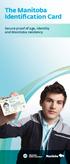 The Manitoba Identification Card Secure proof of age, identity and Manitoba residency The Manitoba Identification Card A voluntary option for Manitoba residents The Manitoba Identification Card is a voluntary,
Policy/Program Memorandum No. 142
 Date of Issue: December 5, 2012 Effective: Until revoked or modified Subject: Application: SCHOOL BOARD PROGRAMS FOR EXPELLED STUDENTS Directors of Education Supervisory Officers and Secretary-Treasurers
REPORTING REQUIREMENTS
 REPORTING REQUIREMENTS REPORTING REQUIREMENTS Consistent with state law, you must report known or suspected abuse, neglect, and/or exploitation of children and certain adults. Different rules apply to
PROGRAM R 2361/Page 1 of 12 ACCEPTABLE USE OF COMPUTERS NETWORKS/COMPUTERS AND RESOURCES
 R 2361/Page 1 of 12 R 2361 ACCEPTABLE USE OF COMPUTER NETWORKS/COMPUTERS AND RESOURCES The school district provides computer equipment, computer services, and Internet access to its pupils and staff for
GENERAL ASSEMBLY OF NORTH CAROLINA SESSION 2011 SESSION LAW 2012-149 SENATE BILL 707
 GENERAL ASSEMBLY OF NORTH CAROLINA SESSION 2011 SESSION LAW 2012-149 SENATE BILL 707 AN ACT TO ENACT THE SCHOOL VIOLENCE PREVENTION ACT OF 2012; LIMIT PRAYERS FOR JUDGMENT CONTINUED; AND END SUNSET FOR
PROTOCOL. Between THE POLICE. (Brantford Police Services) (Ontario Provincial Police) and GRAND ERIE DISTRICT SCHOOL BOARD. and
 PROTOCOL Between THE POLICE (Brantford Police Services) (Ontario Provincial Police) and GRAND ERIE DISTRICT SCHOOL BOARD and BRANT HALDIMAND NORFOLK CATHOLIC DISTRICT SCHOOL BOARD September, 2011 Table
PUBLIC INTEREST DISCLOSURE (WHISTLEBLOWER PROTECTION) ACT
 Province of Alberta Statutes of Alberta, Current as of June 1, 2013 Office Consolidation Published by Alberta Queen s Printer Alberta Queen s Printer 7 th Floor, Park Plaza 10611-98 Avenue Edmonton, AB
A Guide to Ontario Legislation Covering the Release of Students
 A Guide to Ontario Legislation Covering the Release of Students Personal Information Revised: June 2011 Ann Cavoukian, Ph.D. Information and Privacy Commissioner, Ontario, Canada Commissioner, Ontario,
BODY ARMOUR CONTROL ACT
 Province of Alberta Statutes of Alberta, Current as of June 15, 2012 Published by Alberta Queen s Printer Alberta Queen s Printer 7 th Floor, Park Plaza 10611-98 Avenue Edmonton, AB T5K 2P7 Phone: 780-427-4952
Youth Criminal Justice Protocol. Alberta Justice and Solicitor General and Human Services November 2013
 Youth Criminal Justice Protocol Alberta Justice and Solicitor General and Human Services November 2013 Table of Contents 1 Intent... 1 2 Parental Responsibility... 1 3 Guiding Principles for Program Delivery
POLICY FRAMEWORK AND STANDARDS INFORMATION SHARING BETWEEN GOVERNMENT AGENCIES
 POLICY FRAMEWORK AND STANDARDS INFORMATION SHARING BETWEEN GOVERNMENT AGENCIES January 2003 CONTENTS Page 1. POLICY FRAMEWORK 1.1 Introduction 1 1.2 Policy Statement 1 1.3 Aims of the Policy 1 1.4 Principles
How To Maintain A Safe School
 Provincial Model for a Local Police/School Board Protocol 2015 The Ontario Public Service endeavours to demonstrate leadership with respect to accessibility in Ontario. Our goal is to ensure that Ontario
The purpose of this policy is to support a comprehensive and collaborative approach to responding to child abuse and neglect by:
 SECTION 1000: STUDENTS AND SCHOOLS POLICY 1045: CHILD PROTECTION Date Adopted: June 18, 2014 POLICY STATEMENT The Board affirms that children have a right to be protected from abuse and neglect, and employees
PERSONAL INFORMATION PROTECTION ACT
 Province of Alberta Statutes of Alberta, Current as of December 17, 2014 Office Consolidation Published by Alberta Queen s Printer Alberta Queen s Printer 7 th Floor, Park Plaza 10611-98 Avenue Edmonton,
2009 Bill 6. Second Session, 27th Legislature, 58 Elizabeth II THE LEGISLATIVE ASSEMBLY OF ALBERTA BILL 6
 2009 Bill 6 Second Session, 27th Legislature, 58 Elizabeth II THE LEGISLATIVE ASSEMBLY OF ALBERTA BILL 6 PROTECTION OF CHILDREN ABUSING DRUGS AMENDMENT ACT, 2009 MRS. FORSYTH First Reading.......................................................
London Borough of Brent Joint Regulatory Services ENFORCEMENT POLICY
 London Borough of Brent Joint Regulatory Services ENFORCEMENT POLICY Date of implementation: 01/11/05 Issue No:01 Issued by: Stephen Moore Executive approval: 12/09/2005 INTRODUCTION 1. This document sets
Court Record Access Policy
 SUPREME COURT OF BRITISH COLUMBIA Court Record Access Policy The Supreme Court of British Columbia 800 Smithe Street Vancouver, BC V6Z 2E1 www.courts.gov.bc.ca Page 1 of 39 TABLE OF CONTENTS PART I: GENERAL
JEWISH FAMILY SERVICE NOTICE OF PRIVACY PRACTICES
 Jewish Family Service takes pride in treating our clients and each other with respect and dignity. Protecting your health information is very important to us. We want you to have a clear understanding
June 2008. Canadian Teachers Federation Fédération canadienne des enseignantes et des enseignants
 Addressing Cyberconduct A Brief to the Department of Justice Canada June 2008 Canadian Teachers Federation Fédération canadienne des enseignantes et des enseignants Brief to the Canadian Ministry of Justice:
ARRANGEMENT OF SECTIONS
 Human Trafficking Act, 2005 Act 694 ARRANGEMENT OF SECTIONS Section Prohibition and offences relating to trafficking 1. Meaning of trafficking 2. Prohibition of trafficking 3. Provision of trafficked person
Oklahoma School Discipline Sources Cited
 Oklahoma School Discipline Sources Cited Excerpted from Oklahoma Compilation of School Discipline Laws and Regulations Prepared: March 20, 2015 Oklahoma State Codes Cited Oklahoma Revised Statutes Title
Education and Child and Family Services Protocol for Children and Youth in Care
 Education and Child and Family Services Protocol for Children and Youth in Care May 2013 Table of Contents A Message from Manitoba s Healthy Child Committee of Cabinet 3 1 Preface 5 1.1 Government of Manitoba
The Credit Reporting Act
 1 CREDIT REPORTING c. C-43.2 The Credit Reporting Act being Chapter C-43.2 of The Statutes of Saskatchewan, 2004 (effective March 1, 2005). NOTE: This consolidation is not official. Amendments have been
PLEASE NOTE. For more information concerning the history of this Act, please see the Table of Public Acts.
 PLEASE NOTE This document, prepared by the Legislative Counsel Office, is an office consolidation of this Act, current to May 30, 2012. It is intended for information and reference purposes only. This
UNIVERSITY OF MANITOBA POLICY CLOSED CIRCUIT TV (CCTV) MONITORING. Part I Reason for Policy
 UNIVERSITY OF MANITOBA POLICY Policy: Effective Date: October 1, 2012 Revised Date: November 20, 2012 Review Date: October 1, 2022 Approving Body: Authority: Responsible Executive Officer: Delegate: Contact:
POLICIES AND REGULATIONS Policy #78
 Peel District School Board POLICIES AND REGULATIONS Policy #78 DIGITAL CITIZENSHIP Digital Citizenship Digital citizenship is defined as the norms of responsible behaviour related to the appropriate use
Canada s Juvenile Justice Law & Children s Rights
 Nov. 28, 2004 edited version Canada s Juvenile Justice Law & Children s Rights Prof. Nicholas Bala Faculty of Law, Queen s University Presented at Conference on Making Children s Rights Work: National
YOUTH CRIMINAL JUSTICE ACT CANADA
 YOUTH CRIMINAL JUSTICE ACT CANADA POCKET GUIDE Solicitor General Justice and Attorney General YOUTH CRIMINAL JUSTICE ACT CANADA POCKET GUIDE This pocket guide is provided for your convenience and personal
The Youth Drug Detoxification and Stabilization Act
 YOUTH DRUG DETOXIFICATION 1 The Youth Drug Detoxification and Stabilization Act being Chapter Y-1.1* of The Statutes of Saskatchewan, 2005 (effective April 1, 2006) as amended by The Statutes of Saskatchewan,
BRENTWOOD BOROUGH SCHOOL DISTRICT
 No. 516 BRENTWOOD BOROUGH SCHOOL DISTRICT SECTION: SUPPORT EMPLOYEES TITLE: SCHOOL POLICE ADOPTED: February 22, 2010 REVISED: 1. Authority SC 510.1, 778 2. Authority SC 778 53 Pa. C.S.A. Sec. 2161 et seq
Casino, Liquor and Gaming Control Authority Act 2007 No 91
 New South Wales Casino, Liquor and Gaming Control Authority Act 2007 No 91 Contents Part 1 Part 2 Preliminary Page 1 Name of Act 2 2 Commencement 2 3 Definitions 2 4 Meaning of gaming and liquor legislation
AP 417 Information and Communication Services
 AP 417 Information and Communication Services Background Access and use of information and communication services (ICS) are an integral component of the learning and working environment. The ability for
The Juvenile and Domestic Relations District Court
 The Juvenile and Domestic Relations District Court I. General Information The juvenile and domestic relations district court handles cases involving: Juveniles accused of delinquent acts, traffic infractions
Children s Hearings (Scotland) Act 2011 2011 asp 1
 Children s Hearings (Scotland) Act 2011 (asp 1) Section Children s Hearings (Scotland) Act 2011 2011 asp 1 CONTENTS PART 1 THE NATIONAL CONVENER AND CHILDREN S HEARINGS SCOTLAND The National Convener and
Compulsory Drug Treatment Correctional Centre Act 2004 No 42
 New South Wales Compulsory Drug Treatment Correctional Centre Act 2004 No 42 Contents Page 1 Name of Act 2 2 Commencement 2 3 Amendment of Drug Court Act 1998 No 150 2 4 Amendment of Crimes (Sentencing
ENDS (Required by Minnesota Statute) Policy Title Policy Level Date Approved/Revised Chemical Use & Abuse EM-020.8 5/20/08 Revised: 7/23/13
 ENDS (Required by Minnesota Statute) Policy Title Policy Level Date Approved/Revised Chemical Use & Abuse 5/20/08 Revised: 7/23/13 1) General Statement of Policy 2) Definitions 3) Students a) Use of controlled
R 2361 ACCEPTABLE USE OF COMPUTER NETWORK/COMPUTERS AND RESOURCES
 R 2361/page 1 of 8 R 2361 ACCEPTABLE USE OF COMPUTER NETWORK/COMPUTERS AND RESOURCES The school district provides computer equipment, computer services, and Internet access to its pupils and staff for
Vincent Massey High School Law 40S Course Outline 2014-2015
 Vincent Massey High School Law 40S Course Outline 2014-2015 Course Title: Law 40S School Year and Semester: 2014-2015 Teacher: Ray McLachlan [email protected] Course Description: The course includes
How To Run The Tanzania Intelligence And Security Service
 THE TANZANIA INTELLIGENCE AND SECURITY SERVICE ACT, 1996 ARRANGEMENT OF SECTIONS PART I PRELIMINARY Section Title 1. Short title and commencement. 2. Application. 3. Interpretation. PART II THE TANZANIA
Business Associate Contract for Nursing Services
 Business Associate Contract for Nursing Services Parties: This Agreement is entered into between Wasco County, Oregon, a political subdivision of the State of Oregon, represented by the North Central Public
EHR Contributor Agreement
 This EHR Contributor Agreement (this Agreement ) is made effective (the Effective Date ) and sets out certain terms and conditions that apply to the sharing of Personal
Protocol with External Agencies for the Provision of Services by Regulated Health Professionals, Social Service Professionals, and Paraprofessionals
 Halton District School Board Administrative Procedure Topic: Effective: March 2010 Cross-Reference: PPM 149 Review/Revision Date: January 2017 Responsibility: Protocol with External Agencies for the Provision
How To Deal With A Pupil Who Is Under The Influence Of Alcohol Or Drugs
 R 5530/Page 1 of 12 R 5530 The following procedures are established in implementation of Policy No. 5530, Substance Abuse. A. Definitions 1. Evaluation means those procedures used by a certified or licensed
GUIDELINES WITH RESPECT TO: DISCLOSURE OF INFORMATION FROM POLICE SERVICE RECORDS
 ONTARIO ASSOCIATION OF CHIEFS OF POLICE GUIDELINES WITH RESPECT TO: DISCLOSURE OF INFORMATION FROM POLICE SERVICE RECORDS Prepared by: The Law Enforcement and Records Managers Network (LEARN) March 1,
Mental Health (Care and Treatment) (Scotland) Bill
 Mental Health (Care and Treatment) (Scotland) Bill [AS AMENDED AT STAGE 2] Section CONTENTS PART 1 INTRODUCTORY A1 Principles for discharging certain functions B1 Welfare of the child 1 Equal opportunities
REGULATION STANHOPE BOARD OF EDUCATION. PUPILS R 5530/page 1 of 15 Substance Abuse M R 5530 SUBSTANCE ABUSE
 R 5530/page 1 of 15 M R 5530 SUBSTANCE ABUSE The following procedures are established in implementation of Policy No. 5530, Substance Abuse. A. Definitions 1. Evaluation means those procedures used by
MANDATORY REPORTING LAWS & RULES
 Janet Napolitano Governor Joey Ridenour Executive Director Arizona State Board of Nursing 4747 North 7th Street, Suite 200 Phoenix AZ 85014-3653 Phone (602) 889-5150 Fax (602) 889-5155 E-Mail: [email protected]
Administration A. Superintendent 1. Student Teacher University Agreement Template
 Dr. Bruce Law Pamela Bylsma Tammy Prentiss Domenico Maniscalco Bill Eagan Superintendent Assistant Superintendent Assistant Superintendent Chief Human Chief Financial of Schools for Academics for Student
PROTOCOL TO ACCOMPANY SAFE SCHOOLS POLICIES IN THE CITY OF OTTAWA. Developed by: The Regional Safe Schools Committee of Ottawa
 PROTOCOL TO ACCOMPANY SAFE SCHOOLS POLICIES IN THE Developed by: The Regional Safe Schools Committee of Ottawa Revised: April 2011 TABLE OF CONTENTS 1. Signatories to the Protocol... 4 2. Guiding Principles...
Information for Individuals Child Abuse Registry Check (Self Check-Mail) Checklist
 Information for Individuals Checklist PLEASE NOTE: FAILURE TO COMPLETE THE APPLICATION PROCESS IN FULL WILL RESULT IN THE IMMEDIATE REJECTION OF THE APPLICATION. YOUR PAYMENT WILL NOT BE PROCESSED AND
We ask that you contact our Privacy Officer in the event you have any questions or concerns regarding this Code or its implementation.
 PRIVACY AND ANTI-SPAM CODE FOR OUR DENTAL OFFICE Please refer to Appendix A for a glossary of defined terms. INTRODUCTION The Personal Health Information Act (PHIA) came into effect on December 11, 1997,
Guide to Providing Counselling Services In School Jurisdictions
 Guide to Providing Counselling Services In School Jurisdictions Revised March 2007 (updated to reflect A.R. 186/2008) Produced by: Access and Privacy Service Alberta 3rd Floor, 10155 102 Street Edmonton,
Canadian Security Intelligence Service Act. R.S.C., 1985, c. C-23. An Act to establish the Canadian Security Intelligence Service SHORT TITLE
 Canadian Security Intelligence Service Act R.S.C., 1985, c. C-23 An Act to establish the Canadian Security Intelligence Service Short title SHORT TITLE This Act may be cited as the Canadian Security Intelligence
Conducting Surveys: A Guide to Privacy Protection. Revised January 2007 (updated to reflect A.R. 186/2008)
 Conducting Surveys: A Guide to Privacy Protection Revised January 2007 (updated to reflect A.R. 186/2008) ISBN 978-0-7785-6101-9 Produced by: Access and Privacy Service Alberta 3rd Floor, 10155 102 Street
Law Firm Compliance: Key Privacy Considerations for Lawyers and Law Firms in Ontario
 PRIVACY COMPLIANCE ISSUES FOR LAW FIRMS IN ONTARIO By Sara A. Levine 1 Presented at Law Firm Compliance: Key Privacy Considerations for Lawyers and Law Firms in Ontario Ontario Bar Association, May 6,
Queensland DRUG REHABILITATION (COURT DIVERSION) ACT 2000
 Queensland DRUG REHABILITATION (COURT DIVERSION) ACT 2000 Act No. 3 of 2000 Queensland DRUG REHABILITATION (COURT DIVERSION) ACT 2000 Section TABLE OF PROVISIONS PART 1 PRELIMINARY Page 1 Short title.....................................................
John Howard Society. Criminal Justice Education
 Youth Criminal Justice Act HANDBOOK John Howard Society Criminal Justice Education Youth Criminal Justice Act Handbook Introduction... 4 To whom does the Act apply?... 4 To whom does the Act not apply?...
OFFICE OF THE DIRECTOR OF PUBLIC PROSECUTIONS
 OFFICE OF THE DIRECTOR OF PUBLIC PROSECUTIONS GUIDELINE FOR FEDERAL PROSECUTORS November 8, 2012 DRUG TREATMENT COURTS Purpose [1] The purpose of this guideline is to advise federal Crown counsel of the
Strategies for occupational therapists to address elder abuse/mistreatment
 Strategies for occupational therapists to address elder abuse/mistreatment Provincial Legal Information: ALBERTA Prepared by the Canadian Association of Occupational Therapists August 2011 This project