
John Howard Society. Criminal Justice Education
|
|
|
- Archibald Black
- 10 years ago
- Views:
Transcription
1 Youth Criminal Justice Act HANDBOOK John Howard Society Criminal Justice Education

2 Youth Criminal Justice Act Handbook Introduction... 4 To whom does the Act apply?... 4 To whom does the Act not apply?... 4 What kinds of Offences does the YCJA cover?... 4 Approach of the Act... 5 Flowchart I - Case Process... 6 Purpose and Principles... 7 Legal Rights... 8 The Right to Counsel...8 Legal Aid 9 Extrajudicial Measures Principles Objectives Warnings, Cautions and Referrals Crown Cautions Extrajudicial Sanctions Flowchart II Extrajudicial Measures What happens to my Record if I get Extrajudicial Measures What happens to my Record if I get Extrajudicial Sanctions Youth Justice Committees Conferences Who Calls a Conference Purpose of a Conference Classification of Offences What happens after a Youth has been arrested? Pre-Trial Detention Show Cause Hearing Where will a Youth be Held in Pre-Trial Detention? First Appearance Trial Youth Justice Court The Courtroom Youth Court Diagram YCJA Handbook Page 1

3 Victims of Crime The Role of the Victim in the Youth Justice System What Information may Victims Access Results for Victims Sentences Pre-sentence Reports Assessments Sentence Options Sentence Lengths Conditions on Probation Orders and Intensive Support & Supervision Appeals Reviews Non Custody Sentence Reviews Failure to Comply Custody and Supervision Sentences Reintegration Leave Supervision Conditions on Custody and Supervision Sentences Breach of Custody and Supervision Order Conditions Continuation of Custody Portion Where will a Youth Serve Time in Custody after Age 18? Custody and Supervision Order Sentence Lengths Adult Sentencing Presumptive Offences Serious but not Presumptive Offences Flowchart III Crown chooses to seek an Adult sentence Adult Sentencing Process Flowchart IV Presumptive Offence a Flowchart V Presumptive offence b Test for an Adult Sentence Adult Sentence Lengths for Homicide Publishing names of young people Youth Records Who can Access a Youth Record What are the Access Periods for Youth Records? Special Records Repository What Happens to Records after the Access Period? What Happens to the Records of Youths who Re-offend? Sharing Youth s Records Impact of a Youth Record More Information Glossary YCJA Handbook Page 2
4 The John Howard Society of Alberta The John Howard Society of Alberta is a non-profit agency concerned with issues of crime and its prevention. The organization takes its name and spirit from the 18th century humanitarian John Howard, whose name has become a symbol of humane consideration for prisoners. The John Howard Society of Alberta was incorporated in In addition to the Provincial Office, the organization in Alberta today consists of six separately incorporated local John Howard Societies. We believe that crime prevention is as much the responsibility of the community as it is of government. Through involvement with the John Howard Society, as members or volunteers, people in the community play an active role in the criminal justice process by providing programs for offenders and their families, ex-offenders, young persons and the public. The Youth Criminal Justice Act - Handbook The John Howard Society gratefully acknowledges the financial support of the Alberta Law Foundation for the production of this Handbook. We also acknowledge the Alberta Solicitor General Department, the Edmonton Police Services, the Youth Criminal Defence Office and Justice Canada for their information and advice. Finally, we would like to thank the initial researcher and writer of the original document and the staff of the Alberta based John Howard Societies for their input on revisions in This document is a summary of the content and administration of the Youth Criminal Justice Act in Alberta at the time of writing. Changes may occur in the Act itself or the choices of the Province of Alberta in administering the Act. This Handbook is meant as summary information only and is NOT legal advice. This Handbook includes plain language descriptions of the Act. If detail is essential, please consult the Youth Criminal Justice Act itself. Copyright 2002, 2007 THE JOHN HOWARD SOCIETY OF ALBERTA YCJA Handbook Page 3

5 INTRODUCTION The Youth Criminal Justice Act became law on April 1, The Canadian government created the Act to respond to young people who get into trouble with the law. The Act outlines how police, alternative programs, the court system and the corrections system will respond to a youth who is accused or found guilty of breaking the law. The Youth Criminal Justice Act is also called the YCJA. In this handbook, the YCJA is also referred to as the Act. Words that are in BOLD TYPE are explained in the glossary at the back starting on Page 52 To Whom Does the Act Apply? The YCJA applies to all young persons in Canada who are 12 to 17 years of age. This means that the law applies to youth the day they turn 12 and continues to apply until the day they turn 18. The Act will also apply to young people over the age of 18 IF the offence was committed while they were still under 18. To Whom Does the Act Not Apply? The YCJA does not apply to youth under the age of 12. A child who is not yet 12 and commits a crime will not go through the youth justice system. However, there may still be consequences for the child as a result of what they have done. The police, people in the community, the school and/or the parents or guardians may be involved in making sure that the child understands what he or she has done, how it has affected other people and what the child is expected to do about it. If the crime is serious enough, a social worker may get involved. In some cases, for the child s safety or for the safety of the community, the child may be removed from their home to reside and be cared for in a court determined location. What Kinds of Offences Does the YCJA Cover? The Youth Criminal Justice Act applies to federal offences. Federal offences are created or defined by federal laws and regulations. These are the laws made by the Government of Canada. Two examples of federal laws are the CRIMINAL CODE OF CANADA and the CONTROLLED DRUGS AND SUBSTANCES ACT. Other offences, such as not wearing a bike helmet or cleaning up after your pet, are defined by provincial laws and municipal by-laws. Both of these levels of government have their own laws that apply to youth if they commit provincial or municipal offences. This Handbook is solely about the federal law that deals with youth crime the Youth Criminal Justice Act. YCJA Handbook Page 4
6 Approach of the Act The Youth Criminal Justice Act begins with a Preamble. The Preamble is a statement from Canada s Parliament about the values that the Youth Criminal Justice Act reflects. The following are some of the important statements in the Preamble: Society is responsible for addressing the needs and challenges of youth as they develop into adults. Communities, families, parents and others should work together to prevent youth crime by addressing basic risk factors that may lead to crime, by responding to the needs of youth and by providing guidance and support. Information about youth justice, youth crime and what works in reducing youth crime should be available to the public. Youth have rights and freedoms guaranteed to them through the Canadian Charter of Rights and Freedoms and the Canadian Bill of Rights. It also recognizes that Canada has signed the United Nations Convention on the Rights of the Child (1989). Canada s youth criminal justice system should: command respect; take into account the interests of the victims; promote responsibility and ensure accountability through meaningful consequences and effective rehabilitation and reintegration; use the most serious interventions only for the most serious crimes; decrease the use of incarceration for non-violent youth. The flowchart on the opposite page describes the overall process of the youth criminal justice system. It shows what steps might be taken in regards to a youth whom the police have reasonable grounds to believe has broken the law. This handbook includes information to explain the youth justice process. It also shows where and how within this system, the Youth Criminal Justice Act offers choices to both the youth and the legal authorities. YCJA Handbook Page 5
7 POLICE HAVE REASONABLE AND PROBABLE GROUNDS TO BELIEVE A YOUTH HAS BROKEN THE LAW * See also Flowchart II on page 11 POLICE TAKE NO FURTHER ACTION POLICE WARNING OR CAUTION POLICE REFERRAL TO A PROGRAM YOUTH CHARGED AND RELEASED YOUTH CHARGED AND DETAINED PROGRAM COMPLETED REFERRAL TO EXTRAJUDICIAL SANCTION PROGRAM SCREENING BY CROWN BAIL HEARING: released or detained CROWN CAUTION PROGRAM NOT COMPLETED ** Adult Sentence flowchart on Page 38 NOT GUILTY YOUTH JUSTICE COURT APPEAL NOTICE TO SEEK **ADULT SENTENCE Flowchart I: Case Process GUILTY SENTENCE PRE-SENTENCE REPORT YCJA Handbook Page 6

8 PURPOSE AND PRINCIPLES The Declaration of Principles in the Act outlines the principles and key goals of this law for young people. The principles in the YCJA are meant to assist judges, lawyers, police and others interpret the law when applying it to youth. The principles reflect Parliament s interpretation of how Canadian society desires to respond to youth crime through its youth criminal justice system. The Declaration of Principles has four main sections: The first section of the Declaration says that the youth criminal justice system is meant to: prevent crime by looking at the underlying or basic reasons for the behaviour; rehabilitate youth and reintegrate or bring them back into society; ensure that youth receive meaningful consequences for breaking the law. The second section of the Declaration says that the criminal justice system for youth has to be separate from the adult system and focus on: rehabilitation and reintegration; fair and proportionate accountability consistent with young persons greater dependence and reduced level of maturity; this means that young persons accountability for their crimes needs to be in line with or fairly balanced with the fact that they are not as mature as adults; enhanced procedural protection in the youth justice process to ensure that young persons are treated fairly and that their rights are protected; timely responses that reinforce the connection between the offence and the consequence; promptness and speed in the system s response, given young persons perception of time. The third section of the Declaration of Principle says that within the limits of fair and proportionate accountability, responses by the system to youth crime should: reinforce respect for society s values; encourage the repair the harm done to victims and the community; be meaningful to the young person, taking into account his or her needs and level of development, and where it is appropriate, involve the parents, other family members and other agencies in the young person s rehabilitation and reintegration; respect gender, ethnic, cultural and language differences and respond to the needs of Aboriginal young persons and of young persons with special requirements. And finally, the fourth section of the Declaration says that special factors apply to proceedings against youth. These special factors include: YCJA Handbook Page 7
9 that young persons have rights and freedoms and that they have special guarantees of these rights and freedoms; victims should be treated with courtesy, compassion and respect for their dignity and privacy, and should suffer the least inconvenience possible as a result of being involved in the youth criminal justice system; victims should be given information about the proceedings and given an opportunity to participate; parents should be told of what is happening in their child s case and be encouraged to support their children in addressing the behaviour that resulted in their involvement with the youth criminal justice system. Some of the main sections of the Act, such as the extrajudicial measures, sentencing, and custody and supervision sections also start with a statement of purpose and principles. This helps to make sure that the law s intentions are clear about the best way to respond to young persons as they move through the youth criminal justice system. LEGAL RIGHTS All people living in Canada have rights and freedoms under the Charter of Rights and Freedoms. Youth also have special legal rights guaranteed to them under the Youth Criminal Justice Act. YCJA Handbook Page 8 Legal rights are protections and powers that are given to a person by law. On being arrested or detained, youth have the following legal rights, which must be told to them by the police: the right to know why they are being arrested or detained; the right to remain silent; the right to talk to their parents, a trusted adult and/or a lawyer; the right to have a lawyer and to be represented by the lawyer as quickly as possible; the right to have their parents, trusted adults and/or a lawyer with them if they choose to make a statement to the police. The Right to Counsel A very important right for youth is their right to counsel. Counsel is another word for a lawyer. While this right is guaranteed in the Charter of Rights and Freedoms, it is expanded for youth in the Youth Criminal Justice Act. The people who work in the legal system have to make sure that the youth s right to counsel is protected at all stages of the youth justice process. The youth has to be told over and over that he or she has the right to a lawyer. This right to speak to a lawyer must be explained in plain language that a youth can understand. For example, during an arrest, the officer must tell the youth that he or she has the right to call a lawyer. The officer must also give the young person an opportunity to call a lawyer (section 25(2)).
10 A young person has the right, at any stage of the youth justice process, to talk to a lawyer without delay. The legal words used in the criminal justice system with respect to talking to a lawyer are the right to retain and instruct counsel without delay. When a youth has his or her own lawyer to represent them, this lawyer is called a defence lawyer or defence counsel. This lawyer s primary goal is to protect the rights of the accused youth. Listed below are all of the times in the youth justice process when youth have to be told that they have the right to talk to a lawyer: when they are arrested or detained (sections 25(2)); if they choose to make a statement to the police (section 146); when considering whether to agree to an extrajudicial sanction (section 25(1)); during the extrajudicial sanction process (section 10(2)(d)); at an appearance in court (section 32(1)(b)); at a hearing, trial or review (section 25(3)). There are many types of hearings in the youth justice process. The following list describes types of hearings and reviews that might happen in a youth s case. At all of these times, the youth must be told of the right to counsel (section 25(3)). pre-trial detention hearings adult sentencing hearings trials hearings to decide whether to detain a youth to the end of a custody sentence hearings to decide whether the young person has breached a conditional supervision hearings to set the conditions of a young person s conditional supervision hearings to decide whether suspending a young person s conditional supervision is appropriate reviews of a youth sentence When a young person goes to court for a first appearance without being represented by a lawyer, the court cannot accept the youth s plea (guilty or not guilty) until the judge has: made sure the young person understands the charge (section 32 (3)(a)); if necessary, explained that the youth may get an adult sentence, and explained how the youth can apply for a youth sentence (section 32(3)(b)); explained that the youth may plead guilty or not guilty to the charge or, if necessary, explained the election options for youth who might get an adult sentence (section 32(3) (c)). YCJA Handbook Page 9

11 If the court does not believe that the young person understands this, then the court will order that a lawyer be appointed for the youth. This means that the youth justice system must make sure that a lawyer is appointed to represent the young person. If a youth s family cannot or will not pay for a lawyer, then the court can order that a lawyer be appointed for the youth through Legal Aid Alberta. Legal Aid A young person can also apply to Legal Aid Alberta for a lawyer without having it ordered by the court. The youth or parents or guardians may hire and pay for that lawyer. In order to get help from Legal Aid Alberta to pay the lawyer s fees, the youth s family has to qualify for such legal help, meaning that the family cannot earn over a certain amount of money each year. If a youth qualifies for legal aid, then Legal Aid Alberta will appoint a lawyer for the youth. Legal aid is not free, even for youth. When a youth s case is finished, Legal Aid Alberta will send a notice about the amount of money owed to Legal Aid Alberta for having provided the lawyer. This will happen even if the appointment of a lawyer was ordered by the court. EXTRAJUDICIAL MEASURES One of the key goals of the Youth Criminal Justice Act is to increase the use of noncourt responses to less serious youth crimes. These extrajudicial measures, as explained in the Act, mean that youth avoid going through the formal court process. Extrajudicial or non-court measures allow early intervention with youth, and give each community the chance to respond to youth crime in their own unique way. Depending on the extrajudicial measure chosen, the youth may get the chance to repair the harm that he or she has caused to the victim. The youth may also participate in a community conference or meet with community members who volunteer on a youth justice committee to determine the appropriate consequences for their illegal behaviour. When youth are kept out of the court system by using extrajudicial measures, this allows the court to focus on more serious youth crimes. The YCJA requires police officers and crown prosecutors to use discretion, and to make non-court measures the normal and expected result when the offence is less serious. The extrajudicial measures section of the Act opens with key principles to guide how extrajudicial measures are used (section 4). Principles The first principle is that it is presumed that extrajudicial measures are adequate or sufficient to hold a young person accountable for breaking the law if: YCJA Handbook Page 10

12 the young person has committed a non-violent offence and the young person has no previous findings of guilt. The second principle is that extrajudicial measures should be used if they are adequate to hold the youth accountable for his or her behaviour and if such measures fit with the other guiding principles outlined in the Act. Extrajudicial measures can be used for a youth who has already received an extrajudicial measure in a previous case OR who has already had a finding of guilt. A youth can, therefore, receive extrajudicial measures several times, even if they already have a youth record. In the youth criminal justice system, a young person does not receive a conviction they have a finding of guilt. Objectives The YCJA also sets clear objectives for extrajudicial measures (section 5). These objectives say that the measures should: provide an effective and timely response to behaviour that is against the law; encourage young persons to acknowledge and repair the harm caused to the victim and the community; encourage their families and other members of the community to be involved in the design and implementation of extrajudicial measures; provide the chance for victims to participate in decisions related to the measures and to receive reparation; respect the rights and freedoms of young persons and be proportionate to the seriousness of the offence. Warnings, Cautions and Referrals When the police believe that a youth has committed a crime, the YCJA requires police officers to use their discretion in deciding whether to charge the youth OR to divert the young person from going through the court system. If the police decide to use an extrajudicial measure, the officer can choose to do any of the following things: 1. Take no further action against the youth. 2. Give a warning or caution. An officer may decide to give a verbal warning or a written caution to the youth. This often involves the officer talking to the youth about the impact of what the youth has done and explaining the legal consequences if the youth is caught again by the police for the same behaviour. The warning or caution may be entered into the local police records system so that if police deal with that youth again in the future, they know that the youth was warned in the past. Youth can receive more than one warning or caution. YCJA Handbook Page 11
13 3. Make a referral. An officer may refer a youth to a community program or agency that may help the youth change his or her behaviour. The officer can refer a young person to a recreation program, a counseling agency, a child welfare agency, a youth justice committee or a mental health agency. The goal is to help the youth deal with any issue(s) the police officer feels may have led to the crime. The young person has to agree to the referral. The youth must be told of his or her right to talk to a lawyer before deciding to accept the referral. The referral may also be entered into the local police records system. The three examples above are informal types of extrajudicial measures that the police can use. If the police use any of the three measures listed above, the police do NOT lay a charge against the youth. If the police decide not to use a warning, caution or referral, or if the youth does not consent to a referral, then the police may lay a charge against the youth. However, even if a charge is laid by the police, there remain two extrajudicial measures by which the youth s case may avoid the formal court process. The Crown Prosecutor decides which of these measures to use. A Youth does not have to admit to the offence before he or she can receive a police warning, caution or referral. Crown Cautions The first option is the issuing of a crown caution to the youth. The crown prosecutor sends the youth a letter, with a copy to the parents and/or guardians. The letter explains the charge and warns the youth to change his or her behaviour if they do not want to face more serious legal consequences in the future. Extrajudicial Sanctions Extrajudicial sanctions are the most formal type of extrajudicial measures. The Act says that an extrajudicial sanction may be used when a warning, caution or referral is not adequate because of the seriousness of the offence, the nature and number of previous offences or other aggravating circumstances. Consenting to an extrajudicial sanctions program means that a young person will be under supervision for three months. During this time, the youth agrees to complete certain actions or live under certain conditions. In Alberta, a youth must agree to complete up to three (3) of the following possible conditions: apologize in person and/or in writing to the victim; do personal service for the victim; do community service for a non-profit community or government agency; make restitution or return property to the victim; YCJA Handbook Page 12
14 make a donation to a registered charity; participate in aboriginal cultural/spiritual activities; write an essay; attend and participate in a community counseling or intervention program. Parents or guardians must be told of the youth s extrajudicial sanctions agreement. They are also encouraged to have input into the agreement. The victim can be told the name of the young person and what consequences the youth has received. The victim can also be invited to have input into the agreement. A youth dealt with by extrajudicial sanctions marks the beginning of a youth record. An extrajudicial sanction can only be used if: the province has set up an extrajudicial sanctions program; an extrajudicial sanction is appropriate, considering the needs of the youth and the interests of society; the young person consents or agrees to participate; the young person has, before consenting, been told of his or her right to counsel; the young person accepts responsibility for the offence; there is enough evidence to take the case through the court process (section 10(2)). Young people are not allowed to participate in an extrajudicial sanctions program if they deny having committed the offence, or if they say that they would rather have the charge dealt with in court (section 10(3)). If the crown decides to send the case to an extrajudicial sanctions program, the crown adjourns the case for about three months and sends the file to a probation officer. There are two options for what might happen next: YCJA Handbook Page 13
15 Flowchart II: Extrajudicial Measures POLICE HAVE REASONABLE AND PROBABLE GROUNDS TO BELIEVE A YOUTH HAS BROKEN THE LAW POLICE TAKE NO FURTHER ACTION POLICE OFFICER REQUIRED TO CONSIDER EXTRAJUDICIAL MEASURES EXTRAJUDICIAL MEASURES CONSIDERED ADEQUATE EXTRAJUDICIAL MEASURES CONSIDERED NOT ADEQUATE POLICE CAUTION OR WARNING POLICE REFERRAL TO A PROGRAM YOUTH CHARGED AND RELEASED YOUTH CHARGED AND DETAINED YOUTH AGREES TO ATTEND PROGRAM SUCH AS YOUTH JUSTICE COMMITTEE, RECREATION PROGRAM OR COUNSELLING ANY ACTION TAKEN BY YOUTH TO FOLLOW UP IS VOLUNTARY SCREENING BY CROWN BAIL HEARING: detained or released CROWN CAUTION REFERRAL TO EXTRAJUDICIAL SANCTION PROGRAM PROBATION OFFICER REVIEWS FILE PROBATION OFFICER REFERS CASE TO YOUTH JUSTICE COMMITTEE OR COMMUNITY CONFERENCE PROBATION OFFICER REACHES EXTRAJUDICIAL SANCTIONS AGREEMENT WITH YOUTH YOUTH JUSTICE COMMITTEE HEARS THE CASE & REACHES EXTRAJUDICIAL SANCTION AGREEMENT WITH YOUTH YOUTH COMPLETES AGREEMENT YOUTH DOES NOT COMPLETE THE AGREEMENT CASE MAY GO TO COURT YCJA Handbook Page 14
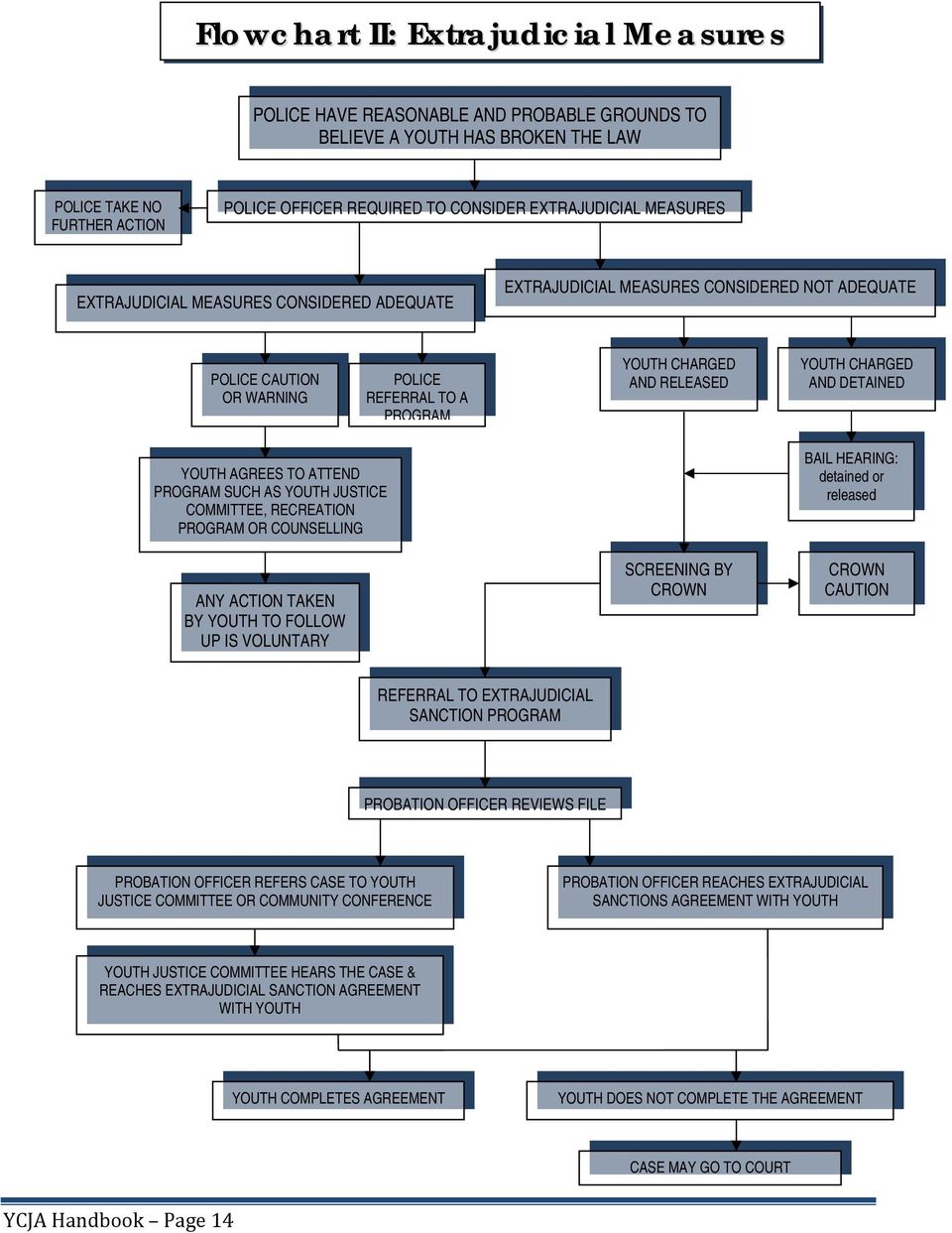
16 the probation officer works directly with the youth to reach an agreement on what actions the youth will take to complete the extrajudicial sanctions program; the probation officer refers the youth s case to a youth justice committee. See the Youth Justice Committee section on page 12 for more details. Young people can go through the extrajudicial sanctions program more than once, and can even go through it if they have already gone to court and received a finding of guilt in previous cases. If the youth does not follow the conditions of the program as determined with the probation officer or the youth justice committee, the case may go to court. What Happens to My record if I get an Extrajudicial Measure? When a youth receives an extrajudicial measure, the system limits access to youth records to police officers, or to a person participating in a conference deciding on appropriate extrajudicial measures (section119 (4)). What Happens to My record if I get an Extrajudicial Sanction? A youth who participates in an extrajudicial sanctions program will have a record. A youth record for extrajudicial sanctions will exist for two years after the youth agrees to participate in the program (section 119(2)). See the Youth Records section on page 45 for more information. The justice system cannot use any admission, confession or statement given by a young person participating in an extrajudicial sanctions program as evidence against the youth in future court proceedings (section 10(4)). However, a youth s participation in an extrajudicial sanctions program can be included in a future presentence report. This report about a young person s background, which may include the youth s previous participation in extrajudicial sanctions, as well as their current situation, will help the judge when sentencing in a future case. YOUTH JUSTICE COMMITTEES The Youth Criminal Justice Act allows the province to create youth justice committees (section 18). Youth justice committees are groups of community members who volunteer to work with youth who are in trouble with the law. The functions of youth justice committees may include to: advise federal and provincial governments on whether the rights and protections for youth in the Act are being followed; advise federal and provincial governments on policies and procedures related to youth justice; provide information to the public about the YCJA and the youth justice system; YCJA Handbook Page 15

17 act as a conference (See Conferences section on page 14 for more details); perform any other functions assigned to it by the provincially designated official who established the committee; work with youth who have committed offences by: giving advice on what actions the youth should take as part of an extrajudicial measure; supporting victims by asking about their concerns and help in the reconciliation of the victim and the young person; making sure that community support is available for the youth (including programs) and enlist community members to provide supervision and mentoring; helping to coordinate interaction between the child protection agencies and community groups and the youth criminal justice system if a youth is involved with one of these groups. Youth justice committees in Alberta are formally designated by the province, which means that they have been approved by the province and that the province offers them support such as training. Youth justice committees in Alberta usually recommend or decide what consequences a youth should receive. They do this by reviewing the case information and giving the youth, the youth s family, the victim and other people involved the chance to talk about the impact of the offence on them as well as their concerns. The committee s recommendations may include what the youth should do to repair the harm he or she has caused. Youth may appear before a youth justice committee in a number of ways: 1. A case can be sent to a youth justice committee by the police. If the police decide not to lay a charge against the youth, they may instead refer the youth to appear before a youth justice committee. 2. A case can be sent to a youth justice committee by the crown prosecutor. If a charge has been laid by the police and the crown prosecutor has reviewed the file, the crown may decide that an extrajudicial sanctions program would be appropriate. The crown prosecutor sends the case to a probation officer who in turn can forward the case to a youth justice committee. 3. A case can be sent to a youth justice committee by a judge, after the youth is charged with the crime and appears in court. Once a guilty plea is entered, the judge may send the case to the youth justice committee for advice on the best sentence. After completing its review of the case, the committee makes its recommendations to the judge who may use the recommendations in deciding the sentence. YCJA Handbook Page 16

18 CONFERENCES A conference involves the bringing together of people who are interested in a particular youth, who are responsible for that youth or who are affected by the youth s actions. The YCJA allows for each province to establish rules on how conferences will work (section 19). Examples of conferences include a family conference and a case (inter-agency) conference. Benefits from conferences include: a wider range of views on a case can be heard; more creative solutions are proposed; better coordination of services in the interest of the youth; more possibility for the involvement of the victim and other community members in the youth justice system. Conferences are advisory only; they do not make decisions. Who Calls a Conference? A conference can be called by a youth justice court judge, the provincial director, a police officer, a justice of the peace, a crown prosecutor or a youth worker (section 19). Purpose of a Conference A conference is called to give advice on (section 19(2)): i) Extrajudicial measures; This can help to reduce the number of youth who are brought into the formal system. A conference can provide a better understanding of why the youth committed the crime when the people responsible for that youth get together to discuss the situation. They can talk about how the youth could be held accountable outside of the formal court process. This group can also recommend the best response to the youth s behaviour because they understand the needs of the youth. ii) Conditions for judicial interim release; The conference can make recommendations to the court about: - alternatives to detention; - conditions for release, as well as possibilities for supervision; - who could act as a responsible person; iii) Sentences (including sentence reviews); YCJA Handbook Page 17
19 The conference is asked to make recommendations to the judge about the best sentence. iv) Reintegration plans; The conference links the youth to appropriate community services. People from such agencies give input into the plan and agree on what role their agency can play in the reintegration of the youth into the community. CLASSIFICATION OF OFFENCES The Criminal Code of Canada defines three types of offences. These are known as a summary offence, an indictable offence and a hybrid offence. Summary Offence Summary offences are the less serious offences. Examples of summary offences include trespassing at night, breaching a condition of probation and causing a disturbance. Indictable Offence Indictable offences are more serious offences. Examples include robbery, break and entry to someone s home and theft over $5000. Hybrid Offence A hybrid offence means that the crown prosecutor has a choice as to whether the case will proceed as if the offence was a summary offence or an indictable offence. Examples of hybrid offences include theft under $5000, dangerous driving and mischief to property. What Happens After a Youth has been Arrested? Once the police have apprehended a young person, they have a number of choices. The police can decide not to lay a charge and use an extrajudicial measure instead. If the police have decided to lay a charge, they can give the young person a form that explains where and when the youth must appear in court. This form can be an appearance notice, a promise to appear, a summons, an undertaking or a recognizance before an officer in charge. The form may also advise the youth that they are required to appear at the police station to be fingerprinted and photographed. A young person who fails to appear in court or to be fingerprinted and photographed as directed may receive additional charges. The police can also decide that they do not want to release the youth. This action will result in a number of additional steps. YCJA Handbook Page 18
20 Pre-Trial Detention Pre-trial detention is when a young person is detained, or held in custody, after an arrest. If a youth is in pre-trial detention, the youth will appear before a justice of the peace for a judicial interim release hearing within 24 hours of being arrested or as soon as possible. Judicial interim release means that the youth is released into the community under certain conditions. Show Cause Hearing If a young person is denied release by a justice of the peace at a show cause hearing, he or she may get another chance at release by appearing before a youth justice court judge (section 33 (1)). In order for the young person to be detained in custody, the crown prosecutor must prove that: the youth may not show up in court if he or she is released, or the youth needs to be detained to protect the public. These criteria make it clear that young persons cannot be detained for their own protection, mental health concerns or other social issues (section 29(1)), such as having no home to go to or concerns of a young person using drugs or alcohol. If the crown cannot convince the judge that either of the two concerns is valid, then the judge must release the youth with no conditions, other than signing a form that the youth will appear in court in the future. If the crown convinces the judge that either of these concerns is valid, the judge has four choices: 1. Release the youth with conditions that must be followed. Possible conditions include that the young person must be home by a certain time every night (that is, the young person has a curfew) or that he or she must report regularly to someone such as a police officer while waiting for the trial. 2. Release the youth once money is deposited to ensure that the youth returns to court. This money (bail) is meant to guarantee that a youth will return to court and abide by any conditions of release. The money is returned once the youth s court case is finished, provided that the youth has followed all the conditions and has appeared in court when directed. 3. Release the youth to the care of a responsible person. YCJA Handbook Page 19
21 The Act encourages judges to re-unite youth with their families unless there are good reasons for not doing this. The Act also recognizes that youth have the right to the least possible interference with their freedom. For these reasons, the judge can allow the youth to be placed in the care of a responsible person (section 31(1)). The responsible person promises in writing to take care of and be responsible for the young person s appearance in court, when required, and to make sure that the youth follows the conditions the judge has set. The youth must also agree in writing to follow the conditions that the judge has set. This agreement can be ended if a judge or a justice of the peace makes an order ending the agreement. This can happen if the responsible person, the youth or any other person applies in writing to ask that the agreement be cancelled. If a responsible person does not do all the things that he or she has agreed to do in writing for the supervision and care of the youth, the responsible person can be charged with a summary offence (section 139(1)). 4. Keep the youth in detention. The judge can decide to keep the youth in pre-trial detention. The youth would then be sent to a custody centre for youth, where there would be close supervision. A youth can also be detained in custody for medical or psychological assessments to determine whether the youth is fit to stand trial. If a young person needs to be held in custody for an assessment, the custody cannot be for longer than 30 days (section 34). See Page 23 for more information about assessments. Where will a Youth be Held in Pre-trial Detention? There are a number of places where youth can be held in pre-trial detention in Alberta: all police holding cells; young offender centres. First Appearance At a young person s first appearance in youth justice court, the judge will have the clerk of the court read the charge to the youth. The judge will also tell the youth that he or she has the right to be represented by a lawyer. The youth can then be asked if he or she wants to enter a plea of guilty or not guilty, reserve their plea or request to speak to duty counsel. YCJA Handbook Page 20
22 Before accepting a plea of guilty or not guilty, the judge has to be sure that the youth understands the charge. If the judge is not convinced that the young person understands the charge, the judge cannot allow the youth to plead guilty. If a guilty plea is entered and the youth justice court judge is satisfied that the facts presented by the crown prosecutor support the charge laid by the police, a finding of guilt is entered. A sentence can be given right away. Alternatively, the case may be put over to another day so that a pre-sentence report can be prepared by a probation officer. A pre-sentence report must be done before any custody and supervision sentence is given, but is optional if the judge is considering other sentences. See the Sentences section on page 22 for more information on presentence reports. If a not guilty plea is entered, there will be an adjournment of the court and a date for a trial will be set. Adjournment means that a case is ended for that day. Trial A trial is when the court does a formal examination of all the evidence to decide if the accused is guilty or not guilty of the charge(s) laid. At the trial, the crown prosecutor and the defence counsel who is representing the young person (if the young person has counsel) present their evidence and call witnesses. The judge then makes a decision based on what has been presented. There is no jury in youth justice court UNLESS a youth is charged with first or second degree murder or could receive an adult sentence. Youth who may receive adult sentences or who are under the age of 14 and have been charged with first or second degree murder are the only ones to have the choice of whether they want to have a jury (section 67 (1)). Please see the Adult Sentencing section on page 34 for more information. If the young person is found not guilty, he or she will receive an acquittal. This means the case is over and the young person is free to leave. Any records about the case will be destroyed or sealed after a specified period of time. See the Youth Record section on page 45 for more information. If the judge finds the youth guilty, a pre-sentence report may be ordered or the judge may decide to sentence the youth without it. See the Sentences section on page 22 for what follows next. YOUTH JUSTICE COURT Cases are heard in youth justice court. Youth justice court is open to the public and members of the news media. However, in most cases, the media are not allowed to publish or broadcast any information that may identify any youth involved in the case. YCJA Handbook Page 21
23 A young person s parents or guardians must be told of all proceedings (section 26). Parents or guardians are encouraged to attend court. When a parent or guardian has not come to court, the judge can order that parent or guardian to attend (section 27). THE COURTROOM There are a number of people who will be present in youth justice court: The Accused Clerk of the Court Crown Prosecutor Defense Counsel Duty Counsel General Public Sheriff Judge Witness Transcript The accused is the young person who has been charged with a crime. The accused is innocent until proven guilty. The clerk of the court reads the charge to the accused and administers an oath or affirmation to witnesses. The clerk also keeps records of charges, decisions and sentences for the court. The crown prosecutor is the lawyer who works for and represents the government. During the trial, it is the crown s job to prove that the accused is guilty beyond a reasonable doubt. The defense counsel (lawyer) represents and defends the accused. An important role of the defense lawyer is to protect the rights of the accused youth. The duty counsel (lawyer) provides temporary legal help in docket court to any youth who does not have a lawyer. This legal help might include: giving immediate legal advice, helping the youth apply for judicial interim release, asking that the charges be withdrawn, entering a guilty plea and talking to the judge about what the best sentence would be. This includes anyone who is watching the live court proceedings. The guard protects and defends the safety of the court and the people in it. The judge considers all the facts and evidence in the case he or she must then decide whether the crown has proven, beyond a reasonable doubt, that the accused is guilty. If the accused pleads or is found guilty, the judge must give the youth a fair sentence. Witnesses tell the judge what they know. This includes anything related to the case that the witnesses have heard, seen or did. The officially written record of all proceedings in a trial. NOTE: The following diagram shows how youth justice court is usually arranged. Some courtrooms may be different than this diagram YCJA Handbook Page 22
24 YOUTH COURT DIAGRAM JUDGE SHERIFF COURT WITNESS ACCUSED COURT CLERK CROWN PROSECUTOR DEFENSE LAWYER/ DUTY COUNSEL Bar GENERAL PUBLIC YCJA Handbook Page 23
25 VICTIMS OF CRIME A victim is a person or group of people who are negatively affected by the actions of another individual or group. The victim can be hurt, harmed, cheated, misled or killed as a result of the actions of others. There is often more than one victim for any specific crime that is committed. The Role of the Victim in the Youth Justice Process An important part of the Youth Criminal Justice Act is the inclusion of the victim in the youth justice process. The Act states that victims should be treated with courtesy, compassion and respect, and that their privacy is respected. The Act also says that victims should suffer the least inconvenience possible as a result of their involvement with the youth criminal justice system. Information from the victim may be included in a pre-sentence report. If the victim is willing, they can be interviewed so that their views are included in the information that the judge considers when deciding on the sentence. See the Sentences section on page 22 for more information. Before giving a sentence, the judge has to ask whether the victims in the case have been told that they may complete a victim impact statement. Victims can complete a written statement that talks about what harm was done or what the victim has lost as a result of the crime committed against them. The victim can read the statement in court or ask the court s permission to have it presented in a different way. Victims are encouraged to get involved in community methods of responding to youth crime. They may be given the opportunity to have input regarding the consequences for a crime or speak about how the crime affected them. Many extrajudicial measures can involve victims in the process, such as youth justice committees, conferences and extrajudicial sanctions. What Information may Victims Access? Various sections of the Act detail how victims can participate, and be heard, in the case in which they are involved. The Act also details what information the victim can receive throughout the youth justice process. When a youth goes through the extrajudicial sanctions program, the victim can be told the name of the young person who has admitted to the crime (section 12). Victims can also be told what consequences the youth received. This information can be provided by the police, the Attorney general, the provincial director or a victim s assistance organization. However, the victim does have to ask for this information. Results for Victims Once a judge has given a sentence of compensation, restitution, pay purchaser or compensation through personal service, the victim who will be compensated or who YCJA Handbook Page 24
26 will receive restitution has to be told about the conditions of the sentence. Furthermore, the judge cannot order a sentence of personal service without the consent of the person to be compensated. Upon request, victims are allowed to see the court record of the young person who committed the offence against them (section 119). The victim has to ask for this record. In addition, the victim may ask to be allowed to access police and government records of the youth involved in the crime, but it is not guaranteed that these records will be released. Victims can only access these records during the access period. The record will not be shared after the record access period has passed. See the Youth records section starting on page 46 for more information. SENTENCES The Youth Criminal Justice Act (section 38(1)) says that the purpose of sentencing is: to hold a young person accountable for an offence through the imposition of just sanctions that have meaningful consequences for the young person and that promote his or her rehabilitation and reintegration into society, thereby contributing to the long-term protection of the public. A sentence in the YCJA is the consequence given to a young person who is found guilty in youth justice court of committing a crime. The Act states (section 38(2)) the principles that must be observed when sentencing a youth. The sentence given must: not be more severe than the sentence an adult would receive for the same offence committed under similar circumstances; be similar to youth sentences ordered for similar offences in similar circumstances in that area; be fairly balanced with how serious the offence was, and the young person s degree of responsibility for that offence; be chosen after consideration of all other possible sentences (other than custody) that are reasonable under the circumstances of the case; pay particular attention to the circumstances of aboriginal young people; be the least restrictive sentence that will achieve the purpose of sentencing; be the sentence that is the most likely to rehabilitate and reintegrate the young person, and; promote responsibility and recognition by the young person of the harm done to victims and the community. Pre-Sentence Reports The judge may want a pre-sentence report to be completed before giving a youth his or her sentence (section 40). A pre-sentence report is prepared by a probation officer and includes information about the young person s background that will help YCJA Handbook Page 25
27 the judge decide on the sentence. In some cases, a pre-sentence report must be completed, unless there is an agreement among the judge, the youth and crown prosecutor not to have one done. A pre-sentence report considers the youth s age, behaviour, attitude, school records, previous contact with the law, experience in extrajudicial sanctions programs and relationships with family members. Anyone involved in the youth s life, including parents, guardians and teachers may be interviewed to help the court understand the youth. The victim may also be interviewed. The pre-sentence report will also include any plans the youth may have on how to change their behaviour. Assessments The court can also order a medical or psychological assessment of the youth at any time during the court case. Such an assessment can be ordered if the court has reasonable grounds to believe that the youth is suffering from any of the following: a physical or mental illness or disorder; a psychological disorder; an emotional disturbance; a learning disability; a mental disability. Assessments can also be ordered if the youth has committed a serious violent offence or is a repeat offender, so that the court has a better understanding of that youth (section 34b (i) and (ii)). An assessment is undertaken for the purpose of: a) considering an application for release of custody; b) making its decision on an application heard under section 71 (hearingadult sentences); c) making or reviewing a youth sentence; d) considering an application of continuation of custody (subsection 104(1)); e) setting conditions of conditional supervision (subsection 105(1)); f) making an order in regards to conditional supervision (subsection 109 (2)); g) authorizing disclosure of information about a young person (subsection 127 (1). Sentence Options The Youth Criminal Justice Act provides youth court judges with many options for sentences once a youth has been found guilty. YCJA Handbook Page 26
28 Reprimand (section 42(2)(a)) A reprimand is a stern warning from the judge. It is intended for minor cases where the judge feels that the experience of being arrested, taken through the court process and receiving a stern warning would be enough to hold the youth accountable for the offence. Absolute Discharge (section 42(2)(b)) An absolute discharge is a sentence which allows the court to discharge the youth without any conditions and is used when the court is satisfied that nothing further is required. Conditional Discharge (section 42(2)(3)) The court issues a discharge but only after the youth has followed specific conditions set by the court for a specific period of time. Such conditions may include the youth having to report to a probation officer. Fine (section 42(2)(d)) The judge orders the youth to pay money to the court. The judge sets the amount owed (no more than $1000) and the date by which the money has to be paid. If the youth is unable to pay the fine, the Fine Option Program allows a person to work off the fine by doing work in the community. Before giving a youth a fine, the judge must consider the ability of the youth to pay the fine, now and/or in the future. In addition to the fine, the judge will add the Victim Fine Surcharge, which can be up to 15% of the amount of the fine. The money from the Victim Fine Surcharge is used by the government to fund victim programs. Compensation (section 42(2)(e)) The court orders a young person to pay money to another person (usually the victim) for loss, damage or injury that resulted from their offence. Before giving a compensation order, the judge must consider the ability of the young person to pay the compensation, now and/or in the future. The judge orders the length of time the youth has available for paying the compensation and the terms of payment (e.g. paid in smaller amounts over a period of time). Restitution (section 42(2)(f)) The judge orders the youth to return to the owner(s) any goods that were stolen. The judge will also decide how much time the youth has to return the items. YCJA Handbook Page 27
29 Pay Purchaser (section 42(2)(g)) The judge orders the youth to pay a person who innocently purchased property that had been obtained as a result of a crime. An example would be if a youth steals a DVD player and sells it to a person who does not know that it was stolen. When the youth is caught, the DVD player is returned to the original owner, leaving the innocent person who bought the DVD player without both the player and their money. Before ordering a young person to pay an innocent purchaser, the judge has to consider the ability of the young person to pay the purchaser, now and/or in the future. Personal Service (section 42(2)(h)) The judge orders the young person to provide compensation to any person in kind or by way of personal services, meaning that the young person works off his or her debt by doing chores or work for the victim. The victim must agree to the terms before this sentence can be imposed. This sentence cannot be given unless the judge has decided that the youth is suitable and capable of this type of sentence and that the order will not interfere with work or school. Community Service (section 42(2)(i)) This order requires a young person to work in the community without being paid for it. The judge will decide how many hours of community service that a youth must complete. The most that can be given in Alberta is 240 hours to be completed within one year. This sentence cannot be given unless the judge has decided that the youth is suitable for this type of sentence and the order will not interfere with work or school. Prohibition, Seizure and Forfeiture (section 42(2)(j)) Prohibition means that the youth is banned from owning something. Seizure means that something is taken away from the youth. Forfeiture means that the youth has to give something up that he or she has. When a judge makes a non-mandatory prohibition order (the prohibition cannot be for longer than two years after the youth has completed the custody portion of any sentence or after the finding of guilt for all other sentences. For some types of offences, other federal laws (e.g. Criminal Code of Canada) may require mandatory prohibition, seizure or forfeiture to be imposed. Probation (section 42(2)(l)) The judge orders the supervision of the youth by a probation officer for a period not longer than two years. During the supervision period, the judge may order that the youth follow certain conditions such as attend school, obey a curfew, report regularly YCJA Handbook Page 28
30 to a probation officer, and keep the peace and be of good behaviour. Please see page 27 for more information about conditions on probation orders. Intensive Support and Supervision (section 42(2)(1)) This sentence involves closer supervision of the young person and more support than a probation order in order to help the youth change his or her behaviour. Attendance Order (section 42(2)(m)) The court orders the youth to attend a non-residential program, such as anger management, at specified times and on conditions set by the judge. The sentence can be designed to meet the particular needs of the youth. An attendance order cannot be for longer than 240 hours, over a period no longer than six months. This sentence cannot be given unless the judge has decided that the youth is suitable for this sentence and the order will not interfere with work or school. Custody and Supervision Order (section 42(2)(n), (o) and (q)) The judge orders the youth to serve time in a young offender centre or community - based residential facility, followed by supervision in the community. The judge determines the length of the sentence. The custody portion is followed by a period of community supervision. The period of community supervision must be one half (1/2) as long as the period of custody. This means that 1/3 of the sentence will be served under community supervision. For example, if the youth receives a nine (9) month custody and supervision order, six (6) months will be served in custody and three (3) months would be served under community supervision. Please see the Custody and Supervision Sentences section on page 30 for more information on who can receive a custody sentence and the maximum sentence lengths. Deferred Custody and Supervision Order (section 42(2)(p)) This sentence allows the youth to serve the sentence in the community under specified conditions rather than serve the sentence in custody. The judge cannot give this sentence if the youth has been found guilty of a serious violent offence. If the youth violates a condition of the deferred custody and supervision order, the judge can change the conditions or the youth may have to serve the rest of the sentence as a regular custody and supervision order. The judge sets the length of the deferred custody and supervision order, which cannot be longer than six months. The supervision under a deferred custody and supervision order is deemed to be conditional supervision (section (42) (6)). Intensive Rehabilitative Custody and Supervision Order (section 42(2)(r)) The intensive rehabilitative custody and supervision sentence is for the most violent and high-risk youth. This sentence is intended to provide youth with the treatment YCJA Handbook Page 29
31 they need. Since this order is a special sentence for serious violent offenders, the court can only order it if: the youth has been found guilty of murder, attempted murder, manslaughter, aggravated sexual assault or has a pattern of repeated serious violent offences; the young person is suffering from a mental or psychological disorder or an emotional disturbance there is a treatment and intensive supervision plan for the youth and this plan might work in preventing the youth from committing this type of crime again, and; the young person is suitable for the program of treatment and there is a place available where the youth can get the treatment. After a youth receives this sentence, he or she has the right to withdraw consent for the physical or mental health treatment or care. In that situation, the sentence would be changed to a regular custody and supervision order of the same length. The maximum length of an intensive rehabilitative custody and supervision order depends on the offence committed by the youth. Please see page 35 for a chart that shows sentence lengths for the different types of custody and supervision orders. Sentence Lengths A young person can receive any combination of the above sentences, as long as the combined length is not greater than the following maximums: if one offence is involved, the combined length cannot be longer than 2 years (section 42(14)). (There are some exceptions to this that are listed in the Custody and Supervision Order Sentence Lengths chart on page 35). if multiple offences (none of which is murder) are involved, the combined length cannot be greater than 3 years (section 42(15)); if multiple offences (one of which is murder) are involved, the combined length cannot be longer than 10 years in the case of first degree murder, or 7 years in the case of second degree murder (section 42(15)); if more offences are committed while the youth is already serving a sentence, the combined length may be longer than 3 years (section 42(16)(a)); if more offences are committed while the young person is already serving a sentence for murder, the combined length can be greater than 10 years in the case of first degree murder or greater than 7 years in the case of second degree murder (section 42(16)(c)). Conditions on Probation Orders and Intensive Support and Supervision Orders When a young person receives a probation order or an intensive support and supervision order, the youth will be sent to meet with a probation officer. This YCJA Handbook Page 30
32 probation officer will read the probation order to the youth and ask the youth to sign the order. When the youth signs the probation order, the young person signifies that he or she understands the order. A copy of the probation order will be sent to the young person s parents or guardians (section 56). There are two conditions that appear on every probation order or intensive support and supervision order: the young person will keep the peace and be of good behaviour; the young person will appear in youth justice court when required to do so. There are other conditions that the judge may put on any probation or intensive support and supervision order (section 55(2)). The judge can choose the conditions that he or she feels are best for that youth. These additional conditions may require the youth to: Appeals report to a youth probation officer; advise the youth justice court, the provincial director or probation officer about any change in address or change in employment, training or school; stay within a specific geographic area; make reasonable efforts to obtain and maintain suitable employment attend school or other training program live with a parent or any other adult who is considered both appropriate and willing by the youth justice court to provide care and maintenance for the youth; live in a specified place approved by the provincial director or their designate; follow other conditions decided by the judge. For example, the judge may impose a curfew on the youth as an additional condition. The Youth Criminal Justice Act gives youth the right to appeal the decision of the youth court judge. If the youth disagrees with either the finding of guilt or the sentence, the youth can ask a higher court to review the decision. The appeal court can agree with the finding of guilt, change the decision about the finding of guilt or change the sentence. The Act also gives the crown the right to appeal if a young person is found not guilty or if the crown feels that the sentence is not appropriate. Reviews All youth sentences can be reviewed. A review of a sentence is a way for the court to reconsider the sentence that a youth is serving. A review allows the court to change a sentence if it is no longer in the best interest of the youth or of society. YCJA Handbook Page 31
33 A review can be requested by the youth, the youth s parents or guardians or the provincial director. The court, however, must have grounds or reasons for allowing a review to take place. A review is automatic after one year in cases involving custody. Non Custody Sentence Reviews Application to review a non custodial youth sentence can be made after 6 months after the date of the sentence (or at an earlier time with leave of a youth court judge), if the court is satisfied that there grounds for review. Acceptable grounds include: circumstances that led to the youth sentence have changed materially; the young person is unable to comply, or facing serious difficulty in complying, with the terms of the sentence; the young person has contravened (breached) a condition of the order without reasonable excuse that the terms of the sentence are adversely affecting the opportunities available to the young person to obtain services, education or employments; any other grounds that the court considers appropriate. Upon completion of the review, at which the court will hear from the young person, the parent or guardian of the young person, the Solicitor General or the provincial director, the court will decide to: a) confirm the youth sentence b) terminate the youth sentence and discharge the young person from any further obligation of the sentence; c) vary the youth sentence or impose any new youth sentence under section 42, other than a committal to custody, for any period of time NOT exceeding the remainder of the period of the earlier sentence. Custody Sentence Reviews (relating to sentences under section (42 (2) (n), (o), (r) and (q). Application to review a custodial youth sentence is automatic after one year from the most recent sentence (or earliest sentence, in cases of multiple sentences) imposed. In addition to the above, application to review a custodial sentence can be made: when the youth sentence is for less than one year and can be brought forward once after the expiry of the greater of: 30 days after the date of the youth sentence imposed, and; 1/3 of the period of the youth sentence imposed. When the youth sentence is for a period exceeding one year, at any time after the date of the most recent sentence imposed. At any time with leave of the youth justice judge. YCJA Handbook Page 32
34 Acceptable grounds for review of a custody sentence include: that the young person has made sufficient progress to justify a change in the youth sentence; that circumstances that led to the youth sentence have changed materially; that new services or programs are available that were not available at the time of sentencing; that the opportunities for rehabilitation are now greater in the community, or; any other ground that the youth court considers appropriate. Upon completion of the review, at which the court will hear from the young person, the parent or guardian of the young person, the Solicitor General or the provincial director, the court will decide to: a) confirm the youth sentence; b) release the young person from custody and place them under conditional supervision for a period not exceeding the remainder of the youth sentence that the young person is then serving; c) convert the youth sentence from under paragraph 42(2)(r) to 42(2)(q) if the offence was murder, or to a youth sentence under paragraph 42(2) (n) or (o) if the offence was not murder. Failure to Comply Youth are expected to comply with everything that is included in their sentence. To comply means to act in agreement with the conditions. Youth who do not complete the sentence because they purposely fail or refuse to comply with the sentence can be charged with a new offence (section 137). This new charge is a summary offence that is called a failure to comply with a sentence. For example, if a youth ignores or breaks one of the conditions on a probation order, he or she can be charged with a new offence. Custody and Supervision Sentences The purpose of the custody and supervision sentence is to protect society by carrying out sentences imposed by the courts through the safe, fair and humane custody and supervision of young persons, as well as to help rehabilitate and reintegrate youth into the community as law abiding citizens by providing effective programs to young persons in custody and while under supervision in the community (section 83(1)). The principles that are used to achieve the purpose of custody and supervision are: the use of the least restrictive measures that still protect the public, youth justice system staff and the youth; that youth sentenced to custody keep the same rights as other youth, except those that have to be restricted because of being in custody; YCJA Handbook Page 33
35 that the custody and supervision system helps to keep the family and members of the public involved with youth; that the custody and supervision decisions be straightforward, fair and timely; that youth have access to an effective review procedure; that when youth are placed where they are treated as adults, this does not disadvantage them when it comes to their eligibility for, and conditions of, release (section 83(2)). Custody is only to be used for violent offenders and serious repeat offenders. To help make sure that custody is only used when absolutely necessary the Youth Criminal Justice Act includes restrictions defining when it can be used. A young person cannot be given custody unless: he or she has committed a violent offence; he or she has failed to comply with non-custodial sentences; he or she has committed an indictable offence and has a history that shows a pattern of findings of guilt, or; it is an unusual or exceptional case where he or she has committed an indictable offence and it would be impossible to give a sentence other than custody that would be consistent with the purpose and principles of sentencing (section 39). Before the youth can receive a custody and supervision sentence, the court has to consider all of the other community based sentences that would be reasonable for the case and circumstances. When trying to decide if there is a reasonable choice other than custody, the judge has to look at what other sentences are available, how likely it is that the youth will comply with the community based sentence and other sentences that have been given in similar cases. Youth must be kept in custody separately from adults. This may mean in a facility entirely for youth or it may mean that a local remand centre has a distinct unit for youth only. The Youth Criminal Justice Act distinguishes two levels of custody that reflect the degree of restraint imposed on the young person (section 85(1)). The two levels of custody allow for greater flexibility when sentencing a youth to custody. When determining the level of custody for the young person several factors are to be considered: the level of custody that is least restrictive having considered the seriousness and circumstances of the offence, the needs and circumstances of the young person, the safety of other young persons in custody, and the interests of society, the level of custody that will allow for the best possible programs available for the young persons needs and behavior, the likelihood of escape (section 85(5)). YCJA Handbook Page 34
36 There are a number of options for custody. These range from designated young offender centres and youth units in other facilities through to a group home or similarly supervised residences. Reintegration Leave Any time while a youth is in custody, the youth can apply for a reintegration leave (section 91). This leave is meant to rehabilitate the youth and prepare him or her for reintegration into the community. This reintegration leave can be for medical, compassionate or humanitarian reasons, or to help the youth with rehabilitation or reintegration into the community. Leave granted for any of these reasons can be up to 30 days. Reintegration leave can also be given for a specified period of time in order to: attend school or any other educational or training institution; keep a job or do household or other duties required by the young person s family; participate in a program that will help the youth to find and keep a job or improve his or her education; attend a treatment program that will meet the young person s needs. Reintegration leaves can be renewed. They can also be taken away and the young person returned to custody. Supervision Conditions on Custody and Supervision Sentences Each custody and supervision sentence includes some time when the youth will be supervised in the community. The youth will have to follow conditions during the supervision phase of the sentence. Depending on the type of custody and supervision sentence that the youth is serving and the details of the case, the conditions will be slightly different for each case and the person who sets those conditions may also vary. For regular custody and supervision orders (those under section 42(2)(n)), there are mandatory or required conditions on each order. In addition to the mandatory conditions, the provincial director can also give some optional conditions that the director thinks would help address the young person s needs, promote reintegration and protect the public. The following are the mandatory conditions (section 97(1)) on a regular custody and supervision order: keep the peace and be of good behaviour report to and be under the supervision of the provincial director; advise the provincial director immediately if arrested or questioned by the police; YCJA Handbook Page 35
37 report to the police or other person as instructed; advise the provincial director of address and report immediately any change in: address; employment, school or volunteer work; family or financial situations; factors that may affect the youth s ability to comply with the conditions; not own or possess weapons. For other custody and supervision orders (those given under sections 42(2) (o), (q) or (r)), section 105 (2) stipulates mandatory conditions which the youth justice court must include in the order, while section 105 (3) lists a number of additional conditions upon which the court must decide that may also be included. The court has to decide on these conditions before the youth is released on supervision. Breach of Custody and Supervision Order Conditions If there is reason to believe that a youth has breached or is about to breach a condition of supervision, what happens next depends on whether the youth received a regular custody and supervision order (section 42(2)(n)) or one of the other custody and supervision orders (sections 42(2)(o), (q) or (r)). Under the regular custody and supervision order, the provincial director can let the youth continue under supervision in the community, either under the same conditions or under different conditions (section 102(1)(a)). If the breach is serious enough that it puts public safety at risk, the provincial director can return the youth to custody until a review can be done by the provincial director and then by a court, if necessary (section 102(1)(b), section 102(2) and sections 108 and 109). If a youth breaches a condition of one of the other custody and supervision orders, the provincial director can put the youth back into custody until a review can be done by the provincial director and then by a court if necessary (sections 106, 108 and 109). Continuation of Custody Portion Each custody and supervision order includes the possibility that the youth will not be released for the community supervision part of the sentence. The crown prosecutor or the provincial director can ask the youth justice court to keep the youth in custody through all or some of the community supervision portion of the sentence (sections 98 and 104). Under regular custody and supervision orders (section 42(2)(n)), the crown prosecutor or the provincial director can apply for continuation of custody if they can demonstrate that: it is likely that the youth will commit a serious violent offence before the end of the sentence; YCJA Handbook Page 36
38 any conditions they put on the youth would not be enough to prevent that offence from occurring (section 98(3)). The Youth Criminal Justice Act lists the factors that the judge has to consider when deciding whether or not to detain a youth in custody until the end of the sentence (section 98(4)). With other custody and supervision orders (section 42(2)(o), (q) and (r)) the Crown can apply for the continuation of custody of the youth. The judge can order continuation of custody if he or she is satisfied there is reason to believe that the youth will commit an offence causing death or serious harm before the end of the sentence (section 104). Where will a Youth Serve Time in Custody after Age 18? There is no simple answer to the question of where a young person will serve their sentence after they have turned 18. It depends on a number of factors. If a youth who is serving a youth sentence in a young offender centre turns 18, the provincial director can apply to have the youth serve the rest of the sentence in either a provincial correctional facility or a federal penitentiary, depending on the time left in the sentence and the best interests of the youth and the public (section 92(1) and (2)). If a person who is serving a youth sentence remains in a youth facility after the age of 18, he or she will be transferred at age 20 to a provincial correctional facility for adults, unless the provincial director decides that the person can remain in a youth custody facility (section 93). Once the youth has been transferred to the provincial correctional facility for adults, the provincial director can then apply for the youth to be sent to a federal penitentiary, depending on the time left in the sentence and the best interests of the person and the public (section 89). Finally, if a youth receives an adult sentence, there will be a hearing for a judge to decide where the youth will serve the sentence. The judge will decide whether to have the youth serve the sentence in a youth custody facility, in a provincial correctional facility for adults or in a federal penitentiary (section 76). There are some guidelines to help the judge decide where the youth should be sent: if the youth is under 18 at the time of sentencing, the sentence should be served in a youth custody facility (but not past the age of 20); if the youth is over the age of 18 at the time of sentencing, the sentence should be served in an adult facility, either provincial or federal. YCJA Handbook Page 37
39 Custody and Supervision Order Sentence Lengths The maximum length of a custody and supervision sentence depends on the type of custody sentence given and the type of crime committed. The following chart helps explain all of the possibilities. Custody and Supervision Sentence Type Order made under 42(2)(n) Custody and supervision order Order made under 42(2)(o) Custody and supervision order given for a presumptive offence that is NOT murder Order made under 42(2)(q) Custody and supervision order given for a presumptive offence that is murder Order made under 42(2)(r) Intensive rehabilitative custody and supervision order Type of Crime If adult could not get like sentence for this crime If adult could get a life sentence for this crime Attempted murder Manslaughter Aggravated Assault First degree murder Second degree murder If adult could not get a life sentence for this crime If adult could get a life sentence for this crime First degree murder Second degree murder 2 years 3 years 3 years Maximum Sentence Up to 10 years, with a maximum of 6 years in custody, followed by community supervision Up to 7 years, with a maximum of 4 years in custody, followed by community supervision 2 years 3 years Up to 10 years, with a maximum of 6 years in custody, followed by community supervision Up to 7 years, with a maximum of 4 years in custody, followed by community supervision YCJA Handbook Page 38
40 ADULT SENTENCING The processes for adult sentencing in the Youth Criminal Justice Act are complicated. This Handbook has tried to simplify the explanation of these processes so that they are understandable. This means, however, that not all of the possible notices, motions, hearings and outcomes for each scenario is explained. You are invited to contact any John Howard Society office (see addresses for your closest office in the back of this Handbook) for more detailed information about the processes. If you would like advice on the process, you should always contact a lawyer. It is possible for youth to get an adult sentence in certain circumstances. If a youth receives an adult sentence, he or she could receive a longer sentence, similar to the sentences received by adults. These longer sentences are in the Criminal Code of Canada. The Youth Criminal Justice Act s sentencing principles offer guidance to make sure that adult sentences are rare and that they are strictly limited to appropriate cases. Adult sentences are only allowed in cases where it is shown that a youth sentence could not be long enough to hold the youth accountable, keeping in mind that the youth s accountability has to match their greater dependency and reduced level of maturity. This is called the test for an adult sentence. The test is explained in more detail on page 43. Youth who are 12 and 13 years of age cannot be given adult sentences. Adult sentences can only be given to youth who are 14 years of age and older. A youth could receive an adult sentence if the youth is found guilty of an offence for which an adult could receive a sentence of more than two years. A youth cannot get an adult sentence if this criterion is not met (section 62). Once this criterion is met, the Act gives specific methods for seeking an adult sentence, depending on the type of offence. There are three basic processes for the court to consider an adult sentence. Two of these processes involve presumptive offences. PRESUMPTIVE OFFENCES Presumptive offences are defined in section 2 of the Act as: (a) First degree murder, second degree murder, manslaughter (these three offences are also known as Homicide), attempted murder, or aggravated sexual assault; OR (b) A serious violent offence, combined with at least two (2) previous judicial determinations of a serious violent offence in previous cases. YCJA Handbook Page 39
41 A serious violent offence is one in which the youth has caused or attempted to cause serious bodily harm. Definition b above talks about judicial determinations of a serious violent offence. Any time a youth is found guilty in court of a serious and violent offence, the crown prosecutor can ask the court for an opportunity to establish that the offence should be considered a serious violent offence for the purpose of adult sentencing (section 42(9)). If the judge agrees, the court then makes sure that this decision or judicial determination is recorded. The application for a judicial determination must be made shortly after the youth has been found guilty of the offence; the crown prosecutor cannot ask for offences committed sometime in the past to be labeled serious violent offences. The court can make the judicial determination that an offence is a serious violent offence as long as the offence happened after the youth turned 12 years of age. Once the youth has two previous judicial determinations that he or she committed serious violent offences and then commits a third serious violent offence (which takes place AFTER the youth has turned 14 years of age), that offence meets the criterion for presumptive offence b and an adult sentence could be given. Serious but not Presumptive Offences (c) There is also a third way for a youth to receive an adult sentence, even if they have not been found guilty of a presumptive offence. This can occur when the crown prosecutor seeks an adult sentence for a young person who commits an indictable offence for which an adult could receive a prison sentence of over 2 years in length. If a youth has been charged with a presumptive offence, this means that it is presumed that the youth will get an adult sentence. But an adult sentence will not automatically be given even if the youth is charged with a presumptive offence. The youth is allowed to apply for a youth sentence or to argue against the crown s application for an adult sentence. In some cases, if the youth does not give notice to oppose the adult sentence then an adult sentence will be given. In other cases, the court will have a hearing to decide if an adult sentence is applicable. In most cases, once the crown prosecutor gives notice to the youth that the crown will be asking for an adult sentence, the youth is given what is called an election. An election means the youth chooses or elects how he or she wants to be tried. The young person can choose from trial by; judge alone with no preliminary inquiry; judge alone with a preliminary inquiry; judge and jury with a preliminary inquiry. YCJA Handbook Page 40
42 Flowchart III: Crown Chooses to Seek an Adult Sentence YOUTH IS CHARGED WITH A CRIME FOR WHICH AN ADULT IS LIABLE TO OVER 2 YEARS FIRST APPEARANCE IN COURT CROWN NOTICE TO SEEK ADULT SENTENCE YOUTH NOTICE TO NOT OPPOSE ADULT SENTENCE PLEA, ELECTION AND TRIAL TRIAL GUILTY GUILTY ADULT SENTENCE CROWN APPLIES FOR ADULT SENTENCE CROWN DOES NOT APPLY FOR ADULT SENTENCE HEARING TO DECIDE YOUTH OR ADULT SENTENCE YOUTH NOTICE TO NOT OPPOSE ADULT SENTENCE YOUTH SENTENCE YOUTH SENTENCE ADULT SENTENCE ADULT SENTENCE YCJA Handbook Page 41
43 The election is given in cases where an adult could get five years or more in prison and in cases of murder (no matter whether an adult or youth sentence may be given (section 66 and 67). All trials take place in youth court, no matter which method of trial the youth selects. Adult Sentencing Processes 1. Crown Prosecutor Chooses to Seek an Adult Sentence The first process or scenario is where the crown prosecutor gives notice to the court that he or she intends to seek an adult sentence in a particular case. This process is for cases that do not involve a presumptive offence. The crown can seek an adult sentence in any case that involves a charge serious enough that an adult charged with the same offence could receive a sentence of over two years (see c above). The crown (who is acting for the Attorney general) would give notice to the court and the young person that they intend to apply for an adult sentence (section 64(2)). This notice is given at the first appearance prior to the young person entering a plea. At this point, if the youth then gives notice that he or she will not oppose the adult sentence (section 64(5)), then the youth will receive an adult sentence if found guilty. The case then moves to the plea stage. If a youth pleads guilty, the case goes to sentencing. If a youth pleads not guilty, the case moves to election, possible preliminary inquiry and trial. If the youth is found not guilty, a sentence would not be given. If the youth is found guilty, then the crown has to decide whether to apply for the adult sentence or not (section 64(1)). If the crown does not apply, then the young person receives a youth sentence. If the crown does apply for the adult sentence, then the youth again has the opportunity to give notice (section 64(5)) that they will not oppose the adult sentence and an adult sentence will be given. If the youth does not give this notice, then there is a hearing to decide whether the youth should receive a youth or adult sentence (section71). Please see the Test for an Adult Sentence section on page 44 for details about how this process proceeds. YCJA Handbook Page 42
44 Flowchart IV: Presumptive Offence a YOUTH IS CHARGED WITH A CRIME FOR WHICH AN ADULT IS LIABLE TO OVER 2 YEARS FIRST APPEARANCE IN COURT CHARGE IS FOR PRESUMPTIVE OFFENCE a (I.e. homicide, attempted murder, aggravated sexual assault) AT ANY TIME CROWN CAN GIVE NOTICE THEY WILL NOT SEEK ADULT SENTENCE AT ANY TIME PRIOR TO SENTENCE, YOUTH MAY APPLY FOR YOUTH SENTENCE GUILTY CROWN OPPOSES CROWN GIVES NOTICE THAT NOT OPPOSED YOUTH SENTENCE PLEA, ELECTION AND TRIAL GUILTY GUILTY YOUTH SENTENCE CROWN NOTICE NOT SEEK ADULT SENTENCE YOUTH APPLY FOR YOUTH SENTENCE CROWN GIVES NOTICE NOT OPPOSE YOUTH SENTENCE YOUTH SENTENCE ADULT SENTENCE HEARING TO DECIDE YOUTH OR ADULT SENTENCE YOUTH SENTENCE ADULT SENTENCE YCJA Handbook Page 43
45 2. Presumptive Offence a The second process or scenario is where the youth has been charged with homicide (first or second degree murder, manslaughter), attempted murder or aggravated sexual assault. These are the a type presumptive offences (see page 35 for definitions of presumptive offences). In this case, the judge is required to advise the young person at the youth s first appearance in court that an adult sentence will be given unless the court orders otherwise. This is where the meaning of a presumptive offence becomes clearer: youth are presumed to get an adult sentence when charged with these crimes unless something occurs during the process to change this presumption. At any point in this type of case, the crown may give notice that they will not seek an adult sentence (section 65). If this happens, the youth will receive a youth sentence if found guilty. On the other hand, the youth can also apply for a youth sentence (section 63(1)) at any time during this type of case. If the crown does not oppose this application, then the youth will receive a youth sentence if found guilty. If neither of these two notices is given at the first appearance, the case moves to the plea stage. If a youth pleads guilty, the case goes to sentencing. If a youth pleads not guilty, the case moves to election, possible preliminary inquiry and then trial. If a youth is found not guilty, neither a youth nor an adult sentence would be given. If the youth is found guilty of a presumptive offence, there are two possible outcomes. First, the crown can give notice that they will not seek an adult sentence (section 65), which means the young person receives a youth sentence. Second, the court will ask if the youth wants to apply for a youth sentence at this stage (section 63(1)). If the youth chooses not to apply for a youth sentence, an adult sentence will be given. If the youth does apply for a youth sentence, then there must be a hearing to decide whether to give a youth or an adult sentence (section 71). Please see the Test for an Adult Sentence section on page 44 for further details. 3. Presumptive Offence b The third process or scenario is where the youth: has been charged with a serious violent offence for which an adult could be sentenced to prison for more than 2 years, and has at least 2 previous judicial determinations of a serious violent offence at previous different proceedings. YCJA Handbook Page 44
46 Flowchart V: Presumptive Offence b YOUTH IS CHARGED WITH A CRIME FOR WHICH AN ADULT IS LIABLE TO OVER 2 YEARS FIRST APPEARANCE IN COURT CHARGE IS FOR SERIOUS VIOLENT OFFENCE (SVO) & YOUTH HAS 2 PREVIOUS JUDICIAL DETERMINATIONS OF SVO CROWN NOTICE TO SEEK ADULT SENTENCE YOUTH NOTICE TO NOT OPPOSE ADULT SENTENCE CROWN NOTICE TO SEEK JUDICIAL DETERMINATION OF SERIOUS VIOLENT OFFENCE AND CROWN NOTICE TO SEEK ADULT SENTENCE PLEA, ELECTION AND TRIAL GUILTY GUILTY ADULT SENTENCE CROWN APPLIES FOR JUDICIAL DETERMINATION OF SERIOUS VIOLENT OFFENCE OFFENCE NOT JUDICIALLY DETERMINED AS SERIOUS VIOLENT OFFENCE OFFENCE IS JUDICIALLY DETERMINED AS SERIOUS VIOLENT OFFENCE CROWN NOT APPLY FOR ADULT SENTENCE YOUTH SENTENCE **CROWN NOTICE TO SEEK ADULT SENTENCE UNDER SECTION 64(1) ** See Flowchart: Crown Chooses to Seek an Adult Sentence on Page 38 ADULT SENTENCE YOUTH APPLY FOR YOUTH SENTENCE HEARING TO DECIDE YOUTH OR ADULT SENTENCE CROWN NOTICE THAT NOT OPPOSED YOUTH SENTENCE ADULT SENTENCE YOUTH SENTENCE YCJA Handbook Page 45
47 This is the b type of presumptive offence. This type of offence deals with youth who have a history of violent activity and who are charged with an offence involving serious violence. As described above, this third offence becomes presumptive in cases where, on at least two previous times the youth has been found guilty of an offence where the court made a judicial determination in each case that the offence was a serious violent offence. This type of presumptive offence is meant to allow the courts to consider a longer sentence in cases involving repeated serious violent offenders. A case like this starts when: a youth has been charged with an offence for which an adult could be sentenced to prison for more than 2 years; the offence may meet the definition of a serious violent offence, and; the youth has a record of two previous serious violent offences that were judicially determined as serious violent offences. Before the youth enters a plea, the crown can give notice that they intend to seek an adult sentence (section 64(2)). The youth can then give notice that he or she does not oppose the application for an adult sentence (section 64(5)). In this case, the youth will receive an adult sentence if found guilty. The crown can also give notice, before a youth enters a plea that they intend to ask the court to designate this offence as the third serious violent offence (section 64(4)). The judge is required to advise the youth at the youth s first appearance in court that an adult sentence may be given. The case then moves through plea. If a youth pleads guilty, then the case goes to sentencing. If a youth pleads not guilty, the case moves to election, possible preliminary inquiry and trial. If the youth is found not guilty, neither a youth nor an adult sentence would be given. If the youth is found guilty of the offence that may qualify as presumptive, the crown can make the application for the offence to be designated as the third serious violent offence (section 68(2) and 42(9)). If the crown is not successful in achieving the judicial determination of a serious violent offence, the crown can still apply for an adult sentence (section 68(5)) under the first process described on page 39. If the judge makes the decision that it is a serious violent offence, then the offence becomes presumptive. The court will then ask the youth whether he or she wishes to apply for a youth sentence (section 63(1)). If the youth does not apply for a youth sentence, an adult sentence will be given. If the youth does apply for a youth sentence, then there is a hearing to decide whether to give a youth or an adult sentence (section 71). Please see the Test for an Adult Sentence section on page 44 for further details. YCJA Handbook Page 46
48 Test for an Adult Sentence Depending on how the case progresses, some cases may come to a point where there will be a hearing to decide whether the youth will receive a youth or adult sentence (section 71). At this hearing, the crown prosecutor, the defence lawyer and the parents of the youth have the opportunity to speak. The judge will consider the seriousness and circumstances of the offence; the age, level of maturity and character of the youth; the background and previous record of the youth; as well as any other factors that the court considers important. In deciding whether to impose a youth or an adult sentence, the judge must first consider the Declaration of Principle section of the Youth Criminal Justice Act. In looking at this section, the judge has to consider the principle that the criminal justice system for youth has to be separate from the adult system and that it must emphasize fair and proportionate accountability consistent with the youth s greater dependence and reduced level of maturity. The judge also has to think about the purpose and principles of sentencing (see page 22 of this Handbook). After careful consideration of these principles, if the judge feels that a youth sentence would be adequate to hold the young person accountable for the crime committed, the judge must give a youth sentence. On the other hand, if after considering these same principles above, a youth sentence would not have sufficient length to hold the young person accountable, the judge must give an adult sentence. It is important to note that the test for an adult sentence requires a judge to think about what would be adequate to hold the youth accountable in that particular case. The idea of giving a youth an adult sentence in order to set an example or to deter other youth from committing the same crime is not supported by the Youth Criminal Justice Act. Deterrence is not listed as a principle in sentencing youth, so it cannot be considered in deciding whether to give an adult sentence. The judge must only look at what would be adequate to make sure that the youth is held accountable. Adult Sentence Lengths for Homicide Homicide means that someone caused the death of another human being. It includes first degree murder, second degree murder and manslaughter. A youth who receives an adult sentence will be sentenced under the Criminal Code of Canada and not the Youth Criminal Justice Act. For most offences, a youth receiving an adult sentence could receive a sentence with the same maximums that an adult could receive. However, the Criminal Code (section 745.1) includes specific information about what adult sentence a youth will receive for first or second degree murder and manslaughter. YCJA Handbook Page 47
49 If a youth who is 14 or 15 years of age receives an adult sentence for either first or second degree murder, he or she will receive a life sentence and be eligible for parole after 5 to 7 years. If a 16 or 17 year old youth receives an adult sentence for first degree murder, he or she will receive a life sentence and be eligible for parole after 10 years. If a youth who is 16 or 17 years old receives an adult sentence for second degree murder, he or she will receive a life sentence and be eligible for parole after 7 years. PUBLISHING NAMES OF YOUNG PEOPLE The Youth Criminal Justice Act does not allow a youth s name or any information that would identify the youth to be given to the public. This means that a youth s identity cannot be published or broadcast by the news media. However, there are a number of exceptions to this. The following chart explains when a young person s name may or may not be made public. Offence and Circumstance Case Outcome/Result Result regarding Publication The youth is charged with a presumptive offence An adult sentence is given by the judge Publication is allowed (section 110(2)(a)) The youth is charged with 1 st or 2 nd degree murder, manslaughter, attempted murder or aggravated sexual assault Crown gives notice that they will not seek an adult sentence so a youth sentence is automatic Publication is not allowed (section 65) The youth is charged with a presumptive offence The youth is at large and the police have applied for publication Crown seeks an adult sentence but the judge gives a youth sentence Judge is satisfied that the youth is dangerous to others and the publication is necessary in order to arrest the youth Judge may order that publication is not allowed (section 75) Publication is ordered, but it is only allowed for a maximum of five days (section 110(4)) Original source: Department of Justice Canada YCJA Explained: Youth Criminal Justice Act Explanatory Materials The name of a youth could also become known through the publication of information made in the course of the administration of justice, if it is not the purpose of the publication to make the information known in the community (section 110 (2)(c)). It is an offence if someone publishes any information that may identify a youth who is involved in the youth justice system. A person who breaks this law can get a punishment of up to two years in prison (section 138). YCJA Handbook Page 48
50 YOUTH RECORDS When a young person is found guilty of breaking a federal law, he or she will receive a record. There are four types of youth records: Youth Justice Court Records A youth justice court record is kept by the youth justice court itself, a review board or any other court that dealt with anything related to the offence (section 114). Police Records When a young person is charged with an offence, the police service that did the investigation may keep a record about that youth s charge or alleged offence information (section 115). If the charge was for a hybrid offence or an indictable offence, the offence information, photographs and fingerprints contained in the record can be sent to the RCMP s central repository known as CPIC (Canadian Police Information Centre database). Government Records Government records contain information gathered by a government agency or department and may be kept: for investigating an offence allegedly committed by a youth; for use in proceedings against a young person; for use in administering a sentence or other court order; for use in deciding whether extrajudicial measures are appropriate; as a result of extrajudicial measures (section 116(1)). Other Records An other record is any information collected by any person or organization because of an extrajudicial measure or because they are administering or taking part in the administration of the sentence. Information such as the offence committed, the sentence given and personal information about the youth are examples of what might be in a private record (section 116(2)). All of the information in this Handbook about Youth Records DOES NOT apply in cases where a youth has received an adult sentence. The records of young persons receiving adult sentences are adult records, so they fall under a different law called the Criminal Records Act. Who Can Access a Youth Record? The basic rule in the Youth Criminal Justice Act is that no one can access a youth record (section 118) unless that person is specifically listed in the Act (section 119). Some of the people who can access a record include: YCJA Handbook Page 49
51 - The young person - Attorney general - The young person s parents or guardians - Staff who are responsible for the care and supervision of the young person - The young person s lawyer - The victim of the Offence - A government of Canada employee for statistical purposes - A coroner or child advocate - Ombudsman or privacy commissioner - Any peace officer - Anyone participating in a conference - Any judge, court, review board - Any person who determines the granting of criminal record checks required for all levels of government However, persons not listed as having access to youth records may be able to see a record. A person can apply to the court for access to a youth record. A judge is allowed to share a record if the judge decides that a person has a valid interest in the record, as long as the record is desirable in the public interest for research or statistical purposes or in the interest of the proper administration of justice (section 119(1)(s)). What are the Access Periods for Youth Records? The access period is that period of time during which a youth record can be given to those listed in the Act. Access to a youth s record commences once the youth is convicted. The period of time after which access is denied starts once a youth has successfully completed all portions of the sentence. Youth records are accessible to those listed in the Act only for a specific period of time. Once that time has passed, the records are not available even to those listed, except in specific cases. The table below provides the access periods (section 119(2)). Category Extrajudicial Sanction Acquittal Charge is withdrawn or dismissed, or reprimand received after finding of guilt Charge is stayed Absolute discharge Conditional discharge Summary offence Indictable offence YCJA Handbook Page 50 When the Youth Record is No Longer Accessible 2 years after the youth agrees to the sanction 2 months after the time allowed for an appeal has passed; or if an appeal is held, 3 months after all proceedings have been completed 2 months after withdrawal, dismissal or finding of guilt 1 year after stay 1 year after the youth is found guilty 3 years after the youth is found guilty 3 years after all sentences related to the offence have been completed 5 years after all sentences related to the offence have been completed THERE ARE EXCEPTIONS TO THE ACCESS PERIODS LISTED ABOVE.
52 Some records may be accessed for longer periods than those listed above and some records can be accessed forever. Records can be accessed for longer periods when the offence was presumptive or when the offence is on a specific list of violent offences. Please see page 49 for a further discussion of the length schedule or a list of specific violent offences. Special Records Repository In cases where the charge was for a presumptive offence (see page 35 for information on presumptive offences), the record can be held forever in a location known as the special records repository (section 120 (3) (b)), and be accessed by a restricted group of people. In cases of a violent offence, the record will be kept in the special repository for an additional five years (section 120(3) (a)). During that additional five year period, if the young person commits another offence listed in the schedule, access to the record may be given to a specific list of individuals for specific purposes (section 120(4)) parents/guardians; judge/court/review board; government agent involved in the youth s case. If a person over 18 years of age is found guilty of another offence before the access period for a youth record has passed, those youth records become part of the person s adult record and the rules about adult records now apply. What Happens to Records after the Access Period? Once a youth s record has passed the access period, no court record, police record or government record can be used for any purpose that would identify the youth (section 128). It is an offence to disclose or share youth records after they have passed the access date. A person who illegally discloses a youth s record can get a punishment of up to two years in prison (section 138). It is the responsibility of the youth to check whether their youth record has been sealed once the access period has been reached. Police records kept by the RCMP in CPIC are destroyed (deleted, shredded or physically destroyed) after the access period has passed (section 128). When a record has passed the access date, CPIC should not show that a record ever existed. Each individual offence must have passed the access period before the record can be destroyed. It is important to realize, however, that mandatory disposal of youth records at the end of the access period does NOT apply to all types of records. Police records in the special records repository or in the regular and special fingerprints repositories are not necessarily destroyed. The people who hold the court records, government records and other records have a choice about whether to destroy them. They cannot, however, disclose them after the access period is completed. YCJA Handbook Page 51
53 There are exceptions in which the record is not destroyed once it has passed the access period. When the offence is on the list of serious offences, the record is transferred from the CPIC database to a special records repository. The list of serious offences in the Youth Criminal Justice Act is contained in the Schedule. The following are some examples of serious offences for which records are kept in a special RCMP records repository for an additional or indefinite period of time (section 120): - Aggravated sexual assault - Kidnapping - Arson - Assault with a weapon - Manslaughter - Rape - Attempted murder - Robbery - Murder - Sexual interference - Trafficking - Incest The complete list of offences for which records are kept can be found at the end of the Act. What Happens to the Records of Youth Who Re-offend? This depends on whether the young person s record has passed the access period. If the youth re-offends while his, or her, first record is still in the access period, the first record will still be accessible until the end of the access period for the new offence. If the young person commits a new offence after the age of 18 and the youth record was still in the access period, the youth record can be used in adult court. The person s youth record becomes part of the person s adult record and the rules about adult records apply. If the young person re-offends after the access period for the first offence(s) had passed, the youth record will remain sealed and cannot be used in either youth or adult court. If the youth record has passed the access period and the person gets into trouble as an adult, the person will be treated as an adult with no prior criminal record. Sharing Youth s Records Information in a youth s record can also be shared with certain other people. These other people would only receive information in certain situations or for specific purposes. For example, an insurance company may be given information by a police officer because the company is investigating a claim about an offence committed by a young person. Schools may get information from a record that is important to help the school make sure that the youth complies with conditions of a sentence, to ensure the safety of the staff, students and others or to help with the young person s rehabilitation (section 125). YCJA Handbook Page 52
54 Impact of a Youth Record Having a youth record can impact a young person in three major areas. The first is when a youth is applying for a job or a volunteer position that requires a police record check. For example, a youth s record may be disclosed when a security clearance is necessary for a job with the Government of Canada, a provincial government or a municipality (section 119(1)(o)). Employers other than the government who want to see the record have to make a formal request in youth justice court and convince the judge that they have a substantial interest in the record. Some employers ask youth themselves to make the request to the police for their records. Young people are allowed to access their own records. When employers ask the young person to voluntarily provide their own record (or proof that they have no record), the youth can either agree to or refuse this request. The employer will then have to decide how to proceed with the application. A youth record can also affect a youth who wants to attend university, college or trade school. Many types of education programs require people to provide their record, or proof that they do not have a record before that person will be admitted into the program. Depending on the type of program and kinds of offences in the youth record, the young person may find that they will not be admitted into the program of their choice. A youth record may impact someone who wants to travel. A record does not affect the ability to travel within Canada. But if a person wants to travel outside of Canada, there are a number of things to think about. Every country has its own rules about visitors with police (criminal/youth) records. It is recommended that people with police records from their youth who want to visit a foreign country contact the country s consulate or embassy to get information about that country s practice or entry standards United States Customs officers have access to Canada s CPIC system. Customs officials use the CPIC system to see if people trying to cross the border have police (criminal) records. Youth records that are still in the access period are available on CPIC and therefore accessible to US Customs. No other country has any obligation to remove a record. YCJA Handbook Page 53
55 MORE INFORMATION This Handbook is intended to be an easy to read overview of the key aspects of the Youth Criminal Justice Act. While we have tried to anticipate many of your questions and concerns about the Act, there will undoubtedly be specific circumstances and questions that will not be addressed in this handbook. If you are responsible for, or dealing with, a youth who has become involved with the youth justice system, you are strongly advised to contact a criminal lawyer and make an appointment. Many lawyers will offer a free initial consultation to determine your best needs. If you require some additional basic information about the Act, please feel free to contact your local John Howard Society. The Alberta based societies are listed below. Please note that we do not offer legal advice, nor suggest particular law firms or lawyers. Calgary John Howard Society Edmonton John Howard Society th Avenue SE #401, St. Calgary, AB T2G 0S5 Edmonton, AB T5J 1C4 Ph: (403) Ph: (780) Lethbridge John Howard Society Grande Prairie John Howard Society #07, rd Avenue N Avenue Lethbridge, AB T1J 4K3 Grande Prairie, AB T8V 1V5 Ph: (403) Ph: (780) Medicine Hat John Howard Society Red Deer John Howard Society #208, rd Street SE Street Medicine Hat, AB T1A 0H2 Red Deer, AB T4N 1X7 Ph: (403) Ph: (403) John Howard Society of Alberta 2 nd Floor, Avenue Edmonton, AB T5J 0A8 Ph: (780) YCJA Handbook Page 54
56 GLOSSARY ACCUSED ACQUITTAL ADJOURNMENT ACT APPEAL APPEARANCE NOTICE AT LARGE BAIL BREACH The accused is a young person who has been charged with breaking the law. The accused is innocent until proven guilty. This is when the judge has found the accused young person not guilty of having committed the crime. Deferring, transferring or postponing court proceedings to another time. This refers to the Youth Criminal Justice Act or YCJA. An act is any written law. The judicial process by which the defence or crown resort to a higher court to correct what is felt to be an incorrect judgment of the original proceedings. A form issued by a police officer which outlines the date, time and location of the court where the accused must appear or may require the accused to go to a designated police station on a set date and time for fingerprinting and photographing. This form can be issued on the spot without attending at a police station or appearing in front of a justice of the peace. When a young person is not where they are supposed to be, such as court or a care facility, they are said to be at large. Money that is deposited with the court to guarantee that an accused will appear in court as directed and abide by any conditions ordered by the court. This money will be returned once the court case is completed and the accused has followed all the conditions. The breaking of an obligation or condition set by the court. YCJA Handbook Page 55
57 CANADIAN BILL OF RIGHTS An Act for the recognition and protection of human rights and fundamental freedoms passed by parliament in CANADIAN CHARTER OF Charter passed by the Canadian Parliament in RIGHTS AND FREEDOMS 1982 which guarantees the rights and freedoms set out in it subject only to such reasonable limits prescribed by law as can be demonstrably justified in a free and democratic society. CASE CONFERENCE COMMUNITY CONFERENCE COMPLY A specific type of conference that brings together professionals from agencies and other parties involved in the case of the young person. A specific type of conference that brings together people from the community with an interest in, and concern for, a youth involved with the law. The act of following all of the conditions and terms set in a specific case. CONDITIONAL SUPERVISION Is the community portion of any Custody and Supervision Order or Deferred Custody and Supervision Order. It allows a young person to serve the supervision portion of his or her sentence in the community under conditions set by the court. CONFERENCE CONVICTION COUNSEL A conference means a group of people who may be called upon by the Provincial Director, youth court judge, a police officer, a justice of the peace, a crown prosecutor or a youth case worker for the purpose of making a decision under the Youth Criminal Justice Act. This could include giving advice on appropriate extrajudicial measures, conditions for judicial interim release, sentencing or plans for reintegration. The formal finding of guilt against an adult person charged with a criminal offence. A lawyer. YCJA Handbook Page 56
58 CRIMINAL RECORDS ACT CROWN CAUTION CROWN PROSECUTOR CURFEW DETENTION DISCRETION DISMISSED DOCKET COURT ELECTION An Act to provide for the relief of persons who have been convicted of offences and have subsequently rehabilitated themselves. The Crown Prosecutor sends the young person a letter that warns the youth to change his or her behaviour and outlines the potential consequences if they do not. The prosecuting counsel (lawyer) in criminal matters; often referred to as the Crown. The condition set by court of having someone confined to their place of residence between set hours of the day. The act of holding someone in custody other than arrest. It can refer to when a youth is detained before his or her first court appearance or while awaiting trial. The power to use one s own judgment and conscience, uncontrolled by others. A decision or judgment by the judge that the case will not proceed. In this outcome, the decision is final and the case cannot be opened or started again. The name for the court where the accused makes his or her first appearance. The exercise of choice for the accused to decide whether he or she wants to be tried by judge alone, with or without a preliminary inquiry; or by judge and jury with a preliminary inquiry. EXTRAJUDICIAL MEASURES Actions and conditions that are set without involvement of the courts. These measures divert the youth from having to go through the formal justice system. Police officers and the crown prosecutor have the discretion under the YCJA to exercise non-court measures. YCJA Handbook Page 57
59 EXTRAJUDICIAL SANCTIONS This is the most formal type of extrajudicial measure. Although the youth still does not go through the courts, the youth is now under the supervision of a probation officer or youth justice committee for three months and must meet several conditions agreed to by the youth in consultation with parents/guardians, the probation officer or youth justice committee and even the victim. FAMILY CONFERENCE FINDING OF GUILT FIRST APPEARANCE HEARING HOMICIDE HYBRID OFFENCE INDICTABLE OFFENCE JUDICIAL DETERMINATION A specific type of conference that brings together family members with other people involved in the case of a young person. The pronouncement that the accused young person is guilty of the charge against them. The first time that a youth appears before a judge after being charged with an offence. A legal proceeding by a court where definite issues of fact or law are determined. Causing the death of another human being. It includes first and second degree murder and manslaughter. A hybrid offence means that the crown prosecutor determines if the case will proceed as if the offence was a summary offence or as if the offence was an indictable offence. Indictable offences are more serious offences. Examples include robbery, break and entry to someone s home and theft over $5000. A decision made by the court that the offence is appropriate to fit the definition of a serious violent crime. JUDICIAL INTERIM RELEASE The right granted by the court for an accused youth to be free from being held in custody. There are usually conditions attached to this release. YCJA Handbook Page 58
60 JUSTICE OF THE PEACE LEGAL AID ALBERTA A minor judicial officer who is commissioned to perform both administrative and judicial functions. Legal Aid Alberta provides lawyers at a reduced cost to Albertans who need legal assistance and who qualify financially. MANDATORY PROHIBITION A mandatory order of prohibition from possessing a firearm, ammunition or other weapons for a minimum period of two years. PLEA PRELIMINARY INQUIRY PRE-TRIAL DETENTION PRE-SENTENCE REPORT PRESUMPTIVE OFFENCE PROBATION OFFICER PROCEEDINGS PROMISE TO APPEAR The answer to a charge made in court. The plea may be either not guilty or guilty. This is not a trial. Its function is to determine if there is enough admissible evidence that could, if it were believed, result in a conviction. It can be held in front of a justice of the peace or a judge. When a young person is detained or held in custody after an arrest. A pre-sentence report is prepared by a probation officer and includes information about the young person s background that will help the judge decide on the sentence. Presumptive offences are defined in the Youth Criminal Justice Act as first or second degree murder, manslaughter, attempted murder or aggravated sexual assault or as a serious violent offence. Provincial corrections employee to whom a young person reports as directed by the youth court. The formal conduct of legal issues, as in a trial. A formal document issued by a police officer on release of the accused which sets out the charge; the date, time and place at which the accused is to appear in court; and may also require the accused to appear at a designated place for fingerprinting and photographing. YCJA Handbook Page 59
61 PROVINCIAL DIRECTOR The provincial government staff person designated by the province to mange youth justice. RECOGNIZANCE REHABILITATION REINTEGRATION REPARATION REVIEW STAYED In addition to a summons or a promise to appear, a police officer may release an accused on a recognizance which is a formal acknowledgement of debt to the crown for any amount up to $500, without any cash or sureties being deposited. Treatment and programs to assist a youth to change those aspects of their behaviour that resulted in criminal activity. Programs and activities that restore a youth to be a law abiding citizen of society. The making of amends for wrong or injury done. When the court looks at the sentence that a youth is serving and allows the court to change a sentence if it is no longer best for the youth or for society. Reviews of custody sentences are automatic after one year. The temporary or permanent suspension of proceedings through a court order. SUMMARY OFFENCE Minor offences that could include both provincial and federal offences but are considered to be less serious. SUMMONS TRIAL A formal document issued by a justice of the peace which sets out the charge of the accused; the date, time and place at which the accused is to appear in court; and may also require the accused to appear at a designated place for fingerprinting and photographing. The process through which the court does a formal examination of all the evidence to decide if the accused is guilty or not guilty of the charge(s) laid. YCJA Handbook Page 60
62 YOUTH CRIMINAL JUSTICE ACT The Act passed by Parliament in 2003 to address youth justice in Canada and which replaced the Young Offenders Act. YOUTH JUSTICE COMMITTEE A formally designated groups of citizens who volunteer to work with youth who are in trouble with the law. VICTIM The person or persons against whom an offence has been committed. VICTIM IMPACT STATEMENT A written or spoken declaration by the victim of an offence detailing how the offence has affected their life. UNDERTAKING WITHDRAWN Following arrest, the pledge to a police officer that upon release the accused will follow conditions set by the officer. A promise to appear or an appearance notice will be issued in addition to an undertaking. The decision by the crown to stop a case from proceeding. Once withdrawn, the case cannot be re-opened unless there are new charges laid. YCJA Handbook Page 61
THE YOUTH CRIMINAL JUSTICE ACT: SUMMARY AND BACKGROUND. Department of Justice Canada. Ministère de la Justice Canada
 S E R V I N G C A N A D I A N S THE YOUTH CRIMINAL JUSTICE ACT: SUMMARY AND BACKGROUND Department of Justice Canada Ministère de la Justice Canada Permission to reproduce Information contained in this
Glossary. To seize a person under authority of the law. Police officers can make arrests
 Criminal Law Glossary Arrest Charge Convicted Court Crime/Offence Crown Attorney or Prosecutor Criminal Custody Guilty Illegal Innocent Lawyer To seize a person under authority of the law. Police officers
YOUTH CRIMINAL JUSTICE ACT CANADA
 YOUTH CRIMINAL JUSTICE ACT CANADA POCKET GUIDE Solicitor General Justice and Attorney General YOUTH CRIMINAL JUSTICE ACT CANADA POCKET GUIDE This pocket guide is provided for your convenience and personal
Guide to Criminal procedure
 Guide to Criminal procedure This free guide gives a general idea to members of the public as to what you may expect to encounter if you or someone you know is charged with a criminal offence. The overriding
Community Legal Information Association of Prince Edward Island, Inc.
 Community Legal Information Association of Prince Edward Island, Inc. Going to Court: Criminal Trial Procedure If you've been charged with a crime and your case has not been diverted from the courts system,
CHARGED with a CRIME What YOU
 YOU VE been CHARGED with a CRIME What YOU NEED to KNOW Visit the Alberta Justice website at: www.justice.alberta.ca This booklet is intended to provide general information only. If you require specific
YOU VE been CHARGED. with a CRIME What YOU. NEED to KNOW. Justice
 YOU VE been CHARGED with a CRIME What YOU NEED to KNOW Justice 1 This booklet is intended to provide general information only. If you require specific legal advice, please consult the appropriate legislation
For the Record Fourth Edition
 For the Record Fourth Edition The Youth Criminal Justice Act For the Record Fourth Edition the Youth Criminal Justice Act Our mission is to provide public legal education and information services with
Guidelines for Information Sharing related to the Youth Criminal Justice Act (2003)
 Guidelines for Information Sharing related to the Youth Criminal Justice Act (2003) For School Division and Young Offender Programs Personnel April 2011 Prepared by the Ministries of Education and Corrections,
AN INTRODUCTION COURT. Victim Services Department of Justice
 AN INTRODUCTION TO COURT Victim Services Department of Justice TABE OF CONTENTS 1. INTRODUCTION......1 2. FIING A POICE REPORT...1 3. COURT PROCESS......2 4. TESTIFYING IN COURT...5 5. COMMONY ASKED QUESTIONS...6
7. MY RIGHTS IN DEALING WITH CRIMINAL LAW AND THE GARDAÍ
 7. MY RIGHTS IN DEALING WITH CRIMINAL LAW AND THE GARDAÍ 7.1 Victim of a crime What are my rights if I have been the victim of a crime? As a victim of crime, you have the right to report that crime to
Going to Court: A Roadmap for People Representing Themselves in Criminal Court
 Going to Court: A Roadmap for People Representing Themselves in Criminal Court This roadmap to criminal law is divided into four different sections. The Basics explains what criminal law is and how criminal
TABLE OF CONTENTS. Homicide Case Flowchart...3. Overview of Homicide Trial...4. Location of Local Court Houses...5. General Courtroom Diagram...
 A Guide to the Homicide Criminal Justice Process P a g e 2 TABLE OF CONTENTS Homicide Case Flowchart...3 Overview of Homicide Trial...4 Location of Local Court Houses...5 General Courtroom Diagram...6
Traffic. Court. What you need. to know when you ve been charged with a provincial offence. website at: www.albertacourts.ab.ca
 Traffic Court What you need? to know when you ve been charged with a provincial offence website at: www.albertacourts.ab.ca Table of Contents 1. You Have Been Charged With an Offence. Now What? ----------------1
To obtain additional copies of this document, or to ask how to contact Victim Services in your area, contact:
 October 2013 To obtain additional copies of this document, or to ask how to contact Victim Services in your area, contact: Victims Services Policy and Program Development Branch Alberta Justice and Solicitor
STUDENT LEGAL SERVICES THEFT, FRAUD AND POSSESSION OF STOLEN PROPERTY A GUIDE TO THE LAW IN ALBERTA REGARDING OF EDMONTON COPYRIGHT AND DISCLAIMER
 COPYRIGHT AND DISCLAIMER A GUIDE TO THE LAW IN ALBERTA REGARDING THEFT, FRAUD AND POSSESSION OF STOLEN PROPERTY version: 2008 STUDENT LEGAL SERVICES OF EDMONTON GENERAL All information is provided for
Chapter 10: Records, Fingerprints, Photos, DNA. Part 1: Understanding Records
 Note: As of October 23, 2015 Questions 5 and 12 of this chapter is still being edited. For updated information, please consult: http://jfcy.org/en/rights/criminal-youth-criminal-justice-act/ Chapter 10:
YOUTH CRIMINAL JUSTICE ACT
 POCKET GUIDE YOUTH CRIMINAL JUSTICE ACT POCKET GUIDE 2013 YOUTH CRIMINAL JUSTICE ACT This pocket guide is provided for your convenience and personal use. Paraphrases, descriptions, and formatting of sections
Contents. Introduction. How to report a fraud. What happens when you report a fraud? The investigation process
 1 Contents Introduction How to report a fraud What happens when you report a fraud? The investigation process Who decides if the case should go to court? What is a non-court disposal? What happens at
Victims of Crime. information leaflet. Working together for a safer Scotland
 Working together for a safer Scotland If you have been a victim of crime this leaflet is to help let you know about how to find support and help and to tell you about the criminal justice system. Support
Community Legal Information Association of PEI. Prince Edward Island, Inc.
 Community Legal Information Association of Prince Edward Island, Inc. Sentencing This pamphlet gives you some information about sentencing in criminal court. If you are charged with a criminal offence,
ALBERTA S JUSTICE SYSTEM AND YOU
 ALBERTA S JUSTICE SYSTEM AND YOU This brochure will give you the facts about your justice system the major participants and the important roles that each plays. In addition, it will help you better understand
Criminal Justice (Scotland) Bill [AS INTRODUCED]
![Criminal Justice (Scotland) Bill [AS INTRODUCED]](/thumbs/26/8940436.jpg "Criminal Justice (Scotland) Bill [AS INTRODUCED]") Criminal Justice (Scotland) Bill [AS INTRODUCED] CONTENTS Section PART 1 ARREST AND CUSTODY CHAPTER 1 ARREST BY POLICE 1 Power of a constable 2 Exercise of the power Arrest without warrant Procedure following
Criminal Justice (Scotland) Bill [AS INTRODUCED] CONTENTS Section PART 1 ARREST AND CUSTODY CHAPTER 1 ARREST BY POLICE 1 Power of a constable 2 Exercise of the power Arrest without warrant Procedure following
The Witness Charter. Standards of care for witnesses in the Criminal Justice System
 The Witness Charter Standards of care for witnesses in the Criminal Justice System 1 THE WITNESS CHARTER About this charter The Witness Charter has been developed to tell you how, as a witness, you can
FLORIDA STATE UNIVERSITY POLICE DEPARTMENT Chief David L. Perry
 FLORIDA STATE UNIVERSITY POLICE DEPARTMENT Chief David L. Perry 830 West Jefferson Street 850-644-1234 VICTIMS' RIGHTS BROCHURE YOUR RIGHTS AS A VICTIM OR WITNESS: ------- We realize that for many persons,
How To Be Tried In A Court In Canada
 Community Legal Information Association of Prince Edward Island, Inc. Defending Yourself in Criminal Court If you are charged with a criminal offence, certain federal offences, or a provincial offence,
PROGRAM AUTHORIZATION
 PROGRAM AUTHORIZATION A Restorative Justice Program as set out in the document Restorative Justice: A Program for Nova Scotia, Department of Justice, attached as Schedule "A" ("the Program"), is hereby
High School Law Project This program is funded by the Law Foundation of Ontario. Youth Criminal Justice Act. Table of Contents
 High School Law Project Youth Criminal Justice Act Table of Contents Lesson Plan - To Be Completed Before the Lesson 2 Lesson Plan Summary (Day 1).. 3 Lesson Plan Summary (Day 2).. 4 Lesson Plan Detailed
HANDOUT 1: Purpose and Principles of Sentencing in Canada
 HANDOUT 1: Purpose and Principles of Sentencing in Canada Principles of Sentencing The Criminal Code of Canada outlines the principles and purpose of sentencing in s. 718. These principles are placed in
Going to Court as a Witness
 Going to Court as a Witness - July 2010 Going to Court as a Witness 1 Introduction Going to court can be stressful for many victims and witnesses. If you need to give evidence in a criminal trial, we hope
Criminal Justice System Commonly Used Terms & Definitions
 Criminal Justice System Commonly Used Terms & Definitions A B C D E F G H I J K L M N O P Q R S T U V W X Y Z Accused: Acquittal: Adjudication: Admissible Evidence: Affidavit: Alford Doctrine: Appeal:
Where can I get help after a sexual assault?
 Sexual Assault What is assault? Assault is when someone uses force to hurt you. Slapping, kicking and pushing can be assault. Sometimes touching can be an assault. Threatening or trying to hurt someone
court. However, without your testimony the defendant might go unpunished.
 Office of State Attorney Michael J. Satz VICTIM RIGHTS BROCHURE YOUR RIGHTS AS A VICTIM OR WITNESS: CRIMINAL JUSTICE PROCESS The stages of the criminal justice system are as follows: We realize that for
Project: Youth Criminal Justice Workshop
 Ontario Justice Education Network Project: Youth Criminal Justice Workshop Classroom Presentation Resources & Lesson Plan 1 Youth Criminal Justice Workshop Project In class, youth criminal justice workshops
WHERE WILL MY CRIMINAL CASE BE DEALT WITH AND WHAT HAPPENS?
 WHERE WILL MY CRIMINAL CASE BE DEALT WITH AND WHAT HAPPENS? This factsheet relates to those who are 18 or over. If you are 17 or under, please see our separate factsheet for the Youth Court. Where will
Queensland DRUG REHABILITATION (COURT DIVERSION) ACT 2000
 Queensland DRUG REHABILITATION (COURT DIVERSION) ACT 2000 Act No. 3 of 2000 Queensland DRUG REHABILITATION (COURT DIVERSION) ACT 2000 Section TABLE OF PROVISIONS PART 1 PRELIMINARY Page 1 Short title.....................................................
DRINKING AND DRIVING OFFENCE
 What to do if you are charged with a DRINKING AND DRIVING OFFENCE This booklet is not about provincial Motor Vehicle Act penalties for drinking and driving. This guide explains what normally happens when
Courts & Our Legal System
 Courts & Our Legal System 2012 (Version 1.0) This booklet has been prepared, published and distributed by the Public Legal Education Association of Saskatchewan (PLEA). The purpose of PLEA and this booklet
Title 15 CRIMINAL PROCEDURE -Chapter 23 ALABAMA CRIME VICTIMS Article 3 Crime Victims' Rights
 Section 15-23-60 Definitions. As used in this article, the following words shall have the following meanings: (1) ACCUSED. A person who has been arrested for committing a criminal offense and who is held
APPEARANCE, PLEA AND WAIVER
 Guide to Municipal Court What Types of Cases Are Heard in Municipal Court? Cases heard in municipal court are divided into four general categories: Violations of motor vehicle and traffic laws Violations
YOUTH RECORDS - WHAT ARE THEY - WHO CAN GET THEM - FOR HOW LONG
 YOUTH RECORDS - WHAT ARE THEY - WHO CAN GET THEM - FOR HOW LONG PROHIBITION TO ACCESS S. 118 YCJA Except as authorized by the YCJA, no person shall be given access to a record and no information contained
REPORT TO CRIME & DISORDER OVERVIEW & SCRUTINY PANEL. Title: OVERVIEW OF THE CRIMINAL JUSTICE SYSTEM. Date: 27 th October 2009
 REPORT TO CRIME & DISORDER OVERVIEW & SCRUTINY PANEL Title: OVERVIEW OF THE CRIMINAL JUSTICE SYSTEM Date: 27 th October 2009 Officer Reporting: Brian Martin, Community Safety Manager Contact Officer(s):
BRYCE A. FETTER ORLANDO JUVENILE CHARGES ATTORNEY
 BRYCE A. FETTER ORLANDO JUVENILE CHARGES ATTORNEY People make mistakes, especially young people. Juvenile lawyer Bryce Fetter believes children should get a second chance through rehabilitation rather
MANCHESTER CITY COUNCIL REPORT FOR INFORMATION. The work of the Criminal Justice System
 MANCHESTER CITY COUNCIL REPORT FOR INFORMATION Committee: Citizenship and Inclusion Overview and Scrutiny Committee Date: October 2007 Subject: Report of: The work of the Criminal Justice System Maureen
Community Legal Information Association of PEI, Inc. Sexual Assault
 Community Legal Information Association of PEI, Inc. Sexual Assault As an adult in Canada, you have the right to choose when or if you engage in sexual activity. Sexual activity without your consent is
Victims of crime: Understanding the support you can expect
 Victims of crime: Understanding the support you can expect If you have been a victim of crime, you are entitled to certain information and support from criminal justice organisations such as the police
* Now that we have introduced criminal justice & the major institutions of the CJS, today we will review: Processing cases through the CJS:
 SOC 3395: Criminal Justice & Corrections Lecture 2: Overview of the Canadian Criminal Justice System 2 * Now that we have introduced criminal justice & the major institutions of the CJS, today we will
ROLE PREPARATION MOCK BAIL HEARING PREPARING FOR A MOCK BAIL HEARING
 THIS PACKAGE CONTAINS: PAGE Preparing for a Mock Bail Hearing 1-2 Background: The Bail Process 3-7 Courtroom Etiquette 8-9 Mock Bail Hearing Schedule 10 Role Preparation Packages for: Crown & Defence Counsel
have to appear before the Youth Justice Court *, or
 Chapter 3: Lawyers Part 1: The right to a lawyer 1. When do I need a lawyer? You should talk to a lawyer whenever you: are charged* with breaking the law, are arrested or detained by the police, have to
Juvenile Delinquency Proceedings and Your Child. A Guide for Parents and Guardians
 Juvenile Delinquency Proceedings and Your Child A Guide for Parents and Guardians NOTICE TO READER This brochure provides basic information about family court procedures relating to juvenile delinquency
Understanding the Juvenile Delinquency System
 Understanding the Juvenile Delinquency System 2013 WHO SHOULD READ THIS? The Juvenile Delinquency System is a complicated web of people, agencies, and laws. This pamphlet was written especially for young
The Legal System in the United States
 The Legal System in the United States At the conclusion of this chapter, students will be able to: 1. Understand how the legal system works; 2. Explain why laws are necessary; 3. Discuss how cases proceed
Youth and the Law. Presented by The Crime Prevention Unit
 Youth and the Law Presented by The Crime Prevention Unit Objectives Explaining the juvenile justice system and the differences between it and the adult system. Discussing juveniles rights and responsibilities
Court Record Access Policy
 SUPREME COURT OF BRITISH COLUMBIA Court Record Access Policy The Supreme Court of British Columbia 800 Smithe Street Vancouver, BC V6Z 2E1 www.courts.gov.bc.ca Page 1 of 39 TABLE OF CONTENTS PART I: GENERAL
Attending Court as a Witness
 Attending Court as a Witness 2006 Attending Court as a Witness This booklet is also available in the following languages: - Arabic - French - Irish - Latvian - Lithuanian - Mandarin - Polish - Russian
The Region of Waterloo Drug Treatment Court
 The Region of Waterloo Drug Treatment Court Adult PROGRAM Waiver for Stream B Participants I understand that I am charged with the following criminal offence(s) of: [LIST BELOW] The normal course of a
GETTING THROUGH THE CRIMINAL JUSTICE SYSTEM
 GETTING THROUGH THE CRIMINAL JUSTICE SYSTEM ARREST An ARREST starts the criminal justice process. It is called an arrest whether the police officer hands you a summons or puts handcuffs on you and takes
for Albertans We re Here to Help You can reach us by phone or by visiting one of our offices:
 We re Here to Help You can reach us by phone or by visiting one of our offices: Phone 1.866.845.3425 Monday to Friday The phone service enables Albertans across the province, and in the most remote areas,
How will I know if I have to give evidence in court?
 Being a Witness What is a witness? A witness is a person who is required to come to court to answer questions about a case. The answers a witness gives in court are called evidence. Before giving evidence,
The Witness and the Justice System in Alberta
 The Witness and the Justice System in Alberta Introduction This booklet provides basic information about appearing as a witness in the courts of Alberta. It is designed to explain your role as a witness,
Glossary of Terms Acquittal Affidavit Allegation Appeal Arraignment Arrest Warrant Assistant District Attorney General Attachment Bail Bailiff Bench
 Glossary of Terms The Glossary of Terms defines some of the most common legal terms in easy-tounderstand language. Terms are listed in alphabetical order. A B C D E F G H I J K L M N O P Q R S T U V W
Legal Representation of Children (Youth Criminal Justice Act Y.C.J.A.)
 Legal Representation of Children (Youth Criminal Justice Act Y.C.J.A.) Dominique Trahan, lawyer Presentation at the Conference Making Children s Rights Work: National and International Perspectives Montreal,
OFFICE OF THE DISTRICT ATTORNEY
 OFFICE OF THE DISTRICT ATTORNEY TWENTIETH JUDICIAL DISTRICT Stanley L. Garnett, District Attorney Boulder Office: Justice Center, 1777 6th St., Boulder, Colorado 80302 303.441.3700 fax: 303.441.4703 Longmont
Franklin County State's Attorney Victim Services
 Franklin County State's Attorney Victim Services FREQUENTLY ASKED QUESTIONS What type of services and information can I get through Victim Services Program? A Victim Advocate will be assigned to assist
Purpose of the Victim/Witness Unit
 Purpose of the Victim/Witness Unit The Victim/Witness Assistance Division of the Lake County State s Attorney s Office was formed to serve the needs of people like you. The division is meant to ensure
Understanding Consent to Sexual Activity. Public Legal Education and Information Service of New Brunswick
 Understanding Consent to Sexual Activity Public Legal Education and Information Service of New Brunswick NO means NO Understanding Consent to Sexual Activity This pamphlet provides information on what
Type of law: CRIMINAL LAW. A 2011 Alberta Guide to the Law IMPAIRED DRIVING. Student Legal Services of Edmonton
 Type of law: CRIMINAL LAW A 2011 Alberta Guide to the Law IMPAIRED DRIVING Student Legal Services of Edmonton COPYRIGHT & DISCLAIMER GENERAL All information is provided for general knowledge purposes only
JUVENILE JUSTICE ACT, 2003 (ACT
 ACTS OF GHANA FOURTH REPUBLIC JUVENILE JUSTICE ACT, 2003 (ACT 653) ARRANGEMENT OF SECTIONS PART I RIGHTS OF JUVENILE, ARREST AND CAUTION Section 1. Juvenile 2. Welfare Principle 3. Rights of the Juvenile
Law & The Courts Resource Guide
 Law & The Courts Resource Guide - what to do in case of an auto accident - your rights in traffic court - your rights if arrested table of contents What To Do In Case Of An Auto Accident...1 Your Rights
An Introduction to the Federal Public Defender=s Office and the Federal Court System
 Some Things You Should Know An Introduction to the Federal Public Defender=s Office and the Federal Court System Office of the Federal Public Defender Southern District of West Virginia 300 Virginia Street
DESCRIPTION OF THE FEDERAL CRIMINAL JUSTICE SYSTEM FOR DEFENDANTS
 DESCRIPTION OF THE FEDERAL CRIMINAL JUSTICE SYSTEM FOR DEFENDANTS DESCRIPTION OF THE FEDERAL CRIMINAL JUSTICE SYSTEM FOR DEFENDANTS This pamphlet has been provided to help you better understand the federal
TORONTO BAIL PROGRAM
 TORONTO BAIL PROGRAM Cameron Brown The Toronto Bail Program is a private, non-profit, charitable organization which provides Bail Verification and Supervision services under contract to the Ministry of
Your Criminal Justice System
 Your Criminal Justice System Helpful Information for the Victims and Witnesses of Crime Provided by Kansas Attorney General Derek Schmidt Victims Services Division 120 SW 10th Ave, 2nd Floor Topeka, KS
HOW A TYPICAL CRIMINAL CASE IS PROSECUTED IN ALASKA
 HOW A TYPICAL CRIMINAL CASE IS PROSECUTED IN ALASKA The Office of Victims Rights receives many inquiries from victims about how a criminal case in Alaska is investigated by police and then prosecuted by
Youth Criminal Justice Protocol. Alberta Justice and Solicitor General and Human Services November 2013
 Youth Criminal Justice Protocol Alberta Justice and Solicitor General and Human Services November 2013 Table of Contents 1 Intent... 1 2 Parental Responsibility... 1 3 Guiding Principles for Program Delivery
Maricopa County Attorney s Office Adult Criminal Case Process
 The following is a brief description of the process to prosecute an adult accused of committing a felony offense. Most misdemeanor offenses are handled by municipal prosecutors; cases involving minors
Defending Yourself. in Provincial Court. Public Legal Education and Information Service of New Brunswick
 Defending Yourself in Provincial Court Public Legal Education and Information Service of New Brunswick Public Legal Education and Information Service of New Brunswick is a non-profit organization. Its
The Code. for Crown Prosecutors
 The Code for Crown Prosecutors January 2013 Table of Contents Introduction... 2 General Principles... 3 The Decision Whether to Prosecute... 4 The Full Code Test... 6 The Evidential Stage... 6 The Public
INFORMATION / FACT SHEET CRIME TO TRIAL PROCESS CRIMINAL COURT HEARINGS EXPLAINED
 INFORMATION / FACT SHEET CRIME TO TRIAL PROCESS CRIMINAL COURT HEARINGS EXPLAINED *(Please be advised that this is a general guide only and is by no means an exhaustive summary of all criminal court hearings.
Addictions, Mental Health and Police Records: An examination of the impact of non-conviction records, issues and solutions
 Addictions, Mental Health and Police Records: An examination of the impact of non-conviction records, issues and solutions Police Records Check Coalition Jacqueline Tasca Abby Deshman Theresa Claxton Irina
10 Victims and the law 57
 10 Victims and the law 57 10: Victims and the law This section gives a summary of the law in relation to victims of crime. Introduction The court may call a victim as a witness in a criminal case. However,
Arrest, Release, Detention & The Calgary Police Service. A/S/Sgt. Dunn #3632 & Cst. Sorochan #4691
 Arrest, Release, Detention & The Calgary Police Service A/S/Sgt. Dunn #3632 & Cst. Sorochan #4691 S. 495 Arrest without warrant (1) A peace officer may arrest without warrant a) A person who has committed
GETTING TO KNOW THE CRIMINAL JUSTICE SYSTEM
 Patricia A. DeAngelis District Attorney GETTING TO KNOW THE CRIMINAL JUSTICE SYSTEM AN OFFENSE IS COMMITTED There are three types of offenses that can be committed in New York State: VIOLATION MISDEMEANOR
Information for witnesses going to court
 Information for witnesses going to court Useful telephone numbers Witness Service...440496 Victim Support...440496 Women s Refuge...08007 356836 (freephone) Citizen s Advice Bureau...08007 350249 (freephone)
FROM CHARGE TO TRIAL: A GUIDE TO CRIMINAL PROCEEDINGS
 FROM CHARGE TO TRIAL: A GUIDE TO CRIMINAL PROCEEDINGS If you are experiencing, or have experienced, domestic violence and/or sexual violence there are a number of ways the law can protect you. This includes
SECTION ONE: OVERVIEW
 SECTION ONE: OVERVIEW A. Program Goals And Objectives The Nova Scotia Restorative Justice Program has four goals. The Program aims to: 1. Reduce recidivism 2. Increase victim satisfaction 3. Strengthen
How To Help Victims Of Youth Crime In The Nth Century
 Are you a victim of youth crime? Learn about victims rights. Understand what victims can do. Participate in the youth justice process. A youth grabs your purse, steals your car, breaks into your house
Dealing with the Criminal Justice System
 Dealing with the Criminal Justice System It is quite likely that, at some point, a young person with an addiction will run afoul of the law. The corrections system can be very frightening and confusing
8 July 2015 CRIMINAL JUSTICE (Victims of Crime) BILL 2015 GENERAL SCHEME CONTENTS PART 1 PRELIMINARY. PART 2 Information for Victims
 1 P a g e 8 July version Preamble Head 8 July 2015 CRIMINAL JUSTICE (Victims of Crime) BILL 2015 GENERAL SCHEME 1. Short title and commencement 2. Interpretation 3. Expenses CONTENTS PART 1 PRELIMINARY
INTRODUCTION DO YOU NEED A LAWYER?
 INTRODUCTION The purpose of this handbook is to provide answers to some very basic questions that inmates or inmates families might have regarding the processes of the criminal justice system. In no way
POSSESSION OF CONTROLLED DRUGS AND SUBSTANCES
 Type of law: CRIMINAL LAW A 2015 Alberta Guide to the Law POSSESSION OF CONTROLLED DRUGS AND SUBSTANCES Student Legal Services of Edmonton COPYRIGHT & DISCLAIMER GENERAL All information is provided for
Making a Victim Personal Statement. You have a voice in the criminal justice system and have a right to explain how the crime has affected you
 Making a Victim Personal Statement You have a voice in the criminal justice system and have a right to explain how the crime has affected you CONTENTS About this leaflet What is a Victim Personal Statement
Child Abuse, Child Neglect. What Parents Should Know If They Are Investigated
 Child Abuse, Child Neglect What Parents Should Know If They Are Investigated Written by South Carolina Appleseed Legal Justice Center with editing and assistance from the Children s Law Center and the
If the people who make the decisions are the people who will also bear the consequences of those decisions, perhaps better decisions will result.
 VICTIMS OF CRIME If the people who make the decisions are the people who will also bear the consequences of those decisions, perhaps better decisions will result. Introduction - John Abrams The Attorney
C RIMINAL LAW O V E RVIEW OF T H E T E XAS C RIMINAL J USTICE P ROCESS
 T E X A S Y O U N G L A W Y E R S A S S O C I A T I O N A N D S T A T E B A R O F T E X A S C RIMINAL LAW 1 0 1 : O V E RVIEW OF T H E T E XAS C RIMINAL J USTICE P ROCESS A C RIMINAL LAW 1 0 1 Prepared
What is the "Code Of Service Discipline"?
 This booklet has been designed to provide general information on disciplinary proceedings under the Code of Service Discipline, focusing on the rights and entitlements of CF members under the Canadian
PARENT GUIDE TO THE JUVENILE COURT CHIPS PROCESS
 PARENT GUIDE TO THE JUVENILE COURT CHIPS PROCESS INTRODUCTION This booklet has been prepared to help parents gain a better understanding of what to expect in Juvenile Court CHIPS proceedings (Chapter 48
The support you should get if you are a victim of crime
 The support you should get if you are a victim of crime This is an EasyRead booklet showing you what to do. About this booklet The Ministry of Justice wrote this information. This is an EasyRead guide