
Primatics Financial 401(k) Profit Sharing Plan & Trust SUMMARY PLAN DESCRIPTION
|
|
|
- Erick Chandler
- 10 years ago
- Views:
Transcription
1 Primatics Financial 401(k) Profit Sharing Plan & Trust SUMMARY PLAN DESCRIPTION

2

3 Primatics Financial 401(k) Profit Sharing Plan & Trust SUMMARY PLAN DESCRIPTION TABLE OF CONTENTS INTRODUCTION TO YOUR PLAN...1 PARTICIPATION IN THE PLAN...2 CONTRIBUTIONS...4 COMPENSATION AND ACCOUNT BALANCE...12 VESTING...15 DISTRIBUTIONS PRIOR TO TERMINATION...19 BENEFITS AND DISTRIBUTIONS UPON TERMINATION OF EMPLOYMENT...22 BENEFITS AND DISTRIBUTIONS UPON DEATH...25 TAX TREATMENT OF DISTRIBUTIONS...27 LOANS...29 PROTECTED BENEFITS AND CLAIMS PROCEDURES...32 GENERAL INFORMATION ABOUT THE PLAN...39

4 Primatics Financial 401(k) Profit Sharing Plan & Trust SUMMARY PLAN DESCRIPTION INTRODUCTION TO YOUR PLAN The Primatics Financial 401(k) Profit Sharing Plan & Trust ( Plan ) has been adopted to provide you with the opportunity to save for retirement on a tax-deferred basis. This Summary Plan Description ( SPD ) contains valuable information regarding when you may become eligible to participate in the Plan, your Plan benefits, your distribution options, and many other features of the Plan. You should take the time to read this SPD to get a better understanding of your rights and obligations in the Plan. In this summary, your Employer has attempted to answer most of the questions you may have regarding your benefits in the Plan. If this SPD does not answer all of your questions, please contact the Administrator (or other Plan representative). The Administrator is responsible for responding to questions and making determinations related to the administration, interpretation, and application of the Plan. The name and address of the Administrator can be found in Article XI of this SPD entitled GENERAL INFORMATION ABOUT THE PLAN. This SPD describes the Plan s benefits and obligations as contained in the legal Plan document, which governs the operation of the Plan. The Plan document is written in much more technical and precise language. If the non-technical language in this SPD and the technical, legal language of the Plan document conflict, the Plan document always governs. Likewise, any oral information provided to you regarding the terms of the Plan is not binding on the Plan or the Administrator to the extent it conflicts with the language of the Plan document. If you wish to receive a copy of the legal Plan document, please contact the Administrator. This SPD describes the current provisions of the Plan which are designed to comply with applicable legal requirements. The Plan and your rights under the Plan are subject to federal laws, such as the Employee Retirement Income Security Act (ERISA), the Internal Revenue Code, and other federal and state laws. The provisions of the Plan are subject to revision due to a change in laws or due to pronouncements by the Internal Revenue Service (IRS) or Department of Labor (DOL). Your Employer may also amend or terminate this Plan. If the provisions of the Plan that are described in this SPD change, your Employer will notify you. 1
5 Am I eligible to participate in the Plan? ARTICLE I PARTICIPATION IN THE PLAN Provided you are not an Excluded Employee (as explained below), you may begin participating in the Plan once you have satisfied the Plan s eligibility requirements and reached your Entry Date. The following describes the eligibility requirements and Entry Dates that apply. You should contact the Administrator if you have questions about the timing of your Plan participation. If you are a member of a class of employees identified below, you are an Excluded Employee and you are not entitled to participate in the Plan. The Excluded Employees are: union employees whose employment is governed by a collective bargaining agreement under which retirement benefits were the subject of good faith bargaining. When am I eligible to participate in the Plan? Provided you are not an Excluded Employee, you will be eligible to participate in the Plan when you have reached age 21 and you have completed 1 months of service. However you will actually enter the Plan once you reach the Entry Date as described below. How is my service determined for purposes of Plan eligibility? You will be credited with a Period of Service once twelve months have passed since your date of hire. When is my entry date? Provided you are not an Excluded Employee, you may begin participating under the Plan once you have satisfied the eligibility requirements and reached your Entry Date. The following describes the specific Entry Date(s) that apply under the Plan. In addition, special rules may apply if you terminate employment and are later rehired. If you have questions about the timing of your Plan participation, please contact the Administrator. Your Entry Date will be the first day of the month coinciding with or next following the date you satisfy the eligibility requirements. What service is counted for purposes of Plan eligibility? In determining whether you satisfy the minimum service requirements to participate under the Plan, all service you perform for the Employer will generally be counted. However there are some exceptions to this general rule. 2
6 The Plan has Break in Service rules. If you terminate employment and are rehired, you may lose credit for prior service under the Plan s Break in Service rules. For eligibility purposes, you will have a Break in Service if you are not employed with the Employer for a period of at least twelve consecutive months. However, if you are absent from work for certain leaves of absence such as a maternity or paternity leave, the twelve consecutive month period beginning on the first anniversary of your first day of such absence will not constitute a Break in Service. The Plan has a five-year Break in Service rule. The five-year Break in Service rule applies only to participants who had no vested interest in the Plan when employment had terminated. If you were not vested in any amounts when you terminated employment and you have five consecutive Breaks in Service (as defined above), all the service you earned before the 5-year period no longer counts for eligibility purposes. Thus, if you were to return to employment, you would have to resatisfy any minimum service requirements under the Plan. If you are a veteran and are reemployed under the Uniformed Services Employment and Reemployment Rights Act of 1994, your qualified military service may be considered service with the Employer. If you may be affected by this law, ask the Administrator for further details. What happens if I m a participant, terminate employment and then I m rehired? If you are no longer a participant because you terminated employment, and you are rehired, then you will continue to participate in the Plan on your date of rehire provided your prior service had not been disregarded under the Break in Service rules and you are otherwise eligible to participate in the Plan. 3
7 ARTICLE II CONTRIBUTIONS What are elective deferrals and how do I contribute them to the Plan? As a participant under the Plan, you may elect to reduce your compensation by a specific percentage and have that amount contributed to the Plan as an elective deferral. There are two types of elective deferrals: Pre-tax Elective Deferrals and Roth Elective Deferrals. For purposes of this SPD, elective deferrals generally means both Pre-tax Elective Deferrals and Roth Elective Deferrals. Regardless of the type of deferrals you make, the amount you defer is counted as compensation for purposes of Social Security taxes. If you have a Roth account under the Plan, the distribution and other rules described below for Roth Elective Deferrals apply to your Roth account. If you elect to make Pre-tax Elective Deferrals, then your taxable income is reduced by the deferral contributions so you pay less in federal income taxes. Later, when the Plan distributes the deferrals and earnings, you will pay the taxes on those deferrals and the earnings. Therefore, with a Pre-tax Elective Deferral, federal income taxes on the deferral contributions and on the earnings are only postponed. Eventually, you will have to pay taxes on these amounts. If you elect to make Roth Elective Deferrals, the deferrals are subject to federal income taxes in the year of deferral. However, the deferrals and, in most cases, the earnings on the deferrals are not subject to federal income taxes when distributed to you. In order for the earnings to be tax free, the distribution must be qualified (see below). The total combined amount of your compensation that you may defer either as a Pre-tax Elective Deferral or as a Roth Elective Deferral is subject to both the Plan limit and the Internal Revenue Code limit on deferrals (see the question entitled How much may I contribute to the Plan? below). There are two ways to contribute Roth Elective Deferrals to the Plan. The first is by electing to contribute Roth Elective Deferrals directly to the Plan. (Roth Elective Deferrals contributed directly to the Plan will be recorded in a Roth Elective Deferral account.) The second is by making a Roth rollover contribution to the Plan. Roth rollover contributions will be recorded in a separate account called a Roth rollover account. A Roth rollover contribution is a rollover contribution that consists of Roth Elective Deferrals and earnings that you roll over to this Plan from another employer s eligible retirement plan. A Roth rollover contribution to this Plan must be in the form of a direct rollover to this Plan from the other eligible retirement plan. If you are interested in making a Roth rollover contribution to this Plan, please contact the Administrator beforehand. In order for the earnings on Roth Elective Deferrals to be distributed tax-free for federal income tax purposes, a distribution from your Roth Elective Deferral or Roth rollover accounts must be a qualified distribution. In order to be a qualified distribution, the distribution must occur after one of the following: (1) your attainment of age 59 ½, (2) your disability (please note 4

8 that disability for this purpose has a special meaning, as discussed below), or (3) your death. In addition, the distribution must occur after the expiration of a 5-year participation period. The 5-year participation period is the 5-year period beginning with the calendar year in which you first make a Roth Elective Deferral to this Plan (or to another 401(k) plan or 403(b) plan if that amount was rolled over into this Plan) and ending on the last day of the calendar year that is five years later. For example, if you make your first Roth deferral under this Plan on November 30, 2007, your 5-year participation period will end on December 31, If you made your first Roth deferral under another eligible retirement plan on September 1, 2006, and later make a Roth rollover contribution from that plan to this Plan, your 5-year participation period for all Roth amounts in this Plan (whether contributed directly to this Plan or contributed as a Roth rollover contribution) will end on December 31, It is not necessary that you make a Roth contribution in each of the five years of your participation period. As noted above, the term disability has a special meaning for purposes of whether a distribution of Roth amounts on account of disability is a qualified distribution. For this purpose only, disability means that you are unable to engage in any substantial gainful activity by reason of any medically determinable physical or mental impairment which can be expected to result in your death or to be of long-continued and indefinite duration. This definition might not be the same as the Plan s definition of Disability for other purposes under the Plan (for example, when your account becomes fully vested because of a Disability). If you request a qualified distribution of Roth amounts on the grounds that you are disabled, the Administrator may require you to furnish proof that you meet the definition of disability for purposes of a qualified distribution. If a distribution from your Roth Elective Deferral or Roth rollover contribution account is not a qualified distribution, the earnings distributed with the Roth contributions will be taxable to you at the time of distribution (unless you roll over the distribution to a Roth IRA or other 401(k) plan or 403(b) plan that will accept the rollover). In addition, in some cases, there may be a 10% excise tax on the earnings that are distributed. Whenever you receive a distribution, the Administrator will deliver to you a more detailed explanation of your options. However, the tax rules are very complex and you should consult with qualified tax counsel before making a choice. 5

9 What other rules apply to Roth Elective Deferrals under our Plan? Roth Elective Deferrals are generally treated in the same manner as Pre-tax Elective Deferrals. This means that your Roth Elective Deferral account is always fully vested and is subject to the distribution restrictions and provisions set forth in this SPD and in the Plan. Your Roth rollover account is also fully vested and subject to the distribution restrictions and provisions set forth in this SPD and the Plan. In addition: If your Plan provides for loans, you may take a loan from your Roth Elective Deferral or Roth rollover accounts. If the Plan permits you to withdraw your Pre-tax Elective Deferral contributions on account of a hardship, you may receive a hardship distribution from your Roth Elective Deferral account (excluding earnings). However the rules for a qualified Roth distribution discussed above still apply. To the extent that the Plan permits in-service (i.e., prior to separation from service) distributions from your Pre-tax Elective Deferral account and rollover account, inservice distributions may be made to you from your Roth Elective Deferral and Roth rollover accounts. However the rules for a qualified Roth distribution discussed above still apply. However, there are some additional restrictions that apply to amounts in your Roth Elective Deferral and, if applicable, Roth rollover accounts. When you take a distribution from the Plan, a direct transfer (sometimes referred to as a direct rollover) of any portion of your distribution attributable to a Roth Elective Deferral or Roth rollover account may only be transferred to an eligible employer plan that separately accounts for Roth Elective Deferrals or to a Roth individual retirement account (a Roth IRA ). A corrective distribution from amounts attributable to elective deferrals may be required on occasion to meet certain legal requirements. For any Plan Year in which you contribute both Pre-tax Elective Deferrals and Roth Elective Deferrals to the Plan, if it becomes necessary to make a corrective distribution of a portion of your elective deferrals to you to meet these requirements, Pre-tax Elective Deferrals will be returned before Roth Elective Deferrals. If you are determined to be cashout-eligible and you fail to make a distribution election, the portion of your account balance attributable to your Roth Elective Deferral account and Roth rollover contribution account, if any, will be automatically rolled over to a Roth IRA established by a Roth IRA provider selected by the Administrator. 6
10 How often can I change the amount I contribute? The amount you elect to defer will be deducted from your pay in accordance with a procedure established by the Administrator. The procedure will require that you enter into a salary-reduction agreement after you satisfy the Plan s eligibility requirements. You may elect to make deferrals as of your Entry Date or any time after your Entry Date. Such election will become effective as soon as administratively feasible. Your election will remain in effect until you modify or terminate it. You may change your deferral election each payroll period. You are permitted to revoke your election any time during the Plan Year. The modification will become effective as soon as administratively feasible. How much may I contribute to the Plan? As a participant, you may elect to defer up to 80% of your compensation each year instead of receiving that amount in cash. However, your total deferrals in any taxable year may not exceed a dollar limit, which is set by law. The limit for 2012 is $17,000. After 2012 the dollar limit may increase for cost-of-living adjustments. Does the Plan allow catch-up contributions? If you will attain age 50 before the end of a calendar year, then you may elect to defer additional amounts (called catch-up contributions ) to the Plan beginning on January 1st of that year. The additional amounts may be deferred regardless of any other limitations on the amount that you may defer under the Plan. The maximum catch-up contribution that you can make in 2012 is $5,500. After 2012, the maximum may increase for cost-of-living adjustments. If you are eligible to make catch-up contributions, you should contact your Plan s Administrator to learn whether you need to take any special steps to make catch-up contributions under your Plan. If you wish to arrange to make catch-up contributions in excess of your Plan s limit on contributions, you will not be able to do so through either the ADP Voice Response System or the Participant Website; instead, you will have to arrange this through your Plan s Administrator. 7
11 Annual Dollar Limits You should also be aware that each separately stated annual dollar limit on the amount you may defer (the annual deferral limit and the catch-up contribution limit) is a separate aggregate limit that applies to all such similar elective deferral amounts and catch-up contributions you may make under this Plan or other cash or deferred arrangements (including tax-sheltered 403(b) annuity contracts, simplified employee pensions or other 401(k) plans) in which you may be participating. Generally, if an annual dollar limit is exceeded, then the excess must be returned to you in order to avoid adverse tax consequences. For this reason, it is desirable to request in writing that any such excess elective deferral amounts or catch-up contributions be returned to you. If you are in more than one plan, you must decide which plan or arrangement you would like to return the excess. If you decide that the excess should be distributed from this Plan, you must communicate this in writing to the Administrator no later than the March 1 st following the close of the calendar year in which such excess deferrals were made. However, if the entire dollar limit is exceeded in this Plan, then you will be deemed to have notified the Administrator of the excess. The Administrator will then return the excess deferral and any earnings to you by April 15 th. Allocation and Distribution of Deferrals The Administrator will allocate the amount you elect to defer to an account maintained on your behalf. You will always be 100% vested in this account (see the Article in this SPD entitled Vesting ). This means that you will always be entitled to all amounts that you defer. This money will, however, be affected by any investment gains or losses. If there is an investment gain, then the balance in your account will increase. If there is an investment loss, then the balance in your account will decrease. The rules regarding distributions of amounts attributable to your elective deferrals are explained later in this SPD. However, if you are a highly compensated employee (generally, more than 5% owners or individuals receiving wages in excess of a certain amount established by law), a distribution of amounts attributable to certain excess contributions may be required to comply with the law. The Administrator will notify you when a distribution is required. What are rollover contributions? At the discretion of the Administrator, if you are an Eligible Employee or a Participant who is a former employee, you may be permitted to deposit into the Plan distributions you have received from other plans and certain IRAs. Such a deposit is called a rollover and may result in tax savings to you. You may ask the administrator or trustee of the other plan or IRA to directly transfer (a direct rollover ) to this Plan all or a portion of any amount that you are entitled to receive as a distribution from such plan. Alternatively, if you received a distribution from a prior plan, you may elect to deposit any amount eligible to be rolled over within 60 days 8
12 of your receipt of the distribution. You should consult qualified counsel to determine if a rollover is permitted and in your best interest. You may make a rollover contribution to this Plan from the following types of eligible retirement plans: a conduit IRA, which only contains rollover contributions from another qualified plan; a non-conduit traditional IRA (rollovers from these IRAs are limited to taxable distributions, i.e., your non-taxable IRA contributions plus earnings on any of your IRA contributions whether taxable or not); a SIMPLE IRA (as long as the SIMPLE IRA has been in existence for at least two years at the time of the distribution); an employer s qualified plan (excluding after-tax amounts); a 403(a) qualified annuity plan; a governmental employer s 457(b) plan; or a 403(b) tax-sheltered annuity (excluding after-tax amounts). Your rollover will be accounted for in a rollover account. You will always be 100% vested in your rollover account (see the Article in this SPD entitled Vesting ). This means that you will always be entitled to all amounts in your rollover account. Rollover contributions will be affected by any investment gains or losses. You may withdraw the amounts in your rollover account at any time (including any amounts in a Roth rollover contribution account). Please see the question What are elective deferrals and how do I contribute them to the Plan? above for information regarding rollovers of Roth Elective Deferrals and earnings from another eligible retirement plan to this Plan. Will the Employer contribute to the Plan? Each year, in addition to your elective deferrals your Employer may make additional contributions to the Plan on your behalf. The remainder of this Article describes the Employer contributions that may be made to the Plan and how your share of the contribution is determined. What is the Employer matching contribution and how is it allocated? Your Employer will make a matching contribution equal to 50.0% of your elective deferrals. In applying this matching percentage, however, elective deferrals for each payroll period that exceed 6.0% of your compensation for such period will be not considered. You will always share in the matching contribution, regardless of the amount of service you complete during the year. 9
13 What is an Employer nonelective contribution and how is it allocated? Each year, your Employer may make a discretionary nonelective contribution to the Plan. Your share of any contribution is determined as described below. You will always share in the nonelective contribution, regardless of the amount of service you complete during the year. In order to share in the nonelective contribution for a Plan Year, you must satisfy the following conditions: If you are employed on the last day of the Plan Year, you will share regardless of the amount of service you complete during the Plan Year. If you terminate employment (not employed on the last day of the Plan Year), you will receive a nonelective contribution regardless of the amount of service you complete during the Plan Year. You will share in the nonelective contribution for the year regardless of the amount of service you complete in the Plan Year of your death, total and permanent disability, or retirement. The nonelective contribution will be allocated or divided among participants eligible to share in the contribution for the Plan Year. The contribution will be allocated to your account in the same proportion that your compensation plus your compensation in excess of the Social Security Taxable Wage Base (also called excess compensation ) bears to the total compensation plus excess compensation of all eligible participants. For any short Plan Year, your excess compensation will be prorated. If after the first step of the allocation process there still remains a portion of the contribution that has not yet been allocated, the remainder will be allocated to you in the same proportion that your compensation bears to the total compensation of all participants. If your Employer makes a nonelective contribution, it will be allocated to your account annually (as of the last day of the Plan Year). 10

14 How is my service determined for allocation purposes? You will be credited with an Hour of Service for: (a) each hour for which you are directly or indirectly compensated by the Employer for the performance of duties during the Plan Year; (b) each hour for which you are directly or indirectly compensated by the Employer for reasons other than the performance of duties (such as vacation, holidays, sickness, disability, lay-off, military duty, jury duty or leave of absence during the Plan Year); and (c) each hour for back pay awarded or agreed to by the Employer. You will not be credited for the same Hours of Service both under (a) or (b), as the case may be, and under (c). The Plan does not credit you with your actual Hours of Service. Instead, the Plan uses an equivalency method. Under this method, you will be credited with 190 Hours of Service for each month in which you would otherwise be credited with at least one Hour of Service. What are forfeitures and how are they allocated? In order to reward employees who remain employed with the Employer for a long period of time, the law permits a vesting schedule to be applied to certain contributions that your Employer makes to the Plan. This means that you will not be vested in (entitled to) all of the contributions until you have been employed with the Employer for a specified period of time (see the Article entitled Vesting ). If a participant terminates employment before being fully vested, then the non-vested portion of the terminated participant's account balance remains in the Plan and is called a forfeiture. Forfeitures will be allocated as follows: Forfeitures may first be used to pay any administrative expenses. Any remaining forfeitures will be used to reduce any Employer contribution. 11

15 ARTICLE III COMPENSATION AND ACCOUNT BALANCE What compensation is used to determine my Plan benefits? For the purposes of the Plan, compensation has a special meaning. Compensation is generally defined as your total compensation that is subject to income tax and paid to you by your Employer during the Plan Year. Also, salary deferrals to this Plan and to any other plan or arrangement (such as a cafeteria plan) will be included in compensation. Amounts paid to you after you terminate employment are generally not treated as compensation (except as described below under the question entitled Are post-severance payments included in compensation? ) If you are a self-employed individual, your compensation will be equal to your earned income. The following describes the adjustments to compensation that may apply to the Plan (adjustments to compensation may be different for the different types of contributions provided under the Plan). The following adjustments to compensation will be made: reimbursements or other expense allowances, fringe benefits, moving expenses, deferred compensation, and welfare benefits will be excluded compensation paid while you are not a participant in the component of the Plan for which compensation is being used will be excluded Are post-severance payments included in compensation? For purposes of determining benefits under the Plan, certain payments made by the later of 2 ½ months after you sever from employment (as defined under Section 401(k) of the Internal Revenue Code) and the end of the Plan Year that includes your severance date ( Post-Severance Payments ) will be treated as follows: Post-Severance Payments that, absent a severance from employment, would have been paid to you had you continued in employment with your Employer and are regular compensation for services during or outside your regular working hours, commissions, bonuses, or other similar compensation will be included in compensation. Post-Severance Payments for accrued sick, vacation, or other leave (but only if you would have been able to use the leave if your employment continued) will be included in compensation if they would have been included in the Plan s definition of compensation if paid before severance from employment. Post-Severance Payments you receive under a nonqualified deferred compensation plan will be included in compensation (but only if the payments are taxable and would have been paid to you if your employment had continued, and if such payments would have been included in the Plan s definition of compensation if paid before severance from employment). 12
16 If differential wage payments (defined below) are paid to employees who are on active military duty for a period of more than 30 days, those payments will be included in compensation unless they are excluded as described above in the section entitled What compensation is used to determine my Plan benefits?. Differential wage payments are any payments made by an employer to an individual for any period during which the individual is performing service in the uniformed services while on active duty for a period of more than 30 days and which represents all or a portion of the wages he or she would have received from the employer if the individual were performing services for the employer. Salary continuation payments to Participants who are permanently and totally disabled within the meaning of Section 22(e) of the Internal Revenue Code will NOT be included in compensation. The inclusion of any Post-Severance Payments or salary continuation payments described above in compensation is subject to any exclusions from compensation described above under the question entitled What compensation is used to determine my Plan benefits? In other words, if any Post-Severance Payment or salary continuation payment would not fall within the Plan s definition of compensation if paid prior to severance from employment, it will not be included in compensation. Is there a limit on the amount of compensation that may be considered? The Plan, by law, cannot recognize annual compensation in excess of a certain dollar limit. The limit for the Plan Year beginning in 2012 is $250,000. After 2012, the dollar limit may increase for cost-of-living adjustments. Is there a limit on how much can be contributed to my account each year? Generally, the law imposes a maximum limit on the amount of contributions (excluding catch-up contributions) that may be made to your account and any other amounts allocated to any of your accounts during the Plan Year, excluding earnings. Beginning in 2012, this total cannot exceed the lesser of $50,000 or 100% of your annual compensation. After 2012, the dollar limit may increase for cost-of-living adjustments. How is the money in the Plan invested? The Trustee of the Plan has been designated to hold the assets of the Plan for the benefit of Plan participants and their beneficiaries in accordance with the terms of this Plan. The trust fund established by the Plan s Trustee will be the funding medium used for the accumulation of assets from which Plan benefits will be distributed. You will be able to direct the investment of your entire interest in the Plan. The Administrator will provide you with information on the investment choices available to you, the procedures for making investment elections, the frequency with which you can change your investment choices and other important information. You need to follow the procedures for making investment elections, and you should carefully review the information provided to you 13
17 before you give investment directions. If you do not direct the investment of your applicable Plan accounts, then your accounts will be invested in accordance with the default investment alternatives established under the Plan. The Plan is intended to comply with Section 404(c) of ERISA (the Employee Retirement Income Security Act). If the Plan complies with this Section, then the fiduciaries of the Plan, including your Employer, the Trustee and the Administrator, will be relieved of any liability for any losses that are the direct and necessary result of the investment directions that you give. When you direct investments, your accounts are segregated for purposes of determining the earnings or losses on these investments. Your account does not share in the investment performance of other participants who have directed their own investments. You should remember that the amount of your benefits under the Plan will depend in part upon your choice of investments. Gains as well as losses can occur and your Employer, the Administrator, and the Trustee will not provide investment advice or guarantee the performance of any investment you choose. Periodically, you will receive a benefit statement that provides information on your account balance and your investment returns. If you have any questions about the investment of your Plan accounts, please contact the Administrator (or other Plan representative). Will Plan expenses be deducted from my account balance? The value of your account may be affected by investment management expenses, transactional costs and service charges. The Employer has elected to charge administrative fees to the Plan s trust. If you would like information on these fees and expenses, please contact the Administrator. The statement of your account will reflect all transactions affecting the value of your account. If you take a distribution from the Plan of all or a portion of your plan account (whether in-service or following termination of employment), certain administrative fees that are charged by the Plan's recordkeeper for the processing of these transactions will be charged directly against your account. The fees will be taken pro-rata from all of the mutual funds and collective investment funds in which your account is invested at the time the transaction is processed. The fees will not reduce the proceeds of the transaction requested (other than upon a complete distribution of your account). Contact the Plan Administrator at the address or phone number set forth in the Article entitled General Information About the Plan for further information about these fees. 14
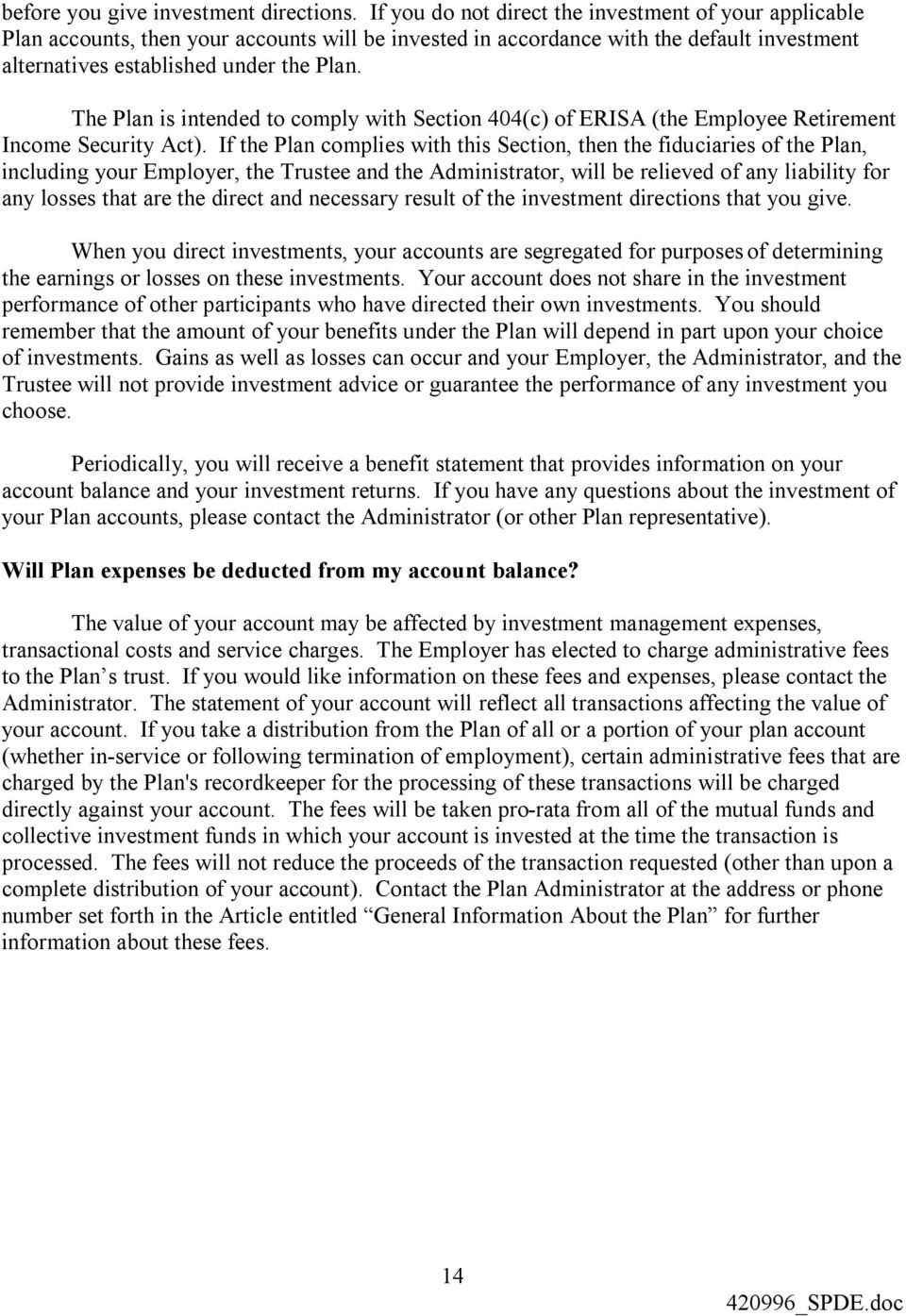
18 What is my vested interest in my accounts? ARTICLE IV VESTING In order to reward employees who remain employed with the Employer for a long period of time, the law permits a vesting schedule to be applied to certain contributions that your Employer makes to the Plan. This means that you will not be entitled to ( vested in) all of the contributions until you have been employed with the Employer for a specified period of time. You are always 100% vested (which means that you are entitled to all of the amounts) in the account(s) attributable to your elective deferrals (including Roth Elective Deferrals) and rollover contributions. Your vested percentage in your account(s) attributable to matching contributions and nonelective contributions is based on vesting Years (or Periods) of Service. This means at the time you stop working, your account balance attributable to these contributions is multiplied by your vested percentage. The result, when added to the amounts that are always 100% vested as shown above, is your vested interest in the Plan, which is what you will actually receive from the Plan. You will always, however, be 100% vested if you are employed on or after your Normal Retirement Age. (See the question in Article VI entitled What happens if I terminate employment at normal retirement age?.) Your vested percentage is determined under the following schedule(s): Vesting Schedule Years (or Periods) of Service Percentage Less than 1 0% 1 20% 2 40% 3 60% 4 80% 5 100% 15
19 How is my service determined for vesting purposes? To earn a Year of Service, you must be credited with at least 1000 Hour(s) of Service during a Plan Year. The Plan contains specific rules for crediting Hours of Service for vesting purposes. The Administrator will track your service and will credit you with a Year of Service for each Plan Year in which you are credited with the required Hours of Service, in accordance with the terms of the Plan. If you have any questions regarding your vesting service, you should contact the Administrator. You will be credited with an Hour of Service for: (a) each hour for which you are directly or indirectly compensated by the Employer for the performance of duties during the Plan Year; (b) each hour for which you are directly or indirectly compensated by the Employer for reasons other than the performance of duties (such as vacation, holidays, sickness, disability, lay-off, military duty, jury duty or leave of absence during the Plan Year); and (c) each hour for back pay awarded or agreed to by the Employer. You will not be credited for the same Hours of Service both under (a) or (b), as the case may be, and under (c). The Plan does not credit you with your actual Hours of Service. Instead, the Plan uses an equivalency method. Under this method, you will be credited with 190 Hours of Service for each month in which you would otherwise be credited with at least one Hour of Service. What service is counted for vesting purposes? In calculating your vested percentage, all service you perform for the Employer will generally be counted. However, there are some exceptions to this general rule. The Plan has Break in Service rules. If you terminate employment and are rehired, you may lose credit for prior service under the Plan s Break in Service rules. For vesting purposes, you will have a Break in Service if you complete less than 501 Hours of Service during the computation period used to determine whether you have a Year of Service. However, if you are absent from work for certain leaves of absence such as a maternity or paternity leave, you may be credited with enough Hours of Service to prevent a Break in Service. The Plan has a five-year Break in Service rule. The five-year Break in Service rule applies only to participants who had no vested interest in the Plan when employment had terminated. If you were not vested in any amounts when you terminated employment and you have five 1-Year Breaks in Service (as defined above), all the service you earned before the 5-year period no longer counts for vesting purposes. Thus, if you return to employment after 16
20 incurring five 1-Year Breaks in Service, you will be treated as a new employee (with no service) for purposes of determining your vested percentage under the Plan. As a veteran, will my military service count as service with the Employer? If you are a veteran and are reemployed under the Uniformed Services Employment and Reemployment Rights Act of 1994, your qualified military service may be considered service with the Employer. If you may be affected by this law, ask your Administrator for further details. What happens to my non-vested account balance if I m rehired? If you have no vested interest in the Plan when you leave, your account balance will be forfeited. However, if you are rehired before incurring five 1-Year Breaks in Service, your account balance as of your termination date will be restored, unadjusted for any gains or losses. If you are partially vested in your account balance when you leave, the non-vested portion of your account balance will be forfeited on the earlier of the date: (a) of the distribution of your vested account balance, or (b) when you incur five consecutive 1-year Breaks in Service. If you received a distribution of your vested account balance and are rehired, you may have the right to repay this distribution. If you repay the entire amount of the distribution, your Employer will restore your account balance with your forfeited amount. You must repay this distribution within five years from your date of reemployment, or, if earlier, before you incur five 1-Year Breaks in Service. If you were 100% vested when you left, you do not have the opportunity to repay your distribution. 17
21 What happens if the Plan becomes a top-heavy plan? A retirement plan that primarily benefits key employees is called a top-heavy plan. Key employees are certain owners or officers of your Employer. A plan is generally a top heavy plan when more than 60% of the plan assets are attributable to key employees. Each year, the Administrator is responsible for determining whether the Plan is a Top-Heavy Plan. If the Plan becomes top heavy in any Plan Year, then non-key employees might be entitled to certain top-heavy minimum benefits, and other special rules will apply. These topheavy rules include the following: Your Employer might be required to make a contribution on your behalf in order to provide you with at least top-heavy minimum benefits. If you are a participant in more than one Plan, you might not be entitled to top-heavy minimum benefits under both plans. 18
22 ARTICLE V DISTRIBUTIONS PRIOR TO TERMINATION Can I withdraw money from my account while working? Generally, you may receive a distribution from the Plan prior to your termination of employment if you satisfy certain conditions. However, this distribution is not in addition to your other benefits and will therefore reduce the value of the benefits you will receive at retirement. This distribution is made at your election and will be made in accordance with the forms of distributions available under the Plan. The minimum amount you can receive as an inservice distribution is $500. You may request an in-service distribution from all accounts when you reach age 59 ½. Before you reach age 59 ½, in addition to hardship distributions (if available under the Plan as described below), you may request an in-service distribution from accounts attributable to your rollover contributions and after-tax employee contributions (if your Plan permits these types of contributions) at any time. See Article II above for additional information regarding availability of Roth Elective Deferrals for in-service distribution. 19
23 Can I withdraw money from my account in the event of financial hardship? You may withdraw money for financial hardship if you satisfy certain conditions. This hardship distribution is not in addition to your other benefits and will therefore reduce the value of the benefits you will receive at retirement. A hardship distribution may be made to satisfy certain immediate and heavy financial needs that you have. A hardship distribution may only be made for payment of the following: Expenses for medical care (described in Section 213(d) of the Internal Revenue Code) previously incurred by you, your spouse, your dependent or your primary beneficiary under the Plan or necessary for you, your spouse, your dependents, or your beneficiaries to obtain medical care; Costs directly related to the purchase of your principal residence (excluding mortgage payments); Tuition, related educational fees, and room and board expenses for the next twelve (12) months of post-secondary education for yourself, your spouse, your dependents or your beneficiaries; Amounts necessary to prevent your eviction from your principal residence or foreclosure on the mortgage of your principal residence; Payment for burial or funeral expenses for your deceased parent, spouse, children, other dependents or beneficiaries; Expenses for the repair of damages to your principal residence that would qualify for a casualty deduction under Section 165 of the Internal Revenue Code. A beneficiary is someone you designate under the Plan to receive your death benefit who is not otherwise your spouse or dependent. If you have any of the above expenses, a hardship distribution can only be made if you certify and agree that all of the following conditions are satisfied: (a) The distribution is not in excess of the amount of your immediate and heavy financial need. The amount of your immediate and heavy financial need may include any amounts necessary to pay any federal, state, or local income taxes or penalties reasonably anticipated to result from the distribution; and (b) You have obtained all distributions, other than hardship distributions, and all nontaxable loans currently available under all plans maintained by your Employer; and (c) That your elective deferrals will be suspended for six (6) months after your receipt of the hardship distribution. The minimum amount you can request as a hardship distribution is $500. You may request a hardship distribution from all accounts. 20
24 There are restrictions placed on hardship distributions which are made from certain accounts. These accounts are the ones set up to receive your elective deferral contributions and other Employer contributions which are used to satisfy special rules that apply to 401(k) plans. Generally, the only amounts that can be distributed to you on account of a hardship from these accounts are your elective deferrals. The earnings on your elective deferrals and special Employer contributions may not be distributed to you on account of a hardship. Ask the Administrator if you need further details. Can I withdraw money from my account under any other circumstances? If you are a qualified member of the reserves, you also may be eligible to request a qualified reservist distribution. A qualified reservist distribution is an exception to Plan restrictions on withdrawal of elective deferrals. Further, the extra 10% tax on a payout before age 59 ½ doesn t apply to a qualified reservist distribution. A qualified reservist distribution from the Plan is: attributable to elective deferrals, available to a person who, because he or she is a member of a reserve component, was ordered or called to active duty for more than 179 days (or for an indefinite period), and made during the period that began or begins on the date of the order or call to duty and ended or ends at the close of the active-duty period. A person who receives or received a qualified reservist distribution may, during the twoyear period that begins on the day after the end of his or her active-duty period, contribute to an IRA an amount up to the amount of the qualified reservist distribution. Although the limits on IRA contributions don t apply to this special contribution, no deduction is allowed for it. This provision applies to a person ordered or called to active duty after September 11, 2001 and applies to a distribution after September 11,
25 ARTICLE VI BENEFITS AND DISTRIBUTIONS UPON TERMINATION OF EMPLOYMENT When can I get money out of the Plan? This Plan is designed to provide you with retirement benefits. However, distributions are permitted if you die, become disabled, or terminate employment for any other reason. The rules under which you can receive a distribution are described in this Article. The rules regarding the payment of death benefits to your beneficiary are described in Article VI Benefits and Distributions Upon Death. You may also receive distributions while you are still employed with the Employer. (See the Article entitled Distributions Prior to Termination for a further explanation.) What happens if I terminate employment before death, disability or retirement? This Plan is designed to encourage you to stay with us until retirement. Payment of your account balance under the Plan is always available upon your death, disability, or retirement. If your employment terminates for reasons other than death, disability, or retirement, you will be entitled to receive only the vested portion of your account balance. You may elect to have your vested benefit distributed to you as soon as administratively feasible following your termination of employment. However, if the value of your vested benefit is $5,000 or less, a distribution of your vested account balance will be made to you as soon as administratively feasible after you terminate employment, regardless of whether you consent to receive it. (See the question entitled How will my benefits be paid to me? for an explanation of how these amounts will be paid.) Amounts in your rollover account will not be considered as part of your benefit in determining if the value of your vested account balance exceeds the $5,000 threshold used to determine whether you must consent to a distribution. What happens if I terminate employment at Normal Retirement Age? You will attain your Normal Retirement Age when you reach age 65. Your Normal Retirement Date is the date on which you attain your Normal Retirement Age. You will become 100% vested in all of your accounts under the Plan if you retire on or after your Normal Retirement Age. However, the actual payment of benefits generally will not begin until you have terminated employment and reached your Normal Retirement Date. In such event, a distribution will be made, at your election, as soon as administratively feasible. If you remain employed past your Normal Retirement Date, you may generally defer the receipt of benefits until you actually terminate employment. In such event, benefit payments will begin as soon as feasible at your request, but not later than age 70 ½. (See the question entitled How will my benefits be paid to me? for an explanation of how these benefits will be paid.) 22
26 What happens if I terminate employment due to disability? Under the Plan, disability is defined as a physical or mental condition resulting from bodily injury, disease, or mental disorder which renders you incapable of continuing any gainful occupation and which has lasted or can be expected to last for a continuous period of at least twelve (12) months. Your disability must be determined by a licensed physician. However, if your condition constitutes total disability under the federal Social Security Act, then the Administrator may deem that you are disabled for purposes of the Plan. If you become disabled while an employee, you will become 100% vested in all of your accounts under the Plan. Payment of your disability benefits will be made to you as if you had retired. However, if the value of your disability benefit is $5,000 or less, then a distribution of your account balance will be made to you, regardless of whether you consent to receive it. (See the question entitled How will my benefits be paid to me? for an explanation of how these benefits will be paid.) How will my benefits be paid to me? If your vested account balance does not exceed $5,000, then your vested account balance may only be distributed to you in a single lump-sum payment. In determining whether your vested account balance exceeds the $5,000 threshold, rollovers and any earnings attributable to rollover contributions will not be taken into account. In addition, if your vested account balance exceeds $5,000, you must consent to the distribution. If your vested account balance exceeds $5,000, you may elect to receive a distribution of your vested account balance in a single lump-sum payment, installments over a period of not more than your assumed life expectancy (or the assumed life expectancies of you and your beneficiary), or partial withdrawals. If you were a participant with an account balance in the Plan prior to the date your plan converted to the ADP recordkeeping system, please contact your Plan s Administrator or refer to the Summary Plan Description that was in effect for your Plan prior to the date your plan converted to the ADP recordkeeping system for information on any additional termination distribution rights that may be available to you. Similarly, if you previously participated in a plan that was merged into the Plan, please contact your Plan s Administrator for information on any additional termination distribution rights that may be available to you. 23
27 You may delay the distribution of your vested account balance unless a distribution is required to be made, as explained earlier, because your vested benefit under the Plan does not exceed $5,000,. However, if you elect to delay the distribution of your vested account balance, there are rules that require that certain minimum distributions be made from the Plan. If you are a 5% owner, distributions are required to begin not later than the April 1st following the end of the year in which you reach age 70 ½. If you are not a 5% owner, distributions are required to begin not later than the April 1st following the later of the end of the year in which you reach age 70 ½ or retire. You should see the Administrator if you think you may be affected by these rules. Benefits under the Plan will generally be paid to you in cash. If you are determined to be a cashout-eligible participant as described in the preceding sentence, your account balance is greater than $1,000, and you have not elected to (a) receive your vested benefit in the form of a single lump sum payment, or (b) have the payment paid as a direct rollover to your individual retirement account (IRA) or to another employer s tax qualified plan, it will automatically be rolled over to an individual retirement account ( IRA ) established by an IRA provider selected by your Employer. If your account balance is automatically rolled over to an IRA, the IRA provider selected by your Employer will establish an IRA for your benefit and your account balance will be invested in an investment product designed to preserve principal and provide a reasonable rate of return and liquidity. Fees and expenses for the IRA will be charged against your account unless you contact the IRA provider and request to make payment of the fees out-of-pocket. You may also contact the IRA provider at any time to request a distribution or rollover of your IRA account balance. Please contact the Plan Administrator for further information regarding the Plan s procedures with regard to the automatic rollover process, the IRA provider that your Employer has selected to hold automatic rollover IRAs for the Plan, and the IRA investment vehicle, as well as fees and interest rate earned on the account. The name, address, and telephone number of the Plan Administrator may be found in the Article entitled General Information About the Plan. 24
28 ARTICLE VII BENEFITS AND DISTRIBUTIONS UPON DEATH What happens if I die while working for the Employer? If you die while still employed by the Employer, then 100% of your account balance will be used to provide your beneficiary with a death benefit. Who is the beneficiary of my death benefit? If you are married at the time of your death, your spouse will be the beneficiary of the entire death benefit unless an election is made to change the beneficiary. IF YOU WISH TO DESIGNATE A BENEFICIARY OTHER THAN YOUR SPOUSE, YOUR SPOUSE MUST IRREVOCABLY CONSENT TO WAIVE ANY RIGHT TO THE DEATH BENEFIT. YOUR SPOUSE S CONSENT MUST BE IN WRITING, BE WITNESSED BY A NOTARY OR A PLAN REPRESENTATIVE AND ACKNOWLEDGE THE SPECIFIC NONSPOUSE BENEFICIARY. If you are married and you change your designation, then your spouse must again consent to the change. In addition, you may elect a beneficiary other than your spouse without your spouse s consent if your spouse cannot be located. If you are not married, you may designate a beneficiary on a form to be supplied to you by the Administrator. If you have named anyone other than your spouse as beneficiary, then you should ask the Administrator whether a new designation will be needed in order to ensure that the beneficiary designation will comply with the Plan provisions. In certain cases, if you fail to properly complete the designation of beneficiary form, then your spouse will be the beneficiary of your entire death benefit under the Plan. Since your spouse has certain rights to the death benefit, you should immediately report any change in your marital status to the Administrator. At the time of your death, if you have not properly designated a beneficiary or the individual named as your beneficiary is also not alive, the death benefit will be paid in the following order of priority to: (a) your surviving spouse (b) your children, including adopted children, in equal shares (and if a child is not living, that child s share will be distributed to that child s heirs) (c) your surviving parents, in equal shares (d) your estate. 25
29 How will the death benefit be paid to my beneficiary? In general, the death benefit will be paid to your beneficiary as a lump-sum. However, if the value of your vested benefit in the Plan is $5, or less, then a lump-sum distribution will be made to your beneficiary within a reasonable time regardless of whether the beneficiary elects to receive it. If your beneficiary is your surviving spouse, he or she may elect to roll over a lump sum distribution to another qualified plan or IRA. A nonspouse beneficiary may make a direct rollover of a lump sum distribution to an IRA in accordance with and to the extent permitted by guidance issued by the Internal Revenue Service. When must the last payment be made to my beneficiary? The law generally restricts the ability of a retirement plan to be used as a method of retaining money for purposes of your death estate. Thus, there are rules that are designed to ensure that death benefits are distributable to beneficiaries within certain time periods. If your designated beneficiary is a person (rather than your estate or most trusts) then minimum distributions of your death benefit must generally begin within one year of your death and must be paid over a period not extending beyond your beneficiary s life expectancy. If your spouse is the beneficiary, the start of payments may be delayed until the year in which you would have attained age 70 ½. Generally, if your beneficiary is not a person, then your entire death benefit must be paid within five years after your death. What happens if I m a participant, terminate employment, and die before receiving all my benefits? If you terminate employment with the Employer and subsequently die, your beneficiary will be entitled to your remaining interest in the Plan at the time of your death. The provision in the Plan providing for full vesting of your benefit upon death does not apply if you die after terminating employment. 26
30 ARTICLE VIII TAX TREATMENT OF DISTRIBUTIONS What are my tax consequences when I receive a distribution from the Plan? Generally, you must include any Plan distribution in your taxable income in the year in which you receive the distribution. Certain distributions made to you when you are under age 59 ½ could be subject to an additional 10% tax. Please note that special tax rules apply if you take a distribution of Roth Elective Deferrals, as discussed in Article II above. Can I elect a rollover to reduce or defer tax on my distribution? Distribution rules provide that any part of a distribution (including after-tax contributions) from a qualified plan (such as this Plan) can be rolled over to an eligible retirement plan. Eligible retirement plans to which a distribution may be rolled over include another employer s tax-qualified retirement plan; a 403(a) qualified annuity plan; a governmental 457(b) plan; a 403(b) tax-sheltered annuity; or a traditional individual retirement account. Rollovers of after-tax contributions to an employer s qualified plan or 403(b) annuity must be transferred directly to the receiving plan (a direct rollover ). After-tax contributions may be rolled over only to a qualified defined contribution plan or an individual retirement account or annuity that agrees to separately account for those contributions. It is your responsibility to confirm that the plan to which you intend to roll over your distribution will accept the rollover from this Plan. Certain types of distributions are not eligible to be rolled over. These include distributions that are one of a series of substantially equal payments made over the life (or joint life expectancies) of the participant and his or her beneficiary, or over a specified period of 10 years or more, hardship withdrawals or a minimum required distribution. You may elect to have any distribution that is eligible for rollover treatment transferred directly to an eligible transferee plan (a direct rollover ). Such a distribution will not be subject to 20% withholding. You will receive a written explanation of your distribution options within a reasonable period of time before receiving a distribution that is eligible to be rolled over. If you elect to have your benefit transferred as a direct rollover, then you must provide your Plan s Administrator, in a timely manner, with information regarding the transferee plan. Your Plan s Administrator is entitled to reasonably rely on the information that you provide and will not independently verify the information. Federal income tax withholding at a rate of 20% is required on any taxable distribution that is eligible to be rolled over but is not transferred directly to an eligible transferee plan. You cannot elect to forego withholding on these distributions. This mandatory 20% withholding also applies to any eligible rollover distribution to your surviving spouse or nonspouse beneficiary that is not directly rolled over. Eligible rollover distributions to a nonspouse beneficiary that are not rolled over are subject to 10% federal income tax withholding. 27
31 WHENEVER YOU RECEIVE A DISTRIBUTION, THE ADMINISTRATOR WILL DELIVER TO YOU A MORE DETAILED EXPLANATION OF THESE OPTIONS. HOWEVER, THE RULES WHICH DETERMINE WHETHER YOU QUALIFY FOR FAVORABLE TAX TREATMENT ARE VERY COMPLEX. YOU SHOULD CONSULT WITH A PROFESSIONAL TAX ADVISOR BEFORE MAKING A CHOICE. You may want to discuss other alternative methods available to you to defer the payment of taxes as well as applicable federal, state and/or local tax rules that may affect your distribution. Can I elect a rollover to a Roth IRA? Effective January 1, 2008, if you receive a distribution of your vested benefit, or an inservice withdrawal that is an eligible rollover distribution, you may elect to have the portion of that distribution that is not attributable to Roth Elective Deferrals or Roth Rollover Contributions ( non-roth amounts ) rolled over directly to a Roth IRA, in addition to a traditional IRA or eligible retirement plan. This right is also available to beneficiaries and alternate payees under a qualified domestic relations order. Non-Roth amounts directly transferred to a Roth IRA must be included in gross income, but are not subject to 10% excise tax for premature distributions. Please note that this tax treatment of non-roth amounts (inclusion of the rollover amount in gross income) is different from the tax treatment that applies if you elect a direct rollover of non-roth amounts to a traditional IRA. If a participant, beneficiary or alternate payee elects a direct rollover of non- Roth amounts to a Roth IRA, no amount will be withheld from the rollover for federal income tax purposes. CAUTION: This means that a participant, beneficiary, or alternate payee making this election will be responsible for making sure he or she is able to pay the full amount of all required income taxes in connection with such a rollover. For this reason, participants, beneficiaries, and alternate payees considering a direct rollover of non-roth amounts to a Roth IRA are strongly encouraged to consult their tax advisor before making this election. If this plan generally permits distribution and in-service withdrawal elections to be made on-line, please note that you may need to complete a paper form to make this particular election. Please contact your Plan s Administrator for further information. 28
32 Is it possible to borrow money from the Plan? ARTICLE IX LOANS Yes, you may request a participant loan from your Plan account. Your ability to obtain a participant loan depends on several factors. The Administrator will determine whether you satisfy these factors. Please refer to Article II for additional information regarding availability of Roth Elective Deferrals for loans. What are the loan rules and requirements? There are various rules and requirements that apply to any loan, which are outlined in this question. In addition, your Employer has established a written Loan Policy, which explains these requirements in more detail. You can request a copy of the Loan Policy from the Plan Administrator. Generally, the rules for loans include the following: Loans are available to participants on a reasonably equivalent basis. Loans will be made to participants who are creditworthy. The Administrator may request that you provide additional information, such as financial statements, tax returns and credit reports to make this determination. No loan in an amount less than $ will be made. All loans must be adequately secured. Your signature on the loan check serves as the promissory note for the loan. Generally, you must use your vested interest in the Plan as security for the loan, provided the outstanding balance of all your loans does not exceed 50% of your vested interest in the Plan. You will be charged a reasonable rate of interest for any loan received from the Plan. In general, the interest rate charged for a Plan loan will be the prime rate plus 1%. The prime rate is determined based upon the prime rate of interest that is published in the Wall Street Journal on the 14 th day of each month. If approved, your loan will provide for level amortization with payments to be made not less frequently than quarterly. Generally, the term of your loan may not exceed five (5) years. However, if the loan is for the purchase of your principal residence, the Administrator may permit a longer repayment term. You must repay your loan through payroll deduction. If you have a leave of absence that is without pay or at a rate of pay after taxes that is less than your loan payments, or go on military leave while you have an outstanding loan, please contact the Administrator to find out your repayment options. 29
33 All loans will be considered a directed investment of your account under the Plan. All payments of principal and interest by you on a loan will be credited to your account. The amount the Plan may loan to you is limited by rules under the Internal Revenue Code. A new loan (if any), when added to the outstanding balance of all other loans from the Plan, will be limited to the lesser of: (a) $50,000 reduced by the excess, if any, of your highest outstanding balance of loans from the Plan during the one-year period ending on the day before the date of the new loan over your current outstanding balance of loans as of the date of the new loan; or (b) 1/2 of your vested interest in the Plan. The maximum number of Plan loans that you may have outstanding at any one time is 1. If you fail to make payments when they are due under the terms of the loan, you will be considered to be in default. The Administrator will consider your loan to be in default if any scheduled loan repayment is not made by the end of the calendar quarter following the calendar quarter in which a payment is first missed. The Plan would then have authority to take all reasonable actions to collect the balance owed on the loan. This could include filing a lawsuit or foreclosing on the security for the loan. A loan that is in default will be treated for income tax purposes as if it were a distribution from the Plan and will result in taxable income to you. In any event, your failure to repay a loan will reduce the benefit you would otherwise be entitled to from the Plan. There are special rules that permit temporary suspension of loan payments in the event you go on unpaid leave or military leave, and special rules governing the resumption of loan payments when a suspension period ends. You should consult your Administrator if you enter or return from unpaid leave or military leave with an outstanding loan. If you terminate employment, your loan becomes due and payable in full immediately. You may repay the entire outstanding balance of the loan (including any accrued interest). If you do not repay the entire outstanding loan balance, your outstanding loan balance, including applicable interest accrued to date, will be deemed distributed and treated as a taxable distribution as of the last day of the calendar quarter following the calendar quarter in which you first miss a payment due to your termination. If you take a distribution of your account balance before that date, your vested account balance will be reduced by the remaining outstanding balance of the loan, which will be reported as a taxable distribution. Loans are permitted from all of your accounts. 30
34 The Administrator may revise the Plan s Loan Policy. If you have any questions on participant loans or the current Loan Policy, please contact the Administrator. 31
35 Are my benefits protected? ARTICLE X PROTECTED BENEFITS AND CLAIMS PROCEDURES As a general rule, your interest in your account, including your vested interest, may not be alienated. This means that your interest may not be sold, used as collateral for a loan, given away or otherwise transferred. In addition, your creditors may not attach, garnish, or otherwise interfere with your account. Are there any exceptions to the general rule? There are two exceptions to this general rule. The Administrator must honor a qualified domestic relations order. A qualified domestic relations order is defined as a decree or order issued by a court that obligates you to pay child support or alimony, or otherwise allocates a portion of your assets in the Plan to your spouse, former spouse, child, or other dependent. If a qualified domestic relations order is received by the Administrator, all or a portion of your benefits may be used to satisfy that obligation. The Administrator will determine the validity of any domestic relations order received. You and your beneficiaries can obtain, without charge, a copy of the Plan s qualified domestic relations order procedures from the Administrator. The second exception applies if you are involved with the Plan s operation. If you are found liable for any action that adversely affects the Plan, the Administrator can offset your benefits by the amount that you are ordered or required by a court to pay the Plan. All or a portion of your benefits may be used to satisfy any such obligation to the Plan. Can the Plan be amended? Your Employer has the right to amend the Plan at any time. In no event, however, will any amendment authorize or permit any part of the Plan assets to be used for purposes other than the exclusive benefit of participants or their beneficiaries. Additionally, no amendment will cause any reduction in the amount credited to your account. What happens if the Plan is discontinued or terminated? Although your Employer intends to maintain the Plan indefinitely, your Employer reserves the right to terminate the Plan at any time. Upon termination, no further contributions will be made to the Plan and all amounts credited to your accounts will be 100% vested. Your Employer will direct the distribution of your accounts in a manner permitted by the Plan as soon as practicable. (See the question entitled How will my benefits be paid to me? for a further explanation.) You will be notified if the Plan is terminated. How do I submit a claim for benefits? Benefits will generally be paid to you and your beneficiaries without the necessity for formal claims. However, if you think an error has been made in determining your benefits, then 32
36 you or your authorized representative may make a request for any Plan benefits to which you believe you are entitled. Any such request must be in writing and should be made to the Administrator. (Note: If your Plan is subject to a collective bargaining agreement and the agreement contains certain provisions, then the procedures for resolution of claims set forth in that collective bargaining agreement will take the place of this claims procedure as permitted by Department of Labor regulations. Please contact your Plan Administrator if you have questions regarding whether a collective bargaining agreement s claims procedures apply to you.) What if my benefits are denied? Your or your authorized representative s request for Plan benefits will be considered a claim for Plan benefits, and it will be subject to a full and fair review. If your claim is wholly or partially denied, the Administrator will provide you or your authorized representative with a written or electronic notification of the denial. This written or electronic notification must be provided to you within a reasonable period of time, but no later than 90 days after the receipt of your claim by the Administrator, unless the Administrator determines that special circumstances require an extension of time for processing your claim. If the Administrator determines that an extension of time for processing is required, written notice of the extension will be furnished to you or your authorized representative prior to the termination of the initial 90-day period. In no event will such extension exceed a period of 90 days from the end of such initial period. The extension notice will indicate the special circumstances requiring an extension of time and the date by which the Plan expects to render the benefit determination. In the case of a claim for disability benefits, if disability is determined by a physician (rather than relying on a determination of disability for Social Security purposes), then instead of the above the Administrator will provide you or your authorized representative with written or electronic notification of the denial within a reasonable period of time, but not later than 45 days after the receipt of your claim by the Plan. This period may be extended by the Plan for up to 30 days, provided that the Administrator notifies you, prior to the expiration of the initial 45-day period, of the circumstances requiring the extension of time and the date by which the Plan expects to render a decision. If, prior to the end of the first 30-day extension period, the Administrator determines that a decision cannot be rendered within that extension period, the period for making the determination may be extended for up to an additional 30 days, provided that the Administrator notifies you or your authorized representative, prior to the expiration of the first 30-day extension period, of the circumstances requiring the extension and the date as of which the Plan expects to render a decision. In the case of any such extension, the notice of extension will specifically explain the standards on which the entitlement to a benefit is based, the unresolved issues that prevent a decision on the claim, and the additional information needed to resolve the issues, and you or your authorized representative will have at least 45 days to provide the specified information. 33
37 The Administrator s written or electronic notification of denial will contain the following information: (a) (b) (c) (d) (e) the specific reason or reasons for the denial; reference to the specific Plan provisions on which the denial is based; a description of any additional information or material necessary to perfect the claim and an explanation of why such material or information is necessary; and appropriate information as to the steps to be taken if you or your authorized representative want to submit your claim for review. In the case of disability benefits where disability is determined by a physician (rather than relying on a determination of disability for Social Security purposes), if an internal rule, guideline, protocol or other similar criterion was relied upon in denying the claim, either a copy of the specific rule, guideline, protocol or other similar criterion; or a statement that such rule, guideline, protocol or other similar criterion was relied upon and that a copy of the rule, guideline, protocol or similar criterion will be provided to you or your authorized representative free of charge upon request. If your claim has been denied, and you want to submit your claim for review, you must follow the Claims Review Procedure in the next question. What is the Claims Review Procedure? Upon the denial of your claim for benefits, you or your authorized representative may file your claim for review, in writing, with the Administrator. (a) YOU MUST FILE THE CLAIM FOR REVIEW NO LATER THAN 60 DAYS AFTER YOU HAVE RECEIVED WRITTEN NOTIFICATION OF THE DENIAL OF YOUR CLAIM FOR BENEFITS. HOWEVER, IF YOUR CLAIM IS FOR DISABILITY BENEFITS AND DISABILITY IS DETERMINED BY A PHYSICIAN (RATHER THAN RELYING ON A DETERMINATION OF DISABILITY FOR SOCIAL SECURITY PURPOSES), THEN INSTEAD OF THE ABOVE, YOU MUST FILE THE CLAIM FOR REVIEW NO LATER THAN 180 DAYS FOLLOWING RECEIPT OF NOTIFICATION OF THE DENIAL OF YOUR CLAIM FOR BENEFITS. 34
38 (b) (c) (d) (e) You or your authorized representative may submit written comments, documents, records, and other information relating to your claim for benefits. You or your authorized representative may review all pertinent documents relating to the denial of your claim and submit any issues and comments, in writing, to the Administrator. You or your authorized representative will be provided, upon request and free of charge, reasonable access to, and copies of, all documents, records and other information relevant to your claim for benefits. Your claim for review must be given a full and fair review. This review will take into account all comments, documents, records and other information submitted by you relating to your claim, without regard to whether such information was submitted or considered in the initial benefit determination. In addition to the Claims Review Procedure above, if your claim is for disability benefits and disability is determined by a physician (rather than relying on a determination of disability for Social Security purposes), then the Claims Review Procedure provides that: (a) (b) (c) (d) Your claim will be reviewed without deference to the initial adverse benefit determination and the review will be conducted by an appropriate fiduciary of the Plan who is neither the individual who made the adverse benefit determination that is the subject of the appeal nor the subordinate of such individual. In deciding an appeal of any adverse benefit determination that is based in whole or in part on medical judgment, the reviewing fiduciary will consult with a health care professional who has appropriate training and experience in the field of medicine involved in the medical judgment. Any medical or vocational experts whose advice was obtained on behalf of the Plan in connection with your claim will be identified, without regard to whether the advice was relied upon in making the benefit determination. The health care professional engaged for purposes of a consultation under (b) above will be an individual who is neither an individual who was consulted in connection with the initial review of the claim that is the subject of the appeal, nor the subordinate of any such individual. 35
39 If your claim is denied on review, the Administrator must provide you or your authorized representative with notification of this denial within 60 days after the Administrator s receipt of your written claim for review, unless the Administrator determines that special circumstances require an extension of time for processing your claim. If the Administrator determines that an extension of time for processing is required, written notice of the extension will be furnished to you or your authorized representative prior to the termination of the initial 60-day period. In no event will such extension exceed a period of 60 days from the end of the initial period. The extension notice will indicate the special circumstances requiring an extension of time and the date by which the Plan expects to render the determination on review. However, if the claim relates to disability benefits and disability is determined by a physician (rather than relying on a determination of disability for Social Security purposes), then 45 days will apply instead of 60 days in the preceding sentences. In the case of an adverse determination on review, the notification will set forth: (a) (b) (c) (d) The specific reason or reasons for the determination. Reference to the specific Plan provisions on which the determination is based. A statement that you are entitled to receive, upon request and free of charge, reasonable access to, and copies of, all documents, records and other information relevant to your claim for benefits. In the case of disability benefits where disability is determined by a physician (rather than relying on a determination of disability for Social Security purposes), if an internal rule, guideline, protocol or other similar criterion was relied upon in making the adverse determination, either a copy of the specific rule, guideline, protocol or other similar criterion; or a statement that such rule, guideline, protocol or other similar criterion was relied upon in making the adverse determination and that a copy of the rule, guideline, protocol or similar criterion will be provided to you or your authorized representative free of charge upon request. The determination on review by the Administrator is the final determination under this claims procedure. If your claim is denied on review, then you may file suit in a state or federal court. However, in order to do so, you must file the suit no later than 180 days after the Administrator makes a final determination to deny your claim. If benefits are provided or administered by an insurance company, insurance service, or other similar organization, which is subject to regulation under the insurance laws, the claims procedure relating to these benefits may provide for review. If so, that company, service, or organization will be the entity to which claims are addressed. If you have any questions regarding the proper person or entity to address claims, you should ask the Administrator. 36
40 What are my rights as a Plan participant? As a participant in the Plan you are entitled to certain rights and protections under the Employee Retirement Income Security Act of 1974 (ERISA). ERISA provides that all Plan participants are entitled to: (a) Examine, without charge, at the Administrator's office and at other specified locations, all documents governing the Plan, including insurance contracts, collective bargaining agreements and a copy of the latest annual report (Form 5500 Series) filed by the Plan with the U.S. Department of Labor and available at the Public Disclosure Room of the Employee Benefits Security Administration. (b) Obtain, upon written request to the Administrator, copies of documents governing the operation of the Plan, including insurance contracts and collective bargaining agreements, and copies of the latest annual report (Form 5500 Series) and updated summary plan description. The Administrator may make a reasonable charge for the copies. (c) Receive a summary of the Plan's annual financial report. The Administrator is required by law to furnish each participant with a copy of this summary annual report. (d) Obtain a statement telling you whether you have a right to receive a pension at Normal Retirement Age and, if so, what your benefits would be at Normal Retirement Age if you stop working under the Plan now. If you do not have a right to a pension benefit, the statement will tell you how many years you have to work to earn a right to a pension. THIS STATEMENT MUST BE REQUESTED IN WRITING AND IS NOT REQUIRED TO BE GIVEN MORE THAN ONCE EVERY TWELVE (12) MONTHS. The Plan must provide this statement free of charge. In addition to creating rights for Plan participants, ERISA imposes duties upon the people who are responsible for the operation of the Plan. The people who operate your Plan, called fiduciaries of the Plan, have a duty to do so prudently and in the interest of you and other Plan participants and beneficiaries. No one, including your Employer or any other person, may fire you or otherwise discriminate against you in any way to prevent you from obtaining a pension benefit or exercising your rights under ERISA. If your claim for a pension benefit is denied or ignored, in whole or in part, you have a right to know why this was done, to obtain copies of documents relating to the decision without charge, and to appeal any denial, all within certain time schedules. Under ERISA, there are steps you can take to enforce the above rights. For instance, if you request a copy of Plan documents or the latest annual report from the Plan and do not receive them within 30 days, you may file suit in a Federal court. In such a case, the court may require the Administrator to provide the materials and pay you up to $ a day until you receive the materials, unless the materials were not sent because of reasons beyond the control of the Administrator. 37
41 If you have a claim for benefits which is denied or ignored, in whole or in part, you may file suit in a state or Federal court. In addition, if you disagree with the Plan's decision or lack thereof concerning the qualified status of a domestic relations order or a medical child support order, you may file suit in Federal court. You and your beneficiaries can obtain, without charge, a copy of the qualified domestic relations order ( QDRO ) procedures from the Administrator. If it should happen that the Plan's fiduciaries misuse the Plan's money, or if you are discriminated against for asserting your rights, you may seek assistance from the U.S. Department of Labor, or you may file suit in a Federal court. The court will decide who should pay court costs and legal fees. If you are successful, the court may order the person you have sued to pay these costs and fees. The court may order you to pay these costs and fees if you lose or if, for example, it finds your claim is frivolous. If you have any questions about the Plan, you should contact the Administrator. If you have any questions about this statement or about your rights under ERISA, or if you need assistance in obtaining documents from the Administrator, you should contact the nearest office of the Employee Benefits Security Administration, U.S. Department of Labor, listed in the telephone directory or the Division of Technical Assistance and Inquiries, Employee Benefits Security Administration, U.S. Department of Labor, 200 Constitution Avenue, N.W., Washington, D.C You may also obtain certain publications about your rights and responsibilities under ERISA by calling the publications hotline of the Employee Benefits Security Administration. 38
42 ARTICLE XI GENERAL INFORMATION ABOUT THE PLAN There is certain general information which you may need to know about the Plan. This information has been summarized for you in this Article. General Plan Information The full name of the Plan is Primatics Financial 401(k) Profit Sharing Plan & Trust. Your Employer has assigned Plan Number 001 to your Plan. This Plan was originally effective on 1/1/2007. The amended and restated provisions of the Plan became effective on 10/1/2012. The Plan s records are maintained for a twelve-month period of time. This is known as the Plan Year. The Plan Year begins on 01/01 and ends on 12/31. The Plan and Trust will be governed by the laws of Virginia to the extent not governed by federal law. Benefits provided by the Plan are NOT insured by the Pension Benefit Guaranty Corporation (PBGC) under Title IV of the Employee Retirement Income Security Act of 1974 because the insurance provisions under ERISA are not applicable to this type of Plan. Service of legal process may be made upon your Employer. Service of legal process may also be made upon the Trustee or Administrator. Employer Information Your Employer s name, address and identification number are: Primatics Financial, LLC 8401 Greensboro Dr Suite 550 McLean, VA Employer s taxpayer identification number:
43 Administrator Information The Plan s Administrator is responsible for the day-to-day administration and operation of the Plan. For example, the Administrator maintains the Plan records, including your account information, provides you with the forms you need to complete for Plan participation, and directs the payment of your account at the appropriate time. The Administrator will also allow you to review the formal Plan document and certain other materials related to the Plan. If you have any questions about the Plan and your participation, you should contact the Administrator. The Administrator may designate other parties to perform some duties of the Administrator. The Administrator has the complete power, in its sole discretion, to determine all questions arising in connection with the administration, interpretation, and application of the Plan (and any related documents and underlying policies). Any such determination by the Administrator is conclusive and binding upon all persons. The name, address, and business telephone number of the Plan s Administrator is: Primatics Financial, LLC 8401 Greensboro Dr Suite 550 McLean, VA (703) Trustee Information All money that is contributed to the Plan is held in a trust fund. The Trustee is responsible for the safekeeping of the Trust Fund, and must hold and invest Plan assets in a prudent manner and in the best interest of you and your beneficiaries. The Trust Fund established by the Plan s Trustee will be the funding medium used for the accumulation of assets from which benefits will be distributed. While all Plan assets are held in a trust fund, the Administrator separately accounts for each Participant s interest in the Plan. The name and address of the Plan s Trustee is: State Street Bank and Trust Co. Institutional Investor Services 105 Rosemont Rd. Westwood, MA
GOLD CROSS SERVICES, INC. 401(K) RETIREMENT SAVINGS PLAN SUMMARY PLAN DESCRIPTION
 GOLD CROSS SERVICES, INC. 401(K) RETIREMENT SAVINGS PLAN SUMMARY PLAN DESCRIPTION TABLE OF CONTENTS INTRODUCTION TO YOUR PLAN What kind of Plan is this?... 1 What information does this Summary provide?...
PRO-SPHERE 401(K) PLAN SUMMARY PLAN DESCRIPTION
 PRO-SPHERE 401(K) PLAN SUMMARY PLAN DESCRIPTION TABLE OF CONTENTS INTRODUCTION TO YOUR PLAN What kind of Plan is this?... 1 What information does this Summary provide?... 1 ARTICLE I PARTICIPATION IN THE
THE CITY OF GALLATIN 401(K) RETIREMENT PLAN SUMMARY PLAN DESCRIPTION
 THE CITY OF GALLATIN 401(K) RETIREMENT PLAN SUMMARY PLAN DESCRIPTION TABLE OF CONTENTS INTRODUCTION TO YOUR PLAN What kind of Plan is this?... 1 What information does this Summary provide?... 1 ARTICLE
NOVA SOUTHEASTERN UNIVERSITY 401(K) PLAN SUMMARY PLAN DESCRIPTION
 NOVA SOUTHEASTERN UNIVERSITY 401(K) PLAN SUMMARY PLAN DESCRIPTION 11/21/11 TABLE OF CONTENTS INTRODUCTION TO YOUR PLAN What kind of Plan is this?...1 What information does this Summary provide?...1 ARTICLE
401(k) Summary Plan Description
 401(k) Summary Plan Description WELLSPAN 401(K) RETIREMENT SAVINGS PLAN SUMMARY PLAN DESCRIPTION I I PRIOR TO II III I TABLE OF TO YOUR PLAN What kind of Plan is this? 5 What information does this Summary
CENTRAL GEORGIA HEALTH VENTURES, INC. 401(K) PLAN SUMMARY PLAN DESCRIPTION GA#04082.P002
 CENTRAL GEORGIA HEALTH VENTURES, INC. 401(K) PLAN SUMMARY PLAN DESCRIPTION TABLE OF CONTENTS INTRODUCTION TO YOUR PLAN What kind of Plan is this?... 1 What information does this Summary provide?... 1 ARTICLE
POWER SOLUTIONS INTERNATIONAL, INC. 70,000 SHARES OF COMMON STOCK TO BE ISSUED UNDER THE POWER GREAT LAKES, INC. EMPLOYEES 401(K) PROFIT SHARING PLAN
 PROSPECTUS POWER SOLUTIONS INTERNATIONAL, INC. 70,000 SHARES OF COMMON STOCK TO BE ISSUED UNDER THE POWER GREAT LAKES, INC. EMPLOYEES 401(K) PROFIT SHARING PLAN This document relates to retirement benefits
AMTRUST RETIREMENT PLAN SUMMARY PLAN DESCRIPTION UPDATED MAY 1, 2015
 AMTRUST RETIREMENT PLAN SUMMARY PLAN DESCRIPTION UPDATED MAY 1, 2015 TABLE OF CONTENTS INTRODUCTION TO YOUR PLAN What kind of Plan is this?... 1 What information does this Summary provide?... 1 ARTICLE
How To Understand Your Plan
 ROCKY MOUNTAIN COLLEGE DEFINED CONTRIBUTION RETIREMENT PLAN SUMMARY PLAN DESCRIPTION TABLE OF CONTENTS INTRODUCTION TO YOUR PLAN ARTICLE I PARTICIPATION IN THE PLAN Am I eligible to participate in the
HOOD COLLEGE DEFINED CONTRIBUTION RETIREMENT PLAN SUMMARY PLAN DESCRIPTION
 HOOD COLLEGE DEFINED CONTRIBUTION RETIREMENT PLAN SUMMARY PLAN DESCRIPTION TABLE OF CONTENTS INTRODUCTION TO YOUR PLAN ARTICLE I PARTICIPATION IN THE PLAN Am I eligible to participate in the Plan?...1
COLGATE UNIVERSITY DEFINED CONTRIBUTION RETIREMENT PLAN SUMMARY PLAN DESCRIPTION JANUARY 2013
 COLGATE UNIVERSITY DEFINED CONTRIBUTION RETIREMENT PLAN SUMMARY PLAN DESCRIPTION JANUARY 2013 TABLE OF CONTENTS ARTICLE I PARTICIPATION IN THE PLAN Page Am I eligible to participate in the Plan?... 2 When
BURNET CONSOLIDATED INDEPENDENT SCHOOL DISTRICT 403(B) RETIREMENT PLAN. SUMMARY OF 403(b) PLAN PROVISIONS
 BURNET CONSOLIDATED INDEPENDENT SCHOOL DISTRICT 403(B) RETIREMENT PLAN SUMMARY OF 403(b) PLAN PROVISIONS Updated January 22, 2013 TABLE OF CONTENTS INTRODUCTION TO YOUR PLAN ARTICLE I PARTICIPATION IN
Favorite Healthcare Staffing 401 (k) Retirement Plan Summary Plan Description
 Favorite Healthcare Staffing 401 (k) Retirement Plan Table of Contents: Article 1... Introduction Article 2...General Plan Information and Key Definitions Article 3... Description of Plan Article 4...Plan
Schwab Individual 401(k) Plan Summary Plan Description
 Schwab Individual 401(k) Plan Summary Plan Description Employer Instructions 1. Complete the Summary Plan Description (SPD) in accordance with the elections you made on the Adoption Agreement. 2. Provide
Qualified Retirement Plan
 Qualified Retirement Plan SUMMARY PLAN DESCRIPTION 150838 02/13 This page intentionally left blank. Qualified Retirement Plan and Trust Summary Plan Description TABLE OF CONTENTS INTRODUCTION... iii DEFINITIONS...
Summary Plan Description. PetSmart, Inc. SaveSmart 401(k) Plan
 Summary Plan Description PetSmart, Inc. SaveSmart 401(k) Plan As Revised Effective January 1, 2010 TABLE OF CONTENTS INTRODUCTION... - 1 - Type of Plan... - 1 - Plan Sponsor... - 1 - Purpose of This Summary...
Summary Plan Description. of the. BECKMAN PRODUCTION SERVICES 401(k) PLAN
 Summary Plan Description of the BECKMAN PRODUCTION SERVICES 401(k) PLAN 2015 TO OUR EMPLOYEES Beckman Production Services, Inc. ( Company ) established the Beckman Production Services 401(k) Plan ( Plan
Excel Finance Co. 401(k) Plan
 Excel Finance Co. 401(k) Plan Summary Plan Description The Summary Plan Description (SPD) which follows is a technical document that meets the legal requirements of the Department of Labor and Internal
SUMMARY PLAN DESCRIPTION
 Qualified Retirement Plan SUMMARY PLAN DESCRIPTION 150838 Rev. 11/08 Qualified Retirement Plan and Trust Summary Plan Description TABLE OF CONTENTS INTRODUCTION...iii DEFINITIONS...1 Beneficiary...1 Catch-up
SUMMARY PLAN DESCRIPTION. STAPLES, INC. EMPLOYEES 401(k) SAVINGS PLAN
 SUMMARY PLAN DESCRIPTION STAPLES, INC. EMPLOYEES 401(k) SAVINGS PLAN Updated as of January 1, 2015 Important Note This booklet is called a Summary Plan Description ( SPD ) and is intended to provide a
SUMMARY PLAN DESCRIPTION FOR MARC CENTER 401(K) RETIREMENT PLAN
 . SUMMARY PLAN DESCRIPTION FOR MARC CENTER 401(K) RETIREMENT PLAN Marc Center 401(k) Retirement Plan Summary Plan Description Table of Contents DESCRIPTION PAGE. INTRODUCTION 1 GENERAL INFORMATION 2 PARTICIPATION
SUMMARY PLAN DESCRIPTION FOR THE BECKER TRUCKING, INC. 401(k) PROFIT SHARING PLAN AND TRUST. (January 1, 2009) Revised
 SUMMARY PLAN DESCRIPTION FOR THE BECKER TRUCKING, INC. 401(k) PROFIT SHARING PLAN AND TRUST (January 1, 2009) Revised TABLE OF CONTENTS Page (1) General... 1 (2) Identification of Plan... 1 (3) Type of
SUMMARY PLAN DESCRIPTION. for the AMBROSE MULTIPLE EMPLOYER RETIREMENT SAVINGS PLAN
 SUMMARY PLAN DESCRIPTION for the AMBROSE MULTIPLE EMPLOYER RETIREMENT SAVINGS PLAN TABLE OF CONTENTS (1) Eligibility to Participate... 4 (2) Types of Plan Contributions... 4 (3) Compensation... 7 (4) Vesting...
Summary Plan Description
 Summary Plan Description Prepared for Norwich University Defined Contribution Retirement Plan INTRODUCTION Norwich University has restated the Norwich University Defined Contribution Retirement Plan (the
401(k) Plan (Non-Sales Rep Employees)
 401(k) Plan (Non-Sales Rep Employees) The Stryker Corporation 401(k) Savings and Retirement Plan gives participants a way to save for their future financial needs. Important This summary plan description
401(k) Plan Summary Plan Description
 401(k) Plan Summary Plan Description i Table of Contents Background Information... 1 Name of the Plan... 1 Plan Sponsor... 1 Plan Sponsor s IRS Identification Number... 1 Participating Companies... 1 Plan
ASA INSTITUTE OF BUSINESS & COMPUTER TECHNOLOGY, INC. 401(K) PROFIT SHARING PLAN SUMMARY PLAN DESCRIPTION
 ASA INSTITUTE OF BUSINESS & COMPUTER TECHNOLOGY, INC. 401(K) PROFIT SHARING PLAN SUMMARY PLAN DESCRIPTION January 1, 2015 ASA INSTITUTE OF BUSINESS & COMPUTER TECHNOLOGY, INC. 401(K) PROFIT SHARING PLAN
SAIIA CONSTRUCTION COMPANY LLC. Saiia Construction Company LLC 401(k) Profit Sharing Plan SUMMARY PLAN DESCRIPTION
 SAIIA CONSTRUCTION COMPANY LLC Saiia Construction Company LLC 401(k) Profit Sharing Plan SUMMARY PLAN DESCRIPTION January 1, 2014 TABLE OF CONTENTS INTRODUCTION... 1 GENERAL PLAN INFORMATION... 1 A. Agent
SUMMARY PLAN DESCRIPTION. EnerNOC, Inc. 401(k) Plan
 SUMMARY PLAN DESCRIPTION EnerNOC, Inc. 401(k) Plan EnerNOC, Inc. 401(k) Plan SUMMARY PLAN DESCRIPTION...1 I. BASIC PLAN INFORMATION...2 A. ACCOUNT...2 B. BENEFICIARY...2 C. DEFERRAL CONTRIBUTION...2 D.
401(k) Retirement Plan
 The Stryker Corporation 401(k) Savings and Retirement Plan gives participants a way to save for their future financial needs. Overview of the Plan The Plan is a type of profit-sharing retirement plan known
SUMMARY REVIEW COLORADO COUNTY OFFICIALS AND EMPLOYEES RETIREMENT ASSOCIATION 457 DEFERRED COMPENSATION PLAN FOR THE
 SUMMARY REVIEW FOR THE COLORADO COUNTY OFFICIALS AND EMPLOYEES RETIREMENT ASSOCIATION 457 DEFERRED COMPENSATION PLAN TABLE OF CONTENTS INTRODUCTION... i HIGHLIGHTS... 2 PARTICIPATION... 2 Eligibility to
Summary Plan Description
 Summary Plan Description Prepared for The Cooper Union Defined Contribution Retirement Plan INTRODUCTION The Cooper Union has restated the The Cooper Union Defined Contribution Retirement Plan (the Plan
North Carolina Public School Teachers and Professional Educators Investment Plan 403(b) Volume Submitter Plan
 SPECIMEN DOCUMENT 5/09/14 North Carolina Public School Teachers and Professional Educators Investment Plan 403 Volume Submitter Plan Base Plan Document [Note: This document will be submitted to the IRS
401(k) Plan (Sales Reps)
 The Stryker Corporation 401(k) Savings and Retirement Plan gives participants a way to save for their future financial needs. Important Effective September 30, 2012 the former Stryker Corporation 401(k)
Summary Plan Description
 Summary Plan Description Prepared for Worcester Polytechnic Institute Defined Contribution Plan INTRODUCTION Worcester Polytechnic Institute has restated the Worcester Polytechnic Institute Defined Contribution
Summary Plan Description
 Summary Plan Description Prepared for Olympia Sport Center, Inc. 401(k) Plan INTRODUCTION Olympia Sport Center, Inc. has established Olympia Sport Center, Inc. 401(k) Plan (the "Plan") to help you and
Randolph College Defined Contribution and Tax-Deferred Annuity Retirement Plan. Plan Document
 Randolph College Defined Contribution and Tax-Deferred Annuity Retirement Plan Plan Document Amended and Restated Effective as of January 1, 2012 2 TABLE OF CONTENTS Page ARTICLE I: DEFINITIONS... 1 ARTICLE
benefits Mayo Clinic Health System Red Cedar, Inc. Employees 401(k) Thrift Plan Summary Plan Description January 1, 2015 FROZEN AS OF 1/1/2015
 FROZEN AS OF 1/1/2015 Summary Plan Description Mayo Clinic Health System Red Cedar, Inc. Employees 401(k) Thrift Plan January 1, 2015 benefits TO BUILD ON FROZEN AS OF 1/1/15 Mayo Clinic Health System
SUMMARY PLAN DESCRIPTION. salesforce.com, Inc. and Salesforce.com Foundation 401(k) Plan
 SUMMARY PLAN DESCRIPTION salesforce.com, Inc. and Salesforce.com Foundation 401(k) Plan salesforce.com, Inc. and Salesforce.com Foundation 401(k) Plan SUMMARY PLAN DESCRIPTION...1 I. BASIC PLAN INFORMATION...2
SUMMARY PLAN DESCRIPTION. Health Care Innovations, Inc. 401(k) Plan
 SUMMARY PLAN DESCRIPTION Health Care Innovations, Inc. 401(k) Plan 04/30/2007 Health Care Innovations, Inc. 401(k) Plan SUMMARY PLAN DESCRIPTION...3 I. BASIC PLAN INFORMATION...4 A. ACCOUNT...4 B. BENEFICIARY...4
Summary Plan Description for the Advance 401(k) Plan (for Oregonian Publishing Company LLC)
 Summary Plan Description for the Advance 401(k) Plan (for Oregonian Publishing Company LLC) SUMMARY PLAN DESCRIPTION... - 1 - I. BASIC PLAN INFORMATION... - 2 - A. ACCOUNT... - 2 - B. BENEFICIARY... -
ALLEGIS GROUP, INC. RETIREMENT SAVINGS PLAN SUMMARY PLAN DESCRIPTION FOR INTERNAL EMPLOYEES
 ALLEGIS GROUP, INC. RETIREMENT SAVINGS PLAN SUMMARY PLAN DESCRIPTION FOR INTERNAL EMPLOYEES January 1, 2012 CONTENTS I. INTRODUCTION...1 II. PLAN MANAGEMENT...1 III. WHO PARTICIPATES AND WHEN...2 IV. YOUR
RESOLUTION TECHNOLOGIES, INC. 401(K) P/S PLAN SUMMARY PLAN DESCRIPTION
 RESOLUTION TECHNOLOGIES, INC. 401(K) P/S PLAN SUMMARY PLAN DESCRIPTION 9/23/2014 RESOLUTION TECHNOLOGIES, INC. 401(K) P/S PLAN SUMMARY PLAN DESCRIPTION TABLE OF CONTENTS INTRODUCTION...1 ELIGIBILITY FOR
BE CONNECTED TO YOUR FUTURE. The Hearst Corporation Employee Savings Plan SUMMARY PLAN DESCRIPTION
 BE CONNECTED TO YOUR FUTURE The Hearst Corporation Employee Savings Plan SUMMARY PLAN DESCRIPTION Contents THE HEARST CORPORATION EMPLOYEE SAVINGS PLAN...1 LIFE EVENTS AND THE SAVINGS PLAN...1 WHO IS ELIGIBLE...3
(05/2010) C.B. FLEET COMPANY, INC. 401(k)/THRIFT PLAN
 (05/2010) C.B. FLEET COMPANY, INC. 401(k)/THRIFT PLAN PLAN HIGHLIGHTS 4-4761 (CL2009) Plan Highlights briefly describes the plan. The rest of this booklet explains in greater detail how the plan works.
SUMMARY PLAN DESCRIPTION NUTANIX, INC. 401(K) PLAN
 SUMMARY PLAN DESCRIPTION NUTANIX, INC. 401(K) PLAN Nutanix, Inc. 401(k) Plan SUMMARY PLAN DESCRIPTION...1 I. BASIC PLAN INFORMATION...2 A. ACCOUNT...2 B. BENEFICIARY...2 C. DEFERRAL CONTRIBUTION...2 D.
Retirement Plan Of CITGO Petroleum Corporation And Participating Subsidiary Companies. Summary Plan Description As in effect January 1, 2012
 Of CITGO Petroleum Corporation And Participating Subsidiary Companies Summary Plan Description As in effect January 1, 2012 01/2012 In the event of any conflict between this Summary Plan Description and
Deferred Vesting Retirement Plan Summary Plan Description. Introduction
 Introduction Brown University maintains two 403(b) retirement plans for faculty and staff: The Legacy Retirement Plan, for those hired before March 1, 2001*, and the Deferred Vesting Retirement Plan, for
SUMMARY PLAN DESCRIPTION
 SUMMARY PLAN DESCRIPTION INTERSTATE BATTERIES PROFIT SHARING & 401(K) PLAN This Summary Plan Description (the SPD), including the Summaries of Material Modification (SMM), is meant to describe highlights
NOTICE OF HARDSHIP WITHDRAWAL
 NOTICE OF HARDSHIP WITHDRAWAL The current Plan provides that certain amounts may be withdrawn if you have a financial hardship. This hardship distribution is not in addition to your other benefits and
AUI Supplemental Retirement Annuity Plan Summary Plan Description
 AUI Supplemental Retirement Annuity Plan Summary Plan Description November 2011 TABLE OF CONTENTS PAGE 1. What kind of plan is this?...1 2. Who is eligible to participate in the Plan?...2 3. Do I need
PACE UNIVERSITY DEFINED CONTRIBUTION RETIREMENT PLAN SUMMARY PLAN DESCRIPTION. January 1, 2010
 PACE UNIVERSITY DEFINED CONTRIBUTION RETIREMENT PLAN SUMMARY PLAN DESCRIPTION January 1, 2010 1674859.3 7/19/2010 TABLE OF CONTENTS INTRODUCTION TO YOUR PLAN ARTICLE I PARTICIPATION IN THE PLAN Am I eligible
Summary Plan Description
 Summary Plan Description Prepared for Trinity University Defined Contribution Retirement Plan, Trinity University Tax Deferred Annuity Plan INTRODUCTION Trinity University has restated the Trinity University
Morristown-Hamblen Hospital Association 401(k) Plan SUMMARY PLAN DESCRIPTION JULY 1, 2011
 Morristown-Hamblen Hospital Association 401(k) Plan SUMMARY PLAN DESCRIPTION JULY 1, 2011 Morristown-Hamblen Hospital Association 401(k) Plan SUMMARY PLAN DESCRIPTION...1 I. BASIC PLAN INFORMATION...2
Emory University Retirement Plan
 Emory University Retirement Plan Revised Summary Plan Description January 2012 852048-3 EMORY UNIVERSITY RETIREMENT PLAN Revised Summary Plan Description January 2012 Introduction Emory University is pleased
Summary Plan Description
 Summary Plan Description Prepared for TIAA-CREF Tax-Deferred Retirement Annuity Plan for all Wilkes University Personnel INTRODUCTION Wilkes University has restated the TIAA-CREF Tax-Deferred Retirement
401(k) Retirement Savings Plan Summary Plan Description
 Livonia, Michigan 401(k) Retirement Savings Plan Summary Plan Description This booklet is a Summary Plan Description (SPD) and summarizes the important information contained in the Trinity Health 401(k)
Summary Plan Description
 Adobe Systems Incorporated 401(k) Retirement Savings Plan #096204 Summary Plan Description Prepared for Adobe Systems Incorporated 401(k) Retirement Savings Plan Effective January 1, 2013 INTRODUCTION
Defined Contribution and Tax-deferred Annuity Retirement Plan. Summary Plan Description
 Defined Contribution and Tax-deferred Annuity Retirement Plan Summary Plan Description Updated September 2015 This document provides each Participant with a description of the Institution's Defined Contribution
Summary Plan Description
 Summary Plan Description Prepared for Loyola University Maryland Retirement Plan July, 2014 INTRODUCTION As of 07/01/2014, Loyola has restated the Loyola University Maryland Retirement Plan (the Plan )
Summary Plan Description
 Summary Plan Description Prepared for DePauw University Retirement Plan January 2012 TABLE OF CONTENTS Page INTRODUCTION...1 ELIGIBILITY...1 Am I eligible to participate in the Plan?...1 What requirements
UBS Financial Services Inc. SIMPLE IRA Summary Description
 UBS Financial Services Inc. SIMPLE IRA Summary Description Your employer has adopted a SIMPLE IRA Plan (SIMPLE IRA Plan) to provide you with a tax-deferred means to accumulate savings for retirement through
SAVE MART 401(K) PLAN SUMMARY PLAN DESCRIPTION
 SAVE MART 401(K) PLAN SUMMARY PLAN DESCRIPTION DATED: April 2013 TABLE OF CONTENTS Page INTRODUCTION... 1 1. Who is Eligible?... 2 2. What Affiliated Employers Participate in the Plan?... 2 3. When does
Employee Benefit Manual
 Employee Benefit Manual Issued May 2011 1 Employee Benefit Manual Table of Contents Page INTRODUCTION 5 Chapter 1: GROUP HEALTH AND OTHER BENEFITS Listing of Benefits Available 7 Group Health Rate Plan
SUMMARY PLAN DESCRIPTION. C. R. England, Inc. Profit Sharing
 SUMMARY PLAN DESCRIPTION C. R. England, Inc. Profit Sharing C. R. England, Inc. Profit Sharing SUMMARY PLAN DESCRIPTION...1 I.BASIC PLAN INFORMATION... 2 A. ACCOUNT... 2 B. BENEFICIARY...2 C. DEFERRAL
THE EMPLOYEE INVESTMENT PROGRAM
 THE EMPLOYEE INVESTMENT PROGRAM The Employee Investment Program (EIP or Program) has two components: 1) The Employee Investment Plan Account governed by Internal Revenue Code Section 403(b) - the account
SUMMARY PLAN DESCRIPTION. for. BRISTOL BAY NATIVE CORPORATION 401(k) SAVINGS PLAN
 SUMMARY PLAN DESCRIPTION for BRISTOL BAY NATIVE CORPORATION 401(k) SAVINGS PLAN July 1, 2013 TABLE OF CONTENTS Page 1. Plan Sponsor... 3 2. Plan Name... 3 3. Plan Number... 3 4. Type of Plan... 3 5. Plan
Summary Plan Description
 Summary Plan Description Prepared for The College of Wooster Defined Contribution Plan July 2011 TABLE OF CONTENTS INTRODUCTION...3 ELIGIBILITY...4 A. Am I eligible to participate in the Plan?...4 B. What
SOUTHERN OHIO EDUCATIONAL SERVICE CENTER. 403(b) RETIREMENT PLAN
 SOUTHERN OHIO EDUCATIONAL SERVICE CENTER 403(b) RETIREMENT PLAN TABLE OF CONTENTS Parties to Agreement................................................... 3 Recitals.............................................................
403(b) RETIREMENT PLAN SUMMARY PLAN DESCRIPTION
 403(b) RETIREMENT PLAN SUMMARY PLAN DESCRIPTION January 1, 2010 GONZAGA UNIVERSITY 403(b) RETIREMENT PLAN I. INTRODUCTION... 1 II. PLAN DATA... 1 III. DEFINITIONS... 2 Compensation.... 2 Disability...
Pepperdine University Retirement Plan
 Table of Contents Introduction 3 Important Information About the Plan 4 Joining the Plan 5 Contributions to the Plan 6 Managing Your Account 12 Ownership of Your Account (Vesting) 15 Withdrawals 15 Benefits
SUPERIOR ENERGY 401(K) PLAN SUMMARY PLAN DESCRIPTION
 SUPERIOR ENERGY 401(K) PLAN SUMMARY PLAN DESCRIPTION TABLE OF CONTENTS INTRODUCTION TO YOUR PLAN What kind of Plan is this?... 1 What information does this Summary provide?... 1 ARTICLE I PARTICIPATION
SUFFOLK UNIVERSITY STANDARD RETIREMENT PLAN AND VOLUNTARY TAX DEFERRED ANNUITY PLAN PLAN DOCUMENT
 SUFFOLK UNIVERSITY STANDARD RETIREMENT PLAN AND VOLUNTARY TAX DEFERRED ANNUITY PLAN PLAN DOCUMENT Restated as of January 1, 2009 1 TABLE OF CONTENTS ARTICLE I ESTABLISHMENT OF PLAN 1.1 Establishment of
Summary Plan Description for the Glatfelter 401(k) Savings Plan. Salaried and Non-union Hourly Employees
 Summary Plan Description for the Glatfelter 401(k) Savings Plan Salaried and Non-union Hourly Employees Effective January 1, 2011 Overview This document is the Summary Plan Description (SPD) of the Glatfelter
SUMMARY PLAN DESCRIPTIONS FOR THE ST. FRANCIS HEALTH SERVICES OF MORRIS EMPLOYEES RETIREMENT PLAN AND THE ST. FRANCIS HEALTH SERVICES OF MORRIS
 SUMMARY PLAN DESCRIPTIONS FOR THE ST. FRANCIS HEALTH SERVICES OF MORRIS EMPLOYEES RETIREMENT PLAN AND THE ST. FRANCIS HEALTH SERVICES OF MORRIS TAX DEFERRED ANNUITY PLAN A summary of the plan as prescribed
B&W PANTEX 401(K) PLAN FOR NON-BARGAINING EMPLOYEES. Summary Plan Description
 B&W PANTEX 401(K) PLAN FOR NON-BARGAINING EMPLOYEES Summary Plan Description January 1, 2014 TABLE OF CONTENTS Introduction to the Plan 4 General Information about the Plan 5 ELIGIBILITY AND PARTICIPATION
DELUXE CORPORATION 401(k) AND PROFIT SHARING PLAN SUMMARY PLAN DESCRIPTION
 DELUXE CORPORATION 401(k) AND PROFIT SHARING PLAN SUMMARY PLAN DESCRIPTION October 1, 2015 151027:0918 INFORMATION IN THIS SUMMARY INTRODUCTION... 1 WHY CONTRIBUTE TO THE PLAN?... 2 ELIGIBILITY... 2 Eligibility
SUMMARY PLAN DESCRIPTION. Roman Catholic Diocese of Erie, Pennsylvania 401(k) Retirement Plan
 SUMMARY PLAN DESCRIPTION Roman Catholic Diocese of Erie, Pennsylvania 401(k) Retirement Plan Table of Contents I. BASIC PLAN INFORMATION AND DEFINITIONS...2 A. ACCOUNT...2 B. BENEFICIARY...2 C. DISABLED
SAVE MART 401(K) COMPANY MATCH PLAN SUMMARY PLAN DESCRIPTION
 SAVE MART 401(K) COMPANY MATCH PLAN SUMMARY PLAN DESCRIPTION DATED: April 2013 #12568514 TABLE OF CONTENTS Page INTRODUCTION... 1 1. Who is Eligible?... 3 2. What Affiliated Employers Participate in the
NORTHWESTERN UNIVERSITY RETIREMENT PLAN AND VOLUNTARY SAVINGS PLAN SUMMARY PLAN DESCRIPTION
 NORTHWESTERN UNIVERSITY RETIREMENT PLAN AND VOLUNTARY SAVINGS PLAN SUMMARY PLAN DESCRIPTION Effective January 1, 2011 Table of Contents Introduction...1 Definitions...2 Eligible Employee...5 Eligible Employees...
COVENANT HEALTH 401(k) Plan
 COVENANT HEALTH 401(k) Plan Summary Plan Description January 1, 2011 Covenant Health Corporate Benefits 1400 Centerpoint Blvd. Building A, Suite 209 Knoxville, Tennessee 37932 SUMMARY PLAN DESCRIPTION
Information About Your Hardship Withdrawal Request. Types of Requests
 Information About Your Hardship Withdrawal Request A Hardship Withdrawal from a 401(k) Plan is subject to IRS Regulations. Please review the following information before completing the Request form. Types
Biola University Defined Contribution Retirement Plan
 Biola University Defined Contribution Retirement Plan Table of Contents ARTICLE I ARTICLE II ARTICLE III ARTICLE IV ARTICLE V ARTICLE VI ARTICLE VII ARTICLE VIII ARTICLE IX ARTICLE X Definitions...3 Establishment
SUMMARY PLAN DESCRIPTION. Petco Animal Supplies, Inc. 401k Plan
 SUMMARY PLAN DESCRIPTION Petco Animal Supplies, Inc. 401k Plan Petco Animal Supplies, Inc. 401k Plan SUMMARY PLAN DESCRIPTION...1 I. BASIC PLAN INFORMATION...2 A. ACCOUNT...2 B. BENEFICIARY...2 C. DEFERRAL
BORGWARNER INC. RETIREMENT SAVINGS PLAN SUMMARY PLAN DESCRIPTION NOVEMBER 1, 2011
 BORGWARNER INC. RETIREMENT SAVINGS PLAN SUMMARY PLAN DESCRIPTION NOVEMBER 1, 2011 This document constitutes part of a prospectus covering securities that have been registered under the Securities Act of
SUMMARY PLAN DESCRIPTION. Transamerican Auto Parts 401k plan
 SUMMARY PLAN DESCRIPTION Transamerican Auto Parts 401k plan Transamerican Auto Parts 401k plan SUMMARY PLAN DESCRIPTION...1 I. BASIC PLAN INFORMATION...2 A. ACCOUNT...2 B. BENEFICIARY...2 C. DEFERRAL CONTRIBUTION...2
CoreLogic, Inc. 401(k) Savings Plan. Summary Plan Description
 CoreLogic, Inc. 401(k) Savings Plan Summary Plan Description This Summary Plan Description ( SPD ) provides an overview of how the CoreLogic, Inc. 401(k) Savings Plan (the Plan ) works, and your rights
This Summary Plan Description is a summary of the key provisions of the Gerber Collision & Glass 401(k) Plan. The summary is an important legal
 This Summary Plan Description is a summary of the key provisions of the Gerber Collision & Glass 401(k) Plan. The summary is an important legal instrument with legal and tax implications. Merrill Lynch,
SUMMARY PLAN DESCRIPTION
 SUMMARY PLAN DESCRIPTION BT US RETIREMENT SAVINGS PLAN 401(K) September 2011 TABLE OF CONTENTS Introduction...1 Type of Plan...1 Plan Sponsor...1 Purpose of This Summary... 1 Plan Administration... 1 Plan
INDIVIDUAL 401(k) PROFIT SHARING PLAN BASIC PLAN DOCUMENT #04
 INDIVIDUAL 401(k) PROFIT SHARING PLAN BASIC PLAN DOCUMENT #04 #4300 (4/2014) i TABLE OF CONTENTS Definitions 2009 RMD...1 Actual Deferral Percentage (ADP)...1 Adopting Employer...1 Adoption Agreement...1
THE CITY OF GALLATIN 401(K) RETIREMENT PLAN
 THE CITY OF GALLATIN 401(K) RETIREMENT PLAN TABLE OF CONTENTS ARTICLE I DEFINITIONS ARTICLE II ADMINISTRATION 2.1 POWERS AND RESPONSIBILITIES OF THE EMPLOYER... 8 2.2 DESIGNATION OF ADMINISTRATIVE AUTHORITY...