
School Counselor Field Experience Practicum Manual Field Experience for the School Counseling Practicum (CNDV 5390) Spring and Fall 2015
|
|
|
- Winfred Francis
- 10 years ago
- Views:
Transcription
1 School Counselor Field Experience Practicum Manual Field Experience for the School Counseling Practicum (CNDV 5390) Spring and Fall 2015 *The Field Experience and Practicum Manual are subject to revisions. Please keep updated with new information as it becomes available. Revised 1/8/2015
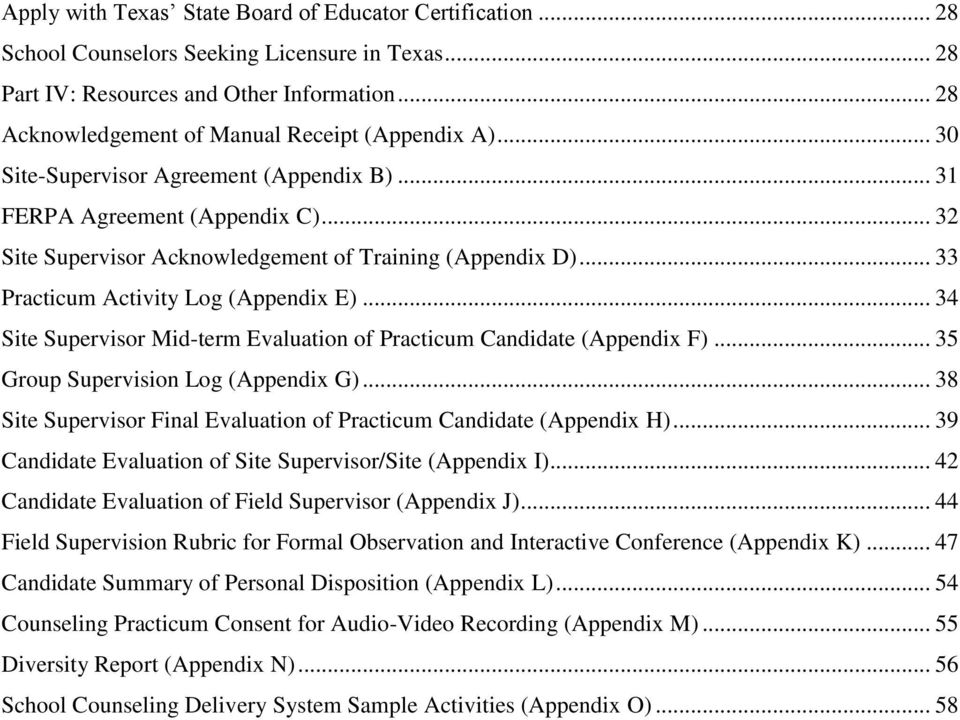
2 Table of Contents Part I: Overview Conceptual Framework and Mission of University Educator Preparation Program... 1 Mission Statement of the Department of Counseling and Special Populations... 1 Accreditation and State Standards... 1 CACREP Learning Outcomes in Practicum... 2 Professional School Counseling Certifice Standards... 2 Terminology for Understanding the Practicum Experience... 3 School Counselor Candidate Information... 5 Supervisor Information... 5 Faculty Supervisor... 5 Field Supervisor... 6 Site and Administrator as Supervisors... 6 Possible Districr Requirements... 7 Site Supervisors and Supervision Process... 7 Use of Competencies and State/National Madates... 7 Roles and Responsibilities of the Site Supervisor... 7 Suggested Topics and Experiences to Utilize During Supervision... 8 Role of the Instructional Associate... 9 Prerequisites and Requirements... 9 Professional Liability Insurance Supervision Candidate Performance and Disposition Review Candidate Evaluations from Site Supervisor Field Supervisor and Site Supervisor Evaluation from Candidate TK-Account and Assessment Portfolio Assessment Portfolio Review Process Remote Proctoring for Certification Pretest- Proctor U Web Camera, Microphone, and Internet Browsers for Adobe Connect Field Experience/Practicum Hourly Requirements Documenting the Practicum Experience... 14

3 Clarification of Direct and Indirect Hours Examples of Other Activities Requirements for Formal Observations and Interactive Conferences Field Supervisor Initial Contact Scheduled Pre-Observation Conference REFLECT Model for Field Observations Preparing for Formal Observations To Prepare for Formal Observation To Prepare for Formal Observation To Prepare for Formal Observation Three Required 45-Minute Observations Interactive Conferences Schedule for Each Interactive Conference Suggested Format for Interactive Conference Meetings Triadic Supervision Model Guidelines for Peer Feedback Guidelines and Process for Field Supervisor Technology Documentation of Field Observations Requesting Accommodations in Accordance with the Americans with Disabilities Act Part II: Professional Responsibilities Professional and Ethical Guidelines Maintain and Advocate Confidentiality Reporting Abuse of Children, Elderly, or Disabled Persons Assessing and Responding to Crisis Professional Organizations Candidate Conduct and Development Policies Counseling and Special Populations Department Candidate Development Policy Academic Grievances Part III: Credentials School Counselor Certification Certification Process for Texas Residents To Apply for Certification in Texas... 27

4 Apply with Texas State Board of Educator Certification School Counselors Seeking Licensure in Texas Part IV: Resources and Other Information Acknowledgement of Manual Receipt (Appendix A) Site-Supervisor Agreement (Appendix B) FERPA Agreement (Appendix C) Site Supervisor Acknowledgement of Training (Appendix D) Practicum Activity Log (Appendix E) Site Supervisor Mid-term Evaluation of Practicum Candidate (Appendix F) Group Supervision Log (Appendix G) Site Supervisor Final Evaluation of Practicum Candidate (Appendix H) Candidate Evaluation of Site Supervisor/Site (Appendix I) Candidate Evaluation of Field Supervisor (Appendix J) Field Supervision Rubric for Formal Observation and Interactive Conference (Appendix K) Candidate Summary of Personal Disposition (Appendix L) Counseling Practicum Consent for Audio-Video Recording (Appendix M) Diversity Report (Appendix N) School Counseling Delivery System Sample Activities (Appendix O)... 58
5

6 Part I: Overview Professional school counselors hold one of the most responsible, challenging, professionally, and personally satisfying positions in U.S. public schools. The field experience, also referred to as professional practice (CACREP, 2009), provides candidates with the opportunity to apply coursework, theory, and develop skills under supervision. Professional school counselors are expected to provide a systematic program for helping all candidates to acquire skills for success in academic, career, and social and emotional development (ASCA, 2012). Conceptual Framework and Mission of University Educator Preparation Program The conceptual framework of the Lamar University Educator Preparation Program illuminates the vision of the faculty, as they are engaged in teaching, research, and service. The undergraduate and graduate programs utilize a variety of delivery systems to prepare educators and leaders for a changing world by requiring them to demonstrate core knowledge, content proficiency, pedagogical techniques and strategies, communication and leadership skills, technological and analytical abilities, and professional dispositions. Lamar University educator preparation candidates develop habits of mind needed for lifelong learning and respond to the ever changing diverse needs of EC-12 candidates and the schools that serve them. Mission Statement of the Department of Counseling and Special Populations Our mission in the Department of Counseling and Special Populations is to prepare candidates to become highly skilled, culturally competent, ethical professionals who enhance human development in a dynamic, global community. One way that we are working within our mission is by providing high quality, accessible, convenient, and relevant educational opportunities through our Academic Partnership programs. Whether you decide to become an on-campus or an online candidate, our role is to prepare you to be a leader in your designated area. The Counseling and Special Population (COSP) Department faculty members adhere to the scholar practitioner model of training. The goals of the department are to graduate candidates who have extensive knowledge in their respective professional areas, possess competent skills in providing professional services, and are committed to the advancement of their respective professions. Candidates work with faculty members who are involved in their professions at national, regional, and local levels. Thus, candidates are exposed to an array of classroom and other experiences in teaching, research, and professional practice. These diverse and wide opportunities prepare candidates for a variety of career opportunities within their respective professions. Accreditation and State Standards The field experience has been designed to address the National Council for Accreditation of Teacher Education (NCATE), now known as the Council for the Accreditation of Educator Preparation, the American School Counselor Association (ASCA), National School Counselor Performance Standards, Texas State Standards (Texas Administrative Code [TAC] and State Board of Educator Certification [SBEC]), and the professional knowledge, skills, and practices outlined by CACREP (2009) standards to promote the academic, career, and personal/social 1
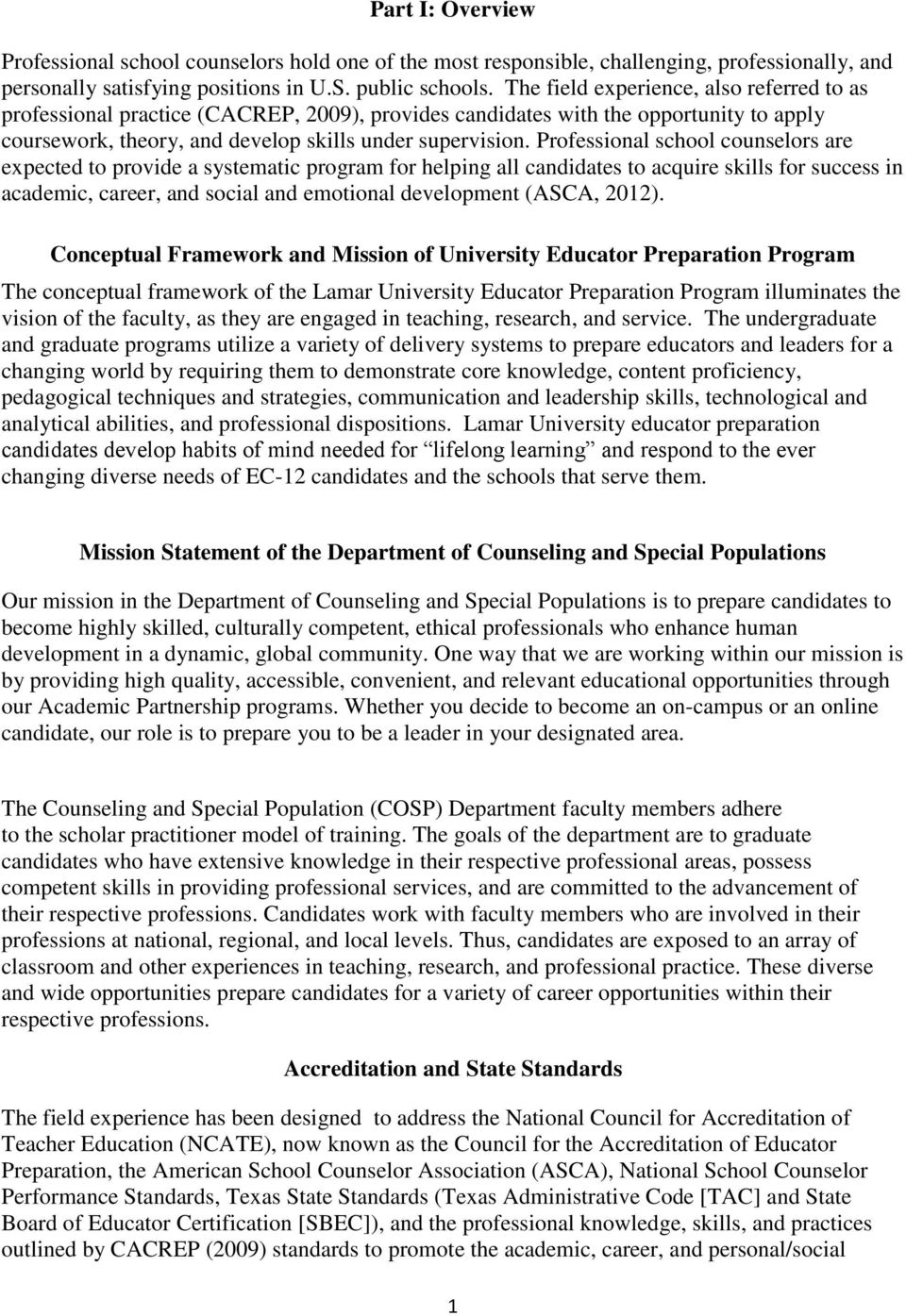
7 development of all K-12 candidates. Following are the websites available for your reference. Candidate learning outcomes are identified in the course syllabus and aligned with each of the state agency and accrediting organizations. National Council for Accreditation of Teacher Education (NCATE) Council for the Accreditation of Educator Preparation American School Counselor Association (ASCA) Standards for the School Counselor Certificate in Texas (SBEC): oc=&p_ploc=&pg=1&p_tac=&ti=19&pt=7&ch=239&rl=15 Council for Accreditation of Counseling and Related Education Programs (CACREP): CACREP Learning Outcomes in Practicum Practicum is a course (CNDV 5390) that includes field experience. Learning outcomes of the field experience, as delineated in the course syllabus, are as follows: 1. Expand upon skills developed during other courses (CACREP II.J.3.b.). 2. Relate theory to practice (CACREP II.J.3.a). 3. Evaluate their professional growth and specific career goals (CACREP II.3.c.d). 4. Consult with appropriate individuals (CACREP II.J.3.c.8.b). 5. Gain increased understanding of the relationship of administrative functions to the counselor role (CACREP II.J.8.b). 6. Acquire greater knowledge of and experience in the application of a variety of intervention strategies (CACREP II.J.3.a.d.e). 7. Gain an understanding and appreciation of professional, ethical, and legal issues and behavior (CACREP II.J.3.a.d.e). 8. Gain understanding of multicultural and diversity issues and needs (CACREP II.J.2.a.3.d). 9. Expand knowledge and application of technology in counseling and assisting clients/candidates (CACREP II.J.3.a.b). 10. Function as a professional counselor in an approved clinical/school setting (CACREP II.J.3.b). Professional School Counselor Certificate Standards (TAC, ) The practicum is organized to give the future counselor experiences related the Professional School Counselor Competencies. 2
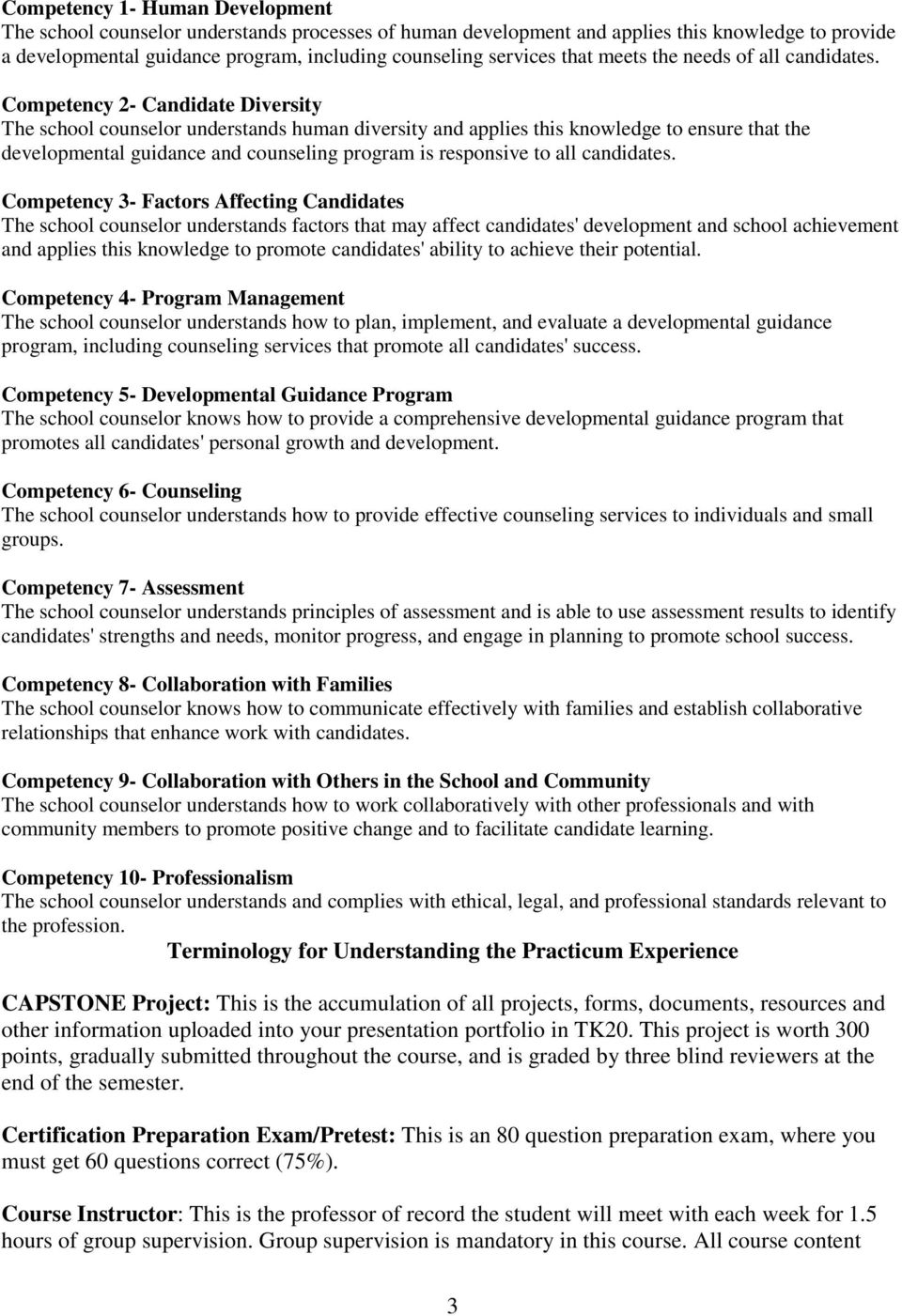
8 Competency 1- Human Development The school counselor understands processes of human development and applies this knowledge to provide a developmental guidance program, including counseling services that meets the needs of all candidates. Competency 2- Candidate Diversity The school counselor understands human diversity and applies this knowledge to ensure that the developmental guidance and counseling program is responsive to all candidates. Competency 3- Factors Affecting Candidates The school counselor understands factors that may affect candidates' development and school achievement and applies this knowledge to promote candidates' ability to achieve their potential. Competency 4- Program Management The school counselor understands how to plan, implement, and evaluate a developmental guidance program, including counseling services that promote all candidates' success. Competency 5- Developmental Guidance Program The school counselor knows how to provide a comprehensive developmental guidance program that promotes all candidates' personal growth and development. Competency 6- Counseling The school counselor understands how to provide effective counseling services to individuals and small groups. Competency 7- Assessment The school counselor understands principles of assessment and is able to use assessment results to identify candidates' strengths and needs, monitor progress, and engage in planning to promote school success. Competency 8- Collaboration with Families The school counselor knows how to communicate effectively with families and establish collaborative relationships that enhance work with candidates. Competency 9- Collaboration with Others in the School and Community The school counselor understands how to work collaboratively with other professionals and with community members to promote positive change and to facilitate candidate learning. Competency 10- Professionalism The school counselor understands and complies with ethical, legal, and professional standards relevant to the profession. Terminology for Understanding the Practicum Experience CAPSTONE Project: This is the accumulation of all projects, forms, documents, resources and other information uploaded into your presentation portfolio in TK20. This project is worth 300 points, gradually submitted throughout the course, and is graded by three blind reviewers at the end of the semester. Certification Preparation Exam/Pretest: This is an 80 question preparation exam, where you must get 60 questions correct (75%). Course Instructor: This is the professor of record the student will meet with each week for 1.5 hours of group supervision. Group supervision is mandatory in this course. All course content 3
9 questions are directed towards this individual. Their contact information is on the getting started page and posted in announcements. Field Work: Also known as your practicum site, is where you will be gaining counseling experience working with the total system- students, parents, teachers, administrators, community members, other professionals, and colleagues within the school district. Field Supervisor: This individual is separate from the IA and course instructor. Students will meet with the field supervisor four separate times. The first meeting will consist of an orientation. The other three formal meetings will be to review and get feedback during your interactive conference. The field supervisor will grade and score all three 45 minute recorded videos, Provide feedback, and post scores in TK20. Formal Observation: School counselor candidates are expected to video-record three 45-minute videos (135 minutes total) of a selected counseling activity, such as individual or group counseling. When this recording is submitted to the field supervisor, the process of a formal observation begins. Group Supervision: This is the weekly Adobe connect Web conference with your instructor that will last 1.5 hours. Group supervision is mandatory. You will need a minimum of 15 hours in group supervision ever the 11 weeks. IA: The IA or instructional associate/assistant, will be grading the CAPSTONE application assignment uploads, discussion boards, and final project points. This individual can answer questions about the course and grading completed within blackboard. Their contact information is on the getting started page and posted in announcements. Interactive conference: This is in addition to on-site supervision and group supervision. Over the course of the 11 weeks you will meet with your assigned field supervisor on three separate occasions for a one-hour interactive conference. The interactive conference will be to discuss your 45 minute recorded video (formal observation) that is posted in blackboard and scored by the field supervisor in TK 20. All feedback received during this conference needs to be shared with your on-site supervisor. On-site supervision: This is in addition to group supervision. You must meet 1 hour each week with your own site supervisor at your school. On-site supervisor/mentor: This is the individual who has signed and agreed to be your site supervisor at the students chosen location. The student is required to meet with her on-site supervisor/mentor each week for at least an hour of supervision. The on-site supervisor will also sign off on all documentation. Portfolio Reviewer: Assigned faculty member from the Counseling and Special Populations Department. Presentation Portfolio: Is a part of the electronic database, TK20, designed to house all the required documents and is created on your behalf. 4

10 School Counselor Candidate Information Practicum candidates are charged to do the following, professionally and accurately. Practicum candidates: Agree to read their practicum manual upon receipt (see Appendix A) Are open to feedback, including areas of growth and professional identity. Stay organized, and brings to site supervisor meetings hour logs, and ideas for contributing to the campus mission plan and the comprehensive school counseling plan. Remain positive when working with site supervisors and other professionals in the school setting. Seek opportunities to work with students and their families. Are innovative, knowledgeable of the ASCA National Model, and creative school leaders. Document all hours on the practicum hours log. Align all practicum hours log activities to the 10 professional school counselor competencies. Are responsible for setting up regular meeting with site supervisors. When these meetings are cancelled, the candidate is responsible to follow-up and reschedule. Explain their approach for working with candidates, including theoretical approach, and ASCA candidate competencies. Represent the profession, themselves, and their coursework with the highest of standards. Are expected to use the Lamar University for all course and field experience correspondences. Supervisor Information The following individuals oversee the field experience/practicum. All supervisors listed herein should have a model of supervision they have adopted to monitor the growth and progress of the candidate. Faculty Supervisor Each practicum course is assigned a university professor, who has a doctorate in counseling or related field, has advanced credentials, or experience within the school settings. The professor oversees your entire practicum experience for an 11-week period of time and conducts supervision each week, for an hour and a half, making certain the course expectations are fulfilled by each candidate. Additionally, each professor will conduct two required site visits, virtually or via phone, and make contact with your site supervisor to ensure your development and growth is appropriate. This should occur mid-term and toward the end of the semester. Further, faculty supervisors will complete dispositions in TK20 on each candidate in addition to the candidate s self-reflection of disposition. The faculty supervisor will work with field supervisors, site supervisors/mentors, and instructional associates to ensure adequate growth and development is being obtained by the school counselor candidate. 5
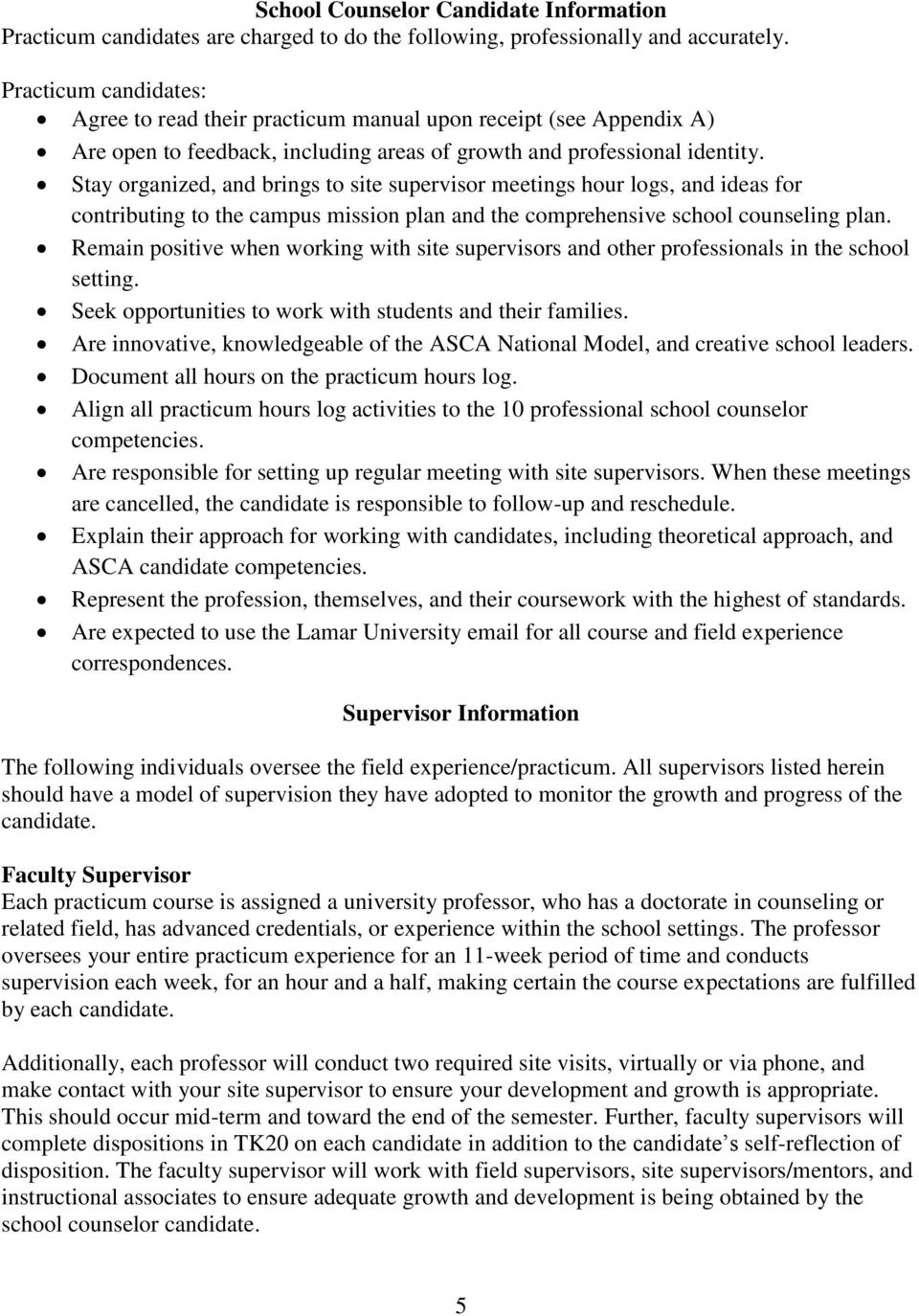
11 Field Supervisor A field supervisor is an individual hired by Lamar University responsible to provide verbal and written feedback for observable skills demonstrated by the candidate during the field experience. The field supervisor will post their contact information in Blackboard under the announcements section for all students to utilize if needed. Candidates are assigned a field supervisor who will coordinate your submission of three required 45 minute video-recordings and will schedule three interactive conferences to provide you with feedback on the observable skills and competencies delineated in the developmental guidance program and ASCA model. Candidates will be required to meet with their field supervisor to 1. generate and answer questions about skills measured during the observation 2. make arrangements if an interactive conference meeting is missed 3. make certain feedback and notices are in TK20 related to the three observations and associated meetings 4. provide the site administrator (Principal) and site supervisor (school counselor) with documented feedback related to the candidate s feedback received during their observations. Field supervisors will copy your faculty supervisor on all correspondence sent, via , to site supervisors or administrators. Site and Administrator as Supervisors The site supervisor will coordinate the field experience to the multiple roles of a school counselor, which align with the unique setting, counseling program goals, district procedures and expectation, and state and national models of counseling such as American School Counselor Association (ASCA) and the Developmental Guidance Program (DGP) for the state of Texas. The administrator is the campus principal that oversees the total operation of the school building. Candidates should provide both the site supervisor and site administrator with information about the Lamar University School Counselor Program and their professional goals, as they align with the campus mission and vision. Candidates should also provide site supervisor with the acknowledgement of training form and the video link to review the training required before a signature can be provided on the acknowledgement form. No electronic signatures on any documents, as original signatures are required. Candidates will secure a site supervisor and campus principal agreement (see Appendix B). Candidates should seek a site supervisor with the following (CACREP, 2009 Standard, II C. 1, 2, and 4) qualifications: 1. A Master s degree in counseling or a related profession with equivalent qualifications which include the appropriate certification (school) and/or license in the respective state of the site 2. A minimum of 2 years of professional experience as a school counselor 3. Willingness to attend the Lamar online brief training for site supervision 4. Willingness to host weekly supervision meetings and provide feedback to school counselor candidate. 6
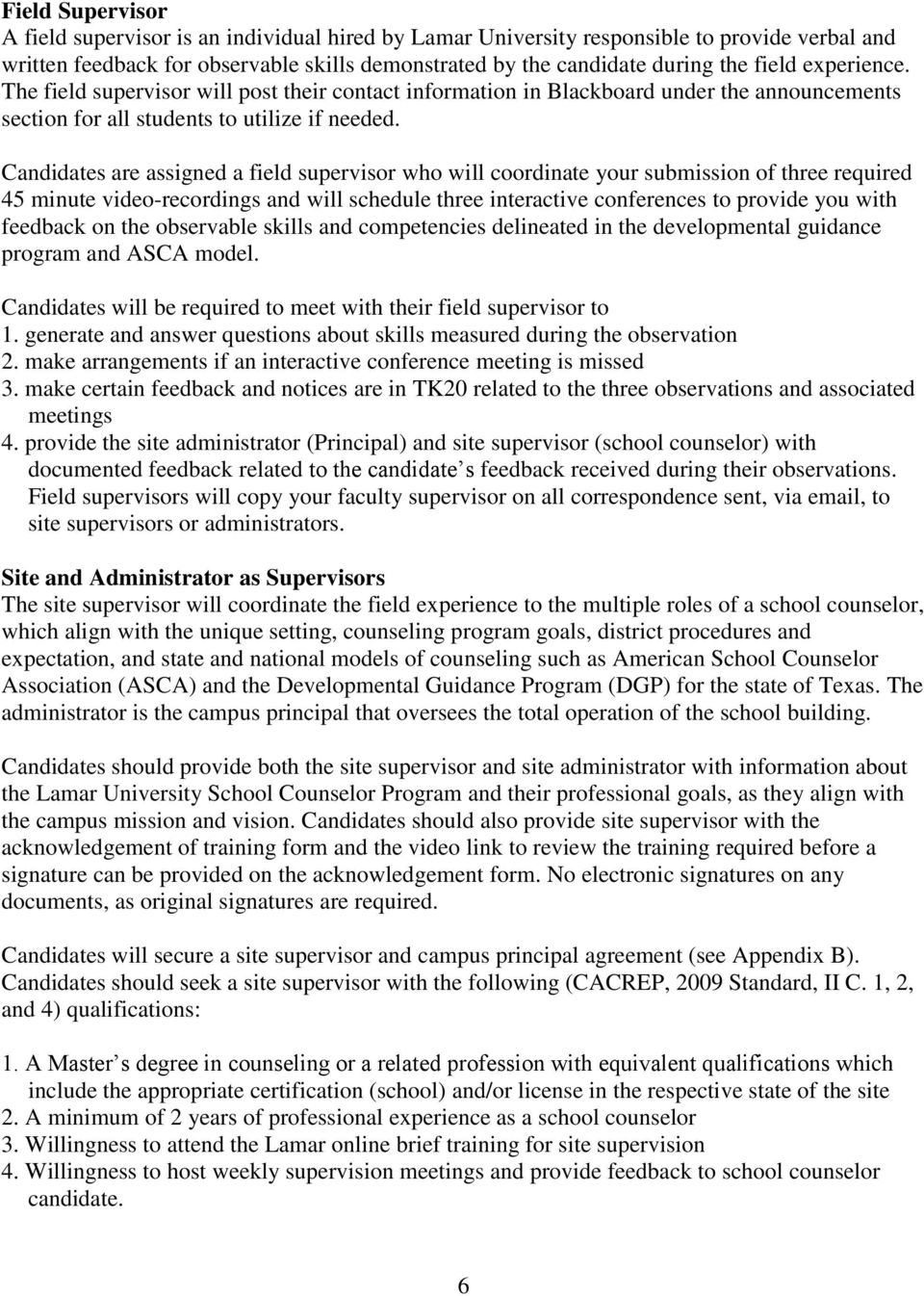
12 Finally and most rarely, a site supervisor may encounter special circumstances (i.e. removal from a campus/position or premature birth/labor of a child). Please discuss, early-on, with your site supervisor an alternative plan, just in-case one is needed so that interruption in your hour accumulation does not occur. Possible District Requirements Candidates must be informed that occasionally the school district they wish to complete their practicum requirements, or that they are employed, may require an Affiliation Agreement. A broadly used definition describes this as a contract between the university and a facility where university departments want to send university students for course-related and graduate required off-campus fieldwork experience. If this is the case in your school district, please notify your faculty supervisor and copy Dr. Carl Sheperis at [email protected], who directly handles all related correspondence and documentation. Additionally, keep in mind that some districts may have a method for placing school counselor candidates into specific campuses. This means you may not be able to obtain required hours for practicum at the campus you are currently employed. Please remember that when recording these videos, it is only required that you video-record yourself and not the student. Campus administrators, site supervisors, and parents/guardians of these students need to clearly understand that the purpose of the video-tape is about your personal and professional growth. Site Supervisor and Supervision Process Candidates are required to secure a site supervisor before submitting the required documents to TK20 for Practicum. The site supervisor agreement is located in appendices of this handbook. Both the campus administrator and the site supervisor must agree to the site agreement, keeping in mind the school district may have their own method of placing school counselor candidates. Use of Competencies and State/National Mandates Candidates should utilize the competencies from the ASCA National Model and Developmental Guidance Program from the state of Texas to integrate and discuss in pursuit to fulfill course requirements. The candidate should plan the supervision session with his/her site supervisor to align with individual planning, responsive services, guidance curriculum, and system support, along with providing a rationale for this activity. Roles and Responsibilities of the Site Supervisor Site supervisors play an important role in the success of the school counseling program. The site supervisor role is to provide support and direction for interns in their efforts to develop increased knowledge, skills, and personal qualities appropriate to the role of the professional school counselor. All site supervisors should have a School Counselor Certificate and two years school counseling experience. Exceptions can be made in the case that the site does not employ or have access to a certified school counselor and are made on an individual basis. Candidate must receive prior approval on these situations. Practicum candidates will be responsible to provide the link to site supervisor to view the Site Supervisor/Mentor Training and follow-up with them to sign the Documentation of Site 7

13 Supervisor Training. This training can be found on the Lamar University Department of Counseling and Special Populations website or the following URL links to access the site supervisor training video: The site supervisor should sign the acknowledgement of training (see Appendix D) and provide coaching for strengths and for areas needing improvement. This coaching is accomplished by meeting regularly with the intern to discuss and facilitate the intern s experiences. The site supervisor should establish open, two-way communication and trust in the relationship with the intern. As the site supervisor critiques activities, the focus should be on developing leadership knowledge and competencies. The site supervisor should discuss with the intern the tasks in which he or she is engaged and help the intern learn from these experiences and verify the hours earned in the campus-supervised activities at the end of the practicum. Site Supervisors: Share their school counseling background and experiences in order to help the intern understand the legitimate role of school counselor. Provide personal insights regarding the profession in a comfortable, trusting atmosphere. Introduce school counselor candidate to key personnel and familiarize them with the school and policies that guide the counseling program. Explain their style and techniques and share their counseling goals for their school and for candidate development. Observe and oversee the work of the intern, review intern s log, and offer suggestions for growth. Assist the intern to find time to complete the practicum and develop the competencies that beginning school counselors much possess. Make an honest appraisal of the intern s performance as a developing professional. Keep the designated administrator abreast of counselor intern s progress. Notify the chair of the Lamar University Department of Counseling and Special Populations (see site supervisor agreement) of any major difficulties or problems. Site supervisors are one of the most important people in the induction of new counselors into the profession. We and our candidates are honored to have mentors to help with the task of induction into the school counseling profession. Suggested Topics and Experiences to Utilize during Supervision There are many topics that the site supervisor and candidate should discuss within the 11-week period of time. Additionally, you will discover other examples of other activities later in the manual. Following are a list of considerations, however, not exhaustive in nature. Supervision meeting dates, times, and location Establishment of goals and objectives for both supervisor (who should truly utilize the candidate for support in the counseling program) and candidate (who should have an idea of desired experiences during practicum) 8
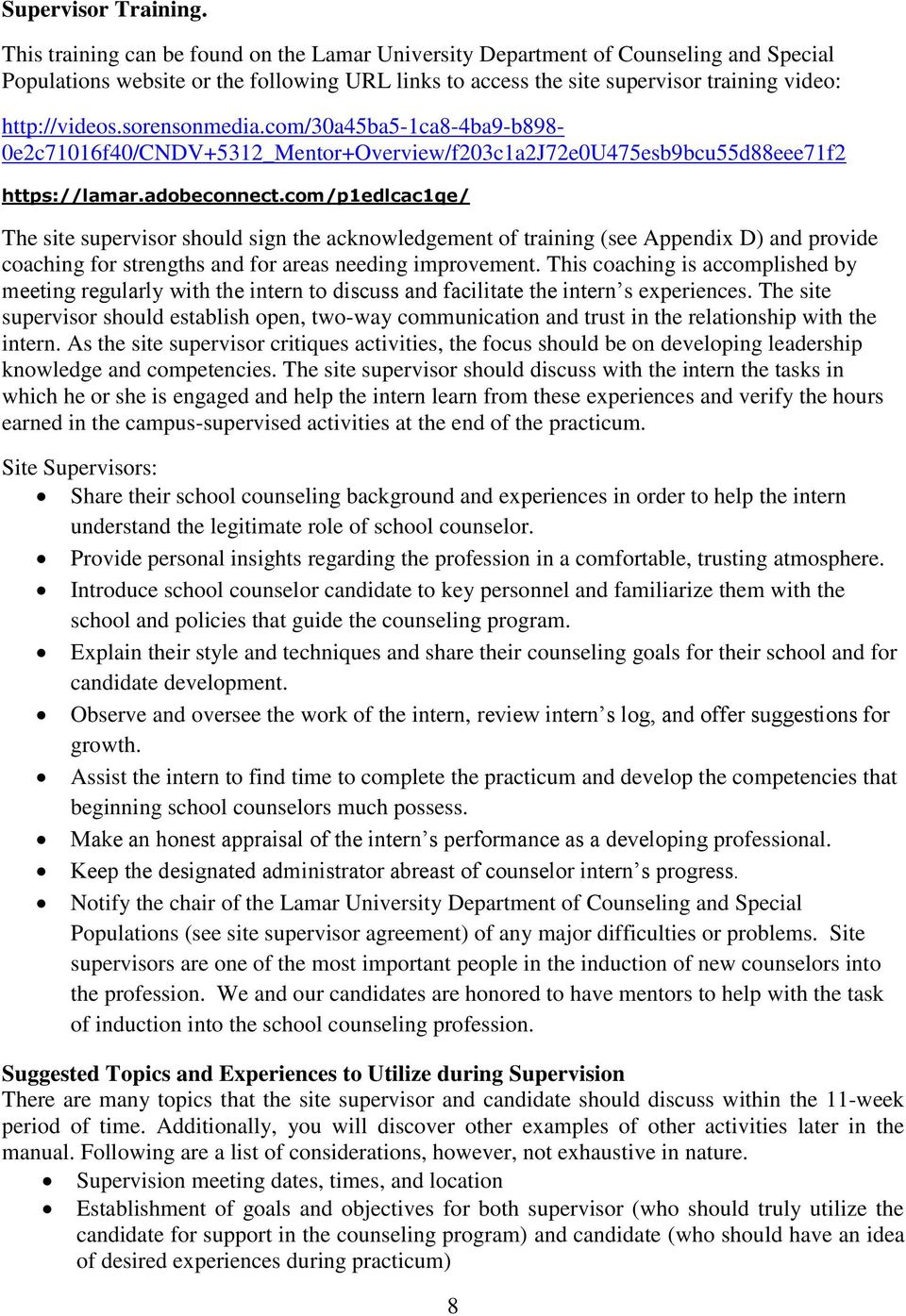
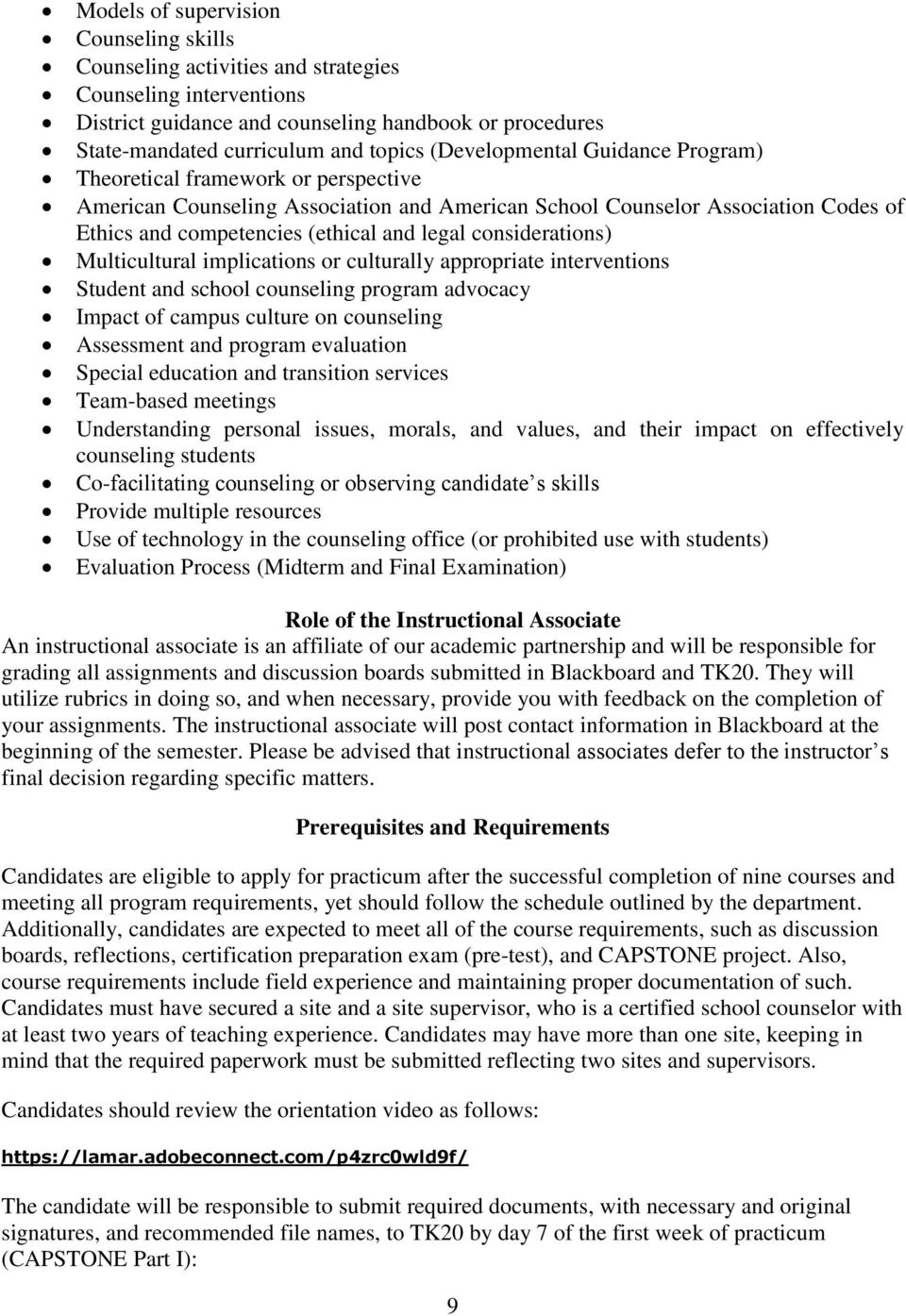
14 Models of supervision Counseling skills Counseling activities and strategies Counseling interventions District guidance and counseling handbook or procedures State-mandated curriculum and topics (Developmental Guidance Program) Theoretical framework or perspective American Counseling Association and American School Counselor Association Codes of Ethics and competencies (ethical and legal considerations) Multicultural implications or culturally appropriate interventions Student and school counseling program advocacy Impact of campus culture on counseling Assessment and program evaluation Special education and transition services Team-based meetings Understanding personal issues, morals, and values, and their impact on effectively counseling students Co-facilitating counseling or observing candidate s skills Provide multiple resources Use of technology in the counseling office (or prohibited use with students) Evaluation Process (Midterm and Final Examination) Role of the Instructional Associate An instructional associate is an affiliate of our academic partnership and will be responsible for grading all assignments and discussion boards submitted in Blackboard and TK20. They will utilize rubrics in doing so, and when necessary, provide you with feedback on the completion of your assignments. The instructional associate will post contact information in Blackboard at the beginning of the semester. Please be advised that instructional associates defer to the instructor s final decision regarding specific matters. Prerequisites and Requirements Candidates are eligible to apply for practicum after the successful completion of nine courses and meeting all program requirements, yet should follow the schedule outlined by the department. Additionally, candidates are expected to meet all of the course requirements, such as discussion boards, reflections, certification preparation exam (pre-test), and CAPSTONE project. Also, course requirements include field experience and maintaining proper documentation of such. Candidates must have secured a site and a site supervisor, who is a certified school counselor with at least two years of teaching experience. Candidates may have more than one site, keeping in mind that the required paperwork must be submitted reflecting two sites and supervisors. Candidates should review the orientation video as follows: The candidate will be responsible to submit required documents, with necessary and original signatures, and recommended file names, to TK20 by day 7 of the first week of practicum (CAPSTONE Part I): 9
15 1. Site Supervisor Agreement 2. Proof of Liability Insurance 3. FERPA Acknowledgement (see Appendix C) 4. Diversity Report 5. Acknowledgement of Practicum Manual 6. Site Supervisor Acknowledgement of Training (please this form) If the six required documents listed above are not in TK20 by the end of the first week of practicum, the field experience or the candidate will not be able to proceed in the course. Specifically, no field experience can begin until all required documentation is submitted. Additional documents required by mid-semester are the midterm evaluation (see Appendix F) completed by the site supervisor, along with the completion of a resource assignment and professional weblink/website. These evaluations should be uploaded to TK20 by day 7 of week 6, with necessary and original signatures, and recommended file names (CAPSTONE Part II). Further documentation needed are seven examples of work, which were completed in previous classes. The examples of work are described in the course shell, and should be uploaded to TK20 by day 7 of week 9 with recommended file names (CAPSTONE Part III). The final documents required, with necessary and original signatures, and recommended file names, are to be uploaded day 7 of week 11, with necessary signatures and recommended file names, are as follows (CAPSTONE PART IV): 1. Documentation of formal observations and interactive conference feedback (Observations 1-3) 2. Practicum Hours Log (see Appendix E) 3. Site Supervisor Final Evaluation of Practicum Student (link must be sent to site supervisor) 4. Practicum Student Evaluation of Site Supervisor and Site 5. Group Supervision Log 6. Students Field Supervisor Evaluation Candidates must have all incompletes removed prior to applying for practicum. The field experience in school counseling follows an academic calendar, and therefore candidates can only participate in field experience during the fall or spring term, which only begins in August and in January. The duration of the course is 11 weeks. In some cases, candidates will be allowed to enroll in their final two courses at the same time as they enroll in practicum. This is called concurrent course enrollment, allowing students to take up to six additional hours, totaling nine hours including practicum. Students who are concurrently enrolled should take those courses during AP I and AP II only. Students should not attempt to take any additional courses during AP III, as they will be unable to complete all course requirements prior to graduation and commencement ceremony. For information specific to all other course start dates, please see the schedule at: 10

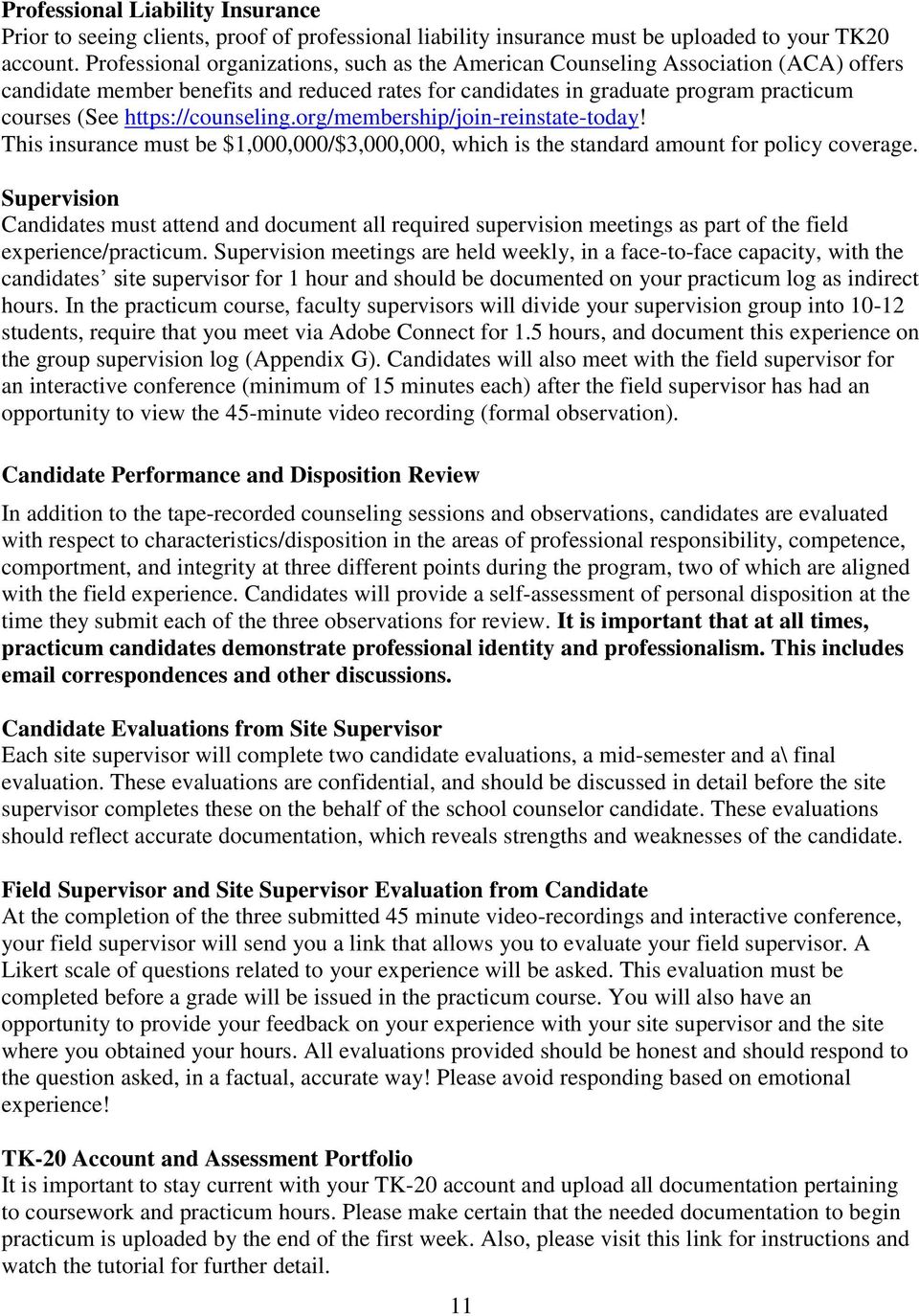
16 Professional Liability Insurance Prior to seeing clients, proof of professional liability insurance must be uploaded to your TK20 account. Professional organizations, such as the American Counseling Association (ACA) offers candidate member benefits and reduced rates for candidates in graduate program practicum courses (See This insurance must be $1,000,000/$3,000,000, which is the standard amount for policy coverage. Supervision Candidates must attend and document all required supervision meetings as part of the field experience/practicum. Supervision meetings are held weekly, in a face-to-face capacity, with the candidates site supervisor for 1 hour and should be documented on your practicum log as indirect hours. In the practicum course, faculty supervisors will divide your supervision group into students, require that you meet via Adobe Connect for 1.5 hours, and document this experience on the group supervision log (Appendix G). Candidates will also meet with the field supervisor for an interactive conference (minimum of 15 minutes each) after the field supervisor has had an opportunity to view the 45-minute video recording (formal observation). Candidate Performance and Disposition Review In addition to the tape-recorded counseling sessions and observations, candidates are evaluated with respect to characteristics/disposition in the areas of professional responsibility, competence, comportment, and integrity at three different points during the program, two of which are aligned with the field experience. Candidates will provide a self-assessment of personal disposition at the time they submit each of the three observations for review. It is important that at all times, practicum candidates demonstrate professional identity and professionalism. This includes correspondences and other discussions. Candidate Evaluations from Site Supervisor Each site supervisor will complete two candidate evaluations, a mid-semester and a\ final evaluation. These evaluations are confidential, and should be discussed in detail before the site supervisor completes these on the behalf of the school counselor candidate. These evaluations should reflect accurate documentation, which reveals strengths and weaknesses of the candidate. Field Supervisor and Site Supervisor Evaluation from Candidate At the completion of the three submitted 45 minute video-recordings and interactive conference, your field supervisor will send you a link that allows you to evaluate your field supervisor. A Likert scale of questions related to your experience will be asked. This evaluation must be completed before a grade will be issued in the practicum course. You will also have an opportunity to provide your feedback on your experience with your site supervisor and the site where you obtained your hours. All evaluations provided should be honest and should respond to the question asked, in a factual, accurate way! Please avoid responding based on emotional experience! TK-20 Account and Assessment Portfolio It is important to stay current with your TK-20 account and upload all documentation pertaining to coursework and practicum hours. Please make certain that the needed documentation to begin practicum is uploaded by the end of the first week. Also, please visit this link for instructions and watch the tutorial for further detail. 11
17 Be mindful, that in the assessment portfolio, always click Save and NOT Submit. Although the instructions outlined in the TK20 section of this manual state to click submit, please wait just in case changes need to be made your portfolio. If you click submit, it does not allow you to go back and make changes. This documentation is mandatory for graduation and certification purposes. See the following weblink as reference: Assessment Portfolio Review Process Candidates are required to upload required documentation to their assessment portfolio. The purpose of this review is to ensure that you have the required documentation for your field experience, housed in a central location, along with demonstrating representative samples of work completed throughout the program. Your portfolio has four parts to it, and a final review takes places at the end of the course. Three faculty members are anonymously assigned to your portfolio, and will issue a score out of 300 possible points. Scores will be averaged, providing one overall score obtained on this assessment portfolio. Remote Proctoring for Certification Pretest- Proctor U A form of remote proctoring will take place for your completion of the final examination. Remote proctoring is a cloud-based method to ensure the integrity and security of an online examination. A nominal fee of $15.00 is required, along with obtaining at least a 75% on the final examination (60 points out of 80 points). It is up to the candidate to schedule this, as an account must be set-up through Proctor U. Please visit the website at All students are given two attempts to obtain the needed score on this exam in order to become eligible for credentialing in the state of Texas. Students will be able to register for the certification preparation exam beginning January 20, 2015, but will not be able to take the exam until after February 1, 2015 through April 1, Web Camera, Microphone, and Internet Browsers for Adobe Connect Due to the nature of online supervision and distance learning, candidates will be required to purchase and install a web camera and microphone on their computer, used as a video recorder with capability to create an MP4 file. Please make certain you have Google Chrome or Firefox as the internet browser utilized for Adobe Connect. 12

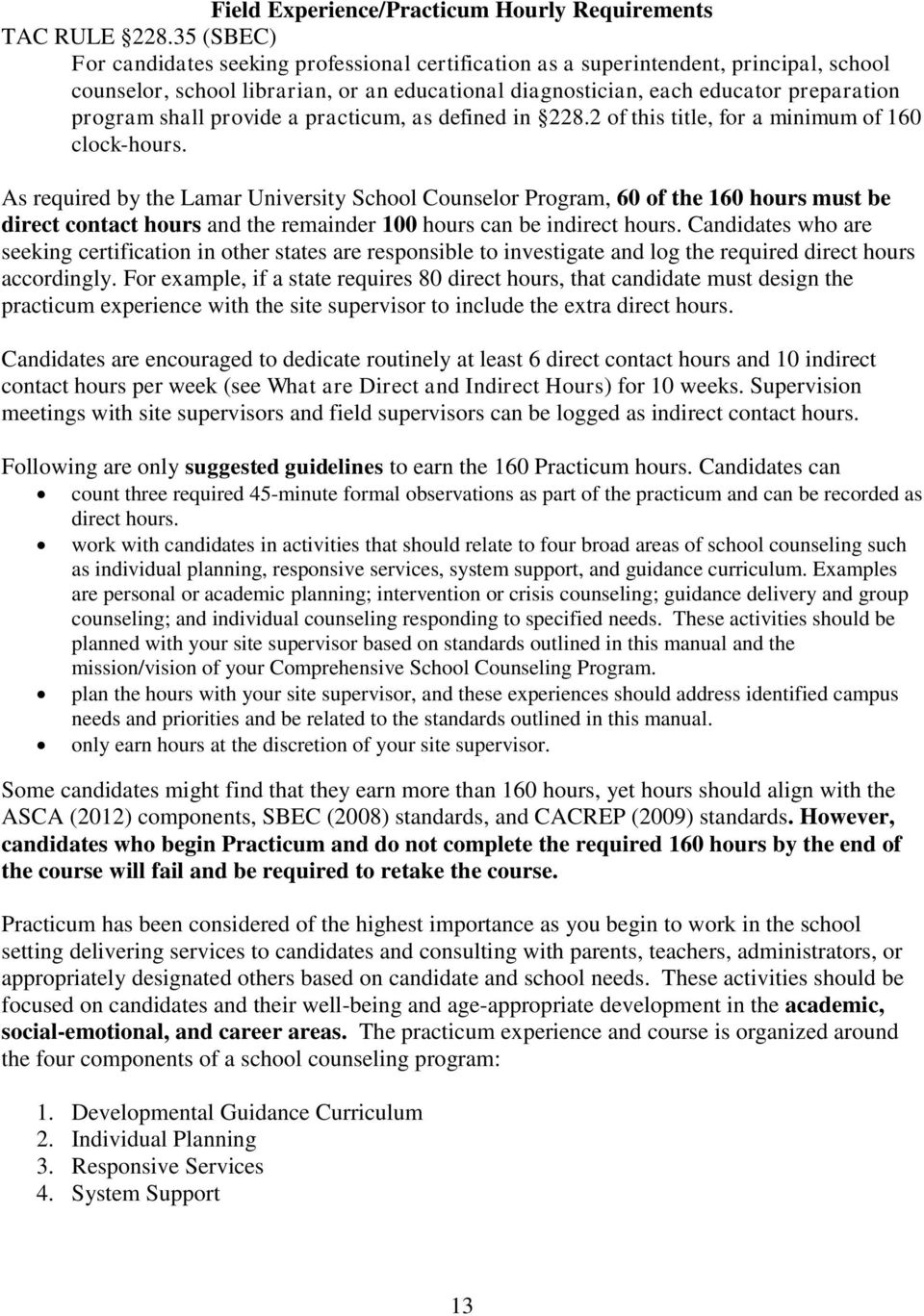
18 Field Experience/Practicum Hourly Requirements TAC RULE (SBEC) For candidates seeking professional certification as a superintendent, principal, school counselor, school librarian, or an educational diagnostician, each educator preparation program shall provide a practicum, as defined in of this title, for a minimum of 160 clock-hours. As required by the Lamar University School Counselor Program, 60 of the 160 hours must be direct contact hours and the remainder 100 hours can be indirect hours. Candidates who are seeking certification in other states are responsible to investigate and log the required direct hours accordingly. For example, if a state requires 80 direct hours, that candidate must design the practicum experience with the site supervisor to include the extra direct hours. Candidates are encouraged to dedicate routinely at least 6 direct contact hours and 10 indirect contact hours per week (see What are Direct and Indirect Hours) for 10 weeks. Supervision meetings with site supervisors and field supervisors can be logged as indirect contact hours. Following are only suggested guidelines to earn the 160 Practicum hours. Candidates can count three required 45-minute formal observations as part of the practicum and can be recorded as direct hours. work with candidates in activities that should relate to four broad areas of school counseling such as individual planning, responsive services, system support, and guidance curriculum. Examples are personal or academic planning; intervention or crisis counseling; guidance delivery and group counseling; and individual counseling responding to specified needs. These activities should be planned with your site supervisor based on standards outlined in this manual and the mission/vision of your Comprehensive School Counseling Program. plan the hours with your site supervisor, and these experiences should address identified campus needs and priorities and be related to the standards outlined in this manual. only earn hours at the discretion of your site supervisor. Some candidates might find that they earn more than 160 hours, yet hours should align with the ASCA (2012) components, SBEC (2008) standards, and CACREP (2009) standards. However, candidates who begin Practicum and do not complete the required 160 hours by the end of the course will fail and be required to retake the course. Practicum has been considered of the highest importance as you begin to work in the school setting delivering services to candidates and consulting with parents, teachers, administrators, or appropriately designated others based on candidate and school needs. These activities should be focused on candidates and their well-being and age-appropriate development in the academic, social-emotional, and career areas. The practicum experience and course is organized around the four components of a school counseling program: 1. Developmental Guidance Curriculum 2. Individual Planning 3. Responsive Services 4. System Support 13
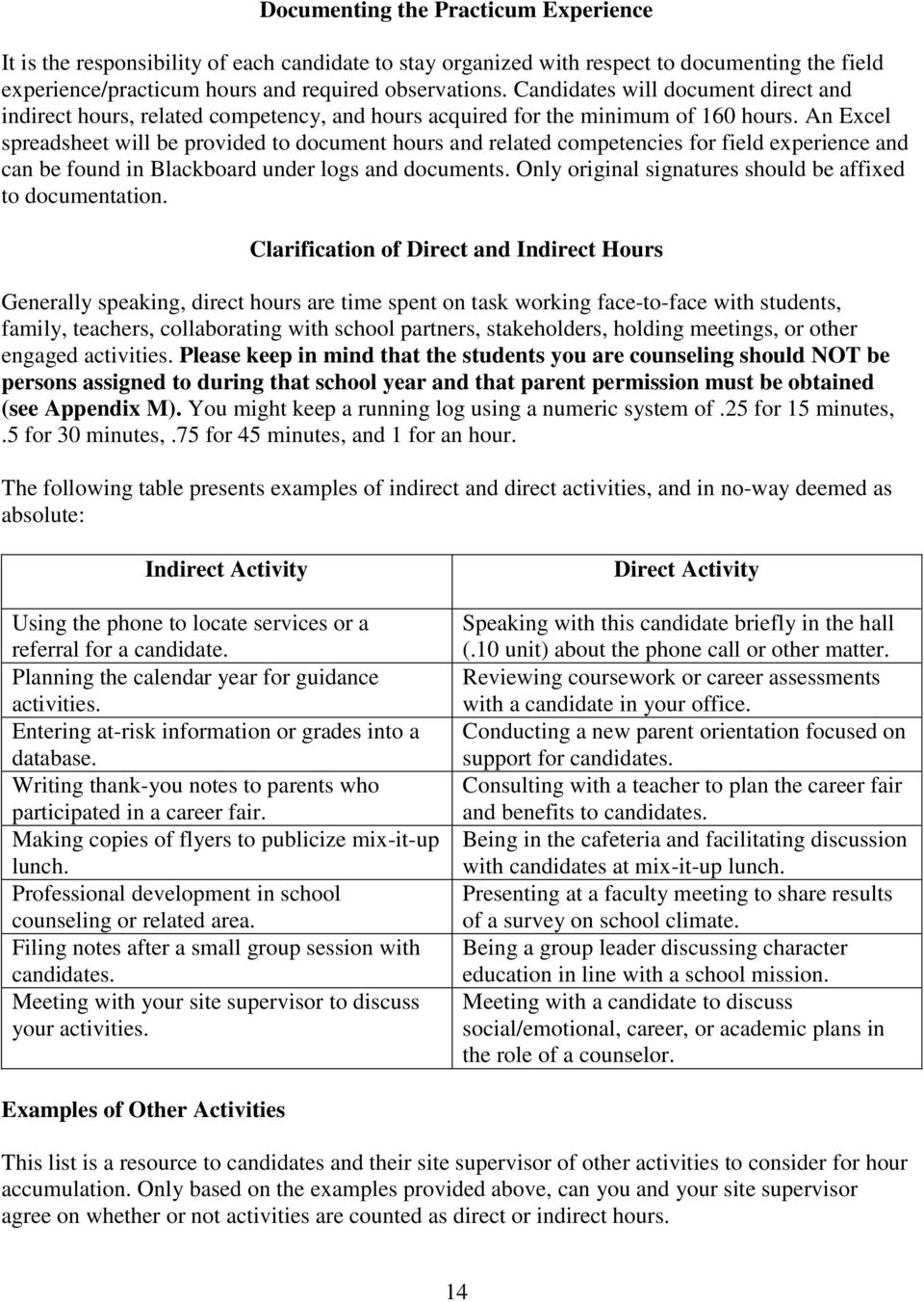
19 Documenting the Practicum Experience It is the responsibility of each candidate to stay organized with respect to documenting the field experience/practicum hours and required observations. Candidates will document direct and indirect hours, related competency, and hours acquired for the minimum of 160 hours. An Excel spreadsheet will be provided to document hours and related competencies for field experience and can be found in Blackboard under logs and documents. Only original signatures should be affixed to documentation. Clarification of Direct and Indirect Hours Generally speaking, direct hours are time spent on task working face-to-face with students, family, teachers, collaborating with school partners, stakeholders, holding meetings, or other engaged activities. Please keep in mind that the students you are counseling should NOT be persons assigned to during that school year and that parent permission must be obtained (see Appendix M). You might keep a running log using a numeric system of.25 for 15 minutes,.5 for 30 minutes,.75 for 45 minutes, and 1 for an hour. The following table presents examples of indirect and direct activities, and in no-way deemed as absolute: Indirect Activity Using the phone to locate services or a referral for a candidate. Planning the calendar year for guidance activities. Entering at-risk information or grades into a database. Writing thank-you notes to parents who participated in a career fair. Making copies of flyers to publicize mix-it-up lunch. Professional development in school counseling or related area. Filing notes after a small group session with candidates. Meeting with your site supervisor to discuss your activities. Direct Activity Speaking with this candidate briefly in the hall (.10 unit) about the phone call or other matter. Reviewing coursework or career assessments with a candidate in your office. Conducting a new parent orientation focused on support for candidates. Consulting with a teacher to plan the career fair and benefits to candidates. Being in the cafeteria and facilitating discussion with candidates at mix-it-up lunch. Presenting at a faculty meeting to share results of a survey on school climate. Being a group leader discussing character education in line with a school mission. Meeting with a candidate to discuss social/emotional, career, or academic plans in the role of a counselor. Examples of Other Activities This list is a resource to candidates and their site supervisor of other activities to consider for hour accumulation. Only based on the examples provided above, can you and your site supervisor agree on whether or not activities are counted as direct or indirect hours. 14
20 Academic Planning/Six or Four Year Planning Assessment/Test Interpretation ARD Meeting/RTI Referral Process/504 Meeting Behavioral Observations/Behavior Planning Career and College Readiness/Post-Secondary Opportunities Classroom Guidance Lessons Consultation/Collaborative Meeting District Counselor Meetings Faculty/Staff Training Family Counseling Group Counseling Individual Counseling Parent Conferences Parent Workshop or Training Peer Mediation/Advisory/Advising Programs Program Coordination Record Keeping Referral Services Responsive Services Scheduling/Candidate Placement Candidate Success Initiatives/Grade Placement Committee (SSI) Testing Coordination Transition Program/Meetings Requirements for Formal Observations and Interactive Conferences Field supervision of each candidate shall be conducted with structured guidance and regular ongoing support of an experienced educator who has been trained as a field supervisor [TAC (f)]. Field supervision is required, and the process of it must be performed accurately. This component of practicum should be viewed as an approach to documenting observable skills, standards, and competencies, along with the opportunity to receive feedback from your field supervisor and peers. Field Supervisor Initial Contact The initial contact by the field supervisors may be made by telephone, , or other electronic communication, with the assigned candidate, and must occur within the first three weeks of the assignment. The field supervisor will also make initial contact with your site supervisor in order to open the lines of communication, which fosters transparency in your process of growth and development. Finally, a pre-observation conference will be scheduled during this time. Scheduled Pre-Observation Conference The purpose of the pre-observation allows for an overview of the formal observation and interactive conference requirements. It is an opportunity to meet your field supervisor in Adobe Connect and to be introduced to the method of scheduling future observations (e.g. using Google Docs). Furthermore, it orients you to the use of technology, initiates a chance to discuss expectations, offer strategies of success for upcoming interactive conferences, and hopefully reduces some of the anxiety and fear associated with this overall process. 15
21 REFLECT Model for Field Observations The REFLECT model is a framework that allows you to plan and assess your personal and professional growth. This framework serves as the foundation that candidates and field supervisors utilize in the formal observations and interactive conference process. Use of the facilitative core conditions and building rapport with students should happen immediately and addressed during your interactive conferences. Following are the descriptions provided on the acronym REFLECT, and should be components that you can self-evaluate and prepare to address during your interactive conferences. RECORD: Document your awareness, knowledge, and skills with respect to the school counseling activity you selected to present (holistic recording) ESTABLISH: Support the overall goal of the activity with at least two specific learning outcomes, keeping in mind how to contribute to the school counseling program goals FRAME: Provide a rationale using the ASCA National Model or other counseling models LINK: Anticipate using one or more specific counseling skills and interventions before, during, or after the recorded session and provide an intended outcome related to a counseling theory (e.g., Reality Theory, Adlerian, Solution-Focused) EVALUATE: Measure the effectiveness of this activity and related counseling skills and document the results CONNECT: Align a new persepective as a result of this activity by revisiting the first three steps of this framework (record, establish, frame), linking your counseling approach (skills, theory) and the interactions/behaviors of participant(s) during the activity TARGET: Identify one or more goals in your (a) personal approach (e.g., awareness of self and others, motivation, autonomy) and (b) professional knowledge and skills (e.g., curriculum, theory, cultural integration, interventions) and list ways in which you plan to meet/target the goal(s) Preparing for Formal Observations The formal observation is a process where the candidate submits their 45- minute video-recorded session, ahead of time, to the field supervisor. By now, you should have an idea when your first interactive conference is scheduled. If you are absent from this interactive conference, or fail to submit your video-recording, there is no guarantee that you will have an opportunity to submit or participate. Candidates can expect to be nervous and lack certainty of their counseling skills, and to question whether or not they are adequate enough to become a professional school counselor. These thoughts are natural and will get better as you more frequently engage in the process of counseling. 16
22 You may wonder who you might select as the counselee (student) to utilize for your videorecordings. Please know that permission must be obtained from the parents in order to viderecord any student and these recordings take place at your approved site. Because some districts have policies that do not allow the video-recording of students, it is important that these concerns are addressed, and solutions are immediately obtained. Additionally, candidates are never to counsel students who they are assigned to as the teacher of record. To Prepare for Formal Observation 1 Read the ASCA National Model (ASCA, 2005), the Transforming School Counseling Vision (Education Trust, n.d.) for the role of the school counselor, and A Model Comprehensive, Developmental Guidance and Counseling Program (TEA, 2004), located in resources section of Blackboard. Observation 1 focuses on: Responsive Services: Individual or group counseling Practice saving MP4 (video) recordings to your computer and the function sharing screen in Adobe Connect so you have a prepared, organized presentation of your counseling activity for your field supervisor. Download a free trial at : The following skills should be practiced before during week one so that you will be prepared for taping formal observation 1, which will be recorded in your field site setting. o Attending o Minimal Encouragers o Open-ended Questions o Restatement of Content o Summarization To Prepare for Formal Observation 2 Counselors are helpers who are careful to avoid imposing their communication styles and values on clients (students), and must be sensitive to communication styles of culturally diverse student populations because culture can play a large role in those patterns of communication. However, particular strategies, such as goal-setting, are important across all approaches and settings Observation 2 focuses on: Responsive Services: Individual or group counseling Practice saving MP4 (video) recordings to your computer and the function sharing screen in Adobe Connect so you have a prepared, organized presentation of your counseling activity for your field supervisor. Download a free trial at : The following skills should be practiced during week two so that you will be prepared for taping formal observation 2, which will be recorded in your field site setting. In your first observation, you were to demonstrate the following skills: o Attending 17
23 o Minimal Encouragers o Open-ended Questions o Restatement of Content o Summarization In addition to these skills, in observation 2, you should demonstrate mastery of the following skills: o Integrating feedback from Observation 1 o Opening and closing a session o Informed consent o Reflection of feeling o Setting goals To Prepare for Formal Observation 3 The effectiveness of helping strategies depends, to some degree, on the strength and trust of the helping relationship as well as the degree to which these strategies are used in a gender- and culture-friendly way. With this in mind, responding to a client s social and environmental milieu is as important in strategy implementation as responding to a student s presenting feelings, beliefs, and behaviors. In addition, counselors must be mindful of factors that decrease the likelihood of success for each student. Observation 3 will help you to begin to think about integrating the various helping strategies and interventions and identifying how you might develop and grow in your counselor characteristics and skills and how to identify and negotiate resistance. Specifically, affective, cognitive, or behavioral interventions should be integrated into this session to some extent. Refer to your textbook (Parsons, 2007) for school counseling-related strategies and potential assessment tools. Observation 3 focuses on: Responsive Services: Individual or group counseling In your first observation, you were to demonstrate the following skills: o Attending o Minimal Encouragers o Open-ended Questions o Restatement of Content o Summarization In addition to these skills, in observation 2, you should have demonstrated mastery of the following skills: o Integrating Feedback from Observation 1 o Opening and closing a session o Informed consent o Reflection of feeling o Setting goals In observation 3, in addition to the above skills you might elect to you, you will demonstrate the following skills: 18
24 o Focusing the session o Handling resistance There are multiple approaches utilized to assist with understanding these skills. Documents are available in the resource section for your personal use. There are videos provided in Blackboard that gives insight to effective implementation of these skills in counseling sessions. Finally, your professor of record will discuss and demonstrate these skills, and briefly review the definition of each. All of the aforementioned is supplemental and you are highly encouraged to spend some time practicing with your partner using one of these checklists. You can also practice giving feedback to one and other, that is honest and strength-based- particularly conducive to growth and development. Three Required 45-Minute Observations All candidates must record three 45-minute video recordings (135 minutes) of their counseling skills and activities, and note the date, start and end time, along with the location. These sessions can be recorded on your practicum log as direct hours. The first observation must be completed within the first six weeks of practicum. The recommended way to do this is to create a YouTube account, making your video unlisted. Please find the directions to creating your YouTube account in Blackboard. Please remember that when recording these videos, it is only required that you video-record yourself and not necessarily the student. Campus administrators, site supervisors, and parents/guardians of these students need to clearly understand that the purpose of the video-tape is about your personal and professional growth/development. Any form of videorecording on your cell phone is prohibited. These devices are not confidential, and create risk of you violating the American Counseling Association Codes of Ethics. Finally, at the end of the semester, all video-recordings or links must be deleted and not shared with anyone. Areas that can be targeted in the video-taped sessions are related to: School Counseling Core Curriculum Individual Student Planning Responsive Services System Support Interactive Conferences The field supervisor shall document formal observations, and provide written and verbal feedback, through an interactive conference with the candidate. Each candidate should complete the REFLECT framework prior to the interactive conference and should expect the following schedule and to sign into the meeting with this information: Full Name Instructor Time and Date Entering the Room Schedule for Each Interactive Conference: Initial Contact: Weeks
25 Pre-observation Conference: 1-2 Weeks Interactive Conference 1: Weeks 3 through 5 (By the 6 th week) Interactive Conference 2: Weeks 5 through 7 Interactive Conference 3: Weeks 7 through 9 These conferences total one hour of shared time, depending upon the candidate s needs and depth of feedback. Keep in mind that if your feedback is sensitive in nature and may require a more focused discussion, both you and your field supervisor can request a separate meeting that allows for a more in-depth discussion of presenting concerns. If during the interactive conference you feel you need more feedback or that you did not do well, you can request a private meeting with your field supervisor. Suggested Format for Interactive Conference Meetings Essential Items Introductions/Establishing Agenda Documenting start/stop times, topic, and goal of tape Documenting start/stop times of observation Member 1 Summary of Strengths, areas of concerns, skills, and counseling activity-reflect Model Interactive Conference with from Field Supervisor and Peer Time Allowance 15 minutes 15 minutes 5 minutes Member 2 Summary of Strengths, areas of concerns, skills, and counseling activity- REFLECT Model Interactive Conference with from Field Supervisor and Peer 15 minutes 5 minutes Plan for next 45- minute video submission and Interactive Conference (Date/Time) Total Allocated Time 5 minutes 1 hour Each student will screen the tape before the scheduled interactive observation and present the 45 minute tape to the field supervisor during the triadic group (supervisor, presenting student, and participating partner student). During the presentation of the taped counseling session, the presenting student will be asked to note and discuss the assigned skills and objectives. In the opening of your presentation, describe your holistic record of awareness, knowledge, and skills you will present in the recorded activity. Next, briefly establish why you are presenting this individual counseling session and frame it with one or more ASCA competencies. Link the specific counseling skills and your intention at the moment. What thoughts or feelings were you experiencing at the time? What did your evaluation of the counseling session reveal? What new perspective did you gain for yourself and how will you address this? At the end of the supervision session, the student will take a screenshot of the 20
26 meeting and upload this documentation to Blackboard. Following is an example of the triadic supervision model. Triadic Supervision Model Supervisor TK20 screen open Three cameras/microphones and sharing screen option Student 1 Student 2 Student 3 Student4 Allowed to sign-in and In cue Scheduling of the interactive conferences may take place in one of two ways: 1) Your field supervisor will schedule the interactive conferences at the same time with the observation, or 2) Your field supervisor will schedule your interactive conference once there has been time to review and document your feedback. Candidates will be expected to demonstrate: Flexibility and interaction during the observation Ability to give and receive feedback at start/stop points Skills and counseling activities presented in the tape Organization and presentation of the tape in the interactive conference Discussion of taped-recordings and interaction with field supervisor during the interactive conference using the REFLECT Model. Candidates will not be approved to proceed and record the next observation until they meet the 75% mastery level in observation one and attend the required interactive webconference/feedback. 21
27 Guidelines for Peer Feedback (10 minutes total) Feedback is a form of discourse that takes place in a here-and-now interaction and provides information to help the receiver recognize the impact of his or her words or behaviors. To be effective, feedback must be kindly delivered by the sender and graciously accepted by the receiver, without becoming defensive or hurt. It is conveyed in such a way that the relationship remains intact. Delivering feedback effectively: Maintain a strength-based approach Be specific when you describe the behavior of interest. What exactly has happened? Deliver the feedback as quickly as possible following the behavior. Deliver the feedback directly to the receiver. Uses I messages to indicate that you assume full ownership and responsibility for what is being said. Addresses behaviors that can be changed, not traits or characteristics of which the receiver has no control. Receiving feedback effectively: Be open and listen first, without interrupting or immediately objecting to what is being said. Listen without turning the focus of the discussion back on the sender. Accept the feedback, rather than immediately refuting it. Recognize that the speaker has a right to his or her perceptions and to say what he or she is sharing. Be open and attentive to the sender and ask for clarification, if needed. Actively hear what is being said and try to understand what the sender means. Reflect upon what is being said about the behavior that prompted the feedback and accept responsibility for that behavior. Convey a genuine interest in receiving the feedback and in making the appropriate personal changes. Guidelines and Process for Field Supervisor Technology Make Presenter Share screen Mute microphone Double screen Attending and typing Record meeting and paste URL before leaving room Excel spreadsheet to store: student name, observation URL, start/stop times of tape, start/stop times of meeting, content topic of tape, presented skills Important Information to Document by Field Supervisor Student taped activity date/start time/stop time Interactive observation date/start time/stop time Topic of taped activity Skills presented Feedback 22
28 Date/time for next observation Documentation of Field Observations There is a difference between practicum observations and hours attainment. The observation session(s) is a demonstration, or snapshot, of the application of counseling skills and activities. Hours refer to the candidates documentation of their daily counseling related experiences relative to completing this course. The interactive conference or feedback session will be provided through a virtual web conference, utilizing the rubric, observation forms, and other documents. Candidates will be required to obtain a copy of the scored observation from the TK20 Assessment Portfolio. These observations should include start and stop times for the observation; interactive conference feedback; topic of taped activity; skills presented by the candidate; date and time for next observation; and site supervisor and campus administrator s (Principal) signature. All feedback provided beyond the scope of the observations and interactive feedback sessions are considered informal and should be documented with date and time. All documentation will be uploaded, including the self-assessment to TK20. For information that outlines Texas Education Agency requirements, please review the TAC Finally, if the candidate is absent, it should be understood that there may not be the opportunity to make-up the interactive conference. Requesting Accommodations in Accordance with the Americans with Disabilities Act Disability Accommodation Lamar University is committed to providing equitable access to learning opportunities for all candidates. Office staff collaborates with candidates who have disabilities to provide and/or arrange reasonable accommodations. If you have, or think you may have, a disability (e.g., mental health, attention deficit, learning, chronic health, sensory, or physical), please contact the DRC at or [email protected] to arrange a confidential appointment with the Director of the DRC to explore possible options regarding equitable access and reasonable accommodations. The DRC is located in the Communication Building, Room 105. The staff can be reached by mail at P.O. Box 10087, Beaumont, TX If you are already registered with DRC and have a current letter requesting reasonable accommodations, we encourage you to contact your instructor early in the semester to review how the accommodations will be applied in the course. If you have a disability, there may be issues of access to Distance Education classes and to your participation that should be explored as early as possible. Please the basic information requested (name, candidate ID#, course abbreviation/number/section, and requested academic adjustments and/or accommodations.) and you will be contacted by someone from DRC about your specific accommodation needs. PART II: PROFESSIONAL RESPONSIBILITIES Professional and Ethical Guidelines As counselors, your behavior, attire and attitude reflect upon the department, university, and the counseling profession in general. Consequently, it is important to maintain a professional image 23
29 for the community, clients, peers, and professors. There are several things you can do to enhance the image you project, including, but not limited to: Dressing appropriately and professionally when seeing students and their parents NEVER discussing cases outside of class or outside the setting of your site supervisor meetings It is important to keep in mind the Lamar Dispositions, which are part of professional identity: Attitude/Disposition Description I relate to peers, professors, and others in an appropriate professional manner I know and apply legal and ethical standards in my writing and field work I take responsibility for compensating deficiencies I provide only those services and apply only those techniques for which I am qualified I demonstrate appropriate self-control (such as anger control, impulse control) in interpersonal relationships with faculty, peers, and clients I am able to receive, integrate, and utilize feedback from peers, teachers and supervisors I do not make statements that are false, misleading, or deceptive I respect the fundamental rights, dignity, and worth of all people, including respect for cultural, individual, and role differences, including those due to age, gender, race, ethnicity, national origin, religion, sexual orientation, physical ability/disability, language, and socioeconomic status Know and Practice within the Current ACA Code of Ethics (2014) Obtain a copy and print this document out for a notebook. You should have this copy available at all times. See Maintain and Advocate Confidentiality The privacy of the counseling relationship and material shared therein belong to the student. Cases should not be discussed with anyone other than the site supervisors, faculty, and other practicum candidates in the setting of the course. Other than the legal exceptions to confidentiality, the student who is a minor, parent(s) must sign a written consent to release information. It is important that the student fully understands the purpose, limits and ramifications of confidentiality. This must be done regardless of the counselee s age. Therefore, be sure to select appropriate vocabulary and/or language. Explain that you are a candidate in a 24
30 professional school counseling program. Because of this, make it clear that you will be receiving supervision from your professor and, potentially, classmates. Next, obtain their signature (if not already signed) and place one copy of the form in the file and give the second copy to the student. Refer to your school district policy for specific guidelines. Remember the difference between maintaining confidentiality and participating in consultation. In the school setting, you can effectively work with a teacher to set goals for a student without breaking confidentiality. For students under the age of 18, recognize the guidelines for engaging family members and sharing information with parents in general, while honoring the confidentiality details disclosed by a candidate. Parents have the right to information shared only by their own child in a group setting. Correspondence All official documents intended for correspondence concerning meetings with students must be co-signed by the site supervisor. Any letter that contains counseling program information, the services of the school counselor, or might be viewed as some form of contract or agreement must be co-signed by the site supervisor. Reporting Abuse of Children, Elderly or Disabled Persons If, during the course of counseling, you suspect that a child, elderly or disabled person is being abused, remind the client of your legal obligation to report. Obtain as much information as you can, including the name, address, birth date (or age) of the person being abused, form and types of injuries, date and time abuse occurred, and the name, address, and telephone number of the alleged perpetrator, if possible. In addition, you must follow the protocol of your school. In many cases, this includes informing the administrator and possibly the nurse of the information. It is preferable that you and your site supervisor report the abuse together. If you are the outcry witness (meaning the person the child disclosed this information to), you are required by law to make the report within 48 hours after learning of the possible abuse. If you are not the outcry, and there is a teacher who is, then they are required to make the report. Keep in mind the aforementioned, however, if there is knowledge of abuse, it is neglectful and unethical not to report it. In the state of Texas, you would contact: The Department of Protective & Regulatory Services at For other states, please have the appropriate number or website in a convenient location for quick reference. Assessing and Responding to Crisis If, during the course of counseling, a student implies or directly states suicidal ideation, candidates must notify the site supervisor and follow the protocol established on the campus. Candidates must seek supervision immediately, with both the course instructor and the site supervisor, once having responded to the crisis. Forms for assessing and responding to crisis are located in this suggested textbook: Johnson, S. L. (2004). Therapist's Guide to Clinical Intervention, Second Edition: The 1-2-3's of Treatment Planning (Practical Resources for the Mental Health Professional. San Diego, CA: Elsevier 25
31 Professional Organizations Candidates are strongly encouraged to join professional organizations. These organizations hold conferences for education and networking. Of significance for new professionals, these are opportunities for presentations of skills. We recommend that candidates develop presentation proposals for annual conferences held within these organizations. American Counseling Association: American School Counseling Association: Texas Counseling Association: Texas School Counselor Association: Candidate Conduct and Development Policies For details regarding candidate conduct polices and the procedures for academic appeals, remediation, and dismissal, a copy can be found online at: Lamar Universities policy provided the Candidate Handbook ( Counseling and Special Populations Department Candidate Development Policy The purpose of the Candidate Development Policy is to create a climate that facilitates the department s objective to produce competent and ethical mental health professionals (counselors, Educational Diagnosticians, and other). We believe all members of the department will operate with integrity, honesty, and personal responsibility. This policy defines expectations for academic and professional integrity; as well as procedures for resolving alleged violations. This policy is congruent with Lamar Universities policy provided the Candidate Handbook ( The Counseling and Special Populations Department will establish a Review Committee consisting of three faculty members of which one of the members will chair the committee. The faculty member involved in the filing an Incident Report may not serve on the committee for the session. The charge for the committee will be to review all necessary documents including but not limited to: the Incident Report(s), evidentiary support, interview with the faculty member/ candidate, and review of university policy to form a recommendation. Recommendations and decisions for a candidate development plan or identified sanction will be made in writing to the faculty member, the candidate, Chair of the Department, and the Review Committee Chair. A copy of the decision and/or recommendation will be placed in the SDF. Academic Grievances 26
32 To provide for the resolution of alleged academic grievances in a prompt, fair, and equitable process throughout the university, departments, and academic divisions of the university shall follow the grievance and appeals procedures. See the Lamar Candidate Handbook regarding this process. PART III: CREDENTIALS School Counselor Certification According to ASCA (2012), most public school systems require advanced degree courses in the Master s degree that include the following: Introduction to School Counseling Human Growth and Development Individual Counseling Theories and Techniques Group Counseling Theories and Techniques Multicultural Counseling Measurement and Assessment Research and Program Evaluation Career Development Professional Ethics and the Law Developmental Guidance & Counseling Crisis Prevention & Intervention School Counseling Practicum These are the courses that each state requires as part of the certification in school counseling. It is important that candidates check the requirements specific to the state of the practicum experience to recognize any additional requirements that are needed. For example, the Lamar Academic Partnership program is a 36 hour program. Some states require a master s degree and 48 hours. Lamar University offers an additional 16 hours to meet the requirements for certification in these states. It is the candidate s responsibility to inquire with each state department of education the requirements for certification. Information for certification and study guides by state can be found at Also, it is important for candidates to verify the information obtained with the state education board for updates on requirements that might not be listed in the school counselor.org site. Certification Process for Texas Residents To understand better the certification process in Texas, please see: 20_636 Read and reread the School Guidance and Counseling - Guide for Program Development: Comprehensive, Developmental Guidance and Counseling Program for Texas Public Schools 4th Edition. 27
33 To Apply for Certification in Texas 1. Complete the TExES application found in TK20 2. Go to applications section, create, choose from pull down menu, TExES applicationmaster of education level or above 3. Complete Application Apply with Texas State Board of Educator Certification (SBEC) Procedures for applying for Full Standard Certification with SBEC 1. Go to the SBEC Online at 2. Click on Apply for Certification 3. If you are a new user, please create a new account 4. Icons on left side click on application; then click on, standard 5. Follow instructions as directed 6. For Academic Partnership candidates, you need to choose Lamar University based and type in counselor Please read all instructions carefully. You can even apply and not pay for until your recommendation has been processed, then SBEC will you for payment. Lamar must have your application for certification and a copy of your service record to be able to recommend you for certification. School Counselors Seeking Licensure in Texas If the candidate needs to register for additional hours, Lamar University Academic Partnership offers the Certificate in Counseling and Development. It suffices in most states as the additional required hours and in Texas also fulfills licensure required coursework. It is 16 graduate semester hours in the following: CNDV 5302 CNDV 5381 CNDV 5350 CNDV 5310 CNDV 5393 CNDV 5189 FOUNDATIONS OF CLINICAL MENTAL HEALTH COUNSELING MARRIAGE, COUPLE, AND FAMILY COUNSELING ABNORMAL HUMAN BEHAVIOR COUNSELING SKILLS PRACTICUM 1 (3 CREDITS) AND 100 CONTACT HOURS SEMINAR COUNSELING CREDENTIALING After completion of add-on coursework, the candidate is responsible for taking the steps to obtain additional credentials and licensure dependent upon each state s licensing guidelines. 1. American Counseling Association Part IV- Resources and Other Information 2. A Model Comprehensive, Developmental Guidance and Counseling Program for Texas Public Schools 28
34 rogram-tx.pdf 3. American School Counselor Association 4. Council for Accreditation of Counseling and Related Education Programs (CACREP) 5. Council for the Accreditation of Educator Preparation 6. National Council for Accreditation of Teacher Education (NCATE) 7. Standards for the School Counselor Certificate in Texas (SBEC) =&ptloc=&p_ploc=&pg=1&p_tac=&ti=19&pt=7&ch=239&rl=15 8. Texas Counseling Association 29
35 Lamar University School Counselor Practicum Manual (Appendix A) Acknowledgement of Practicum Manual Receipt Please read this manual, and sign this document to verify that you have read and understand the information herein. This Acknowledgement of Receipt is available as an artifact and must be completed with an electronic signature in your Practicum Portfolio in TK20. Candidate Name: Candidate Identification Number (L-Number): By signing this document, I acknowledge that I have received and read the Lamar University School Counselor Practicum Manual and noted important deadlines and program requirements required as some of the components of the Masters Degree in School Counseling. I understand that I might contact my field supervisor or Lamar University faculty supervisor with my questions pertaining to field hours and practicum. Signature: Date: 30
36 Site Supervisor Agreement (Appendix B) As a site supervisor, I agree to supervise the following counselor-in-training, during the time he/she is involved in meeting the Practicum requirements of the Professional Counseling Program at Lamar University. Candidates begin CNDV5390 School Counseling Practicum in either the Fall or Spring. I further agree to provide this graduate candidate with assistance and supervision to help fulfill the requirements of the Practicum. The Practicum requires a minimum of 160 hours with a wide range of counseling experiences. It is important that the counselor-in-training has a minimum of 60 hours directly working with candidates or in consultation regarding candidates with parents, teachers or others with whom consultation is needed and 100 hours considered indirect. The practicum candidate s experiences should be based on the following: the four components of a comprehensive developmental guidance and counseling program: Guidance Curriculum; Responsive Services; Individual Planning (addressing areas of educational, career, and personal/social development); and System Support. Site Supervisor: (please print) Signature: School and District: Phone: Date: Campus Principal Agreement The above named Practicum Candidate and Supervisor may participate in the School Counselor Practicum Program of Lamar University with permission on this campus. When permissible and possible, time within the school day for practical experience and work toward completion of the Practicum is very helpful, but certainly dependent on the realities of the situation on your campus. Signature of the Campus Principal or Designee: Date: With respect to any questions or concerns pertaining to the practicum or practicum hours, please contact: Carl J. Sheperis PhD, NCC, LPC, ACS Chair and Associate Professor Counseling and Special Populations Lamar University PO Box Room 105 Beaumont, TX [email protected] Phone:
37 FERPA Agreement To Release Educational Records and Information (Appendix C) The Family Educational Rights and Privacy Act (FERPA) protects candidate confidentiality by placing certain restrictions on the disclosure of information contained in a candidate s education records. By signing this form, you agree that university personnel may provide information from your education records as indicated below. Read this document carefully and complete all sections. Name of Candidate: Name of Course, Section, Term: (example: CNDV 5390_C01_Spring 2014) I give my voluntary consent to Lamar University Department of Counseling and Special Populations to disclose records relating to: -based experiences To the following person(s): sions in triadic and group supervision -based agency/administers/site supervisors These records are being released for the purpose of: I understand and acknowledge that: (1) I have the right not to consent to the release of my education records; and (2) this consent shall remain in effect until revoked by me, in writing, and delivered to Lamar University, but that any such revocation shall not affect disclosures made prior to the receipt of any such written revocation. Candidate s Signature/ Date
38 Please print: Site Supervisor Acknowledgement of Training (Appendix D) Practicum Candidate Name Site Supervisor Name Campus or Site Name As the Site Supervisor to the above named candidate, I acknowledge that I have attended the Site supervisor training offered by Lamar University, and have thoroughly reviewed each video. Click on the links: I understand that if I have questions or concerns during the course of my mentorship/supervision, for any reason, that I can contact Lamar University Department of Counseling and Special Populations at: Carl J. Sheperis PhD, NCC, LPC, ACS Chair and Associate Professor Counseling and Special Populations Lamar University PO Box Room 105 Beaumont, TX [email protected] Phone: The practicum candidate will make a copy of this document for records. Thank you for your willingness to share your talent and expertise in mentorship/supervision. Site Supervisor Signature Date 33
39 Indirect Direct Practicum Activity Log (Appendix E) The log is available in Blackboard and should be kept by the candidate to document hours earned and will be part of the Practicum Course and End-of-Course Documents. Student Name: 1 Week 1 8/24/2014 Practicum Site: 2 Site Supervisor: 3 Faculty Supervisor: 4 Instructions are located below the table. DATE S M T W 8/2 4 8/2 5 8/26 8/27 T H FRI SAT 8/2 8 8/29 8/29 Parent Consultation Teacher Consultation Individual Consultation Group Counseling Classroom Guidance Other Other Total Direct Hours Recordkeeping Staff Meetings Seminars/Workshops Other Site Tasks Site Supervision Interactive Observation Meeting Total Indirect Hours** Weekly Direct/Indirect Totals Site Supervisor Signature: 8 Date: 9 Student Signature: 10 Date: 11 34
40 Site Supervisor Mid-Term Evaluation of Practicum Candidate (Appendix F) Candidate Name: Site Supervisor Name: School District and Campus: RATING SCALE FOR EACH STANDARD: 5=Clearly outstanding, 4=Exceeds standard, 3=Meets standard, 2=Below expectation, 1=Unsatisfactory, NA=Not applicable DOMAIN II: GUIDANCE Standard 1: Plans structured group lessons to deliver the Guidance Curriculum effectively and in accordance with candidates developmental needs. Standard 2: Conducts structured group lessons to deliver the Guidance Curriculum effectively. Standard 3: Involves candidates, teachers, parents and others to promote effective implementation of the Guidance Curriculum. Standard 4: Accurately and without bias guides individuals and groups of candidates and parents to plan, monitor, and manage the candidate s own educational development including provision of information regarding post-secondary opportunities. (Texas Education Code, Section ) Standard 5. Accurately and without bias guides individuals and groups of candidates and parents to plan, monitor, and manage the candidate s own career development. (Texas Education Code, Section ) Standard 6: Accurately and without bias guides individuals and groups of candidates and parents to plan, monitor, and manage a candidate s own personal and social development. (Texas Education Code, Section ) Standard 7: Uses accepted theories and effective techniques of developmental guidance to promote the career, educational, personal, and social development of candidates. TOTAL DOMAIN AVERAGE Rating Strengths of candidate in Domain II: Areas for growth of candidate in Domain II: DOMAIN III: COUNSELING AND DOMAIN IV: CONSULTATION 35
41 Standard 1: Uses accepted theories and effective techniques to provide individual developmental, preventive, remedial, and/or crisis counseling. Standard 2: Uses accepted theories and effective techniques to provide group developmental, preventive, remedial, and/or crisis counseling. Standard 1: Consults with parents, school personnel, and other community members to help them increase the effectiveness of candidate education and promote candidate success. (Texas Education Code, Section ) Standard 2: Consults with school personnel, parents, and other community DOMAIN VI: CANDIDATE ASSESSMENT AND DOMAIN VII: PROFESSIONAL BEHAVIOR Standard 1: Adheres to legal, ethical, and professional standards related to assessment. Standard 2: With the assistance of school personnel, interprets standardized tests results and other assessment data to guide candidates in individual goal setting and planning. Standard 3: Enhances the work of school personnel and parents in guiding candidate goal setting and planning by promoting understanding of standardized test results and other assessment data. Standard 1: Demonstrates professionalism, including a commitment to professional development. Standard 2: Advocates for a school environment that acknowledges and respects diversity. Standard 3: Establishes and maintains professional relationships with administrators, teacher, other school personnel, parents, and community members. DOMAIN VIII: PROFESSIONAL STANDARDS Standard 1: Adheres to legal standards including school board policies. Standard 2: Adheres to state, district, and campus standards, regulations, and procedures. Standard 3: Is committed to current professional standards of competence and practice. (Texas Administrative Code, Rule ) Standard 4: Promotes and follows ethical standards for school counselors. Standard 5: Demonstrates professional and responsible work habits. Standard 6: Uses professional written and oral communication and interpersonal skills. TOTAL DOMAIN AVERAGE Strengths of candidate in Domain III-VIII: Areas for growth of candidate in Domain III-VIII: 36
42 OTHER PROFESSIONAL SKILLS Capacity to empathize with the candidate s conflicts and struggles Ability to establish growth-conducive relationships Capacity for genuineness, openness and warmth with candidates Ability to accurately assess the problems or situations of candidates Ability to formulate an effective intervention plan Completion of case reports clearly, punctually, and conscientiously Engages in open clear communication Willingness to try different approaches to the suggestion of supervisor Willingness and capacity to evaluate self as a counselor and to assess quality of performance Recognizes deficiencies and works to overcome them TOTAL DOMAIN AVERAGE Strengths of candidate in Additional Professional Skills: Areas for growth of candidate in Additional Professional Skills: Additional Comments: Date: Site Supervisor Signature: Candidate Signature: 37
43 GROUP SUPERVISION LOG CNDV5390 SCHOOL COUNSELING PRACTICUM (Appendix G) Candidate Date Course Instructor: Section: Please enter the dates and times you attended group supervision with your instructor. A minimum of 18 hours are required. Practicum candidates are not able to include these hours in the Final Hours Log. Week Date Time Begin/End Time Example 1/15/2014 6:00PM-7:30PM 1.5 hours Total 38
44 Site Supervisor Final Evaluation of Practicum Candidate (Appendix H) Candidate Name: Site Supervisor Name: School District and Campus: RATING SCALE FOR EACH STANDARD: 5=Clearly outstanding, 4=Exceeds standard, 3=Meets standard, 2=Below expectation, 1=Unsatisfactory, NA=Not applicable DOMAIN II: GUIDANCE Standard 1: Plans structured group lessons to deliver the Guidance Curriculum effectively and in accordance with candidates developmental needs. Standard 2: Conducts structured group lessons to deliver the Guidance Curriculum effectively. Standard 3: Involves candidates, teachers, parents and others to promote effective implementation of the Guidance Curriculum. Standard 4: Accurately and without bias guides individuals and groups of candidates and parents to plan, monitor, and manage the candidate s own educational development including provision of information regarding post-secondary opportunities. (Texas Education Code, Section ) Standard 5. Accurately and without bias guides individuals and groups of candidates and parents to plan, monitor, and manage the candidate s own career development. (Texas Education Code, Section ) Standard 6: Accurately and without bias guides individuals and groups of candidates and parents to plan, monitor, and manage a candidate s own personal and social development. (Texas Education Code, Section ) Standard 7: Uses accepted theories and effective techniques of developmental guidance to promote the career, educational, personal, and social development of candidates. TOTAL DOMAIN AVERAGE Rating Strengths of candidate in Domain II: Areas for growth of candidate in Domain II: 39
45 DOMAIN III: COUNSELING AND DOMAIN IV: CONSULTATION Standard 1: Uses accepted theories and effective techniques to provide individual developmental, preventive, remedial, and/or crisis counseling. Standard 2: Uses accepted theories and effective techniques to provide group developmental, preventive, remedial, and/or crisis counseling. Standard 1: Consults with parents, school personnel, and other community members to help them increase the effectiveness of candidate education and promote candidate success. (Texas Education Code, Section ) Standard 2: Consults with school personnel, parents, and other community DOMAIN VI: CANDIDATE ASSESSMENT AND DOMAIN VII: PROFESSIONAL BEHAVIOR Standard 1: Adheres to legal, ethical, and professional standards related to assessment. Standard 2: With the assistance of school personnel, interprets standardized tests results and other assessment data to guide candidates in individual goal setting and planning. Standard 3: Enhances the work of school personnel and parents in guiding candidate goal setting and planning by promoting understanding of standardized test results and other assessment data. Standard 1: Demonstrates professionalism, including a commitment to professional development. Standard 2: Advocates for a school environment that acknowledges and respects diversity. Standard 3: Establishes and maintains professional relationships with administrators, teacher, other school personnel, parents, and community members. DOMAIN VIII: PROFESSIONAL STANDARDS Standard 1: Adheres to legal standards including school board policies. Standard 2: Adheres to state, district, and campus standards, regulations, and procedures. Standard 3: Is committed to current professional standards of competence and practice. (Texas Administrative Code, Rule ) Standard 4: Promotes and follows ethical standards for school counselors. Standard 5: Demonstrates professional and responsible work habits. Standard 6: Uses professional written and oral communication and interpersonal skills. TOTAL DOMAIN AVERAGE Strengths of candidate in Domain III-VIII: Areas for growth of candidate in Domain III-VIII: 40
46 OTHER PROFESSIONAL SKILLS Capacity to empathize with the candidate s conflicts and struggles Ability to establish growth-conducive relationships Capacity for genuineness, openness and warmth with clients Ability to accurately assess the problems or situations of candidates Ability to formulate an effective intervention plan Completion of case reports clearly, punctually, and conscientiously Engages in open clear communication Willingness to try different approaches to the suggestion of supervisor Willingness and capacity to evaluate self as a counselor and to assess quality of performance Recognizes deficiencies and works to overcome them TOTAL DOMAIN AVERAGE Strengths of candidate in Additional Professional Skills: Areas for growth of candidate in Additional Professional Skills: Additional Comments: Date: Site Supervisor Signature: Candidate Signature: 41
47 Candidate Evaluation of Site Supervisor/Site (Appendix I) Practicum Candidate Name: Date: Site Name: Site Address: Site Phone Number: Site Supervisor Name: Start Date of Field Experience: End Date: This form is to be completed by the candidate candidate and submitted per the course instructor directions. Please provide feedback pertaining to the site supervisor and site by circling the appropriate rating: (1) poor (2) fair (3) good (4) very good (5) excellent not applicable (N/A) SUPERVISING SKILLS 1. Performs supervisory functions as teacher, counselor, or consultant N/A as appropriate. 2. Raises questions that encourage candidate to explore alternatives N/A in problem solving, seeking solutions, and responding to clients. 3. Establishes good rapport with candidate N/A 4. Supports candidate's professional development N/A 5. Provides clear and useful suggestions N/A 6. Is sensitive to individual differences and demonstrates flexibility N/A in the supervisory relationship. 7. Assists candidate in conceptualizing cases N/A 8. Gives appropriate feedback to candidate N/A 9. Confronts candidate when appropriate N/A 10. Helps candidate assess own strengths N/A 11. Assists candidate in planning effective candidate goals and objectives N/A when cases are shared. 12. Has knowledge of candidate's professional and personal strengths N/A and weaknesses. SITE SUPERVISOR EFFECTIVENESS 1. Your overall satisfaction with supervisor N/A 2. Interactions with supervisor contributed to improving your N/A counseling ability. 3. Interactions with supervisor contributed to increasing your self N/A confidence as a counselor. 42
48 SITE EVALUATION 1. Appropriateness of the site to your orientation within the N/A counseling program. 2. Adequacy of the physical facilities N/A 3. Receptivity of staff toward you as a practicum candidate N/A 4. Availability of candidates for counseling sessions N/A 5. Receptivity of candidates to you as a practicum candidate N/A 6. Provision of a variety of professional tasks and activities N/A 7. Availability of needed resources N/A 8. Staff support for consultation N/A 9. Provision of appropriate orientation to site and training N/A 10. OVERALL RATING of this site for future candidates N/A Estimate how many hours per week you spent with your Site Supervisor: ADDITIONAL COMMENTS: 43
49 Candidate Evaluation of Field Supervisor (Appendix J) Directions: Please read the statements below. Rate how much you agree or disagree with these statements regarding your experience with your field supervisor using the following scale: 5= Always (All of the time the action was performed by the field supervisor) 4= Almost Always (Almost all of the time the action was performed by the field supervisor) 3= Frequently (Most of the time the action was performed by the field supervisor) 2= Occasionally (Some of the time the action was performed by the supervisor) 1= Rarely (Infrequently the action was performed by the field supervisor) 0= Never (Never was the action performed by the field supervisor) Demographic Information 1. Please provide your first and last name. 2. Please provide the first and last name of your field supervisor during practicum. 3. Please provide the semester and year you were enrolled in practicum (e.g. fall of 2014). Expectations 4. The field supervisor explained there would be three 45-minute video-recorded counseling sessions submitted electronically, known as the formal observation, totaling 135 minutes (TAC ). 5. The field supervisor explained there would be three interactive conferences held to discuss the performance demonstrated on the videos submitted electronically (TAC ). 6. To what extent did the field supervisor share with you the expectations for your performance during the formal observations? 7. To what extend did the field supervisor base observation feedback on the expectations outlined for your performance during the formal observations? 8. The field supervisor explained the importance of obtaining all required signatures (e.g. site supervisor and campus administrator) and that documentation would be made revealing feedback was provided to these specific individuals (TAC ). 44
50 9. The field supervisor explained the importance of documenting the date, start, and stop times of formal observations and interactive conferences (TAC ). 10. The field supervisor set high expectations for me in becoming a certified professional school counselor. Formal Observations and Interactive Conference 11. The field supervisor had previously reviewed your 45-minute video-recorded counseling sessions. 12. The field supervisor encouraged you to highlight a segment of submitted videos that you desired feedback on. 13. The field supervisor had some verbal and written feedback prepared, in advance, for the interactive conferences. 14. The field supervisor offered constructive feedback (e.g. strengths and weaknesses) on skill development during formal observations. 15. The field supervisor offered constructive feedback (e.g. strengths and weaknesses) on counseling-related activities during formal observations. 16. The field supervisor offered informal feedback and coaching beyond the interactive conference. 17. The field supervisor posted grades and feedback within a week of completing the interactive conferences. Communication and Professionalism 18. The field supervisor made initial contact within the first three weeks either by phone, , or another form of electronic communication (TAC ). 19. The field supervisor made communication easy and transparent. 20. The field supervisor demonstrated availability and consistency by answering s, phone calls, and text messages in a timely manner. 21. The field supervisor facilitated a supportive learning environment conducive to interactive conferences and the supervision process (e.g. acting as your advocate). 22. The field supervisor was professional when talking with students in the dyad. 23. The field supervisor offered an opportunity beyond the dyad to discuss developmental concerns and plans, if needed. 45
51 Technology Implementation 24. The field supervisor was knowledgeable about the use of technology. 25. The field supervisor utilized and encouraged your use of technological applications, such as Google Docs, Excel, and YouTube. Reflections of Knowledge and Growth 26. Having the field supervisor as a component in the practicum course added to my knowledge in becoming a certified professional school counselor. 27. The field supervisor aided my growth and development as a candidate of becoming a certified professional school counselor. 28. The field supervisor offered recommendations that were beneficial to the professional growth and development of the candidate. 29. The field supervisor demonstrated knowledge about counseling skills. 30. The field supervisor demonstrated knowledge about counseling activities. Please add any additional comments not covered in this evaluation regarding your experiences with your field supervisor. 46
52 FIELD SUPEVISION RUBRIC FOR FORMAL OBSERVATION AND INTERACTIVE CONFERENCE (APPENDIX K) 1. Supervision of each candidate shall be conducted with the structured guidance and regular ongoing support of an experienced educator who has been trained as a field supervisor. ~TAC (f) 2. Observations must be at least 45 minutes in duration. ~TAC (f) 3. A total of three observations must be completed during Practicum. ~TAC (f) ~TAC (f) by week 9. ~TAC (f) ~TAC (f) 4. The university or field supervisor shall document instructional practices observed, provide written feedback through an interactive conference with the candidate, and provide a copy of the feedback in TK20 (added by the Field Supervisor of the School Counseling Program). ~TAC (f) 5. Informal observations and coaching shall be provided and documented by the university, field supervisor as appropriate, or o-site supervisor. ~TAC (f) 47
53 Name: Section: Course: CNDV AP Date of Formal Observation: Start Time: Stop Time: Name of Session or Activity: Date of Interactive Observation Conference: Start Time: Stop Time: Observation # OBSERVABLE SKILLS The candidate demonstrated a variety of appropriate skills and techniques (four or more). Each observation skill demonstration is worth 60% of your grade. Each skill assessed should have equal weight within the 60%. Observation #1: Attending Minimal Encouragers Open Ended Questions Restatement of Content Summarization Observation #2: Skills from Observation #1 Opening and Closing Informed Consent Reflection of Feeling Setting Goals Observation #3 Skills from Observation #1 Skills from Observation #2 Focusing the session Stating a terminal/ Behavioral objective Handling Resistance LIST ADDITIONAL OBSERVABLE SKILLS: COMMENTS: APPLICATION OF REFLECT MODEL For each observation 30% of your grade is calculated from a clear explanation of the reflect model, addressing goals effectively, and technology presentation. Each skill assessed should have equal weight within the 30%. The candidate demonstrated effective communication and a clear explanations using the REFLECT format. RECORD: Document your awareness, knowledge, and skills with respect to the school counseling activity you selected to present (holistic recording) ESTABLISH: Support the overall goal of the activity with at least two specific learning outcomes, keeping in mind how to contribute to the school counseling program goals FRAME: Provide a rationale using the ASCA National Model or other counseling models 48
54 COMMENTS: LINK: Anticipate using one or more specific counseling skills and interventions before, during, or after the recorded session and provide an intended outcome related to a counseling theory (e.g., Reality Theory, Adlerian, Solution-Focused) EVALUATE: Measure the effectiveness of this activity and related counseling skills and document the results CONNECT: Align a new persepective as a result of this activity by revisiting the first three steps of this framework (record, establish, frame), linking your counseling approach (skills, theory) and the interactions/behaviors of participant(s) during the activity TARGET: Identify one or more goals in your (a) personal approach (e.g., awareness of self and others, motivation, autonomy) and (b) professional knowledge and skills (e.g., curriculum, theory, cultural integration, interventions) and list ways in which you plan to meet/target the goal(s) APPLICATION OF TECHNOLOGY SKILLS The following were not present and the candidate demonstrated errors or issues in their use of the following technological skills. Sound Splicing Finding Time Slots with Skills Presenting in Dyads COMMENTS: APPLICATION OF COUNSELING STANDARDS AND COMPETENCIES The following standards were discussed, observed, or not applicable (N/A) in the formal observation. For each observation, 10% of your grade is calculated from the following standards. Standard I. Learner-Centered Knowledge: The certified school counselor has a broad knowledge base. The certified school counselor must know and understand: Competencies Discussed Observed N/A the history of school counseling; counseling and consultation theories and practices; career development theories and practices; assessment principles and procedures, including the appropriate use of tests and test results; changing societal trends, including demographic, economic, and technological tendencies, and their 49
55 relevance to school counseling; environmental, social, and cultural factors that affect learners development and the relevance of those factors to guidance and counseling programs; learners developmental characteristics and needs and their relevance to educational and career choices; legal and ethical standards, practices, and issues; (CACREP B1) the characteristics and educational needs of special populations; theories and techniques in pedagogy and classroom management; the integration of the guidance and academic curricula; the roles and responsibilities of the counselor in a developmental guidance counseling program that is responsive to all students; and counseling-related research techniques and practices. Standard II. Learner-Centered Skills: The certified school counselor applies the knowledge base to promote the educational, personal, social, and career development of the learner. The certified school counselor must: Competencies Discussed Observed N/A develop processes and participates in the design procedures for planning, designing, implementing, managing, and evaluating a developmental guidance and counseling program; (CACREP P1) provide a proactive, developmental guidance program based on the needs of students; counsel individuals and small groups using appropriate counseling theories and techniques in response to students' needs; promotes and advocates for the academic, career, personal, and social development of students; (CACREP D2, F2) consult with parents/guardians, teachers, administrators, and other individuals as appropriate to enhance their work with students, and to promote the academic, career, personal/social development of students; (CACREP F4) coordinate resources for students within the school and community; demonstrate proficiency in teaching small and large groups by actively engaging students in the learning process; participate in the selection, use, and interpretation of assessments and assessment results; use varied sources of information about students for assessment purposes; use counseling-related research techniques and practices to address student needs; advocate for a developmental guidance and counseling program that is responsive to all students, including an ability to assess and manage suicide risk; (CACREP D4). *design and implements prevention and intervention plans related to the effects of (a) atypical growth and development, (b) health and wellness, (c) language, 50
56 (d) ability level, (e) multicultural issues, and (f) factors of resiliency on student learning and development; and (CACREP D3). *conduct programs designed to enhance student academic development (CACREP L1) Standard III. Learner-Centered Process: The certified school counselor participates in the development, monitoring, and evaluation of a developmental school guidance and counseling program that promotes learners' knowledge, skills, motivation, and personal growth. The certified school counselor must: Competencies Discussed Observed N/A collaborate with others in the school and community to implement a guidance curriculum that promotes learners' development in all domains, including cognitive, social, and emotional areas; facilitate learners' ability to achieve their potential by helping them set and attain challenging educational, career, and personal/social goals based on various types of information; use both preventive and intervening strategies to address the concerns of learners and to help them clarify problems and situations, set goals, explore options, and implement change; implement effective referral procedures to facilitate the use of special programs and services, and to secure assistance for students and their families; (CACREP N5) act as a consultant and/or coordinator to help learners achieve success inside and outside of school; and assesses barriers that impeded students academic, career, and personal/social development; (CACREP H5). *selects the appropriate assessment strategies used to evaluate and analyzes assessment information in a manner that produces valid inferences when evaluating the needs of individual students, such as academic, career, and personal/social development (CACREP H2, H3) *assess the effectiveness of educational programs and develop measurable outcomes for the school counseling programs, activities, interventions, and experiences; (CACREP H3, J2) *analyze and uses data to enhance the school counseling program; and (CACREP J3) *use peer helping strategies in the school counseling program. (CACREP N4) Standard IV. Learner-Centered Equity and Excellence for All Learners: The certified school counselor promotes academic success for all learners by acknowledging, respecting, and responding to diversity while building on similarities that bond all people. The certified school counselor must: Competencies Discussed Observed N/A understand learner differences, including those related to cultural background, gender, ethnicity, and learning styles, and know ways to create and maintain a positive school environment that is responsive to all learners; 51
57 demonstrate multicultural competencies in relation to diversity, equity, and opportunity in student learning and development and advocates for a school environment in which diversity is acknowledged and respected, resulting in positive interactions across cultures; (CACREP F1) facilitate learning and achievement for all students, including special populations, by promoting a cooperative, inclusive, and purposeful learning environment. *assess and interprets students; strengths and needs, recognizing, uniqueness in cultures, languages, values, backgrounds, abilities (CACREP H1) *implement differentiated instructional activities that draw on subject matter and pedagogical content knowledge and skills to promote student achievement; and (CACREP L3) *implement strategies and activities to prepare students for a full range of postsecondary options an opportunities (CACREP L2) Standard V. Learner-Centered Communications: The certified school counselor, an advocate for all students and the school, demonstrates effective professional and interpersonal communication skills. The certified school counselor must: Competencies Discussed Observed N/A demonstrate effective communication through oral, written, and nonverbal expression; use knowledge of group dynamics and productive group interaction; support responsive interventions by effectively communicating with parents/guardians, teachers, administrators, and community members; facilitate learners' access to community resources and locates resources in the community that can be used in the school to improve student achievement and success; (CACREP H4, N2) develop and implement strategies for effective internal and external communications; facilitate parent/guardian/families involvement in their children's education and to act on the behalf of their children to address problems that affect student success in school; (CACREP N1) develop partnerships with parents/guardians, businesses, and other groups in the community to facilitate learning; work effectively as a team member to promote positive change for individuals, groups, and the school community and consults with teachers, staff, and community-based organizations to promote student academic, career, and personal/social development; (CACREP N3). *advocate for school policies, programs, and services that enhance a positive school climate and are equitable and responsive to multicultural students populations; (CACREP F3) *plan and present school counseling related educational programs for use with parents and teachers (e.g. parent education programs, materials 52
58 used in classroom guidance, and advisor/advisee programs for teachers); (CACREP P2) Standard VI. Learner-Centered Professional Development: The certified school counselor continues professional development, demonstrating a commitment to learn, to improve the profession, and to model professional ethics and personal integrity. The certified school counselor must: Competencies Discussed Observed N/A use reflection, self-assessment, and interactions with colleagues to promote personal professional development; use counseling-related research techniques and practices as well as technology and other resources to facilitate continued professional growth; strive toward the highest level of professionalism by adhering to and modeling professional, ethical, and legal standards; apply research-based practice and relevant research findings to improve the school guidance and counseling program; (CACREP J1) continue professional development to improve the school guidance and counseling program. *demonstrate the ability to articulate, model, and advocate for an appropriate school counselor identity and program; (CACREP B2) *demonstrate self-awareness, sensitivity to others, and the skills needed to related to diverse individuals, groups, and classrooms; and (CACREP D1) *demonstrate the ability to recognize his or her limitations as a school counselor and to seek supervision or refer clients when appropriate; (CACREP D5) The candidate appropriately invited and shared feedback with the partner peer and field supervisor and engaged in the interactions. Suggestions/Comments: Total Score: Minimum Passing Score 75 Supervisor Signature: Principal Signature: Student Signature: Date Date Date 53
59 Candidate Summary of Personal Disposition (Appendix L) RATING SCALE FOR EACH STANDARD: 1=Unsatisfactory, 2=Below expectation,, 3=Meets standard, 4=Exceeds standard, 5=Clearly outstanding Rating (1 to 5) Attitude/Disposition Description I relate to peers, professors, and others in an appropriate professional manner I know and apply legal and ethical standards in my writing and field work I take responsibility for compensating deficiencies I provide only those services and apply only those techniques for which qualified I am I demonstrate appropriate self-control (such as anger control, impulse control) in interpersonal relationships with faculty, peers, and clients I am able to receive, integrate, and utilize feedback from peers, teachers and supervisors I do not make statements that are false, misleading, or deceptive I respect the fundamental rights, dignity, and worth of all people, including respect for cultural, individual, and role differences, including those due to age, gender, race, ethnicity, national origin, religion, sexual orientation, physical ability/disability, language, and socioeconomic status For one or more areas of disposition, describe one or more personal goals: 54
60 School Counseling Practicum Consent for Audio-Video Recording (Appendix M) I, hereby give permission to (Parent s name) (Counselor s name) to video/audio record counseling sessions with my child (Student s name) This taping will take place at during the (location) semester of 20. This agreement will remain in effect until. (month, day year) I understand that the video-audio recording will be used for training purposes and that viewing the recording will be restricted to the counselor s supervisor, Lamar instructor, and counselorsin-training under the supervision of the instructor. Also, the video-taped session will only focus on the counselor-in-training, and not the student. I understand that any audio or video recordings will be kept in a secured location and will be erased at the conclusion of the internship/practicum unless further permission for its use is granted by me in writing. Signature of Parent/Guardian: Parent/Guardian Name (Please print): Address: (Street) (City) (State) (Zip) Telephone: 55
61 Diversity Report (Appendix N) Following is an example of the diversity report that you will create as an artifact in TK20. This is not to be printed and uploaded to TK20, but you are more than welcome to begin gathering this information below in order to be prepared to complete it at the appropriate time. This report should be completed for each campus where you are assigned for field or practicum experience. If you are in the state of Texas, instructions for accessing the AEIS Campus Report can be found at Basic Information Title* Description All - Diversity Report To the best of your knowledge, provide the following information about THIS placement: Campus: * ISD (District):* Mentor Information Name* Gender* Ethnicity/Culture* 56
62 Using information found in the TAPR Campus Report for this field placement, report characteristics of STUDENTS who were part of your field experience. Click here to access the TAPR report website % African American * % Hispanic* % White* % Native American * % Asian/Pacific Islander* % Other* During your field experience, internship, or practicum, please indicate the % of diverse student populations YOU OBSERVED in a classroom or on your campus. Were students who were part of your field experience English Language Learners?* Yes No If yes, what % were English Language Learners? Were students who were part of your field experience Economically Disadvantaged?* Yes No If yes, what % were Economically Disadvantaged? Were students who were part of your field experience At- Risk?* Yes No If yes, what % were At-Risk? Did students who were part of your field experience have disability conditions?* Yes No If yes, how many students had disability conditions? Please list conditions: (Examples: LD, Autism, ADD, Hearing Impaired, Vision Impaired, etc.) 57
63 School Counseling Delivery System Sample Activities (Appendix O) Guidance Curriculum Individual Candidate Planning 2 Responsive Services System Support MS (25-35%) & HS (15-25%) 1 Registration Conflict Resolution Goal Setting Learning Styles School Success Scholarship PSAT Test Taking Skills College Prep Career Assessment Parent Workshops MS (15-25%) & HS (25-35%) 1 Senior Interviews Graduation Plans Registration Planning MS/HS Transition Behavior Plans Recovery Plans Scholarship Organizational Skills Parent Consultation Post-Secondary Planning MS (30-40%) & HS (25-35%) 1 Individual Counseling Group Counseling Crisis Intervention SST Meeting Parent Conference Parent Request Peer Meditation PES Homebound Grief and Loss MS (10-15%) & HS (15-20%) 1 Belief Statements Data Review Program Management Professional Development SST Coordinator Crisis Team Coordinator PES Site Leader Business Alliance Test Proctor/Administrator 3 Elementary (35-45%) 1 Study Skills Character Ed Friendship Decision Making Goal Setting Control Theory Brain Game Learning Styles Town Meeting Harassment Social- Emotional Changes Test Taking Skills Bullying Prevention New Candidates Get Real About Violence 3 Cs Second Step Parent Workshops Elementary (5-10%) 1 AG Committee Schools Attuned Project Achieve Repeaters Groups Goal Setting Planning with Candidates At-risk Middle School Transition Parent Consultation Elementary (30-40%) 1 SST Meeting Individual Counseling Group Counseling School Based Mental Health Referral to Community Agencies Reflections Crisis Counseling TMAC Report to Child Protective Services Referrals for Tutoring Referral to Nurse Personal/Social Problems Family Issues Academic Problems PES Homeless Elementary (10-15%) 1 Belief Statements Data Review Program Management Regional Meetings State Conferences Candidate Mentor Coordination Supervising an Intern Leadership Team Agency Visitation Magnet School Tour Retention Committee Coordination of Tutors Homeless Coordinator SST Coordinator PES Site Leader Character Trait Awards Responsibilities 1 Suggested distribution of total school counselor time 2 Can be individual or small group 3 Test coordination is a non-counseling duty 58
Clinical Mental Health Counseling Practicum/Internship Manual. Academic Policies Professional Standards Student Resources Program Curricula
 Clinical Mental Health Counseling Practicum/Internship Manual Academic Policies Professional Standards Student Resources Program Curricula Spring 2014 1 CNDV 5393 Practicum/Internship TABLE OF CONTENTS
PreK 12 Practicum and Internship. School Counseling. Overview
 PreK 12 Practicum and Internship School Counseling Overview Counseling and Development Program Mission Statement The Counseling and Development program is committed to prepare counselors who promote the
Student Handbook For Practicum and Internship. Master of Science in Education With a Major in School Counseling
 Student Handbook For Practicum and Internship Master of Science in Education With a Major in School Counseling Counselor Education Program University of Tennessee at Martin Department of Educational Studies
School Counseling Internship Manual 1. Internship Manual. Master s Degree in School Counseling. Professional Counseling Program
 School Counseling Internship Manual 1 Internship Manual Master s Degree in School Counseling Professional Counseling Program Revised August, 2012 School Counseling Internship Manual 2 GRADUATE INTERNSHIP
Western Kentucky University Department of Counseling and Student Affairs P-12 School Counseling Program Practicum and Internship Manual.
 1 Western Kentucky University Department of Counseling and Student Affairs P-12 School Counseling Program Practicum and Internship Manual Introduction Practicum and Internship provide for the application
CNL 8670 GRADUATE INTERNSHIP MANUAL FOR SCHOOL COUNSELING DEPARTMENT OF HUMAN SERVICES
 CNL 8670 GRADUATE INTERNSHIP MANUAL FOR SCHOOL COUNSELING DEPARTMENT OF HUMAN SERVICES COLLEGE OF EDUCATION AND HUMAN SERVICES Wright State University 108 Allyn Hall 3640 Colonel Glenn Highway Dayton,
Ph.D. Counselor Education and Supervision 2014 2015 Program Guidebook
 Ph.D. Counselor Education and Supervision 2014 2015 Program Guidebook NOTE: 1) This guidebook is subject to change. If it does, students will be notified via email and will be provided with the revised
FREQUENTLY ASKED QUESTIONS (FAQ) ABOUT PRACTICUM AND INTERNSHIP
 FREQUENTLY ASKED QUESTIONS (FAQ) ABOUT PRACTICUM AND INTERNSHIP These questions are intended to assist students in understanding the expectations and opportunities offered in their internship experiences.
Counseling Internship Manual. Guidelines and Contract for the COAD 6991, 6992: Counseling Internship
 INTERNSHIP MANUAL, P. 1 Counseling Internship Manual Guidelines and Contract for the COAD 6991, 6992: Counseling Internship Department of Higher, Adult and Counselor Education College of Education East
Practicum and Internship Manual
 "One of America s Great Metropolitan Research Universities" DEPARTMENT OF COUNSELING, EDUCATIONAL PSYCHOLOGY AND RESEARCH The College of Education The University of Memphis Memphis, TN 38152 (901) 678-2841
COUNSELING PRACTICUM HANDBOOK
 COUNSELING PRACTICUM HANDBOOK Educational Leadership and Counseling Whitlowe R. Green College of Education Prairie View A&M University P.O. Box 519; MS 2430 Prairie View, TX 77446-0519 936-261- 3645 936-261-
FLORIDA ATLANTIC UNIVERSITY. College of Education. Department of Counselor Education SCHOOL COUNSELING PRACTICUM AND INTERNSHIP APPLICATION GUIDE
 FLORIDA ATLANTIC UNIVERSITY College of Education Department of Counselor Education SCHOOL COUNSELING PRACTICUM AND INTERNSHIP APPLICATION GUIDE Greg Brigman, Ph.D. Elizabeth Villares, Ph.D. 1 No portion
Counseling. PRACTICUM and INTERNSHIP. Manual
 Counseling Internship Manual 1 Montclair State University Counselor Education Program Counseling PRACTICUM and INTERNSHIP Manual 2015 2016 Updated August 2015 Counseling Internship Manual 2 TABLE OF CONTENTS
Department of School Counseling Field Placement Manual I. INTRODUCTION
 I. INTRODUCTION his manual includes pertinent information regarding requirements for practicum/field experience in the School Counseling program. Be sure to read it over carefully as you are responsible
M.A. Counseling Psychology 2015 2016 Program Guidebook
 M.A. Counseling Psychology 2015 2016 Program Guidebook NOTE: 1) This guidebook is subject to change. If it does, students will be notified via email and will be provided with the revised version. 2) Policies
TENNESSEE TECHNOLOGICAL UNIVERSITY. Department Of Counseling and Psychology. School Counseling Handbook
 TENNESSEE TECHNOLOGICAL UNIVERSITY Department Of Counseling and Psychology School Counseling Handbook Revised May, 2009 1 TABLE OF CONTENTS CONCEPTUAL FRAMEWORK... 2 PURPOSE OF THIS HANDBOOK... 3 PURPOSE
The University of Alabama Rehabilitation Counselor Education. Information for Prospective Students
 The University of Alabama Rehabilitation Counselor Education Information for Prospective Students Thank you for your interest in the Rehabilitation Counselor Education (RCE) program at The University of
School Counselor Preparation: A Guide for On- Site Supervisors
 LEADERSHIP DIVERSITY CARING EXCELLENCE School Counselor Preparation: A Guide for On- Site Supervisors SUMMER 2015 Master of Science, Educational Counseling Pupil Personnel Services Credential UNIVERSITY
Practicum Handbook for School Counseling (COUN 583) (Updated 9/29/14)
 Practicum Handbook for School Counseling (COUN 583) (Updated 9/29/14) PRACTICUM OVERVIEW Practicum is a planned field-based clinical experience in which the student learns to develop basic counseling skills
University of Wisconsin-Stout. Masters of Science In Clinical Mental Health Counseling. COUN 794: internship Handbook
 University of Wisconsin-Stout Masters of Science In Clinical Mental Health Counseling COUN 794: internship Handbook Table of Contents 1 Internship Overview...3 Course Pre-requisites...3 Course Objectives...4
The College of WILLIAM & MARY. Internship Handbook for ED C49. Supervised Internship in Professional School Counseling. The College of William & Mary
 The College of WILLIAM & MARY Internship Handbook for ED C49 Supervised Internship in Professional School Counseling The College of William & Mary 2012-2013 1 Table of Contents Topic Page 1. Internship
Standards for School Counseling
 Standards for School Counseling Page 1 Standards for School Counseling WAC Standards... 1 CACREP Standards... 7 Conceptual Framework Standards... 12 WAC Standards The items below indicate the candidate
Guidelines. for SCHOOL COUNSELING PRACTICUM AND INTERNSHIP. Department of Counselor Education
 Guidelines for SCHOOL COUNSELING PRACTICUM AND INTERNSHIP Department of Counselor Education The Teachers College Emporia State University Revised 08/14 Emporia State University School Counseling Program
National Standards. Council for Standards in Human Service Education. http://www.cshse.org 2013 (2010, 1980, 2005, 2009)
 Council for Standards in Human Service Education National Standards ASSOCIATE DEGREE IN HUMAN SERVICES http://www.cshse.org 2013 (2010, 1980, 2005, 2009) I. GENERAL PROGRAM CHARACTERISTICS A. Institutional
Supervision Manual SCHOOL COUNSELING INTERNSHIP
 Supervision Manual SCHOOL COUNSELING INTERNSHIP SCOUN-789/790 School of Education UW-Stout Rev. 9/2009 TABLE OF CONTENTS INTRODUCTION...1 RESPONSIBILITIES AND COMMITMENTS Site Supervisor Responsibilities...2
School Counseling Program. Practicum Handbook
 University of Massachusetts Boston College of Education and Human Development Department of Counseling and School Psychology School Counseling Program Practicum Handbook PRACTICUM IN SCHOOL COUNSELING
COUN 659 SYLLABUS Internship in Counselor Education Fall 2013 Thursdays 2:10-3:25 Claxton 210. Course Description
 THE UNIVERSITYofTENNESSEE College of Education, Health & Human Sciences Educational Psychology & Counseling 525 Jane and David Bailey Education Complex 1122 Volunteer Blvd Knoxville, Tennessee 37996-3452
SCHOOL COUNSELING PRACTICUM AND INTERNSHIP MANUAL
 College of Education, Health, & Human Services Counseling and Human Development Services Program SCHOOL COUNSELING PRACTICUM AND INTERNSHIP MANUAL CHDS WEBSITE: http://www.kent.edu/ehhs/chds Clinical Experience
National Standards. Council for Standards in Human Service Education. http://www.cshse.org 2013 (2010, 1980, 2005, 2009)
 Council for Standards in Human Service Education National Standards BACCALAUREATE DEGREE IN HUMAN SERVICES http://www.cshse.org 2013 (2010, 1980, 2005, 2009) I. GENERAL PROGRAM CHARACTERISTICS A. Institutional
The residency school counselor program does not prepare candidates to design, deliver, and
 STANDARD V: KNOWLEDGE AND SKILLS SCHOOL COUNSELORS -Building on the mission to prepare educators who demonstrate a positive impact on student learning based on the Improvement of Student Achievement act
DEPARTMENT OF COUNSELOR EDUCATION. 2014-2015 Site Supervisor Implementation Manual
 DEPARTMENT OF COUNSELOR EDUCATION 2014-2015 Site Supervisor Implementation Manual 350 New Campus Drive Brockport, NY 14420 (585) 395-2258 www.brockport.edu/edc Implementation Manual for Site Supervisors
PRACTICUM HANDBOOK. 2008 Community and College Student Development. The College of Education & Human Development UNIVERSITY OF MINNESOTA
 2008 Community and College Student Development 2009 PRACTICUM HANDBOOK The College of Education & Human Development UNIVERSITY OF MINNESOTA Department of Educational Psychology Counseling and Student Personnel
SCHOOL COUNSELING CONCENTRATION PRACTICUM/INTERNSHIP HANDBOOK
 WILLIAM PATERSON UNIVERSITY COLLEGE OF EDUCATION DEPARTMENT OF SPECIAL EDUCATION AND COUNSELING PROFESSIONAL COUNSELING PROGRAM SCHOOL COUNSELING CONCENTRATION PRACTICUM/INTERNSHIP HANDBOOK Prepared April,
Supervisor Handbook for School Counseling Practicum/Internships
 Virginia State University Professional Educational Programs Unit (College of Education, projected October 2012) Department of School and Community Counseling Supervisor Handbook for School Counseling Practicum/Internships
Site Supervisor Handbook. for. School Counseling Ed.S. Students
 Site Supervisor Handbook for School Counseling Ed.S. Students Counselor Education Program Department of Educational Psychology University of South Carolina (803) 777-3053 Updated 03/22/06 INTRODUCTION
The University of Mississippi School of Education
 The University of Mississippi School of Education Master s Degree in Literacy Education Department of Teacher Education Educators as Reflective Professionals Graduate Handbook Revised Fall 2012 1 Table
COUN 5570.01N: SUPERVISED EXPERIENCE IN SCHOOL COUNSELING. Northwestern State University of LA. Readings as assigned by instructor. No text required.
 COUN 5570.01N: SUPERVISED EXPERIENCE IN SCHOOL COUNSELING Northwestern State University 1. Identification of Course 1.1. COUN 5570: Supervised Experience in School Counseling (3-1-5) 3 credit hours; A
Portfolio Guidelines: Practicum Year Northeastern University's CAGS Program in School Psychology* Revised May 2014
 Portfolio Guidelines: Practicum Year Northeastern University's CAGS Program in School Psychology* Revised May 2014 Introduction: Definition and Purposes of the Portfolio All students are required to create
Doctorate of Education (Ed.D.) in Counselor Education and Supervision. Admission to the Program
 Minnesota State University, Mankato Department of Counseling and Student Personnel Doctorate of Education (Ed.D.) in Counselor Education and Supervision ADMISSIONS INFORMATION AND FORMS The Doctorate of
PRACTICUM AND INTERNSHIP MANUAL. for. School Counseling Ed.S. Students
 PRACTICUM AND INTERNSHIP MANUAL for School Counseling Ed.S. Students Counselor Education Program Department of Educational Psychology University of South Carolina (803) 777-3053 Updated 11/01/05 NOTE:
GEORGIA STANDARDS FOR THE APPROVAL OF PROFESSIONAL EDUCATION UNITS AND EDUCATOR PREPARATION PROGRAMS
 GEORGIA STANDARDS FOR THE APPROVAL OF PROFESSIONAL EDUCATION UNITS AND EDUCATOR PREPARATION PROGRAMS (Effective 9/01/08) Kelly Henson Executive Secretary Table of Contents Standard 1: Candidate Knowledge,
TEXAS SOUTHERN UNIVERSITY COLLEGE OF EDUCATION Department of Counseling
 1 Fall, 2013 COUN 539 School Counseling (Online) Joyce P. Finch, Ed.D. [email protected] or [email protected] Office: 713-313-7625 Cell: 281-731-2099 Office: 307 A TEXAS SOUTHERN UNIVERSITY COLLEGE
Master s in Educational Psychology. School Counseling Track
 Master s in Educational Psychology School Counseling Track Student Handbook Summer 2013 Table of Contents Introduction 3 TAMU School Counseling Mission 3 Student Contract 4 School Counseling Track Faculty
SCHOOL COUNSELING CONCENTRATION SITE SUPERVISOR PRACTICUM/INTERNSHIP HANDBOOK
 WILLIAM PATERSON UNIVERSITY COLLEGE OF EDUCATION DEPARTMENT OF SPECIAL EDUCATION AND COUNSELING SCHOOL COUNSELING CONCENTRATION SITE SUPERVISOR PRACTICUM/INTERNSHIP HANDBOOK Prepared April, 2000 by Paula
Masters of Science (M.S.) in Rehabilitation Counseling Program (RCP)
 GRADUATE PROGRAM IN REHABILITATION COUNSELING Practicum Manual Masters of Science (M.S.) in Rehabilitation Counseling Program (RCP) Langston University Revised: 03/2015 Dr. Corey L. Moore Department Chair
Professional Education Unit
 NORTHERN ARIZONA UNIVERSITY Professional Education Unit ASSESSMENT SYSTEM HANDBOOK 2011/2012 PROFESSIONAL EDUCATION UNIT ASSESSMENT SYSTEM HANDBOOK Table of Contents The Unit Assessment System Overview...
M.Ed. in Educational Leadership w/principal Certification or Certification only
 M.Ed. in Educational Leadership w/principal Certification or Certification only Experienced educators with at least two years teaching experience who are interested in becoming an administrator in a K-12
Department of Counselor Education Clinical Counseling - Internship Manual
 Department of Counselor Education Clinical Counseling - Internship Manual 1 Department of Counselor Education To: Internship Site Supervisors or Potential Site Supervisors From: Russell Fulmer, Ph.D.,
Cosimo Tangorra, Jr. Update on School Counseling Regulations SUMMARY
 THE STATE EDUCATION DEPARTMENT / THE UNIVERSITY OF THE STATE OF NEW YORK / ALBANY, NY 12234 TO: FROM: Higher Education Committee P-12 Education Committee John L. D Agati Cosimo Tangorra, Jr. SUBJECT: Update
Practicum and Internship Manual COUN 505 and COUN 588 Master of Science Program in Rehabilitation Counseling. Updated 3/21/2011
 Practicum and Internship Manual COUN 505 and COUN 588 Master of Science Program in Rehabilitation Counseling The mission of the Rehabilitation Counselor Education Program is to recruit and train individuals
Master of Education School Counseling Degree Program
 Advanced Certificate Portfolio Guidelines Master of Education School Counseling Degree Program Revised Spring 2008 Southeastern Oklahoma State University Durant, Oklahoma 1 TABLE OF CONTENTS Introduction...page
ASU College of Education Course Syllabus ED 4972, ED 4973, ED 4974, ED 4975 or EDG 5660 Clinical Teaching
 ASU College of Education Course Syllabus ED 4972, ED 4973, ED 4974, ED 4975 or EDG 5660 Clinical Teaching Course: ED 4972, ED 4973, ED 4974, ED 4975 or EDG 5660 Credit: 9 Semester Credit Hours (Undergraduate),
School Counseling Manual
 1 School Counseling Manual for CSD 5630 Practicum CSD 6920 Supervised School Experience (Internship) CSD 6921 Supervised School Experience (Internship) CSD 6922 Supervised School Experience (Internship)
Ph.D. PRACTICUM AND INTERNSHIP HANDBOOK DOCTORAL PROGRAM IN COUNSELING OLD DOMINION UNIVERSITY. Effective January 2014
 Ph.D. PRACTICUM AND INTERNSHIP HANDBOOK DOCTORAL PROGRAM IN COUNSELING OLD DOMINION UNIVERSITY Effective January 2014 TABLE OF CONTENTS I. Doctoral Practicum Goals, Objectives, and Requirements II. Practicum
Instructional Technology Master of Education Program Handbook 2014-2015
 Instructional Technology Master of Education Program Handbook 2014-2015 College of Education Graduate Education and Research Texas Tech University Box 41071 Lubbock, TX 79409-1071 (806) 742-1997 Fax (806)
Department of School Psychology Field Placement Manual
 I. INTRODUCTION his manual includes pertinent information regarding requirements for practicum/field experience/internship in the School Psychology program. Be sure to read it over carefully as you are
University of Wisconsin-Stout. Masters of Science In Clinical Mental Health Counseling. COUN 793: Practicum Handbook
 University of Wisconsin-Stout Masters of Science In Clinical Mental Health Counseling COUN 793: Practicum Handbook 1 Table of Contents Practicum Overview...3 Course Pre-requisites...3 Course Objectives...4
University of Connecticut Educational Psychology Department. Policy Handbook for Students and Advisors GRADUATE PROGRAM IN COUNSELING
 University of Connecticut Educational Psychology Department Policy Handbook for Students and Advisors GRADUATE PROGRAM IN COUNSELING Revised 2012 MISSION STATEMENT The mission of the University of Connecticut
On-Site Supervisor Handbook
 On-Site Supervisor Handbook Student Affairs Services Internship Radford University Department of Counselor Education Revised Fall 2010 Radford University Department of Counselor Education PO Box 6994,
Professional Education Unit Early Childhood, Elementary, and Special Education
 Professional Education Unit Early Childhood, Elementary, and Special Education Clinical Practice: Infants & Toddlers and Preschool for 3-5 Year Olds IECE 425-001 Spring 2013 Dr. Elizabeth McLaren 301 B
Master of Science in Nursing Program. Nurse Educator PRECEPTOR / FACULTY / STUDENT ORIENTATION HANDBOOK. Angelo State University
 Master of Science in Nursing Program Nurse Educator PRECEPTOR / FACULTY / STUDENT ORIENTATION HANDBOOK Angelo State University Revised Fall 2014 1 TABLE OF CONTENTS Master of Science in Nursing Program
THE UNIVERSITY OF TENNESSEE AT MARTIN DEPARTMENT OF EDUCATIONAL STUDIES
 THE UNIVERSITY OF TENNESSEE AT MARTIN DEPARTMENT OF EDUCATIONAL STUDIES Instructor: David Dietrich, Ph.D. Office: 219 McWherter, Jackson State Community College, Jackson, TN 38301 Phone: 731.267.2949 or
Charles A. Szuberla, Jr.
 THE STATE EDUCATION DEPARTMENT / THE UNIVERSITY OF THE STATE OF NEW YORK / ALBANY, NY 12234 TO: FROM: Higher Education Committee P-12 Education Committee John L. D Agati Charles A. Szuberla, Jr. SUBJECT:
School of Psychology and Counseling CLINICAL/SCHOOL COUNSELING CONTRACT
 School of Psychology and Counseling CLINICAL/SCHOOL COUNSELING CONTRACT Please select the appropriate degree level and mark the course below that best corresponds with your Approved Degree Plan (ADP).
Counselor Education School Counseling
 School Counseling Field Experience Manual Counselor Education School Counseling FIELD EXPERIENCE HANDBOOK (Revised August 2015) Department of Education and Human Development Clemson University 322 Tillman
Competencies for School Guidance and Counselor, Grades K-12 ADD-ON LICENSURE
 In addition to the Arkansas Teaching Standards, School Counselors in grades K-12 shall demonstrate knowledge and competencies in the following areas: 1. Knowledge CACREP: A1, A2, A3, A4, A5, A6, A7, C1,
Assessment of Strengths and Weaknesses
 Page 1 of 7 Assessment of Strengths and Weaknesses Based on the data we have collected over the last 3½ years, we have found that there is significant evidence to the strength of our curricular design.
INTERNSHIP HANDBOOK. MSEd Counseling, Old Dominion University (May 2014)
 INTERNSHIP HANDBOOK MSEd Counseling, Old Dominion University (May 2014) COUN 666 or 667: Internship in Counseling (College Counseling or Mental Health Counseling) Mental Health & College Counselor Internship
Practicum and Internship Handbook
 Asbury Theological Seminary Masters of Arts in Mental Health Counseling Practicum and Internship Handbook Guidelines for Field Placement Activities of CPC MAMH Students Kentucky Campus 204 N. Lexington
School Counseling Practicum & Internship Handbook
 St. John s University Department of Human Services & Counseling School Counseling Practicum & Internship Handbook Revised 2013 Counselor Education Faculty St. John s University School of Education Department
HANDBOOK OF PRACTICUM AND INTERNSHIP EXPERIENCES IN SCHOOL COUNSELING
 NOVA SOUTHEASTERN UNIVERSITY Center for Psychological Studies HANDBOOK OF PRACTICUM AND INTERNSHIP EXPERIENCES IN SCHOOL COUNSELING Field-Based Master's Program in School Counseling Revised September 2011
THE UNIVERSITY OF TEXAS AT BROWNSVILLE College of Education Syllabus
 THE UNIVERSITY OF TEXAS AT BROWNSVILLE College of Education Syllabus Conceptual Framework & Knowledge Base The conceptual framework contains four core concepts, which are themes through which we organize
Virginia Tech Counselor Education Program ADVISING MANUAL
 Virginia Tech Counselor Education Program ADVISING MANUAL Revised April, 2014 1 Table of Contents VISION AND MISSION STATEMENT 5 DEGREE AUTHORIZATION 10 ADMISSION POLICIES 11 Master s Degree Admission
North Dakota PROGRAM REVIEW FOR SCHOOL COUNSELING PROGRAMS
 North Dakota PROGRAM REVIEW FOR SCHOOL COUNSELING PROGRAMS District: Enrollment: Evaluator: School: Grades in School: Date of Evaluation: *Adapted from the American School Counseling Association National
Ed.S. School Psychology 2014 2015 Program Guidebook
 Ed.S. School Psychology 2014 2015 Program Guidebook NOTE: 1) This guidebook is subject to change. If it does, students will be notified via email and will be provided with the revised version. 2) Policies
Criminal Justice Internship Handbook CRJU 3398
 Criminal Justice Internship Handbook CRJU 3398 Department of Sociology and Criminal Justice Contact: Prof. Peter Fenton Office Phone 470 578-2292 [email protected] PREPARING FOR YOUR INTERNSHIP Read
Department of Counselor Education. Radford University. School Counseling Internship Manual. Department of Counselor Education
 2012 Department of Counselor Education Radford University School Counseling Internship Manual Department of Counselor Education College of Education and Human Development B158 Peters Hall P.O. Box 6994
MENTAL HEALTH COUNSELING CONCENTRATION PRACTICUM/INTERNSHIP HANDBOOK
 WILLIAM PATERSON UNIVERSITY COLLEGE OF EDUCATION DEPARTMENT OF SPECIAL EDUCATION AND COUNSELING MENTAL HEALTH COUNSELING CONCENTRATION PRACTICUM/INTERNSHIP HANDBOOK Prepared April, 2000 by Paula Danzinger,
Department of Counselor Education Mission Statement
 COUN 530, Applied Counseling Skills, AKA Practicum, Clinical Mental Health Section, 3 CR. Fall Semester 2012 Course Meeting Time: Mondays, 8:30-10:00 + individual/dyadic supervision Instructor: Cathy Jenni
Charles A. Szuberla, Jr.
 THE STATE EDUCATION DEPARTMENT / THE UNIVERSITY OF THE STATE OF NEW YORK / ALBANY, NY 12234 TO: FROM: Higher Education Committee P-12 Education Committee John L. D Agati Charles A. Szuberla, Jr. SUBJECT:
St. Charles School District. Counselor Growth Guide and. Evaluation Documents
 St. Charles School District Growth Guide and Evaluation Documents 2014-2015 City of St. Charles School District MISSION The City of St. Charles School District will REACH, TEACH, and EMPOWER all students
How To Become An Educational Specialist
 1 COLLEGE OF EDUCATION IDAHO STATE UNIVERSITY Education Specialist in Education Administration Policies & Procedures Handbook Revised & Approved: February 2015 2 Table of Contents PAGE Introduction 3 About
Competencies for School Counselor, Grades K-12 FIRST TIME STANDARD LICENSURE
 In addition to the Arkansas Teaching Standards, School Counselors in grades K-12 shall demonstrate knowledge and competencies in the following areas: 1. Knowledge CACREP: A1, A2, A3, A4, A5, A6, A7, C1,
TOOL KIT for RESIDENT EDUCATOR and MENT OR MOVES
 Get to Know My RE Observe Collect Evidence Mentor Moments Reflect Review Respond Tailor Support Provide Provide specific feedback specific Feedback What does my RE need? Practice Habits Of Mind Share Data
Site Supervisor Handbook For Practicum and Internship. Master of Science in Education With a Major in Clinical Mental Health Counseling
 1 Site Supervisor Handbook For Practicum and Internship Master of Science in Education With a Major in Clinical Mental Health Counseling Counselor Education Program University of Tennessee at Martin Department
Vision, Mission, and Process
 The Counselor Education and School Psychology Department regularly and systematically evaluates its programs for the purposes of ensuring student success, alignment with licensure and certification standards,
Stephen F. Austin State University
 Stephen F. Austin State University Department of Human Services School Counselor Education Program Information Packet Revised January 2016 1 THE DEPARTMENT OF HUMAN SERVICES Stephen F. Austin State University,
M.A. Clinical Mental Health Counseling 2014-2015 Program Guidebook
 M.A. Clinical Mental Health Counseling 2014-2015 Program Guidebook NOTE: 1) This guidebook is subject to change. If it does, students will be notified via email and will be provided with the revised version.
Ohio Standards for School Counselors
 Adopted by state board of education of ohio October, Ohio Standards for School Counselors Ohio Standards for School Counselors ii Contents Section I: Overview of the Ohio Standards for School Counselors...
School Counseling Field Experience Handbook
 College of Education and Organizational Leadership Summer 2012 Edition School Counseling Field Experience Handbook Educational Counseling Program Master of Science, Educational Counseling Pupil Personnel
Practicum & Internship HANDBOOK FOR SOAR STUDENTS & SITE SUPERVISORS
 1 Practicum & Internship HANDBOOK FOR SOAR STUDENTS & SITE SUPERVISORS SUPPORTERS OF ACADEMIC RIGOR (SOAR) School Counseling Program COUNSELOR EDUCATION 2013-2014 UNIVERSITY OF NORTH FLORIDA COLLEGE OF
Standard 2: The program shall have an explicit philosophical statement and clearly defined knowledge base.
 Council for Standards in Human Service Education National Standards MASTER S DEGREE IN HUMAN SERVICES http://www.cshse.org 2013 (2010, 2009) I. GENERALPROGRAM CHARACTERISTICS A. Institutional Requirements
INTERNSHIP MANUAL for REHABILITATION COUNSELING
 INTERNSHIP MANUAL for REHABILITATION COUNSELING Master of Arts in Counseling with emphasis in Rehabilitation Counseling Department of CARE College of Education Revised: August 2011 University of Arkansas
SECTION 5: MASTER OF EDUCATION DEGREE
 SECTION 5: MASTER OF EDUCATION DEGREE Beginning with the summer session in 1954, a fifth-year program of teacher education leading to the degree Master of Teaching was instituted at Northwestern Oklahoma