
Flood Disaster Mitigation and River Rehabilitation by Marikina City, Philippines
|
|
|
- Shona Woods
- 10 years ago
- Views:
Transcription
1 Governance Philippines Program for Hydro-meteorological Disaster Mitigation in Secondary Cities in Asia 22 Flood Disaster Mitigation and River Rehabilitation by Marikina City, Philippines In the 19th century, the Marikina riverbanks were Marikina town s picnic ground and site of religious town celebrations called fiestas. By the 1970s, the river was all filth and stench. Uncontrolled encroachment on the riverbanks by informal settlers, structures within the river, plus the indiscriminate disposal of both domestic and industrial wastes worsened the impacts of the annual river flooding events. The Save the Marikina River Program was begun in 1993 to revive the river and its environs, and develop the waterway into the city s biggest recreational and sports area. While the main objective was to rehabilitate the river, the program actually started from the idea of mitigating the annual flooding to ultimately contribute to river rehabilitation objectives. Introduction Marikina City lies within Marikina Valley and is bounded by Quezon City and the Marikina river on the west, Pasig City and Cainta to the south, Antipolo City in the east, and by San Mateo to the north. The city has an estimated population of 490,612 for 2008, and its major industry is shoemaking. 1 Marikina river is the major waterway in the city; it flows through the center of Marikina Valley between Capitol Hills and the Sierra Madre mountain range. It also flows alongside the Valley Fault Line, and so Marikina faces riverine flooding, earthquakes from the fault, and liquefaction along the Marikina riverbanks. Marikina City: Location and Boundaries Figure 1 Marikina City began as a town established by Jesuit priests in By the 19 th century, the riverbank area evolved into the most important hacienda (farming estate) that produced rice and vegetables in great quantities. The city was industrialized in the 20 th century, with a shift in emphasis from agriculture to shoemaking and Source: heavy industries. With industrialization came population increases and the conversion of rich agricultural land into residential areas. The river became heavily polluted with domestic sewage and industrial waste. The quarrying on the riverbanks led to scouring and erosion. The end result was poor water quality and flooding that claimed lives and destroyed property. Informal settlements along the riverbanks added to the pressures of pollution and flooding. Abstract Urban riverine flooding can be worsened by local urban processes and activities that cause river flow obstruction and pollution. This case study presents the flood mitigation efforts by Marikina City s local authority and people, with a special focus on how the physical restoration of the riverbanks and solid waste clean-up contributed to flood disaster mitigation. What s inside 1 Flooding by the Marikina River 1 River Rehabilitation in Developing Countries 1 Policy Environment 1 Emergency Preparedness and Rescue Save the Marikina River Program 1 Lessons Learned August 2008

2 The Pasig-Marikina river basin and its river systems. upper river marikina Figure 2 The entire length of the Pasig-Marikina river is 27 km with several catchment areas (at Napindan junction, Rosario Weir, Sto. Niño water level gauging station, and Montalban water level gauging station). Napindan Channel (a river) and the Mangahan Floodway connects it to Laguna Lake, the country s largest lake and temporary storage for excess flood water from Pasig and Marikina rivers. Vulnerability By the 1980s, more than 2,000 households resided on or near the riverbanks. Whether in its normal or flooded state, the river was a hazard to these communities. During continuous heavy downpours or typhoons, the river level rose so much that informal settlers had to vacate their homes and stay in evacuation centers until the floodwaters receded. lower river marikina Source: Badilla, The river s importance to modern Philippine society stems from an old maritime and riverine culture. Filipinos trace their roots largely from seafaring Malays who came over Figure in frail 1wooden boats called balangays, and subsequently established villages called barangays along the island shores or farther upriver. Even the name of the main ethnic group in Metro Manila -Tagalog - means from the (taga) river (ilog). Through much of Philippine history, Manila Bay was the archipelago s front door, while Pasig River and its tributaries (such as Marikina river) were the major passageways to the various settlements. Even though the river had destructive flooding events in modern times, the riverbanks were still considered as potential settlement sites by those who could not afford to buy land or property in safer parts of the city. Despite the water pollution, informal settlers still drew on the river for cooking and washing needs. Rehabilitating the river could have a great cultural and health impact for the city residents. Furthermore, the approach taken that was based on flood disaster mitigation, and so the flood risk could be reduced for the city s constituents in general and for informal settlers in particular. Flooding by Marikina River Marikina River drains the Pasig-Marikina River Basin. The river basin is located east of the Metro Manila region with a total drainage area of km 2. It drains through the Marikina River and then the Pasig River before it empties into Manila Bay. It has a Type I climate, meaning its annual rainfall is from 1,700 to 3,200 mm/year, with about 80% of the rainfall occurring from May to October. Serious flooding usually occurs from August to November. Most of the floods in the urban region s low-lying areas are runoff from the slopes of the Sierra Madre mountain range that run along the east of Marikina Valley (Badilla, 2008). Sanitary Conditions of Informal Settlements; Source: Borje et al., 2004c In normal times, the river was a health hazard for the locals who bathed and washed their clothes and dishes in the river. Sanitation was a major concern since the households either created make-shift toilets near the riverbanks or disposed of their wastes directly into the river. They could not have access to basic facilities such as potable water and sanitation because of their status as informal occupants of the land. In the early 1990s, the environmental problems included limited garbage collection and dumping of wastes on open land and waterways. Aside from being irregular, the garbage collection service did not reach the settlements near the riverbanks. Some parts of the riverbanks turned into small illegal dumpsites; piles of wastes that would fall from these dumpsites into the river were carried by the current and eventually impeded the flow of water. River Rehabilitation in Developing Countries Towns and cities worldwide have historically been established close to or around waterways that provide access to food, water and transport. Subsequent increases of urban dwellers, especially along streams and rivers, affect the appearance and water quality of nearby water bodies). Continued urbanization and the use of alternative water sources for human consumption have made urban waterways a convenient drainage for sewage and storm water. For instance, the shape of the river channel becomes wider, deeper and more uniform, while its water quality degrades due to pollution from sewage effluent and storm water. Urban rivers are influenced by the above-mentioned processes and activities that pollute the water resource. The UN World Water Development Report (2003) states that 50% of the population in developing countries are exposed to polluted water sources. Asian rivers are the most polluted in the world, with three times as many bacteria from human waste as the global average and 20 times more Informal Settlements in the Riverbanks; Source: Marikina City Government

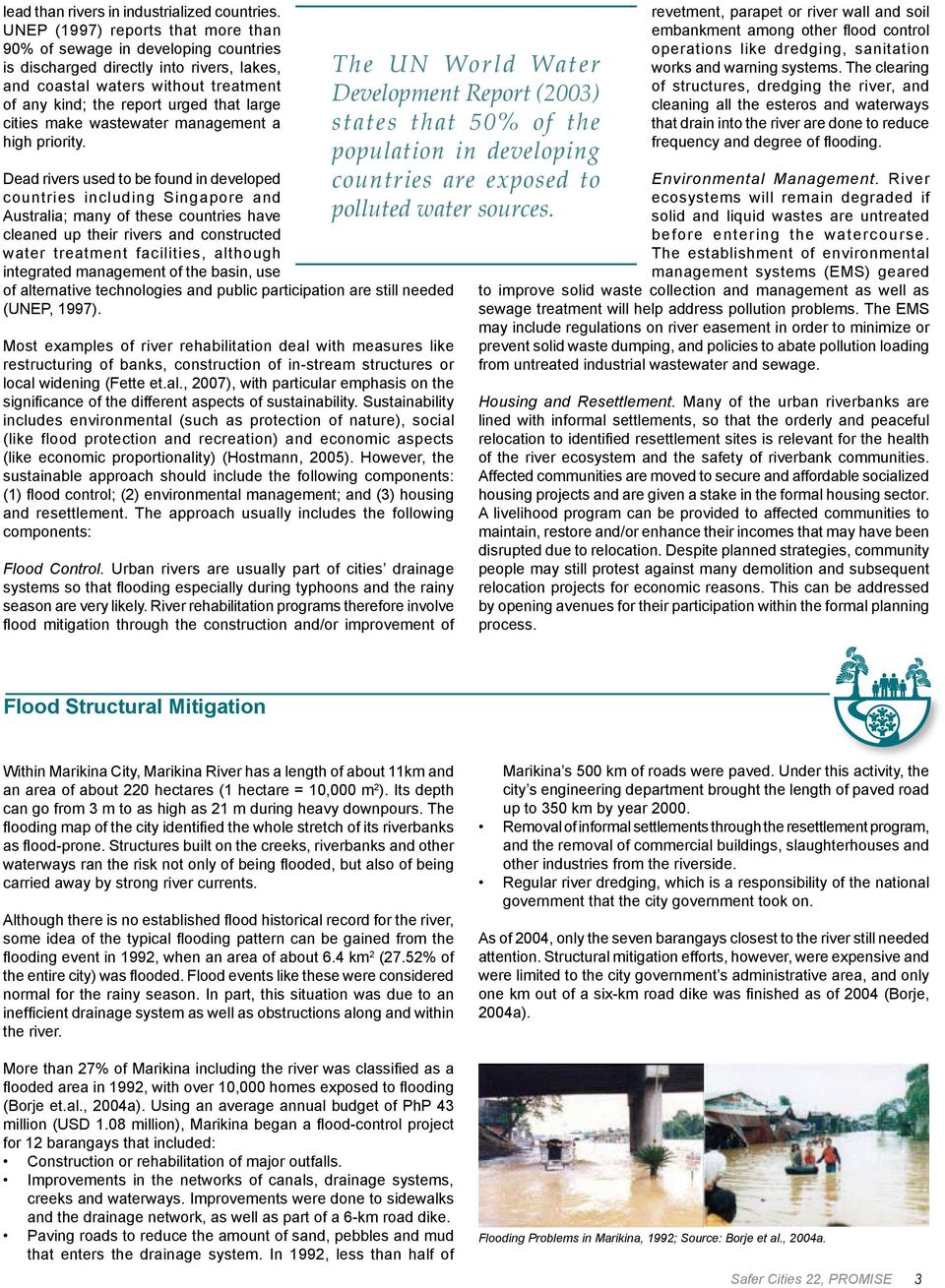
3 lead than rivers in industrialized countries. UNEP (1997) reports that more than 90% of sewage in developing countries is discharged directly into rivers, lakes, and coastal waters without treatment of any kind; the report urged that large cities make wastewater management a high priority. Dead rivers used to be found in developed countries including Singapore and Australia; many of these countries have cleaned up their rivers and constructed water treatment facilities, although integrated management of the basin, use of alternative technologies and public participation are still needed (UNEP, 1997). Most examples of river rehabilitation deal with measures like restructuring of banks, construction of in-stream structures or local widening (Fette et.al., 2007), with particular emphasis on the significance of the different aspects of sustainability. Sustainability includes environmental (such as protection of nature), social (like flood protection and recreation) and economic aspects (like economic proportionality) (Hostmann, 2005). However, the sustainable approach should include the following components: (1) flood control; (2) environmental management; and (3) housing and resettlement. The approach usually includes the following components: Flood Control. Urban rivers are usually part of cities drainage systems so that flooding especially during typhoons and the rainy season are very likely. River rehabilitation programs therefore involve flood mitigation through the construction and/or improvement of The UN World Water Development Report (2003) states that 50% of the population in developing countries are exposed to polluted water sources. revetment, parapet or river wall and soil embankment among other flood control operations like dredging, sanitation works and warning systems. The clearing of structures, dredging the river, and cleaning all the esteros and waterways that drain into the river are done to reduce frequency and degree of flooding. Environmental Management. River ecosystems will remain degraded if solid and liquid wastes are untreated before entering the watercourse. The establishment of environmental management systems (EMS) geared to improve solid waste collection and management as well as sewage treatment will help address pollution problems. The EMS may include regulations on river easement in order to minimize or prevent solid waste dumping, and policies to abate pollution loading from untreated industrial wastewater and sewage. Housing and Resettlement. Many of the urban riverbanks are lined with informal settlements, so that the orderly and peaceful relocation to identified resettlement sites is relevant for the health of the river ecosystem and the safety of riverbank communities. Affected communities are moved to secure and affordable socialized housing projects and are given a stake in the formal housing sector. A livelihood program can be provided to affected communities to maintain, restore and/or enhance their incomes that may have been disrupted due to relocation. Despite planned strategies, community people may still protest against many demolition and subsequent relocation projects for economic reasons. This can be addressed by opening avenues for their participation within the formal planning process. Flood Structural Mitigation Within Marikina City, Marikina River has a length of about 11km and an area of about 220 hectares (1 hectare = 10,000 m 2 ). Its depth can go from 3 m to as high as 21 m during heavy downpours. The flooding map of the city identified the whole stretch of its riverbanks as flood-prone. Structures built on the creeks, riverbanks and other waterways ran the risk not only of being flooded, but also of being carried away by strong river currents. Although there is no established flood historical record for the river, some idea of the typical flooding pattern can be gained from the flooding event in 1992, when an area of about 6.4 km 2 (27.52% of the entire city) was flooded. Flood events like these were considered normal for the rainy season. In part, this situation was due to an inefficient drainage system as well as obstructions along and within the river. Marikina s 500 km of roads were paved. Under this activity, the city s engineering department brought the length of paved road up to 350 km by year Removal of informal settlements through the resettlement program, and the removal of commercial buildings, slaughterhouses and other industries from the riverside. Regular river dredging, which is a responsibility of the national government that the city government took on. As of 2004, only the seven barangays closest to the river still needed attention. Structural mitigation efforts, however, were expensive and were limited to the city government s administrative area, and only one km out of a six-km road dike was finished as of 2004 (Borje, 2004a). More than 27% of Marikina including the river was classified as a flooded area in 1992, with over 10,000 homes exposed to flooding (Borje et.al., 2004a). Using an average annual budget of PhP 43 million (USD 1.08 million), Marikina began a flood-control project for 12 barangays that included: Construction or rehabilitation of major outfalls. Improvements in the networks of canals, drainage systems, creeks and waterways. Improvements were done to sidewalks and the drainage network, as well as part of a 6-km road dike. Paving roads to reduce the amount of sand, pebbles and mud that enters the drainage system. In 1992, less than half of Flooding Problems in Marikina, 1992; Source: Borje et al., 2004a. Safer Cities 22, PROMISE
4 Non-Structural Mitigation Policy Environment The Sangguniang Panlungsod ng Marikina (Marikina City Council) has enacted many ordinances and resolutions (local laws that apply only to the Marikina City administrative area) related to emergency preparedness and disaster management. The policy environment emphasized the public safety and quality of life of the city s residents and businesses. The key ordinances include: Ordinance 59 of 1993: keeping sidewalks, alleys and public spaces clear to maximize free movement of vehicular and human traffic (essential during emergencies). Ordinance 10 of 1994: declaring an easement of 96 meters from either side of the Marikina River centerline, and authorizing the relocation of all residents found within the easement to safer ground. Ordinance 264 of 1998: creating a Disaster Management Office also known as Rescue 161, to be responsible for emergency preparedness, coordinating response, for first response skills training, and monitoring during emergencies. The ordinance defines the staff for the office, their salaries, and that the city will provide the annual budget for the office. Ordinance 171 of 1999: declaring two titled lots found by the river as a danger zone and non-buildable area, revoking unused building permits for the area, and prohibiting any new construction. Ordinance 54 of 2005: authorizing the use of 20% of the Calamity Fund for Disaster Preparedness, specifically for disaster-related tools, gadgets and equipments to be used during emergencies. Ordinance 109 of 2005: creating the Comprehensive Earthquake Disaster Reduction program and action plan, and identifying the roles of 20 offices/agencies of the local authority. Other ordinances support the resettlement of informal settlers, monitoring of water quality, and promoting solid waste management as part of a sanitation code. Two important actors were key in advocating for the necessary local policies and institutional arrangements of the city government Mayor Bayani F. Fernando ( ) and Mayor Ma. Lourdes C. Fernando ( ). They both had consistently pushed for the welfare of their constituents. Mayor Bayani Fernando was the prime mover behind the Save the Marikina River program that prompted the flood disaster mitigation efforts, and Mayor Ma. Lourdes Fernando pushed for the Comprehensive Earthquake Disaster Reduction program as well as the Eco-Savers program that promotes solid waste management at the household and school levels. Emergency Preparedness and Rescue 161 Marikina raised its emergency preparedness and response capacity by setting a target response time of five minutes to reach emergency situations. With Ordinance 264 of 1998, it set up an emergency operations center called Rescue 161, named after the three-digit telephone number of the emergency service. Representatives of the first responders police, fire and ambulance services receive phone calls and coordinate the response to emergencies. Their physical presence in the center is a hallmark of governance since none of them are under the jurisdiction of the city government. However, the city government inked Memoranda of Understanding with their respective organizations, and jointly developed standard operating procedures, monitoring systems and alert systems. The city government expanded the service by setting up three more public safety centers in strategic locations, to serve as additional staging areas for emergency response. The effort has paid off; in 2004, the average response times of Rescue 161 first responder services were: police 3 minutes; fire 4 minutes; ambulance 3.2 minutes (Borje, 2004d). The Rescue 161 program won in the DILG Galing Pook Hall of Fame award for In the same way, 161 rescuers were the overall champions at the Department of Health 2006 Skills Benchmarking with an average response time of three minutes. Marikina City was among the eight Pacific healthy cities in 2006, cited by the World Health Organization for outstanding achievements in emergency preparedness and response planning. Because the city has an earthquake risk, the city government has invested in pontoon bridges (in the event of bridge collapse) and several Collapsed Building Retrieval Boxes, each containing digging and lifting tools, hand tools, personnel safety equipment, lighting and shelter equipment, and a first aid kit. During emergencies, Rescue 161 can use the city government s heavy equipment (e.g. excavators, cranes, pay loaders and water tanker trucks) and light equipment (e.g. power saws, generators, rubber boats with outboard motors, and search lights). The city government operates a narrowcast radio station (DZBF-1674 MHz) with daily programming; in times of emergencies, the radio station transmits public information and emergency alert signals. Public Awareness The city government has some unique efforts to raise public awareness and disaster management and emergency preparedness. The city has established a Disaster Preparedness Education Center that features an Audio Visual/Training Room, a small disaster management museum, and a disaster management library for children and adults. T h e c i t y g o v e r n m e n t h a s reached out to companies and non-governmental organizations to join its efforts at disaster management. As a result, the city government can tap a volunteer fire brigade, six private hospitals, heavy equipment, about 2000 public order and safety volunteers (Bantay Bayan and Civic Action teams), and army reservists. The city has published a Disaster Management Handbook that contains instructions on how the public should prepare for emergencies, lists what to do during emergencies, and the procedures followed by Rescue 161. This handbook is distributed to the presidents of the different homeowners associations, as well as to mayors of other cities and municipalities.

5 Save the Marikina River Program Removal of informal settlements from the riverbanks, just like river dredging, would be a repeated task unless a comprehensive effort was made to make resettlement an attractive option, and the use of the riverbank converted into something compatible with flood management. The program started in 1993 with the principle: The people have to touch and smell the water. Many thought it would take a miracle to restore the river because past attempts at removing trash and relocating informal settlers along the banks have failed. Surprisingly, the program generated enthusiasm from socio-civic groups, NGOs and city residents. An important basis for the river rehabilitation program was a 1987 study that cited the need to improve the riverbanks for better water discharge, reduced flooding, and to serve as a safe inundation area. Furthermore, the Department of Public Works and Highways (DPWH) encouraged Marikina city government to remove illegal structures and prevent the construction of new ones within the easement laid down by Ordinance 10 of The rehabilitation plan was laid out: (1) building access roads to allow men and equipment to go near the river and undertake the necessary cleaning and clearing operations; (2) clearing the banks both of its informal settlers and other encroachments; (3) improving the river water quality by demanding industries to set up and maintain water treatment facilities; (4) creating sports facilities, historical and cultural structures and; (5) enhancing the aesthetic appeal of the river environment by planting various flora. After more than a decade of development, Marikina s riverbanks now have an 11-km jogging/biking lane, the biggest roller skating rink in the country, trees, picnic grounds, children s playgrounds, sports facilities like a baseball field and basketball court, a Youth Camp, a Chinese Pagoda, a Roman Garden, a gazebo, a riverboat, floating stages used for cultural events, an amphitheater, and a Senior Citizens Lifestyle Center. Some of the city s annual celebrations, such as the Mama Mary Fluvial Parade and Festival and the Marikina Christmas Festival, are held in the river and riverbanks. Its success may be partly due to the motivation that the program will not only to rehabilitate, improve and restore the environmental qualities of the river, but also facilitate sustainable development in Marikina. Organizational Structure The city government recognized that it needed to modify its organizational structure in order to implement the river rehabilitation program and closely monitor its progress. Two new offices were created within the city government to implement the program the Marikina River Park Authority and the Marikina Settlements Office. These two offices and the Engineering Department were identified as key program implementers while the city council was identified as a necessary partner who could create an enabling policy environment. The roles of the various actors were: The Sangguniang Panlungsod ng Marikina passes the necessary ordinances for the rehabilitation and relocation programs, especially on issues pertaining to resettlement. These ordinances created the legal bases for changing the land use of the riverbanks. The Engineering Department looks after structural flooding mitigation along the riverbanks, and provides basic services and infrastructure in the resettlement areas. The Marikina Settlements Office (MSO) promotes community participation in the program s delivery and management. The MSO organized community associations to help the communities become active and self-reliant towards their own development. The office hired some of the program beneficiaries as project officers for specific tasks: (1) liaise with barangay officials and community leaders, (2) monitor the building of illegal structures within their areas of assignment, (3) serve as watchdogs of the community in case of emergency or of any other problems, (4) organize associations where necessary, and (5) ensure that all other problems resulting from the relocation of the community were answered (Chuico-Tordecilla, 1998). The Marikina River Park Authority develops the river by planning and designing the various facilities. It leads tree planting activities. It works with the Engineering Department during creek and river clean-up, and helps enforce regulations on waste disposal of factories and homes. Relocation of Informal Settlements in the Riverbanks The resettlement of the families living within the defined easement was a major program geared towards rehabilitating Marikina River. The city considered the riverbank area as a danger zone, and intended to utilize it for projects that could rehabilitate the river and mitigate flood disasters. Ordinance 10 of 1994 combined with the resettlement program made it possible to relocate the settlers and demolish the houses along the river, creeks and government-owned land. Resettlement required a combination of several activities: a citywide registration and census of informal settlers; identification of resettlement areas in the city; demolition of illegal structures; resettlement in new sites; and monitoring against the construction of new ones within the easement and resettlement areas. Census of informal settlers. A census was taken of informal settlers from 1992 to 1994; 23,000 families were found who stayed along the river banks, esteros and creeks, on private property, and on public land targeted for infrastructure development. Identification of resettlement areas. The MSO identified potential resettlement sites through city mapping and land surveys. Since these were usually occupied by informal settlers, the land owners were approached and persuaded by the officials from the MSO and the Community Mortgage Program (CMP) to sell their lands as settlement sites. Tax incentives were given to the land owners for their cooperation, with some bargaining over the value of the property versus the costs of removing the informal settlers. Six relocation sites were eventually used for the city s resettlement program (Malanday, Nangka, Tumana, Dona Petra, Tanguile, and Location of Settlement Areas in Marikina City Source: Borje, J. et.al. (2004b) Figure 3 Safer Cities 22, PROMISE

6 San Miguel Realty); the families from the riverbanks were moved to only three sites (Barangay Malanday, Nangka and Tumana). Figure 3 shows the resettlement sites, with a total area of about 106 hectares. Resettlement. Resettlement areas were made available with reliable utilities, basic infrastructure, garbage collection, and access to emergency services; these urban amenities were not possible on the riverbanks. Small lots (24 m 2 ) were sold to the settlers under the Community Mortgage Program (CMP), wherein each family paid monthly mortgage amortizations from PhP 250 to 400 (USD 6 to 10). The program established several criteria for identifying its potential beneficiaries, as defined under the Urban Development and Housing Act (Republic Act 7279 of 1992): Filipino citizen Underprivileged and homeless Does not own real property, whether in urban or rural areas Not a professional squatter, nor a member of squatting syndicates Member of a community association (the MSO helped the informal settlers form a total of 168 associations) The mortgage program itself is run by the national government, but the city government acted as a facilitator to assist the families in getting the mortgage and forming the required community associations. Marikina City Government added its own criteria (Chuico-Tordecilla, 1998): Settlers who are renting from others and paid between PhP 150 to 400 (USD 4 to 10) per month are eligible Married children and other relatives of the owner are not entitled to a relocation site Of course, there was some resistance to resettlement. The city government employed a strategy of using massive flood events as an opportunity to evacuate the informal settlers and then seal off the area under Ordinance 10 of Under these conditions, the informal settlers would see the advantage of moving into the resettlement areas. Monitoring illegal structures. Encroachment of new settlers on the easement was controlled by reinforcing an existing law that the city government must issue a permit for new construction and could demolish new structures without this permit. The building of illegal structures was monitored with the help of barangay officials, while the city government established a demolition unit that served in many demolition operations. It grew to include members who once had their homes demolished. Even when there are existing laws that support the need to keep riverbanks and other waterways free from obstruction, the resettlement of people and clearing away structures are always difficult undertakings. While supporters to the program claimed that the local government was pro-people throughout the entire relocation process and that they even volunteered to help demolish their own structures, non-supporters believed that their rights were violated. In spite of the controversy, the resettlement program has received recognition within the Philippines as a good initiative by a local authority, having won the Galing Pook Award in About 22,000 families were resettled, and only 800 families are still living within the easement. The clearing of settlements ensured the safety for both people and structures close to waterways, and made the area navigable c u l t u r a l Garden). of anyone the river for engineering equipment to conduct regular creek and river clean-up, therefore mitigating obstruction problems that could lead to or exacerbate flooding. About 500 hectares were freed for development this way, whereas only 106 hectares of private land were required for resettlement. Compatible Land Use of the Floodplain After the flood-mitigation work in the river and removal of structures, the riverbanks (which is the river s floodplain) were designated as recreational land. The land use was converted into parks, sports facilities, historical and structures (like the Chinese Pagoda and Roman These land uses facilitate the timely evacuation who happens to be on the riverbank, and allow for to safely enter its floodplain. Establishment of a Solid Waste Management System The inefficient collection of solid wastes was seen as a major contributor to river pollution, either through direct dumping of wastes in the waterways or via throwing of uncollected garbage near the riverbanks. Solid waste accumulated as sludge in the waterways and impeded the drainage of flood waters. Upon recognizing this, the local government strictly enforced an anti-dumping ordinance and introduced a refuse collection policy. By 1996 the Waste Management Office (WMO) was established with the responsibility of delivering the city s solid waste management services and managing facilities related to sanitation. The office helped draft an ordinance that adopted the Users Pay Principle in This was aimed at persuading commercial establishments to minimize garbage while generating funds to augment the costs incurred in managing solid wastes. Establishments pay more for generating more garbage, while residents are asked to pay a flat rate of PhP 50 (USD1.25) per month regardless of the amount of garbage the household produces. Residents are initially informed of the collection schedule and how to dispose of their garbage (to place wastes in plastic bags or trash receptacles, and put bags or receptacles outside their gates or in areas where the garbage compactor may pass). Garbage was allowed to be placed outside the home only on the day and time of collection; non-compliance had a penalty of PhP 2,000 (USD 50). By 1999, the estimated total solid waste generation in Marikina was between tons or roughly 400 m 3 per day. During the same year, the city is credited with a high garbage collection efficiency rate of 98%. This was due to many factors including the effective deployment of equipment and manpower, the use of a Garbage Transfer Station, as well as the establishment of a collection system in coordination with the residents and other constituents (CPO, 2007). However, the amount of garbage generated within the city grew over time (see Table 1). Solid Waste Generation of Marikina City Table 1 Estimated waste generation: 1999 Estimated waste generation: 2004 Proportion of biodegradable waste (2004) 45% Proportion of non-biodegradable waste (2004) Source: WMO, 2007; Gawad Galing Pook, m 3 /day 690 m 3 /day 55%

7 The city aimed to maintain the high garbage collection efficiency rate by introducing capacity-building projects for waste management by the manufacturing business community, ecological solid waste management plans at the barangay level, and the noteworthy Eco- Savers Program. Introduced in June 2004, the Eco-Savers program instills waste segregation and recycling practices at the household level. Once a week, students are required to bring recyclable waste from their respective households during an assigned Eco Day. Accredited junk shops weigh the waste, value it according to the prevailing market price, convert it into points (PhP 1.00 = 1 point), record the points in Eco Savers passbooks, and haul away the collected waste. Points earned entitle the Eco-saver to shop in the Eco-Savers Mobile Store that visits the school twice within the school year, bringing educational materials such as dictionaries, books, school supplies and educational toys. Individual savings within one school year ranges from PhP 50 to PhP 1,800 (USD 1 to 45), and helps reduce family spending. For the city, Eco-Savers meant reduced waste collection trips from 50 truckload-trips a day to an average of 30 trips a day, reduced traffic decongestion and air pollution, conserved fuel, and it provided junk shops with a regular supply of recyclable materials. Through this program, a total of 238,000 kg of waste with a value of PhP 1.3 million (USD 26,000) have been diverted from dumpsites and reduced the sludge that accumulated in the waterways. Eco-Savers won a Gawad Galing Pook in Water Quality Improvement In the 1970s, Marikina River was rated as clean enough to be used as public water supply. By 2002, the overall water quality of Marikina River had deteriorated (LLDA, 2002), due to untreated domestic and industrial wastes discharged directly into canals that ultimately flow into the river. The worsening water quality is related to incidence of water-borne diseases, and is likely to increase the negative impact of floods on human health. Table 2 shows the incidence of waterborne diseases in Marikina City. Number of Cases of Water-borne Diseases in Marikina City Disease Diarrhea 1,438 1,189 Unspecified intestinal parasitism Typhoid 2 32 Viral hepatitis 2 5 Amoebiasis Ascariasis Source: WMO, Marikina (2007) Table 2 The city government decided to improve water quality by constructing wastewater treatment plants in strategic areas, and improve sewage disposal. It is aided by the Manila Water company that holds the water service concession for the East Zone of Metro Manila (including Marikina). Through a public-private partnership between the city and the company, Manila Water began massive pipe-laying operations to provide potable water to all of the city s households, and will be constructing a wastewater treatment plant in Marikina. Manila Water also conducts free scheduled septic tank emptying services to customers not connected to a sewer network under the Sanitasyon Para Sa Barangay (Sanitation for the Barangay) program. Conclusion The impact of the flood mitigation program can be derived from a comparison of 1992 and 2004 figures for the extent of the floods and the number of exposed buildings (see Table 3). The program shows some improvement and requires monitoring. Urban flood mitigation is a complex effort wherein both structural and non-structural mitigation play equally important roles. In the case of Marikina City, the local authority was able to sustain its efforts that began in The local authority was able to promote good urban governance by engaging the participation of key actors: the city council to provide the needed policy environment, the community to act as volunteers, companies and NGOs who make their equipment and medical facilities available during emergencies, and other national agencies who coordinated police and fire services with a common emergency response effort for Marikina City. Other programs that have flood disaster risk reduction as a secondary benefit are sustaining the disaster risk reduction effort. Examples of such programs include the relocation of informal settlers to safer places, emergency preparedness efforts, river rehabilitation, and solid waste management. Exposure of selected items to 1992 and 2004 floods Exposed Item during 1992 flood during 2004 flood Land (flooded area) 6.36 km km 2 Residences 10,446 4,789 Businesses Critical Facilities 11 9 Source: WMO, Marikina (2007) Table 3 Lesson Learned Urban flood mitigation requires the coordination of efforts by multiple agencies. The governance approach promotes and recognizes transparency and consensual decision-making by stakeholders can facilitate coordination efforts. This is supported by Marikina s experience in establishing and maintaining the inter-agency Rescue 161 emergency operation center. The political will exhibited by the mayors not only sustained the disaster management effort, but also motivated support from the other key actors like the city council, the dedicated staff of the concerned departments of the city government, private companies and NGOS, national agencies for emergency response, and the relocated communities. It is important to integrate disaster risk reduction in all development projects. A river rehabilitation program is an example of how to mainstream flood disaster risk reduction by removing obstructions in the waterways and riverbanks, designating compatible land use for the floodplain area, managing solid waste, and improving water quality. Safer Cities 22, PROMISE

8 References Badilla, Roy. Flood Modelling in Pasig-Marikina Basin, M.Sc. thesis, ITC, March 2008, itc.nl/library/papers_2008/msc/wrem/badilla.pdf Borje, Julie et al. 3cd Sound Practice Series. No. 5, Marikina City Flood Mitigation Countermeasure Program, 2004a, pdc.org/soundpractices/metro-manila/sp5- MM-Flood-Mitigation-Marikina.pdf No. 6, Save the Marikina River, 2004b, emi.pdc.org/soundpractices/metro-manila/sp6- MM-Save-the-Marikina-River.pdf No. 7, Marikina City Squatter-Free Program, 2004c, Metro-Manila/SP7-MM-Marikina-Squatter-Free. pdf No. 8, 5-Minute Quick Response Time: Rescue 161 in Marikina City, org/soundpractices/metro-manila/sp8-mm-5- Minute-Quick-Response.pdf Chuico-Tordecilla, C. The Gatekeepers of Marikina: A Case of In-City Relocation and Management of a Squatter-Free Community, a case study for the Best Practices on the Urban Development and Housing Act Seminar, ASG, LLDA (2002). The Water Mondriaan: Monthly Water Quality Status Report, January 2002, files/2002/january_home.htm Fette, M., and C. Weber, A. Peter, B. Wehrli. Hydropower Production and River Rehabilitation: A case study on an Alpine River, Environmental Modeling and Assessment, 12(4), 2007, pp Gawad Galing Pook awards description, 1994 to latest awards: htm#year Hostmann, M. Decision Support for River Rehabilitation, dissertation, Swiss Federal Institute of Technology Zurich, Diss. No , Marikina City Development Authority City Planning Office (CPO) Comprehensive Land Use Plan UNEP. Freshwater Issues, Global State of Environment Report, 1997, ietc/issues/freshwater.asp UN. World Water Development Report, 2003, URL_ID=3129&URL_DO=DO_TOPIC&URL_ SECTION=201.html Yu, Carlyne. Urban River Rehabilitation in a Developing Country: A Case Study in Marikina City, Philippines, M.Sc. thesis, AIT, May Endnotes This refers to the Gawad Galing Pook, an award for innovative practices by local authorities in the Philippines. The winners are chosen from a national search of local governance programs, evaluated through a multi-level rigorous screening process based on positive results and impact, promotion of people s participation and empowerment, transferability and sustainability, and efficiency of program service delivery. Winning programs become models of good governance. The award is conferred by the President of the Republic of the Philippines. Editorial Board Safer Cities 22 has been reviewed by: Dr. Bhichit Rattakul, ADPC Mr. N.M.S.I. Arambepola, ADPC Mr. Aloysius Rego, ADPC Mr. A.R. Subbiah, ADPC Author: Ms. Gabrielle Iglesias Ms. Carlyne Yu Designer: Lowil Fred Espada Acknowledgment Mayor Ma. Lourdes Fernando, Marikina City, Julie Borje, Center of Excellence, Marikina City Government Lolita E. de Leon, Secretary of the Sangguniang Panlungsod ng Marikina Ory Buenaventura, Waste Management Office, Marikina City Government Other Relevant Safer Cities Studies SC 13: What is the Appropriate Mitigation Mix? Structural and non-structural mitigation in Hat Yai, Thailand SC 16: Cooperation between Local Authority and Communities SC 17: Good Governance and Post-Tsunami Recovery in Patong Safer Cities is a series of case studies that illustrate how people, communities, cities, governments and businesses have been able to make cities safer before disasters strike. The series presents strategies and approaches to urban disaster mitigation derived from analyses of real-life experiences, good practices and lessons learned in Asia and the Pacific. This user-friendly resource is designed to provide decision-makers, planners, city and community leaders and trainers with an array of proven ideas, tools, policy options and strategies for urban disaster mitigation. The key principles emphasized throughout Safer Cities are broad-based participation, partnerships, sustainability and replication of success stories. The contents here may be freely quoted with credit given to the implementing institution, Asian Disaster Preparedness Center (ADPC), and to the Office of Foreign Disaster Assistance (OFDA) of the U.S. Agency for International Development (USAID). The opinions expressed herein are those of the author(s) and do not necessarily reflect the views of ADPC or USAID. The information in this series is provided for purposes of dissemination. For more details, please refer to contacts listed at the end of this material. Publication of this case study was made possible through the support provided by the OFDA, USAID, under the terms of Cooperative Agreement No. DFD-G PROMISE During the implementation of the Asian Urban Disaster Mitigation Program (AUDMP), ADPC recognized the importance of interventions in urban areas and accordingly identified Urban Disaster Risk Management as one of its core thematic areas of work, experiences from which have also guided the selection of the target secondary cities. ADPC has developed Strategy 2020 for Urban Disaster Risk Mitigation in Asia which aims to reach 200 cities by the year The need to minimize the destructive impacts of these hydro-meteorological events on the vulnerable communities, particularly the urban communities and the economic infrastructure through enhanced preparedness and Mitigation is therefore the main trust of the present intervention in implementation of the Program for Hydro-Meteorological Disaster Mitigation in Secondary Cities in Asia (PROMISE). ADPC considers PROMISE program as an opportunity to associate with many communities living in Asian cities vulnerable to hydro-meteorological hazards with the aim of reducing the impacts of such events and demonstrate innovative applications for community preparedness and mitigation. This case study documents the efforts under a specific program objective to increase stakeholder involvement and further enhancement of strategies, tools and methodologies related to community preparedness and mitigation of hydro-meteorological disasters in urban communities. The Asian Disaster Preparedness Center (ADPC) is a regional resource center dedicated to safer communities and sustainable development through disaster risk reduction in Asia and the Pacific. Established in 1986 in Bangkok, Thailand, ADPC is recognized as an important focal point for promoting disaster awareness and developing capabilities to foster institutionalized disaster management and mitigation policies. For more information, please get in touch with us at: Asian Disaster Preparedness Center 979/69, 24th Floor SM Tower, Paholyothin Road Samsen Nai, Phayathai Bangkok, Tel: (66-2) Fax: (66-2) [email protected] URL: Safer Cities 22, PROMISE

Urban River Rehabilitation: A Case Study in Marikina City, Philippines
 Urban River Rehabilitation: A Case Study in Marikina City, Philippines Carlyne Z. Yu 1 and Edsel E. Sajor 2 1 Program Associate, Disaster Preparedness, Mitigation and Management (DPMM), Asian Institute
Mega Manila: Partnership in Action
 Domestic WastewaterManagement in Mega Manila: Partnership in Action Leonor C. Cleofas Deputy Administrator Metropolitan Waterworks and Sewerage System Securing the Future Today The MWSS Privatization On
NGOs ROLE IN THE PASIG RIVER REHABILITATION PROGRAM
 NGOs ROLE IN THE PASIG RIVER REHABILITATION PROGRAM FORUM Network for Urban Futures in Southeast Asia SUMMER SCHOOL 2009: CIVIL SOCIETY Cologne, Germany Imelda Baleta Outline Context The Pasig River The
Table of Contents ESF-3-1 034-00-13
 Table of Contents Primary Coordinating Agency... 2 Local Supporting Agencies... 2 State, Regional, and Federal Agencies and Organizations... 3 Purpose... 3 Situations and Assumptions... 4 Direction and
CASS COUNTY COMMISSION POLICY MANUAL 38.07 ADOPTED DATE: FEBRUARY 2, 1998 PAGE 1 OF 9
 CASS COUNTY COMMISSION POLICY MANUAL 38.07 SUBJECT: ORDINANCE #1998-2 (FLOOD DAMAGE PREVENTION) ADOPTED DATE: FEBRUARY 2, 1998 PAGE 1 OF 9 NORTH DAKOTA COUNTY OF CASS ORDINANCE #1998-2 Be it ordained and
Flood Risk Management
 Flood Risk Management Value of Flood Risk Management Every year floods sweep through communities across the United States taking lives, destroying property, shutting down businesses, harming the environment
Flood Risk Management
 Flood Risk Management Value of Flood Risk Management Value to Individuals and Communities Every year floods sweep through communities across the United States taking lives, destroying property, shutting
Building Tennessee s Tomorrow: Anticipating the State s Infrastructure Needs July 2011 through June 2016
 Building Tennessee s Tomorrow: Anticipating the State s Infrastructure Needs July 2011 through June 2016 Glossary of Terms Basic Education Program (BEP): The programs funded by the formula adopted as part
Source Water Protection Practices Bulletin Managing Sanitary Sewer Overflows and Combined Sewer Overflows to Prevent Contamination of Drinking Water
 United States Office of Water EPA 916-F-01-032 Environmental Protection (4606) July 2001 Agency Source Water Protection Practices Bulletin Managing Sanitary Sewer Overflows and Combined Sewer Overflows
ORDINANCE NO. 3 OF 2009
 PENN TOWNSHIP CUMBERLAND COUNTY BOARD OF SUPERVISORS 1301 Centerville Road Tel: 717-486-3104 Newville, PA 17241 Fax: 717-486-3522 Email: [email protected] Website: www.penntwpcc.org ORDINANCE NO. 3 OF
Flooding Fast Facts. flooding), seismic events (tsunami) or large landslides (sometime also called tsunami).
 Flooding Fast Facts What is a flood? Flooding is the unusual presence of water on land to a depth which affects normal activities. Flooding can arise from: Overflowing rivers (river flooding), Heavy rainfall
District Disaster Risk Management Planning
 District Disaster Risk Management Planning GUIDELINES JULY 2007 National Disaster Management Authority 1. Introduction Notifications for establishment of the District Disaster Management Authorities (DDMAs)
SECTION 1.0 STATUTORY AUTHORIZATION AND PURPOSE
 A local law for Flood Damage Prevention as authorized by the New York State Constitution, Article IX, Section 2, and Environmental Conservation Law, Article 36 1.1 FINDINGS SECTION 1.0 STATUTORY AUTHORIZATION
Preparation. Preparation. Step 2 Prepare an emergency kit. Step 1 Prepare your emergency plan. Step 4 Tune into warnings
 This emergency toolkit provides you with steps to take before and during emergencies to protect you and your property. The Victoria State Emergency Service (SES) is a volunteer organisation dedicated to
A Documentation of the 10-Point Checklist for Making San Francisco, Camotes Resilient to Disasters. Sasakawa Award Nomination Submission
 A Documentation of the 10-Point Checklist for Making San Francisco, Camotes Resilient to Disasters Sasakawa Award Nomination Submission February 2011 Municipal Profile The Municipality of San Francisco,
FOUR RIVERS RESTORATION PROJECT
 MLTM Republic of Korea Making Every Drop Count International Workshop on Integrated Urban Water Management WATER & GREEN GROWTH FOUR RIVERS RESTORATION PROJECT Office of National River Restoration, Korea
City of Green Bay Department of Public Works Engineering Department
 City of Green Bay Department of Public Works Engineering Department The Difference Between Sanitary & Storm Sewers Contact Information: Department of Public Works City Hall 100 North Jefferson Street,
Barre City City-wide Policy and Program Options
 Barre City (VERI Land Use Regulations Update policies allowing fill in flood hazard areas. RPC, DEC River Management, VLCT, Allowing landowners to elevate buildings using fill may help protect an individual
5.0 OVERVIEW OF FLOOD DAMAGE REDUCTION MEASURES
 5.0 OVERVIEW OF FLOOD DAMAGE REDUCTION MEASURES Flood damage reduction consists of two basic techniques structural and non-structural. Structural methods modify the flood and take the flood away from people
GENERAL OBLIGATION BONDS
 DESCRIPTIONS GENERAL OBLIGATION BONDS Appendix C, page 2 GENERAL OBLIGATION BONDS State Transportation Bonds --- 1968 An amount of $640,000,000 was authorized to improve the public transportation system.
DISASTER MANAGEMENT. Goals To instill an understanding of the disaster management process
 DISASTER MANAGEMENT Goals To instill an understanding of the disaster management process Learning outcomes After completing this session, you will be able to Affirm the usefulness of integrating management
A. Flood Management in Nevada
 Nevada Division of Water Planning A. Flood Management in Nevada Introduction Flooding has been a concern for Nevada communities since the first settlers moved to the territory in the mid-1800 s. Fourteen
CHAPTER 372-68 WAC WATER POLLUTION CONTROL AND ABATEMENT PLANS FOR SEWAGE DRAINAGE BASINS
 CHAPTER 372-68 WAC WATER POLLUTION CONTROL AND ABATEMENT PLANS FOR SEWAGE DRAINAGE BASINS Last Update: 6/8/88 WAC 372-68-010 Authority. 372-68-020 Purpose. 372-68-030 Definitions. 372-68-040 Planning guide.
SECTOR ASSESSMENT (SUMMARY): WATER SUPPLY AND OTHER MUNICIPAL INFRASTRUCTURE AND SERVICES 1. 1. Sector Performance, Problems, and Opportunities
 Country Partnership Strategy: Kyrgyz Republic, 2013 2017 SECTOR ASSESSMENT (SUMMARY): WATER SUPPLY AND OTHER MUNICIPAL INFRASTRUCTURE AND SERVICES 1 Sector Road Map 1. Sector Performance, Problems, and
Flood Emergency Response Planning: How to Protect Your Business from a Natural Disaster RIC005
 Flood Emergency Response Planning: How to Protect Your Business from a Natural Disaster RIC005 Speakers: Tom Chan, CEO, Global Risk Miyamoto Greg Bates, Principal, Global Risk Consultants Learning Objectives
Key things to Know About Environment as a. Cross Cutting Issue In Early Recovery
 Key things to Know About Environment as a Cross Cutting Issue In Early Recovery This brief note provides an overview of key things to know about environment for early recovery actors, including Early Recovery
Waste Handling & Disposal
 Objectives Cover Contain Educate Reduce/Minimize Product Substitution Description Improper storage and handling of solid wastes can allow toxic compounds, oils and greases, heavy metals, nutrients, suspended
History of the SPCC Rule
 2010 SPCC Training SPCC Rule History of the SPCC Rule The SPCC plan is a document required under the clean water act (CWA) It became effective in 1972 and has changed little in 32 years. The rule was formally
3.6.1 Existing Conditions - Police, Fire, Ambulance, Water, Sewer, & Solid Waste
 3.6 3.6.1 Existing Conditions - Police, Fire, Ambulance, Water, Sewer, & Solid Waste Police Protection The Clarkstown Police Department provides police protection services to properties within the 40 square
EPA Trends for wastewater Treatment in California - 2011
 EPA S TECHNOLOGY NEEDS FOR THE WATER AND WASTEWATER INDUSTRY Nancy Stoner Acting Assistant Administrator U.S. EPA Office of Water International Emerging Technology Symposium Arlington, VA April 23rd, 2014
In addition to the terms defined in this By-law, the following terms shall have the corresponding meanings for the purposes of this Section:
 Click here to access definitions SECTION 12 FLOODPLAIN LANDS 12.1 INTERPRETATION In addition to the terms defined in this By-law, the following terms shall have the corresponding meanings for the purposes
Anchorage All-Hazard Mitigation Plan October 2004
 EXECUTIVE SUMMARY The Municipality of Anchorage (MOA) is vulnerable to a wide range of natural, technological, and human/societal hazards including earthquakes, avalanches, and hazardous material accidents.
IWA Publishing 2012 Water Practice & Technology Vol 7 No 4 doi: 10.2166/wpt.2012.086
 IWA Publishing 2012 Water Practice & Technology Vol 7 No 4 Manila water s experience in the provision of sewerage service in the east zone of Metro Manila R. Baffrey a and A. Adis b a Wastewater Operations
How To Build A River Restoration Project In North Korea
 Changnyeong Haman Weir Project for Nakdong-River Restoration 1. PROJECT A. Description Changnyeong Haman Weir Project for Nakdong-River Restoration stretched from Oisanri, Bukmyeon of Changwon City to
11.4 Voluntary Purchase. 11.5 House Raising and Flood Proofing
 11.4 Voluntary Purchase As mentioned in Section 10 in certain high hazard areas of the floodplain, it may be impractical or uneconomic to mitigate flood hazard to existing properties at risk, or flood
Maryland Emergency Operations Plan
 Maryland Emergency Operations Plan Purpose The purpose of the Maryland Emergency Operations Plan (EOP) is to outline an approach and designate responsibilities intended to minimize the consequences of
How Your Business Can Prevent Stormwater Pollution
 Tips for a Cleaner Bay How Your Business Can Prevent Stormwater Pollution alameda county You Can Prevent Water Pollution! Storm drains flow directly into creeks and the Bay without any treatment. Because
Post-Flood Assessment
 Page 1 of 7 Post-Flood Assessment CHAPTER 4 AGENCY COORDINATION Agency coordination is an essential element for the operation of the flood management systems in the Central Valley. Due to the nature of
Track-Risk-Impact-Policy (TRIP) Modeling for the Agricultural Sector
 Track-Risk-Impact-Policy (TRIP) Modeling for the Agricultural Sector Glenn S. Banaguas Environmental and Climate Change Research Institute De La Salle Araneta University Manila Observatory Ateneo De Manila
Melbourne, Australia. Melbourne: The city as a catchment approach. The importance of holistic urban water management
 SWITCH Training Kit 1 Melbourne: The city as a catchment approach A prolonged period of drought, increasing population and polluted stormwater runoff are adding pressures to Southern Australia s water
Type of Sewer Systems. Solomon Seyoum
 Type of Sewer Systems Solomon Seyoum 0 Learning objectives Upon completion of this lecture, the participants will be able to differentiate between types of sewer systems and discuss different aspects of
Flood Protection Tips
 Flood Protection Tips Information About Floodplains and Flood Prevention What is a floodplain? Floodplains serve many useful purposes, and those that are preserved in their natural or nearly natural state
Town of Amherst Flood Plan Annex
 Town of Amherst Flood Plan Annex The following document is an annex to the Town of Amherst Disaster Plan and is specifically used as a guideline for Flooding events Flood Plans can enable a flexible response
NYSDEC Optional Additional Language Model Local Law for Flood Damage Prevention Optional Additional Language
 NYSDEC General Comments. The contains language that complies with the floodplain management requirements of the National Flood Insurance Program (NFIP) contained in federal regulations 44 CFR 60.3 through
Preparedness in the Southwest
 Preparedness in the Southwest Risk Assessment and Hazard Vulnerability Developed by The Arizona Center for Public Health Preparedness Cover Art www.azcphp.publichealth.arizona.edu Chapter 1 Importance
TITLE 6. Health and Sanitation CHAPTER 1. Health and Sanitation
 TITLE 6 Chapter 1 Chapter 2 Pollution Abatement CHAPTER 1 6-1-1 Health Officer; Duties and Powers 6-1-2 Rules and Regulations 6-1-3 Health Nuisances 6-1-4 Compulsory Connection to Sewer and Water 6-1-5
KINGDOM OF CAMBODIA NATION RELIGION KING MINISTRY OF EDUCATION, YOUTH AND SPORT FLOOD ASSESSMENT REPORT ON IMPACTS AND DAMAGES ON EDUCATION SECTOR
 Final Draft KINGDOM OF CAMBODIA NATION RELIGION KING MINISTRY OF EDUCATION, YOUTH AND SPORT FLOOD ASSESSMENT REPORT ON IMPACTS AND DAMAGES ON EDUCATION SECTOR DECEMBER 2013 1 Contents ****** FOREWORD*****...
POLLUTION PREVENTION FACT SHEET: AUTOMOBILE MAINTENANCE
 POLLUTION PREVENTION FACT SHEET: AUTOMOBILE MAINTENANCE Description This pollution prevention measure involves creating a program of targeted outreach and training for businesses involved in automobile
rescue and relief efforts in the aftermath of flooding, (iii) repair of flood damaged public facilities and utilities, and
 1. Purpose (1) It is the purpose of this Ordinance to protect human life, health, and property from flood conditions, to preserve the ability of floodplains to carry and discharge a base flood, and to
Proposed Terms of Reference for EIA studies
 1 Proposed Terms of Reference for EIA studies Base line data collection will be collected for the Post-Monsoon season 2016 (September to November 2016) in study area and 10 kms radius from project site.
FLOOD DAMAGE PREVENTION ORDINANCE
 FLOOD DAMAGE PREVENTION ORDINANCE SECTION 1.0 STATUTORY AUTHORIZATION, FINDINGS FO FACT, PURPOSE, AND OBJECTIVES 1.1 STATUTORY AUTHORIZATION The Legislature of the State of Washington has in RCW delegated
National Policy on Water Resources Restoration in Thailand
 Asian River Restoration Network (ARRN) International Forum on Waterfront and Watershed Restoration Urban River Restoration for Sustainable Development National Policy on Water Resources Restoration in
Clean Water Services. Ecosystems Services Case Study: Tualatin River, Washington
 Viewed broadly, the concept of ecosystem services describes the many resources and services provided by nature. Typically, traditional planning and development practices do not adequately represent the
The Town of Lakeshore Basement Flooding Information to Residents
 The Town of Lakeshore Basement Flooding Information to Residents The following information is intended for residents that have homes connected to Municipal storm and sanitary sewers. However, rural residents
LIVING WITH FLOOD IN THE MEKONG DELTA, VIETNAM. Tran Thi Trieu, Nguyen Hieu Trung, Le Anh Tuan
 LIVING WITH FLOOD IN THE MEKONG DELTA, VIETNAM Tran Thi Trieu, Nguyen Hieu Trung, Le Anh Tuan THE MEKONG RIVER DELTA Mekong River Delta is in the most southern of Vietnam. The MD is considered as a biggest
ENVIRONMENTAL REVIEW SCREENING QUESTIONS
 ENVIRONMENTAL REVIEW SCREENING QUESTIONS All applications to WHEDA are required to meet the Department of Housing and Urban Development s environmental compliance standards listed in 24 CFR Part 58. Your
INDONESIA - LAW ON WATER RESOURCES,
 Environment and Development Journal Law LEAD INDONESIA - LAW ON WATER RESOURCES, 2004 VOLUME 2/1 LEAD Journal (Law, Environment and Development Journal) is a peer-reviewed academic publication based in
Objective 4: Enhanced community education, flood awareness and preparedness
 Objective 4: Enhanced community education, flood awareness and preparedness Understanding the extent and full impacts of flooding is essential for planning for potential future pressures on the drainage
Las Pinas-Zapote River System Rehabilitation Program, Philippines
 Background/Context Las Pinas-Zapote River System Rehabilitation Program, Philippines Rapid increases in population and commercial activity have brought about concomitant environmental problems, and water
Iowa Smart Planning. Legislative Guide March 2011
 Iowa Smart Planning Legislative Guide March 2011 Rebuild Iowa Office Wallace State Office Building 529 East 9 th St Des Moines, IA 50319 515-242-5004 www.rio.iowa.gov Iowa Smart Planning Legislation The
PUBLIC ASSISTANCE DAMAGE ASSESSMENT
 PUBLIC ASSISTANCE DAMAGE ASSESSMENT Who does it? Political Subdivisions, Special Districts, Local/Regional Authorities, Public Schools/Colleges/Universities, Certain Private Non-Profit Organizations (PNP)
ANNEX 3 ESF-3 - PUBLIC WORKS AND ENGINEERING. SC Budget and Control Board, Division of Procurement Services, Materials Management Office
 ANNEX 3 ESF-3 - PUBLIC WORKS AND ENGINEERING PRIMARY: SUPPORT: SC Budget and Control Board, Division of Procurement Services, Materials Management Office Clemson University Regulatory and Public Service
PRSENTATION ON DRAINAGE SYSTEM DELHI 25.07.2014 EAST DELHI MUNICIPAL CORPORATION
 PRSENTATION ON DRAINAGE SYSTEM OF DELHI EAST DELHI MUNICIPAL CORPORATION 25.07.2014 MAP OF DELHI SHOWING MCD s, NDMC & DCB ABOUT DELHI DELHI MANIFESTS UNCONTROLLED URBANISATION POPULATION INDUSTRIALISATION
London Borough of Merton Local Flood Risk Management Strategy
 Local Flood Risk Management Strategy Summary 2014-2020 Introduction In response to the severe flooding across large parts of England and Wales in summer 2007, the Government has recently enacted the Flood
Review of Municipal Solid Waste Management: A Case Study of Nairobi, Kenya
 Research Inventy: International Journal Of Engineering And Science Vol.4, Issue 2(February 2014), PP 16-20 Issn(e): 2278-4721, Issn(p):2319-6483, www.researchinventy.com Review of Municipal Solid Waste
Chapter 2 Stormwater Pollution Prevention Plan (SWPPP) for Park Operations
 SWPPP for Park Operations 2 Chapter 2 Stormwater Pollution Prevention Plan (SWPPP) for Park Operations Bordered by Lake Washington & Lake Sammamish, the City of Bellevue has more than 60 miles of streams,
PREVENTION. City of Orem FLOOD DAMAGE PREVENTION 10-1-1
 City of Orem FLOOD DAMAGE PREVENTION 10-1-1 CHAPTER 10. Article 10-1. Article 10-2. Article 10-3. Article 10-4. Article 10-5. FLOOD DAMAGE PREVENTION Purposes Definitions General Provisions Administration
KANABEC COUNTY ORDINANCE NO. 30
 KANABEC COUNTY ORDINANCE NO. 30 CLEANUP OF CLANDESTINE DRUG LAB SITES ORDINANCE Kanabec County ARTICLE I. GENERAL PROVISIONS SECTION 1.10 SECTION 1.20 SECTION 1.30 SECTION 1.40 SECTION 1.50 SECTION 1.60
Lebanon Hotspot Report: the Garbage Mountain
 International POPs Elimination Project Fostering Active and Efficient Civil Society Participation in Preparation for Implementation of the Stockholm Convention Lebanon Hotspot Report: the Garbage Mountain
WATER SHORTAGE MANAGEMENT PLAN
 TOWN OF JAMESTOWN WATER SHORTAGE MANAGEMENT PLAN Adopted November 21, 2005 Revised and Adopted July 21, 2009 Revised and Adopted February 16, 2010 I. PURPOSE The procedures herein are written to reduce
Summary: Introduction
 Summary: Melbourne Water has a range of responsibilities in the Port Phillip and Westernport region, including responsibilities for the protection and restoration of waterways and, in collaboration with
Improper storage of fuel on construction sites will increase the risk of water pollution that may occur as a result of leaks or spills.
 WQ-10 Best Management Practice (BMP) Water Quality Protection Guideline Secondary Containment Design Standards Fuel Storage on Construction Sites According to the EPA, the majority of water pollution in
Best Practice of Flood Hazard Map in Japan
 Best Practice of Flood Hazard Map in Japan 1. Hazard map in Japan There are about 1,500 municipalities in Japan, which need to prepare flood hazard map. 510 municipalities have already made and disclosed
Frequently-Asked Questions about Floodplains and Flood Insurance FLOOD INSURANCE
 Frequently-Asked Questions about Floodplains and Flood Insurance What is a floodplain? The floodplain is any area covered by water during normal water flows, and which could be inundated as a result of
Town of Creston. Bylaw No. 1813
 Town of Creston Bylaw No. 1813 A Bylaw relating to the care and maintenance of private property and adjoining public places within the Town of Creston. WHEREAS Sections 62 and 64 of the Community Charter
Standard Operating Procedures for Flood Preparation and Response
 Standard Operating Procedures for Flood Preparation and Response General Discussion Hurricanes, tropical storms and intense thunderstorms support a conclusion that more severe flooding conditions than
Urban Environmental Management in Singapore. Jothieswaran P Chief Engineer Pollution Control Department National Environment Agency
 Urban Environmental Management in Singapore Jothieswaran P Chief Engineer Pollution Control Department National Environment Agency Introduction City state comprising a main island and some islets Land
Burnt River Black River and Gull River Flood Contingency Plan
 Burnt River Black River and Gull River Flood Contingency Plan Objective: The objective of this plan is to preplan and prepare for flooding events in the Burnt River, Black River and Gull River area of
What to do if sewage floods your property
 What to do if sewage floods your property This leaflet will answer some of your questions and concerns, as well as give you helpful information and advice. What we will do for you Sewer flooding is unpleasant
Best Management Practices
 for The City of Paso Robles is required to implement a Phase II Municipal Water Program in order to reduce or eliminate the pollutants that enter our waterways from both storm water and non-storm water
AGENCY SUMMARY NARRATIVE
 AGENCY SUMMARY Mission Statement and Statutory Authority DEQ s mission is to be a leader in restoring, maintaining and enhancing the quality of Oregon s air, water and land. The Department of Environmental
TOWN OF HARRISBURG FIRE DEPARTMENT 6450 Morehead Road, Harrisburg North Carolina 28075 Phone: 704 455 3574 Fax 704 455 6391 www.harrisburgfd.
 FLOOD FACTS AND SAFETY TIPS Floods are one of the most common hazards in the United States. Flood effects can be local, impacting a neighborhood or community, or very large, affecting entire river basins
16. Storm water drainage
 16. Storm water drainage There are three principal ways to dispose of rainwater from roofs, courtyards and paved areas: storm water sewers, soakaways and collection in storage tanks. Storm water sewers,
KAWERAU DISTRICT COUNCIL BUSINESS DISASTER RECOVERY PLAN 2011
 KAWERAU DISTRICT COUNCIL BUSINESS DISASTER RECOVERY PLAN 2011 Kawerau District Council Private Bag 1004 Ranfurly Court KAWERAU 3169 Tel (07) 306 9009 Fax (07) 323 8072 Email [email protected]
NEW JERSEY. New Jersey ranks 24th among the states in number of local governments, with 1,383 as of October 2007. COUNTY GOVERNMENTS (21)
 NEW JERSEY New Jersey ranks 24th among the states in number of local governments, with 1,383 as of October 2007. COUNTY GOVERNMENTS (21) There are no areas in New Jersey lacking county government. The
Why does Kittitas County want to form a Flood Control Zone District?
 KITTITAS COUNTY DEPARTMENT OF PUBLIC WORKS Kirk Holmes, Director What is a Flood Control Zone District (FCZD)? A Kittitas County Flood Control Zone District (FCZD) would be a special-purpose government
Vermont Economic Resiliency Initiative (VERI) Community Forum Barre City & Barre Town
 Vermont Economic Resiliency Initiative (VERI) Community Forum Barre City & Barre Town MEETING NOTES April 16, 2015 6:00 8:00 PM VERI Project Overview With funding from the US Economic Development Administration
PUZZLING PIPES. Grade Level: 4-6
 PUZZLING PIPES Overview: Students will learn about the various paths that water takes after it is used. They will trace the path of wastewater either through the storm drain system or the sanitary sewer
Household customer. Wastewater flooding guidelines. www.thameswateruk.co.uk
 Household customer Wastewater flooding guidelines www.thameswateruk.co.uk We are very sorry that you have recently suffered wastewater flooding to your property. This leaflet has been designed to answer
LOS ANGELES COUNTY S FLOODING HISTORY:
 LOS ANGELES COUNTY S FLOODING HISTORY: Since 1975, Los Angeles County has experienced twelve federally, declared flood disasters, with three of those disasters coming under El Niño conditions (1983, 1998,
1 Introduction. 1.1 Key objective. 1.2 Why the South Esk
 1 Introduction 1.1 Key objective The aim of this study is to identify and assess possible options for improving the quality of the river channel and habitats in the River South Esk catchment whilst helping
ALBUQUERQUE EMERGENCY OPERATIONS PLAN ANNEX 8 DAMAGE ASSESSMENT AND REPORTING
 ALBUQUERQUE EMERGENCY OPERATIONS PLAN ANNEX 8 DAMAGE ASSESSMENT AND REPORTING PRIMARY RESPONSIBILITY Albuquerque City and Bernalillo County Government SECONDARY RESPONSIBILITY Department of Public Safety,
Control filling, grading, dredging, and other development which may increase erosion or flood damage; and
 ARTICLE 16. FLOOD DAMAGE PREVENTION Section 16-1: Findings of Fact The flood hazard areas of the Town of Lillington are subject to periodic inundation which results in loss of life and property, health