
Access to Health Insurance in a SNAP
|
|
|
- Cynthia Hancock
- 10 years ago
- Views:
Transcription
1 Access to Health Insurance in a SNAP issue brief June 4, 2014 On March 27, 2014, Governor Maggie Hassan signed SB 413 into law, creating the New Hampshire Health Protection Program, a publicly-funded health insurance program for adults with incomes at or below 138 percent of the federal poverty level or about $16,100 for a single person this year. i The program is expected not only to provide affordable health insurance to as many as 50,000 Granite Staters, but also to produce noticeable savings within the state budget. ii Since the amount of savings depends on the number of people who take part in the program, the task now before state policymakers is to enroll as many eligible adults as possible in a relatively short span of time. Fortunately, options are available for achieving those ends efficiently and effectively, making the best use of state resources while ensuring that only those qualified to benefit from the program actually do so. In particular, New Hampshire could use data it currently collects and verifies in administering the federal Supplemental Nutrition Assistance Program (SNAP) to identify and to enroll eligible adults into the Health Protection Program. A handful of other states -- Arkansas, Illinois, Oregon, and West Virginia -- are already using this streamlined approach with impressive results. New Hampshire should take advantage of these same strategies to enroll individuals eligible for the Health Protection Program, thereby maximizing budgetary savings, minimizing strains on state resources, and quickly providing affordable health insurance coverage to thousands of low-income adults. Many SNAP Recipients Likely Eligible for Health Protection Program The Supplemental Nutrition Assistance Program (SNAP), also known as food stamps, is a federal program that provides low-income individuals and families assistance in purchasing food. In New Hampshire, gross income eligibility for SNAP can range up to 185 percent of the federal poverty level (FPL) -- or $36,615 for a family of three in The average monthly per person SNAP benefit was $ in New Hampshire in FY13. iii SNAP benefits are provided through an electronic benefit transfer (EBT) system that provides participants with a debit card for use in purchasing food. A household s monthly allotment is electronically transferred to an account created specifically for SNAP benefits. The amount of any purchase is deducted from the account as a debit at the time of the transaction. Through the end of April, roughly 112,000 New Hampshire residents participated in the SNAP program. Of that total, 41 percent were children and 59 percent were adults, as the figure below illustrates. The adult SNAP population includes adults over age 65, adults with disabilities, adults caring for dependent children, and some childless 64 North Main Street 3 rd Floor Concord, NH

2 adults, though most are in families of two or more people. Adults without children can receive SNAP benefits only if they work or participate in work-related activities; even so, they are permitted to receive benefits only for a limited period of time. While individuals with incomes as high as 185 percent of FPL can qualify for SNAP, the vast majority of those now receiving benefits in New Hampshire have incomes substantially below that level. As a result, a sizable share of SNAP participants are probably also eligible for the Health Protection Program. iv More specifically, as of April 2014, 90 percent of New Hampshire adult SNAP recipients had incomes at or below 135 percent of FPL that is, below the income cutoff for eligibility for the Health Protection Program. In fact, recent data from New Hampshire s Department of Health and Human Services (DHHS) show that roughly 59,000 adults currently receiving SNAP have incomes below 135 percent of FPL placing them squarely in the income eligibility range of the Health Protection Program. After controlling for adults within these income ranges who are ages 19 through 64 and who are not currently receiving Medicaid, the number of adults who are likely eligible for the Health Protection Program presently in the SNAP program rests at around 27,000. In other words, the state already has a simple and efficient way to identify and to communicate with a large number of adults who are likely eligible for the Health Protection Program. SNAP Application Process Uses Broader Income Definition than the Health Protection Program In order to receive SNAP, individuals and families go through a rigorous application and review process, as New Hampshire conducts two levels of eligibility review for the benefit programs it administers. The initial eligibility review cross matches the data it collects with several federal databases and two state databases, in addition to conducting third-party verification of income, residence, and financial assets. DHHS Office of Improvement and Integrity also conducts post-eligibility reviews of randomly selected SNAP recipients. In addition, the United States Department of Agriculture, which oversees SNAP at the federal level, conducts post-enrollment quality control review of a subsample of enrollees to check for accuracy. 2

3 While the SNAP program uses a different measure of income for determining eligibility than the one that will be used for the Health Protection Program, it is the broader of the two, making it more likely that SNAP recipients will qualify for the Health Protection Program. The measure of income that will be used to determine eligibility under the Health Protection Program will be based on Modified Adjusted Gross Income (MAGI), which individuals calculate in filing their federal tax returns, plus Social Security benefits and any foreign income or tax-exempt interest that they receive. MAGI includes earned income such as salaries, wages, and tips, and unearned income such as unemployment benefits and bank interest. SNAP counts both earned income (before payroll taxes and after pre-tax benefits are deducted) and unearned income, but does so from all household members and sources. New Hampshire Can Use SNAP to Identify, Verify, and Enroll Those Eligible for the Health Protection Program Identification of the Newly Eligible One option available to New Hampshire for using SNAP to facilitate participation in the Health Protection Program is to review the current SNAP caseload of adults by income range and Medicaid enrollment to identify people likely eligible for the Health Protection Program. DHHS could then reach out to those individuals to notify them about the program and provide them with application information. As noted above, the vast majority of SNAP adults have gross income below the threshold at which adults would be income eligible for the Health Protection Program. Streamlined Verification New Hampshire could take streamlined enrollment one step further and eliminate the need for workers to conduct a separate income determination process with the SNAP identified eligible population. Under this option, the state would apply for an expedited waiver from the federal government that would allow it to rely on the income determination procedures SNAP adults have already completed. v Targeted SNAP adults -- those ages 19 through 64 who are not currently receiving Medicaid and have incomes below 135 percent of FPL -- would be assumed to have cleared income determination steps for the Health Protection Program. vi The state could then send a streamlined Health Protection Program enrollment form to those targeted individuals. The streamlined form would serve a number of purposes: it would confirm non-financial information about eligibility, such as citizenship and immigration information; it would obtain a signature confirming the individual wants the insurance coverage; and it would inform the individual of his or her rights and responsibilities. vii Such a form would also offer an opportunity for the state to request additional information, such as whether the individual has access to employersponsored insurance, and thereby begin to screen enrollees for the component of the the Health Protection Program that requires them to use available employer-sponsored insurance so long as it is cost effective. viii 3

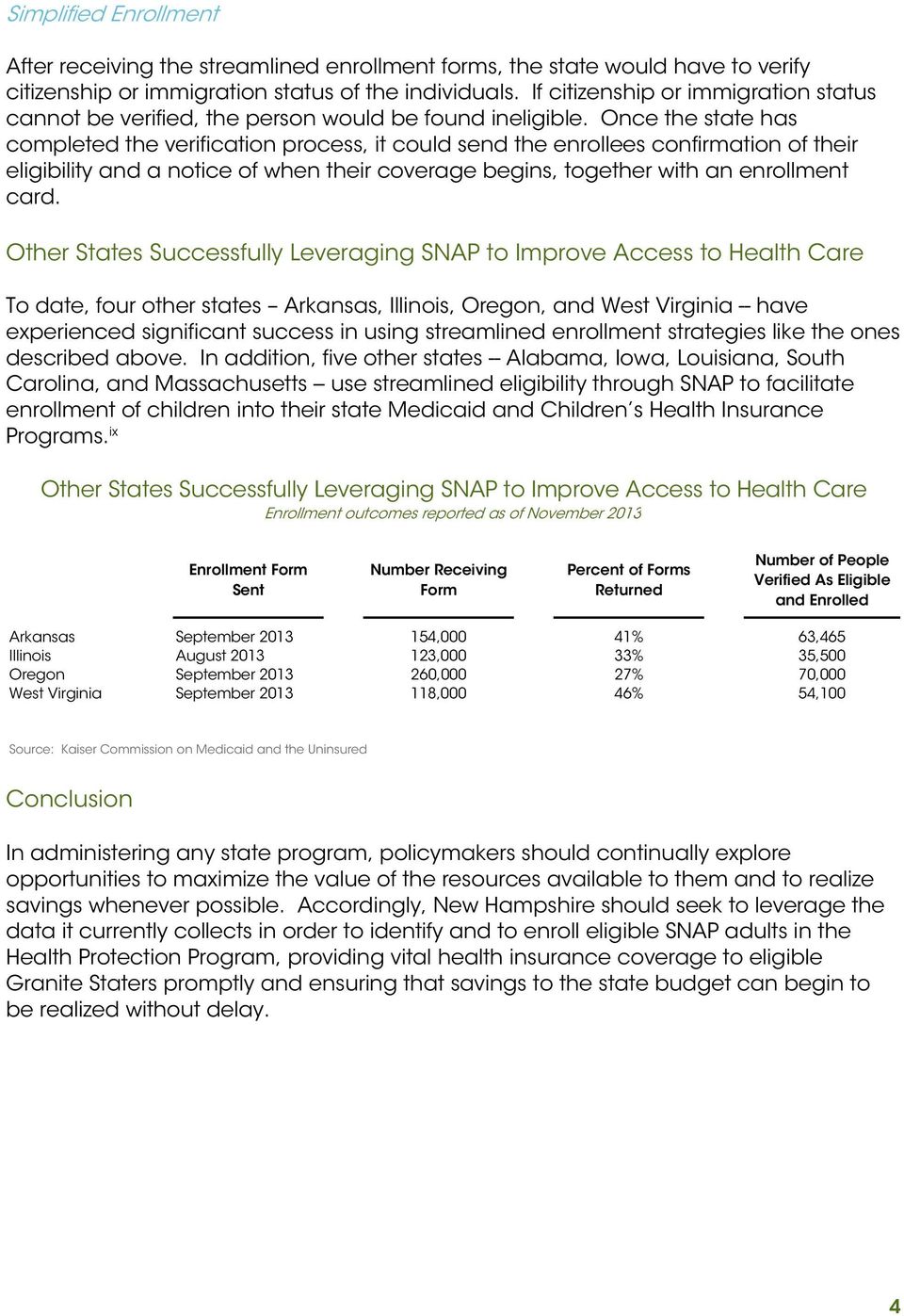
4 Simplified Enrollment After receiving the streamlined enrollment forms, the state would have to verify citizenship or immigration status of the individuals. If citizenship or immigration status cannot be verified, the person would be found ineligible. Once the state has completed the verification process, it could send the enrollees confirmation of their eligibility and a notice of when their coverage begins, together with an enrollment card. Other States Successfully Leveraging SNAP to Improve Access to Health Care To date, four other states Arkansas, Illinois, Oregon, and West Virginia -- have experienced significant success in using streamlined enrollment strategies like the ones described above. In addition, five other states -- Alabama, Iowa, Louisiana, South Carolina, and Massachusetts -- use streamlined eligibility through SNAP to facilitate enrollment of children into their state Medicaid and Children s Health Insurance Programs. ix Other States Successfully Leveraging SNAP to Improve Access to Health Care Enrollment outcomes reported as of November 2013 Enrollment Form Sent Number Receiving Form Percent of Forms Returned Number of People Verified As Eligible and Enrolled Arkansas September ,000 41% 63,465 Illinois August ,000 33% 35,500 Oregon September ,000 27% 70,000 West Virginia September ,000 46% 54,100 Source: Kaiser Commission on Medicaid and the Uninsured Conclusion In administering any state program, policymakers should continually explore opportunities to maximize the value of the resources available to them and to realize savings whenever possible. Accordingly, New Hampshire should seek to leverage the data it currently collects in order to identify and to enroll eligible SNAP adults in the Health Protection Program, providing vital health insurance coverage to eligible Granite Staters promptly and ensuring that savings to the state budget can begin to be realized without delay. 4
5 i Federal law provides that income eligibility for this coverage goes up to 133 percent of the federal poverty level (FPL). Additionally, there is a 5 percent income disregard that is subsequently applied, effectively bringing income eligibility up to 138 percent of FPL. ii A report issued in January 2012 by the Lewin Group estimated offsets to the state budget of roughly $12 million and $14 million in FY 2015 and FY 2016 respectively. Subsequent projections by the New Hampshire Department of Health and Human Services put those figures at $6.4 million and $4.2 million. iii iv The New Hampshire Health Protection Program provides affordable health insurance coverage to adults with incomes up to 138 percent of the federal poverty level, or $27,310 for a family of three. v These waivers do not require the public process associated with Section 1115 waivers and may be able to be granted in a matter of weeks. vi Adults who are not currently receiving New Hampshire Medicaid with incomes up to 135 percent of FPL would be targeted. vii Required by federal regulation 42 CFR viii This component of the Health Protection Program is called the Health Insurance Premium Payment (HIPP) program. ix 5
Pennsylvania s Medicaid program (Medical Assistance) has dozens of eligibility groups and programs, each with its own qualifying criteria.
 1 Pennsylvania s Medicaid program (Medical Assistance) has dozens of eligibility groups and programs, each with its own qualifying criteria. Non Financial Factors include: Age; Disability (temporary, permanent
How To Determine Income For Medicaid And Chip
 P O L I C Y B R I E F kaiser commission on medicaid and the uninsured EXPLAINING HEALTH REFORM The New Rules for Determining Income Under Medicaid in 2014 JUNE 2011 To provide individuals and families
Medicaid & CHIP: November Monthly Applications and Eligibility Determinations Report December 20, 2013
 DEPARTMENT OF HEALTH & HUMAN SERVICES Centers for Medicare & Medicaid Services 7500 Security Boulevard, Mail Stop S2-26-12 Baltimore, Maryland 21244-1850 Medicaid & CHIP: December 20, 2013 Background This
Medicaid & CHIP: December 2015 Monthly Applications, Eligibility Determinations and Enrollment Report February 29, 2016
 DEPARTMENT OF HEALTH AND HUMAN SERVICES Centers for Medicare & Medicaid Services 7500 Security Boulevard, Mail Stop S2-26-12 Baltimore, MD 21244-1850 Medicaid & CHIP: December 2015 Monthly Applications,
Medicaid & CHIP: May 2014 Monthly Applications, Eligibility Determinations and Enrollment Report July 11, 2014
 DEPARTMENT OF HEALTH & HUMAN SERVICES Centers for Medicare & Medicaid Services 7500 Security Boulevard, Mail Stop S2-26-12 Baltimore, Maryland 21244-1850 Medicaid & CHIP: May 2014 Monthly Applications,
State and Federal Policy Choices: How Human Services Programs and Their Clients Can Benefit from National Health Reform
 State and Federal Policy Choices: How Human Services Programs and Their Clients Can Benefit from National Health Reform Stan Dorn Senior Fellow, Urban Institute NGA Center for Best Practices January 9,
Health Coverage for the Hispanic Population Today and Under the Affordable Care Act
 on on medicaid and and the the uninsured Health Coverage for the Population Today and Under the Affordable Care Act April 2013 Over 50 million s currently live in the United States, comprising 17 percent
Office of Health Transformation Extend Medicaid Coverage and Automate Enrollment
 Office of Health Transformation Extend Medicaid Coverage and Automate Enrollment Background: Eligibility determination for health and human services programs in Ohio are fragmented, overly complex, and
Legal Authority: Social Security Act 1905(p)(1); 42 CFR 400.200; 42 CFR 435.406
 QUALIFIED MEDICARE BENEFICIARIES Legal Authority: Social Security Act 1905(p)(1); 42 CFR 400.200; 42 CFR 435.406 1. Overview The Medicare Catastrophic Coverage Act (MCCA) of 1988 established the Qualified
EXAMINING THE IMPACT OF THE PATIENT PROTECTION AND AFFORDABLE CARE ACT IN NORTH CAROLINA MEDICAID EXPANSION OPTION ISSUE BRIEF
 EXAMINING THE IMPACT OF THE PATIENT PROTECTION AND AFFORDABLE CARE ACT IN NORTH CAROLINA MEDICAID EXPANSION OPTION ISSUE BRIEF As originally passed, the Patient Protection and Affordable Care Act (ACA)
Department of Human Services Health Care Reform Review Committee Representative George Keiser, Chairman September 29, 2015
 Department of Human Services Health Care Reform Review Committee Representative George Keiser, Chairman September 29, 2015 Chairman Keiser, members of the Health Care Reform Review Committee, I am Stephanie
Medicaid Topics Impact of Medicare Dual Eligibles Stephen Wilhide, Consultant
 Medicaid Topics Impact of Medicare Dual Eligibles Stephen Wilhide, Consultant Issue Summary The term dual eligible refers to the almost 7.5 milion low-income older individuals or younger persons with disabilities
SENATE BUDGET AND APPROPRIATIONS COMMITTEE STATEMENT TO SENATE COMMITTEE SUBSTITUTE FOR. SENATE, No. 2236 STATE OF NEW JERSEY DATED: JUNE 23, 2005
 SENATE BUDGET AND APPROPRIATIONS COMMITTEE STATEMENT TO SENATE COMMITTEE SUBSTITUTE FOR SENATE, No. 2236 STATE OF NEW JERSEY DATED: JUNE 23, 2005 The Senate Budget and Appropriations Committee reports
State Data Collection and Reporting Requirements in the Affordable Care Act
 State Data Collection and Reporting Requirements in the Affordable Care Act The Affordable Care Act (ACA) and its amendments, including the Health Care and Education Reconciliation Act, set up multiple
Kentucky Children s Health Insurance Program FREE OR LOW COST HEALTH INSURANCE FOR CHILDREN
 Kentucky Children s Health Insurance Program FREE OR LOW COST HEALTH INSURANCE FOR CHILDREN What is KCHIP? FREE OR LOW COST HEALTH INSURANCE FOR CHILDREN Created in 1997 Has served approximately 270,000
The Health Insurance Premium Tax Credit. Topics. What is the Premium Tax Credit? 10/1/2014
 The Health Insurance Premium Tax Credit Kristy Maitre Tax Specialist Center for Agricultural Law and Taxation October 8, 2014 Topics Definitions Premium Tax Credit Basics Determining the amount of the
STATE OPTIONS REPORT
 United States Department of Agriculture Food and Nutrition Service Supplemental Nutrition Assistance Program STATE OPTIONS REPORT TENTH EDITION August 2012 Program Development Division INTRODUCTION Welcome
President Bush s Health Care Tax Deduction Proposal: Coverage, Cost and Distributional Impacts. John Sheils and Randy Haught
 www.lewin.com President Bush s Health Care Tax Deduction Proposal: Coverage, Cost and Distributional Impacts John Sheils and Randy Haught President Bush proposes to replace the existing tax exemption for
Massachusetts Health Care Training Forum (MTF
 ACA LEARNING SERIES Impact on Massachusetts & Implementation Activities to Date Massachusetts Health Care Training Forum (MTF) October 2012 A collaborative effort between the Executive Office of Health
Health Reform Across the States: Increased Insurance Coverage and Federal Spending on the Exchanges and Medicaid
 Health Reform Across the States: Increased Insurance Coverage and Federal Spending on the Exchanges and Medicaid Timely Analysis of Immediate Health Policy Issues March 2011 Matthew Buettgens, John Holahan
Need help with health care coverage?
 Need help with health care coverage? Even if you work or have private health insurance, you may be able to get help such as: Free health care Low-cost health care Help paying for your health insurance
MassHealth Eligibility Letter 131 May 1, 2005. Breast and Cervical Cancer, MassHealth Essential, and Non-countable Income
 Commonwealth of Massachusetts Executive Office of Health and Human Services Office of Medicaid 600 Washington Street Boston, MA 02111 www.mass.gov/masshealth MassHealth Eligibility Letter 131 May 1, 2005
National Training Program
 National Training Program Module 12 Medicaid and the Children s Health Insurance Program Session Objectives This session will help you Describe eligibility, benefits, and administration of Medicaid Define
Consider Savings as Well as Costs State Governments Would Spend at Least $90 Billion Less With the ACA than Without It from 2014 to 2019
 Consider Savings as Well as Costs State Governments Would Spend at Least $90 Billion Less With the ACA than Without It from 2014 to 2019 Timely Analysis of Immediate Health Policy Issues July 2011 Matthew
Currently, for the very low-income, Medicaid is available for children, parents, and individuals who are disabled, elderly, or pregnant.
 0 Currently, for the very low-income, Medicaid is available for children, parents, and individuals who are disabled, elderly, or pregnant. Parents are typically covered at very low income levels, and most
Medicare Buy-In Options for Uninsured Adults
 MEDICARE BUY-IN OPTIONS: ESTIMATING COVERAGE AND COSTS John Sheils and Ying-Jun Chen The Lewin Group, Inc. February 2001 Support for this research was provided by The Commonwealth Fund. The views presented
Division of Health Care Finance and Administration (HCFA), Bureau of TennCare
 Division of Health Care Finance and Administration (HCFA), Bureau of TennCare What is Hospital PE? How Can Hospitals Participate in Hospital PE? Who is Eligible to Enroll in Hospital PE? What Are the Benefits?
kaiser medicaid and the uninsured commission on The Cost and Coverage Implications of the ACA Medicaid Expansion: National and State-by-State Analysis
 kaiser commission on medicaid and the uninsured The Cost and Coverage Implications of the ACA Medicaid Expansion: National and State-by-State Analysis John Holahan, Matthew Buettgens, Caitlin Carroll,
Answering Questions about Your Family s Income When Applying for Health Insurance
 What You Need to Know about Health Insurance Applying for Health Insurance Answering Questions about Your Family s Income When Applying for Health Insurance About this fact sheet You may be able to get
Using Behavioral Economics to Inform the Integration of Human Services and Health Programs under the Affordable Care Act
 Using Behavioral Economics to Inform the Integration of Human Services and Health Programs under the Affordable Care Act Prepared by: Fredric Blavin, Stan Dorn, and Jay Dev The Urban Institute Under Task
How To Calculate The Cost Of A Health Insurance Tax Credit In Oregona
 Oregon Health Fund Board INITIAL ECONOMETRIC MODELING FOR THE OREGON HEALTH FUND BOARD Final Report February 2009 SUMMARY The Oregon Health Fund Board worked with consultants from the Massachusetts Institute
Medicaid Basics and Indiana Health Coverage Programs (IHCPs) Module #2 Training Resource for Indiana Navigators
 Medicaid Basics and Indiana Health Coverage Programs (IHCPs) Module #2 Training Resource for Indiana Navigators 2 Module #2 Objectives After reviewing this module, you will be able to: Assess whether someone
Medicaid and CHIP in 2014: A Seamless Path to Affordable Coverage. The New World of Modified Adjusted Gross Income (MAGI)
 Medicaid and CHIP in 2014: A Seamless Path to Affordable Coverage The New World of Modified Adjusted Gross Income (MAGI) Final Rule: Seamless and Affordable Coverage Expands access to affordable coverage
MCH Update 2002: State Health Coverage for Low-Income Pregnant Women, Children, and Parents
 Issue Brief Health Policy Studies Division Contact: Emily V. Cornell, 202/624-7879 or [email protected] June 9, 2003 MCH Update 2002: State Health Coverage for Low-Income Pregnant Women, Children, and Parents
Health Insurance Affordability Study
 Health Insurance Affordability Study Minnesota Department of Health January, 2009 Division of Health Policy Health Economics Program PO Box 64882 St. Paul, MN 55164-0882 (651) 201-3550 www.health.state.mn.us
The Insurance Mandates of the Affordable Care Act
 1 A. Affordable Care Act Individual Mandate The Insurance Mandates of the Affordable Care Act 1. All citizens of the United States are subject to the individual mandate as are all permanent residents and
Frequently Asked Questions State and Federal Coverage Expansion For Older Age Children May 18, 2010
 Ted Strickland, Governor Mary Jo Hudson, Director 50 West Town Street Third Floor Suite 300 Columbus, OH 43215-4186 (614) 644-2658 www.insurance.ohio.gov Frequently Asked Questions State and Federal Coverage
Summary of Federal SCHIP Reauthorization, Economic Stimulus, and Health Care Reform Bills and Proposals
 Summary of Federal SCHIP Reauthorization, Economic Stimulus, and Health Care Reform Bills and Proposals I. Children s Health Insurance Program (CHIP) Reauthorization Act of 2009 A. Funding for CHIP. The
CHAPTER 3 MEDICAID. Chapter 3: Medicaid 60
 CHAPTER 3 MEDICAID Many of the uninsured people who gain insurance coverage in 2014 will obtain their coverage through the state s Medicaid program. Beginning in 2014, the Affordable Care Act requires
MEDICAL MEDICAL MEDICAL MEDICAL MEDICAL MEDICAL MEDICAL MEDICAL MEDICAL ASSISTANCE OVERVIEW
 A-100 PURPOSE AND APPLICABILITY The Medical Assistance program manual incorporates eligibility policy for all medical assistance programs including family medical groups, children s groups, specialized
Helping Consumers Keep Affordable Health Coverage
 Helping Consumers Keep Affordable Health Coverage By Sophie Stern and Dayanne Leal Providing outreach and enrollment assistance is critical to maximizing the number of people who enroll in health coverage.
Health Coverage by Race and Ethnicity: The Potential Impact of the Affordable Care Act
 on on medicaid and and the the uninsured Health Coverage by Race and Ethnicity: The Potential Impact of the Affordable Care Act Executive Summary March 2013 One of the key goals of the Affordable Care
THE FISCAL YEAR 2015 BUDGET FOR MASSHEALTH AND HEALTH REFORM PROGRAMS
 THE FISCAL YEAR 2015 BUDGET FOR MASSHEALTH AND HEALTH REFORM PROGRAMS BUDGET BRIEF SEPTEMBER 2014 On July 10, 2014, Governor Deval Patrick signed the budget for fiscal year (FY) 2015, one week into the
Children s Health Coverage Under the ACA Part III: Issue Diagnosis Evolutionary Challenges
 Children s Health Coverage Under the ACA Part III: Issue Diagnosis Evolutionary Challenges Prepared by Carolina Coleman Funded by the Lucile Packard Foundation for Children s Health January 2014 This brief
Georgia s Ranking Among the States: Budget, Taxes, and Other Indicators
 THE CENTER FOR STATE AND LOCAL FINANCE JUNE 2015 Georgia s Ranking Among the States: Budget, Taxes, and Other Indicators IN COLLABORATION WITH ABOUT THE CENTER FOR STATE AND LOCAL FINANCE The (CSLF) mission
Agents are not tax specialists so they shouldn t give any tax advice to consumers. If consumers have complex tax questions, they should consult with
 1 Agents are not tax specialists so they shouldn t give any tax advice to consumers. If consumers have complex tax questions, they should consult with their accountants or a tax attorney. This course includes
The Uninsured Population in Texas:
 REPORT The Uninsured Population in Texas: July 2014 Understanding Coverage Needs and the Potential Impact of the Affordable Care Act Prepared by: Katherine Young and Rachel Garfield Kaiser Family Foundation
Center for Medicaid and State Operations SMDL #04-004 JULY 19, 2004. Dear State Medicaid Director:
 DEPARTMENT OF HEALTH & HUMAN SERVICES Centers for Medicare & Medicaid Services 7500 Security Boulevard, Mail Stop S2-26-12 Baltimore, Maryland 21244-1850 Center for Medicaid and State Operations SMDL #04-004
Chapter 4 REFUGEE MEDICAL ASSISTANCE (RMA) PROGRAM
 July 2011 Page 1 of 5 Chapter 4 REFUGEE MEDICAL ASSISTANCE (RMA) PROGRAM A. Program Purpose Refugee Medical Assistance (RMA) provides medical assistance to refugees who meet the Medicaid Program financial
Illinois Exchange Background Research and Needs Assessment Final Report and Findings. Governor s Reform Implementation Council October 14, 2011
 Illinois Exchange Background Research and Needs Assessment Final Report and Findings Governor s Reform Implementation Council October 14, 2011 Research & Assessment Illinois, using Federal grant money,
Program Design Snapshot: Paperless Income Verification
 Program Design Snapshot: Paperless Income Verification Description Medicaid and the Children s Health Insurance Programs (CHIP) collect information on families incomes in order to determine eligibility.
The Application for Benefits Eligibility (ABE) An Introduction for MPE Providers & All Kids Application Agents
 The Application for Benefits Eligibility (ABE) An Introduction for MPE Providers & All Kids Application Agents Illinois Department of Healthcare & Family Services Illinois Department of Human Services
Florida Senate - 2015 (PROPOSED BILL) SPB 7044
 FOR CONSIDERATION By the Committee on Health Policy 1 2 3 4 5 6 7 8 9 10 11 12 13 14 15 16 17 18 19 20 21 22 23 24 25 26 27 28 29 A bill to be entitled An act relating to a health insurance affordability
Public notice. No changes are proposed for the FAMIS Select program. Background -- FAMIS MOMS
 Public notice Virginia s Title XXI Child Health Insurance Plan (CHIP) covers children with family income from 143% to 200% federal poverty level (FPL) under a separate child health plan known as the Family
For the period: November 1 December 26, 2015. January 21, 2016
 ASPE RESEARCH BRIEF HEALTH INSURANCE MARKETPLACES 2016: AVERAGE PREMIUMS AFTER ADVANCE PREMIUM TAX CREDITS IN THE 38 STATES USING THE HEALTHCARE.GOV ELIGIBILITY AND ENROLLMENT PLATFORM For the period:
Residency Status Not Required Residency status is not a consideration for eligibility in WFH s Community Care Program.
 POLICY & PROCEDURE Subject: Patient Financial Assistance/Community Care Program Classification: Policy Owner: Illinois Regional CFO Approved Sr. VP, CFO Approved By: Regional CEO Effective: January 1,
Controls over Outsourcing of Food and Nutrition Service s Supplemental Nutrition Assistance Program Electronic Benefits Transfer Call Centers
 U.S. Department of Agriculture Office of Inspector General Controls over Outsourcing of Food and Nutrition Service s Supplemental Nutrition Assistance Program Electronic Benefits Transfer Call Centers
Express Lane Eligibility
 Express Lane Eligibility New Strategies for Increasing Enrollment June 2009 www.centerforbenefits.org What is Express Lane Eligibility? Having gained prominence recently as a result of its inclusion in
Understanding the Affordable Care Act: How MassHealth Will Count Income in 2014
 Understanding the Affordable Care Act: How MassHealth Will Count Income in 2014 March 2014 One aspect of the federal health reform law, the Affordable Care Act (ACA), that has not made the headlines, is
LOUISIANA CHILDREN S HEALTH INSURANCE PROGRAM
 DEPARTMENT OF HEALTH AND HOSPITALS LOUISIANA CHILDREN S HEALTH INSURANCE PROGRAM September 3, 2015 Contact: Louisiana Department of Health and Hospitals Diane Batts Bureau of Health Services Financing
Low Income Subsidy / Extra Help and Enrollment Assistance
 Low Income Subsidy / Extra Help and Enrollment Assistance Objectives After actively participating in this session, agents will: Identify the value of assisting LISeligible consumers. Identify features