
How To Calculate An Annuity
|
|
|
- Oswald Nash
- 5 years ago
- Views:
Transcription
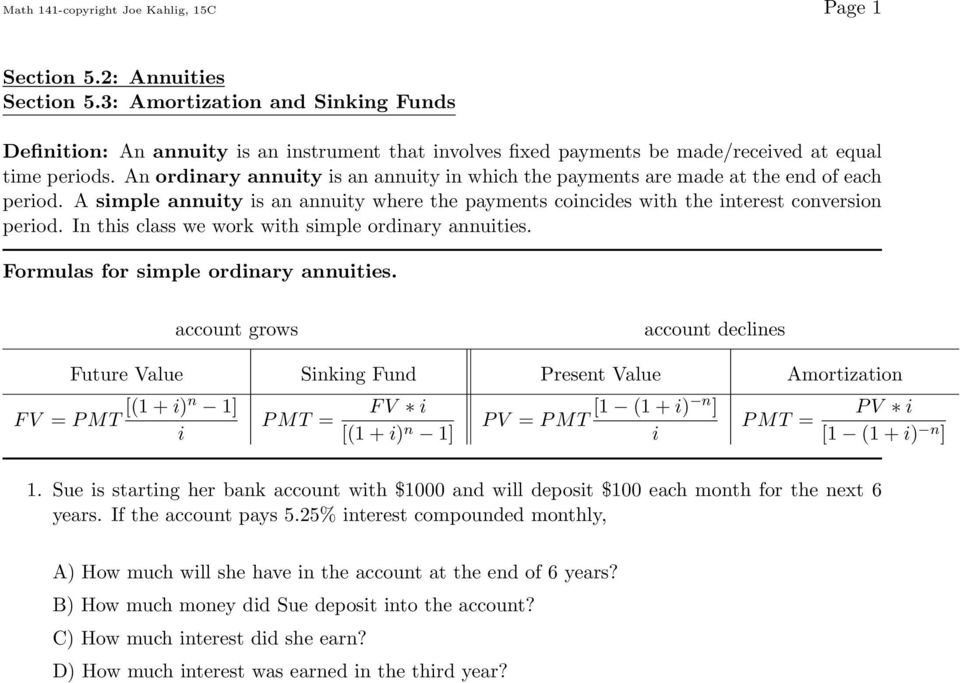
1 Math 141-copyright Joe Kahlig, 15C Page 1 Section 5.2: Annuities Section 5.3: Amortization and Sinking Funds Definition: An annuity is an instrument that involves fixed payments be made/received at equal time periods. An ordinary annuity is an annuity in which the payments are made at the end of each period. A simple annuity is an annuity where the payments coincides with the interest conversion period. In this class we work with simple ordinary annuities. Formulas for simple ordinary annuities. account grows account declines Future Value Sinking Fund Present Value Amortization F V = P MT [(1 + i)n 1] i P MT = F V i [(1 + i) n 1] P V = P MT [1 (1 + i) n ] i P MT = P V i [1 (1 + i) n ] 1. Sue is starting her bank account with $1000 and will deposit $100 each month for the next 6 years. If the account pays 5.25% interest compounded monthly, A) How much will she have in the account at the end of 6 years? B) How much money did Sue deposit into the account? C) How much interest did she earn? D) How much interest was earned in the third year?
2 Math 141-copyright Joe Kahlig, 15C Page 2 2. You have decided to set up a college fund for your kid. You have decided that $75,000 should be enough to get Jr most of the way through college. You decide to open the account when Jr is born and make monthly deposits every month for 18 years. The account pays interest at a rate of 4.9% compounded monthly. A) What is your monthly deposit that would reach your goal? B) What is the balance of the account after 10 years? C) How much money did you deposit into the account? D) How much interest did the account earn? 3. You have decided that you want to buy new Chevy Truck. It will cost $30,000. A) What monthly payments should you make, paying 4.5% interest compounded monthly, so that you can payoff the truck in 5 years? B) How much do you still owe after 25 payments? C) What payment would you have if there was a $9000 balloon payment at the end of the loan?

3 Math 141-copyright Joe Kahlig, 15C Page 3 4. After you retire, you would like to receive quarterly payments of $5,000 for the next 15 years. The account earns 8% compounded quarterly. A) What amount do you use to start the account? B) How much interest was earn during the lifetime of the account? 5. You just won $4 million in the lottery, but you choose the payment method instead of the cash option. This means that you will receive 20 payments of $200,000. How much should be deposited into an account paying 9% compounded annually, so that you can receive the your payments for the next 19 years?

4 Math 141-copyright Joe Kahlig, 15C Page 4 6. You want to buy a house. The house will cost $120,000. You put 5% down and then plan to pay off the house for the next 30 years with monthly payments. What payments should you make to pay off the loan if the interest rate is 7.5% compounded monthly? How much interest did you pay? 7. repeat the house loan for a 15 year loan. 8. Write an amortization schedule for the first 4 months for problem 6. amt. toward outstanding period interest owed payment principal principal How much equity would you have on the 30 year note after 5 years? after 10 years? Equity = value of the object - what you still owe

5 Math 141-copyright Joe Kahlig, 15C Page You had made payments on the 30 year mortgage for 7 years and then decide to refinance the loan for 15 years at 5.35%. A) What would be the new house payment? B) How much money would you save, not counting refinancing costs, by refinancing the loan? 11. Your credit card has a balance of $2000 and the interest rate is 19.5% compounded monthly. If you only make the minimum monthly payment of $35 per month, how many years will it take to pay off the balance? How much interest did you pay? Assume that you are not making any more charges on the card.

6 Math 141-copyright Joe Kahlig, 15C Page You start an account with $1000 and then withdraw $40 at the end of every month. The account earns interest at a rate of 6% per year compounded monthly. A) What is the ballance at the end of 1 year? B) How many full withdrawls of $40 are possible from this account? 13. The local store has a flat screen tv for sale on a payment plan. The terms of the sale are that you make a $300 down payment and then make payments of $70 each month for 4 years at which time the tv will be paid off. Assume that the rate for the account is 8.4% per year compounded monthly. What was the purchase price of the tv?

Week in Review #10. Section 5.2 and 5.3: Annuities, Sinking Funds, and Amortization
 WIR Math 141-copyright Joe Kahlig, 10B Page 1 Week in Review #10 Section 5.2 and 5.3: Annuities, Sinking Funds, and Amortization an annuity is a sequence of payments made at a regular time intervals. For
Chapter F: Finance. Section F.1-F.4
 Chapter F: Finance Section F.1-F.4 F.1 Simple Interest Suppose a sum of money P, called the principal or present value, is invested for t years at an annual simple interest rate of r, where r is given
Chapter 22: Borrowings Models
 October 21, 2013 Last Time The Consumer Price Index Real Growth The Consumer Price index The official measure of inflation is the Consumer Price Index (CPI) which is the determined by the Bureau of Labor
2 The Mathematics. of Finance. Copyright Cengage Learning. All rights reserved.
 2 The Mathematics of Finance Copyright Cengage Learning. All rights reserved. 2.3 Annuities, Loans, and Bonds Copyright Cengage Learning. All rights reserved. Annuities, Loans, and Bonds A typical defined-contribution
Example. L.N. Stout () Problems on annuities 1 / 14
 Example A credit card charges an annual rate of 14% compounded monthly. This month s bill is $6000. The minimum payment is $5. Suppose I keep paying $5 each month. How long will it take to pay off the
Chapter 5 Time Value of Money 2: Analyzing Annuity Cash Flows
 1. Future Value of Multiple Cash Flows 2. Future Value of an Annuity 3. Present Value of an Annuity 4. Perpetuities 5. Other Compounding Periods 6. Effective Annual Rates (EAR) 7. Amortized Loans Chapter
Time Value of Money. Background
 Time Value of Money (Text reference: Chapter 4) Topics Background One period case - single cash flow Multi-period case - single cash flow Multi-period case - compounding periods Multi-period case - multiple
Compound Interest Formula
 Mathematics of Finance Interest is the rental fee charged by a lender to a business or individual for the use of money. charged is determined by Principle, rate and time Interest Formula I = Prt $100 At
Chapter 6 Contents. Principles Used in Chapter 6 Principle 1: Money Has a Time Value.
 Chapter 6 The Time Value of Money: Annuities and Other Topics Chapter 6 Contents Learning Objectives 1. Distinguish between an ordinary annuity and an annuity due, and calculate present and future values
FIN 3000. Chapter 6. Annuities. Liuren Wu
 FIN 3000 Chapter 6 Annuities Liuren Wu Overview 1. Annuities 2. Perpetuities 3. Complex Cash Flow Streams Learning objectives 1. Distinguish between an ordinary annuity and an annuity due, and calculate
A = P (1 + r / n) n t
 Finance Formulas for College Algebra (LCU - Fall 2013) ---------------------------------------------------------------------------------------------------------------------------------- Formula 1: Amount
Annuities and Sinking Funds
 Annuities and Sinking Funds Sinking Fund A sinking fund is an account earning compound interest into which you make periodic deposits. Suppose that the account has an annual interest rate of compounded
Section 5.1 - Compound Interest
 Section 5.1 - Compound Interest Simple Interest Formulas If I denotes the interest on a principal P (in dollars) at an interest rate of r (as a decimal) per year for t years, then we have: Interest: Accumulated
E INV 1 AM 11 Name: INTEREST. There are two types of Interest : and. The formula is. I is. P is. r is. t is
 E INV 1 AM 11 Name: INTEREST There are two types of Interest : and. SIMPLE INTEREST The formula is I is P is r is t is NOTE: For 8% use r =, for 12% use r =, for 2.5% use r = NOTE: For 6 months use t =
Chapter 6. Learning Objectives Principles Used in This Chapter 1. Annuities 2. Perpetuities 3. Complex Cash Flow Streams
 Chapter 6 Learning Objectives Principles Used in This Chapter 1. Annuities 2. Perpetuities 3. Complex Cash Flow Streams 1. Distinguish between an ordinary annuity and an annuity due, and calculate present
1. If you wish to accumulate $140,000 in 13 years, how much must you deposit today in an account that pays an annual interest rate of 14%?
 Chapter 2 - Sample Problems 1. If you wish to accumulate $140,000 in 13 years, how much must you deposit today in an account that pays an annual interest rate of 14%? 2. What will $247,000 grow to be in
Loans Practice. Math 107 Worksheet #23
 Math 107 Worksheet #23 Loans Practice M P r ( 1 + r) n ( 1 + r) n =, M = the monthly payment; P = the original loan amount; r = the monthly interest rate; n = number of payments 1 For each of the following,
Applications of Geometric Se to Financ Content Course 4.3 & 4.4
 pplications of Geometric Se to Financ Content Course 4.3 & 4.4 Name: School: pplications of Geometric Series to Finance Question 1 ER before DIRT Using one of the brochures for NTM State Savings products,
How To Calculate A Pension
 Interests on Transactions Chapter 10 13 PV & FV of Annuities PV & FV of Annuities An annuity is a series of equal regular payment amounts made for a fixed number of periods 2 Problem An engineer deposits
Discounted Cash Flow Valuation
 6 Formulas Discounted Cash Flow Valuation McGraw-Hill/Irwin Copyright 2008 by The McGraw-Hill Companies, Inc. All rights reserved. Chapter Outline Future and Present Values of Multiple Cash Flows Valuing
Index Numbers ja Consumer Price Index
 1 Excel and Mathematics of Finance Index Numbers ja Consumer Price Index The consumer Price index measures differences in the price of goods and services and calculates a change for a fixed basket of goods
Warm-up: Compound vs. Annuity!
 Warm-up: Compound vs. Annuity! 1) How much will you have after 5 years if you deposit $500 twice a year into an account yielding 3% compounded semiannually? 2) How much money is in the bank after 3 years
Mathematics. Rosella Castellano. Rome, University of Tor Vergata
 and Loans Mathematics Rome, University of Tor Vergata and Loans Future Value for Simple Interest Present Value for Simple Interest You deposit E. 1,000, called the principal or present value, into a savings
Finite Mathematics. CHAPTER 6 Finance. Helene Payne. 6.1. Interest. savings account. bond. mortgage loan. auto loan
 Finite Mathematics Helene Payne CHAPTER 6 Finance 6.1. Interest savings account bond mortgage loan auto loan Lender Borrower Interest: Fee charged by the lender to the borrower. Principal or Present Value:
Assist. Financial Calculators. Technology Solutions. About Our Financial Calculators. Benefits of Financial Calculators. Getting Answers.
 Assist. Financial s Technology Solutions. About Our Financial s. Helping members with their financial planning should be a key function of every credit union s website. At Technology Solutions, we provide
Practice Problems. Use the following information extracted from present and future value tables to answer question 1 to 4.
 PROBLEM 1 MULTIPLE CHOICE Practice Problems Use the following information extracted from present and future value tables to answer question 1 to 4. Type of Table Number of Periods Interest Rate Factor
SOCIETY OF ACTUARIES FINANCIAL MATHEMATICS. EXAM FM SAMPLE QUESTIONS Interest Theory
 SOCIETY OF ACTUARIES EXAM FM FINANCIAL MATHEMATICS EXAM FM SAMPLE QUESTIONS Interest Theory This page indicates changes made to Study Note FM-09-05. January 14, 2014: Questions and solutions 58 60 were
Math 1332 Test 5 Review
 Name Find the simple interest. The rate is an annual rate unless otherwise noted. Assume 365 days in a year and 30 days per month. 1) $1660 at 6% for 4 months Find the future value of the deposit if the
Discounted Cash Flow Valuation
 BUAD 100x Foundations of Finance Discounted Cash Flow Valuation September 28, 2009 Review Introduction to corporate finance What is corporate finance? What is a corporation? What decision do managers make?
TIME VALUE OF MONEY (TVM)
 TIME VALUE OF MONEY (TVM) INTEREST Rate of Return When we know the Present Value (amount today), Future Value (amount to which the investment will grow), and Number of Periods, we can calculate the rate
Discounted Cash Flow Valuation
 Discounted Cash Flow Valuation Chapter 5 Key Concepts and Skills Be able to compute the future value of multiple cash flows Be able to compute the present value of multiple cash flows Be able to compute
DISCOUNTED CASH FLOW VALUATION and MULTIPLE CASH FLOWS
 Chapter 5 DISCOUNTED CASH FLOW VALUATION and MULTIPLE CASH FLOWS The basic PV and FV techniques can be extended to handle any number of cash flows. PV with multiple cash flows: Suppose you need $500 one
Chapter The Time Value of Money
 Chapter The Time Value of Money PPT 9-2 Chapter 9 - Outline Time Value of Money Future Value and Present Value Annuities Time-Value-of-Money Formulas Adjusting for Non-Annual Compounding Compound Interest
1. Annuity a sequence of payments, each made at equally spaced time intervals.
 Ordinary Annuities (Young: 6.2) In this Lecture: 1. More Terminology 2. Future Value of an Ordinary Annuity 3. The Ordinary Annuity Formula (Optional) 4. Present Value of an Ordinary Annuity More Terminology
The Time Value of Money C H A P T E R N I N E
 The Time Value of Money C H A P T E R N I N E Figure 9-1 Relationship of present value and future value PPT 9-1 $1,000 present value $ 10% interest $1,464.10 future value 0 1 2 3 4 Number of periods Figure
CHAPTER 5 INTRODUCTION TO VALUATION: THE TIME VALUE OF MONEY
 CHAPTER 5 INTRODUCTION TO VALUATION: THE TIME VALUE OF MONEY 1. The simple interest per year is: $5,000.08 = $400 So after 10 years you will have: $400 10 = $4,000 in interest. The total balance will be
Finding the Payment $20,000 = C[1 1 / 1.0066667 48 ] /.0066667 C = $488.26
![Finding the Payment $20,000 = C[1 1 / 1.0066667 48 ] /.0066667 C = $488.26](/thumbs/17/134163.jpg "Finding the Payment $20,000 = C[1 1 / 1.0066667 48 ] /.0066667 C = $488.26") Quick Quiz: Part 2 You know the payment amount for a loan and you want to know how much was borrowed. Do you compute a present value or a future value? You want to receive $5,000 per month in retirement.
Quick Quiz: Part 2 You know the payment amount for a loan and you want to know how much was borrowed. Do you compute a present value or a future value? You want to receive $5,000 per month in retirement.
Annuities and loan. repayments. In this chapter. syllabusreference. Financial mathematics 5 Annuities and loan. repayments
 Annuities and loan repayments 8 syllabusreference Financial mathematics 5 Annuities and loan repayments In this chapter 8A 8B 8C 8D Future value of an annuity Present value of an annuity Future and present
Click Here to Buy the Tutorial
 FIN 534 Week 4 Quiz 3 (Str) Click Here to Buy the Tutorial http://www.tutorialoutlet.com/fin-534/fin-534-week-4-quiz-3- str/ For more course tutorials visit www.tutorialoutlet.com Which of the following
Check off these skills when you feel that you have mastered them.
 Chapter Objectives Check off these skills when you feel that you have mastered them. Know the basic loan terms principal and interest. Be able to solve the simple interest formula to find the amount of
McGraw-Hill/Irwin Copyright 2011 by the McGraw-Hill Companies, Inc. All rights reserved.
 Chapter 13 Annuities and Sinking Funds McGraw-Hill/Irwin Copyright 2011 by the McGraw-Hill Companies, Inc. All rights reserved. #13 LU13.1 Annuities and Sinking Funds Learning Unit Objectives Annuities:
Appendix. Time Value of Money. Financial Accounting, IFRS Edition Weygandt Kimmel Kieso. Appendix C- 1
 C Time Value of Money C- 1 Financial Accounting, IFRS Edition Weygandt Kimmel Kieso C- 2 Study Objectives 1. Distinguish between simple and compound interest. 2. Solve for future value of a single amount.
Exercise 1 for Time Value of Money
 Exercise 1 for Time Value of Money MULTIPLE CHOICE 1. Which of the following statements is CORRECT? a. A time line is not meaningful unless all cash flows occur annually. b. Time lines are useful for visualizing
300 Chapter 5 Finance
 300 Chapter 5 Finance 17. House Mortgage A couple wish to purchase a house for $200,000 with a down payment of $40,000. They can amortize the balance either at 8% for 20 years or at 9% for 25 years. Which
Interest Rates: Loans, Credit Cards, and Annuties. Interest Rates: Loans, Credit Cards, and Annuties 1/43
 Interest Rates: Loans, Credit Cards, and Annuties Interest Rates: Loans, Credit Cards, and Annuties 1/43 Last Time Last time we discussed compound interest and saw that money can grow very large given
Dick Schwanke Finite Math 111 Harford Community College Fall 2013
 Annuities and Amortization Finite Mathematics 111 Dick Schwanke Session #3 1 In the Previous Two Sessions Calculating Simple Interest Finding the Amount Owed Computing Discounted Loans Quick Review of
CHAPTER 5. Interest Rates. Chapter Synopsis
 CHAPTER 5 Interest Rates Chapter Synopsis 5.1 Interest Rate Quotes and Adjustments Interest rates can compound more than once per year, such as monthly or semiannually. An annual percentage rate (APR)
CHAPTER 6. Accounting and the Time Value of Money. 2. Use of tables. 13, 14 8 1. a. Unknown future amount. 7, 19 1, 5, 13 2, 3, 4, 6
 CHAPTER 6 Accounting and the Time Value of Money ASSIGNMENT CLASSIFICATION TABLE (BY TOPIC) Topics Questions Brief Exercises Exercises Problems 1. Present value concepts. 1, 2, 3, 4, 5, 9, 17, 19 2. Use
T12-1 REVIEW EXERCISES CHAPTER 12 SECTION I
 T12-1 REVIEW EXERCISES CHAPTER 12 SECTION I Use Table 12-1 to calculate the future value of the following ordinary annuities: Annuity Payment Time Nominal Interest Future Value Payment Frequency Period
Six Functions of a Dollar. Made Easy! Business Statistics AJ Nelson 8/27/2011 1
 Six Functions of a Dollar Made Easy! Business Statistics AJ Nelson 8/27/2011 1 Six Functions of a Dollar Here's a list. Simple Interest Future Value using Compound Interest Present Value Future Value of
Chapter 4. The Time Value of Money
 Chapter 4 The Time Value of Money 1 Learning Outcomes Chapter 4 Identify various types of cash flow patterns Compute the future value and the present value of different cash flow streams Compute the return
4 Annuities and Loans
 4 Annuities and Loans 4.1 Introduction In previous section, we discussed different methods for crediting interest, and we claimed that compound interest is the correct way to credit interest. This section
Finance. Simple Interest Formula: I = P rt where I is the interest, P is the principal, r is the rate, and t is the time in years.
 MAT 142 College Mathematics Finance Module #FM Terri L. Miller & Elizabeth E. K. Jones revised December 16, 2010 1. Simple Interest Interest is the money earned profit) on a savings account or investment.
https://assessment.casa.uh.edu/assessment/printtest.htm PRINTABLE VERSION Quiz 4
 1 of 6 2/21/2013 8:18 AM PRINTABLE VERSION Quiz 4 Question 1 Luke invested $130 at 4% simple interest for a period of 7 years. How much will his investment be worth after 7 years? a) $169.40 b) $166.40
Chapter 3 Mathematics of Finance
 Chapter 3 Mathematics of Finance Section 3 Future Value of an Annuity; Sinking Funds Learning Objectives for Section 3.3 Future Value of an Annuity; Sinking Funds The student will be able to compute the
DISCLAIMER: Copyright: 2013
 DISCLAIMER: This publication is intended for EDUCATIONAL purposes only. The information contained herein is subject to change with no notice, and while a great deal of care has been taken to provide accurate
F V P V = F V = P (1 + r) n. n 1. FV n = C (1 + r) i. i=0. = C 1 r. (1 + r) n 1 ]
![F V P V = F V = P (1 + r) n. n 1. FV n = C (1 + r) i. i=0. = C 1 r. (1 + r) n 1 ]](/thumbs/25/5828485.jpg "F V P V = F V = P (1 + r) n. n 1. FV n = C (1 + r) i. i=0. = C 1 r. (1 + r) n 1 ]") 1 Week 2 1.1 Recap Week 1 P V = F V (1 + r) n F V = P (1 + r) n 1.2 FV of Annuity: oncept 1.2.1 Multiple Payments: Annuities Multiple payments over time. A special case of multiple payments: annuities
1 Week 2 1.1 Recap Week 1 P V = F V (1 + r) n F V = P (1 + r) n 1.2 FV of Annuity: oncept 1.2.1 Multiple Payments: Annuities Multiple payments over time. A special case of multiple payments: annuities
C:\Documents and Settings\tracey_hbutters\Desktop\mathematics\year_levels\math_stage6\General\hsc\financial_maths\financial5\annuities_loan_repa
 Annuities and Loan Repayments H General Maths HSC NAME: 1 HSC CAPACITY MATRIX GENERAL MATHEMATICS TOPIC: Financial Mathematics 5 Annuities & loan repayments 3 weeks AM1 rn1 CONTENT CAPACITY BREAKDOWN!
GLENCOE CORRELATION MATHEMATICS WITH BUSINESS APPLICATIONS NEW YORK Math & Financial Applications
 GLENCOE CORRELATION MATHEMATICS WITH NEW YORK COURSE OUTLINE I. PAYROLL A. Terminology and Procedures SE: 92-107, 128-129, 427-428, 634-636, 788-791 B. Compensation Plans: Salary, Hourly, Piecework, Commission,
Chapter 10 Expectations. NOTE: Whenever you see the word communicate, it is implied that it means to communicate both verbally and in writing!
 Chapter 10 Expectations NOTE: Whenever you see the word communicate, it is implied that it means to communicate both verbally and in writing! Section 1: Expectations for Interest 1. Communicate to your
Time Value of Money. 15.511 Corporate Accounting Summer 2004. Professor S. P. Kothari Sloan School of Management Massachusetts Institute of Technology
 Time Value of Money 15.511 Corporate Accounting Summer 2004 Professor S. P. Kothari Sloan School of Management Massachusetts Institute of Technology July 2, 2004 1 LIABILITIES: Current Liabilities Obligations
This is Time Value of Money: Multiple Flows, chapter 7 from the book Finance for Managers (index.html) (v. 0.1).
 This is Time Value of Money: Multiple Flows, chapter 7 from the book Finance for Managers (index.html) (v. 0.1). This book is licensed under a Creative Commons by-nc-sa 3.0 (http://creativecommons.org/licenses/by-nc-sa/
Module 5: Interest concepts of future and present value
 Page 1 of 23 Module 5: Interest concepts of future and present value Overview In this module, you learn about the fundamental concepts of interest and present and future values, as well as ordinary annuities
Appendix C- 1. Time Value of Money. Appendix C- 2. Financial Accounting, Fifth Edition
 C- 1 Time Value of Money C- 2 Financial Accounting, Fifth Edition Study Objectives 1. Distinguish between simple and compound interest. 2. Solve for future value of a single amount. 3. Solve for future
CHAPTER 6 DISCOUNTED CASH FLOW VALUATION
 CHAPTER 6 DISCOUNTED CASH FLOW VALUATION Answers to Concepts Review and Critical Thinking Questions 1. The four pieces are the present value (PV), the periodic cash flow (C), the discount rate (r), and
Solutions to Time value of money practice problems
 Solutions to Time value of money practice problems Prepared by Pamela Peterson Drake 1. What is the balance in an account at the end of 10 years if $2,500 is deposited today and the account earns 4% interest,
SHORT ANSWER. Write the word or phrase that best completes each statement or answers the question.
 Ch. 5 Mathematics of Finance 5.1 Compound Interest SHORT ANSWER. Write the word or phrase that best completes each statement or answers the question. Provide an appropriate response. 1) What is the effective
Section 4.2 (Future Value of Annuities)
 Math 34: Fall 2014 Section 4.2 (Future Value of Annuities) At the end of each year Bethany deposits $2, 000 into an investment account that earns 5% interest compounded annually. How much is in her account
Problem Set: Annuities and Perpetuities (Solutions Below)
 Problem Set: Annuities and Perpetuities (Solutions Below) 1. If you plan to save $300 annually for 10 years and the discount rate is 15%, what is the future value? 2. If you want to buy a boat in 6 years
MAT116 Project 2 Chapters 8 & 9
 MAT116 Project 2 Chapters 8 & 9 1 8-1: The Project In Project 1 we made a loan workout decision based only on data from three banks that had merged into one. We did not consider issues like: What was the
Future Value of an Annuity Sinking Fund. MATH 1003 Calculus and Linear Algebra (Lecture 3)
 MATH 1003 Calculus and Linear Algebra (Lecture 3) Future Value of an Annuity Definition An annuity is a sequence of equal periodic payments. We call it an ordinary annuity if the payments are made at the
HOW TO CALCULATE PRESENT VALUES
 Chapter 2 HOW TO CALCULATE PRESENT VALUES Brealey, Myers, and Allen Principles of Corporate Finance 11th Edition McGraw-Hill/Irwin Copyright 2014 by The McGraw-Hill Companies, Inc. All rights reserved.
Key Concepts and Skills. Multiple Cash Flows Future Value Example 6.1. Chapter Outline. Multiple Cash Flows Example 2 Continued
 6 Calculators Discounted Cash Flow Valuation Key Concepts and Skills Be able to compute the future value of multiple cash flows Be able to compute the present value of multiple cash flows Be able to compute
Module 1: Corporate Finance and the Role of Venture Capital Financing TABLE OF CONTENTS
 1.0 ALTERNATIVE SOURCES OF FINANCE Module 1: Corporate Finance and the Role of Venture Capital Financing Alternative Sources of Finance TABLE OF CONTENTS 1.1 Short-Term Debt (Short-Term Loans, Line of
Chapter 2 Finance Matters
 Chapter 2 Finance Matters Chapter 2 Finance Matters 2.1 Pe r c e n t s 2.2 Simple and Compound Interest 2.3 Credit Cards 2.4 Annuities and Loans Chapter Summary Chapter Review Chapter Test Handling personal
Review for Exam 1. Instructions: Please read carefully
 Review for Exam 1 Instructions: Please read carefully The exam will have 20 multiple choice questions and 4 work problems. Questions in the multiple choice section will be either concept or calculation
Finance 331 Corporate Financial Management Week 1 Week 3 Note: For formulas, a Texas Instruments BAII Plus calculator was used.
 Chapter 1 Finance 331 What is finance? - Finance has to do with decisions about money and/or cash flows. These decisions have to do with money being raised or used. General parts of finance include: -
FI 302, Business Finance Exam 2, Fall 2000 versions 1 & 8 KEYKEYKEYKEYKEYKEYKEYKEYKEYKEYKEYKEYKEY
 FI 302, Business Finance Exam 2, Fall 2000 versions 1 & 8 KEYKEYKEYKEYKEYKEYKEYKEYKEYKEYKEYKEYKEY 1. (3 points) BS16 What is a 401k plan Most U.S. households single largest lifetime source of savings is
1. % of workers age 55 and up have saved less than $50,000 for retirement (not including the value of a primary residence).
 Toward Quantitative Literacy: Interesting Problems in Finance 2008 AMATYC Conference, Washington, D.C., Saturday, November 22, 2008 http://www.delta.edu/jaham Fill in the blanks. 1. % of workers age 55
Managing Home Equity to Build Wealth By Ray Meadows CPA, CFA, MBA
 Managing Home Equity to Build Wealth By Ray Meadows CPA, CFA, MBA About the Author Ray Meadows is the president of Berkeley Investment Advisors, a real estate brokerage and investment advisory firm. He
Section 8.1. I. Percent per hundred
 1 Section 8.1 I. Percent per hundred a. Fractions to Percents: 1. Write the fraction as an improper fraction 2. Divide the numerator by the denominator 3. Multiply by 100 (Move the decimal two times Right)
CHAPTER 1. Compound Interest
 CHAPTER 1 Compound Interest 1. Compound Interest The simplest example of interest is a loan agreement two children might make: I will lend you a dollar, but every day you keep it, you owe me one more penny.
Annuities Due, Deferred Annuities, Perpetuities and Calculus: First Principles
 Math 134 Tutorial 8 Annuities Due, Deferred Annuities, Perpetuities and Calculus: First Principles An annuity due has payments at the beginning of each payment period, so interest accumulates for one extra
REVIEW MATERIALS FOR REAL ESTATE ANALYSIS
 REVIEW MATERIALS FOR REAL ESTATE ANALYSIS 1997, Roy T. Black REAE 5311, Fall 2005 University of Texas at Arlington J. Andrew Hansz, Ph.D., CFA CONTENTS ITEM ANNUAL COMPOUND INTEREST TABLES AT 10% MATERIALS
FIN 5413: Chapter 03 - Mortgage Loan Foundations: The Time Value of Money Page 1
 FIN 5413: Chapter 03 - Mortgage Loan Foundations: The Time Value of Money Page 1 Solutions to Problems - Chapter 3 Mortgage Loan Foundations: The Time Value of Money Problem 3-1 a) Future Value = FV(n,i,PV,PMT)
Engineering Economy. Time Value of Money-3
 Engineering Economy Time Value of Money-3 Prof. Kwang-Kyu Seo 1 Chapter 2 Time Value of Money Interest: The Cost of Money Economic Equivalence Interest Formulas Single Cash Flows Equal-Payment Series Dealing
hp calculators HP 20b Time value of money basics The time value of money The time value of money application Special settings
 The time value of money The time value of money application Special settings Clearing the time value of money registers Begin / End mode Periods per year Cash flow diagrams and sign conventions Practice
Time Value of Money. Work book Section I True, False type questions. State whether the following statements are true (T) or False (F)
 Time Value of Money Work book Section I True, False type questions State whether the following statements are true (T) or False (F) 1.1 Money has time value because you forgo something certain today for
CHAPTER 5 INTRODUCTION TO VALUATION: THE TIME VALUE OF MONEY
 CHAPTER 5 INTRODUCTION TO VALUATION: THE TIME VALUE OF MONEY Answers to Concepts Review and Critical Thinking Questions 1. The four parts are the present value (PV), the future value (FV), the discount
Chapter 21: Savings Models
 October 16, 2013 Last time Arithmetic Growth Simple Interest Geometric Growth Compound Interest A limit to Compounding Problems Question: I put $1,000 dollars in a savings account with 2% nominal interest
Chapter 3 Equivalence A Factor Approach
 Chapter 3 Equivalence A Factor Approach 3-1 If you had $1,000 now and invested it at 6%, how much would it be worth 12 years from now? F = 1,000(F/P, 6%, 12) = $2,012.00 3-2 Mr. Ray deposited $200,000
6.15.1.7 Describe and use the steps involved in the banking reconciliation process
 ND BUSINESS EDUCATION FRAMEWORKS Financial Literacy Course Code Course Name/Course Description Grade Levels Accreditation Time/Credit Options 14095 Financial Literacy is designed to help students understand
Math 120 Basic finance percent problems from prior courses (amount = % X base)
 Math 120 Basic finance percent problems from prior courses (amount = % X base) 1) Given a sales tax rate of 8%, a) find the tax on an item priced at $250, b) find the total amount due (which includes both
Finance CHAPTER OUTLINE. 5.1 Interest 5.2 Compound Interest 5.3 Annuities; Sinking Funds 5.4 Present Value of an Annuity; Amortization
 CHAPTER 5 Finance OUTLINE Even though you re in college now, at some time, probably not too far in the future, you will be thinking of buying a house. And, unless you ve won the lottery, you will need
Matt 109 Business Mathematics Notes. Spring 2013
 1 To be used with: Title: Business Math (Without MyMathLab) Edition: 8 th Author: Cleaves and Hobbs Publisher: Pearson/Prentice Hall Copyright: 2009 ISBN #: 978-0-13-513687-4 Matt 109 Business Mathematics
The Interest Rate: A loan, expressed as a percentage of the amount loaned per year.
 Interest Rates Time Value of Money The Interest Rate Simple Interest Amortizing a Loan The Interest Rate: A loan, expressed as a percentage of the amount loaned per year. Interest rate is the "price" of
Ch. Ch. 5 Discounted Cash Flows & Valuation In Chapter 5,
 Ch. 5 Discounted Cash Flows & Valuation In Chapter 5, we found the PV & FV of single cash flows--either payments or receipts. In this chapter, we will do the same for multiple cash flows. 2 Multiple Cash
8.1 Simple Interest and 8.2 Compound Interest
 8.1 Simple Interest and 8.2 Compound Interest When you open a bank account or invest money in a bank or financial institution the bank/financial institution pays you interest for the use of your money.
TIME VALUE OF MONEY. Return of vs. Return on Investment: We EXPECT to get more than we invest!
 TIME VALUE OF MONEY Return of vs. Return on Investment: We EXPECT to get more than we invest! Invest $1,000 it becomes $1,050 $1,000 return of $50 return on Factors to consider when assessing Return on