
Thesis & Dissertation Handbook
|
|
|
- Shanna Reed
- 10 years ago
- Views:
Transcription
1 International Graduate School of Ministry A School Designed by Pastors for Pastors and Ministry Leaders Thesis & Dissertation Handbook Creating a learning environment that meets the needs of 21 st century leaders
2 Thesis and Dissertation Handbook Rev 1/21/02 winword\igsm\publications\thesis & dissertation handbook Page 2

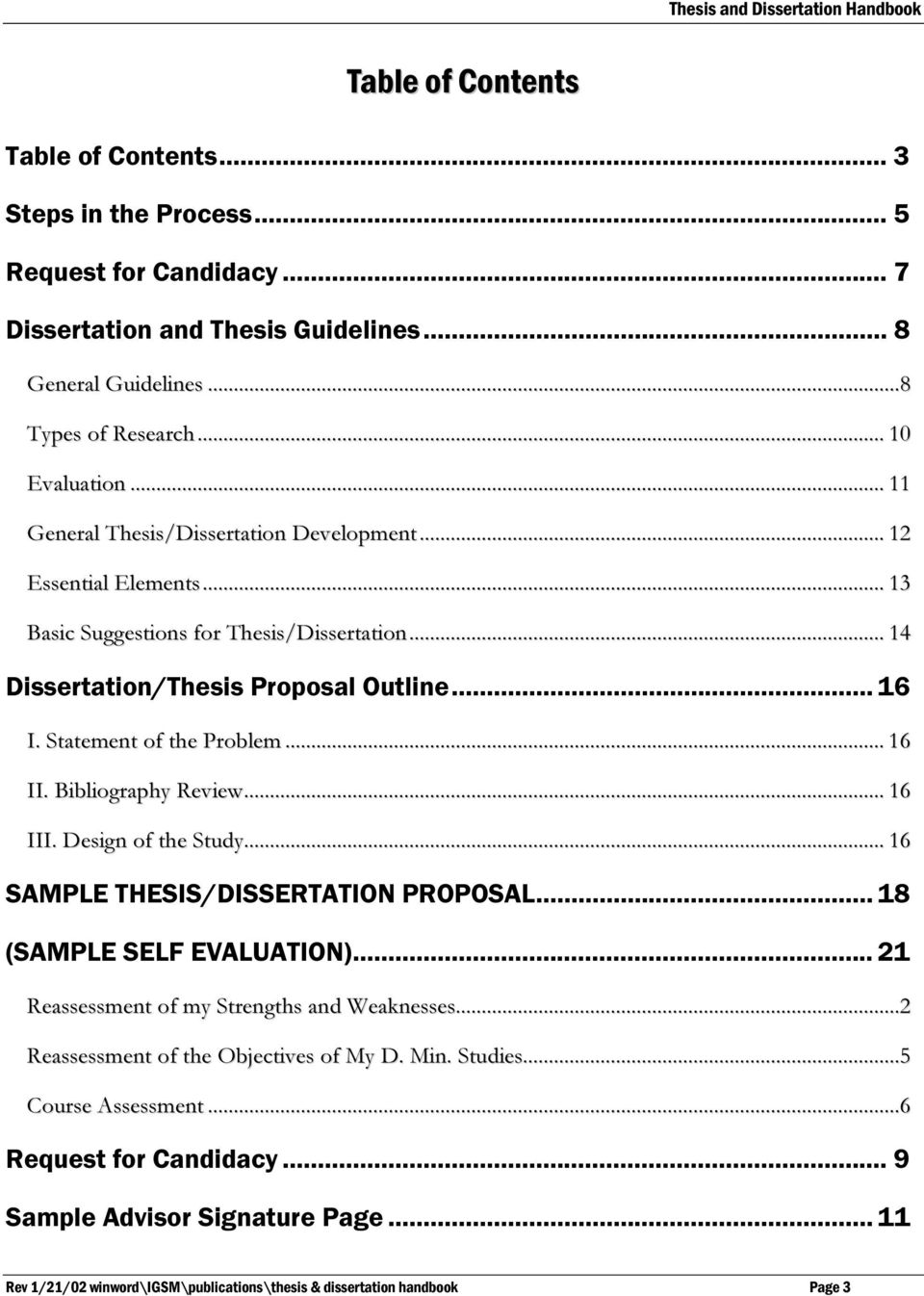
3 Thesis and Dissertation Handbook Table of Contents Table of Contents... 3 Steps in the Process... 5 Request for Candidacy... 7 Dissertation and Thesis Guidelines... 8 General Guidelines...8 Types of Research Evaluation General Thesis/Dissertation Development Essential Elements Basic Suggestions for Thesis/Dissertation Dissertation/Thesis Proposal Outline I. Statement of the Problem II. Bibliography Review III. Design of the Study SAMPLE THESIS/DISSERTATION PROPOSAL (SAMPLE SELF EVALUATION) Reassessment of my Strengths and Weaknesses...2 Reassessment of the Objectives of My D. Min. Studies...5 Course Assessment...6 Request for Candidacy... 9 Sample Advisor Signature Page Rev 1/21/02 winword\igsm\publications\thesis & dissertation handbook Page 3
4 Thesis and Dissertation Handbook Rev 1/21/02 winword\igsm\publications\thesis & dissertation handbook Page 4

5 Steps in the Process Thesis and Dissertation Handbook 1. Select a Topic: The student should define a ministry problem or point of interest to be addressed, including a method of approach and ways to evaluate the results. 2. Consult with Prospective Advisor: The student should identify an advisor they want to use for their Thesis/Dissertation after they have selected a topic. They should meet with this potential advisor and see if they would be willing to serve in that role (an advisor must have a Masters or Doctoral degree where they were required to write a Thesis or Dissertation). The student should discuss the proposed topic with this advisor and refine as necessary. 3. Consult with IGSM Office: The student should consult with the IGSM office concerning the chosen topic and a potential qualified advisor. 4. Submit Request for Candidacy Form and Self Evaluation: These forms need to be submitted prior to Dec. 31 (at least 15 months prior to proposed graduation date). 5. Submit Thesis/Dissertation Proposal: The student should also submit a Thesis/Dissertation proposal by the Dec. 31 deadline. A fee equal to the current cost of one four credit course will be required at this time. The student will be notified of what changes are necessary before final approval will be granted. Approval is normally complete by January Conduct the Study: After receiving Thesis/Dissertation approval, the student may proceed to develop the Thesis/Dissertation, conduct it and begin writing. Please call IGSM the first week of February if you have not heard anything regarding your proposal. 7. Communicate Regularly with your Thesis/Dissertation Advisor. Give them copies of your chapters as they are completed for review and comment. 8. Submit First Draft by September 15: Dissertations/Theses will be evaluated in the order received. Submit one (1) boxed copy of first draft to IGSM for evaluation by outside professional readers. Please be sure your draft is in proper Turabian style and format, and has been carefully proofread for spelling, grammar, punctuation and format. We have included at the end of this Handbook two items that should help you regarding the Turabian format (1) a Sample Thesis/Dissertation Format, and (2) a Sample Turabian Style and Formatting. These should help you get started. A computer disc with the basic Turabian form as demonstrated in the Sample Format is available from the IGSM office if you request it. We suggest you hire a professional proofreader familiar with the Turabian style manual (A Manual For Writers 6 th or 7th ed). This is critical to the process. Drafts not conforming to the proper format will normally be rejected and the student will have to wait another year to graduate. 9. First Draft Returned by October 15: Your first draft will be returned to you with required corrections and revisions. 10. Submit Second Draft by November 15: Submit one (1) boxed copy of second draft to IGSM for reading. 11. Second Draft Returned by December 1: Second draft will be returned to you with any additional required corrections and revisions. Rev 1/21/02 winword\igsm\publications\thesis & dissertation handbook Page 5

6 Thesis and Dissertation Handbook 12. Submit Final Copy of Thesis/Dissertation by December 31: Submit one (1) copy of final draft on computer disk Submit two (2) boxed, laser printed manuscripts of your final draft on acid-free dissertation bond paper. There are many varieties. We have used Eaton Parchment 50, medium weight 20#, regular finish, 50% cotton, watermarked/acid free. Be sure to include the 2 signed original advisor signature pages (see sample at end of this Handbook) and do not bend or fold (include behind title page for binding). The first bound copy will stay with the IGSM Library and the second copy will be given to you at the graduation ceremony. You may send additional copies for binding at additional cost at that time. Your graduation fee is due on the same date, December 31. The Academic Affairs Committee will be meeting early in January to recommend candidates for graduation. Please contact IGSM if you have any questions about these procedures. We are here to assist you through this exciting process! Rev 1/21/02 winword\igsm\publications\thesis & dissertation handbook Page 6

7 Thesis and Dissertation Handbook Request for Candidacy With two (2) courses remaining (besides your Thesis or Dissertation) you may begin your candidacy process. 1. Open your candidacy file by submitting a Request for Candidacy Form (copy at end of this Handbook). Note that you are asked to identify your Thesis/Dissertation Advisor. Please enclose a brief resume or indicate the key information in the space provided on the form. A Thesis/Dissertation Advisor is someone with an earned Masters or Doctoral degree (not necessarily in theology) that can advise you on all the technical aspects of producing a dissertation. Call IGSM if you have questions. 2. Submit a Self-Evaluation Statement to IGSM (see sample at end of this Handbook). The Self- Evaluation Statement includes a candid self-appraisal by the student that includes the following elements. An assessment of your strengths and weaknesses in light of intellectual and spiritual growth produced through work accomplished at the school and in ministry. An assessment of course work taken to-date at the school The length of the Self-Evaluation Statement is to be about 1,000-2,000 words (6-8 typed, double-spaced pages). 3. Submit a Dissertation/Thesis Proposal A Sample Dissertation/Thesis Proposal Outline is enclosed to assist you in writing your proposal. Note that the deadline for submitting these three items is Dec. 31, approximately 15 months prior to your proposed graduation date. Rev 1/21/02 winword\igsm\publications\thesis & dissertation handbook Page 7

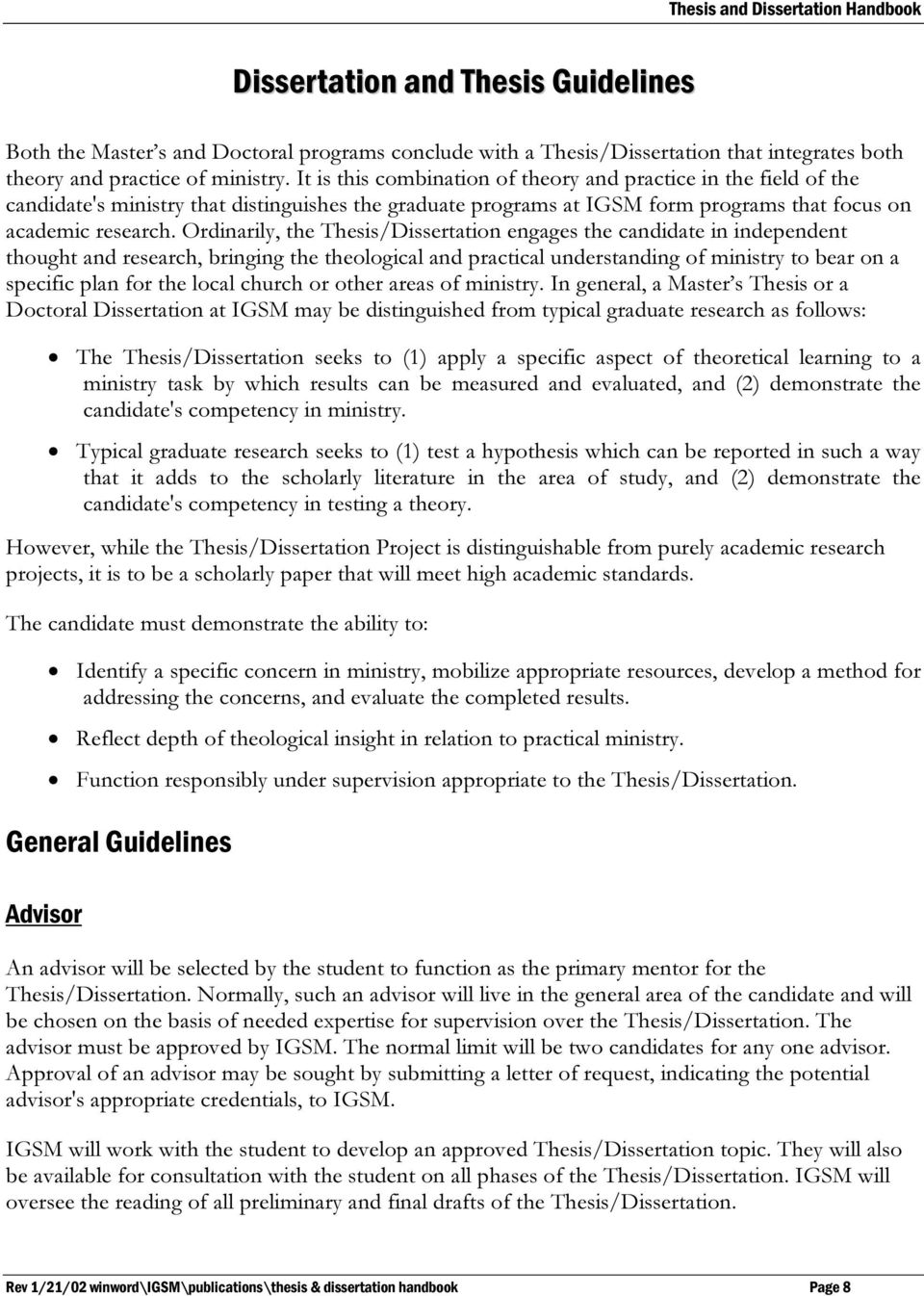
8 Thesis and Dissertation Handbook Dissertation and Thesis Guidelines Both the Master s and Doctoral programs conclude with a Thesis/Dissertation that integrates both theory and practice of ministry. It is this combination of theory and practice in the field of the candidate's ministry that distinguishes the graduate programs at IGSM form programs that focus on academic research. Ordinarily, the Thesis/Dissertation engages the candidate in independent thought and research, bringing the theological and practical understanding of ministry to bear on a specific plan for the local church or other areas of ministry. In general, a Master s Thesis or a Doctoral Dissertation at IGSM may be distinguished from typical graduate research as follows: The Thesis/Dissertation seeks to (1) apply a specific aspect of theoretical learning to a ministry task by which results can be measured and evaluated, and (2) demonstrate the candidate's competency in ministry. Typical graduate research seeks to (1) test a hypothesis which can be reported in such a way that it adds to the scholarly literature in the area of study, and (2) demonstrate the candidate's competency in testing a theory. However, while the Thesis/Dissertation Project is distinguishable from purely academic research projects, it is to be a scholarly paper that will meet high academic standards. The candidate must demonstrate the ability to: Identify a specific concern in ministry, mobilize appropriate resources, develop a method for addressing the concerns, and evaluate the completed results. Reflect depth of theological insight in relation to practical ministry. Function responsibly under supervision appropriate to the Thesis/Dissertation. General Guidelines Advisor An advisor will be selected by the student to function as the primary mentor for the Thesis/Dissertation. Normally, such an advisor will live in the general area of the candidate and will be chosen on the basis of needed expertise for supervision over the Thesis/Dissertation. The advisor must be approved by IGSM. The normal limit will be two candidates for any one advisor. Approval of an advisor may be sought by submitting a letter of request, indicating the potential advisor's appropriate credentials, to IGSM. IGSM will work with the student to develop an approved Thesis/Dissertation topic. They will also be available for consultation with the student on all phases of the Thesis/Dissertation. IGSM will oversee the reading of all preliminary and final drafts of the Thesis/Dissertation. Rev 1/21/02 winword\igsm\publications\thesis & dissertation handbook Page 8
9 Thesis/Dissertation Proposal Thesis and Dissertation Handbook A potential topic may involve a need in the student s ministry or development of the student s own skills. The student may have several ideas in mind, but will need to focus on one area that is most suitable for a Thesis/Dissertation. The topic must be related directly to the student s area of ministry. A student may not develop a Thesis/Dissertation on a purely theological subject without linking it to some aspect of actual ministry. Furthermore, the Thesis/Dissertation topic must lend itself to a depth of study and scope of interest that will qualify as graduate-level work. The Master s Thesis is not to be more than 75 to 125 pages of double-spaced, typewritten text, plus the bibliography and appendices. The Dissertation is not to be more than 150 to 200 pages of double-spaced, typewritten text, plus the bibliography and appendices. Students would do well to focus on a topic that is narrow enough to be handled within these limitations. The topics should be selected in consultation with IGSM. Once a topic has been selected, the student, in conjunction with the Thesis/Dissertation advisor, proceeds to submit to IGSM a Thesis/Dissertation Proposal. A proposal may be submitted when the student has three courses remaining (including the Thesis or Dissertation), but no later than before the last course. Final approval of the proposal will come from IGSM. Approval may be granted subject to conditions. The proposal should be 15 to 20 double-spaced pages in length, and should set forth a description of the student s plans under the following categories: I. Statement of the Problem a. Major Question to be Answered b. Rationale for the Thesis/Dissertation c. Basic Assumptions d. Intended Outcome e. Title f. Definitions Foundational to the Topic g. Biblical and Theological Issues (Provide a first-level outline of subjects to be addressed.) II. Annotated Literature Review a. Resources Related to the Topic (Provide a description of each resource researched so far, indicating relevance of each resource to Thesis/Dissertation topic.) b. Subjects to be Addressed in the Literature Review (Provide a first-level outline indicating subjects to be addressed in the Literature Review chapter of the Thesis/Dissertation.) Rev 1/21/02 winword\igsm\publications\thesis & dissertation handbook Page 9

10 Thesis and Dissertation Handbook III. Design of the Study a. Purpose: Restate the major question or issue addressed by the Thesis/Dissertation and describe how this issue will be addressed. b. Process: List the steps needed to accomplish the purpose of the Thesis/Dissertation with a description of how each step contributes to the whole process. c. Procedures: List the specific methodologies to be used to implement steps of the process. Include specific target dates, teaching topics, curriculum, etc. d. Program Evaluation: List the methods and the instruments to be used to evaluate the effectiveness of each procedure. e. Uniqueness of the Thesis/Dissertation: What is it that makes this Thesis/Dissertation unique in terms of the content, the approach, the setting, the evaluation, or some other distinguishing element. f. Projected Appendices: List anticipated items to be included in the Thesis/Dissertation appendix. The appendix includes such items as sample items used to implement procedures as well as evaluative instruments. A sample proposal is included in this Handbook to help you as your prepare your own. Throughout the Thesis/Dissertation Proposal, the student is expected to show ability to write clearly and to communicate effectively, concisely and correctly. An adequate proposal will enable IGSM to decide whether the Thesis/Dissertation is feasible and suitable, whether modifications need to be made and whether approval will be granted. All written materials in the programs will conform to the most recent edition of A Manual for Writers of Term Papers, Theses, and Dissertations, by Kate L. Turabian. In addition, the student is urged to consult a manual on English usage and style, such as The Elements of Style, by William Strunk, Jr. and E. B. White. Types of Research While several basic methods of research have been developed, only the following will be acceptable for Master of Theological Studies Theses/Doctor of Ministry Dissertations: New Program Development An attempt to develop new skills or new approaches that will help solve problems directly related to ministry. (Examples: A Divorce Recovery Seminar, a 13-week seminar on Christian Parenting, or a program for Never Married Singles ) This Thesis/Dissertation will usually center on developing, conducting and evaluating a new program. It must relate directly to the student s ministry. Rev 1/21/02 winword\igsm\publications\thesis & dissertation handbook Page 10

11 Critical Issue Research Thesis and Dissertation Handbook A study of a contemporary issue that is critical to the student s present ministry, one that can be addressed in a practical manner. (Example: A Thesis/Dissertation on Home Schooling or The New Age Movement.) This Thesis/Dissertation must result in the development of a practical approach to addressing the issue that can be used effectively in the student s local church. Program Evaluation A study of an existing program, strategy and/or methodology in the student s present ministry. This approach will usually center on conducting a particular program in various formats or settings to determine the most effective means of reaching goals. Case Study An in-depth analysis of a group, event, seminar or situation directly related to the student s ministry setting. This approach usually involves the development of a theoretical model of ministry against which the student s ministry is compared, resulting in a critical evaluation and clear recommendations. Book Manuscript (Permitted only for Doctor of Ministry dissertation) Doctor of Ministry students may use the dissertation Project to write a book manuscript. The same general format is to be followed as for the dissertation except for chapter organization. Evaluation It is not acceptable for the student to simply develop a plan and execute a program. The Thesis/Dissertation must include a relatively objective assessment of how well the program accomplished its goals, at what points it might be improved, and how the improvements might be implemented. Case study approaches must include critical evaluation against a ministry model resulting in strong recommendations. The Thesis/Dissertation evaluation is usually not expensive. However, some money should be budgeted for the possible printing of questionnaires, mailing, secretarial help, purchasing and scoring of surveys, travel expense and potential use of a consultant. Most evaluation in ministry situations is subjective. Programs are measured by perceived attendance, favorable comments or good feelings. Such subjective evaluation is important, but should not form the backbone of evaluation in any Thesis/Dissertation. Other more objective tools should be used, such as: Rev 1/21/02 winword\igsm\publications\thesis & dissertation handbook Page 11
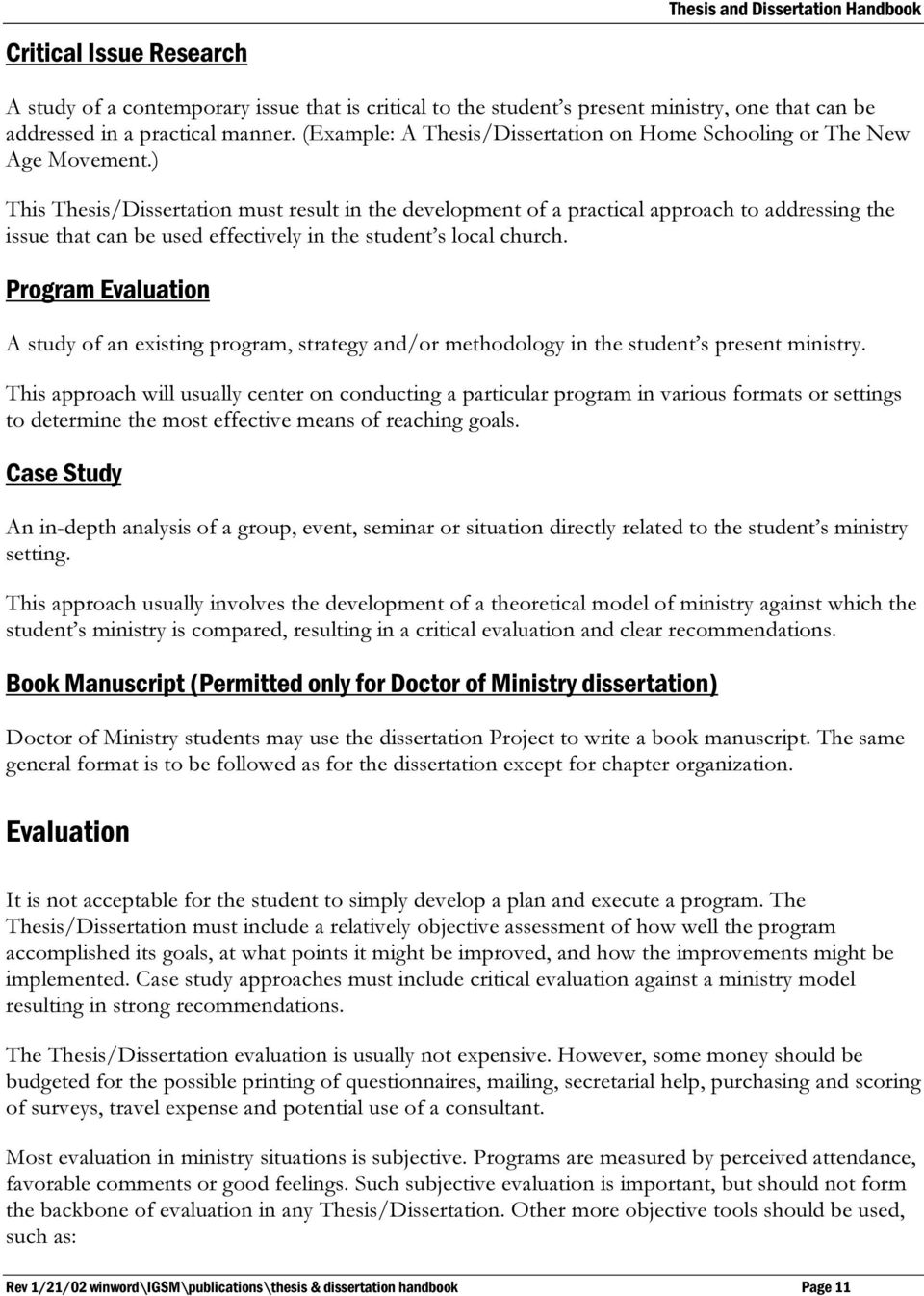
12 Participant questionnaires Independent expert observers Standardized tests Research instruments (non-standardized tests) Observation of objective data Analysis of existing information Thesis and Dissertation Handbook The student should work closely with the Thesis/Dissertation advisor, the IGSM office and other resource people in developing an evaluation plan. Distribution of standardized tests is often limited to certified individuals, which may result in the need to hire a consultant to conduct a portion of the study. General Thesis/Dissertation Development General Process The following is a general process for students to follow in the development of a Thesis/Dissertation. 1. Conduct a literature review in the field of study. Begin by reading books, articles and talking with experts in the chosen field. The student should also select courses that aid in the development of the Thesis/Dissertation. A library should be contacted and a complete computer search conducted to determine previously written books, journal articles, magazines, theses and dissertations on the subject. 2. Prepare a Thesis/Dissertation proposal following the guidelines previously given. 3. After receiving approval of the Thesis/Dissertation proposal, the student should begin to conduct the study and start writing. Generally, initial chapters follow this format: a. First Chapter: General introduction to the Thesis/Dissertation. b. Second Chapter: Literature review of research accomplished by others. c. Third Chapter: Biblical and theological basis for the Thesis/Dissertation. d. Fourth Chapter: Procedures and design for the Thesis/Dissertation. 4. Conduct the Thesis/Dissertation that has been outlined in the initial four chapters. Formulate the initial findings of your study and continue to write the first draft of the Thesis/Dissertation. 5. Rewrite the initial four chapters as needed and add additional chapters to complete the Thesis/Dissertation. Generally, the final chapters follow this format: a. Fifth Chapter: Results and findings of the Thesis/Dissertation. b. Sixth Chapter: Summary of implications of the Thesis/Dissertation. Rev 1/21/02 winword\igsm\publications\thesis & dissertation handbook Page 12

13 Essential Elements Thesis and Dissertation Handbook The following descriptions summarize the essential elements that should be included in the Thesis/Dissertation. The specific chapter headings may be designed by the student. 1. Title Page 2. Dedication Page: (If applicable) 3. Acknowledgements: (If applicable) 4. Abstract Page: A brief summary of the Thesis/Dissertation, including the scope and limitations. 5. Table of Contents: A listing of all chapter headings and sub-headings. 6. Tables and Graphs Page: (If applicable) 7. Figures Page: (If applicable) 8. Introduction: A general overview of the Thesis/Dissertation which includes the major question and issues to be addressed, the need/rationale for the Thesis/Dissertation, the basic assumptions, the intended outcome, the major definitions foundational to the topic, and the uniqueness of this Thesis/Dissertation in light of what has already been done in the field,. 9. Literature Review: A critical review of the literature pertaining to the designated field of study. Biblical, theological, ecclesiastical, historical and/or psychological data are part of the section. Do not give a book review. Develop an outline of topics relevant to your Thesis/Dissertation and then present a discussion of the literature as it relates to your Thesis/Dissertation. The student will also be expected to discuss any foundations pertinent to the study, such as theories of education, communication and learning. 10. Biblical Basis: An elaboration of the Biblical basis and theological doctrines involved in the study. The student is not to resort to the proof-text method, but to present a comprehensive and careful exegesis of the texts chosen. The link between the Biblical text and the development of the study must be shown. 11. Procedure and Design: This chapter should include a discussion of the following: (1) The purpose of the Thesis/Dissertation and how it is addressed; (2) the key elements involved in the process used to accomplish the Thesis/Dissertation purpose; (3) the specific methodologies used to implement the process (teaching series, special events, groups, etc.); and (4) the methods and instruments used to evaluate the procedures (surveys, questionnaires, standardized tests, etc.). 12. Results and Findings: A setting forth of the actual results of the study as determined by the goals, the strategy and means of evaluation. It will demonstrate the success of the Thesis/Dissertation and compare results with previously anticipated goals. It will show how the student's ministry and church benefited or changed through the study. 13. Conclusions: A discussion that summarizes the findings in the study and offers recommendations. The recommendations will vary according to the goals and scope of the study, but should focus on a local church or other ministry. Include implications for the church Rev 1/21/02 winword\igsm\publications\thesis & dissertation handbook Page 13

14 Thesis and Dissertation Handbook at large. In one sense, the Thesis/Dissertation is not to be considered completed, for it is expected that it will be continued through the ongoing ministry of the candidate. 14. Appendix: A collection of miscellaneous items not suitable for the body of the Thesis/Dissertation (sample teachings, outlines, survey forms, etc.). 15. Bibliography: A listing of all books, articles, etc., that were used in the Thesis/Dissertation. 16. Vita Sheet: A one-page vital statistics sheet giving some general information about the student's education, ministry, family and other facts of interest. Basic Suggestions for Thesis/Dissertation Content It will be helpful, in formulating the content of the Thesis/Dissertation, to keep in mind some basic questions that ought to be directly answered by the Thesis/Dissertation or capable of being answered by valid inference on the part of the reader. 1. Is there a clearly developed aim or controlling theme that integrates the raw material used in the Thesis/Dissertation in each area of emphasis? 2. In what way have Biblical and/or theological truths been used to form the critical evaluation of the field of ministry? 3. Do the purposes set forth within each area of emphasis for ministry emerge out of solid Biblical studies, coupled with valid theological insight? 4. Can the specific goals and strategy projected be related to the research done, both in terms of place of ministry as well as in the relevant Biblical and theological literature used? 5. Does the author take note of objections that can be raised to this theology of ministry and does he attempt to persuade the reader why he believes these objections to be invalid? 6. Does the Thesis/Dissertation identify the particular skills that are appropriate to the field of ministry, and does it persuade the reader that these skills have been adequately developed through the use of resources and field experience? Deadlines It is not wise to push the deadlines; and, if work is scheduled well in advance, the Thesis/Dissertation can be completed without undue haste and without pressure being put upon the IGSM office. Deadlines are set so the student can work at a reasonable pace. Since most of our students are involved in full-time ministry, we have set the deadline so the students can complete the work and still continue to full-time ministry. If the deadlines are missed the student may have to delay the Thesis/Dissertation and graduation for one year. Rev 1/21/02 winword\igsm\publications\thesis & dissertation handbook Page 14

15 Writing Style Thesis and Dissertation Handbook The candidate is strongly advised to secure the help of a stylist or a grammarian even before the first draft copy is submitted. For the final typing, the candidate is urged to secure the services of a typist familiar with Turabian and experienced in typing these advanced papers. A third party should be asked to read all draft copies and to identify any typographical errors. It should be expected that there will be changes required in the draft copies prior to the typing of the final copy. Time Requirement The time required for the Thesis/Dissertation will vary according to the goals established by the candidate. The normal length of time is approximately one year, dating from the approval of the Thesis/Dissertation and extending to the submittal of final manuscripts to the IGSM office. The maximum time for the entire program is seven years. Common Difficulties Each Thesis/Dissertation is unique. However, there are some fundamental elements of structure and style that are common to all graduate Thesis/Dissertations. Anticipating common errors and writing the first draft in as polished a form as possible can solve significant rewriting. The following are some common errors to avoid: 1. A weak introduction not clearly stating the purpose of the Thesis/Dissertation and how each component will contribute to the purpose. 2. A lack of focus or a clear theme that is interwoven throughout the Thesis/Dissertation. The result is a compilation of good ideas, research, opinions or essays with little specificity or overall connection. 3. No introduction to each chapter explaining the transition from one chapter to the next. 4. No conclusion or summaries for each chapter that demonstrate how the chapter contributes to the purpose of the Thesis/Dissertation. Each chapter needs to keep the reader looking at the main argument or purpose of the dissertation. 5. Superfluous material in various chapters that does not contribute directly to the thought that is being developed. 6. No specific plan for evaluation of the Thesis/Dissertation. 7. Conclusions not related to the results of the study. 8. No final conclusions that bring it all together and shows that the purpose of the Thesis/Dissertation has been demonstrated. 9. Poor spelling or typing. 10. Poor sentence structure or writing style. Rev 1/21/02 winword\igsm\publications\thesis & dissertation handbook Page 15

16 Dissertation/Thesis Proposal Outline Thesis and Dissertation Handbook The following outline identifies the areas that must be covered in your Dissertation/Thesis Proposal. The length of the proposal should be a minimum of 20 pages (double spaced). Much of this material will be used in the actual Thesis/Dissertation when it is written. I. Statement of the Problem 1. Major Questions to be Answered 2. Rationale for the Thesis/Dissertation 3. Basic Assumptions to be Tested or Addressed 4. Biblical and Theological Issues Addressed 5. Intended Outcomes 6. Definitions Which Are Foundational to the Topic (The above items can be answered in brief, outline form) II. Bibliography Review 1. Background Bibliographical Resources Related to the Topic (Provide a brief description of all resource material read to-date that is applicable to your topic.) 2. Intended Bibliographical Resources Related to the Topic (Provide a list of the proposed resource materials to be used in your study.) III. Design of the Study 1. Purpose: Re-state the major questions or issues to be addressed. 2. Process, Procedures & Methodologies: Outline the process, procedures and methodologies to be used to accomplish the purpose of the Thesis/Dissertation with a description of how each step contributes to the Thesis/Dissertation purpose. 3. Projected Appendices: List anticipated items to be included in the Thesis/Dissertation appendix. The appendix includes sample items used to implement procedures as well as evaluative instruments (teaching outlines, curriculum samples, questionnaires, surveys, etc.) Rev 1/21/02 winword\igsm\publications\thesis & dissertation handbook Page 16

17 Thesis and Dissertation Handbook 4. Thesis/Dissertation Uniqueness: What is it that makes this Thesis/Dissertation unique in terms of the content, the approach, the setting, the evaluation, or some other distinguishing element. 5. Personal Application: Describe how this Thesis/Dissertation will be used to enhance your personal ministry and the ministry of others. Rev 1/21/02 winword\igsm\publications\thesis & dissertation handbook Page 17

18 SAMPLE THESIS/DISSERTATION PROPOSAL A Paper Presented to The Graduate Committee of the International Graduate School of Ministry In Partial Fulfillment of the Requirements for Candidacy for the Degree of Doctor of Ministry by (Author) (Date)
19 CHAPTER 1 Statement of the Problem A. The Question A concern in ministry is that the selection, training, supervision and evaluation of lay counselors be the finest it can be given the excellent resources available from conservative scholars on the subject. In this regard, developing programs, current programs and proposed programs for lay counseling need to be evaluated according to well thought-out theology and practicality. The project is intended to answer one central questions: To what extent is the selection, training, supervision and evaluation of lay counselors effective in the lay counseling program at Crossroads Community Church? This project will look at these four areas of lay counseling to determine any possible changes that would improve the overall program. The research and conclusions will suggest applications for other lay counselor programs in other churches. B. Rationale for the Project This project fits the research category of a program evaluation. The project is meant to identify areas of strength and weakness in the overall lay counseling ministry at Crossroads 2

20 3 Community Church. It will provide evaluation and suggest other resources to measure each of the four categories mentioned above. Methods for implementing changes to the program will be developed in the research. Testing and evaluation will be made to determine the effectiveness and efficiency of the program at Crossroads. After concentrating on evangelism and missions, busy churches have little time, money or energy to do research on lay counseling. Research is needed which has behind it the experimentation to direct church staff toward an effective, biblical, lay counseling program. By using this research project as a guide, church staff can stay on target regarding efficient use of resources. They can remain biblical, effective and flexible regarding the needs of the lay counselors and the counselees. A review of biblical counseling literature reveals a paucity of information regarding techniques and approaches to train church members in effective, biblical lay counseling. Some tried and proven approach to the problem must be in the hands of the church staff member in charge of pastoral care. Whether we are considering a large church with multiple staff and a well-developed pastoral care department or a single staff church, a minister can multiply himself many times over if he can train church members to give effective, biblical lay counseling. When a pastor, for example, attempts to counsel members himself, several outcomes are likely to occur. First, he is taking time directly away from Bible study, prayer, fellowship, administration, recreation, and family time. Second, those he counsels may eventually feel uncomfortable with him as their pastor due to how much he knows of the intimate details of their life. They may eventually leave the church or cause trouble with the pastor or other members. The single staff pastor, as well as the multiple staff minister in the department of pastoral care, need a concise, well developed manuscript to follow in training others to take

21 4 over counseling duties. Any minister who is forced to search through volumes of counseling books and eventually develop a lay counseling manual or program, must necessarily neglect his other duties. This project will produce a list of tests and methods and their expected impact to shorten the search of the pastor who is setting up, developing or changing a lay counseling program. C. The Basic Assumptions This project will examine four assumptions concerning lay counseling in the context of the lay counseling program at Crossroads. 1. The process for selecting lay counselors is an essential ingredient for a successful biblical lay counseling program. 2. A well-organized training program for potential, as well as existing, lay counselors is essential for a successful lay counseling program. 3. A consistent, intense, personal supervision process is necessary in order to help lay counselors constantly improve their skills and function effectively. 4. A regular, periodic, formal evaluation process is important to provide self-reflection for the lay counselor as well as an accountability tool for the supervisor. D. Intended Outcome The intent is to apply the research of eminent scholars to the areas of selection, training, supervision, and evaluation of lay counselors in order to reveal and suggest changes to improve the effectiveness and stability of the counseling program at Crossroads Community
22 5 Church. No follow-up research will be done to see if and how much these changes did, in fact, produce the desired outcome. If, over the years only a few counselors can be disqualified before they are trained or before they begin to counsel, this project will have completed its job. In the same way, if some counselors can be trained, supervised, and evaluated in a way that procures better results for the counselor, client, and the church, the research will have been successful. The project is also intended as a guide to other churches involved in setting up, changing or developing a biblical lay counselor program. E. The Title The title of the project is: An Examination of Biblical Lay Counseling at Crossroads Community Church. F. The Definitions 1. Lay counseling refers to those church members who are not paid staff. They are saints being equipped for the work of the ministry and in no way subservient to clergy" or paid staff members. 2. Counseling refers to any encounter between a church member and a counselee whether or not they have formalized the relationship by setting parameters or meeting times. Counseling has been defined by Dr. Gary Collins as "a caring relationship in which one person tries to help another deal more effectively with the stresses of life. 1 1 G. R. Collins, Innovative Approaches to Counseling (Waco, TX: Word, 1986), 73.
23 6 3. Counselee refers to those who approach the church with a personal or family problem, whether or not they are taken into counseling. 4. Biblical counseling refers to the use of biblical principles or Bible verses in the counseling milieu. It is distinguished from secular or psychological counseling by the model it uses and by the stated premises. 5. Super-vision is defined as, "...an intensive, interpersonally focused, one-to-one, [or one to many] relationship in which one person is designated to facilitate the development of therapeutic competence in the other person [or persons]. 2 We must not neglect the "supervisory" aspects of reliance on the Holy Spirit. This Project will research the work of two other theorists in particular who dwell on the importance of the Holy Spirit: Jay Adams and John MacArthur. G. Biblical and Theological Issues The biblical issue that presents itself is that of the sufficiency of Christ as opposed to "method" in counseling. The works of John MacArthur mitigate against the use of psychology and method in counseling. In the project, we must address MacArthur's concerns to see how the counseling ministry at Crossroads compares to MacArthur's demands. The second issue is that of being guided by the Holy Spirit as opposed to being guided by statistics and research methodology. To answer this question we will proceed along the lines of research methodology while at the same time being guided by the Holy Spirit. The 2 Ibid., p. 125.
24 7 question then is, "How does one know that he is guided by the Holy Spirit?" If the counselors in the program use sound, proven, biblical principles, pray and are accountable to the church and to each other and their leaders, we will assume that they are guided by the Holy Spirit. Multiple are the scriptures that speak of a sound mind which Christians are expected to use. A third theological issue is that of discipleship. The counselor and those involved in this project must answer the questions, "How do good Christian lay counseling and discipleship relate to each other?" Currently, lay counselors see their clients for a maximum of seven to eight times. At that time either the client is ready to exit counseling or the lay counselor refers the client to a professional counselor. If discipleship is an integral part of counseling, then we must find a way for it to continue beyond formal counseling.
25 CHAPTER 2 Annotated Literature Review A. Subjects to be Addressed in Literature Review 1. Selected program models for lay counselor training. 2. The psychology of biblical lay counseling. 3. Who should do counseling? B. Resources Related to the Topic Literature on the subject of lay counseling naturally falls into two categories: secular and Christian. First we will note some of the secular works, then go to the Christian literature. Secular Sources Few secular writers bear directly on the subject of lay biblical counseling. Many of them, however, have made important contributions of data and insight that inform this study. Joint Commission on Mental Illness and Health, Action for Mental Health. New York: Science Editions, This study showed that vast numbers of individuals and couples went directly to clergy for help rather than to mental help professionals. Bergin and Lambert, "The Evaluation of Therapeutic Outcomes," Handbook of Psychotherapy and Behavior Change, 2nd ed., S. L. Garfield and A. E. Bergin. New York:
26 9 Bergin and Lambert report that 43 to 65 percent of patients "get better" on their own with only friends, teachers, pastors, etc., helping them. Though the secular community may call this "spontaneous remission," the Christian community recognizes the value of the biblical, spiritual, and fellowship related therapeutic approaches. Boser, E. G., "The Effect of Therapists' Training on Group Therapeutic Outcome" Journal of Consulting Psychology) This research showed that training could have no results or even have negative results if the right conditions were met. Carkhuff, R. R. and Truax, C. B., "Lay Mental Health Counseling: The Effects of Lay Group Counseling," Journal of Consulting Psychology These studies reported that lay or paraprofessional counseling are effective even when compared with professional counseling. Durlak, J. A., "Comparative Effectiveness of Paraprofessional and Professional Helpers," Psychological Bulletin Durlak said that counselors could do better than paraprofessionals, given the right circumstances. He concludes that "professional mental health education, training and experience do not appear to be necessary prerequisites for an effective helping person." Dorchin, S. J., Modem Clinical Psychology. New York: Basic Books, Dorchin cites several potential problems with the use of lay counselors: They feel, and are nonprofessional, they may have trouble with role boundaries, they may try to do more than they are able to do, they may not know what to do next. Hansen, J. C., Stevic, R. R., and Warner, Jr., R. W., Counseling: Theory and Process. Boston: Allyn and Bacon, 1972.
27 10 These authors compile a very exhaustive book on counseling background. This book should mostly be used for reference. It is most useful for definitions of counseling areas such as secular models, processes, legal issues and values in counseling. Christian Literature Adams, J. E., Competent to Counsel. Grand Rapids: Zondervan, Adams gives a convincing argument for Nouthetic Counseling. He perhaps oversells his conviction that the counselor must be almost perfect to begin lay counseling. Adams, J. E., The Christian Counselor's Manual. Phillipsburg, NJ: Presbyterian and Reformed Publishing Co., This work is a sequel to Competent to Counsel. Adams gives a reference section at the back to provide ready helps to pinpoint possible causes of an biblical solutions for the problems that they confront in the day-by-day work of counseling. He includes check lists for procedures, failure, etc. For something so subjective as Nouthetic Christian Counseling, this may be much too pedantic. Adams is open for much criticism. Adams, J. E., What About Nouthetic Counseling? Phillipsburg, NJ: Presbyterian and Reformed Publishing Co., This book simply answers some of the more important questions about nouthetic counseling. Adams, J. E., Matters of Concern to Christian Counselors. Grand Rapids: Baker Book House,
28 11 Volume II answers some "off-the-wall" questions that novice lay counselors may ask: Is Transactional Analysis OK? and Does the behaviorist have a mind? are just two unlikely questions that could be asked. Allen, C. L., God's Psychiatry. New York: Pyramid Books, Allen looks at the Twenty-Third Psalm, The Ten Commandments, The Lord's Prayer and The Beatitudes. He looks not at the words but at the thoughts. Much of the material in this little book could be used by lay counselors. Berkley, J. D., Called into Crisis. Dallas: Word, Berkley names many of the more common crises and shows how lay persons are called to minister to these. He goes on to show how the lay person can be there for follow-up where, on the other hand, the professional would not likely be there. Brister, C. W., People Who Care. Nashville: Broadman Press, Brister shows that we need to stay alert to how persons around us suffer and are threatened in daily existence. There is no one more in touch with these people than the lay counselor. Collins, G. R., Christian Counseling: A Comprehensive Guide. Dallas: Word, Collins 700-page volume is truly comprehensive. The book revolves around issues. Almost any issue likely to be covered in lay counseling is covered in this book. The lay reader would find it labor-intensive to read. It remains a must for reference work. Collins, G. R., Innovative Approaches to Counseling. Grand Rapids: Zondervan, Collins condenses much into his book. He outlines the goals of counseling plus presents an explanation for the fight between Christianity and psychology. Next, he shows us what we need to know about people in order to counsel them. He
29 12 condenses good theology and practicality into a very short and easily memorized model for counseling that is even compatible with J. E. Adams or John MacArthur's approach. Hiltner, S., The Couns lor in Counading. Nashville: Abingdon Press, Hiltner gives many case notes in this volume. Even though it was published long ago it remains valuable to a lay counselor, asking What do I say in counseling? Holmes III, U. T., The Priest in Community. New York: Seabury Press, Holmes develops the concept of priest from the earliest roots and shows how each of us is priest. A must for developing the foundational aspects of lay counseling. MacArthur, Jr., J., Our Sufficiency in Christ. Dallas: Word, MacArthur and many other conservative Christian authors make a strong case for rejecting much professional counseling in favor of a totally Christian and biblical approach, one usable by the lay counselor. Minirth, F. B., and Meier, P.D., Counseling and the Nature of Man. Grand Rapids: Baker Book House, These two authors squeeze much into this book. The book contains a very comprehensive description of the secular models of counseling as well as a very well developed section of the skills of the Christian counselor. Meier, P. D., and Minirth, F. B., Introduction to Psychology and Counseling. Grand Rapids: Baker Book House, As far as this study is concerned, Minirth and Meier's book should mostly be used as a reference book. They do, however, give some wise counsel on limits for the lay counselor on when to refer to professionals.
30 13 Oats, W. E., The Religious Care of the Psychiatric Patient. Philadelphia: Westminster Press, This book is included for at least two reasons. First, everyone should read Oates. Second, Oates lists some characteristics of a healthy religious faith. Lay persons especially need to know what is healthy and what is not so that they can make a more healthy decision about referral. Stone, H. W., Crisis Counseling. Philadelphia: Fortress Press, Lay counselors are more likely to be called into crisis counseling because they are likely to be on scene. Stone explains the dynamics of a crisis as well as points to a method for intervention. Finally, he cites the church as the caring community. "Journal of Psychology and Christianity," 6, no. 2, 1987: This is a special issue of the journal and has been produced to emphasize Christian counseling, though not solely lay counseling.
31 14 CHAPTER 3 Design of the Study A. Purpose In evaluating the lay counseling program at Crossroads Community Church, this study will look at four areas: the literature, the staff, the counselors and the program. In doing so, it will look at the selection, training, supervision and evaluation of the lay counselors as well as the whole counseling program. It will look at what the experts say are the main issues of concern in a lay counseling program in a local church. It will look at the needs of the counselors, the needs of the church and the community, as well as identified problems. The study will use two grids. A learning, psychological screen will be used to determine which elements of the program are able to be improved. A learning philosophical screen will be used to determine if these elements should be improved. This study will identify and justify what is done and why it is done. The approach of S. Y. Tan draws heavily from three main sources: Jay Adam's Nouthetic Counseling, Gary Collins' People Helping, and Larry Crabb's Biblical Counseling. Tan sees three major models available for establishing a ministry of lay Christian counseling: Informal Spontaneous, Informal Organized and Formal Organized. 3 The design of this study is to 3 S. Y. Tan, Lay Counseling: Equipping Christians for a Helping Ministry (Grand Rapids: Zondervan, 1991), p. 125.
32 15 quickly discern which model is seen at the church under study, then to evaluate how well that church follows that model using the insight gleaned from the experts on the subject such as Tan, Crabb, Adams, Collins, Minirth and Meier and others. Initial research indicates Crossroads Community Church definitely follows the formal, organized model due to its structure, training and counseling location. This study will choose at least three eminent scholars and evaluate how well Crossroads follows the musts of these scholars' recommendations. By selecting at least three scholars and evaluating how well Crossroads follows their model and essentials, it is hoped that an honest, worthy, broad-based evaluation will result. This project will determine how well the selection, training, supervision and evaluation of the counselors is done. To determine this, once again we look at the musts listed by at least three eminent scholars. There are two ways of doing this checking. One is to simply read the literature and then observe the counseling program at Crossroads. Another method is to administer the tests mentioned by the scholars. In this study, we plan to do both. B. Process This project will focus on the process of lay counselor development. The literature indicates four essential elements in the lay counselor development process: 1. Selection: The literature recommends a variety of tests for screening lay counselors such as the Taylor-Johnson Temperament Analysis, the Shepherd Scale, the Spiritual Well Being Scale, the Character Assessment Scale, the Wagner-Revised Houts Questionnaire, the Spiritual Life Check-Up Questionnaire and the Spiritual Leadership Qualities Inventory.
33 16 2. Training: Scholars such as Dr. Jay Adams, Dr. Gary Collins, Dr. Larry Crabb, Dr. S. Y. Tan and Dr. Kenneth Haugh provide extensive research on models and evaluative methods of training programs. The Project will research the training models of these authors and others to develop a criteria by which to evaluate the lay counseling program at Crossroads Community Church. 3. Supervision: This researcher assumes that Crossroads Community Church has a well-established supervision program in effect. This project proposes to look at some of the outstanding work that has been done on the subject, then pass Crossroad s supervision program through this grid to determine what changes should be suggested. Some of the supervision models discovered in the literature include: the Minimum Intervention Model, the Vertical Supervision Model, the Professional Training Model and the Implicit Trust Model. Dr. Gary Collins indicates that good supervision will inherently contain some discipleship training. 4 This study will look for evidence of discipleship at Crossroad s supervisory training meetings. 4. Evaluation of Lay Counselors: There has been little research done in the area of evaluation of lay counselor effectiveness. Dr. S. Y. Tan suggests that evaluation of lay counselors should be conducted by all leaders involved in the training and super-vision of lay counselors, with an emphasis on knowledge and skill acquired through the available program. Tan suggests several methods for evaluating lay counselors, including the Hill Counselor Verbal Response Category system and the Personal Orientation Inventory, which rely on self-reporting, written responses by the lay counselors to counseling situations, peer 4 G. R. Collins, Lay Counseling Within the Local Church, Leadership, 1, 1980, p. 78.
34 17 ratings and professional counselor ratings. 5 Another useful tool may be the Counselor Training Program Questionnaire (CTPQ) as a pre-training and post-training questionnaire. The Helping Relationship Inventory may also be a useful tool for evaluation. Dr. Gary Collins indicates that he knows...of no competent research study that investigates the effectiveness of lay counseling among Christians. 6 This study will examine the lay counselor evaluation process at Crossroads Community church. C. Procedures This study will examine some of the procedures used at Crossroads Community Church to accomplish the process of selection, training, supervision and evaluation of lay counselors. Procedures to be examined will include the following methods discovered by this researcher as of the writing of this proposal. 1. Selection: The selection process includes a general announcements of 12week biblical counseling classes, a conscientious seeking of potential lay counselors by the instructor in the 12-week biblical counseling class, various letters sent out to those who complete the 12-week class, and interviews with potential lay counselor applicants. 2. Training: The training program includes an initial 12-week course on biblical counseling, ongoing monthly supervisory training sessions, and winter retreats. 3. Supervision: The only supervision discovered to date is the monthly supervisory training sessions. 5 S. Y. Tan, Lay Counseling: Equipping Christians for a Helping Ministry, (Grand Rapids: Zondervan, 1991), p. 162.
35 18 4. Evaluation of Lay Counselors: The majority of evaluation seems to happen at the monthly supervisory training sessions. Other procedures will be included in this study as they are discovered through the process of research. D. Program Evaluation The major intent of this Project is evaluation of the lay counseling program at Crossroads Community Church. Methods to be used for evaluation are described in the following: 1. Selection: The study will rely on interviews with members of the pastoral counseling staff as well as students involved in the initial 12-week class. 2. Training: This researcher will attend the 12-week biblical counseling class, review teaching curriculum and interview both staff and students. 3. Supervision: This researcher will attend several monthly counselor supervisory training sessions and interview both staff and existing lay counselors. 4. Evaluation of Lay Counselors: This phase of evaluation will rely on interviews with staff and existing lay counselors. E. Projected Appendices 1. Churches With Lay Counseling Programs 6 G. R. Collins, Lay Counseling: Some Lingering Questions for Professionals, Journal of Psychology and Christianity, 6, no. 2, 1987, p. 7.
36 19 2. Post-Counseling Questionnaire 3. Sample Biblical Counselor Lesson 4. Sample Counseling Department Policy Statement 5. Counseling Release Form (other forms used in program) F. Uniqueness of the Project Many authors claim that little, if any, research has been done on the effectiveness of lay counseling in the local church. Furthermore, even less research has been done at Crossroads. Development of the lay counseling program at Crossroads has proceeded along the lines of good church management and growth, but at several levels, staff members, as well as counselors, have lamented that if they were to develop a lay counseling program from scratch, they would do it differently. Interviews with those staff members and others need to take place to determine what these differences are. This project takes the best from the more prominent authors and applies it to the lay counseling program; namely, examinations and tests of the potential lay counselors, the training techniques, supervision and evaluation procedures. Examination of dissertations done in the last twenty years in the western states shows nothing close to this research method.
37
38 (SAMPLE SELF EVALUATION) A SELF-EVALUATION A Paper Presented to the Graduation Committee of the International Graduate School of Ministry In Partial Fulfillment of the Requirements for Candidacy for the Degree (Doctor of Ministry/Master of Theological Studies) by (Name) (Date)
39 Reassessment of my Strengths and Weaknesses Strengths In my personal statement upon entering the school I described myself as: industrious, well organized, and purposeful/goal oriented. I believe that these personal qualities have been further developed by the demands of the D. Min. program as follows: First, during two summers I completed classes, taught back-to-back. This required real discipline both by way of preparation before the classes and post-course project completion subsequent to the classes. The sheer volume of work brought the best out of me. I believe I learned some things about planning, daily discipline, the cumulative impact of small accomplishments, and raw productivity. Second, for the most part, each class I took brought me to the conclusion that I needed to modify my approach to ministry and do certain basic tasks in different ways. These changes could not be accomplished by simply adding some new responsibilities and tasks to an already full life. I clearly had to prune my life and work to allow for new growth and development. I simply could not, for example, teach parenting classes, hold marriage enrichment meetings, and devote more time to worship service planning without cutting some other-things from my schedule. The D. Min. experience was forcing me to decide on my real purposes and goals, and go with them. I believe the D. Min. experience has developed what were already strengths in my life. Page 2
40 Weaknesses In my personal statement upon entering the school I described myself four ways in terms of weaknesses: unable to initiate creative change, engrossed in details and lose the big picture, push the program and forget the people, lack of tolerance, and opinionated. To some extent, these are still somewhat true of me. However, I feel I have learned a lot about myself in the last three-plus years. I have learned to see and compensate for my self-perceived weaknesses. I would describe the impact of the D-Min. program on my strengths as an enhancement to some good qualities. However, the changes that have taken place in the areas of my self-perceived weaknesses have really provided me with a somewhat new modus operandi. Because of this, I want to address them individually. Weakness #1: Unable to initiate creative change I believe one of the things that I am learning in the area of initiating creative change is that the problem is not totally my leadership. So, I no longer feel fully responsible for all the problems in this area. Secondly, I am learning that I do not have to wait for everyone to agree fully before embarking on a new course of action. While I respect constituted authority, I am not taking my cues from non-constituted power-brokers as I once did. I believe too often in the past I was doomed to a maintenance ministry because of the vested interests of the self-appointed would-be leaders whom I felt responsible to placate. The D. Min. program has helped me be a more positive initiator of change. Weakness #2: Engrossed in details and lose the big picture I see two signs of improvement in this area. One is the fact that I am freer now to delegate responsibility than ever before. Secondly, I have tried to keep the big picture of things by Page 3
41 frequently asking the big questions like, "Where is this going? Where am I headed on this course?" I think I am less likely today to lose my focus than three or four years ago. And, when life gets out of focus, I recognize it sooner than I did in the past. Weakness #3: Push the program and forget the pgpple Since beginning the D. Min. program I believe I am more conscious of the people-impact" of church programming. In the past I was too much "program driven" and not enough "people-driven". At this point I would like to think that the programming I get caught up with is "people friendly". I believe this is due to the fact that I understand a little more of the real needs of people. Weakness #4: Lack of tolerance, opinionated This is still something I wrestle with, but I feel more free today to let everyone I am involved with hold their opinions and all of us deal with the consequences of that. I feel less responsible to get everyone in my line". In some cases this has led to some deterioration of personal relationships, but not through my badgering of people into my mold. I feel free now to express my opinions because I see less of a need for uniformity of thought. Unity does not require uniformity. I believe that the D. Min. program has aided me in recognizing my frailty and of taking constructive action to re-shape my approach to situations and people that heretofore precipitated reactive behavior from me rather than thoughtful action. Page 4
42 Reassessment of the Objectives of My D. Min. Studies In my Personal Statement upon entering the school I identified five objectives for my studies. In seeking candidacy, I want to interact with those objectives and assess my progress. The five objectives were and are: solidification, new insights, integration, growth, and excellence. Objective #1: Solidification I believe I have been able to solidify and consolidate what I am about as a person and a pastor. I believe that Christian character, change, and identity, are the driving forces behind Christian behavior as opposed to behavior driving character. Hence, my focus is on changing behavior by reforming character. The "doing" of the church is to grow out of the "being" of the church. We cannot live beyond our character. My D. Min. studies have helped me clarify my understanding of the nature of humanity and the touchstones of the Gospel transforming people. Objective #2: New Insights Commensurate with the above, I have been gaining insights and expanding my horizons through the D. Min. classes. One of the surprises has been the impact of other students on me. I expected the professors and reading to be of a great influence. However, I did not expect to find such a rich resource in my classmates. This has been a delightful realization of Proverbs 27:17. Page 5
43 Objective #3: Integration The post-course projects became the epicenter of my desire for integration. In drafting and executing the post-course projects, theory and practice touched. I found the projects to be a type of "laboratory experience". The professors involved served as catalysts toward integration. Objective #4: Growth Growth involves change. I believe the D. Min. experience has fostered growth in my personal and pastoral life. I never imagined, for example, that I would feel about worship as I do now. As in the rest of life, one thing tends to lead to another, and before was really conscious of what was happening, new buds were forming on my tree of life. Objective #5: Excellence I believe that the discipline of the D. Min. program has raised my proficiency as a pastor. I believe that my schedule, reliability, thoroughness, and competence in performing pastoral tasks reflect quality. Just because I pastor a smaller church in a no-name" community is no reason why my congregation should get a mediocre job from me. The Lord, His church, and the community at-large deserve the best I have to offer. The impact of the D. Min. program has simply raised my sights. I believe that the D. Min. program has lived up to my expectations in terms of helping me realize the objectives I had for embarking on the program in the first place. Course Assessment The following is a brief description of what I have gotten from my classes. Page 6
44 I have completed six courses. I consider myself very fortunate to have had a most positive experience in all my classes. In fact, I feel that it was wise for me to pick all my classes before taking any. I studied what I felt I wanted and needed, without regard to the convenience of spacing, travel schedule, and financial pressures. My first class was "Pastoral Care and Counseling Skills" with Dr. Neil Anderson. This helped me understand afresh what pastoring is about by focusing on the identity of the Christian by his union with Christ through faith. If this seems basic, it is! For me it became the starting point, the foundation of my D. Min. program. This was a great place to start. Class number two was "Worship" with Dr. Neil Anderson serving as coordinator. This class, more than any other, simply revolutionized me. I was a changed person. My understanding of worship, my planning and preparation for worship, and my conducting of worship services were all drastically upgraded. If my first class laid a foundation for pastoring, class two gave expression of what the church as the people of God is to be. The third class was "Theological and Psychological Foundations for Parenting" with Dr. Bruce and Kathy Narramore. This helped me clarify my understanding of human nature, what people really need, and how personal relationships factor into all of life. I came away from this class a richer person with a very practical post-course project on parenting that I can use and develop for years to come. Fourth in the list of six classes was "Pre-marital Counseling" with Rex Johnson. This class helped me understand marital skills and develop resources to assist couples in enhancing their marriage skills. I came away from this class with some counseling techniques and a Page 7
45 post-course project on marriage enrichment which I may expand and use in numerous settings. Class number five was "Family Life Education" with Dr. Norman Wakefield. At this point the reader may feel that class three, four, and five were duplicitous. Not so! They related, but they did not overlap. This particular class assisted me in articulating a theology of the family and expressing in a most practical post-course project in a "Dad's Development Seminar". Classes three, four, and five all converged on giving me tools for developing systems of ministry within the life of the church to nurture marriages and families. The sixth and final class was "The Pastor's Spiritual and Emotional Health" with Dr. Vernon Grounds. This class helped me to apply the first five classes to my personal life. It could not have come at a better time in my life. I believe that the order in which I took these classes actually enhanced their individual and corporate contribution to my life and ministry. Page 8
46 Request for Candidacy Name: Address: City: State: Zip: Date Admitted: Degree Program: Entrance Degree: Anticipated Graduate Date: Anticipated Dissertation/Thesis Title: Recommended Advisor: Address: City: State: Zip: Phone: Fax: Advisor Credentials: Courses Completed:
47 I request that I be advanced to Candidacy in the Doctor of Ministry/Master of Theological Studies program of the International Graduate School of Ministry. Attached is the required self-evaluation. Signature: Date:
48 Sample Advisor Signature Page 11
49 AN ANALYSIS OF THE RELATIONSHIP BETWEEN LEADERSHIP AND CHURCH EFFECTIVENESS IN THE LOCAL CHURCH By SAMUEL S. SMITH A Dissertation submitted in partial fulfillment of the requirements for the degree of DOCTOR OF MINISTRY DEGREE INTERNATIONAL GRADUATE SCHOOL OF MINISTRY 2001 Approved by Project Advisor Date Approved by IGSM Date
THESIS GUIDELINES for MA in Theology and Ministry, MA in Pastoral Ministry, and MEd in Religious Education
 THESIS GUIDELINES for MA in Theology and Ministry, MA in Pastoral Ministry, and MEd in Religious Education 2 PURPOSE Upon completion of this project, students will have demonstrated that they are able
Doctoral Course Descriptions
 Dissertation Research (DR) DR 9108 - Dissertation Research This course will enable the student to conduct preliminary research for a dissertation proposal, to draw from bibliographical resources relevant
Boston University School of Theology. Doctor of Ministry in Transformational Leadership Handbook
 Boston University School of Theology Doctor of Ministry in Transformational Leadership Handbook Last revised June 2015 Boston University School of Theology Doctor of Ministry in Transformational Leadership
Online CE-150 Course Syllabus. Bethesda University of California
 Online CE-150 Course Syllabus Bethesda University of California BETHESDA UNIVERSITY MISSION STATEMENT: Bethesda University of California is a Christ-centered community of higher education preparing Korean/English
Handbook. Doctor of Ministry in Biblical Preaching
 Handbook Doctor of Ministry in Biblical Preaching Welcome! It is a pleasure to welcome you to the Doctor of Ministry program at Anderson University. Our prayer is that God will use this program to enhance
Graduate Program. Master of Divinity
 Purpose Graduate Program Master of Divinity Three-year program: 90 credits Twenty-six Core courses: 78 credits Four Elective courses: 12 credits All M.Div. courses are 3 credit hours The Master of Divinity
Course Syllabus FALL 2012 FOUNDATIONAL PERSPECTIVES OF CHRISTIAN COUNSELLING COUN 0574. September 13 to December 6, 2012 THURSDAYS 8:30-11:45 AM
 Course Syllabus FALL 2012 FOUNDATIONAL PERSPECTIVES OF CHRISTIAN COUNSELLING COUN 0574 September 13 to December 6, 2012 THURSDAYS 8:30-11:45 AM INSTRUCTOR: THE REV. DR. PAUL D. SCUSE Phone number: (416)
Doctoral Program. Doctor of Ministry
 Purpose Doctoral Program Doctor of Ministry Two-year program: 30 credits and a Ministry Research Project Five Core courses: 15 credits Five Elective courses: 15 credits All D.Min. courses are 3 credit
A Guide to Writing A D.Min. Project Prospectus Louisville Presbyterian Theological Seminary
 A Guide to Writing A D.Min. Project Prospectus Louisville Presbyterian Theological Seminary What is the D.Min. Project? When you applied to the LPTS doctoral program, one of the essays asked about any
Cornerstone Christian University School of Theology Orlando, FL. Doctor of Theology Program
 Cornerstone Christian University School of Theology Orlando, FL Doctor of Theology Program This is 48 credit hours of Theological Studies program. Completing this track will lead to a Doctor Degree in
MINISTRY INTERNATIONAL INSTITUTE COUNSELING TRAINING
 MINISTRY INTERNATIONAL INSTITUTE COUNSELING TRAINING In addition to providing Theological Training, Ministry International Institute (MII) founded by J. Tony Slay is also committed to providing quality
Master of Arts in Theology
 Master of Arts in Theology Overview The Whitworth Master of Arts in Theology Program seeks to produce Christ-centered, well-educated, spiritually disciplined, visionary leaders for the church and society.
A Guide to Writing a D.Min Project Report. Louisville Presbyterian Theological Seminary
 A Guide to Writing a D.Min Project Report Louisville Presbyterian Theological Seminary The Purpose of the Report The Project Report is just what its name suggests: a report on the D.Min. project that you
Master of Divinity (MDiv)
 Master of Divinity (MDiv) Purpose The 82 semester-hour Master of Divinity program is the basic graduate professional degree program in the seminary and is designed to provide the foundational academic
THEOLOGICAL EDUCATION FOR THE ANGLICAN COMMUNION PRIESTS AND TRANSITIONAL DEACONS TARGET GROUP
 Page 1 of 9 THEOLOGICAL EDUCATION FOR THE ANGLICAN COMMUNION PRIESTS AND TRANSITIONAL DEACONS TARGET GROUP At selection evidence should be shown that At ordination evidence should be shown that After ordination
MASTER OF DIVINITY PURPOSES OBJECTIVES. Program Information Sheet wscal.edu/admissions [email protected] 888.480.8474
 888.80.87 MASTER OF DIVINITY PURPOSES Educate and form candidates for official, ordained ministries of instruction and leadership in the church as pastors, evangelists, and teachers Prepare graduates to
viewbook PROVIDENCE theological seminary 2013 / 2014 Master of Divinity Program and Save 60% on Tuition Enroll in the
 PROVIDENCE theological seminary viewbook 2013 / 2014 PREPARING LEADERS SERVING THE CHURCH Enroll in the Master of Divinity Program and Save 60% on Tuition PROVIDENCE theological seminary TABLE of CONTENTS
Birmingham Theological Seminary 2200 Briarwood Way Birmingham, Alabama 35243. Huntsville Campus: Westminster Presbyterian Church
 Birmingham Theological Seminary 2200 Briarwood Way Birmingham, Alabama 35243 Huntsville Campus: Westminster Presbyterian Church Fall 2013 BC7501 Introduction to Biblical Counseling Wednesday 6:00-8:00
Doctor of Ministry Handbook
 Louisville Presbyterian Theological Seminary Doctor of Ministry Handbook Office of the Doctor of Ministry and Continuing Education January, 2013 TABLE OF CONTENTS PURPOSE AND MISSION... 3 PLAN OF STUDY...
Course Syllabus PASTORAL COUNSELING AND CRISIS INTERVENTION PAST 0741/COUN 0683 FALL 2009 THURSDAYS 8:30 11:45
 Course Syllabus PASTORAL COUNSELING AND CRISIS INTERVENTION PAST 0741/COUN 0683 I. COURSE DESCRIPTION FALL 2009 THURSDAYS 8:30 11:45 INSTRUCTOR: HELEN NOH, PH.D 647-588-2975 Email: [email protected]
How To Help Someone Who Is Depressed
 P. O. Box 252354 West Bloomfield, MI 48325 313 247-8315 WHAT IS GACCS? God Almighty Christian Community Services is a 501(c)3 that provides low cost spiritual and in most cases no cost, psychological,
I. PURPOSE, GOALS, AND OUTCOMES OF D.MIN. PROGRAM
 I. PURPOSE, GOALS, AND OUTCOMES OF D.MIN. PROGRAM A. Purpose The Doctor of Ministry is a twenty-seven hour advanced professional degree designed to enhance the practice of ministry and leadership in the
Philosophies of Counseling
 Philosophies of Counseling By Dr. Edward Watke Jr. - Preface - When you consider all the ideas there are about counseling one becomes aware that it is not very scientific. The world has over 10,000 ideas
The following is a list of competencies to be demonstrated in order to earn the degree:
 The Master of Ministry degree (M.Min.) is granted for demonstration of competencies associated with being a minister of the gospel (pastor, church planter, missionary) and other ministry leaders who are
Doctor of Ministry Program Introduction
 Doctor of Ministry Program Introduction www.sebts.edu/dmin Welcome to the Doctor of Ministry Program at Southeastern! It is my prayer that through this course of study and interaction you will grow in
DOCTORATE IN SACRED THEOLOGY
 DOCTORATE IN SACRED THEOLOGY DOCTORATE IN SACRED THEOLOGY DESCRIPTION The Doctorate in Sacred Theology is the highest degree granted by the Ecclesiastical Faculty within the Boston College School of Theology
Formal Learning. HANDOUT B Being a Lifelong Learner Chapter 12 of Growing Toward Spiritual Maturity
 HANDOUT B Being a Lifelong Learner Chapter 12 of By Gary C. Newton Published by Evangelical Training Association Growth is a never-ending process for the Christian. This was true in the lives of such biblical
Master of Arts in Criminal Justice
 Master of Arts in Criminal Justice Planning Your Course of Study and Selecting an Exit Options: (Thesis, Professional Project, and Comprehensive Exam) The Master of Arts in Criminal Justice program offers
Section Three. Nursing: MSN Research Procedures. Page 25
 Section Three Nursing Research Procedures Page 25 Research Competency Nursing majors are expected to develop their research skills throughout the program and demonstrate this skill in the final research
Introducing King s Online Bible School
 Introducing King s Online Bible School Our Goals for our Students We desire and pray that you will: abide in Christ abide in His Word abide in His church abide in His love For all things belong to you,
DISTANCE EDUCATION. Introduction to Counseling 0PT501, 3 Credit Hours. Lectures by Gary L. Rupp, Ph.D.
 RTS DISTANCE EDUCATION Introduction to Counseling 0PT501, 3 Credit Hours Lectures by Gary L. Rupp, Ph.D. RTS Distance Education This course notebook is for the coordination of your course materials, including
Online GBIB-512 Course Syllabus. Bethesda University of California
 Online GBIB-512 Course Syllabus Bethesda University of California BETHESDA UNIVERSITY MISSION STATEMENT: Bethesda University of California is a Christ-centered community of higher education preparing Korean/English
Youth Sunday School Organization Guide. Finding your place of service
 Youth Sunday School Organization Guide Finding your place of service An Open Group Youth Sunday School Class is Foundational the fundamental beginning place for involving youth in doing the work of the
Doctor of Theology Handbook
 Doctor of Theology Handbook For Candler School of Theology (Emory University) Interdenominational Theological Center Columbia Theological Seminary Care and Counseling Center of Georgia This handbook is
Leadership Development in Youth Ministry CEYH6357 New Orleans Baptist Theological Seminary Christian Education Division
 Leadership Development in Youth Ministry CEYH6357 New Orleans Baptist Theological Seminary Christian Education Division Dr. R. Clyde Hall, Jr. Professor of Youth Ministry [email protected] Office: (504)
WMBC Counseling Ministry Personal Data Inventory
 WMBC Counseling Ministry Personal Data Inventory Please complete this inventory carefully (Question marks have been eliminated.) Personal Identification Name: Birth Date: Physical Address: Mailing Address
Nazarene Theological Seminary 1700 E Meyer Blvd Kansas City, MO 64131 816/268-5400
 Nazarene Theological Seminary 1700 E Meyer Blvd Kansas City, MO 64131 816/268-5400 MTS810 Seminar: Theological Method and Research Module - Fall 2012 Essential Information Please refer to the following
QUT Digital Repository: http;;//eprints.qut.edu.au
 QUT Digital Repository: http;;//eprints.qut.edu.au Garner, Gary O. (2003) Christian models of Counselling: Just a Secular Model?. Copyright 2003 Gary O. Garner Christian models of Counselling: Just a Secular
COLLEGE OF VISUAL ARTS AND DESIGN Department of Art Education and Art History DOCTORAL PROGRAM IN ART EDUCATION PROCEDURES MANUAL
 COLLEGE OF VISUAL ARTS AND DESIGN Department of Art Education and Art History DOCTORAL PROGRAM IN ART EDUCATION PROCEDURES MANUAL Revised 3/2008 HEJC MANUAL FOR DOCTORAL STUDENTS IN ART EDUCATION The information
BIBLICAL COUNSELING. Counseling & Discipleship/Sanctification (chapters 2 & 3) Homework: Read chapter 4
 BIBLICAL COUNSELING Week One (Danny Hodges) Who is to do counseling? (chapter 8,) The crisis in Christian counseling (possibly glean from MacArthur s book) The Lord as counselor (Read chapters 1 & 8 before
CSM. Celebration Student Ministry Volunteer Application Packet
 CSM Celebration Student Ministry Volunteer Application Packet Celebration Church Blountville, TN Dear Potential Youth Leader, I M GLAD YOU RE INTERESTED IN WORKING WITH OUR STUDENT MINISTRY! Our church
MINISTRY INTERN PROGRAM Northstar Church Blacksburg, VA
 MINISTRY INTERN PROGRAM Northstar Church Blacksburg, VA I. PURPOSE The purpose for the Intern Program is two-fold. Individuals are afforded an opportunity to work alongside the staff in the coordination
ADMINISTRATIVE OFFICES: 5303 WEST KENTUCKY, LAKEWOOD, COLORADO 80226-4833 303.935.7746
 To Whom It May Concern: Center of Hope is a non-profit, faith based rehabilitation program developed to assist men, women and young people in restoration and improvement of their current situations, through
Doctor of Ministry Handbook. Compiled by Office of Academic Affairs
 Doctor of Ministry Handbook Compiled by Office of Academic Affairs 2010-2012 1 Index Program Objectives Overall Goals 3 Program Foundations Peer Group Learning 4 Experience-Based 4 Tradition-Based 4 Adult
Helpful Forms for Ministry Use
 Helpful Forms for Ministry Use We share the following forms as examples, not as legal advice. Biblical Counseling Ministries assumes no responsibility for the use or adaptation of these forms. We encourage
The Book of Love: Biblical Foundations for Christian Counselling
 The Book of Love: Biblical Foundations for Christian Counselling Dale Campbell Principles of Counselling (MM 661) Lecturer: Phil Halstead Assessment I: Essay (learning outcome 1) Due: 24 August 2009 Introduction
THESIS AND DISSERTATION FORMATTING GUIDE GRADUATE SCHOOL
 THESIS AND DISSERTATION FORMATTING GUIDE GRADUATE SCHOOL A Guide to the Preparation and Submission of Thesis and Dissertation Manuscripts in Electronic Form August 2015 Revised Fort Collins, Colorado 80523-1005
Basic Programs Oriented Toward Ministerial Leadership
 Basic Programs Oriented Toward Ministerial Leadership A MASTER OF DIVINITY (MDiv) A.I Purpose of the Degree A.1.0 The Master of Divinity degree is the normative degree to prepare persons for ordained ministry
SEMINARY PROGRAMS SEMINARY PROGRAMS
 SEMINARY PROGRAMS Luther Rice University offers two seminary degrees to prepare Christian ministers for excellence in service to the local church and denominational entities. The Master of Divinity (M.Div.)
D.Min. in Pastoral Care and Counseling
 D.Min. in Pastoral Care and Counseling Guidelines and Strategies for Completing the Program Revised 1/11 Index Section I Curriculum 3 Constructing a Course of Study 3 Areas of Study 3 Core D.Min. Seminars
Doctor of Ministry. admission materials. Hardin-Simmons University
 admission materials Hardin-Simmons University w w w. l o g s d o n s e m i n a r y. o r g An Invitation to the Ministry in a changing and complex world presents both exciting opportunities and significant
F O R A N N U A L CO N F E R E N C E S
 From Readiness to Effectiveness The Residency Program for Provisional, Commissioned Members of The United Methodist Church 2013 2016 Mentoring Continuing Theological Education Covenant Groups Supervision
BOSTON UNIVERSITY SCHOOL OF THEOLOGY THESIS FORMAT GUIDE
 BOSTON UNIVERSITY SCHOOL OF THEOLOGY THESIS FORMAT GUIDE This guide presents the standard format for a doctoral dissertation or master s thesis in the School of Theology. Candidates should follow this
REQUIREMENTS FOR THE MASTER THESIS IN INNOVATION AND TECHNOLOGY MANAGEMENT PROGRAM
 APPROVED BY Protocol No. 18-02-2016 Of 18 February 2016 of the Studies Commission meeting REQUIREMENTS FOR THE MASTER THESIS IN INNOVATION AND TECHNOLOGY MANAGEMENT PROGRAM Vilnius 2016-2017 1 P a g e
Doctor of Ministry Program (Cordova Campus) Description of the Doctor of Ministry Program (DMin)
 Doctor of Ministry Program (Cordova Campus) Description of the Doctor of Ministry Program (DMin) The doctor of ministry degree is an advanced professional degree designed to enable students to practice
Client Intake Information. Client Name: Home Phone: OK to leave message? Yes No. Office Phone: OK to leave message? Yes No
 : Chris Groff, JD, MA, Licensed Pastor Certified Sex Addiction Therapist Candidate 550 Bailey, Suite 235 Fort Worth, Texas 76107 Client Intake Information Client Name: Street Address: City: State: ZIP:
American Academy of Biblical Counselors
 American Academy of Biblical Counselors Policies & Procedures for Becoming a Certified Training Center How to Become an AABC Certified Training Center Thank you for your interest in AABC Certification
Online CMHC Program Course Descriptions
 Online CMHC Program Course Descriptions Students must meet with their advisor prior to registering for courses. If a student wishes to take a course outside the suggested schedule of study, they must first
College of Graduate Studies and Research Master s Thesis Manual
 College of Graduate Studies and Research Master s Thesis Manual Table of Contents GENERAL INFORMATION... 1 Selecting and formulating a thesis topic... 1 Preparing a thesis proposal... 2 Acceptance of a
TRAINING FOR GOSPEL MINISTRY WITH METRO
 TRAINING FOR GOSPEL MINISTRY WITH METRO METRO AT A GLANCE ministry equipping training recruiting organisation And the things you have heard me say in the presence of many witnesses entrust to reliable
COMPREHENSIVE EXAMINATION. Adopted May 31, 2005/Voted revisions in January, 2007, August, 2008, and November 2008 and adapted October, 2010
 COMPREHENSIVE EXAMINATION Adopted May 31, 2005/Voted revisions in January, 2007, August, 2008, and November 2008 and adapted October, 2010 All students are required to successfully complete the Comprehensive
ALJC CHRISTIAN SCHOOL ACCREDITATION AND CERTIFICATION DEPARTMENT EVALUATIVE CRITERIA AND STANDARDS
 ALJC CHRISTIAN SCHOOL ACCREDITATION AND CERTIFICATION DEPARTMENT EVALUATIVE CRITERIA AND STANDARDS CHRISTIAN EDUCATION DEPARTMENT ASSEMBLIES OF THE LORD JESUS CHRIST DEPARTMENT OFFICE 1093 CORE ROAD, PARKERSBURG,
Master s Thesis Procedure
 Master s Thesis Procedure These guidelines have been prepared to assist you in the successful completion of your master s thesis program. Any questions about the procedures should be addressed to the St.
B. H. Carroll Theological Institute 301 S. Center St., Ste 100, Arlington, TX 76010 (817) 274-4284 www.bhcti.org [email protected]
 B. H. Carroll Theological Institute 301 S. Center St., Ste 100, Arlington, TX 76010 (817) 274-4284 www.bhcti.org [email protected] Master of Divinity in Chaplain Ministry CORE Gateway 2 Old Testament* 4
Diaconal Ministry at Luther Seminary
 Diaconal Ministry at Luther Seminary Diaconal ministers are consecrated to ministry of Word and Service, at the intersection of church and world. Diaconal ministers work to seek wholeness in the world,
THESIS MANUAL GRNS 391 DEPARTMENT OF NURSING GRADUATE PROGRAM
 THESIS MANUAL GRNS 391 DEPARTMENT OF NURSING GRADUATE PROGRAM COLLEGE OF NURSING AND HEALTH SCIENCES THE UNIVERSITY OF VERMONT Approved 12/98 Revised 6/01, 7/02, 11/03, 10/13, 1/2014 Contents Thesis Completion
DOCTOR of MINISTRY. Emphasis in Church Revitalization. Charlotte
 DOCTOR of MINISTRY Emphasis in Church Revitalization Charlotte I am so grateful for the marvelous blessing of this unique D.Min. emphasis and how it came together. I am praying that our Lord will use this
Silliman University Divinity School [MASTER OF DIVINITY] Major in Christian Education (Thesis Track)
![Silliman University Divinity School [MASTER OF DIVINITY] Major in Christian Education (Thesis Track)](/thumbs/26/7781596.jpg "Silliman University Divinity School [MASTER OF DIVINITY] Major in Christian Education (Thesis Track)") 2009 Silliman University Divinity School [MASTER OF DIVINITY] Major in Christian Education (Thesis Track) Page 2 of 10 Master of Divinity Major in Christian Education First Year (3) 1 st Semester Units
2009 Silliman University Divinity School [MASTER OF DIVINITY] Major in Christian Education (Thesis Track) Page 2 of 10 Master of Divinity Major in Christian Education First Year (3) 1 st Semester Units
2015-2016. Doctor of Ministry Handbook
 420 S. Broad Street Winston-Salem, NC 27101 Phone: 336-725-8344 FAX: 336-725-5522 Website: www.piedmontu.edu Admissions: 800-937-5097 2015-2016 Doctor of Ministry Handbook CONTENTS Description of the Program...
A Plea for the Training of New Missionaries By Roger Perrott
 A Plea for the Training of New Missionaries By Roger Perrott All Christians know that the need for new missionaries going out to spread the gospel is great because the number of career missionaries quitting
DOCTOR OF MINISTRY PROGRAM HANDBOOK. Revised August 2015
 DOCTOR OF MINISTRY PROGRAM HANDBOOK Revised August 2015 2 TABLE OF CONTENTS Introduction... 2 Program Goals... 2 Overview of Program... 2 Admission Requirements... 2 Facilitating Structures... 2 Program
GRADUATE SCHOOL OF THEOLOGY & MINISTRY
 GRADUATE SCHOOL OF THEOLOGY & MINISTRY PROGRAM OVERVIEW ORU SEMINARY A GLOBAL PLACE FOR WORLD-CLASS TRAINING IN MINISTRY, COUNSELING, AND LEADERSHIP The Oral Roberts University Graduate School of Theology
MASTER OF PUBLIC HEALTH PROGRAM
 Revised January 2012 MASTER OF PUBLIC HEALTH PROGRAM GUIDE TO COMPLETING THE MASTER S THESIS Disclaimer This Guide to Completing the Master s Thesis is meant as a resource for students in the Master of
A Guide to Completing the Music Education Thesis
 A Guide to Completing the Music Education Thesis Revised: June, 2007 Frank Abrahams, Professor of Music Education Patrick K. Schmidt, Associate Professor of Music Education Westminster Choir College Music
How To Get A Doctor Of Ministry Degree
 Doctor of Ministry Degree Description The Doctor of Ministry (D.Min.) is an advanced professional degree. The Doctor of Ministry program is designed for ministry professionals who desire to excel in the
APPLIED MINISTRY HANDBOOK
 The Southern Baptist Theological Seminary APPLIED MINISTRY HANDBOOK Revised November 2013 But be doers of the word, and not hearers only, deceiving yourselves. James 1:22 Matt Haste Applied Ministry Center
INTEGRATION EXAM STUDY GUIDE
 INTEGRATION EXAM STUDY GUIDE Dear Student, The purpose of this study guide is to assist you in preparing for taking the 20-question Integration section of your comprehensive exam. This guide covers all
ONE NIGHT A WEEK CAN CHANGE YOUR LIFE. College of Adult and Professional Studies
 ONE NIGHT A WEEK CAN CHANGE YOUR LIFE College of Adult and Professional Studies WE HELPED THIS CARPENTER BUILD A BETTER CAREER Joshua Meeks was a full-time carpenter with an overtime life. He wasn t sure
SCHOOL OF THEOLOGY AND MISSIONS
 SCHOOL OF THEOLOGY AND MISSIONS Degrees Offered Available Online and on the Jackson, Germantown, Hendersonville Campuses Master of Christian Studies Available on the Germantown Campus and in partnership
CERTIFICATE OF CHRISTIAN MINISTRY BULLETIN
 WAYLAND BAPTIST UNIVERSITY CERTIFICATE OF CHRISTIAN MINISTRY BULLETIN Wayland Baptist University San Antonio Certificate of Christian Ministry 11550 IH-35 North San Antonio, TX 78233 (210) 826-7595 September,
Sunday School Leaders Job Descriptions
 Sunday School Leaders Job Descriptions Written by LifeWay.com Staff Pastor and Other Ministers Basic Role The pastor is the primary leader for a church s Sunday School strategy. The pastor and other ministers
Qatar University Office of Graduate Studies GRADUATE ACADEMIC MANUAL. 2. Procedure for Thesis/Dissertation Proposal, Comprehensive Exam, and Defense
 Qatar University Office of Graduate Studies GRADUATE ACADEMIC MANUAL 1. Introduction: This manual summarizes the relevant rules and regulations of graduate studies in Qatar University. This manual should
Doctor of Ministry. Pastoral Care and Counseling Emphasis
 Doctor of Ministry Pastoral Care and Counseling Emphasis Overview San Francisco Theological Seminary offers a Doctor of Ministry with special emphasis on Pastoral Care and Counseling. This is one of several
Doctoral Dissertation Procedure
 Doctoral Dissertation Procedure The responsibility for a well organized presentation of personal research rests entirely upon the candidate and is in no sense a part of the instructional responsibility
PASTORAL COUNSELING Lars Wilhelmsson
 1 PASTORAL COUNSELING Lars Wilhelmsson The list of problems facing people are endless: emotional conflict, mental disorders, depression, grief, anxiety, irrational fears, compulsive behaviors, general
Guidelines for Preparation of Master s Thesis in Art History
 Guidelines for Preparation of Master s Thesis in Art History The MA thesis represents the final step in the completion of your MA in Art History degree at Studio Art Centers International (SACI). It should
Destiny College International
 Destiny College International South Africa DEVELOPING WORLD-CLASS LEADERS WHO WILL POSITIVELY TRANSFORM THE WORLD EXTENSION CAMPUS MANUAL ACCREDITED SINCE 2006. Accrediting Commission International, The
DISSERTATION MANUAL. How many members are on a dissertation committee?
 DISSERTATION MANUAL How many members are on a dissertation committee? The initial, three-person dissertation committee will work with the doctoral student. After the dissertation research has been completed
How To Get A Phd In Engineering
 Department of Electrical and Computer Engineering Boise State University DOCTORAL PROGRAM ACADEMIC POLICIES AND PROCEDURES 1 I. Ph.D. Program Areas of Study The Department of Electrical and Computer Engineering
SIUE Mass Communications Graduate Program Guide & Handbook. Designed To Educate & Assist Our Prospective & Current Masters Candidates
 SIUE Mass Communications Graduate Program Guide & Handbook Designed To Educate & Assist Our Prospective & Current Masters Candidates Copyright SIUE Mass Communications Department 2010 Table of Contents
ASHLAND THEOLOGICAL SEMINARY CC 882 ADVANCED FAMILY COUNSELING Winter Quarter 2014 Monday, 9:00 - Noon
 COURSE DESCRIPTION ASHLAND THEOLOGICAL SEMINARY CC 882 ADVANCED FAMILY COUNSELING Winter Quarter 2014 Monday, 9:00 - Noon Teresa Davis, MA, PCC- S E- mail: [email protected] This course is designed to
Temple Baptist Seminary 1815 Union Avenue Chattanooga, TN 37404
 Temple Baptist Seminary 1815 Union Avenue Chattanooga, TN 37404 Revised May 2013 CONTENTS Description of the Doctor of Ministry Program... 1 Goals of the Doctor of Ministry Program... 1 General Requirements
Professor s notes* As of April 16, 2008
 PACO 500 INTRODUCTION TO PASTORAL COUNSELING Professor s notes* As of April 16, 2008 *Note: All content provided in the professor s notes, course chart and course syllabus are based on the professor s
Program of Study Ph.D. in Community Health Promotion University of Arkansas. Introduction
 DOCTOR OF PHILOSOPHY DEGREE: COMMUNITY HEALTH PROMOTION GRADUATE MANUAL DEPARTMENT OF HEALTH, HUMAN PERFORMANCE, & RECREATION 1 Program of Study Ph.D. in Community Health Promotion University of Arkansas
Dr. Sylvester Washington Senior Pastor /Teacher. Teach me your way O Lord, and I will walk in your truth Psalm 86:11 KJV
 Dr. Sylvester Washington Senior Pastor /Teacher Pleasant Hill Baptist Church 2009 West Martin L. King Jr. Blvd. Los Angeles, CA 90062 Office: (323) 293-6448 Fax: (323) 293-6605 Teach me your way O Lord,
III. What do you believe about Creation? a. What do you believe about the Creation account in Genesis?
 Some Questions to consider: I. What do you believe about Scripture? a. What do you believe about divine inspiration? b. What do you believe about the Bible's accuracy? c. What do you believe about the