
Analysis of the Impacts of the Clean Power Plan
|
|
|
- Clarissa McGee
- 10 years ago
- Views:
Transcription
1 Analysis of the Impacts of the Clean Power Plan May 2015 Independent Statistics & Analysis U.S. Department of Energy Washington, DC 20585

2 This report was prepared by the U.S. Energy Information Administration (EIA), the statistical and analytical agency within the U.S. Department of Energy. By law, EIA s data, analyses, and forecasts are independent of approval by any other officer or employee of the United States Government. The views in this report therefore should not be construed as representing those of the U.S. Department of Energy or other federal agencies. U.S. Energy Information Administration Analysis of the Impacts of the Clean Power Plan i

3 Table of Contents Background, Methodology, and Scenarios... 1 Description of the proposed Clean Power Plan... 1 Rulemaking history and status... 1 EPA s proposed Best System of Emissions Reduction and state-level CO 2 emission performance goals... 2 Methodology... 4 The National Energy Modeling System... 4 Regional groupings... 5 Caveats regarding interpretation of this analysis... 8 Scenario descriptions Summary of Results Detailed Results CO 2 emissions and compliance strategy indicators CO 2 emissions Total generation by fuel type Heat rate improvement Retirements and capacity additions Retirements Capacity additions New nuclear Demand reduction through incremental efficiency programs Electricity prices Natural gas Coal Regional coal production Further regional impacts Regional differences in renewable penetration Regional differences in natural gas-fired generation Regional differences in the operation of coal-fired generating units Regional differences in demand reduction U.S. Energy Information Administration Analysis of the Impacts of the Clean Power Plan ii

4 Reliability and infrastructure impacts Macroeconomic indicators Additional sensitivity cases Phase-in sensitivity Heat rate improvement sensitivity cases Energy efficiency sensitivity cases Markets for CO 2 for enhanced oil recovery Wide regional cooperation Biomass CO 2 emission rate Limited interregional transmission capacity Appendix A Request letter Appendix B Acronyms Appendix C State carbon intensity targets Appendix D EMM Region carbon intensity targets Appendix E Detailed description of NEMS carbon intensity constraint Appendix F Additional description of methodology for heat rate improvement, re-dispatch, low- and zero-carbon generation, and demand-side efficiency Heat rate improvement Re-dispatch Low- and zero-carbon capacity expansion Demand-side energy efficiency Appendix G Appendix H Appendix I U.S. Energy Information Administration Analysis of the Impacts of the Clean Power Plan iii

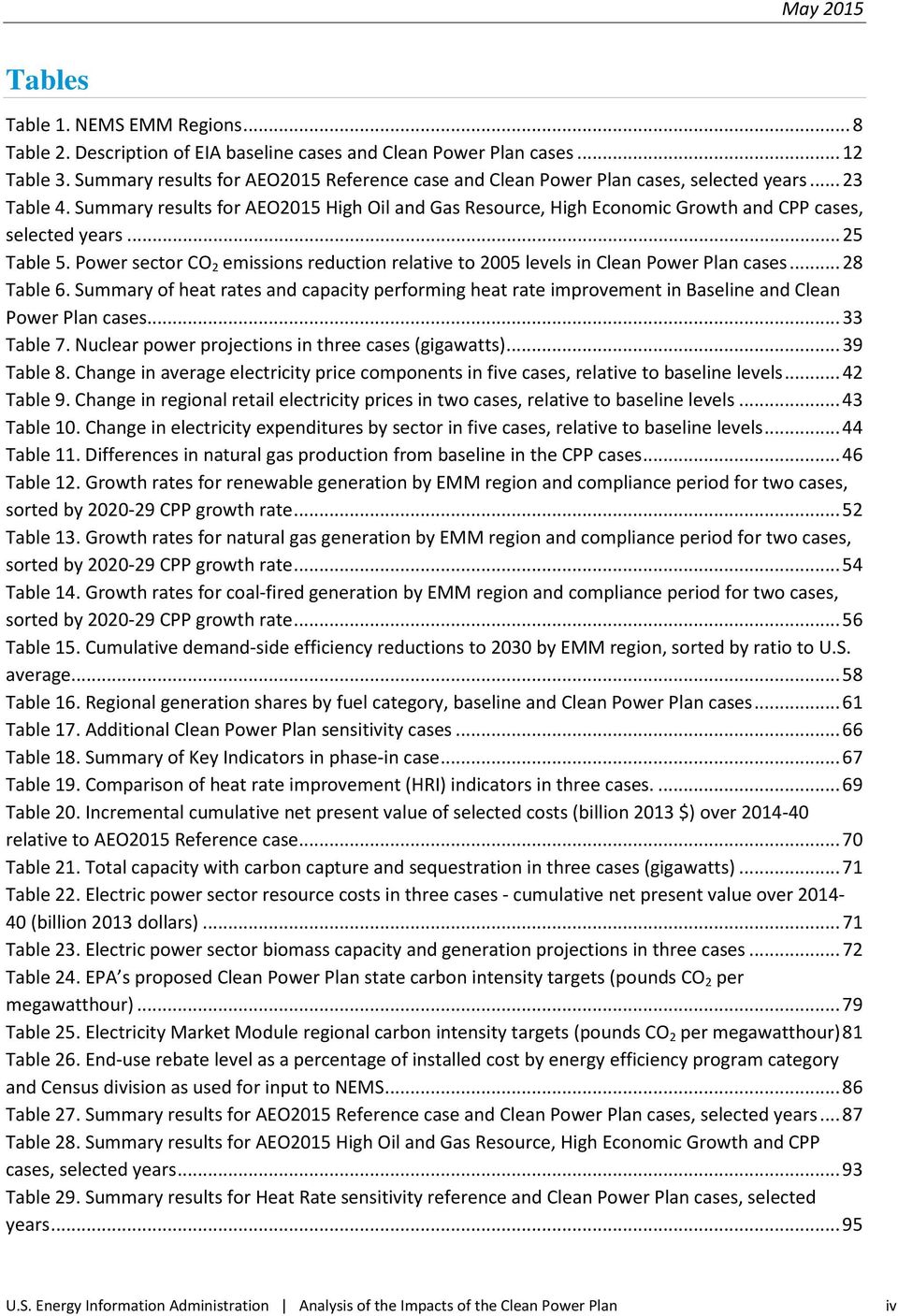
5 Tables Table 1. NEMS EMM Regions... 8 Table 2. Description of EIA baseline cases and Clean Power Plan cases Table 3. Summary results for 2015 Reference case and Clean Power Plan cases, selected years Table 4. Summary results for 2015 High Oil and Gas Resource, High Economic Growth and cases, selected years Table 5. Power sector CO 2 emissions reduction relative to 2005 levels in Clean Power Plan cases Table 6. Summary of heat rates and capacity performing heat rate improvement in Baseline and Clean Power Plan cases Table 7. Nuclear power projections in three cases (gigawatts) Table 8. Change in average electricity price components in five cases, relative to baseline levels Table 9. Change in regional retail electricity prices in two cases, relative to baseline levels Table 10. Change in electricity expenditures by sector in five cases, relative to baseline levels Table 11. Differences in natural gas production from baseline in the cases Table 12. Growth rates for renewable generation by EMM region and compliance period for two cases, sorted by growth rate Table 13. Growth rates for natural gas generation by EMM region and compliance period for two cases, sorted by growth rate Table 14. Growth rates for coal-fired generation by EMM region and compliance period for two cases, sorted by growth rate Table 15. Cumulative demand-side efficiency reductions to 2030 by EMM region, sorted by ratio to U.S. average Table 16. Regional generation shares by fuel category, baseline and Clean Power Plan cases Table 17. Additional Clean Power Plan sensitivity cases Table 18. Summary of Key Indicators in phase-in case Table 19. Comparison of heat rate improvement (HRI) indicators in three cases Table 20. Incremental cumulative net present value of selected costs (billion 2013 $) over relative to 2015 Reference case Table 21. Total capacity with carbon capture and sequestration in three cases (gigawatts) Table 22. Electric power sector resource costs in three cases - cumulative net present value over (billion 2013 dollars) Table 23. Electric power sector biomass capacity and generation projections in three cases Table 24. EPA s proposed Clean Power Plan state carbon intensity targets (pounds CO 2 per megawatthour) Table 25. Electricity Market Module regional carbon intensity targets (pounds CO 2 per megawatthour) 81 Table 26. End-use rebate level as a percentage of installed cost by energy efficiency program category and Census division as used for input to NEMS Table 27. Summary results for 2015 Reference case and Clean Power Plan cases, selected years Table 28. Summary results for 2015 High Oil and Gas Resource, High Economic Growth and cases, selected years Table 29. Summary results for Heat Rate sensitivity reference and Clean Power Plan cases, selected years U.S. Energy Information Administration Analysis of the Impacts of the Clean Power Plan iv
6 Figures Figure 1. NEMS Electricity Market Module regions... 5 Figure 2. United States Census Divisions... 7 Figure 3. Change in electric power sector CO 2 emissions in Clean Power Plan () cases relative to baseline, selected years Figure 4. Change in generation and energy efficiency savings under the Clean Power Plan Base Policy case relative to 2015 Reference case Figure 5. Change in generation and energy efficiency savings under the Clean Power Plan Policy Extension case relative to 2015 Reference case Figure 6. Nuclear generation in 2015 Reference and Clean Power Plan cases, selected years Figure 7. Change in generating capacity retirements by fuel type in Clean Power Plan cases relative to baseline (cumulative, ) Figure 8. Change in generating capacity additions by fuel type in Clean Power Plan cases relative to baseline (cumulative, ) Figure 9. Total U.S. coal production in baseline and Clean Power Plan cases, Figure 10. Minemouth steam coal prices in baseline and Clean Power Plan cases, Figure 11. Natural gas production in baseline and Clean Power Plan cases, Figure 12. Henry Hub spot price for natural gas in baseline and Clean Power Plan cases, Figure 13. Average percentage change in heat rate of coal-fired generators in Clean Power Plan cases, relative to baseline cases Figure 14. All sectors average retail electricity price in baseline and Clean Power Plan cases, Figure 15. Power sector CO 2 emissions in Baseline and Clean Power Plan cases, Figure 16. Average capacity factor for coal-fired generating units in Baseline and Clean Power Plan cases, Figure 17. Average capacity factor for natural gas combined cycle plants in Baseline and Clean Power Plan cases, Figure 18. Change in electricity generation by fuel in Clean Power Plan cases relative to baseline Figure 19. Average heat rate of coal-fired generators in Baseline and Clean Power Plan cases, Figure 20. Change in generating capacity retirements by fuel type in Clean Power Plan cases relative to baseline (cumulative, ) Figure 21. Change in cumulative capacity additions, , in Clean Power Plan cases relative to baseline Figure 22. Change in installed wind generating capacity in Clean Power Plan cases relative to baseline. 37 Figure 23. Change in installed solar generating capacity in Clean Power Plan cases relative to baseline. 38 Figure 24. Change in installed natural gas-fired combined cycle capacity in Clean Power Plan cases relative to baseline Figure 25. Delivered buildings electricity consumption, Figure 26. Electric power sector natural gas consumption in baseline and cases, Figure 27. Average delivered natural gas prices to the electric power sector in baseline and Clean Power Plan cases, Figure 28. Total U.S. coal production in baseline and Clean Power Plan cases, U.S. Energy Information Administration Analysis of the Impacts of the Clean Power Plan v

7 Figure 29. Average delivered coal prices to the electric power sector in baseline and Clean Power Plan cases, Figure 30. Appalachian coal production in baseline and Clean Power Plan cases, Figure 31. Interior coal production in baseline and Clean Power Plan cases, Figure 32. Western coal production in baseline and Clean Power Plan cases, Figure 33. Difference in renewable generation (Base Policy case vs Reference case) in top five growth regions, Figure 34. Difference in natural gas-fired generation (Base Policy case vs Reference case) in top five growth regions, Figure 35. Difference in coal-fired generation (Base Policy case vs Reference case) in top five regions of decline, Figure 36. Regional EMM demand-side reductions, Base Policy relative to Reference, 2030 sales.. 58 Figure 37. Wholesale and consumer energy price changes across two Clean Power Plan cases, relative to 2015 Reference case Figure 38. Real gross domestic product in 2015 Reference and Clean Power Plan cases, Figure 39. Real cumulative GDP impacts across two Clean Power Plan cases, relative to 2015 Reference case Figure 40. Disposable income changes across two Clean Power Plan cases, relative to 2015 Reference case Figure 41. Change in wholesale energy prices and real GDP in Clean Power Plan cases relative to baseline U.S. Energy Information Administration Analysis of the Impacts of the Clean Power Plan vi

8 Background, Methodology, and Scenarios This report responds to an August 2014 request to the U.S. Energy Information Administration (EIA) from Representative Lamar Smith, Chairman of the U.S. House of Representatives Committee on Science, Space, and Technology, for an analysis of the Environmental Protection Agency s (EPA) proposed Clean Power Plan under which states would be required to develop plans to reduce carbon dioxide (CO 2 ) emissions rates from existing fossil-fired electricity generating units. 1 Appendix A provides a copy of the request letter. The starting point for EIA s analysis of the Clean Power Plan is the Annual Energy Outlook 2015 (2015) Reference case rather than earlier projections that were developed using versions of EIA s National Energy Modeling System (NEMS) that lack the model structure needed to analyze key features of the Clean Power Plan proposal. With EIA s decision, unrelated to this project, to publish shorter and longer editions of the in alternating years, 2015 does not include all of the alternative cases presented in earlier editions. However, in the spirit of Chairman Smith s request, this report analyzes the Clean Power Plan in the context of the 2015 High Economic Growth and High Oil and Gas Resource cases as well as the Reference case in order to examine indicators of the proposed rule s impacts on energy markets under varying assumptions regarding economic growth, electricity demand, and fuel prices. To address some of the additional questions raised in Chairman Smith s request, the report includes additional Clean Power Plan sensitivity cases including: 1) extension of the Clean Power Plan targets beyond 2030 to reduce CO 2 emissions from electric power generation by 45% relative to the 2005 level by 2040; 2) treatment of future nuclear capacity similar to the treatment of renewable capacity; 3) sensitivities for expenditures and effectiveness of energy efficiency programs; 4) sensitivities for the cost and effectiveness of heat rate improvement measures; 5) no availability of markets for CO 2 captured from electric power plants for enhanced oil recovery (EOR); 6) an alternative compliance phase-in trajectory during the period; 7) alternative accounting rules for emissions from biomass generation; 8) national compliance cooperation; and 9) limited interregional trade. Description of the proposed Clean Power Plan Rulemaking history and status In June 2014, EPA issued its proposed Clean Power Plan to regulate CO 2 emissions from existing power plants under section 111(d) of the Clean Air Act. 2 The Clean Power Plan proposes to limit carbon emissions from existing fossil fuel-fired electric generating units, including steam generating, integrated gasification combined cycle, or stationary combustion turbines (in either simple cycle or combined cycle 1 U.S. Environmental Protection Agency, Carbon Pollution Emission Guidelines for Existing Stationary Sources: Electric Utility Generating Units (Proposed Rule), 79 Fed. Reg. 34,830 (June 18, 2014), accessed January 10, Clean Air Act, 42 U.S.C et seq. (2013), 7411(d). U.S. Energy Information Administration Analysis of the Impacts of the Clean Power Plan 1

9 configuration) operating or under construction by January 8, In addition to the text of the proposed rule, EPA issued a Regulatory Impact Analysis for the Clean Power Plan, 4 along with numerous technical supporting documents and fact sheets. 5 In October 2014, EPA issued a notice of data availability, which provided discussion and solicited additional comment on several topic areas, including the compliance trajectories. 6 Also in October 2014, EPA issued a supplemental proposal to address carbon pollution from affected power plants in Indian Country and U.S. territories. 7 In November 2014, EPA issued an additional technical support document providing examples of how a state could translate its rate-based goal into an equivalent mass-based goal, expressed in metric tons of CO 2. 8 In November 2014, EPA also issued a memo addressing biogenic CO 2 emissions from stationary sources that explicitly relates this topic to the implementation of the Clean Power Plan. 9 EPA s proposed Best System of Emissions Reduction and state-level CO 2 emission performance goals In the proposed Clean Power Plan, EPA calculates the emissions reduction targets for individual states through application of a Best System of Emissions Reduction (BSER). The BSER consists of four building blocks which represent approaches to reducing CO 2 emissions rates from existing fossil fuel-fired generators as calculated for purposes of compliance: Building block 1: Improving the thermal efficiency of individual affected sources (heat rate improvement) 10 Building Block 2: Dispatching the generating fleet to substitute less-carbon-intensive affected sources for more-carbon-intensive affected sources (re-dispatch for reduced emissions) Building Block 3: Expanding the use of low- or zero-carbon generation in order to displace affected sources (low- and zero-carbon capacity expansion) 3 U.S. Environmental Protection Agency, Carbon Pollution Emission Guidelines for Existing Stationary Sources: Electric Utility Generating Units (Proposed Rule), 79 Fed. Reg. 34,830 (June 18, 2014), at 34,954, accessed January 10, U.S. Environmental Protection Agency, Office of Air Quality Planning and Standards, Regulatory Impact Analysis for the Proposed Carbon Pollution Guidelines for Existing Power Plants and Emissions Standards for Modified and Reconstructed Power Plants, EPA-452/R (June, 2014), accessed December 30, U.S. Environmental Protection Agency, Clean Power Plan Proposed Rule Technical Documents, accessed January 10, U.S. Environmental Protection Agency, Carbon Pollution Emission Guidelines for Existing Stationary Sources: Electric Utility Generating Units (Notice of Data Availability), 79 Fed. Reg. 69,543 (October 30, 2014), accessed January 31, U.S. Environmental Protection Agency, Carbon Pollution Emission Guidelines for Existing Stationary Sources: EGU s in Indian Country and U.S. Territories; Multi-Jurisdictional Partnerships (Supplemental Proposed Rulemaking), 79 Fed. Reg. 65,482 (November 4, 2014), accessed January 31, U.S. Environmental Protection Agency, Office of Air and Radiation, Translation of the Clean Power Plan Emission Rate-Based CO 2 Goals to Mass-Based Equivalents, Technical Support Document, Docket ID No. EPA-HQ-OAR (November 2014), accessed January 10, 2015 [hereinafter Mass-Based Equivalent Technical Support Document ]. 9 U.S. Environmental Protection Agency, Office of Air and Radiation, Framework for Assessing Biogenic CO 2 Emissions from Stationary Sources (November 2014) 10 Heat rate is defined as a measure of generating station thermal efficiency, commonly stated in British thermal units (Btu) per kilowatthour (kwh). U.S. Energy Information Administration Glossary, accessed November 12, U.S. Energy Information Administration Analysis of the Impacts of the Clean Power Plan 2
10 Building Block 4: Employing the use of demand-side energy efficiency to reduce overall generation required from affected sources (demand-side energy efficiency) 11 In determining state goals, EPA begins by calculating an affected fossil generation emissions rate, in pounds of CO 2 emissions per megawatt hour of electricity generated, based on 2012 historical data for each state. EPA then applies the building blocks of the BSER to arrive at each state s interim and final emission rate performance goals. The Clean Power Plan proposes that states begin to reduce CO 2 emissions from affected electric generating units by 2020 in order to reach final CO 2 emission performance goals, measured in pounds of CO 2 emitted per megawatthour of electricity generated from affected electric generating units, by The Clean Power Plan also proposes that states meet interim CO 2 emission performance goals, on average, over the 10-year compliance period from The state-level emissions rates as calculated by EPA for 2012, as well as the interim targets for and the final targets for 2030 and beyond, specified in the proposed Clean Power Plan are provided in Appendix C, Table 25. It is critical to recognize that while the BSER building blocks are used to establish state-level goals, each state has discretion in designing implementation plans to achieve outcomes that meet the goals. Two or more states may also cooperate to meet their combined goals jointly. The state-level emissions performance goals under the proposed Clean Power Plan are not based on a simple emission rate calculation (emissions divided by generation) for generation provided by existing fossil-fired electric generating units. Rather, the goals are established and compliance is assessed using a formula that provides varying treatment of specific generation sources and demand-side efficiency programs that can displace CO 2 emissions from existing generating units that are regulated under the Clean Power Plan proposal. For example, unlimited amounts of new and existing zero-emission nonhydropower renewable generation are included in the generation base used to calculate compliance, which makes the non-hydropower renewable generation more valuable for compliance than existing hydropower and new and existing nuclear generation that do not receive similar treatment. The proposed Clean Power Plan formula also considers efficiency programs that reduce load as equivalent to zero-emission generation that counts in the base for the compliance calculation, even though some of the generation that is avoided by reduced load may have already been served by zero-emission generation sources. 11 U.S. Environmental Protection Agency, Carbon Pollution Emission Guidelines for Existing Stationary Sources: Electric Utility Generating Units (Proposed Rule), 79 Fed. Reg. 34,830 (June 18, 2014), at 34,851, accessed January 10, U.S. Environmental Protection Agency, Carbon Pollution Emission Guidelines for Existing Stationary Sources: Electric Utility Generating Units (Proposed Rule), 79 Fed. Reg. 34,830 (June 18, 2014) at 34,838, accessed January 10, EPA also sought comment on an alternative regulatory option, consisting of a 5-year compliance period and a less-stringent set of CO 2 emission performance levels. The alternative option would require that states meet final emission performance levels by 2025, with interim goals met over the period from In this report, EIA does not analyze the alternative 5-year option. U.S. Energy Information Administration Analysis of the Impacts of the Clean Power Plan 3

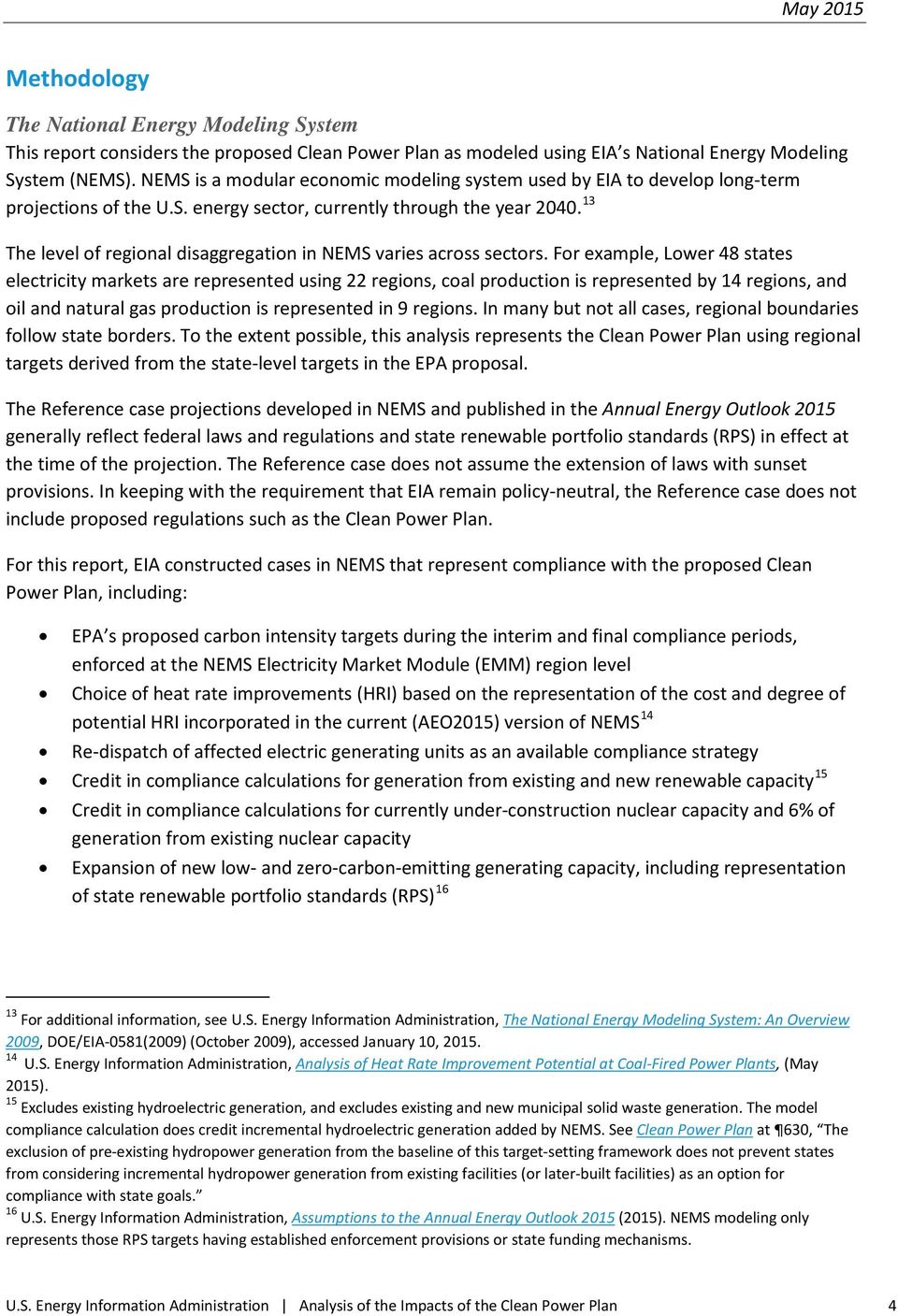
11 Methodology The National Energy Modeling System This report considers the proposed Clean Power Plan as modeled using EIA s National Energy Modeling System (NEMS). NEMS is a modular economic modeling system used by EIA to develop long-term projections of the U.S. energy sector, currently through the year The level of regional disaggregation in NEMS varies across sectors. For example, Lower 48 states electricity markets are represented using 22 regions, coal production is represented by 14 regions, and oil and natural gas production is represented in 9 regions. In many but not all cases, regional boundaries follow state borders. To the extent possible, this analysis represents the Clean Power Plan using regional targets derived from the state-level targets in the EPA proposal. The Reference case projections developed in NEMS and published in the Annual Energy Outlook 2015 generally reflect federal laws and regulations and state renewable portfolio standards (RPS) in effect at the time of the projection. The Reference case does not assume the extension of laws with sunset provisions. In keeping with the requirement that EIA remain policy-neutral, the Reference case does not include proposed regulations such as the Clean Power Plan. For this report, EIA constructed cases in NEMS that represent compliance with the proposed Clean Power Plan, including: EPA s proposed carbon intensity targets during the interim and final compliance periods, enforced at the NEMS Electricity Market Module (EMM) region level Choice of heat rate improvements (HRI) based on the representation of the cost and degree of potential HRI incorporated in the current (2015) version of NEMS 14 Re-dispatch of affected electric generating units as an available compliance strategy Credit in compliance calculations for generation from existing and new renewable capacity 15 Credit in compliance calculations for currently under-construction nuclear capacity and 6% of generation from existing nuclear capacity Expansion of new low- and zero-carbon-emitting generating capacity, including representation of state renewable portfolio standards (RPS) For additional information, see U.S. Energy Information Administration, The National Energy Modeling System: An Overview 2009, DOE/EIA-0581(2009) (October 2009), accessed January 10, U.S. Energy Information Administration, Analysis of Heat Rate Improvement Potential at Coal-Fired Power Plants, (May 2015). 15 Excludes existing hydroelectric generation, and excludes existing and new municipal solid waste generation. The model compliance calculation does credit incremental hydroelectric generation added by NEMS. See Clean Power Plan at 630, The exclusion of pre-existing hydropower generation from the baseline of this target-setting framework does not prevent states from considering incremental hydropower generation from existing facilities (or later-built facilities) as an option for compliance with state goals. 16 U.S. Energy Information Administration, Assumptions to the Annual Energy Outlook 2015 (2015). NEMS modeling only represents those RPS targets having established enforcement provisions or state funding mechanisms. U.S. Energy Information Administration Analysis of the Impacts of the Clean Power Plan 4
12 Credit in compliance calculations for avoided generation as a result of incremental demand-side energy efficiency savings achieved through energy efficiency measures in the residential and commercial sectors 17 A phased-in compliance trajectory, to reflect that the proposed rule allows states flexibility to determine their pre-2030 trajectory, if they meet interim targets on a 10-year average or cumulative basis By explicitly modeling the intensity targets, NEMS does not require or assume specific levels for individual compliance strategies. The discussion of EIA s analysis presents results in terms of the compliance options used to meet the regionalized Clean Power Plan targets. Regional groupings As noted above, NEMS is not a state-level model. The Electricity Market Module (EMM) builds and dispatches electric generating capacity in twenty-two distinct geographic regions, as shown in Figure 1 and described in Table For modeling purposes, EIA treats EMM regions as Clean Power Plan compliance regions in the bulk of this analysis. The model assigns each EMM region an emission performance goal in each compliance year from , and holds the final goal constant from 2030 onwards. The modeled EMM regional goals, provided in Appendix D, Table 25, are consistent with EPA s proposed state-level goals. 19 End-use sector models within NEMS, including the Residential Demand Module and the Commercial Demand Module, are Census region-based rather than state-level models. For this analysis, the end-use sector models determine results of incremental demand-side energy efficiency activities by U.S. Census division (Figure 2) and then map the savings to Electricity Market Module regions. 17 U.S. Energy Information Administration, Analysis of Energy Efficiency Program Impacts Based on Program Spending, (May 2015). 18 The Electricity Market Module regions shown in Figure 1 were developed and implemented in NEMS for the Annual Energy Outlook 2011, and corresponded to the North American Reliability Corporation (NERC) regions in place at that time, divided into sub-regions. See U.S. Energy Information Administration, Annual Energy Outlook 2011, Electricity Market Module Documentation at p. 16, accessed January 2, The 2012 historical generation-weighted average goal for each state in an EMM region is used as the basis for translating from EPA s state goals to EMM regional goals. U.S. Energy Information Administration Analysis of the Impacts of the Clean Power Plan 5

13 Figure 1. NEMS Electricity Market Module regions U.S. Energy Information Administration Analysis of the Impacts of the Clean Power Plan 6

14 Figure 2. United States Census Divisions U.S. Energy Information Administration Analysis of the Impacts of the Clean Power Plan 7

15 Table 1. NEMS EMM Regions Number Abbreviation NERC Sub Region Name Geographic Name* 1 ERCT Texas Regional Entity Texas 2 FRCC Florida Reliability Coordinating Council Florida 3 MROE Midwest Reliability Council East Eastern Wisconsin 4 MROW Midwest Reliability Council West Northern Plains 5 NEWE Northeast Power Coordinating Council/ New England Northeast 6 NYCW Northeast Power Coordinating Council/ New York City New York City-Westchester 7 NYLI Northeast Power Coordinating Council/ Long Island Long Island 8 NYUP Northeast Power Coordinating Council/ Upstate New York Upstate New York 9 RFCE ReliabilityFirst Corporation East Mid-Atlantic 10 RFCM ReliabilityFirst Corporation Michigan Lower Michigan 11 RFCW ReliabilityFirst Corporation West Great Lakes 12 SRDA SERC Reliability Corporation (SERC)- Mississippi Delta Delta 13 SRGW SERC Gateway Mississippi Basin 14 SRSE SERC Southeast Southeast 15 SRCE SERC Central Tennessee Valley 16 SRVC SERC Virginia-Carolina Virginia-Carolina 17 SPNO Southwest Power Pool North Central Plains 18 SPSO Southwest Power Pool South Southern Plains 19 AZNM Western Electricity Coordinating Council Southwest (WECC) Arizona New Mexico 20 CAMX WECC California California 21 NWPP WECC Northwest Power Pool Area Northwest 22 RMPA WECC Rocky Mountain Rocky Mountain * Names are intended to be approximately descriptive of location. Exact regional boundaries do not necessarily correspond to state borders or to other regional naming conventions. Note: EIA groups Regions 6, 7, and 8 (New York City, Long Island, and Upstate New York) into a single Clean Power Plan compliance region in the Base Policy case and in the alternative cases. Caveats regarding interpretation of this analysis Consistent with EIA s statutory mission and expertise, this analysis focuses on the implications for the energy system and the economy of reducing CO 2 emissions under the proposed Clean Power Plan. It does not consider any potential health or environmental benefits from reducing CO 2 emissions from existing electric generating units covered by the proposed Clean Power Plan. It is not a cost-benefit analysis. U.S. Energy Information Administration Analysis of the Impacts of the Clean Power Plan 8

16 Additionally, this analysis represents other laws and regulations as modeled in NEMS. The Reference case used as the starting point for this analysis is the Annual Energy Outlook 2015 (2015) Reference case, which generally reflects laws and regulations in effect as of October EIA recognizes that projections over a 25-year horizon are inherently uncertain and subject to changing policy objectives, supply disruptions, the emergence of disruptive technologies, and other future developments. It is not possible for EIA to account for all uncertainties; for practical reasons this study examines a limited set of sensitivities through alternative scenario analysis. Additionally, there is considerable uncertainty and many challenges are involved in projecting the impacts of the proposed Clean Power Plan. The Clean Power Plan is still a proposed rule as of the date of this report; the final rule may differ from the proposed rule in material ways. The regional compliance patterns presented in this analysis are model outputs from NEMS, while actual compliance mechanisms will be defined by state compliance proposals and may have different characteristics. The construction of new generation to comply with the Clean Power Plan may necessitate upgrades to, and expansion of, electric power transmission systems; however, NEMS does not include transfer limits on intraregional power trade, nor does it contain a power-flow model or assess the reliability of bulk power transmission systems in detail. NEMS does not consider how deliverability of natural gas to power plants using that fuel might be impacted by extreme cold conditions in regions where natural gas is a primary fuel for residential and commercial heating and local natural gas distribution companies typically have the first call on available firm natural gas transmission capacity. The modeled emission performance trajectory was developed outside of NEMS, as an approach to represent the proposed rule s flexibility within the existing NEMS framework. 20 Combustion turbines are not included in compliance calculations based on the assumption that only a small percentage would reach the output criteria proposed by EPA. NEMS does not model useful thermal output from power-sector combined heat and power (CHP) plants; therefore, this analysis applies a calculated average generation factor to powersector CHP plants in NEMS in order to represent the Clean Power Plan s provision to account for useful thermal output from CHP The modeled trajectory attempts to impose lower carbon reductions in the early compliance years, within the constraints of maintaining the 10-year average interim emission performance goals, and not require any state to reduce its annual emission performance goal below its final 2030 target in any compliance year. This analysis also includes a sensitivity case showing the impact if the trajectory is assumed to be identical to the path shown in Appendix 1 to EPA s Goal Computation TSD. 21 For the purposes of this analysis, end-use CHP is excluded from compliance calculations. U.S. Energy Information Administration Analysis of the Impacts of the Clean Power Plan 9

17 Treatment of New Nuclear Generating Capacity under EPA s Proposed Clean Power Plan rule for Existing Electric Generating Units under Clean Air Act Section 111(d) The proposed Clean Power Plan Rule under section 111(d) is complex and subject to varying interpretation even before consideration of decisions that will be made by states to implement the rule that is finally promulgated. The treatment of new nuclear generation not already under construction illustrates the challenges in this area. In developing its Base Policy case (), EIA assumed that new nuclear generation beyond units already under construction would not receive the same treatment accorded under the rule to eligible renewable generation, which is counted in the denominator when calculating the average carbon dioxide intensity rate for generation from existing fossil-fuel units for compliance purposes. However, EIA also considered an alternative case (NUC) that accorded all new nuclear power the same treatment as new eligible renewables in the compliance calculation. EIA s assumption regarding the treatment of new nuclear units beyond those already under construction in the Base Policy case () is consistent with its reading of: 1) Language regarding the definition of new nuclear generating capacity from the proposed rule, 22 and 2) The rate-setting criteria 23 in the technical support documentation accompanying the proposed rule. The proposed rule identifies new nuclear capacity as a potential source of carbon-free generation that can replace existing fossil-fueled power plants targeted under the program. EPA focuses on what it regards as the two most promising sources of additional nuclear output: 1) plants currently under construction, and 2) preservation of existing plants that might otherwise be retired, 5.7 GW of capacity, or roughly 6% of the share of nuclear capacity termed at risk of retirement. Generation from new nuclear plants not already under construction is not presented as affected generation (i.e., the denominator of the average CO 2 intensity rate formula). States could allow generation from new, notunder-construction plants to displace generation (and emissions) from existing coal or natural gas plants that were accounted for in the emission rate computation. While this displacement would, presumably, help states meet their emission rate goal, the generation from these new plants would not be directly reflected in the base generation used to compute the goal. EPA s Goal Computation Technical Support Document (TSD) accompanying the Federal Register Notice allows generation from under construction and at risk [of retirement] nuclear plants to count against the affected generation (in the denominator, as indicated in the equation below) used to compute the emission rate goals for each state U.S. Environmental Protection Agency, Carbon Pollution Emission Guidelines for Existing Stationary Sources: Electric Utility Generating Units; Proposed Rule Federal Register /Vol. 79, No. 117 /Wednesday, June 18, 2014 / page , 23 U.S. Environmental Protection Agency, Goal Computation Technical Support Document; June 2014 page 3, 24 See page 18, Step 5: BSER Block Four in the Goal Computation TSD U.S. Energy Information Administration Analysis of the Impacts of the Clean Power Plan 10

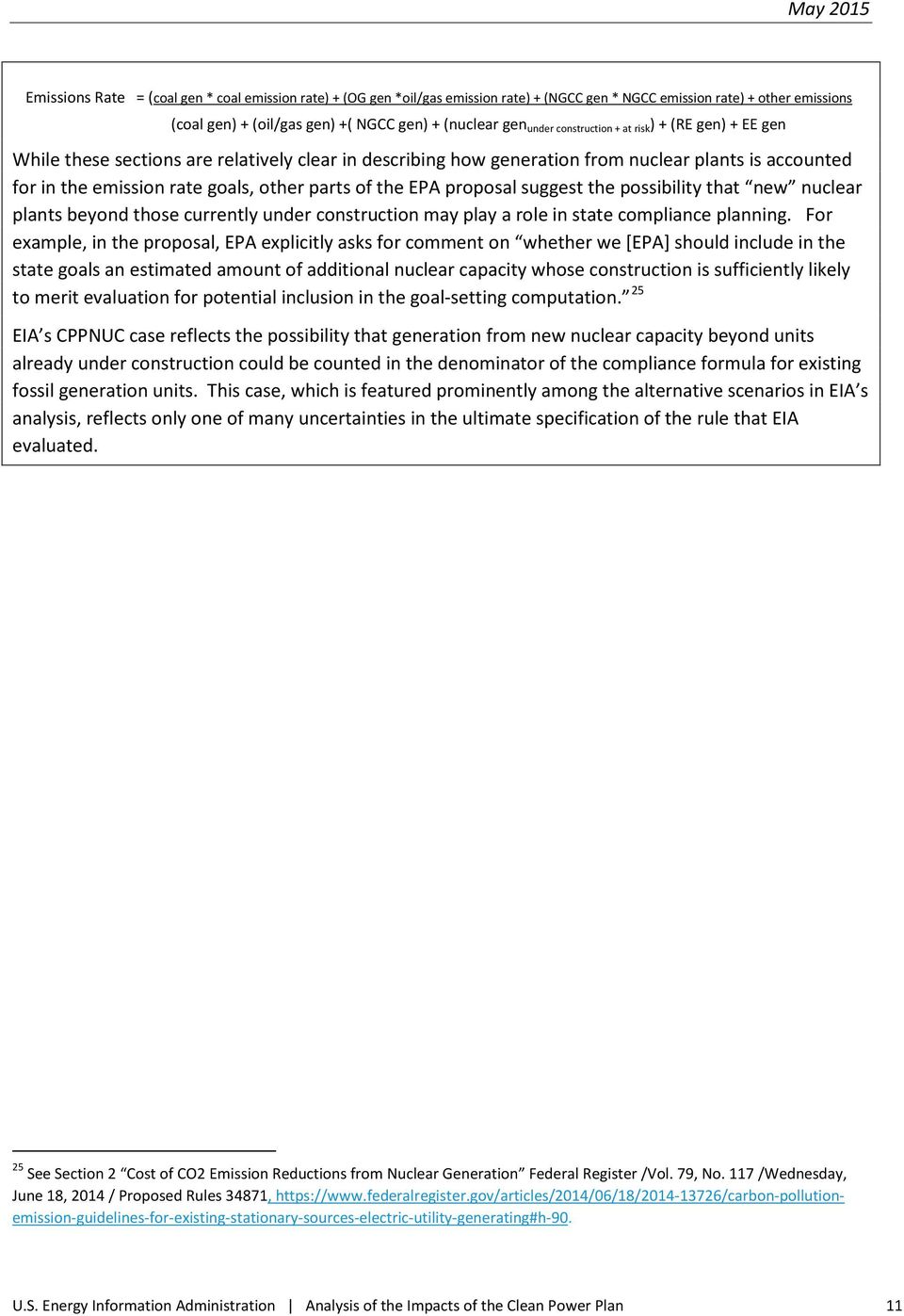
18 Emissions Rate = (coal gen * coal emission rate) + (OG gen *oil/gas emission rate) + (NGCC gen * NGCC emission rate) + other emissions (coal gen) + (oil/gas gen) +( NGCC gen) + (nuclear gen under construction + at risk ) + (RE gen) + EE gen While these sections are relatively clear in describing how generation from nuclear plants is accounted for in the emission rate goals, other parts of the EPA proposal suggest the possibility that new nuclear plants beyond those currently under construction may play a role in state compliance planning. For example, in the proposal, EPA explicitly asks for comment on whether we [EPA] should include in the state goals an estimated amount of additional nuclear capacity whose construction is sufficiently likely to merit evaluation for potential inclusion in the goal-setting computation. 25 EIA s NUC case reflects the possibility that generation from new nuclear capacity beyond units already under construction could be counted in the denominator of the compliance formula for existing fossil generation units. This case, which is featured prominently among the alternative scenarios in EIA s analysis, reflects only one of many uncertainties in the ultimate specification of the rule that EIA evaluated. 25 See Section 2 Cost of CO2 Emission Reductions from Nuclear Generation Federal Register /Vol. 79, No. 117 /Wednesday, June 18, 2014 / Proposed Rules 34871, U.S. Energy Information Administration Analysis of the Impacts of the Clean Power Plan 11
19 Scenario descriptions Table 2 describes the EIA baseline cases and the main Clean Power Plan cases analyzed in this report. 26 Table 2. Description of EIA baseline cases and Clean Power Plan cases Case name Reference () Base Policy () Policy Extension (EXT) Policy with New Nuclear (NUC) Policy with Biomass CO 2 (BIO195) Cases using alternative baselines High Economic Growth (HEG) High Oil and Gas Resource (HOGR) Policy with High Economic Growth (HEG) Policy with High Oil and Gas Resource (HOGR) Description EIA s 2015 Reference case presents annual projections of energy supply, demand, and prices through The Reference case is generally based on federal, state, and local laws and regulations as of October The Base Policy case models the proposed Clean Power Plan using the 2015 Reference case as the underlying baseline. The Policy Extension case extends CO 2 reduction targets beyond 2030, in order to reduce CO 2 emissions from the power sector by 45% below 2005 levels in 2040, using the 2015 Reference case as the baseline. The Policy with New Nuclear case models the Clean Power Plan assuming that generation from currently unplanned new nuclear capacity counts in compliance calculations. The baseline for the NUC case is the 2015 Reference case. The Policy with Biomass CO 2 case models the Clean Power Plan assuming that the emission rate for biomass fuel is 195 pounds CO 2 per MMBtu, as assumed by EPA in its Regulatory Impact Analysis, in place of EIA s Reference case assumption that biomass is carbon neutral. The baseline for the BIO195 case is the 2015 Reference case. EIA s 2015 High Economic Growth case, which reflects higher growth in U.S. gross domestic product (GDP) than the Reference case, resulting in higher electricity demand and fuel prices. EIA s 2015 High Oil and Gas Resource case, which reflects moreoptimistic assumptions about domestic oil and natural gas supply prospects than the Reference case, resulting in lower natural gas prices. The HEG case models the proposed Clean Power Plan using the 2015 High Economic Growth case as the baseline. The HOGR case models the proposed Clean Power Plan using the 2015 High Oil and Gas Resource case as the baseline. 26 See Table 17 for a list of additional sensitivity scenarios. U.S. Energy Information Administration Analysis of the Impacts of the Clean Power Plan 12

20 FIGURES IN THIS REPORT: This report includes two primary figure styles. Difference-type figures, such as Figure 3 below, focus on the change in a specific year or over a specific time period between Clean Power Plan cases and the baseline cases from which they are developed. Time-trend figures, such as Figure 9 below, present base and policy case information starting from the historical year 2005 through 2040, the end of the 2015 projection period. Nearly all time-trend figures in this report have two panels. The left-hand panel reports the Reference case (black line) together with several Clean Power Plan cases developed from that baseline. The right-hand panel reports two alternative baselines, High Economic Growth and High Oil and Gas Resources, along with one Clean Power Plan case developed from each respective baseline. Each baseline and its associated policy case in the right-hand panel use the same color (darker for the former, lighter for the latter) to help readers identify which lines should be compared to identify changes resulting from the Clean Power Plan. U.S. Energy Information Administration Analysis of the Impacts of the Clean Power Plan 13

21 Summary of Results Power sector CO 2 emissions declined by 363 million metric tons between 2005 and 2013, due to a decline in coal s generation share and growing use of natural gas and renewables, but the CO 2 emissions are projected to change only modestly from 2013 through 2040 in the 3 baseline cases used in this report. Relative to the 2015 Reference case, the projected emissions trajectory is somewhat lower in the High Oil and Gas Resource case baseline, which has cheaper natural gas, and somewhat higher in the High Economic Growth case, which has higher electricity use. The proposed Clean Power Plan would reduce projected power sector CO 2 emissions (Figure 3, Table 3 and Table 4). Reductions in projected emissions in 2030 relative to baseline projections for that year range from 484 to 625 million metric tons. The projected power sector emissions level in 2030 ranges from 1,553 to 1,727 million metric tons across the cases, reflecting a reduction of between 29% and 36% relative to the 2005 emissions level of 2,416 million metric tons. Figure 3. Change in electric power sector CO 2 emissions in Clean Power Plan () cases relative to baseline, selected years million metric tons EXT NUC HEG HOGR Switching from coal-fired generation to natural gas-fired generation is the predominant compliance strategy as implementation begins, with renewables playing a growing role in the mid-2020s and beyond (Figures 4 and 5; Tables 3 and 4). Demand-side energy efficiency plays a moderate role in compliance, relative to the early role of natural gas and the eventual role of renewables. The economics of increased natural gas generation and expanded renewable electricity capacity vary regionally, the key determinants being: 1) the natural gas supply and combined cycle utilization rates by region; and 2) the potential for penetration of renewable generation in regions including states that have no (or low) renewable portfolio standards. U.S. Energy Information Administration Analysis of the Impacts of the Clean Power Plan 14
22 Figure 4. Change in generation and energy efficiency savings under the Clean Power Plan Base Policy case relative to 2015 Reference case billion kilowatthours EE savings Renewable Natural Gas Coal With continued Clean Power Plan emissions reduction requirements through 2040 under the Policy Extension Case (EXT), the shift to higher natural gas-fired generation is maintained through (Figure 5 and Table 3). Figure 5. Change in generation and energy efficiency savings under the Clean Power Plan Policy Extension case relative to 2015 Reference case billion kilowatthours EE savings Renewable Natural Gas Coal U.S. Energy Information Administration Analysis of the Impacts of the Clean Power Plan 15
23 If new nuclear power generation were to be treated in the same manner as new renewable generation in compliance calculations, the Clean Power Plan would also result in increased nuclear generation (Figure 6 and Table 3). Figure 6. Nuclear generation in 2015 Reference and Clean Power Plan cases, selected years billion kilowatthours 1, NUC The Clean Power Plan has a significant effect on projected retirements and additions of electric generation capacity (Figures 7 and 8; Tables 3 and 4). Projected coal plant retirements over the period, which are 40 GW in the 2015 Reference case (most before 2017), increase to 90 GW (nearly all by 2020) in the Base Policy case (). Retirements of inefficient units fueled by natural gas or oil, generally involving primary steam cycles, are also projected to rise. Turning to additions, which are dominated by natural gas and renewables over the period in the 2015 Reference case, the Clean Power Plan significantly increases projected renewable capacity additions in all cases. Under favorable natural gas supply conditions, the Clean Power Plan also increases additions of generation capacity fueled by natural gas (HOGR). Nuclear capacity is also added in a sensitivity case in which new nuclear generation receives the same treatment as new renewable generation in compliance calculations (NUC). U.S. Energy Information Administration Analysis of the Impacts of the Clean Power Plan 16
24 Figure 7. Change in generating capacity retirements by fuel type in Clean Power Plan cases relative to baseline (cumulative, ) gigawatts EXT NUC HEG HOGR Coal Natural Gas/Oil Figure 8. Change in generating capacity additions by fuel type in Clean Power Plan cases relative to baseline (cumulative, ) gigawatts EXT NUC HEG HOGR Natural Gas Nuclear Coal Solar Wind Other renewable U.S. Energy Information Administration Analysis of the Impacts of the Clean Power Plan 17
25 Coal production and minemouth steam coal prices are lower compared with the 2015 Reference case in the early years following Clean Power Plan implementation (Figures 9 and 10, and Tables 3 and 4). In the Base Policy case () projected U.S. coal production in 2020 and 2025 is 20% and 32% lower relative to the 2015 baseline level in those years, respectively. All major coal-producing regions (West, Interior, and Appalachia) experience negative production impacts in Expanded generation from renewables, rising natural gas prices, and static targets in the post-2030 period in the case allow existing coal-fired plants to operate at a higher utilization rate which rises from a low of 60% in 2024 to 71% in As a result, coal production edges higher but still remains 20% below the 2015 Reference case level in The Interior coal-producing region, which primarily includes the Illinois and Gulf-lignite Basins, and the West coal-producing region, which primarily includes the Powder River, Rocky Mountain, Arizona/New Mexico and Dakota-lignite Basins, account for most of the increase in production levels in the case towards the end of the projection period. Average minemouth steam coal prices also decline after 2020 and are 8% and 10% lower in 2025 and 2030, respectively in the Base Policy Case compared with the 2015 Reference case and then remain at least 8% lower than the Reference case through Figure 9. Total U.S. coal production in baseline and Clean Power Plan cases, million short tons EXT NUC HEG HOGR 200 HEG HOGR U.S. Energy Information Administration Analysis of the Impacts of the Clean Power Plan 18
26 Figure 10. Minemouth steam coal prices in baseline and Clean Power Plan cases, dollars per ton HEG HOGR EXT NUC HEG HOGR Note: Minemouth steam coal prices include coal delivered to all users of steam coal (buildings, industrial, and electricity sectors as well as steam exports). The Clean Power Plan s effect on natural gas production and prices is very sensitive to baseline supply conditions (Figure 11 and Figure 12; Tables 3 and 4). The Clean Power Plan increases natural gas use significantly relative to baseline at the start of Clean Power Plan implementation, but this effect fades over time as renewables and efficiency programs increasingly become the dominant compliance strategies. While there are significant differences in projected natural gas prices across baselines, with persistently lower prices in the High Oil and Gas Resource case, the Clean Power plan itself does not significantly move natural gas prices with the exception of an initial impact expected during the first 2-3 years after the start of implementation. U.S. Energy Information Administration Analysis of the Impacts of the Clean Power Plan 19
27 Figure 11. Natural gas production in baseline and Clean Power Plan cases, trillion cubic feet EXT NUC 10 HEG HEG HOGR HOGR Figure 12. Henry Hub spot price for natural gas in baseline and Clean Power Plan cases, dollars per MMBtu EXT NUC HEG HOGR 2 HEG HOGR Heat rates for coal-fired generators that remain in use, defined as the energy content of coal consumed (in Btu) per kwh of net electricity generated, improve modestly under the Clean Power Plan (Figure 13). In all cases, the average heat rate improvement across the fleet of coal-fired generators is less than 2%. The projected level of heat rate improvement is sensitive to assumptions about natural gas supply that influence natural gas prices, reflecting competition between available compliance options. U.S. Energy Information Administration Analysis of the Impacts of the Clean Power Plan 20
28 Figure 13. Average percentage change in heat rate of coal-fired generators in Clean Power Plan cases, relative to baseline cases percent improvement relative to baseline 0.0% % -1.0% -1.5% -2.0% EXT NUC HEG HOGR Retail electricity prices and expenditures rise under the Clean Power Plan. Retail electricity prices increase most in the early 2020s, in response to initial compliance measures. Increased investment in new generating capacity as well as increased use of natural gas for generation lead to electricity prices that are 3% to 7% higher on average from in the Clean Power Plan cases, versus the respective baseline cases (Figure 14). While prices return to near-baseline levels by 2030 in many regions, prices remain at elevated levels in some parts of the country. In Florida and the Southeast, the Southern Plains, and the Southwest regions the projected electricity prices in 2030 are roughly 10% above baseline in the Base Policy case (). Electricity expenditures also generally rise with Clean Power Plan implementation, but expenditure changes are smaller in percentage terms than price changes as the combination of energy-efficiency programs pursued for compliance purposes and higher electricity prices tends to reduce electricity consumption relative to baseline. By 2040, total electricity expenditures in the case are slightly below those in the 2015 Reference case, as decreases in demand more than offset the price increases. U.S. Energy Information Administration Analysis of the Impacts of the Clean Power Plan 21
29 Figure 14. All sectors average retail electricity price in baseline and Clean Power Plan cases, cents per kilowatthour HEG HOGR 7 7 EXT NUC HEG HOGR Biomass generation accounts for only a small share of total generation with or without the Clean Power Plan. Implementation of the Clean Power Plan can either increase or decrease projected biomass generation depending on the emission rate applied to biomass generation in the compliance calculation. Using the 195 pounds/mmbtu emissions rate for biomass assumed in EPA s Regulatory Impact Analysis, as in the BIO195 case, EIA projects that biomass generation in 2020 and 2030 would be 33% and 71% below the respective 2015 baseline levels of 24 billion kwh (BkWh) and 41 BkWh for those years. In the Base Policy case (), which uses the standard EIA treatment of biomass generation as a net zero emissions generation source, EIA projects that biomass generation in 2020 and 2030 would be 46% above and 5% below the respective 2015 baseline levels for those years. Economic activity indicators, including real gross domestic product (GDP), industrial shipments, and consumption, are reduced relative to baseline under the Clean Power Plan. Across cases that start from the 2015 Reference case, the reduction in cumulative GDP over ranges from 0.17%- 0.25%, with the high end reflecting a tighter policy beyond Implementing the Clean Power Plan under baselines that assume high economic growth or high oil and gas resources ameliorate both GDP and disposable income impacts relative to outcomes using the 2015 Reference case baseline. U.S. Energy Information Administration Analysis of the Impacts of the Clean Power Plan 22
30 Table 3. Summary results for 2015 Reference case and Clean Power Plan cases, selected years EXT NUC EXT NUC EXT NUC ELECTRIC GENERATION (billion kwh) Coal 2,013 1,586 1,709 1,340 1,324 1,357 1,713 1,153 1,101 1,165 1,702 1, ,306 Natural Gas 761 1,118 1,117 1,382 1,359 1,371 1,371 1,429 1,464 1,401 1,569 1,456 1,560 1,400 Nuclear Hydro Wind Solar Other renewables Oil/ other Total 4,055 4,070 4,351 4,308 4,308 4,311 4,691 4,584 4,586 4,586 5,056 4,942 4,903 4,948 ELECTRIC GENERATION CAPACITY (GW) Coal Natural gas / Oil Nuclear Hydro Wind Solar Other renewables Other Total 978 1,065 1,079 1,065 1,074 1,068 1,133 1,226 1,235 1,215 1,261 1,365 1,435 1,337 ELECTRICITY-RELATED CARBON DIOXIDE EMISSIONS (million metric tons) Power sector 2,416 2,053 2,107 1,814 1,794 1,825 2,177 1,596 1,553 1,598 2,195 1,691 1,329 1,696 ELECTRICITY PRICES (2013 cents per kwh) Residential Commercial Industrial All Sectors ELECTRICITY EXPENDITURES (billion 2013 dollars) Residential Commercial Industrial Total ENERGY PRODUCTION (quadrillion Btu) Natural Gas Coal Oil Nuclear Renewable Other Total U.S. Energy Information Administration Analysis of the Impacts of the Clean Power Plan 23
31 Table 3. Summary results for 2015 Reference case and Clean Power Plan cases, selected years (cont.) EXT NUC EXT NUC EXT NUC OTHER PRICES (2013 $/MMBtu, unless otherwise noted) Natural Gas (Henry Hub) Average Delivered Natural Gas Price to Electric Power Sector Steam Coal Minemouth Price (2013$/short-ton) Steam Coal Price Delivered to Electric Power Sector Brent Spot Price (2013 dollars per barrel) ECONOMIC INDICATORS (billion 2009 chain-weighted dollars, unless otherwise noted) Gross domestic product 14,234 15,710 18,801 18,739 18,732 18,744 23,894 23,866 23,855 23,862 29,898 29,886 29,831 29,899 Total industrial shipments 7,464 7,004 8,467 8,423 8,417 8,426 9,870 9,810 9,801 9,810 11,463 11,418 11,374 11,423 Non-farm employment (millions) Average Annual Change in CPI from 2013 (%) % 1.75% 1.82% 1.83% 1.81% 1.85% 1.88% 1.88% 1.88% 1.98% 1.99% 2.00% 1.99% END-USE ENERGY CONSUMPTION (quadrillion Btu) Liquids Natural Gas Electricity Coal PRIMARY ENERGY (quadrillion Btu) Consumption Imports Exports Production All sector average price includes transportation sector. 2 Total expenditures exclude transportation sector. U.S. Energy Information Administration Analysis of the Impacts of the Clean Power Plan 24
32 Table 4. Summary results for 2015 High Oil and Gas Resource, High Economic Growth and cases, selected years HOGR HOGR HEG HEG ELECTRIC GENERATION (billion kwh) Coal 2,013 1,586 1,443 1,212 1,733 1,415 1, ,733 1,293 1, ,744 1,421 Natural Gas 761 1,118 1,450 1,610 1,204 1,377 1,832 2,092 1,573 1,422 2,200 2,439 1,705 1,475 Nuclear Hydro Wind Solar Other renewables Oil/ other Total 4,055 4,070 4,417 4,392 4,480 4,445 4,854 4,753 5,003 4,912 5,274 5,154 5,574 5,461 HOGR HOGR HEG HEG HOGR HOGR HEG HEG ELECTRIC GENERATION CAPACITY (GW) Coal Natural gas / Oil Nuclear Hydro Wind Solar Other renewables Other Total 978 1,065 1,075 1,070 1,094 1,108 1,159 1,196 1,207 1,335 1,275 1,309 1,422 1,546 ELECTRICITY-RELATED CARBON DIOXIDE EMISSIONS (million metric tons) Power sector 2,416 2,053 1,973 1,789 2,165 1,886 2,089 1,605 2,262 1,727 2,179 1,701 2,266 1,827 ELECTRICITY PRICES (2013 cents per kwh) Residential Commercial Industrial All Sectors ELECTRICITY EXPENDITURES (billion 2013 dollars) Residential Commercial Industrial Total ENERGY PRODUCTION (quadrillion Btu) Natural Gas Coal Oil Nuclear Renewable Other Total U.S. Energy Information Administration Analysis of the Impacts of the Clean Power Plan 25
33 Table 4. Summary results for 2015 High Oil and Gas Resource, High Economic Growth and cases, selected years (cont.) HOGR HOGR HEG HEG OTHER PRICES (2013 $/MMBtu, unless otherwise noted) Natural Gas (Henry Hub) Average Delivered Natural Gas Price to Electric Power Sector Steam Coal Minemouth Price (2013$/short-ton) Steam Coal Price Delivered to Electric Power Sector Brent Spot Price (2013 dollars per barrel) HOGR HOGR HEG HEG HOGR HOGR ECONOMIC INDICATORS (billion 2009 chain-weighted dollars, unless otherwise noted) Gross domestic 14,234 15,710 18,841 18,796 19,590 19,526 24,222 24,192 26,146 26,126 30,236 30,186 34,146 34,107 product Total industrial shipments 7,464 7,004 8,566 8,536 8,967 8,924 10,349 10,314 11,081 11,022 11,989 11,969 13,786 13,656 Non-farm employment (millions) Average Annual Change in CPI from 2013 (%) % 1.56% 1.60% 1.67% 1.74% 1.63% 1.63% 1.62% 1.65% 1.85% 1.84% 1.80% 1.82% END-USE ENERGY CONSUMPTION (quadrillion Btu) Liquids Natural Gas Electricity Coal HEG HEG PRIMARY ENERGY (quadrillion Btu) Consumption Imports Exports Production All sector average price includes transportation sector. 2 Total expenditures exclude transportation sector. U.S. Energy Information Administration Analysis of the Impacts of the Clean Power Plan 26
34 Detailed Results Appendices G, H and I provide sets of tables that summarize key results for all cases included in this report for 2020, 2030, and EIA s standard reporting tables for all runs in this study are available through the web browser at CO 2 emissions and compliance strategy indicators CO 2 emissions In the 2015 Reference case (), EIA projects that power sector CO 2 emissions will fall below 2005 levels by 13% in 2020, by 10% in 2030 and 9% in The expected reductions in CO 2 emissions are primarily due to moderate natural gas prices, which result in higher utilization of natural gas-fired generating capacity and lower use of coal-fired generators, along with renewable energy standards, which lead to increased generation from zero-carbon technologies. EIA projects that the Clean Power Plan would further reduce power sector CO 2 emissions through a combination of compliance strategies, including re-dispatch, increasing use of lower-carbon technologies, heat rate improvements, and energy efficiency. The projected reductions are sensitive to many factors, especially assumptions about economic growth, fuel prices, and post-2030 policies. Figure 15 compares total electric power sector CO 2 emissions across the Clean Power Plan cases and baseline cases. In the Base Policy case (), power sector CO 2 emissions are 25% below 2005 levels in 2020 and about 34% below 2005 levels in By 2040, the corresponding reduction is 30%, as continued demand growth leads to additional generation from fossil fuel-fired sources. In the Policy Extension case (EXT), the assumed decrease in the emission performance goals after 2030 results in a 45% reduction in CO 2 emissions in 2040, compared with 2005 levels. U.S. Energy Information Administration Analysis of the Impacts of the Clean Power Plan 27
35 Figure 15. Power sector CO 2 emissions in Baseline and Clean Power Plan cases, million metric tons CO EXT NUC HEG HEG HOGR HOGR Higher economic growth typically results in higher electricity demand, which in turn can lead to higher power sector CO 2 emissions. In the 2015 High Economic Growth case (HEG), power sector CO 2 emissions are 10% below 2005 levels in 2020 and 6% below 2005 levels in 2030 and In the HEG case, which applies the Clean Power Plan under the 2015 High Economic Growth assumptions, power sector CO 2 emissions in 2020, 2030, and 2040 are 22%, 29%, and 24% lower than 2005 levels, respectively. Low natural gas prices can lead to lower power sector CO 2 emissions due to increased switching from coal-fired generation to less-carbon-intensive natural gas-fired generation. In the High Oil and Gas Resource case (HOGR), power sector CO 2 emissions are 18% below 2005 levels in 2020, 14% below 2005 levels in 2030, and 10% below 2005 levels in In the HOGR case, which applies the Clean Power Plan under 2015 High Oil and Gas Resource assumptions, power sector CO 2 emissions in 2020, 2030, and 2040 are 26%, 34%, and 30% lower than 2005 levels, respectively. The HOGR case, which assumes conditions leading to lower natural gas prices, relies more heavily on switching from coal to natural gas, relative to the Base Policy case (). Table 5. Power sector CO 2 emissions reduction relative to 2005 levels in Clean Power Plan cases EXT NUC HEG HOGR % -26% -24% -22% -26% % -36% -34% -29% -34% % -45% -30% -24% -30% U.S. Energy Information Administration Analysis of the Impacts of the Clean Power Plan 28
36 Total generation by fuel type In the early years of compliance, re-dispatch from coal-fired generation to natural gas-fired generation is the main strategy to achieve emission performance goals. In the longer term, growth in renewable generation provides a dominant share of compliance, reflecting both increasingly attractive costs and the design of the formula used to calculate compliance. The ultimate generation mix depends on the base assumptions regarding future natural gas prices and economic growth. In all Clean Power Plan cases, total coal-fired generation declines from the 2013 level of 1,586 billion kilowatthours (BkWh), which is already well below the 2005 level of 2,013 BkWh. The declines relative to baseline coal-fired generation range from 18% to 43% in 2030 (Figure 18). In the Base Policy case (), coal-fired generation declines to 1,340 BkWh in 2020 and 1,153 BkWh in 2030 (27% below the underlying 2015 Reference case baseline level). In the Policy Extension case (EXT), where emission performance goals continue to decline post-2030, coal-fired generation continues to fall, to 904 BkWh in In the HEG case, coal-fired generators produce a higher level of output under higher demand growth, but carry about the same share of total generation relative to the Base Policy case. In the HOGR case, lower natural gas prices result in more re-dispatch from coal-fired generation to natural gas-fired generation, with coal-fired generation declining to 898 BkWh by 2030 and remaining near that level through In the HOGR case, the share of total generation from coal-fired units drops to 18% in Capacity factor is a measure of the utilization of a generating resource s total capacity, and is a convenient metric for analyzing re-dispatch trends under the Clean Power Plan. In the Base Policy Case, the average capacity factor for coal-fired generators decreases from 74% in 2019 to 60% in 2024, as regions adjust generator dispatch to meet interim emission performance goals (Figure 16). By 2040, the capacity factor for coal-fired generators rebounds to 71%. In the Policy Extension case, capacity factors for coal-fired generators level off following the early compliance years, averaging 66% from , but then decline steadily to 53% by Capacity factors for coal-fired generating units are highest among the Clean Power Plan cases under 2015 High Economic Growth assumptions in the HEG case, rebounding from 61% in 2024 to 74% in 2040 due to higher electricity demand growth and increased use of other compliance options, which offset the carbon intensity impact of coal-fired generation. Capacity factors for coal-fired generating units are lowest in the HOGR case, averaging 61% from 2020 through 2040, due to low natural gas prices in the underlying 2015 High Oil and Gas Resource base case. U.S. Energy Information Administration Analysis of the Impacts of the Clean Power Plan 29
37 Figure 16. Average capacity factor for coal-fired generating units in Baseline and Clean Power Plan cases, percent EXT NUC HEG HEG HOGR HOGR Natural gas-fired generation increases substantially in the early 2020s across all cases, as an initial compliance strategy. Natural gas-fired generation increases from 1,118 BkWh in 2013 to 1,382 BkWh in 2020 in the Base Policy case, 24% above the underlying 2015 Reference case baseline level. However, by 2030, natural gas-fired generation is near its baseline Reference case levels, due to lower demand requiring less new natural gas-fired capacity and an increased reliance on renewable generation for compliance. The share of total generation from natural gas grows from 27% to 32% from in the Base Policy case, and remains at or above 30% throughout most of the projection. In the Policy Extension case, natural gas-fired generation continues to grow beyond 2030, displacing more coal-fired generation when emission performance goals continue to decline (become more stringent), and the natural gas share remains steady between 32% and 33% from 2031 to Only the HOGR case, which uses 2015 High Oil and Gas Resource assumptions, sees continued growth in the share of natural gas-fired generation throughout the projection, reaching 47% in 2040, as lower natural gas prices lead to greater reliance on natural gas-fired compliance strategies over renewables. Capacity factors for natural gas combined cycle plants experience a sharp ramp-up at the beginning of the compliance period, peaking in 2020 at 57% in the Base Policy case and 56% in the Policy Extension case, before falling to 45% and 46%, respectively, in 2040 (Figure 17). By contrast, natural gas-fired combined cycle plants have their highest capacity factors among the Clean Power Plan cases in the HOGR case, averaging 62% between 2020 and U.S. Energy Information Administration Analysis of the Impacts of the Clean Power Plan 30
38 Figure 17. Average capacity factor for natural gas combined cycle plants in Baseline and Clean Power Plan cases, percent EXT NUC HEG HEG HOGR HOGR New renewable generation represents an important strategy for attaining compliance requirements. In the Base Policy case, as emission performance goals decline (become more stringent) over the interim compliance period, renewable generation increases to 1,154 BkWh in 2030 (53% above the 2015 Reference case and more than double 2013 levels). The role of renewables in the compliance mix grows over time. As interim Clean Power Plan requirements begin in 2020, natural-gas fired combined cycle units predominate among the alternatives to existing coal-fired generation, with natural gas generation increasing by 369 BkWh over baseline levels, while coal generation declines by 369 BkWh. By 2025, however, renewable generation contributes more to the shifting generation mix and by 2030 the increase in renewable generation relative to the is 398 BkWh, compared with a decline in coal generation of 561 BkWh. Renewable generation continues to increase beyond 2030 in the Base Policy case, as rising natural gas prices make re-dispatch from coal to natural gas a less economically attractive compliance mechanism. In both the Policy Extension case and the HEG case, renewable generation represents over 30% of total generation in 2040, with higher levels of renewable generation required to meet the declining goals, or to maintain the goals under more robust electricity demand growth, respectively. However, the use of renewables as the primary long-term compliance mechanism is sensitive to fuel price assumptions. In the HOGR case, which assumes 2015 High Oil and Gas Resource conditions, renewable generation represents less than 20% of total generation throughout the projection as regions tend to choose compliance strategies involving re-dispatch and displacement of existing coal-fired generation with generation from new natural gas-fired combined cycle capacity. U.S. Energy Information Administration Analysis of the Impacts of the Clean Power Plan 31
39 Figure 18. Change in electricity generation by fuel in Clean Power Plan cases relative to baseline billion kilowatthours ,000 Nuclear Renewable Coal Natural Gas Oil/other Heat rate improvement Heat rate is a measure of the thermal efficiency of a power plant, representing the amount of energy, in Btu, used to generate one kilowatthour of net electricity generation. NEMS incorporates logic that allows coal-fired generating units to undertake heat rate improvement projects, whenever it is economic to do so under baseline conditions or when the Clean Power Plan is implemented. EIA s analysis indicates that heat rate improvement activities would significantly increase under the proposed rule. Most heat rate improvement activity takes place in the early years of compliance. In the Base Policy case, the average heat rate for coal-fired generating units reaches its most efficient point, 10,170 British thermal units per kilowatthour (Btu/kWh), in 2023 (a 1.9% improvement over the underlying baseline 2015 Reference case). Through the remainder of the projection, the average heat rate for coal-fired generating units rises slightly, as more non-fossil fuel generating sources come online and less-efficient coal-fired generating units achieve higher production levels without violating regional emission performance goals. Table 6 presents average heat rates for coal-fired generating units, and the total capacity performing heat rate improvement projects, in the baseline and Clean Power Plan cases for 2020, 2030, and The reported heat rates apply to coal-fired generation fleets and utilization rates that vary considerably across cases. For this reason, differences in heat rates across cases cannot be attributed only to differences in heat rate improvement investments. In the Base Policy case, 75 gigawatts of coal-fired capacity undertake heat rate improvement projects by 2040, compared with 13 gigawatts in the underlying baseline 2015 Reference case. In the Policy U.S. Energy Information Administration Analysis of the Impacts of the Clean Power Plan 32
40 Extension case, there is less heat rate improvement activity (57 gigawatts in 2040) due to a combination of factors: higher overall coal-fired generation capacity retirements, along with regional decisions to pursue other compliance options early in the projection, in anticipation of increasingly stringent post requirements. Heat rate improvement activity is economic if the requisite capital, operations, and maintenance costs are lower than expected fuel cost savings. When natural gas prices are low, it is less costly to substitute natural gas-fired generation for coal-fired generation, and regions find it less economically attractive to use heat rate improvement as a compliance mechanism. In the HOGR case, which evaluates the Clean Power Plan under lower natural gas prices using 2015 High Oil and Gas Resource assumptions, 43 gigawatts of capacity undertake heat rate improvement activity by This represents a 32 gigawatt increase over the underlying base case, but is nearly 42% lower than the amount of capacity undertaking heat rate improvement in the Base Policy case, and 44% lower than the amount in the HEG case, which assumes 2015 High Economic Growth conditions. Figure 19 illustrates the average heat rate for coal-fired generators in the Clean Power Plan cases and the respective baseline cases. Across cases, the overall level of heat rate improvement is modest. Relative to baseline, the highest level of heat rate improvement occurs in the Base Policy case. Lower levels of heat rate improvement are realized when the Clean Power Plan emission performance goals are extended (Policy Extension) because other compliance options are more economic when greater reductions in the average emission rate are required. Table 6. Summary of heat rates and capacity performing heat rate improvement in Baseline and Clean Power Plan cases Average heat rate for coal-fired units (Btu/kWh) Gigawatts of capacity undertaking HRI Case Column ,372 10,370 10, HEG 10,383 10,381 10, HOGR 10,336 10,353 10, ,198 10,215 10, EXT 10,221 10,249 10, NUC 10,177 10,219 10, HEG 10,204 10,255 10, HOGR 10,230 10,216 10, U.S. Energy Information Administration Analysis of the Impacts of the Clean Power Plan 33
41 Figure 19. Average heat rate of coal-fired generators in Baseline and Clean Power Plan cases, Btu per kilowatthour HEG HOGR EXT NUC HEG HOGR Retirements and capacity additions Retirements The emission performance goals in the Clean Power Plan lead to a reduced reliance on existing fossil fuel-fired plants, which results in more retirements. Under the Clean Power Plan, coal-fired capacity accounts for most of the additional retirements relative to the underlying baseline cases (Figure 20). In the 2015 Reference case, total retirements of existing capacity are about 90 gigawatts. Coal-fired and natural gas/oil-fired capacity account for 40 gigawatts and 46 gigawatts of the total retirements, respectively. In the Base Policy case, 90 gigawatts of coal-fired capacity and 62 gigawatts of natural gas/oil-fired capacity retires. In the Policy Extension case, additional retirements occur as the emission performance goals continue decreasing after 2030, resulting in total retirements of about 179 gigawatts, including 101 gigawatts of coal-fired capacity and 74 gigawatts of natural gas/oil-fired capacity. Compared with the 2015 Reference case, the 2015 High Economic Growth case projects higher demand growth, and the 2015 High Oil and Gas Resource case projects lower natural gas prices. The HEG and HOGR cases examine the impacts of the Clean Power Plan under higher demand and lower fuel prices, respectively. With higher electricity demand (HEG), the Clean Power Plan increases total retirements by 43 gigawatts and most of this increment is coal-fired capacity. With lower natural gas prices (HOGR), the emission performance goals in the Clean Power Plan result in 88 gigawatts of additional retirements, about 70% of which is attributed to coal-fired capacity (Figure 20). U.S. Energy Information Administration Analysis of the Impacts of the Clean Power Plan 34
42 Figure 20. Change in generating capacity retirements by fuel type in Clean Power Plan cases relative to baseline (cumulative, ) gigawatts EXT NUC HEG HOGR Coal Natural Gas/Oil Nuclear Renewable Capacity additions The Clean Power Plan alters the outlook for capacity builds in the electric power sector, substantially increasing builds of renewable electricity capacity in most of the cases analyzed. The increase in renewable capacity builds is largely attributable to the inclusion of new renewable generation in the denominator of EPA s calculation of the achieved intensity standard. In the Base Policy case, cumulative additions of renewable electricity generation capacity through 2040 increase by 174 gigawatts, or 160%, as compared with the underlying 2015 Reference case (Figure 21). In the Extended Policies case, renewable electricity generation capacity additions increase by another 79 gigawatts, to 362 gigawatts overall, as regions continue to add zero-carbon resources to meet post-2030 emission performance goals. The largest amount of renewable electricity generation capacity additions occur under 2015 High Economic Growth conditions in the HEG case (393 gigawatts). The least amount of renewable electricity generation capacity additions occur in the HOGR case, as low natural gas prices shift the economics of regional compliance strategies away from building new zero-carbon generating capacity, and towards the use of re-dispatch and the construction of new natural gas combined cycle capacity to offset generation from existing sources. Nonetheless, the 138 gigawatts of renewable electricity generation capacity additions in the HOGR case are more than double the level in the underlying 2015 High Oil and Gas Resource base case. U.S. Energy Information Administration Analysis of the Impacts of the Clean Power Plan 35
43 Figure 21. Change in cumulative capacity additions, , in Clean Power Plan cases relative to baseline gigawatts EXT NUC HEG HOGR Natural Gas Nuclear Coal Solar Wind Other renewable Wind power plays an important role in Clean Power Plan compliance, with wind electricity generation capacity more than tripling over 2013 levels by 2040 in the Base Policy case (205 gigawatts in 2040 vs. 61 gigawatts in 2013). Most of the increase in wind electricity generation capacity occurs from (Figure 22), as regions shift their electricity capacity mixes to achieve interim emission performance goals. As a result, in the Base Policy case, installed wind electricity generation capacity in 2025 (188 gigawatts) is more than double the level in the underlying 2015 Reference case (84 gigawatts). Wind electricity generation capacity continues to expand moderately after 2030, as regions add zero-carbon capacity to maintain their final emission performance levels. 27 This trend also holds under 2015 High Economic Growth assumptions, in the HEG case. In the Policy Extension case, emission performance goals continue to decrease (becoming more stringent) throughout the 2030s, and wind electricity generation capacity continues to play a major role in attaining tightening carbon intensity limits on existing resources. The most substantial amount of post-2030 wind electricity generation capacity expansion occurs in the Policy Extension case, with total installed capacity growing from 198 gigawatts in 2030 to 273 gigawatts in In the HOGR case, following a period of expansion between 2020 and 2025, wind electricity generation capacity is relatively flat through the late 2020s and 2030s as lower fuel prices lead regions to favor natural gas-fired compliance strategies. 27 Additionally, wind is increasingly economically competitive with other resource types in the post-2030 timeframe, as can be seen by the late-projection increase in wind electricity generation capacity in the Reference case. U.S. Energy Information Administration Analysis of the Impacts of the Clean Power Plan 36
44 Figure 22. Change in installed wind generating capacity in Clean Power Plan cases relative to baseline gigawatts EXT NUC HEG HOGR The Base Policy case projects 136 gigawatts of installed solar electricity generating capacity in 2040, an increase of 76 gigawatts over the underlying 2015 Reference case (Figure 23), as regions with rich solar resources leverage solar technology to reduce carbon intensity and reduce fuel costs. However, solar electricity generation capacity additions vary widely across cases, heavily dependent on the projected paths of electricity use and natural gas prices. The HEG case assumes high economic growth and has the highest total electricity use among the Clean Power Plan cases. The HEG case projects 200 gigawatts of installed solar electricity generation capacity in 2040 (versus 82 gigawatts in the underlying High Economic Growth base case). By contrast, the HOGR case, which assumes 2015 High Oil and Gas Resource conditions and low natural gas prices, projects a much smaller increase in solar electricity generation capacity (58 gigawatts in the HOGR case vs. 48 gigawatts in the High Oil and Gas Resource base case). Across the Clean Power Plan cases, all of the solar electricity generation capacity additions above the Reference case level employ solar photovoltaic technology (as opposed to solar thermal technology). U.S. Energy Information Administration Analysis of the Impacts of the Clean Power Plan 37
45 Figure 23. Change in installed solar generating capacity in Clean Power Plan cases relative to baseline gigawatts EXT NUC HEG HOGR Adding new natural gas-fired combined cycle (NGCC) electricity generation capacity can lead to the displacement of generation from affected existing sources in dispatch, which can in turn help a region achieve its Clean Power Plan emission performance goals. However, generation from new natural gasfired units, unlike new renewable generation, is not included in the base (denominator) generation total used to calculate the emission intensity of existing fossil generation for compliance purposes. Across the cases analyzed, the use of this option depends on the economics of natural gas markets, compliance assumptions, and the relative amount of renewable electricity generation capacity additions. In most cases, the total NGCC electricity generation capacity remains near baseline levels. Under 2015 High Oil and Gas Resource assumptions, in the HOGR case, lower natural gas prices lead regions to rely more heavily on natural gas-fired options to reduce the CO 2 emissions from existing sources, as NGCC electricity generation capacity increases from 252 gigawatts in 2020 to 334 gigawatts in 2030, and 386 gigawatts in 2040, 65 gigawatts more than the 2015 High Oil and Gas resource case (Figure 24). U.S. Energy Information Administration Analysis of the Impacts of the Clean Power Plan 38
46 Figure 24. Change in installed natural gas fired combined cycle capacity in Clean Power Plan cases relative to baseline gigawatts EXT NUC HEG HOGR New nuclear New nuclear capacity represents another zero carbon technology that could potentially reduce overall CO 2 emissions. The Base Policy with New Nuclear case (NUC) allows credit for generation from unplanned new nuclear plants in compliance calculations. The primary result is that the new nuclear displaces some of the renewable capacity additions as a means of compliance. Table 7. Nuclear power projections in three cases (gigawatts) Nuclear capacity (gigawatts) NUC Nuclear Generation Share (percent) U.S. Energy Information Administration Analysis of the Impacts of the Clean Power Plan 40
47 Demand reduction through incremental efficiency programs Delivered electricity consumption in the buildings (residential and commercial) sector in 2030 is 2.6% lower in the Base Policy case than in the Reference case (Figure 25). Both energy efficiency (EE) program activity and consumer response to higher electricity prices contribute to the reduction. Buildings sector demand reductions in the four other Clean Power Plan cases are similar, ranging from 2.4% in the HEG case to 2.6% in the Policy with New Nuclear case. When the energy efficiency compliance option is excluded from Clean Power Plan actions, electricity consumption in 2030 in buildings is 0.8% lower than in the Reference case based on electricity price effects alone. If direct rebate levels for the efficiency compliance option increase to 25% of the installed cost of efficient equipment, buildings electricity consumption in 2030 is 4.9% below the Reference case. 28 However, these higher rebate levels are not cost-effective compliance measures under the set of assumptions in this analysis. Renewable energy, natural gas, and other supply-side measures trade off against demand reductions to achieve compliance with the Clean Power Plan s goals; the incremental cost of saved energy is less than the required program investment costs at higher assumed rebate levels. Further discussion of the energy efficiency sensitivity cases is provided in the Additional Sensitivity case section. The Base Policy case represents a roughly 17% increase in average annual program expenditures from 2012 national energy efficiency program activity over the interim compliance period. In combination with Reference case total demand reductions of about 0.5% per year, it yields just over 0.7% per year in national program-induced savings (if compared with a hypothetical case where no efficiency spending took place). Price-related demand reductions occur in addition to program-induced reductions, resulting in the national change in electric sales from Reference case levels shown in the Clean Power Plan cases. Using the NEMS end-use modeling approach, EIA s projection of the energy efficiency savings achieved by 2030 for the Base Policy case totals 81 BkWh for use in emission performance calculations. For the four other Clean Power Plan cases, the energy savings range from a high of 80 BkWh in the Policy with New Nuclear case to a low of 75 BkWh in the HEG case. 28 The methodology underlying modeled efficiency incentives for the Clean Power Plan is described in detail in Appendix F. Table 26 provides assumed rebate levels and timing for efficiency measures by Census division in the Base Policy case. U.S. Energy Information Administration Analysis of the Impacts of the Clean Power Plan 40
48 Figure 25. Delivered buildings electricity consumption, billion kilowatthours HEG HOGR EXT NUC HEG HOGR Increased utility costs to meet plan requirements are assumed to be passed along to consumers through higher electricity prices. Despite lower residential electricity demand, average annual household electricity bills during the interim compliance period ( ) are 3.0% higher in the Base Policy case than in the Reference case. Annual household electricity bills average 2.0% higher during the same period in HEG relative to the HEG case as higher economic growth spreads costs across a larger number of households. Residential consumers also spend more for energy-using equipment in the Base Policy case relative to the Reference case. By 2030, a net cumulative investment of $2.4 billion in equipment and building shell measures is made by residential consumers after receiving cumulative rebates totaling $6.8 billion. Commercial consumers as a whole invest less in new equipment in the Base Policy case than in the Reference case. By 2030, commercial consumers spend $0.9 billion less cumulatively on new equipment, because $7.4 billion in cumulative rebates are realized by the commercial sector. Electricity prices Average retail electricity prices increase, particularly in the near term, as a result of the measures used to comply with the Clean Power Plan. The increased investment in new electricity generation capacity as well as the increased use of natural gas for electricity generation leads to electricity prices in 2020 that are 2% to 5% higher in the compliance cases than the respective base prices (Table 8). 29 The delivered 29 In competitive pricing, the generation component consists of the marginal energy cost and a capacity payment to represent the marginal cost of meeting reliability requirements (i.e., reserve margins). The marginal energy cost will reflect the Clean Power Plan compliance costs that are related to re-dispatch, but will not account for the incremental investment that is incurred specifically to meet the intensity standard. Therefore, an additional capacity-related payment is calculated for the competitive regions to represent the marginal investment-related costs associated with new plants built to comply with the standards and is added to the retail price. U.S. Energy Information Administration Analysis of the Impacts of the Clean Power Plan 41
49 price of natural gas is also higher as a result of the increased consumption, and is correspondingly passed through to electricity rates. Over the longer term, reliance on natural gas for compliance declines and the fuel price drops back closer to reference case levels, resulting in less of an impact on the electricity price. In 2030, the electricity prices are about 3% to 4% above reference case levels. In 2040, only the Policy Extension case has an average electricity price more than 3% above its baseline price. In general, electricity generation prices in the Clean Power Plan cases remain above their respective baseline case prices in the later years of the forecast because recovery of new generating assets occurs over time, offsetting reductions in fuel expenses. The transmission and distribution prices are also projected to be higher in the compliance cases. The costs of energy-efficiency programs are assumed to be recovered through distribution charges, and transmission costs will increase as the amount of new generating capacity is added and if new interregional transmission capacity is needed. Table 8. Change in average electricity price components in five cases, relative to baseline levels Transmission and Distribution Generation price Total price price % 2.8% 1.2% 3.3% 5.8% 5.0% 4.9% 4.0% 2.6% EXT 5.8% 2.8% 5.8% 3.5% 6.0% 6.2% 4.9% 4.0% 5.9% NUC 5.2% 2.7% 0.6% 3.2% 5.6% 4.8% 4.4% 3.8% 2.1% HEG 3.4% 1.1% -0.8% 3.5% 5.7% 5.0% 3.4% 2.8% 1.1% HOGR 1.5% 2.5% 0.0% 2.9% 5.4% 4.9% 2.0% 3.7% 2.1% The electricity price increases are generally lowest in the HOGR case, with less of an impact in 2020 because the 2015 High Oil and Gas Resource case is already shifting into natural gas generation, and the increased resource availability results in less of a natural gas price increase under the higher usage case. Although prices increase in the HOGR case relative to the 2015 High Oil and Gas Resource case, they are from 3% to 12% below the Reference case prices. In the HEG case, the generation price drops slightly below its baseline by 2040, because the underlying High Economic Growth case already has relatively high prices reflecting increased investment in new capacity to meet the greater demand growth, and fuel costs that rise faster than the Reference case. The addition of the Clean Power Plan under these conditions results in fuel costs that are reduced enough to offset additional capital costs in the later years of the forecast. In the Base Policy case (), electricity prices increase in 2020 relative to the Reference case in all regions, although the level of the impact varies (Table 9). As in the national average, the price impact tends to be the highest in the earlier years, when shifting to natural gas is the main compliance option and natural gas prices rise. To some extent, regions that are able to build renewable capacity more quickly will have less of an early price impact. Additionally, the level of the regional intensity standard is also a factor, as some regions appear to be closer to meeting the standard under the Reference case projections. For example, because California already has a carbon policy and a state renewable portfolio standard, EIA s results show that the Reference case generation mix already comes close to meeting California s Clean Power Plan standard. As a result, the price impact in California is fairly minimal throughout the projection. U.S. Energy Information Administration Analysis of the Impacts of the Clean Power Plan 42
50 Table 9. Change in regional retail electricity prices in two cases, relative to baseline levels 30 Base Policy Case Policy Extension Case U.S. average 4.9% 4.0% 2.6% 4.9% 4.0% 5.9% Texas 7.3% 0.7% 3.6% 7.2% 0.4% 4.8% Florida 9.7% 10.9% 6.2% 9.3% 11.6% 8.4% Eastern Wisconsin 7.0% 6.7% 5.1% 7.5% 7.4% 11.8% Northern Plains 2.9% 6.3% 2.2% 2.2% 5.8% 3.4% New England 3.1% -1.2% 1.0% 3.1% -2.3% 1.1% New York City 5.7% -0.2% 1.8% 6.6% -2.3% 2.0% Long Island 2.6% -1.8% 0.4% 4.4% -2.0% 0.2% Upstate New York 5.1% -0.5% 2.1% 4.9% 0.2% 2.7% Mid Atlantic 4.4% 0.4% 1.3% 6.8% -2.8% 3.1% Lower Michigan 4.0% 6.9% 3.5% 7.7% 4.9% 6.9% Great Lakes 1.8% -0.8% -1.9% 0.8% -0.4% 5.3% Mississippi Delta 9.7% 7.0% 7.0% 8.3% 8.8% 8.1% Mississippi Basin 5.9% 4.6% 0.7% 5.3% 6.0% 9.0% Southeast 5.2% 10.4% 8.9% 4.8% 10.1% 16.0% Tennessee Valley 9.4% 8.2% 4.8% 9.6% 11.4% 13.9% Virginia-Carolina 5.0% 6.8% 4.4% 5.3% 7.7% 7.5% Central Plains 1.0% 1.7% -3.1% 0.9% 1.6% 0.3% Southern Plains 8.4% 10.6% 5.0% 8.6% 10.8% 7.3% Southwest 7.7% 11.1% 5.4% 6.2% 10.8% 7.8% California 2.2% 0.6% 0.7% 2.1% 0.6% 1.6% Northwest 0.8% 2.6% -1.1% 0.5% 3.1% 1.0% Rocky Mountain 6.4% 7.0% 0.7% 6.4% 8.2% 7.9% price change from baseline Decreasing Median (4.9%) Increasing In most regions the price impact declines by 2040, but several regions in the southeastern United States (Florida, Southeast, Mississippi Delta), as well as the Southwest and Eastern Wisconsin, have prices that are more than 5% above the reference case levels in 2040 in the Base Policy case. Wind resource potential is relatively low in some of these regions, and instead they tend to build relatively more expensive solar photovoltaic capacity to offset their fossil generation and meet emission performance goals. The New England and New York regions tend to have among the lowest price increases by Several regions (Central Plains, Great Lakes and Northwest) have lower prices by 2040 in the Base Policy case relative to the Reference case. In general, these tend to be regions with favorable wind resources. Implementation of the Clean Power Plan generally results in higher electricity expenditures, but changes in expenditures are lower in percentage terms than price changes as the combination of energy 30 Prices used in the creation of this table are all-sectors average (Residential, Commercial, Industrial and Transportation). U.S. Energy Information Administration Analysis of the Impacts of the Clean Power Plan 43
51 efficiency programs pursued for compliance purposes and higher electricity prices tend to reduce electricity consumption relative to baseline levels. Table 10. Change in electricity expenditures by sector in five cases, relative to baseline levels Residential Commercial Industrial % 1.4% 0.3% 3.9% 1.1% -1.3% 4.6% 1.6% 0.2% EXT 3.4% 1.5% 2.3% 4.0% 0.9% 0.7% 4.3% 1.8% 3.7% NUC 3.1% 1.4% -0.1% 3.5% 0.9% -1.7% 4.0% 1.5% -0.2% HEG 2.4% 0.8% -0.6% 2.5% 0.2% -2.3% 3.1% 1.1% -1.0% HOGR 1.4% 1.3% -0.1% 1.5% 0.9% -1.7% 2.3% 2.3% 0.6% Natural gas Regardless of the underlying case, the Clean Power Plan results in a rapid increase in consumption of natural gas in the electric power sector when implementation begins in When imposed under 2015 Reference and High Economic Growth case assumptions, 2020 is the peak year of projected natural gas consumption for the electric power sector (Figure 26), and the year of the greatest increase over the comparative underlying base case. Following the early 2020s, the increase over the base declines and eventually results in less gas consumption by power generators compared with the underlying baseline case. In the Policy Extension case, increased natural gas consumption by electric power generators over the 2015 Reference case continues through Under 2015 High Economic Growth case assumptions, which project higher natural gas prices than the 2015 Reference case, the use of natural gas-fired generation is a less-attractive option to achieve regional emission performance goals under the Clean Power Plan. In the HEG case, there is a smaller increase in power sector gas consumption in 2020, and the move from using more gas to less gas than the underlying case occurs earlier (2025 versus 2032 under Reference case conditions). Relatively low natural gas prices in the HOGR case make natural gas a comparatively economical fuel for electricity generation, driving a continued increase in the difference in natural gas consumption over the underlying 2015 High Oil and Gas Resource case beyond 2020 to As with the other cases, this increase over the base volumes declines thereafter, but stays at a notably higher level. U.S. Energy Information Administration Analysis of the Impacts of the Clean Power Plan 44
52 Figure 26. Electric power sector natural gas consumption in baseline and cases, trillion cubic feet HEG HOGR 2 EXT NUC 2 HEG HOGR Driven by changes in natural gas consumption in the electric power sector, overall consumption of natural gas follows a similar pattern, and the differences between the Clean Power Plan cases and their respective base cases for electricity and total natural gas consumption are nearly equal. Total natural gas consumption across other sectors only modestly decreases under Reference and High Oil and Gas Resource assumptions under the Clean Power Plan. Total delivered natural gas consumption across other sectors falls less than 2.1% and 1.1%, respectively, in any one year, and less than 1% on average from Under High Economic Growth assumptions, post-2025 natural gas consumption is slightly higher in other sectors, 0.3% on average. In the early compliance years of the Clean Power Plan, a combination of increased production and lower LNG exports meets the increase in electric power sector natural gas demand. With the exception of the HEG case, dry natural gas production over the 2020 to 2030 period is, on average, 0.9% to 3.6% higher in the Clean Power Plan cases than in the respective base cases. Of this increased production, 55% to 84% comes from increased production from shale plays. In particular, natural gas production is higher in the timeframe (even in the HEG case), when there is also a short-term run-up in natural gas supply prices (Table 11), as the market balances to the higher level of demand. Although there might be a level of market anticipation for increased natural gas demand in 2020, supply pressures drive the increase in prices during the early years. As consumption levels in the Clean Power Plan cases move closer to their base levels, if not below them, relative production levels follow suit, and price differences decline in the second half of the projection period. U.S. Energy Information Administration Analysis of the Impacts of the Clean Power Plan 45
53 Table 11. Differences in natural gas production from baseline in the cases EXT NUC HEG HOGR United States Total 0% 1% -2% 0% 0% -2% 0% 1% -3% 0% -1% -4% 0% 4% 1% Lower 48 Onshore 0% 1% -3% 0% 0% -2% 0% 1% -3% 0% -1% -5% 0% 4% 1% Tight Gas 0% 0% -4% 0% 0% -3% 0% 0% -4% 0% -1% -5% 0% 3% 1% Shale Gas and Tight Oil Plays 0% 1% -3% 1% 0% -3% 0% 1% -4% 0% -2% -6% 0% 5% 2% Coalbed Methane 0% 1% 1% 1% 0% 1% 0% 1% 1% 0% 1% 1% 1% 1% 1% Other 0% 0% 0% 0% 0% 0% 0% 0% 0% 0% 0% 0% 0% 0% 0% Lower 48 Offshore 0% 1% 1% 0% 1% 1% 0% 1% 0% 0% 1% -1% 0% 0% 1% State 0% 0% 0% 0% 0% 0% 0% 0% 0% 0% 0% 0% 0% 0% 0% Federal 0% 1% 1% 0% 1% 1% 0% 1% 0% 0% 1% -1% 0% 0% 1% Alaska 0% 24% 0% 0% 24% 0% 0% 24% 0% 0% 0% 0% 0% 0% 0% Onshore 0% 24% 0% 0% 24% 0% 0% 24% 0% 0% 0% 0% 0% 0% 0% Lower 48 Onshore by Region Northeast 0% 4% 0% 0% 2% 0% 0% 3% 0% 0% 1% -3% 0% 4% 2% Gulf Coast 1% 0% -7% 1% -1% -6% 1% 0% -7% 0% -4% -9% 1% 7% 2% Midcontinent 0% 0% -3% 0% -1% -2% 0% 0% -3% 0% -2% -5% 1% 4% 3% Southwest 0% 0% -1% 0% 0% -1% 0% 0% -1% 0% -1% -2% 0% 1% 1% Rocky Mountain 0% 0% -2% 0% -1% -2% 0% 0% -2% 0% -1% -2% 0% 2% 0% West Coast 0% 0% 0% 0% 0% 0% 0% 0% 0% 0% 0% 0% 0% 0% 0% The largest changes in natural gas production occur in the Northeast and Gulf Coast regions in the Clean Power Plan cases compared with their respective base cases. In the, EXT, and NUC cases, the increases in production over their respective baselines during the period are driven by increases in the Northeast. In these cases, production from the Marcellus play has the highest percentage increase during that period. During , when electric generators consume less natural gas than in their respective base cases, natural gas production similarly decreases; with the relatively low prices in the HOGR case, natural gas consumers consume more than the baseline and natural gas production is higher. The largest declines occur in the Gulf Coast, with natural gas production averaging 6% to 9% less in the Clean Power Plan cases compared with their baselines. In particular, natural gas production from the Eagle Ford shale play falls by 7% to 9% in those cases during that period. U.S. Energy Information Administration Analysis of the Impacts of the Clean Power Plan 46
54 Figure 27. Average delivered natural gas prices to the electric power sector in baseline and Clean Power Plan cases, dollars per million Btu EXT NUC 2 HEG HEG HOGR HOGR On average from , net natural gas exports range from 3% lower (HOGR) to 12% lower (EXT) in the Clean Power Plan cases compared with the underlying base cases. Reduced exports, primarily comprised of domestic LNG, drive the decrease, with the exception of the HOGR case. Net exports have a similar pattern with other segments of the natural gas market in the Clean Power Plan cases, with the greatest impact occurring in the earlier years of the policy s implementation. However, lower LNG export capacity build-out during the early years of the projection period, in anticipation of higher prices, contributes to the overall decrease in LNG exports over the projection period. Under high oil and gas resource assumptions, natural gas prices are relatively low whether or not the Clean Power Plan is implemented, and therefore, LNG exports grow similarly in the HOGR case and its underlying base case through Coal The demand for coal in the power sector declines in every policy case (with respect to its baseline) as a result of Clean Power Plan implementation. Total coal production in the core policy cases is 15% to 21% lower in 2020 compared with baseline projections (Figure 28). In 2040, the comparable decrease in coal production ranges between 16% and 38%. Among the core policy cases, the largest falloff from baseline projections occurs in the Policy Extension case (EXT) where emission performance goals continue to tighten rather than remaining constant after However, the lowest level of total coal production among the policy cases occurs under the high oil and gas resource availability case (HOGR). After 2024, coal production in the Base Policy case () begins to rise from its low of 741 million tons. Coal production increases by 151 million tons after 2024, as an increase in electricity demand growth in U.S. Energy Information Administration Analysis of the Impacts of the Clean Power Plan 47
55 combination with expanded use of renewables, rising natural gas prices, and static targets in the post-2030 period allows greater utilization of the existing coal-fired fleet. In 2040, coal production reaches 892 million tons in the Base Policy case. Lower coal demand in three adjacent southeastern Census divisions (South Atlantic, East South Central, and West South Central) contributes to 75% of the decline in 2040 coal production projected in the Base Policy case (). If Clean Power Plan emission performance goals continue to decline post-2030 (Policy Extension case), total coal production also continues to decline, dropping by 48 million tons between 2024 and Throughout most of the projection, coal production is lowest under 2015 High Oil and Gas Resource assumptions (HOGR), as coal loses more of its share in the electric power sector to natural gas. In 2040, the HOGR case projects a decline in production of 299 million tons relative to the underlying 2015 High Oil and Gas Resource case, while in the Base Policy case coal production drops by 225 million tons relative to the 2015 Reference case. High Economic Growth assumptions (HEG case) lead to the highest levels of coal production among the Clean Power Plan cases, and the HEG case also has the steepest slope of recovery for coal in the post-2020 period (0.4% per year). In this case, higher economic growth leads to higher electricity demand. In addition, the HEG case projects the most additions of renewable generating capacity, which allows regions to generate more coal-fired electricity without exceeding the Clean Power Plan s emission performance goals. These factors result in higher utilization of coal plants-and higher coal production-relative to the other cases analyzed. Figure 28. Total U.S. coal production in baseline and Clean Power Plan cases, million short tons EXT NUC HEG HOGR 200 HEG HOGR Average delivered coal prices to the power sector are lower than the baseline cases in all of the Clean Power Plan cases analyzed (Figure 29). In the Base Policy case (), delivered coal prices fall to 13% below the underlying 2015 Reference case baseline levels in 2030, and rebound slightly to 10% below base in In the Policy Extension case, where emission performance goals continue to decline after 2030, delivered coal prices see the largest percentage drop, falling to 17% below Reference case levels in Demand for coal under the Clean Power Plan is strongest with 2015 High Economic U.S. Energy Information Administration Analysis of the Impacts of the Clean Power Plan 48
56 Growth assumptions (HEG), where delivered coal prices are 10% below the underlying base case in 2030 and 7% below the base case in In the HOGR case, delivered coal prices are 12% to 14% below baseline levels between 2030 and Figure 29. Average delivered coal prices to the electric power sector in baseline and Clean Power Plan cases, dollars per short ton HEG HOGR 25 EXT NUC 25 HEG HOGR Regional coal production In the Base Policy case, production of higher-cost Appalachian coal declines sharply after 2019, relative to the underlying 2015 Reference base case (Figure 30). Appalachian coal production is then relatively flat throughout the remainder of the Base Policy case projection but continues to decline when post-2030 emission performance goals are assumed in the Policy Extension case. U.S. Energy Information Administration Analysis of the Impacts of the Clean Power Plan 49
57 Figure 30. Appalachian coal production in baseline and Clean Power Plan cases, million short tons EXT NUC HEG HOGR 50 HEG HOGR When the Clean Power Plan first takes effect, Interior and Western region coal production decline by similar percentages compared with their 2015 Reference case levels, 24% and 22% in 2020, respectively (Figure 31 and Figure 32). However, for the Western region this decline represents a drop of 130 million tons, more than twice the decline for the Interior region (53 million tons). While higher-cost Appalachian coal never shows signs of recovery in the Base Policy case, production of less-costly Interior and Western coal does rebound somewhat, though total coal production never attains 2013 levels within the projection period. After 2024, Interior and Western production increase by 84 and 65 million tons, respectively. In the Policy Extension case in the post-2030 period, Western coal production continues to decline relative to the Base Policy case, but Interior coal production first rises slightly from 2025 to 2030 before ultimately flattening out. Across the policy cases, Interior coal production consistently shows some recovery over the projection after sustaining an initial decline in production. Relatively higher productivity expectations for the Illinois Basin (part of the Interior region) contribute to lower mine production costs for the region. Additionally, regions which increase their demand for coal in the later years of the projection also tend to be regions where Interior coal is projected to be economically competitive. These regions include the South Atlantic Census division for the Eastern Interior coal and the West South Central Census division for Gulf Lignite. In the High Oil and Gas Resource Policy case (HOGR), Western coal production initially falls and then gradually increases by 21 million tons in 2040 compared to 2024 levels, a smaller increase than the Interior region s rebound of 43 million tons over the same time period. The Western region is less U.S. Energy Information Administration Analysis of the Impacts of the Clean Power Plan 50
58 resilient than the Interior region in this case partly because many of the demand regions for Western coal are also regions where natural gas tends to be more competitive with coal. Figure 31. Interior coal production in baseline and Clean Power Plan cases, million short tons EXT NUC HEG HEG HOGR HOGR Figure 32. Western coal production in baseline and Clean Power Plan cases, million short tons HEG HOGR 100 EXT NUC 100 HEG HOGR U.S. Energy Information Administration Analysis of the Impacts of the Clean Power Plan 51
59 Further regional impacts As previously indicated, two key attributes of the Clean Power Plan are 1) the establishment of state-bystate emissions intensity targets and 2) the provision of flexibility in choosing how to comply, accounting for differences in the regions. Regional differences in renewable penetration The projected changes in electricity generation from renewables have significant implications for regional power systems supporting these areas. Table 12 compares the changing pattern of percentage growth in renewables generation for all EMM regions between the Reference () and Base Policy () cases over three phases of implementation: pre-compliance ( ), interim compliance ( ), and post-compliance ( ). From an overall perspective, on average the proposed rule extends a period of strong growth for renewable generation, so that instead of declining from 3.5% to 0.9% growth per year in the Reference case from the pre-compliance period to the interim compliance period, the growth in renewable generation in the Base Policy case increases to 5.0% per year. Over the long term, the rate of renewables growth approaches a steady annual rate in the range of 1.7%-1.9% in both cases. Table 12. Growth rates for renewable generation by EMM region and compliance period for two cases, sorted by growth rate Region Florida 2.0% 2.0% 1.8% 15.0% 4.9% 3.4% Great Lakes 4.9% 6.6% 0.4% 13.7% 1.3% 0.5% Virginia-Carolina 5.0% 7.1% 2.0% 10.6% 4.8% 3.5% Mississippi Basin 7.8% 8.0% 0.6% 10.3% 1.7% 0.2% Mid-Atlantic 2.4% 2.0% 2.0% 8.2% 2.0% 2.9% Rocky Mountain 1.1% 1.1% 1.5% 7.1% 3.7% 1.3% Lower Michigan 4.3% 13.1% 1.6% 6.9% 1.2% 1.4% Southern Plains 7.3% 7.5% 0.2% 6.0% 0.6% 0.7% Southwest 5.8% 5.8% 0.5% 5.5% 3.5% 4.3% Tennessee Valley 2.2% 3.3% 0.7% 5.0% 1.2% 1.3% U.S. Total 3.5% 3.9% 0.9% 5.0% 1.9% 1.7% Northern Plains 2.8% 3.0% 0.2% 4.0% 1.9% 0.6% Central Plains 3.5% 3.5% 0.4% 3.8% 8.2% 0.5% Southeast 0.7% 2.0% 0.2% 3.5% 0.7% 6.7% Mississippi Delta 1.0% 1.6% 0.9% 2.9% 2.6% 2.3% Texas 3.5% 4.0% 0.5% 2.4% 1.7% 4.6% Eastern Wisconsin 1.7% 2.5% 1.3% 2.3% 2.2% 2.7% California 4.6% 4.5% 2.3% 2.1% 1.9% 2.0% Northwest 2.2% 2.1% 0.5% 1.8% 1.2% 0.3% Long Island 2.2% 3.6% 2.0% 1.6% 1.8% 1.8% New England 6.8% 7.6% 1.0% 1.5% 0.5% 0.4% New York City 1.1% 1.1% 1.3% 1.4% 1.8% 1.9% Upstate New York 2.2% 2.2% 0.1% 1.3% 0.1% 0.1% U.S. Energy Information Administration Analysis of the Impacts of the Clean Power Plan 52
60 At a regional level there is significant variability in the expected impact on renewable sources. The strongest growth in generation is projected for regions which either do not have renewable portfolio standards (RPS) in place (Florida and the Mississippi Basin), or have only modest requirements (i.e., the Virginia-Carolina region). Conversely, the areas with the slowest expected growth in renewable generation are among those which have set higher RPS requirements (New York, New England, and the Pacific Northwest). The projected pattern of renewable generation growth among the fastest-growing regions is similar. As shown in Figure 33, all of the regions shown experience consistent growth in renewable generation in the Base Policy case relative to the 2015 Reference case at the beginning of the interim compliance period from before leveling off for the remainder of the period. In absolute terms, the growth is most pronounced for the large Great Lakes region. Three of the remaining regions (Southern Plains, Florida, and the Virginia-Carolina region) similarly add about BkWh over the interim compliance period. Figure 33. Difference in renewable generation (Base Policy case vs Reference case) in top five growth regions, billion kilowatthours Great Lakes Southern Plains Virginia-Carolina Mississippi Basin Florida Regional differences in natural gas-fired generation Under the Base Policy case () conditions, the expected change in natural gas-fired capacity is greatest at the outset of the program. The projected increase in natural gas generation in 2020 is 265 BkWh. However, the use of natural gas capacity declines steadily thereafter, and by 2029 the projected increase in natural gas generation in the Base Policy case relative to the 2015 Reference case is 74 BkWh. From a national perspective, the projected tapering off of natural gas generation under the Base Policy case translates into little to no growth in natural gas generation over the entire interim U.S. Energy Information Administration Analysis of the Impacts of the Clean Power Plan 53
61 compliance period, in contrast with a moderate 2.1% annual average increase under the Reference case (Table 13). Table 13. Growth rates for natural gas generation by EMM region and compliance period for two cases, sorted by growth rate Region Mid Atlantic -0.5% -1.2% 1.7% 4.0% 2.9% 0.4% Long Island -12.1% -10.1% 2.7% 3.5% 3.2% 0.4% Mississippi Delta -3.7% -3.2% 5.1% 3.4% 0.9% 1.3% Southeast 0.3% 0.4% -0.2% 2.1% 1.7% -1.1% Upstate New York -7.0% -7.9% -0.8% 2.0% 3.3% 1.0% California 0.0% -0.2% 2.3% 2.0% 1.1% 0.4% Mississippi Basin 11.9% 12.1% 11.1% 1.7% 6.6% 6.1% Texas 0.6% 2.0% 2.2% 1.7% 1.5% -0.5% Central Plains -0.9% -0.6% 2.1% 0.7% 3.3% 1.7% U.S. Total -0.1% 0.4% 2.1% 0.4% 1.4% 0.0% New England -0.8% -1.1% 0.6% 0.0% 0.9% 0.7% Great Lakes -4.3% -4.8% 4.1% -0.2% 2.6% 2.2% Florida 1.5% 2.9% 2.2% -0.5% -0.2% -0.9% Lower Michigan 14.0% 13.5% -0.1% -0.7% 0.8% -1.1% Northwest -11.6% -11.9% 7.4% -1.5% -0.2% -1.2% Tennessee Valley 15.9% 21.2% 4.0% -1.6% -0.4% 1.3% Virginia Carolina 11.3% 12.9% 0.5% -3.6% 1.2% -2.4% New York City -9.4% -9.1% -0.9% -4.1% 2.2% 0.8% Southwest -1.4% -0.5% 0.0% -4.5% -0.8% -0.8% Southern Plains 3.3% 3.7% 2.3% -4.9% 1.8% 0.0% Rocky Mountain -7.7% -9.0% 8.3% -4.9% 3.3% 1.2% Northern Plains 12.9% 14.5% 5.7% -6.9% 2.9% 3.5% Eastern Wisconsin 1.7% 3.7% 6.6% -7.9% 1.8% 3.6% The regional impact of the proposed rule on combined cycle utilization appears to be the inverse of renewables growth, with some of the strongest regions for renewables (Florida, Great Lakes, and Virginia-Carolina regions) being among the slow-growing or declining regions for natural gas-fired generation. On the other hand, some of the lagging regions in renewables (Texas and Mississippi Delta) are among the faster-growing regions in the natural gas-fired generation group. Figure 34 indicates the difference in natural gas-fired generation between the Base Policy case and the Reference case for the top five EMM regions for natural gas generation growth under the Clean Power Plan. Among these regions, Texas shows the largest initial absolute increase in natural gas generation under the Clean Power Plan, over Reference case levels, before declining again by The remaining four growth regions (Florida, Eastern Wisconsin, the Northern Plains and New England) exhibit smaller initial boosts in gas generation, before eventually converging to nearly no change from baseline levels. U.S. Energy Information Administration Analysis of the Impacts of the Clean Power Plan 54
62 Figure 34. Difference in natural gas-fired generation (Base Policy case vs Reference case) in top five growth regions, billion kilowatthours Texas Florida Eastern Wisconsin Northern Plains New England Regional differences in the operation of coal-fired generating units Coal-fired power plants are expected to reduce output over the compliance period under the Clean Power Plan. For the United States as a whole, under the Base Policy Case () in the interim compliance period through 2029, the proposed rule results in an annual decrease of 1.8% in coal-fired generation (Table 14). However, over the period coal generation under the Base Policy Case is expected to recover modestly to a 1.1% annual growth rate. U.S. Energy Information Administration Analysis of the Impacts of the Clean Power Plan 55
63 Table 14. Growth rates for coal-fired generation by EMM region and compliance period for two cases, sorted by growth rate Region Tennessee Valley -1.5% -2.5% 0.1% 0.1% 0.0% 0.0% New York City 0.0% 0.0% 0.0% 0.0% 0.0% 0.0% Long Island 0.0% 0.0% 0.0% 0.0% 0.0% 0.0% Rocky Mountain 0.0% 0.0% 0.0% 0.0% 0.0% 0.0% Great Lakes 1.8% 1.6% 0.2% -0.2% -0.1% 0.3% Northern Plains 2.5% 1.8% 0.1% -0.4% 0.0% 0.3% Central Plains 1.1% 0.9% 0.0% -0.5% -0.1% 0.4% Southern Plains -2.6% -2.9% 0.1% -0.5% -0.1% 1.9% Southwest -0.9% -0.9% -0.2% -0.6% -0.1% 5.4% Northwest 8.0% 7.9% -0.8% -0.8% -0.1% -0.2% Mississippi Basin 1.2% 0.4% 0.2% -1.1% -0.1% 0.1% U.S. Total 1.2% 0.7% 0.0% -1.8% -0.1% 1.1% Lower Michigan -5.9% -6.7% 0.4% -2.4% -0.1% 1.0% Virginia-Carolina 2.1% 1.7% 0.3% -3.0% -0.1% 2.1% Texas 1.3% -0.8% 0.0% -3.7% 0.0% 3.6% Florida -1.1% -4.9% 0.3% -6.0% 0.0% 6.9% Southeast 3.8% 4.0% 0.3% -7.1% -0.2% 4.6% Mississippi Delta 1.8% 1.8% 0.0% -7.5% -0.1% 2.1% Eastern Wisconsin -5.8% -6.1% 0.2% -7.9% 0.0% 4.3% Mid-Atlantic 1.3% 1.3% 0.2% -9.2% 0.2% 2.4% New England 18.3% 55.9% -0.1% -11.7% -0.2% 10.2% Upstate New York 61.5% 58.8% 2.2% -16.3% 0.1% 1.1% California 0.3% 0.3% -23.0% -20.0% 0.2% -0.6% In absolute terms, the changes in coal output reflect a combination of the expected results for natural gas and renewable generation. As a general rule, the regions in the Base Policy case which have aboveaverage growth in renewable generation and/or natural gas-fired generation growth are projected to exhibit declining coal generation (Texas and the Virginia-Carolina region, see Figure 35). For those EMM regions projected to undergo the strongest declines in coal generation, the pattern of change is a mirror image to the front-loaded natural gas-fired and renewables generation capacity additions. For three of the regions, (Southeast, Mid-Atlantic and Eastern Wisconsin) the largest declines in coal-fired generation occur at the outset of the interim control period in 2020, and then either flatten out or recover. U.S. Energy Information Administration Analysis of the Impacts of the Clean Power Plan 56
64 Figure 35. Difference in coal-fired generation (Base Policy case vs Reference case) in top five regions of decline, billion kilowatthours Texas Southeast Virginia-Carolina Mid-Atlantic Tennessee Valley Regional differences in demand reduction States exhibit clear regional differences in levels of demand-side energy efficiency (EE) savings they will achieve by 2030 under the Base Policy case () relative to the Reference case (). The U.S. averages a 2.5% reduction in electricity sales from efficiency programs and rebates by 2030 in the Base Policy case, relative to the 2015 Reference case. Reductions in demand attributed to energy efficiency range from 3.7% in the Rocky Mountain and Southwest regions (EMM regions RMPA and AZNM) to 0.77% in New England (NEWE). Figure 36 illustrates demand reductions in the 22 EMM regions modeled by NEMS. The map represents demand reductions as a ratio of regional efficiency gains under the Base Policy case () to average national reductions (where the U.S. is 1.0) relative to total 2030 sales in the Reference case (). Ten regions shaded in red, yellow, and orange produce efficiency savings during the interim compliance period ( ) at a higher rate than average; the twelve green-shaded regions produce lower-thanaverage reductions. Similarly to aggregate state-level growth rates in renewable resources, many states with a history of strong energy efficiency policy encouragement exhibit lower demand reductions under the Base Policy case (). By early 2015, nearly 30 states had adopted state-level efficiency policies, including energy efficiency resource standards (EERS), EE pilots, or EE goals 31. These policies were first established in 31 Analysis by U.S. Energy Information Administration using data in: American Council for an Energy Efficient Economy (ACEEE), State Energy Efficiency Resources Standards (EERS) (April 2015), accessed May 15, 2015; ACEEE, State and Local Policy U.S. Energy Information Administration Analysis of the Impacts of the Clean Power Plan 57
65 1997, although most were enacted between 2007 and Long-standing state-level efficiency targets may result in fewer low-cost efficiency gains available during the interim Clean Power Plan compliance period. While NEMS includes state-level renewable (e.g. RPS) policies, it does not explicitly include statelevel EE policies. Regional incremental EE activities are implicitly captured in this analysis, however, through the implementation of Census division-level rebates. Appendix F and Table 26 provides details on assumed rebate levels, covered programs, and implementation timing. Figure 36. Regional EMM demand-side reductions, Base Policy relative to Reference, 2030 sales Key Range U.S. avg = Note: ratios are regional changes relative to average U.S. change Table 15. Cumulative demand-side efficiency reductions to 2030 by EMM region, sorted by ratio to U.S. average Region Ratios RMPA - Rocky Mountain 1.51 AZNM - Southwest 1.49 FRCC - Florida 1.36 SRVC - Virginia-Carolina 1.36 SRSE - Southeast 1.34 SRCE - Tennessee Valley 1.31 NWPP - Northwest 1.16 SRDA - Mississippi Delta 1.13 SPSO - Southern Plains 1.09 ERCT - Texas 1.06 U.S. Lower 48 states 1 Database, accessed May 15, 2015; Database of State Incentives for Renewables and Efficiency (DSIRE); and state public utility commission (PUC) websites. U.S. Energy Information Administration Analysis of the Impacts of the Clean Power Plan 58
66 Table 15. Cumulative demand-side efficiency reductions to 2030 by EMM region, sorted by ratio to U.S. average, continued Region Ratios SPNO - Central Plains 0.91 CAMX - California 0.83 MROW Northern Plains 0.81 SRGW - Mississippi Basin 0.77 RFCE - Mid-Atlantic 0.73 RFCW - Great Lakes 0.68 RFCM - Lower Michigan 0.6 MROE - Eastern Wisconsin 0.58 NYLI - Long Island 0.43 NYUP - Upstate New York 0.4 NYCW - New York City 0.37 NEWE - New England 0.31 Reliability and infrastructure impacts Reliability of the electric power system can be broadly divided into the categories of adequacy and security. 32 Adequacy includes ensuring sufficient generating capacity to meet peak demand with a very high probability, as specified by reliability standards. Security includes the ability of the system to survive sudden disruptions. As the NEMS Electricity Market Module (EMM) is not a suitable model for conducting reliability analyses, this report does not provide a reliability assessment of the Clean Power Plan. The analysis does, however, attempt to represent adequacy requirements by ensuring that each EMM region carries adequate resources to meet projected peak demands, plus an assumed reserve margin. Intermittent generation capacity is significantly discounted relative to dispatchable capacity in adequacy calculations based on the availability characteristics of each renewable resource within each of the model s regions during peak load conditions. However, as discussed below, the adequacy analysis in the EMM does not consider possible limitations on fuel availability for generation capacity fueled by natural gas during cold winter weather, when high demand for natural gas for heating homes and commercial buildings may coincide with high electricity demand. This analysis projects that the Clean Power Plan would result in substantial expansion of renewable generating capacity, and substantial retirements of fossil fuel-fired generation. To accommodate the projected penetrations of intermittent renewable resources, coupled with projected retirements of base load capacity, system requirements would need to be examined with respect to planning and operational contexts. 32 North American Electric Reliability Corporation (NERC), Frequently Asked Questions, August 2013, accessed February 1, U.S. Energy Information Administration Analysis of the Impacts of the Clean Power Plan 59
67 High penetrations of intermittent renewable capacity could lead to changes in capacity or ancillary services requirements in order to ensure sufficient system flexibility. An additional caveat to this analysis is that it may not capture future system requirements that could change the projected capacity mix under the proposed rule. Compliance with the proposed rule could necessitate significant investment in electric transmission system infrastructure to integrate renewables from remote areas. NEMS represents power transfers between regions, but it does not represent constraints on power transfers within EMM regions. While NEMS builds interregional transfer capacity when economic, it does not include a detailed model of the bulk transmission system and does not assess the reliability of these interactions in detail. In addition, the activity surrounding the funding, siting, and construction of transmission infrastructure involves numerous complexities that are beyond the scope of the NEMS model and this study. Fuel diversity and availability of fuel supplies are another aspect of reliable power system operations. Under the Clean Power Plan, some regions will shift their fuel mix away from baseload capacity with onsite fuel supplies (such as coal, nuclear, hydroelectricity, and oil) towards capacity that tends to utilize real-time fuel delivery (natural gas-fired, as well as intermittent energy resources). Table 16 below reports regional generation shares based on 3 categories: dispatchable generation with on-site fuel (coal, nuclear, hydroelectricity, oil, biomass, and geothermal), dispatchable generation with real-time fuel (natural gas) and intermittent generation (wind and solar). As shown in the table, implementation of the Clean Power Plan shifts generation shares away from dispatchable capacity with on-site fuel towards the other two categories. In some areas subject to cold winter weather, such as Eastern Wisconsin, the Northern Plains, the Central Plains, Lower Michigan, and Upstate New York, the Clean Power Plan is projected to significantly reduce the share of dispatchable generation with on-site fuel supply. There are several ways to mitigate potential issues that may arise from increased reliance on generation using real-time fuels and intermittent renewable generation. For example, regulators may encourage natural gas-fired generators to secure firm pipeline capacity to reduce or eliminate situations in which insufficient natural gas is available to meet both heating and generation requirements on the coldest days. Another strategy focuses on maintaining the capability to generate with on-site fuels. One possible option is to maintain back-up distillate fuel supplies for natural gas-fired plants that have the capability of burning either fuel. Another option would be to maintain back-up coal-fired capacity that could be dispatched as an alternative to natural gas-fired generation when natural gas supply is constrained. The various options are not mutually exclusive, nor are they costless. To the extent that it is necessary for states to pursue some combination of these options to assure reliability, the cost of doing so, which is not reflected in the electricity price analysis in this report, would likely be borne by electricity consumers. U.S. Energy Information Administration Analysis of the Impacts of the Clean Power Plan 60
68 Table 16. Regional generation shares by fuel category, baseline and Clean Power Plan cases Onsite fuel Real-time fuel Intermittent Region - Case Texas - Reference 45% 47% 42% 46% 43% 48% 9% 11% 10% - 29% 22% 61% 64% 11% 14% - EXT 29% 21% 61% 65% 11% 13% - NUC 28% 21% 61% 67% 11% 12% Florida - Reference 37% 41% 37% 63% 58% 62% 0% 0% 1% - 24% 21% 75% 67% 1% 12% - EXT 24% 21% 74% 68% 1% 10% - NUC 23% 44% 75% 54% 2% 2% Eastern Wisconsin - Reference 89% 90% 85% 8% 6% 10% 3% 4% 5% - 64% 59% 22% 15% 14% 26% - EXT 67% 54% 15% 15% 18% 30% - NUC 66% 58% 20% 13% 15% 29% Northern Plains - Reference 78% 77% 75% 5% 4% 6% 17% 19% 19% - 71% 66% 9% 5% 20% 30% - EXT 71% 65% 9% 5% 20% 30% - NUC 72% 66% 8% 4% 20% 30% New England - Reference 53% 39% 38% 45% 54% 55% 2% 6% 7% - 39% 38% 55% 54% 7% 8% - EXT 39% 36% 55% 54% 7% 10% - NUC 39% 37% 54% 55% 7% 8% New York City - Reference 40% 46% 48% 59% 54% 51% 1% 1% 1% - 43% 51% 56% 48% 1% 1% - EXT 42% 52% 57% 47% 1% 1% - NUC 44% 51% 55% 48% 1% 1% Long Island - Reference 10% 17% 12% 88% 76% 80% 2% 6% 8% - 16% 11% 78% 81% 7% 8% - EXT 14% 12% 81% 79% 5% 10% - NUC 16% 12% 77% 80% 7% 8% Upstate New York - Reference 70% 70% 72% 26% 25% 23% 4% 5% 5% - 63% 57% 31% 33% 5% 10% - EXT 64% 59% 31% 28% 5% 13% - NUC 67% 58% 28% 33% 5% 9% Mid-Atlantic - Reference 71% 64% 60% 27% 34% 37% 2% 2% 3% - 65% 47% 33% 46% 2% 7% - EXT 62% 45% 33% 47% 5% 8% - NUC 65% 48% 33% 45% 2% 8% Lower Michigan - Reference 82% 64% 64% 15% 31% 29% 3% 5% 7% - 59% 51% 30% 27% 11% 22% - EXT 58% 49% 21% 28% 21% 22% - NUC 59% 50% 31% 29% 10% 21% Great Lakes - Reference 89% 90% 88% 9% 6% 9% 2% 3% 3% - 88% 76% 6% 5% 6% 19% - EXT 87% 74% 7% 6% 7% 20% - NUC 89% 76% 6% 5% 6% 19% Mississippi Delta - Reference 54% 57% 46% 46% 43% 54% 0% 0% 0% - 45% 36% 55% 63% 0% 1% - EXT 43% 35% 56% 64% 1% 1% - NUC 41% 40% 58% 60% 0% 1% Mississippi Basin - Reference 94% 94% 90% 2% 2% 6% 3% 4% 4% - 85% 71% 6% 6% 9% 23% - EXT 84% 70% 5% 6% 10% 24% - NUC 85% 72% 5% 6% 10% 22% Southeast - Reference 61% 66% 66% 39% 34% 34% 0% 0% 0% - 58% 45% 42% 52% 0% 3% - EXT 56% 42% 44% 58% 0% 0% - NUC 60% 51% 40% 49% 0% 0% U.S. Energy Information Administration Analysis of the Impacts of the Clean Power Plan 61
69 Table 16. Regional generation shares by fuel category, baseline and Clean Power Plan cases, continued Onsite fuel Real-time fuel Intermittent Region - Case Tennessee Valley - Reference 89% 90% 86% 11% 10% 13% 0% 0% 1% - 85% 82% 12% 9% 4% 9% - EXT 85% 80% 12% 8% 3% 12% - NUC 86% 91% 12% 8% 1% 2% Virginia Carolina - Reference 79% 83% 81% 21% 15% 16% 0% 2% 3% - 72% 67% 26% 21% 2% 12% - EXT 74% 68% 23% 18% 3% 14% - NUC 72% 67% 25% 22% 3% 11% Central Plains - Reference 80% 79% 78% 7% 4% 5% 13% 16% 16% - 79% 73% 5% 5% 16% 22% - EXT 79% 72% 5% 6% 16% 23% - NUC 79% 73% 5% 5% 16% 22% Southern Plains - Reference 54% 48% 45% 36% 32% 37% 11% 20% 18% - 33% 32% 45% 28% 21% 40% - EXT 34% 31% 44% 30% 23% 39% - NUC 32% 32% 47% 28% 20% 40% Southwest - Reference 64% 60% 60% 33% 31% 31% 3% 9% 9% - 44% 46% 47% 31% 9% 23% - EXT 44% 47% 45% 33% 10% 20% - NUC 44% 46% 47% 33% 9% 22% California - Reference 35% 35% 32% 55% 50% 53% 10% 16% 16% - 35% 34% 48% 50% 16% 16% - EXT 37% 34% 44% 48% 19% 18% - NUC 35% 33% 49% 51% 16% 16% Northwest - Reference 78% 82% 76% 14% 8% 15% 8% 10% 10% - 79% 74% 11% 11% 10% 16% - EXT 78% 73% 11% 11% 10% 16% - NUC 79% 73% 11% 11% 10% 16% Rocky Mountain - Reference 73% 76% 64% 16% 11% 20% 11% 13% 16% - 62% 56% 20% 12% 18% 32% - EXT 62% 53% 19% 15% 18% 32% - NUC 63% 56% 20% 12% 18% 32% Macroeconomic indicators Under the Clean Power Plan, energy price changes and incremental investment needed to reach emission performance goals determine economic impacts. Resources must be diverted in order to fund technologies that would not have been used if the emission performance goals had not been imposed. These factors result in fewer available resources to produce other goods and services. The cost of energy efficiency improvements financed through utility programs is also reflected in energy prices, but consumer bills also reflect the savings associated with lower electricity consumption. Economic activity, when measured either by real gross domestic product (GDP), industrial shipments, or consumption, is lower under the Base Policy case () than for the Reference case (). Energy prices are higher, and more investment is needed in order to produce electricity from low- and zero-carbon sources under the Base Policy case (). The economic impacts across the policy cases, when compared with the relevant baseline case, reduce cumulative GDP over the period by 0.15%- 0.25%. The Policy Extension case (EXT) causes larger reductions in GDP and disposable income than U.S. Energy Information Administration Analysis of the Impacts of the Clean Power Plan 62
70 the Base Policy case (). Figure 37 shows the pattern of industrial and consumer energy prices which drive much of the difference in economic impacts. Figure 38 shows that the level of GDP in the and EXT cases is almost indistinguishable from that projected in the 2015 Reference case that serves as their baseline. GDP growth trends in all cases are dominated by workforce and productivity drivers that are not influenced by the proposed Clean Power Plan. Figure 39 and Figure 40 provide an alternative perspective on the same information by respectively displaying effects of the Base Policy case () and the Policy Extension case (EXT) on cumulative GDP and cumulative disposable income. As shown in these figures, cumulative impacts over the period are in the hundreds of billions of dollars, equivalent to changes of a few tenths of 1 percent from baseline given the magnitude of GDP and disposable income accumulated over the period. Figure 37. Wholesale and consumer energy price changes across two Clean Power Plan cases, relative to 2015 Reference case percent change in wholesale energy prices 8% 7% 6% EXT 5% 4% 3% 2% 1% 0% -1% % Figure 38. Real gross domestic product in 2015 Reference and Clean Power Plan cases, billion 2009 chain-weighted dollars percent change in consumer energy prices 8% 7% 6% 5% 4% 3% 2% 1% EXT EXT U.S. Energy Information Administration Analysis of the Impacts of the Clean Power Plan 63
71 Figure 39. Real cumulative GDP impacts across two Clean Power Plan cases, relative to 2015 Reference case cumulative change, billion 2009 dollars percent change cumulative GDP 0.00% -0.05% -0.10% EXT undiscounted discounted at 4% -0.15% -0.20% -0.25% -0.30% EXT undiscounted discounted at 4% Figure 40. Disposable income changes across two Clean Power Plan cases, relative to 2015 Reference case cumulative change, billion 2009 dollars percent change disposable income % % % % -0.08% % % -600 undiscounted discounted at 4% -0.14% undiscounted discounted at 4% EXT EXT U.S. Energy Information Administration Analysis of the Impacts of the Clean Power Plan 64
72 Implementing the Clean Power Plan under conditions that assume high economic growth (HEG) or high oil and gas resources (HOGR) ameliorate both GDP and disposable income impacts relative to outcomes using the respective baseline cases. For the Base Policy case () Industrial energy price changes peak at 7% above the 2015 Reference case, compared with 5% above baseline for the High Economic Growth case (HEG) and 2.5% above baseline for the High Oil and Gas Resource case (HOGR). Figure 41 highlights this correspondence between energy price changes and economic impacts, with cumulative GDP impacts over the period deviating slightly from their respective reference cases. Figure 41. Change in wholesale energy prices and real GDP in Clean Power Plan cases relative to baseline % change in wholesale energy prices relative to base percent change cumulative real GDP 8% 6% HEG HOGR 0.0% 4% -0.1% 2% -0.2% 0% -2% % HEG HOGR undiscounted discounted at 4% Additional sensitivity cases This section of the report discusses additional sensitivity cases beyond the main Clean Power Plan cases previously analyzed. Table 17 describes each additional sensitivity case in detail. U.S. Energy Information Administration Analysis of the Impacts of the Clean Power Plan 65
73 Table 17. Additional Clean Power Plan sensitivity cases Case name Policy with TSD Phase-in (TSDPH) Policy with High HRI (HRIHI) Policy with Low HRI (HRILO) Policy with No EE (EENO) Policy with High EE (EEHI) Policy with No EOR (EORNO) Policy with National Cooperation (US) Policy with Limited Trade (LIMTR) Description The Policy with TSD Phase-In case models the Clean Power Plan relative to the 2015 Reference case. The case differs from the Base Policy case by assuming the state phase-in paths from Appendix 1 of EPA s Goal Computation Technical Support Document (TSD), without modification. The phase-in paths in the Goal Computation TSD tend to represent larger reductions in the early compliance years, compared with the phase-in paths assumed in the bulk of this analysis. The Policy with High HRI case models the Clean Power Plan assuming higher levels of heat rate improvement (HRI) potential and associated cost. The HRIHI case is compared with a modified Reference case (HRIHI) that uses the same heat rate improvement parameters. The Policy with Low HRI case models the Clean Power Plan assuming lower levels of heat rate improvement potential and associated cost. The HRILO case is compared with a modified Reference case (HRILO) that uses the same heat rate improvement parameters. The Policy with No EE case models the Clean Power Plan assuming that energy efficiency is not used as a compliance mechanism, without modification to state emission performance goals. The baseline for the EENO case is the 2015 Reference case. The Policy with High EE case models the Clean Power Plan assuming that demandside energy efficiency is subsidized more heavily, relative to the Base Policy case. The baseline for the EEHI case is the 2015 Reference case. The Policy with No EOR case models the Clean Power Plan assuming no market for CO 2 from the electric power sector for enhanced oil recovery purposes. The baseline for the EORNO case is the 2015 Reference case. The Policy with National Cooperation case models the Clean Power Plan assuming that EMM regions group together to form a compliance region consisting of the entire lower 48 states. The baseline for the US case is the 2015 Reference case. The Policy with Limited Trade case constrains transmission capacity between regions, resulting in a scenario that limits increases in interregional flows as a compliance strategy to meet Clean Power Plan requirements. The baseline for the LIMTR case is the 2015 Reference case. Phase-in sensitivity The Clean Power Plan contains interim emission performance goals, which must be met on average from EPA allows the flexibility in choosing annual targets, as long as the averages over the period correspond to the interim goals. EPA s Goal Computation Technical Support document included an appendix with calculated annual goals for each state, illustrating a potential path to meeting the interim goals. U.S. Energy Information Administration Analysis of the Impacts of the Clean Power Plan 66
74 The cases in this analysis use an alternate phase-in path that imposes less stringent targets in the initial years but modifies the subsequent rates to maintain interim compliance goals. However, the Base Policy with TSD Phase-in (TSDPH) case phases in emission performance goals exactly as published in EPA s Goal Computation Technical Support Document. This case was examined in order to evaluate the impacts of alternate phase-in choices. In 2020 the electricity price in the TSDPH case is 8% higher than the Reference case, compared with a 5% higher electricity price in the Base Policy case. This difference reflects the greater shock to the system at the start of implementation when affected states and regions do not take advantage of the flexibility to phase in implementation more gradually while still meeting the specified average interim goals for The initial impact on renewable generation is minimal because the capability to increase renewable capacity is limited in the short term due to the lead times associated with building new capacity. Table 18. Summary of Key Indicators in phase-in case Reference TSDPH Heat Rate Improvement (gigawatts) Heat Rate Improvement (percent) * Coal-Fired Generation Share (percent) Gas-Fired Generation Share (percent) U.S. Energy Information Administration Analysis of the Impacts of the Clean Power Plan 67
75 Table 18. Summary of Key Indicators in phase-in case (cont.) Reference TSDPH Renewable Generation Share (percent) Energy Efficiency Savings (billion kilowatthours) Electricity Price (2013 cents per kilowatthour) *Heat rate improvement is relative to 2013 levels. Heat rate improvement sensitivity cases The study that EIA used as a basis for modeling heat rate improvement in 2015 and in this report reflects a range of heat rate improvement potential and cost for each NEMS coal plant type and quartile grouping as described in Appendix F. The high end of the range generally represents higher heat rate improvement potential for a higher cost, while the low end generally represents lower improvement potential for lower cost. In this report, EIA uses a mid-range heat rate improvement estimate in the main Clean Power Plan cases and in the baseline cases. However, to assess the impact of varying heat rate improvement assumptions, EIA also ran sensitivity cases using the high and low heat rate improvement estimates under both Reference and Base Policy cases. The Base Policy High HRI case uses the high end of the heat rate improvement potential and cost estimates, while the Base Policy Low HRI case uses the low-end estimates. Table 19 displays heat rate improvement projections for coal-fired units under the Clean Power Plan in the sensitivity cases. For comparison, each Base Policy sensitivity case matches with its consistent baseline (for instance, the Base Policy High HRI case compares to a Reference case that uses high heat rate improvement potential and cost estimates). Compared with the Base Policy case (), the Policy with High HRI case (HRIHI) projects greater heat rate improvement, on average, although less total capacity undertakes heat rate improvement measures. At the same time, there is more improvement realized per unit of capacity due to the higher potential of each activity. In the Policy with Low HRI case (HRILO), less capacity undertakes heat rate improvement activity, and the average improvement across coal-fired generating units is lower as compared with the Base Policy case. The lower level for heat rate improvement potential in the Policy U.S. Energy Information Administration Analysis of the Impacts of the Clean Power Plan 68
76 with Low HRI case results in the most modest levels of heat rate improvement compared with the underlying baseline. Table 19. Comparison of heat rate improvement (HRI) indicators in three cases. Average heat rate for coalfired units (Btu/kWh) Percentage HRI relative to baseline Gigawatts of capacity undertaking HRI (baseline) ,198 10,215 10, % 1.5% 1.5% 68 HRIHI 10,153 10,144 10, % 2.2% 1.8% 66 HRILO 10,290 10,317 10, % 0.8% 0.6% 66 (7) (3) (2) 74 (13) 71 (9) 73 (2) 75 (13) 73 (13) 73 (2) Energy efficiency sensitivity cases This section further explores key demand-side results for the Base Policy case () along with two alternatives: a case without using the energy efficiency compliance option (EENO) and a case with more aggressive subsidization of end uses (EEHI). Overall the results demonstrate that within the analytic framework of this study, energy efficiency plays an important yet limited role in Clean Power Plan compliance. This is due to the presence of competing compliance options within a narrow range of incremental cost. Table 20 summarizes the net present value of annual costs incremental to Reference case costs. In the Base Policy case, $110 billion of new capacity net present value (NPV) costs are accumulated through 2030 along with EE expenditures of $21 billion. Total sales are 2.5% lower than in the Reference case, and with increased renewable (wind) capacity and generation, fuel costs and non-fuel operating costs are $37 billion lower. Consumers across all sectors spend $59 billion more for electricity in 2030 in the Base Policy case relative to the Reference case as suppliers pass along the increased costs incurred in meeting Clean Power Plan requirements. After accounting for program incentives, consumers also spend approximately $2 billion on EE electrical equipment purchases that have been stimulated by both EE program subsidies and higher electricity prices. Consumers natural gas bills are $18 billion higher as increased natural gas use by the power sector affects delivered prices to all users. In the EENO case, wind capacity costs substitute for expenditures on EE subsidies nearly one-for-one compared with the Base Policy case - cumulative NPV new capacity costs are $21 billion higher and EE expenditures $21 billion lower in 2030 (Table 20). Due to the lack of subsidies, electricity sales are 56 BkWh higher in 2030 (not cumulative), since sales are not being directly impacted by energy efficiency savings, and the only incentive for more-efficient purchases is the higher electricity prices relative to the Reference case. Fuel costs are $4 billion lower in the EENO case due to the increased wind generation, and total power sector costs net to a $3 billion decrease relative to the Base Policy case. Electricity expenditures by all consumers are $5 billion lower and the increased wind generation reduces the pressure on natural gas-fired generation, which mitigates the price rise for natural gas in the EENO case, reducing consumer natural gas expenditures by $3 billion relative to the Base Policy case. U.S. Energy Information Administration Analysis of the Impacts of the Clean Power Plan 69
77 Table 20. Incremental cumulative net present value of selected costs (billion 2013 $) over relative to 2015 Reference case 33 EENO EEHI New capacity Retrofits Non-fuel operating costs Fuel costs EE expenditures by electric power sector Consumer costs of EE expenditures Consumer electricity bills Consumer natural gas bills For the EEHI case, 2030 cumulative NPV power sector costs are $17 billion greater than for the Base Policy case. Lower cumulative NPV capacity and operating costs are not enough to offset the additional $41 billion in NPV cumulative EE expenditures through Electricity expenditures are $17 billion higher in the EEHI case than the Base Policy case as the additional power sector costs are passed along to consumers. Lower electricity sales reduce the pressure on natural gas-fired generation and prices in this case, reducing natural gas expenditures by $4 billion relative to the Base Policy case. Markets for CO 2 for enhanced oil recovery Carbon dioxide can be injected into oil fields to enhance oil recovery (EOR) so this can represent an incentive to either retrofit or build new generating capacity with carbon capture and sequestration (CCS) equipment. CCS also represents another potential option for reducing the average CO 2 emission rate. An alternate case was examined, in which there was no market for CO 2 from electric power plants for EOR. In the 2015 Reference case, one gigawatt of new capacity with CCS is added. In the Base Policy case, four gigawatts of existing coal-fired plants are retrofitted with CCS due to the combination of the EOR incentive and contribution towards lowering the average CO 2 emission rate. Upon removal of the incentive to capture CO 2 for EOR, the additional CCS retrofits do not occur. 33 Costs are incremental to the cumulative NPV of resource costs in the Reference case. NPV calculations for this table use an 8% discount rate. 34 Approximate incremental consumer investment in energy-efficient technologies. U.S. Energy Information Administration Analysis of the Impacts of the Clean Power Plan 70
78 Table 21. Total capacity with carbon capture and sequestration in three cases (gigawatts) EORNO Wide regional cooperation The Clean Power Plan specifies a set of goals for each state. In this analysis, the state goals are converted to regional goals for the 22 NEMS EMM regions. In the Base Policy case, each region is required to meet its own standards. To examine the impacts of greater interregional cooperation, the Policy with National Cooperation case models all 22 electricity regions as a single national compliance region. Compared with the Base Policy case, the US case results in more renewable capacity and generation as areas with abundant, economic supplies can increase the contribution of zero-carbon electricity supplies. This, in turn, reduces the need to switch from coal to natural gas and invest in energy efficiency. Cooperation among regions also lowers electric power sector resource costs, which include investment costs (new capacity, transmission, retrofits, and energy efficiency) and operating expenditures (operating and maintenance, fuel, and power purchases). Table 22 shows the difference in total electric power sector resource costs between the Base Policy case and the US case. Note, however, that the US case is only included as a sensitivity to bound the total compliance cost savings achievable through cooperation. Issues such as interregional cost allocation, which would be needed to achieve wide cooperation, were not addressed in this analysis. Therefore, no regional results are presented for the US case. Table 22. Electric power sector resource costs in three cases - cumulative net present value over (billion 2013 dollars) US ,561 1,662 1, ,928 2,058 2,034 Biomass CO 2 emission rate In its analysis of the Clean Power Plan, the EPA assumes that biomass consumption has an emission rate for CO 2 of 195 pounds per MMBtu consumed. The biomass fuels represented in the EIA analysis are primarily waste products and agricultural and forestry feedstock, which are assumed to be carbonneutral over the fuel lifecycle. U.S. Energy Information Administration Analysis of the Impacts of the Clean Power Plan 71
79 In the 2015 Reference case, dedicated biomass capacity in the electric power sector totals five gigawatts by In the Base Policy case, an additional three gigawatts are built. However, in the Policy with Biomass CO 2 (BIO195) case, which uses the EPA emission rate for CO 2 of 195 pounds per MMBtu, no biomass capacity additions occur. Generation from dedicated biomass plants in 2040 increases by 58% in the Base Policy case relative to the Reference case, but declines by 66% in the BIO case when there are no new builds. In both cases biomass generation from co-firing is lower than in the Reference case, due to increased coal retirements and lower use of coal capacity. Table 23. Electric power sector biomass capacity and generation projections in three cases BIO195 Biomass capacity (gigawatts) Dedicated biomass generation (billion kwh) Biomass co-firing generation (billion kwh) Limited interregional transmission capacity One issue in modeling the Clean Power Plan implementation relates to interregional power flows. Available data show that significant power already flows between the regions represented in EIA s model. Model runs, whether for baseline or policy cases, allow for increases in interregional power flows and reflect the cost of added transmission that may be required to accommodate such flows in electricity prices. Interregional transmission capacity is generally projected to increase in the three 2015 cases (Reference, High Economic Growth, and High Oil and Gas Resources) used as baselines for implementation of the Clean Power Plan in this study. Interregional power flows and transmission capacity generally increase beyond baseline levels in model runs that implement the Clean Power Plan. Even though interregional power flows already exist, the increase above baseline in trade in the Clean Power Plan cases could be viewed by some analysts as a form of interregional compliance cooperation. To explore the importance of trade to compliance, EIA developed the LIMTR case as a sensitivity that is identical to the case except that interregional transmission flows are held below the baseline ( reference case) level. In the LIMTR case, aggregate interregional flows are considerably lower than in the case, where existing transfer capability is utilized more heavily and more interregional transmission capacity is added compared with the baseline case. Relative to the case, the more restrictive interregional trade assumption in the LIMTR case results in a slight reduction in reliance on wind generation for U.S. Energy Information Administration Analysis of the Impacts of the Clean Power Plan 72
80 compliance, reflecting a reduced capability to move power from regions with attractive wind resources to regions with less wind resource potential. The regions that have less wind resource potential generally compensate for lower interregional electricity supply in the LIMTR case through a combination of increased within-region natural gas-fired and/or other renewable generation. Increased solar PV is an important source of in-region renewable generation in some of these areas. While the results of the and LIMTR cases differ significantly for some regions, key indicators such as electricity prices, coal plant retirements, and reliance on coal, renewables, and natural gas are very similar when considered at the national level. Price results for both the and LIMTR cases, as well as the baselines against which they are compared, necessarily reflect the way in which prices and costs of interregional generation and transmission capacity are allocated across regions within the model. U.S. Energy Information Administration Analysis of the Impacts of the Clean Power Plan 73
81 Appendix A Request letter U.S. Energy Information Administration Analysis of the Impacts of the Clean Power Plan 74
82 U.S. Energy Information Administration Analysis of the Impacts of the Clean Power Plan 75
83 U.S. Energy Information Administration Analysis of the Impacts of the Clean Power Plan 76
84 Appendix B Acronyms Acronym 2015 HEG HOGR HRIHI HRILO AZNM BkWh BSER Btu/kWh CAIR CAMX CCS CHP CO 2 BIO195 EXT HEG EEHI HRIHI HOGR HRILO EENO EORNO LIMTR NUC TSDPH US CSAPR ECP EE EIA EMM EOR EPA Definition Annual Energy Outlook Reference case Annual Energy Outlook, 2015 edition Annual Energy Outlook High Economic Growth case Annual Energy Outlook High Oil and Gas Resource case Revised Reference case using higher heat rate improvement assumptions Revised Reference case using lower heat rate improvement assumptions WECC / Southwest (EMM region) billion kilowatthours Best System of Emissions Reduction heat rate: commonly stated in British thermal units (Btu) per kilowatt-hour (kwh) Clean Air Interstate Rule WECC / California (EMM region) carbon capture and sequestration combined heat and power carbon dioxide Base Policy case - Clean Power Plan modeling scenario Policy with Biomass CO 2 case Policy Extension case modeling scenario Policy with High Economic Growth case Policy with High Energy Efficiency case Policy with High Heat rate Improvement case Policy with High Oil and Gas Resource case Policy with Low Heat rate Improvement case Policy with no Energy Efficiency case Policy with no EOR market case Policy with Limited Trade case Policy with New Nuclear case Policy with TSD-phase in case Policy with National Cooperation case Cross-State Air Pollution Rule Electricity Capacity Planning Energy Efficiency U.S. Energy Information Administration Electricity Market Module enhanced oil recovery U.S. Environmental Protection Agency U.S. Energy Information Administration Analysis of the Impacts of the Clean Power Plan 77
85 Acronym ERCT FGD FRCC GDP GW HRI IGCC kwh lbs CO 2 /MWh MRO MROE MROW MWh NEMS NEWE NGCC NPCC NPV NWPP NYCW NYLI NYUP RFC RFCE RFCM RFCW RMPA RPS SERC SPNO SPP SPSO SRCE SRDA SRGW SRSE SRVC TSD WECC Definition Texas Regional Entity (EMM region) flue-gas desulfurization Florida Reliability Coordinating Council (NERC, EMM region) gross domestic product gigawatts (1000 MW): a measure of capacity Heat rate improvement Integrated Gasification Combined Cycle kilowatthour(s) pounds of carbon-dioxide per megawatt-hour: carbon intensity measure Midwest Reliability Organization (NERC regional entity) Midwest Reliability Organization / East (EMM region) Midwest Reliability Organization / West (EMM region) megawatt-hour(s) / megawatthour(s) National Energy Modeling System NPCC / New England (EMM region) natural gas combined cycle (type of generating unit) Northeast Power Coordinating Council (NERC regional entity) net present value WECC / Northwest Power Pool (EMM region) NPCC / NYC-Westchester (EMM region) NPCC / Long Island (EMM region) NPCC / Upstate New York (EMM region) ReliabilityFirst Corporation (NERC regional entity) ReliabilityFirst Corporation / East (EMM region) ReliabilityFirst Corporation / Michigan (EMM region) ReliabilityFirst Corporation / West (EMM region) WECC / Rocky Mountain (EMM region) renewable portfolio standard(s) SERC Reliability Corporation (NERC regional entity) Southwest Power Pool / North (EMM region) Southwest Power Pool (RTO; NERC regional entity) Southwest Power Pool / South (EMM region) SERC / Central (EMM region) SERC / Delta (EMM region) SERC / Gateway (EMM region) SERC / Southeastern (EMM region) SERC / Virginia-Carolina (EMM region) EPA s Goal Computation Technical Support Document Western Electricity Coordinating Council (NERC regional entity) U.S. Energy Information Administration Analysis of the Impacts of the Clean Power Plan 78
86 Appendix C State carbon intensity targets Table 24 displays the interim and final state goals that were used to model the Clean Power Plan in this analysis, as well as rates based on the 2012 historical data that were used to develop the targets. The 2012 fossil emission rate is based solely on 2012 fossil emissions and generation (and is not adjusted for other affected generators included in the goals, such as qualifying renewable and at-risk nuclear generation). An adjusted 2012 rate, reflecting the average emission rate including all affected generation, as defined by the Clean Power Plan is shown in the second column. Table 24. EPA s proposed Clean Power Plan state carbon intensity targets (pounds CO 2 per megawatthour) 35 State 2012 Fossil Emission rate 2012 affected rate Interim Goal ( average) Final Goal (2030 and beyond) Alabama 1,518 1,444 1,147 1,059 Alaska 1,368 1,351 1,097 1,003 Arizona 1,551 1, Arkansas 1,722 1, California Colorado 1,959 1,714 1,159 1,108 Connecticut Delaware 1,255 1, Florida 1,238 1, Georgia 1,598 1, Hawaii 1,783 1,540 1,378 1,306 Idaho Illinois 2,189 1,894 1,366 1,271 Indiana 1,991 1,924 1,607 1,531 Iowa 2,197 1,552 1,341 1,301 Kansas 2,320 1,940 1,578 1,499 Kentucky 2,166 2,158 1,844 1,763 Louisiana 1,533 1, Maine Maryland 2,029 1,870 1,347 1,187 Massachusetts 1, Michigan 1,814 1,690 1,227 1,161 Minnesota 2,013 1, Mississippi 1,140 1, Goal Computation Technical Support Document at Appendix 1, accessed December 29, U.S. Energy Information Administration Analysis of the Impacts of the Clean Power Plan 79
87 Table 24. EPA s proposed Clean Power Plan state carbon intensity targets (pounds CO 2 per megawatthour) (cont.) State 2012 Fossil Emission rate 2012 affected rate Interim Goal ( average) Final Goal (2030 and beyond) Missouri 2,010 1,963 1,621 1,544 Montana 2,439 2,246 1,882 1,771 Nebraska 2,162 2,009 1,596 1,479 Nevada 1, New Hampshire 1, New Jersey 1, New Mexico 1,798 1,586 1,107 1,048 New York 1, North Carolina 1,772 1,647 1, North Dakota 2,368 1,994 1,817 1,783 Ohio 1,897 1,850 1,452 1,338 Oklahoma 1,562 1, Oregon 1, Pennsylvania 1,627 1,531 1,179 1,052 Rhode Island South Carolina 1,791 1, South Dakota 2,256 1, Tennessee 2,015 1,903 1,254 1,163 Texas 1,420 1, Utah 1,874 1,813 1,378 1,322 Virginia 1,438 1, Washington 1, West Virginia 2,056 2,019 1,748 1,620 Wisconsin 1,988 1,827 1,281 1,203 Wyoming 2,331 2,115 1,808 1,714 Source: U.S. Environmental Protection Agency, Office of Air and Radiation, Goal Computation Technical Support Document, Docket ID No. EPA-HQ-OAR (June 2014), Appendix 1 - State level goals, underlying state level data, and calculations for The Proposed state goals, accessed December 29, U.S. Energy Information Administration Analysis of the Impacts of the Clean Power Plan 80
88 Appendix D EMM Region carbon intensity targets Table 25 displays the calculated interim and final carbon intensity goals for the Electricity Market Module regions, as used in this analysis. The 2012 historical generation-weighted average goal for each state in an EMM region was used as the basis for translating from EPA s state goals to EMM regional goals. The 2012 affected rate represents a measure of the current regional rate (estimated from modeled values), calculated based on affected generation defined by the Clean Power Plan. Table 25. Electricity Market Module regional carbon intensity targets (pounds CO 2 per megawatthour) Region * 2012 affected rate Interim Goal ( average) Final Goal (2030 and beyond) Texas 1, Florida 1, Eastern Wisconsin 2,068 1,281 1,203 Northern Plains 1,816 1,362 1,308 New England New York 1, Mid Atlantic 1,557 1, Lower Michigan 2,096 1,227 1,161 Great Lakes 2,002 1,496 1,395 Mississippi Delta 1, Mississippi Basin 2,202 1,462 1,374 Southeast 1,088 1, Tennessee Valley 1,757 1,391 1,317 Virginia Carolina 1,509 1, Central Plains 1,914 1,593 1,515 Southern Plains 1, Southwest 1, California 1, Northwest 1,656 1,081 1,017 Rocky Mountain 1,783 1,330 1,268 * See Figure 1 and Table 1 for description of EMM regions. Names are intended to be approximately descriptive of location. Exact regional boundaries do not necessarily correspond to state borders or to other regional naming conventions. Source: U.S. Energy Information Administration U.S. Energy Information Administration Analysis of the Impacts of the Clean Power Plan 81
89 Appendix E Detailed description of NEMS carbon intensity constraint Equation 1 is a simplified version of the intensity constraint. When this constraint is binding in the Electric Capacity Planning model, its shadow price (in units of $/pound) represents the marginal cost for a region to take an action from among building blocks #1, #2 and #3 for Clean Power Plan compliance in a particular time period. When the constraint is binding in the Electricity Fuel Dispatch model (after the capacity decisions are in place), its shadow price represents the marginal cost of using building block #2 for compliance. As the use of building block #4 (energy efficiency) is determined through an iterative process with the NEMS Residential and Commercial Demand models, the capacity planning model does not optimize energy efficiency as a marginal compliance option. Equation 1: Simplified representation of NEMS carbon intensity constraint g yyy f ii h yy 0.06g yyy h yy g yyy h yy d yy h yy 0 y, r i AAA i NNN where: y the index of compliance years i the index of generating capacity types r the index of EMM regions AAA the set of affected CO 2-emitting electric generating capacity types NNN the set of existing nuclear generating plants ZZ the set of credited zero-carbon-emitting compliance options, including existing and new renewables and nuclear plants already under construction f ii carbon emissions rate of generating capacity type i in EMM region r (pounds per megawatthour) g yyy generation in compliance year y from generating capacity type i in EMM region r (megawatthours) h yy emissions rate goal in compliance year y in EMM region r (pounds per megawatthour) d yy energy efficiency savings in compliance year y in EMM region r (megawatthours) It is uncertain how interregional trade should be accounted for in the intensity standards of both the exporting and importing regions. Although not explicitly shown in the simplified representation above, this analysis represents trade as a supply source with an intensity rate equal to the specified intensity standard of the exporting (i.e., producing) region. That is, it is equivalent to a plant with a carbon emission rate corresponding to the target specified for the exporter. This amount is then treated as affected generation in the importing region s intensity standard and excluded from corresponding generation in the exporting region. i ZZ U.S. Energy Information Administration Analysis of the Impacts of the Clean Power Plan 82
90 Appendix F Additional description of methodology for heat rate improvement, re-dispatch, low- and zero-carbon generation, and demand-side efficiency Heat rate improvement Heat rate is a measure of the thermal efficiency of an electric generating unit, commonly representing the amount of energy used to generate one kilowatthour of electricity. 36 A generating unit with a lower, or more-efficient, heat rate can generate the same quantity of electricity while consuming less fuel, compared with a unit with a higher heat rate. The heat rate improvement potential for the existing coal-fired steam generating units represented in NEMS is based on a recent contractor study. 37 The study used a statistical analysis of the characteristics of coal-fired steam generating units to create predictive models for heat rates. The analysis underlying the study categorized coal-fired generating units according to plant characteristics, and assigned units to quartiles representing observed versus predicted heat rate performance. Units in the first quartile (Q1), which perform better than predicted, were generally considered to have the least potential for heat rate improvement. Units in the fourth quartile (Q4), representing the least-efficient units relative to predicted values, were generally considered to have the most potential for heat rate improvement. The study then considered the application of heat rate improvement measures, and their associated costs, across combinations of plant types and improvement potential quartiles. Through a literature review and engineering expertise, the contractor developed a matrix of heat rate improvement measures and associated costs for combinations of plant types and quartiles. The study included minimum and maximum heat rate potential estimates, along with the associated costs. 38 The contractor also provided EIA with an estimate of mid-range heat rate improvement potential and cost estimates, which are the default assumptions for the 2015 and for this analysis. Under these assumptions, across the fleet of existing coal-fired generators, the average attainable improvement potential is 4%, at an average capital cost of $300/kW. 39 However, there is significant variation across plant types and quartiles. Across 28 plant type-quartile combinations, potential for improvement ranges from 0% to 10%, with the associated capital costs ranging from $0 (no improvement available) to $1,000/kW. 36 U.S. Energy Information Administration, Frequently Asked Questions, What is the efficiency of different types of power plants?, accessed January 31, U.S. Energy Information Administration, Analysis of Heat Rate Improvement Potential at Coal-Fired Power Plants, (May 2015). 38 The analysis selected the ECP type and quartile groupings such that each grouping contained at least 10 generating units, with the exception of the IG type, which has essentially no heat rate improvement potential. Some ECP types and quartiles also had associated variable O&M costs. The variable O&M costs were not incorporated into the NEMS EMM model at the time of this analysis. However, the impact of omitting variable O&M cost is expected to be small due to the relative magnitude of the capital and fixed O&M cost components. 39 Costs expressed in 2014 dollars. U.S. Energy Information Administration Analysis of the Impacts of the Clean Power Plan 83
91 Re-dispatch A central component of power systems scheduling and operations is the dispatch of electric generators. Dispatch refers to setting the power output level of electric generators in order to meet a variety of system requirements, including satisfying electricity demand, along with other constraints. Re-dispatch refers to changes in the dispatch configuration. The use of re-dispatch to shift utilization away from resources with higher carbon intensity, and towards those with lower carbon intensity (especially away from existing coal-fired generating units and towards existing natural gas combined cycle plants), is one available option for compliance with the proposed Clean Power Plan emissions targets. EIA s NEMS model represents dispatch at the EMM regional level (see Figure 1). Within each NEMS EMM region, an economic dispatch algorithm finds the least-cost solution to meeting electricity demand, within modeled generator and system constraints. For this analysis, EIA added a carbon intensity constraint to the NEMS EMM model to represent regional emission performance goals, and to allow economic choice of the re-dispatch option. The carbon intensity constraint appears in the economic dispatch algorithms used by both the capacity planning and dispatch sub-modules of the EMM. This model structure simulates each region making economic tradeoffs between the use of redispatch, the use of heat rate improvement, and capacity expansion in order to achieve compliance in a least-cost manner. The use of energy efficiency, which is determined semi-endogenously through an iterative process with the NEMS Commercial and Residential Demand Modules, also factors into the intensity constraint. Appendix E describes the carbon intensity constraint in further detail. Low- and zero-carbon capacity expansion EIA s NEMS model represents economic and policy choices to expand low- and zero-carbon renewable electricity resources. NEMS includes state-level policies, such as renewable portfolio standards (RPS). For this analysis, there are no changes to EIA s 2015 Reference case assumptions regarding state RPS constraints, nor are there any changes to assumptions for cost or operational characteristics of renewable electricity resources. When modeling the Clean Power Plan, existing and new nonhydroelectric and non-municipal solid waste (MSW) renewable resources receive credit in the compliance calculation for each region. 40 Output from incremental new hydroelectric generating capacity also factors into the compliance calculation for each region. NEMS represents the addition of nuclear plants currently under construction (Summer 2 and 3, Vogtle 3 and 4, and Watts Bar 2), and allows economic choices to add new nuclear plants in the future. The output from currently under construction nuclear plants is included in the compliance calculation for each region. In addition, 6% of generation from existing nuclear plants is included in the compliance calculation for each region, consistent with the proposed rule s provision to give states credit for preserving at-risk nuclear capacity. The Clean Power Plan does not explicitly discuss credit for new nuclear power plants not already under construction in compliance calculations. As such, this analysis does not include output from unplanned new nuclear units in the regional compliance calculations for the Base Policy case. However, this report 40 The net energy generated from these resources is included in the denominator of the (pounds CO 2 per megawatthour) carbon intensity calculation for each region, helping to lower the region s intensity, as zero-carbon generation does not contribute any CO 2 to the numerator. U.S. Energy Information Administration Analysis of the Impacts of the Clean Power Plan 84
92 contains an alternate case in which generation from unplanned new nuclear capacity is included in the compliance calculation. Demand-side energy efficiency EIA developed prototypical portfolios of energy efficiency program measures to represent and distribute energy efficiency program spending for the Clean Power Plan in the NEMS Residential and Commercial Demand Modules. Subsidies, in the form of direct rebates, decrease the installed capital cost of energyefficient equipment, as is typical of utility incentives. 41 Subsidized end uses include space heating, space cooling, water heating, ventilation, lighting, refrigeration, and residential building envelopes. EIA assumes that energy efficiency portfolios vary by Census division in terms of the implementation, timing, and level of end-use subsidies. For the purposes of this analysis, EIA calculates electricity savings as the difference between baseline residential and commercial electricity sales in the appropriate baseline case, and electricity sales to these sectors in the Clean Power Plan scenarios. EIA calculates utility expenditures as the total cost of all equipment rebates plus additional utility program costs. EIA assumes the additional program costs add 50% to the total cost of equipment rebates. Within NEMS, the Residential Demand Module and the Commercial Demand Module provide the Electricity Market Module with incremental energy efficiency program savings and costs by sector, Census division, and year for use in the regional compliance calculations. EIA contracted to obtain information regarding current energy efficiency program activity for use in developing assumptions about common types of efficiency measures employed and variation in program spending by region and end use. 42 EIA categorized Census divisions as either active or startup based on current program activity. Table 26 provides assumed rebate levels for efficiency measures and timing of implementation as part of the Clean Power Plan. 41 Modeling of federal equipment subsidies (e.g., federal tax credits) is achieved through different subsidy inputs than those used for this analysis to maintain the ability to model both types of rebates without over-counting equipment expenditures associated with utility savings. 42 U.S. Energy Information Administration, Analysis of Energy Efficiency Program Impacts Based on Program Spending, (May 2015). U.S. Energy Information Administration Analysis of the Impacts of the Clean Power Plan 85
93 Table 26. End-use rebate level as a percentage of installed cost by energy efficiency program category and Census division as used for input to NEMS New England Space heating 10% in % in 2020 Middle Atlantic 10% in % in 2020 East North Central 10% in % in 2020 West North Central 10% in % in 2020 South Atlantic 10% in % in 2020 Space cooling 10% in % in % in % in % in % in % in % in % in % in 2020 Water heating 15% in % in % in % in % in 2025 Ventilation (Commercial) 10% in % in % in % in % in % in % in % in % in % in 2025 Lighting 10% in % in % in % in % in % in % in % in % in % in 2020 Refrigeration 10% in % in % in % in % in % in % in % in % in % in 2025 Building envelope (Residential) 15% in % in % in % in % in 2025 Efficiency program activity category active active startup startup startup East South Central West South Central Mountain Pacific Space heating 10% in % in % in % in % in % in % in % in 2020 Space cooling 10% in % in % in % in % in % in % in % in 2020 Water heating 15% in % in % in % in 2020 Ventilation (Commercial) 10% in % in % in % in % in % in % in % in 2025 Lighting 10% in % in % in % in % in % in % in % in 2020 Refrigeration 10% in % in % in % in % in % in % in % in 2025 Building envelope 15% in % in % in % in 2017 (Residential) Efficiency program startup startup active active activity category U.S. Energy Information Administration Analysis of the Impacts of the Clean Power Plan 86
94 Appendix G Table 27. Summary results for 2015 Reference case and Clean Power Plan cases, selected years EXT NUC EENO EEHI BIO195 TSD EOR US ELECTRIC GENERATION (billion kwh) Coal 2,013 1,586 1,709 1,340 1,324 1,357 1,336 1,341 1,313 1,148 1,329 1,449 1,303 Natural Gas 761 1,118 1,117 1,382 1,359 1,371 1,364 1,371 1,420 1,561 1,395 1,252 1,386 Nuclear Hydro Wind Solar Other renewables Oil/ other Total 4,055 4,070 4,351 4,308 4,308 4,311 4,322 4,294 4,305 4,287 4,307 4,322 4,305 LIMTR ELECTRIC GENERATION CAPACITY (GW) Coal Natural gas / Oil Nuclear Hydro Wind Solar Other renewables Other Total 978 1,065 1,079 1,065 1,074 1,068 1,081 1,062 1,063 1,065 1,064 1,084 1,072 ELECTRICITY-RELATED CARBON DIOXIDE EMISSIONS (million metric tons) Power sector 2,416 2,053 2,107 1,814 1,794 1,825 1,803 1,810 1,801 1,684 1,818 1,870 1,779 ELECTRICITY PRICES (2013 cents per kwh) Residential Commercial Industrial All Sectors ELECTRICITY EXPENDITURES (billion 2013 dollars) Residential Commercial Industrial Total ENERGY PRODUCTION (quadrillion Btu) Natural Gas Coal Oil Nuclear Renewable Other Total U.S. Energy Information Administration Analysis of the Impacts of the Clean Power Plan 87
95 Table 27. Summary results for 2015 Reference case and Clean Power Plan cases, selected years (cont.) EXT NUC EENO EEHI BIO195 TSD EOR US LIMTR OTHER PRICES (2013 $/MMBtu, unless otherwise noted) Natural Gas (Henry Hub) Average Delivered Natural Gas Price to Electric Power Sector Steam Coal Minemouth Price (2013$/short ton) Steam Coal Price Delivered to Electric Power Sector Brent Spot Price (2013 dollars per barrel) ECONOMIC INDICATORS (billion 2009 chain-weighted dollars, unless otherwise noted) Gross domestic 14,234 15,710 18,801 18,739 18,732 18,744 18,735 18,736 18,731 18,708 18,738 18,754 18,731 product Total industrial shipments 7,464 7,004 8,467 8,423 8,417 8,426 8,420 8,421 8,416 8,403 8,422 8,433 8,414 Non-farm employment (millions) Average Annual Change in CPI from 2013 (%) % 1.75% 1.82% 1.83% 1.81% 1.82% 1.82% 1.82% 1.84% 1.82% 1.81% 1.84% END-USE ENERGY CONSUMPTION (quadrillion Btu) Liquids Natural Gas Electricity Coal PRIMARY ENERGY (quadrillion Btu) Consumption Imports Exports Production U.S. Energy Information Administration Analysis of the Impacts of the Clean Power Plan 88
96 Table 27. Summary results for 2015 Reference case and Clean Power Plan cases, selected years (cont.) EXT NUC EENO EEHI BIO195 TSD EOR US ELECTRIC GENERATION (billion kwh) Coal 2,013 1,586 1,713 1,153 1,101 1,165 1,135 1,162 1,138 1,164 1,131 1,226 1,108 Natural Gas 761 1,118 1,371 1,429 1,464 1,401 1,446 1,386 1,436 1,399 1,431 1,326 1,458 Nuclear Hydro Wind Solar Other renewables Oil/ other Total 4,055 4,070 4,691 4,584 4,586 4,586 4,643 4,510 4,580 4,577 4,585 4,596 4,588 LIMTR ELECTRIC GENERATION CAPACITY (GW) Coal Natural gas / Oil Nuclear Hydro Wind Solar Other renewables Other Total 978 1,065 1,133 1,226 1,235 1,215 1,253 1,202 1,235 1,226 1,231 1,242 1,234 ELECTRICITY-RELATED CARBON DIOXIDE EMISSIONS (million metric tons) Power sector 2,416 2,053 2,177 1,596 1,553 1,598 1,586 1,589 1,584 1,595 1,595 1,619 1,554 ELECTRICITY PRICES (2013 cents per kwh) Residential Commercial Industrial All Sectors ELECTRICITY EXPENDITURES (billion 2013 dollars) Residential Commercial Industrial Total ENERGY PRODUCTION (quadrillion Btu) Natural Gas Coal Oil Nuclear Renewable Other Total U.S. Energy Information Administration Analysis of the Impacts of the Clean Power Plan 89
97 Table 27. Summary results for 2015 Reference case and Clean Power Plan cases, selected years (cont.) EXT NUC EENO EEHI BIO195 TSD EOR US OTHER PRICES (2013 $/MMBtu unless otherwise noted) Natural Gas (Henry Hub) Average Delivered Natural Gas Price to Electric Power Sector Steam Coal Minemouth Price (2013$/short ton) Steam Coal Price Delivered to Electric Power Sector Brent Spot Price (2013 dollars per barrel) LIMTR ECONOMIC INDICATORS (billion 2009 chain-weighted dollars, unless otherwise noted) Gross domestic product 14,234 15,710 23,894 23,866 23,855 23,862 23,861 23,870 23,875 23,855 23,863 23,860 23,863 Total industrial shipments 7,464 7,004 9,870 9,810 9,801 9,810 9,804 9,810 9,817 9,798 9,808 9,811 9,802 Non-farm employment (millions) Average Annual Change in CPI from 2013 (%) % 1.85% 1.88% 1.88% 1.88% 1.88% 1.88% 1.87% 1.89% 1.88% 1.88% 1.88% 2030 END-USE ENERGY CONSUMPTION (quadrillion Btu) Liquids Natural Gas Electricity Coal PRIMARY ENERGY (quadrillion Btu) Consumption Imports Exports Production U.S. Energy Information Administration Analysis of the Impacts of the Clean Power Plan 90
98 Table 27. Summary results for 2015 Reference case and Clean Power Plan cases, selected years (cont.) EXT NUC EENO EEHI BIO195 TSD EOR US ELECTRIC GENERATION (billion kwh) Coal 2,013 1,586 1,702 1, ,306 1,274 1,289 1,258 1,298 1,256 1,373 1,235 Natural Gas 761 1,118 1,569 1,456 1,560 1,400 1,465 1,408 1,447 1,400 1,458 1,340 1,496 Nuclear Hydro Wind Solar Other renewables Oil/ other Total 4,055 4,070 5,056 4,942 4,903 4,948 5,034 4,839 4,935 4,924 4,938 4,964 4,941 LIMTR ELECTRIC GENERATION CAPACITY (GW) Coal Natural gas / Oil Nuclear Hydro Wind Solar Other renewables Other Total 978 1,065 1,261 1,365 1,435 1,337 1,405 1,327 1,376 1,365 1,367 1,385 1,365 ELECTRICITY-RELATED CARBON DIOXIDE EMISSIONS (million metric tons) Power sector 2,416 2,053 2,195 1,691 1,329 1,696 1,690 1,682 1,667 1,686 1,689 1,733 1,653 ELECTRICITY PRICES (2013 cents per kwh) Residential Commercial Industrial All Sectors ELECTRICITY EXPENDITURES (billion 2013 dollars) Residential Commercial Industrial Total ENERGY PRODUCTION (quadrillion Btu) Natural Gas Coal Oil Nuclear Renewable Other Total U.S. Energy Information Administration Analysis of the Impacts of the Clean Power Plan 91
99 Table 27. Summary results for 2015 Reference case and Clean Power Plan cases, selected years (cont.) EXT NUC EENO EEHI BIO195 TSD EOR US OTHER PRICES (2013 $/MMBtu unless otherwise noted) Natural Gas (Henry Hub) Average Delivered Natural Gas Price to Electric Power Sector Steam Coal Minemouth Price (2013$/short ton) Steam Coal price Delivered to Electric Power Sector Brent Spot Price (2013 dollars per barrel) LIMTR ECONOMIC INDICATORS (billion 2009 chain-weighted dollars, unless otherwise noted) Gross domestic product 14,234 15,710 29,898 29,886 29,831 29,899 29,901 29,861 29,881 29,897 29,879 29,903 29,881 Total industrial shipments 7,464 7,004 11,463 11,418 11,374 11,423 11,424 11,398 11,416 11,413 11,413 11,420 11,415 Non-farm employment (millions) Average Annual Change in CPI from 2013 (%) % 1.98% 1.99% 2.00% 1.99% 1.99% 2.00% 1.99% 2.00% 1.99% 1.99% 1.99% END-USE ENERGY CONSUMPTION (quadrillion Btu) Liquids Natural Gas Electricity Coal PRIMARY ENERGY (quadrillion Btu) Consumption Imports Exports Production All sector average price includes transportation sector. 2 Total expenditures exclude transportation sector. U.S. Energy Information Administration Analysis of the Impacts of the Clean Power Plan 92
100 Appendix H Table 28. Summary results for 2015 High Oil and Gas Resource, High Economic Growth and cases, selected years HOGR HOGR HEG HEG ELECTRIC GENERATION (billion kwh) Coal 2,013 1,586 1,443 1,212 1,733 1,415 1, ,733 1,293 1, ,744 1,421 Natural Gas 761 1,118 1,450 1,610 1,204 1,377 1,832 2,092 1,573 1,422 2,200 2,439 1,705 1,475 Nuclear Hydro Wind Solar Other renewables Oil/ other Total 4,055 4,070 4,417 4,392 4,480 4,445 4,854 4,753 5,003 4,912 5,274 5,154 5,574 5,461 HOGR HOGR HEG HEG HOGR HOGR HEG HEG ELECTRIC GENERATION CAPACITY (GW) Coal Natural gas / Oil Nuclear Hydro Wind Solar Other renewables Other Total 978 1,065 1,075 1,070 1,094 1,108 1,159 1,196 1,207 1,335 1,275 1,309 1,422 1,546 ELECTRICITY-RELATED CARBON DIOXIDE EMISSIONS (million metric tons) Power sector 2,416 2,053 1,973 1,789 2,165 1,886 2,089 1,605 2,262 1,727 2,179 1,701 2,266 1,827 ELECTRICITY PRICES (2013 cents per kwh) Residential Commercial Industrial All Sectors ELECTRICITY EXPENDITURES (billion 2013 dollars) Residential Commercial Industrial Total ENERGY PRODUCTION (quadrillion Btu) Natural Gas Coal Oil Nuclear Renewable Other Total U.S. Energy Information Administration Analysis of the Impacts of the Clean Power Plan 93
101 Table 28. Summary results for 2015 High Oil and Gas Resource, High Economic Growth and cases, selected years (cont.) HOGR HOGR HEG HEG OTHER PRICES (2013 $/MMBtu unless otherwise noted) Natural Gas (Henry Hub) Average Delivered Natural Gas Price to Electric Power Sector Steam Coal Minemouth Price (2013$/short ton) Steam Coal price Delivered to Electric Power Sector Oil price (2013 dollars per barrel) HOGR HOGR HEG HEG HOGR HOGR ECONOMIC INDICATORS (billion 2009 chain-weighted dollars, unless otherwise noted) Gross domestic 14,234 15,710 18,841 18,796 19,590 19,526 24,222 24,192 26,146 26,126 30,236 30,186 34,146 34,107 product Total industrial shipments 7,464 7,004 8,566 8,536 8,967 8,924 10,349 10,314 11,081 11,022 11,989 11,969 13,786 13,656 Non-farm employment (millions) Average Annual Change in CPI from 2013 (%) % 1.56% 1.60% 1.67% 1.74% 1.63% 1.63% 1.62% 1.65% 1.85% 1.84% 1.80% 1.82% END-USE ENERGY CONSUMPTION (quadrillion Btu) Liquids Natural Gas Electricity Coal HEG HEG PRIMARY ENERGY (quadrillion Btu) Consumption Imports Exports Production All sector average price includes transportation sector. 2 Total expenditures exclude transportation sector. U.S. Energy Information Administration Analysis of the Impacts of the Clean Power Plan 94
102 Appendix I Table 29. Summary results for Heat Rate sensitivity reference and Clean Power Plan cases, selected years HRILO HRILO HRIHI HRIHI ELECTRIC GENERATION (billion kwh) Coal 2,013 1,586 1,709 1,336 1,709 1,341 1,709 1,137 1,710 1,154 1,700 1,271 1,701 1,289 Natural Gas 761 1,118 1,117 1,390 1,117 1,381 1,380 1,421 1,376 1,418 1,569 1,436 1,568 1,433 Nuclear Hydro Wind Solar Other renewables Oil/ other Total 4,055 4,070 4,350 4,307 4,352 4,307 4,697 4,583 4,692 4,585 5,053 4,941 5,053 4,945 HRILO HRILO HRIHI HRIHI HRILO HRILO HRIHI HRIHI ELECTRIC GENERATION CAPACITY (GW) Coal Natural gas / Oil Nuclear Hydro Wind Solar Other renewables Other Total 978 1,065 1,078 1,064 1,078 1,065 1,133 1,232 1,132 1,229 1,258 1,371 1,260 1,370 ELECTRICITY-RELATED CARBON DIOXIDE EMISSIONS (million metric tons) Power sector 2,416 2,053 2,109 1,826 2,109 1,810 2,181 1,597 2,176 1,595 2,199 1,692 2,191 1,691 ELECTRICITY PRICES (2013 cents per kwh) Residential Commercial Industrial All Sectors ELECTRICITY EXPENDITURES (billion 2013 dollars) Residential Commercial Industrial Total ENERGY PRODUCTION (quadrillion Btu) Natural Gas Coal Oil Nuclear Renewable Other Total U.S. Energy Information Administration Analysis of the Impacts of the Clean Power Plan 95
103 Table 29. Summary results for Heat Rate sensitivity reference and Clean Power Plan cases, selected years (cont.) HRILO HRILO HRIHI HRIHI OTHER PRICES (2013 $/MMBtu unless otherwise noted) Natural Gas (Henry Hub) Average Delivered Natural Gas Price to Electric Power Sector Steam Coal Minemouth Price (2013$/short-ton) Steam Coal price Delivered to Electric Power Sector Brent Spot Price (2013 dollars per barrel) HRILO HRILO HRIHI HRIHI HRILO HRILO HRIHI HRIHI ECONOMIC INDICATORS (billion 2009 chain-weighted dollars, unless otherwise noted) Gross domestic 14,234 15,710 18,801 18,740 18,801 18,739 23,895 23,859 23,898 23,860 29,882 29,895 29,884 29,890 product Total industrial shipments 7,464 7,004 8,467 8,424 8,467 8,423 9,871 9,803 9,872 9,806 11,454 11,417 11,454 11,417 Non-farm employment (millions) Average Annual Change in CPI from 2013 (%) % 1.75% 1.82% 1.75% 1.82% 1.85% 1.88% 1.85% 1.88% 1.98% 1.99% 1.98% 1.99% END-USE ENERGY CONSUMPTION (quadrillion Btu) Liquids Natural Gas Electricity Coal PRIMARY ENERGY (quadrillion Btu) Consumption Imports Exports Production All sector average price includes transportation sector. 2 Total expenditures exclude transportation sector. Source: U.S. Energy Information Administration U.S. Energy Information Administration Analysis of the Impacts of the Clean Power Plan 96
Potential Energy Impacts of the EPA Proposed Clean Power Plan
 Potential Energy Impacts of the EPA Proposed Clean Power Plan Prepared for: American Coalition for Clean Coal Electricity American Fuel & Petrochemical Manufacturers Association of American Railroads American
Energy and Consumer Impacts of EPA s Clean Power Plan. Prepared for the American Coalition for Clean Coal Electricity
 Energy and Consumer Impacts of EPA s Clean Power Plan Prepared for the American Coalition for Clean Coal Electricity Contents Executive Summary Overview of the Clean Power Plan NERA Methodology Baseline
Effect of Increased Natural Gas Exports on Domestic Energy Markets
 Effect of Increased Natural Gas Exports on Domestic Energy Markets as requested by the Office of Fossil Energy January 2012 This report was prepared by the U.S. Energy Information Administration (EIA),
EPA s Clean Power Plan
 EPA s Clean Power Plan Basics and Implications of the Proposed CO 2 Emissions Standard on Existing Fossil Units under CAA Section 111(d) PRESENTED TO Goldman Sachs Power, Utilities, MLP and Pipeline Conference
Goal Computation Technical Support Document
 Technical Support Document (TSD) for the CAA Section 111(d) Emission Guidelines for Existing Power Plants Docket ID No. EPA-HQ-OAR-2013-0602 Goal Computation Technical Support Document U.S Environmental
Transforming America s Energy Future. Kentucky. Energy Statistics. Developed by
 Transforming America s Energy Future Kentucky Energy Statistics Developed by 2 2 Summary The first edition of Kentucky Energy Statistics is offered by the National Association for State Energy Officials
Levelized Cost and Levelized Avoided Cost of New Generation Resources in the Annual Energy Outlook 2015
 June 2015 Levelized Cost and Levelized Avoided Cost of New Generation Resources in the Annual Energy Outlook 2015 This paper presents average values of levelized costs for generating technologies that
Anticipating Compliance Strategies and Forecasts for Satisfying Clean Power Plan Requirements
 Anticipating Compliance Strategies and Forecasts for Satisfying Clean Power Plan Requirements By Maggie Shober, Matthew Tanner, and Matt Drews CONTENTS Executive Summary 2 The Clean Power Plan 4 Litigation
Electric Power Annual 2013
 Electric Power Annual 2013 March 2015 Independent Statistics & Analysis www.eia.gov U.S. Department of Energy Washington, DC 20585 This report was prepared by the U.S. Energy Information Administration
Electric Power Annual 2014
 Electric Power Annual 2014 February 2016 Independent Statistics & Analysis www.eia.gov U.S. Department of Energy Washington, DC 20585 This report was prepared by the U.S. Energy Information Administration
Energy Projections 2006 2030 Price and Policy Considerations. Dr. Randy Hudson Oak Ridge National Laboratory
 Energy Projections 2006 2030 Price and Policy Considerations Dr. Randy Hudson Oak Ridge National Laboratory There is perhaps no single current topic so potentially impacting to all life on this planet
Competitive Electricity Prices: An Update 1
 Competitive Electricity Prices: An Update by J. Alan Beamon Throughout the country, States are moving to make their electricity generation markets more competitive. Although the timing will surely vary,
Alternate Scenarios for 111(d) Implementation in North Carolina
 Alternate Scenarios for 111(d) Implementation in North Carolina Prepared for the Southern Environmental Law Center November 26, 2014 AUTHORS Spencer Fields Elizabeth A. Stanton, PhD Pat Knight Bruce Biewald
Electricity Sources. Coal Fleet
 This paper is called Coal Facts because it provides factual information and data related to coal-based electricity. Most of the data are taken from independent third party sources, such as the Energy Information
CO 2 Emissions from Electricity Generation and Imports in the Regional Greenhouse Gas Initiative: 2010 Monitoring Report
 CO 2 Emissions from Electricity Generation and Imports in the Regional Greenhouse Gas Initiative: 2010 Monitoring Report August 6, 2012 1 This report was prepared on behalf of the states participating
ERCOT Analysis of the Impacts of the Clean Power Plan Final Rule Update
 ERCOT Analysis of the Impacts of the Clean Power Plan Final Rule Update ERCOT Public October 16, 2015 ERCOT Analysis of the Impacts of the Clean Power Plan Final Rule Update In August 2015, the U.S. Environmental
Annual Energy Outlook 1998
 DOE/EIA-08(98) Distribution Category UC-90 Annual Energy Outlook 998 With Projections to 00 December 997 Energy Information Administration Office of Integrated Analysis and Forecasting U.S. Department
Appendix F Alternatives for Estimating Energy Consumption
 Appendix F Alternatives Estimating Energy Consumption This appendix is reprinted from the Annual Energy Review 200. EIA continues to review alternative options accounting energy consumption and related
Electric Power Monthly with Data for May 2015
 Electric Power Monthly with Data for May 2015 July 2015 Independent Statistics & Analysis www.eia.gov U.S. Department of Energy Washington, DC 20585 This report was prepared by the U.S. Energy Information
NEVADA S ELECTRIC POWER SYSTEM AND THE CLEAN POWER PLAN
 ADVANCED ENERGY ECONOMY the business voice of advanced energy NEVADA S ELECTRIC POWER SYSTEM AND THE CLEAN POWER PLAN The U.S. Environmental Protection Agency (EPA) will soon release the final rule for
The Market for Petroleum-Based Electrical Generation Capacity in the United States
 THE POTENTIAL MARKET FOR BIODIESEL AS A RENEWABLE ALTERNATIVE FUEL FOR THE GENERATION OF ELECTRICITY IN THE UNITED STATES BY LEROY WATSON, DIRECTOR OF REGULATORY MANAGEMENT NATIONAL BIODIESEL BOARD OCTOBER
Levelized Cost of New Electricity Generating Technologies
 Levelized Cost of New Electricity Generating Technologies The Energy Information Administration (EIA) produces forecasts of energy supply and demand for the next 20 years using the National Energy Modeling
Economic Outcomes of a U.S. Carbon Tax. Executive Summary
 Economic Outcomes of a U.S. Carbon Tax Executive Summary [ Overview [ During the ongoing debate on how to address our nation s fiscal challenges, some have suggested that imposing a carbon tax would improve
The Outlook for Nuclear Energy In a Competitive Electricity Business
 1776 I STREET N.W. SUITE 400 WASHINGTON, D.C. 20006 202.739.8000 The Outlook for Nuclear Energy In a Competitive Electricity Business Executive Summary: Nuclear Units Competitive, Profitable in Deregulated
Electric Power Monthly with Data for October 2015
 Electric Power Monthly with Data for October 2015 December 2015 This report was prepared by the U.S. Energy Information Administration (EIA), the statistical and analytical agency within the U.S. Department
Rhode Island State Energy Plan Business-As- Usual Forecast
 Rhode Island State Energy Plan Business-As- Usual Forecast October, 2013 Authors: Varun Kumar & Jamie Howland, ENE Submitted to: State of Rhode Island, Office of Energy Resources Table of Contents 1 Introduction...
THE NET BENEFITS OF LOW AND NO-CARBON ELECTRICITY TECHNOLOGIES
 GLOBAL ECONOMY & DEVELOPMENT WORKING PAPER 73 MAY 2014 Global Economy and Development at BROOKINGS THE NET BENEFITS OF LOW AND NO-CARBON ELECTRICITY TECHNOLOGIES Charles R. Frank, Jr. Global Economy and
SECTOR ASSESSMENT (SUMMARY): ENERGY. 1. Sector Performance, Problems, and Opportunities
 Country Operations Business Plan: Philippines, 2013 2015 SECTOR ASSESSMENT (SUMMARY): ENERGY 1. Sector Performance, Problems, and Opportunities 1. Challenges. Economic growth has been impeded in the Philippines
CO 2 Emissions from Electricity Generation and Imports in the Regional Greenhouse Gas Initiative: 2012 Monitoring Report
 CO 2 from Electricity Generation and Imports in the Regional Greenhouse Gas Initiative: 2012 Monitoring Report August 11, 2014 1 This report was prepared on behalf of the states participating in the second
Source-Site Ratios (Final)
 Source-Site Ratios (Final) Prepared for: National Rural Electric Cooperative Association (NRECA) Energy and Power Division Prepared by: December 8, 2014 Source-Site Ratios National Rural Electric Cooperative
Delivering Clean Energy
 Delivering Clean Energy Meeting Energy Needs Homes and businesses across the country depend on energy to support the economy and sustain a high quality of life. Yet there s also a responsibility to provide
Renewable Energy on Regional Power Grids Can Help States Meet Federal Carbon Standards
 FACT SHEET Renewable Energy on Regional Power Grids Can Help States Meet Federal Carbon Standards In June 2014, the U.S. Environmental Protection Agency (EPA) used its authority under Section 111(d) of
GLOBAL RENEWABLE ENERGY MARKET OUTLOOK 2013
 GLOBAL RENEWABLE ENERGY MARKET OUTLOOK 213 FACT PACK GUY TURNER HEAD OF ECONOMICS AND COMMODITIES APRIL 26, 213 GLOBAL RENEWABLE ENERGY MARKET OUTLOOK, 26 APRIL 213 1 INTRODUCTION This year s Global Renewable
Comparison of CO 2 Abatement Costs in the United States for Various Low and No Carbon Resources. Total System Levelized Cost Based on EIA LCOE
 Comparison of CO 2 Abatement Costs in the United States for Various Low and No Carbon Resources Every year the Energy Information Administration (EIA) publishes its Annual Energy Outlook (AEO). In the
Efficiency Metrics for CHP Systems: Total System and Effective Electric Efficiencies
 Efficiency Metrics for CHP Systems: Total System and Effective Electric Efficiencies Combined heat and power (CHP) is an efficient and clean approach to generating power and thermal energy from a single
Present and Future Cost of New Utility- Scale Electricity Generation
 Present and Future Cost of New Utility- Scale Electricity Generation Version 1.0 July 10 Matt Croucher and Tim James L. William Seidman Research Institute W. P. Carey School of Business Arizona State University
The economic impact. of current Investment Trends in. Infrastructure
 Failure to Act The economic impact of current Investment Trends in Electricit y Infrastructure This report was prepared for the American Society of Civil Engineers by Economic Development Research Group,
Displacement of Coal with Natural Gas to Generate Electricity
 Displacement of Coal with Natural Gas to Generate Electricity The American Coalition for Clean Coal Electricity (ACCCE) supports a balanced energy strategy that will ensure affordable and reliable energy,
Electricity Costs White Paper
 Electricity Costs White Paper ISO New England Inc. June 1, 2006 Table of Contents Executive Summary...1 Highlights of the Analysis...1 Components of Electricity Rates...2 Action Plan for Managing Electricity
Alternative RE Approach Technical Support Document
 Alternative RE Approach Technical Support Document 1.1. Introduction Renewable energy (RE) is a cost-effective approach for reducing carbon dioxide (CO 2) emissions from fossil fuel-fired electric generating
Clean Power Plan: MISO Analysis ADEQ/APSC Stakeholder Meeting
 Clean Power Plan: MISO Analysis ADEQ/APSC Stakeholder Meeting 8/28/2014 The generation fleet in MISO is being affected by timing, fuel prices and multiple phases of environmental regulations. MATS CSAPR
SECTOR ASSESSMENT (SUMMARY): ENERGY 1
 Country Partnership Strategy: Kazakhstan 2012 2016 SECTOR ASSESSMENT (SUMMARY): ENERGY 1 Sector Road Map 1. Sector Performance, Problems, and Opportunities 1. Overview. Oil accounts for about a quarter
Emissions Comparison for a 20 MW Flywheel-based Frequency Regulation Power Plant
 Emissions Comparison for a 20 MW Flywheel-based Frequency Regulation Power Plant Beacon Power Corporation KEMA Project: BPCC.0003.001 May 18, 2007 Final Report with Updated Data Emissions Comparison for
North American Natural Gas Midstream Infrastructure Through 2035: A Secure Energy Future
 North American Natural Gas Midstream Infrastructure Through 2035: A Secure Energy Future Updated Supply Demand Outlook Background Executive Summary June 28, 2011 Sufficient midstream natural gas infrastructure,
Vectren Integrated Resource Plan (IRP) Stakeholder Meeting 3 of 3. Discussion of Analysis Results September 24, 2014
 Vectren Integrated Resource Plan (IRP) Stakeholder Meeting 3 of 3 Discussion of Analysis Results September 24, 2014 IRP Timeline 2 1. Identify key objectives and metrics Complete 2. Gather information
Consumer Cost Effectiveness of CO 2 Mitigation Policies in Restructured Electricity Markets. Jared Moore and Jay Apt.
 Consumer Cost Effectiveness of CO 2 Mitigation Policies in Restructured Electricity Markets Jared Moore and Jay Apt Supporting Data Consumer Cost Effectiveness of CO 2 Mitigation Policies in Restructured
A Look at Western Natural Gas Infrastructure During the Recent El Paso Pipeline Disruption
 A Look at Western Natural Gas Infrastructure During the Recent El Paso Pipeline Disruption This analysis examines the impact of the August 2000 El Paso Natural Gas Pipeline system disruption upon the ability
Michigan Nuclear Power Plants Contribution to the State Economy
 Michigan Nuclear Power Plants Contribution to the State Economy PREPARED FOR PREPARED BY Mark Berkman, Ph.D. Dean Murphy, Ph.D. September 2015 This report was prepared for Nuclear Matters. All results
Residential Energy Consumption: Longer Term Response to Climate Change
 24 th USAEE/IAEE North American Conference July 8-10, 2004, Washington, DC Residential Energy Consumption: Longer Term Response to Climate Change Christian Crowley and Frederick L. Joutz GWU Department
Natural Gas & Energy Efficiency: Keys to Reducing GHG Emissions
 Natural Gas & Energy Efficiency: Keys to Reducing GHG Emissions Janet Gail Besser, Vice President, Regulatory Strategy NARUC 120 th Annual Convention November 17, 2008 New Orleans, Louisiana Overview 1.
Short-Term Energy Outlook Supplement: Summer 2013 Outlook for Residential Electric Bills
 Short-Term Energy Outlook Supplement: Summer 2013 Outlook for Residential Electric Bills June 2013 Independent Statistics & Analysis www.eia.gov U.S. Department of Energy Washington, DC 20585 This report
Presentation to the Staff Subcommittee on Gas 2010 NARUC Winter Committee Meetings Washington, D.C. February 14, 2010
 Presentation to the Staff Subcommittee on Gas 2010 NARUC Winter Committee Meetings Washington, D.C. February 14, 2010 CenterPoint Energy, Inc. promotes the direct use of natural gas through energy efficiency
Policy Brief International Renewable Energy Investment Credits Under a Federal Renewable Energy Standard
 Policy Brief International Renewable Energy Investment Credits Under a Federal Renewable Energy Standard Andrew Stevenson and Nigel Purvis* July 13, 2010 Key Findings Allowing regulated entities to comply
Analysis of the EU Renewable Directive by a TIMES-Norway
 Analysis of the EU Renewable Directive by a TIMES-Norway NorRen Summer School Arne Lind Institute for Energy Technology 07.08.2012 Outline The EU Renewable Directive (RES) Definition Targets Implications
THE FUTURE OF NUCLEAR POWER IN THE UNITED STAES. Richard A. Meserve Carnegie Institution 1530 P St., NW Washington, DC 20004 202-387-6404
 THE FUTURE OF NUCLEAR POWER IN THE UNITED STAES Richard A. Meserve Carnegie Institution 1530 P St., NW Washington, DC 20004 202-387-6404 Outline Factors affecting domestic interest in nuclear power Challenges
New York s Upstate Nuclear Power Plants Contribution to the State Economy
 New York s Upstate Nuclear Power Plants Contribution to the State Economy PREPARED FOR New York State IBEW Utility Labor Council Rochester Building and Construction Trades Council Central and Northern
rising Electricity Costs:
 rising Electricity Costs: A Challenge For Consumers, Regulators, And Utilities Electricity is the lifeblood of the U.S. economy. It powers our homes, offices, and industries; provides communications, entertainment,
LONG-TERM ASSESSMENT OF NATURAL GAS INFRASTRUCTURE TO SERVE ELECTRIC GENERATION NEEDS WITHIN ERCOT
 LONG-TERM ASSESSMENT OF NATURAL GAS INFRASTRUCTURE TO SERVE ELECTRIC GENERATION NEEDS WITHIN ERCOT Prepared for The Electric Reliability Council of Texas JUNE 2013 Black & Veatch Holding Company 2011.
Appendix D: Electricity Price Forecast Preliminary Draft
 Preliminary Draft Introduction... 1 Findings... 2 Approach and Assumptions... 5 Demand Growth... 5 Firm Capacity Standards... 6 Planning Reserve Margin Targets... 6 Firm Capacity Credit... 7 Existing Resources...
Natural Gas Monthly. October 2015. Office of Oil, Gas, and Coal Supply Statistics www.eia.gov. U.S. Department of Energy Washington, DC 20585
 Natural Gas Monthly October 2015 Office of Oil, Gas, and Coal Supply Statistics www.eia.gov U.S. Department of Energy Washington, DC 20585 This report was prepared by the U.S. Energy Information Administration
Natural Gas: A Bridge to a Low Carbon Future?
 Date Issue Brief # ISSUE BRIEF Natural Gas: A Bridge to a Low Carbon Future? Stephen P.A. Brown, Alan J. Krupnick, and Margaret A. Walls December 2009 Issue Brief 09 11 Resources for the Future Resources
MODELING EPA S CLEAN POWER PLAN: INSIGHTS FOR COST-EFFECTIVE IMPLEMENTATION
 U.S. POLICY MODELING EPA S CLEAN POWER PLAN: INSIGHTS FOR COST-EFFECTIVE IMPLEMENTATION Jeff Hopkins May 2015 This brief examines the findings of six economic modeling studies of the anticipated impacts
Annual Energy Outlook 2004
 DOE/EIA-0383(2004) January 2004 Annual Energy Outlook 2004 With Projections to 2025 January 2004 For Further Information... The Annual Energy Outlook 2004 (AEO2004) was prepared by the Energy Information
Natural Gas and Electricity Coordination Experiences and Challenges
 1 Natural Gas and Electricity Coordination Experiences and Challenges Challenges Facing the New England Power System Gordon van Welie, President and CEO, ISO New England 2015 IEEE Power & Energy Society
Economic and Rate Impact Analysis of Clean Energy Development in North Carolina 2015 Update
 February 2015 Economic and Rate Impact Analysis of Clean Energy Development in North Carolina 2015 Update Prepared for North Carolina Sustainable Energy Association 4800 Six Forks Rd Suite 300 Raleigh,
Electricity Prices Panel
 Electricity Prices Panel Presentation to CCRE Roundtable Hockley Valley March 27, 214 Amir Shalaby, Vice President, Power System Planning March 27, 214 Today s Journey to Residential Bills Part I: Electricity