
Adaptive Server Enterprise
|
|
|
- Joel Daniel
- 10 years ago
- Views:
Transcription
1 Configuration Guide Adaptive Server Enterprise 15.7 [ Windows ]
2 DOCUMENT ID: DC LAST REVISED: September 2011 Copyright 2011 by Sybase, Inc. All rights reserved. This publication pertains to Sybase software and to any subsequent release until otherwise indicated in new editions or technical notes. Information in this document is subject to change without notice. The software described herein is furnished under a license agreement, and it may be used or copied only in accordance with the terms of that agreement. To order additional documents, U.S. and Canadian customers should call Customer Fulfillment at (800) , fax (617) Customers in other countries with a U.S. license agreement may contact Customer Fulfillment via the above fax number. All other international customers should contact their Sybase subsidiary or local distributor. Upgrades are provided only at regularly scheduled software release dates. No part of this publication may be reproduced, transmitted, or translated in any form or by any means, electronic, mechanical, manual, optical, or otherwise, without the prior written permission of Sybase, Inc. Sybase trademarks can be viewed at the Sybase trademarks page at Sybase and the marks listed are trademarks of Sybase, Inc. indicates registration in the United States of America. SAP and other SAP products and services mentioned herein as well as their respective logos are trademarks or registered trademarks of SAP AG in Germany and in several other countries all over the world. Java and all Java-based marks are trademarks or registered trademarks of Sun Microsystems, Inc. in the U.S. and other countries. Unicode and the Unicode Logo are registered trademarks of Unicode, Inc. IBM and Tivoli are registered trademarks of International Business Machines Corporation in the United States, other countries, or both. All other company and product names mentioned may be trademarks of the respective companies with which they are associated. Use, duplication, or disclosure by the government is subject to the restrictions set forth in subparagraph (c)(1)(ii) of DFARS for the DOD and as set forth in FAR (a)-(d) for civilian agencies. Sybase, Inc., One Sybase Drive, Dublin, CA
3 Contents CHAPTER 1 Introduction... 1 About Adaptive Server... 1 System-specific issues... 2 Definition of terms... 2 User roles... 3 Environment variables... 3 Adaptive Server devices and system databases... 5 The master device... 5 The sybsystemdb device... 6 The sysprocsdev device... 6 Optional devices and databases... 6 Client/server communication (the interfaces file)... 8 Changing Adaptive Server configuration... 9 Languages other than U.S. English Adaptive Server specifications CHAPTER 2 Starting and Stopping Servers Overview Requirements for starting servers Starting servers Server start-up parameters Starting and stopping servers using the Control Panel Starting servers as an automatic service Starting, stopping, and pausing servers manually Stopping servers Stopping Adaptive Server Stopping Backup Server Monitoring servers Unified Agent The Control Panel CHAPTER 3 Default Adaptive Server Configuration Starting Server Config for Adaptive Server Configuration Guide iii

4 Contents Configuring Adaptive Server Setting Adaptive Server parameters Changing the default Backup Server Changing the default XP Server Configuring Backup Server Configuring Job Scheduler and Self Management CHAPTER 4 Network Communications Using sql.ini How clients connect to Adaptive Server How Adaptive Server listens for client connections How a client accesses Adaptive Server Enabling client access to a server Changing the server entries in sql.ini Components in the sql.ini file Server name Network driver Service type Server address Sharing network configuration information Creating a master sql.ini file Using Windows Registry as a directory service Verifying server connections Configuring ODBC connections Configuring the ODBC driver IPv6 support Understanding IPv IPv6 infrastructure CHAPTER 5 Lightweight Directory Access Protocol in Adaptive Server Overview LDAP directory services versus the Sybase interfaces file The libtcl.cfg file Enabling LDAP directory services Adding a server to the directory services Multiple directory services Encrypting the password Performance Migrating from the sql.ini file to LDAP CHAPTER 6 Customizing Localization for Adaptive Server Overview of localization support Language modules iv Adaptive Server Enterprise

5 Contents Default character sets for servers Supported character sets Character set conversion Conversions between server and client Sort orders Available sort orders Language modules Installing a new language module Message languages Localization Localization directories About the directory About the charsets directory About the locales.dat file Changing the localization configuration For Adaptive Server For Backup Server Sort orders Character sets charset utility CHAPTER 7 Logging Error Messages and Events Logging errors and events Adaptive Server error logging Windows event-logging Managing the logs Setting error log paths Setting the Adaptive Server error log path Setting the Backup Server error log path Enabling and disabling Windows event logging Using Server Config Using sp_configure Managing messages Logging user-defined messages Logging auditing events Logging user-defined events Using a remote log Using a central logging site Logging messages from multiple Adaptive Servers Setting up a local central logging site Viewing the messages In the Windows event log In the Adaptive Server error log Configuration Guide v

6 Contents CHAPTER 8 Using Security Services with Windows LAN Manager Security services with Windows LAN Manager How login authentication works Administering security services using LAN Manager Modifying configuration files for a unified login Setting up drivers for network-based security Checking the LAN Manager s local name Specifying security information for Adaptive Server Identifying users and servers to LAN Manager Configuring Adaptive Server for LAN Manager security Enabling and disabling external security services Managing unified login Requiring data integrity check Ensuring adequate memory for security services Initiating the new security services Adding logins to support unified login General procedure for adding logins Defining the connection to a server for security services Specifying the principal name Specifying network-based user authentication Specifying the name assigned to LAN Manager Determining the status of security services Configuration parameters used in security services Checking data integrity Checking message sequence Detecting interception or replay Specifying a login Controlling user authentication Managing login security on an Windows computer Overview of security features Standard mode Integrated mode Mixed mode Managing the login security features Administering login security using system procedures Configuring login security Changing login security options CHAPTER 9 Using with Adaptive Server Sybmail messages Sending messages Receiving messages Preparing Windows Mail for Sybmail Connecting to a post office vi Adaptive Server Enterprise

7 Contents Creating a mailbox for Adaptive Server Creating a mail profile for Adaptive Server Creating an Adaptive Server login for Sybmail Sybmail and extended stored procedures Managing a mail session Starting a session Stopping a mail session Stored and extended procedures for handling messages Sending messages Text messages Query result messages Receiving messages Finding the next message Reading a specific message Deleting a message Processing incoming mail Using Sybmail security Setting execution privileges Setting the execution context CHAPTER 10 Managing Adaptive Server Databases Managing database devices Device requirements Creating.dat files for database devices Backing up and restoring data Using a tape drive Using a hard disk Dumping across a network Examples of backing up and restoring databases Optimizing Adaptive Server performance and tuning Using dedicated Adaptive Server operation Using disk drives Monitoring Adaptive Server statistics with Windows Performance Monitor CHAPTER 11 Adding Optional Functionality to Adaptive Server Installing auditing Audit system devices and databases Pre-installation tasks for auditing devices Installing Auditing Installing online help for Transact-SQL syntax Online syntax help: sp_syntax Default device for the sybsyntax database Configuration Guide vii

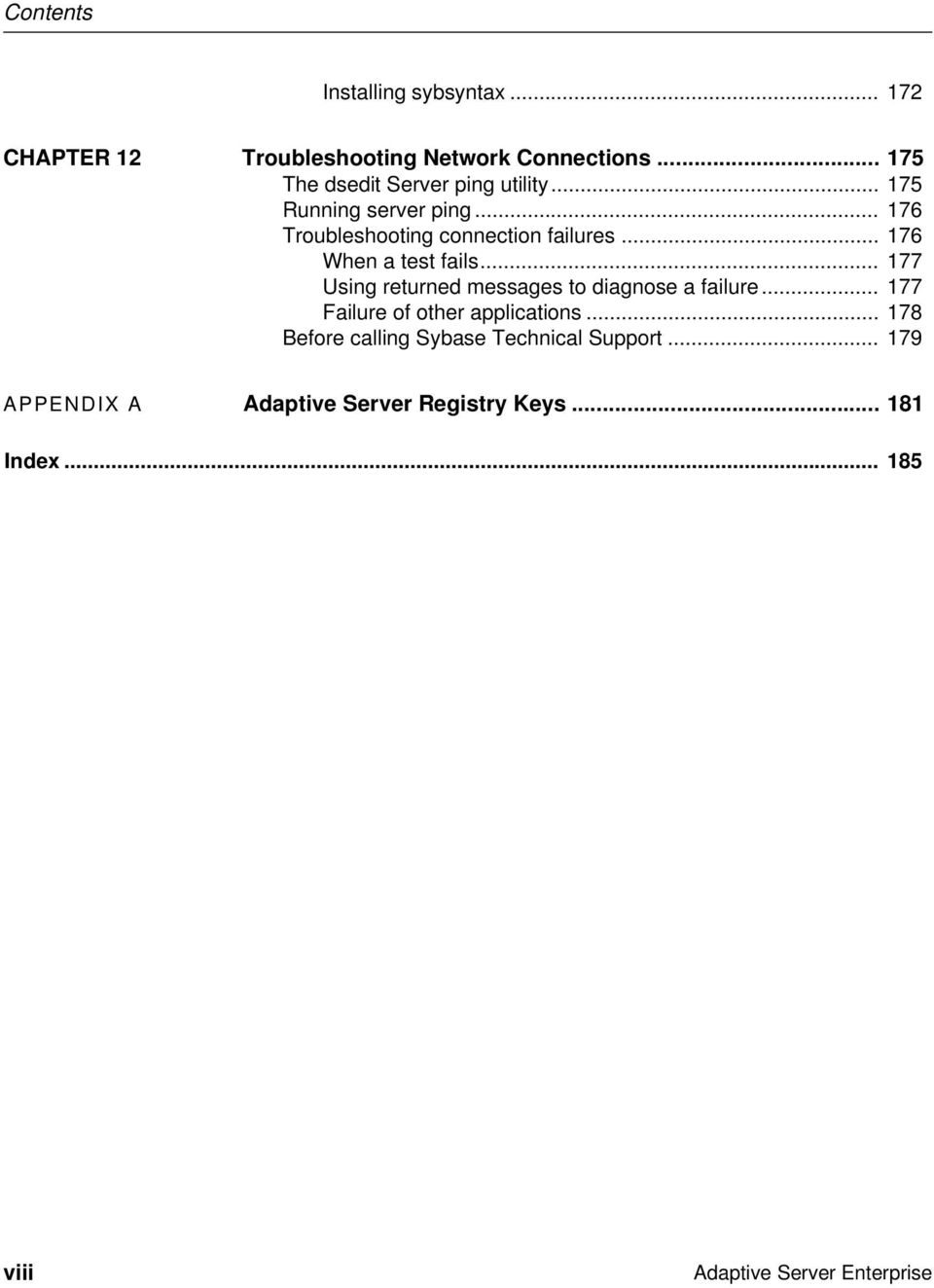
8 Contents Installing sybsyntax CHAPTER 12 Troubleshooting Network Connections The dsedit Server ping utility Running server ping Troubleshooting connection failures When a test fails Using returned messages to diagnose a failure Failure of other applications Before calling Sybase Technical Support APPENDIX A Adaptive Server Registry Keys Index viii Adaptive Server Enterprise
9 CHAPTER 1 Introduction Adaptive Server Enterprise for Windows is a full-featured Adaptive Server that runs on Windows operating systems in the Windows environment. The instructions in this book assume that Adaptive Server is installed and running. For information about installing and starting Adaptive Server, see the Installation Guide for your platform. This chapter provides an overview of how to configure Adaptive Server and the steps you need to take to customize it for your use. Topic Page About Adaptive Server 1 System-specific issues 2 Definition of terms 2 User roles 3 Environment variables 3 Adaptive Server devices and system databases 5 Client/server communication (the interfaces file) 8 Changing Adaptive Server configuration 9 Languages other than U.S. English 10 Adaptive Server specifications 10 About Adaptive Server Adaptive Server performs data management and transaction functions, independent of client applications and user interface functions. Adaptive Server also: Manages multiple databases and multiple users Keeps track of the data s location on disks Configuration Guide 1

10 System-specific issues Maintains the mapping of logical data description to physical data storage Maintains data and procedure caches in memory Adaptive Server uses these auxiliary programs to perform dedicated tasks: Backup Server manages database load, dump, backup, and restoration activities. XP Server stores the extended stored procedures (ESPs) that allow Adaptive Server to run operating-system level commands. System-specific issues Adaptive Server runs on a variety of hardware and operating system platforms. System-specific issues do not affect the basic functionality of Adaptive Server, but there are differences among platform implementations. These differences may include: Adaptive Server configuration Changes to the operating system that enable or enhance Adaptive Server performance Adaptive Server features that are available only on Windows The structure of entries in the sql.ini file Options for selecting database devices Operating system commands or utilities that simplify or automate routine system administration tasks Operating system utilities for monitoring Adaptive Server performance System-specific issues are described in this document. For more information about system-specific issues, see the Installation Guide and release bulletin for your platform. Definition of terms The following terms are used in this book: 2 Adaptive Server Enterprise

11 CHAPTER 1 Introduction Server provides a service in client/server computing. Examples include Adaptive Server, Backup Server, and XP Server. Client requests a service in client/server computing. Sybase Central, PowerDesigner, SQL Modeler, and end-user applications are clients. User roles The Adaptive Server installation and setup process defines various user roles. Different user roles have different responsibilities and privileges. These user roles clarify the way Adaptive Server is to be integrated into your system: Operating System Administrator the individual who maintains the operating system. This individual has administrator privileges. System Administrator the individual in charge of Adaptive Server system administration, creating user accounts, assigning permissions on databases, and creating new databases. At installation time, the System Administrator s login name is sa. The sa login is specific to Adaptive Server and is used to log in to Adaptive Server using the isql command. Environment variables It is crucial to the operation of Sybase products that the system environment variables are set correctly. The installer will set the environment variables automatically at the system level. Note As part of the installation, the installer sets up these environment variables in the system. As part of the installation, the installer sets up these environment variables in the system: DSLISTEN defines the name Adaptive Server uses to listen for client connections if no name is provided during the Adaptive Server start-up. If DSLISTEN is not set, and no name is given during the Adaptive Server start-up, the Adaptive Server name defaults to the server name given at installation. Configuration Guide 3

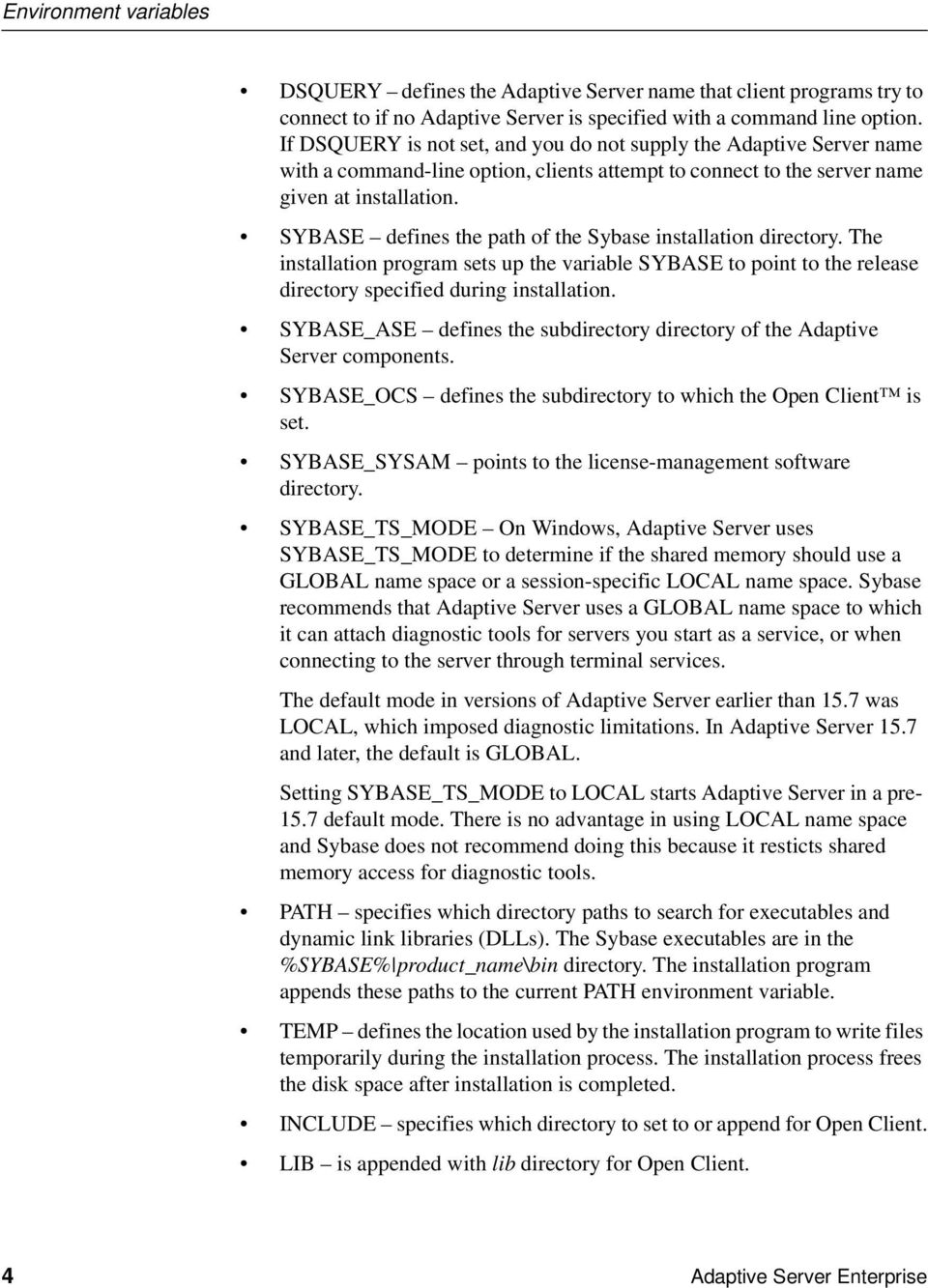
12 Environment variables DSQUERY defines the Adaptive Server name that client programs try to connect to if no Adaptive Server is specified with a command line option. If DSQUERY is not set, and you do not supply the Adaptive Server name with a command-line option, clients attempt to connect to the server name given at installation. SYBASE defines the path of the Sybase installation directory. The installation program sets up the variable SYBASE to point to the release directory specified during installation. SYBASE_ASE defines the subdirectory directory of the Adaptive Server components. SYBASE_OCS defines the subdirectory to which the Open Client is set. SYBASE_SYSAM points to the license-management software directory. SYBASE_TS_MODE On Windows, Adaptive Server uses SYBASE_TS_MODE to determine if the shared memory should use a GLOBAL name space or a session-specific LOCAL name space. Sybase recommends that Adaptive Server uses a GLOBAL name space to which it can attach diagnostic tools for servers you start as a service, or when connecting to the server through terminal services. The default mode in versions of Adaptive Server earlier than 15.7 was LOCAL, which imposed diagnostic limitations. In Adaptive Server 15.7 and later, the default is GLOBAL. Setting SYBASE_TS_MODE to LOCAL starts Adaptive Server in a pre default mode. There is no advantage in using LOCAL name space and Sybase does not recommend doing this because it resticts shared memory access for diagnostic tools. PATH specifies which directory paths to search for executables and dynamic link libraries (DLLs). The Sybase executables are in the %SYBASE% product_name\bin directory. The installation program appends these paths to the current PATH environment variable. TEMP defines the location used by the installation program to write files temporarily during the installation process. The installation process frees the disk space after installation is completed. INCLUDE specifies which directory to set to or append for Open Client. LIB is appended with lib directory for Open Client. 4 Adaptive Server Enterprise
13 CHAPTER 1 Introduction Adaptive Server devices and system databases Devices are files or portions of a disk that are used to store databases and database objects. You can initialize devices using raw disk partitions or operating system files. Adaptive Server requires the following devices: master to store system databases. sybsystemdb to store information about transaction in process. sysprocsdev to store system procedures. The master, sybsystemdb, and sysprocsdev devices are created when you create a new Adaptive Server. The master device The master device contains the following databases: master controls the operation of Adaptive Server as a whole and stores information about all users, user databases, devices, objects, and system table entries. The master database is contained entirely on the master device and cannot be expanded onto any other device. model provides a template for new user databases. The model database contains required system tables, which are copied into a new user database with the create database command. tempdb the work area for Adaptive Server. Each time Adaptive Server is started the tempdb database is cleared and rebuilt from the model database. The sample databases are stored on the master device at installation, but should be moved to a user-defined device after installation. For more information, see The sample databases on page 7. Note For recovery purposes, Sybase recommends that you do not create other system or user databases or user objects on the master device. Configuration Guide 5

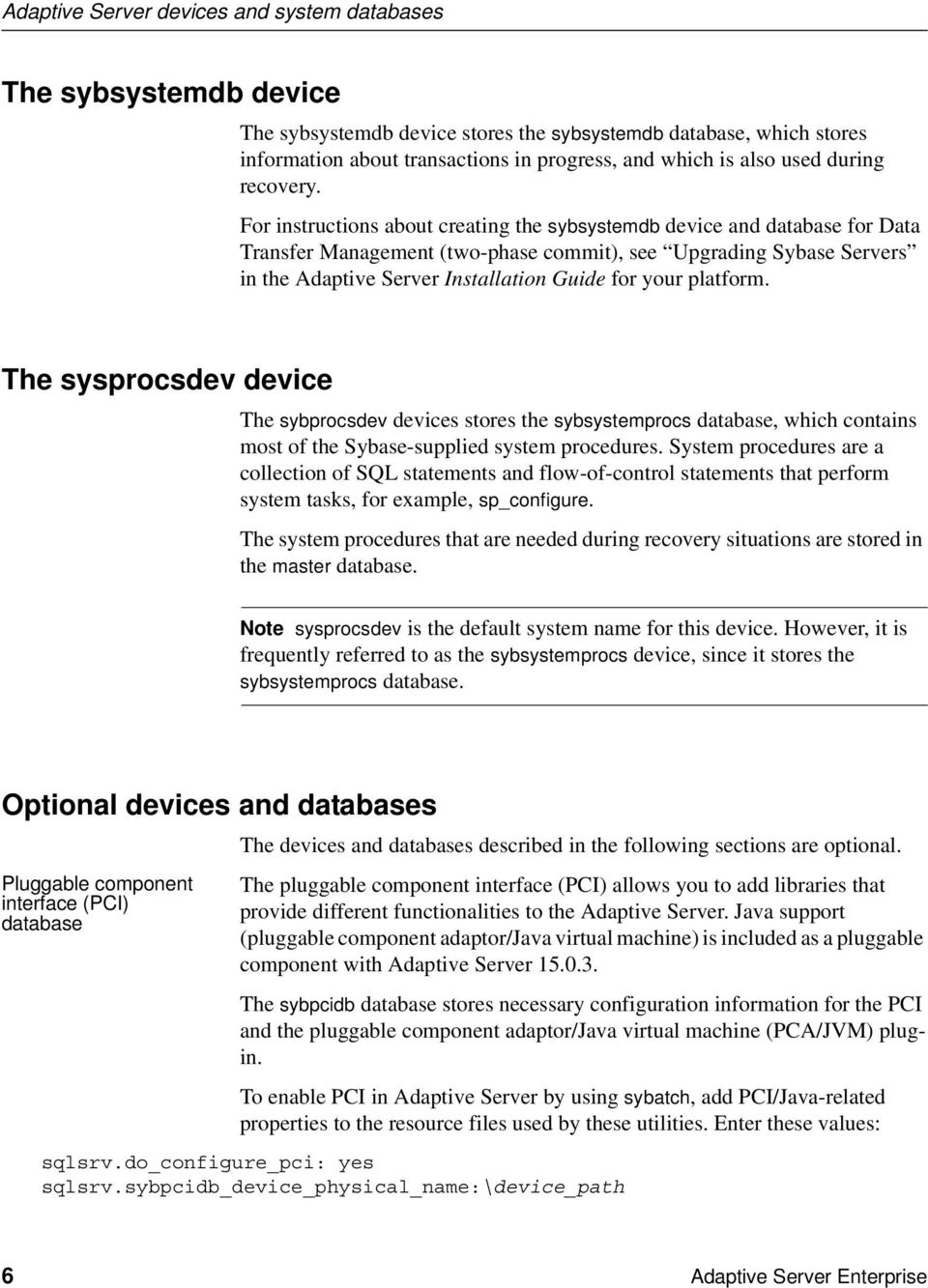
14 Adaptive Server devices and system databases The sybsystemdb device The sybsystemdb device stores the sybsystemdb database, which stores information about transactions in progress, and which is also used during recovery. For instructions about creating the sybsystemdb device and database for Data Transfer Management (two-phase commit), see Upgrading Sybase Servers in the Adaptive Server Installation Guide for your platform. The sysprocsdev device The sybprocsdev devices stores the sybsystemprocs database, which contains most of the Sybase-supplied system procedures. System procedures are a collection of SQL statements and flow-of-control statements that perform system tasks, for example, sp_configure. The system procedures that are needed during recovery situations are stored in the master database. Note sysprocsdev is the default system name for this device. However, it is frequently referred to as the sybsystemprocs device, since it stores the sybsystemprocs database. Optional devices and databases Pluggable component interface (PCI) database The devices and databases described in the following sections are optional. The pluggable component interface (PCI) allows you to add libraries that provide different functionalities to the Adaptive Server. Java support (pluggable component adaptor/java virtual machine) is included as a pluggable component with Adaptive Server The sybpcidb database stores necessary configuration information for the PCI and the pluggable component adaptor/java virtual machine (PCA/JVM) plugin. To enable PCI in Adaptive Server by using sybatch, add PCI/Java-related properties to the resource files used by these utilities. Enter these values: sqlsrv.do_configure_pci: yes sqlsrv.sybpcidb_device_physical_name:\device_path 6 Adaptive Server Enterprise
15 CHAPTER 1 Introduction sqlsrv.sybpcidb_device_size: USE_DEFAULT sqlsrv.sybpcidb_database_size: USE_DEFAULT The sample databases The sybsecurity device and database dbccdb database The sample databases are: pubs2 and pubs3 are provided as learning tools for Adaptive Server. pubs2 is used for most of the examples in the Adaptive Server documentation; other examples use the pubs3 database. Both are available in U.S. English versions of Adaptive Server. interpubs database contains French and German data. jpubs contains Japanese data. For information about installing the sample databases, see Chapter 5, Post- Installation Tasks in the Adaptive Server Installation Guide for your platform. For information about the contents of the sample databases, see the Transact-SQL Users Guide. The sybsecurity device is created as part of the auditing installation process. The sybsecurity device stores the sybsecurity database and the auditing system procedures with which you can configure auditing for your system. The auditing system records system security information in an Adaptive Server audit trail. You can use this audit trail to monitor the use of Adaptive Server or system resources. For instructions on configuring Adaptive Server for auditing, see Chapter 11, Adding Optional Functionality to Adaptive Server. For information about installing and using the auditing system, see Chapter 12, Auditing, in the System Administration Guide: Volume 1. The database consistency checker (dbcc) provides commands for checking the logical and physical consistency of a database. The dbccdb database stores the results of dbcc when dbcc checkstorage or dbcc checkverify is used. dbcc checkstorage records configuration information for the target database, operation activity, and the results of the operation in the dbccdb database. Stored in the database are dbcc stored procedures for creating and maintaining dbccdb and for generating reports on the results of dbcc checkstorage operations. For information on installing and using dbccdb, see Checking Database Consistency, in the System Administration Guide: Volume 2. Configuration Guide 7

16 Client/server communication (the interfaces file) Client/server communication (the interfaces file) Adaptive Server communicates with other Adaptive Servers, Open Server applications (such as Backup Server), and client software on your network. Clients can talk to one or more servers, and servers can communicate with other servers by remote procedure calls. For Sybase products to interact with one another, each product needs to know where the others reside on the network. Names and addresses of every known server are listed in a directory services file. This information can be stored in a directory services file two different ways: In an interfaces file called sql.ini on Windows platforms, located in the %SYBASE%\ini installation directory, or In an LDAP server After your Adaptive Server or client software is installed, it can connect with any server on the network that is listed in the interfaces file When you are using a client program, and you want to connect with a particular server, the client program looks up the server name in the interfaces file and connects to that server, as shown in Figure 1-1. You can supply the name of the server by using the DSQUERY environment variable. On TCP/IP networks, the port number gives clients a way to identify the Adaptive Server to which they want to connect. It also tells Adaptive Server where to listen for incoming connection attempts from clients. Adaptive Server uses a single port for these two services (referred to as listener servicequery service). On SPX networks, the socket number gives clients and servers a way to identify each other. 8 Adaptive Server Enterprise
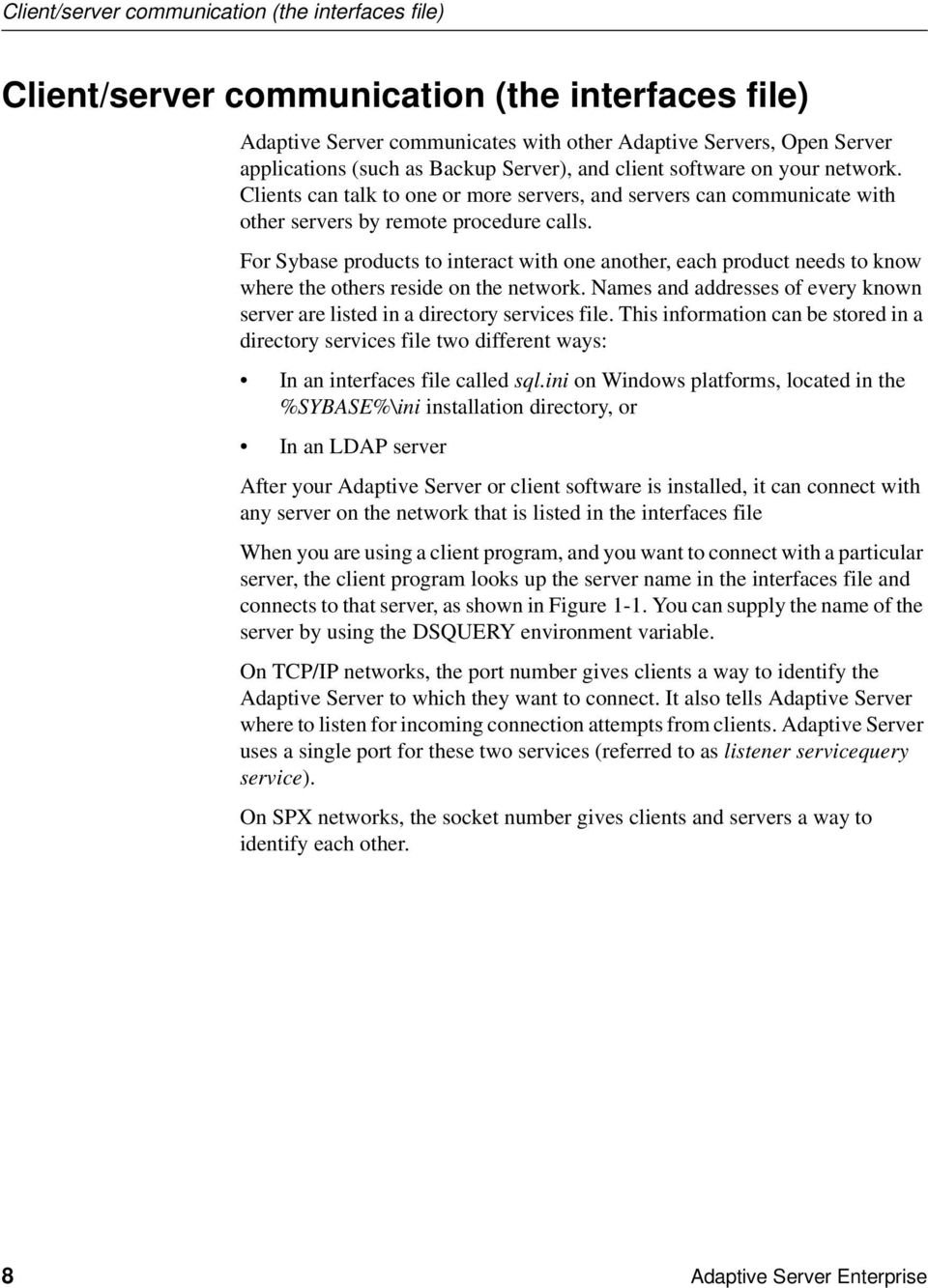
17 CHAPTER 1 Introduction Figure 1-1: Communicating with a server using the sql.ini file During installation, the installer adds entries to the sql.ini file for the new Adaptive Server, Backup Server, or XP Server. Note You can use Windows File Replication to replicate sql.ini in the multiple locations. See the Microsoft documentation for information. You can also use Windows Registry to keep the interfaces file information. Changing Adaptive Server configuration For information about configuring Adaptive Server to your system s needs, see Chapter 3, Default Adaptive Server Configuration. For information about configuring languages, character sets, and sort orders, see Chapter 6, Customizing Localization for Adaptive Server. For information about configuring Adaptive Server to use high availability features, see Using Sybase Failover in a High Availability Environment. For information about configuring Adaptive Server for distributed transaction management (two-phase commit), see the Distributed Transaction Management User s Guide. Configuration Guide 9

18 Languages other than U.S. English Languages other than U.S. English Many of the configuration tasks described in this manual require the use of the Server Config utility. If you are running Server Config in a language other than U.S. English, make sure that any input you provide uses a character set that is supported by the us_english character set. Note The us_english character set does not support accent marks, such as tildes (~) and umlauts (ü). This prevents Server Config from supporting the character sets that use these characters. For more information about languages, character sets, and sort orders, see the Adaptive Server Installation Guide for your platform. Adaptive Server specifications Database specifications Databases per Adaptive Server A maximum of 32,767 databases per server Maximum database size 2K page server 4TB 4K page server 8TB 8K page server 16TB 16K page server 32TB Minimum allowable 136MB sybsystemprocs database Maximum size of a 2 42 database device (disk (4TB) partition) Maximum number of database devices per server Maximum number of devices or device pieces per database Maximum number of segments per database 2 31 Unlimited 31 Required for an upgrade If the operating system supports file sizes up to 4TB, then Adaptive Server supports file system devices up to 4TB Limited by available memory 10 Adaptive Server Enterprise

19 CHAPTER 1 Introduction Maximum number of login IDs per server Maximum number of users per database Maximum number of groups per database Table specifications User objects per database Indexes per table 250 (one clustered index) Rows per table Limited by available storage Columns per composite 31 index Creation of clustered index 1.2*(x + y) x = total data space in table, y = sum of space of all nonclustered indexes on table, and 20 percent overhead for logging Maximum size of object name 255 Maximum 2 32 For sorted data, approximately 20 percent of the table size needed Query specifications Maximum number of tables participating in a query, for a query without a union, or for each side of a union in a query Maximum number of tables in a union query 64 Maximum of 50 user tables, including result tables, tables referenced by views (the view itself is not counted) correlations and self-joins; maximum of 46 worktables 256 Includes up to 50 user tables and 14 work tables on every side of the union, for a total of up to 256 tables across all sides of the union. Configuration Guide 11

20 Adaptive Server specifications Maximum number of databases participating in one transaction Practical number of databases participating in one query Maximum number of tables with referential integrity constraints for a query Unlimited Includes database where transaction began, all databases changed during transaction, and tempdb, if it is used for results or worktables 16 Includes each occurrence of each database queried and tempdb, if it is used for results or worktables 192 Procedure specifications Number of buffers and procedure buffers Minimum memory required per stored procedure Maximum number of parameters per stored procedure Configurable 2K 2048 Limited by amount of RAM and maximum size of shared memory segment Maximum APL table limits Adaptive Server extended-limit capabilities vary by type of table and the database logical page size. Table 1-1 lists the column and row limits for allpages-locked (APL) tables. Table 1-1: Allpages-locked (APL) tables Number of columns Column size 2K page Column size 4K page Table 1-2 lists the column and row limits for data-only-locked (DOL) tables. Table 1-2: Data row and data page tables. Column size 8K page Column size 16K page Fixed-length column bytes 4008 bytes 8104 bytes bytes Variable-length column bytes 3988 bytes 8068 bytes bytes Maximum DOL table limits Number of columns Column size 2K page Column size 4K page Column size 8K page Column size 16K page Fixed-length column bytes 4006 bytes 8102 bytes bytes Variable-length column bytes 4002 bytes 8098 bytes bytes 12 Adaptive Server Enterprise
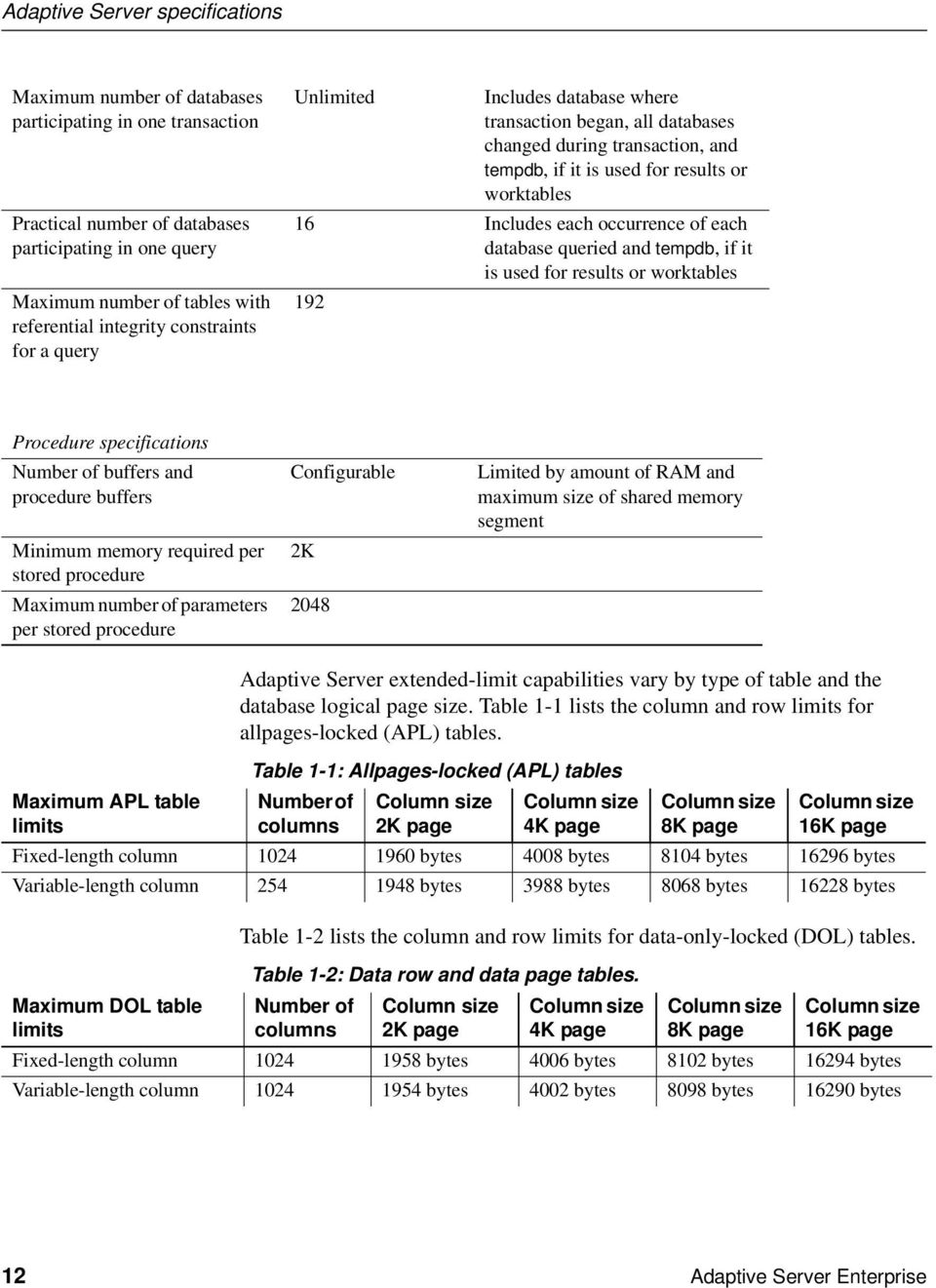
21 CHAPTER 1 Introduction Database space requirements depend upon the logical page size of the server.if your model database is larger than the minim size listed below, then the minimum size of the database is equal to the model database. Table 1-3 lists the minimum size for each database. Table 1-3: Database requirements for varying page sizes Databases 2K page 4K page 8K page 16K page Default database size 3MB 6MB 12MB 24MB master database 13MB 26MB 52MB 104MB model database 3MB 6MB 12MB 24MB tempdb database 4MB 6MB 12MB 24MB sybpcidb database 24MB 48MB 96MB 192MB Larger logical page sizes can contain more data. Table 1-4 lists the maximum data for each logical page size. Table 1-4: Data limits for tables according to page size Tables 2K page 4K page 8K page 16K page Bytes per index key User-visible row length DOL table User-visible row length APL table Configuration Guide 13
22 Adaptive Server specifications 14 Adaptive Server Enterprise
23 CHAPTER 2 Starting and Stopping Servers This chapter describes how to start and stop Adaptive Server, Backup Server, and XP Server. Topic Page Overview 15 Starting servers 16 Starting and stopping servers using the Control Panel 18 Stopping servers 20 Monitoring servers 22 Overview The methods described in this chapter are used to start Adaptive Server and Backup Server after a shutdown for database maintenance, because of an operating system crash, or for other reasons. XP Server is not started by the installation process. XP Server is started only when any XP command is issued through isql. You can use Sybase Central to start and stop servers manually or automatically. The ASE plug-in can also start Adaptive Servers monitored by Unified Agent if the agent is properly configured. Requirements for starting servers To start a server, your user account must have: Windows administrator privileges Access to the Adaptive Server distribution files Access to a sql.ini file entry for the server The system environment variables discussed in Chapter 1, Introduction. Configuration Guide 15
24 Starting servers Access to SySAM licenses. For more information, see the Sybase Software Asset Management Users Guide. The installation program creates the sql.ini file and system environment variables when you install servers on your computer. Starting servers Adaptive Server and Backup Server store their default start-up parameters in the Windows Registry file. This allows you to start and manage servers as Windows services, and allows servers to start automatically when you boot your computer. Server start-up parameters The default start-up parameters are stored under the Registry key \\HKEY_LOCAL_MACHINE\SOFTWARE\SYBASE\Server\ server_name\parameters, where server_name is the name of the server you installed. Backup Server server names are appended with _BS. Note You can install multiple servers, each with its own Registry key. Start-up parameters are listed under Registry values named Argn, where n is a number from 0 to 8. The number of the argument indicates the order in which the server reads the parameter. Table 2-1 lists the default start-up parameters for Adaptive Server. Table 2-1: Default Adaptive Server start-up parameters Parameter Switch Description Arg0 -d %SYBASE%\data\master.dat Location of the master device file Arg1 -s server_name Name of the Adaptive Server Arg2 -e%sybase%\%sybase_ase%\ install\errorlog Location and name of the error log file Arg3 -i %SYBASE%\ini Directory containing the sql.ini file Arg4 -M %SYBASE%\%SYBASE_ASE% Directory that stores shared memory files 16 Adaptive Server Enterprise
25 CHAPTER 2 Starting and Stopping Servers Parameter Switch Description Arg5 -N %SYBASE%\$SYBASE_ASE%\ Location and name of license cache file. sysam\<srv_name>.properties Changing start-up parameters You cannot change any of these default start-up parameters unless you directly edit the Windows Registry values. However, you can use Server Config to specify additional start-up parameters. Additional start-up parameters include any valid server command-line options listed for the sqlsvr and bcksrvr descriptions in the Adaptive Server Utility Guide for your platform. Specifying additional start-up parameters 1 Log in to Windows using an account with Windows administrator privileges. 2 Start Server Config. 3 Select the Adaptive Server or Backup Server icon to indicate which type of server you want to configure. 4 Select Configure Adaptive Server or Configure Backup Server to display a list of available servers on your system. 5 Select the name of the server to configure, and choose Continue. 6 If you are configuring Adaptive Server, enter the login name and password of a user with System Administrator privileges, and choose Continue. 7 If Adaptive Server is not running, Server Config asks you to start it now; choose Yes. 8 Select the Command Line button. Server Config displays the Command Line Parameters dialog box: 9 Edit the text in the Command Line Parameters box to include the additional start-up parameters and values you require. Do not specify the default command line parameters listed in Table 2-1 on page 16. For details on available command-line parameters, see sqlsvr and bcksrvr in the Adaptive Server Utility Guide for your platform. 10 Choose OK. 11 Choose Save in the server s configuration dialog box. Configuration Guide 17
26 Starting and stopping servers using the Control Panel 12 Exit Server Config. Starting and stopping servers using Unified Agent You can shut down Adaptive Servers running either locally or remotely if you have the proper permission to do so. With ASE plug-in, connect to the Adaptive Server you want to shut down, and select File Shut Down. If the Adaptive Server is monitored by Unified Agent, you do not have to connect first. Simply select the Adaptive Server and then select File Shut Down. Starting and stopping servers using the Control Panel You can start, stop, and pause a server both automatically and manually from the Services applet in the Control Panel. Note If you are running Adaptive Server and the Windows Process Viewer, and Adaptive Server is listed in the Process Viewer, you may not be able to restart Adaptive Server after you shut it down. This is because the Process Viewer holds some Registry resources, even after the viewed process is closed. Shut down the Process Viewer before you restart Adaptive Server. Starting servers as an automatic service This section describes how to configure your operating system for automatic restart of Adaptive Server and Backup Server. In production systems, Adaptive Server and Backup Server should start automatically when you restart your computer. To do this, use the Control Panel to set up the server as an automatic service. Note Do not place Adaptive Server devices on network drives. If Adaptive Server uses a device on a network drive, you cannot start the server as an automatic Windows service. 18 Adaptive Server Enterprise
27 CHAPTER 2 Starting and Stopping Servers Setting up Adaptive Server as an automatic service 1 Go to Windows Services at Start Settings Control Panel Administrative Tools Services. 2 Scroll through the list of available services until you find the listings for your Sybase servers. Server names use the format: Sybase typeserver _ servername_suffix where servername is the name of the Adaptive Server and type and _suffix represent the server type: SQL for Adaptive Server BCK and _BS for Backup Server XP and _XP for XP Server 3 Double click on the Adaptive Server service entry, or right click on the Adaptive Server service entry and select Properties. 4 In Startup type, select Automatic. 5 Click the Close button to close the Services window. The selected server now starts automatically each time you restart the computer. You can verify the status of the server by examining the status column in the Services applet. See your Windows documentation or online help for more information on setting up automatic services. Starting, stopping, and pausing servers manually You can use the Control Panel to stop, start, and pause Adaptive Server manually. 1 Log in to Windows using an account with Windows administrator privileges. 2 Choose Start Settings Control Panel Administrative Tools Services. The Services window displays. 3 Scroll through the list of available services until you find the listings for your Sybase servers. Server names use the format: Configuration Guide 19
28 Stopping servers Sybase typeserver_servername_suffix where servername is the name of the Adaptive Server and type and _suffix represent the server type: SQL for Adaptive Server BCK and _BS for Backup Server XP and _XP for XP Server 4 Select the service name, then click Start, Stop, or Pause to confirm the choice. 5 Click the Close button to close the Services window. You can verify the status of the server either by using Sybase Central or by examining the status column in the Services applet. Stopping servers Only the System Administrator has permission to issue a shutdown command. Using a shutdown command minimizes the amount of work that automatic recovery needs to do when the servers are restarted. The preferred method of stopping Adaptive Server or Backup Server is to use the Transact-SQL shutdown command. Stopping Adaptive Server To shut down Adaptive Server: 1 Use isql to log in to an Adaptive Server account with System Administrator privileges: isql -Usa -Ppassword -Sserver_name 2 Enter the following command to shut down the server: 1> shutdown 2> go 20 Adaptive Server Enterprise
29 CHAPTER 2 Starting and Stopping Servers The default for the shutdown command is with wait. The with wait option allows Adaptive Server to finish executing SQL statements or procedures, perform a checkpoint in each database, disable new logins, and perform other shutdown tasks. Issuing the shutdown command prints a message like this to the stderr file: Server SHUTDOWN by request.the SQL Server is terminating this process. CT-LIBRARY error: This is normal behavior. If the message indicates that Adaptive Server is waiting for processes to complete, and you need to stop Adaptive Server immediately, you can use the shutdown with nowait command. shutdown with nowait does not wait for currently executing statements to finish, nor does it perform checkpoints in every database. Use the shutdown with nowait command only when necessary. Stopping Backup Server To shut down a Backup Server: 1 Use isql to log in to a server with System Administrator privileges: isql -Usa -Ppassword -Sserver_name 2 Enter the following command to shut down the specified Backup Server: 1> shutdown SYB_BACKUP 2> go After you shut down a Backup Server, you must wait at least 30 seconds before restarting it; otherwise, you see a message from the operating system that another process is using the disk. Issuing the shutdown command prints a message similar to the following to the stderr file: Backup Server: : The Backup Server will go down immediately. Terminating sessions. This is normal behavior. If a message indicates that Adaptive Server or Backup Server is waiting for processes to complete, and you need to stop Adaptive Server or Backup Server immediately, you can use the shutdown with nowait command. shutdown with nowait does not wait for currently executing statements to finish and does not perform checkpoints in every database. Configuration Guide 21
30 Monitoring servers Using shutdown with nowait for Backup Server can cause inconsistent or incomplete dumps and loads. Use this command only when necessary. For more information on the shutdown command, see the Reference Manual: Commands. Monitoring servers There are two methods for checking a server s status: Unified Agent or through the Control Panel. Unified Agent You can monitor the Adaptive Server status either locally or remotely using Unified Agent, if Unified Agent is monitoring the Adaptive Server. For more information about using Unified Agent to monitor Adaptive Server, see the Unified Agent / Agent Management Console User s Guide. The Control Panel You can use the Services option in the Control Panel to check a local server s status. The Services option is available under Start Settings Control Panel Administrative Tools Services. Check the Status column. If the server is: Running, the Status value is Started. Not running, the Status value is blank. 22 Adaptive Server Enterprise
31 CHAPTER 3 Default Adaptive Server Configuration When you install or upgrade Adaptive Server, it includes some default parameter settings and a few of its auxiliary programs. After installing and testing this default Adaptive Server, configure it to your system s needs and install other optional features. Topic Page Starting Server Config for Adaptive Server 24 Configuring Adaptive Server 25 Configuring Backup Server 27 Configuring Job Scheduler and Self Management 28 After installation, Adaptive Server default settings are as listed in Table 3-1. You may need to configure these settings to suit your computer and database needs. Table 3-1: Defaults for Adaptive Server parameter settings Item Default value Name AdaptiveServername Network support TCP/IP Socket number 5000 Named pipes \pipe\sybase\server Command line options None Error log path %SYBASE%\%SYBASE_ASE%\install/error log Event logging Not configured International Support (Localization): Language us_english Character set cp850 Sort order Binary ordering Login security mode Standard Table 3-2 lists the default settings for the Backup Server and XP Server. Configuration Guide 23
32 Starting Server Config for Adaptive Server Table 3-2: Defaults for the Backup and XP servers Server Item Default value Backup Server Name AdaptiveServername_BS Network support Named Pipes, Windows Sockets (TCP/IP) Pipe name \pipe\sybase\backup Socket number 5001 Error log path %SYBASE%\%SYBASE_ASE\install\backup.log XP Server Name AdaptiveServername_XP Network support Named Pipes, Windows Sockets (TCP/IP) Pipe name \pipe\sybase\xp Socket number 5002 Error log path N/A Starting Server Config for Adaptive Server To change configuration settings for Adaptive Server, use the Server Config utility. You can run this program in one of two ways: By selecting the Server Config from within Windows. To run this utility from the Windows command prompt, run syconfig.exe. By running sp_configure from within isql. Use sp_configure to quickly and easily change single parameters and values. For more information, see sp_configure in the Reference Manual: Procedures. This manual walks you through Adaptive Server configuration through the Server Config utility. Starting Server Config 1 Select Start Programs. 2 Select Start Programs Sybase Adaptive Server Enterprise Server Config. 3 Choose Server Config 4 When you have completed the necessary configuration changes, click Exit to quit Server Config. For more information on how to configure: Adaptive Server, see Configuring Adaptive Server on page Adaptive Server Enterprise
33 CHAPTER 3 Default Adaptive Server Configuration For more information on how to configure Backup Server, see Configuring Backup Server on page 27. Note The Adaptive Server installer allows you to tune basic configuration settings during installation, instead of as a postinstallation task. See the Installation Guide for more details. Configuring Adaptive Server To change the Adaptive Server configuration, including its auxiliary programs and options: 1 Start Server Config. 2 Click the Adaptive Server icon, and click Configure Adaptive Server from the Configure Sybase Servers dialog box. 3 Select the name of the server to configure, and click Continue. The Enter System Administrator Password dialog box appears. 4 Type the login name and password of an Adaptive Server user with System Administrator privileges, and click Continue. 5 Click Yes if the Adaptive Server is not running, and Server Config asks you if you want to start it. The Configuring Adaptive Server Enterprise dialog box appears. 6 Select the option to be configured from the Change Options set of buttons: Command Line see Setting Adaptive Server parameters on page 26. Default Backup Server see Changing the default Backup Server on page 26. Default XP Server see Changing the default XP Server on page 27. Two Phase Commit see the Adaptive Server Installation Guide for your platform. Error Log Path see Setting error log paths on page 92. Configuration Guide 25
34 Configuring Adaptive Server Event Logging see Enabling and disabling Windows event logging on page 94. Language see the Adaptive Server Installation Guide for your platform. Login Security see Configuring login security on page 133. Setting Adaptive Server parameters When you start Adaptive Server, you can configure the server to use certain configuration parameters that are not accessible through isql. To set these configuration parameters: 1 Click Command Line from the Change Options box on the Configuring Adaptive Server Enterprise dialog box. The Command Line Parameters dialog box appears. 2 Type in parameters and values that you want to set for Adaptive Server. Type these parameters as you would at the command line. However, omit the command itself and any parameters that might vary. 3 Click OK to return to the Configure Adaptive Server Enterprise dialog box. 4 When you have completed the necessary configuration changes, click Exit to quit Server Config. Changing the default Backup Server During backup or recovery, the dump or load command uses the Backup Server named in the configuration for the selected Adaptive Server. You can name a different default Backup Server through the Adaptive Server configuration. To name a different Backup Server to use as the default: 1 Click Default Backup Server from the Change Options buttons. The Set Default Backup Server Name dialog box appears. 2 Type the name of the Backup Server as the default, and click OK. For information about naming and configuring Backup Server, see Configuring Backup Server on page Adaptive Server Enterprise
35 CHAPTER 3 Default Adaptive Server Configuration 3 Click Save to return to the Configuring Adaptive Server Enterprise dialog box. 4 When you have completed the necessary configuration changes, click Exit to quit Server Config. Changing the default XP Server XP Server provides the extended stored procedures available through Adaptive Server. When you install Adaptive Server, the program defines XP Server using the Adaptive Server name as a basis for the filename. For example, XP Server for an Adaptive Server named PIANO is named PIANO_XP. You can change the configuration for the default XP Server for a particular Adaptive Server. See Sybmail and extended stored procedures on page 143. Configuring Backup Server Backup Server performs all Adaptive Server backup and recovery operations (dump and load). When you install Adaptive Server, the program defines Backup Server using the Adaptive Server name as a basis for the file name. For example, Backup Server for an Adaptive Server named PIANO is named PIANO_BS. To change the configuration for a Backup Server: 1 Start Server Config. 2 Click the Backup Server icon, and click Configure Backup Server from the Configure Sybase Servers dialog box. 3 Select the name of the server to configure from the Existing Servers dialog box, and click Continue. The Configure Backup Server dialog box appears. 4 Change the path indicated in the Error Log Path area, if necessary. For more information about the error log, see Logging errors and events on page 89. Configuration Guide 27
36 Configuring Job Scheduler and Self Management 5 Change the language indicated in the Language area that Backup Server will use for its messages, if necessary. For more information about languages, see the Installation Guide. 6 Change the server s character set in the Character Set area, if necessary. For more information about character sets, see the Installation Guide. 7 Click Save to return to the Configure Sybase Servers dialog box. 8 When you have completed the necessary configuration changes, click Exit to quit Server Config. Configuring Job Scheduler and Self Management Job Scheduler defines and schedules database administration and maintenance tasks. Self Management is Adaptive Server s ability to monitor it s state and adjust that state as necessary. Adaptive Server s ability to manage itself can be extended by creating and scheduling job that perform maintenance and tuning tasks. You can only configure Job Scheduler and Self Management in resource file mode. To configure new Job Scheduler and Self Management, edit the sample resource file %SYBASE%\%SYBASE_ASE%\sample\server\sybatch_js.res and execute: sybatch.exe -r sybatch_js.res See the Job Scheduler Users Guide for more information. 28 Adaptive Server Enterprise
37 CHAPTER 4 Network Communications Using sql.ini Adaptive Server can communicate with other Adaptive Servers, Open Server applications, and client software across a network. Clients can communicate with one or more servers, and servers can communicate with other servers via remote procedure calls. This chapter provides information about the connection process, the kinds of connections, and how to configure Adaptive Server to use sql.ini file connections. Topic Page How clients connect to Adaptive Server 30 How Adaptive Server listens for client connections 31 How a client accesses Adaptive Server 32 Components in the sql.ini file 33 Sharing network configuration information 43 Verifying server connections 45 Configuring ODBC connections 45 IPv6 support 47 For instructions on using Server Config to change the values that it can access, see Configuring Adaptive Server on page 25. For information on LDAP, see Chapter 5, Lightweight Directory Access Protocol in Adaptive Server. Adaptive Server on Windows supports network connections using the Named Pipes, Sockets (TCP/IP), and IPX/SPX protocols. The default Adaptive Server uses TCP/IP and Named Pipes, since Named Pipes is always installed with Windows. Two files control how clients find servers and drivers: The sql.ini file lists the server names, their network addresses, and the Net-Library driver to use to establish a connection. The library file, libtcl.cfg, lists the installed Net-Library drivers that are available to support each protocol (connection). Configuration Guide 29
38 How clients connect to Adaptive Server These files, which reside on both server and client machines, enable each Sybase product to find the other Sybase servers that are on the network. The installation program automatically creates, verifies, and appends these configuration files when you install Adaptive Server. How clients connect to Adaptive Server Client software performs the following steps to connect to Adaptive Server: 1 Determines the name of the Adaptive Server by finding the value of the DSQUERY environment variable. 2 Looks in the sql.ini file for an entry whose name matches the name of the server. If it cannot find a matching entry, the connection fails. 3 Looks in the libtcl.cfg file for an entry that matches the Net-Library driver name associated with the server entry in the sql.inifile. If the application cannot find such an entry, the connection fails. 4 Loads the specified Net-Library driver. 5 Uses the network connection information provided by the sql.ini file to connect to the server. Figure 4-1 summarizes the client connection process. 30 Adaptive Server Enterprise
39 CHAPTER 4 Network Communications Using sql.ini Figure 4-1: Connecting to Adaptive Server How Adaptive Server listens for client connections Adaptive Server uses the sql.ini file to determine the address at which it should listen for clients. When you start, the Adaptive Server: 1 Determines the name of the Adaptive Server by finding the value of the DSLISTEN environment variable. 2 Looks in the sql.ini file for an entry that matches the specified server name. 3 Looks in the libtcl.cfg file for an entry that matches the Net-Library driver name associated with the server entry in the sql.inifile. 4 Loads the specified Net-Library driver. Configuration Guide 31
40 How a client accesses Adaptive Server 5 Uses the information from the MASTER entry in the sql.ini file to determine the address at which it should listen for client connection requests. How a client accesses Adaptive Server The installation program provides a default sql.ini file in Adaptive Server. The file has MASTER and QUERY entries that use both the Named Pipes and Sockets (TCP/IP) drivers for all servers that were installed. Enabling client access to a server To enable a client to access a server on the network, create a sql.ini file on the client. In that file, include entries for all servers the client needs to access. To create a new sql.ini file, see Changing the server entries in sql.ini on page 32. Changing the server entries in sql.ini To edit an existing sql.ini file on the server machine, or to create a new file on the client machine, use the Directory Services Editor utility, dsedit. For more information about the components of a sql.ini file, see Components in the sql.ini file on page 33. For more information about using dsedit, see the Utilities Guide. For general information about the sql.ini file, see the Open Client/Server Configuration Guide for Desktop Platforms. To start dsedit, select it either from the Sybase program group or from the Utilities group in Sybase Central. To add an Adaptive Server to the sql.ini file: 1 Select Start Programs Sybase Connectivity Open Client Directory Service Editor. The Select Directory Service dialog box appears. 32 Adaptive Server Enterprise
41 CHAPTER 4 Network Communications Using sql.ini 2 Select a driver from the DS Name list, and click OK. The DSEDIT - Interfaces Driver dialog box appears. 3 Select Server Object menu, and select Add. The Input Server Name dialog box appears. 4 Type the name of the server to add, and click OK. For information about valid server names, see Server name on page Select the new server name, which you have just added, from the Server list. Steps 6 10 describe how to enter the server s address: 6 Select Server Address from Attributes box on the Interfaces Driver window. 7 Select the Server Object menu and select Modify Attribute. The Network Address Attribute dialog box appears. 8 Click Add. The Input Network Address For Protocol dialog box appears. 9 Choose the appropriate protocol from the drop-down list, enter the network address in the Network Address text box, and click OK. For information about protocols, see Network driver on page 35. For information about the formats of network addresses required by the different protocols, see Server address on page 35. The Network Address Attribute dialog box reappears. 10 Click OK. The dsedit utility creates MASTER and QUERY entries for the server. In the sql.ini file, the client ignores the MASTER entry. 11 Exit dsedit. Components in the sql.ini file This section provides useful background information for editing an sql.ini file. The sql.ini file will look similar to: Configuration Guide 33
42 Components in the sql.ini file [PIANO_XP] master=nlwnsck,piano,5002 query=nlwnsck,piano,5002 [PIANO] master=nlwnsck,piano,5000 query=nlwnsck,piano,5000 [PIANO_BS] master=nlwnsck,piano,5001 query=nlwnsck,piano,5001 [PIANO_JSAGENT] master=nlwnsck,piano,4900 query=nlwnsck,piano,4900 [ws] master=nlwnsck,piano,8183 Server name The server name is the name of the Adaptive Server to which clients will connect. Use the following rules to create an acceptable server name: Server names can be no more than 11 characters long. However, if you installed Adaptive Server on a FAT (file allocation table) partition, limit the server name to 8 characters. The initial character of a server name must be a letter (a z, A Z). The characters that follow can be letters, numbers, the underscore character (_), the pound sign (#), the at sign (@), or the dollar sign ($). The name cannot contain a period (.), a slash (/), a backslash (\), an accented letter, a character from a Japanese character set, or any other character that is invalid for Windows file names. Adaptive Server names are not case-sensitive. For example, PRODUCTION, Production, and production are interpreted as the same server name. 34 Adaptive Server Enterprise
43 CHAPTER 4 Network Communications Using sql.ini Network driver The network driver specifies the name of the Net-Library driver to use for the connection. The driver name must correspond to a valid entry in the library (libtcl.cfg) file, which is located in the ini subdirectory of the Sybase installation directory. The following example shows three driver entries in a libtcl.cfg file: NLMSNMP=NLMSNMP Named Pipes Driver NLWNSCK=NLWNSCK WinSock TCP/IP Driver NLNWLINK=NLNWLINK NWLink SPX/IPX Driver Note As drivers are added or removed, you can edit the libtcl.cfg file with a text editor or with the ocscfg.exe utility, located in the bin subdirectory of the Sybase installation directory. Service type The service type defines the Adaptive Server s service. The two service types are MASTER and QUERY: MASTER defines the service that Adaptive Server uses to listen to login requests from clients. This type defines a server machine. A MASTER entry is required only if you plan to use your computer as a server. It is not required in a sql.ini file for a computer that is running clients only. QUERY represents the service that a client application uses to log in to Adaptive Server. This type defines a client machine. A QUERY entry is required if you plan to use your computer to access a server. In general, since even dedicated servers need access to other servers, a QUERY entry is always required. Server address This value is the address at which Adaptive Server listens for client connections. The address requires the following information: Address format Configuration Guide 35
44 Components in the sql.ini file IP address Named Pipes format Windows Sockets format NWLink IPX/SPX format Address format The format of the server address depends on the network driver used by Adaptive Server. The format for the server address can be: Named Pipes format Windows Sockets format NWLink IPX/SPX format Use the following guidelines to define your server address: Some formats require a port, or socket number. Port numbers for MASTER and QUERY entries must be the same on server and client. For example, if a server is listening on 5000, the client workstation must be connecting on The server usually controls the port number, which means that you specify the same port number in the client s sql.ini file as that specified in the sql.ini file for the server to which it will connect. Port addresses must be unique to each server. The port address is determined by the port number provided in the sql.ini file in conjunction with the IP address. By default, the port number for Adaptive Server is 5000, for Backup Server, it is Note Two Adaptive Servers on different computers can use the same port number because their IP addresses are different. IP address If you know a computer s IP address as well as its name, specify the IP address in the sql.ini file to ensure that the computer can be found on the network. 36 Adaptive Server Enterprise
45 CHAPTER 4 Network Communications Using sql.ini For example, the following entry, which uses Named Pipes, specifies a remote server s computer name and requires name resolution: NLMSNMP,\\SMOKE\pipe\sybase\query The following entry uses a remote server s IP address and does not require name resolution: NLMSNMP,\\ \pipe\sybase\query Named Pipes format For the Named Pipes protocol, the network address consists of the unique pipe name for the server. Use the following guidelines to create acceptable pipe names. Valid pipe names begin with \pipe and follow the same naming restrictions as MS-DOS file names. The default pipe name for Adaptive Server is \pipe\sybase\query. To avoid conflict, always use unique pipe names of the same length (levels) for all Sybase products on your computer. For example, you might select \pipe\sybase\query for Adaptive Server and \pipe\backup\query for Backup Server. Do not use pipe names such as \pipe\sql and \pipe\sql\query, because they do not ensure uniqueness. When adding a network entry to access a server on a remote network computer, such as on a client, preface the pipe name for the QUERY service with the following, where machine_name is the name of the computer that runs the server: \\machine_name Warning! Server pipes must be local. Do not add \\machine_name if you are configuring a network entry for a server on a local computer. Additionally, do not preface the pipe name with this prefix when entering connection information for the MASTER service. If you include this prefix, you cannot restart Adaptive Server. Configuration Guide 37
46 Components in the sql.ini file Windows Sockets format For the Windows Sockets protocol, the server address consists of the TCP/IP host name or IP address of the Windows computer and a unique socket for the Adaptive Server, separated by a comma. Keep the following guidelines in mind when creating the address: The TCP/IP host name is case-sensitive. For example, a possible entry for a TCP/IP host named CENTAUR is CENTAUR, Adaptive Server uses the default socket number of 5000 to listen to connections from client workstations. Select a different socket number if another application on your computer already uses socket Valid socket numbers for Adaptive Server range from 1025 to 65535, in integers. Increasing Windows Sockets connections To support more than Windows Sockets (TCP/IP) connections to Adaptive Server, you may need to use the Windows Registry to increase the maximum number of sockets connections available on the server. Warning! Do not modify a Registry value unless you are an Windows administrator and are familiar with the regedt32 utility. See your Windows operating system documentation for information on using regedt32. Modifying an existing TcpNumConnections value 1 Log in to Windows using an account with Windows administrator privileges, or use the default sa login. 2 Start the regedt32 utility from the run prompt. 3 Select the Registry window HKEY_LOCAL MACHINE. 4 Open the Registry key HKEY_LOCAL_MACHINE\SYSTEM\ CurrentControlSet\Services\Tcpip\Parameters. 5 If the TcpNumConnections value exists, go to step 6. If the value does not exist, add and configure it by completing the steps under To add a TcpNumConnections value. 6 Double-click the value. 7 In the DWORD Editor dialog box, select the Decimal option. 38 Adaptive Server Enterprise
47 CHAPTER 4 Network Communications Using sql.ini 8 In the Data text box, enter the maximum number of connections to support. 9 Click OK to return to the Registry key dialog box. 10 If you have completed your tasks in regedt32: 1 Select Exit from the Registry menu to quit regedt32. 2 Restart your computer. Adding a TcpNumConnections value 1 Complete the Add Value dialog box as follows: Value Name TcpNumConnections Data Type select REG_DWORD from the drop-down list. 2 Click OK. 3 Complete the DWORD Editor dialog box as follows: Data enter the maximum number of TCP connections for the computer. Radix select the Decimal option button. 4 Click OK. The utility adds the new value to the Registry key. 5 If you have completed your tasks in regedt32: 1 Choose Exit from the Registry menu to quit regedt32. 2 Restart your computer. Using multiple TCP/IP network interface cards When client workstations use multiple TCP/IP network interface cards, the Windows Administrator must edit the lmhosts file on the Windows server to accept connections from the clients. To correctly enter the card information: There must be one entry for each network card. Each address must be unique. The entries in the lmhosts file match those in the sql.ini file. Configuration Guide 39
48 Components in the sql.ini file For example, assume that a server named BALCLUTHA has three cards. Without an lmhosts entry and separate entries in sql.ini, the server listens on socket BALCLUTHA,5000 for all three cards. To provide unique addresses, set up lmhosts as follows: NT NT NT2 In the sql.ini file, add entries for both QUERY and MASTER: [BALCLUTHA] query=nt0,5000 master=nt0,5000 query=nt1,5000 master=nt1,5000 query=nt2,5000 master=nt2,5000 Controlling the connection timeout When an isql connection remains idle for several minutes, the next query may result in this error message: Attempt to initiate a new SQL Server operation with results pending. This problem occurs when you use the Windows Sockets protocol, and you have a small value for Windows TcpKeepTries. To correct this problem, you must increase the value in Windows TcpKeepTries. Warning! Do not modify Registry values unless you are an Windows Administrator and you are familiar with the regedt32 utility. See the Windows operating system documentation for information on using regedt32. Increasing the TcpKeepTries value 1 Start the regedt32 utility, and display the Parameters values. 2 Double-click the TcpKeepTries value. 3 Change the data value to at least 20, and choose OK. 4 If you have completed your tasks in regedt32: 1 Choose Exit from the Registry menu to quit. 40 Adaptive Server Enterprise
49 CHAPTER 4 Network Communications Using sql.ini 2 Reboot your computer. NWLink IPX/SPX format Before setting up Adaptive Server network support, configure the NWLink IPX/SPX software according to the instructions for your Windows operating system. Specify the correct network number (usually 0) and frame type during the configuration. The frame type is generally mandated by the frame type of a NetWare file server on the network, usually If your network does not use a NetWare file server, make sure all client and server computers use the same frame type. Available NWLink IPX/SPX connection formats Table 4-1 describes the available connection formats for NWLink IPX/SPX MASTER and QUERY entries. Table 4-1: Connection information formats for IPX/SPX Format Connection information syntax Example 1 net_number,node_number,socket_number ,02608CDA1997,83BD 2 cotmputer_name,socket_number piano,83bd 3 computer_name piano Keep the following items in mind when working with these formats: Any of the three formats is acceptable for the MASTER entry. Only Format 1 and Format 3 are acceptable for QUERY entries. Some formats are not acceptable for accessing a local Adaptive Server. For more information, see Selecting valid connection formats on page 42. In Table 4-1, net_number is the network number that you specified during the NWLink IPX/SPX configuration. To find the network number: 1 Open Network and Dial-up Connections from Windows Control Panel. 2 In the Network and Dial-up Connections dialog box, right-click Local Area Connection, and then click Properties. 3 In the Local Area Connection Properties dialog box, double-click the entry: NWLink IPX/SPX/NetBIOS Compatible Transport Protocol. Configuration Guide 41
50 Components in the sql.ini file 4 The NWLink IPX/SPX/NetBIOS Compatible Transport Protocol dialog box is displayed. The current network number is the decimal number displayed in the Internal network number edit box To determine the node_number, enter the net config command at the Windows command prompt. For example: net config workstation Computer name \\PIANO User name user1 Workstation active on NBT_Elnk31 (00A0242EA892) Software version Windows 4.0 Workstation domain AMERICAS Logon domain AMERICAS COM Open Timeout (sec) 3600 COM Send Count (byte) 16 COM Send Timeout (msec) 250 The command completed successfully. In the preceding example: The node_number, which is a 4-byte, hexadecimal number in the connection information string, appears in parentheses; 00A0242E. The socket_number, which can be any unused socket number on the computer, in 2-byte, hexadecimal format, appears with the node_number; A892. The computer_name can be any unique name on the network. Use the local computer s name to ensure uniqueness. Selecting valid connection formats The NWLink IPX/SPX connection formats you use depend on whether you want to access Adaptive Server on a local computer or on a remote, network computer. When both Adaptive Server and the client program reside on the same computer, a local connection, use a Named Pipes connection. If you must use NWLink IPX/SPX for a local connection, follow these guidelines: Use either Format 1 or Format 2 for the MASTER entry. Use only Format 1 for the QUERY entry. 42 Adaptive Server Enterprise
51 CHAPTER 4 Network Communications Using sql.ini If Adaptive Server and its clients reside on separate computers, a remote connection, you have two options: Use Format 3 for both the MASTER and QUERY entries. Use either Format 1 or Format 2 for the MASTER entry, but use Format 1 for the QUERY entry. Sharing network configuration information There are two ways to share identical network information across multiple systems: Create a master interfaces (sql.ini) file. Use Windows Registry as a directory service. Creating a master sql.ini file A master sql.ini file contains entries for all Sybase servers on the network. It can be used with every server and client connected to the network. By distributing copies of a master sql.ini file, you can ensure that all Sybase products on the network interact with one another. To maintain consistency in the sql.ini files on a network, make the changes to one version of the file, and then copy that file to the rest of the computers on the network. For this task, you can use Windows File Replication to copy the file to many computers. For more information, see your Windows operating system documentation. Using Windows Registry as a directory service Another option is to use the Windows Registry as a directory service. Review the following Sybase product arrangements before settling on this method: Adaptive Server Enterprise only you can deploy an application on multiple clients and enter the network information once in the Registry on the Adaptive Server computer without needing to create and maintain a sql.ini file on every client. Configuration Guide 43
52 Sharing network configuration information Adaptive Server Enterprise and its bundled applications the client applications that are bundled with Adaptive Server require a sql.ini file. Even if you are using the Registry for your own applications, you still need to maintain a sql.ini file if users are to connect from any of the Sybase client applications, such as Sybase Central. The following instructions create server name keys under the Registry key specified for ditbase in libtcl.cfg, in the example in step 2, SOFTWARE\SYBASE\SERVER. It also stores the network information in the keys. Both the Adaptive Server and client applications look in the Registry for network information before searching the sql.ini file. You will need both the Open Client/Open Server Configuration and the dsedit utilities. Using Windows Registry as a Directory Service 1 Make sure the ocscfg.dat file is in your d:\sybase\ocs-15_0\bin directory. 2 Start the OC OS Config Utility. 1 Select Start Programs Sybase Connectivity Open Client Directory Service Editor. 2 Select the Directory Services tab. 3 Click Add. 4 Type REGISTRY for the DS Name. 5 Type LIBDREG for the Directory Service Driver or select it from the drop-down list. 6 Type \\machine_name:software\sybase\server for the Directory Service Ditbase, where machine_name is the name of the computer that stores the network information. 7 Click OK. The values you entered appear on the Directory Services dialog box. You can also use a text editor to add the following lines to the libtcl.cfg file: [NT_DIRECTORY] REGISTRY=LIBDREG ditbase=\\machine_name:software\sybase\server For information about using ocscfg, see the Open Client/Server Configuration Guide for Desktop Platforms. 44 Adaptive Server Enterprise
53 CHAPTER 4 Network Communications Using sql.ini 3 Start dsedit. 1 Select Start Programs Sybase Connectivity Open Client Directory Service Editor. 2 In the Select Directory Service dialog box, select Registry from the DS Name list, and click OK. 3 Follow the instructions in How a client accesses Adaptive Server on page 32 for creating server entries using dsedit. Verifying server connections After you configure your network connections, use the dsedit utility to verify that you can connect to a server. dsedit includes a network diagnostic utility that checks to see whether a process is listening at the specified address. You can access this diagnostic utility in one of two ways: By choosing Server Object, then Server Ping from the dsedit menu, or By pressing the Ping (lightening bolt) key on your keyboard. See The dsedit Server ping utility on page 175, for information about using dsedit to test connections. Configuring ODBC connections Some client applications do not connect to Adaptive Server directly through the Open Client software, but through the ODBC (Open Database Connectivity) driver instead. For example, PowerDesigner connects through the ODBC driver. Other third-party applications may also require the ODBC driver. For Adaptive Server versions previous to 12.5, the ODBC connections are built on top of the Open Client Client-Library, so you need to install the Open Client software on the clients where you install the ODBC Driver. You can also install the driver separately on other client workstations on which you will be running third-party or developed products. Configuration Guide 45
54 Configuring ODBC connections For more information about the ODBC driver, see the ODBC Driver Reference Guide. To use ODBC connections, you need to configure the Adaptive Server ODBC driver to allow connection to Adaptive Server. Configuring the ODBC driver When you configure the ODBC driver to connect to Adaptive Server, you create an ODBC data source. You can configure more than one data source for Adaptive Server. For example, you might want one data source for each database. Configuring a data source 1 Start the ODBC Data Source Administrator (odbcad32.exe) from the Windows System program group. For more information about ODBC, see your Windows operating system documentation. 2 Click on the System DSN tab to display the System Data Sources dialog box. The dialog box appears with a list of sources you might have already defined. 3 Click Add to add a new Data Source. The Create New Data Source dialog box appears. 4 Select Adaptive Server ODBC Driver as the driver you want to use for Adaptive Server, and click Finish. The ODBC Adaptive Server Setup dialog box appears. 5 Complete the dialog box as follows: Data Source Name enter a short description of the Adaptive Server that is meaningful to you. For example, if you are creating the data source to connect to a specific Adaptive Server database, include the database name in the description. Description (optional) a long description of a data source name; for example, Accounting database on Adaptive Server 3. 6 Click the Options button to display the Login box. 46 Adaptive Server Enterprise
55 CHAPTER 4 Network Communications Using sql.ini 7 Type the name of the database to which you want to connect in the Database Name text box: For a PowerDesigner connection, you do not need to specify a database unless you want to reverse-engineer it. In this case, to reverse-engineer means to create a database and then determine its schema, rather than using the normal process of creating the schema first and then creating the database. You can fill in values for the other parameters in the box. For information about each parameter, see the online help or the ODBC Driver Reference Guide in Technical Library. 8 Click OK, and close the rest of the ODBC dialog boxes. 9 Exit the program. You can now connect to Adaptive Server from applications that require connections through the ODBC Driver. When you start the application and it prompts you for an ODBC data source, choose the data source you have just named and configured. IPv6 support Adaptive Server supports IPv6 technology. Understanding IPv6 IPv6 addressing terminology: Link-local address an IPv6 address that is usable only over a single link. Site-local address an IPv6 address that can be used within a single-site. Global address an IPv6 address that can be used across the global Internet. Note Interfaces files also provide IPv6 support. IPv6 application types: IPv6-unaware an application that cannot handle IPv6 addresses. Configuration Guide 47
56 IPv6 support IPv6-aware an application that can communicate with nodes that do not have IPv4 addresses. In some cases, this might be transparent to the application, for instance when the API hides the content and format of the actual addresses. IPv6-enabled an application that, in addition to being IPv6-aware, takes advantage of some IPv6 features. IPv6-required an application that requires some IPv6 features and cannot operate over IPv4. IPv6 Infrastructure: IPv6 infrastructure Dual Stack infrastructure implements both IPv4 and IPv6. This is the recommended infrastructure implementation for using Adaptive Server Enterprise as an IPv6-aware server. Sybase applications are IPv6-aware. All code to turn Sybase Adaptive Server and the Open Client/Server components IPv6-aware was done using the IETF designed primitives. The following matrix lists the platform run-time requirements and the specific product and its release version: Table 4-2: IPv6 support Platform Adaptive Server IPv6 awareness Open Client/Server IPv6 awareness Sun Solaris and a and and 15.0 bit HP-UX 11i(v1) 32- and a and and bit Microsoft Server a and and 15.0 Linux RHEL and 15.0 Many Sybase products that are Open Client/Server based like XP Server, Backup Server, Replication Server and Open Switch became automatically IPv6-aware due to the layered Open Client Transport Control Layer (CTlib- >NETlib) which is IPv6-aware for network-socket operations. An important note is that any DBlib based Open Client product is not IPv6-aware. 48 Adaptive Server Enterprise
57 CHAPTER 4 Network Communications Using sql.ini For Adaptive Server Enterprise being IPv6-aware is a complex issue because some components within the ASE are 3rd party components and are not yet IPv6-aware. To understand how this impacts Adaptive Server Enterprise the following list shows all functional mechanisms of Adaptive Server Enterprise that are IPv6-aware with respect to the platform / release matrix above: Connection Handler RPC mechanisms Job Scheduler Task / Agent session connection Network Host API UDP Message support for sybsendmsg Component Integration Services connectivity Host / name resolving XML URL connection handler Auditing for client address data The following functional mechanisms in Adaptive Server Enterprise do not support IPv6. These mechanisms in Adaptive Server Enterprise are IPv6- unaware. They will gradually (over time) be become IPv6-aware in follow-on releases: Java support License Management Server LDAP driver Before starting Adaptive Server for IPv6-aware operations, make sure that your infrastructure is correctly set up. Once your operating system is correctly configured, an IPv6 connection handler can be configured and enabled. Configuring and enabling the IPv6 connection handler requires adding an additional DCL entry. A single Adaptive Server configuration can typically carry up to 32 connection handler assignments within the DCL. For example if you have a Site-local setup with two domains administrated under the name server setup: sybase.com - being responsible for all IPv4 networking applications v6.sybase.com - being responsible for all IPv6 networking applications The DCL entry for Adaptive Server to start named SYBASE on the host revival for port would typically look like: SYBASE Configuration Guide 49
58 IPv6 support master tcp ether revival.sybase.com query tcp ether revival.sybase.com master tcp ether revival.v6.sybase.com query tcp ether revival.v6.sybase.com In the above example, when Adaptive Server is started with IPv6-awareness it creates two connection handlers. One listens on port for incoming IPv4 Clients connection requests, and the other listens on port for incoming IPv6 Clients connection requests. Note When you start Adaptive Server, you can set Trace flag 7815 to capture and log IPv4 and IPv6 client address connection requests and host / name lookups. 50 Adaptive Server Enterprise
59 CHAPTER 5 Lightweight Directory Access Protocol in Adaptive Server Adaptive Server uses directory services to establish client and RPC connections over the Internet. This chapter provides information about using LDAP directory services to establish connections. Topic Page Overview 51 LDAP directory services versus the Sybase interfaces file 52 The libtcl.cfg file 55 Enabling LDAP directory services 56 Adding a server to the directory services 57 Multiple directory services 58 Encrypting the password 59 Performance 60 Migrating from the sql.ini file to LDAP 60 Overview Lightweight Directory Access Protocol (LDAP) is an industry standard for accessing directory services. Directory services allow components to look up information by a distinguished name (DN) from an LDAP server that stores and manages server, user, and software information that is used throughout the enterprise or over a network. The LDAP server can be located on a different platform from the one on which Adaptive Server or the clients are running. LDAP defines the communication protocol and the contents of messages exchanged between clients and servers. Messages are operators, such as client requests for read, write and query, and server responses, including data-format information. The LDAP server stores and retrieves information about: Configuration Guide 51
60 LDAP directory services versus the Sybase interfaces file Adaptive Server, such as IP address, port number, and network protocol Security mechanisms and filters High availability companion server name The LDAP server can be configured with these access restrictions: Anonymous authentication all data is visible to any user. User name and password authentication Adaptive Server uses the default user name and password from Windows %SYBASE%\%SYBASE_OCS%\ini\libtcl.cfg User name and password authentication properties establish and end a session connection to an LDAP server. Note The user name and password that are passed to the LDAP server for user authentication purposes are distinct and different from those used to access Adaptive Server. When an LDAP server is specified in the libtcl.cfg file the server information is accessible only from the LDAP server. Adaptive Server ignores the interfaces file. If multiple directory services are supported in a server, then the order in which they are searched is specified in libtcl.cfg. You cannot specify the search order with the dataserver command-line option. See Multiple directory services on page 58. LDAP directory services versus the Sybase interfaces file The LDAP driver implements directory services for use with an LDAP server. LDAP directories are an infrastructure that provide: A network-based alternative to the traditional Sybase interfaces file A single, hierarchical view of information, including users, software, resources, networks, files, and so on Table 5-1 highlights the differences between the Sybase interfaces file and an LDAP server. 52 Adaptive Server Enterprise
61 CHAPTER 5 Lightweight Directory Access Protocol in Adaptive Server interfaces file Platform-specific Specific to each Sybase installation Contains separate master and query entries Cannot store metadata about the server Table 5-1: interfaces file versus LDAP directory services Directory services Platform-independent Centralized and hierarchical One entry for each server that is accessed by both clients and servers Stores metadata about the server LDAP directory services support more attributes than the Sybase interfaces file. These attributes can include server version, server status, and so on. See Table 5-2 for a list of attributes. Note LDAP is only supported with reentrant libraries. You must use isql_r, instead of isql, when connecting to a server using LDAP directory services. Table 5-2 lists the Sybase LDAP directory entries. Table 5-2: Sybase LDAP directory definitions Attribute name Value type Description ditbase interfaces file DIT base for object tree. If the libtcl.cfg file is specified, the or libtcl.cfg interfaces file is ignored. The libtcl.cfg file can be overridden with ct_con_prop() for a specified connection. dn Character Distinguished name. Must be unique name that identifies the object. string sybaseversion Integer Server version number. sybaseservername Character Server name. string sybaseservice Character Service type: Sybase Adaptive Server, or Sybase SQL Server. string sybasestatus Integer Status: 1 = Active, 2 = Stopped, 3 = Failed, 4 = Unknown. sybaseaddress String Each server address includes: Protocol: TCP, NAMEPIPE, SPX DECNET (entry is case-sensitive). Address: any valid address for the protocol type. Note dscp splits this attribute into Transport type and Transport address. sybasesecurity (optional) String Security OID (object ID). sybaseretrycount Integer This attribute is mapped to CS_RETRY_COUNT, which specifies the number of times that ct_connect retries the sequence of network addresses associated with a server name. Configuration Guide 53
62 LDAP directory services versus the Sybase interfaces file Attribute name Value type Description sybaseretrydelay Integer This attribute is mapped to CS_LOOP_DELAY, which specifies the delay, in seconds, that ct_connect waits before retrying the entire sequence of addresses. sybasehaservername (optional) String A secondary server for failover protection. The traditional interfaces file with TCP connection and a failover machine looks like: master tcp ether huey 5000 query tcp ether huey 5000 hafailover secondary An example of an LDAP entry with TCP and a failover machine looks like: dn: sybaseservername=foobar, dc=sybase,dc=com objectclass: sybaseserver sybaseversion: 1500 sybaseservername: foobar sybaseservice: ASE sybasestatus: 4 sybaseaddress: TCP#1#foobar 5000 sybaseretrycount: 12 sybaseretrydelay: 30 sybasehaservernam: secondary All entries in the LDAP directory service are called entities. Each entity has a distinguished name (DN) and is stored in a hierarchical tree structure based on its DN. This tree is call the directory information tree (DIT). Client applications use a DIT base to specify where entities are stored. See The libtcl.cfg file on page 55. In the example above, the entry describes an Adaptive Server named foobar listening on a TCP connection with a port number of This entity also specifies a retry count of 12 (times) and a retry delay of 30 (seconds). Once a client has found an address where a server responds, the login dialog between the client and the server begins. You can find a complete list of the Sybase LDAP directory schema in Windows %SYBASE%\%SYBASE_OCS%\ini. In the same directory, there is also a file called sybase-schema.conf, which contains the same schema, but uses a Netscape-specific syntax. 54 Adaptive Server Enterprise
63 CHAPTER 5 Lightweight Directory Access Protocol in Adaptive Server Since LDAP supports multiple entries for each attribute, each address attribute must contain the address of a single server, including protocol, access type, and address. See sybaseaddress in Table 5-2. For example, this is an LDAP entry for an Windows server listening on two addresses, with different connection protocols: sybaseaddress = TCP#1#TOEJAM 4444 sybaseaddress = NAMEPIPE#1#\pipe\sybase\query Note Each entry in the address field is separated by the # character. You can edit these entries with dsedit. See Adding a server to the directory services on page 57. To ensure cross-platform compatibility for all Sybase products, the protocol and address attribute fields should be in a platform- and product-independent format. The libtcl.cfg file You use the libtcl.cfg file to specify the LDAP server name, port number, DIT base, user name, and password to authenticate the connection to an LDAP server. The purpose of the libtcl.cfg file is to provide configuration information such as driver, directory, and security services for Open Client/Open Server and Open Client/Open Server-based applications. 32-bit utilities such as dsedit and srvbuild, look up the libtcl.cfg. The default libtcl.cfg file is located in %SYBASE% %SYBASE_OCS%\ini. If LDAP is specified in the libtcl.cfg file, the interfaces file is not used. Note Open Client/Open Server applications that use the -I option at start-up override the libtcl.cfg file and use the interfaces file. In its simplest form, the libtcl.cfg file is in this format: [DIRECTORY] ldap=libsybdldap.dll ldapurl Configuration Guide 55
64 Enabling LDAP directory services where the ldapurl is defined as: ldap://host:port/ditbase The following LDAP entry, using these same attributes, is an anonymous connection and only works only if the LDAP server allows read-only access. ldap=libsybdldap.dll ldap://seashore/d=sybase,dc=com You can specify a user name and password in the libtcl.cfg file as extensions to the LDAP URL to enable password authentication at connection time. Enabling LDAP directory services To use a directory service, you must: 1 Configure the LDAP server according to the vendor-supplied documentation. 2 Add the location of the LDAP libraries to the PATH environment variable for your platform. 3 Configure the libtcl.cfg file to use directory services. Use any standard ASCII text editor to: Remove the semicolon (;) comment markers from the beginning of the LDAP URL lines in the libtcl.cfg file under the [DIRECTORY] entry. Add the LDAP URL under the [DIRECTORY] entry. See Table 5-3 for supported LDAP URL values. Warning! The LDAP URL must be on a single line. ldap=libsybdldap.dll ldap://seashore/dc=sybase,dc=com??one??bindname=uid=manager,dc=sybase, dc=com?password For example: [DIRECTORY] ldap=libsybdldap.dll ldap://seashore/dc=sybase,dc=com??one??bindname=uid=manager,dc=sybase, dc=com?password 56 Adaptive Server Enterprise
65 CHAPTER 5 Lightweight Directory Access Protocol in Adaptive Server one indicates the scope of a search that retrieves entries one level below the DIT base. Table 5-3 defines the keywords for the ldapurl variables. Table 5-3: ldapurl variables Keyword Description Default host (required) The host name or IP address of the machine running None the LDAP server port The port number that the LDAP server is listening on 389 ditbase (required) The default DIT base None username Distinguished name (DN) of the user to authenticate NULL (anonymous authentication) password Password of the user to be authenticated NULL (anonymous authentication) 4 Verify that the appropriate environment variable points to the required third-party libraries. The Netscape LDAP SDK libraries are located in %SYBASE%\%SYBASE_OCS\lib3p.The Windows PATH environment variable must point to this directory. 5 Add your server entry to the LDAP server using dscp or dsedit. See Adding a server to the directory services on page 57. Adding a server to the directory services Warning! Most LDAP servers have an ldapadd utility for adding directory entries. Sybase recommends you use dsedit instead since it has built-in semantic checks that generic tools do not provide. Each server entry is made up of a set of attributes. When you add or modify a server entry, you are prompted for information about server attributes. Some attributes are provided by default, others require user input. When a default value is provided, it appears in brackets [ ]. See Table 5-2 for accepted values. You can use srvbuild to add entries, but not modify or delete them. Adding a server entry to the directory service using dsedit Before you can add, delete, or modify an LDAP server entry, you must add the LDAP URL to the libtcl.cfg file. See The libtcl.cfg file on page 55. Configuration Guide 57
66 Multiple directory services Use dsedit to add a server to the directory service: 1 From the Windows task bar, select Start Programs Sybase Connectivity Open Client Directory Service Editor. 2 Select LDAP from the list of servers, and click OK. 3 Click Add New Server Entry. 4 Enter: The server name this is required. Security mechanism optional. A list of security mechanism OIDs are located in %SYBASE%\ini\objectid.dat. HA server name optional. This is the name of the high-availability failover server, if you have one. 5 Click Add New Network Transport. Select the transport type from the drop-down list. Enter the host name. Enter the port number. 6 Click OK two times to exit the dsedit utility. To view the server entries, enter the following URL in Netscape: ldap://host:port/ditbase??one For example: ldap://huey:11389/dc=sybase,dc=com??one Note Microsoft Internet Explorer does not recognize LDAP URLs. For more information about dscp, see the Open Client/Server Configuration Guide, in the 11.1.x Generic Collection at Multiple directory services Any type of LDAP service, whether it is an actual server or a gateway to other LDAP services, is called an LDAP server. 58 Adaptive Server Enterprise
67 CHAPTER 5 Lightweight Directory Access Protocol in Adaptive Server You can specify multiple directory services for high-availability failover protection. Not every directory service in the list needs to be an LDAP server. For example: [DIRECTORY] ldap=libsybdldap.dll ldap://seashore/dc=sybase,dc=com??one??bindname=uid=manager,dc=sybase, dc=com?password In this example, if the connection to test:389 fails, the connection fails over to the DCE driver with the specified DIT base. If this also fails, a connection to the LDAP server on huey:11389 is attempted. Different vendors employ different DIT base formats. Note For more information, see the Open Client Client-Library/C Programmer s Guide and the Open Client Client-Library/C Reference Manual at Encrypting the password Entries in the libtcl.cfg file are in human-readable format. Sybase provides a pwdcrypt utility for basic password encryption. pwdcrypt is a simple algorithm that, when applied to keyboard input, generates an encrypted value that can be substituted for the password. pwdcrypt is located in %SYBASE%\%SYBASE_OCS%\bin. From the %SYBASE%\%SYBASE_OCS% directory, enter: bin/pwdcrypt Enter your password twice when prompted. pwdcrypt generates an encrypted password. For example: 0x01312a775ab9d5c71f99f05f7712d2cded2i8d0ae1ce78868d0e d1bc4c706 Copy and paste the encrypted password into the libtcl.cfg file using any standard ASCII-text editor. Before encryption, the file entry appears as: ldap=libsybdldap.dll ldap://seashore/dc=sybase,dc=com??one??bindname=uid=manager,dc=sybase, dc=com?password Replace the password with the encrypted string: Configuration Guide 59
68 Performance ldap=libsybdldap.dll ldap://seashore/dc=sybase,dc=com??one??bindname=uid=manager,dc=sybase,dc=com 0x01312a775ab9d5c71f99f05f7712d2cded2i8d0ae1ce78868d0e d1bc4c706 Warning! Even if your password is encrypted, you should still protect it using file-system security. Performance Performance when using an LDAP server may be slower than when using an interfaces file because the LDAP server requires time to make a network connection and retrieve data. Since this connection is made when Adaptive Server is started, changes in performance will be seen at login time, if at all. During normal system load, the delay should not be noticeable. During high system load with many connections, especially repeated connections with short duration, the overall performance difference of using an LDAP server versus the traditional interfaces file might be noticeable. Migrating from the sql.ini file to LDAP There is no direct method to upgrade an existing server using the sql.ini file to one that uses lightweight directory services. To upgrade a previous release of Adaptive Server to Adaptive Server version 15.0, see the Installation Guide for Windows. If you have LDAP or other directory services defined in the libtcl.cfg file before configuring the server, the -i argument is not added to the sql.ini file. If you do not have LDAP or other directory services defined in the libtcl.cfg, the -i argument is added to the Windows registry for your SYBASE server. Once you have upgraded the server, you can configure your server to use LDAP service. 1 Shut down the server. See Chapter 2, Starting and Stopping Servers. 2 Edit the %SYBASE%\%SYBASE_OCS%\ini\libtcl.cfg file to add the directory service. See Enabling LDAP directory services on page Adaptive Server Enterprise
69 CHAPTER 5 Lightweight Directory Access Protocol in Adaptive Server 3 Use dsedit and add the server entry to directory service. See Adding a server to the directory services on page Start the configuration utility. Select Start Programs Sybase Adaptive Server Enterprise Server Config. 5 Select Configure Adaptive Server. 6 Select the server for which you want to enable directory service, and click Continue. 7 Enter your log in name and password, and click Continue. 8 When prompted to start the server, select Yes. 9 On the Configure Adaptive Server screen, click Cancel or Save. 10 Exit Server Config. Alternatively, you can add or remove the -i argument which specifies the interfaces (sql.ini on Windows) file directly from the Windows registry. 1 Select Start Run and enter, regedt32. 2 Select the HKEY_LOCAL_MACHINE view. 3 Select SOFTWARE\Sybase\Server\server_ name\parameters 4 Remove the -i argument from the line that ends with...\sybase\ini\sql.ini Configuration Guide 61
70 Migrating from the sql.ini file to LDAP 62 Adaptive Server Enterprise
71 CHAPTER 6 Customizing Localization for Adaptive Server This chapter provides information about Sybase localization support for international installations. It also includes information for reconfiguring localization. This chapter provides only the information that you need to know to configure languages, character sets, and sort order. For more information, see the System Administration Guide: Volume 1. Topic Page Overview of localization support 63 Character set conversion 70 Sort orders 71 Language modules 74 Localization 75 Changing the localization configuration 79 Overview of localization support Localization is setting up an application to run in a particular language or country environment, including translated system messages and correct formats for date, time, and currency. Adaptive Server supports localization for international customers and for customers with heterogeneous environments. This support includes: Data processing support Adaptive Server comes with character set and sort-order definition files it uses to process the characters used in different languages. Sybase provides support for the major languages in: Western Europe Configuration Guide 63
72 Overview of localization support Eastern Europe Middle East Latin America Asia Translated system messages Adaptive Server includes language modules for: Brazilian Portuguese Chinese (Simplified) French German Japanese Korean Polish Spanish Thai Translated documentation translated documentation is available in: Chinese (Simplified) French German Japanese Korean Polish Spanish Language modules Adaptive Server stores its localized software messages in separate language modules. 64 Adaptive Server Enterprise
73 CHAPTER 6 Customizing Localization for Adaptive Server When you install a language module, the installation program loads the messages, character set, and sort-order files that support the new language in the correct locations. When you install Adaptive Server and Backup Server, system messages in English are installed by default. Default character sets for servers The default character set is the character set in which data is encoded and stored on the Adaptive Server databases. By default, when Adaptive Server and Backup Server are installed on Windows systems, the installation installs the character set files for CP 850 which supports the Western European languages. Changing the default character set for servers You can select any character set as the default on Adaptive Server, including character sets that are not the platform default character sets. Keep the following guidelines in mind when selecting a new default character set: To avoid conversion errors or overhead, determine the default character set based on the character set used by your clients. For example, if most of your clients use ISO , you can minimize the amount of data conversion that has to occur by specifying ISO If your server is operating in a heterogeneous environment, choose a character set that will work with all the character sets needed. Often, this is Unicode (UTF-8). Warning! Make all changes to the default character set and sort order for a new Adaptive Server before creating any user databases or making any changes to the Sybase-supplied databases. Changing the character set and sort order after data or data structures have been added to Adaptive Server can cause incorrect behavior. To change the character set or sort order after you have added data, see the System Administration Guide: Volume 1. Configuration Guide 65
74 Overview of localization support Supported character sets The following language, scripts and character sets are supported by Adaptive Server: Arabic See Table 6-1 on page 67. Baltic See Table 6-2 on page 67. Chinese, Simplified See Table 6-3 on page 67. Chinese, Traditional See Table 6-4 on page 67. Cyrillic See Table 6-5 on page 68. Eastern European See Table 6-6 on page 68. Greek See Table 6-7 on page 68. Hebrew See Table 6-8 on page 68. Japanese See Table 6-9 on page 69. Korean See Table 6-10 on page 69. Thai See Table 6-11 on page 69. Turkish See Table 6-12 on page 69. Unicode See Table 6-13 on page 69. Vietnamese See Table 6-14 on page 69. Western European See Table 6-15 on page 70. The tables define each character set and indicate information on whether it requires Unilib conversion (Unilib Required column). Checkmark (x) the character set requires Unilib conversion. No checkmark the character set may use either the Unilib conversion or the built-in conversion. For more information see Character set conversion on page 70. Table 6-1 lists the Arabic character set: 66 Adaptive Server Enterprise
75 CHAPTER 6 Customizing Localization for Adaptive Server Table 6-1: Arabic character sets Character set Unilib required Description cp864 X PC Arabic cp1256 X Microsoft Windows Arabic iso88596 X ISO Latin/Arabic Table 6-2 lists the Baltic character set: Table 6-2: Baltic character sets Character set Unilib required Description cp1257 X Microsoft Windows Baltic Table 6-3 lists the simplified Chinese character set: Table 6-3: Simplified Chinese character sets Character set Unilib required Description eucgb X EUC GB encoding = Simplified Chinese character sets cp936 X Microsoft Simplified Chinese character sets gb18030 X RC standard Table 6-4 lists the traditional Chinese character set: Table 6-4: Traditional Chinese character set Character set Unilib required Description cp950 X PC (Microsoft) Traditional Chinese euccns X EUC CNS encoding = Traditional Chinese with extensions big5 X Big 5 Traditional Chinese big5hk X Big 5 with HKSCS extensions Table 6-5 lists the Cyrillic character set: Configuration Guide 67
76 Overview of localization support Table 6-5: Cyrillic character sets Character set Unilib required Description cp855 IBM PC Cyrillic cp866 PC Russian cp1251 Microsoft Windows 3.1 Cyrillic iso88595 ISO Latin/Cyrillic koi8 KOI-8 Cyrillic mac_cyr Macintosh Cyrillic kz1048 Kazakhstan Cyrillic Table 6-6 lists the Eastern European character set: Table 6-6: Eastern European character sets Character set Unilib required Description cp852 PC Eastern Europe cp1250 Microsoft Windows 3.1 Eastern European iso88592 ISO Latin-2 mac_ee Macintosh Eastern European Table 6-7 lists the Greek character set: Table 6-7: Greek character sets Character set Unilib required Description cp869 IBM PC Greek cp1253 MS Windows Greek greek8 HP GREEK8 iso88597 ISO Latin/Greek macgrk2 Macintosh Greek Table 6-8 lists the Hebrew character set: Table 6-8: Hebrew character sets Character set Unilib required Description cp1255 X Microsoft Windows Hebrew iso88598 X ISO Hebrew Table 6-9 lists the Japanese character set: 68 Adaptive Server Enterprise
77 CHAPTER 6 Customizing Localization for Adaptive Server Table 6-9: Japanese character sets Character set Unilib required Description cp932 X IBM J-DBCS:CP897 + CP301 (Shift-JIS) deckanji Digital UNIX JIS encoding eucjis EUC-JIS encoding sjis Shift-JIS (no extensions) Table 6-10 lists the Korean character set: Table 6-10: Korean character sets Character set Unilib required Description eucksc X EUC KSC Korean encoding = CP949 Table 6-11 lists the Thai character set: Table 6-11: Thai client character sets Character set Unilib required Description tis620 X TIS-620 Thai standard cp874 X Microsoft Windows Thai Table 6-12 lists the Turkish character set: Table 6-12: Turkish character sets Character set Unilib required Description cp857 IBM PC Turkish cp1254 Microsoft Windows Turkish iso88599 ISO Latin-5 Turkish macturk Macintosh Turkish turkish8 HP TURKISH8 Table 6-13 lists the Unicode character set: Table 6-13: Unicode character set Character set Unilib required Description utf8 X Unicode UTF-8 encoding Table 6-14 lists the Vietnamese character set: Table 6-14: Vietnamese character set Character set Unilib required Description cp1258 X Microsoft Windows Vietnamese Table 6-15 lists the Western European character set: Configuration Guide 69
78 Character set conversion Table 6-15: Western European character set Character set Unilib required Description ascii8 X US ASCII, with 8-bit data, ISO 646 cp437 IBM CP437 - U.S. code set cp850 IBM CP850 - European code set cp860 X PC Portuguese cp863 X IBM PC Canadian French code page cp1252 X Microsoft Windows US (ANSI) iso_1 ISO Latin-1 mac Standard Macintosh coding roman8 HP ROMAN8 iso X ISO Latin-1 with Euro support Character set conversion Backup Server passes messages to Adaptive Server in the client s language and in the Adaptive Server character set. Adaptive Server then converts the messages and issues them in the client s language and character set. Keep the following requirements in mind when selecting a character set: In a heterogeneous environment, Adaptive Server and Backup Server may need to communicate with clients running on different platforms and using different character sets. To maintain data integrity, the server converts the code between the character sets. To use the built-in conversion, you need to install the character set definition files on the server for all the character sets being used by your clients. Built-in conversion support is available for many character sets. Unilib conversion support is available for all character sets supported by Sybase. To enable Unilib conversion, you must use sp_configure and turn enable unicode conversions on. See the System Administration Guide: Volume 1. If either Adaptive Server or Backup Server does not support a client s language or character set, that server issues a warning message. Errors also occur when the Backup Server character set is not compatible with the Adaptive Server character set. By default, Unicode conversion is enabled. Character set conversion is supported only between character sets for the same language or between character sets in the same language group. 70 Adaptive Server Enterprise
79 CHAPTER 6 Customizing Localization for Adaptive Server For example, automatic character set conversion is supported between the character sets for the Western European languages: ASCII 8, CP 437, CP 850, CP 860, CP 863, CP 1252, ISO , ISO , Macintosh Roman and ROMAN8. Similarly, conversion is supported between the character sets for Japanese: CP 932, EUC-JIS, Shift-JIS, and DEC-Kanji. However, code conversion is not supported between any of the Western European language character sets and the Japanese character sets. For more information about supported conversions, see the System Administration Guide: Volume 1. Conversions between server and client If Adaptive Server does not support the client s language or character set, the client can connect with the server, but no character conversions will occur. When a localized client application connects to Adaptive Server, the server checks to see if it supports the client s language and character set. If Adaptive Server supports the language, it automatically performs all character set conversions and displays its messages in the client s language and character set. If Adaptive Server does not support the language, it uses the user s default language or Adaptive Server s default language. If Adaptive Server does not support the character set, it issues a warning to the client, turns conversion off, and sets the language to U.S. English. Sort orders Each character set comes with one or more sort orders (collating sequences), which are located in the sort-order definition files (.srt files). These files accompany the character set definition files and can be found in the same directory. You can select a sort order for your data according to the needs at your site. Keep in mind that the server can support only one sort order at a time, so select a sort order that will work for all of your clients. Configuration Guide 71
80 Sort orders Warning! Make all changes to the default character set and sort order for a new Adaptive Server before creating any user databases or making any changes to the Sybase-supplied databases. Changing the character set and sort order after data or data structures have been added to Adaptive Server may cause incorrect behavior. To change the character set or sort order after you have added data, see the System Administration Guide: Volume 1. Available sort orders The sort order determines the collating sequence Adaptive Server uses to order, compare, and index character data. Each character set comes with one or more sort orders. Sort orders are located in sort order definition files (.srt files) that accompany your character set definition files. Note Available sort orders vary according to the character set installed on Adaptive Server. You can see the available sort orders for your character set by looking in the.srt file for your language. Sort orders are stored in the following path: %SYBASE%\charsets\<charset_name>\*.srt For more information about localization files, see Localization directories on page 75. Table 6-16 describes the sort orders that you can specify at installation time or at a later time using the syconfig utility. Sort order name Binary order Table 6-16: Sort orders available in Adaptive Server Description Sorts all data according to numeric byte values for that character set. Binary order sorts all ASCII uppercase letters before lowercase letters. Accented or ideographic (multibyte) characters sort in their respective standards order, which may be arbitrary. All character sets have binary order as the default. If binary order does not meet your needs, you can specify one of the other sort orders either at installation or at a later time by, using the syconfig utility. 72 Adaptive Server Enterprise
81 CHAPTER 6 Customizing Localization for Adaptive Server Sort order name Dictionary order, casesensitive, accent-sensitive Dictionary order, caseinsensitive, accent-sensitive Dictionary order, caseinsensitive, accent-insensitive Dictionary order, caseinsensitive with preference Description case-sensitive. Sorts each uppercase letter before its lowercase counterpart, including accented characters. Recognizes the various accented forms of a letter and sorts them after the associated unaccented letter. Case-insensitive dictionary sort order. Uppercase letters are equivalent to their lowercase counterparts and are intermingled in sorting results. Case-insensitive dictionary sort order. Diacritical marks are ignored. Case-insensitive dictionary sort order, with case preference for collating purposes. A word written with uppercase letters is equivalent to the same word written with lowercase letters. Uppercase and lowercase letters are distinguished only when you use an order by clause. The order by clause sorts uppercase letters before it sorts lowercase. Note Do not select this sort order unless your installation requires that uppercase letters be sorted before lowercase letters in otherwise equivalent strings for order by clauses. Using this sort order may reduce performance in large tables when the columns specified in an order by clause match the key of the table s clustered index. Alternate dictionary order, case-sensitive Alternate dictionary order, case-insensitive, accentinsensitive Alternate dictionary order, case-insensitive, uppercase preference Spanish dictionary order, case-sensitive Spanish dictionary order, case-insensitive Spanish dictionary order case-insensitive, accentinsensitive Scandinavian dictionary order, case-sensitive Scandinavian dictionary order, case-insensitive, uppercase preference Case-sensitive alternate dictionary sort order with lowercase variants sorted before uppercase. Use with several of the Western European languages. Case-insensitive and accent-insensitive alternate dictionary sort order. Use with several of the Western European languages. Case-insensitive alternate dictionary sort order with uppercase preference. Use with several of the Western European languages. Case-sensitive Spanish dictionary sort order. Use with Spanish and for most Latin American locales. Spanish case-insensitive dictionary sort order. Use with Spanish and for most Latin American locales. Spanish case-insensitive and accent-insensitive dictionary sort order. Use with Spanish and for most Latin American locales. Case-sensitive dictionary sort order. Use with Scandinavian languages. Case-insensitive and accent-insensitive dictionary sorting, with uppercase preference. Use with Scandinavian languages. Configuration Guide 73
82 Language modules To see the sort orders that are available, use Server Config to display the sort orders for the character sets you plan to use. Language modules If you want Adaptive Server error messages to be displayed in a language other than U.S. English (us_english), you must install the appropriate language module. When you install a new language module, installation automatically loads the language into the Sybase installation directory to support the new language. For information about directories, see Localization directories on page 75. Installing a new language module A full install of Adaptive Server installs all the language components automatically. If you did not select a full install, you need to install additional language modules manually. To install a new language module: 1 Load the language module software from the distribution media. You must load this software into the same directory in which you loaded Adaptive Server. 2 Reconfigure the language and, if necessary, the character set and sort order for Adaptive Server. For instructions, see Changing the localization configuration on page 79. Message languages For messages, U.S. English is installed as the default language in Adaptive Server. The following rules apply to language modules: During Adaptive Server installation or reconfiguration, you can specify a default language other than U.S. English. However, you must have installed the language module for the language you specify. 74 Adaptive Server Enterprise
83 CHAPTER 6 Customizing Localization for Adaptive Server If your clients require Adaptive Server messages in a language other than U.S. English, you must load the language module for those languages. Then, you can configure Adaptive Server to the language used by your clients. If Adaptive Server does not support messages in a client s language, these clients receive messages in the server default language. For example, if your client s language is Latin, the Spanish language module is installed, and Spanish is specified as the Adaptive Server default language, the client receives messages in Spanish. Localization By default, the Adaptive Server and Backup Server configurations use the English locale settings, which include: Character set definition files for Western European character sets Sort-order definition files for Western European character sets U.S. English system message files During the installation process or through reconfiguration, you can specify a different language, character set, and sort order. Localization directories Sybase localization configuration involves the following directories: locales charsets The table below illustrates the structure of the localization files. It does not show a complete list of all the files. Configuration Guide 75
84 Localization %SYBASE%/ or $SYBASE/ charsets charset_name *.srt files charset_name... charset.loc unicode *.uct files locales language_name charset_name language_name... charset_name... locales.dat message language_name language_name... About the directory The %SYBASE%\locales or directory contains a subdirectory for each available language. Each language subdirectory contains a subdirectory for each character set available with that language. The.loc files in these subdirectories enable Adaptive Server or Backup Server to report errors in a specific language, encoded in a specific character set. There are a variety of.loc files in each subdirectory. Most of these files contain translated error messages for a specific product or utility. The common.loc file in the utf8 subdirectory for each language contains localized information, such as local date, time, and currency formatting, that is used by all products. The locales.dat file contains entries that associate platform-specific locale names with Sybase language and character set combinations. About the charsets directory The files in %SYBASE%\charsets\charset_name contain information related to each particular character set, such as the definition of the character set and any sort orders available for that character set. About the locales.dat file You can edit the locales.dat file to: Change the default language or character set for a platform, or 76 Adaptive Server Enterprise
85 CHAPTER 6 Customizing Localization for Adaptive Server Add new associations between platform locale names and Sybase language and character set names. Format of locales.dat file entries Each entry in the locales.dat file links a platform-specific locale definition to a Sybase language and character set combination. Each entry has the following format: locale = platform_locale, syb_language, syb_charset where: platform_locale is the platform-specific keyword for a locale. For acceptable values, see your operating system documentation. When the locale being defined is the default for the site, platform_locale is default. syb_language is the name of the language directory to be used from within %SYBASE%\locales\language_name. syb_charset is the character set name that determines the character set conversion method and identifies the directory location of the message files for clients from within %SYBASE%\locales\language_name\charset_name. For example, the following entry specifies that the default locale uses us_english for the language and iso_1 for the character set: locale = default, us_english, iso_1 How client applications use locales.dat Client applications use the locales.dat file to identify the language and character set to use. The connection process follows these steps: 1 When a client application starts, it checks the operating system locale setting and then checks the locales.date file to see if that setting is appropriate for Adaptive Server. For example, a locale entry for French can look like the following: locale = fr_fr, french, iso_1 2 When the client connects to Adaptive Server, the language and character set information is passed to Adaptive Server in the login record. 3 Adaptive Server then uses: Configuration Guide 77
86 Localization The character set information, for example, iso_1, to identify the client s character set and verify whether it can convert character data to this character set The language (in the preceding example, French) and character set information to see if it has messages in the client s language Note Adaptive Server software comes with some locale entries already defined in the locales.dat file. If these entries do not meet your needs, you can either modify them or add new locale entries. Editing the locales.dat file Before beginning the edit, make a copy of the original file, in case you have problems with the resulting edited version. To edit the locales.dat file: 1 Open the locales.dat file copy in a text editor such as Notepad. 2 Find the section for Windows, which is enclosed in brackets [NT]. 3 Make sure the section contains an entry for the language (syb_language) and character set (syb_charset) combination that you want to use. If an entry does not exist, continue with step 4. If an entry does exist, continue with step 5. Note The value for platform_locale must match the value required by your operating system. If the locales definitions in your system configuration files do not match the Sybase locale definitions, your applications will not run properly. For example, if you want your Open Client messages to appear in French, and Adaptive Server is using the ROMAN8 character set, you would check the locales.dat entries for your platform and look for the following entry: locale = fr_fr, french, roman8 4 Add the required entry or modify an existing entry. 5 Save the changes, if any, and exit the text editor. 78 Adaptive Server Enterprise
87 CHAPTER 6 Customizing Localization for Adaptive Server Changing the localization configuration By default, the Adaptive Server and Backup Server configurations use the English locale settings localization, which include: Character set definition files for Western European character sets Sort order definition files for Western European character sets us_english system message files During the installation process and through reconfiguration, you can specify a different language, character set, and sort order. Changing the localization configuration for Adaptive Server and Backup Server 1 Start Server Config at Start Programs Sybase Adaptive Server Enterprise Server Config. 2 Click the icon for the server for which you want to change configuration, and click its corresponding Configure button in the Configure Sybase Servers dialog box. 3 From the Existing Servers screen, select the name of the server you want to configure, and click Continue. 4 Log in, if necessary. When configuring a Backup Server, you may already be logged in. If you are, go to step 6. When configuring an Adaptive Server, you need to log in first. 1 Enter the login name and password of a user with System Administrator privileges, and click Continue. 2 Click Yes if the Adaptive Server is not running. Server Config asks you to start it now. 5 Depending on the type of server you are configuring, go to For Adaptive Server, on page 79, or For Backup Server on page 81. For Adaptive Server Each language uses about 2MB of database space per module. If necessary, use the alter database command to increase the size of the master database before adding another language. Configuration Guide 79
88 Changing the localization configuration Note If you want to install more than one language on Adaptive Server, and the master database is not large enough to manage more than one language, the transaction log may become too full. You can expand the master database only on the master device. For more information, see the System Administration Guide: Volume 2. Configuring localization for Adaptive Server on the server, start syconfig 1 Choose Language from the Configure Adaptive Server Enterprise dialog box. Server Config displays the Language Options dialog box. Note If you change the sort order or default character set, you must reconfigure existing databases to work with the new data requirements. See the System Administration Guide: Volume 1 for more information. 2 To add or remove a language or character set, click the appropriate Add/Remove option. Server Config displays the Install Languages or Install Character Sets dialog box, depending on your choice. The languages and character sets displayed in the Selected list are already installed and available for Adaptive Server to use. Server Config permits you to configure only those languages for which it finds message files. Since we do not provide message files for all possible languages, some languages cannot be installed using the Server Config utility. If your language does not appear as one of the available languages you must exit Server Config and follow the instructions in Installing a new language module on page 74. To add or remove a language or character set: 1 Select a language or character set from the Available list, and click Add or Remove. 2 Click OK. The Configure Adaptive Server dialog box redisplays. Note The Japanese language cannot coexist with any other installed language. If you install the Japanese language on Adaptive Server, you must make it the default language. 80 Adaptive Server Enterprise
89 CHAPTER 6 Customizing Localization for Adaptive Server 3 To change the default language, character set, or sort order, click the appropriate Set Default button in the Language Options dialog box. Server Config displays the appropriate Change dialog box: Change Default Language Change Default Character Set Change Default Sort Order Adaptive Server supports only one sort order at a time, so the Sort Order heading provides only the Set Default option. 4 For languages or character sets: 1 Select an option from the Available list, and click Add. 2 Click OK. For sort orders: 1 Select a sort order from the Available Sort Orders list. 2 Click OK. 5 In the Language Options dialog box, click OK. 6 In the Configure Adaptive Server dialog box, choose Save to save the localization settings and return to the Configure Sybase Servers dialog box. 7 When you have completed the necessary configuration changes, click Exit to quit Server Config. For Backup Server When you select the Backup Server to configure, Server Config displays the Configure Backup Server dialog box. Configuring localization for Backup Server 1 From the Configure Backup Server dialog box, choose: 1 The default language for Backup Server from the Language dropdown list 2 The default character set from the Character Set drop-down list 2 Click Save to save the changes and return to the Configure Sybase Servers dialog box. Configuration Guide 81
90 Changing the localization configuration 3 When you have completed the necessary configuration changes, click Exit to quit Server Config. Configuring Adaptive Server for other character sets To configure Adaptive Server with the character set and sort order for your language, complete the following steps. Your system messages appear in the default language, English. 1 Use the charset utility to load the default character set and sort order. To use the charset, the server must be running and you must have System Administrator privileges. Use the file name of the sort order: %SYBASE%\%SYBASE_ASE%\bin\charset -Usa -Ppassword - Sserver_name sort_order_file character_set Replace sort_order_file with the name of the sort order file. See Table 6-17 on page 83. Replace character_set with the Sybase name for your character set. See Table 6-18 on page Use the charset utility to load any additional character sets. See charset utility on page 86 for more about this utility. If you plan to use the Adaptive Server built-in character set conversions, you must load the character set definition files for all the characters set on your client platforms. If you are using the Unilib character set conversions, you do not need to do this. 3 Using isql, log in to your server as sa and select the master database. 1> use master 2> go 4 Use the ID of the sort order to configure your server for the new character set and sort order. 1> sp_configure "default sort_order_id", 2> sort_order_id, "character_set" 3> go Replace sort_order_id with the ID for your sort order. See Table 6-17 on page 83. Replace character_set with the Sybase name for your character set. See Table 6-18 on page Shut down the server to start the reconfiguration process. 82 Adaptive Server Enterprise
91 CHAPTER 6 Customizing Localization for Adaptive Server 6 Restart the server. Use Windows Service Manager from your Sybase Program Group or from a command prompt, invoke RUN_server_name.bat from %SYBASE%\%SYBASE_ASE%\install. 7 The server starts, rebuilds all the system indexes, then shuts down. Restart a second time to bring the server up in a stable state. Sort orders Table 6-17 describes the available sort orders. If your language does not appear, then there is no language-specific sort order for your language use a binary sort order. Table 6-17: Available sort orders Language or script Sort orders File name ID All languages Binary order binary.srt 50 Cyrillic Dictionary order, case-sensitive, accent-sensitive cyrdict.srt 63 Dictionary order, case-sensitive, accent-sensitive cyrnocs.srt 64 English French German Dictionary order, case-sensitive, accent-sensitive Dictionary order, case-insensitive, accent-sensitive Dictionary order, case-insensitive, accent-sensitive, with dictiona.srt nocase.srt nocasepr.srt preference These sort orders work with all Western European character sets. English French German These sort orders work only with CP 850. Greek This sort order works only with ISO Hungarian These sort orders work only with ISO Russian This sort order works with all Cyrillic character sets except for CP 855. Dictionary order, case-insensitive, accent-insensitive noaccent.srt 54 Alternate dictionary order, case-sensitive altdict.srt 45 Alternate dictionary order, case-sensitive, accentinsensitive altnoacc.srt 39 Alternate dictionary order, case-sensitive, with preference altnocsp.srt 46 Dictionary order, case-sensitive, accent-sensitive elldict.srt 65 Dictionary order, case-sensitive, accent-sensitive hundict.srt 69 Dictionary order, case-insensitive, accent-sensitive hunnoac.srt 70 Dictionary order, case-insensitive, accent-insensitive hunnocs.srt 71 Dictionary order, case-sensitive, accent-sensitive rusdict.srt 58 Dictionary order, case-insensitive, accent-sensitive rusnocs.srt 59 Configuration Guide 83
92 Changing the localization configuration Language or script Sort orders File name ID Scandinavian Dictionary order, case-sensitive, accent-sensitive scandict.srt 47 These sort orders work only Dictionary order, case-insensitive, with preference scannocp.srt 48 with CP 850. Spanish Dictionary order, case-sensitive, accent-sensitive espdict.srt 55 Dictionary order, case-insensitive, accent-sensitive espnocs.srt 56 Dictionary order, case-insensitive, accent-insensitive espnoac.srt 57 Thai Dictionary order dictionary.srt 51 Turkish Dictionary order, case-sensitive, accent-sensitive turdict.srt 72 These sort orders work only Dictionary order, case-insensitive, accent-insensitive turnoac.srt 73 with ISO Dictionary order, case-insensitive, accent-sensitive turnocs.srt Adaptive Server Enterprise
93 CHAPTER 6 Customizing Localization for Adaptive Server Character sets Table 6-18 lists the supported character sets and their Sybase name. Table 6-18: Sybase character set names Character sets Sybase name ASCII 8 acsii_8 Big 5 big5 CP 437 cp437 CP 850 cp850 CP 852 cp852 CP 855 cp855 CP 857 cp857 CP 860 cp860 CP 863 cp863 CP 864 cp864 CP 866 cp866 CP 869 cp869 CP 874 cp874 CP 932 cp932 CP 936 cp936 CP 950 cp950 CP 1250 cp1250 CP 1251 cp1251 CP 1252 cp1252 CP 1253 cp1253 CP 1254 cp1254 CP 1255 cp1255 CP 1256 cp1256 CP 1257 cp1257 CP 1258 cp1258 DEC Kanji deckanji EUC-CNS euccns EUC-GB eucgb EUC-JIS eucjis EUC-KSC eucksc GREEK8 greek8 ISO iso_1 ISO iso88592 Configuration Guide 85
94 Changing the localization configuration Character sets ISO ISO ISO ISO ISO ISO Koi8 Kazakhstan Cyrillic Macintosh Cyrillic Macintosh Central European Macintosh Greek Macintosh Roman Macintosh Turkish ROMAN8 Shift-JIS TIS 620 TURKISH8 UTF-8 Sybase name iso88595 iso88596 iso88597 iso88598 iso88599 iso koi8 kz1048 mac_cyr mac_ee macgrk2 mac macturk roman8 sjis tis620 turkish8 utf8 charset utility Use the charset utility to load character sets and sort orders into Adaptive Server. If you are using charset to load the default character set and sort order, this should be done only at the time of installation. To change the default character set and sort order of Adaptive Server, see the System Administration Guide: Volume 1. Syntax charset [ -U username ] [ -P password ] [ -S server ] [ -I interfaces ] [ -v version ] sort_order [charset] 86 Adaptive Server Enterprise
95 CHAPTER 6 Customizing Localization for Adaptive Server Table 6-19: Keywords and options for charsets Keywords and options Description -U If you are not already logged in to your operating system as sa, you must specify -Usa in the command line. -P Specifies the sa password on the command line. If not specified, the user is prompted for the sa password. -S Specifies the name of the server. If not specified, charset uses the DSQUERY environment variable to identify the server name. If there is no DSQUERY environment variable, charset attempts to connect to a server named SYBASE. -I Specifies the interfaces file to use. If not specified, charset uses the interfaces file in the SYBASE directory. -v Causes the Sybase version string to be printed, then exits. Use with no other options specified. sort_order charset When charset is used to load the default character set and sort order, sort_order is a mandatory parameter specifying the name of the sort order file to be used by Adaptive Server. When loading additional character sets, use charset.loc to indicate the name of the character set files. Specifies the directory of the character set to be used by Adaptive Server. Configuration Guide 87
96 Changing the localization configuration 88 Adaptive Server Enterprise
97 CHAPTER 7 Logging Error Messages and Events This chapter describes how to use the error logging features of Adaptive Server for Windows. Topic Page Logging errors and events 89 Managing the logs 92 Setting error log paths 92 Enabling and disabling Windows event logging 94 Managing messages 96 Using a remote log 98 Using a central logging site 99 Viewing the messages 103 Logging errors and events Adaptive Server for Windows supports two types of message logging: Adaptive Server error logging Windows event logging Adaptive Server error logging Adaptive Server begins to write information to a local error log file, called the Adaptive Server error log each time Adaptive Server starts: %SYBASE%\%SYBASE_ASE%\install\errorlog This error log file: Stores information about the success or failure of each start-up attempt. Configuration Guide 89
98 Logging errors and events Logs error and informational messages generated by the server during its operations. Remains open until you stop the server process. Retains its contents until you rename, move, or empty the file. If the error log become too large, you can: Dynamically change the path of the error log using sp_errorlog. Once the older errorlog is not being user by Adaptive Server, you can move it, and make space available. Stop the Adaptive Server and delete logged messages. See Diagnosing System Problems, in the System Administraton Guide, Volume 1 for a description of the error log format. Enabling and disabling error logging Logging to the Adaptive Server Error Log is always enabled. However, when you create or modify a specific user-defined message, you can set it to be omitted from the log. See Logging user-defined messages on page 96. Types of information logged The Adaptive Server Error Log stores the following types of messages: Start-up messages from Adaptive Server Backtraces and stack traces from Adaptive Server Fatal error messages (severity level 19 and higher) Kernel error messages Informational messages Windows event-logging Adaptive Server also logs error messages in the Windows event log, if event logging is enabled. Using the Windows event-logging feature, you can: Manage Adaptive Server error messages in the same way that you manage error messages for other Windows applications and services 90 Adaptive Server Enterprise
99 CHAPTER 7 Logging Error Messages and Events Set up a central event-logging site to store error messages from multiple Adaptive Servers For information about centralized event logging, see Using a central logging site on page 99. Setting up Windows event-logging for use by Adaptive Server By default, Windows event logging of Adaptive Server messages is enabled, but you can disable it. You can also specify that logging of specific messages always be enabled. For information about controlling logging of Adaptive Server messages to the Windows Event Log, see Enabling and disabling Windows event logging on page 94. To make Windows event logging available to Adaptive Server, ensure that the following conditions are true in the Windows Event Log Settings box: The Overwrite Events as Needed option is selected The Maximum Log Size is set to at least 2048 bytes Use the Windows Event Viewer to confirm or change these settings: 1 Choose Programs from the Start menu, choose Administrative Tools, and choose Event Viewer. 2 Choose Log Settings from the Log menu. The Event Log Settings dialog box appears. Make sure that the System Log is selected. 3 Change the Maximum Log Size to 2048, if necessary. 4 Click the Overwrite Events as Needed button to toggle the feature on or off. 5 Click OK. 6 Choose Exit from the Log menu. Types of information logged Adaptive Server for Windows logs the same messages in the Windows event log as in its Adaptive Server error log, with the exception of normal start-up messages. Some start-up messages are recorded only in the Windows event log, but all messages are logged in the local Adaptive Server Error Log. Configuration Guide 91
100 Managing the logs Optionally, you can specify the recording of successful and unsuccessful logins to Adaptive Server in the Adaptive Server error log and the Windows event log. See Logging user-defined messages on page 96. Managing the logs Table 7-1 names the parameters, options, and system procedures for enabling and disabling event and error logging and indicates whether they affect the two logs. It also lists the pages in this chapter that contain instructions on using these elements to refine message logging. Table 7-1: Methods for enabling/disabling error and event logging Method Affects event log Affects error log See page error logging configuration parameter Yes No 95 event log computer name configuration parameter Yes No 95, 98 Server Config Event Logging option Yes No 95 Server Config Error Log Path option No Yes 93, 104 sp_altermessage system procedure Yes Yes 96 sp_addmessage system procedure Yes Yes 96 log audit logon success configuration parameter Yes Yes 97 log audit logon failure configuration parameter Yes Yes 97 xp_logevent system extended stored procedure Yes No 98 Setting error log paths The installation program sets the error log location in the Sybase installation directory when you configure a new Adaptive Server. Backup Servers have their own error logs. The default location for each server s error log is: Adaptive Server: %SYBASE%\%SYBASE_ASE%\install directory Backup Server: %SYBASE%\%SYBASE_ASE%\install directory At start-up, you can reset the name and location of the Adaptive Server Error Log file from the command line. Use the -e start-up parameter to set the name and location for the error log file. 92 Adaptive Server Enterprise
101 CHAPTER 7 Logging Error Messages and Events To change the default error log path or file name: For Adaptive Server, see Setting the Adaptive Server error log path on page 93. For Backup Server, see Setting the Backup Server error log path on page 94. Note Multiple Adaptive Servers cannot share the same error log. If you install multiple Adaptive Servers, specify a unique error log file name for each server. Setting the Adaptive Server error log path Use the Server Config utility to change the path: 1 Select Start Programs Sybase Adaptive Server Enterprise Server Config. 2 Click the Adaptive Server icon from the Products box in the Configure Sybase Servers dialog box. 3 Click the Configure Adaptive Server button in the Adaptive Server Enterprise box. 4 Select the name of the server to configure in the Existing Servers box, and click Continue. 5 Type the login name and password of an Adaptive Server user with System Administrator privileges in the Enter System Administrator Password dialog box. 6 Click Continue. 7 Click Yes if Adaptive Server is not running, and Server Config prompts you to start it. 8 Click the Error Log Path button in the Configure Adaptive Serve Enterprise dialog box. Server Config displays the Error Log Installation Path dialog box. 9 Type the full path name to an error log file that is not on a network drive, and click OK. 10 In the Configure Adaptive Server dialog box, click Save to save the new error log setting. Configuration Guide 93
102 Enabling and disabling Windows event logging 11 Click Exit to quit Server Config. Setting the Backup Server error log path Use the Server Config utility to change the path: 1 Select Start Programs Sybase Adaptive Server Enterprise Server Config. 2 Click the Backup Server icon from the Products box in the Configure Sybase Servers dialog box. 3 Click the Configure Backup Serve button in the Backup Server box. 4 Select the name of the server to configure in the Existing Servers box, and click Continue. 5 Type the full path name to an error log file that is not on a network drive in the Configure Backup Server dialog box. 6 Click Save to save the new error log setting. 7 Click Exit to quit Server Config. Enabling and disabling Windows event logging By default, Adaptive Server enables the logging of its messages to the Windows event log at start-up. This section explains how to disable and enable logging of Adaptive Server messages to the Windows event log. There are two ways to control event logging: Using Server Config Using sp_configure Using Server Config Use the Server Config utility to control event logging: 1 Select Start Programs Sybase Adaptive Server Enterprise Server Config. 94 Adaptive Server Enterprise
103 CHAPTER 7 Logging Error Messages and Events 2 Click the Adaptive Server icon, and click the Configure Adaptive Server button. 3 Select the name of the server to configure in the Existing Servers dialog box, and click Continue. 4 Type the login name and password of an Adaptive Server user with System Administrator privileges in the Enter System Administrator Password dialog box. 5 Click Continue. 6 Click Yes if the Adaptive Server is not running, and Server Config asks you to start it now. 7 Click Event Logging in the Configure Adaptive Server Enterprise dialog box. Server Config displays the Event Logging dialog box. 8 Click the Use Windows Event Logging button to enable or disable Adaptive Server error message logging to the Windows Event Log. 9 In the Event Log Computer Name text box: To send messages to a remote computer log, type its name. To send messages to a local computer log, let the value default to LocalSystem. 10 Click OK. 11 Click Save to save your changes in the Configure Adaptive Server dialog box. 12 Click Exit to quit Server Config. Using sp_configure You can enable Adaptive Server message storage in the Windows event log by using sp_configure to set the event logging configuration parameter. Possible values are: 1 to enable logging of Adaptive Server messages sp_configure "event logging", 1 0 to disable logging of Adaptive Server messages Configuration Guide 95
104 Managing messages sp_configure "event logging", 0 Note Restart Adaptive Server after enabling logging with sp_configure; disabling does not require a server restart. For information about the event logging configuration parameter and sp_configure in general, see the System Administration Guide: Volume 1. Managing messages When event logging is enabled, you can manage its functions in the following ways: Use sp_addmessage to add a user message, or sp_altermessage to control whether a specific message is logged in both the Adaptive Server error log and in the Windows event log. For the complete syntax for the sp_addmessage and sp_altermessage system procedures, see the Reference Manual: Procedures. Use configuration parameters to specify whether auditing events are logged. Auditing events pertain to a user s success, log audit logon success, or failure, log audit logon failure, in logging in to Adaptive Server. Use the xp_logevent extended stored procedure to set up logging of userdefined events in the Windows event log in Adaptive Server. Logging user-defined messages You can specify whether a user-defined message is logged to the Adaptive Server error log as well as to the Windows event log. Adaptive Server lets you make this determination for: New messages (sp_addmessage) Existing messages (sp_altermessage) For more information about these commands and their parameters, see sp_addmessage and sp_altermessage in the Reference Manual: Procedures. 96 Adaptive Server Enterprise
105 CHAPTER 7 Logging Error Messages and Events New messages Include the with_log option in sp_addmessage when you add a new userdefined message to sysusermessages. This parameter sets the Adaptive Server to log the message each time that the message appears. Existing messages Include the with_log option in sp_altermessage to change an existing userdefined message. This parameter alters the reporting status of that message: TRUE to enable logging FALSE to disable logging Logging auditing events By default, Adaptive Server does not log auditing events. However, you can use sp_configure parameters to specify whether Adaptive Server is to log auditing events, such as logins, to the Adaptive Server error log and to the Windows event log. Possible parameters and values are: log audit logon success at 1 to enable logging of successful Adaptive Server logins: sp_configure "log audit logon success", 1 log audit logon failure at 1 to enable logging of unsuccessful Adaptive Server logins: sp_configure "log audit logon failure", 1 Either parameter at 0 to disable logging of that message type: sp_configure "log audit logon success", 0 sp_configure "log audit logon failure", 0 For more information about sp_configure, see the System Administration Guide: Volume 1. Configuration Guide 97
106 Using a remote log Logging user-defined events You can arrange to have user-defined events logged to the Windows event log from within Adaptive Server. For example, you can create a database imported event that is generated after a database has been imported successfully. Using the xp_logevent extended stored procedure (ESP), you can arrange to log the event. This ESP allows you to specify the following: The message that is to appear in the event description field of the event viewer when the event is logged Whether the event should be characterized as informational, warning, or error For more information, see xp_logevent in the Reference Manual: Procedures. Using a remote log By default, if event logging is enabled, Adaptive Server logs messages to the Windows event log on the local computer system. To change the destination computer for logging messages: 1 Set event log computer name with sp_configure on the local computer. Use either: sp_configure, as in the following command line, or: sp_configure "event log computer name", 0, user1 Enter the name of the target computer in the Event Log Computer Name box on the Event Logging dialog box. To display the name box, see Using Server Config on page Start the server from a Domain Administrators account. a Choose Start/Settings/Control Panel/Services. b Select the remote server to use from the list. c Click Startup. d Click This Account in the Log On As box. e Open the drop-down list to display the Add Users dialog box. 98 Adaptive Server Enterprise
107 CHAPTER 7 Logging Error Messages and Events f Double-click an account name that is in the Domain Administrators group, and click OK. g Click OK at the Service dialog box. h Click Start to exit the utility and enable the server. Regardless of how you specify the destination computer, be sure that it is configured to record Adaptive Server error messages. To configure the destination computer, see Using a central logging site on page 99. Using a central logging site You can record messages from multiple Adaptive Servers in the Windows event log of a central, network computer. The recording computer does not need to run Adaptive Server. Figure 7-1 illustrates a central logging site. Configuration Guide 99
108 Using a central logging site Figure 7-1: Diagram of a central logging site Using a central logging site provides added flexibility in managing multiple Adaptive Servers. For example: A System Administrator can monitor the status of all Adaptive Servers on the network by examining the central event log. Users of individual Adaptive Servers can view either the local Adaptive Server error log file or the central event logging site to examine error messages. 100 Adaptive Server Enterprise
109 CHAPTER 7 Logging Error Messages and Events Logging messages from multiple Adaptive Servers To log messages from multiple Adaptive Servers, the central logging computer must have: Access to the sybevent.dll file A Registry key for each Adaptive Server that will log messages on the central computer A set of four key values that define each Registry key for Adaptive Server Setting up a local central logging site An event-logging computer uses a Registry key to define each messagesending Adaptive Server and is unable to log messages from servers for which it has no key. To set up a computer as a central logging site, you must create and define a Registry key for each Adaptive Server that is to log messages into the site. To create and define a Registry key Use the sybevent.dll file and the regedt32 utility. To create and define a Registry key: 1 Log in to Windows using an account with Windows administrator privileges. 2 Copy the sybevent.dll file from an Adaptive Server machine if it does not exist on the local computer. The sybevent.dll file is stored in the dll subdirectory of the Sybase installation directory (\sybase\dll, by default). The actual location of sybevent.dll on the logging computer is not important, however, you must record a fixed location for the file in the Windows Registry. Note You can use the same sybevent.dll file on the event-logging computer, as long as all Adaptive Servers are at the same Version level; for example, Start the Windows regedt32 utility. Configuration Guide 101
110 Using a central logging site For instructions and screens on using this utility with Adaptive Server, see Increasing Windows Sockets connections on page Complete the steps in Creating a Registry key on page 102 to create a key for a single Adaptive Server. 5 Complete the steps in Defining a Registry key on page 102 to define the key that you just created. 6 Repeat steps 4 and 5 for each Adaptive Server that is to send messages to the logging site computer. Creating a Registry key 1 In the regedt32 utility, select the Registry window named HKEY_LOCAL_MACHINE. 2 Open the levels until you reach the Registry key named: HKEY_LOCAL_MACHINE\SYSTEM\ CurrentControlSet\Services\EventLog\Application 3 From the Edit menu, choose Add Key to display the Add Key dialog box. 4 Complete the dialog box as follows: Key Name type the name of the Adaptive Server computer that is to store the messages at the central logging site. Class leave this box blank. You do not have to specify a class for the new key. 5 Verify that you have entered the new Registry key correctly. 6 Click OK. 7 Complete the steps in Defining a Registry key on page 102 to define the key that you just created. Defining a Registry key 1 In the regedt32 utility, open the Registry key that you just created. 2 From the Edit menu, choose Add Value. 3 Type an event-logging value name as shown in Table 7-2 for the new Registry key. Enter the value name exactly as it is shown in the table; value names are case-sensitive. 102 Adaptive Server Enterprise
111 CHAPTER 7 Logging Error Messages and Events Table 7-2: Registry values for a central logging PC Value name Datatype String Notes CategoryCount REG_DWORD 0x6 Do not change the data value. Make sure the string value is hexadecimal (Hex). CategoryMessageFile REG_SZ %SYBASE%\%SYBASE_ASE%\dll directory EventMessageFile REG_SZ %SYBASE%\%SYBASE_ASE%\dll directory Replace %SYBASE%\%SYBASE_ASE%\ dll directory with the path to the sybevent.dll file. Replace %SYBASE%\%SYBASE_ASE%\ dll directory with the path to the sybevent.dll file. TypesSupported REG_DWORD 0xff Do not change the data value. Make sure the string value is hexadecimal (Hex). Note Be sure to enter the correct path to the sybevent.dll file for the CategoryMessageFile and EventMessageFile values. 4 Select the data type for the value as named in Table 7-2 from the dropdown list. 5 Verify that you have entered the new key value and datatype correctly, and click OK. 6 Type the data or string in the Editor box, and click OK. 7 Repeat steps 2 6 for the remaining three values in each Registry key. 8 To create another key begin again with Creating a Registry key on page Once you have created a Registry key for each Adaptive Server, choose Exit from the Registry menu in the Registry Editor dialog box to quit regedt32. Viewing the messages You need the Windows Event Viewer and a text editor to display the error messages and events that have been logged. Configuration Guide 103
112 Viewing the messages In the Windows event log Use the Windows Event Viewer in the Administrative Tools group. To examine Adaptive Server messages recorded in the Windows event log: 1 Choose Programs from the Start menu, choose Administrative Tools, and choose Event Viewer. The Viewer displays a list of Adaptive Server messages. 2 Double-click on a message to display its Event Detail dialog box. The Description list box defines the Adaptive Server message number as a number and text. In the Adaptive Server error log Use a text editor, such as Notepad, on the logging computer to open the file and view the messages in the Adaptive Server error log. If you cannot find the error log file: 1 Choose Start/Programs/Sybase/Server Config. 2 Click the Adaptive Server icon, and click the Configure Adaptive Server button. 3 Select the name of the server whose error log you want to examine from the Existing Servers dialog box, and click Continue. 4 Type the login name and password of an Adaptive Server user with System Administrator privileges in the Enter System Administrator Password dialog box. 5 Click Continue. 6 Click Yes if the Adaptive Server is not running, and Server Config asks you to start it now. 7 Click Error Log Path from the Configure Adaptive Server dialog box. Server Config displays the Error Log Installation Path dialog box, which supplies the current path to the error log. For detailed information on interpreting the information in the error log, see the System Administration Guide: Volume Adaptive Server Enterprise
113 CHAPTER 8 Using Security Services with Windows LAN Manager This chapter describes how to use Adaptive Server security services with the Windows LAN Manager to authenticate users and provide data integrity. Topic Page Security services with Windows LAN Manager 105 Administering security services using LAN Manager 107 Modifying configuration files for a unified login 108 Identifying users and servers to LAN Manager 111 Configuring Adaptive Server for LAN Manager security 111 Initiating the new security services 116 Adding logins to support unified login 117 Defining the connection to a server for security services 118 Determining the status of security services 120 Configuration parameters used in security services 120 Managing login security on an Windows computer 123 Security services with Windows LAN Manager When using Adaptive Server on Windows, you can enable the security services provided by Windows LAN Manager to authenticate users, clients, and servers to one another. Figure 8-1 shows a client application that is using LAN Manager to ensure a secure connection with Adaptive Server. Configuration Guide 105
114 Security services with Windows LAN Manager Figure 8-1: Establishing secure connections between LAN Manager and Adaptive Server The secure connection between LAN Manager and a server can be used to provide a unified login to Adaptive Server. Through this login, the LAN Manager authenticates users once and does not require them to supply a name and password every time they log into Adaptive Server. The secure connection also can support one or more of the following security services: Message integrity to verify that data communications have not been modified Replay detection to verify that data has not been intercepted by an intruder Out-of-sequence check to verify the order of data communications How login authentication works When a client requests authentication services, the following steps occur: 1 The client validates the login with LAN Manager. LAN Manager returns a credential, which contains security-relevant information. 2 The client sends the credential to Adaptive Server and informs Adaptive Server that it wants to establish a secure connection. 3 Adaptive Server authenticates the client s credential with LAN Manager. 106 Adaptive Server Enterprise
115 CHAPTER 8 Using Security Services with Windows LAN Manager When the credential is valid, Adaptive Server establishes a secure connection between itself and the client. Administering security services using LAN Manager Table 8-1 describes a process for using Adaptive Server s unified login capability with LAN Manager. Warning! Adaptive Server must be installed before completing the steps in Table 8-1. Table 8-1: Process for administering network-based security Step Description See 1. Set up the configuration files: Use a text editor to modify the Modifying configuration files for libtcl.cfg libtcl.cfg file. Use dsedit to specify a unified login on page 108 security mechanisms in the sql.ini sql.ini file or a Directory Service. 2. Make sure the security administrator for LAN Manager has created logins for each user and for the Adaptive Server and Backup Server. 3. Configure security for the installation. The security administrator for LAN Manager must add names and passwords for users and servers. Use sp_configure to enable the use of security services. 4. Restart Adaptive Server. Activates the use security services parameter. 5. Add logins to Adaptive Server to support enterprise-wide login. Use sp_addlogin to add users. Optionally, specify a default secure login with sp_configure. 6. Connect to the server. Use isql with the -V option or use Open Client Client-Library to connect to Adaptive Server and specify the security services to use. Note If you use the isql utility, you do not have to supply a user name or password. Identifying users and servers to LAN Manager on page 111, and your Windows documentation Configuring Adaptive Server for LAN Manager security on page 111 Initiating the new security services on page 116 Adding logins to support unified login on page 117 Defining the connection to a server for security services on page 118 Open Client/Server Configuration Guide for Desktop Platforms Security Features topics page in the Open Client Client-Library Reference Manual Configuration Guide 107
116 Modifying configuration files for a unified login Modifying configuration files for a unified login Configuration files are created during installation at a default location in the Sybase directory structure. Table 8-2 provides an overview of the configuration files required for LAN Manager to use unified login and security services. Table 8-2: Names and locations for configuration files File name Description Directory libtcl.cfg This driver configuration file contains information pertaining to directory, security, %SYBASE% and network drivers and any required initialization information. \ini objectid.dat sql.ini This object identifiers file maps global object identifiers, such as the LAN Manager, to local names for character set, collating sequence, and security mechanisms. The sql.ini file contains connection and security information for each server that it lists. %SYBASE% \ini %SYBASE% \ini For a detailed description of the configuration files, see the Open Client/Server Configuration Guide for Desktop Platforms. Setting up drivers for network-based security The libtcl.cfg file stores information about the following driver types: Network (Net-Library) Directory Services Security A driver is a Sybase library that provides an interface to an external service provider. Adaptive Server dynamically loads drivers so you can change the driver used by an application without relinking the application. Entries for network drivers The syntax for a network driver entry in the libtcl.cfg file is: driver=protocol description where: driver is the name of the network driver. protocol is the name of the network protocol. 108 Adaptive Server Enterprise
117 CHAPTER 8 Using Security Services with Windows LAN Manager description is a description of the entry. This element is optional. Note You can comment out the network driver entry by placing a semicolon at the beginning of the line; then, Adaptive Server will use a driver that is compatible with your application and platform. Entries for Directory Services Entries for Directory Services apply if you want to use a Directory Service instead of the sql.ini file. For information about directory entries, see Sharing network configuration information on page 43. Warning! Client applications bundled with Adaptive Server require a sql.ini file for effective processing. Eliminating this file with a Directory Service may limit Adaptive Server functionality. Entries for security drivers The syntax for a security driver entry in the libtcl.cfg file is: provider=driver where: provider is the local name for the security mechanism. objectid.dat defines the mapping of the local name to a global object identifier. The default local name for Windows LAN Manager on Windows and Windows 95 (for clients only) is LIBSMSSP. Note If you use a provider name other than the default, you must also change the local name in the objectid.dat file. For an example, see Checking the LAN Manager s local name on page 110. driver is the name of the security driver. The Windows LAN Manager driver is named LIBSMSSP. The default location of all drivers is %SYBASE%\%SYBASE_OCS%\dll. Configuration Guide 109
118 Modifying configuration files for a unified login Editing the libtcl.cfg file Use the ocscfg utility to edit the libtcl.cfg file. This utility displays the file s contents in a dialog box with section headings in the form of tabs for easy perusal. For information on using the ocscfg utility, see the Open Client/Server Configuration Guide for Desktop Platforms. The following text is a sample libtcl.cfg file for desktop platforms: [NT_DIRECTORY] ntreg_dsa=libdreg ditbase=software\sybase\serverdsa [DRIVERS] NLWNSCK=TCP Winsock TCP/IP Net-Lib driver NLMSNMP=NAMEPIPE Named Pipe Net-Lib driver NLNWLINK=SPX NT NWLINK SPX/IPX Net-Lib driver NLDECNET=DECNET DecNET Net-Lib driver [SECURITY] NTLM=LIBSMSSP Checking the LAN Manager s local name The objectid.dat file maps global object identifiers to local names. Note You need to change this file only if you have changed the local name of the LAN Manager in the libtcl.cfg file. The file contains sections such as [CHARSET] for character sets and [SECMECH] for security services. Of interest here is the security section. The following example is a security section excerpt from the objectid.dat file: [secmech] = NTLM You can specify only one local name for LAN Manager. Use any text editor to edit this file. Warning! Do not change the identification. 110 Adaptive Server Enterprise
119 CHAPTER 8 Using Security Services with Windows LAN Manager Specifying security information for Adaptive Server You can use the sql.ini file or a Directory Service to provide information about the servers in your installation. To use either the sql.ini file or a Directory Service, run the dsedit utility. This utility provides a graphical user interface for specifying server attributes such as the server version, name, and security mechanism. For information about using dsedit, see the Open Client/Server Configuration Guide for Desktop Platforms. For more information about using directory services with Adaptive Server on Windows, see Sharing network configuration information on page 43. Identifying users and servers to LAN Manager The security administrator for LAN Manager must define principals (defined users) to the security mechanism. Use LAN Manager s User Manager utility to identify all users for the system. You do not need to enter the Adaptive Server name as a principal to LAN Manager. However, the Windows user account that you use to start Adaptive Server must be defined as a valid principal to LAN Manager. For example, to use an Windows account named servadmin to start Adaptive Server, you must define servadmin as a principal to LAN Manager. This rule applies whether you start Adaptive Server through Sybase Central or as an Windows service. See the Installation Guide. For detailed information about the User Manager utility, see your Windows documentation. Configuring Adaptive Server for LAN Manager security Adaptive Server uses several configuration parameters to administer unified login and security services through LAN Manager. To set these parameters, you must be a System Security Officer. Configuration Guide 111
120 Configuring Adaptive Server for LAN Manager security All parameters for unified login and security through LAN Manager are part of the Security-Related configuration parameter group. Use the configuration parameters to: Enable the use of external security services (LAN Manager) Require unified login Require one or more message integrity security services Enabling and disabling external security services To reset the status of LAN Manager security services, use sp_configure with the use security services configuration parameter: 1 to enable services with LAN Manager. 0 the default, to disable network-based security services. The syntax is: sp_configure "use security services", [0 1] For example, to enable services with LAN Manager, execute: sp_configure "use security services", 1 Managing unified login You can use configuration parameters to: Require unified login Establish a default secure login Because all the parameters for unified login are dynamic, they take effect as soon as you change them. You must be a System Security Officer to set the parameters. Requiring unified login The unified login required configuration parameter controls the type of login that is acceptable to Adaptive Server. The possible values are: 1 to require all users who request a connection to Adaptive Server to be authenticated by LAN Manager. 112 Adaptive Server Enterprise
121 CHAPTER 8 Using Security Services with Windows LAN Manager 0 the default, to let Adaptive Server accept both traditional login names and passwords and authenticated credentials. The syntax is: sp_configure "unified login required", [0 1] For example, to require all logins to be authenticated by a security mechanism, execute: sp_configure "unified login required", 1 Establishing a secure default login When a user with a valid credential from LAN Manager logs in to Adaptive Server, the server checks to see whether the name is listed as a user in master..syslogins. If it is, Adaptive Server accepts that user name. For example, a user logs in to LAN Manager as ralph, and ralph is listed in master..syslogins. Adaptive Server uses all roles and authorizations as defined for ralph on that server. As an alternative example, a user with a valid credential logs in to Adaptive Server, but is unknown to the server. Adaptive Server accepts the login only when a secure default login has been defined with sp_configure. Adaptive Server uses the default login for any user who is not defined in master.syslogins, but who is validated by LAN Manager. To set up a secure login, use the following syntax: sp_configure "secure default login", 0, login_name where login_name is a user name. The default value for the secure default login parameter is guest. The login used for this parameter must be a valid login in master..syslogins. For example, to set the login gen_auth to be the default login. 1 Use sp_addlogin to add the login as a valid user in Adaptive Server: sp_addlogin gen_auth, pwgenau This procedure sets the initial password to pwgenau. 2 Use sp_configure to designate the login as the security default: sp_configure "secure default login", 0, gen_auth Configuration Guide 113
122 Configuring Adaptive Server for LAN Manager security Adaptive Server then uses this login for a user who, although validated by LAN Manager, is unknown to Adaptive Server. Note This user does not have a unique identity in Adaptive Server. That is, more than one user can assume the suid (system user ID) associated with the secure default login. You might want to activate auditing for all activities of the default login. Instead of using the secure default login, consider using sp_addlogin to add all users to the server. For more information about adding logins, see Adding logins to support unified login on page 117. Mapping LAN Manager login names to server names All login names in Adaptive Server must be valid identifiers. However, external security mechanisms, such as LAN Manager, may allow login names that are not valid in Adaptive Server. For example, login names that are longer than 30 characters or that contain special characters such as!, %, *, and & are invalid names in Adaptive Server. Table 8-3: Conversion of invalid characters in login names Invalid character Converts to Ampersand & Underscore _ Apostrophe ' Backslash \ Colon : Comma, Equals sign = Left single quotation mark Percent sign% Right angle bracket > Right single quotation mark Tilde ~ 114 Adaptive Server Enterprise
123 CHAPTER 8 Using Security Services with Windows LAN Manager Invalid character Caret ^ Curly brackets { } Exclamation point! Left angle bracket < Parentheses ( ) Period. Question mark? Asterisk * Minus sign - Pipe Plus sign + Quotation marks " " Semicolon ; Slash / Square brackets [ ] Converts to Dollar sign $ Pound sign # For more information about identifiers, see the Reference Manual: Blocks. Requiring data integrity check You can use the following configuration parameters with LAN Manager. These parameters cause Adaptive Server to check one or more types of data integrity for all messages. msg integrity reqd set this parameter to 1 to force a check for general tampering in all messages. If the parameter is set to 0 (the default), message integrity is not required. However, the client can establish this check if the security mechanism supports it. msg out-of-seq checks reqd set this parameter to 1 to force a check for sequence changes in all messages. If the parameter is set to 0 (the default), sequence checking is not required. However, the client can establish this check if the security mechanism supports it. msg replay detection reqd set this parameter to 1 to force a check for replay or interception in all messages. Configuration Guide 115
124 Initiating the new security services If the parameter is set to 0 (the default), replay detection is not required. However, the client can establish this check if the security mechanism supports it. Ensuring adequate memory for security services The value of the total memory configuration parameter specifies the number of 2K blocks of memory that Adaptive Server requires at start-up. To make sure that there is sufficient memory when using unified login and security services through LAN Manager, allocate approximately 6K of additional memory per connection. For example, if the maximum number of unified logins that occur at the same time is expected to be 150, increase the total memory parameter by 450. This increase expands memory allocation by 450 2K blocks. The syntax is: sp_configure total memory, value where value is the sum of the current memory and the memory you are adding. For example, to supply Adaptive Server with 25,000 2K blocks of memory, including the increased memory for network-based security, enter: sp_configure total memory, The minimum requirement for this parameter is specific to the operating system. For information about estimating and specifying memory requirements for Adaptive Server, see the System Administration Guide: Volume 2. Initiating the new security services Changes to the security services are static. You must restart Adaptive Server to activate the security services. For instructions on starting and stopping Adaptive Server, see the Installation Guide. 116 Adaptive Server Enterprise
125 CHAPTER 8 Using Security Services with Windows LAN Manager Adding logins to support unified login When a user logs in to Adaptive Server with an authenticated credential, Adaptive Server follows these steps, as needed: 1 Checks that user is a valid user in master..syslogins. If the user name appears, Adaptive Server accepts the login without requiring a password. If the user name does not appear, Adaptive Server performs step 2. 2 Checks that a default secure login is defined in master..syslogins. A default login definition allows the user to log in successfully. The absence of a default login definition causes Adaptive Server to reject the login. Therefore, consider whether to allow only users who are defined as valid logins to use Adaptive Server or to allow any user with the default login to use Adaptive Server. Note You must add the default login in master..syslogins and use sp_configure to define the default. For more information, see Establishing a secure default login on page 113. General procedure for adding logins To add logins to the server and, optionally, to add users with appropriate roles and authorization to one or more databases, follow the general procedure described in Table 8-4. Task 1. Add a login for the user. 2. Add the user to one or more databases. Table 8-4: Adding logins and authorizing database access Required role Command or procedure System Security Officer sp_addlogin Security Administration Guide System Security Officer, System Administrator, or Database Owner sp_adduser Enter this procedure from within the database. See Security Administration Guide Configuration Guide 117
126 Defining the connection to a server for security services Task 3. Add the user to a group in a database. 4. Grant system roles to the user. 5. Create user-defined roles and grant the roles to users. 6. Grant access to database objects. Required role System Security Officer, System Administrator, or Database Owner System Administrator or System Security Officer System Security Officer Command or procedure sp_changegroup Enter this procedure from within the database. grant role create role grant role Database object owner grant [select insert delete update references execute ] See Security Administration Guide Reference Manual: Procedures Security Administration Guide Reference Manual: Commands Security Administration Guide Reference Manual: Commands Security Administration Guide Defining the connection to a server for security services Use the following options to define an Adaptive Server for network-based security services such as Windows LAN Manager through the isql and bcp utilities: -R remote_server_principal to specify the principal name for Adaptive Server. -V security_options to specify network-based user authentication. -Z security_mechanism to specify the name assigned to LAN Manager. For more information about Adaptive Server utilities, see the Utility Guide for your platform. Specifying the principal name Use -R remote_server_principal to specify the principal name for the server as defined for LAN Manager. 118 Adaptive Server Enterprise
127 CHAPTER 8 Using Security Services with Windows LAN Manager By default, a server s principal name matches the server s network name, which is specified by either the -S option or the DSQUERY environment variable. You must use the -R option when the server s principal name and network name are not the same. Specifying network-based user authentication Use -V security_options to specify network-based user authentication. With this option, the user must log in to Windows LAN Manager before running the utility. In this case, if a user specifies the -U option, the user must supply the network user name known to the security mechanism, and any password supplied with the -P option is ignored. -V can be followed by a security_options string of key-letter options to enable additional security services. The key letters are: i to enable data integrity service. This option verifies that data communications have not been modified. r to enable data replay detection. This option verifies that data has not been intercepted by an intruder. q to enable out-of-sequence detection. This option verifies the order of data communications. You can specify additional security options by including them immediately following the -V option. For example, to use isql with network-based user authentication, replay detection, and out-of-sequence detection, enter: isql -Vrq Specifying the name assigned to LAN Manager The -Z security_mechanism specifies the name assigned to LAN Manager in the libtcl.cfg configuration file; LIBSMSSP, by default. When the line does not supply a security_mechanism name, the command uses the default mechanism. Configuration Guide 119
128 Determining the status of security services For more information about security mechanism names, see the Open Client/Server Configuration Guide for Desktop Platforms. Note When you log in to LAN Manager and then log in to Adaptive Server, you do not need to specify the -U (user) option on the utility because Adaptive Server gets the user name from LAN Manager. Determining the status of security services To determine whether security services are enabled for the current session, use show_sec_services. In the following example, the results indicate that unified login is enabled, and, therefore, so are the security services: select show_sec_services() go unifiedlogin (1 row affected) Configuration parameters used in security services This section summarizes the configuration parameters that the unified login and security services use through LAN Manager. These parameters provide the following security checks: msg integrity reqd to check data integrity. msg out-of-seq checks reqd to check message sequence. msg replay detection reqd to detect interception or replay. secure default login to specify a default login. unified login required to control user authentication. For general information on configuration parameters, see the System Administration Guide: Volume Adaptive Server Enterprise
129 CHAPTER 8 Using Security Services with Windows LAN Manager Checking data integrity Summary information Name in pre-11.0 version Default value Range of values Status Display level Required role N/A 0 (off) 0 (off), 1 (on) Dynamic Intermediate System Security Officer The msg integrity reqd parameter controls the checking of all messages to ensure data integrity. The use security services parameter must be set to 1 (enabled) for message integrity checks to occur. Checking message sequence Summary information Name in pre-11.0 version Default value Range of values Status Display level Required role N/A 0 (off) 0 (off), 1 (on) Dynamic Intermediate System Security Officer The msg out-of-seq checks reqd parameter controls the checking of all messages to ensure that the sequence is correct. The use security services parameter must be set to 1 (enabled) for sequence checks to occur. Detecting interception or replay Summary information Name in pre-11.0 version Default value Range of values Status Display level N/A 0 (off) 0 (off), 1 (on) Dynamic Intermediate Configuration Guide 121
130 Configuration parameters used in security services Summary information Required role System Security Officer The msg replay detection reqd parameter controls the checking of all messages to detect whether they have been intercepted (detect replay). The use security services parameter must be set to 1 (enabled) for replay detection checks to occur. Specifying a login Summary information Name in pre-11.0 version N/A Default value 0 Range of values 0 (followed by another parameter naming the default login) Status Dynamic Display level Intermediate Required role System Security Officer The secure default login parameter specifies a default login for all users who are preauthenticated, but do not have a login in master..syslogins. Use the following syntax to establish the secure default login: sp_configure "secure default login", 0, default_login_name where default_login_name is the name of the default login for a user who, although unknown to Adaptive Server, has already been authenticated by a security mechanism. This name must be a valid login in master..syslogins. For example, to specify dlogin as the secure default login, execute: select sp_configure "secure default login", 0, dlogin Controlling user authentication Summary information Name in pre-11.0 version N/A Default value 0 Range of values 0, Adaptive Server Enterprise
131 CHAPTER 8 Using Security Services with Windows LAN Manager Summary information Status Display level Required role Dynamic Intermediate System Security Officer The unified login required parameter controls authentication of all users who log into Adaptive Server by means of a security mechanism. The use security services parameter must be set to 1 (enabled) to use the unified login security service. Managing login security on an Windows computer This section discusses how to use the login security features of Adaptive Server for Windows. For more information on system security, see the Security Administration Guide. Overview of security features You can use Adaptive Server security features alone or in combination with the Windows security features. Adaptive Server security As a standalone product, Adaptive Server ensures security by: Storing login information for all database users in the master.dbo.syslogins table. Passwords stored are encrypted. Requiring client applications to specify the login name and password of a database user, either programmatically or with a command-line option. Checking the user name and password against the information in syslogins, and accepting or rejecting the login accordingly. Configuration Guide 123
132 Managing login security on an Windows computer Combined Adaptive Server and Windows login security Adaptive Server increases security by integrating the default Adaptive Server login process with Windows security features. The resulting integrated security modes add the following conveniences for users: Authorized users do not have to maintain separate login passwords for Adaptive Server and Windows. System Administrators can take advantage of Windows security features such as encrypted passwords, password aging, domain-wide user accounts, and Windows-based user and group administration. Trusted connections and combined login security Combined login security operates only over network protocols that support authenticated connections between clients and servers. Such connections are referred to as trusted connections. Trusted connections are limited to client applications that access Adaptive Server by using the Named Pipes protocol. Note Other network protocols, such as TCP/IP sockets and IPX/SPX, do not support authenticated connections, so clients on these protocols are handled according to the standard Adaptive Server login mechanism. A System Administrator must use sp_grantlogin to assign permissions to Windows users and groups. Using sp_grantlogin, the System Administrator has the following additional options: Assigning one or more Adaptive Server roles to Windows users and groups Designating that the user or group should receive the default database object permissions assigned by the grant command If the System Administrator does not use sp_grantlogin to assign user or group permissions, users cannot log in through trusted connections. For more information, see Permitting trusted connections on page 127. Note Adaptive Server does not permit trusted connections for Windows users named sa. The user name sa is reserved for the default Adaptive Server System Administrator account. 124 Adaptive Server Enterprise
133 CHAPTER 8 Using Security Services with Windows LAN Manager Understanding login security modes Adaptive Server provides the following modes for configuring login security: Standard Integrated Mixed Standard mode When operating in Standard mode, Adaptive Server manages its own login validation process for all connections by: Ignoring the Windows network user name and checking the supplied Adaptive Server user name and password against the information in the syslogins table Providing valid users with Adaptive Server connections and allowing valid users to receive the permissions and roles that were assigned to them with the grant command For a description of the login security features of Adaptive Server, see the Security Administration Guide. Integrated mode When operating in Integrated mode, Adaptive Server uses Windows-based authentication mechanisms for all connections by: Allowing only trusted connections, using Named Pipes, to connect to Adaptive Server Ignoring any Adaptive Server login name and password that is submitted in the login request. Instead, it checks the mapped Windows network user name against the information in the syslogins table. If no matching login name exists, and the login process includes a default user name, Adaptive Server substitutes the default login name, for example, guest, to complete the connection. For more information, see Default login on page 128. Providing authorized users, when they log in, with permissions and roles as described in Permitting trusted connections on page 127. Configuration Guide 125
134 Managing login security on an Windows computer Following the Windows Domain structure for the use of computers. Windows must authenticate each user, either through trust relationships or through explicitly assigned permissions on each server. Note If you bypass the Windows login security for Adaptive Server authentication, that is, if you opt for Adaptive Server security only, it does not matter to which user or group you assign the computers. The only requirement is that the protocol you use allows the client and server to communicate. Mixed mode When operating in Mixed mode, Adaptive Server allows both trusted, as with Named Pipes, and untrusted connections. It first examines the requested login name as specified by the client application, then handles the login depending on the information supplied. Adaptive Server processes the login: When the login name matches the mapped network user name, is null, or is composed of spaces, Adaptive Server treats the login attempt as a trusted connection and uses the rules for Integrated mode. When the user supplies a different login name, Adaptive Server treats the login attempt as an untrusted connection and uses the rules for Standard mode. Mixed mode offers users the convenience of login security integration without forcing all clients and applications to use that integration. Existing applications that embed a hard-coded login name and password for all users continue to operate as before. Other operating system clients, such as Apple Macintosh clients and UNIX-based workstations, also can access an Adaptive Server in Mixed mode. Users accessing Adaptive Server over trusted connections can avoid a separate Adaptive Server password validation by omitting the user name and password in their login request. Note Applications can be designed to send an empty login name field in the connection request, thereby avoiding a separate login step. 126 Adaptive Server Enterprise
135 CHAPTER 8 Using Security Services with Windows LAN Manager Managing the login security features Use the following elements to manage login security in Integrated or Mixed mode: Trusted connections Windows Registry parameters Permitting trusted connections When operating under Integrated or Mixed Login Mode, Adaptive Server assigns permissions to trusted user connections by checking the user s network or Windows group name. This check determines whether the Security Administrator, using sp_grantlogin, has assigned an Adaptive Server role, or the default value, to that name, and Adaptive Server acts accordingly. When no permissions were assigned to the name, and Adaptive Server is operating in: Integrated mode, Adaptive Server refuses the connection. Mixed mode, Adaptive Server treats the connection as an untrusted connection. Then, the login process continues under the Standard mode rules. When one or more Adaptive Server roles have been assigned to the user s network name or to the user s Windows group, the user receives those roles and permissions that were assigned by the Security Administrator through the grant statement. When only the default value has been assigned to the user s network name or Windows group, the user receives only the permissions and roles that were assigned by the Security Administrator through the grant statement. The most important point to remember is that Windows users or their associated Windows groups must have permissions that were assigned with sp_grantlogin. For examples of this system procedure, see Assigning trusted connection permissions on page 131. For more information about sp_grantlogin, see the Security Administration Guide. Configuration Guide 127
136 Managing login security on an Windows computer Windows Registry parameters When you install Adaptive Server and other Sybase products on your computer, the installation program configures several parameters to help you to manage the login security features while in Integrated or Mixed mode. This sections describes the following management parameters: Default login Default domain SetHostName Character mappings To modify the parameter values, see Modifying the parameter values on page 130. Default login Adaptive Server uses the default login parameter to specify the Adaptive Server login name that an authorized user can enter when a network user name does not appear in the syslogins table. Standard mode does not use this value. When there is no value for default login, Adaptive Server denies access to users who do not have a network user name in syslogins. Default domain Adaptive Server uses the default domain parameter to specify the Windows or LAN Manager domain name for matching network user names to Adaptive Server login names. Because two different domains can define the same network user name for two different users, the following rules apply: Adaptive Server can authorize access to both distinct users, but it must be able to distinguish between the two names in the login process for a trusted connection. For user names defined in domains other than the parameter s default value, Adaptive Server adds the domain name and a domain separator, a backslash character (\), to the network user name before looking for the user name in the syslogins table. 128 Adaptive Server Enterprise
137 CHAPTER 8 Using Security Services with Windows LAN Manager For example, the domain MARKETING is the Adaptive Server default definition, and two different users employ the network user name john, one in the MARKETING domain and the other in the ENGINEERING domain. John in MARKETING accesses Adaptive Server with the login name of john over a trusted connection. John in ENGINEERING accesses the same Adaptive Server with a login name of ENGINEERING\john to which his name was mapped before the software looked it up in syslogins. When your server computer participates in a specific domain, set the default domain parameter to that domain name. Otherwise, set default domain to the server s computer name. SetHostName The SetHostName parameter determines whether the host name from the client login record is replaced with the Windows network user name for users under integrated security mode. 1 (enabled) to include the network user name in the results of the sp_who system procedure. 0 (disabled) the default, to omit the network user name from the results of the sp_who system procedure. To modify the SetHostName value, which is located in the following Registry path: HKEY_LOCAL_MACHINE\SOFTWARE\Sybase\ Server\server_name, you must use the regedt32 utility. For general information about regedt32, see your Windows operating system documentation. Character mappings Certain characters that are valid for Windows user names are not valid for Adaptive Server login user names. Such characters include the following: Domain separator (\) Space ( ) Hyphen (-) Period (.) Single quotation mark ( ) Configuration Guide 129
138 Managing login security on an Windows computer Exclamation point (!) Percent sign (%) Caret (^) Ampersand (&) Character mapping lets you determine how these invalid characters can be converted into characters that are valid for Adaptive Server. For example, the Windows user name t-johns contains a dash character (-), which is invalid in Adaptive Server. You can map the dash character to a valid at sign (@) to make the user name compatible with Adaptive Server, as t@john. The mapping stores the dash as an at sign, but displays it as a dash. When you first install Adaptive Server, the installation program maps a few invalid characters to the valid characters that are listed in Table 8-5. Table 8-5: Default mapping values Invalid character Valid mapped character Domain separator (\) Underscore (_) Hyphen (-) Pound sign (#) Space ( ) Dollar sign ($) Modifying the parameter values To modify the values for the default login, default domain, and SetHostName parameters, use one of the following utilities: Note You can change the SetHostName value only through reged32. Use the Server Config utility to modify the value only for Adaptive Server. For general steps on using Server Config, see Changing login security options on page 135. Use the regedt32 utility to change the value directly for use throughout your Windows operating system. For steps on using regedt32 to affect your operating system, see your Windows operating system documentation. 130 Adaptive Server Enterprise
139 CHAPTER 8 Using Security Services with Windows LAN Manager Administering login security using system procedures You can administer integrated security under Windows in the following ways: Assign trusted connection permissions sp_grantlogin Display Adaptive Server integrated login configuration sp_loginconfig Display permissions and user names sp_logininfo Revoke permissions sp_revokelogin For the full syntax for these procedures, see the procedure names in the Reference Manual: Procedures. Assigning trusted connection permissions To assign permissions to Windows users and groups that access Adaptive Server over trusted connections: Use sp_grantlogin when Adaptive Server is running under Integrated mode or Mixed mode, and the connection is Named Pipes. Use the grant command when Adaptive Server is running under Standard mode or Mixed mode with a connection other than Named Pipes. The sp_grantlogin permissions can include either one or more Adaptive Server roles or just the default parameter. This parameter indicates that Adaptive Server provides the user with the default permissions as assigned by the grant command. To use the sp_grantlogin, grant, and default parameters in an example: 1 To assign the System Administrator and System Security Officer roles to all members of the Windows group named Administrators, enter: sp_grantlogin "Administrators", "sa_role sso_role" 2 Then, to assign select permissions on the sales table to the Windows user, hasani, enter: sp_grantlogin "hasani", "default" grant select on sales to hasani Note If you do not specify a role or a value with sp_grantlogin, the procedure automatically assigns the default value. Configuration Guide 131
140 Managing login security on an Windows computer Displaying the current Registry values To display the current settings for the Registry values, use sp_loginconfig as discussed under Windows Registry parameters on page 128. For example, executing sp_loginconfig on a newly installed Adaptive Server displays a list similar to the following: name config_item login mode standard default account NULL default domain EAST set host false key _ domain separator key $ space space key # - Displaying permissions and user names To display the current permissions and mapped user names for both Windows users and groups, use sp_logininfo. The following list describes this sample display: account name mapped login name type privilege BUILTIN\Administrators BUILTIN\Administrators group sa_role sso_role oper_role WEST\chantal WEST_chantal user default EAST\chantal chantal user sa_role Three roles were assigned to the Windows administrators group: sa_role, sso_role, and oper_role. The group names are prefaced by BUILTIN\ to indicate that the entry refers to a built-in Windows group (a default group on all servers), rather than a group that is created by the user. The domain separator in a group name is not mapped to a valid Adaptive Server character. 132 Adaptive Server Enterprise
141 CHAPTER 8 Using Security Services with Windows LAN Manager You do not need to add a login or grant further permissions to an Windows group, but you do need to add a login for each user in that group. The first Windows user, named chantal, has the default parameter assigned as a permission. chantal is a member of the WEST domain, and her mapped Adaptive Server login name is WEST_chantal. WEST_chantal is the name the System Administrator should use when assigning an Adaptive Server login name and permissions to this user. The second Windows user, also named chantal, logs in from the EAST domain. Her mapped user name is simply chantal, since EAST has been set as Adaptive Server s default domain (see the second item in this list). To change or revoke the displayed users, groups, and permissions use the sp_grantlogin and sp_revokelogin procedures. Revoking permissions granted with sp_grantlogin To revoke permissions that were granted with sp_grantlogin use either: The sp_revokelogin command when Adaptive Server is running under Integrated Security mode or under Mixed mode, and the connection is Named Pipes. The revoke command when Adaptive Server is running under Standard mode or under Mixed mode, and the connection is other than Named Pipe. The following command line revokes all permissions from the Windows group named Administrators: sp_revokelogin Administrators Configuring login security This section provides general guidelines and suggestions for configuring Adaptive Server login security. Although you can complete the configuration tasks in a variety of ways, it is easiest to follow the steps in the order shown. Create Windows users and groups To create the user accounts and user groups that will access Adaptive Server over trusted connections, run the User Manager from the Administrative Tools (Common) menu. To access this menu, choose Start/Programs. Configuration Guide 133
142 Managing login security on an Windows computer Keep the following guidelines in mind when creating groups and users: Make sure that Windows users and groups exist before you assign permissions to them in Adaptive Server. Create the accounts with a user name other than sa. Note Some functions that were assigned to the sa user in earlier versions of Adaptive Server are now divided between the sa_role and sso_role. You may want to assign both roles to Adaptive Server system administrators to provide the same permission level on an upgraded system. For more information, see the System Administration Guide: Volume 1. Begin planning the permission levels you want to assign to the users and groups. Although it may seem intuitive to grant the sa_role to the Windows Administrators group, the choice ultimately depends on the security requirements for your site. When using integrated security features for the first time, consider restricting the permission level to a small group of Windows users. After you become more experienced with administering integrated security, you can expand the permission levels to include Windows groups. Configure mapping and default domain values To set the mapping and default domain options, follow the instructions under Changing login security options on page 135. Configure these values before adding accounts to Adaptive Server in step 4, as these values affect the format of entries in syslogins. For example, a user named joseph in the WEST domain is to log in to Adaptive Server over a trusted connection. If you set the Map_ value to the domain separator (\) and the default domain value to NULL, the name WEST_joseph must appear in the syslogins table. However, if you later change the default domain value to WEST, the login name joseph would need to be in syslogins instead of WEST_joseph. Set login security mode To set the security mode to either Integrated or Mixed, follow the instructions under Changing login security options on page Adaptive Server Enterprise
143 CHAPTER 8 Using Security Services with Windows LAN Manager When using login security features for the first time, consider using Mixed mode. If, for some reason, you cannot connect over a trusted connection, Mixed mode allows you to log in to Adaptive Server using standard Adaptive Server user names and passwords, such as the user name sa. Add network login names to syslogins To add a login name for each Windows user who will access Adaptive Server over a trusted connection, use sp_addlogin. Include any nondefault domain names and the correct mapping characters in the login name. If you are not sure what to enter as the login name, experiment with a sample user to clarify your options: 1 Use sp_grantlogin to assign a role to a sample user on the network. 2 Enter sp_logininfo to determine what the format of entries in syslogins should look like. 3 Use the entries listed in the mapped login name column as templates for the login names you create with sp_addlogin. Assign roles To assign roles or default permissions to Windows users or groups, use sp_grantlogin. When performing this step, keep in mind that assigning permissions to Windows groups generally provides more flexibility than assigning permissions to individual users. After you have configured several groups with the correct permissions, you can use the User Manager to manage individual user s access to Adaptive Server. Changing login security options When you install a new Adaptive Server, the installation program sets it to operate in Standard mode. Use the Server Config tool to change the following settings: The login security mode (Standard, Integrated, or Mixed) The name of the default login account The name of the default domain Configuration Guide 135
144 Managing login security on an Windows computer Selecting a login security mode 1 Log into Windows using an account with Windows administrator privileges 2 Start the Server Config utility 3 Complete the initial steps to configure Adaptive Server. For instructions, see Starting Server Config for Adaptive Server on page Click the Login Security button in the Configure Adaptive Server Enterprise dialog box. 5 Continue with To enable Standard login security mode or For integrated or mixed login security mode, depending on the login mode. Enabling Standard login security mode 1 Click the Standard option button to display Standard Current Login Security Mode box, then click OK. 2 Click Save in the Configure Adaptive Server dialog box. 3 Click Exit to quit Server Config. Enabling Integrated or Mixed login security mode 1 Click the Integrated option button to display Integrated in the Current Login Security Mode box, and click Continue 2 Set the login security mode: For Integrated Mode, click the Automatic Login for Trusted Connections (Named Pipes) Only option. For Mixed mode, click the Trusted First and Adaptive Server Login for Excluded (i.e., Netware, TCPIP) option. 3 Enter the values to use as defaults: In the default login box, type the name of the default user account to use for trusted connections. Adaptive Server uses this value when it cannot locate the user name in syslogins. For more information, see Default login on page 128. In the default domain box, type either the default domain name or the workstation s network name. For more information, see Default domain on page Adaptive Server Enterprise
145 CHAPTER 8 Using Security Services with Windows LAN Manager 4 Click the Map Characters button to configure Adaptive Server mappings under an Integrated security mode. Server Config displays the Character Mapping dialog box. 5 Use the drop-down lists to select the invalid character to be mapped to each valid Adaptive Server character. For more information, see Character mappings on page Click OK to save the character mapping configuration and return to the Integrated Login Options dialog box. 7 Click OK in the Integrated Login Options dialog box. 8 Click OK in the Login Security Options dialog box. 9 Click Save in the Configure Adaptive Server dialog box to save the new configuration. 10 Click Exit to quit Server Config. Configuration Guide 137
146 Managing login security on an Windows computer 138 Adaptive Server Enterprise
147 CHAPTER 9 Using with Adaptive Server Adaptive Server can send and receive messages through Sybmail, the Sybase messaging facility, and can take advantage of Windows Mail. This chapter provides instructions for using and configuring Sybmail to work with Windows Mail. Topic Page Sybmail messages 139 Preparing Windows Mail for Sybmail 140 Creating an Adaptive Server login for Sybmail 142 Sybmail and extended stored procedures 143 Managing a mail session 144 Sending messages 146 Receiving messages 148 Using Sybmail security 151 Sybmail messages Adaptive Server for Windows can send, receive, and process messages.you can set Adaptive Server to manage these messages by using: A set of extended stored procedures (ESPs) that the user must run manually, or A system procedure that invokes the ESPs automatically by using procedural language code, rather than Transact-SQL statements. Sending messages Messages from Adaptive Server (outgoing messages) can be one of two types: Configuration Guide 139
148 Preparing Windows Mail for Sybmail Text Formatted query results Adaptive Server s capability for greatly increases the potential usefulness of a stored procedure or trigger. For example: A user-defined stored procedure that registers a new employee in the company database can include commands that send messages to a new employee and to other departments that need to be aware of the new hire, such as facilities, human resources, and training. A trigger on an inventory table can send an message to inform the purchasing department that an item needs to be reorder when an update causes the number of items on hand to fall below a certain level. A weekly report generated from a database query can be produced automatically and sent to a mailing list. Receiving messages Adaptive Server s ability to process incoming mail allows users to send queries and receive results using , rather than a traditional client/server connection. Sybmail flexibility allows a user to send queries to Adaptive Server from any computer, and, at a later time, to check for the results from either the same or a different computer. Preparing Windows Mail for Sybmail Sybmail takes advantage of the Windows Mail facility, so you need to prepare the Windows Mail system before you can use Sybmail. You must: 1 Connect to a post office. 2 Create a mailbox. 3 Create a mail profile for Adaptive Server. The following sections provide a general outline for setting up Adaptive Server in the Windows Mail system. 140 Adaptive Server Enterprise
149 CHAPTER 9 Using with Adaptive Server For detailed instructions on working with Mail on your system, see your Windows operating system documentation or the Microsoft Windows Resource Kit. Connecting to a post office An Windows post office holds messages until all of the recipients have retrieved them. The computer that is running Adaptive Server must have access to an Windows post office on the network. You can: Create a new post office, if one does not exist for your domain, or Connect to an existing workgroup post office. When connecting to an existing post office, be prepared to supply its path. Creating a mailbox for Adaptive Server After connecting to a post office, create a mailbox for Adaptive Server in the destination post office. Note Only the Windows post office administrator can add a new mailbox. Be sure to supply a mailbox name and password for the mailbox. The password will be useful later when you establish a Sybmail user account on Adaptive Server. Make sure that the password meets the requirements for Adaptive Server passwords: Must be at least 6 bytes. Must be enclosed in quotation marks if the password does not begin with an alphabetic character. The mailbox name creates the association between the mailbox and the Adaptive Server mail profile that you will create in the next step. Configuration Guide 141
150 Creating an Adaptive Server login for Sybmail Creating a mail profile for Adaptive Server After you have added a mailbox for Adaptive Server, use the mailbox information to create a mail profile that is associated with the mailbox. Note Each mail profile is associated with a single mailbox, although a single mailbox may be associated with several mail profiles. The mail profile must have a password and be associated with a mailbox name. The password must be the same as Adaptive Server s mailbox password. The mailbox name must be the same as the mailbox name specified when you created the mailbox for Adaptive Server. In the Mail Login Properties window, make sure the check box labeled When logging on, automatically enter password is selected (checked). Creating an Adaptive Server login for Sybmail After setting up an Adaptive Server profile in Windows Mail, create a login for Sybmail on Adaptive Server. When creating this user account, make sure that the following conditions are true: The loginame parameter is sybmail. The fullname parameter has the same value as the Profile Name for Adaptive Server s mail profile. Adaptive Server uses this value as its MailUserName. The password parameter has the same value as the password for the mailbox that is associated with the server s mail profile. This value becomes Adaptive Server s MailPassword. These values are the defaults for starting up an Adaptive Server mail session with the extended stored procedure xp_startmail, as discussed in Managing a mail session on page 144. You can use either of the following methods to create a login for Adaptive Server: sp_addlogin from isql: 142 Adaptive Server Enterprise
151 CHAPTER 9 Using with Adaptive Server sp_addlogin "sybmail", or The Add Login facility in Sybase Central or Adaptive Server Manager. Figure 9-1 summarizes the relationships between the values that you supplied to prepare an account for Sybmail. Figure 9-1: User-defined values relationships in Sybmail Sybmail and extended stored procedures Adaptive Server uses XP Server, an Open Server application, to execute all of its extended stored procedures (ESPs), including the system ESPs that implement Sybmail. By default, XP Server configuration uses the System Account (LocalSystem) as its start-up account. However, to use Sybmail, you must configure XP Server to start under a user account. Configuring XP Server for a user account 1 Start the Server Config tool. 2 Complete the initial steps to configure Adaptive Server. For instructions, see Configuring Adaptive Server on page Click the Configure Default XP Server button in the Configure Adaptive Server Enterprise dialog box. 4 Click This Account to enable the option, and type a valid Windows user account and password for the server. Make sure that the account has the right to log in as a service. Configuration Guide 143
152 Managing a mail session If you do not have an existing user account with the right to log in as a service, you can grant a user this right from the Windows User Manager: 1 Open User Manager from the Administrative Tools (Common) menu in the Start menu. 2 Select the User name to act as the service. 3 Choose User Rights from the Policies menu. 4 In the User Rights Policy dialog box, select the Show Advanced User Rights check box. 5 In the Right drop-down list, select Log on as a service, and click OK. 6 Exit the User Manager. 5 Click OK. 6 Click Save in the Configure Adaptive Server Enterprise dialog box. 7 Click Exit to quit Server Config. Managing a mail session You must initiate an Adaptive Server mail session before any messages can be sent or received. Note Only one Sybmail session at a time can be running on an Adaptive Server. Starting a session When Adaptive Server starts a session, the mail user is represented by the MailUserName and the MailPassword that you defined when you created the Adaptive Server login for Sybmail. You can initiate an Adaptive Server mail session in one of two ways: Call the xp_startmail extended stored procedure explicitly each time you start Adaptive Server. 144 Adaptive Server Enterprise
153 CHAPTER 9 Using with Adaptive Server You can override the previously mentioned login default by passing another user name and password to xp_startmail. You might want to do this if there are multiple profiles associated with Adaptive Server s mailbox, and you want to use an alternative profile. Arrange to start a mail session automatically when Adaptive Server starts up. For automatic start-up of an Adaptive Server mail session for subsequent Adaptive Server sessions, set the start mail session configuration parameter to 1. With the automatic start-up, you do not need to use xp_startmail to begin a mail session the next time that you start Adaptive Server. Starting Sybmail without parameters You can start Sybmail with xp_startmail and no parameters (default configuration), but only in the following situations: The Sybmail user account exists and the Start mail session parameter was configured to 1 when Adaptive Server was started, or The Sybmail user account exists, and you enter the following command to automatically start Sybmail: sp_configure "start mail session", 1 In both of these situations, do not restart XP Server before issuing the command to start Sybmail with its default configuration. Once you restart XP Server, it drops the default settings. Stopping a mail session A mail session stops automatically when Adaptive Server shuts down. You also can explicitly stop an Adaptive Server mail session at any time with the xp_stopmail ESP. Configuration Guide 145
154 Sending messages For syntax and parameters for xp_startmail and xp_stopmail, see the Reference Manual: Procedures. Note Stop the current Adaptive Server mail session with xp_stopmail before using xp_startmail to start another mail session for a different profile name. Until you stop the first session, the second session cannot access resources that are considered to be still in use by the first session. Stored and extended procedures for handling messages Table 9-1 summarizes the procedures that are available for processing for Adaptive Server. Table 9-1: Procedures for processing mail Procedure Description xp_delet Deletes a message from the Adaptive Server message inbox. xp_findnextmsg Retrieves the message identifier of the next message in the Adaptive Server message inbox. xp_readmail Reads a message from the Adaptive Server message inbox. xp_sendmail Sends a message from Adaptive Server. xp_startmail Starts an Adaptive Server mail session. xp_stopmail Stops an Adaptive Server mail session. sp_processmail Reads, executes, responds to, and deletes messages submitted to Adaptive Server by . Sending messages An outgoing message can consist of text or the formatted results of a query or batch of queries. You can send a message directly through isql from either a stored procedure or a trigger that uses the xp_sendmail ESP. Keep the following concepts in mind when managing outgoing messages: To send query results, input the query, or a stored procedure containing the query, to xp_sendmail. The query results are sent to the recipients of the message. 146 Adaptive Server Enterprise
155 CHAPTER 9 Using with Adaptive Server When the message consists of query results, you can specify whether you want the results to be sent in the body of the message or as an attachment. When the message consists of text, use the message parameter to xp_sendmail. When the message consists of the results of a query, use the query parameter, and pass the quoted text of the query or the quoted execute command with its stored procedure name. For syntax and parameters for xp_sendmail, see the Reference Manual: Procedure. Text messages The trigger in the following example sends to purchasing when an update causes the number of items on hand (onhand) in an inventory table (part) to fall below a certain level (min_onhand). 1> create trigger reorder 2> on part 3> for update as 4> if update(onhand) 5> if (select onhand - min_onhand 6> from inserted <= 0 7> begin 8> execute xp_sendmail Notice" need to be reordered." 12> end Query result messages In response to the message generated by the trigger listed in the previous examples, the purchasing department can send the Adaptive Server mailbox a query to determine which parts should be reordered. Note For a diagram of the process, see Figure 9-1 on page 143. Configuration Guide 147
156 Receiving messages Adaptive Server then reads the query into a variable, named received_mess, as in the following example, with xp_readmail, and uses xp_sendmail to execute it and return the results: varchar(255) execute = = = ="sa" Another example of mailing query results, a user-defined stored procedure, named usp_salesreport, in the salesdb database, is run at the end of the month to report on monthly sales activity. By invoking this procedure inside a call to xp_sendmail, you can automatically send the results of the procedure through to a mail group. The following example sends the results of the usp_salesreport stored procedure as an attachment to an message addressed to sales, with copies to mitchell and hasani. The procedure is executed in the salesdb database with the privileges of the database owner of salesdb. execute = = "mitchell"; = "Monthly Sales = "execute = = = "dbo" Receiving messages Adaptive Server expects incoming messages to be in the form of Transact-SQL statements. Incoming mail can consist of a single statement or a batch of statements, delimited by an end-of-batch indicator. Note Messages containing multiple statements must follow the rules for batches, as described in the Transact-SQL Users Guide. Sybmail provides ESPs to process incoming messages, including the following: xp_findnextmsg xp_readmail 148 Adaptive Server Enterprise
157 CHAPTER 9 Using with Adaptive Server xp_delet These ESPs are briefly described below. For syntax and parameters, see the Reference Manual: Procedures. Finding the next message xp_findnextmsg returns the message identifier of the next message in the Adaptive Server inbox. Use the unread_only parameter to specify the messages for consideration: true to consider only unread messages. false to consider all messages. You need the message identifier that is returned by xp_findnextmsg to pass to subsequent procedures that read and delete messages. Reading a specific message You can read a specific message by passing its message identifier to xp_readmail. To read the first message in the inbox, or the first unread message, depending upon the unread_only parameter, do not specify a message identifier. xp_readmail places the contents of the message in its message output parameter. Other output parameters that store the remaining attributes of the message include originator (message sender), date_received (message received date), subject (message subject), and recipients (message addressees). Deleting a message After reading Adaptive Server s mail with xp_readmail, you can remove the message from Adaptive Server s inbox by passing the message identifier to xp_delet . If you do not specify a message identifier, xp_delet deletes the first message in the inbox. Configuration Guide 149
158 Receiving messages Processing incoming mail You can process Adaptive Server s incoming queries manually by: 1 Calling the ESPs xp_findnextmsg, xp_readmail, and xp_delet individually for each message 2 Using xp_sendmail to execute the query in each message and send the e- mail results back to the requestor However, it is much easier to use sp_processmail, which invokes these ESPs automatically. sp_processmail reads and responds to the unread messages in the Adaptive Server inbox. You can determine which messages to process by passing a value for the originator parameter and/or the subject parameter, as shown in Table 9-2. Table 9-2: Selecting messages by sender or subject When you specify sp_processmail processes originator Only mail from the specified sender subject Only mail with the specified subject header originator and subject Only mail by the specified sender with the specified subject header Neither originator nor subject The unread mail in the inbox sp_processmail uses default parameters when invoking xp_sendmail, but you can override the dbname, dbuser, and separator defaults by passing these values to sp_processmail. For the syntax for sp_processmail and xp_sendmail, see the Reference Manual: Procedures. The following example processes all the unread mail sent to Adaptive Server by the sender admin : = = = "db1" The procedure executes the queries in the db1 database in the System Administrator s context and returns the results an attachment to admin and to all the copied and blind-copied recipients of the original incoming message. 150 Adaptive Server Enterprise
159 CHAPTER 9 Using with Adaptive Server Using Sybmail security To prevent unauthorized users from accessing privileged Adaptive Server data through , you must set: The execution privileges on the ESPs that process mail The security context for executing queries Use the xp_sendmail or sp_processmail procedures to set these values. Setting execution privileges The ESPs that process mail, such as xp_findnextmsg, xp_readmail, xp_sendmail, and xp_delet , are database objects owned by the System Administrator. Limit execution permission of these procedures to users with the sa_role or to a very small group of users to prevent unauthorized users from accessing Sybmail to execute queries that they would normally not be able to execute. Setting the execution context When you use xp_sendmail to execute a query that has been submitted by e- mail, the procedure causes Adaptive Server to execute the query with the privileges of a particular Adaptive Server login in a particular database. This login/database combination is the execution context. By default, the login is sybmail and the database is master. You can set the execution context for individual messages by passing different login and database values to xp_sendmail or sp_processmail with the following optional variables: dbuser to reset the login name. The login must represent a valid Adaptive Server account on the target Adaptive Server. dbname to reset the database name. The following sections describe the execution context when the procedure specifies one, both, or neither of the optional variables. Configuration Guide 151
160 Using Sybmail security Naming both the user and the database Specify both dbuser and dbname to control how Adaptive Server executes the query. These variables can affect the process: In the user context of the specified login when that login is a valid user in the specified database In the user context of guest when the login is not a valid user in the specified database When the specified database is a system database, a guest account always exists. However, when the specified database is a user database, the database owner must have ensured that: The entity represented by the dbuser login is a valid database user, or There is a guest user in the database that can map to any login and execute queries with minimal permissions. Naming the user but not the database Specify only dbuser to name a user but cause Adaptive Server to execute the command, xp_sendmail or sp_processmail, in the master database. When the login specified by dbuser is not a valid user in the master database, Adaptive Server executes the query in the user context of guest. Naming the database but not the user Specify only dbname to set the default dbuser as sybmail and to cause Adaptive Server to execute any query under the user context of guest. When the specified database is a system database, a guest account always exists. However, when the specified database is a user database, the database owner must have ensured that there is a guest user in the database that can map to any login and execute queries with minimal permissions. Naming neither the user nor the database Specify neither parameter to retain the default dbuser as sybmail and the default database as master. Adaptive Server executes the query as guest in the master database. 152 Adaptive Server Enterprise
161 CHAPTER 10 Managing Adaptive Server Databases The administration of Adaptive Server databases includes both routine tasks and performance and tuning considerations. The System Administration Guide: Volume 1 and Volume 2 discusses most of the administrative tasks in detail. The Performance and Tuning Series provides in-depth explanations of performance issues. This chapter discusses some of the tasks described in these books that may require different handling for Windows. Topic Page Managing database devices 153 Backing up and restoring data 155 Optimizing Adaptive Server performance and tuning 162 Monitoring Adaptive Server statistics with Windows Performance 164 Monitor Managing database devices The term database device refers to a disk or a portion of a disk that stores Adaptive Server databases and database objects. Device requirements The size and number of Adaptive Server devices depend on the following constraints: The maximum device size is 4TB. Each database can have up to 2G - 1devices. Configuration Guide 153
162 Managing database devices The maximum database size is 4 32 TB (dependent upon page size.) Although some operating systems can designate an entire hard disk to use as a database device, Windows accepts only an operating system file (.dat file) as a database device. When you install Adaptive Server, the program creates a.dat file in the \data directory of the Sybase installation directory. To use a.dat file as a database device, you can either use the default d:\sybase\data directory or create a device and a directory in which to store it. Creating.dat files for database devices If you choose to create a new device, use the disk init command to specify the drive, path, and file name of the database device. Warning! Do not place Adaptive Server devices on network drives, as this causes unpredictable system behavior. Also, if your Adaptive Server uses a network drive, you cannot start the server as an automatic Windows service. Create a database device using the file d:\devices\user1.dat 1 If the d:\data directory does not exist, create it from the Windows command-prompt: d:\> mkdir data 2 Start isql and connect to Adaptive Server using the sa account: d:\sybase\bin> isql -Usa -Ppassword -Sserver_name 3 Create the device using a disk init statement similar to the following example: 1> disk init 2> name = "user_device1", 3>physname = "d:\data\user1.dat", 4>size = 4M 5> go This example creates a 4MB device, without an actual device number. To use a specific number, run sp_helpdevice to determine the number of an available device, and enter that number using vdevno = (number). 154 Adaptive Server Enterprise
163 CHAPTER 10 Managing Adaptive Server Databases For more information about sp_helpdevice and the disk init command, see the System Administration Guide: Volume 2 and the Reference Manual: Commands. Note Raw partitions for database devices provide little performance advantage over files as database devices and might have been favored in past releases for cache coherence and security. However, because the Windows file system now addresses these concerns, it is recommended that you do not use raw partitions. Backing up and restoring data Sybase supports tape drives and hard disks for backing up and restoring databases. The dump command backs up databases and transaction logs. To back up your databases, follow the instruction for Using a tape drive on page 155 or Using a hard disk on page 158, depending on which media you plan to use for the dump. The load command restores databases and transaction logs. To copy Sybase-supplied databases, see the Installation Guide. Note Always use the Adaptive Server dump database and load database commands, rather than the Windows backup and restore utilities, to back up and restore Adaptive Server databases. Using the Adaptive Server commands ensures database integrity. For more information about backing up and restoring databases, see the System Administration Guide: Volume 2. Using a tape drive Sybase software can back up and restore databases to tape drives that are compatible with Windows, including: 1/4-inch cartridge Configuration Guide 155
164 Backing up and restoring data 4-mm and 8-mm digital audio tape (DAT) formats To back up a database to a tape drive: 1 Install the tape drive according to the manufacturer s instructions. This task includes installing an Windows-compatible driver for the tape drive by using the Add/Remove buttons in the Tape Devices dialog box from the Control Panel. For instructions, see your tape drive and Windows operating system documentation. 2 Start isql, and connect to Adaptive Server: d:\sybase\bin> isql -Usa -Ppassword -Sserver_name 3 Use the Windows tape device name with isql statements to name the tape drive. For more information about using the dump and load commands, see Examples of backing up and restoring databases on page 159. Windows tape drive names Windows tape devices use the format TAPEn, where n is the tape drive number, in its physical device names. Windows assigns the names as follows: TAPE0 is assigned to the tape drive with the lowest SCSI ID, then TAPE1 is assigned to the drive with the next highest SCSI ID, and so on until all devices have been assigned names For example, to dump a database directly to the first tape drive, substitute the following value for the stripe_device parameter in the dump database command: \\.\tape0 1> dump database pubs2 to "stripe_device" 2> capacity = > go 156 Adaptive Server Enterprise
165 CHAPTER 10 Managing Adaptive Server Databases The Windows setup program uses these device names to create logical device names to refer to the Windows tape devices; for example, TAPEDUMP1 and TAPEDUMPS2 (logical names) for TAPE0 and TAPE1 (tape device names), respectively. Note On your local computer, you can use the logical names TAPEDUMP1 and TAPEDUMP2 to refer to the associated tape devices. However, when you run the backup on a remote Backup Server, be sure to use the actual tape device names, rather than the logical names. See also Setting the maximum capacity for a tape drive on page 157. To create a new, logical device name, use the sp_addumpdevice system procedure. Setting the maximum capacity for a tape drive To run properly, the dump command needs to know the maximum capacity of the destination tape drive. It determines this capacity in one of two ways, depending on the tape device name that you use: The physical device name you must include the capacity parameter in the dump command. This parameter specifies the maximum number of bytes to write to a tape device. Check your tape s capacity, and keep the following in mind: The minimum value that the capacity parameter can accept is 5 databases pages, 2K each. The maximum value that the capacity parameter can accept is 4,294,967,295K. The actual capacity value should be 70 to 80 percent of the true capacity of the tape. If you omit the capacity parameter for Windows, Backup Server writes the maximum number of bytes for the specified tape device. The logical device name the command uses the size parameter stored in the sysdevices system table. You can override that value by using the capacity parameter as described in the preceding list item. Configuration Guide 157
166 Backing up and restoring data Using a hard disk Sybase software can back up data to any existing directory on a mounted Windows volume. To back up a database to a hard disk: 1 Select a volume that has enough free space to hold the database. 2 To place the database file in a new directory on the volume, use the mkdir command to create the directory. 3 Start isql and connect to Adaptive Server: d:\sybase\bin> isql -Usa -Ppassword -Sserver_name 4 Use the full drive, path, and file name designation to name the dump device. For more information about using the dump and load commands, see Examples of backing up and restoring databases on page 159. Dumping across a network Backup Server may issue an Access denied message when you try to dump to a device mounted from across a network. By default, all Windows services are started by using the LocalSystem user account, which does not allow the service to access network-mounted drives, for example, NFS, NetWare, or NTFS mounts from other machines. To work around this restriction, configure Backup Server to start with a regular user account, rather than the Windows default account. The user should have the permission to access remote drives. To start Backup Server with a regular user account: 1 Double-click the Services icon from the Control Panel. 2 Select the Backup Server to configure, and click the Startup button. 3 In the Log On As area, name the user in the This Account box to activate that option, type the user s password, and confirm that password. 4 Click OK to exit the Services dialog box. 5 Click Close to exit Services. 158 Adaptive Server Enterprise
167 CHAPTER 10 Managing Adaptive Server Databases Examples of backing up and restoring databases Following are examples of using the dump and load commands for backup and recovery of Adaptive Server database on Windows. For more information, see the System Administration Guide: Volume 2. User databases The following sections provide examples for backing up and restoring user database. Specifying a database and device This section provides examples on using a tape drive and a.dat file as the backup and recovery resources. Using a tape drive Using a.dat file In the commands in this section, the physical device name TAPE0 replaces the stripe_device variable. To use the first tape device to back up and load a database: 1> dump database pubs2 to "\\.\TAPE0" 2> go 1> load database pubs2 from "\\.\TAPE0" 2> go To back up and load the pubs2 database using a.dat file: 1> dump database pubs2 to "d:\backups\backup1.dat" 2> go 1> load database pubs2 from "d:\backups\backup1.dat" 2> go Specifying a remote Backup Server To back up to and restore from the first tape drive on a remote Windows Backup Server named REMOTE_BKP_SERVER: 1> dump database pubs2 to "\\.\TAPE0" at REMOTE_BKP_SERVER 2> go 1> load database pubs2 from "\\.\TAPE0" at REMOTE_BKP_SERVER 2> go Naming a backup file To back up a transaction log and create a default backup file name: 1> dump tran publications to "\\.\TAPE0" Configuration Guide 159
168 Backing up and restoring data 2> go To restore the log using the default file name in the file clause: 1> load tran publications from "\\.\TAPE0" 2> with file = "cations930590e100" 3> go Note The dump command uses the last 7 characters in the database name publications to create the transaction log backup file E100. See the System Administration Guide. In the following example, as directed by the user, the 15-character file name, personnel97sep records the following backup information: The database name (personnel) The date (97sep11) September 11, 1997 The time (1800) 18:00 or 6:00 p.m. To back up the personnel database using the file clause to create the file name: 1> dump database personnel to "\\.\TAPE0" 2> with file = "personnel97sep111800" 3> go To restore the personnel database by advancing the tape automatically to personnel97sep before restoring: 1> load database personnel from "\\.\TAPE0" 2> with file = "personnel97sep111800" 3> go Note The file names in the preceding examples are valid only for systems that use the NTFS file system. If you are using a FAT-based file system, file names are limited to 8 characters with a 3-character extension. Specifying additional dump devices To back up the database to three devices using the stripe on parameter and three devices: 1> dump database personnel to "\\.\TAPE0" 2> stripe on "\\.\TAPE1" 3> stripe on "\\.\TAPE2" 4> go 160 Adaptive Server Enterprise
169 CHAPTER 10 Managing Adaptive Server Databases To restore the database using the stripe on parameter and two devices: 1> load database personnel from "\\.\TAPE0" 2> stripe on "\\.\TAPE1" 3> go To back up a database using three devices, each attached to the remote Backup Server, REMOTE_BKP_SERVER: 1> dump database personnel 2> to "\\.\TAPE0" at REMOTE_BKP_SERVER 3> stripe on "\\.\TAPE1" at REMOTE_BKP_SERVER 4> stripe on "\\.\TAPE2" at REMOTE_BKP_SERVER 5> go Tape handling options To initialize two devices to overwrite the existing contents with the new transaction log backups: 1> dump transaction personnel to "\\.\TAPE0" 2> stripe on "\\.\TAPE1" with init 3> go Getting information about files To return header information for the first file on the tape: 1> load database personnel from "\\.\TAPE0" 2> with headeronly 3> go To return header information for the file personnel : 1> load database personnel from "\\.\TAPE0" 2> with headeronly, file = "personnel " 3> go System databases You can back up system databases the same way you back up user databases. It is not necessary to back up the tempdb database, as it is re-created every time the server restarts. For more information, see the System Administration Guide: Volume 2 and the Transact-SQL Users Guide Configuration Guide 161
170 Optimizing Adaptive Server performance and tuning Optimizing Adaptive Server performance and tuning You can make changes to your Windows system to improve Adaptive Server performance. The Windows utilities let you monitor Adaptive Server s use of operating system resources disk, memory, and I/O to see if you need to make any changes to your system. For more information, see Performance and Tuning Series. Using dedicated Adaptive Server operation Installing Adaptive Server on a dedicated computer improves performance, because the software does not have to share system resources with file and print server applications. However, Adaptive Server is not a foreground application, because it runs as an Windows service. Increasing the priority of Adaptive Server increases the CPU time available for the server. To increase the priority of Adaptive Server: 1 Start the Server Config tool either from the Sybase menu or from the Sybase Central Utilities panel. 2 Select Configure Adaptive Server. 3 Select the server to configure, then click Continue. 4 If the server needs to be started, click Yes, and enter an sa login and password when prompted. 5 Select Command Line Parameters. 6 Enter -P in the parameter entry field. 7 Click OK. When the server restarts, it picks up the new command line parameter. Using disk drives The overall performance in an I/O-bound application is determined by the number of disk drives on a system, not by the amount of space available. A single disk drive might not be able to deliver the number of I/Os per second that are needed for your Adaptive Server application. 162 Adaptive Server Enterprise
171 CHAPTER 10 Managing Adaptive Server Databases To achieve your performance objectives for an application, you must have enough disk drives to give the necessary number of I/Os per second. Note Your disk drive requirements may not be directly related to the size of your database. Depending on the amount of I/O you need, you may have free space on your disk drives. Monitoring disk usage Sybase recommends that you distribute data in heavily used databases across multiple disks. To do this effectively, you need to monitor disk usage. If one or more disks are consistently very busy, distribute the database objects on those disks to other devices. This strategy spreads out the work among disks and allow for greater data throughput. You can use stored system procedures on Adaptive Server to monitor the disk space: To determine which devices a specific database is using, run sp_helpdevice or sp_helpdb. For more information, see sp_helpdevice and sp_helpdb in the Reference Manual: Procedures; also see the System Administration Guide: Volume 2. To check for disk space usage rates and I/O contention, run sp_sysmon. For more information, see sp_sysmon in the Reference Manual: Procedures; see also the Performand and Tuning Series: Monitoring Adaptive Server with sp_sysmon. Configuration Guide 163
172 Monitoring Adaptive Server statistics with Windows Performance Monitor Monitoring Adaptive Server statistics with Windows Performance Monitor You can use the Windows Performance Monitor to monitor Adaptive Server statistics. Note You must be running the running the 32-bit version of Adaptive Server on the 32-bit Windows operating system for sybperf to work. For example, the 32-bit version of sybperf does not work with Windows To support performance monitor integration, Adaptive Server must be registered as an Windows Service. This registration occurs automatically in the following situations: When you use the Services option through the Control Panel When you have configured Windows to start Adaptive Server as an automatic service To enable performance monitoring, make sure that the SQL Perfmon Integration configuration parameter is set to 1. If necessary, use the sp_configure system procedure to reset this parameter. Note After you set this parameter, you must restart Adaptive Server for the setting to take effect. To monitor selected Adaptive Server statistics from Windows Performance Monitor: 1 Start the Windows Performance Monitor (perfmon.exe) from its program group. 2 Choose Add to Chart from the Edit menu. The Add to Chart dialog box appears. 3 Select the computer to monitor, if necessary. For a local computer, skip this step and go to step 4. For a remote computer, click the drop-down list button on the Computer text box, select the computer you are monitoring from the Select Computer dialog box, and click OK. 4 Select the Adaptive Server Counter group that contains the counter to monitor from the Object drop-down list. 164 Adaptive Server Enterprise
173 CHAPTER 10 Managing Adaptive Server Databases 5 Select the counter that you want to monitor from the Counter list for the selected group. For an explanation of a particular counter, select the counter and click the Explain button. The bottom of the dialog box displays the explanation. 6 If selecting a counter displays numbers in the Instance box, select the instance that you want to monitor. 7 Click Add to activate the counter on the Performance Monitor display. For general information on the Windows Performance Monitor, see your Windows documentation. Configuration Guide 165
174 Monitoring Adaptive Server statistics with Windows Performance Monitor 166 Adaptive Server Enterprise
175 CHAPTER 11 Adding Optional Functionality to Adaptive Server This chapter provides instructions for adding the following optional functionality for Adaptive Server: Auditing tracks security-related system activity in an audit trail, which can be used to detect penetration of the system and misuse of resources. Topics include: Name Page Installing auditing 167 Installing online help for Transact-SQL syntax 171 Installing auditing Auditing is an important part of security in a database management system. Security-related system activity is recorded in an audit trail, which can be used to detect penetration of the system and misuse of resources. By examining the audit trail, the system security officer can inspect patterns of access to objects in databases and can monitor the activity of specific users. Audit records can be traced to specific users, enabling the audit system to act as a deterrent to users who are attempting to misuse the system. A System Security Officer manages the audit system and is the only user who can start and stop auditing, set up auditing options, and process audit data. Audit system devices and databases The audit system includes several components. The major components are: Configuration Guide 167
176 Installing auditing The sybsecurity device and the sybsecurity database, which stores audit information The audit trail, which is composed of several audit devices and tables that you determine at configuration time The syslogs transaction log device, which stores transaction logs The sybsecurity device and database The sybsecurity device stores the sybsecurity database. The sybsecurity database is created as part of the auditing configuration process. It contains all the system tables in the model database as well as a system table for keeping track of server-wide auditing options and system tables for the audit trail. Tables and devices for the audit trail Adaptive Server stores the audit trail in system tables, named sysaudits_01 through sysaudits_08. For example, if you have two audit tables, they are named sysaudits_01 and sysaudits_02. At any given time, only one of the audit tables is current. Adaptive Server writes all audit data to the current audit table. A System Security Officer can use sp_configure to set or change which audit table is current. When you configure Adaptive Server for auditing, you determine the number of audit tables for your installation. You can specify up to eight system tables (sysaudits_01 through sysaudits_08). Plan to use at least two or three system tables for the audit trail and to put each system table on its own device, separate from the master device. If you do this, you can use a threshold procedure that archives the current audit table automatically, before it fills up and switches to a new, empty table for subsequent audit records. Device for syslogs systems table When you configure for auditing, you must specify a separate device for the syslogs system table, which contains the transaction log. The syslogs table, which exists in every database, contains a log of transactions that are executed in the database. 168 Adaptive Server Enterprise
177 CHAPTER 11 Adding Optional Functionality to Adaptive Server Pre-installation tasks for auditing devices Determine the location of the raw devices you need for the sybsecurity, syslogs, and sysaudits table devices. You will need to provide this information later. It is recommended that you configure your system with the minimum number of auditing devices you require you must configure for at least three devices. You can add more auditing devices later with sp_addaudittable. For information, see the Reference Manual: Procedures. Sybase recommends: Installing auditing tables and devices in a one-to-one ratio Tables that share the same device will share the same upper threshold limit. These tables cannot be used sequentially when a device fills up, because they both reside on the same device. Installing each auditing table on its own device This enables you to set up a smoothly running auditing system with no loss of auditing records. With two auditing tables, when one fills up, you can switch to the other. With a third auditing table, if one device fails, the System Security Officer can install a new threshold procedure that changes the device rotation to skip the broken device until the device is repaired. Making the device larger than the table When you use only three auditing tables and devices, the size of the table and the size of the device can be similar, because you can obtain more auditing capacity by adding more auditing tables and devices (up to eight). When you are working toward the upper table and device limit (six to eight), you may want to make the device considerably larger than the table. Then, you can expand the table size later towards the upper size of the device when a larger auditing capacity is desired, and few or no device additions are available. Installing Auditing The Adaptive Server auditing feature records information about the use of the server. By default, the auditing feature is not installed, but you can install it by using the instructions in this section. For more information about the auditing features, see the Security Administration Guide. The basic steps to install auditing include: Configuration Guide 169
178 Installing auditing Create auditing devices. Create the auditing database. Run the instsecu script to populate the database tables. To install auditing: 1 Open a Command Prompt window. 2 Start the isql program as user sa : isql -Usa -Ppassword -Sserver_name 3 Determine the next available device number to use for the auditing device using statements similar to the following: For the auditing database itself: 1> int 2> = max(low/ )+1 from sysdevices 3>disk init 4> name = "auditdev", 5> physname = "%SYBASE%\data\sybaud.dat", 6> vdevno 7> size = > go For the auditing database log: int 2> = max(low/ )+1 from sysdevices 3> disk init 4> name = "auditlogdev", 5> physname = "%SYBASE%\data\sybaudlg.dat", 6> vdevno 7> size = > go 4 At the isql prompt, use the disk init command to create the auditing devices. 5 Create the auditing database: 6 Exit isql: 1> create database sybsecurity on auditdev 2> log on auditlogdev 3> go exit 170 Adaptive Server Enterprise
179 CHAPTER 11 Adding Optional Functionality to Adaptive Server 7 Change to the scripts directory: cd %SYBASE%\ASE-15_0\scripts 8 Set the DSQUERY environment variable: set DSQUERY = server_name 9 Start the isql program as user sa with the instsecu script as the input file: isql -Usa -Ppassword -Sserver_name -iinstsecu 10 Restart Adaptive Server. After auditing is installed, no auditing occurs until a System Administrator or System Security Officer enables auditing with the auditing system procedures. See the Security Administration Guide for information about enabling auditing features. Installing online help for Transact-SQL syntax This section provides instructions for installing online help for Transact-SQL syntax. Online syntax help: sp_syntax The %SYBASE%\%SYBASE_ASE%\scripts directory contains scripts for installing the syntax help database, sybsyntax. You can retrieve this data with the sp_syntax system procedure. For more information on sp_syntax, see the Reference Manual: Procedures. All Adaptive Server installations receive the ins_syn_sql script. This script includes syntax information for Transact-SQL, the system procedures, and the Sybase utilities. When you execute this script, you install the SQL portion of the sybsyntax database. You can install any of these scripts, depending on the need for Sybase information on your server. The first script you execute creates the sybsyntax database and the needed tables and indexes. Any scripts that you execute after the first one add to the existing information in the database. If you execute a script that was executed previously, the previously installed rows of information are deleted from the table in the database and then reinstalled. Configuration Guide 171
180 Installing online help for Transact-SQL syntax Default device for the sybsyntax database The sybsyntax database requires space on the device that is at least as large as the model database. By default, the sybsyntax installation scripts install the sybsyntax database on the device that is designated as the default database device. If you have not used sp_diskdefault to change the status of the master device (which is installed as the default disk) or to specify another default device, the scripts install sybsyntax on the master device. This configuration is not recommended because sybsyntax uses valuable space, which is best left available for future expansion of the master database. To avoid installing sybsyntax on the master device, do one of the following: Use sp_diskdefault to specify a default device other than the master device. For information about sp_diskdefault, see the Reference Manual: Procedures. Modify each sybsyntax installation script that you plan to execute to specify a different device, as explained in the following section. Installing sybsyntax For each sybsyntax installation script you want to execute: 1 Determine the type (raw partition, logical volume, operating system file, and so on) and location of the device where you plan to store the sybsyntax database. You will need to provide this information later. 2 Make a copy of the original script. Be sure you can access this copy, in case you experience problems with the edited script. 3 Use a text editor to edit the script, if necessary, to change the default device from the master device to the device created in step 1. For information on the default device, see Default device for the sybsyntax database on page 172. Comment out the following section, which specifies the default device: /* create the database, if it does not exist */ if not exists (select name from sysdatabases where name = "sybsyntax") begin /* create the sybsyntax table if it doesn t exist */ /* is the space left on the default database 172 Adaptive Server Enterprise
181 CHAPTER 11 Adding Optional Functionality to Adaptive Server end devices > size of model? */ if (select sum (high-low +1) from sysdevices where status & 1 = 1) - (select sum(size) from sysusages, sysdevices where vstart >= sysdevices.low and vstart <= sysdevices.high and sysdevices.status &1 = 1) > (select sum(sysusages.size) from sysusages where dbid = 3) begin create database sybsyntax end else begin print "There is not enough room on the default devices to create the sybsyntax database." return end After you have commented out this entire section, add a line like this to the script: create database sybsyntax on device_name where device_name is the name of the device where you want to install sybsyntax. 4 Execute the script with a command like the following: isql -Usa -Ppassword -Sservername < %SYBASE%\%SYBASE_ASE%\scripts\ins_syn_sql where sa is the user ID of the System Administrator, password is the System Administrator s password, and servername is the Adaptive Server where you plan to install the database. If you have set the DSQUERY environment variable to the servername, you can replace the server name with DSQUERY. For example: isql -Usa -Ppassword -S$DSQUERY < %SYBASE%\%SYBASE_ASE%\scripts\Sins_syn_sql 5 To ensure that you have installed the sybsyntax database and that it is working correctly, use isql to log in to the server on which you installed the database, and execute sp_syntax. For example: isql -Usa -Ppassword -Sservername 1> sp_syntax "select" 2> go Configuration Guide 173
182 Installing online help for Transact-SQL syntax Adaptive Server displays a list of commands that contain the word or word fragment select. 174 Adaptive Server Enterprise
183 CHAPTER 12 Troubleshooting Network Connections Net-Library enables clients and Adaptive Servers to interact with each other over a network. If the Net-Library software is not functioning properly, the client/server environment will not function properly either. This chapter describes how to use the Server Ping utility in the Directory Services Editor (dsedit) to get information about Adaptive Servers on a network. Topic Page The dsedit Server ping utility 175 Running server ping 176 Troubleshooting connection failures 176 Before calling Sybase Technical Support 179 The dsedit Server ping utility Use the Directory Services Editor (dsedit) utility s Server Ping utility to run tests on the Net-Library-to-server connections across your network software. Server Ping reports information about both successful connections and failed connection attempts. This test is particularly useful when you have multiple server names to identify more than one server in the sql.ini file. You do not need to have a valid user name on Adaptive Server to run Server Ping. Configuration Guide 175
184 Running server ping Running server ping You can test the connections to any server that has a name in the sql.ini file on your client, as described in How a client accesses Adaptive Server on page Start dsedit. 2 Select the directory service to open from the Select Directory Service dialog box, and click OK. The Interfaces Driver dialog box for the server appears. 3 Select the name of the server to test from the list of server names. The server information displayed depends upon the specific Net-Library driver that you have installed. 4 Select Server Object/Server Ping. The Ping dialog box appears. 5 Click Ping to test the connection. If Server Ping makes a successful connection to the server, a message indicating the success appears in a dsedit dialog box. A successful connection indicates that you have properly configured your Adaptive Server for network access. If Server Ping reports an unsuccessful connection to the server, see Troubleshooting connection failures on page 176. Troubleshooting connection failures When a client application fails to connect to a server, you can test the application for diagnostic purposes. The messages that the Server Ping utility displays may provide you with enough information to solve the problem. This test, however, cannot diagnose all types of network connection problems. Some problems may result from issues in your Adaptive Server setup, rather than in your Net-Library-to-network-software connection. For tips on troubleshooting these setup problems, see Failure of other applications on page Adaptive Server Enterprise
185 CHAPTER 12 Troubleshooting Network Connections When a test fails When Server Ping reports an unsuccessful connection, check to make sure that: Adaptive Server is running on the target server. A network hardware connection exists between your client machine and the target server. The server meets the minimum hardware and software requirements (see the Installation Guide). The network software is installed and configured on the client and the server. The connection information in the sql.ini file is correct for the server. The connection information in your client s network configuration file is correct. For more information, see the Net-Library documentation for your client. The format of the connection information is correct for the network protocol. See Components in the sql.ini file on page 33. If you need to edit sql.ini, use dsedit. Warning! Make sure that no more than one copy of any Net-Library DLL is installed on your computer. Using returned messages to diagnose a failure When you are sure that the requirements named in When a test fails on page 177 have been met, determine the point at which the Server Ping failed by reviewing the resulting messages. Failure to connect to Adaptive Server When Server Ping does not connect to a server, dsedit displays information about what went wrong. For example, if the server is not running, the message shown in this next screen might appear: Since it loaded the Net-Library DLL, dsedit found connection information in sql.ini. When the connection succeeds in finding the information, but notifies you that the server is not responding, you can use that information to discover the problem. Configuration Guide 177
186 Troubleshooting connection failures Troubleshooting an unsuccessful Server Ping 1 Verify that the server is running. 2 Check that your networking software and hardware are properly configured. 3 Check to see if any network error messages are displayed. 4 Check that the connection information is correct for your network protocol and that format of your entries matches the format shown in Chapter 4, Network Communications Using sql.ini. Failure to load Net-Library DLLs Server Ping displays a message when it cannot load the Net-Library DLL. verify that the directory containing Net-Library DLL is included in the PATH environment variable. Failure of other applications When Server Ping reports no errors, but your other applications fail to run, use this information to discover the problem. Troubleshooting a falsely successful Server Ping 1 Verify that the Net-Library driver that you want to use is listed in the libtcl.cfg file. The utility does not look in libtcl.cfg, so Server Ping can be successful, even if the libtcl.cfg file contains incorrect information. The libtcl.cfg file is in the ini subdirectory of the Sybase installation directory. 2 Use isql to verify that you can access Adaptive Server locally from your computer. 3 Use isql to verify that the databases and tables used by your client application exist. 4 Verify that you have a valid user login name for Adaptive Server. 5 Verify that you have permissions on databases and tables that are consistent with the permissions required to run your applications. 178 Adaptive Server Enterprise
187 CHAPTER 12 Troubleshooting Network Connections Occasionally, a Server Ping result might indicate inaccurately a successful connection to Adaptive Server because dsedit found some other application listening at the specified Adaptive Server address. dsedit does not recognize that the non-sybase application is not an Adaptive Server. To determine if this is the case, try to connect to the server with isql. Before calling Sybase Technical Support For problems with your Net-Library application, have the following information available when you call Sybase Technical Support: The text of the diagnostic utility error A listing of your sql.ini file The name and version number of your network software The name and version number of the operating system on which your client and server networking software is running The version number of the server to which you are connected The date and size of your Net-Library DLL To locate this library information, execute the dir command to display a file list that includes the DLL. Configuration Guide 179
188 Before calling Sybase Technical Support 180 Adaptive Server Enterprise
189 APPENDIX A Adaptive Server Registry Keys The Windows operating system stores configuration information in a treestructured file called the Registry. When you install Adaptive Server for Windows, the installation program and Server Config utility write configuration information to several branches, called keys, in the Windows Registry. This appendix presents the Registry values in a series of tables, one table for each key that appears under HKEY_LOCAL_MACHINE in the Registry: \SOFTWARE\SYBASE\Server\server_name Table A-1 \SOFTWARE\SYBASE\SQLServer\server_name\parameter Table A-2 \SOFTWARE\SYBASE\SQLServer Table A-3 \SYSTEM\CurrentControlSet\Services\SYBSQL_server_name Table A-4 In some cases, you can use the information in this appendix to configure features of Adaptive Server. However, you can seriously impair your Windows system if you make incorrect changes to the Registry. Warning! Do not modify key values in the Registry unless you are an experienced Windows administrator, and you are familiar with the regedt32 utility. See your system Windows documentation for information about using regedt32. Table A-1: \SOFTWARE\SYBASE\Server\server_name HKEY_LOCAL_MACHINE\SOFTWARE\SYBASE\Server\server_name Key name Type Default Description DefaultDomain REG_SZ None The default domain for mapping Windows user names to Adaptive Server logins DefaultLogin REG_SZ None The login ID to use for access to Adaptive Server when an authorized user does not have an Adaptive Server login defined in syslogins Configuration Guide 181
190 HKEY_LOCAL_MACHINE\SOFTWARE\SYBASE\Server\server_name Key name Type Default Description LoginMode REG_DWORD 0 The login security mode: 0 indicates Standard 1 indicates Integrated 2 indicates Mixed Map# REG_SZ Dash (-) The special character mapped to the valid Adaptive Server pound sign (#) character Map$ REG_SZ Space ( ) The special character mapped to the valid Adaptive Server dollar sign ($) character Map@ REG_SZ Space ( ) The special character mapped to the valid Adaptive Server at sign (@) character Map_ REG_SZ Domain Separator (\) The special character mapped to the valid Adaptive Server underscore (_) character ServerType REG_SZ SQLServer The type of server SetHostName REG_DWORD 0 Replacement status of the host name from the client login by the network user name under integrated security; 1 = yes 0 = no Table A-2: \SOFTWARE\SYBASE\SQLServer\server_name\parameter HKEY_LOCAL_MACHINE\SOFTWARE\SYBASE\SQLServer\server_name\parameters Key name Type Default Description Arg0 REG_SZ -dd:\sybase\ase-15_0\ The location of the master device file data\master.dat Arg1 REG_SZ -sserver_name The name of the Adaptive Server Arg2 REG_SZ -ed:\sybase\ase-15_0\install\ The location and name of the error log file errorlog Arg3 REG_SZ -id:\sybase\ini The location of the sql.ini file Arg4 REG_SZ -Md:\sybase The directory that stores shared memory files Arg5 REG-SZ -Nd:\sybase\ASE-15_0\sysam\ Location and name of license cache file. <srv_name>.properties Table A-3: \SOFTWARE\SYBASE\SQLServer HKEY_LOCAL_MACHINE\SOFTWARE\SYBASE\SQLServer Key name Type Default Description CurrentVersion REG_SZ Windows 15.0 The version number for the Adaptive Server software installed on the computer DefaultBackupServer REG_SZ server_name_bs The name of the default Backup Server 182 Adaptive Server Enterprise
191 APPENDIX A Adaptive Server Registry Keys HKEY_LOCAL_MACHINE\SOFTWARE\SYBASE\SQLServer Key name Type Default Description DSEVNTLOG REG_SZ LocalSystem The destination machine for logging messages to the Windows event log DSLISTEN REG_SZ server_name The name Adaptive Server uses to listen for client connections when no name is given during Adaptive Server start-up RootDir REG_SZ D:\sybase The location of the Sybase installation directory for client applications to look for. Lists the SYBASE environment variable. Version REG_SZ 15.0 The version number of the Adaptive Server Table A-4: \SYSTEM\CurrentControlSet\Services\SYBSQL_server_name HKEY_LOCAL_MACHINE\SYSTEM\CurrentControlSet\Services\SYBSQL_server_name Key Name Type Default Description DisplayName REG_SZ Sybase SQL Server_server_name The Adaptive Server name used in the Services list under Control Panel ErrorControl REG_DWORD 0x1 For system use only ImagePath REG_EXPAND_SZ D:\Sybase\ASE-15_0\bin\ sqlsrvr.exe -s<server_name> -C The path for the Adaptive Server executable file ObjectName REG_SZ LocalSystem For system use only Start REG_DWORD 0x2 For system use only Type REG_DWORD 0x10 For system use only Configuration Guide 183
192 184 Adaptive Server Enterprise
193 Index Symbols sa login 124 A accented letters 10, 73 Adaptive Server 1 auditing feature 171 automatic start-up settings 26 character sets 70 client communications with 29 clients connecting to 30 configuring 25 conversions between, and clients 71 dedicated computers and 162 default Backup Server default Backup Server, changing 26 default configuration 23 default XP Server 27 entries in sql.ini 9 error log path 93 event-logging feature 94 improving performance 162 listening for client connections 31 login names 114 multiple disk drives and 163 passwords and Windows 124 shutting down 20 started as an automatic service 19 stopped manually 20 support for international systems. See localization 63 testing 175 troubleshooting 45, 175 usernames 129 verifying connections 45 Windows system-specific issues 2 adding a server 32 adding a server, LDAP 57 address formats 36 administrator operating system 3 Sybase system 3 application drivers, changing automatically 108 Arabic character sets 67 assigning permissions 131 audit system 167 audit trail overview 167 system audit tables 168 auditing database for 168 device for 168 feature 171 global options 168 process 168 tables for tracking 168 auditinit utility 7 authentications 105, 106 See also user authentications 119 automatic operations changing application drivers 108 character conversions in logins 114 B backup operations 27, 155 across a network 158 Backup Server 2 changing the default 26 character sets 71, 81 configuration, Adaptive Server default 27 configuring 27, 75, 79 default configuration 24 default, for Adaptive Server 24, entries in sql.ini 9 error log path 94 Configuration Guide 185
194 Index for Adaptive Server 27 naming 27 remote 159 started as an automatic service 19 stopped manually 20 bcp utility 118 binary sort order 73 buffer specifications 12 built-in functions, status of 120 bulk copy utility (bcp) 118 C CategoryCount value 103 CategoryMessageFile value 103 central logging site 101 changing character sets 79 languages 79 sort order 79 status of event logging 94 character sets 71 accented letters in 10 changing 65, 79 client selection of 65 code conversions and 70 configuring 81 converting between 70 databases and 72 default 65 in a heterogeneous environment 70 sort orders and 72 U.S. English 10 characters invalid, in login names 114 invalid, in user names 129 charsets directory 75 about the 76 Chinese character sets 67 clients 35 Adaptive Server communications with 29 applications and locales.dat file 77 connecting to Adaptive Server 30 conversion between, and server 71 default character set 65 code conversion between character sets 70 collating sequences. tags. See sort orders combined login security 124 command line options 16 changing 17 command line settings 26 common.loc file 76 communications between client and Adaptive Server 29 computers 35 address 36 configurations, default 24 configuring Adaptive Server 25 Backup Server 27, 75, 79 character sets 81 network support 32, 33 ODBC drivers 46 Open Client/Open Server 44 connecting to servers 30 connections clients to Adaptive Server 30 Named Pipes 37 NWLink IPX/SPX 41 server address for 35 Windows Sockets 38 conversions, Unicode character 66 converting between character sets 70 create database command, system tables created by 5 create role command 118 credential, security mechanism and 106 Cyrillic character sets 68 D data loading 27 data integrity enabling 119 data sources 46 data translation 63 database devices 172 master 5 sybsystemdb Adaptive Server Enterprise
195 Index sysprocsdev 5, 6 database objects granting access to 118 databases 72 adding a user to a 117 backing up and restoring 155, 161 dbccdb 7 devices 153 master 5, 6 media for backups and restores 155 model 5 pcidb 6 sample 7 sizes of 10 specifications 10 sybsecurity 7 sybsystemprocs 5, 6, 10 system databases, dump and load examples 161 tempdb 5 user, backup and restore examples 159 users information 123 dbcc checkstorage, database for 7 dbccdb database 7 Dec-Kanji character set 71 dedicated computers 162 dedicated servers 162 default logins 125 DefaultDomain value 128, 134 devices files 153 tape, names 156 using additional 160 diagnostic utility 175 dialog boxes Command Line Parameters 26 Configure Backup Server 27 Configuring Adaptive Server Enterprise 25 Create New Data Source 46 DSEDIT - Interfaces Driver 33 Input Network Address For Protocol 33 Input Server Name 33 Network Address Attribute 33 ODBC SQL Server Setup 46 Set Default Backup Server Name 26 System Data Sources 46 dictionary sort orders 73 Scandinavian 74 Spanish 73 directories charsets 76 driver, in libtcl.cfg file 110 localization 75 services in libtcl.cfg file 109 directory schema, LDAP 54 directory services 43 drivers and 108 Directory Services Editor utility 32 disk drives multiple 163 disk usage, monitoring 163 displaying permissions 132 registry values 132 ditbase value 44 DLLs (dynamic linked libraries), not loading 178 documentation Adaptive Server translated 64 drivers 108 Directory Server (LIBDREG) 44 directory, in libtcl.cfg file 110 Named Pipes connections 37 Net-Library 29 NWLink IPX/SPX connections 41 ODBC 45, 46 Windows Sockets connections 38 dsedit adding an LDAP server 57 dsedit utility 32 diagnosing Adaptive Server with the 45 for security services 111 DSLISTEN environment variable 3 DSQUERY environment variable 4 dump command 155, 159, 161 E 139, 152 receiving 140, 148, 150 security 151 sending 139, 140, 146, 148 environment variables Configuration Guide 187
196 Index DSLISTEN 3 DSQUERY 4 SYBASE 4 SYBASE_ASE 4 SYBASE_OCS 4 SYBASE_SYSAM 4 SYBASE_TS_MODE 4 error log paths 23, 92, 93, 94 Backup Server 27 configuring 92 error logging 89, 90 configuring 92 disabling 92 enabling 92 file errorlog 89 ESPs 2, 27 EUC-JIS character set 71 event logging 89, 90, 91, 92 central site 101 changing the status of 94, 96 status and Server Config 94 status and sp_configure 95 user-defined events 98 viewing Adaptive Server events 104 EventMessageFile value 103 execution context (Sybmail) 151 extended stored procedures (ESPs) 2, 27 F files. See also sql.ini file 15 files common.loc 76 device files 153 library (libtcl.cfg) 29 libtcl.cfg 29 locales.dat 76 localization 64 localized error messages (.loc) 76 ocscfg.dat 44 odbcad32.exe 46 sort order definition (.srt) files 71 sql.ini 29, 32, 33 formatting for local date, time, and currency 76 French sample database 7 fullname in Sybmail login 142 functions security, status of 120 G German sample database 7 globalization support, Sybase 23, 63, 75, 79 grant command 127 permissions and 124 grant role command 118 Greek character sets 68 groups, creating NT 133 H hard disks, backing up to 158 hard drives 155 Hebrew character sets 68 heterogeneous environments 65, 70 I I/O-bound applications 162 information for database users 123 Install Character Sets dialog box 80 Install Languages dialog box 80 Integrated security mode 125 See also login security 125 integrity check for messages 115 interception check 115 interfaces file 8 interfaces file. See sql.ini file 29 international systems support for 63 Sybase support for 63 interpubs sample database 7 invalid characters in login names 114 IP address 36 IPX/SPX connection information 41 IPX/SPX protocol 124 isql utility 118, 119, 178 security services and the Adaptive Server Enterprise
197 Index J Japanese as default language 81 sample database 7 jpubs sample database 7 K Korean character sets 69 L LAN Manager, NT names 119 LAN Manager, Windows 105 language modules 64, 74, 75 default 23 installing new 74 Japanese 81 localization files 64 memory requirements for 80 Language Options dialog box 80 languages 10 changing 79 error reporting in specific 76 selecting message 75 translation support 63 Latin character sets 68 LDAP access restrictions 52 adding a server 57 defined 51 directory definitions 53 directory schema 54 enabling 56 multiple directory services 58 sample entry 54 specifying in libtcl.cfg 55 versus the interfaces file 52 LDAP libraries environment variables 57 location of 57 LDAP server using dsedit to add and modify 57 ldapurl defined 56 example 56 keywords 57 letter case in sort orders 73 LIBDREG driver 44 library file. See libtcl.cfg file 29 libtcl*.cfg file 55 format of 55 location of 55 purpose of 55 libtcl*cfg password 59 libtcl.cfg file 29, 110 editing the 110 preparing for unified login 108 security drivers in 110 list of system procedures 146, 152 listing backup files on a tape 161 load command 155, 159, 161 loc files 76 local date, time, and currency formatting 76 locales directory 75 locales.dat file 76 localization 63 changing the configuration 79 common, information 76 localization support 23 log file contents 90, 91 logging errors 89 events 89, 90, 91, 92 user-defined events 98 using a remote site 98 login root 3 sa 3 superuser 3 login names 114 invalid characters in 114 mapping to server names 114 login process, authentication 106 login security. See auditing feature 169 login security 123, 124, 136 combined 124 Configuration Guide 189
198 Index configuring 135, 136 default domain 128 guidelines for configuring 133 Integrated mode 125 integration 126 mapping characters 129 Mixed mode 126 modes 125, 134, 135 options 128, 135, 136 overview of 123 permission mapping 127 restrictions 124 Standard mode 125 system procedures for 131 trusted connections 127 loginame for Sybmail login 142 logins adding unified 117 default 125 sa 124 table (syslogins) 123 unified 105 logins, unified activating new 116 adding 117 using 118 M Macintosh clients and mixed mode 126 mail password 142, 144 mail profile for Adaptive Server 142 mail session 144 stopping 145 without parameters 145 mailbox for Adaptive Server 141 MailUserName 144 mapping invalid characters 129, 135 master database 5 master device 5 MASTER entry 33, 41 MASTER services 35 media supported for database backups 155 memory unified logins and 116 messages integrity 106 integrity check 115 out-of-sequence checks 115 replay detection 115 messages, selecting language for 75 Mixed mode 126 Macintosh clients and 126 See also login security 126 UNIX workstations and 126 model database 5 monitoring Adaptive Server statistics 164 msg integrity reqd parameter 115, 120 msg out-of-seq checks reqd parameter 115, 121 msg replay detection reqd parameter 115, 121 multiple directory services LDAP 58 N Named Pipes connection information 37 default pipe 24 protocol 124 NetImpact Dynamo 45 Net-Library See also network configuration 175 verifying with Server Ping utility 176 Net-Library drivers 29 network configuration 32, 33 Adaptive Server listening for client connections 31 backing up files 158 client connection 30 connection failures 176, 179 master sql.ini file 43 Open DataBase Connectivity 45 sharing, information 43 troubleshooting 179, 181, 183 verifying connections for a 45 network connections 124 trusted and untrusted 126 network drivers 108 example of, in libtcl.cfg file 110 syntax for in libtcl.cfg file 108 network number Adaptive Server Enterprise
199 Index network protocols DECnet 8 SPX 8 TCP/IP 8 network support configuring 32, 33, 47 default configuration 23, 24 NWLink IPX/SPX drivers 41 connection information 41 O objectid.dat location of 58 objectid.dat file 110 OC OS Config utility 44 ocscfg utility 110 ocscfg.dat file 44 ODBC Data Source Administrator 46 ODBC data sources 47 ODBC drivers 45 built on top of Open Client 45 configuring 46 data source 46 odbcad32.exe file 46 online syntax help 171 Open Client/Open Server configuration utility 44 Open DataBase Connectivity (ODBC) 45 Open Database Connectivity drivers. See ODBC drivers 45 operating system administrator 3 out-of-sequence checks 106, 119 for messages 115 P parameters 160 setting start-up 26 password encryption for libtcl*.cfg 59 pwdcrypt 59 passwords Adaptive Server and Windows 124 for mail (Sybmail) 142 for Sybmail login 142 paths, error log 92 performance and tuning 162, 165 dedicated computers 162 I/O-bound applications 162 monitoring disk usage 163 Performance Monitor 164 permissions assigning trusted connection 131 displaying current 132 revoking 133 to NT uses and groups 124 user, to database objects 118 Ping key on Windows 45 ping utility 175 pipe names 37 platform-specific locale names 76 pluggable component interface (PCI) 6 port numbers 38 post office 141 PowerDesigner 45, 47 principal name for server 118 procedure specifications 12 procedures Sybase extended stored 2 Process Viewer 18 protocols, network 124 pubs2 sample database 7 pubs3 sample database 7 punctuation in login names 114 pwdcrypt location of 59 password encryption 59 Q QUERY entry 33, 41 services 35 query specifications 11 Configuration Guide 191
200 Index R -R remote_server_principal 118 referential integrity constraint 12 regedt32 utility 40 registry values, displaying current 132 Registry keys 181, 183 replay detection 106, 115 enabling 119 restart problems with 18 restarting the server 116 restore operations 27, 155 restoring databases master 161 revoking permissions 133 roles granting system, to a user 118 user-defined, creating 118 S sa login 124 Scandinavian dictionary sort orders 74 secmech specification 110 secure default login 113 secure default login configuration parameter 122 security drivers example of, in libtcl.cfg file 110 syntax for, in libtcl.cfg file 109 security features. See login security 123 security functions 120 status of 120 security login modes. See also login security security. See auditing 167 sequence checks 106, 115 enabling 119 server address 35, 36 Server Config utility 10 event logging status and 94 starting the 24 server name 34 Server Ping utility 45, 175, 176, 179 if it succeeds 178 when it fails 176 servers 1 adding, to sql.ini file 32 changing start-up parameters 17 logging errors 89 principal name 118 setting response times 162 starting automatically 18 service types 35 Set Default button 81 SetHostName value 129 setting start-up parameters 26 sharing network information 43 Shift-JIS character set 71 show_sec_services function 120 shutdown command 21 size sybsystemprocs database, minimum required for upgrade 10 slloc utility 72 socket numbers 38 sort orders 71 binary 73 changing 65, 79 character sets and 72 databases and 72 definition files 71 dictionary 73 letter case in 73 sp_addlogin procedure 117, sp_adduser procedure 117 sp_changegroup procedure 118 sp_configure procedure 24 event logging status and 95 for security services 111 sp_grantlogin procedure 127, 131 assigning roles 135 trusted connections 124, 127 sp_loginconfig procedure 132 sp_logininfo procedure 132 sp_processmail procedure 150 sp_revokelogin procedure 133 sp_who procedure 129 Spanish dictionary sort orders 73 SPX network protocol Adaptive Server Enterprise
201 Index SQL Perfmon Integration parameter 164 sql.ini file 29, 32, 33, 111 adding servers to 32 components of 33 entries in 33 master 43 srt files 71 Standard security mode 125 configuring 136 See also login security 125 start mail session configuration parameter 145 starting servers as automatic services 18 from UNIX command line 16 requirements for 15 using Sybase Central 18 starting servers and security services 116 start-up Adaptive Server 26 parameters 16, 17 stripe on parameter 160 Sybase globalization support 63, 75, 79 SYBASE environment variable 4 Sybase globalization support 63 Sybase Technical Support 179 Sybase utilities 32 SYBASE_ASE environment variable 4 SYBASE_OCS environment variable 4 SYBASE_SYSAM environment variable 4 SYBASE_TS_MODE environment variable 4 sybevent.dll file 101 Sybmail 139, 152 Adaptive Server login 142 configuring XP Server for 143 login password 142 password for 142 sybsecurity database 7, 168 device 7 sybsyntax database 171 sybsystemdb purpose of 5 sybsystemprocs database 5, 6 syslogins table 123, 125, 135 sysprocsdev device purpose of 5, 6 system administrator login 124 system audit tables 168 system messages, translated 64 system procedures 131 list of 146, 152 sp_configure 95 system procedures, storage location of 6 T table specifications 11 tape drives 155 dumping data to 155 examples of dumping and loading 159 loading data to 155 NT 156 TCP/IP connections 38 network protocol 8 protocol 124 TcpKeepTries value 40 Technical Support 179 tempdb database 5 Thai character sets 69 transaction log, example 159 translated messages error (.loc files) 76 system 64 troubleshooting 45 connection failures 176 problems restarting 18 using the Server Ping utility 175 trusted connections 124, 126 assigning permissions for 131 Turkish character sets 69 TypesSupported value 103 U Unicode character conversion 66 unified login 105, 117, 120 Configuration Guide 193
202 Index adding logins 117 configuring server for 111 connecting to server 118 identifying users and servers 111 mapping login names 114 memory requirements 116 process for administering 107 requiring 112 restarting server to activate 116 secure default login 113 setting up configuration files 108 using a 118 UNIX workstations and mixed mode 126 untrusted connections 126 use security services parameter 112 user authentication network-based 119 network-based user 119 user names, invalid characters in 129 user-defined message 97 users 133 adding to a group 118 granting system roles to 118 utilities diagnostic 175 dsedit 32, 107, 111, 176 isql 118, 178 OC OS Config 44 ocscfg 110 Open Client/Open Server configuration 44 Performance Monitor 164 regedt32 40, 41, 101, 181, 183 Server Config 10, 24, 94 Server Ping 179 slloc 72 Windows Performance Monitor 164 Windows Registry as a directory service 43 Windows security features domain-wide user accounts 124 encrypted passwords 124 password aging 124 passwords and Adaptive Server 124 user and group administration 124 user and group permissions 124 Windows Sockets connection information 38 connections timing out 40 default socket 24 increasing 38, 39 Windows system-specific issues 2 X XP Server 2, 27 configuring 143 default configuration 24 entries in sql.ini 9 naming the 27 started as an automatic service 19 starting 15 stopped manually 20 xp_cmdshell command 15 xp_delet ESP 146, 149 xp_findnextmsg ESP 149 xp_readmail ESP 148, 149 xp_sendmail ESP 146, 148 xp_startmail ESP 145 xp_stopmail ESP 145 V -V security_mechanism 119 Z -Z security_mechanism 119 W Windows LAN Manager 105, 111, 120 Windows operating system Adaptive Server Enterprise
Sybase ASE Linux Installation Guide Installation and getting started guide for SAP Sybase ASE on Linux
 Sybase ASE Linux Installation Guide Installation and getting started guide for SAP Sybase ASE on Linux www.sap.com TABLE OF CONTENTS INSTALLING ADAPTIVE SERVER... 3 Installing Adaptive Server with the
Adaptive Server Enterprise
 Using Backup Server with IBM Tivoli Storage Manager Adaptive Server Enterprise 15.7 DOCUMENT ID: DC01176-01-1570-01 LAST REVISED: September 2011 Copyright 2011 by Sybase, Inc. All rights reserved. This
New Features Guide. Adaptive Server Enterprise 15.7 SP50
 New Features Guide Adaptive Server Enterprise 15.7 SP50 DOCUMENT ID: DC00641-01-157050-01 LAST REVISED: July 2013 Copyright 2013 by Sybase, Inc. All rights reserved. This publication pertains to Sybase
Installation Guide. SyBooks 3.4. [ Windows, Linux ]
![Installation Guide. SyBooks 3.4. [ Windows, Linux ]](/thumbs/36/17551871.jpg "Installation Guide. SyBooks 3.4. [ Windows, Linux ]") Installation Guide SyBooks 3.4 [ Windows, Linux ] DOCUMENT ID: DC00123-01-0340-01 LAST REVISED: October 2008 Copyright 2008 by Sybase, Inc. All rights reserved. This publication pertains to Sybase software
Installation Guide SyBooks 3.4 [ Windows, Linux ] DOCUMENT ID: DC00123-01-0340-01 LAST REVISED: October 2008 Copyright 2008 by Sybase, Inc. All rights reserved. This publication pertains to Sybase software
Quick Start SAP Sybase IQ 16.0
 Quick Start SAP Sybase IQ 16.0 UNIX/Linux DOCUMENT ID: DC01687-01-1600-01 LAST REVISED: February 2013 Copyright 2013 by Sybase, Inc. All rights reserved. This publication pertains to Sybase software and
Adaptive Server Enterprise
 Using Sybase Failover in a High Availability System Adaptive Server Enterprise 15.7 DOCUMENT ID: DC00356-01-1570-02 LAST REVISED: Feburary 2012 Copyright 2012 by Sybase, Inc. All rights reserved. This
BrightStor ARCserve Backup for Windows
 BrightStor ARCserve Backup for Windows Agent for Microsoft SQL Server r11.5 D01173-2E This documentation and related computer software program (hereinafter referred to as the "Documentation") is for the
Users Guide. Ribo 3.0
 Users Guide Ribo 3.0 DOCUMENT ID: DC37542-01-0300-02 LAST REVISED: April 2012 Copyright 2012 by Sybase, Inc. All rights reserved. This publication pertains to Sybase software and to any subsequent release
Tutorial: Mobile Business Object Development. Sybase Unwired Platform 2.2 SP02
 Tutorial: Mobile Business Object Development Sybase Unwired Platform 2.2 SP02 DOCUMENT ID: DC01208-01-0222-01 LAST REVISED: January 2013 Copyright 2013 by Sybase, Inc. All rights reserved. This publication
Tutorial: Mobile Business Object Development. SAP Mobile Platform 2.3
 Tutorial: Mobile Business Object Development SAP Mobile Platform 2.3 DOCUMENT ID: DC01927-01-0230-01 LAST REVISED: March 2013 Copyright 2013 by Sybase, Inc. All rights reserved. This publication pertains
Tutorial: Mobile Business Object Development. SAP Mobile Platform 2.3 SP02
 Tutorial: Mobile Business Object Development SAP Mobile Platform 2.3 SP02 DOCUMENT ID: DC01927-01-0232-01 LAST REVISED: May 2013 Copyright 2013 by Sybase, Inc. All rights reserved. This publication pertains
HYPERION SYSTEM 9 N-TIER INSTALLATION GUIDE MASTER DATA MANAGEMENT RELEASE 9.2
 HYPERION SYSTEM 9 MASTER DATA MANAGEMENT RELEASE 9.2 N-TIER INSTALLATION GUIDE P/N: DM90192000 Copyright 2005-2006 Hyperion Solutions Corporation. All rights reserved. Hyperion, the Hyperion logo, and
Matisse Installation Guide for MS Windows. 10th Edition
 Matisse Installation Guide for MS Windows 10th Edition April 2004 Matisse Installation Guide for MS Windows Copyright 1992 2004 Matisse Software Inc. All Rights Reserved. Matisse Software Inc. 433 Airport
CA ARCserve Backup for Windows
 CA ARCserve Backup for Windows Agent for Sybase Guide r16 This Documentation, which includes embedded help systems and electronically distributed materials, (hereinafter referred to as the Documentation
Matisse Installation Guide for MS Windows
 Matisse Installation Guide for MS Windows July 2013 Matisse Installation Guide for MS Windows Copyright 2013 Matisse Software Inc. All Rights Reserved. This manual and the software described in it are
Installation Guide Sybase ETL Small Business Edition 4.2 for Windows
 Installation Guide Sybase ETL Small Business Edition 4.2 for Windows Document ID: DC00738-01-0420-01 Last revised: April 2007 Topic Page 1. Overview 2 2. Before you begin 2 2.1 Review system requirements
CA ARCserve Backup for Windows
 CA ARCserve Backup for Windows Agent for Sybase Guide r16.5 This Documentation, which includes embedded help systems and electronically distributed materials, (hereinafter referred to as the Documentation
Tutorial: BlackBerry Object API Application Development. Sybase Unwired Platform 2.2 SP04
 Tutorial: BlackBerry Object API Application Development Sybase Unwired Platform 2.2 SP04 DOCUMENT ID: DC01214-01-0224-01 LAST REVISED: May 2013 Copyright 2013 by Sybase, Inc. All rights reserved. This
Adaptive Server Enterprise
 System Administration Guide: Volume 1 Adaptive Server Enterprise 15.7 DOCUMENT ID: DC31654-01-1570-01 LAST REVISED: September 2011 Copyright 2011 by Sybase, Inc. All rights reserved. This publication pertains
EXPRESSCLUSTER X for Windows Quick Start Guide for Microsoft SQL Server 2014. Version 1
 EXPRESSCLUSTER X for Windows Quick Start Guide for Microsoft SQL Server 2014 Version 1 NEC EXPRESSCLUSTER X 3.x for Windows SQL Server 2014 Quick Start Guide Document Number ECX-MSSQL2014-QSG, Version
VERITAS Backup Exec TM 10.0 for Windows Servers
 VERITAS Backup Exec TM 10.0 for Windows Servers Quick Installation Guide N134418 July 2004 Disclaimer The information contained in this publication is subject to change without notice. VERITAS Software
PaperClip32. Installation Guide. for Workgroup and Enterprise Editions. Document Revision 2.1 1
 PaperClip32 Installation Guide for Workgroup and Enterprise Editions Document Revision 2.1 1 Copyright Information Copyright 2005, PaperClip Software, Inc. The PaperClip32 product name and PaperClip Logo
Release Bulletin. Sybase Mobile Sales for SAP CRM 1.2.1
 Sybase Mobile Sales for SAP CRM 1.2.1 DOCUMENT ID: DC01178-01-0121-02 LAST REVISED: July 2011 Copyright 2011 by Sybase, Inc. All rights reserved. This publication pertains to Sybase software and to any
Tutorial: BlackBerry Application Development. Sybase Unwired Platform 2.0
 Tutorial: BlackBerry Application Development Sybase Unwired Platform 2.0 DOCUMENT ID: DC01214-01-0200-02 LAST REVISED: May 2011 Copyright 2011 by Sybase, Inc. All rights reserved. This publication pertains
SQLBase. Starter Guide 20-2905-1004
 SQLBase Starter Guide 20-2905-1004 Trademarks Centura, Centura net.db, Centura Ranger, the Centura logo, Centura Web Developer, Gupta, the Gupta logo, Gupta Powered, the Gupta Powered logo, Fast Facts,
Networking Best Practices Guide. Version 6.5
 Networking Best Practices Guide Version 6.5 Summer 2010 Copyright: 2010, CCH, a Wolters Kluwer business. All rights reserved. Material in this publication may not be reproduced or transmitted in any form
DiskPulse DISK CHANGE MONITOR
 DiskPulse DISK CHANGE MONITOR User Manual Version 7.9 Oct 2015 www.diskpulse.com [email protected] 1 1 DiskPulse Overview...3 2 DiskPulse Product Versions...5 3 Using Desktop Product Version...6 3.1 Product
FileMaker Server 11. FileMaker Server Help
 FileMaker Server 11 FileMaker Server Help 2010 FileMaker, Inc. All Rights Reserved. FileMaker, Inc. 5201 Patrick Henry Drive Santa Clara, California 95054 FileMaker is a trademark of FileMaker, Inc. registered
Sage ERP MAS 90 Sage ERP MAS 200 Sage ERP MAS 200 SQL. Installation and System Administrator's Guide 4MASIN450-08
 Sage ERP MAS 90 Sage ERP MAS 200 Sage ERP MAS 200 SQL Installation and System Administrator's Guide 4MASIN450-08 2011 Sage Software, Inc. All rights reserved. Sage, the Sage logos and the Sage product
Out n About! for Outlook Electronic In/Out Status Board. Administrators Guide. Version 3.x
 Out n About! for Outlook Electronic In/Out Status Board Administrators Guide Version 3.x Contents Introduction... 1 Welcome... 1 Administration... 1 System Design... 1 Installation... 3 System Requirements...
Portions of this product were created using LEADTOOLS 1991-2009 LEAD Technologies, Inc. ALL RIGHTS RESERVED.
 Installation Guide Lenel OnGuard 2009 Installation Guide, product version 6.3. This guide is item number DOC-110, revision 1.038, May 2009 Copyright 1992-2009 Lenel Systems International, Inc. Information
VERITAS Backup Exec 9.1 for Windows Servers Quick Installation Guide
 VERITAS Backup Exec 9.1 for Windows Servers Quick Installation Guide N109548 Disclaimer The information contained in this publication is subject to change without notice. VERITAS Software Corporation makes
Sybase Replication Agent
 Installation Guide Sybase Replication Agent 15.0 [ Linux, Microsoft Windows, and UNIX ] DOCUMENT ID: DC38268-01-1500-02 LAST REVISED: October 2007 Copyright 1998-2007 by Sybase, Inc. All rights reserved.
SteelEye Protection Suite for Windows Microsoft SQL Server Recovery Kit. Administration Guide
 SteelEye Protection Suite for Windows Microsoft SQL Server Recovery Kit Administration Guide June 2013 This document and the information herein is the property of SIOS Technology Corp. (previously known
FileMaker Server 8. Administrator s Guide
 FileMaker Server 8 Administrator s Guide 1994-2005 FileMaker, Inc. All Rights Reserved. FileMaker, Inc. 5201 Patrick Henry Drive Santa Clara, California 95054 FileMaker is a trademark of FileMaker, Inc.,
Operating System Installation Guide
 Operating System Installation Guide This guide provides instructions on the following: Installing the Windows Server 2008 operating systems on page 1 Installing the Windows Small Business Server 2011 operating
ODBC Driver User s Guide. Objectivity/SQL++ ODBC Driver User s Guide. Release 10.2
 ODBC Driver User s Guide Objectivity/SQL++ ODBC Driver User s Guide Release 10.2 Objectivity/SQL++ ODBC Driver User s Guide Part Number: 10.2-ODBC-0 Release 10.2, October 13, 2011 The information in this
Moving the TRITON Reporting Databases
 Moving the TRITON Reporting Databases Topic 50530 Web, Data, and Email Security Versions 7.7.x, 7.8.x Updated 06-Nov-2013 If you need to move your Microsoft SQL Server database to a new location (directory,
etrust Audit Using the Recorder for Check Point FireWall-1 1.5
 etrust Audit Using the Recorder for Check Point FireWall-1 1.5 This documentation and related computer software program (hereinafter referred to as the Documentation ) is for the end user s informational
Table of Contents. CHAPTER 1 About This Guide... 9. CHAPTER 2 Introduction... 11. CHAPTER 3 Database Backup and Restoration... 15
 Table of Contents CHAPTER 1 About This Guide......................... 9 The Installation Guides....................................... 10 CHAPTER 2 Introduction............................ 11 Required
FileMaker Server 7. Administrator s Guide. For Windows and Mac OS
 FileMaker Server 7 Administrator s Guide For Windows and Mac OS 1994-2004, FileMaker, Inc. All Rights Reserved. FileMaker, Inc. 5201 Patrick Henry Drive Santa Clara, California 95054 FileMaker is a trademark
VirtualCenter Database Maintenance VirtualCenter 2.0.x and Microsoft SQL Server
 Technical Note VirtualCenter Database Maintenance VirtualCenter 2.0.x and Microsoft SQL Server This document discusses ways to maintain the VirtualCenter database for increased performance and manageability.
Configuring and Monitoring Database Servers
 Configuring and Monitoring Database Servers eg Enterprise v5.6 Restricted Rights Legend The information contained in this document is confidential and subject to change without notice. No part of this
Symantec Backup Exec TM 11d for Windows Servers. Quick Installation Guide
 Symantec Backup Exec TM 11d for Windows Servers Quick Installation Guide September 2006 Symantec Legal Notice Copyright 2006 Symantec Corporation. All rights reserved. Symantec, Backup Exec, and the Symantec
Release Bulletin. Sybase Mobile Sales for SAP CRM 1.2
 Release Bulletin Sybase Mobile Sales for SAP CRM 1.2 DOCUMENT ID: DC01178-01-0120-01 LAST REVISED: December 2010 Copyright 2010 by Sybase, Inc. All rights reserved. This publication pertains to Sybase
Bosch ReadykeyPRO Unlimited Installation Guide, product version 6.5. This guide is item number DOC-110-2-029, revision 2.029, May 2012.
 Bosch ReadykeyPRO Unlimited Installation Guide, product version 6.5. This guide is item number DOC-110-2-029, revision 2.029, May 2012. Copyright 1995-2012 Lenel Systems International, Inc. Information
3 Setting up Databases on a Microsoft SQL 7.0 Server
 3 Setting up Databases on a Microsoft SQL 7.0 Server Overview of the Installation Process To set up GoldMine properly, you must follow a sequence of steps to install GoldMine s program files, and the other
Embarcadero Performance Center 2.7 Installation Guide
 Embarcadero Performance Center 2.7 Installation Guide Copyright 1994-2009 Embarcadero Technologies, Inc. Embarcadero Technologies, Inc. 100 California Street, 12th Floor San Francisco, CA 94111 U.S.A.
Symantec Backup Exec 2010 R2. Quick Installation Guide
 Symantec Backup Exec 2010 R2 Quick Installation Guide 20047221 The software described in this book is furnished under a license agreement and may be used only in accordance with the terms of the agreement.
Ahsay Replication Server v5.5. Administrator s Guide. Ahsay TM Online Backup - Development Department
 Ahsay Replication Server v5.5 Administrator s Guide Ahsay TM Online Backup - Development Department October 9, 2009 Copyright Notice Ahsay Systems Corporation Limited 2008. All rights reserved. Author:
Metalogix SharePoint Backup. Advanced Installation Guide. Publication Date: August 24, 2015
 Metalogix SharePoint Backup Publication Date: August 24, 2015 All Rights Reserved. This software is protected by copyright law and international treaties. Unauthorized reproduction or distribution of this
Heterogeneous Replication Guide. Replication Server 15.5
 Heterogeneous Replication Guide Replication Server 15.5 DOCUMENT ID: DC36924-01-1550-01 LAST REVISED: March 2010 Copyright 2010 by Sybase, Inc. All rights reserved. This publication pertains to Sybase
Enterprise Architecture Modeling PowerDesigner 16.1
 Enterprise Architecture Modeling PowerDesigner 16.1 Windows DOCUMENT ID: DC00816-01-1610-01 LAST REVISED: November 2011 Copyright 2011 by Sybase, Inc. All rights reserved. This publication pertains to
NETWRIX EVENT LOG MANAGER
 NETWRIX EVENT LOG MANAGER QUICK-START GUIDE FOR THE ENTERPRISE EDITION Product Version: 4.0 July/2012. Legal Notice The information in this publication is furnished for information use only, and does not
CA ARCserve Backup for Windows
 CA ARCserve Backup for Windows Agent for Microsoft SharePoint Server Guide r15 This documentation and any related computer software help programs (hereinafter referred to as the "Documentation") are for
Sage 100 ERP. Installation and System Administrator s Guide
 Sage 100 ERP Installation and System Administrator s Guide This is a publication of Sage Software, Inc. Version 2014 Copyright 2013 Sage Software, Inc. All rights reserved. Sage, the Sage logos, and the
Device Users Guide Sybase Mobile Sales for SAP CRM 1.2
 Device Users Guide Sybase Mobile Sales for SAP CRM 1.2 ios DOCUMENT ID: DC01177-01-0120-01 LAST REVISED: December 2010 Copyright 2010 by Sybase, Inc. All rights reserved. This publication pertains to Sybase
Nexio Connectus with Nexio G-Scribe
 Nexio Connectus with Nexio G-Scribe 2.1.2 3/20/2014 Edition: A 2.1.2 Publication Information 2014 Imagine Communications. Proprietary and Confidential. Imagine Communications considers this document and
GlobalSCAPE DMZ Gateway, v1. User Guide
 GlobalSCAPE DMZ Gateway, v1 User Guide GlobalSCAPE, Inc. (GSB) Address: 4500 Lockhill-Selma Road, Suite 150 San Antonio, TX (USA) 78249 Sales: (210) 308-8267 Sales (Toll Free): (800) 290-5054 Technical
Installation Guide. Sybase Control Center 3.2
 Installation Guide Sybase Control Center 3.2 DOCUMENT ID: DC01002-01-0320-02 LAST REVISED: August 2011 Copyright 2011 by Sybase, Inc. All rights reserved. This publication pertains to Sybase software and
PMOD Installation on Windows Systems
 User's Guide PMOD Installation on Windows Systems Version 3.7 PMOD Technologies Windows Installation The installation for all types of PMOD systems starts with the software extraction from the installation
FileMaker Server 14. FileMaker Server Help
 FileMaker Server 14 FileMaker Server Help 2007 2015 FileMaker, Inc. All Rights Reserved. FileMaker, Inc. 5201 Patrick Henry Drive Santa Clara, California 95054 FileMaker and FileMaker Go are trademarks
Installing Ameos for Windows Platforms
 OpenAmeos Software through Pictures Installing Ameos for Windows Platforms StP Administration Guide Installing Ameos for Windows Platforms Trademarks Aonix and its logo, Software through Pictures, StP,
WhatsUp Gold v16.3 Installation and Configuration Guide
 WhatsUp Gold v16.3 Installation and Configuration Guide Contents Installing and Configuring WhatsUp Gold using WhatsUp Setup Installation Overview... 1 Overview... 1 Security considerations... 2 Standard
Installation Guide for Workstations
 Installation Guide for Workstations Copyright 1998-2005, E-Z Data, Inc. All Rights Reserved. No part of this documentation may be copied, reproduced, or translated in any form without the prior written
Installing SQL Express. For CribMaster 9.2 and Later
 Installing SQL Express For CribMaster 9.2 and Later CRIBMASTER USER GUIDE Installing SQL Express Document ID: CM9-031-03012012 Copyright CribMaster. 1996, 1997, 1998, 1999, 2000, 2001, 2002, 2003, 2004,
Plug-In for Informatica Guide
 HP Vertica Analytic Database Software Version: 7.0.x Document Release Date: 2/20/2015 Legal Notices Warranty The only warranties for HP products and services are set forth in the express warranty statements
Installation Instruction STATISTICA Enterprise Small Business
 Installation Instruction STATISTICA Enterprise Small Business Notes: ❶ The installation of STATISTICA Enterprise Small Business entails two parts: a) a server installation, and b) workstation installations
for Networks Installation Guide for the application on the server July 2014 (GUIDE 2) Lucid Rapid Version 6.05-N and later
 for Networks Installation Guide for the application on the server July 2014 (GUIDE 2) Lucid Rapid Version 6.05-N and later Copyright 2014, Lucid Innovations Limited. All Rights Reserved Lucid Research
Planning the Installation and Installing SQL Server
 Chapter 2 Planning the Installation and Installing SQL Server In This Chapter c SQL Server Editions c Planning Phase c Installing SQL Server 22 Microsoft SQL Server 2012: A Beginner s Guide This chapter
Backup Exec 15. Quick Installation Guide
 Backup Exec 15 Quick Installation Guide 21344987 Documentation version: 15 PN: 21344987 Legal Notice Copyright 2015 Symantec Corporation. All rights reserved. Symantec, the Symantec Logo, the Checkmark
Dell InTrust 11.0. Preparing for Auditing Microsoft SQL Server
 2014 Dell Inc. ALL RIGHTS RESERVED. This guide contains proprietary information protected by copyright. The software described in this guide is furnished under a software license or nondisclosure agreement.
Sybase Software Asset Management (SySAM)
 Users Guide Sybase Software Asset Management (SySAM) 2.0 DOCUMENT ID: DC00530-01-0200-03 LAST REVISED: August 2008 Copyright 2008 by Sybase, Inc. All rights reserved. This publication pertains to Sybase
Enterprise Server. Application Sentinel for SQL Server Installation and Configuration Guide. Application Sentinel 2.0 and Higher
 Enterprise Server Application Sentinel for SQL Server Installation and Configuration Guide Application Sentinel 2.0 and Higher August 2004 Printed in USA 3832 1097 000 . Enterprise Server Application Sentinel
PATROL Console Server and RTserver Getting Started
 PATROL Console Server and RTserver Getting Started Supporting PATROL Console Server 7.5.00 RTserver 6.6.00 February 14, 2005 Contacting BMC Software You can access the BMC Software website at http://www.bmc.com.
Sage ERP Accpac 6.0A. Installation and System Administrator's Guide
 Sage ERP Accpac 6.0A Installation and System Administrator's Guide 2010 Sage Software, Inc. All rights reserved. Sage, the Sage logos, and all Sage ERP Accpac product and service names mentioned herein
Administration guide. Host software WinCCU Installation. Complete gas volume and energy data management
 Administration guide Host software WinCCU Installation Complete gas volume and energy data management Contents 1 Introduction... 1 Safety first... 1 Warning... 1 Typographic conventions... 1 Product versioning...
Dell Statistica 13.0. Statistica Enterprise Installation Instructions
 Dell Statistica 13.0 2015 Dell Inc. ALL RIGHTS RESERVED. This guide contains proprietary information protected by copyright. The software described in this guide is furnished under a software license or
Microsoft SQL Server Guide. Best Practices and Backup Procedures
 Microsoft SQL Server Guide Best Practices and Backup Procedures Constellation HomeBuilder Systems Inc. This document is copyrighted and all rights are reserved. This document may not, in whole or in part,
FAS Asset Accounting FAS CIP Accounting FAS Asset Inventory SQL Server Installation & Administration Guide Version 2011.1
 FAS Asset Accounting FAS CIP Accounting FAS Asset Inventory SQL Server Installation & Administration Guide Version 2011.1 2011 Sage Software, Inc. All rights reserved. Published by Sage 2325 Dulles Corner
BrightStor ARCserve Backup for Linux
 BrightStor ARCserve Backup for Linux Agent for MySQL Guide r11.5 D01213-2E This documentation and related computer software program (hereinafter referred to as the "Documentation") is for the end user's
Sharp Remote Device Manager (SRDM) Server Software Setup Guide
 Sharp Remote Device Manager (SRDM) Server Software Setup Guide This Guide explains how to install the software which is required in order to use Sharp Remote Device Manager (SRDM). SRDM is a web-based
STATISTICA VERSION 12 STATISTICA ENTERPRISE SMALL BUSINESS INSTALLATION INSTRUCTIONS
 STATISTICA VERSION 12 STATISTICA ENTERPRISE SMALL BUSINESS INSTALLATION INSTRUCTIONS Notes 1. The installation of STATISTICA Enterprise Small Business entails two parts: a) a server installation, and b)
Database Administration
 Unified CCE, page 1 Historical Data, page 2 Tool, page 3 Database Sizing Estimator Tool, page 11 Administration & Data Server with Historical Data Server Setup, page 14 Database Size Monitoring, page 15
NovaBACKUP xsp Version 15.0 Upgrade Guide
 NovaBACKUP xsp Version 15.0 Upgrade Guide NovaStor / November 2013 2013 NovaStor, all rights reserved. All trademarks are the property of their respective owners. Features and specifications are subject
User Migration Tool. Note. Staging Guide for Cisco Unified ICM/Contact Center Enterprise & Hosted Release 9.0(1) 1
 The (UMT): Is a stand-alone Windows command-line application that performs migration in the granularity of a Unified ICM instance. It migrates only Unified ICM AD user accounts (config/setup and supervisors)
ArcGIS 9. Installation Guide: Workgroup for Microsoft SQL Server Express
 ArcGIS 9 Installation Guide: Workgroup for Microsoft SQL Server Express Copyright 2006 ESRI All Rights Reserved. Printed in the United States of America. The information contained in this document is the
Web Enabled Software for 8614xB-series Optical Spectrum Analyzers. Installation Guide
 for 8614xB-series Optical Spectrum Analyzers Installation Guide Copyright Agilent Technologies Company 2001 All Rights Reserved. Reproduction, adaptation, or translation without prior written permission
Content Server Installation Guide
 Content Server Installation Guide Version 5.3 SP3 July 2006 Copyright 1994-2006 EMC Corporation. All rights reserved. Table of Contents Preface... 11 Chapter 1 Server Installation Quick Start... 13 Installing
Reporting for Contact Center Setup and Operations Guide. BCM Contact Center
 Reporting for Contact Center Setup and Operations Guide BCM Contact Center Document Number: NN40040-302 Document Status: Standard Document Version: 04.00 Part Code: N0060637 Date: June 2006 Copyright 2005
Installation Guide. SAP Control Center 3.3
 Installation Guide SAP Control Center 3.3 DOCUMENT ID: DC01002-01-0330-01 LAST REVISED: November 2013 Copyright 2013 by SAP AG or an SAP affiliate company. All rights reserved. No part of this publication
Backup Exec Cloud Storage for Nirvanix Installation Guide. Release 2.0
 Backup Exec Cloud Storage for Nirvanix Installation Guide Release 2.0 The software described in this book is furnished under a license agreement and may be used only in accordance with the terms of the
Administering a Microsoft SQL Server 2000 Database
 Aug/12/2002 Page 1 of 5 Administering a Microsoft SQL Server 2000 Database Catalog No: RS-MOC2072 MOC Course Number: 2072 5 days Tuition: $2,070 Introduction This course provides students with the knowledge
Portions of this product were created using LEADTOOLS 1991-2010 LEAD Technologies, Inc. ALL RIGHTS RESERVED.
 Installation Guide Lenel OnGuard 2010 Installation Guide, product version 6.4. This guide is item number DOC-110, revision 1.045, May 2010 Copyright 1995-2010 Lenel Systems International, Inc. Information
Enterprise Vault Installing and Configuring
 Enterprise Vault Installing and Configuring Enterprise Vault 6.0 Legal Notice Copyright 2005 Symantec Corporation. All rights reserved. Symantec, the Symantec Logo, VERITAS, the VERITAS Logo, and Enterprise
Consumer Portal User Manual. Sybase Money Mobiliser 5.1
 Consumer Portal User Manual Sybase Money Mobiliser 5.1 DOCUMENT ID: DC01869-01-0510-02 LAST REVISED: February 2013 Copyright 2013 by Sybase, Inc. All rights reserved. This publication pertains to Sybase
Copyright. Copyright. Arbutus Software Inc. 270-6450 Roberts Street Burnaby, British Columbia Canada V5G 4E1
 i Copyright Copyright 2015 Arbutus Software Inc. All rights reserved. This manual may contain dated information. Use of these materials is based on the understanding that this manual may not contain all