
Ziggo Bond Company B.V. Annual Report 2013
|
|
|
- Bertram Blankenship
- 10 years ago
- Views:
Transcription
1 Ziggo Bond Company B.V. Annual Report 2013

2 Mission, trends and strategy At Ziggo, we want our customers to experience the highest level of convenience and pleasure in the field of information, communication and entertainment. We offer customers access to high-quality content and differentiating services, anywhere and at any time through our state-of-the-art network. In doing so, our mission is to be the preferred media and entertainment company. Ziggo is the largest Dutch cable operator with a network that covers approximately 56% of total homes passed in the Netherlands. Our service portfolio includes TV, broadband internet and (fixed and mobile) telephony services to consumers and businesses. Our strategy is to combine individual services in attractive packages, offering customers benefits in terms of convenience and cost while optimizing our network s utilization. Superior network and product offering Instrumental to the success of Ziggo s strategy is our fully-owned Hybrid Fibre Coaxial (HFC) network, which is very dense and brings high-capacity fibre very close (on average less than 300 metres) to the premises of our customers. As a result, we provide individual households in our service area with connections consisting for 98% out of fibre and a constant capacity of 3-4 Gbps. Our superior network enables us to offer our customers the bestvalue products and services now and in the foreseeable future. As DOCSIS 3.0 is completely rolled out, Ziggo chooses to deliver internet speeds up to 150 Mbps to all our homes passed today, whilst having the option to increase speeds to 400 Mbps at our discretion using our current technology. Furthermore, we focus on providing our customers with highly attractive propositions which differentiate us from our competitors in terms of content, speed, functionality and quality of service. Thanks to our network strength and differentiating service propositions, we have developed leading positions in triple-play, digital pay TV and broadband internet services within our service area. We will continue to leverage our network and proposition advantages to grow by increasing the product penetration of existing products and realizing our innovation roadmap. These topics will be discussed in the following paragraph. Innovation and growth opportunities Innovation is key to capturing new growth opportunities and strengthening our leading position in the dynamic Dutch telecom and media market. Our strategy is fully focused on providing customers access to high-quality content and services anywhere and anytime by leveraging and further improving our superior infrastructure and introducing new products and services. Our superior network enables us to offer our customers the best-value products and services now and in the foreseeable future. Ziggo continuously monitors the demand for bandwidth and increases the capacity of its network in order to deliver the best possible service to our customers. At the same time, since DOCSIS 3.1 has been defined as the next industry standard, we closely monitor the development of the next generation of corresponding hardware, so we can roll out DOCSIS 3.1 and gradually increase internet speeds to up to 10 Gbps as our customers need it. In doing so, Ziggo makes sure it maintains its superior network advantage in the longer run.

3 Ziggo believes that ubiquitous broadband connectivity will become increasingly important for end users and we are deploying a mix of technologies and infrastructures to cater to this need. In 2013, Ziggo successfully rolled out more than 1.1 million WifiSpots, using Ziggo wifi routers at the premises of our consumer and business customers as public hotspots for other Ziggo customers. Moreover, we have started pilots in 2013 to further expand the wifi coverage in the public space for our customers by installing public hotspots on Ziggo s existing street cabinets. The use of public hotspots using wifi routers and street cabinets implies a significant expansion of the accessibility of our high-capacity network for individual customers far beyond proximity of their homes. Finally, we further complement our fixed and wifi coverage with a range of mobile solutions and infrastructures, such as an MVNO (mobile virtual network operator) and our 2.6Ghz LTE license acquired in In September 2013, Ziggo successfully launched its first mobile propositions offering mobile voice and data to existing customers. The fact that Ziggo already has a continually expanding high-density wifi network in place means low-cost, high-speed connectivity to customers and low-cost benefits to Ziggo due to mobile data offloading. Taken together, these elements constitute important steps towards the realization of our connectivity strategy focused on providing ubiquitous broadband access to truly converged voice and video services. We continue to improve our TV proposition by offering interactive solutions. In 2013, we launched our cloud-based user interface offering an interactive TV experience through a high-end user interface on our customers noninteractive set top boxes. Furthermore, we have rolled out the Interactive CI+1.3 CAM module; combined with our cloud-base UI this enables us to offer interactive services on over 260 CI-certified television sets, which eliminates the use of set top boxes altogether. Both innovations will increase the penetration of Interactive Television amongst our customers and, combined with our ubiquitous connectivity, contribute to the realization of our TV Everywhere strategy enabling customers to watch interactive television on tablets and smartphones wherever they want, whenever they want. Customer services Increasing customer satisfaction is of crucial importance to Ziggo. About one-third of our workforce is active in direct customer service. We have invested and will continue to invest heavily in our customer services. The fact that a significant part of our employees and management performance bonuses are based on customer satisfaction criteria underscores the importance we attach to customer service. The increase of customer satisfaction and Net Promoter Score ratings exceeded our objectives in We continue to invest in improving our products and services in order to meet the highest standards of customer satisfaction. Business Clients Ziggo is traditionally a service provider to private households, but our superior network also enables us to deliver premium-quality services with attractive pricing in the business market. In recent years we have been gaining market share among home offices and small and medium-sized companies and we aim to further strengthen this position. At the same time, we aim to further grow in the business market by serving customers in the segments of medium and large companies. To this end, Ziggo acquired Esprit Telecom in 2013, providing access to their base in the medium and large segment, indirect sales channels and national DSL network. Furthermore, we continue to cater to the business market by developing tailored solutions to our business customers in selected industry verticals.

4 Performance Operational review Over the full year, Ziggo added 27,000 new subscriptions in the consumer market. At the end of December 2013, total consumer RGUs reached 6.94 million, an increase of 0.4% year on year. The number of subscribers to the Allin-1 bundle grew by 100,000 or 7.1% to million. The number of internet subscribers grew by 104,000 to a total of 1.86 million at year-end 2013 and by 6.0% compared to last year, driven by the growth in All-in-1 and the increase of the internet speeds and the roll-out of Ziggo WifiSpots. The number of digital TV subscribers increased to 2.25 million, representing a penetration of over 84.7% of our customer base. The number of TV-only subscribers decreased to a total of 747,000 at December 31, The decrease was mainly due to the upsell of the dual play and triple play bundle to our TV-only subscribers as well as churn. Among TV-only subscribers, churn came down compared to the end of last year and the first half of 2013, following higher investments in customer retention, the upsell to dual play and triple play and the investment in improved product propositions, like the increase of the internet speeds and the roll-out of Ziggo WifiSpots. However, we expect to continue to experience churn among our TV-only customers as a result of a market moving towards triple-play and a competitive environment. Churn on all other product lines, and for the All-in-1 bundle in particular, is significantly lower than churn among TV-only subscribers. Therefore, we will continue to focus on upgrading customers to our dual play and triple play bundles. The total number of consumer telephony subscribers rose to 1.56 million at year-end 2013, an increase of 6.9% compared to a year ago. This increase is mainly the result of the increase in All-in-1 subscriptions, partly mitigated by a number of customers who churn their fixed-line telephony subscription and switched from triple play to dual play. RGUs per customer grew to 2.56, up 4.6% compared to last year, following a growth in RGUs combined with a lower number of customers. Excluding digital Pay TV as a separate RGU, Ziggo recorded an average of 2.24 RGUs per customer or a 5.8% growth compared to the previous year. Marketing & Sales At the start of January, a campaign was launched to counter local FttH (Fiber to the Home) activities. The initiative emphasized the future-proof network of Ziggo, delivering high-speed internet (up to 150Mbps today), superb High Definition television channels and the best quality telephony, combined with a special offer. These targeted retention and win-back campaigns were supported by special retention offers granting a free interactive receiver or recorder, in combination with a twelve- or twenty-four month contract, respectively. The campaign was launched in areas where FttH initiatives are about to set off, and continued to run throughout In February we started several new sales and promotional campaigns focusing on triple play, dual play and upsell to interactive TV services. New subscribers to our All-in-1 bundle with a minimum twelve-month contract period were invited to choose their own special offer : either an introduction discount on their monthly subscription fee or a free set top box. The Android tablet was added in the second quarter. During the second quarter we also launched a number of new campaigns focusing on customer loyalty and customer retention, whereby existing customers can purchase an interactive HD receiver or an interactive HD recorder at an attractive discount.

5 In addition to the sales and retention campaigns that continued from the second quarter onwards, several new campaigns were launched in the third quarter. The successful sales campaign Overstapweken (switching weeks) ran throughout the summer period and invited new All-in-1 customers to choose their own promotional offer, varying from a discount on the subscription for the first six months, a free Android tablet, or a free interactive HD receiver to a one-off discount for an interactive HD recorder. In August, our new branding campaign was introduced, emphasizing the new Ziggo pay-off: connected for ever. Maintaining close contact plays an important role with the five characters in the campaign. In different settings, this new line of TV commercials focuses on the emotional connection people have. In September the HBO Series Nights and sales campaign started. The campaign had a two-phased approach. The first phase kicked off with a loyalty campaign for the existing Ziggo customers. On the free accessible Ziggo TV channel, several high-quality HBO series were broadcast for a full week. In the second phase of the campaign, a discount of 50% for four months was offered to new HBO subscribers. On September 16, the introduction of Ziggo Mobile was supported by a brand and promotional campaign through TV commercials, advertisements in daily newspapers and several direct mail campaigns, emphasizing the special offer for existing Ziggo customers and the additional access to our Ziggo WifiSpots for subscribers to Ziggo Mobile. The launch of Ziggo Mobile in the 2nd half of September was followed up by promotions through TV and radio commercials, online banners and direct mail campaigns. The two SIM-Only subscriptions for consumers and the two for business clients were well received. In December of 2013, a special campaign was launched called the Ziggo Decemberdagen. Besides the typical bundle promotional offers for new customers, existing customers were offered several free movies on our event channel and a live cooking workshop with Rudolf van Veen in cooperation with the 24Kitchen channel. During the broadcast, participants had the opportunity to ask advice and share photos of their home cooked meals via social media. Products & Services On March 15, Ziggo officially introduced the first fully cloud-based interactive DVB-C TV service in the world, as announced in the fourth quarter of By combining the IP protocol with the DVB-C television standard, even set top boxes without built-in hardware functionality for interactivity, are now able to utilize interactive services via cable. Part of this innovation is the migration of the new streaming graphical user interface (SGUI). The userfriendly GUI, which is based on HTML5, is streamed to the user over the DVB-C network using a temporary personal connection. This enables customers to access interactive services like Video on Demand or TV Gemist via a simple and basic digital receiver. By December 31, the number of activated decoders with this new SGUI had grown to over 310,000 (excl. CI+ 1.3). On December 31, we had over 566,000 customers with an interactive device, while those devices with streaming graphical user interface were already accounting for 40-50% of total VOD activity. At the end of April, we launched the roll-out of our WiFi Homezone concept in our footprint, called Ziggo WifiSpots, starting with the activation of 65,000 Ziggo WifiSpots in the city of The Hague. The wifi-hotspot concept utilizes the public channel of our wifi EuroDOCSIS 3.0 modems at the customer s premises, enabling all Ziggo internet customers to access high-speed internet in the vicinity of an activated Ziggo modem. The introduction was supported by a special communication campaign through television commercials, advertising and mailings to explain the concept and communicate the benefits for Ziggo customers: mobility and high-quality internet access on any device, anywhere in our footprint. Since its launch in April, 2013, Ziggo has activated over 1 million WifiSpots. Since the launch, we saw an anticipated strong increase in the number of active users of WifiSpots as well as in the size of data offloaded every day. In the municipality of The Hague we started with a pilot of adding 120 public, highquality WifiSpots in the public domain as part of a project between the city council of The Hague and Ziggo. On top of this public wifi initiative, we expect to expand the number of Ziggo WifiSpots in The Hague on streetcabinets

6 (non-public) to 450 by the end of December, enabling Ziggo customers to access the internet in the streets and city centre of The Hague. The implementation of WifiSpots, together with the internet speed increase, led to a significant increase in our Net Promoter Score in the third quarter. By the end of July, we finalized the internet speed increase for approximately 800,000 internet subscribers. The internet speed for basic internet subscriptions was raised from 8/1 MBit/s to 20/2 MBit/s and for All-in-1 Basis from 10/1 MBit/s to 20/2 MBit/s. The increase further widens the gap with DSL-based offerings, particularly when the actual speed delivered is considered. In addition, the highest internet speed for internet Z3 and All-in-1 Extra increased to 150/15 MBit/s and are on a par with FttH offered internet speeds. On September 15, Ziggo received an award from the International Broadcast Convention (IBC) in the Content Delivery category with the first fully cloud-based interactive DVB-C TV service in the world. By combining the IP protocol with the DVB-C television standard, even set top boxes without built-in hardware functionality for interactivity are able to provide interactive services via a cable. On September 16, Ziggo launched its mobile voice and data service on the back of the roll-out of our Ziggo WifiSpots: Ziggo Mobile. Ziggo Mobile has been specially created for existing Ziggo customers. Ziggo strives to offer the best possible access to its services everywhere, connecting customers wherever they are, at attractive rates. Ziggo Mobile plays an essential role in this respect. Ziggo Mobile has two SIM-Only subscription options for consumers and two for business clients. The basic consumer subscription is available for 15 per month (incl. VAT). This subscription offers 300 minutes call time/text messages, 1,000 MB data and unlimited access to more than 1 million Ziggo WifiSpots, a number that will continue to grow. There is an introductory subscription for business clients of 20 (excl. VAT) with 400 minutes call time/text messages, 1,000 MB data and unlimited access to the Ziggo WifiSpots. Both Ziggo Mobile propositions come with one-month notice periods, rather than the 1 or 2 years that is currently common in the market. The introduction of Ziggo Mobile was very well received by the media and customers. On November 5, we introduced the CI+ 1.3 module, enabling interactive services such as on-demand movies, television series or missed TV programmes, without the use of a set top box and using the remote control of the television set. Ziggo is the first in the world to enable interactive television via such a CI+ module. Since the beginning of 2013, an increasing number of televisions have been enabled for usage of this CI+ 1.3 module. Many Samsung, LG and Philips televisions have already been certified by Ziggo for this service and many more brands are to be expected in The CI+ 1.3 module makes use of the streaming graphical user interface (SGUI) which was deployed earlier in Other On March 2, the dance event Energy was held in the Ziggo Dome. A live broadcast was made available to all Ziggo customers via the Ziggo event channel, enabling them to experience the dance event live at home through our digital TV service. On June 16, a very popular live concert from the Ziggo Dome ( Holland Zingt Hazes ) was broadcasted for our customers via the Ziggo TV App and via the Ziggo Event Channel. The event was viewed by approximately 300,000 Ziggo customers. Later that month, the Ziggo Dome celebrated its first anniversary with a contest in which Ziggo customers could win golden seats, enabling them to attend all concerts in the Ziggo Dome for a whole year. Approximately one million people have attended a concert or event since the Ziggo Dome was opened in June On June 30, the ParkPop concert was broadcasted live via the Ziggo Event Channel. During this music festival in The Hague, Ziggo WifiSpots were placed in the concert area for the concertgoers, and a social media campaign was launched offering participants the chance to win backstage passes for the event.

7 In early November we presented the Ziggo MTV Music Week. In the week prior to the MTV EMA Awards ceremony, which was held in the Ziggo Dome, several artists gave small concerts which were broadcasted through our own Ziggo Event TV channel. In addition to this Music Week, Ziggo sponsored the MTV EMA Awards and live broadcasted the ceremony to its customers. At the Ziggo Congress of November 7, it was announced that Bits of Freedom had won the Ziggo Open Society Award Bits of Freedom is the Dutch digital rights organization focusing on privacy and communications freedom in the digital age. Bernard Dijkhuizen Ziggo s former CEO presented the award, a trophy and 15,000. The other finalists were NoXqs and Internet Protection Lab. According to the jury, both organizations fulfill an important role in Dutch (open) society. On November 21, Ziggo and the Ziggo Dome won a prestigious award at the SponsorRing event. The SponsorRing is a yearly event where the best sponsor promotions are rewarded in several categories. Ziggo and the Ziggo Dome were praised for the successful partnership and won the award in the innovation and entertainment categories. Business Market During 2013, almost 18,000 new subscribers signed up to our Office Basis, Office Plus and Internet Plus business bundles, bringing the total to more than 54,800 subscribers for our business bundles targeted at home offices and SME (Small and medium-sized) businesses. Relative growth in B2B was particularly strong with a total of 251,400 RGUs as at year-end compared to 193,800 RGUs in In the first quarter of 2013 Ziggo Zakelijk focused on specific sectors like social health care, educational institutes and recreation and several larger new contracts were won. In addition, new product innovations, including IP-VPN services with Quality of Service over both fiber and hybrid fiber coax (HFC), supporting multi-site services at cost efficient and attractive rates for our subscribers, were introduced, offering new areas of future growth for our business operations. On March 14, Ziggo announced the acquisition of Esprit Telecom, a leading provider of voice and data services for the SME market in the Netherlands, through which it can further expand its services to these segments. Esprit Telecom has an active sales channel of dealers across the country. The acquisition includes Zoranet, an ICT service provider that focuses on the retail sector. In 2012, Esprit Telecom generated revenues of 35 million. With this acquisition we have strengthened our propositions and services for the mid-market. We expect that Esprit Telecom, together with our state-of-the-art infrastructure, will bring new growth opportunities. Following the goahead from the Dutch Authority for Consumers and Markets (ACM), we finalized the acquisition of Esprit Telecom, which was consolidated as of May 1, 2013.

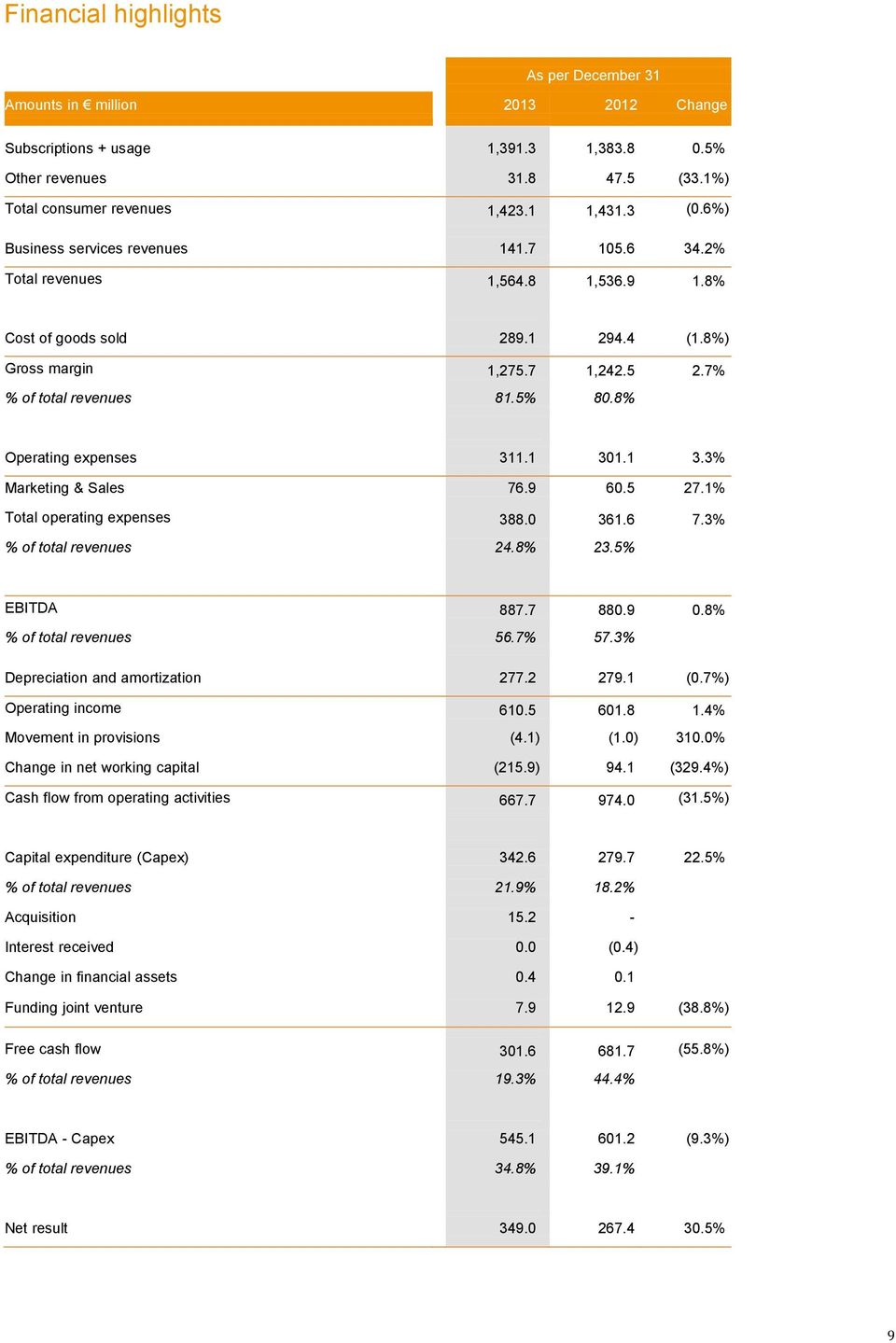
8 Financial review Financial performance Revenues We generated revenues of 1,564.8 million, an increase of 1.8% compared to 2012 ( 1,536.9 million). Excluding Other Revenues, revenues increased by 2.9% and by 1.2% excluding the revenue contribution from Esprit Telecom. Esprit Telecom was consolidated as of May 1, 2013 and has contributed 25.2 million in revenues since its consolidation. The main drivers of growth in revenues were continued growth in RGUs for internet and telephony, driven by a further uptake of our All-in-1 bundle, and revenues from business services. Revenues from business services were spurred by organic growth of 10.3% in the business market which, combined with a 25.2 million revenue contribution from Esprit Telecom, reported total revenue growth of 34.2%. Consumer market revenues declined by 0.6% to 1,423.1 million in 2013 (2012: 1,431.3 million). Excluding Other revenues, consumer revenues increased by 0.5%. This was driven primarily by a further uptake of our All-in-1 bundle during the year, with 100,000 net additions, or 7.1% year-on-year growth. This resulted in growth in both internet and telephony RGUs by 6.0% and 6.9%, respectively. In addition, the price increase effective February 1, 2013 contributed to the revenue growth by approximately 1.7%. Revenue growth was partly offset by a decline in revenues from digital pay TV by 0.4% and revenues from telephony usage by 2.8%. Revenues generated through our All-in-1 bundle increased by 8.3% from million in 2012 to million in 2013, representing 52.3% of total revenues from subscriptions and usage in the consumer market, versus 48.6% in Revenues from digital pay TV, including video on demand (VOD), declined by 0.4%, driven by a decline in the number of subscribers to digital pay TV from 917,000 at the end of 2012 to 853,000 at the end of 2013, which was partly offset by an increase in ARPU for digital pay TV by 7.1%, from in 2012 to in The ARPU increase was driven by a strong increase in the number of VOD transactions by 48%. The decline in RGUs for digital pay TV was driven by (a) depressed consumer confidence given the macro environment, (b) the growing popularity of VOD which does not count as an RGU, and (c) our marketing focus on customer retention and All-in-1, and the launch of Ziggo Mobile instead of premium pay TV. The growth in VOD transactions was negatively impacted by the price increase for watching live football per match from 6.95 to in the second half of In addition to the growing popularity of VOD, growth was also supported by the rise in the number of customers with an interactive set top box to 566,000 at the end of 2013, compared to 359,000 at the end of Revenues from telephony usage decreased by 2.8% from million in 2012 to million in Excluding interconnection revenues, revenues from telephony usage were flat. Interconnection rates were approximately 20.0% lower as at September 1, negatively affecting revenue by approximately 5 million. A 6.9% increase in the number of telephony subscribers was more than offset by a lower ARPU for telephony usage, as more subscribers selected a flat-fee subscription for calls within the Netherlands and several foreign countries. The lower ARPU for telephony was also attributable to a higher share of free on-net calls following growth in the number of telephony subscribers. When a Ziggo telephony customer makes a fixed-line call to another Ziggo telephony customer, the call qualifies as on-net, with no costs being charged as a result. Both trends resulted in a higher percentage of non-billable calling minutes compared with the previous year, as well as an overall decline in average usage per fixed-line telephony subscriber.
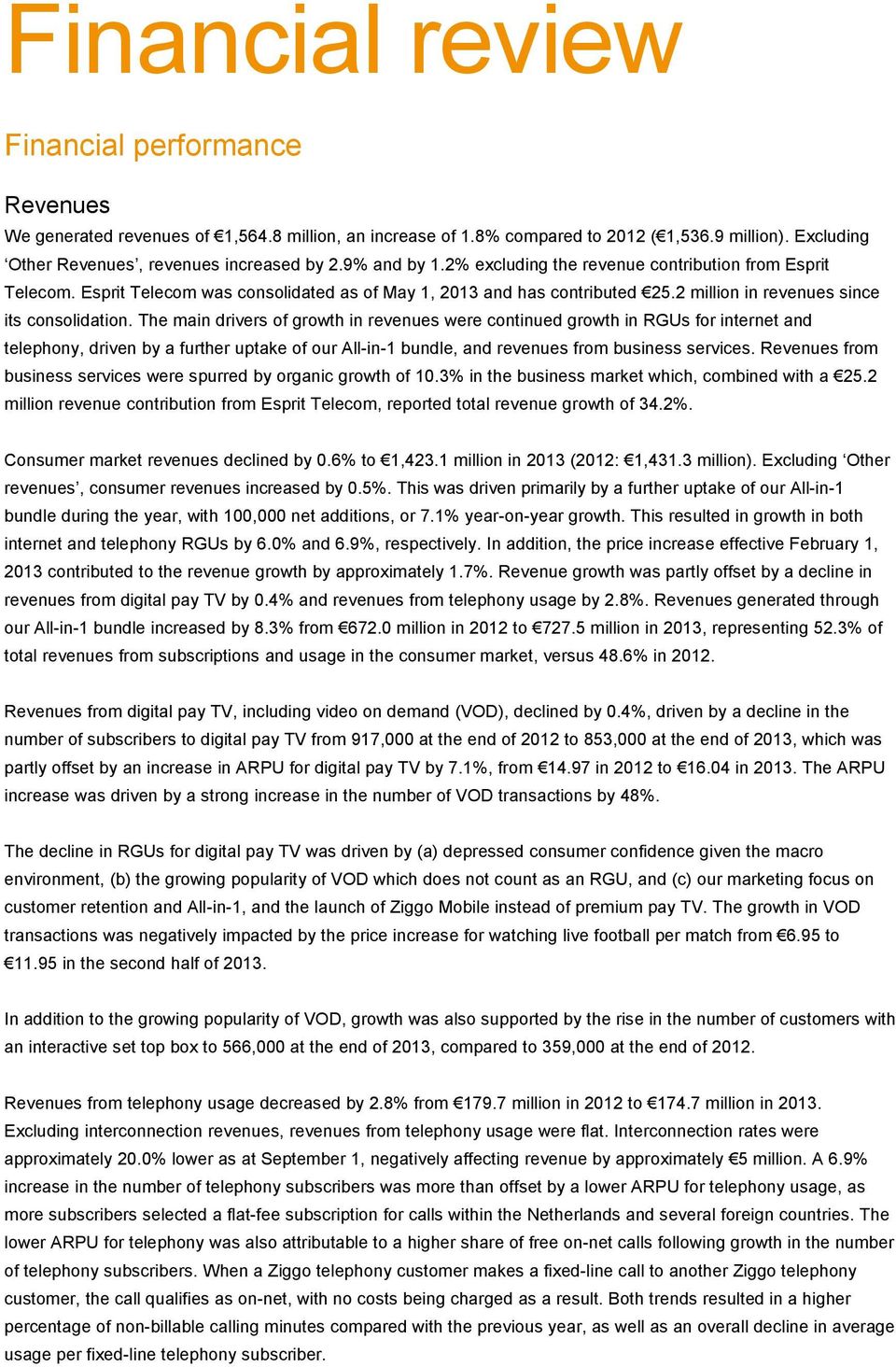
9 Financial highlights As per December 31 Amounts in million Change Subscriptions + usage 1, , % Other revenues (33.1%) Total consumer revenues 1, ,431.3 (0.6%) Business services revenues % Total revenues 1, , % Cost of goods sold (1.8%) Gross margin 1, , % % of total revenues 81.5% 80.8% Operating expenses % Marketing & Sales % Total operating expenses % % of total revenues 24.8% 23.5% EBITDA % % of total revenues 56.7% 57.3% Depreciation and amortization (0.7%) Operating income % Movement in provisions (4.1) (1.0) 310.0% Change in net working capital (215.9) 94.1 (329.4%) Cash flow from operating activities (31.5%) Capital expenditure (Capex) % % of total revenues 21.9% 18.2% Acquisition Interest received 0.0 (0.4) Change in financial assets Funding joint venture (38.8%) Free cash flow (55.8%) % of total revenues 19.3% 44.4% EBITDA - Capex (9.3%) % of total revenues 34.8% 39.1% Net result % 9
10 Total call minutes excluding interconnection decreased by 1.0% compared to On-net calling grew by 4.5%, with the number of billable minutes declining by almost 9.4% as a result of growth in on-net calling and growth in the number of flat-fee subscriptions by 13%. Average call minutes per subscriber declined by 8.4%. The gross margin on telephony usage improved by over 2.3%, supported by reduced FTA rates. Blended ARPU for consumers in 2013 was 42.10, up 2.36 (+5.9%) from This increase was driven by growth in the number of subscribers to our All-in-1 bundle and internet, which, combined with churn in TV-only subscribers, resulted in a 4.6% increase in RGUs per customer to 2.56 (based on a maximum of four RGUs per customer). Excluding digital pay TV as a separate RGU, Ziggo recorded an average of 2.24 RGUs per customer. Additionally, blended ARPU was positively affected by the price increase which became effective on February 1, Revenue from other sources, predominantly consisting of set top box sales, collection fees and revenues from service numbers, declined by 33.0% y-o-y to 31.8 million in Part of this decline was the result of accounting for costs of tablets, which are provided to new subscribers to All-in-1 or our dual-play proposition TV plus internet with a one-year contract. The costs of these tablets are deferred and allocated as a discount for the contract period to other revenues, rather than being expensed. This resulted in a discount as a result of deferred tablet costs of 3.2 million during Excluding this adjustment, revenues from other sources decreased by 12.5 million, or 26.2%. Although we shipped a higher number of set top boxes, we recorded a decline in revenues due to a lower average sales price per set top box and the capitalization of set top boxes covered by a subscription period of 12 months for which the ownership of the set top boxes remains with Ziggo Change Expensed Interactive recorders 140, ,742 (48,913) Interactive receivers 91,938-91,938 HD decoders - 89,024 (89,024) CI+ modules 16,374 25,138 (8,764) 249, ,904 (54,763) Capitalized Interactive recorders 82,380-82,380 Interactive receivers 34,106-34, , ,486 Total 365, ,904 61,723 Our business services activities generated revenues of million in 2013, up 34.2% from million in This was the result of strong growth in revenues from subscriptions to business bundles and the acquisition and consolidation of Esprit Telecom effective May 1, Excluding Esprit Telecom, revenues grew organically by 10.3%. In 2013, Ziggo added almost 18,000 new subscribers to its main B2B bundles products Internet Plus, Office Basis and Office Plus bundle, reaching a total of over 54,800 subscribers by December 31, Total revenues from coaxial products TOM and TOMi, our collective TV contracts, and business bundles for the year grew by over 37% compared to 2012 to 48.9 million, representing 42.0% of total B2B revenues ( %), excluding revenues from Esprit Telecom. 10

11 Cost of goods sold and gross margin Cost of goods sold includes the costs of materials and services directly related to revenues. It consists of copyrights, signal costs and royalties paid to procure our content, interconnection fees paid to other network operators, materials and logistics costs and costs of guarantees relating to the sale of set top boxes and other products and materials used to connect customers to our network. In 2013 cost of goods sold decreased slightly to million, down 1.8% from The gross margin for 2013 was 81.5% of revenue versus 80.8% in Excluding the acquisition of Esprit Telecom (2013 COGS of 15.5 million), which has been consolidated since May 1, cost of goods sold would have declined by 7.1% and the gross margin would have been 82.2%. Margin improvement was mainly the result of higher gross margins on internet, telephony and business services (excluding Esprit Telecom) and a lower negative margin contribution realized on the sale of set top boxes. The lower negative margin contribution from the sales of set top boxes is the result of a lower volume of set top boxes recognized as sales (233,000 in 2013 versus 279,000 in 2012, and 16,000 CI+ modules versus 25,000 in 2012) at a lower negative margin contribution per set top box. A lower average sales price during the year compared to 2012 was more than offset by a lower average purchase price. In addition, 116,000 set top boxes were capitalized, as these boxes were provided to customers as part of our sales and retention promotions covered by a one-year contract, with the ownership of the set top boxes remaining with Ziggo. These capitalized set top boxes represented a total value of 14.5 million in Our business services activities generated revenues of million in 2013, up 34.2% from million in Operating expenses (opex) Operating expenses increased by 26.4 million, or 7.3%, to million in 2013, from million in As a percentage of revenue, operating expenses increased from 23.5% to 24.8%, mainly as a result of a 27.1% increase in marketing and sales expenses from 60.5 million in 2012 to 76.9 million in The majority of marketing and sales expenses were spent on sales and customer retention campaigns, the Ziggo branding campaign and the launch of Ziggo Mobile. Excluding marketing and sales, operating expenses increased by 3.3%, or 10.0 million, compared to Excluding the acquisition of Esprit Telecom ( 5.4 million), operating expenses amounted to million, up 1.5% compared to This was mainly due to higher costs of contracted work driven by higher costs of our external call centres and costs of customer maintenance & visits. Personnel costs increased by 0.8% compared to Excluding Esprit Telecom ( 4.3 million), personnel costs decreased by 1.5%, or 2.7 million. Although headcount increased by 7.7%, excluding Esprit Telecom, and average salary costs by 3.3%, the resulting increase in personnel expenses was offset by higher capitalized personnel costs and a reduction of accrued bonuses by approximately 4.8 million as company targets were only partially achieved. The increase in average salary costs was driven by both discretionary individual salary increases and a general salary increase in line with the collective labour agreement, including an increased employer s contribution to the pension premium, which was partly offset by a decrease in employer charges for social securities. The increase in headcount was predominantly the result of an increase in the number of external resources, an increase that was more than offset by an increase in capitalized personnel costs of approximately 29.5 million, or 52%. The increased headcount is the result of an increase in external personnel hired for projects relating to investments in innovation and in our core infrastructure and service platforms, facilitating the addition of new services such as mobility and converged services and TV Everywhere. The personnel costs for the Management Board of Ziggo N.V. is recognized under Ziggo N.V. and therefore not recognized by the Company. At the end of 2013, our workforce totalled 3,350 FTEs. Excluding Esprit Telecom, we recorded 3,244 FTEs, compared to 3,014 FTEs at the end of Excluding external and temporary employees, we had 2,496 employees versus 2,498 in the previous year. The number of external resources increased from 278 FTEs at the end of 2012 to 521 at the end of The number of temporary call centre agents decreased slightly from 238 FTEs at the end of 2012 to 226 at the end of Costs of contracted work, excluding Esprit Telecom, increased by 12.8% compared to This increase was mainly driven by higher costs of our external call centres and costs of customer maintenance & visits. As a result of a strong growth in RGUs in the second half 11

12 of 2013 and the roll-out of Ziggo WifiSpots, call volumes rose by approximately 5% compared to In combination with an increase in the average handling time of approximately 23% and a relatively higher percentage of the call volume being outsourced, external call centre costs and costs of customer maintenance & visits rose by almost 30%. Consultancy costs and costs of maintenance of network and technology were stable. The higher costs of our external call centres and customer maintenance & visits was partly offset by lower consultancy costs. Costs of maintenance of our network and technology rose slightly compared to 2012 as a result of an increase in the capacity of our infrastructure, as well as rising maintenance costs following investments in our core infrastructure and systems facilitating the addition of new services, such as mobility and TV Everywhere. Office expenses, excluding Esprit Telecom, decreased by 2.0% compared to 2012 to 52.8 million. Costs of housing and sites increased by almost 1.6% as the result of the opening of a new data centre in the third quarter to support the new IT infrastructure and service platforms, facilitating the addition of new services such as mobility and converged services and TV Everywhere. Investments in innovations for our converged platform and business applications resulted in additional license and maintenance costs on top of recurring costs of existing IT business applications. The increase was more than offset by a refund of energy tax for prior years and an increase in coverage of office expenses and office IT as a result of the increase in the headcount and hours capitalized. Excluding the coverage of office expenses and the refund of energy tax, office expenses increased by 4.6%. Other operating expenses, excluding Esprit Telecom, increased by 59.3% to 8.1 million, mainly as a result of a release relating to the provision for bad debts in 2012 due to improved quality and ageing of our trade accounts receivable at the time. Other expenses also include the proceeds and gain of 6.9 million from the sale of our transmission towers and an impairment of 6.5 million. This impairment was due to our decision to replace certain components of a project to build our new video platform. Moreover we recognized more management fee by 1.2 million, which has been charged to Ziggo by Ziggo N.V. for services rendered by the members of the Board of Management of Ziggo N.V. as result of the fact that last year the management fee was charged from Q EBITDA and operating profit We achieved an EBITDA of million in 2013, up 0.8% versus The EBITDA margin was 56.7% compared to 57.3%. Excluding the EBITDA contribution of 4.3 million from Esprit Telecom, EBITDA increased by 0.3%, resulting in an EBITDA margin of 56.5% compared to an EBITDA margin of 57.3% in the prior year. Depreciation expenses and amortization of software in 2013 decreased by 1.9 million to million, from million in Excluding the acquisition of Esprit Telecom and excluding the amortization of other intangible fixed assets, depreciation expenses and amortization of software decreased by 3.4 million. This decrease is the result of high historical network and infrastructure investments as well as investments related to the merger of the three predecessor companies, which has led to relatively high depreciation expenses in recent years. However, with the current investment program in place in our core infrastructure and systems facilitating the addition of new services such as mobility and TV Everywhere, depreciation and amortization will increase in the future. In 2013, we recognized 0.8 million in amortization of other intangible assets, which is the result of the recognition of the amortization of the Esprit Telecom customer list. The Esprit Telecom customer list has been valued based on the allocation of the purchase price paid for the acquisition to the individual assets. Operating income (EBIT) in 2013 increased by 1.4% to million, compared to million in Excluding the acquisition of Esprit Telecom, operating income increased by 0.9% to million, due to the increase in EBITDA of 0.8% and lower depreciation and amortization expenses. Net income Interest costs decreased by 4.0% to million in 2013, compared to million in In 2013, 12.6 million was allocated as borrowing costs to work in progress, resulting in an interest credit, compared to 10.4 million in Excluding borrowing costs, interest costs decreased by 2.8% or 6.1 million. A reduction in our average debt by approximately 160 million lowered our interest expenses compared to The blended interest rate for 2013 was 6.9% versus approximately 6.8% for Banking and financing fees increased by 37.1% to 1.4 million in 2013, from 1.0 million in the previous year. This increase is mainly attributable to the new revolving credit facility of 400 million, which was put into place in March 2013, replacing a revolving credit facility of 50 million. 12

13 Amortization of funding costs increased by 37.8 million to 51.0 million in As a result of the refinancing of the old 1.1 billion senior credit facility in March 2013, we impaired the remaining balance of the capitalized financing costs of 42.7 million related to this old senior credit facility. The total financing fees of 12.7 million relating to (1) the new 750 million, 3.625% senior secured notes issue, (2) the new 150 million term loan A and (3) the new 400 million revolving credit facility, have been capitalized and will be amortized over the terms of the senior secured notes, the term loan and revolving credit facility. As Ziggo does not apply hedge accounting rules for interest rate swaps under IFRS, any change in fair value is recognized as financial income and expense. In 2013 Ziggo recorded a 29.1 million gain on other income, due to: (1) the periodic amortization of our negative hedge reserve of 4.6 million, (2) a fair value gain on IRS contracts of 33.7 million as a result of shortened expiration periods of underlying hedges and an increase in the underlying interest. In 2012, we reported a fair value loss of 10.8 million. A foreign exchange gain on US dollar-denominated purchases of 0.2 million is recognised in The 9.1 million net loss from joint ventures predominantly relates to our 50% share in the results of HBO NL, our joint venture with HBO. Investments in and results from the joint venture are accounted for using the equity method. Our share in the funding of this joint venture amounts to approximately 7.9 million in For 2013 Ziggo reported an income tax expense of 30.1 million, compared with an income tax expense of 92.3 million in Higher operating income, combined with reduced interest costs, partly offset by the impairment of capitalized financing costs, resulted in a strong increase in the result before income taxes to million, compared to million for the prior year. The result before income taxes of million would have led to a corporate income tax charge of 97.0 million at an effective tax rate of 25%. However, we formalized an agreement with the Dutch tax authorities in the first quarter of 2013 regarding the innovation box, which will reduce the effective tax rate going forward, as well as reducing it retrospectively for the period 2010 to The innovation box is a tax facility under Dutch corporate income tax law, which taxes profits attributable to innovation at an effective tax rate of 5% instead of the statutory rate of 25%. The application of the innovation box resulted in a one-off benefit of 35.1 million reflecting the period 2010 to 2012, as well as reducing corporate income tax charges for 2013 by 31.9 million. In 2013 Ziggo posted a net profit of million, versus a net profit of million in Adjusted for (1) amortization of financing fees and (2) changes in fair value on our interest rate hedges (all adjustments net of income taxes), the net result would have increased from approximately 285 million in 2012 to 366 million in 2013, representing an increase of 28%. 13

14 Working capital, cash flow and liquidity Working capital Net working capital excluding accrued interest and corporate income tax due increased by 99.6 million, from million negative at year-end 2012 to million negative at year-end In 2012 working capital decreased by million. The closing balance as at December 31, 2012 was adjusted for the opening balance of working capital of the acquisition of Esprit Telecom. The increase in working capital in 2013 is mainly due to (1) an increase in inventories of 12.0 million as higher inventories for network equipment and interactive recorders and receivers are kept to avoid shortages, (2) an increase in trade accounts receivable of 17.9 million as a result of a one-off delay of the collection of part of the December 2013 bill run, due to the implementation of Sepa in December, while in the prior year the billing of quarterly subscriptions was postponed from the end of December to the beginning of January; this reduced the balance for trade receivables at end-2012 by approximately 8 million, and (3) the balance deferred revenue by 9.2 million, and (4) a decrease in Other current liabilities of 11.2 million due to the relatively high capital expenditure in the last months of Working capital excludes corporate income tax due of 4.7 million as at December 31, This balance due is the result of an intragroup transaction as part of which certain assets were transferred in 2012 in order to renew part of Ziggo s tax loss carry-forward position so as to avoid expiry of these losses. One of its subsidiaries is required to report profit for tax purposes based on a percentage of the value of transferred assets, which cannot be offset against the remaining losses of the fiscal unit according to Dutch carryforward rules. The increase in working capital in the prior year was mainly attributable to VAT being payable on a quarterly rather than on a monthly basis (effective 2012), resulting in a reduction in net working capital of approximately 29 million and repayment of intracompany loan with Ziggo N.V. in order to pay dividend at Ziggo N.V. level. Cash flow from operating activities Cash flow from operating activities decreased by million, or 31.5%, to million versus million in Although EBITDA improved by 6.8 million, the cash outflow of million as a result of the increase in working capital in 2013 versus a 94.1 million cash inflow from a decrease in net working capital in 2012 and a 3.1 million higher cash outflow from a movement in provisions resulted in a decrease in cash flow from operating activities of million. Capital expenditure (capex) Capital expenditure and investments relate primarily to extending, upgrading and maintaining the network, installing new service equipment at customer premises, cost of modems and investments in the core infrastructure, service platforms and systems facilitating the addition of new services such as mobility and TV Everywhere. They also include increases in intangible assets, primarily expenditures on software, which are capitalized. Set top boxes are capitalized if these boxes are provided to customers covered by a 1- or 2-year subscription and ownership remains with Ziggo. In 2013 Ziggo recorded capital expenditures of million, an increase of 22.5% compared to 2012 ( million). The increase of 62.9 million compared to 2012 was mainly driven by investments in core infrastructure and systems to facilitate the addition of new services such as mobility and TV Everywhere, growth of access capacity and the capitalization of interactive recorders and receivers. million 2013 % of total Increase 2012 % of total Customer installation % 19.2% % Network growth % 22.4% % Maintenance and other % 24.8% % Total Capex % 22.5% % In 2013, 75.3 million (22%) of capital expenditure related to installations of service equipment, modem installations at customer premises and set top boxes covered by a one-year subscription with the ownership of the set top boxes remaining with Ziggo (compared to 63.2 million, or 23%, in 2012), whereas 43% (43% in 2012) related to new homes connected (new build) and growth of our network capacity to accommodate our increased subscriber base for internet and the continuously increasing internet speed and bandwidth requirements. 14

15 The increase in customer installations compared to 2012 is predominantly due to capitalization of set top boxes (which were not capitalized in the prior year), partly offset by a lower number of modems installed at customer premises. In 2013 Ziggo capitalized 82,400 interactive recorders and 34,100 interactive receivers, representing a total value of 14.5 million. More than 432,000 modems were shipped, versus 488,000 in 2012, reflecting a continuous upgrade of internet subscribers to a Wifi-enabled EuroDOCSIS 3.0 modem and growth in the number of internet subscribers. At the end of 2013, Ziggo had activated 1,566,000 EuroDOCSIS 3.0 modems at customer premises, of which 1,165,000 were Wifi-enabled, representing an increase of 343,000 compared to December 31, Network capacity grew by 26.9 million or 22.4% compared to 2012, mainly due to the additional required network and access capacity to process an approximately 41% increase in internet traffic, in line with the prior year (approximately 40%), as well as from the roll-out of Ziggo WifiSpot and the upgrading of our office IT systems and computer equipment of our employees. The remainder of our capital expenditure represents maintenance and replacement of network equipment and recurring investments in our IT platform and systems, as well as other investments in core infrastructure and systems to facilitate the addition of new services such as mobility and TV Everywhere. In 2013, investments in this category increased by 23.9 million, or 24.8%, to million (or 35% of total capital expenditure for the year) compared to 96.4 million for the previous year. In the fourth quarter of 2011, we had launched an investment programme for core infrastructure and systems facilitating the addition of new services such as mobility and TV Everywhere. This led to a step-up in capital investments in the category maintenance and other. Following increased network investments to stay ahead of ever-increasing customer demand for bandwidth, the investments in set top boxes to support customer experience and the continuation of investments to upgrade our IT systems to enable converged services and TV everywhere, Capex will increase to around 370 million in Operational free cash flow Operational free cash flow (OpFCF, or EBITDA minus capex) decreased by 9.3% to million as a result of an increase in capital expenditure of 63.0 million. Free cash flow and net cash used in financing activities In 2013 free cash flow (cash flow before financing activities) decreased by million to million, down 55.8% from Although EBITDA increased by 6.8 million, or 0.8%, compared to the previous year, the increase in capital expenditure of 63.0 million combined with the cash outflow from a change in working capital of million compared with a cash inflow from a change in working capital of 94.1 million in 2012, resulted in the decrease of the free cash flow. Net cash used in financing activities for the year comprises interest costs, banking and financing fees related to our loan facilities, prepayments on the senior credit facilities and drawings on the revolving credit facility. In 2013 we drew an amount of 90.2 million under our facilities. Cash interest paid in 2013 amounted to million, representing a 27.1 million drop from the previous year. The difference can be explained by a slightly lower average debt and a different timing of interest payments following the refinancing in March Our senior credit facility with interest payable on a monthly basis was partly replaced by a new senior secured note of 750 million with an annual interest payment. Interest on both the 6.125% senior secured and 8.0% senior unsecured notes is payable semi-annually, in May and November, and interest on the 3.625% senior secured note is payable annually in March. At the end of 2013, accrued interest on the senior secured and senior unsecured notes was 38.8 million, compared to 17.8 million at the end of The increase is due to a different timing of interest payments following the refinancing in March At the end of 2013, Ziggo held 77.2 million in cash and cash equivalents, compared to 92.4 million at the end of Ziggo has a revolving credit facility of million in place, expiring in March As at December 31, 2013, million had been drawn under this facility. Net debt and financing structure As at December 31, 2013, we carried a total debt balance of 3,073.5 million, including the principal amount, capitalized funding costs and discount on the issuance date. An amount of million is owed under our senior credit facility (term loan A and revolving credit facility), million was lent on by Ziggo Finance B.V. (term loan E), which had issued senior secured notes for a similar amount in 2010, million related to senior secured notes issued in March 2013 and 1,208.9 million related to senior unsecured notes issued in A summary of the capital structure with notional amounts outstanding as at December 31, 2013 is provided below. 15

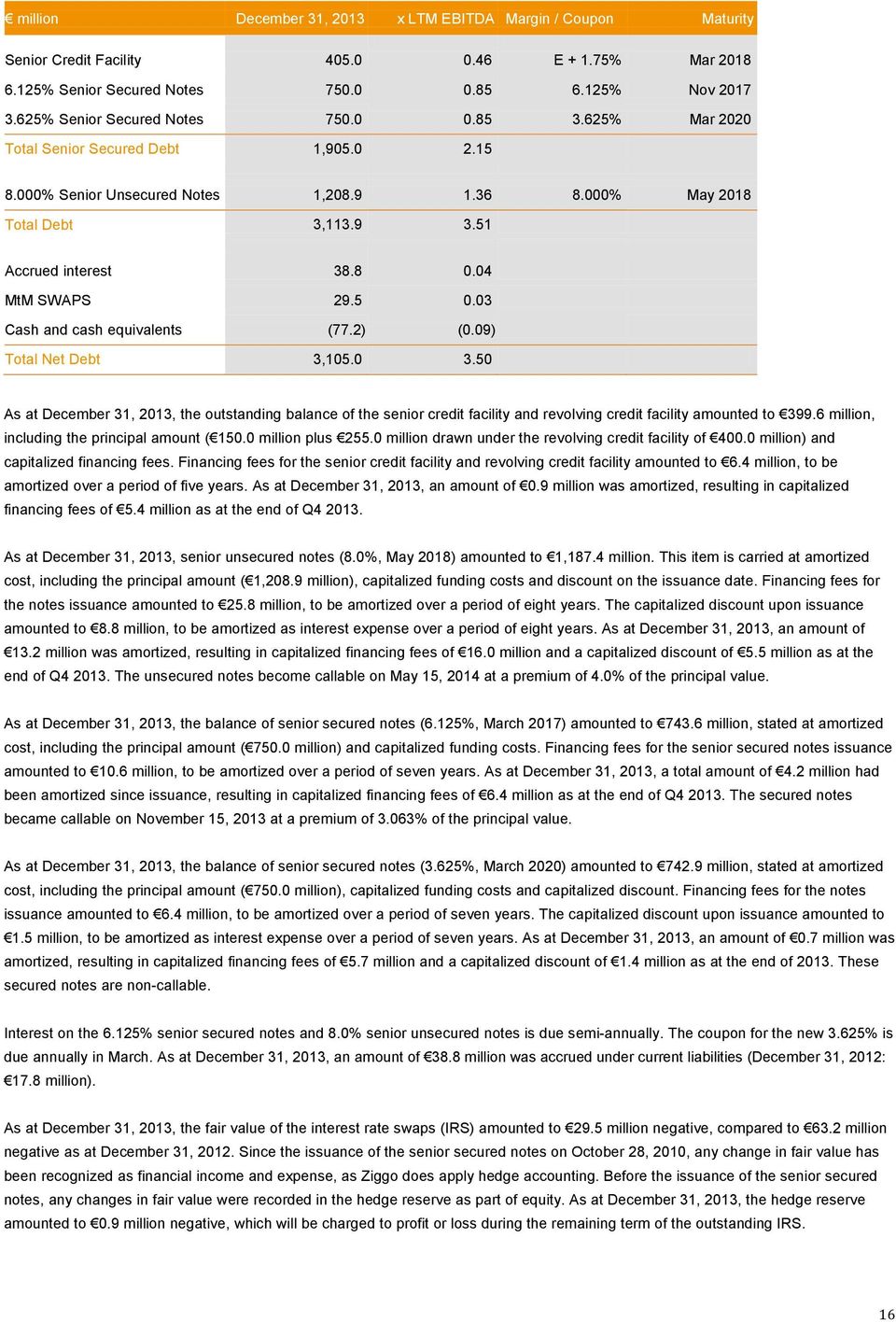
16 million December 31, 2013 x LTM EBITDA Margin / Coupon Maturity Senior Credit Facility E % Mar % Senior Secured Notes % Nov % Senior Secured Notes % Mar 2020 Total Senior Secured Debt 1, % Senior Unsecured Notes 1, % May 2018 Total Debt 3, Accrued interest MtM SWAPS Cash and cash equivalents (77.2) (0.09) Total Net Debt 3, As at December 31, 2013, the outstanding balance of the senior credit facility and revolving credit facility amounted to million, including the principal amount ( million plus million drawn under the revolving credit facility of million) and capitalized financing fees. Financing fees for the senior credit facility and revolving credit facility amounted to 6.4 million, to be amortized over a period of five years. As at December 31, 2013, an amount of 0.9 million was amortized, resulting in capitalized financing fees of 5.4 million as at the end of Q As at December 31, 2013, senior unsecured notes (8.0%, May 2018) amounted to 1,187.4 million. This item is carried at amortized cost, including the principal amount ( 1,208.9 million), capitalized funding costs and discount on the issuance date. Financing fees for the notes issuance amounted to 25.8 million, to be amortized over a period of eight years. The capitalized discount upon issuance amounted to 8.8 million, to be amortized as interest expense over a period of eight years. As at December 31, 2013, an amount of 13.2 million was amortized, resulting in capitalized financing fees of 16.0 million and a capitalized discount of 5.5 million as at the end of Q The unsecured notes become callable on May 15, 2014 at a premium of 4.0% of the principal value. As at December 31, 2013, the balance of senior secured notes (6.125%, March 2017) amounted to million, stated at amortized cost, including the principal amount ( million) and capitalized funding costs. Financing fees for the senior secured notes issuance amounted to 10.6 million, to be amortized over a period of seven years. As at December 31, 2013, a total amount of 4.2 million had been amortized since issuance, resulting in capitalized financing fees of 6.4 million as at the end of Q The secured notes became callable on November 15, 2013 at a premium of 3.063% of the principal value. As at December 31, 2013, the balance of senior secured notes (3.625%, March 2020) amounted to million, stated at amortized cost, including the principal amount ( million), capitalized funding costs and capitalized discount. Financing fees for the notes issuance amounted to 6.4 million, to be amortized over a period of seven years. The capitalized discount upon issuance amounted to 1.5 million, to be amortized as interest expense over a period of seven years. As at December 31, 2013, an amount of 0.7 million was amortized, resulting in capitalized financing fees of 5.7 million and a capitalized discount of 1.4 million as at the end of These secured notes are non-callable. Interest on the 6.125% senior secured notes and 8.0% senior unsecured notes is due semi-annually. The coupon for the new 3.625% is due annually in March. As at December 31, 2013, an amount of 38.8 million was accrued under current liabilities (December 31, 2012: 17.8 million). As at December 31, 2013, the fair value of the interest rate swaps (IRS) amounted to 29.5 million negative, compared to 63.2 million negative as at December 31, Since the issuance of the senior secured notes on October 28, 2010, any change in fair value has been recognized as financial income and expense, as Ziggo does apply hedge accounting. Before the issuance of the senior secured notes, any changes in fair value were recorded in the hedge reserve as part of equity. As at December 31, 2013, the hedge reserve amounted to 0.9 million negative, which will be charged to profit or loss during the remaining term of the outstanding IRS. 16
17 In 2013 we entered into forward-starting interest rate swaps for the period May 2014 to May 2024 for an amount of 900 million. Using this instrument we have hedged the base interest rate and consequently reduced our interest rate exposure for the period , assuming we would call our unsecured notes ultimately at the first call date in May As a result of the intended public offer on all outstanding shares of Ziggo N.V. by Liberty Global on January 27, 2014 and the exchange offer launched for the unsecured notes in combination with the availability of the term loan B3 to refinance the remainder of the unsecured notes which are not tendered, these forward interest rate swaps were settled in February 2014 after the exchange offer was successfully completed and the interest exposure was no longer existing. As at December 31, 2013, our Net Debt to Adjusted LTM EBITDA leverage ratio was 3.50, up from 3.42x as at year-end The leverage of 3.50x is in line with our stated leverage target of around 3.5x. Net debt is defined as the outstanding balance of the principal amount of our borrowings, plus interest accrued on those borrowings ( 38.8 million as at December 31, 2013) and the market-to-market value of the interest rate swaps ( 29.5 million negative as at December 31, 2013), reduced by the balance of cash and cash equivalents. The average debt maturity was 4.7 years as at December 31, 2013, down from 4.9 years as at the end of December 31, The refinancing in March 2013 of our senior credit facility with a maturity in 2017 by a new senior secured note of 750 million with a maturity in March 2020 extended the average debt maturity. Intangible assets and goodwill and the acquisition of Esprit Telecom Following the acquisition of Esprit Telecom and the purchase price allocation, we allocated 5.1 million to the customer list of Esprit Telecom and recognized goodwill of 11.3 million. The customer list will be amortized in four and a half years. The cash paid amounted to 17.8 million and an earn-out of 0.5 million has been recognized under provisions. 17

18 Outlook Based on our strong network and appealing product offerings, we will continue to focus on our top line in This will predominantly be facilitated by ongoing growth in broadband internet, Ziggo Mobile and our B2B activities. As we anticipate no substantial change in the current competitiveness in the market, we intend to make further investments in sales and promotions, customer retention and product development to strengthen our position and improve our services. We expect these additional investments, which will be skewed towards the first half of the year, will result in a flat EBITDA for 2014 compared to Following increased network investments to stay ahead of ever-increasing customer demand for bandwidth, the investments in set top boxes to support customer experience and the continuation of investments to upgrade our IT systems to enable converged services, Capex will increase to around 370 million in We believe the investments we are making will help secure continued long-term earnings growth and generate new revenue streams for the business in the medium term. We will continue to exercise financial self-discipline, which underpins the financial flexibility we enjoy. Our strong cash generation enables us to invest in the future while also gradually increasing shareholder returns. 18

19 Corporate social responsibility Ziggo takes its responsibility as a provider of television, internet and telephony services very seriously. The high-quality, reliable products and services we deliver perform an important role in the lives of millions of people. Information, communication and entertainment support and enrich society and support social interaction. Ziggo and the Open Society Dutch society is one of the most open societies in the world. Ziggo believes that the quality, availability and accessibility of information, as well as the digitization required to facilitate it all, can play an important role in maintaining and advancing an Open Society. Ziggo wants to be actively involved in thinking about, and acting towards, an open society, from the perspective of computerization and digitization. Where are the barriers? How can we get more people involved? How can we ensure that everyone is able to participate? How will we maintain the high-quality and diversity levels of the information upon which people base their opinions and, in some cases, even their identities? Ziggo Open Society Award 2013 To address these issues Ziggo has established an annual prize: the Ziggo Open Society Award (de Ziggo Prijs voor de Open Samenleving). The prize is awarded to organizations or individuals who have clearly contributed through their ideas, initiatives or projects to an Open Society; a society in which everyone is included and has the opportunity to act, think and imagine, and in doing so, increases pluriformity and quality. In 2013, the Ziggo Open Society Award was won by Bits of Freedom, a Dutch digital rights organization that focuses on privacy and communications freedom in the digital age. The other finalists were NoXqs and Internet Protection Lab. According to the jury, the two runners-up also play an important role in Dutch (open) society. The focus that Bits of Freedom puts on protecting civil rights on the internet will continue to increase, and remain important, in the coming years. We hope that this award acts as both recognition and an additional incentive, the jury said following its decision. Bernard Dijkhuizen, Ziggo s CEO at the time, presented the award, a trophy and 15,000 to Tim Toornvliet of Bits of Freedom at the annual Ziggo Congres. Ziggo also plays an active role in government and industry initiatives and programmes that shape the present and future of our industry. As a vital member of the ECP (Electronic Commerce Platform), we participate in initiatives that promote internet safety and prevent abuse of the internet. Meldpunt Kinderporno The Meldpunt Kinderporno, (the Registration Centre for Child Pornography) is a foundation that fights against the distribution of child sex abuse on and through the internet. Ziggo financially supported the foundation in Unicef Kinderrechten Filmfestival Ziggo also supports the Unicef Rights of the Child Movie Festival (Unicef Kinderrechten Filmfestival), the biggest movie project for primary school children in the Netherlands. This project enables children, together with their school, to create their own movies on the 19

20 subject of the rights of children. Quality of content In 2013 we supported several initiatives that are aimed at enhancing the quality of content. A series of Debatlabb, a televised debate on Open Society topics hosted in Club Ziggo, was broadcast live via our event channel. As in 2012, we supported de Tegel (the most important annual award for Dutch journalism) together with the Nipkow-schijf. The Nipkow-schijf is an annual award given by Dutch media journalists to the best television programme, interview, radio broadcast and multimedia performance of the past season. DE TV-BEELDEN The Netherlands plays an important role in the international television industry. It is the third most successful country in terms of developing (successful) new TV formats, behind only the United Kingdom and the United States. Dutch television makers are known globally for the quality of their work, but in their own country these achievements are still under-exposed. DE TV-BEELDEN, a new Dutch television trade award through which industry producers and creators can honour each other s work annually, was established to redress this. Ziggo is a founding partner of DE TV-BEELDEN. Universiteit van Nederland In 2013 we joined forces with the University of the Netherlands (Universiteit van Nederland). This initiative, led by Alexander Klöpping and Marten Blankensteijn, provides the country s leading university professors with a platform to share their knowledge with a broader audience. The classes are free and are broadcast on Ziggo s events channel and over the internet. We believe these projects will not only stimulate the quality of broadcast content, but will also contribute to an Open Society. Our people Ziggo s direct sphere of influence is formed by its employees. Our employees enjoy a range of modern, flexible benefits, and are able to make choices that fit their personal priorities. Throughout the year the Company organizes internal meetings and events, both formal and informal, to exchange information and get together. Employees are increasingly taking the opportunity to do voluntary work, or to make donations to good causes. Ziggo is an inclusive employer, offering equal opportunities to everyone, irrespective of country of origin, beliefs, handicap, sexual orientation, gender or age. In 2013 we continued to invest in our people, ensuring our customers receive the best quality products and services and allowing our employees to lead rewarding and fulfilling lives, both at work and at home. Within the Company, employees have a personal budget that can be spent on items such as extra free days, a subscription to a gym or extra pension payments. In addition to the personal budget, we also offer opportunities for personal development through training courses and coaching programmes. Employee representation Ziggo is in frequent contact with its works council, targeting a level of transparency and cooperation beyond legal requirements. The relationship is constructive, professional and mutually beneficial. Ziggo supports Enactus, a non-profit platform for social entrepreneurialism and leadership development that is active in more than 1,500 schools and universities across 39 countries. Enactus and Ziggo aim to develop sustainable leadership among students by introducing them to social entrepreneurialism. Enactus students, together with key representatives from Ziggo, set up projects aimed at sustainably improving the living standards and circumstances of people less well off than themselves. At the end of 2013, Ziggo employees selected the Nationale Voedselbank (national food bank) as their charity of choice, donating 75,000. Sustainability Ziggo s approach to environmental sustainability rests on three pillars: energy conservation, material use and waste management. In the last quarter of 2012, we were the first company in the Netherlands to receive BREEAM-NL certification for one of our new data centres. BREEAM determines the sustainability performance of buildings, and the data centre was constructed to be environment friendly (all materials are reusable) and uses an optimal temperature management system. As a result, the new data centre consumes 40% less energy. In 2013, a total of seven data centres received BREEAM-NL certification. Ziggo is a member of The Green Grid. The Green Grid is a group of companies, government and educational institutions that aim to 20

21 decrease the environmental impact of the IT industry. All members cooperate on research, as well as sharing practical tips to achieve greater efficiency in the use of energy and power management devices, thereby reducing the CO 2 footprint of information and communications technologies (ICT). Customer data Information security and integrity are a priority at Ziggo. Our guidelines are established in the Code of Conduct, available to all staff. Information security starts with knowledge and awareness. In 2013, an intensive training programme was finalized to raise the level of awareness among our employees. Our National Operations Centre and our Security Operations Centre monitor our systems and operations continuously (24/7), ensuring security and continuity remain at the highest possible level. 21
22 Corporate Governance Structure Ziggo Bond Company B.V. is an indirect 100% subsidiary of Ziggo N.V, parent company of the Ziggo group. As an intermediate holding company, Ziggo Bond Company B.V. is submissive to the corporate governance of Ziggo N.V. as all other direct and indirect subsidiaries of Ziggo N.V. As such, the coverage below is based on the corporate governance as a whole for the Ziggo group, chaired by the ultimate parent company Ziggo N.V. Ziggo has a two-tier board structure consisting of a Board of Management (Raad van Bestuur) and a Supervisory Board (Raad van Commissarissen), in accordance with the Dutch complete structure regime for large companies (volledig structuurregime) as set forth in the provisions of sections 2:158 to 2:162 inclusive and 2:164 of the Dutch Civil Code (Burgerlijk Wetboek), which is being applied by Ziggo. The Board of Management is the executive body and is responsible for the day-to-day management of the operations, supervised by the Supervisory Board. The Board of Management is required to keep our Supervisory Board informed, consult with our Supervisory Board on important matters and submit certain important decisions to our Supervisory Board for its approval. The Board of Management has three members, supported by seven Vice Presidents. The Supervisory Board is responsible for supervising the activities of our Board of Management and the general course of our affairs and our business. Our Supervisory Board may also, at its own initiative, provide the Board of Management with advice and may request any information from the Board of Management that it deems appropriate. The Supervisory Board is authorized to appoint the members of the Board of Management. In performing their duties, our Supervisory Board members must act in accordance with our interests and those of our business and all stakeholders. The members of our Supervisory Board are generally not authorized to represent us in dealings with third parties. The Supervisory Board bears collective responsibility for carrying out its duties. The powers of the General Meeting of Shareholders include appointing the Supervisory Board members based on nominations by the Supervisory Board (for one third of the appointments the Works Council has an enhanced right of recommendation), adopting the financial statements and endorsing the manner in which affairs were conducted during the financial year by the Board of Management and the supervision thereof by the Supervisory Board. The annual report, the policy on reserves and dividends and the proposal to distribute a dividend are discussed with the General Meeting of Shareholders. Furthermore, the Board of Management and the Supervisory Board report to the General Meeting of Shareholders on the Corporate Governance Structure. The General Meeting of Shareholders may resolve to amend the articles of association of Ziggo on proposal of the Board of Management which has been approved by the Supervisory Board. 22
23 Risk Management and Internal Control Aligning Risk and Strategy a focus on true relevance Ziggo s strategy to become the preferred media and entertainment company remained unchanged. Our superior network that allows us to offer our customers the best value in products and services, now and in the foreseeable future, is still at the foundation of our strategy. Innovation is however key to capturing new growth opportunities and strengthening our leading position in the Dutch telecom and media market. Our risk appetite (the amount of risk Ziggo is willing to accept in pursuit of value) is clearly linked to our strategy, defining the boundaries for our business model and taking into account internal and external factors, including financial, commercial and reputational aspects, thus allowing us to focus on truly relevant risks. In line with our innovation strategy, we strongly favour exploring new opportunities and are prepared to accept a reasonable amount of risk if these opportunities are likely to contribute to the realisation of our strategic, operational and financial goals. Taking into account our risk appetite, we require our management to pro-actively manage risks and control in order to ensure an acceptable level of risk for Ziggo. As the execution of our strategy brings its own, unique risks, the challenge for our management is to determine how much risk to accept while realizing our (strategic) objectives. This requires a clear strategy in terms of the amount of risk our management is willing to accept and the corresponding level of control required. In setting our risk management strategy, we initiated the implementation of an integrated Risk Management and Internal Control framework in 2012 where, based on strategic objectives, risks are identified in a structured way and key (financial) controls defined, implemented and executed in accordance with defined risk tolerances. Our integrated approach aids us in developing and achieving our strategic, operational and financial objectives and is both fundamental to the day-to-day management of our Company and a critical success factor in ensuring that our strategy is executed in a controlled, transparent and compliant manner. During 2013 we enhanced our Risk Management framework with a clear focus on strategic and project risk management and focussed on simplifying our Internal Control framework based on lessons learned from Our Risk Management Framework three lines of defence We apply a COSO Enterprise Risk Management (COSO ERM) based Internal Control and Risk Management framework to continuously and proactively manage risks and to realise our (strategic) objectives effectively and efficiently, in accordance with our brand values. In addition to COSO ERM, we apply the COSO Internal Control Integrated Framework as it enables us to more effectively and efficiently develop and maintain our systems of internal control. During 2013 we assessed the impact of the updated COSO Internal Control Integrated Framework (Framework) and related illustrative documents, released on May 14, We found that the updated Framework confirmed our approach to Internal Control and defined additional areas for enhancements to be implemented during Although the implementation of the Ziggo Internal Control and Risk Management framework initially had a strong focus on managing financial reporting risks, during 2013 we continued to extend our scope to managing risks on strategic, tactical and operational levels also incorporating other than financial reporting risk factors in line with our Risk Management Roadmap Despite all efforts exercised, the implementation of an internal control and risk management system only provides a reasonable level of assurance, risks that are currently not considered material, could however in a later stage have a significant negative effect on the realization of our (strategic) goals. 23
24 The three lines of defence against which we review significant risks are illustrated below. First, our management has ownership, responsibility and accountability for assessing, controlling and mitigating risk (first line of defence) on a daily basis. Second, our management is supported by subject matter experts (second line of defence) originating from Business Control, Internal Control & Risk Management, Security & Integrity and Compliance. Finally, Internal Audit helps us in accomplishing our objectives by bringing a systematic, disciplined approach to evaluate and improve the effectiveness of risk management, internal control, and governance processes (third line of defence). Internal Audit directly reports to the Board of Management, represented by the CFO, and has direct access to the Audit Committee of the Supervisory Board. Our Board of Management is the executive body and is responsible for the day-to-day management of the operations, supervised by the Supervisory Board. The Audit Committee assists the Supervisory Board in fulfilling its oversight responsibilities for the integrity of the Company s financial statements, the financial reporting process, the internal control and risk management systems, the internal and external audit process, the internal and external auditor s qualifications, independence and performance, as well as the Company s process for monitoring compliance with laws and regulations. What has this meant in practice this year? Core values Ziggo s core values are best characterized by innovative, co-operative, challenging and aiming for simplicity. Integrity and ethical values are vital elements embedded in our core values. Ziggo s performance management cycle is based on High Performance principles; as a result we have defined a High Performance leadership profile which focuses on quality of personal leadership, also including integrity and ethical values. Evaluation of these competences has become a continuous process throughout the year and therefore improvement opportunities can be addressed at an early stage. The Board of Management and management at various levels in the organization articulate and demonstrate the importance of integrity and ethical values, applying various forms and mechanisms including, but not limited to: Companywide communications underpinning the expected standards of conduct as laid out in the Code of Conduct; Timely inquiries and investigations into any alleged conduct that is inconsistent with the Code of Conduct; Corrective action when deviations from expected standards of conduct occur. Ziggo s Code of Conduct, available on the Ziggo intranet, addresses the fundamental integrity and ethics-related rules and principles. In order to further enhance and embed employee s awareness of the Code of Conduct, we apply a Serious Gaming concept. The Ziggo Serious Game is based on gaming principles and contains True/False and multiple choice questions as well as intervention moments (dilemmas) covering the fundamentals of the Code of Conduct to ensure the best possible learning curve. During 2013 the Serious Game has been made available to all employees for replay after the initial launch in 2012 and has become part of the Ziggo introduction day for new joiners. A new release of the Ziggo Serious Game is targeted for 2014 and will focus on further guidance to our rules and principles and more specific security-related topics. Along with the Code of Conduct, a whistle blower procedure is in place, ensuring that incidents can be reported, anonymously if desired. Risk and control assessment We systematically identify, prioritize and analyse risks based on likelihood and impact on all relevant organizational levels, including but not limited to strategic, tactical, operational and project levels. During 2013 we focused our risk management efforts on enhancing strategic and project risk management as the execution of a substantial part of our strategy is performed by means of projects. As our management is responsible for the design and operating effectiveness of the risk management and controls systems in the organization, we deem transparency on the outcomes of this process of the utmost importance. Throughout the year control selfassessments are performed by management for key financial and operational controls. The results of these control self-assessments are reported to and discussed with management every quarter by means of the Risk and Control reports, providing a consolidated view 24
25 on the, predominantly financial reporting, risk and control profile of the business area. Every year the results of these control selfassessments are reported to and discussed with the Board of Management and the Audit Committee of the Supervisory Board. During 2013 we focussed our risk management efforts on enhancing strategic and project risk management. Subsequent to the implementation of the control self-assessment process during 2012 and in line with our core value of aiming at simplicity, the focus of the second line of defence for 2013 has been on supporting our management with the rationalisation of the Ziggo Business Control Framework and enhancing the quality of control documentation. In line with our IT strategy and transformation efforts towards an entertainment company, we will be replacing multiple IT systems during the period These developments provide us with a unique opportunity to implement our control by design concept, aiming at replacing manual controls by automated controls to the maximum extent possible, which will remain a key element in our In Control strategy for the coming years. Planning and control cycle Ziggo has clearly defined requirements, formats and dates for our planning reporting and review cycles in order to facilitate setting company and departmental objectives, budgets, forecasts and reports, including both financial and operational aspects. Reporting on the outcome of our risk management and internal control systems has been synchronised with our regular planning and control cycle during 2013 through close cooperation between our Internal Control & Risk Management teams and Internal Audit, thus providing our management with an actionable and integrated view on the, predominantly financial, Risk and Control next to the financial and operational results for their business area of responsibility. The IIRC (International Integrated Reporting Council), a global organization comprising primarily regulators, investors, companies and standard setters, launched the International Integrated Reporting Framework on December 9, Its goal is to bring greater cohesion and efficiency to the reporting process, and adopting integrated thinking as a way of breaking down internal silos and reducing duplication. It s intent is to improve the quality of information available to providers of financial capital to enable a more efficient and productive allocation of capital. During 2013 we initiated a preliminary assessment of our approach to Corporate Reporting compared to the IIRC framework, by that stage available in draft for public exposure. Based on our initial assessment and the final framework released December 9, 2013, we will finalise our efforts to prepare a draft framework for Ziggo in 2014 and will determine a roadmap to implement accordingly. Policies and procedures Management establishes and clearly articulates financial reporting objectives, including those related to internal control over financial reporting. We apply a uniform set of operational and financial procedures, including those related to our financial reporting and closing process. Our main accounting policies have been incorporated in a digitalized accounting manual which is available on our intranet, accessible for all employees, and which is updated on a regular basis. Furthermore, necessary segregation of duties is in place and the risk of singular decision making is minimized. During 2013 we further professionalised the policies and procedures of our second line of defence functions in accordance with our assessment of the updates to the COSO Internal Control Integrated Framework. As a result, the Internal Control and Risk Management team updated and documented the principles of our Ziggo Business Control Framework. Information Security Information Risk Management (IRM), an integral part of Enterprise Risk Management, enables Ziggo to protect the Company assets, including but not limited to our people, customer services, information sources and other assets. The IRM function has a key role in our security management system by identifying and classifying information risks and thus supporting our management in the design and execution of information risk management and the implementation of security controls systems in the organization. During 2013 Ziggo opened the Security Operations Centre (SOC), one of the major results of the information security programme initiated in The SOC is a major step in improving security within Ziggo and key to the detection of and response to operational security threats in our network. From an IRM perspective the SOC is a key security control to mitigate our security risks. The IRM function will now start monitoring the quality of the SOC performance as a next level of security control. 25
26 Internal Audit Internal Audit applies a risk-based approach to testing key financial reporting controls, and reports the outcome of their procedures performed to the Board of Management and the Audit Committee of the Supervisory Board. Internal Audit also performs planned audits on specific (key) risk areas and audits on request of management, both financial and operational by nature. Audit findings are discussed with responsible (senior) management. Updates to the audit plan, major findings and the results of follow-up activities are discussed with the Audit Committee on a quarterly basis. Significant risks facing the business The nature of the industry in which we operate, combined with our chosen strategy, expose Ziggo to a number of risks. We have considered the nature and extent of the significant risks we face and have summarised our most significant risks, their level and trend as well as our mitigation strategy in the table below. We have categorized 1 our risks in accordance with our Risk Management framework as strategic, operational, compliance and financial reporting risks. 26
27 We have visualised the trends in our risk levels (2013 compared to 2012) in the following table. Strategic Risks Definition Mitigation Business and Industry Level High Trend Rising We operate in a highly competitive industry and face significant competition from established and new competitors. Over the course of 2013 the level of competition for the Dutch market continued to increase, including more aggressive price- and promotional campaigns from competitors like KPN and Telfort as well as the entrance of new competitors like Netflix. In addition, Fibre to the Home (FTTH) initiatives have been continued by our competitors, challenging Ziggo to adequately manage the perception of the general public towards FTTH networks compared to the Hybrid Fibre Coax (HFC) network of Ziggo. As a result, we encounter more challenges to attract new subscribers and/or retain existing subscribers, resulting in less usage of our services and increased price pressure. If we are not able to compete successfully against our current or future competitors in any of our businesses, this may result in a material adverse effect on our business in terms of increasing churn levels and decreasing results of operations. We continuously monitor our competitive environment, also performing deep dives into competitive product and service offerings, preparing ourselves in the best possible way to diligently assess how and where we can differentiate ourselves from our competition. While considering our response to the competitive environment we take into account perspectives from both new and existing subscribers to ensure a balanced view between attracting new subscribers and retaining existing subscribers (churn prevention). We have been and will be continuing and strengthening our fact-based communication with (potential) customers on FTTH, meanwhile highlighting the differentiating factors of our own products and services. Based on various reputable sources, we estimate that the demand for bandwidth for fixed connections will grow exponentially in the Netherlands, by approximately 30% to 40% per year, between now and 2020, which we deem to be a conservative estimate. Due to the very high intrinsic capacity of coax, our fibre-coax network (cable) can deal with such exponential growth in demand for bandwidth 1. The video, broadband internet and telephony businesses in which we operate are capitalintensive. Significant capital expenditures, including expenditures for equipment and labour costs, are required to add customers to our network and to increase the capacity of our network in order to keep up with the increasing demand for broadband speed. If we are unable to pay for costs and capital expenditure associated with adding new customers, expanding or upgrading our network or making our other planned or unplanned capital expenditures, our growth could be limited and our competitive position could be harmed. The multitude of capital-intensive projects Ziggo executes requires strong portfolio management to ensure the proper allocation of resources and funds for achieving our strategic ambitions. Our integrated roadmap allows us to determine an appropriate balance between successful introductions of both commercial and technological enhancements to existing products and services, and the introduction of new, innovative, products and services. Although we continuously monitor our integrated roadmap to ensure we are well positioned to achieve our strategic and operational objectives, it remains difficult to predict the effect of technological innovations on our business. Our growth prospects also depend on a continuing demand for cable and telecommunications products and services and an increasing demand for bundled offerings. As we exclusively operate in the Dutch market, our success is therefore closely tied to general economic developments in the Netherlands and cannot be offset by developments in other markets. Negative developments in or the weakness of the Dutch economy, in particular increasing levels of unemployment, may have a direct negative impact on the spending patterns of retail consumers, both in terms of the products they subscribe for and usage levels. Although hard to mitigate, we believe we have effective measures in place to respond to market conditions in the best possible way. Our mitigation strategy aims at reinforcing measures around: planning, budgeting and forecasting processes; resource allocation processes; debt reduction and refinancing; cost reduction, pricing and gross margin management initiatives; customer service and productivity improvement. 27
28 Innovation Level High Trend Stable One of our main challenges is the rapidly increasing growth of IPTV and Over The Top (OTT) service offerings. These types of service offerings forces us to invest in innovative offerings and to develop new, attractive services and propositions in order to stay competitive. We strongly favour exploring new opportunities and are prepared to accept a reasonable amount of risk if such opportunities contribute to the achievement of our strategic and operational objectives. Developing new, attractive services and propositions also requires an innovative Information Technology (IT) infrastructure to support the delivery of our services and propositions. The implementation of such innovative IT infrastructure requires a clear transformation strategy. If our transformation strategy is not executed adequately this may result in the inability to deliver new services and propositions, thus harming our competitive position. In order to ensure an appropriate speed of innovation, we have aligned ourselves with key players in innovative technologies to leverage their knowledge and experience. We initiated the implementation of partner management processes in 2012 and continued enhancing these processes during While exploring new opportunities, we exercise strict quality controls to ensure the best possible customer experience. In order to ensure our IT infrastructure adequately supports the delivery of our products and services, a clear IT strategy has been defined and translated into Critical To Quality (CTQ) factors which are at the heart of each system implementation. We also translated our IT strategy into a multiyear transformation plan which is diligently executed. Risk Management, Programme Assurance and Quality Assurance have been embedded into the transformation plan. This has been verified in a study of November 2010 commissioned by the Dutch Ministry of Economic Affairs that addressed forecasting the supply of and demand for Next Generation Infrastructures in the Netherlands until Operational Risks Definition Mitigation Service Excellence Level Medium Trend Stable Our products are at the heart of society and tightly integrated in our customers day-to-day lives, making service levels, customer satisfaction and service excellence our key priorities. The continuity and quality of our (network) services is the primary condition for providing our services and subject to the highest service levels. Our challenge is to be proactive and demonstrate customer insight, resulting in an increase in customer satisfaction and with the possibility to clearly distinguish ourselves from our competitors. If, however, our service levels are not met, our customers may not be satisfied by our products or services. This may lead to customer churn or additional costs to maintain our customer base. We continuously monitor our customer satisfaction using Net Promoter Scores (NPS) as a key indicator. Based on NPS results, we set our priorities for improving our current processes and training our staff. In addition, the implementation of our IT strategy will allow us to be more pro-active and demonstrate customer insight. The success of our products depends on, among other things, the quality and variety of the television programming delivered to our subscribers. We do not produce our own content and depend upon broadcasters for programming. We continuously monitor the quality and variety of the television programming delivered by broadcasters as perceived by our customers. As a result, we have updated our television programming multiple times during
29 Operational Risks Definition Mitigation Systems and Infrastructure capabilities and resilience Level Medium Trend Stable Our day-to-day operations are highly dependent on our IT infrastructure and network. Disruptions to our IT infrastructure and network may have a negative impact on the continuity of our services to our customers and the support of our operations. Despite all efforts exercised, the potential impact of losses as a result of sabotage or other external disasters may still be considerable. We continuously monitor a variety of business continuity and security aspects, for example by performing impact analyses on our critical IT infrastructure and network components. We also ensure our critical IT infrastructure and network components are installed taking into account appropriate levels of redundancy, and continuously replace old technologies by new ones. A dedicated Business Continuity Officer was appointed as of September 1, 2013 to further enhance our mitigation efforts to disruptions to our IT infrastructure and network. During 2012 a security programme was initiated to enhance our baseline security controls and as a result decrease security risks. We opened our Security Operations Centre as of September 1, 2013, implemented vulnerability scanning, SIEM and IDS tooling and enhanced our (security) patch management processes during Human Capital Level Medium Trend Increasing To support our investments in capital-intensive projects, we need to ensure the availability of personnel of the highest quality. Especially introductions of innovative products and services, and the changing nature of our business which requires the ability to continuously adjust our processes, require specific knowledge and skills (competences) from our employees. We may however not be able to attract and retain those resources at all times, which may adversely affect our operations. Our people strategy, including the strategic staffing plan, provides a solid base to prepare ourselves in the best possible way to attract and retain appropriate resources, taking High Performance Organizations (HPO) as a benchmark. As a result, an HPO development programme was initiated during 2012 and continued during 2013 for (senior) management, next to our regular investments in training and education for all our staff. In addition, the set-up of our performance management cycle ensures a continuous dialogue between management and staff, allowing us to quickly identify any lack of specific knowledge and skills and take appropriate actions. 29
30 Compliance Risks Definition Mitigation Extensive legislation Level Low Trend Stable The television, broadband internet and telephony markets in which we operate are regulated more extensively than many other industries. We are subject to extensive supervision and regulation by Dutch regulatory authorities, including the ACM (Autoriteit Consument en Markt), the Dutch Media Authority, Consumer Data Protection Agency and the Radio Communications Agency (Agentschap Telecom), as well as European Union authorities. Regulatory agencies continuously monitor the level of competition within our market and may conclude, based on changes in the competitive environment, that any organization has obtained significant market power. Although hard to predict the effect of such regulatory changes, these changes may influence how we operate our business and may either result in decreasing revenues caused by increased churn levels or additional price pressure, or result in additional costs of adjusting our current processes and systems. In addition, if despite all efforts exercised, a violation of laws and regulations occurs, this may result in fines and loss of reputation. We continuously monitor changes to the legislative and regulatory environment, including but not limited to those on country and European level, to ensure an appropriate level of compliance. During 2013 we successfully amended our processes to comply with the requirements for the notification of personal data breaches under Directive 2002/58/EC on privacy and electronic communications. In addition, we performed a Compliance Risk Assessment taking into account both internal (e.g. Code of Conduct) and external laws and regulations in close cooperation between various subject matter experts in our organization who are monitoring our compliance to these laws and regulations on a daily basis. The outcome of this Compliance Risk Assessment provides a stepping stone for enhancing our current Compliance framework in The upcoming change from an EU directive to an EU regulation with a likely effective date in 2014 will result in more strict privacy requirements towards all companies processing personal information. Next to Ziggo being in control of personal data processed at or on behalf of Ziggo, customers should be more empowered to control their personal information stored, including the right to know what personal information is stored and the right to erasure. This change is likely to result in additional costs due to required adjustments to our current processes and systems. As customer privacy has been a key element in legislation, regulations or government policies, including the Dutch Telecomwet, over the last years we have intensified our compliance efforts in this domain. Ziggo s Legal and Regulatory Affairs department is in charge of assessing the impact of the new EU regulation on the organization and providing internal policies and procedures where required, to provide further guidance on how these regulations should be embedded in the day-to-day operations. Furthermore, Ziggo will formalize and enhance their Compliance framework as laid out in the Compliance plan Tax compliance Level Low Trend Stable In the normal course of business, a company may enter into discussions about tax positions with the tax authorities based on its tax returns. There is a risk that the Dutch tax authorities take a different stance on the Company s tax positions, which may have an impact on the tax position of the Company and result in additional taxation. On February 7, 2013, we signed a compliance agreement with the Dutch tax authorities based on horizontal monitoring. Horizontal monitoring incorporates a forward-looking way of working ensuring transparency between the Company and the tax authorities and incorporates two key elements: A relationship between the tax payer and the tax authorities based on mutual trust and understanding which is recorded in a compliance agreement ( handhavingsconvenant ). Appropriate risk management based on a tax control framework. The Dutch tax authorities found the tax controls and procedures in the Ziggo Business Control Framework (part of the Ziggo Internal Control and Risk Management framework) more than adequate to conclude a compliance agreement. This agreement confirms our good relationship with the Dutch tax authorities. 30
31 Financial Reporting Risks Definition Mitigation Capital structure Level Low Trend Stable Changes in our business model or the introduction of new and innovative products or services may require a revision of our current capital structure and the introduction of alternative financial instruments. A downgrade in our credit rating may negatively affect our ability to obtain funds from financial institutions. It may also hurt our ability to retain investors and banks, and may increase our financing costs by raising the interest rates on our outstanding debt or the interest rates for refinancing existing debt or incurring new debt. Our agreements and instruments governing the loans contain restrictions, covenants and limitations that could adversely affect our ability to operate our business, to fund capital expenditure, to incur additional debt and to pay dividends. We continuously manage our capital structure in order to safeguard the Company s ability to continue as a going concern, providing returns for our shareholders and benefits for our other stakeholders, thus maintaining the best possible capital structure. As a result, we have refinanced a substantial amount of our debt, 800 million, during Interest rate risk Level Low Our capital structure includes a substantial number of loans at floating interest rates, which exposes us to interest rate risk. Fluctuations in interest rates may have a material adverse effect on our financial results in any given reporting period. Our interest rate risk is managed by hedging at least 65-70% of the floating interest rate risk. Fluctuations in interest rates may however still result in changes in interest expenses and changes in fair value for the interest rate swaps. Trend Stable Foreign exchange risk Level Low A portion of our purchases is made in foreign currency, predominantly in US dollars, exposing us to exchange rate fluctuations from future commercial transactions. We apply hedging arrangements and other contracts in order to reduce our exposure to exchange rate fluctuations and to minimise our operating or financing costs. Trend Stable Increases in operating costs and inflation risks Level Low Trend Stable We are subject to increases in operating costs mainly due to our intensified Marketing and Sales efforts in order to counter the increasing level of competition and an increase in personnel costs mainly due to our investments in innovation as well as inflation risks which may adversely affect our earnings as operating costs may rise faster than associated revenues, resulting in a negative impact on our cash flow and net earnings. We attempt to increase our subscription fees to offset increases in operating costs as a result of inflationary increases in salaries, wages, benefits and other administrative costs. As a result, we updated the pricing structure for our products and services as of February In addition, our mitigation strategy aims at reinforcing measures around: planning, budgeting and forecasting processes; resource allocation processes; debt reduction and refinancing; cost reduction, pricing and gross margin management initiatives; customer service and productivity improvement. 31
32 Financial Statements CONTENTS Consolidated statement of income Consolidated statement of comprehensive income Consolidated statement of financial position Consolidated statement of changes in equity Consolidated statement of cash flows Notes to the consolidated financial statements The Company and its operations Basis of preparation Significant accounting policies Business combinations Revenues Personnel expenses Other operating expenses Net financial income and expense Income taxes Intangible assets Property and equipment Other non-current financial assets Investments in joint ventures Inventories Trade accounts receivable Other current assets Cash and cash equivalents Equity attributable to equity holders Interest-bearing loans Provisions Other non-current liabilities Other current liabilities Commitments and contingencies Related party disclosures Financial risks Financial instruments Subsidiaries Subsequent events 69 CORPORATE FINANCIAL STATEMENTS 71 Income statement Statement of financial position Notes to the corporate financial statements APPROPRIATION OF RESULT 77 INDEPENDENT AUDITOR S REPORT 78 CONTACT DETAILS AND ADDRESS 80 32
33 Consolidated statement of income For the years ended December 31 Amounts in thousands of (except per share data) Note Revenues 5 1,564,843 1,536,865 Cost of goods sold 289, ,407 Personnel expenses 6, 7 189, ,434 Contracted work 57,461 50,876 Materials & logistics 3,033 3,750 Marketing & sales 76,885 60,531 Office expenses 53,415 53,901 Other operating expenses 8,254 5,091 Amortisation and impairments 10 24,121 28,407 Depreciation and impairments , ,707 Total operating expenses 954, ,111 Operating income 610, ,754 Net financial income (expense) 8 (222,291) (232,623) Result before income taxes 388, ,131 Net result of joint ventures and associates (after tax) 13 (9,111) (9,389) Income tax benefit (expense) 9 (30,057) (92,307) Net result for the year 349, ,435 Net result attributable to equity holders 349, ,435 The accompanying notes to this statement of cash flows form an integral part of these consolidated financial statements. 33
34 Consolidated statement of comprehensive income For the years ended December 31 Amounts in thousands of Net result for the year 349, ,435 Net other comprehensive income to be reclassified to profit or loss in subsequent periods - - Items not to be reclassified to profit or loss in subsequent periods: Cash flow hedges, net of tax 3,462 3,462 Net other comprehensive income not being reclassified to profit or loss in subsequent periods 3,462 3,462 Total comprehensive income for the period 352, ,897 Total comprehensive income attributable to equity holders 352, ,897 34
35 Consolidated statement of financial position Amounts in thousands of Note December 31, 2013 December 31, 2012 Assets Intangible assets 10 3,416,418 3,358,387 Property and equipment 11 1,473,278 1,434,080 Other non-current financial assets 12 1, Investments in joint ventures 13 3,437 3,556 Deferred tax assets 9 77,137 91,654 Total non-current assets 4,971,395 4,888,396 Inventories 14 40,004 27,889 Trade accounts receivable 15 37,887 18,240 Other current assets 16 54,352 24,391 Cash and cash equivalents 17 77,157 92,363 Total current assets 209, ,882 Total assets 5,180,796 5,051,278 Equity and liabilities Issued share capital Share premium 840, ,982 Other reserves (865) (4,327) Retained earnings 401, ,569 Equity attributable to equity holders 18 1,241,609 1,091,242 Interest-bearing loans 19 3,073,489 2,943,816 Derivative financial instruments 26 21,194 63,236 Provisions 20 19,830 23,059 Deferred tax liabilities 9 414, ,824 Other non-current liabilities 21 1, Total non-current liabilities 3,531,265 3,438,139 Deferred revenues 120, ,692 Derivative financial instruments 26 8,343 - Provisions 20 7,072 7,480 Trade accounts payable 88,199 85,563 Corporate income tax 9 4,673 2,323 Other current liabilities , ,840 Total current liabilities 407, ,898 Total equity and liabilities 5,180,796 5,051,278 The accompanying notes to this statement of financial position form an integral part of these consolidated financial statements. 35
36 Consolidated statement of changes in equity Amounts in thousands of Issued capital Share premium Cash flow hedge reserve Retained earnings Total equity Balance at December 31, ,982 (7,789) 150, ,345 Comprehensive income Net result for the year , ,435 Other comprehensive income: Cash flow hedges, net of tax - - 3,462-3,462 Total comprehensive income - - 3, , ,897 Transactions with shareholders Dividend payment (163,000) (163,000) Total transactions with shareholders (163,000) (163,000) Balance at December 31, ,982 (4,327) (254,569) 1,091,242 Comprehensive income Net profit for the year , ,033 Other comprehensive income: Cash flow hedges, net of tax - - 3,462-3,462 Total comprehensive income - - 3, , ,033 Transactions with shareholders Dividend payment (202,128) (202,128) Total transaction with shareholders - (295,528) - (202,128) (202,128) Balance at December 31, ,982 (865) 401,474 1,241,609 36
37 Consolidated statement of cash flows For the years ended December 31 Amounts in thousands of Note Operating activities Result before income taxes 388, ,131 Adjustments for: Amortisation and impairments 10 24,121 28,407 Depreciation and impairments , ,707 Movement in provisions 20 (4,137) (1,020) Net financial expense 8 222, ,623 Operating cash flow before changes in working capital 883, ,848 Changes in working capital relating to: Inventories 14 (12,022) 4,291 Trade accounts receivable 15 (17,906) 7,513 Other current assets 16 (26,319) 1,903 Trade accounts payable (385) 10,908 Deferred revenues 9,232 (6,184) Other current liabilities 22 (168,480) 75,716 Change in working capital (215,880) 94,147 Net cash flow from operating activities 667, ,995 Investing activities Purchase of intangible and tagible assets 10, 11 (342,649) (279,650) Acquisition of business, net of cash acquired 4 (15,186) - Additional contribution to joint ventures 13 (7,948) (12,954) Interest received Change in financial assets (406) (155) Net cash flow from investing activities (366,145) (292,335) Financing activities Proceeds from loans 19 1,378,500 - Repayments of loans 19 (1,288,348) (320,000) Interest paid (190,762) (217,906) Dividend paid (202,128) (163,000) Financing and commitment fees (12,689) (1,025) Other financing activities (1,298) - Net cash flow from financing activities (316,725) (701,931) Net (decrease) / increase in cash and cash equivalents (15,206) (20,271) Net cash and cash equivalents at January 1 92, ,634 Net cash flow from operating, investing and financing activities (15,206) (20,271) Net cash and cash equivalents at December 31 77,157 92,363 The accompanying notes to this statement of cash flows form an integral part of these consolidated financial statements. 37
38 Notes to the consolidated financial statements 1. The Company and its operations The Company is the owner and operator of a broadband cable network in the Netherlands and provides analogue and digital radio and television, broadband internet and telephony services in the Netherlands to 2.9 million households and businesses under the brand name Ziggo. The principal activity of the Company is the exploitation of its broadband cable network. The ultimate parent of the Company is Ziggo N.V. 2. Basis of preparation Date of authorisation of issue The consolidated financial statements of Ziggo Bond Company B.V. for the year ended December 31, 2013 were prepared by the Board of Management and adopted on April 14, The Company is a private limited company incorporated in Amsterdam (registered office: Winschotendiep 60, 9723 AB Groningen) in the Netherlands. Statement of compliance The consolidated financial statements of the Company and all its subsidiaries have been prepared in accordance with International Financial Reporting Standards (IFRS) as adopted by the European Union and in accordance with part 9 of Book 2 of the Dutch Civil Code. Measurement basis The consolidated financial statements have been prepared on a historical cost basis, except for derivative financial instruments that have been measured at fair value. The consolidated financial statements are presented in thousands of euros ( ) except when otherwise indicated. Foreign currency translation The consolidated financial statements are presented in euros ( ), which is the Company s functional and presentation currency. Transactions in currencies other than the functional currency are recorded at the rates of exchange prevailing at the transaction dates. Monetary items denominated in foreign currencies are translated into the Company s functional currency at the spot rate of exchange ruling at the reporting date. Exchange differences arising on the settlement of monetary items and the translation of monetary items are included in net income for the period. Non-monetary items that are measured on a historical cost basis in a foreign currency are translated using the exchange rates ruling at the dates of the initial transactions. Basis of consolidation The consolidated financial statements comprise the financial statements of the Company and its subsidiaries as at December 31, Subsidiaries are fully consolidated from the date of acquisition, being the date on which the Company obtains control, and continue to be consolidated until the date that such control ceases. Control is achieved when the Company is exposed, or has rights, to variable returns from its involvement with the investee and has the ability to affect those returns through its power over the investee. Specifically, the Group controls an investee if and only if the Group has: Power over the investee (i.e. existing rights that give it the current ability to direct the relevant activities of the investee); Exposure, or rights, to variable returns from its involvement with the investee; The ability to use its power over the investee to affect its returns. The Group re-assesses whether or not it controls an investee if facts and circumstances indicate that there are changes to one or more of the three elements of control. Consolidation of a subsidiary begins when the Group obtains control over the subsidiary and ceases when the Group loses control of the subsidiary. Assets, liabilities, income and expenses of a subsidiary acquired or disposed of during the year are included in the statement of comprehensive income from the date the Group gains control until the date the Group ceases to control the subsidiary. 38
39 The financial statements of the subsidiaries are prepared for the same financial year as those of the parent company, using consistent accounting policies. Profit or loss and each component of other comprehensive income (OCI) are attributed to the equity holders of the parent company. All intra-group balances, transactions, income and expenses and unrealised gains and losses resulting from intragroup transactions are eliminated in full on consolidation. The consolidated financial statements of the Company include the subsidiaries mentioned in Note 27. Use of estimates and assumptions The preparation of financial statements requires management to make a number of estimates and assumptions. These estimates and assumptions affect the reported amounts of assets and liabilities, of revenues and expenses and the disclosure of contingent assets and liabilities. All assumptions, expectations and forecasts used as a basis for certain estimates within these consolidated financial statements represent good-faith assessments of the Company s future performance for which management believes there is a reasonable basis. These estimates and assumptions represent the Company s view at the times they are made, and only then. They involve risks, uncertainties and other factors that could cause the Company's actual future results, performance and achievements to differ materially from those forecasted. The estimates and assumptions that management considers most critical relate to: Impairment of goodwill and intangible assets with indefinite lives (Note 3 and Note 10) Deferred tax assets (Note 3 and Note 9) Fair value of financial instruments (Note 3, Note 25 and Note 26) Other long-term employee benefits (Note 3 and Note 20) Provisions and contingencies (Note 3, Note 20 and Note 23) Change in presentation In 2013 the Company changed presentation of some items previously included in cost of goods of sold to office expenses. Comparative information 2012 has been adjusted as follows: December 31, 2012 Amounts in thousands of Previously reported Change in presentation Adjusted Item Income Statement Cost of goods sold 295,013 (606) 294,407 Office Expenses 53, ,908 Change in accounting policies IAS 19, Employee Benefits, (as revised June 2011) became effective for the Company as of January 1, The amendments require, amongst other things, the recognition of changes in defined benefit obligations and in fair value of plan assets as they occur, hence eliminating the corridor approach permitted under the previous version of IAS 19, and accelerate the recognition of past service costs. All actuarial gains and losses are recognized immediately through other comprehensive income in order for the net pension asset or liability recognized in the consolidated balance sheet to reflect the full value of the plan deficit or surplus. Furthermore, the interest cost and expected return on plan assets used in the previous version of IAS 19 have been replaced with a net-interest amount, which is calculated by applying the discount rate to the net defined liability or asset. IAS 19 (as revised) introduces certain changes in the presentation of the defined benefit cost including more extensive disclosures. As the Company is not able to recognize its multiemployer defined benefit plans as defined benefit plans, the amendment does not have an impact accounting for these plans. IFRS 13, Fair value measurement, became effective for the Company as of January 1, It is applied prospectively. IFRS 13 aims to improve consistency and reduce complexity by providing a precise definition of fair value and a single source of fair value measurement and disclosure requirements for use across all IFRSs. The requirements do not extend the use of fair value accounting but provide guidance on how it should be applied where its use is already required or permitted by other standards within the IFRSs. The adoption of IFRS 13 does not have a significant effect on the Company s financial position or performance. For more information about financial instruments and fair value measurements, see Note
40 3. Significant accounting policies Significant accounting policies applied in the preparation of the consolidated financial statements are presented below. These policies have been consistently applied through all years presented, unless otherwise stated. Segment reporting IFRS 8 Operating Segments defines an operating segment as a component of the Company that engages in business activities from which it may earn revenues and incur expenses. The operating segment s operating result is reviewed regularly by the Board of Management (Chief Operating Decision Maker), which makes decisions as to the resources to be allocated to the segment and assesses its performance, based on discrete financial information available. Segment results are reported to the Board of Management include items directly attributable to a segment as well as those that can be allocated on a reasonable basis. Performance of the segments is evaluated on the basis of several measures, of which operating income excluding depreciation and amortisation (EBITDA) is the most important. Segment assets and liabilities do not include corporate assets and liabilities and income tax assets and liabilities. Segment capital expenditure is the total cost incurred during the period to acquire property, plant and equipment, and intangible assets other than goodwill. In the assessment of operating segments, the Company concluded there is only one operating segment, based on the following assumptions: Chief Operating Decision Maker (Board of Management of the Company) makes decisions on the basis of financial results for the Company as one company; - The Company has only one geographic area in which it operates; - The Company has an integrated network for all activities; - The Company s investments and related costs are not allocated to its specific business lines or products. Business combinations Business combinations are accounted for using the acquisition accounting method. The cost of an acquisition is measured as the aggregate of the consideration transferred, measured at acquisition date fair value and the amount of any non-controlling interest in the acquiree. For each business combination, the acquirer measures the non-controlling interest in the acquiree either at fair value or at the proportionate share of the acquiree s identifiable net assets. Acquisition costs incurred are expensed and included in other operating expenses. Any contingent consideration to be transferred by the acquirer will be recognised at fair value at the acquisition date. Subsequent changes to the fair value of the contingent consideration that is classified as an asset or liability are remeasured at subsequent reporting dates in accordance with IAS 39 Financial Instruments: Recognition and Measurement or IAS 37 Provisions, Contingent Liabilities and Contingent Assets as appropriate, with the corresponding gain or loss being recognised in the statement of income. Contingent consideration that is classified as equity is not re-measured at subsequent reporting dates until it is finally settled within equity. Intangible assets Goodwill Goodwill represents the excess of costs of an acquisition over the Company s interest in the net fair value of the identifiable assets, liabilities, and contingent liabilities at the date of acquisition, and is carried at cost less accumulated impairment losses. Goodwill paid on the acquisition of joint ventures and associates is included in the carrying amount of the investment. For the purposes of impairment testing, goodwill is allocated to each of the Company s cash-generating units (or groups of cashgenerating units) that is expected to benefit from the synergies of the combination. The Company identifies one main cash-generating unit, as the network of the company services all business operations and cannot be allocated to specific segments. On disposal of the relevant cash-generating unit, the attributable amount of goodwill is included in the determination of the profit or loss on disposal. 40
41 Other intangible assets Intangible assets acquired separately are measured at cost on initial recognition. The cost of intangible assets acquired in a business combination is the fair value as at the date of acquisition. Following initial recognition, intangible assets are carried at cost less any accumulated amortisation and any accumulated impairment losses. Internally generated intangible assets, excluding capitalised development costs, are not capitalised. Expenditures are reflected in the statement of income in the year in which the expenditure is incurred. The useful lives of intangible assets are assessed as either finite or indefinite. Intangible assets with finite lives are amortised over their useful economic lives and assessed for impairment whenever there is an indication that the economic benefits related to the intangible asset decreased. The amortisation period and the amortisation method for an intangible asset with a finite useful life are reviewed at least at each financial year-end. Changes in the expected useful life or the expected pattern of consumption of future economic benefits embodied in the asset are accounted for by changing the amortisation period or method, as appropriate, and treated as changes in accounting estimates. Such a change in the useful life assessment is made on a prospective basis. Intangible assets with indefinite useful lives are not amortised, but are tested for impairment annually. The assessment of indefinite life is reviewed annually to determine whether the indefinite life of the asset remains indefinite. If not, the change in useful life from indefinite to finite is made on a prospective basis. Customer lists acquired upon the merger into Ziggo in 2008 represent the customer relationships of Multikabel, Casema Those customer lists, which are initially measured at fair value, are recognised as an asset with an indefinite life due to a high level of uncertainty in estimating the useful life as historic attrition rates vary significantly. The asset is tested for impairment at least annually. The customer list recorded upon the acquisition of Esprit Telecom will be amortised on a straight line basis over 4.5 years, since the customers acquired are not dependent on the infrastructure (network) of the Company the life of the asset isn t evaluated as indefinite. Software is amortised in 3-5 years using the straight-line method over its economically useful life. Gains or losses arising from derecognition of an intangible asset are measured as the difference between the net disposal proceeds and the carrying amount of the assets and are recognised in the statement of income when the asset is derecognised. Property and equipment Property and equipment is stated at cost less accumulated depreciation and accumulated impairment losses, if any. The cost includes direct costs (materials, replacement parts, direct labour and contracted work) and directly attributable office expenses. The present value of the expected cost for the decommissioning of the asset after its use is included in the cost of the respective asset if the recognition criteria for a provision are met. Borrowing costs directly attributable to the acquisition, construction or production of an asset that necessarily takes a substantial period of time to get ready for its intended use are capitalised as part of the costs of the respective assets. Borrowing costs consist of interest and other costs that an entity incurs in connection with the borrowing of funds. The interest percentage used reflects the weighted average interest expense of the Company. Depreciation is calculated on a straight-line basis over the estimated useful life of the asset, taking into account residual value. Borrowing costs are depreciated over the estimated useful life of the corresponding asset. Land is not depreciated. The useful lives of the assets are as follows: Useful lives Network active (head-end, local network) Network passive (fibre) Network equipment (IP and datacom equipment) Other years years 5 years 3-20 years 41
42 The assets residual values, useful lives and methods of depreciation are reviewed and adjusted if appropriate at each financial yearend. Any change in accounting caused by this review is applied prospectively. Subsequent costs are included in the asset s carrying amount or recognised as a separate asset, as appropriate, only when it is probable that future economic benefits associated with the item will flow to the Company and the cost of the item can be measured reliably. The carrying amount of the replaced part is derecognised. An item of property and equipment is derecognised upon disposal or when no future economic benefits are expected from its use or disposal. Any gain or loss arising from derecognition of the asset (calculated as the difference between the net disposal proceeds and the carrying amount of the asset) is included in the statement of income in the year the asset is derecognised. Repairs and maintenance are charged to expense during the financial period in which they incur. Leases The determination of whether an arrangement is or contains a lease is based on the substance of the arrangement and requires an assessment of whether the fulfilment of the arrangement is dependent on the use of a specific asset or assets and the arrangement conveys a right to use the asset. Finance leases, which transfer substantially all the risks and benefits incidental to ownership of the leased item to the Company, are capitalised at the inception of the lease at the fair value of the leased item or, if lower, at the present value of the minimum lease payments. Lease payments are apportioned between the finance charges and reduction of the lease liability so as to achieve a constant rate of interest on the remaining balance of the liability. Finance charges are recognised as an expense once they occur. Capitalised leased assets are depreciated over the shorter of the estimated useful life of the asset and the lease term, if there is no reasonable certainty that the Company will obtain ownership by the end of the lease term. Operating lease payments are recognised as an expense in the statement of income on a straight-line basis over the lease term. Impairment of non-financial assets The Company assesses at each financial year-end whether there is an indication that an asset may be impaired. If any such indication exists, or when annual impairment testing for an asset is required, the Company makes an estimate of the asset s recoverable amount. An asset s recoverable amount is the higher of an asset s or cash-generating unit s fair value less costs of disposal and its value in use and is determined for an individual asset, unless the asset does not generate cash inflows that are largely independent of those from other assets or groups of assets. Where the carrying amount of an asset exceeds its recoverable amount, the asset is considered impaired and is written down to its recoverable amount. In assessing value in use, the estimated future cash flows are discounted to their present value using a pre-tax discount rate that reflects current market assessments of the time value of money and the risks specific to the asset. In determining fair value less costs of disposal, an appropriate valuation model is used. These calculations are substantiated by valuation multiples, quoted share prices for publicly traded subsidiaries or other available fair value indicators. Impairment losses of continuing operations recognised in the statement of income will be recorded in a separate line item in those expense categories consistent with the classification of the impaired asset. For assets excluding goodwill, an assessment is made at each reporting date as to whether there is any indication that previously recognised impairment losses may no longer exist or may have decreased. If such an indication exists, the Company makes an estimate of the recoverable amount. A previously recognised impairment loss is reversed only if there has been a change in the estimates used to determine the asset s recoverable amount since the last impairment loss was recognised. If that is the case, the carrying amount of the asset is increased to its recoverable amount. That increased amount cannot exceed the carrying amount that would have been determined, net of depreciation, if no impairment loss had been recognised for the asset in prior years. Such a reversal is recognised in the statement of income. Impairment losses recognised in relation to goodwill are not reversed for subsequent increases in its recoverable amount. Goodwill and other assets with indefinite lives are reviewed for impairment, annually or more frequently if events or changes in circumstances indicate that their carrying amounts may be impaired. An indicator for impairment may be a drop in the share price of Ziggo N.V. below the issue price of Impairment is determined for goodwill by assessing the recoverable amount of the cashgenerating unit (or group of cash-generating units) to which the goodwill relates. The recoverable amount is the higher of the cashgenerating unit s fair value less cost to sell and its value in use. The value in use of the cash-generating unit is determined using the 42
43 discounted cash flow method. Where the recoverable amount of the cash-generating unit is less than the carrying amount of the cashgenerating unit to which goodwill has been allocated, an impairment loss is recognised. Impairment losses relating to goodwill cannot be reversed in future periods. Investments in joint ventures and associates A joint venture is a joint arrangement whereby the Company and one or more other parties have joint control and rights to the net assets of the arrangement. Associates are entities over which the Company has significant influence but not control, generally accompanying a shareholding of between 20% and 50% of the voting rights. Joint ventures and associates are accounted for using the equity method. Under the equity method, investments in joint ventures and associates are measured at cost and adjusted for post-acquisition changes in the Company s share of the net assets of the investment (net of any accumulated impairment in the value of individual investments). Inventories Inventories are measured at cost or net realisable value, whichever is the lower. Cost consists of all costs of purchase, costs of conversion and other costs incurred in bringing the inventories to their present location and condition. Net realisable value is the estimated selling price in the ordinary course of business, less the estimated marketing, distribution and selling expenses. Most of the inventory is not sold to customers but used in the Company s network and capitalised once used. Sold inventory is included in the cost of goods sold. Provisions Provisions are recognised when a legal or constructive obligation, which can be reliably estimated, exists as a result of a past event and it is probable that an outflow of economic benefits will be required to settle the obligation. Where the Company expects some or all of a provision to be reimbursed, the reimbursement is recognised as a separate asset but only when the reimbursement is virtually certain. The expense relating to any provision is presented in the statement of income net of any reimbursement. A provision for restructuring is recognised when management has approved a detailed and formal restructuring plan and the restructuring has either commenced or has been announced to the parties concerned. The Company recognises a provision for asset retirement obligations related to dismantling and removing items at leased property and restoring the site on which these items are located after termination of the lease agreement. In addition, the Company is exposed to costs of returning customer premises equipment upon termination of the subscription or renewals. If the effect of the time value of money is material, provisions are discounted using a current pre-tax rate that reflects, where appropriate, the risks specific to the liability. Where discounting is used, the increase in the provision due to the passage of time is recognised as finance cost. The net assets and net liabilities recognised in the consolidated statement of financial position for defined benefit plans and other longterm employee benefits represent the net amount of the defined benefit obligations and unrecognised past-service costs less plan assets. Actuarial gains and losses are recognised in other comprehensive income. Any net asset resulting from the calculation is limited to unrecognised past-service cost, plus the present value of available refunds and reductions in future contributions to the plan. No adjustment for the time value of money is made in case that the Company has an unconditional right to a refund of the full amount of the surplus, even if such a refund is realisable only at a future date. Defined benefit obligations are actuarially calculated at least annually on the reporting date using the projected unit credit method. The present value of the defined benefit obligations is determined by discounting the estimated future cash outflows using interest rates of high-quality corporate bonds denominated in the currency in which the benefits will be paid, and that have an average duration similar to the expected duration of the related pension liabilities. The Company provides pension plans for qualifying employees. The plans are multi-employer defined benefit plans with publicly or privately administered pension insurance organisations (known as bedrijfstak-pensioenfonds ). These pension insurance organisations are not able to provide the Company with sufficient information in order to account for the plans as defined benefit plans. As a result, the defined benefit pension plans are treated as defined contribution plans. 43
44 Contributions to defined contribution plans are recognised as an expense when they are due. Post-employment benefits provided through industry multi-employer plans, managed by third parties, are generally accounted for using defined contribution criteria. Provisions are recognised for other long-term employee benefits on the basis of discount rates and other estimates that are consistent with the estimates used for the defined benefit obligations. For these provisions the corridor approach is not applied and all actuarial gains and losses are recognised in the consolidated statement of income immediately. Financial instruments Financial assets The Company initially recognises loans and receivables and deposits on the date they originated. All other financial assets (including assets designated at fair value through profit or loss) are recognised initially on the trade date, which is the date that the Company becomes a party to the contractual provisions of the instrument. The Company derecognises a financial asset when the contractual rights to the cash flows from the asset expire, or it transfers the rights to receive the contractual cash flows on the financial asset in a transaction in which substantially all the risks and rewards of ownership of the financial asset are transferred. Loans and receivables Loans and receivables are financial assets with fixed or determinable payments that are not quoted in an active market. Such assets are recognised initially at fair value plus any directly attributable transaction costs. Subsequent to initial recognition, loans and receivables are measured at amortised cost using the effective interest method, less any impairment losses. An impairment is recorded in operating expenses when it is probable (based on objective evidence) that the Company will not be able to collect all amounts due under the original terms. Impairments are calculated on an individual basis and on a portfolio basis for groups of receivables that are not individually identified as impaired. Impaired loans and receivables are derecognised when they are assessed as uncollectible. Loans and receivables comprise cash and cash equivalents, and trade and other receivables. Cash and cash equivalents comprise cash balances and call deposits with original maturities of three months or less. Financial liabilities The Company initially recognises debt securities issued and subordinated liabilities on the date they originated. All other financial liabilities (including liabilities designated at fair value through profit or loss) are recognised initially on the trade date, which is the date that the Company becomes a party to the contractual provisions of the instrument. A financial liability is derecognised when the obligation under the liability is discharged or cancelled or expires. Where an existing financial liability is replaced by another from the same lender on substantially different terms, or the terms of an existing liability are substantially modified, such an exchange or modification is treated as a derecognition of the original liability and the recognition of a new liability, with the difference in the respective carrying amounts being recognised in the statement of income. The Company classifies non-derivative financial liabilities into the other financial liabilities category. Such financial liabilities are recognised initially at fair value plus any directly attributable transaction costs. Subsequent to initial recognition, these financial liabilities are measured at amortised cost using the effective interest method. Other financial liabilities comprise loans and borrowings, bank overdrafts, and trade accounts and other payables. Derivative financial instruments and hedging The Company entered into several interest rate swaps in order to mitigate its risks associated with interest rate fluctuations. These derivatives are recognised at fair value. The fair value of interest rate swaps is the estimated amount that would be received or paid to terminate the swap at the reporting date, taking into account the current interest rates and creditworthiness of the swap counter parties. As a result of the refinancing of the Company in October 2010, hedge accounting is no longer applied. Since October 2010 changes in the fair value of derivatives that are designated and qualify as fair value hedges are recorded in the statement of income. Until October 44
45 2010 changes in the fair value were recorded as hedge reserve in shareholders equity. This hedge reserve is charged linear to the income statement since October 2010 based on the term of the underlying hedge instrument. The fair values of various derivative instruments used for hedging purposes are disclosed in Note 26. The full fair value of a hedging derivative is classified as a non-current asset or liability when the remaining term to maturity of the hedged item is more than 12 months, and as a current asset or liability when the remaining term to maturity of the hedged item is less than 12 months. Trading derivatives are classified as a current asset or liability. When a hedging instrument expires or is sold, any cumulative gain or loss recorded in equity at that time is immediately transferred to the statement of income under Other net financial income and expense. Revenue recognition Revenue is recognised to the extent that it is probable that the economic benefits will flow to the Company and the revenue can be reliably measured. Revenue from the services provided in the ordinary course of business is measured at the fair value of the consideration received or receivable, net of sales tax, customer discounts and other sales-related discounts. Revenue primarily comprises revenues earned from subscription and usage fees on the delivery of standard cable (analogue and digital signal) and digital pay television, broadband internet and telephony and subscriptions and services provided to the business market. Revenue from other sources primarily comprises revenue from the sale of set top boxes and other goods, revenues customer care service numbers, revenues from connection- and installation fees and various other items. Subscription and usage revenues are recognised at the time services are provided to customers. Pre-invoiced revenues are deferred and allocated to the respective period they relate to. Any unearned revenue is recognised as deferred revenue within current liabilities. Revenue from the sale of goods is recognised when the significant risks and rewards of ownership of the goods have passed to the buyer, usually on delivery of the goods. The Company may provide the subscriber with an installation to establish the connection to its network and offers connection-related services. Revenue from installations is recognised immediately when the installation and services have been rendered for contracts with undefined contractual terms and is allocated to the concerning periods of a contract with a defined terms. Cost of goods sold Cost of goods sold includes the costs for purchases of materials and services directly related to revenue, such as copyright, interconnection costs, signal delivery costs, royalties, internet service provider fees and materials and logistics cost directly related to the sale of set top boxes. Income tax Current income tax is recognised in the consolidated statement of income except to the extent that it relates to items recognised in other comprehensive income. The current income tax is based on the best estimate of taxable income for the year, using tax rates that have been enacted or substantively enacted at the reporting date, and adjustments for current taxes payable (receivable) for prior years. Deferred income tax is the tax expected to be payable or recoverable on differences between the carrying amounts of assets and liabilities and the corresponding tax basis used in the computation of taxable income. Deferred income tax assets are generally recognised for all temporary differences, carry forwards of unused tax credits and unused tax losses, to the extent that it is probable that taxable profit will be available against which the deductible temporary differences and the carry forward of unused tax credits and unused tax losses can be utilised except to the extent that a deferred income tax asset arises from the initial recognition of goodwill. Deferred income tax liabilities are generally recognised for all temporary differences. Deferred income tax assets and liabilities are based on differences between financial reporting and tax bases of assets and liabilities and are measured using the enacted tax rates and laws that will be in effect when the differences are expected to reverse or are substantively enacted at the reporting date. The effect of a change in tax rates on deferred income tax assets and liabilities is recognised in the period that includes the enactment date. Deferred income tax assets are reduced by a valuation allowance when the Company cannot make the determination that it is more likely than not that some portion or all of the related tax assets will be realised. 45
46 The carrying amount of deferred income tax assets is reviewed at each reporting date and reduced to the extent that it is no longer probable that sufficient taxable profit will be available to allow all or part of the deferred income tax asset to be utilised. Unrecognised deferred income tax assets are reassessed at each reporting date and are recognised to the extent that it has become probable that future taxable profits will allow the deferred tax asset to be recovered. Deferred tax assets and liabilities are offset if a legally enforceable right exists to set off current tax assets against current tax liabilities and the deferred taxes relate to the same taxable entity and the same taxation authority. Statement of cash flows The statement of cash flows is prepared using the indirect method with a breakdown into cash flows from operating, investing and financing activities. The purchase of the business combination in investing activities is presented net of cash acquired. Bank overdrafts that are repayable on demand and form an integral part of the Company s cash management are included as a component of cash and cash equivalents for the purpose of the statement of cash flows. Standards issued but not yet effective The following new standards, amendments to standards and interpretations are not yet effective for the year ended December 31, 2013 and have not been applied in preparing these consolidated financial statements: Issued and effective as from the 2014 financial year: - Novation of Derivatives and Continuation of Hedge Accounting (Amendments to IAS 39) (issued June 2013) - Recoverable Amount Disclosures for Non-Financial Assets (Amendments to IAS 36) (issued May 2013) - IFRIC 21 Levies (issued May 2013) - Investment Entities (Amendments to IFRS 10, IFRS 12 and IAS 27) (issued October 2012) - Offsetting Financial Assets and Financial Liabilities (Amendments to IAS 32) (issued December 2011) Issued in previous financial years and not yet effective as from 2014: - IFRS 9 Financial Instruments (issued in November 2009) and subsequent amendments (amendments to IFRS 9 and IFRS 7 issued in December 2011) Issued by the IASB in this financial year but not yet effective as from 2014: - Annual Improvements to IFRSs Cycle (issued December 2013) - Annual Improvements to IFRSs Cycle (issued December 2013) - Defined Benefit Plans: Employee Contributions (Amendments to IAS 19) (issued November 2013) The Company will introduce the new standards, amendments to standards and interpretations as of their effective date unless otherwise indicated. Adoption of the standards and interpretations for the next financial year are not expected to have an impact on the Consolidated statement of income, the Consolidated statement of comprehensive income and on the disclosure notes to the financial statements of the Company. 46
47 4. Business combinations On May 1, 2013 Ziggo acquired 100% of the shares of Esprit Telecom B.V. ( Esprit Telecom ). The acquisition enables the Company to further expand its services for the business market. Esprit Telecom is a leading provider of voice and data services for the SME (Small and Medium Enterprises) market in the Netherlands, and has an active sales channel of dealers across the country. Esprit Telecom is the 100% parent company of Zoranet Connectivity Services B.V. (an ICT service provider that focuses on the retail sector) and XB Facilities B.V. Assets acquired and liabilities assumed The fair value of the identifiable assets and liabilities of Esprit Telecom as at the date of acquisition were: Amounts in thousands of Fair value recognised on acquisition Assets Intangible assets 5,402 Property and equipment 2,467 Deferred tax asset 1,041 Inventories 93 Trade receivables 1,741 Other current assets 2,655 Cash and cash equivalents 2,630 Total assets 16,030 Liabilities Loans from financial institutions 914 Deferred tax liability 1,274 Trade payables 2,971 Other current liabilities 3,862 Total liabilities 9,021 Net asset value acquired 7,008 Goodwill arising on acquisition 11,308 Total purchase consideration 18,316 The purchase consideration comprises: Amounts in thousands of Purchase consideration Cash consideration 17,816 Contingent consideration 500 Total purchase consideration 18,316 47
48 Contingent consideration As part of the purchase agreement with the previous owner of Esprit Telecom a contingent consideration has been agreed. Payment is conditional upon the renewal of an Internet & Data agreement with a primary customer prior to July 1, 2014 against market practice prices for a period of at least 12 months. As at the acquisition date, the fair value of the contingent consideration was 0.5 million, as it is expected that this Internet & Data agreement with this customer will be extended prior to July 1, If the contractual criteria are met, the maximum cash payable will not materially differ from the liability recorded. In the remainder of the half year there were no changes in the underlying assumptions of the contingent consideration that required a change in the fair value of the cash payment. Cash flow on acquisition Amounts in thousands of Cash flow on acquisition Net cash acquired with the subsidiary 2,630 Cash consideration (17,816) Net cash flow on acquisition (15,186) Of the total purchase consideration of 18.3 million an amount of 11.3 million is allocated to the goodwill for the acquisition of the sales channel and product portfolio of Esprit Telecom. Additionally the company expects to realize synergy advantages mainly within interconnection costs from the acquisition in the future. From the date of acquisition, Esprit Telecom contributed 25.2 million in revenues and 3.5 million to the operating income of the Company. If the combination had taken place per January 1, 2013, revenue from continuing operations would have been 37.8 million and the operating income from continuing operations would have been 4.5 million for the Company. 5. Revenues The Company s revenues comprise the following: For the years ended Amounts in thousands of December 31, 2013 December 31, 2012 Standard cable subscription 447, ,533 Digital pay television services 167, ,139 Total Video revenues 614, ,672 Broadband Internet subscription 464, ,419 Telephony subscription 137, ,048 Telephony usage 174, ,701 Total Telephony revenues 312, ,749 Revenues from other sources 31,805 47,461 Total Consumer Market 1,423,144 1,431,301 Business Services 141, ,564 Total revenues 1,564,843 1,536,865 48
49 Revenues generated from bundle subscriptions amounted to million (2012: million) and have been allocated to the individual products Video-, Broadband Internet- and Telephony subscriptions based on the individual product prices for each product as a percentage of the sum of the individual product price. The Company s revenues are generated through a large customer base and no customer generates more than 10% of total revenues. Revenues from other sources primarily comprise revenue from the sale of goods. Revenues from the sale of goods as at December 31, 2013 amounted to 19.1 million (2012: 27.8 million). 6. Personnel expenses The Company s personnel expenses comprise the following: For the years ended Amounts in thousands of December 31, 2013 December 31, 2012 Wages and salaries 145, ,893 Social security costs 17,368 19,135 Pensions and other long-term employee benefits 20,737 18,087 External personnel 78,307 53,093 Lease- & mileage costs 11,030 10,556 Other 6,555 7,090 Work Capitalized (86,857) (57,329) Total personnel expenses 193, ,525 The number of employees of the Company in full time equivalents (FTEs) as at December 31, 2013 was 2,602 (2012: 2,498). The average number of employees in 2013 was 2,567 FTEs (2012: 2,444). No personnel expenses for the Board of Management are included in the consolidated financial statements of Ziggo Bond Company B.V. as those expenses are recognised in Ziggo N.V., the ultimate parent of the group. 7. Other operating expenses Other operating expenses per December 31, 2013 comprise a management fee of 3.2 million (2012: 2.0 million) charged to the Company by Ziggo N.V. for services rendered by the members of the Board of Management of Ziggo N.V. 49
50 8. Net financial income and expense For the years ended Amounts in thousands of December 31, 2013 December 31, 2012 Interest on loans from financial institutions (114,004) (119,834) Interest on 8.0% senior notes (96,708) (96,708) Other interest expense (2,007) (1,672) Capitalisation of borrowing cost 12,591 10,447 Interest expense (200,128) (207,767) Interest income 1, Amortisation of financing fees, including write-offs of terminated facilities (51,043) (13,228) Fair value gains (losses) on derivative financial instruments 29,083 (10,789) Commitment fees (1,436) (1,047) Foreign exchange results 208 (216) Other net financial income and expense (23,188) (25,280) Net financial income (expense) (222,291) (232,623) The Company s financing has changed in 2012 and in 2013, which is discussed in Note 19. A gain was realised on the derivative financial instruments, offset by a write-off of capitalized financing fees for terminated credit facilities in IAS 23 Borrowing Costs requires the Company to capitalise borrowing costs that are directly attributable to the construction of a qualifying asset, hence the Company s assets under construction. Other interest expense relates mainly to the interest added to provisions and long-term employee benefits. 9. Income taxes The subsidiaries of the Company are incorporated into the fiscal unity of Ziggo N.V. for corporate income tax purposes. For financial reporting purposes, its consolidated subsidiaries calculate their respective tax assets, tax liabilities and tax benefits on a consolidated tax return basis. The Company s income tax comprises: For the years ended Amounts in thousands of December 31, 2013 December 31, 2012 Deferred tax assets (21,491) (68,271) Deferred tax liabilities (5,786) (4,110) Current tax liabilities (2,217) (2,296) Income tax benefit (expense) (29,494) (74,677) The current taxes due by the Company are recognised in the current account related parties. 50
51 A reconciliation between the statutory tax rates of 25.0% and the Company s effective tax rate is as follows: For the years ended Amounts in thousands of Tax rate 2013 Tax rate 2012 Profit for the period 388, ,131 Notional tax income at statutory rates 25.00% 97, % 92,283 Adjustments: Non-deductable items 0.04% % 24 Innovation tax facilities (17.36%) (67,010) 0.00% - Research and development deduction (0.03%) (124) 0.00% - Effective tax rate / Income tax benefit 7.64% 30, % 92,307 The Company reached an agreement with the Dutch tax authorities regarding the innovation box. The innovation box is a tax facility under Dutch corporate income tax law, which taxes profits attributable to innovation at an effective tax rate of 5% instead of the statutory rate of 25%. The innovation box reduces the effective tax rate going forward but also reduces it retrospectively for the period 2010 to The Company and the Dutch tax authorities have reached agreement on all income tax filings up to and until In 2013 no taxes were paid in cash (2012: nil). A current tax liability is included for corporate income tax due per December 31, 2013 of 4.7 million (2012: 2.3 million). This is the result of an intragroup transaction in which the Company transferred part of its assets in order to renew part of the tax loss carry-forward position to avoid expiration of these losses. In one of the subsidiaries the Company will report a profit for tax purposes based on a percentage of the value of the transferred assets, which cannot be offset against the remaining losses of the fiscal unity according to Dutch carry-over rules. Income tax recognised under other comprehensive income comprises: For the years ended Amounts in thousands of December 31, 2013 December 31, 2012 Before tax Tax benefit Net of tax Before tax Tax benefit Net of tax Cash flow hedges 4,616 (1,154) 3,462 4,615 (1,154) 3,462 4,616 (1,154) 3,462 4,615 (1,154) 3,462 51
52 The tax effects of temporary differences influencing significant portions of the deferred tax assets and deferred tax liabilities as of December 31, 2013 and 2012 are presented below: Amounts in thousands of December 31, 2011 Recog ni sed in profit or loss Recognised in other comprehensive income Reclassification overdraft December 31, 2012 Recog ni sed in profit or loss Recognised in other comprehensive income Acquired in a business combination December 31, 2013 Tax loss carry-forwards 21,622 (21,622) (816) - 1, Property and equipment - 54,914-20,934 75,848 (6,321) ,527 Derivative financial instruments 14,264 2,696 (1,154) - 15,806 (7,267) (1,154) - 7,385 Deferred tax assets 35,886 35,988 (1,154) 20,934 91,654 (14,404) (1,154) 1,041 77,137 Intangible assets (382,581) (2,493) - - (385,358) (3,241) - (1,156) (389,755) Property and equipment 85 (1,617) - (20,934) (22,466) (2,545) - (25,011) Deferred tax liabilities (382,496) (4,110) - (20,934) (407,824) (5,786) - (1,156) (414,766) Deferred tax assets and liabilities (346,610) 31,594 (1,154) - (316,170) (20,190) (1,154) (115) (337,629) The deferred tax asset and tax liability are calculated at a tax rate of 25.0%. Recognised deferred tax assets relating to fiscal losses reflect management s estimate of realisable amounts based on historic growth numbers and expected future net results. The amounts of tax loss carry forwards are subject to assessment by local tax authorities. The deferred tax asset furthermore relates to derivative financial instruments and a balance as a result of the loss renewal. The loss renewal transaction resulted in a temporary difference on the fiscal value of transferred assets and thus a higher fiscal depreciation base. This balance will decrease in time due to the higher fiscal depreciation. The expiration of the available tax loss carry-forwards is
53 10. Intangible assets The Company s intangible assets comprise: Amounts in thousands of Goodwill Customer lists Software Total Balance as of January 1, ,782,449 1,538,755 38,532 3,359,736 Additions ,058 27,058 Amortisation and impairment - - (28,407) (28,407) Total changes in net book value (1,349) (1,349) Cost 1,782,449 2,401, ,898 4,472,915 Accumulated amortisation - (862,813) (251,715) (1,114,528) Balance as of December 31, ,782,449 1,538,755 37,183 3,358,387 Additions ,442 65,442 Acquired through business combinations 11,308 5, ,710 Amortisation and impairment - (755) (23,366) (24,121) Total changes in net book value ,308 4,338 42,385 58,030 Cost 1,793,757 2,406, ,649 4,555,067 Accumulated amortisation - (863,568) (275,081) (1,138,649) Balance as of December 31, ,793,757 1,543,093 79,568 3,416,418 Value in use calculations for goodwill and customer lists are based on cash flow projections covering a maximum period of five years and a terminal value; the four-year financial plan approved by the Company s management and the years beyond the four-year financial plan are based on models for this projection period using growth rates that do not exceed the long-term average growth rate and are consistent with forecasts included in industry reports. The terminal value is calculated based on a growth rate that does not exceed the long-term average growth rate and discounted at the weighted average cost of capital. The key assumptions used in the goodwill impairment test and the customer list impairment test are set out below. The main parameters used for impairment testing are as follows: Parameters WACC 8.78% 8.78% Growth rate (after 2018) 2.00% 2.00% Goodwill All goodwill acquired through business combinations has been allocated for impairment testing purposes to the one cash-generating unit at which management monitors the operating results. Impairment testing is based on the current group of customers of the Company. Growth rate The growth rates in the four-year financial plan reflect historic growth numbers and current market developments. The years beyond the four-year financial plan are extrapolated using estimated growth rates that do not exceed the long-term average growth rate and are consistent with forecasts included in industry reports. 53
54 Cash flow Free cash flow consists of operating cash flow before changes in working capital, changes in net working capital and capital expenditures. Revenues are estimated based on historic growth numbers and expected future market penetration levels, resulting in related costs and capital expenditures. Cash flow projections beyond the five-year period are captured in a terminal value and are extrapolated from the final year cash flows, discounted by the appropriate discount rate. Discount rate The pre-tax discount rate is calculated taking into account the relative weights of each component of the capital structure and is used by management as a benchmark to assess operating performance and future investments. The pre-tax discount rate used for the 2013 goodwill impairment test is 8.78% (2012: 8.78%). Customer lists Customer lists acquired upon the merger of Multikabel, Casema into Ziggo in 2008 were initially amortised on a straightline basis in years. As from April 2011, the Company ceased amortising its customer lists as it was concluded that the useful life of its underlying customer relationships connected to the Company s network is indefinite (See Note 2). Consequently the asset is subject to impairment testing for assets with indefinite lives as discussed in Note 3. The impairment test for the customer lists is based on the historic number of active connections at the time the customer list was acquired. Customer Relationship The Company defines a customer relationship as an active connection to the Company s network multiplied by the number of residential products sold to this connection, also referred to as Revenue Generating Units (RGUs) for the consumer market. The maximum number of RGUs per active connection is 4 RGUs. Attrition Attrition represents the expected decline of the customer relationships and is based on both historical information as well as management expectations and market developments. Growth rate The growth rates in the four-year financial plan reflect historic growth numbers and current market developments. The years beyond the four-year financial plan are extrapolated using estimated growth rates that do not exceed the long-term average growth rate and are consistent with forecasts included in industry reports. Cash flow Free cash flow consists of operating cash flow before changes in working capital, changes in net working capital and capital expenditures. Revenues comprise all revenues related to existing customer relationships at the time of the merger and exclude revenues resulting from new customer relationships. Revenues are estimated based on historic growth numbers and expected future market penetration levels, resulting in related costs and capital expenditures. Cash flow projections beyond the five-year period are captured in a terminal value and are extrapolated from the final year cash flows, discounted by the appropriate discount rate. Discount rate The pre-tax discount rate is calculated taking into account the relative weights of each component of the capital structure and is used by management as a benchmark to assess operating performance and future investments. The pre-tax discount rate used for the 2013 customer lists impairment test is 8.78% (2012: 8.78%). Sensitivity to changes in assumptions With regard to the sensitivity analyses, no reasonably possible change in any of the above key assumptions would cause the carrying amount of the unit to materially exceed its recoverable amount. Software During 2013 the Company did not impair capitalised development of software (2012: nil). 54
55 11. Property and equipment The Company s property and equipment comprises: Amounts in thousands of Network Land Other Assets under construction Total Balance as of January 1, ,212,575 3,023 68, ,286 1,421,386 Additions 241, ,483 2, ,401 Reclassification - cost (253) (0) Reclassification - accumulated depreciation 21 - (21) - (0) Depreciation and impairment (227,118) - (23,589) - (250,707) Total change in net book value , (3,874) 2,289 12,694 Cost 4,788,111 3, , ,575 5,146,967 Accumulated depreciation (3,561,722) - (151,165) - (3,712,887) Balance as of December 31, ,226,389 3,488 64, ,575 1,434,080 Additions 251, ,687 12, ,808 Acquired through business combinations 1,197-1,270-2,467 Disposals - - (9) - (9) Depreciation and impairment (233,288) - (19,780) - (253,068) Total change in net book value , ,168 12,278 39,198 Cost 5,040,372 4, , ,853 5,438,598 Accumulated depreciation (3,795,010) - (170,310) - (3,965,320) Balance as of December 31, ,245,362 4,267 71, ,853 1,473,278 Network The additions to the network include capitalised borrowing costs of 12.6 million (2012: 10.4 million). Generally, the capitalisation rate used to determine the amount of capitalised borrowing costs is a weighted average of the interest rate applicable. For 2013, an average interest rate of 6.91 % (2012: 6.76%) was applied. During 2013 the Company did not recognise any impairments for property and equipment (2012: nil). Mortgages on all registered properties, related movable assets and network-related elements established under the Senior Credit Facilities as explained in Note 19. Assets under construction Assets under construction relates to projects for the expansion and improvement of the Company s network and IT infrastructure. Included in assets under construction is software, which is recognised as an intangible asset once in use. 12. Other non-current financial assets Financial assets consist of long-term prepaid expenses (related to information technology contracts) of 1,021 (2012: 578), participation in the association COIN 99, and other financial assets 5 (2012: 42). 55
56 13. Investments in joint ventures Amounts in thousands of HBO Nederland Cooperatief U.A. ZUM B.V. ZUM B B.V. Other noncurrent liabilities HBO Nederland Cooperatief U.A. ZUM B.V. ZUM B B.V. Other noncurrent liabilities Balance as of January 1 Investments in joint ventures 3,556 (110) Joint ventures with a negative equity value presented within other noncurrent liabilities (190) (14) (204) (104) - (104) Adjustment starting balance (42) Expected profit / (loss) for the year (8,237) (96) (922) (1,018) (9,237) (86) (23) (109) Funding 7, , Balance as of December 31 3,437 (286) (936) (1,222) 3,556 (190) (14) (204) The Company has a 50% interest in ZUM B.V. and ZUMB B.V. ZUM B.V. and ZUMB B.V. were established to participate in, finance or have any other interest in, or conduct the management of frequency licences for mobile telecommunication. The Company has a 50% interest in HBO Nederland Coöperatief U.A., which holds all the shares in HBO Netherland Distribution B.V., which is responsible for the marketing and distribution of premium HBO content in the Netherlands through television operators. Net equity value of ZUM B.V. and ZUMB B.V. is negative. Subsequently, the net equity value is presented within other non-current liabilities. 14. Inventories Amounts in thousands of December 31, 2013 December 31, 2012 Equipment and cables 17,712 12,951 Set top boxes 17,201 11,416 Customer premises equipment 5,659 4,386 Allowance for obsolete stock (568) (864) Total Inventories 40,004 27,889 Movements in the provision for obsolete stock were as follows: Amounts in thousands of Balance as of January ,718 Additions Used (514) (854) Balance as of December
57 15. Trade accounts receivable Trade accounts receivable as at December 31, 2013 amounted to 37.9 million (2012: 18.2 million). The provision for doubtful debts is calculated on an individual basis and on a portfolio basis for groups of receivables that are not individually identified. The doubtful debts provision reflects probable losses in the accounts receivable balance based on historical experience by type of trade debtor and other currently available evidence. Movements in the provision for doubtful debts were as follows: Amounts in thousands of Balance as at January 1 3,782 5,103 Additions 3,104 2,080 Acquired in a business combination Used (2,866) (1,836) Released - (1,565) Balance as of December 31 4,859 3,782 A pledge has been given on all receivables as mentioned in Note 19. Trade accounts receivable are non-interest-bearing and are generally due on 30 days terms. Note 25 discloses the Company s credit risk related to the trade accounts receivable. 16. Other current assets Amounts in thousands of December 31, 2013 December 31, 2012 Prepaid expenses 14,171 11,820 Revenues to be invoiced 11,185 10,649 Related parties 21, Other current assets 7,429 1,753 Total current assets 54,352 24,391 Revenues for December, to be invoiced with the bill run of January 2014, comprise Telephony usage revenues and Video on Demand revenues. 17. Cash and cash equivalents All cash and cash equivalents within the Company are held within bank accounts and earn interest at floating rates based on bank deposit rates. A pledge has been given on the accounts of the Company as mentioned in Note
58 18. Equity attributable to equity holders The Company is incorporated as a private limited liability company under Dutch law. Its registered capital consists entirely of ordinary shares. The authorised capital is divided into 900 shares of 100 nominal value each. Other reserves represents the cash flow hedge reserve. Prior to the Company s refinancing in October 2010, hedge accounting was applied resulting in a cash flow hedge reserve. After the refinancing, the Company no longer applied hedge accounting, with the hedge reserve released to statement of income during the remainder of the contractual period of the underlying hedge contracts. 19. Interest-bearing loans Amounts in thousands of December 31, 2013 December 31, 2012 Loans from financial institutions 1,143,218 1,760, % Unsecured Notes, due ,187,357 1,183, % Senior Secured Notes, due ,914 - Interest bearing loans 3,073,489 2,943,816 Movements in total interest-bearing loans were as follows: Amounts in thousands of Balance at January 1 2,943,816 3,257,243 Repayments on loans (1,063,348) (320,000) New facility A financial institutions 150,000 Issuance of 3.625% Senior Secured Notes 750,000 - Disagio on 3.625% Senior Secured Notes (1,500) - Drawings revolving facility 480,000 - Repayments revolving facility (225,000) - Incretion due to disagio 1,167 - Financing fees new facilities and senior notes (13,445) (7,587) Amortisation and impairment of financing fees 51,799 14,160 Balance at December 31 3,073,489 2,943,816 In 2013 the Company refinanced part of its loans from financial institutions to reduce financing costs, extend the debt maturity and increase flexibility. The existing Facility B loan and the revolving facility were replaced by a 3.625% Senior Secured Notes with a due date of March 2020, a new term loan A under a new credit facility of million and a revolving credit facility of million. The remaining balance of capitalized financing fees of the terminated facilities in the amount of 42.7 million were impaired and charged to the income instatement. Financing fees in 2013 relate to the refinancing of the Senior Credit Facility and the 3.625% Senior Secured Notes. Capitalized financing fees in 2012 relate to the IPO consent fee of 7.6 million payable to the lenders of the senior credit facilities upon completion of the IPO. 58
59 Loans from financial institutions Loans from financial institutions can be broken down as follows: Amounts in thousands of Interest rate Maturity December 31, 2013 December 31, 2012 Senior Credit Facilities Facility A loan - new EURIBOR +1.75% March ,000 - Facility B loan EURIBOR +3.00% ,906 Facility E loan (Sr. Secured Notes) 6.125% March , ,000 Facility F loan EURIBOR % ,431 Revolving Credit Facility EURIBOR +1.75% March ,000 - Total 1,155,000 1,813,337 Financing fees (11,782) (52,898) Total 1,143,218 1,760,439 Facility A loan new In March 2013, Ziggo agreed on a new Facility A loan under a new credit facility of million. Interest on the Facility A loan is Euribor+1.75% and is paid monthly. Financing fees for this new facility have been capitalized for an amount of 6.4 million. Facility B loan In 2013 the Facility B loan of million was fully repaid. In 2012 no repayments were made on the Facility B loan. Facility E loan In October 2010, Ziggo Finance B.V., a company managed by Deutsche Bank International Trust Company N.V., issued Senior Secured Notes of million with a nominal interest rate of 6.125%, due in Interest on the Notes is payable semi-annually on May 15 and November 15 of each year. Ziggo Finance B.V. granted the proceeds of the Senior Secured Notes to the Company. The Facility E loan is stated at amortised cost. Financing fees have been charged for an amount of 10.6 million, which are presented as a deduction from the loan. The subsequent effective interest rate is 6.37%, which is recognised as financial expense. Revolving and capital expenditure restructuring facility As per December 31, 2013, an amount of million is drawn under the new revolving facility. Prepayment On certain occasions prepayment of part or all of the drawn facilities is mandatory. If such events materialise, all outstanding utilisations and ancillary outstandings, together with accrued interest, become immediately due and payable. Securitisation The total Senior Credit Facility is secured over the Company s assets as follows: Mortgage on all registered properties, related movable assets, the network-related elements and the claims Pledges on all bank accounts, intellectual property rights, receivables and movable assets The Company needs to comply on a quarterly basis with covenants set by the lenders of the senior credit facility. These covenants are the interest coverage ratio and net leverage ratio. These financial covenants were all met during the years 2013 and Financing fees Financing fees associated with the issuance of the facilities are subtracted from the loans from financial institutions and amortised over the period of the related loan. Amortisation costs on financing fees are recognised as other net financial income and expense in financial income and expense. 59
60 8.0% Senior Notes On April 27, 2010, the Company, issued unsecured Senior Notes for an amount of 1,208.9 million at a price of % with a nominal interest rate of 8.0% due in Interest on the notes is payable semi-annually on May 15 and November 15. The notes are senior obligations of the Company and are guaranteed on a senior subordinated basis by all of the subsidiaries of Ziggo Bond Company B.V. Financing fees have been charged in the amount of 25.9 million, which are presented as a deduction from the loan. The subsequent effective interest rate is 8.36%, which is recognised as financial expense % Senior Secured Notes In March 2013 Ziggo refinanced part of its capital by issuing a Senior Secured Note for the amount of million at a price of 99.8% with a nominal interest rate of 3.625% due in 2020 (disagio amounts to 1.5 million). Interest on the notes is payable annually on March 27. The notes are Senior Secured Obligations of Ziggo B.V. and are guaranteed on a senior secured basis by ABC B.V., Torenspits II B.V. and by the issuer s subsidiaries Ziggo Netwerk B.V. and Ziggo Netwerk II B.V. Financing fees have been capitalized for an amount of 6.3 million, which is presented as a deduction on the value of the Senior Secured Note. 20. Provisions Amounts in thousands of Other long-term employee benefits Restructuring Legal claims Other Total Balance as of December 31, ,144 2,025 4,791 11,818 31,778 Additions (including interest cost) 1,051 1,025-4,662 6,738 Usage (1,665) (1,216) - (2,446) (5,327) Released (276) (262) (1,599) (514) (2,651) Balance as of December 31, ,254 1,572 3,192 13,521 30,539 Current 1,719 1,095-4,666 7,480 Non-current 10, ,192 8,855 23,059 Balance as of December 31, ,254 1,572 3,192 13,521 30,539 Additions (including interest cost) 914 1,473-5,314 7,701 Acquired in business combination Usage (1,768) (1,384) - (8,263) (11,415) Released (423) (423) Balance as of December 31, ,977 1,661 3,192 11,072 26,902 Current 1,767 1,299-4,006 7,072 Non-current 9, ,192 7,066 19,830 Balance as of December 31, ,977 1,661 3,192 11,072 26,902 60
61 Defined benefit plans The Company has no obligations for deficits other than higher future pension-insurance payments. The Company pays contributions on a contractual basis. The Company has no further payment obligations once the contributions have been paid. The contributions are recognised as employee benefit expenses in the statement of income when they are due. The defined benefit plans for which contributions are paid are multi-employer plans. At December 31, 2013 the main administered pension insurance organisation had a coverage ratio of 106% (2012: 96%). Other long-term employee benefits provision In addition to the pension plan, the Company offers eligible participants a reduction of their working time with partial continuation of income. The plan offers eligible employees born before January 1, 1957 or employees born before January 1, 1959 and in service for at least 25 years as at December 31, 2008: a working time reduction of 20% between the ages of 55 and 59; and a working time reduction of up to 40% between the ages of 59 and 65. According to the plan rules, 75% of the working time reduction is compensated by the Company. The employee benefit plan is wholly unfunded and consequently the Company funds the plan as claims are incurred. The present value of the defined benefit obligation and service cost were measured using the Projected Unit Credit Method. Net periodic benefit expense, which is presented in the consolidated statement of income as a component of personnel expenses, was as follows: For the years ended Amounts in thousands of December 31, 2013 December 31, 2012 Service cost Interest cost Actuarial (gains) / losses (423) (276) Net periodic benefit cost Changes in the present value of the defined benefit obligation were as follows: Amounts in thousands of Defined benefit obligation at January 1 12,254 13,144 Service cost Interest cost Actuarial (gains) / losses (423) (276) Benefits paid (1,768) (1,665) Defined benefit obligation at December 31 10,977 12,254 Since the Company recognises all actuarial results related to other long-term employee benefits immediately as an expense, the defined benefit obligation equals the liability recognised in the statement of financial position. 61
62 The assumptions used in the actuarial calculations of the defined benefit obligation and net periodic benefit expense require a degree of judgement. The key assumptions required to calculate the actuarial present value of benefit obligations and net periodic benefit expense are as follows: Discount rate 2.60% 2.60% Price inflation 1.00% 1.00% Future salary increase 1.00% 1.00% Turnover rates 0.50% % 0.50% % Additional turnover rate early retirement at % 10.00% Mortality table AG Table AG Table The Company has applied defined benefit accounting for the other long-term employee benefit plan since January 1, The experience table is as follows: Amounts in thousands of Effect of change(s) in assumptions - (7) Experience adjustments (423) (269) (531) (1,285) (294) Actuarial (gains) losses (423) (276) (372) (1,041) 255 Restructuring provision The Company recognised a provision for restructuring for a number of employees. Legal claims provision The Company recognised a provision for a limited number of disputes. Other provisions Other provisions include asset retirement obligations, the guarantee provision and onerous contracts. 21. Other non-current liabilities Other non-current liabilities consisted of the negative investments in ZUM B.V. and ZUMB B.V. in the amount of 1,222 (2012: 204) and financial lease obligations of 765 (2012: nil). Reference is made to note 13 Investments in joint ventures. 62
63 22. Other current liabilities The Company s other current liabilities comprise the following: Amounts in thousands of December 31, 2013 December 31, 2012 Accrued interest 38,768 17,976 Accrued expenses 65,375 73,333 Taxes and social securities 49,385 52,819 Accrued employee benefits 11,532 17,495 Related Parties 14, ,217 Total other current liabilities 179, , Commitments and contingencies Lease commitments The Company leases buildings, certain office equipment and vehicles and has entered into various maintenance and support contracts for the support for network equipment. Lease terms generally range from three to five years with the option of renewal for varying terms. Lease commitments for the coming periods are shown in the following schedule: Amounts in thousands of December 31, 2013 December 31, 2012 Buildings Other contracts Total Total Within 1 year 10,127 5,893 16,020 16,279 Between 1 and 5 years 32,058 6,760 38,818 38,375 After 5 years 10, ,385 15,754 Total Lease commitments 52,498 12,725 65,223 70,408 Purchase commitments The Company enters into purchase commitments in the ordinary course of business. As at December 31, 2013 it had purchase commitments for an amount of 77 million (2012: 62 million). Legal proceedings The Company is involved in a number of legal proceedings. The legal proceedings may result in a liability that is material to the Company s financial condition, results of operations, or cash flows. The Company may enter into discussions regarding settlement of these proceedings, and may enter into settlement agreements, if it believes settlement is in the best interest of the Company. In accordance with IAS 37 Provisions, Contingent Liabilities and Contingent Assets, the Company has recognised provisions with respect to these proceedings, where appropriate, which are reflected in the consolidated statement of financial position and Note 20. Guarantees The company has provided guarantees to unrelated parties for an amount of 3.9 million (2012: 3.9 million). 24. Related party disclosures Identification of related parties Parties are considered to be related if one party has the ability to control or exercise significant influence over the other party s financial or operational decisions. The related parties comprise associated companies, key management personnel and close family members of related parties. 63
64 Transactions and positions The following significant related party transactions occurred during the year ended December 31, 2013: Management fees were charged to the Company by Ziggo N.V. for the services rendered by the Board of Management resulting in a charge of 3.2 million in 2013 (2012: 2.0 million); In 2013, no management fees were charged by the ultimate shareholders to the Ziggo Group (2012: 0.4 million); As at year-end 2013 the Company had a current account receivable with ZUM B.V. of (2012: 688), a trade receivable with HBO Nederland Coöperatief U.A. of 347 (2012: nil) and a trade account payable with HBO Nederland Coöperatief U.A. of nil (2012: 818) for premium content. In the normal course of business, the Company and its subsidiaries conduct various types of ordinary business with related parties (mainly as a provider of internet, television and telephony services). These transactions are not considered material to the Company, either individually or in the aggregate. 25. Financial risks The Company s financial risk management focuses on the unpredictability of financial markets and seeks to minimise potential adverse effects on the Company s financial position and performance. The Company is exposed to the following financial risks: Credit risk; Liquidity risk; and Market risk. For each of these financial risks, which are included in the Company s risk management programme, the Company s exposure, objectives, policies and processes for measuring and managing risk are presented below. Credit risk The credit risk on consumer trade accounts receivable is considered to be low as a result of the large consumer customer base, the relatively small amount of receivables per customer and the high percentage of customers who pay by direct debit. The risk on trade accounts receivable from the Company s business customers is also considered low, but this concerns a smaller customer base with on average larger receivables per customer than for the Company s consumer customers. The analysis of the ageing of the trade accounts receivables is as follows: Amounts in thousands of Total Not due Past due, but not impaired <30 days days days days days >365 days ,887 23,688 8,984 1,843 2, ,240 10,368 2,001 1,216 2,326 2,329 - The Company s maximum exposure to credit risk in the event that a counterparty fails to fulfil its obligations in relation to each class of recognised financial asset, including derivatives, is the carrying amount of those assets in the consolidated statement of financial position. 64
65 Liquidity risk The Company manages its liquidity risk on a consolidated basis with cash provided from operating activities being a primary source of liquidity. The Company manages short-term liquidity based on a rolling forecast for projected cash flows for a six-month period. Based on the current operating performance and liquidity position, the Company believes that cash generated by operating activities and available cash balances will be sufficient for working capital, capital expenditures, interest payments, dividends and scheduled debt repayment requirements for the next twelve months and the foreseeable future. The following table summarises the maturity profile of the Company s financial liabilities: December 31, 2013 Amounts in thousands of Carrying amount Contractual cash flows January - March 2014 April - December After 2018 Non - derivative financial liabilities Loans from financial institutions (1,143,218) (1,379,285) (2,009) (51,964) (53,973) (1,271,339) - 8.0% Unsecured Notes (1,187,357) (1,692,691) - (96,708) (96,708) (1,499,275) % Senior Secured Notes 742,914 (994,852) (27,188) - (27,188) (81,564) (858,912) Finance lease (764) (845) (72) (217) (289) (267) - Trade accounts payable (88,199) (88,199) (88,199) Derivative financial liabilities Interest rate swaps used for hedging (29,537) (42,941) (8,322) (6,424) (8,685) (19,510) - Total (3,191,990) (4,198,813) (125,790) (155,313) (186,843) (2,871,955) (858,912) December 31, 2012 Amounts in thousands of Carrying amount Contractual cash flows January - March 2013 April - December After 2017 Non - derivative financial liabilities Loans from financial institutions (1,760,439) (2,245,737) (22,216) (67,881) (90,097) (2,065,544) % Unsecured Notes (1,183,377) (1,727,894) (23,846) (72,862) (96,708) (290,124) (1,244,354) Trade accounts payable (85,563) (85,563) (85,563) Derivative financial liabilities Interest rate swaps used for hedging (63,236) (69,119) (8,475) (25,425) (15,161) (20,058) - Total (3,092,615) (4,128,313) (140,100) (166,168) (201,966) (2,375,726) (1,244,354) Market risk The Company is exposed to market risks, including interest rate and foreign currency exchange rate risks, associated with underlying assets, liabilities and anticipated transactions. Based on the analysis of these exposures, the Company selectively enters into derivatives to manage the related risk exposures. 65
66 Interest rate risk Exposure to the risk of changes in the market interest rates relates primarily to the Company s long-term debt obligations with a (partly) floating interest rate. The Company manages its exposure to changes in interest rates and its overall cost of financing by using interest rate swap (IRS) agreements. These IRS agreements are used to transform the interest rate exposure on the underlying liability from a floating interest rate into a fixed interest rate. It is the Company s policy to keep at least 70% of its borrowings at fixed rates of interest. The net interest rate risk can be analysed as follows: Amounts in thousands of December 31, 2013 December 31, 2012 Notional amount borrowing (floating) (405,000) (1,063,337) Cash (floating) & deposits (floating and / or fixed) 77,157 92,428 Notional amount IRS (fixed) 250,000 1,000,000 Net interest rate risk - including offset IRS (77,844) 29,091 At December 31, 2013, after taking into account the effect of interest rate swaps, approximately 97% of the Company s borrowings were at a fixed interest rate (2012: 101%). Sensitivity analysis for interest rate risk The following table demonstrates the sensitivity to a possible change in interest rates, with all other variables held constant, of the Company s result before tax (through the impact on floating rate borrowings). There is no impact on the Company s equity. Amounts in thousands of December 31, 2013 December 31, 2012 Increase / decrease in basis points + 20bp (156) bp (78) 29-10bp 78 (29) - 20bp 156 (58) Foreign currency risk The Company has transactional currency exposures arising from purchases in USD. The Company enters into foreign exchange swaps to partially mitigate this risk. As at December 31, 2013 the net foreign currency exposure of the USD amounted to USD 5.0 million (2012: USD 0.6 million), relating to the net amount of cash and cash equivalents, foreign exchange swaps and trade accounts payable. At year-end 2013 the Company entered into 2 foreign exchange swaps with a nominal value of 9.0 million (2012: nil). The fair value of the swaps is close to zero. 66
67 26. Financial instruments Fair values The following table presents the fair values of financial instruments, based on the Company s categories of financial instruments, including current portions, compared to the carrying amounts at which these instruments are recognised in the consolidated statement of financial position: Amounts in thousands of December 31, 2013 December 31, 2012 Carrying amount Fair value Carrying amount Fair value Financial assets Loans Trade accounts receivable 37,887 37,887 18,240 18,240 Cash and cash equivalents 77,157 77,157 92,363 92,363 Total financial assets 115, , , ,744 Financial liabilities Loans from financial institutions (1,143,218) (1,175,510) (1,760,439) (1,867,029) 8% Unsecured Notes (1,187,357) (1,285,310) (1,183,377) (1,334,570) 3.625% Senior Secured Notes (742,914) (752,340) - - Finance lease (764) (764) - - Trade accounts payable (88,199) (88,199) (85,563) (85,563) Total financial liabilities at amortised cost (3,162,452) (3,302,121) (3,029,379) (3,287,162) Derivative financial instruments (29,537) (29,537) (63,236) (63,236) Total financial liabilities (3,191,989) (3,331,659) (3,092,615) (3,350,398) The carrying amounts of receivables, other current assets, cash and cash equivalents and accounts payable approximate their fair values because of the short-term nature of these instruments and, for receivables, because of the fact that any recoverability loss is reflected in an impairment loss. The fair values of quoted borrowings are based on year-end ask-market quoted prices. The fair values of other non-derivative financial assets and liabilities that are not traded in an active market are estimated using discounted cash flow analyses based on market rates prevailing at year-end. Hedging activities At December 31, 2013, the Company had concluded interest rate swap (IRS) agreements with a total notional amount of million (2012: 1,000.0 million) under which it pays a fixed rate of interest (between 3.55% and 3.59%) and receives a variable rate equal to EURIBOR on the notional amount. These IRS agreements are used to reduce the exposure to changes in the variable EURIBOR rates on the outstanding loan portfolio of million (2012: 1,063.3 million). As at December 31, 2013 the Company did not have any swap agreements to reduce its exposure to fluctuations in its purchase obligations denominated in US dollars (2012: nil). 67
68 Hedge accounting As a consequence of the refinancing of the Company in October 2010, the Company no longer applies hedge accounting for IRS, as the underlying hedges became ineffective. As of October 2010 any change in fair value of IRS is reported in financial income and expense. The cash flow hedge reserve recognised under other comprehensive income is released to financial income and expense over the remaining contractual period of the hedges concerned. Fair value hierarchy Of the Company s financial instruments, only derivatives are measured at fair value using the Level 2 inputs as defined in IFRS 7 Financial Instruments: Disclosures. These inputs are inputs other than quoted prices that are observable for the asset or liability, either directly (i.e. as prices) or indirectly (i.e. derived from prices). The fair value of derivative instruments is estimated by discounting future cash flows at prevailing market rates or based on the rates and quotations obtained from third parties. The Company enters into derivative financial instruments with various counterparties, principally financial institutions with investment grade ratings. There were no changes in the valuation method of the financial instruments of the Company in 2013 and Derivatives The numbers and the maturities of derivative contracts, the fair values and the qualification of the instruments for accounting purposes are presented in the table below: Amounts in thousands of December 31, 2013 December 31, 2012 Number of contracts Fair value Number of contracts Fair value Interest rate swaps Within one year 6 (8,343) - - Within two - five years 5 (21,194) 6 (63,236) Total derivative financial instruments 11 (29,537) 6 (63,236) As per December 31, 2013 the Company hedged 62% of the outstanding balance with a floating interest rate under the Senior Credit Facility. A hedge contract of 1 billion and an offset hedge contract of 750 million expire on March 31, As of this date, an interest rate hedge of 500 million becomes effective with an expiration date of March 31, Besides the above mentioned hedges the Company entered into forward starting swaps of 900 million, starting on May 15, 2014 and expiring on March 31, 2024 in order to hedge the current forward EURIBOR rate, assuming the Company will refinance the 750 million Senior Secured Notes and the 1.2 billion Unsecured Senior Notes early 2014, latest at the call date for the Unsecured Senior Notes in May For more information on the refinancing reference is made to Note 28 Subsequent events. 68
69 27. Subsidiaries The following companies were Ziggo Bond Company s significant subsidiaries as at December 31, Unless otherwise indicated, these are wholly owned subsidiaries. Subsidiaries that are not material to providing an insight into the group as required under Dutch law are omitted from this list. With respect to the separate financial statements of a number of legal entities included in the consolidation, the Company used the exemption laid down in section 403, subsection 1 of Book 2 of the Dutch Civil Code. Pursuant to this section, the Company has issued liability statements for its subsidiaries. These companies are marked with an * in the following table. Amsterdamse Beheer- en Consultingmaatschappij B.V., Amsterdam, the Netherlands Torenspits II B.V., Amsterdam, the Netherlands* Ziggo B.V., Groningen, the Netherlands* Ziggo Netwerk B.V., Groningen, the Netherlands* Esprit Telecom B.V., Almere, the Netherlands Breezz Nederland B.V., Den Dolder, the Netherlands Ziggo Netwerk II B.V., Utrecht, the Netherlands ZUM B.V., Amsterdam, the Netherlands (50.0%) ZUMB B.V., Amsterdam, the Netherlands (50.0%) HBO Nederland Coöperatief U.A, Amsterdam, the Netherlands (50.0%) 28. Subsequent events On January 27, 2014 the Company s parent company Ziggo N.V. announced together with Liberty Global Plc. that they have reached a conditional agreement (the Merger Protocol ) on a recommended offer (the Offer ) pursuant to which Liberty Global will acquire Ziggo N.V. in a stock and cash transaction valuing Ziggo N.V. at approximately 10.0 billion. After careful consideration, the Board of Management and the Supervisory Board of Ziggo N.V. (the Boards ) believe the Offer to be in the best interests of Ziggo N.V. and its stakeholders, including its shareholders, and have agreed to fully and unanimously support and recommend the Offer for acceptance to its shareholders. This potential change in ownership is still awaiting the acceptance of shareholders and approval by the requisite authorities. Based on the required steps and subject to the necessary approvals, Liberty Global and Ziggo N.V. anticipate that the Offer will close in the second half of In relation to the Offer, refinancing of the outstanding debt occurred. The following steps have been taken by the Company and/or its subsidiaries since the announced Offer on January 27, 2014: The 225 million Revolving Credit Facility and the 150 million Facility A Loan have been refinanced through senior debt Facility B1 Loan on February 26, The Facility B1 Loan has an interest rate of Euribor +275 bps; The % 750 million Senior Secured Notes have been tendered for 678 million and the tendered notes have been redeemed through a new senior debt Facility B2 Loan (Euribor +275 bps) on February 27, The remainder is still outstanding; The % 750 million Senior Notes have been refinanced through senior debt Facility B1 Loan on March 4, 2014; Regarding the % 1,208.9 million Senior Unsecured Notes, the Company has commenced an offer to exchange up to 934 million aggregate principal amount. As per February 24, million has been validly tendered and accepted in the Exchange Offer. The exchanged principal amount and the outstanding principal amount post exchange have been deposited in an escrow account until successful completion of the Offer. Upon closing new 2024 Notes will be issued by Liberty Global and the remainder of the current outstanding amount for the Senior Unsecured Notes will be called and refinanced through Facility B3 Loan; The Facility B1, B2 and B3 Loan have a duration of 8 years and are composed of a Euro and US Dollar component. The Euro component has as defined under the Senior Facility Agreement - an interest rate of Euribor +275 bps/300 bps (margin depending on leverage). The US Dollar component has as defined under the Senior Facility Agreement - an interest rate of is Libor +250bps/275 bps (margin depending on leverage). Both Euribor and Libor have a floor of 75bp; 69
70 The US Dollar exposure and variable interest rate exposure on the new Facility Loans have been hedged as per March 6, The Mark-to-Market positions for all interest rate hedges, including the forward rate hedges, which were outstanding as per December 31, 2013, have been settled for cash. Ziggo N.V. announced on February 19, 2014 that Marcel Nijhoff, Chief Commercial Officer, will step down as of March 1, The Supervisory Board intends to appoint Hendrik de Groot as Chief Commercial Officer and member of Board of Management of Ziggo as of April 18, The intended appointment will be put on the agenda of the Annual General Meeting of shareholders of Ziggo on April 17, 2014 for information purposes. Hendrik de Groot is currently Managing Director of Business-to-Business at Ziggo. 70
71 CORPORATE FINANCIAL STATEMENTS Income statement For the years ended December 31 Amounts in thousands of (except per share data) Note Profit (loss) after tax Result from investments, after tax 4 349, ,435 Net result attributable to equity holders 349, ,435 The accompanying notes to this statement of income form an integral part of these financial statements. 71
72 Statement of financial position Amounts in thousands of Note December 31, 2013 December 31, 2012 Assets Investments in subsidiaries 4 1,241,609 1,091,242 Loans receivable related parties 5 1,187,357 1,183,378 Total non-current assets 2,428,966 2,274,620 Total assets 2,428,966 2,274,620 Equity and liabilities Issued share capital Share premium 840, ,982 Other reserves (865) (4,327) Retained earnings 401, ,569 Equity attributable to equity holders 6 1,241,609 1,091,242 Interest-bearing loans 7 1,187,357 1,183,378 Total non-current liabilities 1,187,357 1,183,378 Total equity and liabilities 2,428,966 2,274,620 The accompanying notes to this statement of financial position form an integral part of these financial statements. 72
73 Notes to the corporate financial statements 1. Corporate information Ziggo Bond Company B.V. is a private limited company having its corporate seat in Amsterdam (registered office: Atoomweg 100, 3542 AB Utrecht) the Netherlands. Ziggo Bond Company s principal activities are to act as a holding company for the group companies of the Ziggo group, the owner and operator of a broadband cable network in the Netherlands, and providing analogue and digital radio and television, broadband internet and telephony services in the Netherlands to 2.9 million households and businesses under the brand name Ziggo. 2. Basis of preparation Date of authorisation of issue The corporate financial statements of Ziggo Bond Company B.V. for the year ended December 31, 2013 were prepared by the Board of Management and adopted on April 14, Statement of compliance The corporate financial statements of Ziggo Bond Company B.V. have been prepared in accordance with Part 9, Book 2 of the Netherlands Civil Code. In accordance with subsection 8 of section 362, Book 2 of the Netherlands Civil Code, the measurement principles applied in these corporate financial statements are the same as those applied in the consolidated financial statements (see Note 3 to the consolidated financial statements). This means that the principles for recognition and measurement of assets and liabilities and determination of the result of Ziggo Bond Company B.V. are the same as those applied for the consolidated financial statements. Measurement basis In the corporate financial statements of Ziggo Bond Company B.V., the same accounting principles were applied as set out in the notes to the consolidated financial statements. These policies were consistently applied to all years presented. The amounts in the corporate financial statements are presented in thousands of euros ( ) except when otherwise indicated. Reference is made to Note 3 of the consolidated financial statements for a description of these principles. As the financial data of Ziggo Bond Company B.V. (the parent company) are included in the consolidated financial statements, the income statement in the parent company financial statements is presented in condensed form (in accordance with section 402, Book 2 of the Netherlands Civil Code). Foreign currency translation The corporate financial statements have been drawn up in euros ( ), which is Ziggo Bond Company B.V. s functional and presentation currency. Investments in subsidiaries Investments in subsidiaries are accounted for using the net asset value. Ziggo Bond Company B.V. calculates the net asset value using the accounting policies as described in Note 3 to the consolidated financial statements. The net asset value of subsidiaries comprises the cost, excluding goodwill, of Ziggo Bond Company B.V. s share in the net assets of the subsidiary, plus the share in income or losses since acquisition, less dividends received. In case the net asset value is negative and the Company is liable for the deficit of the subsidiary the carrying amount is presented as Provision for the net capital deficit of investments. 73
74 3. Financial income and expense Amounts in thousands of Interest from 8.0 % Senior Notes (100,688) (96,708) Interest income from related parties 100,688 96,708 Net financial income (expenses) Investment in subsidiaries Movements of the Company s investment in its only subsidiary, Amsterdamse Beheer- en Consultingmaatschappij B.V., were as follows: Amounts in thousands of Balance at January 1 1,091, ,345 Cash flow hedge reserve 3,462 3,462 Dividend (202,128) (163,000) Result subsidiary 349, ,435 Balance at December 31 1,241,609 1,091, Loans receivable related parties Upon the issuance of the 8.0% unsecured Senior Notes, the Company simultaneously provided its indirect subsidiaries Plinius Investments II B.V. and Serpering Investments B.V. with the proceeds under the same terms and conditions as the issued 8.0% senior notes. For more information reference is made to Note 7. In 2012 Plinius Investments II B.V. and Serpering Investments B.V. merged into Torenspits II B.V. 6. Shareholders equity The Company is incorporated as a private limited liability company under Dutch law. Its authorised capital consists entirely of ordinary shares. Amounts in thousands of December 31, 2013 December 31, 2012 Authorised capital Ordinary shares 900 million of 100 each Issued and fully paid (181 shares) Share premium 840, ,982 Other reserves (865) (4,327) Retained earnings 401, ,569 Equity attributable to equity holders 1,241,609 1,091,242 74
75 7. Interest bearing loans On 27 April 2010, the Company issued unsecured Senior Notes for an amount of 1,208.9 million at a price of % with a nominal interest rate of 8.0% due in Interest on the notes is payable semi-annually on 15 May and 15 November. The notes are senior obligations of the Company and are guaranteed on a senior subordinated basis by all of the subsidiaries of Ziggo Bond Company B.V. Financing fees have been charged in the amount of 25.9 million, which are presented as a deduction from the loan. The effective interest rate subsequently is 8.36%, which is recognised as financial expense. 8. Commitments and contingencies Ziggo Bond Company B.V. has no outstanding commitments or contingencies. 9. Related party disclosures Identification of related parties Parties are considered to be related if one party has the ability to control or exercise significant influence over the other party s financial or operational decisions. Related parties include associated companies, key management personnel and close family members of related parties. Transactions and positions In the normal course of business, Ziggo Bond Company B.V. conducts various types of ordinary business with related parties (mainly as a provider of internet, television and telephony services). These transactions are not considered material to Ziggo Bond Company B.V., either individually or in the aggregate. 10. Subsequent events On January 27, 2014 the Company s parent company Ziggo N.V. announced together with Liberty Global Plc. that they have reached a conditional agreement (the Merger Protocol ) on a recommended offer (the Offer ) pursuant to which Liberty Global will acquire Ziggo N.V. in a stock and cash transaction valuing Ziggo N.V. at approximately 10.0 billion. After careful consideration, the Board of Management and the Supervisory Board of Ziggo N.V. (the Boards ) believe the Offer to be in the best interests of Ziggo N.V. and its stakeholders, including its shareholders, and have agreed to fully and unanimously support and recommend the Offer for acceptance to its shareholders. This potential change in ownership is still awaiting the acceptance of shareholders and approval by the requisite authorities. Based on the required steps and subject to the necessary approvals, Liberty Global and Ziggo N.V. anticipate that the Offer will close in the second half of In relation to the Offer, refinancing of the outstanding debt occurred. The following steps have been taken by the Company and/or its subsidiaries since the announced Offer on January 27, 2014: The 225 million Revolving Credit Facility and the 150 million Facility A Loan have been refinanced through senior debt Facility B1 Loan on February 26, The Facility B1 Loan has an interest rate of Euribor +275 bps; The % 750 million Senior Secured Notes have been tendered for 678 million and the tendered notes have been redeemed through a new senior debt Facility B2 Loan (Euribor +275 bps) on February 27, The remainder is still outstanding; The % 750 million Senior Notes have been refinanced through senior debt Facility B1 Loan on March 4, 2014; Regarding the % 1,208.9 million Senior Unsecured Notes, the Company has commenced an offer to exchange up to 934 million aggregate principal amount. As per February 24, million 75
76 has been validly tendered and accepted in the Exchange Offer. The exchanged principal amount and the outstanding principal amount post exchange have been deposited in an escrow account until successful completion of the Offer. Upon closing new 2024 Notes will be issued by Liberty Global and the remainder of the current outstanding amount for the Senior Unsecured Notes will be called and refinanced through Facility B3 Loan; The Facility B1, B2 and B3 Loan have a duration of 8 years and are composed of a Euro and US Dollar component. The Euro component has as defined under the Senior Facility Agreement - an interest rate of Euribor +275 bps/300 bps (margin depending on leverage). The US Dollar component has as defined under the Senior Facility Agreement - an interest rate of is Libor +250bps/275 bps (margin depending on leverage). Both Euribor and Libor have a floor of 75bp; The US Dollar exposure and variable interest rate exposure on the new Facility Loans have been hedged as per March 6, The Mark-to-Market positions for all interest rate hedges, including the forward rate hedges, which were outstanding as per December 31, 2013, have been settled for cash. Ziggo N.V. announced on February 19, 2014 that Marcel Nijhoff, Chief Commercial Officer, will step down as of March 1, The Supervisory Board intends to appoint Hendrik de Groot as Chief Commercial Officer and member of Board of Management of Ziggo as of April 18, The intended appointment will be put on the agenda of the Annual General Meeting of shareholders of Ziggo on April 17, 2014 for information purposes. Hendrik de Groot is currently Managing Director of Business-to-Business at Ziggo. 11. Auditor s fees The fees for services provided by the Company s independent auditor, EY and its member firms and/or affiliates to the Company and its subsidiaries can be broken down as follows: Amounts in thousands of Audit and audit-related fees Tax-related fees Transactional related (compliance) fees Other non-audit fees Total 1,115 2,056 Amsterdam, The Netherlands April 14, 2014 Board of Management Rene Obermann Bert Groenewegen Paul Hendriks 76
77 Appropriation of result The articles of association of the Company state that the distributable profits are at the disposal of the General Meeting of Shareholders for distribution of dividend or in order to be added to the reserves or for such other purposes within the Company s objects as the meeting shall decide. The result for the year 2013, which is a profit of 349,033 has been added to retained earnings. 77
78 Independent Auditor s Report To: the Shareholders of Ziggo Bond Company B.V. Report on the financial statements We have audited the accompanying financial statements 2013 of Ziggo Bond Company B.V., Amsterdam. The financial statements include the consolidated financial statements and the corporate financial statements. The consolidated financial statements comprise the consolidated statement of income for the year ended 31 December 2013, the consolidated statement of comprehensive income for the year ended 31 December 2013, the consolidated statement of financial position as at 31 December 2013, the consolidated statement of changes in equity and the consolidated statement of cash flows for the year then ended, and the notes, comprising a summary of the accounting policies and other explanatory information. The corporate financial statements comprise the corporate statement of income for the year ended 31 December 2013, the corporate statement of financial position as at 31 December 2013 and the notes, comprising a summary of the accounting policies and other explanatory information. Management's responsibility Management is responsible for the preparation and fair presentation of these financial statements in accordance with International Financial Reporting Standards as adopted by the European Union and with Part 9 of Book 2 of the Dutch Civil Code, and for the preparation of the board report in accordance with Part 9 of Book 2 of the Dutch Civil Code. Furthermore management is responsible for such internal control as it determines is necessary to enable the preparation of the financial statements that are free from material misstatement, whether due to fraud or error. Auditor's responsibility Our responsibility is to express an opinion on these financial statements based on our audit. We conducted our audit in accordance with Dutch law, including the Dutch Standards on Auditing. This requires that we comply with ethical requirements and plan and perform the audit to obtain reasonable assurance about whether the financial statements are free from material misstatement. An audit involves performing procedures to obtain audit evidence about the amounts and disclosures in the financial statements. The procedures selected depend on the auditor's judgment, including the assessment of the risks of material misstatement of the financial statements, whether due to fraud or error. In making those risk assessments, the auditor considers internal control relevant to the entity's preparation and fair presentation of the financial statements in order to design audit procedures that are appropriate in the circumstances, but not for the purpose of expressing an opinion on the effectiveness of the entity's internal control. An audit also includes evaluating the appropriateness of accounting policies used and the reasonableness of accounting estimates made by management, as well as evaluating the overall presentation of the financial statements. We believe that the audit evidence we have obtained is sufficient and appropriate to provide a basis for our audit opinion. Opinion with respect to the consolidated financial statements In our opinion, the consolidated financial statements give a true and fair view of the financial position of Ziggo Bond Company B.V. as at 31 December 2013, its result and its cash flows for the year then ended in accordance with International Financial Reporting Standards as adopted by the European Union and with Part 9 of Book 2 of the Dutch Civil Code. 78
79 Opinion with respect to the corporate financial statements In our opinion, the corporate financial statements give a true and fair view of the financial position of Ziggo Bond Company B.V. as at 31 December 2013 and its result for the year then ended in accordance with Part 9 of Book 2 of the Dutch Civil Code. Report on other legal and regulatory requirements Pursuant to the legal requirement under Section 2:393 sub 5 at e and f of the Dutch Civil Code, we have no deficiencies to report as a result of our examination whether the board report, to the extent we can assess, has been prepared in accordance with Part 9 of Book 2 of this Code, and whether the information as required under Section 2:392 sub 1 at b-h has been annexed. Further we report that the board report, to the extent we can assess, is consistent with the financial statements as required by Section 2:391 sub 4 of the Dutch Civil Code. Amsterdam, 14 April 2014 Ernst & Young Accountants LLP signed by F.J. Blenderman 79
80 Contact details and address Ziggo Bond Company B.V. Postal address P.O. Box AA Utrecht The Netherlands Visiting address Atoomweg AB Utrecht The Netherlands Telephone: +31 (0) Corporate Communications P.O. Box AA Utrecht The Netherlands Disclaimer The annual report and accounts contain certain forward-looking statements with respect to the financial condition, results, operations and businesses of Ziggo Bond Company B.V. These statements and forecasts involve risk and uncertainty because they relate to events and depend upon circumstances that will occur in the future. There are a number of factors that could cause actual results or developments to differ materially from those expressed or implied by these forward-looking statements and forecasts. Nothing in this annual report and accounts should be construed as a profit forecast. The financial statements were audited by Ernst & Young Accountants LLP. 80
Continued RGU growth supported by broadband internet and business bundles
 Utrecht, January 24, 2014 Ziggo N.V. Full-year and Q4 2013 results Continued RGU growth supported by broadband internet and business bundles Solid growth in internet and mobile telephony Customer churn
Further investments to improve revenue momentum Investments focused on Ziggo WifiSpots, launch of mobile offerings and customer retention
 Utrecht, July 18, 2013 Ziggo N.V. Q2 2013 Results Further investments to improve revenue momentum Investments focused on Ziggo WifiSpots, launch of mobile offerings and customer retention Successful launch
Solid performance in unchanged market conditions
 Utrecht, April 17, 2013 Ziggo N.V. Q1 Results Solid performance in unchanged market conditions New marketing campaigns launched in February; increased new Allin-1 sales Successful launch of our cloud-based
Ziggo first quarter results Ziggo continues growth in subscriptions and revenue in the first quarter of 2011
 Ziggo first quarter results Ziggo continues growth in subscriptions and revenue in the first quarter of 2011 Utrecht, April 18, 2011 Bundle sales continue to be the driver of growth, supported by our leading
Ziggo N.V. Interim Report
 Interim Report For the first half year 2014 ended June 30, 2014 Table of contents INTRODUCTION...3 REPORT OF THE BOARD OF MANAGEMENT...4 Financial highlights... 4 Operational highlights... 5 Outlook...
Utrecht, July 17, 2014 Ziggo N.V. Q2 2014 results
 Utrecht, July 17, 2014 Ziggo N.V. Q2 2014 results Growth in internet, mobile and business bundles lead to solid revenue growth EBITDA growth despite higher investments in customer services and marketing
Ziggo fourth quarter and full year 2011 results Focus on bundled services leads to sustained growth of revenue and EBITDA
 Ziggo fourth quarter and full year 2011 results Focus on bundled services leads to sustained growth of revenue and EBITDA Utrecht, January 27, 2012 Market share wins in virtually all product categories
Ziggo N.V. Q2 2012 results Bundles, digital pay TV and B2B continue to drive growth Utrecht, July 20, 2012
 Ziggo N.V. Q2 2012 results Bundles, digital pay TV and B2B continue to drive growth Utrecht, July 20, 2012 Operational highlights Q2 2012 All-in-1 bundle subscribers up 34,000 or 2.6% q-o-q and 187,000
Share. Annual Report 2012
 Share. Annual Report 2012 Ziggo N.V. Table of contents 4 Ziggo at a glance 16 Performance 36 Corporate governance & compliance 60 Financial statements Ziggo at a glance Performance Governance Financial
Ziggo N.V. Interim Report. For the 1st half year 2012 Ended June 30, 2012
 Ziggo N.V. Interim Report For the 1st half year 2012 Ended June 30, 2012 INTRODUCTION...3 REPORT OF THE BOARD OF MANAGEMENT...3 Financial highlights...3 Operational highlights (in thousands)...4 Operations...5
Annual Report 2011. Growth continues. Ziggo Bond Company B.V.
 Annual Report 2011 Growth continues Ziggo Bond Company B.V. Ziggo wants its customers to experience the largest possible convenience and fun in the field of information, communication and entertainment
Growth continues. Annual Report 2011. Zesko B.V.
 Growth continues Annual Report 2011 Zesko B.V. 1 Contents ZIGGO AT A GLANCE 4 Introduction... 4 Facts & figures... 6 Highlights... 7 CHAIRMAN S STATEMENT* 9 CEO STATEMENT 11 ZIGGO S STRATEGY 12 PERFORMANCE
Fourth Quarter and Annual Results 2014
 Fourth Quarter and Annual Results 2014 KPN ends transformational year 2014 with another quarter of good progress. Strong customer base growth in The Netherlands in Q4 2014 Good uptake Consumer fixed-mobile
Disclaimer. This document has been prepared by Tele Columbus AG (the "Company") solely for informational purposes.
 Disclaimer This document has been prepared by Tele Columbus AG (the "Company") solely for informational purposes. This presentation may contain forward-looking statements. These statements are based on
Q1 2010 Selected Operating and Financial Results
 Investor Release Q1 2010 Selected Operating and Financial Results Continued Triple Play Growth at Unitymedia Cologne, May 7, 2010 Unitymedia GmbH ( Unitymedia ), the second largest cable operator in Germany
How To Make A Profit From Telecolumna.Com
 FY 2015 Q1 Results Presentation Berlin, 12 May 2015 Disclaimer This document has been prepared by Tele Columbus AG(the"Company") solely for informational purposes. This presentation may contain forward-looking
O2 Czech Republic January to September 2014 Financial Results
 Interim report O2 Czech Republic January to September 2014 Financial Results November 12, 2014 O2 Czech Republic a. s. announces its unaudited financial results for January to September 2014. These results
DEVELOPMENT OF BUSINESS IN THE OPERATING SEGMENTS
 96 DEVELOPMENT OF BUSINESS IN THE OPERATING SEGMENTS GERMANY CUSTOMER DEVELOPMENT G 27 Mobile customers G 29 Fixed-network lines 4, 38,625 39,145 39,337 39,653 38,989 24, 21,417 21,22 21,34 2,841 2,686
Solon Survey of European Cable Communication 2014
 Solon Survey of European Cable Communication 2014 Key Findings Solon European Cable Survey 2014 Cable industry to accelerate growth: The European cable operators participating in this year s survey are
Telefónica O2 Czech Republic 2010 First Half Financial Results
 Telefónica O2 Czech Republic 2010 First Half Financial Results July 28, 2010 Telefónica O2 Czech Republic, a.s. announces its unaudited financial results for the first half of 2010. These results are consolidated
TomTom reports first quarter 2012 results
 De Ruyterkade 154 1011 AC Amsterdam, The Netherlands corporate.tomtom.com [email protected] 25 April 2012 TomTom reports first quarter 2012 results Financial headlines - Group revenue of 233 million - Content
Q4 2012 Results Conference Call
 Q4 2012 Results Conference Call February 28, 2013 at 16:00 CET Good afternoon, everybody, and welcome to Magyar Telekom s fourth quarter 2012 results conference call. I am Chris Mattheisen, Magyar Telekom
DEUTSCHE TELEKOM Q3/14 Results
 DEUTSCHE TELEKOM Results DISCLAIMER This presentation contains forward-looking statements that reflect the current views of Deutsche Telekom management with respect to future events. These forwardlooking
Management s Discussion and Analysis of
 Management s Discussion and Analysis of UNIQUE BROADBAND SYSTEMS, INC Second Quarter, 2005 Three months and six months ended February 28, 2005 UNIQUE BROADBAND SYSTEMS, INC. MANAGEMENT S DISCUSSION AND
Numericable Group Company presentation
 Numericable Group Company presentation July 2013 Numericable Group Q1 2014 Results Presentation 13 May 2014 Paris Disclaimer 2 This document was prepared by Numericable Group for the sole purpose of this
Solon Survey of European Cable Communication 2011 2012
 Solon Survey of European Cable Communication 2011 2012 Key Findings Solon European Cable Survey 2011 2012 European cable operators are optimistic about revenue growth and see broadband, mobile and B2B
Interim Report as of March 31, 2014. NorCell Sweden Holding 2 AB (publ) Group
 Interim Report as of March 31, 2014 NorCell Sweden Holding 2 AB (publ) Group FOR IMMEDIATE RELEASE Date: May 2, 2014 Time: 11:00 CET IMPORTANT INFORMATION For investors and prospective investors in NorCell
Earnings Conference Call Fiscal 3Q14
 Earnings Conference Call Fiscal 3Q14 February 5, 2015 Cautionary Statement This release includes forward-looking statements within the meaning of the securities laws. The words may, could, should, estimate,
How To Report Third Quarter 2013 Results From Tomtom.Com
 De Ruyterkade 154 1011 AC Amsterdam, The Netherlands corporate.tomtom.com [email protected] 30 October 2013 TomTom reports third quarter 2013 results Financial summary Group revenue of 244 million (Q3 '12:
Orange Polska reports strong commercial performance in mobile post-paid and satisfactory financial results in 2Q 2015 2Q 2015 highlights:
 Current Report (38/) Orange Polska S.A., Warsaw, Poland July 27, Pursuant to art. 56, clause 1, item 1 of the Law of July 29, 2005 on public offering and the conditions for introducing financial instruments
Etisalat Group. Q4 2014 Results Presentation
 Etisalat Group Q4 2014 Results Presentation 26 th February 2015 Disclaimer Emirates Telecommunications Corporation and its subsidiaries ( Etisalat or the Company ) have prepared this presentation ( Presentation
net income 110 140-21.4% 407 505-19.4% organic cash flow 2 (guidance definition) 302 369-18.2% 833 851-2.1%
 Current Report (53/) Orange Polska S.A., Warsaw, Poland October 21, Pursuant to art. 56, clause 1, item 1 of the Law of July 29, 2005 on public offering and the conditions for introducing financial instruments
3Q11 Earnings Conference Call. October 31, 2011
 3Q11 Earnings Conference Call October 31, 2011 Presentation of Financial Information Historical financial and operating data in this presentation reflects the consolidated results of Leap, its subsidiaries
Telenor Norway Fixed broadband. Øystein Myrvold, Investment Director, Telenor Norway London 2 June 2015
 Telenor Norway Fixed broadband Øystein Myrvold, Investment Director, Telenor Norway London 2 June 2015 The Norwegian fixed Internet and TV market 2.35 million households 63% living in single-dwelling units
WIND Telecomunicazioni First Half 2014 Results
 WIND Telecomunicazioni First Half 2014 Results August 7, 2014 H1 2014 Highlights Revenues EBITDA Op. FCF (EBITDA CAPEX) NFI Debt Optimization WIND continues to outperform the market with total revenue
SFR Investor Presentation
 SFR Investor Presentation March, 2010 1 AGENDA 1 Integrated fixed/mobile operator with strong assets 2 Growth opportunities 3 2009 performance overview 2 AGENDA 1 Integrated fixed/mobile operator with
Orange Polska 1Q 15 results. 28 April 2015
 Orange Polska 1Q 15 results 28 April 2015 1 Forward looking statement This presentation contains 'forward-looking statements' including, but not limited to, statements regarding anticipated future events
Kabel Deutschland reports strong momentum in the third quarter of fiscal year 2011/2012
 INVESTOR RELATIONS RELEASE Kabel Deutschland reports strong momentum in the third quarter of fiscal year 2011/2012 Unterfoehring, February 16, 2012 Kabel Deutschland Holding AG ( Kabel Deutschland, KDH
TD Securities Telecom & Media Forum
 TD Securities Telecom & Media Forum June 14, 2012 George Cope President & CEO Safe harbour notice Certain statements made in the attached presentation, including, but not limited to, statements relating
O KEY GROUP ANNOUNCES AUDITED FINANCIAL RESULTS FOR 2014
 Press Release 19 March 2015 O KEY GROUP ANNOUNCES AUDITED FINANCIAL RESULTS FOR 2014 O KEY Group S.A (LSE: OKEY), a leading food retailer in Russia, today released audited consolidated financial results
Financial results Q1 2015 Numericable-SFR returns to growth, EBITDA up by 21%
 Press release Saint-Denis, May 12 th 2015 Financial results Q1 2015 Numericable-SFR returns to growth, EBITDA up by 21% Clear market leader in Fiber with investment plan to accelerate the Fiber and 4G
First quarter 2015 results
 First quarter 205 results FINANCIAL AND OPERATIONAL HIGHLIGHTS Financial summary Q '5 Group revenue of 205 million (Q '4: 205 million) Gross margin of 54% (Q '4: 57%) EBITDA of 2 million (Q '4: 30 million)
Orange Polska results for 4Q 14 and full year 2014. Warsaw 13th February 2015
 Orange Polska results for 4Q 14 and full year 2014 Warsaw 13th February 2015 1 forward looking statement This presentation contains 'forward-looking statements' including, but not limited to, statements
China Telecom Corporation Limited. Edited Transcript of 2012 Annual Results Analyst Presentation
 China Telecom Corporation Limited Edited Transcript of 2012 Annual Results Analyst Presentation Speaker: Mr. Wang Xiaochu, Chairman and CEO Good afternoon, ladies and gentlemen. I am very pleased to meet
Quarterly Report. Grupo Clarín announces its Results for the Nine Months (9M15) and Third Quarter of 2015 (3Q15)
 Quarterly Report GCLA: Ps.117.0 / share (BCBA) GCLA: USD 16.0 / GDS (LSE) Total Shares: 287,418,584 Total GDSs: 143,709,292 Market Value: USD 2,299.3 MM Closing Price: November 10th, Grupo Clarín announces
T-Mobile USA Reports Third Quarter 2012 Financial Results Net Customer Growth in the Third Quarter; Continued Year-on-Year Churn Improvements
 Reports Third Quarter Financial Results Net Customer Growth in the Third Quarter; Continued Year-on-Year Churn Improvements BELLEVUE, Wash., November 8, --, Inc. ( T-Mobile ) today reported its third quarter
Sunrise Communications Holdings S.A. Financial results Second quarter 2014
 Sunrise Communications Holdings S.A. Financial results Second quarter 2014 1 Q2 Highlights Successful launch of new offers accelerates growth momentum Freedom new mobile portfolio: 150k new Freedom subscribers
Mobile business: 15% market share just three years after launch
 2014 RESULTS Paris, March 12, 2015 16 million subscribers (landline and mobile) Mobile business: 15% market share just three years after launch Revenues of 4.2 billion, topping the 4 billion mark for the
CHT Third Quarter 2008 Results Conference Call Script October 30, 2008 at 6:00 A.M. (EST)
 CHT Third Quarter 2008 Results Conference Call Script October 30, 2008 at 6:00 A.M. (EST) Fufu: Thank You. This is Fufu Shen, Investor Relations Director of Chunghwa. Welcome to our third quarter 2008
Agenda. CEO s review Veli-Matti Mattila, CEO. Financial review Jari Kinnunen, CFO
 Agenda CEO s review Veli-Matti Mattila, CEO Financial review Jari Kinnunen, CFO CEO s review Q1 2013 financial and operational highlights Segment review Strategy execution Outlook for 2013 3 Q1 2013 highlights
Kabel Deutschland reports 7.3% revenue growth for the second quarter
 INVESTOR RELATIONS RELEASE Kabel Deutschland reports 7.3% revenue growth for the second quarter Unterfoehring, November 9, 2015 Kabel Deutschland Holding AG ( Kabel Deutschland, KDH or the Company ), Germany
*See note 4 to our Summary Financial Information table below concerning our current operational and reporting structure
 INTERIM REPORT 1(39) Nokia Corporation Interim Report for Q1 2014 FINANCIAL AND OPERATING HIGHLIGHTS First quarter 2014 highlights for continuing operations*: Nokia s non-ifrs diluted EPS in Q1 2014 of
ICT Practice. IDA Lighthouse Series : Frost and Sullivan APAC Telecom Research Team
 ICT Practice IDA Lighthouse Series : Frost and Sullivan APAC Telecom Research Team 1 Evolution of networks Networks will continue to evolve rapidly to spawn new apps and consumer behaviour Speeds FTTH
CHT 2Q 2012 Results August 30, 2012 at 5:00 A.M. (EST)
 CHT 2Q 2012 Results August 30, 2012 at 5:00 A.M. (EST) Fufu: Thank you. This is Fufu Shen, Investor Relations Director of Chunghwa Telecom. Welcome to our second quarter 2012 results conference call. Joining
Wideband: Delivering the Connected Life
 White Paper Wideband: Delivering the Connected Life Subscribers are increasingly demanding many services to many screens. They want the convenience of having services available anytime, anywhere, and on
UK : implementing Convergence
 UK : implementing Convergence Bernard Ghillebaert Executive VP, Orange UK agenda 1 2 3 market background our strategy in mobile and broadband summary and outlook 2 the UK telecoms market : one of the most
TDC confirms 2015 guidance and pays out interim dividend
 TDC confirms 2015 guidance and pays out interim dividend The Q2 financial results were much in line with our expectations and continued the development from Q1 with a challenged EBITDA development in Denmark
STRATEGIC FOCUS ON THE CUSTOMER EXPERIENCE. ATTILA KESZÉG Chief Commercial Officer Residential
 STRATEGIC FOCUS ON THE CUSTOMER ATTILA KESZÉG Chief Commercial Officer Residential CUSTOMER ENHANCED THROUGH BUNDLING SERVICES BUNDLING SERVICES CORE NEAR CORE BEYOND CORE Retention Multiplay Digital push
Creating Value in Russia
 Creating Value in Russia Mikhail Slobodin Group Executive Vice President and Head of Russia London, January 28-29, 2014 Strong free cash flow generation Good quality mobile network Strong mobile data revenue
How To Profit From Fiber In European Business
 Solon Telecoms White Paper PROFITABLE GROWTH IN FIBER: FIVE WINNING STRATEGIES CHRISTIAN TEICHMANN, SVEN MÜLLER, OLIVER THEISS MARCH 2012 Fiber carriers across Europe are ideally positioned to benefit
Ströer Out-of-Home Media AG: On Track for Growth
 Ströer Out-of-Home Media AG: On Track for Growth Berenberg Bank European Conference London December 1-3, 2010 # 1 operator in underpenetrated and very attractive growth markets #1 in GERMANY Europe s largest
Orange Polska results for 4Q 2013 and full year 2013. Warsaw February 12, 2014
 Orange Polska results for 4Q 2013 and full year 2013 Warsaw February 12, 2014 1 forward looking statement This presentation contains 'forward-looking statements' including, but not limited to, statements
Advanced Info Service SET EU & UK Road Show 2013. SET EU & UK Road Show June 17 21, 2013
 Advanced Info Service SET EU & UK Road Show 2013 SET EU & UK Road Show June 17 21, 2013 AIS at glance 53% revenue market share 44% subscriber market share No.1 mobile operator in Thailand 37m users Breakdown
GrandVision reports 2.8 billion Revenue and 449 million EBITDA for 2014
 GrandVision reports 2.8 billion Revenue and 449 million EBITDA for 2014 Schiphol, the Netherlands 18 March 2015. GrandVision N.V. publishes Full Year and Quarter 2014 results. 2014 Highlights Revenue grew
Preliminary results for the year ended 31 March 2015
 Preliminary results for the year ended 31 March 2015 Highlights Second phase of our transformational journey Performance in line with expectations; progress across all key focus areas Pre-exceptional operating
EE FULL YEAR 2014 RESULTS
 EE FULL YEAR 2014 RESULTS Olaf Swantee, CEO Neal Milsom, CFO Company achieves 2014 targets with record 5.7m 4G customers to become Europe s largest 4G operator Delivered 2014 financial targets, including
TeliaSonera Interim Report January September 2015
 January September January September Solid core business THIRD QUARTER SUMMARY Net sales increased 6.3 percent to SEK 27,029 million (25,417). Net sales in local currencies, excluding acquisitions and disposals,
TransUnion Reports Third Quarter 2014 Results
 TransUnion Reports Third Quarter 2014 Results Revenue of $338 million, an increase of 13 percent on a GAAP basis (14 percent on a constant currency basis) compared with the third quarter of 2013 Adjusted