
SciDAC Visualization and Analytics Center for Enabling Technology
|
|
|
- Phillip Summers
- 10 years ago
- Views:
Transcription
1 SciDAC Visualization and Analytics Center for Enabling Technology E. Wes Bethel 1, Chris Johnson 2, Ken Joy 3, Sean Ahern 4, Valerio Pascucci 5, Hank Childs 5, Jonathan Cohen 5, Mark Duchaineau 5, Bernd Hamann 3, Charles Hansen 2, Dan Laney 5, Peter Lindstrom 5, Jeremy Meredith 4, George Ostrouchov 4, Steven Parker 2, Claudio Silva 2, Allen Sanderson 2 and Xavier Tricoche 2 1. Computing Sciences Division, Lawrence Berkeley National Laboratory, The University of California, Berkeley, CA , USA. 2. Scientific Computing and Imaging Institute, University of Utah, 72 S. Central Campus Drive, Salt Lake City, UT 84112, USA. 3. Institute for Data Analysis and Visualization, University of California, One Shields Avenue, Davis, CA USA. 4. National Center for Computational Sciences, Oak Ridge National Laboratory, One Bethel Valley Road, P.O. Box 2008 MS-6016, Oak Ridge, TN 37831, USA. 5. Center for Applied Scientific Computing, Lawrence Livermore National Laboratory, P.O. Box 808, L- 561, Livermore, CA USA, USA. Website: Abstract. The Visualization and Analytics Center for Enabling Technologies (VACET) focuses on leveraging scientific visualization and analytics software technology as an enabling technology for increasing scientific productivity and insight. Advances in computational technology have resulted in an "information big bang," which in turn has created a significant data understanding challenge. This challenge is widely acknowledged to be one of the primary bottlenecks in contemporary science. The vision of VACET is to adapt, extend, create when necessary, and deploy visual data analysis solutions that are responsive to the needs of DOE's computational and experimental scientists. Our center is engineered to be directly responsive to those needs and to deliver solutions for use in DOE's large open computing facilities. The research and development directly target data understanding problems provided by our scientific application stakeholders. VACET draws from a diverse set of visualization technology ranging from production quality applications and application frameworks to stateof-the-art algorithms for visualization, analysis, analytics, data manipulation, and data management. 1. Introduction VACET and Its Mission The SciDAC Visualization and Analytics Center for Enabling Technologies (VACET) [1] focuses on leveraging scientific visualization and analytics software technology as an enabling technology for increasing scientific productivity and insight. Our mission is to foster scientific insight through creating and deploying effective data understanding technology that is truly responsive to the needs of our stakeholders in the scientific research community. Our stakeholders researchers from experimental and computational sciences are awash in data produced by an information big bang whereby their ability to collect and generate data far outpaces the ability to understand such data. This challenge is widely acknowledged to be one of the primary bottlenecks in contemporary science. The vision for our Center is to respond directly to this challenge by adapting, extending, creating when necessary and deploying visualization and data understanding technologies for our science stakeholders. As a Center for Enabling Technologies, one of VACET s central goals is to bring cutting-edge, production quality visualization and analytics to bear on the data understanding challenges of the SciDAC scientific community in the form of well engineered, usable software. The remainder of this article highlights a few examples of how we are achieving this vision. First, we provide an overview of technical challenges that lie on the path towards petascale visual data analysis.

2 Second, we offer a view of how our Center's software infrastructure will be deployed. Third, we present an overview of recent visual data analysis accomplishments that span many different science applications. 2. Path to Petascale Visual Data Analysis For some, the end result of a scientific visualization has been a colorful 3D image or animation. In many cases, a scientific researcher would throw data over the fence to the visualization scientist, who would then produce an image. This approach has resulted in very nice images and animations, but has not taken full value of the capabilities of visual analysis for scientific data understanding. As we move towards petascale and beyond, we are in the midst of a major paradigm shift in the field of visual data analysis. This shift reflects the realities of moving towards petascale: We can no longer think of visualization as entirely a post process, visual data analysis activities must be an integral part of the scientific knowledge discovery process. The growing data size/complexity confounds traditional visualization algorithms; new machine architectures and I/O loads require rethinking the visual data analysis pipeline. Childs [2] describes a visual data analysis architecture that consists of modular software components that can operate in any of the four potential architectural approaches. This architecture, which forms the basis of the VisIt [3] software application, is in widespread use and runs on all modern desktop and HPC platforms. While this architecture appears to be sufficient for the present, it will likely require evolution to accommodate the demands data loads at the petascale and beyond. VACET is adopting this architectural model for use in deploying its software infrastructure to scientific collaborators for use on HPC platforms, particularly at the DOE's open computing facilities (NERSC, NCCS). This architecture also serves as one of the primary platforms for conducting the applied research in visual data analysis that will provide solutions responsive to the needs of petascale applications. At the HPC centers, and within VACET in particular, we are attempting to provide solutions that go beyond traditional visualization. Visual analysis goes beyond simple generation of imagery and includes data exploration, visual code debugging, comparative analysis, quantitative analysis, and presentation graphics. Our goal is to deploy infrastructure for all of these, for full analysis, code comparison, and verification and validation. In this, we will need the assistance of application scientists, as physics experience will be required. Our codes will act as facilitators, providing parallel infrastructure, releases on many platforms, documentation, and support. 3. Example Collaborator Accomplishments We now give examples of VACET visual data analysis with some of our SciDAC collaborators Accelerator Modeling Plasma and laser wakefield-driven accelerators produce accelerating fields thousands of times those achievable in conventional radio-frequency accelerators, potentially extending the frontiers of highenergy physics and enabling laboratory scale ultrafast radiation sources. Because the plasma response is highly nonlinear, large-scale, self-consistent particle simulations in 3D are important to understand and optimize this new acceleration process. Codes that model particle-based physics, including VORPAL, Osiris, and GTC, are capable of extreme levels of parallelism and a correspondingly large amount of output data. The data understanding challenge in this case is to focus visual data analysis and presentation on data deemed to be interesting. Figure 1 shows particles that have been trapped in a laser wakefield simulation and that are undergoing wakefield acceleration. These particles are shown in conjunction with the plasma density field. (Data courtesy C. Geddes, LBNL; Image courtesy C. Siegerist, LBNL)

3 Figure 1. Laser wakefield simulation. Figure 2. Accleration simulation particle visualization. An alternate presentation of wakefield-acceleration simulation output, Figure 2, shows density as a height field and individual particles whose velocity exceeds a user-specified threshold. In this image, we are exploring using high performance, interactive ray tracing technology to generate photorealistic images at interactive rates. Photorealism plays a key role in facilitating rapid comprehension of threedimensional structure and depth relationships in complex scientific data (Data courtesy P. Hamill, Tech-X Corp., image courtesy S. Parker, Utah) Astrophysics The Computational Astrophysics Consortium aims to develop a full understanding, achieved through numerical simulation, of how supernovae of all types explode and how the elements have been created in nature. Validation of simulation results will occur through ongoing comparison with astronomical observations. These simulation codes will model physical, chemical, radiation and gravitational phenomena that occur at a vast range of scales, and will produce vast quantities of large and complex data. Early progress includes visualization results, shown in Figures 3 and 4, of a code that models radiation and hydrodynamic processes in a core-collapse supernova. This is the first step towards Figures 3 and 4 show volume rendering of two time steps of the entropy field from a simulation modeling the radiation/hydrodynamic processes in a core collapse supernova explosion (Data courtesy A. Burrows, U. of Arizona; Image courtesy C. Siegerist, LBNL).

4 providing production-quality, parallel-capable visual data analysis infrastructure for one of several interrelated code teams Climate/Environment In the area of climate modeling, the focus has recently shifted from studying isolated simulations of, for example, the atmosphere to trying to understand the intricate coupling between atmospheric and oceanographic chemistry and land and ocean ecological systems. The ultimate goal is to understand the dynamics of the global carbon cycle on time scales ranging from decades to centuries. To this end, VACET is collaborating with the Community Climate System Model (CCSM) Consortium and the Earth Science grid to develop and deploy advanced visualization and data analysis tool. One of VACET s technologies, VisTrails [6], was recently featured in a CDAT Newsletter [7] Combustion As part of DOE's INCITE program, combustion researchers have used the S3D code to perform threedimensional Direct Numerical Simulation (DNS) of a turbulent, non-premixed H 2 /CO/N 2 -air flame with detailed chemistry. VACET has provided a custom data reader to directly load S3D output data, thereby eliminating costly data conversion steps and accelerating time to discovery, as well as provide one-on-one consulting to help the DNS team to conduct their own visual data analysis. Figure 5. Heat release computed by S3D during Direct Numerical Simulation of a turbulent, nonpremixed H 2 /CO/N 2 -air flame with detailed chemistry. (Data courtesy of R Sankaran, ORNL and J Chen, SNL; Image courtesy of S Ahern, ORNL. Figure 6. Feature identification and tracking over time. Here, the features consist of auto-ignition kernels that combine over time then undergo an extinction and reignition process. The count, spatial positioning and topological relationships of such features provide the basis for the type of quantitative analysis needed to support advances in scientific knowledge discovery (data courtesy J. Chen, SNL-CA, Image courtesy P.-T. Bremer, A. Mascarenhas, V. Pascucci, LLNL). In recent work, we have developed a method for computing and displaying the correlation between variables in a multivariate dataset. This technique provides new insights into the relationships between variables not possible with standard visualization techniques Fusion Computational fusion includes modeling many different regimes: wave heating and current drive, microturbulence and turbulent transport, magnetohydrodynamics and device stability, and energy transport across all regimes. VACET has interactions with fusion teams studying each of these areas, as well as teams focusing on integrated/coupled codes to model the entire device. With respect to visual data analysis from the microturbulence studies, which use particle-in-cell codes, one significant challenge is to focus visual data analysis processing and presentation on the subset of large and complex data deemed to be interesting. One approach, which is being studied and applied by both the SciDAC VACET and the SciDAC Institute for Ultrascale Visualization, uses

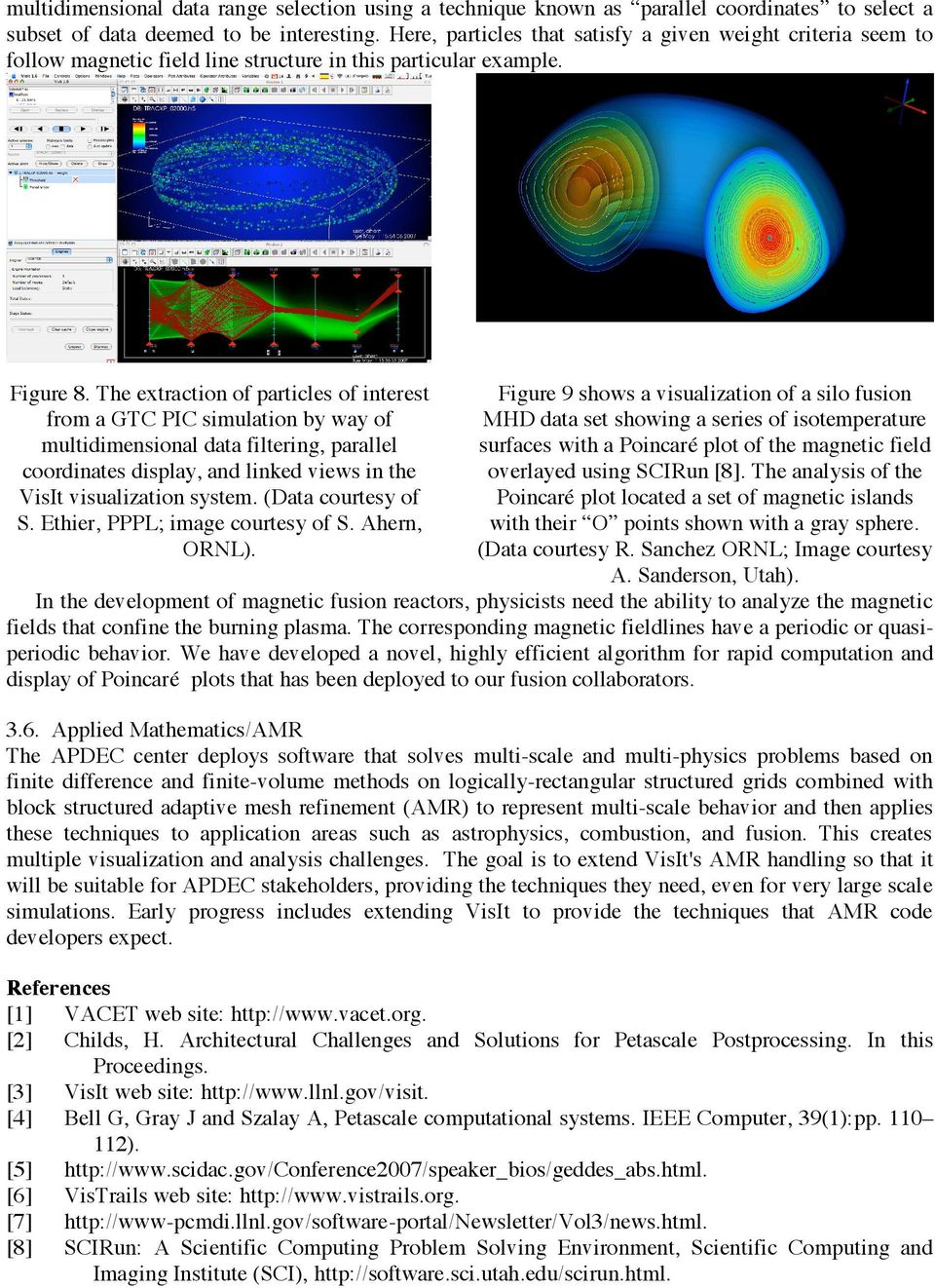
5 multidimensional data range selection using a technique known as parallel coordinates to select a subset of data deemed to be interesting. Here, particles that satisfy a given weight criteria seem to follow magnetic field line structure in this particular example. Figure 8. The extraction of particles of interest from a GTC PIC simulation by way of multidimensional data filtering, parallel coordinates display, and linked views in the VisIt visualization system. (Data courtesy of S. Ethier, PPPL; image courtesy of S. Ahern, ORNL). Figure 9 shows a visualization of a silo fusion MHD data set showing a series of isotemperature surfaces with a Poincaré plot of the magnetic field overlayed using SCIRun [8]. The analysis of the Poincaré plot located a set of magnetic islands with their O points shown with a gray sphere. (Data courtesy R. Sanchez ORNL; Image courtesy A. Sanderson, Utah). In the development of magnetic fusion reactors, physicists need the ability to analyze the magnetic fields that confine the burning plasma. The corresponding magnetic fieldlines have a periodic or quasiperiodic behavior. We have developed a novel, highly efficient algorithm for rapid computation and display of Poincaré plots that has been deployed to our fusion collaborators Applied Mathematics/AMR The APDEC center deploys software that solves multi-scale and multi-physics problems based on finite difference and finite-volume methods on logically-rectangular structured grids combined with block structured adaptive mesh refinement (AMR) to represent multi-scale behavior and then applies these techniques to application areas such as astrophysics, combustion, and fusion. This creates multiple visualization and analysis challenges. The goal is to extend VisIt's AMR handling so that it will be suitable for APDEC stakeholders, providing the techniques they need, even for very large scale simulations. Early progress includes extending VisIt to provide the techniques that AMR code developers expect. References [1] VACET web site: [2] Childs, H. Architectural Challenges and Solutions for Petascale Postprocessing. In this Proceedings. [3] VisIt web site: [4] Bell G, Gray J and Szalay A, Petascale computational systems. IEEE Computer, 39(1):pp ). [5] [6] VisTrails web site: [7] [8] SCIRun: A Scientific Computing Problem Solving Environment, Scientific Computing and Imaging Institute (SCI),
The Ultra-scale Visualization Climate Data Analysis Tools (UV-CDAT): A Vision for Large-Scale Climate Data
 The Ultra-scale Visualization Climate Data Analysis Tools (UV-CDAT): A Vision for Large-Scale Climate Data Lawrence Livermore National Laboratory? Hank Childs (LBNL) and Charles Doutriaux (LLNL) September
Parallel Analysis and Visualization on Cray Compute Node Linux
 Parallel Analysis and Visualization on Cray Compute Node Linux David Pugmire, Oak Ridge National Laboratory and Hank Childs, Lawrence Livermore National Laboratory and Sean Ahern, Oak Ridge National Laboratory
Large Vector-Field Visualization, Theory and Practice: Large Data and Parallel Visualization Hank Childs + D. Pugmire, D. Camp, C. Garth, G.
 Large Vector-Field Visualization, Theory and Practice: Large Data and Parallel Visualization Hank Childs + D. Pugmire, D. Camp, C. Garth, G. Weber, S. Ahern, & K. Joy Lawrence Berkeley National Laboratory
VisIt: A Tool for Visualizing and Analyzing Very Large Data. Hank Childs, Lawrence Berkeley National Laboratory December 13, 2010
 VisIt: A Tool for Visualizing and Analyzing Very Large Data Hank Childs, Lawrence Berkeley National Laboratory December 13, 2010 VisIt is an open source, richly featured, turn-key application for large
HPC & Visualization. Visualization and High-Performance Computing
 HPC & Visualization Visualization and High-Performance Computing Visualization is a critical step in gaining in-depth insight into research problems, empowering understanding that is not possible with
An Analytical Framework for Particle and Volume Data of Large-Scale Combustion Simulations. Franz Sauer 1, Hongfeng Yu 2, Kwan-Liu Ma 1
 An Analytical Framework for Particle and Volume Data of Large-Scale Combustion Simulations Franz Sauer 1, Hongfeng Yu 2, Kwan-Liu Ma 1 1 University of California, Davis 2 University of Nebraska, Lincoln
Visualizing Large, Complex Data
 Visualizing Large, Complex Data Outline Visualizing Large Scientific Simulation Data Importance-driven visualization Multidimensional filtering Visualizing Large Networks A layout method Filtering methods
Visualization of Adaptive Mesh Refinement Data with VisIt
 Visualization of Adaptive Mesh Refinement Data with VisIt Gunther H. Weber Lawrence Berkeley National Laboratory VisIt Richly featured visualization and analysis tool for large data sets Built for five
Mission Need Statement for the Next Generation High Performance Production Computing System Project (NERSC-8)
 Mission Need Statement for the Next Generation High Performance Production Computing System Project () (Non-major acquisition project) Office of Advanced Scientific Computing Research Office of Science
COSC 6344 Visualization
 COSC 64 Visualization University of Houston, Fall 2015 Instructor: Guoning Chen [email protected] Course Information Location: AH 2 Time: 10am~11:am Tu/Th Office Hours: 11:am~12:pm Tu /Th or by appointment
VisIt: An End-User Tool For Visualizing and Analyzing Very Large Data
 VisIt: An End-User Tool For Visualizing and Analyzing Very Large Data Hank Childs,, Eric Brugger, Brad Whitlock, Jeremy Meredith, Sean Ahern, Kathleen Bonnell, Mark Miller, Gunther Weber, Cyrus Harrison,
Hank Childs, University of Oregon
 Exascale Analysis & Visualization: Get Ready For a Whole New World Sept. 16, 2015 Hank Childs, University of Oregon Before I forget VisIt: visualization and analysis for very big data DOE Workshop for
Scientific Discovery at the Exascale:
 Scientific Discovery at the Exascale: Report from the DOE ASCR 2011 Workshop on Exascale Data Management, Analysis, and Visualization February 2011 Houston, TX Workshop Organizer: Sean Ahern, Oak Ridge
DIY Parallel Data Analysis
 I have had my results for a long time, but I do not yet know how I am to arrive at them. Carl Friedrich Gauss, 1777-1855 DIY Parallel Data Analysis APTESC Talk 8/6/13 Image courtesy pigtimes.com Tom Peterka
The Design and Implement of Ultra-scale Data Parallel. In-situ Visualization System
 The Design and Implement of Ultra-scale Data Parallel In-situ Visualization System Liu Ning [email protected] Gao Guoxian [email protected] Zhang Yingping [email protected] Zhu Dengming [email protected]
Lawrence Berkeley National Laboratory Lawrence Berkeley National Laboratory
 Lawrence Berkeley National Laboratory Lawrence Berkeley National Laboratory Peer Reviewed Title: Extreme Scaling of Production Visualization Software on Diverse Architectures Author: Childs, Henry Publication
High Performance Multivariate Visual Data Exploration for Extremely Large Data
 High Performance Multivariate Visual Data Exploration for Extremely Large Data Oliver Rübel,5,6, Prabhat, Kesheng Wu, Hank Childs 2, Jeremy Meredith 3, Cameron G.R. Geddes 4, Estelle Cormier-Michel 4,
Zhenping Liu *, Yao Liang * Virginia Polytechnic Institute and State University. Xu Liang ** University of California, Berkeley
 P1.1 AN INTEGRATED DATA MANAGEMENT, RETRIEVAL AND VISUALIZATION SYSTEM FOR EARTH SCIENCE DATASETS Zhenping Liu *, Yao Liang * Virginia Polytechnic Institute and State University Xu Liang ** University
NEXT-GENERATION. EXTREME Scale. Visualization Technologies: Enabling Discoveries at ULTRA-SCALE VISUALIZATION
 ULTRA-SCALE VISUALIZATION NEXT-GENERATION Visualization Technologies: Enabling Discoveries at EXTREME Scale The SciDAC Institute for Ultra-Scale Visualization aims to enable extreme-scale knowledge discovery
The Big Gift of Big Data
 The Big Gift of Big Data Valerio Pascucci Director, Center for Extreme Data Management Analysis and Visualization Professor, SCI institute and School of Computing, University of Utah Laboratory Fellow,
Visualisatie BMT. Introduction, visualization, visualization pipeline. Arjan Kok Huub van de Wetering ([email protected])
 Visualisatie BMT Introduction, visualization, visualization pipeline Arjan Kok Huub van de Wetering ([email protected]) 1 Lecture overview Goal Summary Study material What is visualization Examples
Graduate Research and Education: New Initiatives at ORNL and the University of Tennessee
 Graduate Research and Education: New Initiatives at ORNL and the University of Tennessee Presented to Joint Workshop on Large-Scale Computer Simulation Jim Roberto Associate Laboratory Director Graduate
Mapping the Universe; Challenge for the Big Data science
 Mapping the Universe; Challenge for the Big Data science Dr.Utain Sawangwit National Astronomical Research Institute of Thailand [email protected] Observational Cosmology relies on big surveys and very
Visualization and Data Analysis
 Working Group Outbrief Visualization and Data Analysis James Ahrens, David Rogers, Becky Springmeyer Eric Brugger, Cyrus Harrison, Laura Monroe, Dino Pavlakos Scott Klasky, Kwan-Liu Ma, Hank Childs LLNL-PRES-481881
ME6130 An introduction to CFD 1-1
 ME6130 An introduction to CFD 1-1 What is CFD? Computational fluid dynamics (CFD) is the science of predicting fluid flow, heat and mass transfer, chemical reactions, and related phenomena by solving numerically
CYBERINFRASTRUCTURE FRAMEWORK FOR 21 st CENTURY SCIENCE AND ENGINEERING (CIF21)
 CYBERINFRASTRUCTURE FRAMEWORK FOR 21 st CENTURY SCIENCE AND ENGINEERING (CIF21) Goal Develop and deploy comprehensive, integrated, sustainable, and secure cyberinfrastructure (CI) to accelerate research
Big Data: Rethinking Text Visualization
 Big Data: Rethinking Text Visualization Dr. Anton Heijs [email protected] Treparel April 8, 2013 Abstract In this white paper we discuss text visualization approaches and how these are important
Briefing for NFAC February 5, 2014. Sharlene Weatherwax Associate Director Office of Biological and Environmental Research U.S. Department of Energy
 Briefing for NFAC February 5, 2014 Sharlene Weatherwax Associate Director Office of Biological and Environmental Research U.S. Department of Energy Outline of the Presentation DOE and the National Labs--background
Parallel Visualization for GIS Applications
 Parallel Visualization for GIS Applications Alexandre Sorokine, Jamison Daniel, Cheng Liu Oak Ridge National Laboratory, Geographic Information Science & Technology, PO Box 2008 MS 6017, Oak Ridge National
Performance Engineering of the Community Atmosphere Model
 Performance Engineering of the Community Atmosphere Model Patrick H. Worley Oak Ridge National Laboratory Arthur A. Mirin Lawrence Livermore National Laboratory 11th Annual CCSM Workshop June 20-22, 2006
Introduction to Visualization with VTK and ParaView
 Introduction to Visualization with VTK and ParaView R. Sungkorn and J. Derksen Department of Chemical and Materials Engineering University of Alberta Canada August 24, 2011 / LBM Workshop 1 Introduction
Data Centric Systems (DCS)
 Data Centric Systems (DCS) Architecture and Solutions for High Performance Computing, Big Data and High Performance Analytics High Performance Computing with Data Centric Systems 1 Data Centric Systems
Data Driven Discovery In the Social, Behavioral, and Economic Sciences
 Data Driven Discovery In the Social, Behavioral, and Economic Sciences Simon Appleford, Marshall Scott Poole, Kevin Franklin, Peter Bajcsy, Alan B. Craig, Institute for Computing in the Humanities, Arts,
Visualization methods for patent data
 Visualization methods for patent data Treparel 2013 Dr. Anton Heijs (CTO & Founder) Delft, The Netherlands Introduction Treparel can provide advanced visualizations for patent data. This document describes
A Visualization is Worth a Thousand Tables: How IBM Business Analytics Lets Users See Big Data
 White Paper A Visualization is Worth a Thousand Tables: How IBM Business Analytics Lets Users See Big Data Contents Executive Summary....2 Introduction....3 Too much data, not enough information....3 Only
Information Visualization WS 2013/14 11 Visual Analytics
 1 11.1 Definitions and Motivation Lot of research and papers in this emerging field: Visual Analytics: Scope and Challenges of Keim et al. Illuminating the path of Thomas and Cook 2 11.1 Definitions and
Visualizing and Analyzing Massive Astronomical Datasets with Partiview
 Visualizing and Analyzing Massive Astronomical Datasets with Partiview Brian P. Abbott 1, Carter B. Emmart 1, Stuart Levy 2, and Charles T. Liu 1 1 American Museum of Natural History & Hayden Planetarium,
COMPLEX DATA VISUALIZATION. 15/01/2015 CEA DSM Irfu - Daniel Pomarède - COMPLEX DATA VISUALIZATION
 COMPLEX DATA VISUALIZATION 15/01/2015 CEA DSM Irfu - Daniel Pomarède - COMPLEX DATA VISUALIZATION 1 COMPLEX DATA VISUALIZATION a software project established in the context of the COAST «Computational
Software and Performance Engineering of the Community Atmosphere Model
 Software and Performance Engineering of the Community Atmosphere Model Patrick H. Worley Oak Ridge National Laboratory Arthur A. Mirin Lawrence Livermore National Laboratory Science Team Meeting Climate
MIDLAND ISD ADVANCED PLACEMENT CURRICULUM STANDARDS AP ENVIRONMENTAL SCIENCE
 Science Practices Standard SP.1: Scientific Questions and Predictions Asking scientific questions that can be tested empirically and structuring these questions in the form of testable predictions SP.1.1
Interactive Visualization of Magnetic Fields
 JOURNAL OF APPLIED COMPUTER SCIENCE Vol. 21 No. 1 (2013), pp. 107-117 Interactive Visualization of Magnetic Fields Piotr Napieralski 1, Krzysztof Guzek 1 1 Institute of Information Technology, Lodz University
Data Deduplication in a Hybrid Architecture for Improving Write Performance
 Data Deduplication in a Hybrid Architecture for Improving Write Performance Data-intensive Salable Computing Laboratory Department of Computer Science Texas Tech University Lubbock, Texas June 10th, 2013
Systems Thinking and Modeling Climate Change Amy Pallant, Hee-Sun Lee, and Sarah Pryputniewicz
 Systems Thinking and Modeling Climate Change Amy Pallant, Hee-Sun Lee, and Sarah Pryputniewicz You know the effects of the proverbial butterfly flapping its wings. But what about an automobile driver?
BIG DATA & ANALYTICS. Transforming the business and driving revenue through big data and analytics
 BIG DATA & ANALYTICS Transforming the business and driving revenue through big data and analytics Collection, storage and extraction of business value from data generated from a variety of sources are
COGNITIVE SCIENCE AND NEUROSCIENCE
 COGNITIVE SCIENCE AND NEUROSCIENCE Overview Cognitive Science and Neuroscience is a multi-year effort that includes NSF s participation in the Administration s Brain Research through Advancing Innovative
Adaptation of General Purpose CFD Code for Fusion MHD Applications*
 Adaptation of General Purpose CFD Code for Fusion MHD Applications* Andrei Khodak Princeton Plasma Physics Laboratory P.O. Box 451 Princeton, NJ, 08540 USA [email protected] Abstract Analysis of many fusion
A Multiresolution Approach to Large Data Visualization
 A Multiresolution Approach to Large Data Visualization John Clyne 1 Abstract Numerical simulations of turbulent flow, which are fundamental to the study of weather, climate, oceanography, astrophysics,
NASA's Strategy and Activities in Server Side Analytics
 NASA's Strategy and Activities in Server Side Analytics Tsengdar Lee, Ph.D. High-end Computing Program Manager NASA Headquarters Presented at the ESGF/UVCDAT Conference Lawrence Livermore National Laboratory
The D-Wave 2X Quantum Computer Technology Overview
 The D-Wave 2X Quantum Computer Technology Overview D-Wave Systems Inc. www.dwavesys.com D-Wave Systems Founded in 1999, D-Wave Systems is the world s first quantum computing company. Our mission is to
A GENERAL TAXONOMY FOR VISUALIZATION OF PREDICTIVE SOCIAL MEDIA ANALYTICS
 A GENERAL TAXONOMY FOR VISUALIZATION OF PREDICTIVE SOCIAL MEDIA ANALYTICS Stacey Franklin Jones, D.Sc. ProTech Global Solutions Annapolis, MD Abstract The use of Social Media as a resource to characterize
How is EnSight Uniquely Suited to FLOW-3D Data?
 How is EnSight Uniquely Suited to FLOW-3D Data? July 5, 2011 figure 1. FLOW-3D model of Dam visualized with EnSight If you would like to know how CEI s EnSight offers you more power than other postprocessors
Astrophysics with Terabyte Datasets. Alex Szalay, JHU and Jim Gray, Microsoft Research
 Astrophysics with Terabyte Datasets Alex Szalay, JHU and Jim Gray, Microsoft Research Living in an Exponential World Astronomers have a few hundred TB now 1 pixel (byte) / sq arc second ~ 4TB Multi-spectral,
MEng, BSc Applied Computer Science
 School of Computing FACULTY OF ENGINEERING MEng, BSc Applied Computer Science Year 1 COMP1212 Computer Processor Effective programming depends on understanding not only how to give a machine instructions
Verication of Continuum Kinetics in NIMROD
 Verication of Continuum Kinetics in NIMROD CEMM Meeting, New Orleans, LA E. Held 1 J.Y. Ji 1 S. Kruger 2 NIMROD Team 1 Department of Physics Utah State University 2 Tech-X Corp. October 26, 2014 Electron,
Ahead of the Curve with Intelligent. Transportation
 Ahead of the Curve with Intelligent Transportation Advanced technologies to ensure the safe, efficient, and secure movement of passengers and freight. Intelligent transportation is changing the way America
The Scientific Data Mining Process
 Chapter 4 The Scientific Data Mining Process When I use a word, Humpty Dumpty said, in rather a scornful tone, it means just what I choose it to mean neither more nor less. Lewis Carroll [87, p. 214] In
Major Conclusions of the MFE Study
 Major Conclusions of the MFE Study 1. Why a burning plasma Navratil 2. Burning plasma options Baker 3. Assessment of contributions of the options Van Dam 4. Assessment of the feasibility of the options
High Performance Computing Initiatives
 High Performance Computing Initiatives Eric Stahlberg September 1, 2015 DEPARTMENT OF HEALTH AND HUMAN SERVICES National Institutes of Health National Cancer Institute Frederick National Laboratory is