
Beach Soccer Laws of the Game
|
|
|
- Nicholas Robinson
- 10 years ago
- Views:
Transcription
1 Beach Soccer Laws of the Game Beach Soccer Laws of the Game YEARS FIFA Fédération Internationale de Football Association
2 2006 Beach Soccer Laws of the Game All rights reserved. This booklet may not be reproduced or translated in whole or in part in any manner without the express permission of FIFA. Published by Fédération Internationale de Football Association FIFA-Strasse 20, P.O. Box, CH-8044 Zurich, Switzerland. In the event of a difference in interpretation between the various language versions of these Beach Soccer Laws of the Game, the English version shall be deemed authoritative.

3 Notes on the Laws of the Game FÉDÉRATION INTERNATIONALE DE FOOTBALL ASSOCIATION Modifications President: General Secretary: Joseph S. BLATTER (Switzerland) Urs LINSI (Switzerland) Address: FIFA-Strasse 20 P.O. Box 8044 Zurich, Switzerland Telephone: +41-(0) Telefax: +41-(0) Internet: FUTSAL AND BEACH SOCCER COMMITTEE Chairman: Deputy Chairman: Members: TEIXEIRA Ricardo Terra (Brazil) SASSO SASSO Isaac David (Costa Rica) OGURA Junji (Japan) VAN DER HULST Tom (Netherlands) MELO FILHO Alvaro (Brazil) FOUSEK Petr (Czech Rep.) KLASS Colin (Guyana) WILLIAMS Anthony (Nigeria) TINOCO KIPPS Rafael Ignacio (Guatemala) BATANGTARIS Wandy (Indonesia) VILAR Alberto (Spain) KING LAI Richard (Guam) MALTOCK Lambert (Vanuatu) CUSCÓ Joan (Spain) DAVIO Vairani (Tahiti) ZAHER Samir (Egypt) Gender Subject to the agreement of the member associations concerned and provided that the principles of these Laws are respected, the Laws may be modified in their application for matches for players under 16 years of age, for female players, for veteran footballers (over 35 years) and for players with disabilities. Any or all of the following modifications are permissible: size of the pitch size, weight and material of the ball width between the goalposts and the height of the crossbar from the ground duration of the periods of play number of players No amendments may be made to these Laws without the consent of the International Football Association Board. References to the male gender in the Laws of the Game for Beach Soccer in respect of referees, timekeepers, players and officials are for simplification and apply to both men and women. 2

4 Contents Law Page 1 The pitch 6 2 The ball 12 The number of players 14 4 The players equipment 17 5 The referee and second referee 20 6 The timekeeper and third referee 23 7 The duration of the match 26 8 The start and restart of play 28 9 The ball in and out of play 2 10 The method of scoring 11 Fouls and misconduct 5 12 Direct free kicks The penalty kick The ball inbound The goal clearance The double backpass to the goalkeeper The corner kick Procedures to determine the winner of a match 58 Referees signals 62 Additional instructions for referees, second referees, third referees and timekeepers

5 LAW 1 The pitch Pitch surface The surface is composed of sand, is level and free of pebbles, shells and any other objects which could injure the players. For international competitions, the sand must be fine and at least 40cm deep. It must be sifted until suitable for play, must not be rough or contain pebbles or any other dangerous elements; however, it must not be so fine as to cause dust that sticks to the skin. Dimensions Pitch markings The pitch is rectangular. The touch line must be longer than the goal line. Length: 35 37m Width: 26 28m The boundaries of the pitch are marked by lines that belong to the areas that they delineate. The two longer boundary lines are called touch lines. The two shorter boundary lines are called goal lines, although there is no line between the goalposts. 1 2 m m 5 7 m m 8 10 cm 5 m 9 m 9 m 6 7

6 LAW 1 The pitch All lines are 8cm to 10cm wide and are made of blue tape to contrast with the sand. The tape must be flexible and hard-wearing but not harm the players feet. These lines must be firmly anchored to the sand at each corner and in the middle of each touch line with special clamps, and to the goals with rubber rings attached to the posts. The pitch is divided into two halves by an imaginary halfway line marked by two red flags located outside the pitch. The middle of this imaginary line is the exact position for the kick-off and certain direct free kicks. >1.5 m m 1 2 m The penalty area The penalty area is the area between the goal line and an imaginary parallel line joining both touch lines at a distance of 9m from the goal line and marked by two yellow flags placed next to each touch line outside the pitch cm The imaginary penalty mark is located in the middle of the penalty area line, equidistant from each goal post. Substitution zone Flags The substitution zone is the area on the touch line where the players enter and leave the pitch. Each corner is marked with a pole with a blunt end and a red flag made of pliable, durable, weatherproof plastic. A yellow flag is placed at each end of the imaginary lines marking the penalty area and two red flags at each side of the halfway line, all of which are securely anchored at a distance of between 1 and 1.5m outside the touch lines. It is situated in front of the timekeeper s table and measures a total of 5m, with 2.5m on either side of the point where the halfway line joins the touch line. The teams benches are placed behind the touch lines in such a way that the substitution zone is kept clear. The flagpoles must be at least 1.5m high. 8 9

7 LAW 1 The pitch Goals The goals are placed in the middle of each goal line. They consist of two upright posts equidistant from each corner and joined at the top by a horizontal crossbar. The distance (inside measurement) between the posts is 5.5m and the distance from the lower edge of the crossbar to the ground is 2.2m. 5.5 m The posts and crossbar have the same width and thickness of not less than 10cm and not more than 20cm all around and are painted in a colour contrasting with the sand. 2.2 m 1.5 m cm The nets, made of hemp, jute or nylon, are attached to the back of the posts and crossbar. For safety reasons, the bottom of each post has a ledge that is anchored beneath the sand. Two horizontal bars measuring 1.5m attached to the back of each post are joined by a bar or chain at the back covered with plastic, with hooks and knots at each end, and placed on the sand surface. This bar (or chain) is also anchored in the sand. Safety The pitch is surrounded by a safety zone perimeter measuring 1m to 2m wide. The goals may be portable but they must be anchored securely to the ground during play

8 LAW 2 The ball Properties and measurements Decisions The ball: is spherical; is made of leather or another suitable material that is crush-proof and resistant to water and abrasion; has a circumference of not less than 68cm and not more than 70cm; weighs not less than 400 grams and not more than 440 grams at the start of the match; has a pressure equal to atmospheres at sea level. 1 The official ball used in competitions must be approved by FIFA. 2 In competition matches, only balls that meet the minimum technical requirements stipulated in Law 2 are permitted for use. In FIFA competition matches and in competition matches organised under the auspices of the confederations, acceptance of the use of a football is conditional upon the football bearing one of the following three designations: The official FIFA APPROVED logo or the official FIFA INSPECTED logo or the INTERNATIONAL MATCHBALL STANDARD reference cm Such a designation on a football indicates that it has been tested officially and found to be in compliance with specific technical requirements, different for each category and additional to the minimum specifications stipulated in Law 2. FIFA issues the list of additional requirements specific to each of the respective categories and selects the institutes conducting the quality tests. Association competitions may require the use of balls bearing any one of these three designations. In all other matches, the ball used must fulfil the requirements of Law 2. Replacement of a defective ball If the ball bursts or becomes defective during the course of a match: play is stopped; the match is restarted in accordance with the provisions of Law 8. If an association imposes the use of balls bearing the FIFA APPROVED or FIFA INSPECTED logos for its own competitions, it must also permit the use of balls bearing the royalty-free INTERNATIONAL MATCHBALL STANDARD designation. If the ball bursts or is damaged while not in play (at a kick-off, goal kick, corner kick, direct free kick, penalty kick or ball inbound): play is restarted in accordance with the Laws

9 LAW 3 The number of players Players Substitution procedure A match is played by two teams, each consisting of no more than five players, one of whom is the goalkeeper. Substitutes may be used in any match played under the rules of an official competition at FIFA, confederation or association level. The maximum number of substitutes permitted is five. The number of substitutions made during a match is unlimited. A player who has been replaced may return to the pitch as a substitute for another player. A substitution may be made at any time, whether the ball is in or out of play, as long as the following conditions are observed: the player wishing to enter the pitch signals his intention to do so by raising a sign with the number of the player whom he intends to replace above his head; the player being replaced leaves the pitch through his own team s substitution zone; the player entering the pitch does so from his own team s substitution zone but not until the player leaving the pitch has crossed the touch line completely; a substitute is subject to the authority and jurisdiction of the referees whether he is called upon to play or not; the substitution is complete when the substitute entering the pitch hands the player leaving the pitch the sign with the player s number, at which point the substitute becomes an active player and the player he is replacing ceases to be one. The stopwatch is not stopped while players are substituted. Changing goalkeepers A goalkeeper may be substituted at any time. The stopwatch is not stopped while goalkeepers are substituted. Any player may change places with the goalkeeper, providing: the referee is informed before the substitution takes place; the player must wear a goalkeeper s shirt

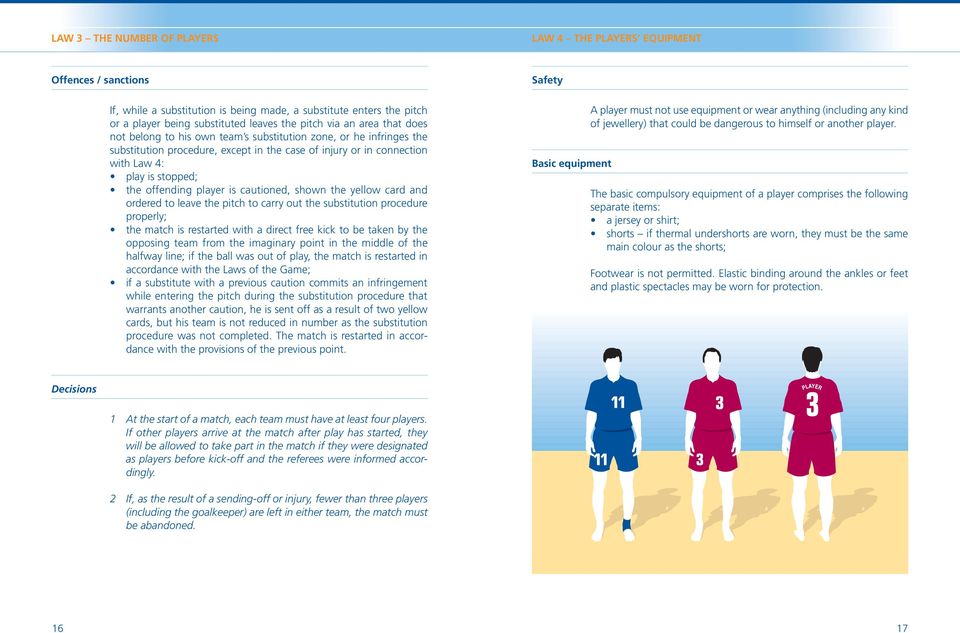
10 LAW 3 The number of players Law 4 The players equipment Offences / sanctions If, while a substitution is being made, a substitute enters the pitch or a player being substituted leaves the pitch via an area that does not belong to his own team s substitution zone, or he infringes the substitution procedure, except in the case of injury or in connection with Law 4: play is stopped; the offending player is cautioned, shown the yellow card and ordered to leave the pitch to carry out the substitution procedure properly; the match is restarted with a direct free kick to be taken by the opposing team from the imaginary point in the middle of the halfway line; if the ball was out of play, the match is restarted in accordance with the Laws of the Game; if a substitute with a previous caution commits an infringement while entering the pitch during the substitution procedure that warrants another caution, he is sent off as a result of two yellow cards, but his team is not reduced in number as the substitution procedure was not completed. The match is restarted in accordance with the provisions of the previous point. Safety Basic equipment A player must not use equipment or wear anything (including any kind of jewellery) that could be dangerous to himself or another player. The basic compulsory equipment of a player comprises the following separate items: a jersey or shirt; shorts if thermal undershorts are worn, they must be the same main colour as the shorts; Footwear is not permitted. Elastic binding around the ankles or feet and plastic spectacles may be worn for protection. Decisions 1 At the start of a match, each team must have at least four players. If other players arrive at the match after play has started, they will be allowed to take part in the match if they were designated as players before kick-off and the referees were informed accordingly. 2 If, as the result of a sending-off or injury, fewer than three players (including the goalkeeper) are left in either team, the match must be abandoned
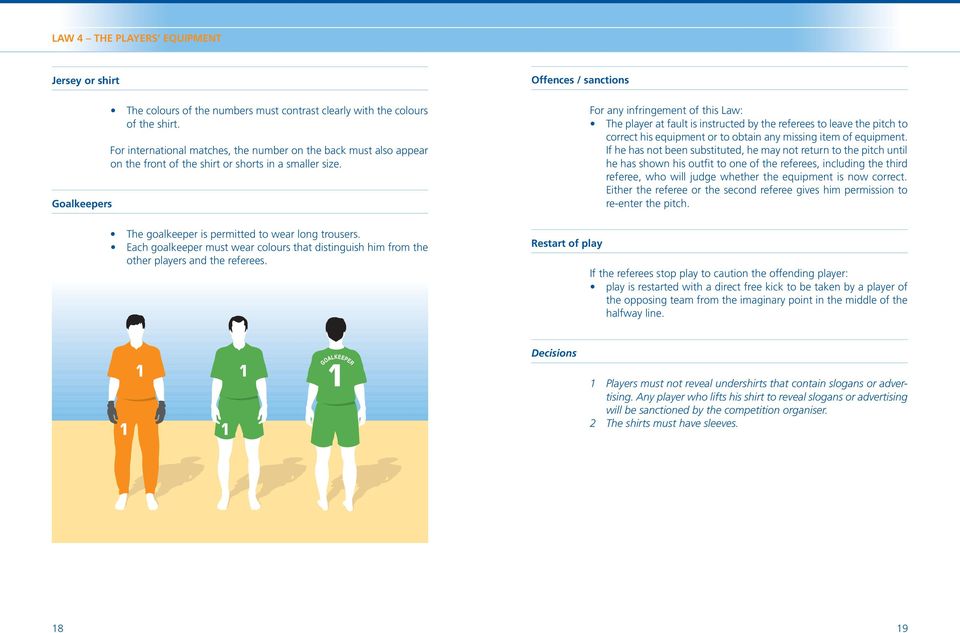
11 Law 4 The players equipment Jersey or shirt Goalkeepers The colours of the numbers must contrast clearly with the colours of the shirt. For international matches, the number on the back must also appear on the front of the shirt or shorts in a smaller size. The goalkeeper is permitted to wear long trousers. Each goalkeeper must wear colours that distinguish him from the other players and the referees. Offences / sanctions Restart of play For any infringement of this Law: The player at fault is instructed by the referees to leave the pitch to correct his equipment or to obtain any missing item of equipment. If he has not been substituted, he may not return to the pitch until he has shown his outfit to one of the referees, including the third referee, who will judge whether the equipment is now correct. Either the referee or the second referee gives him permission to re-enter the pitch. If the referees stop play to caution the offending player: play is restarted with a direct free kick to be taken by a player of the opposing team from the imaginary point in the middle of the halfway line. Decisions 1 Players must not reveal undershirts that contain slogans or advertising. Any player who lifts his shirt to reveal slogans or advertising will be sanctioned by the competition organiser. 2 The shirts must have sleeves
12 LAW 5 The referee and second referee The referees authority Each match is controlled by two referees, who have the authority to enforce the Laws of the Game in the match for which they have been appointed, from the moment they enter the facilities where the pitch is situated until they leave. Powers and duties The referees: enforce the Laws of the Game; allow play to continue if the team against which an offence has been committed stands to benefit from such an advantage, and punish the original offence if the anticipated advantage does not accrue at that time; keep a record of the match and provide the appropriate authorities with a match report that includes information on any disciplinary action taken against players or team officials as well as any other incidents that occur before, during or after the match; the referee acts as timekeeper if the latter or third referee is not present; the referee stops, suspends or terminates the match for any infringement of the Laws or as a result of any outside interference; take disciplinary action against players guilty of offences warranting a caution or sending-off; take action against team officials who are guilty of misconduct and, if necessary, dismiss them from the pitch area without showing them a card; ensure that no unauthorised persons enter the pitch; interrupt play if a player is deemed to be wasting time; stop the match if, in their opinion, a player is seriously injured, and ensure that the player is carried off the pitch; allow play to continue until the ball is out of play if a player is, in their opinion, only slightly injured; ensure that any balls used meet the requirements of Law 2; Referees decisions The decisions of the referee regarding facts connected with play are final. The referee and second referee may only change a decision if they realise that they have made a mistake or if they deem it necessary to do so, provided that play has not restarted or the match has not terminated

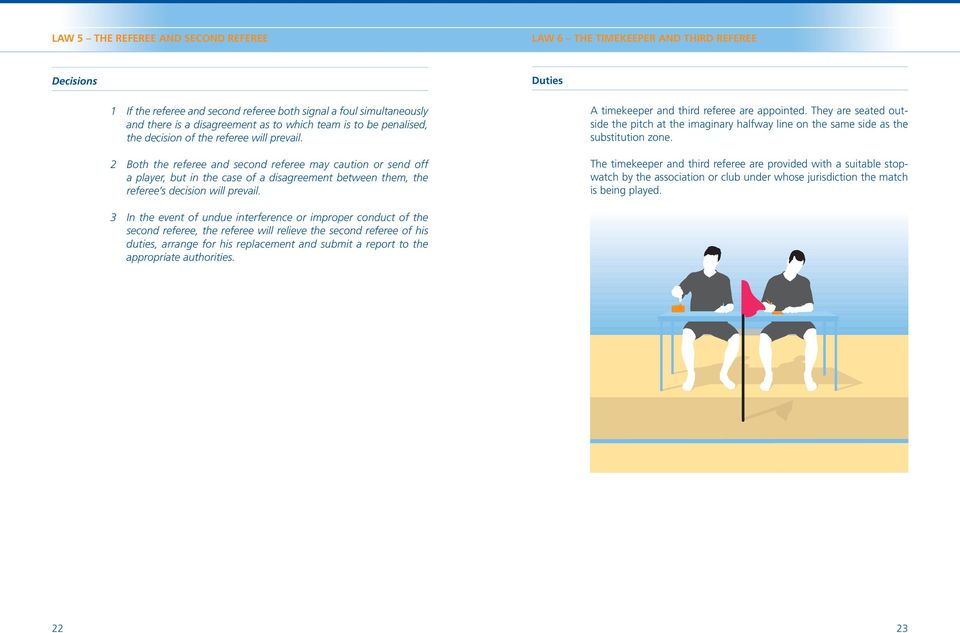
13 LAW 5 The referee and second referee Law 6 The timekeeper and third referee Decisions 1 If the referee and second referee both signal a foul simultaneously and there is a disagreement as to which team is to be penalised, the decision of the referee will prevail. 2 Both the referee and second referee may caution or send off a player, but in the case of a disagreement between them, the referee s decision will prevail. Duties A timekeeper and third referee are appointed. They are seated outside the pitch at the imaginary halfway line on the same side as the substitution zone. The timekeeper and third referee are provided with a suitable stopwatch by the association or club under whose jurisdiction the match is being played. 3 In the event of undue interference or improper conduct of the second referee, the referee will relieve the second referee of his duties, arrange for his replacement and submit a report to the appropriate authorities
14 Law 6 The timekeeper and third referee The timekeeper ensures that the duration of the match complies with the provisions of Law 7 by: - starting his stopwatch as soon as the match kicks off; - stopping the stopwatch as soon as a goal has been scored, a penalty kick or direct free kick awarded, or the referees have signalled that a player is injured or for time-wasting. - stopping the stopwatch whenever the referees signal him to do so; - restarting the stopwatch after a kick-off, a direct free kick or a penalty kick has been taken. checking the two-minute effective time punishment period when a player has been sent off; indicating the end of each period, the match and extra time with a different whistle or acoustic signal from those used by the referees; signalling to the referees exactly when to start the second and third periods of play after the three-minute break and when to start extra time, if necessary. The third referee The third referee assists the referees and timekeeper by: keeping a record of stoppages in the game and the reasons for them; ensuring that substitutions are correctly carried out and, by using a different whistle or acoustic signal from those used by the referees, indicating any infringement that has occurred during substitution, if the advantage rule cannot be applied; making a note of the numbers of the players who score goals and in which minute of play; recording the names and numbers of the players cautioned or sent off; providing any other information relevant to the game; monitoring the conduct of those persons seated on the substitutes bench; informing the teams exactly when a player may substitute another who has been sent off. If either of the other referees is injured, the third referee replaces him, assuming the function of the second referee. Decisions 1 For international matches, the use of a timekeeper and third referee is compulsory. 2 In the event of undue interference by the timekeeper or third referee, the referee will relieve either of his duties, arrange for his replacement and submit a report to the appropriate authorities

15 LAW 7 The duration of the match Periods of play The match lasts three equal periods of 12 minutes each. The timekeeping is carried out by a timekeeper, whose duties are defined in Law 6. The time must be stopped as described in Law 6: whenever a goal is scored; whenever a direct free kick or a penalty kick is awarded; whenever the referees signal accordingly; whenever the referees signal that a player is wasting time. The duration of each period may be prolonged to enable a penalty kick or a direct free kick to be taken. The match or period of play ends when: the ball goes directly into a goal and a goal is scored; after the ball has been kicked and it passes over the boundaries of the pitch; the ball touches the goalkeeper or the posts, crossbar or sand and passes into goal the goal is awarded; the ball touches any player other than the goalkeeper after it has been kicked; the defending goalkeeper stops the ball or it rebounds from the goalposts or crossbar and does not enter the goal. The timekeeper determines the end of each period of 12 (twelve) minutes. When the whistle or horn is blown, the referee signals the end of each period or the match. After this signal, no other action will be allowed apart from those specified above. If the ball has been kicked, the referees must wait for the completion of the action that began before the timekeeper blew the whistle or horn before they can terminate the period of play or match. Interval between periods of play Extra time There is a three-minute interval between each period of play min / If the score is level after normal playing time, extra time of three minutes is played. If the score is level after extra time, penalty kicks are taken from the imaginary penalty mark in accordance with Law / 24 min 12 min 2/ 26 27

16 LAW 8 The start and restart of play Preliminaries A coin is tossed and the team that wins the toss decides whether to attack in a certain direction in the first period of play or whether to take the kick-off. In the second period of play, the teams change ends and attack the opposite goals; the team that did not take the kick-off in the first period will take it in the second period of play. Before the third period of play, a coin is again tossed and the team that wins the toss decides whether to attack in a certain direction in the third period of play or whether to take the kick-off. 5 m If extra time is played, the team that did not take the kick-off in the third period of play will take it in the period of extra time; the teams change ends and attack opposite goals. Kick-off A kick-off is a way of starting or restarting play: at the start of the match; after a goal has been scored; at the start of the second and third periods of play; at the start of extra time. A goal may not be scored directly from a kick-off. Procedure All players are in their own half of the pitch. The opponents of the team taking the kick-off are at least 5m away from the ball until it is in play. The ball is stationary on the imaginary point in the middle of the halfway line. The referee gives a signal to kick off. A player kicks the ball into action. The ball is in play when it is in the air or has been moved forward, after which another player may kick the ball. The player taking the kick-off may not touch the ball a second time until it has touched another player. After a team scores a goal, the kick-off is taken by the other team

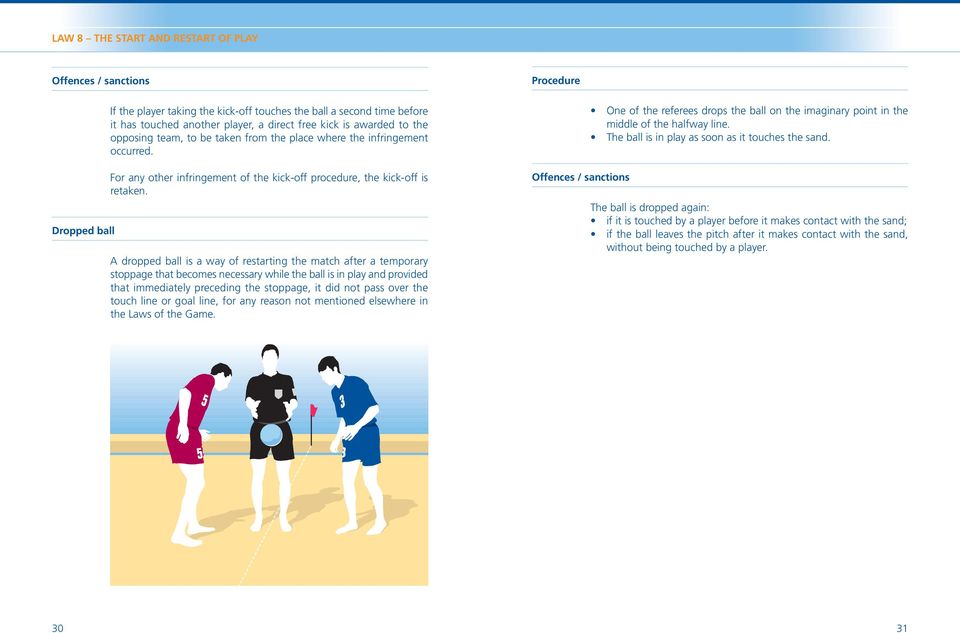
17 LAW 8 The start and restart of play Offences / sanctions Procedure Dropped ball If the player taking the kick-off touches the ball a second time before it has touched another player, a direct free kick is awarded to the opposing team, to be taken from the place where the infringement occurred. For any other infringement of the kick-off procedure, the kick-off is retaken. A dropped ball is a way of restarting the match after a temporary stoppage that becomes necessary while the ball is in play and provided that immediately preceding the stoppage, it did not pass over the touch line or goal line, for any reason not mentioned elsewhere in the Laws of the Game. Offences / sanctions One of the referees drops the ball on the imaginary point in the middle of the halfway line. The ball is in play as soon as it touches the sand. The ball is dropped again: if it is touched by a player before it makes contact with the sand; if the ball leaves the pitch after it makes contact with the sand, without being touched by a player
18 Law 9 The ball in and out of play LAW 10 The method of scoring Ball out of play Ball in play The ball is out of play when: it has wholly crossed the goal line or touch line, whether on the ground or in the air; play has been stopped by the referees. The ball is in play at all other times, including when: it rebounds from a goal post or the crossbar or the corner flags onto the pitch; it rebounds from either of the referees while they are on the pitch; it is in the air after the kick-off. Goal scored Unless otherwise provided for by these Laws, a goal is scored when the whole of the ball passes over the imaginary goal line between the goalposts and under the crossbar, unless it has been thrown, carried or intentionally propelled by the hand or arm by a player of the attacking side, including the goalkeeper, and providing the team scoring the goal has not infringed the Laws of the Game. The goalkeeper: may not score a goal directly by throwing the ball with his hand; if this happens, a goal clearance is awarded to the opposing team. may not score a goal directly after releasing the ball with hands and kicking it into the air before it touches the ground; may score a goal directly by placing the ball on the ground and then kicking it. OUT OF PLAY GOAL IN PLAY IN PLAY IN PLAY NO GOAL NO GOAL NO GOAL 32 33

19 LAW 10 The method of scoring Law 11 Fouls and misconduct Winning team The team that scores the greater number of goals during a match is the winner. If both teams score an equal number of goals or none at all, extra time is played at the end of normal time. If extra time ends in a draw, the match is decided by alternate kicks taken from the imaginary penalty mark. The team that scores more goals from the same number of penalty kicks is the winner. If a team is left with fewer than three (3) players as a result of sendings-off, the referee will stop play and send a report to the relevant authorities. Direct free kick Fouls and misconduct are penalised as follows: A direct free kick is awarded to the opposing team if a player commits any of the following offences in a manner considered by the referees to be careless, reckless or using excessive force: kicks or attempts to kick an opponent; tackles or attempts to tackle an opponent, either by sliding or by bending down in front of or behind him; jumps at an opponent; charges an opponent, even with the shoulder; strikes or attempts to strike an opponent; pushes an opponent. A direct free kick is also awarded to the opposing team if a player commits any of the following offences: holds an opponent spits at an opponent; handles the ball, i.e. deliberately carries, propels or throws it with a hand or arm, (except for the goalkeeper in his own penalty area); holds the ball back deliberately with his legs so as to waste time; plays dangerously; deliberately obstructs an opponent; prevents the goalkeeper from releasing the ball from his hands; touches the opponent before the ball when attempting to win possession
20 Law 11 Fouls and misconduct the goalkeeper releases the ball from his hands and kicks it into the air before it touches the ground; the goalkeeper, after having possession of the ball in his hands in his own penalty area, plays the ball with his feet out of his penalty area and returns there to receive the ball with his hands again; commits any other offence, not previously mentioned in Law 11, for which play is stopped to caution or dismiss a player. Disciplinary sanctions The referees are authorised to pronounce disciplinary sanctions on players from the moment they enter the pitch until they leave the pitch after the final whistle. Cautionable offences by players or substitutes Penalty kick A penalty kick is awarded if a player commits any of the aforementioned offences inside his own penalty area, irrespective of the position of the ball but provided that it is in play. Direct free kick from the imaginary point in the middle of the halfway line A player or a substitute is cautioned and shown the yellow card if he commits any of the following offences: he is guilty of unsporting behaviour; he shows dissent by word or action; he persistently infringes the Laws of the Game; he delays the restart of play; he fails to respect the required distance during a kick-off, corner kick, ball inbound, direct free kick or goal clearance; he enters or re-enters the pitch without the referees permission or infringes the substitution procedure; he deliberately leaves the pitch without the referees permission. A direct free kick is awarded to the opposing team, to be taken from the imaginary point in the middle of the halfway line if: a team has possession of the ball inside its own penalty area for more than five (5) seconds when it is not defending it from an opponent; the goalkeeper uses his hands to receive a deliberate backpass from any team-mate two consecutive times without the ball having touched an opponent; 36 37

21 Law 11 Fouls and misconduct Sending-off offences by players or substitutes A player or a substitute is sent off and shown the red card if he commits any of the following offences: he is guilty of serious foul play; he is guilty of violent conduct; he throws sand at anyone; he spits at an opponent or any other person; he denies the opposing team a goal or an obvious goalscoring opportunity by deliberately handling the ball (with the exception of a goalkeeper inside his own penalty area); he denies an opponent moving towards the player s goal an obvious goalscoring opportunity by committing an offence punishable by a direct free kick or a penalty kick; he uses offensive, insulting or abusive language or gestures; he receives a second caution in the same match. 2 A tackle that endangers the safety of an opponent must be sanctioned as serious foul play. 3 Any act of simulation on the pitch that is intended to deceive the referees must be sanctioned as unsporting behaviour. 4 A player who removes his shirt when celebrating a goal must be cautioned for unsporting behaviour. Decisions 1 A player who has been sent off may not re-enter the game in progress or sit on the substitutes bench but must leave the vicinity of the pitch. Another player may substitute a team-mate who has been sent off, after a lapse of two minutes; he may enter the pitch provided he has the authorisation of the third referee
22 LAW 12 Direct free kicks Direct free kicks There are only direct free kicks, which are to be taken as follows: The players may not form a wall. The player who was fouled takes the kick, unless he has been seriously injured, in which case his substitute will take it. The ball must be stationary when the kick is taken and the kicker may not touch the ball a second time until it has touched another player. Additional time must be allowed for a direct free kick to be taken at the end of each period of time or extra time. If a direct free kick enters the player s own goal directly, a corner kick is awarded to the opposing team. If a direct free kick enters the opposing team s goal directly, a goal is awarded. 5 m Position of direct free kick Direct free kick from the opponents half of the pitch If a direct free kick is taken in the half of the pitch of the team that committed an offence, every player, apart from the one taking the kick and the opposing goalkeeper, must be: on the pitch; at least 5m away from the ball until it is in play; behind or to the side of the ball
23 LAW 12 Direct free kicks Procedure 5 m The player taking the kick may make a small mound of sand with his feet or the ball to raise the position of the ball. The direct free kick must be taken within five (5) seconds of the referees signal to do so. The kicker may not play the ball again until it has touched another player. The ball is in play after it has been kicked or touched. The ball may be kicked in any direction and passed to any teammate, including the goalkeeper. If the ball is kicked in the direction of the opposing team s goal within the area between the ball and the opposing goal only the defending goalkeeper may touch the ball while it is in the air. In every other case, if the ball leaves this area or touches the ground, the restriction no longer applies and any player may touch or play the ball. Offences / sanctions Direct free kick from a team s own half or from the middle of the pitch If a direct free kick is taken in the half of the pitch of the team that did not commit an offence, every player, apart from the one taking the kick and the opposing goalkeeper, must be: on the pitch; at least 5m away from the ball until the ball is in play, leaving an imaginary area free between the ball and the opposing goal, apart from the opposing goalkeeper, who may stay in his penalty area. If a player in the attacking team infringes Law 12: a direct free kick is awarded to the opposing team, to be taken from the place where the offence occurred. If a player in the defending team infringes Law 12: the direct free kick is not retaken if a goal is scored. If a goal is not scored, the opposing team is awarded a direct free kick, to be taken from the place where the offence occurred, unless it occurred in the offending player s penalty area, in which case a penalty kick is awarded to the opposing team
24 LAW 13 The penalty kick The penalty kick A penalty kick is awarded against a team that commits any of the offences punishable by a direct free kick which is not required to be taken from the middle of the pitch, while the ball is in play inside its own penalty area. A goal may be scored directly from a penalty kick. Additional time is allowed for a penalty kick to be taken at the end of each period or at the end of extra time. Position of the ball and the players The ball: is placed on the imaginary penalty mark in the middle of the imaginary penalty area line, 9m from the centre of the goal. The player taking the penalty kick: is properly identified, is the player who was fouled, unless he has been seriously injured, in which case his substitute will take it. The defending goalkeeper: remains on his goal line, facing the kicker and between the goalposts until the ball has been kicked, and is allowed to move sideways. The players other than the kicker are located: on the pitch, outside of the penalty area, behind or to the side of the ball, at least 5m away from the ball. 5 m The referee does not give the signal for the penalty kick to be taken until all of the players have taken up positions in accordance with Law 13, decides whether the penalty kick has been completed. The second referee ensures that the defending goalkeeper complies with the provisions of Law 13, decides whether the ball has entered the goal or not
25 LAW 13 The penalty kick Procedure The player taking the penalty kicks the ball forward. He may not play the ball a second time until it has touched another player. The ball is in play when it is kicked and moves forward. A team-mate of the kicker infringes the Laws of the Game: the referee will allow play to continue; if the ball enters the goal, the kick will be retaken; if the ball does not enter the goal, the referee will stop play and restart the match by awarding a direct free kick to the defending team, to be taken from the place where the offence occurred. Offences / sanctions When a penalty kick is taken during the normal course of play or when time has been extended at the end of the three periods or at the end of extra time to enable a penalty kick to be taken or retaken, a goal is awarded if, before passing the goalposts and under the crossbar: the ball touches either or both of the goalposts, and/or the crossbar and/or the goalkeeper. If the referee signals for a penalty kick to be taken and one of the following situations arises before the ball is in play: The kicker infringes the Laws of the Game: the referee will allow play to continue; if the ball enters the goal, the kick will be retaken; if the ball does not enter the goal, the referee will stop play and restart the match by awarding a direct free kick to the opposing team, to be taken from where the offence occurred. The defending goalkeeper infringes the Laws of the Game: the referee will allow play to continue; if the ball enters the goal, a goal is awarded; if the ball does not enter the goal, the kick will be retaken. A team-mate of the defending goalkeeper infringes the Laws of the Game: the referee will allow play to continue; if the ball enters the goal, a goal is awarded; if the ball does not enter the goal, the kick will be retaken. If a player of the defending team and a player of the attacking team infringe the Laws of the Game: the penalty kick is retaken. If a different player from the one designated in accordance with these provisions of the Laws of the Game takes the penalty kick: a direct free kick is awarded to the opposing team, to be taken from the place where the offence occurred. If, after a penalty kick has been taken: the kicker touches the ball a second time before it has touched another player, a direct free kick is awarded to the opposing team, to be taken from the place where the offence occurred. If the ball strikes an object after it has been played forward: the penalty kick is retaken. If the ball rebounds into play off a goalkeeper, the crossbar or the posts and then strikes an object: the referee stops play; play is restarted with a dropped ball in accordance with the provisions for restarting play in Law 8 (dropped ball)
26 LAW 13 The penalty kick Law 14 The ball inbound If the ball bursts or becomes defective during a penalty kick before it touches the posts, crossbar or goalkeeper: the penalty kick is retaken with a new ball. If the ball bursts or becomes defective during a penalty kick after it has touched the posts, crossbar or goalkeeper: if the ball enters the goal directly, a goal is awarded; if the ball does not enter the goal directly, play is stopped and restarted with a dropped ball in accordance with the provisions of Law 8 (dropped ball). The ball inbound A ball inbound is a method of restarting play. Any player, including the goalkeeper, may take a ball inbound. A goal cannot be scored directly from a ball inbound. If the ball inbound is taken directly towards a goal and the ball crosses the imaginary goal line without touching a player: a corner kick is awarded to the opposing team, if the ball enters the player s own goal directly; a goal clearance is awarded to the opposing team, if the ball enters the opposing team s goal directly; A ball inbound is awarded: when the whole of the ball passes over a touch line, either on the ground or in the air; from the place where it crossed the touch line; to the opponents of the player who last touched the ball. Position of the ball and the players Types of balls inbound: The kick-in The players of the defending team must be at least 5m away from the place where the kick-in is being taken
27 Law 14 The ball inbound Procedure The throw-in The ball: must be stationary on the touch line, or next to it outside the pitch; is kicked back into play in any direction; is in play immediately after it has been kicked or touched. The player taking the kick-in: must keep one foot on the ground outside the pitch when he kicks the ball into play; must do so within 5 seconds of taking possession of the ball; may not play the ball a second time until it has touched another player. may not take a kick-in after holding the ball with his hands to perform a throw-in; Procedure The players of the defending team must be at least 5m away from the place where the throw-in is being taken. The player taking the throw-in: faces the pitch; has part of both feet on or outside the touch line; uses both hands; throws the ball from behind and over his head; must do so within 5 seconds of taking possession of the ball; may not play the ball a second time until it has touched another player; may not take a throw-in if he has controlled the ball with his feet to perform a kick-in; 5 m 5 m 50 51
28 Law 14 The ball inbound LAW 15 The goal clearance Offences / sanctions A direct free kick is awarded to the opposing team if: the player taking the ball inbound plays the ball a second time before it has touched another player. The direct free kick is taken from the imaginary point in the middle of the halfway line. The ball inbound is retaken by a player of the opposing team if: the ball inbound was taken incorrectly; the ball inbound was taken from a different place from where the ball passed over the touch line; the ball inbound was not taken within five seconds of taking possession of the ball; any other infringement of Law 14 has been committed. The goal clearance A goal clearance is a method of restarting play. A goal may not be scored directly from a goal clearance. If the ball enters the opposing goal directly, play is restarted with a goal clearance taken by the opposing team. A goal clearance is awarded when: the whole of the ball, after last touching a player of the attacking team, passes over the goal line, either on the ground or in the air, and a goal is not scored in accordance with Law
29 LAW 15 The goal clearance LAW 16 The double backpass to the goalkeeper Procedure The ball is thrown from any point within the penalty area by the goalkeeper of the defending team. The goalkeeper may not receive the ball from a team-mate a second time until it has touched an opponent (cf. Law 16). The ball is in play as soon as the goalkeeper releases it. The goalkeeper must throw the ball into play within 5 seconds of taking possession of it. The double backpass to the goalkeeper The goalkeeper may not touch the ball with his hands or arms when the ball is returned to him by a team-mate a second consecutive time, including from a header or a ball inbound, without it having touched an opponent. If the ball is passed to the goalkeeper by a team-mate, one of the referees must signal this first backpass by raising his arm above his head. Offences / sanctions A direct free kick is awarded to the opposing team, to be taken from the imaginary point in the middle of the halfway line, if: the goalkeeper takes longer than 5 seconds to take the goal clearance; the goalkeeper takes a goal clearance with his feet; the goalkeeper touches the ball again before it has been played by another player. Offences / sanctions A direct free kick is awarded to the opposing team, to be taken from the imaginary point in the middle of the halfway line if: the goalkeeper receives the ball with his hands or arms a second time from a team-mate after the ball is in play, without it having touched an opponent; any other infringement of Law 16 has been committed. If, during a goal clearance, the ball enters the opposing goal directly, play is restarted with a goal clearance taken by the opposing team. If the ball touches any player before it enters the goal, a goal is awarded. If the goalkeeper scores an own goal after taking a goal clearance, a corner kick is awarded to the opposing team
30 LAW 17 The corner kick The corner kick Procedure A corner kick is a method of restarting play. A goal may be scored directly from a corner kick, but only against the opposing team. A corner kick is awarded when: the whole of the ball, after last touching a player of the defending team, passes over the goal line, either on the ground or in the air, and a goal is not scored in accordance with Law m 5 m The ball is placed inside an imaginary arc of 1m radius from the flag in the corner nearest to where the ball crossed the goal line. The kicker may make a small mound of sand with his feet or the ball to raise the position of the ball. The opponents remain at least 5m away from the ball until it is in play. The ball is kicked by a player of the attacking team. The ball is in play after it has been kicked or touched. The kicker may not play the ball a second time until it has touched another player. The kicker must take the corner kick within 5 seconds of taking possession of the ball. Offences / sanctions A direct free kick is awarded to the opposing team, to be taken from the imaginary point in the middle of the halfway line if: the player taking the corner kick plays the ball a second time before it has touched another player. The opposing goalkeeper restarts play with a goal clearance if: the kicker has not taken the corner kick within 5 seconds of taking possession of the ball. If the kicker scores an own goal directly after taking a corner kick, a corner kick is awarded to the opposing team. If, after a corner kick, the ball enters the opposing goal directly, a goal is awarded. For any other infringement of the Law: the corner kick is retaken
31 LAW 18 Procedures to determine the winner of a match Procedures to determine the winner of a match Procedure Extra time Extra time and taking kicks from the imaginary penalty mark are methods of determining the winning team in the case of a draw after normal time. Extra time of three minutes is played in accordance with Laws 7 and 8. Kicks from the imaginary penalty mark If the score is still level after extra time, the winner will be decided by kicks taken from the imaginary penalty mark, in accordance with Law 7. The referee chooses the goal at which the kicks will be taken. The referee tosses a coin and the team whose captain wins the toss decides whether to take the first or second kick. The referee and the timekeeper keep a record of the kicks being taken. The kicks are taken alternately by the teams. The first team to score one goal more than the other from the same number of penalty kicks is the winner. All players and substitutes, including the goalkeepers, are eligible to take a penalty kick. Each kick is taken by a different player and all eligible players must take a kick before any player can take a second kick. Only the eligible players and referees are permitted to remain on the pitch when kicks from the imaginary penalty mark are being taken. All eligible players, except the player taking the kick and the two goalkeepers, must remain in the opposite half of the pitch with the third referee. An eligible player may change places with the goalkeeper at any time when kicks from the imaginary penalty mark are being taken. The referee stands level with the imaginary penalty mark to the left of the player taking the kick, ensures that the kicker does not commit any infringement and gives the signal for the kick to be taken. The second referee, standing on the goal line to the left of the goal on the opposite side to the referee, ensures that the defending goalkeeper does not commit any infringement and decides whether the ball has entered the goal or not; he also monitors the position of the other goalkeeper, who must stand on the goal line on the opposite side to the second referee, at least 5m away from the right-hand goal post, and ensures that he does not behave unsportingly
32 LAW 18 Procedures to determine the winner of a match When a team finishes the match with a greater number of players and substitutes than its opponents, it must reduce the numbers to equate with those of their opponents and inform the referee of the name of and number of each player excluded. The team captain is responsible for ensuring that this is implemented. Before the start of kicks from the imaginary penalty mark, the referee must ensure that only the same number of eligible players from each team remains in the opposite half of the pitch; these players will take the penalty kicks
33 REFEREES SIGNALS Direct free kick/ Penalty kick Advantage Ball inbound First backpass to goalkeeper Goal clearance Corner kick Caution Sending-off Stop the stopwatch 5 seconds count Goalkeeper substitution 62 63
34 ADDITIONAL INSTRUCTIONS FOR REFEREES, SECOND REFEREES, THIRD REFEREES AND TIMEKEEPERS Serious foul play Violent conduct The aim of these additional instructions for referees, second referees, third referees and timekeepers is to ensure the correct application of the Beach Soccer Laws of the Game. Beach soccer is a competitive sport, and physical contact between the players is normal and an acceptable part of the game. However, players must respect the Beach Soccer Laws of the Game and the principles of fair play. Serious foul play and violent conduct are two offences that result in unacceptable physical aggression, which must be punished by expulsion from the pitch, as stated in Law 11. A player is guilty of serious foul play if he uses excessive force or brutality against an opponent when challenging for the ball. Any player who launches himself into an opposing player when challenging for the ball from the front, back or side, using one or both legs and with excessive force and putting the opponent s personal safety in danger, is guilty of serious foul play. Violent conduct can occur on or off the pitch, regardless of whether the ball is in play or not. A player is guilty of violent conduct if excessive force or brutality is used against an opponent, without either of them challenging for the ball. The player is also guilty of violent conduct if excessive force or brutality is used against a team-mate or against any other person. Offences against the goalkeeper Shielding the ball Scissors kick Deliberate handball Referees are reminded that: It is an offence for a player to stop the goalkeeper from throwing, clearing or releasing the ball. A player must be punished for dangerous play if he plays or tries to play a ball with his feet when the goalkeeper is throwing, clearing or releasing the ball. It is an offence to restrict the goalkeeper s movements in an unsporting manner at a corner kick. It is not an offence for a player to control a ball within playing distance by trying to shield it with his body without spreading his arms out. However, if the player stops the opponent taking the ball from him by using his hands, arms, legs or body in an unsporting manner, this will be punished with a direct free kick or penalty if the offence was committed in the penalty area. The scissors kick is permitted. Referees are reminded that deliberate handball is punishable with a direct free kick or penalty if the offence is committed in the penalty area. Under normal circumstances, deliberate handball should not result in a caution or sending off
35 ADDITIONAL INSTRUCTIONS FOR REFEREES, SECOND REFEREES, THIRD REFEREES AND TIMEKEEPERS Denying an obvious goalscoring opportunity A player will, however, be sent off if he intentionally prevents an obvious goalscoring opportunity by using his hand. This punishment is not for the deliberate handball, but rather for unacceptable and unsporting behaviour that prevented a goal from being scored. Cautions for unsporting behaviour as a result of deliberate handball There are circumstances which, in addition to being penalised by a direct free kick, will also result in the player being cautioned for unsporting behaviour, for example, when he: touches or deliberately strikes the ball to stop the opponent receiving it; tries to score a goal by deliberately touching or striking the ball with his hand. Holding an opponent back A common criticism levelled against referees is their inability to correctly identify and punish the offence of holding an opponent back. This inability to properly assess the action of holding a shirt or an arm can lead to controversy; referees are therefore urged to intervene immediately and firmly in these situations, according to the stipulations of Law 11. Generally speaking, a direct free kick or penalty kick is a sufficient punishment, but under certain circumstances an additional sanction should be imposed. For example: A player will be cautioned for holding an opponent back to prevent him from reaching the ball or taking up an advantageous position. A player will be sent off for preventing an obvious goalscoring opportunity by holding back an opponent. Direct free kicks The penalty kick Goalkeeping offences Persistent offenders Referees are reminded that a player must be cautioned if: he fails to observe the regulation distance when play restarts. It is an infringement of the Laws of the Game for players to stand less than 5 metres from the penalty spot before the penalty kick is taken. The goalkeeper is likewise in breach of the Laws of the Game if he moves off his goal line before the ball is kicked. The referees must ensure that the appropriate measures are taken if the players infringe this rule. Referees are reminded that goalkeepers are not allowed to hold the ball for more than 5 seconds. Any goalkeeper committing this offence will be sanctioned with a direct free kick to be taken from the imaginary point in the middle of the halfway line. The goalkeeper may not touch the ball with his hands or arms when the ball is returned to him by a team-mate a second consecutive time, including from a header or a ball inbound, without it having touched an opponent. Any goalkeeper committing this offence will be sanctioned with a direct free kick to be taken from the imaginary point in the middle of the halfway line. Referees must always be alert to players persistently violating the Beach Soccer Laws of the Game. It must also be noted that even if the player in question has committed different types of offences, he must be cautioned for persistently violating the Laws
36 ADDITIONAL INSTRUCTIONS FOR REFEREES, SECOND REFEREES, THIRD REFEREES AND TIMEKEEPERS Behaviour towards the match officials Simulation The team captains do not benefit from special status or special treatment as far as the Beach Soccer Laws of the Game are concerned, but they do have a certain degree of responsibility when it comes to their teams behaviour. Any player who is guilty of showing verbal dissent in respect of the referees decisions must be cautioned. Any player who attacks a match official or is guilty of using offensive, rude or obscene gestures or language must be sent off. Any player that tries to fool the referees by feigning injury or pretending to have been the victim of an offence will be guilty of simulation and will be punished for unsporting conduct. If play is stopped on account of such an infringement, the game will resume with a direct free kick, to be taken from the imaginary point in the middle of the halfway line. Goal celebrations Even though players are allowed to express their joy when they score a goal, the celebration should not be excessive. In FIFA circular no. 579, FIFA gave permission to celebrate the scoring of goals in a reasonable manner. However, the practice of rehearsed celebrations should be discouraged if it causes time-wasting, in which case the referees should intervene. Players will be cautioned, if, in the opinion of the referee, they do any of the following: Make provocative, derisory or overexcited gestures; Leave the pitch and enter an area in which fans are congregated in order to celebrate a goal; Remove their shirt or cover their head with it. Leaving the pitch while celebrating a goal is not a punishable offence, as such, but it is essential that the players return immediately. The aim is for referees to act preventively and use common sense regarding goal celebrations. Delaying the restart of the match Referees must caution players who delay the restart of play by using the following tactics: Taking a free kick from the wrong place with the deliberate intention of having it retaken; Kicking the ball away or picking it up and holding it after the referee has stopped the game; Deliberately provoking a confrontation by interfering with the ball after the referee has stopped play. Refreshments Players have the right to consume refreshments during an interruption in the match, but only at the touch line. Throwing bags of water or any other type of receptacle containing water onto the pitch is not permitted. Basic playing equipment Goalkeepers: Each goalkeeper must wear colours that easily distinguish him from the other players and the referees. If the goalkeepers have shirts of the same colour and neither has a spare jersey to change into, the referee shall allow play to commence
37 ADDITIONAL INSTRUCTIONS FOR REFEREES, SECOND REFEREES, THIRD REFEREES AND TIMEKEEPERS Safety Jewellery Non-basic playing equipment A player may not wear any piece of equipment that is dangerous to himself or another player. Modern protective equipment, such as headgear, face masks, shinguards and arm protectors made of soft, light material are not considered to be dangerous and are therefore permitted, New technology has ensured that sports glasses are safer for the player himself and for other players. Referees should therefore show tolerance and permit the use of such glasses. A player must not use equipment or wear anything that is dangerous to himself or another player (including any kind of jewellery). All kinds of jewellery are potentially dangerous. Players may not use tape to cover items of jewellery. Rings and ear-rings, as well as leather and rubber articles are not necessary and can only cause injuries. The word dangerous can at times be ambiguous and controversial, but in the interests of uniformity and consistency, players, substitutes and match officials may not wear any type of jewellery or adornment. Taping up jewellery does not offer sufficient protection. To avoid lastminute problems, officials must inform their players in advance of this ban on such items. Procedure for injured players The referee must take into account the following instructions if a player is injured: Allow the match to continue until the ball is no longer in play if the injury is, in the referee s opinion, a minor one. Stop the match if the referee considers the injury to be serious. After consulting the injured player, the referee will authorise one or more (maximum two) medical staff to enter the pitch to allow them to assess the injury and ensure that the player leaves the pitch safely and swiftly. If necessary, the stretcher-bearers will enter the pitch at the same time as the doctors to hasten the player s departure from the pitch. The referee must ensure that the injured player is carried off the pitch safely and swiftly. The player may not be treated on the pitch. Any player with a bleeding wound must leave the pitch and may not return until the referee has ascertained that the wound has stopped bleeding. A player may not wear blood-stained clothing. As soon as the doctors have entered the pitch, the player must leave the pitch either on foot or be carried off on a stretcher. If a player does not comply with this provision, he must be cautioned for deliberately delaying the restart of play. Assuming he has not been substituted, an injured player may return to the pitch only after the match has restarted. An injured player does not have to leave the pitch via the substitute zone, but over any line that marks the pitch boundaries. An injured player who has left the pitch or has had to leave the pitch may be substituted, but the substitute must always enter the pitch via the substitution zone. When the ball is in play, the injured player may return to the pitch if he has not been substituted, but only from the touch line. When the ball is not in play, he may return via any boundary line on the pitch. Only the referees may allow an injured player who has not been substituted to return to the pitch, whether the ball is in play or not. If play has not been stopped for any other reason or if the injury to the player is not the result of an infringement of the Beach Soccer Laws of the Game, the referee will restart play with a dropped ball (see Law 8)
38 ADDITIONAL INSTRUCTIONS FOR REFEREES, SECOND REFEREES, THIRD REFEREES AND TIMEKEEPERS Exceptions Exceptions are made in the following cases only: Goalkeeper injury; When the goalkeeper and an outfield player collide with each other and require immediate treatment; When there is a serious injury, for example, a player has swallowed his tongue, is suffering from concussion or has broken his leg, etc. 72
39 Fédération Internationale de Football Association President: General Secretary: Address: Joseph S. Blatter (Switzerland) Urs Linsi (Switzerland) FIFA FIFA-Strasse 20 P.O. Box 8044 Zurich Switzerland Telephone: +41-(0) Telefax: +41-(0) Internet:
2015 FFA Laws Of The Game Certificate Help File
 2015 FFA Laws Of The Game Certificate Help File Field Of Play 1. Move sections of the pitch to correct positions 2. 2.44m x 7.32m (8 feet x 8 yards) 3. 1.5m (5 feet) 4. Correct Field Markings Corner Flags
Fédération Internationale de Football Association. Secretary General: Jérôme Valcke
 Laws of the Game 2012/2013 Fédération Internationale de Football Association President: Joseph S. Blatter Secretary General: Jérôme Valcke Address: FIFA FIFA-Strasse 20 P.O. Box 8044 Zurich Switzerland
Futsal Laws of the Game 2006
 Futsal Laws of the Game 2006 This revised version of the Futsal Laws of the Game has been drawn up in collaboration with the Sub-Committee of the International Football Association Board (IFAB), as agreed
Laws of the Game 2008/2009
 Laws of the Game 2008/2009 Laws of the Game 2008/2009 100 YEARS FIFA 1904-2004 Fédération Internationale de Football Association Fédération Internationale de Football Association President: Joseph S. Blatter
Laws of the game 2014/2015
 Laws of the game 2014/2015 Fédération Internationale de Football Association President: Joseph S. Blatter Secretary General: Jérôme Valcke Address: FIFA FIFA-Strasse 20 P.O. Box 8044 Zurich Switzerland
Laws of the Game 2010/2011. www.fifa.com
 Laws of the Game 2010/2011 www.fifa.com Laws of the Game 2010/2011 Fédération Internationale de Football Association President: Joseph S. Blatter Secretary General: Jérôme Valcke Address: FIFA FIFA-Strasse
SMALL SIDED FOOTBALL LAWS OF THE GAME REVISED FEBRUARY 2012
 SMALL SIDED FOOTBALL LAWS OF THE GAME REVISED FEBRUARY 2012 Contents Introduction... 4 Section 1 - Small Sided Football Laws of the Game LAW 1: The Playing Area... 6 LAW 2: The Ball... 8 LAW 3: The Number
Notes on The Laws of the Game. Key FEDERATION INTERNATIONALE DE FOOTBALL ASSOCIATION
 Laws of the Game July 2003 Authorised by the International Football Association Board This booklet may not be reproduced or translated in whole or in part in any manner without the permission of FIFA Published
Law 12 Fouls and Misconduct (Part 1 - Fouls)
 Law 12 Fouls and Misconduct (Part 1 - Fouls) Topics 2 Fouls Basis requirements for a foul Direct Free Kick Indirect Free kick Careless, reckless, using excessive force Charging an opponent Holding an opponent
Summary of FUTSAL Laws of the Gamel. A summary of FIFA's Futsal Laws of the Game
 Summary of FUTSAL Laws of the Gamel A summary of FIFA's Futsal Laws of the Game This is a summary of FIFA's "Laws of the Game for Futsal (Indoor Football)" Click the hypertext in the above sentence for
The Laws of the Game Questions and Answers 2005
 The Laws of the Game Questions and Answers 2005 CONTENTS Questions and Answer 2005 Laws of the Game Law Answers Page 1 The Field of Play 1 7 4 2 The Ball 1 3 6 3 The Number of Players 1 29 7 4 The Players
Futsal Laws of the Game Questions and Answers 2006
 Futsal Laws of the Game Questions and Answers 2006 CONTENTS Questions and Answers 2006 Futsal Laws of the Game Law Page 1 THE PITCH 4 2 THE BALL 6 3 THE NUMBER OF PLAYERS 7 4 THE PLAYERS EQUIPMENT 16 5
The referee acts on the advice of assistant referees regarding incidents that he has not seen
 Law 5 The Referee Topics 2 Powers and Duties Advantage Injuries Cooperation with Assistant Referees Cooperation with Fourth Official Team officials Trifling (minor) offences More than one offence occurring
IBSA Futsal Rulebook 2009-2013 1
 IBSA Futsal Rulebook 2009-2013 1 INTERNATIONAL BLIND SPORTS FEDERATION FUTSAL LAWS OF THE GAME 2009-2013 B1 & B2/B3 CATEGORIES Adopted by the IBSA (International Blind Sports Federation) Futsal Subcommittee
SUFFOLK SOCCER INTERLEAGUE LAWS OF THE GAME MODIFIED FIFA RULES
 LAW I THE FIELD OF PLAY The field of play must be rectangular. The length of the touch line must be greater than the length of the goal line. Length: minimum = 100yds, maximum = 130 yds Width: minimum
17 Laws of Soccer. LAW 5 The Referee The referee enforces the 17 laws.
 17 Laws of Soccer The 17 laws explained below are the basic laws of soccer accepted throughout the world. These laws are usually altered slightly so the game is more fun and beneficial for young players.
Player Information eligible to play on only one intramural soccer team per season. Illegal or Ineligible Penalty: Penalty: poor weather conditions
 Soccer Rules The following rules will govern play in Intramural Soccer. Rules not covered below are governed by FIFA (Federation International of Football Association) Rules. I. Player Information A. Player
FIFA Laws of the Game U10-18
 FIFA Laws of the Game U10-18 Law 1: Field of Play Law 2: The Ball Field size for U6-U12 players is reduced for small- sided play. U14 U19 play on regulation size fields. U6 & U8 play with size 3 soccer
17 Basic Rules of Soccer
 17 Basic Rules of Soccer Soccer has 17 laws or rules by which the game is played. Most of these laws are easy to understand. The laws are designed to make soccer fun, safe, and fair for all participants.
F. CONDUCT OF SPECTATORS
 RULES OF THE GAME A. SISTAS RULES: In general, our rules are governed by F.I.F.A. Please see our rules below for exceptions and clarification. A substitution may be requested after goals, goal kicks, during
Tiamo Festival Cup Tournament
 Tiamo Festival Cup Tournament General Information: July 16 to July 17 th, 2016 TOURNAMENT STRUCTURE AND RULES SHEET For Coaches/Officials/Convenors TOURNAMENT INFORMATION, RULES AND SPECTATOR CODE 1. Registration
Law 3 The Number of Players
 Law 3 The Number of Players Topics 2 The Substitution Process Extra Persons on the Field of Play Goal Scored with an Extra Person on the Field of Play Minimum number of players The Substitution Process
AYSO Intermediate Coaching Course Instructor Notes
 AYSO Intermediate Coaching Course Instructor Notes 12/20/10 John Ouellette AYSO INTERMEDIATE Coaching Course The Intermediate Coaching course is a fifteen hour course designed to link the technical aspects
FUTSAL RULES Below are additions and/or highlights to FIFA Futsal Rules For details on FIFA Rules, see Rules PDF.
 FUTSAL RULES Below are additions and/or highlights to FIFA Futsal Rules For details on FIFA Rules, see Rules PDF. Equipment & Uniforms Game balls are to be provided. Personal Futsal balls are allowed,
The Technical Committee of the Alberta Soccer Association wishes to thank
 The Technical Committee of the Alberta Soccer Association wishes to thank The St. Albert Soccer Association and Sherwood Park Soccer Association for their assistance with the development of the RULES for
Law 14 The Penalty Kick
 Law 14 The Penalty Kick Topics 2 Cooperation Preparing for the Penalty Kick Infringements Kicks from the Penalty Mark Cooperation 3 Referee: manages prerequisites for the restart monitors infringements
SECTION A OFFICIAL EVENTS
 1 The Official Special Olympics Sports Rules for Football (Soccer) shall govern all Special Olympics competitions. As an international sports program, Special Olympics has created these rules based upon
Washington State Youth Soccer Association. Small-Sided Program Format Summary
 Washington State Youth Soccer Association Small-Sided Program Format Summary Field Size Goal Size Ball Size Field Players Roster Size Game Length Year of (w x l in yds) (max feet) (maximum) (maximum) Implementation
7 v 7 Outdoor Soccer - Rules
 G e o r g e M a s o n U n i v e r s i t y 7 v 7 Outdoor Soccer - Rules Each player must present a valid Mason G Card before each contest to be eligible to participate. No ID No Play No Exceptions! *Note:
Chapter Three Laws of the Game Of the Greater Longview Soccer Association
 Chapter Three Laws of the Game Of the Greater Longview Soccer Association 3.1 General FIFA Laws of the Game as Modified (recommended 2016/2017, mandatory 2017/2018). The Rules of play for Adult and Youth
The Football Association Laws for 9v9 Football Law 1 Playing Area
 The Football Association Laws for 9v9 Football This guide provides the Laws for Under 11 and Under 12 versions of the game, with children playing a maximum of 9v9. These Laws are also appropriate for other
PART VI WATER POLO RULES 2015-2017
 PART VI WATER POLO RULES 2015-2017 WP 1 WP 2 WP 3 WP 4 WP 5 WP 6 WP 7 WP 8 WP 9 WP 10 WP 11 WP 12 WP 13 WP 14 WP 15 WP 16 WP 17 WP 18 WP 19 WP 20 WP 21 WP 22 WP 23 WP 24 WP 25 WPAG Appendix A Appendix
Law 6 The Assistant Referee
 Law 6 The Assistant Referee Topics 2 Duties and Responsibilities Positioning & Teamwork Gestures Running Technique Signal Beep Flag Technique Duties and Responsibilities 3 Two assistant referees are appointed.
US INDOOR SOCCER RULES THE OFFICIAL RULES OF INDOOR SOCCER Youth and Amateur Edition
 US INDOOR SOCCER RULES THE OFFICIAL RULES OF INDOOR SOCCER Youth and Amateur Edition The Rules Rule 1 - The Field Of Play Due to structural differences among indoor soccer facilities, The Field of Play
Official Rules of Netball
 Official Rules of Netball Revised 2012 Netball Australia L.2, 140 King St, Melbourne VIC 3000 PO Box 13285, Law Courts VIC 8010 Tel +61 3 8621 8600 Fax +61 3 9614 4308 [email protected] www.netball.asn.au
Topics. Elements of the Law Offside Position Involvement in Active Play. Infringements Recommendations
 Law 11 Offside Topics 2 Elements of the Law Offside Position Involvement in Active Play Interfering with an opponent Interfering with play Gaining an advantage Infringements Recommendations Elements of
a. COREC MODIFICATIONS CoRec teams must have at least 2 males and 2 females to start and continue a game.
 -Texas A&M University- Department of Recreational Sports INTRAMURAL SPORTS INDOOR SOCCER Regulations published in the Texas A&M Rec Sports Handbook will be the governing policies for all intramural sports.
Play is governed by NFHS Soccer rules with the following modifications:
 Play is governed by NFHS Soccer rules with the following modifications: 1. AREA OF PLAY All Soccer matches will be played at the Intramural Fields with the below modifications to a regulation pitch. The
secondary Intra-school/Level 1 Resource football - 9 v 9
 secondary Intra-school/Level 1 Resource football - 9 v 9 Quick introduction This game uses smaller goals and a smaller pitch. With large squads and roll-on, roll-off substitutions, many players can be
INTERNATIONAL MINIFOOTBALL RULES INTRODUCTION. Definitions of terms
 INTERNATIONAL MINIFOOTBALL RULES INTRODUCTION Definitions of terms 1. First referee, R1 (or the main referee in case only one referee is delegated for a match): A referee who is a holder of a referee s
Rules 2012/13. www.englandhockey.co.uk/in2hockey. The Rules of In2Hockey. are published by the EHB
 Rules 2012/13 The Rules of In2Hockey www.englandhockey.co.uk/in2hockey are published by the EHB in2hockey 7-A-Side Rules 2012/13 RULE 1 TEAMS a. The game is played between two teams. They shall each have
FUTSAL Laws of the Game 2014/2015
 FUTSAL Laws of the Game 2014/2015 Fédération Internationale de Football Association President: Joseph S. Blatter Secretary General: Jérôme Valcke Address: FIFA FIFA-Strasse 20 P.O. Box 8044 Zurich Switzerland
Law 4 The Players Equipment
 Law 4 The Players Equipment Topics 2 Basic Players Equipment Decisions of the IFAB Other Equipment Jewellery Disciplinary Sanctions Basic Players Equipment 3 Players are required to wear the following
RECREATIONAL RULES AND MODIFICATIONS TABLE OF CONTENTS. 1. Applicable to all Age Brackets 2. 2. Under 7...4. 3. Under 8...6. 4. Under 9...
 RECREATIONAL RULES AND MODIFICATIONS TABLE OF CONTENTS Club-Specific League Policies 1. Applicable to all Age Brackets 2 Age-Specific League Policies: 2. Under 7...4 3. Under 8...6 4. Under 9...8 5. Under
Rules for the IEEE Very Small Competition Version 1.0
 7th LATIN AMERICAN IEEE STUDENT ROBOTICS COMPETITION Joint with JRI 2008 (Brazilian Intelligent Robotic Journey) and SBIA 2008 (19 th Brazilian Symposium on Artificial Intelligence) Rules for the IEEE
Laws of the Game 2016/17
 Laws of the Game 2016/17 2 The International Football Association Board Münstergasse 9, 8001 Zurich, Switzerland T: +41 (0)44 245 1886, F: +41 (0)44 245 1887 www.theifab.com This booklet may not be reproduced
Laws of the Game. All full field divisions U19 and below.
 OBJECT OF THE GAME: To score more goals than your opponent. METHOD OF SCORING: A goal is scored when the entire ball, while in play, has passed completely over the goal line, between the goal posts and
SCHOOL NETBALL LEAGUE RULES FORMAT AND LOGISTICS
 SCHOOL NETBALL LEAGUE RULES FORMAT AND LOGISTICS Sporting-world.net schools Netball league handbook Aims Hasten the progress of youngsters to the standard game. Offer a game to suit the curriculum, extra-curricular
2011 Part II Soccer Exam. Question #1. Question #2. Question #3. Question #4. Question #5. Question #6
 2011 Part II Soccer Exam Question #1 The Team A goalkeeper is dribbling the ball with his feet in his own penalty area when opponent B1 fairly charges and steals the ball. The referee penalizes B1 and
Team Handball Study Guide
 Team Handball Study Guide Grotthuss History Team Handball originated in northern Europe (Denmark, Germany, Norway and Sweden) in the end of the 19 th century. The Dane Holger Nielsen drew up the rules
MEMORANDUM. Stefanie Sparks Smith Secretary-Rules Editor, NCAA Women s Lacrosse Rules Committee.
 MEMORANDUM September 25, 2015 VIA EMAIL TO: Head Women s Lacrosse Coaches and Officials. FROM: Julie Myers Chair, NCAA Women s Lacrosse Rules Committee. Stefanie Sparks Smith Secretary-Rules Editor, NCAA
NHSOA 2013 SOCCER EXAM
 NHSOA 2013 SOCCER EXAM 1. During their inspection of the field, the referees note that the portable goals are not secured, anchored or counterweighted. The home team s head coach says that this is the
DANONE NATIONS CUP SOUTH AFRICA SASFA U12 SUMMARISED RULES 2016
 DANONE NATIONS CUP SOUTH AFRICA SASFA U12 SUMMARISED RULES 2016 PREAMBULE By participating in the Danone Nations Cup, all the teams undertake to respect the values of the event (humanism, open-mindedness,
SPECTATORS GUIDE TO RUGBY (Borrowed from a USA RUGBY brochure)
 SPECTATORS GUIDE TO RUGBY (Borrowed from a USA RUGBY brochure) The sport of Rugby is often referred to as the father of American football. Football evolved with many of the same principles, strategies
RUGBY LEAGUE LAWS OF THE GAME INTERNATIONAL LEVEL WITH NOTES ON THE LAWS AND NRL TELSTRA PREMIERSHIP INTERPRETATIONS
 2013 EDITION RUGBY LEAGUE LAWS OF THE GAME INTERNATIONAL LEVEL WITH ON THE LAWS AND NRL TELSTRA PREMIERSHIP INTERPRETATIONS (APPROVED BY THE AUSTRALIAN RUGBY LEAGUE COMMISSION) OFFICIAL FEBRUARY 2013 PLEASE
C) UNDER 10s NEW RULES OF PLAY (Transitional Contact)
 C) UNDER 0s Players and match officials must ensure that RFU Regulation 5 www.englandrugby. com/governance/regulations and the World Rugby Laws of the Game, modified by the Rules of Play, are observed
Emerald Isle Parks & Recreation Adult Soccer Rules
 RULE I GENERAL RULES a. No profanity, regardless if you are playing in a game or not. Profanity will not be tolerated. You will get ONE WARNING then a YELLOW card and then a RED card. b. No fighting. Fighting
U13-U18 Girls Variations to the World Laws of the Game. Law Variations applicable to all age grades between U13 and U18
 APPENDIX 3 U3-U8 Girls Variations to the World Laws of the Game Players and Match Officials must ensure that the World Rugby Laws of Game (including the World Rugby Under 9 Law Variations) and any such
FLOOR HOCKEY RULES. Rule 1: Eligibility
 INTRAMURAL SPORTS Mission Statement The mission of the Department of Campus Recreation is to develop and provide high quality innovative fitness, recreation, and leadership programming to promote retention
GENERAL RULES OF PLAY ALL LEVELS AND AGES EXCEPTIONS AND ADDITIONS TO FIFA LAWS Updated 8.6.15 with changes from July 19, 2015 GBM
 GENERAL RULES OF PLAY ALL LEVELS AND AGES EXCEPTIONS AND ADDITIONS TO FIFA LAWS Updated 8.6.15 with changes from July 19, 2015 GBM Except as otherwise noted in these rules, FIFA Laws will govern the play
III. TEAM COMPOSITION
 Volleyball Rules I. GAME CHARACTERISTICS 1. Volleyball is a sport played by two teams on a playing court divided by a net. There are different, versions available for specific circumstances in order to
COMPETITION RULES BY-LAWS AND RELATED PROCEDURES
 COMPETITION RULES BY-LAWS AND RELATED PROCEDURES VACT Competition By-Laws (2015) Page 1 of 14 Foreword Volleyball ACT Inc (VACT) conducts its competitions and matches according to FIVB Rules except as
2016/ 2017 Laws of the Game for Indoor Soccer
 2016/ 2017 Laws of the Game for Indoor Soccer All basic rules of play as described by FIFA, USSF and USYSA will be used by TEAMWORKS and Indoor Sports with adaptations and exceptions as noted below. Law
BASC Recreational Youth Soccer 11v11 U13 to U19 Program Official Rules and Policies (FIFA/USYS/OSA Laws and Policies as amended by BASC 3/2014)
 BASC Recreational Youth Soccer 11v11 U13 to U19 Program Official Rules and Policies (FIFA/USYS/OSA Laws and Policies as amended by BASC 3/2014) All rules herein are for BASC Closed League matches and supersede
PART 8 INDOOR CYCLING CYCLE-BALL
 (version on 1.10.10) PART 8 INDOOR CYCLING CYCLE-BALL TABLE OF CONTENTS Page Chapter I TECHNICAL CONDITIONS 1 1 Type of sport 1 2 Jury 1 3 Match field and size 2 4 Match field boarding 2 5 Marking of the
Team Selection. Team Selection. Advanced Game. Positions. Advanced Game
 Welcome to Subbuteo Dream Team Stadium: the classic game of tabletop football, now with an all-star, international line-up. You are the player-manager of an elite dream team, made up of the most talented
SUBURBAN FRIENDSHIP LEAGUE. Guide to Referees
 SUBURBAN FRIENDSHIP LEAGUE Guide to Referees SFL Guide to Referees - 1 - October 20, 2014 SFL Guide to Referees Contents SFL MODIFICATIONS TO FIFA LAWS 3 Law 3 The Number of Players 3 SFL Play-Down Rule
SECTION A OFFICIAL EVENTS
 1 The Official Special Olympics Sports Rules for Beach Volleyball shall govern all Special Olympics competitions. As an international sports program, Special Olympics has created these rules based upon
RULE 1. The Field of Play
 RULE 1 The Field of Play 1.1 Dimensions 1.1.1 The field of play shall be rectangular, the width of which shall not be more than 75 yards [68.58 m] or less than 70 yards [64.01 m] and shall not exceed the
Youth League rules are subject to change at the discretion of the League Director at any time during the course of the season.
 Youth League Rule Handbook 6v6 / 7v7 / 8v8 Youth Leagues* *5v5 League Rules included in separate handbook Youth League rules are subject to change at the discretion of the League Director at any time during
RULES OF THE GAME FOR INTRAMURAL VOLLEYBALL Revised July 10, 2013
 RULES OF THE GAME FOR INTRAMURAL VOLLEYBALL Revised July 10, 2013 OFFICE OF INTRAMURAL SPORTS DEPARTMENT OF UNIVERSITY RECREATION DIVISION OF STUDENT AFFAIRS MISSISSIPPI STATE UNIVERSITY General Information
IIHF COACH DEVELOPMENT PROGRAM LEVEL I RULES AND REGULATIONS
 IIHF COACH DEVELOPMENT PROGRAM LEVEL I RULES AND REGULATIONS 24. RULES 24. Rules Like most organized sports, hockey is governed by a set of rules designed to ensure equality for all participants. As a
A Quick 20 Step Guide to the Youth Rules (up to 16 years of age)
 A Quick 20 Step Guide to the Youth Rules (up to 16 years of age) Compiled by Nick Leonard Updated April 2014 1 The Playing Area for Youth Tag Rugby For recreational games of Tag Rugby it is by no means
COMPETITION RULES BY-LAWS AND RELATED PROCEDURES
 COMPETITION RULES BY-LAWS AND RELATED PROCEDURES VACT Competition By-Laws (2013) Page 1 of 14 Foreword Foreword Volleyball ACT Inc (VACT) conducts its competitions and matches according to FIVB Rules except
FIBA vs North American Rules Comparison
 FIBA vs North American Rules Comparison by Anthony Reimer During his officiating career of over 20 years, Anthony Reimer became known in the province of Alberta, Canada, for his expertise in basketball
Official Basketball Rules 2014
 Official Basketball Rules 2014 As approved by FIBA Central Board Barcelona, Spain, 2 nd February 2014 Valid as of 1 st October 2014 Page 2 of 86 OFFICIAL BASKETBALL RULES 2014 May 2014 TABLE OF CONTENTS
MODERN PENTATHLON 2014 COMPETITION RULES
 MODERN PENTATHLON 2014 COMPETITION RULES 3. EVENT RULES SWIMMING PART A THE EVENT 3.1 PRESENTATION OF THE EVENT 1 The Swimming Event 2 Distances 3.2 AUTHORITIES 1 The Swimming Director 2 The Referee 3
R e f e r e e s G u i d e l i n e s Issued by Director of Refereeing
 Page 1 of 6 R e f e r e e s G u i d e l i n e s Issued by Director of Refereeing No one goes to a Sports Event to see the Referees. We are the people without fans But we have a commitment with the sport;
PART 8: FLOOR HOCKEY TECHNICAL RULES
 2013 IDAF Rules 32 7.8 OFFICIALS 7.8.1 Minimum number. There shall be one head referee for the overall boccia tournament, one match referee for each match, and one scorekeeper for each match. The head
Updated: Jan. 24, 2016
 Section 4 Officiating Philosophies The following rules-based philosophies have been adopted for NCAA games. They also appear in the appropriate sections of this manual. Ball-Spotting 1. The ball can be
Most Misunderstood Basketball Rules
 Most Misunderstood Basketball Rules This is a list of basketball rules that are often misunderstood by coaches, players, and parents. This has been developed over the past twenty-five years, officiating
Official Basketball Rules 2008
 Official Basketball Rules 2008 As approved by FIBA Central Board Beijing, People s Republic of China, 26 th April 2008 Valid as of 1 st October 2008 April 2008 Page 2 of 80 April 2008 Page 3 of 80 TABLE
FFSA Competition Rules and Regulations. Amended and Updated
 FFSA Competition Rules and Regulations Amended and Updated January 2016 Page 2 of 50 Table of Content Page No A. Definitions 5 1. Team Names 5 2. Nomination Form 6 3. Financial Obligations 6 4. Club Colours
Age Groups Field Width Field Length Goal Size Adult All Ages Max. 80 yds. Max. 120 yds. 8ft. x24 ft.
 The following rule changes were passed at the 2016 Semi-AGM and become effective September 1, 2016: (Please note 3.14 and Tournament Rules changes are recommended 2016/2017; mandated 2017/2018) 3.14 NTSSA
IIHF CASE BOOK. Copyright 2014 by the International Ice Hockey Federation (IIHF). All rights reserved.
 IIHF CASE BOOK Copyright 2014 by the International Ice Hockey Federation (IIHF). All rights reserved. Contents RULE 34 - HELMET... 3 RULE 41 MEASUREMENT OF A PLAYER S EQUIPMENT... 3 RULE 49 PUCK IN PLAY...
Socci Sport Alternative Games
 - 1 - Socci Sport Alternative Games Table of Contents 1 Roller Socci 2 2 Pass and Shoot Socci 2 3 Punt & Catch Socci 2 4 Long Pass Socci 3 5 Pass, Dribble, and Shoot Socci 3 6 Scooter Socci Basketball
4 on 4 Intramural Volleyball Rules
 4 on 4 Intramural Volleyball Rules COURT 1. NET HEIGHT: Men: 7'11", Women/Co-Rec: 7'4" 2. OUT AREA: The players have the right to play the ball in the out court. Where competition is being conducted on
SECTION A OFFICIAL EVENTS
 1 The Official Special Olympics Sports Rules for Volleyball shall govern all Special Olympics competitions. As an international sports program, Special Olympics has created these rules based upon Federation
Alpine School District Team Handball Presentation
 Alpine School District Team Handball Presentation Submitted by: Brandon Gustafson USA Team Handball Development 2330 California Ave. Salt Lake City, UT 84108 (801) 463-2000 About Team Handball Team Handball,
Elite Street Hockey Manual
 Table of Contents Foreword.. 2 Introduction.. 3 Offsides and Floating Blue-Line System.. 4 Summary of ISBHF Playing Rules. 5 ISBHF International Competitions and Qualifications. 9 ISBHF Application. 11
Rugby 101 - The Basics
 Rugby 101 - The Basics Rugby Union was, if the legend is to be believed first played when William Webb Ellis was involved in a game of football at Rugby School in England in 1823. The story goes that Master
MARBLE FALLS LEAGUES. Volleyball Rules
 MARBLE FALLS LEAGUES Volleyball Rules MATCH - Matches may either consist of 15 points or 30 minutes (whichever is first) TO WIN A GAME - One game match: 15 points, win by 2, no cap (until 30 minute mark)
NRL On Field Policy POLICY. » All official personnel over the age of (14) years who enter the field of play, must possess a
 NRL On Field Policy POLICY» All official personnel over the age of (14) years who enter the field of play, must possess a minimum of an NRL Leaguesafe Certificate of Completion or; an Accredited Sports
Official Basketball Rules 2010
 Official Basketball Rules 2010 As approved by FIBA Central Board San Juan, Puerto Rico, 17 th April 2010 Valid as of 1 st October 2010 April 2010 Page 2 of 81 OFFICIAL BASKETBALL RULES 2010 OFFICIAL BASKETBALL
Player development, as well as administrative and economic concerns, have all been taken into consideration regarding the new playing standards.
 600. RULES OF PLAY Player development, as well as administrative and economic concerns, have all been taken into consideration regarding the new playing standards. NOTE: Penalty areas for every age group
2013-2014 USA Volleyball REFEREE EXAM Form C
 2013-2014 USA Volleyball REFEREE EXAM Form C Although USA Volleyball (USAV) and PAVO collaborate in developing the referee examinations, for clarity and simplification, the Form A and Form B examinations