
Issues of Collaboration in a Virtual Environment
|
|
|
- Clarence Hardy
- 10 years ago
- Views:
Transcription

1

2 Preface World Wide Web is becoming a utility, not unlike electricity or running water in our homes. This creates new ways of using the web, where Social media plays a particular role. This gives an unprecedented opportunity to study the emerging social phenomena in the virtual world. In addition, it opens new avenues for improving public services such as schooling. This book includes some of the latest developments in employing the information and communications technologies for examining both virtual and real-life social interactions. Investigating modern challenges such as online education, web security or organized cybercrime, this book outlines the state of the art in social applications and implications of ICT. 9
3

4 Issues of Collaboration in a Virtual Environment Blaž Rodič Faculty of Information Studies in Novo mesto, Slovenia Abstract With the globalization of the economy, more and more employees are working with team members half way around the world. This paper examines the benefits and issues in using information technologies, including Web 2.0, to support collaboration of teams in a virtual environment, the emerging methods and technologies and socio-technical issues associated with collaboration and teams in virtual environments, and proposes a new categorization of e-collaboration tools, which supplements the older classifications. In order to reduce the negative effects, developers and users of e-collaboration tools for virtual environments should address human interaction issues as well as social issues and organizational issues. Keywords e-collaboration, virtual teams, virtual environment, HCI, globalization 1. Introduction Advancing research in the area of human-computer interaction, smart environments, multi-modal interaction, ambient intelligence and ubiquitous computing nowadays is converging into the dawning era of human computing (Pantic et al., 2006). Human computing escalates the complexities of human-human and human-machine interaction in the already complex software engineering and system integration (Clancey, 1997). Emerging e-collaboration systems are expected to be increasingly adapted to the nature of human cognition and communication and present a quantum leap beyond modern productivity-oriented workplace technologies in which performance is the key objective and the user experience comes after business process logic and formalized workflow. To understand the current limitations, i.e. opportunities for improvement in e-collaboration tools and concepts and possible issues, we first need to define e-collaboration itself. Kock (2005) stated that e-collaboration consists of the following elements: 11

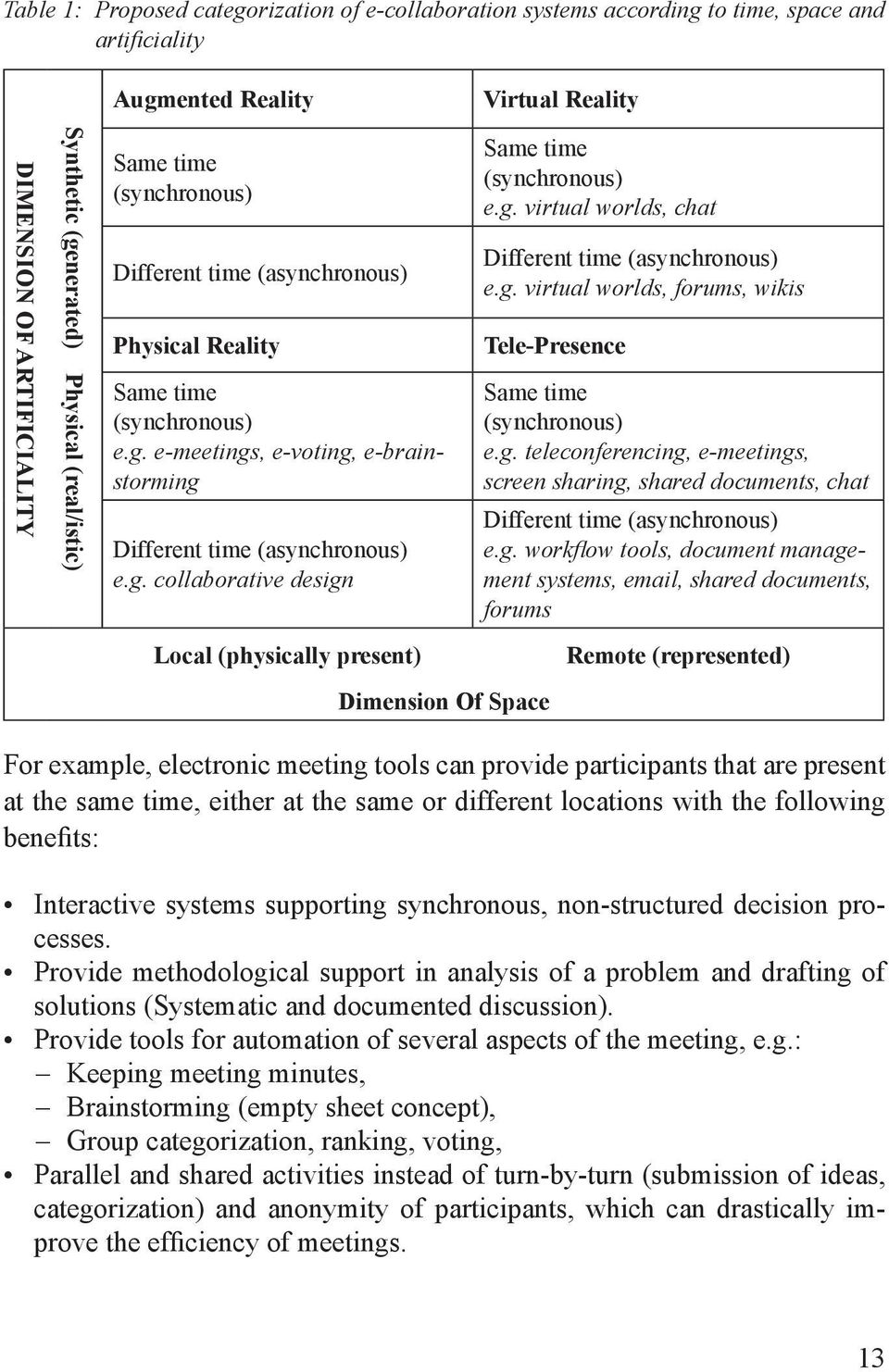
5 The collaborative task: A task that parties can work on together. For example, jobs beyond the capacity of one organization, or jobs that require complementary skill sets; The e-collaboration technology: Existing or new IT infrastructure such as teleconferencing, discussion boards and instant messaging; The participants: Organizations that are collaborating, industry associations and government agencies. Characteristics of the participants and size of the group can also have an effect on the collaboration. Mental schemas of the participants: The knowledge and experience of the participants and the degree of similarity between participants. For example, expert or novice understanding of the task. The physical environment: The location of the participants. For example, the geographical location of the toolmakers was dispersed and therefore they needed to apply more effort to e-collaboration, whereas the IT organizations were within the same geographical area; The social environment: the perceptions of trust and the behaviour among the participants as well as peer pressure among participants. An ever-increasing number of e-collaboration systems and solutions have been developed recently. E-collaboration can be categorized according to the time and space where/when the participants are present. The space dimension is discrete, while the dimension of artificiality (nature of a participant s presentation in the software) can use several different combinations of realistic and synthetic representations. We have combined the model of shared spaces proposed by Benford et al. (1998), which focuses on synchronous communication with the categorization of several types of groupware tools. Our proposed categorization of groupware is shown in Table 1. This new categorization gives a better insight into the relation between the dimensions of artificiality, space, time, and the type of tools available. Several examples of tools are listed in multiple categories, as their flexibility allows usage under synchronous and asynchronous conditions and the choice of representation is left to the user. It is also evident that some modes of collaboration are supported by more tools than other modes. E.g. tools made specifically for asynchronous collaboration at the same location are rare, as location is generally not relevant for asynchronous collaboration. 12
6 Table 1: Proposed categorization of e-collaboration systems according to time, space and artificiality Augmented Reality Virtual Reality DIMENSION OF ARTIFICIALITY Synthetic (generated) Physical (real/istic) Same time (synchronous) Different time (asynchronous) Physical Reality Same time (synchronous) e.g. e-meetings, e-voting, e-brainstorming Different time (asynchronous) e.g. collaborative design Local (physically present) Dimension Of Space Same time (synchronous) e.g. virtual worlds, chat Different time (asynchronous) e.g. virtual worlds, forums, wikis Tele-Presence Same time (synchronous) e.g. teleconferencing, e-meetings, screen sharing, shared documents, chat Different time (asynchronous) e.g. workflow tools, document management systems, , shared documents, forums Remote (represented) For example, electronic meeting tools can provide participants that are present at the same time, either at the same or different locations with the following benefits: Interactive systems supporting synchronous, non-structured decision processes. Provide methodological support in analysis of a problem and drafting of solutions (Systematic and documented discussion). Provide tools for automation of several aspects of the meeting, e.g.: Keeping meeting minutes, Brainstorming (empty sheet concept), Group categorization, ranking, voting, Parallel and shared activities instead of turn-by-turn (submission of ideas, categorization) and anonymity of participants, which can drastically improve the efficiency of meetings. 13
7 2. E-collaboration Tool Development Trends A new type of e-collaboration has recently emerged that is not product of the thousands of man-years and millions of dollars, invested in the development of formal ecollaboration solutions (usually proprietary and created by professionals): the dark horse is user-created and community-driven e-collaboration, produced by volunteers, and freely available. In the world of new collaborative media, content is increasingly created by users, enhanced by community contribution, and accessed through open platforms, particularly Web 2.0 based platforms. Web 2.0 platforms are technologies, which enable users to form up virtual communities in order to interact and communicate over the Internet. A virtual community can be defined as a group of people sharing common interests by using Internet applications. Nowadays an increasing number of companies and non-governmental and non-profit organizations set up virtual communities (McAfee, 2006; O Reilly, 2005). Virtual communities implemented by companies promise to improve the knowledge management by integrating customers in the value creation chain. As a means of customer relationship management, virtual communities contribute to increase the customer loyalty and a deeper understanding of customer needs (Lattemann & Stieglitz, 2007). Web 2.0 driven social software comprises a couple of innovative technological approaches, which in particular are key elements of virtual community infrastructures. Virtual communities allow members to share knowledge, experiences, opinions, and ideas with each other. The term Web 2.0 was coined around the year 2005 and describes new interactive applications on the internet (O Reilly, 2005). However most technological improvements comprised by the term web 2.0 have already been invented years before ((O Reilly, 2005) and (McAfee, 2006)). Web 2.0 applications are often associated with social software. Whereas traditional software focuses on productivity and process support, web 2.0 applications focus on enabling communication, cooperation, and collaboration of individuals and groups over the internet. Social software is based on different services for setting up networks and supporting the distribution of information within the network (e.g. , instant messaging, chats, or blogs) (Stieglitz et al., 2008). However, social e-collaboration systems can become a compliance and control nightmare and introduce the risk of information leaks and public relations problems. Most companies therefore aim to either regulate or ban non-company e-collaboration systems. However if the CEOs of yesteryear 14
8 wondered whether to ban Facebook and other social networks during work hours outright, today s CEOs wonder how to make employees use them effectively for their business needs. One way of making Web 2.0 more acceptable to executives and security managers is the use of the platform in the development of proprietary, company controlled e-collaboration systems. This approach has brought the advent of Enterprise 2.0. While Web 2.0 is originally about the development and usage of new ways of communication and tools for this in the public; Enterprise 2.0 is about organizationally focused support of collaboration in the enterprise. Enterprise 2.0 aims to help employees, customers and suppliers collaborate, share, and organize information via Web 2.0 technologies. McAfee (2006) describes Enterprise 2.0 as the use of emergent social software platforms within companies, or between companies and their partners or customers To be honest, most concepts in what is now is advertised as a revolution on the Web or Enterprise 2.0 have been used in companies as CSCW (Computer-Supported Collaborative Work) applications since the 1970s. However, the tools of old were not nearly as intuitive, adaptable and usable as today, and the technologies that have been developed since then allow us to make e-collaboration tools accessible beyond the walls of companies. Virtual environments and mobile technologies bring business scenarios closer to the 24/7, anytime, anywhere vision (Kalakota & Robinson, 2001). Virtual communities are set up by companies in order to bridge the gap between customers and companies and thus serve as a customer relationship management tool (Stieglitz et al., 2008). A good example are collaborative Customer Relations Management (CRM) technologies, which allow collaboration and instant sharing of relevant information among employees at different locations, which can improve customer service and increase customer involvement in the business processes (e.g. product design, creation, sales and marketing). The results (Reinhold & Alt, 2009) can be a higher alignment of business offerings with customer needs, optimization of internal business processes with customer feedback and an increased customer satisfaction with the delivered services. One interesting model developed in CSCW or e-collaboration systems for understanding different modes of communication in groups is the people/artifact framework which tackles the functional relationship between members and the tools to support collaboration, and maps out these relationships in a way that allows designers to follow the flow of information within the system (Dix et al., 1993). Figure 1 shows the principle of this framework. The directional and bi-directional connections indicate channels of communication either between participants or between a participant and the artefact. 15

Using a Multichannel Strategy to Deliver an Exceptional Customer Experience
 Using a Multichannel Strategy to Deliver an Exceptional Customer Experience 10 things to consider when building a multichannel strategy to improve the customer experience Jesús Hoyos CRM industry analyst,
MARKETING LENS SAMPLE REPORT. Are your marketing efforts effective? September 2013. Available on www.tooliers.com
 Are your marketing efforts effective? September 2013 Available on www.tooliers.com TABLE OF CONTENTS I. What this instrument is, and what it is not II. Factors that can influence your results III. Your
Customer Timeline - New in Summer 2012. Web Lead Capture - New in Summer 2012. Built-In Dashboards - New in Summer 2012
 What s New Maximizer CRM 12 Features New Mobile Access User Interface Enhanced Mobile Access Appointment Management Enhanced Web Access User Interface Improved Web Access Speed & Navigation LinkedIn Integration
Understanding the Business Value of Social Solutions in Sales
 WHITE PAPER Understanding the Business Value of Social Solutions in Sales Sponsored by: SAP Vanessa Thompson April 2014 IDC OPINION The confluence of the changing competitive landscape, strategic business
10 Steps to a Multichannel Strategy and an Exceptional Customer Experience
 10 Steps to a Multichannel Strategy and an Exceptional Customer Experience Jesús Hoyos CRM industry analyst and advisor Brad Herrington Principal Solutions Architect Interactive Intelligence, Inc. Contents
Delivering Transformation. Together. The challenges of the new customer experience. Delivering Transformation. Together.
 Delivering Transformation. Together. The challenges of the new customer experience Delivering Transformation. Together. Sopra Steria Consulting is the Consultancy activity of Sopra Steria Group. With 37,000
ENVIRONICS COMMUNICATIONS WHITEPAPER
 ENVIRONICS COMMUNICATIONS WHITEPAPER Creating an Employee Centric Internal Communications Model April 2013 "The only irreplaceable capital an organization possesses is the knowledge and ability of its
Social Media Implementations
 SEM Experience Analytics Social Media Implementations SEM Experience Analytics delivers real sentiment, meaning and trends within social media for many of the world s leading consumer brand companies.
A Getronics Whitepaper NEW WORLD NEW BEHAVIOUR NEW SUPPORT
 A Getronics Whitepaper NEW WORLD NEW BEHAVIOUR NEW SUPPORT NEW WORLD NEW BEHAVIOUR NEW SUPPORT We see a new world of work beginning to emerge, driving some big changes in the world of ICT support. These
Chapter 9 Knowledge Management
 Turban, Aronson, and Liang Decision Support Systems and Intelligent Systems, Seventh Edition Chapter 9 Knowledge Management 9-1 Learning Objectives Define knowledge. Learn the characteristics of knowledge
INSIGHT. IDC's Social Business Taxonomy, 2011 IDC OPINION IN THIS INSIGHT. Scott Guinn
 INSIGHT IDC's Social Business Taxonomy, 2011 Michael Fauscette Mary Wardley Scott Guinn Erin Traudt Lisa Rowan IDC OPINION Global Headquarters: 5 Speen Street Framingham, MA 01701 USA P.508.872.8200 F.508.935.4015
Global E-business and Collaboration
 Global E-business and Collaboration Content Define and describe business processes and their relationship to information systems. Evaluate the role played by systems serving the various levels of management
Social Media and CFL Pedagogy: Transforming Classrooms into Learning Communities
 Social Media and CFL Pedagogy: Transforming Classrooms into Learning Communities Wen-Hua Teng ( 鄧 文 華 ) Department of Asian Studies The University of Texas at Austin [email protected] ABSTRACT With
Chapter 3: Strategic CRM
 Chapter 3: Strategic CRM Overview Topics discussed: CRM perspectives The components of strategic CRM Steps in developing a CRM strategy Case Study: CRM implementation at International Business Machines,
The Next Generation of Retail Customer Interaction. Strategies and Technologies for Meeting the Evolving Needs of Retail Customers
 The Next Generation of Retail Customer Interaction Strategies and Technologies for Meeting the Evolving Needs of Retail Customers The Next Generation of Retail Customer Interaction Strategies and Technologies
Cisco Unified Intelligent Contact Management Enterprise 7.2
 Cisco Unified Intelligent Contact Management Enterprise 7.2 Cisco Unified Intelligent Contact Management Enterprise-an integral component of the Cisco Unified Communications system-delivers an integrated
IBM Social Media Analytics
 IBM Analyze social media data to improve business outcomes Highlights Grow your business by understanding consumer sentiment and optimizing marketing campaigns. Make better decisions and strategies across
IRLS 571: Introduction to Information Technology (SUBJECT TO CHANGE)
 Instructor: Dr. Xiaolong (Luke) Zhang Prerequisites IRLS 504 or permission of the instruction IRLS 571: Introduction to Information Technology (SUBJECT TO CHANGE) Course Description Information technology
Thought Leadership White Paper Deliver a Better Service Management User Experience
 Thought Leadership White Paper Deliver a Better Service Management User Experience Modernize service management for a more productive workforce Table of Contents 1 EXECUTIVE SUMMARY 2 MILLENNIALS AND MOBILES
Online Retail Banking Customer Experience: The Road Ahead
 Universal Banking Solution System Integration Consulting Business Process Outsourcing Customer experience is a key differentiator in banking In recent years, customer experience has caught the imagination
Five steps to improving the customer service experience
 Five steps to improving the customer service experience Metrics, tips, and tools for utilizing customer feedback An Ovum White Paper Sponsored by Publication Date: January 2012 INTRODUCTION As the use
Marketing Automation 2.0 Closing the Marketing and Sales Gap with a Next-Generation Collaborative Platform
 Marketing Automation 2.0 Closing the Marketing and Sales Gap with a Next-Generation Collaborative Platform 4 Contents 1 Executive Summary 2 Defining Marketing Automation 2.0 3 Marketing Automation 1.0:
HUMAN COMPUTER INTERACTION. Course Convenor: Constantine Stephanidis
 UNIVERSITY OF CRETE FACULTY OF SCIENCES AND ENGINEERING COMPUTER SCIENCE DEPARTMENT COURSE CS-464 (OPTIONAL) HUMAN COMPUTER INTERACTION Course Convenor: Constantine Stephanidis HY-464: Επικοινωνία Ανθρώπου
Transforming life sciences contract management operations into sustainable profit centers
 Point of View Generating life sciences Impact Transforming life sciences contract management operations into sustainable profit centers Globally, life sciences companies spend anywhere from $700 million
Information Visualization WS 2013/14 11 Visual Analytics
 1 11.1 Definitions and Motivation Lot of research and papers in this emerging field: Visual Analytics: Scope and Challenges of Keim et al. Illuminating the path of Thomas and Cook 2 11.1 Definitions and
@Banks: Stay Tuned With Your Customers
 Financial Services @Banks: Stay Tuned With Your Customers How Smart Financial Institutions Exploit the Communication Advantage Contents Executive Summary 1 The Communication Advantage 2 Communication Design
Enterprise Release Management
 Enterprise Release Management Plutora helps organizations manage complex IT Feature Pipeline, IT Releases and IT Test Environments in a simple and transparent manner. Enterprise Releases Transparency and
This presentation introduces online tools that can be used to support public deliberation.
 This presentation introduces online tools that can be used to support public deliberation. During this presentation, we discuss the types of online tools that can be used to support public deliberation
ARC VIEW. OSIsoft-SAP Partnership Deepens SAP s Predictive Analytics at the Plant Floor. Keywords. Summary. By Peter Reynolds
 ARC VIEW AUGUST 13, 2015 OSIsoft-SAP Partnership Deepens SAP s Predictive Analytics at the Plant Floor By Peter Reynolds Keywords SAP, OSIsoft, Oil & Gas, Internet of Things, SAP HANA, PI Server Summary
CUSTOMER RELATIONSHIP MANAGEMENT FOR MANUFACTURING
 WWW.HSO.COM The rise of CRM and how it s transforming business interactions CUSTOMER RELATIONSHIP MANAGEMENT FOR MANUFACTURING Why customer loyalty pays dividends Delivering a personal experience Unsurprisingly,
Delivering an Unmatched Customer Experience
 Consumers are becoming smarter than organisations. The implications are stark. Smart Organisations need to answer a whole new set of exam questions... David Williams, CEO Delivering an Unmatched Customer
Important dimensions of knowledge Knowledge is a firm asset: Knowledge has different forms Knowledge has a location Knowledge is situational Wisdom:
 Southern Company Electricity Generators uses Content Management System (CMS). Important dimensions of knowledge: Knowledge is a firm asset: Intangible. Creation of knowledge from data, information, requires
SOCIAL MEDIA. About Infosys. The Rise of Social Media in Financial Services Balancing Risk and Reward
 The Rise of Social Media in Financial Services Balancing Risk and Reward SOCIAL MEDIA About Infosys Many of the world s most successful organizations rely on Infosys to deliver measurable business value.
Intelligent document management for the legal industry
 Brochure Intelligent document management for the legal industry HP WorkSite The leading legal enterprise content management solution Sharing documents between legal teams, clients, and service providers
CRM or AMS? By Altai Systems
 CRM or AMS? What Associations should know about how a Microsoft Dynamics CRM solution for membership management compares to traditional Association Management Software systems By Altai Systems September
SOCIAL CUSTOMER RELATIONSHIP MANAGEMENT (SCRM) IN INDIAN RETAIL INDUSTRY
 SOCIAL CUSTOMER RELATIONSHIP MANAGEMENT (SCRM) IN INDIAN RETAIL Dr. A.R. Annadurai* INDUSTRY Abstract: Social CRM is an advanced form of customer relationship management that uses social media services,
The Enterprise Information Management Barbell Strengthens Your Information Value
 July 15, 2013 The Enterprise Information Management Barbell Strengthens Your Information Value by Alan Weintraub with Leslie Owens and Emily Jedinak Why Read This Report Businesses increasingly rely on
Predictive Marketing for Banking
 Tony Firmani Predictive Analytics Solution Architect Predictive Marketing for Banking Business Analytics software Session Overview Data Drives Decisions Applying Predictive Analytics Throughout Entire
Your Mobility Strategy Guide Book
 The fast adoption in the use of mobile devices to access work files, data and customer information requires companies to deepen their understanding about how to create a balance between flexibility and
How Social Media will Change the Future of Banking Services
 DOI: 10.7763/IPEDR. 2013. V65. 1 How Social Media will Change the Future of Banking Services Iwa Kuchciak 1 1 University of Lodz Abstract. Parallel with the growth of importance of social media there is
How To Reduce Costs Of Outbound Communication
 Transforming Healthcare Communications An Expense Reduction Strategy and New Business Model Healthcare Communication Services Business Brief For Healthcare Payers, outbound constituent communications (checks,
Intelligent Business Solutions MALLSFORCE. Mall Management System www.mallsforce.com
 Inspark Intelligent Business Solutions MALLSFORCE Mall Management System www.mallsforce.com 2 Increase your asset s value MALLSFORCE helps better management of your tenants by it s strong cloud computing
RUNNING HEAD: INSTRUCTIONAL DESIGN AND PEDOGIGCAL ISSUES. Instructional Design and Pedagogical Issues with Web 2.0 Tools
 Instructional Design 1 RUNNING HEAD: INSTRUCTIONAL DESIGN AND PEDOGIGCAL ISSUES Instructional Design and Pedagogical Issues with Web 2.0 Tools Amelia W. Cheney Robert L. Sanders Nita J. Matzen John H.
Why your business decisions still rely more on gut feel than data driven insights.
 Why your business decisions still rely more on gut feel than data driven insights. THERE ARE BIG PROMISES FROM BIG DATA, BUT FEW ARE CONNECTING INSIGHTS TO HIGH CONFIDENCE DECISION-MAKING 85% of Business
When Computers really become Personal
 When Computers really become Personal What is Consumerization of IT? The Consumerization of IT and what it means The term "consumerization" was first popularized in 20011 as a description for how innovation
Targeting. 5 Tenets. of Modern Marketing
 5 Tenets of Modern Marketing Targeting The foundation of any effective Modern Marketing effort is to ensure you have a clear and accurate picture of your potential customers. Without the proper strategies
9. Technology in KM. ETL525 Knowledge Management Tutorial Four. 16 January 2009. K.T. Lam [email protected]
 9. Technology in KM ETL525 Knowledge Management Tutorial Four 16 January 2009 K.T. Lam [email protected] Last updated: 15 January 2009 Technology is KM Enabler Technology is one of the Four Pillars of KM, which
Part VIII: ecrm (Customer Relationship Management)
 Part VIII: ecrm (Customer Relationship Management) Learning Targets What are the objectives of CRM? How can we achieve customer acquisition and loyalty? What is the customer buying cycle? How does the
Paper Title: Ubiquitous and Integrated Portfolio management of Federal & State projects
 Paper Title: Ubiquitous and Integrated Portfolio management of Federal & State projects Conference Theme : ARCHITECTING PROJECT MANAGEMENT for Redefining India.. Sub Theme - Strategic & Innovative Practices
WHITEPAPER. Creating and Deploying Predictive Strategies that Drive Customer Value in Marketing, Sales and Risk
 WHITEPAPER Creating and Deploying Predictive Strategies that Drive Customer Value in Marketing, Sales and Risk Overview Angoss is helping its clients achieve significant revenue growth and measurable return
Course Specification
 LEEDS BECKETT UNIVERSITY Course Specification MSc Sport and Exercise Science 2016-17 (SEMSC) Our courses undergo a process of review periodically, in addition to annual review and enhancement. Course Specifications
WHITEPAPER. An ECM Journey. Abstract
 WHITEPAPER An ECM Journey Abstract Over the last few years, Enterprise Content Management (ECM) has evolved multifold. This paper describes the past, current and future state of ECM, and talks about the
6/10/2015. Chapter Nine Overview. Learning Outcomes. Opening Case: Twitter: A Social CRM Tool
 Opening Case: Twitter: A Social CRM Tool McGraw-Hill-Ryerson 2015 The McGraw-Hill Companies, All Rights Reserved Chapter Nine Overview SECTION 9.1 CRM FUNDAMENTALS Introduction Using Information to Drive
Social Business Intelligence For Retail Industry
 Actionable Social Intelligence SOCIAL BUSINESS INTELLIGENCE FOR RETAIL INDUSTRY Leverage Voice of Customers, Competitors, and Competitor s Customers to Drive ROI Abstract Conversations on social media
Management Information Systems
 Management Information Systems Information Systems, Global Business and E-business Lecturer: Richard Boateng, PhD. Lecturer in Information Systems, University of Ghana Business School Executive Director,
The Customer Experience:
 The Customer Experience: The Holy Grail of Competitive Advantage. 1 A great customer experience has emerged as the holy grail of competitive advantage. Providing a great customer experience has emerged
Driving Supplier Performance Improvement:
 Driving Supplier Performance Improvement: Using established HR techniques and on-line tools to enhance supplier performance management. Although supplier performance management can be complex and time
ElegantJ BI. White Paper. Operational Business Intelligence (BI)
 ElegantJ BI Simple. Smart. Strategic. ElegantJ BI White Paper Operational Business Intelligence (BI) Integrated Business Intelligence and Reporting for Performance Management, Operational Business Intelligence
Effortless Customer Service with SAP Cloud for Service
 SAP Brief SAP CRM SAP Cloud for Service Objectives Effortless Customer Service with SAP Cloud for Service Discerning customers require expert service attention Discerning customers require expert service
White paper The future of Service Desks - vision
 White paper The future of Service Desks - vision Service Desks require strategic consideration and innovation to raise user productivity and to support business goals. Fujitsu has the experience and feedback
Increasing Efficiency across the Value Chain with Master Data Management
 APPLICATIONS A WHITE PAPER SERIES MASTER DATA MANAGEMENT ENSURES THAT THE ORGANIZATION MAINTAINS CRITICAL DATA IN SYSTEMATIZED ORDER TO AVOID DUPLICATION AND INCONSISTENCY. LARGE ORGANIZATIONS RESORT TO
CORRALLING THE WILD, WILD WEST OF SOCIAL MEDIA INTELLIGENCE
 CORRALLING THE WILD, WILD WEST OF SOCIAL MEDIA INTELLIGENCE Michael Diederich, Microsoft CMG Research & Insights Introduction The rise of social media platforms like Facebook and Twitter has created new
How To Use Social Media To Improve Your Business
 IBM Software Business Analytics Social Analytics Social Business Analytics Gaining business value from social media 2 Social Business Analytics Contents 2 Overview 3 Analytics as a competitive advantage
ICT Development Trends (2014): Embracing the Era of Mobile-ICT
 ICT Development Trends (2014): Embracing the Era of Mobile-ICT ZTE COPORATION In our fast-growing global information society, technology has had a profound effect on every aspect of society and each individual's
Fundamentals of Information Systems, Fifth Edition. Chapter 1 An Introduction to Information Systems in Organizations
 Fundamentals of Information Systems, Fifth Edition Chapter 1 An Introduction to Information Systems in Organizations 1 Principles and Learning Objectives The value of information is directly linked to
Fundamentals of Information Systems, Seventh Edition
 Chapter 1 An Introduction to Information Systems in Organizations 1 Principles and Learning Objectives The value of information is directly linked to how it helps decision makers achieve the organization
Mobilizing Your CRM. Whitepaper. August 2011. Exploring the Benefits and Considerations. Copyright 2009-2011 CWR Mobility B.V.
 Customer Support Program Page 1 of 16 Version 1.3 August 2011 Mobilizing Your CRM Exploring the Benefits and Considerations Whitepaper Copyright 2009-2011 B.V. Mobilizing Your CRM: Exploring the Benefits
Extend the value of Microsoft Dynamics ERP with other technology innovations from Microsoft
 Extend the value of Microsoft Dynamics ERP with other technology innovations from Microsoft Combined with these products and technologies, Microsoft Dynamics ERP solutions can help you gain momentum in
The 5 Forces that are Changing Employee www.namely.com Performance Reviews
 REINVENTING THE PERFORMANCE REVIEW The 5 Forces that are Changing Employee Performance Reviews 1 REINVENTING THE PERFORMANCE REVIEW The 5 Forces that are Changing Employee Performance Reviews Summary This
Logicalis Unified Communications and Collaboration. Collaborate anytime, anywhere, on any device
 Logicalis Unified Communications and Collaboration Collaborate anytime, anywhere, on any device Logicalis Unified Communications and Collaboration Solutions & Services Are you struggling to support today
IT Tools for SMEs and Business Innovation
 Purpose This Quick Guide is one of a series of information products targeted at small to medium sized enterprises (SMEs). It is designed to help SMEs better understand, and take advantage of, new information
STUDENT CENTERED INSTRUCTIONAL DESIGN FOR E-LEARNING CONTENT LEARNING MANAGEMENT SYSTEM (LMS)
 Proceedings of the 2 nd International Conference of Teaching and Learning (ICTL 2009) INTI University College, Malaysia STUDENT CENTERED INSTRUCTIONAL DESIGN FOR E-LEARNING CONTENT LEARNING MANAGEMENT