
JOINT REGULATORY FINANCIAL QUESTIONNAIRE AND REPORT TABLE OF CONTENTS
|
|
|
- Dina Wells
- 10 years ago
- Views:
Transcription
1 JOINT REGULATORY FINANCIAL QUESTIONNAIRE AND REPORT TABLE OF CONTENTS (Firm Name) (Date) GENERAL NOTES AND DEFINITIONS PART I AUDITORS' REPORT [at audit date only] Updated Dec-2008 Jun-2007 STATEMENT A (3 pages) Statements of assets and of liabilities and shareholder/partner capital Mar-2006 B Statement of net allowable assets and risk adjusted capital Aug-2002 C Statement of early warning excess and early warning reserve Apr-2007 D Statement of free credit segregation amount Apr-2000 E Summary statement of income Jun-2002 F Statement of changes in capital and retained earnings (corporations) or undivided profits Jun-2002 (partnerships) G Statement of changes in subordinated loans Apr-2000 CERTIFICATE OF PARTNERS OR DIRECTORS PART II AUDITORS' REPORT [at audit date only] REPORT ON COMPLIANCE FOR INSURANCE [at audit date only] REPORT ON COMPLIANCE FOR SEGREGATION OF SECURITIES [at audit date only] Jun-2002 Jun-2007 Jul-1997 Jan-1998 SCHEDULE 1 Analysis of loans receivable, securities borrowed and resale agreements Aug Analysis of securities owned and sold short at market value Jun A Margin for concentration in underwriting commitments Mar B Underwriting issues margined at less than the normal margin rates Jun Analysis of clients' trading accounts long and short Jun A List of ten largest value date trading balances with acceptable institutions and Jun-1995 acceptable counterparties 5 Analysis of brokers' and dealers' trading balances Feb Income taxes Jun A Tax recoveries Aug Analysis of overdrafts, loans, securities loaned and repurchase agreements Aug A Acceptable Counterparties Financing Activities Concentration Charge Aug Concentration of securities Dec Insurance Apr Unhedged foreign currencies calculation Jun A Details of unhedged foreign currencies calculation for individual currencies with margin Jun-2002 required greater than or equal to $5, Margin on commodity concentrations and deposits Dec Early warning tests - Level 1 Aug A Early warning tests - Level 2 Jan (2 pages) Provider of capital concentration charge Apr Supplementary information Jun-2002 Note: Schedules 2C, 2D, 3, 3A, 4B, 8 and 12A have been eliminated. Feb-2009

2 JOINT REGULATORY FINANCIAL QUESTIONNAIRE AND REPORT GENERAL NOTES AND DEFINITIONS 1. Each Member shall comply in all respects with the requirements outlined in this prescribed Joint Regulatory Financial Questionnaire and Report as approved and amended from time to time by the Board of Directors of the Joint Regulatory Bodies and Canadian Investor Protection Fund. These statements are to be prepared in accordance with generally accepted accounting principles, except as modified by the requirements of the appropriate regulatory body. These statements and schedules are to be completed by members of the Joint Regulatory Bodies as follows: The Canadian Venture Exchange The Montreal Exchange The Toronto Stock Exchange Investment Dealers Association of Canada Firms may have multiple memberships in the above bodies. When this is the case and the requirements of such bodies are not consistent in a specific area, the firm must adhere to the most stringent requirement. The appropriate Joint Regulatory Body refers to the institution that maintains the primary audit jurisdiction for the firm and its affiliates under Canadian Investor Protection Fund rules. 2. These statements and schedules should be read in conjunction with the bylaws, rules and regulations of the Joint Regulatory Bodies and Canadian Investor Protection Fund including, but not limited to, Margin Rates, Early Warning System, Segregation, Free Credit Segregation, Insurance, Concentration of Securities and Audit Requirements. 3. For purposes of these statements and schedules, the accounts of related companies as defined by the appropriate Joint Regulatory Body may be consolidated as provided by the bylaws, rules and regulations of the Joint Regulatory Bodies. If consolidation is appropriate, the names of the companies consolidated must be provided. 4. FOR THE PURPOSES OF THESE CAPITAL CALCULATIONS REPORTING ON A TRADE DATE BASIS MUST BE USED UNLESS SPECIFIED OTHERWISE IN THE INSTRUCTIONS. THIS MEANS INCLUDING IN THE FOLLOWING PRESCRIBED STATEMENTS AND SCHEDULES, ALL ASSETS AND LIABILITIES RESULTING FROM SALES AND PURCHASES OF SECURITIES ON OR BEFORE THE REPORTING DATE, EVEN THOUGH THEY MAY BE FOR NORMAL SETTLEMENT AFTER THE REPORTING DATE. 5. Firms may determine margin deficiencies for clients, brokers and dealers on either a settlement date basis or trade date basis. Firms may also determine margin deficiencies for acceptable institutions, acceptable counterparties, regulated entities and investment counselors accounts as a block on either a settlement date basis or trade date basis and the remaining clients, brokers and dealer accounts on the other basis. In each case, firms must do so for all such accounts and consistently from period to period. 6. All statements and schedules must be filed. If a schedule is not applicable, a "NIL" return must be filed. 7. Comparative figures on all statements are only required at the audit date. 8. All statements and schedules must be expressed in Canadian dollars and must be rounded to the nearest thousand. 9. Schedules should be attached showing details of any significant amounts that have not been clearly described on the attached statements and schedules. 10. Mandatory security counts. All securities except those held in segregation or safe-keeping shall be counted once a month, or monthly on a cyclical basis. Those held in segregation and safekeeping must be counted once in the year in addition to the count as at the year-end audit date. 11. At the year-end, enclose a list of all brokers and dealers for which a confirmation has not been obtained after two requests. Such list should include the dollar balances in such accounts, as reflected in the firm's records. 12. At the year-end, enclose a list of guarantees that have been disallowed for margin purposes as a result of the lack of confirmation based on a positive request. Such list should disclose the names of the guarantor and guaranteed account involved, as well as the amount of margin relief that was disallowed. A copy should be provided to the Member firm. Dec-2008

3 GENERAL NOTES AND DEFINITIONS (Cont d) 13. At the year end, enclose a list of Other Acceptable Foreign Securities Locations, the market value of the securities held at each of these locations and whether a written custodial agreement is in place. In addition, include a list of those Other Acceptable Foreign Securities Locations for which a positive confirmation has not been received at the time of filing and the amount of margin provided on these positions. DEFINITIONS: (a) acceptable clearing corporations means those entities considered suitable to provide a Member with securities or derivatives transactions clearing and settlement services. These entities are as follows: Any clearing agency operating a central system for clearing of securities or derivatives transactions that is subject to legislation and oversight by a central or regional government authority in the country of operation. The legislation or oversight regime must provide for or recognize the clearing agency s powers of compliance and enforcement over its members or participants. The Joint Regulatory Bodies will maintain and regularly update a list of those acceptable clearing corporations. (b) acceptable counterparties means those entities with whom a Member may deal on a value for value basis, with mark to market imposed on outstanding transactions. The entities are as follows: 1. Canadian banks, Quebec savings banks, trust companies and loan companies licensed to do business in Canada or a province thereof. Each of the aforementioned entities must have paid up capital and surplus on the last audited balance sheet (plus such other forms of capital recognized as such in their regulatory regime as well as in this capital formula, e.g. subordinated debt) in excess of $10 million and less than or equal to $100 million to qualify, provided acceptable financial information with respect to such entities is available for inspection. 2. Credit and central credit unions and regional caisses populaires with paid up capital and surplus or net worth (excluding appraisal credits but including general reserves) on the last audited balance sheet in excess of $10 million and less than or equal to $100 million, provided acceptable financial information with respect to such entities is available for inspection. 3. Insurance companies licensed to do business in Canada or a province thereof with paid up capital and surplus or net worth on the last audited balance sheet in excess of $10 million and less than or equal to $100 million, provided acceptable financial information with respect to such companies is available for inspection. 4. Canadian provincial capital cities and all other Canadian cities and municipalities, or their equivalents, with populations of 50,000 and over. 5. Mutual funds subject to a satisfactory regulatory regime with total net assets in the fund in excess of $10 million. 6. Corporations (other than regulated entities) with a minimum net worth of $75 million on the last audited balance sheet, provided acceptable financial information with respect to such corporation is available for inspection. 7. Trusts and limited partnerships with minimum total net assets on the last audited balance sheet in excess of $100 million, provided acceptable financial information with respect to such trust or limited partnership is available for inspection. 8. Canadian pension funds which are regulated either by the Office of Superintendent of Financial Institutions or a provincial pension commission, with total net assets on the last audited balance sheet in excess of $10 million, provided that in determining net assets the liability of the fund for future pension payments shall not be deducted. 9. Foreign banks and trust companies subject to a satisfactory regulatory regime with paid up capital and surplus on the last audited balance sheet in excess of $15 million and less than or equal to $150 million, provided acceptable financial information with respect to such entities is available for inspection. 10. Foreign insurance companies subject to a satisfactory regulatory regime with paid up capital and surplus or net worth on the last audited balance sheet in excess of $15 million, provided acceptable financial information with respect to such companies is available for inspection. 11. Foreign pension funds subject to a satisfactory regulatory regime with total net assets on the last audited balance sheet in excess of $15 million, provided that in determining net assets the liability of the fund for future pension payments shall not be deducted. Dec-2008
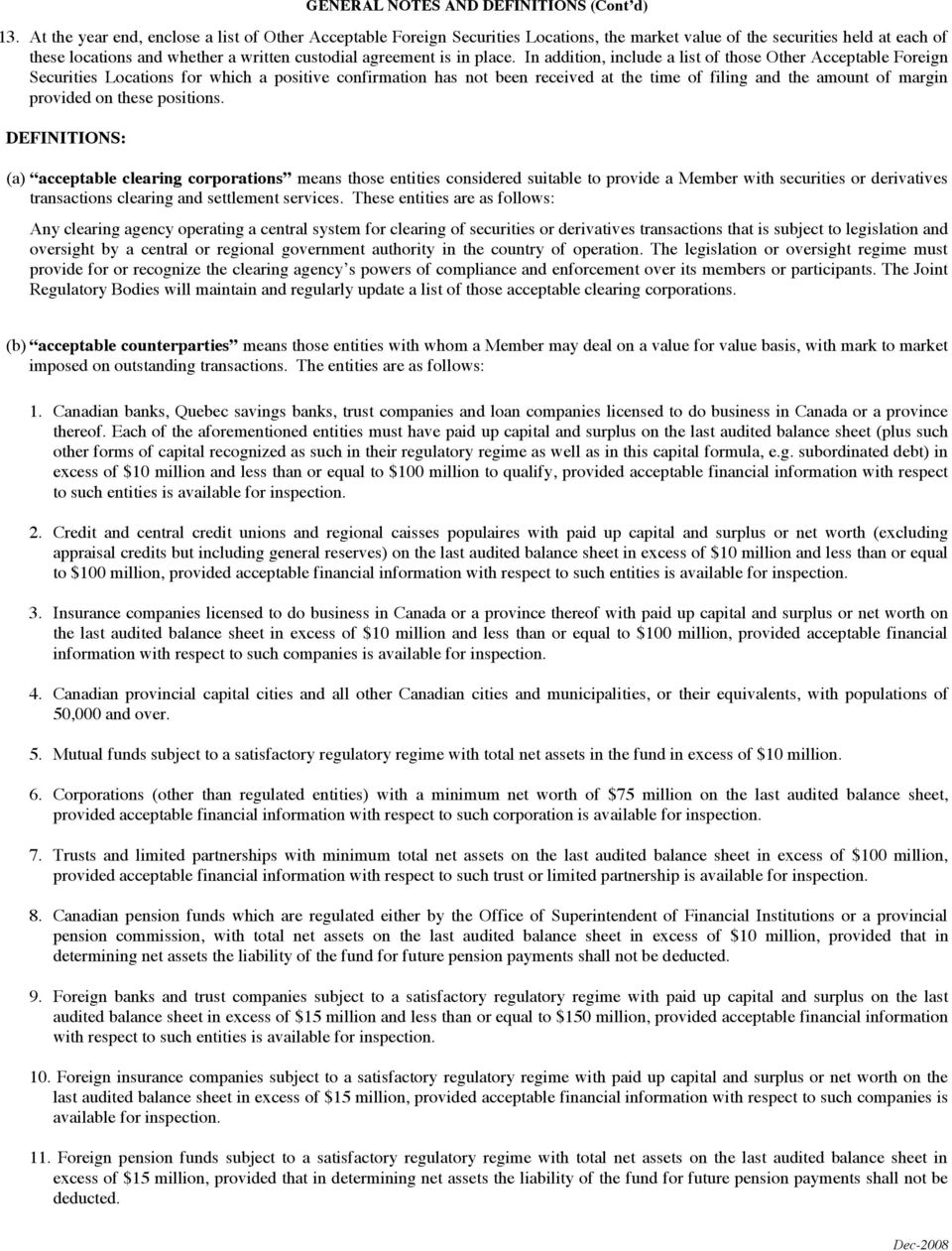
4 GENERAL NOTES AND DEFINITIONS (Cont d) 12. Federal governments of foreign countries which do not qualify as a Basle Accord country. For the purposes of this definition, a satisfactory regulatory regime will be one within Basle Accord countries. Subsidiaries (excluding regulated entities) whose business falls in the category of any of the above enterprises and whose parent or affiliate qualifies as an acceptable counterparty may also be considered as an acceptable counterparty if the parent or affiliate provides a written unconditional irrevocable guarantee, subject to approval by the appropriate Joint Regulatory Body. (c) acceptable institutions means those entities with which a Member is permitted to deal on an unsecured basis without capital penalty. The entities are as follows: 1. Government of Canada, the Bank of Canada and provincial governments. 2. All crown corporations, instrumentalities and agencies of the Canadian federal or provincial governments which are government guaranteed as evidenced by a written unconditional irrevocable guarantee or have a call on the consolidated revenue fund of the federal or provincial governments. 3. Canadian banks, Quebec savings banks, trust companies and loan companies licensed to do business in Canada or a province thereof. Each of the aforementioned entities must have paid up capital and surplus on the last audited balance sheet (plus such other forms of capital recognized as such in their regulatory regime as well as in this capital formula, e.g. subordinated debt) in excess of $100 million, provided acceptable financial information with respect to such entities is available for inspection. 4. Credit and central credit unions and regional caisses populaires with paid up capital and surplus (excluding appraisal credits but including general reserves) on the last audited balance sheet in excess of $100 million, provided acceptable financial information with respect to such entities is available for inspection. 5. Federal governments of Basle Accord Countries. 6. Foreign banks and trust companies subject to a satisfactory regulatory regime with paid up capital and surplus on the last audited balance sheet in excess of $150 million, provided acceptable financial information with respect to such entities is available for inspection. 7. Insurance companies licensed to do business in Canada or a province thereof with paid up capital and surplus or net worth on the last audited balance sheet in excess of $100 million, provided acceptable financial information with respect to such companies is available for inspection. 8. Canadian pension funds which are regulated either by the Office of Superintendent of Financial Institutions or a provincial pension commission, and with total net assets on the last audited balance sheet in excess of $200 million, provided that in determining net assets the liability of the fund for future pension payments shall not be deducted. 9. Foreign pension funds subject to a satisfactory regulatory regime with total net assets on the last audited balance sheet in excess of $300 million, provided that in determining net assets the liability of the fund for future pension payments shall not be deducted. For the purposes of this definition, a satisfactory regulatory regime will be one within Basle Accord countries. Subsidiaries (other than regulated entities) whose business falls in the category of any of the above enterprises and whose parent or affiliate qualifies as an acceptable institution may also be considered as an acceptable institution if the parent or affiliate provides a written unconditional irrevocable guarantee, subject to approval by the appropriate Joint Regulatory Body. (d) acceptable securities locations means those entities considered suitable to hold securities on behalf of a Member, for both inventory and client positions, without capital penalty, given that the locations meet the requirements outlined in the segregation bylaws, rules or regulations of the Joint Regulatory Bodies including, but not limited to, the requirement for a written custody agreement outlining the terms upon which such securities are deposited and including provisions that no use or disposition of the securities shall be made without the prior written consent of the Member and the securities can be delivered to the Member promptly on demand. The entities are as follows: Dec-2008
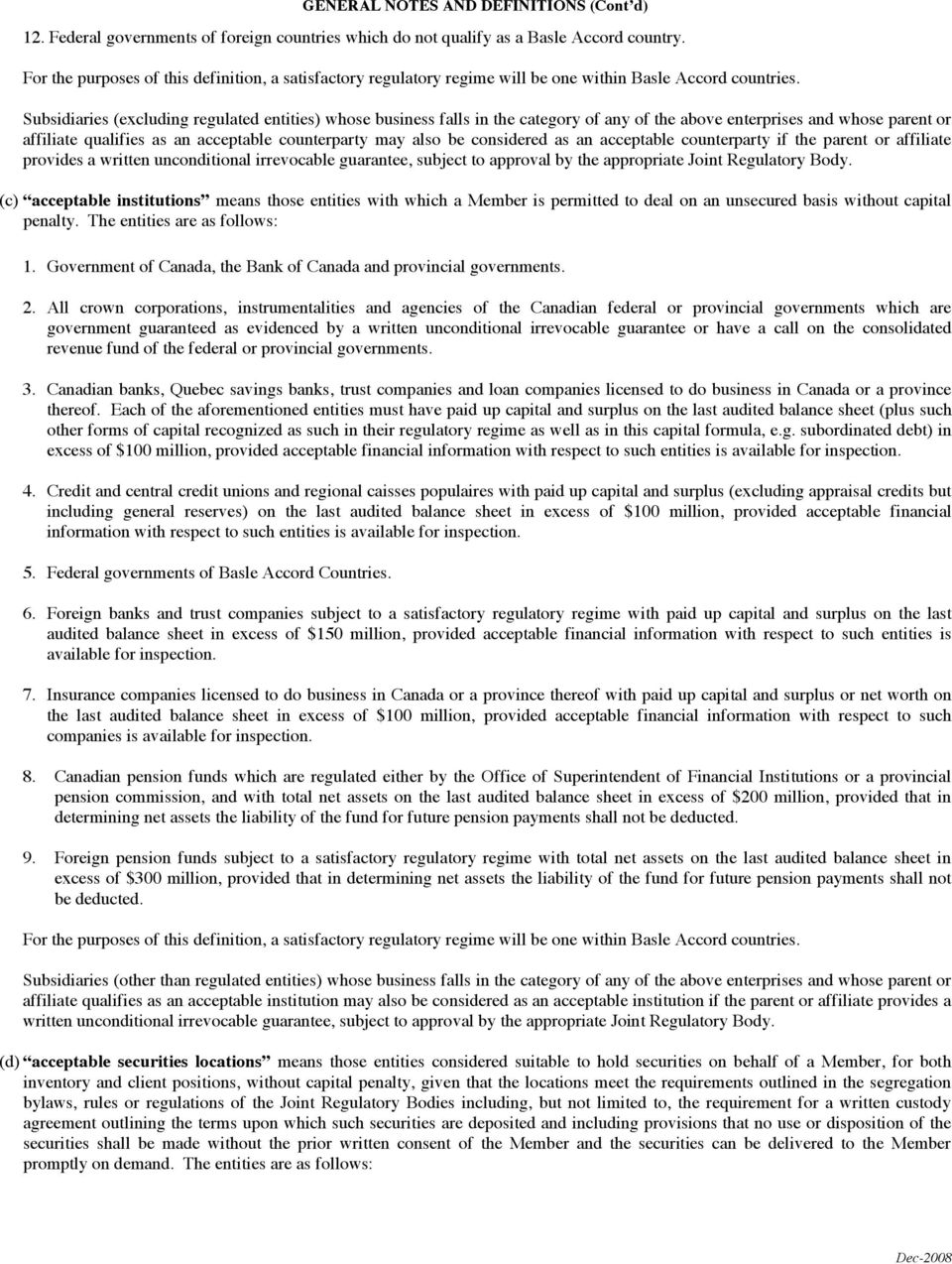
5 GENERAL NOTES AND DEFINITIONS (Cont d) 1, Depositories and Clearing Agencies Any securities depository or clearing agency operating a central system for handling securities or equivalent book-based entries or for clearing of securities or derivatives transactions that is subject to legislation and oversight by a central or regional government authority in the country of operation. The legislation or oversight regime must provide for or recognize the securities depository s or clearing agency s powers of compliance and enforcement over its members or participants. The Joint Regulatory Bodies will maintain and regularly update a list of those depositories and clearing agencies that comply with these criteria. 2. (a) Acceptable Institutions which in their normal course of business offer custodial security services; or (b) Subsidiaries of Acceptable Institutions provided that each such subsidiary, together with the Acceptable Institution, has entered into a custodial agreement with the member containing a legally enforceable indemnity by the Acceptable Institution in favour of the Member covering all losses, claims, damages, costs and liabilities in respect of securities and other property held for the Member and its clients at the subsidiary s location. 3. Acceptable Counterparties - with respect to security positions maintained as a book entry of securities issued by the Acceptable Counterparty and for which the Acceptable Counterparty is unconditionally responsible. 4. Banks and Trust Companies otherwise classified as Acceptable Counterparties - with respect to securities for which they act as transfer agent and for which custody services are not being provided (in such case, a written custody agreement is not required). 5. Mutual Funds or their Agents - with respect to security positions maintained as a book entry of securities issued by the mutual fund and for which the mutual fund is unconditionally responsible. 6. Regulated entities. 7. Foreign institutions and securities dealers that satisfy the following criteria: (a) the paid-up capital and surplus according to its most recent audited balance sheet is in excess of Cdn. $150 million as evidenced by the audited financial statements of such entity; (b) in respect of which a foreign custodian certificate has been completed and signed in the prescribed form by the Member s board of directors or authorized committee thereof; provided that: (c) a formal application in respect of each such foreign location is made by the Member to the relevant joint regulatory authority in the form of a letter enclosing the financial statements and certificate described above; and (d) the Member reviews each such foreign location annually and files a foreign custodian certificate with the appropriate joint regulatory authority annually. and such other locations which have been approved as acceptable securities locations by the Joint Regulatory Body having prime jurisdiction over the Member. (e) Basle Accord Countries means those countries that are members of the Basle Accord and those countries that have adopted the banking and supervisory rules set out in the Basle Accord. [The Basle Accord, which includes the regulating authorities of major industrial countries acting under the auspices of the Bank for International Settlements (B.I.S.), has developed definitions and guidelines that have become accepted standards for capital adequacy.] A list of current Basle Accord countries is included in the most recent list of Foreign Acceptable Institutions and Foreign Acceptable Counterparties. (f) broad based index means an equity index whose underlying basket of securities is comprised of: 1. thirty or more securities; 2. the single largest security position by weighting comprises no more than 20% of the overall market value of the basket of equity securities; 3. the average market capitalization for each security position in the basket of equity securities underlying the index is at least $50 million; 4. the securities shall be from a broad range of industries and market sectors as determined by the Joint Regulatory Bodies to represent index diversification; and 5. in the case of foreign equity indices, the index is both listed and traded on an exchange that meets the criteria for being considered a recognized exchange, as set out in the definition of regulated entities in the General Notes and Definitions. Dec-2008
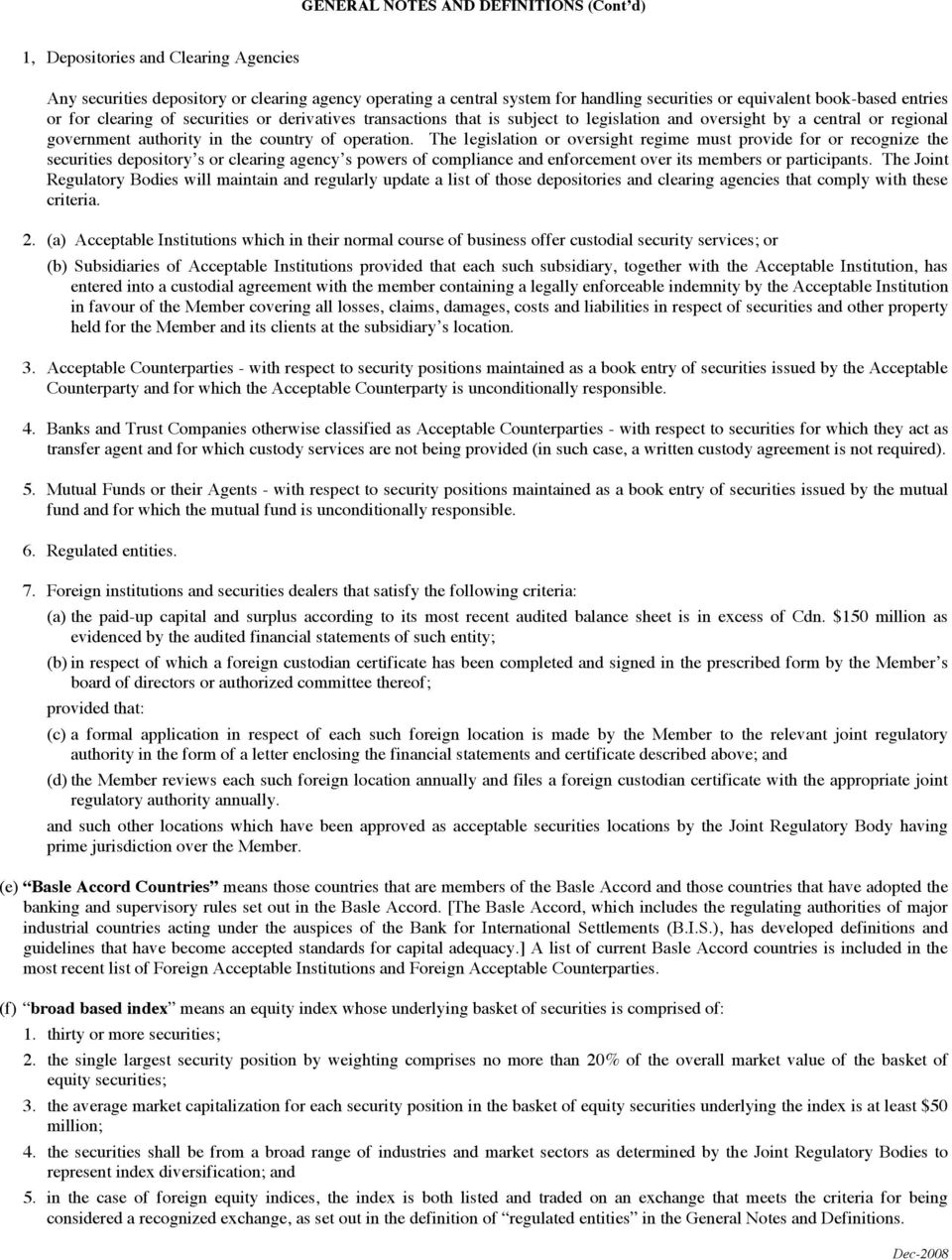
6 GENERAL NOTES AND DEFINITIONS (Cont d) (g) market value of securities means: 1. for listed securities, the last bid price of a long security and, correspondingly, the last ask price of a short security, as shown on the exchange quotation sheets as of the close of business on the relevant date or last trading date prior to the relevant date, as the case may be, subject to an appropriate adjustment where an unusually large or unusually small quantity of securities is being valued. If not available, the last sale price of a board lot may be used. Where not readily marketable, no market value shall be assigned. 2. for unlisted and debt securities, a value determined as reasonable from published market reports or inter-dealer quotation sheets on the relevant date or last trading day prior to the relevant date, or based on a reasonable yield rate. Where not readily marketable, no market value shall be assigned. 3. for commodity futures contracts, the settlement price on the relevant date or last trading day prior to the relevant date. 4. for money market fixed date repurchases (no borrower call feature), the market price is the price determined by applying the current yield for the security to the term of maturity from the repurchase date. This will permit calculation of any profit or loss based on the market conditions at the reporting date. Exposure due to future changes in market conditions is covered by the margin rate. 5. for money market open repurchases (no borrower call feature), prices are to be determined as of the reporting date or the date the commitment first becomes open, whichever is the later. Market price is to be determined as in 4. and commitment price is to be determined in the same manner using the yield stated in the repurchase commitment. 6. for money market repurchases with borrower call features, the market price is the borrower call price. (h) regulated entities means those entities with whom a Member may deal on a value for value basis, with mark to market imposed on outstanding transactions. The entities are participating institutions in the Canadian Investor Protection Fund or members of recognized exchanges and associations. For the purposes of this definition recognized exchanges and associations mean those entities that meet the following criteria: 1. the exchange or association maintains or is a member of an investor protection regime equivalent to the Canadian Investor Protection Fund; 2. the exchange or association requires the segregation by its members of customers fully paid for securities; 3. the exchange or association rules set out specific methodologies for the segregation of, or reserve for, customer credit balances; 4. the exchange or association has established rules regarding member firm and customer account margining; 5. the exchange or association is subject to the regulatory oversight of a government agency or a self-regulatory organization under a government agency which conducts regular examinations of its members and monitors member s regulatory capital on an ongoing basis; and 6. the exchange or association requires regular regulatory financial reporting by its members. A list of current recognized exchanges and associations is included in the most recent list of Foreign Acceptable Institutions and Foreign Acceptable Counterparties. (i) settlement date - extended shall mean a transaction (other than a mutual fund security redemption) in respect of which the arranged settlement date is a date after regular settlement date. (j) settlement date - regular means the settlement date generally accepted according to industry practice for the relevant security in the market in which the transaction occurs, including foreign jurisdictions. For margin purposes, if such settlement date exceeds 15 business days past trade date, settlement date will be deemed to be 15 business days past trade date. In the case of new issue trades, regular settlement date means the contracted settlement date as specified for that issue. Dec-2008

7 JOINT REGULATORY FINANCIAL QUESTIONNAIRE AND REPORT PART I AUDITORS REPORT TO: The and the Canadian Investor Protection Fund (applicable regulatory body) We have audited the following Part I financial statements of : (firm) Statement A - Statement B - Statement C - Statement D - Statement E - Statement F - Statement G - Statements of assets and of liabilities and shareholder/partner capital as at and ; (date) (date) Statements of net allowable assets and risk adjusted capital as at and ; (date) (date) Statement of early warning excess and early warning reserve as at ; (date) Statement of free credit segregation amount as at ; (date) Summary statements of income for the years ended and ; (date) (date) Statement of changes in capital and retained earnings (corporations) or undivided profits (partnerships) for the year ended ; and (date) Statement of changes in subordinated loans for the year ended. (date) These financial statements have been prepared for the purpose of complying with the regulations, bylaws and policies of the. These financial statements are (applicable regulatory body) the responsibility of the Company s management. Our responsibility is to express an opinion on these financial statements based on our audits. We conducted our audits in accordance with Canadian generally accepted auditing standards. Those standards require that we plan and perform an audit to obtain reasonable assurance whether the financial statements are free of material misstatement. An audit includes examining, on a test basis, evidence supporting the amounts and disclosures in the financial statements. An audit also includes assessing the accounting principles used and significant estimates made by management, as well as evaluating the overall financial statement presentation. In our opinion, (a) The statements of assets and of liabilities and shareholders/partner capital and the summary statements of income present fairly, in all material respects, the financial position of the Company as at and and the results of its (date) (date) operations for the years then ended in accordance with the basis of accounting disclosed in Note 2 to the financial statements. 1 Jun-2007

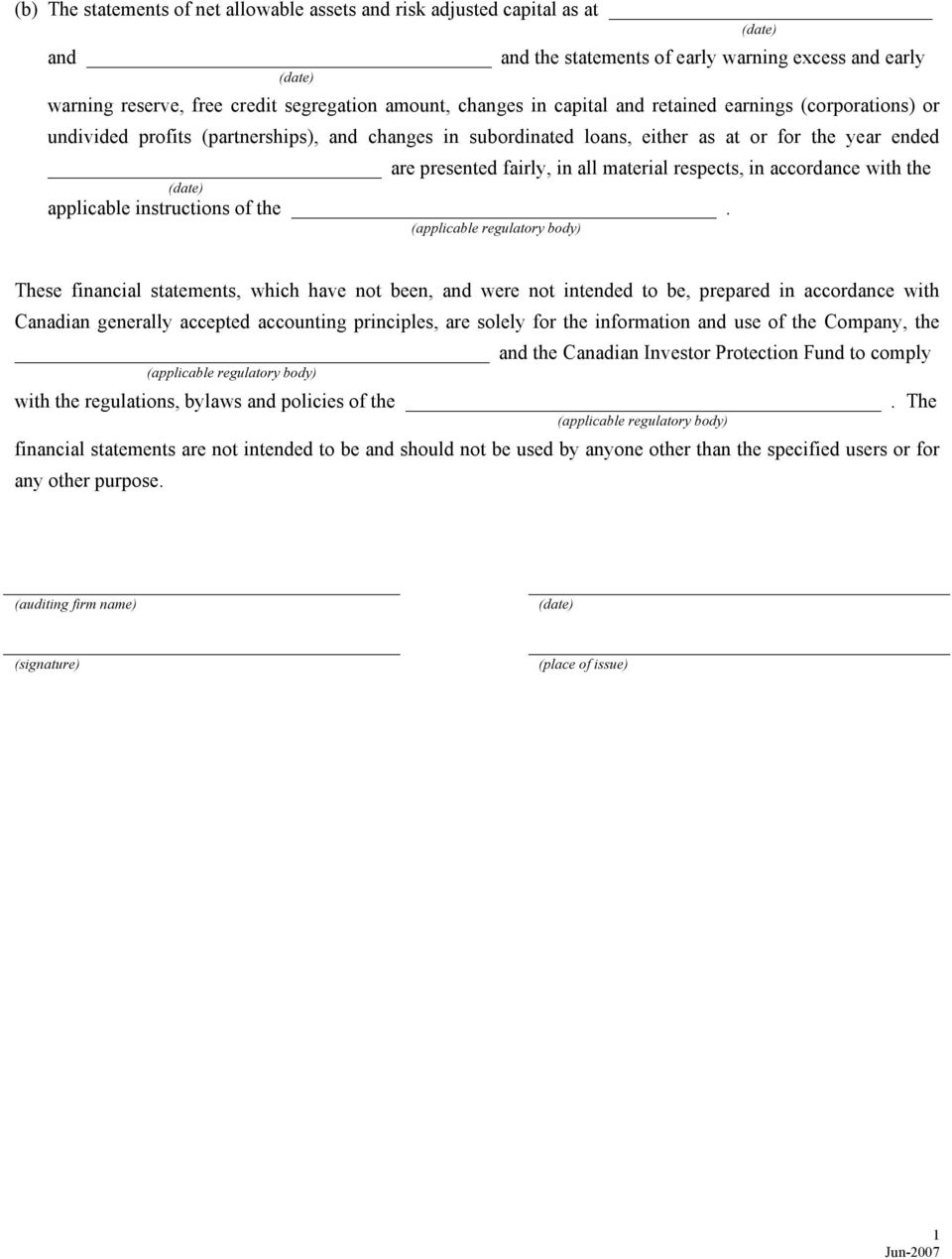
8 (b) The statements of net allowable assets and risk adjusted capital as at (date) and and the statements of early warning excess and early (date) warning reserve, free credit segregation amount, changes in capital and retained earnings (corporations) or undivided profits (partnerships), and changes in subordinated loans, either as at or for the year ended are presented fairly, in all material respects, in accordance with the (date) applicable instructions of the. (applicable regulatory body) These financial statements, which have not been, and were not intended to be, prepared in accordance with Canadian generally accepted accounting principles, are solely for the information and use of the Company, the and the Canadian Investor Protection Fund to comply (applicable regulatory body) with the regulations, bylaws and policies of the. The (applicable regulatory body) financial statements are not intended to be and should not be used by anyone other than the specified users or for any other purpose. (auditing firm name) (date) (signature) (place of issue) 1 Jun-2007
9 PART I - AUDITORS' REPORT NOTES AND INSTRUCTIONS A measure of uniformity in the form of the auditors' report is desirable in order to facilitate identification of circumstances where the underlying conditions are different. Therefore, when auditors are able to express an unqualified opinion, their report should take the form of the auditors' report shown above. Alternate forms of Auditors Reports are available either online from within the web-based Securities Industry Regulatory Financial Filings system (SIRFF) or from the Joint Regulatory Body with primary audit jurisdiction. Any limitations in the scope of the audit must be discussed in advance with the appropriate regulatory authority. Discretionary scope limitations will not be accepted. Copies with original signatures must be provided to the Joint Regulatory Body with primary audit jurisdiction. 1 Jun-2007

10 STATEMENT A PART I PAGE 1 OF 3 JOINT REGULATORY FINANCIAL QUESTIONNAIRE AND REPORT (Firm Name) STATEMENT OF ASSETS (as at with comparative figures as at ) REFERENCE CURRENT YEAR PREVIOUS YEAR LIQUID ASSETS: 1. Cash on deposit with Acceptable Institutions... $ _ $ _ 2. Funds deposited in trust for RRSP and other similar accounts Stmt. D Cash, held in trust with Acceptable Institutions, due to free credit 4. ratio calculation... Variable base deposits and margin deposits with Acceptable Clearing Corporations [cash balances only] Margin deposits with Regulated Entities [cash balances only] Sch.1 Loans receivable, securities borrowed and resold Sch.2 Securities owned - at market value Sch.2 Securities owned and segregated due to free credit ratio calculation Syndicate and joint trading accounts Sch.4 Clients' accounts Sch.5 Brokers and dealers trading balances Receivable from carrying broker or mutual fund TOTAL LIQUID ASSETS... OTHER ALLOWABLE ASSETS (RECEIVABLES FROM ACCEPTABLE INSTITUTIONS): 14. Sch.6 Recoverable and overpaid income taxes Recoverable and overpaid taxes Commissions and fees receivable Interest and dividends receivable Other receivables [attach details] TOTAL OTHER ALLOWABLE ASSETS... NON ALLOWABLE ASSETS: 20. Other deposits with Acceptable Clearing Corporations [cash or market value of securities lodged] Deposits and other balances with non-acceptable clearing corporations [cash or market value of securities lodged] Commissions and fees receivable Interest and dividends receivable Fixed assets - at depreciated value Stock exchange seats Capitalized leases Investments in and advances to subsidiaries and affiliates Other assets [attach details] TOTAL NON ALLOWABLE ASSETS TOTAL ASSETS... $ ============ $ ============ [see notes and instructions] Mar-2006
![D Cash, held in trust with Acceptable Institutions, due to free credit 4. ratio calculation... Variable base deposits and margin deposits with Acceptable Clearing Corporations [cash balances only]... 5.](/docs-images/45/3830743/images/page_10.jpg "Margin deposits with Regulated Entities [cash balances only]... 6. Sch.1 Loans receivable, securities borrowed and resold... 7. Sch.2 Securities owned - at market value... 8. Sch.2 Securities owned and segregated due to free credit ratio calculation.")
11 STATEMENT A PART I PAGE 2 OF 3 JOINT REGULATORY FINANCIAL QUESTIONNAIRE AND REPORT (Firm Name) STATEMENT OF LIABILITIES AND SHAREHOLDER/PARTNER CAPITAL (as at with comparative figures as at ) REFERENCE CURRENT YEAR PREVIOUS YEAR CURRENT LIABILITIES: 51. Sch.7 Overdrafts, loans, securities loaned and repurchases... $ _ $ _ 52. Sch.2 Securities sold short - at market value Syndicate and joint trading accounts Sch.4 Clients' accounts Sch.5 Brokers and dealers Sch.6 Income taxes payable Sch.6 Deferred income taxes - current portion Bonuses payable Accounts payable and accrued expenses Capitalized leases and lease-related liabilities - current portion Other current liabilities [attach details] TOTAL CURRENT LIABILITIES... LONG TERM LIABILITIES: 63. Sch.6 Non-current portion of deferred income taxes Non-current portion of capitalized leases and lease-related liabilities Other long-term liabilities [attach details] TOTAL LONG-TERM LIABILITIES TOTAL LIABILITIES [line 62 plus line 66]... FINANCIAL STATEMENT CAPITAL: 68. Non-current portion of capitalized leases qualifying as capital [see note] G-6 Subordinated loans - approved non-industry investors G-6 Subordinated loans - industry investors F-A-3 Capital F-C-3 Retained earnings or undivided profits TOTAL FINANCIAL STATEMENT CAPITAL TOTAL LIABILITIES AND CAPITAL... $ ============ $ ============ [see notes and instructions] Mar-2006

12 STATEMENT A PAGE 3 OF 3 PART I JOINT REGULATORY FINANCIAL QUESTIONNAIRE AND REPORT (Firm Name) NOTES TO THE FINANCIAL STATEMENTS [to be provided at both audit date and interim date] Notes to the financial statements - Any notes which may be necessary for the fair presentation of the financial statements in accordance with generally accepted accounting principles and which are not contained in the supporting schedules must be attached as page 3 to Statement A, including without limitation: Significant accounting policies; Subsequent events (which are not otherwise disclosed) to the date of filing, which have a material effect on the firm s financial position and risk adjusted capital; Obligations under letters of credit; Outstanding legal claims which are likely to result in a material adverse effect on the firm s financial position and risk adjusted capital; Related party transactions, detailing by type of transaction the amount and parties involved, for all such transactions; Description of authorized and issued share capital and subordinated loans; Lease commitments; and Any other significant commitments or contingencies not otherwise disclosed. Mar-2006

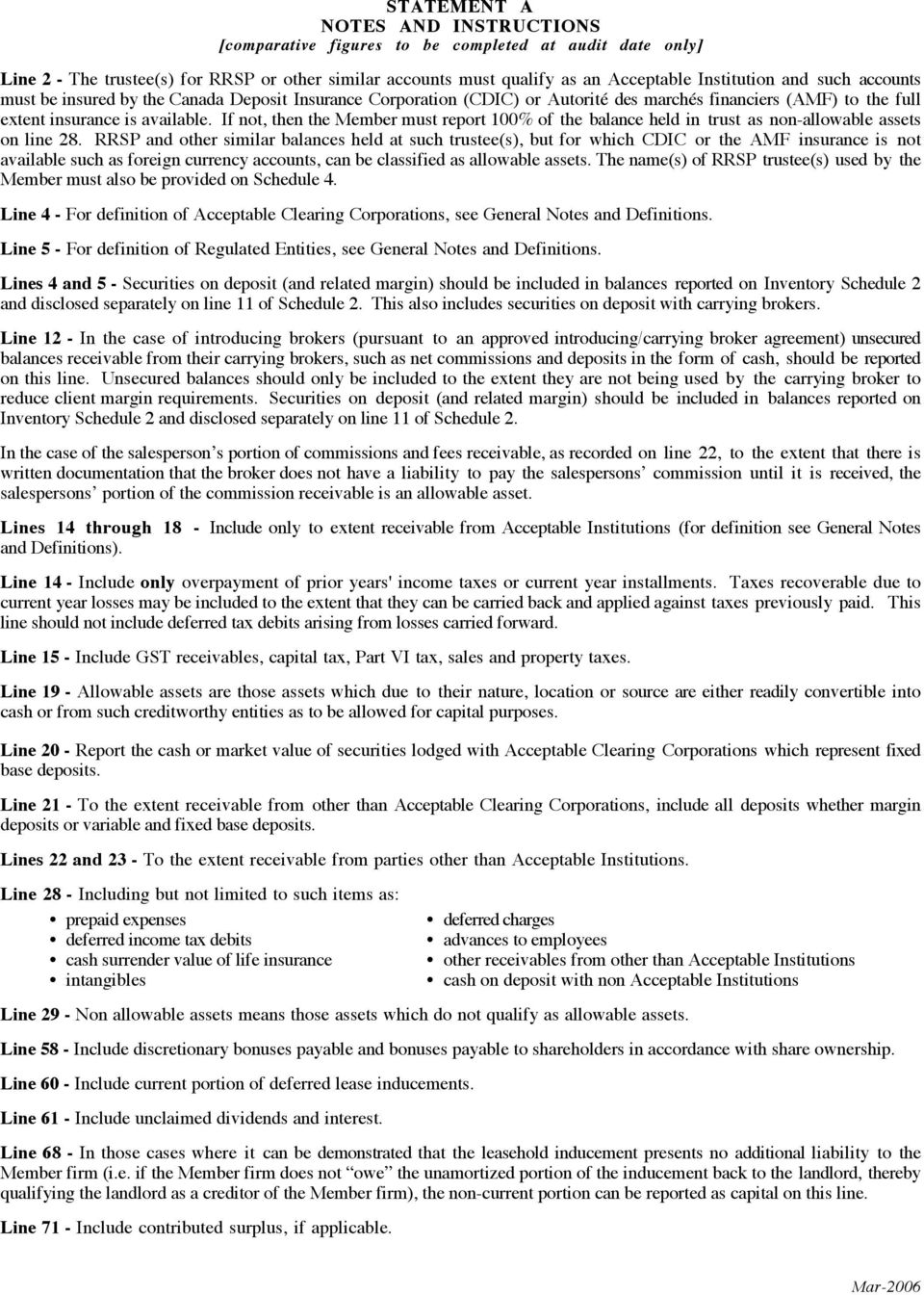
13 STATEMENT A NOTES AND INSTRUCTIONS [comparative figures to be completed at audit date only] Line 2 - The trustee(s) for RRSP or other similar accounts must qualify as an Acceptable Institution and such accounts must be insured by the Canada Deposit Insurance Corporation (CDIC) or Autorité des marchés financiers (AMF) to the full extent insurance is available. If not, then the Member must report 100% of the balance held in trust as non-allowable assets on line 28. RRSP and other similar balances held at such trustee(s), but for which CDIC or the AMF insurance is not available such as foreign currency accounts, can be classified as allowable assets. The name(s) of RRSP trustee(s) used by the Member must also be provided on Schedule 4. Line 4 - For definition of Acceptable Clearing Corporations, see General Notes and Definitions. Line 5 - For definition of Regulated Entities, see General Notes and Definitions. Lines 4 and 5 - Securities on deposit (and related margin) should be included in balances reported on Inventory Schedule 2 and disclosed separately on line 11 of Schedule 2. This also includes securities on deposit with carrying brokers. Line 12 - In the case of introducing brokers (pursuant to an approved introducing/carrying broker agreement) unsecured balances receivable from their carrying brokers, such as net commissions and deposits in the form of cash, should be reported on this line. Unsecured balances should only be included to the extent they are not being used by the carrying broker to reduce client margin requirements. Securities on deposit (and related margin) should be included in balances reported on Inventory Schedule 2 and disclosed separately on line 11 of Schedule 2. In the case of the salesperson s portion of commissions and fees receivable, as recorded on line 22, to the extent that there is written documentation that the broker does not have a liability to pay the salespersons commission until it is received, the salespersons portion of the commission receivable is an allowable asset. Lines 14 through 18 - Include only to extent receivable from Acceptable Institutions (for definition see General Notes and Definitions). Line 14 - Include only overpayment of prior years' income taxes or current year installments. Taxes recoverable due to current year losses may be included to the extent that they can be carried back and applied against taxes previously paid. This line should not include deferred tax debits arising from losses carried forward. Line 15 - Include GST receivables, capital tax, Part VI tax, sales and property taxes. Line 19 - Allowable assets are those assets which due to their nature, location or source are either readily convertible into cash or from such creditworthy entities as to be allowed for capital purposes. Line 20 - Report the cash or market value of securities lodged with Acceptable Clearing Corporations which represent fixed base deposits. Line 21 - To the extent receivable from other than Acceptable Clearing Corporations, include all deposits whether margin deposits or variable and fixed base deposits. Lines 22 and 23 - To the extent receivable from parties other than Acceptable Institutions. Line 28 - Including but not limited to such items as: prepaid expenses deferred income tax debits cash surrender value of life insurance intangibles deferred charges advances to employees other receivables from other than Acceptable Institutions cash on deposit with non Acceptable Institutions Line 29 - Non allowable assets means those assets which do not qualify as allowable assets. Line 58 - Include discretionary bonuses payable and bonuses payable to shareholders in accordance with share ownership. Line 60 - Include current portion of deferred lease inducements. Line 61 - Include unclaimed dividends and interest. Line 68 - In those cases where it can be demonstrated that the leasehold inducement presents no additional liability to the Member firm (i.e. if the Member firm does not owe the unamortized portion of the inducement back to the landlord, thereby qualifying the landlord as a creditor of the Member firm), the non-current portion can be reported as capital on this line. Line 71 - Include contributed surplus, if applicable. Mar-2006
14 PART I JOINT REGULATORY FINANCIAL QUESTIONNAIRE AND REPORT (Firm Name) STATEMENT OF NET ALLOWABLE ASSETS AND RISK ADJUSTED CAPITAL (as at with comparative figures as at ) STATEMENT B REFERENCE CURRENT YEAR PREVIOUS YEAR 1. A-73 Total financial statement capital... $ _ $ _ 2. A-29 Deduct: Non allowable assets NET ALLOWABLE ASSETS... $ $ 4. Deduct: Minimum capital SUBTOTAL... Deduct - amounts required to fully margin: 6. Sch.1 Loans receivable, securities borrowed and resold Sch.2 Securities owned and sold short Sch.2A Underwriting concentration Syndicate and joint trading accounts [attach details] Sch.4 Clients' accounts Sch.5 Brokers and dealers Sch.7 Loans and repurchases Contingent liabilities [attach details] Sch.10 Financial institution bond deductible [greatest under any clause] Sch.11 Unhedged foreign currencies Sch.12 Commodity futures contracts Sch.14 Provider of capital concentration charge Securities held at non-acceptable securities locations [see note] 19. Sch.7A Acceptable Counterparties Financing Activities Concentration Charge Unresolved differences [attach details] Other [attach details] TOTAL MARGIN REQUIRED [lines 6 through 21] SUBTOTAL [line 5 less line 22] Sch.6A Add: Applicable tax recoveries Risk Adjusted Capital before securities concentration charge [line 23 plus line 24] Sch.9 Deduct: Securities concentration charge of Sch.6A less tax recoveries of RISK ADJUSTED CAPITAL [line 25 less line 26]... $ ============ $ ============ [see notes and instructions] Aug-2002

15 DATE: STATEMENT B SUPPLEMENTAL PART I JOINT REGULATORY FINANCIAL QUESTIONNAIRE AND REPORT (Firm Name) Statement B Line 20: Details of Unresolved Differences Debit/Short Credit/Long Reconciled as Number value Number value Required at Report Date of (Potential of (Potential to (Yes/No) items Losses) items Gains) margin (a) Clearing (b) Brokers and dealers (c) Bank accounts (d) Intercompany accounts (e) Mutual Funds (f) Security Counts (g) Other unreconciled differences TOTAL Statement B Line 20 [see notes and instructions] Aug-2002

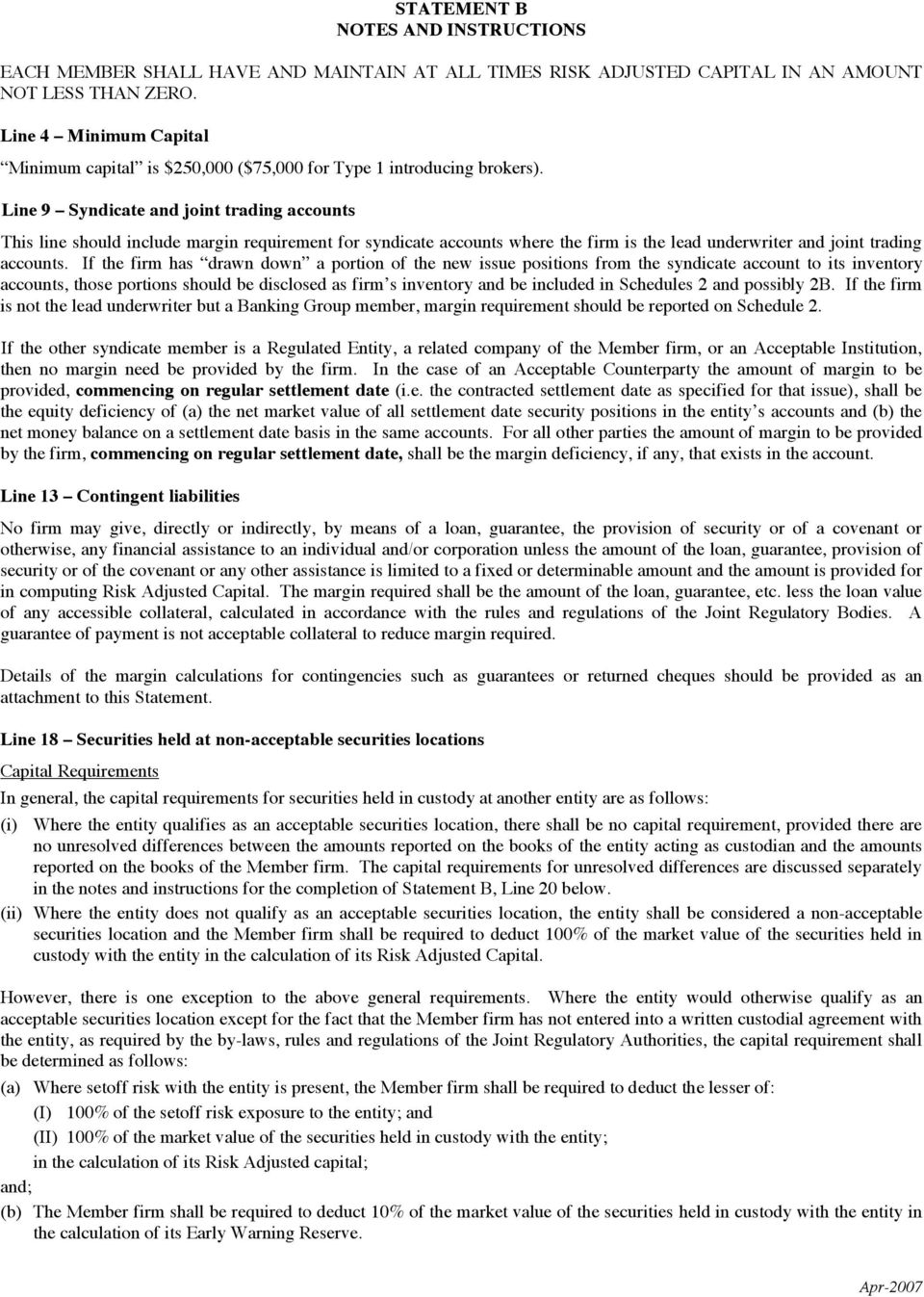
16 STATEMENT B NOTES AND INSTRUCTIONS EACH MEMBER SHALL HAVE AND MAINTAIN AT ALL TIMES RISK ADJUSTED CAPITAL IN AN AMOUNT NOT LESS THAN ZERO. Line 4 Minimum Capital Minimum capital is $250,000 ($75,000 for Type 1 introducing brokers). Line 9 Syndicate and joint trading accounts This line should include margin requirement for syndicate accounts where the firm is the lead underwriter and joint trading accounts. If the firm has drawn down a portion of the new issue positions from the syndicate account to its inventory accounts, those portions should be disclosed as firm s inventory and be included in Schedules 2 and possibly 2B. If the firm is not the lead underwriter but a Banking Group member, margin requirement should be reported on Schedule 2. If the other syndicate member is a Regulated Entity, a related company of the Member firm, or an Acceptable Institution, then no margin need be provided by the firm. In the case of an Acceptable Counterparty the amount of margin to be provided, commencing on regular settlement date (i.e. the contracted settlement date as specified for that issue), shall be the equity deficiency of (a) the net market value of all settlement date security positions in the entity s accounts and (b) the net money balance on a settlement date basis in the same accounts. For all other parties the amount of margin to be provided by the firm, commencing on regular settlement date, shall be the margin deficiency, if any, that exists in the account. Line 13 Contingent liabilities No firm may give, directly or indirectly, by means of a loan, guarantee, the provision of security or of a covenant or otherwise, any financial assistance to an individual and/or corporation unless the amount of the loan, guarantee, provision of security or of the covenant or any other assistance is limited to a fixed or determinable amount and the amount is provided for in computing Risk Adjusted Capital. The margin required shall be the amount of the loan, guarantee, etc. less the loan value of any accessible collateral, calculated in accordance with the rules and regulations of the Joint Regulatory Bodies. A guarantee of payment is not acceptable collateral to reduce margin required. Details of the margin calculations for contingencies such as guarantees or returned cheques should be provided as an attachment to this Statement. Line 18 Securities held at non-acceptable securities locations Capital Requirements In general, the capital requirements for securities held in custody at another entity are as follows: (i) Where the entity qualifies as an acceptable securities location, there shall be no capital requirement, provided there are no unresolved differences between the amounts reported on the books of the entity acting as custodian and the amounts reported on the books of the Member firm. The capital requirements for unresolved differences are discussed separately in the notes and instructions for the completion of Statement B, Line 20 below. (ii) Where the entity does not qualify as an acceptable securities location, the entity shall be considered a non-acceptable securities location and the Member firm shall be required to deduct 100% of the market value of the securities held in custody with the entity in the calculation of its Risk Adjusted Capital. However, there is one exception to the above general requirements. Where the entity would otherwise qualify as an acceptable securities location except for the fact that the Member firm has not entered into a written custodial agreement with the entity, as required by the by-laws, rules and regulations of the Joint Regulatory Authorities, the capital requirement shall be determined as follows: (a) Where setoff risk with the entity is present, the Member firm shall be required to deduct the lesser of: (I) 100% of the setoff risk exposure to the entity; and (II) 100% of the market value of the securities held in custody with the entity; in the calculation of its Risk Adjusted capital; and; (b) The Member firm shall be required to deduct 10% of the market value of the securities held in custody with the entity in the calculation of its Early Warning Reserve. Apr-2007
17 STATEMENT B NOTES AND INSTRUCTIONS (Cont'd) The sum of the requirements calculated in paragraphs (a) and (b) above shall be no greater than 100% of the market value of the securities held in custody with the entity. Where the sum amounts initially calculated in paragraphs (a) and (b) above are greater than 100%, the capital required under paragraph (b) and the amount reported as a deduction in the calculation of the Early Warning Reserve shall be reduced accordingly. For the purposes of determining the capital requirement detailed in paragraph (a) above, the term setoff risk, shall mean the risk exposure that results from the situation where the Member firm has other transactions, balances or positions with the entity, where the resultant obligations of the Member firm might be setoff again the value of the securities held in custody with the entity. Client Waiver Where the laws and circumstances prevailing in a foreign jurisdiction may restrict the transfer of securities from the jurisdiction and the Member is unable to arrange for the holding of client securities in the jurisdiction at an acceptable securities location, the Member may hold such securities at a location in that jurisdiction if (a) the Member has entered into a written custodial agreement with the location as required hereunder and (b) the client has consented to the arrangement, acknowledged the risks and waived any claims it may have against the Member, in a form approved by the Joint Regulatory Authority. Such a consent and waiver must be obtained on a transaction by transaction basis. Line 20 Unresolved Differences Items are considered unresolved unless: (i) a written acknowledgement from the counterparty of a valid claim has been received (ii) a journal entry to resolve the difference has been processed as of the Due Date of the questionnaire. This does not include journal entries writing off the difference to profit or loss in the period subsequent to the date of the questionnaire. Provision should be made for the market value and margin requirements at the questionnaire date on out of balance short securities and other adverse unresolved differences (e.g. with banks, trust companies, brokers, clearing corporations), still unresolved as at a date one month subsequent to the questionnaire date or other applicable Due Date of the questionnaire. The margin rate to be used is the one that is appropriate for inventory positions. For instance, if the calculation is for securities eligible for reduced margin, the margin rate is 25%, rather than 30%. A separate schedule, in a form approved by the Joint Regulatory Authority, must be prepared detailing all unresolved differences as at the report date. The following guidelines should be followed when calculating the required to margin amount on unresolved items: Type of Unresolved Difference Amount Required to Margin Money balance credit (potential gains) debit (potential losses) None Money balance Unresolved Long with Money on the Member's Book [(Money Balance on the trade minus market value of the security)* plus the applicable inventory margin] Unresolved Long without Money on the Member's Books None Unresolved Short with Money on the Member's Books [(Market value of the security minus money balance on the trade)* plus the applicable inventory margin] Unresolved Long/Short on the Other Broker's Books None Short Security Break (e.g. Mutual Funds, Stock Dividends) or Unresolved Short without Money on the [Market value of the security plus the applicable inventory margin] Member's Books * also referred to as the Mark to Market Adjustment. Where mutual fund positions are not reconciled on a monthly basis, margin shall be provided equal to a percentage of the market value of such mutual funds held on behalf of clients. Where no transactions in the mutual fund, other than redemptions and transfers, have occurred for at least six months and no loan value has been associated with the mutual fund, the percentage shall be 10%. In all other cases, the percentage shall be 100%. Apr-2007

18 STATEMENT B NOTES AND INSTRUCTIONS (Cont'd) Unresolved Differences in Accounts: Report all differences determined on or before the report date that have not been resolved as of the due date. Month End (Report date) Month End + 20 Business Days (Due date) Include differences determined on or before the report date that have not been resolved as of the due date. Do not include differences as of the report date that have been resolved on or before the due date. For each account listed, set out the number of unresolved differences and the money value of both the debit and credit differences. The Debit/Short value column includes money differences and market value of security differences, which represent a potential loss. The Credit/Long value column includes money differences and market value of security differences, which represent a potential gain. In determining the potential gain or loss, the money balance and the security position market value of the same transaction should be netted. Debit/short and credit/long balances of different transactions cannot be netted. All reconciliation must be properly documented and made available for review by the Vice-President, Financial Compliance and Member's Auditor. Unresolved differences in Security Counts: Report all security count differences determined on or before the report date that have not been resolved as of due date. The amount required to margin is the market value of short security differences plus the applicable inventory margin. Line 21 Other This item should include all margin requirements not mentioned above as outlined in the bylaws, rules and regulations of the Joint Regulatory Bodies and the Canadian Investor Protection Fund. Apr-2007

19 DATE: STATEMENT C PART I JOINT REGULATORY FINANCIAL QUESTIONNAIRE AND REPORT (Firm Name) STATEMENT OF EARLY WARNING EXCESS AND EARLY WARNING RESERVE REFERENCE CURRENT YEAR 1. B-27 RISK ADJUSTED CAPITAL... $ ============ 2. LIQUIDITY ITEMS - DEDUCT: A-19 (a) Other allowable assets... _ Sch.6A (b) Tax recoveries... (c) Securities held at non-acceptable securities locations... ADD: A-66 (d) Long term liabilities... _ Sch.6A (e) Tax recoveries - income accruals... _ 3. EARLY WARNING EXCESS... $ ============ 4. DEDUCT: CAPITAL CUSHION - B-22 Total margin required $ _ multiplied by 5%... $ _ 5. EARLY WARNING RESERVE [line 3 less line 4]... $ ============ Apr-2007

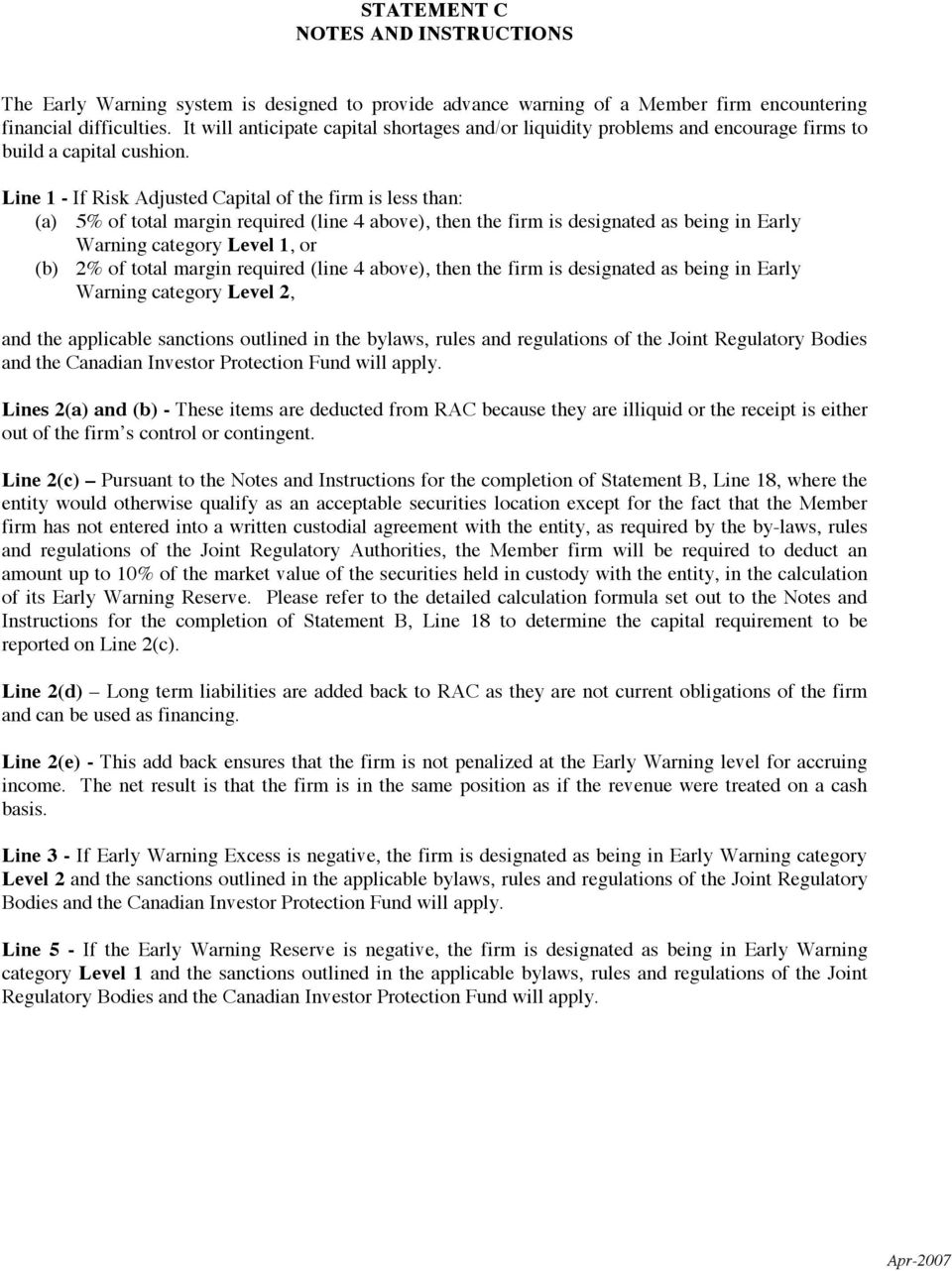
20 STATEMENT C NOTES AND INSTRUCTIONS The Early Warning system is designed to provide advance warning of a Member firm encountering financial difficulties. It will anticipate capital shortages and/or liquidity problems and encourage firms to build a capital cushion. Line 1 - If Risk Adjusted Capital of the firm is less than: (a) 5% of total margin required (line 4 above), then the firm is designated as being in Early Warning category Level 1, or (b) 2% of total margin required (line 4 above), then the firm is designated as being in Early Warning category Level 2, and the applicable sanctions outlined in the bylaws, rules and regulations of the Joint Regulatory Bodies and the Canadian Investor Protection Fund will apply. Lines 2(a) and (b) - These items are deducted from RAC because they are illiquid or the receipt is either out of the firm s control or contingent. Line 2(c) Pursuant to the Notes and Instructions for the completion of Statement B, Line 18, where the entity would otherwise qualify as an acceptable securities location except for the fact that the Member firm has not entered into a written custodial agreement with the entity, as required by the by-laws, rules and regulations of the Joint Regulatory Authorities, the Member firm will be required to deduct an amount up to 10% of the market value of the securities held in custody with the entity, in the calculation of its Early Warning Reserve. Please refer to the detailed calculation formula set out to the Notes and Instructions for the completion of Statement B, Line 18 to determine the capital requirement to be reported on Line 2(c). Line 2(d) Long term liabilities are added back to RAC as they are not current obligations of the firm and can be used as financing. Line 2(e) - This add back ensures that the firm is not penalized at the Early Warning level for accruing income. The net result is that the firm is in the same position as if the revenue were treated on a cash basis. Line 3 - If Early Warning Excess is negative, the firm is designated as being in Early Warning category Level 2 and the sanctions outlined in the applicable bylaws, rules and regulations of the Joint Regulatory Bodies and the Canadian Investor Protection Fund will apply. Line 5 - If the Early Warning Reserve is negative, the firm is designated as being in Early Warning category Level 1 and the sanctions outlined in the applicable bylaws, rules and regulations of the Joint Regulatory Bodies and the Canadian Investor Protection Fund will apply. Apr-2007
21 PART I JOINT REGULATORY FINANCIAL QUESTIONNAIRE AND REPORT (Firm Name) STATEMENT OF FREE CREDIT SEGREGATION AMOUNT (as at ) STATEMENT D REFERENCE AMOUNT REQUIRED TO SEGREGATE: 1. B-3 Net allowable assets of $ multiplied by C-5 Early warning reserve of $ multiplied by FREE CREDIT LIMIT [lines 1 plus 2]... $ 4. Sch.4 Less client free credit balances: (a) Firm s own [see note]... (b) Carried For Type 3 Introducers AMOUNT REQUIRED TO SEGREGATE [NIL if line 3 exceeds line 4a plus 4b, see note]... ($ ) AMOUNT IN SEGREGATION: 6. A-3 Client funds held in trust in an account with an Acceptable Institution [see note] Sch.2 Market value of securities owned and in segregation [see note] TOTAL IN SEGREGATION [lines 6 plus 7]... $ 9. NET SEGREGATION EXCESS (DEFICIENCY) [lines 5 plus 8, see note]... $ NOTES: Line 3 - If negative, then line 5 equals line 4, i.e. Member firm is required to segregate 100% of client free credits. Line 4 - Free credit balances in RRSP and other similar accounts should not be included. Refer to Schedule 4 - Notes and Instructions for discussion of trade versus settlement date reporting of free credit balances. For purposes of this statement a free credit is: (a) For cash and margin accounts - the credit balance less an amount equal to the aggregate of the market value of short positions and regulatory margin on those shorts. (b) For commodity accounts - any credit balance less an amount equal to the aggregate of margin required to carry open futures contracts and/or futures contracts option positions less equity in those contracts plus deficits in those contracts, provided that such aggregate amount may not exceed the dollar amount of the credit balance. Line 5 - If Nil, no further calculation on this Statement need be done. Line 6 - The trust must be an obligation binding the Member firm (the trustee) to deal with the free credits over which it has control (the trust property), for the benefit of the client (the beneficiary). The trust property must be clearly identified as such even if residing with an Acceptable Institution. FUNDS HELD IN TRUST FOR RRSP AND OTHER SIMILAR ACCOUNTS ARE NOT TO BE INCLUDED IN THIS CALCULATION. Line 7 - The securities to be included are bonds, debentures, treasury bills and other securities with a term of 1 year or less, of or guaranteed by the Government of Canada or a Province of Canada, the United Kingdom, the United States of America and any other national foreign government (provided such other foreign government is a party to the Basle Accord) which are segregated and held separate and apart as the Member firm s property. Line 9 - If negative, then a segregation deficiency exists, and the Member firm shall expeditiously take the most appropriate action required to settle the segregation deficiency. The Member firm should attach an explanation of how the deficiency was corrected as well as the date of correction. Apr-2000
22 STATEMENT E PART I JOINT REGULATORY FINANCIAL QUESTIONNAIRE AND REPORT (Firm Name) SUMMARY STATEMENT OF INCOME FOR THE PERIOD ENDED [with comparative figures for the year /month ended ] CURRENT YR/ MO PREVIOUS YR/ MO COMMISSION REVENUE 1 Listed Canadian securities... $ $ 2 Other securities... 3 Mutual funds... 4 Listed Canadian options... 5 Other options... 6 Listed Canadian futures... 7 Other futures... PRINCIPAL REVENUE 8 Listed Canadian options and related underlying securities... 9 Other Equities and options Bonds Futures Money market... CORPORATE FINANCE REVENUE 13 (a) New issues - equity (b) New issues - debt (c) Corporate advisory fees... OTHER REVENUE 14 Net interest Fees Other TOTAL REVENUE... EXPENSES 18 Variable compensation Bad debt expense (recoveries) Interest on subordinated debt Unusual items [attach details] Operating expenses other than lines 24, 25, 26 & Profit [loss] before lines 24, 25, 26 & Interest on internal subordinated debt Bonuses S-6(5) Provision for (recovery of) income taxes (a) current... (b) deferred Extraordinary items [attach details] NET PROFIT [LOSS] FOR PERIOD... $ =========== $ =========== F-C-2(a) NOTE: COMPLETE LINES 29 TO 31 ALSO IF FILING A MONTHLY REPORT 29 Dividends paid or partners drawings Other [attach details] NET CHANGE TO RETAINED EARNINGS [lines 28 to 30]... $ =========== $ =========== [see notes and instructions] June-2002
23 STATEMENT E NOTES AND INSTRUCTIONS A comparative statement of income prepared in accordance with generally accepted accounting principles and containing at least the information shown in the pre-printed Statement E may be substituted. It should be affixed to the statement provided. It is recognized that the components of the revenue and expense classification on this statement may vary between firms. However, it is important that each firm be consistent between periods except where approved by the appropriate authority. Fair presentation may require the separate disclosure of additional large and/or unusual items by way of a note to this statement. Lines 1-7. All Commission Revenue should be reported net of payouts to other brokers. Commission paid to registered representatives should be shown on line 18. Commissions earned on soft dollar deals should also be included on lines 1 to Includes all gross commissions earned on listed Canadian securities [TSE, ME, CDNX, Winnipeg] less amounts paid out to any brokers. Options commission should go on lines 4 or Includes gross commissions earned on OTC transactions [equity or debt, foreign or Canadian], rights and offers, and other foreign securities, less amounts paid out to any brokers. Report Money Market commissions on line Includes all gross commissions and trailer fees earned on mutual fund transactions, net of any payouts to the mutual funds. 4. Includes all gross commissions earned on listed option contracts cleared through the Canadian Derivatives Clearing Corporation ("CDCC"). 5. Includes gross commissions on Canadian OTC, and foreign option transactions less amounts paid out to any brokers. 6. Includes all gross commissions earned on listed futures contracts cleared through the CDCC. 7. Includes all gross commissions earned on foreign listed futures contracts as well as all over-the-counter futures contracts. 8. Includes all principal revenue [trading profits/losses including dividends and interest] from listed options cleared through CDCC and related underlying security transactions in market makers' and firms' inventory accounts. An interest carry factor is to be included. Include adjustment of inventories to market value. 9. Includes all principal revenue [trading profits/losses including dividends and interest] from all other options and equities except those indicated on line 8. An interest carry factor is to be included. Include adjustment of inventories to market value. 10. Includes revenue [trading profits/losses] on all bonds, e.g. all Canada's, Provincial's, Municipal's, Corporate's, Euro- Bond's, US, UK and other foreign debt instruments, net of interest carry [coupon revenue less financing cost]. The cost of carry rate should be an actual cost of funds, which can be calculated as a weighted average. The cost of carrying short inventory should be the actual coupon, offset as appropriate by interest savings less applicable bond borrow fees when short inventory is borrowed. Revenues from financial futures used to hedge bond positions should also be shown here. Include any adjustment of inventories to market value. Over-certification costs should be included on line Includes all principal revenue [trading profits/losses] on futures contracts excluding those relating to bond trading [line 10] and money market trading [line 12]. 12. Includes revenue on all money market activities net of interest carry in the area of Canadian and US Treasury Bills, Bankers Acceptance, Bank Paper [domestic and foreign], Municipal and Commercial paper. The cost of carry rate should be an actual cost of funds money market rate, which can be calculated as a weighted average. Discount notes should be amortized on a yield to maturity method. Interest revenues and expenses on repurchase and resale agreements should be accrued on a monthly basis. Include any adjustment of inventories to market value. Money Market commissions should also be shown here. As well, revenues from futures contracts used to hedge money market positions should be included. 13(a). Includes revenue relating to equity new issue business - Underwriting and/or management fees, Banking group profits, Private Placement fees, trading profits on new issue inventories [trading on an "if, as and when basis"], selling group spreads and/or commissions, convertible debts, and Syndicate expenses [unless treated as a prepaid asset]. 13(b). Includes revenue relating to debt new issue business - Corporate and government issues, and CBS commissions [net of sub-agent fees]. 13(c). Includes revenue relating to corporate advisory fees such as corporate restructuring, privatization, M&A fees. Jun-2002
24 STATEMENT E NOTES AND INSTRUCTIONS (Cont d) 14. Includes all interest revenue, which is not otherwise related to a specific liability trading activity [i.e. other than bond, money market, futures and options]. All interest revenue and the related interest cost of carrying account balances for retail and institutional accounts should be reported on a net basis on this line. 15. Includes Proxy fees, Portfolio service fees, Segregation and/or Safekeeping fees, RRSP fees, and any charges to clients that are not related to commission or interest. 16. Includes foreign exchange profits/losses and all other revenue not reported above. 18. This category should include commissions, bonuses and other variable compensation of a contractual nature. Examples would encompass commission payouts to RR's and payments to institutional and professional trading personnel. Discretionary bonuses should be included on line 25. All contractual bonuses should be accrued monthly and included on line Includes all interest on external subordinated debt, as well as non-discretionary contractual interest on internal subordinated debt. 21. Unusual items are items that have some but not all of the characteristics of extraordinary items [line 27]. An example of an unusual item may include costs associated with a branch closure. 22. Includes all operating expenses (including those related to soft dollar deals) except those mentioned elsewhere: Syndicate expenses [line 13(a)], variable compensation [line 18], and discretionary bonuses [line 25]. 24. Includes interest on subordinated debt with related parties and other industry investors for which the interest charges can be waived if required. 25. This category should include discretionary bonuses and all bonuses to shareholders in accordance with share ownership. However, please read the instructions for line 18 before completing. 26. Includes ONLY income taxes. Realty and capital taxes should be included in line 22. Taxes at 33-1/3% on partnership profits should be disclosed on this line. The current provision should be net of loss carryforwards, the details of which should be disclosed on Schedule Extraordinary items have the following characteristics: (a) they are not expected to occur frequently over several years; (b) they do not typify normal business activities; and (c) they do not depend primarily on decisions or determinations by management. They should be reported net of tax. An example of an extraordinary item would include the destruction of a company s uninsured art collection by fire. 30. Includes only direct charges or credits to retained earnings that are capital transactions (e.g. premium on share redemptions), income of a subsidiary accounted for by the equity method and prior period adjustments. Any adjustment(s) required to reconcile the MFR's retained earnings to the JRFQ&R's should be posted to the individual Statement E line items on the first MFR that is filed after the adjustment(s) is known. Jun-2002
25 PART I JOINT REGULATORY FINANCIAL QUESTIONNAIRE AND REPORT (Firm Name) STATEMENT F STATEMENT OF CHANGES IN CAPITAL AND RETAINED EARNINGS (CORPORATIONS) OR UNDIVIDED PROFITS (PARTNERSHIPS) FOR THE YEAR ENDED REFERENCE CURRENT YEAR A. CHANGES IN CAPITAL 1. Balance at last year-end... $ 2. Increases (Decreases) during period [provide details] (a)... (b)... (c) Present capital... $ ============ A-71 B. ANALYSIS OF PRESENT CAPITAL [see note 1] 1. (a)... $ (b)... (c)... To agree with line 3 above... $ ============ C. RETAINED EARNINGS [CORPORATIONS] OR UNDIVIDED PROFITS [PARTNERSHIPS] 1. Retained earnings or undivided profits, at last year-end... $ 2. Increases (Decreases) during period [see note 2]: E-28 (a) Net income (loss) for the period... (b) Dividends paid or partners drawings... (c) Other [provide details] Present retained earnings or undivided profits... $ ============ A-72 NOTES: 1. Part B - Disclosure should be made of authorized and issued share capital in accordance with generally accepted accounting principles. 2. Line C-2 - Direct charges or credits to retained earnings are to be restricted to capital transactions (e.g. dividends, premium on share redemptions, etc.) and prior period adjustments. All income items of an extraordinary or unusual nature (e.g. profits or losses on sale of fixed assets or stock exchange seats, etc.) are to be included in Statement E in arriving at net income or loss for the period. The latter amount is to be transferred in total to retained earnings [Stmt. F- line C-2(a)]. Jun-2002
26 PART I JOINT REGULATORY FINANCIAL QUESTIONNAIRE AND REPORT (Firm Name) STATEMENT OF CHANGES IN SUBORDINATED LOANS FOR THE YEAR ENDED STATEMENT G Industry Investors Approved Non-Industry Investors 1. Balance at last year-end... $ $ 2. Increases during period [give name of lender and date of increase] (a)... (b)... (c)... (d)... (e)... (f) Subtotal Decreases during period [give name of lender and date of decrease] (a)... (b)... (c)... (d)... (e)... (f) Subtotal Present subordinated loans... $ ============ $ ============ A-70 A-69 NOTES: 1. At the annual audit date only, provide an attachment to Statement G showing the amount and the name of the lender for each subordinated loan outstanding. Subordinated debentures issued under a trust debenture should be disclosed in total only. 2. subordinated loans means approved loans, pursuant to an agreement in writing in a form satisfactory to the appropriate Joint Regulatory Body, obtained from a chartered bank or any other lending institution, industry investor approved as such by the appropriate Joint Regulatory Body, or non-industry investor subject to the applicable approvals of the appropriate Joint Regulatory Body, the payment of which is deferred in favour of other creditors and is subject to regulatory approval. 3. industry investor - For definition, refer to the regulations of the appropriate Joint Regulatory Body. Apr-2000
27 JOINT REGULATORY FINANCIAL QUESTIONNAIRE AND REPORT CERTIFICATE OF PARTNERS OR DIRECTORS (Firm Name) I/We have examined the attached statements and schedules and certify that, to the best of my/our knowledge, they present fairly the financial position and capital of the firm at and the results of operations for the period then ended, and are in agreement with the books of the firm. I/We certify that the following information is true and correct to the best of my/our knowledge for the period from the last audit to the date of the attached statements which have been prepared in accordance with the current requirements of the applicable Joint Regulatory Body and Canadian Investor Protection Fund. ANSWERS 1. Do the attached statements fully disclose all assets and liabilities including the following: (a) All future purchase and sales commitments?... (b) Outstanding puts, calls or other options?... (c) Participation in any underwriting or other agreement subject to future demands?... (d) Writs issued against the firm or partners or corporation or any other litigation pending?... (e) Income tax arrears of partners or corporation?... (f) Other contingent liabilities, guarantees, accommodation endorsements or commitments affecting the financial position of the firm? Are all Exchange seats which are operated by the firm owned outright and clear of encumbrance by the firm? Does the firm promptly segregate clients' securities in accordance with the rules and regulations prescribed by the appropriate Joint Regulatory Body? Does the firm determine on a regular basis its free credit segregation amount and act promptly to segregate assets as appropriate in accordance with the rules and regulations prescribed by the appropriate Joint Regulatory Body? Does the firm carry insurance of the type and in the amount required by the rules and regulations of the appropriate Joint Regulatory Body? Have all "concentrations of securities", as described in the rules, regulations and policies of the appropriate Joint Regulatory Body, been identified on Schedule 9? Has the "most stringent rule" requirement [as described in the general instructions] been adhered to in the preparation of these statements and schedules? Does the firm monitor on a regular basis its adherence to early warning requirements in accordance with the rules and regulations prescribed by the appropriate Joint Regulatory Body? Does the firm have adequate internal controls in accordance with the rules and regulations prescribed by the appropriate Joint Regulatory Body? Does the firm maintain adequate books and records in accordance with the rules and regulations prescribed by the appropriate Joint Regulatory Body? Does the firm follow the minimum required firm policies and procedures relating to security counts as prescribed by the appropriate Joint Regulatory Body?... [date] Name and Title - Please type Signature [see notes and instructions] Jun-2002
28 CERTIFICATE OF PARTNERS OR DIRECTORS NOTES AND INSTRUCTIONS 1. Details must be given for any no answers. 2. To be signed by: (a) (b) (c) (d) (e) chief executive officer/partner chief financial officer member seatholder [if applicable] chief accountant at least two directors/partners if not included in (a) to (d) above. 3. Copies with original signatures must be provided to the Joint Regulatory Body with prime audit jurisdiction. Jun-2002
29 JOINT REGULATORY FINANCIAL QUESTIONNAIRE AND REPORT PART II - AUDITORS' REPORT TO: and the (applicable regulatory body) Canadian Investor Protection Fund. We have audited Part I of the Joint Regulatory Financial Questionnaire and Report (Part I JRFQR) of as at (firm) (date) and for the year then ended, and reported thereon as of. (date) The additional information set out in Part II of the Joint Regulatory Financial Questionnaire and Report Schedules 1 to 14 (Part II JRFQR) have been subjected to the procedures applied in the audit of Part I JRFQR and in our opinion, presents fairly the information contained therein, in all material respects, in relation to Part I JRFQR taken as a whole. No procedures have been carried out in addition to those necessary to form an opinion on Part I JRFQR. The additional information set out in Part II JRFQR, which has not been, and was not intended to be, prepared in accordance with Canadian generally accepted accounting principles, is solely for the information and use of the Member, the Investment Dealers Association and the Canadian Investor Protection Fund to comply with the regulations, bylaws and policies of the Investment Dealers Association. The additional information set out in Part II JRFQR is not intended to be and should not be used by anyone other than these specified users or for any other purpose. (auditing firm name) (date) (signature) (place of issue) NOTES: A measure of uniformity in the form of the auditors' report is desirable in order to facilitate identification of circumstances where the underlying conditions are different. Therefore, when auditors are able to express an unqualified opinion, their report should take the above form. Any limitations in the scope of the audit must be discussed in advance with the appropriate regulatory authority. Discretionary scope limitations will not be accepted. Copies with original signatures must be provided to the Joint Regulatory Body with primary audit jurisdiction. Jun-2007
30 REPORT ON COMPLIANCE FOR INSURANCE To: and the Canadian Investor Protection Fund. (appropriate regulatory body) We have performed the following procedures in connection with the regulatory requirements for to maintain minimum insurance as outlined in the Bylaws, Rules, (Member firm) Regulations and Policies of the and the Canadian Investor Protection Fund. (appropriate regulatory body) Compliance with the Bylaws, Rules, Regulations and Policies with respect (appropriate regulatory body) to insurance is the responsibility of the management of the Member firm. Our responsibility is to perform the procedures requested by you. 1. We read the Member firm s written internal control policies and procedures with respect to maintaining insurance coverage to determine whether such policies and procedures meet the minimum required, as prescribed by the Policies of the appropriate regulatory body in regards to establishing and maintaining adequate internal controls. 2. We obtained representation from appropriate senior management of the Member firm that the Member firm s internal control policies and procedures with respect to insurance meet the minimum required, as prescribed by the Policies of the appropriate regulatory body in regards to establishing and maintaining adequate internal controls and that they have been implemented. 3. We read the Financial Institution Bond Form #14 (the FIB ) insurance policy(s) to determine whether the FIB policy(s) includes the minimum required clauses and coverage limits as prescribed in the Bylaws, Rules, Regulations and Policies of. (appropriate regulatory body) 4. We requested and obtained confirmation from the Member firm s Insurance Broker(s) as at 19 (period end date) as to the FIB coverage maintained with the Insurance Underwriter(s) including: (a) clauses (d) name of insurer and insured (b) aggregate and single loss limits (e) claims made on the policy since last audit date (c) deductible amounts (f) details of losses/claims outstanding 5. We selected account statements for ten clients. For each, we calculated the Client Net Equity amount. We traced the Client Net Equity amount to the Total Client Net Equity Report as at the audit date produced by the Member firm to check that the compilation of Client Net Equity is in accordance with the Notes and Instructions to Schedule 10 of the Joint Regulatory Financial Questionnaire and Report. We agreed Total Client Net Equity from the report to Schedule 10. As a result of applying the above procedures, we found the following exceptions: (list of exceptions) These procedures do not constitute an audit and therefore we express no opinion on the adequacy of the Member firm s insurance coverage or its internal control policies and procedures. This letter is for use solely by the and the Canadian Investor Protection Fund to assist (appropriate regulatory body) in their assessment of the Member firm s compliance with the requirement to maintain minimum insurance as outlined in the Bylaws, Rules, Regulations and Policies of the and not for any other purpose. (appropriate regulatory body) (auditing firm) (date) (signature) (place of issue) Jul-97
31 REPORT ON COMPLIANCE FOR SEGREGATION OF SECURITIES To: and the Canadian Investor Protection Fund. (appropriate regulatory body) We have performed the following procedures in connection with the requirement for (Member firm) to segregate client securities as outlined in the Bylaws, Rules, Regulations and Policies of the. Compliance with the Bylaws, Rules, (appropriate regulatory body) (appropriate regulatory body) Regulations and Policies with respect to the segregation of client securities is the responsibility of the management of the Member firm. Our responsibility is to perform the procedures requested by you. 1. We have read the Member firm s written internal control policies and procedures with respect to segregation of client securities to determine whether such policies and procedures meet the minimum required under the policies of the appropriate regulatory body in regards to establishing and maintaining adequate internal controls. 2. We obtained representation from appropriate senior management of the Member firm that the Member firm s internal control policies and procedures with respect to segregation of client securities meet the minimum required under the policies of the appropriate regulatory body in regards to establishing and maintaining adequate internal controls. 3. We obtained a listing of all segregation locations used by the Member firm and determined that each location met the definition of Acceptable Securities Locations as defined in the General Notes and Definitions to the Joint Regulatory Financial Questionnaire and Report (JRFQ&R). 4. We selected a sample of ten client account statements. For each we re-calculated the segregation requirements and compared the result to the Member firm s Segregation Report. 5. We selected positions 1 reported as being undersegregated at various dates throughout the year and determined the date on which the undersegregation was corrected. We obtained explanations from the Member firm and reviewed them for reasonableness. Undersegregated positions not corrected in accordance with the Bylaws, Rules, Regulations and Policies are reported below. (appropriate regulatory body) 6. We obtained the lists of hypothecated securities at 19 and compared a sample (period end date) of securities 1 to the Segregation Report to determine if there were securities used to secure call loans which should have been in segregation. 7. We selected ten securities positions from the Stock Record and Position Report ( SRP ) to identify a customer holding a position. We compared the securities positions to the customers statements to check whether the stock message properly reported whether the positions were held in segregation. We also selected a sample of segregated securities from customer accounts and traced those back to the SRP and to the Segregation Report. As a result of applying the above procedures, we found the following exceptions: (list of exceptions) These procedures do not constitute an audit of segregation of client securities and therefore we express no opinion on the adequacy of the Member firm s internal control policies or procedures over segregation of client securities. This letter is for use solely by the and the Canadian Investor Protection Fund to (appropriate regulatory body) assist in their assessment of the Member firm s compliance with the requirements regarding segregation of client securities as outlined in the Bylaws, Rules, Regulations and Policies of the and not for any other purpose. (appropriate regulatory body) (auditing firm) (date) (signature) (place of issue) 1 The sample selected must consist of the greater of: (i) ten securities or, (ii) the total sample items selected by the auditor to support the audit opinion provided on Part II of the JRFQ&R in reference to question #3 of the Certificate of Partners and Directors. Jan-98
32 DATE: SCHEDULE 1 PART II JOINT REGULATORY FINANCIAL QUESTIONNAIRE AND REPORT (Firm Name) ANALYSIS OF LOANS RECEIVABLE, SECURITIES BORROWED AND RESALE AGREEMENTS LOANS RECEIVABLE: Market value Amount of loan Market value of securities receivable or cash of securities received as Required delivered as delivered as collateral or to margin collateral collateral borrowed [see note 3] [see note 4] [see note 4] 1. Acceptable Institutions... $ N/A $Nil 2. Acceptable Counterparties... N/A 3. Regulated Entities... $ N/A 4. Others [see note 12]... N/A SECURITIES BORROWED: 5. Acceptable Institutions... Nil 6. Acceptable Counterparties Regulated Entities... $ 8. Others [see note 12]... RESALE AGREEMENTS: 9. Acceptable Institutions... N/A Nil 10. Acceptable Counterparties... N/A 11. Regulated Entities... $ N/A 12. Others [see note 12]... N/A TOTAL [Lines 1 through 12]... $ =============== $ =============== A-6 B-6 [see notes and instructions] Aug-2002
33 SCHEDULE 1 NOTES AND INSTRUCTIONS 1. This schedule is to be completed for secured loan receivable transactions whereby the stated purpose of the transaction is to lend excess cash. All security borrowing transactions and resale (i.e. reverse repo) agreements, including financing transactions done via 2 trade tickets and those with related parties, should also be disclosed on this schedule. 2. For the purpose of this schedule, "excess collateral deficiency" is defined as the actual collateral provided to the counterparty less the collateral required to be received by the counterparty pursuant to regulatory or legislative requirements. A list of current collateralization rates for each category of Acceptable Counterparties is published on a regular basis. 3. Include accrued interest in amount of loan receivable. 4. Market value of securities delivered or received as collateral should include accrued interest. 5. In the case of either a cash loan and securities borrowing or a resale transaction, if a written agreement between the firm and the counterparty has been entered into containing the terms described below, the instructions in Notes 7, 8, 9, and 10 are applicable, as the case may be. Each such written agreement shall include terms which provide (i) for the rights of either party to retain or realize on securities held by it from the other party on default, (ii) for events of default, (iii) for the treatment of the value of securities held by a non-defaulting party in excess of amounts which may be owed by a defaulting party, (iv) either for set-off or, in the case of secured loans of securities, continuous segregation of collateral and the requirement for the lender to perfect a security interest in collateral giving the highest priority, and (v) if set-off rights or security interests are created in securities sold or loaned by one party to another, that the securities are endorsed for transfer and free of any trading restrictions. In addition, in the case of a resale transaction such written agreement shall contain an acknowledgement by the parties that either has the right, upon notice, to call for any shortfall in the difference between the collateral and the securities at any time. Such agreements are not mandatory and if not used are to be margined as provided below. In the case of a cash loan and securities borrowing transaction, if no such written agreement has been entered into in respect of the transaction, then 100% of the market value must be provided as margin by the firm on the collateral given to the lender except in the case where the lender is an Acceptable Institution in which case no margin need be provided. In the case of a resale transaction, if no such written agreement has been entered into in respect of the transaction, the position shall be margined as follows: Counterparty Written Repurchase/Reverse Repurchase Agreement NO Written Repurchase/Reverse Repurchase Agreement Calendar days after regular settlement (Note 1) 30 days or less Greater than 30 days Acceptable Institution No margin No margin (Note 2) Acceptable Counterparty Excess collateral deficiency Excess collateral deficiency (Note 2) Regulated Entity Market deficiency Market deficiency (Note 2) Margin Other Margin Margin 200% of margin (to a maximum of the market value of the underlying securities) Note 1: Regular settlement means the settlement dates or delivery date generally accepted according to industry practice for the relevant security in the market in which the transaction occurs. Margin is calculated from the date of regular settlement. Calendar days refers to the original term of the repurchase/reverse repurchase. Note 2: Any transaction which has not been confirmed by an Acceptable Institution, Acceptable Counterparty or Regulated Entity within 15 business days of the trade shall be margined. 6. For any given counterparty a deficiency in one type of loan may be offset by an excess in another type of loan provided that there are written agreements for each type of loan which provide for the right of offset between each type of loan. In such case, the balances may also be offset. 7. Lines 1, 5 and 9 - In a cash loan and securities borrow or resale transaction between a firm and an Acceptable Institution, no capital need be provided in the case where a deficiency exists between the market value of the cash loaned or securities borrowed or resold and the market value of the collateral or cash pledged. Aug-2002
34 SCHEDULE 1 NOTES AND INSTRUCTIONS (Continued) In order for a pension fund to be treated as an Acceptable Institution for purposes of this Schedule, it must not only meet the Acceptable Institution criteria outlined in General Notes and Definitions, but the Member must also have received representation that the pension fund is legally able to enter into the obligations of the transaction. If such representation has not been received, the pension fund which otherwise meets the Acceptable Institution criteria must be treated as an Acceptable Counterparty. WHERE AN AGREEMENT HAS BEEN EXECUTED, THEN: 8. Lines 2, 6 and 10 - In a cash loan and securities borrow or resale transaction between a firm and an Acceptable Counterparty, where an excess collateral deficiency exists, action must be taken to correct the deficiency. If no action is taken the amount of excess collateral deficiency must be immediately provided out of the firm s capital. In any case, where the deficiency exists for more than one business day, it must be provided out of the firm s capital. 9. Lines 3, 7 and 11 - In a cash loan and securities borrow or resale transaction between a firm and a Regulated Entity, where a deficiency exists between the market value of the cash loaned or securities borrowed or resold and the market value of the collateral or cash pledged, action must be taken to correct the deficiency. If no action is taken the amount of market value deficiency must be immediately provided out of the firm s capital. In any case, where the deficiency exists for more than one business day, it must be provided out of the firm s capital. 10. Lines 4, 8 and 12 - In a cash loan and securities borrow or resale transaction between a firm and a party other than an Acceptable Institution, Acceptable Counterparty or Regulated Entity, where a deficiency exists between the loan value of the cash loaned or securities borrowed or resold and the loan value of the collateral or cash pledged, action must be taken to correct the deficiency. If no action is taken the amount of loan value deficiency must be immediately provided out of the firm s capital. The margin required may be reduced by any margin already provided on the collateral (e.g. in inventory). Where the collateral is either held by the Member on a fully segregated basis or held in escrow on its behalf by an Acceptable Depository or a bank or trust company qualifying as either an Acceptable Institution or Acceptable Counterparty, only the amount of market value deficiency need be provided out of the firm s capital. In any case, where the deficiency exists for more than one business day, it must be provided out of the firm s capital. 11. Lines 5, 6 and 7 - In a securities borrowed transaction between a firm and an Acceptable Institution, Acceptable Counterparty, or Regulated Entity, where a letter of credit issued by a Schedule 1 Bank is used as collateral for the securities borrowed, there shall be no charge to the Member s capital for any excess of the value of the letter of credit pledged as collateral over the market value of the securities borrowed. 12. Lines 4, 8 and 12 - Transactions whereby an Acceptable Institution, Acceptable Counterparty, or Regulated Entity are only acting as agents (on behalf of an other party) should be reported and margined as Others. Aug-2002
35 DATE: SCHEDULE 2 PART II JOINT REGULATORY FINANCIAL QUESTIONNAIRE AND REPORT (Firm Name) ANALYSIS OF SECURITIES OWNED AND SOLD SHORT AT MARKET VALUE Market Value Margin Category Long Short required 1. Money market $ $ $ Accrued interest NIL TOTAL MONEY MARKET 2. Bonds Accrued interest NIL TOTAL BONDS 3. Equities Accrued interest on convertible debentures NIL TOTAL EQUITIES 4. Options 5. Futures NIL NIL 6. Other Accrued interest NIL TOTAL OTHER 7. Registered traders, specialists and market makers [see instructions] NIL NIL 8. TOTAL $ ============ $ ============ A-52 B-7 9. LESS: Securities, including accrued interest, segregated for client free credit ratio calculation [see instructions] A-8 & D NET TOTAL $============ A-7 SUPPLEMENTARY INFORMATION 11. Market value of securities included above but held on deposit with Acceptable Clearing Corporations or Regulated Entities as variable base deposits or margin deposits $ ============ 12. Margin reduction from offsets against Trader reserves, PDO guarantees or General allowances $ ============ [see notes and instructions] Jun-2002
36 SCHEDULE 2 NOTES AND INSTRUCTIONS 1. All securities are to be valued at market (see General Notes and Definitions) as of the reporting date. The margin rates to be used are those outlined in the bylaws, rules and regulations of the Joint Regulatory Bodies and the Canadian Investor Protection Fund. 2. Schedule 2 summarizes all securities owned and sold short by the categories indicated. Details that must be included for each category are total long market value, total short market value and total margin required as indicated. 3. Where the firm utilizes the computerized options margining program of a recognized Exchange operating in Canada, the margin requirement produced by such program may be used provided the positions in the firm's records agree with the positions in the Exchange computer. No details of such positions are to be reported if the programs are employed. Details of any adjustments made to the margin calculated by an Exchange computer-margining program must be provided. For the purposes of this paragraph, recognized Exchange means The Montreal Exchange. 4. The Examiners and/or Auditors of the Joint Regulatory Bodies may request additional details of securities owned or sold short as they, in their discretion, believe necessary. 5. Where there are margin offsets between categories, the residual should be shown in the category with the larger initial margin required before offsets. Line 1 - Money market shall include Canadian & US Treasury Bills, Bankers Acceptances, Bank paper (Domestic & Foreign), Municipal and Commercial Paper or other similar instruments. Supplementary instructions for reporting money market commitments: Market Price" for money market commitments [fixed-term repurchases, calls, etc.] shall be calculated as follows: (a) Fixed date repurchases [no borrower call feature] - the market price is the price determined by applying the current yield for the security to the term of maturity from the repurchase date. This will permit calculation of any profit or loss based on the market conditions at the reporting date. Exposure due to future changes in market conditions is covered by the margin rate. (b) Open repurchases [no borrower call feature] - prices are to be determined as of the reporting date or the date the commitment first becomes open, whichever is the later. Market price is to be determined as in (a) and commitment price is to be determined in the same manner using the yield stated in the repurchase commitment. (c) Repurchase with borrower call features - the market price is the borrower call price. No margin is required where the total consideration for which the holder can put the security back to the dealer is less than the total consideration for which the dealer may put the security back to the issuer. However, where a holder consideration exceeds dealer consideration [the dealer has a loss], the margin required is the lesser of: (1) the prescribed rate appropriate to the term of the security, and (2) the spread between holder consideration and dealer consideration [the loss] based on the call features subject to a minimum of 1/4 of 1% margin. Line 7 - (i) The minimum margin requirement for each TSE registered trader is $50,000. (ii) The minimum margin requirement for each ME registered specialist is the lesser of $50,000 or an amount sufficient to assume a position of twenty board lots of each security in which such specialist is registered, subject to a maximum of $25,000 per issuer. (iii) The market maker minimum margin requirement is for the TSE $50,000 for each specialist appointed and for the ME $10,000 for each security and/or class of options appointed (not to exceed $25,000 for each market maker in each preceding case). No minimum margin is required where the market maker does not have an appointment. The above-noted minimum margin for each registered trader, specialist, or market maker may be applied as an offset to reduce any margin on positions held long or short in the registered trading account of such registered trader, specialist or market maker. It cannot be used to offset margin required for any other registered trader, specialist or market maker or for any other security positions of the member. The market values related to positions in registered traders, specialists and market maker accounts should be included in the appropriate categories in the preceding lines of the Schedule. Related margin in excess of the minimum margin reported on this line should also be included in the preceding lines. Line 9 - The securities to be included are bonds, debentures, treasury bills and other securities with a term of 1 year or less, or guaranteed by the Government of Canada or a Province of Canada, the United Kingdom, the United States of America and any other national foreign government (provided such other foreign government is a party to the Basle Accord), which are segregated and held separate and apart as the Member firm s property. Line 12 - Include margin reductions from offsets against IA reserves only to the extent there is a written agreement between the firm and the trader permitting the firm to recover realized or unrealized losses from the IA reserve account. Include margin reductions arising from guarantees relating to inventory accounts by Partners, Directors, and Officers of the firm (PDO Guarantees). Include margin reductions arising from offsets against non-specific allowances of the firm. Jun-2002
37 DATE: SCHEDULE 2A PART II JOINT REGULATORY FINANCIAL QUESTIONNAIRE AND REPORT (Firm Name) MARGIN FOR CONCENTRATION IN UNDERWRITING COMMITMENTS INDIVIDUAL CONCENTRATION: 40% of Margin Market Normal Net allow- Already Concentration Description Value Margin able assets Excess Provided Margin (see note 3) (see note 2) 1. SUBTOTAL... $ _ OVERALL CONCENTRATION: Total 100% of Margin Market Normal Net allow- Already Concentration Description Value Margin able assets Excess Provided Margin (see note 5) (see note 4) 2. $ _ 3. TOTAL CONCENTRATION MARGIN [lines 1 plus 2]... $=========== B-8 NOTES: 1. This schedule need only be completed for underwriting commitments requiring concentration margin. 2. INDIVIDUAL COMMITMENT CONCENTRATION: Where the normal margin required on any one commitment is reduced due to either: (a) the use of a new issue letter; or (b) qualifying expressions of interest received from exempt list customers that have been verbally confirmed but not yet contracted [the margin reduction is only permitted once the final allocation has been made to the exempt purchasers and the entire allotment to exempt purchasers has been verbally confirmed] and the normal margin on the commitment exceeds 40% of the member firm s net allowable assets, such excess shall be provided as margin. The amount to be added may be reduced by the amount of margin already provided on the individual underwriting position to which such excess relates. 3. Report details by individual commitments. 4. OVERALL COMMITMENT CONCENTRATION: Where the normal margin required on some or all commitments is reduced due to either: (a) the use of a new issue letter; or (b) qualifying expressions of interest received from exempt list customers that have been verbally confirmed but not yet contracted [the margin reduction is only permitted once the final allocation has been made to the exempt purchasers and the entire allotment to exempt purchasers has been verbally confirmed] and the aggregate normal margin on these commitments exceeds 100% of the member firm s net allowable assets, such excess shall be provided as margin. The amount to be added may be reduced by the amount of margin already provided on such commitments and by the amount, if any, already provided for individual concentration. 5. It is not necessary to report details of individual commitments. Report the aggregate totals. Mar-2005
38 DATE: SCHEDULE 2B PART II JOINT REGULATORY FINANCIAL QUESTIONNAIRE AND REPORT (Firm Name) UNDERWRITING ISSUES MARGINED AT LESS THAN THE NORMAL MARGIN RATES Par or Effective Maturity --No. of shares-- Market --Market value-- margin Margin Expiry Description date Long Short price Long Short rate % required date TOTALS $====== $====== $====== NOTES: 1. The purpose of this schedule is to disclose all unsold portions of new and secondary issues held by underwriters, other than issues disclosed on Statement A, lines 9 and 53, that are margined at less than the normal margin rates applicable to those securities as permitted in the bylaws, rules and regulations of the Joint Regulatory Bodies and the Canadian Investor Protection Fund. Expiry date refers to the date of any out clause or the expiry date on a bank letter. 2. For positions in this schedule, the margin rate shall give effect to any bank letters or out clauses, and the margin required shall indicate the margin remaining after offsets and/or hedging strategies. Jun-2002
39 DATE: SCHEDULE 4 PART II JOINT REGULATORY FINANCIAL QUESTIONNAIRE AND REPORT (Firm Name) ANALYSIS OF CLIENTS' TRADING ACCOUNTS LONG AND SHORT Amount Balances required to Debit Credit fully margin 1. Acceptable Institutions...$ $ $ 2. Acceptable Counterparties Other clients: (a) Margin accounts... (b) Cash accounts... (c) Commodity accounts... (d) Unsecured debits and shorts... N/A 4. Margin on extended settlements... N/A N/A 5. Free credits... N/A N/A D-4 5. (a) Free credits, pending trades [if applicable]... N/A N/A 6. RRSP and other similar accounts Less - allowance for bad debts or accounts provided for but included above TOTAL... $ ============ $ ============ $ ============ A-10 A-54 B SUPPLEMENTARY DISCLOSURE : (a) NAME OF RRSP TRUSTEE(S) (b) Total margin reductions from offsets against IA reserves, PDO guarantees or general allowances $ ============ [see notes and instructions] Jun-2002
40 SCHEDULE 4 NOTES AND INSTRUCTIONS 1. EACH FIRM SHALL OBTAIN FROM CLIENTS, PARTNERS, SHAREHOLDERS, AND CLIENTS CARRIED FOR AN INTRODUCING BROKER, SUCH MINIMUM MARGIN IN SUCH AMOUNT AND IN ACCORDANCE WITH SUCH REQUIREMENTS AS PRESCRIBED BY THE JOINT REGULATORY BODIES. 2. "extended settlement date" transaction shall mean a transaction (other than a mutual fund security redemption) in respect of which the arranged settlement date is a date after regular settlement date. "regular settlement date" means the settlement date generally accepted according to industry practice for the relevant security in the market in which the transaction occurs, including foreign jurisdictions. For margin purposes, if such settlement date exceeds 15 business days past trade date, settlement date will be deemed to be 15 business days past trade date. In the case of new issue trades, regular settlement date means the contracted settlement date as specified for that issue. 3. Lines 1 to 3 - Balances including extended settlement date transactions should be reported on these lines. However, the margin related to such extended settlements should be calculated as described in Note 13 and reported on line Line 1 - No mark to market or margin is required on accounts with Acceptable Institutions in the case of either regular or extended settlement date transactions EXCEPT any transaction which has not been confirmed by an Acceptable Institution within 15 business days of the trade date shall be margined. This line is to include all trading balances with Acceptable Institutions except free credit balances, which should be included on line Line 2 - In the case of a regular settlement date transaction in the account of an Acceptable Counterparty the amount of margin to be provided, commencing on regular settlement date, shall be the equity deficiency calculated by determining the difference between (a) the net market value of all settlement date security positions in the customer s account(s) and (b) the net money balance on a settlement date basis in the same account(s). Any transaction, which has not been confirmed by an Acceptable Counterparty within 15 business days of the trade date, shall be margined. This line is to include all trading balances with Acceptable Counterparties except free credit balances, which should be included on line Line 3(a) - "margin accounts" means accounts which operate according to the following rules: 1. Settlement of each transaction in a margin account of a customer shall be made on or before the settlement date by payment of the amount required to complete the transaction or by delivery of the required securities, as the case may be. 2. Payment by a customer in respect of any margin account transaction may be by: a) cash or other immediately available funds; b) applying the loan value of securities to be deposited; c) applying the excess loan value in the account or in a guarantor s account. 3. Each margin account of a customer, which has become undermargined, shall within 20 business days of the account becoming undermargined be restricted only to trades, which reduce the margin deficiency in the account. Such restriction shall apply until the account is fully margined. 4. Advancing funds or delivering securities from the account of a customer shall not be permitted as long as the account is undermargined or if such advance or delivery would cause the account to become undermargined. 7. Line 3(a) - In the case of a regular settlement date transaction in the margin account of a person other than a Regulated Entity, Acceptable Counterparty or Acceptable Institution, the amount of margin to be provided, commencing on regular settlement date, shall be the margin deficiency at not less than prescribed rates, if any, that exists. TRADE DATE MARGINING For Members determining margin deficiencies for clients on a trade date basis, (a) any amount of margin required to be provided under this subsection shall be determined using money balances and security positions as of trade date, and (b) the amount referred to in the previous paragraph shall be determined and provided commencing on trade date. Jun-2002
41 SCHEDULE 4 NOTES AND INSTRUCTIONS (Cont d) 8. Line 3(b) - "cash accounts" means accounts which operate according to the following rules: 1. CASH ACCOUNTS Settlement of each transaction in a cash account (other than DAP or RAP transactions referred to below) of a customer should be made by payment or delivery on the settlement date. In the event the account does not settle as required, capital will be provided as prescribed in Note DELIVERY AGAINST PAYMENT (DAP) Settlement of a purchase transaction in an account for which the customer has made arrangements with the Member on or before settlement date for delivery by the Member against payment in full by the customer shall be settled on the later of (i) settlement date or (ii) the date on which the Member gives notice to the customer that the securities purchased are available for delivery. 3. RECEIPT AGAINST PAYMENT (RAP) Settlement of a sale transaction in an account for which the customer has made arrangements with the Member on or before settlement date for receipt of securities by the Member against payment to the customer shall be settled on the settlement date. 4. PAYMENT Payment by a customer in respect of any cash account transaction may be by: a) cash or other immediately available funds; b) the application of the proceeds of the sale of the same or other securities held long in any cash account of the customer with the Member provided that the equity (trade date brokers include unsettled transactions) in such account exceeds the amount of the transaction; c) the transfer of funds from a margin account of the customer with the Member provided adequate margin is maintained in such account immediately before and after the transfer. 5. ISOLATED TRANSACTIONS A customer shall be permitted in an isolated instance to: a) settle, when the equity (excluding all unsettled transactions) in such account does not exceed the amount of the transaction, a regular or DAP cash account transaction by the sale of the same security in any cash account of the customer with the Member; b transfer a transaction in a cash account to a margin account prior to payment in full; or c) transfer a transaction in a DAP account to a margin account within 10 business days after settlement date. 6. ACCOUNT RESTRICTIONS a) Cash accounts When any portion of the money balance for a cash account of a customer is outstanding 20 business days or more after settlement date the customer shall be restricted from entering into any other transactions (other than liquidating transactions) in any account of the customer with the Member, unless and until (i) payment of any such money balance outstanding for 20 business days or more shall have been made, (ii) all open and unsettled transactions in any cash account of the customer with the Member have been transferred in accordance with subsection 7, or (iii) the customer has executed a liquidating transaction in the account with the effect that no portion of the money balance in the account is outstanding 20 business days or more after settlement date. b) DAP accounts When any portion of the money balance for a DAP account transaction of a customer is outstanding 5 business days or more (or, in the case of transactions of customers situated other than in continental North America, 15 business days) from the date on which the transaction is required to be settled in accordance with subsection 2. the customer shall be restricted from entering into any other transaction (other than liquidating transactions) in any other account of the customer with the Member, unless and until (i) such transaction has been settled in full or (ii) all open and unsettled transactions in any cash account of the customer with the Member have been transferred in accordance with subsection TRANSFER TO MARGIN ACCOUNT The account restrictions in subsection 6 (a) and (b) shall not apply to the accounts of a customer who (i) do not have a margin account with the Member, and (ii) on or after the accounts becoming so restricted, transfers all open and unsettled transactions in any cash account of the customer with the Member to one or more newly established margin accounts of Jun-2002
42 SCHEDULE 4 NOTES AND INSTRUCTIONS (Cont d) the customer with the Member, provided such margin accounts have been properly established by the completion of all necessary documentation and action and adequate margin is maintained in such account(s) immediately after such transfer. 8. ACCEPTABLE INSTITUTIONS AND OTHERS Subsection 6 does not apply to the accounts of Acceptable Institutions, Acceptable Counterparties, non-member brokers, or Regulated Entities. 9. Line 3(b) - Margin must be provided as follows: CASH ACCOUNTS a) When any portion of the money balance in a cash account of a person other than a Regulated Entity, Acceptable Counterparty or Acceptable Institution is overdue for a period of less than 6 business days past regular settlement date, in the case of regular settlement transactions, the amount of margin to be provided, commencing on regular settlement date, shall be the equity deficiency, if any, calculated by determining the difference between (a) the net weighted market value of all settlement date security positions in the customer s cash account(s) and (b) the net money balance on a settlement date basis in the same account(s). For the purposes of calculating weighted market value, the following weightings will apply: Securities that currently have a margin rate of 60% or less, are weighted at Listed securities with a margin rate greater than 60% are weighted as Nasdaq National Market and Nasdaq SmallCap MarketSM securities with a margin rate of more than 60% are weighted as All other unlisted securities with a margin rate of more than 60% are weighted as b) Commencing on 6 business days or more past regular settlement date, the amount of margin to be provided shall be the margin deficiency, if any, that would exist if all of the customer s cash accounts were margin accounts; c) The amounts provided in (a) or (b) above may be reduced by the amount of excess margin in the customer s margin accounts and any equity surplus in the customer s DAP and RAP accounts, if any. DAP AND RAP ACCOUNTS a) When any portion of the money balance in a DAP account or RAP account of a person other than a Regulated Entity, Acceptable Counterparty or Acceptable Institution is overdue for a period of less than 10 business days past regular settlement date, in the case of regular settlement transactions, the amount of margin to be provided, commencing on regular settlement date, shall be the equity deficiency, if any, of (a) the net market value of all settlement date security positions in the customer s DAP, or RAP account(s) and (b) the net money balance on a settlement date basis in the same account(s). b) For each transaction in a DAP or RAP account which is unsettled, or any money portion in respect of such transaction is outstanding, in either case for a period of 10 business days or more past regular settlement date, the amount of margin to be provided shall be the margin deficiency calculated in respect of each such transaction as if such transaction was in a margin account. c) For a customer whose accounts are restricted, the amount to be provided shall be the margin deficiency, if any, that would exist if all of the customer s DAP and RAP accounts were margin accounts; d) The amount to be provided in (a), (b) or (c) above may also be reduced by the amount of excess margin in the customer s margin accounts and any equity surplus in the customer s cash accounts, if any. CONFIRMATIONS AND COMMITMENT LETTERS The margin requirements outlined in the previous paragraphs of Note 9 do not apply if a customer has provided the Member on or before settlement date with an irrevocable and unconditional confirmation from an Acceptable Clearing Corporation or letter of commitment from an Acceptable Institution to the effect that such corporation or institution will accept delivery from the Member and pay for the securities to be delivered, and in such event settlement shall be considered provided for by the customer. TRADE DATE MARGINING For Members determining margin deficiencies for clients on a trade date basis, the amount of margin required between trade date and settlement date shall be the equity deficiency, if any, calculated by determining the difference between (a) the net market value of all trade date security positions in the customer s cash, DAP or RAP account(s) and (b) the trade date net money balance in the same account(s). Commencing on regular settlement date, the amount of margin to be provided shall be the margin requirement outlined in the previous paragraphs of Note 9. Jun-2002
43 SCHEDULE 4 NOTES AND INSTRUCTIONS (Cont d) 10. Any transactions in open cash accounts at the report date which, subsequent to that date, become in violation of the cash account requirements and have resulted in either a material loss or a material deficit - equity position, must either be fully margined or the total amount to margin such items must be reported as a footnote to the questionnaire. 11. Line 3(c) - Client accounts shall be marked to market and margined daily using as a minimum the margin requirements of the Clearing House of the Commodity Exchange on which the commodity is traded or at the rate required by the firm's clearing broker, whichever is the greater. 12. Line 3(d) - The amount required to fully margin should be the aggregate of unsecured debits plus the margin required on any short security positions in such accounts or in accounts with no money balance. Any account that is partly secured should be included on Line 3(a) - Margin Accounts. 13. Line 4 - Report only the margin related to extended settlements in cash, DAP, RAP or margin accounts on this line. In the case of an extended settlement transaction between a Member and either an Acceptable Counterparty or any other counterparty (other than an Acceptable Institution (see Note 4) or Regulated Entity (see Schedule 5)), the position shall be margined as follows, commencing on regular settlement date: CALENDAR DAYS AFTER REGULAR SETTLEMENT (Note 1) Counterparty 30 days or less Greater than 30 days Acceptable Counterparty Market deficiency (Note 2) Margin Other Margin 200% of margin (to a maximum of the market value of the underlying securities) Note 1: Note 2: Calendar days refers to the original term of the extended settlement transaction. Any transaction which has not been confirmed by an Acceptable Counterparty within 15 business days of the trade shall be margined. 14. Line 5 - Free credit balances in all accounts except RRSP and other similar accounts should be included. Members margining on a trade date basis will generally calculate free credit balances on a trade date basis and should report this trade date figure on line 5. However, for those Members margining on a settlement date basis, their free credit balances will generally be calculated on a settlement date basis and this settlement date figure should be reported on line 5. Note that a consistent basis of calculating free credit balances must be used from month to month. For cash and margin accounts, a free credit is: the credit balance less an amount equal to the aggregate of the market value of short positions and regulatory margin on those shorts. For commodity accounts, a free credit is: any credit balance less an amount equal to the aggregate of margin required to carry open futures contracts and/or futures contracts option positions less equity in those contracts plus deficits in those contracts, provided that such aggregate amount may not exceed the dollar amount of the credit balance. 15. Line 5(a) - For those Members reporting free credit balances on a settlement date basis on line 5, report the free credit balances arising as a result of pending trades on this line. 16. Line 7 - Deduct the allowance for bad debts recorded in the accounts in order that the totals in line 8 are shown "net". 17. Line 9(b) - Include margin reductions from offsets against IA reserves only to the extent there is a written agreement between the firm and the IA permitting the firm to recover the unsecured balances of the IA's client accounts from the IA reserve account. Include margin reductions arising from guarantees relating to customers' accounts by Partners, Directors, and Officers of the firm (PDO Guarantees). Include margin reductions arising from offsets against non-specific allowances of the firm. Jun-2002
44 DATE: SCHEDULE 4A PART II JOINT REGULATORY FINANCIAL QUESTIONNAIRE AND REPORT (Firm Name) LIST OF TEN LARGEST VALUE DATE TRADING BALANCES WITH ACCEPTABLE INSTITUTIONS AND ACCEPTABLE COUNTERPARTIES [excluding balances less than 20% of Risk Adjusted Capital or $250,000, whichever is the smaller] On Acceptable Approved Institutions/ List Counterparty Name of Institution Yes/No AI AC Debits Credits Margin TOTALS $ ======= $ ======= $ ======== NOTES: 1. This schedule is to report only ten balances with an indication whether each balance is with an Acceptable Institution or an Acceptable Counterparty. 2. For balances with Acceptable Institutions and Acceptable Counterparties not on the approved lists, as published by the Joint Regulatory Bodies, please provide their latest audited financial statements. Jun-95
45 DATE: SCHEDULE 5 PART II JOINT REGULATORY FINANCIAL QUESTIONNAIRE AND REPORT (Firm Name) ANALYSIS OF BROKERS' AND DEALERS' TRADING BALANCES Amount Balances required to Debit Credit fully margin 1. Acceptable Clearing Corporations trading balances [see notes]... $ $ $ 2. Regulated Entities [see notes] (a) Firm's own affiliated/related partnerships or corporations duly approved and audited under the capital requirements of the Joint Regulatory Bodies... (b) Firm's own affiliated/related partnerships or corporations - not approved [see note 6 - give details] (a) Other brokers and dealers not qualifying as Regulated Entities but qualifying as Acceptable Counterparties [see note 7 - give details]... (b) Other brokers and dealers not qualifying as Regulated Entities or Acceptable Counterparties [see note 8 - give details] Mutual Funds or their agents [see note 9] TOTAL... $ ============ $ ============ $ ============ A-11 A-55 B-11 [see notes and instructions] Feb-2009
46 SCHEDULE 5 NOTES AND INSTRUCTIONS 1. This schedule is only to include ordinary security trading transactions. All security borrowing or lending transactions should be disclosed on Schedules 1 or Lines 1, 2, 3 and 4 where applicable - Balances may be reported on a net basis (broker by broker) or on a gross basis. Balances with a broker or dealer must not be netted against those with its affiliated company. 3. Line 1 - For definition, see General Notes and Definitions. Margin on such balances should be provided as follows: (i) Trades settling through a Net Settlement system should be treated as if the other party to the trade was an Acceptable Institution. For example, CNS balances with CDS, and CNS balances with National Securities Clearing Corporation. (ii) All transactions done through CDS outside of the CNS system should be treated as if with a single counterparty to be classified as an Acceptable Counterparty (even if some or all of the other parties qualify as an Acceptable Institution). (iii) Other trades settling on a transaction by transaction basis should be treated as if they were to be settled directly with the other party to the trade. For example, balances arising from trades settled through National Securities Clearing Corporation s Netted Balance Order or Trade-for-Trade Services, and balances arising from trades settled through Euroclear and Cedel. 4. Line 2 - This line is not to include non-arms length transactions which are to be reported on line 3. For definition of Regulated Entities, see General Notes and Definitions. Margin on balances with Regulated Entities must be provided as follows: (i) In the case of a regular settlement date transaction in the account of a Regulated Entity the amount of margin to be provided, commencing on regular settlement date, shall be the equity deficiency of (a) the net market value of all settlement date security positions in the broker's accounts, and (b) the net money balance on a settlement date basis in the same accounts. In the case of an extended settlement date transaction between a Member and a Regulated Entity, commencing on regular settlement date the position shall be marked to market if the original term of the extended settlement transaction is 30 days or less, otherwise the position should be margined at applicable rates. (ii) Any transaction which has not been confirmed by a Regulated Entity within 15 business days of the trade date shall be margined. 5. Line 3(a) - Margin must be provided as outlined for Regulated Entities in note 4 above. 6. Line 3(b) - If the affiliated/related company qualifies as a Regulated Entity, then margin must be provided as outlined for Regulated Entities in note 4 above. If the affiliated/related company qualifies as an Acceptable Counterparty, then margin must be provided in the manner outlined in Schedule 4 Notes and Instructions for Acceptable Counterparties. If neither of the above, then margin must be provided in the manner outlined in Schedule 4 Notes and Instructions for regular clients accounts. 7. Line 4(a) - All balances must be margined in the same way as accounts of Acceptable Counterparties (see Schedule 4 Notes and Instructions). Balances, or portions thereof, arising from trading transactions such as futures, options and short sale deposits should also be reported on this line. This line should also include balances with approved inter-dealer bond brokers. Approved inter-dealer bond brokers are those inter-dealer bond dealers that are approved by IIROC and Bourse de Montréal Inc. The list of approved inter-dealer bond brokers will be published from time to time through the issuance of a regulatory notice. 8. Line 4(b) - All balances must be margined in the same way as regular clients accounts (see Schedule 4 Notes and Instructions). Balances, or portions thereof, arising from trading transactions such as futures, options and short sale deposits should also be reported on this line. This line should also include balances with inter-dealer bond brokers which are not on the list of approved inter-dealer bond brokers. 9. Line 5 - This line is to include balances arising from mutual fund redemptions or purchase transactions. All balances must be margined in the same way as accounts of Acceptable Counterparties, or as regular client accounts. Feb-2009
47 DATE: SCHEDULE 6 PART II JOINT REGULATORY FINANCIAL QUESTIONNAIRE AND REPORT (Firm Name) INCOME TAXES A. INCOME TAX PAYABLE (RECOVERABLE) 1. Balance payable (recoverable) at last year-end... $ 2. (a) Payments (made) or received relating to above balance... $ (b) Adjustments, including reassessments, relating to prior periods [give details if significant] Total adjustment to prior years payable (recoverable) taxes during current year Subtotal [add or subtract line 3 from line 1] Provision for (recovery of) taxes, including taxes on extraordinary items - current... E-26(a) 6. less: Current instalments Other adjustments [give details if significant] Total adjustment for current year's taxes TOTAL PAYABLE (RECOVERABLE) [add or subtract line 8 from line 4]... $ ============ A if recoverable A if payable B. ANALYSIS OF DEFERRED INCOME TAXES Credit re Credit re Non-current Current assets assets and Debit and liabilities liabilities 1. Unrealized - Trading... $ $ $ - Commission... - Underwriting CCA/Depreciation Other [give details] TOTAL DEFERRED INCOME TAXES... $ ============ $ ============ $ ============ A-28 details A-57 A-63 Jun-2002
48 DATE: SCHEDULE 6A PART II JOINT REGULATORY FINANCIAL QUESTIONNAIRE AND REPORT (Firm Name) TAX RECOVERIES A. TAX RECOVERY FOR RISK ADJUSTED CAPITAL: 1. 6-A5 Current year tax provision [must be greater than 0, else N/A]... $ A-22 Commission and/or fees receivable (non allowable assets) of $ multiplied by an effective corporate tax rate of % TAX RECOVERY - ASSETS [100% of lesser of lines 1 and 2] Balance of current provision available for margin and securities concentration charge tax recovery [line 1 minus line 3] Recoverable taxes from preceding three years of $ net of current year tax recovery (if applicable) of $ Total available for margin tax recovery [line 4 plus line 5] B-22 Total margin required of $ multiplied by an effective corporate tax rate of % TAX RECOVERY - MARGIN [75% of lesser of lines 6 and 7]... $ TOTAL TAX RECOVERY BEFORE TAX RECOVERY ON SECURITIES CONCENTRATION CHARGE [line 3 plus line 8]... $ 10. Balance of taxes available for securities concentration charge tax recovery [line 6 minus line 8, must be greater than 0, else N/A] Sch.9 Total securities concentration charge of $ multiplied by an effective corporate tax rate of % TAX RECOVERY - SECURITIES CONCENTRATION CHARGE [75% of lesser of lines 10 and 11] TOTAL TAX RECOVERY RAC [line 3 plus line 8 plus line 12]... $ B. TAX RECOVERY FOR EARLY WARNING CALCULATION: 1. 6-A5 Current year tax provision [must be greater than 0, else N/A]... $ 2. A-16 Commission and/or fees receivable (allowable assets)... $ _ 3. A-22 Commission and/or fees receivable (non allowable assets)... $ _ 4. SUBTOTAL [line 2 plus line 3]... $ 5. Line 4 multiplied by an effective corporate tax rate of %... $ B-24 B-26 C-2(b) 6. TAX RECOVERY - INCOME ACCRUALS [100% of lesser of lines 1 and 5]... $ [see notes and instructions] C-2(d) Aug-2002
49 SCHEDULE 6A NOTES AND INSTRUCTIONS SECTION A - ASSETS: The purpose of this calculation is to tax effect identifiable revenue related receivables which have been classified as non allowable assets for capital purposes. In other words, the calculation gives recognition to the fact that in recording the receivable the firm generated revenue against which a tax provision has been set up. SECTION A - MARGIN: The purpose of this calculation is to reduce the provision for contingent market losses on client and inventory positions (i.e. margin) by the appropriate allowance for taxes recoverable in the event of realization of such a market loss. Line A1 - If firm has no current tax provision due to being in a net tax recovery position, then no tax recovery on assets is allowed for RAC purposes. Line A3 - If firm has no current tax provision, then insert N/A on this line. Line A5 - The balance reported as the recoverable taxes from preceding three years should be the total taxes paid in the three preceding years, hence available for recovery. If firm has reported a balance on line A1 above, then no balance should be reported as the current year tax recovery on this line. Line B1 - If firm has no current tax provision due to being in a net tax recovery position, then no tax recovery on income accruals is allowed for Early Warning purposes. Aug-2002
50 DATE: SCHEDULE 7 PART II JOINT REGULATORY FINANCIAL QUESTIONNAIRE AND REPORT (Firm Name) ANALYSIS OF OVERDRAFTS, LOANS, SECURITIES LOANED AND REPURCHASE AGREEMENTS Market value Amount of loan Market value of securities payable or cash of securities delivered as received as received as collateral Required collateral collateral or loaned to margin [see note 3] [see note 4] [see note 4] 1. Bank overdrafts... $ _ N/A N/A $Nil LOANS PAYABLE: 2. Acceptable Institutions... _ N/A _ Nil 3. Acceptable Counterparties... _ N/A 4. Regulated Entities... _ N/A 5. Others... _ N/A SECURITIES LOANED: 6. Acceptable Institutions... _ Nil 7 Acceptable Counterparties Regulated Entities Others... REPURCHASE AGREEMENTS: 10. Acceptable Institutions... _ N/A _ Nil 11. Acceptable Counterparties... _ N/A 12. Regulated Entities... _ N/A 13. Others... _ N/A TOTAL [Lines 1 through 13]... $ =========== $ ========== A-51 B-12 [see notes and instructions] Aug-2002
51 SCHEDULE 7 NOTES AND INSTRUCTIONS 1. This schedule is to be completed for loan payable transactions whereby the stated purpose of the transaction is to borrow cash. All security lending transactions and securities repurchases, including financing transactions done via 2 trade tickets and those with related parties, should also be disclosed on this schedule. 2. For the purpose of this schedule, "excess collateral deficiency" is defined as the actual collateral provided to the counterparty less the collateral required to be received by the counterparty pursuant to regulatory or legislative requirements. A list of current collateralization rates for each category of Acceptable Counterparties is published on a regular basis. 3. Include accrued interest in amount of loan payable. 4. Market value of securities received or delivered as collateral should include accrued interest. 5. In the case of either a cash borrow and securities loan or a repurchase transaction, if a written agreement between the firm and the counterparty has been entered into containing the terms described below, the instructions in Notes 7, 8, 9 and 10 are applicable, as the case may be. Each such written agreement shall include terms which provide (i) for the rights of either party to retain or realize on securities held by it from the other party on default, (ii) for events of default, (iii) for the treatment of the value of securities held by a non-defaulting party in excess of amounts which may be owed by a defaulting party, (iv) either for set-off or, in the case of secured loans of securities, continuous segregation of collateral and the requirement for the lender to perfect a security interest in collateral giving the highest priority, and (v) if set-off rights or security interests are created in securities sold or loaned by one party to another, that the securities are endorsed for transfer and free of any trading restrictions. In addition, in the case of a repurchase transaction such written agreement shall contain an acknowledgement by the parties that either has the right, upon notice, to call for any difference between the collateral and the securities at any time. Such agreements are not mandatory and if not used are to be margined as provided below. In the case of a cash borrow and securities loan transaction, if no such written agreement has been entered into in respect of the transaction, then 100% of the market value must be provided as margin by the firm on the collateral given to the lender except in the case where the lender is an Acceptable Institution in which case no margin need be provided. In the case of a repurchase transaction, if no such written agreement has been entered into in respect of the transaction, the position shall be margined as follows: NO Written Repurchase/Reverse Repurchase Agreement Written Repurchase/Reverse Calendar days after regular settlement (Note 1) Counterparty Repurchase Agreement 30 days or less Greater than 30 days Acceptable Institution No margin No margin (Note 2) Acceptable Counterparty Excess collateral deficiency Excess collateral deficiency (Note 2) Regulated Entity Market deficiency Market deficiency (Note 2) Margin Other Margin Margin 200% of margin (to a maximum of the market value of the underlying securities) Note 1: Regular settlement means the settlement dates or delivery date generally accepted according to industry practice for the relevant security in the market in which the transaction occurs. Margin is calculated from the date of regular settlement. Calendar days refers to the original term of the repurchase/reverse repurchase. Note 2: Any transaction which has not been confirmed by an Acceptable Institution, Acceptable Counterparty or Regulated Entity within 15 business days of the trade shall be margined. 6. For any given counterparty a deficiency in one type of loan may be offset by an excess in another type of loan provided that there are written agreements for each type of loan which provide for the right of offset between each type of loan. In such case, the balances may also be offset. 7. Lines 2, 6, and 10 - In a cash borrowed and securities loan or repurchase transaction between a firm and an Acceptable Institution, no capital need be provided in the case where a deficiency exists between the market value of the cash borrowed or securities loaned or repurchased and the market value of the collateral or cash pledged. Aug-2002
52 SCHEDULE 7 NOTES AND INSTRUCTIONS (Continued) In order for a pension fund to be treated as an Acceptable Institution for purposes of this Schedule, it must not only meet the Acceptable Institution criteria outlined in General Notes and Definitions, but the Member must also have received representation that the pension fund is legally able to enter into the obligations of the transaction. If such representation has not been received, the pension fund which otherwise meets the Acceptable Institution criteria must be treated as an Acceptable Counterparty. WHERE AN AGREEMENT HAS BEEN EXECUTED, THEN: 8. Lines 3, 7, and 11 - In a cash borrowed and securities loan or repurchase transaction between a firm and an Acceptable Counterparty, where an excess collateral deficiency exists, action must be taken to correct the deficiency. If no action is taken, the amount of excess collateral de ficiency must be immediately provided out of the firm s capital. In any case, where the deficiency exists for more than one business day it must be provided out of the firm s capital. 9. Lines 4, 8, and 12 - In a cash borrowed and securities loan or repurchase transaction between a firm and a Regulated Entity, where a deficiency exists between the market value of the cash borrowed or securities loaned or repurchased and the market value of the collateral or cash pledged, action must be taken to correct the deficiency. If no action is taken, the amount of market value deficiency must be immediately provided out of the firm s capital. In any case, where the deficiency exists for more than one business day it must be provided out of the firm s capital. 10. Lines 5, 9, and l3 - In a cash borrowed and securities loan or repurchase transaction between a firm and a party other than an Acceptable Institution, Acceptable Counterparty or Regulated Entity, where a deficiency exists between the loan value of the cash borrowed or securities loaned or repurchased and the loan value of the collateral or cash pledged, action must be taken to correct the deficiency. If no action is taken, the amount of loan value deficiency must be immediately provided out of the firm s capital. The margin required may be reduced by any margin already provided on the collateral (e.g. in inventory). Where the collateral is either held by the Member on a fully segregated basis or held in escrow on its behalf by an Acceptable Depository or a bank or trust company qualifying as either an Acceptable Institution or Acceptable Counterparty, only the amount of market value deficiency need be provided out of the firm s capital. In any case, where the deficiency exists for more than one business day, it must be provided out of the firm s capital. 11. Lines 2, 3 and 4 - In a cash borrowed transaction between a firm and an Acceptable Institution, Acceptable Counterparty, or Regulated Entity, where a letter of credit issued by a Schedule 1 Bank is used as collateral for the cash borrowed, there shall be no charge to the Member firm s capital for any excess of the value of the letter of credit pledged as collateral over the cash borrowed. 12. Lines 5, 9, and l3 - Transactions whereby an Acceptable Institution, Acceptable Counterparty, or Regulated Entity are only acting as agents (on behalf of an other party) should be reported and margined as Others. Aug-2002
53 DATE: SCHEDULE 7A PART II JOINT REGULATORY FINANCIAL QUESTIONNAIRE AND REPORT (Firm Name) ACCEPTABLE COUNTERPARTIES FINANCING ACTIVITIES CONCENTRATION CHARGE 1. Market value deficiency amount relating to loans receivable from acceptable counterparties reported on Schedule 1, line 2, net of legal offsets and margin already provided... $ 2. Market value deficiency amount relating to securities borrowed from acceptable counterparties reported on Schedule 1, line 6, net of legal offsets and margin already provided Market value deficiency amount relating to resale agreements with acceptable counterparties reported on Schedule 1, line 10, net of legal offsets and margin already provided Market value deficiency amount relating to loans payable to acceptable counterparties reported on Schedule 7, line 3, net of legal offsets and margin already provided Market value deficiency amount relating to securities lent to acceptable counterparties reported on Schedule 7, line 7, net of legal offsets and margin already provided Market value deficiency amount relating to repurchase agreements with acceptable counterparties reported on Schedule 7, line 11, net of legal offsets and margin already provided TOTAL MARKET VALUE DEFICIENCY EXPOSURE WITH ACCEPTABLE COUNTERPARTIES, NET OF LEGAL OFFSETS AND MARGIN ALREADY PROVIDED [Sum of lines 1 to 6]... $ =============== 8. CONCENTRATION THRESHOLD 100% OF NET ALLOWABLE ASSETS... $ 9. FINANCING ACTIVITIES CONCENTRATION CHARGE [Excess of line 7 over line 8, otherwise NIL]... $ =============== B-19 Aug-2002
54 DATE: SCHEDULE 9 PART II JOINT REGULATORY FINANCIAL QUESTIONNAIRE AND REPORT (Firm Name) CONCENTRATION OF SECURITIES [excluding securities required to be in segregation or safekeeping & debt securities with a margin rate of 10% or less (see note 5)] Amount Client Firm s Effective Adjustments cleared Adjusted Concenposition own Unit Market Margin Loan value in arriving at "Amount within five amount tration Description of Security long/(short) long/(short) Price value rate of securities amount loaned loaned" business days loaned charge [note 6] [note 7] [note 8] [note 2] [note 9] [note 10] ======= B-26 [see notes and instructions] Dec-2008
55 General SCHEDULE 9 NOTES AND INSTRUCTIONS 1. The purpose of this schedule is to disclose the largest ten issuer positions that are being relied upon for loan value whether or not a concentration charge applies. If there are more than ten issuer positions where a concentration exposure exists, then all such issuer positions must be listed on the schedule. 2. For the purpose of this schedule, an issuer position must include all classes of securities for an issuer (i.e. all long and short positions in equity, convertibles, debt or other securities of an issuer other than debt securities with a normal margin requirement of 10% or less) where: loan value is being extended in a margin account, cash account, delivery against payment account, receipt against payment account; or an inventory position is being held. 3. Securities that are required to be in segregation or safekeeping should not be included in the issuer position. Securities that have been segregated but are not required to be can still be relied on by the Member for loan value and must be included in the issuer position. 4. For the purpose of this schedule, an amount loaned exposure to broad based index (as defined in the General Notes and Definitions) positions may be treated as an amount loaned exposure to each of the individual securities comprising the index basket. These amount loaned exposures may be reported by breaking down the broad based index position into its constituent security positions and adding these constituent security positions to other amount loaned exposures for the same issuer to arrive at the combined amount loaned exposure. To calculate the combined amount loaned exposure for each index constituent security position held, sum a) the individual security positions held, and b) the constituent security position held. [For example, if ABC security has a 7.3% weighting in a broad based index, the number of securities that represents 7.3% of the value of the broad based index position shall be reported as the constituent security position.] 5. For the purpose of this schedule only, stripped coupons and residuals, [if they are held on a book based system, and are in respect of federal and provincial debt instruments], should be margined at the same rate as the underlying security. 6. For short positions, the loan value is the market value of the short position. Client position 7. (a) Client positions are to be reported on a settlement date basis for client accounts including positions in margin accounts, regular cash accounts [when any transaction in the account is outstanding after settlement date] and delivery against payment and receipt against payment accounts [when any transaction in the account is outstanding after settlement date]. Within each client account, security positions that qualify for a margin offset may be eliminated. (b) Positions in delivery against payment and receipt against payment accounts with Acceptable Institutions, Acceptable Counterparties, or Regulated Entities resulting from transactions that are outstanding less than ten business days past settlement date are not to be included in the positions reported. If the transaction has been outstanding ten business days or more past settlement and is not confirmed for clearing through an Acceptable Clearing Corporation or not confirmed by the Acceptable Institution, Acceptable Counterparty or Regulated Entity, then the position must be included in the position reported. Firm's own position 8. (a) Firm s own inventory positions are to be reported on a trade date basis, including new issue positions carried in inventory twenty business days after new issue settlement date. All security positions that qualify for a margin offset may be eliminated. (b) The amount reported must include uncovered stock positions in market-maker accounts. Dec-2008
56 SCHEDULE 9 NOTES AND INSTRUCTIONS (Continued) Amount Loaned 9. The client and firm s own positions reported are to be determined based on the combined client/firm s own long or short position that results in the largest amount loaned exposure. (a) To calculate the combined amount loaned on the long position exposure, combine: the loan value of the gross long client position (if any) contained within client margin accounts; the weighted market value (calculated pursuant to the weighted market value calculation set out in Schedule 4, Note 9, Cash Accounts Instruction (a)) and/or loan value (calculated pursuant to the loan value calculation set out in Schedule 4, Note 9, Cash Accounts Instruction (b)) of the gross long client position (if any) contained within client cash accounts; the market value (calculated pursuant to the market value calculation set out in Schedule 4, Note 9, DAP and RAP Accounts Instruction (a)) and/or loan value (calculated pursuant to the loan value calculation set out in Schedule 4, Note 9, DAP and RAP Accounts Instruction (b)) of the gross long client position (if any) contained within client delivery against payment accounts; and the loan value (calculated pursuant to the Notes and Instructions to Schedule 2) of the net long firm s own position (if any). (b) To calculate the combined amount loaned on the short position exposure, combine the market value of the gross short client position (if any) contained within client margin, cash and receipt against payment accounts; and the market value of the net short firm s own position (if any). (c) If the loan value of an issuer position (net of issuer securities required to be in segregation/safekeeping) does not exceed one-half (one-third in the case of an issuer position which qualifies under either Note 10(a) or 10(b) below) of the sum of the Member s Risk Adjusted Capital before securities concentration charge and minimum capital (Stmt. B, line 4) as most recently calculated, the completion of the column titled Adjustments in arriving at Amount Loaned is optional. However, nil should be reflected for the concentration charge. (d) In determining the amount loaned on either a long, or short position exposure, the following adjustments may be made: (i) (ii) (iii) (iv) (v) (vi) Security positions that qualify for a margin offset may be excluded, as previously discussed in notes 7(a) and 8(a); Security positions that represent excess margin in the client's account may be excluded. (Note if the starting point of the calculations is securities not required to be in segregation/safekeeping, this deduction has already been included in the loan value calculation of Column 6.); In the case of margin accounts, 25% of the market value of long positions in any: (a) non-marginable securities or, (b) securities with a margin rate of 100%, in the account may be deducted from the amount loaned calculation, provided that such securities are carried in readily saleable quantities only; In the case of cash accounts, 25% of the market value of long positions in any securities whose market value weighting is (pursuant to Schedule 4, Note 9, Cash Accounts Instruction (a)) in the account may be deducted from the amount loaned calculation, provided that such securities are carried in readily saleable quantities only; The amount loaned values of trades made with financial institutions that are not Acceptable Institutions, Acceptable Counterparties or Regulated Entities, if the trades are outstanding less than 10 business days past settlement date, and the trades were confirmed on or before settlement date with a settlement agent that is an Acceptable Institution may be deducted from the amount loaned calculation; and Any security positions in the client s (the Guarantor ) account which are used to reduce the margin required in another account pursuant to the terms of a guarantee agreement shall be included in calculating the amount loaned on each security for the purposes of the Guarantor s account. (e) Amount Loaned is the position exposure (either long or short) with the largest calculated amount loaned. Dec-2008
57 SCHEDULE 9 NOTES AND INSTRUCTIONS (Continued) Concentration Charge 10. (a) Where the Amount Loaned reported relates to securities issued by (i) (ii) the Member, or a company, where the accounts of a Member are included in the consolidated financial statements and where the assets and revenue of the Member constitute more than 50% of the consolidated assets and 50% of the consolidated revenue, respectively, of the company, based on the amounts shown in the audited consolidated financial statements of the company and the ember for the preceding fiscal year and the total Amount Loaned by a Member on such issuer securities exceeds one-third of the sum of the Member s Risk Adjusted Capital before securities concentration charge and minimum capital (Stmt. B, line 4), as most recently calculated, a concentration charge of an amount equal to 150% of the excess of the Amount Loaned over one-third of the sum of the Member s Risk Adjusted Capital before securities concentration charge and minimum capital (Stmt. B, line 4) is required unless the excess is cleared within five business days of the date it first occurs. For long positions, the concentration charge as calculated herein shall not exceed the loan value of the issuer security(ies) for which such charge is incurred. (b) Where the Amount Loaned reported relates to non-marginable securities of an issuer held in a cash account(s), where loan value has been extended pursuant to the weighted market value calculation set out in Schedule 4, Note 9, and the total Amount Loaned by a Member on such issuer securities exceeds one-third of the sum of the Member s Risk Adjusted Capital before securities concentration charge and minimum capital (Stmt. B, line 4), as most recently calculated, a concentration charge of an amount equal to 150% of the excess of the Amount Loaned over one-third of the sum of the Member s Risk Adjusted Capital before securities concentration charge and minimum capital (Stmt. B, line 4) is required unless the excess is cleared within five business days of the date it first occurs. For long positions, the concentration charge as calculated herein shall not exceed the loan value of the issuer security(ies) for which such charge is incurred. (c) Where the Amount Loaned reported relates to arm s length marginable securities of an issuer (i.e., securities other than those described in note 10(a), or 10(b)), and the total Amount Loaned by a Member on such issuer securities exceeds two-thirds of the sum of the Member s Risk Adjusted Capital before securities concentration charge and minimum capital (Stmt. B, line 4), as most recently calculated, a concentration charge of an amount equal to 150% of the excess of the Amount Loaned over two-thirds of the sum of the Member s Risk Adjusted Capital before securities concentration charge and minimum capital (Stmt. B, line 4) is required unless the excess is cleared within five business days of the date it first occurs. For long positions, the concentration charge as calculated herein shall not exceed the loan value of the issuer security(ies) for which such charge is incurred. (d) Where: (i) The Member has incurred a concentration charge for an issuer position under either note 10(a) or 10(b) or 10(c); or (ii) The Amount Loaned by a Member on any one issuer (other than issuers whose securities may be subject to a concentration charge under either Note 10(a) or 10(b) above) exceeds one-half of the sum of the Member's Risk Adjusted Capital before securities concentration charge and minimum capital (Stmt. B, line 4), as most recently calculated; and (iii) The Amount Loaned on any other issuer exceeds one-half (one-third in the case of issuers whose securities may be subject to a concentration charge under either Note 10(a) or 10(b) above) of the sum of Risk Adjusted Capital before securities concentration charge and minimum capital (Stmt. B, line 4); then (iv) A concentration charge on such other issuer position of an amount equal to 150% of the excess of the Amount Loaned on the other issuer over one-half (one-third in the case of issuers whose securities may be subject to a concentration charge under either Note 10(a) or 10(b) above) of the sum of the Member's Risk Adjusted Capital before securities concentration charge and minimum capital (Stmt. B, line 4) is required unless the excess is cleared within five business days of the date it first occurs. For long positions, the concentration charge as calculated herein shall not exceed the loan value of the security(ies) for which such charge is incurred. (e) For the purpose of calculating the concentration charges as required by notes 10(a), 10(b), 10(c) and 10(d) above, such calculations shall be performed for the largest five issuer positions by Amount Loaned in which there is a concentration exposure. Dec-2008
58 SCHEDULE 9 NOTES AND INSTRUCTIONS (Continued) Other 11. (a) Where there is an over exposure in a security and the concentration charge as referred to above would produce either a capital deficiency or a violation of the Early Warning Rule, the Member must report the over exposure situation to the appropriate Joint Regulatory Body on the date the over exposure first occurs. (b) A measure of discretion is left with the Joint Regulatory Bodies in dealing with the resolution of concentration situations, particularly as regards to time requirements for correcting any over exposure, as well as whether securities are carried in readily saleable quantities. Dec-2008
59 DATE: SCHEDULE 10 PART II JOINT REGULATORY FINANCIAL QUESTIONNAIRE AND REPORT (Firm Name) INSURANCE PART A. FINANCIAL INSTITUTION BOND (FIB) CLAUSES (A) TO (E) 1. Coverage required for FIB (a) Client Net Equity: i) Firm's Own _ ii) Carriers Introducing Firms _ Total $ ============ x 1%* _ [Note 3] (b) Total Liquid Assets (A-13) _ Total Other Allowable Assets (A-19) _ Total $ ============ x 1%* _ The actual coverage required for each clause is the Greater of (a) and (b), with a Minimum Requirement of $500,000 ($200,000 for a Type 1 Introducing Broker), and a Maximum Requirement of $25,000,000. _ *based on one half of one percent for Types 1 and 2 Introducing Brokers 2. Coverage maintained per FIB _ [Notes 4 & 8] 3. Excess / (Deficiency) in coverage $ ============ [Note 5] 4. Amount deductible under FIB (if any) $ ============ [Note 6] B-14 PART B. REGISTERED MAIL INSURANCE 1. Coverage per mail policy $ ============ [Note 7] PART C. FIB AND REGISTERED MAIL POLICY INFORMATION [Note 9] FIB/ Expiry Type of Provision for full Insurance Company Name of the Insured Registered Mai l Date Coverage Aggregate Limit Reinstatement Premium PART D. LOSSES AND CLAIMS [Note 10] Deductible Date Date of Amount Applying Claim Date of Loss Discovery of Loss to Loss Description Made? Settlement Settled [see notes and instructions] Apr-2003
60 SCHEDULE 10 NOTES AND INSTRUCTIONS 1. Member firms must maintain minimum insurance in type and amounts as outlined in the bylaws, rules and regulations of the Joint Regulatory Bodies and Canadian Investor Protection Fund. 2. Schedule 10 must be completed at the audit date and monthly as part of the Monthly Financial Report. 3. Net equity for each client is the total value of cash and securities owed to the client by the Member less the value of cash and securities owed by the client to the Member. In determining net equity, accounts of a client such as cash, margin, short sale, options, futures, foreign currency and Quebec Stock Savings Plans are combined and treated as one account. Accounts such as RRSP, RRIF, RESP, Joint accounts are not combined with other accounts and are treated as separate accounts. Net equity is determined on a client by client basis on either a settlement date basis or trade date basis. Schedule 10 Part A line 1(a) is the aggregate net equity for each client. Negative client net equity, (i.e. total deficiency in net equity owed to the Member by the client) is not included in the aggregate. For Schedule 10, guarantee/guarantor agreements should not be considered in the calculation of net equity. The Client Net Equity calculation should include all retail and institutional client accounts, as well as accounts of broker dealers, repos, loan post, broker syndicates, affiliates and other similar accounts. 4. The amounts of insurance required to be maintained by a Member shall as a minimum be by way of a Financial Institution Bond with a double aggregate limit or a provision for full reinstatement. For Financial Institution Bond policies containing an aggregate limit coverage, the actual coverage maintained should be reduced by the amount of reported loss claims, if any, during the policy period. 5. The Certificate of Partners or Directors in the JRFQR contains a question pertaining to the adequacy of insurance coverage. The Auditors Report requires the auditor to state that the question has been fairly answered. The rules and regulations also state: Should there be insufficient coverage, firms shall be deemed to be complying with these Regulations provided that any such deficiency does not exceed 10% of the insurance requirement and that evidence is furnished within two months of the dates of completion of the monthly financial report or annual audit that the deficiency has been corrected. If the deficiency is 10% or more of the insurance requirement, action must be taken by the Member to correct the deficiency within 10 days of its determination and the Member shall immediately notify the appropriate Joint Regulatory Body. 6. A Financial Institution Bond maintained pursuant to the rules and regulations may contain a clause or rider stating that all claims made under the bond are subject to a deductible, provided that the firm s margin requirement is increased by the amount of the deductible. 7. Unless specifically exempted as provide for in the regulations of the Self Regulatory Organization, every Firm shall effect and keep in force Mail Insurance against loss arising by reason of any outgoing shipments of money or securities, negotiable or non-negotiable, by first-class mail, registered mail, registered air mail, express or air express, such insurance to provide at least 100% cover. 8. The aggregate value of securities in transit in the custody of any employee or any person acting as a messenger shall not at any time exceed the coverage per the Financial Institution Bond (Statement 10 line 2). 9. List all Financial Institution Bond and Registered Mail underwriters, policies, coverage and premiums indicating their expiry dates. State type of aggregate limits, if applicable, or note that provision for full reinstatement exists. 10. List all losses reported to the insurers or their authorized representatives including those losses that are less than the amount of the deductible. Do not include lost document bond claims. Indicate in the Amount of Loss column if the amount of the loss is estimated or unknown as at the reporting date. Losses should continue to be reported on Schedule 10 Part D until resolved. In the reporting period where a claim has been settled or a decision has been made not to pursue a claim, the loss should be listed along with the amount of the settlement, if any. At the annual audit date, list all unsettled claims, whether or not the claims were initiated in the period under audit. In addition, list all losses and claims identified in the current or previous periods that have been settled during the period under audit. Apr-2003
61 DATE: SCHEDULE 11 PART II JOINT REGULATORY FINANCIAL QUESTIONNAIRE AND REPORT (Firm Name) UNHEDGED FOREIGN CURRENCIES CALCULATION SUMMARY A. Total foreign exchange margin requirement $ B-15 B. Details for individual currencies with margin requirement greater than or equal to $5,000: Foreign Currency with margin requirement $5,000 (For each foreign currency, a schedule 11A must be completed) Margin Group Required Margin Subtotal All other foreign exchange margin requirement Total $ [see notes and instructions] Jun-2002
62 DATE: PART II JOINT REGULATORY FINANCIAL QUESTIONNAIRE AND REPORT SCHEDULE 11A (Firm Name) DETAILS OF UNHEDGED FOREIGN CURRENCIES CALCULATION FOR INDIVIDUAL CURRENCIES WITH MARGIN REQUIRED GREATER THAN OR EQUAL TO $5,000 Foreign Currency: Margin Group: BALANCE SHEET ITEMS AND FORWARD/FUTURE COMMITMENTS <= TWO YEARS TO MATURITY Weighted Margin Amount Value Required 1. Total monetary assets Total long forward / futures contract positions Total monetary liabilities Total (short) forward / futures contract positions Net long (short) foreign exchange positions... ============ 6. Net weighted value... ============ 7. Net weighted value multiplied by term risk for Group of %... BALANCE SHEET ITEMS AND FORWARD/FUTURE COMMITMENTS > TWO YEARS TO MATURITY 8. Total monetary assets Total long forward / futures contract positions Total monetary liabilities Total (short) forward / futures contract positions Net long (short) foreign exchange positions... ============ 13. Greater of long or (short) weighted values... ============ 14. Weighted value multiplied by term risk for Group of %... FOREIGN EXCHANGE MARGIN REQUIREMENTS 15. Net long (short) foreign exchange positions... ============ 16. Net foreign exchange position multiplied by spot risk for Group of % Total term risk and spot risk margin requirement... ============ 18. Spot rate at reporting date Margin requirement converted to Canadian dollars... FOREIGN EXCHANGE CONCENTRATION CHARGE 20. Total foreign exchange margin (line 19) in excess of 25% of net allowable assets less minimum capital [not applicable to Group 1]... TOTAL FOREIGN EXCHANGE MARGIN FOR ( Currency ):... ============ S-11 [see notes and instructions] Jun-2002
63 SCHEDULE 11 AND 11A NOTES AND INSTRUCTIONS 1. The purpose of this Schedule is to measure the balance sheet exposure a Member firm has to foreign currency risk. Schedule 11A must be completed for each foreign currency that has margin requirement greater than or equal to $5, The following is a summary of the quantitative and qualitative criteria for Currency Groups 1-4. Firms should refer to the most recently published listing by SROs of currency groupings. Currency Group 1 consists of the US dollar. Currency Group 2 consists of all countries whose currencies have a historical volatility of less than 3% relative to the Canadian dollar, are quoted on a daily basis by a Canadian Schedule 1 chartered bank, and are either a member of the European Monetary System and a participant of the Exchange Rate Mechanism or there is a listed future for the currency on a recognized futures exchange such as the Chicago Mercantile Exchange (CME) or Philadelphia Board of Trade (PBOT). Currency Group 3 consists of all countries whose currencies have a historical volatility of less than 10% relative to the Canadian dollar, are quoted on a daily basis by a Canadian Schedule 1 chartered bank and are a full member of the International Monetary Fund (IMF). Currency Group 4 consists of all countries, which do not satisfy the quantitative and qualitative criteria for Currency Groups Reference should be made to the applicable bylaws, rules, regulations and interpretation notices of the Joint Regulatory Bodies for definitions and calculations. 4. Monetary assets and liabilities are money or claims to money, the values of which, whether denominated in foreign or domestic currency are fixed by contract or otherwise. 5. All monetary assets and liabilities as well as the firm s own foreign currency future and forward commitments are to be reported on a trade date basis. 6. Monetary liabilities and the firm s own foreign currency future and forward commitments should be disclosed by maturity dates i.e. less than or equal to two (2) years and greater than two (2) years. 7. Weighted value is calculated for foreign exchange positions with terms to maturity of greater than three (3) days. The weighted value is derived by taking the term to maturity of the foreign exchange position divided by 365 (weighting factor) and multiplying it by the unhedged foreign exchange amount. 8. The total margin requirement is the sum of the spot risk margin and the term risk margin requirements. The spot risk margin rates apply to all unhedged foreign exchange positions regardless of term to maturity. The term risk margin rates apply to all unhedged foreign exchange positions with a term to maturity of greater than three (3) days. The following summarizes the margin rates by Currency Group: Currency Group Spot Risk Margin Rate (Note 1) 1.0% 3.0% 10% 25% Term Risk Margin Rate (Note 2) 1.0% to a maximum of 4% 3.0% to a maximum of 7% 5.0% to a maximum of 10% 12.5% to a maximum of 25% Total Maximum Margin Rates (Note 1) 5% 10% 20% 50% Note 1: Spot risk margin rates may be subject to the Foreign Exchange Margin Surcharge Note 2: If the weighting factor described in 7 above exceeds the maximum term risk margin rate in the above table, the weighting factor should be adjusted to the maximum. 9. Firms may elect to exclude non-allowable monetary assets from the total monetary assets reported on Schedule 11A for purposes of the foreign exchange margin calculation. The reason underlying this proviso is that a firm should not have to provide foreign exchange margin on a non-allowable asset which is already fully provided for in the determination of the capital position of the firm unless it serves as an economic hedge against a monetary liability. 10. For firms offsetting an inventory futures contract/forward contract position in which there is a futures contract for the currency listed on a recognized exchange, an alternative margin calculation may be used (refer to bylaws, rules, regulations and interpretation notices of the Joint Regulatory Bodies). Any contract positions for which the margin is calculated under the alternative method must be reported as part of the inventory margin calculations on Schedule 2 and should be excluded from Schedule 11A. 11. Line 20 - The Foreign Exchange Concentration Charge applies only to currencies in Groups 2 to 4. Jun-2002
64 DATE: SCHEDULE 12 PART II JOINT REGULATORY FINANCIAL QUESTIONNAIRE AND REPORT (Firm Name) MARGIN ON COMMODITY CONCENTRATIONS AND DEPOSITS (refer to instructions) 1. Margin on Total Positions... $ 2. Margin regarding Concentration in Individual Accounts... $ 3. Margin regarding Concentration in Individual Commodity... $ 4. Margin on Commodity Deposits-Correspondent Brokers... $ 5. TOTAL... $ ============ B-16 [see notes and instructions] Dec-2005
65 SCHEDULE 12 NOTES AND INSTRUCTIONS Line 1 - General margin provision. The margin requirement for futures contracts and options on futures contracts shall be 15% of the maintenance margin requirements, as required by the Commodity Futures Exchange on which such futures contracts were entered into, for the greater of the total long or total short futures contracts per commodity or financial futures carried for all client and Member accounts. For the purpose of this general margin provision, short futures contracts positions include futures contracts underlying the short call options on futures contracts and long futures contracts positions include futures contracts underlying the short put options on futures contracts. The following positions are excluded from this calculation: (a) (b) (c) (d) positions in Acceptable Institution, Acceptable Counterparty and Regulated Entity accounts; hedge positions, provided that the underlying interest is held in the client s account at the Member or that the Member has a document giving the Member an irrevocable right to take possession of the underlying interest and deliver it at the location designated by the appropriate clearing corporation. All other hedge positions are treated as speculative positions for the purpose of this calculation; client and Member spreads in the same futures contract entered into on the same futures exchange. All other spread positions are treated as speculative positions for the purpose of this calculation; The following options on futures contracts positions: (i) short options on futures contracts which are out-of-the-money by more than two maintenance margin requirements; and (ii) spreads in the same options on futures contracts. Line 2 - Concentration in individual accounts. The Member must provide for the amount by which; (a) the aggregate of the maintenance margin requirements of the commodity or financial futures or underlying interest of option on futures contracts held both long and short for any client (including without limitation groups of clients or related clients) or in inventory, except for positions mentioned in Note 1 below, less any excess margin provided exceeds (b) 15% of the Member s net allowable assets. The excess margin must be based on the maintenance margin. However, spread positions in the same product or different product on the same exchange and an inter-exchange or inter-commodity spread could be included using the maintenance margin as set by the exchange, provided that the spread is acceptable for margin purposes by a recognized exchange. If the excess is not eliminated within three (3) trading days after it first occurs, the Member s capital shall be charged the lesser of: (a) (b) the excess calculated when the concentration first occurred; and the excess, if any, that exists on the close of the third trading day. For the purpose of the concentration calculation, short futures contracts positions include futures contracts underlying the short call options on futures contracts and long futures contracts positions include futures contracts underlying the short put options on futures contracts. Line 3 - Concentration in individual open futures contracts and short options on futures contract positions. The Member must provide for the amount by which; (a) the aggregate of two maintenance margin requirements on the greater of the long or the short commodity or financial futures contracts position held for clients and in inventory, except for positions mentioned in Note 1 below, exceeds (b) 40% of the Member s net allowable assets. There may be deducted from this difference, on a per client basis, the excess margin available in all accounts of the client up to two maintenance margin requirements of the client s positions in the futures contracts. Dec-2005
66 SCHEDULE 12 NOTES AND INSTRUCTIONS (Cont d) The excess margin must be based on the maintenance margin. However, spread positions in the same product or different product on the same exchange and an inter-exchange or inter-commodity spread could be included in both the long and short side using the maintenance margin as set by the exchange, provided that the spread is acceptable for margin purposes by a recognized exchange. If the excess is not eliminated within three (3) trading days after it first occurs, the Member s capital shall be charged the lesser of: (a) the excess calculated when the concentration first occurred; and (b) the excess, if any, that exists on the close of the third trading day. For the purpose of the concentration calculation, short futures contracts positions include futures contracts underlying the short call options on futures contracts and long futures contracts positions include futures contracts underlying the short put options on futures contracts. Line 4 - Where assets, including cash, open trade equity and securities, owing to a Member from a Commodity Futures Correspondent Broker exceed 50% of the Member s net allowable assets, any excess over this amount shall be provided as a charge in computing the Member s margin required. Where the net worth of the Commodity Futures Correspondent Broker, as determined from its latest published audited financial statements, exceeds $50,000,000, no margin is required under this rule. Where the net worth of the Commodity Futures Correspondent Broker, as determined from its latest published financial statements, is less than $50,000,000, the Member may use a confirmed unconditional and irrevocable letter of credit issued by a US bank qualifying as an Acceptable Institution on behalf of the Commodity Futures Correspondent Broker to offset any margin requirement calculated above. The amount of the offset is limited to the amount of the letter of credit. No exemption from this requirement is permitted for Members who operate their commodity futures contracts and commodity option on futures contracts business on a fully disclosed basis with a correspondent broker. Note 1: For the purpose of the calculation of the concentration margin on individual client accounts (Line 2) and for open futures contracts and short options on futures contracts positions (Line 3), the following positions are excluded: 1.1 positions held in Acceptable Institution, Acceptable Counterparty and Regulated Entity accounts; 1.2 hedge positions provided that the underlying interest is held in the client s account at the Member or that the Member has a document giving the Member an irrevocable right to take possession of the underlying interest and deliver it at the location designated by the appropriate clearing corporation. All other hedge positions are treated as speculative positions and are thereby not excluded; 1.3 the following short Options on Futures Contracts Positions: (i) either the short call or the short put where a client or Member account is short a call and short a put on the same futures contract with the same exercise price and same expiration month; (ii) a futures contract paired with an in-the-money option provided that this pairing is acceptable for margin purposes by a recognized exchange; (iii) a short option paired with a long in-the-money option provided that this pairing is acceptable for margin purposes by a recognized exchange; (iv) a short option paired with a futures contract provided that this pairing is acceptable for margin purposes by a recognized exchange; (v) an out-of-the-money short call option paired with an out-of-the-money long call option, where the strike price of the short call exceeds the strike price of the long call, provided that this pairing is acceptable for margin purposes by a recognized exchange; (vi) an out-of-the-money short put option paired with an out-of-the-money long put option provided that this pairing is acceptable for margin purposes by a recognized exchange; and (vii) short option, which is out-of-the-money by more than two maintenance margin requirements. Dec-2005
67 DATE: SCHEDULE 13 PART II JOINT REGULATORY FINANCIAL QUESTIONNAIRE AND REPORT (Firm Name) EARLY WARNING TESTS - LEVEL 1 A. LIQUIDITY TEST Is Early Warning Reserve (Stmt. C, line 5) less than 0? B. CAPITAL TEST 1. Risk Adjusted Capital (RAC) [Stmt. B, line 27] $ ============= Early Warning Level 1 YES/NO 2. Total Margin Required [Stmt. B, line 22] multiplied by 5% $ ============= Is line 1 less than line 2? YES/NO C. PROFITABILITY TEST #1 PROFIT OR LOSS PROFIT OR LOSS FOR 6 MONTHS ENDING FOR 6 MONTHS ENDING MONTHS WITH CURRENT MONTH WITH PRECEDING MONTH [note 2] [note 2] 1. Current month $ 2. Preceding month $ 3. 3rd month 4. 4th month 5. 5th month 6. 6th month 7. 7th month 8. TOTAL [note 3] $ ============= $ ============= 9. AVERAGE multiplied by -1 $ ============= $ ============= 10A. RAC [at questionnaire date] $ ============= 10B. RAC [at preceding month end] $ ============= 11A. Line 10A divided by line 9 $ ============= 11B. Line 10B divided by line 9 $ ============= Are both of the following conditions true: 1. Line 11A is greater than or equal to 3 but less than 6, and 2. Line 11B less than 6? YES/NO D. PROFITABILITY TEST #2 1. Loss for current month [notes 2 and 4} multiplied by -6 $ ============= 2. RAC [at questionnaire date] $ ============= Is line 2 less than line 1? YES/NO [see notes and instructions] Aug-2002
68 DATE: PART II JOINT REGULATORY FINANCIAL QUESTIONNAIRE AND REPORT (Firm Name) EARLY WARNING TESTS - LEVEL 2 SCHEDULE 13A A. LIQUIDITY TEST Is Early Warning Excess (Stmt. C, line 3) < 0? B. CAPITAL TEST 1. Risk Adjusted Capital (RAC) [Stmt. B, line 27] $ ============= 2. Total Margin Required [Stmt. B, line 22] multiplied by 2% $ ============= Is line 1 less than line 2? C. PROFITABILITY TEST #1 Is Schedule 13, Line 11A less than 3 AND Schedule 13, Line 11B less than 6? D. PROFITABILITY TEST #2 1. Loss for current month [notes 2 and 4} multiplied by -3 $ ============= 2. RAC [at questionnaire date] $ ============= Is line 2 less than line 1? E. PROFITABILITY TEST #3 MONTHS PROFIT OR LOSS FOR 3 MONTHS ENDING WITH CURRENT MONTH [note 2] 1. Current month $ 2. Preceding month 3. Second preceding month 4. TOTAL [note 5] $ ============= 5. RAC [at questionnaire date] $ ============= Is loss on line 4 greater than line 5? F. FREQUENCY PENALTY Has Member: 1. triggered Early Warning at least 3 times in the past 6 months or is RAC less than 0? 2. triggered Liquidity or Capital Tests on Schedule 13? YES/NO 3. triggered Profitability Tests on Schedule 13? YES/NO Are lines 2 and 3 both YES? Early Warning Level 2 YES/NO YES/NO YES/NO YES/NO YES/NO YES/NO YES/NO [see notes and instructions] Jan-2007
69 SCHEDULES 13 AND 13A NOTES AND INSTRUCTIONS 1. The objective of the various Early Warning Tests is to measure characteristics likely to identify a firm heading into financial trouble and to impose restrictions and sanctions to reduce further financial deterioration and prevent a subsequent capital deficiency. Yes answers indicate Early Warning has been triggered. If the firm is currently capital deficient (i.e. risk adjusted capital is negative), only Part F of Schedule 13A need be completed. Schedule 13 and the remainder of Schedule 13A need not be completed. 2. The profit or loss figures to be used are before interest on internal subordinated debt, bonuses, income taxes and extraordinary items [Statement E, line 23]. Note that the current month figure must also reflect any audit adjustments made subsequent to the filing of the Monthly Financial Report. 3. If either or both of the calculated totals is a profit, no further calculation under this section C need be done. 4. If the balance is a profit, no further calculation under this section D need be done. 5. If the total is a profit, no further calculation under this section E need be done. Aug-2002
70 DATE: SCHEDULE 14 Page 1 of 2 PART II JOINT REGULATORY FINANCIAL QUESTIONNAIRE AND REPORT (Firm Name) PROVIDER OF CAPITAL CONCENTRATION CHARGE A. CALCULATION OF CASH AND UNDERSECURED LOANS WITH PROVIDER OF CAPITAL Amount (000 s) 1. Cash on deposit with provider of capital $ 2. Cash, held in trust with provider of capital, due to free credit ratio calculation 3. Loans receivable - undersecured loans receivable from provider of capital relative to normal commercial terms 4. Loans receivable - secured loans receivable from provider of capital that are secured by investments in securities issued by the provider of capital 5. Securities borrowed - securities borrowing agreements with the provider of capital that are undersecured relative to normal commercial terms 6. Securities borrowed - secured securities borrowing agreements with the provider of capital that are secured by investments in securities issued by the provider of capital 7. Resale agreements - agreements with the provider of capital that are undersecured relative to normal commercial terms 8. Commissions and fees receivable from the provider of capital 9. Interest and dividends receivable from the provider of capital 10. Other receivables from the provider of capital 11. Loans payable - loans payable to the provider of capital that are overcollateralized relative to normal commercial terms 12. Securities lent - agreements with the provider of capital that are overcollateralized relative to normal commercial terms 13. Repurchase agreements - agreements with the provider of capital that are overcollateralized relative to normal commercial terms LESS: 14. Bank overdrafts with the provider of capital 15. TOTAL CASH DEPOSITS AND UNDERSECURED LOANS WITH PROVIDER OF CAPITAL $ ========================= B. CALCULATION OF INVESTMENTS IN SECURITIES ISSUED BY THE PROVIDER OF CAPITAL 1. Investments in securities issued by the provider of capital (net of margin provided) $ LESS: 2. Loans payable to provider of capital that are linked to the assets above and are limited recourse 3. Securities issued by the provider of capital sold short provided they are used as part of a valid offset with the investments reported in Section B, Line 1 above 4. TOTAL INVESTMENTS IN SECURITIES ISSUED BY THE PROVIDER OF CAPITAL $ ========================= [See notes and instructions] Apr-2000
71 DATE: SCHEDULE 14 Page 2 of 2 PART II JOINT REGULATORY FINANCIAL QUESTIONNAIRE AND REPORT (Firm Name) PROVIDER OF CAPITAL CONCENTRATION CHARGE Amount C. CALCULATION OF FINANCIAL STATEMENT CAPITAL PROVIDED (000 s) BY THE PROVIDER OF CAPITAL 1. Financial statement capital provided by provider of capital (including pro-rata share of contributed surplus and retained earnings) $ ========================== D. NET ALLOWABLE ASSETS 1. Net Allowable Assets $ ========================== E. EXPOSURE TEST #1 - DOLLAR CAP ON CASH DEPOSITS AND UNDERSECURED LOANS 1. Sec. C, line 1 Financial statement capital provided by provider of capital $ 2. Sec. A, line 15 Cash deposits and undersecured loans with provider of capital 3. Financial statement capital redeposited or lent back on an undersecured basis [Minimum of Section E, Line 1 and Section E, Line 2] $ ========================= 4. Exposure threshold $ 50, Capital requirement [Excess of Section E, Line 3 over Section E, Line 4] $ ========================= F. EXPOSURE TEST #2 - OVERALL CAP ON CASH DEPOSITS AND UNDERSECURED LOANS AND INVESTMENTS 1. Sec. C, line 1 Financial statement capital provided by provider of capital $ 2. Sec. A, line 15 Cash deposits and undersecured loans with provider of capital $ 3. Sec. B, line 4 Investments in securities issued by the provider of capital $ 4. Total cash deposits and undersecured loans and investments [Section F, Line 2 plus Section F, Line 3] $ ========================= 5. Financial statement capital redeposited or lent back on an undersecured basis or invested in securities issued by the provider of capital [Minimum of Section F, Line 1 and Section F, Line 4] LESS: 6. Sec. E, line 5 Capital charge incurred under Exposure Test #1 7. Net financial statement capital redeposited or lent back on an undersecured basis or invested in securities issued by the provider of capital [Section F, Line 5 minus Section F, Line 6] 8. Exposure threshold being the greater of: (a) Ten million dollars $ $ ========================= $ (b) 20% of Net Allowable Assets [20% of Section D, Line 1] $ $ ========================= 9. Capital requirement [Excess of Section F, Line 7 over Section F, Line 8] $ ========================== TOTAL PROVIDER OF CAPITAL CONCENTRATION CHARGE [Section E, Line 5 plus Section F, Line 9] [See notes and instructions] $ ========================= B-17 Apr-2000
72 SCHEDULE 14 NOTES AND INSTRUCTIONS 1. The purpose of this schedule is to measure the exposure a Member firm has to each of its providers of capital (as defined below). As such is the case, a separate copy of this schedule should be completed for each provider of capital where the capital provided is in excess of $10 million. 2. For the purposes of this schedule: capital provided is: The face amount of subordinated debt provided by the provider of capital, plus The book amount of equity capital provided by the provider of capital plus a pro-rata share of contributed surplus and retained earnings A provider of capital is: An individual or entity and its affiliates that provides capital [as defined above in capital provided ] to a Member firm CALCULATION OF CASH AND UNDERSECURED LOANS WITH PROVIDER OF CAPITAL Section A, Line 3 The undersecured amount to be reported on this line refers to any deficiency between the market value of the collateral received for the loan and the amount of the loan receivable that is greater than the percentage [the percentage is determined by dividing the deficiency by the market value of the collateral received] deficiency required under normal commercial terms. Section A, Line 4 The amount to be reported on this line refers to the entire loan receivable balance if the only collateral received for the loan is securities issued by the provider of capital or its affiliates. Section A, Line 5 The undersecured amount to be reported on this line refers to any deficiency between the market value of the collateral received for the loan and the amount of the loan receivable or the market value of the securities delivered as collateral that is greater than the percentage [the percentage is determined by dividing the deficiency by the market value of the collateral received] deficiency required under normal commercial terms. Section A, Line 6 The amount to be reported on this line refers to the entire loan receivable balance or the market value of the securities delivered as collateral if the only collateral received for the loan is securities issued by the provider of capital or its affiliates. Section A, Line 7 The undersecured amount to be reported on this line refers to any deficiency between the market value of the security received pursuant to the resale agreement and the amount of the loan receivable that is greater than the percentage [the percentage is determined by dividing the deficiency by the market value of the security received] deficiency required under normal commercial terms. If the security received is a security issued by the provider of capital or its affiliates the collateral is assumed to have no value for the purposes of the above calculation. Section A, Lines 8, 9 and 10 The amount to be reported on these lines refers to the amount of the loan receivable less any collateral provided other than securities issued by the provider of capital or its affiliates. Section A, Line 11 The overcollateralized amount to be reported on this line refers to any deficiency between the market value of the collateral delivered for the loan and the amount of the loan payable that is greater than the percentage [the percentage is determined by dividing the deficiency by the amount of the loan payable] deficiency required under normal commercial terms. Section A, Line 12 The overcollateralized amount to be reported on this line refers to any deficiency between the market value of the collateral delivered pursuant to the securities lending agreement and the amount of the loan payable or the market value of the securities received as collateral that is greater than the percentage [the percentage is determined by dividing the deficiency by the amount of the loan payable] deficiency required under normal commercial terms. Section A, Line 13 The overcollateralized amount to be reported on this line refers to any deficiency between the market value of the collateral delivered pursuant to the repurchase agreement and the amount of the loan payable that is greater than the percentage [the percentage is determined by dividing the deficiency by the amount of the loan payable] deficiency required under normal commercial terms. CALCULATION OF INVESTMENTS IN SECURITIES ISSUED BY THE PROVIDER OF CAPITAL Section B, Line 1 Include all investments in securities issued by the provider of capital or its affiliates. Section B, Line 2 Include only those loans where the agreement executed includes the industry standard wording set out in the Limited Recourse Call Loan Agreement. Section B, Line 3 Include only those security positions that are otherwise eligible for offset pursuant to SRO capital requirements. CALCULATION OF FINANCIAL STATEMENT CAPITAL PROVIDED BY THE PROVIDER OF CAPITAL Section C, Line 1 Include the face amount of subordinated debt provided by the provider of capital, plus the book amount of equity capital provided by the provider of capital plus a pro-rata share of contributed surplus and retained earnings. Apr-2000
73 DATE: SCHEDULE 15 PART II JOINT REGULATORY FINANCIAL QUESTIONNAIRE AND REPORT (Firm Name) SUPPLEMENTARY INFORMATION (Figures not subject to audit) A. Segregation: Aggregate market value of securities required to be recalled from call loans $ B. Number of employees: registered other C. Number of trades executed during the month: Bonds Money Market Equities: Listed Cdn Foreign Options Futures Contracts Mutual Funds New Issues Other TOTAL NOTE: 1. Trade tickets, not fills, for all markets should be counted. Jun-2002
THE FORM 1 REFERENCE MANUAL
 THE FORM 1 REFERENCE MANUAL March 2014 TABLE OF CONTENTS GLOSSARY...1 CHAPTER 1 - MFDA OVERSIGHT...2 Introduction... 2 Role of MFDA IPC... 2 Review of Unaudited and Audited Form 1 Filings... 2 On-site
FORM G-405, PART IIA REPORT ON FINANCES AND OPERATIONS OF GOVERNMENT SECURITIES BROKERS AND DEALERS
 FORM G-405, PART IIA REPORT ON FINANCES AND OPERATIONS OF GOVERNMENT SECURITIES BROKERS AND DEALERS GENERAL INSTRUCTIONS This report on the finances and operations of government securities brokers and
Apex Clearing Corporation
 Statement of Financial Condition (Unaudited) Apex Clearing Corporation is a member of FINRA, Securities Investor Protection Corporation (SIPC), NYSE MKT LLC, NYSE Arca, Inc., BATS Y Exchange, Inc., BATS
Guideline. Large Exposure Limits. Category: Prudential Limits and Restrictions. No: B-2 Date: August 2003. I. Introduction
 Canada Bureau du surintendant des institutions financières Canada 255 Albert Street 255, rue Albert Ottawa, Canada Ottawa, Canada K1A 0H2 K1A 0H2 www.osfi-bsif.gc.ca Guideline Subject: Category: Prudential
GOLDMAN SACHS EXECUTION & CLEARING, L.P. and SUBSIDIARIES
 CONSOLIDATED STATEMENT of FINANCIAL CONDITION PURSUANT to RULE 17a-5 of the SECURITIES and EXCHANGE COMMISSION As of June 30, 2010 30 HUDSON STREET JERSEY CITY, NJ 07302 CONSOLIDATED STATEMENT OF FINANCIAL
Margin requirements for certain cash and security borrowing and lending arrangements - Amendments to Schedules 1, 7 and 7A of Dealer Member Form 1
 Rules Notice Request for Comments Dealer Member Rules Please distribute internally to: Credit Institutional Internal Audit Legal and Compliance Operations Regulatory Accounting Senior Management Trading
CANADIAN TIRE BANK. BASEL PILLAR 3 DISCLOSURES December 31, 2014 (unaudited)
 (unaudited) 1. SCOPE OF APPLICATION Basis of preparation This document represents the Basel Pillar 3 disclosures for Canadian Tire Bank ( the Bank ) and is unaudited. The Basel Pillar 3 disclosures included
York Business Associates, L.L.C. (d/b/a TransAct Futures) and Subsidiary FINANCIAL STATEMENTS AND INDEPENDENT AUDITORS' REPORT.
 York Business Associates, L.L.C. (d/b/a TransAct Futures) and Subsidiary FINANCIAL STATEMENTS AND INDEPENDENT AUDITORS' REPORT December 31, 2014 CONSOLIDATED STATEMENT OF FINANCIAL CONDITION December
Introducing the potential for equity powered return with principal protection
 This series is available Introducing the potential for equity powered return with principal protection Enjoy full principal protection Invest for growth or income Consider this investment if: You want
SECURITIES AND FUTURES ACT (CAP. 289)
 Monetary Authority of Singapore SECURITIES AND FUTURES ACT (CAP. 289) NOTICE ON RISK BASED CAPITAL ADEQUACY REQUIREMENTS FOR HOLDERS OF CAPITAL MARKETS SERVICES LICENCES Monetary Authority of Singapore
Consolidated Financial Statements
 Consolidated Financial Statements For the year ended February 20, 2016 Nitori Holdings Co., Ltd. Consolidated Balance Sheet Nitori Holdings Co., Ltd. and consolidated subsidiaries As at February 20, 2016
INTERACTIVE BROKERS LLC (SEC I.D. No. 8-47257)
 INTERACTIVE BROKERS LLC (SEC I.D. No. 8-47257) STATEMENT OF FINANCIAL CONDITION AS OF DECEMBER 31, 2003 AND INDEPENDENT AUDITORS REPORT AND SUPPLEMENTAL REPORT ON INTERNAL CONTROL ******* Filed pursuant
Attachment A to Rules Notice 14-0214 INVESTMENT INDUSTRY REGULATORY ORGANIZATION OF CANADA
 INVESTMENT INDUSTRY REGULATORY ORGANIZATION OF CANADA PERFORMANCE REPORTING AND FEE / CHARGE DISCLOSURE AMENDMENTS TO DEALER MEMBER RULE 200 AND FORM 1 (THE IIROC 2015 AND 2016 CRM2 AMENDMENTS ) TEXT OF
HARMONIC DRIVE SYSTEMS INC. AND CONSOLIDATED SUBSIDIARIES CONSOLIDATED FINANCIAL STATEMENTS MARCH 31, 2013
 HARMONIC DRIVE SYSTEMS INC. AND CONSOLIDATED SUBSIDIARIES CONSOLIDATED FINANCIAL STATEMENTS MARCH 31, 2013 HARMONIC DRIVE SYSTEMS INC. AND CONSOLIDATED SUBSIDIARIES CONSOLIDATED BALANCE SHEETS ASSETS
NATIONAL FINANCIAL SERVICES LLC STATEMENT OF FINANCIAL CONDITION AS OF DECEMBER 31, 2015 AND REPORT OF INDEPENDENT REGISTERED PUBLIC ACCOUNTING FIRM
 STATEMENT OF FINANCIAL CONDITION AS OF DECEMBER 31, 2015 AND REPORT OF INDEPENDENT REGISTERED PUBLIC ACCOUNTING FIRM Report of Independent Registered Public Accounting Firm To the Board of Directors of
GOLDMAN SACHS EXECUTION & CLEARING, L.P. STATEMENT OF FINANCIAL CONDITION PURSUANT to RULE 17a-5 of the SECURITIES and EXCHANGE COMMISSION
 STATEMENT OF FINANCIAL CONDITION PURSUANT to RULE 17a-5 of the SECURITIES and EXCHANGE COMMISSION As of June 30, 2013 200 WEST STREET NEW YORK, NY 10282 Statement of Financial Condition INDEX Page No.
The Options Clearing Corporation
 PROSPECTUS M The Options Clearing Corporation PUT AND CALL OPTIONS This prospectus pertains to put and call security options ( Options ) issued by The Options Clearing Corporation ( OCC ). Certain types
eqube Gaming Limited Condensed Interim Consolidated Financial Statements For the Three and Nine Months Ended November 30, 2015 (Unaudited)
 Condensed Interim Consolidated Financial Statements For the Three and Nine Months Ended November 30, 2015 Notice to Reader The following interim consolidated financial statements and notes have not been
AcuityAds Inc. Condensed Consolidated Interim Financial Statements. Three months ended March 31, 2014 and 2013 (Unaudited)
 AcuityAds Inc. Condensed Consolidated Interim Financial Statements Condensed Consolidated Interim Statements of Financial Position March 31, December 31, 2014 2013 Assets Current assets: Cash $ 446,034
GUARDIAN CANADIAN BOND FUND
 GUARDIAN CANADIAN BOND FUND FINANCIAL STATEMENTS DECEMBER 31, 2010 March 11, 2011 PricewaterhouseCoopers LLP Chartered Accountants PO Box 82 Royal Trust Tower, Suite 3000 Toronto-Dominion Centre Toronto,
RULE 1 INTERPRETATION AND EFFECT
 RULE 1 INTERPRETATION AND EFFECT 1.1. In these Rules unless the context otherwise requires, the expression: Affiliate or Affiliated Corporation means in respect of two corporations, either corporation
The Kansai Electric Power Company, Incorporated and Subsidiaries
 The Kansai Electric Power Company, Incorporated and Subsidiaries Consolidated Financial Statements for the Years Ended March 31, 2003 and 2002 and for the Six Months Ended September 30, 2003 and 2002 The
Consolidated Balance Sheets March 31, 2001 and 2000
 Financial Statements SEIKAGAKU CORPORATION AND CONSOLIDATED SUBSIDIARIES Consolidated Balance Sheets March 31, 2001 and 2000 Assets Current assets: Cash and cash equivalents... Short-term investments (Note
FINANCIAL STATEMENTS. As at May 31, 2013 and 2012
 FINANCIAL STATEMENTS As at May 31, 2013 and 2012 INDEPENDENT AUDITORS REPORT To the Shareholders of the Fonds de solidarité des travailleurs du Québec (F.T.Q.) We have audited the accompanying financial
The Depository Trust Company
 The Depository Trust Company Unaudited Condensed Consolidated Financial Statements as of March 31, 2016 and December 31, 2015 and for the three months ended March 31, 2016 and 2015 THE DEPOSITORY TRUST
Dumfries Mutual Insurance Company Financial Statements For the year ended December 31, 2010
 Dumfries Mutual Insurance Company Financial Statements For the year ended December 31, 2010 Contents Independent Auditors' Report 2 Financial Statements Balance Sheet 3 Statement of Operations and Unappropriated
Statement of Financial Condition unaudited
 Statement of Financial Condition unaudited June 30, 2015 Vanguard Marketing Corporation (a wholly owned subsidiary of The Vanguard Group, Inc.) Vanguard Marketing Corporation (a wholly owned subsidiary
MTA ALL AGENCY INVESTMENT GUIDELINES Operating and Capital Program Funds
 MTA ALL AGENCY INVESTMENT GUIDELINES Operating and Capital Program Funds WHEREAS the Treasury Department of the Metropolitan Transportation Authority manages the investment of the operating and capital
FINANCIAL STATEMENT 2010
 FINANCIAL STATEMENT 2010 CONTENTS Independent Auditors Report------------------------------ 2 Consolidated Balance Sheets ------------------------------ 3 Consolidated Statements of Operations ----------------
FORM X-17A-5 PART IIA (FOCUS Report)
 UNITED STATES SECURITIES AND EXCHANGE COMMISSION Washington, D.C. 20549 OMB APPROVAL OMB Number: 3235-0123 Expires: March 31, 2016 Estimated average burden hours per response......12.00 FORM X-17A-5 PART
PROVINCIAL COMPANIES REGULATION
 Province of Alberta INSURANCE ACT PROVINCIAL COMPANIES REGULATION Alberta Regulation 124/2001 With amendments up to and including Alberta Regulation 79/2011 Office Consolidation Published by Alberta Queen
MOUNTAIN EQUIPMENT CO-OPERATIVE
 Consolidated Financial Statements of MOUNTAIN EQUIPMENT CO-OPERATIVE KPMG LLP PO Box 10426 777 Dunsmuir Street Vancouver BC V7Y 1K3 Canada Telephone (604) 691-3000 Fax (604) 691-3031 Internet www.kpmg.ca
ABN AMRO CLEARING CHICAGO LLC. Statement of Financial Condition. June 30, 2015
 Assets Cash $ 47,929,384 Cash segregated under federal and other regulations 1,453,436,144 Securities purchased under agreements to resell 503,068,395 Securities owned, marketable, at fair value (including
STATUTORY INSTRUMENTS. CENTRAL BANK (SUPERVISION AND ENFORCEMENT) ACT 2013 (SECTION 48(1)) CLIENT ASSET REGULATIONS 2015 FOR INVESTMENT FIRMS
 STATUTORY INSTRUMENTS. S.I. No. )04, of 2015 CENTRAL BANK (SUPERVISION AND ENFORCEMENT) ACT 2013 (SECTION 48(1)) CLIENT ASSET REGULATIONS 2015 FOR INVESTMENT FIRMS S.I. No. (74 of 2015 CENTRAL BANK (SUPERVISION
Statement of Financial Condition
 Financial Report for the 14th Business Year 5-1, Marunouchi 1-Chome, Chiyoda-ku, Tokyo Citigroup Global Markets Japan Inc. Rodrigo Zorrilla, Representative Director, President and CEO Statement of Financial
GOLDMAN SACHS EXECUTION & CLEARING, L.P. and SUBSIDIARIES
 CONSOLIDATED STATEMENT of FINANCIAL CONDITION PURSUANT to RULE 17a-5 of the SECURITIES and EXCHANGE COMMISSION As of June 30, 2011 200 WEST STREET NEW YORK, NY 10282 CONSOLIDATED STATEMENT OF FINANCIAL
RBC Dain Rauscher Inc.
 RBC Dain Rauscher Inc. Consolidated Statement of Financial Condition as of April 30, 2004 Unaudited RBC DAIN RAUSCHER INC. CONSOLIDATED STATEMENT OF FINANCIAL CONDITION APRIL 30, 2004 (IN THOUSANDS, EXCEPT
BMO Mutual Funds 2015
 BMO Mutual Funds 2015 SEMI-ANNUAL FINANCIAL STATEMENTS BMO Select Trust Conservative Portfolio NOTICE OF NO AUDITOR REVIEW OF THE SEMI-ANNUAL FINANCIAL STATEMENTS BMO Investments Inc., the Manager of the
Audit Report of Independent Certified Public Accountants
 Audit Report of Independent Certified Public Accountants The Board of Directors Acer Incorporated: We have audited the non-consolidated balance sheets of Acer Incorporated (the Company ) as of June 30,
Client Asset Requirements. Under S.I No.60 of 2007 European Communities (Markets in Financial Instruments) Regulations 2007
 Client Asset Requirements Under S.I No.60 of 2007 European Communities (Markets in Financial Instruments) Regulations 2007 Instructions Paper November 2007 1 Contents 1 Contents 2 Introduction 1 2.1 Scope
Arkansas Development Finance Authority, a Component Unit of the State of Arkansas
 Arkansas Development Finance Authority, a Component Unit of the State of Arkansas Combined Financial Statements and Additional Information for the Year Ended June 30, 2000, and Independent Auditors Report
FUNDY MUTUAL INSURANCE COMPANY CONSOLIDATED FINANCIAL STATEMENTS
 CONSOLIDATED FINANCIAL STATEMENTS INDEX Page INDEPENDENT AUDITORS' REPORT 1-2 CONSOLIDATED FINANCIAL STATEMENTS Statement 1 - Consolidated Balance Sheet 3 Statement 2 - Consolidated General Reserve and
UTILITY SPLIT TRUST. Annual Financial Statements for the year ended December 31, 2011
 Annual Financial Statements for the year ended December 31, 2011 MANAGEMENT S RESPONSIBILITY FOR FINANCIAL REPORTING The accompanying financial statements of Utility Split Trust (the Fund ) are the responsibility
Data Compilation Financial Data
 Data Compilation Financial Data CONTENTS 1. Transition of Significant Management Indicators, etc. Japan Post Group (Consolidated) 122 Japan Post Holdings Co., Ltd. (Non-consolidated) 122 Japan Post Co.,
ASPE AT A GLANCE Section 3856 Financial Instruments
 ASPE AT A GLANCE Section 3856 Financial Instruments December 2014 Section 3856 Financial Instruments Effective Date Fiscal years beginning on or after January 1, 2011 1 SCOPE Applies to all financial instruments
Name of the holder of a capital markets services licence: Statement of assets and liabilities as at: (dd/mm/yy)
 SECURITIES AND FUTURES ACT (CHAPTER 289) SECURITIES AND FUTURES (FINANCIAL AND MARGIN REQUIREMENTS FOR HOLDERS OF CAPITAL MARKETS SERVICES LICENCES) REGULATIONS (Rg 13) REGULATION 27(1)(a), (3)(a), AND
TUCKAMORE CAPITAL MANAGEMENT INC.
 Consolidated Interim Financial Statements of TUCKAMORE CAPITAL MANAGEMENT INC. Three and Six Months Ended June 30, 2013 and 2012 (Unaudited) These statements have not been reviewed by an independent firm
CEMATRIX CORPORATION Consolidated Financial Statements (in Canadian dollars) September 30, 2015
 Consolidated Financial Statements September 30, 2015 Management s Responsibility for Financial Reporting and Notice of No Auditor Review of the Interim Consolidated Financial Statements for the Three and
1 CONSOLIDATED FINANCIAL STATEMENTS (1) Consolidated Balance Sheets
 1 CONSOLIDATED FINANCIAL STATEMENTS (1) Consolidated Balance Sheets As of March 31,2014 As of March 31,2015 Assets Cash and due from banks 478,425 339,266 Call loans and bills bought 23,088 58,740 Monetary
GENWORTH MI CANADA INC.
 Condensed Consolidated Interim Financial Statements (In Canadian dollars) GENWORTH MI CANADA INC. Three and six months ended June 30, 2015 and 2014 Condensed Consolidated Interim Statements of Financial
A&W Food Services of Canada Inc. Consolidated Financial Statements December 30, 2012 and January 1, 2012 (in thousands of dollars)
 A&W Food Services of Canada Inc. Consolidated Financial Statements December 30, and January 1, (in thousands of dollars) February 12, 2013 Independent Auditor s Report To the Shareholders of A&W Food Services
Supplement No. 2 published with Extraordinary Gazette No. 129 dated 20 th December, 2012. THE INSURANCE LAW, 2010 (LAW 32 OF 2010)
 CAYMAN ISLANDS Supplement No. 2 published with Extraordinary Gazette No. 129 dated 20 th December, 2012. THE INSURANCE LAW, 2010 (LAW 32 OF 2010) THE INSURANCE (CAPITAL AND SOLVENCY) (CLASS A INSURERS)
5N PLUS INC. Condensed Interim Consolidated Financial Statements (Unaudited) For the three month periods ended March 31, 2016 and 2015 (in thousands
 Condensed Interim Consolidated Financial Statements (Unaudited) (in thousands of United States dollars) Condensed Interim Consolidated Statements of Financial Position (in thousands of United States dollars)
Statement of Investment Policies and Goals. Saskatchewan Pension Plan Annuity Fund. As of January 1, 2015. APPROVED on this 9 th day of December, 2014
 Statement of Investment Policies and Goals Saskatchewan Pension Plan Annuity Fund As of January 1, 2015 APPROVED on this 9 th day of December, 2014 Tim Calibaba Chair on behalf of the Board of Trustees
NORTH AMERICAN HIGH YIELD BOND FUND (PUTNAM)
 MANAGEMENT REPORT Management s Responsibility for Financial Reporting The accompanying financial statements have been prepared by Mackenzie Financial Corporation, as Manager of North American High Yield
Series of Shares B, B-6, E, F, F-6, O B, E, F, O O A, B
 No securities regulatory authority has expressed an opinion about these securities and it is an offence to claim otherwise. The Funds and their securities offered under this Annual Information Form are
Chapter 21 INVESTMENT VEHICLES INVESTMENT COMPANIES. General
 Chapter 21 INVESTMENT VEHICLES CHAPTER 21 INVESTMENT COMPANIES General 21.01 The Exchange Listing Rules apply as much to issues of equity securities or debt securities by investment companies as they do
Indian Accounting Standard (Ind AS) 32 Financial Instruments: Presentation
 Indian Accounting Standard (Ind AS) 32 Financial Instruments: Presentation Contents Paragraphs Objective 2 3 Scope 4 10 Definitions 11 14 Presentation 15 50 Liabilities and equity 15 27 Puttable instruments
NATIONAL INSTRUMENT 31-103 REGISTRATION REQUIREMENTS AND EXEMPTIONS. Table of Contents
 NATIONAL INSTRUMENT 31-103 REGISTRATION REQUIREMENTS AND EXEMPTIONS Table of Contents Part 1 Interpretation 1.1 Definitions of terms used throughout this Instrument 1.2 Interpretation of securities in
Loan Disclosure Statement
 ab Loan Disclosure Statement Risk Factors You Should Consider Before Using Margin or Other Loans Secured by Your Securities Accounts This brochure is only a summary of certain risk factors you should consider
The Wawanesa Life Insurance Company. Financial Statements December 31, 2011
 The Wawanesa Life Insurance Company Financial Statements February 21, 2012 Appointed Actuary s Report To the Shareholder and Policyholders of The Wawanesa Life Insurance Company I have valued the insurance
BALANCE SHEET. 1. Form BA 100 - Balance sheet... 27
 26 BALANCE SHEET Page no. 1. Form BA 100 - Balance sheet... 27 2. Regulation 18 - Directives and interpretations for completion of monthly balance sheet (Form BA 100)... 32 27 BALANCE SHEET BA 100 (Confidential
Public Employees Individual Retirement Account Fund/Deferred Compensation Plan (A Component Unit of the State of Alabama)
 Public Employees Individual Retirement Account Fund/Deferred Compensation Plan (A Component Unit of the State of Alabama) FINANCIAL STATEMENTS For the Fiscal Year Ended September 30, 2014 201 South Union
Notes to Consolidated Balance Sheet
 Notes to Consolidated Balance Sheet 1. Amounts less than one million yen have been omitted. 2. Standards for recognition and measurement of trading assets and liabilities are as follows: Recognition: Trading
Welcome to workshop on revised schedule VI. K. Chandra Sekhar Company Secretary Ace Designers Limited, Bangalore
 Welcome to workshop on revised schedule VI K. Chandra Sekhar Company Secretary Ace Designers Limited, Bangalore 1 Relevant provisions Indian Companies Act, 1956 Rules Notifications Circulars Accounting
www.fondsftq.com FINANCIAL STATEMENTS A S AT M AY 3 1, 2 0 1 1 A N D 2 0 1 0
 www.fondsftq.com FINANCIAL STATEMENTS A S AT M AY 3 1, 2 0 1 1 A N D 2 0 1 0 INDEPENDENT AUDITORS REPORT To the Shareholders of the Fonds de solidarité des travailleurs du Québec (F.T.Q.) We have audited
RAYMOND JAMES (USA) LTD.
 Statement of Financial Condition RAYMOND JAMES (USA) LTD. KPMG LLP Chartered Accountants PO Box 10426 777 Dunsmuir Street Vancouver BC V7Y 1K3 Canada Telephone (604) 691-3000 Fax (604) 691-3031 Internet
Report of Independent Auditors and Consolidated Statements of Financial Condition for. Davidson Companies and Subsidiaries
 Report of Independent Auditors and Consolidated Statements of Financial Condition for Davidson Companies and Subsidiaries REPORT OF INDEPENDENT AUDITORS To the Board of Directors Davidson Companies We
CETERA INVESTMENT SERVICES LLC (SEC I.D. No. 8-31826) STATEMENT OF FINANCIAL CONDITION AS OF JUNE 30, 2015 (UNAUDITED)
 CETERA INVESTMENT SERVICES LLC (SEC I.D. No. 8-31826) STATEMENT OF FINANCIAL CONDITION AS OF JUNE 30, 2015 (UNAUDITED) CETERA INVESTMENT SERVICES LLC STATEMENT OF FINANCIAL CONDITION AS OF JUNE 30, 2015
INDUSTRIAL-ALLIANCE LIFE INSURANCE COMPANY. FIRST QUARTER 2000 Consolidated Financial Statements (Non audited)
 INDUSTRIAL-ALLIANCE LIFE INSURANCE COMPANY FIRST QUARTER 2000 Consolidated Financial Statements (Non audited) March 31,2000 TABLE OF CONTENTS CONSOLIDATED INCOME 2 CONSOLIDATED CONTINUITY OF EQUITY 3 CONSOLIDATED
INSTRUCTIONS FOR COMPLETING INSURANCE COMPANY FINANCIAL STATEMENTS
 INSTRUCTIONS FOR COMPLETING INSURANCE COMPANY "DRAFT VERSION FOR FIRST REVIEW ONLY" Submitted to: Minstry of Finance and Economy Head of Insurance Department Republic of Armenia Submitted by: BearingPoint
DRAFT. Quarterly Savings and Loan Holding Company Report FR 2320. General Instructions Who Must Report. When to Submit the Report
 JOBNAME: No Job Name PAGE: 1 SESS: 378 OUTPUT: Mon Nov 21 10:08:25 2011 /frb/bsr/instructs/fr2320/4_dec11_2320-gen_v3 INSTRUCTIONS FOR PREPARATION OF Quarterly Savings and Loan Holding Company Report General
THE EMPIRE LIFE INSURANCE COMPANY
 THE EMPIRE LIFE INSURANCE COMPANY Condensed Interim Consolidated Financial Statements For the six months ended June 30, 2013 Unaudited Issue Date: August 9, 2013 These condensed interim consolidated financial
FINANCIAL STATEMENTS AS AT NOVEMBER 30, 2014
 FINANCIAL STATEMENTS AS AT NOVEMBER 30, 2014 INDEPENDENT AUDITORS REPORT To the Shareholders of the Fonds de solidarité des travailleurs du Québec (F.T.Q.) We have audited the accompanying financial statements
The Goldman Sachs Group, Inc.
 UNITED STATES SECURITIES AND EXCHANGE COMMISSION Washington, D.C. 20549 Form 10-Q È QUARTERLY REPORT PURSUANT TO SECTION 13 OR 15(d) OF THE SECURITIES EXCHANGE ACT OF 1934 For the quarterly period ended
Consolidated Financial Statements
 Consolidated Financial Statements Reports 111 Management s responsibility for financial reporting 111 Report of Independent Registered Chartered Accountants 112 Management s report on internal control
BetaShares Geared U.S. Equity Fund - Currency Hedged (hedge fund) ASX code: GGUS
 BetaShares Geared U.S. Equity Fund - Currency Hedged (hedge fund) ASX code: GGUS ARSN 602 666 615 Annual Financial Report for the period 10 November 2014 to 30 June 2015 BetaShares Geared U.S. Equity Fund
STATE BOARD OF REGENTS OF THE STATE OF UTAH STUDENT LOAN PURCHASE PROGRAM An Enterprise Fund of the State of Utah
 An Enterprise Fund of the State of Utah Financial Statements AN ENTERPRISE FUND OF THE STATE OF UTAH FOR THE SIX MONTHS ENDED DECEMBER 31, 2011 TABLE OF CONTENTS Page MANAGEMENT S REPORT 1 FINANCIAL STATEMENTS:
SSAP 24 STATEMENT OF STANDARD ACCOUNTING PRACTICE 24 ACCOUNTING FOR INVESTMENTS IN SECURITIES
 SSAP 24 STATEMENT OF STANDARD ACCOUNTING PRACTICE 24 ACCOUNTING FOR INVESTMENTS IN SECURITIES (Issued April 1999) The standards, which have been set in bold italic type, should be read in the context of
Notes to Consolidated Financial Statements Note 1: Basis of Presentation
 NOTES TO CONSOLIDATED FINANCIAL STATEMENTS to Consolidated Financial Statements Note 1: Basis of Presentation Bank of Montreal ( the bank ) is a public company incorporated in Canada having its registered
West Japan Railway Company
 (Translation) Matters to be disclosed on the Internet in accordance with laws and ordinances and the Articles of Incorporation NOTES TO CONSOLIDATED FINANCIAL STATEMENTS NOTES TO NON-CONSOLIDATED FINANCIAL
T he restrictions of Sections 23A and Regulation W
 BNA s Banking Report Reproduced with permission from BNA s Banking Report, 100 BBR 109, 1/15/13, 01/15/2013. Copyright 2013 by The Bureau of National Affairs, Inc. (800-372-1033) http://www.bna.com REGULATION
Highlands Ranch Metropolitan District. Investment Policy
 Highlands Ranch Metropolitan District Investment Policy Highlands Ranch Metropolitan District ( the District ) is a governmental subdivision of the State of Colorado and a body corporate with those powers
DEPOSITORIES OF PUBLIC FUNDS AND PUBLIC INVESTMENTS
 DEPOSITORIES OF PUBLIC FUNDS AND PUBLIC INVESTMENTS LEGAL COMPLIANCE MANUAL DEPOSITORIES OF PUBLIC FUNDS AND PUBLIC INVESTMENTS Introduction A government entity that receives and disburses funds may deposit
[SIGNATURE PAGE FOLLOWS]
![[SIGNATURE PAGE FOLLOWS]](/thumbs/31/15235077.jpg "[SIGNATURE PAGE FOLLOWS]") [ ] TERM SHEET FOR SUBORDINATED VARIABLE PAYMENT DEBT (DEMAND DIVIDEND) THIS TERM SHEET outlines the principal terms of a proposed financing for [ ] (hereafter, the Company ), a [ ] corporation by [ ]
[ ] TERM SHEET FOR SUBORDINATED VARIABLE PAYMENT DEBT (DEMAND DIVIDEND) THIS TERM SHEET outlines the principal terms of a proposed financing for [ ] (hereafter, the Company ), a [ ] corporation by [ ]
We believe that the audit evidence we have obtained is sufficient and appropriate to provide a basis for our audit opinion.
 Financial Statements MNP INDEPENDENT AUDITOR'S REPORT To the Policyholders of Grenville Mutual Insurance Company We have audited the accompanying financial statements of Grenville Mutual Insurance Company,
Illustrative Financial Statements Prepared Using the Financial Reporting Framework for Small- and Medium-Entities
 Illustrative Financial Statements Prepared Using the Financial Reporting Framework for Small- and Medium-Entities Illustrative Financial Statements This component of the toolkit contains sample financial
UNITED STATES SECURITIES AND EXCHANGE COMMISSION Washington, D.C. 20549 FORM 10-Q
 UNITED STATES SECURITIES AND EXCHANGE COMMISSION Washington, D.C. 20549 FORM 10-Q È QUARTERLY REPORT PURSUANT TO SECTION 13 OR 15(d) OF THE SECURITIES EXCHANGE ACT OF 1934 For the quarterly period ended
First Quarter Report January 31, 2015
 First Quarter Report January 31, 2015 PWC CAPITAL INC. ANNOUNCES RESULTS FOR ITS FIRST QUARTER ENDED JANUARY 31, 2015 FIRST QUARTER SUMMARY (1) (compared to the same periods in the prior year unless otherwise
Data Compilation Financial Data
 Data Compilation Financial Data CONTENTS 1. Transition of Significant Management Indicators, etc. Japan Post Group (Consolidated) 124 Japan Post Service Co., Ltd. (Non-consolidated) 125 Japan Post Holdings
International Accounting Standard 32 Financial Instruments: Presentation
 EC staff consolidated version as of 21 June 2012, EN EU IAS 32 FOR INFORMATION PURPOSES ONLY International Accounting Standard 32 Financial Instruments: Presentation Objective 1 [Deleted] 2 The objective
Citibank Japan, LTD ( CJL ) 2-3-14 Higashi-shinagawa, Shinagawa-ku, Tokyo Representative Director, President & CEO Darren Buckley
 Financial Publication for Fiscal Year Ended March 31, 2009 June 30, 2009 Citibank Japan, LTD ( CJL ) 2-3-14 Higashi-shinagawa, Shinagawa-ku, Tokyo Representative Director, President & CEO Darren Buckley
Capital Adequacy: Asset Risk Charge
 Prudential Standard LPS 114 Capital Adequacy: Asset Risk Charge Objective and key requirements of this Prudential Standard This Prudential Standard requires a life company to maintain adequate capital
THE EMPIRE LIFE INSURANCE COMPANY TRILOGY. Policy Summary
 Policy Summary This Policy Summary is dated June 1, 2012. When you make a change to your Contract, we will issue a new version of these pages. The Policy Summary with the most recent date replaces any