
Administrative Manual
|
|
|
- Mervyn Neal
- 10 years ago
- Views:
Transcription
1 State of Indiana Employees Short and Long Term Disability and Workers Compensation Programs Administrative Manual Revised October 2012 State Personnel Department Benefits Division 402 W. Washington St. Rm W161 Indianapolis, IN 46204

2 STATE OF INDIANA EMPLOYEE S SHORT AND LONG TERM DISABILITY PLANS AND WORKERS COMPENSATION ADMINISTRATION Table of Contents Introduction...3 Purpose and Scope...4 Communication with Employer/Medical Confidentiality...5 Brief Overview of Programs under the Disability Plan...6 Eligibility...8 Short Term Disability (STD) Overview...11 Elimination Period STD Benefits STD Duration STD Recurring Long Term Disability (LTD) Overview...14 LTD Duration LTD Recurring Disability Social Security Disability Application Process Partial Disability Program (PDJ)...17 Part Time Disability...19 Minimum Benefits...20 Worker s Compensation...21 When a Claim is Reported Temporary Modified Duty (TMD) TMD Forms Tortious Acts Benefits Disability Administration Process...34 Employee Packet Checklist for a Disability Claim Important Administrative Notes Payroll Guidelines Termination... 39

3 Independent Medical Examinations Other Employment Concurrent Claims Return to Work Guidelines for Disability Recipients...40 Offsets...42 Income Adjustments...43 Subrogation...43 Deferred Compensation on Disability...44 Disability Plan Exclusions...44 Staffing Report Location...44 Enrollment Contribution...44 Special Sick Leave...45 Occupational Safety and Health Administration... 48

4 Introduction This manual was drafted for human resource personnel and payroll professionals within State service to provide clarity and direction for the Disability and Worker s Compensation benefits and procedures. The information in this booklet is based upon the State Personnel Department s understanding of the statute and rules that govern the Disability and Worker s Compensation programs, and on the procedures developed over the years in the administration of the plans. It is important to note that the authority for these programs is outlined in state statutes: I.C and I.C through and Administrative Rules 31 I.A.C to In the event of a dispute or conflict between the language of this manual and the above statutes and rules, proper resolution lies with these statutes and rules, rather than the language of this manual. The State of Indiana has selected JWF Specialty, a Third Party Administrator, to oversee the administration of both the Disability and the Worker s Compensation programs. Service issues, concerns or general questions can be directed to either entity listed below. State Personnel Department JWF Specialty Company 402 W. Washington St. Rm W E. 96 th St. Ste. 425 Indianapolis, IN Indianapolis, IN Benefit Hotline: Toll Free: Or Toll Free:

5 Purpose & Scope of State Disability Program The State s Disability Program is self insured, and was enacted in The purpose of the Disability Program is to provide income replacement and insurance premium continuation for State employees who are unable to work due to illness or non-occupational injury. The Program includes both Short Term Disability (STD) benefits and Long Term Disability (LTD) benefits. The duration of these payments should be sufficient for most employees to recover or to obtain other forms of long term support. The Disability Program is provided to employees as a bridge to sustain employees financially either to a full recovery, partial recovery, or permanent disability through Social Security. The Program is not intended to provide alternative income for employees who are otherwise eligible to perform original occupational duties or duties of any occupation, based on provisions outlined in the statute and administrative rules. 4

6 Communication with Employer/Medical Confidentiality JWF Specialty will review all medical documentation on behalf of the State agencies for employees who submit disability claims. While it has been determined that the HIPAA Federal regulations do not apply to employers in Worker s Compensation or disability claims, the State has determined that JWF Specialty follow these guidelines: Advise all employees to communicate with JWF Specialty rather than the agency on medical information, unless Family Medical Leave is running concurrently. If there is a FML claim the medical information may need to be provided to both the agency and JWF Specialty. For disability claims, JWF will inform the agency about information regarding ONLY the restrictions and estimated return to work. The only instance where a diagnosis would be shared is if it is a communicable disease and no treatment specifics are available. JWF Specialty will obtain a release from employees expressly allowing information to be communicated about the medical condition with the agency, which will still entitle ONLY the HR representative to the information. For Worker s Compensation, employers are entitled to medical information and diagnoses related to the work injury only, and no written release is necessary from the claimant. 5
7 Brief Overview of Benefits Short Term Disability (STD) The Short Term Disability period lasts up to six (6) months from the date the employee becomes disabled for a maximum of five (5) months of payments. The basic STD benefit is 60% of the base biweekly gross wage, before taxes and insurance. Other options are available if the employee qualifies. All options are outlined in the STD section. The Disability Program continues to pay the State s share of premium amounts. Long Term Disability (LTD) If an employee is continuously disabled six (6) months after the disability began, he or she may be eligible for Long Term Disability. No reapplication is needed, but updated medical information may be requested. For the first two years of LTD, the basic benefit is 50% of the base biweekly gross salary, and 40% during the third and fourth year. This is the gross benefit amount, before taxes and insurance. The Disability Program pays the State s share of premium amounts. Partial Disability Job (PDJ) Program 31 IAC outlines the authority for the Partial Disability Program. The PDJ program returns Short and Long Term Disability recipients to work, who are able to perform gainful employment, but not capable of performing their own duties. Employees who are able to perform PDJ assignments are required to perform those assignments when they are available. The PDJ program assists in transitioning employees through the recovery process toward suitable employment while providing State agencies with additional staff. Refusal to perform a reasonable PDJ assignment will result in termination of disability benefits, thereby ensuring that disability benefits are paid only to employees who are not capable of performing any duties for the State. Part Time Disability Employees whose recovery allows return to their original assignment on a part-time basis can temporarily receive compensation that blends regular salary for hours worked with the appropriate disability benefit for hours missed due to the disability. Part Time Disability can be offered to claimants during an approved disability claim but not during the Elimination Period. Employees are paid a full base salary for hours worked and the disability rate is paid for the hours missed due to the disability. Both the full wages and the disability wages are paid by the agency. JWF Specialty calculates the disability portion of what is paid by the agency and instructs the agency to process a reimbursement to JWF for the disability portion. Minimum Benefits Minimum Benefits are created by an offset to disability. When an offset reduces the employee s wages they are guaranteed a minimum benefit sufficient to make the employee contribution to group medical, dental, vision, life insurance plans and the employee assistance program coverage offered by the State. Offsets most commonly originate from Worker s Compensation payments and Social Security payments. 6

8 Worker s Compensation & State Disability Program Worker s Compensation is an entitlement separate from the State s Disability Program, governed by IC through IC However, State employees who experience a Worker s Compensation claim under Indiana law are additionally entitled to be considered for specific benefits under the State s Disability Program. These include the payment of minimum benefits and the payment of benefits under the Tortious Acts portion of the State Disability Program. Tortious Acts An employee who, in the scope of State employment, is disabled by injuries resulting from the tortious (wrongful or negligent) act of another person, shall receive one hundred percent (100%) of the gross base bi-weekly salary from the agency as authorized by JWF Specialty in lieu of the statutory Worker s Compensation benefits. 7

9 Eligibility General Description It is very important to understand the definition of eligibility in discussing the Disability Program with employees, and to understand that the definition of eligibility changes as the claim ages. During the Short Term Disability period, and the first (1 st ) and second (2 nd ) year of Long Term Disability, benefits are available if the employee is unable to perform the duties of the employee s original job classification. The Long Term Disability benefit is available for a third (3 rd ) and fourth (4 th ) year only if the employee is unable to perform the duties of any occupation for which the employee is reasonably qualified by reason of education, training or experience. JWF Specialty reviews the medical documentation of the employee s disabling condition and work restrictions, and relies primarily on the agency s description of the essential functions of the claimant s job and medical professional s documentation of the employee s condition in order to verify continuing eligibility. This partnership is key to managing disability claims successfully and efficiently. Initial Threshold - Full Time Employment for 6 Months State employees who have been employed on a permanent full-time basis for a continuous period of six (6) months are eligible for Short Term Disability and Long Term Disability. Note that uniformed State Police, elected Officials, and employees of a very few Quasi-agencies do not participate in the group STD and LTD programs. Participation in the State Disability Program is based on contributions from both the State and the employee. An employee must have served six (6) months of full time active continuous employment to qualify for eligibility. 30 Day Elimination Period Upon application to the Disability Program, employees are subject to a thirty (30) day elimination period. The date an employee s disability begins is the date a physician removes the employee from work. The date a physician removes the employee from work is the date from which the thirty (30) day elimination period begins, regardless of whether or not an employee has used accrued leave prior to making an application. Employees with fewer than six (6) months of full-time active employment will not be covered by the Disability Program. Consequently, no benefits will be payable for a period of absence that begins within the first six (6) months of employment. Only periods of absence that begin after six (6) months of full-time employment will be counted to satisfy the thirty (30) day elimination period. Employee Responsibility to report other income Eligibility is evaluated throughout the claim and can be terminated if an employee fails to report other income pursuant to the State Disability Program. In the event that an employee receives any income from other sources, such as Social Security benefits, PERF, or other forms of employment, the employee is obligated by the statute to report this income to JWF Specialty within seven (7) calendar days. A failure to do so will result in terminating eligibility for disability benefits. 8

10 Employee Responsibility for Medical Updates An employee s eligibility for benefits is also evaluated throughout the claim through review of medical updates from the attending physician which outlines an employee s continuing disabling condition. The program holds claimants primarily responsible for responding to requests for updated medical information. Failure to comply with medical information requests made by JWF Specialty can result in disability benefit termination. Additional Eligibility Guidelines - Long Term Disability Eligibility for Long Term Disability Years 1 and 2 An employee is eligible for Long Term Disability (LTD) if that employee remains unable to perform the duties of his or her OWN occupation due to a disabling condition after six (6) months of Short Term Disability(STD) [a thirty (30) day elimination period plus five (5) months for which STD is paid]. Eligibility for Long Term Disability Years 3 and 4 Eligibility for Long Term Disability changes for a claim that reaches year three (3). The eligibility standard in this timeframe allows an employee to continue to receive benefits only if the employee is unable to perform the duties of ANY OCCUPATION, due to a disabling condition. Employees receiving Social Security Disability payments continue to be deemed disabled for purposes of the State Disability Program. However, employees who have not received or have not been approved for Social Security Disability may be terminated from the Long Term Disability Program if it can be determined that the employee can perform the duties of any occupation. JWF Specialty identifies these cases ninety (90) days before the claim enters the third year. Notification is sent to the employee advising of the change in the eligibility requirement. In the notice, employees are asked to provide documentation of their continued disability, including all restrictions that apply to their disabling condition. An employee, who is able to perform ANY OCCUPATION upon reviewing this information, will be terminated from the Program. Employees who are medically disabled from any occupation will continue to be eligible. Employees who are unable to prove a continued disabling condition are no longer eligible under this eligibility requirement, and disability benefits may be terminated accordingly. 9

11 Medical Statements to Verify Continuous Eligibility Periodically, JWF Specialty will require employees to provide updated medical statements to ensure continual eligibility. Updates are requested as needed, even for claimants whose doctor determines them to be permanently disabled. Requests for updated medical statements may be noted on the benefit calculation letter which comes with the disability check. The designated claims representative will contact the employee by letter or phone. The State does not pay for preparation of the medical statement. The employee is required to call or visit the attending physician and ask that a current statement be sent to JWF Specialty. The information needed includes: (1) Current Diagnosis (2) Current Disability Status (3) Expected Return-to-Work Date (4) Doctor s Signature (5) Date Signed (6) Dates of Treatment (7) Current Work Restrictions Disability benefits can be terminated for failure to attend a State-ordered, State-paid examination. 10
12 Short Term Disability (STD) Overview Elimination Period General Description Short Term Disability benefits are payable to eligible employees beginning on the thirty first (31 st) day following an elimination period of thirty (30) consecutive calendar days during which: (a) The employee has been continuously absent from work due to disability resulting from illness, injury or legal quarantine. (b) The disability has been certified by an Attending Physician s Statement. Calculation To calculate the first Short Term benefit day for an employee whose claim is approved and filed timely, start with the first whole day absent from work due to the disabling condition, as certified by the attending physician. Count each calendar day in order thereafter, until you reach thirty (30) consecutive calendar days without a return to work. Benefits start the 31 st day, if it would have been a work day. If not, benefits will start the next work day missed. Note that the first disability benefit check is not issued on the 31st day but benefits for that day and subsequent days will be included on the check issued for that corresponding pay period. Agency Payroll Responsibility During the elimination period, the agency continues to have a payroll responsibility toward the employee. The employee may use accrued leave to continue to be paid. If FML applies, use of accrued leave must follow FML policy. If FML does not apply, the employee may choose the order in which vacation leave, sick leave, personal leave, and/or compensatory time (up to established limits) is charged. After all leave balances have been exhausted, the employee may elect to use any available special sick leave days, if his or her agency approves. By using or charging accrued leave to stay in pay status, the employee ensures that all regular deductions are made and insurance premiums are paid. Holidays During Elimination If a holiday occurs during the elimination period, and the employee either worked at least one day or used any accrued leave day during that week, the employee should get the holiday pay from the agency. If the employee goes out of pay status for the whole week in which a holiday is observed, the holiday is not paid. Once disability benefits begin, every week day is a disability day no holidays are paid. Leave Without Pay Status If, prior to completing the thirty (30) day elimination period, the employee has used all leave days including any special sick leave, he/she will be in a leave-without-pay status. 11

13 FMLA Family/Medical Leave runs concurrently with all other paid and unpaid leave taken for the same purpose, including during the elimination and benefit periods of Short and Long Term Disability. Family/Medial Leave will be charged concurrently for each eligible employee who receives notice from the agency that relevant period(s) of time away from work count toward Family/Medical Leave. Use of a PPAF The payroll or HR department of the employee s agency should complete a PPAF for any paid, unpaid, FMLA or disability leaves. The PPAF will update the employee s status in PeopleSoft and will notify the insurance carriers if the employee is to be billed for insurance premiums. **Please note that leaves are input into PeopleSoft differently, depending on whether or not the leave is paid or unpaid. Paid leaves need to be entered into PeopleSoft regardless of whether they extend a full pay period or not. However, unpaid leaves are only documented in PeopleSoft once they extend an entire pay period. Also, when sending a PPAF to put an employee on disability, you must first send a PPAF returning them from the leave that they were on during their elimination period. Payroll Staff Duties for Elimination Period Agency payroll staff must change the employee s leave status code on the payroll system. The leave status code is changed by completing and submitting an AP-63 form to the Auditor s Office to make this change. Examples of these codes are: N-99 Family/Medical Leave (unpaid) N-50 Worker s Compensation Leave (where employee is not supplementing with leave) N-30 Authorized Unpaid Leave Billing Employees for Insurance Premiums During an unpaid Family Medical Leave the employee is billed at home by the insurance carrier for the employee s portion of insurance premiums for health, life, dental, and vision. Once the employee pays the premiums, the agency is notified to pay the State s share. During other non- FMLA Authorized Unpaid Leaves, the employee is billed for both the employee and the State s share of the premium. Note: If an employee is out of pay status for one or more pay period during the elimination period, missed premiums can usually be caught up by submitting the Auditor s Office D.O.E. form. This form should be submitted by the agency to JWF Specialty for the next pay period. The agency will be billed for premiums paid from disability funds that are for pay periods prior to the employee s entitlement to disability benefits. 12

14 Short Term Disability Benefits Options There are three options of pay available within the plan. 1. Option one is the basic plan. The amount of the basic STD benefit in option one is sixty percent (60%) of the employee s gross base bi-weekly salary. 2. In option two, the employee may increase payments to eighty percent (80%) by charging one (1) day each week, in most instances, against accrued leave balances (note this is after the disability benefit period has begun, not during the elimination period). 3. If an employee has enough accrued leave available that employee may choose option three, which allows the employee to use 10 days of leave per pay period, in most instances, to receive full wages. Taxes Under Internal Revenue Service regulations, Short Term Disability benefits are subject to both income tax and FICA/Medicare taxes. Accrued leave days used to augment disability benefits are then charged back to the employing agency for reimbursement to the disability fund. Short Term Disability Duration Payment of STD benefits may not exceed a five (5) month period. Including the thirty (30) day elimination period, this means that STD benefits are exhausted six (6) months from the date of disability. During this period the employee is required to provide medical proof of continuing disability and information about other sources of income and or other work upon request. STD Recurring Disability/Continued Treatment If an employee returns to work after receiving STD benefits and, within 90 days of the return, becomes disabled again from the same condition causing the original disability, that employee will not be required to satisfy a new thirty (30) day elimination period. The employee can go right back on to STD and the entire period will be considered as one continuous period of disability and will not establish a new benefit period. The employee must submit a new Attending Physician s Statement or other reliable certification by a doctor of the recurrence of the disability. If an employee returns to work after receiving STD benefits and must be off work for qualifying treatments for the approved disability, those periods of missed work are eligible for benefits under the Program, or the employee may elect to use accrued leave time to receive full compensation. The basic STD benefit paid during those one or one-half day periods will be sixty percent (60%) of the employee s base bi-weekly salary and may not be increased to the eighty percent (80%) level by augmenting with accrued leave. This coverage is for actual medical treatment only and does not cover routine doctor visits. A written medical statement must be provided for qualifying treatments. 13

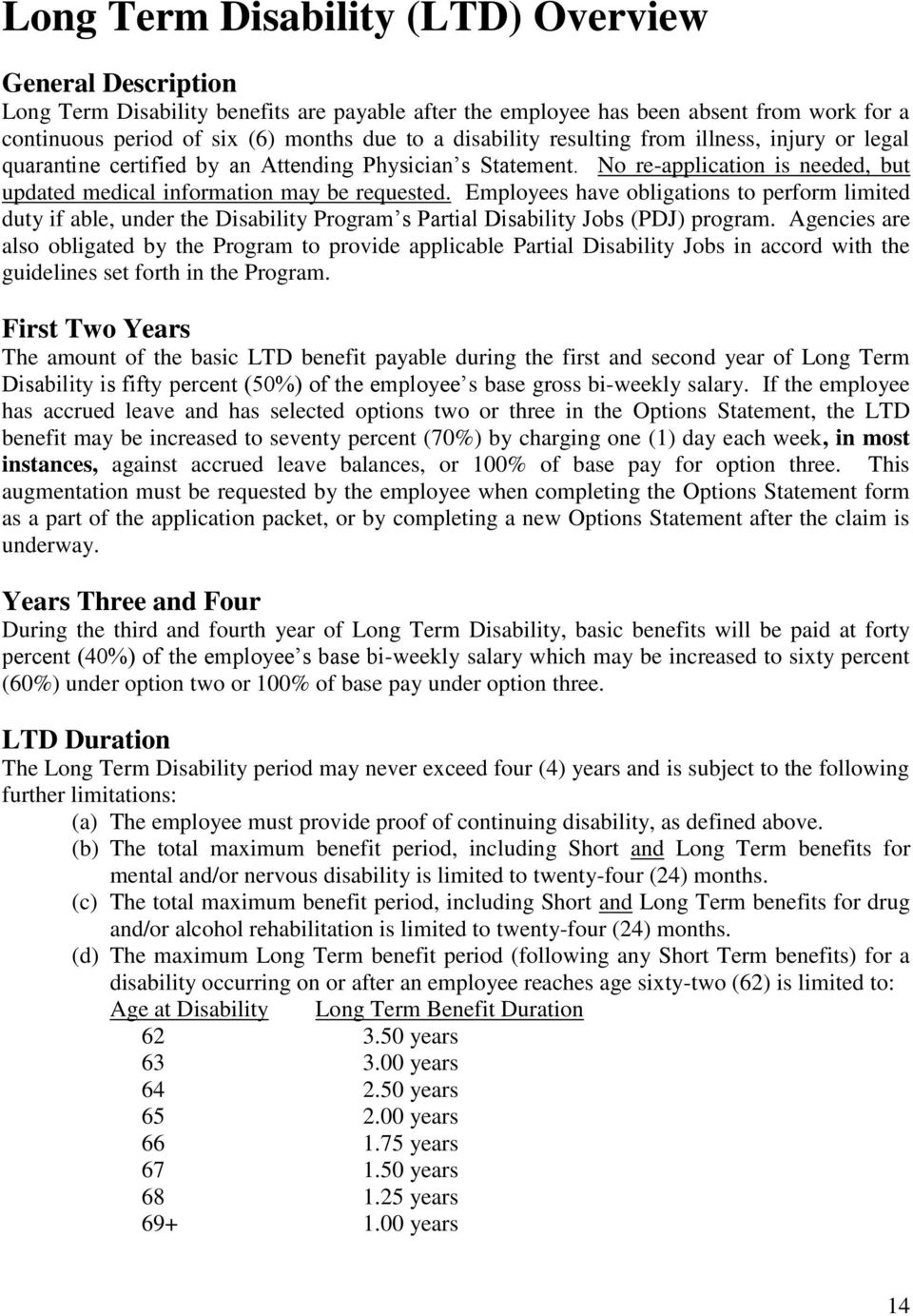
15 Long Term Disability (LTD) Overview General Description Long Term Disability benefits are payable after the employee has been absent from work for a continuous period of six (6) months due to a disability resulting from illness, injury or legal quarantine certified by an Attending Physician s Statement. No re-application is needed, but updated medical information may be requested. Employees have obligations to perform limited duty if able, under the Disability Program s Partial Disability Jobs (PDJ) program. Agencies are also obligated by the Program to provide applicable Partial Disability Jobs in accord with the guidelines set forth in the Program. First Two Years The amount of the basic LTD benefit payable during the first and second year of Long Term Disability is fifty percent (50%) of the employee s base gross bi-weekly salary. If the employee has accrued leave and has selected options two or three in the Options Statement, the LTD benefit may be increased to seventy percent (70%) by charging one (1) day each week, in most instances, against accrued leave balances, or 100% of base pay for option three. This augmentation must be requested by the employee when completing the Options Statement form as a part of the application packet, or by completing a new Options Statement after the claim is underway. Years Three and Four During the third and fourth year of Long Term Disability, basic benefits will be paid at forty percent (40%) of the employee s base bi-weekly salary which may be increased to sixty percent (60%) under option two or 100% of base pay under option three. LTD Duration The Long Term Disability period may never exceed four (4) years and is subject to the following further limitations: (a) The employee must provide proof of continuing disability, as defined above. (b) The total maximum benefit period, including Short and Long Term benefits for mental and/or nervous disability is limited to twenty-four (24) months. (c) The total maximum benefit period, including Short and Long Term benefits for drug and/or alcohol rehabilitation is limited to twenty-four (24) months. (d) The maximum Long Term benefit period (following any Short Term benefits) for a disability occurring on or after an employee reaches age sixty-two (62) is limited to: Age at Disability Long Term Benefit Duration years years years years years years years years 14
16 Recurring Disability An employee who returns to work after receiving Long Term Disability (LTD) benefits and within six (6) months/180 days becomes disabled from the same condition that caused the original disability or a closely related condition will not be required to satisfy a new elimination period. The employee may go back on LTD and the entire period off work will be considered as one continuous period of disability and will not establish a new benefit period. In short, the clock on the re-opened existing disability claim starts running again where it stopped when the employee returned to work. The employee must submit a new Attending Physician s Statement or other reliable certification by a doctor of the recurrence of the disability. Brief Periods off work for Medical Treatment for Disabling Condition If an employee returns to work after receiving LTD benefits and must be off work for brief periods periodically to receive medical treatment for the condition causing the original disability, those periods are eligible for coverage under the basic LTD benefit or the employee may elect to use accrued leave time to receive full compensation. The basic LTD benefit paid during these periods will be fifty percent (50%) or forty percent (40%) of the employee s base bi-weekly salary, depending upon the duration of the claim. After Disability Benefits Are Exhausted If the employee remains disabled and continues to receive benefits under the Program for the full period allowed, the employee and the agency will be notified by JWF Specialty before disability benefits are exhausted. The employee is transferred to the agency for termination of employment by retirement or resignation. LTD Social Security Disability Application Requirement Employee Obligation to file for SSD If the employee enters the Long Term Disability Program, he or she must apply for Social Security Disability from the federal Department of Health and Human Services, Social Security Administration. JWF Specialty will notify the employee on a letter or paycheck insert to contact the nearest Social Security office. The Social Security office will provide the forms and instructions to apply. Denials: If benefits are denied on the first application, the employee must pursue reconsideration. If this is denied, the employee must pursue at least one appeal at the hearing level. Repayment of Disability for SS Awards: If Social Security Disability is awarded, the employee must notify JWF Specialty within seven (7) calendar days of receipt of the notice of the award, and send a copy of the award letter. The employee must also notify the JWF Specialty upon receiving the first Social Security check. An award of a lump sum for back pay is subject to collection by the State as reimbursement for benefits already paid. The regular monthly benefit amount is then applied to reduce or offset 15
17 future wage replacement benefits from the State Disability Fund, dollar for dollar. This is authorized by 31 IAC PERF: If SSD is awarded, employees are required to apply for pension benefits and are required to report the award within 7 calendar days so an offset can be calculated. Legal Assistance Employees may seek legal assistance in their quest for Social Security Disability benefits, if they so desire. The State will not attempt to collect back pay for that portion assigned to the attorney as a contingency fee. JWF Specialty may refer an employee to a consultant for assistance in applying for and obtaining Social Security Disability. This would be at no cost to the employee. If successful, the State would pay the fee of the consultant, and then seek its share of the SSD back pay and future offsets from the employee. 16

18 Partial Disability Program (PDJ) Purpose 31 IAC outlines the authority for the Partial Disability Program. The PDJ returns Short and Long Term Disability recipients to work who are able to perform gainful employment but not capable of performing their own duties. The PDJ program assists in transitioning a disabled employee to a suitable work assignment, and provides additional staff to the State. Employee Benefits An employee performing a work assignment through the PDJ program will receive an increase in disability to 80% of bi-weekly wage or the minimum hourly rate for services performed, whichever is greater. This applies to recipients on Short Term Disability and years 1 & 2 of Long Term Disability benefits. Employees performing PDJ assignments will also begin to accrue leave time under the Personnel Rules of the State. Employees will also benefit from a PDJ placement by being exposed to employment opportunities suited for their level of disability. This can lead to long term full time employment in these occupations. Agency Benefits Employees performing PDJ assignments are paid wages via the State Disability Program, rather than from agency budgets. Therefore, the PDJ program provides agencies opportunities to improve productivity even when there are restrictions on hiring new employees. Having a PDJ employee on staff frees regular staff to accomplish critical service tasks. Participation All State agencies and all State Disability claimants are required to participate in the PDJ program. Agencies: Must actively create and offer PDJ placement opportunities on a regular basis. Agencies are also required to accept disability recipients who are qualified to perform appropriate duties, within reason, regardless of the employee s originating agency. Supervisors of PDJ recipients performing an assignment should apply all personnel policies to the management of that employee, including disciplinary action for work performance and attendance rather than the supervisor from the originating agency. Employees on PDJ will remain on JWF Specialty s payroll and in disability status. Employees: When assigned PDJ, an employee must adhere to the assignment, including abiding by all HR polices of the State and the agency for which the assignment is being performed. Refusal of an appropriate assignment (which adheres to the disability directives outlined by a physician) will result in termination of an employee s disability benefits and can also lead to disciplinary action under State Personnel Department policies. When working under the PDJ program, employees report directly to supervisors at the assigned agency, and are not under the direction of supervisors at the originating agency. It is the responsibility of the employee to adhere to the policies of the assigning agency. 17
19 PDJ Assignment Guidelines Agencies should examine all work processes at the task level, rather than looking to fill whole vacancies. PDJ assignments must be located within 30 miles of the employee s most recent full time assignment prior to disability. They can be: limited to any singular task performed temporary projects backlog restoration greeting the public in service video monitoring phone answering filing part time limited time period work at a full time or part time basis any other tasks that fall within a disability recipient s restrictions Communication Requirements of Agencies & JWF Specialty Once identified, PDJ availability must be communicated to the agency s assigned JWF Specialty contact. JWF Specialty will actively pursue PDJ placements to any eligible disability candidate and will regularly review the overall PDJ bank and disability rolls to ensure the most effective use of this program. JWF will facilitate communication between the assigning agency and the disabled employee of the expectations and duration of the assignment. If a problem arises, either party may contact JWF Specialty for assistance in resolving the dispute. When communicating a PDJ request to JWF Specialty, agencies should include the following: Basic description of duties Primary physical demands of the job Suggested hours required for the position If temporary project, a general scope and timeframe Agency contact information for placement Consequences for Assignment Refusal If recipients assigned to PDJ disagree with the determination that they are capable of performing the duties based on their disability, the disagreement must be communicated in writing along with substantiating medical evidence to JWF Specialty. The dispute will be resolved in adherence with the State Disability Program. JWF Specialty may request an Independent Medical Examination whenever appropriate to assist in this resolution. If, after substantiating the appropriateness of the assignment pursuant to the State Disability Program, an employee still refuses to report to duty, disability benefits may be terminated, and the assigning agency may pursue disciplinary action. 18

20 Part Time Disability General Description Employees receiving benefits approved in accord with the State Disability Program can return to original work assignments on a part time basis subject to appropriate medical documentation. Consideration JWF Specialty reviews every disability file to determine a claimant s ability to return to regular duty on a part time basis. Hours assigned must be medically approved and continuously reviewed as part of the claim administration process by JWF Specialty. JWF Specialty will ensure that the physician has recommended these reduced hours on a temporary basis. The goal of this benefit is to assist the employee to full recovery expeditiously and is not intended to be a permanent assignment. JWF also initiates contact with State agencies to discuss placement of claimants on this part time basis. State agencies should make every attempt to accommodate these time restrictions, as this benefit often provides quicker recovery to full duty and assists in mitigating interruption of work production. Employees or State agency personnel may also initiate a request for this consideration, and should contact JWF Specialty to request a review for eligibility to return on a temporary basis. Ability to Perform Duties If, after an honest attempt to perform part time work, an employee is medically unable to meet the requirements, the claimant will be returned to full time disability under the Program. Administration & Payment The employee is paid full base salary for hours worked and the disability rate is paid for the hours missed due to the disability. Both the full wages and the disability wages are paid by the agency. JWF Specialty will calculate the disability portion of the wages and provide this information to the agency. JWF Specialty will instruct the agency to process reimbursement for the disability portion. 19

21 MINIMUM BENEFITS Description Minimum Benefits are created by an offset to disability benefits. This offset can originate from several income sources as outlined in the Offsets section of this manual. These are most commonly Worker s Compensation payments and Social Security payments. The purpose of Minimum Benefits is to pay the employee and employer portions of the State sponsored insurance package. Minimum benefits created by an offset for Worker s Compensation injuries are billed to the agency. Minimum Benefits created by an offset from other income, including Social Security, are paid out of the Disability Fund. An employee who qualifies for Minimum Benefits will be eligible for continuation of insurance benefits as follows: (a) An employee who qualifies for the Short or Long Term Disability Program but whose benefits would be zero because of the offset provisions shall receive a guaranteed minimum benefit sufficient to make the employee contribution to group medical, dental, vision, life insurance plans and employee assistance program offered by the State. Employees can also make changes during open enrollment periods while on disability. (b) Those employees on Worker s Compensation who are augmenting their benefits with accrued leave do not qualify for Minimum Benefits because contributions are being paid as if in pay status through the payroll system. 20
22 Worker s Compensation Program Worker s Compensation Benefit Description The State provides a Worker s Compensation Program for all employees, as required by Indiana Code through Worker s Compensation is the employee s exclusive remedy for an injury that arises out of and occurs in the course of employment. Although employees cannot sue their employers or co-workers for injuries that are deemed compensable under Workers Compensation, employees are guaranteed certain benefit payments within certain timeframes without having to sue. Worker s Compensation benefits generally consist of: Wage Replacement: Temporary Total Disability (TTD); or Temporary Partial Disability (TPD) 100% Paid Medical Care (Necessary to treat the injury and bring the employee to Maximum Medical Improvement from that injury) Impairment Compensation for Permanent Partial Impairment (PPI). This compensation is often referred to as a settlement. It can be paid in a lump sum or structured. It is based on a statutory formula which was created to compensate injured workers for the partial or total loss of use of a body part or function, or compensation for amputation of a portion of the body. Employer Choice of Medical Care The State delegates to JWF Specialty the authority to choose and direct an injured employee s medical care. This is a right of all employers in Indiana, and it should be exercised correctly, in order to avoid relinquishing it. This means that while the employer does have the right to direct care, the employer also has the obligation to provide quality care promptly and with due diligence. Not doing so can result in forfeiting the right to direct care, which allows the injured worker to direct medical care. Work very closely with your representatives at JWF Specialty to ensure you have an effective plan in place the minute an injury is reported. Wage Replacement Compensation Description (TTD, AWW) Salary continuation, or the temporary total disability benefit (TTD), under Worker s Compensation, is 66 2/3% of the employee s average weekly wage (AWW) on the date of the injury. AWW is defined as the wage an employee earned on average per week for the past 52 calendar weeks. It includes overtime and any other adjustment that is considered to be income to the employee. The payment of TTD is subject to a cap. All employees earning wages in excess of the Maximum AWW will receive only the Maximum TTD rate. There is a 7 day waiting period that must first be met. TTD compensation is paid beginning the 8 th day an injured worker is off work. An employee receives TTD for the first seven (7) calendar days of his/her disability (or reinstatement of paid leave days) only if the disability continues for longer than twenty-one (21) calendar days. Note that the seven (7) calendar day wait may not have to be consecutive 21
23 days, but only seven days of actual disability from work due to the injury. Depending upon the specific date of injury, the Worker s Compensation Act sets forth the wage benefit. JWF Specialty will calculate the compensation owed pursuant to the guidelines in the Act. The amount of TTD is not changed by any salary adjustment that occurs after the employee s date of injury. In other words, the employee is locked-in to a certain Worker s Compensation rate by his/her date of injury, and that rate does not change over the period of disability due to that injury. (This is not true for the Short and Long Term Disability Benefits.) Taxes Worker s Compensation salary continuation benefits are not subject to state or federal income tax, and are not included in the W-2 Wage and Tax Statement. (Again, this is different from Short and Long Term Disability Benefits.) This is one reason it is important that employees be paid under the proper program. Insurance Deductions Medical, dental, vision and life insurance deductions are not taken out of Worker s Compensation salary continuation benefits. The leave codes that are entered into PeopleSoft notify the insurance carriers whether or not to bill the employees for their insurance premiums. Object Codes for WC Payments The State is self-insured for its Worker s Compensation obligations, so benefits are paid directly from agency operating budgets through the use of a claim voucher. TTD Payments are made from.5120 minor object code. Medical Payments are made using the.5720 minor object code. Voucher Completion The employee s name, date of accident and the dates for which compensation is being paid would be put on the claim voucher and voucher abstract. JWF Specialty, the administrator, will generate the necessary documents. Ending a Worker s Compensation Claim All claim determinations in Worker s Compensation are medically driven. The State is required to care for an injured worker through the appropriate compensation and benefits until the employee reaches Maximum Medical Improvement (MMI), as determined by the treating physician. This is also called quiescence. It simply means that an employee s condition as a result of the occupational injury or illness will no longer improve. Many employees return to work with no problems after reaching MMI. However, some badly injured employees will also suffer disability beyond the point of MMI. The State provides these injured workers the right to enter into the State s Disability Program, once all Worker s Compensation Benefits have been exhausted as long as additional time is available to the employee through the guidelines of the Program. 22
24 When a Claim is Reported Responsibilities Agencies should work very closely with JWF Specialty in the initial investigation, and ongoing progress of claims. This includes providing any information about an employee's activities that might impact the claim, as well as work functions that can be accommodated, or any other modified duty that can be offered to avoid unnecessary lost time. JWF Specialty will conduct a professional claims investigation to determine eligibility. Compensability is defined by the statute as claims that arise out of the course and within the scope of employment. If the claim is denied the parties will be notified, and if a dispute arises over the denial, JWF Specialty will work with legal counsel to defend the case on behalf of the State. If the claim is accepted as compensable, the claim will be administered for: medical evaluation and treatment; payment of medical bills; payment of TTD (if necessary); and ongoing evaluation through closure. JWF Specialty acts on behalf of the State to: select treating physicians; set targeted benchmarks to anticipate closure of the claim; and communicate with the injured worker and the physicians on the responsibilities each has on behalf of the claim. In the event a dispute arises in a claim, JWF Specialty works with the claimant and agency to resolve the dispute. If the dispute escalates to a formal complaint to the Indiana Worker s Compensation Board as a request for hearing, JWF Specialty will obtain competent legal counsel versed in Worker s Compensation law to represent the State before the Board. Investigation and Processing Responsibilities of Worker s Compensation Claims When an employee presents an injury claim related to employment, the agency s Worker s Compensation Coordinator (WCC) should gather the information needed to report the injury to JWF Specialty. The State Form 34401, Employer s Report of Injury/Illness of Employee is a guide to the information needed. The WCC should then call JWF Specialty at and report the necessary information, along with the agency code. Faxed reports are also acceptable, and can be sent in 24 hours a day to JWF Specialty does not need a paper copy of the Employer s First Report of Injury JWF Specialty will set up the claim file and send the agency an acknowledgement with the claim number and the name and phone number of the claims professional assigned to the case. Forms for Worker s Compensation JWF Specialty also files appropriate State Forms on behalf of the State to ensure compliance with the Worker s Compensation statutes. These forms include the Employer s First Report of Injury SF 1043, the Report of Claim Status SF 38911, and the Agreement to Compensation SF Information needed to complete these forms is provided by various entities, including the agency, which must provide an accurate account of the incident details. Worker s Compensation and the Disability Plan Worker s Compensation benefits do not include payment of any premiums to continue coverage. The Disability Program includes provisions for minimum benefits when an employee is on Worker s Compensation. However, the 6 month work requirement must be met. Therefore, if an injured worker is not supplementing Worker s Compensation with accrued leave and is eligible 23
25 for disability, claims for disability and Worker s Compensation benefits should be filed under both plans. Where it appears an employee who meets the 6 month work requirement will be disabled from any illness or injury, including one covered by Worker s Compensation, such that he/she will probably be unable to work for at least the thirty (30) day elimination period, he/she should be given an Application for Disability Benefits packet and an Attending Physician s Statement. These should be completed and submitted to JWF Specialty within the thirty (30) day elimination period to avoid delay in benefits. It is important to note that Worker s Compensation, FMLA and disability all run concurrently and employees must be notified of these designations when they are made. Worker s Compensation Claimants NOT Eligible for Both Plans If you have an employee who suffers a compensable Worker s Compensation injury and receives Temporary Total Disability from Worker s Compensation, then the payroll clerk should place that employee in Worker s Compensation leave status so that the employee will be billed at home for his or her share of premiums, and the State s share will be paid by the employing agency upon notice from the benefit carriers. This applies to employees who are eligible for minimum benefits. Also, during the 30 day elimination period, the employee will be responsible for their share of the premiums. Supplementing Worker s Compensation TTD Payments Most State agencies allow their employees to supplement Worker s Compensation TTD benefits with their own accrued leave in order to receive 100% of regular salary from the two sources combined. This is accomplished by the employee receiving 66 2/3% of non-taxable salary replacement through the Accounts Payable process of claim vouchers paid from the agency s.572 object code. Then the agency also leaves the employee in pay status on the Auditor s payroll system and arranges for the employee to be paid a gross payment every two weeks equivalent to 33 1/3 of regular payroll warrant. This payment is taxable and the employee s share, if any, of insurance premiums is deducted. The agency then charges the employee with having used 3 accrued leave days the first pay period, 3 days the second and 4 days the third, then repeats the cycle. This results in the employee being charged an average of 3 1/3 day each pay period. Reporting Questionable Claims In accordance with Indiana Worker s Compensation statutes, once an employer has knowledge of an injury or a claimed injury the employer is obligated to report the claim, even if there is a question as to whether the injury is compensable. Calling JWF Specialty to report that an employee has reported an injury to your agency and/or completion of the S.F (Employer s First Report of Injury) form is not an admission of liability. JWF Specialty will send notice to the agency or institution within two (2) weeks of the report of claim if it is deemed non-compensable. JWF Specialty also files the Report of Injury with the Worker s Compensation Board electronically, as required by law. 24
26 Special Situations in Worker s Compensation Other Employment In Worker s Compensation cases, if the employee obtains any other employment after the onset of disability, it is grounds for discontinuing TTD benefits. Questions Agencies with questions about Worker s Compensation or disability benefits that have not been covered or adequately explained in this manual can consult the following sources: JWF Specialty State Personnel Department, Benefits Division. 25
27 Temporary Modified Duty (TMD) Program Purpose & Policy Statement It is the policy of the State of Indiana to provide meaningful work activity for all employees who temporarily become unable to perform all or part of their regular work assignments due to workrelated injury or illness. By providing temporary transitional work activity, injured employees remain active and vital participants in their employment. Temporary duty may be in a variety of formats including modified duties within the scope of an employee s current position; other available duties for which an employee may be qualified; or a modified schedule of reduced work-hours. Agency Requirements TMD is created and made available by individual agencies as part of the State s program pursuant to this policy. All State agencies are required to actively participate in designing, offering and monitoring TMD as outlined herein. Employee Requirements All employees who are assigned modified duty are required to report for modified duty, as long as the duty assigned falls within the restrictions outlined by the Worker s Compensation treating physician. Assignment Process: Consideration: TMD will be available to all employees on a fair and equitable basis, with temporary assignments being based on skill and abilities. Form: Treating physicians will be asked to complete a TMD Physical Evaluation Form when seeing patients, to provide detailed information to the State as to an employee s ability to perform modified work. Same Day Return: In many cases, the employee will be required to request these restrictions to be completed by the treating physician and returned to the agency in the same day. Once recommended, the State agency is required to participate fully in the program Timeframe of Assignment: TMD will typically be assigned for a period not to exceed 90 days. Subsequent limited assignments may be approved as needed. Restriction Application: An employee s limitations/restrictions are effective 24 hours per day. Not following these restrictions can aggravate an employee s condition and cause a delay in the recovery process. An employee who is found to be performing activities outside the treating physician s prescribed restrictions may be subject to termination of Worker s Compensation benefits, and may also be subject to disciplinary action under State Personnel Policies. Dispute Resolution: Concerns about participation should be addressed with the Human Resources representative of the agency, State Personnel Department Benefits Division and JWF Specialty. 26
28 Scheduled TMD Assignments In most case, TMD shall be offered within the employee s regular work schedule; however, restricted or altered work schedules may be required if designed reasonably and within the parameters of any restrictions and recommendations by the treating physician and claims professionals at JWF Specialty. Payment of Wages Employees performing TMD shall be returned to pay status and paid their full hourly rate for the hours worked as an incentive for participating in the return to work program. Partial Disability Employees working TMD assignments that involve a reduction of hours may also be entitled to Temporary Partial Disability (TPD) pursuant to IC TPD was created by the Indiana General Assembly as in incentive for employees to return to work on a temporary basis while still partially disabled, but not yet at maximum medical improvement. Temporary Partial Disability will be calculated by JWF Specialty, pursuant to the statutory formula. Vacation/Personal/Holiday/Sick (Accrued Leave) If an employee participating in TMD has an approved vacation, sick or personal day, or upon the occurrence of a holiday, the employee is entitled to regular leave pay at the regular rate as long as there were hours physically worked by the employee within that week, pursuant to State Personnel Policies. Other Use of Leave If an employee on TMD is unable to report to work for reasons unrelated to the compensable injury, the employee may then be charged for up to the full number of hours scheduled for that shift of accrued leave if the employee has the appropriate leave available. If no leave is available, employees who have been approved for and required to participate in TMD who do not report to work will be subject to State Personnel Policies normally applicable to absence from work. 27
29 TMD Administration Checklist: Pro-Active Pre-Injury Responsibilities: Maintain an open culture regarding injuries and disabilities in the workplace. Perform detailed job analysis and maintain updated job descriptions for each employee. Identify all opportunities for TMD and create job tasks to have ready using the TMD Opportunities Form. Encourage early reporting of all injuries and disabilities without penalties. When an Injury Occurs: Attend to the employee s medical needs immediately by selecting a treating physician from the JWF network. Send the employee to the physician with a Temporary Modified Duty Physical Evaluation Form (attached). Establish and enforce an agency RULE that your employees are to return to work from physician appointments the same day with this completed form in hand so you can assign TMD on the spot. File the First Report of Injury in concert with directives on the program as administered by JWF Specialty. JWF will advise you when claimants who have been totally disabled can return to participate in TMD, and will provide you with a copy of the physician s recommendations for work restrictions. Accommodate these restrictions and assign the TMD right away. Use the TMD Assignment Form (attached), accompanied by a letter (template attached), documenting the expectations of TMD participation and the consequences for refusal. Establish an expiration date for TMD. Use 90 days or the next physician s appointment date, whichever is sooner. A new form can be used at the end of 90 days if restrictions continue and the employee has not reached maximum medical improvement. Employees are paid pre-injury full wages for the hours worked, regardless of assignment. Respond to negative behavior swiftly. Implement further disciplinary action in accord with SPD policies. Welcome the employee back to full duty without penalty and thank the employee for playing a diligent role in his/her own recovery. Encourage and accept an employee s feedback on the program and communicate suggestions for improvement to JWF Specialty. 28
30 TMD Opportunities Form This form is being distributed to all departments within the agency to develop a Modified Duty job bank. This proactive approach will ensure that injured workers will be offered modified duty consistent with their restrictions in a timely fashion upon their first ability to return to the workforce. The Sate s program requires all supervisors to create and provide TMD opportunities. Some examples include, clerical work, light maintenance and repair work, organization of office supply areas and record keeping locations, additional phone service to customers, additional walk-in support, receptionist assistance, eliminating backlog, and job sharing. Please submit this completed form to By Department Name: Supervisor/Phone: Date Submitted: Description of Modified Duty Work: Description of physical requirements to perform this work: Duration of task (if appropriate, i.e. 3 full time days to clean a storage room, etc.) 29
31 Temporary Modified Duty Physical Evaluation Form Employee Name: Agency Name: Agency Contact & Phone: Part 1 - Attention Agency Personnel: This form is to be completed by you and the employee prior to examination by the treating physician, who will complete it at the appointment. JWF Specialty has established the treating physicians for many agencies. However, if you are not familiar with your physicians in the state s network for worker s compensation, please contact your JWF Specialty representative at 888/ Part 2 - Attention Employees: The Indiana Worker s Compensation Act provides benefits to injured workers. One such benefit is that you are entitled medical treatment for injuries that arise out of the course and scope of your employment by a physician selected by your employer. Your treating physician for this appointment is: Your responsibilities: Attend this appointment on time; Request that the bottom portion of this form be completed by the physician; Return to your work station within the same business day with the completed form; Perform Temporary Modified Duty upon assignment. Supervisor approval is required if you do not return to work same day to avoid lost time penalties.. Supervisor and Employee Initials Here: Date: Part 3 - Attention Medical Providers: Thank you for evaluating or treating the above employee of the State of Indiana. To promote healing and expeditious return to full duty, the state has implemented a Temporary Modified Duty plan. Whenever possible, our employees are to return to work the same day with restrictions in hand to be evaluated for the provision of TMD. With that in mind, please provide specific information about the above employee s restrictions and an estimated duration for those until resolved or required to be re-evaluated in follow-up. Can the patient return to appropriate modified duty today? Yes No Explain if No: Restrictions (please be as specific as possible): (If you prefer to attach your own equivalent form for restrictions, please do so) Until: Follow-up: Yes, (date desired if yes) No 30
32 Temporary Modified Duty Assignment Agency Name: Date of Injury/Illness: Employee Name (Last) (First) (Middle Initial) Original Department: Description of Treating Physician s Restrictions: TMD Department (if different): Describe TMD Below: TMD Hours/week: TMD Ending Date: TMD Ending Date: TMD Ending Date: 90 days unless released at maximum medical improvement. Second 90 day period, or until maximum medical improvement. Third 90 day period, or until maximum medical improvement. Date Date Date Employee Signature Date Supervisor Signature Date Employees are required to adhere to prescribed restrictions while recovering from Worker s Compensation injuries 24 hours/day. Employees found to be violating prescribed restrictions at any time or place may be subject to termination of worker s compensation benefits. A new form should be used if restrictions change, in order to record new TMD assignment. Employees who refuse to participate in TMD, will be subject to disciplinary action, up to and including termination. Report any problems in ability to perform TMD immediately to supervisors and JWF Specialty. 31
33 Employee Letter from Agency Draft (Date) Name Address City, State, Zip RE: Temporary Modified Duty Assignment Dear State Employee: According to your treating physician, (Name), you have been released to return to work in a modified duty assignment. Work is available which meets your restrictions. Your starting date is (Date), and you are to report to (Name of Administrator) at (time). This is to confirm that your hours will be from (Start Time to End Time) per day for a total of (Number) hours per week. Your wage will be (Rate) while you perform this TMD. You will receive (Rate) as regular earned wages while you perform this assignment from the agency, but your case will remain an active Worker s Compensation claim as administered by JWF Specialty. Failure to report for the TMD assignment will jeopardize your Worker s Compensation benefits and may also jeopardize your employment. Please contact me with any questions you have. Sincerely, (Name of Human Resource Director) (State Agency Name) 32
34 Tortious Acts Benefits An employee who, in the scope of State employment, is disabled by injuries resulting from the tortious (wrongful or negligent) act of another person, shall receive one hundred percent (100%) of his/her base bi-weekly salary from the agency as authorized by JWF Specialty. An example of a tortious act covered by this program would be an attack on an employee by a patient or inmate. The statute makes clear that this benefit is to cover disability resulting from acts of active as opposed to passive negligence. All State employees injured and thus disabled under such circumstances are eligible to apply for this benefit regardless of date of hire. Notice of claims If an employee is injured on the job as the result of an act of another person, he/she should be provided with an Application for Disability Benefits packet and an Attending Physician s Statement at the time of the injury. The employee should be instructed to have these forms completed immediately and submitted to JWF Specialty directly or to a designated agency HR representative to avoid a delay in benefits. This can be done through the agency. These claims should also be filed as Worker s Compensation cases with JWF Specialty to invoke the procedures for compliance. Allowances for Tortious Act Benefits A seven (7) calendar day elimination (waiting) period applies to this benefit. During the elimination period the employee may use accrued leave benefits to receive pay. Unlike STD and LTD, the seven (7) day wait for Tortious Act Disability benefits does not require the days be consecutive but does require that the employee be unable to work due to disability caused by the injury. This is the same interpretation applied to the seven (7) calendar day waiting period established by the Worker s Compensation Act for Temporary Total Disability (TTD) benefits. If the employee is disabled more than twenty-one (21) calendar days due to this type of injury and is eligible for Worker s Compensation, the leave days used can be partially restored by Worker s Compensation. If an employee does not have accrued leave available to cover the elimination period, TTD will be paid for the elimination period if the employee is off for more than 21 days. Duration The maximum duration of Tortious benefits under this section is one (1) calendar year from the date of the job-related injury or upon recovery, whichever is sooner. After exhaustion of this benefit, if the employee remains disabled, the employee may be eligible for salary continuation under Worker s Compensation and/or LTD. In this situation, LTD benefits may be provided for the maximum Long Term Benefit Period under the guidelines of the Disability Program. Important Distinction to avoid Double Dipping The employee cannot receive both the Tortious Act Disability benefit and Worker s Compensation wage replacement simultaneously. Payment of Tortious Act Disability benefits satisfies the statutory duty under the Worker s Compensation Act. Note that for an employee on Tortious Act Disability, medical bills related to the injury should be paid by his or her agency as Worker s Compensation expenses, under a regularly established Worker s Compensation claim. 33
35 Disability Administration Process Disability claims begin with the submission of the Disability Application Packet. This includes the Employer s Report of Claim, the Employee s Claim Statement, Options Statement, Employee s Authorization for Release of Medical Information, and the Attending Physician s Statement. These are to be submitted to JWF Specialty. Effective Date The effective date for benefit calculations will be based upon the postmark date or upon JWF Specialty s date stamp if the Application Packet was not mailed. When claim paperwork is submitted through the agency and promptly forwarded, JWF Specialty may accept the agency s date stamp as the filing date. An agency may forward the packet to JWF Specialty on behalf of an employee. The packet should be date stamped in order to aid in tracking eligibility timeframes. The Employee s Application Packet Includes: (a) Employee s Claim Statement. This is the employee s request for benefits. The employee should complete this form by him or herself. However, if an employee is unable to complete any form due to the disability, it may be completed by a family member, a supervisor or another person, to ensure timely application. Original employee signatures can later be obtained when the employee is able. (b) Employee s Authorization for Release of Information. This form authorizes the disability staff to collect additional medical information if needed to process benefits (applies only to condition(s) causing the disability). (c) Options Statement. This form tells the how the employee wants the benefits to be paid. In the absence of a correctly completed Options Statement, the employee will be paid at the basic benefit rate (Option 1). Options may be changed at any time during the life of the claim, by completing a new Options Statement; however, any changes will apply only to future benefits as of the date received, NOT retroactively. Option 1 This pays the basic benefit of 60% of regular biweekly salary for the Short Term, 50% for the first two years of Long Term, and 40% for the third and fourth year of Long Term Benefits. Option 2 The employee may choose to receive 20% more than the basic benefit by using two (2) days of accrued leave per pay period, in most instances, as long as these leave days last. In this option, an employee is eligible to use one leave day per each 5 days of disability, but the employee must also be disabled for a full week to obtain the right to use one leave day. 34
36 Option 3 Under Option 3 the employee requests and the agency grants use of accrued compensatory time off, sick, vacation, personal or special sick leave in lieu of regular short and/or long term disability benefits. In most instances, on Option 3, one (1) day of accrued leave is charged for each day of absence. Disability Application Packet Deadline Packets received after the thirty-first (31 st ) consecutive day absent from work due to disability will result in the loss of benefits for every day late. It is forbidden by law to pay disability benefits for days prior to the receipt of the application for such benefits. Important Administrative Note on Holiday Pay & Accrued Leave: If an employee is using any option that involves using accrued time, the employee IS entitled to Holiday pay, except Option 2. If an employee is using Special Sick Leave, an option that involves accrued leave, the employee is NOT eligible for Holiday pay An employee on Option 2 or 3 may designate the order in which accrued leave time is charged; however, if FML applies, use of accrued leave must follow FML policy. Special Sick Leave is still only available to certain long-time employees who accrued this leave before July 1, 1989, and only when other types of leave (vacation, sick, personal, a limited amount of compensatory time) are exhausted. When an employee on Option 2 or 3 runs out of accrued leave, yet remains disabled, he or she automatically changes to Option 1. Tortious Act Injury Disability Benefits Packet Requirement Employees applying for this disability are required to file the three-part form due by the eighth (8th) day off work. Required: Attending Physician s Statement The employee is to complete only the top portion of the form and ask the attending physician to complete the rest. Disability determination and benefit payment cannot be made until the completed form has been submitted to JWF Specialty. This form must be signed by the physician, generally M.D. s and Ph.D. s. Additional information may be requested or claims can be temporarily suspended for reports from chiropractors, social workers, nurse practitioners or physicians assistants. During the period of disability the employee may be required to obtain additional periodic Attending Physician s Statements or medical updates as deemed appropriate for the disabling condition. This will be determined on an individual case basis according to an employee s medical condition and the anticipated length of disability. JWF Specialty will contact the employee and/or the attending physician directly to obtain the necessary information. 35
37 Note that a delay in receipt of the Attending Physician s Statement or Employer s Statement can delay the date the first check is cut, but will not result in an actual loss of benefit; however, if there is a failure to turn in the required forms, there will be a loss of benefits. Important Information on Disability Determination and the Attending Physician s Statement: The date of disability cannot ever be any date that precedes the date a patient is first seen by an appropriate practitioner. It is the employee s responsibility to see that requested medical statements are submitted. Failure to provide requested updated medical information can result in termination of benefits. Employer s Report of Claim This form should be completed by the agency payroll or personnel staff member assigned to this task. This form tells JWF Specialty what the base wage is, what the leave balances will be at the time the claim is to start, and other vital information. Any special sick leave balance must be calculated by the agency (after checking with State Personnel s HR Data Division) and documented to JWF Specialty in writing. Please note that it is essential that the agency carefully enter the date of full time employment, regardless of the date of hire. Employees who hire on as part time but eventually become full time are not eligible until the six (6) month full time requirement is met. Cases Regarding Vehicle Accidents or Crimes In cases where the disability is the result of a vehicle accident or a crime, the employee must submit a copy of the Police Report to JWF Specialty before benefits can be considered. 36
38 CHECKLIST FOR A DISABILITY CLAIM Generally, an Indiana State employee should apply for disability in the following circumstances: A disabling personal injury or illness is expected to last for more than thirty (30) days; An employee suffers a Tortious Act Benefits claim while performing work duties within seven (7) days of the occurrence; or, In a regular worker s compensation claim that is expected to result in the employee s disability for more than thirty (30) days. When an employee presents a claim: Give the employee an Application Packet for the employee to complete. Inform the employee that every form must be submitted to JWF Specialty within thirty (30) days after the absence begins. Late submission can result in lost days of disability benefits. Remind the employee to give only the Attending Physician Statement to the attending physician. The Employee Claim Statement, Employee s Authorization for Release of Information and Options Statement should not be given to the physician. Notify the employee that benefits under the FMLA run concurrent with the disability claim if the employee is eligible for FMLA. Give the Employee an Attending Physician s Statement. o Make certain the employee gives ONLY this form to the attending physician, and inform the employee that late submissions of this form by the attending physician could cause a delay in their disability benefits. o Advise the employee that this form may be needed additional times for medical updates as deemed necessary by JWF Specialty. Complete and submit an Employer s Report of Claim. o Take care to be certain it is thorough and accurate do not leave any fields blank e.g. last actual day worked. o Make sure to report the actual date the employee began service in full time status. JWF Specialty will review the claim and notify the agency and employee of the receipt of claim. o If any additional information is needed, JWF will contact the agency or employee accordingly. o Claims will be acknowledged by letter advising acceptance or denial. Accepted Claims are administered by JWF Specialty on behalf of the State. This includes: o Working with the agency payroll administrator to set up claim. o Reviewing the claim every two weeks to ensure proper continued eligibility. o Requesting appropriate supporting documentation from employees, physicians, and/or agencies. o Evaluate claims that are maturing to LTD, and notifying the employee of specific obligations related to LTD. o Administer LTD by monitoring the eligibility, reviewing medical updates, and communicating with agencies on the employee s ability to return to work on either Partial Disability or some other form of light duty during recovery, wherever applicable. o Terminating claims appropriately and in accordance with the Disability Program. 37
39 Important Administrative Notes All Disability Benefits State Agencies Not Paid Through The Auditor of State: Most of the payroll information contained in this manual refers to State agencies paid through the Auditor of State payroll system. If your State agency is not paid through the Auditor of State, you will need to work with JWF Specialty to ensure that the appropriate payroll actions are taken. Payroll Guidelines There may be a pay period when an employee: (a) works, (b) elects to be charged with leave time, (c) is charged with days lost, and (d) is eligible for disability payments. Add/Move Form (AP-63): At the time the claim is approved JWF Specialty will complete an Add/Move Form (AP63) to move the employee from the agency s payroll to the Disability Program s payroll so that the Auditor produces the bi-weekly disability checks and continues deductions and State contributions toward insurance coverage. On the first disability check, JWF Specialty will process any leave days used that pay period as well as the days of disability in a single check. ID Billing: The employing agency will receive an Inter-Departmental Bill (State Form 1351) from JWF Specialty to reimburse the Disability Fund for the day (s) that would otherwise have been processed through that agency s payroll, such as leave days. NOTE: The employee should remain on the agency s payroll and be processed accordingly until notification of approval has been provided by JWF Specialty. Checks Sent: Once the benefits begin, the employee will receive a disability check each regular biweekly pay period. The checks will be deposited via direct deposit or on the Indiana Visa Debit Card, whichever method was set up by the employee prior to the onset of their disability. Payroll Processing: While on disability, an employee may change his/her address or payroll deductions, just as regular employees do. JWF Specialty serves as the disability payroll in charge of such changes. The employee should contact JWF Specialty to receive the required forms and submit any needed documentation. JWF Specialty will file all appropriate forms and submit the AS-47 with SPD and the State Auditor s office. 38
40 Termination STD, LTD, or Tortious Injury Disability benefits terminate when any of the following occur: (a) The employee fails to submit information necessary for claim administration including, but not limited to, the following: (i) Authorizing attending physicians to release information to the State on the employee s condition and prognosis. (ii) Timely reporting income from sources specified in the Offsets section. (b) The employee refuses to submit to an examination by a designated physician. (c) The employee s medical condition no longer meets the standard set in the definition of disability. (d) The employee refuses to accept work assignments appropriate to the employee s medical condition. (e) The employee returns to regular duty. (f) The employee commits fraud related to their application for disability benefits. (g) The Short and Long Term Benefit Periods have been exhausted. (h) The employee is terminated by his or her originating agency for just cause unrelated to the disabling condition. Independent Medical Examinations The agency, JWF Specialty, State Personnel, or the Department of Health and Human Services (Social Security) may require an employee to attend a medical examination by designated physicians. Examinations by State-designated physicians shall be paid for by the State. If the employee requests a copy of the examination report in writing, JWF will send a copy to the employee s Attending Physician. The plan will not pay for examinations or tests that are not specifically ordered by the State. Notice of Examination: If an examination is necessary, the employee will be notified by regular and certified mail in advance of the time, date, and place of the examination. Failure of the employee to submit to a required examination or to authorize release of the medical information regarding the condition(s) causing the disability will result in disqualification or suspension of eligibility for benefits. Years 3 & 4: For employees who reach the third year of Long Term Disability, JWF Specialty may ask the employee to submit a Residual Functional Capacity Evaluation form, to be completed by the treating physician, at no cost to the State. Or JWF Specialty, on behalf of the State, may order an Independent Medical Examination at the State s expense. The results would be used to determine the employee s continued eligibility for LTD. Other Employment An employee who accepts other outside employment or receives remuneration (income) from another job entered into after the disability began, or an outside job where the hours or pay rate has increased after the onset of the disability, must report receipt of the income within seven (7) calendar days. Persons receiving Short or Long Term Disability payments may be prohibited from accepting other employment, outside State government, which would interfere with their rehabilitation. 39
41 Concurrent Claims When No Return to Work Occurred: If, prior to returning to work, the employee becomes disabled from working by a different condition that is not part of nor a consequence of the original disabling condition, benefits will continue under the existing claim. The second condition does not extend the length of the claim past the maximum 4.5 years. Benefits will be paid based on the inability to work due to either or both of the disabling conditions. After A Return to Work: If the employee is released to return to work based on improvement in the original condition and makes an actual return to work, and is subsequently disabled by a second condition then a new elimination period must be met and a new claim must be filed for consideration. General Return to Work Guidelines for Disability Recipients Returning Employees Transferring to Other Agencies: Any employee on disability who is released to work, with or without restrictions, may transfer out of disability to any agency to which the employee applies and is chosen to fill a vacancy through the competitive process just as any other State employee is free to apply for a transfer to other State jobs. Having been on disability does not encumber the employee from a transfer. Preliminary Part Time Returns to Work: Sometimes, a physician s release to return to work statement will contain a restriction providing that the employee make a part-time return to work. In these cases, the employee would go back on the agency payroll, and the agency would pay the employee at his or her normal rate for the time worked and at the disability benefit rate for time off due to the disability. Disability benefits are billed to the State Disability Program by the agency. This arrangement can last until the employee is released by the physician for a full-time return or as long as the employee is entitled to disability benefits. Releases and the ADA: If an employee is released to return to work and has any restrictions or is perceived as having a disability, he or she may be covered by the Americans with Disabilities Act and, therefore, the agency must consider reasonable accommodations to enable the employee to perform the essential functions of his/her job. For more information on the ADA, please contact your agency s ADA Coordinator or the State Personnel Department s Employee Relations Division. Long Term Disability Return to Work Guidelines & Retention Scoring If an employee, having recovered from LTD, desires to return to work, and the agency in which he or she was employed before the onset of the disability has no vacant position in the same classification or a similar classification with the same basic qualifications and salary range, retention scoring procedures shall be instituted to determine which employee is to be laid off. Retention scoring procedures are found at 31 IAC It is the agency s responsibility to initiate retention scoring. If the agency fails to request retention scoring promptly in this 40
42 situation, it may result in the agency having to reimburse the disability fund for benefits paid out to the employee after he or she was released to return to work. Returning an Employee to Same Agency: If the employee is released to return to work, and the agency does have an opening in the employee s originating classification - or a similar one - at the original facility (or one nearby), requiring the same basic qualifications and having the same salary range, the agency must take the employee back to work. If the vacant position is in the employee s original classification, or if the position is one with similar qualifications and duties and the same pay, but a different classification, it would be considered a transfer. Consult the State Personnel Department s Employee Relations Division for information about transfers and other employment matters. Contact State Personnel s Employment Division for information about qualifications, job openings, and job bank exceptions. Return to Work in LTD Years 3 & 4: If an employee in the third or fourth year of Long Term Disability is released to return to work with restrictions, that employee is no longer entitled to disability benefits. When benefits are otherwise due to cease because the disability does not meet the standard for the third and fourth year, the employer shall offer the employee the next available position within thirty (30) miles of the designated work station before the onset of the disability, at the same or a lower skill level, which he/she is legally qualified to fill and physically capable of performing. The third declination of such an offer is cause for termination of employment. The agency must offer the employee three different positions to meet this obligation, before terminating an employee from service. Disability benefits will terminate regardless of an employee s work status when an employee is no longer eligible as described herein. The last employing agency must return an employee to its payroll level and place the employee in non-pay status while attempting to place the employee. 41
43 Offsets The State Disability Program is designed to provide a basic level of income and continuation of insurance coverage to disabled State employees. If the employee receives additional income from any of the sources listed below, he or she must report it within seven (7) calendar days of receipt. Short and Long Term Disability salary continuation benefits shall be reduced, dollar for dollar, if the employee derives income, as the primary recipient, from any of the following sources: (a) Social Security (including SS Disability, and SS Retirement awarded, even to widows, after the onset of disability in lieu of SSD, but not Supplemental Security Income (SSI). (b) Public Employees Retirement Fund (PERF). (c) Teachers Retirement Fund. (d) Any other State-supported retirement fund. (e) Pension Disability, if for the same condition. (f) Worker s Compensation salary continuation benefits (from the State of Indiana or any other employer). (g) Benefits provided from another employer s group plan. (h) Remuneration (pay) for employment entered into after the disability was incurred (including any increase in pay realized after the onset of disability for an outside job that was held prior to disability). (i) Veteran s Disability Benefits, if they are payable as a result of the same disabling condition. Benefits provided by an individually purchased disability insurance policy will not be an offset. Offset Notices Requirements: A notice about the requirement to report other income and other work is enclosed with the employee s first disability benefit check, along with a form to complete, sign and return to report the other income and/or acknowledge the obligation to do so. JWF Specialty also sends out periodic reminder notices about other income during the course of a claim. Social Security Retirement and Disability: If the employee is already receiving Social Security Retirement when State disability benefits begin, the employee must notify JWF Specialty at the start of the claim. If Social Security Retirement payments begin during the State disability claim, the employee must notify JWF Specialty within seven (7) calendar days of receiving the first check. These retirement benefits will also be considered an offset. 42
44 INCOME ADJUSTMENTS Short and Long Term Disability benefits are not subject to adjustment based on increases in Social Security or pension benefits. Offsets are established at the time of the original award. Once the amount of the Social Security Retirement or Social Security Disability and/or pension benefit offsets are established, benefits remain constant, even if an employee receives a cost of living adjustment from the Social Security Administration. General salary adjustments granted to all employees in the disabled employee s classification shall cause the disabled employee s base gross bi-weekly base pay to be adjusted and will result in an increase in benefits under the Disability Program. Note that under Internal Revenue Service regulations, LTD benefits are subject to income tax, but are not generally subject to FICA/Medicare taxes, although there are some special situations. FMLA Impact on Disability Claims and Performance-based Merit Increases and Bonuses Disability claimants who have not exhausted FMLA benefits will be considered for performancebased merit increases and bonuses. Disability claimants who have exhausted FMLA benefits will not be eligible for performancebased merit increases and bonuses. SUBROGATION If the employee s disability arises out of a vehicle accident or other circumstance such that the employee may get a settlement or court award from an outside party for the injuries, the employee must inform JWF Specialty of any settlement. The State of Indiana has the right to place a lien on any such settlement to the extent of disability benefits and fringe benefit payments made to the employee or on the employee s behalf because of this injury. This is called a Subrogation Lien. When someone injured in an accident receives a settlement, part of that money is usually for lost wages. However, if the employee also receives disability or Workers Compensation benefits, not all the wages are really lost. So, the State requires the employee to repay the disability benefits paid to compensate for the same injuries. If a disability claim appears to be a candidate for subrogation, JWF Specialty sends the employee a notice of the requirement to reimburse the State out of any settlement received. Before settlement, the employee or legal counsel is asked to obtain a calculation of the total benefits paid so that this total can be included in the demand against the other party. If the total settlement is less than the total amount of disability benefits paid up to the date of the settlement of the third-party claim, the State is to collect only one-half (1/2) of the settlement in satisfaction of its lien. The State s lien is subject to reduction for a pro-rata share of attorney s fees, litigation expenses, or if the employee s award or settlement is limited for reasons listed in the relevant Indiana Code sections. Neither the State Personnel Department nor JWF Specialty is authorized to accept a lien settlement that is reduced below those statutory limits. 43
45 STOPPING DEFERRED COMPENSATION ON DISABILITY: Once FICA is no longer being paid, the employee ceases to be in current employment status and, therefore, Deferred Compensation contributions are also stopped. DISABILITY PLAN EXCLUSIONS The Disability Program, like nearly all insurance programs, have exclusions or circumstances under which the program will not pay even though the employee may be disabled. The exclusions under the disability program are practically identical to the exclusions under the Worker s Compensation program. Neither Short Term nor Long Term Disability benefits are payable for a disability resulting from the following: (a) War, declared or undeclared. (b) Participation in a rebellion, insurrection, or riot [by the claimant]. (c) Intentionally self-inflicted injury. (d) Commission, or attempt to commit, a crime [by the claimant]. (e) Accident caused by [claimant s] intoxication due to alcohol or illicit drugs. (f) Willful failure to follow designated safety procedures [by the claimant]. (g) Willful disregard of rules [by the claimant]. (h) Willful failure to perform a stated duty [by the claimant]. STAFFING REPORT LOCATION Employees on Short Term Disability will continue to occupy an appropriately classified Staffing Report position of the employing agency. Employees on Long Term Disability will be removed from the Staffing Report of the employing agency and placed on a special Disability Program Staffing Report containing the names and classifications of all persons on Long Term Disability. When an employee s disability claim ends for any reason, the employing agency must submit a Personnel/Payroll Action Form (PPAF) to the State Personnel Department s HR Data Division, so that the employee will be placed back on the agency staffing report. If the employee is deceased, terminated, resigned, retired, in a new job, etc., that information should also be included on the PPAF. ENROLLMENT/CONTRIBUTIONS All eligible employees who have completed six (6) months of continuous permanent full-time employment shall contribute to the LTD Plan through a payroll deduction one-quarter of one percent (.25% or.0025) of their bi-weekly salary. Coverage and contribution is mandated by law for these employees. Employee contribution levels have never increased since the Disability Program started in All State agencies whose employees participate in the Program, must also contribute a prescribed amount bi-weekly to the Disability Fund. The agency s payroll department is responsible for tracking their employees service dates and the payroll clerk must activate these contributions (deductions CE and H9) at the six-month anniversary date by submitting an AS-47 to the Auditor of State s Office. For example: Bi-weekly Salary Employee Contribution $ $1.75 $1, $2.50 $1, $
46 SPECIAL SICK LEAVE Special sick leave benefits that were accrued by employees prior to July 1, 1989, and which have not yet been used remain on account for use by the employee, unless the employee has had a break in service since The use of special sick leave is governed by the rules and policies that were in effect at the time it was accrued, as supplemented by official announcements from the State Personnel Director and Benefits Division Director (including memorandums to Appointing Authorities and Payroll Clerks dated December 13, 1976, June 25, 1982, and September 23, 1991). State of Indiana employees with more than one (1) year of continuous full-time employment as of June 30, 1989 were credited with five (5) work days of special sick leave for each full year of employment, less any special sick leave previously taken. Employees were credited with prorata amounts of special sick leave for continuous service as of June 30, 1989 beyond the whole years completed. In accordance with 31 IAC (and Public Law 27), any special sick leave accrued through June 30, 1989 and still unused remains available for use by the employee. Any break in service results in loss of all accrued special sick leave. Special sick leave is not reinstated upon re-hire or re-employment. This practice is supported by 31 IAC (h), ( c), (e), 31 IAC (repealed), 31 IAC (h), ( c), (e), , and 31 IAC (repealed). Only for Employee s Own Illness: Special sick leave is only for time off needed due to the employee s own illness or recuperation from injury, unlike regular sick leave which can also be used to care for a sick family member. Special sick leave can only be used after the employee has exhausted all other vacation, sick, personal leave and overtime credits available, and only after the employee has received permission from the appointing authority. Special Sick Leave and Worker s Compensation Benefits: Special sick leave is not to be granted in lieu of Worker s Compensation benefits. Special sick leave may be used during the waiting period for Worker s Compensation Temporary Disability Benefits (TTD), provided other types of leave have been exhausted, and special sick leave may be used to supplement Worker s Compensation payments. Approval for Use: Employees wishing to use special sick leave must apply in writing to their appointing authority. A medical certificate or Attending Physician s Statement (State Form [R/8-92] from the disability application packet) should be submitted to the appointing authority with the employee s request for use of special sick leave. The medical certificate or Attending Physician s Statement should contain the physician s estimate of the duration of leave needed for the employee to recover and return to work, if such information is available. The appointing authority must then consider and approve the request before it can be used. If the special sick leave is to be under (30) calendar days, the agency has discretion to grant or deny the leave, once all other types of leave are exhausted, consistent with medical necessity and in compliance with all other state and federal employment rules. The State Personnel Department suggests that the agency include the employee s record for discipline and attendance in its consideration. If the duration of leave is expected to be thirty (30) calendar days or more and the employee is deemed eligible for the Disability Program, the agency shall grant the leave. 45
47 Agencies should check with State Personnel s HR Data Division to see if the master personnel file for that employee contains a record of any breaks in service, use of special sick leave, or periods of leave without pay that may not be in the agency s files. The agency considering the request should also check with other agencies for which the employee has previously worked to see if they have records of breaks in service, use of special sick leave, or periods of leave without pay. Information needed to check the special sick leave balance includes: -Employee name -Employee number -Previous uses of special sick leave Manner in which it is Paid: Special sick leave is paid in a regular payroll check, with standard deductions, including FICA and income taxes for the first six (6) months off work. After employee has missed six (6) months of work, the payroll clerk should change the FICA indicator to B for OFF, on the payroll system. This is consistent with the advice of Internal Revenue Service Circular 952. If the employee returns to work for one (1) day, the FICA indicator must be changed back to A, for ON, until the employee has been off work for another six (6) months. If the employee is using special sick leave on disability Option 3, the originating agency payroll clerk will have this duty. If the employee is using special sick leave to supplement disability Option 2, JWF Specialty will change the FICA indicator. Special sick leave is paid at 100% of the employee s regular base wage at the time the leave is taken, just like vacation, sick or personal leave. If the employee is using special sick leave at the rate of one (1) day for each day off work, the employee will remain on the agency s payroll because the cost of special sick leave is an agency expense. Employees using only special sick leave will remain on the agency Staffing Report. Employees, who are using special sick leave at the rate of one day every week to augment disability benefits under Option 2 will be transferred to the disability payroll and the agency will be billed for the special sick leave expense. After six (6) months off work due to disability, employees will be transferred to the Long Term Disability Staffing Report. During the use of special sick leave, the employee will not accrue vacation, sick or personal leave, per 31 IAC , (repealed) and 31 IAC (repealed). When an employee begins using special sick leave, the payroll clerk should make the necessary changes to the employee s payroll status to stop leave accrual. Elimination Period: Special sick leave can be used to receive pay during the elimination period, if approved by the appointing authority. It can then be used at the rate of one (1) day per week under disability Option 2 to augment the benefit, or to receive full pay under disability Option 3 by using (1) day of leave for each day absent from work. If an employee chooses to receive full pay for the period of disability, this must be documented with a disability claim application under Option 3. Special Sick Leave Cannot Extend Disability: Employees using special sick leave in lieu of disability (Option 3) are still considered to be on disability and required to complete appropriate paperwork timely in order to be eligible for benefits under the Disability Program. The employee is still required to supply all appropriate medical documentation to JWF Specialty for 46
48 continued determination of their qualifying disability. The use of special sick leave or any other leave under Option 3 will not extend the maximum allowable benefit under the Disability Program. Regardless of whether or not an employee uses special sick leave, the maximum possible allowable disability benefit period remains limited to four and one-half (4.5) years from the date of disability; or the maximum outlined in the Indiana Administrative Code, 31 IAC The employee s own serious health condition may qualify for special sick leave and FML. Such an absence will be charged concurrently against both leave balances. The agency may not disapprove the use of special sick leave when the absence also qualifies under the FMLA policy. If special sick leave is being charged concurrently with FMLA leave, it may be used intermittently in increments as small as one (1) hour. Special sick leave balances and records of special sick leave use are kept by the agency and not on the Auditor s payroll system. It is important that agencies keep good records of the use of both special sick leave and FML. The employee must present a medical release showing fitness for duty upon return to work at his or her agency from special sick or any disability leave. When the employee returns from leave, the payroll clerk should perform any necessary leave accrual adjustment calculations and return the employee to accrual status. Note when calculating accrual credits, the leave date is the date the employee began special sick leave. When calculating an adjusted accrual date (in cases where the employee was out-ofpay for more than thirty (30) calendar days), the leave date is the date the employee went into an out-of-pay status. The payroll clerk should check to make sure the returning employee s FICA indicator on the payroll system is A, for ON. If it is not, it must be re-set to A. Also, the employee should be returned to the agency s staffing report using an Personnel/Payroll Action Form (PPAF) if the employee was transferred to the LTD Staffing report. 47
49 Occupational Safety and Health Administration Reporting Requirements All employers are separately obligated to record injuries on the job in accord with IC Every agency is required to maintain the log on site at each facility, according to the law. There are differences between what constitutes a worker's compensation claim and what constitutes an OSHA recordable injury. For more information on employer requirements regarding OSHA compliance, refer to the Indiana Department of Labor website, which contains sample logs and posters for the workplace. IDOL can be found at 48
State of Indiana Short and Long Term Disability and Worker s Compensation Programs
 State of Indiana Short and Long Term Disability and Worker s Compensation Programs Employee Handbook Governing Statute IC 5-10-8-7 Administrative Rules 31 IAC 5-9-1 to 5-9-31 Workers Compensation Statute
Information for Worker s Compensation Clients
 Information for Worker s Compensation Clients Overview of the Worker s Compensation Act Indiana Worker s Compensation cases are governed by a State law known as the Worker s Compensation Act. The legislature
LEAVES CITY OF PORTLAND HUMAN RESOURCES ADMINISTRATIVE RULES 6.13 SUPPLEMENTAL WORKERS COMPENSATION BENEFITS
 CITY OF PORTLAND HUMAN RESOURCES ADMINISTRATIVE RULES LEAVES Purpose The purpose of this Administrative Rule is to provide additional benefits to eligible employees with accepted workers compensation claims.
LONG-TERM DISABILITY BENEFITS
 LONG-TERM DISABILITY BENEFITS Revised September 1, 2004 No. 6 (*) 7000CI-U-EZ E O BENEFIT INFORMATION WHY LONG-TERM DISABILITY COVERAGE People tend to take their good health and ability to work for granted.
STATE OF MICHIGAN LONG TERM DISABILITY INCOME PROTECTION PLAN October 1, 2007
 STATE OF MICHIGAN LONG TERM DISABILITY INCOME PROTECTION PLAN October 1, 2007 This document is the State of Michigan self-funded Long Term Disability Income Protection Plan (LTD Plan). The LTD Plan is
HUMAN RESOURCES POLICY Fauquier County, Virginia
 HUMAN RESOURCES POLICY Fauquier County, Virginia Policy Title: Workers Compensation Effective Date: 05/17/04 36 Supersedes Policy: 09/04/90 I. PURPOSE It is the objective of the Board of Supervisors that
DISABILITY INSURANCE PROGRAM FREQUENTLY ASKED QUESTIONS
 DISABILITY INSURANCE PROGRAM FREQUENTLY ASKED QUESTIONS (FAQs) SECTION 2 - SHORT TERM DISABILITY (STD) PROGRAM TWELVE MONTH (MERIT, NON-MERIT & EDUCATIONAL) EMPLOYEES Effective July 1, 2015 Disclaimer
LONG TERM DISABILITY INSURANCE CERTIFICATE BOOKLET
 LONG TERM DISABILITY INSURANCE CERTIFICATE BOOKLET GROUP INSURANCE FOR MONROE CO COMMUNITY COLLEGE SCHOOL NUMBER 704 TEACHERS The benefits for which you are insured are set forth in the pages of this booklet.
Short-Term Disability Pay Policy for Hourly & Commissioned Associates
 Short-Term Disability Pay Policy for Hourly & Commissioned Associates POLICY DESCRIPTION Effective March 1, 2014 Effective March 1, 2014, Updated November 26, 2013 1 of 15 Table of Contents Table of Contents...
Short-Term Disability Program
 Short-Term Disability Program April 1, 2015 THE CBS SHORT-TERM DISABILITY (STD) PROGRAM The CBS Short -Term Disability (STD) Program is a salary continuance program designed to provide eligible employees
Long Term Disability Income Plan
 Long Term Disability Income Plan THIS BOOKLET SUMMARIZES THE PLAN; ARIZONA LAW GOVERNS This booklet is a summary description of the Long Term Disability Income Plan. Changes to or interpretation of Arizona
LONG TERM DISABILITY INSURANCE CERTIFICATE BOOKLET
 LONG TERM DISABILITY INSURANCE CERTIFICATE BOOKLET GROUP INSURANCE FOR SOUTH LYON COMMUNITY SCHOOL NUMBER 143 TEACHERS The benefits for which you are insured are set forth in the pages of this booklet.
LONG TERM DISABILITY INSURANCE CERTIFICATE BOOKLET
 LONG TERM DISABILITY INSURANCE CERTIFICATE BOOKLET GROUP INSURANCE FOR WAYNE WESTLAND COMMUNITY SCHOOLS SCHOOL NUMBER 944 TEACHERS The benefits for which you are insured are set forth in the pages of this
DISABILITY PLAN. Table of Contents
 July 2004 Table of Contents Overview...2 Summary of Disability Insurance Benefits...3 Glossary of Terms...4 Employees Eligible for Disability Insurance Coverage...9 Disability Coverage... 10 Effective
Long Term Disability Insurance
 Long Term Disability Insurance Group Insurance for School Employees FERRIS STATE UNIVERSITY INSTRUCTOR,FACULTY,LIBRARIAN Underwritten by Connecticut General Life Insurance Company 1475 Kendale Boulevard
A Guide to Long Term Disability Benefits
 A Guide to Long Term Disability Benefits The University of Maine System is proud to offer a Long Term Disability (LTD) plan to eligible employees. Long term disability is defined as a severe illness or
Employee Injury/Illness Reporting and Managed Return to Work. April 15, 2011 HR 23. Human Resources Responsible Key Business
 Managed Return to Work Date Effective April 15, 2011 City Manager Revision Date Effective Code Number HR 23 Human Resources Responsible Key Business Objective: The City of Charlotte seeks to ensure the
Short Term Disability Insurance
 Short Term Disability Insurance This subsection summarizes the group Short Term Disability Insurance plan available through PEBB. It is a summary only. For full details, see the Certificate of Insurance
CITY OF NEWPORT NEWS PERSONNEL ADMINISTRATIVE MANUAL Effective: 4/01/08
 This section establishes policies and procedures pertaining to work-related injuries and diseases. I. PROCEDURES A. Any employee who sustains or witnesses a work-related injury or any employee who is diagnosed
Workers Compensation Program Review and Approval Authority
 July 2003 Workers Compensation Program Review and Approval Authority Prepared and Edited by: Assistant Director Date UM Workers Compensation Manager Date Reviewed and Approved by: Chair - UM E, H & S Operations
Short-Term Disability Pay Policy for Hourly & Commissioned Associates
 Short-Term Disability Pay Policy for Hourly & Commissioned Associates POLICY DESCRIPTION Effective March 1, 2016 Effective March 1, 2016, Updated March 2, 2016 1 of 14 Table of Contents Table of Contents...
DISABILITY INSURANCE PROGRAM FREQUENTLY ASKED QUESTIONS
 DISABILITY INSURANCE PROGRAM FREQUENTLY ASKED QUESTIONS (FAQs) SECTION 4 LONG TERM DISABILITY (LTD) PROGRAM Effective July 1, 2015 Disclaimer If there is any conflict in interpretation between the FAQ
WORKERS COMPENSATION, ASSAULT LEAVE, DISABILITY LEAVE BENEFITS
 WORKERS COMPENSATION, ASSAULT LEAVE, DISABILITY LEAVE BENEFITS FOR MEMBERS OF THE Chicago Teachers Union 111 East Wacker Drive, Suite 2600, Chicago, Illinois 60601 312-861-1800; fax, 312-861-3009 www.potterlaw.org
Workers Compensation Policy and Procedure
 EL PASO COUNTY DEPARTMENT OF HUMAN RESOURCES Workers Compensation Policy and Procedure Revised Date: March 21, 2016 I. Purpose The County of El Paso provides workers compensation benefits for incidental
ROCHESTER INSTITUTE OF TECHNOLOGY
 ROCHESTER INSTITUTE OF TECHNOLOGY Sick/Personal Leave and Short-Term Disability Table of Contents Introduction...2 Sick/Personal Leave for Non-Exempt Staff...2 Staff Employees Scheduled for Less Than 12
The Ohio State University Disability Program Specific Plan Details
 The Ohio State University Disability Program Specific Plan Details Program Provisions for: Long-Term Disability (LTD) Short-Term Disability (STD) Plan Year 204 (January December 3, 204) Office of Human
Disability. Short-Term Disability benefits. Long-Term Disability benefits
 Your plan provides you with disability coverage that gives you and your family protection against some of the financial hardships that can occur if you become disabled or injured. The benefits include:
North Carolina State Government
 North Carolina State Government W O R K E R S C O M P E N S A T I O N E M P L O Y E E H A N D B O O K PURPOSE The contents in this handbook are designed to provide employees of the State of North Carolina
Long Term Disability Insurance
 Long Term Disability Insurance This subsection summarizes the group Long Term Disability Insurance plan available through PEBB. It is a summary only. For full details, see the Certificate of Insurance
Disability. Guidelines for Disability Leave. Lawrence Livermore National Security, LLC
 Lawrence Livermore National Security, LLC This checklist explains how your benefits are affected when you are on disability. You may wish to review this information with the Benefits Office to be sure
Table of Contents SHORT TERM DISABILITY BENEFITS
 Table of Contents SHORT TERM DISABILITY BENEFITS 5.2 Eligibility... 2 5.3 Enrollment... 2 5.4 Plan Cost... 2 5.5 How the Plan Works... 3 Schedule of Benefits... 3 5.6 Recurring Disability... 4 5.7 Duration
7-48 (a) PERSONNEL COMPENSATION REGULATION. 7-48 Workers' Compensation. A. Purpose
 (a) 7-48 Workers' Compensation A. Purpose 1. The purpose of the Virginia Workers' Compensation Act is to provide compensation to employees for the loss of their opportunity to engage in work when their
Workers Compensation Insurance Procedures
 A. General Policy Workers Compensation Insurance Procedures Title 42, of the South Carolina Code of Laws contains the South Carolina Workers Compensation Act. The Rules and Regulations of the South Carolina
2. Employees will receive regular pay for the hours scheduled on the day of injury.
 SECTION 10.5 WORKERS COMPENSATION POLICY A. Statement of Purpose Jefferson County provides Workers' Compensation benefits for injuries or illnesses sustained in the course and scope of employment in accordance
Long-Term Disability Insurance
 Long-Term Disability Insurance Developed for the Employees of City of Colorado Springs (Employees with less than 5 years of PERA Service) (City Council Members) How This Program Protects You If you suffer
The Hospital Authority of Valdosta and Lowndes County dba South Georgia Medical Center
 LIFE INSURANCE COMPANY OF NORTH AMERICA 1601 CHESTNUT STREET GROUP POLICY PHILADELPHIA, PA 19192-2235 (800) 732-1603 TDD (800) 552-5744 A STOCK INSURANCE COMPANY POLICYHOLDER: POLICY NUMBER: The Hospital
Employees. Table of Contents
 Table of Contents 1. Introduction 2 2. Recruitment 2 3. Pay and Leave Administration 5 3.1 Pay Administration 5 3.2 Leave Administration 7 4. Benefits 10 5. Employee Assistance Program 12 6. Conflict Resolution
Table of Contents. Section 4: Disability
 Table of Contents Section 4: Disability YOUR CALTECH DISABILITY BENEFITS... 4.1 Short Term Disability... 4.1 Paid Family Leave... 4.1 Long Term Disability... 4.1 YOUR BASIC AND SUPPLEMENTAL LONG TERM DISABILITY
UNI V E RSI T Y O F M I C H I G A N
 SE C T I O N: Human Resources Number: 201.11-0 Revised: 10/14/2010 SUBJE C T: Sick Pay Plan Date Issued: Review Date: 10/14/2012 Attachment(s) 0 APPL I ES T O: Short-term sick time pay: All staff, with
Accessing and Managing a Short-Term Disability Claim (non-work related)
 Accessing and Managing a Short-Term Disability Claim (non-work related) I. Basics II. III. IV. STD Packet Accessing STD Benefits Letters You May Receive V. Supplementing Income Replacement with Leave VI.
STIIP (Short Term Illness and Injury Plan)
 1 STIIP (Short Term Illness and Injury Plan) 1.1 Eligibility (a) Regular employees shall be covered by the Short Term Illness and Injury Plan upon completion of six months active service with the Employer.
FMLA Eligibility Requirements
 FMLA Eligibility Requirements ELIGIBLE EMPLOYEES An employee who has been employed by the company for 12 months / 52 weeks as of the date the leave commences. During the preceding 12 months / 52 weeks
Table of Contents. 1 Partnering for Success... 2. 5 Questions and Answers... 9. 2 About Liberty Mutual... 3. 3 Supplementing the State's Plan...
 Table of Contents 1 Partnering for Success... 2 Page 2 About Liberty Mutual... 3 3 Supplementing the State's Plan... 4 4 Plan Highlights... 7 5 Questions and Answers... 9 UNC Supplemental Disability 1
Workers Compensation Procedure
 City and County of Denver Workers Compensation Procedure Issued September 10, 2001 Revised 2/1/2013 Workplace Safety 201 West Colfax Avenue Dept. 1105 Denver, CO 80202 [email protected] Workplace
Section. Long Term Disability (LTD) Insurance
 Section D Long Term Disability (LTD) Insurance Section Page When Coverage Begins...D. 1 When Coverage Terminates...D. 1 What are the Benefits...D. 1 Duration of Benefits...D. 2 What is Total Disability...D.
Public Employees Benefits Agency. Public Employees Disability Income Plan
 Public Employees Benefits Agency Public Employees Disability Income Plan Table of Contents INTRODUCTION...4 Overview Administration Employee Booklet ELIGIBILITY...5 Employer Responsibility Enrolment BENEFITS...7
New Jersey State Disability Claim. Your New Jersey State Disability Benefit Claim. How To Apply For Benefits
 Your New Jersey State Disability Benefit Claim This packet contains the forms that will help us to process your claim for New Jersey State Disability Benefits. Please save a copy of this material for your
Staker Parson. Short Term Disability Income Protection Plan
 Staker Parson Short Term Disability Income Protection Plan Effective Date: 01/01/2006 Contact Information Plan Administrator: Address and Telephone #: Claims Administrator: Address and Telephone #: Staker
Who Administers the Workers Compensation Program and Related Responsibilities?
 What is Workers Compensation? Who Administers the Workers Compensation Program and Related Responsibilities? Who is Eligible for Workers Compensation? What Coverage is Provided? What is a Compensable Injury?
3. Has a disability which has been verified and accepted by the Employment Development Department (EDD), and
 NON-INDUSTRIAL DISABILITY INSURANCE (NDI) OVERVIEW WHAT IS NON-INDUSTRIAL DISABILITY INSURANCE (NDI)? NDI is a wage continuation program that provides income for eligible employees who are disabled and
LTD (Long Term Disability Plan)
 1 LTD (Long Term Disability Plan) 2.1 Eligibility (a) (1) Regular full-time employees shall be covered by the Long Term Disability Plan upon completion of six months active employment with the Employer.
Short-Term Disability and Leaves of Absence Frequently Asked Questions All States
 Short-Term Disability and Leaves of Absence Frequently Asked Questions All States GENERAL INFORMATION...2 FAMILY AND MEDICAL LEAVE ACT (FMLA)...4 PREGNANCY...5 VACATION AND CONTINUATION OF BENEFITS DURING
Long-Term Disability Insurance
 Long-Term Disability Insurance Developed for the class 1 Employees of Research Triangle Institute Protecting Your Family Securing Your Future As long as you've got your health. If you're physically healthy,
Information for the New Claimant WORKER S COMPENSATION
 Information for the New Claimant WORKER S COMPENSATION Published by: Employee Compensation and Benefits Services University of Wisconsin Madison 21 N Park Street, Suite 5101 Madison, WI 53715 Daim ntawv
INDUSTRIAL COMMISSION OF ARIZONA
 INDUSTRIAL COMMISSION OF ARIZONA WORKERS COMPENSATION INFORMATION FOR THE INJURED WORKER Phoenix Office: Industrial Commission of Arizona 800 W. Washington Street Phoenix, Arizona 85007-2922 Claims Phone:
Your Disability Benefits
 Your Disability Benefits Contents Your Disability Benefits...1 About This SPD... 1 Changes to the Plans... 3 Participating in the Plans...4 Eligibility... 4 Cost of Coverage... 5 When Coverage Ends...
El Paso County. Self-Funded Short Term Disability Plan
 El Paso County Self-Funded Short Term Disability Plan Effective January 1, 2003 Restated January 1, 2011 Index INTRODUCTION... 2 ELIGIBILITY... 2 Eligible Classes... 2 Eligibility Date... 2 POLICY EFFECTIVE
SHORT-TERM DISABILITY
 Summary Plan Description SHORT-TERM DISABILITY Table of Contents Introduction... 1 Eligibility and Enrollment... 1 Eligibility... 1 Enrollment... 1 STD Benefits... 2 Duration of Benefit Payments... 4 Successive
Livingston County Michigan Human Resources Policy Manual
 Livingston County Michigan Human Resources Policy Manual Section: Subject: A. POLICY 1. PURPOSE: To establish uniform procedures for claims and payments. 2. POLICY STATEMENT: Livingston County will provide
How To Understand The Short Term Disability Plan
 Chicago Public Schools Short Term Disability Plan Plan Effective Date: January 1, 2012 CPS Short-term Disability Plan rev. 02-25-2013 Page 1 TABLE OF CONTENTS PAGE Introduction...3 General Definitions...4
Summary Plan Description
 Summary Plan Description IMPORTANT BENEFITS INFORMATION AT&T East Disability Benefits Program This is an updated summary plan description (SPD) for the AT&T East Disability Benefits Program. This SPD replaces
DISABILITY BENEFITS. An explanation of the salary protection program available to IMRF members. Locally funded, financially sound.
 DISABILITY BENEFITS An explanation of the salary protection program available to IMRF members. 02/2015 Locally funded, financially sound. YOUR IMRF DISABILITY CHECKLIST Please use this checklist when
Benefits through the stages of your life. DISABILITY BENEFITS
 Benefits through the stages of your life. DISABILITY BENEFITS Table of Contents 1. Disability Benefits Death and Disability Plan...1 Overview.... 1 Eligibility and Enrollment... 3 Disability Benefits....
Frequently Asked Questions Disability & Leaves of Absence
 Frequently Asked Questions Disability & Leaves of Absence Salaried and Non-Bargaining Unit Hourly Employees Reviewed: 7/1/2012 Short Term Disability What is short term disability? Short term disability
The County of Scotland Transitional Duty Policy
 The County of Scotland Transitional Duty Policy A. PURPOSE This policy defines the County of Scotland s Transitional Duty Program for employees who are injured on the job. B. POLICY/MISSION STATEMENT It
JUSTICE ADMINISTRATIVE COMMISSION
 JUSTICE ADMINISTRATIVE COMMISSION POLICY AND PROCEDURES FOR WORKER S COMPENSATION POLICY STATEMENT The Justice Administrative Commission (JAC) strives for a safe and secure place to work, but there are
Key Provisions of Tennessee Senate Bill 200 Effective July 1, 2014, through July 1, 2016
 2014 Construction of Statute Definition of Injury (Causation) Revises Section 50-6-116, Construction of Chapter, to indicate that for dates of injury on or after July 1, 2014, the chapter should no longer
Brigham and Women s Hospital Human Resources Policies and Procedures
 Brigham and Women s Hospital Human Resources Policies and Procedures SUBJECT: POLICY #: EMPLOYEE WORK-RELATED INJURY AND ILLNESS REPORTING HR-405 Effective Date: January 1, 2008 Revised: January 1, 2013
What do I do about time missed from work to attend appointments relating to my injury?
 What do I do about time missed from work to attend appointments relating to my injury? An injured worker needs to use accrued leave to be paid for time missed from work to attend appointments relating
OCSEA EDUCATION DEPARTMENT FACT SHEET
 OCSEA EDUCATION DEPARTMENT FACT SHEET #250 Page 1 of 6 STATE OF OHIO CONTRACT SERIES ARTICLE 35 - DISABILITY LEAVE: QUESTIONS & ANSWERS Q: What is the eligibility criteria? A: You must have completed one
Disability TABLE OF CONTENTS
 Disability TABLE OF CONTENTS INCOME PROTECTION... 2 SICK LEAVE PLAN... 2 Eligibility... 2 Sick Leave Accumulation... 2 Sick Leave Benefits... 2 SHORT AND LONG TERM DISABILITY PLANS... 2 Eligibility...
Short Term Disability Plan
 Short Term Disability Plan The Short Term Disability Plan provides eligible Full-Time Employees with short term income protection for absences due to nonworking related disability. Coverage is automatic
New Jersey State Disability Claim. Your New Jersey State Disability Benefit Claim. The Standard Benefit Administrators. How To Apply For Benefits
 Your New Jersey State Disability Benefit Claim This packet contains the forms that will help us to process your claim for New Jersey State Disability Benefits. Please save a copy of this material for your
Guide for Injured Workers
 Guide for Injured Workers This is a guide to Oklahoma workers' compensation law and rules. It is based on laws and rules in effect in 2015. Laws and rules can change by acts of the Legislature, rulemaking
40.65 DUTY DISABILITY AND SURVIVOR BENEFITS Wisconsin Retirement System ET-5103 (11/2013)
 40.65 DUTY DISABILITY AND SURVIVOR BENEFITS Wisconsin Retirement System ET-5103 (11/2013) Table of Contents DUTY DISABILITY BENEFIT What Is A Duty Disability Benefit? 2 Am I Eligible To Apply? 3 Presumptive
NEBRASKA PROPERTY AND LIABILITY INSURANCE GUARANTY ASSOCIATION ACT
 NEBRASKA PROPERTY AND LIABILITY INSURANCE GUARANTY ASSOCIATION ACT Section. 44-2401. Purpose of sections. 44-2402. Kinds of insurance covered. 44-2403. Terms, defined. 44-2404. Nebraska Property and Liability
Long-Term Disability Insurance
 Long-Term Disability Insurance Developed for the Employees of Lake County Board of County Commissioners 817763 a 06/12 Protecting Your Family Securing Your Future As long as you've got your health. If
Your Rights Under the Missouri Workers Compensation Law
 Your Rights Under the Missouri Workers Compensation Law All states have workers compensation laws. The Missouri Workers Compensation Law is contained in Chapter 287 of the Revised Statutes of Missouri.
1. The initial claim must be filed within 20 days of employees last work day.
 DISABILITY LEAVE SOURCE: OHIO REVISED CODE 124.385, OHIO ADMINISTRATIVE CODE 123:1-33-07, & OCSEA/AFSCME BARGAINING UNIT AGREEMENT ARTICLE 35 CONTACT: OFFICE OF EMPLOYEE SERVICES Disability Leave Policy:
FLORIDA ATLANTIC UNIVERSITY WORKERS COMPENSATION RETURN TO WORK PROGRAM
 FLORIDA ATLANTIC UNIVERSITY WORKERS COMPENSATION RETURN TO WORK PROGRAM APPLICABILITY/ACCOUNTABILITY: In compliance with statutory requirement, this program provides general guidelines for employees who
University of Chicago Long-Term Disability Summary Plan Description
 University of Chicago Long-Term Disability Summary Plan Description June 2007 University of Chicago Long-Term Disability Plan Page 1 Table of Contents Your LTD Benefits... 3 Participating in LTD... 3 Eligibility...
BENEFITS SUMMARY. Physicians (Unit 1)
 BENEFITS SUMMARY Physicians (Unit 1) THE BENEFITS OF WORKING AT THE CSU This summary provides an overview of systemwide benefits generally available to Physician (Unit 1) employees of the California State
UNIVERSITY SYSTEM OF MARYLAND
 UNIVERSITY SYSTEM OF MARYLAND II-2.32 POLICY ON ACCIDENT LEAVE FOR FACULTY (Approved by the Board of Regents, June 21, 2013) I. PURPOSE AND SCOPE This policy governs Accident Leave for Faculty in compliance
BENEFITS SUMMARY. Academic Support (Unit 4)
 BENEFITS SUMMARY Academic Support (Unit 4) THE BENEFITS OF WORKING AT THE CSU This summary provides an overview of systemwide benefits generally available to Academic Support (Unit 4) employees of the
NUMBER: HR 1.66. Workers Compensation. DATE: August 1988. REVISED: August 24, 2010. Division of Human Resources
 NUMBER: HR 1.66 SECTION: SUBJECT: Human Resources Workers Compensation DATE: August 1988 REVISED: August 24, 2010 Policy for: Procedure for: Authorized by: Issued by: All Campuses All Campuses Judy Owens
WORKER S COMPENSATION, ACCIDENT REPORTING AND OSHA RECORDKEEPING
 Authority: WORKER S COMPENSATION, ACCIDENT REPORTING AND OSHA RECORDKEEPING Chancellor History: Revised January 22, 2007; supersedes former Policy No. HR 5.10 effective July 24, 1995 Source of Authority:
County of Los Angeles. MegaFlex Short-Term Disability Plan
 County of Los Angeles MegaFlex Short-Term Disability Plan County of Los Angeles Board of Supervisors Gloria Molina First District Mark Ridley-Thomas Second District Zev Yaroslavsky Third District Don Knabe
RELATED ACA STANDARDS: EFFECTIVE DATE: ` March 18, 2015 DEPARTMENT OF REHABILITATION AND CORRECTION
 STATE OF OHIO SUBJECT: PAGE 1 OF 8. Payroll and Timekeeping NUMBER: 35-PAY-04 RULE/CODE REFERENCE: SUPERSEDES: ORC 5120.01; ORC 124.18; 35-PAY-04 dated 04/23/14 FLSA 52.STAT1060,29 USCA.207,213 RELATED
TOWN of BROOKLINE Massachusetts. HUMAN RESOURCES OFFICE 333 Washington Street Brookline, MA 02445 (617) 730-2120 www.brooklinema.
 TOWN of BROOKLINE Massachusetts HUMAN RESOURCES OFFICE 333 Washington Street Brookline, MA 02445 (617) 730-2120 www.brooklinema.gov Sandra A. DeBow-Huang, Director Human Resources Office September 14,
WORKERS COMPENSATION POLICY
 Revised: 08/03/06 THE CITY OF POMONA SAFETY POLICIES AND PROCEDURES WORKERS COMPENSATION POLICY City Manager: I. PURPOSE This Policy describes the procedures for the City of Pomona s self-insured workers
LONG-TERM DISABILITY. Table of Contents. Page i SUMMARY PLAN DESCRIPTION
 For this plan year, the plan includes the following provisions, subject to change or discontinuation with or without notice at any time. This Summary Plan Description presents an overview of your Benefits.
Sample Disability Income Salary Continuation Plan Resolution And Agreement
 Sample Disability Income Salary Continuation Plan Resolution And Agreement The sample agreement has been prepared as guides to assist attorneys. This sample agreement cannot be used as a final draft. Clients