
Student Handbook. Doctoral Program in Clinical Psychology University of Maine
|
|
|
- Lester McCoy
- 10 years ago
- Views:
Transcription
1 Fall 13 Student Handbook Doctoral Program in Clinical Psychology University of Maine L i t t l e H a l l, O r o n o, M E
2 INTRODUCTION TO THE STUDENT HANDBOOK This Handbook is an important source of information for program faculty and students. It is the only place where all program policies are documented and it is the "go to" resource when related questions are arises. As such, it is strongly recommended that faculty and students familiarize themselves with its content and turn to it when needed. Covered are topics ranging from degree requirements, practicum, comprehensive examinations, grades, student evaluation, internship, student rights, and official program policies. In addition to this Handbook, faculty and students should also consult the Graduate School website ( and Department's Graduate Student Rules for other important information and policies. Of course, faculty and students must also adhere to the APA 2002 Code of Ethics for Psychologists. Upon entry into the program, students are required to sign a form acknowledging receipt of this Handbook and pledging adherence to program, department, and university policies, as well as the ethics code. Putting together a document such as this is a major undertaking. As DCT, I would like to acknowledge the input of April O'Grady and the clinical faculty. Special thanks to Amanda Kutz for coordinating the revision process and to Amber Martinson, Jess Fales, Melissa Hord, Julia Craner, Jen Sauve, Liz Baroni, and Morgan McGillicuddy for taking the time to make comments and suggestions on earlier draft versions. Douglas W. Nangle Professor and Director of Clinical Training Clinical Student Handbook, page 1
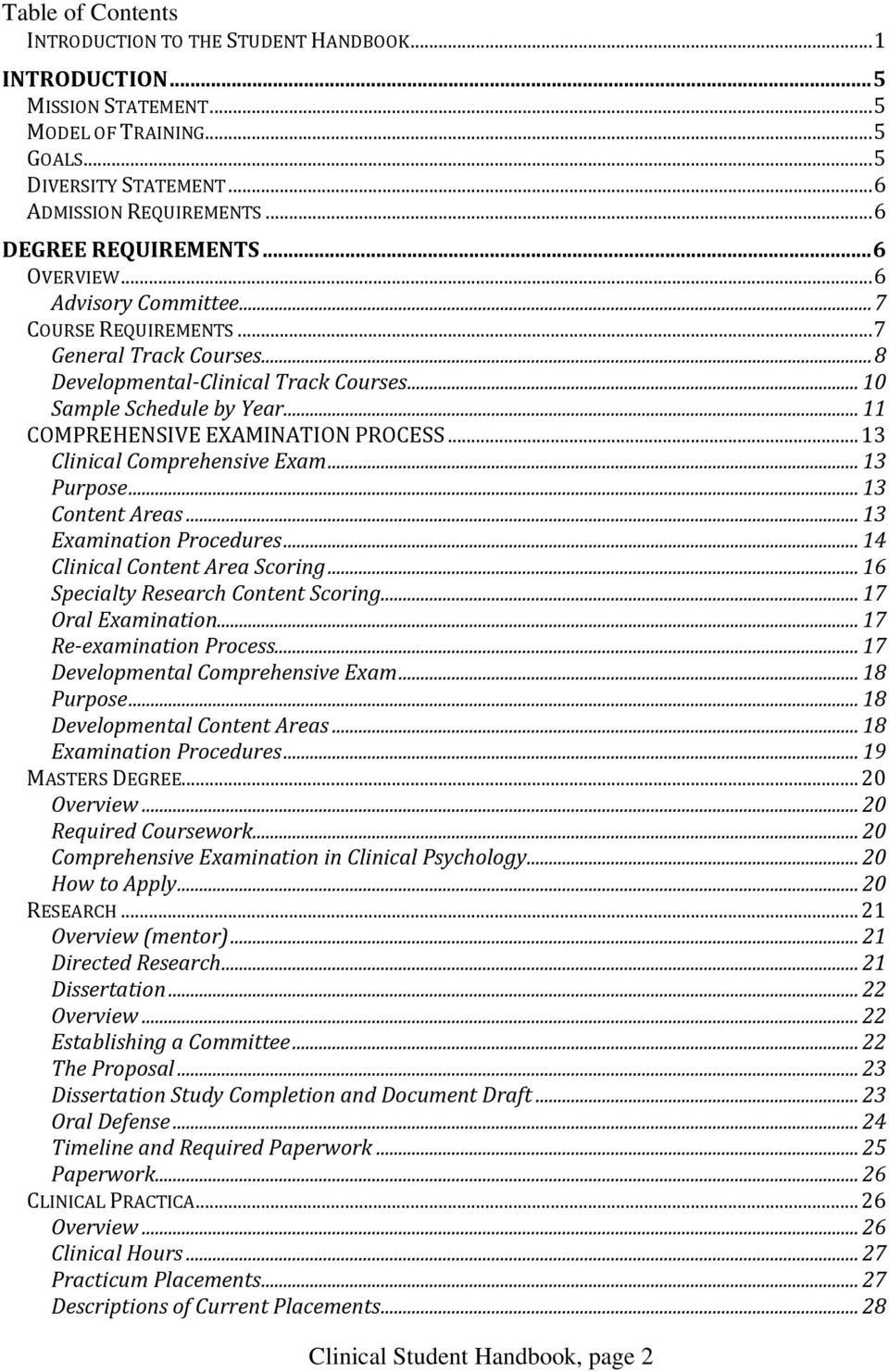
3 Table of Contents INTRODUCTION TO THE STUDENT HANDBOOK... 1 INTRODUCTION... 5 MISSION STATEMENT... 5 MODEL OF TRAINING... 5 GOALS... 5 DIVERSITY STATEMENT... 6 ADMISSION REQUIREMENTS... 6 DEGREE REQUIREMENTS... 6 OVERVIEW... 6 Advisory Committee... 7 COURSE REQUIREMENTS... 7 General Track Courses... 8 Developmental-Clinical Track Courses Sample Schedule by Year COMPREHENSIVE EXAMINATION PROCESS Clinical Comprehensive Exam Purpose Content Areas Examination Procedures Clinical Content Area Scoring Specialty Research Content Scoring Oral Examination Re-examination Process Developmental Comprehensive Exam Purpose Developmental Content Areas Examination Procedures MASTERS DEGREE Overview Required Coursework Comprehensive Examination in Clinical Psychology How to Apply RESEARCH Overview (mentor) Directed Research Dissertation Overview Establishing a Committee The Proposal Dissertation Study Completion and Document Draft Oral Defense Timeline and Required Paperwork Paperwork CLINICAL PRACTICA Overview Clinical Hours Practicum Placements Descriptions of Current Placements Clinical Student Handbook, page 2
4 PSC Psychological Services Center Student and PSC Associates Responsibilities Case Conference INTERNSHIP Overview Applying for Internship Registration Requirements TASKS BY YEAR Tasks of the First Year Tasks of the Second Year Tasks of the Third Year Tasks of the Fourth and Fifth Years GRADUATION PROGRAM GOVERNANCE: STUDENT RIGHTS, RESPONSIBILITIES, AND PROGRESS KEY POSITIONS AND COMMITTEES GENERAL PROGRAM EXPECTATIONS EVALUATION OF STUDENT PROGRESS Clinical Faculty Meetings Practicum Evaluation Meetings Annual Performance Review Departmental Review Program Review PERFORMANCE PROBLEMS, STUDENT DISMISSAL, AND GRIEVANCE PROCEDURES Grades Academic v. Non-Academic Progress Personal Adjustment Remediation Efforts Counseling Out Dismissal Grievance Procedures PROGRAM POLICIES Website policy Teaching Transfer Credits and Waivers of Requirements Americans with Disability Act Non-Discrimination Policy Harassment Policy STUDENT SERVICE TO PROGRAM Student Role in Governance Clinical Student Representative PSC Associate Director Diversity Committee Diversity Committee Chairperson FUNDING TEACHING ASSISTANTSHIPS FELLOWSHIPS AND OTHER AWARDS CLINICAL AND RESEARCH CONTRACTS GRANTS Clinical Student Handbook, page 3

5 FINANCIAL AID APPENDICES OVERVIEW OF FORMS GENERAL CLINICAL TRACK CURRICULUM CHECKLIST DEVELOPMENTAL- CLINICAL TRACK CURRICULUM CHECKLIST FREQUENTLY ASKED QUESTIONS Clinical Student Handbook, page 4

6 INTRODUCTION MISSION STATEMENT The mission of the University of Maine s Clinical Psychology Doctoral Training Program is to prepare students for the doctorate (Ph.D.) in psychology and for careers combining research and practice. As such, all program training components heavily emphasize the interactive influences and integration of the science and professional practice of psychology. The program philosophy and model of training are entirely consistent with the general University mission with its emphases on teaching, basic and applied research, and public service activities that benefit the state of Maine and the larger world community ( ). MODEL OF TRAINING The philosophy and model of training for the UM Clinical Program is consistent with the scientist-practitioner model espoused at the Boulder Conference in As stated above, this model emphasizes the interactive influences and integration of the science and professional practice of psychology. The program also adheres to the mentor model of training, in which faculty recruit students that match their training philosophy and research activities and act as mentors, modeling the integration of science, practice, and continuing education. Students are treated as junior colleagues and encouraged to participate in program governance and evaluation, present and publish research, review manuscripts, and attend professional workshops. GOALS The program s emphasis on science-practice integration is reflected in clearly specified training goals: (1) To produce graduates who have the requisite knowledge of the broad bases of scientific psychology; (2) To produce graduates who have the requisite knowledge and skills to critically evaluate and conduct empirical research; (3) To produce scientist-practitioner graduates who have an appreciation of the close links between psychological research and practice and the knowledge and skills needed to integrate the two; (4) To produce graduates who have the requisite knowledge and skills for entry into the practice of professional psychology; and (5) To produce graduates with the requisite knowledge and skills to form a foundation upon which to function in an ethical and professional manner throughout their professional careers. Goal attainment is pursued through a variety of concurrent coursework, practicum, and research training activities that are sequential, cumulative, and graded in complexity. Clinical Student Handbook, page 5
7 DIVERSITY STATEMENT The University of Maine Clinical Psychology Program is dedicated to diversity, consistent with the broad definition accepted by the American Psychological Association. Faculty and students in the program are committed to providing a supportive and open learning environment for all individuals regardless of age, culture, ethnicity, socioeconomic status, gender, race, sexuality, disability, or beliefs. Respect for the differing opinions and attitudes of all individuals, as well as the continued acceptance of these differences, are important to the development of this environment. The program values the importance of interaction with individuals different from oneself and views this as vital to our student training. ADMISSION REQUIREMENTS To be considered for admission, program candidates must complete both departmental (which is located under Psychology Program Application in this link: and graduate school ( applications. In a typical year, there are 100 or more completed applications. An initial screening is completed in order to decide which candidates will be invited for an on campus interview. This screening is based on a composite of GRE scores (advanced psychology test not required), undergraduate (and graduate if applicable) grade point average (GPA), research and clinical interests reflected in the Personal Statement, and letters of reference. Because of the program s heavy research emphasis, candidates with evidence of strong performance in science and mathematics courses are favored. Though no minimum scores/grades are used as cutoffs in the screening process, grade point averages below 3.3 and GRE scores below the 50 th percentile) often result in rejection. A summary of GPA s and GRE scores of admitted candidates for the past 7 years can be found on the program s website in the Admissions section under Student Admissions, Outcomes and Other Data. Low GPA or GRE scores are sometimes offset by other strengths and rarely result in the rejection of an application. Finally, because of the program s mentor-based training model, the perceived match of interests between candidates and potential faculty mentors is crucial in the admission process. A related consideration is whether particular faculty members have the funding to make admission offers in a particular year. DEGREE REQUIREMENTS OVERVIEW The basic degree requirements set forth by the Graduate School include a minimum residency period, the successful completion of comprehensive examinations and admission into doctoral candidacy, a successfully defended dissertation, a minimum number of graduate course credits, and a program of study approved by an established advisory committee. There is no department Clinical Student Handbook, page 6

8 or program language requirement. With respect to residency, the program requires a minimum of three full-time academic years of graduate study (note this is more than the minimum of two required by the Graduate School) and the completion of a clinical internship prior to awarding the doctoral degree. Full-time status is defined by the Graduate School and is currently enrolling for six or more credit hours per semester, with the exceptions of the internship year in which only one internship credit per semester is necessary and/or the final semester in which one thesis credit is needed to maintain full-time status. Note that despite these minimum requirements, the nature of the program typically makes full-time residence essential throughout the entire course of study, which is typically four years pre-internship for General Track students and five years for Developmental-Clinical Track students. ADVISORY COMMITTEE At the time of admission, all students are assigned to an advisor. In consultation with their advisor and advisory committee, students must develop a Program of Study (form can be downloaded from the Graduate School website). The program of study is an outline of courses to be passed and research to be undertaken. Prerequisite and elective courses are part of the program of study. This should be completed and submitted to the Graduate School by the end of the first year of study and a failure to do so may interfere with registration. When the program is approved by the advisory committee, the Chair of the Department s Graduate Committee, and filed with the Graduate School, it becomes the student s required curriculum. Students must also establish an advisory committee. This committee is typically chaired by the advisor (must be a full-time graduate faculty member or a co-chair must be appointed) and includes a minimum of three members of the graduate faculty. These faculty members do not have to be appointed to the student s eventual dissertation committee. The advisory committee guides the student on curricular and related issues, approves the program of study and any requested modifications, and helps determine a student s standing in the program when a grade below a B- is received in any required course. Since this committee must approve the above described program of study, it should be established within the first year of study. COURSE REQUIREMENTS The Graduate School requires the completion of a minimum of 60 credit hours for the doctoral degree. With the course, research, and practicum credit requirements described below, however, students will exceed that minimum. Note that all required courses must be passed, which is defined as a B- or higher. Required coursework grounds students in the broad bases of psychology as a scientific discipline and emphasizes empirical findings and a science perspective in the coverage of more specific clinical content areas, including psychopathology, assessment, and intervention. As far as sequencing, first-year students take core clinical courses (psychopathology, basic and advanced assessment, supervision and consultation, and ethics and professional issues). In addition, General Track (GT) students take the statistics and research methods and basic Clinical Student Handbook, page 7
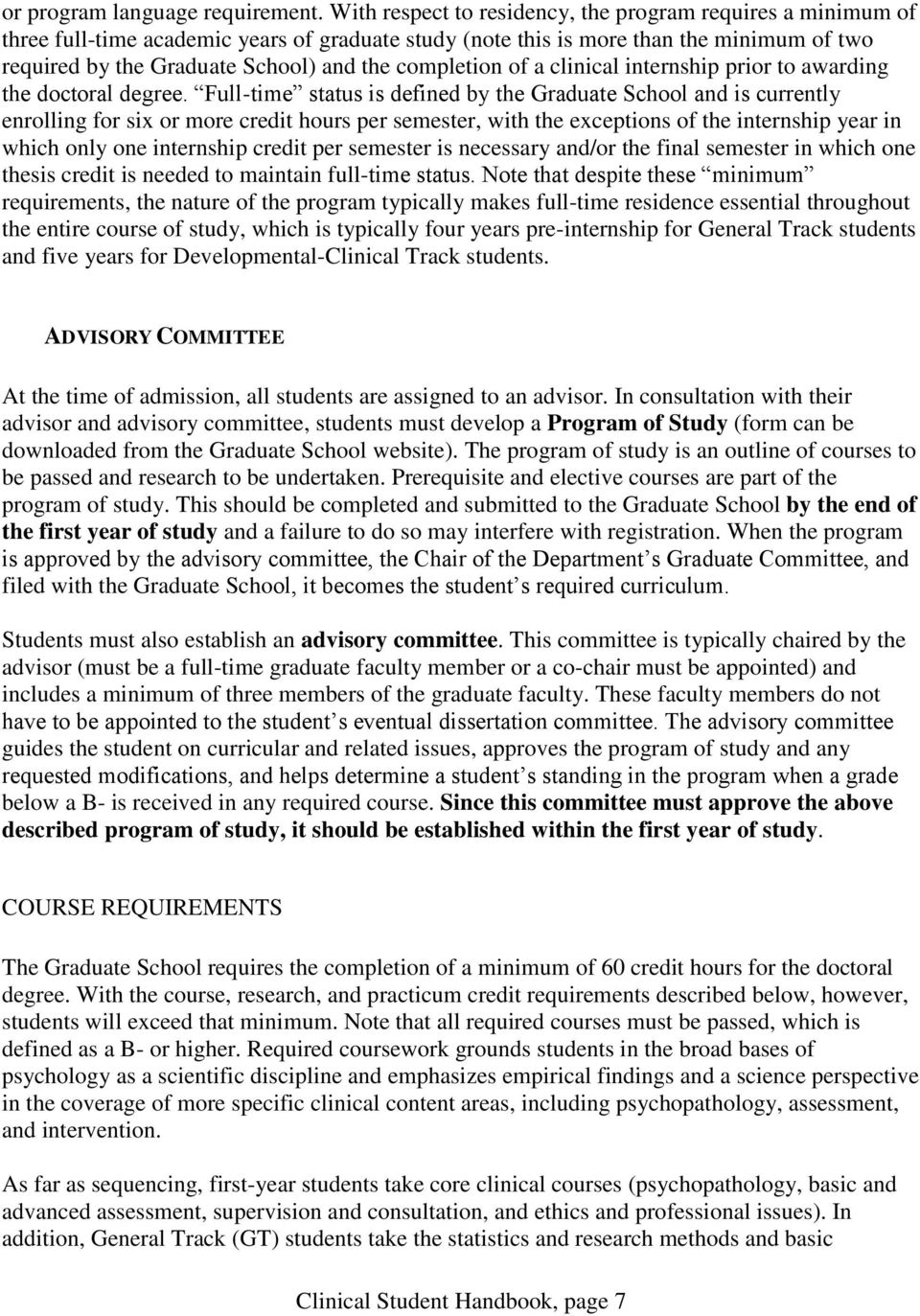
9 foundations in psychological science (e.g., cognitive psychology, social psychology, physiological) and human development (i.e., Life Span Development). Developmental-Clinical Track (DC) students take the core developmental courses (biological bases, social, emotional, and life span) and generally delay the start of the statistics and research sequence. The second year is critical for doctoral comprehensive examination preparation. At the end of the second year, GT students take the clinical comprehensive examinations and DC students take the developmental comprehensive examinations. DC students also complete the clinical comprehensive examinations, but by the end of the third year. As such, GT students must complete all the core clinical courses by the close of the second year and DC students by the close of the third year. In addition, DC students must complete the child psychopathology course in order to sit for the clinical comprehensive examinations. Finally, DC students must complete all of the required developmental core courses (biological bases, social, and emotional) by the close of the second year. Third and fourth year students take any remaining required and elective courses. GENERAL TRACK COURSES 1. Core Clinical Courses (Required for Clinical Comprehensive Examinations) PSY 625 Basic Method in Assessment I PSY 626 Advanced Clinical Assessment II PSY 634 Advanced Psychopathology PSY 603 Ethics and Professional Problems PSY 643 Seminar in Clinical Psychology PSY 655 Seminar in Psychotherapy 1 1 General track students must complete the general track version; Developmental-clinical track students must complete the child and adolescent version. 2. Additional Required Clinical Courses PSY 528 Life Span Development PSY 681 Clinical Supervision and Consultation I PSY 682 Clinical Supervision and Consultation II* PSY 683 Clinical Supervision and Consultation III* PSY 592 Directed Readings in Diversity (at least one credit) *These courses are only offered in the fall semester. 3. Required Courses Outside of the Clinical Area a. All of the following PSY 540 PSY 541 Advanced Psychological Statistics and Methods I Advanced Psychological Statistics and Methods II Clinical Student Handbook, page 8
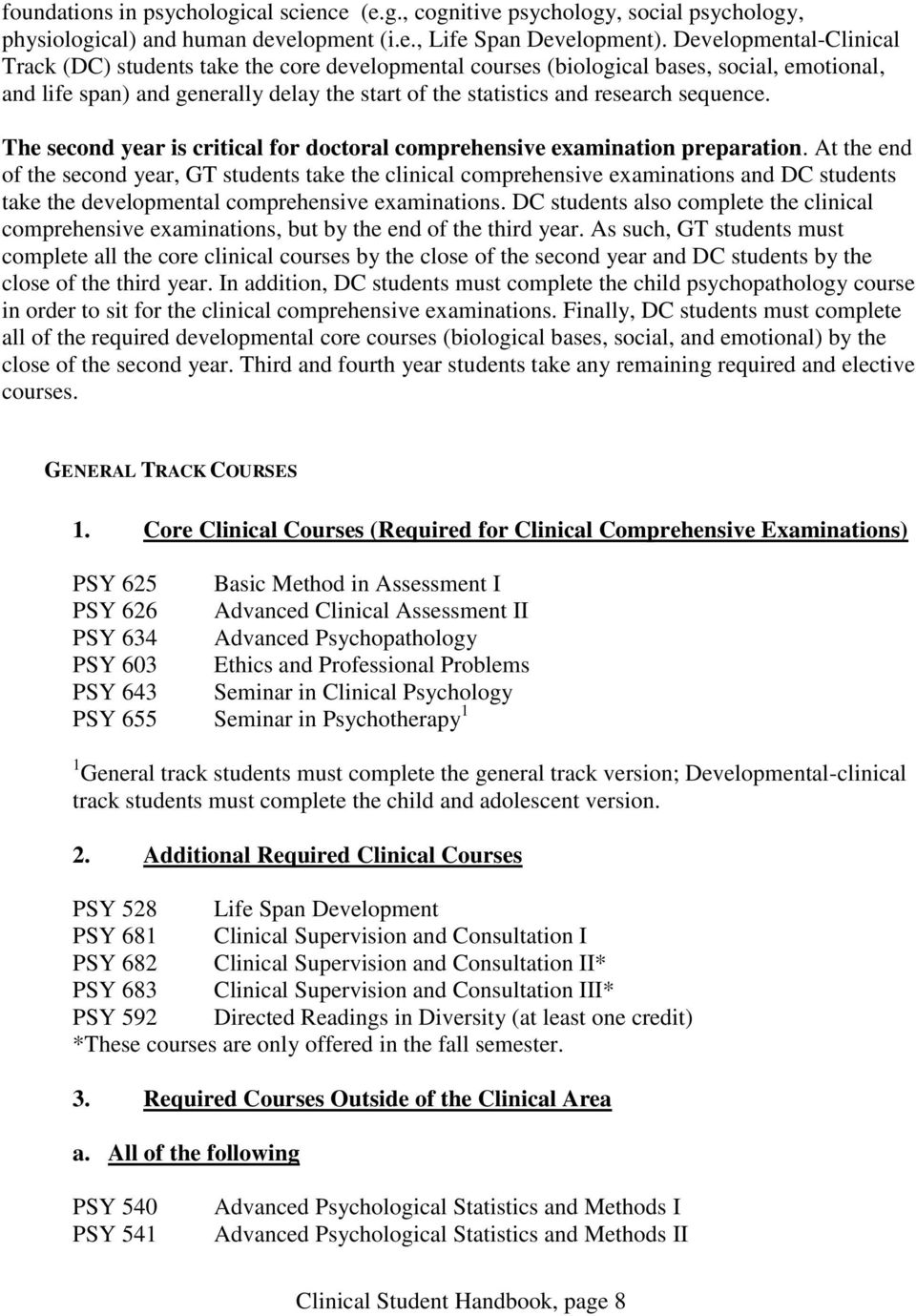
10 PSY 661 Seminar in History and Philosophy of Psychology b. At least one course from each of these areas Biological Bases of Behavior PSY 520 Biological Bases of Infancy and Development PSY 551 Advanced Physiological Psychology Cognitive-Affective Bases of Behavior PSY 521 Emotion, Adaptation, and Development PSY 567 Advanced Cognitive Psychology Social Bases of Behavior PSY 522 Social Development in Children PSY 561 Advanced Social Psychology Human Development PSY 528 Life Span Development Individual Differences PSY 522 Social Development in Children PSY 528 Life Span Development PSY 634 Advanced Psychopathology PSY 641 Personality PSY 651 Child Psychopathology and Therapy 4. Elective courses (Two for general track, one for development-clinical track) Electives can be one of the courses listed in b above not used to satisfy the one course requirement in that area, one of the courses listed below, or another course with approval from the program advisory committee (e.g., a three credit directed readings course). PSY 677 Topics in Clinical Psychology (e.g., Health Psychology, Clinical Neuropsychology) 5. Research, Practicum, and Internship Courses PSY 692 PSY 699 PSY 691 PSY 695 PSY 696 Directed Research (minimum of nine credit hours) Thesis (minimum of six credit hours; three per semester) Practicum (at least one credit hour per semester, including summer term, when engaged in any clinical work) Internship (one credit hour in fall) Internship (one credit hour in spring) Clinical Student Handbook, page 9
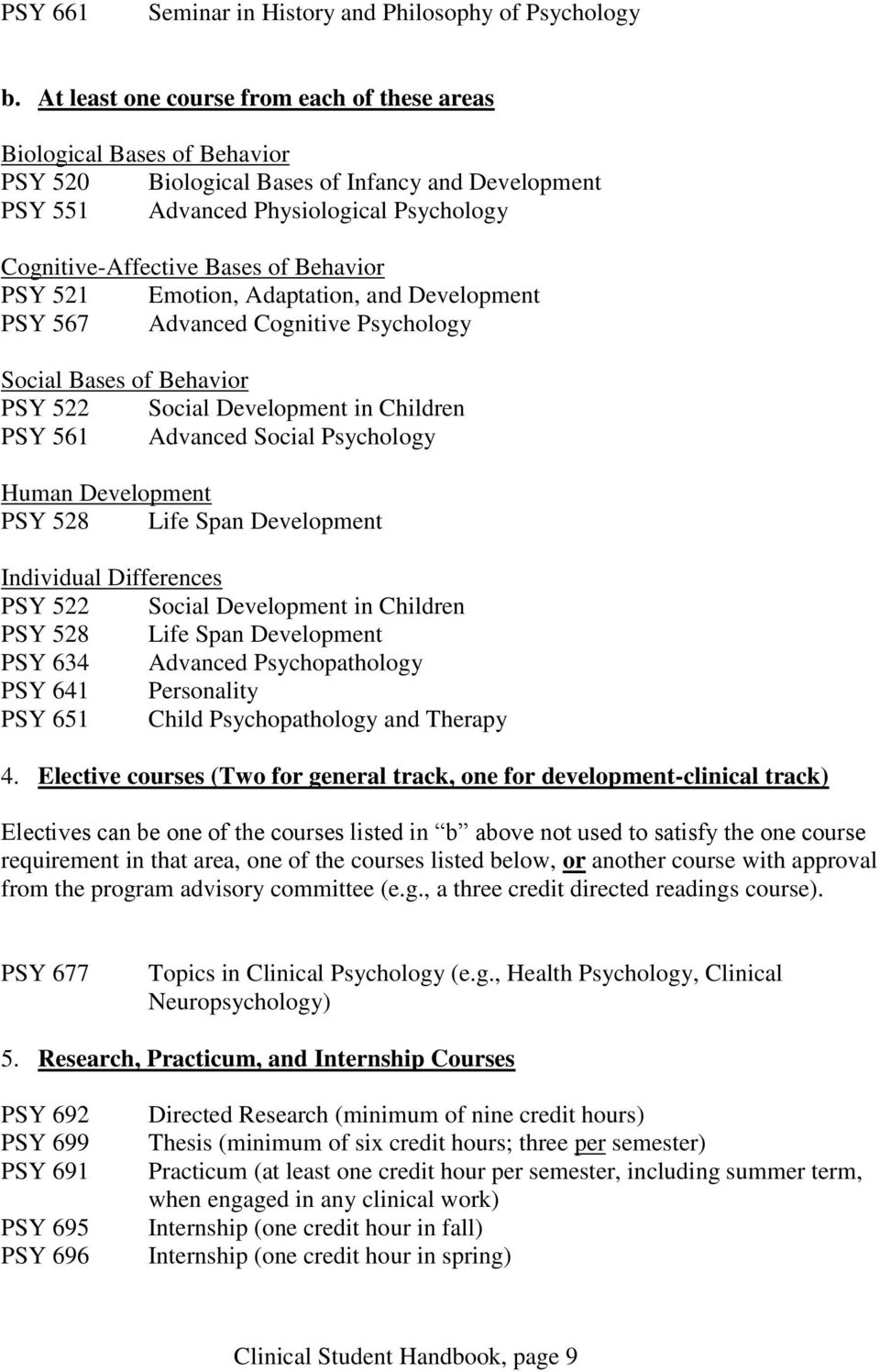
11 DEVELOPMENTAL-CLINICAL TRACK COURSES 1. All courses as outlined in 1, 2, 3a, and 5 above. Note that DC students must complete the child/adolescent section of the PSY 655 Seminar in Psychotherapy course. 2. In addition, DC students must complete the four developmental core courses. Note that these courses also fulfill the requirements listed in 3b above (i.e., Biological Bases of Behavior, Cognitive-Affective Bases of Behavior, Social Bases of Behavior,Human Development, and Individual Differences) and constitute the core courses required for developmental comprehensive examinations. PSY 520 Biological Bases of Infancy and Development PSY 521 Emotion, Adaptation, and Development PSY 522 Social Development in Children PSY 528 Life Span Development 3. DC students must also complete one of the following courses: PSY 551 Advanced Physiological Psychology PSY 561 Advanced Social Psychology PSY 567 Advanced Cognitive Psychology 4. A child psychopathology course is also required. This is in addition to the PSY 634 Advanced Psychopathology course. PSY 651 Child Psychopathology and Therapy 5. Finally, DC students must complete an elective course. Electives can be one of the courses listed in 3 above (i.e., PSY 551, PSY 561, and PSY 567) not used to satisfy the one course requirement in that area, one of the courses listed below, or another course with approval from the program advisory committee (e.g., a three credit directed readings course). PSY 677 Topics in Clinical Psychology (e.g., Health Psychology, Clinical Neuropsychology) Clinical Student Handbook, page 10

12 SAMPLE SCHEDULE BY YEAR General Clinical Track Curriculum: SAMPLE SCHEDULE *Please note this is only a SAMPLE. Actual schedules will vary based on courses offered each semester. 1 ST YEAR FALL SPRING SUMMER Clinical core Psy 625 Assessment I Psy 634 Psychopath Required courses At least 1 credit Psy 692 Psy 661 History & Phil One from each of 4 areas Electives Psy 603 Ethics Psy 626 Assessment II Psy 643 Seminar At least 1 credit Psy 692 Psy 681 Supervision I Psy 691 Practicum At least 1 credit Psy nd YEAR FALL SPRING SUMMER Clinical core Psy 655 Seminar (gen) Psy 528 Life Span Required courses Psy 540 Statistics I Psy 691 Practicum At least 1 credit Psy 692 Psy 541 Statistics II Psy 592 Diversity Psy 691 Practicum At least 1 credit Psy 692 One from each of 4 Psy 651 Child Path. Psy 551 Adv. Physio. areas Electives Clinical Student Handbook, page 11 Psy 691 Practicum At least 1 credit Psy rd YEAR FALL SPRING SUMMER Clinical core Required courses One from each of 4 areas Electives Psy 682 Supervision II Psy 691 Practicum At least 1 credit Psy 692 Psy 567 Adv. Cognitive Psy 691 Practicum At least 1 credit Psy 692 Psy 561 Adv. Social Psy 677 Topics Psy 691 Practicum At least 1 credit Psy th YEAR FALL SPRING SUMMER Clinical core Required courses Psy 683 Supervision III Psy 691 Practicum 3 credits Psy 699 Thesis Psy 691 Practicum 3 credits Psy 699 Thesis Psy 691 Practicum One from each of 4 areas Electives 5 th YEAR: Register for Psy 695 Internship I in the Fall and Psy 696 Internship II in the Spring.
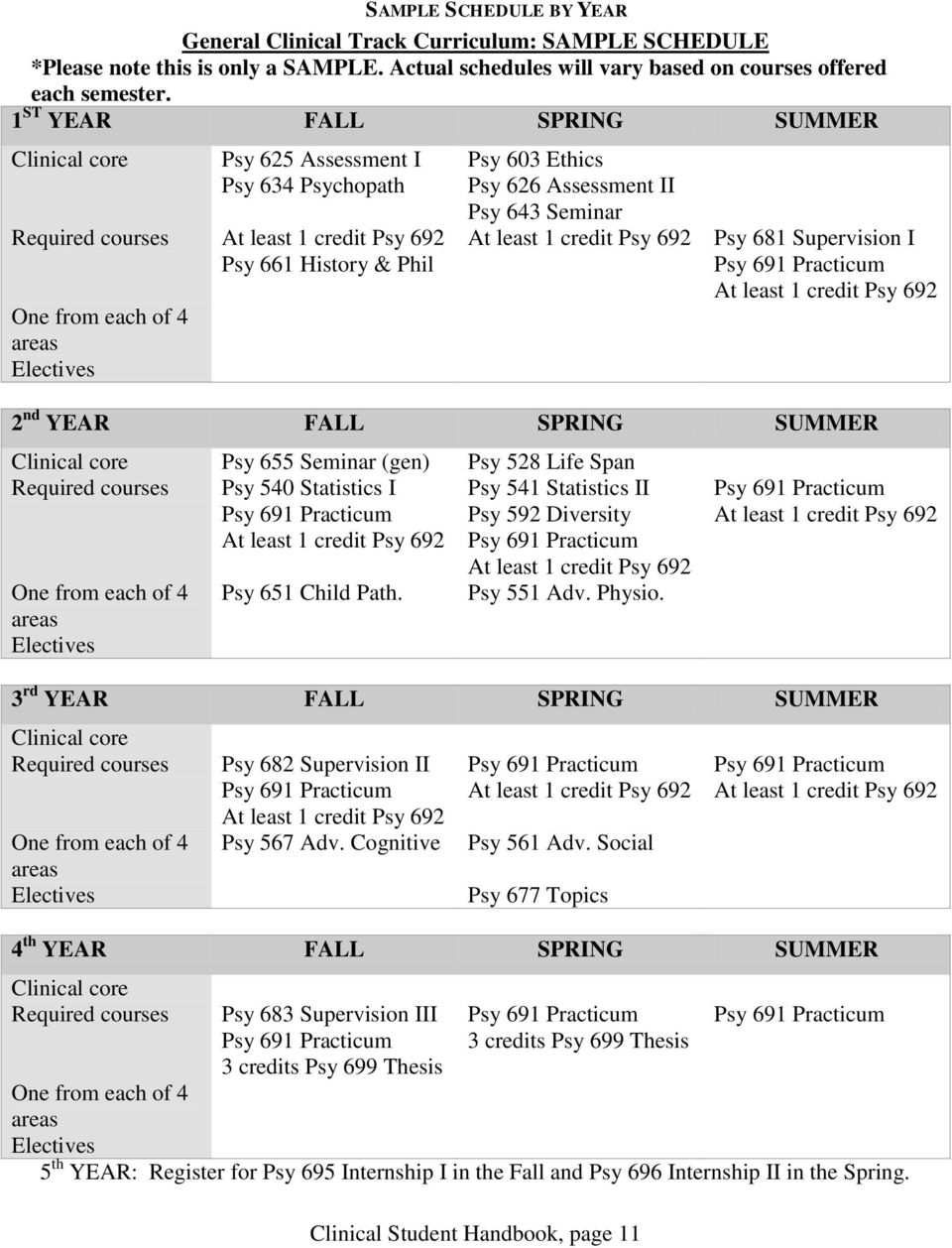
13 Developmental-Clinical Track Curriculum SAMPLE SCHEDULE *Please note this is only a SAMPLE. Actual schedules will vary based on courses offered each semester. 1 ST YEAR FALL SPRING SUMMER Clinical core Psy 625 Assessment I Psy 634 Psychopath Psy 603 Ethics Psy 626 Assessment II Developmental core Psy 520 Biological Dev Psy 521 Emotion Dev Required courses At least 1 credit Psy 692 At least 1 credit Psy 692 Psy 681 Supervision I Psy 691 Practicum At least 1 credit Psy 692 Electives + 1 addit. 2 nd YEAR FALL SPRING SUMMER Clinical core Psy 643 Seminar Developmental core Psy 522 Social Dev Psy 528 Life Span Required courses Psy 540 Statistics I Psy 691 Practicum At least 1 credit Psy 692 Psy 541 Statistics II Psy 691 Practicum At least 1 credit Psy 692 Electives + 1 addit. Clinical Student Handbook, page 12 Psy 691 Practicum At least 1 credit Psy rd YEAR FALL SPRING SUMMER Clinical core Required courses Electives + 1 addit. Psy 651 Child Psychopath. Psy 682 Supervision II Psy 691 Practicum At least 1 credit Psy 692 Psy 655 Seminar (dev) Psy 691 Practicum At least 1 credit Psy 692 Psy 677 Topics Psy 691 Practicum At least 1 credit Psy th YEAR FALL SPRING SUMMER Clinical core Required courses Electives + 1 addit. Psy 683 Supervision III Psy 691 Practicum At least 1 credit Psy 692 Psy 551 Physiological Psy 661 History & Phil Psy 592 Diversity Psy 691 Practicum At least 1 credit Psy 692 Psy 691 Practicum At least 1 credit Psy th YEAR FALL SPRING SUMMER Clinical core Required courses Psy 691 Practicum 3 credits Psy 699 Thesis Psy 691 Practicum 3 credits Psy 699 Thesis Psy 691 Practicum Electives + 1 addit. 6 th YEAR: Register for Psy 695 Internship I in the Fall and Psy 696 Internship II in the Spring.

14 COMPREHENSIVE EXAMINATION PROCESS CLINICAL COMPREHENSIVE EXAM PURPOSE Successful completion of the Comprehensive Examination in Clinical Psychology qualifies the student for admission to Ph.D. candidacy and doctoral level study, and allows the faculty to recognize formallythat the student: a. has attained a certain minimum level of competence in clinical psychology. b. can think in an integrative manner about the material covered in core clinical program courses. c. is able to bring professional (in addition to technical) skills to the subject matter of clinical psychology. d. is able to exercise appropriate professional judgment and apply pertinent ethical principles in using information obtained through course work. e. has doctoral level oral presentation skills. The exam covers four content areas within clinical psychology and a fifth content area related to the student's research specialization. Note that the research specialization question is graded by the student s advisor and two agreed upon additional faculty members. It is the student s responsibility (in consultation with the advisor) to get the agreement of the additional faculty readers. Note: Students in the developmental-clinical track also complete the developmental comprehensive examinations that are described in a later section. They complete the question related to their research specialization during the developmental comprehensive examination rather than the clinical comprehensive examination. CONTENT AREAS The four clinical content areas are as follows: a. Psychological Assessment b. Psychopathology c. Psychotherapy d. Ethical/professional issues To help guide the preparation process, the clinical faculty group has identified a pool of potential subtopics from which specific questions can be generated. Note that this list is not exhaustive and the actual questions can come from subtopics not listed and/or the merging of two subtopics. Each year, the Comprehensive Examination Committee (see below) selects three subtopics within each major content area from which the exam questions will be developed (e.g., Psychological Assessment: inter-rater agreement, behavioral assessment versus other Clinical Student Handbook, page 13
15 approaches, and sources of bias in testing). In responding to exam items, students will be expected to integrate information from their reading of the literature, as well as accumulated knowledge from core clinical courses(e.g., knowledge of specific tests, psychotherapy outcome literature) and related professional experiences (e.g., practicum, supervision). Potential subtopics (not an exclusive list) within each major content area are as follows: a.psychological Assessment: inter-rater agreement; empirically supported assessment; child versus adult assessment; behavioral assessment versus other approaches; statistical versus clinical assessment and prediction; triple response mode assessment; projective testing; sources of bias in testing - cultural, social class, etc.; and the mental status examination. b. Psychopathology: diathesis-stress models; continuity or otherwise from childhood to adult disorders; comorbidity among disorders; the validity of classification systems; alternatives to categorical classification; diversity issues in psychopathology; gender bias in classification; gender differences in the etiology of particular disorders; psychological processes versus diagnostic categories; the validation of diagnostic constructs in children; and genetic factors. c. Psychotherapy: measurement of clinical significance; the role of meta-analysis in psychotherapy research; internal versus external validity in psychotherapy research; psychotherapy research design; the relationship between assessment and treatment; integration of psychotherapy approaches; special considerations in the treatment of children; definition of psychotherapy; the role of therapy in psychotherapy; cross-cultural issues in psychotherapy practice and research; empirically supported treatments; and gender issues. d.ethics and Professional Issues: ethical issues in clinical research; effects of therapist misconduct; issues in defining competence; issues in defining expert status; prescription privileges for psychologists, ethics and the law; and issues in maintenance of competence. e.specialty Research Area The content of this area will be determined by the student and his or her advisor. 1. Timeline EXAMINATION PROCEDURES The timing of the clinical comprehensive examination varies by track. General track (GT) students typically complete the exam in the summer following their second year, whereas the developmental-clinical (DC) track students typically complete the exam in the summer following their third year. DC track students typically complete the developmental comprehensive examination in the summer following their second year. The timeline for the Comprehensive Examination process is as follows: Clinical Student Handbook, page 14
16 October (fall preceding the summer exam): The Comprehensive Examination Committee is appointed and chair is elected. November:The committee (or a representative) meets with the students scheduled to sit for the exam and fields questions and/or addresses any concerns regarding the exam process itself. December:The committee notifies students as to the subtopics within each major content area. January/February: Individual students may contact individual committee members for feedback and advice while generating a list of readings. February: Dates for the comprehensive exam are chosen and potential dates for the oral portion of examination are identified. June: The written portion of the comprehensive exam is typically completed. July/August: The oral portion of the exam is typically completed. The Comprehensive Examination Committee Chair submits the Notification of Results of the Comprehensive Examination form signed by all committee members within one week of successful completion of both exam portions. Following fall semester: Apply for graduation through the graduate school to obtain master s degree (see Master s Degree section for more details) 2. Comprehensive Exam Committee The committee is made up of three members of the clinical faculty. Individual clinical faculty members rotate on and off the committee. Each year, a Chair is selected from within the appointed committee members. The responsibilities of the committee include (a) the selection of the three subtopics within each of the major content areas, (b) drafting the actual exam questions, (c) administration and monitoring of the exam, (d) scoring the written portion of the exam; (e) providing timely feedback to the students taking the exam, (f) administration and evaluation of the oral portion of the exam, (g) arranging for retakes of particular question areas or entire exams for students as needed (see re-examination procedures below), and (h) submission of the Notification of Results of the Comprehensive Examination form signed by all committee members within one week of successful completion of both exam portions. 3. Reading List The development of a list of readings to use in preparation for the Comprehensive Exam is part of the exam procedure. As such, no final reading list is approved by committee members. Each student is responsible for developing a list of readings and deciding upon its adequacy. Committee members, as well as other clinical faculty, however, can be called upon to consult with individual students in identifying readings for the list. Discussions and feedback during the development of a reading list are aimed at identifying whether an overall approach to a topic is appropriate and/or as comprehensive as expected with less intention for guiding the exact formulation of the reading list. Obtaining advice from students that have already passed the examination can also be helpful in preparing. For the Specialty Research Area, the research advisor and student will decide upon how the reading list is to be developed. 4. Written Examination Clinical Student Handbook, page 15
17 Students will respond to four questions, one from each of the clinical content areas outlined above. Students will not be made aware of the subtopic areas from which the questions will be drawn prior to the exam. The exam occurs across two days (separated by a day off). On the first day, students will complete two questions and have three hours to respond to each. Typically, the first question is answered between 9 and 12 and the second between 1 and 4 with a break between 12 and 1. The second exam day is structured in the same way. For general track students, the research specialty portion of the exam will occur on a third day (with a day off after the second exam day) during which the students will have three hours to respond. For example, a typical schedule for a general track student would be two clinical content area questions on Monday, another two on Wednesday, and the research question on Friday. Students type their answers on a computer provided by the committee. Memory sticks will be provided to the students to record their answers. Students are reminded to save work throughout the examination. 4. Oral Examination Students who pass the written portion of the exam take the oral component. The oral examination is usually scheduled within 10 weeks of completion of the written portion. Students are not expected to do any additional reading to prepare for the oral examination unless specifically suggested by the committee. Rather, students will be asked to expand upon and clarify their answers on the written portion. Follow-up on the Specialty Research Question is not part of the oral exam. In the past, students have found scheduling individual meetings with faculty members to discuss their answers to be helpful in preparing for the oral component. Students will be evaluated based upon their ability to orally present and defend their ideas. With rare exception, the three Comprehensive Examination Committee members will administer the oral portion of the exam. The oral examination usually lasts between 30 and 60 minutes. Results may or may not be communicated to the student on the day of the exam, but at a maximum within 3 to 4 days. 5. Grading Exam questions are graded "blindly." Students' typed answers are identified using an arbitrary numbering system. Given the way it is structured, however, blind grading of the Specialty Research Question is not possible. CLINICAL CONTENT AREA SCORING Each question is graded by each of three committee members using a five point grading scale (1 to 5 with higher ratings indicative of higher quality responses)with 0.25 scale points used as the smallest interval assignable (e.g., 3.00, 3.25, 3.50). The mean of the three committee members scores will be calculated for each question. A mean score of 3.25 and higher indicates an Clinical Student Handbook, page 16

18 automatic pass. A mean score below 2.75 indicates an automatic fail. A mean score between 2.75 and 3.25 signifies marginal performance. For a student receiving a marginal score, the committee will meet and decide whether the student passes or fails the item based upon discussion and group consensus. Students may be required tore-take a portion of the written exam for a marginal answer within six months. The committee may obtain a fourth and fifth rating of answers that fall into the marginal range. Students must obtain a passing score in all four content areas in order to pass the written portion of the exam. Students who fail one or more examination questions must re-take that section of the examination (see re-examination process below). SPECIALTY RESEARCH CONTENT SCORING Responses to the Specialty Research Area questions are graded by three selected faculty members (the advisor and two others). The additional raters can be drawn from the entire graduate faculty of the Department of Psychology. With advisor consultation and approval, students request that the faculty members serve as raters. On rare occasions, raters may be drawn from outside the Department of Psychology and such exceptions must be approved by the clinical faculty. The grading system used for the Specialty Research Area is the same as for the Clinical Content Area. ORAL EXAMINATION Through consensus of the exam committee, performance on the oral examination will be graded on a pass/fail basis. Note that although students are asked to clarify and expand upon their written answers, grading of the two are not linked. Thus, performance on the oral portion will not impact the pass status of the written portion nor will the oral exam be influential for marginal scores of the written portion. RE-EXAMINATION PROCESS Students who fail one or more examination questions must re-take that section(s) of the examination no sooner than one month and no later than six months after the original examination date. Likewise, students failing the oral examination must re-take it no sooner than one month and no later than six months after the original examination date. The specific date will be jointly selected by the committee and the student; however, the committee will have final approval of the re-examination date. A student may take each portion of the examination (i.e., written, oral) a maximum of two times. If a student fails the second examination, he/she will be dropped from the program. Note that failing one question on two occasions would constitute failure of the entire exam. Clinical Student Handbook, page 17
19 DEVELOPMENTAL COMPREHENSIVE EXAM In addition to the above described examination, students enrolled in the DC track also complete the Comprehensive Examination in Developmental Psychology. It is important to note that DC students complete their research specialization question within the developmental comprehensive examination and not as part of the clinical comprehensive examination. It is also important to note that the developmental comprehensive examination is under the auspices of the developmental faculty group and is administered by the acting Developmental Coordinator. PURPOSE Successful completion of the Comprehensive Examination in Developmental Psychology allows the faculty to recognize formally that the student: a. has attained a certain minimal level of competence in developmental psychology. b. can think in an integrative manner about the material covered in the core developmental courses. c. has attained a particular level of knowledge with respect to one developmental period (i.e., infancy/toddlerhood, preschool, middle childhood, or adolescence). DEVELOPMENTAL CONTENT AREAS The four developmental content areas are as follows: a. Biological Development b. Social Development c. Emotional Development d. Cognitive Development The foundation for the examination are the four required developmental core courses: Biological Bases of Infancy and Development; Social Development in Children; Emotion, Development, and Adaptation; and Lifespan Development. Although there is no specified course in cognitive development, this content area is emphasized and integrated within the four core courses. The exam itself is integrative in nature. Students will respond to two questions. The first is a question within the student s research area. For example, a student specializing in peer relations research might respond to a question within the broader social development content area. The second question requires that the student integrate content area material and focus on a particular developmental period (i.e., infancy/toddlerhood, preschool, middle childhood, or adolescence). Clinical Student Handbook, page 18

20 EXAMINATION PROCEDURES 1. Timeline Students typically take the exam at the end of their second year in the program when the four developmental core courses have been completed. The timeline for the exam process is as follows: January: Students hoping to take the exam submit research specialization areas and one developmental period of focus to the Developmental Coordinator. March: Developmental Coordinator arranges for exam readers (two faculty persons) that will be responsible for question generation and scoring. June: Exam typically administered. 2. Exam Subcommittees The Developmental Coordinator arranges for comprehensive exam readers or groups of two faculty members that are responsible for question generation and scoring. For the research specialization question, the advisor is one of the two readers. For the remaining question, the readers are two developmental faculty members with relevant expertise. 3. Reading List The development of a list of readings to use in preparation for the exam is part of the overall procedure. Although no final reading list is approved by the faculty readers, individual students can call upon faculty for consultation as they develop their own reading list. For the research specialization area, the student and advisor will decide upon how the reading list is to be developed. 4. Examination Students will respond to the two questions (as described above) in two four-hour periods scheduled on two days with a one day break in between. 5. Grading Grading of each question is done by the assigned readers and adheres to the same procedures described in the preceding Comprehensive Examination Process section. The Developmental Coordinator calculates the mean scores, determines whether questions are passed, and communicates the results to the students. Clinical Student Handbook, page 19

21 MASTERS DEGREE OVERVIEW Students enrolled in the Doctoral Program in Clinical Psychology earn a non-terminal/non-thesis option Master s of Arts degree on the way to their Ph.D. The term non-terminal reflects the fact that this degree is not considered an end point in training and that no M.A. option or program is offered. Non-thesis option denotes that completion of the comprehensive examination substitutes for a thesis in qualifying for the degree. Qualification for the M.A. is based on the successful completion of coursework and the comprehensive examination in clinical psychology. REQUIRED COURSEWORK With regard to coursework, a total of 38 credit hours must be completed with grades of B- or better (P if a P/F option) in each course. Nineteen of these credit hours must come from completing the clinical core courses (PSY 603, PSY 625/626, PSY 634, PSY 643, PSY 655, and PSY 681). Note that with the exception of PSY 681 (Clinical Supervision and Consultation I) these are the same courses that must be completed in order to sit for the comprehensive examination. The remaining 19 credit hours must come from the completion of 12 credit hours in graduate psychology courses (500 or 600 level), as well as 4 credit hours of PSY 692 (Directed Research) and 3 credit hours of PSY 691 (Practicum). COMPREHENSIVE EXAMINATION IN CLINICAL PSYCHOLOGY As fully described in the previous section, students must successfully complete both the written and oral portions of the comprehensive examination in clinical psychology in order to qualify for the M.A. degree. HOW TO APPLY It is very important for students to take the initiative in the degree application process. The degree will not be awarded unless the student applies for graduation through the Graduate School. The application can be found on MaineStreet (mainestreet.maine.edu) and must be submitted in time for the December graduation cycle (that follows the completion of the comprehensive examination). It is also important to note the Graduate School may not recognize program students as being eligible for applying for the MA degree since they are enrolled in a Ph.D. program. As such, prior to application, students must alert the Graduate School that they are eligible to apply and the Graduate School will add them to the list. Finally, students should also ensure that the Comprehensive Examination Committee Clinical Student Handbook, page 20
22 Chair has submitted the Notification of Results of the Comprehensive Examination form within one week of successful completion of both exam portions. RESEARCH OVERVIEW (MENTOR) Training in research is grounded in the mentor model and begins in the admissions process in which applicants are matched to particular mentors based on their similarity in research interests and professional goals. The mentor serves as the student s advisor, both in terms of research and overall professional development, and the relationship continues throughout the years in the program and beyond. Another key aspect is the program s adherence to the junior colleague model, in which mentors encourage students to present research at regional and national conferences, review manuscripts for journals, and publish scholarly work. Students become involved in their mentors research upon entry into the program and continue to sign up for directed research course credits. First year students formulate research goals with their mentors and typically assume junior roles in ongoing projects (e.g., data collection, literature reviews). In the second year, there is an increasing focus on research and students take on more senior roles in the laboratory. A key task of the second year is preparation for the research question on the comprehensive examination. This literature review often helps to form the basis of an independent research project and the eventual dissertation proposal. Training in the form of ongoing meetings with mentors and coursework in statistics and research design continues into the third year, during which many students complete independent projects and begin preparation of the dissertation proposal. By the fourth and fifth years, students spend much less time in coursework and more time in research, clinical practice, and other professional activities. During this time, students establish their dissertation committees, defend their proposals, and begin data collection. Students are encouraged to complete their data collection and have it analyzed before leaving for clinical internship and the defense usually occurs during the internship year. DIRECTED RESEARCH All incoming students are required to sign up for a minimum of one credit of PSY 692 (Directed Research) each semester until work on the dissertation begins and they instead sign up for PSY 699 (thesis) credits. A minimum of 9 hours of directed research and 6 hours of thesis credits are required for graduation. Regardless of course credits, however, all students are expected to participate in research under the direction of their faculty mentor throughout their graduate education. Directed research courses are graded and students should consult with their mentors about the expectations for performance and evaluation procedures. Clinical Student Handbook, page 21
23 DISSERTATION OVERVIEW The dissertation is the capstone research experience for students. In many ways, it defines and distinguishes the doctoral degree. In brief, the dissertation involves the design and implementation of an empirical research project, data analyses, formal write-up, and oral defense. As described below, the process begins with the drafting of a dissertation proposal that is approved by the advisor before being reviewed by a committee. After required revisions and committee approval, the proposal is orally defended before the committee and a successful defense allows for the implementation of the study. Once the data are collected, analyzed, and the initial dissertation document is approved by the advisor, the dissertation is distributed to the committee for review. The committee is asked whether or not an oral defense can be scheduled. If approved, an oral defense is scheduled and successful completion marks the end of the process. ESTABLISHING A COMMITTEE There are two principles guiding the establishment of a dissertation committee. First, students need a primary mentor who has the expertise to aid in the carrying out the dissertation research and writing (usually the academic advisor). Second, the dissertation should also pass the scrutiny of, and be comprehensible to, a broader community of scholars. As far as the process, the official designation of the chair of the dissertation committee occurs after the successful completion of the comprehensive examination (both sets for developmental-clinical track students). In consultation with the chair, the student selects other members of the committee, all of whom must be active graduate faculty (as defined and approved the Graduate School) and the committee as a whole must be approved by the Graduate School. Below are the guidelines for committee composition: 1. A chairperson, who is a member of the psychology department (typically the student s advisor); 2. At least one psychology faculty member from the psychology department who is identified as clinical in orientation; 3. At least one psychology faculty member from the psychology department who is not identified as clinical in orientation; 4. Students in the developmental-clinical track must have at least one developmental psychology faculty member from the psychology department on their committee. 5. The committee must be composed of a minimum of five people. Committee members (other than those specified above) are usually chosen for their expertise in a given area. Each committee member must have active graduate faculty status as determined by the Graduate School. The Graduate School also has a procedure for having someone outside the University serve on a committee. 6. The committee composition must be approved by the Graduate School. Clinical Student Handbook, page 22
24 In all dealings with the dissertation committee, students should behave in a professional manner. It is helpful to consult with advisors to learn what is appropriate etiquette and protocol. One consideration is that committee members should be given the full amount of time for proposal/dissertation review without being pressured for feedback or meeting scheduling. Another is that if a proposal or defense meeting is being planned for the summer, students should be aware that most faculty members do not receive summer salary and may not be available. If this is deemed necessary, students should check far in advance with each member to see if they will be available. THE PROPOSAL After establishing a committee, the drafting of a dissertation proposal begins and continues until the finished product is approved by the committee chair (i.e., advisor). In the project development, students are encouraged to consult with committee members regarding methodological and analytical questions. Once approved by the chair, the proposal is distributed to the remaining committee members. Committee members have one month to review the proposal before being approached by the student or chair for feedback and a determination of readiness for a defense meeting. Students should refrain from contacting members of the committee about the draft during this one month period. The chair then confirms that the committee is ready to meet and the proposal meeting is scheduled by the student. At this meeting, potential modifications are discussed and the committee either approves the proposal or schedules a second meeting for further deliberation. T The dissertation proposal should follow graduate school requirements, APA style, and will typically be comprised of the following sections: 1. An introduction that includes the purpose of the dissertation research, and a literature review extensive enough to demonstrate familiarity with relevant prior work and justification of the proposed project; 2. A statement of hypotheses to be tested by the project; 3. A methods section containing a detailed description of methods and procedures used to carry out the project; 4. A tentative plan for analyses; 5. A reference section; 6. An Appendices section including each measure. DISSERTATION STUDY COMPLETION AND DOCUMENT DRAFT After successfully defending the dissertation proposal, students work with their advisors and committee members to incorporate any feedback and/or changes to the study design and then apply for Institution Review Board (IRB) approval. Once this is received, the data collection portion of the project begins and continues until the approved markers for study completion Clinical Student Handbook, page 23
25 are reached (e.g., number of participants). Any subsequent modifications to what was proposed must be reviewed and approved by the advisor and committee members. After analyzing the data, students draft Results and Discussion sections, submitting them for advisor review and approval. At this time, care should also be taken to ensure that all previously offered edits, etc. (by advisor and committee in the proposal stage) have been incorporated into the Introduction and Methods sections. The final draft of the dissertation should follow the requirements of the Graduate School and APA style. In addition to the sections included in the proposal, which may include revisions, the final dissertation will include: 1. An abstract 2. A Results section: presenting the findings of the dissertation research 3. A Discussion section: including an interpretation of the findings, statement of conclusions, limitations of the study, and implications of the findings for future research, theory, and clinical practice. For a complete description of dissertation requirements, consult the thesis guidelines link at It is very helpful to access this document during the writing process. Students should keep in mind that their dissertation document will not be accepted if these guidelines are not followed and that their drafts will be closely scrutinized by the Graduate School. ORAL DEFENSE Once the advisor has approved a full draft of the dissertation document, the student distributes copies to the committee. At this time, the thesis advisor will schedule a pre-oral defense meeting, which is to be held at least three weeks from the time the draft dissertation is distributed. Students do not attend this meeting. During this period, committee members are expected to read the draft dissertation and to meet with the student to discuss requested modifications and revisions, as needed. At the pre-oral defense meeting, committee members discuss the dissertation and have the option of offering tentative acceptance (there is a form for this) and allowing the scheduling of an oral examination. Alternatively, the committee may require an additional pre-oral meeting before setting the date for the oral examination. In either case, the oral examination will be scheduled to occur no sooner than two weeks following the pre-oral meeting. In the oral defense meeting, students typically present a 45-minute overview of the project, results, and discussion. Students should check with their advisors to discuss the nature of the presentation. The meeting is open to all faculty and graduate students of the University, though only committee members will vote on the final dissertation. The dissertation committee members will ask questions of the candidate. After the committee members have finished asking questions, other faculty and students may ask questions. At the end of the questioning period, everyone leaves the room with the exception of the committee. Once the committee has Clinical Student Handbook, page 24
26 completed deliberation, the student is notified of the decision, which is either pass or fail. At least three members of the committee must vote for approval in order for the dissertation to be approved. If the dissertation is not approved, a discussion of needed changes and a timetable for completing them will ensue before adjourning the meeting. Even if approved, the committee may still ask that certain changes be made before the dissertation is accepted in its final form. TIMELINE AND REQUIRED PAPERWORK There are no preset timeline requirements for the dissertation proposal and oral defense other than those necessary to meet particular graduation deadlines and/or to be given clinical program approval for applying to internship. For graduation deadlines, students should consult with the Graduate School. If the student is entering the internship matching process, the dissertation proposal must be approved by the advisor and distributed to the committee by September 15 th and defended and accepted in final written form by December 15 th of the year preceding internship. If these deadlines are not met, the student will be required to withdraw from the internship match. Assuming that most general track students apply for internship in their 4 th year (5 th year for developmental-clinical track students), the proposal writing process should begin no later than the summer preceding the 4 th year (5 th year for DC students). The dissertation committee should be selected and approved during the 3 rd year (4 th for DC students). Before reviewing the timeline below, students should note that the major dissertation steps, such as proposal, data collection, and write-up, often take longer than expected. It is in the student s best interest to proactively accomplish these steps earlier than the above sample timeline when possible. Sample step-by-step timeline for a general track student: 1. Fall/Spring of 3 rd year select committee and submit form to Graduate School 2. Spring of 3 rd year provide chair with initial completed proposal 3. After 1 month ask chair for feedback 4. Revise proposal based on comments (repeat until chair approves proposal) 5. Chair approves proposal 6. Make copies of proposal and distribute to all committee members no later than September 15th 7. After 1 month ask committee for feedback (Oct 15 th ) 8. After the proposal is approved for a full committee evaluation, the student shall schedule a full committee proposal meeting (Nov 1 st ) 9. At the proposal meeting the committee will either approve or recommend additional modification. If additional changes are requested, the student will schedule a second meeting after completing those edits. (Dec 1 st ) 10. Once the proposal is approved (no later than Dec 15 th ), student must apply for IRB approval. 11. After IRB approval, the student may begin data collection. Clinical Student Handbook, page 25
27 12. Data collection. This process should be completed while the student is in their final year of the on campus portion of the program. Exceptions to this goal must be approved by the student s research advisor. 13. Completion of the final dissertation draft typically takes place during the summer before and the year of clinical internship. 14. Provide copies of the final dissertation to all committee members upon advisor approval. 15. Advisor schedules pre-oral defense meeting for no earlier than three weeks after draft approval and distribution to the committee. 16. During this three-week period, the student may contact committee members for feedback. 17. Schedule the formal defense. 18. Formal defense. 19. After approval provide bound copies to all necessary departments (listed below). PAPERWORK There are five forms that must be completed during the dissertation defense process: 1. Establishment of dissertation committee To be submitted soon after completing the clinical comprehensive exams. 2. Notice of oral examination To be submitted at least two weeks prior to oral defense date. 3. Tentative thesis acceptance To be submitted with tentative thesis/dissertation at least 24 hours before oral defense, signed by committee members. Alternatively, this can be done via with the Graduate School. 4. Final thesis acceptance form Committee votes at oral defense, then student makes any required corrections, then student shows the committee chair that the changes have been made, and the committee chair signs the form. 5. Completion of requirements This form can be completed and submitted as soon as the department verifies that the student has completed all requirements (taken care of all incompletes, etc.). CLINICAL PRACTICA OVERVIEW Students are first exposed to clinical practice through their attendance at clinical case conferences, courses with lab components (i.e., the assessment courses), and participation in clinical research (e.g., conducting structured interviews). In the summer following their first year, students enroll in PSY 691 (Practicum in Clinical Psychology) and clinical practice training begins in earnest. That summer, students are typically assigned cases in the Psychological Services Center (PSC) and often continue as clinical associates in the PSC for their second year of practicum experience. It is also common for students to continue to serve as clinic associates Clinical Student Handbook, page 26
28 in the PSC in some capacity throughout their years in the program. In addition, second year students may also be assigned to the school assessment practicum and perhaps an external placement. Third year students are typically assigned to an external practicum, such as Mountain View Youth Development Center, Health Psych Maine, and the Department of Corrections. Fourth and fifth year students (note that a practicum placement is not required for fifth year students) are often assigned to an external placement requiring increased levels of experience and clinical skills, such as Penobscot Job Corps and Maine General Medical Center. In addition to their primary practicum placements, students have a variety of opportunities to add to their clinical experiences throughout their years in the program (e.g., clinical research, assessments for schools and other agencies, parent training, behavioral medicine, etc.). CLINICAL HOURS The program defines what constitutes a clinical hour and all practicum experiences must be approved by the DCT. It is the students responsibility to ensure that the DCT is made aware of any intended agreement to provide clinical services outside of their assigned practicum placements. Program sanctioned clinical hours require a minimum of one hour of supervision by a licensed psychologist for every 10 hours of clinical practice (not just direct client contact). In addition, the DCT maintains regular contact with supervisors and closely monitors the quality of both the clinical experience and supervision. For training and liability reasons, all students engaging in program sanctioned clinical work of any type must be registered for at least one credit of PSY 691. As a minimum, the program requires 600 hours of approved supervised practicum experience before a student leaves for internship. Typically, however, students attain far more than the minimum and the average has hovered around 1200 hours for recent program internship applicants. The program requires students to track their supervised clinical hours by logging them into the MyPsychTrack system ( All hours must be approved online through the website by the supervisor and are reviewed by the DCT. These hours consist of direct supervision, direct provision of psychological services, assessment, intervention, administering assessment or intervention protocols for research, writing reports, and attending case conference meetings. Detailed tracking of clinical hours is required for predoctoral clinical internship applications and it is helpful for students to regularly check to see how such hours are defined by the Association of Psychology Postdoctoral and InternshipCenters (APPIC; PRACTICUM PLACEMENTS A variety of settings are used for practicum training. The Psychological Services Center (PSC) is the primary program training site and it serves children, adults, and families from the surrounding community. The PSC also provides consultation to community agencies, such as the Department of Corrections, Job Corps, and localschool systems. Practicum students participate in Clinical Student Handbook, page 27
29 PSC activities throughout their stay in the program and assume significant clinical and administrative responsibilities under faculty supervision. The availability of external practicum placements depends on a number of factors, including funding, number of students at the appropriate level of training, andstudent interest. External practicum sites available to students in past years have includedacadia Hospital, Maine General Medical Center, Bangor Mental Health Institute, Department of Veterans Affairs Medical Center (Togus), Eastern Maine Medical Center, KidsPeace New England, Kennebec Behavioral Health, Maine Center for Integrated Rehabilitation, Penobscot Job Corps Academy, Health Psych Maine, and Indian Township Health Center (which offers evaluation and intervention services to Native Americans on a reservation). Students are matched to practicum placements in the spring of each year and assignments begin in the following summer or fall. The process begins with the DCT determining which placements will be available in the coming year and gathering student placement preference rankings. In consultation with the clinical faculty group, the DCT then matches students to placements. The goal is to match students with their most preferred placements, but the ultimate assignment depends on a range of other considerations, such as student training needs, the need to fill funded placements, seniority, past assignments, and stipulations of external placement supervisors and/or settings. Because of all of these factors and the fact that some placements may not be certain of their ability to take students in the spring, this matching process often extends into late spring/early summer and initial assignments may sometimes be changed to meet program needs. In consultation with the DCT, students can also consider developing an alternate practicum placement that meets their particular needs or professional goals. In fact, some of the program s finest placements began in this way. As indicated above, the program must approve any proposed placement and a variety of factors are considered (e.g., qualifications of the supervising psychologist, quality of the training that is being offered, and compatibility with a scientistpractitioner model of training). Central to this process is a DCT site visit and meeting with the supervising psychologist. As indicated above, all practicum experiences must be approved by the DCT. Participating in clinical work that is not program sanctioned is discouraged. It raises serious concerns regarding malpractice liability coverage. In addition, the hours logged cannot be counted as program sanctioned clinical hours for internship applications. DESCRIPTIONS OF CURRENT PLACEMENTS School District Assessment Practicum Supervisor: Dr. Nina Boulard This practicum involves the administration of both initial and triennial assessments of children and adolescents referred for, or receiving special education services for behavioral impairments and/or learning disabilities in the M.S.A.D.#68 school district (Dover-Foxcroft, ME). Clinical Student Handbook, page 28
30 Responsibilities: Administration, scoring, and interpretation of cognitive measures (e.g., WISC- IV) and other psychological testing batteries where necessary (e.g., Vineland Adaptive Scales of Behavior, CBCL, WIAT-II, parent interview, etc). Comprehensive evaluations for Attention- Deficit/Hyperactivity Disorder and Pervasive Developmental Disorder are sometimes conducted. Students are expected to communicate results and recommendations in formal assessment reports which are used to determine eligibility for special education services. Generally, students in the developmental-clinical track are given priority for this placement. Mountain ViewYouthDevelopmentCenter Supervisor: Dr. Asia Serwik Mountain ViewYouthDevelopmentCenter is a secure juvenile facility that houses detained and "shock-sentenced" males and females aged and committed males aged Responsibilities:Two placements are usually available. One is assessment oriented and includes the administration of psychological evaluations upon commitment to MVYDC including cognitive (e.g., WISC-IV), achievement tests (e.g., WIAT), and behavior. Students may also have the opportunity to be involved in more comprehensive assessments of cognitive or learning disabilities. The other placement is treatment focused and includes individual therapy clients and opportunitiesto co-facilitate group therapy (Aggression Replacement Training; Sexual behavior treatment groups) with psychiatric social workers at the facility. Penobscot Job Corps Center, Bangor Supervisor: Dr. April O Grady Practicum students serve as mental health consultants at Job Corps a federal job training center serving young adults from diverse backgrounds. Responsibilities: Responsibilities include brief assessment, psychoeducation of various presenting problems, crisis intervention, short-term treatment, and group therapy. Practicum students also provide consultation and training to the Job Corps staff regarding the management of students with emotional and behavioral difficulties. Health Psych Maine, Waterville Supervisor: Dr. Jeff Matranga, Dr. Stacy Whitcomb-Smith Responsibilities: Practicum students provide assessment and treatment to individuals with a range of psychological and medical diagnoses (e.g., chronic pain, insomnia, anxiety, and mood disorders). In addition, students can also provide assessment and treatment to individuals with other psychological problems, such as anxiety and mood disorders. Students also have the opportunity to co-facilitate a weekly chronic pain treatment group. Finally, students have the opportunity to do bariatric surgery consultations. Due to the demands of the site it is recommended that advanced students, not actively applying for internship, rank this placement. Clinical Student Handbook, page 29
31 Department of Corrections Practicum Supervisor: Dr. April O Grady Students in this practicum conduct forensic evaluations with a wide range of juveniles who have been adjudicated in the juvenile justice system. Responsibilities: Psychological assessment and risk assessment with both juveniles and their guardians (e.g., administration of MMPI, MACI, SASSI). Practicum students are expected to contact and review records from other providers, schools, and psychiatric hospitals, as well as to give diagnostic and treatment recommendations. Along with their clinical supervisor, students also hold feedback sessionswith the juvenile, guardians, probation officer, and other treatment providers. Both general and developmental-clinical track students are considered for this practicum. AWARE Center for Early Intervention, Bangor Supervisor: Dr. Jessica Pollard The AWARE center for Early Intervention is a community based clinic that provides comprehensive clinical assessments and therapy for children and adolescents with severe psychological difficulties, with a special focus on the early identification of psychotic disorders. Responsibilities: Practicum students are required to spend approximately 8-10 hours per week at the AWARE center. Activities include conducting 5-6 hour clinical interviews with children and their families, administration of cognitive testing, interpretation of personality and behavior rating indices, feedback to the family, and report write-ups. Students have one week to complete reports for Dr. Pollard following the initial assessment Psychology Intern Edmund N. Ervin Pediatric Center, MaineGeneral Medical Center, Waterville Supervisors: Dr. Nancy Ponzetti-Dyer, Dr. Michael Nurick, Dr. Anne Uecker The student serves as a member of a multidisciplinary Developmental Evaluation Clinic (DEC) consisting of a psychologist, neurodevelopmental pediatrician, social worker, speech therapist, occupational therapist, physical therapist, and hearing evaluator. The student also serves as a member of a multidisciplinary Pediatric Behavioral Management Clinical (PBMC) consisting of a psychologist, pediatrician, and social worker. Responsibilities: Psychological assessment and arena evaluations of children ages zero to thirteen, many presenting with questions of autism, Asperger s, Attention Deficit/Hyperactivity Disorder or more general developmental or medically-based delays. Students administer and score tests, formulate diagnostic impressions for team review, dictate integrative reports, record review, and present findings to families and service providers. Additional duties include behavioral observations, interviewing caregivers and teachers, and occasionally conduct psychoeducational and intellectual evaluations using the WPPSI, WISC-IV, WNV, and DAS.More advanced students in the developmental-clinical track are encouraged for this site due to the nature of the responsibilities. Clinical Student Handbook, page 30
32 Clinical Psychology Intern, Way to Optimal Weight (WOW)Eastern Maine Medical Center, Orono Supervisor: Diana Prescott, Ph.D. The student serves as a member of a multidisciplinary intervention team including a pediatrician, nurse, dietician, physical therapy, and psychologist in a hospital. Responsibilities: The student aids in the development and implementation of brief health and behavior interventions for children and adolescents ages 4 through 19 who are obese or at risk for obesity. Additional responsibilities include brief-focused assessment of psychological problems, referral to appropriate services, and provision of consultation to aid in adherence to overall obesity treatment program. Behavioral Health Consultant/Therapist, Penobscot Community Health Care, Summer Street Clinic, Bangor, ME Supervisors: Sandra T. Sigmon, Ph.D., Leslie Brown, LCPC, Angela Fileccia, LCSW, Lisa Buck, M.D., Trip Gardner, M.D. Responsibilities: Practicum students provide behavioral medicine consultation as well as group therapy (e.g., smoking cessation, anxiety management, weight management, substance abuse treatment, homelessness support, wellness, women s health) to homeless and peri-homeless (e.g., couch surfers ) patients in an integrated primary care setting. PSC PSYCHOLOGICAL SERVICES CENTER The Psychological Services Center (PSC) serves as the primary training site for the APA accredited doctoral program in clinical psychology. The PSC provides a number of psychological services to the general public, including individual psychotherapy and psychological assessment for adult and child clients. Family therapy and couples therapy are also offered to the public. The PSC offersvarious specialized diagnostic assessment and treatment services to individuals with specific difficulties. These areas of specialty vary according to the expertise of current supervisors. Frequent areas of specialty include anxiety, depression, obsessive-compulsive spectrum disorders, health psychology, chronic pain, ADHD, childhood behavioral difficulties, seasonal affective disorder, forensics, and consulting. Director: Dr. April O Grady STUDENT AND PSC ASSOCIATES RESPONSIBILITIES Beginning in their first year, all clinical students are required to attend weekly PSC case conferences and students who conduct clinical work typically present a case conference once per semester. If the associate's primary practicum assignment is in the PSC, she or he should expect to carry an active caseload of three clients throughout the semester and possibly an assessment case. Students may request additional cases or training experiences. Each incoming case is assigned Clinical Student Handbook, page 31
33 by the Clinic Director to an Associate-Supervisor team. Although members of the clinical faculty serve in a supervisory capacity, the associate directly administers clinical services to the client. It is the practicum students responsibility to keep the Director of Psychological Services informed about their caseload. For example, students should inform the Clinic Director and the Administrative Assistant if a case is closed or if the frequency of sessions will be less than weekly. When students are assigned a new case, the Administrative Assistant s the associate and sends a copy to the assigned supervisor as well. Practicum students are responsible for checking their mailboxes and First Class accounts on a daily basis. If a student would prefer another method of being informed, he/she should discuss this with the Administrative Assistant. Students are eligible for a new intake when a case is terminated (i.e., no further sessions are planned or when it is apparent that a client has dropped out), not when the Closing Summary Report is written and approved. Once again, it is the student s responsibility to let the Clinic Director and Administrative Assistantknow when a case is terminated. Students must keep the Clinic Director informed if they will be away for an extended period of time (e.g., more than one week). If the Director does not hear from a student, preferably in writing, she will assume that he or she is eligible for a new intake and that he or she will be checking for messages. Clinical work does not line up neatly with an academic year schedule. The PSC is open 52 weeks of the year. Students should discuss with their clinical supervisors how to handle absences from the clinic. Students should avoid extended periods of time (e.g., beyond two weeks) of unavailability to their clients. If three weeks pass and a student has not had contact with a client, the Clinic Director will assume that the student is eligible for a new intake. It is the student s responsibility to let the Director know why he or she should not be eligible for a new intake. If the Director does not hear from the student, she will assume he or she is eligible and assign a case if one is available. CASE CONFERENCE Clinic cases are presented by associates at a weekly staff conference and may be presented periodically thereafter for interim and, as necessary, formal case review. The staff conference is presided over by the Director of Psychological Services Center and is attended by clinical faculty and students in the clinical psychology training program at UMaine. Cases are reviewed to determine the appropriateness of the treatment goals, to evaluate progress in reaching goals and to suggest possible modifications of the treatment plan, as well as to educate attendees. A summary of the proceedings of each staff conference for a given case will be found in the case chart. Attendance at the PSC staff conferences is required of all clinical graduate students in years one through four. Attendance is mandatory for first-year students not yet involved in practicum Clinical Student Handbook, page 32
34 work, as staff conferences serve to introduce students to clinical training. Attendance is restricted to graduate students and faculty in the clinical program unless there is an approved reason for a temporary guest. The staff conference generally follows this format. First, agenda items that have been approved by the Clinic Director are presented. Second, scheduled interim case review(s) will be presented by PSC associates. These interim reviews are designed to take between 5 and 10 minutes and have been established for the purpose of providing PSC associates with follow-up to cases previously presented for intake. Next, the core item for staff conferences, the new intake or formal review presentation, will be given. Finally, discussion and staff input on presentations will follow. This format may be modified at the discretion of the Clinic Director. Interim case reviews will be scheduled, with the assistance of PSC associates, by the Associate Clinic Director. Because of the nature of outpatient psychotherapy (i.e., idiosyncratic scheduling, client cancellations and no-shows) there is no firm time-table for interim reviews. However, the Associate Director will work towards the goal of scheduling for 30 day / 4 session interim reviews after the case was originally presented at case conference. Interim presentations should not require additional preparation by the associate and the presentation and discussion will not exceed a maximum of five minutes. There is no form for the documentation of interim case review presentations. They shall be noted by a contact note entry in the client s record. The duration of case presentations should be no longer than 30 minutes, with time allotted for discussion. Multimedia is often used to enhance the quality of presentations. Associates are encouraged to discuss their presentation goals/format with the case supervisor prior to the presentation. It is recommended that associates include ethical considerations, points of clinical decision-making, and other clinically relevant considerations. Associates are evaluated on the quality of their case presentations, and evaluations are based on level of experience in the program. Evaluations are intended as a means of providing constructive feedback and, thereby, enhancing professional training. When an associate presents a case, each clinical faculty member present, as well as the PSC Director, completes a presentation summary rating form. Ratings from 1 (unacceptable) to 5 (excellent) are given in each of the following categories: organization of information, use of assessment, presentation style, professional demeanor, use of time, attention to ethical issues, attention to diversity issues, integration of research base with client s issues, openness to feedback, and overall presentation. A rating of N/A is assigned if one of the above categories does not apply to a particular case. Two open-ended categories, including strengths and areas to improve, are included to record specific notations about the presentation. The mean ratings are calculated by the DCT and a summary sheet is given to the clinical supervisor of the case. Approximately two weeks after the presentation, the associate must schedule a supervision meeting with his/her supervisor to review the case conference feedback; this is also an opportunity to ask questions about the feedback. Clinical Student Handbook, page 33
35 INTERNSHIP OVERVIEW Students apply for internship placement in the fall prior to the year they intend to spend on internship (e.g., typically the fifth year for those in the General Track (GT) and sixth year for those in the Developmental-Clinical (DC) track). A successfully defended and accepted dissertation proposal is required in order to participate in the internship match process. Specifically, the proposal must be approved by the student s advisor and distributed to their dissertation committeeno later than September 15, and the proposal must be orally defended and accepted in final written form by the full committee no later than December 15.Students are encouraged to make as much progress on the proposal as possible before completing their internship applications. Often, students try to defend prior to their earliest application deadline, but this is not a requirement. Importantly, if a student does not defend by the December 15 th date, they will be required to withdraw all pending internship applications. APPLYING FOR INTERNSHIP The process is very demanding and students are strongly advised to begin early. The standardized online application requires that students track their clinical experiences in a comprehensive and detailed manner (e.g., direct client hours, hours of supervision, number and type of clients seen, number and types of tests administered). It is recommended that students use the online tracking forms sponsored by the clinical program as soon as they begin clinical work. Regularly updating CV and asking for supervisor/faculty input is also helpful. In the summer before the application is completed, students should begin reviewing available training sites (be aware, however, that many sites do not update their materials for the upcoming training year until the fall). Students may search for internship sites using the APPIC online directory ( One thing to consider is training site start dates. Start dates after the University s August graduation deadline could result in degree date delays. Advanced students can be quite helpful; do not hesitate to ask them questions. An informational meeting with students that just completed the application process is held each spring. In the past, students have been willing to share sample APPI applications. Faculty members are also more than willing to talk with students about specific internship programs and the application process. It is highly recommended that students join the APPIC list serves, Match News (provides news and updates about the match process) and Intern-Network (discussion of questions by intern applicants and internship directors) the summer before applying to internship. There is also an internship binder kept in the graduate lounge at the PSC with sample application materials. Students may wish to consider purchasing the APAGS Workbook (Internships in Psychology) or A Guide to Obtaining a Psychology Internship by Edwin I. Mergargee. Students may also prepare for internship applications over the summer by applying for the match ( and by creating a login and beginning portions of the online AAPI application ( reviewing match protocol, and thinking about how to answer the essay questions. ABCT holds an internship presentation that students may wish to consider attending. Clinical Student Handbook, page 34
36 Applications for internships are typically due sometime between late October and throughout the month of November. APPIC has a recommended interview notification deadline of December 15 (although you may begin to hear from sites a few weeks after applications are submitted). Interviews typically occur during the months of December and January. Applicant rankings of sites are due in early February, approximately two-and-a-half weeks before Match Day. Applicants learn if they have matched on Match Day (a Friday in late February). If an applicant does not match to an internship program, a second match phase opens the morning of Match Day. These procedures are described in the APPIC Guidelines. 1. Internship Match The internship match process must conform to the policies articulated by APPIC and is described in the guidelines. 2. APPI Online Application The online application portal can be found at: The online portal requires applicants to request one set of graduate transcripts to be sent to the online service. Applicants complete the uniform application online and can upload tailored application materials for each site (i.e., cover letters, essays, letters of recommendation) if desired. Individuals writing letters of recommendation upload them directly to the online portal. Applicants must also have the DCT complete the DCT verification portal of the application. Students should have their hours calculation completed well in advance of their first application deadline to ensure that the DCT has time to complete the verification. REGISTRATION REQUIREMENTS During the internship year, students are required to register for one internship credit in the fall and spring semesters (there are no summer credits). This one credit allows the student to be considered full-time and eligible for student loans. In addition, students must register for one thesis credit in the semester they intend to graduate (even if all thesis credit requirements have already been met). Students are required to pay tuition and all associated fees. If the student is relocating to an area with a substantially more expensive cost of living, an appeal to increase the need-based status for loans should be considered. Clinical Student Handbook, page 35
37 TASKS BY YEAR TASKS OF THE FIRST YEAR Coursework The first year of the program places an emphasis on coursework in preparation for increasing research and practicum responsibilities in the second year and beyond. Students enroll for a minimum of three courses each semester plus research credits (students must sign up for at least 1 hour of directed research with their advisor). Classes are offered on a rotating basis in order to achieve optimal enrollment levels. Therefore, the specific classes taken vary from year to year. However, it is important to note that if a student has a tuition waiver, 9 credits are covered in the fall and spring semesters, and 6 credits in the summer semester. Students should be prepared to pay out-of-pocket for any additional credits. In the summer semester, all first year students enroll in practicum and research.supervision and Consultation I is taken during the first or second year summer. Research Research opportunities begin the first year of study. Specific research goals are determined by each student and his or her research advisor. Practicum Students typically sign up for practicum credits (see advisor to determine the number of credits) and begin seeing clients in the Psychological Services Center during the summer of their first year. Attendance at case conference is also required. Assistantships Students are typically assigned teaching or research assistantships. For a teaching assistantship, students may be required to hold office hours, run review sessions, and proctor exams. If students are interested in lecturing, they should discuss this with the professor. For teaching assistantships of research methods or statistics courses, students may be required to teach the laboratory portion of the course, as well as proctor exams. Other assistantships may involve organizing applications to the program, advising undergraduate students, or assisting the department chair or DCT. As soon as students are assigned teaching assistantships, they should meet with the professor to ascertain what theresponsibilities will be. The most important task of the first year student is to adjust to graduate school. A major goal of the program is to assist students with this transition. The advanced students are a valuable resource for first year students as they are more than willing to answer any questions and offer advice to incoming students. Clinical Student Handbook, page 36
38 TASKS OF THE SECOND YEAR Coursework In the second year of the program, students continue coursework. At this point, students generally take two courses per semester, as they will also be beginning their practicum experience (in addition to directed research hours). General Track (GT) students should have completed all core clinical courses in the second year so that they will be prepared for clinical Comprehensive exams (i.e., Advanced Psychopathology, Basic Methods in Assessment I, Advanced Clinical Assessment II, Psychotherapy, and Seminar in Clinical Psychology). Developmental-Clinical (DC) track students should finish 3 core developmental courses by this time so that they will be prepared for developmental Comprehensive exams (i.e., Biological Bases of Infancy and Development, Cognitive Development in Children, Social Development in Children,and Emotion, Adaptation, and Development). Research Students should continue to refine their research interests with the help of their research advisor. Students should determine their primary research interests during this year, as they will be tested upon them during Comprehensive Examinations, which take place the summer after completing the second year of graduate study. For students in the DC track, developmental qualifying exams will be taken the summer of the second year, whereas clinical qualifying exams will be taken in the summer of the third year. Some students may begin an independent research project in their second year. Practicum Students will begin seeing clients at the Psychological Services Center after having completed the Ethics course during the first year. Students generally carry a caseload of three clients. Alternatively, some students begin an external practicum in their second year that comprises the bulk of their clinical hours; however, all students are required to have at least one client at the PSC. Assistantships Students are typically assigned teaching or research assistantships. For a teaching assistantship, students may be required to hold office hours, run review sessions, and proctor exams. Students may also be given the opportunity to lecture. If students are interested in lecturing for a class, they should discuss this with the professor. For teaching assistantships of research methods or statistics courses, students may be required to teach the laboratory portion of the course as well as proctor exams. As soon as students are assigned a teaching assistantship, they should meet with the professor to ascertain what theresponsibilities will be. Other assistantships (e.g., research, clinical) may also be available. If a student is assigned one of these, a teaching assistantship is not required. Clinical Student Handbook, page 37
39 Comprehensive Examinations Typically, GT students complete the clinical comprehensive exam after their second year. Students in the DC track usually complete the developmental comprehensive exams at this time. TASKS OF THE THIRD YEAR Course Work During the third year, students are expected to continue their course work. At this point, all core clinical courses should have been completed by GT students and DC should complete all core clinical courses by the end of their third year. This is necessary so that students will be prepared to take the clinical comprehensive exams in June of their third year. In the third year, GT students typically also take courses in the broad bases of psychology (e.g., cognitive, history and systems, physiological). Research During the third year, students usually conduct their own independent research project. An independent research project is recommended, but not required. Usually this research project is a pilot study for the student s dissertation. Furthermore, such project(s) allow the student the opportunity to practice those skills learned via course work (e.g., study design, statistics, etc.). Students are encouraged to conduct pilot research projects before beginning their actual dissertation as they help the student develop their hypotheses, as well as highlight potential problems that the student may not have considered. Independent research projects also offer the student opportunities for poster presentations and publications. Practicum Students will continue seeing clients at the Psychological Services Center. In addition, a majority of students will also complete the bulk of their clinical hours at an external practicum; however, all students are required to have at least one client at the PSC. Assistantships If a student is interested in teaching during their fourth year, they need to have had some teaching experience. To prepare and qualify for teaching, students should guest lecture and have those guest lectures evaluated. If a student has taught a lab (e.g., methods, statistics), this is usually enough experience to qualify for a teaching position. In addition, students need to make their teaching requests known to the Department Chairperson so that he/she is aware. Furthermore, teaching positions are decided well in advance. For example, to teach in the fall, a student should notify the Chairperson in November or December. Students are assigned courses after professors; therefore, they may not receive the requested teaching assignment. Some students will receive funding through practicum placements and will not have teaching Clinical Student Handbook, page 38
40 assistantships. However, if a student wishes to teach in the future, he/she may request to guest lecture for courses to continue to accrue teaching experience. Comprehensive Examinations Typically, students in the DC track complete the clinical qualifying exam in the summer of their third year. TASKS OF THE FOURTH AND FIFTH YEARS During the fourth year (GT) or fifth year (DC), students are expected to complete all required and elective course work, gain experience teaching their own courses (if they so desire), begin and hopefully complete work on their doctoral dissertations, and apply for and obtain an internship. It is a very demanding year, but also an especially rewarding one because, upon its completion, students can look forward to the excitement of internship and the completion of their doctoral studies. Finish Course Work Students typically only have one or two courses left to take by the fourth year. Teaching Experience Teaching experience is not a requirement, but is an option for students interested in teaching. Early in the third year, interested students should speak to their advisor and Department Chair and express interest in teaching particular courses. In order to take full responsibility as a course instructor, students must have passed the doctoral comprehensive examinations. In addition, in order to teach statistics or research methods, they must have taught the lab sections of these courses in the past. Examples of courses that have been taught by graduate students are: Introductory Psychology, Research Methods, Statistics, Abnormal Psychology, Personality, Childhood Psychology, Social Psychology, and Women s Issues. Dissertation Expectations Ideally, the dissertation represents the student s original contribution to research and scholarship prior to completing the Ph.D. In the tradition of psychology, this has usually implied an empirical approach and a contribution of new knowledge or understanding. During the fourth year, the student will typically register for three thesis credits each semester. Students should discuss with their advisors expectations and a timeline regarding the dissertation process (see Research section for details and a projected timeline). Apply for Internship See Internship section of handbook for more information. Clinical Student Handbook, page 39
41 GRADUATION Students in the program actually graduate twice: once upon completion of the comprehensive examinations and other MA degree requirements (see MA section for more details on requirements and application for graduation process) and other upon the completion of the dissertation and other Ph.D. degree requirements. For the Ph.D., graduation requires that ALL degree requirements have been satisfied (see Degree Requirements section for details). In brief, these include a minimum residency period, the successful completion of comprehensive examinations and admission into doctoral candidacy, a successfully defended dissertation, a minimum number of graduate course credits, and a program of study approved by an established advisory committee. Another requirement is the completion of an APA-approved predoctoral clinical psychology internship (see Internship section). Note that the completion of this internship generally determines the actual graduation date. Many internship placements begin around or after July 1 st, making a May graduation impossible. May is the prototypical graduation period, in which students walk and get hooded by their advisors. The University also has two other graduation periods: August and December, but these lack the pomp and circumstance of the May ceremony. For that reason, students generally prefer the May option and are allowed to walk (attend and go through the ceremony) if they have successfully defended their dissertations by the listed date (sometime in April) even if the internship has not yet been completed. Note, however, that the actual graduation date would depend upon the completion of the internship. Thus, August is the most common official graduation date for program students. Often, an issue arises with students beginning postdoctoral placements that require a graduation date before the position actually begins. In some instances, placements will consider the date of graduation requirement completion rather than the formal graduation date and allow students to begin accruing postdoctoral clinical hours. The DCT can write a letter on behalf of the student certifying that all requirements have been met. Note that it is the student s responsibility to ensure that all of the paperwork, notifications, etc. are completed in the application for graduation process. This includes notifying the Office of Student Records and the Graduate School very early in the process. Students must formally apply for graduation. Please see the Dissertation section for related details on the specific steps and requirements. Another step is to ensure that the Bookstore reserves graduation regalia. Clinical Student Handbook, page 40
42 PROGRAM GOVERNANCE: STUDENT RIGHTS, RESPONSIBILITIES, AND PROGRESS KEY POSITIONS AND COMMITTEES In understanding student rights and program governance, it is important to learn more about key positions and committees. Here is a brief overview. Director of Clinical Training (DCT): Responsible for program coordination and administration. Chairs all clinical faculty meetings and evaluates student performance. In all matters related to clinical training, this person answers directly to the Chair of the Department. Person currently in this position is Dr. Nangle. Graduate Coordinator: Responsible for the overall coordination of graduate programs in the Department. Chairs all Graduate Committee meetings and helps to set policies impacting all graduate students. Person currently in this position is Dr. Rosenwasser. Department Chair: Responsible for Department administration. Chairs all faculty meetings, oversees the Department budget, makes all funding decisions (e.g., teaching assistantship assignments), and issues Departmental recommendations for student termination to the Graduate School. Person currently in this position is Dr. Robbins. Graduate Committee: Committee responsible for suggesting policies impacting all graduate students and faculty within the Department. The committee brings such policy recommendations to the full Department faculty for approval. The committee also advises the Chair on all matters relating to graduate training. The committee is chaired by the Graduate Coordinator and its membership is comprised of the program area coordinators (i.e., Psychological Sciences, Developmental, and Clinical), as well as an untenured faculty member. The Department Chair attends meetings, but does not vote on motions. Current members on this committee are: Dr. Rosenwasser, Dr. Nangle, Dr. Hayes, Dr. Fremouw and Dr. McCoy). Advisory Committee: This is a student selected committee that evaluates and approves the student s curriculum plan and any subsequent modification requests. The committee also makes recommendations regarding student standing in the event of low grades. Program Ombudsperson: A chosen faculty representative for students with grievances or program issues that they do not feel comfortable bringing up with their advisor, DCT, or Department Chair. Importantly, the students have input into the selection of candidates for this position and the person serving must come from outside the clinical faculty. At the student s discretion, the Ombudsperson can serve as a representative at any formal appeal proceeding. Person currently in this position is Dr. Ell. Director of Psychological Services: Professional staff person in charge of the administration of the program s training clinic, the Psychological Services Center (PSC). As a licensed psychologist, this person provides supervision, coordinates placements and clinical contracts, Clinical Student Handbook, page 41
43 and makes all PSC budgetary decisions. This person attends practicum evaluation meetings and some clinical faculty meetings and is consulted on clinical training issues. Person currently in this position is Dr. O Grady. Dean for Graduate Studies: Oversees all graduate programs at the University and is the ultimate source (after faculty, program, and department levels) for student appeals and grievances. Person currently in this position is Dr. Sandweiss. Associate Dean of the Graduate School: Responsible for graduate program administration and makes most of the key decisions regarding everyday graduate student concerns. Person currently in this position is Scott Delcourt. GENERAL PROGRAM EXPECTATIONS Graduate school is a full-time responsibility. Students are expected to spend equal amounts of time on research and clinical experiences. It is expected that students will continue to work on these areas throughout the entire calendar year. Occasionally, funds are available for summer work. With the approval of his or her advisor, students may seek their own summer research experience, applied practicum, or any paid position. Students should notify the Director of Clinical Training of paid or unpaid clinical experiences or any type of non-psychology related employment. All work for the doctoral degree must be completed within eight years. If the requirements for the Ph.D. are not completed within eight years, the student must file a petition for exemption (see online Bulletin). A student should consult often with his or her advisor about program and individual expectations. If a disagreement arises with the advisor, a student should attempt to resolve the issue with the advisor if at all possible. In instances where this is not feasible, the student may consult with the Director of Clinical Training (DCT) or the clinical program ombudsperson (Dr. Shawn Ell) for students who are advised by the DCT. The ombudsperson is available for any clinical student to talk with when they cannot or do not feel like they can talk with their advisor or the DCT (e.g., personal adjustment, faculty-student relations, student-student relations). Also, see the policies for grievances and due process on the Graduate School website, as well as other relevant sections of this handbook. Students are expected to complete evaluations that the program deems necessary to ensure program continuity, quality control, and reaccreditation by APA (e.g., annual program evaluations, clinical supervisor evaluations, professional experiences rating forms). This requirement is considered part of a student s professional development. As part of their continuing professional development, it is also expected that students will attend departmental colloquia as a way to insure continuing professional development. Clinical Student Handbook, page 42
44 EVALUATION OF STUDENT PROGRESS Student progress is evaluated on an ongoing basis. In addition to course grades, advisor and supervisor feedback, etc. there are four formats for such evaluation. First, the clinical faculty group meets every other week during the year and discussion of student progress is a regular agenda item. Second, the clinical faculty group and supervisors meet at the end of each semester and summer term to discuss and evaluate student practicum performance. Third, advisors and the DCT review activity reports and CV s at the end of the academic year and the clinical faculty meets to evaluate student performance and progress on specified core competencies. Finally, there is a department-wide annual review of students in May of each year. Ongoing feedback is critical to training. Advisors and supervisors are encouraged to meet with students regularly and provide both praise and suggestions for improvement when necessary. Students are also encouraged to ask for regular feedback from their advisors and supervisors. CLINICAL FACULTY MEETINGS Every other week during the academic year (and more when necessary), the clinical faculty group meets to discuss program-related issues. The DCT reserves a portion of each meeting for the discussion of student progress and/or specific student concerns (e.g., course, practicum, or research performance). The clinical student representative is not present at this part of the meeting. At times, a particular supervisor(s) may be asked to attend the meeting to provide further description and/or clarification of the student performance concern. Most often, this process results in suggestions for how the issue can best be resolved between the student and faculty/supervisor involved. If an issue cannot be resolved in this manner or is deemed to be of a more serious nature, a letter from the DCT summarizing the concerns and a suggested plan of remedial action may be issued to the student and placed in his/her file. In addition, the student may be asked to attend a meeting with the DCT or clinical faculty group to discuss the issues raised. PRACTICUM EVALUATION MEETINGS At the end of each semester and summer term, the clinical faculty and supervisors meet to discuss and evaluate student practicum performance. In preparation for each of these meetings, the following online forms must be completed: Student Evaluation of Supervisor Forms (completed for each supervisor) Supervisor Evaluation of Student Practicum Performance Forms (completed by each supervisor for each student supervised) Practicum hours should also be logged into the MyPsychTrack system and approved by supervisors. Clinical Student Handbook, page 43
45 In addition, the Student Feedback Form (paper/not online) must completed by each supervisor for each student supervised and signed by the supervisor and student at the required individual feedback meeting and turned into the DCT by the supervisor). Importantly, it is the responsibility of the clinical supervisor to ensure that each student has received individualized practicum performance feedback prior to the group meeting. A meeting should be scheduled for this purpose and the performance review should mirror the actual evaluation form and be as specific as possible. To verify that this meeting has occurred, the above described feedback form must be completed and turned into the DCT. Students should note that despite efforts to provide such feedback there are instances when subsequent faculty/supervisor group discussion results in the identification of concerns for which a particular supervisor had not previously provided specific feedback. After discussing each student s practicum performance, the faculty group issues a P (pass) or F (fail) grade. At times, an I (incomplete) grade is issued when the group decides to give the student a chance to remediate a problem within a specified timeframe (e.g., failure to complete reports or other paperwork on time, missed supervision sessions). In addition, the group may make suggestions for handling student performance problems, ask the DCT to meet with the student and/or issue a letter summarizing the performance concerns, or suggest a specific plan for remedial action. ANNUAL PERFORMANCE REVIEW In May of each year, all graduate students in the department are reviewed by the full faculty. Advisors and the DCT review materials submitted by students (i.e., Activity Reports, CV s). In addition, the clinical faculty meets to review student progress. For the review process, the following forms and materials must be submitted by students to the DCT by the specified deadline: Student Activity Report (reviewed and signed by advisor) Copies of Teaching Evaluations (if applicable) Updated Curriculum Vitae DEPARTMENTAL REVIEW At the May full faculty meeting, all graduate students are reviewed. The purpose of this review is to determine whether students are making sufficient progress toward their Ph.D. degrees. The student s advisor reviews the activity report and briefs the faculty on progress over the preceding year (e.g., milestones reached, accomplishments, research performance). Other faculty members (e.g., teaching assistant supervisor, course instructor) are also given the opportunity to provide input on the student s performance. This process also provides an opportunity for the department to give the student feedback on any issues impeding progress and to recommend a course of action that would get the student back on track to complete the degree requirements. Clinical Student Handbook, page 44
46 Several outcomes can come from this review. Most typical is that students are judged to remain in good standing within the department. In such cases, there is no official letter to the student. The Chair issues letters to students on behalf of the department in two instances. One instance is when the departmental faculty requests a letter of commendation for outstanding performance. The other is when a student is not making adequate progress toward degree completion. In such instances, the faculty group can request a soft deadline letter asking the student if there is any reason why he or she should not be expected to complete his or her degree by a given date (the alternative being removal from the department) or a hard deadline letter indicating that if the student has not graduated by a certain date he or she will not be allowed to complete his or her degree. PROGRAM REVIEW The program conducts a more comprehensive annual review of its students. In addition to the individual reviews of advisors and the DCT, the clinical faculty meets to review student progress and performance. Included in this review are the input of advisors and other faculty, activity reports and other supporting documents (e.g., teaching evaluations), curriculum vitae, practicum evaluations, and transcripts. As part of this review, the faculty group assesses student progress on specified core clinical, research, and professionalism competencies. Each student receives a signed summary form and is given the opportunity to discuss any concerns with the DCT. A copy of the evaluation summary is placed in the student s file. PERFORMANCE PROBLEMS, STUDENT DISMISSAL, AND GRIEVANCE PROCEDURES GRADES Any grade of C+ or less in a course described in the student s program of study will be reviewed by the student s Program Advisory Committee. Grades of C and C+ will only fulfill program requirements if the student s advisory committee recommends and the Dean and Associate Provost for Graduate Studies approves that the course credit be allowed. Grades of C- and below are not acceptable for course credit by GraduateSchool standards and thus cannot meet program requirements. The advisory committee may also require additional remedial action for grades of C+ and less (e.g., delayed practicum assignment, retake portions of a course, extra clinical assignments under close supervision). A second grade of C+ or less will result in automatic probation and potential loss of funding (also see section on student dismissal). A written petition for continuance of the funds can be made by the student and should include the reasons for the inadequate performance, the plan to rectify the situation, and the positive aspects of the student s overall graduate performance that would support the plea. The student must also ask his or her advisor to submit a statement to the Graduate Committee in regard to the merits of the case. Reinstatement of funds for each case Clinical Student Handbook, page 45
47 will be based upon information obtained in the student s petition, the advisor s statement, other information to which the Graduate Committee has access, and availability of funds. ACADEMIC V. NON-ACADEMIC PROGRESS In evaluating students and identifying performance problems, the program considers both academic and non-academic progress. Academic progress is more objective with markers such as grades and meeting major milestones (e.g., passing the comprehensive examination). More challenging is defining non-academic functioning and progress. The principal concern underlying evaluation in this domain is the ability of the student to perform in a professional manner. Three goals that are highly valued by our faculty and students guide evaluations of professionalism: Demonstrated commitment to continued involvement with professional growth and development. Demonstrated commitment to accurately represent professional competence and qualifications. Demonstrated ability to take responsibility for identifying needs, and planning and structuring training to meet personal and professional goals. More concrete markers of professionalism include exhibiting professionally responsible behavior, adhering to University and agency policies, punctuality of work assignments, ethical behavior, proper record keeping, responsiveness to feedback, and appropriate professional relationships with peers and supervisors. Clear and objective markers of problems in the non-academic domain would be a felony conviction, violation of the APA ethics code, plagiarism, and exhibition of behavior that interferes with professional functioning and proves resistant to remediation. PERSONAL ADJUSTMENT The clinical faculty recognizes that students display a wide range of behaviors and responses across situations. However, when those behaviors and responses are judged to interfere with effective professional functioning, the program will move to ensure that appropriate remedial actions are taken or to determine whether such actions are not possible or have been ineffective in the past. If remediation is deemed not possible or ineffective in the past, the program may decide to recommend the dismissal of the student through a counseling out or non-academic failure process (both described below). Clinical Student Handbook, page 46
48 Effective professional functioning includes freedom from behavioral problems that seriously limit the student s potential for effective functioning as a psychologist, commitment to personal growth and understanding, accurate representation of professional competence and qualifications, and responsibility for identifying needs and seeking additional training. For example, chronic tardiness in turning in assignments and/or not scheduling and meeting other professional obligations (e.g., making client or collateral contacts, attending supervisory sessions, keeping supervisor informed) may be judged as professionally irresponsible. Critical for functioning as a professional psychologist is the ability to be sensitive to one s own needs and how they might impact clients and others. Furthermore, once identified, it is just as critical that appropriate action is taken to address these needs and accommodate the needs of others. For example, a psychologist experiencing depressive symptoms might seek counseling and work to determine how such symptoms may impact his or her professional duties. Depending on the outcome, this psychologist might decide to stop engaging in clinical practice (appropriately ensuring that the cases are covered) until the symptoms are better managed. The bottom line is that the psychologist is proactive in such situations. With this in mind, the clinical faculty recognize that graduate school is a very stressful experience and are open to requests for accommodations in particularly distressing periods (e.g., death of a family member, illness, etc.). In such situations, the student should bring the situation to the attention of his or her advisor, DCT, and other affected faculty/supervisors. If the situation is of a very personal nature, the student can first consult with his or her advisor and/or DCT. Every effort will be made to work toward a reasonable solution for the student (e.g., adjusting program demands, brief program absence, or leave of absence). REMEDIATION EFFORTS In working with and evaluating students, the clinical faculty group maintains a focus on the fact that this is a training program. Students are judged in the context of their developmental level and growth throughout the program is expected. As such, when clinical performance issues arise, they should be first addressed by the student s supervisor. Feedback should be timely and clear. Working together, the student and supervisor should attempt to design a suitable remediation plan with concrete markers for success. For example, a student who misses report draft deadlines might be encouraged to break the report writing process into smaller steps with timelines for the completion of each step. When supervisors determine that a performance problem is not responding to such efforts or is of a particularly serious nature (e.g., behavior problems, ethical breaches), they are expected to alert the DCT. As described above, the DCT reserves time at each clinical faculty meeting to discuss student performance concerns. At times, a particular supervisor(s) may be asked to attend the meeting to provide further description and/or clarification. Most often, this process results in suggestions for how the issue can best be resolved between the student and faculty/supervisor involved. If an issue cannot be resolved in this manner or is deemed to be of a more serious nature, a letter from the DCT summarizing the concerns and a suggested plan of remedial action Clinical Student Handbook, page 47
49 may be issued to the student and placed in his/her file. The student is typically included in this process and is asked to assist in the generation of possible remediation plans. In addition, the student may be asked to attend a meeting with the DCT or clinical faculty group to discuss the issues raised. Over the years, the program has instituted a wide variety of remediation plans. Examples of past plan components include the assignment extra assessment or therapy cases under close supervision, assignment to particular supervisors or types of cases, special writing assignments, specially designed faculty mentoring relationships, time and stress management procedures, brief and longer term leaves of absence, reduction of clinical and/or other program responsibilities, restriction of clinical practicum experiences to the PSC, and suggested referrals for psychological evaluation and/or counseling. In closing, it is important to consider that remediation is considered to be a process that unfolds with time. Critical to faculty evaluation is the responsiveness of the student to feedback. Repeated problems subsequent to the receipt of feedback are of particular concern. COUNSELING OUT If remediation is deemed not possible or has been ineffective in the past, the program may decide to recommend the dismissal of the student through a counseling out or non-academic failure process (both described below). Most often, the counseling out option is used by the program. If the clinical faculty group agrees that remediation is not possible or has not been effective in the past, the DCT will meet with the student and advisor to recommend that the student voluntarily withdraw from the program rather than being formally dismissed (see Non-Academic Termination section below). DISMISSAL The DCT makes recommendations regarding termination to the Department Chair for review and action. Such recommendations have academic or non-academic bases as described below. As spelled out in the Department s Graduate Student Rules: Academic Termination 1. A student who receives a C+ or lower in the same course twice will be terminated from the Department. 2. The receipt of a grade of D+ or lower in two different courses at any time will result in termination from the Department even if the student has subsequently passed one of the courses in which he or she received a D+ or lower. Clinical Student Handbook, page 48
50 3. The receipt of a grade of C+ or lower in 3 different courses at any time will result in termination from the Department even if he or she subsequently earned an A or B in one or more of the courses in which he or she received a C+ or lower. Non-Academic Termination Graduate students may also be terminated for non-academic reasons. Causes of non-academic termination may include student behaviors that interfere with professional functioning and that have proven resistant to remediation. Additional examples include but are not limited to criminal offenses, violations of professional ethics and/or the APA ethics code, and academic dishonesty (e.g., plagiarism or cheating). Student Status Following Termination Graduate students who have been terminated from their specific graduate program (i.e., Clinical, Developmental, or Psychological Sciences) will be considered to have been terminated from the Department of Psychology. Under special circumstances, especially in the case of non-academic termination, a student may be subsequently admitted into a different graduate program within the Department. GRIEVANCE PROCEDURES Students asked to withdraw (as in the earlier described counseling out process) or recommended for program dismissal on the basis of non-academic reasons, maintain the right to a program appeals process. They will have up to four weeks to prepare an argument for retention to be heard by the clinical faculty group. This argument can include a letter of response to the faculty as well. Upon student request, another student and/or the program ombudsperson can be asked to attend this meeting. A majority clinical faculty group vote is required to overturn the decision to request voluntary withdrawal or recommend program dismissal. If the appeal is rejected, the DCT will recommend the student s termination to the Department Chair for review and action. Once the termination request is made to the Chair, he or she works to assess the situation by talking with the parties involved. If, after discussions with the relevant parties, the Chair is unable to resolve the situation, a notice of termination will be sent to the GraduateSchool for action. At this point, the student may appeal to the Graduate Dean for a final determination, following procedures described under Policies and Regulations on the GraduateSchool website. Clinical Student Handbook, page 49
51 PROGRAM POLICIES WEBSITE POLICY Students in the clinical program should conduct their internet behaviors in a manner fitting with the program. Messages sent in s, messages posted to social networking websites, and messages through other electronic media are never private after they are sent and should always be considered from a professional view. Internship programs, potential employers, and even clients are reporting using the internet to search for student names for information. Students should utilize internet security settings to secure profiles but recognize this does not prevent information from being forwarded, downloaded, saved, or hacked. Therefore, simply using secure settings is not enough. Student s online behavior is a direct reflection of their professional conduct and will be considered as if the behavior had been conducted in person. Some facts students should know: 1. Internship programs report conducting web searches on applicants names before inviting applicants for interviews and before deciding to rank applicants in the match. 2. Clients are conducting web-based searches on trainees names and finding information about therapists (and declining to come to clinics based on what they find). 3. Potential employers are conducting on-line searches of potential employees prior to interviews and job offers. 4. Legal authorities are looking at websites for evidence of illegal activities. Some prima facie evidence may be gained from websites such as photographs, but text may also alert authorities to investigate further. 5. Postings to a variety of listserves might reflect poorly on oneself and the program. 6. Signature lines on s might affect how others view students as a professional and may be forwarded without the student s control. Quotations on personal philosophy, religious beliefs, and political attitudes are examples of signature lines that might have adverse reactions from other people. 7. Greetings on voic services and answering machines should be thoughtfully constructed. If a personal cell phone or home telephone is used for professional purposes (research, teaching, or clinical activities), be sure the greeting is appropriate and professional in demeanor and content. Students are reminded that, if they identify themselves as a graduate student in the program, then there is some interest in how they portray themselves (see other policies in the program). If it is reported that a student is doing something unethical or illegal, then the website may be used by the Program to determine probation or even retention. As a preventive measure, the Program advises that students (and faculty) approach online blogs and websites, including personal Clinical Student Handbook, page 50
52 information, carefully. Students are advised to engage in "safe" web practices and be concerned now about professional demeanor and presentations. TEACHING Funding may come from one of three sources. Students may receive funding from teaching and research assistantships, as well as practicum placements. The term teaching assistantship applies to positions requiring 20 hours of work per week and a wide variety of responsibilities. Typically, in the first year, students are assigned to assist a professor or instructor with a course with large enrollments, such as introductory psychology. Duties range from holding review sessions before exams, grading exams, entering exam grades into a computer program, holding office hours, grading homework and exams, to proctoring exams. Teaching assistants may be asked to proctor exams for other classes as well. Opportunities to guest lecture often arise in the course of the semester. An additional teaching assistantship involves teaching the laboratory portion of an upper level psychology course, such as Research Methods or Statistics. Typical duties include writing lab lectures and homework assignments, holding office hours, grading homework assignments, etc. Students in their third or fourth year may have the opportunity to teach a course as their teaching assistantship. In order to be eligible to teach a course, a student must have passed all doctoral Comprehensive Examinations. Teaching a course requires undertaking full responsibility for all aspects of the course. TRANSFER CREDITS AND WAIVERS OF REQUIREMENTS A student may be exempted from a required course if he or she has passed an analogous course at another institution. It is important to distinguish between transfer credit and a waiver. A student can move to transfer actual course credit in accordance with the stipulations below, but credits per se are usually not an important issue since by following the all of the program requirements students will have all of the needed credits by graduation. What is more crucial is a waiver or program permission to waive a required course. This can free up time for the student to take different courses, participate in research, etc. Waiver decisions (and hence transfer credit decisions) are made by the instructor of the course within the program in consultation with the DCT and clinical faculty. It is up to the student to approach the faculty person teaching the course and present a course syllabus and other supporting materials for consideration. At the instructor s discretion, part of a course can also be waived. The program does not allow the accumulation of waivers be an avenue to advanced standing. Therefore, the total number of credits that can be waived is limited to 12. No waiver decisions are made prior to program admission. The criteria for obtaining a waiver for any course are as follows: 1. The course must have been taken at the graduate level, and the student should have received a grade of B or better. 2. The course must have been offered by a psychology department. Clinical Student Handbook, page 51
53 3. The course must have had substantially similar content as the course for which it is to be substituted. The procedure for obtaining a course waiver follows: 1. The student submits to the professor offering the course, the syllabus of the course previously taken along with any additional materials (transcripts, etc.) to demonstrate that the above criteria are met. Given that the professor finds the conditions satisfactory, he or she will sign a letter drafted by the student indicating that the above criteria have been met (sample letter in Appendix D). 2. The student seeks final approval (i.e., obtains signatures) from his or her advisor, Director of Clinical Training, and the Chair of the Psychology Department. 3. After a copy is made for the student s file, the DCT will submit the letter to the Graduate Student Office. AMERICANS WITH DISABILITY ACT If a student has a disability and wishes accommodations, the process begins with the Director of Clinical Training and is considered with the help of University of Maine Disability Support Services (DSS). Students should make an appointment with the DCT to discuss their needs. Although it is possible for the program to informally accommodate students without using DSS, it is preferable to involve them in the process. Since the Ph.D. in clinical psychology involves a systematic and sequential program of training, accommodations are considered from an overall programmatic perspective rather than from an individual course perspective. Accommodations are rarely granted on a retroactive basis. If desired, the student can also schedule an appointment to meet with a DSS representative. For more information about DSS, please see their website at NON-DISCRIMINATION POLICY In complying with the letter and spirit of applicable laws and in pursuing its own goals of diversity, the University of Maine System shall not discriminate on the grounds of race, color, religion, sex, sexual orientation including transgender status or gender expression, national origin, citizenship status, age, disability, or veterans status in employment, education, and all other areas of the University. The University provides reasonable accommodations to qualified individuals with disabilities upon request. HARASSMENT POLICY The University of Maine System is committed to providing a positive education and work environment for all students and staff. Sexual harassment, whether intentional or not, undermines the quality of this climate and is against the law. The University has a legal and ethical responsibility to ensure that all students and employees can learn and work in an environment free of sexual harassment. Sexual harassment of either employees or students is a violation of federal and state laws. It is the policy of the University of Maine System that no member of the University System community sexually harass another. In accordance with its policy of Clinical Student Handbook, page 52
54 complying with non-discrimination laws, the University System will regard freedom from sexual harassment as an individual employee and student right which will be safeguarded as a matter of policy. Any employee or student will be subject to disciplinary action for violation of this policy. STUDENT SERVICE TO PROGRAM Professional service is critical student training and program functioning. In fact, it is one of the major training areas assessed in the annual student evaluations. There are many varied ways for students to provide service to the program, department, and wider university community. Some examples include assisting mentors with manuscript reviews for journals, serving on committees, getting involved in the Graduate Student Government, guest lecturing, mentoring an undergraduate research project, and getting involved in a professional organization. More specific to program service, students can help with the annual interview weekend, participate in a program task force (periodically formed by the clinical faculty to assist with particular program needs, such as conducting an alumni survey, searching for new practicum experiences, and suggesting changes in program policy), or assist with new student orientation. Students are strongly encouraged to seek consultation on professional service opportunities from the DCT and their advisors. The program s major service positions are the Associate Director of the PSC and the Clinical Student Representative. These positions are student elected, faculty approved, and more fully described in earlier sections of the Handbook. In keeping with the program s commitment to diversity sensitivity and education, another major service opportunity for students is the diversity committee and its coordination. STUDENT ROLE IN GOVERNANCE CLINICAL STUDENT REPRESENTATIVE The Clinical Student Representativeserves to promote the interests of all clinical students (i.e., the General and Developmental-Clinical Tracks)by working closely with the DCT and serving as a liaison between clinical faculty and students. As a student with access to information about program policies and procedures, the clinical student representative is viewed as a valuable resource for first year students who may have questions about the intricacies of the program and for all students who wish to stay informed about program news and developments. The clinical student representative is elected by students in the program. Those interested in the position should inform the current student representative. Students can also be nominated by other program students. The students vote for a candidate during a case conference meeting held in the late spring and present their choice to the clinical faculty. The clinical faculty makes the final decision. The tasks of the clinical student representative are numerous and varied. They include: Clinical Student Handbook, page 53
55 Attending and discussing student concerns at clinical faculty meetings Continued consultation with and assistance to the DCT Enhancing communication between students and faculty Communicating information to the other students about the issues discussed in clinical faculty meetings Organizing housing and activities for student applicants Assisting in the scheduling of applicant interviews Collaborating with Clinic Associate Director in the development of an annual clinical program newsletter PSC ASSOCIATE DIRECTOR See PSC section of handbook for more information. DIVERSITY COMMITTEE The Clinical Psychology Diversity Committee is a group composed of students and a faculty advisor from the clinical program that is committed to organizing activities and efforts to increase diversity awareness, sensitivity, and education. Diversity Committee members organize efforts to: design specific recruitment and retention strategies to attract diverse graduate students and faculty; recruit speakers for colloquia, case conference, and brown bag professional development seminars; andacquire funding for the financial support of these activities. Students interested in joining the Diversity Committee attend the first meeting of the fall semester. At this first meeting, responsibilities of committee members are described and those who are willing and able to commit to these responsibilities then attend the second meeting of the Committee and are considered committee members. Diversity Committee members are expected to commit to an average of two hours of committeerelated work per week. Specific responsibilities include: Attendance at all meetings. If a Committee member is unable to attend a meeting, that studentmust contact the Committee chairperson prior to the meeting and provide an update on any Committee activities. This student must also read the meeting minutes, which are posted to the Diversity Committee First Class folder, and provide input to the Committee chairperson on issues discussed. If any student is unable to attend meetings during the time decided during the first month of the fall semester, he/she will be unable to participate as a Diversity Committee member that year. Must actively attempt to recruit diversity education speakers Must attend all Diversity Committee activities (e.g., colloquia, Brown Bags). If a Committee member is unable to attend a Diversity Committee activity, that student must contact the Committee chairperson prior to the activity. Clinical Student Handbook, page 54
56 Each fall semester, an undergraduate representative to the Diversity Committee is also elected. Given this student s unique perspective as an undergraduate student and access to larger University of Maine resources, he/she acts as an informant to the Committee. In this role, this individual provides suggestions for potential diversity speakers of interest to Psychology undergraduates, helps advertise Diversity Committee activities to the undergraduate and wider University of Maine community, and provides input in designing strategies for the recruitment of diverse graduate students. The undergraduate representative to the Diversity Committee is elected by Diversity Committee members each spring semester. In the last month of the semester, nominations are sought from graduate students, faculty members, and the Psi Chi faculty representative. DIVERSITY COMMITTEE CHAIRPERSON The Diversity Committee chairperson acts to organize and facilitate the activities of the Diversity Committee in order to enhance its cohesiveness and productivity. The chairperson is a student who has been a member of the Committee for at least one semester, and thus is familiar with its activities and goals. The Diversity Committee chairperson is elected by members of the Committee. A call for nominees for the position is put out in the last month of the spring semester each year. Interested students can also inform the current chairperson of his/her interest in the position. Members vote for the Committee chairperson during the last meeting of the spring semester. In addition to following through with all responsibilities set forth for any diversity committee member, responsibilities and tasks of the diversity committee chairperson include: Generating agendas for and leading meetings Writing up meeting minutes to be posted to the Diversity Committee First Class conference Overseeing all Diversity Committee activities Facilitation of the Annual Stanley Sue Distinguished Diversity Lecture Series Ensuring that activities of the Diversity Committee adhere to the goals of the Clinical Psychology Doctoral Program Ensuring that Committee members follow through with responsibilities, as laid out at the beginning of the semester Acting as liaison with the Director of Clinical Training, informing him/her of the Diversity Committee s activities Facilitating completion of the Yearly Report of the Diversity Committee s activities Clinical Student Handbook, page 55
57 FUNDING Student funding decisions are made by the Department Chair in consultation with the DCT, Graduate Committee, and other faculty/professional staff. The department currently makes every effort to fund all graduate students through their first four years of study, unless otherwise agreed to at the time of admission. The department also prioritizes current students over recruited students. That is, the decision about how many new funded students can be recruited each year comes after careful consideration about the ability to continue funding for funded students in their fourth year or below. Though not assured, every effort is made to fund students in their fifth years as well, with priority given to students enrolled in the Developmental-Clinical (DC) Track because it requires an extra year of study. Whole or partial funding is often arranged through some combination of teaching, work study, Trustee Tuition Scholarships, clinical contracts, etc. Student funding is connected to the advisor and it is partly on that basis that prioritization for new student recruiting is done. Failure to remain in good standing (e.g., poor grades, poor performance, failure to make sufficient progress toward graduation) can jeopardize funding status. The Department takes pride in the fact that the vast majority of incoming graduate students are funded throughout their first four years of study. However, this is not a guarantee. Many of the factors affecting the ability to fund students are outside departmental control and decisions to renew existing contracts are made on varying timetables. As a result, yearly planning requires time and flexibility. At present, like many institutions across the nation, the University finds itself in a dire fiscal situation. In all likelihood some changes to the program s funding policy will have to be made in the near future. One option under consideration is accepting a proportion of unfunded or partially funded students each year. TEACHING ASSISTANTSHIPS The most common funding source for program students are teaching assistantships (TA) allotted to the department from the Graduate School. At present, the Department receives 17 such assistantships. These assistantships are nine month contracts to provide particular services to the Department, most often connected to the undergraduate teaching mission. The assignments require 15 to 20 hours of work per week and responsibilities vary widely depending on the particular assignment. First year students are often assigned to assist an instructor tasked with teaching one of the large undergraduate courses, such as introductory psychology. Duties range from holding review sessions before exams, holding regular office hours, grading exams, entering exam grades into a data file, grading homework assignments, and proctoring exams. Some TA s are assigned to teach the lab section of an upper level course, such as research methods or statistics. These students work closely with the course instructor and take part in drafting lab lectures and homework assignments. In their third or fourth years, students may have the opportunity to teach an undergraduate course on their own. In order to be eligible, students must have passed all doctoral comprehensive examinations. The pay and benefits associated with these TA assignments change year by year, but at the present time they provide a stipend ($13,120), one half of the university health insurance premium ($1,100), and up to 18 credit hours (plus up to six for the summer term; valued at $400 per hour). In addition, TA recipients Clinical Student Handbook, page 56
58 are charged at the in-state tuition rate ($400 per hour) for any additional credits. For further information and updates, students should consult the Graduate School web pages. FELLOWSHIPS AND OTHER AWARDS In addition to these TA positions, program students compete for a range of university fellowships including the Provost Fellowship, Chase Distinguished Research Assistantship, and University of Maine Dissertation Research Fellowship. For descriptions and updates, students should consult the Graduate School web pages. A department-based fellowship, the Maine Academic Prominence Initiative (MAPI) Research Assistantship, is made available each year for a student specializing in developmental or developmental-clinical. CLINICAL AND RESEARCH CONTRACTS Another funding source is clinical or research contracts. The Psychological Services Center (PSC) typically funds one to two students each year, as well as a range of fees paid to students for ad hoc contracted services (e.g., assessments and other outside-of-regular practicum duties). For example, a contract with Maine Department of Corrections funds a student each year. Other contracts helping to fund students are those with Maine General Medical Center, Acadia Hospital, area public schools, Mountain View Youth Development Center, Health Psych Maine, and Penobscot Job Corps. A number of students have also been funded through a research contract with the Maine Department of Health and Human Services. GRANTS Finally, the department faculty has been very active in grant seeking and in recent years a number of students have been funded through such awards. Students are also encouraged to seek their own grant funding. Most program students regularly apply for and receive travel and dissertation assistance from the Graduate Student Government ( Such assistance may also be available from the department. In addition, students should seek out additional funding sources, such as the American Psychological Association. Here is a non-exhaustive list of other potential student funding sources. NIH NRSA predoctoral fellowships (F31) RFA for underrepresented minorities (NIMH, NIDCD, etc) NSF predoctoral fellowships. Foundation awards for specific topics For Canadian citizens: SSHRC (sounds like "shirk ). Clinical Student Handbook, page 57
59 For smaller amounts of money (no stipend): APA Early Graduate Student Researcher Awards. These are just for $1000, but are for students early in their training (first 3.5 years). ( Woodrow Wilson Foundation American Association of University Women American Association of Pediatrics FINANCIAL AID Despite the relatively generous funding package awarded to the majority of students, many must also apply for some type of financial aid in the form of loans, etc. Interested students should contact the Office of Student Financial Aid for more information ( Clinical Student Handbook, page 58
60 APPENDICES OVERVIEW OF FORMS The current forms located on the department website are listed below. Please check for updated forms regularly. Forms will be updated on the website and in the psychology office. Form title Add/drop/withdrawal course form Alumni data for APA accreditation APA ethics code Case conference presentation evaluation form Clinical hours weekly tracking Notification of results of the comprehensive examination Completion of requirements Establishment of dissertation committee Oral examination and final thesis/dissertation acceptance Grad Student Rules Notice of oral examination Program of study and research for doctoral degree Program of study for master s degree Practicum hours Practicum preference rating Professional experiences rating Program Evaluation form Registration form Student rating of supervisor Supervisor rating of practicum student Tentative thesis acceptance Approximate Due Date Follow UM guidelines Upon request N/A 2 weeks post conference Annually in April Within 1 week of completion After dissertation completion After COMPS After acceptance N/A Prior to orals First year of school N/A Annually in April Upon request End of each semester End of each semester Follow UM guidelines End of each semester End of each semester After acceptance Clinical Student Handbook, page 59
61 GENERAL CLINICAL TRACK CURRICULUM CHECKLIST 1. All of the following clinical core courses: PSY 603 PSY 625 PSY 626 PSY 634 PSY 643 PSY 655 Ethics and Professional Problems Basic Methods in Assessment I Advanced Clinical Assessment II Advanced Psychopathology Seminar in Clinical Psychology Seminar in Psychotherapy (general clinical section) 2. All of the following required courses: PSY 528 PSY 661 PSY 540 PSY 541 PSY 592 PSY 681 PSY 682 PSY 683 PSY 691 PSY 692 PSY 695 PSY 696 PSY 699 Life Span Development Seminar in History and Philosophy of Psychology Advanced Psychological Statistics and Methods I Advanced Psychological Statistics and Methods II Directed Readings in Diversity (at least one credit) Clinical Supervision and Consultation I Clinical Supervision and Consultation II Clinical Supervision and Consultation III Practicum Directed Research Internship I Internship II Thesis 3. At least one course in each of the groups listed below. Biological Bases of Behavior (incl. PSY 520, 551) Cognitive-Affective Bases of Behavior (incl. PSY 521, PSY 567) Social Bases of Behavior (incl. PSY 522, 561) Individual Differences (incl. PSY 522, 634, 641, 651) 4. Electives - Two of the following courses (or any of the above if not already satisfying one of the above categories). PSY 503 PSY 677 Behavior Therapy Topics in Clinical Psychology Clinical Student Handbook, page 60
62 DEVELOPMENTAL- CLINICAL TRACK CURRICULUM CHECKLIST 1. All of the following clinical core courses: PSY 603 PSY 625 PSY 626 PSY 634 PSY 643 PSY 651 PSY 655 Ethics and Professional Problems Basic Methods in Assessment I Advanced Clinical Assessment II Advanced Psychopathology Seminar in Clinical Psychology Child Psychopathology and Therapy Seminar in Psychotherapy (child/adolescent section) 2. All of the following core developmental courses. PSY 520 PSY 521 PSY 522 PSY 528 Biological Bases of Infancy and Development Emotion, Adaptation, and Development Social Development in Children Life Span Development 3. All of the following required courses: PSY 661 PSY 540 PSY 541 PSY 592 PSY 681 PSY 682 PSY 683 PSY 691 PSY 692 PSY 695 PSY 696 PSY 699 Seminar in History and Philosophy of Psychology Advanced Psychological Statistics and Methods I Advanced Psychological Statistics and Methods II Directed Readings in Diversity (at least one credit) Clinical Supervision and Consultation I Clinical Supervision and Consultation II Clinical Supervision and Consultation III Practicum Directed Research Internship I Internship II Thesis 4. One additional course in psychology. E.g., (One of PSY 551, 567, 561) 5. Electives - One of the following courses (or any of the above if not already satisfying one of the above categories). PSY 503 PSY 677 Behavior Therapy Topics in Clinical Psychology Clinical Student Handbook, page 61
63 FREQUENTLY ASKED QUESTIONS Do I have a mailbox? Yes. Each student has a mailbox located in the Psychology Department Office on the 3 rd floor of Little Hall (Room 301). Incoming students should check this mailbox upon arrival for important information. All students should check their mailboxes on a daily basis. Students also are provided a mailbox in the graduate student lounge in the Psychological Services Center in Corbett Hall. Do I have to have a First Class (FC) account? Yes. Each student is encouraged to check their account on a daily basis as this has become one of the primary means of communication. The graduate school will send out information about your username, password, and how to establish the FC account via long distance. Any questions regarding your FirstClass account can be directed to IT services. ( addition to regular communication, conference folders on FC are used to communicate important information between faculty and students. What do I call myself? Students may put graduate student in clinical psychology under your name on your signature and on official letters. Students in the developmental-clinical track may add that they are a graduate student in the developmental-clinical track. You can follow your name with a MA or use the title doctoral candidate after you have passed all required comps. Do I have an office on campus? Yes, all students are assigned office space in North Stevens Hall, Little Hall, or Corbett Hall. Typically, two students share one office. If you are assigned an office in North Stevens your first year, you may request to move to Little Hall for your second year by writing a letter to the Department Chair. Requests will be fulfilled depending on office space availability. Currently, for an installation fee of $25 and $18/month, students can have a phone line installed in their offices in Little Hall. Ethernet access can be purchased for your office for approximately $7 a month. There may be an installation fee for the Ethernet access.keep in mind that most offices already come equipped with a phone, so there is no need to pay for an installation fee. In addition, UMaine has recently gone wireless, so there is free internet access on campus. However, students can still choose to pay for hardwired (i.e., Ethernet) internet access if they wish. How do I register when I first arrive on campus? The first thing you should do when you arrive for your first year is check your mailbox and register for classes. You can obtain a registration form in the departmental office, from the Graduate School Office (located at 5755 Stodder Hall, Room 42; ) or it may be mailed to you. A schedule of classes for each semester is kept in the Psychology Office (301 Little Hall) and contains all of the information about the classes that you will need to complete your registration form. Consult your advisor as to which classes you should register and to sign the registration form. It is also recommended that you speak with financial aid as soon as possible so that funding and/or loans are not delayed. Where do I show my proof of immunization? Questions about immunization should be addressed to the Cutler Health Center located on 5271 Long Road at ( Cutler Health Center also can provide you with information about their services and the University Health Insurance (see below). Do I have health insurance? Clinical Student Handbook, page 62
64 Yes. All graduate students who hold teaching or research assistantships are automatically enrolled in the University s insurance plan. If students have and prefer to continue with their private insurance, they must complete a form showing proof of insurance and submit it to the Graduate School to waive enrollment in this program. Currently, the Graduate School pays half of the annual premium and students are responsible for the other half. Students can arrange to pay this through the Bursar s office as a one-time payment or through monthly direct withdrawals from their stipend checks. How do I get a parking sticker and University ID? Before classes begin, the Maine Card office (in the Memorial Union) will issue your student ID and parking permit. You will need to complete an application form and the Maine Card office will sell you a parking sticker for $50/year. This will be good until August of the following year. If you are a TA, you may need to get proof of TA status from the graduate school. This only occurs if you try to get a parking permit before the graduate school has a chance to send the Maine Card Office a list of valid TAs. If you need to confirm your TA status, you need to take your application to the graduate school in order to get a stamp confirming your status. If this is necessary, the Maine Card Office will let you know. What portion of tuition and fees am I responsible for? First-Year Students with a tuition waiver must pay for all credits exceeding 9 credits in the fall, 9 credits in the spring, and 6 in the summer. Students beyond the first year must pay for all credits exceeding 9 credits in the fall, 9 credits in the spring, and 2 credits in the summer. Typically, first year students enroll in credits each in the fall and spring. Students are also responsible for the Unified Fee (currently $381 per semester), Communication Fee ($15 per semester), Recreation Center Fee ($115 per semester) and Graduate Student Activity Fee ($40 per semester). A tuition bill will be mailed to you (or may be viewed on Mainestreet) reflecting your total charges, the amount covered by your tuition waiver, and the amount for which you are responsible. If you have a tuition waiver or will be receiving loans, you will be required to complete the Anticipated Resources form on Mainestreet indicating how your bill will be paid. You can arrange to have your fees and insurance premium paid through direct withdrawal from your loan money prior to disbursement. Because tuition waivers tend to be applied to student accounts late in the semester, students must complete the Anticipated Resources form to avoid being charged late fees. Do graduate students have access to a Fitness Center on campus? Yes, there is a recreation center located on campus. All students are required to pay a recreation fee each semester which includes membership at the recreation and fitness center. What are Collins Center for the Arts rush tickets? Students registered with 6 credit hours or more per semester are entitled to 2 free tickets to specially designated CCA events per semester. The tickets are available starting the first day of classes each semester. You can pick them up at the CCA office. Students may also purchase certain tickets for $13.00 on the day of the performance or on the Friday before for a weekend event, providing the performance is not sold out. Each student is allowed to buy a maximum of 2 tickets per student ID. You can visithttp:// more information. What do I need to do to get a student loan? The first thing you need to do is fill out a FAFSA, which you can either fill out online or pick up at the Financial Aid Office, located at Wingate Hall ( ; mailing address: 5781 Wingate Hall). After you mail in the form, about six weeks later, the financial aid office receives your information electronically and will mail you an award letter. The award letter will indicate your loan eligibility. Once processed, you must Accept/Decline the award on Mainestreet. You must be registered for classes to receive your loans, which typically arrive during the first week of classes. You can arrange with the Clinical Student Handbook, page 63
65 Bursar s Office to either pick up your check there or have it mailed to you. You can fill out an appeal form with the Financial Aid Office if you need to apply for more loan money. How do I receive my stipend? If you have a teaching or research assistantship, you will receive your stipend on the last working day of every month. When you first arrive on campus, you will need to visit the Payroll Office (5717 Corbett Hall room ) to fill out your I-9 and W-4 forms for tax purposes. You will need 2 forms of identification (they prefer a social security card, passport, birth certificate, driver s license, etc.). Is funding available for research and travel? Students are occasionally given some travel funding from the Psychology Department, and the Psychological Services Center can often provide reimbursement for some travel expenditures at the end of the fiscal year. Most students apply for travel funds through grants offered by the Graduate Student Government (GSG) each semester. Additional funding is available on a competitive basis from other University organizations such as the Alumni Association. Students are encouraged to seek out funding opportunities as they arise. Is there a graduate student organization? Yes. The Graduate Student Government (GSG) serves as an advocate for graduate student interests at the university. GSG offers graduate students services such as laptop loans and competitive funding for research and conference travel. GSG also sponsors graduate student social events and an annual graduate student research exposition. In addition, GSG publishes a general informational graduate student handbook. A graduate student representative is appointed from the department yearly and meeting attendance is required for students in the psychology department to be eligible to receive funding. Are there psychological services available for graduate students on campus? All students who are enrolled are eligible to go to the University Counseling Center ( ). Are there opportunities to become involved in department activities? Absolutely! All students are encouraged to become an active member of the department through involvement in various committees and opportunities as they arise. The Diversity Committee meets regularly during the academic semesters to discuss issues of diversity as they relate to clinical and research endeavors and organize professional presentations to foster awareness and sensitivity to such issues. In recent years, the Diversity Committee has focused on increasing knowledge regarding Native American, Franco-American, and GLBT populations in Maine by scheduling a range of departmental, University, and community guest speakers. Other committees are formed on an as-needed basis to address the needs of the department. Recently students have been involved in assisting with recruiting new faculty, revising the clinical student handbook, and readying the department for accreditation renewal. All you need to do to become involved is volunteer! Who can I go to with questions? You may approach any clinical student with additional questions. The members of your lab can be valuable resources while you are adjusting to graduate life. The Director of Clinical Training, your clinical student representative, and the department secretary are also available to provide information and answer any questions you have regarding department or university operations. Clinical Student Handbook, page 64
CLINICAL PSYCHOLOGY HANDBOOK
 College of Humanities and Social Sciences Department of Psychology CLINICAL PSYCHOLOGY HANDBOOK 1 Table of Contents Introduction... 3 Training Objectives and Evaluation Tools... 3 General Rules and Guidelines...
GRADUATE DEGREE REGULATIONS
 Graduate Regulations-Spring 2014 1 GRADUATE DEGREE REGULATIONS DEPARTMENT OF PSYCHOLOGY UNIVERSITY OF FLORIDA GRADUATE DEGREE REGULATIONS 1 I. GENERAL INFORMATION 2 A. Graduate Advisor/Supervisory Committee.
Psychology. Forensic Psychology Master of Science (M.S.)
 University of North Dakota 1 Psychology http://www.und.edu/dept/psych/ Bradley, Derenne, De Young, Ferraro, Grabe, Holm, Kehn, Kelly, King, Legerski, Looby, McDonald, Miller, Peters, Petros, Plumm, Poltavski,
The current (2015-2016) Marketing Ph.D. Committee consists of Greg M. Allenby (Committee Chair), Xiaoyan Deng, Nino Hardt, and Rebecca Walker Reczek.
 Marketing Ph.D. Program Handbook 1. Marketing Ph.D. Program Structure and Committees Graduate Faculty and the Marketing Ph.D. As a doctoral student, you are enrolled in the Graduate School of the Ohio
2015-2016 BEHAVIORAL SCIENCE MANUAL
 2015-2016 BEHAVIORAL SCIENCE MANUAL BEHAVIORAL SCIENCE DOCTORAL PROGRAM University of North Texas Academic Year 2015-2016 Program Description... 1 Program Faculty... 2 Application and Admission Requirements...
Psychology. Forensic Psychology Master of Science (M.S.)
 University of North Dakota 1 Psychology http://www.und.edu/dept/psych/ Bradley, Derenne, De Young, Ferraro, Grabe, Holm, Kehn, Kelly, King, Legerski, Looby, McDonald, Miller, Peters, Petros, Plumm, Poltavski,
DEPARTMENT OF POLITICAL SCIENCE
 DEPARTMENT OF POLITICAL SCIENCE HANDBOOK FOR THE GRADUATE PROGRAM Revised Fall 2013 The Department of Political Science at the University of New Mexico is a department of eighteen full-time faculty members.
Graduate Handbook EDUCATIONAL PSYCHOLOGY
 Graduate Handbook EDUCATIONAL PSYCHOLOGY IFCE /Simpson Hall Phone 505-277-4535 MSC05 3040 Fax 505-277-8361 1 University of New Mexico E-Mail [email protected] Albuquerque, NM 87131-1246 Program Website: http://coe.unm.edu/departments/ifce/educational-psychology.html
DEPARTMENT OF PSYCHOLOGY Ph.D. in Clinical Psychology 90 SEMESTER HOURS
 DEPARTMENT OF PSYCHOLOGY Ph.D. in Clinical Psychology 90 SEMESTER HOURS Program Coordinator: Ellen Koch, Ph.D. 301G Science Complex Ypsilanti, MI 48197 Ph: 734-487-0189 [email protected] Objectives The
Academic Program: Doctoral Program in Clinical Psychology. Graduate or Undergraduate: Graduate Date: October 10, 2003
 Academic Program: Doctoral Program in Clinical Psychology Graduate or Undergraduate: Graduate Date: October 10, 2003 Coordinator of the Program: Kenneth W. Sewell Person completing this form: Kenneth W.
Counseling, Educational Psychology, and Foundations
 Mississippi State University 1 Counseling, Educational Psychology, and Foundations Department Head: Dr. David Morse Graduate Coordinator (COE): Dr. Charles Palmer Graduate Coordinator (EPY): Dr. Carlen
Master of Arts in Psychology
 Master of Arts in Psychology Administrative Unit This program is administered by the Office of Graduate Studies and Research through the faculty of Psychology, Department of Psychology, College of Arts
Program of Study Ph.D. in Community Health Promotion University of Arkansas. Introduction
 DOCTOR OF PHILOSOPHY DEGREE: COMMUNITY HEALTH PROMOTION GRADUATE MANUAL DEPARTMENT OF HEALTH, HUMAN PERFORMANCE, & RECREATION 1 Program of Study Ph.D. in Community Health Promotion University of Arkansas
CLINICAL COMPETENCY EXAMINATION GUIDELINES
 CLINICAL COMPETENCY EXAMINATION GUIDELINES 2013-2014 Nova Southeastern University Center for Psychological Studies Revised: April 2011 1 Clinical Competency Examination All Psy.D. candidates are required
Program Planning Guide. Counseling Psychology Program Department of Psychology Southern Illinois University. Revised Spring, 2014.
 1 Program Planning Guide Counseling Psychology Program Department of Psychology Southern Illinois University Revised Spring, 2014 This program planning guide is designed for use by students and their faculty
Master of Arts in Psychology
 Master of Arts in Psychology Administrative Unit This program is administered by the Office of Graduate Studies and Research through the faculty of Psychology, Department of Psychology, College of Arts
LLED Doctoral Program Requirements
 LLED Doctoral Program Requirements Students are responsible for information on the Graduate School website. See, especially the Graduate Bulletin and the Graduate School s Academic Regulations & Procedures
Department of Electrical and Computer Engineering. The University of Texas. San Antonio DOCTORAL PROGRAM ACADEMIC POLICIES AND PROCEDURES.
 Department of Electrical and Computer Engineering The University of Texas San Antonio DOCTORAL PROGRAM ACADEMIC POLICIES AND PROCEDURES August 2012 (Date of approval: Aug. 24, 2011) 1 I. Ph.D. Program
OKLAHOMA STATE UNIVERSITY. School of Applied Health and Educational Psychology
 OKLAHOMA STATE UNIVERSITY School of Applied Health and Educational Psychology Doctorate in Educational Psychology Option: Counseling Psychology Overview The Counseling Psychology Program leading to the
GRADUATE PROGRAM IN BIOTECHNOLOGY
 GRADUATE PROGRAM IN BIOTECHNOLOGY I. Governance 2 II. Admission....... 3 III. Counseling...... 3 IV. Course of Study...... 3 V. Student Seminars... 4 VI. Teaching... 4 VII. Research...... 4 VIII. Qualifying
Graduate Student HANDBOOK. Rehabilitation Counseling Program
 Graduate Student HANDBOOK Rehabilitation Counseling Program 2014-2015 Dear Rehabilitation Counseling Students, On behalf of the Rehabilitation Counseling faculty, staff, and second year students, I would
Ph.D. Program FINANCE
 Ph.D. Program In FINANCE DEPARTMENT OF FINANCE POLICIES AND PROCEDURES Ph.D. Program Fisher College of Business The Ohio State University 700 Fisher Hall 2100 Neil Avenue Columbus, OH 43210 (Revised July
UAF-UAA Joint PhD Program in Clinical-Community Psychology with Rural, Indigenous Emphasis Outcomes Assessment Goals, Objectives, and Benchmarks
 Page 1 of 16 UAF-UAA Joint PhD Program in Clinical-Community Psychology with Rural, Indigenous Emphasis Outcomes Assessment Goals,, and Benchmarks Mission The PhD Program in Clinical-Community Psychology
DEPARTMENT OF EDUCATIONAL PSYCHOLOGY GRADUATE STUDENT / ADVISOR HANDBOOK DOCTORAL DEGREE PROGRAM. College of Education. University of Arizona
 1 DEPARTMENT OF EDUCATIONAL PSYCHOLOGY GRADUATE STUDENT / ADVISOR HANDBOOK DOCTORAL DEGREE PROGRAM College of Education University of Arizona Revised March 2014 2 DOCTORAL PLAN OF STUDY AND DEGREE FORMS
Howard University Clinical Psychology PhD Program Frequently Asked Questions
 Howard University Clinical Psychology PhD Program Frequently Asked Questions SUMMARY OF FAQs I. CLINICAL PSYCHOLOGY PHD PROGRAM FAQs 1. Is the program APA Accredited? 2. Who is the Director of Clinical
M.A. Counseling Psychology 2015 2016 Program Guidebook
 M.A. Counseling Psychology 2015 2016 Program Guidebook NOTE: 1) This guidebook is subject to change. If it does, students will be notified via email and will be provided with the revised version. 2) Policies
Department of Psychology
 Colorado State University 1 Department of Psychology Office in Behavioral Sciences Building, Room 201 (970) 491-3799 colostate.edu/depts/psychology (http://www.colostate.edu/depts/ Psychology) Professor
Ph.D. in Communication Sciences and Disorders (Audiology or Speech and Language Pathology), including a joint M.S./Ph.D.
 Ph.D. in Communication Sciences and Disorders (Audiology or Speech and Language Pathology), including a joint M.S./Ph.D. option in SLP Introduction The Doctor of Philosophy (Ph.D.) degree in Communication
Masters of Science in Clinical Psychology: MFT & LPCC Program Information Packet
 Masters of Science in Clinical Psychology: MFT & LPCC Program Information Packet Department of Psychology One Washington Square San Jose CA 95192-0120 psych.sjsu.edu/grad/clinical Dear Prospective Student,
Department of Wildlife, Fisheries, & Conservation Biology
 Department of Wildlife, Fisheries, & Conservation Biology The Department of Wildlife, Fisheries, & Conservation Biology in the College of Natural Sciences, Forestry and Agriculture offers graduate study
III. THE CLINICAL DEVELOPMENTAL PSYCHOLOGY PH.D. PROGRAM
 III. THE CLINICAL DEVELOPMENTAL PSYCHOLOGY PH.D. PROGRAM A. PROGRAM REQUIREMENTS 16 courses (80 credit hours) Predissertation research Ph.D. Preliminary Examinations in three fields Major Area Paper Assessment
Doctoral Programs in Communication Sciences and Disorders
 Website: http://www.ecu.edu/cs-acad/grcat/programcsdi.cfm#audphd Doctoral Programs in Communication Sciences and Disorders The doctoral programs are designed for advanced scholars with interest in communication
Department of Biodiversity, Earth and Environmental Science College of Arts and Sciences Graduate Student Handbook
 Department of Biodiversity, Earth and Environmental Science College of Arts and Sciences Graduate Student Handbook Table of Contents I. Introduction II. Graduate Program and Requirements A. The Doctor
Ph.D. PROGRAM GUIDELINES
 Ph.D. PROGRAM GUIDELINES Marketing Department December 8 th, 2014 Kellogg s Marketing Department is regarded as one of the premiere marketing programs in the world and is renowned for its groundbreaking
Program Overview. General Training Approach and Specialization: Both MA and Ph.D programs have four broad training objectives:
 Program Overview The M.A. and Ph.D. programs in Clinical Psychology at The University of Tulsa train students to do what psychologists actually do in today s society: ethically apply knowledge of psychological
RULES, REGULATIONS AND FORMS PERTAINING TO GRADUATE PROGRAMS IN PSYCHOLOGY DEPARTMENT OF PSYCHOLOGY UNIVERSITY OF NEW ORLEANS 2015-2016
 RULES, REGULATIONS AND FORMS PERTAINING TO GRADUATE PROGRAMS IN PSYCHOLOGY DEPARTMENT OF PSYCHOLOGY UNIVERSITY OF NEW ORLEANS 2015-2016 Revised, August 2008 1 TABLE OF CONTENTS I. Admission 4 A. Criteria
GRADUATE PROGRAMS AGRICULTURAL AND APPLIED ECONOMICS TEXAS TECH UNIVERSITY. September 2013
 GRADUATE PROGRAMS IN AGRICULTURAL AND APPLIED ECONOMICS AT TEXAS TECH UNIVERSITY September 2013 This handbook contains information about graduate programs in Agricultural and Applied Economics. It supplements
INFORMATION FOR GRADUATE STUDENTS IN BIOCHEMISTRY. Department of Chemistry and Biochemistry Utah State University, Logan, Utah
 Biochemistry Graduate Program Approved July 2014 INFORMATION FOR GRADUATE STUDENTS IN BIOCHEMISTRY Department of Chemistry and Biochemistry Utah State University, Logan, Utah The Department of Chemistry
Requirements for a Graduate Degree (M.S. or Ph.D.) in Oceanography at the University of Maine
 Requirements for a Graduate Degree (M.S. or Ph.D.) in Oceanography at the University of Maine Mission Statement The University of Maine's Oceanography Program creates and communicates integrated understanding
MASTER OF SCIENCE DEGREE: KINESIOLOGY GRADUATE MANUAL DEPARTMENT OF HEALTH, HUMAN PERFORMANCE & RECREATION
 MASTER OF SCIENCE DEGREE: KINESIOLOGY GRADUATE MANUAL DEPARTMENT OF HEALTH, HUMAN PERFORMANCE & RECREATION M.S. in Kinesiology (Adapted Movement & Exercise Science Concentrations) University of Arkansas
DOCTOR OF PHILOSOPHY (Ph.D.) DEGREE PROGRAMS IN EDUCATIONAL ADMINISTRATION with an emphasis in HIGHER EDUCATION ADMINISTRATION
 DOCTOR OF PHILOSOPHY (Ph.D.) DEGREE PROGRAMS IN EDUCATIONAL ADMINISTRATION with an emphasis in HIGHER EDUCATION ADMINISTRATION Department of Educational Leadership & Policies College of Education University
Frequently Asked Questions Howard University APA Accredited Clinical Psychology PhD Program
 Frequently Asked Questions Howard University APA Accredited Clinical Psychology PhD Program 1. Is the program APA Accredited? The American Psychological Association has accredited our doctoral program
CLINICAL AND TRANSLATIONAL SCIENCES, DOCTOR OF PHILOSOPHY (PH.D.) WITH A CONCENTRATION IN PSYCHIATRIC, BEHAVIORAL AND STATISTICAL GENETICS
 VCU 1 CLINICAL AND TRANSLATIONAL SCIENCES, DOCTOR OF PHILOSOPHY (PH.D.) WITH A CONCENTRATION IN PSYCHIATRIC, BEHAVIORAL AND STATISTICAL GENETICS Program goal The doctoral program in clinical and translational
American International College PSYCHOLOGY. Doctor of Education in Educational
 American International College 1 PSYCHOLOGY Doctor of Education in Educational cognition Doctor of Education in Educational Psychology The Doctor of Education in Educational Psychology (EdD) program provides
PROCEDURES MANUAL FOR DOCTORAL STUDENTS. Ed.D. Human Resource & Workforce Development Education
 PROCEDURES MANUAL FOR DOCTORAL STUDENTS Ed.D. Human Resource & Workforce Development Education Department of Rehabilitation, Human Resources and Communication Disorders Graduate Studies The purpose of
octor of Philosophy Degree in Statistics
 D octor of Philosophy Degree in Statistics The Doctor of Philosophy (PhD) program in Statistics is designed to prepare you to work on the frontiers of the discipline of Statistics, whether your career
Doctoral Study in Applied Developmental Psychology
 Doctoral Study in Applied Developmental Psychology Department of Psychology University of New Orleans College of Sciences New Orleans, LA With a Ph.D. in Applied Developmental Psychology from the University
I. Master s Degree Requirements: A. Completion of appropriate course work as defined by the student s area (Behavioral Neuroscience, Clinical, or
 I. Master s Degree Requirements: A. Completion of appropriate course work as defined by the student s area (Behavioral Neuroscience, Clinical, or Cognitive). Students are to fill out the area course check-list
MISSION STATEMENT CURRICULUM
 DEPARTMENT OF PSYCHOLOGY University of Oregon Undergraduate Handbook 2014-2015 1715 Franklin Boulevard, Eugene, OR 97403-1227 (541) 346-4921 Web Page : psychology.uoregon.edu MISSION STATEMENT The mission
EDUCATIONAL PSYCHOLOGY MASTER S PROGRAM 2013-2014
 EDUCATIONAL PSYCHOLOGY MASTER S PROGRAM 2013-2014 Department of Educational Leadership and Counseling Psychology 351 Cleveland Hall Pullman, WA 99164-2136 Telephone: (509) 335-7016/335-9195 FAX: (509)
Department of Psychology
 The University of Texas at San Antonio 1 Department of Psychology The Department of Psychology offers the Master of Science Degree in Psychology and the Doctor of Philosophy Degree in Psychology. Master
EARTH & ATMOSPHERIC SCIENCES (EAS) GRADUATE PROGRAM OVERVIEW
 1 Table of Contents EARTH & ATMOSPHERIC SCIENCES (EAS) GRADUATE PROGRAM OVERVIEW 1.0 Application Process 1.1 Admissions Process and Criteria 1.1.1 Masters Degree 1.1.2 Doctoral Degree 1.2 Application Deadlines
political Science Degree Requirements and Requirements
 UWM Political Science Department Graduate Program Policies A. Political Science at UWM B. M.A. C. Ph.D. D. Transfer of Credits E. Incompletes F. Scheduling Completion of M.A. and Ph.D. Degrees G. Fellowship
Graduate or Undergraduate: Graduate-PhD Date 12/18/03. Coordinator of the Program: Douglas Johnson Email [email protected]_
 Assessment of Student Learning Outcomes (Fall 2003) Please provide the information below about how your academic unit assesses the extent to which students achieve learning outcomes associated with each
2015-2016 PROGRAM GUIDE PSY.D. PROGRAM IN CLINICAL PSYCHOLOGY
 2015-2016 PROGRAM GUIDE PSY.D. PROGRAM IN CLINICAL PSYCHOLOGY CH 1: INTRODUCTION... 5 Overview Of The Program... 5 Admission To The Program... 7 Residency Requirements And Transfer Credit... 8 Assistantships
PH.D. PROGRAM. 1) Admissions Requirements
 PH.D. PROGRAM 1) Admissions Requirements Admission to graduate standing in the Biomedical Engineering Graduate Group (BMEGG) requires a Bachelor s degree in a discipline relevant to biomedical engineering
YALE CLINICAL PSYCHOLOGY: TRAINING MISSION AND PROGRAM STRUCTURE RESEARCH TRAINING
 YALE CLINICAL PSYCHOLOGY: TRAINING MISSION AND PROGRAM STRUCTURE The Clinical Psychology Program at Yale University aspires to educate the next generation of leading academic and research psychologists
CLINICAL PSYCHOLOGY GRADUATE STUDENT HANDBOOK University of Colorado Boulder Boulder, CO 80309-0345
 REVISED: Fall, 2014 CLINICAL PSYCHOLOGY GRADUATE STUDENT HANDBOOK University of Colorado Boulder Boulder, CO 80309-0345 This handbook provides a comprehensive and current orientation to the doctoral program
INFORMATION PACKET FOR PROSPECTIVE STUDENTS
 SPECIALIST-LEVEL PROGRAM IN SCHOOL PSYCHOLOGY INFORMATION PACKET FOR PROSPECTIVE STUDENTS Updated: October 2013 College of Social Justice and Human Service Department of School Psychology, Higher Education
TEXAS A&M UNIVERSITY CLINICAL PSYCHOLOGY DOCTORAL TRAINING PROGRAM CURRICULUM Revised 5/15/2013
 TEXAS A&M UNIVERSITY CLINICAL PSYCHOLOGY DOCTORAL TRAINING PROGRAM CURRICULUM Revised 5/15/2013 Students must confirm directly with the Office of Graduate Studies (OGS) and the Department of Psychology
DEPARTMENT OF MATHEMATICS AND STATISTICS GRADUATE STUDENT HANDBOOK. April 2015
 DEPARTMENT OF MATHEMATICS AND STATISTICS GRADUATE STUDENT HANDBOOK April 2015 Postal address: Department of Mathematics and Statistics, Washington State University, Pullman, WA 99164-3113 Voice: 509-335-8645
PROGRAM HANDBOOK Doctor of Education Higher Education Community College Administration
 PROGRAM HANDBOOK Doctor of Education Higher Education Community College Administration College of Education Graduate Education and Research Texas Tech University Box 41071 Lubbock, TX 79409-1071 (806)
Graduate Group in Child Development revised graduate degree requirements
 UC DAVIS: ACADEMIC SENATE GRADUATE COUNCIL February 23, 2010 LARRY HARPER, Chair Graduate Group in Child Development RE: Graduate Group in Child Development revised graduate degree requirements Dear Larry:
Department of Chemical and Environmental Engineering
 Department of Chemical and Environmental Engineering CHEMICAL AND ENVIRONMENTAL ENGINEERING GRADUATE STUDENT HANDBOOK 2015-2016 Revised 4/28/16 TABLE OF CONTENTS 1. Introduction.........2 2. General Program
Graduate Study in History
 Graduate Study in History Degrees and Options The History Program in the Department of History and Social Sciences at Pittsburg State University offers a graduate program leading to the MASTER OF ARTS
Doctorate of Education (Ed.D.) in Counselor Education and Supervision. Admission to the Program
 Minnesota State University, Mankato Department of Counseling and Student Personnel Doctorate of Education (Ed.D.) in Counselor Education and Supervision ADMISSIONS INFORMATION AND FORMS The Doctorate of
MASTER S IN PROFESSIONAL COUNSELING 2007-2008
 MASTER S IN PROFESSIONAL COUNSELING 2007-2008 THE COUNSELING PROFESSION Professional mental health counselors facilitate the growth and development of individuals, families, and groups. The helping relationship
GRADUATE PROGRAM IN EXPERIMENTAL PSYCHOLOGY GRADUATE HANDBOOK ACADEMIC YEAR 2014-2015. Approved by Experimental Program Committee 04/29/2014
 GRADUATE PROGRAM IN EXPERIMENTAL PSYCHOLOGY GRADUATE HANDBOOK ACADEMIC YEAR 2014-2015 Approved by Experimental Program Committee 04/29/2014 Contents Contents... 1 Introduction... 4 Section 1: PH.D. Degree
How To Get A Phd In Engineering
 Department of Electrical and Computer Engineering Boise State University DOCTORAL PROGRAM ACADEMIC POLICIES AND PROCEDURES 1 I. Ph.D. Program Areas of Study The Department of Electrical and Computer Engineering
Biomedical Sciences Graduate Program Guidelines
 Biomedical Sciences Graduate Program Guidelines 1111 West 17 th Street Tulsa, OK 74107-1898 Table of Contents Section Page Number Program Description 3 1. Master of Science (M.S.) in Biomedical Sciences
Student Handbook. Master of Science Program in Educational Psychology. Georgia State University
 Student Handbook Master of Science Program in Educational Psychology Georgia State University Department of Educational Psychology and Special Education This document has been prepared as an overview for
Students select at time of application the option to which they would like to be admitted.
 German Graduate Program Ph.D. and MA Degree Requirements Revised: Sept 2008; Jan 2009; March 2014 Graduate Council Approved: Feb 18, 2009; Aug 14, 2014 Master s Degree Requirements 1) Admissions requirements
Requirements for Graduate Students in the Vanderbilt Psychological Sciences Program. April 2015
 Requirements for Graduate Students in the Vanderbilt Psychological Sciences Program April 2015 Table of Contents I. Overview... 3 II. Areas of Specialization... 3 III. Accreditation... 3 IV. Training Objectives
Clinical Psychology Program Department of Psychology Saint Louis University
 Clinical Psychology Program Department of Psychology Saint Louis University STUDENT MANUAL 2014-2015 This student manual is designed to help you progress through the clinical psychology graduate program.
Graduate School Policies and Procedures
 Graduate School Policies and Procedures Mission Statement: The mission of the Graduate School is to promote excellence in graduate education and to facilitate educational opportunities for graduate students.
Degree Requirements for the Graduate Program in Chemistry and Biochemistry 2014-15
 Degree Requirements for the Graduate Program in Chemistry and Biochemistry 2014-15 University of Oregon Contents PH.D. DEGREE REQUIREMENTS... 2 Examination Requirements... 2 Cumulative Examinations...
NEUROSCIENCE GRADUATE GROUP Ph.D. AND M.S. DEGREE REQUIREMENTS Revised: 2010 Graduate Council Approval: June 3, 2011
 NEUROSCIENCE GRADUATE GROUP Ph.D. AND M.S. DEGREE REQUIREMENTS Revised: 2010 Graduate Council Approval: June 3, 2011 Ph.D. PROGRAM 1) Admissions Requirements Consideration for admission requires a bachelor
Wichita State University School Psychologist, Narrative Describing the Operation of the Program Assessment Plan Approved 11-15-05
 School Psychologist, Narrative Describing the Operation of the Program Assessment Plan Approved 11-15-05 Program evaluation in the Program occurs both (a) to make decisions about individual candidates
DOCTORAL DEGREE PROGRAM GUIDE
 DOCTORAL DEGREE PROGRAM GUIDE Purpose of the Degree The Doctoral degree in Political Science is intended to prepare students for academic careers in research and teaching, and professional careers in public
Experimental Psychology Programs Handbook. Cognitive Psychology Program Human Factors Program Social Psychology Program
 Experimental Psychology Programs Handbook Cognitive Psychology Program Human Factors Program Social Psychology Program Edition: 2015-2016 Table of Contents Introduction... 1 Practical Issues... 1-3 Advisors...
The BA/MA Program Proposal Rutgers-Newark, Psychology
 The BA/MA Program 1 11/13/2015 The BA/MA Program Proposal Rutgers-Newark, Psychology Written and compiled by Master's Committee on 10/26/2015: Liz Bonawitz Will Graves Steve Hanson Barry Komisaruk Revised
Cognitive Area Program Requirements 10/4/12 1
 THE OHIO STATE UNIVERSITY, DEPARTMENT OF PSYCHOLOGY Cognitive Area Program The guiding principle in the Cognitive Area graduate training program is to involve students from their very first year in the
Doctor of Psychology (PsyD) Supplemental Program Information
 Doctor of Psychology (PsyD) Supplemental Program Information INTEGRATED PROFESSIONAL SEMINAR The Integrated Professional Seminar (IPS) is a key component of the program. This composite of courses spanning
Summary of OS PhD Program Requirements for Faculty and Students Updated Sept 9, 2015
 Summary of OS PhD Program Requirements for Faculty and Students Updated Sept 9, 2015 1) Students are responsible for fulfilling all program requirements including those outlined in the USC Catalogue, the
Handbook for Graduate Students. Department of Chemistry and Biochemistry California State University, Northridge
 Handbook for Graduate Students Department of Chemistry and Biochemistry California State University, Northridge 8 th Edition July 2014 Table of Contents 1. INTRODUCTION... 2-4 1.1. Purpose of the handbook...
DOCTORAL DEGREE PROGRAM
 DOCTORAL DEGREE PROGRAM Introduction The Department of Curriculum and Instruction offers the Doctor of Philosophy in Education degree with a Concentration in Curriculum and Instruction. This program is
DOCTORAL PROGRAM DEPARTMENT OF BIOLOGICAL SCIENCES TEXAS TECH UNIVERSITY Revised December 2013
 DOCTORAL PROGRAM DEPARTMENT OF BIOLOGICAL SCIENCES TEXAS TECH UNIVERSITY Revised December 2013 The Department of Biological Sciences offers doctoral degree programs in Biology and Zoology for students
DSU DOCTORAL PROGRAM HANDBOOK
 DSU DOCTORAL PROGRAM HANDBOOK DELTA STATE UNIVERSITY CLEVELAND, MISSISSIPPI 38733 NONDISCRIMINATION Delta State University is committed to a policy of equal employment and educational opportunity for all
Mays Business School
 Mays Business School PhD Program Handbook NOTE: Mays Departments may have a Departmental PhD Handbook, set internal PhD Program procedures, requirements, and deadlines in additional to this Handbook. Contact
School Psychology Area Requirements
 School Psychology Area Requirements Graduate study in the School Psychology Program at the University of Wisconsin-Madison is a degree program leading to a Doctor of Philosophy (PhD) in Educational Psychology.
Counselor Education COLLEGE OF EDUCATION AND HUMAN SERVICES. Master of Science in Education. 136 / Graduate Catalog 2015-2016 Chapter 2
 136 / Graduate Catalog 2015-2016 Chapter 2 Counselor Education http://epse.ehs.siu.edu/ COLLEGE OF EDUCATION AND HUMAN SERVICES Graduate Faculty: Asner-Self, Kimberly K., Associate Professor, Ed.D., George
OVERVIEW AND ADMISSION REQUIREMENTS
 PH.D. PROGRAM IN SPECIAL EDUCATION EMPHASIS IN APPLIED BEHAVIOR ANALYSIS AND POSITIVE BEHAVIORAL SUPPORT (ABA/PBS; INCLUDING BCBA) (THIS IS A SPECIAL FEDERALLY FUNDED PROJECT) OVERVIEW AND ADMISSION REQUIREMENTS
Master of Arts in Psychology
 Master of Arts in Psychology Introduction This handbook describes the major milestones, program regulations and requirements that students will encounter as they complete the Master s program in Psychology