
Addendum to Form 211, Application for Award for Original Information
|
|
|
- Samantha Harmon
- 10 years ago
- Views:
Transcription

1
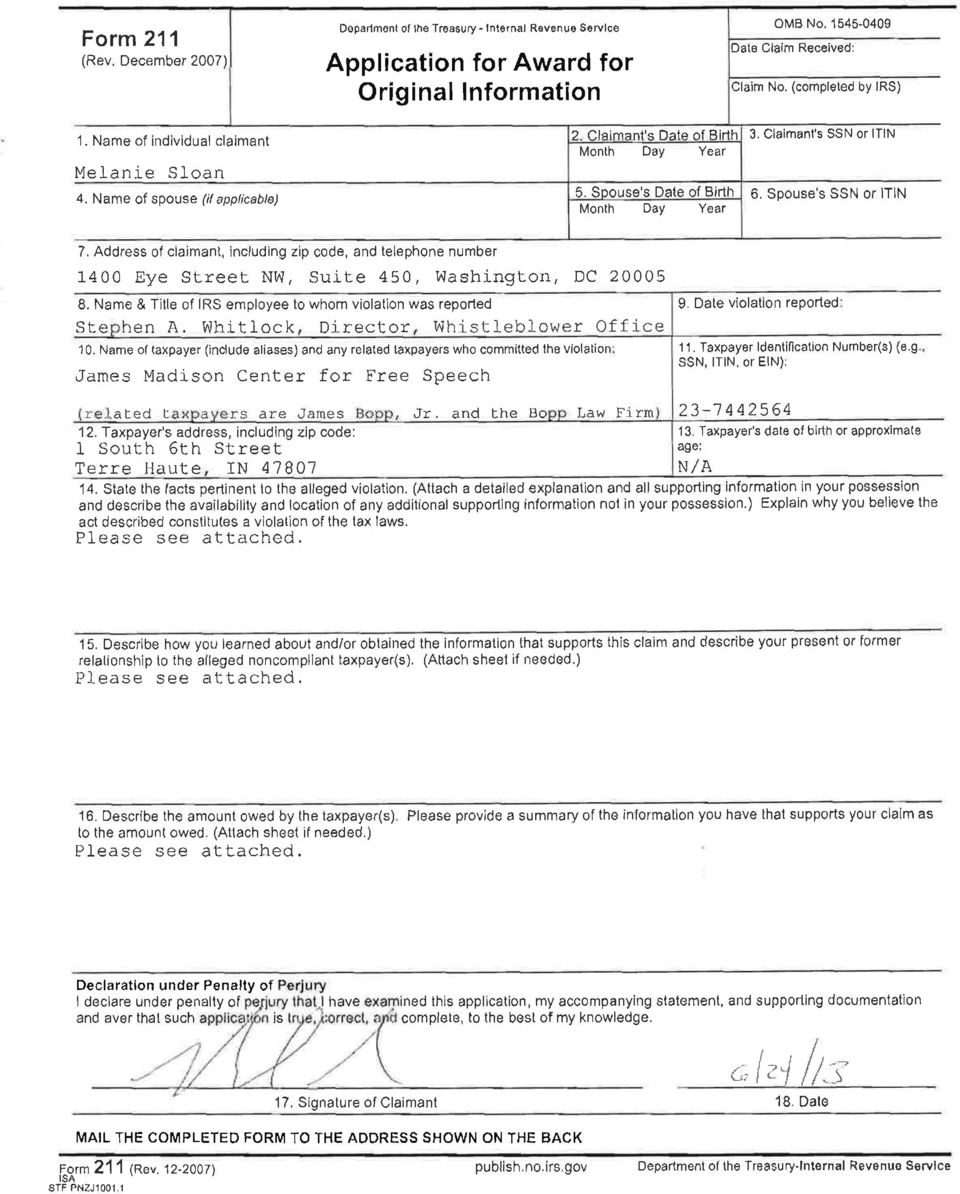
2 Addendum to Form 211, Application for Award for Original Information Melanie Sloan is filing this IRS Whistleblower complaint to bring to the Service s attention a series of questionable transactions involving three related parties: the James Madison Center for Free Speech ( JMCFS ), a section 501(c)(3) organization that was classified as a public charity until 2008, and currently is classified as a private foundation 1 ; the individual who founded the charity, and served as its sole manager, Mr. James Bopp; and the Bopp Law Firm, a business owned and controlled by Mr. Bopp. 2 Media reports, JMCFS s filings with the IRS, and other public documents suggest that JMCFS, under the control of Mr. Bopp an attorney who claims substantial experience and expertise in the tax laws affecting nonprofit organizations 3 is misrepresenting its activities to the IRS and the public in order to divert funds through the Bopp Law Firm to enrich Mr. Bopp personally. This submission will demonstrate that, for each of the last six years, Mr. Bopp as the sole manager of JMCFS, and operating unchecked by its Board of Directors caused the organization to pay essentially all of its income to the Bopp Law Firm. By directing the diversion of charitable funds for his own benefit, Mr. Bopp caused JMCFS to fail some of the most fundamental tax requirements applicable to section 501(c)(3) organizations, and has subjected himself, JMCFS and the Bopp Law Firm to more than $6.2 million in excise tax liability under sections 4941, 4945 and 4958 of the Code. Put simply, JMCFS is a private law firm masquerading as a charity. It serves private purposes to an extraordinary degree and thus should not be recognized as tax-exempt under section 501(c)(3). The information in this submission also suggests, quite strongly, that the conduct of JMCFS and Mr. Bopp violates other civil and criminal tax laws and may violate other federal and state criminal statutes as well. Thus, Ms. Sloan urges the Service to investigate immediately and, after verifying this information, assess penalties and other appropriate sanctions including revocation of JMCFS s tax-exempt status and assessment of penalty taxes on Mr. Bopp and the Bopp Law Firm. Indeed, given the visibility of the organization, the significant dollars involved, and the continuing nature of Mr. Bopp s and JMCFS s troubling activities, any inaction on the part of the Service will undermine the integrity of the law itself. 1 All section references are to the Internal Revenue Code of 1986, as amended (the Code ), and all regulatory references are to the Treasury Regulations currently in effect under the Code (the Regulations ). 2 The Bopp Law Firm was a sole proprietorship from 1992 to April 2012, when Mr. Bopp incorporated it as an Indiana professional corporation. See &client_id=&submit.x=0&submit.y=0&search_mode=search (Exhibit A). 3 See The Bopp Law Firm, PC, Summary of Resume of James Bopp, Jr. (Exhibit B). This document was submitted by Mr. Bopp to a federal district court in Washington state in 2012, as part of a fee petition.

3 -2- Consistent with the requirements of section 3.03(7) of Notice , C.B. 253, the Background section of this submission sets out the factual background supporting Ms. Sloan s claim, including the amounts and tax years of excise taxes at issue. And, as required by section 3.03(8), this submission both above, and in the Background section explains that these facts came to Ms. Sloan s attention through the various public documents described herein. The Discussion section applies the legal authorities supporting Ms. Sloan s contention that JMCFS, Mr. Bopp, and the Bopp Law Firm are liable for Chapter 42 excise taxes and calculates the excise taxes owed by each. Throughout this submission, various documents are cited that substantiate Ms. Sloan s claim, all of which are publicly available. For convenient reference, copies of certain of these documents are enclosed as exhibits to this submission. Also enclosed is a Form 2848, authorizing Ms. Sloan s attorneys to represent her before the IRS. Summary of Key Findings JMCFS, under the control of Mr. Bopp (who, by his own admission, single-handedly controls JMCFS s operations), paid nearly all of its income over a period of years to the Bopp Law Firm then a sole proprietorship owned by Mr. Bopp in violation of the prohibitions against private inurement and substantial private benefit that are fundamental requirements for exemption under section 501(c)(3) of the Code. The repeated diversions of JMCFS s income to Mr. Bopp s sole proprietorship in 2006 and 2007, at Mr. Bopp s direction, constituted excess benefit transactions which, to date, have not been corrected subjecting Mr. Bopp and the Bopp Law Firm to more than $2.9 million in section 4958 excise taxes in 2006 and The repeated diversions of JMCFS s income to the Bopp Law Firm in 2008, 2009, 2010, and 2011 resulted in numerous self-dealing transactions between JMCFS and the Bopp Law Firm, and taxable expenditures through the use of JMCFS s charitable assets for the benefit of the Bopp Law Firm none of which has been corrected subjecting JMCFS, Mr. Bopp, and the Bopp Law Firm to more than $3.3 million in excise taxes under sections 4941 and 4945 of the Code. A pattern of filing inaccurate Forms 990-PF and 990 including affirmative statements that JMCFS has no independent contractors to which it pays more than $50,000, even though JMCFS annually paid the Bopp Law Firm well in excess of that amount subjects JMCFS and Mr. Bopp (who signed JMCFS s information returns under penalties of perjury) to civil, and potentially criminal, penalties.

4 -3- Background A. Overview of JMCFS s Mission, Governance, and Activities. Formerly called The Caring Foundation, 4 JMCFS is a corporation exempt from federal income tax under section 501(c)(3). 5 It has been classified as a private foundation under section 509(a) since 2008, although the organization was previously classified as a public charity. 6 JMCFS was founded by James Bopp, Jr., an attorney who represents numerous not-forprofit organizations and has long held himself out as an expert on not-for-profit corporate and tax law, on campaign finance and election law... [and] on federal and state trial and appellate litigation. 7 Media reports and JMCFS s website confirm that Mr. Bopp founded JMCFS in However, the corporation to which JMCFS s EIN was assigned (the Caring Foundation) existed long before; indeed, JMCFS s Business Master File confirms that the IRS recognized the corporation as exempt in April Accordingly, it appears that, rather than founding JMCFS, and applying to the IRS for recognition of the new organization s tax-exempt status, Mr. Bopp simply repurposed an existing corporation that already had been recognized by the IRS as exempt, ostensibly for JMCFS s stated purposes. JMCFS s stated mission is to protect the First Amendment right of all citizens to free political expression in our democratic Republic. Its purpose is to support litigation and public education activities in order to defend the rights of political expression and association by citizens and citizen groups as guaranteed by the First Amendment of the United States Constitution. 10 According to its most recently available Form 990, JMCFS s sole activity is to 4 See JMCFS 1998 Form 990 (Exhibit C). 5 JMCFS states on its website that it is an internal educational fund of the James Madison Center, Inc., a District of Columbia non-profit corporation. See (Exhibit D). While this statement could be read to imply that JMCFS is not a separate organization from the James Madison Center, Inc., the organizations were separately recognized by the IRS as tax-exempt entities in April 1975, with JMCFS recognized under section 501(c)(3) and the James Madison Center, Inc. recognized under section 501(c)(4). See (Exhibit E). 6 See, e.g., JMCFS 2008 Form 990-PF; JMCFS 2007 Form 990, Sch. A (filing as section 509(a)(1) and 170(b)(1)(A)(vi) organization); JMCFS 2006 Form 990, Sch. A (filing as section 509(a)(2) organization). Copies of JMCFS s 2006 through 2011 information returns are enclosed as Exhibit F. 7 Exhibit A ( Summary of Resume of James Bopp, Jr. ). 8 Jon Campbell, James Bopp Jr. Gets Creative: How Does the conservative maestro of campaign finance fund his legal work?, Slate (Oct. 5, 2012), available at h_the_james_madison_center_.html (Exhibit G); see also JMCFS, About Us, available at ) (Exhibit H) (confirming that Mr. Bopp s affiliation with JMCFS began in 1997). 9 See Exhibit E. 10 See ( Mission Statement of the James Madison Center for Free Speech ) (Exhibit I).

5 -4- provide funding for legal services, specifically, defending the first amendment free speech rights of nonprofit organizations and providing compliance advice to churches nationwide. 11 JMCFS ostensibly is governed by a five-member Board of Directors. 12 Mr. Bopp has served as JMCFS s general counsel since founding the organization 1997, 13 and he has signed its annual Forms 990 and 990-PF nearly every year since Interestingly, although JMCFS is located in Terre Haute, Indiana, and JMCFS stated on Part VII-A, Line 8a, of its Forms 990-PF that it is registered with, or reports to, Indiana and the District of Columbia, no record of the organization can be found with the Indiana Secretary of State or the District of Columbia. 14 Although JMCFS lists Wanda Franz as its president on its website and annual returns, the organization has no paid staff 15 and Mr. Bopp is evidently the only person managing JMCFS s operations. 16 Indeed, in a 2012 interview, Mr. Bopp told a Slate reporter that he could not remember the last time the Board met. 17 Further, despite representations to the contrary on JMCFS s last five annual information returns, Ms. Franz denied that she was JMCFS s president, maintaining that she was only a trustee. 18 Claiming that JMCFS s Board delegated all management authority to him, Mr. Bopp said he is free to pursue litigation on his own initiative and that his law firm handles JMCFS s management, bookkeeping, filing IRS returns, and provision of legal services. 19 Consistent with Mr. Bopp s assertions that he alone is responsible for JMCFS s management effectively serving as the organization s principal officer JMCFS has published press releases that refer to Mr. Bopp as the organization s President ; however, they were removed earlier this year from the organization s website. 20 Those assertions by Mr. Bopp and JMCFS s press releases directly 11 JMCFS 2011 Form 990-PF, Part IX-A, line 1 (summary of direct charitable activities). 12 Id. Part VII, line 1 (referring to Board members as trustees ); see also (referring to Board members as directors. ) (Exhibit J). 13 See (profile of James Bopp, Jr.) (Exhibit K); (Exhibit L). 14 See (Exhibit M). The District of Columbia does, however, have record of the James Madison Center, Inc.: the Center was organized on May 17, 1973, is registered as a corporation, and last filed reports with the District in See (Initial File Number ) (Exhibit N). No record of the Center can be found on the Indiana Secretary of State s website. 15 See Exhibit J ( JMCFS 2011 Form 990-PF, Part VII, line 1; JMCFS 2006 Form 990, Part V-A. 16 Exhibit G (Jon Campbell, James Bopp Jr. Gets Creative: How Does the conservative maestro of campaign finance fund his legal work?, Slate (Oct. 5, 2012)). 17 Id. 18 Id. 19 Id. 20 See, e.g., (Exhibit O). See also (Exhibit P).

6 -5- contradict JMCFS s representations on its annual returns filed with the IRS and signed under penalties of perjury by Mr. Bopp. B. JMCFS s Relationship with the Bopp Law Firm. Founded in 1992 by Mr. Bopp as Bopp, Coleson & Bostrom, the Bopp Law Firm was a sole proprietorship until its recent incorporation. 21 The Bopp Law Firm and JMCFS share the same address, phone number, and fax number. 22 Consistent with Mr. Bopp s assertion that he is JMCFS s sole manager, his address and his law firm s phone number are the main contacts listed on JMCFS s website. 23 Further, the list of attorney bios of JMCFS s general counsel are essentially identical those on the Bopp Law Firm s website. 24 And, it appears that the Bopp Law Firm is financially dependent on charitable dollars flowing through JMCFS to the firm; indeed, it has been publicly reported that half of the Bopp Law Firm s litigation work is funded by JMCFS. 25 In another example of the blurring of the lines between JMCFS and the Bopp Law Firm, JMCFS lists cases on its website apparently representing that these are the cases JMCFS funded and provides links to court filings. In these filings, Mr. Bopp and his associates state that they represent various clients in their capacities at the Bopp Law Firm, JMCFS, or both. 26 JMCFS s annual filings with the IRS, which were reviewed and signed under penalties of perjury by Mr. Bopp, underscore the reality that the organization is little more than a front for, or alter ego of, the Bopp Law Firm. On its Form 990 and Form 990-PF information returns, JMCFS claims that providing funding for legal services as opposed to providing direct legal representation is its sole activity. 27 Troublingly, however, the revenue and expenditure schedules to those returns reveal that virtually all of JMCFS s revenue is passed on to the Bopp Law Firm to fund the legal services by Bopp and his associates for cases such as those listed on 21 See Bopp v. Brames, 713 N.E.2d 866, 868 (Ind. Ct. App. 1999) (after the October 1992 dissolution of the partnership, Brames, Bopp, Abel & Oldham, Bopp proceeded to form a sole proprietorship entitled Bopp, Coleson & Bostrom ) (Exhibit Q); (Exhibit R) (stating that The Bopp Law Firm was founded by Bopp in 1992). On April 23, 2012, Mr. Bopp incorporated the Bopp Law Firm, P.C., as an Indiana professional corporation with one authorized share. See (Exhibit S). Mr. Bopp is presumably the sole shareholder, as he was the sole proprietor of Bopp Law Firm for nearly 20 years, and Indiana law requires that at least one share of a professional corporation rendering legal services be owned by an Indiana-licensed attorney. Ind. Code See JMCFS 2011 Form 990-PF; (Exhibit T); 23 See ([email protected] is JMCFS s contact) (Exhibit U). 24 Compare with 25 See Terry Carter, The Big Bopper, ABA Journal (November 24, 2006), available at (Exhibit V). 26 See (Exhibit W) (providing links to various petitions, briefs, and filings that list Mr. Bopp and his associates as working for the Bopp Law Firm, JMCFS, or both). 27 See, e.g., JMCFS 2011 Form 990-PF, Part IX, Stmt. 5 (describing the organization s sole charitable activity as provid[ing] funding for legal services to litigate First Amendment cases and to assist churches with legal compliance).

7 -6- JMCFS s website. These payments are reported as legal fees on the organization s information returns. Table 1. Year Total Revenue Total Expenditures Payments to Bopp Law Firm Bopp Payments as % of Total Revenue Bopp Payments as % of Total Expenses 2006 $1,018,689 $1,018,781 $1,011, % 99.2% 2007 $277,956 $277,524 $276, % 99.6% 2008 $317,853 $319,328 $317, % 99.5% 2009 $127,082 $77,127 $77, % 99.9% 2010 $135,000 $184,435 $183, % 99.4% 2011 $255,879 $256,173 $255, % 99.9% Total $2,132,459 $2,133,368 $2,129, % 99.4% As Table 1 reveals, approximately 99.5% of JMCFS s annual revenues from were used to fund legal services performed by the Bopp Law Firm on behalf of third parties. 28 Despite making substantial payments to its founder s law firm year after year, JMCFS took the position in its Forms 990-PF that the organization did not engage any independent contractors to which it paid more than $50,000 per year. 29 JMCFS s position that the Bopp Law Firm is not an independent contractor suggests that JMCFS likely did not file 28 See JMCFS 2011 Form 990-PF, Part I, Lines 12, 16a (Stmt. 1), and 26; JMCFS 2010 Form 990-PF, Part I, Lines 12, 16a (Stmt. 1), and 26; JMCFS 2009 Form 990-PF, Part I, Lines 12, 16a (Stmt. 1), and 26; JMCFS 2008 Form 990-PF, Part I, Lines 12, 16a (Stmt. 2), and 26; JMCFS 2007 Form 990, Part I, Lines 12 and 17, and Schedule A, Part II-A; JMCFS 2006 Form 990, Part I, Lines 12 and 17, and Schedule A, Part II-A. It appears that it has long been JMCFS s practice to pay nearly all of its expenses to the law firm where Mr. Bopp works. For example, in 2005, JMCFS paid 102.9% of its revenues and 98.5% of its expenses to Bopp, Coleson & Bostrom. JMCFS 2005 Form 990, Part I, Lines 12 and 17, and Schedule A, Part II-A. From , while JMCFS did not disclose to which firm it paid legal fees, its legal fees accounted for 97.6% of its revenues and 95.5% of the organization s expenses. JMCFS 2004 Form 990, Part I, Lines 12 and 17; JMCFS 2003 Form 990, Part I, Lines 12 and 17; JMCFS 2002 Form 990, Part I, Lines 12 and 17; JMCFS 2001 Form 990, Part I, Lines 12 and 17; JMCFS 2000 Form 990, Part I, Lines 12 and 17; JMCFS 1999 Form 990, Part I, Lines 12 and 17; and JMCFS 1999 Form 990, Part I, Lines 12 and 17. Given JMCFS s consistent pattern of paying most of its revenues to Mr. Bopp s law firm, it appears likely that JMCFS paid nearly all such legal fees to Mr. Bopp s firm. 29 See JMCFS 2011 Form 990-PF, Part VIII, Line 3; JMCFS 2010 Form 990-PF, Part VIII, Line 3; JMCFS 2009 Form 990-PF, Part VIII, Line 3; JMCFS 2008 Form 990-PF, Part VIII, Line 3.

8 -7- Form 1099-MISC with respect to these payments and the Bopp Law Firm may not have paid employment taxes on these payments. The Service should investigate this potentially substantial employment tax issue. More troubling, JMCFS s position that the Bopp Law Firm is not an independent contractor suggests that that JMCFS considers the firm and itself as one and the same a sentiment that has been echoed by Mr. Bopp s public statements and business decisions. For example, Mr. Bopp himself has described organizations he represented as clients of JMCFS even though JMCFS, as a funder of legal services, does not provide legal services and thus has no clients. 30 And, although JMCFS represents itself as a funder of legal services, the organization claimed in its 2006 and 2007 information returns that JMCFS itself provid[ed] legal representation, rather than funding for such services. 31 Further, under Mr. Bopp s sole direction, JMCFS shares the firm s offices, has no paid staff, pays nearly all of its revenues to the firm, and considers all of the attorneys at the firm as its general counsel. Thus, there appears to be little, if any, meaningful distinction between JMCFS and the firm itself. In sum, Mr. Bopp admits that he is the sole manager of JMCFS and the organization s Board has delegated him authority over the organization s operations including the authority to choose the cases with which JMCFS is involved; JMCFS shares offices, phones, faxes, and personnel with the Bopp Law Firm; nearly all of JMCFS s revenues are paid to the Bopp Law Firm; and JMCFS does not report the Bopp Law Firm as an independent contractor on the organization s annual information returns. Given these circumstances, it is difficult to characterize JMCFS as anything other than an instrument Mr. Bopp uses to pay his firm s legal fees. 32 Because JMCFS is currently exempt from federal income tax under section 501(c)(3), donors have been able to take charitable deductions for what would otherwise be non-deductible payments to the Bopp Law Firm. 30 See, e.g., James Bopp, Jr. & Richard E. Coleson, Electioneering Communication Versus Abortion, Election Law Journal, Vol. 3, No. 2 (2004) 205, 205 ( The authors represented the following parties before the Supreme Court in National Right to Life Committee v. FEC ( ; consolidated with McConnell v. FEC) as clients of the James Madison Center for Free Speech: U.S. Representative Mike Pence, Alabama Attorney General Bill Pryor, Libertarian National Committee, Inc., Club for Growth, Inc., Indiana Family Institute, Inc., National Right to Life Committee, Inc., National Right to Life Educational Trust Fund, National Right to Life Political Action Committee, Trevor M. Southerland, and Barret Austin O Brock. ), available at online.liebertpub.com/doi/pdfplus/ / (Exhibit X). 31 See JMCFS 2006 and 2007 Forms 990, Part III, Line a. 32 See Jonathan Salant, Election Spending to Exceed $6 Billion Thanks Partly to Jim Bopp, Bloomberg, Sept. 21, 2011, available at (Exhibit Y) ( To help pay his legal fees, Bopp set up the James Madison Center for Free Speech in ).

9 -8- Discussion A. JMCFS Operates for the Private Benefit of Mr. Bopp and the Bopp Law Firm, in Violation of Section 501(c)(3). 1. The Private Benefit Doctrine. As you are well aware, organizations that are exempt from federal income tax under section 501(c)(3) must be organized and operated exclusively for charitable, educational, or other exempt purposes. Indeed, the Supreme Court has held that the presence of a single non-exempt purpose, if substantial in nature, will disqualify an organization from tax-exempt status, even if the organization also conducts charitable activities. 33 The Regulations further clarify that an organization is not operated exclusively for exempt purposes unless it serves a public rather than a private interest. 34 To meet this requirement, the organization must establish that it is not operated for the benefit of private interests such as designated individuals, the creator or his family, shareholders of the organization, or persons controlled, directly or indirectly, by such private interests. 35 Accordingly, although a section-501(c)(3) organization may have as its sole purpose the providing of funds to defend constitutional rights, in turn furthering charitable purposes, an organization conducting such activities like any other section 501(c)(3) organization is not exempt if it does not comply with the Regulation proscribing private benefit. 36 In determining whether such an organization meets this requirement, the IRS has cited as an important criterion whether the selection of cases by the organization for its support is made by a board or committee that is representative of the public and is not controlled by employees, persons who litigate on behalf of the organization, or by any commercial entity. 37 Moreover, the social welfare aspect of such an organization s funding of cases may be negated by a finding of overriding private benefit. 38 Courts have interpreted this regulation to create a private benefit test that prohibits taxexempt organizations from conducting more than insubstantial activities that confer nonincidental benefits... that serve private interests. 39 In other words, if an organization serves private interests other than incidentally, it will not meet the standard for tax-exemption, 33 See Better Business Bureau v. United States, 326 U.S. 279, 283 (1945). 34 Treas. Reg (c)(3)-1(d)(1)(ii). 35 Id. 36 See id.; Rev. Rul , C.B EO CPE Text, D. Litigation by IRC 501(c)(3) Organizations. 38 Id. 39 Am. Campaign Acad. v. Comm r, 92 T.C. 1053, 1069 (1989); Rev. Rul , I.R.B. 915.

10 -9- even if it otherwise appears to conduct charitable activities. 40 Based on the foregoing, this appears to be precisely JMCFS s situation. While the most common examples of impermissible private benefit involve a charity conferring financial benefits to individuals, the doctrine is substantially broader than this paradigm. Significantly, for purposes of our analysis, the IRS and courts have long recognized that a charity may create an impermissible private benefit and, accordingly, jeopardize its exempt status if it has a substantial purpose of generating business or providing pecuniary support for one or more nonexempt entities. 41 In one case, for example, the Tax Court upheld the IRS s revocation of the section 501(c)(3) status of the International Postgraduate Medical Foundation because a substantial purpose of its operations was to benefit a for-profit company owned by an officer of the charity. 42 In its decision, the Court explained: When a for-profit organization benefits substantially from the manner in which the activities of a related organization are carried on, the latter organization is not operated exclusively for exempt purposes within the meaning of section 501(c)(3), even if it furthers other exempt purposes. 43 Further, the Tax Court noted that the officer had control of [the charity] and exercised it for the benefit of [his for-profit company]. 44 The IRS takes a similar approach. Thus, when an organization s principal expenditures were to purchase products and services from a for-profit company that controlled it, the IRS denied exemption because the organization was totally dependent on one for profit for [its] operations and, although the organization indicated that after three years it would only account for 10% of the company s sales, the organization s purchases would produce a substantial amount of revenue for [the company]. 45 Accordingly, the IRS found that the organization was formed for the substantial non-exempt purpose of providing a related commercial entity with business revenue. 46 Similarly, when an organization s principal activity was purchasing the books of one of its founders and making them available for public use, the Service held that the organization failed to operate exclusively for section 501(c)(3) purposes. 47 Moreover, impermissible private benefit exists when a charity allows private interests to dictate the charity s internal operations and policies. Thus, in Columbia Park & Recreation 40 See Columbia Park & Recreation Ass n v. Comm r, 88 T.C. 1, 25 (1987) (explaining that under the section 501(c)(3) Regulations, a private interest exists if any person having a private or personal interest in [the organization s] activities is the focus of [the organization s] benefit ). 41 E.g., Int l Postgraduate Med. Found. v. Comm r, 56 T.C.M. (CCH) 1140 (1989); KJ s Fund Raisers Inc. v. Comm r, 74 T.C.M (CCH) 669 (1997), aff d, 166 F.3d 1200 (2d Cir. 1998); Rev. Rul , C.B Int l Postgraduate Med. Found., 56 T.C.M. (CCH) 1140 (1989). 43 Id. 44 Id. 45 Priv. Ltr. Rul (Aug. 17, 2011). 46 Id. (citing Int l Postgraduate Med. Found.). 47 Rev. Rul , C.B. 72.

11 -10- Association v. Commissioner, the Tax Court ruled that a nonprofit civic association created to provide park, recreation, and other services to a planned community failed to qualify for exemption because it was operated principally to promote the private interests of the homeowners residing in the community. 48 The court rejected the argument that this benefit was incidental to a greater benefit to the public at large, which had access to some of the development s facilities, as the residents and property owners formulated the organization s budget and defined its goals and policies JMCFS Provided Impermissible Private Benefits to Mr. Bopp and the Bopp Law Firm. Here, it appears that JMCFS is operated to confer nonincidental benefits that serve private interests namely those of the Bopp Law Firm and Mr. Bopp, thus running afoul of the requirement that charities be operated for a public interest. 50 Indeed, JMCFS s sole activity is to further the private and pecuniary interests of Mr. Bopp by providing funding for legal services performed by his business, the Bopp Law Firm. As in International Postgraduate Medical Foundation, Mr. Bopp, as the individual controlling the daily operations of JMCFS, has caused the organization to operate for the benefit of his for-profit business by directing approximately 99.5% of JMCFS s revenues to the business. Accordingly, because his law firm benefits substantially from the manner in which the activities of JMCFS are carried on, JMCFS fails to be operated exclusively for exempt purposes, even if it furthers some exempt purposes. 51 Because Mr. Bopp controls JMCFS and nearly all of JMCFS s revenues are paid to his law firm, the social welfare aspects of JMCFS s operations are negated by the nonincidental indeed, substantial private benefit JMCFS provides to Mr. Bopp and his firm. 52 For example, if JMCFS s cases were selected by a board or committee independent of Mr. Bopp or his firm, and the independent board made a decision that Mr. Bopp was the best choice to conduct the litigation, this would weigh in favor of a finding that JMCFS benefits a public, rather than private interest. 53 In fact, however, one individual Mr. Bopp selects JMCFS s cases, serves as the main litigator of these cases, and is the principal of the firm to which essentially all of JMCFS s business is driven. Given that Mr. Bopp controls both JMCFS and the Bopp Law Firm, JMCFS pays nearly all of its revenues to the Bopp Law Firm, and the firm s work for JMCFS accounts for half of the firm s business, it is clear that JMCFS has a substantial purpose of providing pecuniary support for a non-exempt entity, an impermissible private benefit. 54 Indeed, its principal activity is the 48 Columbia Park & Recreation Ass n, 88 T.C. at Id. 50 See Treas. Reg (c)(3)-1(d)(1)(ii). 51 See Int l Postgraduate Med. Found., 56 T.C.M. (CCH) 1140 (1989). 52 See 1984 EO CPE Text, D. Litigation by IRC 501(c)(3) Organizations. 53 See id. 54 See Int l Postgraduate Med. Found., 56 T.C.M. (CCH) 1140 (1989); Priv. Ltr. Rul

12 -11- purchase of services that directly benefit its founder. 55 Accordingly, JMCFS fails to operate exclusively for exempt purposes. B. JMCFS Engaged in Excess Benefit Transactions and Violated the Prohibition Against Private Inurement. 1. The Inurement Prohibition and the Intermediate Sanctions Excise Tax Regime of Section As you are well aware, every organization exempt under section 501(c)(3) is subject to a requirement that none of its assets or income inure to insiders of the organization. 56 The IRS has stated that the inurement prohibition serves to prevent anyone in a position to do so from siphoning off any of a charity s income or assets for personal use. 57 Specifically, a charity is not to siphon its earnings to its founder, or the members of its board, or their families, or anyone else fairly to be described as an insider, that is, as the equivalent of an owner or manager. 58 Applying this principle, the Tax Court has held that an organization s fee-for-service contracts with companies owned by the two individuals that managed it were inconsistent with section 501(c)(3). 59 In another case, the Tax Court held that when for-profit companies exerted considerable control over an organization and its programs, the organization operated as the instrument to subsidize the for profit corporations, and therefore failed to qualify for tax-exempt status. 60 And, when an organization entered a transaction in order to benefit an insider even though the organization ultimately benefitted from the transaction the Tax Court held that the transaction nonetheless caused the organization to fail to be exempt. 61 Furthermore, the Tax Court held that an organization operated to promote a business owned by its two directors, who were free to set policy for their own benefit without objection from the board, failed to qualify as exempt. 62 More recently, the IRS has observed that extensive dealings of exempt organizations with back-office service providers and other for-profit businesses, often owned by the principals, are fact patterns indicative of inurement. 63 When an arrangement involving a public charity and an insider is particularly egregious, the IRS may revoke a charity s exemption, retroactive to the year of the bad acts. In less egregious cases, however, the IRS may look to the intermediate sanctions rules of section See Rev. Rul , C.B. 72 (discussing the purchase of a founder s books, which the organization distributed for public use). Analogous to the facts in the revenue ruling, JMCFS s principal activity is the purchase of services for the benefit of its founder. 56 See Treas. Reg (c)(3)-1(c)(2). 57 Gen. Couns. Mem (December 2, 1991). 58 United Cancer Council, Inc. v. Comm r, 165 F.3d 1173, 1176 (7th Cir. 1999). 59 Church by Mail, Inc. v. Comm r, 48 T.C.M. (CCH) 471 (1984). 60 est of Hawaii v. Comm r, 71 T.C. 1067, 1082 (1979). 61 See Beeghly Fund v. Comm r, 35 T.C. 490, 523 (1960). 62 KJ s Fund Raisers Inc. v. Comm r, 74 T.C.M (CCH) 669 (1997). 63 C.C.A (July 13, 2004).

13 -12- of the Code, which impose tiered excise taxes on excess benefit transactions involving a charity and one or more of its officers, directors, or other disqualified persons. Under section 4958, disqualified persons who wrongly participate in excess benefit transactions are liable for an initial 25-percent tax on the amount of the excess benefit (e.g., the amount by which the economic benefit provided to the disqualified person exceeds the value of the consideration provided in exchange). If the disqualified persons fail to correct the excess benefit transaction by returning the excess to the charity, they owe an additional 200-percent tax. 64 Further, managers of the organization who knowingly approve such impermissible transactions are liable for a 10-percent tax. 65 Immediately upon the IRS s assessment of the 25- percent tax on a disqualified person for an uncorrected excess benefit transaction, the disqualified person is also liable for a 200-percent tax. 66 And, when multiple disqualified persons receive an excess benefit from a transaction, they are jointly and severally liable for the 25- percent and 200-percent tax, as applicable. 67 The term excess benefit includes a benefit obtained by a disqualified person by an unauthorized diversion of assets for example, by theft or fraud which is an automatic excess benefit transaction not treated as provided in consideration for the performance of services. 68 Thus, in these situations the full economic benefit is the excess benefit that is provided by the charity. The treatment of such benefits is a corollary to the rule that if payment is intended as compensation for services, a charity or the disqualified persons must clearly indicate this intent or the payment will be considered automatically an excess benefit transaction. 69 These Regulations reflect the IRS and Treasury Department s position that any economic benefit received by a disqualified person from the assets of the organization even if not authorized under the organization s regular procedures is provided by the organization with the meaning of section 4958, and thus unauthorized transfers are excess benefit transactions. 70 Accordingly, the diversion of funds by an insider, such as a founder, in unauthorized transactions with an organization produces excess benefit transactions. 71 For purposes of section 4958, a disqualified person is any person or entity in a position to exercise substantial influence over the charity at any time during the five-year period ending on the date of the transaction. The Regulations identify certain categories of persons who are 64 I.R.C. 4958(a)-(b). 65 I.R.C. 4958(a)(2). A manager who knowingly participates in such a transaction is liable for the 10-percent tax, unless his or her participation was not willful and due to reasonable cause. Section 4958(d)(2) limits the tax imposed for one transaction to $20, I.R.C. 4958(b), (f)(5), (f)(6). 67 Treas. Reg (c)(1)-(2). 68 Treas. Reg (c)(1). 69 Id. 70 See Explanation of Provisions, T.D. 8920, 66 Fed. Reg. 2144, See Treas. Reg (c)(3)-1(f), Example 3 (a diversion of assets benefiting a disqualified person is an excess benefit transaction).

14 -13- automatically deemed to have substantial influence over a charity, and thus are per se disqualified persons, which include: anyone holding the ultimate responsibility for implementing the decisions of the governing body or for supervising the charity s management, administration, or operation (i.e., President, CEO, or COO); or anyone holding the ultimate responsibility for the finances of the organization (i.e., Treasurer or CFO); 72 and any entity in which 35 percent or more of the combined voting power (in a corporation), profits interest (in a partnership), or beneficial interest (in a trust) is owned by persons described in the first category ( 35-percent controlled entities ). 73 The Regulations under section 501(a) similarly define a private shareholder or individual as a person with a personal and private interest in the activities of the organization. 74 Chief executives, corporate officers, and other insiders in a position to control or influence an organization s activities are generally considered private shareholders or individuals for purposes of the inurement rule. 75 The section 4958 excise taxes are generally imposed as an alternative to revocation; however, where the circumstances warrant, intermediate sanctions and revocation may both be imposed simultaneously. 76 The Regulations clarify that, in determining whether to continue to recognize the tax-exempt status of an organization that engages in one or more excess benefit transactions, the Service will consider all relevant facts and circumstances, including, but not limited to, the following: the size and scope of the excess benefit transaction or transactions (collectively, if more than one) in relation to the size and scope of the organization's regular and ongoing activities that further exempt purposes; whether the organization has been involved in multiple excess benefit transactions with one or more persons; whether the organization has implemented safeguards that are reasonably calculated to prevent excess benefit transactions; and 72 Treas. Reg (c)(2)-(3). 73 Treas. Reg (b)(2). 74 Treas. Reg (a)-1(c). 75 See United Cancer Council, Inc., 165 F.3d at See Treas. Reg (c)(3)-1(f)(2); (a).

15 -14- Whether the excess benefit transaction has been corrected, or the organization has made good faith efforts to seek correction from the disqualified person(s) who benefited from the excess benefit transaction. 77 An example in the Regulations helpfully illustrates the type of situation that warrants both the imposition of section 4958 excise taxes and revocation of the organization s exemption: (i) O conducts educational programs for the benefit of the general public. Since its formation, O has employed its founder, C, as its Chief Executive Officer. Beginning in Year 5 of O s operations and continuing to the present, C caused O to divert significant portions of O s funds to pay C s personal expenses. The diversions by C significantly reduced the funds available to conduct O s ongoing educational programs. The board of trustees never authorized C to cause O to pay C s personal expenses from O s funds. Certain members of the board were aware that O was paying C s personal expenses. However, the board did not terminate C s employment and did not take any action to seek repayment from C or to prevent C from continuing to divert O s funds to pay C s personal expenses. C claimed that O s payments of C s personal expenses represented loans from O to C. However, no contemporaneous loan documentation exists, and C never made any payments of principal or interest. (ii) The diversions of O s funds to pay C s personal expenses constitute excess benefit transactions between an applicable tax-exempt organization and a disqualified person under section Therefore, these transactions are subject to the applicable excise taxes provided in that section. In addition, these transactions violate the proscription against inurement under section 501(c)(3) and paragraph (c)(2) of this section JMCFS s Tax-Exempt Status Should be Revoked for Prohibited Private Inurement. The facts in this case strongly suggest that JMCFS, through its relationship with Mr. Bopp and the Bopp Law Firm, has violated the prohibition against private inurement. JMCFS has long been controlled by Mr. Bopp, who says that the organization s governing body delegated away all management authority to him. As JMCFS s founder and sole manager, Mr. Bopp is certainly an insider. 79 Moreover, Mr. Bopp is a private shareholder or individual for purposes of the inurement prohibition he unquestionably has a personal and private interest in the activities of the organization. 80 Mr. Bopp has caused JMCFS under his sole control pay over nearly 99.5 percent of JMCFS s revenues to his firm. This is textbook private inurement Treas. Reg (c)(3)-1(f)(2)(ii). 78 Treas. Reg (c)(3)-1(f), Example (3). 79 See United Cancer Council, Inc., 165 F.3d at Treas. Reg (a)-1(c). 81 See United Cancer Council, Inc., 165 F.3d at 1176.

16 -15- Mr. Bopp s absolute control over both JMCFS and the Bopp Law Firm has opened the door to this abuse. Under the authorities discussed above, such control is an important factor in determining whether an organization is entitled to retain its tax-exempt status 82 ; the facts in JMCFS s case practically compel revocation. Here, Mr. Bopp alone controls JMCFS and the Bopp Law Firm, and thus is free to set JMCFS s policies for his own benefit without any objection from the Board. Because JMCFS directs virtually all of its revenues to its founder s business, it also appears that the organization operates to promote the business of an insider. 83 Further, it appears that JMCFS operates as an instrument to subsidize the Bopp Law Firm s business by providing about half of its funding, inconsistent with the inurement prohibition. 84 As the IRS has noted, such extensive dealings with a for-profit business owned by an exempt organization s principals is a strong indicator of inurement. 85 The Service should investigate whether as the facts quite strongly indicate JMCFS has allowed its net earnings to inure to the benefit of Mr. Bopp and the Bopp Law Firm, in violation of the inurement prohibition. 3. Mr. Bopp and the Bopp Law Firm Have Engaged in Substantial Automatic Excess Benefit Transactions and are Liable for Section 4958 Excise Taxes. Mr. Bopp claims, in essence, that he has ultimate responsibility for the management of JMCFS and the execution of its self-proclaimed sole activity providing funding for legal services. As the sole individual responsible for the organization s management and day-to-day operations, he is a per se disqualified person with respect to JMCFS under section Moreover, because the Bopp Law Firm was a sole proprietorship, wholly owned by Mr. Bopp, the firm is also a per se disqualified person with respect to JMCFS. 87 Accordingly, any transaction between JMCFS and Mr. Bopp, or JMCFS and the Bopp Law Firm, is subject to section Mr. Bopp claims that JMCFS s Board has delegated all management authority to him. He admits that the Board does not regularly meet and thus, presumably never reviewed or authorized any particular case, or guidelines as to which cases JMCFS should fund. Further, Mr. Bopp notes that he alone chooses cases the Bopp Law Firm will take on, and which JMCFS will evidently fund without question. Accordingly, Mr. Bopp operates JMCFS alone and unchecked by any JMCFS officer or trustee, and has caused JMCFS to repeatedly and continuously fund commercial legal services provided by the Bopp Law Firm to third parties. The facts strongly suggest that the JMCFS Board never authorized these services or their funding by JMCFS. 82 See Church by Mail, Inc., 48 T.C.M. (CCH) 471 (1984). 83 Compare KJ s Fund Raisers, Inc., 74 T.C.M. (CCH) 669 (1997). 84 Compare est of Hawaii, 71 T.C (1979). 85 See C.C.A (July 13, 2004). 86 See Treas. Reg (c)(2)-(3). 87 See Treas. Reg (b)(2).

17 -16- When a disqualified person, such as a sole manager, like Mr. Bopp, causes a charity to provide him with an economic benefit, without Board authorization indicating that the payment is intended to be made as compensation for services, the entire benefit conferred is deemed to be an automatic excess benefit. 88 Here, it appears that the Board abdicated all of its authority, and has never considered or approved the funding of any of JMCFS s cases, let alone repeated payments to the Bopp Law Firm to litigate those cases. Rather, it appears the Board stood by while Mr. Bopp caused JMCFS to transfer its charitable assets to his private law firm. Even if some Board members knew that Mr. Bopp diverted JMCFS s charitable assets for his personal benefit, however, the Regulations make clear that such diversions are automatic excess benefit transactions. 89 The Regulations also make clear that such diversions of assets violate the inurement prohibition where as here (1) the size and scope of the excess benefit transactions dwarfs the size and scope of the organization s other charitable activities, (2) the organization has not implemented safeguards to prevent future diversions, (3) the transactions have not been corrected, and (4) the organization has failed to seek correction of such transactions. 90 Accordingly, it appears that JMCFS engaged in excess benefit transactions in 2006 and 2007, resulting in a liability for Bopp Law Firm for a 25-percent excise tax of $321,839 and immediately upon the IRS s assessment thereof an additional 200-percent tax of $2,574, With respect to any of these excess benefit transactions, Mr. Bopp would certainly be considered to knowingly have approved such transactions under the standards described in the Regulations, 92 and would thus be personally liable for a 10-percent tax on the 2006 and 2007 excess benefit transactions, totaling $40, C. JMCFS Engaged in Acts of Self-Dealing and Made Significant Taxable Expenditures. 1. Self-Dealing and Taxable Expenditures. As you know, section 4941(a)(1) imposes a tax on the disqualified person for any act of self-dealing with a private foundation. Disqualified persons include foundation managers, (e.g., officers, directors, trustees) and any corporation, partnership, trust, or unincorporated entity more than 35-percent owned by a foundation manager. 94 For each act of self-dealing, the disqualified person participating in the act is liable for a 10-percent tax on the amount involved, subject to an additional 200-percent tax for failure to correct the benefit by returning it to the 88 See Treas. Reg (c)(1). 89 See Treas. Reg (c)(3)-1(f), Example 3 (a diversion of assets benefiting a disqualified person is an excess benefit transaction). 90 See Treas. Reg (c)(3)-1(f)(2)(ii)-(iii). 91 See I.R.C. 4958(b), (f)(5), (f)(6). 92 See Treas. Reg (d)(4). 93 The amount of tax on foundation managers for any one excess benefit transaction is limited to $20, I.R.C. 4946(a)(1)(B), (E)-(G); Treas. Reg (a)(1)(ii), (v)-(vii).

18 -17- foundation. 95 Further, a foundation manager who knowingly approved such a transaction is liable for a 5-percent tax, subject to an additional 50-percent tax when the disqualified person fails to correct such a transaction. 96 Under section 4941(d)(1)(D), the payment of compensation by a private foundation to a disqualified person is an act of self-dealing subject to penalty unless the payment is for the performance of personal services which are reasonable and necessary to carry out the exempt purpose of the private foundation and the compensation is not excessive. 97 Personal services include the professional services of a broker serving as an agent for a foundation, but not the services of a dealer buying from the foundation and reselling to third parties. 98 Thus, the Regulations distinguish between services performed for a foundation, which are personal services, and independent actions of a disqualified person, which are not. Indeed, an example in the Regulations provides that a law firm that is a disqualified person may perform legal services for a foundation and payments for such services will not give rise to acts of self-dealing if the services performed are reasonable and necessary for the carrying out of the foundation s exempt purposes and the amount paid for such services is not excessive. 99 The reasonable and necessary standard is a core federal tax-law concept originally developed by the IRS and the courts under section 162 for purposes of determining the deductibility of business expenses. 100 The IRS has indicated that the conceptual standards for judging whether an expense is reasonable and necessary for purposes of the self-dealing rules are essentially the same as for purposes of the business-expense deduction. 101 Whether the amount of a payment is reasonable and not excessive is a factual determination for which there is no bright-line test. 102 The Treasury Regulations state that reasonable compensation is only such amount as would be paid for like services by like 95 I.R.C. 4941(a)(1), (b)(1). 96 I.R.C. 4941(a)(2), (b)(2). Section 4941(c)(2) subjects both the first- and second-tier tax imposed on a foundation manager to $20,000 with respect to each act of self-dealing. 97 I.R.C. 4941(d)(2)(E); Treas. Reg (d)-3(c)(1). 98 Treas. Reg (d)-3(c)(1). 99 See Treas. Reg (d)-3(c)(2), Example (1). 100 See I.R.C. 162(a). Section 162(a) actually uses the phrase ordinary and necessary, but as a leading commentator has observed, in the context of payments between related parties (as with JMCFS s payments to the Bopp Law Firm), the requirement that expenses be reasonable in amount is inherent in the broader requirement that they be ordinary and necessary. Bittker & Lokken, Federal Taxation of Income, Estates, and Gifts See, e.g., Treas. Reg (c)-3(c)(1) (cross-referencing Treas. Reg for the determination of whether compensation is excessive under the same section of the private foundation Regulations applicable to reimbursement of expenses); Priv. Ltr. Rul (Aug. 18, 1995) (considering whether reimbursement for services is necessary within the meaning of section 4941(d)(2)(E) and stating that the term necessary has been construed in substantially the same manner as it is used with respect to deductible expenses under section 162(a) of the Code ). 102 Treas. Reg (b)(3) (the allowance for compensation may not exceed what is reasonable under all the circumstances ); (b)(2) (the determination of whether an administrative expense is unreasonable shall depend upon the facts and circumstances of the particular case ).

19 -18- enterprises under like circumstances. 103 As this formulation suggests, the reasonableness of a payment is generally judged based on whether the payment is consistent with the prevailing practice of comparable entities. 104 To qualify as necessary, services must be appropriate and helpful, in the sense of being plainly adapted to advancing JMCFS s charitable purposes. 105 A leading commentator has summarized the test as follows: a business expense is necessary if it is appropriate and helpful with respect to the taxpayer s trade or business. 106 Section 4945(a)(1) imposes a tax on taxable expenditures made by a private foundation. Under section 4945, the foundation is liable for an initial 20-percent tax on each taxable expenditure, plus a 100-percent tax that is due immediately upon assessment of the initial tax, if the taxable expenditure has not been corrected. 107 A foundation manager who knowingly approves of a taxable expenditure is liable for a 5-percent tax, and, immediately upon assessment thereof, he or she is also liable for 50-percent tax on the uncorrected taxable expenditure. 108 Taxable expenditures include any amount a foundation pays for non-charitable purposes, which in turn include unreasonable administrative expenses, unless the taxpayer can establish that the costs were incurred in the good faith belief that they were reasonable and... consistent with ordinary business care and prudence. 109 Accordingly, both section 4945 and section 4941 employ a reasonable and necessary standard to determine whether expenses are appropriate. 2. JMCFS, Mr. Bopp, and the Bopp Law Firm are Liable for Section 4941 and 4945 Excise Taxes. Mr. Bopp and the Bopp Law Firm are disqualified persons with respect to JMCFS, and any payment provided to either of them by JMCFS, after JMCFS became a private foundation in 2008, is subject to the self-dealing rules. 110 Accordingly, the question is whether the legal services the Bopp Law Firm to provided to various third-party clients are personal services 103 Treas. Reg (b)(3). 104 See, e.g., Rutter v. Comm r, 853 F.2d 1267, (5th Cir. 1988); Bittker & Lokken, Federal Taxation of Income, Estates, and Gifts See, e.g., Comm r v. Tellier, 383 U.S. 687, 689 (1966) ( Our decisions have consistently construed the term necessary as imposing only the minimal requirement that the expense be appropriate and helpful for the development of the [taxpayer s] business. ) (quoting Welch v. Helvering, 290 U.S. 111, 113 (1933)) (alteration in original) Mertens Law of Fed. Income Tax n 25:12; 25: I.R.C. 4945(a)(1), (b)(1), (i). 108 I.R.C. 4945(a)(2), (b)(2), (i). Section 4945(c)(2) limits the first-tier tax on a foundation manager to $10,000 for any one taxable expenditure, and $20,000 for the second-tier tax. 109 I.R.C. 4945(d)(5); Treas. Reg (a), (b)(2). 110 See I.R.C. 4946(a)(1)(B), (G); Treas. Reg (a)(1)(vii). Mr. Bopp is a foundation manager and the Bopp Law Firm is a 35-percent controlled entity.

20 -19- which are reasonable and necessary to carrying out JMCFS s exempt purposes. The answer to this question must be no. Mr. Bopp, as principal of the Bopp Law Firm, decides cases the firm will take on. And, as sole manager of JMCFS, Mr. Bopp also directs the payment by JMCFS of the firm s fees for providing these legal services to third parties not to JMCFS itself. When the Bopp Law Firm under Mr. Bopp s control acts as a principal by choosing the cases to take on, and JMCFS then funds services the Bopp Law Firm provides to third parties, such an arrangement appears to fall outside of the personal services exception in the Regulations. 111 Indeed, the example in the Regulations discussing legal services provides that a law firm that is a disqualified person provides personal services when it performs various legal services for the foundation. 112 Here, by contrast, the legal services performed by the Bopp Law Firm services performed for third parties on the firm s own initiative are more analogous to services of a dealer acting as principal operating on its own behalf. Such services do not qualify as personal services 113 and, accordingly JMCFS s payments to the Bopp Law Firm for these services run afoul of sections 4941 and 4945, as acts of self-dealing and taxable expenditures. Because JMCFS s payments to the Bopp Law Firm, a disqualified person, appear to be acts of self-dealing, the Bopp Law Firm is subject to an initial tax of 10 percent of the amount of compensation upon the payment of compensation and a 10-percent tax each year thereafter until correction or assessment of the tax, for a total of $379,241 for the payments to the Bopp Law Firm. Further, immediately upon the IRS s assessment of the 10-percent tax, the Bopp Law Firm is also subject to a 200-percent tax on each act of self-dealing, for a total of $1,667,940 for Moreover, for knowingly approving acts of self-dealing, Mr. Bopp is subject to 5-percent tax on the amount of compensation for the initial payments of compensation and a 5-percent tax each year thereafter, for a total of $79,263 for the payments to the Bopp Law Firm. 114 And, immediately upon the assessment of the 5-percent tax, Mr. Bopp is also liable for a 50-percent tax on each such act of self-dealing in , for a total of $80,000 in excise taxes. 115 The payments to the Bopp Law Firm also appear to be taxable expenditures, as discussed above, producing a liability for JMCFS under the 20-percent tax, totaling $166,794 for the payments to the Bopp Law Firm. JMCFS is also liable for the 100-percent tax on these expenditures, immediately upon assessment of the 20-percent tax, totaling an additional $833,970. Further, for knowingly approving such taxable expenditures, Mr. Bopp is subject to a 111 See Treas. Reg (d)-3(c)(1) (broker services as an agent of a foundation are personal services, a dealer s purchases from a foundation and re-sales to third parties are not). 112 Treas. Reg (d)-3(c)(2), Example 2 (emphasis added). 113 See Treas. Reg (d)-3(c)(1). 114 The initial tax on a foundation manager is subject to a $20,000 limit for each act of self-dealing. I.R.C. 4941(c)(2). 115 The second-tier tax on a foundation manager is subject to a $20,000 limit for each act of self-dealing. Id.

21 -20-5-percent tax totaling $33,021, and a 50-percent tax immediately assessed upon the assessment of the 5-percent tax of $80, D. Repeated, Willful Chapter 42 Violations May Subject JMCFS to Termination of its Private Foundation Status and Imposition of Tax Under Section 507. Under section 507(a)(2)(A) of the Code, a the IRS can cause the involuntary termination of an organization s private foundation status if the organization commits willful repeated acts (or failures to act) that give rise to Chapter 42 excise taxes e.g., taxes imposed under sections 4941 or The section 507(c) tax is substantial it is equal to the lower of (1) the aggregate tax benefit resulting from the private foundation s tax-exempt status or (2) the value of the net assets of the foundation. The IRS has noted that, because the aggregate tax benefit will in almost all cases exceed the net assets of the private foundation, the tax is essentially a tax of the net assets of the private foundation. 117 Once its foundation status is terminated under section 507, the organization is treated as a new organization created on the day of termination, and must therefore apply to the IRS if it wishes to be recognized as exempt. 118 Willful repeated acts (or failures to act) means at least two acts or failures to act, both of which are voluntary, conscious, and intentional. 119 No motive to avoid the restrictions of the law or the incurrence of a tax is necessary; rather, an act will be treated as willful under similar standards used for the imposition of taxes on foundation managers for knowingly approving acts of self-dealing or taxable expenditures 120 that is, the manager must: have actual knowledge of sufficient facts so that, based solely upon such facts, such transaction would violate one of the provisions in Chapter 42; be aware that such an act under these circumstances may violate the provisions of Chapter 42; and negligently fail to make reasonable attempts to ascertain whether the transaction is an act of self-dealing, or he is in fact aware that it is such an act. 121 Further, an act or failure to act may be treated as an act or failure to act by the private foundation itself, even if the tax is imposed upon one or more foundation managers rather than upon the 116 Section 4945(c)(2) limits the first-tier tax on a foundation manager for any one taxable expenditure to $10,000, and the second-tier tax to $20, EO CPE Text, J. IRC 507 Terminations (1989). 118 I.R.C. 509(c). 119 Treas. Reg (c)(1). 120 Treas. Reg (c)(2). 121 Treas. Reg (a)-1(b)(3); (a)(2)(iii).
22 -21- foundation itself (as is the case, for example, with the self-dealing excise tax imposed by section 4941). 122 As discussed above, Mr. Bopp, as sole manager of JMCFS in , approved the payments to the Bopp Law Firm, which gave rise to acts of self-dealing and taxable expenditures. Moreover, he did so knowingly. Mr. Bopp was intimately familiar with the pertinent facts (having orchestrated the payments) and, as a foundation manger and general counsel of JMCFS not to mention as an attorney [whose] practice concentrates on not-forprofit corporate and tax law 123 he was unquestionably familiar with the laws that apply to private foundations, including the rules penalizing acts of self-dealing and taxable expenditures. Because Mr. Bopp knowing approved the payments that gave rise to acts of self-dealing and taxable expenditures, such acts by Mr. Bopp may be treated as acts of JMCFS for purposes of the involuntary termination rules. 124 Further, the ongoing, repeated payments to the Bopp Law Firm by JMCFS under Mr. Bopp s control easily qualify as willful repeated acts. 125 Accordingly, JMCFS may be subject to involuntary termination by the IRS and the imposition of a tax equal to the entirety of its net assets. D. The Filing of Inaccurate Information Returns Should Subject JMCFS to Penalties, Interest, and Extended Statutes of Limitations. The public record suggests that there may be a number of inconsistencies and potentially significant inaccuracies in the Forms 990 and 990-PF that were filed by JMCFS under penalties of perjury. First, on Part VIII, line 3 of its Forms 990-PF, JMCFS reported that it did not pay any independent contractors more than $50,000 for professional services. At the same time, JMCFS reported in each year that it paid $317,678, $77,052, $183,361, and $255,879 for legal expenses i.e., professional services to The Bopp Law Firm or Bopp, Coleson and Bostrom. Further, JMCFS previously characterized payments to Mr. Bopp s law firm as payments to independent contractors on Part II-A of Schedule A of its 2006 and 2007 Forms 990 $1,011,000 and $276,355, respectively although, at the same time, JMCFS stated that it provided legal representation, rather than funding such activities. 126 Thus, after accurately reporting these payments to independent contractors in (albeit simultaneously appearing to taking credit for the contractors activities as its own), JMCFS departed from accurately reporting such payments to contractors from , potentially avoiding substantial employment taxes in the process. 122 Treas. Reg (c)(3). 123 See Exhibit A. 124 Id. 125 See Treas. Reg (c)(1). 126 See JMCFS, 2007 Form 990, Part III; 2006 Form 990, Part III.
23 -22- By reporting the amounts paid to the Bopp Law Firm as administrative expenses not paid to independent contractors, JMCFS appears to have taken the position that the activities of the Bopp Law Firm were its own activities. Moreover, it appears that, by characterizing such activities as its own, JMCFS may have been attempting to disguise the reality that the amounts paid to the Bopp Law Firm represented more than 99.4% of JMCFS s expenses, and almost 99.5% of its revenues, between 2006 and Further, it appears that JMCFS understood the proper reporting of independent contractor payments, and properly reported them in , and then deliberately departed from proper reporting practices in Second, it appears that JMCFS for which Mr. Bopp signed annual information returns every year from under penalties of perjury may have inaccurately reported its list of officers and trustees. On Part VIII, line 1 of its Forms 990-PF and on Part V-A of its 2006 and 2007 Forms 990, JMCFS lists its officers and trustees as Dr. Wanda Franz (President), Darla St. Martin (Secretary), and Dr. David O Steen (Treasurer), Betsy Devos (Trustee) and David Norcross (Trustee). However, Ms. Franz has publicly insisted that she is a trustee, not the president, calling into question the accuracy of the list. 127 Further, given Mr. Bopp s assertions that the Board has delegated him all management authority over JMCFS and his statement in late 2012 that he could not remember the last time the Board met, it appears that the lists may be well outdated or wholly inaccurate. 128 Given that Mr. Bopp signed the annual returns each year on behalf of JMCFS, it is difficult to believe that that if the list of officers and trustees listed filed each year was incorrect, Mr. Bopp would not have known as much. Third, while JMCFS reported in Part VII-A, line 8a of its Forms 990-PF that it reports to, or is registered with Indiana and the District of Columbia, no record of JMCFS can be found on the websites of the Indiana Secretary of State or the District of Columbia Department of Consumer and Regulatory Affairs. The misstatements on JMCFS s information returns are serious and may subject the organization and Mr. Bopp who signed the return under penalties of perjury to the civil and criminal penalties described below. 1. JMCFS Faces Civil Penalties for Failing to File a Complete or Correct Information Return. Section 6652 of the Code imposes penalties for failing to file a return required under [section] 6033(a)(1) e.g., a Form 990 or 990-PF or for failing to provide complete or correct information on a required return. 129 For purposes of section 6652, a return is considered incomplete if material information has been omitted. 130 Although materiality is not 127 Jon Campbell, How Does James Bopp Jr. Fund His Legal Work Attacking Campaign Finance Reform, Slate (Oct. 5, 2012). 128 See id. 129 I.R.C. 6652(c)(1)(A)(ii). 130 Internal Revenue Manual ( I.R.M. ) (3) ( Incomplete Returns ) (emphasis supplied).
24 -23- defined in section 6652 or the accompanying Regulations, the IRS has explained that materiality is both a qualitative and quantitative assessment used in identifying those items that are most relevant and consequential in determining (a) continued tax exempt status; (b) the overall accuracy and completeness of the information return (Form 990, 990 PF, etc.); and (c) the correct tax liability (income, employment, excise). 131 Information is material in the qualitative sense if it affects the ability of the IRS to perform the duties and responsibilities placed upon it by Congress for proper administration of the revenue laws. 132 Significantly, the IRS stated that the Form 990 and instructions request information that is necessary in order for the Service to perform the duties and responsibilities placed upon it by Congress for proper administration of the revenue laws... [which include] conducting audits of exempt organizations to determine their compliance with statutory provisions. When a return is submitted that has not been satisfactorily completed, the Service s ability to perform its duties is seriously hindered.... Thus, when material information is omitted, a return is not completed in the manner prescribed by the form and instructions and the organization has not met the filing requirements of section 6033(a)(1) of the Code. 133 For this reason, the IRS takes the position that when material information has been omitted from a Form 990, the return is treated in the same manner as if no return had been filed when considering whether to impose penalties. 134 For example, the organization is considered to have failed to file any return at all, thereby preventing the commencing of the statute of limitations under Code 6501(c)(3). 135 In this case, it appears that the Form 990s filed by JMCFS contained incorrect information about its activities and payments to the Bopp Law Firm. Specifically, JMCFS s information returns omitted critical information as to the character of the legal services provided, and whether they were services provided by JMCFS, or provided by the Bopp Law Firm. Further, the officers and trustees JMCFS listed on its returns may be inaccurate, and do not reflect the reality that Mr. Bopp, as he claims, is the sole individual with authority over JMCFS. 131 I.R.M (defining materiality for purposes of the Exempt Organizations Team Examination Program Procedures) (emphasis supplied). 132 Rev. Rul , C.B Id. 134 I.R.M (3); see also Gen. Couns. Mem (Dec 8, 1975) ( the filing of an incomplete return does constitute failure to file a return... if, absent reasonable cause, the incompleteness of the return is due to the omission of material information that would hinder or preclude the Service from being able to perform the duties and responsibilities placed upon it by Congress. ). 135 Gen. Couns. Mem (Dec. 8, 1975).
25 -24- These misstatements and omissions are material within the meaning of section 6652 i.e., they are unquestionably relevant and consequential in determining (a) the accuracy and completeness of JMCFS s return, (b) its liability for excise tax under sections 4941 and 4958, and (c) its continued exemption from federal income tax. Properly reporting the expenditures as payments to independent contractors, rather than expenditures related to its own activities, would have provided the IRS with proper notice and an opportunity to inquire into the scope of JMCFS s payments of approximately 99.5% of its expenses and revenues to the Bopp Law Firm and significantly its continued exemption from tax. JMCFS s reporting of its legal service expenditures as part of its own activities, and reporting of an apparently inaccurate list of officers and trustees, misrepresented the nature of JMCFS s relationship with the Bopp Law Firm and the nature of JMCFS s governance structure and, accordingly, interfered with the IRS s ability to properly administer the internal revenue laws and determine JMCFS s compliance with the requirements of section 501(c)(3). 136 In sum, it appears that JMCFS, at Mr. Bopp s direction, filed multiple Forms 990 and 990-PF that not only reported incorrect information, but also omitted material information. As a result, the organization may be subject to civil penalties under section 6652 of the Internal Revenue Code. 2. JMCFS and Mr. Bopp May Face Criminal Tax Penalties for Failing to File Complete or Correct Information Returns. The misstatements and omissions on JMCFS s Form 990 may expose the organization to far more than civil penalties. If the misstatements or omissions were made knowingly or willfully, JMCFS, and any person who willfully assisted or advised JMCFS in connection with the preparation of its information returns (e.g., Mr. Bopp) could face criminal penalties as well. Media reports strongly suggest that JMCFS s activities are incompatible with section 501(c)(3) and, at times, with statements made by the organization on its Form 990. For instance, JMCFS properly reported payments to the Bopp Law Firm in Part II-A of Schedule A of its 2006 and 2007 Forms 990, indicating that the organization understood that payments to independent contractors in excess of $50,000 were required to be reported as such. However, JMCFS puzzlingly reversed its reporting position in Part VIII, line 3 of its Forms 990-PF in years , and stated that it paid None of its independent contractors more than $50,000. Given the magnitude of these inconsistencies and the fact that they were approved, if not directed, by an individual with documented expertise in the federal tax and information reporting requirements that apply to tax-exempt organizations the Service should investigate whether the misreporting of JMCFS s payments to the Bopp Law Firm subjects the organization, Mr. Bopp, or any other person to criminal tax penalties. Specifically, the following criminal tax penalties may be implicated in this case: 136 See Rev. Rul , C.B. 400; compare I.R.M ( The primary objectives for examination of an exempt organization are to determine if: (a) The organization is organized and operated in accordance with its exempt purpose(s) and should continue to be recognized as exempt from Federal income taxes[, and] (b) The Form is complete, correct, and contains all public information required by I.R.C ).
26 -25- a. Penalties for Fraud and False Statements. Section 7206(1) of the Code provides that any person who, under penalties of perjury, signs a document that he does not believe to be true and correct as to every material matter, is guilty of a felony and is subject to a $100,000 fine and up to three years imprisonment. 137 Section 7206(2) of the Code provides that any person including a legal or tax advisor, trustee, officer, or chief financial officer of an organization who willfully aids or assists in the preparation of a return that is false or fraudulent as to any material matter is subject to these same penalties. 138 As with the civil penalties imposed by section 6652, materiality is not defined for purposes of section However, courts have found a misstatement to be material for purposes of section 7206 if it has the potential [to] hinder[] the IRS s efforts to monitor and verify the tax liability of the taxpayer, or if it results in the underpayment of tax. 139 It bears emphasis that the government need not prove that the misstatement resulted in an actual tax deficiency to obtain a conviction under this section. In other words, it is irrelevant if the misstatement affected the ultimate tax liability of the organization. Rather the government must prove only that the tax return was false as to a material matter. JMCFS s failure to report as payments to independent contractors the payments to the Bopp Law Firm, which represented nearly all of the organization s expenditures, and which JMCFS has previously reported, are arguably material under this definition. Further, when he signed JMCFS s information returns under penalties of perjury, Mr. Bopp was intimately familiar with (a) the details of JMCFS s relationship with the Bopp Law Firm, and (b) the federal tax and information reporting rules that apply to tax-exempt organizations and are implicated by that relationship. These circumstances suggest that Mr. Bopp signed JMCFS s information returns under penalties of perjury, well-aware that they were not true and correct as to every material matter and may have willfully assisted in the preparation of these information returns, in violation of section 7206 of the Code. b. Penalties for Willful Failure to Provide Required Information. Section 7203 of the Code provides for a fine not to exceed $25,000, plus the costs of prosecution, and imprisonment of not more than one year, for a willful failure to provide information required under the Internal Revenue Code. Thus, if the government were to establish that JMCFS willfully failed to provide any information required by the Instructions to the Form 990 which, for the reasons stated above, appears to be the case these penalties would be applicable as well. 137 I.R.C. 7206(1). 138 I.R.C. 7206(2). 139 United States v. Presbitero, 569 F.3d 691, (7th Cir. 2009).
27 -26- c. Penalties for Attempting to Interfere with the Administration of Internal Revenue Laws. Section 7212(a) of the Code provides for fines not to exceed $5,000 and imprisonment of not more than three years, or both, for corruptly endeavoring to impede the administration of the Internal Revenue Code. Accordingly, if the government were to establish that JMCFS or Mr. Bopp corruptly endeavored to impede the administration of the Code, these penalties would further apply. Recently, the Department of Justice secured a guilty plea from the former CEO and Director of a charity for attempting to interfere with the administration of federal tax laws when she facilitate[d] the preparation of grant documents that were materially false, which were later used to prepare a Form 990 for the charity that the CEO knew would necessarily be false. 140 Specifically and quite relevantly for Mr. Bopp the CEO knew that $110,000 of the charity s funds had been improperly diverted to benefit non-exempt entities, but concealed this fact from the organization s auditors and, ultimately, from the IRS JMCFS and Mr. Bopp Also May Face Liability Under the Federal Criminal Code for Failing to File a Complete or Correct Information Return. In addition to the penalties imposed by the Internal Revenue Code, Title 18 of the United States Code (the Federal Criminal Code ) sets forth criminal penalties for certain conduct relating to filing required tax or information returns with the IRS. In recent years, the Department of Justice has indicated a greater willingness to seek criminal prosecutions of individuals [associated with charities] who falsify information... on their Forms 990 under these provisions. 142 Section 371 of the Federal Criminal Code proscribes two types of conspiracies: a conspiracy to violate any federal criminal statute, or a conspiracy to defraud the United States. The latter clause gives wide leeway to federal prosecutors to charge criminal offenses. Specifically, the alleged fraudulent conduct underlying a conspiracy to defraud the United States need not constitute a substantive tax crime. To that end, courts have held that a charge of 140 See Criminal Information, United States v. West, Case No. 1:13-cr JDB (D.D.C. filed Feb. 21, 2013), 2 (Exhibit Z). 141 See id.; see also United States Attorney s Office, District of Columbia, Press Release, Former Head of Youth- Oriented Non-Profit Pleads Guilty To Tax Charge Involving $110,000 Grant That Funded an Inaugural Ball, available at (Exhibit AA) ( According to the government s evidence, West s conduct covered up the actual beneficiaries of the youth grant funds and later led to the filing of false and misleading tax forms. ). 142 Frances R. Hill & Douglas M. Mancino, Taxation of Exempt Organizations 33.13[3][e] ( Criminalization of Form 1023 and Form 990 Filings ).
28 -27- conspiracy to defraud the United States can be predicated upon any agreement to obstruct or impede the Internal Revenue Service in the determination, assessment or collection of tax. 143 Under the conspiracy to defraud prong of section 371 of the Federal Criminal Code, courts will sustain prosecutions where the government can demonstrate two things: (1) an agreement by two or more persons to obstruct, impair or impede the IRS in performing any of its lawful functions, and (2) a single overt act which by itself need not be criminal in furtherance of that agreement. The conspiracy need not have been successful and an IRS examination need not have occurred. All the government need show is that two or more people conspired to take any step (such as reporting that JMCFS did not engage any independent contractors), which, had an IRS auditor examined the books, might have misled him or her in any way. In recent years, the Department of Justice has convicted officers of a charity for conspiring to defraud the United States for knowingly signing a false Form 990. For example, In one case, the officer of a tax-exempt charity was convicted for conspiracy to defraud the United States (18 U.S.C. 371) and making false statements on tax returns (I.R.C. 7206(1)) when the charity s Form 990 undervalued a building and did not disclose that it had received a contribution that was earmarked for another organization. 144 In another case, the officers of a tax-exempt charity were convicted of the same crimes when the charity s Form 990 did not disclose that the charity published a fund-raising newsletter and that the officers had formerly been volunteers for another organization. There were no allegations in this case that the charity s resources had been diverted for an improper purpose. 145 Most recently, the Department of Justice secured a guilty plea from the Ex-Chief of the Fiesta Bowl to conspiracy charges for knowingly filing a false Form 990; specifically falsely declaring that it engaged in no lobbying or political campaign activity. 146 Sufficient information to fully analyze these claims is not readily available, and this submission does not attempt to evaluate the extent to which Mr. Bopp or others might be complicit under state or federal statutes. However, it bears emphasis that any violation by JMCFS of these criminal statutes or, for that matter, the criminal tax statutes discussed 143 See United States v. Klein, 247 F.2d 908, 915 (2d Cir. 1957); cf. Hammerschmidt v. United States, 265 U.S. 182, 188 (1924). 144 United States v. Sedaghaty, No. CR (D. Ore.). 145 United States v. Mubayyid, et al., 476 F. Supp. 2d 46 (D. Mass. 2007), aff d 658 F.3d 35 (1st Cir. 2011). 146 See (Exhibit BB).
29 -28- above would raise potentially significant issues under section 501(c)(3) and provide independent grounds for revoking JMCFS s tax-exempt status. 147 Conclusion The foregoing information strongly indicates the presence of (1) prohibited private benefit, (2) ongoing, uncorrected excess benefit transactions giving rise to more than $2.9 million in excise taxes, (3) prohibited inurement, (4) ongoing, uncorrected acts of self-dealing and taxable expenditures giving rise to more than $3.3 million in excise taxes, and (5) false and misleading statements filed on Forms 990 and 990-PF, which were signed by Mr. Bopp under penalties of perjury. Accordingly, Ms. Sloan strongly urges the Service to immediately investigate JMCFS, Mr. Bopp, and the Bopp Law Firm for tax law violations, assess any applicable excise taxes and penalties on JMCFS, Mr. Bopp, and the Bopp Law Firm, and consider whether to revoke JMCFS s tax-exempt status. 147 E.g., Rev. Rul , C.B. 121, Situation 5 ( [a]n organization that engages in substantial unlawful activities... does not qualify as an organization described in section 501(c)(3) ) (citing Rev. Rul , C.B. 204); see also Activities that are Illegal or Contrary to Public Policy, IRS EO CPE Text, at 109 (1985) ( Violation of constitutionally valid laws is inconsistent with exemption under IRC 501(c)(3). ); Jean Wright and Jay H. Rotz, Illegality and Public Policy Considerations, IRS EO CPE Text (1994) ( [I]n most cases, if an organization has engaged in substantial illegal activity, it has also run afoul of other basic principles of tax exemption and may be subject to revocation on those grounds, independent of the illegality issues. ).
Excess Benefit Transactions Under Section 4958 And Revocation Of Tax-Exempt Status
 Excess Benefit Transactions Under Section 4958 And Revocation Of Tax-Exempt Status Originally published in the Spring 2009 issue of The Practical Tax Lawyer, published by ALI-ABA in cooperation with the
DEPARTMENT OF THE TREASURY INTERNAL REVENUE SERVICE WASHINGTON, D.C. 20224
 DEPARTMENT OF THE TREASURY INTERNAL REVENUE SERVICE WASHINGTON, D.C. 20224 TAX EXEMPT AND GOVERNMENT ENTITIES DIVISION Number: 201452017 Release Date: 12/26/2014 Contact Person: Identification Number:
D. UPDATE ON HEALTH CARE JOINT VENTURE ARRANGEMENTS by Mary Jo Salins and Marvin Friedlander
 D. UPDATE ON HEALTH CARE JOINT VENTURE ARRANGEMENTS by Mary Jo Salins and Marvin Friedlander 1. Introduction The 1999 CPE discussed whole hospital joint ventures and the impact of Rev. Rul. 98 15 on such
C. PHYSICIAN INCENTIVE COMPENSATION by Lawrence M. Brauer and Charles F. Kaiser III
 C. PHYSICIAN INCENTIVE COMPENSATION by Lawrence M. Brauer and Charles F. Kaiser III 1. Introduction Health care organizations are under continuous pressure to improve their performance by increasing efficiency
fij IRS UIL: 501.33-00; 501.36-00 Department of the Treasury Internal Revenue Service P.O. Box 2508 Cincinnati, OH 45201
 fij IRS Department of the Treasury Internal Revenue Service P.O. Box 2508 Cincinnati, OH 45201 Date: January 6, 2015 Employer ID number: Number: 201514013 Release Date: 4/3/2015 Contact person/10 number:
Note: Page 1 of 6 Instructions for Form CHAR500 (rev. 2010)
 New York State Department of Law (Office of the Attorney General) Charities Bureau - Registration Section Instructions for Form CHAR500 Annual Filing for Charitable Organizations www.charitiesnys.com Contents:
A Basic Guide to Corporate Philanthropy
 A Basic Guide to Corporate Philanthropy Stephanie L. Petit November 2009 A business has reached a point where it wants to give back. It s had a year better than it expected in this economy, and it knows
Journal. of Health Law. Intermediate Sanctions Flow Charts NOTES AND COMMENTS. Joseph C. Mandarino. Winter 2003 Volume 36, No. 1
 Journal of Health Law Winter 2003 Volume 36, No. 1 TES AND COMMENTS Intermediate Sanctions Flow Charts Joseph C. Mandarino Intermediate Sanctions Flow Charts TES AND COMMENTS Intermediate Sanctions Flow
Internal Revenue Service
 Internal Revenue Service Number: 200924034 Release Date: 6/12/2009 Index Number: 468B.00-00, 468B.04-01, 468B.07-00, 461.00-00, 162.00-00, 172.00-00, 172.01-00, 172.01-05, 172.06-00 -----------------------
FAQs on 501(c)(4) Social Welfare Organizations
 May 20, 2013 FAQs on 501(c)(4) Social Welfare Organizations What are 501(c)(4) social welfare organizations? Section 501(c)(4) social welfare organizations are tax-exempt organizations that have as their
PRIVATE FOUNDATION CAUTION: The purposes of this memorandum are to assist you, the directors of your private foundation, and your accountant in:
 CHERRY CREEK CORPORATE CENTER 4500 CHERRY CREEK DRIVE SOUTH #600 DENVER, CO 80246-1500 303.322.8943 WWW.WADEASH.COM DISCLAIMER Material presented on the Wade Ash Woods Hill & Farley, P.C., website is intended
INTERNAL REVENUE SERVICE Index No.: 115.02-00. Number: 199923029 Release Date: 6/11/1999. CC:DOM:FI&P:1 - PLR-116624-98 March 11, 1999 LEGEND:
 INTERNAL REVENUE SERVICE Index No.: 115.02-00 Number: 199923029 Release Date: 6/11/1999 CC:DOM:FI&P:1 - PLR-116624-98 March 11, 1999 LEGEND: Authority = State A = Year 1 = County = Date 1 = Program = Date
H. LIMITED LIABILITY COMPANIES AS EXEMPT ORGANIZATIONS by Richard A. McCray and Ward L. Thomas
 H. LIMITED LIABILITY COMPANIES AS EXEMPT ORGANIZATIONS by Richard A. McCray and Ward L. Thomas 1. Introduction Although similar forms of business organization have existed in Europe and South America since
by Private Foundations to Individuals and Foreign Organizations
 PROFESSIONAL Tax & Estate Planning NOTES The New York Community Trust Issues in this series: MARCH 2002 1 2 3 MARCH 2002 Grants by Private Foundations JUNE 2002 Grants by Public Charities OCTOBER 2002
CERTIFICATE OF INCORPORATION OF FRIENDS OF HONG KONG CHURCHES, INC. ARTICLE I. NAME ARTICLE 11. ADDRESS ARTICLE 111. PURPOSES
 CERTIFICATE OF INCORPORATION OF FRIENDS OF HONG KONG CHURCHES, INC. THE UNDERSIGNED INCORPORATOR, a natural person of the age of twenty-one years or more, in order to form a nonprofit corporation for the
CERTIFICATE OF FORMATION SAMPLE CHARITY
 CERTIFICATE OF FORMATION OF SAMPLE CHARITY I, the undersigned natural person of the age of eighteen (18) years or more and a citizen of the State of Texas, acting as organizer of a corporation under the
Philanthropy as a Family Affair: Using a Private Foundation to Achieve Your Charitable Goals ~ Susan B. Hecker
 Philanthropy as a Family Affair: Using a Private Foundation to Achieve Your Charitable Goals ~ Susan B. Hecker Establishing a private foundation can be a fulfilling way to work with charities, but be prepared
Internal Revenue Service
 Internal Revenue Service Number: 201045005 Release Date: 11/12/2010 Index Number: 162.25-05 ----------------------- ------------------------------------------- ----------------------------------- --------------------------------------------------
BYLAWS OF SCHNAUZER & FRIENDS RESCUE, INC. A NONPROFIT CORPORATION PREAMBLE
 BYLAWS OF SCHNAUZER & FRIENDS RESCUE, INC. A NONPROFIT CORPORATION PREAMBLE These bylaws are subordinate to and governed by the provisions of the articles of incorporation of this corporation. Section
DEPARTMENT OF THE TREASURY INTERNAL REVENUE SERVICE WASHINGTON, D.C. 20224. UIL: 501.03-11 Telephone Number:
 DEPARTMENT OF THE TREASURY INTERNAL REVENUE SERVICE WASHINGTON, D.C. 20224 TAX EXEMPT AND GOVERNMENT ENTITIES DIVISION Number: 200622050 Release Date: 6/2/06 Date: March 10, 2006 No Third Party Contact
Internal Revenue Service Number: 200439017 Release Date: 9/24/04 0061.28-03, 0061.29-00, 0277.00-00
 Internal Revenue Service Number: 200439017 Release Date: 9/24/04 0061.28-03, 0061.29-00, 0277.00-00 -------------------------- --------------------------------------------- ----------------------------------
The Federal Circuit Affirms a Court of Federal Claims Decision Dismissing Foreign Tax Credit Refund Claims as Untimely
 Tax Controversy Services IRS Insights In this issue: The Federal Circuit Affirms a Court of Federal Claims Decision Dismissing Foreign Tax Credit Refund Claims as Untimely... 1 The Court of Federal Claims
Form 1023-EZ Streamlined Application for Reinstatement of Tax-Exempt Status For Organizations within 15 months of Revocation
 Form 1023-EZ Streamlined Application for Reinstatement of Tax-Exempt Status For Organizations within 15 months of Revocation Dear PTA Leader: The IRS has released their new Form 1023-EZ to facilitate the
REVISITING DIRECTOR AND OFFICER INDEMNIFICATION: PROVISIONS IN THE NEW D.C. NONPROFIT ACT
 Updated July 2015 REVISITING DIRECTOR AND OFFICER INDEMNIFICATION: PROVISIONS IN THE NEW D.C. NONPROFIT ACT 1. Initial Considerations The District of Columbia has recently modernized its statute dealing
Introduction to Tax-Exempt Status
 State of California Franchise Tax Board Introduction to Tax-Exempt Status Some organizations that may apply for exemption status Business Leagues Cemeteries Chambers of Commerce Charitable Organizations
Responsibility & Liability of Nonprofit Board Members
 Responsibility & Liability of Nonprofit Board Members A free resource provided by the Virginia Society of Certified Public Accountants Responsibility and Liability of Nonprofit Board Members A free resource
FIRST AMENDED AND RESTATED ARTICLES OF ACCEPTANCE OF TAYLOR UNIVERSITY
 FIRST AMENDED AND RESTATED ARTICLES OF ACCEPTANCE OF TAYLOR UNIVERSITY The undersigned officer of Taylor University, Inc. (the "Corporation"), existing pursuant to the Indiana Nonprofit Corporation Act
Internal Revenue Service Number: 200405009 Release Date: 01/30/2004 Index Number: 355.04-00
 Internal Revenue Service Number: 200405009 Release Date: 01/30/2004 Index Number: 355.04-00 --------------------- -------------------------------- --------------------------------------------------- --------------------------------------
Internal Revenue Service Tax Exempt and Government Entities Exempt Organizations. Applying for 501(c)(3) Tax-Exempt Status
 Internal Revenue Service Tax Exempt and Government Entities Exempt Organizations Applying for 501(c)(3) Tax-Exempt Status 01 Why apply for 501(c)(3) status?... 2 Who is eligible for 501(c)(3) status?....
G. IRC 501(c)(7) ORGANIZATION
 G. IRC 501(c)(7) ORGANIZATION 1. Introduction Social and recreational clubs were originally granted exemption in the Revenue Act of 1916. Congress stated that the reason for their exemption was that the
INTERNAL REVENUE SERVICE NATIONAL OFFICE FIELD SERVICE ADVICE MEMORANDUM FOR
 INTERNAL REVENUE SERVICE Number: 200102004 Release Date: 1/12/2001 CC:IT&A:01/TL-N-2327-00 UILC: 446.04-03 August 14, 2000 INTERNAL REVENUE SERVICE NATIONAL OFFICE FIELD SERVICE ADVICE MEMORANDUM FOR FROM:
CONFLICT OF INTEREST AND COMPENSATION APPROVAL POLICY
 CONFLICT OF INTEREST AND COMPENSATION APPROVAL POLICY ARTICLE I PURPOSE The purpose of the Reno Initiative for Shelter and Equality s ( RISE ) conflict of interest policy is to protect the corporation
Qualified Plans in Puerto Rico
 ARTICLE Qualified Plans in Puerto Rico By Elizabeth A. LaCombe In this article, Elizabeth A. LaCombe discusses some practical issues that a U.S. employer should consider before offering retirement benefits
1BYLAWS OF ARLINGTON ALLIANCE FOR YOUTH, INC. A NON-PROFIT CORPORATION (with amendments 1, 2, & 3)
 1BYLAWS OF ARLINGTON ALLIANCE FOR YOUTH, INC. A NON-PROFIT CORPORATION (with amendments 1, 2, & 3) These Bylaws of the Arlington Alliance for Youth, Inc. ( Bylaws ) are subject to, and governed by the
1. Whether a shareholder and CEO of a company is subject to tax on the exchange of old
 Office of Chief Counsel Internal Revenue Service Memorandum Number: 20131601F Release Date: 4/19/2013 CC:LB&I:HMT:NEW:1:NConnelly POSTF-123943-11 date: February 19, 2012 to: Angela Nyagu Internal Revenue
Choosing a Tribal Business Structure
 U. S. Department of the Interior ϐ Division of Economic Development Tribal Economic Development Principles at a Glance Series Choosing a Tribal Business Structure Office of Indian Energy and Economic Development
RESPONSIBILITIES OF DIRECTORS AND OFFICERS OF CALIFORNIA NONPROFIT PUBLIC BENEFIT CORPORATIONS
 RESPONSIBILITIES OF DIRECTORS AND OFFICERS OF CALIFORNIA NONPROFIT PUBLIC BENEFIT CORPORATIONS William C. Staley Attorney www.staleylaw.com 818 936-3490 Los Angeles June 16, 2005 RESPONSIBILITIES OF DIRECTORS
Internal Revenue Service
 Internal Revenue Service Number: 200750009 Release Date: 12/14/2007 Index Numbers: 368.04-00, 355.01-00 ---------------------- -------------------------------------------------- --------------------------------------
How To Be A Good Fundraiser
 A Legal Checklist for Not-for-Profit Organizations This 10-point checklist is written to help busy charitable organizations stay on top of today s regulatory compliance requirements. For further information,
BYLAWS OF BOCA RATON AMATEUR RADIO ASSOCIATION, INC. ARTICLE 1 - OFFICES SECTION 1. PRINCIPAL OFFICE
 BYLAWS OF BOCA RATON AMATEUR RADIO ASSOCIATION, INC. ARTICLE 1 - OFFICES SECTION 1. PRINCIPAL OFFICE The principal office of the corporation is located at 21512 Woodchuck Lane, Boca Raton FL 33428 SECTION
SOCIETY FOR FOODSERVICE MANAGEMENT FOUNDATION. (a Delaware nonprofit, non-stock corporation) Bylaws ARTICLE I NAME AND PURPOSE
 SOCIETY FOR FOODSERVICE MANAGEMENT FOUNDATION (a Delaware nonprofit, non-stock corporation) Bylaws ARTICLE I NAME AND PURPOSE Section 1.1. Name. The name of the Corporation is Society for Foodservice Management
Internal Revenue Service
 Internal Revenue Service Number: 201429007 Release Date: 7/18/2014 Index Number: 1504.02-00, 832.00-00, 832.06-00 --------------- ------------------------------------------------------------ ------------
Fundraising Trips and Traps: Bingo, Casino Nights, and Revenue Sharing Arrangements
 Fundraising Trips and Traps: Bingo, Casino Nights, and Revenue Sharing Arrangements Clay M. Grayson, Esq. Carter N. Deupree, Esq. Haynsworth Sinkler Boyd, P.A Fundraising Trips and Traps Sustainability
PRIVATE FOUNDATIONS. Web: www.aldavlaw.com Blog: www.californiatrustestateandprobatelitigation.com. What is a Private Foundation?
 Web: www.aldavlaw.com Blog: www.californiatrustestateandprobatelitigation.com What is a Private Foundation? PRIVATE FOUNDATIONS A private foundation is a charitable organization that is not publicly funded.
Employment Tax Considerations for Businesses When Addressing Litigation with Employees or Former Employees
 Employment Tax Considerations for Businesses When Addressing Litigation with Employees or Former Employees William Hays Weissman Littler Mendelson, P.C. San Francisco, California It is a common fact of
Business Organization\Tax Structure
 Business Organization\Tax Structure One of the first decisions a new business owner faces is choosing a structure for the business. Businesses range in size and complexity, from someone who is self-employed
Association Affinity Programs: An Overview
 January 15, 2009 Association Affinity Programs: An Overview Many associations derive significant non-dues revenue from sponsored affinity programs. 1 These programs arise when tax-exempt organizations
Internal Revenue Service
 Internal Revenue Service Number: 201027015 Release Date: 7/9/2010 Index Number: 170.01-00 ------------------------------------------------------------ -------- --------------------------- ---------------------------------------
So you re thinking of forming a nonprofit organization?
 A C O M M U N I T Y G U I D E So you re thinking of forming a nonprofit organization? NEW YORK LAWYERS FOR THE PUBLIC INTEREST THE FORMATION AND QUALIFICATION OF A NONPROFIT ORGANIZATION 1 Table of Contents
DIVORCE AND LIFE INSURANCE, QUALIFIED PLANS AND IRAS 2013-2015
 DIVORCE AND LIFE INSURANCE, QUALIFIED PLANS AND IRAS 2013-2015 I. INTRODUCTION In a divorce, property is generally divided between the spouses. Generally, all assets of the spouses, whether individual,
UNITED STATES TAX COURT. MEDICAL PRACTICE SOLUTIONS, LLC, CAROLYN BRITTON, SOLE MEMBER, Petitioner v. COMMISSIONER OF INTERNAL REVENUE, Respondent
 132 T.C. No. 7 UNITED STATES TAX COURT MEDICAL PRACTICE SOLUTIONS, LLC, CAROLYN BRITTON, SOLE MEMBER, Petitioner v. COMMISSIONER OF INTERNAL REVENUE, Respondent Docket No. 14668-07L. Filed March 31, 2009.
Trust Arrangements Purporting to Provide Nondiscriminatory Post- Retirement Medical and Life Insurance Benefits
 Part III -- Administrative, Procedural, and Miscellaneous Trust Arrangements Purporting to Provide Nondiscriminatory Post- Retirement Medical and Life Insurance Benefits Notice 2007-84 Sections 419 and
Title 13-B: MAINE NONPROFIT CORPORATION ACT
 Title 13-B: MAINE NONPROFIT CORPORATION ACT Chapter 7: DIRECTORS AND OFFICERS Table of Contents Section 701. BOARD OF DIRECTORS... 3 Section 702. NUMBER AND ELECTION OF DIRECTORS... 3 Section 703. VACANCIES...
Notice 97-34, 1997-1 CB 422, 6/02/1997, IRC Sec(s). 6048
 Notice 97-34, 1997-1 CB 422, 6/02/1997, IRC Sec(s). 6048 Returns of foreign trusts foreign gift reporting requirements tax This notice provides guidance regarding the new foreign trust and foreign gift
Compliance Guide for 501(c)(3) Public Charities
 Internal Revenue Service Tax Exempt and Government Entities Exempt Organizations Compliance Guide for 501(c)(3) Public Charities Covers: Activities that may jeopardize a charity's exempt status Federal
Accountable Care Organizations: Tax Consequences to Tax-Exempt Healthcare Organizations in Joint Ventures
 Accountable Care Organizations: Tax Consequences to Tax-Exempt Healthcare Organizations in Joint Ventures by Nancy Ortmeyer Kuhn Nancy Ortmeyer Kuhn is a director in the Business Law group of Jackson &
IRS PROCEDURAL ISSUES
 IRS PROCEDURAL ISSUES I. Introduction A. In general, IRS procedural issues involving organizations that are, are seeking to become, or claim to be exempt from Federal income tax are the same as those for
Bankruptcy Filing and Federal Employment Taxes. Bad investments, too great an assumption of risk, circumstances beyond their control.
 I. What causes someone to file for bankruptcy? Bad investments, too great an assumption of risk, circumstances beyond their control. II. The options A. Individuals Chapter 7, Chapter 11, i Chapter 13 B.
State Bar of Texas Charitable Lead Trusts
 State Bar of Texas Charitable Lead Trusts Jeffrey N. Myers Bourland, Wall & Wenzel, A Professional Corporation Attorneys and Counselors 301 Commerce Street, Suite 1500 Fort Worth, Texas 76102 (817) 877-1088
Accepting Gifts Using a Single Member LLC May 31, 2013
 Accepting Gifts Using a Single Member LLC May 31, 2013 Shannon Paresa, Of Counsel Rodriguez, Horii, Choi & Cafferata, LLP (213) 892-7700 [email protected] Rebecca Bibleheimer, JD LLM US Bank Charitable
Life Insurance in Qualified Defined Contribution Plans
 ARTICLE 30 Life Insurance in Qualified Defined Contribution Plans By Elizabeth A. LaCombe At first blush, offering life insurance in a qualified defined contribution plan sounds like a cost efficient way
PTE 84-24 and Pension Plan Transactions Involving Insurance Agents or Brokers, Pension Consultants or Mutual Fund Principal Underwriters
 PTE 84-24 and Pension Plan Transactions Involving Insurance Agents or Brokers, Pension Consultants or Mutual Fund Principal Underwriters If an insurance agent or broker, pension consultant or mutual fund
Health Care Provider Reference Guide
 By Janet E. Gitterman and Marvin Friedlander Overview Purpose The purpose of this article, with the accompanying guide sheet, is to provide an introduction to and aid in the processing of IRC 501(c)(3)
Treacherous Waters: Using IRD for Charitable Bequests. A Charitable Income Tax Deduction For A Bequest Of IRD?
 Treacherous Waters: Using IRD for Charitable Bequests Christopher R. Hoyt Professor of Law University of Missouri (Kansas City) School of Law (c) 2008 Christopher R. Hoyt All Rights Reserved In IRS Chief
BYLAWS OF CHAMPIONS MADE FROM ADVERSITY A GEORGIA NONPROFIT CORPORATION
 BYLAWS OF CHAMPIONS MADE FROM ADVERSITY A GEORGIA NONPROFIT CORPORATION TABLE OF CONTENTS ARTICLE I INTRODUCTORY... 1 Section 1.1 Name... 1 Section 1.2 Purpose... 1 Section 1.3 Offices... 1 Section 1.4
CHAPTER FOUR Private Foundations
 This summary of the tax rules for private foundations will be published shortly by the Council on Foundations as Chapter 4 of The Rules of the Road: A Guide to the Law of Charities in the United States,
Rollovers as Business Start-Up Transactions Are Under Attack by the IRS
 Rollovers as Business Start-Up Transactions Are Under Attack by the IRS by Edward K. Zollars, CPA Recent developments suggest the IRS is getting serious about challenging taxpayers who have used their
LA VIÑA, INC. A Nevada Non-Profit Public Benefit Corporation NONPROFIT CORPORATION ARTICLES OF INCORPORATION. Article I Name. Article II Duration
 LA VIÑA, INC. A Nevada Non-Profit Public Benefit Corporation NONPROFIT CORPORATION ARTICLES OF INCORPORATION Article I Name 1.1 Name The name of this corporation is LA VIÑA, INC. 2.1 Duration Article II
UNITED STATES COURT OF APPEALS FOR THE THIRD CIRCUIT. No. 10-3272. In re: JOHN W. HOWARD, Debtor. ROBERT O. LAMPL, Appellant
 UNITED STATES COURT OF APPEALS FOR THE THIRD CIRCUIT No. 10-3272 In re: JOHN W. HOWARD, Debtor NOT PRECEDENTIAL ROBERT O. LAMPL, Appellant VANASKIE, Circuit Judge. On Appeal from the United States District
Avoiding Tax Surprises In Trust And Estate Litigation: Transfer Tax Aspects Of Settlements
 Avoiding Tax Surprises In Trust And Estate Litigation: Transfer Tax Aspects Of Settlements Julie K. Kwon A. Introduction 1. Parties negotiating the resolution of their disputes regarding interests in trusts
Help On Church Incorporation
 Help On Church Incorporation Each church chooses its legal identity and structure. Baptists understand the church to be an autonomous local congregation of baptized believers, associated by covenant in
ISSUES. (1) When are attorney s fees paid by an employer as part of a settlement agreement with a former employee subject to employment taxes?
 Office of Chief Counsel Internal Revenue Service Memorandum Release Number: 20133501F Release Date: 8/30/2013 CC:TEGE:FS:MABAL:MRLenius POSTF-129928-13 Release Number: Release Date: 8/30/2013 date: July
R. HOMEOWNERS' ASSOCIATIONS UNDER IRC 501(c)(4), 501(c)(7) AND 528
 R. HOMEOWNERS' ASSOCIATIONS UNDER IRC 501(c)(4), 501(c)(7) AND 528 1. Introduction A discussion of the exemption of homeowners' associations was included in the 1981 CPE textbook. However, because of questions