
City of East Lansing CSO Control Facility Evaluation Demonstrative Approach to Meet WQS
|
|
|
- Jasmin McDowell
- 10 years ago
- Views:
Transcription
1 City of East Lansing CSO Control Facility Evaluation Demonstrative Approach to Meet WQS Jeff Johnston, East Lansing WWTP Superintendent & Tom Maxwell, P.E., Hubbell, Roth & Clark, Inc.
2 East Lansing CSO Evaluation Study 1. The Problem 2. A Demonstrative Solution 3. WQS Evaluation 4. Results
3 One pipe system: Dry weather flow Sewage only Combined Sewer System Regulator directs to interceptor for treatment at WWTP Wet weather flow Sewage and stormwater runoff combined Smaller storms usually within capacity of interceptor Larger storms cause a CSO Combined Sewer Overflows (CSOs) Occur during wet weather events that exceed the capacity of the sanitary interceptor and discharge (untreated) to the River, thus causing potential health risks to local citizens and environment

4 Combined Sewer Overflows CSOs impacts to surface waters: Fecal coliform (bacteria) Decreases dissolved oxygen Suspended solids/toxics Floatables Violation of State and Federal law unless permitted Surface water discharges are regulated by a National Pollutant Discharge Elimination System (NPDES) permit

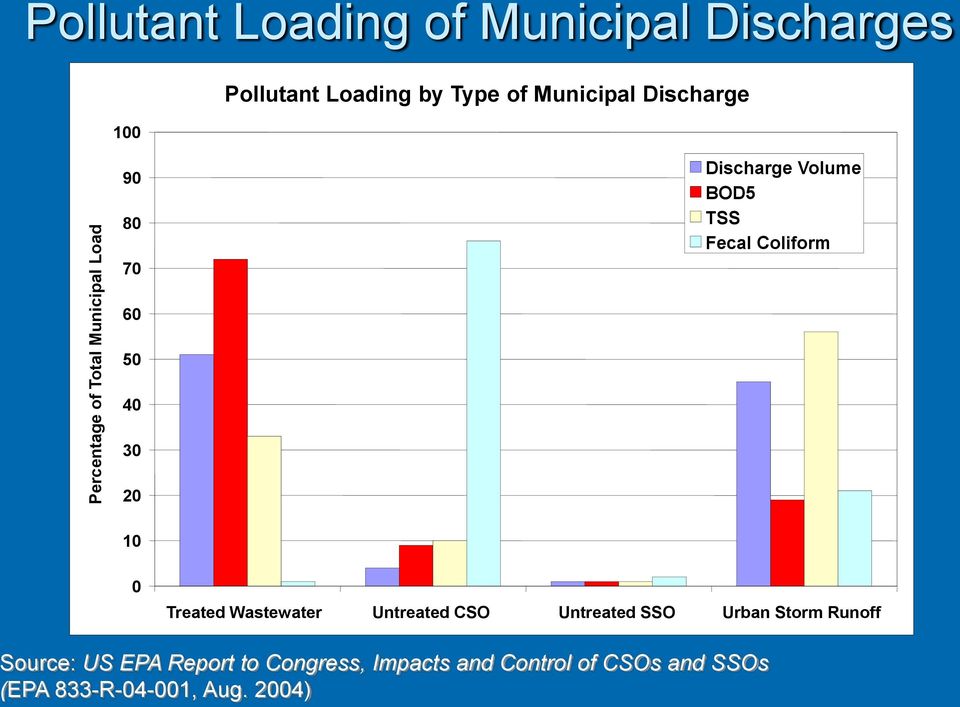
5 Percentage of Total Municipal Load Pollutant Loading of Municipal Discharges 100 Pollutant Loading by Type of Municipal Discharge Discharge Volume BOD5 TSS Fecal Coliform Treated Wastewater Untreated CSO Untreated SSO Urban Storm Runoff Source: US EPA Report to Congress, Impacts and Control of CSOs and SSOs (EPA 833-R , Aug. 2004)
6 Pollutant Load (pounds/acre/in of overflow or runoff) Pollutant Loading of Municipal Discharges 50 Pollutant Loading by Type of Municipal Discharge Storm Runoff Untreated CSO Pounds/acre/in times TSS BOD5 Phosphorus Nitrogen Lead Source: US EPA Report to Congress, Impacts and Control of CSOs and SSOs (EPA 833-R , Aug. 2004)

7 MDEQ Water Quality Standards Treat all CSO (settling, skimming, and disinfection) Protect public health--red Cedar is protected for total body contact recreation Discharges meet Water Quality Standards-- Red Cedar is protected as a warm water fishery Bacteria (Fecal coliform, E. coli) Dissolved Oxygen Physical Characteristics Total Residual Chlorine Health of Biological Community

8 Alternative CSO Solutions No Action Separation Storage and Treatment (Retention Treatment Facilities) Retention Treatment Basins Tunnels Treatment Shafts

9 CSO Abatement Storage and Treatment RTFs in Michigan may be designed using either Presumptive Criteria or Demonstrative Criteria Presumptive Criteria (Definition of Adequate Treatment): 1 year-1 hour storm: No overflow, capture entire CSO volume for later treatment at WWTP 10 year-1 hour storm: Provide min of 30 minutes of detention to provide disinfection for the max avg hour out of the RTB Flows in excess of the 10 year-1 hour storm: Treat to maximum extent possible Demonstrative Criteria Demonstrate that new facilities meet Water Quality Standards Requires extensive evaluation program, including sampling at the RTF and the surface water and biological habitat surveys

10 Major RTFs in Michigan Community Basin Name Basis of Design Criteria Total 1 (MG/1000 ac) Community Basin Name Basis of Design Criteria Total 1 (MG/1000 ac) Dearborn Shaft 013 Presumptive n/a Oakland County Bloomfield Hills Demonstration 5.9 Dearborn Shaft 014 Presumptive n/a Saginaw Weiss Presumptive 6.0 Dearborn Shaft 015 Presumptive n/a Macomb County Chapaton Demonstration 6.1 Detroit St. Aubin Demonstration n/a Grand Rapids Market St. Presumptive 6.5 Detroit Baby Creek Demonstration n/a Saginaw 14th Street Presumptive 6.8 Detroit Lieb Facility Demonstration n/a Saginaw Emerson Demonstration 6.8 Detroit Belle Isle Demonstration n/a Saginaw Fitzhugh Demonstration 6.9 Detroit Conner Creek Demonstration n/a Saginaw Hancock Demonstration 7.1 Saginaw Twp. Center Rd. Presumptive n/a River Rouge River Rouge Presumptive 7.6 Essexville Burns St. n/a n/a Oakland County Birmingham Demonstration 8.1 Detroit Hubbell/Southfield Site Constraints 1.8 East Lansing East Lansing Demonstration 8.5 Wayne County Redford Demonstration 3.2 Detroit Puritan/Fenkell Demonstration 8.6 Wayne County Southgate-Wyandotte Demonstration 3.7 Detroit Seven Mile Demonstration 8.6 Oakland County George Kuhn Demonstration 3.9 Macomb County Martin Demonstration 8.8 Wayne County Inkster Demonstration 4.9 Wayne County Dearborn Hts. Presumptive 9.4 Wayne County Milk River Demonstration 5.1 Bay City Union & Marquette Presumptive 11.1 Saginaw Salt-Fraser Demonstration 5.3 Bay City Water St. Presumptive 11.1 Oakland County Acacia Park Demonstration 5.4 Bay City Harrison & 33rd Presumptive 11.1 Saginaw Webber Demonstration 5.4 Bay WWTP Presumptive 11.1 Inkster L-46 and 009 Demonstration 5.6 Bay City Wenonah Pk Presumptive The total storage per 1,000 acres is based upon combined and storm tributary areas only; separated sanitary tributary areas are NOT included. The above list includes the majority of the CSO facilities in Michigan. Smaller facilities located at WWTPs are generally not included.

11 City of East Lansing CSO Area City of East Lansing: Sewer Separation & One RTF 911 acre combined sewer watershed Red Cedar Watershed: 465 square miles Grand River Watershed Red Cedar Watershed

12 East Lansing CSO Area and Control Facilities Phase B (1995) Sewer Separation Phase A (1995) Tunnel Sewer Phase A (1995) WBS & P Sta. MSU CAMPUS WWTP Phase C (2006) 2.6 MG RTB

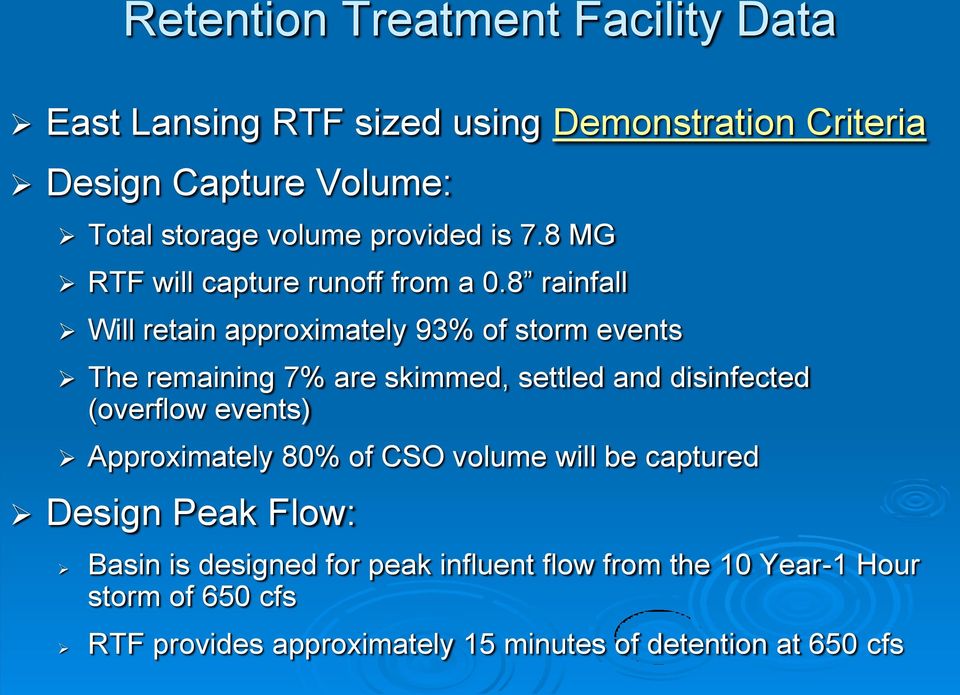
13 Retention Treatment Facility Data East Lansing RTF sized using Demonstration Criteria Design Capture Volume: Total storage volume provided is 7.8 MG RTF will capture runoff from a 0.8 rainfall Will retain approximately 93% of storm events The remaining 7% are skimmed, settled and disinfected (overflow events) Approximately 80% of CSO volume will be captured Design Peak Flow: Basin is designed for peak influent flow from the 10 Year-1 Hour storm of 650 cfs RTF provides approximately 15 minutes of detention at 650 cfs
14 RTB Effluent RTB Influent Sanitary Interceptor (to WWTP) RTB Effluent RTB Influent Sanitary Interceptor (to WWTP) Case 1: Dry Weather Sanitary flow in interceptor Red Cedar River Regulator Structure Combined Sewer Backwater gate Weir & Baffle 5 MGD Pump Sta. RTB Cell #2 RTB Cell #1 Case 2: Minor Storm Flow contained in Tunnel and Weir & Baffle Structure Red Cedar River Backwater gate Weir & Baffle Regulator Structure Combined Sewer 5 MGD Pump Sta. RTB Cell #2 RTB Cell #1
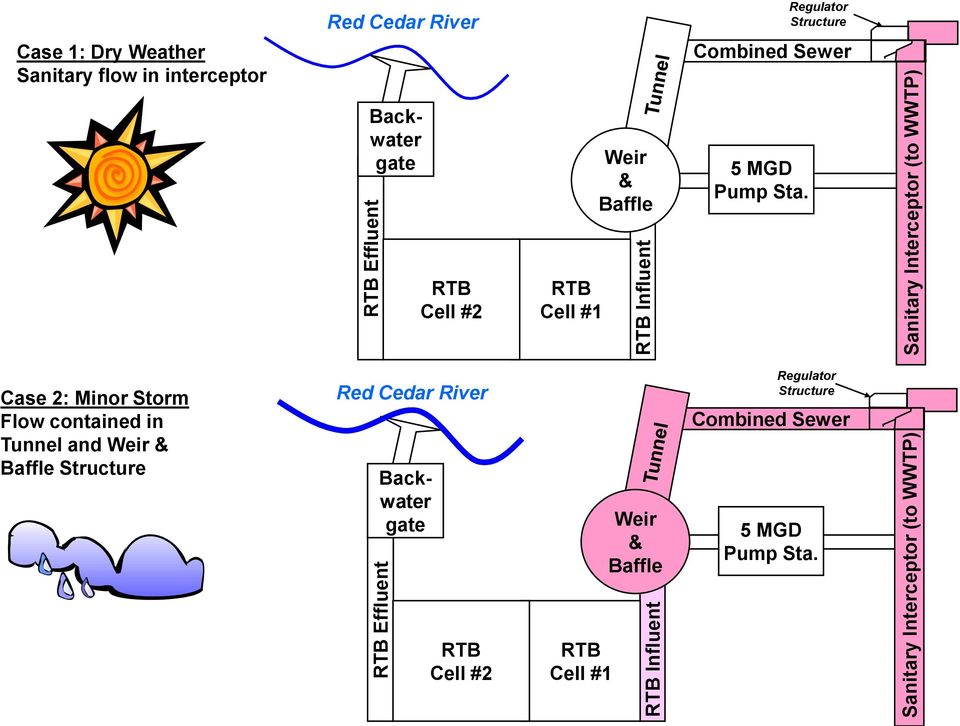
15 RTB Effluent RTB Influent Sanitary Interceptor (to WWTP) RTB Effluent RTB Influent Sanitary Interceptor (to WWTP) Case 3: Small Storm Flow contained in RTB Red Cedar River Backwater gate Weir & Baffle 5 MGD Pump Sta. Regulator Structure Combined Sewer RTB Cell #2 RTB Cell #1 Case 4: Large Storm RTB discharging settled, skimmed, and disinfected Combined sewage to Red Cedar River Red Cedar River Backwater gate Weir & Baffle Regulator Structure Combined Sewer 5 MGD Pump Sta. RTB Cell #2 RTB Cell #1

16 RTB Effluent RTB Influent Sanitary Interceptor (to WWTP) Case 5: Post Storm RTB is flushed and captured flow and solids pumped to sanitary interceptor for treatment at WWTP Red Cedar River Backwater gate Weir & Baffle Combined Sewer 5 MGD Pump Sta. Regulator Structure RTB Cell #2 RTB Cell #1

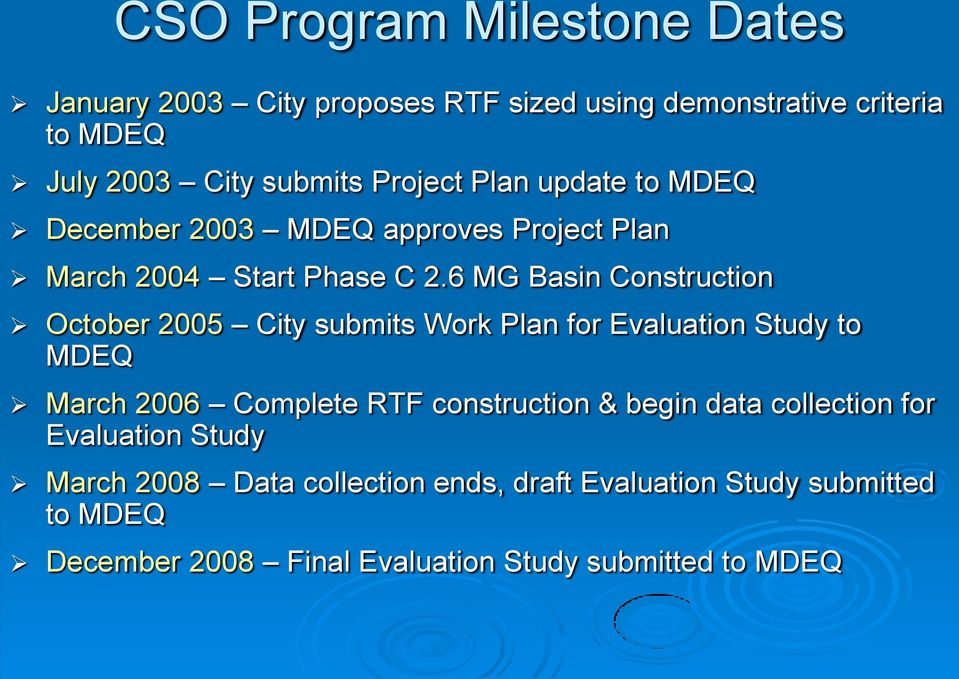
17 CSO Program Milestone Dates January 2003 City proposes RTF sized using demonstrative criteria to MDEQ July 2003 City submits Project Plan update to MDEQ December 2003 MDEQ approves Project Plan March 2004 Start Phase C 2.6 MG Basin Construction October 2005 City submits Work Plan for Evaluation Study to MDEQ March 2006 Complete RTF construction & begin data collection for Evaluation Study March 2008 Data collection ends, draft Evaluation Study submitted to MDEQ December 2008 Final Evaluation Study submitted to MDEQ
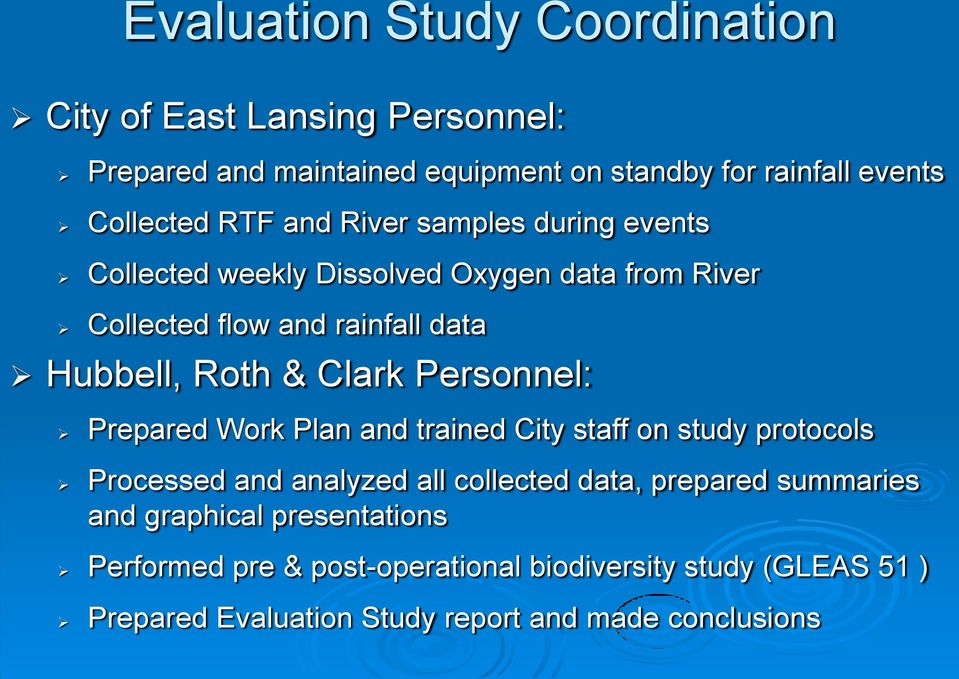
18 Evaluation Study Coordination City of East Lansing Personnel: Prepared and maintained equipment on standby for rainfall events Collected RTF and River samples during events Collected weekly Dissolved Oxygen data from River Collected flow and rainfall data Hubbell, Roth & Clark Personnel: Prepared Work Plan and trained City staff on study protocols Processed and analyzed all collected data, prepared summaries and graphical presentations Performed pre & post-operational biodiversity study (GLEAS 51 ) Prepared Evaluation Study report and made conclusions
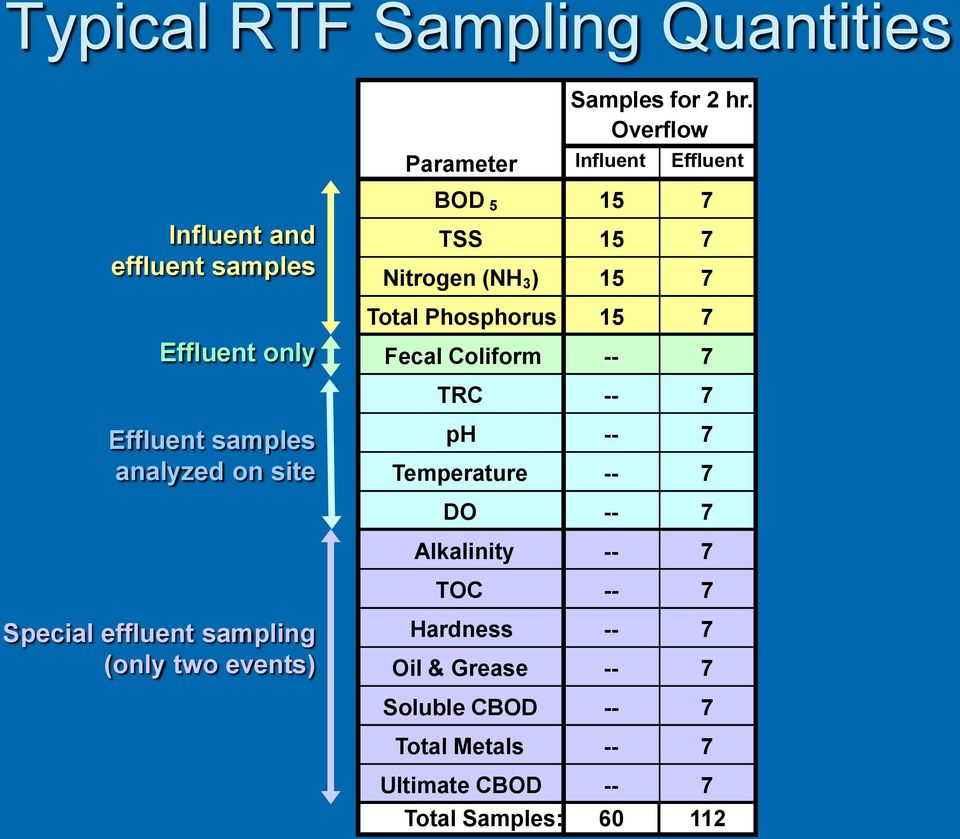
19 Evaluation Study Data Collection RTF Data Collection: Influent and Effluent samples were analyzed for BOD, TSS, Total P, NH 3 Effluent samples were also analyzed for Fecal coliform, DO, ph, temperature and TRC Limited additional Effluent samples were taken for metals, hardness, alkalinity, oil and grease, and CBOD River Data Collection: River sampling included TRC and DO County health department collected E. Coli samples Visual observation made for physical characteristics GLEAS 51 to determine health of the biological community
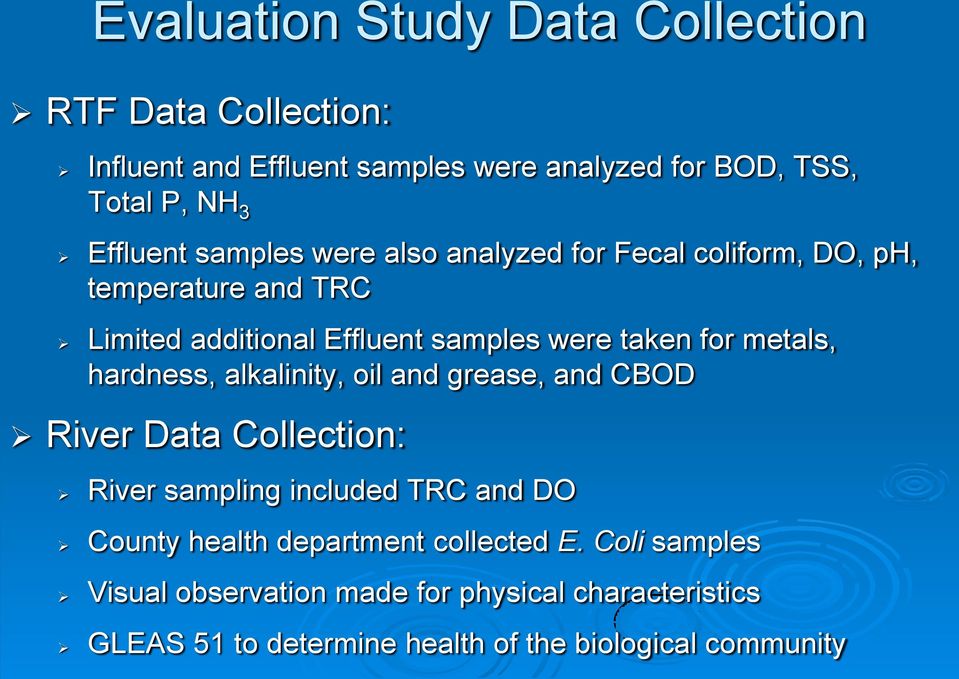
20 Typical RTF Sampling Quantities Influent and effluent samples Effluent only Parameter Samples for 2 hr. Overflow Influent Effluent BOD TSS 15 7 Nitrogen (NH 3 ) 15 7 Total Phosphorus 15 7 Fecal Coliform -- 7 TRC -- 7 Effluent samples analyzed on site ph -- 7 Temperature -- 7 DO -- 7 Alkalinity -- 7 TOC -- 7 Special effluent sampling (only two events) Hardness -- 7 Oil & Grease -- 7 Soluble CBOD -- 7 Total Metals -- 7 Ultimate CBOD -- 7 Total Samples:
21 Typical River Sampling During large storm events, City personnel collected DO and TRC samples from the Red Cedar River while the RTF was discharging Multiple TRC samples taken at left, middle, and right bank to determine the TRC plume downstream of CSO outfall Personnel needed to be prepared to sample on short notice and deal with safety and weather issues
22 East Lansing Study Area
23 Evaluation Study Data Summary Number of Events during Two-Year Study: There were nine events where the RTF received flow, but did not discharge. Approximate volume captured was 194 MG. This does not include smaller events where flow did not enter the RTB and was captured in the upstream system. All captured flows are dewatered to the WWTP for treatment. There were three overflow events during the Study period. Total treated volume discharged was approximately 36 MG. There are no provisions for bypassing of flows.
24 Total Residual Chlorine River samples were taken during two overflow events to locate the TRC plume from the RTF. June 2007 event: Average RTF effluent TRC concentration was 2.1 mg/l Maximum River TRC was 0.23 mg/l. Plume was short in duration and length, hugged bank. TRC was non-detect at the outfall three hours into the event. August 2007 event: Average RTF effluent TRC concentration was 2.6 mg/l. No TRC was detected in the River.
25 June 4, 2007 Event, TRC Results 0 0 Approx. 1,500 downstream of outfall Approx. 400 downstream of outfall
26 Bacteria RTF effluent samples were measured for Fecal coliform. The RTF disinfection system (sodium hypochlorite) was not operational during the first overflow event. Geometric mean for Fecal coliform was 6,900 cts./100 ml without disinfection. The geometric means were less than 10 cts./100 ml during the other two overflow events, with an average TRC of 2.2 mg/l. E. Coli samples are regularly taken from the Red Cedar River by the Ingham County Health Dept. Results are similar up and downstream of the RTF. Public health standard is sometimes not met after wet weather events, whether or not RTF discharges.
27 E. Coli Geo. Mean (cts./ 100 ml) Daily Rainfall on Sample Date (inches) Red Cedar River Bacteria (E. Coli) 2007 Ingham County Health Department Red Cedar River E. Coli Sampling 100, ,000 RTB Discharged 6/4/07 to 6/5/07 RTB Discharged 8/24/07 2 1, Note: Hagadorn and Harrison Rd. sites are upstream of the RTB, and Kalamazoo St. site is downstream of the RTB. Rainfall Hagadorn Road Harrison Road Kalamazoo Street 1 4/30/07 5/14/07 5/28/07 6/11/07 6/25/07 7/9/07 7/23/07 8/6/07 8/20/07 9/3/07 9/17/07 10
28 Dissolved Oxygen Permit required River sampling for DO during three overflow events in critical months (May Sept.). Only two overflow event occurred during critical months. Nearly impossible to distinguish impact of RTF discharge on Red Cedar DO because of numerous other inputs and conditions up and downstream of the RTF: DO drops regularly occur at dam approx. 1 mile upstream of RTF Approx. 60 storm water outfalls located on the MSU campus. Confluence with Sycamore Creek, approx. 1.5 miles downstream, which has DO sags due to sediment. Confluence with Upper Grand River, approx. 2 miles downstream, which has numerous other storm and wastewater inputs.
29 Dissolved Oxygen City therefore revised study approach by reviewing longterm DO trends in the River. City has collected data at locations up and downstream of the RTF and WWTP for more than 20 years. DO sags were found to occur up and downstream of the RTF when there were no CSO discharges. Only three DO sags were observed downstream of the RTF after it was constructed all were in 2006 when there were no CSO discharges, and were during low flow conditions. No DO sags were observed after the CSO overflow events in 2007 and DO sags that do occasionally occur are generally correlated with low flow conditions.
30 Red Cedar River Dissolved Oxygen
31 Red Cedar River Dissolved Oxygen
32 Health of Biological Community The health of the benthic community upstream and downstream of the RTF was assessed as a surrogate for testing for toxic materials and other pollutants. Used MDEQ GLEAS Procedure No. 51, Qualitative Biological and Habitat Survey Protocols for Wadable Streams and Rivers. Two surveys were made one prior to construction of the RTF in August 2005, and one after nearly two years of RTF operation in August No measurable change in the macroinvertebrate community was found between 2005 and In both studies, the macroinvertebrate communities were scored as having acceptable biological integrity both upstream and downstream of the RTF.
33 Pollutant Loading Approximately 80% of the total CSO volume and 93% of the pollutant load to the RTF was captured. All captured flows are treated by the City s WWTP. Event Date Overflow Event? Influent Pollutant Load (pounds) Effluent Pollutant Load (pounds) BOD 5 NH 3 TP TSS BOD 5 NH 3 TP TSS % Captured 3/13/06* Yes 14, ,987 2, ,007 85% 5/30/06* No 3, , /02/06* No 13, , /24/06* No 8, , /16/06 No 4, , /29/06 No 8, , /15/07 No 5, , /02/07 Yes 9, ,608 2, ,897 81% 8/20/07 No 5, , /24/07 Yes 3, , ,165 94% 10/19/07 No 4, , /06/08 No 5, , Totals during Study Period 86,244 2,220 1, ,233 6, ,069 93%
34 Pollutant Loading RTF effluent pollutant concentrations are similar to expected stormwater concentrations, using NURP data. Pollutant loads from the RTF are significantly lower than stormwater due to the significant amount of runoff (>80%) captured for treatment at the WWTP. Pollutant Concentrations Source BOD (mg/l) NH 3 (mg/l) TKN (mg/l) TP (mg/l) TSS (mg/l) Total Cu (mg/l) Total Pb (mg/l) Total Zn (mg/l) Fecal coliform (cts/100 ml) East Lansing RTF Average Effluent NURP Median Urban Storm Pollutant Loading Over Study Period (pounds/year) Source BOD NH 3 TKN TP TSS East Lansing RTF Effluent 6, ,069 NURP Median Urban Stormwater 310,005 47,582 10,814 4,614,023
35 Stormwater & Treated CSO Concentrations Treated CSO Stormwater 21,000 (warm weather) (TKN) (CBOD) (NH 3 ) (BOD) 71 BOD TSS Nitrogen TP Fecal (permit limit) Sources: CSO Data: Rouge Phase I CSO Basins ( Stormwater Data: EPA NURP, Site Median EMCs.
36 CONCLUSIONS East Lansing has created a successful Demonstrative Program The City is continuously trying to refine basin operations to improve and minimize discharges to Red Cedar River RTF originally anticipated to discharge to river 4 times per year but has averaged 2 overflows/year since 1996 Pollutant load from stormwater runoff is significantly greater than loading resulting from treated RTF discharges Wet weather standards should be developed for storage and treatment facilities Licensing should be established for operators of storage & treatment facilities TRC needs to be further evaluated and understood before current standards are changed
Rouge River Watershed, MI Region 5. Community Case Study ROU-1. Number of CSO Outfalls. Combined Sewer Service Area. Wastewater Treatment Capacity
 Community Case Study Rouge River Watershed, MI Region 5 Number of CSO Outfalls 168 Combined Sewer Service Area 93 square miles Wastewater Treatment Capacity 1,700 mgd (primary) 930 mgd (secondary) Receiving
PERMITTEE/FACILITY NAME: City of Detroit Water and Sewerage Department / Detroit Wastewater Treatment Plant
 Permit No. MI0022802 FACT SHEET PERMITTEE/FACILITY NAME: City of Detroit / Detroit Wastewater Treatment Plant COUNTY: Wayne DESCRIPTION OF EXISTING WASTEWATER TREATMENT FACILITIES: The Detroit (DWSD) owns
High-Rate Retention Treatment Facility for CSO Control in Windsor Riverfront East
 High-Rate Retention Treatment Facility for CSO Control in Windsor Riverfront East Jian Li, Ph.D., P.Eng., PE Senior Environmental Engineer Stantec Consulting Ltd. Water & Wastewater Treatment BMP Forum
DID YOU KNOW... THE IMPACT OF ON-SITE SEWAGE SYSTEMS AND ILLICIT DISCHARGES ON THE ROUGE RIVER
 DID YOU KNOW... THE IMPAT OF ON-SITE SEWAGE SYSTEMS AND ILLIIT DISHARGES ON THE ROUGE RIVER by Barry Johnson, P.E., M.S., amp Dresser & McKee and Dean Tuomari, Wayne ounty Department of Environment The
NPDES Permit No. IL0021695. Notice No. JCH:12012302.bah. Public Notice Beginning Date: November 27, 2012. Public Notice Ending Date: December 27, 2012
 Notice No. JCH:12012302.bah Public Notice/Fact Sheet Issued By: Public Notice Beginning Date: November 27, 2012 Public Notice Ending Date: December 27, 2012 National Pollutant Discharge Elimination System
WATER QUALITY MODELING TO SUPPORT THE ROUGE RIVER RESTORATION
 WATER QUALITY MODELING TO SUPPORT THE ROUGE RIVER RESTORATION Edward H. Kluitenberg, P.E., Applied Science, Inc. Gary W. Mercer, P.E., Camp, Dresser and McKee Vyto Kaunelis, Wayne County Department of
NPDES Permit No. IL0020737. Notice No. SKT:13120601.bah. Public Notice Beginning Date: April 9, 2014. Public Notice Ending Date: May 9, 2014
 Public Notice/Fact Sheet Issued By: Notice No. SKT:13120601.bah Public Notice Beginning Date: April 9, 2014 Public Notice Ending Date: May 9, 2014 National Pollutant Discharge Elimination System (NPDES)
Source Water Protection Practices Bulletin Managing Sanitary Sewer Overflows and Combined Sewer Overflows to Prevent Contamination of Drinking Water
 United States Office of Water EPA 916-F-01-032 Environmental Protection (4606) July 2001 Agency Source Water Protection Practices Bulletin Managing Sanitary Sewer Overflows and Combined Sewer Overflows
Technical Feasibility of a Wet Weather Flow Treatment Facility
 Wastewater Master Plan DWSD Project No. CS-1314 Technical Feasibility of a Wet Weather Flow Treatment Facility Technical Memorandum Original Date: August 9, 2001 Revision Date: September 2003 Author: Tetra
Sewerage Management System for Reduction of River Pollution
 Sewerage Management System for Reduction of River Pollution Peter Hartwig Germany Content page: 1 Introduction 1 2 Total emissions 3 3 Discharge from the wastewater treatment plants 4 4 Discharge from
Maine Department of Environmental Protection Program Guidance On Combined Sewer Overflow Facility Plans
 Maine Department of Environmental Protection Program Guidance On Combined Sewer Overflow Facility Plans OVERVIEW The objective of a Combined Sewer Overflow (CSO) Facility Plan is to abate CSO discharges
What is a CSO / SSO? Sewer Overflows. Prevalence of CSOs in the US. Magnitude of Problem (Local)
 Sewer Overflows Combined Sewer Overflows (CSOs( CSOs) Older, large cities built combined networks to convey sewage and stormwater Stormwater overwhelmed sewage flow, but only for short periods To reduce
NPDES Permit No. IL0052639. Notice No. IL0052639-12.TTL. Public Notice Beginning Date: June 15, 2012. Public Notice Ending Date: July 16, 2012
 NPDES Permit No. IL0052639 Notice No. IL0052639-12.TTL Public Notice/Fact Sheet Issued By: Public Notice Beginning Date: June 15, 2012 Public Notice Ending Date: July 16, 2012 National Pollutant Discharge
Executive Summary Consent Decree
 OVERFLOW ABATEMENT PROGRAM Executive Summary Consent Decree The sewer system in Nashville dates back to the late 1800s and originally consisted of a combined sewer system, later transitioning to separate
City of Mebane Wastewater Collection and Treatment Facility
 City of Mebane Wastewater Collection and Treatment Facility For the Fiscal Year July 1, 2014 - June 30, 2015 City of Mebane Wastewater Collection and Treatment Facility For the Fiscal Year July 1, 2014
Cambridge Wastewater Treatment Facility
 Cambridge Wastewater Treatment Facility Emergency Situations If you have a water or sewer emergency that relates to the City s utility system call the Public Works office at 763-689-1800 on normal working
The Clean Water Project What Is The Stormwater Impact?
 The Clean Water Project What Is The Stormwater Impact? Presentation To: Seminar On Water Issues Bob Weimar, PE, BCEE Chief of Program Management The Metropolitan District Sewage Overflows Have Become More
City of Lakeland s Wetlands Treatment System An Overview
 An Overview In response to more stringent requirements for wastewater discharges in the early 1980 s, the City explored options for the advanced treatment required, with the Wetland Treatment System proving
Allegany County Combined Sewer Overflows - Long Term Control Plan
 Allegany County Combined Sewer Overflows - Long Term Control Plan On December 14, 2001 the Maryland Department of the Environment (MDE) filed a Consent Decree and Judgment (Consolidated Case No. 01-C-00-18342-L)
City of Charlottetown Wastewater Treatment Expansion & Upgrading
 City of Charlottetown Wastewater Treatment Expansion & Upgrading Background As Canada s smallest provincial capital, the City of the Charlottetown has a population of approximately 34,000 residents and
System Optimization: The First Step in CSO Control Alternatives Development
 System Optimization: The First Step in CSO Control Alternatives Development Don Walker NEWEA 215 Specialty Conference Series October 26, 215 Outline System Characterization ü Groundwork for system optimization
COMBINED SEWER OVERFLOW OPERATIONAL AND MAINTENANCE PLAN SUMMARY
 COMBINED SEWER OVERFLOW OPERATIONAL AND MAINTENANCE PLAN SUMMARY Revised: April 2014 Village of Wilmette, Illinois NPDES CSO Permit No. ILM580012 Chapter 1 Introduction This Operational and Maintenance
LOTT ~WateJi Alliance
 LOTT ~WateJi Alliance May 5, 2015 Lacey Olympia Tumwater Thurston County David Dougherty, P.E. Water Quality Program Washington State Department Of Ecology Southwest Regional Office P.O. Box 47775 Olympia,
Water and Wastewater. Sample Collection and Analysis
 Water and Wastewater Sample Collection and Analysis December 2011 Introduction Accurate testing of drinking water is crucial to maintaining the health and safety of Islanders who rely on this resource.
-O^ DEQ. National Pollutant Discharge Elimination System PERMIT EVALUATION AND FACT SHEET November 12,2003
 \ I -O^ DEQ State of Oregon Department of Environmental Quality National Pollutant Discharge Elimination System PERMIT EVALUATION AND FACT SHEET November 12,2003 Oregon Department of Environmental Quality
Presented by Paul Krauth Utah DEQ. Salt Lake Countywide Watershed Symposium October 28-29, 2008
 Basic Nutrient Removal from Water Beta Edition Presented by Paul Krauth Utah DEQ Salt Lake Countywide Watershed Symposium October 28-29, 2008 Presentation Outline Salt Lake County waters / 303(d) listings
COMBINED SEWER OVERFLOW LONG-TERM CONTROL PLAN Executive Summary
 CITY OF LAKEWOOD COMBINED SEWER OVERFLOW LONG-TERM CONTROL PLAN Executive Summary MAY 2006 storage conveyance treatment performance Prepared for: City of Lakewood, Ohio Prepared by: Metcalf & Eddy of Ohio,
Report prepared by: Kelly Hagan and Mark Anderson Grand River Conservation Authority 400 Clyde Road Cambridge ON N1R 5W6
 2013 Watershed Overview of Wastewater Treatment Plant Performance Report prepared by: Kelly Hagan and Mark Anderson Grand River Conservation Authority 400 Clyde Road Cambridge ON N1R 5W6 Table of Contents
HYDROVEX. CSO, SSO and Stormwater Management Specialist Products and Services for North America
 HYDROVEX CSO, SSO and Stormwater Management Specialist Products and Services for North America A long tradition in excellence John Meunier Inc. has been serving North American municipalities and industries
Scattergraph Principles and Practice Characterization of Sanitary Sewer and Combined Sewer Overflows
 Scattergraph Principles and Practice Characterization of Sanitary Sewer and Combined Sewer Overflows Kevin L. Enfinger, P.E. and Patrick L. Stevens, P.E. ADS Environmental Services 494 Research Drive Huntsville,
STORMWATER MONITORING: POLLUTANTS, SOURCES, AND SOLUTIONS
 RICHLAND COUNTY STORMWATER MANAGEMENT DIVISION STORMWATER MONITORING: POLLUTANTS, SOURCES, AND SOLUTIONS As part of the federal government s National Pollutant Discharge Elimination System Permit (NPDES)
DRAFT Public Outreach Document for What s an SSMP?
 DRAFT Public Outreach Document for What s an SSMP? This easy to read document is developed and provided to interested parties to assist in educating cities, agencies, their management, elected officials
Bay Park Sewage Treatment Plant Super Storm Sandy Recovery
 County of Nassau Department of Public Works Bay Park Sewage Treatment Plant Super Storm Sandy Recovery Edward P. Mangano County Executive Shila Shah-Gavnoudias, P.E. Commissioner of Public Works Bay Park
Greater Los Angeles County Region
 Attachment 6 Greater Los Angeles County Region IRWM Implementation Grant Proposal Monitoring, Assessment, and Attachment 6 consists of the following items: Monitoring, Assessment, and. The purpose of this
San Diego Citizen s Forum. USIBWC San Diego Field Office
 San Diego Office Update San Diego Citizen s Forum Steve Smullen, Area Operations Manager USIBWC San Diego Field Office August 25, 2011 SAN DIEGO OFFICE ACTIVITIES Flood Control Tijuana River Flood Control
TREATMENT OF SANITARY SEWER OVERFLOW
 TREATMENT OF SANITARY SEWER OVERFLOW WITH FIXED MEDIA BIOREACTORS J. Tao, K. M. Mancl, O. H. Tuovinen ABSTRACT. Fixed media bioreactors (biofilters) are a promising and proven technology used for wastewater
TOWN OF CHESTERTON, INDIANA COMBINED SEWER OVERFLOW LONG TERM CONTROL PLAN
 TOWN OF CHESTERTON, INDIANA COMBINED SEWER OVERFLOW LONG TERM CONTROL PLAN Prepared For: Town Of Chesterton Utilities Chesterton, Indiana Prepared By: Engineers Architects Scientists Planners Surveyors
OPTIMIZING BIOLOGICAL PHOSPHORUS REMOVAL FROM AN SBR SYSTEM MIDDLEBURY, VT. Paul Klebs, Senior Applications Engineer Aqua-Aerobic Systems, Inc.
 OPTIMIZING BIOLOGICAL PHOSPHORUS REMOVAL FROM AN SBR SYSTEM ABSTRACT MIDDLEBURY, VT Paul Klebs, Senior Applications Engineer Aqua-Aerobic Systems, Inc. The Middlebury Wastwater Treatment Plant, located
EXISTING WASTEWATER TREATMENT FACILITIES
 Chapter 5 EXISTING WASTEWATER TREATMENT FACILITIES 5.1 THERESA STREET WWTF 5.1.1 Overview The Theresa Street WWTF is the larger of the two wastewater treatment facilities owned and operated by the City.
Final Report of the Town Owned Lands Improvement Project for the Town of Brentwood, NH
 Final Report of the Town Owned Lands Improvement Project for the Town of Brentwood, NH Project Background In November of 2013 the Green Infrastructure for Sustainable Coastal Communities (GISCC) project
Terry Biederman, PE- Director of Public Works Greg Gucwa, PE- Principal Johnson and Anderson Engineering
 DON T JUST REHAB IT, RENEW IT! WATERFORD TOWNSHIP, MICHIGAN IMPROVEMENTS TO A 3.0 MGD SEWAGE PUMPING STATION Terry Biederman, PE- Director of Public Works Greg Gucwa, PE- Principal Johnson and Anderson
THE SANITARY SEWER SYSTEM
 THE SANITARY SEWER SYSTEM The Water Services Department is responsible for the planning and construction of sewers, pump stations, and treatment facilities serving Kansas City and certain surrounding areas.
NEVADA CITY WASTEWATER TREATMENT INQUIRY
 NEVADA CITY WASTEWATER TREATMENT INQUIRY REASON FOR INVESTIGATION The 2003-2004 Grand Jury investigated the status of wastewater treatment in unincorporated Nevada County. This year, the Grand Jury investigated
EXISTING WASTEWATER TREATMENT FACILITIES
 Chapter 5 EXISTING WASTEWATER TREATMENT FACILITIES 5.1 THERESA STREET WWTF 5.1.1 Overview The Theresa Street WWTF is the larger of the two wastewater treatment facilities owned and operated by the City
Canada-wide Strategy for the Management of Municipal Wastewater Effluent
 Canada-wide Strategy for the Management of Municipal Wastewater Effluent Endorsed by CCME Council of Ministers, February 17, 2009, Whitehorse Executive Summary Wastewater from households, industrial, commercial
St. John s Harbour Clean-Up Phase 2. Project Description
 St. John s Harbour Clean-Up Phase 2 Project Description February 2003 NEWFOUNDLAND DESIGN ASSOCIATES LIMITED 1 Introduction The City of St. John s, the adjoining City of Mount Pearl and the Town of Paradise
Combined Sewer Overflows in the Milwaukee Metropolitan Sewerage District Conveyance and Treatment System
 Combined Sewer Overflows in the Milwaukee Metropolitan Sewerage District Conveyance and Treatment System Eric Loucks 1, David Watkins 2, Theresa Culver 3 Background Many older cities across the United
COURSE # 343 UNIT # 1: ADVANTEX WASTEWATER TREATMENT SYSTEM. What you will learn in this lesson. Introduction to the listing
 What you will learn in this lesson IN THIS LESSON, YOU WILL LEARN... About the Orenco AdvanTex alternate technology listing The components that make up the AdvanTex Treatment System How the AdvanTex Treatment
Omaha Combined Sewer Overflow (CSO) Control Program
 Omaha Combined Sewer Overflow (CSO) Control Program Service Disabled Veteran Owned Small Business Outreach, Training, Industry Forum Marty Grate - City of Omaha May 28, 2009 Challenges Facing Omaha Meeting
Combined Sewer Overflow Management Fact Sheet Sewer Separation
 United States Environmental Protection Agency Office of Water Washington, D.C. EPA 832-F-99-041 September 1999 Combined Sewer Overflow Management Fact Sheet Sewer Separation DESCRIPTION Sewer systems that
U.S. Environmental Protection Agency, Region IX Response to Comments on the Goleta Sanitary District Draft NPDES Permit and 301(h) TDD
 U.S. Environmental Protection Agency, Region IX Response to Comments on the Goleta Sanitary District Draft NPDES Permit and 301(h) TDD A. Kamil S. Azoury of Goleta Sanitary District provided comments on
 Bio-P Removal- Principles and examples in MI and elsewhere S. Joh Kang, Ph.D., P.E. Tetra Tech, Inc. Ann Arbor, MI 2010 Presentation Outline Optimization of Chemicals and Energy Bio-P Removal - Review
TABLE OF CONTENTS EXECUTIVE SUMMARY...1 1.0 DESCRIPTION OF EXISTING CONDITIONS... 1-1. 1.1 Population... 1-1. 1.2 Wastewater Flows...
 TABLE OF CONTENTS EXECUTIVE SUMMARY...1 1.0 DESCRIPTION OF EXISTING CONDITIONS... 1-1 1.1 Population... 1-1 1.2 Wastewater Flows... 1-1 1.3 Existing Wastewater Facilities... 1-2 1.3.1 City of Celina...
Combined Sewer Overflow (CSO) & Sanitary Sewer Overflow (SSO) 2007 Annual Report
 Combined Sewer Overflow (CSO) & Sanitary Sewer Overflow (SSO) 2007 Annual Report () Special Feature: 20 Years of Progress in CSO Control in Michigan (1988 to 2008) This publication was prepared for the
MANAGEMENT OF COMBINED SEWER OVERFLOWS. Rob Baker
 MANAGEMENT OF COMBINED SEWER OVERFLOWS Rob Baker Abstract Combined sewer overflow (CSO) events are an unintended consequence that pollutes surface receiving waters in the United States with excess and
26th Ward Wastewater Treatment Plant Wet Weather Operating Plan
 26th Ward Wastewater Treatment Plant Prepared by: New York City Department of Environmental Protection Bureau of Wastewater Treatment July 2010 TABLE OF CONTENTS Page 1.0 INTRODUCTION... 1-1 1.1 BACKGROUND...
The International Stormwater BMP Database Part 1: Summary of Database
 Land Development Brief: February 2013 The Pennsylvania Housing Research Center The International Stormwater BMP Database Part 1: Summary of Database Katherine L. Blansett, Ph.D., P.E. INTRODUCTION This
Pursuant to Department of Environmental Protection Rules Chapter 555, effective March 9, 2009
 APPLICATION FOR ADDITION OF TRANSPORTED WASTES IN WASTEWATER TREATMENT FACILITIES Pursuant to Department of Environmental Protection Rules Chapter 555, effective March 9, 2009 This application is to be
Saudi Aramco Project Development
 Saudi Aramco Project Development Wastewater Treatment Facilities Jeddah Refinery And Marine Area December 2007 Facilities Planning Dept. OBJECTIVE: Provide an overview of the complexities of developing
Expanded Treatment Facilities within the City of Detroit
 Wastewater Master Plan DWSD Project No. CS-1314 Expanded Treatment Facilities within the City of Detroit Technical Memorandum Original Date: August 9, 2001 Revision Date: September 2003 Author: Tetra Tech
WASTEWATER TREATMENT OBJECTIVES
 WASTEWATER TREATMENT OBJECTIVES The student will do the following: 1. Define wastewater and list components of wastewater. 2. Describe the function of a wastewater treatment plant. 3. Create a wastewater
FACT SHEET STATEMENT OF BASIS HARLEY DOME 1 PRODUCED WATER TREATMENT FACILITY UPDES PERMIT NUMBER: UT0025917 NEW PERMIT MINOR INDUSTRIAL
 FACT SHEET STATEMENT OF BASIS HARLEY DOME 1 PRODUCED WATER TREATMENT FACILITY UPDES PERMIT NUMBER: NEW PERMIT MINOR INDUSTRIAL FACILITY CONTACTS Mitch Burroughs, Operator Mailing Address 1716 E. Lincoln
Lansdowne Stormwater UPDATE
 Lansdowne Stormwater UPDATE August 22, 2012 Ann Arbor Footing Drain Disconnection Stormwater Review Presentation Agenda Welcome and introductions Background on stormwater and sanitary sewer issues Footing
Nutrient Removal at Wastewater Treatment Facilities. Nitrogen and Phosphorus. Gary M. Grey HydroQual, Inc. [email protected] 201 529 5151 X 7167
 Nutrient Removal at Wastewater Treatment Facilities Nitrogen and Phosphorus Gary M. Grey HydroQual, Inc. [email protected] 201 529 5151 X 7167 1 Agenda Nitrification and Denitrification Fundamentals
RESIDENTIAL TREATMENT SYSTEMS
 EFFLUENT SAMPLING FOR RESIDENTIAL TREATMENT SYSTEMS For various reasons, many wastewater treatment systems periodically require effluent sampling and characterization. Whether sampling is done to verify
NPDES Permit No. IL0022071. Notice No. AAH:10120701.ajo. Public Notice Beginning Date: April 28, 2011. Public Notice Ending Date: May 30, 2011
 Public Notice/Fact Sheet Issued By: Notice No. AAH:10120701.ajo Public Notice Beginning Date: April 28, 2011 Public Notice Ending Date: May 30, 2011 National Pollutant Discharge Elimination System (NPDES)
Kansas City s Overflow Control Program
 Kansas City s Overflow Control Program Kansas City Water Services Water Wastewater Stormwater 2 Water Services Department 1000 Positions 835 Employees 3 Utilities FY 13/14 Budget = $307 million Water Wastewater
Chapter 2 Treatment Facility Menus
 Chapter 2 Treatment Facility Menus This chapter identifies the treatment facility menus. The menus in this chapter are as follows: Oil Control Menu, Section 2.1 Phosphorus Treatment Menu, Section 2.2 Enhanced
SAWS SSO Reduction Program
 SAWS SSO Reduction Program Jeff Haby, P.E. Director Sewer System Improvements February 20, 2014 TMDL Implementation Plan Technical Committee Overview Sanitary Sewer Overflows Consent Decree Overview Major
A San Antonio Case Study on the Water Quantity and Quality Benefits of LID Development
 A San Antonio Case Study on the Water Quantity and Quality Benefits of LID Development Chad Richards PE, CFM, CPSWQ Brett Sachtleben PE, CFM Agenda Purpose Water Quality Processes LID Components and their
DESCRIPTION OF STORMWATER STRUCTURAL CONTROLS IN MS4 PERMITS
 DESCRIPTION OF STORMWATER STRUCTURAL CONTROLS IN MS4 PERMITS Phase I MS4 permits require continuous updating of the stormwater system inventory owned and operated by the MS4. They also include inspection
National Pollutant Removal Performance Database
 National Pollutant Removal Performance Database Version 3 September, 2007 8390 Main Street, 2 nd Floor Ellicott City, MD 21043 410.461.8323 FAX 410.461.8324 www.cwp.org www.stormwatercenter.net The National
ENVIRONMENTAL ISSUES IN THE RENDERING INDUSTRY. Gregory L. Sindt, P.E. Environmental Engineer Bolton and Menk, Inc.
 Summary ENVIRONMENTAL ISSUES IN THE RENDERING INDUSTRY Gregory L. Sindt, P.E. Environmental Engineer Bolton and Menk, Inc. The rendering industry has a significant positive impact on environmental quality.
M E M O R A N D U M. Among the standard conditions contained in the NPDES permit is also a Duty to
 M E M O R A N D U M DATE: August 7, 2015 TO: FROM: SUBJECT: Metropolitan Wastewater Management Commission (MWMC) Matt Stouder, MWMC General Manager Capacity Management, Operations, and Maintenance (CMOM)
Characterization of water quality in the Los Angeles River
 Characterization of water quality in the Los Angeles River Drew Ackerman, Kenneth C. Schiff, Heather Trim 1, and Mike Mullin 2 ABSTRACT - The Los Angeles River is one of the most highly modified water
City of Monroe Wastewater System Report
 2013 City of Monroe Wastewater System Report Protecting the environment is a top priority for the City of Monroe Water Resources Department. We are pleased to present our annual Wastewater System Report.
City of Dallas Wastewater Collection System: TCEQ Sanitary Sewer Outreach Agreement City Council Briefing January 17, 2007
 City of Dallas Wastewater Collection System: TCEQ Sanitary Sewer Outreach Agreement City Council Briefing January 17, 2007 1/12/2007 1 Briefing Purpose Provide update on Wastewater Collection Activities
How To Get A Stormwater Discharge Permit In A City Of Scottsdale
 Environmental Regulations Guide Section 4 Pollution Prevention 4. 0 Pollution Prevention The Pollution Prevention Act (PPA) focuses on source reduction, i.e. on reducing the amount of pollution through
City and County of San Francisco 2030 Sewer System Master Plan TASK 400 TECHNICAL MEMORANDUM NO. 405
 City and County of San Francisco 2030 Sewer System Master Plan TASK 400 TECHNICAL MEMORANDUM NO. 405 REGULATORY CONSIDERATIONS FOR WET WEATHER COLLECTION SYSTEM BACKUPS FINAL DRAFT August 2009 2700 YGNACIO
History of the Detroit Sewer System
 DWSD Rates Understanding DWSD Wholesale Sewer er Rates Clean, fresh water is plentiful in southeast Michigan. Like many things in good supply, we sometimes take our water for granted. Rarely is a second