
Examinations Page 1 MODULE 2 STUDENT GUIDE TO NOTE TAKING
|
|
|
- Sophia Bishop
- 10 years ago
- Views:
Transcription
1 Examinations Page 1 MODULE 2 STUDENT GUIDE TO NOTE TAKING

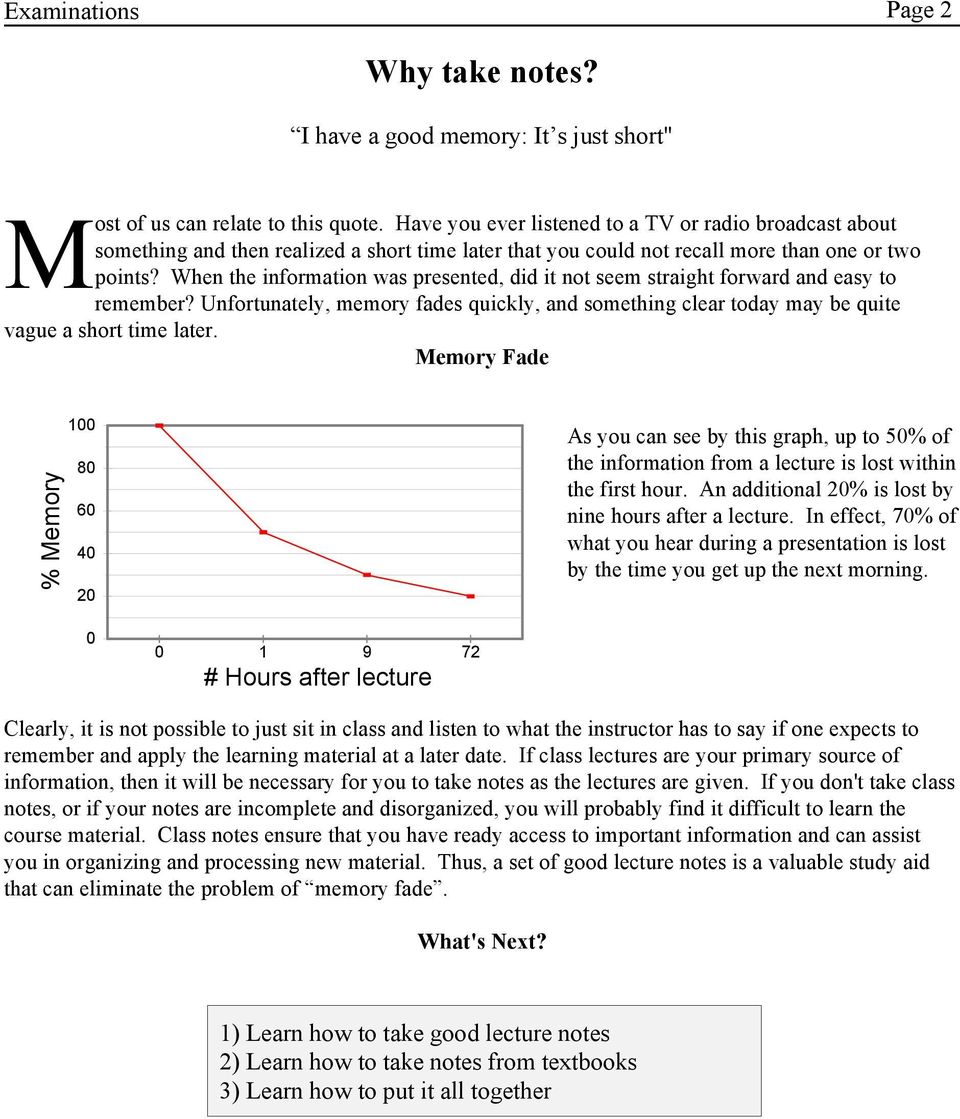
2 Examinations Page 2 Why take notes? I have a good memory: It s just short" o s t o f u s c a n r e l a t e t o t h i s q u o t e. H a v e y o u e v e r l i s t e n e d t o a T V o r r a d i o b r o a d c a s t a b o u t something and then realized a short time later that you could not recall more than one or two points? When the information was presented, did it not seem straight forward and easy to remember? Unfortunately, memory fades quickly, and something clear today may be quite vague a short time later. Memory Fade % Memory As you can see by this graph, up to 50% of the information from a lecture is lost within t h e f i r s t h o u r. A n a d d i t i o n a l 2 0 % i s l o s t b y n i n e h o u r s a f t e r a l e c t u r e. I n e f f e c t, 7 0 % o f what you hear during a presentation is lost by the time you get up the next morning # Hours after lecture Clearly, it is not possible to just sit in class and listen to what the instructor has to say if one expects to remember and apply the learning material at a later date. If class lectures are your primary source of information, then it will be necessary for you to take notes as the lectures are given. If you don't take class notes, or if your notes are incomplete and disorganized, you will probably find it difficult to learn the course material. Class notes ensure that you have ready access to important information and can assist you in organizing and processing new material. Thus, a set of good lecture notes is a valuable study aid that can eliminate the problem of memory fade. What's Next? 1) Learn how to take good lecture notes 2) Learn how to take notes from textbooks 3) Learn how to put it all together
3 Examinations Page 3 How do I make/take good notes? here are many effective methods for taking notes. The common features of a good note-taking t e c h n i q u e i n c l u d e : " highlighting the main ideas covered in the lecture " organizing the minor points, details, facts, and supporting examples " showing the relationships between main ideas " reminding you of your assignments, due dates, extra readings etc. Recording Main Ideas The most common problem that students have in taking notes from textbooks or lectures is taking too many notes. Ideally, you want to record only the important points. If you record too much, then the review will be just like rereading or repeating the lecture. The main ideas of a lecture are the points the instructor pays particular attention to. Instructors frequently give clues to what is important and your job is to pick up on these clues. Here are a few indicators of important points: P o i n t s r e p e a t e d - w h e n t h e i n s t r u c t o r r e p e a t s a s t a t e m e n t o r c o n c e p t i t s h o u l d b e c o n s i d e r e d i m p o r t a n t -signals include 'As I said earlier..." or 'if you recall from before" Change of Voice -the instructor may speak louder or softer when reaching a key point Change of Speed -the instructor may slow d o w n w h e n i n t r o d u c i n g a n i m p o r t a n t p o i n t Listing and Numbering Points -take note if a lecturer directly states there are a certain number of points Writing on the Board -key words or outlines may be written on the board as they speak D i r e c t A n n o u n c e m e n t -may state that something is important such as "good exam question"

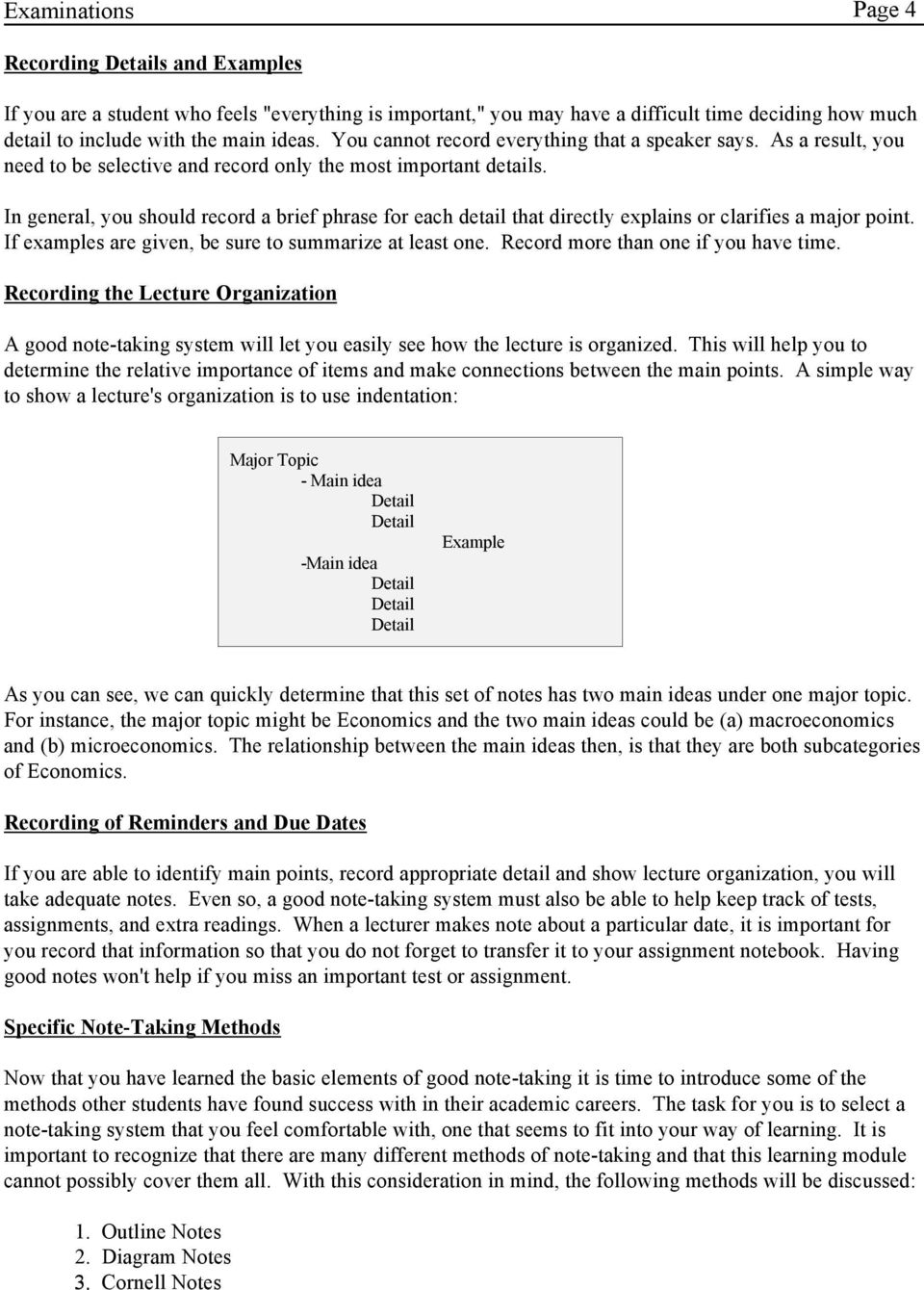
4 Examinations Page 4 Recording Details and Examples If you are a student who feels "everything is important," you may have a difficult time deciding how much detail to include with the main ideas. You cannot record everything that a speaker says. As a result, you need to be selective and record only the most important details. In general, you should record a brief phrase for each detail that directly explains or clarifies a major point. If examples are given, be sure to summarize at least one. Record more than one if you have time. Recording the Lecture Organization A good note-taking system will let you easily see how the lecture is organized. This will help you to determine the relative importance of items and make connections between the main points. A simple way to show a lecture's organization is to use indentation: Major Topic - Main idea Detail Detail -Main idea Detail Detail Detail Example As you can see, we can quickly determine that this set of notes has two main ideas under one major topic. For instance, the major topic might be Economics and the two main ideas could be (a) macroeconomics and (b) microeconomics. The relationship between the main ideas then, is that they are both subcategories o f E c o n o m i c s. Recording of Reminders and Due Dates If you are able to identify main points, record appropriate detail and show lecture organization, you will take adequate notes. Even so, a good note-taking system must also be able to help keep track of tests, assignments, and extra readings. When a lecturer makes note about a particular date, it is important for you record that information so that you do not forget to transfer it to your assignment notebook. Having good notes won't help if you miss an important test or assignment. Specific Note-Taking Methods Now that you have learned the basic elements of good note-taking it is time to introduce some of the m e t h o d s o t h e r s t u d e n t s h a v e f o u n d s u c c e s s w i t h i n t h e i r a c a d e m i c c a r e e r s. T h e t a s k f o r y o u i s t o s e l e c t a note-taking system that you feel comfortable with, one that seems to fit into your way of learning. It is important to recognize that there are many different methods of note-taking and that this learning module cannot possibly cover them all. With this consideration in mind, the following methods will be discussed: 1. O u t l i n e N o t e s 2. Diagram Notes 3. C o r n e l l N o t e s
5 Examinations Page 5 Outline Notes There are two types of outline notes. The first is called Traditional Outline Notes and they typically look like this: Memory Psych 101 Tues, Oct. 2 I. 2 kinds memory - short & long A. Short-term 1. New info enter here 2. Temporary storage 3. Small capacity, info either -put in long-term -forgotten B. Long-term 1. Transferred from short 2. Permanent storage 3. Info there just can t get it a. tip=of-tongue b. other info in way N o t e t h e u s e o f R o m a n n u m e r a l s f o r main points Note the use of letters to indicate sub-main point. Note that details are given regular n u m b e r s. Assignment - Read chapter 4 The second type of Outline notes is Modified Outline notes: Memory Nov Psych Short-term & long-term Short-term All info goes here first Temp. Memory, limited storage Info s.t. mem. Must get to l.t. mem or forg Long-term info,ust go to s.t. first Forgetting You forget if: 1. Info not transferred to l.t. 2. Brain becomes damaged Note the use of boxing to identify major topic. N o t e t h e u s e o f u n d e r l i n i n g a n d indentation to separate main topic from sub-topics. This note-taker has also made extensive use of abbreviations. Minimal amounts of lettering or n u m b e r s a r e u s e d. Next week - Ch.4 Outline Notes Summary
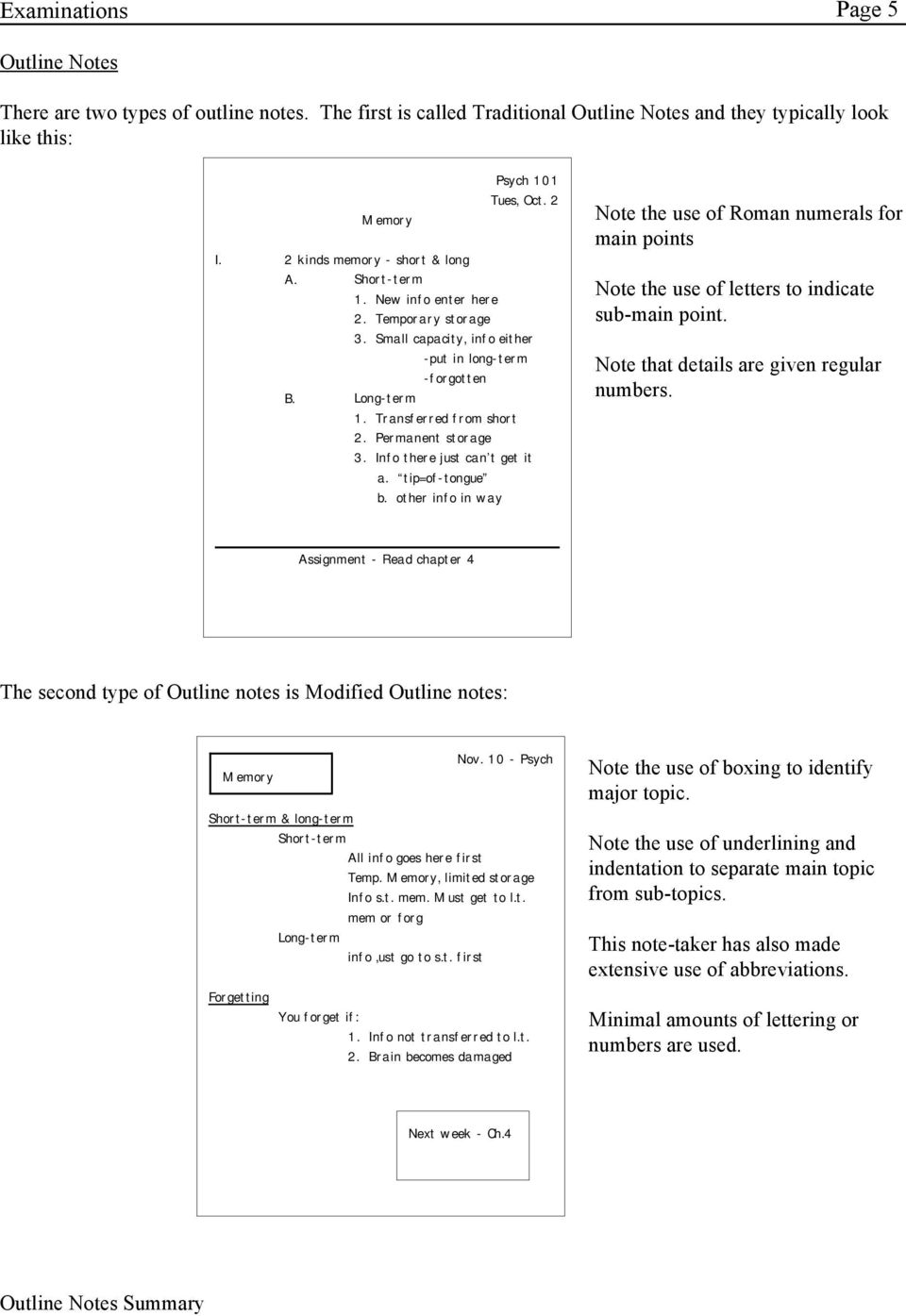
6 Examinations Page 6 Outline notes take advantage of the fact that there are a limited number of main points in any lecture. Once you have identified the major topic it is simply a matter of waiting for the instructor to introduce the main ideas, followed by details and examples. If we look at our note example, we can easily see that the major topic was Memory, w h i c h w a s f u r t h e r d e v e l o p e d i n t o t w o m a i n i d e a s : Kinds of Memory a n d Forgetting. Outline notes work best with instructors who are highly organized, and perhaps even a bit formal, in their style of presentation. Similarly, outline notes work best for course material that can be presented as a series of main topics followed by sub-topics and details. If the lecture is not highly organized it is best to record as much information as possible and then identify the main points later. You may have to combine the various note-taking techniques.. Diagram Notes Another good way to record information from lectures is to make pictorial or schematic notes. Not all lecture material can be organized into outline form. Sometimes information shows a course of d e v e l o p m e n t, a s e q u e n c e o f e v e n t s, a p r o c e d u r e o r d e s c r i p t i o n. I n s u c h c a s e s, a d i a g r a m m a y b e a b e t t e r way to remember the information. In fact, you may already be familiar with this type of notes if you have taken courses in biology, geology, physics, or economics. Here is a paragraph of lecture material followed by an example of diagram notes: "All verbal information goes first into the primary memory...also called short-term memory. When this information is rehearsed... or recited...part of it goes into our secondary or long-term memory. The rest of the information, usually the part we are least interested in, is forgotten". Memory Psych 101 What happens to new info: Verbal info Short-term Mem. Recited Long-Term Mem. œ Not Recited Forgotten As you can see, the diagram provides a good summary for verbal information. There are several methods for mapping and making tree or flow diagrams such as the example above. However, the benefits of such methods may be outweighed by the considerable amount of time it would take to learn effective diagramming techniques. You may want to use diagramming on a limited basis, combined with outlining, until you have developed an efficient technique. You may also consider a more simple form of diagram notes called T-notes. T-notes As the name suggests, T-notes involve organizing information around one or more large Ts that are drawn on the page of your notebook. Each main idea or topic goes above the top of a T. Subtopics or key points a r e r e c o r d e d o n t h e l e f t h a l f o f t h e p a g e a s t h e i n s t r u c t o r i n t r o d u c e s t h e m. A d d i t i o n a l d e t a i l s, e x a m p l e s,

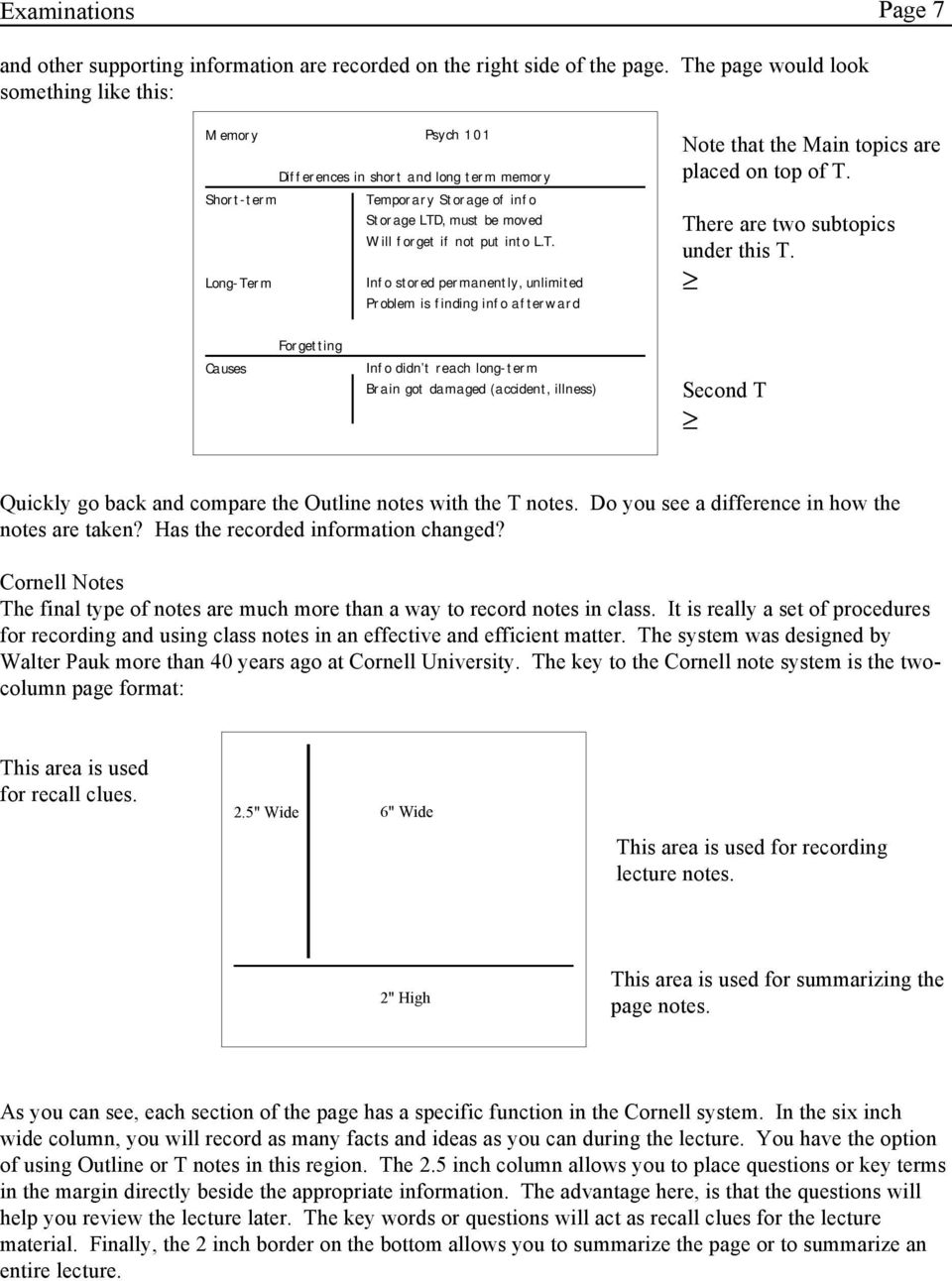
7 Examinations Page 7 and other supporting information are recorded on the right side of the page. The page would look something like this: Memory Psych 101 Differences in short and long term memory Short-term Temporary Storage of info Storage LTD, must be moved Will forget if not put into L.T. Long-Term Info stored permanently, unlimited Problem is finding info afterward Forgetting Causes Info didn t reach long-term Brain got damaged (accident, illness) N o t e t h a t t h e M a i n t o p i c s a r e p l a c e d o n t o p o f T. T h e r e a r e t w o s u b t o p i c s u n d e r t h i s T. S e c o n d T Quickly go back and compare the Outline notes with the T notes. Do you see a difference in how the n o t e s a r e t a k e n? H a s t h e r e c o r d e d i n f o r m a t i o n c h a n g e d? Cornell Notes The final type of notes are much more than a way to record notes in class. It is really a set of procedures for recording and using class notes in an effective and efficient matter. The system was designed by Walter Pauk more than 40 years ago at Cornell University. The key to the Cornell note system is the twocolumn page format: T h i s a r e a i s u s e d f o r r e c a l l c l u e s. 2.5" Wide 6" Wide T h i s a r e a i s u s e d f o r r e c o r d i n g l e c t u r e n o t e s. 2" High This area is used for summarizing the page notes. As you can see, each section of the page has a specific function in the Cornell system. In the six inch wide column, you will record as many facts and ideas as you can during the lecture. You have the option of using Outline or T notes in this region. The 2.5 inch column allows you to place questions or key terms in the margin directly beside the appropriate information. The advantage here, is that the questions will help you review the lecture later. The key words or questions will act as recall clues for the lecture material. Finally, the 2 inch border on the bottom allows you to summarize the page or to summarize an entire lecture.
8 Examinations Page 8 How Do I Take Notes From Textbooks? ost students make the mistake of believing that there is only one time to worry about taking notes, namely, during the lecture. True enough, a good set of lecture notes can take you a long way. However, your lecture notes are only part of the equation. The most successful students also benefit from knowing how to make notes in and from their textbooks. Once again, space limitations dictate that only three different note taking systems can be illustrated: " Standard System " Question-in-the margin System " Separate Notes System Standard System The standard system is actually a textbook marking system. The system operates best when the student can identify important ideas within the textbook and has knowledge of the basic guidelines for underlining and jotting notes in the margin. If you choose to use the standard system, you must develop the following two skills first: Sensing what to mark " Sensing what to mark " Consistency in marking Textbook marking can be a useful aid to study and review, but not if you mark everything. Two general rules to follow include (a) never mark anything until you have read the entire thought and (b) mark something only if you can say it from memory first. The rational behind these two rules is that we can't assume something is important before we have read it, and second, we don't learn something just because w e h a v e u n d e r l i n e d i t. There are several textbook features that can help you to determine what is important: 1. Titles and Topic Headings M a i n t o p i c s a r e p r e s e n t e d a n d s u b t o p i c s a r e i d e n t i f i e d 2. P a r a g r a p h s a n d T o p i c s e n t e n c e s Every paragraph will have a topic sentence and that sentence will state the main idea of the paragraph. Usually is the first one. 3. Signal Words and Phrases Introductory signal a point is about to be made eg. "three causes are..." R e l a t i o n a l eg. 'in addition.." "however.. ' Conclusive highlight cause and effect eg. 'thus.." 'therefore...'
9 Examinations Page 9 4. Lists of things What belongs & what does not? 5. Emphasis eg. boldface type or italic Consistency in Marking The second skill to develop is using a marking system that is consistent so that you don't have to spend a lot of time determining what to use when you read something. Some of the markings that have become quite standard include the following: D o u b l e u n d e r l i n e m e a n s m a i n i d e a Single line indicates supporting idea Circled numbers means related points Box key terms Put an asterisk beside ideas of special importance Put? by things unclear to you The Question-in-the-Margin System The second system we are going to look at is also a textbook marking technique. The advantage is that the guidelines for using this system include only four easy steps: -Survey the chapter -Return to the first paragraph -Write a question in the margin -Underline key words Surveying the chapter This first step should not take longer than 10 minutes. The purpose is really only to get "the big picture' about the reading. Take a look at the chapter title. What does this tell you about the content of the Chapter? For example, in a Psychology textbook, what would a chapter called Child Development tell you? It probably would be about the stages a child goes through as a grows. Do you know anything already about child development? Take a look at the pictures, charts, graphs, diagrams etc. Read the captions and see if they make sense to you. If you look at the headings and sub-headings, do they seem to follow a particular order. For instance a c h a p t e r o n c h i l d d e v e l o p m e n t w o u l d p r o b a b l y s t a r t w i t h n e w b o r n s a n d w o r k t o w a r d a d o l e s c e n c e. R e a d the short summary at the end if there is one. Return to the first paragraph T h e s e c o n d s t e p s h o u l d n o t t a k e m o r e t h a n a f e w m i n u t e s e i t h e r. R e a d t h e f i r s t p a r a g r a p h. I s t h e r e a t o p i c s e n t e n c e? What is the main idea of this paragraph? The author should indicate what this chapter is going to b e a b o u t. U s e t h e t o p i c s e n t e n c e a s o n e o f t h e p o i n t s i n y o u r o u t l i n e n o t e s o f t h e c h a p t e r. Write a question in the margin F o r t h e f i r s t, a n d e a c h s u b s e q u e n t p a r a g r a p h, t r y t o d e v e l o p a q u e s t i o n t h a t c o u l d b e a n s w e r e d b y r e a d i n g the main points in the paragraph. A good start would be to use the typical Who, What, When, Where,

10 Examinations Page 10 Why and How type of questions. Place the questions in the margin of your text or use post-it notes if you don't want to mark your book. Make sure the question draws out relevant information. As you improve at this skill you will notice that your margin questions often appear on the test. Underline key words The final step involves underlining only the key terms, phrases, and sentences that make up the answer to t h e q u e s t i o n. Y o u h a v e t h e o p t i o n o f w r i t i n g o u t t h e i n f o r m a t i o n i n r e s p o n s e t o y o u r q u e s t i o n o r y o u c a n just recite the answer out loud. It is important not to look at the underlined text material when you are trying to recall the answer. Remember, your text won't be there when you have to answer the question on test day. A good guideline is to not underline terms until you can say them without looking. A very similar note taking system to the Question-in-the-margin technique is the ADULT method for developing useful notes. The ADULT method asks you to follow five steps as you analyze textbook material. Only a brief description will be given in this module, but you can easily adapt from the Question-in-the margin method. Applying the ADULT Method of Note Taking Ask Q u e s t i o n s As you are reading new material ask yourself questions or even jot them in the margin. Determine w h e r e t h e a n s w e r i s Document the appropriate info with some marking technique Understand the information Rework the information into an answer that makes sense to you Learn t h e a n s w e r s R e v i e w a n d r e c i t e, o u t l o u d, y o u r a n s w e r s t o t h e q u e s t i o n s Test yourself As if you were preparing for a test; make up an exam or two to write Separate Notes System The final system we will look at is the separate notes system. As the name suggests, this system requires t h e d e v e l o p m e n t o f a s e p a r a t e s e t o f n o t e s. T h e n o t e s a r e m a d e f r o m t h e t e x t a n d t h e r e a r e s e v e n g e n e r a l guidelines to follow: " Use the Cornell format for page design " Finish each paragraph before writing a note about it " Be selective -use one-sentence summaries " Use own words -should be able to say from memory " Write full sentences " Be swift -don't spend all day making notes " Don't forget the visual stuff ie. Diagrams, Charts, Tables

11 Examinations Page 11 Contour Lines Sample from Fact based Text Key Words N o t e s o n C h a p t e r General Rules for Contour Lines 1. Steep Slope 1. Steep Slope - lines close together 2. Gentle Slope 2. Gentle Slope - lines are spread 3. Cross 3. Lines Never cross 4. Streams 4. Lines crossing streams - bend upstream
12 Examinations Page 12 How do I Put It All Together? "I don't have a problem, I just need more time" an you relate to this guy? You may be wondering how you are going to find the time to attend class, take notes, revise notes, read the text, make more notes and then somehow study all this stuff! Don't worry, it can be done, and you may even be surprised to learn that the extra effort you put into developing a Note Taking/Study technique can actually save time. In all likelihood, what you perceive to be a time problem is actually an efficiency problem. In most cases, if students improve learning efficiency, they have few problems with time. Improving efficiency with the PLRS Learning Cycle One of the best ways to improve learning efficiency is to combine all the tasks of learning into a daily cycle. Ideally, the cycle would ensure that the time spent on one task would decrease the amount of time required for the next task. The PLRS Cycle incorporates four common tasks: PREVIEW œ STUDY LEARN œ REVIEW œ As you can see by the diagram, the PLRS cycle has a definite direction and the tasks are interconnected. T o u n d e r s t a n d t h e w o r k i n g s o f t h e c y c l e y o u w i l l n e e d t o a d d r e s s w h a t h a p p e n s d u r i n g e a c h p h a s e o f t h e four tasks. Previewing Overall, only about 10 minutes are spent previewing an item. The main goal of previewing is to get the general idea about the content of a chapter, article, lab assignment etc. Previewing can be accomplished by reading the introduction or first paragraph completely, followed by the summary and then the topic sentence of each paragraph. Once completed, time is then spent trying to recall and recite the main ideas of the article or chapter. Even though this phase of the cycle takes relatively little time, the benefits are substantial. The first benefit is that it is possible to obtain as much as 70% of the important information contained in an item by previewing. This suggests that a student who previews material prior to class will have a very good idea of what will be discussed. In addition it allows the student to start thinking about what to listen for in the lecture. For instance, perhaps something was unclear in the text or was controversial for the student.
13 Examinations Page 13 T h e s e c o n d b e n e f i t o f p r e v i e w i n g i s t h a t b r i e f n o t e s c a n b e p l a c e d o n t h e r i g h t h a n d p a g e s s o t h a t t h e lecture can be followed more easily during class. Material not covered in the text will stand out during the lecture. Time will not be wasted searching for information in the text later on when reviewing lecture material. Learning It may seem strange to have a phase called learning in the cycle given that all of the tasks involve learning. However, learning actually refers to the fact that the lecture session is the primary learning period for most s t u d e n t s. S t u d e n t s a r e e x p e c t e d t o a t t e n d l e c t u r e s a n d t h e y a r e r e s p o n s i b l e f o r t h e i n f o r m a t i o n t h a t i s p r e s e n t e d d u r i n g t h e s e s e s s i o n s. If lectures are the primary learning period, then note taking is the primary activity that occurs during this time period. Your ability to take adequate notes is not only dependent on your note taking technique but also your level of preparation. If you have previewed the material, then you have a definite advantage. Thus the time spent previewing now helps you to perform better during the learning phase. The note taking technique used during the Learning phase must accomplish two things: (a) r e c o r d a n a c c u r a t e a c c o u n t o f t h e m a i n c o n c e p t s a n d i m p o r t a n t d e t a i l s o f t h e l e c t u r e ( b ) allow for quick review of the main concepts and important details of the lecture There are several things a student should do to ensure that the two objectives mentioned above are met: 1. Arrive at class ON TIME 2. Sit UP FRONT 3. U s e a LOOSE-LEAF NOTEBOOK 4. Always TITLE and DATE your notes 5. Be PREPARED f o r c l a s s - PREVIEW 6. Take notes in your OWN WORDS 7. U s e KEYWORDS Review Efforts to take good notes in the Learning phase will pay off when it comes time to review. Notes that are designed properly will allow a student to review the lecture in a very short period of time. The review session typically involves the following steps: 1. R e a d n o t e s a s s o o n a s p o s s i b l e a f t e r c l a s s 2. Fill in recall column (Comell Notes) with key words or?'s 3. S u m m a r i z e n o t e s i n a c o u p l e s e n t e n c e s a t b o t t o m 4. Fill in any missing blanks S p e n d i n g time immediately after class to review notes will pay off greatly later on in the term. The 10 minutes o r s o y o u s p e n d e a c h d a y r e v i e w i n g y o u r n o t e s w i l l a c t u a l l y h e l p y o u t o r e t a i n u p t o 7 5 % o f t h e l e c t u r e material. Compare this to a student who loses 50% of the information within the first hour after class. By the time the exam arrives, that student will have 80% of the material to put back into memory, whereas you will only need to replace 25%.
14 Examinations Page 14 Study The fourth phase of the cycle involves studying the material covered that day. Your preparation for exams must begin on the very first day of classes and continue throughout the entire term. The review sessions that take place in phase 3 help to keep you up-to-date and greatly reduce the amount of time you must spend studying for tests. The object of the study phase is to organize your individual lecture notes into larger groups so that you see the 'big picture'. In other words, 'we had three lectures this week, how are they related'. When you grasp the overall organization of the lectures, you can begin to write summaries for the week so that later on you can quickly review a whole week of lectures in a short period of time. After completing the Study phase, one would begin to preview material for the next lecture, and thus, the cycle continues. The best part is that one more day has passed and you have managed to keep up. R e m e m b e r t h e d a y s w h e n o n e m o r e d a y w o u l d p a s s a n d y o u w o u l d b e o n e d a y f u r t h e r b e h i n d?

TAKING NOTES. II. Instructors usually give clues to what is important to take down:
 TAKING NOTES I. There are many reasons for taking lecture notes. A. Making yourself take notes forces you to listen carefully and test your understanding of the material. B. When you are reviewing, notes
Example - Cornell Note-Taking Format
 All the info on a note-taking system that you ll ever want to know p. 1 Example - Cornell Note-Taking Format Subject: Notetaking Date: 11/20/04 Main Ideas Details Cornell notes Semantic map or web Can
Lecture Notes. Take Note: Note Taking Tips & Tricks. In this session. Lecture Notes. Getting the most out of Text Books
 1 Take Note: Note Taking Tips & Tricks In this session Lecture Notes Are you listening? Do I need to write this down? Taking effective lecture notes Getting the most out of Text Books A system for reading
Study Strategies Used By Successful Students
 Study Strategies Used By Successful Students Test performance not only reflects how much one studied in the hours and days right before the test but also how well the person has been studying throughout
Note Taking. Learn to be an efficient note taker. Save time by taking notes that work for you! 05/27/14
 Note Taking Learn to be an efficient note taker. Save time by taking notes that work for you! 05/27/14 2 Note taking Strategies good note taking skills require practice and dedication First steps. Make
NOTE-TAKING. Rutgers School of Nursing
 NOTE-TAKING Rutgers School of Nursing WHEN TO TAKE NOTES BEFORE DURING AFTER I. Before Class: Preparation (mental and physical) Read Textbook BEFORE Class Start Taking Notes BEFORE Class The SQ3R Method
Lesson Plan for Note Taking
 Lesson Plan for Note Taking Goals: To prepare students to take pertinent notes form lecture, books and activities. Expose students to different styles of note-taking. Give students an opportunity to practice
Strategies for note taking
 Why are notes important? Notes help you locate the information you need faster. Strategies for note taking why notes are important This is because a set of well-organized notes will allow you to use headings,
Notecard Question & Answer Technique
 Academic Resources Notecard Question & Answer Technique To succeed in college, important ideas from lectures and textbooks must be identified, organized, recorded, practiced and stored in long term memory
MODULE 6. Annotating Texts and Notetaking. An Effective Reading Process: Student Strategies. STRATEGY #1: Developing and Using an Annotation Code
 An Effective Reading Process: Student Strategies Being able to annotate and take effective notes helps you actively engage with your texts and improve your reading comprehension. The strategies included
Cornell Note Taking System (For Lecture or Reading)
 Cornell Note Taking System (For Lecture or Reading) Taking good notes is one of several keys to academic success. There are several reasons why developing an effective technique of note taking is important.
College Reading Strategies
 College Reading Strategies Reading a college textbook should be approached differently than reading a magazine or novel. It is difficult to remember or even understand everything in a textbook chapter
Notetaking and Notemaking Academic skills guide 4
 Notetaking and Notemaking Academic skills guide 4 Produced by Dyslexia Support Enabling Services View at www.soton.ac.uk/edusupport/dyslexia Contents Introduction... 3 Note taking and note making... 5
Note Taking Will Make You a Better Student
 Note Taking Will Make You a Better Student Have you ever found yourself getting ready to study for a test at 10:30 p.m. the night before a test? You sit there with only the book in front of you as your
STUDENT SUPPORT SERVICES PRESENTS SCHEDULING TIME FOR STUDY
 STUDENT SUPPORT SERVICES PRESENTS SCHEDULING TIME FOR STUDY 1. PLAN ENOUGH TIME FOR STUDY. A college expects a student to average about two hours in studying (including library work, term papers, themes,
Taking Notes in Class THINK
 Taking Notes in Class I. Page Setup: Cornell System Date Topic Leave blank 2 Notes 2-3 lines leave blank II. Background Information. A. Today we will be discussing an organized way of study that starts
EFFECTIVE NOTE- TAKING METHODS. Student Success Workshop Series Sauk Valley Community College
 EFFECTIVE NOTE- TAKING METHODS Student Success Workshop Series Sauk Valley Community College Retaining Information Studies show that people may forget: 50% of a lecture within 24 hours 80% in two weeks
INFORMATION FOR LEARNING: MAKING IT YOUR OWN
 INFORMATION FOR LEARNING: MAKING IT YOUR OWN Active listening: notetaking in lectures DCU Student Learning Resources Office of the Vice-President for Learning Innovation and Registrar 2 INFORMATION FOR
Note-Taking Tips. 1. REVIEW your notes within 24 hours of taking them. This will help you retain up to 80% of information for a test.
 NOTE-TAKING SKILLS & STRATEGIES Note-Taking Tips 1. REVIEW your notes within 24 hours of taking them. This will help you retain up to 80% of information for a test. 2. Leave spaces in your notes to fill
Learning From Lectures:
 Learning From Lectures: A Guide to University Learning Learning Services University of Guelph Table of Contents Student Guide:... 3 University Lectures... 3 Preparing for Lectures... 4 Laptop Pros & Cons...
SHARPEN YOUR NOTE -TAKING
 SHARPEN YOUR NOTE -TAKING SKILLS Mayland Community College SOAR Program 1996 Note-taking is a three part process of OBSERVING, RECORDING, AND REVIEWING. First you observe an event (teacher lecturing or
Effective Study Skills. Dr. Bob Kizlik. How to Study and Make the Most of Your Time
 Effective Study Skills Dr. Bob Kizlik How to Study and Make the Most of Your Time There is little doubt that no two people study the same way, and it is a near certainty that what works for one person
What s Your Learning Style?
 What s Your Learning Style? Different people have different learning styles. Style refers to a student s specific learning preferences and actions. One student may learn more effectively from listening
Quickwrite Questions: How did you learn the skill of note taking? How did this skill contribute to your success?
 Quickwrite Questions: How did you learn the skill of note taking? How did this skill contribute to your success? Cornell note taking stimulates critical thinking skills. Note taking helps students remember
3. How can you improve your ability to understand and record information presented in lectures?
 GETTING THE MOST OUT OF LECTURES Use this sheet to help you: prepare for and learn from lectures manage note-taking during lectures 5 minute self test 1. What are some of the purposes of lectures? 2. How
Reading for College. How to read Faster AND more effectively
 Reading for College How to read Faster AND more effectively Reading for college First, let s talk about reading speed This is not about trying to read as FAST as you can...... It is about learning to read
How to Study Mathematics Written by Paul Dawkins
 How to Study Mathematics Written by Paul Dawkins Before I get into the tips for how to study math let me first say that everyone studies differently and there is no one right way to study for a math class.
Course Syllabus Abnormal Psychology (PSYC 3151-001 & 002)
 Term: Spring 2014 Instructor: Dr. Richard McAnulty E-mail: [email protected] Office Hours: by appointment Course Syllabus Abnormal Psychology (PSYC 3151-001 & 002) Preface: This is an advanced and challenging
Reading and Taking Notes on Scholarly Journal Articles
 Reading and Taking Notes on Scholarly Journal Articles Set aside enough time in your schedule to read material thoroughly and repeatedly, until you understand what the author is studying, arguing, or discussing.
Get enough sleep so that you can stay alert during lecture. Falling asleep in the front row wastes your time and might offend your professor.
 SCIENCE STUDY SKILLS CYCLE (S 3 C) DR. JEFF PARADIS (SACSTATE) GENERAL INFORMATION Doing well in college science classes requires a minimum of 2-3 hours work outside of class for each hour you are in lecture.
HOW TO STUDY CHEMISTRY
 AN OVERALL STUDY STRATEGY HOW TO STUDY CHEMISTRY For an introductory science course such as Chemistry 1A, lectures usually provide the best guide to the study of the subject. The instructor presents and
Organizing Math Notes
 Organizing Math Notes Author/Creation: Emilie Eggleston, September 2010. Summary: Learn to organize math notes for better accessibility. Learning Objectives: To describe why intuitiveness and accessibility
API 510 Inspector Certification Training Study Suggestions
 Welcome to API 510 Training!! You re making a significant investment in your career. Here a few study suggestions. 1. API S APPLICATION An API application can be downloaded from API s ICP website at www.api.org/icp.
It is vital that you understand the rationale behind the correct answer(s) as wel as the incorrect answer options.
 Getting the Most out of ATI www.atitesting.com What is ATI? ATI is an online resource that will be used throughout the nursing program to help you learn about nursing practice as well as help prepare you
Get the Most Out of Class
 Get the Most Out of Class Academic Resource Center, tel: 684-5917 Class preparation is an essential element of studying for any course. The time you spend in class each week shouldn t be a time in which
Note Taking Structures
 ELFTMANN STUDENT SUCCESS CENTER Note Taking Structures Moving Beyond Bullets and Dashes T. Milligan 2014 D U N W O O D Y C O L L E G E O F T E C H N O L O G Y N o t e T a k i n g S t r u c t u r e s P
Study Strategies to be a Successful Student QUIZ
 Study Strategies to be a Successful Student INTRODUCTION Test performance not only reflects how much one studied in the hours and days right before the test but also how well the person has been studying
Why Take Notes. Note-taking serves two main academic purposes:
 Note-Taking Why Take Notes Note-taking serves two main academic purposes: It provides a method to identify/predict what will be on tests and puts that information in a format that can be easily studied.
Club Accounts. 2011 Question 6.
 Club Accounts. 2011 Question 6. Anyone familiar with Farm Accounts or Service Firms (notes for both topics are back on the webpage you found this on), will have no trouble with Club Accounts. Essentially
Reading and note-making
 Reading and note-making Outline of Session Unravelling Reading Reading techniques Note-making for Research Note-taking in lectures Further Sources of help Unravelling Reading 1) What reading styles do
How Do You Manage Your Time?
 How Do You Manage Your Time? Time Management Time management refers to how you regulate your time. In high school, students spend approximately 35 hours per week in class. However, the average college
SQ3R: Textbook Study System
 Academic Resources SQ3R: Textbook Study System Inexperienced college students interpret the processes needed for learning in may different ways. For many students frantic reading of assigned textbook material
LECTURE AND NOTE TAKING
 LECTURE AND NOTE TAKING Goals of Note Taking Taking notes helps with classroom concentration, test preparation and for clues as to what the instructor feels is most important. Prepare to take effective
STUDY SKILLS FOR SUCCESS. Ms. Dawn Robertson Guidance Counselor
 STUDY SKILLS FOR SUCCESS Ms. Dawn Robertson Guidance Counselor HSMSE SCHEDULE Alternating A/B Day Schedule Math and Enrichment EVERY DAY Bell Schedule 8:00-9:25 9:30-10:55 11:00-11:45 11:50-12:35 12:40-2:05
Do you take good class notes? Do you take any notes at all? If you take notes, why do so?
 Taking Notes and Reviewing 1 Do you take good class notes? Do you take any notes at all? If you take notes, why do so? Make sure I have a chance to pass the next test and the final exam. Preserve course
Making effective notes. Why take notes?
 1 Making effective notes Why take notes? Think about any reasons you might have for taking notes in everyday life, and any occasions when you do so. It s a skill we all use, to some extent, as part of
Transition Planning Considerations: A Strategy for Note Taking. PowerPoint Slides to be used in conjunction with the Facilitator s Guide
 Transition Planning Considerations: A Strategy for Note Taking PowerPoint Slides to be used in conjunction with the Facilitator s Guide Copyright 2011, East Carolina University. Recommended citation: Bouck,
How To Take Good Lecture Notes
 How To Take Good Lecture Notes A good set of lecture notes is one of your most important assets in getting ready for an examination. If you have the facts in readable form, you are well equipped to do
Guidelines for Note Takers
 Services for Students with Disabilities Guidelines for Note Takers August, 2009 (Revised) Table of Contents Introduction..3 Documentation of Disability...3 Qualifications for Note Takers.. 4 Obtaining
Learning Styles. The VARK Categories. What is a Learning Style?
 Learning Styles What is a Learning Style? Learning styles focus on how your brain receives information. No one else learns or processes information exactly the way you do! If you discover how you process
Note-Taking Skills. Overview: This lesson adds to the learners note-taking skills. This is a
 xxx Lesson 14 Note-Taking Skills Overview: This lesson adds to the learners note-taking skills. This is a lesson that can be repeated on Tuesday of Week Three or can be taught in two segments. Learners
How to Succeed in AP World History (borrowed/modified from Southwest High School)
 How to Succeed in AP World History (borrowed/modified from Southwest High School) TIP #1: LEARN TO MANAGE TIME. Students who take AP classes are many times those students who are also involved in band,
Developing Critical Thinking Skills Saundra Yancy McGuire. Slide 1 TutorLingo On Demand Tutor Training Videos
 Developing Critical Thinking Skills Saundra Yancy McGuire Slide 1 TutorLingo On Demand Tutor Training Videos To view Closed Captioning, click on the Notes tab to the left. For screen reader accessible
Increasing Achievement Scores With. The Use of the Cornell Note Taking Style. A Special Project. Presented to Dr. Gretta Merwin.
 Increasing Achievement Scores With The Use of the Cornell Note Taking Style A Special Project Presented to Dr. Gretta Merwin Heritage College In Partial Fulfillment of the Requirement for the Degree of
Steps for Planning and Preparing an Effective Presentation
 Steps for Planning and Preparing an Effective Presentation According to speaking consultant Lilyan Wilder (1999), two of the greatest myths about delivering oral presentations are that you re better off
TIME MANAGEMENT AND STUDY SKILLS
 TIME MANAGEMENT AND STUDY SKILLS People aren t born knowing how to be good students. Adopting good study skills takes practice and dedication, but anyone can become a good student. The two most important
Study Strategies for Success in College. Dr. James Brown Quinsigamond Community College
 Study Strategies for Success in College Dr. James Brown Quinsigamond Community College 2014 Table of Contents Chapter One: Strategies for Managing Time at the College Level... 2 Strategies for Managing
CLASS PARTICIPATION: MORE THAN JUST RAISING YOUR HAND
 STUDENT LEARNING SUPPORT TUTORIAL PRODUCED BY THE CENTER FOR TEACHING AND FACULTY DEVELOPMENT CLASS PARTICIPATION: MORE THAN JUST RAISING YOUR HAND CHAPTER 1: LEARNING THROUGH CLASS PARTICIPATION CLASS
Lesson One: Introduction to Customer Service
 Student s Name: Date: / / Lesson One: Introduction to Customer Service 1. Customer service is a relatively complex puzzle. While engaging customers, we are attempting to offer services in a manner that
PREVIEW STRATEGY PREVIEWING TEXTBOOK READINGS
 PREVIEWING TEXTBOOK READINGS When you preview a reading assignment you become familiar with its contents and goals before you start to read. This helps to make the reading an easier, faster, and more effective
Niles West High School STUDY SKILLS MANUAL
 Niles West High School STUDY SKILLS MANUAL Table of Contents Table of Contents Organizational Skills Study Habits Study Materials Doing Your Best Using the IRC Studying English Studying ESL Studying Foreign
Complete a Relationships Presentation
 Complete a Relationships Presentation Speech Tips 1. I am so scared of giving my speech. How do I get over my nervousness? Nervousness is natural. Think of it as a friend rather than an enemy. You need
Anexo 1 SELF-EFFICACY FOR LEARNING FORM (SELF) Definitely Probably Maybe Probably Definitely Cannot Do it Cannot Can Can Do It
 17 Anexo 1 SELF-EFFICACY FOR LEARNING FORM (SELF) Definitely Probably Maybe Probably Definitely Cannot Do it Cannot Can Can Do It 0% 10% 20% 30% 40% 50% 60% 70% 80% 90% 100% Choose a percentage to indicate
THE MUSKIE KEYS TO ACADEMIC SUCCESS
 THE MUSKIE KEYS TO ACADEMIC SUCCESS Prepared by Leigh Williamson Assistant to the Vice President for Academic Affairs Muskingum College 2007 2 KEY #1: GET ORGANIZED! Use your planner! Your planner should
Advising mothers on management of diarrhoea in the home
 CDD193.1 ORIGINAL ENGUSH 1 Advising mothers on management of diarrhoea in the home A GUIDE FOR HEALTH WORKERS Diarrh~eal Disease Control (CDD) Programme World Health Organization CONTENTS PAGE Introduction
I've got a quick question for you
 I've got a quick question for you If you've been trying to learn to read Tarot, does any of the following sound familiar? "I can't seem to commit the Tarot card meanings to memory. I try, but memorising
The Challenge of Helping Adults Learn: Principles for Teaching Technical Information to Adults
 The Challenge of Helping Adults Learn: Principles for Teaching Technical Information to Adults S. Joseph Levine, Ph.D. Michigan State University [email protected] One of a series of workshop handouts made
Instructional Scaffolding to Improve Learning
 Instructional Scaffolding to Improve Learning When you incorporate scaffolding in the classroom, you become more of a mentor and facilitator of knowledge rather than the dominant content expert. Although
Effective Listening and Notetaking
 Effective Listening and Notetaking Effective and Listening and Notetaking Listening is a skill that should be taught since eighty percent of what you know is learned by listening. This packet contains
Making the Most of Lectures
 Making the Most of Lectures This section will help you to : O BJECTIVES Identify why lectures are used Get the most out of lectures by knowing how to prepare and learning how to listen Identify different
ACADEMIC SUCCESS. WWU Tutoring Center WL 280 360.650.3855 [email protected] www.wwu.edu/tutoring
 ACADEMIC SUCCESS WWU Tutoring Center WL 280 360.650.3855 [email protected] www.wwu.edu/tutoring HOW TO USE THIS BOOKLET Read through the study skills strategies and suggestions. Determine your strengths
Orientation Lecture Series: LEARNING TO LEARN Lectures and how to use them
 Orientation Lecture Series: LEARNING TO LEARN Lectures and how to use them Outline of Lecture Part 1: to give you some useful strategies for: getting the most out of your lectures taking more effective
Writing Essays. SAS 25 W11 Karen Kostan, Margaret Swisher
 Writing Essays A GOOD ESSAY CONTAINS: 1. An introductory paragraph 2. A clear thesis statement 3. A body consisting of supporting paragraphs 4. A concluding paragraph Step 1: Review Assignment Read the
F O C U S Challenge? Reaction? Insight? Action Chapter Seven Engaging, Listening, and Note Taking in Class
 F O C U S Challenge? Reaction? Insight? Action Chapter Seven Engaging, Listening, and Note Taking in Class Reading Assignments Chapter 7, pages 151-174 PowerPoint Presentations Chapter 7 FOCUS on Community
OBJECTIVES. The BIG Idea. How will taking notes improve my performance in school and on the job? Taking Notes
 Taking Notes 2 Study Skills The BIG Idea How will taking notes improve my performance in school and on the job? AGENDA Approx. 45 minutes I. Warm Up: Scavenger Hunt (5 minutes) II. What s My Line? (10
Writing a Formal Lab Report
 Writing a Formal Lab Report Note: This handout provides guidelines for writing a formal, typed laboratory report for a Biology, Chemistry, Natural Science, or Physics class. Routine lab write-ups such
Learning Styles and the Writing Process
 Learning Styles and the Writing Process Gathering Information Look at Model Papers Both student writing and professional papers will give you useful ideas about structure and organization. List Important
Note taking skills - from lectures and readings
 Introduction Department of Lifelong Learning: Study Skills Series Note taking skills - from lectures and readings When you are at university, the sheer amount of information that is delivered to you can
INTRODUCTION. Just a quick word
 P.P.P. INTRODUCTION Just a quick word Most of us would rather drag a dead horse through a sewer than write an essay. The trouble is, because essays are required by most educational institutions, we must
Determining Importance
 Determining Importance How do you The modern world is inundated by Facts. Television, the Internet-more information than your grandparents every imagined-is at your fingertips with the click of a button.
Study Skills for Mathematics. Dr. Lisa O Keeffe August 2012
 Study Skills for Mathematics Dr. Lisa O Keeffe August 2012 Study Techniques for Mathematics Study outside of class regularly Work on maths every day. (recommended 2 hours study for each one hour lecture)
CADET PORTFOLIO GUIDE
 KNIGHTDALE AJROTC CADET PORTFOLIO GUIDE MARCH 2014 KNIGHTDALE HIGH SCHOOL Army Junior Reserve Officers Training Corps 100 Bryan Chalk Way Knightdale, NC 27545 Cadet Portfolios Table of Contents Purpose
INDEX OF LEARNING STYLES *
 INDEX OF LEARNING STYLES * DIRECTIONS Enter your answers to every question on the ILS scoring sheet. Please choose only one answer for each question. If both a and b seem to apply to you, choose the one
Monitoring for Meaning
 Monitoring for Meaning Grades 3-5 eeee Wwh Monitoring comprehension is above all engagement. When readers monitor their thinking, they have an inner conversation with the text. They listen to the voice
How to Write A Solid AP Psychology Free Response Question
 How to Write A Solid AP Psychology Free Response Question 1. Read before answering. Carefully read both of the questions before you start to write anything. Decide which question you are more comfortable
Activity 3: Observe Psychological First Aid
 Activity 3: Observe Psychological First Aid In this activity you have the opportunity to hear a conversation between a survivor of bomb blast and a Red Cross behavioral health volunteer. This role play
OBJECTIVES. The BIG Idea. How do I register for the ACT? What do I need to know for the test day? ACT Registration
 ACT Registration 3 Taking Tests The BIG Idea How do I register for the ACT? What do I need to know for the test day? AGENDA Approx. 45 minutes I. Warm Up: ACTing Ahead (5 minutes) II. ACT Registration
Active Learning Strategies
 Active Learning Strategies Right Brain Reports Let learners work in small groups to create informational reports to present to the large group. Instead of a verbal report on the information, have learners
Central England People First s friendly guide to downloading
 Central England People First s friendly guide to downloading What is Skype? Skype is a computer programme that turns your computer into a telephone. This means that you can speak to other people using
What is active learning?
 ACTIVE LEARNING: AN INTRODUCTION * Richard M. Felder Hoechst Celanese Professor Emeritus of Chemical Engineering North Carolina State University Rebecca Brent President, Education Designs, Inc. Cary, North
Active Listening. Learning Objectives. By the end of this module, the learner will have
 1 Active Listening Learning Objectives By the end of this module, the learner will have An understanding of what is meant by active listening Gained insight into your natural listening strengths and areas
Using Think-Alouds to Improve Reading Comprehension Lesson Plan
 Using Think-Alouds to Improve Reading Comprehension Lesson Plan Estimated Lesson Time: One class period Overview: Studies have shown that the think-aloud strategy improves comprehension on tests. Through
TIPS AND TECHNIQUES FOR TAKING NOTES IN CLASS 1
 TIPS AND TECHNIQUES FOR TAKING NOTES IN CLASS 1 2010 The Writing Center at GULC. All rights reserved. Taking notes is a crucial skill for law students. In law school, your notes are your record of what
Maryland 4-H Public Speaking Guide
 Maryland 4-H Public Speaking Guide Do you have questions? Contact Tom Hutson, 4-H Educator University of Maryland Extension Talbot County (410) 822-1244 or [email protected] Equal access/opportunity programs
LIBERTY NATIONAL LIFE LAPTOP PRESENTATION SCRIPTS
 Presentation Tips Remember 40% of the presentation is Rapport Building! When you walk into the home, don t start closing right away! Go slow, build rapport first. The clients buy you first, then the Company,
Quick Guide. Oral presentations. Four-step guide to preparing oral presentations. What is in this guide. Step 1: Plan
 Oral presentations What is in this guide Four-step guide to preparing oral presentations Step 1: Plan Step 2: Prepare Step 3: Practise Step 4: Present Reflecting on the presentation Oral presentations
TIME MANAGEMENT By Ann Marie Ross Created for CLASS and ECLP Revised Fall 2005 by Peggy Ozaki
 TIME MANAGEMENT By Ann Marie Ross Created for CLASS and ECLP Revised Fall 2005 by Peggy Ozaki WHAT THIS HANDOUT IS ABOUT This handout will help you understand how to plan and organize your time more effectively
Steward News TAKING GOOD NOTES DURING GRIEVANCE MEETINGS. a p u b l i c a t i o n f o r C U P E A c t i v i s t s i n A l b e r t a Winter 2004
 Steward News a p u b l i c a t i o n f o r C U P E A c t i v i s t s i n A l b e r t a Winter 2004 TAKING GOOD NOTES DURING GRIEVANCE MEETINGS A steward in a training session was asked how he knew that