
Relationship between Stock Futures Index and Cash Prices Index: Empirical Evidence Based on Malaysia Data
|
|
|
- Stanley Oliver
- 10 years ago
- Views:
Transcription
1 2012, Vol. 4, No. 2, pp ISSN Relationship between Stock Futures Index and Cash Prices Index: Empirical Evidence Based on Malaysia Data Abstract Zukarnain Zakaria Universiti Teknologi Malaysia, Jalan Semarak Kuala Lumpur, Malaysia Sofian Shamsuddin Universiti Teknologi MARA Shah Alam, Malaysia The empirical relationship between cash price index and future price index has been studied extensively. However, only few studies have been carried out in case of emerging markets. The main focuses of the previous studies were to investigate the lead-lag or causality relationship between these two indexes. In perfect markets, returns on derivative and underlying securities should be perfectly and contemporaneously correlated. However, due to market imperfections, one of these markets may reflect information faster. This paper examined this issue based on daily data of Malaysian stock market by using cointegration and Granger causality regression. The results from cointegration tests show that cash price index and futures price indexes in Malaysia are cointegrated indicating the existence of long run relationship between these two variables. Meanwhile the results from Granger causality tests found that the direction of causality relationship is unidirectional that running from cash market to futures market. The finding suggests that in the emerging market like Malaysia where the futures market is less active compared to the cash market, the cash market reflects to the new information faster than the futures market. Therefore, spot market plays a role as price discovery vehicle for the stock market instead of futures market. Key words: Cointegration, Causality, Stock market, Futures Price Index, Cash Price Index, Malaysia. 1.0 Introduction Since the introduction of stock index futures in the United States in 1982, the relationships and interactions between stock market spot price index and stock market futures price index have been an area of intense investigation. Many theoretical and empirical studies have been conducted with regard to this relationship, especially to investigate the role of futures index as price discovery and the lead-lag
2 2012, Vol. 4, No. 2, pp relationship between these two indexes. In general, the focus of investigation is to determine whether the cash market leads the futures market, whether the futures market leads the cash market or whether the bidirectional feedback between the two markets exists. It is very important to understand the lead-lag relationship since it may indicate how well the two markets are linked together, as well as providing information on how fast one market reacts to the new information from the other market. This information is crucial for the investors in their decision making process. For example, if a feedback relationship from cash price to futures price exists, then it is possible for the investors to use past information to predict prices in the future. Meanwhile, if a bi-directional causality exists between the two indexes, then both cash and futures prices have an important discovery role. Most of the studies to investigate the lead-lag relationship between spot and futures prices have been carried out in the case of developed market and only few were focused on the emerging markets. Different in the level of economic as well as the stock market development, make findings from the developed markets cannot be generalised to the emerging markets. Therefore, this paper focuses in investigating the causality relationship between cash index and futures index in case of Malaysia. In Malaysia, trading on stock index futures contracts is relatively new to financial investors. The Kuala Lumpur Stock Exchange Composite Index Futures (FKLI) contract was introduced on December Initially, the index was based on the Kuala Lumpur Composite Index (KLCI), which made up of 100 most actively traded stocks from approximately 500 to 650 companies listed in the Main Board of Bursa Malaysia (formerly known as Kuala Lumpur Stocks Exchange). The Kuala Lumpur Composite Index (KLCI) is a market value weighted index. The index is one of the most widely followed by the investors because KLCI represents the overall performance of the stocks listed in Bursa Malaysia. The index has generally been accepted as the local stock market barometer. The KLCI which was introduced in 1986 is to serve as a performance indicator of the Malaysian stock market as well as the Malaysian economy as a whole. As part of Bursa Malaysia s strategic initiative, the KLCI was enhanced to ensure that it remains robust in measuring the Malaysian economy and its growing linkage to the global economy. With this respect, Bursa Malaysia together with FTSE, its index partner, have integrated the KLCI with internationally accepted index calculation methodology to provide a more investable, tradable and transparently managed index. The enhanced index known as the FTSE Bursa Malaysia KLCI has been implemented on 6 th July, In contrast with KLCI, the FTSE Bursa Malaysia KLCI only comprises 30 largest companies listed on the main board of Bursa Malaysia. However, FTSE Bursa Malaysia KLCI maintains the continuity of the KLCI index value, therefore preserves the historical movements of Malaysian stock market. Meanwhile, FKLI is basically the futures contract of the overall health of the Bursa Malaysia and its underlying instrument is FTSE Bursa Malaysia KLCI. Since stock indices are not company shares, they are traded in the futures exchange, rather than the stock exchange. Future Exchange is basically a market where traders and investors trade futures contract (as apposed to stocks and shares). Futures contracts are standardized contract obligation to buy/sell a particular investment instruments between two parties, at a certain date in the future, at an agreed price. Empirically, little is known about the nature of relationship that exists between FTSE Bursa Malaysia KLCI and FKLI. This is due to the fact that systematic studies on this relationship are very limited. Therefore, this paper intends to fill the gap. The purpose of this paper is to investigate empirically the dynamic of interdependence relationship between Malaysia s cash price stock index (FTSE Bursa Malaysia KLCI) and future prices stock index (FKLI). There are two main objectives of this paper. The first objective is to examine the existence of long run, steady-state equilibrium between spot and futures prices index in Malaysia by using cointegration analysis. The use of cointegration analysis enables us to distinguish between short-run deviations from equilibrium indicative of price discovery and long-run deviations that account for efficiency and stability. The second objective is to test the causality 104
3 relationship between cash index prices and index futures prices of Bursa Malaysia by using Granger causality test. The causality analysis enables us to understand the interdependence relationship between these two indexes especially their lead-lag relationships. 2.0 Literature Review Theoretically, in a perfect market where no arbitrage opportunities exist, returns on derivative securities such as stock index futures contracts should neither lead nor lag returns on the spot stock index, and the contemporaneous returns of these two indexes should be perfectly correlated. Meanwhile, in imperfect markets, with the existence of private information and transaction costs, traders will prefer the cheaper market affording the highest leverage. Since a trade in the futures markets only requires little upfront cash (usually for initial margin deposits which just a fraction of the stocks market value compared with to purchase the basket of stocks composing the index), the preference for cost efficiency could cause the futures market to lead the spot market. There are also several technical reasons that could explain why returns on a particular market seem to lead the returns on other markets. For example, if futures markets instantaneously reflect new information and if the stocks within the index trade infrequently, futures returns will lead stock index returns. Cornell and French (1983) argued that an equilibrium condition exists between futures prices and cash index prices. Meanwhile, study by Modest and Sundaresan (1983), and Mackinlay and Ramaswamy (1988) found that futures prices deviate substantially from their theoretical prices. The above studies found that movements in the futures markets index will lead movements in the stock market. In this respect, the futures market has been described as a vehicle for price discovery in the stock market. Empirically, the lead-lag relationship between spot and futures markets has been examined extensively by using a causality regression. In the causality regression, the prices in one market are explained by lagged, contemporaneous and lead prices in the other market. This approach has been used in the several empirical studies investigating the causality relationship between cash market index and futures market index such as by Kawaller, Koch and Koch (1987), Chan (1990), Stephan and Whaley (1990) and Stoll and Whaley (1990), Chan, Cheung and Johnson (1993), Finnerty and Park (1987), Ng (1987), Chan (1992) and Huang and Stoll (1994). In general, the results from these studies suggest that the futures returns lead the cash return and the effect is stronger when there are more stocks moving together. The results indicate that futures market serves as a price discovery vehicle for the stock prices. However, the relationship is not completely unidirectional; some studies show that cash market may also lead futures market although this lead is always much shorter. The role of futures markets as a main source of market information is usually explained by transaction costs, restrictions on short sales in the cash market and the higher degree of leverage that can be attained by using futures. Black (1975) was the first to suggest that the higher leverage available in the futures market might induce informed traders to transact in futures rather than in stocks. Study by Gardbade and Silber (1983) also suggests that futures markets lead the spot. Herbst et. al (1987) examine the lead-lag relationship between the spot and futures markets for S&P500 and VLCI indices. They find that for S&P500 the lead is between zero and eight minutes, while for VLCI the lead is up to sixteen minutes. Pizzi et al. (1998) examine the relationship between the S&P500 stock index and the threemonth and six-month futures contracts expiration over the same period. The results show that both the three- and six-month futures markets lead the spot market by at least 20 minutes. Empirical studies by using more sophisticated methods of causality (such as VECM) models also support that futures prices lead spot prices. Kawaller et al. (1987), for example, found that futures price movement consistently led the spot index movement by minutes. Similarly, Stoll and Wheley (1990) who examined the causal relationship between intra-day returns of stock index and stock index futures contracts found that the S&P500 and MM index futures returns tend to lead stock market returns by about five minutes on an average. Brooks et al. (2001) investigate the lead-lag relationship between the cash and futures contract for the FTSE 100 index. Their results from the Engle-Granger method show that there is a strong relationship between cash and futures prices. They also find that changes in cash 105 JBSQ 2012

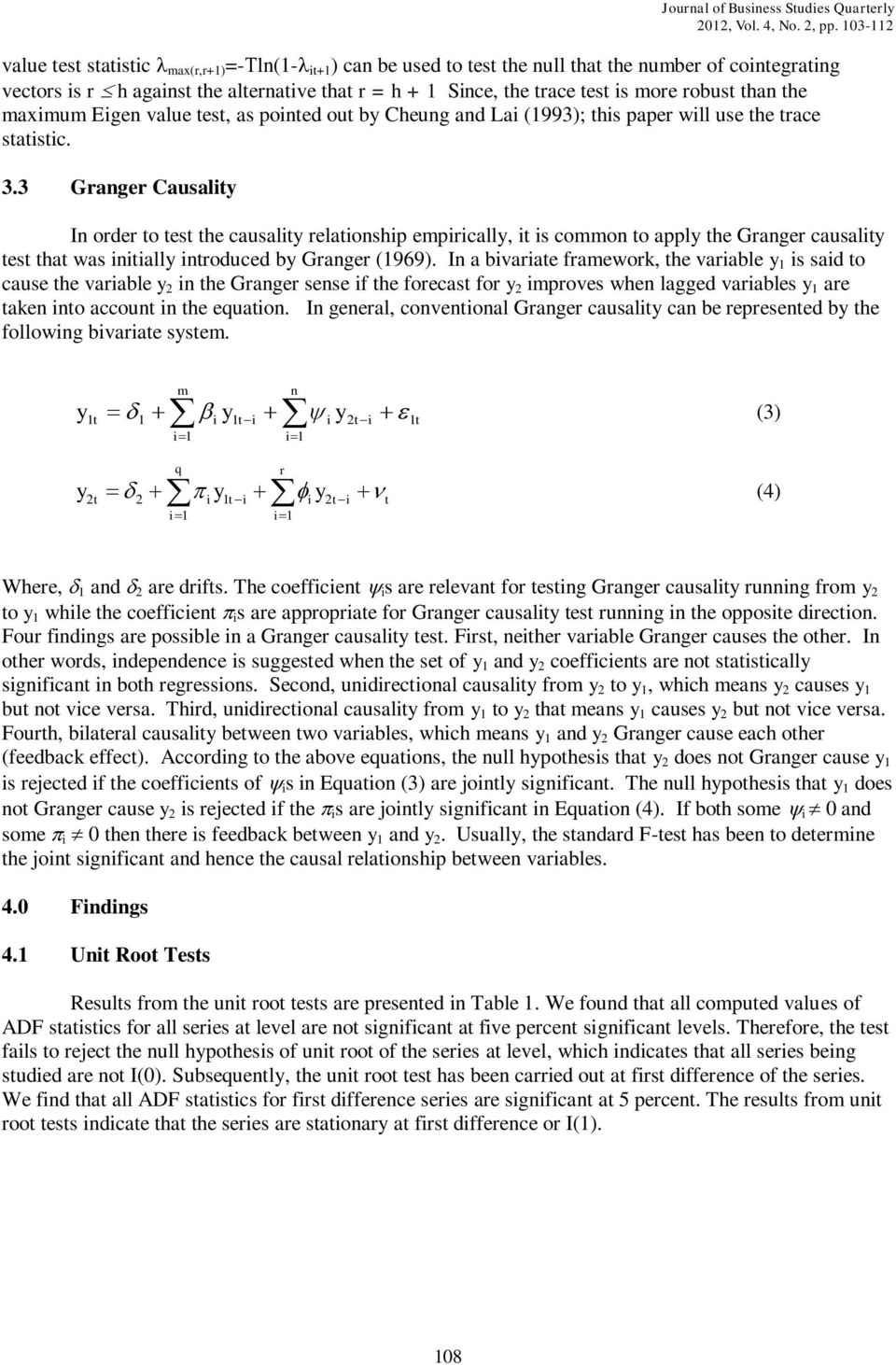
4 2012, Vol. 4, No. 2, pp index depend on the lagged changes in the cash index and futures price, while the lead-lag relationship between cash and futures markets do not last for more than half an hour. Tang et al. (1992) investigated the relationship between the Heng Seng index futures contracts traded in Hong Kong and the underlying Heng Seng index. The result shows that futures prices cause cash index price to change in the pre-crash period. In the post-crash period, the study found that a bi-directional causality exists between the two variables. More recently, Athanasios (2010) examined the dynamic relationship between the FTSE/ASE-20 spot price index, the FTSE/ASE-20 futures price index and their respective volatilities. The results revealed contemporaneous and interactions as well as unidirectional and bi-directional causal effects running between the examined market indices and their volatilities. Hernandez and Torero (2010) examined the dynamic relationship between spot and futures prices of agricultural commodities. The used Granger causality tests to empirically uncover the direction of information flows between spot and futures prices. The results indicate that spot prices are generally discovered in futures markets. In particular, they find that changes in futures prices lead changes in spot prices more often that the reverse. Meanwhile, in the case of Malaysia, Pok (2007) has investigated the impact change of the composition of market agents on the timing of the arrival of information in Bursa Malaysia. In his study, the price discovery role of futures trading on the spot market was examined using three distinct subperiods: pre-crisis, crisis, and after capital control. The Johansen, VECM and Granger causality tests were used in the analysis. The results from the analysis shows that there is no significant long-run relationship, but for a short run, the results indicate that futures lead spot index. In addition, futures lead is shorter in pre-crisis and crisis periods where foreign institutional investors dominate the market. Therefore, in line with the study by Pok (2007), this paper is intends to provide more empirical evidence on this issue based on more recent data. 3.0 Methodology In this paper, the relationship between spot price index and future prices indexes will be examined by using Granger causality test. These tests require that the variables used in a given model be stationary, that is, their stochastic properties are time invariant. The standard Granger tests are also only valid if the original time series are not cointegrated. Thus, the time series analysis that is appropriate for this study includes unit root tests to test the stationary properties of the series, cointegration test and causality tests. This section gives a brief explanation of these tests and their appropriateness for this study. The data used in this study are daily stock prices of the FTSE Bursa Malaysia KLCI (KLCI) and Kuala Lumpur Options and Financial Futures Exchange (KLOFFE) Composite Index Future (FKLI) for the period from January 2006 to November 2011 (1460 observations). All prices used in this study are the closing prices of each trading day. There are three types of contracts traded at the KLOFFE; the spot month contract (FKLI), the next month contract (FKLINM), and the next two calendar quarterly months (FKLINM2). The calendar quarter months are March, June, September and December. Since most of trading occurs in spot month and next month contracts, this study concentrates on these two futures contracts only. Data for composite index are collected from Bursa Malaysia, while data for futures contract price index are collected from Research and Development, KLOFFE. For estimation, all index series are transformed to logarithm. 3.1 Unit Root Tests The purpose of unit root tests is to establish the stationarity properties of the time series. Existence of unit roots in a variable denotes that a series is not stationary. A number of alternative tests are available for testing whether a series is stationary. In this paper, the unit root tests will be performed using the Augmented Dickey-Fuller (ADF) tests. The ADF test for unit roots indicates whether an individual series is stationary by running an OLS regression on the following regression equation. 106
5 y y m y i, t i i, t 1 ij i, t i i it (1) In the ADF tests, the null hypothesis H o : i, is to test that the series contains a unit root and is therefore non-stationary. If the t-statistic associated with the estimated coefficient i is greater than the critical values, we reject the null hypothesis of a unit root in favour of stationarity. The optimal lag lengths of the process will be chosen by the Akaike Information Criteria (AIC) described in Pantula et al. (1994). 3.2 Cointegration Tests A cointegration test can be applied to determine the existence of a long-run relationship between economic variables. From a statistical point of view, a long-term relationship means that the variables move together over time so that short-term relationship disturbances from the long-term trend will be corrected (Manning and Andrianacos, 1993). The basic idea behind cointegration is that, if in the longrun two or more series move closely together, even though the series themselves are trended, the difference between them is constant. It is possible to regard these series as a long-run equilibrium relationship, as the difference between them is stationary. Meanwhile, a lack of cointegration suggests that such variables have no long-run relationship: In principal, they can wander arbitrarily far away from each other (Dickey et al. 1991). There are two tests for cointegration usually used in empirical studies; the single equation based Engle and Granger (1987) test, and the systems based Johansen (1988) tests. The Engle and Granger (1987) two-step procedure for modelling the relationship between cointegrated variables has received a great deal of attention in recent years. This approach is attractive because it reduces the number of coefficients to be estimated, thus reduces the problem of multicollinearity. The procedure used to establish the existence of a cointegrating relationship is as follows: first, the long-run relationship (y 1t = y 2t + t ) is estimated by OLS. This is called the cointegrating regression. Second, the residuals ( = y 1t - 1 OLS - 2 OLS y 2t ) from this regression are retained and the ADF/PP test is applied to the residual as follows. t m t 1 i t (2) In ADF tests, the null hypothesis H o : = is tested against the alternative H a : using the appropriate critical value (MacKinnon, 1991). The null hypothesis of the cointegration test is that the series formed by the residuals of each of the cointegrating regressions is not stationary. In other words, if there exists cointegration between y 1 and y 2, the residual t is a (0) process. Meanwhile, if there is not cointegration between y 1 and y 2, t is a unit root process. Thus, whether y 1 and y 2 are cointegrated corresponds to whether t follows a unit root process or not. The system method suggested by Johansen (1988) enables us to determine the number of cointegration relations and estimate them by Maximum Likelihood Estimation in a unified framework. Specifically, Johansen provides a multivariate alternative approach, which tests for multiple cointegrating vectors and examines long run causality between variables. It relies on the relationship between the rank of a matrix and its characteristic roots (eigenvalues). Specifically, if the system has r independent cointegrating relations, the test for the number of characteristic roots that are not significantly different from unity is given by trace (r) = - ln(1- I ), where, i is the number of estimated values of the characteristic roots and is the number of usable observations. The Johansen trace tests for cointegration is testing the null that there are less then or equal to h cointegrating relations (r h) against the alternative hypothesis that there are more than h cointegrating relations (r h). Meanwhile, the maximum Eigen 107 JBSQ 2012
6 2012, Vol. 4, No. 2, pp value test statistic max(r,r+1) =- ln(1- it+1 ) can be used to test the null that the number of cointegrating vectors is r h against the alternative that r = h + 1 Since, the trace test is more robust than the maximum Eigen value test, as pointed out by Cheung and Lai (1993); this paper will use the trace statistic. 3.3 Granger Causality In order to test the causality relationship empirically, it is common to apply the Granger causality test that was initially introduced by Granger (1969). In a bivariate framework, the variable y 1 is said to cause the variable y 2 in the Granger sense if the forecast for y 2 improves when lagged variables y 1 are taken into account in the equation. In general, conventional Granger causality can be represented by the following bivariate system. m n y1 t 1 i y1 t i i y2t i 1 t y (3) q r 2 t 2 i y1 t i i y2t i t (4) Where, 1 and 2 are drifts. The coefficient i s are relevant for testing Granger causality running from y 2 to y 1 while the coefficient i s are appropriate for Granger causality test running in the opposite direction. Four findings are possible in a Granger causality test. First, neither variable Granger causes the other. In other words, independence is suggested when the set of y 1 and y 2 coefficients are not statistically significant in both regressions. Second, unidirectional causality from y 2 to y 1, which means y 2 causes y 1 but not vice versa. Third, unidirectional causality from y 1 to y 2 that means y 1 causes y 2 but not vice versa. Fourth, bilateral causality between two variables, which means y 1 and y 2 Granger cause each other (feedback effect). According to the above equations, the null hypothesis that y 2 does not Granger cause y 1 is rejected if the coefficients of i s in Equation (3) are jointly significant. The null hypothesis that y 1 does not Granger cause y 2 is rejected if the i s are jointly significant in Equation (4). If both some i 0 and some i 0 then there is feedback between y 1 and y 2. Usually, the standard F-test has been to determine the joint significant and hence the causal relationship between variables. 4.0 Findings 4.1 Unit Root Tests Results from the unit root tests are presented in Table 1. We found that all computed values of ADF statistics for all series at level are not significant at five percent significant levels. Therefore, the test fails to reject the null hypothesis of unit root of the series at level, which indicates that all series being studied are not I(0). Subsequently, the unit root test has been carried out at first difference of the series. We find that all ADF statistics for first difference series are significant at 5 percent. The results from unit root tests indicate that the series are stationary at first difference or I(1). 108
7 Table 1: Results from Unit Root Tests ADF Series Level Critical Value (5%) 1 st Diff. KLCI * FKLI * FKLINM * * Significant at 5% level Critical Value (5%) Cointegration Tests The cointegration tests in this study have been carried out between FTSE Bursa Malaysia KLCI (KLCI) and two futures contract indexes FKLI and FKLINM, separately. The results from the tests are presented in Table 2. Statistics in Table 2 for the cointegration rank tests between KLCI and FKLI indicate that at least there is one cointegration equation exist between the two variables at 5 percent levels. Similarly, the trace test also found that there is at least one cointegration equation between KLCI and FKLINM. These results confirm the existence of a long-run relationship between KLCI and FKLI, and between KLCI and FKLINM, respectively. Table 2: Cointegration Rank Test (Trace) between KLCI, FKLI and FKLINM Futures Index Hypothesized No. of CE(s) Eigenvalue Trace Statistic Critical value Conclusion (5%) FKLI None* cointegrating equation At most FKLINM None* At most *Denotes rejection of the hypothesis at the 0.05 level cointegration equation 4.3 Granger Causality Based on the results from unit root tests and cointegration tests, the pairwise Granger causality tests were conducted between KLCI, FKLI and FKLINM at first difference of the series. The results from the test are presented in Table 3. F-Statistics in Table 3 reject the null hypothesis that KLCI does not Granger cause FKLI. In other words, the test supports the hypothesis that KLCI does cause FKLI. In contrast, we found that FKLI does not Granger cause KLCI, indicating the direction of causality between KLCI and FKLI is unidirectional which running from KLCI to FKLI only. Similar results also can be observed in the causality relationship between KLCI and FKLINM where the direction of causality is also unidirectional from KLCI to FKLINM. Results from Granger causality tests indicated that in the case of Malaysia, cash market leads the future market. Further testing has been carried out to investigate the existence of causality relationship between two future indexes used in this study, FKLI and FKLINM. We found that F-Statistics reject the null hypothesis that FKLI does not Granger cause FKLINM, and also the hypothesis FKLINM does not cause FKLI. The results indicate that the two variables cause each other or in other words the direction of causality between these two variables is bidirectional. 109 JBSQ 2012

8 2012, Vol. 4, No. 2, pp Table 3: Results of Pairwise Granger Causality Tests between KLCI, FKLI and FKLINM Null Hypothesis F-Statistic Probability KLCI does not Granger cause FKLI FKLI does not Granger cause KLCI KLCI does not Granger cause FKLINM FKLINM does not Granger cause KLCI FKLI does not Granger cause FKLINM FKLINM does not Granger cause FKLI * Significant at 5 percent level 5.0 Discussion and Conclusion * * * * The main objective of the paper is to empirically investigate the cointegration and causality relationship between stock market cash prices index and stock market futures price index in Malaysia. For this purposes, three statistical tests namely unit root tests, cointegration test and Granger causality tests have been conducted. The tests have been carried out based on the daily closing prices of FTSE Bursa Malaysia KLCI with their two futures index contracts; spot month futures contract (FKLI) and next month futures contract (FKLINM). The findings from unit root tests show that all series used in this study are stationary at first difference. The results from the cointegration tests indicate the existence of long rung stable relationship between spot index and futures contract indexes of Malaysian stock market. Meanwhile, the Granger causality tests suggest that the direction of causality is unidirectional running from cash market index to futures market indexes. The finding implicates that in case of Malaysia, the cash prices lead the futures prices. This is contradicted with the findings from the previous studies in the case of developed stock markets which generally found that futures prices lead stock spot prices. However, the finding from this study is consistent with the findings from other studies such as by Stephen and Whaley (1990) that found the opposite, cash prices lead futures prices. Chan et al. (1991) argued that this result can be explained as spurious leads induced by infrequent trading of futures contract. The results from Granger causality tests of this study suggest that in case of Malaysia stock market, the flow of information is from cash market to futures market. This may suggests that spot market in Malaysia reflects to information faster than the futures market. In other words, futures market in Malaysia did not play a role as price discovery vehicle for stock price. This role, however, played by cash market. As a result, the futures stock prices cannot be used as indicator for the movements in the stock market prices in Malaysia. The results could also suggest that financial investors in Malaysia used information in cash market to trade in futures market, and not vice versa. This may due to the fact that stock market in Malaysia is more actively traded as compared to futures market which can be considered as new to Malaysian investors. 110

9 References Athanasios, V. (2010). Lead-lag relationship between futures market and spot market. Evidence from the greek stock and derivative market. International Journal of Finance and Economics, Issue 41, pp Black, F. (1975). Fact and fantasy in use of options. Financial Analyst Journal, 31, 36-41, pp Brooks, C., Rew, A. G. and Ritson, S. (2001). A trading strategy based on the lead-lag relationship between the spot index and futures contract for the FTSE100. International Journal of Forecasting, 17, pp Chan, K. (1993). A further analysis of the lead-lag relationship between the cash market and stock index futures market. Review of Financial Studies, 5, pp Chan, K., Chan, K. C. and Karolyi, G. A. (1991) Intraday volatility in the stock index and stock index futures markets. Review of Financial Studies, Vol.4, 4, pp Cheung, Y-W. and Lai, K. (1993). A fractional cointegration analysis of purchasing power parity. Journal of Business and Economic Statistics, 11, pp Cornell B. and French, K. R., (1983). Taxes and the pricing of stock index futures. The Journal of Finance, XXXV111, 3, pp Dickey, D. A., Jansen, D. W. and Thornton, D. C. (1991). A primer on cointegration with an application to money and income. Review Federal Reserve Bank of ST. Louis, 73(2), pp Engle, R. T., and Granger, C. W. J. (1987). Cointegration and error correction: Representation, estimation and testing. Econometrica, 55, pp Finnerty, J. E., and Park, H. Y. (1987). Stock index futures: Does the tail wag the dog? A technical note. Financial Analysis Journal, 43, pp Garbade D., and Silber, W. L. (1983). Price movement and price discovery in futures and cash markets. Review of Economics and statistics, 65, pp Granger, C. W. (1969). Investigating causal relations by econometric models and cross-spectral methods, Econometrica, 37, pp Herbst, A. F., McCormack, J. P. and West, E. N. (1987). Investigation of a lead-lag relationship between spot stock indices and their futures contracts. The Journal of Futures Markets, 7, pp Hernandez, M., and Torero, M. (2010). Examining the dynamic relationship between spot and future prices of agricultural commodities. IFPRI Discussion Paper Huang, R. D., and Syoll, H. R. (1994). Market microstructure and stock return predictions. Review of Financial Studies, 7, pp Johansen, S. (1988). Statistical analysis of cointegration vectors. Journal of Economic Dynamics and Control. 12, pp JBSQ 2012
10 2012, Vol. 4, No. 2, pp Kawaller, I. G., Koch, P. D., and Koch, T. W. (1987). The temporal price relationship between S&P500 futures and the S&P500 index, Journal of Finance, 42, pp MacKinlay, A. C. and Ramaswamy. (1988). Index-futures arbitrage and the behaviour of stock index futures prices, Review of Financial Studies, 1, pp Manning, L. M. and Adriacanos, D. (1993). Dollar movements and inflation: a Cointegration analysis. Applied Economics, 25, pp MacKinnon, J. G. (1991). Critical values for cointegration tests. In R. F. Engle and C. W. J. Granger (eds.). Long-run Economic Realtionships: Reading in Cointegration. Oxford; Oxford University Press. Modest, D. M., and Sunderesan, M. (1983). The relationship between spot and futures prices in stock index futures markets some preliminary evidence. The Journal of Future Market, 3(1), pp Pantula, S. G., Gonzalez-Farias, G. and Fuller, W. A. (1994). A comparison of unit root test criteria. Journal of Business and Economic Statistics, 12, pp Pizzi, M. A., Economopoulos, A. J., and O neill, M. H. (1998). An examination of the relationship between stock cash and futures markets: A cointegration approach. The Journal of futures Markets. Vol. 18, 3, pp Pok, W. C. (2007). Temporal causality of return of index futures and stock markets: Evidence from Malaysia. International Financial Review, Issue 8, pp Stoll, H. R. and Whaley, R. E. (1990). The dynamics of stock index and stock index futures returns. Journal of Financial and quantitative Analysis, 25, pp Stephen, J., and Whaley, R. E. (1990). Intraday price change and trading volume relations in the stock and stock option markets. Journal of Finance, 45, pp Tan, G. Y. N., Mark, S. C., and Choi, D. F. S. (1992). The causal relationship between stock index futures and cash index prices in Hong Kong. Applied Financial Economics, 2, pp

Serhat YANIK* & Yusuf AYTURK*
 LEAD-LAG RELATIONSHIP BETWEEN ISE 30 SPOT AND FUTURES MARKETS Serhat YANIK* & Yusuf AYTURK* Abstract The lead-lag relationship between spot and futures markets indicates which market leads to the other.
On the long run relationship between gold and silver prices A note
 Global Finance Journal 12 (2001) 299 303 On the long run relationship between gold and silver prices A note C. Ciner* Northeastern University College of Business Administration, Boston, MA 02115-5000,
The price-volume relationship of the Malaysian Stock Index futures market
 The price-volume relationship of the Malaysian Stock Index futures market ABSTRACT Carl B. McGowan, Jr. Norfolk State University Junaina Muhammad University Putra Malaysia The objective of this study is
CHAPTER-6 LEAD-LAG RELATIONSHIP BETWEEN SPOT AND INDEX FUTURES MARKETS IN INDIA
 CHAPTER-6 LEAD-LAG RELATIONSHIP BETWEEN SPOT AND INDEX FUTURES MARKETS IN INDIA 6.1 INTRODUCTION The introduction of the Nifty index futures contract in June 12, 2000 has offered investors a much greater
The VAR models discussed so fare are appropriate for modeling I(0) data, like asset returns or growth rates of macroeconomic time series.
 Cointegration The VAR models discussed so fare are appropriate for modeling I(0) data, like asset returns or growth rates of macroeconomic time series. Economic theory, however, often implies equilibrium
ANALYSIS OF EUROPEAN, AMERICAN AND JAPANESE GOVERNMENT BOND YIELDS
 Applied Time Series Analysis ANALYSIS OF EUROPEAN, AMERICAN AND JAPANESE GOVERNMENT BOND YIELDS Stationarity, cointegration, Granger causality Aleksandra Falkowska and Piotr Lewicki TABLE OF CONTENTS 1.
Chapter 5: Bivariate Cointegration Analysis
 Chapter 5: Bivariate Cointegration Analysis 1 Contents: Lehrstuhl für Department Empirische of Wirtschaftsforschung Empirical Research and und Econometrics Ökonometrie V. Bivariate Cointegration Analysis...
Business cycles and natural gas prices
 Business cycles and natural gas prices Apostolos Serletis and Asghar Shahmoradi Abstract This paper investigates the basic stylised facts of natural gas price movements using data for the period that natural
The effect of Macroeconomic Determinants on the Performance of the Indian Stock Market
 The effect of Macroeconomic Determinants on the Performance of the Indian Stock Market 1 Samveg Patel Abstract The study investigates the effect of macroeconomic determinants on the performance of the
Relationship between Commodity Prices and Exchange Rate in Light of Global Financial Crisis: Evidence from Australia
 Relationship between Commodity Prices and Exchange Rate in Light of Global Financial Crisis: Evidence from Australia Omar K. M. R. Bashar and Sarkar Humayun Kabir Abstract This study seeks to identify
Working Papers. Cointegration Based Trading Strategy For Soft Commodities Market. Piotr Arendarski Łukasz Postek. No. 2/2012 (68)
 Working Papers No. 2/2012 (68) Piotr Arendarski Łukasz Postek Cointegration Based Trading Strategy For Soft Commodities Market Warsaw 2012 Cointegration Based Trading Strategy For Soft Commodities Market
Financial Integration of Stock Markets in the Gulf: A Multivariate Cointegration Analysis
 INTERNATIONAL JOURNAL OF BUSINESS, 8(3), 2003 ISSN:1083-4346 Financial Integration of Stock Markets in the Gulf: A Multivariate Cointegration Analysis Aqil Mohd. Hadi Hassan Department of Economics, College
Is the Forward Exchange Rate a Useful Indicator of the Future Exchange Rate?
 Is the Forward Exchange Rate a Useful Indicator of the Future Exchange Rate? Emily Polito, Trinity College In the past two decades, there have been many empirical studies both in support of and opposing
INTRADAY STOCK INDEX FUTURES ARBITRAGE WITH TIME LAG EFFECTS. Robert T. Daigler. Associate Professor. Florida International University
 INTRADAY STOCK INDEX FUTURES ARBITRAGE WITH TIME LAG EFFECTS Robert T. Daigler Associate Professor Florida International University The following individuals provided helpful information concerning the
A Trading Strategy Based on the Lead-Lag Relationship of Spot and Futures Prices of the S&P 500
 A Trading Strategy Based on the Lead-Lag Relationship of Spot and Futures Prices of the S&P 500 FE8827 Quantitative Trading Strategies 2010/11 Mini-Term 5 Nanyang Technological University Submitted By:
Revisiting Share Market Efficiency: Evidence from the New Zealand Australia, US and Japan Stock Indices
 American Journal of Applied Sciences 2 (5): 996-1002, 2005 ISSN 1546-9239 Science Publications, 2005 Revisiting Share Market Efficiency: Evidence from the New Zealand Australia, US and Japan Stock Indices
An Empirical Study on the Relationship between Stock Index and the National Economy: The Case of China
 An Empirical Study on the Relationship between Stock Index and the National Economy: The Case of China Ming Men And Rui Li University of International Business & Economics Beijing, People s Republic of
THE PRICE OF GOLD AND STOCK PRICE INDICES FOR
 THE PRICE OF GOLD AND STOCK PRICE INDICES FOR THE UNITED STATES by Graham Smith November 2001 Abstract This paper provides empirical evidence on the relationship between the price of gold and stock price
Dynamic Relationship between Interest Rate and Stock Price: Empirical Evidence from Colombo Stock Exchange
 International Journal of Business and Social Science Vol. 6, No. 4; April 2015 Dynamic Relationship between Interest Rate and Stock Price: Empirical Evidence from Colombo Stock Exchange AAMD Amarasinghe
A trading strategy based on the lead lag relationship between the spot index and futures contract for the FTSE 100
 A trading strategy based on the lead lag relationship between the spot index and futures contract for the FTSE 100 Article Accepted Version Brooks, C., Rew, A. G. and Ritson, S. (2001) A trading strategy
The Impact of Foreign Direct Investment on the Growth of the Manufacturing Sector in Malaysia
 International Applied Economics and Management Letters 1(1): 41-45 (2008) The Impact of Foreign Direct Investment on the Growth of the Manufacturing Sector in Malaysia Hooi Hooi Lean Economics Program,
TEMPORAL CAUSAL RELATIONSHIP BETWEEN STOCK MARKET CAPITALIZATION, TRADE OPENNESS AND REAL GDP: EVIDENCE FROM THAILAND
 I J A B E R, Vol. 13, No. 4, (2015): 1525-1534 TEMPORAL CAUSAL RELATIONSHIP BETWEEN STOCK MARKET CAPITALIZATION, TRADE OPENNESS AND REAL GDP: EVIDENCE FROM THAILAND Komain Jiranyakul * Abstract: This study
A Study on the Relationship between Korean Stock Index. Futures and Foreign Exchange Markets
 A Study on the Relationship between Korean Stock Index Futures and Foreign Exchange Markets Young-Jae Kim and Sunghee Choi + Abstracts This paper explores the linkage between stock index futures market
The Causal Relationship between Producer Price Index and Consumer Price Index: Empirical Evidence from Selected European Countries
 The Causal Relationship between Producer Price Index and Consumer Price Index: Empirical Evidence from Selected European Countries Selçuk AKÇAY Afyon Kocatepe University, Faculty of Economics and Administrative
Testing The Quantity Theory of Money in Greece: A Note
 ERC Working Paper in Economic 03/10 November 2003 Testing The Quantity Theory of Money in Greece: A Note Erdal Özmen Department of Economics Middle East Technical University Ankara 06531, Turkey [email protected]
Testing for Granger causality between stock prices and economic growth
 MPRA Munich Personal RePEc Archive Testing for Granger causality between stock prices and economic growth Pasquale Foresti 2006 Online at http://mpra.ub.uni-muenchen.de/2962/ MPRA Paper No. 2962, posted
COINTEGRATION AND CAUSAL RELATIONSHIP AMONG CRUDE PRICE, DOMESTIC GOLD PRICE AND FINANCIAL VARIABLES- AN EVIDENCE OF BSE AND NSE *
 Journal of Contemporary Issues in Business Research ISSN 2305-8277 (Online), 2013, Vol. 2, No. 1, 1-10. Copyright of the Academic Journals JCIBR All rights reserved. COINTEGRATION AND CAUSAL RELATIONSHIP
IS THERE A LONG-RUN RELATIONSHIP
 7. IS THERE A LONG-RUN RELATIONSHIP BETWEEN TAXATION AND GROWTH: THE CASE OF TURKEY Salih Turan KATIRCIOGLU Abstract This paper empirically investigates long-run equilibrium relationship between economic
IMPACT OF FOREIGN EXCHANGE RESERVES ON NIGERIAN STOCK MARKET Olayinka Olufisayo Akinlo, Obafemi Awolowo University, Ile-Ife, Nigeria
 International Journal of Business and Finance Research Vol. 9, No. 2, 2015, pp. 69-76 ISSN: 1931-0269 (print) ISSN: 2157-0698 (online) www.theibfr.org IMPACT OF FOREIGN EXCHANGE RESERVES ON NIGERIAN STOCK
The Relationship between Current Account and Government Budget Balance: The Case of Kuwait
 International Journal of Humanities and Social Science Vol. 2 No. 7; April 2012 The Relationship between Current Account and Government Budget Balance: The Case of Kuwait Abstract Ebrahim Merza Economics
Unit Labor Costs and the Price Level
 Unit Labor Costs and the Price Level Yash P. Mehra A popular theoretical model of the inflation process is the expectationsaugmented Phillips-curve model. According to this model, prices are set as markup
Examining the Relationship between ETFS and Their Underlying Assets in Indian Capital Market
 2012 2nd International Conference on Computer and Software Modeling (ICCSM 2012) IPCSIT vol. 54 (2012) (2012) IACSIT Press, Singapore DOI: 10.7763/IPCSIT.2012.V54.20 Examining the Relationship between
Empirical Properties of the Indonesian Rupiah: Testing for Structural Breaks, Unit Roots, and White Noise
 Volume 24, Number 2, December 1999 Empirical Properties of the Indonesian Rupiah: Testing for Structural Breaks, Unit Roots, and White Noise Reza Yamora Siregar * 1 This paper shows that the real exchange
Stock Returns and Equity Premium Evidence Using Dividend Price Ratios and Dividend Yields in Malaysia
 Stock Returns and Equity Premium Evidence Using Dividend Price Ratios and Dividend Yields in Malaysia By David E. Allen 1 and Imbarine Bujang 1 1 School of Accounting, Finance and Economics, Edith Cowan
The Long-Run Relation Between The Personal Savings Rate And Consumer Sentiment
 The Long-Run Relation Between The Personal Savings Rate And Consumer Sentiment Bradley T. Ewing 1 and James E. Payne 2 This study examined the long run relationship between the personal savings rate and
CFDs and Liquidity Provision
 2011 International Conference on Financial Management and Economics IPEDR vol.11 (2011) (2011) IACSIT Press, Singapore CFDs and Liquidity Provision Andrew Lepone and Jin Young Yang Discipline of Finance,
ijcrb.com INTERDISCIPLINARY JOURNAL OF CONTEMPORARY RESEARCH IN BUSINESS AUGUST 2014 VOL 6, NO 4
 RELATIONSHIP AND CAUSALITY BETWEEN INTEREST RATE AND INFLATION RATE CASE OF JORDAN Dr. Mahmoud A. Jaradat Saleh A. AI-Hhosban Al al-bayt University, Jordan ABSTRACT This study attempts to examine and study
THE EFFECTS OF BANKING CREDIT ON THE HOUSE PRICE
 THE EFFECTS OF BANKING CREDIT ON THE HOUSE PRICE * Adibeh Savari 1, Yaser Borvayeh 2 1 MA Student, Department of Economics, Science and Research Branch, Islamic Azad University, Khuzestan, Iran 2 MA Student,
National Institute for Applied Statistics Research Australia. Working Paper
 National Institute for Applied Statistics Research Australia The University of Wollongong Working Paper 10-14 Cointegration with a Time Trend and Pairs Trading Strategy: Empirical Study on the S&P 500
The Impact of Macroeconomic Fundamentals on Stock Prices Revisited: Evidence from Indian Data
 Eurasian Journal of Business and Economics 2012, 5 (10), 25-44. The Impact of Macroeconomic Fundamentals on Stock Prices Revisited: Evidence from Indian Data Pramod Kumar NAIK *, Puja PADHI ** Abstract
Impact of foreign portfolio investments on market comovements: Evidence from the emerging Indian stock market
 Impact of foreign portfolio investments on market comovements: Evidence from the emerging Indian stock market Sunil Poshakwale and Chandra Thapa Cranfield School of Management, Cranfield University, Cranfield,
Energy consumption and GDP: causality relationship in G-7 countries and emerging markets
 Ž. Energy Economics 25 2003 33 37 Energy consumption and GDP: causality relationship in G-7 countries and emerging markets Ugur Soytas a,, Ramazan Sari b a Middle East Technical Uni ersity, Department
Lead-lag relationship between spot and futures stock indexes: Intraday data and Regime Switching Models.
 Lead-lag relationship between spot and futures stock indexes: Intraday data and Regime Switching Models. Introduction A key question in finance is the lead lag relationship between spot and futures markets.
Granger Causality between Government Revenues and Expenditures in Korea
 Volume 23, Number 1, June 1998 Granger Causality between Government Revenues and Expenditures in Korea Wan Kyu Park ** 2 This paper investigates the Granger causal relationship between government revenues
Elucidating the Relationship among Volatility Index, US Dollar Index and Oil Price
 23-24 July 25, Sheraton LaGuardia East Hotel, New York, USA, ISBN: 978--92269-79-5 Elucidating the Relationship among Volatility Index, US Dollar Index and Oil Price John Wei-Shan Hu* and Hsin-Yi Chang**
Implied volatility transmissions between Thai and selected advanced stock markets
 MPRA Munich Personal RePEc Archive Implied volatility transmissions between Thai and selected advanced stock markets Supachok Thakolsri and Yuthana Sethapramote and Komain Jiranyakul Public Enterprise
AN EMPIRICAL INVESTIGATION OF THE RELATIONSHIP AMONG P/E RATIO, STOCK RETURN AND DIVIDEND YIELS FOR ISTANBUL STOCK EXCHANGE
 AN EMPIRICAL INVESTIGATION OF THE RELATIONSHIP AMONG P/E RATIO, STOCK RETURN AND DIVIDEND YIELS FOR ISTANBUL STOCK EXCHANGE Funda H. SEZGIN Mimar Sinan Fine Arts University, Faculty of Science and Letters
Chapter 6: Multivariate Cointegration Analysis
 Chapter 6: Multivariate Cointegration Analysis 1 Contents: Lehrstuhl für Department Empirische of Wirtschaftsforschung Empirical Research and und Econometrics Ökonometrie VI. Multivariate Cointegration
FDI and Economic Growth Relationship: An Empirical Study on Malaysia
 International Business Research April, 2008 FDI and Economic Growth Relationship: An Empirical Study on Malaysia Har Wai Mun Faculty of Accountancy and Management Universiti Tunku Abdul Rahman Bander Sungai
STOCK MARKET INTEGRATION BETWEEN MALAYSIA AND ITS MAJOR TRADING PARTNERS (1994-2002) KARIM, Mohd Zaini * GEE, Chan Sok
 Karim, M.Z.A. and Gee, C.S. Stock Markets Integration Between Malaysia and Trade Partners STOCK MARKET INTEGRATION BETWEEN MALAYSIA AND ITS MAJOR TRADING PARTNERS (1994-2002) KARIM, Mohd Zaini * GEE, Chan
How do oil prices affect stock returns in GCC markets? An asymmetric cointegration approach.
 How do oil prices affect stock returns in GCC markets? An asymmetric cointegration approach. Mohamed El Hedi AROURI (LEO-Université d Orléans & EDHEC, [email protected]) Julien FOUQUAU (ESC
Dynamics of Real Investment and Stock Prices in Listed Companies of Tehran Stock Exchange
 Dynamics of Real Investment and Stock Prices in Listed Companies of Tehran Stock Exchange Farzad Karimi Assistant Professor Department of Management Mobarakeh Branch, Islamic Azad University, Mobarakeh,
Price efficiency in tuna fish marketing in Sri Lanka - An application of cointegration approach
 21 Sri Lanka J. Aquat. Sci. 11 (2006): 21-26 Price efficiency in tuna fish marketing in Sri Lanka - An application of cointegration approach Y.Y.K. DE SILVA 1, P.S.K. RAJAPAKSHE 2 AMARALAL 3 AND K.H.M.L.
Algorithmic Trading Session 6 Trade Signal Generation IV Momentum Strategies. Oliver Steinki, CFA, FRM
 Algorithmic Trading Session 6 Trade Signal Generation IV Momentum Strategies Oliver Steinki, CFA, FRM Outline Introduction What is Momentum? Tests to Discover Momentum Interday Momentum Strategies Intraday
THE U.S. CURRENT ACCOUNT: THE IMPACT OF HOUSEHOLD WEALTH
 THE U.S. CURRENT ACCOUNT: THE IMPACT OF HOUSEHOLD WEALTH Grant Keener, Sam Houston State University M.H. Tuttle, Sam Houston State University 21 ABSTRACT Household wealth is shown to have a substantial
Contemporaneous Spill-over among Equity, Gold, and Exchange Rate Implied Volatility Indices
 Contemporaneous Spill-over among Equity, Gold, and Exchange Rate Implied Volatility Indices Ihsan Ullah Badshah, Bart Frijns*, Alireza Tourani-Rad Department of Finance, Faculty of Business and Law, Auckland
Chapter 9: Univariate Time Series Analysis
 Chapter 9: Univariate Time Series Analysis In the last chapter we discussed models with only lags of explanatory variables. These can be misleading if: 1. The dependent variable Y t depends on lags of
Oil Price Shocks and Stock Market Behaviour: The Nigerian Experience
 Kamla-Raj 2012 J Economics, 3(1): 19-24 (2012) Oil Price Shocks and Stock Market Behaviour: The Nigerian Experience Anthony Olugbenga Adaramola Department of Banking and Finance, Ekiti State University,
Co-movements of NAFTA trade, FDI and stock markets
 Co-movements of NAFTA trade, FDI and stock markets Paweł Folfas, Ph. D. Warsaw School of Economics Abstract The paper scrutinizes the causal relationship between performance of American, Canadian and Mexican
The Interaction between Exchange Rates and Stock Prices: An Australian Context
 The Interaction between Exchange Rates and Stock Prices: An Australian Context Noel Dilrukshan Richards & John Simpson School of Economics and Finance Curtin University of Technology, Perth Kent St. Bentley,
A cointegration and causality analysis of Scandinavian stock markets
 A cointegration and causality analysis of Scandinavian stock markets Sanda Hubana Trondheim, May 2013 Master s thesis in Financial Economics Norwegian University of Science and Technology Faculty of Social
The Trade Balance Effects of U.S. Foreign Direct Investment in Mexico
 The Trade Balance Effects of U.S. Foreign Direct Investment in Mexico PETER WILAMOSKI AND SARAH TINKLER* This paper examines the effect of U.S. foreign direct investment (FDI) in Mexico on U.S. exports
IMPACT OF GOLD PRICES ON STOCK EXCHANGE: A CASE STUDY OF PAKISTAN
 IMPACT OF GOLD PRICES ON STOCK EXCHANGE: A CASE STUDY OF PAKISTAN KEY WORDS: By Hina Shahzadi Department of Management Sciences University of Central Punjab (UCP), Lahore, Pakistan [email protected]
Why the saving rate has been falling in Japan
 MPRA Munich Personal RePEc Archive Why the saving rate has been falling in Japan Yoshiaki Azuma and Takeo Nakao January 2009 Online at http://mpra.ub.uni-muenchen.de/62581/ MPRA Paper No. 62581, posted
Stock market interdependence between Australia and its trading partners: does trade intensity matter?
 ISSN 1836-8123 Stock market interdependence between Australia and its trading partners: does trade intensity matter? Sudharshan Reddy Paramati, Rakesh Gupta, Eduardo Roca No. 2015-06 Series Editors: Dr
Population Growth and Economic Development: Empirical Evidence from the Philippines
 Philippine Journal of Development Number 68, First Semester 2010 Volume XXXVII, No. 1 Population Growth and Economic Development: Empirical Evidence from the Philippines Fumitaka Furuoka 1 Abstract In
Testing the long-run cointegration among global equity indices: Pair-wise test with Indian stock market
 IRJCL Vol.02 Issue-05, (May, 2015) ISSN: 2349-705 (Impact Factor- 2.915) Testing the long-run cointegration among global equity indices: Pair-wise test with Indian stock market Devesh Shankar Research
Do Global Oil Price Changes Affect Indian Stock Market Returns?
 Journal of Management & Public Policy Vol. 6, No. 2, June 2015, Pp. 29-41 ISSN: 0976-0148 Do Global Oil Price Changes Affect Indian Stock Market Returns? Saif Siddiqui Centre of Management Studies, Jamia
Price efficiency in Commodities Future Market A case study for Gold Futures in India
 Price efficiency in Commodities Future Market A case study for Gold Futures in India Commodities play a very important role in the macroeconomic environment of an economy. Shortage of commodities can lead
The Engle-Granger representation theorem
 The Engle-Granger representation theorem Reference note to lecture 10 in ECON 5101/9101, Time Series Econometrics Ragnar Nymoen March 29 2011 1 Introduction The Granger-Engle representation theorem is
Government bond market linkages: evidence from Europe
 Applied Financial Economics, 2005, 15, 599 610 Government bond market linkages: evidence from Europe Jian Yang Department of Accounting, Finance & MIS, Prairie View A&M University, Prairie View, TX 77446,
seasonal causality in the energy commodities
 PROFESSIONAL BRIEFING aestimatio, the ieb international journal of finance, 2011. 3: 02-9 2011 aestimatio, the ieb international journal of finance seasonal causality in the energy commodities Díaz Rodríguez,
Air passenger departures forecast models A technical note
 Ministry of Transport Air passenger departures forecast models A technical note By Haobo Wang Financial, Economic and Statistical Analysis Page 1 of 15 1. Introduction Sine 1999, the Ministry of Business,
MICHAEL MONOYIOS LUCIO SARNO*
 MEAN REVERSION IN STOCK INDEX FUTURES MARKETS: A NONLINEAR ANALYSIS MICHAEL MONOYIOS LUCIO SARNO* Several stylized theoretical models of futures basis behavior under nonzero transactions costs predict
TheRelationshipbetweenTradingVolumeandStockReturnsIndexofAmmanStocksExchangeAnalyticalStudy2000-2014
 Global Journal of Management and Business Research: B Economics and Commerce Volume 14 Issue 7 Version 1.0 Year 2014 Type: Double Blind Peer Reviewed International Research Journal Publisher: Global Journals
The information content of lagged equity and bond yields
 Economics Letters 68 (2000) 179 184 www.elsevier.com/ locate/ econbase The information content of lagged equity and bond yields Richard D.F. Harris *, Rene Sanchez-Valle School of Business and Economics,
Relative Effectiveness of Foreign Debt and Foreign Aid on Economic Growth in Pakistan
 Relative Effectiveness of Foreign Debt and Foreign Aid on Economic Growth in Pakistan Abstract Zeshan Arshad Faculty of Management and Sciences, Evening Program, University of Gujrat, Pakistan. Muhammad
The relation between news events and stock price jump: an analysis based on neural network
 20th International Congress on Modelling and Simulation, Adelaide, Australia, 1 6 December 2013 www.mssanz.org.au/modsim2013 The relation between news events and stock price jump: an analysis based on
THE IMPACT OF EXCHANGE RATE VOLATILITY ON BRAZILIAN MANUFACTURED EXPORTS
 THE IMPACT OF EXCHANGE RATE VOLATILITY ON BRAZILIAN MANUFACTURED EXPORTS ANTONIO AGUIRRE UFMG / Department of Economics CEPE (Centre for Research in International Economics) Rua Curitiba, 832 Belo Horizonte