
WEST VIRGINIA DRUG CONTROL UPDATE. Drug Use Trends in West Virginia
|
|
|
- Morris Barrett
- 10 years ago
- Views:
Transcription
1 WEST VIRGINIA DRUG CONTROL UPDATE This report reflects significant trends, data, and major issues relating to drugs in the State of West Virginia. West Virginia At-a-Glance: In , West Virginia was one of the top ten states for rates in several drug-use categories among young adults age 18-25: past-year use of cocaine; past-month use of illicit drugs other than marijuana; and illicit drug dependence. Source: National Survey on Drug Use and Health (NSDUH), Approximately 7 percent of West Virginia residents reported past-month illicit drug use; the national average was 8 percent. The rate of drug-induced deaths in West Virginia is higher than the national average. McDowell County in West Virginia has the 5 th highest rate of drug poisoning deaths in the country, at 38.3 deaths per 100,000 population. Drug Use Trends in West Virginia Drug Use in West Virginia: The National Survey on Drug Use and Health (NSDUH) provides national and state-level data on the use of tobacco, alcohol, illicit drugs (including non-medical use of prescription drugs), and mental health in the United States. In the most recent Survey, 6.79 percent of West Virginia residents reported using illicit drugs in the past month. The national average was 8.02 percent. Additionally, 3.78 percent of West Virginia residents reported using an illicit drug other than marijuana in the past month (the national average was 3.58 percent). Source: Substance Abuse and Mental Health Services Administration - State Estimates of Substance Use from the National Survey on Drug Use and Health: Drug-Induced Deaths: As a direct consequence of drug use, 405 persons died in West Virginia in This is compared to the number of persons in West Virginia who died from motor vehicle accidents (429) and firearms (267) in the same year. West Virginia drug-induced deaths (22.4 per 100,000 population) exceeded the national rate (12.7 per 100,000). Source: Centers for Disease Control and Prevention - National Vital Statistics Reports Volume 58, Number 19 for 2007: Substance Abuse Treatment Admissions Data West Virginia primary treatment admissions: The graph at right depicts substance abuse primary treatment admissions in West Virginia in The data show that opiates, including prescription drugs, are the most commonly cited drugs among primary drug treatment admissions in the state. Source: Treatment Episode Data Set, Substance Abuse and Mental Health Services Administration: 1

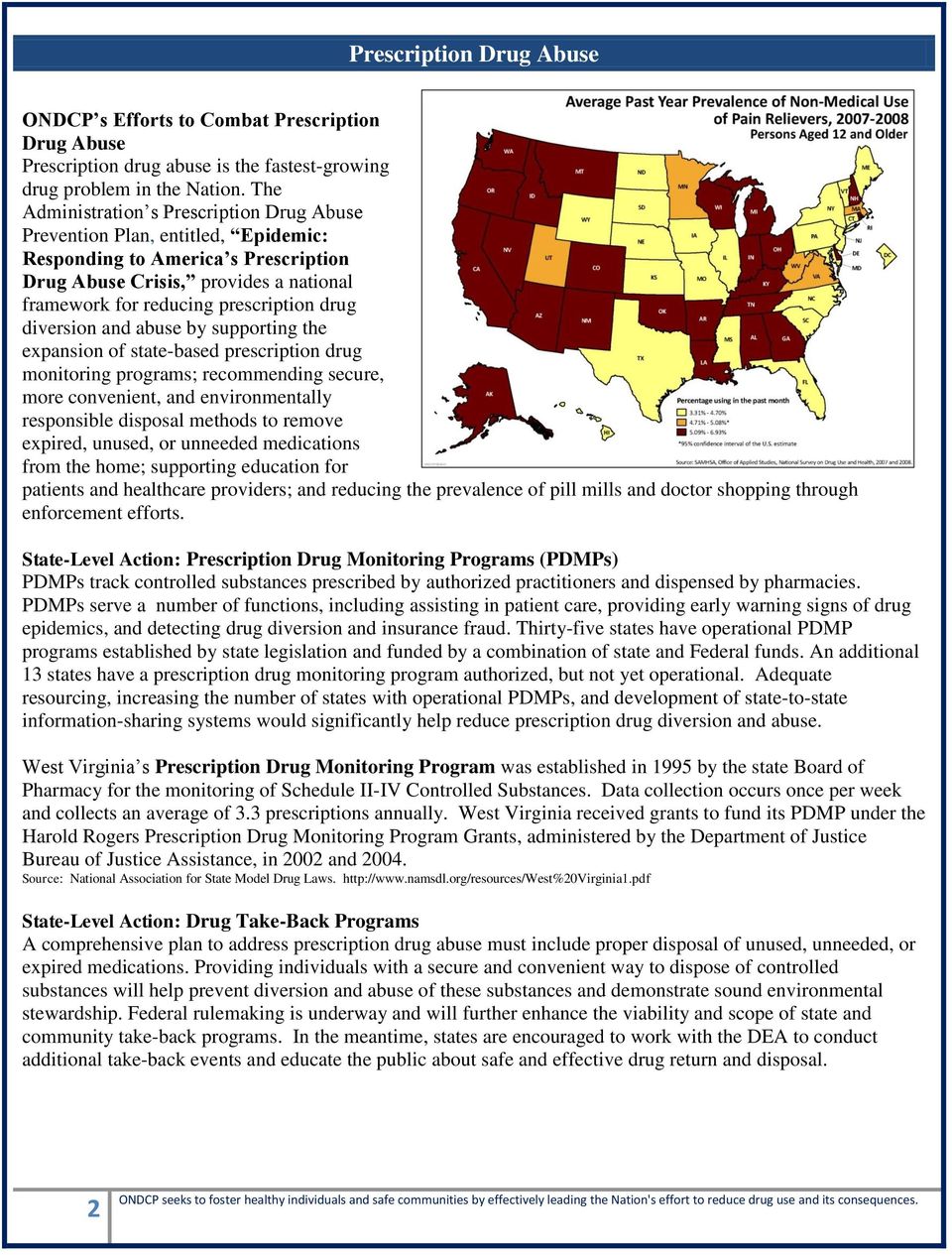
2 Prescription Drug Abuse ONDCP s Efforts to Combat Prescription Drug Abuse Prescription drug abuse is the fastest-growing drug problem in the Nation. The Administration s Prescription Drug Abuse Prevention Plan, entitled, Epidemic: Responding to America s Prescription Drug Abuse Crisis, provides a national framework for reducing prescription drug diversion and abuse by supporting the expansion of state-based prescription drug monitoring programs; recommending secure, more convenient, and environmentally responsible disposal methods to remove expired, unused, or unneeded medications from the home; supporting education for patients and healthcare providers; and reducing the prevalence of pill mills and doctor shopping through enforcement efforts. State-Level Action: Prescription Drug Monitoring Programs (PDMPs) PDMPs track controlled substances prescribed by authorized practitioners and dispensed by pharmacies. PDMPs serve a number of functions, including assisting in patient care, providing early warning signs of drug epidemics, and detecting drug diversion and insurance fraud. Thirty-five states have operational PDMP programs established by state legislation and funded by a combination of state and Federal funds. An additional 13 states have a prescription drug monitoring program authorized, but not yet operational. Adequate resourcing, increasing the number of states with operational PDMPs, and development of state-to-state information-sharing systems would significantly help reduce prescription drug diversion and abuse. West Virginia s Prescription Drug Monitoring Program was established in 1995 by the state Board of Pharmacy for the monitoring of Schedule II-IV Controlled Substances. Data collection occurs once per week and collects an average of 3.3 prescriptions annually. West Virginia received grants to fund its PDMP under the Harold Rogers Prescription Drug Monitoring Program Grants, administered by the Department of Justice Bureau of Justice Assistance, in 2002 and Source: National Association for State Model Drug Laws. State-Level Action: Drug Take-Back Programs A comprehensive plan to address prescription drug abuse must include proper disposal of unused, unneeded, or expired medications. Providing individuals with a secure and convenient way to dispose of controlled substances will help prevent diversion and abuse of these substances and demonstrate sound environmental stewardship. Federal rulemaking is underway and will further enhance the viability and scope of state and community take-back programs. In the meantime, states are encouraged to work with the DEA to conduct additional take-back events and educate the public about safe and effective drug return and disposal. 2
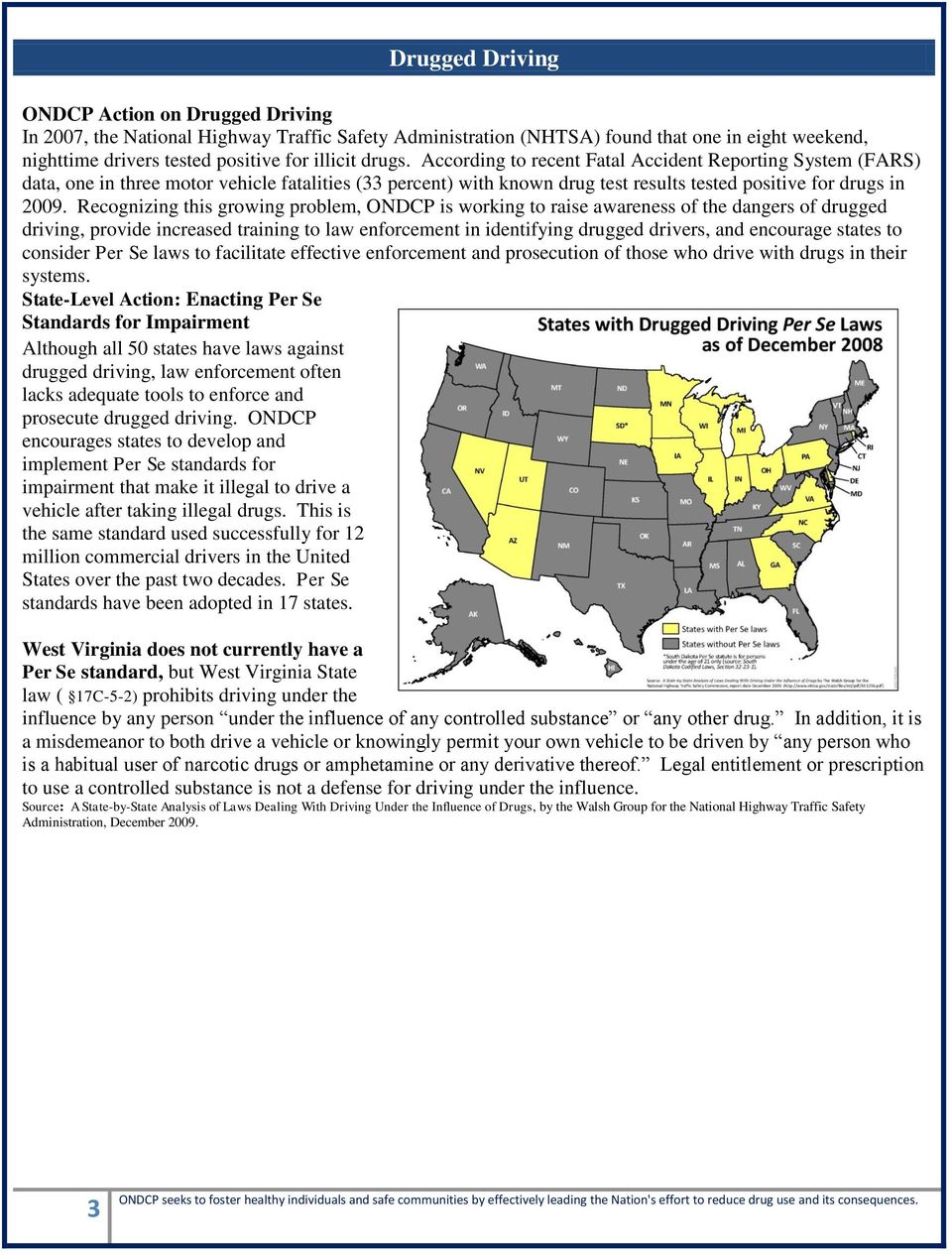
3 Drugged Driving ONDCP Action on Drugged Driving In 2007, the National Highway Traffic Safety Administration (NHTSA) found that one in eight weekend, nighttime drivers tested positive for illicit drugs. According to recent Fatal Accident Reporting System (FARS) data, one in three motor vehicle fatalities (33 percent) with known drug test results tested positive for drugs in Recognizing this growing problem, ONDCP is working to raise awareness of the dangers of drugged driving, provide increased training to law enforcement in identifying drugged drivers, and encourage states to consider Per Se laws to facilitate effective enforcement and prosecution of those who drive with drugs in their systems. State-Level Action: Enacting Per Se Standards for Impairment Although all 50 states have laws against drugged driving, law enforcement often lacks adequate tools to enforce and prosecute drugged driving. ONDCP encourages states to develop and implement Per Se standards for impairment that make it illegal to drive a vehicle after taking illegal drugs. This is the same standard used successfully for 12 million commercial drivers in the United States over the past two decades. Per Se standards have been adopted in 17 states. West Virginia does not currently have a Per Se standard, but West Virginia State law ( 17C-5-2) prohibits driving under the influence by any person under the influence of any controlled substance or any other drug. In addition, it is a misdemeanor to both drive a vehicle or knowingly permit your own vehicle to be driven by any person who is a habitual user of narcotic drugs or amphetamine or any derivative thereof. Legal entitlement or prescription to use a controlled substance is not a defense for driving under the influence. Source: A State-by-State Analysis of Laws Dealing With Driving Under the Influence of Drugs, by the Walsh Group for the National Highway Traffic Safety Administration, December
4 National Anti-Drug Media Campaign ONDCP s National Youth Anti-Drug Media Campaign provides consistent and credible messages (including in Native American and Alaska Native communities) to young people about drug use and its consequences. Above the Influence, a major component of the Campaign, informs and inspires youth to reject illicit drugs and drinking via a mix of national and local advertising vehicles. The Campaign, in close partnership with local community-based, youth-serving organizations, also conducts teen-targeted Above the Influence activities to assist local groups with youth drug prevention work in their respective communities. The Drug Free Communities Program: Recognizing that local problems require local solutions, Drug Free Communities (DFC) organizations mobilize communities to prevent youth drug use by creating local datadriven strategies to reduce drug use in the community. ONDCP works to foster the growth of new coalitions and support existing coalitions through the DFC grants. In FY 2011, the following West Virginia coalitions received grants from ONDCP: Brooke Hancock Drug Prevention Coalition (Weirton, WV) Cabell County Substance Abuse Prevention Partnership Creating Opportunities for Youth (Bluefield) Jackson County Anti-Drug Coalition Marshall County Anti-Drug Coalition Morgan County Partnership, Inc. Ohio County Substance Abuse Prevention Strong Through Our Plan(Gilbert, WV) Source: Office of National Drug Control Policy The High Intensity Drug Trafficking Areas (HIDTA) program enhances and coordinates drug control efforts among local, state, and Federal law enforcement agencies. In designated HIDTA counties, the program provides agencies with coordination, equipment, technology, and additional resources to combat drug trafficking and its harmful consequences in critical regions of the United States. HIDTA Counties in West Virginia: ONDCP Support for Community-Based Prevention ONDCP High Intensity Drug Trafficking Area (HIDTA) County Info Appalachia HIDTA: Boone, Cabell, Kanawha, Lincoln, Logan, Mason, McDowell, Mercer, Mingo, Putnam and Wayne counties. The Appalachia HIDTA supports five multi-agency task forces in West Virginia whose mission is to dismantle and disrupt drug trafficking organizations operating in the designated HIDTA counties. o Huntington Violent Crimes/Drug Task Force: focuses on major organizations that traffic in marijuana, cocaine, methamphetamine, heroin, and diverted pharmaceuticals. o Metropolitan Drug Enforcement Network Team: investigates family-based or loosely knit trafficking organization involved in marijuana cultivation, clandestine methamphetamine laboratories, and diversion of pharmaceuticals in southern West Virginia. o U.S. 119 Drug and Violent Crime Task Force: focuses on drug trafficking organizations, with specific emphasis on the four primary drugs affecting the region: cannabis, OxyContin, cocaine, and cocaine base. o West Virginia DEA HIDTA Task Force: focuses on locally based mid- to upper-level drug trafficking organizations with local, multi-state, or international operations. o West Virginia Eradication Initiative: focuses on reducing the availability of marijuana in the region and beyond. 4
5 Federal Grant Awards Available to Reduce Drug Use in the State of West Virginia The Federal Government awards competitive grants to help states in their efforts to reduce drug use and its harmful consequences. In FY 2010, direct support was provided to state and local governments, schools, and law enforcement organizations in your state for this purpose. Some Federal grant programs are dedicated to reducing drug use and its harmful consequences while others can be used for reducing drug use or for other purposes. In FY 2010, your State received support under the grant programs shown below. Federal Grant Awards 2010 Department of Education Safe and Drug-Free Schools and Communities_National Programs 2,339,601 Improving The Climate For Learning 2,339,601 Department of Health and Human Services Administration for Children and Families 3,072,235 Mentoring Children of Prisoners 206,227 Promoting Safe and Stable Families 2,866,008 Health Resources and Services Administration 698,735 Healthy Start Initiative 698,735 National Institutes of Health 878,707 Discovery and Applied Research for Technological Innovations to Improve Human Health 522,513 Drug Abuse and Addiction Research Programs 356,194 Substance Abuse and Mental Health Services Administration 14,370,431 Block Grants for Prevention and Treatment of Substance Abuse 8,740,456 Projects for Assistance in Transition from Homelessness (PATH) 300,000 Substance Abuse and Mental Health Services_Projects of Regional and National Significance 5,329,975 Department of Housing and Urban Development Assistant Secretary for Community Planning and Development (158,168) Shelter Plus Care (158,168) Department of Justice Office of Justice Programs 22,857,928 Community Capacity Development Office 157,000 Congressionally Recommended Awards 3,606,000 Criminal and Juvenile Justice and Mental Health Collaboration Program 200,000 Drug Court Discretionary Grant Program 350,000 Edward Byrne Memorial Justice Assistance Grant Program 2,998,238 Enforcing Underage Drinking Laws Program 356,400 Juvenile Accountability Block Grants 404,800 National Institute of Justice Research Evaluation and Development Project Grants 14,331,349 Recovery Act - Eward Byrne Memorial Justice Assistance Grant (JAG) Program 242,151 Residential Substance Abuse Treatment for State Prisoners 211,990 Executive Office of the President Substance Abuse and Mental Health Services Administration 1,000,000 Drug-Free Communities Support Program Grants 1,000,000 Grand Total 45,059,469 Note: Report as of 11/30/2010. FY 2009 includes additional grant awards under the Recovery Act. The Federal, State and Local Shares of Medicaid and the Federal Medicare Programs are not included above. Updated 6/7/

6 6

NEVADA DRUG CONTROL UPDATE. Drug Use Trends in Nevada. Substance Abuse Treatment Admissions Data
 NEVADA DRUG CONTROL UPDATE This report reflects significant trends, data, and major issues relating to drugs in the State of Nevada. Nevada At-a-Glance: The rate of drug-induced deaths in Nevada is higher
Prescription Drug Abuse
 DELAWARE DRUG CONTROL UPDATE This report reflects significant trends, data, and major issues relating to drugs in the State of Delaware. Delaware At-a-Glance: In 2007-2008, Delaware was one of the top
HAWAII DRUG CONTROL UPDATE. Drug Use Trends in Hawaii. Substance Abuse Treatment Admissions Data
 HAWAII DRUG CONTROL UPDATE This report reflects significant trends, data, and major issues relating to drugs in the State of Hawaii. Hawaii At-a-Glance: In the 2007-2008 time period, Hawaii was among the
UTAH DRUG CONTROL UPDATE. Substance Abuse Treatment Admissions Data
 UTAH DRUG CONTROL UPDATE This report reflects significant trends, data, and major issues relating to drugs in the State of Utah. Utah At-a-Glance: Approximately 6 percent of Utah residents reported past-month
SOUTH CAROLINA DRUG CONTROL UPDATE. Drug Use Trends in South Carolina
 SOUTH CAROLINA DRUG CONTROL UPDATE This report reflects significant trends, data, and major issues relating to drugs in the State of South Carolina. South Carolina At-a-Glance: The number of meth lab seizure
NEW JERSEY DRUG CONTROL UPDATE. Substance Abuse Treatment Admissions Data
 NEW JERSEY DRUG CONTROL UPDATE This report reflects significant trends, data, and major issues relating to drugs in the State of New Jersey. New Jersey At-a-Glance: Approximately 6 percent of New Jersey
NEW JERSEY DRUG CONTROL UPDATE. Drug Use Trends in New Jersey
 NEW JERSEY DRUG CONTROL UPDATE This report reflects significant trends, data, and major issues relating to drugs in the State of New Jersey. New Jersey At-a-Glance: In 2009-2010 New Jersey was one of the
OREGON DRUG CONTROL UPDATE. Drug Use Trends in Oregon
 OREGON DRUG CONTROL UPDATE This report reflects significant trends, data, and major issues relating to drugs in the State of Oregon. Oregon At-a-Glance: In 2009-2010, Oregon was one of the top ten states
MARYLAND DRUG CONTROL UPDATE. Substance Abuse Treatment Admissions Data
 MARYLAND DRUG CONTROL UPDATE This report reflects significant trends, data, and major issues relating to drugs in the State of Maryland. Maryland At-a-Glance: Approximately 7 percent of Maryland residents
ILLINOIS DRUG CONTROL UPDATE. Substance Abuse Treatment Admissions Data
 ILLINOIS DRUG CONTROL UPDATE This report reflects significant trends, data, and major issues relating to drugs in the state of Illinois. Illinois At-a-Glance: The number of meth lab seizure incidents in
PENNSYLVANIA DRUG CONTROL UPDATE. Drug Use Trends in Pennsylvania
 PENNSYLVANIA DRUG CONTROL UPDATE This report reflects significant trends, data, and major issues relating to drugs in the State of Pennsylvania. Pennsylvania At-a-Glance: Approximately 7 percent of Pennsylvania
OKLAHOMA DRUG CONTROL UPDATE. Drug Use Trends in Oklahoma. Substance Abuse Treatment Admissions Data
 OKLAHOMA DRUG CONTROL UPDATE This report reflects significant trends, data, and major issues relating to drugs in the State of Oklahoma. Oklahoma At-a-Glance: The number of meth lab seizure incidents in
NORTH CAROLINA DRUG CONTROL UPDATE. Substance Abuse Treatment Admissions Data
 NORTH CAROLINA DRUG CONTROL UPDATE This report reflects significant trends, data, and major issues relating to drugs in the State of North Carolina. North Carolina At-a-Glance: The number of meth lab seizure
KANSAS DRUG CONTROL UPDATE. Substance Abuse Treatment Admissions Data
 KANSAS DRUG CONTROL UPDATE This report reflects significant trends, data, and major issues relating to drugs in the State of Kansas. Kansas At-a-Glance: The number of meth lab seizure incidents in the
OHIO DRUG CONTROL UPDATE. Drug Use Trends in Ohio. Substance Abuse Treatment Admissions Data
 OHIO DRUG CONTROL UPDATE This report reflects significant trends, data, and major issues relating to drugs in the State of Ohio. Ohio At-a-Glance: In 2007-2008, Ohio was one of the top ten states for rates
ARIZONA DRUG CONTROL UPDATE. Drug Use Trends in Arizona
 ARIZONA DRUG CONTROL UPDATE This report reflects significant trends, data, and major issues relating to drugs in the State of Arizona. Arizona At-a-Glance: In 2009-2010, Arizona was one of the top ten
GEORGIA DRUG CONTROL UPDATE. Drug Use Trends in Georgia. Substance Abuse Treatment Admissions Data
 GEORGIA DRUG CONTROL UPDATE This report reflects significant trends, data, and major issues relating to drugs in the State of Georgia. Georgia At-a-Glance: Approximately 7 percent of Georgia residents
NEW YORK DRUG CONTROL UPDATE. Drug Use Trends in New York
 NEW YORK DRUG CONTROL UPDATE This report reflects significant trends, data, and major issues relating to drugs in the State of New York. New York At-a-Glance: In 2009-2010, New York was one of the top
NEW YORK DRUG CONTROL UPDATE
 NEW YORK DRUG CONTROL UPDATE This report reflects significant trends, data, and major issues relating to drugs in the State of New York. New York At-a-Glance: In 2008, New York was one of the top ten states
FLORIDA DRUG CONTROL UPDATE. Drug Use Trends in Florida
 FLORIDA DRUG CONTROL UPDATE This report reflects significant trends, data, and major issues relating to drugs in the State of Florida. Florida At-a-Glance: Approximately 8.32 percent of Florida residents
FLORIDA DRUG CONTROL UPDATE. Drug Use Trends in Florida. Substance Abuse Treatment Admissions Data
 FLORIDA DRUG CONTROL UPDATE This report reflects significant trends, data, and major issues relating to drugs in the State of Florida. Florida At-a-Glance: Approximately 8 percent of Florida residents
CALIFORNIA DRUG CONTROL UPDATE. Drug Use Trends in California
 CALIFORNIA DRUG CONTROL UPDATE This report reflects significant trends, data, and major issues relating to drugs in the State of California. California At-a-Glance: Data from the Treatment Episode Data
TEXAS DRUG CONTROL UPDATE. Substance Abuse Treatment Admissions Data
 TEXAS DRUG CONTROL UPDATE This report reflects significant trends, data, and major issues relating to drugs in the State of Texas. Texas At-a-Glance: The number of meth lab seizure incidents in the state
Colorado Substance Use and Recommendations Regarding Marijuana Tax Revenue
 Colorado Substance Use and Recommendations Regarding Marijuana Tax Revenue Substance addiction and abuse is Colorado s most prevalent, complex, costly and untreated public health challenge. It is an issue
WHAT WE KNOW. Collective Action Issue Brief #2 Updated June 2014 PRESCRIPTION PAIN MEDICATION MISUSE
 Collective Action Issue Brief #2 Updated June 2014 PRESCRIPTION PAIN MEDICATION MISUSE WHAT WE KNOW The misuse and abuse of prescription drugs has become a leading cause of harm among New Hampshire adults,
Rural Substance Abuse Partnership (RSAP) State Profile: OKLAHOMA
 Rural Substance Abuse Partnership (RSAP) State Profile: OKLAHOMA Overview: The Rural Substance Abuse Partnership (RSAP), organized with the help of a U.S. Department of Justice, Office of Justice Programs
Substance Use: Addressing Addiction and Emerging Issues
 MODULE 6: SUBSTANCE USE: ADDRESSING ADDICTION AND EMERGING ISSUES Substance Use: Addressing Addiction and Emerging Issues Martha C. Romney, RN, MS, JD, MPH Assistant Professor Jefferson School of Population
Prescription Drug Monitoring Program Administrators Guide for Training Law Enforcement
 Prescription Drug Monitoring Program Administrators Guide for Training Law Enforcement 2013 Telephone: (781) 609-7741 Fax: (888) 705-8053 Email: [email protected] Website: www.pdmpassist.org INTRODUCTION
PUBLIC SAFETY ACTION PLAN. Prepared for Governor Haslam by Subcabinet Working Group
 PUBLIC SAFETY ACTION PLAN Prepared for Governor Haslam by Subcabinet Working Group JANUARY 2012 Table of Contents Subcabinet working group makeup and input Two-fold mission of the group Summary of findings
Overview. Highlights of FY 2016 Key Funding Priorities
 February 2015 Overview In FY 2016, a total of $27.6 billion is requested by the President to support 2015 National Drug Control Strategy (Strategy) efforts to reduce drug use and its consequences in the
The State of Prescription Drug Use in Georgia: A Needs Assessment
 2012 The State of Prescription Drug Use in Georgia: A Needs Assessment Submitted By: Dr. Sheryl Strasser, Evaluator and Megan Smith, MPH, Assistant Evaluator Georgia State University, Institute of Public
States In Brief Substance Abuse and Mental Health Issues At-A-Glance
 kentucky States In Brief Substance Abuse and Mental Health Issues At-A-Glance A Short Report from the Office of Applied Studies Prevalence of Illicit Substance 1 and Alcohol Use The National Survey on
PRESCRIPTION DRUG ABUSE: THE NATIONAL PERSPECTIVE
 PRESCRIPTION DRUG ABUSE: THE NATIONAL PERSPECTIVE May 19, 2012 National Association Boards of Pharmacy Annual Meeting Gil Kerlikowske, Director White House Office of National Drug Control Policy ONDCP
Macomb County Office of Substance Abuse MCOSA. Executive Summary
 Macomb County Office of Substance Abuse MCOSA Executive Summary This report marks the second data profile of alcohol and illicit drugs burden in Macomb County. The first report produced in 2007 detailed
How To Help People Who Are Addicted To Prescription Drugs And Heroin
 Community Behavioral Healthcare Association of Illinois Frank Anselmo, MPA Chief Executive Officer 3085 Stevenson Drive, Suite 203 Springfield, Illinois 62703 Phone: 217/585-1600 Fax: 217/585-1601 www.cbha.net
Enforcement - Aggressively Attacking Unlawful Drug Activity. Treatment/Recovery - Getting Treatment Resources Where They Are Needed
 Orange County Drug Free Coalition Strategic Plan Mission Statement: To engage, advocate, inform and bring awareness of alcohol and other substance abuse issues through education, prevention, enforcement,
TESTIMONY. March 17, 2014. Rutland, VT
 Community Solutions to Breaking the Cycle of Heroin & Opioid Addiction TESTIMONY Harry Chen, MD, Commissioner of Health March 17, 2014 Senate Committee on the Judiciary Franklin Conference Center at the
The Arizona Prescription Drug Misuse and Abuse Initiative: A Multi-Systems Approach to Addressing Prescription Drug Misuse and Abuse
 The Arizona Prescription Drug Misuse and Abuse Initiative: A Multi-Systems Approach to Addressing Prescription Drug Misuse and Abuse Presented by: Phillip Stevenson, Ph.D. Director, Statistical Analysis
States In Brief Substance Abuse and Mental Health Issues At-A-Glance
 virginia States In Brief Substance Abuse and Mental Health Issues At-A-Glance a Short report from the Office of applied Studies Prevalence of Illicit Substance 1 and Alcohol Use The National Survey on
1. Youth Drug Use More than 40% of Maryland high school seniors used an illicit drug in the past year.
 1. Youth Drug Use More than 4% of Maryland high school seniors used an illicit drug in the past year. Any Illicit Drug Alcohol Marijuana Ecstasy Cocaine Percentage of Maryland and U.S. high school seniors
For a Healthier America: Reducing Prescription Drug Misuse and Abuse
 For a Healthier America: Reducing Prescription Drug Misuse and Abuse The misuse and abuse of prescription medicines is a growing public health problem. In addition to the tragic toll on families and communities,
OHIO COUNTY. Demographic Data. Adult Behavioral Health Risk Factors: 2007-2011
 Prepared by the Department of Health and Human Resources Bureau for Behavioral Health and Health Facilities OHIO COUNTY February 14 Behavioral Health Epidemiological County Profile Demographic Data Ohio
EPIDEMIC: RESPONDING TO AMERICA S PRESCRIPTION DRUG ABUSE CRISIS
 EPIDEMIC: RESPONDING TO AMERICA S PRESCRIPTION DRUG ABUSE CRISIS 2011 Background Prescription drug abuse is the Nation s fastest-growing drug problem. While there has been a marked decrease in the use
Blunt Truth Conference. Debbie Weir MADD CEO
 Blunt Truth Conference Debbie Weir MADD CEO Mission Moment Honoring Victims Emma Longstreet 2014 Mothers Against Drunk Driving Telling Victim Stories 2011 Mothers Against Drunk Driving Who We Are Founded
Chapter 4 STRATEGIC GOALS AND OBJECTIVES
 Chapter 4 STRATEGIC GOALS AND OBJECTIVES PRINCIPLES OF A COMPREHENSIVE, BALANCED STRATEGY This urban-based Substance Abuse Strategy (the Strategy) is built on the premise that no single approach can end
Signs of Substance Abuse in Broward County, Florida
 Adult Summer 8 The chart below summarizes the severity and trends for indicators of drug use and abuse in Broward County, Florida. The Severity Index is based on the number of drug-related deaths, emergency
Marijuana in Massachusetts. Arrests, Usage, and Related Data
 Marijuana in Massachusetts Arrests, Usage, and Related Data Jon Gettman, Ph.D. The Bulletin of Cannabis Reform www.drugscience.org 10/19/2009 1 Introduction This state report is part of a comprehensive
Marijuana in New Jersey. Arrests, Usage, and Related Data
 Arrests, Usage, and Related Data Jon Gettman, Ph.D. The Bulletin of Cannabis Reform www.drugscience.org 10/19/2009 1 Introduction This state report is part of a comprehensive presentation of national,
BIOPHARMACEUTICAL INDUSTRY IMPACT REPORT: Florida PRESENTED BY:
 BIOPHARMACEUTICAL INDUSTRY IMPACT REPORT: Florida PRESENTED BY: About the report About PhRMA The Pharmaceutical Research and Manufacturers of America (PhRMA) represents the country s leading innovative
Prescription Drug Abuse and Overdose: Public Health Perspective
 Prescription Drug Abuse and Overdose: Public Health Perspective [Residency educators may use the following slides for their own teaching purposes.] CDC s Primary Care and Public Health Initiative October
Fairfax-Falls Church Community Services Board
 LOB #267: ADULT RESIDENTIAL TREATMENT SERVICES Purpose Adult Residential Treatment Services provides residential treatment programs for adults with severe substance use disorders and/or co occurring mental
States In Brief. The National Survey on Drug Use and Health. texas. Prevalence of Illicit Substance 1 and Alcohol Use
 texas States In Brief Substance Abuse and Mental Health Issues At-A-Glance a short Report from the Office of applied studies Prevalence of Illicit Substance 1 and Alcohol Use The National Survey on Drug
NATURE AND EXTENT OF THE ILLICIT DRUG PROBLEM IN MISSOURI
 NATURE AND EXTENT OF THE ILLICIT DRUG PROBLEM IN MISSOURI Department of Public Safety and Statistical Analysis Center Funding for this report was provided by the Edward Byrne Memorial Justice Assistance
Office of National Drug Control Policy 2 April 2013. Figure 1: Drug Control Resources by Function FY 2012 FY 2013. Domestic Law Enforcement
 April 2013 Overview In support of the 2013 National Drug Control Strategy (Strategy), the President requests $25.4 billion in Fiscal Year (FY) 2014 to reduce drug use and its consequences in the United
An integrated approach to addressing opiate abuse in Maine. Debra L. Brucker, MPA, PhD State of Maine Office of Substance Abuse October 2009
 An integrated approach to addressing opiate abuse in Maine Debra L. Brucker, MPA, PhD State of Maine Office of Substance Abuse October 2009 Background Defining the problem: Opiates pain relievers (OxyContin,
Colorado Prescription Drug Monitoring Program. Department of Regulatory Agencies Division of Professions and Occupations State Board of Pharmacy
 Colorado Prescription Drug Monitoring Program Department of Regulatory Agencies Division of Professions and Occupations State Board of Pharmacy DORA is dedicated to preserving the integrity of the marketplace
Drug Abuse Trends in the Seattle/King County Area: 2013
 Drug Abuse Trends in the Seattle/King County Area: 2013 Caleb Banta-Green 1, T. Ron Jackson 2, Steve Freng 3, Michael Hanrahan 4, Cynthia Graff 5, John Ohta 6, Mary Taylor 7, Richard Harruff 8, Robyn Smith
Structure and Function
 Structure and Function OKLAHOMA State SSA Director Mr. Ben Brown, Deputy Commissioner Oklahoma Department of Mental Health and Substance Abuse Services P.O. Box 53277 Oklahoma City, OK 73152-3277 Phone:
The Current State of Drug Abuse Across the Nation. December 12, 2015
 The Current State of Drug Abuse Across the Nation December 12, 2015 Agenda The Partnership for Drug-Free Kids The macro picture Opioid abuse and addiction What can we do about it? Moving upstream: connecting
Treatment Approaches for Drug Addiction
 Treatment Approaches for Drug Addiction [NOTE: This is a fact sheet covering research findings on effective treatment approaches for drug abuse and addiction. If you are seeking treatment, please call
In Brief UTAH. Adolescent Behavioral Health. A Short Report from the Office of Applied Studies
 UTAH Adolescent Behavioral Health In Brief A Short Report from the Office of Applied Studies Adolescence (12 to 17 years) is a critical and vulnerable stage of human development, during which males and
Strategic Plan for Alcohol and Drug Abuse
 Strategic Plan for Alcohol and Drug Abuse Fiscal Years 2016-2017 1 GARRETT COUNTY, MARYLAND STRATEGIC PLAN FOR ALCOHOL AND DRUG ABUSE Vision: Mission: A safe and drug free Garrett County To assist in promoting
Official Notice to Students Regarding Substance Abuse in University Campus Communities
 Official Notice to Students Regarding Substance Abuse in University Campus Communities This Official Notice is issued pursuant to the requirements of Subpart B, Section 86.100 of the federal Drug-Free
AUDIT REPORT DEPARTMENT OF JUSTICE DRUG DEMAND REDUCTION ACTIVITIES FEBRUARY 2003 03-12
 United States Department of Justice Office of the Inspector General Audit Division AUDIT REPORT DEPARTMENT OF JUSTICE DRUG DEMAND REDUCTION ACTIVITIES FEBRUARY 2003 03-12 DEPARTMENT OF JUSTICE DRUG DEMAND
Presentation to Senate Health and Human Services Committee: Prescription Drug Abuse in Texas
 Presentation to Senate Health and Human Services Committee: Prescription Drug Abuse in Texas David Lakey, MD Commissioner, Department of State Health Services Lauren Lacefield Lewis Assistant Commissioner,
It s a Privilege to Drive: Snapshot of Impaired Driving in Montana
 It s a Privilege to Drive: Snapshot of Impaired Driving in Montana Unlawful Acts Notes Montana Code Drive under the influence of drugs or alcohol: DUI Operate a noncommercial vehicle with excessive alcohol
2013 OHIO DRUG OVERDOSE DATA: GENERAL FINDINGS 1
 Number of Deaths Rate per 100,000 persons 2013 OHIO DRUG OVERDOSE DATA: GENERAL FINDINGS 1 Drug overdose deaths continue to be a public health crisis in Ohio with a 413 percent increase in the number of
Drug-Free Workplace. Policy Statement. Reason for the Policy. Policy V. 7.2.1
 Policy V. 7.2.1 Responsible Official: Vice President for Human Resources, Diversity, and Multicultural Affairs Effective Date: October 26, 2009 Drug-Free Workplace Policy Statement The University of Vermont
Opiate Addiction in Ohio: An Update on Scope of Problem Ashland Ohio
 Governor s Cabinet Opiate Action Team Promoting Wellness and Recovery John R. Kasich, Governor Tracy J. Plouck, Director Opiate Addiction in Ohio: An Update on Scope of Problem Ashland Ohio November 14,
Program Descriptions:
 Program Descriptions: Alcohol Education Alcohol education programs include underage drinking prevention and diverse community outreach. Underage drinking is America s number one youth drug problem, killing
The Heroin and Opioid Epidemic in Northeast Ohio: One Year Report to the Community
 The Heroin and Opioid Epidemic in Northeast Ohio: One Year Report to the Community The Heroin and Opioid Epidemic in Northeast Ohio: One Year Report to the Community November 2014 INTRODUCTION The Heroin