
Course Syllabus. HITT Advanced Medical Coding. Revision Date: August 21, 2013
|
|
|
- Dylan Hood
- 10 years ago
- Views:
Transcription
1 Course Syllabus HITT Advanced Medical Coding Revision Date: August 21, 2013 Catalog Description: In-depth coverage of ICD and CPT coding rubrics, conventions, principles, and updates as they apply to accurate coding of complex medical/surgical cases, with emphasis on case studies. Government regulations and changes in health care reporting will be addressed. Students will assign coding and prospective payment categories using computerized software. Lecture hours = 3, Lab hours = 0 Prerequisites: HITT1342- Ambulatory Coding (can be taken concurrently), HITT Medical Terminology I, and HITT Coding and Classifications Systems Semester Credit Hours: 3 Lecture Hours per Week: 3 Lab Hours per Week: 0 Contact Hours per Semester: 48 State Approval Code: Instructional Goals and Purposes: The purpose of this course is to provide students with advanced knowledge of how to accurately report diagnoses and procedure codes through the application of official coding guidelines and the use of 3M coding software. Upon successful completion of this course, students will have achieved the goal of being able to effectively identify, understand, and utilize medical codes as they will be applicable to hospital reimbursement in the field of healthcare. Learning Objectives: 1. Complete intermediate and advanced coding exercises by applying the coding guidelines of ICD-10-CM/PCS, CPT, and HCPCS level II. 2. Use 3M computerized software to assign diagnoses and procedure codes. 3. Use 3M computerized software to assign appropriate prospective payment system reimbursement categories. Specific Course Objectives (includes SCANS): After studying the material presented in the text and online, the student should be able to complete all behavioral/learning objectives listed below with a minimum competency of 70% on assignments and exams. 1. Complete intermediate and advanced coding exercises by applying the coding guidelines of ICD-10-CM/PCS, CPT, and HCPCS level II. Identify the characteristics and conventions of ICD-10-CM/PCS and CPT through the application of class exercises and exams. Differentiate between disease specific and organ specific coding guidelines.

2 Discuss the current CPT organization, structure, and guidelines. Utilize the principles of ICD-10-CM/PCS, CPT, and HCPCS to complete intermediate physician-based case study coding exercises. Utilize the principles of ICD-10-CM/PCS, CPT, and HCPCS to complete advanced inpatient case study coding exercises. Utilize the principles of ICD-10-CM/PCS, CPT, and HCPCS to complete advanced ambulatory case study coding exercises. Utilize the principles of ICD-10-CM/PCS, CPT, and HCPCS to complete advanced physician-based case study coding exercises. (SCANS 1a-iv. 1a-v. 1bi. 1b-ii. 1b-iii. 1b-iv. 1b-v. 1c-i. 1c-ii. 1c-iii. 1c-iv. 1c-v. 2a-i. 2aiii. 2b-i. 2b-ii. 2b-iv. 2b-vi. 2c-i. 2c-ii. 2c-iii. 2c-iv.) 2. Use 3M coding software to assign diagnoses and procedure codes. Complete case studies and coding exercises with the use of 3M coding software. (SCANS 1a-iv. 1a-v. 1bi. 1b-ii. 1b-iii. 1b-iv. 1b-v. 1c-i. 1c-ii. 1c-iii. 1c-iv. 1c-v. 2a-i. 2a-iii. 2b-i. 2b-ii. 2b-iv. 2b-vi. 2c-i. 2c-ii. 2c-iii. 2c-iv.) Course Content: Students in all sections of Advanced Medical Coding will be required to do the following: 1. Students will demonstrate knowledge of course material by completing course examinations given over lecture and textbook material. 2. Students will complete all daily assignments as instructed. Methods of Instruction/Course Format/Delivery: Students will meet regularly for lecture over the material. Additionally, students will meet regularly for the laboratory portion of this course. The student is expected to attend all face-to-face class meetings and all laboratory meetings, of those in which the student is enrolled. The resources provided, for this class, through Canvas include: A calendar displaying assignments each week (assignments will also be given in class) (totally contained within Canvas) Extra credit opportunities Assignments: Students should use the within Canvas to communicate with the instructor. Using Canvas gives you access to the instructor and other classmates without having to remember or type addresses- you must select a name from the list. If you are not able to contact the instructor using in Canvas, you may use my Panola College address, contact me by telephone, or stop by her office. Instructor will attempt to respond to all within 24 hours. Please always include a subject line and your name in your . Attendance Policy: This class will meet twice each week. Attendance will be checked and recorded in the instructor s grade book at each class meeting. Students are responsible for all assignments, even in the event of an absence. Late work is not accepted. 2
3 Students are encouraged to please be on time for all class sessions. Late arrivals result in class disruptions. If students arrive late (less than a quarter hour, 15 minutes) they will be recorded as tardy. Three times of tardy will equal one absence. Additionally, leaving class early without the instructor s permission will be recorded as one absence. Note: Withdrawing from this course is the student s responsibility. Students who fail to officially withdraw by notifying the Records and Admission Office will receive the grade of F in the class. Refer to the College Calendar for the official Last Day to Withdraw. Academic Integrity: Academic misconduct will not be tolerated. Any incident of academic misconduct will result in a failing grade for the test or assignment. Classroom Etiquette: All cell phones should be turned off prior to entering the classroom. Additionally, students are expected to display tolerance for other s views during classroom discussions. Comments and language used should be appropriate for a professional setting. Assessment: The following items will be assigned during the semester and used to calculate the student s final grade: * Daily Assignments and Participation You will be assigned daily assignments that you must complete. All assignments are due by the scheduled due date. No late work will be accepted. Additionally, you will be assessed according to your class participation. Class participation is crucial to a thorough understanding of the material presented. Exams You will be required to demonstrate what you have learned by completing course examinations. In addition to the regular examinations that you will receive throughout the course, you will be required to complete a comprehensive final examination. Course Grade: Computation Regular Examinations 35% Daily assignments and participation 35% Final Examination 10% A = B = C = D = F = Below 60 All of your grades will be posted to My Grades in Canvas. Additionally, your midterm grade and final grade will be posted to My Grades in Canvas. Textbooks (required): 3

4 For current texts and materials, use the following link to access bookstore listings: If any student in the class has special classroom or testing needs because of a physical, learning or emotional condition, please contact Teresa Washington-Shelby, ADA Student Coordinator, in the Martha Miller Administration (903) OTHER: For testing services, use the following link: If any student in this class has special classroom or testing needs because of a physical learning or emotional condition, please contact the ADA Student Coordinator in Support Services located in the Administration Building or go to for more information. Withdrawing from a course is the student s responsibility. Students who do not attend class and who do not withdraw will receive the grade earned for the course. Student Handbook, The Pathfinder: Secretary of Labor s Commission on Achieving Necessary Skills (SCANS) SCANS CRITERIA 1) Foundation skills are defined in three areas: basic skills, thinking skills, and personal qualities. a) Basic Skills: A worker must read, write, perform arithmetic and mathematical operations, listen, and speak effectively. These skills include: i) Reading: locate, understand, and interpret written information in prose and in documents such as manuals, graphs, and schedules. ii) Writing: communicate thoughts, ideas, information, and messages in writing, and create documents such as letters, directions, manuals, reports, graphs, and flow charts. iii) Arithmetic and Mathematical Operations: perform basic computations and approach practical problems by choosing appropriately from a variety of mathematical techniques. iv) Listening: receive, attend to, interpret, and respond to verbal messages and other cues. v) Speaking: Organize ideas and communicate orally. b) Thinking Skills: A worker must think creatively, make decisions, solve problems, visualize, know how to learn, and reason effectively. These skills include: i) Creative Thinking: generate new ideas. ii) Decision Making: specify goals and constraints, generate alternatives, consider risks, and evaluate and choose the best alternative. 4
5 iii) Problem Solving: recognize problems and devise and implement plan of action. iv) Visualize ("Seeing Things in the Mind's Eye"): organize and process symbols, pictures, graphs, objects, and other information. v) Knowing How to Learn: use efficient learning techniques to acquire and apply new knowledge and skills. vi) Reasoning: discover a rule or principle underlying the relationship between two or more objects and apply it when solving a problem. c) Personal Qualities: A worker must display responsibility, self-esteem, sociability, selfmanagement, integrity, and honesty. i) Responsibility: exert a high level of effort and persevere toward goal attainment. ii) Self-Esteem: believe in one's own self-worth and maintain a positive view of oneself. iii) Sociability: demonstrate understanding, friendliness, adaptability, empathy, and politeness in group settings. iv) Self-Management: assess oneself accurately, set personal goals, monitor progress, and exhibit self-control. v) Integrity and Honesty: choose ethical courses of action. 2) Workplace competencies are defined in five areas: resources, interpersonal skills, information, systems, and technology. a) Resources: A worker must identify, organize, plan, and allocate resources effectively. i) Time: select goal-relevant activities, rank them, allocate time, and prepare and follow schedules. ii) Money: Use or prepare budgets, make forecasts, keep records, and make adjustments to meet objectives. iii) Material and Facilities: Acquire, store, allocate, and use materials or space efficiently. Examples: construct a decision time line chart; use computer software to plan a project; prepare a budget; conduct a cost/benefits analysis; design an RFP process; write a job description; develop a staffing plan. b) Interpersonal Skills: A worker must work with others effectively. i) Participate as a Member of a Team: contribute to group effort. ii) Teach Others New Skills. iii) Serve Clients/Customers: work to satisfy customer's expectations. iv) Exercise Leadership: communicate ideas to justify position, persuade and convince others, responsibly challenge existing procedures and policies. v) Negotiate: work toward agreements involving exchange of resources, resolve divergent interests. vi) Work with Diversity: work well with men and women from diverse backgrounds. Examples: collaborate with a group member to solve a problem; work through a group conflict situation, train a colleague; deal with a dissatisfied customer in person; select and use appropriate leadership styles; use effective delegation techniques; conduct an individual or team negotiation; demonstrate an understanding of how people from different cultural backgrounds might behave in various situations. c) Information: A worker must be able to acquire and use information. i) Acquire and Evaluate Information. ii) Organize and Maintain Information. iii) Interpret and Communicate Information. 5
6 iv) Use Computers to Process Information. Examples: research and collect data from various sources; develop a form to collect data; develop an inventory record-keeping system; produce a report using graphics; make an oral presentation using various media; use on-line computer data bases to research a report; use a computer spreadsheet to develop a budget. d) Systems: A worker must understand complex interrelationships. i) Understand Systems: know how social, organizational, and technological systems work and operate effectively with them. ii) Monitor and Correct Performance: distinguish trends, predict impacts on system operations, diagnose deviations in systems' performance and correct malfunctions. iii) Improve or Design Systems: suggest modifications to existing systems and develop new or alternative systems to improve performance. Examples: draw and interpret an organizational chart; develop a monitoring process; choose a situation needing improvement, break it down, examine it, propose an improvement, and implement it. e) Technology: A worker must be able to work with a variety of technologies. i) Select Technology: choose procedures, tools or equipment including computers and related technologies. ii) Apply Technologies to Task: understand overall intent and proper procedures for setup and operation of equipment. iii) Maintain and Troubleshoot Equipment: Prevent, identify, or solve problems with equipment, including computers and other technologies. Examples: read equipment descriptions and technical specifications to select equipment to meet needs; set up and assemble appropriate equipment from instructions; read and follow directions for troubleshooting and repairing equipment. 6
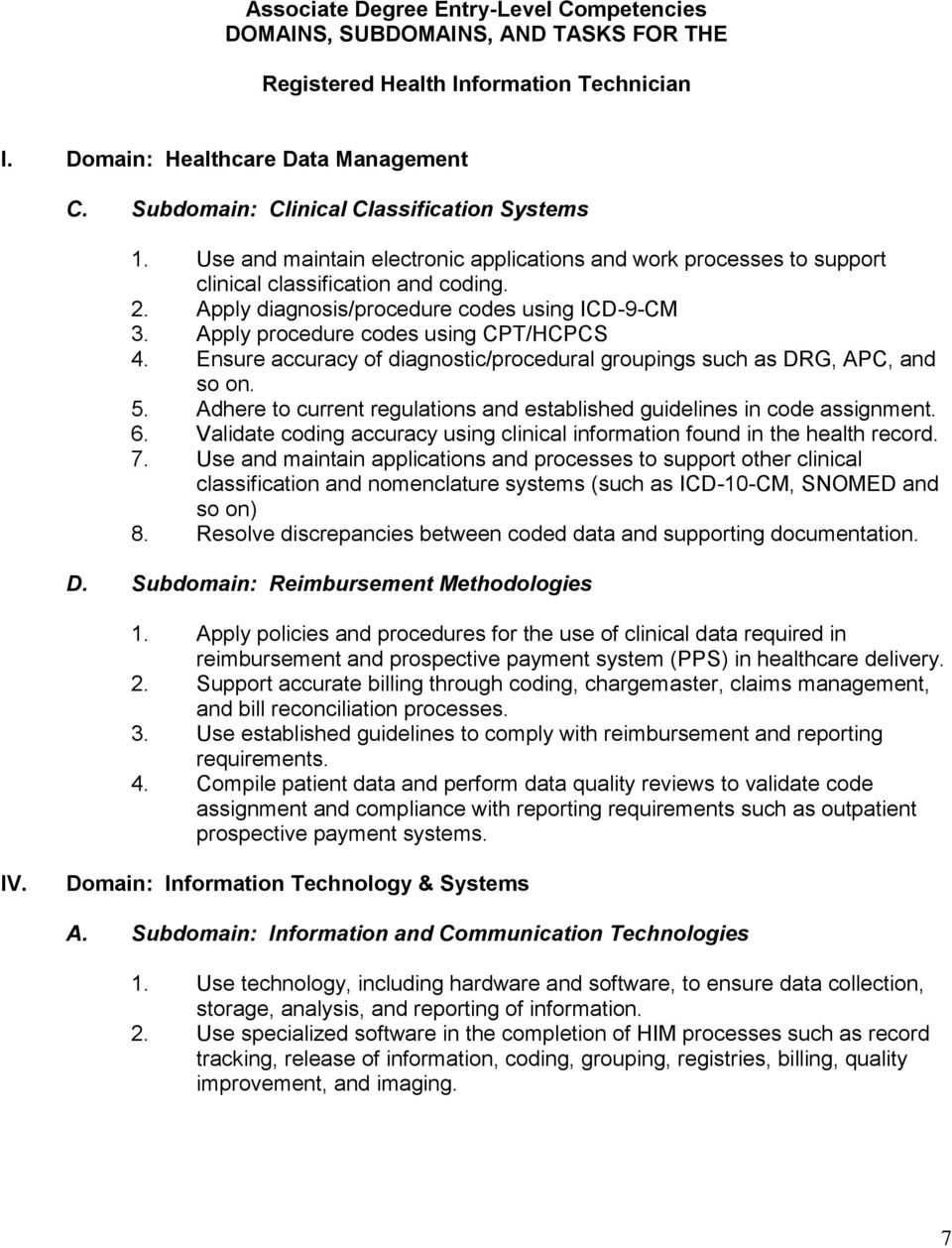
7 Associate Degree Entry-Level Competencies DOMAINS, SUBDOMAINS, AND TASKS FOR THE Registered Health Information Technician I. Domain: Healthcare Data Management C. Subdomain: Clinical Classification Systems 1. Use and maintain electronic applications and work processes to support clinical classification and coding. 2. Apply diagnosis/procedure codes using ICD-9-CM 3. Apply procedure codes using CPT/HCPCS 4. Ensure accuracy of diagnostic/procedural groupings such as DRG, APC, and so on. 5. Adhere to current regulations and established guidelines in code assignment. 6. Validate coding accuracy using clinical information found in the health record. 7. Use and maintain applications and processes to support other clinical classification and nomenclature systems (such as ICD-10-CM, SNOMED and so on) 8. Resolve discrepancies between coded data and supporting documentation. D. Subdomain: Reimbursement Methodologies 1. Apply policies and procedures for the use of clinical data required in reimbursement and prospective payment system (PPS) in healthcare delivery. 2. Support accurate billing through coding, chargemaster, claims management, and bill reconciliation processes. 3. Use established guidelines to comply with reimbursement and reporting requirements. 4. Compile patient data and perform data quality reviews to validate code assignment and compliance with reporting requirements such as outpatient prospective payment systems. IV. Domain: Information Technology & Systems A. Subdomain: Information and Communication Technologies 1. Use technology, including hardware and software, to ensure data collection, storage, analysis, and reporting of information. 2. Use specialized software in the completion of HIM processes such as record tracking, release of information, coding, grouping, registries, billing, quality improvement, and imaging. 7
Course Syllabus. HITT 2346- Advanced Medical Coding
 Course Syllabus HITT 2346- Advanced Medical Coding Catalog Description: In-depth coverage of ICD and CPT coding rubrics, conventions, principles, and updates as they apply to accurate coding of complex
Specific Course Objectives (includes SCANS): After studying all materials and resources presented in the course, the student will be able to:
 Course Syllabus Introduction to Accounting I Revision Date: July 2015 Catalog Description: A study of analyzing, classifying, and recording business transactions in a manual and computerized environment.
INSTRUCTIONAL GOALS AND PURPOSES
 Course Syllabus HITT 2261 Clinical Health Information Technology/Technician Revision Date: April 14, 2015 Catalog Description: A health-related work-based learning experience that enables the student to
Instructional Goals and Purposes: The purpose of this course is to teach students the importance of and principles of records management.
 Course Syllabus POFT 1319 RECORDS AND INFORMATION MANAGEMENT I Revision Date: 09/02/2013 Catalog Description: Records and Information Management I is an introduction to basic records and information management.
POFT 2312 BUSINESS CORRESPONDENCE & COMMUNICATION
 Course Syllabus POFT 2312 BUSINESS CORRESPONDENCE & COMMUNICATION Revision Date: 10/1/2015 Catalog Description: Development of writing and presentation skills to produce effective business communications.
Course Syllabus. CDEC 1313 Curriculum Resources for Early Childhood Programs. Revision Date: April 19, 2016
 Course Syllabus CDEC 1313 Curriculum Resources for Early Childhood Programs Revision Date: April 19, 2016 Catalog Description: A study of the fundamentals of developmentally-appropriate curriculum design
Course Syllabus. GAME 1403 Introduction to Game Design and Development
 1 Course Syllabus GAME 1403 Introduction to Game Design and Development Catalog Description: Introduction to electronic game development and game development careers. Includes examination of history and
INSTRUCTIONAL GOALS AND PURPOSES:
 Course Syllabus HITT 1401 Health Data Content and Structure Revision Date: August 20, 2013 Catalog Description: Introduction to systems and processes for collecting, maintaining, and disseminating health
ITNW 1325 Fundamentals of Networking Technologies
 Course Syllabus ITNW 1325 Fundamentals of Networking Technologies Catalog Description: Instruction in networking technologies and their implementation. Topics include the OSI reference model, network protocols,
Course Syllabus. MDCA 1360 Clinical- Clinical/Medical Assistant. Revision Date: August 2015
 Course Syllabus MDCA 1360 Clinical- Clinical/Medical Assistant Revision Date: August 2015 Catalog Description: A health-related work-based learning experience that enables the student to apply specialized
Course Syllabus. MDCA 2264 Practicum- Medical/Clinical Assistant. Revision Date: August 2015
 Course Syllabus MDCA 2264 Practicum- Medical/Clinical Assistant Revision Date: August 2015 Catalog Description: Practical, general workplace training supported by an individualized learning plan developed
Course Syllabus. ITNW 1337 Introduction to the Internet
 Course Syllabus ITNW 1337 Introduction to the Internet Catalog Description: Introduction to the Internet with emphasis on using the World Wide Web to locate, transfer, and publish information. Survey of
HITT 1305 Medical Terminology I. Revision Date: August 18, 2016
 Course Syllabus HITT 1305 Medical Terminology I Revision Date: August 18, 2016 Catalog Description: Study of word origin and structure through the introduction of prefixes, suffixes, root words, plurals,
COURSE SYLLABUS INMT-1317 INDUSTRIAL AUTOMATION
 COURSE SYLLABUS INMT-1317 INDUSTRIAL AUTOMATION Catalog Description: A study of the applications of industrial automation systems, including identification of system requirements, equipment integration,
MRKG 1311 Principles of Marketing
 Course Syllabus MRKG 1311 Principles of Marketing Revision Date: May 19, 2015 Catalog Description: Introduction to the marketing mix functions and process. Includes identification of consumer and organizational
Advanced Medical Billing and Reimbursement
 Course Syllabus HITT 2240 Advanced Medical Billing and Reimbursement Catalog Description: Study of health insurance and reimbursement in various health care settings. Includes application of coding skills
POFT 1421 Business Math
 Course Syllabus POFT 1421 Business Math Revision Date: June 18, 2014 Catalog Description: Fundamentals of business mathematics including analytical and critical thinking skills. Lecture hours = 3, Lab
Specific Course Objectives (includes SCANS): After studying all materials and resources presented in the course, the student will be able to:
 Course Syllabus VNSG 1231-Pharmacology Revision Date: January 2016 Catalog Description: Fundamentals of medications and their diagnostic, therapeutic, and curative effects. Includes nursing interventions
Application Packet. Insurance Billing & Coding Program. Insurance Coding and Billing Insurance Billing and Coding Program
 Insurance Billing & Coding Program 12800 Abrams Road Dallas, Texas 75243-2199 972.238.6920 or 972.238-6248 www.richlandcollege.edu/hp School of Math/Science/Health Professions SH205 Insurance Coding and
Course Syllabus RNSG 2262. Revision Date: 8/22/2014
 Course Syllabus RNSG 2262 Clinical Nursing, Psychiatric/Mental Health Revision Date: 8/22/2014 Catalog Description: A health-related work-based learning experiences that enables the student to apply specialized
BUSINESS COMPUTER APPLICATIONS BCIS 1305 COMPUTER INFORMATION SYSTEMS DEPARTMENT TECHNICAL EDUCATION DIVISION LEVELLAND CAMPUS SOUTH PLAINS COLLEGE
 BUSINESS COMPUTER APPLICATIONS BCIS 1305 COMPUTER INFORMATION SYSTEMS DEPARTMENT TECHNICAL EDUCATION DIVISION LEVELLAND CAMPUS SOUTH PLAINS COLLEGE 2015-2016 S C A N S C O M P E T E N C I E S RESOURCES:
COURSE SYLLABUS AUMT 1445 (4:2:8) HEATING AND AIR CONDITIONING AUTOMOTIVE SERVICE TECHNOLOGY INDUSTRIAL TECHNOLOGY TECHNICAL DIVISION LEVELAND CAMPUS
 COURSE SYLLABUS AUMT 1445 (4:2:8) HEATING AND AIR CONDITIONING AUTOMOTIVE SERVICE TECHNOLOGY INDUSTRIAL TECHNOLOGY TECHNICAL DIVISION LEVELAND CAMPUS Spring 2014 SOUTH PLAINS COLLEGE SCANS COMPETENCIES
COURSE SYLLABUS RNSG 1146 (1:1:0) LEGAL AND ETHICAL ISSUES FOR NURSES ********* ASSOCIATE DEGREE NURSING PROGRAM NURSING DEPARTMENT
 COURSE SYLLABUS RNSG 1146 (1:1:0) LEGAL AND ETHICAL ISSUES FOR NURSES ********* ASSOCIATE DEGREE NURSING PROGRAM NURSING DEPARTMENT HEALTH OCCUPATIONS DIVISION LEVELLAND CAMPUS SOUTH PLAINS COLLEGE FALL
South Texas College Division of Nursing/Allied Health Occupational Therapy Assistant Program Master Syllabus Fall 2006
 As of 8/28/06 Chair's Information: South Texas College Division of Nursing/Allied Health Occupational Therapy Assistant Program Master Syllabus Fall 2006 1. Name of Chair: Esperanza J. Brattin, OTR 2.
RHIT Competency Review
 COURSE SYLLABUS HITT 2149.200 (1:1:0) RHIT Competency Review Health Information Technology Allied Health Department Technical Education Division South Plains College Reese Center Spring 2012 COURSE SYLLABUS
COURSE SYLLABUS ARTV 1303 (3:3:0) Basic Animation. Design Communications. Creative Arts. Technical Education Division.
 COURSE SYLLABUS ARTV 1303 (3:3:0) Basic Animation Design Communications Creative Arts Technical Education Division Levelland Campus SOUTH PLAINS COLLEGE Levelland COURSE SYLLABUS COURSE TITLE: INSTRUCTOR:
COURSE SYLLABUS POFT 2312 (3:3:0) BUSINESS CORRESPONDENCE AND COMMUNICATIONS OFFICE TECHNOLOGY BUSINESS ADMINISTRATION DEPARTMENT
 COURSE SYLLABUS POFT 2312 (3:3:0) BUSINESS CORRESPONDENCE AND COMMUNICATIONS OFFICE TECHNOLOGY BUSINESS ADMINISTRATION DEPARTMENT TECHNICAL EDUCATION DIVISION LEVELLAND CAMPUS SOUTH PLAINS COLLEGE FALL
Application Packet. Patient Care Technician Program. School of Math/Science/Health Professions Sabine Hall SH205
 Patient Care Technician Program + 12800 Abrams Road Dallas, Texas 75243-2199 972.238.6950 or 972.238-6920 richlandcollege.edu/hp School of Math/Science/Health Professions Sabine Hall SH205 Patient Care
Course Syllabus 2012
 Course Syllabus 2012 Course Title: ITSC 1405.271 Introduction to PC Operating Systems Lecture: ARR, Monday Lab 3.30 PM 5.30 PM Room ATC -107 Instructor: Mr. Dennis R. Robinson Office location: ATC #119
COURSE SYLLABUS ACNT 2302 (3:1:4) Accounting Capstone. Accounting Associate. Business Administration Department. Technical Education Division
 COURSE SYLLABUS ACNT 2302 (3:1:4) Accounting Capstone Accounting Associate Business Administration Department Technical Education Division Levelland SOUTH PLAINS COLLEGE Fall 2013 Lauren Gregory SCANS
SYLLABUS. Credits: 4 Lecture Hours: 3 Lab/Studio Hours: 2
 Code: HITC 224 Title: Coding & Classification Systems II Division: Health Sciences Department: Allied Health Course Description: In this course the student will study the principles of coding and classification
COURSE SYLLABUS BUSI 1301 (3:3:0) INTRODUCTION TO BUSINESS. Business. Business Administration Department
 COURSE SYLLABUS BUSI 1301 (3:3:0) INTRODUCTION TO BUSINESS Business Business Administration Department Technical Education Division and Division of Arts and Science Lauren Gregory Assistant Professor Reese
ARTC 1305 Section 151 (I-NET) Basic Graphic Design
 ARTC 1305 Section 151 (I-NET) Basic Graphic Design Spring 2012 Instructor: Ben Walton Phone: 716-4602 Location: 108 ATC Office Hours: See Bottom Class Time: Section 151: ARRANGED Location: Section 151:
Advanced Medical Billing and Reimbursement
 COURSE SYLLABUS HITT.2340.200 (3:2:2) Advanced Medical Billing and Reimbursement Health Information Technology Allied Health Department Technical Education Division Reese Center SOUTH PLAINS COLLEGE SPRING
COURSE SYLLABUS ARTV 1345 (3:2:2) 3D Modeling and Render. Design Communications. Creative Arts Department. Technical Education Division
 COURSE SYLLABUS ARTV 1345 (3:2:2) 3D Modeling and Render Design Communications Creative Arts Department Technical Education Division Levelland Campus SOUTH PLAINS COLLEGE COURSE SYLLABUS COURSE TITLE:
AHIMA Curriculum Map Health Information Management Associate Degree Approved by AHIMA Education Strategy Committee February 2011
 HIM Associate Degree Entry Level Competencies (Student Learning Outcomes) I. Domain: Health Data Management A. Subdomain: Health Data Structure, Content and Standards 1. Collect and maintain health data
COURSE SYLLABUS IMED 1345 (3:2:3) Interactive Digital Media I. Design Communications. Creative Arts. Technical Education Division.
 COURSE SYLLABUS IMED 1345 (3:2:3) Interactive Digital Media I Design Communications Creative Arts Technical Education Division Levelland Campus SOUTH PLAINS COLLEGE Fall and Spring 2008 Levelland COURSE
COURSE SYLLABUS. Advanced Medical Coding. HITT 2346 Number. 3-0 - 3 Lecture - Lab - Credit
 COURSE SYLLABUS HITT 2346 Number 3-0 - 3 Lecture - Lab - Credit Coding and Classification Systems, Ambulatory Coding Prerequisite This syllabus has been reviewed and is current on the date indicated. Prepared
Central Arizona College 8470 N. Overfield Road Coolidge, AZ 85128 Phone: (520) 494-5444
 Page 1 of 7 Central Arizona College 8470 N. Overfield Road Coolidge, AZ 85128 Phone: (520) 494-5444 Program Description for the Catalog: Effective Term: Fall Effective Year: 2013 Semester Hours: 71 The
AHIMA Curriculum Map Health Information Management Associate Degree Approved by AHIMA Education Strategy Committee February 2011
 AHIMA Curriculum Map Health Information Management Associate Degree Approved by AHIMA Education Strategy Committee February 2011 HIM Associate Degree Entry-Level Competencies (Student Learning Outcomes)
Course Syllabus. COURSE IDENTIFICATION Course Prefix/Number: ALHT 230
 Course Syllabus COURSE IDENTIFICATION Course Prefix/Number: ALHT 230 Course Title: Division: Outreach and Workforce Development Program: Health Information Technology Credit Hours: 3.0 Initiation/Revised
HIT 210. Basic CPT Procedural Coding. Syllabus
 HIT 210 Basic CPT Procedural Coding Syllabus Instructor Jeanie Heck, BBA, CCS, CPC, FCS, PCS Email address Use Course Email (Internal Moodle email) Course Introduction This is a beginning level course
COURSE SYLLABUS DFTG 2328 (3:2:4) ARCHITECTURAL DRAFTING-COMMERCIAL. Technical Graphics and Design. Industrial Technology Department
 COURSE SYLLABUS DFTG 2328 (3:2:4) ARCHITECTURAL DRAFTING-COMMERCIAL Technical Graphics and Design Industrial Technology Department Technical Education Division Levelland Campus SOUTH PLAINS COLLEGE Spring
*South Plains College improves each student s life.*
 Reese Campus Course Syllabus Course: CDEC 1317.151 Child Development Associate Training I Semester: Summer 2011 Instructor: Stephanie Deering Office: South Plains College - Reese Campus, Building #5, Room
HITT 1345 AUSTIN COMMUNITY COLLEGE Semester: Spring 2016 Course Dates: January 19 May 15, 2016. HITT 1345--Health Care Delivery Systems
 HITT 1345 AUSTIN COMMUNITY COLLEGE Semester: Spring 2016 Course Dates: January 19 May 15, 2016 PROGRAM: COURSE NUMBER: COURSE TIME/LOCATION: Health Information Technology HITT 1345--Health Care Delivery
Credit Hours 3 lecture + 1 lab
 Syllabus HIM 170 Physician Coding: HCPCS & CPT Credit Hours 3 lecture + 1 lab DEPARTMENT: School of Health Sciences COURSE DESCRIPTION This course is a study of the official coding rules, guidelines, and
Knowledge Clusters (Curricular Components) HIM Associate Degree Entry-Level Competencies (Student Learning Outcomes) Notes
 2011 AHIMA Curriculum Competencies and Knowledge Clusters Health Information Management Associate Degree Approved by AHIMA Education Strategy Committee HIM Associate Degree Entry-Level Competencies (Student
Occupational Therapy Assistant Program
 COURSE SYLLABUS Instructor: Turquessa Francis, OTR, Ed.D Instructor Information: Name: Turquessa Francis, OTR, Ed.D Office Location: Coleman, HSC, Room 382 Contact: Office 713-718-7392 Email: [email protected]
Midland College Syllabus HITT 2340 Spring 2008 Advanced Medical Billing and Coding
 Midland College Syllabus HITT 2340 Spring 2008 Advanced Medical Billing and Coding HITT 2340 Course Syllabus - Page 1 Course Description Text, References and Supplies Development of coding techniques of
Syllabus Outline. Syllabus COSC1336 Programming Fundamentals I Page 1 of 6
 Syllabus COSC1336 Programming Fundamentals I Page 1 of 6 Syllabus Outline Austin Community College Department of Computer Studies and Advanced Technology Programming Fundamentals I ALL sections Spring
HIT 2250 Seminar in Health Information Technology 3 Semester Credit Hours
 HIT 2250 Seminar in Health Information Technology 3 Semester Credit Hours Course Information Course Description: A capstone course of research and testing based on all domains and knowledge clusters of
CODING and CODING LABORATORY Health Information Technology Program. Course Number: John A. Logan College HIT 204 Shawnee Community College HIT 204
 CODING and CODING LABORATORY Health Information Technology Program Course Number: John A. Logan College HIT 204 Shawnee Community College HIT 204 Hours of Lecture: 4 Hours of Lab: 2 Total Credits: 5 Semester/Year:
COURSE SYLLABUS ACNT 1311 (3:3:0) Introduction to Computerized Accounting. Accounting Associate. Business Administration Department
 COURSE SYLLABUS ACNT 1311 (3:3:0) Introduction to Computerized Accounting Accounting Associate Business Administration Department Technical Education Division Levelland SOUTH PLAINS COLLEGE SPRING, 2012
MATH 1314 College Algebra Frank Phillips College
 MATH 1314 College Algebra Frank Phillips College General Course Information Credit Hours: 3 General Education Core Curriculum Course Prerequisite Completion of MATH 0303 with a grade of C or better or
NEOSHO COUNTY COMMUNITY COLLEGE MASTER COURSE SYLLABUS. Division: Applied Science (AS) Liberal Arts (LA) Workforce Development (WD)
 NEOSHO COUNTY COMMUNITY COLLEGE MASTER COURSE SYLLABUS COURSE IDENTIFICATION Course Code/Number: ALHT 250 Course Title: Reimbursement Methodologies Division: Applied Science (AS) Liberal Arts (LA) Workforce
HIT 255 MEDICAL BILLING AND REIMBURSEMENT METHODOLOGIES Spring Semester 2012
 HIT 255 MEDICAL BILLING AND REIMBURSEMENT METHODOLOGIES Spring Semester 2012 Instructor Mary Jo Jenkins, MPH, RHIA Email address Instructor Office Hours Contact Information [email protected] but
ITSE 1401 Web Design Tools General Syllabus (Note: This general syllabus presents only general course information for nonregistered students)
 (Note: This general syllabus presents only general course information for nonregistered students) Instructor Information Name & Title T. M. Smith, Ph.D. Professor, Computer Studies and Computer Science
MATH 1324 Mathematics for Business & Social Sciences Frank Phillips College
 MATH 1324 Mathematics for Business & Social Sciences Frank Phillips College General Course Information Credit Hours: 3 General Education Core Curriculum Course Prerequisite Placement by an approved TSI
Coding Certificate Program Competencies
 Coding Certificate Program Competencies A significant change in approach is noted with this release of the curricula. The emphasis and measurement of success is with attainment of the Bloom s taxonomy
NORTH CENTRAL TEXAS COLLEGE COURSE SYLLABUS
 NORTH CENTRAL TEXAS COLLEGE COURSE SYLLABUS Course Name & Number Instructor s Name Business Correspondence & Communication POFT2312 Semester & Year Fall 2011 Office Phone # 940-668-7731, x4416 Dawn Dias
South Texas College Bachelor Programs Bachelor of Applied Technology Computer and Information Technologies CITP 3320 Database Management Fall 2007
 1 South Texas College Bachelor Programs Bachelor of Applied Technology Computer and Information Technologies CITP 3320 Database Management Fall 2007 Instructor s Information: Name of Instructor: Office
GOVT 2305 Federal Government Frank Phillips College
 GOVT 2305 Federal Government Frank Phillips College General Course Information Credit Hours: 3 General Education Core Curriculum Course Prerequisite Passage of or exemption from the Reading Section of
SOUTH TEXAS COLLEGE Bachelor Programs Bachelor of Applied Technology Computer and Information Technologies Fall 2011 Chair s Information:
 SOUTH TEXAS COLLEGE Bachelor Programs Bachelor of Applied Technology Computer and Information Technologies Fall 2011 Chair s Information: 1. Name of Chair: Saeed Molki 2. Office Location: Information Technology
Austin Community College Institutional Pharmacy Practice PHRA 1449 Syllabus
 Austin Community College Institutional Pharmacy Practice PHRA 1449 Syllabus Instructor: Office: Office Hours: Length of Program: 16 weeks Total Number of Hours (approximate): 96 Classroom Hours: 48 Laboratory
HIT 255 MEDICAL BILLING AND REIMBURSEMENT METHODOLOGIES Fall 2011
 HIT 255 MEDICAL BILLING AND REIMBURSEMENT METHODOLOGIES Fall 2011 Instructor Email address Instructor Office Hours Contact Information Office hours location Shawna Sweeney, MSHI, RHIA, CCS Use Moodle Course
RARITAN VALLEY COMMUNITY COLLEGE ACADEMIC COURSE OUTLINE HITC 290 MEDICAL CODING INTERNSHIP
 RARITAN VALLEY COMMUNITY COLLEGE ACADEMIC COURSE OUTLINE HITC 290 MEDICAL CODING INTERNSHIP I. Basic Course Information A. Course Number and Title: HITC-290 Medical Coding Internship B. Date of Proposal:
Appendix A WORK PROCESS SCHEDULE HIM (HEALTH INFORMATION MANAGEMENT) HOSPITAL CODER O*NET-SOC CODE: 29-2071.00 RAPIDS CODE: TBD
 Appendix A WORK PROCESS SCHEDULE HIM (HEALTH INFORMATION MANAGEMENT) HOSPITAL CODER O*NET-SOC CODE: 29-2071.00 RAPIDS CODE: TBD This schedule is attached to and a part of these Standards for the above
ITSE 1401 Section 151 (I-NET) Web Design Tools
 ITSE 1401 Section 151 (I-NET) Web Design Tools Spring 2011 Instructor: Ben Walton Phone: 716-4602 Location: 108 ATC Office Hours: See Bottom Class Time: Email: Blackboard: Section 151: ARRANGED [email protected]
DYERSBURG STATE COMMUNITY COLLEGE Course Syllabus
 DYERSBURG STATE COMMUNITY COLLEGE Course Syllabus COURSE DEPARTMENT AND NUMBER: MATH 1830 COURSE NAME: Elementary Calculus NUMBER OF SEMESTER HOURS: Three semester hours INSTRUCTOR: Bobby Solmon TEXT:
HT 2500D Health Information Technology Practicum
 HT 2500D Health Information Technology Practicum HANDBOOK AND REQUIREMENTS GUIDE Page 1 of 31 Contents INTRODUCTION... Error! Bookmark not defined. The Profession... Error! Bookmark not defined. The University...
NORTH CENTRAL TEXAS COLLEGE COURSE SYLLABUS
 NORTH CENTRAL TEXAS COLLEGE COURSE SYLLABUS Course Name & Number Business Math and Machine Applications POFT1325_400 Semester & Year Fall 2009 Online Instructor s Name Judy Archer Office Phone # 940-498-6292
PELLISSIPPI STATE COMMUNITY COLLEGE MASTER SYLLABUS INSURANCE BILLING & CODING OST 2945
 PELLISSIPPI STATE COMMUNITY COLLEGE MASTER SYLLABUS INSURANCE BILLING & CODING OST 2945 Class Hours: 3.0 Credit Hours: 3.0 Laboratory Hours: 0.0 Revised: Spring 2010 Catalog Course Description: A continuation
Santa Barbara City College HIT 280 Medical Coding Practicum Syllabus Instructor: Lynette M. Williamson, MBA, RHIA, CCS, CPC
 Santa Barbara City College HIT 280 Medical Coding Practicum Syllabus Instructor: Lynette M. Williamson, MBA, RHIA, CCS, CPC Email address: Use Moodle Email OR [email protected] Note: There is no need
LAREDO COMMUNITY COLLEGE GENERAL COURSE SYLLABUS Fall 2013. MOSBY, St.Louis, Mo Student Clinical Handbook ISBN# 978-0-323-085267
 INSTRUCTOR: DEPARTMENT: LAREDO COMMUNITY COLLEGE GENERAL COURSE SYLLABUS Fall 2013 PHONE NUMBER/EXTENSION: (956) 721-5252 E-MAIL ADDRESS: CAMPUS/OFFICE LOCATION: OFFICE HOURS: COURSE TITLE: Manuel Gonzalez,
HITT 1301/1001 AUSTIN COMMUNITY COLLEGE Semester
 HITT 1301/1001 AUSTIN COMMUNITY COLLEGE Semester PROGRAM: COURSE NUMBER: Health Information Technology HITT 1301/1001 Health Data Content and Structure COURSE TIME/LOCATION: Hybrid/Online FACULTY NAME:
Phlebotomy Technician Program. Phlebotomy Technician Program Application Packet
 Phlebotomy Technician Program 12800 Abrams Road Dallas, Texas 75243-2199 972.238.6920 or 972.238.6248 www.richlandcollege.edu/hp Mathematics/Science/Health Professions Sabine Hall 205 Phlebotomy Technician