
DIVISION OF EMERGENCY MANAGEMENT Office of the Governor
|
|
|
- Timothy Roberts
- 10 years ago
- Views:
Transcription
1 RICK PERRY Governor DIVISION OF EMERGENCY MANAGEMENT Office of the Governor Mailing Address: Contact Numbers: Physical Address: PO Box Duty Hours 5805 N. Lamar Blvd. Austin, Texas Non-Duty Hours Austin, Texas Fax March 24, 2006 STEVEN McCRAW Director Office of Homeland Security JACK COLLEY Chief Dear Emergency Management Director/Coordinator: I am pleased to be sending you this newest edition of the Texas Recovery Manual. This manual supersedes any previous versions. It provides current information and procedures to assist the community s recovery following a disaster. I ask that you review this manual and keep it readily accessible for use should a disaster strike your community. We intend to provide you with updates and changes when they occur to keep this manual current. Please make these changes as they arrive to ensure the document is accurate and up-to-date when it is needed. This document is intended to be the property of the political jurisdiction s current Emergency Management Director/Coordinator. Should there be a change in assignment, this document should be transferred along with all other emergency management material to the new appointee. Working together with you, the Emergency Managers of the state, to provide recovery programs for our citizens to ease their suffering in the aftermath of disastrous events remains one of our primary goals. By using the procedures detailed herein, you can speed the recovery efforts to your jurisdiction. I want to thank you for your interest and efforts in Emergency Management and tell you that they are greatly appreciated. Please do not hesitate to contact the Division s Disaster Recovery Staff at (512) if you have any questions about this material or any other recovery issue. Sincerely, Jack Colley Chief
2 This page has been intentionally left blank. 1

3 Record of Changes to Disaster Recovery Manual The Disaster Recovery Manual is scheduled to be updated annually. Please keep this page with the manual for documenting all changes that are made. Received Change from Governor s Division of Emergency Management (date): Entered on (date): Entered by (signature): 2
4 This page has been intentionally left blank. 3

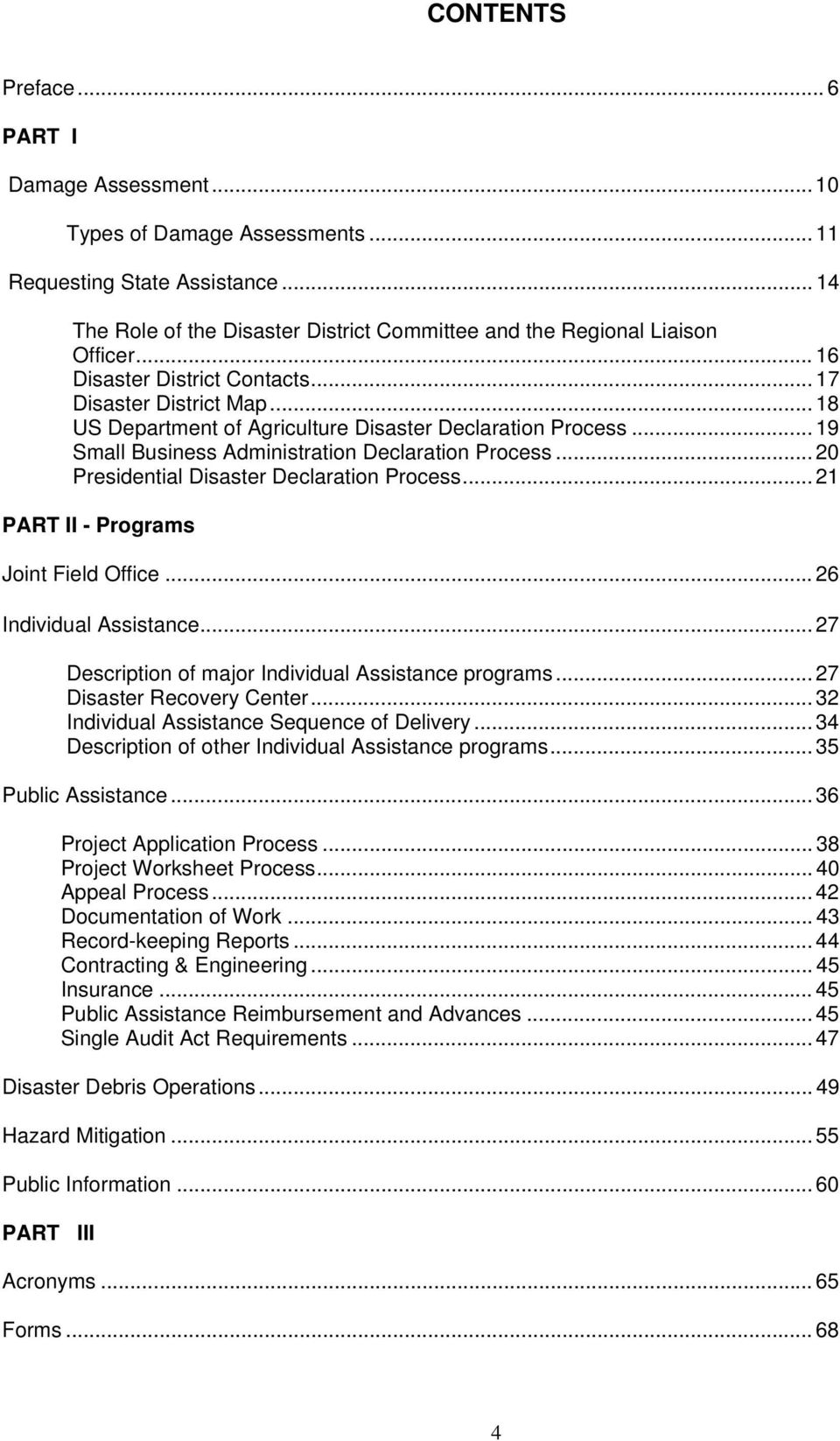
5 CONTENTS Preface... 6 PART I Damage Assessment...10 Types of Damage Assessments Requesting State Assistance The Role of the Disaster District Committee and the Regional Liaison Officer Disaster District Contacts Disaster District Map US Department of Agriculture Disaster Declaration Process Small Business Administration Declaration Process Presidential Disaster Declaration Process PART II - Programs Joint Field Office Individual Assistance Description of major Individual Assistance programs Disaster Recovery Center Individual Assistance Sequence of Delivery Description of other Individual Assistance programs Public Assistance Project Application Process Project Worksheet Process Appeal Process Documentation of Work Record-keeping Reports Contracting & Engineering Insurance Public Assistance Reimbursement and Advances Single Audit Act Requirements Disaster Debris Operations Hazard Mitigation Public Information...60 PART III Acronyms Forms
6 This page has been intentionally left blank. 5

7 PREFACE This manual provides public officials in the State of Texas with information about the process, procedures, and programs necessary for a smooth, effective recovery following a disaster. While the subject of disaster recovery on the surface may seem clean and simple, it is extremely complex. It seems to become more complicated as one becomes more involved. Many public officials learn this too late. This can cause individuals, businesses or governmental agencies to lose benefits to which they may be entitled as a result of a slow and inefficient recovery process. Normally when people talk about disaster activities they talk about preparedness and response. While there is much that goes on in the preparedness and response phases there is much more to the Emergency Management cycle than simply these two activities. Two equally important phases are recovery and mitigation. This manual primarily focuses upon the recovery phase. A community leader should be familiar with the desires of the citizens and be active in the local planning and development process. It necessarily follows that local government officials should have an updated recovery plan immediately available should a disaster strike. While a community will eventually recover from a disaster regardless of the effort applied by community leaders, the quality of the recovery will be directly proportional to the planning process. In other words, no planning means an unorganized, expensive, time-consuming, and frustrating recovery experience; advanced, quality planning means an organized, well-orchestrated recovery in which one can obtain maximum assistance. Although this manual is intended for city and county government officials, we encourage private individuals, businesses, and other organizations that may be impacted by a disaster to refer to it for disaster recovery information as well. It can also serve as a handout and study guide for students, conferees, emergency management coordinators and floodplain administrators. You should read and study the manual. If you have not made recovery plans, start today. If you have a plan, review it and consider revising it to reflect any new information you may obtain. 6

8 This page has been intentionally left blank. 7

9 PART I 8

10 This page has been intentionally left blank. 9

11 DAMAGE ASSESSMENT The damage assessment process is the mechanism used to determine the impact and magnitude of a disaster, the resulting unmet needs of individuals, businesses and the public sector as well as the appropriate type and amount of assistance that is needed. The responsibility for this initial assessment rests with the Mayor or County Judge of the appropriate jurisdiction. The Emergency Management Coordinator (EMC), appointed by the Mayor or County Judge, should take the lead in compiling the data and coordinate inputs for all departments. To assist in this process, the EMC may want to contact the Governor s Division of Emergency Management (GDEM) Regional Liaison Officer (RLO) in your area (see pages 17-18). The importance of the initial local assessment cannot be over emphasized. Since speed and accuracy are essential in obtaining the maximum amount of help in the shortest amount of time, established workable procedures and trained personnel should be in place beforehand. This should begin with a team of personnel trained in damage assessment. Team Members to be considered: City/County engineers, commissioners, department heads such as public works, utilities, etc, for evaluating debris clearance, public health and protective measure issues and road and street system damage. Building inspectors, tax assessor and/or lending institutions for evaluating damages to buildings, mobile/modular homes and businesses. Red Cross representatives to address those needing immediate assistance. Hospital administrators or county health officials for providing information on fatalities, injuries, community health, etc. School district superintendents or school principals to provide school damage information. County Agents for farm and ranch damage information. Those in charge of levees, drainage systems, electric cooperatives and other non-profit and government service facilities (i.e. state agencies, river authorities, etc.) The following pages contain suggested assessment/survey forms to use in the collection of damage information. They are designed to give you an understanding of what damage assessment form(s) to use and when to use them. It is important to understand the different types of damage assessments and their general characteristics. 10

12 TYPES OF DAMAGE ASSESSMENT RAPID ASSESSMENT Immediately following an event, local government first responders are normally the ones to provide an initial snapshot of the situation. As emergency calls come in and the response phase begins, the general location and the severity of damage becomes known. This initial assessment is commonly referred to as a rapid assessment and basically paints a footprint of the affected area. The focus of the rapid assessment is normally limited to evaluating the following humanitarian and emergency needs/activities; Life safety (i.e. search and rescue, injuries and fatalities, mass care, hazardous material) Life lines ( i.e. utilities and transportation systems) Critical facilities (i.e. medical, emergency, communication facilities/services) WINDSHIELD ASSESSMENT Soon after these immediate needs have been addressed, or at least identified and access into the area is possible (i.e. the debris has been cleared or the water has receded), a more detailed assessment is made to actually determine the extent of damage to residential property, businesses and public property. This assessment is commonly referred to as a windshield assessment. Team members should give priority to assessing residential property damage. For this purpose, the Residential Windshield Assessment Form (page 70) is provided. This form categorizes damage by the type of residential property, the relative income of the residents, the severity of damage, and the estimated insurance coverage. This form is designed as a tally or "tick" sheet. Recording damage is done by simply making a mark in the appropriate box which best categorizes the damage. To aid you in making consistent determinations as to the extent of damage, the back of the form (page 71) has a general description of each damage category. At a minimum, a separate Windshield Assessment Form should be completed for each governmental entity. For example, one form should be completed for the unincorporated area of a county and one should be completed for each city that sustained damage. Given a large geographic area, several forms may be needed for a single jurisdiction. It is important to remember that since no address is being recorded, windshield assessment team assignments and travel routes should be made so as not to duplicate the damage count. As an example, cities should report damages to the county and the county should report total county damages to the RLO and their Disaster District who will in turn forward it to the State Operations Center (SOC). This is normally the second biggest error local governments can make when conducting a windshield assessment. The biggest error is incorrectly categorizing damages. A windshield assessment can normally begin within hours of the event but may take several days to complete depending upon the extent of damage, accessibility, and the number of assessment teams available. A key element that distinguishes a rapid assessment from a windshield assessment is consideration of insurance coverage. Estimating the amount of insurance coverage during a windshield assessment can be done by determining the income level of the residential area, the type of residential property, and by talking to disaster victims as part of the assessment. Note that by simply asking disaster victims about insurance coverage, you are not inquiring as to the extent of coverage but rather if they have the appropriate type of insurance. Given a flood 11

13 disaster, the local government's floodplain administrator should be able to assist in determining whether the impacted area is located in the Special Flood Hazard Area (SFHA). They also should provide the number of the National Flood Insurance Program (NFIP) insurance policies in effect. The following are general guidelines to estimating insurance coverage: Renters are less likely to have insurance. Low-income residents are less likely to have insurance. Homeowners who are still paying off their mortgage will normally have the appropriate type of insurance. Residents who are flooded and reside in an area that does not participate in the NFIP or in an area that has been sanctioned for NFIP code enforcement violations generally will not have flood insurance. Residents who are flooded, but whose property is not located in the SFHA, will probably not have flood insurance. SITE ASSESSMENT Finally, in order to gather the most specific damage assessment information, local governments may be required to conduct a detailed site assessment of the damaged areas This type of assessment helps to determine if an area may qualify for US Small Business Administration (SBA) Disaster Assistance and/or public property assistance. For this type of assessment, the forms titled, Site Assessment-Housing Losses (Page 72), Site Assessment-Business Losses (Page 74), and the Public Property site assessment worksheet (Page 76), can be used. These forms are either self-explanatory or have instructions on the back. Please note, the information is much more specific and requires a visit with each home or business owner affected or a visit to each public property damage site. This assessment is more time consuming and may take several days or even weeks to complete. PUBLIC PROPERTY DAMAGE If a local request for public property assistance is submitted, it may be some time after the disaster before a State or a State and Federal assessment team is dispatched to your area. In the interim, emergency work may need to be conducted. The question becomes - how do you record these expenditures? The best way is to establish a separate folder for each work activity that must be accomplished immediately after the disaster. For example, a community has a washout on three streets that must be repaired right away. Set up three separate folders (one for each street), not one folder for all streets. If there is damage to several buildings, and repairs have started (i.e. repairing roofs to prevent further rain damage), set up a folder for each building. In other words, set up a folder for each individual item of work activity, based upon the seven eligible categories of work (debris clearance, protective measures, road systems, water control facilities, buildings & equipment, public utilities and other). To assist you in tracking these costs, there are several types of suggested formats in the Forms section of this manual (Pages 85 through 104). Whether you use the suggested forms or your own record keeping system, the objective is to track what was done (by category), when it was done and how long (by day), where it was done (by specific job/site location), who was doing it (by name) and what materials (by quantity) and equipment (by hours or mileage) were used. 12

14 The general rule for the type of assessment needed is that the more catastrophic an event from a State or National perspective, the less likely a detailed assessment will be needed to qualify for State and/or Federal assistance. Conversely, the more marginal an event, the greater the need will be for a detailed assessment to be conducted in order to qualify for assistance. 13

15 REQUESTING STATE ASSISTANCE After a local damage assessment has been completed and all other pertinent information has been collected, an analysis of the situation needs to be made to determine if assistance is needed. The information collected should answer the following questions: 1. Is the damage primarily agricultural? If there is a need for agriculture assistance only, the County Judge needs to obtain a Flash Situation Report from the local Farm Service Agency (FSA) and submit a letter of request for agricultural assistance to the Governor. (See page 78) 2. Are uninsured damages and unmet needs of disaster victims beyond the capability of the local government, the American Red Cross (ARC), The Salvation Army (TSA), the Mennonite Disaster Service, and other local volunteer agencies? 3. Will the extent of damage to residential property require a significant and long-term need for temporary housing? 4. Are there significant uninsured business losses? Have business losses created a severe impact on jobs, production and/or revenue? 5. Does the jurisdiction s budget have sufficient funds to make needed repairs to Public Property? If not, can the jurisdiction re-prioritize non-disaster related projects and use those funds to recover? If a County Judge/Mayor determines that a situation is of such severity and magnitude that an effective response is beyond the affected jurisdiction's capability to recover, he/she must submit: a request letter to the Governor (page 79) a local State of Disaster Declaration (page 80) a Disaster Summary Outline (DSO) (page 82). The DSO is the standard method of reporting damage information to the GDEM. The DSO should be filled out completely and as quickly as possible after the disaster, preferably within ten (10) days. The Mayor/County Judges' letter should explain the situation and state that the damage is of such severity and magnitude that an effective response is beyond the capability of the City/County to recover, and that outside assistance is needed to alleviate hardship and suffering caused by the disaster. NOTE: In order to prevent duplication of damage reports, cities should send their request letter and DSO to the County Judge. The County Judge should combine all DSOs into one DSO for the entire county. (Federal disasters are declared by county.) The County Judge's request letter along with the DSO and local State of Disaster Declaration should be mailed/faxed to: The Honorable Governor of Texas c/o State Coordinator Governor s Division of Emergency Management P.O. Box 4087 Austin, Texas Fax (512) [Provide a copy to the appropriate Disaster District Committee (DDC) Office (page 17 and 18).] 14

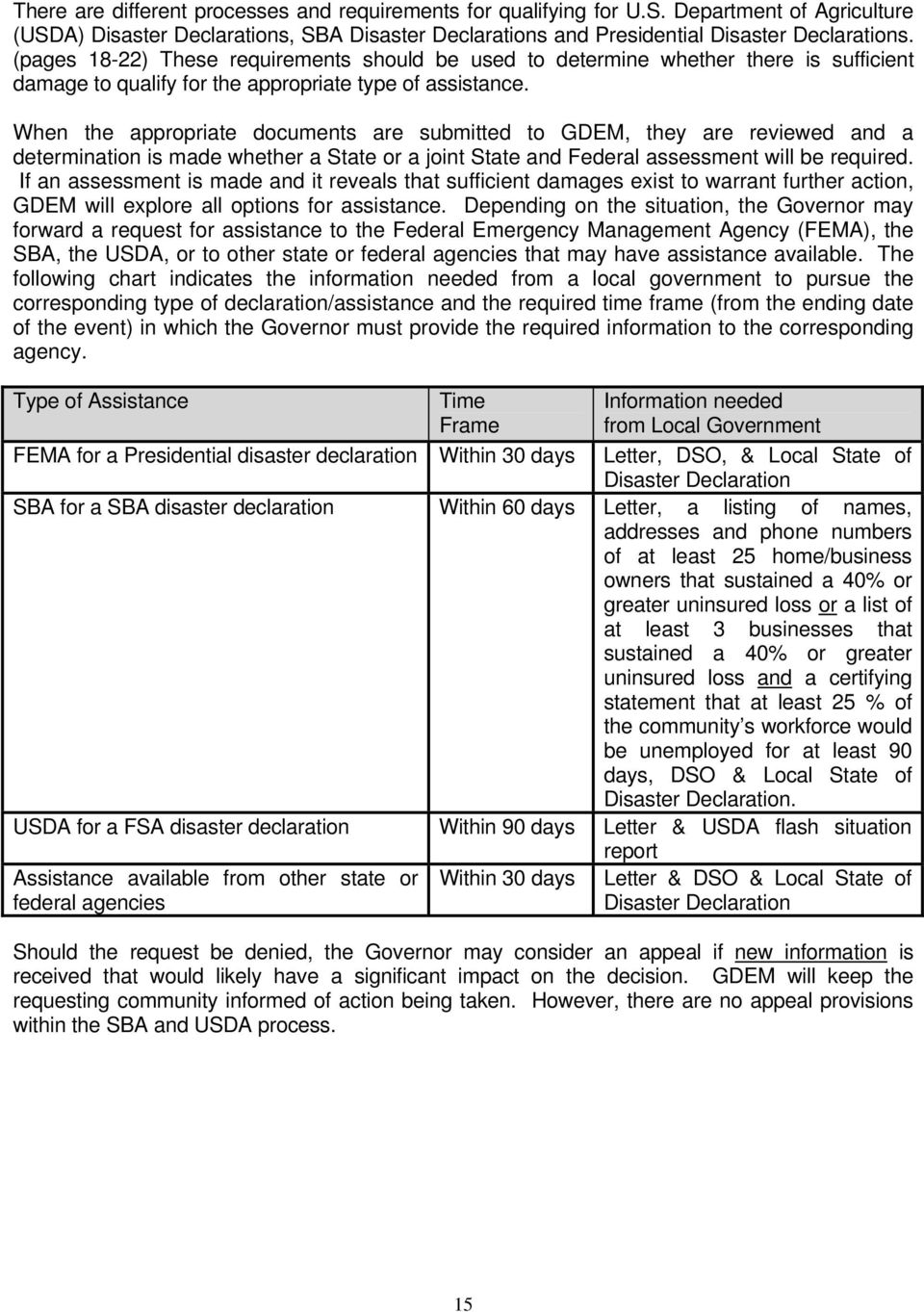
16 There are different processes and requirements for qualifying for U.S. Department of Agriculture (USDA) Disaster Declarations, SBA Disaster Declarations and Presidential Disaster Declarations. (pages 18-22) These requirements should be used to determine whether there is sufficient damage to qualify for the appropriate type of assistance. When the appropriate documents are submitted to GDEM, they are reviewed and a determination is made whether a State or a joint State and Federal assessment will be required. If an assessment is made and it reveals that sufficient damages exist to warrant further action, GDEM will explore all options for assistance. Depending on the situation, the Governor may forward a request for assistance to the Federal Emergency Management Agency (FEMA), the SBA, the USDA, or to other state or federal agencies that may have assistance available. The following chart indicates the information needed from a local government to pursue the corresponding type of declaration/assistance and the required time frame (from the ending date of the event) in which the Governor must provide the required information to the corresponding agency. Type of Assistance Time Frame Information needed from Local Government FEMA for a Presidential disaster declaration Within 30 days Letter, DSO, & Local State of Disaster Declaration SBA for a SBA disaster declaration Within 60 days Letter, a listing of names, addresses and phone numbers of at least 25 home/business owners that sustained a 40% or greater uninsured loss or a list of at least 3 businesses that sustained a 40% or greater uninsured loss and a certifying statement that at least 25 % of the community s workforce would be unemployed for at least 90 days, DSO & Local State of Disaster Declaration. USDA for a FSA disaster declaration Within 90 days Letter & USDA flash situation report Assistance available from other state or federal agencies Within 30 days Letter & DSO & Local State of Disaster Declaration Should the request be denied, the Governor may consider an appeal if new information is received that would likely have a significant impact on the decision. GDEM will keep the requesting community informed of action being taken. However, there are no appeal provisions within the SBA and USDA process. 15
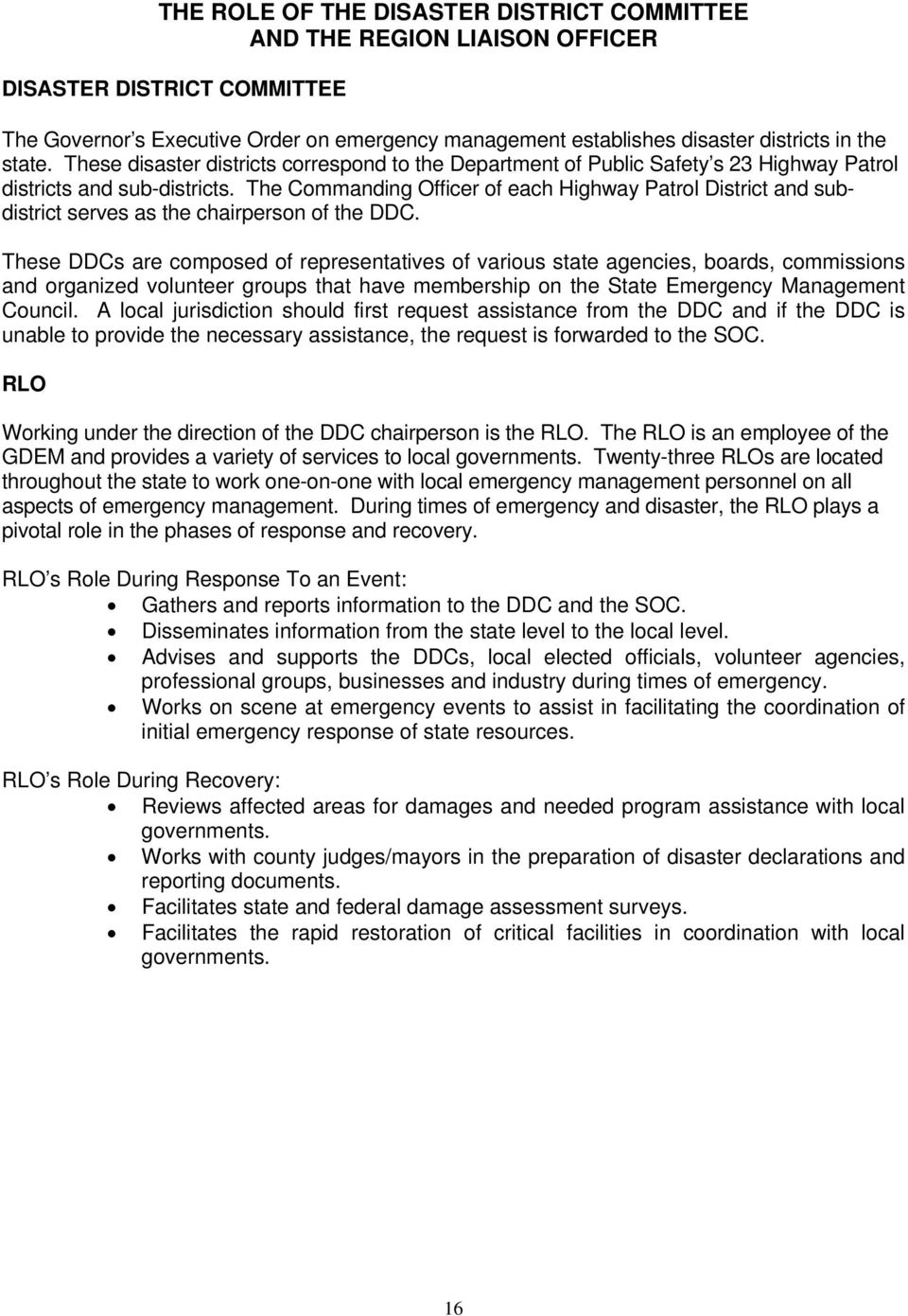
17 THE ROLE OF THE DISASTER DISTRICT COMMITTEE AND THE REGION LIAISON OFFICER DISASTER DISTRICT COMMITTEE The Governor s Executive Order on emergency management establishes disaster districts in the state. These disaster districts correspond to the Department of Public Safety s 23 Highway Patrol districts and sub-districts. The Commanding Officer of each Highway Patrol District and subdistrict serves as the chairperson of the DDC. These DDCs are composed of representatives of various state agencies, boards, commissions and organized volunteer groups that have membership on the State Emergency Management Council. A local jurisdiction should first request assistance from the DDC and if the DDC is unable to provide the necessary assistance, the request is forwarded to the SOC. RLO Working under the direction of the DDC chairperson is the RLO. The RLO is an employee of the GDEM and provides a variety of services to local governments. Twenty-three RLOs are located throughout the state to work one-on-one with local emergency management personnel on all aspects of emergency management. During times of emergency and disaster, the RLO plays a pivotal role in the phases of response and recovery. RLO s Role During Response To an Event: Gathers and reports information to the DDC and the SOC. Disseminates information from the state level to the local level. Advises and supports the DDCs, local elected officials, volunteer agencies, professional groups, businesses and industry during times of emergency. Works on scene at emergency events to assist in facilitating the coordination of initial emergency response of state resources. RLO s Role During Recovery: Reviews affected areas for damages and needed program assistance with local governments. Works with county judges/mayors in the preparation of disaster declarations and reporting documents. Facilitates state and federal damage assessment surveys. Facilitates the rapid restoration of critical facilities in coordination with local governments. 16
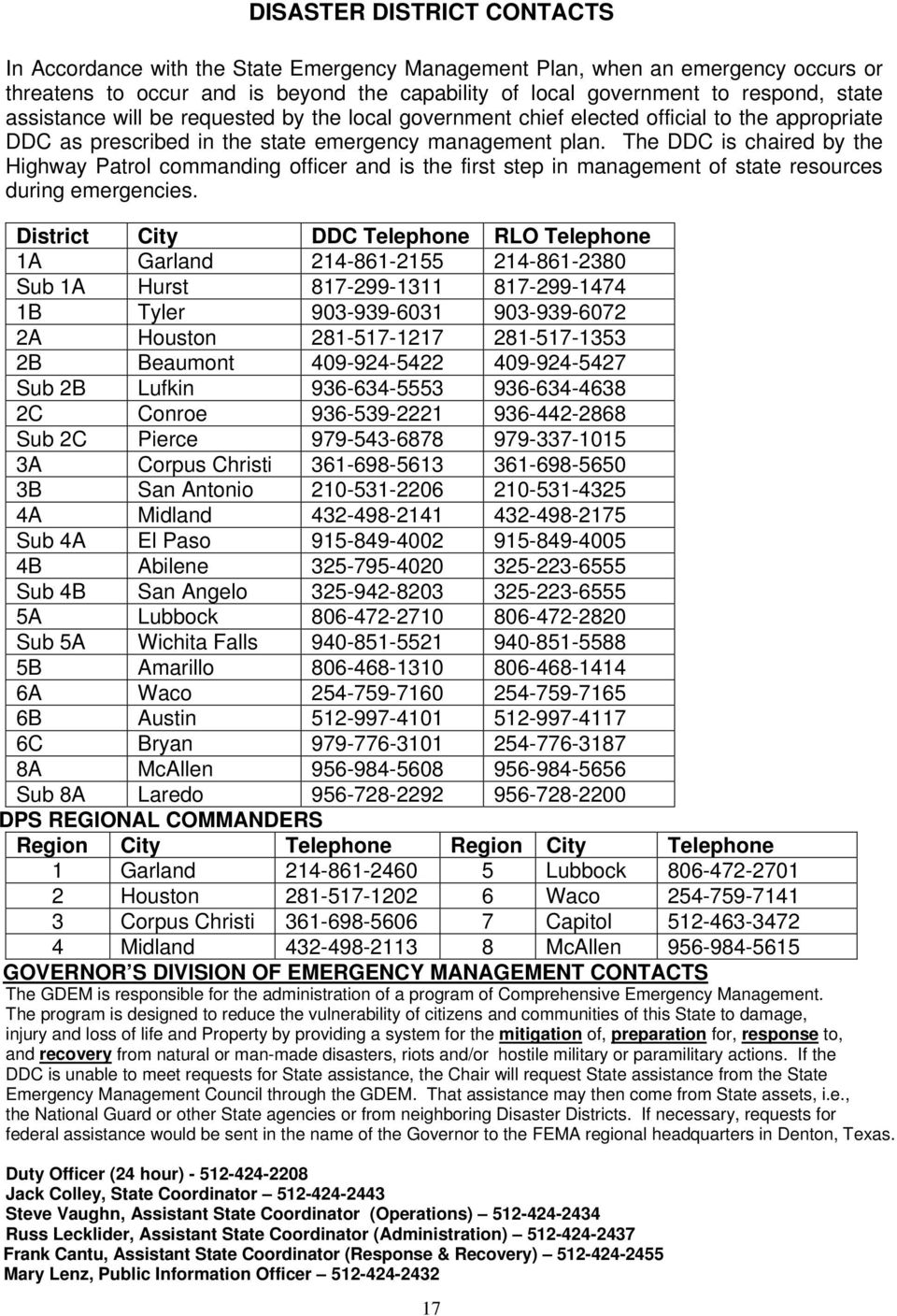
18 DISASTER DISTRICT CONTACTS In Accordance with the State Emergency Management Plan, when an emergency occurs or threatens to occur and is beyond the capability of local government to respond, state assistance will be requested by the local government chief elected official to the appropriate DDC as prescribed in the state emergency management plan. The DDC is chaired by the Highway Patrol commanding officer and is the first step in management of state resources during emergencies. District City DDC Telephone RLO Telephone 1A Garland Sub 1A Hurst B Tyler A Houston B Beaumont Sub 2B Lufkin C Conroe Sub 2C Pierce A Corpus Christi B San Antonio A Midland Sub 4A El Paso B Abilene Sub 4B San Angelo A Lubbock Sub 5A Wichita Falls B Amarillo A Waco B Austin C Bryan A McAllen Sub 8A Laredo DPS REGIONAL COMMANDERS Region City Telephone Region City Telephone 1 Garland Lubbock Houston Waco Corpus Christi Capitol Midland McAllen GOVERNOR S DIVISION OF EMERGENCY MANAGEMENT CONTACTS The GDEM is responsible for the administration of a program of Comprehensive Emergency Management. The program is designed to reduce the vulnerability of citizens and communities of this State to damage, injury and loss of life and Property by providing a system for the mitigation of, preparation for, response to, and recovery from natural or man-made disasters, riots and/or hostile military or paramilitary actions. If the DDC is unable to meet requests for State assistance, the Chair will request State assistance from the State Emergency Management Council through the GDEM. That assistance may then come from State assets, i.e., the National Guard or other State agencies or from neighboring Disaster Districts. If necessary, requests for federal assistance would be sent in the name of the Governor to the FEMA regional headquarters in Denton, Texas. Duty Officer (24 hour) Jack Colley, State Coordinator Steve Vaughn, Assistant State Coordinator (Operations) Russ Lecklider, Assistant State Coordinator (Administration) Frank Cantu, Assistant State Coordinator (Response & Recovery) Mary Lenz, Public Information Officer
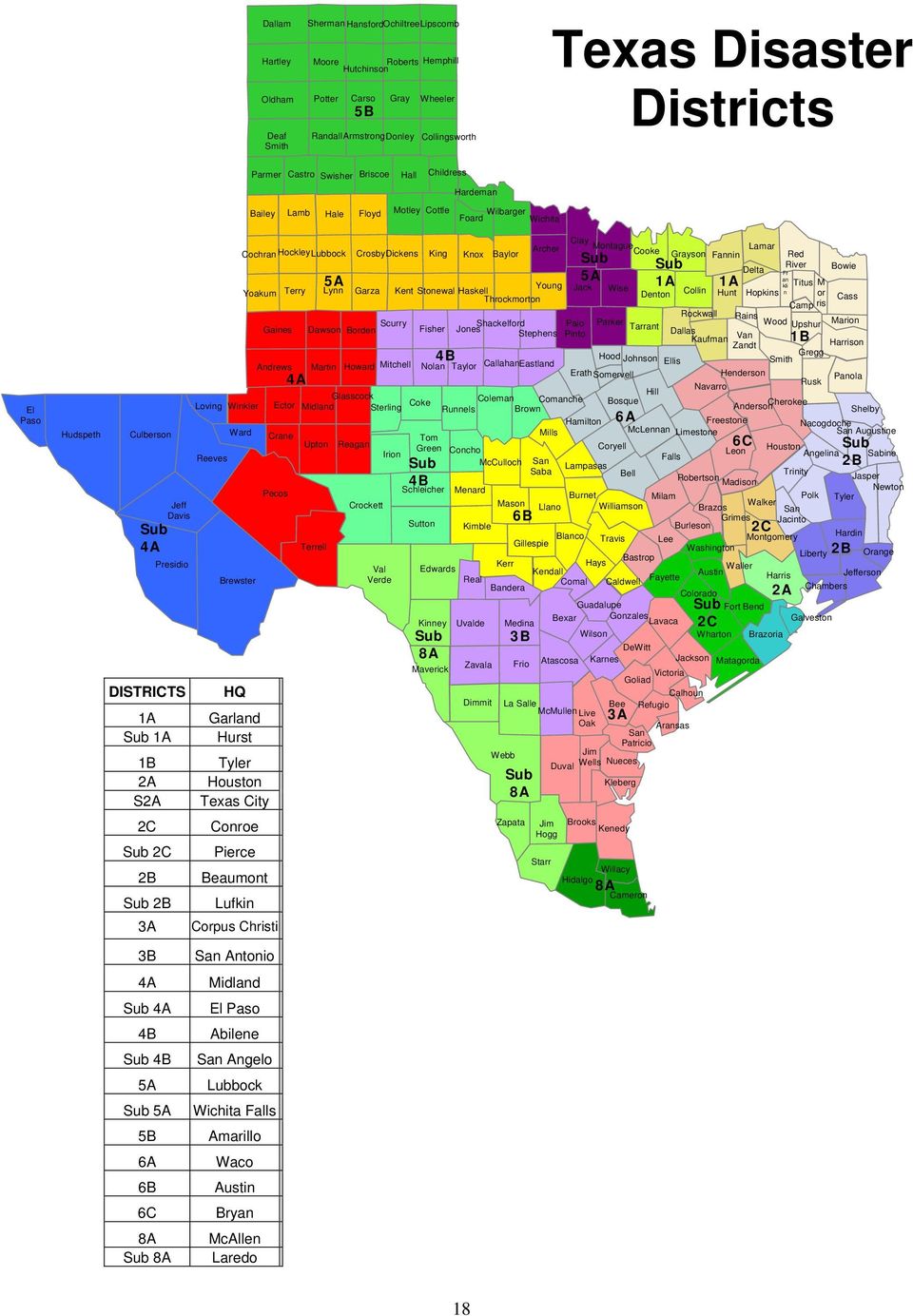
19 18 DISTRICTS HQ 1A Garland Sub 1A Hurst 1B Tyler 2A Houston S2A Texas City 2C Conroe Sub 2C Pierce 2B Beaumont Sub 2B Lufkin 3A Corpus Christi 3B San Antonio 4A Midland Sub 4A El Paso 4B Abilene Sub 4B San Angelo 5A Lubbock Sub 5A Wichita Falls 5B Amarillo 6A Waco 6B Austin 6C Bryan 8A McAllen Sub 8A Laredo Dallam Lipscomb Moore Hemphill Potter Gray Parmer Cochran Yoakum Hall Hale Motley Lubbock Dickens Andrews King Terry Sherman Hansford Ochiltree Hutchinson Wheeler Randall Armstrong Donley Castro Briscoe Childress Cottle Hardeman Foard Hartley Roberts Oldham Carso Deaf Smith Collingsworth Bailey Swisher Lamb Floyd Hockley Crosby Gaines Knox Lynn Garza Kent Stonewal El Paso Hudspeth Culberson Jeff Davis Reeves Loving Winkler Ward Ector Dawson Martin Zavala Uvalde Kinney Edwards Val Verde Presidio Brewster McMullen La Salle Dimmit Jim Wells Webb Brooks Kenedy Starr Hidalgo Willacy Cameron Bowie Cass Camp Titus Fr an kli n M or ris Rains Marion Kaufman Harrison Panola Gregg Rusk Bell Williamson Milam Sabine Trinity Upshur Wood Van Zandt Navarro Hill Cherokee Freestone McLennan Falls Shelby Nacogdoche San Augustine Jasper Jefferson Tyler Walker Polk Robertson Madison Brazos Hardin San Jacinto Grimes Liberty Chambers Montgomery Burleson Lee Ellis Goliad Bee Live Oak Maverick Refugio Nueces San Patricio Kleberg Duval Zapata Jim Hogg Smith Henderson Anderson Leon Limestone Travis Hays Comal Houston Angelina Newton Orange Cooke Grayson Fannin Collin Denton Hunt Lamar Delta Hopkins Dallas Red River Rockwall Nolan Baylor Jones Shackelford Stephens Archer Young Taylor Fisher Haskell Throckmorton Callahan Eastland Howard Borden Parker Erath Palo Pinto Montague Clay Wichita Wilbarger Wise Jack Upton Brown Coleman Runnels Coke Sterling Glasscock Midland Crane Menard McCulloch Concho Sutton Schleicher Tom Green Crockett Pecos Irion Reagan Comanche Hood Bosque Somervell Hamilton Kimble Mason Mills San Saba Blanco Burnet Lampasas Johnson Gillespie Terrell Llano Coryell Tarrant Washington Fayette Lavaca Jackson Wharton Colorado Austin Fort Bend Brazoria Harris Bastrop Matagorda Kerr Real Bexar Wilson Karnes Caldwell Guadalupe Gonzales DeWitt Waller Calhoun Victoria Kendall Atascosa Frio Medina Bandera Galveston Aransas Scurry Mitchell Sub 2B 5B 5A 4A 4B Sub 4A Sub 4B 6B 3B Sub 8A 3A 8A Sub 2C 6A Sub 5A Sub 1A 1A 1B 6C 2C 2A 2B Texas Disaster Districts Sub 8A
20 USDA DISASTER DECLARATION PROCESS Incident Occurs. The County Judge sends a letter of request (page 78) and a Flash Situation Report to the Governor asking for an Agricultural disaster declaration. Farm Service Agency (FSA) prepares a Flash Situation Report that summarizes the damage. If warranted, the Governor will request USDA assistance from the U.S. Secretary of Agriculture. The FSA prepares a Damage Assessment Report (DAR) outlining the extent of agricultural losses and submits the report to USDA for determination. or or The FSA Administrator can designate a county for physical losses only. The Secretary of Agriculture decides whether the request for a declaration should be granted. Approved Only EM Physical Loss Loans implemented Approved EM Loans implemented Denied There is no Appeal process. A USDA declaration may be approved as a result of a natural disaster within a county if, a request is made within 90 days of the incident, the incident is weather-related, and: there is at least 30% county-wide production loss of crops A USDA declaration will result in the implementation of the Emergency Loan (EM) Program through the FSA. This program enables eligible farmers and ranchers in the affected county as well as contiguous counties to apply for low interest loans. A USDA declaration will automatically follow a Presidential declaration for counties designated major disaster areas and those counties that are contiguous to a declared county - including counties that are across state lines. As part of an agreement with the USDA, the SBA offers low interest loans for eligible businesses that suffered economic losses in declared and contiguous counties that have been declared by the Secretary of Agriculture. These loans are referred to as Economic Injury Disaster Loans (EIDL). In situations involving serious physical losses, the FSA Administrator may also designate a county a disaster area, but only for physical loss loans. A sample letter for requesting USDA assistance can be found on page

21 SBA S DISASTER DECLARATION PROCESS Incident Occurs. Local government assesses the damage and their capability to recover. The Governor includes SBA assistance in a request for a Presidential disaster declaration. The County Judge/Mayor sends a letter of request (page 79) to the Governor with a list of 25 homes/businesses that sustained a 40% or greater uninsured loss or a list of 3 businesses who sustained a 40% or greater uninsured loss and certifies that at least 25% of the community s workforce would be unemployed for at least 90 days. If the Presidential disaster declaration is denied, the Governor may refer the request to the SBA Administrator. State and local representatives assess the damage. SBA, state and local representatives assess the damage. If warranted, the Governor will request assistance from the SBA Administrator. SBA staff determine whether the declaration criteria has been met and recommends a course of action to the SBA Administrator. A SBA declaration may be approved for a county as a result of disaster-related damage if: at least 25 homes and/or businesses have sustained uninsured losses of at least 40 percent of their replacement value or at least 3 businesses have sustained uninsured losses of at least 40 percent of their replacement value and, as a direct result of the disaster, at least 25 percent of the workforce in the community would be unemployed for at least 90 days. To determine the extent of damage, SBA, state and local officials jointly conduct assessments in the affected counties following the Governor s request. If the Governor has requested a Presidential disaster declaration for Individual Assistance (IA), SBA s policy is to suspend action on a request it receives until the President has made a decision on the Governor s request. The following is a list of other situations when SBA assistance may be available: In the event of a Presidential disaster declaration, the declared county is eligible to apply for Physical Disaster Loans and EIDL through the SBA. Contiguous counties may apply for EIDL only. In the event of an SBA only declaration, the declared county as well as the contiguous counties, are eligible for both Physical Loss and EIDL. In the event of a USDA Secretarial Declaration, the declared county, as well as any contiguous counties, are eligible to apply for EIDL only. A sample letter for requesting disaster assistance can be found on page The SBA Administrator determines whether to grant or deny the gubernatorial request. SBA has no formal appeal process.
22 PRESIDENTIAL DISASTER DECLARATION PROCESS The Robert T. Stafford Disaster Relief and Emergency Assistance Act, PL , as amended, authorizes the President to declare an emergency or major disaster in the state, if requested by the Governor, and to make federal assistance available to supplement state and local resources. Incident occurs. Local government assesses the damage and its capability to recover. Federal, state, and local government personnel conduct an on-site preliminary damage assessment (PDA). The FEMA Director recommends a course of action to the President based on the analysis. The County Judge/Mayor sends a letter of request (page 79) to the Governor certifying that the severity of the disaster is beyond the local government capability and provides a DSO (page 81). If warranted, the Governor requests assistance from the President, certifying that the severity of the disaster is beyond the state and local capability. The President determines whether to grant or deny the gubernatorial request. If damages appear to exceed state/local capability, the state contacts the FEMA regional office. FEMA regional personnel summarize the information collected during the PDA and send a recommendation to FEMA headquarters for further analysis. If denied, the Governor may appeal the decision within 30 days. The Act does not prescribe specific criteria to guide FEMA s recommendation or the President s decision. As a prerequisite to federal disaster assistance under the Act, the Governor must take appropriate response action and provide information on the nature and amount of state and local resources committed to alleviate the results of the disaster. The PDA is the mechanism used to determine the impact and magnitude of damage and the resulting unmet needs of individuals, businesses, the public sector, and the community as a whole. This information is used by GDEM in preparing the Governor s request and by FEMA in making a recommendation to the President as to whether assistance is warranted. The President then decides whether to approve the assistance requested and/or recommended. Generally, FEMA considers some or all of the following factors in making a recommendation to the President: The number of homes destroyed or sustaining major damage. The number of homes sustaining minor damage. The extent to which the damage is concentrated or dispersed. The estimated cost of repairing the damage. The demographics of the affected areas (e.g. income levels, unemployment, and concentrations of the elderly). 21
23 The extent to which the damage is covered by insurance. The extent to which the disaster area is traumatized. The extent of disaster-related unemployment. The level of assistance available from other federal agencies (e.g. SBA s home and business loans). The state and local governments capabilities for dealing with the disaster. The level of assistance available from voluntary organizations (e.g. the ARC). The availability of rental housing. The extent of health and safety problems. The extent of damage to facilities providing essential services (e.g. medical, utilities, police, etc.). A sample letter for requesting disaster assistance can be found on page
24 This page has been intentionally left blank. 23
25 PART II PROGRAMS 24
26 This page has been intentionally left blank. 25
27 JOINT FIELD OFFICE If a major disaster is declared by the President, a Joint Field Office (JFO) is established in the vicinity of the disaster area and serves as the field headquarters for disaster operations, direction, coordination and information. The Federal Coordinating Officer (FCO), who is appointed by the FEMA Director and the State Coordinating Officer (SCO), who is appointed by the Governor, and their support staff are in charge of the overall JFO operation. The JFO will function at the same location while the Individual and Public Assistance programs are being administered. The JFO also provides an operating location for other disaster related functions such as Public Information, Hazard Mitigation, NFIP, ARC, etc. This office operation differs from that of the Disaster Recovery Centers (DRC s) in that the DRC s are established to assist individual victims to understand the recovery process after they have registered for the assistance. The JFO is an administrative office. The organization of the JFO, like so many other aspects of disaster recovery, is not rigid and must remain flexible so that it may be adjusted to meet the needs of each disaster situation. Below is a typical JFO organizational chart. STATE FEDERAL JOINT FIELD OFFICE FEDERAL COORDINATING OFFICER STATE COORDINATING OFFICER Public Assistance Officer Program Administration Project Worksheet Individual Assistance Officer Other Housing Needs Housing Assistance Disaster Recovery Center Crisis Counseling Community Relations Public Information Officer Media Hazard Mitigation Small Business Administration Loans 26
28 INDIVIDUAL ASSISTANCE Individual Assistance (IA) is to help families, individuals, or owners of small businesses recover from the effects of a disaster. After a federal declaration, Individuals have the option of applying for disaster assistance over the telephone by calling FEMA National Teleregistration Center (NTC) at FEMA. That number also doubles as a helpline where individuals needing information on application status or other program information may call. Individuals should have the following information ready before calling: Name of applicant, names of other persons living at the damaged address, address of damaged residence, social security number, total family income, name of insurance company, proof of ownership, and phone number where applicant can be reached. DESCRIPTION OF INDIVIDUAL ASSISTANCE PROGRAMS Individuals and Households Program (IHP) a combined FEMA and State program that provides money to help people in the declared disaster area whose property has been damaged or destroyed and whose losses are not covered by insurance. The IHP is divided into two parts - Housing Assistance (HA) and Other Needs Assistance (ONA). Total IHP maximum amount to any individual is $26,200 (as of this printing). This amount will be adjusted annually according to the Consumer Price Index (CPI). 1. Housing Assistance (HA) Disaster related housing assistance for applicants displaced from their pre-disaster primary residences and/or whose pre-disaster residences are rendered uninhabitable, and who are under-insured or have no insurance to provide for their housing needs. a. Temporary Housing financial assistance for lodging expenses, rental assistance or direct assistance through mobile homes or travel trailers. b. Repairs - Provides financial assistance for repairs to make residence habitable limited funding 2. Other Needs Assistance (ONA) Disaster related assistance for other necessary expenses and serious needs. a. Medical and Dental Expenses assistance for disaster related illness or injury and repair/replacement of medical personal property. b. Funeral Expenses financial assistance for disaster related loss of life including funeral services and other related expenses. c. Personal Property financial assistance to repair or replace disaster damaged essential personal property items, limited to the following: clothing, household items, furnishings, appliances, computers, uniforms, school books, supplies required for educational purposes. Also tools or specialized or protective clothing/equipment required by an employer as a condition of employment. d. Transportation funds to repair or replace damaged or destroyed personal vehicles 27
29 SBA Disaster Loans e. Other Expenses - Moving and Storage assistance to move and store personal property to avoid additional disaster damage, including storing the property while disaster related repairs are made to the primary residence and returning the property back to the home. The following assistance is administered by the SBA and is available in a SBA only or major disaster declaration approved by the President. 1. Home/Personal Property Physical Disaster Loans. Loans are available to homeowners and renters to repair or replace disaster-related damage to primary residences and personal property. Up to $200,000 may be loaned to repair or replace disaster damaged primary residences and up to $40,000 may be loaned for the repair or replacement of disaster damaged personal property. The loan amount is limited to the amount of the uninsured, SBA verified loss, but may be increased by up to twenty percent, but not exceeding the maximum loan amount for mitigating devices. 2. Business Physical Disaster Loans. Loans are available to businesses and non-profit organizations of any size to repair or replace disaster damaged property owned by the business, including inventory, machinery, or equipment. Up to $1,500,000 may be loaned to repair or replace uninsured, SBA verified business loss. Within this limit, the loan may be increased up to twenty percent for approved mitigation activities. 3. Economic Injury Disaster Loans for Businesses (EIDL). Loans are available, to eligible small businesses and small non-farming agricultural cooperatives, for working capital to assist them through the disaster recovery period. A business need not have sustained physical loss as a result of the disaster. Loans are available only if the business or its owners cannot obtain this type of assistance from non-government sources. Up to $1,500,000 may be loaned for eligible economic needs. The total physical and economic injury loan to any one business entity, including affiliates, cannot exceed $1,500,000. In addition to those declarations listed above, EIDL loans are also available following an USDA Secretarial disaster declaration in both primary and contiguous counties. There are different interest rates and terms for these loans. The SBA determines the interest rate based upon the individual applicant s ability to recover from the disaster damages with their own resources or their ability to borrow through non-government sources. Loan terms may extend up to thirty years and are determined by the applicant s ability to repay the loan. For more information, contact the SBA at , or TDD Emergency Services - Voluntary organizations (e.g. the ARC, TSA, and Mennonite Disaster Services) and local private sources, provide disaster victims with assistance to meet their emergency needs. Whether declared or not, you may contact the State Voluntary Agency Liaison through the SOC at , to receive additional resource contacts. Such assistance may include, but is not limited to providing: 28
30 1) Immediate food, clothing, shelter, medical attention, and such items as false teeth, prescription medicines, eyeglasses, artificial limbs, etc. 2) Financial assistance for emergency home repair or replacement of essential household items. 3) Skilled and unskilled labor for debris removal and/or home repair and rehabilitation. Crisis Counseling Local mental health centers can provide referral services and short-term counseling for mental health problems caused or aggravated by the disaster. This program, which is administered by the Texas Department of State Health Services (DSHS), is available only under a major disaster declaration approved by the President. In non-declared events, this assistance may be provided by volunteer disaster relief organizations. Unemployment Assistance Disaster Unemployment Assistance (DUA) is a program, which provides unemployment benefits and re-employment services to individuals who have become unemployed because of major disaster. Individuals, such as migrant workers, who reside in this state but whose employment opportunities have been adversely affected by a disaster in another state may also be eligible for this assistance. In either case, this program, which is administered by the Texas Workforce Commission, is available only under a major disaster declaration approved by the President. The application period is 30 days from the declaration, with the benefit period starting with the week following the disaster incident or the date that the individual became unemployed, whichever is later. An individual is eligible for up to 26 weeks (from the date of declaration) of benefits, or until the individual becomes reemployed, whichever comes first. The individual usually must have been employed for a minimum of one week to become eligible for benefit payments. All entitlements to state unemployment insurance must be exhausted before the individual is eligible for DUA. Tax Assistance The Internal Revenue Service (IRS) provides counseling and assistance in the form of income tax refunds to disaster victims who filed income tax returns during the year of the disaster, by amendment to the previous year s return or by providing copies of previous years returns. Uninsured losses are deductible only to the extent they exceed 10 percent of the adjusted gross income. Also, county assessors may provide information of possible property tax relief. For more information, contact the IRS at and your county tax assessor. Insurance Services Insurance information and assistance can be provided by the State Department of Insurance (TDI) and the NFIP. Such assistance includes counseling on insurance problems, answering insurance questions as well as help with filing claims, settling claims, and securing flood insurance. For more information, contact the TDI at or the National Flood Insurance Office at ext
31 Farm Service Agency (FSA) EM Loans. Emergency Loans are available in counties that the President, the U.S. Secretary of Agriculture or the FSA Administrator designates as disaster areas. This assistance is also available in all counties contiguous to declared counties. These EM loans are for severe physical and/or production losses and may be used to repair or replace damaged or destroyed farm property or other expenses incurred or needed to continue farming operations. Loan eligibility is limited to an applicant who: Has suffered property damage or severe production losses from a natural disaster; Is a U.S. citizen or legal resident alien; Is an established farm, ranch, or aquaculture operator; Is unable to obtain credit elsewhere; Can provide adequate security; Can demonstrate adequate repayment ability; Has losses to crops that are not insurable under the Federal Crop Insurance Corporation. (Usually waived) Has training or farming experience. The loan limit is 80 percent of the sum of the calculated actual production loss and/or 100 percent of the actual physical loss, or $500,000, whichever is less, per borrower per each disaster declaration/designation. Loan repayment time is usually 1 to 7 years, but may be up to 20 years for production losses, and up to 30 years (40 years in special need situations) for physical losses to essential buildings and facilities. Legal Services Free legal counseling is usually provided by the Young Lawyers Division (YLD) of the American Bar Association to low-income persons for disaster-related issues. Assistance may include replacing legal documents, transferring titles, addressing contract problems, will probates, and insurance matters, etc. Other attorneys may also be available to provide this service. For more information, contact the State Bar Association at Social Security The Social Security Administration assists annuitants in making address changes to expedite check delivery and Social Security insurance payments and in applying for disability, death and survivor benefits. For more information, contact the Social Security Administration at Veterans Benefits The Veterans Administration (VA) representatives will record any necessary changes or assist with VA death benefits, pensions, insurance settlements, and adjustments to VAinsured home mortgages. For more information, contact the Veterans Administration at
32 Food Stamp Program Food coupons may be issued by the Texas Health & Human Service Commission (HHSC). This 30-day increment of food stamps is only administered when the ongoing food stamp program is unable to expeditiously handle the number of potentially eligible households who are affected by the disaster and are in need of emergency food assistance. Consumer Services The State Attorney General s Office provides counseling on consumer related problems, such as non availability of products and services needed for reconstruction, price gouging, and disreputable business concerns and practices. This service may involve coordination with insurance and/other consumer protection organizations. For more information, contact the Attorney General s Office at Aging Services Area Offices on Aging can provide transportation for the elderly to and from the Disaster Recovery Center (DRC) as well as information to the elderly population about applying for the various types of assistance. For more information, contact the Texas Department of Aging and Disability Services at
33 DISASTER RECOVERY CENTER (DRC) The opening of a DRC is a joint effort by the State and FEMA to provide technical assistance and provide status of assistance that is being requested by the individuals affected by the disaster. The DRC is set up in or near the area that received the worst damage. If the damage is wide spread or a large number of people need assistance, several DRC s may be established. Local government will be asked to identify potential locations and provide the necessary logistic support (tables, chairs, etc.) for a DRC. The DRC is staffed by federal and state government agency representatives and volunteer organizations, which offer information on resource available to people in the affected community. They are all placed in one facility so those applicants will have easy access to them and can check with each agency to determine what assistance may be available. City and county governments are encouraged to station a representative in any DRC they believe their citizens will visit. In addition, telephone lines will be available for disaster victims to apply directly to the NTC, for those who have not yet made an application. The site selection for the DRC is a joint state and local responsibility. The process will be accelerated if local officials will identify ahead of time, buildings with at least 4500 square feet of usable space, not in a flood-zone, which could serve as DRC. It would also be helpful if they would be able to locate on short notice, at least tables and chairs for use in the DRC. Personal comfort items such as air conditioning, heating, electricity, air circulation fans, water, restrooms, etc. should also be available. Other DRC related items to consider include: Communications in the way of telephones or two-way radios for coordination between the JFO and other DRCs. Local government representation to handle local government assistance questions and activities Transportation arrangements for victims who are not able to get to the center (check with community action agencies) Custodial support Emergency medical support Security personnel during operations and after closing Fire protection Bilingual support, if required Child care if practical Training and scheduling of staff personnel to assure full coverage of duty stations General office supplies Adequate parking space for peak periods Appropriate publicity through radio, television, newspaper and public notices DRC management will be jointly shared by a federal, state and local representatives. Each will be responsible for his or her respective DRC personnel. Individuals will enter the center, meet the receptionist, sign in, and proceed to the waiting area until there is an opening at the interview table. The applicant will be apprised of the various programs/services offered in the DRC. After the interview, if the applicant has questions, he/she may proceed to the appropriate program station for answers. 32
34 This page has been intentionally left blank. 33
35 Individual Assistance Sequence of Delivery for Presidential Disaster Declarations Voluntary Agencies Emergency Food, Shelter, Clothing, Medical Needs Insurance (Homeowner, NFIP) Applicants May Be Referred to any or all of the below FEMA Housing Assistance (HA) Not Income Dependent Can Receive Award in More than One Category Based on Eligibility* 1. Temporary Housing (Lodging Expenses, Rental Assistance; Direct: Mobile Homes / Trailers) 2. Repairs (Up to $5,200 maximum) 3. Replacement (Up to $10,500 maximum towards a new home) 4. Permanent Housing Construction Further housing assistance beyond the scope of FEMA s programs will be provided based on income Personal Property Income Dependent FEMA Screens Applicant s Income Referred for SBA Loan SBA Loan for Personal Property Low interest loans for owners or renters for up to $40,000 Not Eligible for SBA Loan FEMA/State Other Needs Assistance (ONA) -Personal Property -Transportation -Moving & Storage -Group Flood Insurance FEMA/State Other Needs Assistance (ONA) Not Income Dependent -Medical Expenses -Dental Expenses -Funeral Expenses -Other Disaster Created Needs Unmet Needs Voluntary Agencies to assist other needs If applicant has received the maximum amount* and there is still a need, FEMA refers the applicant to Voluntary Agencies SBA Loan for Real Property Homeowner loans up to $200,000 Unmet Needs Voluntary Agencies to assist with further Real Property needs if applicant is not eligible for a loan If applicant has received the maximum amount** or the need is not covered under ONA, FEMA refers the applicant to Voluntary Agencies Unmet Needs Voluntary Agencies to assist other needs *Category eligibility is based on a FEMA inspection conducted on the damaged property **Maximum Individual and Household Program (IHP) Amount (HA & ONA) is $26,200 (as of this printing) 34
36 SINGLE FAMILY HOME PROGRAM The HOME Program is administered by the Texas Department of Housing & Community Affairs (TDHCA) and is available regardless of whether or not the state requests a Presidential disaster declaration. The primary points concerning the program are listed below: Purpose: - Use of Funds All eligible activities must benefit low-income households, defined as households earning 80% or less of the Area Median Family Income (AMFI) for the area, as determined by the US Department of Housing and Urban Development (HUD). Eligibility - awards funds to local entities for distribution to individuals. - Local entities may apply for funds after the Governor has determined that a disaster has occurred and requested that the director of TDHCA make those funds available. - Only available to a Non-Participating Jurisdiction (non-pj)*. Terms - The maximum award is $500,000 per local entity - Repair costs may not be reimbursed after the fact. No repairs should be made prior to award being granted. Process - Request Application Guide from TDHCA Contact - TDHCA HOME Program (512) * A non-participating jurisdiction is defined as a jurisdiction that does not receive annual HUD funding. 35
37 PUBLIC ASSISTANCE Public Assistance (PA) is a reimbursement program which provides funding on a percentage basis to eligible applicants who have suffered damages as a result of a Presidentially declared disaster and whose damages are within a county authorized for PA. Funding under this program is limited to repairing/restoring damaged items/facilities to their pre-disaster condition and will only be provided once all other means of funding have been exhausted. This program is administered by the GDEM and is no less than 75% federally funded. Eligibility FEMA and the State determine if the applicant is eligible, if the facility is eligible, if the work is eligible and finally if the cost is eligible. All of these components must meet the eligibility criterion. The order in which eligibility is evaluated starts with applicant eligibility and ends with the eligibility of cost. Applicant Eligibility State agencies and local governments/governmental entities Private Non-Profit (PNP) organizations, which have an IRS, tax exemption letter or a State PNP certification (i.e. Articles/Certificate of Incorporation). Special utility districts must provide a copy of the Legislation, which grants the district taxing authority. Eligible PNP organizations must own or operate educational, utility, emergency, medical, custodial care or essential governmental service facilities. Governmental service facilities are defined as museums, zoos, community centers, libraries, homeless shelters, senior citizens centers, rehabilitation facilities, shelter workshops, and other facilities which provide a health and safety service of a governmental nature. All such facilities must be open to the general public. Indian tribes or authorized tribal organizations Facility Eligibility Must be the responsibility of an eligible applicant. Be located in a designated disaster area. Not be under the specific authority of another Federal agency. Be in active use at the time of the disaster. Work Eligibility Be required as the result of a major disaster event; Be located within a designated disaster area, and Be the legal responsibility of an eligible applicant 36
38 Cost Eligibility Be reasonable and necessary to accomplish the eligible work. Work must comply with federal, state and local laws and regulations, Insurance proceeds, salvage value and purchase discounts must be deducted from otherwise eligible costs. Categories of Work The PA program is administered at the JFO and consists of two main types of work: Emergency and Permanent. Usually Emergency Work is an activity done immediately after a disaster to save lives, protect and preserve property, public health and safety, and to provide essential public services. The two "Emergency" work categories are identified as categories "A" and "B" and include the following: A. Debris Clearance on public roads and streets including rights of way, public property, and private property in some cases. (See page 49 for further discussion on Disaster Debris Operations) B. Emergency Protective Measures taken before, during, and after a disaster to save lives, protect public health and safety, and protect improved public and private property. This can be overtime for public safety employees involved with barricading, sandbagging, and other protective measures, as well as the use of personnel and equipment used in rescue operations. Permanent Work is that work required restoring a damaged facility to its pre-disaster condition. The five "Permanent" work categories are identified as categories "C" through "G" and include the following: C. Road Systems (Roads, Bridges, Traffic Controls, Streets, Culverts, etc.) Damage to these facilities must be directly related to the disaster. It cannot be a pre-existing condition nor caused by an event after the official incident period. Repairs may be made when the estimated repair cost is less than the estimated replacement cost, unless the structure is damaged greater than 50%. If damage is greater than 50%, funding may be provided to replace the structure. Codes and standards that have been formally adopted and are in practice prior to project approval, can be eligible. Facilities funded by other federal agencies, such as the Federal Highway Administration (FHWA), are not eligible for permanent repair. D. Water Control Facilities (Dikes, Levees, Dams, Drainage Channels, and Irrigation Works). If the levee or dam meets the definition of a flood control facility and falls within the authority of the U. S. Army Corps of Engineers (USACE) or Natural Resource Conservation Service (NRCS), it is not eligible. E. Public Buildings and Equipment (Public buildings, Supplies or Inventory, Vehicle or other equipment, Transportation systems and Educational facilities). Buildings may be restored to pre-disaster design capacity in accordance with existing codes and standards. The building must have been in active use at the time of the disaster. If there is an existing insurance policy for any damaged facilities, insurance will become the primary reimbursement source. Uninsured losses are eligible, however, an insurance policy will be 37
39 required in the amount of the damages to cover future losses. Repair costs for flood damages to buildings and/or contents within the 100-year flood zone will be reduced by the amount that would have been available from a standard NFIP flood policy whether or not an actual policy existed. F. Public Utility Systems (Water, Electric, Gas, Sanitary Sewage, Storm Water Drainage). Cleaning of disaster related debris from sewer lines is eligible only when necessary to restore adequate functioning of the system in specific reaches when the pre-existing condition can be established. Visual evidence of ground subsidence indicating infiltration into sewage pipes must be present. Limited video inspection is eligible when damage is apparent. Use of video inspection to search for damages is not eligible. Loss of revenue is not an eligible expense. G. Other (Parks, Airports, Recreation facilities, etc.) Trees and other plantings are not an eligible item. Grass, seeding and sod are eligible only when necessary to stabilize slopes and minimize sediment runoff. Grass, seeding and sod are not eligible for cosmetic purposes. All structures and damage sites within a park may be included as a single project if repair or contract is being handled in that manner. They can be claimed separately, if desired. For beaches to be eligible, the beach must have been improved and regularly maintained prior to the disaster and documentation supporting the maintenance must be provided. PROJECT APPLICATION PROCESS Applicant s Briefing Once a designated area has been approved for PA, a publicized Applicant's Briefing will be conducted by the GDEM s Recovery Staff to cover the general aspects of the program. The number of briefings are determined by the number of potential applicants and the area involved in the disaster. All potential applicants in the declared county should send a representative to the meeting. The individual attending the meeting should be qualified to speak on behalf of the local government/organization he/she is representing. Other Federal Agencies For certain types of facilities, disaster assistance is the responsibility of a federal agency other than FEMA. When a request is made for public assistance for a facility whose repair FEMA considers to be within the authority of another federal agency, the specific federal agency with responsibility will be asked to review the request and advise FEMA whether the work is eligible under that agency s authority. US Army Corps of Engineers (USACE). The USACE has a continuing authority to conduct emergency repair and permanent restoration of damaged flood control works. Flood control works are those facilities constructed for the purpose of eliminating or reducing the threat of flooding. Department of Agriculture Natural Resources Conservation Service (NRCS). Under the Emergency Watershed Protection Program, the NRCS has authority for the repair of flood control works that are similar to that of the USACE. Because of these overlapping authorities, the two agencies have a memorandum of 38
40 understanding that provides guidance in dividing responsibilities when disasters occur. The NRCS authority applies to drainage basins of 400 square miles or less. The NRCS also has authority for debris removal from natural streams when the debris creates a flood threat to lives and property by blocking the flow of water. Federal Highway Administration (FHWA). The FHWA administers the emergency Relief Program to assist state and local governments with the repair of federal-aid roads and bridges damaged during disasters. Funds for this program are used for facilities on routes identified by the FHWA. They include most public roads functionally classified as arterial and collector routes. Department of Housing and Urban Development (HUD). When a public housing authority is determined to be an eligible applicant, disaster assistance may be available from both FEMA and HUD. Public Housing Authorities that do not qualify for assistance under the Housing Act of 1937 may apply directly to FEMA for permanent restoration work. The following are a list of steps which an applicant needs to be aware of in the PA process: 1. The Request for Public Assistance (RPA), (FEMA form 90-49)(page 86) is the initial document submitted by an applicant indicating an intention of filing for federal assistance under a PA disaster declaration (F-1). This form establishes an initial point of contact. The applicant will be required to submit an RPA within 30 days from the date their county was approved for PA. RPAs that are submitted after this 30-day period will be reviewed on a case by case basis and, if warranted will be forwarded to FEMA for program consideration. If necessary, GDEM may request that the deadline for filing RPAs be extended. Once this document is submitted, the Project Worksheets (PW) (FEMA form 90-90) process will begin. 2. The Designation of Applicant's Agent form (page 88) should be completed and submitted by the applicant as soon as possible after the RPA has been filed. An applicant's Chief (Elected/Executive) Official will be required to designate agents in writing who will be the applicant's point of contact (primary and secondary) for all matters pertaining to their application for federal assistance. The applicant's agent must arrange for a local representative to show the State/Federal inspection team the damaged areas for the purpose of recording this information on the PW. Until an agent is appointed, the Chief (Elected/Executive) Official of the eligible organization will be designated as the applicant's agent. Reimbursement of applicant expenses cannot occur until this form is completed and submitted. 3. A Direct Deposit Authorization (Act-52) form should be completed and submitted by the applicant as soon as possible after the RPA has been filed. This form will allow the GDEM to deposit payments directly into the applicant s bank account. Reimbursement of applicant expenses cannot occur until this form is completed and submitted. 4. Applicants need to be able to provide cost-effective proposals to prevent or reduce the threat of future damages (hazard mitigation) to a facility. The costs of eligible hazard mitigation measures will be included in the overall funding of a project. In some cases, FEMA may require mitigation measures as a part of an approved project. 39
41 5. After the PWs have been written, reviewed and approved by FEMA, they are given to the GDEM for completion and distribution. 6.. An appointment with the applicant's agent will be scheduled in order to sign the grant application, review all pertinent program requirements (i.e. completion dates/extension, record keeping, project completion and certification), and initiate the funding process. 7. Once all the approved work has been completed, the applicant's agent will file a Project Completion and Certification Report (P4) with GDEM. This report is provided to the applicant as part of the project application. The applicant will have to indicate the amount expended on each project and the date that it was completed. Once the required information is provided, the applicant's agent will sign the report certifying that all the work was completed in accordance with the grant conditions. THE PROJECT WORKSHEET PROCESS The heart of the PA system is the PW (FEMA form 90-91). Once a RPA is filed, the PW process begins. Shortly after the receipt of an applicant s RPA, the Public Assistance Coordinator (PAC), project officer and state liaison will contact the applicant to schedule a Kickoff Meeting. This meeting differs from the Applicant s Briefing conducted by the State at the onset of disaster operations. Whereas the Applicants Briefing describes the application process and gives a general overview of the PA Program, the Kickoff Meeting is designed to provide a much more detailed review of the PA Program. The meeting is the first step in establishing a partnership with the applicant and is designed to focus on the specific needs of that applicant. The PAC also discusses Special Considerations, such as floodplain management, insurance, hazard mitigation opportunities, and compliance with environmental and historic preservation laws, that could potentially affect the type and amount of assistance available and the documentation needed. The local representative/applicant s agent is responsible for ensuring that all damaged areas, repair costs, insurance entitlements, applicable construction standards, and hazard mitigation opportunities are identified (see checklist page 90). At the beginning of the disaster recovery process, a PAC is assigned to each project officer who works with the applicant to resolve disaster-related needs and ensure that the applicant s projects are processed as efficiently and expeditiously as possible. By being involved from the declaration to the obligation of funds, the PAC ensures continuity of service throughout the delivery of the PA Program. Private Non-Profits PNP organizations or institutions that own or operate facilities that provide certain services otherwise performed by a government agency are eligible for assistance. Qualifying PNPs include those that provide education, medical, custodial care, emergency, utility, and other essential governmental services including museums, zoos, community centers, libraries, homeless shelters, senior citizen centers, shelter workshops, and health and safety services such as low-income housing, alcohol and drug treatment centers, residences and other facilities offering programs for battered spouses, facilities offering food programs for the needy, 40
42 and daycare centers for children or those individual with special needs (such as Alzheimer s disease, autism, and muscular dystrophy). PNP organizations that provide a critical service such as power, water, sewer, waste water treatment, communications, emergency medical care, fire protection and emergency services will be funded for emergency and permanent work (categories A through G). PNP makes application The Private Non-Profit SBA PNP receives loan for facility losses Eligible PNP organizations that do not provide a critical service or are non-critical will be funded for emergency work (categories A and B) through FEMA. Permanent work (categories C through G) will be funded by a low-interest loan through the SBA. The SBA loan application process for noncritical PNP facilities will generate one of three outcomes: If the PNP is declined for an SBA loan, then the PNP may apply to FEMA for public assistance. If the SBA loan fully covers eligible damages for categories C-G from the disaster event, then no funding from FEMA is needed. If the maximum loan for which the facility is eligible does not fully cover eligible damages, then the PNP may apply to FEMA. Writing the Projects State/FEMA determine critical status Critical service & non-critical emergency work Non-critical service permanent work Federal Emergency Management Agency If projects are categorized as small, the local government may elect to prepare its own PWs. This option, as well as environmental, historical, and other special considerations, will be discussed in full at the applicants briefing and kick-off meetings held prior to PW preparation. PWs are completed for each PA category of work. Depending on the type of damage, each category may consist of several PWs. If a work site involves more than one category of work there will be PWs written for each category at that location. For example, damage to a park area may cover several work categories; debris removal (Cat. A), building damage (Cat. E), and damage to park/recreation facilities (Cat. G). Once the PW writing process is complete, the PWs are forwarded to the JFO where the information is entered into the FEMA program database. The computerized information will then begin the following review and approval process: 1. The PWs and backup information are delivered to the JFO for review to ensure the PWs are filled out properly and that the work is eligible. Once FEMA completes its review, the PWs are given to the GDEM and other FEMA special consideration areas for review, after which they are returned to FEMA for final amending and funding approval. 2. Approved PWs are then transmitted to the GDEM who will prepare the applicant s project application and notify the applicant s agent that the application is ready to be picked up. Eligible items not funded by SBA are submitted to FEMA Applicant receives federal share for losses 41
43 3. At package pickup, the applicant s agent will be briefed on project completion and documentation requirements, appeal and project completion deadlines, time extension provisions and the approved scope of work of each PW. Damages are identified to State and FEMA Local, State and FEMA personnel write up losses FEMA PA State PA PROJECT WORKSHEET DEVELOPMENT AND APPROVAL PW is entered into NEMIS by a FEMA data entry clerk Environmental Mitigation Final FEMA PA Review PW approved is PW is reviewed by various sections Insurance After the PWs are approved by FEMA, a request to change the scope of work, extend the completion deadline, and/or request additional funds must be submitted in writing to the GDEM as soon as possible. Any damage not identified during the initial PW inspection team visit will need to be brought to the GDEM s attention within 60 days of the initial visit or kick-off meeting in order to receive funding consideration. PUBLIC ASSISTANCE APPEAL PROCEDURE If there is a disagreement between the local, state and/or federal government representative about project funding, eligibility, time limits, or any other matter regarding a project, an appeal process is available for further review and/or reconsideration of the decision made. An appeal must be made in writing to the GDEM within 60 days of notification by the GDEM action in question. If the necessary information to support an appeal is not available within the 60- day appeal timeframe, the applicant must (within the 60-day period) notify the GDEM in writing of its intention to appeal and then follow-up with the required support documentation. The appeal must identify the specific line item(s) or the specific matter of concern, and include copies of reference material not otherwise available to the GDEM or FEMA. 42
44 First Appeal Upon receipt of an appeal from the applicant, GDEM will review the material submitted, make such additional investigations as necessary, and will forward the appeal with a written recommendation to FEMA within 60 days. The FEMA Regional Director, upon receipt of the appeal, will review the material submitted and make such additional investigation as he/she deems appropriate. The Regional Director will notify GDEM in writing of his/her decision to grant or deny the appeal. If the decision is to grant the appeal, the Regional Director will take such additional action as is necessary to implement that decision. Second Appeal A second appeal to the FEMA Associate Director may be made if the Regional Director denies the first appeal. This appeal must be submitted in writing to GDEM no later than 60 days after the applicant is notified in writing of the Regional Director's denial of the first appeal. DOCUMENTATION OF WORK Proper documentation of disaster related expenditures should not only include the specific documents identified below but also photographs, videos and sketches for additional clarity. Establishing a sound record keeping system should provide a clear audit trail of expenditures and provide the inspection team, the reviewers and/or auditors with the documentation needed to recommend prompt reimbursement of eligible disaster related expenses. There are specific limitations in applying for federal disaster grants and for completing eligible restorative work. This will be explained at the Applicant's Briefing and Kickoff Meeting which are conducted shortly after a PA disaster is declared, as well as when the Project Application is picked up. Proper record keeping will provide the means for identifying the need for time extensions and supplemental funds. A filing system will need to be established for disaster recovery operations by work activity or by PW, if available. When tracking costs before PWs are written, segregate and record costs, damages and work related activities by the seven categories of work outlined on page 33 of this manual. Establish a separate folder for each work activity or PW to file all supporting project documents. It is essential to begin record keeping as soon as possible. The following documents should be placed in the file folder for contract work : PW, if available Project cost summary Requests for bid (copy of advertisements) Bid documents/work specifications Bid summary sheet Basic contract and contract change orders Invoices submitted by the contractor Invoices submitted for engineering services 43
45 Authorization for check issuances Copies of checks issued for payment If an applicant uses its own employees (force account), the file folder should contain the following documents: Project Worksheet, if available + Project cost summary Force Account Labor Summary Record (page 96) (Including Benefit Rate Sheet) (page 106) + A copy of payroll records or cross-reference information needed to locate source payroll documents Force Account Equipment Summary (page 98) Materials Record Summary (page 100) + Inventory withdrawal forms for items taken from stock Rented Equipment Summary Record (page 102) Contract Work Summary Record (page 104) These record keeping requirements are presented to give an idea of the kinds of records that will be required to support a Public Assistance claim. If the applicant has an equally detailed record keeping system and prefers to use its own system, this is acceptable as long as the records are tied to a specific PW or activity. RECORD KEEPING REPORTS Summary Reports (Pages 96 through 107) These reports are designed to help organize expenses related to a particular PW. It is recommended that the work foreman use this report to record information on personnel, materials, and equipment on a daily basis. Make sure that entries are thorough enough so that supporting information can be quickly located. With the exception of equipment such as trailers and pumps, labor hours should match equipment hours. Copies are also available on Project Completion Report (P4) This report lists each approved PW in the applicant's project application. For each PW listed, the applicant will have to indicate the amount expended and the date it was completed. Once the required information is provided, the applicant's agent will sign the report certifying that all the work was completed in accordance with the grant conditions and forward the report to GDEM. 44
46 If an applicant chooses not to complete a project, this should be noted on the report. In this case, the applicant will be advised as to the amount of federal funding that will need to be returned to GDEM, once appropriate funding adjustments are made by FEMA. Record Retention Policy Applicants are required to keep complete records of all work (i.e. receipts, checks, job orders, contracts, equipment usage documentation and payroll information) funded under the Public Assistance program for three years from the date the last project was completed or from the date final payment was received, whichever is later. During this three-year period, all approved PWs are subject to state and federal audit/review. CONTRACTING AND ENGINEERING DESIGN SERVICES If a decision is made to complete the repair work by contract using FEMA funds, there are several things an applicant must avoid. First, the applicant cannot enter into a contract with a contractor who is listed on the Excluded Parties Listing System ( Secondly, the applicant cannot enter into a contract that is contingent upon receiving FEMA funds. This would also apply to governmental mutual aid agreements in which a providing entity bills a receiving entity only if a PA declaration is approved. And finally, FEMA does not fund Cost Plus (cost plus percentage) contracts. In addition to contract costs, a percentage of engineering and design services may also be eligible for FEMA funding depending on the complexity of the repair work and the engineering/design capabilities of an applicant. INSURANCE Insurance should be an applicant s first and primary source of assistance after a disaster. Understanding that not all public property is insurable, the program only requires insurance in those situations where it is reasonably available, adequate and necessary. However, if insurable property was not covered by insurance and the damage is greater than $5,000, an applicant must obtain and maintain insurance to cover that facility for the hazard that caused the damage (structure and contents). If the requirement to purchase insurance is not met, FEMA will not provide assistance for damage sustained in the current disaster. If a project is less than $5,000 or the state insurance commissioner determines that insurance is not reasonably available, adequate and necessary, the insurance requirement is waived. (this exemption does not apply to facilities insurable under the NFIP.) PUBLIC ASSISTANCE REIMBURSEMENT & ADVANCES Project Funding 45
47 Payments for approved PWs are handled in two ways, depending on the amount approved for the project. Any approved PW less than the large project threshold (FY 05 $55,500) is referred to as a small project. The threshold amount for small and large PWs is adjusted annually by FEMA based on the CPI. Future disasters will likely use a slightly higher threshold figure. The 75% Federal share of a small PW is paid by GDEM as soon as possible after it has been approved by FEMA. Approved PWs equal to or greater than $55,500 are considered large projects. A large PW is funded based on actual expenses. Therefore, the final approved amount may differ from the amount initially approved for a large project. If the applicant exceeds the FEMA approved scope of work in the PW, funding will be limited to the amount authorized in the PW. An example of an "improved project" is paving with asphalt where gravel was specified in the original PW scope of work (SOW). It is important to remember that a change in the scope of work must be requested by the applicant prior to construction and approved by GDEM or FEMA. Small Project Cost Overruns Small projects are funded based on the approved PW estimates. Therefore, if a small project is completed for less than the PW estimate and if the SOW is maintained, the applicant may retain the difference. Conversely, if a small PW cost overrun is incurred, the applicant covers the additional expense. Simply put, small PWs with cost overruns are to be offset by small PWs with underruns before additional funds can be considered. However, if the actual cost of all small projects combined exceeds the total estimate (by approximately 10% or more), the applicant may request an audit within 60 days of completing the last small project in order to determine whether additional funding is warranted. Simply submitting a P4 that indicates the repair costs were greater than the actual estimates, does not initiate the cost overrun process. A letter specifically requesting a small project cost overrun audit must be submitted within the specified time frame. Reimbursement for Large Projects The following steps are normally taken in obtaining final reimbursement for large projects: 1. Applicant submits a P4 and Claim Summary to GDEM upon project completion. 2. Final inspections are made, if necessary. 3. GDEM reviews the claim and submits an audit report along with a final funding recommendation to FEMA for review and approval. 4. FEMA reviews the claim and makes any necessary funding adjustments. 5. Final reimbursement is made to the applicant, or in some cases, a refund of excess advances may be required. Advances for Large Projects Advances on large projects may be made once the PW has been approved. Advances require a firm commitment to apply the funds toward expenditures made to date or for immediate anticipated costs. An example is an outlay of funds for work done according to the SOW on the 46
48 approved PW or a firm contract signed with a contractor. Requests must be in writing to GDEM (see page 92). Advances cannot exceed 75% of the 75% Federal share. Quarterly Reporting Quarterly reports for large PWs are required to be submitted to GDEM for all projects that have not received final payment. The reports explain the progress that has been made on the various projects (see page 108). Quarterly reports are due the first full quarter after the closure of the JFO. The following dates are deadlines for submitting quarterly reports to GDEM: March 31 st June 30 th September 30 th December 31 st Review and Audit All approved PWs are subject to random audits. For large projects, along with the P4, a Project Cost Summary (Claim Summary Form) will need to be submitted when the individual projects are completed. Audits and quarterly reviews are conducted on all large PWs that have not received final payment. SINGLE AUDIT ACT REQUIREMENTS Grant recipients (States, local governments, non-profit organizations and Indian Tribes) are required to comply with the provisions set forth under the Single Audit Act Amendments of The Act requires grant recipients expending $500,000 or more in Federal funds in a fiscal year to perform a single audit. Even though a single audit must be performed, grant recipients also are subject to additional audits by the FEMA Office of Inspector General and State auditors for items not covered by the single audit. Specific documentation and procedures are based on the requirements of the Federal Office of Management and Budget (OMB). The OMB requires grant recipients to maintain financial and program records for three (3) years following submittal of the final expenditure report. Applicants will be informed of audit requirements during the Applicants' Briefing and Documentation Briefing. Any questions after the briefing regarding the single audit, or audits in general, should be directed to the appropriate State official. The following information must be adhered to, as not to jeopardize funding awarded grants: 1. The Accounting system must provide: Accurate, current, and complete disclosure of the financial result of each project. The source and application of all funds The comparison of outlays with approved amounts for each award. Information proving matching funds Details to a level appropriate to ensure that all laws, regulations, and grant agreements are met. 47
49 2. Coordination between the grant manager (Primary/Secondary Agent) and accounting staff. Oversight by Chief Financial Officer (County auditor, City Secretary etc.) is necessary. 3. Contracts/Procurement Must meet or exceed Federal and State Procurement Standards and must follow local procurement standards if they exceed the Federal and State. Contracts must be reasonable. They should contain right to audit clauses and retention of records clause. They should also contain standards of performance and monitoring provisions. Multiple project contracts should use line items to identify each FEMA PW. Contract performance should fall within the scope of work of each FEMA PW. Records to maintain for contract work: Copy of contract Copy of PWs Copies of request for bids Bid documents Bid advertisement List of bidders Signed Contract Invoices, cancelled checks, and inspection records. 4. A-87 factors affecting allowable costs. Be necessary and reasonable for proper and efficient performance and administration of the Federal Award. Be allocable to Federal awards under the provisions of this Circular. Be authorized or not prohibited under State and local laws and regulations Conform to any limitations or exclusions set forth in these principles, Federal laws, terms and conditions of the Federal award, and other governing regulations as to types or amounts of cost items. Be consistent with policies, regulations, and procedures that apply uniformly to both Federal awards and other activities of the governmental unit. Be accorded consistent treatment. Be determined in accordance with generally accepted accounting principles, except as otherwise provided for in this Circular. Not be included as a cost or used to meet cost sharing or matching requirements of any other Federal award in either the current or a prior period, except as specifically provided by Federal law or regulation. Be the net or all applicable credits. Be adequately documented. 5. Audit Requirements. These are Federal Funds originating with FEMA and passed through the GDEM. As such they fall under the Single Audit Act and accompanying circular (OMB 48
50 Circular A-133). You must meet the requirements of this act. A Copy of the circular is available on the Internet. All records of grant projects are subject to audit or review by the GDEM, FEMA Inspector General, and other Federal Audit and Review organizations. Therefore documentation should be kept on all projects and provide adequate backup for your claimed costs. All records must be sustained for a period of three years beginning with the date of completion and close-out of the last project. DISASTER DEBRIS OPERATIONS Following a natural disaster, local governments will encounter various types of debris during their recovery operations based on the type of event. For hurricanes, debris may include trees, construction materials from damaged or destroyed structures, personal property and sediment. Although the greatest concentration of debris will be located along the shoreline, flooding and tornadoes spawned by hurricanes can cause damage and leave extensive amounts of natural and manmade debris far inland. Tornadoes will generate debris similar to a hurricane, consisting primarily of trees, construction materials from damaged or destroyed structures and personal property. However, due to the high velocity winds of a tornado and the small area of impact comparatively, the debris will be more confined but also more severe for this event. The types of debris caused by floods include sediment, wreckage, personal belongings and, sometimes, hazardous materials deposited on public and private property. Floods may also produce landslides; leaving primarily of soil, gravel, rock and some construction materials. Debris from wildfires consists of burned out structures, cars and/or other metal objects, ash and charred wood waste. Large-scale loss of ground cover may lead to mudslides, resulting in clogged drainage structures and possible damage to homes and bridges. Debris from ice storms or snowstorms will consist of significant amounts of woody debris from broken tree limbs. Phases of Disaster Debris Removal Disaster debris recovery occurs in several phases with varying degrees of complexity based on the type of event, the type of debris and local characteristics. The typical operation occurs in four stages: emergency clearance, disaster debris removal, reduction, and disposal. Emergency Roadway Clearance: Emergency clearance is the first operational phase of disaster debris management. During this phase, local governments must reestablish critical services and begin the recovery process. It is the responsibility of local governments to clear roadways to open routes to critical facilities and for emergency services to reach citizens. Debris is not picked up or transported during this phase, only moved out of the way to allow for emergency routes to critical facilities be established. Force account labor and equipment, rental equipment, mutual aid agreements or outside contracts may be utilized for this, as well as the remaining phases of disaster debris operations. However, all methods require monitoring and documentation to qualify for potential reimbursement. 49
51 If the disaster event is significant enough to require the use of an outside contractor, a time and materials type contract may be an acceptable method for this phase of work for the first seventy hours after the disaster. Whether work is completed using force account or contract labor, local governments should coordinate with the Texas Commission an Environmental Quality (TCEQ) in association with most disaster debris clearance. Coordinate work with local utility crews to ensure safety issues are addressed with regards to energized power lines and gas lines. Contact your local Texas Department of Transportation (TxDOT) District office to discuss the priority for clearance on State roads in your area following a disaster event. Identify the routes that are essential to conduct emergency operations. Work with surrounding communities to ensure that critical regional routes are opened quickly to facilitate the movement of additional resources into the area after a disaster. If the jurisdiction plans on utilizing force account labor and equipment, the jurisdiction should specify someone in charge of dispersing equipment throughout the area. In addition, consider some of the following debris placement issues during this phase: Do not block fire hydrants. Remove debris from drainage structure grates and intakes. Debris that is moved or relocated while performing clearing operations should be placed as close as possible to the edge of the roadway to facilitate its removal at a later date. Disaster Debris Removal: Following the emergency clearance phase of operations, local governments will begin to remove the initial roadside piles of debris, as well as the additional disaster debris brought to the curbside by citizens. Roadways have been cleared of debris, which will give officials an opportunity to assess the extent of damage and estimate the quantities and types of debris that must be removed. The data collected during this assessment will aid in the local decision to use force account labor or contract labor based on available resources. For contract work, a unit price or lump sum contract is appropriate for the debris removal phase (refer to Disaster Debris Contracts for additional information). If force account labor is utilized for Category A (Debris) projects, only overtime labor costs for debris work is reimbursable through the PA program. Proper curbside separation is also critical during the debris removal phase of operations. Differing types of debris will have to be handled separately. For instance, flood contaminated demolition materials brought to the roadside must be taken to a landfill. If these materials are mixed at the roadside with vegetative debris, which can be reduced and recycled, then local officials will have to separate the different wastes or take all of the materials to the landfill. This type of operation can be very expensive. Educate citizens early in the disaster on the local debris plan to increase efficiency. Citizens should be aware of: Pick-up schedules for different types of debris, Segregating recyclable materials, 50
52 Separation of flammable and nonflammable debris, Segregating household hazardous wastes, The end date for roadside disaster debris removal, and Drop off sites for disaster debris. Local governments should also monitor contractor activities to ensure that contract haulers are in compliance with their contract and that the quantity of debris removed is verified. Local officials should use their own personnel, temporary personnel, or hire a local engineering consulting firm to serve as contract monitors (refer to Disaster Debris Contracting for additional information). All work hours completed by temporary personnel hired after a disaster for eligible disaster debris work, including contract monitoring, are eligible for PA reimbursement. Disaster Debris Reduction: Several types of debris can be reduced or recycled after disaster debris is removed from the right-of-way and other public property. Decreasing the quantity of debris taken to a permanent disposal site will ultimately decrease the overall costs for the disaster debris recovery process. Some materials can be separated curbside and taken to nearby recycling markets; other materials must first be temporarily stored, also called staging (refer to Disaster Debris Staging for additional information). Vegetative debris can be easily reduced an/or recycled if not contaminated with other types of materials. One volume reduction method is incineration. There are several incineration methods available. Each method should be considered in developing a volume reduction strategy; however, on average, incineration will reduce vegetative debris by 95%. Air curtain pit incineration offers an effective means to the volume reduction process without the environmental concerns of open-air incineration. Portable air curtain incinerators use the same methods, except it uses a premanufactured pit, which is well suited for areas with a high water table and sandy soils or for areas susceptible to erosion. Another method of volume reduction is grinding and chipping. The cost of chipping and grinding is basically equal to incineration, but there are some differences in the methods. Chipping and grinding reduces debris by 75%, instead of 95%. Consider carefully where the remaining fourth of the debris will be taken. For instance, wood chips can be used as a mulch for agriculture or as a fuel for some local industries. The last method of volume reduction is recycling. Recycling should be considered very early in the debris recovery process and included with the public announcements about curbside separation. Disaster Debris Disposal: Following either the removal or reduction phase and if additional recycling is not possible, disaster debris must be taken to a permanent disposal facility that is permitted to take this type of material. 51
53 In order to receive reimbursement from the PA grant program, local governments must be able to document that debris was disposed of properly. Local governments should assess the capacity of local and regional landfills to accept debris following a major event. If there is not a landfill within the county, then debris removal and disposal costs will be escalated. Applicants must be able to explain and document these inflated costs to receive PA reimbursement. Weight and load tickets will also need to be documented for direct disposal costs. FEMA will not reimburse landfills in full for waived tipping fees. The overall fee that would have been charged will be reduced to reflect the actual loss of landfill costs. Therefore, local governments that operate a landfill should strongly consider whether to waive landfill fees. Keep in mind that any eligible applicant that incurs a landfill fee for eligible debris will be reimbursed in full for that fee. FEMA Eligibility Guidelines for Debris Removal If an incident escalates to the point of becoming a Presidential disaster declaration for Texas, FEMA may provide assistance to State and local governments for costs associated with debris removal operations. (Debris removal operations include collection, pick-up, hauling, and disposal at a temporary site, segregation, reduction and final disposal.) This funding is available under the PA Program. This document provides guidance regarding the eligibility of debris removal operations for PA funding. Questions: Questions regarding debris operations of the PA Program in general should be referred to a member of the GDEM s PA Section by calling (512) General Work Eligibility: Removal and disposal of debris that is a result of the disaster, and is on public property, is eligible for Federal assistance if a declaration is granted. Public property includes road, streets, and publicly owned facilities. Removal of debris from parks and recreation areas is eligible when it affects public safety, or limits the use of those facilities. Debris Removal from Private Property: Disaster related debris may be removed from private property if it is pre-approved by the Federal Disaster Recovery Manager, is a health and safety hazard, and if the work is performed by an eligible applicant, such as a municipal or county government. Removal of debris by private individuals is not eligible for Federal reimbursement; however, an eligible applicant may move debris to the curbside for pick-up. Debris Operations: Before starting debris operations, local governments are advised to contact their regional office of TCEQ for specific instructions on required permitting, such as burn permits. Eligible Debris: Debris becomes eligible for funding when it meets the following criteria: Construction debris deposited by the storm on private property is eligible when brought to the curb or right-of-way and picked up by an eligible applicant under the PA program. 52
54 Woody debris on private property is eligible when brought to the curbside or right-of-way and picked up by an eligible applicant under the PA program. Household debris when brought to curbside or right-of-way and picked up by an eligible applicant under the PA program. Ineligible Debris: Debris becomes ineligible for funding when it meets the following criteria: Reconstruction and demolition debris is not eligible. Normal household garbage is not eligible. Eligible Costs: If an applicant uses force-account personnel and equipment, the cost of the equipment and overtime costs for personnel are eligible for Federal funding. If an applicant chooses to award a contract(s) for debris operations, the costs of the contracts also are eligible for Federal funding. Applicants should exercise judicious care in contracting for debris operations, since by law; FEMA is authorized only to assist with reasonable costs. Reasonable costs are those that are fair and equitable for the type of work performed. If desired, FEMA staff can provide technical assistance on debris removal contracts for reasonableness prior to contract award. Use of Contractors: If an applicant decides to award contracts for debris removal, FEMA advises the following: Do not allow contractors to make eligibility determinations; they have no authority to do so. Utilize pre-negotiated contracts if available. Consider using qualified local contractors due to their familiarity with the area. Obtain informal bids (such as by telephone) from several contractors, if time does not permit use of formal competitive procedures. Utilize formal competitive procedures when time permits. If the contractor is not known, request copies of references, licenses, and financial records. Document and maintain procedures used to obtain contractors. Do not use contractors that have been excluded from participation in Federal assistance programs (Debarment list). Do not accept contractor-provided contracts without close review. FEMA and GDEM can provide technical assistance on contracts and contract procedures. FEMA does not recommend, pre-approve or certify any debris contractor. FEMA does not certify or credential personnel other than official employees and Technical Assistance Contract personnel assigned to the disaster by FEMA. Only FEMA has the authority to make eligibility determinations. There are various types of contracts that may be used for debris operations. Understanding the differences in the types will reduce potential problems. Time and Materials Contracts: Time and materials contracts may be used for short periods of time immediately after the disaster to mobilize contractors for emergency removal efforts. They must have a dollar ceiling or a not-to-exceed limit for hours (or both), and should be terminated immediately when this limit is reached. Such contracts should be limited to 70 hours of actual work. The contract should state that: 53
55 Price for equipment applies only when equipment is operating. Hourly rate includes operator, fuel, maintenance, and repair. The community reserves the right to terminate the contract at its convenience. The community does not guarantee a minimum number of hours. Price must be reasonable Unit Price Contracts: Unit prices should be based on weight (tons) or volume (cubic yards) of debris hauled, and should be used when the scope-of-work is not well defined. It requires detailed monitoring of pick-up, hauling, and dumping to ensure that quantities are accurate. Unit price contracts may be complicated by the need to segregate debris for disposal. Lump Sum Contracts: This type of contract establishes the total contract price using a oneitem bid from the contractor. It is used when the scope of work is clearly defined, with areas of work and quantities of material clearly identified. Lump-sum contracts can be defined in one of two ways: Area Method: The scope of work is based on one-time clearance of a specified area. Controls are necessary to ensure that additional material is not brought into the area. Pass Method: The scope of work is based on a certain number of passes through a specified area, such as a given distance along a right-of-way. The contract should specify how the debris is to be sorted, identify specific roads and streets to be covered, the time intervals between passes, and the required time frame for completing a pass. Ineligible Contracts: FEMA will not provide assistance for two types of contracts: cost-pluspercentage of cost contracts, or contract contingent upon State or Federal disaster assistance funding. Monitoring: Formal monitoring of contractor activities is necessary to ensure satisfactory performance. Monitoring includes the following: Verification that all debris picked up is a direct result of the disaster. Truck-by-truck inspection to ensure that trucks are fully loaded. On-site monitoring of pick-up areas, temporary sites, and disposal areas. Verification that the contractor is working in its assigned contract areas. Access control and security of all debris reduction and disposal sites. Documentation: To ensure that processing of potential funding is done as quickly as possible, applicants should keep the following information: debris estimates, procurement information (bid requests, bid tabulations, etc.), contracts, invoices, and monitoring information (load tickets, scale records). If an applicant does debris removal, the payroll and equipment hours must be kept. Technical Assistance: FEMA and the State may provide technical assistance with planning, carrying out, and monitoring of debris removal operations. Applicants in need of technical assistance should contact the GDEM PA Section either at the headquarters in Austin or at a JFO, if one has been established. 54
56 Program Description HAZARD MITIGATION GRANT PROGRAM (HMGP) The HMGP is not a disaster relief program for individual disaster victims. The HMGP is, likewise, not a recovery program that funds repairs to public property damaged during a disaster. Rather, the HMGP provides a means to fund long-term hazard mitigation actions specifically designed to eliminate or reduce the consequences of future disasters. Disaster Recovery programs seek to repair damages and return matters to pre-disaster conditions. The HMGP s single focus is to make conditions better than they were before the disaster occurred, and to reduce injuries and damage suffered during the next inevitable disaster. This is most certainly a long-term process with long-term goals and objectives. Eligible Applicants and Projects The HMGP may provide federal funds for up to 75% of the cost of appropriate hazard mitigation projects. Eligible applicants, which include state and local governments, certain non-profit organizations and institutions, and Indian tribes or authorized tribal organizations, must contribute at least 25% of the cost of their projects. This 25% match can be made in a variety of ways and may include in kind matches. Federal funding is limited, and there are usually more requests than dollars available. Awards are made on a competitive basis, with only the most effective projects providing the most longterm risk reduction benefits being funded. To be considered projects, must be consistent with state and local hazard mitigation plans and strategies and: Solve a problem (prevent or substantially reduce future risks); Have a beneficial impact (cause more good than harm); Be cost effective (cost less than potential future damages); Be environmentally sound (positive rather than negative impacts); Comply with applicable laws, rules, and administrative requirements. State Strategy and Priorities Upon activation following a major disaster declaration, the HMGP is open to participation from eligible applicants throughout Texas. State strategy, however, gives priority to applicants located in the affected counties included in the disaster declaration. Flooding presents the highest continuing hazard risk to Texans. The majority of people and property throughout the state are vulnerable to flash, slosh and riverine flooding. Recognizing this fact, the state strategy gives priority for use of HMGP funds to reduce long-term risks from flooding, specifically, the voluntary acquisition of structures from flood prone areas. Acquisition provides the best opportunity for effective land use changes and permanent elimination of flood risks and vulnerability. 55
57 Application Process The GDEM serves as Grantee and administers the HMGP for the State of Texas. All jurisdictions within those counties included in a major disaster declaration will be notified of their eligibility to seek HMGP funding and will be requested to complete and submit a Notice of Interest (NOI) describing their prospective project(s). Jurisdictions with eligible projects will then be invited to submit a formal application for HMGP funds. All applications will be reviewed and scored by the State Hazard Mitigation Team with the ones providing the best opportunity for long-term mitigation being recommended and submitted to FEMA for final approval and awarding of grant funds. Once approved, projects are implemented and, when completed, up to 75% of eligible project costs will be reimbursed to applicants. Applicant Responsibilities Applicants (Subgrantees) must submit a complete and accurate application to GDEM for participation, and commit to meeting the 25% cost-share requirement; County Judges and Mayors must appoint individuals to serve as the HMGP Agents. The HMGP Agent serves as a single point of contact with GDEM, and is responsible for administering the HMGP at the local level in accordance with all-applicable laws, regulations, and administrative requirements. 56
58 STATE OF TEXAS STRATEGY GUIDELINES FOR HMGP PROJECTS The primary use of HMGP funds will focus on the voluntary acquisition of structures within floodprone areas. Based on projections of available funds for the HMGP, there will often be inadequate funds to address all mitigation projects. Therefore, projects must be prioritized to maximize mitigation benefits as follows: Priority I is Mitigation Action Plans (MAPs) that meet State standards. All jurisdictions must have State and FEMA approved MAPs by November 1 st, 2004 to establish eligibility for HMGP mitigation grants. Congress has established that no more than 7% of the available HMGP funds in a disaster may go toward planning grants. Priority II is Acquisition; priorities as listed in order below: Acquisition is the voluntary purchase and removal of flood-prone structures and return of the land to the natural floodplain in perpetuity. The benefit cost ratio (B/C) requirement is waived for priority 1a & 1b. 1. Primary Residences 1 a. In the floodway with > 50% damage. b. In the floodplain with > 50% damage 2. c. In the floodway with < 50% damage. d. In the floodplain with < 50% damage. 2. Secondary Residences 3 a. In the floodway with > 50% damage. b. In the floodplain with > 50% damage. c. In the floodway with < 50% damage. d. In the floodplain with < 50% damage. 3. Non-residential/commercial property a. In the floodway with > 50% damage. b. In the floodplain with > 50% damage. c. In the floodway with < 50% damage. d. In the floodplain with < 50% damage. 4. Vacant lots 4. a. In the floodway that make B/C. b. In the floodplain that make B/C. 5. Primary, then Secondary Residences a. Outside floodplain with > 50% damage. b. Outside the floodplain with < 50% damage. Priority III is Residential Relocation then Elevation projects: Starting with the most Cost Effective. Priority IV is Retrofitting (including saferooms), then Structural: Starting with the most Cost Effective. Priority V is Warning, Public Information: 1 Normally substantiated by the presence of a homestead tax exemption, but the owner may submit an affidavit explaining how the property actually is a primary residence in the absence of the filed exemption. 2 Categories 1a and 1 b are normally called fast track qualified. 3 Rent homes or vacation homes; these residences could become primary residences with a change of owner. Apartments fall in the category of commercial property. 4 This category refers to vacant lots that are acquired to prevent their eventual development. Vacant lots contiguous with a structure are acquired and classified with the structure. 57
59 These projects are normally submitted as initiative projects, and do not have to make the normally required 1/1 B/C. A maximum of 5% of the available HMGP funds in any disaster may go toward initiative type projects. Priority VI is Equipment: Emergency generators, radios, etc. These do little to reduce damages in the next disaster. They normally will not make B/C and are therefore requested under the initiative category. 58
60 Mitigation Considerations STATE MITIGATION STRATEGY FOR TORNADOES Tornadoes are a major threat to people and property with virtually the entire state at risk. Tornadoes are capable of causing catastrophic disasters with numerous deaths, mass casualties, and widespread destruction of property, facilities, and infrastructure. The destruction potential coupled with unpredictability, speed of onset, and limited reaction time require a strategy that focuses on four (4) types of measures. These measures consist of insurance, awareness, protective shelters, and warning. Implementation Strategy The State of Texas Mitigation Strategy for Tornadoes will be to employ partnership participation and all available and appropriate funding sources in both pre and post-disaster efforts to implement and sustain actions that: 1. Promote and provide for expanded normal peril and windstorm insurance coverage for public and private property. 2. Promote and provide enhanced, widespread awareness, along with information, instructions, and guidelines concerning risks, consequences, public safety, and mitigation of the tornado hazard. 3. Promote and provide for the protection of people. This includes the adoption and enforcement of appropriate building codes and/or design criteria, along with the construction of area shelters in public facilities, schools, mobile home parks, the construction of safe rooms in homes, and other public or personnel protective shelter initiatives. 4. Promote and provide enhanced warning capabilities that ensure 90% or more of the state s population receives accurate and timely warnings leading to adequate reaction time prior to the occurrence of weather related disaster events. This includes actions to enhance and expand hazard occurrence indicators such as volunteer storm-spotters networks, river, tide, seismic, wind and rainfall gauge systems, and data collection projects such as post-storm analysis that collect and record damage area footprints and high water markers. This also includes actions that proactively pursue installation of additional National Oceanic and Atmospheric Administration (NOAA) Weather Radio transmitters by local governments, state agencies, river authorities and civic-minded groups in all parts of the state not yet under the NOAA umbrella. 59
61 PUBLIC INFORMATION Public Information takes on many forms in a disaster setting -- release of information to the press and the public, rumor control, and community relations. The Press and the Public Public Information Officers (PIO) are those persons authorized by their respective organizations to release news and information to the media; to provide information and instructions to affected individuals, families, businesses and industries; and to coordinate the release of accurate, timely information. Recovery phase public information usually concentrates upon such issues as available assistance, health and safety, consumer awareness, and accessing public or private sector resources. To ensure these messages are effective, emphasis is placed upon information delivered on a repetitive basis. PIOs use several channels for information dissemination: speeches and briefings, news releases, and direct response to public or media queries. These activities are coordinated with other local, state, federal and volunteer agencies and organizations prior to release. The best way to accomplish this is through a Joint Information Center (JIC), where local, state, federal and volunteer public information or affairs personnel can work together. This system is not an attempt to censor or control information being released; it is a method of ensuring that all responders know what is being said so no one is caught "off guard" or that information released reflects a lack of coordination among responders. Usually located at the JFO, the JIC essentially becomes a one-stop source for emergency public information. The JIC is not the only source the media will use, nor is it a means of preventing individual departments and command posts from commenting on their own issues. It is, however, the best source for the release of vital and timely information that is coordinated and does not interfere with other response and recovery operations. At the JIC, the GDEM PIO serves as lead State PIO and the FEMA Public Affairs Officer as lead Federal PIO. They are responsible for information release related specifically to their level of authority, as well as ensuring coordination with all other levels of government. Likewise, a designated local PIO serves as lead for all local issues, and ensures that these issues are represented in all joint news and informational releases. The local PIO can provide valuable information about the news media in the affected area. While GDEM and FEMA have access to media lists, often there are media sources of which they are unaware. A local PIO also can provide insight into community issues that state and federal personnel, being less familiar with the area, might overlook. Rumor Control Established rumor control polices must be a major aspect of the informational process. Public feedback and regular monitoring of news reports will facilitate this effort, and provide a measure of the overall effectiveness of recovery efforts. Personnel at all levels of government must support this process and help gauge the public perception of all messages. Identifying potentially damaging rumors and bringing them to the attention of the PIO most capable of correcting the situation will have a positive impact upon the overall response and recovery operation. 60
62 Community Relations One of the best outlets for vital disaster recovery information for the public is through the Community Relations (CR) program. Immediately after a Presidential disaster declaration, state and federal personnel, in conjunction with local government, identify areas and individuals in need of disaster recovery assistance and deliver instructional and educational materials directly to those individuals. They work closely with businesses, social service agencies, community organizations, and local government. They post informational flyers in areas to which disaster victims have regular or immediate access. CR workers also are a valuable source for identifying individuals who may need additional assistance, or whose immediate needs may be unmet. They relay such information to GDEM or FEMA for follow up. Depending upon need, flyers and other instructional and educational materials are available in special needs formats or can be translated into different languages for the non-english speaking/reading population. Arrangements also can be made to deliver special programs to communities where unique problems or concerns exist, or where individuals are impaired by physical or technical restrictions from otherwise accessing assistance. GDEM also will supply, upon request, program information, community-specific materials, or other educational/instructional assistance to local governments. Public Information Checklist Have a written media plan (updated and tested annually). Identify a PIO and two to three back ups or assistants (to ensure 24-hour coverage). Ensure individuals with PIO responsibilities are familiar with: Flood Insurance Floodplain determination Hazard Mitigation Building/Repair permitting requirements Disaster Recovery Programs and DRCs General status of recovery efforts Local disaster recovery efforts Private and public sector agencies and organizations providing assistance Identify a CR point of contact for state/federal coordination. Identify potential sites for a JIC, and/or media center (so the press can work and not interfere with response/recovery activities). Prepare pre-scripted statements, background material, graphics, etc. Identify a contract service or staff member to monitor news broadcasts and clip printed materials for rumor control and historical use. Identify a PIO assistant or other personnel to tape or video record all news briefings. Identify local media points of contact, deadlines, methods of operation. Include print, television, radio (AM/FM), cable. 61
63 Identify other sources for information dissemination. Include newsletters, sources for speeches and announcements (e.g. public meetings, churches, schools, clubs, etc.), and locations to post flyers. Coordinate with chief elected officials, department heads, volunteer and civic organizations to review PIO policies and procedures and seek out individuals who, during a disaster, would be willing to participate in press conferences and briefings or provide personnel support at JIC. Develop checklists of supplies and equipment needed for public information activities during a disaster. Ensure they are portable for transport to a JIC or other site. Include, audio and video equipment, computer hardware and software, printers, extension cords, office supplies, fax and telephone capabilities, resource reference materials and PIO Go Kit with area media information and special needs format materials. 62
64 PART III 63
65 ACRONYMS 64
66 ACRONYMS AMFI ARC B/C CPI CR DAR DDC DRC DRM DSHS DSO DUA EIDL EM EMC FCO FEMA FHWA FIPS FSA FY GAR GDEM HA HHSC HMGP HUD IA IHP IRS JFO JIC MAPs NFIP NOI NTC NRCS OMB ONA ORCA PA PAC PDA PIO PNP PHR PW Area Median Family Income The American Red Cross Benefit Cost Ratio Consumer Price Index Community Relations Daily Activity Report (Public Assistance) or Damage Assessment Report (USDA) Disaster District Committee/Disaster District Chairperson Disaster Recovery Center Disaster Recovery Manual Texas Department of State Health Services Disaster Summary Outline Disaster Unemployment Assistance Economic Injury Disaster Loans Emergency Declaration (FEMA)/Emergency Loan (USDA) Emergency Management Coordinator Federal Coordinating Officer Federal Emergency Management Agency Federal Highway Administration Federal Information Processing Standard Farm Service Agency Fiscal Year Governor s Authorized Representative Governor s Division of Emergency Management Housing Assistance Texas Health and Human Services Commission Hazard Mitigation Grant Program US Department of Housing and Urban Development Individual Assistance Individuals and Households Program Internal Revenue Service Joint Field Office Joint Information Center Mitigation Action Plans National Flood Insurance Program Notice of Interest National Tele-registration Center Natural Resource Conservation Service (USDA) Federal Office of Management and Budget Other Needs Assistance Office of Rural Community Affairs Public Assistance Public Assistance Coordinator Preliminary Damage Assessment Public Information Office/Officer Private Non-Profit Personnel Hourly Rate Project Worksheet 65
67 RLO RPA SBA SCO SFHA SHMO SHPO SOC SOW TCEQ TDHCA TDI TSA TxDOT USACE USDA VA YLD-ABA Regional Liaison Officer Request for Public Assistance Small Business Administration State Coordinating Officer Special Flood Hazard Area State Hazard Mitigation Officer State Historical Preservation Office State Operations Center Scope of Work Texas Commission on Environmental Quality Texas Department of Housing & Community Affairs Texas Department of Insurance The Salvation Army Texas Department of Transportation US Army Corps of Engineers United States Department of Agriculture Veterans Administration Young Lawyers Department-American Bar Association 66
68 FORMS 67
69 FORMS Windshield Assessment Form Guidelines for Preliminary Damage Assessments Site Assessment-Housing Losses Form Instructions for Site Assessment-Housing Losses Site Assessment-Business Losses Form Instructions for Site Assessment-Business Losses Public Property Site Assessment Worksheet Public Assistance Damage Assessment Checklist Sample Request Letter for Agricultural Disaster Assistance Sample Request Letter for Disaster Assistance Sample for Declaring a Local State of Disaster Sample Disaster Summary Outline (DSO) Request for Public Assistance Designation of Applicant s Agent Public Assistance Project/Applicant s Agent Checklist (Although similar to the Public Assistance Damage Assessment Checklist on page 77, this checklist is for use after a Major Disaster Declaration is approved for Public Assistance) Advance of Funds Request Applicant Record-keeping Forms and Instructions Force Account Labor Summary Record and Instructions Force Account Equipment Summary Record and Instructions Materials Summary Record and Instructions Rented Equipment Summary Record and Instructions Contract Work Summary Record and Instructions Applicant s Benefits Calculation Worksheet and Instructions Quarterly Project Review Form Disaster Checklist Preparation Instructions for a Damage Assessment
70 This page has been intentionally left blank. 69
71 WINDSHIELD ASSESSMENT FORM County: City: Subdivision: Disaster Description: Date of Assessment: Team Members: Income Levels Affected Minor Major Destroyed % Insurance Businesses Notes S I N G L E F A M I L Y LOW MIDDLE HIGH M O B I L E H O M E S LOW MIDDLE HIGH M U L T I F A M I L Y LOW MIDDLE HIGH TOTALS
72 GUIDELINES FOR PRELIMINARY DAMAGE ASSESSMENT FLOODING Single Family/Multi-Family Homes (All variable depends on length of time structure was flooded, velocity, clean/dirty flood water, etc.) o Affected 0-6 inches o Minor 6-18 inches (Electrical, insulation) o Major inches o Over 48 inches requires further investigation o Destroyed Mobile Homes (All variable will vary due to same variables as above, as well as the age and make of the mobile home) o Affected - Ground level to within 12 inches of bottom board o Minor Within 12 inches of bottom board to 3 inches above floor level o Major 3-12 inches above floor level o Over 12 inches requires further investigation o Destroyed OVERALL GUIDELINES FLOOD & OTHER Affected If the living unit, porch, carport, garage, etc., was damaged but in the inspector s judgment the living unit is still habitable, the Affected category should be used. A few shingles, some broken windows, damage to cars Minor Minor damage is when the home is damaged and uninhabitable, but may be made habitable in a short period of time with home repairs. Any one of the following may constitute minor damage: 1. Can be repaired within 30 days 2. Has less than 50% damage to structure Major Major damage is when the home has sustained structural or significant damages, is uninhabitable and requires extensive repairs. Any one of the following may constitute major damage. 1. Substantial failures to structural elements of the residence (e.g., walls, floors, foundation, roof) 2. Has more than 50% damage to structure 3. Damage that will take more than 30 days to repair Destroyed Destroyed is used when there is a total loss or damage to such an extent that repairs are not economically feasible. Any one of the following may constitute a status of destroyed: (Should be obvious) 1. Structure is not economically feasible to repair 2. Structure is permanently uninhabitable 3. Complete failures to major components of structure (e.g., foundation, walls, roof w/noticeable distortion of the walls) 4. Unaffected structure that will require demolition as a result of the disaster (e.g., floodplain) Estimating Insurance: The following are general guidelines to estimating insurance coverage. 1. Renters are less likely to have insurance 2. Low income residents are less likely to have insurance 3. Homeowners who are still paying off their mortgage normally have the appropriate type of insurance 4. Residents who are flooded and reside in an area that does not participate in the NFIP or in an area that has been sanctioned for NFIP code enforcement violations will not have flood insurance 5. Residents who are flooded but whose property is not located in the Special Flood Hazard Area (SFHA) will probably not have flood insurance. 71
73 SITE ASSESSMENT - HOUSING LOSSES (1) COUNTY (4) INCIDENT PERIOD: (7) ASSESSMENT TEAM: (2) MUNICIPALITY (5)DATE OF SURVEY: (3) TYPE OF INCIDENT: (6) PAGE of 8) (9) (10) (11) (12) (13) (14) (15) (16) (17) 18) (19) (20) (21) R E F N O. NAME ADDRESS PHONE TYPE OF STRUCTURE SF MF MH DAMAGE CATEGORY AFFECTED MINOR MAJOR DESTROYED WATER LEVEL IN STRUCTURE (INCHES) ESTIMATED INCOME LOW MIDDLE HIGH IS STRUCTURE OCCUPIED Y/N? STATUS OWN RENT RESIDENCE PRIMARY OR SECONDARY FAIR REPLACEMENT VALUE EST. LOSS $ ANTICIPATED INSURANCE $ AMOUNT OF UNINSURED LOSS $ PERCENT OF UNINSURED LOSS STRUCTURE CONTENTS STRUCTURE CONTENTS STRUCTURE CONTENTS STRUCTURE CONTENTS STRUCTURE CONTENTS STRUCTURE CONTENTS TOTALS SF MF MH AFF MIN MAJ DEST L M H Y N O R P S STRUCTURE CONTENTS $ $ $
74 Instructions for Site Assessment - Housing Losses (1) County where the damage is located (2) City if in the corporate limits (3) Note the type of incident (4) Date(s) of the incident (5) Date(s) of the survey (6) Page number (7) Identify the team members (8) Locally established reference number - 1,2,3...etc (9) Name of occupant, street address, phone (10) Type of Structure ( SF - Single Family, MH - Mobile Home, MF - Multi-Family) (11) Damage Category Affected, Minor, Major, Destroyed (12) Water Level in Structure ( in feet ) (13) Estimated income (Low, Medium, High) (14) Is structure occupied? (Yes/No) (15) Own/Rent (16) Primary/Secondary Residence (If secondary structure is occupied; evaluate extent of damage and % of uninsured loss to the tenant s property and evaluate extent of damage and % of uninsured loss to the owner s property) (17) Fair Replacement Value (structure and contents) (18) Estimated Total Loss (structure + contents) (19) Insurance coverage (Anticipated Payment) (20) Amount of uninsured loss (18 19) (21) Percent of uninsured loss (20 / 18) 73
75 SITE ASSESSMENT BUSINESS LOSSES (1) COUNTY (4) DAMAGE ASSESSMENT TEAM (5) INCIDENT PERIOD: (2) CITY (6) DATE OF SURVEY: (3) INCIDENT: (7) PAGE of REF NO. (8) NAME OF BUSINESS NAME OF TENANT/OWNER TYPE OF BUSINESS STREET ADDRESS PHONE NO. (9) ESTIMATED DAYS OUT OF OPERATION (10) EMPLOYEES NO. (11) UI (12) FAIR REPLACEMENT VALUE (13) ESTIMATED DOLLAR LOSS (14) AMOUNT OF ANTICIPATED INSURANCE (15) % UNINSURED LOSS (16) IF COL 16 IS: <40% MIN (17) >40% MAJ (18) CONTENTS:$ $ $ STRUCTURE:$ $ $ LAND:$ $ $ CONTENTS:$ $ $ STRUCTURE:$ $ $ LAND:$ $ $ CONTENTS:$ $ $ STRUCTURE:$ $ $ LAND:$ $ $ CONTENTS:$ $ $ STRUCTURE:$ $ $ LAND:$ $ $ CONTENTS:$ $ $ STRUCTURE:$ $ $ LAND:$ $ $ CONTENTS:$ $ $ STRUCTURE:$ $ $ LAND:$ $ $ CONTENTS:$ $ $ STRUCTURE:$ $ $ LAND:$ $ $ CONTENTS:$ $ $ STRUCTURE:$ $ $ LAND:$ $ $
76 (1) County where the business is located (2) City, if in the corporate limits (3) Note the type of incident (4) Identify the team members (5) Date(s) of the incident (6) Date(s) of the survey (7) Page number Instructions for Site Assessment - Business Losses (8) Reference number (for local use, 1,2,3 etc.) (9) Name of business, tenant/owner, street address and phone number and type of business; note that if the business is renting building space, the building owner will need to be contacted to determine the extent of structure damage and percent of uninsured loss. (10) Estimated days business will be out of operation (11) Total number of employees (12) Number of employees in which unemployment insurance is carried (13) Fair replacement value, for this purpose, is the cost to replace equivalent real/personal property, or the fair market value of the pre-disaster property, whichever is less, for each potential applicant. (14) Estimated dollar loss (15) The amount of anticipated insurance. Anticipated insurance is normally calculated by subtracting any deductible, depreciation or uncoverable loss from the estimated repair cost. (16) Percentage of uninsured loss. Uninsured loss for this purpose, is the dollar amount of damage less any insurance received to repair that damage. Dollar value of uninsured loss = Percent of uninsured loss Fair replacement value (17) X if column 16 is less than 40%, it is considered minor damage (18) X if column 16 is greater than 40%, it is considered major damage 75
77 DEM-25 (01/05) GOVERNOR S DIVISION OF EMERGENCY MANAGEMENT TEXAS DEPARTMENT OF PUBLIC SAFETY PUBLIC PROPERTY SITE ASSESSMENT WORKSHEET PG of KEY FOR DAMAGE CATEGORY (Use appropriate letters in the category blocks below) A. DEBRIS CLEARANCE D. WATER CONTROL FACILITIES G. OTHER B. PROTECTIVE MEASURES E. BUILDINGS AND EQUIPMENT C. ROAD SYSTEMS F. PUBLIC UTILITY SYSTEM SITE NO. CATEGORY LOCATION (Use map location, address, etc.) DESCRIPTION OF DAMAGE IMPACT INSURANCE % COMPLETE COST ESTIMATE SITE NO. CATEGORY LOCATION (Use map location, address, etc.) DESCRIPTION OF DAMAGE IMPACT INSURANCE % COMPLETE COST ESTIMATE SITE NO. CATEGORY LOCATION (Use map location, address, etc.) DESCRIPTION OF DAMAGE IMPACT INSURANCE % COMPLETE COST ESTIMATE SITE NO. CATEGORY LOCATION (Use map location, address, etc.) DESCRIPTION OF DAMAGE IMPACT INSURANCE % COMPLETE COST ESTIMATE 76
78 PUBLIC ASSISTANCE DAMAGE ASSESSMENT CHECKLIST (To Prepare for State and/or Federal Inspectors) In order to expedite the damage assessment process, applicants should take the following steps before the arrival of the State and Federal assessment team: 1. Mark the location of each damage site on a suitable map and develop a route of travel to each site. Segregate damage/work activities into the seven categories of work, listed on the front of this worksheet. All damage sites should be identified by the applicant before the inspectors arrive. 2. Ensure that the person designated to accompany the survey team is knowledgeable of the repairs already made and the location of all other damage sites which need to be repaired/surveyed. 3. Have photographs, site sketches or drawings of each damage site available for the inspectors (especially where work has already been performed). 4. Compile a detailed breakdown of labor (including fringe benefits), equipment, and material costs for each location where work has been completed or is in progress. While a variety of forms can be used to summarize these items, the format chosen must document the type and location of work performed on a daily basis. 5. Record force account equipment use in a manner compatible with the FEMA Schedule of Equipment Rates. Keep damaged equipment and parts for review and inspection by the survey team. 6. List equipment, materials or inventory lost as a result of the disaster. Provide copies of estimates, bids, purchase orders, invoices, inventory records or other substantiating evidence to verify loss values or replacement cost. 7. Be prepared to describe to the inspectors which sites will be repaired by contract and those which will be repaired by force account. If a contractor's estimate/bid has been received, have it available for the inspectors. 8. Provide inspectors with policy information on insurance coverage and any proceeds received or anticipated. 77
79 (SAMPLE LETTER FOR REQUESTING DISASTER ASSISTANCE AGRICULTURAL) COUNTY /CITY LETTERHEAD _Date_ The Honorable (Governor s Full Name) Governor of Texas c/o State Coordinator GDEM P.O. Box 4087 Austin, Texas Dear Governor (Governor s Last Name) : As a result of (flood, drought, tornado, etc.) that occurred on (incident date), area farmers and ranchers are currently facing tremendous physical and economic losses. The estimated damage to (list crops, farm equipment, etc)_ has resulted in and estimated loss of _(% of the crops lost)_ which will severely impact this farm and ranch based community. I have enclosed a USDA Flash Situation Report prepared by the Farm Service Agency, which supports these estimates. Therefore, I am requesting that _(county name)_ be declared a disaster area thereby making available low-interest emergency loans to eligible farmers and ranchers. Your assistance in this emergency matter, as it affects the needs of our citizens would be appreciated. Sincerely, (County Judge Name) (title) Enclosure: (USDA Flash Situation Report) (SAMPLE) 78
80 (SAMPLE LETTER FOR REQUESTING DISASTER ASSISTANCE) COUNTY /CITY LETTERHEAD _Date_ The Honorable (Governor s Full Name) Governor of Texas c/o State Coordinator GDEM P.O. Box 4087 Austin, Texas Dear Governor (Governor s Last Name) : As a result of _(flood, tornado, excessive rain, excessive wind, etc.) that occurred on (incident date), (jurisdiction) is currently facing tremendous physical and economic losses. An estimated (number) homes and/or businesses have been flooded, and (number) families will be in need of temporary housing, and other individual assistance. _ (number) of businesses have sustained significant uninsured losses. These business losses have created a severe impact on jobs, production and revenue. Likewise, public utilities have been impacted to the extent that (number) homes/businesses have been left without _(specify (eg. potable water, electricity, telephones, etc.)_. The public works and road situation in (jurisdiction) has been affected to an extent that _(number)_ homes have been isolated due to impassable roads and water crossings. It is estimated that road and bridge damage will exceed $_(dollar amount)_. It is my belief the damage to homes, businesses, public works and utility systems due to the rain constitutes a public health and safety hazard. I have determined that this incident is of such severity and magnitude that an effective response is beyond _(jurisdiction) capability to recover without supplementary State and/or Federal assistance. Additionally, I certify that (jurisdiction) does not have local funding available to make the needed repairs and to provide these citizens with effective relief. Your assistance in this emergency matter, as it affects the safety and health needs of our citizens would be appreciated. Sincerely, (County Judge/Mayor Name) (title) Enclosure: (Disaster Summary Outline) (Local Disaster Proclamation, if issued) (SAMPLE) 79
81 (SAMPLE) DECLARING A LOCAL STATE OF DISASTER WHEREAS, the City/County of on the day of, 20 has suffered widespread or severe damage, injury, or loss of life or property (or there is imminent threat of same) resulting from and; WHEREAS, the judge of the City/County of has determined that extraordinary measures must be taken to alleviate the suffering of people and to protect or rehabilitate property; NOW, THEREFORE, BE IT PROCLAIMED BY THE MAYOR/JUDGE OF THE CITY/COUNTY OF : 1. That a state of disaster is declared for the City/County of. 2. That the City/County s Emergency Management Plan has been implemented. 3. That this state of disaster shall continue for a period of not more than seven days of the date hereof, unless the same is continued by consent of the Commissioners Court of the City/County of, Texas. 4. That this proclamation shall take effect immediately from and after its issuance. ORDERED this the day of, 20. ATTEST:.. City Mayor/County Judge (SAMPLE) 80
82 This page has been intentionally left blank. 81
83 Disaster Summary Outline Date: Time: Revision#: GENERAL Jurisdiction (County/City): Population: Type of Disaster (Flood, Hurricane, Tornado, etc.) If this is a flood event, does the City/County participate in the National Flood Insurance Program (NFIP)? Yes/No Inclusive dates of the disaster: Was a local disaster declaration issued? Yes/ No (Not applicable for Agriculture assistance only) Contact Person: Title: Address: City: Zip Code: Phone ( ) Fax ( ) Cell ( ) Pager ( ) 24-Hour Duty Officer/Sheriff s Office ( ) INDIVIDUAL ASSISTANCE Casualties: (Contact local area hospitals) A. Number of Fatalities B. Number of Injuries C. Number Hospitalized Number of homes isolated due to road closure (high water, etc.): Agricultural Losses: (Contact the FSA in your county) Is agricultural assistance needed? Yes/ No If yes, please attach USDA flash situation report. Residential Losses - Primary Residence Only: (Local Damage Assessment) See guidelines on page 4. Type of Homes Affected Minor Damage Major Damage Destroyed % Covered by Insurance Single Family Homes Mobile Homes Multi-Family Units Totals DEM-93 - Page 1 (Rev. 02/05) 82
84 Estimated number of persons whose situation will not be satisfied by volunteer organizations (Contact local volunteer organizations) Are shelters opened? Yes/No How many? Name, location, capacity, and current occupancy of shelters? Business Losses/Impacts: # Not Covered by Number Adequate Insurance Minor Damage (less than 40%) $ Major Damage (greater than 40%) $ Total Estimate of Loss Total Estimate of Uninsured Loss Totals $ How many businesses have ceased operations: How many businesses have experienced economic injury: Estimated number of persons unemployed because of this disaster (Contact affected businesses and the local Texas Workforce Commission Office) PUBLIC ASSISTANCE NOTE: All disaster related costs should be separated into the seven damage/work categories listed below: Category Subcategory No. of Sites Estimated Repair Costs Debris Clearance $ $ Anticipated Insurance * Emergency (EMS, Fire, Police) $ $ Road & Bridge Roads - Paved $ $ Roads - Unpaved $ $ Bridges - Destroyed $ $ Bridges - Closed & Repairable $ $ Bridges - Damaged & $ $ Serviceable Culverts - Totally washed away $ $ Culverts - Damaged & still in $ $ place Water Control Facilities $ $ (Dams, levees, dikes) Buildings & Equipment $ $ Public Utility Systems $ $ (Gas, Electric, Sewer, Water) Other $ $ (Recreational Facilities, Airports, etc.) Totals $ $ * Anticipated insurance is normally calculated by subtracting any deductible, depreciation or uncoverable loss from the estimated repair cost. DEM-93-Page 2 (Rev. 02/05) 83
85 Total annual maintenance budget (i.e. Public Works, Road & Bridge): $ Start of Fiscal Year: Month Others (Contact non-profit or governmental, medical, emergency, utility, educational, custodial care facilities, etc.) Organization/ Facility No. of Sites Estimated Repair Costs Anticipated Insurance * $ $ $ $ $ $ $ $ $ $ $ $ $ $ $ $ $ $ $ $ $ $ $ $ $ $ $ $ Totals $ $ This form is for damage assessment reporting purposes only. In accordance with the State Emergency Management Plan, if a Mayor/County Judge determines that a situation is of such severity and magnitude that an effective response is beyond the affected jurisdiction s capability to recover, a letter outlining the disaster impact and the need for supplemental State and/or Federal assistance must accompany this DSO. Once this form is completed, submit pages 1-3 to your local Disaster District Committee, and to: Texas Department of Public Safety Governor s Division of Emergency Management P.O. Box 4087 Austin, Texas or FAX to: EM-93 - Page 3 (Rev. 02/05) 84
86 FLOODING RESIDENTIAL LOSS GUIDELINES Single Family/Multi-Family Homes (All variable depends on length of time structure was flooded, velocity, clean/dirty flood water, etc.) o Affected 0-6 inches o Minor 6-18 inches (Electrical, insulation) o Major inches o Over 48 inches requires further investigation o Destroyed Mobile Homes (All variable will vary due to same variables as above, as well as the age and make of the mobile home) o Affected - Ground level to within 12 inches of bottom board o Minor Within 12 inches of bottom board to 3 inches above floor level o Major 3-12 inches above floor level o Over 12 inches requires further investigation o Destroyed OVERALL GUIDELINES FLOOD & OTHER Affected If the living unit, porch, carport, garage, etc., was damaged but in the inspector s judgment the living unit is still habitable, the Affected category should be used. A few shingles, some broken windows, damage to cars Minor Minor damage is when the home is damaged and uninhabitable, but may be made habitable in a short period of time with home repairs. Any one of the following may constitute minor damage: 1. Can be repaired within 30 days 2. Has less than 50% damage to structure Major Major damage is when the home has sustained structural or significant damages, is uninhabitable and requires extensive repairs. Any one of the following may constitute major damage. 1. Substantial failures to structural elements of the residence (e.g., walls, floors, foundation, roof) 2. Has more than 50% damage to structure 3. Damage that will take more than 30 days to repair Destroyed Destroyed is used when there is a total loss or damage to such an extent that repairs are not economically feasible. Any one of the following may constitute a status of destroyed: (Should be obvious) 1. Structure is not economically feasible to repair 2. Structure is permanently uninhabitable 3. Complete failures to major components of structure (e.g., foundation, walls, roof w/noticeable distortion of the walls) 4. Unaffected structure that will require demolition as a result of the disaster (e.g., floodplain) Estimating Insurance: The following are general guidelines to estimating insurance coverage. 1. Renters are less likely to have insurance 2. Low income residents are less likely to have insurance 3. Homeowners who are still paying off their mortgage normally have the appropriate type of insurance 4. Residents who are flooded and reside in an area that does not participate in the NFIP or in an area that has been sanctioned for NFIP code enforcement violations will not have flood insurance 5. Residents who are flooded but whose property is not located in the Special Flood Hazard Area (SFHA) will probably not have flood insurance. 85
87 Federal Emergency Management Agency REQUEST FOR PUBLIC ASSISTANCE Submittal of the Request for Public Assistance Form is the initial step in filing for disaster assistance. After a Presidential I disaster declaration, state and local government agencies, Native American Tribal organizations, and eligible private nonprofit Organizations interested in filing must complete and submit this form to the state. The submittal deadline for this form is no later than 30 days after your area is designated eligible for Public Assistance. Applicant: Political subdivision or eligible applicant. Date Submitted: County: Location of Damages. If located in multiple counties, please indicate. Applicant Physical Location: Street: City: County: State: Mailing Address, if different than Physical Location: Zip Code: Street: PO Box: City: State: Zip Code: Primary Contact Name: Title: Business Phone: Home Phone: Fax Number: Cell Phone: address: Pager & Pin Number: Alternate Contact Name: Title: Business Phone: Home Phone: Fax Number: Cell Phone: address: Pager & Pin Number: Did your jurisdiction or organization participate in the Federal/State Preliminary Damage Assessment (PDA)? Yes No Private Non-Profit Organization? Yes No If yes, which of the facilities identified below best describes your organization? Title 44 CFR, part (e) defines an eligible private non-profit facility as: any private non-profit educational, utility, emergency, medical, or custodial care facility, including a facility for the aged or disabled, and other facility providing essential governmental type services to the general public, and such facilities on Indian reservations. Other essential governmental service facility means museums, zoos, community centers, libraries, homeless shelters, senior citizen centers, rehabilitation facilities, shelter workshops and facilities which provide health and safety services of a governmental nature. All such facilities must be open to the general public. Private Non-Profit Organizations must attach copies of their Tax Exemption Certificate and Organization Charter or By Laws. If your organization is a school or educational facility, please attach information on accreditation or certification. FEMA Use Only: FEMA - - DR - FIPS # Date Received: 86
88 This page has been intentionally left blank. 87
89 DESIGNATION OF APPLICANT S AGENT PUBLIC ASSISTANCE Texas Department of Public Safety Governor s Division of Emergency Management Organization Name (hereafter named Organization) Agent s Name Primary Agent Agent s Name Secondary Agent Organization Organization Official Position Official Position Mailing Address Mailing Address City,State, Zip City,State, Zip Work Phone Fax Number Work Phone Fax Number Address Address Cellular Phone Pager Cellular Phone Pager The above Primary and Secondary Agents are hereby authorized to execute and file Application for Public Assistance on behalf of the Organization for the purpose of obtaining certain state and federal financial assistance under the Robert T. Stafford Disaster Relief & Emergency Assistance Act, (Public Law as amended) or otherwise available. This agent is authorized to represent and act for the Organization in all dealings with the State of Texas for all matters pertaining to such disaster assistance required by the agreements and assurances printed on the reverse side hereof. Name Chief Financial Officer Official s Name Certifying Official Organization Organization Official Position Mailing Address City,State, Zip Official Position Mailing Address City,State, Zip Work Phone Fax Number Work Phone Fax Number Address Address Cellular Phone Pager Cellular Phone Pager Applicant's State Cognizant Agency for Single Audit purposes (If a Cognizant Agency is not assigned, please indicate): Applicant's Fiscal Year (FY) Start Applicant's Federal Employer's Identification Number Applicant's State Payee Identification Number Certifying Official s Signature / Date Month Day: - - _ - 88
90 APPLICANT ASSURANCES The applicant hereby assures and certifies that he will comply with the FEMA regulations, policies, guidelines and requirements including OMB's Circulars No. A- 95 and A-102, and FMC 74-4, as they relate to the application, acceptance and use of Federal funds for this Federally-assisted project. Also, the Applicant gives assurance and certifies with respect to and as a condition for the grant that: 1. It possesses legal authority to apply for the grant, and to finance and construct the proposed facilities; that a resolution, motion or similar action has been duly adopted or passed as an official act of the applicant's governing body, authorizing the filing of the application, including all understandings and assurances contained therein, and directing and authorizing the person identified as the official representative of the applicant to act in connection with the application and to provide such additional information as may be required. 2. It will comply with the provisions of: Executive Order 11988, relating to Floodplain Management and Executive Order 11990, relating to Protection of Wetlands. 3. It will have sufficient funds available to meet the non-federal share of the cost for construction projects. Sufficient funds will be available when construction is completed to assure effective operation and maintenance of the facility for the purpose constructed. 4. It will not enter into a construction contract(s) for the project or undertake other activities until the conditions of the grant program(s) have been met. 5. It will provide and maintain competent and adequate architectural engineering supervision and inspection at the construction site to insure that the completed work conforms with the approved plans and specifications; that it will furnish progress reports and such other information as the Federal grantor agency may need. 6. It will operate and maintain the facility in accordance with the minimum standards as may be required or prescribed by the applicable Federal, State and local agencies for the maintenance and operation of such facilities. 7. It will give the grantor agency and the Comptroller General, through any authorized representative, access to and the right to examine all records, books, papers, or documents related to the grant. 8. It will require the facility to be designed to comply with the "American Standard Specifications for Making Buildings and Facilities Accessible to, and Usable by the Physically Handicapped," Number A , as modified (41 CFR ). The applicant will be responsible for conducting inspections to insure compliance with these specifications by the contractor. 9. It will cause work on the project to be commenced within a reasonable time after receipt of notification from the approving Federal agency that funds have been approved and will see that work on the project will be prosecuted to completion with reasonable diligence. 10. It will not dispose of or encumber its title or other interests in the site and facilities during the period of Federal interest or while the Government holds bonds, whichever is the longer. 11. It agrees to comply with Section 311, P.L and with Title VI of the Civil Rights Act of 1964 (P.L ) and in accordance with Title VI of the Act, no person in the United States shall, on the ground of race, color, or national origin, be excluded from participation in, be denied the benefits of, or be otherwise subjected to discrimination under any program or activity for which the applicant receives Federal financial assistance and will immediately take any measures necessary to effectuate this agreement. If any real property or structure is provided or improved with the aid of Federal financial assistance extended to the Applicant, this assurance shall obligate the Applicant, or in the case of any transfer of such property, any transferee, for the period during which the real property or structure is used for a purpose for which the Federal financial assistance is extended or for another purpose involving the provision of similar services or benefits. 12. It will establish safeguards to prohibit employees from using their positions for a purpose that is or gives the appearance of being motivated by a desire for private gain for themselves or others, particularly those with whom they have family, business, or other ties. 16. It will comply with the minimum wage and maximum hours provisions of the Federal Fair Labor Standards Act, as they apply to hospital and educational institution employees of State and local governments. 17. (To the best of his knowledge and belief) the disaster relief work described on each Federal Emergency Management Agency (FEMA) Project Application for which Federal Financial assistance is requested is eligible in accordance with the criteria contained in 44 Code of Federal Regulations, Part 205, and applicable FEMA Handbooks. 18. The emergency or disaster relief work therein described for which Federal Assistance is requested hereunder does not or will not duplicate benefits received for the same loss from another source. 19. It will (1) provide without cost to the United States all lands, easements and rights-of-way necessary for accomplishments of the approved work; (2) hold and save the United States free from damages due to the approved work or Federal funding. 20. This assurance is given in consideration of and for the purpose of obtaining any and all Federal grants, loans, reimbursements, advances, contracts, property, discounts of other Federal financial assistance extended after the date hereof to the Applicant by FEMA, that such Federal Financial assistance will be extended in reliance on the representations and agreements made in this assurance and that the United States shall have the right to seek judicial enforcement of this assurance. This assurance is binding on the applicant, its successors, transferees, and assignees, and the person or persons whose signatures appear on the reverse as authorized to sign this assurance on behalf of the applicant. 21. It will comply with the flood insurance purchase requirements of Section 102(a) of the Flood Disaster Protection Act of 1973, Public Law , 87 Stat. 975, approved December 31, Section 102(a) requires, on and after March 2, 1975, the purchase of flood insurance in communities where such insurance is available as a condition for the receipt of any Federal financial assistance for construction or acquisition purposes for use in any area that has been identified by the Director, Federal Emergency Management Agency as an area having special flood hazards. The phrase "Federal financial assistance" includes any form of loan, grant, guaranty, insurance payment, rebate, subsidy, disaster assistance loan or grant, or any other form of direct or indirect Federal assistance. 22. It will comply with the insurance requirements of Section 314, PL , to obtain and maintain any other insurance as may be reasonable, adequate, and necessary to protect against further loss to any property which was replaced, restored, repaired, or constructed with this assistance. 23. It will defer funding of any projects involving flexible funding until FEMA makes a favorable environmental clearance, if this is required. 24. It will assist the Federal grantor agency in its compliance with Section 106 of the National Historic Preservation Act of 1966, as amended, (16 U.S.C. 470), Executive Order 11593, and the Archeological and Historic Preservation Act of 1966 (16 U.S.C. 469a-1 et seq.) by (a) consulting with the State Historic Preservation Officer on the conduct of investigations, as necessary, to identify properties listed in or eligible for inclusion in the National Register of Historic places that are subject to adverse effects (see 36 CFR Part 800.8) by the activity, and notifying the Federal grantor agency of the existence of any such properties, and by (b) complying with all requirements established by the Federal grantor agency to avoid or mitigate adverse effects upon such properties. 25. It will, for any repairs or construction financed herewith, comply with applicable standards of safety, decency and sanitation and in conformity with applicable codes, specifications and standards; and, will evaluate the natural hazards in areas in which the proceeds of the grant or loan are to be used and take appropriate action to mitigate such hazards, including safe land use and construction practices. STATE ASSURANCES The State agrees to take any necessary action within State capabilities to require compliance with these assurances and agreements by the applicant or to assume responsibility to the Federal government for any deficiencies not resolved to the satisfaction of the Regional Director. 13. It will comply with the requirements of Title II and Title III of the Uniform Relocation Assistance and Real Property Acquisitions Act of 1970 (P.L ) which provides for fair and equitable treatment of persons displaced as a result of Federal and Federally assisted programs. 14. It will comply with all requirements imposed by the Federal grantor agency concerning special requirements of law, program requirements, and other administrative requirements approved in accordance with OMB Circular A-102, P.L as amended, and applicable Federal Regulations. 15. It will comply with the provisions of the Hatch Act which limit the political activity of employees. 89
91 PUBLIC ASSISTANCE PROJECT CHECKLIST (To prepare for State and Federal Project Officers) In order to expedite the project process, applicants should take the following steps and be aware of the following procedures before the Kick-Off meeting (or first visit) with the Federal - State team: 1. Mark the location of each damage project on a suitable map and develop a route of travel to each site. Segregate damage/work activities into the seven categories of work. The applicant should identify all damage/work projects before the Project Officers arrive. 2. A list of projects broken down by small (< $55,500) and large (> $55,500) for FY Ensure that the person designated to accompany the survey team is knowledgeable of the repairs already made and the location of all other damage sites which need to be repaired. 4. Have photographs, site sketches or drawings of each damage site available for the Project Officers (especially where work has already been performed). 5. Compile a detailed breakdown of labor (including fringe benefits), equipment, and material costs for each project where work has been completed or is in progress. While a variety of forms can be used or summarize these items, the format chosen must document the type and location of work performed on a daily basis. 6. Provide force account equipment use in a manner compatible with the FEMA Schedule of Equipment Rates. Keep damaged equipment and parts for a review and inspection by the survey team. 7. List equipment, materials or inventory lost as a result of the disaster. Provide copies of estimates, bids, purchase orders, invoices, inventory records or other substantiating evidence to verify loss values or replacement cost. 8. Be prepared to describe to the inspectors which projects will be repaired by contract and those which will be repaired by force account. If a contractor s estimate/bid has been received, have it available for the Project Officers. 9. If damaged facilities are to be restored in accordance with adopted codes or standards different from the original construction, provide Project Officers with copies of the appropriate standards. 10.Provide Project Officers with policy information on insurance coverage and any proceeds received or anticipated. 11.Notify GDEM as soon as possible, but no later than 60 days from the date of the initial Kick-off meeting, of any additional damage that has been identified. 12.Be aware that a statement of non-concurrence must be attached to any project in which the local representative does not agree with the proposed scope of work. 90
92 APPLICANT S AGENT CHECKLIST This checklist was prepared to make the process of applying for and receiving disaster relief under the PA program as easy as possible. If you have any questions, please call the GDEM Recovery Section at (512) ADMINISTRATION Attend the applicant s briefing. Contact other potential applicants within your county/city who sustained disaster related damages/cost and have them contact GDEM by filling out a request for assistance within 30 days from the date the county was declared. Ensure that an applicant s agent is designated. Submit appeals in a timely manner normally within 60 days of notification. Check on insurance coverage and determine the settlement amount, if any. Submit a proof of loss statement (insurance settlement) from the insurance company. WORK MONITORING Review each PW to become familiar with approved scope of work. Give appropriate supervisors a copy of each PW. Make approved repairs ONLY or obtain GDEM and FEMA approval before changing the approved scope of work. Notify GDEM of significant cost overruns. Follow proper bid and contract procedures. Ensure the contractor is NOT on the most current List of Parties Excluded from current Federal Procurement or Non-Procurement Programs published by the U.S. General Services Administration. Complete work within allowable time periods. Request a time extension by PW if needed. Submit a project cost summary for each large PW that is completed. Complete the P4 once all approved work has been completed. DOCUMENTATION Maintain a separate folder for each PW. Document repair costs at each work site as they occur. Prepare Summary Reports from supervisor s daily logs. Keep these documents for each work site as they occur: Summary Reports for Labor, Equipment and Materials Delivery Tickets Invoices Payroll Journals Cancelled Checks Daily Logs from Supervisors Keep these documents for each PW done by contract: Bid specifications Bid advertisement Bid summary sheet Contract award documents Invoices Canceled Checks Record of work inspections 91
93 Advance of Funds Request Date: To: Subject: State Coordinating Officer Governor s Division Emergency Management Texas Department of Public Safety P.O. Box 4087 Austin, Texas (Description of event) FEMA XXXX DR TX Advance of Funds for Project Worksheet(s) Large Projects ($55,500 and greater)(fy 05) This is to request an advance on the following approved PW(s): PW Number PW Amount Federal Share Previously Advanced Amount Expended (*) Maximum Amount to be Advanced $ $ $ $ $ Totals $ $ $ $ $ (*) Accumulative total amount of expenditures for each (PW) made to date and/or the amount that will be needed to meet immediate anticipated costs. The amount advanced cannot exceed 75% of the federal share or 75% of 75% of the amount expended for the project, whichever is less. I understand that any part of this advance that is not supported by cost documents and/or expended within the scope of the PW will be refunded to the Governor s Division of Emergency Management within 30 days of receiving the de-obligation notice. Sincerely, Signature of Applicant's Agent Printed Name of Applicant's Agent Name of Jurisdiction Applicant's Agent's Phone Number Mailing Address City, State, Zip Code For GDEM Use Amount Approved By Date 92
94 This page has been intentionally left blank. 93
95 APPLICANT RECORD-KEEPING FORMS AND INSTRUCTIONS GENERAL It is essential that you accurately document the expenses incurred in disaster response and recovery. Accurate documentation will help you to: Recover all of your eligible costs. Have the information necessary to develop your disaster projects. Have the information available, which the state and FEMA will need to see, to validate the accuracy of your small projects. Be ready for any state or federal audits or other program or financial reviews. There are many ways to maintain documentation of your records. What s important is that you have the necessary information, readily available, and that all this information is in a usable format. Your records must be compiled under the Project Number as shown on FEMA s Project Worksheet. The Project Number will be given to you by the PAC. A set of six summary records has been developed to assist you to organize your project documentation. If you already have a system you want to use, you may do so, if it shows the information outlined above. The summary records are: 1. Force Account Labor Summary Record used to record your personnel costs. 2. Force Account Equipment Summary Record used to record your equipment use costs. 3. Material Summary Record used to record the supplies and materials that you take out of stock or purchase. 4. Rented Equipment Summary Record used to record the costs of rented or leased equipment. 5. Contract Work Summary Record used to record the costs or work that you have done by contract. 6. Applicant s Benefit Calculation Worksheet used to assist the applicant in calculating the percentage of fringe benefits paid on an employee s salary. 94
96 This page has been intentionally left blank. 95
97 GOVERNOR S DIVISION OF EMERGENCY MANAGEMENT FORCE ACCOUNT LABOR SUMMARY RECORD Page of 1. APPLICANT 2. PA ID 3. PW # 4. DISASTER NUMBER 5. LOCATION/SITE 6. CATEGORY 7. PERIOD COVERING to 8. DESCRIPTION OF WORK PERFORMED NAME DATES AND HOURS WORKED EACH WEEK COSTS JOB TITLE DATE TOTAL HOURS HOURLY RATE BENEFIT RATE/HR TOTAL HOURLY TOTAL COSTS NAME REG. $ / $ $ JOB TITLE O.T. $ / $ $ NAME REG. $ / $ $ JOB TITLE- O.T. $ / $ $ NAME REG. $ / $ $ JOB TITLE O.T. $ / $ $ NAME REG. $ / $ $ JOB TITLE O.T. $ / $ $ NAME REG. $ / $ $ JOB TITLE O.T. $ / $ $ Total Cost for Force Account Labor Regular Time $ Total Cost for Force Account Labor Overtime $ I CERTIFY THAT THE ABOVE INFORMATION WAS OBTAINED FROM PAYROLL RECORDS, INVOICES, OR OTHER DOCUMENTS THAT ARE AVAILABLE FOR AUDIT. CERTIFIED TITLE DATE 96
98 FORCE ACCOUNT LABOR SUMMARY RECORD INSTRUCTIONS Force account is the term to refer to your own personnel and equipment. Keep the following points in mind when compiling force account labor information: Record regular and overtime hours separately. Record the benefits separately for regular and overtime hours. Most overtime hours include fewer benefits than regular hours. Attach a Fringe Benefit Rate Sheet giving a breakdown of what is included in your benefits, by percentages, e.g., social security 15.2%, worker s compensation 4.3%, insurance 18.5%, etc. You can use an average rate if you have different benefit rates for different employees. Complete the Record as Follows: Applicant Name: Enter your organization s name. FIPS#: Enter the computer tracking number that FEMA assigns to your organization. Your Public Assistance Coordinator can tell you what it is if you don t know it. Disaster Number: Enter the declaration number for this disaster here. The Public Assistance Coordinator can tell you what it is if you don t know. Project Number: Enter your project number. Employee Name: Enter the names of each employee who worked on the project. Title/Occupation: Enter the title or occupation of each employee who worked on the project. OT: Enter overtime hours that each employee worked on the project. REMINDER: Only overtime is eligible for reimbursement for emergency work. Record both regular and overtime hours, so that personnel hours can be compared with equipment use hours, if necessary. Total HR: Total the hours for each employee and enter the result in this block Rate/Hr: Enter each employee s hourly rate. Benefits/Hr: Enter each employees hourly benefit rate. There should be different percentages for benefits pertaining to regular and overtime wages. Total Rate/Hr: Add the employee s hourly rate in the Rate/Hr block and the hourly benefits rate in the Benefits/Hr block and enter the result here. Total Cost: Multiply the entries in the Total Hr and Total Rate/Hr blocks and enter the result here. Total Cost for Force Account Labor Regular Time: Add the entries in the Total Cost, REG block for each employee and enter the results here. 97
99 GOVERNOR S DIVISION OF EMERGENCY MANAGEMENT FORCE ACCOUNT EQUIPMENT SUMMARY RECORD Page of 1. APPLICANT 2. PA ID 3. PW # 4. DISASTER NUMBER 5. LOCATION/SITE 6. CATEGORY 7. PERIOD COVERING to 8. DESCRIPTION OF WORK PERFORMED TYPE OF EQUIPMENT DATES AND HOURS USED EACH DAY COSTS INDICATE SIZE, CAPACITY, HORSEPOWER, MAKE AND MODEL AS APPROPRIATE EQUIPMENT CODE NUMBER OPERATOR'S NAME DATE TOTAL HOURS EQUIPMENT RATE TOTAL COST HOURS $ $ HOURS $ $ HOURS $ $ HOURS $ $ HOURS $ $ HOURS $ $ HOURS $ $ GRAND TOTALS $ I CERTIFY THAT THE ABOVE INFORMATION WAS OBTAINED FROM PAYROLL RECORDS, INVOICES, OR OTHER DOCUMENTS THAT ARE AVAILABLE FOR AUDIT. CERTIFIED TITLE DATE 98
100 FORCE ACCOUNT EQUIPMENT SUMMARY RECORD INSTRUCTIONS Force account is the term to refer to your own personnel and equipment. Keep the following points in mind when compiling force account labor information: Completing the record as follows: Applicant Name: Enter your organization s name. FIPS #: Enter the computer tracking number that FEMA assigns to your organization. Your PAC can tell you what it is if you don t know it. Disaster Number: Enter the declaration number for this disaster here. The PAC can tell you what it is if you don t know it. Project Number: Enter your project number. Date: Enter the dates for each day the project was worked on. FEMA Code: Enter the FEMA cost code for the equipment. Equipment Description: Enter a brief description of the equipment, including the rated horsepower or capacity of the equipment. Be sure to include this information if you also use a trade name or common name to describe the equipment, e.g., Ditch Witch. Operator: Enter the equipment operator s name. Hours Used: Enter the hours the equipment was used on the project. Cost/Hour: Enter the hourly cost to use the equipment. Total Cost: Multiply the number in the Hours block by the number in the Cost/Hour block and enter the result here. Total Cost for Force Account Equipment: Add the numbers in the Total Cost blocks and enter the result here. 99
101 GOVERNOR S DIVISION OF EMERGENCY MANAGEMENT MATERIALS SUMMARY RECORD Page of 1. APPLICANT 2. PA ID 3. PW # 4. DISASTER NUMBER 5. LOCATION/SITE 6. CATEGORY 7. PERIOD COVERING to 8. DESCRIPTION OF WORK PERFORMED VENDOR DESCRIPTION QUAN. UNIT PRICE TOTAL PRICE DATE PURCHASED DATE USED INFO FROM (CHECK ONE) INVOICE STOCK $ $ $ $ $ $ $ $ $ $ $ $ $ $ $ $ $ $ $ $ $ $ $ $ GRAND TOTAL $ I CERTIFY THAT THE ABOVE INFORMATION WAS OBTAINED FROM PAYROLL RECORDS, INVOICES, OR OTHER DOCUMENTS THAT ARE AVAILABLE FOR AUDIT. CERTIFIED TITLE DATE 100
102 THE MATERIAL RECORD SUMMARY INSTRUCTIONS This form is used to record the costs of supplies and materials purchased in response to the disaster or used to repair damages caused by the disaster. Complete the record as follows: Applicant Name: Enter your organization s name. Applicant s Project number: Enter the number you have assigned to this project. FIPS #: Enter the computer tracking number that FEMA assigns to your organization. Your PAC can tell you what it is if you don t know it. Disaster Number: Enter the declaration number this disaster here. The PAC can tell you what it is if you don t know it. Invoice Number: Enter the invoice number. Date: Enter the date on the invoice. Vendor: Enter the name of the supplier if the material was bought specifically as a result of the disaster. Description: Enter a brief description of the supplies or materials used or purchased. Invoice Total: Enter the total cost listed on the invoice. Total Cost for Material: Add the numbers in the Invoice Total block and enter the result here. 101
103 GOVERNOR S DIVISION OF EMERGENCY MANAGEMENT RENTED EQUIPMENT SUMMARY RECORD Page of 1. APPLICANT 2. PA ID 3. PW # 4. DISASTER NUMBER 5. LOCATION/SITE 6. CATEGORY 7. PERIOD COVERING to 8. DESCRIPTION OF WORK PERFORMED TYPE OF EQUIPMENT Indicate size, capacity, horsepower, make and model as appropriate DATES AND HOURS USED RATE PER HOUR W/OPR W/OUT OPR TOTAL COST VENDOR INVOICE NO. DATE AND AMOUNT PAID CHECK NO. $ $ $ $ $ $ $ $ $ $ $ $ $ $ $ $ $ $ GRAND TOTAL I CERTIFY THAT THE ABOVE INFORMATION WAS OBTAINED FROM PAYROLL RECORDS, INVOICES, OR OTHER DOCUMENTS THAT ARE AVAILABLE FOR AUDIT. CERTIFIED TITLE DATE 102
104 THE RENTED EQUIPMENT SUMMARY RECORD INSTRUCTIONS This form is used to record the costs of equipment that you had to rent or lease to respond to the disaster or to be used in making repairs to damages caused by the disaster. Complete the record as follows: Applicant Name: Enter your organization s name. FIPS #: Enter the computer tracking number that FEMA assigns to your organization. Your PAC can tell you what it is if you don t know it. Disaster Number: Enter the declaration number this disaster here. The PAC can tell you what it is if you don t know it. Project Number: Enter the number you have assigned to this project. Date: Enter the date on the invoice. Company: Enter the name of the company that rented or lease the equipment to you. Equipment Description: Enter a brief description of the equipment that you leased or rented. Hours Used: Enter the number of hours that the equipment was used on the project. Cost/Hour: Enter the hourly rental or lease cost of the equipment. Indicate if the equipment was rented on a daily, weekly, or monthly rate, instead of an hourly rate. NOTE: Determine that the rental rate is fair and reasonable and has not been raised to an unacceptable rate because of the disaster. Total Cost: Enter the usage cost based on the renter s agreement. Total Cost for Rented Equipment: Add the numbers in the Total Cost block and enter the result here. 103
105 GOVERNOR S DIVISION OF EMERGENCY MANAGEMENT CONTRACT WORK SUMMARY RECORD Page of 1. APPLICANT 2. PA ID 3. PW # 4. DISASTER NUMBER 5. LOCATION/SITE 6. CATEGORY 7. PERIOD COVERING to 8. DESCRIPTION OF WORK PERFORMED DATES WORKED CONTRACTOR BILLING/INVOICE NUMBER AMOUNT COMMENTS SCOPE to $ to $ to $ to $ to $ to $ to $ to $ to $ to $ GRAND TOTAL $ I CERTIFY THAT THE ABOVE INFORMATION WAS OBTAINED FROM PAYROLL RECORDS, INVOICES, OR OTHER DOCUMENTS THAT ARE AVAILABLE FOR AUDIT. CERTIFIED TITLE DATE 104
106 CONTRACT WORK SUMMARY RECORD INSTRUCTIONS This form is used to record the costs of contracts that you awarded to respond to the disaster or to make repairs to damages caused by the disaster. Complete the record as follows: Applicant: Enter your organization s name. PA ID: Enter the computer tracking number that FEMA assigns to your organization. Your PAC can tell you what it is if you don t know it. PW#: Enter the project number that you have assigned to this project. If you know the project number assigned by FEMA, use that number. Disaster Number: Enter the declaration number for this disaster here. The PAC can tell you what it is if you don t know it. Location/site: Enter physical address or location of project. Category: Enter category of work, if known. Period Covering: Enter time period referenced for the information contained on this sheet. Description of work performed: Briefly describe the type of work that was performed. Invoice Number: Enter the invoice number. Dates Worked: Enter the dates that contractor work on the project. Contractor: Enter the name of the contractor receiving the contract. Billing/Invoice Number: Enter invoice or billing number submitted by contractor. Amount: Enter the total dollar figure listed on the invoice for that project. Comments Scope enter a brief description of the work the contractor performed and/or other pertinent comments. Grant Total (includes contract labor): Add the numbers in the Amount column and enter the result here. 105
107 GOVERNOR S DIVISION OF EMERGENCY MANAGEMENT APPLICANT'S BENEFITS CALCULATION WORKSHEET PAGE 1, APPLICANT 2. PA ID OF 3. DISASTER NUMBER 4. PW # FRINGE BENEFITS (by %) REGULAR TIME OVERTIME HOLIDAYS VACATION LEAVE SICK LEAVE SOCIAL SECURITY MEDICARE UNEMPLOYMENT WORKER'S COMP. RETIREMENT HEALTH BENEFITS LIFE INS. BENEFITS OTHER TOTAL in % of annual salary COMMENTS I CERTIFY THAT THE INFORMATION ABOVE WAS TRANSCRIBED FROM PAYROLL RECORDS OR OTHER DOCUMENTS WHICH ARE AVAILABLE FOR AUDIT. CERTIFIED BY TITLE DATE 106
108 Fringe Benefit Calculations FRINGE BENEFIT RATE SHEET INSTRUCTIONS Fringe benefits for force account labor is eligible. Except in extremely unusual cases, fringe benefits for overtime will be significantly less than regular time. The following steps will assist in calculating the percentage of fringe benefits paid on an employee s salary. Note that items and percentages will vary from one entity to another. 1. The normal year consists of 2080 hours (52 weeks x 5 workdays/week x 8 hours/day). This does not include holidays and vacations. 2. Determine the employee s basic hourly pay rate (annual salary/2080 hours). 3. Fringe benefit percentage for vacation time: Divide the number of hours of annual vacation time provided to the employee by 2080 (80 hours (2 weeks)/2080 = 3.85%). 4. Fringe benefit percentage for paid holidays: Divide the number of paid holiday hours by 2080 (64 hours (8 holidays)/2080 = 3.07%). 5. Retirement pay: Because this measure varies widely, use only the percentage of salary matched by the employer. 6. Social Security and Unemployment Insurance: Both are standard percentages of salary. 7. Insurance: this benefit varies by employee. Divide the amount paid by the city or county by the basic pay rate determined in Step Workman s Compensation: this benefit also varies by employee. Divide the amount paid by the city or county by the basic pay rate determined in Step 2. Use the rate per $100 to determine the correct percentage. Note: Typically, you should not be charging the same rate for regular time and overtime. Generally, only FICA (Social Security) is eligible for overtime; however some entities may charge retirement tax on all income. Sample Rates Although some rates may differ greatly between organizations due to their particular experiences, the table below provides some general guidelines that can be used as a reasonableness test to review submitted claims. These rates are based on experience in developing fringe rates for several state departments; the default rate is that used for the state of Florida, following Hurricane Andrew (August 1992), and the review of several FEMA claims. The rates presented are determined using the gross wage method applicable to the personnel hourly rate (PHR) method. The net available hours method would result in higher rates. Paid Fringe Benefits HCA Matching 7.65% (or slightly less) Retirement Regular 17.00% (or less) Retirement Special Risk 25.00% (or slightly more) Health Insurance 12.00% (or less) Life & Disability Insurance 1.00% (or less) Worker s Compensation 3.00% (or less) Unemployment Insurance 0.25% (or less) Leave Fringe Benefits Accrued Annual Leave 7.00% (or less) Sick Leave 4.00% (or less) Administrative Leave 0.50% (or less) Holiday Leave 4.00% (or less) Compensatory Leave 2.00% (or less) Rates outside of these ranges are possible, but should be justified during the validation process. 107
109 Governor s Division of Emergency Management Public Assistance Quarterly Project Review FEMA DR TX Applicant PA ID Date PW: Dates PW Completion Date Time Extension Given Extended Date Estimated Completion Date Percent of Work Completed % Person Contacted Dollar Amounts PW Amount Projected Cost Amt. Spent to Date Phone Number Was PW Site Visited? YES NO Comments (Will expand as needed) Reviewer Notes: Quarterly reports are required on all large projects. Large projects are equal to or greater than $55,500 for declarations made in FY05 (10/31/04 09/30/05). Failure to submit quarterly reports could jeopardize the funding. Quarterly reports are due in our office on the following dates: March 31st June 30th September 30th December 31st Submit to: GDEM - Public Assistance Officer Fax P.O. Box 4087 Austin, Texas Upon completion of a large project, a final claim must be submitted. The claim will be reviewed by GDEM and forwarded to FEMA. The obligated amount will be adjusted to reflect the actual eligible amount and final payment will be made. This Form is available for electronic filing of Quarterly Project Reviews. Please let us know if you want this form ed to you. 108
110 D i s a s t e r C h e c k l i s t When disaster strikes there are several actions jurisdictions may need to take immediately. Speed and accuracy are essential in obtaining the maximum amount of help in the shortest amount of time. This checklist in conjunction with the Disaster Recovery Manual (DRM) are key tools to assist you when disasters happen. Activate the mutual aid agreements you have in place. If you need State or Federal resources (the disaster is beyond your jurisdiction s capability to deal with) in order to respond to the disaster, contact your Disaster District Committee Chairman and/or your RLO. (DRM page 17) If you need State or Federal assistance for long term recovery, complete the following steps: #1 Contact your RLO and explain that you are interested in long-term recovery. #2 Have your jurisdiction survey and estimate damages. (DRM page 70) #3 Prepare a map showing locations of damage. #4 Complete a DSO. (DRM page 82) #5 Prepare a local state of disaster proclamation. (DRM page 80) #6 Prepare a letter to the Governor of Texas asking for assistance. (DRM page 79) Fax items #4, #5 and #6 to the GDEM at (512) within 10 days from the date of the disaster with a copy provided to the appropriate DDC Office (DRM page 17). Mail Originals To: Texas Department of Public Safety Governor s Division Emergency Management P.O. Box 4087 Austin, Texas Make preparations for state/federal damage assessment teams to conduct Preliminary Damage Assessments (if warranted). See preparation instructions on reverse page. If you do not have a copy of the DRM or if you have questions contact the GDEM s Recovery Section at (512) or visit our website at for a printable copy. 109
111 Preparation for a Damage Assessment Damage Assessments will need to be performed in the following two areas (if needed): Residential (homes, businesses) Infrastructure (government and some private non-profit owned facilities) Before GDEM/FEMA Teams Arrive Local emergency management personnel should have already performed a rapid assessment by surveying both areas as mentioned above. Typically, people used for this effort have included individuals with familiarity in assessment of homes and businesses, i.e. human services officers, building inspectors and tax assessors. Individuals that can be utilized for infrastructure losses may include city/county engineers, council members, commissioners, department heads or managers from departments such as public works, utilities, etc. Based on the outcome of the rapid assessment, local governments should perform the following: Prepare maps locating damages Secure large capacity vehicles for damage state/federal assessment teams. The vehicles should be able to accommodate up to six passengers. Assign a local representative to each team who is familiar with the damages, i.e. public works director for assessment of infrastructure losses or a human services officer for damages to homes and businesses. A county representative will need to drive the assessment teams throughout the county and cities, serving as a liaison with each jurisdiction. Determine the percent of insurance coverage for the impacted homes/businesses A Public Property Site Assessment Worksheet (DEM-25) should be utilized along with a map in local assessment of infrastructure losses. The importance of the initial local assessment cannot be over emphasized. Since speed and accuracy are essential in obtaining the maximum amount of help in the shortest amount of time, established workable procedures and trained personnel should be in place beforehand, if at all possible. After GDEM/FEMA Teams Arrive The assessments will occur in the following order: 1. Teams will meet with county officials first to discuss the current disaster situation. 2. Teams will break into the two assessment groups (infrastructure and homes/businesses) and review damages by looking at maps and discussing losses with local team representatives. 3. Teams will begin surveying worst affected areas and slowly move to less damaged areas as time allows. 4. Teams will return to the original county location to discuss the assessments and to de-brief local elected officials. 110
TEXAS BOARD OF NURSING 12/2015
 UNKNOWN 2784 104 1202 218 4308 4158 ANDERSON 18 0 7 2 27 27 ANDREWS 7 0 2 1 10 10 ANGELINA 38 0 21 2 61 59 ARANSAS 4 0 0 0 4 4 ARCHER 1 0 0 0 1 1 ARMSTRONG 1 0 0 0 1 1 ATASCOSA 7 0 2 1 10 9 AUSTIN 6 0
TEXAS COMMISSION ON JAIL STANDARDS Incarceration Rate Report - Highest to Lowest July1, 2016
 TEXAS COMMISSION ON JAIL STANDARDS Report - Highest to Lowest July1, 2016 County Kenedy 400 0 5 13.13 McMullen 805 0 8 10.14 Garza 6,435 96 35 5.40 Carson 6,013 50 31 5.18 Limestone 23,524 213 116 4.93
Fatal Crashes and Fatalities by County and Road Type
 and ities by and Road Type RURAL Anderson Andrews Angelina Aransas Archer Armstrong Atascosa Austin Bailey Bandera Bastrop Baylor Bee Bell Bexar Blanco Borden Bosque Bowie Brazoria Brazos Brewster Briscoe
Texas Managed Long Term Services and Supports. National Health Policy Forum Presentation
 Texas Managed Long Term Services and Supports National Health Policy Forum Presentation Pam Coleman Texas Health and Human Services Commission April 25, 2008 1 STAR+PLUS Model Risk-based, capitated managed
Texas Medicaid/CHIP Vendor Drug Program
 Bexar Atascosa, Bandera, Bexar, Comal, Guadalupe, Kendall, Medina, and Wilson. Aetna Better Health CVS Caremark Amerigroup Express Scripts Aetna Better Health CVS Caremark Amerigroup Express Scripts Molina
Keep Wilco Moving 2000 2015. Presented by Cynthia Long County Commissioner, Williamson County, Texas September 21, 2015
 Keep Wilco Moving 2000 2015 Presented by Cynthia Long County Commissioner, Williamson County, Texas September 21, 2015 Historic County Population, Texas 1950 1960 1970 1980 1990 2000 2010 Source: U.S.
Demographic Characteristics and Trends. Texas Mining and Reclamation Association October 26, 2010 Bastrop, TX
 Texas Demographic Characteristics and Trends Texas Mining and Reclamation Association October 26, 2010 Bastrop, TX 1 25 Million Reasons to be Proud of Texas (among a few more) TEXAS is: Demographic Highlights
Important Information From Your Liberty Health Care Network
 EMPLOYEE NOTIFICATION OF NETWORK REQUIREMENTS Important Information From Your Liberty Health Care Network Keep this handy for future reference Medical treatment for work related injuries Your employer
Employee Notice of. Network Requirements
 Employee Notice of Network Requirements Important Medical Care Information for Work- Related Injuries and Illnesses An employer that subscribes to workers compensation must pay for medical care if you
Important Information for Employees Regarding Medical Treatment for a Work-Related Injury or Illness
 Important Information for Employees Regarding Medical Treatment for a Work-Related Injury or Illness First Health/Travelers Texas Law requires your employer to provide, and pay for, medical treatment related
Cervical Cancer in Texas: A Closer Look. (Incidence and Mortality Data by Councils of Government and County)
 Cervical Cancer in Texas: A Closer Look (Incidence and Mortality Data by Councils of Government and County) Revised January 4, 2010 Acknowledgements CPRIT wishes to thank the Texas Cancer Registry (TCR),
How To Improve Education In Texas
 EARLY CHILDHOOD EDUCATION Released: April 13, 1999 The earliest years of a child's life are key to predicting ultimate success in school and life. Recent research findings pointing to the importance of
TRIAL COURTS AND JURISDICTION BY COUNTY
 ANDERSON COUNTY District Courts - 4 3rd... 24.103 Also serves Henderson and Houston 87th... 24.189 Also serves Freestone, Leon, and Limestone 349th... 24.495 Also serves Houston County. 369th... 24.514
Genworth 2015 Cost of Care Survey Texas
 Cost of Care Survey 2015 Genworth 2015 Cost of Care Survey State-Specific Data 118928TX 04/01/15 Homemaker Services Hourly Rates USA $8 $20 $40 $44,616 2% Whole State $8 $19 $35 $42,328 1% Abilene $17
Texas Title Insurance Statistical Plan
 Texas Title Insurance Statistical Plan TABLE OF CONTENTS Page Introduction ii Schedule S-1 Transaction Report 1 Schedule S-2 Reconciliation Report 2 Schedule S-3 Liability Distribution Report 3 Schedule
Texas Department of Public Safety Texas Division of Emergency Management
 Texas Department of Public Safety Texas Division of Emergency Management Event Name 8 May 2015 Severe Weather Event SITREP Date 06/29/2015 Time 0700 Operational Period 06/22/15 06/29/15 Report Number 47
Zurich Services Corporation Health Care Network (HCN)
 Zurich Services Corporation Health Care Network (HCN) Information, Instructions and Your Rights and Obligations Dear Employee, Your employer has chosen Zurich Services Corporation Health Care Network (HCN)
Zurich Services Corporation Health Care Network (HCN)
 Zurich Services Corporation Health Care Network (HCN) Information, Instructions and Your Rights and Obligations Dear Employee, Your employer has chosen Zurich Services Corporation Health Care Network (HCN)
Professional Employee Salary Report
 Executive Summary Professional Employee Salary Report In compliance with Texas Education Code (TEC) Section7.038(c), the Texas Education Agency (TEA) has conducted an analysis of teacher salaries, employing
How To Manage A Disaster
 TEXAS EMERGENCY MANAGEMENT Executive Guide Fiscal Year 2015 Edition TEXAS DEPARTMENT OF PUBLIC SAFETY TEXAS DIVISION OF EMERGENCY MANAGEMENT 1 TABLE OF CONTENTS Disasters vs. Emergencies The National
STATE BAR OF TEXAS DEPARTMENT OF RESEARCH & ANALYSIS 2011 HOURLY FACT SHEET
 STATE BAR OF TEXAS DEPARTMENT OF RESEARCH & ANALYSIS 2011 HOURLY FACT SHEET P.O. Box 12487, Austin, TX 78711 (800) 204-2222, ext. 1724 or (512) 427-1724 [email protected] Introduction This hourly rate
2014 Paralegal Division Compensation Survey
 STATE BAR OF TEXAS DEPARTMENT OF RESEARCH & ANALYSIS 2014 PARALEGAL DIVISION COMPENSATION SURVEY For more information, contact: State Bar of Texas Department of Research and Analysis P.O. Box 12487 Austin,
Texas Star Network Employee Notice of Network Requirements
 Texas Star Network Employee Notice of Network Requirements Important Contact Information: To locate a provider, call (800) 381-8067 To contact Texas Mutual Insurance Company, visit www.texasmutual.com
STATE BAR OF TEXAS DEPARTMENT OF RESEARCH & ANALYSIS 2009 HOURLY FACT SHEET
 STATE BAR OF TEXAS DEPARTMENT OF RESEARCH & ANALYSIS 2009 HOURLY FACT SHEET P.O. Box 12487, Austin, TX 78711 (800) 204-2222, ext. 1724 or (512) 427-1724 [email protected] Introduction This hourly rate
STATE BAR OF TEXAS DEPARTMENT OF RESEARCH & ANALYSIS
 STATE BAR OF TEXAS DEPARTMENT OF RESEARCH & ANALYSIS 2009 INCOME FACT SHEET P.O. Box 12487, Austin, TX 78711 (800) 204-2222, ext. 1724 or (512) 427-1724 [email protected] Introduction This report is
Coventry Workers Comp Network. Employee Information Materials
 Coventry Workers Comp Network Employee Information Materials To All Employees: Your employer is committed to your health and safety at the workplace. Our first concern is to keep injuries from happening.
Humana Medicare Supplement Plan
 Humana Medicare Supplement Plan Outline of Medicare Supplement Coverage for TEXAS residents Medicare supplement benefit plans: A, B, C, F, High Deductible F, K, and L TX81077RR 506 TX81077RR 506 1 Humana
STATE BAR OF TEXAS DEPARTMENT OF RESEARCH & ANALYSIS 2013 HOURLY FACT SHEET
 STATE BAR OF TEXAS DEPARTMENT OF RESEARCH & ANALYSIS 2013 HOURLY FACT SHEET P.O. Box 12487, Austin, TX 78711 (800) 204-2222, ext. 1724 or (512) 427-1724 [email protected] Introduction This hourly rate
COVENTRY WORKERS COMPENSATION NETWORK: KELLY SERVICES MATERIALS
 Applies to: Regular Applicants and Temporary Candidates and Employees Who Will Work in Texas COVENTRY WORKERS COMPENSATION NETWORK: KELLY SERVICES MATERIALS Kelly Services is committed to health and safety
Comparing Texas HMOs 2014
 Comparing Texas HMOs 2014 Health Plan Quality From the Consumer s Point of View All Regions Included: Central Texas East Texas Gulf Coast Texas North Texas Panhandle/Plains Texas South Texas West Texas
Coventry Workers Compensation Network Employee Information Materials
 Coventry Workers Compensation Network Employee Information Materials To All Employees: Your employer is committed to your health and safety at the workplace. Our first concern is to keep injuries from
EMPLOYEE NOTIFICATION OF NETWORK REQUIREMENTS IMPORTANT INFORMATION FROM YOUR LIBERTY HEALTH CARE NETWORK
 EMPLOYEE NOTIFICATION OF NETWORK REQUIREMENTS IMPORTANT INFORMATION FROM YOUR LIBERTY HEALTH CARE NETWORK October 2009 1 Keep this handy for future reference MEDICAL TREATMENT FOR WORK RELATED INJURIES
Long-Term Community Recovery & Mitigation
 Emergency Support Function 14 Long-Term Community Recovery & Mitigation ESF Coordinator Grays Harbor County Division of Emergency Management Primary Agencies Grays Harbor County Division of Emergency Management
Demographics in Texas: Changes in Household Characteristics and Changes in Family Structure of the Dallas Area
 Demographics in Texas: Changes in Household Characteristics and Changes in Family Structure of the Dallas Area Dallas Bar Association - Family Law Section February 9, 2012 Dallas, TX Growing States, 2000-2010
Texas Department of Public Safety Texas Division of Emergency Management
 Texas Department of Public Safety Texas Division of Emergency Management Event Name 8 May 2015 Severe Weather Event SITREP Date 06/08/2015 Time 0700 Operational Period 06/07/15 06/08/15 Report Number 32
Provider Network Contract and Credentialing Checklist for Ancillary and Facility Providers
 Provider Network Contract and Credentialing Checklist for Ancillary and Facility Providers Thank you for your interest in joining the Superior HealthPlan Network (SHP). Please use this checklist to ensure
Texas Star Network Texas Health Care Provider Network. Employee Information Materials
 Texas Star Network Texas Health Care Provider Network Employee Information Materials To All Employees: Your employer is committed to your health and safety at the workplace. Our first concern is to keep
Table of Contents. Introduction Introduction Statement... i-ii Glossary of Terms... iii-v
 Table of Contents Introduction Introduction Statement... i-ii Glossary of Terms... iii-v Demographic Highlights On Hand...1 Receives...2 Releases...3 Parole Supervision...4-5 Community Supervision...6-7
Overview of the STAR+PLUS Program in Texas
 Overview of the STAR+PLUS Program in Texas Marc Gold Department of Aging and Disability Services National Academy of State Health Policy Seattle, WA October 2013 History 1995 - Legislative Direction to
Texas Board of Nursing 2013 Enrollment, Graduation, Admissions Vocational Nursing
 2013, Graduation, s Graduation ALVIN COMMUNITY COLLEGE Brazoria 47 22 43 108 43 43 2 5 1 3 0 N AMARILLO COLLEGE Potter 84 66 90 109 88 84 2 1 1 3 0 N AMERICAN MEDICAL INSTITUTE Houston 67 62 0 0 0 0 1
Preservation Consultants
 Archer Harper Perkins Architects 4724 Old Jacksboro Hwy. (940) 767-1421 Round II, III Wichita Falls, TX 76302-3599 fax: (940) 397-0273 Atascosa Fisher * Heck Architects 915 South St. Mary's St. (210) 299-1500
APPENDIX A ACO Facilities
 April 2015 THE PHYSICIAN WORKFORCE IN TEXAS An Examination of Physician Distribution, Access, Demographics, Affiliations, and Practice Patterns in Texas 254 Counties Prepared for North Texas Regional Extension
IMO MED-SELECT NETWORK A Certified Texas Workers Compensation Health Care Network
 IMO MED-SELECT NETWORK A Certified Texas Workers Compensation Health Care Network Notice of Network Requirements for The University of Texas System 1 Revised 1.16.13 Notice of Network Requirements 1. The
Pharmacy Provider Training
 Pharmacy Provider Training Texas Managed Care Medicaid STAR and CHIP Programs July 24, 2013 PH-0613-061 ANTI-TRUST STATEMENT The association or any committee, section, chapter of activity of the Pharmacy
Workers Compensation Health Care Network
 The Hartford s Texas Workers Compensation Health Care Network Employee Enrollment Package Includes: 1. Employee Notification Letter 2. Attachment A - Healthcare Provider Listing 3. Attachment B - Description
IMO MED-SELECT NETWORK A Certified Texas Workers Compensation Health Care Network
 IMO MED-SELECT NETWORK A Certified Texas Workers Compensation Health Care Network Notice of Network Requirements for The University of Texas System 1 March 1, 2013 IMO Med-Select Network Notice of Network
Texas State Expenditures by County
 Glenn Hegar Texas Comptroller of Accounts Texas State Expenditures by County The Geography of State Spending Glenn Hegar Texas Comptroller of Accounts April 10, 2015 The Honorable Greg Abbott, Governor
IMO MED-SELECT NETWORK A Certified Texas Workers Compensation Health Care Network
 IMO MED-SELECT NETWORK A Certified Texas Workers Compensation Health Care Network Employee Network Notification Packet 1 Revised 8.6.14 Notice of Network Requirements Important Medical Care Information
Texas Relocation Report
 Texas Relocation Report 2014 Edition Release date: Oct. 1, 2014 Contact: Stacy Armijo Pierpont Communications 512-448-4950 [email protected] About the Texas Relocation Report The Texas Relocation Report
Texas Relocation Report
 Texas Relocation Report 2015 Edition Release date: Oct. 1, 2015 Contact: Danielle Urban Pierpont Communications 512-448-4950 [email protected] About the Texas Relocation Report The Texas Relocation Report
Texas Board of Nursing 2013 Enrollment, Graduation, and Admissions Professional Nursing Programs
 213, Graduation, and issions s from Academic Year 212-213 RN Student issions Enroll cap Qual App Diploma School Covenant School of Nursing Lubbock 259 2 2 18 281 281 122 12 134 134 159 366 159 159 Diploma
October 1, 2015. Kay Ghahremani State Medicaid Director Texas Health and Human Services Commission P.O. Box 13247 Austin, Texas 78711
 DEPARTMENT OF HEALTH & HUMAN SERVICES Centers for Medicare & Medicaid Services 7500 Security Boulevard, Mail Stop S2-26-12 Baltimore, Maryland 21244-1850 October 1, 2015 Kay Ghahremani State Medicaid Director
Animals in Disasters
 MODULE B UNIT 6 Animals in Disasters Recovering from a Disaster Overview Federal, State, and local governments work together in any major emergency. Emergency assistance funding is based on the concept
Texas Electric Cooperatives
 Texas Electric Cooperatives Government Relations 1122 Colorado 24 th Floor Austin, Texas 78701 Voice: (512) 454-0311 Direct #: (512) 486-6221 Fax: (512) 486-6225 http://www.texas-ec.org Testimony of Texas
RECOVERY ACT LOCAL JAG AWARDS. Texas
 Anderson County Aransas County Atascosa County Bandera County Bastrop County Bee County Brazoria County Burleson County Caldwell County Cherokee County City of Abilene City of Alamo City of Alice City
Overview of the Criminal Justice Policy Council Criminal Justice Information System Audit
 Overview of the Criminal Justice Policy Council Criminal Justice Information System Audit Criminal Justice Policy Council December 2001 Tony Fabelo, Ph.D. Executive Director Overview of the Criminal Justice
AEP Texas Central Company (AEP TCC) Residential Air Conditioning Distributor Market Transformation Pilot - 2014
 AEP Texas Central Company (AEP TCC) Residential Air Conditioning Distributor Market Transformation Pilot - 2014 AEP Texas Central Company (AEP TCC) is implementing a limited-scale Residential Air Conditioning
Financial Models to Support State Efforts to Coordinate Care for Medicare-Medicaid Enrollees. Demonstration Proposal. Texas
 Financial Models to Support State Efforts to Coordinate Care for Medicare-Medicaid Enrollees Demonstration Proposal Texas Summary: In July 2011, CMS released a State Medicaid Directors' letter regarding
Trends, Profile and Policy Issues Related to Felony Probation Revocations in Texas
 Trends, Profile and Policy Issues Related to Felony Probation Revocations in Texas Criminal Justice Policy Council May 2002 Tony Fabelo, Ph.D. Executive Director Trends, Profile and Policy Issues Related
THE DEBATE OVER DROPOUTS: HOW MANY ARE THERE? Released: February 22, 1999
 THE DEBATE OVER DROPOUTS: HOW MANY ARE THERE? Released: February 22, 1999 Released: February 22, 1999 The problem of school-age children dropping out of school is a serious one in Texas. School dropouts
062010_tblAccreditedTCRLabs
 REGION COUNTY LAB ID LAB LAB_ CITY OF BORGER WATER 1 HUTCHINSON 48114 PLANT LAB (806) 273-0966 [email protected], [email protected] 1 RANDALL 48103 CITY OF AMARILLO EL (806)
The National Cybersecurity Preparedness Consortium Gregory White, Ph.D. UTSA/CIAS [email protected] 210-458-2166 October 2013
 The National Cybersecurity Preparedness Consortium Gregory White, Ph.D. UTSA/CIAS [email protected] 210-458-2166 October 2013 Center for Infrastructure Assurance and Security Center at The University
If applicable: Servicer Loan Number MCC Number
 If applicable: Servicer Loan Number MCC Number TEXAS DEPARTMENT OF HOUSING AND COMMUNITY AFFAIRS Taxable Mortgage Program (TMP) / Texas Mortgage Credit Certificate (MCC) NOTICE TO BUYERS Texas Department
MONTGOMERY COUNTY, KANSAS EMERGENCY OPERATIONS PLAN. ESF14-Long Term Community Recovery
 MONTGOMERY COUNTY, KANSAS EMERGENCY OPERATIONS PLAN ESF14-Long Term Community Recovery Planning Team Support Agency Coffeyville Public Works Independence Public Works Montgomery County Public Works 1/15/2009
Aging & Caregiver Resources Helpful Numbers and Websites
 Aging & Caregiver Resources Helpful Numbers and Websites (North Central Texas Area) Phone numbers and websites change. Look below for the name of an agency, product, or service in alphabetic order. 2-1-1
The Role of Elected Officials During Disasters. The Florida Division of Emergency Management
 The Role of Elected Officials During Disasters The Florida Division of Emergency Management Bryan W. Koon Director Florida Division of Emergency Management Introduction Florida s elected officials play
An applicant agency must not provide home health, hospice or personal assistance services until it receives the HCSSA license.
 Texas Department of Aging and Disability Services Home and Community Support Services Agencies (HCSSAs), License Application Instructions Who Should Submit This Application? Those persons providing home
For more information about SBA s disaster assistance programs, visit www.sba.gov/disaster or call our disaster assistance center at 1-800-659-2955.
 SBA Many communities are still feeling the effects of Superstorm Sandy, including power outages and flooding. The importance of listening to instructions and safety information from your local officials
Aetna Advantage Plans for Individuals, Families and the Self-Employed
 Aetna Advantage Plans for Individuals, Families and the Self-Employed underwritten by Aetna Life Insurance Company Texas A Guide to Understanding Your Choices and Selecting a Quality Health Insurance Plan
Texas Department of Public Safety Texas Division of Emergency Management
 Texas Department of Public Safety Texas Division of Emergency Management Event Name August 2015 Wild Fire Event SITREP Date 08/12/2015 Time 1400 Operational Period 0800 081115 thru 1500 081215 Report Number
ESF 14. Long-Term Community Recovery
 1. Purpose This annex provides an overview of the general process to be followed in recovering from the economic results of a natural disaster or other major emergency that may impact Coos County. It outlines
C R I M E V I C T I M S E R V I C E S D I V I S I O N
 C R I M E V I C T I M S E R V I C E S D I V I S I O N G R A N T S & C O N T R A C T S F Y 2 0 0 4 R E P O R T October 30, 2004 To: Governor Rick Perry Lt. Governor David Dewhurst Speaker Tom Craddick
VENDOR GUIDE How to Do Business with the State of Texas
 VENDOR GUIDE How to Do Business with the State of Texas Comptroller of Public Accounts Texas Procurement and Support Services 1711 San Jacinto Blvd. Austin, Texas 78701 http://www.window.state.tx.us/procurement/
Texas Department of Public Safety Texas Division of Emergency Management State Situation Report
 Texas Department of Public Safety Texas Division of Emergency Management Event Name Flooding Event and Potential Severe Weather SITREP Date June 23, 2014 Time 1500 Operational Period Monday Report Number
Government agency disaster recovery support contacts
 Government agency disaster recovery support contacts Table of contents: Help from DisasterAssistance.gov and the Catalog of Federal Domestic Assistance (CFDA) Page 1 Disaster assistance available from
2011-2012 DIRECTORY (REVISED 08/30/2011)
 2011-2012 DIRECTORY (REVISED 08/30/2011) Mobilizing Volunteers Strengthening Communities www.txseniorcorps.org Texas Senior Corps Association Officers Page 5 FGP Foster Grandparents Program Pages 6-10
Guidelines for Assessing and Documenting Disaster Damage. Part 1: Immediately After the Event
 State of Wisconsin Guidelines for Assessing and Documenting Disaster Damage Part 1: Immediately After the Event Department of Military Affairs Wisconsin Emergency Management 2400 Wright St. Madison, WI
International Registration Plan Texas Apportioned Registration Information Packet
 International Registration Plan Texas Apportioned Registration Information Packet Revised January 2016 Texas Department of Motor Vehicles Motor Carrier Division Commercial Fleet Services Section P.O. Box
Landowner s Guide to Plugging Abandoned Water Wells
 Landowner s Guide to Plugging Abandoned Water Wells Texas Groundwater Protection Committee March, 2006; RG-347 Water is one of our state's most precious resources. Groundwater derived from many aquifers
Cigna Health and Life Insurance Company (Cigna) Texas Individual and Family Plan Enrollment Application / Change Form
 Our medical plans are only available in the following service areas/counties: HOUSTON: Austin, Brazoria, Brazos, Chambers, Fort Bend, Galveston, Grimes, Harris, Liberty, Montgomery, San Jacinto, Walker,
Frequently Asked Questions about Physical Disaster Business Loans
 Frequently Asked Questions about Physical Disaster Business Loans Q. How much can I borrow? A. The amount of money that the SBA will lend you will be based upon the actual cost of repairing or replacing
Florida Division of Emergency Management. Recovery. Operations Guidance For Essential Service Centers
 Recovery Operations Guidance For Essential Service Centers - 1 - TABLE OF CONTENTS I. Introduction. 3 II. Mission/Scope 3 III. Assumptions.. 3 IV. Roles and Responsibilities.. 4 V. Concept of Operations
Local Hotel Occupancy Tax
 Local Hotel Occupancy Tax Texas City Attorneys Association Prepared and Presented by: Jeff Moore Brown & Hofmeister, L.L.P. 740 East Campbell Road, Suite 800 Richardson, Texas 75081 (214) 747-6100 General:
COLONIAL LLOYDS. Underwriting Guidelines
 Underwriting Guidelines ANIMAL EXCLUSION...2, 4 APPLICATION PROCESS...7 BINDING AUTHORITY...10 CBF-06-84929...4 CBW-06-84929...4 CDW-04-64162...2, 4 CHW-04-72951...4 CL-05-80108...4 CL-05-82272...4 CL-06-82673...4