
Annual Report and Financial Statements. For the year ended 31 March 2015
|
|
|
- Grace Bell
- 10 years ago
- Views:
Transcription
1 Annual Report and Financial Statements For the year ended 31 March 2015

2

3 CMC Markets plc Table of contents Table of contents 1 Highlights... 2 Chairman s statement... 5 CEO report... 6 Company history... 8 Strategic report Business review Corporate social responsibility Financial review Governance Directors report Statement of Directors responsibilities Independent auditors report Financial statements Notes to the financial statements Corporate information

4 2 Highlights Highlights Annual Report 2015 The CMC Markets vision CMC Markets is a leading global provider of online retail trading. Our goal is to provide the most superior and unrivalled trading experience for our clients. Net operating income 1 Active clients 2 and revenue per active client ,000 3, Active clients 55,000 50,000 45,000 56,103 48,006 50,303 2,500 2,000 1,500 1, Revenue per active client ( ) , Net operating income 1 ( m) Active clients 2 Revenue per active client 3 EBITDA Value of trades 5 and number of trades 60 2, Value of trades ( bn) 1,500 1, ,287 1,351 1, Number of trades (m) Underlying EBITDA ( m) 4 Value of trades 5 EBITDA ( m) Number of trades 1 Net operating income represents revenue net of rebates payable to introducing partners who are not themselves trading counterparties less spread betting levies 2 Active clients represent those individual clients who have traded with or held CFD or Spread bet positions with CMC Markets on at least one occasion during the financial year 3 Trading revenue generated from CFD and Spreadbet active clients 4 Underlying figures represent EBITDA and PBT before exceptionals 5 Value of client trades represents the notional value of trades

5 CMC Markets plc Highlights 3 Profit before tax Dividends paid and earnings per share (pence) Dividends paid ( m) Earnings per share (pence) Underlying profit before tax ( m) 1 Profit before tax ( m) Dividends paid ( m) Earnings per share (pence) Own funds of 141 million; own funds generated from operations of 45 million Regulatory capital solvency ratio of 24% (301% pre-crd IV) Full segregation of retail client money in all jurisdictions Next Generation platform is now live in all countries of operation Won 27 awards globally relating to the Next Generation platform and client service Summary income statement m Variance Variance % Net operating income % Operating expenses (92.3) (78.4) (13.9) (18)% EBITDA % Analysed as: Underlying EBITDA % Exceptional items (8.4) (8.4) EBITDA % Depreciation and amortisation (6.9) (10.7) % Finance Costs (0.9) (0.7) (0.2) (29)% Profit before tax % Analysed as: Underlying Profit before tax % Exceptional items (8.4) (8.4) Profit before tax % 1 Underlying figures represent EBITDA and PBT before exceptionals

6 Chairman s statement Annual Report

7 CMC Markets plc Chairman s statement Chairman s statement 5 I am very pleased to report another successful year for the Group, building on the strong performance with underlying profit before tax increasing by 61% to 51.9 million ( 43.5 million after exceptionals), with the total dividend increasing by 33% to 15.9 million. We continue to invest in our trading platform and client service; Next Generation is an award-winning platform, providing clients with the tools to trade the financial markets and manage their risks accordingly. The platform, combined with our focus on client service is attracting new clients across all areas of the Group, with retail client numbers growing by 11% year on year. The Group has a highly cash generative business model and is committed to a dividend policy that provides a good return for shareholders, whilst ensuring that cash remains within the Group to meet its growth aspirations and investment requirements. With that in mind the Board will maintain its policy of paying a dividend of 50% of post-tax profits. The Group operates in 12 locations globally and works collaboratively with the regulators in each of these jurisdictions to ensure that it is compliant at all times and seeks to work with those regulators to ensure that the industry operates to a high regulatory standard. The Group is highly cash generative and is committed to a dividend policy that provides a good return for shareholders. On 1 April James Richards joined the Board as a Non-Executive Director. He joined the Board having occupied various senior positions within leading law firms and has extensive experience in capital markets. John Jackson stepped down from the Board on 30 June after more than ten years of service and I would like to thank John on behalf of the Board for his contribution to CMC Markets throughout that period. We wish him well for the future. The Board is also looking to add a further Non-Executive Director in the coming six months and this search is well underway. We recently celebrated our 25 year anniversary and throughout that time the business has always focused on innovation and client service. The Group is performing well in all of its locations but there remain significant opportunities to grow in all of these markets as well as others that the Group is now targeting. The continuing success of the Group has been achieved through the support of our clients and also the hard work of our colleagues. On behalf of the Board I would like to thank them. Simon Waugh Chairman 15 July 2015

8 CEO report Annual Report CEO report Financial performance Scalability through technology, particularly mobile, has been one of the foundations of our success over the last year and we believe for the future as well. We have invested heavily in our technology over the last five years. The Group demonstrated the robustness of its technology focused business model with growth in underlying profit before tax of 61% to 51.9 million. Net operating income grew by 18% to million with total expenses excluding exceptional items increasing by a modest 2%. After exceptional items, profit before tax was 43.5 million, a 35% improvement on prior year. The business continues to be highly cash generative allowing the Group to maintain its policy to distribute 50% of post-tax profits. At 31 March 2015 own funds stood at 141 million, and the capital ratio was 24% (301% pre CRD IV). We continue to focus on our award winning technology through our Next Generation platform as the main driver behind business expansion, complemented by our focus on providing excellent client service. Next Generation mobile trading now accounts for over 41% of total value of clients trades. It is now possible to open and fund your account, trade over 10,000 products, access real time news and charts and execute trades all from your mobile phone. Scalability through technology, particularly mobile, has been one of the foundations of our success over the last year and we believe for the future as well. We have invested heavily in our technology over the last five years, which has driven increased profit margins and provided control over our cost base. This has proved to be the right strategy. CFD and spread bet regional review The UK continues to be our largest market and regional growth opportunity given the size of the market and our home base. UK revenue per client grew by 33%, while overall UK revenue grew by 46%. Our ANZ region also grew significantly, resulting in revenues rising by 24%. European regions have been equally resilient during the year, representing 33% of the Group s revenue. Rest of World (Singapore and Canada) revenue was 13% higher than prior year.

9 CMC Markets plc CEO report 7 One off events On 15th January 2015 the Swiss National Bank (SNB) made the unprecedented decision to discontinue its support of the Swiss Franc/Euro peg. Following this decision the Swiss Franc appreciated by over 30% in a matter of minutes; a move of such magnitude in a major currency has not been witnessed in over a generation. Unfortunately given the size of the market gap, some of our clients fell into deficit and this resulted in client debt of 4.5 million. Debt provisions and write-offs at the year-end relating to this event stood at 3.8 million. During the last financial year the Group received a claim against one of its subsidiaries relating to losses on a CFD trading account over a period in A settlement was reached in March 2015, and including legal costs, amounted to 4.6 million. Strategy Product innovation. Client feedback is the driving force behind the continued evolution of our trading platform. We introduced Morningstar Quantitative Equity Research reports during the year, followed by Guaranteed Stop Loss Orders in March The Group has received 27 industry awards for our products and services during the last year and over 45 for the last two years. Mobile innovation. Mobile continues to take a growing share of our Next Generation platform activity, representing 41% of the total value of client trades this financial year (FY14: 36%). This growth is supported by continuous improvements to our mobile offering, including a major upgrade released in December Client focus. Our commitment to rewarding and investing in our clients is reflected through the global rollout of our retail rebate scheme which has returned 7.2 million to clients during the year, a 133% increase on FY14. Product launch. Later this year we plan to launch a mobile centric binaries and options product to appeal to a wider retail market. Regulation The Group operates in a number of regulatory jurisdictions including supervision from the Financial Conduct Authority (FCA) in the UK and the Australian Securities and Investments Commission (ASIC) in Australia. The regulatory landscape across all of the Group s jurisdictions is complex and constantly changing. However, we fully support a strong regulatory environment and we have invested to ensure that the Group maintains robust compliance throughout all of its operations. Looking forward We remain committed to our ambition of providing an unrivalled trading experience to our clients. Having invested heavily in our Next Generation trading platform, we believe that we have a competitive advantage, in particular through our mobile trading apps. We plan to leverage off the scalability that our technology gives us through increased investment in digital marketing and mobile client onboarding. We also plan to improve our distribution reach through the opening of more overseas offices during the coming year and improve our onboarding capabilities. In addition, our white label (branded platform for introduced business) offering will be released this year to complement our existing grey label (unbranded platform for introduced business) offering, providing an additional channel through which to offer our Next Generation trading platforms. We will also be expanding our product base by offering binaries and options in some regions. These are not expected to have a material impact on our revenue in FY16, but will form an increasingly important part of our wider business offering in the years ahead. Following the SNB decision (mentioned above), our strong balance sheet and capital ratio is attracting new clients that see us as a flight to safety, when they look for more secure providers. Outlook These strategies and initiatives are expected to improve the Group s performance year on year as we increase our market share. Early trading for FY16 is very encouraging, and significantly up on the prior year. I would like to take this opportunity to thank our clients for their support and valuable feedback, and our staff for their hard work and commitment. I believe that there are very exciting times ahead for CMC Markets. Peter Cruddas Chief Executive Officer 15 July 2015

10 Company history Annual Report Company history CMC Markets was founded by Peter Cruddas in 1989, and since then the company has grown to become a global leader in online trading. There have been numerous significant milestones for the Group over the past 25 years as the company has expanded into new markets around the world and continues to champion innovation and new trading technology. When Currency Management Corporation, later abbreviated to CMC, first began trading in London in 1989 as an FX broker, the office contained one desk, one telephone and one highly ambitious trader and entrepreneur. Over the following years the company grew rapidly, and in 1996 it launched the world s first online retail FX trading platform, allowing its clients to take advantage of markets previously only accessible to institutional traders. In 2000, CMC Markets expanded its business to become a CFD broker. In 2001 the company launched an online financial spread betting service, becoming the first spread betting company to launch the daily Rolling Cash Bet. The innovative daily Rolling Cash concept subsequently became an industry benchmark. In 2002, CMC Markets opened its first overseas office in Sydney, launching into the Australian market as an online CFD and foreign exchange provider. By 2007 the company had expanded its global footprint with additional offices in New Zealand, Germany, Canada, Singapore and Sweden, and had sold a 10% equity stake to Goldman Sachs. Further global growth followed over the next few years, with offices opened in Norway, Spain, Italy and France, taking the number of offices around the world to 12. CMC Markets launched its award-winning¹ Next Generation platform in 2010 and has since then rolled it out across all the regions in which the Group operates, frequently adding new tools, features and enhancements. In 2014 the Group celebrated its 25th anniversary and received a record number of awards in the UK in recognition of the quality of the Next Generation trading platform and associated service. ¹ Awarded Best Online Trading Platform by Shares Magazine in Awarded Best Mobile Trading in the Investment Trends 2014 UK Leveraged Trading Report based on highest user satisfaction among spread betters, CFD and FX traders.

11 CMC Markets plc Company history Company history Timeline 9 CMC Markets begins operations in the UK Launches the world s first online retail FX trading platform Starts offering CFDs in the UK Opens first non-uk office in Sydney, Australia Launches online spread betting service in the UK Offices opened in Beijing and Canada Singapore and Sweden offices opened; Goldman Sachs purchases 10% stake Next Generation platform is launched; offices opened in Italy and France; spread betting iphone app launched in the UK Spread betting app for Android TM launched CMC Markets celebrates 25 years of being a world-leader in online trading Opens New Zealand office CMC Markets (Australia) starts offering a stockbroking service following the acquisition of local stockbroker Andrew West & Co. CMC Markets wins Financial Services Provider of the Year (Shares Magazine) CMC Markets wins 33 industry awards globally

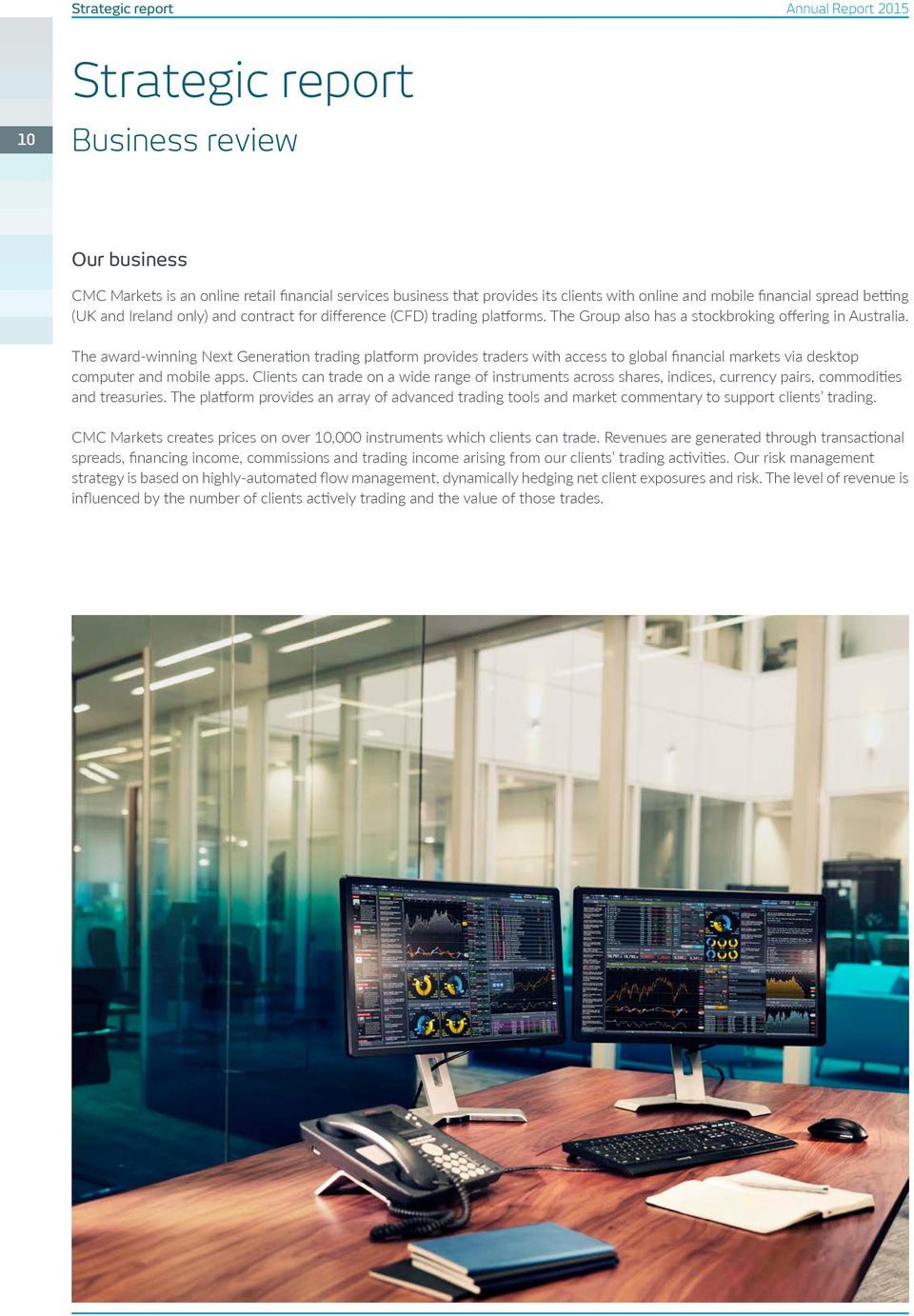
12 Strategic report Annual Report Strategic report Business review Our business CMC Markets is an online retail financial services business that provides its clients with online and mobile financial spread betting (UK and Ireland only) and contract for difference (CFD) trading platforms. The Group also has a stockbroking offering in Australia. The award-winning Next Generation trading platform provides traders with access to global financial markets via desktop computer and mobile apps. Clients can trade on a wide range of instruments across shares, indices, currency pairs, commodities and treasuries. The platform provides an array of advanced trading tools and market commentary to support clients trading. CMC Markets creates prices on over 10,000 instruments which clients can trade. Revenues are generated through transactional spreads, financing income, commissions and trading income arising from our clients trading activities. Our risk management strategy is based on highly-automated flow management, dynamically hedging net client exposures and risk. The level of revenue is influenced by the number of clients actively trading and the value of those trades.
13 CMC Markets plc Strategic report 11 Our products CFD A CFD provides economic benefits similar to an investment in an underlying asset without the costs and limitations associated with physical ownership. A CFD is a cash-settled investment in products which are based on currencies, commodities, treasuries, indices and shares. A CFD tracks the price movement of the chosen product, including dividend on stocks, interest on positive carry currency positions, and coupon on interest bearing instruments. A CFD is a leveraged product, which has the potential to magnify profits as well as losses. The CFD trade If you think the market will fall, you place a sell trade. You sell 1000 units at the sell price of 98p. 99p 102p 101p 100p Underlying market price 98p Spread Spread The spread is 2 CMC Buy Markets buy price CMC Markets sell Sell price If the market price falls by 10 pence = 80 profit* Exited at 90 Exited at 110 If the market price rises by 10 pence = 120 loss 97p 96p *When placing a sell trade, you enter the trade using the sell price and exit using the buy price. In the profitable scenario above, you entered the trade at 98p (original sell price) and exited at 90p (new buy price), so the price moved 8p in your favour. Multiply 8p by the number of units bought (1000) to get a profit of 80. The spread bet

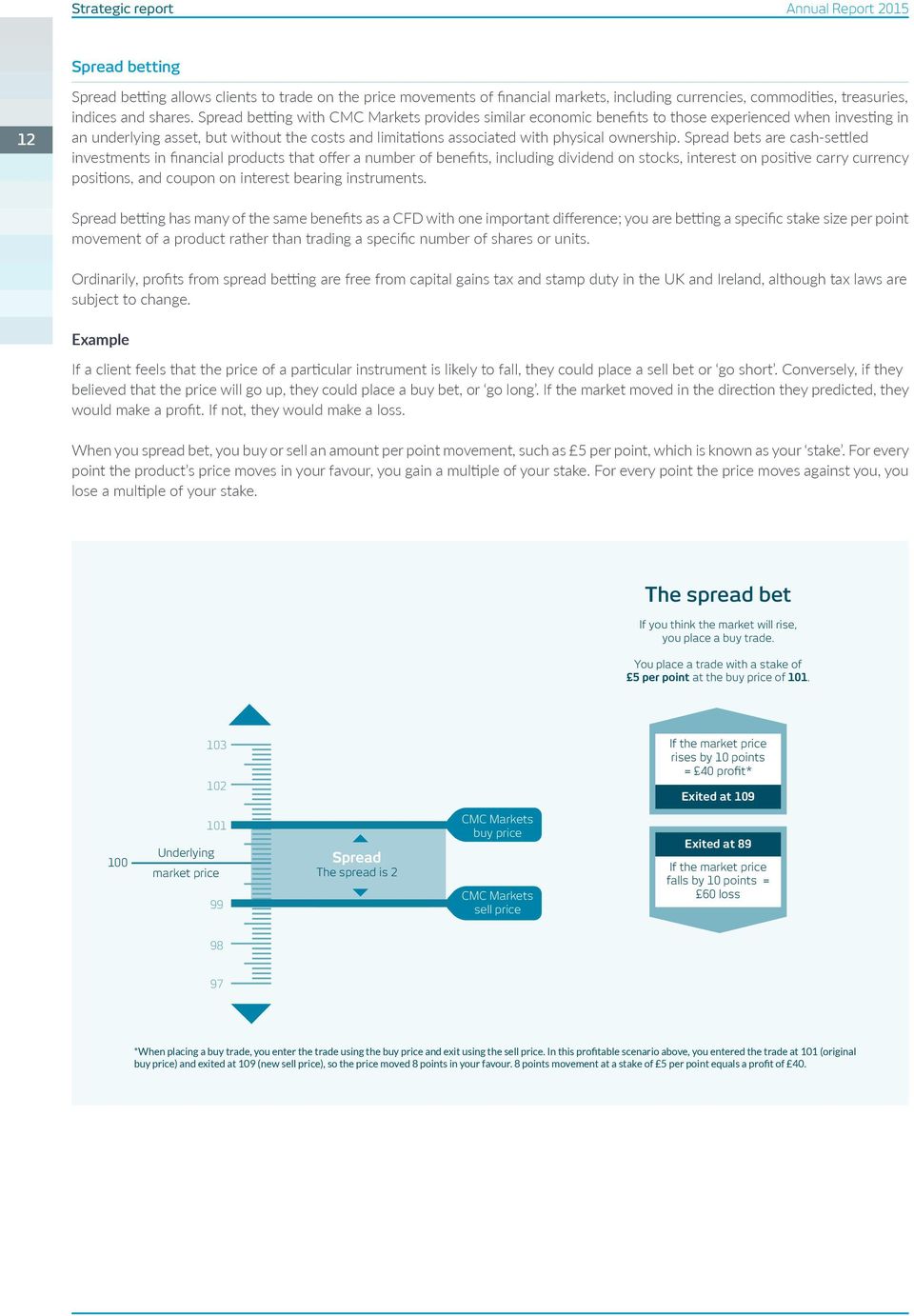
14 You sell 1000 units at the sell price of 98p. Strategic report Annual Report Spread betting 102p 101p If the market price falls by 10 pence = 80 profit* Spread betting allows clients to trade on the price movements of financial markets, including currencies, Exited at 90commodities, treasuries, indices and shares. Spread betting with CMC Markets provides CMC Buy Markets similar economic benefits to those experienced when investing in 100p buy price an underlying asset, but without the costs and limitations associated with physical ownership. Spread bets are cash-settled Underlying Exited at 110 investments 99p in financial products that offer Spread Spread a number of benefits, including dividend on stocks, interest on positive carry currency market price The spread is 2 positions, and coupon on interest bearing instruments. 98p CMC Markets sell Sell price If the market price rises by 10 pence = 120 loss Spread betting has many of the same benefits as a CFD with one important difference; you are betting a specific stake size per point movement of a product rather than trading a specific number of shares or units. 97p Ordinarily, profits from 96p spread betting are free from capital gains tax and stamp duty in the UK and Ireland, although tax laws are subject to change. Example *When placing a sell trade, you enter the trade using the sell price and exit using the buy price. In the profitable scenario above, you entered the trade at 98p (original If a client feels sell price) that and exited the price at 90p (new of a buy particular price), so the instrument price moved 8p in is your likely favour. to Multiply fall, they 8p by could the number place of units a bought sell bet (1000) or to go get short. a profit of Conversely, 80. if they believed that the price will go up, they could place a buy bet, or go long. If the market moved in the direction they predicted, they would make a profit. If not, they would make a loss. When you spread bet, you buy or sell an amount per point movement, such as 5 per point, which is known as your stake. For every point the product s price moves in your favour, you gain a multiple of your stake. For every point the price moves against you, you lose a multiple of your stake. The spread bet If you think the market will rise, you place a buy trade. You place a trade with a stake of 5 per point at the buy price of If the market price rises by 10 points = 40 profit* Exited at Underlying market price 99 Spread The spread is 2 CMC Buy Markets buy price CMC Markets Sell sell price Exited at 89 If the market price falls by 10 points = 60 loss *When placing a buy trade, you enter the trade using the buy price and exit using the sell price. In this profitable scenario above, you entered the trade at 101 (original buy price) and exited at 109 (new sell price), so the price moved 8 points in your favour. 8 points movement at a stake of 5 per point equals a profit of 40.
15 CMC Markets plc Strategic report Binaries and Countdowns Binaries will be a new addition to our product range where the client s risk and potential profit are determined at the point of trade. Clients will be offered the opportunity to place a trade depending on whether they believe a particular market s price will be above or below a certain level at a specific time in the future. If their trade is in the money at the end of the specified timeframe, they will be credited with the amount agreed at the point of trade; if they are out of the money they will forfeit their stake. Clients will also have the opportunity to close a binary product prior to the time of expiry as the odds of the product being above or below a pre-determined level change as the price in the underlying market changes. The product will be released in late In Summer 2015 CMC Markets will launch Countdowns, a product which allows clients to place fixed-odds trades over a range of short-term timeframes from as little as 30 seconds. The client decides the timeframe starting from time of trade as opposed to selecting a pre-determined expiry time. Stockbroking CMC Markets also offers Australian clients the ability to buy and sell ASX and APX listed equities as well as funds. Clients have access to live market data and research from some of Australia s most respected stock market analysts. During the year CMC Markets started offering an mfunds settlement service allowing clients access to the unlisted managed funds space, and has also supported several fund raises during the year through the ASX on-market bookbuilding service. Our geographical reach CMC Markets is a global business with a significant presence in its main hubs in the UK, Australia, Germany and Singapore. It operates across four continents, from 12 offices and with clients located in 70 countries worldwide. Toronto London Paris Madrid Oslo Stockholm Frankfurt Milan Beijing Singapore Sydney Auckland

16 Strategic report Annual Report 2015 Our strategic objectives 14 Client service Our ambition is to deliver an unparalleled client experience to the active trader. This will help maintain a loyal trading community, contributing towards optimal returns for our shareholders and increasing long-term value for the business. As well as offering competitive pricing, products and trading capabilities that we know our clients want, we will continue to strive to ensure that our clients see us as the most trusted and recommended provider in the industry through excellence in client service. CMC Markets continues to place the utmost importance on client service and the continuous delivery of fair outcomes to our clients through our behaviour, image, product innovation and internal culture. With this client-centric vision at the core of our business we continue to strive to ensure that CMC Markets will become the brand of choice in all of our global markets. Progress Our clients are offered an exceptional service experience and have access to a market-leading, award-winning platform, designed with a trader s needs in mind, offering competitive spreads and costs. Many of the new enhancements to our platform have been developed as a result of feedback gathered face-to-face from clients who regularly attend our London Trader Network events and from those who contribute directly via our Feedback module within the trading platform or respond to our client satisfaction surveys. We continue to focus on retaining our premium clients and are in the process of onboarding our existing Partners onto the Next Generation platform. Increased recruitment onto our Sales Trading desk has enabled the business to manage and support our top-tier client base and to encourage acquisition of other likeminded high value traders from our competitors. The introduction of Guaranteed Stop Loss Orders, several thousand new stocks and the pending release of binaries and other new products for the Next Generation platform has encouraged a number of new clients to make the switch already. Winning the award for Highest Overall Client Satisfaction 1 from Investment Trends combined with the Best Spread Betting platform from the ADVFN International Financial Awards gives clear confirmation that we are delivering a service that gives clients exactly what they need. Our Trader Development Programme is now better than ever; offering a wide range of in-platform, on-demand education, tailored market commentary and advanced trading tools to assist our clients every step of the way. In addition to our range of weekly and monthly webinars and seminars hosted by our team of market analysts and the Trading Smart Series (a series of articles designed to cover key trading concepts and analysis techniques), CMC Markets also partnered with Trade With Precision (TWP), a team of professional traders who seek to broaden the skills of our clients with advanced market-focused technical analysis workshops. A significant success story in our stockbroking business was the revenue contribution our Frequent Trader Program has delivered. Engineered to provide a tailored broking solution for three types of stockbroking trader - Classic, Active Investor and Premium Trader. It tailors the appropriate technical features and best-value pricing for each group. By delivering a premium solution alongside low brokerage and advanced features to high volume traders, this focus on the premium category is perfectly aligned with the overall Group strategy and value proposition. This was reinforced through the recognition we received during 2015 including: For the fifth consecutive year, CMC Markets Stockbroking secured CANSTAR s national award for Outstanding Value Online Share Trading For the second year, we were awarded CANSTAR s five star rating for each investor category (casual investor, active investor and trader) Investment Trends product proven to be best in class offering 1 Investment Trends 2014 report

17 CMC Markets plc Strategic report 15

18 Strategic report Annual Report Product innovation We continue to invest in our Next Generation technology in order to improve and enhance our platform capabilities while streamlining our user experience for more efficient navigation around our ever-expanding feature list. We constantly review our content, services and products in order to stand out from the competition and we feel our platform technology and trading tools provide us with a significant competitive advantage. Our deep understanding of what active traders want, combined with our regular platform upgrades, allows CMC Markets to focus on delivering the latest innovations. This is why the Next Generation platform has become so popular with existing and new traders. In March 2015 a survey of CMC Markets clients showed 92% 2 of respondents were either satisfied or very satisfied with the platform. Progress A key milestone was achieved in September 2014 when the Next Generation trading platform was released to the Canadian market. This meant that all regions in which we operate now have access to our latest state-of-the-art trading technology. The majority of the new services added to the Next Generation platform stem directly from our extensive engagement with our client base and include features such as Morningstar Quantitative Equity Research reports, Guaranteed Stop Loss Orders, the ability to go long and short on the same product simultaneously and Module Linking, for faster platform navigation. We also released a major upgrade to our mobile trading apps in late 2014 that included an all-new design, additional trading features and enriched Android tablet support. A major highlight of the past year has been the continued growth seen in new users of our Next Generation platform, with mobile trading growth particularly impressive. General platform usage jumped more than 30% 3 from last year, while mobile usage has increased by more than 37% 4. These numbers justify the significant investment undertaken and we are confident our mobile strategy will continue to be effective and resonate well with active traders. All of these developments saw CMC Markets win 27 global awards including Best Online Platform and Financial Services Provider of the Year from the Shares Awards and 12 awards from the Investment Trends 2014 UK Leveraged Trading Report, which included Best Platform Features 5, Best Mobile and Tablet App 6 and Best Research Tools 7 based on highest user satisfaction. Technology and operations Technology and operations has always been a key to the success of CMC Markets and this has won the business outstanding recognition as the leader in our industry for innovation and service. Our aim is to provide our clients with the ability to take ownership of their personal financial investments. Our platform has been built to provide complete control and flexibility. We are investing in technology and operational processes which will allow us to expand with ease in the future, providing scalability, combined with exceptional dependability and speed, while driving down marginal costs as volumes grow. Progress We have invested and continue to invest significantly in our technology infrastructure. Spend on both platform scalability to support business growth and platform responsiveness to improve user experience have been focus points during the year. This has resulted in capital expenditure of 8.6 million in IT infrastructure and software licences during FY15. 2 March 2015 UK Survey 3 Unique Next Generation users: March 2014 = 27,419; March 2015 = 35,774 4 Unique Next Generation users: March 2014 = 20,079; March 2015 = 27,521 5 According to spread betters, CFD and FX traders 6 According to spread betters, CFD and FX traders 7 According to spread betters and CFD traders

19 CMC Markets plc Strategic report Trading risk management Part of the success of CMC Markets is our global trading risk management capability, dealing with high volumes of sophisticated multi-asset retail flow benefiting from a significant proportion of natural aggregation. Our strong capital and liquidity balances allow us to retain an element of net client portfolio risk, transferring the remaining risk through hedging to our external counterparties. This delivers a highly automated transactional based risk management strategy, allowing the business to deliver consistent and sustainable returns irrespective of underlying client performance and driving long term client engagement. 17 We aspire to be a global leader in providing pricing, execution and liquidity to retail clients and this is enabled through fully automated execution and dynamic risk management which is scalable far beyond our current levels of trading activity. Clients are required to place margin in advance of entering into any transaction with CMC Markets, and positions are automatically closed if these margins are materially eroded. We have significant expertise in retail flow and risk management across multi-asset classes and will continue to lead and innovate as we expand our products and services into the future. Risk appetite is controlled via strong governance and real time controls and oversight, within tightly defined risk parameters approved by the Board. Progress Enhancements to our trading tools during the year have further improved the returns of our highly automated transactional based risk management strategy. This has delivered improved daily average revenue and lower revenue variability. Financial strength We aim to maintain our secure capital and liquidity structure, ensuring that it is appropriate for the future growth and success of the business. This includes a long-term level of capital to withstand the demands of financial fluctuations in the markets and access to a healthy level of surplus liquid resources in line with the size of our business and the growth opportunities which exist. Progress The Group monitors its capital position, which has increased on prior year, on a real time basis (see Financial review, page 25). The Group s liquidity position has improved during the year (see Financial Review, page 25) and the non-utilisation of our credit facility for over two years demonstrates the robust liquidity profile of the Group. The facility provides additional capacity to support the Group s strategy of maintaining excess liquidity to fund both growth and client trading peaks. This commitment to maintaining the facility is demonstrated through the re-negotiation of part of the facility to a tenure of three years. People CMC Markets is committed to recruiting, developing, retaining and motivating exceptional people who are smart, innovative and determined to deliver on our promise to our clients. Our team has the knowledge and determination to make this happen. Progress CMC Markets continuing commitment to our people is described in more depth in Corporate social responsibility (page 18).

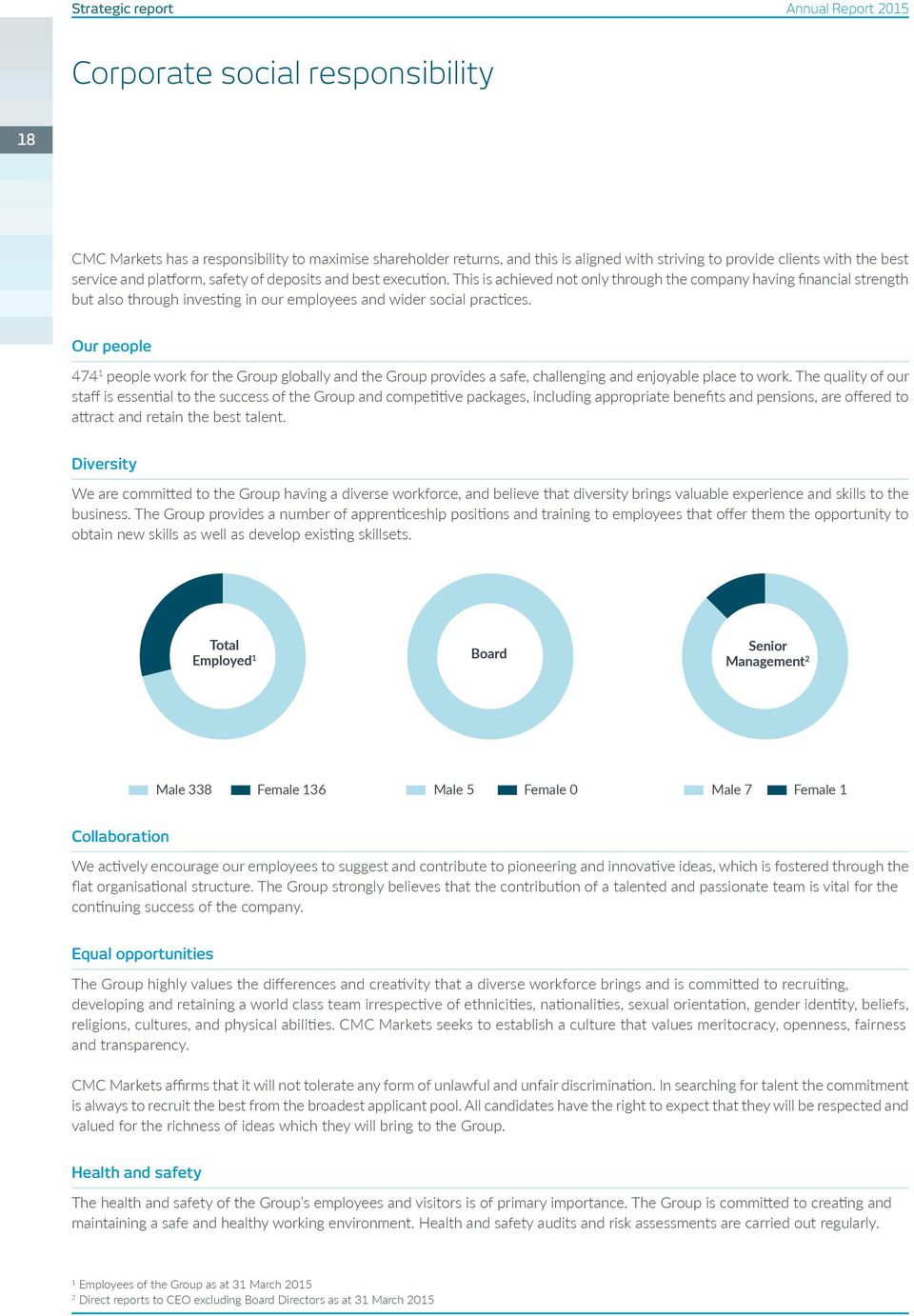
20 Strategic report Annual Report 2015 Corporate social responsibility 18 CMC Markets has a responsibility to maximise shareholder returns, and this is aligned with striving to provide clients with the best service and platform, safety of deposits and best execution. This is achieved not only through the company having financial strength but also through investing in our employees and wider social practices. Our people people work for the Group globally and the Group provides a safe, challenging and enjoyable place to work. The quality of our staff is essential to the success of the Group and competitive packages, including appropriate benefits and pensions, are offered to attract and retain the best talent. Diversity We are committed to the Group having a diverse workforce, and believe that diversity brings valuable experience and skills to the business. The Group provides a number of apprenticeship positions and training to employees that offer them the opportunity to obtain new skills as well as develop existing skillsets. Total Employed 1 Board Senior Management 2 Male 338 Female 136 Male 5 Female 0 Male 7 Female 1 Collaboration We actively encourage our employees to suggest and contribute to pioneering and innovative ideas, which is fostered through the flat organisational structure. The Group strongly believes that the contribution of a talented and passionate team is vital for the continuing success of the company. Equal opportunities The Group highly values the differences and creativity that a diverse workforce brings and is committed to recruiting, developing and retaining a world class team irrespective of ethnicities, nationalities, sexual orientation, gender identity, beliefs, religions, cultures, and physical abilities. CMC Markets seeks to establish a culture that values meritocracy, openness, fairness and transparency. CMC Markets affirms that it will not tolerate any form of unlawful and unfair discrimination. In searching for talent the commitment is always to recruit the best from the broadest applicant pool. All candidates have the right to expect that they will be respected and valued for the richness of ideas which they will bring to the Group. Health and safety The health and safety of the Group s employees and visitors is of primary importance. The Group is committed to creating and maintaining a safe and healthy working environment. Health and safety audits and risk assessments are carried out regularly. 1 Employees of the Group as at 31 March Direct reports to CEO excluding Board Directors as at 31 March 2015
21 CMC Markets plc Strategic report Clients Clients are critical to the success of the business and we strive to deliver a high quality and efficient service to all of them. Client service is central to our strategy and is described in more depth in the Business Review on page 10. The Group fully segregates all retail client funds whether required by regulation or not. All funds are held separately in designated accounts to ensure that in the event of default, client funds are safe and can be quickly returned to clients. 19 CFDs and spread bets are leveraged products and losses can exceed initial deposits. In order to help protect clients from suffering excessive losses, most clients are automatically liquidated once margin has been reduced to agreed levels. Within the platform there are also a number of tools available to clients to effectively manage their risk. We also offer our clients a range of education opportunities through weekly and monthly webinars and seminars, as well as our Trader Development Programme which offers a wide range of in-platform, on-demand education and tailored market commentary. Charitable donations During the year ended 31 March 2015 CMC Markets donated 350,000 to The Peter Cruddas Foundation. The Peter Cruddas Foundation s strapline is Helping Young People Achieve More. Its aims and objectives are to benefit disadvantaged and disengaged young people in our society by ensuring funding reaches those most in need. In order to achieve these aims and objectives, grants are given to charities registered with the Charity Commission for England and Wales working in their area of interest. During the year ended 31 March 2015 grants were given to 15 charities, including: Great Ormond Street Children s Hospital Charitable Trust The Tick Tock Club was supported with the funding for a Post-Anaesthetic Care Unit. After a surgical procedure, young people are taken to a first stage recovery area next to the operating theatre. As they begin to wake, the patients are moved to the Post- Anaesthetic Care Unit. These units are enclosed and include en-suite facilities, and a comfortable chair for a parent to sit with their child as they wake up. University College London Horizons Programme This programme enables up to 100 gifted young people from schools around London to participate, explore their potential, and open their minds to a university course after their A-levels. This has been hugely successful for the students who in most cases improve their A-level results and therefore open up other pathways to education and employment and is inspirational to the student s parents/guardians/carers to witness the capabilities of their child. In addition to the donations to The Peter Cruddas Foundation, CMC Markets staff are encouraged to support charity through a pound for pound matching scheme, with CMC Markets matching every pound raised through sponsorship.
22 Strategic report Annual Report 2015 Financial review 20 KPIs Net operating income: up 21.6 million (18%) to million Revenue per active client 1 : up 342 (14%) to 2,716 Active clients: up 2,297 (5%) to 50,303. Active retail clients up 4,355 (11%) to 45,103 Underlying Profit Before Tax: up 19.7 million (61%) to 51.9 million Statutory Profit Before Tax: up 11.3 million (35%) to 43.5 million Basic earnings per share: up 3.9 pence (46%) to 12.4 pence Own funds generated from operations: 45.2 million Summary Net operating income grew 21.6 million (18%) to million, mainly driven by a combination of increased client activity and our dynamic risk management strategy. The higher client activity was illustrated through a 275 billion (20%) increase in the value of client trades to 1,626 billion, with all major regions contributing positively. This rise in net operating income came against a backdrop of subdued volatility during the first half of the year followed by a rise in activity from September onwards, with increases in FX and Commodities volatility particularly notable. From a volatility index (VIX) perspective, volatility on a monthly rolling average basis has remained broadly similar over the last two years, although below the long-term average; against this backdrop the Group has grown average monthly revenue during this period. Active client numbers and revenue per active client (RPC) increased by 2,297 (5%) to 50,303 and 342 (14%) to 2,716 respectively, the latter underlining our continuing focus on, and success in, attracting high value traders. Looking at this figure based on our channels, our retail client base increased by 11% to 45,103 during the year. This was offset by a reduction in our Partners client base due to the focus on delivering a full Next Generation solution before pursuing new business through this channel. Retail rebates increased by 3.8 million (133%) to 7.2 million. We are committed to our high value traders and our monthly rebate scheme, which is based on the notional value that our clients trade is central to this commitment. Total costs increased by 10.3 million (12%) to million. Once one-off items of 8.4 million are excluded, costs increased by 2.0 million (2%). The increase was driven by investment in personnel and marketing activity, which was partly offset by lower amortisation costs. Underlying profit before tax increased by 19.7 million (61%) to 51.9 million reflecting the operational scalability of the business as revenue grows. Statutory profit before tax also increased by 11.3 million (35%) to 43.5 million. As a result of revenue growth and cost control, profit before tax margin 2 improved 4%, rising from 26% to 30% despite the impact of 8.4 million of exceptional items. Excluding exceptional items the margin increased to 36%. VIX Mar 11 VIX: Daily Sep 11 Mar 12 Sep 12 Mar 13 Sep 13 Mar 14 VIX: 12 Month Rolling Average Sep 14 Mar 15 CFD and Spread Bet 12 Month Rolling Average Trading Revenue Trading Revenue ( m) Net operating income overview m CFD and Spread bet Stockbroking (exc interest income) Interest income Other income (0.2) 0.4 Net operating income Trading revenue per active CFD and Spread bet client 2 Statutory profit before tax as a percentage of net operating income
23 CMC Markets plc Strategic report CFD and spread bet regional performance overview Revenue 1 ( m) Value of trades ( bn) % change Active Clients RPC ( ) Revenue 1 ( m) Value of trades ( bn) Active Clients RPC ( ) Revenue 1 Value of trades Active Clients UK ,417 3, ,054 2,373 46% 31% 10% 33% Europe ,019 2, ,572 2,338 (1)% 4% 2% (3)% ANZ ,527 3, ,076 3,045 24% 37% 5% 19% Rest of World ,340 1, ,304 1,362 13% 6% 1% 13% Total ,626 50,303 2, ,351 48,006 2,374 20% 20% 5% 14% RPC 21 UK The value of client trades in the UK was 31% ahead of the prior year at 548 billion (FY14: 418 billion), with quarter on quarter growth. Active client numbers were up 10% during the year to 15,417 (FY14: 14,054), while average revenue per active client increased by 33%. This was achieved despite the annual Investment Trends study released in September 2014 pointing to a 4% decline in the UK spread betting market from 93,000 to 89,000. Client acquisition has improved dramatically throughout the year with new accounts up by 70% from the prior year, and an increasing return on investment from higher marketing expenditure. Client quality and tenure continues to improve, a direct result of the strategy to appeal to high value clients switching from direct competitors and the successful recruitment of experienced sales specialists. Europe Europe comprises the German, French, Italian, Spanish, Norwegian and Swedish offices. The value of client trades in Europe was 4% ahead of the prior year at 553 billion (FY14: 532 billion). The region contributed 34% of overall Group value of client trades throughout the year (FY14: 39%), with the decline in the value of the Euro and economic headwinds contributing to this decline. Active client numbers were up 2% in the year at 20,019 (FY14: 19,572). There was a strong performance from Spain, with the value of client trades 32% ahead of the prior year at 79 billion (FY14: 60 billion), despite the challenging economic landscape. We expect to see further growth across the rest of Europe as migration from our legacy MarketMaker platform to the Next Generation platform nears completion and we actively begin to market our Next Generation Partner offering. ANZ Our ANZ business, which services clients from our Sydney and Auckland offices, grew significantly during the year. The value of client trades in ANZ was 37% ahead of the prior year at 453 billion (FY14: 332 billion). Our continuing focus on client activation and engagement, increased education initiatives and platform updates have resulted in an increase in active clients of 5% to 9,527 and revenue per active client up 19% to 3,608. The rise in revenue per client is evidence that our focus on acquiring and supporting our high value client base is succeeding. Results from an independent report 3 showed that CMC had the highest prompted brand awareness in the market, and that CMC s brand profile has been regaining strength in the region. Rest of World Our Rest of World region consists of the Singapore and Canada offices. The value of client trades grew by 6% during the year, revenue by 13% and revenue per active client by 13%. Despite showing healthy growth, it has not enjoyed levels similar to those generated by the UK and ANZ regions. Singapore performance was more subdued in the first half of the year due to having more reliance on FX trading, which was low across the industry during this period, but recovered strongly in the second half of the year. The Canada office spent much of the year preparing for the release of the Next Generation platform in September 2014 and since then has been yielding encouraging results. Stockbroking The Australian stockbroking business performed broadly in line with the prior year, with trading revenues of 5.1 million (2014: 5.5 million) despite a relatively subdued equities market in Australia and strong adverse currency movements. Similar to the rest of CMC s business, the year consisted of two distinctive halves in the Australian equities market, with subdued trading volumes in the first half offset by improved performance in the second half. 1 CFD and Spread bet trading revenue 2 Active client numbers and RPC comparatives have been re-stated 3 Investment Trends 2014 report
24 Strategic report Annual Report 2015 Non-trading interest income 22 The low interest rate environment has meant that interest income has remained static at 2.1 million (FY14: 2.1 million). This is mainly earned through our segregated client deposits in our Australia, New Zealand and stockbroking subsidiaries. Asset class performance The asset class split of revenue remains relatively stable on an annual basis, with Indices constituting the major revenue contributor. FX revenue remained robust despite low volatility levels in the first half of the year. The share of revenue provided by Commodities increased significantly year-on-year due to the volatility in oil prices during the second half of the year. FY15 Revenue by asset class FY14 Revenue by asset class Shares 12% Indices 48% Commodities 15% Treasury 1% FX 20% Stockbroking 4% Shares 11% Indices 53% Commodities 10% Treasury 0% FX 21% Stockbroking 5% Expenses The Group s underlying operating expenses increased by 5.5 million (7%) to 83.9 million with investment in marketing ( 2.3 million increase) and staff costs ( 1.6 million increase) the main drivers of the rise. Exceptional costs consist of 4.6 million relating to the settlement of an Australian litigation case and the associated legal costs and 3.8 million relating to provisions and write-offs relating to client debt arising from the SNB release of the Swiss Franc peg. m Net staff costs IT costs Sales and marketing costs Premises costs Legal and professional fees Regulatory fees Other Total operating expenses before exceptional costs Exceptional costs 8.4 Total operating expenses Depreciation and amortisation Interest Total costs Net staff costs increased 1.6 million (4%) to 40.7 million, with a rise in average headcount from 450 to 473 being the main driver of the increase. The increase in wages and salaries was more than offset by a reduction in contractors as we converted key contract staff to permanent employees. The introduction of executive and management share option schemes also contributed towards the rise in costs.
25 CMC Markets plc Strategic report m Wages and salaries Performance related pay Share based payments 1.0 Total employee costs Contract staff costs Net staff costs IT costs were broadly flat on the prior year at 11.4 million as we continued to focus on cost efficiencies whilst also investing where necessary. Sales and marketing costs increased 2.3 million (20%) to 13.7 million during the year as we continue to invest in growing our client base. The main increases in expenditure were seen in the UK, followed by ANZ. Brand expenditure in both of these regions increased during the year with sponsorship of the NSW Waratahs in Australia and the Summer of Sport event in London. Premises costs were 0.5 million (10%) higher at 5.6 million, mainly due to the dual running of our UK data centre, partly offset by reduced costs from the use of less costly offices in Sydney and more efficient use of office space in Singapore. Legal and professional fees decreased by 0.5 million (15%) at 2.9 million due to lower expenditure on external legal advice. Regulatory fees reduced by 0.3 million (14%) to 2.1 million due to a reduced FSCS levy for the year. Other costs increased by 1.7 million (30%) to 7.5 million, with the major contributor to the rise being the one-off currency benefits from closure of the Japan office recorded in FY14 ( 2.3 million credit). Depreciation and amortisation was lower by 3.8 million (35%) at 6.9 million due to the significantly reduced amortisation of the Next Generation platform in FY15. Interest costs increased by 0.2 million ( 29%) to 0.9 million due to the increase of our broker funding line from 25 million to 40 million as well as additional costs associated with new IT finance leases. The broker funding line was not utilised during the financial year. Taxation The effective tax rate for the year was 20% (2014: 26%). The majority of our profits are taxed in the UK and the main driver of the decrease in the effective tax rate was a reduction in the UK corporation tax rate from 23% to 21%. Profit for the year The retained profit for the year of 34.7 million (2014: 24.0 million) illustrates the success of the Group s focus on client service, an award winning platform, dynamic risk management and a strong cost control environment. Dividend Dividends of 12.0 million were paid during the year, 6.0 million relating to the final dividend relating to the prior year and 6.0 million relating to current year s performance. A further interim dividend of 9.9 million was paid in May 2015, resulting in a total dividend relating to FY15 to date of 15.9 million (FY14: 12.0 million). The Group remains committed to a dividend policy of paying 50% of post-tax profit in the form of dividends.
26 Strategic report Annual Report 2015 Own funds 24 The Group monitors own funds generated from operations in the manner explained in note 4 to the accounts. Own funds generated includes excess funds held with brokers. During the year the Group generated 45.2 million from operating activities, which covered dividend requirements by 2.6 times. Group Balance Sheet m Intangible assets Property, plant and equipment Deferred tax assets Total non-current assets Trade and other receivables Derivative financial instruments Amount due from brokers Cash and cash equivalents Total current assets Total assets Trade and other payables Derivative financial instruments Borrowings Current tax payable Short term provisions Total current liabilities Trade and other payables Borrowings Deferred tax liabilities Long term provisions Total non-current liabilities Total liabilities Total equity Total equity and liabilities Non-current assets The Group is committed to investing in and developing its trading platform and these costs are expensed as incurred, with the majority of intangible assets now relating to the net book value of software licences rather than net capitalised internal development costs. The rise in property, plant and equipment costs mainly relate to investment in IT infrastructure, which is regularly reviewed to ensure its scale and resilience is aligned with anticipated growth in the business. During the year the Group invested 8.6 million in IT equipment and licences (FY14: 1.4 million). Current assets Trade and other receivables relate mainly to client receivables relating to Stockbroking positions yet to settle, prepayments, amounts due from our segregated client accounts on the next working day and other client debtors. Amount due from brokers relates to cash held at brokers either for initial margin or to reduce interest payable on the Group s overall hedge position. Cash and cash equivalents have reduced significantly during the course of the year due to the Group actively holding excess funds at our brokers in preference to cash at bank. This has the effect of both reducing financing costs with brokers and reducing concentration risk. At 31 March 2015 the Group held an excess of 57.0 million with brokers (31 March 2014: 22.6 million).
27 CMC Markets plc Strategic report Current liabilities Trade and other payables consist mainly of accruals and deferred income, amounts due on Stockbroking trades yet to settle, and amounts due to clients in relation to title transfer funds. Current tax payable has increased significantly to 3.5 million (FY14: 1.2 million) due to the increase in Group profits. The rise in provisions relates to 4.2 million payable as a result of the Australian litigation settlement. This was paid in April Non-current liabilities Trade and other payables relate mainly to the deferred unwinding of lease incentives on our London property and the increase in borrowings is due to new lease agreements associated with IT equipment purchases. Regulatory capital For the year under review, CMC Markets was supervised on a consolidated basis by the UK s Financial Conduct Authority (FCA). The Group maintained a significant capital surplus over the regulatory requirement at all times. The Group s Tier 1 capital increased due to the rise in retained earnings relating to audited 2014 profits, as well as lower intangible assets on the balance sheet. Deduction for deferred tax assets has been taken from the Tier 1 capital through a phased approach in accordance with the Capital Requirements Directive IV (CRD IV). At 31 March 2015 the capital resources represented 24.1% of the capital resources requirement (31 March %). The following table summarises the Group s capital adequacy position at the year end. The Group s approach to capital management is described in note 4 to the financial statements. Regulatory capital Total capital resources ( m) Total risk exposure ( m) Total capital ratio (%) 24.1% 18.6% Note: capital resources are the reported position as at 31 March 2015 and therefore excludes unaudited reserves and any changes to deferred tax assets resulting from the audit process Liquidity The Group has access to the following sources of liquidity that make up total liquid assets: Own funds. The primary source of liquidity for the Group. It represents the cash that the business has generated historically excluding all cash held on behalf of clients. Title transfer client funds (TTCFs). This represents funds received from professional clients and eligible counterparties (as defined in the FCA Handbook) that are held under a Title Transfer Collateral Agreement (TTCA); a means by which a professional client or eligible counterparty may agree that full ownership of such funds is unconditionally transferred to the Group. The Group considers these funds as an ancillary source of liquidity and places no reliance on its stability. Committed banking facilities. The Group has a committed banking facility that can be used to support the hedging programme by meeting potential fluctuations in the margin requirements of brokers. The amount available, calculated daily, depends on current broker and client margin positions and is committed up to 40 million (March 2014: 25 million). The Group s use of liquidity resources consist of: Blocked cash regulatory purposes. Amounts held to meet the requirements of local market regulators. Blocked cash operational purposes. Amounts held at overseas subsidiaries in excess of local segregated client requirements to meet potential future client requirements. Internal liquidity buffer. An amount that represents the Group s liquidity risk appetite. This is based on the liquidity requirements of the Group under a number of stress tests (conducted according to the FCA s ILAS regime) and other traditional liquidity measures.
28 Strategic report Annual Report 2015 Broker margin requirements. The total GBP equivalent initial margin required by prime brokers to cover the Group s hedge derivative positions. 26 At 31 March 2015, the Group held cash balances of 38.6 million (2014: 57.8 million). In addition, million (2014: million) was held in segregated client money accounts for clients. The movement in Group cash and cash equivalents is set out in the Consolidated Cash Flow Statement. Own funds have increased to million (2014: million) with the overall net own cash decreasing slightly due to higher year-end broker margin requirements. m Sources of Liquidity Own Funds Title Transfer Funds Committed banking facilities Liquid Assets Uses of Liquidity Blocked cash regulatory purposes (11.6) (7.2) Blocked cash operational purposes (3.3) (2.8) Available Liquid Assets Less: Internal Liquidity Buffer (30.0) (30.0) Gross Surplus¹ Liquidity Less: Broker Margin Requirements (52.8) (43.3) Net Surplus¹ Liquidity Client money Total client funds held by the Group on behalf of its retail clients was million at 31 March 2015 (2014: million) including regulatory buffers held in client money bank accounts where required or permitted. Client money is held by the Group in trust on behalf of its retail clients and is not included in Net Surplus Liquidity. Client funds represent the latent capacity for our clients to trade and offer an underlying indication to the health of our client base. The year on year increase in retail client money balances is aligned with the growth in Group client numbers. Client money governance The Group segregates all money held by it on behalf of retail clients in accordance with applicable client money regulations in countries in which it operates and in particular the CASS rules of the UK Financial Conduct Authority (FCA). All segregated client funds are held in dedicated client money bank accounts with major banks that meet strict internal criteria separate from the Group s own cash. The Group has comprehensive client money processes and procedures in place to ensure client money is identified and protected at the earliest possible point after receipt as well as governance structures which ensure such activities are effective in providing the maximum protection for client money. The protection of client money is of fundamental importance to the Group and a governance structure is in place to ensure ongoing compliance and maximum protection is afforded to client money. The Group s governance structure is explained further on pages 32 to 39. ¹ Surplus liquidity is defined as the liquidity in excess of the Group s liquidity risk appetite and is the Group s key liquidity measure. Gross/ Net surplus is pre/ post the deduction of broker margin requirements.
29 CMC Markets plc Strategic report Principal risks and uncertainties The Group s business activities naturally expose it to strategic, financial and operational risks inherent in the nature of the business it undertakes and the financial, market and regulatory environments in which it operates. The Group recognises the importance of understanding and managing these risks and that it cannot place a cap or limit on all of the risks to which the Group is exposed, however effective risk management ensures that risks are managed to an acceptable level. 27 The Board, through its Audit and Risk Committee, is ultimately responsible for the implementation of an appropriate risk strategy, which has been achieved by the establishment of an integrated Risk Management Framework. The main areas covered by the Risk Management Framework are: Identification, evaluation and monitoring of the principle risks to which the Group is exposed. Setting the Risk Appetite of the Board in order to achieve its strategic objectives. Establishment and maintenance of governance, policies, systems and controls to ensure the Group is operating within the stated Risk Appetite. The Board has put in place a governance structure which is appropriate for the operations of an online retail financial services group and is aligned to the delivery of the Groups strategic objectives. In addition the principles of the Three Lines of Defence risk management model, explained below, have been adopted and are being implemented across the Group. The structure is regularly reviewed and monitored and any changes are subject to Board approval. Furthermore, management regularly considers updates to the processes and procedures to embed good corporate governance throughout CMC Markets. Business Functions Identify, own, assess and manage risks. Design, implement and monitor suitable controls. Issue Management. KRI and Risk Appetite reporting. Independent review via Internal and External Audit Board Executive Committees Execution of Board s risk strategy including Risk Appetite. Risk & Control Functions Finance, Risk Management, Legal, Compliance, Financial Crime. Integrate risk management into daily business activities, providing guidance tools and support. As part of the Group Risk Management Framework, the business is subject to independent assurance by external and internal audit (third line of defence). The use of independent compliance monitoring, risk reviews (second line of defence) and risk and control self-assessments (first line of defence) provide additional support to the integrated assurance programme and ensure that the Group is effectively identifying, managing and reporting its risks. Further details of the Risk Management Framework are set out on pages 28 to 31. The main risks associated with the Group s financial activities and the key operational risks faced by the Group are outlined below and details of financial risks and their management are set out in note 4 of the financial statements. The Board has undertaken an assessment of the Principle Risks and how they are managed or mitigated. These are outlined below and details of financial risks and their management are set out in note 4 to the financial statements. Further information on the structure and workings of Board and Management committees is included in the Corporate Governance report on page 34.
30 Strategic report Annual Report Category Risk Description Management and Mitigation Strategic risk Strategic risk The risk of an adverse impact resulting from the Group s strategic decisionmaking as well as failure to exploit strengths or to take opportunities. It is a risk which may cause damage or loss, financial or otherwise to the Group as a whole. Financial risks Market risk Market risk is defined as the risk that the value of our residual portfolio will decrease due to the change in market risk factors. The four standard market risk factors are stock prices, interest rates, foreign exchange rates, and commodity prices. Strong governance framework established including three independent Non Executive Directors sitting on the Board Robust governance, challenge and oversight from independent Non-Executive Directors Managing the Group in line with the agreed strategy, policies and risk appetite Trading risk management monitors and manages the exposures it inherits from clients on a real time basis and in accordance with Board approved appetite. CMC Markets predominantly acts as a market maker in linear, highly liquid financial instruments in which it can easily neutralise all market risk exposure through its prime broker (PB) arrangements. This significantly reduces the Group s revenue sensitivity to individual asset classes and instruments. Financial risk management runs stress scenarios on the residual portfolio, comprising a number of single and combined, company specific and market-wide events in order to assess potential financial and capital adequacy impacts to ensure the Group can withstand severe moves in the risk drivers it is exposed to. Credit risk Client Credit Risk: Financial losses may be incurred in cases where the adverse price move exceeds the margin that a client holds to maintain their position, followed by the client defaulting against their contractual obligations to pay the deficit. Counterparty Credit Risk: A Financial Institution failing to meet or defaulting on their obligations in accordance with agreed terms. For further information see note 4 to the financial statements. Client Credit Risk: The Group s management of client credit risk is significantly aided by automatic liquidation functionality where margin levels are continuously reviewed and if they fall below pre agreed levels the positions held on the account will automatically be closed out. Other platform functionality mitigates risk further: Tiered margin requires clients to hold more collateral against bigger or higher risk positions. Mobile phone access allowing clients to manage their portfolios on the move. Guaranteed Stop Loss Orders allowing a client to remove their chance of debt from their position(s). However, after mitigations, there is a residual risk that the Group could incur losses relating to clients moving into debit balances if there is a market gap. Counterparty Credit Risk: Risk management is carried out by a central Liquidity Risk Management (LRM) team under the Counterparty Concentration Risk Policy, approved by the board of Directors. Mitigation is achieved by: Monitoring concentration levels to counterparties and reporting these internally/externally on a monthly/ quarterly basis. Monitoring the credit ratings and CDS spreads of counterparties and reporting internally on a weekly basis. Further information is available in note 4 to the financial statements.
31 CMC Markets plc Strategic report Category Risk Description Management and Mitigation Liquidity risk The risk that there is insufficient available liquidity to meet the liabilities of the Group as they fall due. Risk management is carried out by a central Liquidity Risk Management (LRM) team under policies approved by the Board and in-line with the FCA s ILAS regime. The Group utilises a combination of liquidity forecasting and stress testing to identify any potential liquidity risk both during normal and stressed conditions. The forecasting and stress testing fully incorporates the impact of all liquidity regulations in force in each jurisdiction and other impediments to the free movement of liquidity around the Group. 29 Risk is mitigated by: The provision of timely daily, weekly and monthly liquidity reporting and real-time broker margin requirements to enable strong management and control of liquidity resources. A 40 million committed bank facility to meet shortterm liquidity obligations to broker counterparties in the event that it does not have sufficient access to its own cash. A formal Contingency Funding Plan (CFP) is in place that is designed to aid senior management to assess and prioritise actions in a liquidity stress scenario. For more information see note 4 to the financial statements. Operational risks Business continuity & disaster recovery risk The risk that a physical business continuity event or system failure results in a reduced ability or inability to perform core business activities or processes. Dedicated business continuity functional support within Operational Risk Function. Use of external specialist premises to enhance resilience in the event of a disaster recovery or business continuity requirement. Periodic testing of business continuity processes and disaster recovery. Prompt response to significant systems failures or interruptions. Financial crime risk The risk of abuse of services in the form of financial crime including but not limited to fraud, bribery, market abuse and money laundering. Adoption of the risk based approach to financial crime, including undertaking formal and regular risk assessments across global operations. Global reporting procedures and surveillance processes in place using local compliance and legal expertise. Regular and on-going training and awareness programme in place for staff at all levels and in all jurisdictions. Group Whistleblowing policy provides a clear framework for escalation of issues.
32 Strategic report Annual Report Category Risk Description Management and Mitigation Information and data security risk The risk of unauthorised access to or external disclosure of client or company information. Dedicated Information Security & Data Protection resource/expertise within the Operational Risk Function. Technical and procedural controls implemented to minimise the occurrence of information security and data protection breaches. Technology risk People risk The risk of system failures exposing the Group to significant commercial, financial, regulatory or reputational damage. In addition, the risk of impact on competitive advantage through inadequate systems development and/ or implementation of the enhancements/upgrades. The risk of loss of key individuals and skills, inadequate development, succession or resource planning and inappropriate behaviours or actions. Access to information only provided on a need to know and least privilege basis consistent with the user s role and requires appropriate authorisation. Key data loss prevention initiatives and regular system access reviews implemented across the business. Continuous investment in increased functionality, capacity and responsiveness of systems and infrastructure. Rigorous software design methodologies, project management and testing regimes to minimise implementation and operational risks. Constant monitoring of systems performance and in the event of any operational issues, changes to processes are implemented to mitigate future concerns. Operation of two data centres in the UK. Systems and data centres designed for high availability and data integrity. Continuous service available to clients in the event of individual equipment failures or major disaster recovery events. Retention programmes and succession planning initiatives in place. Training and skills transfer programmes being undertaken. Education and training, performance management and associated remuneration policies in place. Recognition scheme for high performing individuals.
33 CMC Markets plc Strategic report Category Risk Description Management and Mitigation Regulatory and compliance risk Effective Compliance Function. The risk of regulatory sanction or legal proceedings as a result of failure to comply with regulatory, statutory or fiduciary requirements or as a result of a defective transaction. Internal Audit outsourced to a third party professional services firm. Effective compliance oversight planning and implementation. Comprehensive monitoring programmes by Compliance and Internal audit. 31 Other operational risks Other operational risks include the Group s exposure to legal and litigation risks, the failure of key third parties, manual errors and any other action or occurrence which may have financial impact or affect its reputation with clients and the business community. Controls for appointment and approval of staff holding a controlled function and annual declarations to establish ongoing fitness and propriety. Governance and reporting of regulatory risks through Business Risk Committee and Audit and Risk Committee. AML controls for client due diligence and sanctions checking. Compliance with legal and regulatory requirements including relevant codes of practice. Early engagement with legal advisors and other risk managers. Appropriately managed complaints that have a legal/ litigious aspect. An early assessment of the impact and implementation of changes in the law. Outsourcing only employed where there is a tactical gain in resource or experience. Due diligence performed on service supplier ahead of outsourcing being agreed. Service level agreements in place and regular monitoring of performance undertaken. Grant Foley Group Director of Finance, Risk and Compliance
34 Governance Annual Report Governance The Board Simon Waugh (Chairman) Simon was Group Director of Sales, Marketing and Customer service at Centrica. He retained these responsibilities for the seven years he was with the Group, and also held the roles of Deputy CEO of British Gas and CEO of the Centrica Financial Services Company. On leaving Centrica Simon became CEO of AWD Financial Services Group, a leading IFA and consumer financial services business. Simon s final senior executive position was in the role of Chairman/CEO of the National Apprenticeship Service, leading the government s flagship skills programme, reporting to the Secretaries of State for both Education and Business. Simon is also a life fellow of both The Marketing Society and the Institute of Direct Marketing. John Jackson (Non-Executive Director; resigned 30 June 2015) John joined the CMC Markets Board as its first non-executive director in May 2005, having had a 25 year career principally as a corporate lawyer advising UK, public and large private companies in various sectors. During his legal career John was a partner in English and Global Law firms. John has held a number of directorships and consultancy positions in both public and private companies. John currently runs his own advisory business and is also a non-executive director of a UK regulatory and compliance company. James Richards (Non-Executive Director; appointed 1 April 2015) James is a partner at the financial services law firm, Dillon Eustace in Ireland, where he has been in this role since Prior to this he was a banking and finance partner at Travers Smith LLP for 14 years. Having occupied various senior positions within leading law firms, James has extensive experience in debt capital markets, derivatives and structured finance working with major corporates, central banks and governmental organisations.
35 CMC Markets plc Governance 33 Peter Cruddas (Chief Executive Officer) Peter founded the Group in Prior to founding the Group, Peter was Chief Dealer and Group Treasury Advisor at S.C.F. Equity Services, where he was responsible for all the activities of a dealing room whose principal activities were trading in futures and options in currencies, precious metals, commodities and financials and spot forwards on foreign exchange and bullion. Grant Foley (Group Director of Finance, Risk and Compliance) Grant is a Chartered Accountant (FCA) and has held senior finance positions in Financial Services businesses for a number of years. These have included, Coutts & Co, Prudential Bache and Arbuthnot Securities. Grant joined CMC Markets in April 2013 as Group Head of Finance and was appointed to the role of Group Director of Finance, Risk and Compliance in August David Fineberg (Group Director of Trading) David joined CMC Markets in November 1997 working on the trading desk and developed the Group s multi asset CFD and spread bet dealing desk. As a senior dealer he was responsible for managing the UK and US equity books. Between April 2007 and September 2012 David was Western Head of Trading, covering all asset classes for the Western region. In September 2012 David was appointed to the role of Group Head of Trading. In January 2014 David was appointed as the Group Director of Trading.
36 Governance Annual Report 2015 Corporate governance report 34 The Directors and senior management of CMC Markets are fully aware of the benefits of robust and effective Corporate Governance. Apart from the evident advantages that clarity and accountability bring to management, the value it adds to commercial activities is acknowledged. The Board has put in place a governance structure which it believes is appropriate to the operations of an online retail financial services trading group and reflects the size and stage of development of the business. CMC Markets plc is an unlisted public company and is not required to meet the provisions of the Listing Rules of the UK Listing Authority or the Financial Reporting Council s UK Corporate Governance Code. However, the Board is aware of the relevance of these and the Directors support best corporate governance practice and its practical application as considered suitable with regard to the Group s operations. The structure is regularly reviewed and monitored by the Board for effectiveness and adapted as required to fit the needs of the Group s businesses and their management. The objectives of the governance structure are: to satisfy the needs of the business for proper consideration and decision making; to provide a clear management support and monitoring framework to add value to the business and identify and control risks; to ensure good governance principles are followed including: clear remits and definitions of responsibility, authority, accountability and lines of report; provision of appropriate delegated authority; a framework to facilitate effective checks and balances in management and oversight processes; to allow and encourage effective constructive challenge of the executive; and to apply best practice governance principles appropriate to the business. The governance structure is regularly reviewed for effectiveness and adapted as required to fit the needs of the Group s businesses and their management. Governance Group Senior Management Team Group Board Group Audit and Risk Committee Nominations and Remuneration Committee Independent Assurance Risk Management Oversight Client Money Committee Group Risk Management Business Risk Committee Group Legal Compliance and Financial Crime Internal Assurance Group Internal Audit External Audit Business Risk Management Regional performance Reviews Business Units
37 CMC Markets plc Governance Board responsibilities 35 The Group Board has overall responsibility for the Group s affairs. It comprises three Executive and three independent Non-Executive Directors. The calibre of all the Non-Executive Directors is regarded as more than capable of carrying sufficient weight in the Board s decision-making and to challenge the executive. The Directors believe that the Board has a balance of skills, experience and service to provide effective strategic leadership and proper governance of the Company and Group. The Articles of Association of the Company do not require the Directors to retire by rotation. The Board is responsible for the management and oversight of the Group, setting strategic aims and determining policy. Any changes to the roles of the Directors during the year and since the year end are set out in the Directors Report. The role of the CEO is defined in writing and has been approved by the Board. The effectiveness of the Board is the responsibility of the Non-Executive Chairman. Supported by the Executive Directors and senior management, the CEO is responsible for the implementation and execution of strategy and policy. The CEO manages the Group s operations on a day-to-day basis and is in frequent contact with the Executive Directors and senior management in addition to attending formal Board meetings. Key performance indicators are included in the performance evaluation process for CEO, Executive Directors and senior management and are used in determining their remuneration. The statement regarding the use of the going concern basis for preparation of the financial statements is included in the Directors Report on page 40. The Statement of Directors Responsibilities including the disclosure of information to the auditors can be found on page 42. The Board has a formal schedule of matters specifically reserved to it which includes: setting strategic aims, values and standards to promote the Group s best interests; control and oversight of business management; setting risk parameters and final overall risk management; ensuring adequate financial and human resources; meeting obligations to shareholders and stakeholders; providing guidance and direction to subsidiaries managements; establishment, maintenance and review of effective systems and controls for: compliance with applicable requirements of regulatory systems countering the risk of use of the Group to further financial crime identifying, measuring, managing and controlling risks ensuring business continuity ensuring adequate records are maintained; delegation of authority where appropriate, receiving reports and recommendations from Board Committees and monitoring the discharge of delegated authorities; and the review of policies, procedures, frameworks, standards and controls required for business operations. All the Directors regularly receive full and timely information required to enable them to perform their role. The Board held seven scheduled meetings during the year and also held four ad-hoc meetings when there was business which could not wait until the next scheduled meeting. Board papers, which are distributed to all directors in advance of each meeting, follow a set agenda although further subjects are added for discussion as the need arises. In the months when no Board meeting is scheduled, the Directors receive a Board pack containing updated reports from each function to ensure consistent oversight. In addition to the scheduled Board meetings, Directors briefings were also held on particular issues requiring their attention. Directors receive appropriate training on appointment and as necessary during their service and also receive regular briefings on proposed developments or changes to the law or regulations that affect the Group. Each Director has access to the advice and services of the Company Secretary. The Directors may take independent professional advice at the Group s expense and Directors and Officers liability insurance is in place as permitted under the 2006 Companies Act. Board committees The Board Audit and Risk and the Nomination and Remuneration Committees carry out duties delegated to them by the Board and set out in written terms of reference.
38 Governance Annual Report Sub-board committees The corporate governance structure also includes sub-board committees which together provide a framework to support and monitor the management of the Group. Two sub-board committees report to the Audit and Risk Committee and the Board, ensuring that the oversight and challenge obligations can more directly be discharged. The Business Risk Committee monitors the risk areas of the business, including financial risk, compliance, financial crime, and internal audit. This is chaired by the Group Director of Finance, Risk and Compliance with senior managers and specialists attending for each field they cover. The Client Money Committee is a fundamental part of the Group s client money governance and oversight procedures. The committee is chaired by the CF10a, an FCA-approved person, who is responsible for overseeing the controls and procedures in place to protect client money. The committee is comprised of senior management from across the Group who oversee functions which impact client money. The Client Money Committee forms a key part of the oversight of client money in addition to Compliance, internal audit and PwC as external auditors. Each of the sub-board committees outlined above has terms of reference approved by the Audit and Risk Committee. Meetings are formally scheduled at least once a month although should a particular matter require immediate consideration they can be convened quickly to determine any necessary action. Risks The on-going process of identifying, assessing and treating the significant risks facing the Group is coordinated by the risk function. This process has been in place for the full year under review and to the date of the approval of the Annual Report and financial statements. The principal risks and uncertainties affecting the Group and the responsibilities for the management of the key risks are set out in the Strategic Report on pages 27 to 31. Regulation CMC Markets worldwide regulated entities and the relevant regulatory authorities are set out on page 39. In order to meet regulatory requirements, they are monitored by specialist executives in the finance, risk, legal and compliance functions globally, supported by the governance structure and processes. Company meetings The Executive Directors and the Chairmen of the Audit and Risk and Nomination and Remuneration Committees of the Board will be available to answer questions at the 2015 AGM. Information on the 2015 AGM can be found in the Directors Report on page 40. In addition, management meetings are held once a month attended by senior managers from each function across the business and chaired by the CEO. The meetings allow for the communication and discussion of any business developments, on-going projects and new issues that have arisen.
39 CMC Markets plc Governance Audit and Risk Committee 37 The Audit and Risk Committee comprising all independent Non-Executive Directors - Simon Waugh (Chairman), John Jackson (resigned 30 June 2015) and James Richards, meets at least two times a year. The Committee holds structured meetings two times per year and consults with external auditors, internal auditors, where appropriate, and senior management. The Committee usually requests that executive directors and senior managers attend to provide reports for the meetings in order to reinforce a strong culture of risk management and to keep the Committee up to date with events in the business. The Group Director of Finance, Risk & Compliance attended all of this year s meetings. The Committee regularly reviews the various types of risk relevant to the CMC Group (the Group ) and has reviewed the key risks (described on pages 27 to 31) and the associating controls and mitigating factors. The Committee receives reports and briefings from internal audit and has reviewed the level of internal audit resource provided by Grant Thornton and believes that it is adequate for the size, structure and business risks of the Group. The Committee s review of the full year financial statements focussed on the following areas of significance: The presentation of the client debt arising from the SNB event as an exceptional cost. The presentation of the settlement of a legal dispute as an exceptional cost. These were discussed and there were no significant differences between the Group Director of Finance, Risk & Compliance and external auditor conclusions. The operations of the Group are highly reliant on the Group s IT systems. The Committee receives regular briefings covering various aspects of IT and IT security. In this rapidly moving area, there is inevitably a risk that a systems failure or cyber-attack could cause significant business disruption. Significant resources are therefore devoted to the development, maintenance and security of the IT systems. The Committee had discussions with the external auditor on audit planning, fees, accounting policies, audit findings and internal control. The external auditor attended both of this year s Committee meetings. Meetings are also held with the external auditor without management present. The effectiveness of the audit was assessed through the review of audit plans, reports and conclusions and through discussions with management and the external auditor. The Committee was satisfied that the audit was effective. The Committee is responsible for recommending the appointment, re-appointment and removal of the external auditor. Consideration is given each year to an audit tender process, however, a tender was not considered necessary during the current year. PricewaterhouseCoopers ( PwC ) has been the Group s auditor for 6 years and the Committee is satisfied that PwC continues to possess the skills and experience required to fulfil its duties effectively and efficiently. PwC have reported to the Committee that, in their professional judgement, they are independent within the meaning of regulatory and professional requirements and the objectivity of the audit engagement partner and audit staff is not impaired. The Committee has assessed the independence of PwC and concurs with this statement. The Group s external auditor is prohibited from providing any services that would conflict with their statutory responsibilities or which would otherwise compromise their objectivity or independence. During the year, PwC s audit fee amounted to 585,000 and non-audit fees were 282,000 in total. The Committee has reviewed its Terms of Reference and composition, and believes that both are appropriate. Simon Waugh Chairman of the Audit & Risk Committee 15 July 2015 The Group s internal control functions in areas such as Finance, Risk and Compliance are regularly reviewed by the Committee members. Briefings are received on areas such as Treating Customers Fairly, Financial Crime, Business Continuity as well as Operational, Financial and Liquidity Risk.
40 Governance Annual Report 2015 Nomination and Remuneration Committee 38 The Nomination and Remuneration Committee comprising the three independent Non-Executive Directors (John Jackson (resigned as Chairman 30 June 2015), Simon Waugh and James Richards (appointed Chairman 1 July 2015)) meets at least two times a year. Attendance may be invited from senior executive management and regular attendees include the Group Director of Finance, Risk and Compliance, and the Group Head of HR. The duties of the committee are set out in written terms of reference approved by the Board which include: the regular review of the structure of the Board; to lead the process for making Board appointments and to ensure plans are in place for orderly succession; participation with the Board in its periodic review of the performance of Directors and senior management and to make recommendations arising from such review; consideration and periodic recommendation to the Board of the remuneration policy (including incentives linked to the Company s performance measured, amongst other things, by financial results adjusted for risks) relating to the Executive Directors and other senior managers that it is designated to consider and ensuring that such policy attracts and retains high calibre Directors and senior management; and the review of Group wide annual salary arrangements, performance related pay schemes and incentive plans and to consider and make recommendations in respect of their rationale, structure and aggregate cost. James Richards Chairman, Nomination and Remuneration Committee. 15 July 2015
41 CMC Markets plc Governance Regulated Entities 39 CMC Markets entity CMC Markets UK plc CMC Markets UK plc European branches Italy CMC Markets UK plc Succursale di Milano France CMC Markets UK plc, France Germany Niederlassung Frankfurt am Main der CMC Markets UK plc Norway CMC Markets UK plc Filial Oslo Spain CMC Markets UK plc, Sucursal en España Sweden CMC Markets UK plc Filial Stockholm CMC Markets UK plc Representative Office: Beijing Representative Office of CMC Markets UK plc CMC Spreadbet plc CMC Markets Asia Pacific Pty Ltd CMC Markets Pty Ltd CMC Markets Stockbroking Ltd CMC Markets Canada Inc. (Operating as Marches CMC Canada in Quebec) CMC Markets NZ Ltd CMC Markets Singapore Pte Ltd Financial services regulator(s) Financial Conduct Authority (FCA), UK FCA, UK; and Commissione Nazionale per le Società e la Borsa (CONSOB), Italy Autorité des Marchés Financiers (AMF); and Autorité de Controle Prudential et de resolution (ACPR) Bundesanstalt für Finanzdienstleistungsaufsicht (BaFin), Germany Finanstilsynet (The Financial Supervisory Authority of Norway) Comisión Nacional del Mercado de Valores (CNMV), Spain Finansinspektionen (Financial Supervisory Authority Sweden) China Banking and Regulatory Commission FCA, UK Australian Securities and Investments Commission (ASIC) ASIC ASIC; and Australia Stock Exchange (ASX) Investment Industry Regulatory Organization of Canada (IIROC); Autorité des Marchés Financiers (AMF) Ontario Securities Commission; and British Columbia Securities Commission Financial Markets Authority (New Zealand) Monetary Authority of Singapore (MAS)
42 Directors report Annual Report 2015 Directors report 40 CMC Markets plc is incorporated as a public limited company and is registered in England and Wales with the registered number CMC Markets plc s registered address is 133 Houndsditch, London, EC3A 7BX. The Directors present their report together with the audited financial statements of CMC Markets plc and its subsidiary companies ( the Group ) for the year ended 31 March Principal activities CMC Markets is an online retail financial services business and, through its principal subsidiaries and their branches as set out in the Corporate Governance Report and note 15 to the financial statements, provides its clients the ability to trade contracts for difference (CFD) or financial spread betting on a range of shares, indices, foreign currencies, commodities and treasuries. The Group also provides stock broking services in Australia. Strategic report The Companies Act 2006 requires the Group to prepare a Strategic report, which commences at the start of this Annual Report and financial statements up to page 85. The Strategic report includes information about the Group s operations and business model, review of the business throughout the year, anticipated future developments, key performance indicators and principal risks and uncertainties. The use of financial instruments is included in the report and further covered under note 20 to the consolidated financial statements on page 76. The Group s vision is to be market leader in global online multi-asset trading. Its strategic objective is to provide superior shareholder returns through the consistent and sustainable delivery of growth in revenue and improvement to operating margins through operational excellence including product innovation, technology and service. The strategic objectives to achieve this are also set out in the Strategic Report. Summary of results and dividends The results for the financial year are shown in the Consolidated Income Statement on page 45. The details of dividends are set out in note 30. General Capital structure The Company s share capital comprises ordinary shares of 25 pence each and deferred shares of 25 pence each. At 31 March 2015 there were 280,296,862 ordinary and 2,478,086 deferred shares in issue. Each ordinary share carries one vote. Deferred shares have no voting rights. During the year: 1. under the CMC Markets Management Equity Plan 2009 ( the MEP ), no ordinary shares were allocated to any employee by the Employee Benefit Trust (EBT) due to exercise of vested share options. Similarly, no ordinary shares were acquired by the EBT from any employee who left the employ of the Group. Due to no transactions during the year, 1,069,282 ordinary shares (0.38% of total issued ordinary shares) remain retained by the EBT at the date of this report and are treated as own shares held in trust for the future benefit of employees of CMC Markets UK plc; 2. under the MEP, 309,000 options over ordinary shares were granted without charge to two Directors; ,735 options previously granted under the MEP lapsed resulting in 934,300 remaining outstanding at the yearend; and 4. 2,315 ordinary shares were converted to deferred shares. At the date of this report an aggregate of 934,300 options over ordinary shares in the Company remain outstanding subject to the rules of the MEP. Further details of the authorised and issued capital are disclosed in note 23. Directors and their responsibilities Details of the Directors who served throughout or for part of the year and up to the date of signing the financial statements and their executive positions are set out below. Peter Cruddas David Fineberg Grant Foley John Jackson James Richards Simon Waugh Chief Executive Officer Group Director of Trading Group Director of Finance, Risk and Compliance Non-Executive Director (Resigned 30 June 2015) Non-Executive Director (Appointed 01 April 2015) Non-Executive Chairman Further information on the Board s activities, powers and responsibilities is included in the Corporate Governance Report on page 34. The Statement of Directors Responsibilities is covered on page 42. Corporate governance The Company s report on corporate governance which forms part of this Directors Report is covered on pages 32 to 39.
43 CMC Markets plc Directors report Research and development The Group has continued to invest significantly in the development of the CFD and spread bet Next Generation platform in addition to maintaining existing infrastructure with considerable effort applied by the technical and software development teams. Little expenditure is capitalised and is therefore expensed when it is incurred. nil of development expenditure has been capitalised during the year (2014: nil). 41 Going concern Having given due consideration to the nature of the Group s business, the Directors consider that the Company and the Group are going concerns and the financial statements are prepared on that basis. This treatment reflects the reasonable expectation that the Group has adequate resources to continue in business for the foreseeable future and the consideration of the various risks set out on pages 27 to 31 and financial risks described in note 4 to the financial statements. AGM The 2015 Annual General Meeting of CMC Markets plc (the 2014 AGM ) is to be held at 133 Houndsditch, London, EC3A 7BX at noon on Wednesday 30 September The Notice of the 2015 AGM and related papers are sent to shareholders at least 21 clear days before the meeting. Resolutions are included in the notice of meeting to give Directors the authority for the maximum statutory period of five years to allot the unissued shares of the Company and, subject to the foregoing authority being provided, to permit the Directors to issue such shares wholly for cash on a non pre-emptive basis. These resolutions seek to renew similar authorities given to the Directors by shareholders at the 2014 Annual General Meeting. Independent auditors A resolution proposing the re-appointment of PricewaterhouseCoopers LLP as the Company s auditors and authorising the Directors to determine the auditors remuneration will be put forward at the 2015 annual general meeting. By order of the Board Jonathan Bradshaw Company Secretary 15 July 2015 CMC Markets plc Registered number:
44 Statement of Directors responsibilities Annual Report 2015 Statement of Directors responsibilities The Directors are responsible for preparing the Annual Report and the financial statements in accordance with applicable law and regulations and those International Financial Reporting Standards (IFRS) as adopted by the European Union. 42 Under Company law, the Directors must not approve the Group financial statements unless they are satisfied that they give a true and fair view of the state of affairs of the Group and the profit or loss of the Group for that period. The Directors are required to prepare financial statements for each financial year which present fairly the financial position of the Company and of the Group and the results and cash flows of the Group for that period. In preparing the financial statements, the Directors are required to: select suitable accounting policies and then apply them consistently; make judgments and accounting estimates that are reasonable and prudent; state whether applicable IFRSs have been followed, subject to any material departures disclosed and explained in the financial statements; and prepare the financial statements on the going concern basis unless it is inappropriate to presume that the Group and the Company will continue in business. The Directors are responsible for keeping proper and adequate accounting records that are sufficient to show and explain the Company s and the Group s transactions and disclose with reasonable accuracy, at any time, the financial position of the Company and the Group and enable them to ensure that the financial statements comply with the Companies Act They are also responsible for safeguarding the assets of the Company and the Group and hence for taking reasonable steps for the prevention and detection of fraud and other irregularities. The Directors are responsible for the maintenance and integrity of the Company s website Legislation in the United Kingdom governing the preparation and dissemination of financial statements may differ from legislation in other jurisdictions. Disclosure of information to auditor In accordance with s418 of the Companies Act 2006, each Director in office at the date of approval of this report confirms that: to the best of each Director s knowledge and belief, there is no information relevant to the preparation of their report of which the Group s auditors are unaware; and each Director has taken all steps a Director might reasonably be expected to have taken, to be aware of relevant audit information and to establish that the Group s auditors are aware of that information. Directors responsibility statement Each of the Directors, whose names and functions are listed on pages 32 to 33 confirm that, to the best of their knowledge: the financial statements, prepared in accordance with IFRSs as adopted by the European Union, give a true and fair view of the assets, liabilities, financial position and profit for the Company and undertakings included in the consolidation taken as a whole; and the Company s Annual Report and financial statements include a fair review of the development and performance of the business and the position of the Company and the undertakings included in the consolidation taken as a whole, together with a description of the principal risks and uncertainties that it faces. The Directors consider that the Annual Report and financial statements taken as a whole is fair, balanced and understandable and provides the information necessary for shareholders to assess the Company s and the Group s performance, business model and strategy. The Annual Report on pages 1 to 85 was approved by the Board of Directors and authorised for issue on 15 July 2015 and signed on behalf of the Board by: Peter Cruddas Chief Executive Officer Grant Foley Group Director of Finance, Risk and Compliance
45 CMC Markets plc Independent auditors report Independent auditors report Report on the financial statements Our opinion In our opinion: the financial statements, defined below, give a true and fair view of the state of the Group s and of the parent company s affairs as at 31 March 2015 and of the Group s profit and the Group s cash flows for the year then ended; the Group financial statements have been properly prepared in accordance with International Financial Reporting Standards (IFRSs) as adopted by the European Union; the parent company financial statements have been properly prepared in accordance with International Financial Reporting Standards (IFRSs) as adopted by the European Union and as applied in accordance with the provisions of the Companies Act 2006; and the financial statements have been prepared in accordance with the requirements of the Companies Act This opinion is to be read in the context of what we say in the remainder of this report. What we have audited The Group financial statements and parent company financial statements (the financial statements ), which are prepared by CMC Markets plc, comprise: Consolidated and parent company statement of financial position as at 31 March 2015; Consolidated income statement and statement of comprehensive income for the year then ended; Consolidated statement of cash flows for the year then ended; Consolidated and parent company statement of changes in equity for the year then ended; and the notes to the financial statements, which include a summary of significant accounting policies and other explanatory information. The financial reporting framework that has been applied in their preparation is applicable law and IFRSs as adopted by the European Union and, as regards the parent company financial statements, as applied in accordance with the provisions of the Companies Act In applying the financial reporting framework, the directors have made a number of subjective judgements, for example in respect of significant accounting estimates. In making such estimates, they have made assumptions and considered future events. What an audit of financial statements involves We conducted our audit in accordance with International Standards on Auditing (UK and Ireland) ( ISAs (UK & Ireland) ). An audit involves obtaining evidence about the amounts and disclosures in the financial statements sufficient to give reasonable assurance that the financial statements are free from material misstatement, whether caused by fraud or error. This includes an assessment of: whether the accounting policies are appropriate to the Group s and the parent company s circumstances and have been consistently applied and adequately disclosed; the reasonableness of significant accounting estimates made by the directors; and the overall presentation of the financial statements. We primarily focus our work in these areas by assessing the directors judgements against available evidence, forming our own judgements, and evaluating the disclosures in the financial statements. We test and examine information, using sampling and other auditing techniques, to the extent we consider necessary to provide a reasonable basis for us to draw conclusions. We obtain audit evidence through testing the effectiveness of controls, substantive procedures or a combination of both. In addition, we read all the financial and non-financial information in the Annual Report to identify material inconsistencies with the audited financial statements and to identify any information that is apparently materially incorrect based on, or materially inconsistent with, the knowledge acquired by us in the course of performing the audit. If we become aware of any apparent material misstatements or inconsistencies we consider the implications for our report. Opinion on other matter prescribed by the Companies Act 2006 In our opinion the information given in the Strategic Report and the Directors Report for the financial year for which the financial statements are prepared is consistent with the financial statements. 43
46 Independent auditors report Annual Report 2015 Other matters on which we are required to report by exception Adequacy of accounting records and information and explanations received Under the Companies Act 2006 we are required to report to you if, in our opinion: we have not received all the information and explanations we require for our audit; or 44 adequate accounting records have not been kept by the parent company, or returns adequate for our audit have not been received from branches not visited by us; or the parent company financial statements are not in agreement with the accounting records and returns. We have no exceptions to report arising from this responsibility. Directors remuneration Under the Companies Act 2006 we are required to report to you if, in our opinion, certain disclosures of directors remuneration specified by law are not made. We have no exceptions to report arising from this responsibility. Responsibilities for the financial statements and the audit Our responsibilities and those of the directors As explained more fully in the Directors Responsibilities Statement set out on page 42, the directors are responsible for the preparation of the financial statements and for being satisfied that they give a true and fair view. Our responsibility is to audit and express an opinion on the financial statements in accordance with applicable law and ISAs (UK & Ireland). Those standards require us to comply with the Auditing Practices Board s Ethical Standards for Auditors. This report, including the opinions, has been prepared for and only for the company s members as a body in accordance with Chapter 3 of Part 16 of the Companies Act 2006 and for no other purpose. We do not, in giving these opinions, accept or assume responsibility for any other purpose or to any other person to whom this report is shown or into whose hands it may come save where expressly agreed by our prior consent in writing. Hemione Hudson (Senior Statutory Auditor) for and on behalf of PricewaterhouseCoopers LLP Chartered Accountants and Statutory Auditors London 15 July 2015
47 CMC Markets plc Financial statements Financial statements Consolidated income statement For the year ended 31 March Note Restated Revenue 164, ,618 Net interest income 6 2,118 2,146 Total revenue 166, ,764 Rebates and levies (23,263) (20,754) Net operating income 5 143, ,010 Operating expenses 7 (92,312) (78,375) EBITDA (1) 51,340 43,635 Analysed as: EBITDA before exceptional costs 59,774 43,635 Exceptional costs 7 (8,434) EBITDA (1) 51,340 43,635 Depreciation and amortisation (6,934) (10,698) 45 Operating profit 44,406 32,937 Finance costs 9 (896) (696) Profit before taxation 10 43,510 32,241 Analysed as: Profit before taxation and exceptional costs 51,944 32,241 Exceptional costs 7 (8,434) Profit before taxation 43,510 32,241 Taxation 11 (8,770) (8,285) Profit for the year attributable to owners of the Company 34,740 23,956 Earnings per share Basic (p) p 8.5p Diluted (p) p 8.5p (1) EBITDA represents earnings before interest, tax, depreciation and amortisation and impairment of intangible assets, but includes interest income classified as trading revenue. As permitted by Section 408 of the Companies Act 2006, the Company has not presented its own income statement or statement of comprehensive income. The loss for the year ended 31 March 2015 dealt within the financial statements of the Company was 11,000 (2014: 44,000 Profit). The Company had no other comprehensive income.
48 Financial statements Annual Report 2015 Consolidated statement of comprehensive income For the year ended 31 March Restated Profit for the year 34,740 23,956 Other comprehensive income: Items that may be subsequently reclassified to income statement Profit on net investment hedges net of tax 1,063 3,941 Profit recycled from equity to the income statement 1,212 Currency translation differences (1,485) (8,183) Other comprehensive expense for the year (422) (3,030) Total comprehensive income for the year attributable to owners of the Company 34,318 20,926
49 CMC Markets plc Financial statements Consolidated and Parent Company statement of financial position Note ASSETS As at 31 March Restated As at 1 April 2013 Restated COMPANY As at 31 March Non-current assets Intangible assets 13 3,658 4,091 10,667 Property, plant and equipment 14 17,376 13,733 16,114 Investment in subsidiary undertakings , ,576 Deferred tax assets 22 7,552 7,380 13, Total non-current assets 28,586 25,204 40, , ,576 Current assets Trade and other receivables 16 18,766 19,661 22,456 35,444 36,765 Derivative financial instruments 20 3, Current tax recoverable 448 Amounts due from brokers 109,794 65,864 48,758 Cash and cash equivalents 17 38,611 57,801 49,102 Total current assets 170, , ,358 35,444 36,765 Total assets 199, , , , ,341 LIABILITIES Current liabilities Trade and other payables 18 38,723 39,657 44,160 54,014 43,728 Derivative financial instruments ,106 2,192 Borrowings 19 1, ,184 Current tax payable 3,507 1, Short term provisions 21 4, ,715 Total current liabilities 48,779 43,928 51,251 54,017 43,752 Non-current liabilities Trade and other payables 18 3,926 4,375 4,376 Borrowings 19 2, Deferred tax liabilities ,146 Long term provisions 21 1, Total non-current liabilities 7,930 5,651 6,546 Total liabilities 56,709 49,579 57,797 54,017 43,752 EQUITY Equity attributable to owners of the Company Share capital 23 70,694 70,694 70,694 70,694 70,694 Share premium 23 33,362 33,362 33,362 33,362 33,362 Own shares held in trust 24 (1,983) (1,983) (2,000) Other reserves 26 (49,969) (49,547) (46,517) Retained earnings 90,219 67,055 48,715 39,947 51,533 Total equity 142, , , , ,589 Total equity and liabilities 199, , , , ,341 The Financial statements on pages 45 to 85 were approved and authorised for issue by the Board of Directors on 15 July 2015 and signed on its behalf by: Peter Cruddas, Chief Executive Officer Grant Foley, Group Director of Finance, Risk and Compliance
50 Financial statements Annual Report 2015 Consolidated and Parent Company statement of changes in equity For the year ended 31 March Share capital Share premium Own shares held in trust Other reserves Retained earnings Total equity At 1 April 2013 (As previously reported) 70,694 33,362 (2,000) (46,517) 46, ,483 Effect of changes in accounting policies 1,771 1,771 At 1 April 2013 (Restated) 70,694 33,362 (2,000) (46,517) 48, ,254 Total comprehensive income for the year (3,030) 23,956 20,926 Share-based payments Dividends (5,889) (5,889) Disposal of own shares held in trust At 31 March 2014 (Restated) 70,694 33,362 (1,983) (49,547) 67, ,581 Total comprehensive income for the year (422) 34,740 34,318 Share-based payments Dividends (11,950) (11,950) At 31 March ,694 33,362 (1,983) (49,969) 90, ,323 Total equity is attributable to owners of the Company COMPANY Share capital Share premium Retained earnings Total equity At 1 April ,694 33,362 57, ,333 Total comprehensive income for the year Share-based payments Dividends (5,977) (5,977) At 31 March ,694 33,362 51, ,589 Total comprehensive expense for the year (10) (10) Share-based payments Dividends (11,950) (11,950) At 31 March ,694 33,362 39, ,003
51 CMC Markets plc Financial statements Consolidated statement of cash flows For the year ended 31 March 2015 Note Restated Cash flows from operating activities Cash generated from operations 28 6,362 19,571 Net interest income 2,118 2,146 Tax paid (6,471) (1,372) Net cash generated from operating activities 2,009 20, Cash flows from investing activities Purchase of property, plant and equipment (8,584) (1,606) Proceeds from disposal of property, plant and equipment Investment in intangible assets (1,866) (684) Proceeds from disposal of intangibles 65 Proceeds from disposal of subsidiary 127 Net cash used in investment activities (10,314) (1,961) Cash flows from financing activities Repayment of borrowings (1,524) (1,167) Proceeds from borrowings 4,402 Dividends paid (11,950) (5,889) Finance costs (896) (696) Net cash used in financing activities (9,968) (7,752) Net (decrease)/increase in cash and cash equivalents (18,273) 10,632 Cash and cash equivalents at the beginning of the year 57,801 49,102 Effect of foreign exchange rate changes (917) (1,933) Cash and cash equivalents at the end of the year 17 38,611 57,801 The company had no balance of cash or cash equivalents or transactions involving cash or cash equivalents during the year therefore no cash flow statement has been provided.
52 Financial statements Annual Report 2015 Notes to the financial statements Index to notes General information 2. Basis of preparation 3. Summary of significant accounting policies 4. Financial risk management 5. Divisional analysis 6. Net interest income 7. Operating expenses 8. Employee information 9. Finance costs 10. Profit before taxation 11. Taxation 12. Earnings per share (EPS) 13. Intangible assets 14. Property, plant and equipment 15. Investment in subsidiary undertakings 16. Trade and other receivables 17. Cash and cash equivalents 18. Trade and other payables 19. Borrowings 20. Derivative financial instruments 21. Provisions 22. Deferred tax 23. Share capital and premium 24. Own shares held in trust 25. Share-based payment 26. Other reserves 27. Operating lease commitments 28. Cash generated from operations 29. Retirement benefit plans 30. Dividend per share 31. Related party transactions 32. Contingent liabilities 33. Ultimate controlling party 34. Impact of adopting new accounting standards and re-allocations
53 CMC Markets plc Financial statements 1. General information Corporate information CMC Markets plc (the Company) is a company incorporated and domiciled in England and Wales under the Companies Act The nature of the operations and principal activities of the CMC Markets plc Group (the Group) are set out in note 5. Functional and presentation currency Items included in the financial statements of each of the Group s entities are measured using the currency of the primary economic environment in which the entity operates ( the functional currency ). The consolidated financial statements are presented in Sterling (GBP) which is the Company s functional and the Group s presentation currency. Foreign operations are included in accordance with the policies set out in note Basis of preparation Basis of accounting The consolidated financial statements have been prepared in accordance with International Financial Reporting Standards (IFRS) and IFRS Interpretations Committee (IFRS IC) as adopted by the European Union and the Companies Act 2006 applicable to companies reporting under IFRS. The financial information has been prepared under the historical cost convention, except for the revaluation of certain financial assets and financial liabilities (including derivative instruments) at fair value through profit or loss, and in accordance with the going concern basis. The financial information is rounded to the nearest thousands, except where otherwise indicated. The principal accounting policies adopted in the preparation of these financial statements are set out in note 3 below. These policies have been consistently applied to all periods presented, unless otherwise stated. Changes in accounting policy and disclosures New accounting standards On 1 April 2014, the Group implemented IFRIC 21, Levies with retrospective effect from 1 April IFRIC 21, Levies, provides guidance on when to recognise a liability for a levy imposed by a government, both for levies that are accounted for in accordance with IAS 37 Provisions, Contingent Liabilities and Contingent Assets and those where the timing and amount of the levy is certain. There are no further IFRSs or IFRIC interpretations that are effective for the first time for the financial year beginning on or after 1 April 2014 that would be expected to have a material impact on the Group. At the date of authorisation of these Financial Statements, the following new Standards and Interpretations relevant to the Group were in issue but not yet effective and have not been applied to these Financial Statements: IFRS 9, Financial instruments: classification and measurement, will replace IAS 39, Financial instruments: Recognition and measurement. IFRS 9 has two measurement categories: amortised cost and fair value. All equity instruments are measured at fair value. A debt instrument is measured at amortised cost only if the entity is holding it to collect contractual cash flows and the cash flows represent principal and interest. For liabilities, the standard retains most of the IAS 39 requirements. These include amortised-cost accounting for most financial liabilities, with bifurcation of embedded derivatives. The main change is that, in cases where the fair value option is taken for financial liabilities, the part of a fair value change due to an entity s own credit risk is recorded in other comprehensive income rather than the income statement, unless this creates an accounting mismatch. The Group is yet to assess the full impact of IFRS 9, but intends to adopt the Standard no later than the accounting period beginning 1 April 2018, subject to endorsement by the EU. IFRS 15, Revenue from contracts with customers deals with revenue recognition and establishes principles for reporting useful information to users of financial statements about the nature, amount, timing and uncertainty of revenue and cash flows arising from an entity s contracts with customers. Revenue is recognised when a customer obtains control of a good or service and thus has the ability to direct the use and obtain the benefits from the good or service. The standard replaces IAS 18 Revenue and IAS 11 Construction contracts and related interpretations. The Group is yet to assess the full impact of IFRS 15, but intends to adopt the Standard no later than the accounting period beginning 1 April 2017, subject to endorsement by the EU.
54 Financial statements Annual Report 2015 Basis of consolidation The consolidated financial information incorporates the financial information of the Company and its subsidiaries made up to 31 March each year. Subsidiaries are all entities over which the Group has the power to govern the financial and operating policies, generally determined by the ownership of more than 50% of the voting rights of an investee enterprise, so as to obtain benefits from its activities. CMC Markets plc became the ultimate holding company of the Group under a group reorganisation in The pooling of interests method of accounting was applied to the Group reorganisation as it fell outside the scope of IFRS 3: Business Combinations. The Directors adopted the pooling of interests as they believed it best reflected the true nature of the Group. All other business combinations have been accounted for by the purchase method of accounting. 52 Under the purchase method of accounting, the identifiable assets, liabilities and contingent liabilities of a subsidiary are measured initially at their fair values at the date of acquisition, irrespective of the extent of any minority interest. The results of subsidiaries acquired or disposed of during the year are included in the Consolidated Income Statement from the effective date of acquisition or up to the effective date of disposal, as appropriate. Acquisition related costs are expensed as incurred. Where necessary, adjustments are made to the financial information of subsidiaries to bring the accounting policies used into line with those adopted by the Group. All inter-company transactions, balances and unrealised gains on transactions between Group companies are eliminated on consolidation. Unrealised losses are also eliminated unless the transaction provides evidence of an impairment of the asset transferred. Use of estimates The preparation of financial statements in conformity with IFRS requires the use of certain critical accounting estimates. It also requires management to exercise its judgement in the process of applying the Company s accounting policies. The areas involving a higher degree of judgement or complexity, or areas where assumptions and estimates are significant to the financial statements are set out below: Acquisitions When acquiring a business, the Directors have to make judgements and best estimates about the fair value allocation of the purchase price and assets and liabilities acquired. Where necessary, the Directors will seek appropriate competent and professional advice before making any such allocations. There were no businesses acquired in the current financial year. Impairment reviews The Group tests annually whether goodwill and other intangibles have suffered any impairment in accordance with the accounting policy for impairment of assets described in note 3. The recoverable amounts of cash-generating units (CGUs) are determined using value-in-use calculations. These calculations are based on management assumptions and require the use of estimates. Details of the impairment of intangibles calculation and assumptions made are provided in note 13. Fair value of derivatives and other financial instruments Details of derivative financial instruments held by the Group and their valuation is provided in note 4. Income taxes The Group is subject to income taxes in numerous jurisdictions. Significant judgement is required in determining the worldwide provision for income taxes. There are transactions and calculations for which the ultimate tax determination is uncertain during the ordinary course of business. The Group recognises liabilities for anticipated tax audit issues based on estimates of whether additional taxes will be due. Where the final tax outcome of these matters is different from the amounts that were recorded, such differences will impact the income tax and deferred tax provisions in the period in which such determination is made.
55 CMC Markets plc Financial statements 3. Summary of significant accounting policies Revenue Revenue comprises the fair value of the consideration received from the provision of online financial services in the ordinary course of the Group s activities. Revenue is shown net of value added tax, client rebates and discounts and after eliminating sales within the Group. Revenue is recognised when it is probable that economic benefits associated with the transaction will flow to the Group and the revenue can be reliably measured. The Group generates revenue principally from flow management, commissions and financing income associated with acting as a market maker to its clients to trade contracts for difference (CFD) and financial spread betting. CFD and spread betting revenue represents profits and losses, including commissions and financing income, from client trading activity and the transactions undertaken to hedge these revenue flows. Gains and losses arising on the valuation of open positions to fair market value are recognised in revenue, as well as the gains and losses realised on positions which have closed. Revenue from the provision of financial information and stockbroking services to third parties is recognised at the later of the rendering of the service or the point at which the revenue can be reliably measured. 53 Revenue also includes interest receivable on clients money, broker trading deposits net of interest payable to clients and brokers and client dormancy fees. Interest revenue is accrued on a time basis, by reference to the principal outstanding and at the interest rate applicable. Rebates and levies Revenue rebates payable to clients and introducing partners, who are not themselves trading counterparties, and spread betting levies are charged to the income statement when the associated revenue is recognised and are disclosed as a deduction from total revenue in deriving net operating income. Divisional reporting Operating divisions are reported in a manner consistent with the internal reporting provided to the chief operating decision-maker. The chief operating decision-maker, who is responsible for allocating resources and assessing the performance of the operating divisions, has been identified as the CMC Markets Board. Share-based payment The Group issues equity-settled and cash-settled share-based payments to certain employees. Equity-settled share-based payments are measured at fair value (excluding the effect of non-market-based vesting conditions) at date of grant. The fair value determined at the grant date of the equity-settled share-based payment is expensed on a straight-line basis over the vesting period, based on the Group s estimate of shares that will eventually vest. At each balance sheet date, the Group revises its estimate of the number of equity instruments expected to vest as a result of the effect of non-market-based vesting conditions. The impact of the revision of the original estimates, if any, is recognised in the income statement such that the cumulative expense reflects the revised estimate, with a corresponding adjustment to the retained earnings. The expected life used in the model has been adjusted, based on management s best estimate, for the effects of non-transferability, exercise restrictions and behavioural considerations. The grant by the Company of options over its equity instruments to the employees of subsidiary undertakings in the Group is treated as a capital contribution. The fair value of employee services received, measured by reference to the grant date fair value, is recognised over the vesting period as an increase to investment in subsidiary undertakings, with a corresponding credit to equity. Cash-settled share based payments are measured at expected value at vesting date at least once per year, along with the likelihood of meeting non-market based vesting conditions and the number of shares that are expected to vest. The cost is recognised in the income statement with a corresponding accrual. Retirement benefit costs Pension scheme contributions to the Group s defined contribution schemes are charged to the income statement in the period to which they relate.
56 Financial statements Annual Report 2015 Leases commitments Leases, where the lessor retains substantially all the risks and benefits of ownership of the asset, are classified as operating leases. The rentals payable under operating leases are charged to the income statement on a straight-line basis over the lease term. Benefits received and receivable as an incentive to enter into an operating lease are accounted for in accordance with SIC 15 as lease incentives. These are included within deferred income and amortised to the income statement so as to spread the benefit on a straight-line basis over the lease term. Where a leasehold property becomes surplus to the Group s foreseeable business requirements, provision is made for the expected future net cost of the property taking account of the duration of the lease and any recovery of cost achievable through subletting. 54 Taxation The tax expense represents the sum of tax currently payable and movements in deferred tax. The tax currently payable is based on taxable profit for the year. Taxable profit differs from profit before tax as reported in the Consolidated Income Statement because it excludes items of income or expense that are taxable or deductible in other years and it further excludes items that are never taxable or deductible. The Group s liability for current tax is calculated using tax rates that have been enacted or substantively enacted by the balance sheet date. Deferred tax is accounted for using the balance sheet liability method in respect of temporary differences arising from differences between the carrying amount of assets and liabilities in the financial information and the corresponding tax basis used in the computation of taxable profit. In principle, deferred tax liabilities are recognised for all temporary differences and deferred tax assets are recognised to the extent that it is probable that taxable profits will be available against which deductible temporary differences may be utilised. Such assets and liabilities are not recognised if the temporary difference arises from the goodwill or from the initial recognition (other than in a business combination) of other assets and liabilities in a transaction, which affects neither the tax profit nor the accounting profit. Deferred tax liabilities are recognised for taxable temporary differences arising on investments in subsidiaries, except where the Group is able to control the reversal of the temporary difference and it is probable that the temporary difference will not reverse in the foreseeable future. The carrying amounts of deferred tax assets are reviewed at each balance sheet date and reduced to the extent that it is no longer probable that sufficient taxable profits will be available to allow all or part of the asset to be recovered. Deferred tax is calculated at the rates that are expected to apply when the asset or liability is settled. Deferred tax is charged or credited in the Consolidated Income Statement, except when it relates to items credited or charged directly to equity, in which case the deferred tax is also dealt with in equity. Deferred tax assets and liabilities are offset when they relate to income taxes levied by the same taxation authority and the Group intends to settle its current tax assets and liabilities on a net basis. Foreign currencies Transactions denominated in currencies, other than the functional currency, are recorded at the rates of exchange prevailing on the date of the transaction. At each balance sheet date, monetary assets and liabilities that are denominated in foreign currencies are retranslated at the rates prevailing on the balance sheet date. Non-monetary assets and liabilities carried at fair value that are denominated in foreign currencies, are translated at the rates prevailing at the date when the fair value was determined. Gains and losses arising on retranslation are included in the income statement for the year, except for exchange differences arising on non-monetary assets and liabilities where the changes in fair value are recognised directly in equity. On consolidation, the assets and liabilities of the Group s overseas operations are translated at exchange rates prevailing on the balance sheet date. Income and expense items are translated at the average exchange rates applicable to the relevant period. Exchange differences arising, if any, are classified as equity and transferred to the Group s translation reserve. Such translation differences are recognised as income or expense in the year in which the operation is disposed of. Goodwill and fair value adjustments arising on the acquisition of a foreign entity are treated as assets and liabilities of the foreign entity and translated at the closing rate.
57 CMC Markets plc Financial statements Intangible assets Goodwill Goodwill represents the excess of the cost of acquisition over the fair value of the Group s interest in the identifiable assets, liabilities and contingent liabilities of a subsidiary, at the date of acquisition. Goodwill arising on the acquisition of subsidiaries is included within intangible assets at cost less accumulated impairment losses. Goodwill is tested for impairment annually. Any impairment is recognised immediately in the Consolidated Income Statement and is not subsequently reversed. On disposal of a subsidiary, the attributed amount of goodwill, which has not been subject to impairment, is included in the determination of the profit or loss on disposal. Goodwill is allocated to cash-generating units for purposes of impairment testing. The allocation is made to those cash-generating units or groups of cash generating units that are expected to benefit from the business combination, identified according to business segment. 55 Computer software (purchased and developed) Purchased software is recognised as an intangible asset at cost when acquired. Costs associated with maintaining computer software are recognised as an expense as incurred. Costs directly attributable to internally developed software are recognised as an intangible asset only if all of the following conditions are met: an asset is created that can be identified; it is probable that the asset created will generate future economic benefits; the development costs of the asset can be measured reliably; sufficient resources are available to complete the development; and it is the Group s intention to complete the asset and use or sell it. Where the above conditions are not met, costs are expensed as incurred. Directly attributable costs that are capitalised include software development employee costs and an appropriate portion of relevant overheads. Costs which have been recognised as an asset are amortised on a straight line basis over their estimated useful lives. Trademarks and trading licences Trademarks and trading licences that are separately acquired are capitalised at cost and those acquired from a business combination are capitalised at the fair value at the date of acquisition. Amortisation is charged to the income statement on a straight line basis over their estimated useful lives. Client relationships The fair value attributable to client relationships acquired through a business combination is included as an intangible asset and amortised over the estimated useful life on a straight line basis. The fair value of client relations is calculated at the date of acquisition on the basis of the expected future cash flows to be generated from that asset. Separate values are not attributed to internally generated client relationships. Following initial recognition, Computer software, Trademarks and trading licences and Client relationships are carried at cost or initial fair value less accumulated amortisation. A summary of the amortisation policies applied to the Group s intangible assets is as follows: Item Computer software (purchased or developed) Trademarks and trading licences Client relationships Amortisation Policy 3 years or life of licence years 14 years Useful lives are also examined on an annual basis and adjustments, where applicable, are made on a prospective basis.
58 Financial statements Annual Report 2015 Property, plant and equipment Property, plant and equipment (PPE) is stated at cost less accumulated depreciation and any recognised impairment loss. Cost includes the original purchase price of the asset and the costs attributable to bringing the asset to its working condition for its intended use. Depreciation is provided on all PPE at rates calculated to write-off the cost, less estimated residual value based on prices prevailing at the balance sheet date, of each asset on a straight-line basis over its expected useful life as follows: Item Furniture, fixtures and equipment Computer hardware Depreciation Policy 5 years 5 years 56 The useful lives and residual values of the assets are assessed annually and may be adjusted depending on a number of factors. In reassessing asset lives, factors such as technological innovation, product life cycles and maintenance programmes are taken into account. Residual value assessments consider issues such as future market conditions, the remaining life of the asset and projected disposal values. Consideration is also given to the extent of current profits and losses on the disposal of similar assets. The gain or loss arising on the disposal or retirement of an asset is determined as the difference between the sales proceeds and the carrying amount of the asset and is recognised in the Consolidated Income statement. Investment in subsidiary undertakings Investments in subsidiaries are stated at cost less provision for impairment. Impairment of assets Assets that have an indefinite useful life are not subject to amortisation and are tested annually for impairment. Assets subject to amortisation or depreciation are reviewed for impairment if events or changes in circumstances indicate that the carrying amount of the asset may not be recoverable. If any such indication exists, the recoverable amount of the asset is estimated in order to determine the extent of the impairment loss (if any). The recoverable amount is the higher of fair value less cost to sell and value-in-use. Net realisable value is the estimated amount at which an asset can be disposed of, less any direct selling costs. Value-in-use is the estimated discounted future cash flows generated from the asset s continued use, including those from its ultimate disposal. For the purpose of assessing value in use, assets are grouped at the lowest levels for which there are separately identifiable cash flows. To the extent that the carrying amount exceeds the recoverable amount, the asset is written down to its recoverable amount. For assets other than goodwill, where an impairment loss subsequently reverses, the carrying amount of the asset is increased to the lower of its original carrying amount and the revised estimate of its recoverable amount. Financial assets Regular purchases and sales of financial assets are recognised on a trade date basis where the purchase or sale of an asset is under a contract whose terms require delivery of the asset within the timeframe established by the market concerned. Financial assets are derecognised when the rights to receive cash flows from the investments have expired or have been transferred and the Group has transferred substantially all risks and rewards of ownership. Loans and receivables Loans and receivables are non-derivative financial assets with fixed or determinable payments that are not quoted in an active market. They are included in current assets, except for maturities greater than 12 months after the end of the reporting period. These are classified as non-current assets. Loans and receivables are recognised initially at cost, being the fair value of the consideration together with any associated issue costs. After initial recognition, loans and receivables are subsequently measured at amortised cost using the effective interest method, less provision for impairment. The Group s loans and receivables comprise trade and other receivables (note 16), amounts due from brokers and cash and cash equivalents (note 17) in the statement of financial position. Derivative financial instruments Derivatives are initially recognised at fair value on the date a derivative contract is entered into and are subsequently re-measured at their fair value. The method of recognising the resulting gain or loss depends on whether the derivative is designated as a hedging instrument, and if so, the nature of the item being hedged.
59 CMC Markets plc Financial statements The Group documents at the inception of the transaction the relationship between hedging instruments and hedged items, as well as its risk management objectives and strategy for undertaking various hedging transactions. The Group also documents its assessment, both at hedge inception and on an on-going basis, of whether the derivatives that are used in hedging transactions are highly effective in offsetting changes in fair values or cash flows of hedged items. The Group designates certain derivatives as either hedges of recognised assets and liabilities that are highly probable forecast transactions or hedges of foreign currency risk of firm commitments (cash flow hedges), or hedges of net investments in foreign operations. Hedges of net investments in foreign operations Hedges of net investments in foreign operations are accounted for similarly to cash flow hedges. Any gain or loss on the hedging instrument relating to the effective portion of the hedge is recognised in equity in other comprehensive income. The gain or loss relating to the ineffective portion is recognised immediately in the income statement. 57 Gains and losses deferred in the foreign currency translation reserve are recognised in the income statement on disposal of the foreign operation. Economic hedges Economic hedges are held for the purpose of mitigating currency risk relating to transactional currency flows arising from earnings in foreign currencies but do not meet the criteria for designation as either cash flow hedges or hedges of net investments in foreign operations. Economic hedges are measured at fair value with any resulting gains or losses recognised in the income statement in the period in which they arise. Trade receivables Trade receivables are recognised initially at fair value and subsequently measured at amortised cost using the effective interest method, less provision for impairment. A provision for impairment of trade receivables is established when there is objective evidence that the Group will not be able to collect all amounts due according to the original terms of the receivables. For trade receivables relating to financial information and stockbroking services, significant financial difficulties of the debtor, probability that the debtor will enter bankruptcy or financial reorganisation, and default or delinquency in payments are considered indicators that the trade receivable is impaired. The amount of the provision is the difference between the asset s carrying amount and the present value of estimated future cash flows, discounted at the original effective interest rate. The carrying amount of the asset is reduced through the use of an allowance account, and the amount of the loss is recognised in the income statement within other operating costs. When a trade receivable is uncollectible, it is written off against the allowance account for trade receivables. Subsequent recoveries of amounts previously written off are credited against other operating costs in the income statement. Amounts due from brokers All derivatives used for hedging are margin-traded. Amounts due from brokers represent funds placed with hedging counterparties, a proportion of which is posted to meet broker margin requirements. Assets or liabilities resulting from profits or losses on open positions are recognised separately as derivative financial instruments. Cash and cash equivalents Cash and cash equivalents comprise current account balances, bank deposits and other short-term highly liquid investments with maturity dates of less than three months. Client money The Group holds money on behalf of clients in accordance with the Client Asset (CASS) rules of the Financial Conduct Authority and other financial markets regulators in the countries in which the Group operates. Client monies are classified as either client money or cash and cash equivalents in accordance with the relevant regulatory agency s requirements. The amounts held on behalf of clients at the balance sheet date are stated in notes 17 and 18. Trade payables Trade payables are not interest-bearing and are stated at fair value on initial recognition and subsequently at amortised cost.
60 Financial statements Annual Report 2015 Borrowings All loans and borrowings are initially recognised at cost, being the fair value of the consideration received, net of issue costs associated with the borrowing. After initial recognition, interest-bearing loans and borrowings are subsequently measured at amortised cost using the effective interest rate method. Amortised cost is calculated by taking into account any issue costs, and any discount or premium on settlement. Gains and losses are recognised in the income statement when the liabilities are derecognised or impaired, as well as through the amortisation process. Provisions 58 Provisions for property and employee benefit trust commitments are recognised when the Group has a present obligation (legal or constructive) as a result of a past event where it is probable that the Group will be required to settle that obligation. Provisions are measured at the Directors best estimate of the expenditure required to settle the obligation at the balance sheet date and are discounted to present value where the effect is material. The increase in the provision due to the unwind of the discount to present value over time is recognised as an interest expense. Share capital Ordinary and deferred shares are classified as equity. Incremental costs directly attributable to the issue of new shares or options are shown in equity as a deduction, net of tax, from the proceeds. Employee benefit trusts Assets held in employee benefit trusts are recognised as assets of the Group, until these vest unconditionally to identified employees. A full provision is made in respect of assets held by the trust as there is an obligation to distribute these assets to the beneficiaries of the employee benefit trust. The employee benefit trusts own equity shares in the Company. These investments in the Company s own shares ( treasury shares ) are held at cost and are included as a deduction from equity attributable to the Company s equity owners until such time as the shares are cancelled or transferred. Where such shares are subsequently transferred, any consideration received, net of any directly attributable incremental transaction costs and the related income tax effects, are included in equity attributable to the Company s equity owners. Exceptional items Exceptional items are events or transactions that fall within the activities of the Group and which by virtue of their size or incidence have been disclosed in order to improve a reader s understanding of the financial statements. 4. Financial risk management The Group s day-to-day business activities naturally expose it to strategic, financial (including credit and market) and operational risks. The Board accepts that it cannot place a cap or limit on all of the risks to which the Group is exposed. However, effective risk management ensures that risks are managed to an acceptable level. The Board is ultimately responsible for the implementation of an appropriate risk strategy, defining and communicating the Group s risk appetite, the establishment and maintenance of effective systems and controls, and continued monitoring of the adherence to Group policies. The Group has adopted a standard risk process, through a five step approach to risk management: Risk Identification; Risk Assessment; Risk Management; Risk Reporting and Risk Monitoring. The approach to managing risk within the business is governed by the Board approved Risk Appetite Statement and Risk Management Framework. The Board sets the strategy and policies for managing these risks and delegates the monitoring and management of these risks to various committees including the Board, Audit and Risk Committee, Operations and Risk Group and the Financial (Business) Risk Group. The Group s Internal Capital Adequacy Assessment Process (ICAAP) is prepared under the requirements set out in the Prudential Regulation Authority (PRA) Rulebook in accordance with CRD IV 1. A key purpose of an Internal Capital Adequacy Assessment Process (ICAAP) is to inform a firm s board of the ongoing assessment of the firm s risks, how the firm intends to mitigate those risks, and how much current and future capital is necessary, having considered potential stresses as well as mitigating factors. Financial risks arising from financial instruments are categorised into market, credit and liquidity risks which, together with how CMC Markets categorises and manages these risks, are described below. Market risk Market risk is defined as the risk that the value of our residual portfolio will decrease due to the change in market risk factors. The four standard market risk factors are stock prices, interest rates, foreign exchange rates, and commodity prices. 1 The Capital Requirements Directive (2013/36/EU) (CRD) and the Capital Requirements Regulation (575/2013) (CRR), called CRD IV
61 CMC Markets plc Financial statements Market price risk This is the risk that the fair value of a financial instrument will fluctuate due to changes in market prices other than due to currency or interest rate risk. The trading risk management team inherit exposure from client trades on all asset classes, the risk management approach is primarily based on segmenting intraday and overnight aggregate exposures across the entire client base and determining how much risk the Group wishes to retain in accordance with risk appetite. Mitigation of market price risk CMC Markets benefits from a number of factors which also reduce the volatility of its revenue and protect it from market shocks as follows: Natural mitigation of concentration 59 CMC Markets acts as a market maker in over 10,000 cross asset instruments, specifically equities, indices, commodities, treasuries and foreign exchange as well as forwards on commodities, treasuries, equity, indexes and FX. Because of the high level of notional turnover there is a high level of internal crossing and natural hedging across instruments and asset classes to mitigate significant single instrument concentration risk within the portfolio. Ease of hedging CMC Markets predominantly acts as a market maker in linear, highly liquid financial instruments in which it can easily neutralise market risk exposure through its prime broker (PB) arrangements. In order to avoid over-reliance on one arrangement the Group has five PB relationships. Natural aggregation In the year ending 31 March 2015, CMC Markets traded with over 50,000 clients. This large international client base has a diverse range of trading strategies resulting in CMC Markets enjoying a high degree of natural hedging between clients. This portfolio effect leads to a significant reduction in the Group s net market risk exposure. Market risk limits Market risk positions are managed in accordance with CMC Markets Risk Appetite Statement and Group Market Risk Management Framework to ensure that the Group has sufficient capital resources to support the calculated Market Risk Capital Requirement as well as staying within the Risk Appetite. The Group manages this crucial component of capital adequacy with risk zones Green, Amber and Red, which are internally set limits (precluding the red zone which is maximum capital usage) designed to mitigate the risk of breaching Capital Adequacy requirements. The Market Risk policy requires that the Group s market price risk exposure, calculated under the FCA s Own funds requirement (OFR) methodology, should not reach the red zone, which is set according to relevant regulatory requirements. To reduce the chances of the Group entering into the red zone, the amber zone gives a very large buffer, which if entered, immediate remedial action must be taken to hedge client exposure and reduce the Group s overall market price risk exposure back to the green zone. Overall client exposures can vary significantly over a short period of time and are highly dependent on underlying market conditions. Under the residual risk flow model the Group s OFR has fallen against the prior year end and remains well within the Board-approved risk appetite Net exposure Gross exposure OFR Net exposure Gross exposure OFR Asset class Consolidated equities 25,309 69,881 5, , ,264 12,871 Commodities (15,696) 17,150 2,692 (4,578) 11,862 2,073 Treasuries 37,223 42,487 1,656 21,216 21, Foreign exchange 30,802 30,802 2,464 12,877 12,877 1,030 Interest rate risk , ,320 12, , ,415 17,276
62 Financial statements Annual Report 2015 Market price risk stress testing 60 Group Financial Risk conducts market price risk stress testing on a daily basis. The approach to this stress testing is taking volatility stress factors and applying them to net market price risk exposures in order to assess the market price risk impact. Volatility stresses are derived from actual market price histories for 12 months up to 31 March 2015 (31 March 2014 for the previous financial year). In order to make the model more reliable, stress factors are defined for each asset class (consolidated equities, commodities, treasuries and foreign exchange). Furthermore, volatility stress factors for consolidated equities are defined per region and for commodities they are split between oil and other. Gold and silver are measured separately and are given a separate stress factor. Volatility stress factors for foreign exchange are split between major currency pairs and all other currency pairs. Applying regional as well as asset class based stress factors to exposures ensures that the results are a fair representation of the potential market price risk the Group faces. These stress factors and scenarios are updated quarterly by Group Financial Risk. The Group also runs extreme case stress scenarios on a daily basis, where the stress factors are broken down as mentioned above. None of the stress tests run through the year implied any significant risk to the capital adequacy nor ongoing the profitability of the Group. Non trading book interest-rate risk Interest rate risk arises from either less interest being earned or more being paid on interest bearing assets and liabilities due to a change in the relevant floating rate. Interest rate risk is felt by the Group through a limited number of channels, income on segregated client and own funds and debits on client balances that are over a pre-defined threshold. The sensitivity analysis performed is based on a reasonable and possible move in the floating rate by 0.5% upwards and 0.25% downwards (FY14: 1% movement both upwards and downwards). This is summarised in the table below, and reflects the Group s view that in the current economic environment, interest rate volatility is unlikely to have a significant impact on the profits of the Group Absolute increase Absolute decrease Absolute increase Absolute decrease Impact of 0.50% change 0.25% change 1.00% change 1.00% change Profit after tax 697 (278) 2,110 (835) Equity 697 (278) 2,110 (835) Non trading book foreign exchange risk Foreign exchange risk is the risk that the Group s results are impacted by movements in foreign exchange rates. CMC has foreign exchange risk in the form of transaction and translation exposure. Transaction exposure is from holdings of cash and other current assets and liabilities in a currency other than the base currency of the entity. This risk is hedged each month by the Liquidity Risk Management team according to a policy based on a cap and floor model, with gains/losses recognised in the income statement. At year ended 31 March 2015 there were no significant unhedged exposures (none greater than 250,000). Given the effectiveness of the hedging program (income statement impact in year ended 31 March 2015: 374,000 gain (2014: 308,000 loss)), no sensitivity analysis has been performed. These fair value hedges are derivative financial instruments and are reported as described in note 3. Translation exposure occurs when the net assets of an entity are denominated in a foreign currency other than GBP, when the consolidated statement of financial position is prepared. The Group hedges this exposure by using 3 month FX forwards. These Net Investment Hedges are derivative financial instruments and are reported as described in note 3. The unhedged portion does not pose a significant risk to the capital adequacy or to the ongoing profitability of the Group.
63 CMC Markets plc Financial statements Credit risk Credit risk is the risk that the counterparty to a transaction will cause the Group financial loss by failing to discharge a contractual obligation. Below are the channels of credit risk the Group is exposed through: Credit institution (CI); Client. Credit Institution credit risk The Group has relationships with a number of counterparties that provide prime brokerage and/or banking services (e.g. cash accounts, foreign exchange trading, credit facilities etc.). All these market counterparties can be described as Credit Institutions (CIs) as defined by Article 4 Definitions in the CRR ( credit institution is defined as an undertaking the business of which is to take deposits or other repayable funds from the public and to grant credits for its own account). 61 Credit Institution credit risk can therefore be defined as the risk that a CI will default on their contractual obligation to the Group resulting in a loss to the Group. The above could be felt in two ways: For both CIs used as bank and those as broker the Group does not receive the funds the CI holds back; For the CIs used as broker, the default causes the need to re hedge at a different broker at a different price. Mitigation of Credit Institution credit risk To mitigate or avoid a credit loss the Group maintains, where practical, a range of relationships to reduce over-reliance on a single CI. Liquidity Risk Management monitor the credit quality of all its CIs, by tracking the credit ratings issued by Moody s, Standard & Poor s and Fitch rating agencies and the CDS (Credit Default Swap) spreads determined in the CDS market. Ratings, rating outlooks and CDS spreads are reported to senior management on a weekly basis with any changes highlighted. No quantitative credit rating limits are set by the Group that CIs must exceed because the choice of suitable CIs is finite and therefore setting minimum rating limits could lead to the possibility that no CIs are able to meet them. As an alternative, the Group reviews negative rating action and large CDS spread widening to CIs on a case by case basis. However, all CIs are of investment grade quality and that negative rating action on CIs rated below A3/A-/A- (by Moody s, S&P and Fitch respectively) would be escalated directly to the Group Director of Finance, Risk and Compliance in the first instance to decide if any management actions were required. Possible actions by the Firm to reduce exposure to CIs depend on the nature of the relationship and the practical availability of substitute CIs. Possible actions include the withdrawal of cash balances from a CI on a daily basis, switching a proportion of hedge trading to another prime broker CI or ceasing all commercial activity with the CI. The tables below present CMC Markets exposure to credit institutions based on their long-term credit rating Cash and cash equivalents Amounts due from brokers Cash and cash equivalents Amounts due from brokers AA+ to AA- 19,216 14,950 65,864 A+ to A- 11,300 73,694 22,291 BBB+ to BBB- 7,067 36,100 20,560 Unrated 1,028 38, ,794 57,801 65,864 No cash balances or deposits with institutions were considered past due but not impaired or impaired (2014: nil). Client credit risk The Group operates a real-time mark-to-market leveraged trading facility where clients are required to lodge collateral against positions, any profits and losses generated by the client are credited and debited automatically to their account. As with any leveraged product offering, there is the potential for a client to lose more than the collateral lodged.
64 Financial statements Annual Report 2015 Client counterparty risk capital component captures the risk associated with a client defaulting on their obligations due to the Group. As the Group does not offer most of its retail clients credit terms and has a robust liquidation process, client counterparty credit risk will in general only arise when markets and instruments gap and the movement in the value of a clients leveraged portfolio exceeds the value of equity that the client has held at the Group leaving the client account in deficit. Mitigation of client credit risk Liquidation process This is the process of closing a client s open position if the total equity is not enough to cover a predefined percentage of required margin for the portfolio held. 62 The Group Client Liquidation Policy clarifies the Group s approach to liquidation management, detailing the fully automated liquidation process on the Group s Next Generation platform and the semi-automated liquidation order management process on Marketmaker. This policy and process ensure a consistent and timely approach to the processing of liquidation orders and ultimately aims to minimise client credit risk exposure through protecting the client from becoming a debtor. Pre-emptive processes are also in place where a clients free equity (total equity less total margin requirement) becomes negative. At this point the client is requested to deposit additional funds and is restricted from increasing their position. Tiered margin Tiered margin was implemented in September 2013 on the Next Generation platform. It enables the Group to set higher margin rates (therefore requiring a client to lodge more collateral) against positions that are deemed to be more risky due to risk profile, which could be due to size relative to the underlying s turn over, the appetite for the business or volatility of the instrument. Position limits Position limits can be implemented on an instrument and client level on the Next Generation platform. The Instrument level enables the Group to control the total exposure the Group takes on in a single instrument. At a client level this ensures that the client can only reach a pre-defined size in and one instrument. Client credit risk stress testing The Group uses the same volatility stress factors as for price risk to shock the client portfolio and assess the total equity post shock. It is deemed a prudent approach as the PCRE calculations do not factor in or give any benefit for the correlations between instruments within a client s portfolio and treat each position separately, summing the losses resulting from the shocks (no sub-additivity). Also the Probability of Default for regions where historically the Group has had a very low debt recovery rate is set at 100% (i.e. will not recover the debt). None of the stress tests run through the year implied any significant risk to the capital adequacy nor ongoing the profitability of the Group. Client debt history For the financial year to 31 March 2015, new debt arising was 6,597,000 (2014: 1,309,000). This constituted 4.0% of total trading revenue (2014: 0.9%). The Group establishes specific provisions against debts due from clients where the Group determines that it is probable that it will be unable to collect all amounts owed in accordance with contractual terms of the clients agreement. New debt provided for in the financial year to 31 March 2015 amounted to 4,335,000 (2014: Release of unutilised provisions: 235,000), the provision representing 2.6% of total trading revenue (2014: provision release 0.2%). Bad debt written off in the financial year to 31 March 2015 was 401,000 or 0.2% of revenue (2014: 908,000; 0.7% of revenue).
65 CMC Markets plc Financial statements The table below details the movement on the Group provision for impairment of trade receivables: Opening provision 1,951 3,094 New debt provided for 4,335 (235) Debt written off (401) (908) Closing provision 5,885 1,951 Debt ageing analysis Group Credit Control works efficiently to minimise the effects of client debts on the Company s profit and loss. Client debts are managed very early in their life cycle in order to minimise the likelihood of them becoming doubtful debts or of being written off. The following table sets out aging of debts that are past due and the provisions charged against them: Debt Provision Debt Provision Less than one month One to three months 4,362 3, Three to 12 months Over 12 months 1,872 1,872 1,703 1,667 6,743 5,885 2,190 1,951 Liquidity risk Liquidity risk is the risk that there is insufficient available liquidity to meet the liabilities of the Group as they fall due. Liquidity is managed centrally for the Group by the Liquidity Risk Management team. Utilising a combination of liquidity forecasting and stress testing (formally documented in the Individual Liquidity Adequacy Assessment ( ILAA )) to ensure that the Group retains access to sufficient liquidity resources in both normal and stressed conditions. Liquidity forecasting fully incorporates the impact of liquidity regulations in force in each jurisdiction and other impediments to the free movement of liquidity around the Group, including its own policies on minimum liquidity to be retained by trading entities. Stress testing is undertaken on a quarterly basis upon a range of individual and combined, firm-specific and market-wide, short and long term scenarios that represent plausible but severe stress events to ensure the Group has appropriate sources of liquidity in place to meet such events. Due to the risk hedging strategy adopted and the changeable scale of the client trading book, the largest and most variable consumer of liquidity is broker counterparty margin requirements. The collateral calls are met in cash from own funds but to ensure liquidity is available for extreme spikes the Group has arranged a committed bank facility of 40m to meet short term liquidity obligations to broker counterparties in the event that it does not have sufficient access to own cash or funds from clients and to leave a sufficient liquidity buffer to cope with a stress event. The Group does not engage in maturity transformation as part of its underlying business and therefore maturity mismatch of assets and liabilities does not represent a liquidity risk to the Group.
66 Financial statements Annual Report 2015 Own funds Own funds is a key measure the Group uses to monitor the overall level of liquidity available to the Group. The derivation of Own funds is shown in the table below: Cash and cash equivalents 38,611 57,801 Amount due from brokers 109,794 65, , ,665 Less: Title transfer funds (7,803) (7,218) Own funds 140, ,447 The following Own Funds Flow Statement summarises the Group s generation of own funds during the year and excludes all cash flows in relation to monies held on behalf of clients. Additionally, amounts due from brokers have been treated as cash equivalents and included within own funds in order to provide a clear presentation of the Group s cash resources Restated Operating activities Profit before tax 43,510 32,241 Adjustments for: Finance costs Depreciation and amortisation 6,934 10,698 Other non-cash adjustments Gain on disposal of investment in subsidiaries (127) Tax paid (6,471) (1,372) Own funds generated from operating activities 45,243 42,409 Movement in working capital Inflow/(Outflow) from investing activities Net Purchase of property, plant and equipment and intangible assets (10,314) (2,088) Proceeds from disposal of subsidiary 127 Inflow/(Outflow) from financing activities Interest paid (896) (696) Dividends paid (11,950) (5,889) Other Inflow/(Outflow) from financing activities 2,878 (1,167) Total outflow from investing and financing activities (20,282) (9,713) Increase in own funds 25,072 33,505 Own funds at the beginning of the year 116,447 84,875 Effect of foreign exchange rate changes (917) (1,933) Own funds at the end of the year 140, ,447
67 CMC Markets plc Financial statements Maturity analysis 2015 On demand Less than three months Three months to one year After one year Total Financial assets Cash 38,611 38,611 Amounts due from brokers 109, ,794 Derivative financial instruments 3,275 3,275 Trade and other receivables 15,134 15, ,539 3, ,814 Financial liabilities Trade and other payables 37,415 37,415 Derivative financial instruments Borrowings Finance lease liabilities 336 1,041 2,376 3,753 37,415 1,146 1,058 2,453 42, Net liquidity gap 126,124 2,129 (1,058) (2,453) 124, (Restated) On demand Less than three months Three months to one year After one year Total Financial assets Cash 55,520 2,281 57,801 Amounts due from brokers 65,864 65,864 Derivative financial instruments Trade and other receivables 15,997 15, ,381 2, ,292 Financial liabilities Trade and other payables 39,325 39,325 Derivatives 2,106 2,106 Finance lease liabilities ,325 2, ,405 Net liquidity gap 98, (482) (339) 97,887 Analysis of financial instruments by category Financial assets and liabilities as determined by IAS 39, Financial Instruments: Recognition and Measurement, are categorised as follows: 2015 Assets at fair value through profit and loss Derivatives held for hedging Loans and receivables Total Financial assets Cash and cash equivalents 38,611 38,611 Amounts due from brokers 109, ,794 Derivative financial instruments 2, ,275 Trade and other receivables 15,134 15,134 2, , ,814
68 Financial statements Annual Report 2015 Liabilities at fair value through profit and loss Derivatives held for hedging Financial liabilities at amortised cost Total Financial liabilities Trade and other payables excluding non-financial liabilities 41,790 41,790 Derivative financial instruments Borrowings Finance lease liabilities 3,753 3, ,642 46, (Restated) Assets at fair value through profit and loss Derivatives held for hedging Loans and receivables Total Financial assets Cash and cash equivalents 57,801 57,801 Amounts due from brokers 65,864 65,864 Derivative financial instruments Trade and other receivables 15,997 15, , ,292 Liabilities at fair value through profit and loss Derivatives held for hedging Financial liabilities at amortised cost Total Financial liabilities Trade and other payables excluding non-financial liabilities 44,251 44,251 Derivative financial instruments 2, ,106 Borrowings Finance lease liabilities , ,225 47,331 Fair value estimation The Group s assets and liabilities that are measured at fair value are derivative financial instruments. The table below categorises those financial instruments measured at fair value based on the following fair value measurement hierarchy: Level 1 quoted prices (unadjusted) in active markets for identical assets or liabilities; Level 2 inputs other than quoted prices included within level 1 that are observable for the asset or liability, either directly (that is, as prices) or indirectly (that is, derived from prices); or Level 3 inputs for the asset or liability that are not based on observable market data (that is, unobservable inputs) Level 1 Level 2 Level 3 Total Level 1 Level 2 Level 3 Total Derivative financial instruments Assets 3,275 3, Liabilities (805) (805) (2,106) (2,106) 2,470 2,470 (1,476) (1,476)
69 CMC Markets plc Financial statements Capital management The Group s objectives for managing capital are as follows: to comply with the capital requirements set by the financial market regulators to which the Group is subject; to ensure that all Group entities are able to operate as going concerns and satisfy any minimum externally imposed capital requirements; and to ensure that the Group maintains a strong capital base to support the development of its business. The capital resources of the Group consists of equity being share capital, share premium, other reserves and retained earnings, which at 31 March 2015 totalled 142.3m (2014: 119.6m). 67 CMC Markets is supervised on a consolidated basis by the UK s Financial Conduct Authority (FCA). The Group s Internal Capital Adequacy Assessment Process (ICAAP), prepared under the requirements of the FCA and the Capital Requirements Directive, is an on-going assessment of CMC Markets risks and risk mitigation strategies, to ensure that adequate capital is maintained against risks that the Group wishes to take to achieve its business objectives. The outcome of the ICAAP is presented as an Internal Capital Assessment (ICA) document covering CMC Markets. The ICA covers all material risks to determine the capital requirement over a three year horizon and includes stressed scenarios to satisfy regulatory requirements. The ICA is reviewed and approved by the Board on an annual basis. Further information on the Group s management of regulatory capital is provided in the Pillar 3 Disclosure report, which is available on the CMC Markets plc website ( The Group s country-by-country reporting disclosure is also available in the same location on the website. 5. Divisional analysis Division structure The Group s principal business is online retail financial services and provides its clients with the ability to trade contracts for difference (CFD) and financial spread betting on a range of underlying shares, indices, foreign currencies, commodities and treasuries. CMC Markets also makes these services available to institutional partners through white label and introducing broker arrangements. The Group also provides stockbroking services in Australia. The Group s core business is generally managed on a geographical basis and for management purposes, the Group is organised into four divisions: UK and Ireland; Europe; Australia and New Zealand; and Rest of World (Singapore and Canada). Revenues and costs are allocated to the divisions that originated the transaction. Costs generated centrally are allocated to divisions on an equitable basis, mainly based on revenue, headcount or active client levels.
70 Financial statements Annual Report 2015 Division results analysis UK & IE Europe ANZ Rest of World Central Total Division net trading revenue 48,600 45,429 39,473 8, ,698 Interest income 359 1, ,118 Revenue from external customers 48,959 45,429 41,074 8, ,816 Other operating income 99 (339) (164) Net operating income 49,058 45,090 41,103 8, ,652 Division contribution 38,194 34,498 32,631 5,838 (59,821) 51,340 Allocation of central income and costs (19,145) (17,440) (17,670) (5,566) 59,821 Depreciation and amortisation (1,369) (145) (266) (69) (5,085) (6,934) Allocation of central D&A (1,476) (1,762) (1,253) (594) 5,085 Operating profit 16,204 15,151 13,442 (391) 44,406 Net finance costs (14) (882) (896) Allocation of central net finance costs (305) (295) (247) (35) 882 Profit before taxation 15,899 14,842 13,195 (426) 43, UK & IE Europe ANZ Rest of World Central Total Division net trading revenue 33,354 45,754 33,128 7, ,461 Interest income , ,146 Revenue from external customers 33,817 45,760 34,627 7, ,607 Other operating income 391 (167) Net operating income 34,208 45,593 34,746 7, ,010 Division contribution 26,245 36,593 27,858 4,903 (51,964) 43,635 Allocation of central income and costs (16,517) (16,068) (13,078) (6,301) 51,964 Depreciation and amortisation (1,202) (174) (172) (78) (9,072) (10,698) Allocation of central D&A (2,407) (3,365) (2,087) (1,213) 9,072 Operating profit 6,119 16,986 12,521 (2,689) 32,937 Net finance costs (435) (3) (23) (24) (211) (696) Allocation of central net finance costs (67) (81) (52) (11) 211 Profit before taxation 5,617 16,902 12,446 (2,724) 32,241 The measurement of net operating income for divisional analysis is consistent with that in the income statement. The Group uses EBITDA to assess the financial performance of each division. EBITDA comprises operating profit for the year before interest expense, taxation, depreciation of property, plant and equipment and amortisation and impairment of intangibles. 6. Net interest income Restated Bank interest 1,984 1,946 Interest from clients Total 2,118 2,146 The Group earns interest income from its own corporate funds and from segregated client funds.
71 CMC Markets plc Financial statements 7. Operating expenses Restated Net staff costs (note 8) 40,722 39,070 IT costs 11,398 11,168 Sales and marketing 13,652 11,388 Premises 5,594 5,104 Legal and Professional fees 2,925 3,451 Regulatory fees 2,078 2,406 Other 7,509 5,788 Total operating expenses before exceptional costs 83,878 78,375 Exceptional costs 8, Total operating expenses 92,312 78,375 Exceptional costs As a result of their materiality the directors decided to disclose certain amounts separately in order to present results which are not distorted by significant non-recurring events Litigation settlement and associated costs 4,584 Bad debt provisions and write offs 3,850 Exceptional costs 8,434 During the last financial year the Group received a claim against one of its subsidiaries relating to losses on a CFD trading account over a period in A settlement was reached in March The settlement and associated costs amounted to 4,584,000 during the year. On 15 January 2015 the SNB made the unprecedented decision to discontinue its support of the Swiss Franc/Euro peg. Following this decision the Swiss Franc appreciated by over 30 per cent in a matter of minutes. The Debt provisions and write-offs during the year relating to this event amounted to 3,850, Employee information The aggregate employment costs of staff and Directors were: Wages and salaries 33,058 30,815 Social security costs 4,951 4,120 Other pension costs 1,031 1,128 Total director and employee costs 39,040 36,063 Contract staff costs 1,682 3,007 Net staff costs 40,722 39,070 Compensation of key management personnel is disclosed in note 31.
72 Financial statements Annual Report 2015 The monthly average number of Directors and employees of the Group during the year is set out below: Number 2014 Number By activity: Key management 5 5 Client acquisition and maintenance IT development and support Global support functions Total directors and employees Contract staff Total staff Finance costs Interest on bank borrowings Profit before taxation Profit before tax is stated after charging/(crediting): Depreciation 4,697 3,735 Amortisation of intangible assets 2,237 6,963 Gain on disposal of subsidiary (127) Net foreign exchange gain (608) (1,218) Operating lease rentals 2,717 2,915 Auditors remuneration for audit and other services (see below) Fees payable to the Company s auditors, PricewaterhouseCoopers LLP were as follows: Audit services Statutory audit of parent and consolidation Statutory audit of subsidiaries Other services Tax services Other services Total
73 CMC Markets plc Financial statements 11. Taxation Analysis of charge for the year: Current tax Current tax on profit for the year 9,165 4,204 Adjustment in respect of previous years (76) (79) Total current tax 9,089 4,125 Deferred tax Origination and reversal of temporary differences (944) 2,769 Adjustment in respect of previous years Impact of change in tax rate 574 Total deferred tax (319) 4, Tax charge 8,770 8,285 The tax for the year differs from the standard rate of UK Corporation Tax of 21% (2014: 23%). The differences are explained below: Profit before taxation 43,510 32,241 Profit multiplied by the standard rate of corp. tax in the UK of 21% (2014: 23%) 9,137 7,415 Adjustment in respect of foreign tax rates Adjustments in respect of previous periods Change in tax rate 574 Effect of research and development tax concession 195 (18) Expenses that are not recognised for tax purposes Income not subject to tax (12) (593) Irrecoverable foreign tax (8) 173 Movement to reserves (323) Recognition of previously unrecognised tax losses (1,888) (13) Other timing differences (19) 10 Tax charge 8,770 8,285 The tax credited directly to equity during the year is as follows: Tax on loss on net investment hedges 664 (750) 12. Earnings per share (EPS) Basic EPS is calculated by dividing the earnings attributable to the equity owners of the Company by the weighted average number of ordinary shares in issue during the year excluding those held in employee share trusts which are treated as cancelled. For diluted earnings per share, the weighted average number of ordinary shares in issue, excluding those held in employee share trusts, is adjusted to assume conversion of all dilutive potential ordinary shares, which consists of share options granted to employees during the year ended 31 March 2015.
74 Financial statements Annual Report Restated Earnings Shares Earnings per share pence Earnings Shares Earnings per share pence Basic EPS Earnings attributable to ordinary shareholders 34, , , , Dilutive effect of share options Diluted EPS 34, , , , For the year to 31 March 2015, 814,000 potentially dilutive ordinary shares in respect of share options in issue were included in the calculation of diluted EPS for that year. For the year to 31 March 2014, 878,000 potentially dilutive ordinary shares in respect of share options in issue were included in the calculation of diluted EPS for that year. 13. Intangible assets Goodwill Computer software Trademarks and trading licences Client relationships Total Cost At 1 April , ,844 3,135 4, ,107 Additions Disposals (302) (302) Foreign currency translation (4,767) (144) (707) (5,618) At 31 March , ,459 2,991 3, ,871 Additions 1,866 1,866 Disposals (1,600) (900) (2,500) Foreign currency translation (1,574) (89) (232) (1,895) At 31 March , ,751 1,302 2, ,342 Accumulated amortisation At 1 April 2013 (11,500) (109,986) (2,658) (3,296) (127,440) Charge for the year (6,564) (48) (351) (6,963) Disposals Foreign currency translation 4, ,386 At 31 March 2014 (11,500) (111,548) (2,594) (3,138) (128,780) Charge for the year (1,866) (46) (325) (2,237) Disposals 1, ,500 Foreign currency translation 1, ,833 At 31 March 2015 (11,500) (111,841) (785) (2,558) (126,684) Carrying amount At 31 March , ,658 At 31 March , ,091 At 1 April , ,332 10,667 Impairment Goodwill During the year ended 31 March 2009, impairment tests carried out resulted in the carrying value of goodwill being fully written down to nil. There have been no subsequent acquisitions therefore no additional goodwill has been recognised. Other intangibles Other intangibles are tested for impairment if events or changes in circumstances indicate that the carrying amount of the asset may not be recoverable. There was no impairment identified in the year to 31 March 2015.
75 CMC Markets plc Financial statements 14. Property, plant and equipment Furniture, fixtures and equipment Computer hardware Total Cost At 1 April ,603 20,647 42,250 Additions ,606 Disposals (470) (356) (826) Foreign currency translation (546) (587) (1,133) At 31 March ,454 20,443 41,897 Additions 1,884 6,700 8,584 Disposals (169) (321) (490) Foreign currency translation (387) (245) (632) At 31 March ,782 26,577 49,359 Accumulated depreciation At 1 April 2013 (10,207) (15,929) (26,136) Charge for the year (1,739) (1,996) (3,735) Disposals Foreign currency translation ,018 At 31 March 2014 (11,072) (17,092) (28,164) Charge for the year (2,170) (2,527) (4,697) Disposals Foreign currency translation At 31 March 2015 (12,892) (19,091) (31,983) Carrying amount At 31 March ,890 7,486 17,376 At 31 March ,382 3,351 13, At 1 April ,396 4,718 16,114 At 31 March 2015, the Group had no material capital commitments in respect of property, plant and equipment (2014: nil). The net book value amount of property, plant and equipment includes 4,536,000 (2014: 1,507,000) in respect of computer hardware held under finance leases. 15. Investment in subsidiary undertakings COMPANY At 1 April 162, ,652 Capital reduction relating to share based payments (1,076) At 31 March 162, ,576 The capital reduction relating to share based payments relates to share options granted by the Company to employees of subsidiary undertakings in the Group, reduced by distributions received from those subsidiaries in respect of those share options. On 24 January 2011, the Company sold its wholly owned subsidiary, Digital Look Limited for an initial cash consideration of 1.4m resulting in a gain of 1.0m for the Company. The net assets of Digital Look Limited on disposal were zero resulting in a gain of 1.4m for the Group. Of the initial consideration, 0.2m was received by 31 March 2011 with the remainder received in June During the year ended 31 March 2014 a further 0.1m (2013: 0.1m) was recognised in relation to previously unrecognised deferred contingent consideration. No further additional consideration was recognised during year ended 31 March 2015.
76 Financial statements Annual Report 2015 Subsidiary undertakings At 31 March 2015, the following companies were CMC Markets plc s trading subsidiary undertakings and intermediate holding companies: 74 Country of Principal Held incorporation activities CMC Markets UK Holdings Limited England Holding company Directly CMC Markets UK plc England Online trading Indirectly Information Internet Limited England IT development Indirectly CMC Spreadbet plc England Financial spread betting Indirectly CMC Markets Digital Options GmbH Austria IT development Indirectly CMC Markets Overseas Holdings Limited England Holding company Directly CMC Markets Asia Pacific Pty Limited Australia Online trading Indirectly CMC Markets Pty Limited Australia Training and education Indirectly CMC Markets Group Australia Pty Limited Australia Holding company Indirectly CMC Markets Stockbroking Limited Australia Stock broking Indirectly CMC Markets Stockbroking Nominees Pty Limited Australia Stock broking nominee Indirectly CMC Markets Stockbroking Nominees (No. 2 Account) Limited Australia Dormant Indirectly CMC Markets Canada Inc. Canada Client introducing office Indirectly CMC International Financial Consulting (Beijing) Co. Limited China No business activity Indirectly CMC Markets NZ Limited New Zealand Online trading Indirectly Redmonitor GmbH Austria IT development Indirectly CMC Markets Singapore Pte Limited Singapore Online trading Indirectly All shareholdings are of ordinary shares. The issued share capital of all subsidiary undertakings is 100% owned, which also represents the proportion of the voting rights in the subsidiary undertakings. CMC International Financial Consulting (Beijing) Co. Limited was liquidated on 19 May Trade and other receivables COMPANY Trade receivables 6,613 2,030 Less: provision for impairment of trade receivables (5,885) (1,951) Trade receivables net Amounts due from Group companies 35,444 36,765 Prepayments and accrued income 3,632 3,664 Stock broking debtors 12,690 14,603 Other debtors 1,716 1,315 Total 18,766 19,661 35,444 36,765 Stock broking debtors represent the amount receivable in respect of equity security transactions executed on behalf of clients with a corresponding balance included within trade and other payables (note 18). 17. Cash and cash equivalents Gross cash and cash equivalents 270, ,884 Less: Client monies (232,328) (206,083) Own cash and cash equivalents 38,611 57,801 Analysed as: Cash at bank 38,611 55,520 Short-term deposits 2,281 Cash and cash equivalents comprise cash at bank and other short-term highly liquid investments, with typical maturities of three months or less. Cash at bank earns interest at floating rates, based on daily bank deposit rates.
77 CMC Markets plc Financial statements 18. Trade and other payables COMPANY Restated Current Trade payables 240, ,301 Less: Client monies (232,328) (206,083) Trade payables net 7,803 7,218 Amount owing to Group companies 53,439 43,728 Tax and social security 859 Stock broking creditors 11,833 14,493 Accruals and deferred income 18,228 17, ,723 39,657 54,014 43,728 Non-current Accruals and deferred income 3,926 4,375 Total 42,649 44,032 54,014 43, Borrowings Current Finance lease liabilities 1, Other liabilities 22 1, Non-current Finance lease liabilities 2, Other liabilities 77 2, Total 3, Finance lease liabilities Amounts payable under finance lease: Within one year 1, In the second to fifth years inclusive 2, After five years 4,111 1,081 Less: future finance charges (358) (107) Present value of lease obligations 3, The present value of finance lease liabilities is repayable as follows Within one year 1, In the second to fifth years inclusive 2, After five years Present value of lease obligations 3,
78 Financial statements Annual Report 2015 The weighted average interest rates paid were as follows: 2015 % 2014 % Finance leases 6.37% 10.49% The fair value of financial liabilities is approximate to the book value shown above. The carrying amounts of the bank loan and loan notes are both wholly denominated in sterling. 76 Bank loans In June 2014, the 364 day revolving credit facility was renewed at a level of 40m for one year to June This was renewed again in June 2015 where 20m had a maturity date of June 2016 and 20m had a maturity date of June This facility can only be used to meet broker margin requirements of the Group. The rate of interest payable on any loans is the aggregate of the applicable margin, LIBOR, and mandatory cost. Undrawn borrowing facilities The Group has an undrawn multi-currency overdraft facility with NatWest Bank plc of 7.5m, which is repayable on demand. The facility is available in Sterling, Canadian Dollars, Euros, Japanese Yen, Swedish Kronor, Swiss Francs, US Dollars, Australian Dollars and Hong Kong Dollars. The interest rate for the Sterling overdraft is NatWest Bank s Base Rate plus 2% per annum and, for all other currencies, the relevant NatWest Bank currency lending rate. 20. Derivative financial instruments Assets Liabilities Total Assets Liabilities Total Held for trading Index, Commodities and Treasuries futures 199 (624) (425) 448 (446) 2 Forward foreign exchange contracts 2,783 2,783 (1,620) (1,620) Held for hedging Forward foreign exchange contracts economic hedges 34 (151) (117) 102 (38) 64 Forward foreign exchange contracts net investment hedges 259 (30) (2) 78 Total 3,275 (805) 2, (2,106) (1,476) The fair value of derivative contracts is based on the market price of comparable instruments at the balance sheet date. All derivative financial instruments have a maturity date of less than one year. Held for trading As described in note 4, the Group enters derivative contracts in order to hedge its market price risk exposure arising from clients trading and spread betting. Held for hedging The Group s forward foreign exchange contracts are designated as either economic or net investment hedges. Economic hedges are held for the purpose of mitigating currency risk relating to transactional currency flows arising from earnings in foreign currencies but do not meet the criteria for designation as cash flow hedges in accordance with the Group s accounting policies (note 3). The Group has designated a number of foreign exchange derivative contracts as hedges of the net investment in the Group s non-uk subsidiaries. At 31 March 2015, 2,348,000 of fair value gains were recorded in other reserves within equity (2014: 3,833,000). During the year 374,000 of gains (2014 Loss: 308,000) relating to economic hedges were recognised in the income statement. The maximum exposure to credit risk at the reporting date is the fair value of the derivative assets at the balance sheet date.
79 CMC Markets plc Financial statements 21. Provisions EBT commitments Property related Other Total At 1 April Additional provision 3 1,226 4,157 5,386 Utilisation of provision (198) (198) Currency translation (60) (60) At 31 March ,431 4,157 5,768 The provision relating to employee benefit trusts (EBT) represents the obligation to distribute assets held in employee benefit trusts to beneficiaries. 77 The property related provision represents discounted obligations under onerous lease contracts less any amounts considered recoverable by management. Other provisions relate to litigation provisions Analysis of total provisions Current 4, Non-current 1, Total 5, Deferred tax COMPANY Restated Deferred tax assets to be recovered within 12 months 2,278 1,910 Deferred tax assets to be recovered after 12 months 5,274 5,470 7,552 7,380 Deferred tax liabilities to be settled within 12 months (108) (607) Deferred tax liabilities to be settled after 12 months (20) (20) (128) (627) Net deferred tax asset 7,424 6,753 Deferred income taxes are calculated on all temporary differences under the liability method using an effective tax rate of 20% (2014: 20%). The gross movement on deferred tax is as follows: COMPANY Restated At 1 April 6,753 12,759 Charge to income for the year (303) (6,790) Credit/(Charge) to equity for the year 664 (750) Change in tax rate 459 Foreign currency translation 310 1,075 At 31 March 7,424 6,753
80 Financial statements Annual Report 2015 The following table details the deferred tax assets and liabilities recognised by the Group and movements thereon during the year: 78 Tax losses Accelerated capital allowances Other timing differences Total At 1 April 2013 (Restated) 7,977 4, ,759 (Charge)/Credit to income for the year (5,631) (1,648) 489 (6,790) Credit to equity for the year (750) (750) Change in tax rate Foreign currency translation ,075 At 31 March 2014 (Restated) 3,247 2, ,753 (Charge)/Credit to income for the year (673) (42) 412 (303) Credit to equity for the year Foreign currency translation At 31 March ,808 2,795 1,821 7,424 COMPANY At 1 April 2013 At 31 March 2014 Tax losses At 31 March 2015 The recognition of deferred tax assets is based upon whether it is more likely than not that sufficient and suitable taxable profits will be available in the future against which the reversal of the temporary differences can be deducted. The recoverability of the Group s deferred tax asset in respect of carry forward losses is based on an assessment of the future levels of taxable profit expected to arise that can be offset against these losses. The Group s expectations as to the level of future taxable profits take into account the Group s long term financial and strategic plans and anticipated future tax adjusting items. In making this assessment account is taken of business plans including the Board approved Group profit forecast. Deferred tax assets are recognised for tax losses carried forward to the extent that the realisation of the related tax benefit through future taxable profits is probable. The Group did not recognise deferred tax assets of 16.9m in respect of losses amounting to 56.3m. In respect of these losses, there is no time limit on their utilisation. The change in the main rate of corporation tax from 23 per cent to 21 per cent passed into legislation in July 2013 and was effective from 1 April As part of the Finance Bill 2013, it was announced that the main rate of corporation tax will reduce to 20% from 1 April This rate became substantively enacted in July All deferred tax balances are recorded at 20%, as they were at 31 March Share capital and premium AND COMPANY 2015 Number 2014 Number Authorised Ordinary shares of 25p 400,000, ,000, , ,000 Allotted, issued and fully paid Ordinary shares of 25p 280,296, ,299,177 70,074 70,075 Deferred shares of 25p 2,478,086 2,475, Total 282,774, ,774,948 70,694 70,694
81 CMC Markets plc Financial statements Share class rights The Company has two classes of shares, Ordinary and Deferred, neither of which carries a right to fixed income. Deferred shares have no voting or dividend rights. In the event of a winding-up, ordinary shares shall be repaid at nominal value plus 0.5m each in priority to deferred shares. AND COMPANY Ordinary shares Number Deferred shares Number Total Number At 1 April ,397,178 2,377, ,774,948 Conversion of ordinary shares to deferred shares (98,001) 98,001 At 31 March ,299,177 2,475, ,774,948 Conversion of ordinary shares to deferred shares (2,315) 2, At 31 March ,296,862 2,478, ,774,948 AND COMPANY Ordinary shares Deferred shares Share premium Total At 1 April , , ,056 At 31 March , , ,056 At 31 March , , ,056 Movements in share capital and premium During the year 2,315 (2014: 98,001) ordinary shares were converted to deferred shares in accordance with the terms of grant to employees who have now left the Group. 24. Own shares held in trust 2015 Number 2014 Number Ordinary shares of 25p At 1 April 1,069,282 1,069,282 1,983 1,983 At 31 March 1,069,282 1,069,282 1,983 1,983 The shares are held by the CMC Markets 2007 Employee Benefit Trust for the purpose of encouraging or facilitating the holding of shares in the Company for the benefit of employees and the trustees will apply the whole or part of the trust s funds to facilitate dealing in shares by such beneficiaries. 25. Share-based payment The total charge for the year relating to employee share-based payment plans was 1.0m (2014: nil). A 0.4m (2014: Nil) charge relates to equity-settled share-based payments and a 0.6m charge (2014: Nil) relates to cash-settled share-based payments. The CMC Markets plc Management Equity Plan 2009 ( 2009 MEP ) was the only share scheme available to the Group s employees during the current year and no shares were gifted to employees during the year. Share options Share options granted under the 2009 MEP have been in the form of market performance and non-market performance based awards. Market performance based options are exercisable at nil cost subject to the Group achieving certain market valuation targets within defined time scales. There are no individually based performance criteria attached to these awards, other than continued employment within the Group.
82 Financial statements Annual Report 2015 Non-market performance based options are exercisable at nil cost subject to the Group achieving certain profit targets. There are no individually based performance criteria attached to these awards, other than continued employment within the Group. The fair value of non-market performance based options granted prior to 2013 were calculated by reference to a share price of 0.80 and an expected dividend yield of 3%, which resulted in a weighted average fair value per award granted of Share options granted during 2014 had no performance conditions attached. They are exercisable at 0.40 per share and have no individually based performance criteria attached. The fair value of awards made during the year has been calculated using a Black Scholes option pricing model. The significant inputs into the model were the share price of 1.46 at the grant date, volatility of 47.6%, and the annual risk-free interest rate of 0.9%, which resulted in a weighted average fair value per award granted of Volatility was calculated by reference to a number of comparable quoted companies. 80 Share options granted during 2015 had no performance conditions attached. They are exercisable at Nil per share and have no individually based performance criteria attached. The fair value of the awards made during the year has been calculated using quoted comparable groups. This resulted in a fair value per award granted of Movements in the number of share options outstanding are as follows: 2015 Number 2014 Number At 1 April 911,035 1,145,867 Granted 309, ,500 Lapsed (285,735) (797,332) At 31 March 934, ,035 The vesting and expiry dates of outstanding options are shown below: Year of grant Exercise period commencing Exercise period ending 2015 Number 2014 Number September December , April September ,800 62, October October , , April April , , ,035 Matched options Under the terms of the 2009 MEP, certain employees were able to invest up to a specified amount to purchase ordinary shares in the Company (the bought shares) in order to receive a further 1 ½ free matched options on the matching date, being 1 October There are no performance conditions attached to the matched options other than continued employment within the Group and ownership of the bought shares. There were no new bought shares in the year (2014: Nil) and all matched options have now lapsed. The respective matched options for the bought shares are as follows: 2015 Number 2014 Number At 1 April 375, ,000 Lapsed (375,000) At 31 March 375,000
83 CMC Markets plc Financial statements 26. Other reserves Translation reserve Net investment hedging reserve Merger reserve Total At 1 April ,577 (12,294) (47,800) (46,517) Currency translation differences (8,183) (8,183) Profit on net investment hedges 4,997 4,997 Tax on profit on net investment hedges (1,056) (1,056) (Losses)/Gains recycled to Income statement (1,561) 2,773 1,212 At 31 March ,833 (5,580) (47,800) (49,547) Currency translation differences (1,485) (1,485) Profit on net investment hedges Tax on profit on net investment hedges At 31 March ,348 (4,517) (47,800) (49,969) Translation reserve The translation reserve is comprised of translation differences on foreign currency net investments held by the Group. Net investment hedging reserve Overseas net investments are hedged using forward foreign exchange contracts. Gains and losses on instruments used to hedge these overseas net investments are shown in the net investment hedging reserve. These instruments hedge balance sheet translation risk, which is the risk of changes in reserves due to fluctuations in currency exchange rates. All changes in the fair value were treated as being effective under IAS 39 Financial Instruments: Recognition and Measurement and Eligible Hedged Items. Merger reserve The merger reserve arose following a corporate restructure in 2005 when a new holding company, CMC Markets plc, was created to bring all CMC companies into the same corporate structure. The merger reserve represents the difference between the nominal value of the holding company s share capital and that of the acquired companies. 27. Operating lease commitments Minimum lease payments under operating leases recognised in expense for the year 2,717 2,915 Operating lease payments represent rentals payable by the Group for office space. Leases are negotiated for an average term of 3.7 years (2014: 3.7 years) and rentals are fixed for an average of 2.7 years (2014: 2.3 years). The Group had outstanding commitments under non-cancellable operating leases as follows: Within one year 3,134 4,412 Within two to five years 10,043 10,689 After five years 9,418 11,260 22,595 26,361
84 Financial statements Annual Report Cash generated from operations Restated Cash flows from operating activities Profit before taxation 43,510 32,241 Adjustments for: Net interest income (2,118) (2,146) Finance costs Depreciation 4,697 3,735 Amortisation of intangible assets 2,237 6,963 Gain on disposal of investment in subsidiaries (127) Share-based payment Changes in working capital: (Increase)/decrease in trade and other receivables (1,750) 2,759 Increase in amounts due from brokers (43,930) (17,106) Decrease in trade and other payables (2,684) (4,590) Increase/(decrease) in provisions 5,130 (3,127) Cash generated from operations 6,362 19, Retirement benefit plans The Group operates defined contribution retirement benefit plans for all qualifying employees. The assets of the schemes are held separately from those of the Group, in funds under the control of trustees. Where employees leave the scheme prior to vesting fully in the contributions, the contributions payable by the Group are reduced by the amount of the forfeited contributions. The pension charge for these plans for the year was 1,031,000 (2014: 1,128,000). 30. Dividend per share and COMPANY Declared and paid during the years Final Dividend for 2014 at 2.14p per share (2013: nil) 5,975 Interim Dividend for 2015 at 2.14p per share (2014: 2.14p) 5,975 5,977 Total 11,950 5,977 The further interim dividend of 3.57p per share, amounting to 9,968,000 was approved on 29 April 2015 and was paid on 1 May This dividend has not been included as a liability at 31 March Related party transactions Group transactions Transactions between the Company and its subsidiaries, which are related parties, have been eliminated on consolidation and are not disclosed in this section of the note.
85 CMC Markets plc Financial statements Transactions between the Group and its other related parties are disclosed below: Compensation of key management personnel Key management compensation: Short-term employee benefits 1,338 1,003 Post-employment benefits 31 9 Share based payments Remuneration of highest paid director: 1,743 1,066 Wages, salaries, bonuses and incentive payments Key management comprise the Board of CMC Markets plc only. Directors transactions During the financial year, 77,261 (2014: 97,933) was paid to Astre Associates Limited in respect of non-executive director fees payable to John Jackson. Company transactions The Company entered into the following transactions with other CMC Markets Group entities during the year: COMPANY Amounts borrowed 11,406 5,071 Recharge in respect of share options issued to subsidiary s employees (374) (189) The Company had the following amounts outstanding with subsidiaries at year end: COMPANY Amounts due from subsidiaries 35,444 36,765 Amounts due to subsidiaries 53,439 43,728 Amounts due to Group undertakings are unsecured, interest free and repayable on demand. 32. Contingent liabilities Guarantee The Company is a joint and several guarantor to the bank loan facility described in note 19. Under the terms of the loan agreement, CMC Markets UK plc can draw down on this facility. Letters of support The Company has issued letters of support to several of its subsidiary undertakings confirming its intention to provide such financial support as is necessary to settle creditors as they fall due and to be able to continue operations on a going concern basis. 33. Ultimate controlling party The Group s ultimate controlling party is Peter Cruddas by virtue of his majority shareholding in CMC Markets plc.
86 Financial statements Annual Report Impact of adopting new accounting standards and re-allocations During the year ended 31 March 2015, the Group adopted IFRIC 21 Levies and has accordingly restated the prior periods. The tax charge has also been restated to take account of this. Certain prior year balances have been re-allocated to reflect current year presentation. The following tables set out the impact of IFRIC 21 Levies and re-allocations: a) Consolidated Income statement Reported IFRIC21 Levies Re-allocation 2014 Restated Revenue 142,028 (1,410) 140,618 Net interest income 736 1,410 2,146 Operating expenses (77,801) (574) (78,375) Profit/(Loss) before taxation 32,815 (574) 32,241 Taxation (8,452) 167 (8,285) Profit/(Loss) for the year attributable to owners of the Company 24,363 (407) 23,956 b) Consolidated statement of financial position As at 31 March March 2014 Reported IFRIC21 Levies Re-allocation 31 March 2014 Restated LIABILITIES Current liabilities Trade and other payables 43,003 (1,727) (1,619) 39,657 Derivative financial instruments 487 1,619 2,106 Short term Provisions 638 (310) 328 Non-Current liabilities Deferred Tax Liabilities Long term Provisions EQUITY Retained earnings 65,691 1,364 67,055 As at 1 April April 2013 Reported IFRIC21 Levies Re-allocation 1 April 2013 Restated LIABILITIES Current liabilities Trade and other payables 46,948 (2,301) (487) 44,160 Derivative financial instruments 1, ,192 Short term Provisions 3,765 (50) 3,715 Non-Current liabilities Deferred Tax Liabilities ,146 Long term Provisions EQUITY Retained earnings 46,944 1,771 48,715
87 CMC Markets plc Financial statements c) Consolidated statement of changes in equity Retained Earnings At 1 April 2013 (Reported) 46,944 Effect of changes in accounting policies 1,771 At 1 April 2013 (Restated) 48,715 Total comprehensive income for the year (Reported) 24,363 Effect of changes in accounting policies (407) Total comprehensive income for the year (Restated) 23,956 Share-based payments 273 Dividends (5,889) At 31 March 2014 (Reported) 65,691 Effect of changes in accounting policies 1, At 31 March 2014 (Restated) 67,055 d) Consolidated statement of cashflows 2014 Reported IFRIC21 Levies Re-allocation 2014 Restated Cashflow from operating activities Profit before taxation 32,815 (574) 32,241 Net interest income (736) (1,410) (2,146) Changes in Working Capital (Decrease)/increase in trade and other payables (5,164) 574 (4,590) Cash generated from operations 20,981 (1,410) 19,571 Net interest income 736 1,410 2,146 Net cash generated from operating activities 20,345 20,345
88 Corporate information Annual Report 2015 Corporate information UK Head Office France Norway 86 CMC Markets plc, CMC Markets UK plc, CMC Spreadbet plc 133 Houndsditch London EC3A 7BX T +44 (0) E [email protected] CMC Markets UK plc 4ième étage 37 Avenue des Champs-Elysées Paris T +33 (0) E [email protected] CMC Markets UK plc Filial Oslo Fridtjof Nansens Plass Oslo T E [email protected] Australia Germany Singapore CMC Markets Asia Pacific Pty Ltd CMC Markets Stockbroking Limited Level Pitt Street Sydney NSW 2000 T T +61 (0) E [email protected] CMC Markets Niederlassung Frankfurt am Main der CMC Markets UK Plc Garden Tower Neue Mainzer Straße Frankfurt am Main T +49 (0) E [email protected] CMC Markets Singapore Pte Limited 50 Raffles Place #14-06 Singapore Land Tower Singapore T (Local) T E [email protected] Canada Italy Spain CMC Markets Canada Inc. Suite Adelaide Street West Toronto Ontario M5H 1T1 T E [email protected] CMC Markets UK plc Succursale di Milano Corso di Porta Romana Milano T E [email protected] CMC Markets UK plc, Sucursal en España Calle Marqués del Duero, 3 Bajo Izquierda Madrid T E [email protected] China New Zealand Sweden CMC Markets UK plc Beijing Representative Office Unit 22, Room 1901, Tower E2 Oriental Plaza No1 East Chang An Avenue Dong Cheng District Beijing T +86 (0) E [email protected] CMC Markets NZ Limited Level Queen Street Auckland T +64 (0) E [email protected] CMC Markets UK plc Filial Stockholm Hamngarten Stockholm T +46 (0) E [email protected]
89 CMC Markets plc Corporate information Directors Peter Cruddas Grant Foley David Fineberg Simon Waugh James Richards Chief Executive Officer Group Director of Finance, Risk and Compliance Group Director of Trading Non-Executive Chairman Non-Executive Director Company Secretary Jonathan Bradshaw Registered Office 133 Houndsditch London EC3A 7BX Telephone: +44 (0) Fax: +44 (0) Web: 87 Registered Number CMC Markets plc: Registered in England and Wales Independent Auditors PricewaterhouseCoopers LLP 7 More London Riverside London SE1 2RT Bankers The Royal Bank of Scotland plc 280 Bishopsgate London EC2M 4RB Apple, ipad and iphone are trademarks of Apple Inc., registered in the US and other countries.
90 CMC Markets plc 133 Houndsditch London EC3A 7BX United Kingdom Tel +44 (0) Fax +44 (0)
Our business, vision and what we do
 ADVERTISEMENT: This is an advertisement and not a prospectus. In the event that CMC Markets undertakes a flotation, a prospectus will be produced and made available on www.cmcmarkets.com/group/ipo. Any
How To Sell An Investment Bank
 RESULTS PRESENTATION Half year ended 30 November 2013 IG H1 FY14 RESULTS PRESENTATION P1 DISCLAIMER This presentation, prepared by IG Group Holdings plc (the Company ), may contain forward-looking statements
Tim Howkins, CEO. Steve Clutton, Finance Director
 Tim Howkins, CEO Steve Clutton, Finance Director Highlights Revenue Revenue up 36% Earnings per share up 33% All parts of business contributed to growth Benefits of increased IT spend Proposed final dividend
Delivering next generation trading. Annual Report and Financial Statements 2011. CMC Markets plc 133 Houndsditch London EC3A 7BX United Kingdom
 Freephone 0800 0933 633 Tel +44 (0)20 7170 8200 Fax +44 (0)20 7170 8499 Email [email protected] www.cmcmarketsplc.com Annual Report and Financial Statements 2011 CMC Markets plc 133 Houndsditch London
RESULTS PRESENTATION. 6 Months ended 30 November 2012 IG NOVEMBER 2012 1
 RESULTS PRESENTATION 6 Months ended 30 November 2012 IG NOVEMBER 2012 1 DISCLAIMER IG NOVEMBER 2012 2 OVERVIEW Benefits of IG's scale and market leadership are demonstrated in quieter markets FY13 H1 PERFORMANCE
CMC Markets plc. Annual Report and Financial Statements For the year ended 31 March 2013
 CMC Markets plc Annual Report and Financial Statements For the year ended 31 March 2013 Contents At a glance 4 Highlights 4 CEO review 5 What we do 6 Business review 14 Strategy 14 Operating and financial
Introduction. Strong growth continues. Implementing the strategy - 3 - H2 Group revenue H1 Group revenue
 !" #$% $ Disclaimer This presentation, prepared by IG Group Holdings plc (the Company ), contains forward-looking statements about the IG Group. By their very nature, forward-looking statements involve
Tim Howkins, CEO. Steve Clutton, Finance Director
 Tim Howkins, CEO Steve Clutton, Finance Director Highlights Revenue Turnover up 54% Profit before tax up 63% Proposed interim dividend of 3.0p per share (up 50%) Strong levels of client recruitment Paris
30 January 1998 FOR IMMEDIATE RELEASE
 Proposed acquisition of LGT Asset Management Division and Preliminary Results for the year ended ember 1997 30 January 1998 FOR IMMEDIATE RELEASE The Board of AMVESCAP PLC has entered into an agreement
Results presentation Six Months Ended 30 November 2006
 Results presentation Six Months Ended 30 November 2006 Tim Howkins, CEO Steve Clutton, Finance Director Introduction Turnover up 44% Highlights Earnings per share up 43% All parts of business contributed
A guide to CFDs. Contracts for difference. For more information please contact us on 0117 988 9915 or visit our website www.hlmarkets.co.
 A guide to CFDs Contracts for difference For more information please contact us on 0117 988 9915 or visit our website www.hlmarkets.co.uk One College Square South, Anchor Road, Bristol, BS1 5HL www.hl.co.uk
Sportingbet Plc. Unaudited results for the first quarter ended 31 October 2010
 Unaudited results for the first quarter ended 31 October 2010 Sportingbet Plc, a leading online sports betting and gaming group, announces its results for the quarter ended 31 October 2010. Key Highlights
IntroductIon to commsec cfds
 Introduction to CommSec CFDs Important Information This brochure has been prepared without taking account of the objectives, financial and taxation situation or needs of any particular individual. Because
Halma has a very long record of growing its dividend, increasing it by 5% or more for every one of the last 35 years.
 Financial Review Long-term model delivering widespread growth This is another set of record results with widespread growth in all sectors and all regions. High returns were maintained and good cash generation
TRADING LEVERAGE ON EXCHANGE DAILY LEVERAGE PRODUCTS
 London 28/09/2012 TRADING LEVERAGE ON EXCHANGE DAILY LEVERAGE PRODUCTS Trading the markets conference RISK WARNING The following products are suitable for sophisticated retail and professional investors
How To Trade On An On Line Trading Platform
 CFD Trading You can lose more than your initial investment when trading CFDs A ccendo Markets is a market leader in financial trading services*, providing awardwinning on-line and telephone broking services
General Risk Disclosure
 General Risk Disclosure Colmex Pro Ltd (hereinafter called the Company ) is an Investment Firm regulated by the Cyprus Securities and Exchange Commission (license number 123/10). This notice is provided
IG Group Holdings plc ( IG or the Group ) today announces interim results for the six month period ended 30 November 2007.
 14 January 2008 IG GROUP HOLDINGS PLC Interim Results for the six months ended 30 November 2007 IG Group Holdings plc ( IG or the Group ) today announces interim results for the six month period ended
London Stock Exchange Symbol: PLUS
 London Stock Exchange Symbol: PLUS 1 Disclaimer The Presentation does not constitute or form part of any offer or invitation to sell or issue, or any solicitation of any offer to purchase or subscribe
Company Fundamentals. THE CMC Markets Trading Smart Series
 Company Fundamentals THE CMC Markets Trading Smart Series How to evaluate company growth potential At any given point in time, share prices tend to represent the sum of expectations about its value from
1300 307 853 [email protected] commsec.com.au. Important Information
 CommSec CFDs: Introduction to Indices We re here to help To find out more, call us on 1300 307 853, from 8am Monday to 6am Saturday, email us at [email protected] or visit our website at commsec.com.au.
Welcome to Spread Co. Trading the markets with Spread Co
 Welcome to Spread Co. Trading the markets with Spread Co 1 1 Welcome to Spread Co I founded Spread Co in 2006 with the vision to bring a custom built, professional trading platform to financial traders
Annual Shareholder Meeting. June 2012
 Annual Shareholder Meeting June 2012 Agenda Call to Order; Opening of Polls Introduction of Directors Introduction of Management Introduction of Independent Registered Public Accounting Firm Designation
COMPUTERSHARE LIMITED (ASX:CPU) FINANCIAL RESULTS FOR THE FULL YEAR ENDED 30 JUNE 2014. 13 August 2014
 COMPUTERSHARE LIMITED (ASX:CPU) FINANCIAL RESULTS FOR THE FULL YEAR ENDED 30 JUNE 2014 13 August 2014 NOTE: All figures (including comparatives) are presented in US Dollars (unless otherwise stated). The
Analyst & Investor Presentation Interim results to 30 June 2011
 Analyst & Investor Presentation Interim results to 30 June 2011 Ian Temple - Executive Chairman Tim Smeaton - Chief Executive Officer John Glover - Finance Director www.hydrogengroup.com Summary Introduction
EASYJET TRADING STATEMENT FOR THE QUARTER ENDED 31 DECEMBER 2014
 27 January 2015 easyjet Trading Statement Page 1 of 7 A. HIGHLIGHTS: EASYJET TRADING STATEMENT FOR THE QUARTER ENDED 31 DECEMBER 2014 Drive demand, conversion and yields across Europe Seats flown grew
Secure Trust Bank PLC. 2014 YEAR END RESULTS 19th March 2015
 Secure Trust Bank PLC 2014 YEAR END RESULTS 19th March 2015 Introduction PAUL LYNAM Chief Executive Officer Strategy Continues to Deliver Maximise shareholder value by: To maximise shareholder value through
Transact Guide to Investment Risks
 Integrated Financial Arrangements plc Transact Guide to Investment Risks Integrated Financial Arrangements plc A firm authorised and regulated by the Financial Conduct Authority INTRODUCTION Transact operates
The Scottish Investment Trust PLC
 The Scottish Investment Trust PLC INVESTOR DISCLOSURE DOCUMENT This document is issued by SIT Savings Limited (the Manager ) as alternative investment fund manager for The Scottish Investment Trust PLC
Evolution Strategy. Evolution Highlights. Chryson Evolution Strategy & Performance 2012-2013
 Evolution Strategy Chryson Evolution Strategy & Performance 20-20 Evolution Highlights Trading with defined strategy Trade CFDs only in FTSE 100 companies Utilising short and long positions Due to the
This document introduces the principles behind LDI, how LDI strategies work and how to decide on an appropriate approach for your pension scheme.
 for professional clients only. NOT TO BE DISTRIBUTED TO RETAIL CLIENTS. An introduction TO Liability driven INVESTMENT HELPING PENSION SCHEMES ACHIEVE THEIR ULTIMATE GOAL Every defined benefit pension
Guide to Contracts for Difference (CFDs)
 Guide to Contracts for Difference (CFDs) www.templetonsecurities.com What are CFDs? How do CFDs work? A CFD (Contract for Difference) is an arrangement made in a futures contract whereby differences in
Reed Elsevier Results 2013 Erik Engstrom, CEO Duncan Palmer, CFO
 Reed Elsevier Results Erik Engstrom, CEO Duncan Palmer, CFO FORWARD-LOOKING STATEMENTS This presentation contains forward-looking statements within the meaning of Section 27A of the US Securities Act of
Whitehaven Equity Income Fund
 Whitehaven Equity Income Fund ARSN: 166 733 133 Product Disclosure Statement Dated 6 January 2014 Whitehaven Private Portfolios Ltd Investment Manager and Responsible Entity ABN 64 109 808 577; AFSL 300878
for Analysing Listed Private Equity Companies
 8 Steps for Analysing Listed Private Equity Companies Important Notice This document is for information only and does not constitute a recommendation or solicitation to subscribe or purchase any products.
FOR IMMEDIATE RELEASE 17 September 2013 BOND INTERNATIONAL SOFTWARE PLC UNAUDITED INTERIM RESULTS
 FOR IMMEDIATE RELEASE 17 September 2013 BOND INTERNATIONAL SOFTWARE PLC UNAUDITED INTERIM RESULTS Bond International Software Plc ( the Group ), the specialist provider of software for the international
INTERIM RESULTS. For the six months ended 31 December 2014
 INTERIM RESULTS For the six months ended 31 December 1 CONTENTS Page Six Month Key Highlights 3 Overview 4-6 Consolidated Income Statement 7 Consolidated Statement of Comprehensive Income 8 Consolidated
Everything You Need to Know About CFDs
 Everything You Need to Know About CFDs Contracts for Difference, or CFDs, have been used for more than 20 years, but did not become popular with retail traders until after 2000. Essentially, a CFD is a
Guide to Contracts for Difference (CFDs)
 Guide to Contracts for Difference (CFDs) www.templetonsecurities.com What are CFDs? A CFD (Contract for Difference) is an arrangement made in a futures contract whereby differences in settlement are made
Introductory Guide to CFDs
 N E W Y O R K C H I C A G O L O N D O N D U B A I * T O K Y O S I N G A P O R E S Y D N E Y A D A Introductory Guide to CFDs Above all, Integrity. +44 (0) 207 170 0770 LONDON MAIN 0800 358 0864 FREE PHONE
NEWCASTLE BUILDING SOCIETY ANNOUNCES FINANCIAL RESULTS FOR THE YEAR ENDED 31 DECEMBER 2013
 Stock Exchange Announcement Strictly embargoed until 9.00 a.m. Tuesday 25 th February 2014 NEWCASTLE BUILDING SOCIETY ANNOUNCES FINANCIAL RESULTS FOR THE YEAR ENDED 31 DECEMBER 2013 Newcastle Building
INDUSTRY LEADING DERIVATIVES EXPERTS. www.insightcapitalstrategies.com Tel: 0141 375 1246
 INDUSTRY LEADING DERIVATIVES EXPERTS www.insightcapitalstrategies.com Tel: 0141 375 1246 Insight specialises in generating tax-free capital growth by investing client funds using spread betting platforms
PRESS RELEASE. Loyal customers grew by 1.2 million, to 13.8 million, and digitally active customers by 2.5 million, to 16.6 million.
 2015 RESULTS Banco Santander delivers on its targets and earns EUR 5.966 million (+3%), with strong underlying performance of 13% based on increasing customer satisfaction and loyalty PRESS RELEASE In
UBS Diversified Fixed Income Fund Product Disclosure Statement
 12 October 2015 UBS Diversified Fixed Income Fund Product Disclosure Statement Issue No. 3 ARSN: 090 428 372 APIR: SBC0007AU MFUND: UAM06 Issued by UBS Global Asset Management (Australia) Ltd ABN 31 003
PRESS RELEASE. Ana Botín: Santander is well positioned to face the challenges. We will lead change GENERAL SHAREHOLDERS MEETING
 PRESS RELEASE GENERAL SHAREHOLDERS MEETING Ana Botín: Santander is well positioned to face the challenges. We will lead change Banco Santander has room for growth within our customer base and in our ten
I know it s a busy day as HSBC are also reporting. and we re doing the same again today. with the equivalent period in 2008
 Barclays Interim Management Statement 10 November 2009 Chris Lucas Good morning and thanks for joining us I know it s a busy day as HSBC are also reporting so I m going to talk for about fifteen minutes
Financing, margin and exposure
 MODULE 2 Spread betting Financing, margin and exposure FINANCING, MARGIN AND EXPOSURE 2 How to use this module Navigation There are two navigation systems in this PDF. You can move forwards and backwards
AXA INVESTMENT MANAGERS
 AXA INVESTMENT MANAGERS Entering a new phase of growth Investor Day November 20, 2014 Andrea ROSSI CEO AXA Investment Managers Member of the AXA Group Executive Committee Certain statements contained herein
Schroders Schroder Global Blend Fund
 Schroders Schroder Global Blend Fund Product Disclosure Statement Issued 27 October 2014 Contact details Schroder Investment Management Australia Limited (ABN 22 000 443 274) (AFSL No: 226 473) Registered
CLINICAL COMPUTING PLC 2009 PRELIMINARY RESULTS
 CLINICAL COMPUTING PLC 2009 PRELIMINARY RESULTS Clinical Computing Plc (the Company or the Group ), the international developer of clinical information systems and project and resource management software,
C Evolution General Brochure 1114:C Gen Evolution Broch 0314 24/11/2014 12:22 Page 1 Evolution Strategy
 Evolution Strategy Introduction to Chryson Chryson is a boutique stockbroking firm, operating from Glasgow. We are regulated by the Financial Conduct Authority, reference 491208, and have been trading
Key Performance Indicators
 Vodafone Performance Key Performance Indicators The Board and the Executive Committee monitor Group and regional performance against budgets and forecasts using financial and non-financial metrics. In
offering a comprehensive range of investment products and services.
 Linear Investments is a global investment manager offering comprehensive range of Investments is aaglobal investment manager investment products and services Linear offering a comprehensive range of investment
PRODUCT DISCLOSURE STATEMENT FOR THE ISSUE OF ASX CFDs BY MORRISON SECURITIES PTY LIMITED
 PRODUCT DISCLOSURE STATEMENT FOR THE ISSUE OF ASX CFDs BY MORRISON SECURITIES PTY LIMITED PART 1 This document is part of a Product Disclosure Statement and is Part 1. The other document which makes up
Adecco returns to growth in October
 Adecco returns to growth in October Improving revenue trends and strong profitability in Q3 2013 Q3 2013 HIGHLIGHTS Revenues flat in constant currency Gross margin of 18.7%, up 80 bps SG&A down 2% in constant
Secure Trust Bank PLC. 2015 INTERIM RESULTS 21st July 2015
 Secure Trust Bank PLC 2015 INTERIM RESULTS 21st July 2015 Introduction & business review PAUL LYNAM Chief Executive Officer Strategy continues to deliver Maximise shareholder value: To maximise shareholder
Financial Information
 Financial Information Solid results with in all key financial metrics of 23.6 bn, up 0.4% like-for like Adjusted EBITA margin up 0.3 pt on organic basis Net profit up +4% to 1.9 bn Record Free Cash Flow
N Brown Group plc Interim Report 2013
 N Brown Group plc Interim Report 2013 2013 4CUSTOMER CENTRIC SEGMENTS FINANCIAL SUMMARY Financial Highlights 2013 2012 Revenue 409.6m 379.3m Operating profit 48.4m 45.7m Adjusted profit before taxation*
CommSeC CFDS: IntroDuCtIon to FX
 CommSec CFDs: Introduction to FX Important Information This brochure has been prepared without taking account of the objectives, financial and taxation situation or needs of any particular individual.
EU Supply Plc ( EU Supply, the Company or the Group ) Interim results for the six months ended 30 June 2015
 9 September EU Supply Plc ( EU Supply, the Company or the Group ) Interim results for the six months ended EU Supply, the e-procurement SaaS provider, is pleased to announce its unaudited interim results
AIFMD investor information document Temple Bar Investment Trust PLC
 AIFMD investor information document Temple Bar Investment Trust PLC Temple Bar Investment Trust PLC (the Company ) was incorporated in 1926 with the registered number 214601. The Company carries on business
Standard Life plc Half year results 2015 4 August 2015
 Standard Life plc Half year results 2015 4 August 2015 Focus on fee business driving growth and performance Fee based revenue, including Ignis, up 17% to 761m with 95% of income now fee based Assets under
Managed funds. Plain Talk Library
 Plain Talk Library Contents Introduction to managed funds 5 What is a managed fund and how does it work? 6 Types of managed funds 12 What are the benefits of managed funds? 15 Choosing a managed fund
Bank of America Merrill Lynch Banking & Insurance CEO Conference Bob Diamond
 4 October 2011 Bank of America Merrill Lynch Banking & Insurance CEO Conference Bob Diamond Thank you and good morning. It s a pleasure to be here and I d like to thank our hosts for the opportunity to
INDEX SERIES FTSE PUBLICATIONS. FTSE ETF Issuer Services.
 INDEX SERIES FTSE PUBLICATIONS FTSE ETF Issuer Services. BEIJING BOSTON DUBAI HONG KONG LONDON MILAN MUMBAI NEW YORK PARIS SAN FRANCISCO SHANGHAI SYDNEY TOKYO FTSE FTSE Group ( FTSE ) is a world-leader
Macquarie Contracts for Difference
 Macquarie Contracts for Difference Product Disclosure Statement 15 JUNE 2015 Macquarie Bank Limited. ABN 46 008 583 542. Australian Financial Services Licence No. 237502. 1 This PDS This product disclosure
Q3 2015: TRADING IN LINE WITH OUR EXPECTATIONS STRATEGY IMPLEMENTATION UNDERWAY
 LADBROKES PLC ( Ladbrokes or the Group ) 22 October 2015 Q3 2015: TRADING IN LINE WITH OUR EXPECTATIONS STRATEGY IMPLEMENTATION UNDERWAY Ladbrokes plc (LSE:LAD) announces its trading update for the three
Build an investment portfolio that meets your needs
 Investments EBS Choice Investments Build an investment portfolio that meets your needs MOney advice Designed Around EBS Choice Investments is provided by Irish Life Assurance plc. Important note: EBS Choice
Significantly improved cash flow from operations of 1.3m (2013: outflow 1.3m)
 Thu, 24th Jul 2014 07:00 RNS Number : 1728N RTC Group PLC 24 July 2014 RTC Group Plc ("RTC", "the Company" or "the Group") Interim results for the six months June 2014 RTC Group Plc,the business services
CFD Disclosure Document Marketmaker TM (DD)
 CMC Markets NZ Limited CFD Disclosure Document Marketmaker TM (DD) 9 March 2013 Company Registration Number 1705324 Table of contents Table of contents 01 Important information 5 1.1 About this DD 1.2
FOR IMMEDIATE RELEASE 28 September 2015 BOND INTERNATIONAL SOFTWARE PLC UNAUDITED INTERIM RESULTS
 FOR IMMEDIATE RELEASE 28 September 2015 BOND INTERNATIONAL SOFTWARE PLC UNAUDITED INTERIM RESULTS Bond International Software Plc ( the Group ), the specialist provider of software for the international
INVESTING YOUR SUPER. This document forms part of the NGS Super Member Guide (Product Disclosure Statement) dated 14 August 2015
 This document forms part of the NGS Super Member Guide (Product Disclosure Statement) dated 14 August 2015 INVESTING YOUR SUPER FACT SHEET 5 14 AUGUST 2015 NGS Super offers you flexibility and choice when
Synergy Funds Management. Synergy Financial Markets. Create Your Financial Future by Investing with
 Create Your Financial Future by Investing with Synergy Financial Markets Synergy Funds Management Synergy now offers its expertise to the market for the first time through the Synergy Individually Managed
The Westpac Group third quarter 2011 sound core earnings growth
 Media Release 16 August 2011 The Westpac Group third quarter 2011 sound core earnings growth Third quarter 2011 highlights (compared to results for the average of 1Q and 2Q 2011) 1 Cash earnings of approximately
Investor conferences Asia, United Kingdom and United States September and October 2015
 MARKET ANNOUNCEMENT Computershare Limited ABN 71 005 485 825 Yarra Falls, 452 Johnston Street Abbotsford Victoria 3067 Australia PO Box 103 Abbotsford Victoria 3067 Australia Telephone 61 3 9415 5000 Facsimile
FIDUCIAN AUSTRALIAN SHARES FUND
 PRODUCT DISCLOSURE STATEMENT FIDUCIAN AUSTRALIAN SHARES FUND ARSN 093 542 271 2 MARCH 2015 This Product Disclosure Statement (PDS) provides a summary of significant information about the Fiducian Australian
Sportingbet Plc. Sportingbet Plc, a leading online sports betting and gaming group, announces its results for the half year ended 31 January 2012.
 Unaudited results for the half year ended 31 January 2012 Sportingbet Plc, a leading online sports betting and gaming group, announces its results for the half year ended 31 January 2012. Group Financial
CONTRACTS FOR DIFFERENCE
 PRODUCT DISCLOSURE STATEMENT CONTRACTS FOR DIFFERENCE Halifax Investment Services Limited Australian Financial Services Licence No. 225973 Date 20th October 2014 HALIFAX Product Disclosure Statement 1
General Forex Glossary
 General Forex Glossary A ADR American Depository Receipt Arbitrage The simultaneous buying and selling of a security at two different prices in two different markets, with the aim of creating profits without
Trading Education. July 2014. The Five Key Elements of CFD Trading. The Five Key Elements of CFD Trading INTRODUCTION
 READ OUR FULL RISK WARNING. Spread betting, Contracts for Differences (CFDs) & Foreign Exchange (FX) are leveraged products & carry a high level of risk to your capital as prices might move rapidly against
Development of the Client-Focused, Capital-Efficient Business Model
 Development of the Client-Focused, Capital-Efficient Business Model David Mathers, Chief Operating Officer, Investment Bank at the Goldman Sachs European Financials Conference, Madrid, June 10, 2010 Cautionary
Condensed Interim Consolidated Financial Statements of. Canada Pension Plan Investment Board
 Condensed Interim Consolidated Financial Statements of Canada Pension Plan Investment Board September 30, 2015 Condensed Interim Consolidated Balance Sheet As at September 30, 2015 As at September 30,
FIDUCIAN TECHNOLOGY FUND
 PRODUCT DISCLOSURE STATEMENT FIDUCIAN TECHNOLOGY FUND ARSN 093 544 337 2 MARCH 2015 This Product Disclosure Statement (PDS) provides a summary of significant information about the Fiducian Technology Fund
Management Presentation Q2/2012 Results. 8 August 2012
 Management Presentation Q2/2012 Results 8 August 2012 Cautionary statement This presentation contains forward-looking statements which involve risks and uncertainties. The actual performance, results and
Ausbil Investment Trusts Australian Active Equity Fund
 Contactus@ ausbil.com.au Ausbil Investment Trusts Australian Active Equity Fund Product Disclosure Statement 18 December 2014 ARSN 089 996 127 APIR AAP 010 3AU mfund AXW01 Commenced April 1997 Issue Number
Group Financial Review
 Management Discussion and Analysis of Financial Statements. Fifth consecutive year of record performance for the Group. Simplified Income Statement RM Million +/- RM Million % Net interest income 2,065.9
RISK MANAGEMENt AND INtERNAL CONtROL
 RISK MANAGEMENt AND INtERNAL CONtROL Overview 02-09 Internal control the Board meets regularly throughout the year and has adopted a schedule of matters which are required to be brought to it for decision.
PRODUCT DISCLOSURE STATEMENT CONTRACTS FOR DIFFERENCE
 STA Global Investments Pty Ltd (ACN 158 641 064) Trading as Trade.com Level 29, 66 Goulburn Street Sydney NSW 2000 Australia PRODUCT DISCLOSURE STATEMENT CONTRACTS FOR DIFFERENCE AUSTRALIAN FINANCIAL SERVICES
WHERE EXPERIENCE COUNTS
 Investment Services Guide Retail & Corporate Stockbrokers WHERE EXPERIENCE COUNTS Our Advisory Investment Services are designed specifically for investors seeking specialist expertise and advice on investments
ASB Securities Sharetrading Services. You choose how you want to invest
 ASB Securities Sharetrading Services You choose how you want to invest 2 Contents 01 Benefit from dealing with one of New Zealand s leading sharetrading and investment firms. 02 Assist you to meet all
INTERNATIONAL SECURITIES TRADING NOW YOU CAN INVEST ACROSS THE WORLD
 INTERNATIONAL SECURITIES TRADING NOW YOU CAN INVEST ACROSS THE WORLD YOU ARE WHAT YOU DO INTERNATIONAL SECURITIES TRADING III CONTENTS CONTENTS Welcome Welcome 1 2 Trade international securities with
OVERVIEW AND DEALING ONLINE
 MODULE 1 OVERVIEW AND DEALING ONLINE FINANCIAL SPREAD BETTING NOVEMBER 2012, EDITION 18 1 In this module we look at the basics: what financial spread betting is, and how it works. We look at some worked
Global Investment Trends Survey May 2015. A study into global investment trends and saver intentions in 2015
 May 2015 A study into global investment trends and saver intentions in 2015 Global highlights Schroders at a glance Schroders at a glance At Schroders, asset management is our only business and our goals
FOR IMMEDIATE RELEASE
 FOR IMMEDIATE RELEASE O-I REPORTS FULL YEAR AND FOURTH QUARTER 2014 RESULTS O-I generates second highest free cash flow in the Company s history PERRYSBURG, Ohio (February 2, 2015) Owens-Illinois, Inc.
Magellan Global Fund. Product Disclosure Statement 16 June 2014. Contents. Contact Details ARSN 126 366 961 APIR MGE0001AU
 Magellan Global Fund ARSN 126 366 961 APIR MGE0001AU Product Disclosure Statement 16 June 2014 Issued by Magellan Asset Management Limited ABN 31 120 593 946, AFS Licence No. 304 301 Contents 1. About
Condensed Interim Consolidated Financial Statements of. Canada Pension Plan Investment Board
 Condensed Interim Consolidated Financial Statements of Canada Pension Plan Investment Board December 31, 2015 Condensed Interim Consolidated Balance Sheet As at December 31, 2015 (CAD millions) As at December