
J-51 Property Tax Exemptions and Abatements June 4, 2003
|
|
|
- Abraham Ward
- 10 years ago
- Views:
Transcription
1 THE CITY OF NEW YORK INDEPENDENT BUDGET OFFICE 110 WILLIAM STREET, 14 TH FLOOR NEW YORK, NEW YORK J-51 Property Tax Exemptions and Abatements June 4, 2003 OVERVIEW New York City provides owners of residential buildings with tax incentives to rehabilitate these buildings. After doing certain categories of rehabilitation work (described in detail below), owners are eligible to receive a J-51 property tax abatement, and/or a J-51 property tax exemption. 1 A property tax abatement is a reduction in the amount of tax an owner must pay. For example, if a class 2 residential building has an assessed value of $1 million, the annual property tax bill is about $125,000. A property tax abatement reduces the amount of taxes owed by the building owner by an amount tied to the cost of the work done. A J-51 property tax exemption effectively freezes a building s assessed value for tax purposes, so the owner does not have to pay property tax on the increase in value resulting from the rehabilitation work. In the case of a building worth $1 million before the work is done, and $2 million after the rehabilitation work, with a J-51 exemption the building owner pays taxes only on the initial $1 million assessed value, less any abatement as described above. The law specifies certain classes of work that are eligible for J-51 benefits, without making a distinction between exemptions and abatements. However, abatements are much more common than exemptions, because in order for a building to receive an exemption, the rehabilitation work must have increased the assessed value of the property. Only major upgrades will have an appreciable effect on property values. Therefore most rehabilitation work qualifies for J-51 abatements, but not exemptions. In most cases, the buildings that do receive exemptions are also eligible to receive abatements. In 2002, the cost of J-51 exemptions was $65.9 million, and abatements cost $96.5 million, according to the Department of Finance. ELIGIBLE WORK State and city law set out specific categories of rehabilitation work that are eligible for J-51 tax benefits: 1. Conversion of SROs, hotels and lodging houses to Class A multiple dwellings, as long as the building owner also receives substantial governmental assistance to subsidize the conversion; 2. An as-of-right conversion of nonresidential property to a multiple dwelling; 3. Alteration to the exterior of a landmark building;
2 J-51 Property Tax Exemptions and Abatements Page 2 of 9 4. Moderate rehabilitation (at least one system replacement) of a multiple dwelling that is at least 60 percent occupied; 5. Alterations designed to conserve energy; 6. Alterations to eliminate unhealthy or dangerous conditions, generally including any repair included on the Department of Housing Preservation and Development s (HPD) list of Major Capital Improvements; 7. Conversion of a loft registered with the Loft Board to a unit that meets multiple dwelling safety standards; 8. Substantial rehabilitation (four systems replacement) of low- and moderate-income housing, or conversion of a building into low- and moderate-income housing, when the owner receives substantial governmental assistance; 9. Alterations or conversions of a one- or two-family home, when done with substantial governmental assistance; 10. Conversion of a building with sleeping accommodations (such as a dormitory) into a Class A multiple dwelling, if the conversion is done with substantial governmental assistance. BENEFITS AVAILABLE The length and value of the tax benefits differ for abatements and exemptions. Abatements. The city has established a Certified Reasonable Cost (CRC) for each type of work eligible for a J-51 abatement. In any given year, a building s taxes are abated by a portion of the CRC. Abatements can last up to 20 years. Type of Work 1. Conversion of SROs, hotels, or lodging houses to Class A multiple dwellings Maximum Annual Abatement 8 ⅓% of CRC Maximum Total Abatement 90% of CRC 50% of CRC (Manhattan south of 96 th St.) 2. As-of-right conversion of a nonresidential property to a multiple dwelling 8 ⅓% of CRC 50% of CRC (all of Manhattan) 90% of CRC (elsewhere) 3. Alteration to the exterior of a landmark bldg. 8 ⅓% of CRC 90% of CRC 4. Moderate rehabilitation 8 ⅓% of CRC (without gov t. assistance) 12 ½% of CRC (with government assistance) 100% of CRC (without government assistance) 150% of CRC (with government assistance) 5. Alterations designed to conserve energy 8 ⅓% of CRC 90% of CRC 6. Alterations to eliminate unhealthy or dangerous conditions 8 ⅓% of CRC 90% of CRC 7. Conversion of a loft registered with the Loft Board to a multiple dwelling 8 ⅓% of CRC 50% of CRC (all of Manhattan) 90% of CRC (elsewhere) 8. Substantial rehabilitation of or conversion into low- or moderate-income housing 9 Alterations and conversions of one- and twofamily homes 10. Conversion of nonprofit sleeping accommodations 12 ½% of CRC 150% of CRC or actual value of work 8 ⅓% of CRC 90% of CRC 8 ⅓% of CRC 90% of CRC
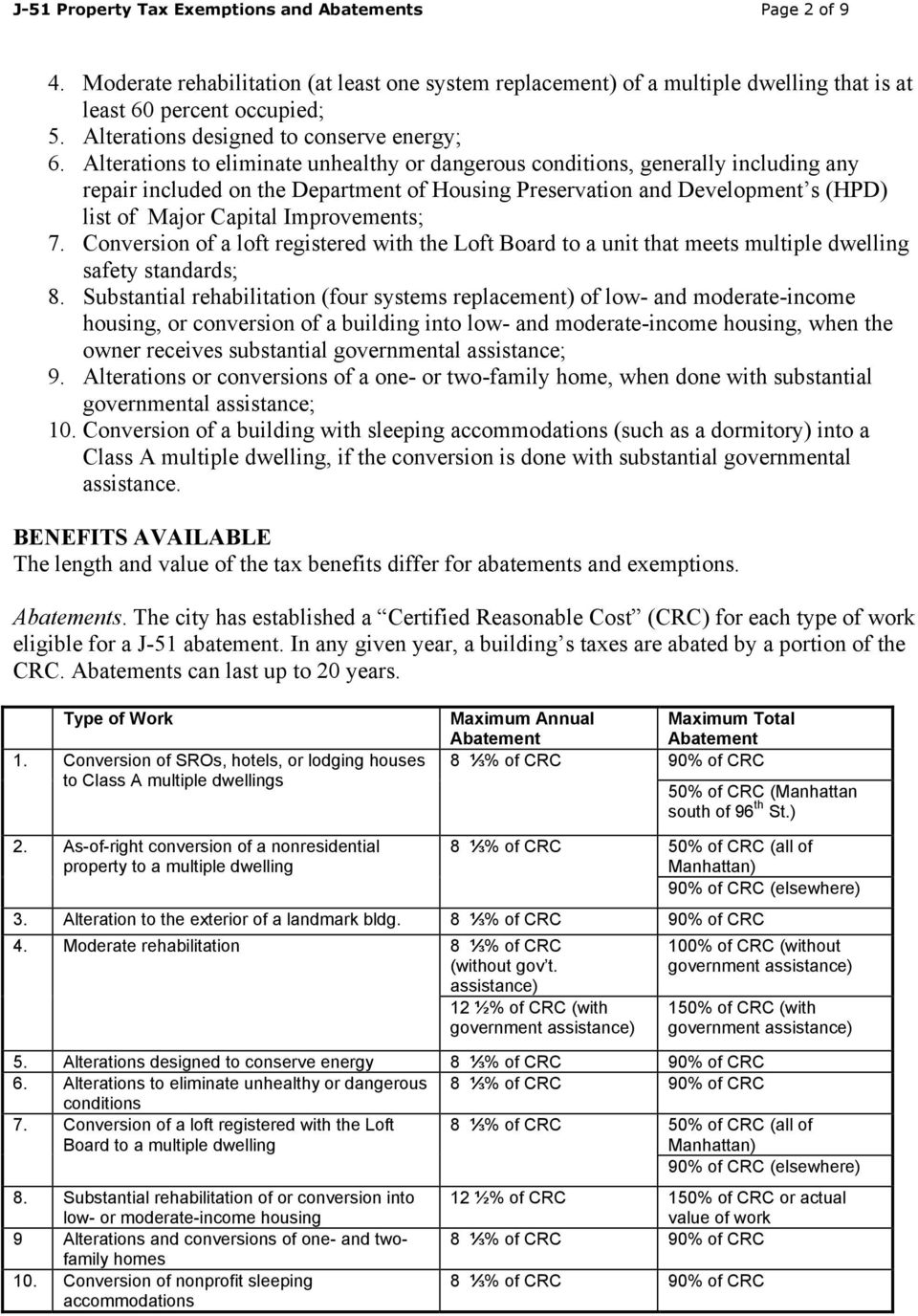
3 J-51 Property Tax Exemptions and Abatements Page 3 of 9 In most cases, the maximum total abatement is reached before the end of the 20-year abatement period. If taxes are reduced by the maximum allowable 8 ⅓ percent each year, the 90 percent of CRC ceiling will be reached in about 11 years. However, the value of the abatement can never exceed a building s total tax liability. If the building s tax liability is low relative to the CRC, the owner may not be able to take advantage of the full 8 ⅓ percent in a given year, but can extend the length of the abatement over time. The maximum allowable CRC is capped, based on the size of the average apartment in the building: Certified Reasonable Cost Ceilings Number of Rooms Maximum CRC 2 ½ $12,600 3 ½ (1 bedroom) $15,000 4 ½ (2 bedroom) $17,400 5 ½ (3 bedroom) $19,800 SOURCES: IBO, Department of Housing Preservation and Development. NOTE: The cap is raised by $2,400 for each additional room. The maximum CRC can be increased by up to 25 percent, if HPD determines that the additional expenditure was necessary. The CRC ceiling does not apply to substantial rehabilitation done with governmental assistance. Finally, there is a $2,500 per unit annual cap on the value of the abatement for condos and co-ops citywide, and rental units south of 96 th Street, unless the work was done with substantial governmental assistance. South of 86 th Street, the abatement can be taken against the value of the building only (not the land), which further limits the allowable tax benefit. The $2,500 cap on the value of the abatement is somewhat redundant, given the maximum allowable CRCs described above. For example, a two bedroom (4 ½ room) apartment has a maximum allowable CRC of $17,400. Under most circumstances, the owner can abate 8 ⅓ percent of the CRC, or a maximum of $1,450 annually, well below the $2,500 cap. Enhanced Abatements. As noted in the table describing abatement benefits, there are some specific instances when owners can receive enhanced abatement benefits: 12 ½ percent of CRC annually, up to a maximum of 150 percent of CRC over 20 years. All substantial rehabilitations of or conversions into low- and moderate-income housing using governmental assistance are eligible for these enhanced benefits. Moderate rehabilitation projects are also eligible, if they meet one of the following criteria: Work carried out with substantial governmental assistance; Work carried out with substantial assistance from a nonprofit housing organization; Work financed by the New York City Residential Mortgage Insurance Corporation (REMIC); Work financed by the State of New York Mortgage Agency (SONYMA);

4 J-51 Property Tax Exemptions and Abatements Page 4 of 9 Work done as part of a Federal Housing Administration (FHA) program in a neighborhood strategy area. Exemptions. In most cases, the increase in assessed value resulting from rehabilitation work is fully exempt for 10 years, and phases out over four years, for a total exemption period of 14 years. However, there are two project categories eligible for 30 years of full exemption, also phasing out over four years, for a total exemption period of 34 years: Moderate rehabilitation (with or without governmental assistance); Substantial rehabilitation or conversions done with governmental assistance to provide housing for low- and moderate-income households. Owners can meet the low- and moderate-income requirement by renting all units to households earning no more than 165 percent of Area Median Income (about $104,000 for a family of four) or 80 percent of units to households earning no more than 180 percent of area median ($113,100 for a family of four) and the remaining 20 percent of units to households earning no more than 80 percent of area median ($50,250). LIMITS ON BENEFITS The J-51 laws place limits on which units are eligible for exemptions and abatements. In general, the laws are designed to keep relatively high-value buildings from qualifying for tax benefits. The limitations on exemptions and abatements differ from one another: Units subject to assessed value cap Cap on per unit AV Exceptions to AV cap Abatements All $40,000 BEFORE rehabilitation work Condos/Co-ops also subject to ceilings on per room sale prices, tied to the Fannie Mae price limits. 2 Moderate rehabilitation Loft conversions Gov t/charitable assistance (not conversions) Building in Neighborhood Preservation Program area Building has REMIC or SONYMA mortgage insurance Work done through specific federal programs Conversions or substantial rehabilitation (without any affordability provision) Condos/Co-ops within three years of first closing Rehab work or conversion that creates new units in condo/co-op buildings. Exemptions South of 110 th Street in Manhattan $38,000 AFTER rehabilitation work. Moderate rehabilitation Loft conversions Gov t/charitable assistance (not conversions) Building in Neighborhood Preservation Program area Building has REMIC or SONYMA mortgage insurance Work done through specific federal programs 30 percent of apartments affordable to low/ moderate income households for 15 years. Both the exemption and abatement rules place limits on the properties that are eligible for tax benefits. The limitations are similar, but not precisely the same, so there are some circumstances

5 J-51 Property Tax Exemptions and Abatements Page 5 of 9 under which a building could be eligible for a J-51 exemption, but not an abatement. For example, a building outside of Manhattan with an average assessed value per unit greater than $40,000 would not be eligible for an abatement (unless it met one of the criteria noted above) but would be eligible for an exemption. In addition to the benefits described above, rental units in buildings receiving J-51 tax exemptions or abatements become subject to rent regulation, and remain so for the life of the exemption/abatement. EXEMPTION AND ABATEMENT DISTRIBUTION In 2002, there were 116,803 units in 3,897 buildings receiving J-51 exemptions, and 662,178 units in 12,279 buildings receiving J-51 abatements. These two groups of buildings overlap. Virtually all buildings that receive exemptions will also receive abatements, although many more units receive abatements than exemptions, because the majority of rehabilitation work does not have an appreciable effect on assessed value. Location. Rental units receive the majority of both exemptions and abatements. Exemptions are concentrated in the Bronx, while abatements are more evenly distributed. Exemptions may be disproportionately concentrated in the Bronx because by many measures of housing quality, the housing in the Bronx is in the worst condition. The Bronx has the highest average number of maintenance deficiencies per dwelling unit, the highest percentage of housing with five or more maintenance deficiencies, and the highest rate of housing complaints, serious violations, and total violations. 3 Therefore properties in the Bronx may be more likely to need the major rehabilitation work that will raise the assessed value of the building and lead to J-51 exemption. The distribution of abatements by borough loosely mirrors the distribution of multifamily housing. About 17 percent of all multifamily housing, and 20 percent of J-51 abatements, are located in the Bronx. Brooklyn has 25 percent of multifamily housing, and 22 percent of J-51 abatements.

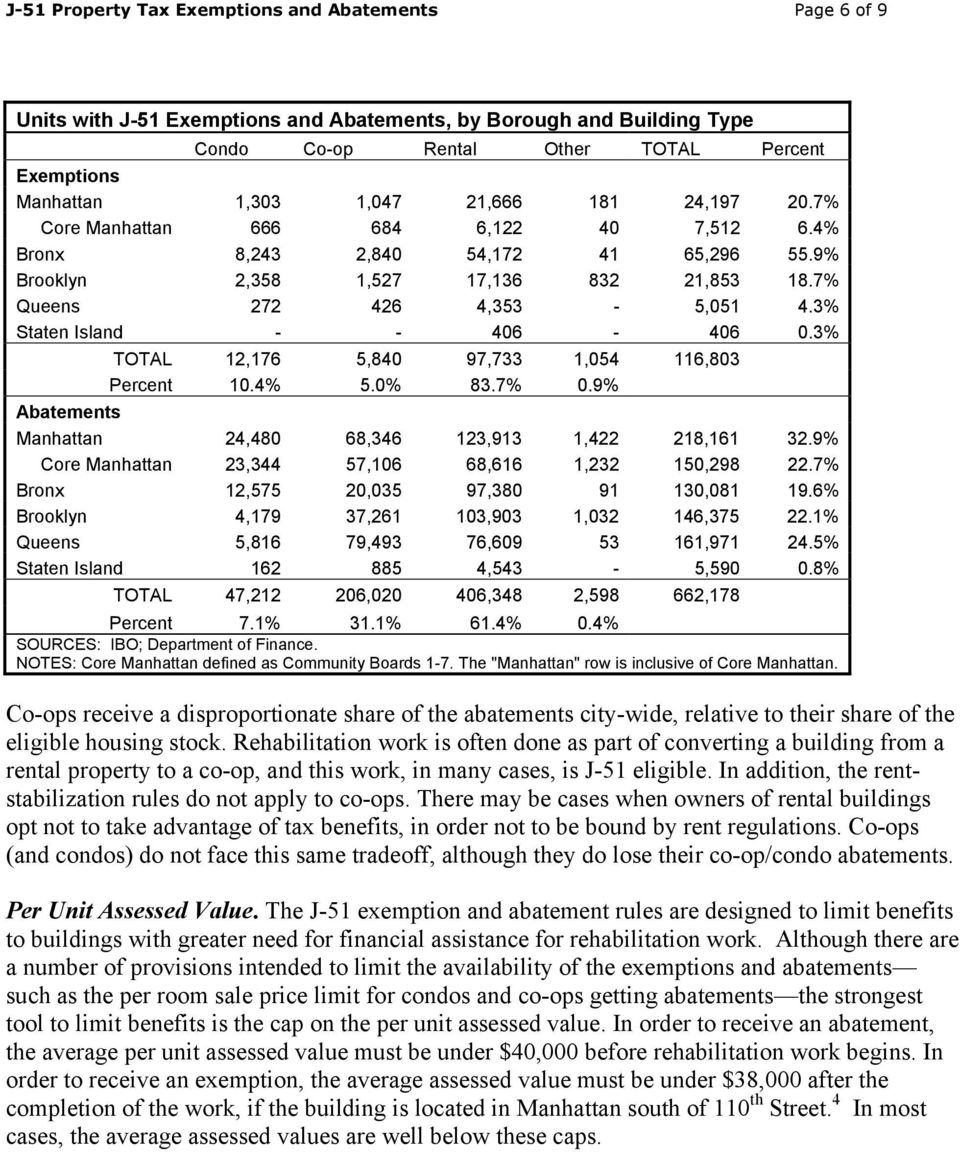
6 J-51 Property Tax Exemptions and Abatements Page 6 of 9 Units with J-51 Exemptions and Abatements, by Borough and Building Type Condo Co-op Rental Other TOTAL Percent Exemptions Manhattan 1,303 1,047 21, , % Core Manhattan , , % Bronx 8,243 2,840 54, , % Brooklyn 2,358 1,527 17, , % Queens ,353-5, % Staten Island % TOTAL 12,176 5,840 97,733 1, ,803 Percent 10.4% 5.0% 83.7% 0.9% Abatements Manhattan 24,480 68, ,913 1, , % Core Manhattan 23,344 57,106 68,616 1, , % Bronx 12,575 20,035 97, , % Brooklyn 4,179 37, ,903 1, , % Queens 5,816 79,493 76, , % Staten Island ,543-5, % TOTAL 47, , ,348 2, ,178 Percent 7.1% 31.1% 61.4% 0.4% SOURCES: IBO; Department of Finance. NOTES: Core Manhattan defined as Community Boards 1-7. The "Manhattan" row is inclusive of Core Manhattan. Co-ops receive a disproportionate share of the abatements city-wide, relative to their share of the eligible housing stock. Rehabilitation work is often done as part of converting a building from a rental property to a co-op, and this work, in many cases, is J-51 eligible. In addition, the rentstabilization rules do not apply to co-ops. There may be cases when owners of rental buildings opt not to take advantage of tax benefits, in order not to be bound by rent regulations. Co-ops (and condos) do not face this same tradeoff, although they do lose their co-op/condo abatements. Per Unit Assessed Value. The J-51 exemption and abatement rules are designed to limit benefits to buildings with greater need for financial assistance for rehabilitation work. Although there are a number of provisions intended to limit the availability of the exemptions and abatements such as the per room sale price limit for condos and co-ops getting abatements the strongest tool to limit benefits is the cap on the per unit assessed value. In order to receive an abatement, the average per unit assessed value must be under $40,000 before rehabilitation work begins. In order to receive an exemption, the average assessed value must be under $38,000 after the completion of the work, if the building is located in Manhattan south of 110 th Street. 4 In most cases, the average assessed values are well below these caps.
7 J-51 Property Tax Exemptions and Abatements Page 7 of 9 Average per Unit Assessed Value, J-51 Exemptions and Abatements, 2003 Condo Co-op Rental Average Exemptions ($38,000 per-unit cap) Manhattan $40,460 $24,462 $16,520 $29,439 Core Manhattan 57,528 28,470 24,484 47,166 Bronx 6,329 10,935 9,748 6,816 Brooklyn 27,010 16,275 11,116 22,240 Queens 21,285 14,151 12,978 19,602 Staten Island ,012 12,012 Abatements ($40,000 per-unit cap) Manhattan $38,303 $28,956 $19,617 $33,519 Core Manhattan 39,188 31,976 27,904 37,363 Bronx 8,475 15,040 10,480 8,860 Brooklyn 24,773 15,677 11,309 18,318 Queens 19,780 17,146 14,007 18,327 Staten Island 13,705 14,343 11,411 13,386 SOURCES: IBO, Department of Finance. NOTES: Core Manhattan defined as Community Boards 1-7. The "Manhattan" row is inclusive of Core Manhattan. Table excludes buildings with other building classes, such as lofts and mixed use properties. The condominium properties in Core Manhattan receiving J-51 exemptions have an average assessed value well above the $38,000 cap. The majority of these roughly 700 units are former lofts, and are therefore not subject to the ceiling on assessed value. Additional units with assessed values above $38,000 are located in the Lower East Side Neighborhood Preservation Area, which also exempts them from the cap on assessed value. However, there are some additional units in buildings with J-51 exemptions and assessed values over $38,000 and without obvious characteristics that would exempt them from the assessed value ceiling. It is highly likely that some of these units met the $38,000 threshold after the work was completed, but that assessments have subsequently grown, bringing the assessed value above the cap. VALUE OF THE TAX BENEFITS For 2003, the average per unit exemption benefit was $715, and the average per unit abatement benefit was $151. Class 2A and class 2B buildings rental buildings with fewer than 10 units are assessed differently than other class 2 buildings. For these buildings, the assessed value is typically more like 20 percent of estimated market value, as compared to 45 percent for other Class 2 properties. IBO has therefore separated class 2A and class 2B units when estimating the average tax benefit per unit. Exemptions and abatements in these smaller buildings are significantly more expensive for the city. However, it is important to note that the J-51 law does not distinguish between different categories of class 2 properties: the same ceilings on assessed value are applied across the board. The bulk of the tax expenditure for both exemptions and abatements is for buildings with low assessed values i.e. relatively affordable housing. However, at the unit level, buildings with higher assessed values receive larger benefits than the more affordable apartments.

8 J-51 Property Tax Exemptions and Abatements Page 8 of J-51 Expenditures, by Per Unit Assessed Value Tax Classes 2A and 2B Other Tax Classes Combined Unit Assessed Value Tax (Millions) Units Per Unit Tax (Millions) Units Per Unit Tax (Millions) Units Per Unit Exemptions Under $20,000 $5.5 6,068 $902 $ ,191 $572 $ ,259 $592 $20,000- $38, ,090 2, ,522 1, ,612 1,506 $38,000- $55, , ,114 2, ,242 2,434 $55,000- $100, , , ,390 Greater than $100, NA , ,868 TOTAL $8.2 7,296 $1,118 $ ,507 $688 $ ,803 $715 Abatements Under $20,000 $3.9 10,614 $365 $ ,119 $140 $ ,733 $145 $20,000- $40, , , , $40,000- $55, , , $55,000- $100, , , Greater than $100, NA , ,153 TOTAL $4.8 12,573 $382 $ ,424 $146 $ ,997 $151 SOURCES: IBO, Department of Finance. NOTES: Exemption tax expenditures reflect the property tax increase enacted in mid-fiscal Year The number of units with abatements excludes some records with missing data, that are included in earlier counts. CONCLUSION The J-51 tax benefit program offers incentives to building owners to repair and rehabilitate their properties. Despite the complex nature of the J-51 laws, it is a major program representing almost half the city s annual tax expenditures for housing development that provides benefits to more than 600,000 units annually. Much of the complexity of the J-51 laws arises from the objective of targeting tax benefits to buildings needing financial assistance for necessary rehabilitation work. Our analysis of the distribution of units by assessed value suggests that the majority of buildings receiving J-51 benefits have relatively low assessed values. Only a small number of higher end units benefit from the J-51 program. Because the number of units is small, the total tax expenditure on these units is similarly small, although the expenditure per unit is substantially higher for high-end units than for units with lower assessed values. Prepared by Molly Wasow Park

9 J-51 Property Tax Exemptions and Abatements Page 9 of 9 END NOTES 1 This report summarizes the J-51 laws. In some cases, details have been omitted or consolidated for simplicity s sake. Readers looking for legal guidance should refer to the J-51 law, rules, and the HPD guidebook. 2 While the $40,000 ceiling on assessed value is usually the relevant cap on a unit s value, there are some cases where a unit has turned over several times in a short period of time, and the growth in sales price has significantly outpaced the growth in assessed value. When this occurs, units may be subject to the per room sale price limits, although they are under the $40,000 ceiling. 3 Denise Wallin, Michael H. Schill, Glynis Daniels: State of New York City s Housing and Neighborhoods, 2002 (New York University, Furman Center for Real Estate and Urban Policy, 2002). 4 For apartment buildings with more than 10 units, the assessed value is equal to 45 percent of full market value. For rental properties, the city estimates market value as the capitalized value of the income stream from the building. State law requires that condominium and co-op units must be valued as if they were rent-regulated units, which forces the city to use incomes imputed from comparable rental buildings. As a result, the city s official market values for co-op and condo buildings are much lower than they would be if market value were determined using sales prices of comparable units. IBO has estimated that as a result of the law, the official market values and assessed values for coops and condos used by the city for tax purposes are discounted by more than 50 percent from their sales-based values.

RESIDENTIAL PROPERTY TAX INCENTIVE PROGRAMS in New York City
 RESIDENTIAL PROPERTY TAX INCENTIVE PROGRAMS in New York City A Guide to Basic Program Rules and Eligibility FEBRUARY 2011 ABOUT ENTERPRISE Enterprise is a leading provider of the development capital and
Changes to the Rent Stabilized Housing Stock in New York City in 2012
 New York City Rent Guidelines Board Changes to the Rent Stabilized Housing Stock in New York City in 2012 May 30, 2013 Board Members Chair: Jonathan L. Kimmel, Esq. Public Members: Tanya Levy-Odom Courtney
Changes to the Rent Stabilized Housing Stock in New York City in 2015
 New York City Rent Guidelines Board Changes to the Rent Stabilized Housing Stock in New York City in 2015 May 26, 2016 Board Members Chair: Hon. Kathleen A. Roberts (Ret.) Public Members: Steven Flax Cecilia
FOR REAL ESTATE & URBAN POLICY
 FURMAN CENTER N E W Y O R K U N I V E R S I T Y FOR REAL ESTATE & URBAN POLICY S C H O O L O F L A W W A G N E R S C H O O L OF P U B L I C S E R V I C E 139 MacDougal Street, 2 nd Floor, New York, NY
NYC RESIDENTIAL. property taxes. coops. condos. rentals. 4+ units. class two
 NYC RESIDENTIAL class two property taxes coops condos rentals 4+ units niform Agencies (Police, Fire, Sanitation, Corrections) WHERE DO YOUR tax dollars go? Education Health and Welfare 28% 20% U32% In
Understanding the NYC 421-a Property Tax Exemption Program How Can it Be Reformed to Create Affordable Housing?
 Pratt Center for Community Development Understanding the NYC 421-a Property Tax Exemption Program How Can it Be Reformed to Create Affordable Housing? Summary Most newly-constructed housing development
CITY OF TEMPE COMMUNITY DEVELOPMENT DEPARTMENT HOUSING SERVICES DIVISION www.tempe.gov
 CITY OF TEMPE COMMUNITY DEVELOPMENT DEPARTMENT AFFORDABLE HOUSING STRATEGY DOCUMENT 1 CITY OF TEMPE COMMUNITY DEVELOPMENT DEPARTMENT HOUSING SERVICES DIVISION www.tempe.gov P.O. BOX 5002 21 E. Sixth Street,
Achieving your goals through Financing. Cooperative Financing Models that may work for you
 Achieving your goals through Financing Cooperative Financing Models that may work for you Overview Cooperative Financing Overview of the environment Interest Rates Why now is the best time to borrow Reasons
Sandy s Effects on Housing in New York City
 MARCH 2013 FACT BRIEF Effects on Housing in New York City Four months after Superstorm Sandy, New Yorkers continue to pick up the pieces and rebuild. Sandy devastated many parts of the city, including
Get Your Multifamily Deal Done With FHA
 January 7, 2009 Get Your Multifamily Deal Done With FHA Arbor Commercial Mortgage, LLC Overview In 2008, the housing finance system came to a near standstill as creditors began losing confidence in the
March 13, 2006. Hon. Scott M. Stringer Manhattan Borough President 1 Centre Street New York, NY 10007. Dear Borough President Stringer:
 THE CITY OF NEW YORK INDEPENDENT BUDGET OFFICE 110 WILLIAM STREET, 14 TH FLOOR NEW YORK, NEW YORK 10038 (212) 442-0632 FAX (212) 442-0350 EMAIL: [email protected] http://www.ibo.nyc.ny.us Hon. Scott M.
Historic Tax Incentive For
 Historic Tax Incentive For 501 2 nd Avenue Hickory Street Annex June 12, 2009 Economic Development Committee Request Review of a proposed historic preservation tax incentive over $50,000 for the Hickory
Appendix 11: AFFORDABLE HOUSING TERMS & CRITERIA
 Appendix 11: AFFORDABLE HOUSING TERMS & CRITERIA (Provided by the Southampton Housing Authority March 18, 2013) What is Affordable Housing? There are a number of definitions of affordable housing as federal
How To Write An Article 7A Program Review
 THE CITY OF NEW YORK INDEPENDENT BUDGET OFFICE 110 WILLIAM STREET, 14 TH FLOOR NEW YORK, NEW YORK 10038 (212) 442-0632 FAX (212) 442-0350 EMAIL: [email protected] http://www.ibo.nyc.ny.us Review of the
Housing Policy in New York City: A Brief History
 FURMAN CENTER FOR REAL ESTATE & URBAN POLICY N E W Y O R K U N I V E R S I T Y S C H O O L O F L A W W A G N E R S C H O O L OF P U B L I C S E R V I C E 40 Washington Square South, Suite 314, New York,
The Third Certainty: How and Why New York City s Property Taxes Increase Consistently Addressing The Many Misconceptions
 Real Estate Forefront Emerging Developments in the NYC Marketplace, #22 The Third Certainty: How and Why New York City s Property Taxes Addressing The Many Misconceptions February 2013 2 Everyone knows
Attachment 3 DCHA Response to FY2016 Budget Oversight Pre-hearing Questions. DC Housing Authority Capital Needs and Maintenance Review
 DC Housing Authority Capital Needs and Maintenance Review Capital Needs Overview The District of Columbia Housing Authority is responsible for providing safe, affordable housing for the District s low-income
NYC RESIDENTIAL. property taxes. class one. one. two. three. family. homes
 NYC RESIDENTIAL class one property taxes one two three family homes niform Agencies (Police, Fire, Sanitation, Corrections) WHERE DO YOUR tax dollars go? Education Health and Welfare 28% 20% U32% In New
Historic Preservation Tax Incentive Program Step 1 Application to the Landmark Commission
 Historic Preservation Tax Incentive Program Step 1 Application to the Landmark Commission Page 1 of 8 Application Requirements Completed Step 1 Application... All requested information must be provided,
FEDERAL AND STATE HOUSING TAX CREDIT PROGRAMS
 CALIFORNIA TAX CREDIT ALLOCATION COMMITTEE 915 Capitol Mall, Suite 485 MEMBERS Sacramento, CA 95814 JOHN CHIANG, CHAIRMAN p (916) 654-6340 State Treasurer f (916) 654-6033 BETTY YEE [email protected]
CITY OF CAMBRIDGE, MASSACHUSETTS. Housing Profile
 CITY OF CAMBRIDGE, MASSACHUSETTS Housing Profile Cambridge Community Development Department August 2010 CAMBRIDGE HOUSING MARKET INFORMATION TABLE OF CONTENTS GENERAL INFORMATION 1. 2010 Cambridge Housing
THE FEDERAL LOW-INCOME HOUSING TAX CREDIT AND HISTORIC REHABILITATION TAX CREDIT
 THE FEDERAL LOW-INCOME HOUSING TAX CREDIT AND HISTORIC REHABILITATION TAX CREDIT This outline provides an overview of the federal low-income housing tax credit and historic rehabilitation tax credit. I.
Project-Based Rental Assistance
 Project-Based Rental Assistance By Staff of the National Housing Trust Administering agency: HUD s Office of Multifamily Housing Programs and Office of Recapitalization Years started: 1961 - Section 221(d)(3)
WHEREAS, Santa Monica is a coastal city in a prime location, being bordered by the City of Los Angeles to the north, east and south; and
 City Council Meeting / /2013 ORDINANCE NUMBER (CCS) (City Council Series) AN ORDINANCE OF THE CITY COUNCIL OF THE CITY OF SANTA MONICA AMENDING SANTA MONICA MUNICIPAL CODE SECTIONS 9.56.020, 9.56.030,
Solar Panel Property Tax Abatement Property Tax Abatement for PV Equipment Expenditures Amount: Amount: Maximum
 Solar Panel Property Tax Abatement Allows NYC building owners to deduct solar electric generating systems from property tax. Amount: Systems placed between August 8, 2008 and December 31, 2010 are eligible
Condo Project Approval Documentation Requirements
 All documentation should be submitted at one time to our Condo Project Approval Department at [email protected]. The subject line of the email should contain the loan number, Borrower s last
More than just housing... CO-OP HOUSING
 More than just housing... CO-OP HOUSING How you can profit by living in a housing cooperative. Introduction A combination of factors including the rising cost of housing in recent years, have forced many
What Can We Learn about the Low-Income Housing Tax Credit Program by Looking at the Tenants?
 MOELIS INSTITUTE FOR AFFORDABLE HOUSING POLICY BRIEF OCTOBER 2012 What Can We Learn about the Low-Income Housing Tax Credit Program by Looking at the Tenants? WWW.FURMANCENTER.ORG I. Introduction While
Gloversville Community Development Agency. CDBG Housing Rehabilitation Program
 Version 10/29/14 Gloversville Community Development Agency CDBG Housing Rehabilitation Program THE PROGRAM ELIGIBLE IMPROVEMENTS The Gloversville Community Development Agency is operating a housing rehabilitation
LOW-INCOME HOUSING TAX CREDIT PROGRAM OVERVIEW
 LOW-INCOME HOUSING TAX CREDIT PROGRAM OVERVIEW September 2015 TAX CREDIT OVERVIEW The credit is a 10-year tax incentive to encourage the development of residential rental housing at or below 60% of area
FORM TC201 INSTRUCTIONS FOR 2015
 TAX COMMISSION OF THE CITY OF NEW YORK 1 Centre Street, Room 2400, New York, NY 10007 INCOME AND EXPENSE SCHEDULE FOR RENT PRODUCING PROPERTIES FORM TC201 INSTRUCTIONS FOR 2015 TC201INS 2015 Attachment
City of Champaign Neighborhood Services Department Neighborhood Programs Division 102 N. Neil St. Champaign, Illinois 61820 (217) 403-7070
 City of Champaign Neighborhood Services Department Neighborhood Programs Division 102 N. Neil St. Champaign, Illinois 61820 (217) 403-7070 Acquisition-Rehabilitation Program SCOPE INCOME LIMIT The program
 Asset Management Outcomes Logic Model Outcomes Asset Management Outcomes Indicators Activities Timing Frequency Who is Accountable Financial Management Process Roles Other Relevant Persons Mission/Housing
SECTION 4 REHABILITATION MORTGAGES 203(k) Standard & 203(k) Limited
 SECTION 4 REHABILITATION MORTGAGES 203(k) Standard & 203(k) Limited 4.1 Program Descriptions 4.2 Borrower Eligibility 4.3 Property Eligibility 4.4 Principal Residence Requirement 4.5 Rehabilitation Loan
Multi-family Affordable. Becky Christoffersen, Midwest Housing Development Fund, Inc.
 Multi-family Affordable Housing Capital Solutions Becky Christoffersen, Midwest Housing Development Fund, Inc. Midwest Housing Development Fund, Inc. CDFI since 2000 Revolving loan fund Affordable Housing
Vancouver s Housing and Homelessness Strategy 2012-2021 A home for everyone
 Vancouver s Housing and Homelessness Strategy 2012-2021 A home for everyone A home for everyone Vancouver s Housing and Homelessness Strategy 2012-2021 Prepared by Context Ltd. June 2011 ACKNOWLEDGEMENTS:
How Subsidized Rents are Set: Area Median Incomes and Fair Markets Rents
 How Subsidized Rents are Set: Area Median Incomes and Fair Markets Rents Many NMHC and NAA members own and/or operate apartment communities that provide affordable housing throughout the country using
PRESERVATION OF AFFORDABLE HOUSING. Housing Affordability, Human Services, and Economic Resiliency Committee Seattle City Council, July 16, 2014
 1 PRESERVATION OF AFFORDABLE HOUSING Housing Affordability, Human Services, and Economic Resiliency Committee Seattle City Council, July 16, 2014 Topics to be covered 2 Affordability and preservation trends
FREDDIE MAC CONDO-PUD MATRIX Consult the Client Guide for complete condominium eligibility details
 FREDDIE MAC CONDO-PUD MATRIX Consult the Client Guide for complete condominium eligibility details PROJECT CLASSIFICATION PROJECT TYPE ELIGIBILITY/LEGAL/DOCUMENTATION INSURANCE PUD PROJECTS ESTABLISHED
Homebuyer s Guide. What you need to know to buy in New York City. Local Housing Partners:
 Homebuyer s Guide What you need to know to buy in New York City Local Housing Partners: Homebuyer s Guide: What you need to know to buy in New York City HUD and Homeownership The Fair Housing Act prohibits
Distribution of the Burden of New York City s Property Tax
 Distribution of the Burden of New York City s Property Tax This section examines how different types of property are assessed in the city, and finds significant disparities in the effective tax rates of
5. CONSERVATION OF AFFORDABLE UNITS
 5. CONSERVATION OF AFFORDABLE UNITS The analysis of the Conservation of Affordable Units section relied primarily on data from the San Benito County Housing and Economic Development Department, San Benito
Perceptions of Homelessness in Chicago and New York City
 Perceptions of Homelessness in and City an ICPH Poll Comparison February 2011 Page 2 Perceptions of Homelessness in and City Perceptions of Homelessness in and City ICPH Poll Comparison In order to gauge
Federal Tax Credits for Historic Preservation
 Federal Tax Credits for Historic Preservation Introduction The Federal Historic Preservation Tax Incentive is described here in general terms only. More detailed information, including copies of application
CITY OF BAY VILLAGE DEPARTMENT OF COMMUNITY SERVICES DOWN PAYMENT ASSISTANCE PROGRAMS
 CITY OF BAY VILLAGE DEPARTMENT OF COMMUNITY SERVICES DOWN PAYMENT ASSISTANCE PROGRAMS Cuyahoga County Loan and Grant Programs for Residents For application forms or more information on the programs below,
NCLB. Development Resource Directory. Newburgh Community Land Bank www.newburghcommunitylandbank.org
 NCLB Development Resource Directory Newburgh Community Land Bank www.newburghcommunitylandbank.org Development Resource Directory The Newburgh Community Land Bank (NCLB) is a non-profit organization focused
Historic Preservation Tax Incentive Program General information and instructions for applying for a historic tax exemption
 Historic Preservation Tax Incentive Program General information and instructions for applying for a historic tax exemption Page 1 of 8 There are Incentives Available for Rehabilitating Historic Structures!
APPENDIX D: HOUSING PROGRAM DIRECTORY
 APPENDIX D: HOUSING PROGRAM DIRECTORY Table D-1 Housing Rehabilitation Programs 1. HOME MAINTENANCE AND IMPROVEMENT PROGRAM (HMIP) To provide loans to correct health and safety violations, abate code deficiencies
Tools for Affordable Housing Preservation. A Case Study of Bellefield Dwellings Pittsburgh. PCRG Conference 5.22.13
 Tools for Affordable Housing Preservation A Case Study of Bellefield Dwellings Pittsburgh PCRG Conference 5.22.13 Panelists Ray Baum- Pepper Hamilton Holly Glauser- PHFA Peter Kaplan- PNC Bank Lara Washington-
AFFORDABLE HOUSING POLICY Recommended July 23, 2013
 AFFORDABLE HOUSING POLICY Recommended July 23, 2013 It shall be the policy of Albemarle County to promote a variety of housing choices for residents. Choice shall be defined by type, tenure, and price
Land Banks and Affordable Housing
 September 2008 Volume 7 Issue 5 Land Banks and Affordable Housing You can hardly turn on the news today without hearing a report that the number of foreclosed properties continues to rise nationwide. In
Residential Rehabilitation Loan Program Guidelines
 Residential Rehabilitation Loan Program Guidelines City of Middletown Department of Planning, Conservation and Development Community Development Division February 1999 Table of Contents Purpose 1 General
Commonwealth of Massachusetts HOUSING STABILIZATION FUND (HSF) Rental Application Guidelines
 Commonwealth of Massachusetts HOUSING STABILIZATION FUND (HSF) Rental Application Guidelines A. Overview Thousands of residential properties requiring moderate or substantial rehabilitation are located
Historic Designation and Financial Incentives for Building Rehabilitation
 Historic Designation and Financial Incentives for Building Rehabilitation Macomb, September 23, 2014 Catherine O Connor & Darius Bryjka Illinois Historic Preservation Agency Illinois Historic Preservation
Historic Preservation Tax Incentives
 Historic Preservation Tax Incentives A Presentation of the Restoration Branch of the North Carolina State Historic Preservation Office Background: The North Carolina State Capitol The federal and state
Community Investments Vol. 11, Issue 2 Hot Tips: Q & A
 Community Investments Vol. 11, Issue 2 Hot Tips: Q & A Author(s): Jeanine Catalano, Fair Lending and CRA Consultant and Carol Cordova, Vice President, Bankers' Compliance Group, Inc. September 1999 Each
Incentives for Historic Preservation
 Incentives for Historic Preservation Historic places help define the character of our communities by providing a tangible link with the past. Today, historic districts around the country are experiencing
Creating More Affordable Housing in Chicago
 Creating More Affordable Housing in Chicago The Home Builders Association of Greater Chicago (HBAGC) supports increasing the availability of affordable housing in the City of Chicago and strongly encourages
Chapter 40B - Frequently Asked Questions
 What is Chapter 40B? Chapter 40B - Frequently Asked Questions Also known as the Comprehensive Permit Law, Chapter 40B (http://www.mass.gov/?pageid=ehedsubtopic&l=3&l0=home&l1=community+ Development&L2=Chapter+40B+Planning&sid=Ehed)
Tax Credits 101 CHPC. California Housing Partnership Corporation Zorica Stancevic Program Manager
 California Housing Partnership Corporation Zorica Stancevic Program Manager CHPC Mission CHPC assists nonprofit and government housing agencies to create, acquire and preserve housing affordable to lower
Federal Housing Assistance Programs
 National Coalition for the Homeless 2201 P. St. NW Washington, DC 20037 Phone: (202) 462-4822 Fax: (202) 462-4823 Email: [email protected] Website: http://www.nationalhomeless.org Federal Housing
Housing Cooperatives. An Accessible and Lasting Tool for Home Ownership. Northcountry Cooperative Development Fund
 Housing Cooperatives An Accessible and Lasting Tool for Home Ownership Northcountry Cooperative Development Fund Did you know. that in the United States, more than 1.5 million families of all income levels
CITY OF LEHI, UTAH GENERAL PLAN MODERATE INCOME HOUSING ELEMENT
 CITY OF LEHI, UTAH GENERAL PLAN MODERATE INCOME HOUSING ELEMENT Prepared by: Lehi City Planning Department and Mountainland Association of Governments Adopted by Lehi City Council August 14, 2012 Recommended
Gustav/Ike Hurricane Recovery
 Gustav/Ike Hurricane Recovery COMPETITIVE AFFORDABLE RENTAL PROGRAM Program Made Possible By Louisiana Recovery Authority, The Office Of Community Development s Disaster Recovery Unit And U.S. Department
New York City Property Taxes
 New York City Property Taxes An Unbalanced Burden Assemblymember Dan Quart 1 HISTORY Until 1975, property assessment in New York City was subject to the discretion of local property assessors who used
RELOCATION ASSISTANCE
 RELOCATION ASSISTANCE All tenant not-at-fault evictions require payment of relocation assistance and the filing of a Landlord Declaration of Intent to Evict form with the Los Angeles Housing and Community
NEIGHBORHOOD LAND BANK
 NEIGHBORHOOD LAND BANK Purpose: Contribute to the community stabilization, revitalization and preservation of San Diego County s communities, particularly San Diego s low and moderate income communities,
HPD Supportive Housing Loan Program:
 A Guide to Eligibility and Rent Setting HPD Supportive Housing Loan Program: A Guide to Eligibility and Rent Setting April 2014 Version Supportive Housing Loan Program: A Guide to Eligibility and Rent
Neighborhoods & Housing
 Chapter 6 Neighborhoods & Housing Introduction A major goal of this plan is to improve the livability of the City s neighborhoods. For existing neighborhoods, this may be achieved through conservation,
FHA INSURED LOANS ~ Multifamily Accelerated Processing (MAP) NEW CONSTRUCTION or SUBSTANTIAL REHABILITATION Of RENTAL APARTMENTS
 FHA INSURED LOANS ~ Multifamily Accelerated Processing (MAP) NEW CONSTRUCTION or SUBSTANTIAL REHABILITATION Of RENTAL APARTMENTS Section 221(d) Family Apartments, all Areas Section 220 Family Apartments,
The Impacts of Foreclosure on Renters
 The Impacts of Foreclosure on Renters Federal Reserve Breakfast Forum F U R M A N C E N T E R FURMAN CENTER FOR REAL ESTATE & URBAN POLICY N E W Y O R K U N I V E R S I T Y S C H O O L O F L A W W A G
NEW YORK STATE HOMES AND COMMUNITY RENEWAL S MITCHELL-LAMA REHABILITATION AND PRESERVATION PROGRAM
 NEW YORK STATE HOMES AND COMMUNITY RENEWAL S MITCHELL-LAMA REHABILITATION AND PRESERVATION PROGRAM PROGRAM GOALS To offer flexible low cost financing to allow statefinanced Mitchell Lama rental properties
XI. HOME RENTAL REHABILITATION PROGRAM
 XI. HOME RENTAL REHABILITATION PROGRAM Introduction... XI-1 Compliance Eligible Costs... XI-1 Property Type and Location... XI-2 Long-Term Affordability... XI-3 The Applicant/Beneficiary... XI-5 Determining
COEUR D ALENE TRIBAL HOUSING AUTHORITY HOUSING REHABILITATION POLICY (CDTHA REHAB)
 COEUR D ALENE TRIBAL HOUSING AUTHORITY HOUSING REHABILITATION POLICY (CDTHA REHAB) Adopted by the Housing Board May 25, 2005 CDTHA HOUSING REHAB POLICY Programs Available... 3 Reconstruction... 3 Relocation/Displacement...
Federal Home Loan Bank of Cincinnati Affordable Housing Program
 Federal Home Loan Bank of Cincinnati Affordable Housing Program Damon V. Allen, Presenter 2014 National Community Land Trust Conference This presentation may contain forward-looking statements that are
CHAPTER 2: GENERAL PROGRAM RULES
 The HOME program has a number of basic rules that apply to all program activities. These rules concern: The definition of a project; The form and amount of subsidy; Eligible costs; The property; The applicant
a GAO-05-174 GAO ELDERLY HOUSING Federal Housing Programs That Offer Assistance for the Elderly Report to Congressional Requesters
 GAO United States Government Accountability Office Report to Congressional Requesters February 2005 ELDERLY HOUSING Federal Housing Programs That Offer Assistance for the Elderly a GAO-05-174 Accountability
New York State Division of Housing and Community Renewal Office of Rent Administration
 Policy Statement 89-7 New York State Division of Housing and Community Renewal Office of Rent Administration Policy Statement 89-7 (June 21, 1989) Collection of Administrative Fees: Housing Accommodations
Agencies and Resources
 The following local, state and federal agencies administer programs or provide funds for housing programs and projects: Murray County EDA P.O. Box 57 Slayton, MN 56172 Contact: Amy Hoglin, Economic Development
Model Legislation for Short-Term Online Rentals. Menu
 Section 1 - Definitions Model Legislation for Short-Term Online Rentals Menu Short-term rental unit means a residential dwelling of any type in the [state/city of ], including, but not limited to, a single-family
IHDA 47 ILLINOIS ADMINISTRATIVE CODE 355 TITLE 47: HOUSING AND COMMUNITY DEVELOPMENT CHAPTER II: ILLINOIS HOUSING DEVELOPMENT AUTHORITY
 IHDA 47 ILLINOIS ADMINISTRATIVE CODE 355 TITLE 47: HOUSING AND COMMUNITY DEVELOPMENT CHAPTER II: ILLINOIS HOUSING DEVELOPMENT AUTHORITY PART 355 ILLINOIS AFFORDABLE HOUSING TAX CREDIT PROGRAM SUBPART A: