
The Role of Law Enforcement Officers in Preventing Suicide
|
|
|
- Thomas Bailey
- 10 years ago
- Views:
Transcription
1 The Role of Law Enforcement Officers in Preventing Suicide Joe and Al, two law enforcement officers, were dispatched on a general disturbance call. A neighbor had called 911 saying she heard a loud argument in the house next door, and it sounded like someone might get hurt. Arriving at the scene, the officers found a husband and wife arguing, but no one was physically hurt. Stephen, the husband, was intoxicated. His wife, Linda, said that he had been out of work for six months, and they were having financial problems. Recently he d also been depressed and lethargic, and kept saying things like I m tired of all this and just want to end it all. Joe asked Stephen if he was thinking of killing himself. Stephen admitted that he had considered taking his life. Joe said that Stephen needed to go to the hospital so that he could be evaluated and get help to deal with his problems. After some hesitation and reluctance, Stephen finally agreed to go. At the hospital, Joe told the emergency department physician that Stephen had become depressed after being unemployed for six months and he had been drinking and had admitted that he considered taking his life. The physician thanked Joe for the information and said it was helpful. (Based on the experiences of a law enforcement officer) Key Steps to Reduce Suicide Risk among the People You Serve: Understand why suicide prevention fits with your role as a law enforcement officer Identify people who may be at risk for suicide Respond to people who may be at risk for suicide or have attempted suicide Help suicide loss survivors at the scene Consider becoming involved in suicide prevention in your agency and community The purpose of this sheet is to help law enforcement officers learn how to identify and respond to people they serve who are suicidal or have attempted suicide. Although the focus is not on suicide among officers, the Resources section of this sheet contains a number of items addressing that important issue. 1

2 Understand Why Suicide Prevention Fits with Your Role as a Law Enforcement Officer Like Joe and Al in the vignette, law enforcement officers often deal with situations involving an individual who is suicidal. These include: A person is communicating a desire or an intent to attempt suicide A person has just made a suicide attempt A person has died by suicide In a significant number of cases, officers receive a call that is not described as a suicidal crisis, but rather as a general disturbance, domestic violence, or similar type of situation. Upon arriving at the scene, the officers need to determine whether the situation involves someone who is suicidal. You have an important role to play in all of these situations. It is generally considered to be within the scope of a law enforcement officer s duty to protect the safety of the community as a whole as well as individuals. Your first responsibility is to deal with any safety issues that may affect you, the person who is suicidal, or others present at the scene, especially if the person has immediate access to lethal means. You can also provide clarity and support to the person who is suicidal and the other people who are there. Then your role, along with that of EMS providers and mental health professionals if they are present, is to ensure the person receives an evaluation as soon as possible. Know the facts Suicide touches everyone all ages and incomes; all racial, ethnic, and religious groups, and in all parts of the country. Suicide takes the lives of about 38,000 Americans each year (CDC, 2010). About 465,000 people per year are seen in hospital emergency departments for self-injury (CDC, 2010). Each year over 8 million adults think seriously about taking their life, and over 1 million make an attempt (NSDUH, 2011). However, there is help and hope when individuals, communities, and professionals join forces to prevent suicide. Preparing Ahead of Time Review the protocols and standard operating procedures required by your law enforcement agency and in your state and local area for responding to a person with suicidal thoughts, a person who has made a suicide attempt, or a death by suicide. 2
3 Learn how you should deal with a suicidal person who refuses to be transported for an evaluation. Meet with your local emergency medical services (EMS) providers to discuss how you can work together to help people who are suicidal, including those who refuse to be transported. If your community has a crisis intervention team (CIT) or if you work closely with mental health providers, meet with them to discuss how to work together most effectively. Identify People Who May Be At Risk for Suicide Look for signs of immediate risk for suicide There are some behaviors that may mean a person is at immediate risk for suicide. These three should prompt you to take action right away: Talking about wanting to die or to kill oneself Looking for a way to kill oneself, such as searching online or obtaining a gun Talking about feeling hopeless or having no reason to live Other behaviors may also indicate a serious risk, especially if the behavior is new; has increased; and/or seems related to a painful event, loss, or change. Ask if the person has been behaving in any of the following ways: Talking about feeling trapped or in unbearable pain Talking about being a burden to others Increasing the use of alcohol or drugs Acting anxious or agitated; behaving recklessly Sleeping too little or too much Withdrawing or feeling isolated Showing rage or talking about seeking revenge Displaying extreme mood swings What is a Crisis Intervention Team Program? The Crisis Intervention Team (CIT) Program is an innovative partnership between local law enforcement officers, community mental health providers, advocates, and consumers of behavioral health services. As part of the program, officers receive intensive training in responding effectively to people in a mental health crisis, including those who are suicidal. For more information, see the NAMI CIT Resource Center at org/content/navigationmenu/ Inform_Yourself/About_ Public_Policy/CIT2/CIT.htm. (Adapted from National Suicide Prevention Lifeline, [n.d.]) Be alert to problems that increase suicide risk Certain problems may increase a person s risk for suicide. Asking if the person has any of these risk factors can help you assess the current situation more accurately and enable you to provide more complete information to medical staff. Some of the most significant risk factors to ask about are: Prior suicide attempt(s) Alcohol and drug abuse Mood and anxiety disorders, e.g., depression, posttraumatic stress disorder (PTSD) Access to a means to kill oneself, i.e., lethal means 3
4 Suicide risk is usually greater among people with more than one risk factor. For individuals who are already at risk, a triggering event causing shame or despair may make them more likely to attempt suicide. These events may include relationship problems and breakups; intimate partner violence; problems at work; financial hardships; legal difficulties; and worsening health. Even though most people with risk factors will not attempt suicide, they should be evaluated by a professional. (Adapted from Rodgers, 2011 and SPRC, 2008) Respond to People Who May Be At Risk for Suicide or Have Attempted Suicide Arriving at the scene Take all suicide threats and attempts seriously. Follow the recommendations below as appropriate to the specific situation: 1. Ensure the safety of everyone present. This includes eliminating the person s access to any type of lethal means. Make sure you do this in a way that does not put you or others in danger. Be aware that the person may attempt to force you into a suicide by cop situation where a suicidal person engages in life-threatening behavior toward officers or other people to provoke officers to fire at him or her. Also be aware of the danger of a potential murdersuicide, including in domestic violence cases. Try to recognize and de-escalate these types of situations. 2. Assess the person for need of medical treatment. If necessary, call for assistance from EMS providers. Then conduct any life-saving first aid that may be necessary before EMS arrives. 3. If you need assistance dealing with the person s mental health issues, call an officer with mental health training, a mental health clinician, or a crisis intervention worker. If no one is available, you can call the National Suicide Prevention Lifeline for assistance. The following steps should be taken by the professional(s) at the scene with the most relevant training and experience. These might include EMS providers, mental health providers, crisis intervention workers, or law enforcement officers with mental health training. In some cases, officers with no mental health training will need to handle the situation on their own. 4. Establish rapport with the person. Listen carefully to what the person says, and talk in a calm, accepting, nonconfrontational, and supportive manner. Explain what is happening, that you are there to help, and how you can help. 5. Assess the person for risk of suicide: oo If it is not clear already, determine whether or not a suicide attempt was made. National Suicide Prevention Lifeline The Lifeline is a 24-hour toll-free phone line for people in suicidal crisis or emotional distress. The phone number is TALK (8255). For a Lifeline wallet-sized card listing the warning signs of suicide and the toll-free number, go to suicidepreventionlifeline. org/getinvolved/materials. 4
5 oo Encourage the person to talk about how he or she is feeling. Acknowledge the feelings and do not judge them. oo If the person has not made an attempt, ask several direct questions to determine the person s risk for suicide, such as Are you thinking about ending your life (killing yourself)? and Do you have a plan? Do not be afraid to ask these questions. Asking a person about suicide will not encourage him or her to attempt it. Many people who are suicidal are relieved to find someone they can talk with about how they are really feeling. oo Ask whether the person has been behaving in ways, or having any of the problems, described on pages 3 4 that indicate potential suicide risk. 6. Supervise the person constantly. Safety continues to be a top priority. If necessary, set up protective measures so that the person cannot engage in suicidal behavior. 7. Arrange for any person who is potentially suicidal to be transported to a local hospital s emergency department or a mental health center for an evaluation. 8. Collect items such as toxic substances, alcohol, drugs, or medications that might have been taken (even just empty containers). Bring these items to the medical and mental health staff to help them determine the appropriate treatment. If the person refuses to be transported, in most states law enforcement can issue a 72-hour hold for evaluation. However, the specific criteria for issuing this type of hold vary by state. Follow your agency s and your state s protocols on how to handle this kind of situation. Address Cultural Differences Differences in cultural background can affect how people respond to problems, the way they talk about death and dying, and their attitudes toward suicide, as well as how they feel about sharing personal information and seeking help. It is important to be aware of these possible differences and tailor your responses accordingly. For example, individuals from some cultures may not be open to seeing a mental health provider, but they may be willing to talk with a faith community leader or traditional healer. Documenting your findings Document all of your findings, including any suicidal statements or behavior, suicide notes, pills, rope, weapons, information provided by other people at the scene, and any other evidence showing the person may be or was suicidal. The findings will be used for the following: Assessment and treatment of the person by medical and mental health staff Reports on the numbers and types of suicide-related calls to which officers respond Any investigation into the possible cause if there was a death Interacting with family or friends present at the scene Family and friends who are present at the scene are often the ones who called about the person. Give them support, reassurance, and a general explanation of what you are doing and will be doing. Family and friends may be able to provide you with useful information and help calm the person. You may also want to obtain information directly from the person, away from others who are present. 5
6 Help Suicide Loss Survivors at the Scene When it is clear that a person has died by suicide, a law enforcement officer and a medical examiner or coroner become responsible for the body. In addition, any family or friends of the deceased (often called suicide loss survivors ) who are present need to be given support. Here are some recommendations for helping survivors: 1. Express empathy to the family by saying I m sorry for your loss. Establish rapport and explain that you are there to help. Be sensitive to the feelings of suicide loss survivors and respectful with the language you use. Allow the survivors to express their thoughts and feelings. 2. Briefly explain the investigation process that occurs with any unnatural death, including what will happen with the body of their loved one and why personal items (including a suicide note) may need to be held until an investigation has been completed. 3. Help survivors identify other people from whom they can get support, such as other family members, close friends, a family physician, mental health professional, or clergy. Offer to contact any of these people. Make sure someone is present to provide support before you leave. 4. Provide written information about community resources they can contact for support, such as mental health providers and suicide survivor groups. Also consider giving them information on coping with a suicide death (see Suicide Survivor Resource Materials and Support Group Directories in the Resources section). 5. Take care of yourself after you have left the scene. It is natural that officers may be affected by what they have seen and experienced in helping people who are suicidal and suicide loss survivors. It is important to pay attention to your feelings and get support from other people you trust, such as co-workers, family, friends, or your agency s employee assistance program. Consider Becoming Involved in Suicide Prevention in Your Agency and Community Helping individuals who are suicidal is an important role for law enforcement officers. In addition, you may want to participate in broader suicide prevention efforts in your agency and local community. Here are some ways you can get involved: Suggest that your agency sponsor a presentation on suicide awareness by a mental health professional for your colleagues, community groups, or the general public. Suicide Loss Survivors Reactions Survivors of suicide loss include anyone who is close to the person who has died. They will likely experience a mixture of strong and conflicting feelings, including emotional shock, confusion, denial, grief, guilt, blame, anger, and shame. They may show physical and behavioral signs similar to those of victims of other types of emotional trauma. Helping Your Colleagues Suicide can occur among your colleagues as well as among the people you serve. Law enforcement officers are at risk for suicide because of the stresses of their jobs. If you notice signs of risk for suicide among your colleagues, you can assist them in receiving help. For more information on law enforcement suicide and how to help yourself and fellow officers, see the Resources section. Encourage your agency to implement training for you and your colleagues. Training could be a brief educational program to learn 6

7 the basics of how to identify individuals at risk for suicide and respond appropriately. Or it could be a more intensive training, such as the Crisis Intervention Team (CIT) Program that would provide more knowledge and skills on how to work with people with mental health issues, including those who are suicidal. Distribute, to your colleagues and the public, written materials on suicide prevention developed by national organizations, such as the American Foundation for Suicide Prevention, American Association of Suicidology, and SAVE. Resources to Help Law Enforcement Officers Prevent Suicide A Guide for Early Responders Supporting Survivors Bereaved by Suicide By Winnipeg Suicide Prevention Network (2012) This guide provides information for emergency responders on how survivors of a suicide loss may feel and how to support them. Connect Suicide Prevention and Intervention Training for Law Enforcement and Connect Suicide Postvention Training for Law Enforcement By Connect The Prevention and Intervention Training is designed to increase the competence of law enforcement officers in responding to suicide incidents. It includes best practices specific to law enforcement officers, interactive scenarios, agency policies and procedures, and discussion on how to integrate key community services for an effective and comprehensive response. The Postvention Training is designed to support proactive planning to provide a comprehensive integrated community response with other key service providers after a suicide death. Participants also learn how to reduce the risk of suicide contagion. Each training is six hours and can be tailored for specific audiences. The intended audience includes officers working in local or state law enforcement, schools, probation and parole agencies, and the juvenile justice system. This training is appropriate for all levels, including administrative staff, dispatch, and chiefs. How Can Emergency Responders Help Grieving Individuals? By M. D. Lerner, & R. D. Shelton in Acute Traumatic Stress Management (2001) This one-page information sheet provides a brief description of the grieving process and some suggestions for how emergency responders can help people who are grieving a death. How Can Emergency Responders Manage Their Own Response to a Traumatic Event? By M. D. Lerner, & R. D. Shelton in Acute Traumatic Stress Management (2001) This two-page information sheet gives practical suggestions for how emergency responders can manage the way they respond to any traumatic event, including a suicide attempt or death, during and following their involvement in the situation. 7

8 QPR for Law Enforcement By QPR Institute (2010) This online course covers knowledge and skills that law enforcement professionals need to recognize and respond to people who may be suicidal or have attempted suicide, to help the family and friends of individuals who have just died by suicide, and to assist colleagues who may be suicidal. If participants complete the first two hours of the course, they earn the QPR Gatekeeper for Suicide Prevention Certificate. If they complete the entire course (six to eight hours), they earn the QPR for Law Enforcement Certificate in Suicide Prevention. Suicide by Cop This website aims to educate and offer support to law enforcement officers who have been drawn into suicide by cop a suicidal incident in which the suicidal person consciously engages in a life-threatening behavior that compels an officer to respond with deadly force. The website provides information and support resources. Suicide Prevention for Police Officers By T. Salvatore for Montgomery County Emergency Service, Inc., Norristown, PA (2009) This brief handbook on suicide prevention helps police officers understand why suicides occurs, how to identify if someone is suicidal, and how to help a person who is suicidal. It also addresses suicide by cop and suicide among police officers. Suicide Survivor Resource Materials and Support Group Directories American Association of Suicidology (AAS): American Foundation for Suicide Prevention (AFSP): Suicide Awareness Voices of Education (SAVE): C5E35440BC7761EE Suicide Warning Signs (wallet card) By National Suicide Prevention Lifeline (2011) This wallet-sized card contains the warning signs for suicide and the toll-free number of the National Suicide Prevention Lifeline. The Role of Co-Workers in Preventing Suicide By Suicide Prevention Resource Center (revised 2013) This information sheet helps people in any type of workplace learn how to recognize and respond to the warning signs for suicide in their co-workers. What Emergency Responders Need to Know about Suicide Loss: A Suicide Postvention Handbook By T. Salvatore for Montgomery County Emergency Service, Inc., Norristown, PA (revised 2009) This brief handbook on postvention helps law enforcement officers, EMS providers, and crisis intervention specialists understand how to help family members, friends, and others close to a person who has just died by suicide. 8

9 Resources on the Problem of Suicide among Law Enforcement Officers Badge of Life Mental Health Program By Badge of Life This is a suicide prevention program for law enforcement officers. It includes the Emotional Self-Care training, which focuses on being mentally healthy, and an annual mental health checkup with a licensed therapist. The website also lists some materials on officer suicide. COPLINE Hotline number: This is a national hotline exclusively for law enforcement officers and their families. It is staffed by retired officers and a therapist with law enforcement experience to help active officers with the psychosocial stressors they face at work. The website also has some resources on officer suicide. In Harm s Way: Law Enforcement Suicide Prevention In Harm s Way offers training seminars and workshops on suicide prevention, including an eight-hour train-thetrainers program that provides a comprehensive approach to stress management and suicide prevention for law enforcement professionals. The website contains numerous resources, including a toolkit to help provide suicide prevention training. Law Enforcement Wallet Card By Suicide Awareness Voices of Education (SAVE) (2008) DC DACA This wallet-sized card contains some of the warning signs for suicide and some basic steps that officers can take if they think a fellow officer is considering suicide. National Police Suicide Foundation This organization provides several different kinds of training programs on suicide awareness and prevention as well as support services that meet the psychological, emotional, and spiritual needs of law enforcement officers and their families. Police Suicide Law Enforcement Mental Health Alliance This network of groups and individuals promotes education and advocacy for new research and mental health strategies for police officers. The website provides access to a large number of written materials on police suicide and mental health. Preventing Law Enforcement Officer Suicide: A Compilation of Resources and Best Practices By the International Association of Chiefs of Police, Psychological Services Section (2009) This interactive CD-ROM provides the law enforcement community with resource materials to initiate a suicide prevention program. It includes sample suicide prevention print materials, presentations, training videos, and reference publications. 9

10 Safe Call Now Crisis line number: Safe Call Now is a 24-hour crisis line for public safety employees and their families across the U.S. to talk with law enforcement officers, former officers, public safety professionals and/or mental health care providers who are familiar with public safety work. They provide education, healthy alternatives, and resources. The Pain Behind the Badge At this website, information is available on the documentary film The Pain Behind the Badge and its associated seminar Winning the Battle. Both focus on officer suicide and positive ways to deal with the stresses of being a law enforcement officer or other type of first responder. References Centers for Disease Control and Prevention (CDC). (2010). Web-based injury statistics query and reporting system (WISQARS). Retrieved from National Suicide Prevention Lifeline. (n.d.) What are the warning signs for suicide? Retrieved from suicidepreventionlifeline.org/learn/warningsigns Rodgers, P. (2011). Understanding risk and protective factors for suicide: A primer for preventing suicide. Waltham, MA: Suicide Prevention Resource Center, Education Development Center, Inc. Retrieved from org/sites/sprc.org/files/library/randpprimer.pdf Substance Abuse and Mental Health Services Administration. (2012). Results from the 2011 National Survey on Drug Use and Health: Summary of national findings. Retrieved from NSDUH/2k11MH_FindingsandDetTables/2K11MHFR/NSDUHmhfr2011.htm#2.3 Suicide Prevention Resource Center. (2008). Is Your Patient Suicidal? Retrieved from sprc.org/files/library/er_suicideriskpostervert2.pdf May 2013 This fact sheet is part of SPRC s Customized Information Series. You may reproduce and distribute the fact sheets in this series provided you retain SPRC s copyright information and website address. The people depicted in the photographs in this publication are models and used for illustrative purposes only. The Suicide Prevention Resource Center is supported by a grant from the U.S. Department of Health and Human Services, Substance Abuse and Mental Health Services Administration (SAMHSA) under Grant No. 5U79SM Suicide Prevention Resource Center Web: [email protected] Phone: 877-GET-SPRC ( ) 10

How To Prevent Suicide In High School
 The Role of High School Teachers in Preventing Suicide Understand Why Suicide Prevention Fits with Your Role as a High School Teacher Ms. Gomez, a high school social studies teacher, was concerned about
High School Mental Health Providers
 The Role of High School Mental Health Providers in Preventing Suicide Ellen s English teacher told the school counselor, Ms. Thompson, that several of Ellen s class writing assignments indicated that she
Ninon Yale Clinical Nurse Specialist Trauma Program McGill University Health Centre Sept. 27, 2012
 Ninon Yale Clinical Nurse Specialist Trauma Program McGill University Health Centre Sept. 27, 2012 Suicide in Québec Québec is the Canadian province with the highest suicide rate Affects all age groups
family suicide prevention
 family suicide prevention our mission The mission of The USAA Educational Foundation is to help consumers make informed decisions by providing information on financial management, safety concerns and significant
USVH Disease of the Week #1: Posttraumatic Stress Disorder (PTSD)
 USVH Disease of the Week #1: Posttraumatic Stress Disorder (PTSD) Effects of Traumatic Experiences A National Center for PTSD Fact Sheet By: Eve B. Carlson, Ph.D. and Josef Ruzek, Ph.D. When people find
Taking Care of Yourself and Your Family After Self-Harm or Suicidal Thoughts A Family Guide
 It is devastating to have a suicidal family member and to live with the feelings that go with this kind of traumatic anxiety. That is why this guide is developed for you. It will give you some important
Trauma FAQs. Content. 1. What is trauma? 2. What events are traumatic?
 Trauma FAQs Content 1. What is trauma? 2. What events are traumatic? 3. Who experiences trauma? 4. What are symptoms of trauma? 5. How can I help someone who may be experiencing trauma? 6. Where can people
After an A t t e m p t
 SUICIDE: Taking Care of Yourself & Your Family After an A t t e m p t Family Guide for Your Relative in the Emergency Department Colonial Place Three 2107 Wilson Blvd., Suite 300 Arlington, VA 22201-3042
Psychological First Aid Red Cross Preparedness Academy 2014
 Caring for Survivors of Trauma and Disaster: An Introduction to Psychological First Aid Biographical Information Rev. William F. Engfehr III LutheranChurch MissouriSynod DisasterResponseChaplain Senior
State of Delaware Suicide Prevention Plan. July 2013 - July 2018. A Five-Year Strategy
 State of Delaware Suicide Prevention Plan July 2013 - July 2018 A Five-Year Strategy Approved by Delaware Suicide Prevention Coalition on Monday, June 17, 2013 Goal 1 : Integrate and coordinate suicide
Depression Assessment & Treatment
 Depressive Symptoms? Administer depression screening tool: PSC Depression Assessment & Treatment Yes Positive screen Safety Screen (see Appendix): Administer every visit Neglect/Abuse? Thoughts of hurting
SUICIDAL BEHAVIOR IN CHILDREN AND ADOLESCENTS NADINE J KASLOW, PHD, ABPP [email protected] 2014 APA PRESIDENT
 SUICIDAL BEHAVIOR IN CHILDREN AND ADOLESCENTS NADINE J KASLOW, PHD, ABPP [email protected] 2014 APA PRESIDENT Setting the Stage What are the common myths about suicide in children and adolescents? If I
After an Attempt. A Guide for Taking Care of Your Family Member After Treatment in the Emergency Department
 After an Attempt A Guide for Taking Care of Your Family Member After Treatment in the Emergency Department U.S. DEPARTMENT OF HEALTH AND HUMAN SERVICES Substance Abuse and Mental Health Services Administration
National Suicide Prevention Lifeline: After an Attempt
 National Suicide Prevention Lifeline: After an Attempt A Guide for Taking Care of Your Family Member After Treatment in the Emergency Department U.S. DEPARTMENT OF HEALTH AND HUMAN SERVICES Substance Abuse
Suicidal. Caring For The Person Who Is. Why might a person be suicidal?
 Caring For The Person Who Is Suicidal For further information see also the following MIND Essentials resource Conducting a suicide risk assessment. Suicidal thoughts and behaviours are not unique to mental
Suicide Screening Tool for School Counselors
 Suicide Screening Tool for School Counselors I. Risk Factors Check all that apply History of prior suicide attempts Self-injurious behaviors (past or present) Feelings of hopelessness Impulsivity Anxiety
Resources for Survivors of Suicide
 Unfinished Conversation: Healing from Suicide and Loss A Guided Journey Resources for Survivors of Suicide General Survivor Resources Resources for Military Survivors Resources for Families and Children
FACT SHEET. What is Trauma? TRAUMA-INFORMED CARE FOR WORKING WITH HOMELESS VETERANS
 FACT SHEET TRAUMA-INFORMED CARE FOR WORKING WITH HOMELESS VETERANS According to SAMHSA 1, trauma-informed care includes having a basic understanding of how trauma affects the life of individuals seeking
Suicide Awareness Pamphlet for Leaders
 Suicide Awareness Pamphlet for Leaders Interim Publication by Army Suicide Prevention Task Force Table of Contents Leadership... 3 Resiliency... 4 Prevention... 5 Awareness... 6 Intervention... 7 Postvention...
Lifeline Online Postvention Manual
 Lifeline Online Postvention Manual Online Postvention Manual Overview When someone dies by suicide that person s online social media profile often becomes a hub for friends and family to talk about the
Traumatic Stress. and Substance Use Problems
 Traumatic Stress and Substance Use Problems The relation between substance use and trauma Research demonstrates a strong link between exposure to traumatic events and substance use problems. Many people
Module 4 Suicide Risk Assessment
 Module 4 Suicide Risk Assessment About 3% of adults (and a much higher percentage of youths) are entertaining thoughts of suicide at any given time; however, there is no certain way to predict who will
I. Policy and Governance Advocacy
 I. Policy and Governance Advocacy Description These efforts include advocating for legislative or policy changes in government and institutions, with a goal of convincing as many systems as possible that
SUICIDAL THOUGHTS IN LATER LIFE
 SUICIDAL THOUGHTS IN LATER LIFE Last year, I felt like there was no point of living another day and there was nobody who would miss me if I wasn t here. Nobody was more surprised than me when I started
7/16/2015. Online Tool to Help Illinois Schools Support Student Mental Health
 Online Tool to Help Illinois Schools Support Student Mental Health Illinois Youth Suicide Prevention Project Jennifer L. Martin, M.S.W. ISBE Special Education Directors Conference August 6, 2015 We want
Walking a Tightrope. Alcohol and other drug use and violence: A guide for families. Alcohol- and Other Drug-related Violence
 Walking a Tightrope Alcohol and other drug use and violence: A guide for families Alcohol- and Other Drug-related Violence Alcohol and other drug use and family violence often occur together. Families
Traumatic Stress with Alcohol and/or Drug Addiction
 Traumatic Stress with Alcohol and/or Drug Addiction information for individuals and families Eastern Trauma Advisory Panel What is Post Traumatic Stress Disorder (PTSD)? How people react to a traumatic
Depression is a medical illness that causes a persistent feeling of sadness and loss of interest. Depression can cause physical symptoms, too.
 The Family Library DEPRESSION What is depression? Depression is a medical illness that causes a persistent feeling of sadness and loss of interest. Depression can cause physical symptoms, too. Also called
Is someone you know being abused? Do you know the warning signs?
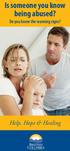 Is someone you know being abused? Do you know the warning signs? Help, Hope & Healing Are you concerned that someone is being abused, but don t know what to do? You may suspect abuse is happening to a
Helping Families Deal with Stress Related to Disasters
 Helping Families Deal with Stress Related to Disasters Diana DelCampo, Ph.D., Child Development and Family Life Specialist [email protected] A disaster is an event that: Involves the destruction of property,
Best Practices Manual For Counseling Services. A Guide for Faculty & Staff
 Best Practices Manual For Counseling Services A Guide for Faculty & Staff 7/2014 Table of Contents Purpose of the Best Practices Manual for Counseling Services.3 General Guidelines on Responding to Concerns
Psychological First Aid Training. For Emergency Responders
 Psychological First Aid Training For Emergency Responders Overview What You Will Learn Impact of disaster on communities Psychological First Aid When to refer Disaster do s/don ts Taking care of self and
Supporting Children s Mental Health Needs in the Aftermath of a Disaster: Pediatric Pearls
 Supporting Children s Mental Health Needs in the Aftermath of a Disaster: Pediatric Pearls Satellite Conference and Live Webcast Thursday, August 25, 2011 5:30 7:00 p.m. Central Time Faculty David J. Schonfeld,
Domestic Violence, Mental Health and Substance Abuse
 Domestic Violence, Mental Health and Substance Abuse Sue Parry, PhD NYS Office for the Prevention of Domestic Violence Why does domestic violence (DV) have so many mental health effects? Put yourself in
Bipolar Disorder. Some people with these symptoms have bipolar disorder, a serious mental illness. Read this brochure to find out more.
 Bipolar Disorder Do you go through intense moods? Do you feel very happy and energized some days, and very sad and depressed on other days? Do these moods last for a week or more? Do your mood changes
Trauma and the Family: Listening and learning from families impacted by psychological trauma. Focus Group Report
 Trauma and the Family: Listening and learning from families impacted by psychological trauma Focus Group Report A summary of reflections and remarks made by Baltimore City families impacted by trauma and
After Sexual Assault. A Recovery Guide for Survivors SAFE HORIZON. 24-Hour Hotline: 212 227 3000. www.safehorizon.org
 After Sexual Assault A Recovery Guide for Survivors SAFE HORIZON 24-Hour Hotline: 212 227 3000 www.safehorizon.org SAFE HORIZON hopes this guide will help the recovery of anyone whose life has been affected
School-Age Child Guidance Technical Assistance Paper #2
 School-Age Child Guidance Technical Assistance Paper #2 School-age Child Guidance High quality out-of-school time programs promote school-age children s emotional and social development as well as their
FAMILY THERAPY CAN HELP FOR PEOPLE IN RECOVERY FROM MENTAL ILLNESS OR ADDICTION
 FAMILY THERAPY CAN HELP FOR PEOPLE IN RECOVERY FROM MENTAL ILLNESS OR ADDICTION U.S. DEPARTMENT OF HEALTH AND HUMAN SERVICES Substance Abuse and Mental Health Services Administration Center for Substance
Social and Emotional Wellbeing
 Social and Emotional Wellbeing A Guide for Children s Services Educators Social and emotional wellbeing may also be called mental health, which is different from mental illness. Mental health is our capacity
Borderline personality disorder
 Understanding NICE guidance Information for people who use NHS services Borderline personality disorder NICE clinical guidelines advise the NHS on caring for people with specific conditions or diseases
APPENDIX B. ASSESSMENT OF RISK POSED TO CHILDREN BY DOMESTIC VIOLENCE Anne L. Ganley, Ph.D.
 APPENDIX B ASSESSMENT OF RISK POSED TO CHILDREN BY DOMESTIC VIOLENCE Anne L. Ganley, Ph.D. Assessment of Domestic Violence for Child Protective Services (CPS) Decision Making Guidelines for Interviewing
Emergency Medical Responder Safety and Wellness
 Chapter 2 Emergency Medical Responder Safety and Wellness OBJECTIVES DIRECTORY 1. Define key terms introduced in this chapter. 55-56 2. List indications of the potential for danger to yourself or others
Your guide to. anxiety treatment. after a motor vehicle accident
 Your guide to anxiety treatment after a motor vehicle accident November 2003 ISBN 1 876958 16 2 Published by the Motor Accidents Authority of NSW Level 22, 580 George Street, Sydney 2000 Phone: 1300 137
Tennessee Strategy for Suicide Prevention Sixth Edition Effective July 1, 2013
 Tennessee Strategy for Suicide Prevention Sixth Edition Effective July 1, 2013 1. Develop broad-based support for suicide prevention. A. Form and sustain public-private partnerships with the widest variety
SPOKANE COUNTY Suicide Prevention Resources
 Spokane County Suicide Prevention Coalition SPOKANE COUNTY Suicide Prevention Resources EMERGENCY NUMBERS on back cover There is support for suicide prevention and people who have lost a loved one to suicide
THE EFFECTS OF FAMILY VIOLENCE ON CHILDREN. Where Does It Hurt?
 THE EFFECTS OF FAMILY VIOLENCE ON CHILDREN Where Does It Hurt? Child Abuse Hurts Us All Every child has the right to be nurtured and to be safe. According to: Family Violence in Canada: A Statistical Profile
Post-Traumatic Stress Disorder
 Post-Traumatic Stress Disorder It s natural to be afraid when you re in danger. It s natural to be upset when something bad happens to you or someone you know. But if you feel afraid and upset weeks or
QUICK REFERENCE GUIDE. Workplace Violence. What You Need to Know to Protect Yourself and Your Employees
 QUICK REFERENCE GUIDE Workplace Violence What You Need to Know to Protect Yourself and Your Employees Types of Workplace Violence: 2 Workplace Violence While the motivation and circumstances of each incident
WHAT IS PTSD? A HANDOUT FROM THE NATIONAL CENTER FOR PTSD BY JESSICA HAMBLEN, PHD
 WHAT IS PTSD? A HANDOUT FROM THE NATIONAL CENTER FOR PTSD BY JESSICA HAMBLEN, PHD Posttraumatic Stress Disorder (PTSD) is an anxiety disorder that can occur following the experience or witnessing of a
Substance Abuse and Sexual Violence:
 Substance Abuse and Sexual Violence: The Need for Integration When Treating Survivors Kelli Hood, M.A. Objective To understand the necessity for therapeutic strategies in clients with cooccurring Substance
What Employers Need to Know to Help
 Occupational Health & Safety Council of Ontario (OHSCO) WORKPLACE VIOLENCE PREVENTION SERIES Domestic Violence Doesn t Stop When Your Worker Arrives at Work: What Employers Need to Know to Help What is
Understanding Suicidal Thinking
 Understanding Suicidal Thinking Suicidal thoughts are temporary. Suicide is permanent. Don t give in to suicidal thoughts you can overcome them. If depression or bipolar disorder (also known as manic depression)
It is a court order against someone who has abused or harassed you. That person is ordered either not to abuse you or not to have contact with you.
 WHAT IS A RESTRAINING ORDER? WILL IT PROTECT ME? It is a court order against someone who has abused or harassed you. That person is ordered either not to abuse you or not to have contact with you. A restraining
Critical Incidents. Information for schools from Derbyshire Educational Psychology Service
 Critical Incidents Information for schools from Derbyshire Educational Psychology Service Introduction to Critical Incidents A critical incident (CI) is any event that is unexpected, acute, stressful and
Tool kit Domestic Violence
 Tool kit Domestic Violence A self-help resource to help people living with domestic violence Lifeline s domestic violence tool kit provides information about: Understanding what domestic violence is Developing
Understanding PTSD treatment
 Understanding PTSD treatment Do I need professional help? Whether or not you need help can only be determined by you and a mental health professional. However, you can take the self-assessment in the PTSD
Age-Appropriate Reactions & Specific Interventions for Children & Adolescents Experiencing A Traumatic Incident
 The Florida Crisis Consortium is supported by the Florida Dep:ntment ofhealth. Age-Appropriate Reactions & Specific Interventions for Children & Adolescents Experiencing A Traumatic Incident The following
TABLETOP EXERCISE FACILITATOR S GUIDE:
 TABLETOP EXERCISE FACILITATOR S GUIDE: ACTIVE SHOOTER EVENT Preparis INTRODUCTION Hello, my name is and I would like to welcome all of you to today s tabletop exercise. I want to thank you for taking the
Copyright Recovery Connection 1 RECOVERY CONNECTION
 1 Choosing a Quality Christian Alcohol and Drug Rehab Some people who seek alcohol and drug treatment arrive at the treatment facility longing for a renewed or a new connection with a spiritual power.
Mental Health Needs Assessment Personality Disorder Prevalence and models of care
 Mental Health Needs Assessment Personality Disorder Prevalence and models of care Introduction and definitions Personality disorders are a complex group of conditions identified through how an individual
Young People s Emotional Health
 Young People s Emotional Health For those working with young people aged 16-24 Key facts from research Warning signs Sources of help and further information Kindly supported by Auto Trader Introducing
Faculty/Staff Referral Guide for Students in Crisis
 Counseling Services Faculty/Staff Referral Guide for Students in Crisis The purpose of this guide is to provide faculty and professional staff with information about counseling services, referral information,
Guidelines for Setting up Security Measures to Stop Domestic Violence in the Workplace
 Guidelines for Setting up Security Measures to Stop Domestic Violence in the Workplace As of June 15, 2010, all employers in Ontario are responsible for protecting workers when domestic violence follows
Community and Social Services
 Developing a path to employment for New Yorkers with disabilities Community and Social Services Mental Health and Substance Abuse Social Workers... 1 Health Educators... 4 Substance Abuse and Behavioral
Post-traumatic stress disorder overview
 Post-traumatic stress disorder overview A NICE pathway brings together all NICE guidance, quality standards and materials to support implementation on a specific topic area. The pathways are interactive
A Service Provider s Guide for Working with GBT Victims and Survivors of Domestic Abuse
 Page 1 of 6 A Service Provider s Guide for Working with GBT Victims and Survivors of Domestic Abuse Partner abuse is one of the most serious health issues for gay, bisexual, and transgender (GBT) men.
P. O. Box 1520 Columbia, South Carolina 29202. Effective date of implementation: January 1, 2005. Domestic Violence
 SOUTH CAROLINA DEPARTMENT OF SOCIAL SERVICES P. O. Box 1520 Columbia, South Carolina 29202 STANDARDS OF CARE FOR BATTERERS TREATMENT Effective date of implementation: January 1, 2005 Domestic Violence
Supporting children in the aftermath of a crisis
 Supporting children in the aftermath of a crisis David J. Schonfeld, MD Thelma and Jack Rubinstein Professor of Pediatrics Director, National Center for School Crisis and Bereavement Division of Developmental
What does it mean to be suicidal?
 What does it mean to be suicidal? Although most young people think about death to some degree, suicidal thinking occurs within a very particular context. When emotional pain, feelings of hopelessness or
Ways to support the person with bipolar disorder
 Ways to support the person with bipolar disorder People differ in what help they need and want from caregivers. Caregivers differ in how involved they are in providing support. Finding ways to provide
Sophia Van Vuuren M.A. Clinical Psychology Registered Psychologist #1659 Burnaby Counselling Group
 Sophia Van Vuuren M.A. Clinical Psychology Registered Psychologist #1659 Burnaby Counselling Group Take Hands to Fight Suicide Burnaby Counselling Group BCG is a non profit, Christian Counselling Group
DRUG and ALCOHOL ABUSE
 M12 DRUG and ALCOHOL ABUSE EMS personnel must be aware that alcohol and drug ingestion can mask the symptoms of injury or illness. In addition, many injuries and illnesses can present as suspected alcohol
- UNDERSTANDING - Dual Diagnosis
 - UNDERSTANDING - Dual Diagnosis TABLE OF CONTENTS Introduction 3 The Link Between Mental Illness and Substance Abuse 4 Characteristics of an Effective Dual Diagnosis Treatment Plan 6 Dual Diagnosis Treatment
Policy for Preventing and Managing Critical Incident Stress
 Policy for Preventing and Managing Critical Incident Stress Document reference number HSAG 2012/3 Document developed by Revision number 1.0 Document approved by Consultation with 14 September 2012 Presented
The Forgotten Worker: Veteran
 The Forgotten Worker: Veteran Larry Ashley & Meghan Pierce University of Nevada, Las Vegas Veteran Workforce Statistics The unemployment rate of veterans from all eras is 8.7% (Bureau of Labor Statistics,
POST-TRAUMATIC STRESS DISORDER PTSD Diagnostic Criteria PTSD Detection and Diagnosis PC-PTSD Screen PCL-C Screen PTSD Treatment Treatment Algorithm
 E-Resource March, 2014 POST-TRAUMATIC STRESS DISORDER PTSD Diagnostic Criteria PTSD Detection and Diagnosis PC-PTSD Screen PCL-C Screen PTSD Treatment Treatment Algorithm Post-traumatic Stress Disorder
SUBSTANCE ABUSE & DEPRESSION: WHAT YOU SHOULD KNOW
 SUBSTANCE ABUSE & DEPRESSION: WHAT YOU SHOULD KNOW TABLE OF CONTENTS What is Depression? 4 Symptoms of Depression 6 Substance Abuse as a Coping Mechanism 8 Which Occurs First? 10 Substance Abuse and the
What is an intervention?
 (Adapted from the Mayo Clinic, 2014) It's challenging to help a loved one struggling with any type of addiction. Sometimes a direct, heart-to-heart conversation can start the road to recovery. But when
How to explain death to children and young people...
 6863-Child BeravementNEW 24/7/06 12:12 pm Page 1 How to explain death to children and young people......and help them cope! 6863-Child BeravementNEW 24/7/06 12:12 pm Page 2 Barnardo s Child Bereavement
What is DOMESTIC VIOLENCE?
 What is DOMESTIC VIOLENCE? Domestic violence is a pattern of control used by one person to exert power over another. Verbal abuse, threats, physical, and sexual abuse are the methods used to maintain power
Screening Tool for Assessing Risk of Suicide Australian Institute for Suicide Research and Prevention Jacinta Hawgood & Diego De Leo
 STARS Screening Tool for Assessing Risk of Suicide Australian Institute for Suicide Research and Prevention Jacinta Hawgood & Diego De Leo STARS Screening Tool for Assessing Risk of Suicide Australian
Priorities of Care for the Dying Person Duties and Responsibilities of Health and Care Staff with prompts for practice
 Priorities of Care for the Dying Person Duties and Responsibilities of Health and Care Staff with prompts for practice Published June 2014 by the Leadership Alliance for the Care of Dying People 1 About
Crisis Intervention Incidents (CRITICAL)
 Policy 435 City of Sunnyvale Department of Public Safety 435.1 PURPOSE AND SCOPE This policy provides guidelines for interacting with those who may be experiencing a mental health or emotional crisis.
Summary of National Strategy for Suicide Prevention: Goals and Objectives for Action
 Table of Contents Summary of National Strategy for Suicide Prevention: Goals and Objectives for Action Summary Goal 1: Promote Awareness that Suicide is a Public Health Problem that is Preventable Goal
Co-Occurring Disorders
 Co-Occurring Disorders PACCT 2011 CAROLYN FRANZEN Learning Objectives List common examples of mental health problems associated with substance abuse disorders Describe risk factors that contribute to the
Presently, there are no means of preventing bipolar disorder. However, there are ways of preventing future episodes: 1
 What is bipolar disorder? There are two main types of bipolar illness: bipolar I and bipolar II. In bipolar I, the symptoms include at least one lifetime episode of mania a period of unusually elevated