
POST-TRAUMATIC STRESS DISORDER PTSD Diagnostic Criteria PTSD Detection and Diagnosis PC-PTSD Screen PCL-C Screen PTSD Treatment Treatment Algorithm
|
|
|
- Hubert Dalton
- 10 years ago
- Views:
Transcription
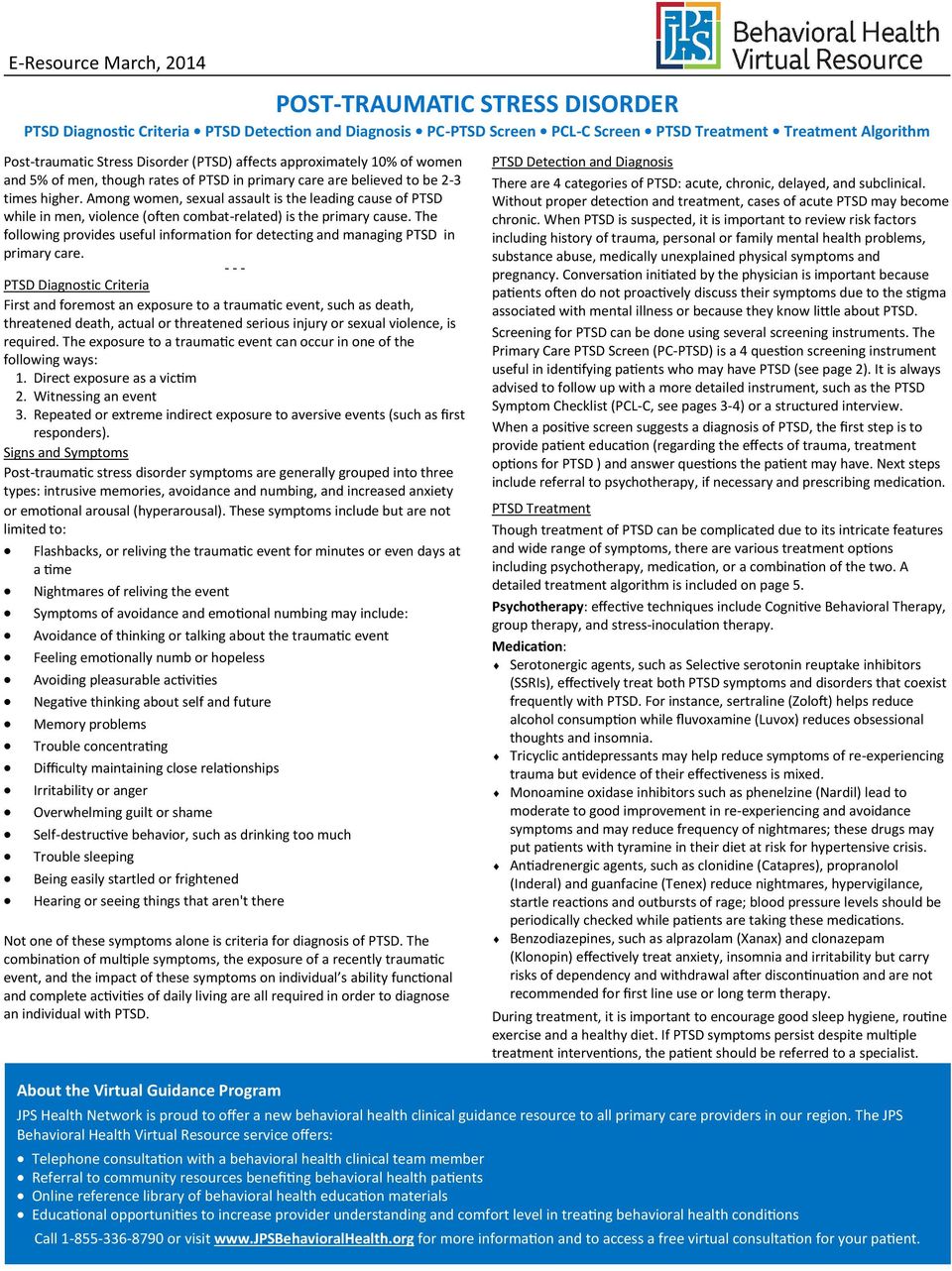
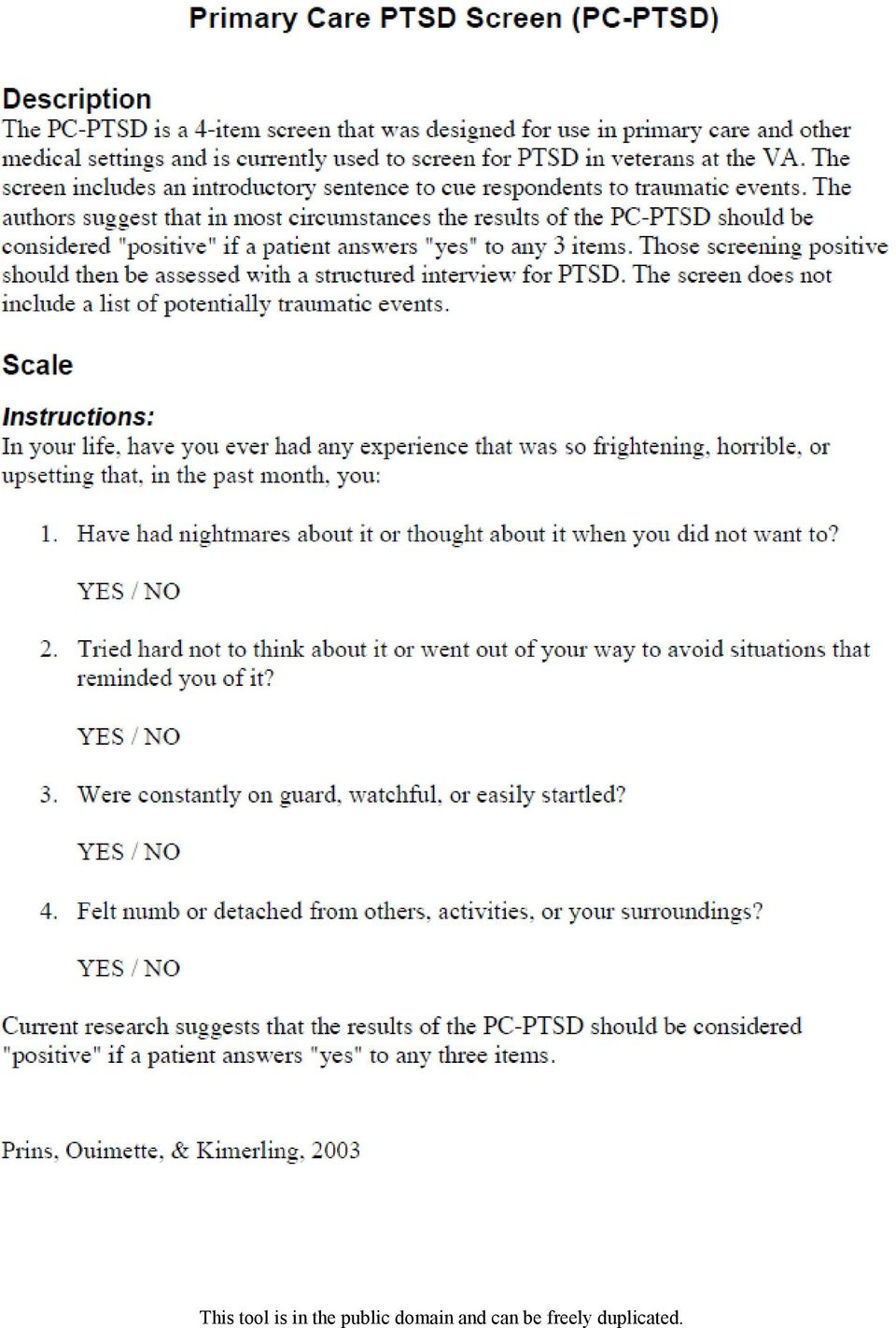
1 E-Resource March, 2014 POST-TRAUMATIC STRESS DISORDER PTSD Diagnostic Criteria PTSD Detection and Diagnosis PC-PTSD Screen PCL-C Screen PTSD Treatment Treatment Algorithm Post-traumatic Stress Disorder (PTSD) affects approximately 10% of women and 5% of men, though rates of PTSD in primary care are believed to be 2-3 times higher. Among women, sexual assault is the leading cause of PTSD while in men, violence (often combat-related) is the primary cause. The following provides useful information for detecting and managing PTSD in primary care PTSD Diagnostic Criteria First and foremost an exposure to a traumatic event, such as death, threatened death, actual or threatened serious injury or sexual violence, is required. The exposure to a traumatic event can occur in one of the following ways: 1. Direct exposure as a victim 2. Witnessing an event 3. Repeated or extreme indirect exposure to aversive events (such as first responders). Signs and Symptoms Post-traumatic stress disorder symptoms are generally grouped into three types: intrusive memories, avoidance and numbing, and increased anxiety or emotional arousal (hyperarousal). These symptoms include but are not limited to: Flashbacks, or reliving the traumatic event for minutes or even days at a time Nightmares of reliving the event Symptoms of avoidance and emotional numbing may include: Avoidance of thinking or talking about the traumatic event Feeling emotionally numb or hopeless Avoiding pleasurable activities Negative thinking about self and future Memory problems Trouble concentrating Difficulty maintaining close relationships Irritability or anger Overwhelming guilt or shame Self-destructive behavior, such as drinking too much Trouble sleeping Being easily startled or frightened Hearing or seeing things that aren't there t one of these symptoms alone is criteria for diagnosis of PTSD. The combination of multiple symptoms, the exposure of a recently traumatic event, and the impact of these symptoms on individual s ability functional and complete activities of daily living are all required in order to diagnose an individual with PTSD. About the Virtual Guidance Program PTSD Detection and Diagnosis There are 4 categories of PTSD: acute, chronic, delayed, and subclinical. Without proper detection and treatment, cases of acute PTSD may become chronic. When PTSD is suspected, it is important to review risk factors including history of trauma, personal or family mental health problems, substance abuse, medically unexplained physical symptoms and pregnancy. Conversation initiated by the physician is important because patients often do not proactively discuss their symptoms due to the stigma associated with mental illness or because they know little about PTSD. Screening for PTSD can be done using several screening instruments. The Primary Care PTSD Screen (PC-PTSD) is a 4 question screening instrument useful in identifying patients who may have PTSD (see page 2). It is always advised to follow up with a more detailed instrument, such as the PTSD Symptom Checklist (PCL-C, see pages 3-4) or a structured interview. When a positive screen suggests a diagnosis of PTSD, the first step is to provide patient education (regarding the effects of trauma, treatment options for PTSD ) and answer questions the patient may have. Next steps include referral to psychotherapy, if necessary and prescribing medication. PTSD Treatment Though treatment of PTSD can be complicated due to its intricate features and wide range of symptoms, there are various treatment options including psychotherapy, medication, or a combination of the two. A detailed treatment algorithm is included on page 5. Psychotherapy: effective techniques include Cognitive Behavioral Therapy, group therapy, and stress-inoculation therapy. Medication: Serotonergic agents, such as Selective serotonin reuptake inhibitors (SSRIs), effectively treat both PTSD symptoms and disorders that coexist frequently with PTSD. For instance, sertraline (Zoloft) helps reduce alcohol consumption while fluvoxamine (Luvox) reduces obsessional thoughts and insomnia. Tricyclic antidepressants may help reduce symptoms of re-experiencing trauma but evidence of their effectiveness is mixed. Monoamine oxidase inhibitors such as phenelzine (Nardil) lead to moderate to good improvement in re-experiencing and avoidance symptoms and may reduce frequency of nightmares; these drugs may put patients with tyramine in their diet at risk for hypertensive crisis. Antiadrenergic agents, such as clonidine (Catapres), propranolol (Inderal) and guanfacine (Tenex) reduce nightmares, hypervigilance, startle reactions and outbursts of rage; blood pressure levels should be periodically checked while patients are taking these medications. Benzodiazepines, such as alprazolam (Xanax) and clonazepam (Klonopin) effectively treat anxiety, insomnia and irritability but carry risks of dependency and withdrawal after discontinuation and are not recommended for first line use or long term therapy. During treatment, it is important to encourage good sleep hygiene, routine exercise and a healthy diet. If PTSD symptoms persist despite multiple treatment interventions, the patient should be referred to a specialist. JPS Health Network is proud to offer a new behavioral health clinical guidance resource to all primary care providers in our region. The JPS Behavioral Health Virtual Resource service offers: Telephone consultation with a behavioral health clinical team member Referral to community resources benefiting behavioral health patients Online reference library of behavioral health education materials Educational opportunities to increase provider understanding and comfort level in treating behavioral health conditions Call or visit for more information and to access a free virtual consultation for your patient.
2 This tool is in the public domain and can be freely duplicated.

3


4

5 Simplified Algorithm for the Detection and Treatment of PTSD Patient experiences a traumatic event Brief assessment based on behavior and appearance Side te: Traumatic Events Include: Experiencing or witnessing a traumatic event or life-threatening situation. A traumatic event can be any situation that causes stress, horror, helplessness, serious injury, or the threat of serious injury or death which has impacted an individuals ability to function Signs to look for during assessment: Flashbacks, or nightmares of reliving the traumatic event.. Feeling emotionally numb, hopeless Memory problems, difficulty concentrating Irritability or anger Overwhelming guilt or shame with possible suicidality Trouble sleeping Being easily startled or frightened, anxious Is patient unstable, suicidal or homicidal? Assess for future environmental harms and ensure basic needs are met. Ensure safety and refer to emergency services (Use police if needed). Begin monotherapy with SSRI or SNRI (avoid first line use of benzodiazepines) and begin referral for counseling/ psychotherapy. (May benefit from consultation with psychiatrist.) Obtain history, physical exam, assess risk factors, and functional level. Follow 4-8 weeks to reassess symptoms and monitor progress. (Can use PCL-C to monitor progress) Does patient meet criteria for Diagnosis of PTSD Is patient progressing? Re-screen in 3-6 months. Provide secondary prevention education and support. Increase dosage or switch to another medication. Consider adjunctive treatment Refer to specialty or consider Virtual consultation. Continue course of treatment and consider stepping down pharmacologic treatments and increasing care management

Psychiatric Issues and Defense Base Act Claims. Dr. Michael Hilton
 Psychiatric Issues and Defense Base Act Claims Dr. Michael Hilton Criteria for DSM-IVRPosttraumatic Stress Disorder with changes now in effect with DSM5 a. The person has been exposed to a traumatic event
Original Article: http://www.mayoclinic.com/health/post-traumatic-stress-disorder
 1 of 11 6/29/2012 12:17 PM MayoClinic.com reprints This single copy is for your personal, noncommercial use only. For permission to reprint multiple copies or to order presentation-ready copies for distribution,
FACT SHEET. What is Trauma? TRAUMA-INFORMED CARE FOR WORKING WITH HOMELESS VETERANS
 FACT SHEET TRAUMA-INFORMED CARE FOR WORKING WITH HOMELESS VETERANS According to SAMHSA 1, trauma-informed care includes having a basic understanding of how trauma affects the life of individuals seeking
Post-traumatic stress disorder overview
 Post-traumatic stress disorder overview A NICE pathway brings together all NICE guidance, quality standards and materials to support implementation on a specific topic area. The pathways are interactive
Acute Stress Disorder and Posttraumatic Stress Disorder
 Acute Stress Disorder and Posttraumatic Stress Disorder Key Messages Traumatic Events Events that involve actual or threatened death or serious injury (real or perceived) to self or others (e.g., accidents,
Traumatic Stress. and Substance Use Problems
 Traumatic Stress and Substance Use Problems The relation between substance use and trauma Research demonstrates a strong link between exposure to traumatic events and substance use problems. Many people
North Pacific Epilepsy Research 2311 NW Northrup Street Suite #202 Portland, Oregon 97210 Tel: 503-291-5300 Fax: 503-291-5303
 North Pacific Epilepsy Research 2311 NW Northrup Street Suite #202 Portland, Oregon 97210 Tel: 503-291-5300 Fax: 503-291-5303 Post-Traumatic Stress Disorder (PTSD) Post-traumatic stress disorder (PTSD)
Post-traumatic stress disorder (PTSD): the treatment of PTSD in adults and children
 Post-traumatic stress disorder (PTSD): the treatment of PTSD in adults and children Understanding NICE guidance information for people with PTSD, their advocates and carers, and the public March 2005 Information
WHAT IS PTSD? A HANDOUT FROM THE NATIONAL CENTER FOR PTSD BY JESSICA HAMBLEN, PHD
 WHAT IS PTSD? A HANDOUT FROM THE NATIONAL CENTER FOR PTSD BY JESSICA HAMBLEN, PHD Posttraumatic Stress Disorder (PTSD) is an anxiety disorder that can occur following the experience or witnessing of a
Psychopharmacotherapy for Children and Adolescents
 TREATMENT GUIDELINES Psychopharmacotherapy for Children and Adolescents Guideline 7 Psychopharmacotherapy for Children and Adolescents Description There are few controlled trials to guide practitioners
Post-Traumatic Stress Disorder (PTSD)
 Post-Traumatic Stress Disorder (PTSD) Post traumatic stress disorder is a condition where you have recurring distressing memories, flashbacks, and other symptoms after suffering a traumatic event. Treatment
CHAPTER 6 Diagnosing and Identifying the Need for Trauma Treatment
 CHAPTER 6 Diagnosing and Identifying the Need for Trauma Treatment This chapter offers mental health professionals: information on diagnosing and identifying the need for trauma treatment guidance in determining
Understanding PTSD and the PDS Assessment
 ProFiles PUTTING ASSESSMENTS TO WORK PDS TEST Understanding PTSD and the PDS Assessment Recurring nightmares. Angry outbursts. Easily startled. These are among the many symptoms associated with Post Traumatic
Depression is a medical illness that causes a persistent feeling of sadness and loss of interest. Depression can cause physical symptoms, too.
 The Family Library DEPRESSION What is depression? Depression is a medical illness that causes a persistent feeling of sadness and loss of interest. Depression can cause physical symptoms, too. Also called
2) Recurrent emotional abuse. 3) Contact sexual abuse. 4) An alcohol and/or drug abuser in the household. 5) An incarcerated household member
 Co Occurring Disorders and the on Children: Effectively Working with Families Affected by Substance Abuse and Mental Illness Definition (Co-Occurring also called Dual Dx) A professional diagnosis of addictive/substance
The Forgotten Worker: Veteran
 The Forgotten Worker: Veteran Larry Ashley & Meghan Pierce University of Nevada, Las Vegas Veteran Workforce Statistics The unemployment rate of veterans from all eras is 8.7% (Bureau of Labor Statistics,
Supporting Children s Mental Health Needs in the Aftermath of a Disaster: Pediatric Pearls
 Supporting Children s Mental Health Needs in the Aftermath of a Disaster: Pediatric Pearls Satellite Conference and Live Webcast Thursday, August 25, 2011 5:30 7:00 p.m. Central Time Faculty David J. Schonfeld,
TITLE: Cannabinoids for the Treatment of Post-Traumatic Stress Disorder: A Review of the Clinical Effectiveness and Guidelines
 TITLE: Cannabinoids for the Treatment of Post-Traumatic Stress Disorder: A Review of the Clinical Effectiveness and Guidelines DATE: 01 December 2009 CONTEXT AND POLICY ISSUES: Post-traumatic stress disorder
DEPRESSION Depression Assessment PHQ-9 Screening tool Depression treatment Treatment flow chart Medications Patient Resource
 E-Resource March, 2015 DEPRESSION Depression Assessment PHQ-9 Screening tool Depression treatment Treatment flow chart Medications Patient Resource Depression affects approximately 20% of the general population
Post Traumatic Stress Disorder (PTSD) Karen Elmore MD Robert K. Schneider MD Revised 5-11-2001 by Robert K. Schneider MD
 Post Traumatic Stress Disorder (PTSD) Karen Elmore MD Robert K. Schneider MD Revised 5-11-2001 by Robert K. Schneider MD Definition and Criteria PTSD is unlike any other anxiety disorder. It requires that
9/11Treatment Referral Program How to Get Care
 9/11Treatment Referral Program How to Get Care Health 9/11 Treatment Referral Program The 9/11 Treatment Referral Program was created to help enrollees and others find care for WTC-related health problems.
Trauma FAQs. Content. 1. What is trauma? 2. What events are traumatic?
 Trauma FAQs Content 1. What is trauma? 2. What events are traumatic? 3. Who experiences trauma? 4. What are symptoms of trauma? 5. How can I help someone who may be experiencing trauma? 6. Where can people
USVH Disease of the Week #1: Posttraumatic Stress Disorder (PTSD)
 USVH Disease of the Week #1: Posttraumatic Stress Disorder (PTSD) Effects of Traumatic Experiences A National Center for PTSD Fact Sheet By: Eve B. Carlson, Ph.D. and Josef Ruzek, Ph.D. When people find
Cognitive Behavioral Therapy for PTSD. Dr. Edna B. Foa
 Cognitive Behavioral Therapy for PTSD Presented by Dr. Edna B. Foa Center for the Treatment and Study of Anxiety University of Pennsylvania Ref # 3 Diagnosis of PTSD Definition of a Trauma The person has
PTSD Evidence Based Practice Recommendations
 PTSD Evidence ased Practice Recommendations Jason's ox est Practice Group Dr. Sam Moreno, Michelle Schnack Compilation & consolidation of the research and recommendations located in: The VA/DoD Clinical
Traumatic Stress with Alcohol and/or Drug Addiction
 Traumatic Stress with Alcohol and/or Drug Addiction information for individuals and families Eastern Trauma Advisory Panel What is Post Traumatic Stress Disorder (PTSD)? How people react to a traumatic
EMOTIONAL AND BEHAVIOURAL CONSEQUENCES OF HEAD INJURY
 Traumatic brain injury EMOTIONAL AND BEHAVIOURAL CONSEQUENCES OF HEAD INJURY Traumatic brain injury (TBI) is a common neurological condition that can have significant emotional and cognitive consequences.
Depression is a common biological brain disorder and occurs in 7-12% of all individuals over
 Depression is a common biological brain disorder and occurs in 7-12% of all individuals over the age of 65. Specific groups have a much higher rate of depression including the seriously medically ill (20-40%),
Depression Assessment & Treatment
 Depressive Symptoms? Administer depression screening tool: PSC Depression Assessment & Treatment Yes Positive screen Safety Screen (see Appendix): Administer every visit Neglect/Abuse? Thoughts of hurting
Suzanne R. Merlis, Psy. D. Georgia-LLC Licensed Psychologist
 Suzanne R. Merlis, Psy. D. Georgia-LLC Licensed Psychologist If going to asylum officer at affirmative stage: ASYLUM OFFICER, ARLINGTON ASYLUM OFFICE In the Matter of Mr. X Respondent If referred to judge:
Supporting children in the aftermath of a crisis
 Supporting children in the aftermath of a crisis David J. Schonfeld, MD Thelma and Jack Rubinstein Professor of Pediatrics Director, National Center for School Crisis and Bereavement Division of Developmental
Treatment of PTSD in Children
 Treatment of PTSD in Children Why Treat PTSD in Kids? Distress & Disabling Impairs Functioning Development Affected Co- morbid Problems Chronicity Limited research on Child PTSD Treatment Combined approach
Major Depression. What is major depression?
 Major Depression What is major depression? Major depression is a serious medical illness affecting 9.9 million American adults, or approximately 5 percent of the adult population in a given year. Unlike
Identifying and Treating Dual-Diagnosed Substance Use and Mental Health Disorders. Presented by: Carrie Terrill, LCDC
 Identifying and Treating Dual-Diagnosed Substance Use and Mental Health Disorders Presented by: Carrie Terrill, LCDC Overview What is Dual Diagnosis? How Common is Dual Diagnosis? What are Substance Use
Post Traumatic Stress Disorder and Substance Abuse. Impacts ALL LEVELS of Leadership
 Post Traumatic Stress Disorder and Substance Abuse Impacts ALL LEVELS of Leadership What IS Post Traumatic Stress Disorder (PTSD) PTSD is an illness which sometimes occurs after a traumatic event such
Appendix 5. Victim Impact
 Appendix 5 Victim Impact ACQUAINTANCE RAPE: THE VICTIM Gail Abarbanel Director Rape Treatment Center Santa Monica-UCLA Medical Center Issues in Acquaintance Rapes Not common perception of rape Not real
Anti-Social Personality Disorder
 Anti-Social Personality Disorder Definition Anti-Social Personality Disorder is a type of chronic mental condition in which a person's ways of thinking, perceiving situations and relating to others are
What is Narrative Exposure Therapy (NET)?
 What is Narrative Exposure Therapy (NET)? Overview NET is a culturally universal short-term intervention used for the reduction of traumatic stress symptoms in survivors of organised violence, torture,
`çããçå=jéåí~ä= aáëçêçéêëw=^åñáéíó=~åç= aééêéëëáçå. aêk=`=f=lâçåü~ jéçáå~ä=aáêéåíçê lñäé~ë=kep=cçìåç~íáçå=qêìëí=
 `çããçå=jéåí~ä= aáëçêçéêëw=^åñáéíó=~åç= aééêéëëáçå aêk=`=f=lâçåü~ jéçáå~ä=aáêéåíçê lñäé~ë=kep=cçìåç~íáçå=qêìëí= Overview: Common Mental What are they? Disorders Why are they important? How do they affect
SLEEP DISTURBANCE AND PSYCHIATRIC DISORDERS
 E-Resource December, 2013 SLEEP DISTURBANCE AND PSYCHIATRIC DISORDERS Between 10-18% of adults in the general population and up to 50% of adults in the primary care setting have difficulty sleeping. Sleep
Uncertainty: Was difficulty falling asleep and hypervigilance related to fear of ventricular tachycardia returning, or fear of being shocked again?
 Manuel Tancer, MD Chart Review: PTSD PATIENT INFO 55 Age: Background: Overweight nurse with 6-month history of nightmares, hyperarousal, and flashbacks; symptoms began after implanted defibrillator was
Introduction to Veteran Treatment Court
 Justice for Vets Veterans Treatment Court Planning Initiative Introduction to Veteran Treatment Court Developed by: Justice for Vets Justice for Vets, 10 February 2015 The following presentation may not
MAJOR DEPRESSION DURING CONCEPTION AND PREGNANCY: A Guide for Patients and Families
 MAJOR DEPRESSION DURING CONCEPTION AND PREGNANCY: A Guide for Patients and Families David A. Kahn, MD, Margaret L. Moline, PhD, Ruth W. Ross, MA, Lee S. Cohen, MD, and Lori L. Altshuler, MD www.womensmentalhealth.org
MOH CLINICAL PRACTICE GUIDELINES 6/2011 DEPRESSION
 MOH CLINICAL PRACTICE GUIDELINES 6/2011 DEPRESSION Executive summary of recommendations Details of recommendations can be found in the main text at the pages indicated. Clinical evaluation D The basic
in young people Management of depression in primary care Key recommendations: 1 Management
 Management of depression in young people in primary care Key recommendations: 1 Management A young person with mild or moderate depression should typically be managed within primary care services A strength-based
Overcoming the Trauma of Your Motor Vehicle Accident
 Overcoming the Trauma of Your Motor Vehicle Accident Chapter 1 Introduction Case Study: Janelle Janelle s accident happened so suddenly. She was simply making a left turn as she was leaving the shopping
National Defence. Défense nationale A-MD-007-144/JD-004. Preparing for CRITICAL incident. Stress
 National Defence Défense nationale A-MD-007-144/JD-004 Preparing for CRITICAL incident Stress Foreword This publication is presented as a resource for the Department of National Defence (DND) community,
TREATING MAJOR DEPRESSIVE DISORDER
 TREATING MAJOR DEPRESSIVE DISORDER A Quick Reference Guide Based on Practice Guideline for the Treatment of Patients With Major Depressive Disorder, Second Edition, originally published in April 2000.
Are You Considering Medication for Depression?
 Are You Considering Medication for Depression? Perhaps your counselor or psychiatrist has mentioned this option to you, or you've wondered whether an antidepressant medication might be helpful based on
Understanding. Depression. The Road to Feeling Better Helping Yourself. Your Treatment Options A Note for Family Members
 TM Understanding Depression The Road to Feeling Better Helping Yourself Your Treatment Options A Note for Family Members Understanding Depression Depression is a biological illness. It affects more than
Antisocial personality disorder
 Page 1 of 7 Diseases and Conditions Antisocial personality disorder By Mayo Clinic Staff Antisocial personality disorder is a type of chronic mental condition in which a person's ways of thinking, perceiving
Domestic Violence, Mental Health and Substance Abuse
 Domestic Violence, Mental Health and Substance Abuse Sue Parry, PhD NYS Office for the Prevention of Domestic Violence Why does domestic violence (DV) have so many mental health effects? Put yourself in
Mental Health Needs Assessment Personality Disorder Prevalence and models of care
 Mental Health Needs Assessment Personality Disorder Prevalence and models of care Introduction and definitions Personality disorders are a complex group of conditions identified through how an individual
Postpartum Depression and Post-Traumatic Stress Disorder
 Postpartum Depression and Post-Traumatic Stress Disorder Emotional Recovery: Postpartum Depression and Post-Traumatic Stress Disorder By: Lisa Houchins Published: July 23, 2013 Emotions vary widely after
POST TRAUMATIC STRESS DISORDER: A PRIMER PTSD. POST-TRAUMATIC STRESS DISORDER A TRAUMA and STRESSOR-RELATED DISORDER
 PTSD POST-TRAUMATIC STRESS DISORDER A TRAUMA and STRESSOR-RELATED DISORDER To help yourself, you need to take care of yourself and be willing to have other people help you. This pamphlet furnishes general
Depression in Older Persons
 Depression in Older Persons How common is depression in later life? Depression affects more than 6.5 million of the 35 million Americans aged 65 or older. Most people in this stage of life with depression
BIPOLAR DISORDER IN PRIMARY CARE
 E-Resource January, 2014 BIPOLAR DISORDER IN PRIMARY CARE Mood Disorder Questionnaire Common Comorbidities Evaluation of Patients with BPD Management of BPD in Primary Care Patient resource Patients with
Algorithm for Initiating Antidepressant Therapy in Depression
 Algorithm for Initiating Antidepressant Therapy in Depression Refer for psychotherapy if patient preference or add cognitive behavioural office skills to antidepressant medication Moderate to Severe depression
7/15/2010. 11 th Annual Summer Institute Sedona, AZ July 21, 2010. July 21, 2010 Sedona, AZ Workshop 1
 The Addiction-Trauma Connection: Spirals of and Healing Stephanie S. Covington, Ph.D., L.C.S.W. Center for Gender and Justice Institute for Relational Development La Jolla, CA 11 th Annual Summer Institute
Child Welfare Trauma Referral Tool
 Module 4, Activity 4F; Module 4, Activity 4G Child Welfare Trauma Referral Tool This measure is designed to help child welfare workers make more trauma-informed decisions about the need for referral to
Your guide to. anxiety treatment. after a motor vehicle accident
 Your guide to anxiety treatment after a motor vehicle accident November 2003 ISBN 1 876958 16 2 Published by the Motor Accidents Authority of NSW Level 22, 580 George Street, Sydney 2000 Phone: 1300 137
Post-traumatic Stress Disorder Within a Primary Care Setting: Effectively and Sensitively Responding to Sexual Trauma Survivors
 Post-traumatic Stress Disorder Within a Primary Care Setting: Effectively and Sensitively Responding to Sexual Trauma Survivors Serena Clardie, MSW, LCSW ABSTRACT It is estimated that 1 in 4 females and
Children s Community Health Plan INTENSIVE IN-HOME MENTAL HEALTH / SUBSTANCE ABUSE SERVICES ASSESSMENT AND RECOVERY / TREATMENT PLAN ATTACHMENT
 Children s Community Health Plan INTENSIVE IN-HOME MENTAL HEALTH / SUBSTANCE ABUSE SERVICES ASSESSMENT AND RECOVERY / TREATMENT PLAN ATTACHMENT Please fax with CCHP prior authorization form to 608-252-0853
MOH CLINICAL PRACTICE GUIDELINES 2/2008 Prescribing of Benzodiazepines
 MOH CLINICL PRCTICE GUIELINES 2/2008 Prescribing of Benzodiazepines College of Family Physicians, Singapore cademy of Medicine, Singapore Executive summary of recommendations etails of recommendations
Responding to the Needs of Justice-Involved Veterans. Mark Mayhew, LCSW VA Justice Outreach Coordinator
 Responding to the Needs of Justice-Involved Veterans Mark Mayhew, LCSW VA Justice Outreach Coordinator There is inherent sympathy for those who sustain damage in defense of country, whether that damage
Lorem Ipsum. Abortion: What can it do to a woman? Design: Issues in Health Aili Middleton
 Lorem Ipsum Abortion: What can it do to a woman? Design: Issues in Health Aili Middleton Lorem Ipsum 2 Basic Information & Process Abortion is the premature termination of a pregnancy. It can be induced
Post Traumatic Stress Disorder & Substance Misuse
 Post Traumatic Stress Disorder & Substance Misuse Produced and Presented by Dr Derek Lee Consultant Chartered Clinical Psychologist Famous Sufferers. Samuel Pepys following the Great Fire of London:..much
Post-Traumatic Stress Disorder (PTSD) and TBI. Kyle Haggerty, Ph.D.
 Post-Traumatic Stress Disorder (PTSD) and TBI Kyle Haggerty, Ph.D. Learning Objects What is Brain Injury What is PTSD Statistics What to Rule Out PTSD and TBI Treatment Case Study What is Brain Injury
Evidence Based Treatment for PTSD during Pregnancy:
 Evidence Based Treatment for PTSD during Pregnancy: What prenatal care providers need to know Robin Lange, Ph.D. Why bother? PTSD in pregnant mothers has been associated with: Shorter gestation Lower birth
Stuck in a Moment in Time: PTSD and Substance Use Disorders
 Stuck in a Moment in Time: PTSD and Substance Use Disorders Dr Glenys Dore. May 2012 Northern Sydney Drug & Alcohol Service [email protected] NDARC Integrated treatment studies PTSD & illicit
Policy for Preventing and Managing Critical Incident Stress
 Policy for Preventing and Managing Critical Incident Stress Document reference number HSAG 2012/3 Document developed by Revision number 1.0 Document approved by Consultation with 14 September 2012 Presented
Postnatal depression is an illness. It is not a sign that you don't love your baby or can't look after your baby properly.
 Patient information from the BMJ Group Postnatal depression Postnatal depression is an illness that women can get after having a baby. If you have it, you may feel sad and anxious, and find it hard to
DOMESTIC VIOLENCE AND CHILDREN. A Children s Health Fund Report. January, 2001
 DOMESTIC VIOLENCE AND CHILDREN A Children s Health Fund Report January, 2001 Peter A. Sherman, MD Division of Community Pediatrics The Children s Hospital at Montefiore -1- Introduction Domestic violence
Essential Trauma Informed Practices in Schools. Shannon Cronn, N.C.S.P. Barb Iversen, M.C.
 Essential Trauma Informed Practices in Schools Shannon Cronn, N.C.S.P. Barb Iversen, M.C. Objectives: Participants attending this session will be able to: Define trauma Explain how trauma may impact child/teen
PTSD, Opioid Dependence, and EMDR: Treatment Considerations for Chronic Pain Patients
 PTSD, Opioid Dependence, and EMDR: Treatment Considerations for Chronic Pain Patients W. Allen Hume, Ph.D.,C.D.P. Licensed Psychologist www.drallenhume.com October 2, 2007 COD client with PTSD seeking
Depression Flow Chart
 Depression Flow Chart SCREEN FOR DEPRESSION ANNUALLY Assess for depression annually with the PHQ-9. Maintain a high index of suspicion in high risk older adults. Consider suicide risk and contributing
Postpartum Depression (PPD) Beth Buxton, LCSW Massachusetts Department of Public Health [email protected]
 Postpartum Depression (PPD) Beth Buxton, LCSW Massachusetts Department of Public Health [email protected] Mental Health Disorders An estimated 57.7 million adults (26.2% of adult population) suffer
Anxiety, Panic and Other Disorders
 Methodist Assistance Program Anxiety, Panic and Other Disorders Anxiety, panic and other disorders such as agoraphobia, social phobia, compulsive disorder and posttraumatic stress disorder are all very
WHAT IT MEANS TO BE A TEAM LEADER. Presented by: Arthur Berger, Ed.D Director of Behavioral Health
 WHAT IT MEANS TO BE A TEAM LEADER Presented by: Arthur Berger, Ed.D Director of Behavioral Health Overview of Urban Health Plan (UHP) Federally Qualified Community Health Center JCAHO accredited Located
Assessing families and treating trauma in substance abusing families
 Children, Trauma and the impact of Substance abuse Day One Outpatient (874-1045) Amy Stevenson LCPC CCS ([email protected]) Don Burke LCPC CCS ([email protected]) Assessing families and treating trauma in
ANTISOCIAL PERSONALITY DISORDER
 ANTISOCIAL PERSONALITY DISORDER Antisocial personality disorder is a type of chronic mental illness in which your ways of thinking, perceiving situations and relating to others are dysfunctional. When
Depression in adults with a chronic physical health problem
 Depression in adults with a chronic physical health problem Treatment and management Issued: October 2009 NICE clinical guideline 91 guidance.nice.org.uk/cg91 NICE has accredited the process used by the
More than just feelings of unhappiness, clinical or major depression is a mood disorder a medical illness that involves both the body and mind.
 What is depression? More than just feelings of unhappiness, clinical or major depression is a mood disorder a medical illness that involves both the body and mind. 1,2 The difference between clinical depression
Understanding PTSD treatment
 Understanding PTSD treatment Do I need professional help? Whether or not you need help can only be determined by you and a mental health professional. However, you can take the self-assessment in the PTSD
Depression Definition
 Depression Definition Depression may be described as feeling sad, blue, unhappy, miserable, or down in the dumps. Most of us feel this way at one time or another for short periods. Clinical depression
Prescribing and Tapering Benzodiazepines
 E-Resource October, 2014 Prescribing and Tapering Benzodiazepines The use of benzodiazepines has grown over time and evidence has shown that long term use of these drugs has very little benefit with many
PTSD and Substance Use Disorders. Anthony Dekker DO Chief, Addiction Medicine Fort Belvoir Community Hospital
 PTSD and Substance Use Disorders Anthony Dekker DO Chief, Addiction Medicine Fort Belvoir Community Hospital Disclosure Anthony Dekker, DO has presented numerous programs on Chronic Pain Management and
Substance Abuse and Sexual Violence:
 Substance Abuse and Sexual Violence: The Need for Integration When Treating Survivors Kelli Hood, M.A. Objective To understand the necessity for therapeutic strategies in clients with cooccurring Substance
After Sexual Assault. A Recovery Guide for Survivors SAFE HORIZON. 24-Hour Hotline: 212 227 3000. www.safehorizon.org
 After Sexual Assault A Recovery Guide for Survivors SAFE HORIZON 24-Hour Hotline: 212 227 3000 www.safehorizon.org SAFE HORIZON hopes this guide will help the recovery of anyone whose life has been affected
NICE Clinical guideline 23
 NICE Clinical guideline 23 Depression Management of depression in primary and secondary care Consultation on amendments to recommendations concerning venlafaxine On 31 May 2006 the MHRA issued revised
What are the best treatments?
 What are the best treatments? Description of Condition Depression is a common medical condition with a lifetime prevalence in the United States of 15% among adults. Symptoms include feelings of sadness,
Elizabeth A. Crocco, MD Assistant Clinical Professor Chief, Division of Geriatric Psychiatry Department of Psychiatry and Behavioral Sciences Miller
 Elizabeth A. Crocco, MD Assistant Clinical Professor Chief, Division of Geriatric Psychiatry Department of Psychiatry and Behavioral Sciences Miller School of Medicine/University of Miami Question 1 You
Best Practices Manual For Counseling Services. A Guide for Faculty & Staff
 Best Practices Manual For Counseling Services A Guide for Faculty & Staff 7/2014 Table of Contents Purpose of the Best Practices Manual for Counseling Services.3 General Guidelines on Responding to Concerns
Depression Overview. Symptoms
 1 of 6 6/3/2014 10:15 AM Return to Web version Depression Overview What is depression? When doctors talk about depression, they mean the medical illness called major depression. Someone who has major depression
Recognition and Treatment of Depression in Parkinson s Disease
 Recognition and Treatment of Depression in Parkinson s Disease Web Ross VA Pacific Islands Health Care System What is depression? Depression is a serious medical condition that affects a person s feelings,