
Medicare Secondary Payer (MSP) Manual Chapter 6 - Medicare Secondary Payer (MSP) CWF Process
|
|
|
- Osborne Phillips
- 10 years ago
- Views:
Transcription
1 Medicare Secondary Payer (MSP) Manual Chapter 6 - Medicare Secondary Payer (MSP) CWF Process Transmittals for Chapter 6 Table of Contents (Rev. 107, ) 10 - General Information Overview of CWF, MSP Processing Definition of MSP/CWF Terms 20 - MSP Maintenance Transaction Record Processing Types of MSP Maintenance Transactions MSP Add Transaction MSP Change Transaction MSP Delete Transaction MSP Termination Date Transaction Medicare Secondary Payer (MSP) Maintenance Transaction Record/ Medicare Contractor MSP Auxiliary File Update Responsibility 30 - CWF, MSP Auxiliary File Integrity of MSP Data Maintenance and Clean-Up of MSP Auxiliary files in CWF MSP Effective Date Change Procedure CWF/MSP Transaction Request for Contractor Assistance MSP Termination Date Procedure MSP Auxiliary File Errors Valid Remarks Codes Valid Insurance Type Codes Other Effective Date and Termination Date Coverage Edits Employee Information Data Code Automatic Notice of Change to MSP Auxiliary File 40 - MSP Claim Processing CWF, MSP Claim Validation

2 Examples CWF Claim Matching Criteria Against MSP Records Conditional Payment Override Codes MSP Cost Avoided Claims Online Inquiry to MSP Data MSP Purge Process MSP Utilization Edits and Resolution for Claims Submitted to CWF CWF MSP Reject for A Beneficiary Entitled to Medicare Part B Only and A GHP Processing of Medicare Secondary Payer Claims Related or Unrelated to an Accident or Injury for Non-GHP Claims with ICD-9-CM Diagnosis Codes and or Related ICD-10-CM Diagnosis Codes 50 - Special CWF Processes Definition of ICD-9-CM Diagnosis Category Codes and Certain Diagnosis Codes Not Allowed on No-Fault Medicare Secondary Payer (MSP) Records Extension of MSP-ESRD Coordination Period Sending of HUSC Files From CWF to Recovery Management and Account Systems (ReMAS) MSP W Records and Accompanying Processes 60 Use of Inter-Contractor Notices (ICNs) and CWF for Development Conditional Payment Amount 60.1 General Rules for the Use of ICNs vs CWF for Development of Medicare s Conditional Payment Amount 70 - Converting Health Insurance Portability and Accountability Act (HIPAA) Individual Relationship Codes to Common Working File (CWF) Medicare Secondary Payer (MSP) Patient Relationship Codes

3 10 - General Information (Rev. 81, Issued: , Effective: , Implementation: ) Medicare Part A and Part B Contractors obtain information pertinent to the identification of MSP for each beneficiary via the CWF, MSP auxiliary file. The auxiliary file is associated with the beneficiary's master record within CWF. The Coordination of Benefits (COBC) contractor completes MSP updates on a daily basis upon receipt of notice that another payer is primary to Medicare (e.g., an explanation of benefits, a beneficiary questionnaire, a notice from a third party payer, etc.). Every claim for a given beneficiary is validated against the same MSP data housed in a CWF, MSP auxiliary file, thus permitting uniform processing. Contractor claims data inconsistent with a CWF, MSP auxiliary file will cause rejects and/or error conditions. An MSP auxiliary record consistent with an identified MSP situation must be present before a payment is approved for an MSP claim. An MSP auxiliary record is established by an MSP maintenance transaction submitted to CWF. The claim must agree with the MSP auxiliary record that was established, or it will not process. The COBC is the source for establishing new MSP records, with the exception of four situations described in 10.1, below. The COBC submits MSP maintenance transactions on the basis of information obtained outside the claims process. Examples include IEQ, IRS/SSA/CMS Data Match, voluntary MSP data match agreements, Section 111 reporting, attorney, beneficiary, provider information, and Notices Overview of CWF MSP Processing (Rev. 1, ) The CWF, MSP auxiliary file is updated with maintenance transactions from the Coordination of Benefits Contractor (COBC), except for the following situations: 1. If the contractor receives a phone call or correspondence from an attorney/other beneficiary representative, beneficiary, third party payer, provider, another insurer s Explanation of Benefits (EOB) or other source that establishes, exclusive of any further required development or investigation, that MSP no longer applies, it must add termination dates to MSP auxiliary records already established by the COB on CWF with a "Y" validity indicator where there is no discrepancy in the validity of the information contained on CWF. (See ) 2. If the intermediary or carrier receives a claim for secondary benefits and could, without further development (for example, the EOB from another insurer or third party payer contains all necessary data), add an MSP occurrence and pay the secondary claim, it submits a validity indicator of "I" to add any new MSP occurrences (only if no MSP record with the same MSP type already exists on CWF with an effective date within 100 days of the effective date of the incoming "I" record). It shall update CWF within 10 calendar days from completion of the evaluation. It cannot submit a new record with a "Y" or any record with an "N" validity indicator.

4 3. If the intermediary or carrier receives a claim for conditional payment, and the claim contains sufficient information to create an "I" record without further development, it must add the MSP occurrence using an "I" validity indicator (only if no MSP record with the same MSP type already exists on CWF with an effective date within 100 days of the effective date of the incoming "I" record). It shall update CWF within 10 calendar days from completion of the evaluation. It shall transmit "I" records to CWF via the current HUSP transaction. The CWF will treat the "I" validity indicator the same as a "Y" validity indicator when processing claims. "I" records should only be submitted to CWF if no MSP record with the same MSP type already exists on CWF with an effective date within 100 days of the effective date of the incoming "I" record. "I" records submitted to CWF that fail these edit criteria will be rejected with an SP 20 error code. Receipt of an "I" validity indicator will result in a CWF trigger to the COBC. The COBC will develop and confirm all "I" maintenance transactions established by the intermediary or carrier. If the COBC has not received information to the contrary within 100 calendar days, the COBC will automatically convert the "I" validity indicator to a "Y". If the COBC develops and determines there is no MSP, the COBC will delete the "I" record. An "I" record should never be established when the mandatory fields of information are not readily available to the intermediary or carrier on its claim attachment or unsolicited refund documentation. If the intermediary or carrier has the actual date that Medicare became secondary payer, it shall use that as the MSP effective date. If that information is not available, it shall use the Part A entitlement date as the MSP effective date. It may include a termination date when it initially establishes an "I" record. It may not add a termination date to an already established "I" record. Prior to April 1, 2002, intermediaries and carriers post MSP records to CWF where beneficiaries were entitled to Part B benefits, but not entitled to Part A benefits. An MSP situation cannot exist when a beneficiary has GHP coverage (i.e., working aged, disability and ESRD) and is entitled to Part B only. CWF edits to prevent the posting of these MSP records to CWF when there is no Part A entitlement date. If a contractor submits an Electronic Correspondence Referral System (ECRS) transaction to the coordination of benefits (COBC) contractor to add a GHP MSP record where there is no Part A entitlement, reason code of 61 will be returned. Intermediaries and carriers should not submit an ECRS request to COBC to establish a GHP MSP record when there is no Part A entitlement. Contractors that attempt to establish an "I" record will receive a CWF error. The CWF will continue to allow the posting of MSP records where there is no Part A entitlement when non-employer GHP situations exists, such as automobile, liability, and workers' compensation. Where a non-employer GHP situation exists, intermediaries and carriers should continue to submit ECRS transactions and establish "I" records, as necessary.

5 MSP Auxiliary maintenance transactions, for the four situations listed above, and claims for payment approval may be submitted to CWF in the same file. The CWF processes the MSP maintenance transactions before processing claims. This procedural flow is to assure processing for claim validation against the most current MSP data. If the MSP claim is accepted, the CWF host will return all MSP data on a beneficiary's auxiliary file to the submitting contractor via an "03" trailer. If the claim is rejected, the host will return only those MSP records that fall within the dates of service on the claim. A maximum of 17 MSP auxiliary records may be stored in CWF for each beneficiary. The validity indicator field of each CWF, MSP auxiliary record indicates confirmation that: Another insurer is responsible for payment ("Y" in the field); or Medicare is the primary payer ("N" in the field, IEQ record). Medicare contractors may access the MSP auxiliary file through the online CWF file display utility Health Insurance Master Record (HIMR). Intermediaries and carriers cannot delete MSP auxiliary records. They send such requests to the COB via the Electronic Correspondence Referral System (ECRS). (See Chapter 5, 10.) Definition of MSP/CWF Terms (Rev. 89, Issued: ; Effective Date: ; Implementation Date: ) Following is a list of terms and their definitions used in MSP/CWF processing. MSP Auxiliary File - Up to 17 beneficiary MSP occurrences/records on the CWF database. MSP Auxiliary Record - Record of beneficiary MSP information. One MSP record/occurrence within the beneficiary's MSP auxiliary file. Occurrence - One MSP occurrence/record within the beneficiary's MSP auxiliary file. MSP Effective Date - Effective date of MSP coverage. MSP Termination Date - Termination date of MSP coverage. Validity Indicator Y - Beneficiary has MSP coverage (there is a primary insurer for this period of time). N - No MSP coverage I - See 10.1.

6 MSP Types - Reason for other coverage entitlement. A = Working Aged B = End stage renal disease (ESRD) D = Automobile/Liability No-Fault E = Workers' Compensation (WC) F = Federal, Public Health G = Disabled H = Black Lung (BL) I = Veterans Affairs (VA) L=Liability W=Workers Compensation Medicare Set-Aside Arrangement (WCMSA) NOTE: VA and other Federal payments are exclusions rather than MSP non-payments. Cost Avoided Claim - A claim returned without payment because CWF indicators indicate another insurer is primary to Medicare. (See Chapter 5, 60 for complete description.) Transaction Type - Identifies type of maintenance record. 0 = Transaction type to add or change MSP data 1 = Transaction type to delete MSP data Override Code - Code used to bypass CWF, MSP edit to allow primary Medicare payment. (See 40.4 for a detailed explanation.) COB MSP Contractor Numbers CWF Source Codes MSP Contractor Numbers Non-payment/ Payment Denial Codes CROWD Special Project Numbers P B,D,T,U,V, or W Q O = Litigation Settlement V = HMO Rate Cell U 3000 Adjustment = IRS/SSA/HCFA Data Y 1000 Match (I, II, III, IV, V, or VI) = Voluntary Data Sharing Q 5000 Agreements = Initial Enrollment T 2000 Questionnaire COB Contractor Numbers prior to January 1, 2001

7 CWF Source Codes COB Contractor Numbers Non-payment/ Payment Denial Codes CROWD Special Project Numbers = COB Contractor = Initial Enrollment K 6010 Questionnaire = IRS/SSA/CMS Data E 6020 Match = HMO Rate Cell F = Litigation Settlement G = Employer Voluntary H 6050 Reporting = Insurer Voluntary H 6060 Reporting = First Claim Development E = Trauma Code F 6080 Development = Secondary Claims G 6090 Investigation X = Self Reports H 7000 Y = J 7010 NOTE: Effective January 1, 2001, the following COB Contractor numbers and nonpayment/payment denial codes will be used. COB Contractor Numbers Effective January 1, 2001 CWF Source Codes COB Contractor Numbers Non-payment/ Payment Denial Codes CROWD Special Project Numbers = COB Contractor 00 Effective /1/ = Initial Enrollment T 6010 Questionnaire = IRS/SSA/CMS Data Y 6020 Match = HMO Rate Cell U = Litigation Settlement V = Employer Voluntary Q 6050 Reporting = Insurer Voluntary K 6060 Reporting = First Claim Development E 6070

8 CWF Source Codes COB Contractor Numbers Non-payment/ Payment Denial Codes CROWD Special Project Numbers = Trauma Code F 6080 Development = Secondary Claims G 6090 Investigation = Self Reports H 7000 Effective 4/1/ Effective 4/1/ = J , 11102, 11103, 11104, and use the same non-payment denial codes as their previous contractor numbers (i.e., 33333, 55555, 77777, 88888, 99999). Savings from the old and new numbers, if applicable will be reported together (e.g., and 99999, etc). There must be a conversion of the MSP savings to the new nonpayment/payment denial codes as of January 1, Additional COB Contractor Numbers Effective April 1, 2002 Effective April 1, 2002, CWF is expanding the source code field and the nonpayment/ payment denial code field from 1-position fields to 2-position fields. CWF Source Codes COB Contractor Numbers Non-payment/ Payment Denial Codes CROWD Special Project Numbers = Blue Cross-Blue Shield Voluntary Data Sharing Agreements = Office of Personnel Management (OPM) Data Match = State Workers' Compensation (WC) Data Match = WC Insurer Voluntary Data Sharing Agreements (WC VDSA) = Liability Insurer Voluntary Data Sharing Agreements (LIAB VDSA) = Voluntary Data Sharing Agreements (No Fault VDSA)

9 CWF Source Codes COB Contractor Numbers Non-payment/ Payment Denial Codes CROWD Special Project Numbers = Pharmacy Benefit Manager Data = Workers Compensation Medicare Set-Aside Arrangement = To be determined = MIR Group Health Plan = MIR non-group Health Plan = To be determined = To be determined = Recovery Audit Contractor-California = Recovery Audit Contractor-Florida = To be determined = GHP Recovery =NGHP Non-ORM = NGHP ORM Recovery = COBC/Medicare Part C/Medicare Advantage = To be determined = To be determined MSP Maintenance Transaction Record Processing (Rev. 1, ) B , A , AB The COBC shall submit an MSP maintenance transaction to establish an MSP auxiliary record within 10 calendar days of receipt of notice that another payer is primary to Medicare. The CWF applies extensive editing to the maintenance transaction. If an MSP maintenance transaction does not meet all edit criteria, error codes specific to the failed edit(s) will be returned via the CWF, MSP Maintenance Transaction Response. A complete record layout and field descriptions are contained in CWF Systems Documentation, Record Name: CWF, MSP Maintenance Transaction Response. For Outof-Service Area transactions, the CWF OSA Maintenance Transaction Response is used. Its complete record layout and field descriptions are contained in CWF Systems Documentation, Record Name: CWF, MSP Maintenance Transaction Response. The consistency edit error codes and edit definitions are contained in CWF Systems Documentation Record Name: MSP Maintenance Transaction Error Codes. MSP transactions that pass all edits are applied to the CWF, MSP auxiliary file.

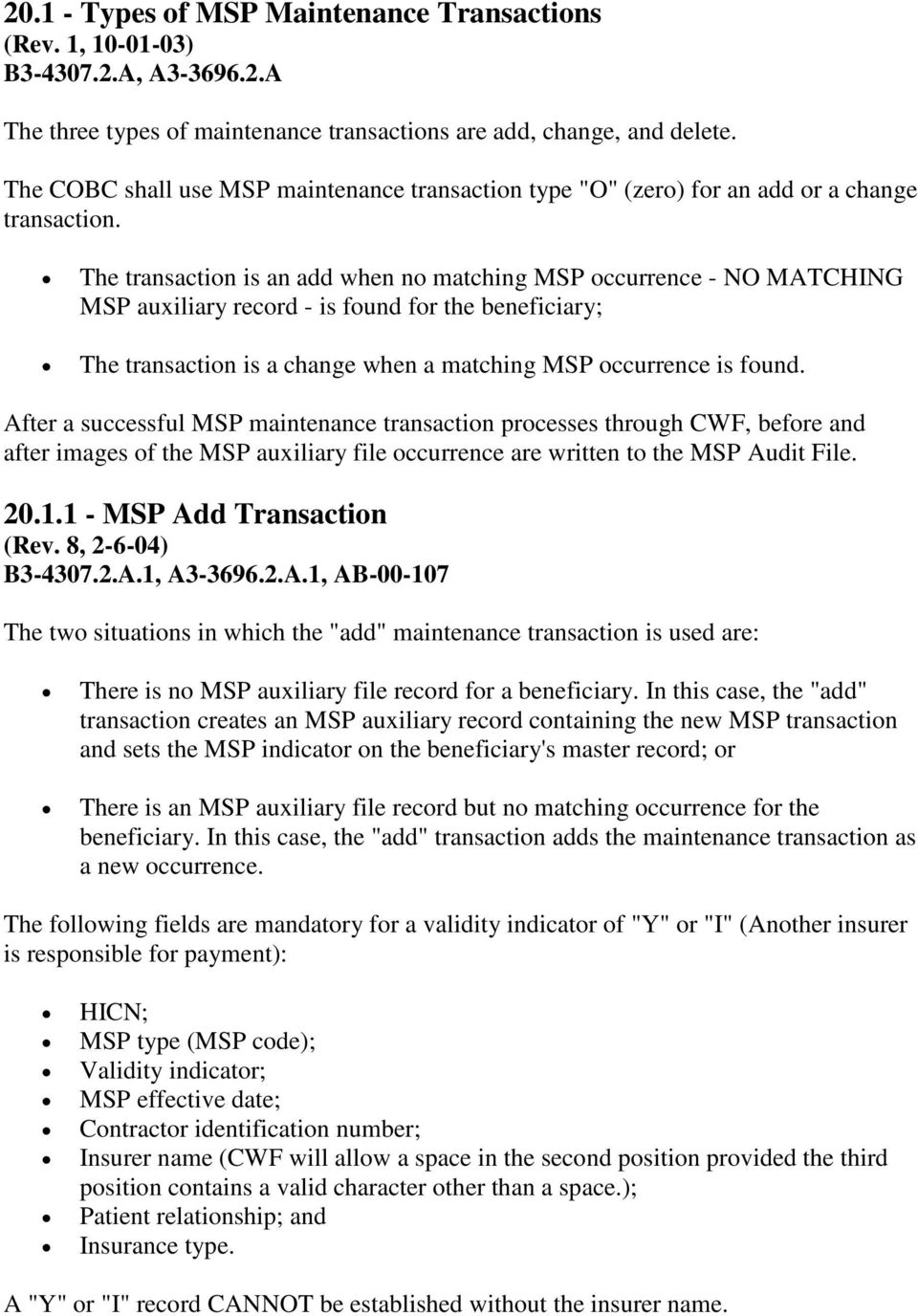
10 Types of MSP Maintenance Transactions (Rev. 1, ) B A, A A The three types of maintenance transactions are add, change, and delete. The COBC shall use MSP maintenance transaction type "O" (zero) for an add or a change transaction. The transaction is an add when no matching MSP occurrence - NO MATCHING MSP auxiliary record - is found for the beneficiary; The transaction is a change when a matching MSP occurrence is found. After a successful MSP maintenance transaction processes through CWF, before and after images of the MSP auxiliary file occurrence are written to the MSP Audit File MSP Add Transaction (Rev. 8, ) B A.1, A A.1, AB The two situations in which the "add" maintenance transaction is used are: There is no MSP auxiliary file record for a beneficiary. In this case, the "add" transaction creates an MSP auxiliary record containing the new MSP transaction and sets the MSP indicator on the beneficiary's master record; or There is an MSP auxiliary file record but no matching occurrence for the beneficiary. In this case, the "add" transaction adds the maintenance transaction as a new occurrence. The following fields are mandatory for a validity indicator of "Y" or "I" (Another insurer is responsible for payment): HICN; MSP type (MSP code); Validity indicator; MSP effective date; Contractor identification number; Insurer name (CWF will allow a space in the second position provided the third position contains a valid character other than a space.); Patient relationship; and Insurance type. A "Y" or "I" record CANNOT be established without the insurer name.
11 NOTE: Although the insurer address cannot be MANDATORY, it should be provided whenever possible MSP Change Transaction (Rev. 76, Issued: ; Effective Date: ; Implementation Date: ) An MSP change transaction occurs when the key fields on the incoming maintenance transaction match those on an existing MSP auxiliary occurrence. A match occurs when the following items are the same: HICN MSP type; MSP effective date; Insurance type; and Patient relationship When these items match, the balance of the record is overlaid. No change transactions will be permitted to records established, except for the addition of a termination date, by any contractor other than the COBC MSP Delete Transaction (Rev. 89, Issued: ; Effective Date: ; Implementation Date: ) The MSP maintenance type "1" is used to delete an MSP auxiliary occurrence. This transaction checks the beneficiary's master record for an MSP indicator. The COBC is responsible for submitting this transaction. Medicare contractors advise the COBC, via the ECRS, of the need to process an MSP maintenance type 1 transaction (delete). Only certain COBC contractor numbers may delete MSP occurrences originated or last updated by certain other COBC contractor numbers. No contractor number may update or delete a MSP occurrence originated or last updated by contractor number except contractor number Please see the table below for the exact criteria for deletion of MSP occurrences last updated by COBC contractor numbers. A match shall occur in order to delete the MSP occurrence originated or last updated by one COBC contractor number with a delete transaction submitted under a certain COBC contractor number. For example, COBC contractor numbers 11100, 11110, and are the only contractor numbers that may delete a MSP occurrence originated or last updated by The COBC will remain the sole contractor that may delete COBC contractor numbers. The COBC shall maintain the necessary logic to control updating and deleting MSP occurrences based on COB contractor numbers. Medicare contractors shall follow the current restrictions regarding deletion of MSP records.

12 Originating or Last Updating Contractor Number That Can Update/Delete Contractor Number , 11110, 11139, 11141, 11140, , 11110, 11139, 11141, 11140, , 11110, 11139, 11141, 11140, , 11110, 11141, 11140, 11121, 11143, 11139, , 11110, 11141, 11140, 11121, 11143, 11139, , 11110, 11141, 11140, 11121, 11143, 11139, , 11110, 11141, 11140, 11121, 11143, 11139, , 11110, 11141, 11140, 11121, 11143, 11105, 11102, 11139, , 11110, 11141, 11140, 11121, 11143, 11105, 11102, 11139, All others Any The COBC shall allow MIR (MMSEA Section 111) GHP responsible reporting entities (RREs) to override this update/delete hierarchy reflected in the table above under certain circumstances. MIR GHP RREs must submit an override code to the COBC after receiving an error on an attempted update/delete. The COBC will then apply the update/delete using contractor number This override capability shall not apply to MSP occurrences originated or last updated by The COBC shall apply the same hierarchy rules represented in the table above to transactions that have the effect of adding back or reopening matching MSP occurrences previously deleted MSP Termination Date Transaction (Rev. 1, ) Intermediaries and carriers add termination dates to MSP auxiliary records already established on CWF with a "Y" validity indicator, where there is no discrepancy in the validity of the information contained on CWF. They handle phone calls and written inquiries relating to simple terminations of existing MSP occurrences. Simple terminations are defined as terminations that can be made to a MSP auxiliary record without further development or investigation. They shall not transfer these calls or written inquiries to the COBC. In determining whether a call is to be handled by them or the COBC, the intermediary or carrier establishes the basis of the call. The following are examples when not to transfer a termination request to the COBC for further action. EXAMPLE 1:

13 Scenario: Mr. Doe is calling to report that his employer group health coverage has ended. Intermediary/Carrier action: The intermediary/carrier checks for matching auxiliary record on CWF and terminates, if no conflicting data are presented. The intermediary/carrier does not transfer the call to the COBC. EXAMPLE 2: Scenario: Mrs. X is calling to report that she has retired. Intermediary/Carrier action: The intermediary/carrier checks for matching auxiliary record on CWF and terminates if no conflicting data are presented. The intermediary/carrier does not transfer the call to the COBC. EXAMPLE 3: Scenario: The intermediary/carrier receives written correspondence that benefits are exhausted for an automobile case. Intermediary/Carrier Action: The intermediary/carrier checks for matching auxiliary record on CWF. The lead contractor terminates in accordance with existing guidelines (e.g., accounting of monies spent). The non-lead contractor refers the case to the lead contractor based on pre-cob guidelines as outlined in the fiscal year (FY) 2001 MSP post pay Budget and Performance Requirements (BPRs). It does not forward the correspondence to the COBC. EXAMPLE 4 Scenario: Union Hospital is calling to report that the MSP period contained on CWF for beneficiary X should be terminated. Intermediary/Carrier action: The intermediary/carrier checks for matching auxiliary record on CWF and terminates if no conflict in evidence is presented. It does not transfer the call to the COBC. COBC Role The COBC adds termination dates to records not covered in A, above. In addition, the COBC updates MSP occurrences as a result of a request from an intermediary or carrier, or as a result of COB development and investigation. The following are examples of when to transfer a termination request to the COBC for further action. EXAMPLE 1:

14 Scenario: The termination date is greater than six months prior to the date of accretion (i.e., SP 57 error code) for all COBC numbers (e.g., , 33333, 77777, 88888, or 99999). (All COBC numbers follow the old data match 6-month termination rule.) Intermediary/Carrier action: The intermediary/carrier sends a CWF assistance request to the COBC. COBC action: The COBC checks for matching record on CWF and terminates. In cases where discrepant information exists, the COBC will investigate to determine the proper course of action. EXAMPLE 2: Scenario: The intermediary/carrier receives information with regard to termination that is discrepant with the information contained on CWF. Intermediary/Carrier action: The intermediary/carrier forwards to the COBC for investigation via ECRS. COBC action: The COBC checks for matching record on CWF, investigates, and terminates if appropriate Medicare Secondary Payer (MSP) Maintenance Transaction Record/Medicare Contractor MSP Auxiliary File Update Responsibility (Rev. 94, Issued: , Effective Date: , Implementation Date: ) Effective January 1, 2001, the capability to update the CWF Medicare Secondary Payer (MSP) auxiliary file is essentially a function of only the Coordination of Benefits Contractor (COBC). Medicare Contractors will not have the capability to delete any MSP auxiliary file records, including those that a specific Medicare Contractor has established. If it is believed that a record should be changed or deleted, Medicare Contractors use the COB Contractor Electronic Correspondence Referral System (discussed in the Medicare Secondary Payer (MSP) Manual, Chapters 4 and 5, CWF Assistance Request option, to notify the COB Contractor. Medicare Contractors process claims in accordance with existing claims processing guidelines. There are only two instances in which Medicare Contractors will retain the capability to update CWF. They are: A. A claim is received for secondary benefits and the contractor could, without further development (for example, the EOB from another insurer or third party payer contains all necessary data), add an MSP occurrence and pay the secondary claim. Medicare Contractors must use a new validity indicator of "I" to add any new MSP occurrences, and update CWF within 10 calendar days from completion of the evaluation Medicare Contractors cannot submit a new record with a "Y" or any record with an "N" validity indicator.

15 B. A claim is received for conditional payment, and the claim contains sufficient information to create an "I" record without further development. Medicare Contractors add the MSP occurrence using an "I" validity indicator. They must update CWF within 10 calendar days from completion of the evaluation. Medicare Contractors will transmit "I" records to CWF via the current HUSP transaction. The CWF will treat the "I" validity indicator the same as a "Y" validity indicator when processing claims. Receipt of an "I" validity indicator will result in a CWF trigger to the COB Contractor. The COB Contractor will develop and confirm all "I" maintenance transactions established by Medicare Contractors. If the COB Contractor has not received information to the contrary within 100 calendar days, the COB Contractor will automatically convert the "I" validity indicator to a "Y." If the COB Contractor develops and determines there is no MSP, the COB Contractor will delete the "I" record. An "I" record should never be established when the mandatory fields of information are not readily available to a Medicare Contractors on a claim attachment. If they have the actual date that Medicare became secondary payer, they use that as the MSP effective date. If that information is not available, they use the Part A entitlement date as the MSP effective date. Medicare Contractors may include a termination date when they initially establish an "I" record. They may not add a termination date to an already established "I" record. Effective January 1, 2003, CWF accepts an "I" record only if no MSP record (validity indicator of either "I" or "Y;" open, closed or deleted status) with the same MSP type already exists on CWF with an effective date within 100 days of the effective date of the incoming "I" record. "I" records submitted to CWF that fail these edit criteria will reject with an SP 20 error code. The resolution for these cases is to transfer all available information to the COBC via the Electronic Correspondence Referral System (ECRS) CWF assistance request screen. It will be the responsibility of the COBC to reconcile the discrepancy and make any necessary modifications to the CWF auxiliary file record. In addition, effective January 1, 2003, a refund or returned check is no longer a justification for submission of an "I" record. Since an "I" record does not contain the source (name and address) of the entity that returned the funds, COBC lacks the information necessary to develop to that source. Follow the examples below to determine which ECRS transaction to submit: 1. An MSP inquiry should be submitted when there is no existing or related MSP record on the CWF. 2. The CWF assistance request should be submitted when the information on the CWF is incorrect or the MSP record has been deleted. 3. If the check or voluntary refund will open and close the case/msp issue, the Medicare Contractors should submit an MSP inquiry. They should refer to the ECRS manual for more information regarding closed cases.

16 The check should be deposited to unapplied cash until COBC makes an MSP determination CWF, MSP Auxiliary File (Rev. 1, ) A maximum number of 17 MSP auxiliary records may be stored in CWF for each beneficiary. The COBC is responsible for deletion of a record when the maximum storage is exceeded using the following priority: Oldest "deleted" (flagged for deletion) occurrence; Oldest "confirmed no" occurrence; Oldest termination date; or Oldest maintenance date for the MSP type to be added Integrity of MSP Data (Rev. 1, ) The CWF MSP data base integrity is totally dependent upon COBC input, supported by input by FIs and carriers to the COBC. The COBC is responsible for submitting to CWF MSP information it believes to be of the highest quality. It shall investigate information thoroughly before making changes to an existing CWF MSP auxiliary record. Intermediaries and carriers shall update their internal MSP control file with the information received via the CWF "03" trailer response. If more current information is available that conflicts with that received from CWF, the contractor is responsible for advising the COBC, via ECRS, of the need to correct the CWF, MSP auxiliary record Maintenance and Clean-Up of MSP Auxiliary files in CWF (Rev. 1, ) 1998 MSP BPRs for MSP As a result of MSP litigation settlement agreements CMS negotiated, records were added to the MSP Auxiliary file under contractor number (litigation settlement). Under the settlement agreements, CMS was to receive records for only those Medicare beneficiaries for which Medicare was secondary payer per a settlement agreement However, some data provided to CMS contain records for Medicare beneficiaries covered under a retirement group health plan or supplemental plan. These records were added to the CWF, MSP Auxiliary File. As these erroneous records are identified, beneficiaries, providers and the primary health plan have been notifying contractors that the records need to be corrected to again reflect Medicare as primary. All MSP Auxiliary File

17 records, including these litigation records, need to be corrected and complete to maintain the integrity of the MSP Auxiliary File. As they become aware of an erroneous record, intermediaries and carriers are to advise the COBC via ECRS MSP Effective Date Change Procedure (Rev. 1, ) When the COBC becomes aware that an MSP effective date is incorrect, it shall perform the following functions: Delete the auxiliary record containing the incorrect MSP effective date using an MSP delete transaction; and Submit a CWF, MSP maintenance transaction with the correct MSP effective date to establish a new auxiliary record. NOTE: When the beneficiary is entitled to both Parts A and B, the COBC shall use the Part A entitlement date, if the insurance effective date is prior to entitlement to Medicare CWF/MSP Transaction Request for Contractor Assistance (Rev. 1, ) Instances occur when the intermediary or carrier determines that the MSP effective date is not correct. When this happens, the contractor shall advise the COB, via ECRS, of the need to change the MSP effective date and shall provide the COBC with documentation to substantiate the change MSP Termination Date Procedure (Rev. 1, ) A. Future Termination Dates The CWF allows future termination dates up to six months for all MSP types, except ESRD. For ESRD, CWF uses the following criteria: MSP effective date prior to February 1, 1990, allows for termination date up to 12 months after the effective date; MSP effective date February 1, 1990, through February 29, 1996, allows for termination date up to 18 months after the effective date; or MSP effective date March 1, 1996, and later allows for termination date up to 30 months after the effective date. B. Add Termination Dates

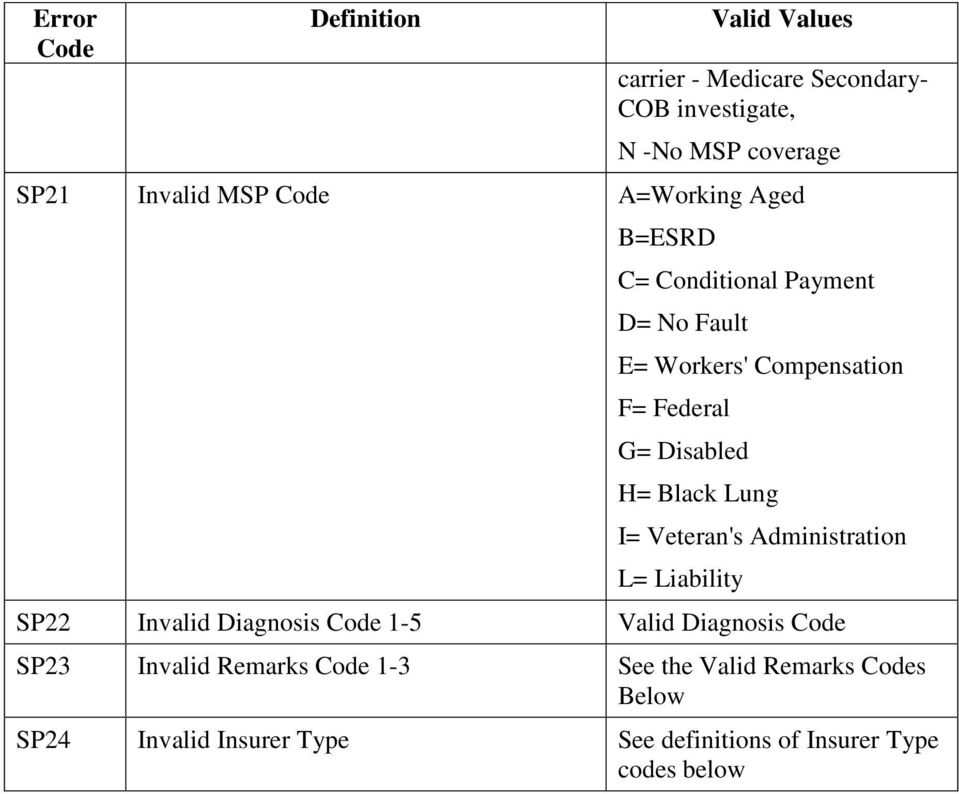
18 A termination date can only be added (not changed) to MSP auxiliary records established by contractor number "77777" or by contractor numbers " " C. Termination for "Y" Validity Indicator A CWF MSP auxiliary record with a "Y" validity indicator establishes Medicare as the secondary payer. When posting a termination date to this record the "Y" validity indicator should not be changed. The record indicates a valid MSP occurrence and all future claims submitted will edit against the time frame posted. The contractor shall advise the COBC via ECRS when MSP no longer applies, and the COBC shall enter the termination date MSP Auxiliary File Errors (Rev. 89, Issued: ; Effective Date: ; Implementation Date: ) Maintenance transactions to the MSP Auxiliary file reject invalid data with errors identified by a value of "SP" in the disposition field on the Reply Record. A trailer of "08" containing up to four error codes, will always follow. See CWF documentation in EDITMNTS.doc at for more specific information. Listed below are the possible MSP Maintenance Transaction error codes with a general description. Error Definition Valid Values Code SP11 Invalid MSP transaction record type "HUSP", "HISP" or "HBSP" SP12 Invalid HIC Number Valid HIC Number SP13 Invalid Beneficiary Surname Valid Surname SP14 Invalid Beneficiary First Name Initial Valid Initial SP15 Invalid Beneficiary Date of Birth Valid Date of Birth SP16 Invalid Beneficiary Sex Code 0=Unknown, 1=Male, 2=Female SP17 Invalid Contractor Number CMS Assigned Contractor Number SP18 Invalid Document Control Number Valid Document Control Number SP19 Invalid Maintenance Transaction Type 0=Add/Change MSP Data transaction, 1=Delete MSP Data Transaction SP20 Invalid Validity Indicator Y= Beneficiary has MSP Coverage, I= Entered by intermediary/

19 Error Code Definition Valid Values carrier - Medicare Secondary- COB investigate, N -No MSP coverage SP21 Invalid MSP Code A=Working Aged B=ESRD C= Conditional Payment D= No Fault E= Workers' Compensation F= Federal G= Disabled H= Black Lung I= Veteran's Administration L= Liability SP22 Invalid Diagnosis Code 1-5 Valid Diagnosis Code SP23 Invalid Remarks Code 1-3 See the Valid Remarks Codes Below SP24 Invalid Insurer Type See definitions of Insurer Type codes below
20 Error Code SP25 Invalid Insurer Name Definition An SP25 error is returned when the MSP Insurer Name is equal to one of the following: Supplement Supplemental Insurer Miscellaneous CMS Attorney Unknown None N/A Un Misc NA NO BC BX BS BCBX Blue Cross Blue Shield Medicare Valid Values Alphabetic, Numeric, Space, Comma, & - # / ; : Insurer Name must be present if Validity Indicator = Y SP26 Invalid Insurer Address 1 and/or Address 2 Alphabetic, Numeric, Space, Comma, & - # / ; : SP27 Invalid Insurer City Alphabetic, Numeric, Space, Comma, & - # / ; : SP28 Invalid Insurer State Must match U.S. Postal Service state abbreviation table.

21 Error Definition Valid Values Code SP29 Invalid Insurer Zip Code If present, 1st 5 digits must be numeric. If foreign country "FC" state code, the nine positions may be spaces. SP30 Invalid Policy Number Alphabetic, Numeric, Space, Comma, & - # / ; : SP31 Invalid MSP Effective Date (Mandatory) Non-blank, non-zero, numeric, number of days must correspond with the particular month. MSP Effective Date must be less than or equal to the current date. SP32 Invalid MSP Termination Date Must be numeric; may be all zeroes if not used; if used, date must correspond with the particular month. SP33 Invalid Patient Relationship The following codes are valid for all MSP Auxiliary occurrences regardless of accretion date: 01 = Self; Beneficiary is the policy holder or subscriber for the other GHP insurance reflected by the MSP occurrence or- Beneficiary is the injured party on the Workers Compensation, No- Fault, or Liability claim 02 =Spouse or Common Law Spouse 03 = Child 04 = Other Family Member 20 = Life Partner or Domestic
22 Error Code Definition Partner Valid Values The following codes are only valid on MSP Auxiliary occurrences with accretion dates PRIOR TO 4/4/2011: 05 = Step Child 06 = Foster Child 07 = Ward of the Court 08 = Employee 09 = Unknown 10 = Handicapped Dependent 11 = Organ donor 12 = Cadaver Donor 13 = Grandchild 14 = Niece/Nephew 15 = Injured Plaintiff 16 = Sponsored Dependent 17 = Minor Dependent of a Minor Dependent 18 = Parent 19 = Grandparent 20 = Life Partner or Domestic Partner SP34 Invalid subscriber First Name Alphabetic, Numeric, Space, Comma, & - # / ; : SP35 Invalid Subscriber Last Name Alphabetic, Numeric, Space, Comma, & - # / ; : SP36 Invalid Employee ID Number Alphabetic, Numeric, Space, Comma, & - # / ; : SP37 Invalid Source Code Spaces, A through W, 0 19,
23 Error Code Definition Valid Values 21, 22, 25, 26, 39, 41, 42, 43. See 10.2 for definitions of valid CWF Source Codes. SP38 Invalid Employee Information Data Code Spaces if not used, alphabetic values P, S, M, F. See for definition of each code. SP39 Invalid Employer Name Spaces if not used. Valid Values: Alphabetic, Numeric, Space, Comma, & - # / ; : SP40 Invalid Employer Address Spaces if not used. Valid Values: Alphabetic, Numeric, Space, Comma, & - # / ; : SP41 Invalid Employer City Spaces if not used. Valid Values: Alphabetic, Numeric, Space, Comma, & - # / ; : SP42 Invalid Employer State Must match U.S. Postal Service state abbreviations. SP43 Invalid Employer ZIP Code If present, 1st 5 digits must be numeric. If foreign country FC is entered as the state code, and the nine positions may be spaces. SP44 Invalid Insurance Group Number Spaces if not used. Valid Values: Alphabetic, Numeric, Space, Comma, & - # / ; : SP45 Invalid Insurance Group Name Spaces if not used. Valid Values: Alphabetic, Numeric, Space, Comma, & - # / ; : SP46 Invalid Pre-paid Health Plan Date Numeric; number of days must correspond with the particular month. SP47 Beneficiary MSP indicator not on for delete Occurs when the code
24 Error Code SP48 SP49 SP50 SP51 SP52 SP53 transaction. Definition MSP auxiliary record not found for delete data transaction MSP auxiliary occurrence not found for delete data transaction Invalid function for update or delete. Contractor number unauthorized MSP Auxiliary record has 17 occurrences and none can be replaced Invalid Patient Relationship Code which is mandatory for MSP Codes A, B and G when the Validity Indicator is "Y" The maintenance transaction was for Working Aged EGHP and there is either a ESRD EGHP or Disability EGHP entry on file that has a termination date after the Effective date on the incoming transaction Valid Values indicating the existence of MSP auxiliary record is not equal to "1" and the MSP maintenance transaction type is equal to 1. See MSP Auxiliary Record add/update and delete function procedures above. See MSP Auxiliary Record add/update and delete function procedures above. See MSP Auxiliary Record add/update and delete function procedures above Accretion Dates prior to 4/4/2011: Patient Relationship must be 01 or 02 for MSP Code A (Working Aged). Patient Relationship must be 01, 02, 03, 04, 05, 18 or 20 for MSP Codes B (ESRD) and G (Disabled). Accretion Dates 4/4/2011 and subsequent: Patient Relationship must be 01 or 02 for MSP Code A (Working Aged). Patient Relationship must be 01, 02, 03, 04, or 20 for MSP Codes B (ESRD) and G (Disabled).
25 Error Code SP54 SP55 SP56 SP57 SP58 SP59 SP60 SP61 Definition or is not terminated, and the contract number on the maintenance transaction is not equal to "11102", "11104", 11105", "11106", "33333", "66666", "77777", "88888", or "99999". MSP Code A, B or G has an Effective date that is in conflict with the calculated age 65 date of the Bene. MSP Effective date is less than the earliest Bene Part A or Part B Entitlement Date. MSP Prepaid Health Plan Date must be = to or greater than MSP Effective date or less than MSP Term. date. Termination Date Greater than 6 months prior to date added for Contractor numbers other than , 11121, 11122, 11126, 11139, 11141, 11142, 11143, 33333, 55555, 77777, 88888, and Invalid Insurer type, MSP code, and validity indicator combination. Invalid Insurer type, and validity indicator combination Other Insurer type for same period on file (Non "J" or "K") Insurer type on incoming maintenance record is equal to "J" or "K" and Insurer type on matching aux record is not equal to "J" or "K". Other Insurer type for same period on file ("J" or "K") Insurer type on incoming maintenance record is not equal to "J" or "K" and Insurer type on matching aux record is equal to "J" or "K". Valid Values For MSP Code A, the Effective date must not be less than the date at age 65. For MSP Code G, the Effective date must not be greater than the date at age 65. If MSP code is equal to "A" or "B" or "G" and validity indicator is equal to "I" or "Y" then insurer type must not be equal to spaces. If validity indicator is equal to "N" then insurer type must be equal to spaces. Edit applies only to MSP codes: A - Working Aged, B - ESRD EGHP, G - Disability EGHP Edit applies only to MSP codes: A - Working Aged, B - ESRD EGHP,
26 Error Code SP62 SP66 SP67 Definition Incoming term date is less than MSP Effective date. MSP Effective date is greater than the Effective date on matching occurrence on auxiliary file Incoming term date is less than posted term date for Provident Valid Values G - Disability EGHP SP72 Invalid Transaction attempted A HUSP add transaction is received from a FI or Carrier (non-cobc) with a validity indicator other than "I". SP73 Invalid Term Date/Delete Transaction A FI or Carrier attempts to change a Term Date on a MSP Auxiliary record with a "I" or "Y" Validity Indicator that is already terminated, or trying to add Term Date to "N" record. SP74 Invalid cannot update "I" record. A FI or Carrier submits a HUSP transaction to update/change an "I" record or to add an "I" record and a match MSP Auxiliary occurrence exists with a "I" validity indicator. SP75 SP76 Invalid transaction, no Medicare Part A benefits MSP Type is equal to W (Workers Compensation Medicare Set-Aside) and A HUSP transaction to add a record with a Validity Indicator equal to "I" (from an FI/carrier) or "Y" (from COBC) with an MSP Type equal to "A", "B", "C" or "G" and the effective date of the transaction is not within a current or prior Medicare Part A entitlement period, or the transaction is greater than the termination date of a Medicare entitlement period.
27 Error Code Definition there is an open MSP Type E (Workers Compensation) record. Valid Values Valid Remarks Codes (Rev. 1, ) Remark Code Definition 01 Beneficiary retired as of termination date. 02 Beneficiary's employer has less than 20 employees. 03 Beneficiary's employer has less than 100 employees 04 Beneficiary is dually entitled to Medicare, based on ESRD and Age or ESRD and disability 05 Beneficiary is not married. 06 The Beneficiary is covered under the group health plan of a family member whose employer has less than 100 employees. 07 Beneficiary's employer has less than 20 employees and is in a multiple or multi-employer plan that has elected the working aged exception. 08 Beneficiary's employer has less than 20 employees and is in a multiple or multi-employer plan that has not elected the working aged exception. 09 Beneficiary is self-employed. 10 A family member of the Beneficiary is self-employed. 20 Spouse retired as of termination date. 21 Spouse's employer has less than 20 employees. 22 Spouse's employer has less than 100 employees. 23 Spouse's employer has less than 100 employees but is in a qualifying multiple or multi-employer plan. 24 Spouse's employer has less than 20 employees and is multiple or multiemployer plan that has elected the working aged exception.
28 Remark Code Definition 25 Spouse's employer has less than 20 employees and is multiple or multiemployer plan that has not elected the working aged exception. 26 Beneficiary's spouse is self-employed 30 Exhausted benefits under the plan 31 Preexisting condition exclusions exist 32 Conditional payment criteria met 33 Multiple primary payers, Medicare is tertiary payer 34 Information has been collected indicating that there is not a parallel plan that covers medical services 35 Information has been collected indicating that there is not a parallel plan that covers hospital services 36 Denial sent by EGHP, claims paid meeting conditional payment criteria. 37 Beneficiary deceased. 38 Employer certification on file. 39 Health plan is in bankruptcy or insolvency proceedings. 40 The termination date is the Beneficiary's retirement date. 41 The termination date is the spouse's retirement date. 42 Potential non-compliance case, Beneficiary enrolled is supplemental plan. 43 GHP coverage is a legitimate supplemental plan. 44 Termination date equals transplant date 50 Employment related accident 51 Claim denied by workers comp 52 Contested denial 53 Workers compensation settlement funds exhausted
29 Remark Code Definition 54 Auto accident - no coverage 55 Not payable by black lung 56 Other accident - no liability 57 Slipped and fell at home 58 Lawsuit filed - decision pending 59 Lawsuit filed - settlement received 60 Medical malpractice lawsuit filed 61 Product liability lawsuit filed 62 Request for waiver filed 70 Data match correction sheet sent 71 Data match record updated 72 Vow of Poverty correction Valid Insurance Type Codes (Rev. 76, Issued: ; Effective Date: ; Implementation Date: ) Insurer Type Code A B C D E F Definition GHP Hospital and Medical Coverage -or- Other Non-GHP GHO Preferred Provider Organization (PPO) Third Party Administrator arrangement under an Administrative Service Only (ASO) contract without stop loss from any entity. Third Party Administrator arrangement with stop loss insurance issued from any entity. Self-Insured/Self-Administered.
30 G H I J K M R S SPACES Collectively-Bargained Health and Welfare Fund. Multiple Employer Health Plan with at least one employer who has more than 100 full and/or part-time employees. Multiple Employer Health Plan with at least one employer who has more than 20 full and/or part-time employees. GHP Hospitalization Only Plan - A plan that covers only Inpatient hospital services. GHP Medical Services Only Plan - A plan that covers only non-inpatient medical services. Medicare Supplemental Plan, Medigap, Medicare Wraparound Plan or Medicare Carve Out Plan. GHP Health Reimbursement Arrangement GHP Health Savings Account Unknown NOTE: For MSP occurrences with accretion dates of 4/4/2011 and subsequent, the only valid Insurer Type Codes are A, J, K, R, S, and spaces Other Effective Date and Termination Date Coverage Edits (Rev. 1, ) If MSP Code: Effective Date Must Be Greater Than A - Working Aged January 1, 1983 (830101) A - Working Aged Calculated Date beneficiary turned 65 (first day of month). B - ESRD October 1,1981 D - No Fault December 1, 1980 E - Workers' Compensation July 1, 1966 F - Federal/Public Health July 1, 1966 H - Black Lung July 1, 1973 I - Veterans' Administration July 1, 1966
31 If MSP Code: Effective Date Must Be Greater Than G - Disabled (43) January 1, 1987 G - Disabled Prior to the first day of the month the Beneficiary turns 65. L - Liability December 1, 1980 Other Termination date coverage edits are: If contractor number is that of the IRS/SSA/CMS data match project ("77777"), the term date may be equal to or greater than the effective date, Cannot be greater than the current date plus six months, except for MSP code = B, and Cannot be greater than the first day the beneficiary turned 65 if the MSP code is B or G Employee Information Data Code (Rev. 1, ) Employee Information Data Code Valid Values P S M Patient Spouse Mother F Father Automatic Notice of Change to MSP Auxiliary File (Rev. 8, ) The Common Working File (CWF) sends MSP transactions to all contractors of record when an MSP auxiliary record is created or changed for any beneficiary. The CWF sends this electronic transaction, known as a HUSC transaction, daily to the appropriate contractors standard system. All contractors shall update their internal MSP files with HUSC transactions automatically. After the internal MSP files have been updated automatically, the contractor s MSP staff shall follow their current instructions regarding MSP recovery activities. This includes (1) initiating claims history searches within existing post-pay guidelines using HUSC transaction information and (2) initiating recovery actions on potential mistaken payments when appropriate.
32 Alerts are sent to Medicare contractors when an update is made to an MSP record. Medicare contractors shall continue to receive Unsolicited Response (UR) alerts. Although, COBC is not required to receive UR alerts for updates that were made to COBC contractor numbers (e.g., 111XX contractor numbers) as COBC receives a disposition that informs COBC that the transaction was accepted. Processing UR alerts initiated by COBC adds duplication to COBC s database and requires excess processing. The CWF is no longer required to transmit UR alerts to COBC for updates that were made to contractor number 111XX MSP Claim Processing (Rev. 1, ) The CWF performs consistency edit checks on claims submitted to it. Refer to CWF Systems Documentation for the complete record layout and field descriptions. Record names are: CWF Part B Claim Record, and CWF Inpatient/SNF Bill Record. The MSP claims failing the consistency edits receive a reject with the appropriate disposition code, reject code, and MSP trailer data. Refer to CWF Systems Documentation, Record Name: CWF, MSP Basic Reply Trailer Data for the complete record layout and field descriptions. Claims passing the consistency edit process are reviewed for utilization compliance. Claims rejected by the utilization review process are rejected with the appropriate disposition code, reject code and MSP trailer data CWF, MSP Claim Validation (Rev. 1, ) There are four conditions that may occur when a contractor validates claims against the CWF, MSP auxiliary file: MSP is indicated on the claim and there is matching data on the CWF, MSP auxiliary record. The claim is accepted and all CWF, MSP auxiliary occurrences are returned, MSP is indicated on the claim and there is no matching data on an MSP auxiliary record. The claim is rejected and all CWF, MSP occurrences that apply are returned. Section 40.8 describes the CWF, MSP Utilization Error Codes, and the appropriate resolution for those codes, MSP is not indicated on the claim and the MSP auxiliary file has an occurrence that indicates there is MSP involvement for the time period affected. The claim is rejected and all occurrences that apply are returned, and
33 MSP is not indicated on the claim and there are no matching occurrences on the CWF, MSP auxiliary file that indicate MSP involvement. The claim is accepted for payment. NOTE: An occurrence applies if the claim service dates are equal to, or greater than, the effective date of the occurrence and less than, or equal to, the termination date of that occurrence, if there is a termination date CWF Claim Matching Criteria Against MSP Records (Rev. 1, ) The matching criteria between the claim and the MSP auxiliary occurrence is as follows: MSP types are equal; MSP auxiliary record validity indicator equals "Y"; Overlapping dates of service on the claim (claim service dates after MSP effective date and before MSP termination date, if present); and No MSP override code used when submitting the claim Conditional Payment (Rev. 1, ) To make a conditional payment, FIs and carriers indicate conditional payment on the CWF, Part B Claim by placing a "C" in the "MSP code" field (field 97 of the CWF Part B Claim record.). Intermediaries indicate conditional payment on the CWF Inpatient/SNF Bill by placing zeros (0) in the "value amount" field (position 77b) along with the appropriate "value code". An MSP auxiliary record for the beneficiary with a "Y" validity indicator must be present. The CWF will reject the claim with error code 6805 when a claim for conditional payment is submitted and there is no matching MSP auxiliary record present Override Codes (Rev. 1, ) The CWF will accept MSP override codes. FIs and carriers must place the appropriate override code in the "MSP code" field (field 97) of the CWF Part B Claim record. Intermediaries must place the appropriate override code in the CWF (Inpatient/SNF Bill or Outpatient/Home Health/Hospice), "Special Action Code/Override Code, field 90". Override codes must be used only as described below. The CWF employs the following matching criteria for override codes "M" and "N": Dates of service on the claim fall within the effective and termination dates on auxiliary record; and
34 Validity indicator is equal to "Y". The correct use of override codes is as follows: A. Override code "M" is used where EGHP, LGHP and ESRD services are involved and the service provided is either: Not a covered service under the primary payer's plan; Not a covered diagnosis under the primary payer's plan; or Benefits have been exhausted under the primary payer's plan. B. Override code "N" is used where non-eghp (auto medical, no-fault, liability, Black Lung, Veterans Affairs and workers' compensation) services are involved and the service is either: Not a covered service under the primary payer's plan; Not a covered diagnosis under the primary payer's plan; or Benefits have been exhausted under the primary payer's plan. Contractors receive error code 6806 when the MSP override code equals "M" or "N" and no MSP record is found with overlapping dates of service. The "Y" and "Z" override codes valid prior to the conversion of MSP data into CWF on December 10, 1990, are obsolete MSP Cost Avoided Claims (Rev. 1, ) Contractors shall follow the instructions cited in Chapter 5, 50, for counting savings on MSP cost avoided claims. They shall submit ALL MSP cost avoided claims to CWF. Payment/Denial codes are used to identify the reason a claim was denied. Specific codes for MSP are listed and defined in 10.2 under the MSP/COB/Contractor Number chart in that section. Carriers submit the appropriate code to CWF in the "HUBC" claim record in field 63 "Payment/Denial Code" for line item denials. They complete the appropriate code for full claim denials in the "HUBC" claim record, field 16 "Payment/Denial". Intermediaries submit the appropriate code in the HUIP CWF record field 58 "Nonpayment" code for inpatient hospital and SNF claim denials. They submit the appropriate code in field 59 "No Pay Code" of the CWF record for the specific type of claim identified in the chart below.
35 PAYMENT/DENIAL CODE FIELDS IN CWF CLAIM RECORD Contractor Type of Claim CWF Record Field Carrier Full Claim Denial HUBC 16 Payment/Denial Carrier Full Line Item Denial HUBC 63 Payment/Denial Code Intermediary Inpatient hospital and inpatient SNF Denial HUIP 58 Nonpayment Code Intermediary Outpatient HUOP 59 No Pay Code RHHI Home Health HUHH 59 No Pay Code RHHI Hospice HUHC 59 No Pay Code Contractor number identifies Voluntary Data Sharing Agreements with other insurers. The denial indicator of "Q" for cost avoided claims is to be used for claims that match against the contractor auxiliary record. If the denial indicator is incorrect, the CWF software will correct the denial indicator based on the matching MSP auxiliary record and send the correct value back to the contractor on the response record header. It is not necessary for an MSP auxiliary record to be present in order to post MSP cost avoided savings. If one is present, the FI or carrier uses the "X" or "Y" override code as appropriate Online Inquiry to MSP Data (Rev. 1, ) The MSP data may be viewed online in CWF via the HIMR access. The user enters the transaction HIMR, which displays the HIMR Main Menu, and enters the MSPA selection. (A complete record layout and field descriptions can be found in the CWF Systems Documentation at Record Name: MSP Auxiliary File and MSP Audit History File.) A user can view a selected CWF, MSP auxiliary record by following the steps outlined below: A. Enter the HICN and MSP record type.
36 If the data entered is invalid, an error message is displayed with the field in error highlighted. If the data entries are valid, a search is done of the beneficiary master file for an MSP indicator. The search of the master file will show one of the following: The MSP indicator on the beneficiary file is not set. In this case the message "MSP not indicated" is displayed; No record is found. In this case, a message "MSP auxiliary file not found" is displayed; or MSP is indicated. In this case, the MSP auxiliary file is read and the screen will display an MSP Record. A successful reading of the MSP file, as noted in the third bullet above, will display an MSP occurrence summary screen that includes: Summary selection number; MSP code; MSP code description; Validity indicator; Delete indicator; Effective date; and Termination date, if applicable. B. Enter the summary selection number on the MSP occurrence summary screen. This results in a display of the MSP occurrence detail screen for the selected MSP occurrence. The MSP occurrence detail screen is a full display of the information on the MSP auxiliary file for the particular MSP occurrence MSP Purge Process (Rev. 1, ) The CWF process includes an MSP purge process. The CMS will determine when the purge process will be employed. The criteria for deletion of MSP data from the MSP auxiliary file will be a predetermined number of years from the following dates: Date of death; Termination date and last maintenance date; or
37 Last maintenance date and delete indicator equal to "D". The MSP purge criteria will be parameter driven. All occurrences of MSP data for a beneficiary will be copied to the MSP history audit file, and the MSP indicator on the beneficiary file will be disengaged (turned off) if no other occurrences are present on the file. A Summary report, by originating contractor identification number, will contain the total number of MSP records affected by the purge and the total of each type of MSP occurrence deleted from the MSP auxiliary file MSP Utilization Edits and Resolution for Claims Submitted to CWF (Rev. 65, Issued: , Effective: / , Implementation: / ) Exhibit 2, AB Error codes do not apply to first claim development. Error Code Error Description Resolution 6801 MSP indicated on claim - no MSP auxiliary record exists on CWF data base. Prepare an "I" MSP maintenance transaction and resubmit claim to CWF. See 10.1 for criteria to submit "I". If "I" criteria is not met, submit an MSP inquiry via ECRS MSP indicated on claim - no match on MSP auxiliary file. (1) Analyze CWF auxiliary file. (2) Create a new "I" MSP auxiliary record, or if "I" record criteria is not met, submit an MSP inquiry or CWF assistance request via ECRS; and (3) Resubmit claim. NOTE: Match criteria: MSP types are equal, validity indicator equals "Y", dates of service are within MSP period and NO override code is indicated on claim MSP auxiliary record exists - no MSP indicated on claim but dates of service match. (1) Deny claim. Advise beneficiary/provider: "Resubmit claim with other payer's Explanation of Benefits for possible secondary payment. If other insurance has
38 Error Code Error Description Resolution terminated, resubmit with documentation showing termination dates of other insurance." If you have documentation showing termination of the insurance coverage indicated in the CWF, MSP occurrence, process as follows: (2) Post a termination date; or. (3) Resubmit claim as MSP. If the termination date is incorrect, submit a CWF assistance request via ECRS MSP conditional payment claim and (1) Create an "I" MSP Auxiliary matching MSP record with "Y" validity Record when it fits the criteria for indicator not found. adding an "I" record. (2) Submit MSP inquiry or CWF assistance request via ECRS. (3) Resubmit claim MSP override code equals "M" or "N" and no MSP record found with overlapping dates of service. If record was deleted in error, request CWF assistance request. Do not recreate record with "I" validity indicator Part A claim was processed and only a Part B (Insurer type = "K") matching record was found Part B claim was processed and only a Part A (Insurer type = "J") matching record was found WC Medicare Set-Aside exists. Medicare contractor payment not allowed. See discussion in 40.4 above for proper use of override codes CWF MSP Reject for A Beneficiary Entitled to Medicare Part B Only and A GHP (Rev. 1, )
39 An MSP situation cannot exist when a beneficiary has GHP coverage (i.e., working aged, disability and ESRD) and is entitled to Part B only. CWF will edit to prevent the posting of these MSP records to CWF when there is no Part A entitlement date. Currently, if a contractor submits an Electronic Correspondence Referral System (ECRS) transaction to the coordination of benefits (COB) contractor to add a GHP MSP record where there is no Part A entitlement, the contractor will receive a reason code of 61. The COB contractor's system cannot delete these types of records once the records are posted to CWF by a contractor. Beginning April 2002 CWF will create a utility to retroactively delete all MSP GHP records where there is no Part A entitlement. Contractors should not submit an ECRS request to COB to establish a GHP MSP record when there is no Part A entitlement. Contractors that attempt to establish an I record will receive a CWF error. The CWF will continue to allow the posting of MSP records where there is no Part A entitlement when non-employer GHP situations exists, such as automobile, liability, and workers compensation. Where a non-employer GHP situation exists, the contractor should continue to submit ECRS transactions and establish I records, as necessary Processing of Medicare Secondary Payer Claims Related or Unrelated to an Accident or Injury for Non-GHP Claims with ICD-9- CM Diagnosis Codes and or Related ICD-10-CM Diagnosis Codes (Rev. 107, Issued: , Effective: ASC X12: January 1, 2012; ICD 10: Upon Implementation of ICD-10, Implementation: ICD 10: Upon Implementation of ICD 10; ASC X12: ) Medicare contractors receive Liability, No-Fault (NF), and Workers Compensation (WC), as well as Black Lung (BL), Medicare Secondary Payer (MSP) claims with ICD-9 diagnosis (DX) codes resulting from an accident, illness, or injury. DX codes are placed on the beneficiary MSP auxiliary file for purposes of processing non group health plan (non-ghp) MSP claims correctly. An MSP Liability, NF, or WC record with associated DX code(s) tells CWF to process the claim as secondary, or conditionally, if a conditional payment code is associated to the MSP file telling the contractor to make a conditional payment. The COB Contractor (COBC) also determines what DX codes should be placed on the beneficiary MSP file when diagnosis information is received through COB development process. Effective July 1, 2011, CMS automated the ICD-9 DX code matching process for DX Code categories and only and established a process where CWF determines whether the DX codes housed on the MSP auxiliary record are related to the ICD-9 DX codes on the incoming claim without unnecessarily prompting denial of claims or requiring the contractor to determine relatedness. The best way to assist in this process is to associate each DX code with the category of codes with which that DX code is affiliated. Contractors shall continue to follow current MSP policy and development procedures for all other DX codes received that do not fall within and
40 DX categories as identified in this instruction. Contractors may use an ICD-9 code list as deemed necessary when DX code research is warranted for beneficiary claims and other MSP purposes. NOTE: These instructions apply to the current ICD-9 DX category codes and MSP procedures and not ICD-10 MSP procedures. An ICD-10 MSP processes and procedures instruction shall be issued when available after the MSP ICD-10 workgroup meets to discuss all pertinent MSP ICD-10 issues and the latest ICD-10 codes are published Definition of ICD-9-CM Diagnosis Category Codes and Examples (Rev. 107, Issued: , Effective: ASC X12: January 1, 2012; ICD 10: Upon Implementation of ICD-10, Implementation: ICD 10: Upon Implementation of ICD 10; ASC X12: ) Contractors, and their associated systems, shall assume that category codes in the ranges identified below are related. Likewise, category codes in the range 800.x through the 804.xx shall be deemed related. However, CWF shall assume that category codes 804 and 805, which relate to separate classification of fractures, are not related to each other. Below are the ICD-9 DX Codes for category ranges that include Black Lung Code (500), Lung Diseases ( ) and Injury and Poisoning Codes ( ). ICD-9 Clinical Modification (CM) contains sections of related codes which are grouped by injuries to specific body parts or systems. These sections are shown within the ICD-9- CM code book preceding each section. Listed below are the general categories of these sections along with the specific code range within each section. Assume that codes within each section are related except as noted below. Coal Workers Pneumoconiosis (500) Only one code is used to identify Black Lung for MSP purposes. Pneumoconiosis and other lung diseases due to external agents ( ) - codes Contractors shall assume each DX code within this category is related. Fractures ( ) Fracture of skull ( ) - code range = Contractors shall assume each DX code within this category is related. Fracture of neck and trunk ( ) - code range = Contractors shall assume each DX code within this category is related. Fracture of upper limb ( ) - code range = Contractors shall assume each DX code within this category is related.
41 Fracture of lower limb ( ) - code range = Contractors shall assume each DX code within this category is related. Dislocations ( ) Contractors shall assume each code within the 3-digit code category for dislocations is related. Contractors shall assume that codes outside of the 3-digit category are not related. For instance, all codes within category 830 ( ) shall be assumed to be related; however, codes within category 831 ( ) shall assume to be unrelated to the 830 category DX codes. Sprains and strains of joints and adjacent muscles ( ) Contractors shall assume each code within the 3-digit code category for sprains and strains is related. Contractors shall assume that codes outside of the 3-digit category are not related. For instance, all codes within category 840 ( ) shall assume to be related; however, codes within category 841 ( ) shall assume to be unrelated to the 840 category DX codes. Intracranial injury, excluding those with skull fracture ( ) (codes ) Contractors shall assume each code with the 3-digit code category for intracranial injuries is related. For instance, all codes within category 850 ( ) shall assume to be related; however, codes within category 854 ( ) shall assume to be unrelated to the 850 category DX codes. Injury codes from (codes ) Contractors shall assume each code within the 3-digit code category for injuries is related. Contractors shall assume that codes outside of the 3-digit category are not related. For instance, all codes within category 861 ( ) shall assume to be related; however, codes within category 862 ( ) shall assume to be unrelated to the 861 category DX codes. Open wound of head, neck and trunk ( ) Contractors shall assume each code within the 3-digit code category for open wounds is related. Contractors shall assume that codes outside of the 3-digit category are not related. For instance, all codes within category 870 ( ) shall assume to be related; however, codes within category 876 ( ) shall assume to be unrelated to the 870 category DX codes Open wound of upper limb ( ), codes
42 Contractors shall assume DX codes within this category range are related. Open wound of lower limb ( ), codes Contractors shall assume DX codes within this category range are related. Injury to blood vessels ( ), codes Contractors shall assume DX codes within this category range are related. Late effects of injuries, poisonings, toxic effects, and other external causes ( ), codes Contractors shall assume each code within the 3-digit code category is related. Contractors shall assume that codes outside of the 3-digit category are not related. For instance, all codes within category 905 ( ) shall assume to be related; however, codes within category 908 ( ) shall assume to be unrelated to the 905 category DX codes. Superficial injury ( ), codes Contractors shall assume each code within the 3-digit code category is related. Contractors shall assume that codes outside of the 3-digit category are not related. For instance, all codes within category 910 ( ) shall assume to be related; however, codes within category 916 ( ) shall assume to be unrelated to the 910 category DX codes. Contusion with intact skin surface ( ), codes Contractors shall assume each code within the 3-digit code category is related. Contractors shall assume that codes outside of the 3-digit category are not related. For instance, all codes within category 921 ( ) shall assume to be related; however, codes within category 924 ( ) shall assume to be unrelated to the 921 category DX codes. Crushing injury ( ), codes Contractors shall assume DX codes within this category range are related. Effects of foreign body entering through orifice ( ), codes Contractors shall assume each code within the 3-digit code category is related. Contractors shall assume that codes outside of the 3-digit category are not related. For instance, all codes within category 930 ( ) shall assume to be related;
43 however, codes within category 934 ( ) shall assume to be unrelated to the 930 category DX codes. Burns ( ), codes Contractors shall assume DX codes within this category range are related. Injury to nerves and spinal cord ( ), codes Contractors shall assume DX codes within this category range are related. Certain traumatic complications and unspecified injuries ( ), codes Contractors shall assume DX codes within this category range are related. Poisoning by drugs, medicinal and biological substances ( ) Contractors shall assume each code within the 3-digit code category for poisoning by drugs medicinal and biological substances is related. Contractors shall assume codes outside of the 3-digit category are not related. For instance, all codes within category 960 ( ) shall assume to be related; however, codes within category 961 ( ) shall assume to be unrelated to the 960 category codes. Toxic effects of substances chiefly non-medicinal as to source ( ) Contractors shall assume each code within the 3-digit code category for toxic effects of substances chiefly non-medicinal as to source is related. Codes outside of the three digit category are not related. For instance, all codes within category 980 ( ) shall be assumed to be related; however, codes within category 982 ( ) shall be assumed to be unrelated to the 980 category codes. Other and unspecified effects of external causes ( ), codes Contractors shall assume each code within the 3-digit code category is related. Contractors shall assume that codes outside of the 3-digit category are not related. For instance, all codes within category 991 ( ) shall assume to be related; however, codes within category 992 ( ) shall assume to be unrelated to the 991 category DX codes. Complications of surgical and medical care NEC ( ) Contractor shall assume each code with the 3-digit category is related unto itself. For instance, codes 996.0, 996.1, 996.2, 996.3, 996.4, 996.5, 996.6, 996.7, 996.8, are not related to each other; however, and , which are within its own
44 category, are related to each other. (Note: A fifth digit may be included in these series of DX codes that fall within these categories to reflect highest level of specificity). To further explain, codes 997.0, 997.1, 997.2, 997.3, 997.4, 997.5, , are not related to each other; however, codes and , which are within its own category, are related to each other. Codes 998.0, 998.1, 998.2, 998.3, 998.4, 998.5, 998.6, 998.7, 998.8, and are not related to each other; however, codes and which are within its own category, are related to each other. Codes 999.0, 999.1, 999.2, 999.3, 999.4, 999.5, 999.6, 999.7, 999.8, are not related to each other; however, codes and which are within its own category, are related to each other. Examples: Fractures are currently identified in the DX code range. Codes within the category (Fracture of Skull) are not related to codes within the category (Fracture of the Neck and Trunk). For instance, if a beneficiary CWF MSP auxiliary record contains a DX code 800.2, but an DX code is received on an incoming claim, CWF and the contractor shall not assume that the DX code is related to the DX code on the MSP record. Development actions by the contractor are required in this situation. Following are a few more specific examples: Example 1: A beneficiary has several injuries due to an automobile accident. The beneficiary previously acquired fractures to the base of the skull (801), multiple fractures involving skull or face with other bones (806), and a fracture of pelvis (808). The incoming claim shows DX codes 801.6, 801.8, 801.9, 806.1, , , and (Note: A fifth digit may be included in these series of DX codes that fall within these categories to reflect highest level of specificity.). The CWF MSP auxiliary record currently reflects DX codes 801.8, and The DX codes found on the MSP auxiliary record therefore fall within the 801, 806, and 808 category codes. The DX codes on the claim include additional codes that also fall within the 801, 806, and 808 categories of codes. The CWF will interpret this to mean that claim DX codes 801.6, 801.9, 806.1, , and falls within the same category of codes as 801, 806, and 808 and therefore are related to the injury noted on the MSP auxiliary record. The contractor shall process the claim appropriately without further development or manual intervention even though the DX codes on the claim do not exactly match the codes on CWF. The DX codes on the claim do not need to be forwarded and placed on the CWF MSP auxiliary file because the related codes already exist on CWF. Example 2: The same beneficiary from Example 1 has another accident a few months later. This time, the beneficiary fell at the local grocery store. The beneficiary goes to the hospital where it is determined he has a fractured ankle and phalange. The DX codes provided on the claim are 824.1, and The contractor receives the claim and
45 determines this accident is not related to a current accident/injury noted on the existing MSP auxiliary record. The contractor therefore 1) establishes an I record at CWF, since there is enough information on the claim to create an I record, and 2) ensures that the DX codes on the claim are also uploaded to CWF. Any subsequent future claims received with additional DX codes that fall within the 824 and 826 DX code categories shall be processed appropriately as codes related to the accident or injury and based on the non-ghp processing rules. Example 3: The COBC received information indicating a beneficiary was involved in an accident at her workplace. The COBC mails a development letter to the beneficiary requesting additional information on the accident. The beneficiary responds stating she suffered from a concussion and lost consciousness for no more than one hour. Through development COBC determines that the DX code is for the incident and creates a CWF MSP auxiliary record in which this code is reflected. The beneficiary later sees her specialist, who includes DX codes and on the claims submitted to Medicare. These DX codes that appear on the specialist s incoming claims, following creation of the original MSP record, shall assume to be related to the accident and processed by the Medicare contractor accordingly. The DX codes on the claim do not need to be forwarded and placed on the CWF MSP auxiliary file because the related codes already exist on CWF. Example 4: A Medicare beneficiary is also entitled to BL benefits. A 500 DX code is on the beneficiary BL MSP auxiliary file record. A contractor receives a claim containing accident services including a DX which is not related to the BL DX code 500 as found on CWF. A new MSP record may need to be uploaded for a new accident and injury record. The contractor processes the new MSP information and claim accordingly based on the COBC development and non-ghp MSP claims processing rules Certain Diagnosis Codes Not Allowed on No-Fault Medicare Secondary Payer (MSP) Records (Rev. 107, Issued: , Effective: ASC X12: January 1, 2012; ICD 10: Upon Implementation of ICD-10, Implementation: ICD 0: Upon Implementation of ICD 10; ASC X12: ) There are certain diagnosis codes that systems must not apply to MSP Type 14, CWF MSP Type D No-Fault records. In order for these MSP claims not to deny and process correctly, the CWF must only allow those diagnosis codes related to the accident or injury. Although CWF does not have the capability of knowing which codes should apply to No-Fault MSP records, CMS has provided the below diagnosis codes that are currently the greatest offenders and are not related to a No-Fault auto accident or injury. Although this list is not inclusive it will assist in processing thousands of claims systematically and lessen chances of inappropriate MSP claim denials as they pertain to No-Fault MSP records. CMS is only applying this policy to No-fault records. CWF shall continue to allow the below diagnosis codes on Liability and Workers Compensation MSP records. It is also noted that the FISS system, which currently systematically
46 processes MSP I records for A/B MACs (A), shall also update their system to not allow the below diagnosis codes from applying to No-Fault MSP records. All Medicare contractors and shared systems shall not apply the below diagnosis codes to No-Fault MSP I records, No-Fault MSP Inquiries, No-Fault CWF assistance requests and No- Fault MSP HUSP transactions. The following ICD-9 diagnosis codes shall not be applied to No-Fault MSP records: ICD-9 Diagnosis Code Definition Hypothyroidism Diabetes Disorders of Lipoid Metabolism Other and Unspecified Anemia Anxiety States Tobacco Use Disorder Hypertension - unspecified Kidney Disease Other forms of Chronic Ischemic Heart Disease Atrial Fibrillation/Flutter 486 Pneumonia, Organism Unspecified Disorder of Esophagus Acute Renal Failure - unspecific and non-trauma Chronic Kidney Disease Disorders of Urethra and Urinary Tract Headache Unknown NOTE: The preceding guidance applies to the current ICD-9 MSP procedures and not ICD-10 MSP procedures. An ICD-10 MSP processes and procedures instruction shall be issued when available Special CWF Processes (Rev. 1, ) Extension of MSP-ESRD Coordination Period (Rev. 1, ) Section 4631(b) of the Balanced Budget Act (BBA) of 1997 permanently extends the coordination period to 30 months for any individual whose coordination period began on or after March 1, Therefore, individuals who have not completed an 18-month
47 coordination period by July 31, 1997, will have a 30-month coordination period under the new law. The Common Working File (CWF) will deny claims for primary payment that are submitted for applicable individuals during the 30-month coordination period. This provision does not apply to individuals who would reach the 18-month point on or before July 31, These individuals would continue to have an 18-month coordination period. A one-time utility program was executed in CWF to extend the ESRD coordination period for applicable individuals (those records with a Medicare Secondary Payer (MSP) code of "B" and a coordination period termination date of August 1997, or later) to 30 months. This was done by adding 12 months to all coordination periods with a termination date on or after August All applicable records were changed by September 1, Any open records (those which do not have a termination date) remained open until they closed using the existing mechanisms, but following the time guidelines outlined above. That is, any ESRD, MSP termination dates, which were added to CWF where the coordination period ended in August 1997 or later, now reflect the new 30-month period. Claims erroneously submitted for primary payment are rejected with CWF Utilization Error Code Sending of HUSC Files From CWF to Recovery Management and Account Systems (ReMAS) (Rev. 65, Issued: , Effective: / , Implementation: / ) A. Background of ReMas Recovery Management and Account Systems (ReMAS) is a system that will identify mistaken Medicare primary payments in the case where Medicare should have paid secondary. In some instances, other insurance is available to pay for furnished services and Medicare payment is secondary to the payment obligation of the other insurance. Medicare does not generally make a primary payment if it should be the secondary payer, and it is aware that the insurance obligated to pay before Medicare is available. If Medicare makes a mistaken primary payment in such a situation, Medicare pursues recovery of the mistaken primary payment from an appropriate party. ReMAS will identify these mistaken payments so that recovery can be initiated from the party that should have paid primary. ReMAS replaces several contractor systems, as well as CMS systems in order to integrate the identification of mistaken MSP overpayments into a centralized database. ReMAS depends on an interface with CWF to receive notification of beneficiaries that had insurance coverage primary to Medicare. A separate, future instruction will explain how and when Medicare Contractors will use ReMAS. B. Purpose, Frequency and File Description of CWF Interface with ReMAS In order for ReMAS to receive notice of MSP situations, it will receive HUSC records from each CWF host on a daily basis. All CWF hosts will transmit HUSC records to ReMAS for every HUSP record that is accepted in CWF. The CWF will send these
48 records to ReMAS using contractor number All files from each CWF host are sent to the CMS Data Center through the CMS mainframe telecommunication information system (MTIS) process, to a specific data set name that will be provided. C. Data Feeds Initial Data Feed: ReMAS will provide an Initial Data Feed Date to CWF. CWF will send any MSP occurrence (MSP Type Values "A"= Working aged; "B"= ESRD; "D"= Automobile Insurance, No-Fault; "E"= Workers' Compensation; "G"= Disabled; "L"= Liability; W =Workers Compensation Medicare Set-Aside Arrangement that was added to CWF since the Initial Data Feed Date. Ongoing Data Feeds: CWF will send any valid new MSP occurrence (MSP Type A, B, D, E, G, L, or W). CWF will send any updates to any valid MSP occurrence (MSP Type A, B, D, E, G, L, or W). CWF will send any deletes of any valid MSP occurrences (MSP Type A, B, D, E, G, L, or W) MSP W Record and Accompanying Processes Rev. 107, Issued: , Effective: ASC X12: January 1, 2012; ICD 10: Upon Implementation of ICD-10, Implementation: ICD 10: Upon Implementation of ICD 10; ASC X12: ) I. Common Working File Requirements (CWF) Effective July 1, 2009, the Common Working File (CWF) shall accept a new Medicare Secondary Payer (MSP) code W for Workers Compensation Medicare Set-Aside Arrangements (WCMSA) for use on the HUSP records for application on the HUSP Auxiliary File. The CWF shall indicate the description name for a MSP code W record as WC Medicare Set-Aside. The CWF shall accept a new contractor number on incoming MSP W HUSP records for application on the MSP Auxiliary file. The CWF shall accept a 19 in the source code field on both the HUSP, HUSC and HUST transactions for contractor The CWF shall accept the Y validity indicator for HUSP and HUSC transactions created by contractor The CWF shall return a 19 in the Source Code field of the 03 response trailer. The CWF shall allow contractors 11100, 11101, 11102, 11103, 11104, 11105, 11106, 11107, 11108, 11109, 11110, 11111, 11112, 11113, 11114, 11115, 11116, 11117, 11118, 11119, 11122, 11125, 11126, 11139, 11140,11141, 11142, 11143, 33333, 55555, 77777, 88888, 99999, to update, delete, change records originated or updated by contractor CWF will create and send a HUSC transaction to the contractor s shared systems that have processed claims for each beneficiary when an add or change transaction is received
49 for contractor or from contractor The CWF shall use the following address for contractor number 11119: WCMSA P.O. Box Detroit, MI The CWF shall apply the same MSP consistency edits for Workers Compensation (WC) code E to MSP code W. The CWF maintainer shall create a new error code (6815). The message for this new error code (6815) shall read WC Set-Aside exists. Medicare contractor payment not allowed. CWF shall activate this error under the following conditions: A MSP code W record is present. The record contains a diagnosis code related to the MSP code W occurrence. The CWF shall ensure that error code 6815 may be overridden by Medicare contractors with a code N or M, for claim lines or claims on which workers compensation set-aside diagnosis do not apply. CWF shall accept t the new error code (6815) as returned on the 08 trailer. The CWF will create a new HUSP transaction error code, SP76, to set when an incoming HUSP transaction with MSP Code W is submitted and the beneficiary MSP Auxiliary file contains an open MSP occurrence with MSP code E with the same effective date and diagnosis code(s). II. Shared Systems and Medicare Contractors Effective July 1, 2009, contractor shared systems shall accept a new MSP Code W to identify a Workers Compensation Medicare Set-Aside Arrangement (WCMSA) for use on HUSP records for application on the HUSP Auxiliary file. The Medicare shared systems shall accept the description name of WC Medicare Set-Aside for MSP code W records. The shared system shall accept a new contractor number on incoming MSP W HUSP records for application on the MSP Auxiliary file. The shared systems shall accept contractor number and MSP code W and source code 19 on the returned 03 CWF trailer. The contractor shared systems shall accept 19 in the source code field on the HUS, HUSC, and HUST transactions for contractor The shared systems shall accept a Y validity indicator, as well as, MSP code W for HUSC transactions created by contractor
50 The contractor shared systems shall accept and process HUSC and HUST transactions when an add, change, or delete transaction is received for contractor or from contractor The CROWD report shall be updated to reflect special project number 7019 as Workers Compensation Set-Aside Arrangements. Shared systems shall accept 19 in the header Payment Indicator field and in the detail Payment Process Indicator field for Contractor Medicare contractors and their systems shall continue to accept claims with value code 15 for A/B MACs (A) and Insurance Code (15) for A/B MACs (B) and DME MACs against an open W MSP Auxiliary file. The shared systems shall accept new error code (6815) as returned with the 08 trailer. Following receipt of the utilization error code 6815, the Medicare contractors systems shall deny all claims (including conditional payment claims) related to the diagnosis codes on the CWF MSP code W, when there is no termination date entered for the W code. Upon denying the claim, all contractor shared systems shall create a 19 Payment Denial Indicator in the header of its HUIP, HUOP, HUHH, HUHC, HUBC, HUDC claims. Upon denying the claim A/B MACs (B), DME MACs, MCS and VMS shall: Populate a W in the MSP code field and Create a 19 in the HUBC and HUDC claim header transaction and a 19 in the claim detail process. Upon denying the claim A/B MACs (A) and the FISS system shall: Populate a 15 in the value code field, in addition to the requirements referenced above. For MSP verification purposes, and prior to overriding claims on which the contractor received error code 6815, the contractor shall: check CWF to confirm that date the date of service of the claim is after the termination date of the MSP W record. and confirm the diagnosis code on the claim is related to the diagnosis codes on the MSP W record. A/B MACs (B)/DME MACs shall override the payable lines with override code N.
51 The A/B MACs (A) shall override the payable claims with override code N. If a claim is to be allowed, a N shall be placed on the 001 Total revenue charge line of the claim. The contractor shared systems shall allow an override of new error code 6815 with the code N. The Comprehensive Error Rate Testing (CERT) contractor shall accept the MSP code W in the claim resolution field. The shared systems shall bypass the MSPPAY module if there is an open MSP code W. The shared systems shall not make payment for those services related to diagnosis codes associated with the W Auxiliary record when the claims date of service is on or after the effective date and before or on the termination date of the record. The shared systems shall make payment for those services related to the diagnosis codes associated with the W auxiliary record when a terminate date is entered and the claims date for service is after the termination date. The shared systems shall include Reason Code 201, Group Code PR, Remark Code MA01, when denying claims based on a W MSP auxiliary record on outbound ASC X claims. The shared systems shall utilize Group Code PR ; Remark Code MA01, Reason Code 201, when denying claims based on a W MSP auxiliary record for ASC X ERA and SPR messages. The shared system shall afford appeal rights for denied MSP code W claims. III. The Medicare Contractors: Shall not make payment for those services related to diagnosis codes associated with an open W auxiliary record (not termed). Shall make payment for those services related to diagnosis codes associated with a termed auxiliary W record when the claims date of service is after the termination date. The Medicare contractors shall include Reason Code 201, Group Code PR, Remark Code MA01, when denying claims based on a W MSP auxiliary record on outbound ASC X claims. The Medicare contractors shall utilize Group Code PR ; Remark Code MA01, Reason Code 201, when denying claims based on a W MSP auxiliary record for ASC X ERA and SPR messages.
52 The Medicare Contractors and shared systems shall afford appeal rights for denied MSP code W claims. Those systems responsible for the 270/271 transaction shall ensure that documentation concerning the EB value and qualifier WC is updated. The CROWD report shall be updated to reflect special project number 7019 as Workers Compensation Medicare Set-Aside Arrangements. 60 Use of Inter-Contractor Notices (ICNs) and CWF for Development Conditional Payment Amount (Rev. 1, ) As a result of the implementation of the Coordination of Benefits Contractor (COBC), lead recovery contractor identification and notification will be done by the COBC; the lead recovery contractor continues to be responsible for the identification and recovery of Medicare s MSP claim. Medicare manual sections cited in the Budget Performance Requirements (BPRs) address the responsibilities of the lead contractor. The CMS has designated fiscal intermediaries as the leads for all new liability, no-fault, workers compensation, and FTCA recoveries. Carriers retain the lead for any preexisting pending cases for which they were the lead recovery contractor prior to the implementation of the COBC. Prior instructions called for lead recovery contractors to issue ICN requests to all contractors having paid claims related to an identified liability, no-fault, workers compensation, or FTCA case. The ICN requests are for purposes of developing the conditional payment amount associated with any claims paid by another contractor. Effective October 1, 2002, contractors began to utilize CWF to identify related conditional payments in certain situations General Rules for the Use of ICNs vs CWF for Development of Medicare s Conditional Payment Amount (Rev. 1, ) When the date of the accident/injury/illness/incident is within 18 months of the contractor s notification of lead recovery contractor status via COBC, contractors must develop the total conditional payment amount through the use of CWF, rather than ICNs. Where the initial conditional payment amount was obtained through the use of ICNs; but the notice of settlement, judgment, or award is less than 22 months from the date the initial conditional payment amount was furnished, the lead recovery contractor will obtain updated amounts through the use of CWF. Where workload permits, the lead recovery contractor should update the conditional payment amounts near the end of the expiration of the 22-month period in order to avoid the need for an ICN at the time of settlement, judgment, or award. When obtaining claims information from the CWF, the
53 lead recovery contractor must retrieve archived claims via the appropriate command (i.e., MSPA, MSPB, INPL, OUTL). If the data is purged and the lead recovery contractor has the ability to retrieve it, they must do so. Contractors have been furnished with OSCAR access (for institutional provider information), the UPIN directory disc (for physician, nurse practitioner, clinical nurse specialists, and physician assistant information), and with a process to gain access to the National Supplier Clearinghouse (NSC) (for DMEPOS supplier information). Where the date of accident/injury/illness/incident in comparison to the lead notification via COBC is greater than 18 months, the lead recovery contractor will send ICNs to the non-lead contractors. Non-leads must respond to the ICN request within 45 days from receipt, except in response to a notice of settlement, judgment, or award. Non-lead contractors have 30 days to respond to a notice of settlement, judgment, or award ICN if they had no prior ICN request; and 15 days to respond if the ICN request is a request to update the conditional payment amount previously received. Where the time span between the development of the initial conditional payment amount and notification of a settlement, judgment, or award exceeds 22 months, the lead recovery contractor may develop the updated conditional payment amount by ICN. All contractors should be aware that because product liability situations are often unknown for some time after the product at issue is first used, many product liability situations are likely to exceed the 18-month time frame for initial notification and will require the use of ICN requests to develop Medicare s conditional payment amounts. NOTE: The retention period for CWF claims data has been increased to a minimum of 24 months. This change, in conjunction with the rules stated above, will allow lead recovery contractors to deal with occasional backlog situations. Even where the initial notification of an accident/injury/illness/incident is near the end of the 18-month period, contractors will have adequate time to develop the conditional payment amount without the need for ICNs. A. ICN Requests By The Lead Recovery Contractor When the 18-Month Period Has Not Expired Non-lead contractors do not need to respond to ICN requests sent within the 18-month period. They should annotate such ICNs with the reason the ICN is not being processed and immediately return the ICN to the lead contractor (to ensure that the lead contractor can obtain the information from CWF while it is still available). If a non-lead contractor experiences repeated problems with this issue from a particular lead contractor, they should notify their regional office (RO). ICN Backlog Issues If an ICN backlog (for issuing and/or replying to ICN requests) develops, contractors are required to report the situation to their RO MSP Coordinator immediately, provide a plan for elimination of the backlog, and obtain RO approval of the plan. The plan for
54 eliminating an ICN backlog must involve simultaneously working both new and old lead assignments in order to minimize the number of ICNs that must be issued. Non-lead contractors must respond to ICN requests where the 24-month CWF minimum period for claims data retention has expired even if they believe that the issuing contractor should have been able to obtain the information from the CWF before the 24-month period expired. If a receiving contractor is concerned about repeated situations with a particular contractor, it must notify its RO. The RO will ascertain whether the other contractor at issue is in the midst of eliminating a backlog. ICN Request Content Issues ICN requests must always provide sufficient information for the non-lead contractor to readily identify if an incoming ICN is an initial request or a follow-up request and whether or not a settlement, judgment, or award has occurred (including the date). ICN requests should also be clearly marked to show that no CWF record exists, in those limited circumstances where a contractor has been directed not to establish a CWF record. Contractors are reminded that ICN requests must include a narrative description of the accident/injury/illness/incident and/or related diagnosis codes as well as the date of the accident/injury/illness/incident. ICN Responses Non-lead contractors responding to ICN requests are reminded that ICN responses must specifically annotate/identify all related claims; the non-lead contractor may not simply furnish a history dump without further identification of those claims which are related to the accident/injury/illness/incident. Non lead contractors are reminded that they must also furnish appropriate claims detail; they may not simply furnish a dollar total for related claims. Reminder Regarding Termination Updates to the CWF When the lead recovery contractor is notified, by writing or via telephone conversation of a settlement, judgment, or award, the date of that settlement, judgment or award should be entered in the termination field of the CWF immediately. The lead recovery contractor must not delay entry of the termination date until the recovery demand letter is issued or until the debt is repaid and the case is closed. Failure to perform a timely update puts the Medicare trust funds at risk. Reminder Regarding Savings Information to Non-Lead Contractors The lead recovery contractor continues to be responsible for reporting appropriate savings amounts to non-lead contractors even where conditional payment amounts were developed using CWF. The lead recovery contractor must furnish sufficient detail with this notification for the non-lead to report appropriate savings and process any necessary
55 claim adjustments. If there is a beneficiary specific recovery in a situation where CMS has determined that a CWF MSP record is not appropriate, all savings should be reported by the lead contractor without any claim adjustments Converting Health Insurance Portability and Accountability Act (HIPAA) Individual Relationship Codes to Common Working File (CWF) Medicare Secondary Payer (MSP) Patient Relationship Codes (Rev. 107, Issued: , Effective: ASC X12: January 1, 2012; ICD 10: Upon Implementation of ICD-10, Implementation: ICD 10: Upon Implementation of ICD 10; ASC X12: ) CMS has realized that its Common Working File (CWF) HUSP transaction does not allow for the correct association of HIPAA individual relationship codes, as found in the HIPAA 837 (4010/5010) institutional and professional claims implementation guides, with corresponding MSP Type Codes, such as working aged (A), end-stage renal disease (B), and disability (G). Therefore, effective July 6, 2004, all A/B MACs (A) that receive incoming electronic HIPAA, DDE, or hard copy claims that are in the HIPAA ASC X format shall convert the incoming individual relationship codes to their equivalent CWF patient relationship codes. Until further notice, A/B MACs (A) shall continue to operate under the working assumption that all providers will be including HIPAA individual relationship codes on incoming claims. Before CMS systems changes are effectuated, A/B MACs (A) may receive SP edits (i.e., SP-33 and SP-52) that indicate that an invalid patient relationship code was applied. A/B MACs (A) are to resolve those edits by manually converting the HIPAA individual relationship code to the CWF patient relationship code, as specified in the conversion chart below. If the A/B MAC (A) receives MSP edits and can determine that the HIPAA individual relationship code rather than the CWF patient relationship code was submitted on the incoming claim, it shall manually work the MSP edits incurred by converting the HIPAA individual relationship code to the appropriate CWF patient relationship code. Until Part A shared system changes are effectuated to convert HIPAA individual relationship codes to CWF patient relationship codes, A/B MACs (A) may move claims with a systems age of 30 days or older that have suspended for resolution of patient relationship code, including SP-33 or SP-52 edits, to condition code 15 (CC-15). The A/B MAC (A) contractor system shall utilize the conversion charts, found below, to cross-walk incoming HIPAA individual relationship codes to the CWF patient relationship code values. For MSP Occurrences with accretion dates PRIOR to 4/4/2011: HIPAA Individual Relationship Codes Convert To CWF Patient Relationship Codes Valid Values
56 HIPAA Individual Relationship Codes Convert To CWF Patient Relationship Codes Valid Values Patient is Insured Spouse Natural Child, Insured has financial responsibility Natural Child, insured does not have financial responsibility Step Child Foster Child Ward of the Court Employee Unknown Handicapped Dependent Organ donor Cadaver donor Grandchild Niece/Nephew Injured Plaintiff Sponsored Dependent Minor Dependent of a Minor Dependent 32,33 18 Parent Grandparent Life Partner 29 N/A Significant Other 30 N/A? 31 N/A? 36 N/A? G8 N/A? Other HIPAA Individual Relationship Codes N/A? For MSP Occurrences with accretion dates 4/4/2011 AND SUBSEQUENT: HIPAA Individual Relationship Codes Convert To CWF Patient Relationship Codes Description Self; Beneficiary is the policy holder or subscriber for the other GHP insurance
57 HIPAA Individual Relationship Codes Convert To CWF Patient Relationship Codes Description reflected by the MSP occurrence or- Beneficiary is the injured party on the Workers Compensation, No-Fault, or Liability claim Spouse Child Child Child Child Other Other Other Other Other Other Other Other Self; Beneficiary is the policy holder or subscriber for the other GHP insurance reflected by the MSP occurrence or- Beneficiary is the injured party on the Workers Compensation, No-Fault, or Liability claim Other Other 32,33 04 Other Other Life Partner 29 N/A Significant Other 30 N/A? 31 N/A? 36 N/A? G8 N/A? Other HIPAA Individual Relationship Codes N/A? A/B MACs (A shall allow for the storing of CWF patient relationship codes in their internal MSP control files, since these files should be populated with information sent back to the A/B MACs (A) systems via the automated HUSC transaction.
58 Transmittals Issued for this Chapter Rev # Issue Date Subject Impl Date CR# R107MSP 10/24/2014 R95MSP 08/23/2013 R94MSP 06/28/2013 R89MSP 08/30/2012 R88MSP 08/17/2012 R81MSP 07/29/2011 R77MSP 01/21/2011 Update to Pub , Chapters 05 and 06 to Provide Language-Only Changes for Updating ICD-10 and ASC X12 Update of the Common Working File (CWF) to not Allow Certain Diagnosis Codes on No- Fault Medicare Secondary Payer (MSP) Records Update the Medicare Secondary Payer Manuals to Indicate Unsolicited Refund Documentation is No Longer a Justification for Submission of an I Record Expanding the Coordination of Benefits (COB) Contractor Numbers to Include and for the Common Working File (CWF) Expanding the Coordination of Benefits (COB) Contractor Numbers to Include and for the Common Working File (CWF) Requesting the Common Working File (CWF) to Cease Submitting First Claim Development (FCD) and Trauma Code Development (TCD) Alerts to the Coordination of Benefits Contractor (COBC) Categorizing Diagnosis Codes and on Incoming Medicare Secondary Payer (MSP) Claims and on the MSP Auxiliary File for non-group Health Plan (GHP) Claims 11/28/ /06/ /30/ /07/ /07/ /03/ /05/
59 R76MSP 11/19/2010 R74MSP 04/28/2010 Common Working File (CWF) Medicare Secondary Payer ( MSP) Coordination of Benefits Contractor (COBC) Number Update and Implementation of MSP Group Health Plan (GHP) COBC Hierarchy Rules as related to Mandatory Insurer Reporting New Medicare Secondary Payer Insurer Type Codes 04/04/ /04/ R65MSP 03/20/2009 New Common Working File (CWF) Medicare Secondary Payer (MSP) Type for Workers Compensation Medicare Set-Aside Arrangements (WCMSAs) to Stop Conditional Payments 04/06/2009/ 07/06/ R64MSP 01/09/2009 New Common Working File (CWF) Medicare Secondary Payer (MSP) Type for Workers Compensation Medicare Set-Aside Arrangements (WCMSAs) to Stop Conditional Payments - Rescinded and replaced by Transmittal 65 04/06/2009/ 07/06/ R61MSP 10/03/2008 R60MSP 09/19/2008 R43MSP 10/31/2005 R31MSP 07/08/2005 Expanding the Mandatory Insurer Reporting (MIR) Coordination of Benefits (COB) Contractor Numbers for the Common Working File (CWF) Expanding the Mandatory Insurer Reporting (MIR) Coordination of Benefits (COB) Contractor Numbers for the Common Working File (CWF) - Rescinded and replaced by Transmittal 61 Expanding the Voluntary Data Sharing Agreement (VDSA) Coordination of Benefit (COB) Contractor Numbers for the Common Working File (CWF) Full Replacement of CR 3770,Expanding the Number of Source Identifiers for Common Working File (CWF) MSP Records 01/05/ /05/ /03/ /03/
60 R12MSP 03/05/2004 Converting HIPAA Individual Relationship Codes to Common Working File (CWF) Patient Relationship Codes 03/19/ R09MSP 02/06/2004 Converting Health Insurance Portability and Accountability ct (HIPAA) Individual Relationship Codes to Common Working File (CWF) Patient Relationship Codes 07/06/ R08MSP 02/06/2004 Common Working File MSP Modifications 07/06/ R06MSP 01/ Automatic Notice of Change to MSP Auxiliary File 01/01/ R01MSP 10/01/2003 Initial Issuance of Manual N/A N/A Back to top of Chapter
Medicare Secondary Payer (MSP) Billing No. Yes. Yes. Yes. Yes
 Does an MSP record appear on the beneficiary s ELGA/ELGH file? Medicare Secondary Payer (MSP) Billing Do your dates of service fall within the effective and term dates on the MSP record? Is the MSP record
Welcome to the Medicare Secondary Payer (MSP) Overview course.
 Welcome to the Medicare Secondary Payer (MSP) Overview course. 1 While all information in this document is believed to be correct at the time of writing, this Computer Based Training (CBT) is for educational
Medicare Secondary Payer (MSP) Manual Chapter 5 - Contractor Prepayment Processing Requirements
 Medicare Secondary Payer (MSP) Manual Chapter 5 - Contractor Prepayment Processing Requirements Transmittals for Chapter 5 Table of Contents (Rev. 112, 06-04-15) 10 - Coordination With the Coordination
Medicare Secondary Payer (MSP) Manual Chapter 5 - Contractor Prepayment Processing Requirements
 Medicare Secondary Payer (MSP) Manual Chapter 5 - Contractor Prepayment Processing Requirements Transmittals for Chapter 5 Table of Contents (Rev. 113, 08-06-15) 10 - Coordination With the Coordination
Introduction...2. Definitions...2. Order of Benefit Determination...3
 Introduction...2 Definitions...2 Order of Benefit Determination...3 COB with Medicare...4 When the HMO Is Primary and Medicare Is Secondary... 4 When Medicare Is Primary Payer and the HMO Is Secondary...
Medicare Secondary Payer (MSP) Manual Chapter 3 - MSP Provider, Physician, and Other Supplier Billing Requirements
 Medicare Secondary Payer (MSP) Manual Chapter 3 - MSP Provider, Physician, and Other Supplier Billing Requirements Transmittals for Chapter 3 Table of Contents (Rev. 87, 08-03-12) 10 - General 10.1 - Limitation
Presented by Rewa Cooper, Patient Access Director Western Medical Center Santa Ana
 Prepared by Ana Ventura, Government Programs Manager IHHI Central Business Office Presented by Rewa Cooper, Patient Access Director Western Medical Center Santa Ana Resources: CMS.GOV and PalmettoGBA.COM
Medicare Secondary Payer BILLING & ADJUSTMENTS
 Does an MSP record appear on the beneficiary s eligibility file? Are you aware of an MSP situation? Contact the BCRC at 1.855.798.2627 Submit claim to Medicare as primary. Do your dates of service fall
(CMS) Transmittal 50 Date: MAY 12, 2006. SUBJECT: Clarification of Exhaustible Benefits and HIGLAS' Role within Transmittal 20
 CMS Manual System Department of Health & Human Services (DHHS) Pub 100-05 Medicare Secondary Centers for Medicare & Medicaid Services Payer (CMS) Transmittal 50 Date: MAY 12, 2006 Change Request 4190 SUBJECT:
DEPARTMENT OF HEALTH AND HUMAN SERVICES Centers for Medicare & Medicaid Services
 DEPARTMENT OF HEALTH AND HUMAN SERVICES Centers for Medicare & Medicaid Services News Flash Medicare is denying an increasing number of claims, because providers are not identifying, nor sending claims
ALERT: October 2011 TIN Reference Response File and Address Validation Information for Group Health Plan (GHP) Responsible Reporting Entities (RREs)
 Offe of Financial Management/Financial Serves Group April 1, 2011 (Revised May 17, 2011) Implementation of Medare Secondary Payer Mandatory Reporting Provisions in Section 111 of the Medare, Medaid, and
DEPARTMENT OF HEALTH AND HUMAN SERVICES Centers for Medicare & Medicaid Services
 DEPARTMENT OF HEALTH AND HUMAN SERVICES Centers for Medicare & Medicaid Services Medicare is denying an increasing number of claims, because providers are not identifying the correct primary payer prior
Medicare Secondary Payer Fact Sheet. for Provider, Physician, and Other Supplier Billing Staff
 Secondary Payer Fact Sheet for Provider, Physician, and Other Supplier Billing Staff BacM kground aintaining the viability and integrity of the Trust Fund becomes critical as the Program matures and the
Medicare Secondary Payer (MSP) NCHFMA 2014
 Medicare Secondary Payer (MSP) NCHFMA 2014 1 Disclaimer The information provided in this presentation was current as of 1/10/2014. Any changes or new information superseding the information in this presentation
Liability Insurance (Including Self-Insurance), No-Fault Insurance, and Workers Compensation USER GUIDE
 MMSEA Section 111 Medicare Secondary Payer Mandatory Reporting Liability Insurance (Including Self-Insurance), No-Fault Insurance, and Workers Compensation USER GUIDE Chapter IV: TECHNICAL INFORMATION
Department of Health & Human Services (DHHS) Centers for Medicare & Medicaid Services (CMS) Transmittal 93 Date: May 22, 2013
 CMS Manual System Pub 100-05 Medicare Secondary Payer Department of Health & Human Services (DHHS) Centers for Medicare & Medicaid Services (CMS) Transmittal 93 Date: May 22, 2013 Change Request 8229 Transmittal
Medicare Intermediary Manual Part 3 - Claims Process
 Medicare Intermediary Manual Part 3 - Claims Process Department of Health and Human Services (DHHS) HEALTH CARE FINANCING ADMINISTRATION (HCFA) Transmittal 1795 Date: APRIL 2000 CHANGE REQUEST 1111 HEADER
Medicare Claims Processing Manual Chapter 27 - Contractor Instructions for CWF
 Medicare Claims Processing Manual Chapter 27 - Contractor Instructions for CWF Transmittals for Chapter 27 Table of Contents (Rev. 3213, 03-06-15) 10 - General Information About the Common Working File
Glossary of Terms and Acronyms
 Glossary of Terms and Acronyms COB/COBC Coordination of Benefits - The Coordination of Benefits Contractor consolidates the activities that support the collection, management, and reporting of other insurance
Chapter 6 Policies and Procedures Unit 1: Other Party Liability
 Chapter 6 Policies and Procedures Unit 1: Other Party Liability In This Unit Topic See Page Unit 1: Other Party Liability Coordination of Benefits 2 Frequently Asked Questions About COB 5 6.1 Coordination
Questionnaire Training
 Medicare Secondary Payer Questionnaire Training University of Mississippi Medical Center Access Management Advanced Insurance Training In Access Management WE are the FIRST STAGE in the Revenue Cycle.
Quick Reference Guide Version 1 January 19, 2012
 Centers for Medicare & Medicaid Services (CMS) MMSEA Section 111 Mandatory Insurer Reporting Quick Reference Guide Version 1 January 19, 2012 For Non-Group Health Plan (NGHP) Insurers The What, Why and
Medicare Secondary Payer Provisions University of California Clinical Enterprise Compliance Office
 Secondary Payer Provisions Basic Concepts and Tools Overview This presentation is designed to provide an introduction to the Secondary Payer (MSP) provisions for staff who register patients and arrive
MMSEA Section 111 MSP Mandatory Reporting
 MMSEA Section 111 MSP Mandatory Reporting Interim Record Layout Information for: Liability Insurance (Including Self-Insurance) No-Fault Insurance Workers Compensation The complete Section 111 User Guide
Medicare Coding and Billing Part 1
 Medicare Coding and Billing Part 1 Medicare Fee ScheduleMedicare has released next year s fee schedule There is a 27% cut in fees. This will be in effect until Congress takes action to delay it again.
Legacy Medigap SM. Plan A and Plan C. Outline of Medigap insurance coverage and enrollment application for
 2015 Medicare Supplement Coverage offered by Blue Cross Blue Shield of Michigan Legacy Medigap SM Outline of Medigap insurance coverage and enrollment application for Plan A and Plan C LEGM_S_LegacyMedigapBrochure
MAXIMIZING REIMBURSEMENT THROUGH COORDINATION OF BENEFITS
 MAXIMIZING REIMBURSEMENT THROUGH COORDINATION OF BENEFITS D O U G L A S T U R E K S E N I O R V I C E P R E S I D E N T A L E G I S R E V E N U E G R O U P, L L C S H A R E H O L D E R T U R E K D E V
Medicare and Other Health Benefits: Your Guide to
 CENTERS FOR MEDICARE & MEDICAID SERVICES Medicare and Other Health Benefits: Your Guide to Who Pays First This official government booklet tells you How Medicare works with other types of insurance or
Administrative Code. Title 23: Medicaid Part 306 Third Party Recovery
 Administrative Code Title 23: Medicaid Part 306 Third Party Recovery Table of Contents Title 23: Division of Medicaid... 1 Part 306: Third Party Recovery... 1 Part 306 Chapter 1: Third Party Recovery...
Who Pays First. Your Guide to. Medicare & Other Health Benefits: This official government booklet tells you:
 Medicare & Other Health Benefits: Your Guide to Who Pays First C E N T E R S F O R M E D I C A R E & M E D I C A I D S E R V I C E S This official government booklet tells you: How Medicare works with
UB-04 Claim Form Instructions
 UB-04 Claim Form Instructions FORM LOCATOR NAME 1. Billing Provider Name & Address INSTRUCTIONS Enter the name and address of the hospital/facility submitting the claim. 2. Pay to Address Pay to address
UB04 INSTRUCTIONS Home Health
 UB04 INSTRUCTIONS Home Health 1 Provider Name, Address, Telephone 2 Pay to Name/Address/ID Required. Enter the name and address of the facility Situational. Enter the name, address, and Louisiana Medicaid
Welcome to the International Classification of Diseases, Ninth Revision (ICD-9) Diagnosis Code Requirements Part I course.
 Welcome to the International Classification of Diseases, Ninth Revision (ICD-9) Diagnosis Code Requirements Part I course. Note: This module applies to Responsible Reporting Entities (RREs) that will be
Other Party Liability
 In this section Page Coordination of Benefits (COB) 14.1 Workers Compensation insurance 14.1 Subrogation 14.1 The Motor Vehicle Financial Responsibility Law 14.1 Frequently asked questions about COB 14.1!
MEDICARE CREDIT BALANCE REPORT CERTIFICATION PAGE
 DEPAR ARTMENT OF HEALTH AND HUMAN SERVICES Form Approved OMB No. 0938-0600 MEDICARE CREDIT BALANCE REPORT CERTIFICATION PAGE The Credit Balance Report is required under the authority of sections 1815(a),
Member Administration
 Member Administration I.2 Member Identification Cards I.4 Provider and Member Rights and Responsibilities I.5 Identifying Members and Verifying Eligibility I.9 Determining Primary Insurance Coverage I.16
Self-Administration Toolkit for Workers Compensation Medicare Set-Aside Arrangements (WCMSAs)
 Self-Administration Toolkit for Workers Compensation Medicare Set-Aside Arrangements (WCMSAs) For WCMSAs Approved by the Centers for Medicare & Medicaid Services (CMS) Version 1.1 January 5, 2015 1 Table
MITS WEB PORTAL BILLING GUIDE FOR DENTAL CLAIMS
 MITS WEB PORTAL BILLING GUIDE FOR DENTAL CLAIMS Revised 2011.12.21 Fields marked with an asterisk (*) require an entry. Information entered into a field must be "recorded" before the system can use it.
Michigan Property & Casualty Guaranty Association P.O. Box 531266 Livonia, Michigan 48153-1266 Phone: (248) 482-0381
 Michigan Property & Casualty Guaranty Association P.O. Box 531266 Livonia, Michigan 48153-1266 Phone: (248) 482-0381 Dear Claimant: The Michigan Property & Casualty Guaranty Association ("the MPCGA") is
Your Health Care Benefit Program
 Your Health Care Benefit Program HMO ILLINOIS A Blue Cross HMO a product of Blue Cross and Blue Shield of Illinois HMO GROUP CERTIFICATE RIDER This Certificate, to which this Rider is attached to and becomes
Welcome to the Medicare Secondary Payer (MSP) Employer Size Guidelines for Group Health Plan (GHP) Arrangements Part 1.
 Slide 1 - of 30 Welcome to the Medicare Secondary Payer (MSP) Employer Size Guidelines for Group Health Plan (GHP) Arrangements Part 1. Page 1 of 30 Slide 2 - of 30 While all information in this document
No Medicare Payments for a Claimant's Work-Related Injury or Disease until the WCMSA has been Exhausted
 No Medicare Payments for a Claimant's Work-Related Injury or Disease until the WCMSA has been Exhausted (Ref: 7/23/01 Memo) The purpose of a Workers' Compensation Medicare Set-aside Arrangement (WCMSA)
Chapter 10 Section 5
 Claims Adjustments And Recoupments Chapter 10 Section 5 1.0 GOVERNMENT S RIGHT TO RECOVER MEDICAL COSTS The following statutes provide the basic authority for the recovery of medical costs incurred as
made by private organizations (called primary payers or primary plans). 4 This includes liability
 passage of the Medicare Secondary Payer Act ( MSP ) 2 in 1980 provided for a redistribution of the primary payment burden. 3 Today, Medicare is a secondary payer to other available payment sources for
Medicare Secondary Payer (MSP) Manual Chapter 1 - Background and Overview
 Medicare Secondary Payer (MSP) Manual Chapter 1 - Background and Overview Transmittals for Chapter 1 10 - General Provisions 10.1 - Working Aged Table of Contents (Rev. 106, 10-10-14) 10.2 - End-Stage
MEDICAID BASICS BOOK Third Party Liability
 Healthy Connections Visual MEDICAID BASICS BOOK Third Party Liability An illustrated companion to the interactive courses at: MedicaideLearning.com. This topic includes content from the exclusive Third
Remittance Advice Remark and Claims Adjustment Reason Code and Medicare Remit Easy Print and PC Print Update
 DEPARTMENT OF HEALTH AND HUMAN SERVICES Centers for Medicare & Medicaid Services The Centers for Medicare & Medicaid Services (CMS) is launching a new instrument for 2013 called the MAC Satisfaction Indicator
Liability Insurance (Including Self-Insurance), No-Fault Insurance, and Workers Compensation
 MMSEA Section 111 Medicare Secondary Payer Mandatory Reporting Liability Insurance (Including Self-Insurance), No-Fault Insurance, and Workers Compensation USER GUIDE Chapter III: POLICY GUIDANCE Rev.
Submitting Settlement Information Monday, July 13, 2015. Slide 1 - of 21
 Slide 1 - of 21 Welcome to the Medicare Secondary Payer Recovery Portal (MSPRP) Submitting Settlement Information course. As a reminder, you may view the slide number you are on by clicking on the moving
COORDINATION OF BENEFITS MODEL REGULATION
 Table of Contents Model Regulation Service October 2013 Section 1. Section 2. Section 3. Section 4. Section 5. Section 6. Section 7. Section 8. Section 9. Section 10. Appendix A. Appendix B. Section 1.
HMO ILLINOIS A Blue Cross HMO a product of BlueCross BlueShield of Illinois SAMPLE COPY. Your Health Care Benefit Program
 HMO ILLINOIS A Blue Cross HMO a product of BlueCross BlueShield of Illinois SAMPLE COPY Your Health Care Benefit Program A message from BLUE CROSS AND BLUE SHIELD Your Group has entered into an agreement
Policy and Procedures for Recoupment & Coordination of Benefits: Workers Compensation Payment
 Policy and Procedures for Recoupment & Coordination of Benefits: Workers Compensation Payment Effective Date: September 1, 2013 I. Authority A. The James Zadroga 9/11 Health and Compensation Act of 2010
Workers Compensation: Commutation of Future Benefits
 July 23, 2001 To: From: SUBJECT: All Associate Regional Administrators Attention: Division of Medicare Deputy Director Purchasing Policy Group Center for Medicare Management Workers Compensation: Commutation
BlueCross BlueShield of Massachusetts. Visits, Subscriber and Dependent v1.3 Visits Cancel, Subscriber and Dependent v1.2
 BlueCross BlueShield of Massachusetts Visits, Subscriber and Dependent v1.3 Visits Cancel, Subscriber and Dependent v1.2 12.16.2013 This publication is the proprietary property of Emdeon and is furnished
Medicare Secondary Payer (MSP) Liability Insurance, No-Fault Insurance & Workers Compensation Recovery Process
 Medicare Secondary Payer (MSP) Liability Insurance, No-Fault Insurance & Workers Compensation Recovery Process Note: This presentation is intended for Medicare beneficiaries and their representatives.
Report to Congress. Computation of Annual Liability Insurance (Including Self-Insurance) Settlement Recovery Threshold
 Report to Congress Computation of Annual Liability Insurance (Including Self-Insurance) Settlement Recovery Threshold As Required by Section 202 of the Medicare IVIG Access and Strengthening Medicare and
Subpart B Insurance Coverage That Limits Medicare Payment: General Provisions
 Subpart B Insurance Coverage That Limits Medicare Payment: General Provisions 411.20 Basis and scope. (a) Statutory basis. (1) Section 1862(b)(2)(A)(i) of the Act precludes Medicare payment for services
CHAPTER 17 CREDIT AND COLLECTION
 CHAPTER 17 CREDIT AND COLLECTION 17101. Credit and Collection Section 17102. Purpose 17103. Policy 17104. Procedures NOTE: Rule making authority cited for the formulation of regulations for the Credit
SECTION I ELIGIBILITY
 SECTION I ELIGIBILITY A. Who s Eligible B. When Your Coverage Begins C. Enrolling in the Benefit Fund D. How to Determine Your Level of Benefits E. Your ID Cards F. Coordinating Your Benefits G. When Others
HOOPS 2008. MSP Update: New Programs, Added Burdens, Possible Expanded Opportunities Focus on CMS Implementation of Mandatory Insurance Reporting
 HOOPS 2008 MSP Update: New Programs, Added Burdens, Possible Expanded Opportunities Focus on CMS Implementation of Mandatory Insurance Reporting Robert L. Roth Crowell & Moring, LLP 1001 Pennsylvania Avenue,
Policy and Procedures for Recoupment & Coordination of Benefits: Workers Compensation Payment
 Policy and Procedures for Recoupment & Coordination of Benefits: Workers Compensation Payment Effective Date: September 1, 2013 Effective Date for Section 32 Agreements: October 1, 2013 Revised: December
evidence of coverage
 evidence of coverage Your Medicare Health Benefits and Services and Prescription Drug Coverage as a Member of Blue Shield 65 Plus Choice Plan (HMO) Los Angeles (partial) and Orange counties January 1 December
Molina Healthcare of Ohio, Inc. PO Box 22712 Long Beach, CA 90801
 Section 9. Claims As a contracted provider, it is important to understand how the claims process works to avoid delays in processing your claims. The following items are covered in this section for your
Welcome to the Reportable Claims course.
 Welcome to the Reportable Claims course. Note: This module applies to Responsible Reporting Entities (RREs) that will be submitting Section 111 claim information via an electronic file submission as well
Florida Medicaid Recipients With Other Medical Insurances. April 2013
 Florida Medicaid Recipients With Other Medical Insurances April 2013 1 Section 1 The Basics 2 What is Third Party Liability? Third Party Liability (TPL) is the obligation of any entity other than Medicaid
Patient Account Services. Patient Reference & Frequently Asked Questions. Admissions
 Patient Account Services Patient Reference & Frequently Asked Questions Admissions Each time you present for a new medical service, a new account number will be assigned. You will be asked to pay any patient
AETNA MEDICARE OPEN SM PLAN PROVIDER TERMS AND CONDITIONS OF PAYMENT
 AETNA MEDICARE OPEN SM PLAN PROVIDER TERMS AND CONDITIONS OF PAYMENT Table of Contents 1. Introduction 2. When a provider is deemed to accept Aetna Medicare Open Plan s terms and conditions 3. Provider
Instructions to help you complete your enrollment form for the HPHC Medicare Supplement Plan
 Instructions to help you complete your enrollment form for the HPHC Medicare Supplement Plan Massachusetts THIS ENROLLMENT FORM IS IN SECTIONS. PLEASE REMOVE THIS TAB TO SEPARATE THE SECTIONS BEFORE YOU
This certificate of coverage is only a representative sample and does not constitute an actual insurance policy or contract.
 Your Health Care Benefit Program BLUE PRECISION HMO a product of Blue Cross and Blue Shield of Illinois A message from BLUE CROSS AND BLUE SHIELD Your Group has entered into an agreement with us (Blue
Summary Plan Description (SPD)
 1199SEIU 1199SEIU National Benefit Fund Summary Plan Description (SPD) June 2015 National Benefit Fund SUMMARY PLAN DESCRIPTION June 2015 Section I Eligibility A. Who Is Eligible B. When Your Coverage
Welcome to the Total Payment Obligation to Claimant (TPOC) course.
 Welcome to the Total Payment Obligation to Claimant (TPOC) course. Note: This module applies to Responsible Reporting Entities (RREs) that will be submitting Section 111 claim information via an electronic
Dual Coverage 1. Non -Dependent / Dependent 2. Children covered under more than one plan, with the parents married or living together:
 Dual Coverage Most health insurance contracts have a clause that allows the benefits of one policy to be coordinated with the benefits of other policies. This clause, referred to as Coordination of Benefits
Lifetouch Orthopedic Physical Therapy. -- PLEASE PRINT -- Patient Information. Proper Name First Middle Last Name you use
 Lifetouch Orthopedic Physical Therapy How did you find out about Lincoln Orthopedic Physical Therapy? Past patient/friend or family Physician Yellow Pages Web Site Location/Street sign Attorney/Nurse Case
INSTRUCTIONS FOR COMPLETING THE GROUP HEALTH PLAN REPORT FOR THE IRS/SSA/CMS DATA MATCH
 INSTRUCTIONS FOR COMPLETING THE GROUP HEALTH PLAN REPORT FOR THE IRS/SSA/CMS DATA MATCH Notice to Employers You are required by law {42 USC 1395y (b) (5)} to complete a Data Match report. The law requires
Your Medicare Health Benefits and Services and Prescription Drug Coverage as a Member of Molina Medicare Options Plus HMO SNP
 January 1 December 31, 2015 Evidence of Coverage: Your Medicare Health Benefits and Services and Prescription Drug Coverage as a Member of Molina Medicare Options Plus HMO SNP This booklet gives you the
Volume Ten, Issue Eight August 2007
 Volume Ten, Issue Eight August 2007 In This Issue Coordination of Benefits Primer In this eighth issue of the McGraw Wentworth Benefit Advisor for 2007, we will discuss common coordination of benefit provisions
COBRA & Billing Administration Administration Services Guide. Welcome!
 Welcome! V4.4/2009 Table of Contents: Welcome Message COBRA & Billing Administrator Contact Information COBRA & Billing Administration Overview COBRA Administration Functions Procedures for Full COBRA
MANDATORY INSURER REPORTING: A PRIMER FOR RESPONSIBLE REPORTING ENTITIES
 MANDATORY INSURER REPORTING: A PRIMER FOR RESPONSIBLE REPORTING ENTITIES INTRODUCTION Liability insurers, self-insured entities, and third party administrators should be aware of how Medicare s right to
When You Have Other Medical Insurance
 Page 1 of 7 When You Have Other Medical Insurance Coordination of Benefits (COB) The COB provision applies to this Plan when a Covered Person has health care coverage under more than one health plan. All
Companion Life Insurance Company. Administrative Guide
 Companion Life Insurance Company Administrative Guide Contents Section.Title About Your Companion Life Administrative Guide I. Online Services II. New Enrollments Who is Eligible for insurance? Processing
Evidence of Coverage:
 January 1 December 31, 2016 Evidence of Coverage: Your Medicare Health Benefits and Services and Prescription Drug Coverage as a Member of Advantra Silver (HMO) This booklet gives you the details about
Medicare Claims Processing Manual Chapter 2 - Admission and Registration Requirements
 Medicare Claims Processing Manual Chapter 2 - Admission and Registration Requirements Transmittals for Chapter 2 01 - Purpose of Chapter 05 - Definition of Provider and Supplier Table of Contents (Rev.
MMSEA Section 111 Medicare Secondary Payer Mandatory Reporting
 MMSEA Section 111 Medicare Secondary Payer Mandatory Reporting Liability Insurance (Including Self-Insurance), No-Fault Insurance, and Workers Compensation USER GUIDE Chapter V: APPENDICES Version 4.7
INSURANCE BILLING & COLLECTIONS PROCEDURES
 INSURANCE BILLING & COLLECTIONS PROCEDURES I. PURPOSE: To establish logical, consistent methods of billing and collections follow-up for Insurance balances to ensure that all staff members possess a good
VOLUME II/MA, MT 49 05/15 SECTION 2230-1
 2230 POLICY STATEMENT Medicaid applicants and recipients (A/Rs) are required to provide information regarding third party liability (TPLs) available to AU members. Rights to TPLs must be assigned to the