
Liability Insurance (Including Self-Insurance), No-Fault Insurance, and Workers Compensation
|
|
|
- Steven Thornton
- 10 years ago
- Views:
Transcription
1 MMSEA Section 111 Medicare Secondary Payer Mandatory Reporting Liability Insurance (Including Self-Insurance), No-Fault Insurance, and Workers Compensation USER GUIDE Chapter III: POLICY GUIDANCE Rev. 2014/3 February COBR-Q V4.1 (January Release B)
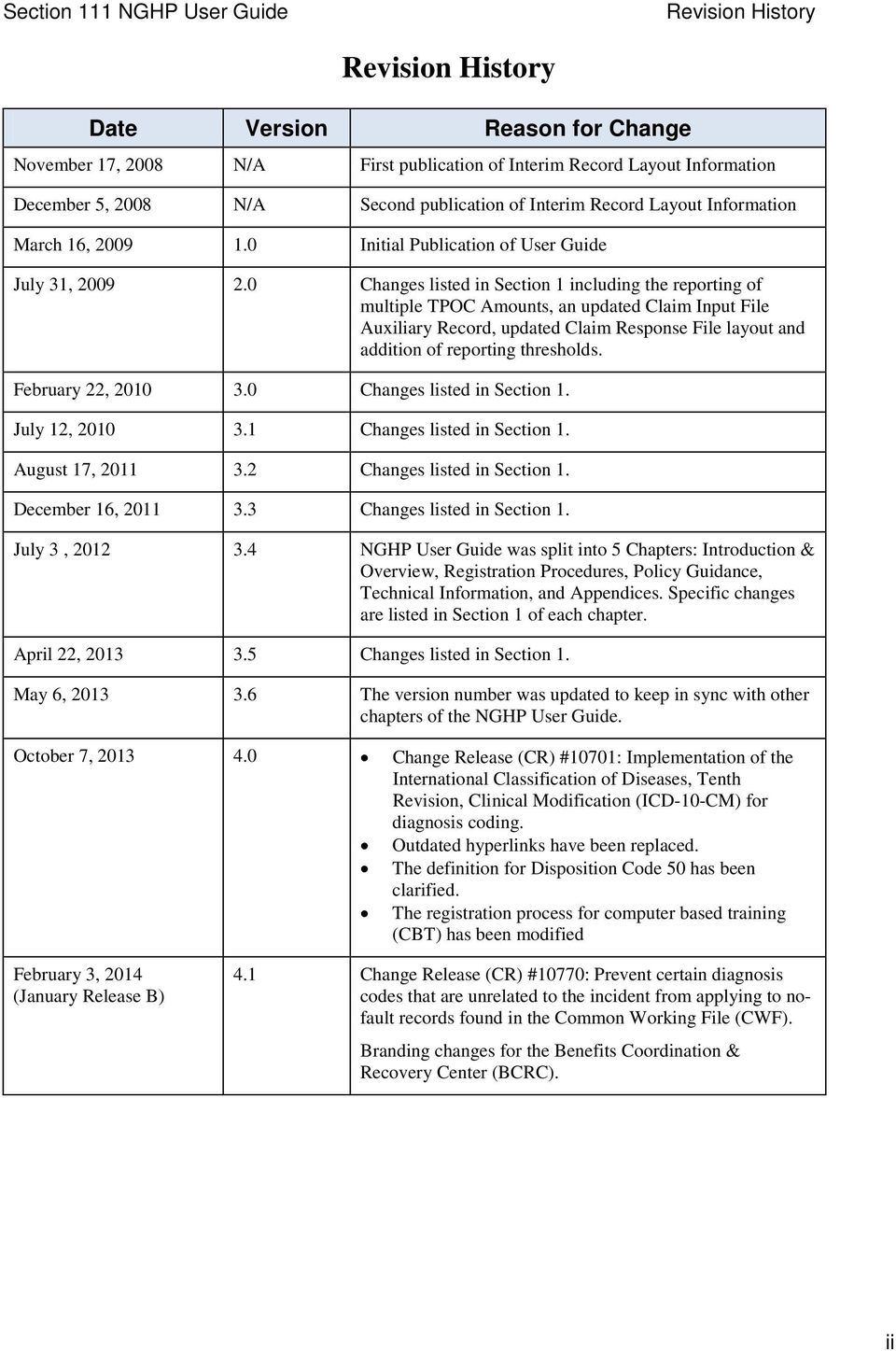
2 Revision History Revision History Date Version Reason for Change November 17, 2008 N/A First publication of Interim Record Layout Information December 5, 2008 N/A Second publication of Interim Record Layout Information March 16, Initial Publication of User Guide July 31, Changes listed in Section 1 including the reporting of multiple TPOC Amounts, an updated Claim Input File Auxiliary Record, updated Claim Response File layout and addition of reporting thresholds. February 22, Changes listed in Section 1. July 12, Changes listed in Section 1. August 17, Changes listed in Section 1. December 16, Changes listed in Section 1. July 3, NGHP User Guide was split into 5 Chapters: Introduction & Overview, Registration Procedures, Policy Guidance, Technical Information, and Appendices. Specific changes are listed in Section 1 of each chapter. April 22, Changes listed in Section 1. May 6, The version number was updated to keep in sync with other chapters of the NGHP User Guide. October 7, Change Release (CR) #10701: Implementation of the International Classification of Diseases, Tenth Revision, Clinical Modification (ICD-10-CM) for diagnosis coding. Outdated hyperlinks have been replaced. The definition for Disposition Code 50 has been clarified. The registration process for computer based training (CBT) has been modified February 3, 2014 (January Release B) 4.1 Change Release (CR) #10770: Prevent certain diagnosis codes that are unrelated to the incident from applying to nofault records found in the Common Working File (CWF). Branding changes for the Benefits Coordination & Recovery Center (BCRC). ii
3 Table of Contents Table of Contents CHAPTER 1 : SUMMARY OF VERSION 4.1 UPDATES CHAPTER 2 : INTRODUCTION AND IMPORTANT TERMS CHAPTER 3 : MEDICARE ENTITLEMENT, ELIGIBILITY, AND ENROLLMENT CHAPTER 4 : MSP OVERVIEW MSP Statutes, Regulations, and Guidance Liability Insurance (Including Self-Insurance) and No-Fault Insurance Workers Compensation Role of CMS s Benefits Coordination & Recovery Center (BCRC) CHAPTER 5 : SECTION 111 OVERVIEW CHAPTER 6 : RESPONSIBLE REPORTING ENTITIES (RRES) Who Must Report Acquisition/ Divestiture or Sale (Not Under Bankruptcy Liquidation) Bankruptcy Deductible Issues vs. Re-insurance, Stop Loss Insurance, Excess Insurance, Umbrella Insurance, etc Foreign Insurers (Including Self-Insurance): Fronting Policies Liquidation (settlement, judgment, award, or other payment obligation against the entity in liquidation) Multiple Defendants Multi-National Organizations, Foreign Nations, American Indian, and Alaskan Native Tribes Self-Insurance Pools State established assigned claims fund Subrogation by an Insurer Workers Compensation Use of Agents Ongoing Responsibility for Medicals (ORM) Reporting Ongoing Responsibility for Medicals (ORM) Reporting Summary Special Qualified Reporting Exception for ORM Assumed Prior to January 1, 2010, Where Such ORM Continues as of January 1, Total Payment Obligation to the Claimant (TPOC) Reporting TPOC Mandatory Reporting Thresholds No-Fault Insurance TPOCs Liability Insurance (including Self-Insurance) TPOCs Workers Compensation TPOCs Additional Requirements What Claims Are Reportable? When Are Such Claims Reportable? How to ask CMS Questions about Section 111 Reporting Policy CHAPTER 7 : DATA USE AGREEMENT CHAPTER 8 : TRAINING AND EDUCATION iii

4 Table of Contents List of Tables Table 6-1: RRE Registration within a Corporate Structure Table 6-2: ORM Reporting Requirements Summary Table 6-3: Qualified Exception Examples: ORM Assumed Prior to January 1, Table 6-4: TPOC Reporting Requirements Summary Table 6-5: Mandatory Thresholds for Liability Insurance (including Self-Insurance) TPOC Settlements, Judgments, Awards or Other Payments Table 6-6: Mandatory Thresholds for Workers Compensation TPOC Settlements, Judgments, Awards or Other Payments Table 6-7: Application of 12/5/1980 Policy Examples iv

5 Chapter 1: Summary of Version 4.1 Updates Chapter 1: Summary of Version 4.1 Updates The updates listed below have been made to the Policy Guidance Chapter Version 4.1 of the NGHP User Guide. As indicated on prior Section 111 NGHP Town Hall teleconferences, the Centers for Medicare & Medicaid Services (CMS) continue to review reporting requirements and will post any applicable updates in the form of revisions to Alerts and the User Guide as necessary. There are no changes to Chapter III of the NGHP User Guide. See Chapters IV & V for changes for this release. 1-1

6 Chapter 2: Introduction and Important Terms Chapter 2: Introduction and Important Terms The Liability Insurance (including Self-Insurance), No-Fault Insurance, and Workers Compensation User Guide, Version 4.1 has been written for use by all Section 111 liability insurance (including self-insurance), no-fault insurance, and workers compensation Responsible Reporting Entities (RREs). The five chapters of the User Guide referred to collectively as the Section 111 NGHP User Guide provide information and instructions for the MSP NGHP mandatory reporting implementation requirements pursuant to Section 111 MMSEA. This Policy Guidance Chapter of Version 4.0 of the MMSEA Section 111 NGHP User Guide provides an overview of Section 111 related legislation and MSP rules, as well as information describing the policy framework behind the MSP liability insurance (including self-insurance), no-fault insurance and workers compensation reporting requirements mandated by Section 111 MMSEA. The other four chapters of the NGHP User Guide: Introduction and Overview, Registration Procedures, Technical Information, and Appendices should be referenced as needed, for applicable guidance. Please note that CMS will continue to implement the Section 111 requirements in phases. New versions of the Section 111 User Guide will be issued when necessary to document revised requirements and when additional information has been added for clarity. At times, certain information may be released in the form of an Alert document. Any Alert dated subsequent to the date of the currently published User Guide supersedes the applicable language in the User Guide. All updated Section 111 policy guidance published in the form of an Alert will be incorporated into the next version of the User Guide. Until such time, RREs must refer to the current User Guide and any subsequently dated Alerts for complete information on Section 111 reporting requirements. The NGHP User Guide Appendices Chapter (Appendix K) contains a list of all NGHP Alerts posted prior to the publication of this version of the User Guide. All official instructions pertinent to Section 111 reporting are on the Section 111 Web site found at Please check this site often for the latest version of this guide and for other important information, such as new Alerts. In order to be notified via of updates posted to this Web page, click the Subscription Sign-up for Mandatory Insurer Reporting (NGHP) Web Page Update Notification link found in the Related Links section of the web page and add your address to the distribution list. When new information regarding mandatory insurer reporting for NGHPs is available, you will be notified. These announcements will also be posted to the NGHP What s New page. Additional information related to Section 111 can be found on the login page of the Section 111 Coordination of Benefits Secure Web site (COBSW) at 2-1

7 Chapter 2: Introduction and Important Terms Important Terms Used in Section 111 Reporting The following terms are frequently referred to throughout this Guide, and are critical to understanding the Section 111 NGHP reporting process. Entities responsible for complying with Section 111 are referred to as Responsible Reporting Entities or RREs. See Chapter 6 for a detailed description of who qualifies as an RRE. Liability insurance (including self-insurance), no-fault insurance, and workers compensation are often collectively referred to as Non-Group Health Plan or NGHP. Ongoing responsibility for medicals (ORM) refers to the RRE s responsibility to pay, on an ongoing basis, for the injured party s (the Medicare beneficiary s) medicals (medical care) associated with a claim. Typically, ORM only applies to no-fault and workers compensation claims. Please see Section 6.3 (Ongoing Responsibility for Medicals (ORM) Reporting) for a more complete explanation of ORM. The Total Payment Obligation to the Claimant (TPOC) refers to the dollar amount of a settlement, judgment, award, or other payment in addition to or apart from ORM. A TPOC generally reflects a one-time or lump sum settlement, judgment, award, or other payment intended to resolve or partially resolve a claim. It is the dollar amount of the total payment obligation to, or on behalf of the injured party in connection with the settlement, judgment, award, or other payment. Individual reimbursements paid for specific medical claims submitted to an RRE, paid due the RRE s ORM for the claim, do not constitute separate TPOC Amounts. The TPOC Date is not necessarily the payment date or check issue date. The TPOC Date is the date the payment obligation was established. This is the date the obligation is signed if there is a written agreement unless court approval is required. If court approval is required it is the later of the date the obligation is signed or the date of court approval. If there is no written agreement it is the date the payment (or first payment if there will be multiple payments) is issued. Please refer to the definition of the TPOC Date and TPOC Amount in Fields 80 and 81 of the Claim Input File Detail Record in the NGHP User Guide Appendices Chapter (Appendix A). As defined by CMS, the Date of Incident (DOI) is: The date of the accident (for an automobile or other accident); The date of first exposure (for claims involving exposure, including; occupational disease); The date of first ingestion (for claims involving ingestion); The date of the implant or date of first implant, if there are multiple implants (for claims involving implant(s); or The earlier of the date that treatment for any manifestation of the cumulative injury began, when such treatment preceded formal diagnosis, or the first date that formal diagnosis was made by a medical practitioner (for claims involving cumulative injury). 2-2

8 Chapter 2: Introduction and Important Terms This CMS definition differs from the definition of that generally used by the insurance industry under specific circumstances. For the DOI used by insurance/workers compensation industry, see Field 13 of the Claim Input File Detail Record in the NGHP User Guide Appendices Chapter (Appendix A) 2-3

9 Chapter 3: Medicare Entitlement Chapter 3: Medicare Entitlement, Eligibility, and Enrollment This section provides a general overview of Medicare entitlement, eligibility and enrollment. Please refer to for more information on this topic. Medicare is a health insurance program for: people age 65 or older, people under age 65 with certain disabilities, and people of all ages with End-Stage Renal Disease (ESRD permanent kidney failure requiring dialysis or a kidney transplant). Medicare has: Part A Hospital Insurance Most people receive premium-free Part A because they or a spouse already paid for it through their payroll taxes while working. Medicare Part A (Hospital Insurance or HI) helps cover inpatient care in hospitals and skilled nursing facilities (but not custodial or long-term care). It also helps cover hospice care and some home health care. Beneficiaries must meet certain conditions to receive these benefits. Part B Medical Insurance Most people pay a monthly premium for Part B. Medicare Part B (Supplemental Medical Insurance or SMI) helps cover physician and other supplier items/services as well as hospital outpatient care. It also covers some other medical services that Part A doesn't cover, such as some of the services of physical and occupational therapists, and some home health care. Part C Medicare Advantage Plan Coverage Medicare Advantage Plans are health plan options (like HMOs and PPOs) approved by Medicare and run by private companies. These plans are part of the Medicare Program and are sometimes called Part C or MA plans. These plans are an alternative to the fee-for-service Part A and Part B coverage and often provide extra coverage for services such as vision or dental care. Prescription Drug Coverage (Part D) Starting January 1, 2006, Medicare prescription drug coverage became available to everyone with Medicare. Private companies provide the coverage. Beneficiaries choose the drug plan they wish to enroll in, and most will pay a monthly premium. Exclusions Medicare has various coverage and payment rules which determine whether or not a particular item or service will be covered and/or reimbursed. 3-1

10 Chapter 4: MSP Overview Chapter 4: MSP Overview Medicare Secondary Payer (MSP) is the term used when the Medicare program does not have primary payment responsibility that is, when another entity has the responsibility for paying before Medicare. Until 1980, the Medicare program was the primary payer in all cases except those involving workers compensation (including black lung benefits) or for care which is the responsibility of another government entity. With the addition of the MSP provisions in 1980 (and subsequent amendments), Medicare is a secondary payer to liability insurance (including self-insurance), no-fault insurance, and workers compensation. An insurer or workers compensation plan cannot, by contract or otherwise, supersede federal law, as by alleging its coverage is supplemental to Medicare. Policies or self-insurance allegedly supplemental to Medicare by statute, Medicare is secondary to liability insurance (including self-insurance), no-fault insurance, and workers' compensation. An insurer or workers compensation cannot, by contract or otherwise, supersede federal law. The coverage data collected through Section 111 reporting is used by CMS in processing claims billed to Medicare for reimbursement for items and services furnished to Medicare beneficiaries and for MSP recovery efforts, as appropriate, and for MSP recovery efforts. Medicare beneficiaries, insurers, self-insured entities, third party administrators and their agents, and attorneys, are always responsible for understanding when there is coverage primary to Medicare, for notifying Medicare when applicable, and for paying appropriately. Section 111 reporting is a comprehensive method for obtaining information regarding situations where Medicare is appropriately a secondary payer. It does not replace or eliminate existing obligations under the MSP provisions for any entity. (For example, Medicare beneficiaries who receive a liability settlement, judgment, award, or other payment have an obligation to refund any conditional payments made by Medicare within 60 days of receipt of such settlement, judgment, award, or other payment. The Section 111 reporting requirements do not eliminate this obligation.) 4.1 MSP Statutes, Regulations, and Guidance The sections of the Social Security Act known as the Medicare Secondary Payer (MSP) provisions were originally enacted in the early 1980s and have been amended several times, including by the MMSEA Section 111 mandatory reporting requirements. Medicare has been secondary to workers compensation benefits from the inception of the Medicare program in The liability insurance (including self-insurance) and nofault insurance MSP provisions were effective December 5, See 42 U.S.C. 1395y(b) [section 1862(b) of the Social Security Act], and 42 C.F.R. Part 411, for the applicable statutory and regulatory provisions. See also, CMS s manuals and 4-1
11 Chapter 4: MSP Overview Web pages for further detail. For Section 111 reporting purposes, use of the Definitions and Reporting Responsibilities document provided in the NGHP User Guide Appendices Chapter (Appendix H) is critical. Additional information can be found at The MSP Manual is CMS Publication Chapter 1 can be found at Liability Insurance (Including Self-Insurance) and No-Fault Insurance Liability insurance (including self-insurance) is coverage that indemnifies or pays on behalf of the policyholder or self-insured entity against claims for negligence, inappropriate action, or inaction which results in injury or illness to an individual or damage to property. It includes, but is not limited to, the following: Homeowners liability insurance Automobile liability insurance Product liability insurance Malpractice liability insurance Uninsured motorist liability insurance Underinsured motorist liability insurance Pursuant to 42 C.F.R. Part : Liability insurance means insurance (including a selfinsured plan) that provides payment based on legal liability for injury or illness or damage to property. It includes, but is not limited to, automobile liability insurance, uninsured motorist insurance, underinsured motorist insurance, homeowners liability insurance, malpractice insurance, product liability insurance, and general casualty insurance. Liability insurance payment means a payment by a liability insurer, or an outof-pocket payment, including a payment to cover a deductible required by a liability insurance policy, by any individual or other entity that carries liability insurance or is covered by a self-insured plan. Entities and individuals/entities engaged in a business, trade, or profession are selfinsured to the extent they have not purchased liability insurance coverage. This includes responsibility for deductibles. See the NGHP User Guide Appendices Chapter (Appendix H) for the full CMS definition of self-insurance. (Please note that government entities are considered to be entities engaged in a business.) No-fault insurance is insurance that pays for health care services resulting from injury to an individual or damage to property in an accident, regardless of who is at fault for causing the accident. Some types of no-fault insurance include, but are not limited to the following: Certain forms of automobile insurance Certain homeowners insurance Commercial insurance plans Medical Payments Coverage/Personal Injury Protection/Medical Expense Coverage 4-2

12 Chapter 4: MSP Overview Pursuant to 42 C.F.R. Part : No-fault insurance means insurance that pays for medical expenses for injuries sustained on the property or premises of the insured, or in the use, occupancy, or operation of an automobile, regardless of who may have been responsible for causing the accident. This insurance includes but is not limited to automobile, homeowners, and commercial plans. It is sometimes called medical payments coverage, personal injury protection, or medical expense coverage. In general, when the injured party is a Medicare beneficiary and the date of incident is on or after December 5, 1980, liability insurance (including self-insurance) and no-fault insurance are, by law, primary payers to Medicare. If a Medicare beneficiary has no-fault coverage, providers, physicians, and other suppliers must bill the no-fault insurer first. If a Medicare beneficiary has made a claim against liability insurance (including selfinsurance), the provider, physician, or other supplier must bill the liability insurer first unless it has evidence that the liability insurance (including self-insurance) will not pay promptly as defined by CMS s regulations. (See 42 C.F.R and for the definitions of the term promptly. ) If payment is not made within the defined period for prompt payment, the provider, physician, or other supplier may bill Medicare as primary. If the item or service is otherwise reimbursable under Medicare rules, Medicare may pay conditionally, subject to later recovery if there is a settlement, judgment, award, or other payment. 4.3 Workers Compensation A workers compensation law or plan means a law or program administered by a State (defined to include commonwealths, territories and possessions of the United States) or the United States to provide compensation to workers for work-related injuries and/or illnesses. The term includes a similar compensation plan established by an employer that is funded by such employer directly, or indirectly through an insurer, to provide compensation to a worker of such employer for a work-related injury or illness. Workers compensation is a law or plan that compensates employees who get sick or injured on the job. Most employees are covered under workers compensation plans. Pursuant to 42 C.F.R Part : Workers compensation plan of the United States includes the workers compensation plans of the 50 States, the District of Columbia, American Samoa, Guam, Puerto Rico, and the Virgin Islands, as well as the systems provided under the Federal Employees Compensation Act and the Longshoremen s and Harbor Workers Compensation Act. Workers compensation is a primary payer to the Medicare program for Medicare beneficiaries work-related illnesses or injuries. Medicare beneficiaries are required to apply for all applicable workers compensation benefits. If a Medicare beneficiary has workers compensation coverage, providers, physicians, and other suppliers must bill workers compensation first. If responsibility for the workers compensation claim is in dispute and workers compensation will not pay promptly, the provider, physician, or other supplier may bill Medicare as primary. If the item or service is reimbursable under Medicare rules, Medicare may pay conditionally, subject to later recovery if there is a subsequent settlement, judgment, award, or other payment. (See 42 C.F.R for the definition of promptly with regard to workers compensation.) 4-3
13 Chapter 4: MSP Overview 4.4 Role of CMS s Benefits Coordination & Recovery Center (BCRC) The purpose of the Coordination of Benefits (COB) process is to identify primary payers to Medicare for the health benefits available to a Medicare beneficiary and to coordinate the payment process to prevent the mistaken or unnecessary conditional payment of Medicare benefits. The Benefits Coordination & Recovery Center (BCRC) consolidates the activities that support the collection, management, and reporting of other insurance or workers compensation coverage for Medicare beneficiaries. The BCRC updates the CMS systems and databases used in the claims payment and recovery processes. The BCRC does not process claims or answer claims-specific inquiries, nor does it handle MSP recoveries. The BCRC assists in the implementation of MMSEA Section 111 mandatory MSP reporting requirements as part of its responsibilities to collect information to coordinate benefits for Medicare beneficiaries on behalf of CMS. In this role, the BCRC will assign each registered RRE an Electronic Data Interchange (EDI) Representative to work with them on all aspects of the reporting process. The BCRC is also responsible for the recovery of amounts owed to the Medicare program as a result of settlements, judgments, awards, or other payments by liability insurance (including self-insurance), no-fault insurance, or workers compensation. 4-4

14 Chapter 5: Section 111 Overview Chapter 5: Section 111 Overview Section 111 of the Medicare, Medicaid, and SCHIP Extension Act of 2007 (MMSEA Section 111) adds mandatory reporting requirements with respect to Medicare beneficiaries who have coverage under group health plan (GHP) arrangements, and for Medicare beneficiaries who receive settlements, judgments, awards or other payment from liability insurance (including self-insurance), no-fault insurance, or workers compensation. Implementation dates were January 1, 2009, for GHP arrangement information and July 1, 2009, for information concerning liability insurance (including self-insurance), no-fault insurance and workers compensation. The MMSEA Section 111 statutory language (42 U.S.C. 1395y(b)(8)) for the liability insurance (including self-insurance), no-fault insurance, and workers compensation provisions can be found in the NGHP User Guide Appendices Chapter (Appendix G). Section 111 authorizes CMS s implementation of the required reporting by program instruction or otherwise. All implementation instructions, including this User Guide, are available on (or through a download at) CMS s dedicated web page: Section 111: Adds reporting rules; it does not eliminate any existing statutory provisions or regulations. Does not eliminate CMS's existing processes, including CMS s process for selfidentifying pending liability insurance (including self-insurance), no-fault insurance, or workers compensation claims to CMS s Benefits Coordination & Recovery Center (BCRC) or for MSP recoveries, where appropriate. Includes penalties for noncompliance. Who Must Report: An applicable plan. The term applicable plan means the following laws, plans, or other arrangements, including the fiduciary or administrator for such law, plan, or arrangement: (i) Liability insurance (including self-insurance). (ii) No-fault insurance. (iii) Workers' compensation laws or plans. See 42 U.S.C. 1395y(b)(8)(F). What Must Be Reported: The identity of a Medicare beneficiary whose illness, injury, incident, or accident was at issue as well as such other information specified by the Secretary of Health and Human Services (HHS) to enable an appropriate determination concerning 5-1
15 Chapter 5: Section 111 Overview coordination of benefits, including any applicable recovery claim. Data elements are determined by the Secretary. When/How Reporting Must Be Done: In a form and manner, including frequency, specified by the Secretary. Information shall be submitted within a time specified by the Secretary after the claim is addressed/resolved (partially addressed/resolved) through a settlement, judgment, award, or other payment, regardless of whether or not there is a determination or admission of liability). Submissions will be in an electronic format. See detailed information in the NGHP User Guide Technical Information Chapter. NOTE: To determine if you are an RRE, you must use the applicable statutory language in conjunction with Attachment A Definitions and Reporting Responsibilities to the Supporting Statement for the Paperwork Reduction Act (PRA) Notice published in the Federal Register. Attachment A of the PRA is also available in the NGHP User Guide Appendices Chapter (Appendix G). See either of these appendices and Section 6.1 (Who Must Report) in order to determine if you are an RRE for purposes of these provisions. The statutory language, the PRA Notice and the PRA Supporting Statement with Attachments are all available as downloads at 5-2

16 (RREs) 6.1 Who Must Report General: 42 U.S.C. 1395y(b)(8) provides that the applicable plan is the RRE and defines applicable plan as follows: APPLICABLE PLAN In this paragraph, the term applicable plan means the following laws, plans, or other arrangements, including the fiduciary or administrator for such law, plan, or arrangement: Liability insurance (including self-insurance). No-fault insurance. Workers' compensation laws or plans. You must use the information in this Section (as well as the applicable statutory language) in conjunction with the requirements located in the NGHP User Guide Appendices Chapter (Appendix H Definitions and Reporting Responsibilities) to determine if you are a RRE for purposes of these provisions. The statutory language is available in the NGHP User Guide Appendices Chapter (Appendix G). CMS is aware that the industry generally does not use the term plan or some other CMS definitions, such as those for no-fault insurance or self-insurance. However, CMS is constrained by the language of the applicable statute and CMS s regulations. It is critical that you understand and use CMS s Section 111 definitions when reviewing and implementing Section 111 instructions. Corporate structure and RREs: An entity may not register as an RRE for a sibling in its corporate structure. An entity may register as an RRE for itself or for any direct subsidiary in its corporate structure. A parent entity may register as an RRE for any subsidiary in its corporate structure regardless of whether or not the parent would otherwise qualify as an RRE. For purposes of this rule regarding corporate structure and RREs, a captive is considered a subsidiary of its parent entity and a sibling of any other subsidiary of its parent. A subsidiary may not register as an RRE for its parent. The general concept is that an entity may only register for another entity if that second entity is below it in the direct line of the corporate structure. For example an entity may register for a direct subsidiary or the subsidiary of that subsidiary. Please see Table 6-1 for a summary of RRE registration for various corporate structures. 6-1

17 Table 6-1: RRE Registration within a Corporate Structure Corporate Structure May Register as May Not Register as Entity Parent Entity RRE for itself RRE for any direct subsidiary in its corporate structure RRE for any subsidiary in its corporate structure regardless of whether the parent would otherwise qualify as an RRE. RRE for a sibling in its corporate structure N/A Subsidiary N/A RRE for its parent Example: Facts: Parent Company/Holding Company A has 4 subsidiaries (S1, S2, S3, and S4). A does not meet the definition of an RRE. S1, S2, S3, and S4 meet the definition of an RRE for self-insurance or otherwise. S1 has a captive insurance company (S1 Captive). S1 Captive meets the definition of an RRE. A may register as RRE for any combination of S1, S2, S3, and S4. (See Table 6-1, Row 2.) A registers as the RRE for S1, it may report for any of S1 s subsidiaries such as S1 Captive. (See Table 6-1, Row 1 and Row 2.) A may, but is not required to, designate S1, S2, S3, S4 or S1 Captive as its agent for reporting purposes for the subsidiaries for which it registers as an RRE. (See Section 6.2 Use of Agents for more information.) S1, S2, S3, S4 and S1 Captive may each register separately as RREs and designate A or any of its sibling subsidiaries or S1 Captive as its agent for reporting purposes. (See Table 6-1, Row 1 & Section 6.2 Use of Agents for more information.) S1, S2, S3, and S4 may not register as the RRE for each other. (See Table 6-1, Row 1.) S2, S3, and S4 may not register as the RRE for S1 Captive. (For purposes of this rule regarding corporate structure and RREs, a captive is considered a subsidiary of its parent entity and a sibling of any other subsidiary of its parent.) S1 Captive may not register as the RRE for S1 (its parent) or for any of the other subsidiaries. (See Table 6-1, Row 3.) The general concept is that an entity may only register for another entity if that second entity is below it in the direct line of the corporate structure. For example an entity may register for a direct subsidiary or the subsidiary of that subsidiary. 6-2

18 Deductible vs. Self-Insured Retention (SIR): Deductible refers to the risk the insured retains with respect to the coverage provided by the insurer. Self-Insured Retention refers to the risk the insured retains that is not included in the coverage provided by the insurer. Payment : When referring to payment of an ORM or TPOC in this Who Must Report section, the reference is to actual physical payment rather than to who/which entity ultimately funds the payment. Third Party Administrators (TPAs): Third party administrators (TPAs) as defined by CMS for purposes for 42 U.S.C. 1395y(b)(7) & (8) are never RREs for purposes of 42 U.S.C. 1395y(b)(8) [liability (including self-insurance), no-fault, and workers compensation] reporting based solely upon their status as this type of TPA. Note, however, that while entities which meet this definition of a TPA generally only act as agents for purposes of liability insurance (including self-insurance), no-fault insurance, or workers compensation reporting they may, under certain specified circumstances, also be an RRE. See, for example, the discussion of State established assigned claims fund later in this section. Although it may contract with a TPA or other entity as its agent for actual file submissions for reporting purposes, the RRE is limited to the applicable plan. An RRE may not by contract or otherwise limit its reporting responsibility. The applicable plan must either report directly or contract with the TPA or some other entity to submit data as the RRE s agent. Where an RRE uses another entity for claims processing or other purposes, it may wish to consider contracting with that entity to act as its agent for reporting purposes. Example: A liability insurer hires a TPA to process claims. The TPA is a separate legal entity, makes payment decisions based upon the facts of each case, and issues payment. The liability insurer is the RRE. The liability insurer may not shift its RRE responsibility to the TPA Acquisition/ Divestiture or Sale (Not Under Bankruptcy Liquidation) An entity which is an RRE is acquired by another entity. The acquiring entity is the RRE as of the effective date of acquisition. The acquiring entity is the RRE with respect to acquired claims, including ORM Bankruptcy When an RRE has filed for bankruptcy, it still remains the RRE, to the extent that settlements, judgments, awards or other payments are paid to or on behalf of the injured party after approval by a bankruptcy court. However, bankruptcy does not eliminate reporting obligations for bankrupt companies or their insurer, regardless of whether a bankrupt company or insurer is the RRE, for payments made pursuant to court order or after lifting the stay. 6-3

19 6.1.3 Deductible Issues vs. Re-insurance, Stop Loss Insurance, Excess Insurance, Umbrella Insurance, etc. Generally, the insurer is the RRE for Section 111 reporting. Where an entity engages in a business, trade, or profession, deductible amounts are self-insurance for MSP purposes. However, where the self-insurance in question is a deductible, and an insurer is responsible for Section 111 reporting with respect to the policy, it is responsible for reporting both the deductible and any amount in excess of the deductible. The deductible is not reported as self-insurance ; it is reported under the applicable policy number. The total of both the deductible and any amount in excess of the deductible is reported. (Please note that government entities are considered to be entities engaged in a business.) If an insured entity engages in a business, trade, or profession and acts without recourse to its insurance, it is responsible for Section 111 reporting with respect to those actions. For example: A claim is made against Company X which has insurance through Insurer Y. Company X settles the claim without informing its insurer. Company X is responsible for Section 111 reporting for the claim regardless of whether or not the settlement amount is within the deductible or in excess of the deductible. For re-insurance, stop loss insurance, excess insurance, umbrella insurance, guaranty funds, patient compensation funds, etc. which have responsibility beyond a certain limit, the key in determining whether or not reporting for 42 U.S.C. 1395y(b)(8) is required for these situations is whether or not the payment is to the injured claimant/representative of the injured claimant vs. payment to the self-insured entity to reimburse the self-insured entity. Where payment is being made to reimburse the self-insured entity, the self-insured entity is the RRE for purposes of a settlement, judgment, award, or other payment to or on behalf of the injured party and no reporting is required by the insurer reimbursing the self-insured entity. If the insurer payment is being made to reimburse the injured claimant (or representative of the injured claimant), the insurer is the RRE and reporting by the insurer is required. See, also, Section Foreign Insurers (Including Self-Insurance): Note: The following information related to foreign RREs does not pertain to liability self-insurance or self-insured workers compensation. For purposes of this Section 111 NGHP User Guide, the term foreign insurer refers to an insurer which does not have a United States Tax Identification Number (TIN) and/or a United States address. For purposes of the Medicare Secondary Payer (MSP) provisions, [a]n entity that engages in a business, trade, or profession shall be deemed to have a self-insured plan if it carries its own risk (whether by a failure to obtain insurance, or otherwise) in whole or in part. (42 U.S.C. 1395y(b)(2)(A)) Deductibles are technically self-insurance under the Medicare Secondary Payer provisions. However, for purposes of this discussion for foreign insurers, the terms self- 6-4
20 insurance and self-insured mean self-insurance or self-insured other than through a deductible. The term United States includes the 50 States, the District of Columbia, American Samoa, Guam, Puerto Rico, and the Virgin Islands. Foreign insurer or workers compensation RREs must report pursuant to Section 111: If they are doing business in the United States, or If a court of competent jurisdiction in the United States has taken jurisdiction over the insurer with respect to a specific liability insurance (including self-insurance) claim, no-fault insurance claim, or workers compensation claim. For purposes of implementing Section 111, foreign insurers are doing business in the United States if: They are registered in one or more of the 50 States, the District of Columbia, American Samoa, Guam, Puerto Rico, or the Virgin Islands as conducting business functions related to insurance. They are not so registered in one or more of the 50 States, the District of Columbia, American Samoa, Guam, Puerto Rico, or the Virgin Islands, but are otherwise engaged in doing business in the United States through a definite presence in the United States. This includes (whether by mail or otherwise): Issuing or delivering insurance contracts to residents of or corporations licensed (or otherwise authorized if licensure is not required) to do business in one or more of the 50 States, the District of Columbia, American Samoa, Guam, Puerto Rico, or the Virgin Islands. Soliciting applications for insurance contracts registered in one or more of the 50 States, the District of Columbia, American Samoa, Guam, Puerto Rico, or the Virgin Islands. Collecting premiums, membership fees, assessments, or other considerations for insurance contracts in one or more of the 50 States, the District of Columbia, American Samoa, Guam, Puerto Rico, or the Virgin Islands. Transacting any other insurance business functions in one or more of the 50 States, the District of Columbia, American Samoa, Guam, Puerto Rico, or the Virgin Islands. An insurer or workers compensation entity which is defending against a liability insurance (including self-insurance) claim, no-fault insurance claim, or workers compensation claim is not subject to Section 111 reporting solely on the basis of its actions in defending the insured. However, if a court of competent jurisdiction in the United States specifically takes jurisdiction over the insurer or workers compensation entity, the insurer or workers compensation entity is subject to Section 111 reporting for the matter at issue. With respect to privacy issues, please note that by regulation Medicare beneficiaries have already consented to the release of information required for coordination of benefit purposes. 6-5
21 Release of information The filing of a Medicare claim by or on behalf of the beneficiary constitutes an express authorization for any entity, including State Medicaid and workers compensation agencies, and data depositories, that possesses information pertinent to the Medicare claim to release that information to CMS. This information will be used only for Medicare claims processing and for coordination of benefits purposes. (42 C.F.R (a)) Fronting Policies The intent with fronting policies is that the insurer will not ultimately retain any risk under the insurance policy. The expectation of both the insured and the insurer is that the insured will retain the ultimate risk under the insurance policy for all claims. Where the insured pays the claim, the insured is the RRE. Where the insurer pays the claim, the insurer is the RRE Liquidation (settlement, judgment, award, or other payment obligation against the entity in liquidation) To the extent that settlement, judgment, award, or other payment to or on behalf of the injured party is funded from the assets of the entity in liquidation, the entity in liquidation is the RRE. To the extent that a portion of a settlement, judgment, award, or other payment obligation to or on behalf of the injured party is funded by another entity from that other entity s assets (for example, payment by a state guarantee fund), the entity that makes payment is the RRE. To the extent that a payment does not fully satisfy the entity in liquidation s debt to the injured party, the amount reported is the amount paid. Any subsequently approved interim or final payments would be handled in the same manner. Additional payments would be reported as additional TPOC Amounts Multiple Defendants Where there are multiple defendants involved in a settlement, an agreement to have one of the defendant s insurer(s) issue any payment in obligation of a settlement, judgment, award, or other does not shift RRE responsibility solely to the entity issuing the payment. All RREs involved in the settlement remain responsible for their own reporting. For a settlement, judgment, award, or other payment with joint and several liability, each insurer must report the total settlement, judgment, award, or other payment not just its assigned or proportionate share Multi-National Organizations, Foreign Nations, American Indian, and Alaskan Native Tribes Liability insurance (including self-insurance), no-fault insurance and workers compensation plans associated with multi-national organizations, foreign nations, American Indian and Alaskan Native tribes are subject to the MSP provisions and must be reported accordingly. 6-6
22 6.1.9 Self-Insurance Pools The RRE for liability insurance (including self-insurance) or workers compensation self-insurance pools Entities self-insured in whole or in part with respect to liability insurance (including self-insurance) or workers compensation may elect, where permitted by law, to join with other similarly situated entities in a self-insurance pool such as a joint powers authority (JPA). Review or approval authority means that the self-insured entity has the ability to affect the payment or other terms of the settlement, judgment, award, or other payment (including ORM). If all three of the characteristics below are met, the self-insurance pool is the RRE: The self-insurance pool is a separate legal entity. The self-insurance pool has full responsibility to resolve and pay claims using pool funds. The self-insurance pool resolves and pays claims without review or approval authority by the participating self-insured entity. Note: When any self-insured entity in the self-insurance pool (including, for example, a JPA) has the review or approval authority for the payment of claims and/or negotiated resolutions, the self-insurance pool is NOT the RRE. Each individual self-insured member is an RRE except during the following exception. Exception: Where the statute authorizing the establishment of a self-insurance pool stipulates that said self-insurance pool shall be licensed and regulated in the same manner as liability insurance (including self-insurance) (or workers compensation, where applicable), then the self-insurance pool is the RRE. Absent meeting this exception, unless all three of the characteristics specified under the preceding bullet apply to the self-insurance pool, the participating self-insured entity is the RRE. Where the individual members are the RREs, each of the members would have the option of using the self-insured pool (or another entity) as its agent for purposes of Section 111 reporting. Example: A self-insurance pool meets the three characteristics specified above for some members of the pools but not for others. The self-insurance pool provides administrative services only (ASO) for certain members. The RRE is the selfinsurance pool only for those members for which it meets the three characteristics specified above. Each member who receives ASO from the self-insurance pool is a separate RRE for its settlements, judgment, awards, or other payments. The selfinsurance pool is not the RRE for such members State established assigned claims fund This subsection addresses the RRE for a State established assigned claims fund which provides benefits for individuals injured in an automobile accident that do not qualify for personal injury protection/medical payments protection from an automobile insurance carrier. 6-7
23 Review or approval authority means that the State agency has the ability to affect the payment or other terms of the settlement, judgment, award, or other payment (including ORM). Where there is a State agency which resolves and pays the claims using State funds or funds obtained from others for this purpose, the established agency is the RRE. Where there is a State agency which designates an authorized insurance carrier to resolve and pay the claims using State-provided funds without State agency review and/or approval, the designated insurance carrier is the RRE. (Note: This would be an example of the rare situation where a TPA entity would also be an RRE for NGHP.) Where there is a State agency which designates an authorized insurance carrier to resolve and pay the claims using State-provided funds but the State agency retains review or approval authority, the State agency is the RRE. Example: A State agency pays no-fault claims using a State fund which is not under the agency s control. Additionally, the State agency designates an insurance carrier to resolve liability insurance claims, but the State agency retains payment responsibility. The State agency is the RRE for both the liability insurance and the no-fault insurance. It may report both types of insurance under a single RRE ID number or obtain a separate RRE ID number for each type of insurance Subrogation by an Insurer Fact pattern: Insurer A pays the claim of its insured under the terms of its contract. The insurer is the RRE and reports the payment. Insurer A files a subrogation claim (on behalf of its insured/the injured party) against insurer B. Insurer B indemnifies insurer A for the payment it previously made. The indemnification payment is not reportable by either insurer Workers Compensation See the Workers Compensation Law or Plan paragraph of Appendix H ( Definitions and Reporting Responsibilities ) in this user guide. The Workers Compensation Law or Plan paragraph in the NGHP User Guide Appendices Chapter (Appendix H Definitions and Reporting Responsibilities) provides, in part: For purposes of the reporting requirements at 42 U.S.C. 1395y(b)(8), a workers compensation law or plan means a law or program administered by a State (defined to include commonwealths, territories and possessions of the United States) or the United States to provide compensation to workers for work-related injuries and/or illnesses. The term includes a similar compensation plan established by an employer that is funded by such employer directly or indirectly through an insurer to provide compensation to a worker of such employer for a work-related injury or illness. Where workers compensation law or plan means a law or program administered by a State (defined to include commonwealths, territories and possessions of the 6-8
24 United States) or the United States to provide compensation to workers for workrelated injuries and/or illnesses, the following rules apply: Where the applicable workers compensation (WC) law or plan authorizes an employer to purchase insurance from an insurance carrier and the employer does so, follow the rules in the subsection for Deductible Issues vs. Re-insurance, Stop Loss Insurance, Excess Insurance, Umbrella Insurance, etc. (Section 6.1.3). Where the applicable WC law or plan authorizes an employer to self-insure and the employer does so independently of other employers, follow the rules in the subsection for Deductible Issues vs. Re-insurance, Stop Loss Insurance, Excess Insurance, Umbrella Insurance, etc. (Here the reference is to self-insurance other than a deductible. ) (Section 6.1.3). Where the applicable WC law or plan authorizes employers to join with other employers in self-insurance pools (e.g., joint powers authorities) and the employer does so, follow the rules in the subsection for Self-Insurance Pools. Where the applicable WC law or plan establishes a State/Federal agency with sole responsibility to resolve and pay claims, the established agency is the RRE. In situations where the applicable WC law or plan authorizes employers to selfinsure or to purchase insurance from an insurance carrier and also establishes a State/Federal agency to assume responsibility for situations where the employer fails to obtain insurance or to properly self-insure Review or approval authority means that the agency has the ability to affect the payment or other terms of the settlement, judgment, award, or other payment (including ORM); Where such State/Federal agency itself resolves and pays the claims using State/Federal funds or funds obtained from others for this purpose, the established agency is the RRE; Where such State/Federal agency designates an authorized insurance carrier to resolve and pay the claim using State/Federal-provided funds without State/Federal agency review and/or approval, the designated carrier is the RRE; Where such State/Federal agency designates an authorized insurance carrier to resolve and pay the claim using State/Federal-provided funds but State/Federal agency retains review or approval authority, the State/Federal agency is the RRE. Where workers compensation law or plan refers to a similar compensation plan established by an employer that is funded by such employer directly or indirectly through an insurer to provide compensation to a worker of such employer for a work-related injury or illness follow the rules for insurer or self-insured, as applicable, including the rules for selfinsurance pools. (Here the reference is to self-insurance other than a deductible. ) 6-9
25 6.2 Use of Agents Agents are not RREs for purposes of Section 111 MSP reporting responsibilities. However, the applicable RRE may contract with another entity to act as an agent for reporting purposes. Agents may include, but are not limited to, data service companies, consulting companies or similar entities that can create and exchange Section 111 files with the BCRC on behalf of the RRE. The RRE must register for reporting and file submission with thebcrc. During registration, the RRE may designate an agent. An agent may not register on behalf of an RRE. However an agent may complete some steps of the registration process with RRE approval and oversight (see the NGHP User Guide Registration Procedures Chapter II). An RRE may not shift its responsibility to report under Section 111 to an agent, by contract or otherwise. The RRE remains solely responsible and accountable for complying with CMS instructions for implementing Section 111 and for the accuracy of data submitted. CMS neither sponsors nor partners with any entities that may be agents. CMS has not and will not endorse any entity as an agent for Section 111 reporting purposes and CMS has no approved list of agents. Entities that are potential agents do not register with CMS or pay CMS a fee in order to become an agent. Agents do not register for Section 111 reporting with the BCRC. Instead, they are named and invited to participate by their RRE customers. Agents must exchange separate files for each RRE that they represent. Agents must test each RRE ID file submission process separately. Agent representatives may be Account Managers and Account Designees for the RRE on the Section 111 COB Secure Web site (COBSW) as described in the Registration Procedures Chapter II of the NGHP Guide. However, agents may not be named as the RRE s Authorized Representative. All communications regarding MSP recovery will be directed to the RRE, not the agent. Note: CMS is not changing its standard MSP recovery processes. For example, demands involving liability insurance (including self-insurance) recoveries against a settlement, judgment, award, or other payment are routinely issued to the Medicare beneficiary. 6.3 Ongoing Responsibility for Medicals (ORM) Reporting The following section reviews the major requirements for reporting the assumption or establishment of ORM for no-fault insurance, liability insurance (including selfinsurance), and workers compensation. Information regarding an RRE s reporting for the assumption of ORM has been presented in other sections of the NGHP User Guide. This section provides the basic policy information. Please see Table 6-2 for a summarized view of the ORM reporting requirements for no-fault, liability insurance (including selfinsurance), and workers compensation. The Technical Information Chapter IV must also be referenced for additional ORM reporting requirement specifications. The reference to ongoing is not related to ongoing reporting or repeated reporting of claims under Section 111, but rather to the RRE s responsibility to pay, on an ongoing basis, for the injured party s (Medicare beneficiary s) medicals associated with the claim. 6-10
26 This often applies to no-fault and workers compensation claims, but may occur in some circumstances with liability insurance (including self-insurance). The trigger for reporting ORM is the assumption of ORM by the RRE when the RRE has made a determination to assume responsibility for ORM, or is otherwise required to assume ORM not when (or after) the first payment for medicals under ORM has actually been made. Medical payments do not actually have to be paid for ORM reporting to be required. If an RRE has assumed ORM, the RRE is reimbursing a provider, or the injured party, for specific medical procedures, treatment, services, or devices (doctor s visit, surgery, ambulance transport, etc.). These medicals are often being paid by the RRE as they are submitted by a provider or injured party. Payments like these are NOT reported individually under Section 111 as TPOCs (see Section 6.4 Total Payment Obligation to the Claimant (TPOC) Reporting) for more information on TPOCs). Even when ORM payments are aggregated and paid to a provider or injured party in a single payment, this aggregation does not constitute a TPOC just because it was paid in a lump sum. For example, an injured party might incur medical expenses in excess of no-fault insurance (such as automobile Personal Injury Protection (PIP) or Med Pay) shortly after an automobile accident. The RRE may reimburse the provider of these medical services or injured party via one payment since the no-fault limit was already reached, but the payment still reflects ORM, not a TPOC settlement, judgment or award. The dollar amounts for ORM are not reported, just the fact that ORM exists or existed. When ORM ends (a no-fault limit is reached, or the RRE otherwise no longer has ORM, etc.) the RRE reports an ORM Termination Date. If there was no TPOC settlement, judgment, award, or other payment related to the claim (an actual settlement for medicals and/or lost wages, etc.), you do not need to report a TPOC Amount on the claim with ORM. You can just submit the ORM Termination Date. Reporting for ORM is not a guarantee by the RRE that ongoing medicals will be paid indefinitely or through a particular date; it is simply a report reflecting the responsibility currently assumed. Ongoing responsibility for medicals (including a termination date, where applicable) is to be reported without regard to whether there has also been a separate settlement, judgment, award, or other payment outside of the payment responsibility for ongoing medicals. It is critical to report ORM claims with information regarding the cause and nature of the illness, injury or incident associated with the claim. Medicare uses the information submitted in the Alleged Cause of Injury, Incident or Illness (Field 15) and the ICD Diagnosis Codes (starting in Field 18) to determine what specific medical services claims, if submitted to Medicare, should be paid first by the RRE and considered only for secondary payment by Medicare. The ICD-9/ICD-10 codes provided in these fields must provide enough information for Medicare to identify medical claims related to the underlying Injury, Incident or Illness claim reported by the RRE. Note: The Alleged Cause of Injury, Incident or Illness (Field 15) is not required. 6-11
27 6.3.1 Ongoing Responsibility for Medicals (ORM) Reporting Summary No-Fault Insurance ORM No-fault insurance ORM that existed or exists on or after January 1, 2010 must be reported (Table 6-2). Liability Insurance ORM Liability Insurance (including Self-Insurance) ORM that existed or exists on or after January 1, 2010 must be reported. Workers Compensation ORM Workers Compensation ORM that existed or exists on or after January 1, 2010 must be reported. However, workers compensation ORM claims are excluded from reporting indefinitely if they meet ALL of the following criteria. Workers Compensation (Plan Insurance Type E ) ORM Exclusion Workers' compensation claims that meet ALL of the following criteria are excluded from reporting until further notice: The claim is for medicals only; The associated lost time is no more than the number of days permitted by the applicable workers compensation law for medicals only (or 7 calendar days if applicable law has no such limit); All payment(s) has/have been made directly to the medical provider; AND Total payment for medicals does not exceed $ Note: Once a workers compensation ORM claim is excluded from reporting, it does not need to be reported unless the circumstances change such that it no longer meets the exclusion criteria listed. In other words, the claim does not need to be reported unless something other than medicals is included, there is more lost time, a payment is made to someone other than a provider, and/or payments for medicals exceed $750. This exclusion does not act as a safe harbor for any other obligation or responsibility of any individual or entity with respect to the Medicare Secondary Payer provisions. Table 6-2: ORM Reporting Requirements Summary Insurance Type Reportable ORM Dates No-Fault ORM Existed or exists on or after 1/1/2010 Liability insurance (including self-insurance) ORM Existed or exists on or after 1/1/2010 Workers Compensation ORM Existed or exists on or after 1/1/
28 6.3.2 Special Qualified Reporting Exception for ORM Assumed Prior to January 1, 2010, Where Such ORM Continues as of January 1, 2010 The general rule is that aside from the Special Exception regarding reporting termination of ORM, a report terminating the ORM should not be submitted as long as the ORM is subject to reopening or otherwise subject to an additional request for payment. QUALIFIED EXCEPTION: However, for ORM assumed prior to January 1, 2010, if the claim was actively closed or removed from current claims records prior to January 1, 2010, the RRE is not required to identify and report that ORM under the requirement for reporting ORM assumed prior to January 1, If such a claim is later subject to reopening with further ORM, it must be reported with full information, including the original Date of Incident (DOI), as defined by CMS. Thus, when looking back through claims history to create your initial Claim Input File report to include claims with ORM that was assumed prior to January 1, 2010, the RRE needs only look back to the status of claims as of January 1, If the claim was removed from the RRE s current/active claim file prior to January 1, 2010, it does not need to be reported unless it is reopened. However, RREs may report ORM on claims they consider closed prior to January 1, 2010 at their discretion. Older ORM claims will not be rejected. Table 6-3 includes some illustrative examples of how to report ORM assumed prior to January 1, Table 6-3: Qualified Exception Examples: ORM Assumed Prior to January 1, 2010 Claim Example RRE assumed ORM March 5, 2009 and is still making payments for medicals as of 1/1/2010. RRE assumed ORM March 5, 2009, is not making payments as of January 1, 2010 but didn t consider the claim closed until after January 1, As of January 1, 2010 and subsequent, the claim is still technically open and ORM continues, but the RRE hasn t made a payment since August of The RRE considers this claim actively closed and removed it from their file of current open/active claims on February 15, Reporting Requirement Report this claim since payment for medicals continues as of January 1, The claim is on the active claim file as of January 1, 2010 and subsequent. Report this claim since the claim was not actively closed or removed from current claim records until after January 1, The claim was on the active claim file as of January 1,
29 Claim Example RRE assumed ORM March 5, 2009, is not making payments as of January 1, 2010 and considered the claim closed prior to January 1, As of January 1, 2010 and subsequent, the claim is still technically open and ORM continues, but the RRE hasn t made a payment since August of The RRE considers this claim actively closed and removed it from their file of current open/active claims on October 1, Reporting Requirement Do not report this claim since it was actively closed or removed from current claims records prior to January 1, The claim was not on the active claim file as of January 1, Total Payment Obligation to the Claimant (TPOC) Reporting The TPOC Amount refers to the dollar amount of a settlement, judgment, award, or other payment in addition to or apart from ORM. A TPOC generally reflects a one-time or lump sum settlement, judgment, award, or other payment intended to resolve or partially resolve a claim. It is the dollar amount of the total payment obligation to, or on behalf of the injured party in connection with the settlement, judgment, award, or other payment. Individual reimbursements paid for specific medical claims submitted to an RRE, paid due the RRE s ORM for the claim, do not constitute separate TPOC Amounts. The TPOC Date is not necessarily the payment date or check issue date. The TPOC Date is the date the payment obligation was established. This is the date the obligation is signed if there is a written agreement, unless court approval is required. If court approval is required, it is the later of the date the obligation is signed or the date of court approval. If there is no written agreement, it is the date the payment (or first payment if there will be multiple payments) is issued. Please refer to the definition of the TPOC Date and TPOC Amount in Fields 80 and 81 of the Claim Input File Detail Record in the NGHP User Guide Appendices Chapter (Appendix A) TPOC Mandatory Reporting Thresholds CMS has revised the mandatory reporting thresholds and implementation timeline for all liability insurance (including self-insurance) and workers compensation TPOC settlements, judgments, awards, or other payments for Section 111 TPOC reporting. Please see Table 6-4 for a TPOC reporting requirements summary, Table 6-5 for the mandatory TPOC thresholds for liability insurance (including self-insurance) and Table 6-6 for the mandatory TPOC thresholds for workers compensation. RREs must adhere to these requirements when determining what claim information should be submitted on initial and subsequent quarterly update Claim Input Files and DDE submissions. These thresholds are solely for the required reporting responsibilities for purposes of 42 U.S.C. 1395y(b)(8) (Section 111 MSP reporting requirements for liability insurance (including self-insurance), no-fault insurance, and workers compensation). 6-14
30 These thresholds are not exceptions; they do not act as a safe harbor for any other obligation or responsibility of any individual or entity with respect to the Medicare Secondary Payer provisions. CMS reserves the right to change these thresholds and will provide appropriate advance notification of any changes. Note: All RREs (except for those using DDE), must report during each quarterly submission window. Please see the NGHP User Guide Technical Information Chapter (Section 5 Submission Timeframes) for more information. DDE submitters are required to report within 45 calendar days of the TPOC Date. Table 6-4: TPOC Reporting Requirements Summary Insurance Type Reportable TPOC Dates Reportable Amounts Threshold Applicable No-Fault October 1, 2010 & subsequent Any amount No Liability insurance (including selfinsurance) October 1, 2011 & subsequent Cumulative TPOC Amount that exceeds threshold Yes Workers Compensation October 1, 2010 & subsequent Cumulative TPOC Amount that exceeds threshold Yes Meeting the Mandatory TPOC Reporting Threshold Where there are multiple TPOCs reported by the same RRE on the same record, the combined TPOC Amounts must be considered in determining whether or not the reporting threshold is met. However, multiple TPOCs must be reported in separate TPOC fields as described in the NGHP User Guide Technical Information Chapter (Section 6.5 Reporting Multiple TPOCs). For TPOCs involving a deductible, where the RRE is responsible for reporting both any deductible and any amount above the deductible, the threshold applies to the total of these two figures. To determine which threshold date range the TPOC falls into, the RRE will compare the most recent (or only) TPOC Date to the threshold date ranges. If the cumulative TPOC Amount associated with the claim is greater than the threshold amount for the threshold date range, the claim record must be reported No-Fault Insurance TPOCs RREs are required to report all no-fault insurance TPOCs with dates of October 1, 2010 and subsequent. RREs may, but are not required to, include no-fault TPOCs with dates prior to October 1, There is no de minimis dollar threshold for reporting no-fault TPOCs. 6-15
31 6.4.3 Liability Insurance (including Self-Insurance) TPOCs RREs are required to report TPOC Dates of October 1, 2011 and subsequent. RREs may, but are not required to, include TPOCs with dates prior to October 1, RREs are required to report liability insurance (including self-insurance) TPOCs only if the cumulative TPOC Amount exceeds the reporting threshold for the most recent TPOC Date. The BCRC will total all TPOC Amounts reported on the claim record when determining if the claim meets the applicable reporting threshold. RREs may submit TPOCs that are less than or equal to the TPOC dollar threshold on an add-record only if the claim has ORM. The TPOC reporting thresholds do not apply to these records. If submitted, the claim report will not reject with the CJ07 error. RREs will not be penalized for submitting claim reports with TPOCs that are under threshold. Mandatory TPOC Thresholds for Liability Insurance (including Self- Insurance) CMS has revised the Implementation Timeline and TPOC Dollar Thresholds for certain liability insurance (including self-insurance) (Plan Insurance Type = L ) TPOC settlements, judgments, awards, or other payments. The reporting requirements are summarized in Table 6-5. If the most recent TPOC Date is on or between October 1, 2011 and March 31, 2012, and the cumulative TPOC Amount is greater than $100,000, the TPOC(s) must be reported no later than the end of the RRE s submission timeframe in the quarter beginning January 1, For this date range, TPOCs greater than $5,000 through $100,000 may be reported, but there is no requirement to do so. If an add record is submitted for this date range with a total TPOC Amount less than or equal to $5,000, the claim report will reject with a CJ07 error. If the most recent TPOC Date is on or between April 1, 2012 and June 30, 2012, and the cumulative TPOC Amount is greater than $50,000, the TPOC(s) must be reported no later than the end of the RRE s submission timeframe in the quarter beginning July 1, For this date range, TPOCs greater than $5,000 through $50,000 may be reported, but there is no requirement to do so. If an add record is submitted for this date range with a total TPOC Amount less than or equal to $5,000, the claim report will reject with a CJ07 error. If the most recent TPOC Date is on or between July 1, 2012 and September 30, 2012, and the cumulative TPOC Amount is greater than $25,000, the TPOC(s) must be reported no later than the end of the RRE s submission timeframe in the quarter beginning October 1,
32 For this date range, TPOCs greater than $5,000 through $25,000 may be reported, but there is no requirement to do so. If an add record is submitted for this date range with a total TPOC Amount less than or equal to $5,000, the claim report will reject with a CJ07 error. If the most recent TPOC Date is on or between October 1, 2012 and September 30, 2013, and the cumulative TPOC Amount is greater than $5,000, the TPOC(s) must be reported no later than the end of the RRE s submission timeframe in the quarter beginning January 1, For this date range, TPOCs greater than $300 through $5,000 may be reported, but there is no requirement to do so. If an add record is submitted for this date range with a total TPOC Amount less than or equal to $300, the claim report will reject with a CJ07 error. If the most recent TPOC Date is on or between October 1, 2013 and September 30, 2014, and the cumulative TPOC Amount is greater than $2,000, the TPOC(s) must be reported no later than the end of the RRE s submission timeframe in the quarter beginning January 1, For this date range, TPOCs greater than $300 through $2,000 may be reported, but there is no requirement to do so. If an add record is submitted for this date range with a total TPOC Amount less than or equal to $300, the claim report will reject with a CJ07 error. If the most recent TPOC Date is on or after October 1, 2014, and the cumulative TPOC Amount is greater than $300, the TPOC(s) must be reported no later than the end of the RRE s submission timeframe in the quarter beginning January 1, If an add record is submitted for this date range with a total TPOC Amount less than or equal to $300, the claim report will reject with a CJ07 error. Table 6-5: Mandatory Thresholds for Liability Insurance (including Self-Insurance) TPOC Settlements, Judgments, Awards or Other Payments Total TPOC Amount TPOC Date On or After Section 111 Reporting Required in the Quarter Beginning TPOCs over $100,000 October 1, 2011 January 1, 2012 TPOCs over $50,000 April 1, 2012 July 1, 2012 TPOCs over $25,000 July 1, 2012 October 1, 2012 TPOCs over $5,000 October 1, 2012 January 1, 2013 TPOCs over $2,000 October 1, 2013 January 1, 2014 TPOCs over $300 October 1, 2014 January 1,
33 6.4.4 Workers Compensation TPOCs RREs are required to report TPOCs with dates of October 1, 2010 and subsequent. RREs may, but are not required to, include TPOCs with dates prior to October 1, RREs are required to report workers compensation TPOCs only if the cumulative TPOC Amount exceeds the reporting threshold for the most recent TPOC Date. RREs may submit TPOCs that are less than or equal to the TPOC dollar threshold on an add-record only if the claim has ORM. The TPOC reporting thresholds do not apply to these records. If submitted, the claim report will not reject with the CJ07 error. RREs will not be penalized for submitting claim reports with TPOCs that are under threshold. The BCRC will total all TPOC Amounts reported on the claim record when determining if the claim meets the reporting threshold. Mandatory TPOC Thresholds for Workers Compensation CMS has revised the Timeline and TPOC Dollar Thresholds for Workers Compensation (Plan Insurance Type = E ) TPOC settlements, judgments, awards, or other payments. The reporting requirements are summarized in Table 6-6. If the most recent TPOC Date is on or between October 1, 2010 and September 30, 2013, and the cumulative TPOC Amount is greater than $5,000, the TPOC(s) must be reported no later than the end of the RRE s submission timeframe in the quarter beginning January 1, Beginning January 1, 2013, TPOCs greater than $300 through $5,000 may be reported, but there is no requirement to do so. Beginning January 1, 2013, if an add record is submitted for this date range with a total TPOC Amount less than or equal to $300, the claim report will reject with a CJ07 error. If the most recent TPOC Date is on or between October 1, 2013 and September 30, 2014, and the cumulative TPOC Amount is greater than $2,000, the TPOC(s) must be reported no later than the end of the RRE s submission timeframe in the quarter beginning January 1, For this date range, TPOCs greater than $300 through $2,000 may be reported, but there is no requirement to do so. If an add record is submitted for this date range with a total TPOC Amount less than or equal to $300, the claim report will reject with a CJ07 error. If the most recent TPOC Date is on or after October 1, 2014, and the cumulative TPOC Amount is greater than $300, the TPOC(s) must be reported no later than the end of the RRE s submission timeframe in the quarter beginning January 1, If an add record is submitted for this date range with a total TPOC Amount less than or equal to $300, the claim report will reject with a CJ07 error. 6-18
34 Table 6-6: Mandatory Thresholds for Workers Compensation TPOC Settlements, Judgments, Awards or Other Payments Total TPOC Amount TPOC Date On or After Section 111 Reporting Required in the Quarter Beginning TPOCs over $5,000 October 1, 2010 January 1, 2011 TPOCs over $2,000 October 1, 2013 January 1, 2014 TPOCs over $300 October 1, 2014 January 1, Additional Requirements Note: All requirements in this guide apply equally to RREs using either a file submission method or DDE, except those specifically related to the mechanics of constructing and exchanging an electronic file or as otherwise noted What Claims Are Reportable? When Are Such Claims Reportable? Information is to be reported for claims related to liability insurance (including selfinsurance), no-fault insurance, and workers compensation where the injured party is (or was) a Medicare beneficiary and medicals are claimed and/or released or the settlement, judgment, award, or other payment has the effect of releasing medicals. RREs must report on no-fault insurance and workers compensation claims where the injured party is/was a Medicare beneficiary that are addressed/resolved (or partially addressed/resolved) through a settlement, judgment, award, or other payment with a TPOC Date on or after October 1, 2010, that meet the reporting thresholds, regardless of the assigned date for a particular RRE s first submission. This reporting requirement date of October 1, 2010 applies to the TPOC Date (see the definition of Claim Input File Detail Record Field 80), NOT necessarily when the actual payment was made or the check was cut. A TPOC is reported in total regardless of whether it is funded through a single payment, an annuity or as a structured settlement. See Section (TPOC Mandatory Reporting Thresholds) for TPOC reporting thresholds. RREs must report on liability insurance (including self-insurance) claims, where the injured party is/was a Medicare beneficiary that are addressed/resolved (or partially addressed/resolved) through a settlement, judgment, award or other payment with a TPOC Date on or after October 1, 2011, that meet the reporting thresholds, regardless of the assigned date for a particular RREs first submission. This reporting requirement date of October 1, 2011 applies to the TPOC Date (see the definition of Claim Input File Detail Record Field 80), NOT necessarily when the actual payment was made or check was cut. A TPOC is reported in total regardless of whether it is funded through a single payment, an annuity or a structured settlement. See Section (TPOC Mandatory Reporting Thresholds) for TPOC reporting thresholds. 6-19
35 RREs must report no-fault insurance, workers compensation and liability insurance (including self-insurance) claim information where ongoing responsibility for medicals (ORM) related to a claim was assumed on or after January 1, In addition, RREs must report claim information for claims considered open by the RRE where ongoing responsibility for medicals exists on or through January 1, 2010, regardless of the date of an initial assumption of ORM (the assumption of ORM predates January 1, 2010). See Section 6.3 (Ongoing Responsibility for Medicals (ORM) Reporting) and Section (Ongoing Responsibility for Medicals (ORM) Reporting Summary) for special exemptions and exceptions for reporting claims with ORM. RREs are to report after there has been a TPOC settlement, judgment, award, or other payment and/or after ORM has been assumed. Timeliness of reporting NGHP TPOC settlements, judgments, awards, or other payments are reportable once the following criteria are met: The alleged injured/harmed individual to or on whose behalf payment will be made has been identified. The TPOC Amount for that individual has been identified. Where these criteria are not met as of the TPOC Date, retain documentation establishing when these criteria are met. RREs should submit the date these criteria were met in the corresponding Funding Delayed Beyond TPOC Start Date field. Example: There is a settlement involving an allegedly defective drug. The settlement contains or provides a process for subsequently determining who will be paid and how much. Consequently, there will be payment to or on behalf of a particular individual and/or the amount of the settlement, judgment, award, or other payment to or on behalf of that individual is not known as of the TPOC Date. Timeliness of MMSEA Section 111 reporting for a particular Medicare beneficiary will be based upon the date there is a determination both that payment will be made to or on behalf of that beneficiary and a determination of the amount of the settlement, judgment, award, or other payment to or on behalf of that beneficiary. RREs shall submit the date of the settlement in the TPOC Date field and the date when there is a determination both that payment will be made to or on behalf of that beneficiary and a determination of the amount of the settlement, judgment, award, or other payment to or on behalf of that beneficiary in the corresponding Funding Delayed Beyond TPOC Start Date field. Notice to CMS of a pending claim or other pending action by an RRE or any other individual or entity does not satisfy an RRE s reporting obligations with respect to 42 U.S.C 1395y(b)(8). Notice to CMS by the RRE of a settlement, judgment, award, or other payment by any means other than through the established Section 111 reporting process. 6-20
36 Notice to CMS of a settlement, judgment, award, or other payment by an individual or entity other than the applicable RRE. Records are submitted by RRE ID, on a beneficiary-by-beneficiary basis, by type of insurance, by policy number, by claim number, etc. Consequently, it is possible that an RRE will submit more than one record for a particular individual in a particular quarterly submission window. For example, if there is an automobile accident with both drivers insured by the same company and both drivers policies are making a payment with respect to a particular Medicare beneficiary, there would be a record with respect to each policy. There could also be two records with respect to a single policy if the policy were reporting a med pay (considered to be no-fault) assumption of ongoing responsibility for medicals and/or exhaustion/termination amount as well as a liability, settlement, judgment, award, or other payment in the same quarter. Joint settlements, judgments, awards, or other payments Each RRE reports its ongoing medical responsibility and/or settlement/judgment/award/other payment responsibility without regard to ongoing medicals. Each RRE would also report any responsibility it has for ongoing medicals on a policy-by-policy basis. An RRE may need to submit multiple records for the same individual depending on the number of policies at issue for an RRE, and/or the type of insurance or workers compensation involved. Where there are multiple defendants and they each have separate settlements with the plaintiff, the applicable RRE reports that separate settlement amount. For a settlement, judgment, award, or other payment with joint and several liabilities, each RRE must report the total settlement, judgment, award, or other payment not just its assigned or proportionate share. Multiple settlements involving the same individual Each RRE must report appropriately. If there will be multiple records submitted for the same individual but coming from different RREs they will be cumulative rather than duplicative. Additionally, if more than one RRE has assumed responsibility for ongoing medicals, Medicare would be secondary to each such entity. Med Pay and Personal Injury Protection (PIP) are both considered no-fault insurance by CMS (Field 51, Plan Insurance Type = D ). RREs must combine PIP/Med Pay limits for one policy when they are separate coverages being paid out on claims for the same injured party and same incident under a single policy and not terminate the ORM until both the PIP and Med Pay limits are exhausted. If PIP and Med Pay are coverages under separate policies then separate records with the applicable no-fault policy limits for each should be reported. Re-insurance, stop loss insurance, excess insurance, umbrella insurance guaranty funds, patient compensation funds which have responsibility beyond a certain limit, etc.: The key in knowing whether or not Section 111 reporting is required for these situations is to determine whether or not the payment is to the injured claimant/representative of the injured claimant or to the self-insured entity to reimburse the self-insured entity. Where payment is being made to reimburse the selfinsured entity, the self-insured entity is the RRE for purposes of the settlement, judgment, award, or other payment to or on behalf of the injured party and no reporting is required by the insurer reimbursing the self-insured entity. 6-21
37 One-time payment for defense evaluation A payment made directly to the provider or other physician furnishing this service specifically for this purpose does not trigger the requirement to report. Where there is a settlement, judgment, award, or other payment with no establishment/acceptance of responsibility for ongoing medicals, if the individual is not a Medicare beneficiary the RRE is not required to report for purposes of 42 U.S.C. 1395y(b)(8) (Section 111 reporting for liability insurance [including selfinsurance], no-fault insurance, or workers compensation). RREs must report settlements, judgments, awards, or other payments regardless of whether or not there is an admission or determination of liability. Reports are required with either partial or full resolution of a claim. For purpose of the required reporting for 42 U.S.C. 1395y(b)(8), the RRE does not make a determination of what portion of any settlement, judgment, award, or other payment is for medicals and what portion is not. The RRE reports responsibility for ongoing medicals separately from any other payment obligation but does not separate medical vs. non-medical issues if medicals have been claimed and/or released or the settlement, judgment, award, or other payment otherwise has the effect of releasing medicals. No medicals If medicals are claimed and/or released, the settlement, judgment, award, or other payment must be reported regardless of any allocation made by the parties or a determination by the court. The CMS is not bound by any allocation made by the parties even where a court has approved such an allocation. The CMS does normally defer to an allocation made through a jury verdict or after a hearing on the merits. However, this issue is relevant to whether or not CMS has a recovery claim with respect to a particular settlement, judgment, award, or other payment and does not affect the RRE s obligation to report. RREs are not required to report liability insurance (including self-insurance) settlements, judgments, awards or other payments for property damage only claims which did not claim and/or release medicals or have the effect of releasing medicals. RREs must report the full amount of any settlement, judgment, award, or other payment amount (the TPOC Amount) without regard to any amount separately obligated to be paid as a result of the assumption/establishment of ongoing responsibility for medicals. The date of incident does not affect the RRE s reporting responsibilities for workers compensation. In situations where the applicable workers compensation or no-fault law or plan requires the RRE to make regularly scheduled periodic payments, pursuant to statute, for an obligation(s) other than medical expenses, to or on behalf of the claimant, the RRE does not report these periodic payments as long as the RRE separately assumes/continues to assume Ongoing Responsibility for Medicals (ORM) and reports this ORM appropriately. Otherwise, such scheduled periodic payments are considered to be part of and are reported as ORM. For example, if an RRE is making 6-22
38 periodic indemnity only payments to the injured party to compensate for lost wages related to the underlying workers compensation or no-fault claim, the RRE has implicitly, if not explicitly, assumed ORM. Therefore, the RRE shall report the ORM. The periodic payments to compensate for lost wages are not reported as TPOCs. In summary, under the aforementioned circumstances, one claim report record is submitted reflecting ORM. RREs generally are not required to report liability insurance (including selfinsurance) or no-fault insurance settlements, judgments, awards or other payments where the date of incident (DOI) as defined by CMS was prior to December 5, When a case involves continued exposure to an environmental hazard, or continued ingestion of a particular substance, Medicare focuses on the date of last exposure or ingestion for purposes of determining whether the exposure or ingestion occurred on or after 12/5/1980. Similarly, in cases involving ruptured implants that allegedly led to a toxic exposure, the exposure guidance or date of last exposure is used. For non-ruptured implanted medical devices, Medicare focuses on the date the implant was removed. (Note: the term exposure refers to the individual s actual physical exposure to the alleged environmental toxin not the defendant s legal exposure to liability.) For example, if the date of first exposure is prior to December 5, 1980, but that exposure continues on or after December 5, 1980; Medicare has a potential recovery claim. Additionally, please note that application of the December 5, 1980, is specific to a particular claim/defendant. For example, if an individual is pursuing a liability insurance (including self-insurance) claim against X, Y and Z for asbestos exposure and exposure for X ended prior to December 5, 1980, but exposure for Y and Z did not; a settlement, judgment, award or other payment with respect to X would not be reported. In the following situations, Medicare will assert a recovery claim against settlements, judgments, awards, or other payments, and MMSEA Section 111 MSP mandatory reporting rules must be followed: Exposure, ingestion, or the alleged effects of an implant on or after 12/5/1980 is claimed, released, or effectively released. A specified length of exposure or ingestion is required in order for the claimant to obtain the settlement, judgment, award, or other payment, and the claimant s date of first exposure plus the specified length of time in the settlement, judgment, award or other payment equals a date on or after 12/5/1980. This also applies to implanted medical devices. A requirement of the settlement, judgment, award, or other payment is that the claimant was exposed to, or ingested, a substance on or after 12/5/1980. This rule also applies if the settlement, judgment, award, or other payment depends on an implant that was never removed or was removed on or after 12/5/1980. When ALL of the following criteria are met, Medicare will not assert a recovery claim against a liability insurance (including self-insurance) settlement, judgment, award, or other payment; and MMSEA Section 111 MSP reporting is not 6-23
39 required. (Note: Where multiple defendants are involved and the claimant meets these requirements with respect to any single defendant, the RRE for that defendant is not required to report as long as that defendant has no joint and several liability for the settlement, judgment, award, or other payment.) All exposure or ingestion ended, or the implant was removed before 12/5/1980; and, Exposure, ingestion, or an implant on or after 12/5/1980 has not been claimed and/or specifically released; and, There is either no release for the exposure, ingestion, or an implant on or after 12/5/1980; or where there is such a release, it is a broad general release (rather than a specific release), which effectively releases exposure or ingestion on or after 12/5/1980. The rule also applies if the broad general release involves an implant. Table 6-7 includes some illustrative examples of how the policy related to December 5, 1980, should be applied to situations involving exposure, ingestion, and implantation. This table is not all inclusive, as each situation must be evaluated individually on its merits. The parties should make a determination as to whether these criteria are met and act accordingly. When reporting a potential settlement, judgment, award, or other payment related to exposure, ingestion, or implantation, the date of first exposure/date of first ingestion/date of implantation is the date that MUST be reported as the DOI. Table 6-7: Application of 12/5/1980 Policy Examples Situation The claimant was exposed to a toxic substance in his house. He moved on 12/4/1980. The claimant did not return to the house. The claimant was exposed to a toxic substance in his house. He moved on 12/4/1980. The claimant makes monthly visits to the house because his mother continues to live in the house. The claimant was exposed to a toxic substance while he worked in Building A. He was transferred to Building B on 12/4/1980, and did not return to Building A The claimant was exposed to a toxic substance while he worked in Building A. He was transferred to Building B on 12/4/1980, but routinely goes to Building A for meetings. The claimant had a defective implant removed on 12/4/1980. The implant had not ruptured. Application of 12/5/1980 Policy Exposure ended before 12/5/1980. Exposure did not end before 12/5/1980. Exposure ended before 12/5/1980. Exposure did not end before 12/5/1980. Exposure ended before 12/5/
40 Situation The claimant had a defective implant that was never removed. Application of 12/5/1980 Policy Exposure did not end before 12/5/1980. Policies or self-insurance which allege that they are supplemental to Medicare By statute, Medicare is secondary to liability insurance (including selfinsurance), no-fault insurance, and workers compensation. An insurer or self-insured entity cannot, by contract or otherwise, supersede federal law. There is no Medicare beneficiary age threshold for reporting for Section 111 liability insurance (including self-insurance), no-fault insurance, and workers compensation. The geographic location of the incident, illness, or injury is not determinative of the RRE s reporting responsibility because Medicare beneficiaries who are injured or become ill outside of the United States often return to the U.S. for medical care. Where there is no settlement, judgment, award, or other payment, including no assumption of responsibility for ongoing medicals, there is no Section 111 reporting required. Note: As indicated earlier, that there is no admission or determination of liability does not exempt an RRE from reporting. If there are multiple TPOCs for the same individual for the same claim, each new TPOC must be reported as a separate settlement, judgment, award, or other payment. This applies to liability insurance (including self-insurance), no-fault insurance, and workers compensation. Note: a single payment obligation is reported as a single aggregate total (one TPOC Amount) regardless of whether it is funded through a single payment, an annuity or a structured settlement. However, the sum of all TPOC Amounts must be used when determining whether the claim meets the applicable reporting threshold. Use the most recent, latest TPOC Date associated with the claim when determining whether the claim meets the reporting thresholds defined in Section (TPOC Mandatory Reporting Thresholds). When to report claims involving appeals: If there is an assumption of ORM due to a judgment or award but the liability insurance (including self-insurance), no-fault insurance, or workers compensation is appealing this judgment or award: If payment is being made, pending results of the appeal, the ORM must be reported. If payment is not being made pending results of the appeals, the ORM is not reported until the appeal is resolved. If there is a TPOC Date/Amount due to a judgment, award, or other payment but the liability insurance (including self-insurance)/no-fault insurance/workers compensation or claimant is appealing or further negotiating the judgment/award/other payment: If payment is being made, pending results of the appeal/negotiation, the TPOC must be reported. If payment is not being made pending results of the appeals/negotiation, the TPOC is not reported until the appeal/negotiation is resolved. 6-25
41 Accident & Health, Short Term Travel and Occupational Accident Products are considered no-fault insurance by CMS and reportable as such under Section 111. When payments are made by sponsors of clinical trials for complications or injuries arising out of the trials, such payments are considered to be payments by liability insurance (including self-insurance) and must be reported. The appropriate Responsible Reporting Entity (RRE) should report the date that the injury/complication first arose as the Date of Incident (DOI). The situation should also be reported as one involving Ongoing Responsibility for Medicals (ORM). Risk Management Write-Offs and Other Actions As a risk management tool to lessen the probability of a liability claim against it and/or to facilitate/enhance customer good-will, entities may reduce charges for items and services (write-off) or provide something of value (e.g., cash, gift card, etc). If an entity takes such actions, it may or may not constitute a reporting obligation (as a TPOC) as explained below. For the purposes of the Medicare Secondary Payer provisions, [a]n entity that engages in a business, trade, or profession shall be deemed to have a self-insured plan if it carries its own risk (whether by a failure to obtain insurance, or otherwise) in whole or in part. (42 U.S.C. 1395y(b)(2)(A)). Risk management write-offs (including a reduction in the amount due as a risk management tool) constitute liability self-insurance for the purposes of the Medicare Secondary Payer provisions. In instances where a provider, physician or other supplier has reduced its charges or written off some portion of a charge for items or services provided to a Medicare beneficiary as such a risk management tool, the provider, physician or other supplier is expected to submit a claim for payment to Medicare reflecting the unreduced permissible charge (e.g., the limiting charge amount) and showing the amount of the reduction provided or write-off as a payment from liability insurance (including self-insurance). Medicare s interests with respect to this particular TPOC Amount have been protected through this billing procedure; the provider, physician or other supplier shall not report the reduction or write-off as a TPOC. In instances where a provider, physician, or other supplier has provided property of value (other than a reduction in charges or write-off) to a Medicare beneficiary as such a risk management tool when there is evidence, or a reasonable expectation, that the individual has sought or may seek medical treatment as a consequence of the underlying incident giving rise to the risk, the entity shall report the value of the property provided as a TPOC from liability insurance (including self-insurance). If the value of the property provided is less than the TPOC reporting threshold, it need not be reported under Section 111. In instances where any other entity has reduced its charges, written off some portion of a charge or provided other property of value to a Medicare beneficiary as such a risk management tool when there is evidence, or a reasonable expectation, that the individual has sought or may seek medical treatment as a consequence of the underlying incident giving rise to the risk, the entity shall report the reduction, write-off or property of value provided as a TPOC from 6-26
42 liability insurance (including self-insurance). If the amount of the reduction, write-off or property of value provided is less than TPOC reporting threshold, it need not be reported under Section 111. The points above address risk management write-offs by providers, physicians, and other suppliers as well as by non-provider/supplier entities. Reporting Exception for Certain TPOCs where the TPOC has been paid into a Qualified Settlement Fund (QSF) prior to October 1, 2011: This exception is applicable for RREs for certain liability insurance (including self-insurance), no-fault insurance, and workers compensation TPOC settlements, judgments, awards, or other payments, where funds have been paid into a QSF under Section 468B of the IRC prior to October 1, (Note: QSFs under Section 468B of the IRC are not RREs.) Under this exception, MMSEA Section 111 reporting is not required when ALL of the following criteria are met: The settlement, judgment, award or other payment is a liability insurance (including self-insurance) TPOC Amount; where there is no Ongoing Responsibility for Medicals (ORM) involved; and The settlement, judgment, award, or other payment will be issued by a QSF under Section 468B of the IRC, in connection with a State or Federal bankruptcy proceeding; and, The funds at issue were paid into the trust prior to October 1, How to ask CMS Questions about Section 111 Reporting Policy Please be sure to frequently visit the Section 111 page on the CMS Web Site at for updated information on Section 111 reporting requirements, including updates to this Guide. In order to be notified via of updates made to this Web page, click on the Subscription Sign-up for Mandatory Insurer Reporting (NGHP) Web Page Update Notification link found in the Related Links section of the web page and add your address to the distribution list. When new information regarding mandatory insurer reporting for NGHPs is available, you will be notified. These announcements will also be posted to the NGHP What s New page. To submit a policy-related comment or inquiry to CMS regarding Section 111 Mandatory Reporting, click the following link: PL [email protected]. This will open Microsoft Outlook directly. You may also click the link at the bottom of the Mandatory Insurer Reporting Overview page (titled For an opportunity to comment ). Please ensure the title in the subject line of your comment and/or is as specific as possible. Note: You will not receive a direct personal response. However, CMS reviews each submission received and will follow up with additional outreach and education as needed. s from CMS or the BCRC may @ghimedicare.com addresses. Update your spam filter software to allow receipt of these addresses. 6-27
43 Chapter 7: Data Use Agreement Chapter 7: Data Use Agreement As part of the Section 111 registration process, the Authorized Representative for each Section 111 RRE will be asked to sign a copy of the following Data Use Agreement. It will be included on the profile report sent to the Authorized Representative after Section 111 COBSW registration and account setup. The Authorized Representative must sign and return the last page of the profile report to the BCRC. In addition, all users must agree to the Data Use Agreement language each time they log on to the Section 111 application of the COBSW. Data exchanged for Section 111 is to be used solely for the purposes of coordinating health care benefits for Medicare beneficiaries between Medicare and Section 111 RREs. Measures must be taken by all involved parties to secure all data exchanged and ensure it is used properly. SAFEGUARDING & LIMITING ACCESS TO EXCHANGED DATA I, the undersigned Authorized Representative of the Responsible Reporting Entity (RRE) defined above, certify that the information contained in this Registration is true, accurate and complete to the best of my knowledge and belief, and I authorize CMS to verify this information. I agree to establish and implement proper safeguards against unauthorized use and disclosure of the data exchanged for the purposes of complying with the Medicare Secondary Payer Mandatory Reporting Provisions in Section 111 of the Medicare, Medicaid and SCHIP Extension Act (MMSEA) of Proper safeguards shall include the adoption of policies and procedures to ensure that the data obtained shall be used solely in accordance with Section 1106 of the Social Security Act [42 U.S.C. 1306], Section 1874(b) of the Social Security Act [42 U.S.C. 1395kk(b)], Section 1862(b) of the Social Security Act [42 U.S.C. 1395y(b)], and the Privacy Act of 1974, as amended [5 U.S.C. 552a]. The Responsible Reporting Entity and its duly authorized agent for this Section 111 reporting, if any, shall establish appropriate administrative, technical, procedural, and physical safeguards to protect the confidentiality of the data and to prevent unauthorized access to the data provided by CMS. I agree that the only entities authorized to have access to the data are CMS, the RRE or its authorized agent for Mandatory Reporting. RREs must ensure that agents reporting on behalf of multiple RREs will segregate data reported on behalf of each unique RRE to limit access to only the RRE and CMS and the agent. Further, RREs must ensure that access by the agent is limited to instances where it is acting solely on behalf of the unique RRE on whose behalf the data was obtained. I agree that the authorized representatives of CMS shall be granted access to premises where the Medicare data is being kept for the purpose of inspecting security arrangements confirming whether the RRE and its duly authorized agent, if any, is in compliance with the security requirements specified above. Access to the records matched and to any records created by the matching process shall be restricted to authorized CMS and RRE employees, agents and officials who require access to perform their official duties in accordance with the uses of the information as authorized under Section 111 of the MMSEA of Such personnel shall be advised of (1) the confidential nature of the information; (2) safeguards required 7-1
44 Chapter 7: Data Use Agreement to protect the information, and (3) the administrative, civil and criminal penalties for noncompliance contained in applicable Federal laws. 7-2
45 Chapter 8: Training and Education Chapter 8: Training and Education A variety of training and educational materials are available to help you with Section 111 reporting, in addition to the material in this guide. The Section 111 CMS Web page ( has links to all CMS publications regarding the MSP Mandatory Reporting Requirements under Section 111 of the MMSEA of To be notified via of updates to this Web page, click on the Subscription Sign-up for Mandatory Insurer Reporting (NGHP) Web Page Update Notification link found in the Related Links section of the web page and add your address to the distribution list. When new information regarding mandatory insurer reporting for NGHPs is available, you will be notified. These announcements will also be posted to the NGHP What s New page. CMS conducts Town Hall Teleconferences to provide information and answer questions regarding Section 111 reporting requirements. The schedule for these calls is posted (and updated as new calls are scheduled) on the Section 111 Web page under the What s New tab at CMS has made available a curriculum of computer-based training (CBT) courses for Section 111 RREs. These courses are offered free of charge and provide in-depth training on Section 111 registration, reporting requirements, the Section 111 COBSW, file transmission, file formats, file processing, and general MSP topics. These courses are all available on the Mandatory Insurer Reporting (NGHP) Training Material page at Recovery/Mandatory-Insurer-Reporting-For-Non-Group-Health-Plans/NGHP- Training-Material/NGHP-CBTs.html on the CMS web site. All updated Section 111 policy guidance published in the form of an Alert can be found on the CMS Web page ( Any Alert posted after the date of the currently published User Guide supersedes the applicable language in the User Guide. All Alerts will be incorporated into the next version of the User Guide. Until such time, RREs must refer to the current User Guide and any subsequently dated Alerts for complete information on Section 111 reporting requirements. The NGHP User Guide Appendices Chapter (Appendix K) contains a list of all the applicable NGHP Alerts posted prior to the publication of this User Guide. 8-1
46 Chapter 8: Training and Education Note: The Section 111 User Guides and other instructions do not and are not intended to cover all aspects of the MSP program. Although these materials provide wide-ranging overviews of MSP in general, any individual or entity that is a primary payer to Medicare is responsible for his/her/its obligations under the law. The statutory provisions for MSP can be found at 42 U.S.C. 1395y(b); the applicable regulations can be found at 42 C.F.R. Part 411. Supplemental guidance regarding the MSP provisions can be found at the following Web pages: Recovery/Coordination-of-Benefits-and-Recovery-Overview/Medicare-Secondary- Payer/Medicare-Secondary-Payer.html, and The MSP Manual is CMS Publication
Liability Insurance (Including Self-Insurance), No-Fault Insurance, and Workers Compensation USER GUIDE
 MMSEA Section 111 Medicare Secondary Payer Mandatory Reporting Liability Insurance (Including Self-Insurance), No-Fault Insurance, and Workers Compensation USER GUIDE Chapter I: INTRODUCTION AND OVERVIEW
Welcome to the Reportable Claims course.
 Welcome to the Reportable Claims course. Note: This module applies to Responsible Reporting Entities (RREs) that will be submitting Section 111 claim information via an electronic file submission as well
Glossary of Terms and Acronyms
 Glossary of Terms and Acronyms COB/COBC Coordination of Benefits - The Coordination of Benefits Contractor consolidates the activities that support the collection, management, and reporting of other insurance
Quick Reference Guide Version 1 January 19, 2012
 Centers for Medicare & Medicaid Services (CMS) MMSEA Section 111 Mandatory Insurer Reporting Quick Reference Guide Version 1 January 19, 2012 For Non-Group Health Plan (NGHP) Insurers The What, Why and
Subpart B Insurance Coverage That Limits Medicare Payment: General Provisions
 Subpart B Insurance Coverage That Limits Medicare Payment: General Provisions 411.20 Basis and scope. (a) Statutory basis. (1) Section 1862(b)(2)(A)(i) of the Act precludes Medicare payment for services
MMSEA Section 111 MSP Mandatory Reporting
 MMSEA Section 111 MSP Mandatory Reporting Interim Record Layout Information for: Liability Insurance (Including Self-Insurance) No-Fault Insurance Workers Compensation The complete Section 111 User Guide
Welcome to the Medicare Secondary Payer (MSP) Overview course.
 Welcome to the Medicare Secondary Payer (MSP) Overview course. 1 While all information in this document is believed to be correct at the time of writing, this Computer Based Training (CBT) is for educational
Welcome to the Total Payment Obligation to Claimant (TPOC) course.
 Welcome to the Total Payment Obligation to Claimant (TPOC) course. Note: This module applies to Responsible Reporting Entities (RREs) that will be submitting Section 111 claim information via an electronic
made by private organizations (called primary payers or primary plans). 4 This includes liability
 passage of the Medicare Secondary Payer Act ( MSP ) 2 in 1980 provided for a redistribution of the primary payment burden. 3 Today, Medicare is a secondary payer to other available payment sources for
Liability Insurance (Including Self-Insurance), No-Fault Insurance, and Workers Compensation USER GUIDE
 MMSEA Section 111 Medicare Secondary Payer Mandatory Reporting Liability Insurance (Including Self-Insurance), No-Fault Insurance, and Workers Compensation USER GUIDE Chapter IV: TECHNICAL INFORMATION
Medicare Secondary Payer (MSP) Liability Insurance, No-Fault Insurance & Workers Compensation Recovery Process
 Medicare Secondary Payer (MSP) Liability Insurance, No-Fault Insurance & Workers Compensation Recovery Process Note: This presentation is intended for Medicare beneficiaries and their representatives.
CLM 2016 Atlanta Conference May 19-20, 2016 in Atlanta, GA
 CLM 2016 Atlanta Conference May 19-20, 2016 in Atlanta, GA Medicare Secondary Payer Compliance: The Critical Transition to the Commercial Repayment Center (CRC) What is Medicare? Medicare is an entitlement
Best Practices for Complying with New Medicare Reporting Requirements What Every Attorney Needs to Know By Ervin A. Gonzalez, Esq.
 Best Practices for Complying with New Medicare Reporting Requirements What Every Attorney Needs to Know By Ervin A. Gonzalez, Esq. I. Overview: How does the MMSEA impact personal injury and mass tort settlements?
Medicare Secondary Payer (MSP) Manual Chapter 1 - Background and Overview
 Medicare Secondary Payer (MSP) Manual Chapter 1 - Background and Overview Transmittals for Chapter 1 10 - General Provisions 10.1 - Working Aged Table of Contents (Rev. 106, 10-10-14) 10.2 - End-Stage
Michigan Property & Casualty Guaranty Association P.O. Box 531266 Livonia, Michigan 48153-1266 Phone: (248) 482-0381
 Michigan Property & Casualty Guaranty Association P.O. Box 531266 Livonia, Michigan 48153-1266 Phone: (248) 482-0381 Dear Claimant: The Michigan Property & Casualty Guaranty Association ("the MPCGA") is
Introduction...2. Definitions...2. Order of Benefit Determination...3
 Introduction...2 Definitions...2 Order of Benefit Determination...3 COB with Medicare...4 When the HMO Is Primary and Medicare Is Secondary... 4 When Medicare Is Primary Payer and the HMO Is Secondary...
MEDICARE AND LIABILITY CASES. A. The Medicare Secondary Payer Statute
 MEDICARE AND LIABILITY CASES I. The Significant Statutory and Code Provisions A. The Medicare Secondary Payer Statute The Medicare Secondary Payer statute (MSP) has been the law for well over 25 years.
Report to Congress. Computation of Annual Liability Insurance (Including Self-Insurance) Settlement Recovery Threshold
 Report to Congress Computation of Annual Liability Insurance (Including Self-Insurance) Settlement Recovery Threshold As Required by Section 202 of the Medicare IVIG Access and Strengthening Medicare and
Medicare Secondary Payer (MSP) Manual Chapter 3 - MSP Provider, Physician, and Other Supplier Billing Requirements
 Medicare Secondary Payer (MSP) Manual Chapter 3 - MSP Provider, Physician, and Other Supplier Billing Requirements Transmittals for Chapter 3 Table of Contents (Rev. 87, 08-03-12) 10 - General 10.1 - Limitation
New Medicare Reporting Requirements for Entities Paying Settlements or Judgments To Personal Injury Plaintiffs Who Are Medicare Beneficiaries
 New Medicare Reporting Requirements for Entities Paying Settlements or Judgments To Personal Injury Plaintiffs Who Are Medicare Beneficiaries By Pamela W. Montgomery, R.N., J.D., LL.M. candidate (Health
HOOPS 2008. MSP Update: New Programs, Added Burdens, Possible Expanded Opportunities Focus on CMS Implementation of Mandatory Insurance Reporting
 HOOPS 2008 MSP Update: New Programs, Added Burdens, Possible Expanded Opportunities Focus on CMS Implementation of Mandatory Insurance Reporting Robert L. Roth Crowell & Moring, LLP 1001 Pennsylvania Avenue,
MMSEA Section 111 Medicare Secondary Payer Mandatory Reporting
 MMSEA Section 111 Medicare Secondary Payer Mandatory Reporting Liability Insurance (Including Self-Insurance), No-Fault Insurance, and Workers Compensation USER GUIDE Chapter V: APPENDICES Version 4.7
SUBROGATION AND MSAs. Settlement of W/C Claim As Part of Third Party Settlement Commutation/Dollar Contracts, Etc.
 MEDICARE SET-ASIDES AND THE SUBROGATION PROFESSIONAL Presented By: Gary L. Wickert, Matthiesen, Wickert & Lehrer, S.C. Russell S. Whittle, Gould & Lamb, LLC GOTOWEBINAR ATTENDEE INTERFACE 1. Viewer Window
COORDINATION OF BENEFITS MODEL REGULATION
 Table of Contents Model Regulation Service October 2013 Section 1. Section 2. Section 3. Section 4. Section 5. Section 6. Section 7. Section 8. Section 9. Section 10. Appendix A. Appendix B. Section 1.
MEDICARE REPORTING AND RECOVERY UPDATE
 CLIENT UPDATE JULY 2012 MEDICARE REPORTING AND RECOVERY UPDATE MMSEA SECTION 111 REPORTING RRES NOT LIMITED TO QUARTERLY REPORTING Responsible Reporting Entities (RREs) were previously required to submit
LIEN ON ME. A Guide to Complying with Medicare s Secondary Payor Act and Pennsylvania s Act 44. April, 2009
 LIEN ON ME A Guide to Complying with Medicare s Secondary Payor Act and Pennsylvania s Act 44 April, 2009 HARRISBURG OFFICE P.O. Box 932 Harrisburg, PA 17106-0932 717-975-8114 PITTSBURGH OFFICE 525 William
Policy and Procedures for Recoupment & Coordination of Benefits: Workers Compensation Payment
 Policy and Procedures for Recoupment & Coordination of Benefits: Workers Compensation Payment Effective Date: September 1, 2013 Effective Date for Section 32 Agreements: October 1, 2013 Revised: December
Welcome to the International Classification of Diseases, Ninth Revision (ICD-9) Diagnosis Code Requirements Part I course.
 Welcome to the International Classification of Diseases, Ninth Revision (ICD-9) Diagnosis Code Requirements Part I course. Note: This module applies to Responsible Reporting Entities (RREs) that will be
Medicare in Personal Injury Claims: Understanding the Fundamentals
 Presenting a live 90-minute webinar with interactive Q&A Medicare in Personal Injury Claims: Understanding the Fundamentals Complying with Reporting Requirements and Satisfying Medicare Liens When Settling
Medicare and Other Health Benefits: Your Guide to Who Pays First
 Medicare and Other Health Benefits: Your Guide to Who Pays First This booklet explains: How Medicare works with other types of insurance Who should pay your bills first Where to get more help Subject Section
Chapter 10 Section 5
 Claims Adjustments And Recoupments Chapter 10 Section 5 1.0 GOVERNMENT S RIGHT TO RECOVER MEDICAL COSTS The following statutes provide the basic authority for the recovery of medical costs incurred as
Who Pays First. Your Guide to. Medicare & Other Health Benefits: This official government booklet tells you:
 Medicare & Other Health Benefits: Your Guide to Who Pays First C E N T E R S F O R M E D I C A R E & M E D I C A I D S E R V I C E S This official government booklet tells you: How Medicare works with
Fixed Percentage Option
 Fixed Percentage Option What Is the Fixed Percentage Option? In an effort to streamline the recovery process, the Centers for Medicare & Medicaid Services (CMS), directed the Benefits Coordination & Recovery
NEGOTIATING WITH MEDICARE AND MEDICAID
 NEGOTIATING WITH MEDICARE AND MEDICAID I. MEDICARE PROVIDES HEALTHCARE COVERAGE A. Persons 65 Years Old and Older B. Certain Disabled Persons under 65 C. Persons with End-Stage Renal Disease II. MEDICARE
Medicare Secondary Payer Provisions University of California Clinical Enterprise Compliance Office
 Secondary Payer Provisions Basic Concepts and Tools Overview This presentation is designed to provide an introduction to the Secondary Payer (MSP) provisions for staff who register patients and arrive
NC WORKERS COMPENSATION: BASIC INFORMATION FOR MEDICAL PROVIDERS
 NC WORKERS COMPENSATION: BASIC INFORMATION FOR MEDICAL PROVIDERS CURRENT AS OF APRIL 1, 2010 I. INFORMATION SOURCES Where is information available for medical providers treating patients with injuries/conditions
Self-Administration Toolkit for Workers Compensation Medicare Set-Aside Arrangements (WCMSAs)
 Self-Administration Toolkit for Workers Compensation Medicare Set-Aside Arrangements (WCMSAs) For WCMSAs Approved by the Centers for Medicare & Medicaid Services (CMS) Version 1.1 January 5, 2015 1 Table
MANDATORY INSURER REPORTING: A PRIMER FOR RESPONSIBLE REPORTING ENTITIES
 MANDATORY INSURER REPORTING: A PRIMER FOR RESPONSIBLE REPORTING ENTITIES INTRODUCTION Liability insurers, self-insured entities, and third party administrators should be aware of how Medicare s right to
Solutions to New Medicare Compliance Rules: A Presentation to the National Council of Self-Insurers. National Coverage
 Solutions to New Medicare Compliance Rules: A Presentation to the National Council of Self-Insurers National Coverage Medicare Crisis Medicare is now paying out more than it takes in. Healthcare costs
Administrative Code. Title 23: Medicaid Part 306 Third Party Recovery
 Administrative Code Title 23: Medicaid Part 306 Third Party Recovery Table of Contents Title 23: Division of Medicaid... 1 Part 306: Third Party Recovery... 1 Part 306 Chapter 1: Third Party Recovery...
Policy and Procedures for Recoupment & Coordination of Benefits: Workers Compensation Payment
 Policy and Procedures for Recoupment & Coordination of Benefits: Workers Compensation Payment Effective Date: September 1, 2013 I. Authority A. The James Zadroga 9/11 Health and Compensation Act of 2010
New M&A insurance risk for buyers Medicare-related settlement clawback
 January 2011 A publication from the Transaction Services practice New M&A insurance risk for buyers Medicare-related settlement clawback At a glance Companies across a wide range of industries must consider
Medicare & NYSHIP. NYS and PE Retirees. May 2006
 NYS and PE Retirees May 2006 Medicare & NYSHIP Important Health Insurance Information for Retirees, Vestees, Dependent Survivors, Preferred List Enrollees and their Enrolled Dependents covered under the
Medicare Issues in Workers Compensation Settlements PRESENTED BY: MICHELLE A. ALLAN, ESQ.
 Medicare Issues in Workers Compensation Settlements PRESENTED BY: MICHELLE A. ALLAN, ESQ. Medicare Basics Medicare is a health insurance program provided by the federal government for: People 65 years
Subrogation and Liens: Basic Principles and Practical Considerations. Brandon E. Berg Thompson, Coe, Cousins & Irons, L.L.P.
 Subrogation and Liens: Basic Principles and Practical Considerations Brandon E. Berg Thompson, Coe, Cousins & Irons, L.L.P. Houston, Texas Texas Hospital Lien Statute Texas Property Code gives a hospital
TRANSITIONING FROM ICD-9 TO ICD-10 CODES PRESENTED OCTOBER 8, 2015 NATALIE RIVERA, RN, MS, BSN, CCM, CNLCP
 TRANSITIONING FROM ICD-9 TO ICD-10 CODES PRESENTED OCTOBER 8, 2015 NATALIE RIVERA, RN, MS, BSN, CCM, CNLCP ICD-10: INTERNATIONAL CLASSIFICATION OF DISEASES 10 TH REVISION International Classification of
Medicare Indemnity and Defense by Federal Mandate?
 Medicare Indemnity and Defense by Federal Mandate? Christian R. Johnson Ebanks Horne Rota Moos LLP 1301 McKinney, Suite 2700 Houston, TX 77010 (713) 333-4500 (713) 333-4600 [fax] [email protected] www.ethlaw.com
2016 Evidence of Coverage for Passport Advantage
 2016 Evidence of Coverage for Passport Advantage EVIDENCE OF COVERAGE January 1, 2016 - December 31, 2016 Your Medicare Health Benefits and Services and Prescription Drug Coverage as a Member of Passport
DEPARTMENT OF HEALTH AND HUMAN SERVICES Centers for Medicare & Medicaid Services
 DEPARTMENT OF HEALTH AND HUMAN SERVICES Centers for Medicare & Medicaid Services Medicare is denying an increasing number of claims, because providers are not identifying the correct primary payer prior
In 2007, Congress passed Section 111 to the Medicare, Medicaid
 SCHOLARLY ARTICLE What Every Attorney Must Know About Medicare Reporting and Reimbursement By Toni J. Ellington In 2007, Congress passed Section 111 to the Medicare, Medicaid and SCHIP Extension Act (MMSEA).
INSTRUCTIONS FOR COMPLETING THE GROUP HEALTH PLAN REPORT FOR THE IRS/SSA/CMS DATA MATCH
 INSTRUCTIONS FOR COMPLETING THE GROUP HEALTH PLAN REPORT FOR THE IRS/SSA/CMS DATA MATCH Notice to Employers You are required by law {42 USC 1395y (b) (5)} to complete a Data Match report. The law requires
USING MEDICARE SET-ASIDE ARRANGEMENTS IN THIRD PARTY LIABILITY CASES By: Thomas D. Begley, Jr.
 USING MEDICARE SET-ASIDE ARRANGEMENTS IN THIRD PARTY LIABILITY CASES By: Thomas D. Begley, Jr. This Special Report is brought to you by Begley Law Group. begleylawgroup.com This newsletter is not intended
WHAT YOU NEED TO KNOW ABOUT MEDICARE LIENS, CONDITIONAL PAYMENTS, AND SET ASIDE TRUSTS
 WHAT YOU NEED TO KNOW ABOUT MEDICARE LIENS, CONDITIONAL PAYMENTS, AND SET ASIDE TRUSTS Presented and Prepared by: Bradford J. Peterson [email protected] Urbana, Illinois 217.344.0060 The cases
Presented by Rewa Cooper, Patient Access Director Western Medical Center Santa Ana
 Prepared by Ana Ventura, Government Programs Manager IHHI Central Business Office Presented by Rewa Cooper, Patient Access Director Western Medical Center Santa Ana Resources: CMS.GOV and PalmettoGBA.COM
Submitting Settlement Information Monday, July 13, 2015. Slide 1 - of 21
 Slide 1 - of 21 Welcome to the Medicare Secondary Payer Recovery Portal (MSPRP) Submitting Settlement Information course. As a reminder, you may view the slide number you are on by clicking on the moving
MEDICARE AND MEDICAID AVOIDING POST-JUDGMENT AND POST-SETTLEMENT LITIGATION WORKERS COMPENSATION AND MEDICARE SET ASIDE ISSUES
 MEDICARE AND MEDICAID AVOIDING POST-JUDGMENT AND POST-SETTLEMENT LITIGATION WORKERS COMPENSATION AND MEDICARE SET ASIDE ISSUES INTRODUCTION Over the last 10 years workers compensation practitioners have
Medicare, Medicaid, and SCHIP Extension Act: What All Lawyers and Their Clients Must Know About the Act Before Settling a Personal Injury Claim
 Medicare, Medicaid, and SCHIP Extension Act: What All Lawyers and Their Clients Must Know About the Act Before Settling a Personal Injury Claim SPEAKERS: W. Randall Bassett Stephanie Ann Webster Tara Kay
NEW MEXICO SELF-INSURERS' FUND WORKERS' COMPENSATION AND EMPLOYERS' LIABILITY PLAN
 NEW MEXICO SELF-INSURERS' FUND WORKERS' COMPENSATION AND EMPLOYERS' LIABILITY PLAN In return for the payment of the premium and subject to all terms of this Policy, we agree with you as follows. GENERAL
Medicare and Other Health Benefits: Your Guide to
 CENTERS FOR MEDICARE & MEDICAID SERVICES Medicare and Other Health Benefits: Your Guide to Who Pays First This official government booklet tells you How Medicare works with other types of insurance or
DeanCare Gold Basic (Cost) offered by Dean Health Plan
 DeanCare Gold Basic (Cost) offered by Dean Health Plan Annual Notice of Changes for 2016 You are currently enrolled as a member of DeanCare Gold Basic (Cost). Next year, there will be some changes to the
Medicare in Personal Injury Claim Settlements: Complying with Reporting Requirements and Satisfying Liens
 Presenting a 90-Minute Encore Presentation of the Teleconference with Live, Interactive Q&A Medicare in Personal Injury Claim Settlements: Complying with Reporting Requirements and Satisfying Liens TUESDAY,
When You Have Other Medical Insurance
 Page 1 of 7 When You Have Other Medical Insurance Coordination of Benefits (COB) The COB provision applies to this Plan when a Covered Person has health care coverage under more than one health plan. All
Medicare has four components, Part A, Part B Part C and Part D:
 Medicare What is Medicare? Medicare is a National Health Insurance Program for people 65 years of age and older Certain persons with disabilities under the age of 65 People with end stage renal disease
OREGON LAWS 2015 Chap. 5 CHAPTER 5
 CHAPTER 5 AN ACT SB 411 Relating to personal injury protection benefits; creating new provisions; and amending ORS 742.500, 742.502, 742.504, 742.506, 742.524 and 742.544. Be It Enacted by the People of
MEDICARE AND WORKERS= COMPENSATION CLAIMS WHO=S ON FIRST? Michael E. Rusin. January, 2002
 MEDICARE AND WORKERS= COMPENSATION CLAIMS WHO=S ON FIRST? Michael E. Rusin January, 2002 Michael E. Rusin Rusin Maciorowski & Friedman, Ltd. 10 South Riverside Plaza, Suite 1530 Chicago, IL 60606 (312)
DEPARTMENT OF HEALTH AND HUMAN SERVICES Centers for Medicare & Medicaid Services
 DEPARTMENT OF HEALTH AND HUMAN SERVICES Centers for Medicare & Medicaid Services News Flash Medicare is denying an increasing number of claims, because providers are not identifying, nor sending claims
APWU Health Plan s Blueprint to. Understanding your health insurance coverage
 APWU Health Plan s Blueprint to Understanding your health insurance coverage This guide is designed to help you understand how APWU Health Plan works with Medicare. Dealing with one health insurance company
AN EMPLOYER S GUIDE TO WORKERS COMPENSATION IN NEW JERSEY
 AN EMPLOYER S GUIDE TO WORKERS COMPENSATION IN NEW JERSEY I. WHAT IS WORKERS COMPENSATION?... 2 II. WORKERS COMPENSATION BENEFITS... 3 III. INSURANCE REQUIREMENTS... 4 Types of Coverage Definition of Employee
Welcome to the Medicare Secondary Payer (MSP) Employer Size Guidelines for Group Health Plan (GHP) Arrangements Part 1.
 Slide 1 - of 30 Welcome to the Medicare Secondary Payer (MSP) Employer Size Guidelines for Group Health Plan (GHP) Arrangements Part 1. Page 1 of 30 Slide 2 - of 30 While all information in this document
Chapter Objectives. Chapter 13. Property and Liability Insurance. What is risk? How to manage pure risks? What are the fundamental insurance concepts?
 Chapter 13. Property and Liability Insurance Chapter Objectives To understand the foundations of insurance To learn the primary components of the homeowners and auto insurance packages To learn how to
SPECIAL TOPICS IN GUARDIANSHIP COMPROMISING CLAIMS FOR MINORS AND INCAPACITATED ADULTS. November 8, 2013
 SPECIAL TOPICS IN GUARDIANSHIP COMPROMISING CLAIMS FOR MINORS AND INCAPACITATED ADULTS November 8, 2013 Stephanie F. Brown McMickle, Kurey & Branch 200 South Main Street Alpharetta, GA 30009 (678) 824-7800
Title 24-A: MAINE INSURANCE CODE
 Title 24-A: MAINE INSURANCE CODE Chapter 72-A: MAINE LIABILITY RISK RETENTION ACT HEADING: PL 1987, c. 769, Pt. A, 100 (rpr) Table of Contents Section 6091. SHORT TITLE... 3 Section 6092. PURPOSE... 3
Workers Compensation & Medicare Set-Asides"
 Workers Compensation & Medicare Set-Asides" Presented by: Betty Gregware, CSSC Mutual of Omaha & Toni Warbington, CSSC EPS Settlements Group W/C vs. Tortfeasor Liability" No provision to bring suit against
Medicare Dilemma ADMINISTRATION AND SETTLEMENT OF WORKERS COMPENSATION CLAIMS AND THE MEDICARE DILEMMA
 Medicare Dilemma ADMINISTRATION AND SETTLEMENT OF WORKERS COMPENSATION CLAIMS AND THE MEDICARE DILEMMA I. Introduction Craig B. Nichols 2009 Hansen Dordell 3900 Northwoods Drive, Suite 250 St. Paul, MN
The Federal Employees Health Benefits Program and Medicare
 The Federal Employees Health Benefits Program and Medicare This booklet answers questions about how the Federal Employees Health Benefits (FEHB) Program and Medicare work together to provide health benefits
Workers Compensation: Commutation of Future Benefits
 July 23, 2001 To: From: SUBJECT: All Associate Regional Administrators Attention: Division of Medicare Deputy Director Purchasing Policy Group Center for Medicare Management Workers Compensation: Commutation
Department of Veterans Affairs VHA HANDBOOK 1601C.01. Washington, DC 20420 February 22, 2012
 Department of Veterans Affairs VHA HANDBOOK 1601C.01 Veterans Health Administration Transmittal Sheet Washington, DC 20420 February 22, 2012 REQUESTING AND VERIFYING INSURANCE INFORMATION FROM THIRD-PARTY
Evidence of Coverage:
 January 1 December 31, 2016 Evidence of Coverage: Your Medicare Health Benefits and Services and Prescription Drug Coverage as a Member of Advantra Silver (HMO) This booklet gives you the details about
Specifically, section 6035 of the DRA amended section 1902(a) (25) of the Act:
 DEPARTMENT OF HEALTH & HUMAN SERVICES Centers for Medicare & Medicaid Services 7500 Security Boulevard, Mail Stop S2-26-12 Baltimore, Maryland 21244-1850 Medicaid and CHIP FAQs: Identification of Medicaid
& Medicare NYSHIP. January 2013. New York State Department of Civil Service, Employee Benefits Division
 January 2013 & Medicare NYSHIP NY and PE Retirees Important Health Insurance Information for Retirees, Vestees, Dependent Survivors, Preferred List Enrollees and their Enrolled Dependents and Young Adult
2015 Evidence of Coverage
 2015 Evidence of Coverage Akamai Advantage Complete Plus (PPO) HMSA Akamai Advantage An Independent Licensee of the Blue Cross and Blue Shield Association H3832_1127_15_AA_Complete_Plus Accepted January
Medicare Secondary Payer (MSP) NCHFMA 2014
 Medicare Secondary Payer (MSP) NCHFMA 2014 1 Disclaimer The information provided in this presentation was current as of 1/10/2014. Any changes or new information superseding the information in this presentation
evidence of coverage
 evidence of coverage Your Medicare Health Benefits and Services and Prescription Drug Coverage as a Member of Blue Shield 65 Plus Choice Plan (HMO) Los Angeles (partial) and Orange counties January 1 December
& Medicare NYSHIP. January 2014. New York State Department of Civil Service, Employee Benefits Division
 January 2014 & Medicare NYSHIP NY and PE Retirees Important Health Insurance Information for Retirees, Vestees, Dependent Survivors, Preferred List Enrollees and their Enrolled Dependents and Young Adult
ISSUES ARISING OUT OF THE MEDICARE SECONDARY PAYER ACT
 ISSUES ARISING OUT OF THE MEDICARE SECONDARY PAYER ACT BY EUGENE J. PODESTA, JR. BAKER, DONELSON, BEARMAN, CALDWELL & BERKOWITZ 165 Madison Avenue, Suite 2000 Memphis, TN 38103 Rising medical costs and
CITY COUNTY INSURANCE SERVICES TRUST WORKERS' COMPENSATION COVERAGE AGREEMENT
 CITY COUNTY INSURANCE SERVICES TRUST WORKERS' COMPENSATION COVERAGE AGREEMENT Various provisions of this agreement restrict coverage. Read the entire coverage agreement carefully to determine rights, duties,