
By Felicia S. Folk Updated: August Getting Started: Trust Accounting
|
|
|
- Neal Henry
- 10 years ago
- Views:
Transcription
1 By Felicia S. Folk Updated: August 2005 Getting Started: Trust Accounting

2 Copyright 2002 by the Law Society of British Columbia The Law Society of British Columbia 8th Floor, 845 Cambie Street Vancouver, BC V6B 4Z9 Telephone: (604) Fax: (604) TTY: (604)

3 TRUST ACCOUNTING TABLE OF CONTENTS General...1 Statutory Framework...1 Your Accounting System...2 Personal responsibility...2 What is an accounting system?...2 Basic Accounting & Bookkeeping Requirements...3 Chart of Accounts...3 Records of Original Entry...6 General Ledger...6 Double Entry Bookkeeping...6 Integrating trust accounting with client file management...7 Start of a new legal matter...7 Progress of the matter...8 Closing the file...8 The Trust Account...8 Types of trust accounts...8 Sample letter: Remitting interest to the Law Foundation...9 Pooled account...10 Separate account...11 Pooled or separate: which account to use...11 Who may operate a trust account...11 Receiving Trust Funds...11 Source of funds...11 Who is your client?...12 Issues to consider...12 Getting funds certified...12 Depositing Trust Funds...12 When to deposit...12 Where to deposit...12

4 The Law Society of British Columbia Withdrawing Trust Funds...13 The only money that may be withdrawn from a trust account Signing trust cheques...13 Withdrawals must be by cheque except as allowed by the rules...14 Withdrawals may occur by means other than cheque under certain limited circumstances...14 Electronic Filing Land Title Branch...14 Electronic Withdrawal of Funds...15 Withdrawals from a separate trust account...16 Paying your fees from trust (Rule 3-57)...16 If your right to take your fees from trust is disputed...17 Trust Balances & Shortages...18 Keeping a sufficient balance...18 If there s a shortfall...18 Another lawyer s shortfall...19 Reconciliations...19 Reconciliation requirements...20 Procedure for monthly trust reconciliations...20 Recording...20 When to record transactions (Rule 3-63(1))...23 The date of the transaction...24 Records for separate trust accounts...24 Reporting...24 Trust Report...24 Purpose of Trust Report...25 Common exceptions...25 Time for filing...26 Reporting period...27 Trust Report Format...27 Section A (completed and signed by law firm)...27 Section B (completed and signed by the law firm if the firm handled or held funds in trust during the reporting period)...28 Section C (completed and signed by accountant if the law firm had over $5,000 trust activity during the reporting period)...29 Section D (completed and signed by the law firm)...29

5 Trust Accounting Lawyers Practice Declaration (Schedule 2)...29 For more information...29 Unclaimed trust funds...30 Periodic audits...30 CDIC report...30 Technology...31 Suggested Software Accounting Packages...34 Additional Issues...34 Credit card payments...34 Electronic banking and funds transfer...34 British Columbia Corporate Online...34 BC Securities Commission s system for electronic filing...35 Developments in banking practice: maintaining clear records...35 Processing cancelled cheques...35 Endorsement of trust cheques by payee...35 Stop Payment on trust cheques...35 Blank cheque stock...36 Cheque signing alternatives...36 Remote branch banking...36 Avoiding Pitfalls...36 Scams & Frauds...38 Miscellaneous...38 Money laundering...39 Things to talk to your savings institution about...40 Where to find help...40 Appendix A: Trust Report Filing Instructions...i

6

7 TRUST ACCOUNTING New in 2005 Trust Administration Fee (TAF): The new trust administration fee was approved by the Benchers when they passed new Law Society Rules through A BC lawyer will be required to remit to the Law Society on a quarterly basis a $10 trust administration fee for each client matter undertaken by the lawyer in connection with which the lawyer receives any money in trust. The TAF will not apply to money received solely as fees or retainers. It is important to note that only one TAF will apply per client matter; accordingly, multiple trust deposits and disbursements in relation to one client matter will not incur multiple trust administration fees. The deposit or payment of money for the sole purpose of legal fees and disbursements will not attract the TAF. For further information and the TAF remittance form, go to the Publications & Forms section of the Law Society website at: If you require a TAF interpretation, [email protected]. General The rules governing trust accounting can seem like a minefield for the unwary. But they have a logic that is aimed at maintaining the integrity of the profession and protecting the public interest. The rules ensure that clients money is kept safely, that it is paid out only under certain conditions, and that a paper trail will provide answers to any questions that may arise. Statutory Framework The new Legal Profession Act came into effect December 31, Part 3 Protection of the Public, and Part 7 Law Foundation contain provisions relevant to trust accounting ( The Law Society Rules that relate to trust accounting are found in Part 3: Protection of the Public, Division 7 Trust Accounts and Other Client Property, and Division 8 Unclaimed Trust Money ( The Law Society Rules are numbered so that the prefix number corresponds to the relevant part of the Act.

8 The Law Society of British Columbia Your Accounting System Personal responsibility As a lawyer, you have a personal responsibility to comply with the Law Society s Rules respecting trust accounts. You may and probably will delegate most accounting functions to others, but the responsibility remains with you. This means that you will need a certain level of understanding of the accounting requirements of your practice so that you can ensure that your obligations under the Rules are being met. Rule 3-48(2) allows a lawyer s firm to fulfill the lawyer s responsibility under Division 7, which deals with trust accounts. The definition of firm includes space sharing arrangements and other arrangements so that lawyers practising in such arrangements could be included in a single annual Trust Report (replacing the Accountant s Report/Form 47 and Form 48 in 2005). What is an accounting system? Your accounting system records all financial transactions relating to your practice. It includes: books or data sources, records and accounts (for recording transactions), reconciliations (for proving the accuracy of your records), files of invoices, vouchers and documents (for corroborating your records), and internal procedures and approvals (to maintain the integrity and accuracy of your system). You have a number of choices to make when it comes to choosing the medium in which you will keep your accounting records. The options range from the traditional bound accounting books very rarely used today to integrated computerized practice management systems. In this paper you will find additional information about accounting system choices under Technology. See the Table of Required Accounting Records in this document (in the section Recording ) for a listing of the necessary accounting records. The Law Society Rules require that your records be: legible in handwritten (ink, not pencil), printed or electronic form (that can readily be transferred to printed form on demand), chronological, and easily traceable (i.e., with appropriate detail and cross-referencing.) (Rule 3-59) 2

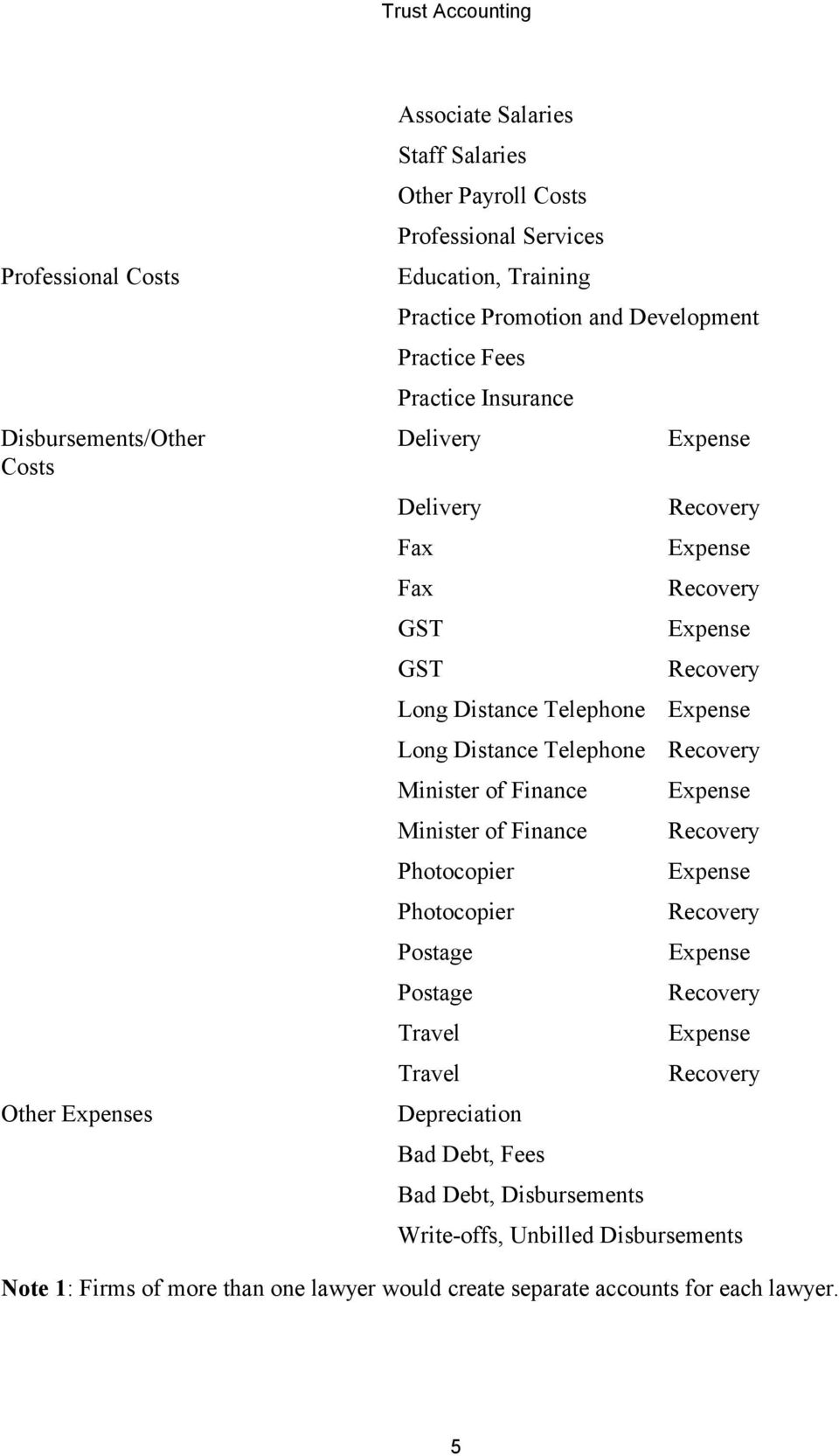
9 Trust Accounting Basic Accounting & Bookkeeping Requirements Chart of Accounts One of the first steps in setting up an accounting system is the creation of a Chart of Accounts. This is the list of transaction categories, or accounts, that will be most relevant to your practice. It is under these categories and codes that your payments and receipts will be recorded. You will have accounts for assets, liabilities, expenses and income. Your Chart of Accounts can be changed as circumstances change, but if it is properly done in the beginning, it will make the recording of transactions easier and more accurate. If you were setting up a manual system, you might include the following in your chart of accounts: CHART OF ACCOUNTS ASSETS Trust Bank Accounts Current Assets Fixed and Other Assets Pooled Trust Account Separate Interest Bearing Trust Account General Bank Account Petty Cash Accounts Receivable Allowance for Doubtful Accounts Client Disbursement Recoverable Employee Loans/Advances W-in-P Fees W-in-P Disbursements Recoverable GST Input Tax Credits Prepaid Expenses Refundable Deposits Furniture Office Equipment Depreciation Furniture Depreciation Office Equipment Investments 3

10 The Law Society of British Columbia LIABILITIES AND PROPRIETORS EQUITY LIABILITIES Current Liabilities Long Term Liabilities Liability for Client Funds Held in Trust Bank Loan Accounts Payable Payroll Clearing Account Vacation Pay Accrual GST Payable (net of account 1320) PST Payable Capital Loan Equipment Loan Other PROPRIETORS EQUITY Capital (Firm or Corporation) Retained Earnings (Note 1) Profit/Income Distribution for Year (Note 1) Drawings for the year (Note 1) REVENUE AND EXPENSE REVENUE Fees Earned Disbursements Recovered Interest Income Other Income EXPENSE Office Insurance General Interest and Bank Charges Occupancy Office Telephone Office 4

11 Trust Accounting Professional Costs Disbursements/Other Costs Other Expenses Associate Salaries Staff Salaries Other Payroll Costs Professional Services Education, Training Practice Promotion and Development Practice Fees Practice Insurance Delivery Expense Delivery Recovery Fax Expense Fax Recovery GST Expense GST Recovery Long Distance Telephone Expense Long Distance Telephone Recovery Minister of Finance Expense Minister of Finance Recovery Photocopier Expense Photocopier Recovery Postage Expense Postage Recovery Travel Expense Travel Recovery Depreciation Bad Debt, Fees Bad Debt, Disbursements Write-offs, Unbilled Disbursements Note 1: Firms of more than one lawyer would create separate accounts for each lawyer. 5
12 The Law Society of British Columbia Records of Original Entry As the name implies, the records of original entry are the place where transactions are first recorded. Their purpose is to accumulate records of individual transactions that can then be summarized in their appropriate categories, or accounts, and totalled and posted monthly to the General Ledger. The book or data source where receipts and payments are originally recorded used to be referred to as a Cash Book but now is usually referred to as a Record of Income. The book or data source where fees and other billed items are originally recorded used to be referred to as a Fees Journal but now is usually referred to as a Record of Fees. Computer systems may have their own names for the various records: you should be familiar with the terms used by your own system. General Ledger This is the hub of your accounting records. After your books or records of original entry have been balanced, the totals are posted monthly to the General Ledger. Then the General Ledger is balanced by preparation of a Trial Balance. The Trial Balance lists all debit or credit balances in each account in the General Ledger. The grand total of debits must match the grand total of credits for the books to be in balance. Double Entry Bookkeeping This accounting practice reflects the fact that every transaction has at least two financial impacts. An increase in an Asset or Expense account is recorded as a debit (dr) and a decrease as a credit (cr). An increase in a Liability, Owner s Equity, or Income Account is recorded as a credit and a decrease as a debit. For example, if you receive trust funds and deposit them in the bank, this transaction results in: an increase in the trust account (an Asset), so it will be recorded as a debit; and an increase in the amount you owe to your client (a Liability), so it will be recorded as a credit. Another example: You deposit $1,000 in your General account. This results in an increase in your cash account, which is an Asset account, so it will be recorded as a debit. The second entry depends on the source of those funds: 6

13 Trust Accounting If it was a payment of your fee from a client, it will be an increase to your Income account (credit) or a decrease to accounts receivable which is an Asset account (credit), If it was proceeds of a loan from your bank, it will be an increase to your Liability account (credit), or If it was a contribution from your own funds, it will be an increase to your Owner s Equity account (credit). If transactions are recorded correctly, the total of debits will always equal the total of credits and the books will always be in balance. Integrating trust accounting with client file management It s important that your accounting records be co-ordinated with your client file management systems. The easiest way to ensure integration of these systems and records is to use an integrated accounting and practice management system that has been developed specifically for law practices. [See Technology on page 31.] The following procedures will give you good control over financial transactions and client file matters through the life of a file: Start of a new legal matter 1. A file for a new matter is opened with a serial number or code assigned that will identify the chronology of all matters opened. 2. Receipt of trust funds is promptly recorded, and the lawyer notified. 3. If the funds are for a client matter (not as a retainer for legal fees), apply TAF and track it for the firm s quarterly remittance to the Law Society. 4. Consider whether it would be appropriate to seek your client s instructions to open a separate trust account. 5. The assigned file number is cross-referenced in the accounting records. 6. Retainer agreement is reviewed to ensure that funds received and billings accord with the agreement. 7. Periodic reviews ensure that the files opened, according to the log, correspond to client trust accounts opened. 7

14 The Law Society of British Columbia Progress of the matter As work progresses on a file, you should periodically review the trust records and balance to make sure that your accounting is consistent with the commitments, undertakings and retainer agreement you have with the client. Security of funds, records and data is a concern in two respects: Custodial security: be sure that only authorized individuals have access to funds and records; ensure that you use passwords and access codes for electronic data. Physical security: consider safe, locked filing cabinets, fire and earthquake protection; ensure that you keep backup for electronic data offsite. Each month you should review unbilled fees and disbursements, accounts receivable and trust fund balances. Closing the file Before you close a file, carefully review it to be sure you have complied with your client s instructions and other requirements. Here is a checklist of items to consider: Were funds invested in interest-bearing accounts? Are there payout conditions? Do any undertakings, restrictions or conditions apply? Are there any specific trust conditions? Do you have authority to pay or withdraw funds? Have incoming funds cleared the bank? Are there sufficient funds to cover proposed payouts? Are all calculations accurate? If an exchange of documents is required, is that completed? Have reporting requirements been complied with? The Trust Account Types of trust accounts Trust accounts are either pooled holding funds of more than one client or separate. Interest on pooled trust accounts must be paid by the savings institution directly to the Law Foundation. Interest on a separate account is the property of the client. Before the Law Foundation was established, savings institutions reaped a windfall profit from lawyers trust accounts. Because the amounts held for individual clients were either small, or 8

15 Trust Accounting held for a short time, it was impractical to allocate interest to individual clients. The lawyer was not allowed to benefit personally from clients funds, so these funds were kept in noninterest bearing accounts. The establishment of the Law Foundation allowed this earned interest to be put to public use. Here is a sample letter to the financial institution about remitting interest to the Law Foundation of British Columbia ( Sample letter: Remitting interest to the Law Foundation CONFIDENTIAL Dear Sir or Madam: Re: Trust Account # By this letter, I am, (we are) advising your institution that the above account is a pooled trust account which will contain the funds of more than one client. The Law Society of BC requires that a pooled trust account shall: (i) (ii) (iii) (iv) (v) be interest bearing, provide cancelled cheques and bank statements periodically to the lawyer, be readily available to be drawn upon by the lawyer, be designated as a trust account on the records of the savings institution (and the lawyer), and be an account in respect of which the savings institution has agreed with the lawyer to pay interest to the Law Foundation. Law Society Rule 3-52(2)(a) requires that every lawyer who opens or maintains a pooled trust account instruct the savings institution in writing to remit the net interest earned on the account, to the Foundation at least quarterly. This letter is my (our) instruction to you to calculate the interest on the above account at the rate and in the manner agreed upon between your institution and the Law Foundation of British Columbia, and to remit such interest directly to the Law Foundation according to the terms of that agreement (in the event that there is no agreement in place, please contact The Executive Director of the Law Foundation.) This letter authorizes and directs you to provide the Law Foundation with such information and explanation as it requires to verify the calculation of the interest remitted, including: 9

16 The Law Society of British Columbia (i) (ii) (iii) account balance information during the reporting period; the interest rate; and the interest earned. A standard form remittance report which should accompany that remittance can be obtained from the Law Foundation. Please forward the interest directly to: The Law Foundation of British Columbia Robson Street Vancouver BC V6B 5J3 and please advise me (us) of the amount of each transmittal. I (We) also draw to your attention a requirement of the Legal Profession Act, S.B.C. 1998, c.9, Part 7: 63(13) Despite any agreement between a lawyer and a savings institution, if the lawyer s pooled trust fund account is overdrawn by an amount exceeding $1,000, the savings institution must, as soon as practicable, inform the Society of the particulars. (14) Subsection (13) and the failure of a savings institution to comply with it has no effect on the civil liability of that savings institution to any person, and that liability, if any, must be determined as though that subsection were not in force. Yours very truly, cc: Law Foundation of British Columbia Pooled account A pooled trust account must be an account that: (Rule 3-52) is designated as trust containing the funds of more than one client, and kept in a designated savings institution that agrees to pay interest to the Law Foundation quarterly or more often, 10

17 Trust Accounting can be drawn upon by the lawyer, provides the lawyer periodically with cancelled cheques and bank statements, which may be received or retained by the lawyer in an electronic form acceptable to the Executive Director, is kept in the name of a lawyer or the firm in which the lawyer is a partner, employee, lawyer or voting shareholder, is created for the purpose of holding trust funds but may hold up to, but no more than, $300 of the lawyer s own money. Separate account A separate trust account must be: (Rule 3-53) an interest-bearing trust account or a savings, deposit, investment or similar form of account in a designated savings institution in BC, designated as a trust account on the records of the savings institution and the lawyer, and used solely to hold trust funds, and kept in the name of a lawyer or the firm in which the lawyer is a partner, employee, lawyer or voting shareholder, or in the name of the trust, or identified in the lawyer s books and accounts by a number that identifies the client. Except as required to make up a shortfall (Rule 3-66) you may not deposit any funds other than trust funds to a separate trust account. Pooled or separate: which account to use Under old rules, a lawyer had discretion to deposit trust funds into either a pooled or separate account. Now, you must deposit all trust funds into a pooled account at a designated savings institution unless you are instructed otherwise, in writing, by your client. (Rule 3-51(2), (3) and (4) and s.62(5) of the Act) Who may operate a trust account If you have valid insurance for the practice of law, you may operate a lawyer s trust account. Receiving Trust Funds Source of funds Does the money come from a client, or from someone else? Does the amount or anything about the transaction arouse concerns about the possibility of money laundering or proceeds of crime? 11

18 The Law Society of British Columbia Are the funds received upon any conditions or undertakings? Who is your client? If the money is coming from someone other than a client, do you owe a duty of care to the payor? Should you advise the payor that you are not protecting his or her interests? Rule 3-47 defines client as any beneficial owner of funds or valuables received by a lawyer in connection with the lawyer s practice. Issues to consider Who is authorized to give instructions about trust accounts, especially where ownership of the funds is disputed, where ownership changes, or where the funds are held subject to conditions? Does the new, wider definition of client found in Rule 3-47 ( any beneficial owner of funds or valuables received by a lawyer in connection with the lawyer s practice ) apply to a determination of who may instruct you under s.62(5)? Getting funds certified If you are going to have to pay out trust funds to a third party immediately or very soon after receiving the funds, get the funds certified. It is not inappropriate to ask another lawyer for a certified cheque. Depositing Trust Funds When to deposit You must deposit trust funds as soon as practicable. (Rule 3-51(1)) As the definition of funds includes credit card slips, you may not hold blank, signed credit card slips as security for fees and disbursements. Where to deposit Trust funds must be held with a designated savings institution as defined in Rule 3-49, with a physical presence in BC accepting demand deposits and the required insurance. This includes the major banks, credit unions and trust companies: check with the Law Society if you re in doubt. In these materials we sometimes use the word bank as shorthand for savings institution, but the meaning always extends to any institution designated under the rule. 12

19 Trust Accounting The institution where the trust funds are deposited must be insured by the Canada Deposit Insurance Corporation ( or by the Credit Union Deposit Insurance Corporation of BC ( This requirement does not apply where your client instructs otherwise in writing. Accounts at most major savings institutions will be appropriately insured, though certain types of accounts, such as foreign currency deposits, may be excluded. Withdrawing Trust Funds You must not withdraw trust funds unless you hold sufficient funds to the credit of the client on whose behalf you are making the withdrawal. The only money that may be withdrawn from a trust account... You may withdraw from a trust account, or authorize the withdrawal, only those funds that: are properly required for payment to or on behalf of a client or to satisfy a court order belong to you were deposited by mistake are paid to you to pay a debt that the client owes you are transferred between trust accounts are due to the Law Foundation are remitted to the Law Society as unclaimed trust funds are authorized by the Executive Director if withdrawal is for a purpose not specified in Rule 3-56(1). (Rule 3-56) Signing trust cheques A trust cheque must be signed by a lawyer. Your firm may require a second signature on trust cheques: if so, that second person may be a lawyer or a non-lawyer staff member. A firm may also deny authority for the signing of trust cheques to any of its lawyers, including partners. A lawyer could lose the right to be the sole signing authority: as an undischarged bankrupt as a result of a disciplinary proceeding as a result of a voluntary undertaking to the Law Society, or 13

20 The Law Society of British Columbia as a result of appointment of a custodian of the practice. If you are a sole practitioner and you need to have a trust cheque issued when you are going to be unavailable to sign it, you can arrange for another member of the Law Society to have temporary signing authority on your trust account. Withdrawals must be by cheque except as allowed by the rules Trust funds may be withdrawn from a pooled or separate trust account by way of a cheque marked Trust and signed by a lawyer. If you are withdrawing funds to pay your fees, make the cheque payable to your general account. You may not draw cheques payable to Cash or to Bearer. See below, Paying Your Fees From Trust, for further information. Be sure that the cheque is dated and that the name of the payee and the amount are completed. Put the file number on the face of the cheque as well as on the cheque stub. Withdrawals may occur by means other than cheque under certain limited circumstances Generally and historically, withdrawals from trust accounts are cheque transactions. However, the Rules have been modernized to better reflect the electronic reality of lawyer s accounting transactions and records. Financial institutions may transfer interest earned on a pooled trust account to the Law Foundation with instruction from the lawyer. (Rule 3-56(4)) Transfer from a pooled trust account to a separate trust account may be authorized by the client and approved in writing by the lawyer. (Rule 3-56(5)) Electronic Filing Land Title Branch As of April 1, 2004 the Land Title Office accepts electronic filings from BC lawyers, notaries and land title agents of these key documents in land transfers: Form A (Freehold Transfer) Form B (Mortgage) Form C (Charge) Form C (Release) Declaration Property Transfer Tax Electronic Payment Authorization Property Transfer Tax Return 14
21 Trust Accounting The electronic filing of documents is optional, not mandatory. The Law Society Rules have been amended to reflect this development. Under the new subrule 3-56(3.2) [added 03/04]: A lawyer may make or authorize the withdrawal of funds from a pooled or separate trust account by electronic transfer using the Electronic Filing System of the Land Title Branch for the purpose of the payment of Property Transfer Tax on behalf of a client, provided that the lawyer (a) retains in the lawyer s records a printed copy of (i) (ii) (iii) all Electronic Payment Authorization forms submitted to the Electronic Filing System, the Property Transfer Tax return, and the transaction receipt provided by the Electronic Filing System, (b) (c) digitally signs the Property Transfer Tax return in accordance with the requirements of the Electronic Filing System, and verifies that the money was drawn from the trust account as specified in the Property Transfer Tax return. For more information, see and Additional information is also available on the Law Society website ( Electronic Withdrawal of Funds Under the new subrule 3-56(3.1) [added 02/03]: A lawyer may make or authorize the withdrawal of funds from a pooled or separate trust account by electronic transfer, provided all of the following conditions are met: (a) (b) the transfer is for more than $25,000,000 [emphasis added]; the transfer system is one that will produce, not later than the next banking day, a confirmation form from the financial institution confirming the details of the transfer, which should include the following: (i) (ii) the date of the transfer; source trust account information, including account name, financial institution and account number; 15
22 The Law Society of British Columbia (iii) (iv) (v) destination account information, including account name, financial institution, financial institution address and account number; the name of the person authorizing the transfer; amount of the transfer; (c) the lawyer must (i) (ii) (iii) (iv) (v) (vi) complete and personally sign a requisition for the transfer in a form approved by the Discipline Committee [see Large Value Transfer System (LVTG) Electronic Transfer Form] available in the Publications & Forms section of the Law Society website at: submit the original requisition to the appropriate financial institution, retain a copy of the requisition in the lawyer s records, obtain the confirmation referred to in paragraph (b) from the financial institution, retain a hard copy of the confirmation in the lawyer s records, and immediately on receipt of the confirmation, verify that the money was drawn from the trust account as specified in the requisition. Withdrawals from a separate trust account You may not make a withdrawal directly from a separate trust account that does not give you monthly statements and cancelled cheques which you keep in your records. To withdraw funds from such an account you must first transfer the funds to your pooled account. (Rule 3-58) This ensures the proper paper trail. The procedures for withdrawal from a pooled account outlined above will apply. All transactions must be properly recorded, whether or not they are trust account holdings or other as directed by your client under Rule 3-51(3). Paying your fees from trust (Rule 3-57) As a general rule, follow these steps: 1. get your client s agreement that you may take your fee, when earned, from trust 2. confirm that agreement in writing 3. do the work 16
23 Trust Accounting 4. prepare the bill 5. deliver the bill 6. collect your fee from trust Fees means fees for your services, and the taxes on those fees. Before you make the withdrawal, you must first prepare the bill. Unless your client gives you written instructions to the contrary, you must immediately deliver the bill to your client. You can deliver a bill: by regular or registered mail to the client s last known address by personal delivery by faxing it to the client s last known fax number, or by ing it to the client s last known electronic mail address. If your right to take your fees from trust is disputed If your client disputes your right to take your fees from the trust account then you may not do so, unless you have met the criteria listed in Rule 3-57(5). (Note that this is not the same as a dispute over the amount of your fee.) You may take your fees if you meet all of these criteria: you have written confirmation of the client s agreement that you may take funds from trust to pay your account (i.e., either you have confirmed that agreement in a letter delivered to the client, or the client has acknowledged the agreement in writing) you have delivered the bill (in cases of a fee dispute this applies even if the client had instructed that you need not deliver a bill) you have given the client written notice that the fees will be taken from trust unless, within one month, the client begins either a fee review under the Act or an action disputing the lawyer s right to the funds the client does not begin a fee review or an action, and at least a month has passed since you gave the notice. If only part of your account is disputed, you may take those fees that are not in dispute. 17
24 The Law Society of British Columbia Trust Balances & Shortages Keeping a sufficient balance You must always maintain enough money on deposit in each pooled or separate trust fund to meet your client obligations. (Rule 3-55) The onus is on you to make sure that you hold sufficient funds for a particular client before you authorize a withdrawal. Take special care to ensure that: funds have actually been deposited your savings institution has cleared the deposit wire transfer funds have actually been received the withdrawal is coming from the same account where the deposit was made the funds on deposit to the credit of that client will cover the withdrawal the use of trust funds is permitted for the purpose of the proposed withdrawal; i.e., the funds are not frozen by a court order, or a contractual or other charge, and the withdrawal would not breach an undertaking. Always review the individual client trust ledger card before issuing a trust cheque. Remember: the test is not whether you have sufficient funds in the bank to cover a particular cheque, but whether the individual client ledger card shows sufficient funds to cover the cheque. Even if it does, be aware that if the ledger card shows a deposit that has not yet cleared the bank, you will have a shortfall if it does not clear. If there s a shortfall If you ever find that you are short of funds in a trust account, you must immediately deposit the amount required to eliminate the shortfall. A trust shortage includes a shortage caused by service charges, credit card discounts and bank errors. If the shortfall is greater than $2,500, you must immediately report the fact of the shortage and the circumstances, in writing, to the Executive Director of the Law Society. (Rule 3-66) If you find that you are, or will be, unable to deliver up trust funds when due, you must immediately report that fact, and the reasons, to the Executive Director. You may not offset an individual client s overdrawn trust balance against other trust credit balances. 18
25 Trust Accounting Another lawyer s shortfall If you become aware of another lawyer s shortage of trust funds, the Professional Conduct Handbook requires you to report that to the Law Society (Chapter 13, paragraph 1(b)). Reconciliations Reconciliation is the accounting procedure that demonstrates that your transactions have been recorded accurately. The process of reconciling your books and records monthly provides valuable early indications of any differences or unauthorized transactions and is an important internal control device for your practice. A proper reconciliation must include: a listing of all unexpended balances of funds held in trust for each client (for all pooled and separate trust accounts). This listing may also be used for your annual CDIC filing requirement under Rule the total of the balances on the bank statement for each pooled and separate trust account the balance as shown in your general ledger or record of income (cash book) A proper trust reconciliation comprises three distinct stages: reconciling the balance per the bank statement with the bank balance per your books and records reconciling the reconciled bank account with the total of the detailed monthly listing of individual clients ascertaining the total trust liability by adding together each reconciled bank account balance (pooled and separate) and agreeing to the total gross trust liability, and correcting any unreconciled items. Reconciling your trust bank balances to your total trust liability will assure you that client trust transactions are being recorded accurately. It can give you early warning of matters that require follow up: a cheque that has been issued but not cleared your savings institution may have been lost; a deposit that has been made but not credited to the account may have been mishandled at the savings institution. It may bring to light errors or unauthorized transactions such as bank debits for service charges. It would identify previously unanticipated credits such as wire transfers or maturity of term deposits. 19
26 The Law Society of British Columbia Reconciliation requirements Rule 3-65(2) requires that you include: (a) (b) (c) a detailed monthly listing showing the unexpended balance of trust funds held for each client, and identifying each client for whom trust funds are held, a detailed monthly bank reconciliation for each pooled trust account, a listing of balances of each separate trust account or savings, deposit, investment or similar form of account, identifying the client for whom each is held, (d) a listing of balances of all other trust funds received pursuant to Rule 3-51(2), and (e) a listing of valuables received and delivered and the undelivered portion of valuables held for each client. Trust reconciliations must be done monthly, even if there have been no transactions and even if there are no funds in an account. For as long as a trust account remains open, monthly reconciliations are required. Procedure for monthly trust reconciliations 1. You or your staff should diarize the date when trust account statements are due from your savings institution. 2. Ensure that your staff knows that any errors or differences must be brought to the lawyer s attention immediately for correction or reimbursement of any deficiency or overdrawn trust balances. Recording TABLE OF REQUIRED ACCOUNTING RECORDS A lawyer must maintain at least, but not limited to, the following records: 20
27 Trust Accounting Record Description Contents Rule Record of Income: Trust Receipts Trust Disbursements Record Record of original entry Record of original entry Date of receipt, amount and source of all trust money received Identity of the client to whom the money belongs, or on whose behalf the money is received All withdrawals from trust Cheque or voucher number Date and amount of withdrawal Name of payee Identification of client with respect to whose affairs the withdrawal is made Trust Ledger Record For each client* for whom you hold, or have received, trust funds: the client name all receipts and withdrawals the unexpended balance * If you have concurrent matters for a client, keep separate ledgers for each. Trust Transfers Record Every transfer of funds between clients trust ledgers, including the name and number of both the source and destination files An explanation of the purpose of each transfer the lawyer s written approval of each transfer General Account: General Receipts Record General Account: General Disbursements Record Record of original entry Record of original entry Date of receipt, amount and source of all money received, other than trust money All payments, other than trust money; Cheque number (if applicable) or voucher number Date and amount of each payment Name of payee 3-60(a) 3-60(a) 3-60(b) 3-60(c) 3-61(1)(a) 3-61(1)(a) 21
28 The Law Society of British Columbia Record Description Contents Rule Client Accounts Receivable Ledger Record For each client, the lawyer/client position on all transactions any bill delivered or disbursement made, including record of all transfers from trust any other receipts from or for the client the balance, if any, owed by the client Billing Records File copies File copies of all billings to clients: showing amounts and dates of fees or other charges identifying the person or client charged filed in chronological, alpha or numeric order Supporting Documents: Trust and General Records Including but not limited to the following: Validated deposit receipts Monthly bank statements Passbooks Cancelled and voiced cheques Bank vouchers and similar documents and invoices 3-61(1)(b) 3-62(1) 3-59(4) 22
29 Trust Accounting Record Description Contents Rule Trust Reconciliations Records A comparison of the total of all unexpended balances of funds as they appear in the trust ledgers held in trust for all accounts together with reasons for any differences between the totals supported by: a detailed monthly listing showing the unexpended balance of trust funds held for each client, and identifying each client for whom trust funds are held a detailed monthly bank reconciliation for each pooled trust account a listing of balances of each separate trust account or savings, deposit, investment or similar form of account, identifying the client for whom each is held a listing of balances of all other trust funds received pursuant to Rule 3-51(2), and a listing of valuables received and delivered and the undelivered portion of valuables held for each client 3-65 and 3-60(d) When to record transactions (Rule 3-63(1)) You must record all transactions promptly but no more than: Seven days after a trust account transaction (but receipt of interest on a separate trust account may be recorded within 30 days of payment or of notice that funds have been credited to the account subrule (4)) 30 days after a general account transaction. 23
30 The Law Society of British Columbia The date of the transaction For trust transactions, the date that should be recorded in your trust is usually for receipts the date the funds are received, and for payments or withdrawals the date the cheque is prepared. There may be circumstances that raise questions about what is the appropriate date to record. For example: You receive trust funds subject to conditions that restrict your ability to deposit the funds in the normal course; or Your office prepares a trust cheque but there is a delay of more than a few days before it is signed or released. In cases such as these, you should follow the general rule, but note the special circumstances on the trust ledger or other records. Records for separate trust accounts If your client instructs you to hold trust funds in a separate account, you may put them into a savings account, a term deposit or similar financial instrument. The interest is the property of the client, but the funds are part of your trust liability. The proper way to record a transfer of funds from a pooled account to a separate account is: DEBIT: CREDIT: Client s Separate Trust Account Pooled Trust Bank Account It is important to understand that the Gross Trust Liability Account is unaffected by a transfer from one trust account to another. Reporting Trust Report The Benchers have adopted reforms to modernize and streamline the trust account reporting requirements of BC lawyers through new trust accounting rules and a new form of Trust Report. The new Trust Report, which is designed to collect more relevant information, will be phased in as a replacement for the current Accountant s Report (Form 47) and Statutory Declaration (Form 48), beginning in The Individual Lawyer s Practice Declaration (Schedule 2) forms part of the new Trust Report and must be filed by the same deadline as the Trust Report. Previously, the Law Society 24
31 Trust Accounting asked lawyers to complete their Annual Practice Declaration separately from their Trust Report. These two filings have now been combined to streamline the annual filings required of a lawyer. These reforms were recommended by the Society s Trust Assurance Reform Task Force as necessary first steps to improving trust assurance standards, while also streamlining administrative requirements. The Trust Report, guidelines and schedules are available in the Publications & Forms section of the Law Society website at The new Trust Report, which must be filed annually, will be phased in gradually in The Law Society will advise law firms individually as to when they will be expected to use the new Trust Report instead of the Form 47 or Form 48. All firms are expected to be using the Trust Report by the end of Provided the Law Society is aware of your Trust Report filing period for the practice, the Trust Review Department ([email protected]) will send a filing notice at least 90 days before your Report is due. You may contact [email protected] with questions regarding the phase-in of the new forms. Your accountant should have experience in monthly trust reconciliations and the inspection of books and records for the Trust Report. Purpose of Trust Report The Trust Report is one of the tools the Law Society uses to carry out its statutory obligation to protect the public interest. It gives an accountant s professional opinion about whether: your practice has an adequate system for recording financial transactions in compliance with the Legal Profession Act and the Law Society Rules, and your system appears to be working properly. Common exceptions Exceptions reported may involve mishandling of clients money, inadequate accounting records, or deficient bookkeeping records. Some of the more common exceptions include: 1. Mishandling of clients funds: shortage of total trust funds individual trust account short over two month ends usually the result of bank errors withdrawals from individual trust ledger accounts without preparation of a bill withdrawals from trust not allocated to individual trust ledger accounts 25
32 The Law Society of British Columbia uncorrected reconciling items on monthly trust reconciliation trust money handled through non-trust account without authorization personal transactions co-mingled with trust unearned retainers deposited in non-trust account trust withdrawals on account of disbursements that have not actually been paid trust deposits delayed trust cheques not signed, or signed by non-lawyer as sole signatory 2. Inadequate accounting records duplicate deposit slips not detailed as to client or source duplicate deposit slips not available trust cash book inadequate or not kept at all cash book lacking required information such as source of funds trust ledger lacking information trust ledger cards filed in individual client files trust obligations recorded incompletely or not at all bank statements and cancelled cheques unavailable pass books for separate trust accounts either unavailable or not updated 3. Deficient bookkeeping practices single-entry bookkeeping no subsidiary ledger for accounts receivable or disbursements receivable general ledger not kept trust ledger accounts kept in unbound books or on loose or unlined sheets of paper client file used as only record of accounts receivable co-mingling of business and personal cash transactions incomplete depositing or recording of income cash books with substantial erasures or white-outs or not totalled and ruled off monthly poor audit trail of supporting vouchers, invoices, etc. Time for filing The Trust Report must be filed with the Law Society within three months of the end of your reporting period e.g., if your reporting period end is December 31 st, your annual Trust Report would be due by March 31 st. 26
33 Trust Accounting Late filing can be expensive. If your report is not delivered within 30 days of the required date, the penalty is $200 for the first 30 days after your due date and $400 per month or part of a month thereafter, until the report is delivered. (Rule 3-74) If your Trust Report is not delivered within 60 days of the required date, you may be suspended until the report is completed to the satisfaction of the Executive Director and delivered as required. (Rule (2)) Reporting period When you are starting a new practice, you may choose your trust reporting period. It does not need to coincide with your year-end for income tax purposes: in fact, it makes sense to choose a trust accounting year-end that does not come at a time of year when other demands on your accountant s time are high. The last reporting period ends on the day a firm ceases to practice. A final Trust Report must be filed within 3 months of winding up a practice. (Rule 3-72) Trust Report Format The Trust Report is divided into four sections and the Schedule 2 Individual Lawyer s Practice Declaration. Here are the highlights: Section A (completed and signed by law firm) Information will be collected on whether the law firm had trust activity during the year, or whether it only held trust funds. The firm must also disclose whether it used the trust account of another firm, or whether it allowed another lawyer to use its trust account. This provision will be especially relevant to the temporary inter-jurisdictional mobility of lawyers. A lawyer who practises temporarily in BC may only conduct trust transactions through a trust account in his or her home jurisdiction or through the account of another lawyer in BC. The firm must report on whether any of its lawyers acted as trustee or sole executor of an estate, had authority to act under a power of attorney or a representation agreement. This will allow the Law Society to identify a lawyer with access to funds outside the practice of law, but in situations that may be related to the lawyer s professional capacity. All authorized signatories to the firm s trust account will be named, to identify which lawyers have access to trust monies through signing authority. All bank accounts maintained by the firm (including general accounts) must be listed. This will prevent firms from depositing trust money to accounts that did not need to be disclosed on the (precursor) form of Accountant s Report. 27
34 The Law Society of British Columbia All trust accounts maintained by the firm under a different business name must be disclosed. The precursor Accountant s Report form did not specifically require such disclosure. Any financial difficulties (bankruptcies or insolvencies) of any of the lawyers in the firm must be disclosed. This will ensure compliance by all lawyers in the firm with Rule 3-45 and will allow the Law Society to compare the information disclosed with that already in the Society s database. The firm must report on its method of maintaining books and records (not part of the precursor form of Accountant s Report) in order to ensure compliance with Rule 3-59, as well as reporting whether the firm has taken steps to establish a back-up system. The firm must disclose whether it has off-site storage and, if so, its location. The firm must disclose whether it has received any funds as a loan from a client, to better ensure compliance with Part 7 of the Professional Conduct Handbook. There must be confirmation of monies in trust accounts to ensure that all non-trust money has been properly removed and that the firm has taken steps to remit trust money to the client or, if the money is unclaimed, to the Law Society. The firm must disclose any cheques (trust or general) returned for insufficient funds. NSF cheques in the trust account are a serious matter, being a breach of undertaking: see Chapter 11, Rule 8 of the Professional Conduct Handbook. NSF cheques in the general account can be an indication that the firm is having difficulties meeting its operation costs. The firm must disclose whether it has been audited by any other regulatory body, such as the Canada Revenue Agency for GST or income tax purposes, or by provincial tax authorities for PST compliance. The firm must confirm whether it has taken steps to ensure its proper winding up in the event of disability or death of the partners. Such steps are needed to reduce the costs of future custodianships. Section B (completed and signed by the law firm if the firm handled or held funds in trust during the reporting period) The firm must disclose the type of trust transactions it has handled. Each type of trust transaction may have an associated risk factor. The firm must also state its actual number of trust transactions, together with the largest transaction and the average number of transactions over the reporting period. The level of risk may increase as the number of transactions increases. 28
35 Trust Accounting The firm must report on whether any trust shortages were handled appropriately and in accordance with Rule The firm must also report on whether client trust funds were properly insured by CDIC in accordance with Rule The firm must address whether it has complied with the requirements of other regulatory bodies (particularly with respect to GST and PST). Section C (completed and signed by accountant if the law firm had over $5,000 trust activity during the reporting period) The accountant must verify that he or she has read all the information provided in Sections A and B. The accountant, having access to the records and books of the firm, should identify any obvious errors contained in those sections. The accountant must confirm that the specific tests required have been performed. The accountant must report on the balance of trust assets and liabilities of the firm at the end of the reporting period. This allows the Law Society to confirm that there are sufficient funds on deposit in the trust accounts to meet the firm s obligations concerning funds held in trust for clients. Any discrepancies will be reviewed. The accountant must report on any exceptions found to Law Society trust accounting rules. Section D (completed and signed by the law firm) A statutory declaration of a lawyer or lawyers of the firm must confirm that all books and records of the firm have been provided to the accountant. Lawyer s Practice Declaration (Schedule 2) Each lawyer at the firm must complete a Schedule 2 Lawyer s Practice Declaration, which is due by the same deadlines as the firm s Trust Report. For more information If you have any questions about any aspect of your Trust Report obligations, contact the Law Society of BC at (604) or toll-free in BC at or you may direct your to [email protected]. 29
36 The Law Society of British Columbia Unclaimed trust funds It sometimes happens, especially when small amounts are involved, that you have funds in trust for a client with whom you have had no contact for a long time. If you have made reasonable efforts to locate the client without success, and have been unable to locate the client for two years, you may apply to pay the trust funds to the Law Society. (Legal Profession Act, s.34) This relieves you of any continuing liability with respect to those funds. The money will be kept for five years and if no claim is made against it after that time, it will be transferred to the Law Foundation. Periodic audits The Legal Profession Act authorizes the Law Society to conduct spot audits of a law firm s books, records and accounts (s.36(b) and (c)). Under the Rules, the Executive Director may have an accountant conduct an audit to determine whether a lawyer is maintaining books, records and accounts in compliance with the Rules. (Rule 3-79) CDIC report The Canada Deposit Insurance Act and Law Society Rules require you to file an annual report by May 30 th for every pooled trust account you hold with a CDIC-insured savings institution, so that each client s funds (and not just the pooled account itself) are insured up to the limit of CDIC insurance. (Rule 3-70) The listing of trust liabilities prepared for your monthly trust reconciliation may be used as the annual CDIC report if you remove client names and substitute file numbers. CDIC Act, Schedule 2: Deposit of beneficiary 3. Where a member institution is obligated to repay moneys to a depositor who is acting as trustee for two or more beneficiaries, if the interest of each beneficiary in the deposit is disclosed on the records of the member institution, the interest of each beneficiary in the deposit shall be deemed for the purposes of deposit insurance with the corporation to be a separate deposit. Here is a sample report: SAMPLE REPORT LAW SOCIETY RULE 3-70 Canada Deposit Insurance Corporation TO: Each Financial Institution, except Credit Unions, where you have a pooled trust account. 30
37 Trust Accounting Dear Sir or Madam: This is to advise you that account number is a multi-beneficiary trust account which, as at April 30, 200, contained the funds of various clients as follows File Number or Client Initials $Amount File Number or Client Initials $Amount File Number or Client Initials $Amount $TOTAL We are providing you with this information so that you can comply with CDIC requirements. Yours truly, Requirements for CDIC report (see Joint and Trust Account Disclosure By-law) Deliver the report to the financial institution within 30 days of April 30th each year. Do not use client s names. The total is to agree with the balance on the bank statement of the same date. Maintaining a pooled trust account with less than $100,000 (maximum basic insurance coverage per account) does not exempt you from this requirement. It is not necessary to file this report with Credit Unions whose insurers do not require it. Whenever you open a new pooled trust account, inform your bank, trust company, or credit union, in writing, that this is a pooled trust account which will contain the funds of more than one client. (This advice can be combined with the required letter instructing the bank to forward net interest to the Law Foundation). Keep a copy of the CDIC report, with receipt acknowledged by the bank, to give to your auditor, who is specifically instructed by the Law Society to confirm that you have complied with Rule Technology This table gives you some idea of the options available to you and some considerations you may want to weigh when making your choice. 31
38 The Law Society of British Columbia System Initial Cost Benefits Drawbacks COMPUTERIZED SYSTEMS Trust accounting systems: Either a stand-alone trust accounting system 1 or a trust module of an integrated system. About $250 and up. Quick, easy, inexpensive. Limited scope. Generic accounting packages 2 About $150 to $200 for basic packages Full accounting system; may have additional components. Not designed specifically for a law office; may require some training. Integrated legal accounting systems designed specifically for law offices. 3 Most are $500 and up Full accounting system, usually offering conflict checking, calendaring (bring forward) systems and management reports. More expensive; requires training to use all components See, for example, Software Technology, Inc. ( that has a trust accounting component that can be combined with other components such as case management. See also Quickbooks ( MYOB ( Quicken ( Simply Accounting ( Peachtree ( Great Plains Accounting ( for example. ESILAW ( PCLaw ( will work alone or with Amicus Attorney, LegalMaster ( Brief Legal Software ( (Vertical Technologies Inc.) Legal Vision ( Manac ( Integra Office System ( for example. 32
39 Trust Accounting System Initial Cost Benefits Drawbacks Fully integrated accounting and law practice management packages 4 : one-stop shopping Potentially thousands of dollars (affected by size of firm and number of system users) In addition to the features of integrated accounting systems, they offer case & file management, full integration of time & billing and full office management reporting. Most expensive; will require training and an experienced accounting department for optimum benefit. MANUAL SYSTEMS Traditional bound accounting books: not a one-write system so debit & credit entries must be made separately. Inexpensive Easy to keep, if properly set up and if entries are made carefully by a knowledgeable person. Requires knowledge of accounting; month end reconciliations can be difficult and time-consuming. One-Write systems 5 : use carbon or NCR paper so that all necessary entries are made at once. Varies, depending on components and stock quantities. See footnote for various suppliers. Reduces mistakes; easier to use than a traditional system. Can work for a small practice. Requires some knowledge of accounting; reconciliations can still be difficult. Many developers are now producing software such as case management systems that can share data with your accounting system. This allows you to pick and choose components of your system and yet have them integrated to reduce the need to re-enter data. The result can be a customized and integrated system at a lower cost, though you may need to pay a consultant to install and configure the systems so that they work together effectively. The technology is evolving. More sophisticated and niche products are being developed 4 5 CMS Open ( ProLaw ( AbacusLaw ( Elite Information Systems ( for example. For example, McBee ( Deluxe ( Safeguard ( and others. See also for more information. One-Write is also incorporated into some software packages. 33
40 The Law Society of British Columbia continuously. The ratio of value for dollars spent has improved, as it has for other tech products. Check the links provided for specific firms and products; also see Technology in Articles/Papers/Precedents in the Practice Support section of the Law Society website at for further information. Suggested Software Accounting Packages Please call Dave Bilinsky, Practice Management Advisor at the Law Society of BC at (604) or toll-free in BC at or by at for information about suggested software accounting packages to suit your practice. Additional Issues Credit card payments If you accept payment by credit card and deposit a credit card slip into trust, be aware that the amount credited to the account will be less than the face value. The service charge (usually 2%-4%) will be deducted. You must deposit a general cheque at the same time for the amount of the service charge so that the total amount credited is equal to the face amount of the charge card sales slips. Electronic banking and funds transfer The Law Societies of Alberta, Upper Canada and BC now allow electronic banking under certain circumstances. Reference is made to electronic banking earlier in this paper, but the reader is encouraged to review the Rules. In co-operation with the Federation of Law Societies of Canada, the Law Society of BC has introduced JURICERT ( a service for the exchange of electronic information and documents which provides for the authentication of the online identity of lawyers. This has some impact on the ability to transfer funds, including Land Title transactions. You may call Ron Usher, Staff Lawyer, Practice Opportunities, for information on JURICERT, or by at [email protected]. You may also [email protected]. Banking services are now available 24-hours through personal computers, touch-tone phones and automatic banking machines. You are permitted to take advantage of remote access services with respect to your personal and general accounts, but note that special rules apply to trust account transactions, withdrawals in particular. Refer to Withdrawals above for additional information. British Columbia Corporate Online The new Business Corporations Act, 2002 and amending statutes and the Business Corporations Regulation came into force on March 29, As of that date, the Corporate 34
41 Trust Accounting Registry no longer accepts paper forms for those filings that are available through the Registry s new Internet filing service, Corporate Online. For more information, see highlights from the Practice Watch column in the 2004 March-April Benchers Bulletin, or visit the newly revised Business Corporations project website at BC Securities Commission s system for electronic filing The System for Electronic Document Analysis and Retrieval (SEDAR, allows for the simultaneous electronic filing of documents required under securities legislation, and payment of filing fees. If you plan to take advantage of this system you should set up a separate bank account dedicated to SEDAR use. You may not use a trust account for this purpose. See the British Columbia Securities Commission Securities Act. For more information, see the Law Society s Benchers Bulletin 1996: No.5, available on the Law Society website. Developments in banking practice: maintaining clear records Your ability to create a paper trail that will allow you to verify and confirm transactions may be affected by the trend towards electronic transactions replacing paper documentation. You can maintain the internal controls you need, and the necessary audit trail, if you are alert to the implications on your practice of these developments in banking practices. Processing cancelled cheques Some financial institutions no longer return cancelled cheques to the customer. Some do not even store the cheques at the branch, but at a data centre. You should instruct your savings institution that the Law Society requires that cancelled trust cheques be returned to you. Endorsement of trust cheques by payee A cancelled cheque endorsed by the payee gives you evidence that the person received the funds. But if the recipient of the cheque deposits it at an ATM, it may not be endorsed and the account number may not be recorded on the reverse, depriving you of the ordinary proof of receipt. This can be an issue particularly in matrimonial disputes. Stop Payment on trust cheques A stop payment order may be ineffective to prevent the cashing of a cheque through deposit at an ATM. You should fully investigate the circumstances before issuing a replacement cheque. Where possible, have your client pick up a cheque from your office, or get the client s confirmation of an address where it is safe to mail a cheque. 35
42 The Law Society of British Columbia Blank cheque stock If you use software to encode and print your own cheques you will have to ensure that you have internal controls in place so that all cheques generated in your office are accounted for, and that there is proper control over serial numbering. Cheque signing alternatives It is now possible to print a digitized signature on a cheque; some businesses use pre-signed cheques with their computer systems; others use a rubber stamp to apply signatures. Such methods are not acceptable in a trust account. Remote branch banking Your savings institution may allow cheques to be deposited at a remote branch for credit to your account. This can be a convenient way for your clients to move funds to your trust account. The downside is that you may never see the cheque that is deposited so you might never know the real source of the funds. You need to see, and keep a copy of, all cheques received for deposit to your trust account. Avoiding Pitfalls Agree with your client at the time of the retainer, that you will be entitled to take funds from trust to satisfy your account, and confirm this agreement in your retainer letter. Before issuing a trust cheque, review the individual client trust ledger card to ensure there are sufficient funds held for that client. Don t rely on the client file for evidence of funds in trust: if you pay out trust funds on the strength of a mortgagee s letter that funds will be advanced, you risk a shortfall. Mortgagees do not always pay as and when they have committed. Do not allow a mortgagee to credit your trust account directly: this can happen if you use the same branch. The pay-out cheques clear the account and it shows an overdrawn balance until the mortgage proceeds are credited. You can also find that the savings institution claims that an amount was advanced in error and it reverses the deposit through a debit memo. These situations cannot occur if you insist on payment by cheque instead of internal credit. Operating too many trust accounts causes confusion: funds are deposited to Account A but cheques issued on Account B. Arithmetical errors on Statements of Adjustments leading to over-disbursement are easily avoided if you add and balance the statement once in draft and again after it has been typed. 36
43 Trust Accounting Don t delay in depositing cheques and do not keep cheques in the client file: cheques become lost, or payouts are made on the strength of the lawyer s memory of having received the funds, but because they have not been deposited, a shortfall results. Photocopy the front and back of cheques for deposit: from time to time it may be necessary to review details about a receipt, either to verify an endorsement, or details about the drawer. Since this information is lost on deposit of the cheque, you should keep these photocopies as part of your receipt record. If you hold a term deposit for a client but pay out of a pooled account the result is an overdrawn pooled account and term deposit interest going to the client. This is an error because that client benefits from the use of other clients funds. A term deposit or daily interest account held in the name of a client can be dangerous: if not done correctly, the bank may credit the proceeds on maturity to the client s account leaving you with a trust deficiency and an undertaking to fulfill from your own funds. Request funds in the form of cash, money order or certified cheque if you are going to have to pay out before a cheque has time to clear the bank. (In Vancouver: allow 3-5 days; outside Vancouver: 7-10 days; out of BC: days.) Alternatively, get the money in early enough that it has time to clear. Be aware that cheques presented for payment are processed on the same date but deposits made after a certain time (usually 3 pm) may not be credited until the next day s date. Cheques drawn on US banks may be credited to the bank statement but then charged back for a 3- or 4-week period before being cleared and permanently credited to your account. Cheques deposited at one bank to the credit of an account at another branch may not be credited for several days if the savings institution uses a courier system instead of online facilities. Establish a policy as to when a certified cheque will be required for deposit to trust; if an uncertified cheque is returned NSF the lawyer will be responsible to make good any deficiency until the funds can be recovered. Telephone instructions to hold funds is not a substitute for certification: your bank may telephone another savings institution to ask that funds be held to cover a cheque, but this is not foolproof and an NSF cheque will still be your responsibility. Encourage your staff to be quick to ask questions when in any doubt concerning a trust account. Be sure they know you would much rather they ask the question than guess at the answer. 37
44 The Law Society of British Columbia Don t allow staff to take trust ledgers home: many bookkeepers work at home but if you need to disburse funds from trust and the client trust ledger is not in the office, you can t be sure the funds are there. Scams & Frauds Miscellaneous The following are examples of actual scams and frauds that have been perpetrated to the detriment of lawyers. ATM trust withdrawals: In order to make after-hours deposits, a lawyer arranged for access to the trust account via an ATM. The bank was instructed to activate the card for deposits only. Nevertheless, a staff member successfully made several unauthorized withdrawals. ATM deposit: a client lost a lawyer s trust cheque and obtained a replacement cheque from the lawyer. The replacement cheque was cashed and presumably a stop payment instruction sent with respect to the original. About five years later the client deposited the original cheque in an ATM (which doesn t check for stale-dating) and immediately withdrew the funds. Impersonating a lawyer: Fraudsters telephoned staff at various law firms pretending to be a friend or client of the lawyer and asked for trust bank account information on the pretext of wanting to wire retainer funds to the firm. Then, with that information, they contacted the bank and purporting to be the lawyer, instructed the bank to wire funds or issue bank drafts to be picked up at another branch. These scams have been successful, usually involving amounts under $1,000. The Nigeria scam : A lawyer receives an unsolicited letter offering huge rewards for participating in a plan that requires the lawyer to pre-pay some set-up costs. Often the plan involves moving money out of Nigeria on behalf of a Nigerian government department. Some lawyers have lost large sums. This scam has spawned variations with a similar theme. Prime bank instruments: this is a fictitious name for a non-existent instrument used to defraud unwary investors. Occasionally, lawyers are asked to act as intermediaries. Forged wire transfer authorizations: A lawyer mailed a trust cheque representing the proceeds of a property sale to an overseas vendor. Using the information provided on the cheque and the lawyer s signature, the perpetrator forged instructions to the bank, authorizing wire transfers from the trust account to an overseas bank. Inter-bank transfers: A client deposited several cheques payable to Lawyer X in trust to an out-of-province branch of the lawyer s bank. The total of the deposit was credited but the individual cheques were not itemized. Without inquiring about the source, the lawyer used the funds to complete a conveyance of property into the client s name. In fact, the client had 38
45 Trust Accounting solicited a number of third parties to participate in an investment: they believed that by providing cheques payable to the lawyer in trust, their interests were being protected. Third party cheques deposited to trust are risky: unless you keep a copy of the front and back you will have no record of the drawer, endorsements, etc. Some individuals have successfully negotiated stolen cheques with forged endorsements, through lawyers trust accounts. Physical security: Blank cheques, blank letterhead, mortgage documents, powers of attorney and other forms, especially when pre-printed with your law firm s name can be an invitation to fraud. Regularly review your office practices to ensure that these documents are not easily accessible. Money laundering Money laundering is a crime and lawyers must be careful not to be complicit in it. Although lawyers are not subject to suspicious transaction and large cash transaction reporting requirements under the Proceeds of Crime (Money Laundering) and Terrorist Financing Act, there are nevertheless legal and ethical prohibitions against assisting a client in the commission of a crime. The offence of money laundering, described in section of the Criminal Code, is committed when a person deals with any property, or any proceeds of property, in any manner and by any means, with the intent to conceal or convert it, knowing or believing that the property or proceeds was obtained or derived as a result of a designated drug offence or an enterprise crime offence, designated in section of the Code. The Criminal Code provisions that prohibit money laundering apply to lawyers, as to all other persons in Canada. If you receive a request from a client for services that seem to mean that you are being retained to be the client s banker, or if you cannot precisely identify the legal services you are being retained to carry out, be vigilant to ensure that no person uses your trust account to deal with the proceeds of crime. Remember that a client who wants to bring you cash because the client has no bank account can instead purchase and then bring you a money order or bank draft. Please call the Law Society if you would like advice on how to deal with ambiguous requests for your services. On April 2, 2004 the Benchers adopted a new financial rule to ensure BC lawyers are at the forefront of the fight against money laundering. The effective date for the new rule was May 7, Under new Rule , lawyers are prohibited from accepting $10,000 or more in cash, other than in those circumstances in which the lawyer receives the funds from a law enforcement agency; pursuant to a court order; in the lawyer's capacity as executor of a will or administrator of an estate; or as professional fees, disbursements, expenses or bail. 39
46 The Law Society of British Columbia Things to talk to your savings institution about Be aware of your savings institution s clearing rules, to avoid paying out against funds that have not yet been credited. Know your bank s practice with respect to late deposits: what is the cut-off time after which deposits are credited on the next day s date. Instruct your bank to charge your general account for any service charges associated with your trust account. If you sometimes deposit cheques at one branch for the credit of an account at another branch, find out whether those cheques are processed immediately on-line, or whether they may take several days to travel by courier. Make sure your bank knows that the Law Society requires that cancelled trust cheques be returned to you (some banks now store cancelled cheques at a data centre). If your savings institution allows deposits to be made at another branch for credit to your trust account, provide instructions that you need a copy of both sides of the cheque, so that you know the source of the funds. It is also imperative to know and record the source of any funds that are wire transferred to your bank. Some financial institutions are now sending information about or copies of cancelled cheques on CD s instead of sending the cancelled cheques. You should print that information and keep both the printed information and the CD s in a secure place. Be sure that for every pooled trust account you have, you instruct the savings institution, in writing, to pay interest on the account directly to the Law Foundation of British Columbia. (Rule 3-52(2)) The Law Foundation has agreements with the major banks, trust companies and credit unions as to the rate of interest paid, but some branches will not pay it unless instructed to do so in writing. Where to find help You may call or Don Terrillon, Controller at [email protected] or Dave Bilinsky, Practice Management Advisor, at the Law Society of BC at (604) or tollfree in BC at or by at [email protected]. 40
47 Trust Accounting Appendix A: Trust Report Filing Instructions i
48 The Law Society of British Columbia ii
49 Trust Accounting iii
2. The Trust Report: Accountant s Reporting Form
 Trust Report Accountant s Report Filing Instructions 845 Cambie Street, Vancouver, BC, Canada V6B 4Z9 t 604.697.5810 toll-free 1.800.903.5300 ext. 5810 f 604.646.5917 TTY 604.443.5700 Email [email protected]
The Trust Accounting Handbook
 The Trust Accounting Handbook A handbook designed to assist lawyers and their staff in understanding the procedures and rules for operating a trust account. Trust Assurance Department V7 August 2015 The
II. THE LAW FIRM SELF-REPORT AND FILING REQUIREMENTS
 These instructions are designed for the Law Firm Self-Report. A separate FAQ has been prepared for the accountants to assist in the completion of the Accountant s Report. A user guide has also been developed
Law Firm Self-Report Guidelines to Complete the Self-Report
 Law Firm Self-Report Guidelines to Complete the Self-Report These guidelines are designed for the Law Firm Self-Report. A separate FAQ has been prepared for the accountants to assist in the completion
LAW SOCIETY OF SASKATCHEWAN
 Use for year ends between Dec. 1/14 and Nov. 30/15. LAW SOCIETY OF SASKATCHEWAN FORM TA-3 PRACTICE DECLARATION RE: Member/Firm Reporting Period: From 20 To 20 (Fiscal Year End) INSTRUCTIONS 1. This form
INDIVIDUAL CLIENT AGREEMENT AGILITY FOREX LTD INDIVIDUAL CLIENT AGREEMENT
 INDIVIDUAL CLIENT AGREEMENT INDIVIDUAL CLIENT AGREEMENT The following terms and conditions apply to individuals who are transacting: for their own account, as a sole proprietor of a business, as a trustee
Accounting and Controls In law practices
 LAW SOCIETY NORTHERN TERRITORY Accounting and Controls In law practices TRUST MONEY & TRUST RECORDS V0911 GPO BOX 2388, Darwin Northern Territory 0801 TELEPHONE: (08) 8981 5104 FAX: (08) 8941 1623 EMAIL:
Lawyers and Conveyancers Act (Trust Account) Regulations 2008
 Lawyers and Conveyancers Act (Trust Account) Regulations 2008 Rt Hon Dame Sian Elias, Administrator of the Government Order in Council At Wellington this 30th day of June 2008 Present: Her Excellency the
MANAGING CLIENT TRUST ACCOUNTS RULES, REGULATIONS, AND TIPS
 MANAGING CLIENT TRUST ACCOUNTS RULES, REGULATIONS, AND TIPS This booklet has been prepared by the Vermont Professional Responsibility Program as a guide for both new and experienced lawyers who have questions
FINANCE COMMITTEE PROCEDURES. Audit Process. Cash Handling
 1 FINANCE COMMITTEE PROCEDURES Audit Process 1. Internal audits are conducted once a year. 2. The bookkeeper will provide the following information: bank statements, prior year vouchers, and access to
FORM 31. (Rule 179) LAW SOCIETY OF YUKON LAW FIRM AND ACCOUNTANT S REPORT
 FORM 31 (Rule 179) LAW SOCIETY OF YUKON LAW FIRM AND ACCOUNTANT S REPORT Instructions 1. This form must be filed within six months from the end of the law firm financial year. 2. If space is insufficient,
The policy and procedural guidelines contained in this handbook are designed to:
 BASIC POLICY STATEMENT The Mikva Challenge is committed to responsible financial management. The entire organization including the board of directors, administrators, and staff will work together to make
ACCOUNTANT S REPORT (Rules, section 7-7, Bylaws, section 4-9.1)
 ACCOUNTANT S REPORT (Rules, section 7-7, Bylaws, section 4-9.1) INSTRUCTIONS 1. Please review the attached Accountant s Report Instructions and Minimum Procedures. The Real Estate Services Act, Regulation
6. Compliance audit of a real estate agent s trust account
 6. Compliance audit of a real estate agent s trust account 6. Compliance audit of a real estate agent s trust account 6:2 Audit of a real estate agent s trust account: Overview 6:2 Purpose 6:2 Legislation
The Bookkeeping Guide
 If you require an accessible text version of these materials, please contact [email protected] The Bookkeeping Guide for lawyers October 2014 Visit For Lawyers at www.lsuc.on.ca or phone 416-947-3315
Lawyer Trust Account Guidelines
 Lawyer Trust Account Guidelines Overview Rule 1.15 of the Mississippi Rules of Professional Conduct imposes strict fiduciary standards on every Mississippi lawyer who holds the property ( trust funds )
Accounting and Controls in law practices
 Accounting and Controls in law practices TRUST MONEY & TRUST RECORDS Accounting and Support Staff Trust Accounts Department Law Society of New South Wales 170 Phillip Street, Sydney NSW 2000 1 July 2015
Table of Contents. MAINTAINING FINANCIAL RECORDS... 11 1. Six Years... 11 2. Ten Years... 11
 Table of Contents PREAMBLE... 3 INTRODUCTION: WHY KEEP BOOKS AND RECORDS?... 3 TYPES OF ACCOUNTING SYSTEMS... 4 BANK ACCOUNTS IN A LAW PRACTICE... 4 General Retainers... 5 Cash Receipts... 6 1. General
DIXON MONTESSORI CHARTER SCHOOL FISCAL CONTROL POLICY
 DIXON MONTESSORI CHARTER SCHOOL FISCAL CONTROL POLICY 1. Purpose The Dixon Montessori Charter School Board of Directors ( Board ) has reviewed and adopted the following policies and procedures to ensure
BERMUDA BARRISTERS (ACCOUNTS AND RECORDS) RULES 1976 SR&O 3 / 1976
 QUO FA T A F U E R N T BERMUDA BARRISTERS (ACCOUNTS AND RECORDS) RULES 1976 SR&O 3 / 1976 [made under section 9 of the Bermuda Bar Act 1974 and brought into operation on 1 April 1976] TABLE OF CONTENTS
LAWYERS PROFESSIONAL RESPONSIBILITY BOARD 1500 LANDMARK TOWERS 345 ST. PETER STREET ST. PAUL, MINNESOTA 55102-1218
 LAWYERS PROFESSIONAL RESPONSIBILITY BOARD 1500 LANDMARK TOWERS 345 ST. PETER STREET ST. PAUL, MINNESOTA 55102-1218 TELEPHONE (651) 296-3952 TOLL-FREE 1-800-657-3601 FAX (651) 297-5801 APPENDIX 1 TO THE
New Zealand Institute of Chartered Accountants
 New Zealand Institute of Chartered Accountants PS-2 Issued 06/03 Revised 05/08 Amended 07/13 PROFESSIONAL STANDARD NO. 2, 2008 CLIENT MONIES Issued by the Council of the New Zealand Institute of Chartered
APES 310 Dealing with Client Monies
 EXPOSURE DRAFT ED 01/10 (April 2010) APES 310 Dealing with Client Monies ISSUED: December 2010 Proposed Standard: APES 310 Dealing with Client Monies (Supersedes APS 10) Prepared and issued by Accounting
S.I. No. 421 of 2001 PART 1 PRELIMINARY
 S.I. No. 421 of 2001 SOLICITORS ACCOUNTS REGULATIONS, 2001 The Law Society of Ireland, in exercise of the powers conferred on them by sections 4, 5, 66 (as substituted by section 76 of the Solicitors (Amendment)
SCHEDULE. ANNUAL TRUST ACCOUNT REPORT (Sections 14 and 15) PART 1
 SCHEDULE TO: The Registrar The Real Estate Brokers Act ANNUAL TRUST ACCOUNT REPORT (Sections 14 and 15) PART 1 At the request of, being the authorized official of ("the "Broker"), I/we have reviewed the
HAWAI'I RULES GOVERNING TRUST ACCOUNTING
 HAWAI'I RULES GOVERNING TRUST ACCOUNTING (SCRU-13-0004270) Adopted and Promulgated by the Supreme Court of the State of Hawai'i Comments and commentary are provided by the rules committee for interpretive
Land Agents Regulations 2010
 Version: 21.11.2015 South Australia Land Agents Regulations 2010 under the Land Agents Act 1994 Contents Part 1 Preliminary 1 Short title 3 Interpretation 4 Fees payment, waiver, reduction and refund Part
CLIENT ACCOUNT REGULATION
 CLIENT ACCOUNT REGULATION 2015 www.iccrc-crcic.ca Version: 2015-002 Last Modified: July 3, 2015 Page 2 of 12 Table of Contents UPDATES TO SECTIONS....4 Section 1 INTRODUCTION... 7 1.1 Regulation of the
Agency Escrow Accounting Standards.
 Agency Escrow Accounting Standards. Title Insurers State regulatory divisions, financial institutions, national groups, and others rely on Title Insurance underwriters to develop programs and practices
12.25.2.2 SCOPE: All escrow companies licensed by the state of New Mexico. [12.25.2.2 NMAC - Rp, 12 NMAC 25.2.2, 7/1/15]
![12.25.2.2 SCOPE: All escrow companies licensed by the state of New Mexico. [12.25.2.2 NMAC - Rp, 12 NMAC 25.2.2, 7/1/15]](/thumbs/29/13835639.jpg "12.25.2.2 SCOPE: All escrow companies licensed by the state of New Mexico. [12.25.2.2 NMAC - Rp, 12 NMAC 25.2.2, 7/1/15]") TITLE 12 CHAPTER 25 PART 2 TRADE, COMMERCE AND BANKING ESCROW COMPANIES ESCROW COMPANY ACT 12.25.2.1 ISSUING AGENCY: Financial Institutions Division of the Regulation and Licensing Department, 2550 Cerrillos
TITLE 12 CHAPTER 25 PART 2 TRADE, COMMERCE AND BANKING ESCROW COMPANIES ESCROW COMPANY ACT 12.25.2.1 ISSUING AGENCY: Financial Institutions Division of the Regulation and Licensing Department, 2550 Cerrillos
Prohibition Against Commingling and Misappropriation of Client Funds or. Property.
 RULE 1.15: PRESERVING IDENTITY OF FUNDS AND PROPERTY OF OTHERS; FIDUCIARY RESPONSIBILITY; COMMINGLING AND MISAPPROPRIATION OF CLIENT FUNDS OR PROPERTY; MAINTENANCE OF BANK ACCOUNTS; RECORD KEEPING; EXAMINATION
Fiscal Procedure Sequence page number
 Table of Contents Fiscal Procedure Sequence page number Treasurer Responsibilities Maintenance of General Ledger Financial Statements Financial Signature/Review Policy Insurance Protection Payroll Procedures
APES 310 Dealing with Client Monies
 M EXPOSURE DRAFT ED 01/10 (April 2010) APES 310 Dealing with Client Monies Proposed Standard: APES 310 Dealing with Client Monies (Supersedes APS 10) [Supersedes APES 310 Dealing with Client Monies issued
FS-06-SF3 School Funds Receipt Log; FS-04-SF2 Schools Funds Payment Request; FS-04-SF1 School Funds: Advance of Funds
 Administrative SCHOOL FUNDS Responsibility: Legal References: Related References: Executive Superintendent of Business Services Nil FS-04-SF4 School Funds: Receipts; FS-06-SF3 School Funds Receipt Log;
How To Manage A Corporation
 Western Climate Initiative, Inc. Accounting Policies and Procedures Adopted May 8, 2013 WESTERN CLIMATE INITIATIVE, INC ACCOUNTING POLICIES AND PROCEDURES Adopted May 8, 2013 Table of Contents I. Introduction...
Maintaining conveyancer trust accounts
 Maintaining conveyancer trust accounts A reference guide consumer.vic.gov.au Maintaining conveyancer trust accounts Disclaimer Because this publication avoids the use of use legal of legal language, information
All transactions are to be entered on the Daily Statement of Business (i.e. record of business transacted) as they are taken.
 SECTION 16: SAVINGS BANK TRUST ACCOUNT (SBTA) 16.1 This account is operated to provide agency banking services for Bank of South Pacific (BSP). The main purpose of this account is to provide service to
TRUST ACCOUNTING ( ') ( )
 ( ', TRUST ACCOUNTING (,. (, \ ' Thesa materiais were prepa~ed,by jo~n Allen. GAl Audltor."for the Law'Socety of Saskatchewan. Regina, Saska~chewan for ~he Saskatchewa-n Legal Education Society Inc. seminar,
SMALL BUSINESS OWNER S HANDBOOK
 SMALL BUSINESS OWNER S HANDBOOK PART V: RECORD KEEPING FOR A SMALL BUSINESS Introduction Bookkeeping Payroll & Personnel Records Other Important Records Record Keeping Checklist Final Considerations Introduction
Chapter 7 Trustee. Internal Control Questionnaire
 Chapter 7 Trustee Instructions for the trustee: The purpose of the (ICQ) is to provide the United States Trustee with an understanding of the internal controls and financial record keeping and reporting
CHAPTER 45 CLIENT TRUST ACCOUNT RULES
 December 2012 CLIENT TRUST ACCOUNT RULES Ch 45, p.i CHAPTER 45 CLIENT TRUST ACCOUNT RULES Rule 45.1 Rule 45.2 Rule 45.3 Rule 45.4 Rule 45.5 Rule 45.6 Rule 45.7 Rule 45.8 Rule 45.9 Rule 45.10 Rule 45.11
Information. Incorporation of a Law Practice. A. Introduction
 Information Incorporation of a Law Practice 845 Cambie Street, Vancouver, BC, Canada V6B 4Z9 t 604.669 2533 BC toll-free 1.800.903.5300 f 604.687 0135 TTY 604.443.5700 Email [email protected] lawsociety.bc.ca
Policy No: F&A 03-15 Approved by Council: June 26, 2013 Resolution: 2013.12.16. The policy should assist in:
 Treasury Department Policy Section: Finance & Accounting Content Updated: Supersedes Policy: Policy No: F&A 03-15 Approved by Council: June 26, 2013 Resolution: 2013.12.16 Pages: 1 of 11 GENERAL ACCOUNTS
Internal Control Guidelines
 Internal Control Guidelines The four basic functions of management are usually described as planning, organizing, directing, and controlling. Internal control is what we mean when we discuss the fourth
FINANCIAL MANAGEMENT POLICIES AND PROCEDURES
 FINANCIAL MANAGEMENT POLICIES AND PROCEDURES SAMPLE 1. GENERAL PURPOSE The purpose of these policies is to establish guidelines for developing financial goals and objectives, making financial decisions,
ACCOUNTING POLICIES AND PROCEDURES SAMPLE MANUAL
 (Name of Organization & logo) ACCOUNTING POLICIES AND PROCEDURES SAMPLE MANUAL (Date) Note: this sample manual is designed for nonprofit organizations with the following staff involved with accounting
EdgeLink Accounting Transfer Utility For Simply Accounting
 EdgeLink Accounting Transfer Utility For Simply Accounting Copyright Edge Management Systems Inc 403.948.0611 The EdgeLink Accounting Transfer Utility is an optional add-on module available within the
The Law Society's insurance program is managed by the Lawyers Insurance Fund.
 Information Compulsory Professional Liability Insurance 845 Cambie Street, Vancouver, BC, Canada V6B 4Z9 t 604.669.2533 BC toll-free 1.800.903.5300 Membership 604.605.5311 f 604.687.0135 TTY 604.443.5700
Accounting Norms and Principles January 7, 2003
 1 Accounting Norms and Principles January 7, 2003 The purpose of an accounting system is to provide credit union management with complete and accurate financial information that can be used to operate
Estate agent trust accounts
 Estate agent trust accounts A reference guide consumer.vic.gov.au Estate agent trust accounts A reference guide Disclaimer Because this publication avoids the use of legal language, information about the
DOWNRIVER COMMUNITY FEDERAL CREDIT UNION VISA BUSINESS CREDIT CARD AGREEMENT
 1 DOWNRIVER COMMUNITY FEDERAL CREDIT UNION VISA BUSINESS CREDIT CARD AGREEMENT THIS IS YOUR AGREEMENT WITH DOWNRIVER COMMUNITY FEDERAL CREDIT UNION REGARDING RIGHTS AND RESPONSIBILITIES ASSOCIATED WITH
TRUST ACCOUNTING GUIDELINES GENERAL GUIDELINES
 June 2013 TRUST ACCOUNTING GUIDELINES GENERAL GUIDELINES One of the purposes of the Travel Industry Act, 2002 (the Act) is the protection of customer monies received for the purchase of travel services.
Contents. Choosing the account that is right for you. Savings accounts. Fixed deposits. Current accounts/cheque. Foreign currency.
 1 2 3 4 5 6 7 8 9 10 11 12 13 Contents Choosing the account that is right for you Savings accounts Fixed deposits Current accounts/cheque Foreign currency Minimum balances Payments into accounts Payments
Trust accounting for law practices under the Legal Profession Act 2007 (Tasmania)
 Trust accounting for law practices under the Legal Profession Act 2007 (Tasmania) Part 1: About this seminar paper The purpose of this seminar paper is to summarise the key legislative changes to the handling
SAMPLE FINANCIAL PROCEDURES MANUAL
 SAMPLE FINANCIAL PROCEDURES MANUAL Approved by (organization s) Board of Directors on (date) I. GENERAL 1. The Board of Directors formulates financial policies, delegates administration of the financial
Interest on Lawyer Account Fund of the State of New York Funding civil legal assistance for low-income New Yorkers since 1984 Dear Banker:
 Interest on Lawyer Account Fund of the State of New York Funding civil legal assistance for low-income New Yorkers since 1984 Dear Banker: Thank you for your interest in the IOLA program. If your financial
WHAT YOU SHOULD KNOW ABOUT YOUR CHAPTER 13 CASE
 WHAT YOU SHOULD KNOW ABOUT YOUR CHAPTER 13 CASE YOUR CASE NUMBER: When your Chapter 13 Petition was filed, the court assigned a case number. This number is very important. ALWAYS write this number on all
ATM/DEBIT CARD APPLICATION
 ATM/DEBIT CARD APPLICATION Application and Member Information Account No. Member Name Street City/State/Zip Home Phone Work Phone Joint Owner Street City/State/Zip Joint Owner Information (If applicable)
POLICY & PROCEDURE DOCUMENT NUMBER: 3.3011. DIVISION: Finance & Administration. TITLE: Cash Operations Policy and Procedures. DATE: July 15, 2011
 POLICY & PROCEDURE DOCUMENT NUMBER: 3.3011 DIVISION: Finance & Administration TITLE: Cash Operations Policy and Procedures DATE: July 15, 2011 Authorized by: K. Ann Mead, VP for Finance & Administration
Victorian Bar Incorporated Clerks' (Audit and Trust Money) Practice Rules
 Victorian Bar Incorporated Clerks' (Audit and Trust Money) Practice Rules 28 November 2003 Contents 1. PRELIMINARY 3 2. APPROVED CLERKS 5 3. ESTABLISHMENT OF TRUST ACCOUNT 6 4. DEPOSIT OF TRUST MONEY WITH
Liquidation Procedures Guideline for Co-operative Financial Institutions
 Liquidation Procedures Guideline for Co-operative Financial Institutions Foreword This document provides guidance to the Supervisor and regulated co-operative financial institutions (CFI) when they are
Our standard terms and conditions for Your Advanced Personal Loan.
 Our standard terms and conditions for Your Advanced Personal Loan. For loans approved on or after 6 June 2015 6 June 2015 Important Information The information set out below forms part of your disclosure
Financial Services Authority. Guide to Client Money for General Insurance Intermediaries
 Financial Services Authority Guide to Client Money for General Insurance Intermediaries March 2007 Contents Introduction 3 Part 1 Making arrangements to hold client money 1.1 What is client money? 4 1.2
ELECTRONIC FUND TRANSFERS AGREEMENT AND DISCLOSURE
 ELECTRONIC FUND TRANSFERS AGREEMENT AND DISCLOSURE This Electronic Fund Transfers Agreement and Disclosure is the contract which covers your and our rights and responsibilities concerning the electronic
Standard Procedures and Controls for the Title Industry. Prepared by the ALTA Internal Auditing Committee ALTA
 Standard Procedures and Controls for the Title Industry Prepared by the ALTA Internal Auditing Committee ALTA The American Land Title Association, founded in 1907, is the national trade association and
How To Calculate A Trial Balance For A Company
 THE BASIC MODEL The accounting information system is designed to collect and organize data into information that is useful for stakeholders. The Accounting Equation The basic accounting equation is what
Thompson Jenner LLP Last revised April 2013 Standard Terms of Business
 The following standard terms of business apply to all engagements accepted by Thompson Jenner LLP. All work carried out is subject to these terms except where changes are expressly agreed in writing. 1
DEBIT CARD & ELECTRONIC FUNDS TRANSFER DISCLOSURE
 DEBIT CARD & ELECTRONIC FUNDS TRANSFER DISCLOSURE The purpose of this Disclosure Statement is to make you aware of your rights and responsibilities when using our Debit Card and Electronic Funds Transfer
CLIENT IDENTIFICATION AND VERIFICATION RULES
 CLIENT IDENTIFICATION AND VERIFICATION RULES INTRODUCTION The Rules require lawyers to follow certain client identification and verification procedures when retained by a client. The Rules also require
CLIENT TRUST ACCOUNTS: REQUIREMENTS, RULES, AND RECOMMENDATIONS
 CLIENT TRUST ACCOUNTS: REQUIREMENTS, RULES, AND RECOMMENDATIONS Introduction An attorney-client relationship involves many matters of trust and confidence. 1 A client confides in his or her lawyer. In
Financial Accounting. (Exam)
 Financial Accounting (Exam) Your AccountingCoach PRO membership includes lifetime access to all of our materials Take a quick tour by visiting wwwaccountingcoachcom/quicktour Table of Contents (click to
BUSINESS CHECK CARD AGREEMENT AND DISCLOSURE
 BUSINESS CHECK CARD AGREEMENT AND DISCLOSURE In this Pacific Continental Bank Business Check Card Agreement and Disclosure for business debit card(s) (this Agreement ), the words we, our, and us mean Pacific
Individual Savings Account Supplementary Terms
 Individual Savings Account Supplementary Terms Individual Savings Account Supplementary Terms and Conditions for Stocktrade Retail Clients forming part of the Agreement between Stocktrade (a division of
Financial Information Kit
 Financial Information Kit The purpose of this kit is to provide basic information on keeping financial records to facilitate compliance by registered charities with the requirements of the Canada Revenue
Client Asset Requirements. Under S.I No.60 of 2007 European Communities (Markets in Financial Instruments) Regulations 2007
 Client Asset Requirements Under S.I No.60 of 2007 European Communities (Markets in Financial Instruments) Regulations 2007 Instructions Paper November 2007 1 Contents 1 Contents 2 Introduction 1 2.1 Scope
Settlement Agents Trust account handbook
 Government of Western Australia Department of Commerce Consumer Protection Settlement Agents Trust account handbook November 2013 Table of Contents Introduction....3 Using this publication....3 Further
NASA Federal Credit Union ebranch Online Banking Service Agreement
 NASA Federal Credit Union ebranch Online Banking Service Agreement By accessing the NASA Federal Credit Union s ebranch Online Banking Service (the Service), you agree to this ebranch Online Banking Agreement
Ten Most Common Violations Found in DRE Audits
 Ten Most Common Violations Found in DRE Audits The real estate industry has moved into a new millennium. New things pop up every day changing the way we do business. Yet, certain things have not changed
NASAA Recordkeeping Requirements For Investment Advisers Model Rule 203(a)-2 Adopted 9/3/87, amended 5/3/99, 4/18/04, 9/11/05; Amended 9/11/2011
 NASAA Recordkeeping Requirements For Investment Advisers Model Rule 203(a)-2 Adopted 9/3/87, amended 5/3/99, 4/18/04, 9/11/05; Amended 9/11/2011 NOTE: Italicized information is explanatory and not intended
Bank of Scotland Private Banking Savings Accounts
 Bank of Scotland Private Banking Savings Accounts Terms and Conditions Applicable to: Premier Investment Account Premier Reserve Account (for Personal Customers) Premier Reserve Account (for Trusts) 3
CHAPTER 9 PRESCRIBED FORMS, TAXES, AND GENERAL INFORMATION
 9-1 PRESCRIBED FORMS CHAPTER 9 PRESCRIBED FORMS, TAXES, AND GENERAL INFORMATION The State Board of Accounts is charged by law with the responsibility of prescribing and installing a system of accounting
Electronic Funds Transfer Agreement and Disclosure
 Electronic Funds Transfer Agreement and Disclosure This Electronic Funds Transfer Agreement is the contract which covers your and our rights and responsibilities concerning the electronic funds transfer
I loved reading the terms & conditions! said no one, ever. term deposit terms + conditions
 I loved reading the terms & conditions! said no one, ever term deposit terms + conditions index. Part a - general terms and conditions. 2 1 Purpose of this booklet. 2 2 Meaning of words used. 2 3 Opening
ELECTRONIC FUND TRANSFERS AGREEMENT AND DISCLOSURE
 ELECTRONIC FUND TRANSFERS AGREEMENT AND DISCLOSURE This Electronic Fund Transfers Agreement and Disclosure is the contract which covers your and our rights and responsibilities concerning the electronic
4.1 Application 4.2 Interpretation: general
 Appendix A PART 4 CLIENT MONEY 4.1 Application 4.2 Interpretation: general 4.3 Meaning of "client money" 4.4 Meaning of "client bank account" and related expressions 4.5 General restriction on holding
NASA FCU Account Ownership Terms and Conditions
 NASA FCU Account Ownership Terms and Conditions This document describes the types of account ownership and certain rights of account ownership for your Accounts at NASA Federal Credit Union ( we, us or
Bill Payer Services Agreement
 WCLA Credit Union PO Box 207, Olympia, WA 98507-0207 360.352.5033 www.loggers.com/cu Bill Payer Services Agreement This Bill Payer Service Agreement ( Agreement ) is the contract, which covers your and
REAL ESTATE AGENCY DIVISION 25 PROPERTY MANAGEMENT
 REAL ESTATE AGENCY DIVISION 25 PROPERTY MANAGEMENT 863-025-0005 Application and Purpose (1) OAR 863-025-0010 to 863-025-0080 apply to the activities of a real estate property manager in the management
IN THE COURT OF APPEALS OF MARYLAND. This Court s Standing Committee on Rules of Practice and. Procedure having submitted a Letter Report to the Court
 IN THE COURT OF APPEALS OF MARYLAND R U L E S O R D E R This Court s Standing Committee on Rules of Practice and Procedure having submitted a Letter Report to the Court recommending adoption of proposed
COLUMBIA CREDIT UNION ELECTRONIC FUNDS TRANSFERS AGREEMENT AND DISCLOSURE Business Accounts
 COLUMBIA CREDIT UNION ELECTRONIC FUNDS TRANSFERS AGREEMENT AND DISCLOSURE Business Accounts This Agreement is the contract that covers your and our rights and responsibilities concerning Electronic Fund
APPENDIX A DRAFT Policy DIE-1 School Funds: Audit & Financial Monitoring Procedures
 APPENDIX A DRAFT Policy DIE-1 School Funds: Audit & Financial Monitoring Procedures Administrative Guidelines Financial Monitoring Procedures The following Administrative Guidelines support the Principal
SCR 20:1.15 Safekeeping property; trust accounts and fiduciary accounts. (Effective, 1/1/11)
 SCR 20:1.15 Safekeeping property; trust accounts and fiduciary accounts. (Effective, 1/1/11) SCR 20:1.15(a) SCR 20:1.15(b) SCR 20:1.15(c) SCR 20:1.15(cm) SCR 20:1.15(d) SCR 20:1.15(e) Definitions. 1 Segregation
Vance County Schools Individual School Accounting
 Individual School Accounting Internal Controls and Responsibilities Individual School Accounting Internal Controls and Responsibilities Contents Page Principal Statement of Understanding 3 Treasurer Statement
New Horizon Bank Online Banking Agreement/Disclosure
 New Horizon Bank Online Banking Agreement/Disclosure This Agreement governs the use of the New Horizon Bank Online Banking Services and is made and entered into by and between New Horizon Bank ("Bank"),
Trust Accounting Guide
 Trust Accounting Guide Trust money and trust accounts The new legislative regime Part 3.3 Legal Profession Act 2007 Version 2.0 20-08-2009 Practice support Table of Contents Contents 1.0 Introduction...6