
Overdraft Education Practice & Reference Materials
|
|
|
- Merilyn Brooks
- 10 years ago
- Views:
Transcription
1 Overdraft Education Practice & Reference Materials 2011 IN-Focus Digital
2 Booklet Instructions 2 This booklet is designed for use with the First Financial Bank Overdraft Education video. Any unauthorized use is prohibited by applicable laws. Thank you for your willingness to learn more about avoiding overdraft charges and how to better use the tools First Financial Bank offers you. First Financial is glad to be your partner as you manage your money. This short workshop is designed to help you understand your checking account and minimize fees. In less than an hour, you will learn how to balance your account register, how to reconcile your register to your bank statement, and how to check your account balance at any time. Along the way, you will learn how to avoid overdraft fees by practicing careful money management. You might even have a little bit of fun today! When you learn something new, you are sure to want more. The first few pages of this booklet provide some additional information to what the Overdraft Education video will show you and give you some reminders of the information the video does show you. Page 3 gives descriptions of the tools you will learn about today. Page 4 shows you what things are important to record in your account register. Page 5 compares the differences between debit cards and credit cards. Page 6 compares some of the different options you have available as Overdraft Privileges. Page 7 is a useful glossary of common banking terms that you will run into as you manage your account. The remaining pages in this booklet can be separated from the rest of the booklet. They will be used at specific points in the video. Your workshop facilitator will help you work through these activities at the appropriate times. Of course, if you have any questions after the video, you can ask your facilitator. If you have questions after the workshop has ended, write them down and visit with any of the friendly personal bankers at your nearest First Financial Bank branch. They will be glad to help you. Thanks again for partnering with First Financial Bank as you manage your money!

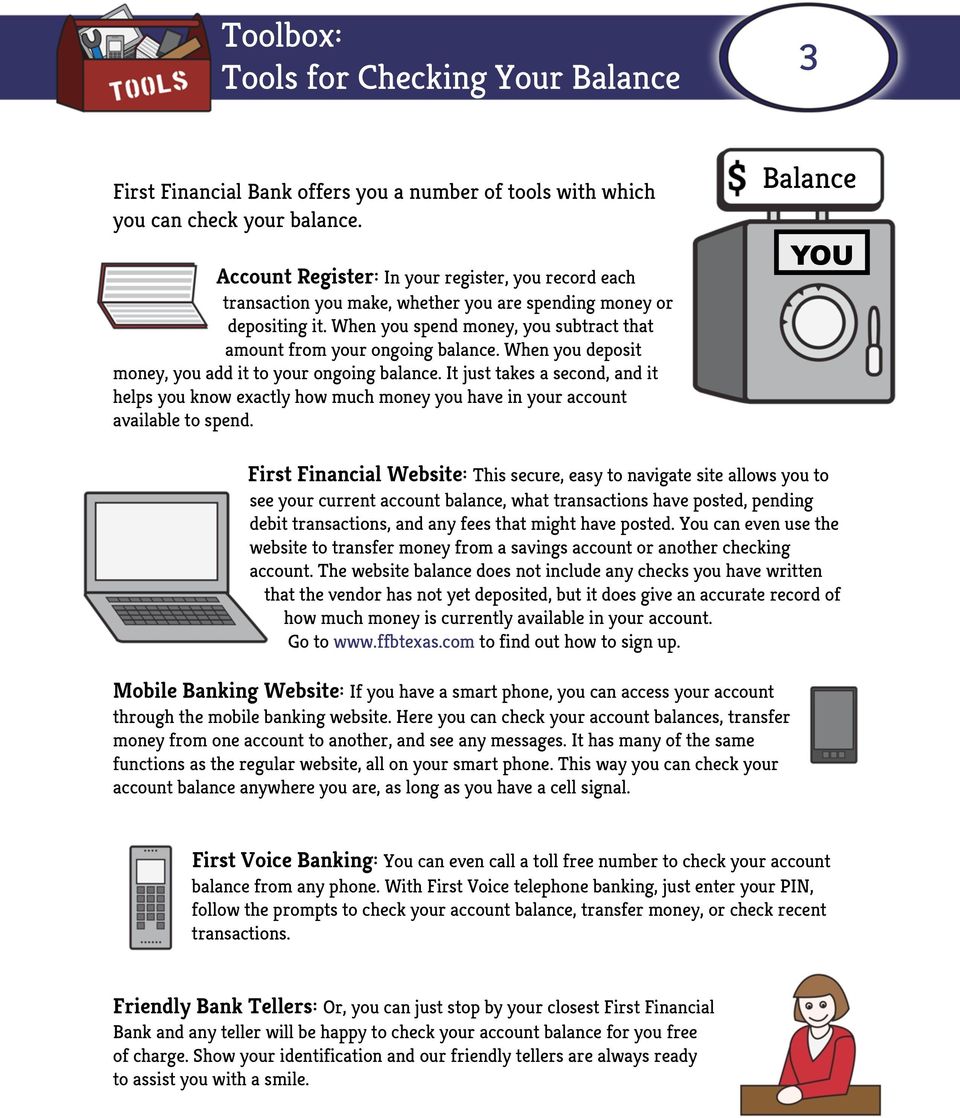
3 Toolbox: Tools for Checking Your Balance 3 First Financial Bank offers you a number of tools with which you can check your balance. Account Register: In your register, you record each transaction you make, whether you are spending money or depositing it. When you spend money, you subtract that amount from your ongoing balance. When you deposit money, you add it to your ongoing balance. It just takes a second, and it helps you know exactly how much money you have in your account available to spend. Balance YOU First Financial Website: This secure, easy to navigate site allows you to see your current account balance, what transactions have posted, pending debit transactions, and any fees that might have posted. You can even use the website to transfer money from a savings account or another checking account. The website balance does not include any checks you have written that the vendor has not yet deposited, but it does give an accurate record of how much money is currently available in your account. Go to to find out how to sign up. Mobile Banking Website: If you have a smart phone, you can access your account through the mobile banking website. Here you can check your account balances, transfer money from one account to another, and see any messages. It has many of the same functions as the regular website, all on your smart phone. This way you can check your account balance anywhere you are, as long as you have a cell signal. First Voice Banking: You can even call a toll free number to check your account balance from any phone. With First Voice telephone banking, just enter your PIN, follow the prompts to check your account balance, transfer money, or check recent transactions. Friendly Bank Tellers: Or, you can just stop by your closest First Financial Bank and any teller will be happy to check your account balance for you free of charge. Show your identification and our friendly tellers are always ready to assist you with a smile.
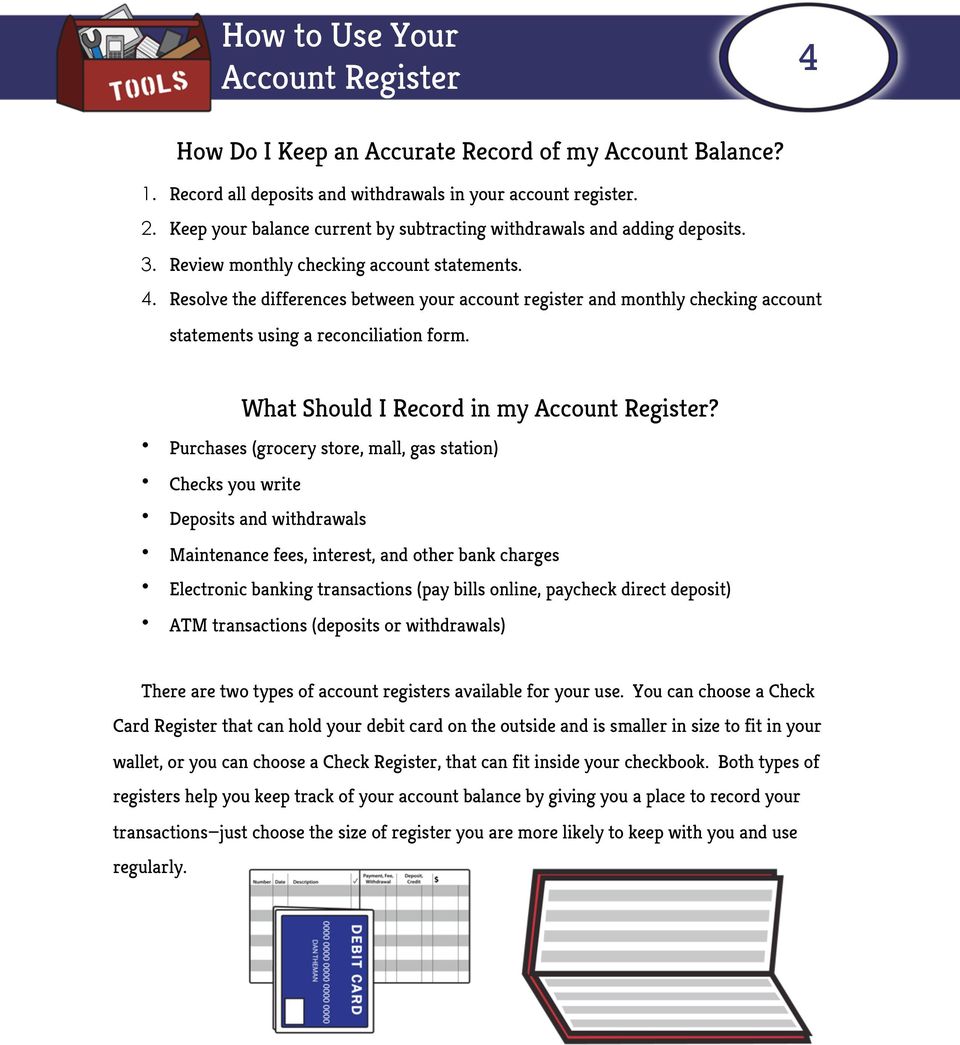
4 How to Use Your Account Register 4 How Do I Keep an Accurate Record of my Account Balance? 1. Record all deposits and withdrawals in your account register. 2. Keep your balance current by subtracting withdrawals and adding deposits. 3. Review monthly checking account statements. 4. Resolve the differences between your account register and monthly checking account statements using a reconciliation form. What Should I Record in my Account Register? Purchases (grocery store, mall, gas station) Checks you write Deposits and withdrawals Maintenance fees, interest, and other bank charges Electronic banking transactions (pay bills online, paycheck direct deposit) ATM transactions (deposits or withdrawals) There are two types of account registers available for your use. You can choose a Check Card Register that can hold your debit card on the outside and is smaller in size to fit in your wallet, or you can choose a Check Register, that can fit inside your checkbook. Both types of registers help you keep track of your account balance by giving you a place to record your transactions just choose the size of register you are more likely to keep with you and use regularly.
5 Differences Between Debit & Credit Cards 5 Debit Card Credit Card When do I pay? Buy now, pay now. Buy now, pay later. Whose money am I spending? You are spending your own money from your checking account. You are borrowing a bank s money to pay back to the bank later. Will I be charged interest? Are there any fees? There are no interest charges because it is your money. You may be charged fees on certain transactions (for example: withdrawing money from your account at an ATM without your bank s name). Overdraft fees are usually larger than other fees because it is such a specialized service. You will be charged interest if you do not pay off your balance, or if your credit card company does not offer a grace period (time to pay off your balance without accumulating interest charges). Fees and penalties will be charged if your payments are not on time. Some credit cards charge yearly fees. If your credit card company does not offer a grace period, you may be charged certain fees for your unpaid balance. Other Possible Benefits Using a debit card is faster and easier than writing a check. A debit card can be replaced, but lost cash cannot be replaced. Some debit card companies may offer free items or rebates (returned money). With enough money in your account, you can pay for purchases without borrowing money or being charged interest. Some credit card companies offer free items (for example: cash rebates, or bonus points) You can withhold payment (not pay) on charges under question. Some credit card companies offer protection plans for defective items. Your credit score may go up and you may qualify for lower interest rates on loans if you manage your credit card well (for example: paying your bill on time every time). Other Possible Concerns Usually, no protection plans are offered for defective items purchased. If you do not have enough money in your account, you will need another way to pay for unexpected emergencies (for example: a car repair). You may over-spend because the credit limit may be higher than you can afford to pay back. You will pay interest if you do not pay your entire balance each month, or if your credit card company does not offer a grace period. Interest is expensive if you only pay the minimum amount due each month.

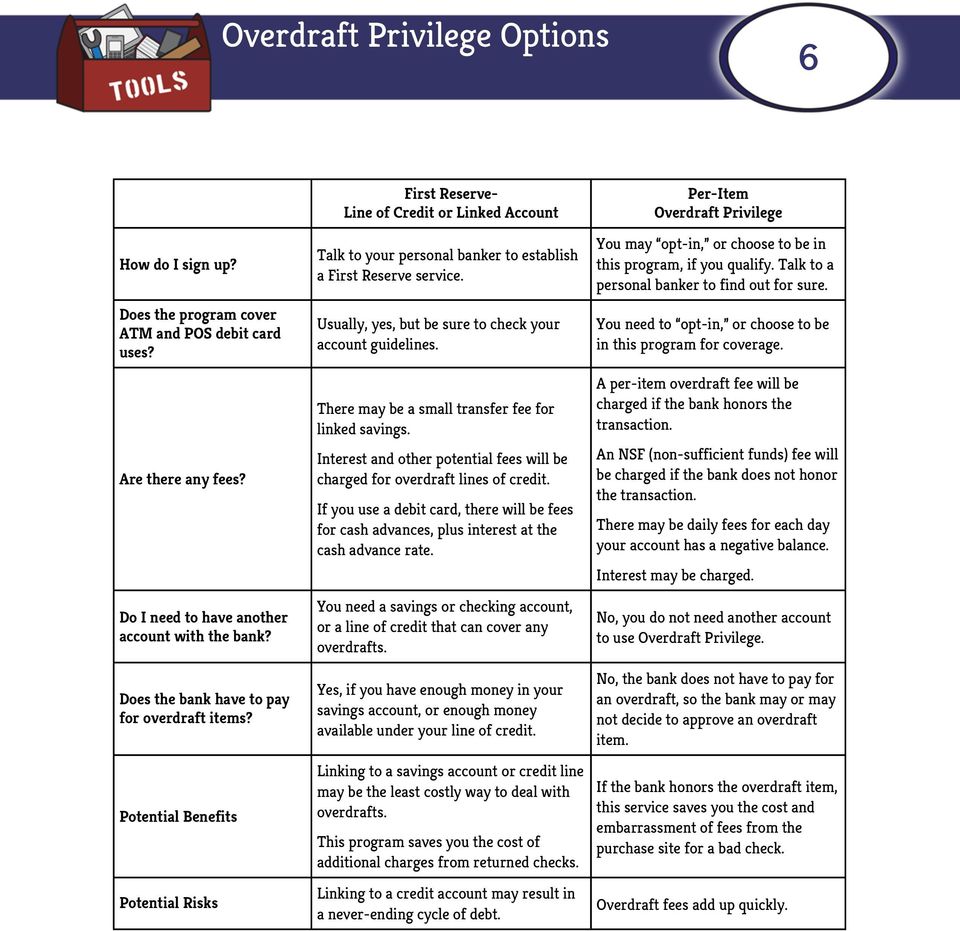
6 Overdraft Privilege Options 6 How do I sign up? Does the program cover ATM and POS debit card uses? Are there any fees? Do I need to have another account with the bank? Does the bank have to pay for overdraft items? Potential Benefits Potential Risks First Reserve- Line of Credit or Linked Account Talk to your personal banker to establish a First Reserve service. Usually, yes, but be sure to check your account guidelines. There may be a small transfer fee for linked savings. Interest and other potential fees will be charged for overdraft lines of credit. If you use a debit card, there will be fees for cash advances, plus interest at the cash advance rate. You need a savings or checking account, or a line of credit that can cover any overdrafts. Yes, if you have enough money in your savings account, or enough money available under your line of credit. Linking to a savings account or credit line may be the least costly way to deal with overdrafts. This program saves you the cost of additional charges from returned checks. Linking to a credit account may result in a never-ending cycle of debt. Per-Item Overdraft Privilege You may opt-in, or choose to be in this program, if you qualify. Talk to a personal banker to find out for sure. You need to opt-in, or choose to be in this program for coverage. A per-item overdraft fee will be charged if the bank honors the transaction. An NSF (non-sufficient funds) fee will be charged if the bank does not honor the transaction. There may be daily fees for each day your account has a negative balance. Interest may be charged. No, you do not need another account to use Overdraft Privilege. No, the bank does not have to pay for an overdraft, so the bank may or may not decide to approve an overdraft item. If the bank honors the overdraft item, this service saves you the cost and embarrassment of fees from the purchase site for a bad check. Overdraft fees add up quickly.
7 Glossary: Learning the Language of Banking 7 Account Register: A small book you can use to write down all of your deposits, withdrawals, and purchases made with your account, including any fees or monthly charges. Automated Teller Machine (ATM): A computer terminal where you can deposit cash and checks into your account or withdraw cash from your account at any time. Budget: A list of items you need to spend money for (for example: monthly bills, groceries, and clothing), and approximate amounts of money needed for each item, to be compared with your estimated income for a set amount of time. Check: A written promise between you and your bank. When you write a check, you are asking the bank to take money from your account and give it to someone else. Checking Account: A personal, secure place to keep your money at a bank, from which you can write checks to pay bills and buy items. Your bank will send you a monthly statement that lists all the deposits, withdrawals, and purchases you made that month. Debit Card: A card that allows you to deposit cash into and withdraw money from your checking account at many ATMs, and make purchases at stores that accept credit cards (for example: grocery stores, department stores, or gas stations). Deposit: A transaction where money is added to your account. This could be when you deposit a check or cash into your account, or when your bank pays you interest. Deposit Slip: A piece of paper used to let the bank teller know how much and what forms of money you are depositing into your account. Direct Deposit: An automated, electronic method for transferring and depositing money directly into your account. Endorsement: The act of signing the back of a check so that you can deposit or cash the check. Electronic Banking: Using computers to move money to and from your account, instead of using checks and other paper transactions. This includes all debit card transactions, electronic bill pay, and ATM transactions. Electronic Bill Pay: A service that automatically takes money from your account to pay your bills. Fee: The amount charged by banks for your account activities and services. Fee Schedule: A document given by the bank that lists the fees you might be charged for certain account activities. Interest: A percentage of money paid in exchange for borrowing money. Overdraft Privilege (ODP): A service from your bank that will help pay for a transaction if your account doesn t have enough money in it to cover the transaction. You don t have to sign a contract for this service, but your account must be qualified to receive this service. Point of Sale (POS): A transaction where you use your debit card at a store s checkout register to buy your items. Reconciliation: The act of fixing the difference between your account s monthly statement balance and your account register balance. Transaction: Any banking activity. For example: depositing or withdrawing money, using an ATM or debit card, or having checks direct-deposited into your account. Withdrawal: The act of taking money out of your bank account.
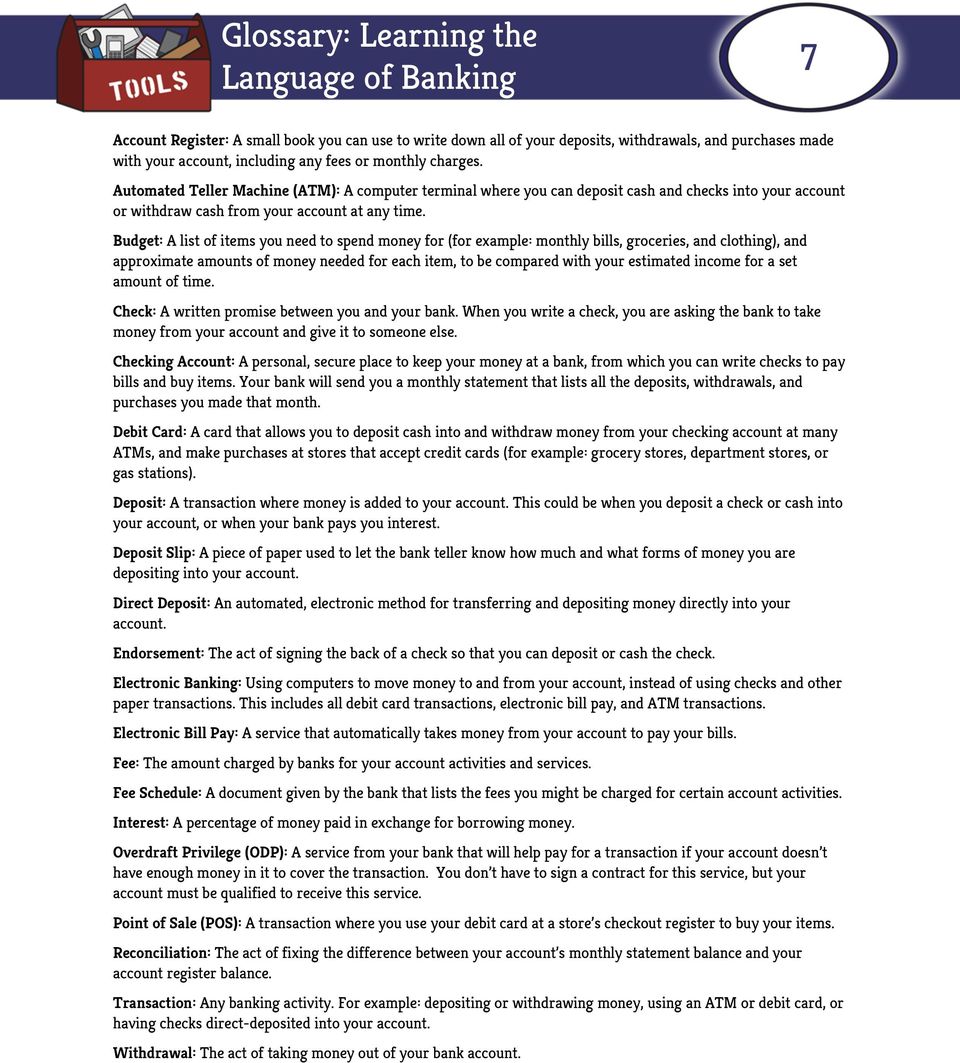
8 Instructions for Activity 2, Page 1 of 4 8 Reconciling Your Register with Your Statement 1. Separate pages 8, 9, 10, and 11 from the rest of your packet so you can see them without flipping back and forth. 2. At the top of your reconciliation form (page 11), write down your account balance according to your monthly statement. 3. Look at your account register (page 14) and monthly account statement (pages 9 and 10). Make a checkmark in your account register next to the items that appear on the statement. 4. List and add up the deposits or credits you recorded in your account register that do not appear on the statement, and add the total to the account balance at the top. Record the new total on the appropriate line. 5.List and add up the withdrawals or debits you recorded in your account register that do not appear on the statement, and subtract the total from the new balance from step 3. Record the updated balance on the last line of the reconciliation form. This total should match your new account register balance.
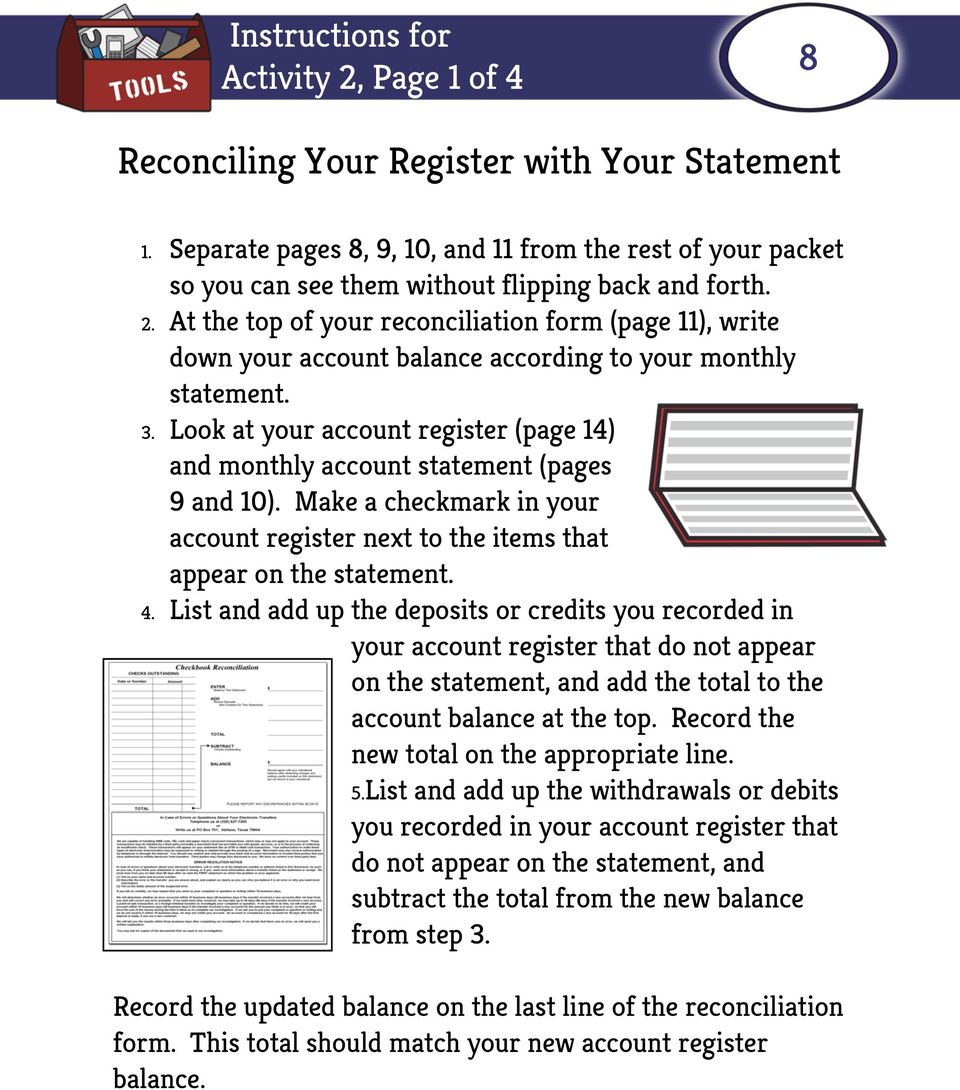
9 Statement for Activity 2, Page 2 of 4 9
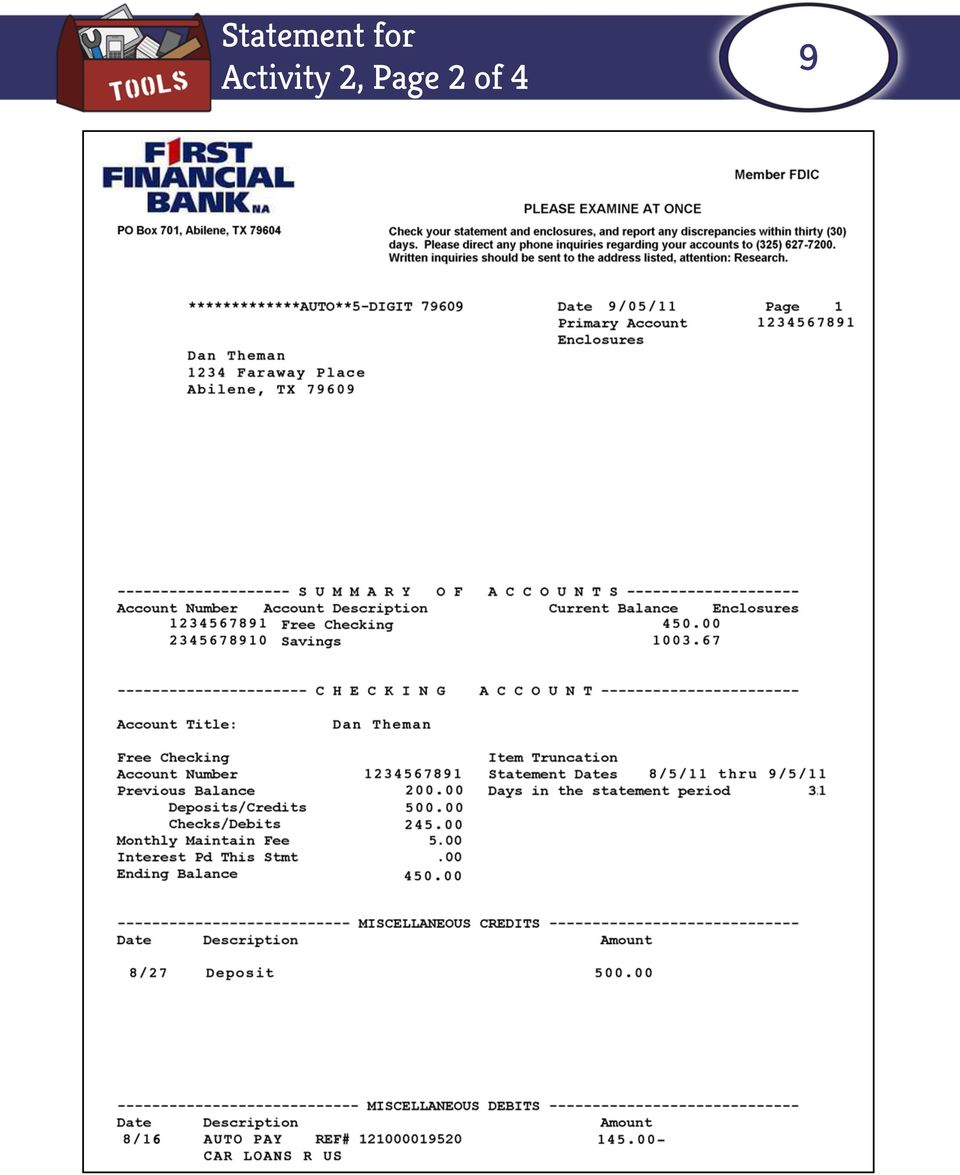
10 Statement for Activity 2, Page 3 of 4 10

11 Reconciliation Form for Activity 2, Page 4 of 4 11

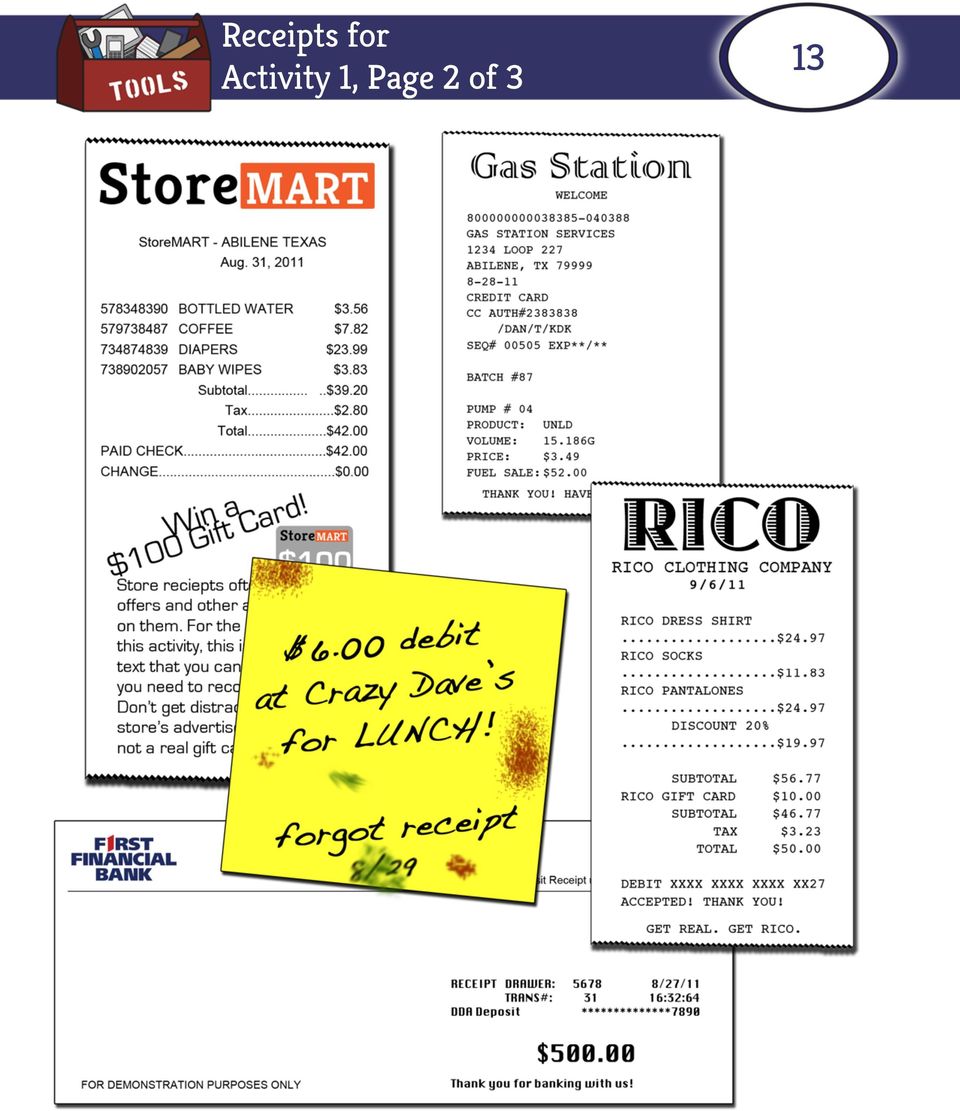
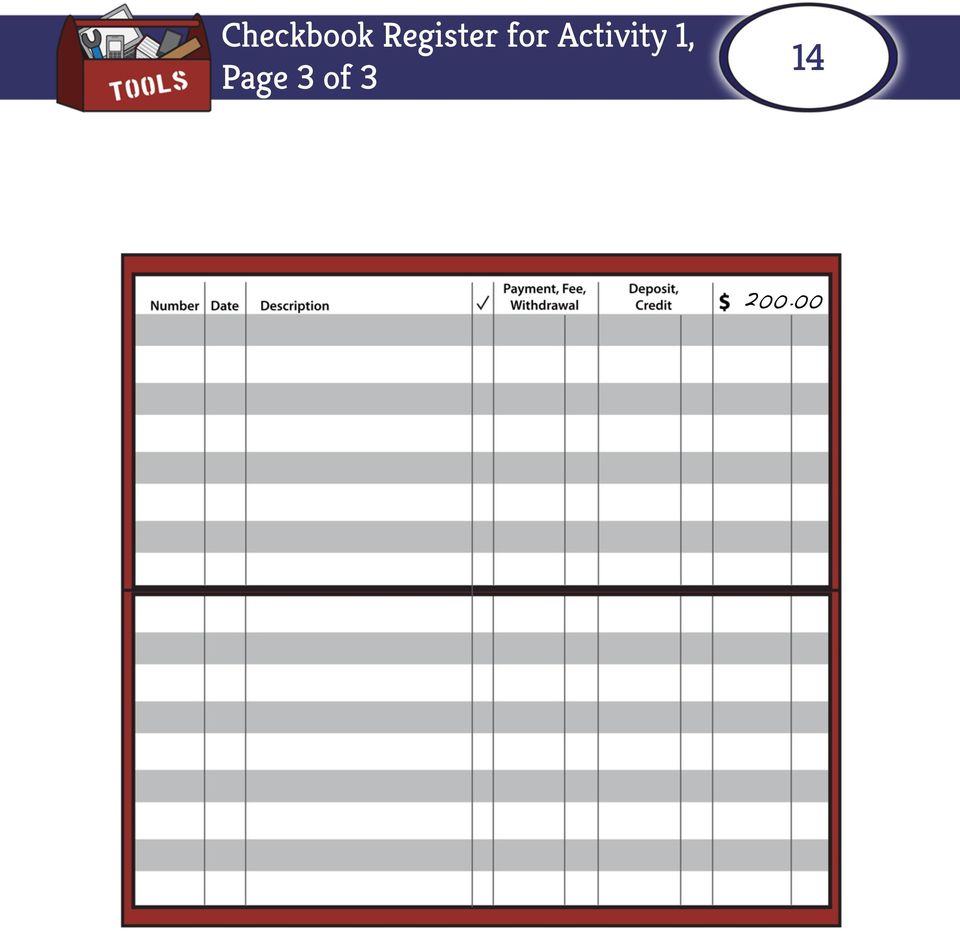
12 Instructions for Activity 1, Page 1 of 3 12 Balancing Your Checkbook Separate pages 12, 13, and 14 from the rest of the packet so you can see them all without flipping back and forth. Fill out your account register (page 14) by entering the information from the receipts and deposit slips (page 13) and calculate a new balance after each transaction. Be sure to include the date, description (usually the location of purchase), type of transaction (payment, fee, withdrawal, deposit, or credit), and dollar amount. Your starting balance is $ /8 StoreMART ! groceries 9/8 Deposit!!!! paycheck debit 9/9 Fannie s Flowers 5.75! flowers for Mom debit 9/10 RICO 12.23! ! cool socks
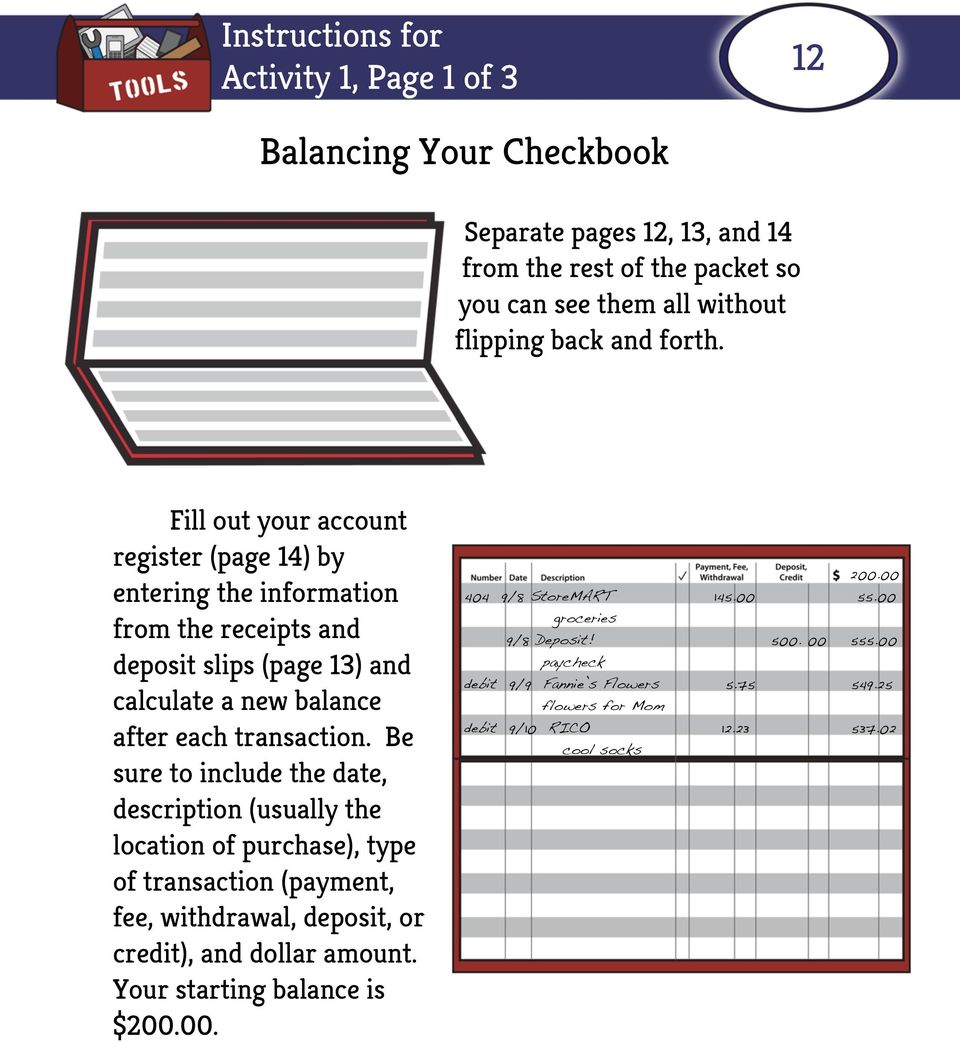
13 Receipts for Activity 1, Page 2 of 3 13
14 Checkbook Register for Activity 1, Page 3 of
CHECKING 101 EDUCATION. Practice & Reference Material
 CHECKING 101 EDUCATION Practice & Reference Material BOOKLET INFORMATION Thank you for your willingness to learn more about managing your checking account and how to better use the tools Academy Bank offers
Participant Guide Building: Knowledge, Security, Confidence FDIC Financial Education Curriculum
 Check It Out Building: Knowledge, Security, Confidence FDIC Financial Education Curriculum TABLE OF CONTENTS Page Determining Your Checking Account Needs 1 Checking Account Fees 2 Practice Exercise: Choosing
TABLE OF CONTENTS. Introduction 3. General Guidelines for Successful Account Management 3. Managing Your Checking Account. 1.
 TABLE OF CONTENTS Introduction 3 General Guidelines for Successful Account Management 3 Managing Your Checking Account 1. Check Register 2. Planning 3. Recording Your Transactions 4. Balancing Your Account
MBTeam Banking. Personal Banking Checking Basics
 MBTeam Banking Personal Banking Checking Basics What is a Checking Account? A checking account allows you to write checks or use a debit card to pay bills and buy goods. Benefits of a Checking Account
Banking Basics 101. How to Manage Your Finances and Still Have Money Left Over For Pizza. Course objectives learn about:
 Banking Basics 101 Course objectives learn about: Using a checking account Various types of payment vehicles Benefits of a savings account How to Manage Your Finances and Still Have Money Left Over For
How to Use a Financial Institution
 How to Use a Financial Institution Latino Community Credit Union & Latino Community Development Center HOW TO USE A FINANCIAL INSTITUTION LATINO COMMUNITY CREDIT UNION & LATINO COMMUNITY DEVELOPMENT CENTER
TABLE OF CONTENTS. Introduction 3. General Guidelines for Successful Account Management 3. Managing Your Checking Account. 1.
 TABLE OF CONTENTS Introduction 3 General Guidelines for Successful Account Management 3 Managing Your Checking Account 1. Check Register 2. Planning 3. Recording Your Transactions 4. Balancing Your Account
CHECKING BASICS101. 701.255.0042 www.capcu.org
 CHECKING BASICS101 701.255.0042 www.capcu.org This book is intended as a general guide to the topics discussed, and it does not deliver accounting, personal finance, or legal advice. It is not intended,
Student Activities. Lesson Six. Banking Services 07/10
 Student Activities $ Lesson Six Banking Services 07/10 name: date: choosing a checking account name of bank: branch information Branch nearest your home: Branch nearest your work: Number of branches: number
Account a service provided by a bank allowing a customer s money to be handled and tracks money coming in and going out of the account.
 Account a service provided by a bank allowing a customer s money to be handled and tracks money coming in and going out of the account. Account fee the amount charged by a financial institution for the
Teacher's Guide. Lesson Six. Banking Services 04/09
 Teacher's Guide $ Lesson Six Banking Services 04/09 banking services websites Students will make wise choices about their banking services once they understand such fundamentals as: selecting and managing
Share Draft/Checking Account Basics
 Goals Share Draft/Checking Account Basics By the end of this session, students will be able to explain and understand: How and why checks are used What factors to compare when shopping for an account How
BANKING BASICS WHY YOU WANT TO KEEP YOUR MONEY IN THE BANK
 BANKING BASICS WHY YOU WANT TO KEEP YOUR MONEY IN THE BANK REASONS TO KEEP MONEY IN A BANK Why keep your money in a bank? Safety Convenience Cost Security Financial Future BENEFITS OF CHECKING ACCOUNTS
lesson six banking services supplemental materials 04/09
 lesson six banking services supplemental materials 04/09 banking terms account Money deposited with a financial institution for investment and/or safekeeping purposes. assets Items of monetary value (e.g.,
Welcome. 1. Agenda. 2. Ground Rules. 3. Introductions. Check It Out 2
 Check It Out Welcome 1. Agenda 2. Ground Rules 3. Introductions Check It Out 2 Objectives: Part 1 State the benefits of using a checking account Determine which checking account is best for you Identify
Checking 101. Property of Penn State Federal Credit Union
 Checking 101 Checking 101 Checking Account Basics A check is a written order that represents cash Credit Union checking accounts are also called SHARE DRAFT accounts A share draft is equivalent to a check,
Standard 4: The student will demonstrate the ability to balance a checkbook and reconcile financial accounts. Standard 4.
 TEACHER GUIDE 4.1 MANAGING A BANK ACCOUNT PAGE 1 Standard 4: The student will demonstrate the ability to balance a checkbook and reconcile financial accounts. Standard 4. Tracking Your Money Priority Academic
Instructor Guide Building: Knowledge, Security, Confidence FDIC Financial Education Curriculum
 Check It Out Building: Knowledge, Security, Confidence FDIC Financial Education Curriculum TABLE OF CONTENTS Page Module Overview 1 Purpose 1 Objectives 1 Time 1 Materials and Equipment Needed to Present
Standard 4: The student will demonstrate the ability to balance a checkbook and reconcile financial accounts. Standard 4.
 STUDENT MODULE 4.1 MANAGING A BANK ACCOUNT PAGE 1 Standard 4: The student will demonstrate the ability to balance a checkbook and reconcile financial accounts. Standard 4. Tracking Your Money Alexis stops
OVERDRAFT PRIVILEGE PROGRAM
 OVERDRAFT PRIVILEGE PROGRAM At times, unanticipated expenses or unforeseen problems can leave you with too little cash in your checking account. Having a check returned due to insufficient funds can be
keeping a running balance
 keeping a running balance Record checks, a check card payment, an ATM transaction and a deposit in the checkbook register below. Include the date, description, and amount of each entry. Calculate the balance.
How To Understand How To Get A Bank Account
 Opening a Bank Account Section Objectives A basic component in establishing financial independence is Opening a Bank Account. Banking services are essential tools for managing personal finances and building
Personal Banking 101 Interested in learning about how to manage your money? Personal Banking 101 will help you understand the financial fundamentals.
 Personal Banking 101 Interested in learning about how to manage your money? Personal Banking 101 will help you understand the financial fundamentals. Checking Account If you need a safe place to keep your
CHECKING ACCOUNTS and ATM TRANSACTIONS
 Grades 6-8 Lesson 1 CHECKING ACCOUNTS and ATM TRANSACTIONS Key concepts: Checking accounts, ATMs, debit cards, credit cards, bank fees and regulation, safeguarding personal information Summary: This lesson
Anytime Adviser Checking Account Coach
 Anytime Adviser Checking Account Coach Welcome. This interactive guide coaches you in managing your checking account. You may move from chapter to chapter by selecting headings from the left. Click on
lesson six banking services overheads
 lesson six banking services overheads beware of these high-cost financial services pawn shops charge very high interest for loans based on the value of tangible assets (such as jewelry or other valuable
Introductions. Student Introductions. Purpose. Objectives (Continued) Objectives
 Introductions Instructor and student introductions Module overview 1 2 Your name Student Introductions Your expectations, questions, and concerns about checking accounts Purpose will teach you how to use
Checking 101. Checking Out Checking Accounts
 Checking 101 Checking Out Checking Accounts Checking Account Basics A check is a written order that represents cash Credit Union checking accounts are also called SHARE DRAFT accounts A share draft is
keeping a running balance answer key
 keeping a running balance answer key record deposits and keep a running balance in the checkbook register below. 1. On May 26, your balance is $527.96. 2. On May 27, you write check #107 to your landlord,
FINANCIAL/BANKING LITERACY ASSISTANCE FOR LATINO AMERICANS
 FINANCIAL/BANKING LITERACY ASSISTANCE FOR LATINO AMERICANS REASONS WHY YOU SHOULD OPEN A BANK ACCOUNT Safety Carrying cash on payday or keeping large amounts of money at home or in your wallet can make
Using my PAYCHEK PLUS!
 Using my PAYCHEK PLUS! Saving Money Pay day 300 Cost 7.50 2.5% of check 1.75* per visit * Or, get my entire paycheck cashed free by using my first free transaction per pay period to purchase a US Post
Managing your checking account.
 We re here for you We hope you have found this guide helpful. In the future, anytime you have a question about your account, visit a Webster branch or call us. You can rely on Webster for whatever assistance
Checking and Banking
 Chapter 5 Checking and Banking 5.1 Checking Accounts 5.2 Banking Services and Fees Lesson 5.1 Checking Accounts Learning Objectives LO 1-1 Describe the purpose of a checking account and the forms associated
Banking Procedures. Online Resources CHAPTER 5
 CHAPTER 5 Banking Procedures Getty Images/PhotoDisc C hapter 5 discusses banking activities for consumers and banking in the United States. Many benefits and services for consumers are available from financial
Getting and Keeping A Checking Account
 Getting and Keeping A Checking Account You've decided to get a checking account. That's a good idea. Your money will be safe and you'll have a record of what you've paid for. You'll know how much you have
Checking Account. Money Smarts for Kids. Money Skills for Life. Member FDIC. Welcome! What Is a Checking Account? Why Is a Checking Account So Great?
 Checking Account Welcome! Welcome to Young Americans Bank, the only bank in the world designed specifically for young people! Mr. Bill Daniels started Young Americans Bank in 1987 because he thought it
lesson six banking services overheads
 lesson six banking services overheads beware of these high-cost financial services pawn shops charge very high interest for loans based on the value of tangible assets (such as jewellery or other valuable
How to manage manage your your checking checking account. account.
 How How to manage to manage your your checking checking account. account. Introduction Welcome to Desert Schools Federal Credit Union. Congratulations on your first checking account! It s the perfect time
lesson six using banking services teacher s guide
 lesson six using banking services teacher s guide using banking services web sites web sites for banking services The Internet is probably the most extensive and dynamic source of information in our society.
HIGH YIELD CHECKING. EXPLANATION OF SOME OF OUR KEY SERVICES AND CHARGES Here are details about High Yield Checking services.
 EXPLANATION OF SOME OF OUR KEY SERVICES AND CHARGES Here are details about High Yield Checking services. KEY ACCOUNT TERMS AND CHARGES: Monthly Service Charge: No monthly service charge. Includes free
Table of Contents. Module Summary... 37 Knowledge Check... 38. Module 2: Check It Out Participant Guide. Money Smart for Young Adults Modules...
 Table of Contents Money Smart for Young Adults Modules...3 Your Guides...4 pre-assessment...5 Checking In...6 Welcome... 6 Purpose... 6 Objectives... 6 Agenda and Ground Rules... 7 Student Materials...
Unit 2 The Basic Accounting Cycle
 Unit 2 The Basic Accounting Cycle Chapter 3 Chapter 4 Chapter 5 Chapter 6 Chapter 7 Chapter 8 Chapter 9 Business Transactions and the Accounting Equation Transactions That Affect Assets, Liabilities, and
Using Banking Services
 Teacher's Guide $ Lesson Six Using Banking Services 04/09 using banking services websites websites for banking services The internet is probably the most extensive and dynamic source of information in
Frequently Asked. Questions. Cash Solution TM PIN Prepaid Debit Card
 0 Frequently Asked Questions TM Cash Solution TM PIN Prepaid Debit Card Frequently Asked Questions About this booklet Moneytree has compiled the information in this booklet to help you understand and use
Credit: The Good and the Bad
 Managing Your Credit Effectively Credit can be a valuable addition to your financial toolbox if you use it carefully and sensibly. Credit means someone is willing to loan you money called Principal in
Uneasy about getting started? Not to worry. SageLink Credit Union has trained employees to help you every step of the way.
 Checking If you re like most young adults, you spend a lot of time thinking about money. How to get money? What to spend your money on? Where to keep your money in between? A MoneyLink Checking account
Personal Financial Literacy: Checking
 Personal Financial Literacy: Checking Overview In this lesson, students will learn the benefits of checking accounts, as well as precautions one must take with these accounts. They will practice using
Purpose of a Checking Account- Money is deposited into an account and checks or drafts can be written to withdraw money from the account.
 CHAPTER 9 CHECKING ACCOUNTS AND BANKING SERVICES Purpose of a Checking Account- Money is deposited into an account and checks or drafts can be written to withdraw money from the account. Demand Deposit-
Checking Account Management
 Checking Account Management 595 Market Street, 16th Floor San Francisco, CA 94105 888.456.2227 www.balancepro.net Whether you have a history of overdraft or nonsufficient funds charges or you just want
PAYROLL CARD FREQUENTLY ASKED QUESTIONS
 The following document provides answers to frequently asked questions regarding the Umpqua Bank Payroll Card. Contact Customer Care at 800-650-7141 with questions. Card Basics Q. How does the Payroll Card
Monthly Service Charge: $8.95 Includes free Debit Cards, usage of Capital One Bank image-enabled ATMs, and access to our extensive Branch Network.
 EXPLANATION OF VARIOUS KEY SERVICES AND CHARGES Here are some details about Regular Checking services. KEY ACCOUNT TERMS AND CHARGES: Monthly Service $8.95 Includes free Debit Cards, usage of Capital One
Adults Version. Instructor guide. 2003, 2012 Wells Fargo Bank, N.A. All rights reserved. Member FDIC. ECG-714394
 Adults Version Instructor guide 2003, 2012 Wells Fargo Bank, N.A. All rights reserved. Member FDIC. ECG-714394 Welcome to Wells Fargo s Hands on Banking program! This fun, interactive, and engaging financial
Basic Banking. 2) Money that a bank allows you to borrow and pay back with interest
 Basic Banking When choosing a bank, you should look for a bank that offers the type of accounts and services you are looking for. You might look for convenience of branch locations, great customer service,
Vocabulary Financial Institutions Student Worksheet
 Vocabulary Student Worksheet Page 1 Name Period Primary 1. Bounced Check: Vocabulary Financial Institutions Student Worksheet 2. ATM Charge: 3. Stop Payment Fee: 4. Travelers Checks: 5. ATM: 6. FDIC: 7.
ABCs OF IBC. ibc.com A GUIDE TO MANAGE YOUR ACCOUNT TW 8/14
 ABCs OF IBC A GUIDE TO MANAGE YOUR ACCOUNT ibc.com TW 8/14 Banking is as Easy as IBC Congratulations on opening your new IBC checking account. A checking account is a convenient way to manage your finances.
CHECKING ACCOUNTS AND ALTERNATIVE BANKING METHODS
 Grades 2-3 Lesson 3 CHECKING ACCOUNTS AND ALTERNATIVE BANKING METHODS Key concepts: Types of payment, checking accounts, interest, ATM transactions, credit cards, purposes of saving Summary: This lesson
COLLEGE. Going from high school to college. Getting Ready for College CHAPTER 1. Getting organized
 CHAPTER 1 COLLEGE Getting Ready for College Going from high school to college means taking more difficult classes, meeting new people, and setting your own hours. But it also means taking charge of your
How To Get A Checking Account In The United States
 Date Here Welcome University of Michigan International Students U.S. Banking System Overview Banking is regulated by federal and state governments Privacy Disclosure Fraud protection Protection against
What You Need to Know about Overdrafts and Overdraft Fees
 What You Need to Know about Overdrafts and Overdraft Fees An overdraft occurs when you do not have enough money in your account to cover a transaction, but we pay it anyway. We can cover your overdrafts
Dimes to Riches Money Management for Teens in Grades 7-12
 Dimes to Riches Money Management for Teens in Grades 7-12 s e e r t n o row g t n s e o yd e n o M t a! h k t n a w b o n a k t u n By now yo Your parents are & Life is getting busy and you need cash for
Managing Your Checking Account
 Managing Your Checking Account Overview At River Valley we strive to provide value to all of our customers and partners. This module was developed to help you: Better Manage Your Checking Account. Avoid
Personal Financial Skills: WORKBOOK 2: Working With Checking and Savings Accounts
 Personal Financial Skills: WORKBOOK 2: Working With Checking and Savings Accounts Personal Financial Skills Realizing Your Financial Goals Whether you want to buy a home, start a business or pay off your
FREQUENTLY ASKED QUESTIONS GENERAL
 FREQUENTLY ASKED QUESTIONS GENERAL What does electronic payment mean to me? What options do I have? What is the best option for me? Can I choose to receive a paper check instead of an electronic payment?
Part I: Checks and Checking Concepts
 Part I: Checks and Checking Concepts Managing a checking account is an easy, step-by-step process that anyone can learn. In spite of the rise of ATM, debit and credit cards, direct deposit, automatic bill
Learn to Manage Your Checking Account and Protect Your Money
 Managing Your Checking Account Learn to Manage Your Checking Account and Protect Your Money Benefits of Your Checking Account Maintaining your TFCU share draft (checking) account responsibly and accurately
Take Charge of Your Own Checking Account ASSESSMENT ONE: Assessment #1
 Assessment #1 ASSESSMENT ONE: Knowledge ο T / F You can only deposit checks into a checking account. ο T / F When using a debit card to make a purchase, the money will immediately be be withdrawn from
Overdraft Protection Programs
 Overdraft Protection Programs The Department has become aware that several banks have implemented various vendor-designed or in-house Programs to generate income resulting from consumers writing checks
Checking Account & Debit Card Simulation. Understanding Checking Accounts and Debit Card Transactions
 Checking Account & Debit Card Simulation Understanding Checking Accounts and Debit Card Transactions What is a Checking Account? Common financial service used by many consumers Funds are easily accessed
Checking Account Workbook. By:
 Checking Account Workbook By: Opening a checking account: One of the safest and easiest ways to manage your money is through a checking account. When you open a checking account make sure you have the
Unit 5: Banking Options
 Read Chapter 5 in the text. Unit 5: Banking Options Read this unit including websites. Suggestions: you may want to write down some key points. This information will be very basic for some of you. For
Checking Accounts. Open, Manage, and Reconcile
 Checking Accounts Open, Manage, and Reconcile 1. What is a checking account? A checking account is opened at a bank or other financial institution. Banks offer several different types of checking accounts.
DEBIT/ATM CARD APPLICATION
 DEBIT/ATM CARD APPLICATION APPLICANT: Last Name: First Name: M.I. Street Address: Apt. # / PO Box: City: State: Zip: Day Telephone #: Evening Telephone # Debit Card ATM Card SECOND APPLICANT: Last Name:
It lets you pay for expenses you could not afford with cash, such as a college education, a new vehicle, furniture or a home.
 USING CREDIT WISELY Credit Is An Important Financial Tool It lets you pay for expenses you could not afford with cash, such as a college education, a new vehicle, furniture or a home.
Checking Account. Check writing ability. ATM/Debit Card. Direct Deposit capabilities. Online Banking & Bill Pay
 Banking 101 Banking 101 Contents Checking Accounts Savings Accounts Balancing Checkbook Clearing Transactions Overdrawn Accounts ATM/Debit Card Direct Deposit Online Banking 2 Checking Account Check writing
DEPOSIT ACCOUNT AGREEMENT
 DEPOSIT ACCOUNT AGREEMENT All America Bank P.O. Box 300 Mustang, OK 73064 November 17, 2015 This disclosure contains information about terms, fees, and interest rates for some of the accounts we offer.
Checking Account & Debit Card Simulation and Student Worksheet. Understanding Checking Accounts and Debit Card Transactions
 Checking Account & Debit Card Simulation and Student Worksheet Understanding Checking Accounts and Debit Card Transactions What is a Checking Account? Common financial service used by many consumers Funds
Bank Products. 3.1 Introduction
 Bank Products Bank Products For many people, the first financial institution they deal with, and the one they use most often, is a bank or credit union. That s because banks and credit unions provide a
THIS AGREEMENT CONTAINS PROVISIONS FOR BINDING ARBITRATION AND WAIVER OF JURY TRIAL (SEE "ARBITRATION AGREEMENT" UNDER ACCOUNT AGREEMENT).
 This booklet was prepared for the customers of The Provident Bank who have accounts and services that will be transferred to OceanFirst Bank according to the information included in the accompanying booklet.
Welcome! You ve made a wise choice opening a savings account. There s a lot to learn, so let s get going!
 Savings Account Welcome! Welcome to Young Americans Bank, the only bank in the world designed specifically for young people! Mr. Bill Daniels started Young Americans Bank in 1987 because he thought it
What is a Checking Account? Checking Account & Debit Card Simulation. What is a Check? Bouncing a Check. Other Checking Components
 Checking Account & Debit Card Simulation Understanding Checking Accounts and Debit Card Transactions What is a Checking Account? Common financial service used by many consumers Funds are easily accessed
Table of Contents... 1. Money Smart... 2. Check It Out... 3. Determine Your Checking Account Needs... 4. Checking Account Fees...
 $ Table of Contents Table of Contents... 1 Money Smart... 2 Check It Out... 3 Determine Your Checking Account Needs... 4 Checking Account Fees... 5 Types of Checking Accounts... 7 Choosing a Checking Account...
TWINSTAR CREDIT UNION PO BOX 718 OLYMPIA WA 98507-0718 (360) 357-9911
 TWINSTAR CREDIT UNION PO BOX 718 OLYMPIA WA 98507-0718 (360) 357-9911 TwinStar Credit Union Visa Business Credit and Check Card Agreement THIS IS YOUR AGREEMENT WITH THE CREDIT UNION; PLEASE READ CAREFULLY.
FDIC Money Smart Financial Education Program
 Check it Out Use this tip sheet to help you in the process of selecting, opening, and maintaining a checking account. This tip sheet covers the following topics: Determining your checking account needs
516-294 Portage Ave Winnipeg, MB R3C 0B9 Phone #: (204) 989-1900 Fax #: (204) 989-1908 Toll Free #: 1-888-573-2383 E-mail: [email protected].
 516-294 Portage Ave Winnipeg, MB R3C 0B9 Phone #: (204) 989-1900 Fax #: (204) 989-1908 Toll Free #: 1-888-573-2383 E-mail: [email protected] debthelpmanitoba.com Todays Session Overview of Services Banking
Banking Basics: Choosing a Bank
 1 Banking Basics: Choosing a Bank Opening a bank account is an important step in managing your money. Every bank in New York is required to offer a basic bank account with a low minimum balance of 25 or
CHECKING ACCOUNTS. published by AAA Fair Credit Foundation
 CHECKING ACCOUNTS published by AAA Fair Credit Foundation Checking Accounts 1. What is a checking account?................................................... 2 2. Opening a checking account...................................................
Minimum Balance to Obtain APY Interest Rate Annual Percentage Yield (APY) Not Applicable Not Applicable Not Applicable. Not Applicable.
 It s important that you understand exactly how your Basic Banking checking account works. We ve created this summary to explain the fees and some key terms of your account. ELIGIBILITY The Basic Banking
Savings and Bank Accounts
 LESSON 2 Savings Savings and Bank Accounts Quick Write Suppose a relative gives you a generous gift of $1,000 for your sixteenth birthday. Your parent or guardian says that you can spend $50 on things
Learning about. Checking. Accounts WHAT YOU NEED TO KNOW. 2010 Deluxe Corp. All Right Reserved.
 Learning about Checking Accounts WHAT YOU NEED TO KNOW 2010 Deluxe Corp. All Right Reserved. Contents Learn About Checking Accounts................................3 Write a Check....................................................4
ELECTRONIC FUNDS TRANSFER AGREEMENT REG E DISCLOSURE
 ELECTRONIC FUNDS TRANSFER AGREEMENT REG E DISCLOSURE The purpose of this disclosure statement is to inform you of certain rights which you have under the Electronic Funds Transfer Act. NOTICE REGARDING
Choosing and Using a Checking Account
 LESSON 8 Choosing and Using a Checking Account Introduction Buying a new mp3 player is not a snap decision. You have to know the storage capacity of the player the larger the capacity, the more music and