
Canada-Saskatchewan Integrated Student Loan Handbook
|
|
|
- Michael Ray
- 10 years ago
- Views:
Transcription
1 Canada-Saskatchewan Integrated Student Loan Handbook Canada-Saskatchewan Integrated Student Loans Program Important Steps in Planning and Financing Your Post-Secondary Education saskatchewan.ca/studentloans CanLearn.ca

2

3 Table of Contents Introduction...1 Eligibility Criteria Residency Student Categories...2 Assistance and Benefits Maximum Weekly Levels of Assistance...3 Additional Assistance for Students with Dependants Canada and Saskatchewan Student Grants...5 Grants for Students with Permanent Disabilities...6 Applying for Full-Time Student Financial Assistance How Assistance is Calculated...8 Allowable Expenses...8 Educational Expenses Living Allowance...9 Child Care Allowance...9 Child Support and/or Alimony...9 Expected Contributions...10 Pre-Study Period Income Study Period Income Expected Parental Contribution...11 Assets...14 Registered Retirement Savings Plans (RRSPs)...14 Student Financial Assistance for Part-Time Studies Canada Student Loans for Part-Time Studies...14 Canada/Saskatchewan Student Grant for Part-Time Studies Canada Student Grant for Part-Time Students with Dependants Receiving Your Funds If this is your first student loan application:...15 Maintaining Your Eligibility While in School Your Responsibilities Keeping Government Student Loans Interest-Free Repaying Your Student Loan Consolidating Your Loan Interest on Canada Student Loans:...18 Interest on Saskatchewan Student Loans: Maintaining Your Loan While in Repayment Repayment Assistance Plan (RAP)...20 Repayment Assistance Plan Permanent Disability (RAP-PD)...20

4 Revision of Terms...20 Loan Forgiveness for Nurses and Nurse Practitioners...20 Bankruptcy and Overpayments Bankruptcy Overpayments...21 Falsified Information Student Financial Assistance Scholarships Contact Information For questions on the assessment of your loan:...23 For questions on maintaining or repaying your loan: For Saskatchewan Student Loans prior to August 1, Glossary... 25

5 Introduction The Government of Canada and the Government of Saskatchewan work together to provide student financial assistance (referred to as assistance ) in Saskatchewan. Loans, grants, and bursaries are available to help full- and part-time students access and afford postsecondary education. This handbook provides Saskatchewan students with information on applying for assistance for the loan year (August 1, 2014 to July 31, 2015). Assistance is meant to supplement, not replace, other resources to pay for post-secondary education. You may want to look at other options to keep your costs down such as: Summer employment; Internship or co-op programs offered for your program of study; Grants, bursaries and scholarships; Savings; and Funding from parents, relatives or other sources. Eligibility Criteria You are eligible to apply for full-time assistance in Saskatchewan if: You are a Saskatchewan resident, as defined by the program; You are a Canadian citizen, permanent resident or a protected person; You have financial need according to program criteria; You are enrolled or qualified to enrol as a full-time post-secondary student at a designated school in an approved program which is at least 12 weeks in length and leads to a degree, diploma or certificate. If your program has a period or periods of study of 6-11 weeks, you may be eligible if the shorter periods of study are part of a longer program; You will be taking at least 60 per cent of a full course load, or 40 per cent if you are a student with a permanent disability; Your previous student loans are in good standing (i.e., you must not have defaulted on a previous student loan); You pass a credit check if you are 22 years of age or older and applying for assistance for the first time; and You have not exhausted the lifetime maximum assistance limit. Check with your school to ensure it is designated for the purposes of student loans or by visiting CanLearn.ca and clicking on Master Designation List under the Online Tools drop down menu. Your school must be designated in order for you to receive funding. If you have questions regarding a school s designation, please contact the Student Service Centre Canada-Saskatchewan Integrated Student Loan Handbook 1

6 Residency If you have lived in Saskatchewan for at least 12 consecutive months before the first day of your study period (excluding time spent as a full-time student in a post-secondary education program) you are considered a Saskatchewan resident. Student Categories When you apply for full-time assistance, you will be classified as belonging to one of the following four categories. This category will help to determine how your financial need is calculated: A Single Dependent Student: Has no children; and Has been out of high school for less than four years before the first day of class of the current study period; or Has been in the work force for less than two years (two periods of 12 consecutive months) before the first day of class of the current study period. A Single Independent Student: Has no children; and Has been out of high school for four years or more before the first day of class of the current study period; or Has been in the workforce for at least two years (two periods of 12 consecutive months) before the first day of class of the current study period. A Married Student: Is legally married; or Is in a common-law relationship (i.e., living with the person you are in a relationship with for a minimum of 12 consecutive months before the first day of class of the current study period). A Single Parent Student: Has custody of one or more children at least 50 percent of the time; and Is not married or common-law. 2 saskatchewan.ca/studentloans

7 Assistance and Benefits Post-secondary education is a worthwhile investment but it is also a serious commitment. Being financially prepared means knowing how much your education will cost and making decisions about how you will meet your financial needs. When planning for your education, you should consider tuition costs, text books and learning materials, as well as transportation and living costs while in school. The amount of assistance you can receive, including any grants and bursaries, depends on your situation. The assessment letter you receive after applying for assistance will outline your eligibility for both provincial and federal assistance. There is a lifetime maximum limit. If you are eligible, you can receive up to 340 weeks of assistance (including interest-free status), and up to 400 weeks if you are a student in doctoral studies. Students with permanent disabilities can receive up to 520 weeks of assistance. Grants are available to students from low- and middle-income families, students with permanent disabilities and students with dependants. Grants do not need to be paid back, and students may be eligible to receive more than one grant at a time. All Saskatchewan assistance is provided first as a loan. Any provincial grants and/or bursaries will be automatically applied to your loan at the end of the study period, reducing the amount you will pay back. Any Canada Student Grants that you are eligible to receive will be paid to you at the beginning and middle of your study period. The Saskatchewan Student Bursary is available to low- and middle-income students enrolled in full-time post- secondary studies in undergraduate or lower-level programs. This bursary reduces the repayable amount by up to $140 per week of study. Graduate and medical students are not eligible for this bursary. Maximum Weekly Levels of Assistance Low-income Students Students in one-year programs Students in multiple year certificate, diploma, or undergraduate programs Students in graduate programs Canada Student Grant Canada Student Loan Saskatchewan Student Grant Saskatchewan Student Loan Total/ Weekly Assistance $0 $210 $58 $140 $408 $58 $210 $0 $140 $408 $0 $210 $58 $140 $408 Medical students $58 $210 $0 $365 $ Canada-Saskatchewan Integrated Student Loan Handbook 3

8 Middle-income Students Students in one-year programs Students in multiple year certificate, diploma, or undergraduate programs Students in graduate programs Canada Student Grant Canada Student Loan Saskatchewan Student Grant Saskatchewan Student Loan Total/ Weekly Assistance $0 $210 $23 $175 $408 $23 $210 $0 $175 $408 $0 $210 $23 $175 $408 Medical students $23 $210 $0 $365 $598 Students Above Middle- Income Students in one-year programs Students in multiple year certificate, diploma, or undergraduate programs Students in graduate programs Canada Student Grant Canada Student Loan Saskatchewan Student Grant Saskatchewan Student Loan Total/ Weekly Assistance $0 $210 $0 $198 $408 $0 $210 $0 $198 $408 $0 $210 $0 $198 $408 Medical students $0 $210 $0 $365 $575 Additional Assistance for Students with Dependants Low-Income Students with Dependants Dependants under 12 years old (or over 12 with a permanent disability), per week Dependants between 12 and 18 years old, per week Canada Student Grant Saskatchewan Student Loan Up to $47 per child $0 $0 $47 per child 4 saskatchewan.ca/studentloans

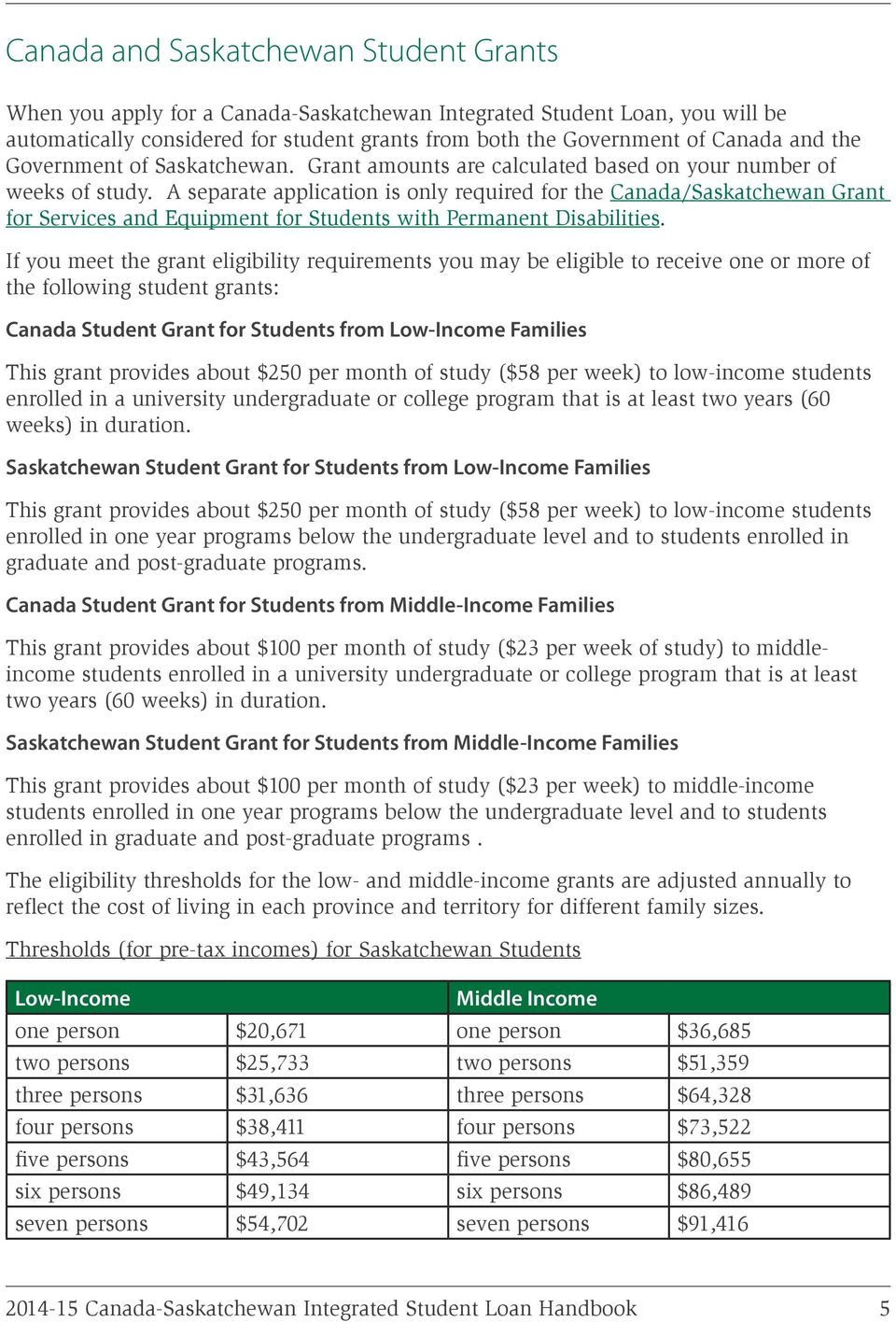
9 Canada and Saskatchewan Student Grants When you apply for a Canada-Saskatchewan Integrated Student Loan, you will be automatically considered for student grants from both the Government of Canada and the Government of Saskatchewan. Grant amounts are calculated based on your number of weeks of study. A separate application is only required for the Canada/Saskatchewan Grant for Services and Equipment for Students with Permanent Disabilities. If you meet the grant eligibility requirements you may be eligible to receive one or more of the following student grants: Canada Student Grant for Students from Low-Income Families This grant provides about $250 per month of study ($58 per week) to low-income students enrolled in a university undergraduate or college program that is at least two years (60 weeks) in duration. Saskatchewan Student Grant for Students from Low-Income Families This grant provides about $250 per month of study ($58 per week) to low-income students enrolled in one year programs below the undergraduate level and to students enrolled in graduate and post-graduate programs. Canada Student Grant for Students from Middle-Income Families This grant provides about $100 per month of study ($23 per week of study) to middleincome students enrolled in a university undergraduate or college program that is at least two years (60 weeks) in duration. Saskatchewan Student Grant for Students from Middle-Income Families This grant provides about $100 per month of study ($23 per week) to middle-income students enrolled in one year programs below the undergraduate level and to students enrolled in graduate and post-graduate programs. The eligibility thresholds for the low- and middle-income grants are adjusted annually to reflect the cost of living in each province and territory for different family sizes. Thresholds (for pre-tax incomes) for Saskatchewan Students Low-Income Middle Income one person $20,671 one person $36,685 two persons $25,733 two persons $51,359 three persons $31,636 three persons $64,328 four persons $38,411 four persons $73,522 five persons $43,564 five persons $80,655 six persons $49,134 six persons $86,489 seven persons $54,702 seven persons $91, Canada-Saskatchewan Integrated Student Loan Handbook 5
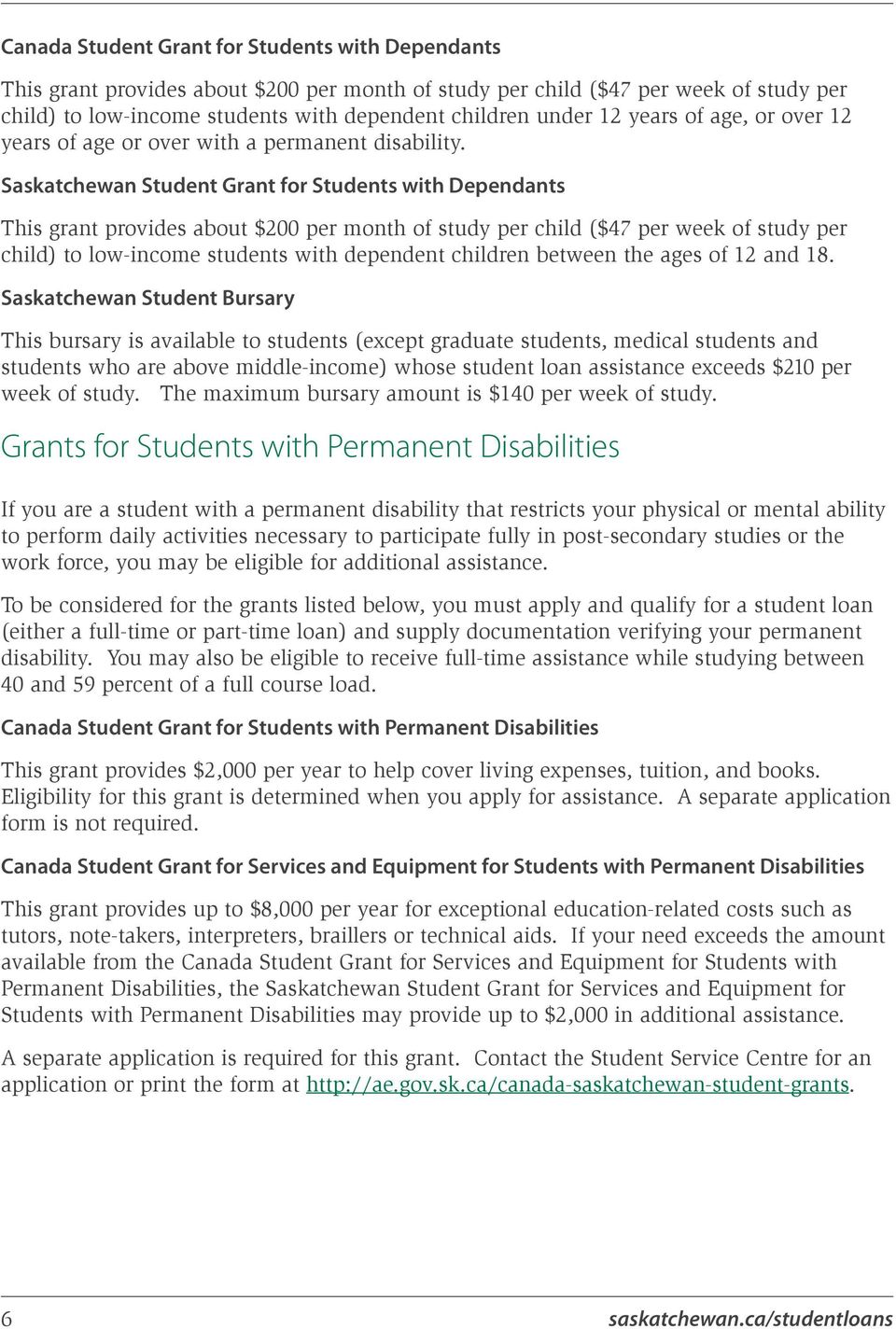
10 Canada Student Grant for Students with Dependants This grant provides about $200 per month of study per child ($47 per week of study per child) to low-income students with dependent children under 12 years of age, or over 12 years of age or over with a permanent disability. Saskatchewan Student Grant for Students with Dependants This grant provides about $200 per month of study per child ($47 per week of study per child) to low-income students with dependent children between the ages of 12 and 18. Saskatchewan Student Bursary This bursary is available to students (except graduate students, medical students and students who are above middle-income) whose student loan assistance exceeds $210 per week of study. The maximum bursary amount is $140 per week of study. Grants for Students with Permanent Disabilities If you are a student with a permanent disability that restricts your physical or mental ability to perform daily activities necessary to participate fully in post-secondary studies or the work force, you may be eligible for additional assistance. To be considered for the grants listed below, you must apply and qualify for a student loan (either a full-time or part-time loan) and supply documentation verifying your permanent disability. You may also be eligible to receive full-time assistance while studying between 40 and 59 percent of a full course load. Canada Student Grant for Students with Permanent Disabilities This grant provides $2,000 per year to help cover living expenses, tuition, and books. Eligibility for this grant is determined when you apply for assistance. A separate application form is not required. Canada Student Grant for Services and Equipment for Students with Permanent Disabilities This grant provides up to $8,000 per year for exceptional education-related costs such as tutors, note-takers, interpreters, braillers or technical aids. If your need exceeds the amount available from the Canada Student Grant for Services and Equipment for Students with Permanent Disabilities, the Saskatchewan Student Grant for Services and Equipment for Students with Permanent Disabilities may provide up to $2,000 in additional assistance. A separate application is required for this grant. Contact the Student Service Centre for an application or print the form at 6 saskatchewan.ca/studentloans
11 A Consent to Share Information - Canada-Saskatchewan Student Grant for Services and Equipment for Students with Permanent Disabilities should also accompany your application. This allows your school or vocational counsellor to share information with the Student Service Centre for the purpose of administering this grant. The form is available from the Student Service Centre or online at Applying for Full-Time Student Financial Assistance Submit your online application early to ensure that you receive your funds at the start of your school term. Applications for the upcoming loan year are available in June. Remember that you only have to fill out one application to be considered for a Canada-Saskatchewan Integrated Student Loan, grants and bursary. If you have questions or need help with your application, check out our online tutorials at saskatchewan.ca/studentloans or call the Student Service Centre: within Canada in the Regina area or outside Canada Before Classes Begin 3 months before program start date When you receive your Letter of Assessment and Master Student Financial Assistance Agreement Classes Begin Start of classes Second month of classes Mid Point While in school Classes End Complete your online application. Submit your required documents to the Student Service Centre. Submit your signed Master Student Financial Assistance Agreement (MSFAA) to the National Student Loans Service Centre. See page 15 and 16 for more information. Canada Student Loan and Grants are paid. Your Canada Student Loan and Grants, or a portion thereof, may be paid directly to your educational institution for tuition. First monthly payment of Saskatchewan funds is paid. Payments will continue monthly until the end of your study period. Your payment may be deposited directly into your bank account or a cheque may be sent to you. Second payment of the Canada Student Grants. Inform the Student Service Centre immediately of any changes to course load, income or personal information. 1 month after end date Saskatchewan Student Grants and/or Bursary applied to loan reducing repayable amount Canada-Saskatchewan Integrated Student Loan Handbook 7

12 Approximately 5 months after end date (unless NSLSC is notified of return to full-time studies) 1st day of 7th month (unless NSLSC is notified of return to full-time studies) Consolidation Letter is sent from the National Student Loans Service Centre. First loan payment due. Note: Applications and any changes must be received 14 business days before your program end date to allow time for processing. How Assistance is Calculated Financial need is the amount you require to help you meet your financial commitments. The formula to calculate the amount of assistance you will receive is as follows: Your Allowable Expenses - Your Expected Contributions = Your Financial Need Example Scenarios A student attending a full-time college or university program can expect to pay between $5,000 and $8,700 per year in tuition. Living expenses will vary depending on if you live at home with your parents and/or spouse or relocate to complete your education. If you are a single student and live at home while studying, your total expenses should be about $7,000 to $10,000, depending on your program of study. If you are single and live away from home, you can expect your expenses to be $11,000 to $15,000. If you have dependent children, the cost will be higher. Tip! CanLearn.ca offers a variety of online tools to help you determine education costs and budget your finances. Visit the Online Tools section for a helpful list of estimators, such as the Student Financial Assistance Estimator. Allowable Expenses Your assistance covers the following allowable expenses: Educational Expenses Allowable educational expenses include the actual costs of tuition and compulsory fees. Books and supplies will be allowed as an expense up to a maximum of $3, saskatchewan.ca/studentloans

13 Living Allowance Your living allowance provides money for shelter, food, miscellaneous items and local public transportation. If you are a single student living away from home, the shelter allowance is based on the expectation that you will share accommodations. Your living allowance is determined by your student category, family size, and province where you are studying. The allowance is a standard allowance for a moderate standard of living based on Statistics Canada s Family Expenditure Survey. Saskatchewan Monthly Living Allowances Student Category Approximate monthly living allowance Single student living at home $479 Single student living away from home $1,112 Married student and spouse with child(ren) $2,169 + $501 for each child Single parent with child(ren) $1,504 + $501 for each child Note: These allowances are used to calculate your financial need. They are not the monthly amount you may receive. As a single student or a married student living in a different community than the family home (your parents or spouse), an allowance will also be included for one return trip home for each period of 16 weeks, to a maximum of $600 per trip. Child Care Allowance If you have dependent children under 12 years of age and you require full-time child care, the allowable expense will be based on whether or not your child care costs are subsidized. A $20 per day incidental rate, up to the maximums outlined below, may be allowed upon a written request for review. Saskatchewan Monthly Child Care Allowances Number of Children Subsidized Unsubsidized Incidental Maximum 1 $85 $400 $200 2 $170 $540 $270 3 $255 $680 $340 4 or more $340 $820 $410 Child Support and/or Alimony If you or your spouse are making child support and/or alimony payments, you can claim this expense up to a maximum amount of $501 per child per month Canada-Saskatchewan Integrated Student Loan Handbook 9

14 Expected Contributions When you are assessed for assistance, your income and financial assets are taken into consideration in the calculation. You and your family are expected to contribute to the cost of your education. These contributions are used to determine how much assistance you are eligible to receive. Pre-Study Period Income The pre-study period is usually the four-month period immediately before you begin your classes. If you are a full-time student during that four-month period, the pre-study period is reduced to the time between the last date of your previous study period and the beginning of your current study period. For example: Your classes start at the beginning of September and you were in school as a full-time student until the end of April. Your pre-study period is from May 1 to September 1. Your classes start at the beginning of September and you were not in school as a fulltime student. Your pre- study period is from May 1 to September 1. Your classes start at the beginning of September and you were in school as a full-time student until the end of June. Your pre-study period is from July 1 to September 1. Assistance is meant to supplement, not replace, other resources to pay for post-secondary education. You (and your spouse, if applicable) are expected to work during your pre-study period, and to save money for your education. This funding is used when calculating your eligibility for assistance. The minimum amount you are expected to save for your education is based on full-time employment at minimum wage less standard deductions for income tax, Canada Pension Plan, Employment Insurance and a monthly living allowance. Full-time employment in Saskatchewan is 29.0 hours per week. The minimum pre-study period contribution may be waived or reduced if you or your spouse are unable to find employment or are unable to work for medical reasons. You will be required to submit documentation verifying your situation. If you (and your spouse, if applicable) earn more than minimum wage, you will be expected to contribute 80 percent of the amount you earn, after allowing for standard deductions for income tax, Canada Pension Plan, Employment Insurance and a monthly living allowance. Your pre-study period income may be verified and you may be required to submit pay stubs. A reassessment of the application is done, which may result in a change in funding if the pre-study period estimate is not equal to the actual income you earned. 10 saskatchewan.ca/studentloans
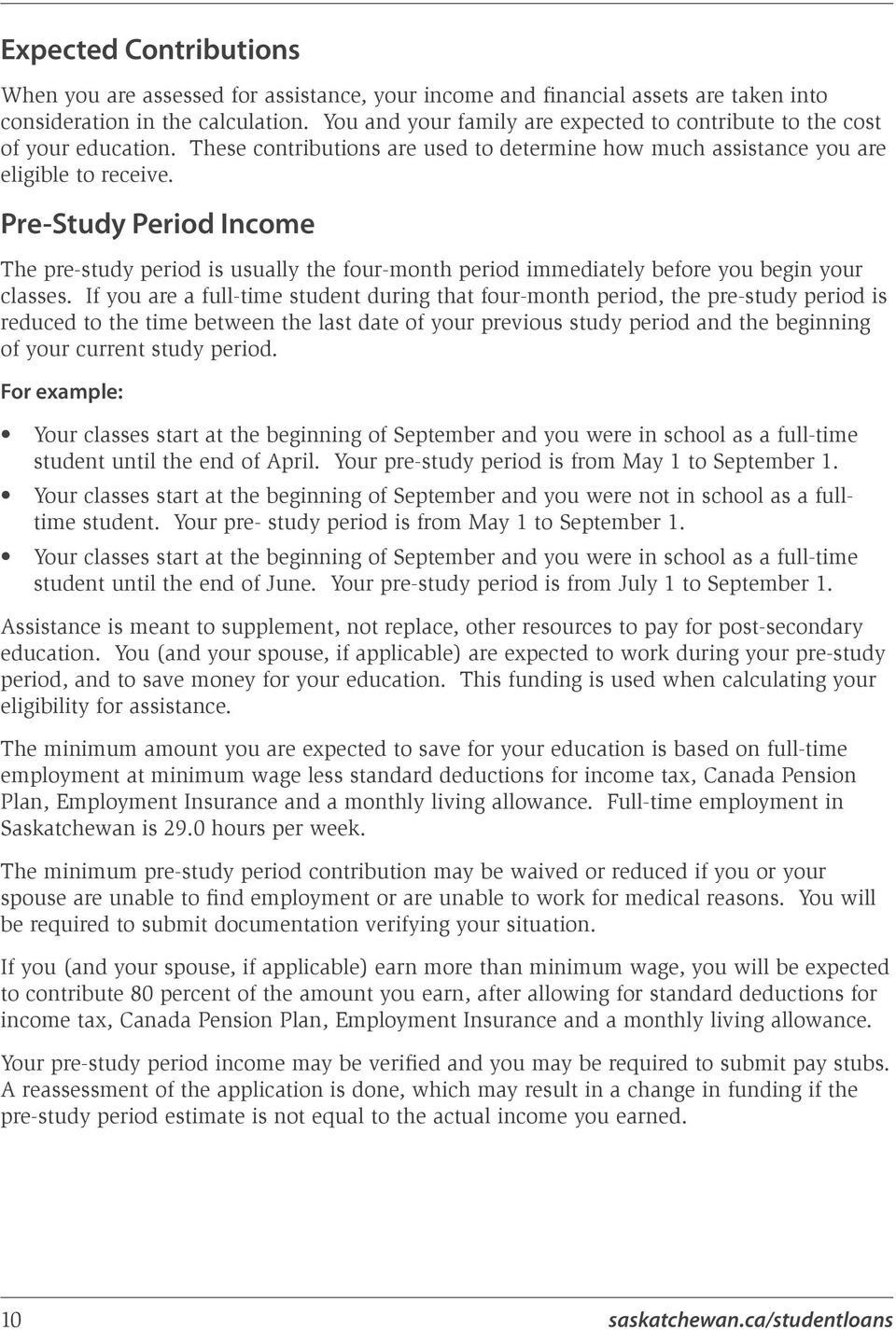
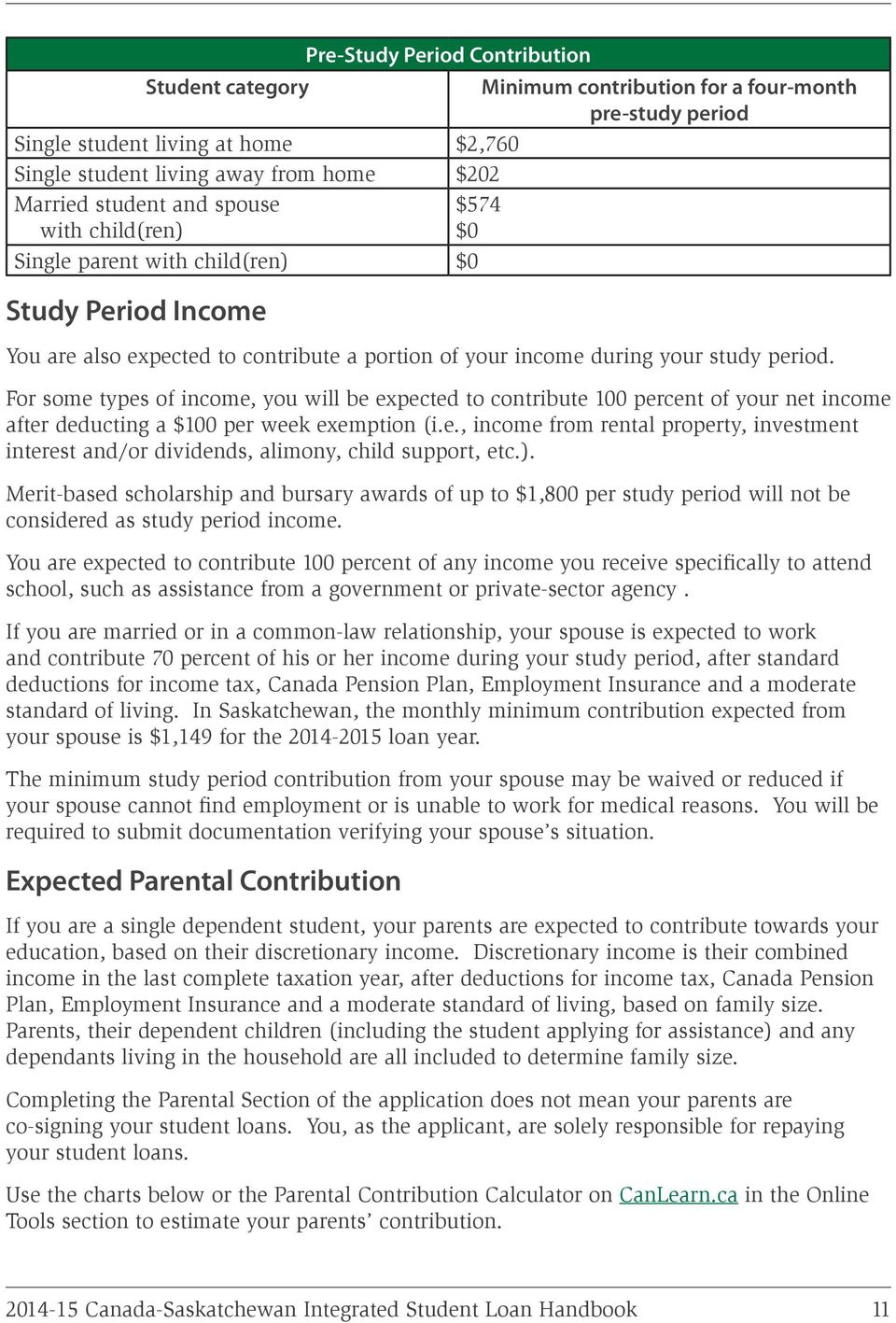
15 Pre-Study Period Contribution Student category Minimum contribution for a four-month pre-study period Single student living at home $2,760 Single student living away from home $202 Married student and spouse with child(ren) $574 $0 Single parent with child(ren) $0 Study Period Income You are also expected to contribute a portion of your income during your study period. For some types of income, you will be expected to contribute 100 percent of your net income after deducting a $100 per week exemption (i.e., income from rental property, investment interest and/or dividends, alimony, child support, etc.). Merit-based scholarship and bursary awards of up to $1,800 per study period will not be considered as study period income. You are expected to contribute 100 percent of any income you receive specifically to attend school, such as assistance from a government or private-sector agency. If you are married or in a common-law relationship, your spouse is expected to work and contribute 70 percent of his or her income during your study period, after standard deductions for income tax, Canada Pension Plan, Employment Insurance and a moderate standard of living. In Saskatchewan, the monthly minimum contribution expected from your spouse is $1,149 for the loan year. The minimum study period contribution from your spouse may be waived or reduced if your spouse cannot find employment or is unable to work for medical reasons. You will be required to submit documentation verifying your spouse s situation. Expected Parental Contribution If you are a single dependent student, your parents are expected to contribute towards your education, based on their discretionary income. Discretionary income is their combined income in the last complete taxation year, after deductions for income tax, Canada Pension Plan, Employment Insurance and a moderate standard of living, based on family size. Parents, their dependent children (including the student applying for assistance) and any dependants living in the household are all included to determine family size. Completing the Parental Section of the application does not mean your parents are co-signing your student loans. You, as the applicant, are solely responsible for repaying your student loans. Use the charts below or the Parental Contribution Calculator on CanLearn.ca in the Online Tools section to estimate your parents contribution Canada-Saskatchewan Integrated Student Loan Handbook 11
16 To calculate parental net income, refer to the parental contribution example below. Subtract a moderate standard of living (MSOL) expense to determine discretionary income. A Parental Contribution Example Parent 1 Parent 2 $29,767 Gross Income (line 150 of $41,779 tax return) $1,169 Less CPP (line 308 of tax $1,744 return) $514 Less EI (line 312 of tax $670 return) $ 1,629 Less taxes payable (line 435 $ 6,551 of tax return) $26,455 Net income $32,814 Combined net income $59,269 Less Moderate Standard of Living (family size of 4) $57,174 Discretionary income $2,095 Parental contribution per week of study. $7 For an 8-month (34 week) course, the parental contribution would be $238 The Moderate Standard of Living (MSOL) is based on Statistics Canada s Family Expenditure Survey. Family Size Saskatchewan 2 $39,939 3 $50,023 4 $57,174 5 $62,722 6 $67,258 7 $71,090 8 $74,409 9 $77, $79, saskatchewan.ca/studentloans

17 Your parents discretionary income is then applied to the Parental Contribution Table. Annual discretionary income Weekly parental contribution Weekly Parental Contribution Table Annual discretionary income $1 8, , $3 9, , , , $4 9, , , , $6 10, , , , $7 10, , , , $9 11, , , , $10 11, , , , $12 12, , , , $13 12, , , , $14 13, , , , $16 13, , , , $17 14, , , , $19 14, , , , $20 15, , , , $22 15, , , , $24 16, , , , $26 16, , , Weekly parental contribution Annual discretionary income $28 17, , $30 17, , $32 18, , $34 18, , $36 19, , $38 19, , $39 20, , $41 20, , $43 21, , $45 21, , $47 22, , $51 22, , $55 23, , $59 23, , $63 24, , $66 24, , $70 25, , Weekly parental contribution $74 $78 $82 $86 $89 $93 $97 $101 $105 $109 $113 $116 $120 $124 $128 $132 $136 If your parents have two or more dependent children studying in full-time post-secondary education, the parental contribution is divided accordingly Canada-Saskatchewan Integrated Student Loan Handbook 13

18 If you are a single dependent student, and your parents set up a Registered Education Savings Plan (RESP) or a scholarship trust fund for you, the expected parental contribution will be the greater of: The assessed parental contribution; or The contribution withdrawn from the RESP or trust fund. Assets Your financial assets, including savings (and those of your spouse, if applicable) are considered in determining your financial need. If they were in your possession during the pre-study or in-study periods, they will be used in the calculation of your assistance. You must advise the Student Service Centre if you acquire or sell any financial investments during your pre-study or study periods. This will result in a reassessment of your application. Example of RESP Contributions Lindsay s parents are expected to contribute $544 towards her education for her current study period. They withdraw $600 of RESP contributions for Lindsay s education costs. Only the $600 RESP contributions will be used in the calculation and will be considered the parental contribution for assistance purposes. The full value of these assets is considered an expected contribution after you receive an exemption for RRSPs. There is no exemption applied to other financial investments. Your home, vehicle and other property you own are not considered. Parental assets are not considered. Registered Retirement Savings Plans (RRSPs) When calculating the value of your assets, a $2,000 exemption is allowed on the current market value of your RRSPs for each year you have been out of high school. If you are married or common-law, a $2,000 exemption is also allowed for each year your spouse has been out of high school. Student Financial Assistance for Part-Time Studies Canada Student Loans for Part-Time Studies The Government of Canada offers loans and grants for part-time studies to students taking between 20 and 59 per cent of a full course load. As a part-time student you may be eligible to borrow up to $10,000 in Canada Student Loans. Interest does not accrue on part-time loans if you confirm your enrolment while in studies. You do not have to begin repaying your loan until six (6) months after you graduate or leave school; however, interest will accrue during those six months. There is no maximum length of assistance for part-time students. However, the maximum loan amount at any time cannot exceed $10,000. Loan applications for part-time students are available from the Student Service Centre or online at Visit CanLearn.ca for more information on financial assistance for part-time students. 14 saskatchewan.ca/studentloans
19 You may be eligible for a Canada Student Loan for Part-Time Studies if you: are from a low- or middle-income family as defined by the Canada Student Loans Program; are enrolled in 20 to 59 percent of a full course load (if you are a student with a permanent disability, and you are taking 40 to 59% of a full course load, you can choose to be considered full- or part-time); are enrolled in a degree, diploma, or certificate program (minimum 12 weeks within a 15-week period) at a designated post-secondary institution; successfully complete all courses for which funding was provided; and pass a credit check if you are 22 or older and applying for a Canada Student Loan and Grant for the first time. Canada/Saskatchewan Student Grant for Part-Time Studies Part-time students with low incomes who qualify for a Canada Student Loan and meet the grant eligibility requirements may be eligible for a federal student grant of up to $1,200 and a provincial student grant of up to $800 per academic year. Canada Student Grant for Part-Time Students with Dependants Part-time students with low incomes and up to two children under 12 years of age (or 12 years or older with a permanent disability) may be eligible for $40 per week of study, up to a maximum of $1,920, and those part- time students with three or more children may be eligible for $60 per week of study up to a maximum of $1,920. Receiving Your Funds The National Student Loans Service Centre (NSLSC) administers your loan on behalf of the Government of Canada and the Government of Saskatchewan. If this is your first student loan application: Once your application has been assessed, you will receive an information package including: Your Master Student Financial Assistance Agreement (MSFAA); Instructions on how to get your Canada-Saskatchewan Integrated Student Loan; and An Assessment Letter with information on the amount of your assistance including the payment schedule of your student loan and grants. As soon as you receive your MSFAA, sign it and take it, along with valid government identification and your Social Insurance Number (SIN), to: The Student Service Centre located in Regina; A designated Canada Post outlet; or Canada-Saskatchewan Integrated Student Loan Handbook 15
20 If studying outside Canada, or if you cannot access a designated Canada Post outlet, mail your documents along with copies of your government-issued identification to the National Student Loans Service Centre. Valid government photo identification includes: Driver s license; Passport; Provincial health card with a photo; or Permanent residency or citizenship card. Tip! Visit CanLearn. ca to find a designated Canada Post outlet near you, by looking in the Useful Resources section under Online Tools Valid Social Insurance Number (SIN) documentation includes: SIN card; Canada Revenue Agency Notice of Assessment; Canada Pension Plan Statement of Contributions; or SIN confirmation from Service Canada. The NSLSC will confirm your enrolment electronically with your school. If your school does not confirm enrolment electronically, the NSLSC will mail the confirmation of enrolment form to you or your school and the school will return it to the NSLSC. Once your enrolment is confirmed, the NSLSC will electronically deposit funds into the bank account that you provided on the MSFAA. Funds will be deposited as outlined in the disbursement schedule in your assessment letter or directly to your school to cover your academic fees. Maintaining Your Eligibility While in School Your Responsibilities After you have obtained your funds and are attending classes, you must do the following to keep your interest-free status and stay eligible for future funding: Continue to be enrolled in 60 per cent or more of a full course load each semester (40 per cent for students with a permanent disability). Your school determines what a full course load is for each term or semester of each study period; Achieve successful completion. Your study period is considered successful when you pass a minimum of 60 per cent of a full course load (40 per cent for students with a permanent disability); and Maintain regular attendance at all times. If your attendance drops below 90 per cent or you miss more than three consecutive weeks (21 calendar days), you will be considered discontinued for student loan purposes. Your study period will be considered unsuccessful. 16 saskatchewan.ca/studentloans

21 You may be considered discontinued if you drop below the minimum required course load for the following reasons: You withdraw from studies on your own accord; You change schools during your study period; or You are expelled before the end of your study period. It is your responsibility to contact the school regarding possible tuition refunds. One unsuccessful completion Two unsuccessful completions Three unsuccessful completions Receives a warning but remains eligible for assistance. Lose eligibility for assistance for 12 months. Lose eligibility for assistance for a minimum of 36 months. Important! If you withdraw during your first semester or term and plan to attend full-time in the second semester or term, you must submit a new application to the Student Service Centre. During these periods of ineligibility you must maintain your student loans in good standing to regain future eligibility. You must complete your studies within the required eligibility periods. For each level of study, you are eligible for assistance for the normal duration of the program plus one additional year. Students with permanent disabilities are exempt from this criteria. You must not exceed the lifetime maximum of 340 weeks of study. The lifetime maximum may be extended up to an additional 60 weeks (to a maximum of 400 weeks) for full-time students enrolled in doctoral studies. Students with permanent disabilities may receive assistance for up to 520 weeks. Keeping Government Student Loans Interest-Free Important! The lifetime maximum for assistance includes the weeks you received student loans and any weeks you did not receive student loans but were in interest-free status. Whether you take out a new student loan for upcoming studies or not, your existing loan holder(s) need to know that you are still in school. If not, you will lose the interest-free status on your existing loans and you will have to start repaying loans earlier than expected. All your lenders must receive Confirmation of Enrolment information, completed by your post-secondary institution. This proves you have registered for upcoming studies. If you are taking out a new loan, your school will provide Confirmation of Enrolment as part of the process for full-time students. If you are not taking out a new loan, you must provide Confirmation of Enrolment (Schedule 2) which is available through your NSLSC borrower account or at CanLearn.ca Canada-Saskatchewan Integrated Student Loan Handbook 17
22 Repaying Your Student Loan Consolidating Your Loan Six months after you have completed full-time study, whether you have graduated, transferred to part-time studies, withdrawn, or you are taking time off from your studies, you will need to begin repaying your student loan. This is called student loan consolidation. Prior to your loan(s) entering the repayment phase, the National Student Loans Service Centre will send you a Consolidation Letter. It outlines your repayment terms and your minimum monthly payment. You also can negotiate your monthly payment amounts with the National Student Loans Service Centre, pay in lump sum or pay out your loan early. Contact the National Student Loans Service Centre if you have not received your repayment information one month before your loans consolidate. Even though you are not required to make a payment for six months after completing your studies, interest will accumulate during this time. Any unpaid interest accumulated during this six-month period will be capitalized and included in your principal balance at the time of consolidation. Your first loan payment is due: On the last day of the seventh month following the date your period of study ends; or The end date you withdraw from studies. Example: Period of Study End Date: April 30, 2014 Date six-month non-repayment period begins (interest starts to accrue): May 1, 2014 Date six-month non-repayment period ends: October 31, 2014 First loan payment due date: November 30, 2014 Interest on Canada Student Loans: Fixed Interest Rate (Prime 1 plus 5%) or Floating Interest Rate (Prime plus 2.5%). Interest on Saskatchewan Student Loans: Fixed Interest Rate (Prime plus 2.5 %) or Floating Interest Rate (Prime). Your loans will be automatically consolidated with the floating rate of interest. You will have a one-time option of switching to the fixed rate of interest during your repayment period. 1 Prime is defined by the Canada Student Loans Program in accordance with The Canada Student Loans Act or The Canada Student Financial Assistance Act. 18 saskatchewan.ca/studentloans
23 To compare different repayment options, visit CanLearn.ca to check out the Loan Repayment Estimator in the Online Tools section. If you received a Canada Student Loan before August 1, 2000, and/or a Saskatchewan Student Loan before August 1, 2001, you must also sign a Consolidation Agreement for each loan with the financial institution(s) holding these loans. You must contact your financial institution(s) and sign a loan Consolidation Agreement within six months of completing your full-time studies. In some instances, you may have two or more separate monthly loan payments. Date you received your student loan On or After August 1, 2001 August 1, 2000 to July 31, 2001 Canada Student Loans Contact the National Student Loans Service Centre Contact the National Student Loans Service Centre Saskatchewan Student Loans Contact the National Student Loans Service Centre Contact the Royal Bank of Canada The National Student Loans Service Centre offers online services to keep track of the activity on your student loan account as well as update your personal information. Go to CanLearn.ca to register. Maintaining Your Loan While in Repayment As a borrower, you are required to fulfill your obligations and responsibilities of the repayment terms and conditions of your loan. Missing payments could damage your credit rating, and your student loan could go into default. Contact the National Student Loans Service Centre before you miss a payment. There are repayment options available to help you manage your payments and avoid defaulting on your loan. Defaulting on your loan will affect your credit score and in turn, your ability to purchase something as simple as buying a new cell phone! Interest on Loan Payments Once you are in repayment, any interest you pay may be claimed on your income tax return. For each year you are in repayment, you will receive a tax form indicating the amount of interest paid during that tax year from the National Student Loans Service Centre (or your financial institution if you have a loan prior to 2001). Visit CanLearn.ca to find out more about repayment assistance and how to manage your student loan debt Canada-Saskatchewan Integrated Student Loan Handbook 19
24 Repayment Assistance Plan (RAP) The Repayment Assistance Plan (RAP) makes it easier for you to manage your debt. You can pay back what you can reasonably afford, based on your family income and family size. Monthly payments are limited to 20 per cent or less of a borrower s gross family income. No borrower on RAP will have a repayment period of more than 15 years, or 10 years for borrowers with permanent disabilities. If borrowers earn very little income, they may not be required to make loan payments until their income increases. To apply, complete the online application through your account with the National Student Loans Service Centre. Repayment Assistance Plan Permanent Disability (RAP-PD) The Repayment Assistance Plan for Borrowers with a Permanent Disability (RAP- PD) is available to borrowers with a permanent disability who are having difficulty repaying their student loan debt. RAP-PD makes it easier for you to manage your student debt and will consider additional medical expenses related to your disability. You can pay back what you can reasonably afford based on your family income and family size. Monthly payments are limited to 20 per cent or less of a borrower s gross family income and no borrower will have a repayment period of more than 10 years. If borrowers earn very little income, they may not be required to make any loan payments until their income increases. To apply, complete the online application and Permanent Disability Expense form through your account with the National Student Loans Service Centre. Note: If you are a student with a severe permanent disability who is prevented from working and going to school and who will never be able to repay your loans, you may benefit from having your loans immediately cancelled under the Severe Permanent Disability Benefit. For more information, please visit CanLearn.ca or call the National Student Loans Service Centre. Revision of Terms You may ask the National Student Loans Service Centre about reducing your monthly payment amount by extending the length of time you take to repay your loan. This will lower your monthly payments, but you will pay more interest over time. Contact the National Student Loans Service Centre for more information. Loan Forgiveness for Nurses and Nurse Practitioners The Saskatchewan Student Loan Forgiveness for Nurses and Nurse Practitioners program encourages nurses and nurse practitioners to work in smaller communities. As a nurse or nurse practitioner, you could receive up to $4,000 per year in Saskatchewan Student Loan forgiveness to a maximum of $20,000 over five years. Please visit saskatchewan.ca for more information. You may also be eligible for federal loan forgiveness on your Canada student loans. The Canada Student Loans Program offers federal loan forgiveness for nurses and nurse practitioners, as well as family doctors and family medicine residents, serving in rural and remote communities. Please visit CanLearn.ca for more information. 20 saskatchewan.ca/studentloans
25 Bankruptcy and Overpayments Bankruptcy Are you a student loan borrower who: Has filed for bankruptcy? Has filed a consumer proposal? Is participating in a provincial arrangement for the orderly payment of debts? If so, contact the Student Service Centre at for more information on student loan eligibility. Overpayments An overpayment is assistance you received for which you are not eligible. An overpayment can occur if your application is reassessed due to a change in your circumstances. For example, if you discontinued studies during a study period, if your income changed, or if an audit of your application uncovered inaccurate information, the Student Service Centre may determine that you have been overpaid. Overpayment amounts are deducted from future assistance awarded under the program. It is your responsibility to contact your school to ensure possible tuition refunds have been processed. This may reduce the amount of your outstanding overpayment. Note: Students can appeal the grant to loan conversion on the grounds that the withdrawal or change to part-or full-time status was the result of unforeseen and unavoidable circumstances or if the educational institution made an error in reporting the withdrawal from full-time studies. Supporting documentation will be required. Appeals must be made within six months of the date the conversion occurred. Falsified Information The Canada-Saskatchewan Integrated Student Loans Program is dedicated to providing assistance to support students seeking post-secondary education under the terms of federal and provincial student loan legislation and policy. It is an offence under The Canada Student Financial Assistance Act and The Saskatchewan Student Assistance and Student Aid Fund Act, 1985 to knowingly give false or misleading information on your application or other forms. Offences may also be punishable under the Criminal Code of Canada. All of the information submitted on your application is subject to audit and verification. If it is determined that an individual knowingly committed fraud or misrepresentation, the Canada Student Loans Program may apply administrative measures and possibly require the individual to immediately repay loans or grants received through misrepresentation (as per section 17.1 (1) of The Canada Student Financial Assistance Act (CSFAA) and Canada-Saskatchewan Integrated Student Loan Handbook 21
26 section 18.1(1) of The Canada Student Loans Act (CSLA)). Administrative measures specifically refer to the individual being restricted from student financial assistance (SFA), such as loans, grants, repayment assistance and in-study interest-free status, for a period of one to five years. If you know of someone providing false information while receiving a financial benefit, please contact Audit Services, who are responsible for investigating allegations of improper funding. Allegations are serious and all contacts will be investigated. We assure you that you will remain anonymous. Audit Services Unit Telephone: Fax: Mailing Address Audit Services Ministry of Advanced Education PO Box 2405 STN Main REGINA SK S4P 4L7 [email protected] Student Financial Assistance Scholarships The Ministry of Advanced Education administers scholarships for students who are entering post-secondary education and individuals in graduate studies. Visit saskatchewan.ca/live/education-learning-and-child-care/post-secondary-education/loansscholarships-and-other-financial-assistance for more information or for an application. Saskatchewan Advantage Scholarship The Saskatchewan Advantage Scholarship provides every Saskatchewan grade 12 graduate (2012 and after) who enrolls at a Saskatchewan post-secondary institution with up to $500 per year to a maximum of $2,000. Your school applies for this scholarship on your behalf. A separate application form is not required. James Dickson Scholarship This $500 scholarship is awarded annually to a graduating Saskatchewan student of Black ancestry. If no award is made one year, two awards may be made the following year. D.R. Simmons Memorial Scholarships Two scholarships of $500 are awarded annually to graduating Saskatchewan high school students of First Nations or Métis ancestry who are continuing studies at the post-secondary level. 22 saskatchewan.ca/studentloans
27 Scholarship of Honour The Saskatchewan Scholarship of Honour recognizes Saskatchewan men and women who have served in a military operation since January 2001, and the families of Canadian Forces members who have been injured or died in a military operation since January Eligible individuals will receive a $5,000 scholarship to assist with post-secondary education expenses. Queen Elizabeth II Scholarship This $20,000 scholarship is awarded annually, to support graduate or post-graduate study of Saskatchewan politics and government at either of Saskatchewan s universities. The scholarship is awarded on the basis of academic excellence to one student or split equally between deserving candidates. Queen Elizabeth II Centennial Aboriginal Scholarship This $20,000 scholarship is to be awarded annually to First Nations and Métis students who are pursuing graduate studies in any field at any accredited university in Saskatchewan. Students must have graduated from a university in Saskatchewan. Preference will be given to students who have attended or received an undergraduate degree from the First Nations University of Canada. The scholarship is awarded on the basis of academic excellence to one student or split between equally deserving candidates. Contact Information It is important to keep your file up to date with the National Student Loans Service Centre and the Student Service Centre. You must provide them with any changes to your personal information, including address changes, while you are in school and after graduation. For questions on the assessment of your loan: Student Service Centre Ministry of Advanced Education th Avenue REGINA SK S4P 0M3 Telephone outside Regina: In the Regina area or outside Canada: Fax: [email protected] Website: saskatchewan.ca/studentloans For security reasons, do not include your SIN if you contact us by Canada-Saskatchewan Integrated Student Loan Handbook 23
28 For questions on maintaining or repaying your loan: National Student Loans Service Centre P.O. Box 4030 MISSISSAUGA ON L5A 4M4 Telephone within North America: Outside North America with an international access code: Countries outside of North America without an international access code: Call the Canadian operator at ; then call collect TTY: Fax: Website: CanLearn.ca For Saskatchewan Student Loans prior to August 1, 2001 Contact the Royal Bank of Canada at: Telephone: Website: This document is available on demand in multiple formats (large print, Braille, audio cassette, audio CD, e-text diskette, e-text CD, or DAISY), by contacting O-Canada ( ). If you use a teletypewriter (TTY), call Her Majesty the Queen in Right of Canada, 2014 ISBN: Vous pouvez obtenir cette publication en français au à : saskatchewan.ca/studentloans 24 saskatchewan.ca/studentloans
29 Glossary Academic year: defined by your school, up to a maximum of 12 months. An academic year may comprise multiple terms or semesters, including spring and summer session. Allowable expenses: expenses used in the calculation of your funding amount. Assessment Letter: information on the calculation of your assistance and the payment schedule. Asset: an item or source of wealth with continuing financial benefit that can be liquidated (e.g. an investment). Bursary: funding that does not have to be paid back. Capitalization: this happens when you add unpaid accumulated interest to the principal of a loan. It increases the total principal outstanding. Confirmation of Enrolment: confirms that you are enrolled in school full-time. Confirmation of Enrolment is done electronically between your school and the National Student Loans Service Centre. Consolidation Letter: a letter is sent to you (the borrower) when you enter the repayment phase of your loan, indicating the terms of repayment. The first loan payment is due on the first day of the 7th month after classes end in your final term. Default: when you are behind on your payments for nine or more months and collection activities are required. Defaulting on your loan will make you ineligible from receiving future student financial assistance or from applying for repayment assistance under the Repayment Assistance Plan. Dependent student: a single student with no children who has been out of high school for less than four years or in the work force for less than two periods of 12 consecutive months (two years). Designation: process by which schools obtain the necessary recognition that allows their students to be eligible for assistance. Designated institution: schools where students are eligible to receive assistance. Discretionary income: disposable income after taxes and living expenses. Financial need: amount required to supplement your existing funds to meet your financial commitment. Full-time student: enrolled in 60 percent of a full course load (or 40 percent for students with permanent disabilities) as determined by the school. Grant: funding that does not have to be paid back Canada-Saskatchewan Integrated Student Loan Handbook 25
30 Independent student: a single student with no children who has been out of high school for more than four years or in the work force for at least two periods of 12 consecutive months (two years). Interest-free status: while you are in school full-time, the Government of Canada and the Government of Saskatchewan will pay the interest on your student loans. Lifetime maximum: the maximum time frame you are eligible to receive money and to maintain your student loans in interest-free status, generally 340 weeks. Moderate standard of living: amount determined by Statistics Canada that is required to maintain a moderate standard of living per family size. National Student Loans Service Centre: the service provider responsible for the payment and collection of your student loan funds on behalf of the Government of Canada and the Government of Saskatchewan. Non-Repayment (Grace) Period: the six-month period after you graduate or leave school during which you are not required to make loan payments. However, interest on your loan builds up during this period and you are responsible for paying this interest. You can choose to add it to your principal (capitalization), but if you do, you will not be able to claim the interest on your income tax return. Please note this is not the same as interestfree status. Overpayment: amount of assistance you received for which you are not eligible. Permanent disability: a functional limitation caused by a physical or mental impairment which restricts a person s ability to perform the daily activities necessary to participate fully in post-secondary studies or in the labour force, and is expected to remain with the person for the person s expected life. Pre-study period: the four-month period immediately prior to program start date. Resident: a person who has resided in the province for 12 consecutive months prior to the first day of their study period. Scholarship: funding which is merit- based, and does not have to be paid back. Study period: length of time that a student is enrolled at a designated institution throughout the school year. (September to April, for example). Successful completion: passing a minimum of 60 percent of a full course load or 40 percent of a full course load for students with a permanent disability. Withdrawal: dropping below the required course load for the study period/program for which you have received funding. 26 saskatchewan.ca/studentloans
31
32 Canada-Saskatchewan Integrated Student Loan Handbook Canada-Saskatchewan Integrated Student Loans Program Important Steps in Planning and Financing Your Post-Secondary Education Need more information? Student Service Centre Ministry of Advanced Education Telephone: Outside Regina call toll-free: Regina area (or outside Canada): saskatchewan.ca/studentloans CanLearn.ca Ce document est aussi disponible en français. saskatchewan.ca/studentloans CanLearn.ca
Canada-Saskatchewan Integrated Student Loan Handbook
 Canada-Saskatchewan Integrated Student Loan Handbook Canada-Saskatchewan Integrated Student Loans Program Important Steps in Planning and Financing Your Post-Secondary Education 2015-16 saskatchewan.ca/studentloans
CONTACT INFORMATION. Fax. Website
 CONTACT INFORMATION STUDENT FINANCIAL SERVICES NATIONAL STUDENT LOANS SERVICE CENTRE (NSLSC) Student Financial Services Department of Post-Secondary Education, Training and Labour P.O. Box 6000, 77 Westmorland
Information Guide. Student Financial Assistance for Full-Time Post-Secondary Students in New Brunswick
 Information Guide Student Financial Assistance for Full-Time Post-Secondary Students in New Brunswick 2015 2016 studentaid.gnb.ca CONTACT INFORMATION STUDENT FINANCIAL SERVICES NATIONAL STUDENT LOANS SERVICE
manitobastudentaid.ca
 Accessible and Affordable Post-Secondary Education 2015-2016 FINANCE YOUR FUTURE! Manitoba Student Aid manitobastudentaid.ca S E C T I O N O N E PLAN AHEAD Education Costs If you have been looking at post-secondary
Application Guide 15/16. www.gov.nl.ca/studentaid
 Application Guide 15/16 www.gov.nl.ca/studentaid INTRODUCTION 2 APPLYING FOR ASSISTANCE 2 How to Apply 2 If not Borrowing for a Semester 2 Applying for Assistance for Second Semester Only 2 Assistance
How To Pay For College In Canada
 Now and Tomorrow Excellence in Everything We Do Canada Student Loans and Grants TRADE SCHOOL, COLLEGE & UNIVERSITY Guide to Federal Student Financial Assistance CanLearn.ca LC-096-03-12 You can order this
Student Financial Assistance Guide and Application. For classes beginning any time between August 1, 2010 and July 31, 2011
 2010-2011 Student Financial Assistance Guide and Application For classes beginning any time between August 1, 2010 and July 31, 2011 You can apply online Go to www.studentloan.pe.ca You do not need high
Student Guide. Student guide u u u 2015/2016. Programs & Eligibility. for classes starting between August 1, 2015 and July 31, 2016
 2015/2016 Student guide u u u Programs & Eligibility for classes starting between August 1, 2015 and July 31, 2016 Apply online www.studentaidbc.ca Student Guide Eligibility - Planning - Apply Online -
Canada-Saskatchewan Integrated Student Loan Instruction Guide
 Canada-Saskatchewan Integrated Student Loan Instruction Guide Canada-Saskatchewan Integrated Student Loans Program Important Steps in Planning and Financing Your Post-Secondary Education 2014-15 saskatchewan.ca/studentloans
Ministry of Advanced Education Student Aid Fund. Annual Report for 2014-15. saskatchewan.ca
 Ministry of Advanced Education Student Aid Fund Annual Report for 2014-15 saskatchewan.ca Table of Contents Letters of Transmittal... 1 Introduction... 2 Ministry Overview... 3 Student Financial Assistance
How To Get A Student Loan From Canada
 STUDENTAID Canada - Newfoundland and Labrador Student Financial Assistance Application Guide www.gov.nl.ca/studentaid14/15 STUDENTAID How does the STUDENT LOAN process work? STEP 1: APPLY ONLINE OR BY
Focus on Your Future
 2014-2015 Focus on Your Future Prince Edward Island Student Financial Assistance Guide www.studentloan.pe.ca Focus on Your Future: Table of Contents Section 1: Before You Apply... 4 1.1 How Will I Pay
Canada Student Loans Program
 Innovation & Learning for Canadians Canada Student Loans Program 2003-2004 Information Guide HRIC-076-03-03 Introduction INTRODUCTION In today s job market, education brings personal success. It holds
Application for Provincial Training Allowance 2016-2017 Office Use Only APPLICANT DEMOGRAPHIC APPLICANT CATEGORY. Sask. Health Services Number (HSN)
 Application for Provincial Training Allowance 2016-2017 Office Use Only Date Received File Number Bar Code PSE Number Application Number APPLICANT DEMOGRAPHIC Social Insurance Number (SIN) No SIN Sask.
Part-Time Studies Application
 2010/2011 Part-Time Studies Application Part-Time Studies Financial Assistance WHO IS ELIGIBLE? Applicants must: Be a Canadian citizen, permanent resident/landed immigrant, convention refugee or a protected
National Student Loans Service Centre (NSLSC) CanLearn.ca
 National Student Loans Service Centre (NSLSC) CanLearn.ca Repayment Seminar Repaying your loan: Six things you need to know: 1. What are the benefits of Government Sponsored Student Loans? 2. What is Non-Repayment
SUBMIT YOUR COMPLETED 2015-16 STUDENT FINANCIAL ASSISTANCE APPLICATION TO:
 SUBMIT YOUR COMPLETED 2015-16 STUDENT FINANCIAL ASSISTANCE APPLICATION TO: Student Financial Services Department of Post-Secondary Education, Training and Labour PO Box 6000, 440 King St. Fredericton,
2015-16 Financial Aid & Awards Frequently Asked Questions
 ENROLMENT SERVICES 2015-16 Financial Aid & Awards Frequently Asked Questions OSAP Questions 1. What is a Master Student Financial Assistance Agreement (MSFAA)? The MSFAA is the student loan agreement that
Student Aid Alberta Operational Policy and Procedure Manual. August 1, 2015. Student Aid Alberta Operational Policy and Procedure Manual
 Student Aid Alberta Operational Policy and Procedure Manual August 1, 2015 August 1, 2015 1 Table of Contents Student Aid Alberta Operational Introduction... 8 Chapter 1: Eligibility for Student Aid...
Educational Institution Manual
 Educational Institution Manual Canada-Saskatchewan Integrated Student Loans Program and Other Financial Assistance 2015-16 saskatchewan.ca/informationforinstitutions CanLearn.ca Table of Contents Introduction...1
Quick Tips. application 13/14. to complete the
 Quick Tips to complete the application FOR FULL-TIME POST-SECONDARY STUDIES 13/14 Contents 03» Student Aid Alberta 05» Loans and Grants 06» Application Basics 07» Money You Need: Your Expenses 08» Money
Online Student Loan Application
 Online Student Loan Application Need Help - Spousal Instructions Spousal Instructions - Table of Contents Spouse Demographics................................................................. 2 Spouse Expense...
The Saskatchewan Student Direct Loans Regulations
 SASKATCHEWAN STUDENT DIRECT LOANS 1 The Saskatchewan Student Direct Loans Regulations being Chapter S-61.1 Reg 1* (effective August 2, 2001) as amended by Saskatchewan Regulations 13/2002, 42/2002, 76/2002,
Instructions OSAP Paper Application for Full-Time Students 2012-2013
 Student Financial Assistance Branch Ministry of Training, Colleges and Universities Instructions OSAP Paper Application for Full-Time Students 2012-2013 July 2012 2012-2013 OSAP Instructions Page 1 A.
Student Loan Information & Scholarships
 Student Loan Information & Scholarships Operating Engineers College Page 1 2012 Student Loan Information Table of Contents Student Loan Information........................................ Page 3 Contact
Frequently Asked Questions
 Frequently Asked Questions OSAP Questions 1. 2012 2013 OSAP Changes: What is a Master Student Financial Assistance Agreement (MSFAA)? The way you get your OSAP assistance is changing for 2012-13. The Ministry
Soulder Loan Interest-Free Periods 8.1 to 12.1
 LENDER-FINANCED 1 The Lender-financed Saskatchewan Student Loans Regulations being Chapter S-61.1 Reg 3 (effective July 30, 1996) as amended by Saskatchewan Regulations 97/97, 59/2000, 58/2001, 9/2002,
ANNUAL REPORT CANADA STUDENT LOANS PROGRAM LC-150-07-14E
 ANNUAL REPORT CANADA STUDENT LOANS PROGRAM 2012 2013 LC-150-07-14E You can download this publication by going online: http://www12.hrsdc.gc.ca This document is available on demand in multiple formats (large
CANADA PENSION PLAN. Canada Pension Plan Survivor Benefits. Death Benefit Survivor s Pension Children s Benefit
 CANADA PENSION PLAN Canada Pension Plan Survivor Benefits Death Benefit Survivor s Pension Children s Benefit Contents Introduction...1 Information for contributors about CPP survivor benefits...1 Information
Canada Pension Plan Disability Benefits
 CANADA PENSION PLAN Canada Pension Plan Disability Benefits March 2013 Service Canada delivers the Canada Pension Plan (CPP) program on behalf of the Department of Human Resources and Skills Development
Canada Pension Plan. Canada Pension Plan Disability Benefits
 Canada Pension Plan Canada Pension Plan Disability Benefits Contents Introduction... 1 CPP disability... 2 Applying for CPP disability benefits... 4 Receiving CPP disability benefits... 7 Children s benefits...
Ontario Student Assistance Program 2014-2015 OSAP Application for Part-Time Students
 Ontario Student Assistance Program 2014-2015 OSAP Application for Part-Time Students For students taking from 20% to 59% of a full course load For programs starting anytime between August 1, 2014 and July
William D. Ford Federal Direct Loan Program Direct Subsidized Loan and Direct Unsubsidized Loan Borrower s Rights and Responsibilities Statement
 Important Notice: This Borrower s Rights and Responsibilities Statement provides additional information about the terms and conditions of the loans you receive under the accompanying Master Promissory
Educational Institution Procedures Guide 2016-17
 Educational Institution Procedures Guide 2016-17 Table of Contents Overview of the Students Finance System...3 Confirming Registration for Full-Time Students...4 Automated Confirmation of Registration...5
Instructions for OSAP Paper Application Form for Full-Time Postsecondary Students 2011-2012. April 2011 Version 3
 Student Financial Assistance Branch Ministry of Training, Colleges and Universities Instructions for OSAP Paper Application Form for Full-Time Postsecondary Students 2011-2012 April 2011 Version 3 2011-2012
William D. Ford Federal Direct Loan Program Direct Subsidized Loan and Direct Unsubsidized Loan Borrower s Rights and Responsibilities Statement
 Important Notice: This Borrower s Rights and Responsibilities Statement provides additional information about the terms and conditions of the loans you receive under the accompanying Master Promissory
The Canada Pension Plan Retirement Pension
 CANADA PENSION PLAN The Canada Pension Plan Retirement Pension Contents The Canada Pension Plan...1 Changes to the CPP you should know about...2 Understanding the CPP...3 Deciding when to apply for your
William D. Ford Federal Direct Loan Program Direct Subsidized Loan and Direct Unsubsidized Loan Borrower s Rights and Responsibilities Statement
 Important Notice: This Borrower s Rights and Responsibilities Statement provides additional information about the terms and conditions of the loans you receive under the accompanying Master Promissory
What You Need To Know. Trent s Student Guide to Financial Literacy 2012-13
 What You Need To Know Trent s Student Guide to Financial Literacy 2012-13 Welcome to Trent University. In addition to the academic challenges students encounter in university, there are financial challenges
Student Loans Bankruptcy and Student Loans: NUTS & BOLTS The Options (pressing your plea Prov 6:1-5) Federal loan
 Student Loans Bankruptcy and Student Loans: Must prove undue hardship Must initiate an adversary hearing, a separate lawsuit within the bankruptcy where the undue hardship is illustrated. Most can t afford
STUDENT FINANCIAL ASSISTANCE REGULATION
 Province of Alberta STUDENT FINANCIAL ASSISTANCE ACT STUDENT FINANCIAL ASSISTANCE REGULATION Alberta Regulation 298/2002 With amendments up to and including Alberta Regulation 111/2015 Office Consolidation
POLICY MANUAL 2015-2016 MINISTRY OF ADVANCED EDUCATION
 POLICY MANUAL 2015-2016 MINISTRY OF ADVANCED EDUCATION Table of Contents 2015-2016 TABLE OF CONTENTS Introduction 1 About StudentAid BC... 1 StudentAid BC Programs... 2 Key Changes for 2015-2016... 3 Chapter
June 2015. The Canada Pension Plan Retirement Pension
 June 2015 The Canada Pension Plan Retirement Pension Service Canada delivers the Canada Pension Plan (CPP) program on behalf of the Department of Employment and Social Development Canada. This publication
3.10 Ontario Student Assistance Program
 MINISTRY OF TRAINING, COLLEGES AND UNIVERSITIES 3.10 Ontario Student Assistance Program BACKGROUND The Ontario Student Assistance Program (OSAP) is a federally and provincially funded program that provides
Exit Counseling Guide for Direct Loan Borrowers
 You borrowed Direct Subsidized Loans and/or Direct Unsubsidized Loans to help you finance your education. Repaying these loans is a serious responsibility. This guide explains some of the most important
POLICY MANUAL 2014-2015 MINISTRY OF ADVANCED EDUCATION
 POLICY MANUAL 2014-2015 MINISTRY OF ADVANCED EDUCATION Table of Contents 2014-2015 TABLE OF CONTENTS Introduction... 1 About StudentAid BC... 1 StudentAid BC Programs... 2 Key Changes for 2014-2015...
A Snapshot of Resource Websites per Province
 A Snapshot of Resource Websites per Province Alberta Alberta students can access resources in the form of scholarships, student loans and grants/bursaries through the Government of Alberta. http://alis.alberta.ca/ec/fo/studentsfinance/students-finance.html
Student loan terms to know
 Definition of words related to federal student loans and the Nelnet payment process. Accrue The act of interest accumulating on the borrower s principle balance. Aggregate Loan Limit The maximum total
Private Loan Guide. Apply for free, federal and state financial aid programs:
 Private Loan Guide Private loan basics Private student loans are non-federal loans. You should only borrow private loans to fund your education as a last resort. Do all of the following before you consider
EXIT COUNSELING GUIDE FOR BORROWERS OF DIRECT LOANS AND FEDERAL FAMILY EDUCATION PROGRAM LOANS
 EXIT COUNSELING GUIDE FOR BORROWERS OF DIRECT LOANS AND FEDERAL FAMILY EDUCATION PROGRAM LOANS U.S. Department of Education Arne Duncan Secretary Federal Student Aid James W. Runcie Chief Operating Officer
COLLEGE INFORMATION GUIDE
 COLLEGE INFORMATION GUIDE 2013-2014 Table of Contents Title Page Introduction and Information on Applying to College Page 3 Ontario Colleges.ca Page 4 How to Apply To College: Step By Step Page 5 Introduction
Making Cents of OSAP. Financial Aid Office of the Registrar. Nov 2013
 Making Cents of OSAP Financial Aid Office of the Registrar Nov 2013 What is OSAP? Ontario Student Assistance Program: federally and provincially funded student loans and grants Intended to supplement existing
Entrance Counseling Guide for Direct Loan Borrowers
 You are borrowing Direct Subsidized Loans and/or Direct Unsubsidized Loans to help you finance your education. Repaying these loans is a serious responsibility. This guide explains some of the most important
All information you and your family provide to Manitoba Student Aid is subject to verification and audit.
 FINANCE YOUR FUTURE! Application for Financial Assistance for Full-time Students This application is for post-secondary programs starting between August 1, 2015 and July 31, 2016. Processing can take up
ENTRANCE COUNSELING GUIDE
 ENTRANCE COUNSELING GUIDE For Direct Loan Borrowers Contents Direct Loan Types 1 Borrow Wisely 2 Borrow Direct Subsidized Loans and Direct Unsubsidized Loans First 2 You Must Repay Your Loans 3 Use of
DIRECT CONSOLIDATION LOAN GUIDE for SCHOOLS
 DIRECT CONSOLIDATION LOAN GUIDE for SCHOOLS Since January 1995, the U.S. Department of Education has been consolidating the federal education loans of borrowers in repayment and borrowers in default. The
A guide to Government of Canada services for seniors and their families
 A guide to Government of Canada services for seniors and their families Services for Seniors Guide About this guide Who should use this guide? You will find the information in this guide useful if you
National Student Loans Service Centre (NSLSC) CanLearn.ca. Repayment Seminar
 National Student Loans Service Centre (NSLSC) CanLearn.ca Repayment Seminar Repaying your loan: Six things you need to know Welcome! This session will offer you six must-knows : 1. The importance of the
William D. Ford Federal Direct Loan Program Direct PLUS Loans Borrower s Rights and Responsibilities Statement
 William D. Ford Federal Direct Loan Program Direct PLUS Loans Borrower s Rights and Responsibilities Statement Important Notice: This Borrower s Rights and Responsibilities Statement provides additional
William D. Ford Federal Direct Loan Program Direct PLUS Loan Borrower s Rights and Responsibilities Statement
 Important Notice: This Borrower s Rights and Responsibilities Statement provides additional information about the terms and conditions of the loans you receive under the accompanying Federal Direct PLUS
CANADA PENSION PLAN. October 2005. Disability Benefits ISPB 153-10-05E
 CANADA PENSION PLAN October 2005 Disability Benefits ISPB 153-10-05E This booklet on Canada Pension Plan disability benefits contains general information only. When questions arise, the wording and provisions
EMPLOYMENT INSURANCE. Employment Insurance Regular Benefits
 EMPLOYMENT INSURANCE Employment Insurance Regular Benefits This document can be made available in alternative formats such as Braille, large print, audio cassette, CD, DAISY, and computer diskette. Call
AWARD LETTER COMPARISON WORKSHEET
 AWARD LETTER COMPARISON WORKSHEET Different schools have different resources, so financial aid offers can vary greatly from school to school. There are several components of an aid offer you should consider:
policy paper building the third pillar: reforming Ontario s student financial aid system october 2006
 policy paper building the third pillar: reforming Ontario s student financial aid system october 2006 prepared by: jennifer chan, director of research and policy analysis ontario undergraduate student
Getting student loans and grants during the Canada Post work disruption
 Getting student loans and grants during the Canada Post work disruption Frequently Asked Questions (FAQs) A legal work disruption has occurred between the Canada Post Corporation (CPC) and the Canadian
Federal Student Aid Glossary (edited. Original at: http://studentaid.ed.gov/glossary) Academic Year This is the amount of the academic work you must
 Federal Student Aid Glossary (edited. Original at: http://studentaid.ed.gov/glossary) Academic Year This is the amount of the academic work you must complete each year, and the time period in which you
fyi Federal loans: The smart way to borrow
 Federal loans: The smart way to borrow If you don t receive enough free money to pay for college and you aren t able to cover your costs with savings or other resources, consider federal student loans.
EXIT COUNSELING GUIDE FOR BORROWERS OF DIRECT LOANS AND FEDERAL FAMILY EDUCATION PROGRAM LOANS
 EXIT COUNSELING GUIDE FOR BORROWERS OF DIRECT LOANS AND FEDERAL FAMILY EDUCATION PROGRAM LOANS U.S. Department of Education Arne Duncan Secretary Federal Student Aid James W. Runcie Chief Operating Officer
Financial Aid Glossary
 Financial Aid Glossary Ability-to-Benefit Academic Year Accreditation Accrue Award Letter Borrower Capitalized Consolidation Cost of Attendance (COA) Default One of the criteria used to establish student
Labette Community College 200 South 14 th Parsons, KS 67357 (620) 421-6700 www.labette.edu STUDENTS FINANCIAL AID RIGHTS & RESPONSIBILITIES
 Labette Community College 200 South 14 th Parsons, KS 67357 (620) 421-6700 www.labette.edu STUDENTS FINANCIAL AID RIGHTS & RESPONSIBILITIES Students who have applied for financial assistance must READ
british columbia institute of technology bcit.ca/finaid
 STUDENT FINANCIAL AID AND AWARDS british columbia institute of technology bcit.ca/finaid TABLE OF CONTENTS Before The Start of Your Program...3 After the Start of Your Program...6 Near the End of Your
Ressources humaines et Développement des compétences Canada
 Human Resources and Skills Development Canada PART-TIME STUDENT LOAN AND/OR GRANT APPLICATION CANADA STUDENT LOANS PROGRAM A. PERSONAL DATA Last name Ressources humaines et Développement des compétences
Direct loan Information. Federal Direct Student Loans A simple and flexible way to finance your education. Welcome!
 Direct loan Information Federal Direct Student Loans A simple and flexible way to finance your education. Welcome! Beginning Spring Semester 2012, Ogeechee Technical College will be participating in the
FAFSA (Free Application for Federal Student Aid) 2013-2014 www.fafsa.gov The federal school is: 015230 (Geneva General Hospital)
 2013-2014 Financial Aid Information Finger Lakes Health College of Nursing & Marion S. Whelan School of Practical Nursing At FLHCON, we know that the cost of a college education and the financial assistance
NAMIBIA STUDENTS FINANCIAL ASSISTANCE FUND (NSFAF) POLICY
 MINISTRY OF EDUCATION NAMIBIA STUDENTS FINANCIAL ASSISTANCE FUND (NSFAF) POLICY Tel: +264 61 270 6111 Fax: +264 61 270 6122 Approved on 08 November 2005 TABLE OF CONTENTS PAGE 1. INTRODUCTION 1 2. PARAMETERS
Canada Pension Plan (CPP) and Old Age Security (OAS)
 Canada Pension Plan (CPP) and Old Age Security (OAS) Connecting to Life s Events ISSD-030-12-10 You can order this publication by contacting: Publications Services Human Resources and Skills Development
This presentation discusses the loan lifecycle and communications to student loan borrowers who have Alberta student loans
 2013-14 PREAMBLE This presentation discusses the loan lifecycle and communications to student loan borrowers who have Alberta student loans This information is subject to change at any time 2 TABLE OF
Nova Scotia Student Assistance Office. Information on the Student Assistance Program
 Nova Scotia Student Assistance Office Information on the Student Assistance Program What is Student Assistance? Government funded student financial assistance ensures students have equal access to post
STUDENT LOAN FORGIVENESS AND REPAYMENT: WHAT YOU NEED TO KNOW
 STUDENT LOAN FORGIVENESS AND REPAYMENT: WHAT YOU NEED TO KNOW From here to repayment IUPUI updates your enrollment status. Your grace period begins. Your student loan servicer sends you details about
William D. Ford Federal Direct Loan Program Direct PLUS Loan Borrower s Rights and Responsibilities Statement
 Important Notice: This Borrower s Rights and Responsibilities Statement provides additional information about the terms and conditions of the loans you receive under the accompanying Federal Direct PLUS
What is a Federal Direct PLUS Loan?
 What is a Federal Direct PLUS Loan? This is one of the low-interest loans that make up the William D. Ford Federal Direct Loan Program (also known as Direct Loans ). The Direct Loan Program enables students
Repaying Your Student Loan. Florida Coastal School of Law
 Repaying Your Student Loan Florida Coastal School of Law Workshop Objectives At the end of the workshop you will understand: What options are available during repayment What education-related tax incentives