
Test Administrators Guide. NC Final Exams
|
|
|
- Leslie Doyle
- 10 years ago
- Views:
Transcription
1 Online Test Administrators Guide NC Final Exams PUBLIC SCHOOLS OF NORTH CAROLINA Department of Public Instruction Office of the Deputy State Superintendent 6368 Mail Service Center Raleigh, NC Stock No Copyright 2014 by the North Carolina Department of Public Instruction. All rights reserved.

2 In compliance with federal laws, NC Public Schools administers all state-operated educational programs, employment activities and admissions without discrimination because of race, religion, national or ethnic origin, color, age, military service, disability, or gender, except where exemption is appropriate and allowed by law. Inquiries or complaints should be directed to: Dr. Rebecca Garland, Deputy State Superintendent Office of the Deputy State Superintendent 6368 Mail Service Center Raleigh, NC Telephone (919) ; fax (919)

3 Table of Contents Teacher Evaluation Process... 1 North Carolina s Teacher Evaluation Process... 1 Standard 6 and Educator Status... 1 How Student Growth Is Measured for Standard School Administrator Evaluation Process... 2 North Carolina s School Administrator Evaluation Process... 2 Standard 8 and Educator Status... 2 How Student Growth Is Measured for Standard North Carolina Final Exams for... 3 Eligible Students... 4 Testing Window for the NC Final Exams... 5 Makeup Testing... 5 Retesting... 5 Administration Time and Testing Schedule... 6 Test Formats and Availability... 6 Test Materials... 6 North Carolina Final Exams Online Testing Materials List... 7 Calculator Requirements... 8 Accommodations and Alternate Assessments... 9 Multiple Testing Sessions Accommodation Testing Code of Ethics Test Security Selection of Test Administrators Using One-on-One/Full-Time or Roving Proctors Student Emergencies and Breaks Procedures for Students Who Complete the Test before the Scheduled Testing Time Is Over Reporting Testing Irregularities Misadministrations Information about Test Items Confidentiality of Student Scores Online Assessment Format Online Assessment Tutorial Student Interface Questions (SIQ) Best Practices for Internet Security, Security of Test Materials, and Online Content Checklist of Steps to Complete before Test Day On The Day of Testing Steps to Complete BEFORE the Students Enter the Room Steps to Complete AS Students Enter the Room Steps to Compete AFTER Students Enter the Room Student Directions After Testing Count and Return All Test Materials Report Testing irregularities i

4 Record Students Provided and Used Accommodations Complete the Special Codes Tab Complete the Accommodations Provided Tab Appendix Appendix A: Addressing Technical Issues Appendix B: Sample Review of Accommodations Used During Testing Form Appendix C: Testing Accommodations for the NC Final Exams (NCFEs) Appendix D: Testing Code of Ethics ii

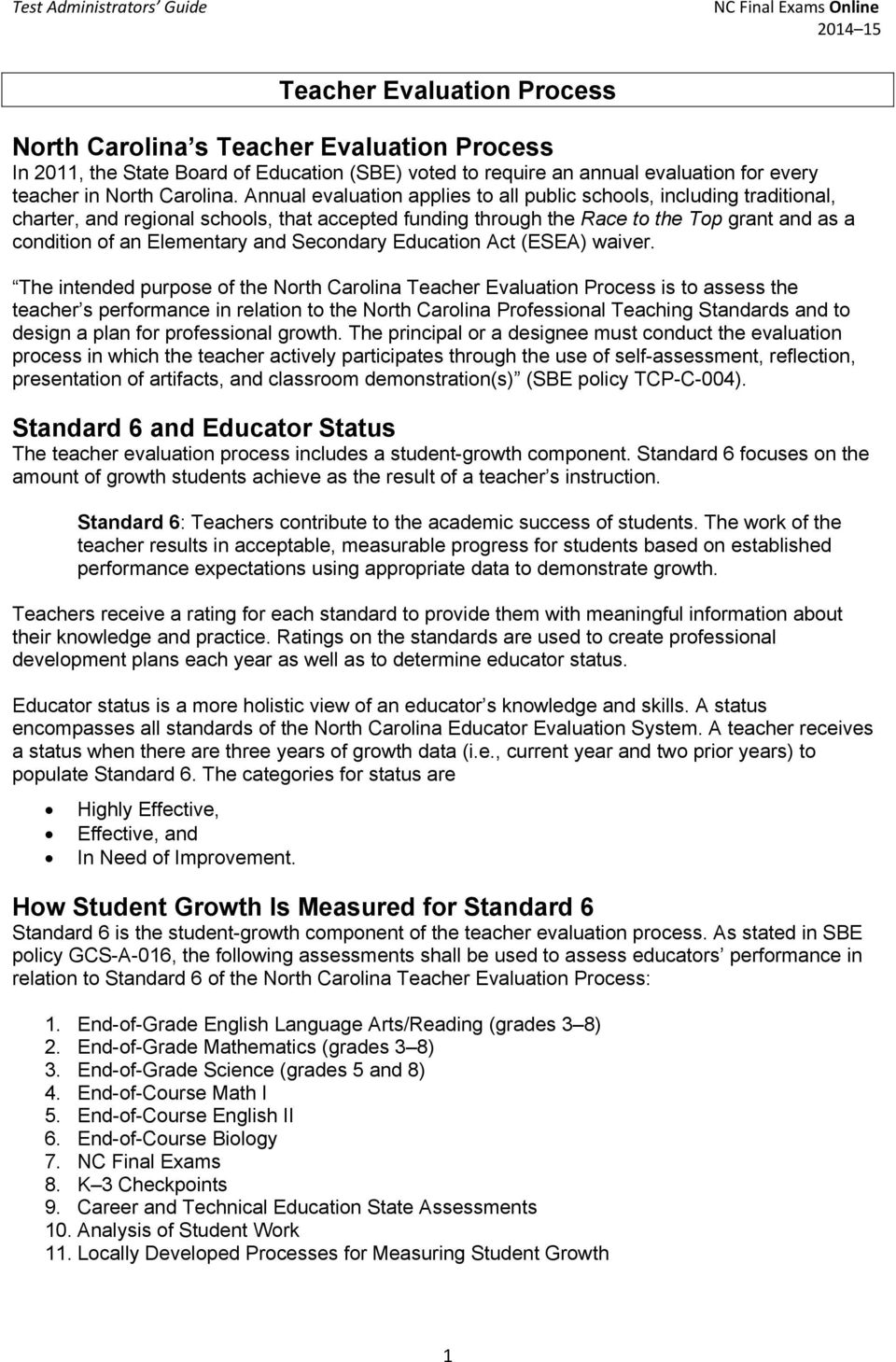
5 Teacher Evaluation Process North Carolina s Teacher Evaluation Process In 2011, the State Board of Education (SBE) voted to require an annual evaluation for every teacher in North Carolina. Annual evaluation applies to all public schools, including traditional, charter, and regional schools, that accepted funding through the Race to the Top grant and as a condition of an Elementary and Secondary Education Act (ESEA) waiver. The intended purpose of the North Carolina Teacher Evaluation Process is to assess the teacher s performance in relation to the North Carolina Professional Teaching Standards and to design a plan for professional growth. The principal or a designee must conduct the evaluation process in which the teacher actively participates through the use of self-assessment, reflection, presentation of artifacts, and classroom demonstration(s) (SBE policy TCP-C-004). Standard 6 and Educator Status The teacher evaluation process includes a student-growth component. Standard 6 focuses on the amount of growth students achieve as the result of a teacher s instruction. Standard 6: Teachers contribute to the academic success of students. The work of the teacher results in acceptable, measurable progress for students based on established performance expectations using appropriate data to demonstrate growth. Teachers receive a rating for each standard to provide them with meaningful information about their knowledge and practice. Ratings on the standards are used to create professional development plans each year as well as to determine educator status. Educator status is a more holistic view of an educator s knowledge and skills. A status encompasses all standards of the North Carolina Educator Evaluation System. A teacher receives a status when there are three years of growth data (i.e., current year and two prior years) to populate Standard 6. The categories for status are Highly Effective, Effective, and In Need of Improvement. How Student Growth Is Measured for Standard 6 Standard 6 is the student-growth component of the teacher evaluation process. As stated in SBE policy GCS-A-016, the following assessments shall be used to assess educators performance in relation to Standard 6 of the North Carolina Teacher Evaluation Process: 1. End-of-Grade English Language Arts/Reading (grades 3 8) 2. End-of-Grade Mathematics (grades 3 8) 3. End-of-Grade Science (grades 5 and 8) 4. End-of-Course Math I 5. End-of-Course English II 6. End-of-Course Biology 7. NC Final Exams 8. K 3 Checkpoints 9. Career and Technical Education State Assessments 10. Analysis of Student Work 11. Locally Developed Processes for Measuring Student Growth 1
6 was the first year of a three-year cycle of student-growth data used as part of the status determination. Whenever possible, growth is calculated through EVAAS. School Administrator Evaluation Process North Carolina s School Administrator Evaluation Process The SBE requires an annual evaluation of every principal and assistant principal in North Carolina. The annual evaluation requirement applies to all public schools including traditional, charter, and regional schools that accepted funding through the Race to the Top grant and as a condition of an ESEA waiver. The intended purpose of the North Carolina School Executive Evaluation Process is to assess the administrator s performance in relation to the North Carolina School Executive Standards and to design a plan for professional growth. Standard 8 and Educator Status The school executive evaluation process includes a student-growth component. Standard 8 focuses on the amount of growth students achieve as the result of their instruction in a school. Standard 8: Academic Achievement Leadership. The school executive will contribute to the academic success of students. The work of the school executive will result in acceptable, measurable progress for students based on established performance expectations using appropriate data to demonstrate growth. Administrators receive a rating for each standard to provide them with meaningful information about their knowledge and practice. Ratings on the standards are used to determine educator status. Educator status is a more holistic view of an educator s knowledge and skills. A status encompasses all standards of the North Carolina Educator Evaluation System. A principal or assistant principal receives a status when there are three years of growth data (i.e., current year and two prior years) to populate Standard 8. The categories for status are Highly Effective, Effective, and In Need of Improvement. How Student Growth Is Measured for Standard 8 Standard 8 is the student-growth component for the school executive evaluation process. As stated in SBE policy GCS-A-016, the following assessments shall be used to assess educators performance in relation to Standard 8 of the North Carolina School Executive Evaluation Process: End-of-Grade English Language Arts/Reading (grades 3 8) End-of-Grade Mathematics (grades 3 8) End-of-Grade Science (grades 5 and 8) End-of-Course Math I End-of-Course English II End-of-Course Biology NC Final Exams K 3 Checkpoints Career and Technical Education State Assessments 2

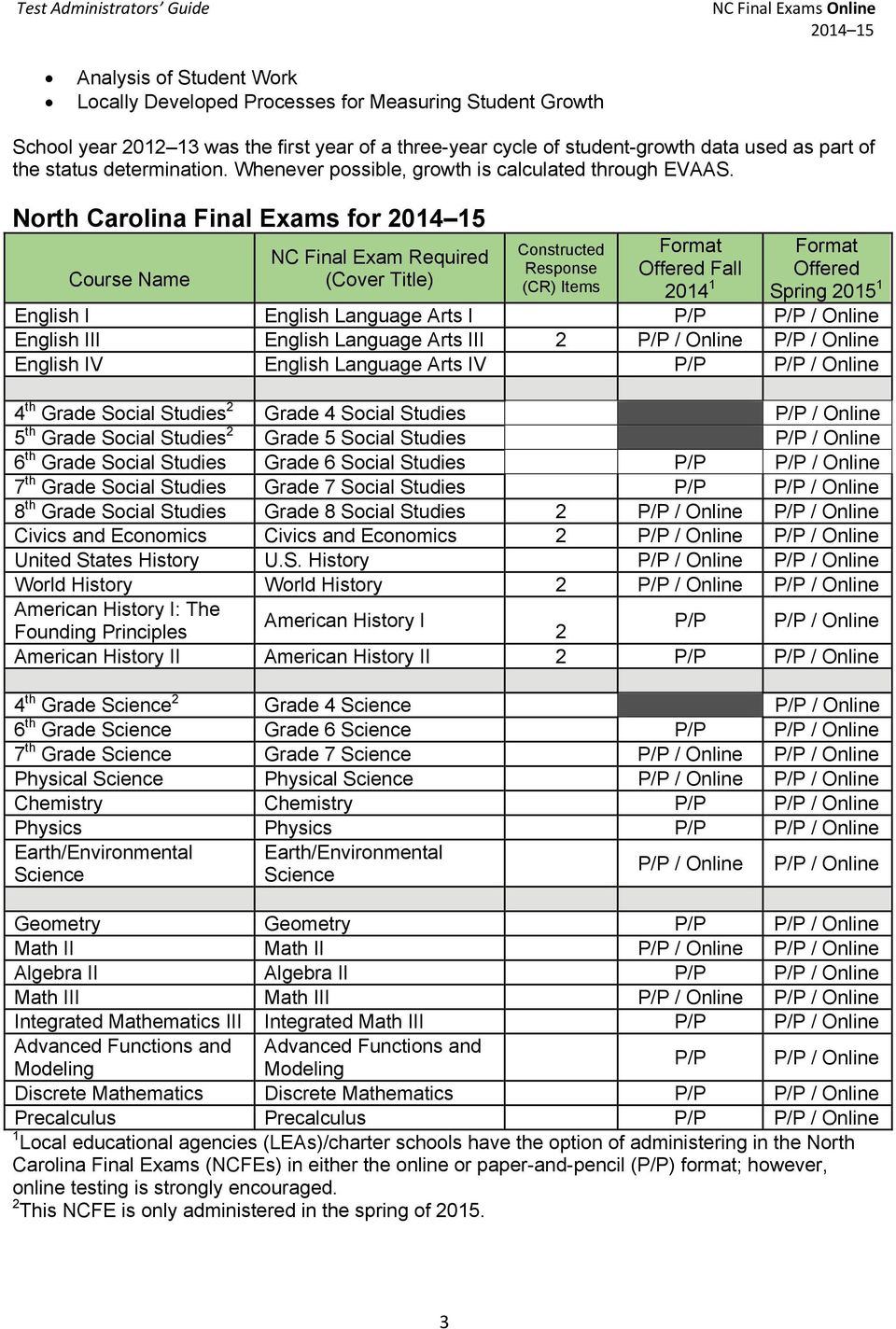
7 Analysis of Student Work Locally Developed Processes for Measuring Student Growth School year was the first year of a three-year cycle of student-growth data used as part of the status determination. Whenever possible, growth is calculated through EVAAS. North Carolina Final Exams for Course Name NC Final Exam Required (Cover Title) Constructed Response (CR) Items Format Offered Fall Format Offered Spring English I English Language Arts I P/P P/P / Online English III English Language Arts III 2 P/P / Online P/P / Online English IV English Language Arts IV P/P P/P / Online 4 th Grade Social Studies 2 Grade 4 Social Studies P/P / Online 5 th Grade Social Studies 2 Grade 5 Social Studies P/P / Online 6 th Grade Social Studies Grade 6 Social Studies P/P P/P / Online 7 th Grade Social Studies Grade 7 Social Studies P/P P/P / Online 8 th Grade Social Studies Grade 8 Social Studies 2 P/P / Online P/P / Online Civics and Economics Civics and Economics 2 P/P / Online P/P / Online United States History U.S. History P/P / Online P/P / Online World History World History 2 P/P / Online P/P / Online American History I: The American History I Founding Principles 2 P/P P/P / Online American History II American History II 2 P/P P/P / Online 4 th Grade Science 2 Grade 4 Science P/P / Online 6 th Grade Science Grade 6 Science P/P P/P / Online 7 th Grade Science Grade 7 Science P/P / Online P/P / Online Physical Science Physical Science P/P / Online P/P / Online Chemistry Chemistry P/P P/P / Online Physics Physics P/P P/P / Online Earth/Environmental Science Earth/Environmental Science P/P / Online P/P / Online Geometry Geometry P/P P/P / Online Math II Math II P/P / Online P/P / Online Algebra II Algebra II P/P P/P / Online Math III Math III P/P / Online P/P / Online Integrated Mathematics III Integrated Math III P/P P/P / Online Advanced Functions and Advanced Functions and Modeling Modeling P/P P/P / Online Discrete Mathematics Discrete Mathematics P/P P/P / Online Precalculus Precalculus P/P P/P / Online 1 Local educational agencies (LEAs)/charter schools have the option of administering in the North Carolina Final Exams (NCFEs) in either the online or paper-and-pencil (P/P) format; however, online testing is strongly encouraged. 2 This NCFE is only administered in the spring of
8 Eligible Students Students Required to Participate: Per State Board policy GCS-A-016, all eligible public school students shall participate in the administration of the NCFEs (standard administrations with or without accommodations). Regardless of the grade level in which the course is offered, a student enrolled in a course that requires an NCFE shall take the appropriate assessment at the completion of the course. This requirement does not apply to o students for science NCFEs at grades 4, 6, and 7 whose teachers have their test scores for the same year from the end-of-grade tests of English language arts/reading and/or mathematics, and/or the social studies NCFEs. The decision must be applied consistently to all schools within a district so that teachers in like categories have the same measures. o students for social studies NCFEs at grades 4, 5, 6, 7, and 8 whose teachers have their test scores for the same year from the end-of-grade tests of English language arts/reading, mathematics, and/or science, and/or science NCFEs. The decision must be applied consistently to all schools within a district so that teachers in like categories have the same measures. Note: School systems may elect to administer the science and social studies NCFEs even if teachers have English language arts/reading, mathematics, science, or social studies scores. Students repeating a course must take the NCFE. Students with disabilities must participate in the NCFEs with or without accommodations. Students identified as limited English proficient (LEP) must participate in the NCFEs with or without accommodations. Students identified as LEP who score below Level 4.0 Expanding on the reading subtest of the WIDA ACCESS Placement Test (W-APT TM ) and are in their first year in U.S. schools are not eligible to be assessed on the NCFEs for English I, English III, and English IV. However, they are required to participate in the administration of the NCFEs for science, mathematics, and social studies. Students who are identified as failing a course/grade/subject for which an NCFE is required shall take the appropriate assessment. Transfer students must take the NCFEs. Scores will not be used to determine teacher growth if the transfer student is in membership less than 70 days for a 4x4/semester course or 140 days for a traditional yearlong course. Students, including seniors, who are exempt from final exams by local board of education policy, shall not be exempt from the NCFEs. Students Not Required to Participate: Note: The 95% tested rule does not apply to the NCFEs. All students in AP and IB courses are exempt from the administration of the NCFEs. AP and IB courses have a different process to determine teacher effectiveness. Students currently instructed on the Extended Content Standards who, according to their Individualized Education Programs (IEPs), participate in the NCEXTEND1 alternate assessments are exempt from the NCFEs. 4

9 Students identified as LEP who score below Level 4.0 Expanding on the reading subtest of the WIDA ACCESS Placement Test (W-APT TM ) and are in their first year in U.S. schools are exempt from the NC Final Exams for English I, English III, and English IV. Students taking a course for credit recovery are exempt from the NCFEs. Students enrolled in online courses taught by persons not employed by the school district (e.g., student enrolled in an early college course taught by a college professor) are exempt from the NCFEs. Students enrolled in courses through the North Carolina Virtual Public Schools (NCVPS) are exempt from the NCFEs. Charter schools that have never received Race to the Top funds do not have to participate in the NCFEs; however, the final exams must be administered by teachers whom a charter school plans to recommend for Standard Professional 2 (SP2) licensure. In rare cases, students may be medically fragile because of a significant medical emergency and/or condition and are unable to participate in a specific test administration. These students may be granted a medical exception for the NCFEs. It is a local decision as to how requests for medical exceptions are to be processed. Medical exceptions for final exams are NOT to be sent to the North Carolina Department of Public Instruction (NCDPI). However, if a student has been granted a medical exception by the NCDPI for the current school year s testing window(s), it may be extended to include the NCFEs at the discretion of the LEA. Testing Window for the NC Final Exams Test administrators must administer the NCFEs during the last five days (4x4/semester courses) or the last ten days (traditional yearlong schedule) of the instructional period (SBE policy GCS-A- 016). For school systems that were required to adjust their school schedules because of adverse weather conditions or other emergencies, the testing schedule should be adjusted to fall within the final five days (4x4/semester) or last ten days (yearlong) of the adjusted school year. Note: For the school year only, local boards of education could apply for a waiver from the requirements of G.S. 115C (4) which limit the administration of final exams (i.e., endof-course, end-of-grade, NCFEs, Career and Technical Education State Assessments, and teacher-made final exams) for yearlong courses to the final ten instructional days of the school year and the final five instructional days of the semester for semester courses. The SBE required all waiver requests be received by September 1, Waivers must be approved by the SBE in order for LEAs/charter schools to have up to five additional days to administer final exams (i.e., within the final fifteen instructional days of the school year for yearlong courses; within the final ten instructional days of the semester for semester courses). The SBE notified LEAs/charters whether the requested waiver was granted by October 1, Makeup Testing Any student absent (i.e., not present) from the test administration must make up the test. The LEA test coordinator will specify how makeup tests are to be handled at the school and will schedule dates and times for completing makeup tests in each school so that all makeups are completed within the testing window. Retesting No retests are permitted for the NCFEs unless a misadministration is declared. 5

10 Administration Time and Testing Schedule The administration time for all NCFEs (elementary, middle, and high school) is 120 minutes. No administration of the NCFEs may exceed the 120 minutes (except for students with documented special needs requiring accommodations, such as Scheduled Extended Time). The administration time does not include time for general instructions and breaks. The NCFEs must be administered in one school day (i.e., not over two or more days) except for students with documented special needs requiring accommodations, such as Multiple Testing Sessions. Refer to the following chart for the test administration times. Activity Time Administration Time 120 minutes 2 Two-Minute Breaks 4 minutes General Instructions 12 minutes Total Time 136 minutes Note: Students are provided the first break after 40 minutes of testing; the second break is provided after another 40 minutes of testing. During the breaks, students must not be allowed to talk or to leave the room except in an emergency (i.e., illness, necessary restroom break). Test Formats and Availability Online Format: For the school year, English III, Grade 8 Social Studies, Civics and Economics, U.S. History, World History, Grade 7 Science, Physical Science, Earth/Environmental Science, Math II, and Math III NCFEs are available for online administrations in the fall. For the spring 2015 administrations, all NCFEs will be available online. Paper-and-Pencil Format: For the school year, all NCFEs are available in paper-and-pencil format for fall and spring administrations: however, online testing is strongly encouraged. Test Materials The superintendent or superintendent s designee, usually the LEA test coordinator, is responsible for ensuring all NCFE test materials are ordered properly from the Testing News Network (TNN) ordering page. Note: Orders will not be prepopulated. The following chart lists the materials required for all NCFEs. In addition to the required testing materials listed in the chart, test administrators will need an accurate timing device that does not make noise or sound an alarm. Note: For NCFEs that require blank paper and/or graph paper, the test administrator may distribute additional blank paper and/or graph paper to students who need them. 6

11 North Carolina Final Exams Online Testing Materials List Test Format 1 Required Materials NCFE Online Testing NC Final Exam (Cover Title) P/P Spring Online Spring P/P Fall Online Fall Online Guide Blank Paper Graph Paper Calculator (Sci/Graph) Formula Sheet Reference Table English Language Arts I English Language Arts III English Language Arts IV Grade 4 Soc. Studies 2 Grade 5 Soc. Studies 2 Grade 6 Soc. Studies Grade 7 Soc. Studies Grade 8 Soc. Studies Civics and Economics U.S. History World History American History I American History II Grade 4 Science 2 Grade 6 Science Grade 7 Science Physical Science Sci. Chemistry Sci. Physics Sci. Earth/Env. Science Sci. Geometry Sci. Math II Graph Algebra II Graph Math III Graph Integrated Math III Graph Adv. Funct. and Modeling Graph Discrete Mathematics Graph Precalculus Graph 1 LEAs/charters have the option of administering in the online or paper-and-pencil (p/p) format; however, online testing is strongly encouraged. 2 This exam is only administered in the spring. 7
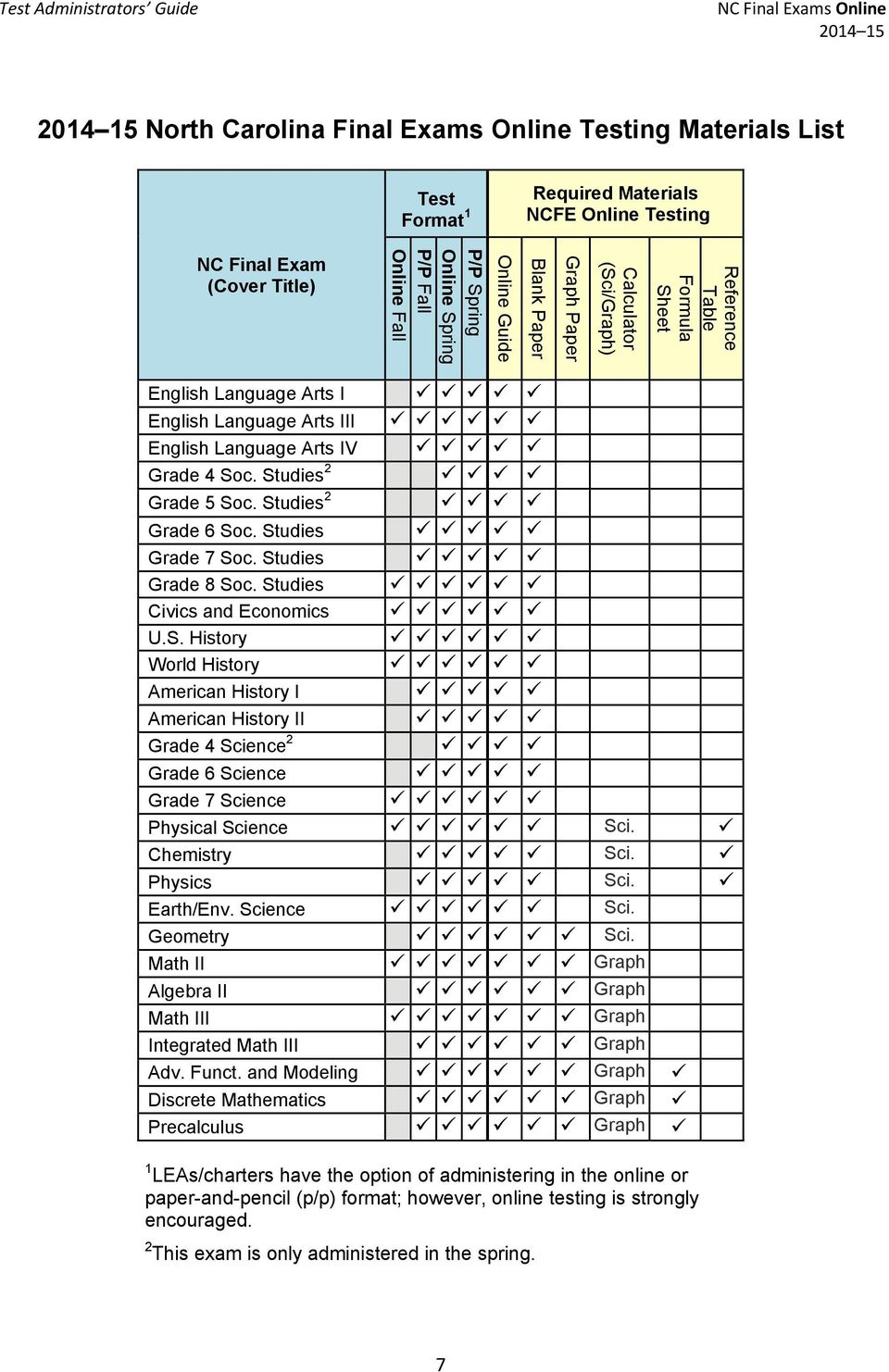
12 Calculator Requirements All students are to have access to calculators only during the administration of NCFEs requiring calculator use. Students must use calculators that are similar to those used during classroom instruction in the current school year. Students who regularly use more than one calculator during classroom instructional activities may be permitted to use more than one calculator during the NCFE administration. Students are not allowed to share calculators during test administrations. Before beginning and immediately following an NCFE that requires calculator use, the test administrator or principal s designee must clear the calculator memory and all applications (including preloaded) of all calculators that will be used during each administration of the test. Only the test administrator or principal s designee is permitted to carry out this procedure. Students may use their personal calculators for the NCFEs. However, they must be informed that if they use their personal calculators, the calculator memory and all applications (including preloaded) must be cleared before and after the test administration. Students who still wish to use their own calculators must be told before the assessment day to back up all data and programs that they wish to save. After the test administration, the test administrator or principal s designee should enable the memory and applications of the students calculators. The minimum calculator requirements for the NCFEs requiring calculator use are as follows: A graphing calculator is the minimum requirement for Math II Algebra II Math III Integrated Math III Advanced Functions and Modeling Discrete Mathematics Precalculus A scientific calculator is the minimum requirement for Geometry Physical Science Chemistry Physics Earth/Environmental Science The following calculator functionalities are not permitted for use on the NCFEs: Calculators with wireless communication technologies (e.g., Bluetooth, Infrared) Calculators with built-in computer algebra systems (CAS) capable of doing symbolic algebra (e.g., factoring, expanding, or simplifying given variable output) or symbolic calculus Pocket organizers Handheld or laptop/notebook computers, unless specifically approved Calculators built into cellular phones or other electronic communication devices Calculators in pen-input/stylus-driven devices Calculators requiring access to an electrical outlet (except for students needing special accommodations) Calculators that make noises of any kind that cannot be disabled (except for students needing special accommodations) Calculators that use a QWERTY (typewriter-style) keyboard 8

13 Calculators that use paper tape The following list includes calculators not permitted for use on the NCFEs. The list is not allinclusive. If the school system test coordinator believes calculator brands other than those listed below may need to be restricted, he/she must contact the regional accountability coordinator (RAC) for clearance before allowing their use. Texas Instruments: All model numbers that begin with TI-89 or TI-92; Voyage 200; N-Spire CAS Hewlett-Packard: hp 48GII and all model numbers that begin with HP 40G, HP 49G, or HP 50G Casio: Algebra fx 2.0, ClassPad 300, and all model numbers that begin with CFX-9970G Texas Instruments TI-Nspire calculators without CAS are allowed only in the following two cases: (1) with the TI-84 Plus keypad or (2) with the Nspire keypad using operating system 1.7 or higher with both limit geometry functions and disable function grab and move invoked in Press-to-Test mode. As curricula and technology change, the policy concerning calculator use with North Carolina assessments will be reevaluated. Accommodations and Alternate Assessments Students with disabilities, including students only receiving services under Section 504, may receive testing accommodations for the NCFEs. Documentation must exist in the students IEPs or Section 504 Plans to substantiate the provision of these accommodations. The documented accommodations must be used routinely during classroom instruction and similar classroom assessments that measure the same construct. The superintendent or superintendent s designee, usually the LEA test coordinator, is responsible for ensuring secure test materials are ordered properly. For ordering purposes, requests for special print versions (Braille, Large Print, and One Test Item Per Page editions) must be entered into the Testing News Network s (TNN) ordering system. Orders for special print versions must be placed at least thirty working days before the actual test administration date. Requests for special print versions other than those specified in this guide must be submitted on an Accommodation Notification Form. Test administrators who provide accommodations for students with disabilities must refer to the most recent publication of Testing Students with Disabilities and any published supplements or updates for additional information regarding appropriate testing procedures and accommodations. This publication is available through the local school system or at Alternate assessments are not available for the NCFEs. On a case-by-case basis where appropriate documentation exists, students identified as LEP may receive testing accommodations for the NCFEs. The need for the accommodations must be documented in the students current LEP plan/documentation to substantiate the provision of these accommodations. Moreover, the documented accommodations must be used routinely during classroom instruction and similar classroom assessments that measure the same construct. For additional information on accommodations and guidelines for testing students identified as LEP, refer to the Guidelines for Testing Students Identified as Limited English Proficient publication and any published supplements or updates. These publications are available through the local school system or at 9
14 On a case-by-case basis where appropriate documentation exists, students who are identified with a transitory impairment (i.e., not Section 504-eligible) may receive testing accommodations for the NCFEs. As with all testing accommodations, accommodations that are being considered for use during testing must be used routinely during instruction and similar classroom assessments when possible. Approved accommodations for students identified with transitory impairments include those accommodations that are approved for use by Section 504-eligible students. The need for accommodations must be documented before testing. Copies of this documentation must be kept at the school and made available to test coordinators. On days before the test administration, the Review of Accommodations Used During Testing form (see Appendix B) must be used to record the required testing accommodations documented on students IEPs, Section 504 Plans, LEP documentation, or transitory impairment documentation. One form is to be completed per assessment per student. For a list of testing accommodations for the NCFEs, see Appendix C. Multiple Testing Sessions Accommodation The Multiple Testing Sessions accommodation allows the total test administration time to be divided into minisessions as determined by the individual needs of the student. In cases in which students have an extended break in the same day, such as a break for lunch, or when continuing the test on a subsequent day, this accommodation does not permit students to go back to previously attempted items. For online administrations, however, students will have access to previously completed items when they return from an extended break. Test administrators must monitor these students carefully to ensure they do not return to previous items. For students with the Multiple Testing Sessions accommodation, the following directions should be followed: During all breaks, the PAUSE button must be clicked to prevent the online test items from being visible on the computer monitor. Each time the PAUSE button is clicked, the student has sixty (60) minutes to continue the assessment. If the break is longer than sixty (60) minutes, or if the student has completed testing for the day, the test administrator must close NCTest by clicking the EXIT button on the Review or Pause page. The student s responses to test items will be saved. The test administrator must log back into NCTest and launch the test again to allow the student to continue working on the assessment. The student should not click the END TEST button on days in which he/she has additional minisessions for testing. If the student does click the END TEST button on days in which he/she will continue working on the assessment following an extended break, the LEA test coordinator/testing assistant must RESUME the assessment on the NCTest Admin page before the student can continue. On subsequent test days, the test administrator should navigate to where the student stopped on the previous test day. This should be done before the student enters the room, and the pause button should be activated. The test administrator will need to closely monitor to make sure the student does not go back to the previous day(s) items. The student must also be given ample warning that testing time is coming to a close on each testing session so he/she may complete any items flagged prior to the end of testing for that day. The student must be informed of these policies before the first day of testing. 10

15 Testing Code of Ethics The North Carolina Testing Code of Ethics (GCS-A-010) applies to the administration of all NCFEs. Before the test administration, test administrators must read and study the Testing Code of Ethics. The Testing Code of Ethics addresses appropriate professional practices for central office and school administrators, test coordinators, teachers (test administrators), and proctors in the areas of securing tests; administering tests; and scoring, reporting, and interpreting test results. The sanctions for violations included in the Testing Code of Ethics are applicable to the administration of the final exams. A copy of the Testing Code of Ethics is found in Appendix D of this guide. Test Security The principal shall account for all test materials and shall ensure test security within the school building (SBE policy GCS-A-010). All NCFE test administrators and proctors must receive training on the policies and procedures for conducting a proper test administration before they administer or proctor an NCFE. The importance of maintaining test security at all times must be stressed. Copying Secure Test Materials Secure tests, including all test materials and test questions, must not be reproduced in any manner. Secure tests must not be copied, filed, or used directly in instructional activities. No person may copy, reproduce, or paraphrase the test materials in any manner for any reason without the prior written consent of the NCDPI Division of Accountability Services/North Carolina Testing Program. Classroom Instruction and/or Study Guides Excerpts from the tests must not be used at any time during classroom instruction or in resource materials such as study guides. Instructional materials that contain sample test questions (whether generated locally or obtained from another school system) must be shared with the principal and school system test coordinator before use. Teachers are not permitted to discuss specific items from the tests with students or colleagues before, during, or after the test administration nor ask students which test questions were difficult. Displays Displaying information regarding content being measured or test-taking strategies (e.g., Tips for Taking Tests, displays, word lists, word walls, definitions, writing formulas, multiplication tables, mathematical formulas/theorems) in any manner or form in the room during a test administration will result in a misadministration. Failure to cover or remove such displays during a test administration is considered a violation of the Testing Code of Ethics. Testing Environment All rooms designated for testing must be quiet, orderly, comfortable, and have adequate lighting. Seating must be arranged to discourage students from sharing responses. Each student should have enough space in which to work. 11
16 Ensure spare computers and power sources are available, if needed. Students are prohibited from having any electronic devices, other than permitted calculators, in their possession or to use cell phones at any time during testing, including breaks. Any person found or observed with a cell phone/electronic device during testing time must be dismissed from testing and a misadministration declared. o If the test administrator or proctor believes an electronic device was used during the test administration to store or exchange information, or to make an image of the test, the device must be collected from the student and the school test coordinator contacted immediately. o If a student must be removed from testing because he/she has a cell phone/electronic device during testing, the test administrator must not leave the testing room unattended. The test administrator must remain in the room, and the school coordinator must be notified and the student removed. o Please note the following exception to the policy: Students participating only in online assessments may use computers or electronic devices to respond to the test items if the computer/devices meet all technical requirements listed at Students personal belongings must be placed under their seats and students must not be permitted to access them at any time during testing, including breaks. o Students who complete the test before the scheduled time is over must be provided the option to read novels or other nontextbooks (e.g., magazines) while waiting for other students to finish the test. Test administrators must collect students answer sheets, test books, and all other ancillary materials (e.g., calculators, used papers) before students are allowed to take out their reading materials. (See the section Procedures for Students Who Complete the Test before the Scheduled Time Is Over located in this guide for additional information.) No one, including testing staff, may eat or drink in the testing room. Accounting for and Storing Test Materials The test administrator must count and record the number of secure test materials and supplemental materials o when the materials are first received; o before the distribution of materials to students; o after the test administration; and o when the materials are returned to the school test coordinator. The test administrator must immediately report any discrepancies in the count to the school test coordinator/principal. Test materials, computers with test material on the screen, or computers that display the student Start screen, must not be left unattended by the test administrator at any time. Immediately after the test administration, the test administrator must return all testing materials to the school test coordinator according to the directions specified in this Assessment Guide. The school test coordinator shall collect, count, and return all test materials to the secure, locked facility. Access to Secure Assessments Access to the tests shall be limited to school personnel who have a legitimate need. 12

17 NC Education usernames and passwords must remain secure and must not be shared or compromised. School personnel must not disclose the contents of secure tests nor discuss with each other or with students specific test questions or information contained within the test(s). Visitors to the classroom are prohibited during the test administration except when required for state or local monitoring of test administrations or under extreme circumstances (i.e., emergency situations). Read Aloud or Signing/Cueing Administrations Test administrators who provide read aloud or signing/cueing administrations have the added responsibility of maintaining confidentiality because of the access they are granted for these types of accommodations. It is strictly prohibited for test administrators who give these administrations to divulge the contents of the assessment, generally or specifically, to anyone or to copy or record test items. Selection of Test Administrators The selection of test administrators should follow these guidelines: If the test administrator is the teacher who teacher s the students in the subject/course of the NCFE being administered (i.e., the teacher of record), then two adults (i.e., the teacher and a proctor [one-on-one, full-time proctor or roving proctor]) should be present during the test administration. If the test administrator is a teacher who teaches the same subject matter/course as the NCFE being administered (i.e., not the teacher of record), then two adults (i.e., the teacher and a proctor [one-on-one, full-time proctor or roving proctor]) should be present during the test administration. If the test administrator is a teacher who does not teach the subject matter/course of the final exam being administered, then LEAs/charter schools may elect not to require a second adult (i.e., proctor) be present during the test administration. Using One-on-One/Full-Time or Roving Proctors A trained proctor should be assigned and present for each NCFE administration regardless of the number of students tested. The proctors assigned to monitor the NCFEs can be either (1) a oneon-one, full-time proctor (i.e., one proctor assisting one test administrator in a single testing room) or (2) a roving proctor (e.g., one proctor assisting up to three test administrators in three testing rooms). All proctors must be trained before each test administration. For best practices, two adults (i.e., the test administrator and a proctor [one-on-one, full-time proctor or roving proctor]) should be present during the test administration if the test administrator is either the teacher of record (i.e., teacher of the group tested) or is a teacher of the subject matter being tested. For best practices, roving proctors should not be responsible for more than three, centrally located classrooms. Before assigning proctors, the LEA/charter school test coordinator must consider the test group(s) that will be monitored by a proctor(s). For example, a small group of students who are easily distracted might not be the best test group for a roving proctor. 13
18 The LEA/charter school test coordinator must specify the logistics for roving proctors, such as the room assignments; the time spent monitoring in each testing room, and whether the testing room door is to be left open or closed during the testing session. For best practices, there should not be more than thirty students in the testing class or group. Testing rooms with over thirty students should have a full-time proctor. Ideally, every test administration should have a proctor present, and it is most preferred when test administrations exceed thirty students. If after working with the RAC and exhausting all options, it is not possible to have proctors as stated in this Administrators Guide, LEAs may submit a letter to the Office of the State Superintendent stating the hardship and assuring the district assumes responsibility for test security. Student Emergencies and Breaks All students should have an opportunity to use the restroom before beginning an NCFE. If a student must leave the room during the test administration because of an emergency (i.e., becoming ill or requiring a visit to the restroom), the student must be accommodated. All test materials must remain in the room. If a student needs a restroom break during testing, these procedures must be followed: To the extent possible, only one student at a time should be excused to the restroom. The student s test materials should be secured (i.e., secure online test items must not be visible). Before leaving for the restroom, the PAUSE button must be clicked to prevent the online test items from being visible. The test administrator should note the time the student left the room to ensure the student has the allotted amount of time to complete the test upon return. If necessary, an appropriate member of the school staff may accompany the student to the restroom. Students must be accompanied if more than one is allowed to leave during the test at the same time. Procedures for Students Who Complete the Test before the Scheduled Testing Time Is Over Students who complete the NCFE before the scheduled time is over must be provided the option to read novels or other nontextbooks (e.g., magazines) while other students continue to work during the scheduled time. Before students who have completed the exam may read, however, the test administrator must ensure that the student has clicked the End Test button to close the test (Once students have clicked the End Test button, they will not be able to return to the test items. A STOP sign will appear on students monitors after the End Test button has been clicked and the test has been closed.); collect all ancillary materials (e.g., calculators, used blank and graph papers); and ensure the students reading material is a novel or other nontextbook, such as a magazine. (Textbooks, reference books, e-book readers, thesauruses, audio books, music, notes, or any unapproved testing aids are prohibited during the administration of any test in the North Carolina Testing Program. (During the scheduled testing time, students are only allowed to read novels or other nontextbooks after they are finished and waiting for other students to complete the test. Students may put their heads down on their desks and rest if they decide not to read.) 14
19 If all students finish the NCFE before the scheduled time period is over, the test administrator may end the testing session early by reading the information in this Assessment Guide under the words Read to Announce the End of the Testing Session. Students must not be dismissed from the room unless authorized by the appropriate local official (e.g., principal). The test administrator must follow local procedures for returning students to the regular school schedule. Reporting Testing Irregularities The test administrator or proctor must report any alleged testing violation or testing irregularity to the school test coordinator on the day of the occurrence. The school test coordinator must contact the LEA test coordinator immediately with any allegation of a testing violation. The school test coordinator must then conduct a thorough investigation and complete the Report of Testing Irregularity provided through the Online Testing Irregularity Submission System (OTISS). (Please note that persons reporting irregularities in OTISS must first receive training and a password from the LEA test coordinator.) The OTISS irregularity report must be submitted to the school system test coordinator within five days of the test administration. Different incidents must be documented on separate reports of testing irregularities even when the incidents occur during the same test administration in the same room. For example, if one student is disruptive during testing and another student becomes ill during the administration of the test, two separate reports of testing irregularity must be filed in OTISS. If the superintendent or school system test coordinator declares a misadministration, the misadministration must be documented and reported using appropriate procedures outlined in OTISS. Examples of testing irregularities include, but are not limited to Eligibility Issues: Failing to test all eligible students (SBE policy GCS-A-016) Administering tests to ineligible students Accommodation Issues: Providing accommodations to students who are not eligible to receive them Failing to provide approved accommodations to the appropriate students Failing to follow appropriate procedures for providing testing accommodations Accommodation Test Administrator Reads Test Aloud (in English) or Interpreter/Transliterator Signs/Cues Test was provided during an assessment that measures reading skills (i.e., English I, English III, or English IV) Security Issues: Allowing access to the secure tests to school or district personnel who do not have a legitimate need Allowing students to review secure test materials before the test administration Leaving students unsupervised with access to secure test materials Secure test materials not stored in a secure, locked facility Failing to cover or remove bulletin board materials, or classroom displays, or reference materials (printed or attached) on students desks that provide information regarding testtaking strategies or the content being measured by the test Failing to return the originally distributed number of test materials to designated school personnel Reproducing secure tests in any manner or form Giving students instruction related to the concepts measured by the tests before the test administration or during the test administration session Not maintaining security of NC Education Username and Password. NC Education usernames and passwords must remain secure and must not be shared or compromised. 15
20 Monitoring Issues: Test administrator left the room unattended when students and secure materials were present Testing personnel did not monitor students during break Students allowed to remove secure materials from the testing area Students cheated by copying, using a cheat sheet, or asking for information Students not prevented from gaining an unfair advantage through the use of cell phones, text messages, or other means Procedural Issues: Interpreting or explaining the test items, including answer choices (SBE policy GCS-A-010) Reading or tampering with (e.g., altering, changing, modifying, erasing, or scoring) student responses to the test questions Failing to administer the secure tests during the testing window designated by the NCDPI Division of Accountability Services/North Carolina Testing Program Failing to follow the test schedule procedures or makeup test schedule designated by the NCDPI Division of Accountability Services/North Carolina Testing Program Providing students with additional time beyond the time specified in this administration guide (except for students with documented special needs requiring accommodations, such as Scheduled Extended Time) Misadministrations School systems must monitor test administration procedures. According to SBE policy GCS-A-001, if school officials discover any instance of improper administration and determine that the validity of the test results has been affected, they must notify the local board of education, order the affected students to be retested, and declare a misadministration. Only the superintendent and the school system test coordinator have the authority to declare misadministrations at the local level. When a misadministration is declared, the affected students must be readministered the test. The LEA/charter school test coordinator will reset the assessment in NC Education and schedule dates and times for readministering the tests in each school so that all retests are completed within the testing windows. Only results from a valid test administration should be used as a minimum of 20% of the student s final grade for the respective course and entered into the North Carolina Educator Evaluation System. All misadministrations must be documented and reported using the appropriate procedures outlined in the OTISS. Information about Test Items All NC Final Exams contain a small portion of experimental (field test) items, which do not count toward or against a student s score. These items are indistinguishable from operational items and should not interfere with the students test-taking experience. Confidentiality of Student Scores Any written material containing personally identifiable information from the student s educational records (i.e., identifiable scores of individual students) shall not be disseminated or otherwise made available to the public by any member of the SBE, any employee of the SBE, the State Superintendent of Public Instruction, any employee of the NCDPI, any member of a local board of education, any employee of a local board of education, or any other person, except as permitted under the provisions of the Family Educational Rights and Privacy Act of 1974, 20 U.S.C. 1232g. 16
21 Online Assessment Format Online assessments are presented through a secure platform (e.g., NCTest Secure Browser, NCTest apps, or Chromebook with required security measures). All test items are formatted specifically for online presentation and presented on the screen one test item at a time. Online assessments provide a toolbar at the top of the screen that includes the following options: Reset, Flag, Strike, Highlight, Unhighlight, Clear Highlight, and Help. Navigation buttons (i.e., First, Back, Pause, Next, and Review) are located at the bottom of the screen. Scroll bars appear on test questions as needed based on the length of the test item or font size. Online assessments are available to all students in regular or large font and in alternate background colors; however, the NCDPI recommends these options be considered only for students who routinely use similar tools (e.g., color acetate overlays, colored background paper, and large print text) in the classroom. It is recommended that students be given the opportunity to view the large font and/or alternate background color versions of the online tutorial and released forms of the assessment (with the device to be used on test day) to determine which mode of administration is appropriate. Students with the documented accommodation of Computer Reads Test Aloud Student Controlled have access to audio files of item content for all online assessments except those that measure reading skills (i.e., English I, III, and IV). Online Assessment Tutorial Schools must ensure every student participating in an online NCFE has completed the Online Assessment Tutorial at least once during the school year before test day in the specific content area. The Online Assessment Tutorial must be in the specific content area (i.e., English, Social Studies, Science, and/or Mathematics) of the associated assessment. The Online Assessment Tutorial is not an assessment; it allows the user to practice navigating through the testing platform and to respond to sample test items. During the Online Assessment Tutorial, students have the opportunity to become familiar with tools, navigation, item tracking/flagging/response features, interactive items, and other test interface features. Additionally, the Online Assessment Tutorial should be used to determine the student s appropriate font size (i.e., regular or large) and/or alternate background color for test day. These options must be entered in the student s interface questions (SIQ) before test day. The Online Assessment Tutorial can assist students, whose IEP or Section 504 Plan designates the Large Print accommodation, in determining if the large font will be sufficient on test day. If the size of the large font is not sufficient for a student because of his/her disability, this accommodation may be used in conjunction with the Magnification Devices accommodation, or a Large Print Edition of the paperand-pencil assessment may be ordered. Schools may use one of two Online Assessment Tutorial options with students. (1) Schools may play a video that demonstrates how to use the available tools, how to navigate the system, how to respond to each item type, and how to use the end-of-test review page. Immediately following the video, students must complete a self-paced interactive set of online sample items for the appropriate assessment offered in the same environment as the assessment. The NCDPI strongly recommends schools show the appropriate video to groups of students instead of allowing each student to stream the video to each computer or tablet simultaneously. (2) Schools may use a standard script developed by the NCDPI that gives guidance for using the available tools, navigating the system, responding to each item type, and using the end-of-test review page while students complete the tutorial items. Schools should review both options prior to the tutorial sessions to determine the best option for students. 17
22 For best results, students should complete the Online Assessment Tutorial using computers or tablets they will use during the actual online assessment. Completing the Online Assessment Tutorial also provides a minimal test of configurations. The Online Assessment Tutorial is available from the NCTest Secure Browser, NCTest Apps or Chromebook (with required security measures). Student Interface Questions (SIQ) On days before the test administration, if designated to do so by the school test coordinator, the test administrator must review and mark the student interface questions (SIQs) for students who need the following interface options or documented accommodations: Student Interface Options: Alternate Background Color Large Font Accommodations Required by Student: Multiple Testing Sessions Computer Reads Test Aloud Student Controlled Other Required Accommodations (i.e., other accommodations besides Multiple Testing Sessions and/or Computer Reads Test Aloud Student Controlled) Online assessments are available in regular or large font and in alternate background colors to all students; however, the NCDPI recommends these options be considered only for students who routinely use similar tools (e.g., color acetate overlays, alternate background color, large print text) in the classroom. In order for a student to access large font, an alternate background color, the Computer Reads Test Aloud Student Controlled accommodation and/or the Multiple Testing Sessions accommodation, the options must be entered into the student s SIQ before test day. Test records for students marked as requiring the Computer Reads Test Aloud Student Controlled accommodation, the Multiple Testing Sessions accommodation, or other required accommodations will not be exported to the LEA test coordinator until the test administrator completes the Accommodations Provided screen for the student. In order to edit a student s SIQ, the user must be linked to the school and assigned the role of teacher-school. To request to be linked to a school or district (LEA), log in to NC Education. At My Home, click Request Link to School/District under the User Tools Heading. Best Practices for Internet Security, Security of Test Materials, and Online Content Online tests contain secure test data, copyrighted content, and confidential student records. Therefore, test administrators, proctors, technology staff, and students must follow rules and procedures that ensure online content is not made available to anyone for any other purpose than to conduct the test. Users must not access the test and then leave a computer or tablet unsupervised. Locally stored off-line content (e.g., cookies, cache) must be cleared or secured after accessing the test so malicious applications or users cannot gain access to secure test materials. Best practices for password protection include, but are not limited to, the following: Never share passwords with anyone. User accounts are confidential. If passwords must be written down on a piece of paper, store the paper in a secure place and destroy it when it is no longer needed. 18
23 Change passwords immediately if they have been compromised. Be careful where passwords are saved on computers and tablets. Some dialog boxes, such as those for remote access, present an option to save or remember a password. Selecting this option poses a potential security threat. Checklist of Steps to Complete before Test Day Prepare for and attend test administrator training session(s) each testing cycle before administering any secure state assessment. Read and study the North Carolina Testing Code of Ethics. Know local testing policies and procedures (e.g., test security, handling technical problems, testing irregularities). Ensure the appropriate NCDPI-approved secure platform is installed. Prepare appropriate physical conditions for the testing room. Inform students of items that are prohibited in the testing room. Ensure your NC Education username/password is working correctly and you can access the NCTest Admin Page. Passwords should be checked two to three days before the test administration date. All test administrator NC Education accounts must be linked to the school with a role of teacher-school to start an online assessment. For questions, contact the LEA test coordinator or the Help Desk ([email protected]). Complete the Online Assessment Tutorial and ensure every student participating in an online NCFE has completed the Online Assessment Tutorial at least once during the school year before test day in the specific content area. The Online Assessment Tutorial must be in the specific content area (i.e., English, social studies, science, and/or mathematics) of the associated assessment. Ensure all computers and tablets meet specified technical requirements listed at Ensure screen savers are disabled and volume controls are set for students with the Computer Reads Test Aloud Student Controlled accommodation. Check to ensure all students who are to participate in online assessments are listed in the Admin Entry Tab lists in NC Education. Students who are no longer in membership MAY appear in this list; please disregard and DO NOT start a test for these students. Review and edit the SIQ, if designated to do so by the school test coordinator, for students who need the following interface options or documented accommodations: alternate background color, large font, Multiple Testing Sessions accommodation, Computer Reads Test Aloud Student Controlled accommodation, and/or other required accommodations (i.e., accommodations other than Multiple Testing Sessions and/or Computer Reads Test Aloud Student Controlled). Complete the Required Accommodations Documented on Students IEP/Section 504 Plan/LEP Plan/Transitory Impairment Documentation column on the Review of Accommodations Used During Testing form (see Appendix B). One form is to be completed per test per student. Ensure test administration sessions are scheduled in NC Education. Test administration sessions must be scheduled at least 24 hours before the test administration date. 19
24 On The Day of Testing Steps to Complete BEFORE Students Enter the Room Approximately minutes before students enter the testing room, the test administrator must launch the NCTest Secure Browser, the appropriate NCTest tablet app, or Chrome on Chromebooks (following required restrictions) and click on the NCTest LOGIN button; choose the appropriate NCFE content area (English, math, science, or social studies) from the drop-down menu; choose the appropriate NCFE online assessment from the drop-down menu; enter a valid NC Education username and password and click LOGIN; if requested, select the appropriate assessment from the list presented on the screen; select the student to be tested from the list presented on the screen; and ensure the screen is set to the START page with the correct student s name and school name near the top of the screen. Do not click the START button for the student. Steps to Complete AS Students Enter the Room As students enter the room, the test administrator must instruct students to sit at the specific computer or tablet that displays their name on the screen, and instruct students NOT to begin using the computer or tablet until they are told to do so. Steps to Complete AFTER Students Enter the Room When all students are seated, and before the test administration can begin, test administrators must confirm each student s computer screen is set to the START page and confirm the student s name, student ID, and school name are correctly identified on his or her screen. 20
25 Student Directions Before Beginning the Testing Session: The test administrator must have logged in to the assessment and selected the name of the student for each computer or tablet. The test administrator must not click the START button for the student. Each student must be seated at his or her assigned computer or tablet and instructed not to click the START button until told to do so. Failure to follow the directions as written in this publication may constitute a misadministration or violation of the Testing Code of Ethics. The test administrator must follow and present the directions in this guide as written. The test administrator must read aloud only the material in boldface print that is preceded by the word SAY. Because the text printed in standard type, underlined, or typed in italics is information for the test administrator only, it must not be read aloud to students. Note: An exception to this policy is administrations including the use of tablets. The word click may be replaced with the word touch in these instances. FOR ENGLISH LANGUAGE ARTS I, III, and IV ONLY: Reading aloud the selections, test questions, or answer choices during the administration of the online NCFE English assessments for any students, including students with disabilities and students identified as LEP, invalidates test results because the test measures reading skills. However, the test directions may be read aloud or signed/cued to students during the online NCFE English assessments. Note: Clicking the EXIT button will close the secure browser or tablet app and log the student out of the test. If the EXIT button is clicked accidently, the test administrator must log the student back into the online test. When ready, the test administrator is to begin the testing session. SAY: Today, you will take the Online (insert the course/subject) NC Final Exam. Before you begin, you must clear your work area of any materials except for a pencil. If you do not have a pencil, raise your hand, and I will provide one for you. The test administrator pauses for students to clear their work areas and to distribute pencils to students who raise their hands. When ready, the test administrator continues reading. SAY: Look at the information on the screen. You should see your name, the school name, a button labeled START, and a button labeled EXIT. Please do not click the EXIT button until you have finished the test because it will log you out of the test. Do NOT start the assessment until I tell you to do so. If the information on the screen is not correct, raise your hand. Before continuing, the test administrator must verify that all students taking the assessment are doing so at the computers/tablets assigned to them. 21
26 Read for English Language Arts I, III, and IV; Social Studies Grades 4, 5, 6, 7, and 8; Civics and Economics; U.S. History; World History; American History I and II; Science Grades 4, 6, and 7 Only: SAY: I am going to give each of you a sheet of blank paper. You may use this paper to help you answer the test questions. I will collect this paper at the end of the testing session. The test administrator distributes the blank paper and then continues reading under For All Students. Read for Physical Science, Chemistry, and Physics Only: SAY: I am going to give each of you a sheet of blank paper, a reference table and a calculator. You may use these materials to help you answer the test questions. I will collect these materials at the end of the testing session. The test administrator distributes blank paper, a reference table, and a calculator to the students and then continues reading under For All Students. Read for Earth/Environmental Science Only: SAY: I am going to give each of you a sheet of blank paper and a calculator. You may use these materials to help you answer the test questions. I will collect these materials at the end of the testing session. The test administrator distributes blank paper and a calculator to the students and then continues reading under For All Students. Read for Geometry, Math II, Algebra II, Math III, and Integrated Math III Only: SAY: I am going to give each of you a sheet of blank paper, a sheet of graph paper, and a calculator. You may use these materials to help you answer the test questions. I will collect these materials at the end of the testing session. The test administrator distributes blank paper, graph paper, and a calculator to the students and then continues reading under For All Students. Read for Advance Functions and Modelling, Discrete Mathematics, and Precalculus Only: SAY: I am going to give each of you a sheet of blank paper, a sheet of graph paper, a calculator, and a formula sheet. You may use these materials to help you answer the test questions. I will collect these materials at the end of the testing session. The test administrator distributes blank paper, graph paper, a calculator, and a formula sheet to the students and then continues reading under For All Students. For All Students: SAY: This is a timed test. You will have120 minutes to complete the test questions. During the test you will take 2 two-minute breaks. I will tell you when it is time for the breaks. I will also let you know when you have five minutes left to work on the test. You should continue working on the test questions until you complete the exam or until time is called. 22
27 Read for Multiple-Choice Final Exams Only: SAY: There are no sample questions on the test. All of the test questions are multiplechoice questions. The test administrator continues. Read for English III and Multiple-Choice and Constructed Response Final Exams Only: SAY: There are no sample questions on the test. The test has multiple-choice questions and questions that require you to write a short answer. The test administrator continues. Note: For all NC Final Exams EXCEPT English Language Arts I, III, and IV, the test administrator may adjust the following read aloud directions accordingly for students whose IEPs and/or Section 504/LEP/transitory impairment documentation indicates they are to receive a combination of the Test Administrator Reads Test Aloud (in English) and the Computer Reads Test Aloud Student Controlled accommodations. (Reading aloud the English Language Arts I, III, and IV assessments invalidates the tests results.) NOT FOR ENGLISH I, III, and IV NOT FOR ENGLISH I, III, and IV Read Only for Students Receiving the Test Administrator Reads Test Aloud (in English) Accommodation: Read If the Entire Test Is to Be Read Read If Information Is Only to Be Read Aloud Aloud: upon Student Request: SAY: I will read aloud all the test SAY: I will read aloud any information questions and answer from the test questions and answer choices for you. I will repeat choices if you ask me to do so. I will this information if you ask repeat this information if you ask me to do so. me to do so. The test administrator will read aloud all sample questions, test questions, and answer choices. Upon request, the test administrator will read aloud the sample questions, test questions, and answer choices. Read Only for Students Receiving the Computer Reads Test Aloud Student Controlled Accommodation: SAY: You may control which portions of the online test are read aloud by clicking a speaker button beside the block of text. Each test question and answer choice has a speaker button. When you click the speaker button, the recorded audio will play. Some test questions and answer choices cannot be read aloud by the computer (i.e., graphic images, tables). When you click on the speaker button for one of these test questions and answer choices, the audio will indicate it cannot be read aloud. Note: To ensure the validity of the test, students receiving the Computer Reads Test Aloud Student Controlled accommodation must also receive the Testing in a Separate Room accommodation (one-on-one) unless using headphones. 23
28 For All Students: SAY: Only one test item will appear on the screen at a time. A scroll bar will automatically be provided if you need it. You can receive assistance if you need help with the operation of the computer or tablet, browser, navigation buttons, tool bar tools, or the review screen. You must not use other software or apps. You must not use other websites or Internet resources or features during this test. Are there any questions? The test administrator must pause to respond to questions and then continues. SAY: When you click the start button, the first test question will appear on your screen. You may click the start button now and begin the test. To assist students with budgeting time, the test administrator must record the following on the board for all students to see: START TIME: (Record the start time of the test administration.) WORK TIME: (Add 40 minutes to the start time.) BREAK TIME: (Record the time for the first break.) Procedures during the Testing Session: As soon as the START TIME, WORK TIME, and BREAK TIME are recorded on the board, the test administrator must begin walking quietly and frequently throughout the room monitoring the test administration. The test administrator must monitor students screens to ensure students are not using additional resources, items are displaying properly, and students have not prematurely ended the online assessment. The test administrator must not leave students unattended at any time during the test administration. The test administrator must remain in the room throughout the entire test administration unless an emergency arises (e.g., illness, necessary restroom break). If an emergency arises and the test administrator must leave the room, the school test coordinator must be notified. Test administrators must have a Review of Accommodations Used During Testing monitoring form (see Appendix B) for each student who requires a testing accommodation. Column 1 of the form must be completed before testing. The remainder of the form must be completed during/after the test administration and then returned to the school test coordinator to be kept in the students IEP folders and/or Section 504/LEP/transitory impairment documentation. If the form is completed during testing, the test administrator must avoid distracting behaviors, such as paper shuffling. In addition, the following procedures apply: 1. Provide a positive test-taking environment. Avoid distracting behaviors such as holding extended conversations with the proctor, reading newspapers or novels, eating, carrying out other personal or professional duties, working on a computer, or talking/texting on cell phones. 2. The test administrator may assist students with computer problems (i.e., system errors). For example, if the network malfunctions or an item fails to load, the student may receive assistance. All student time lost due to technical problems needs to be documented and returned to the student at the end of the test administration if needed. 24
29 Procedures during the Testing Session (continued): 3. The test administrator may answer any student s procedural questions (e.g., having to do with the Web browser, app, navigation, tool bar, review screen) but cannot provide specific assistance with answering test questions. Each student must complete his or her own work without assistance in order for the entries to reflect the student s proficiency level. 4. To address technical issues that may occur during the test administration, see Appendix A in this guide. Read to Announce the First Break: After exactly 40 minutes, the test administrator announces the first break by reading the following: SAY: Stop working. You will take a two-minute break. Click the PAUSE button at the bottom of your screen. The test administrator must ensure each student has clicked the PAUSE button and the online test items are not visible on computer screens. SAY: You may stand beside your desk and stretch or just relax, but you must not talk during the break. The test administrator must not allow students to talk during the break. No one is to leave the room except in an emergency (e.g., illness, necessary restroom break). Test security must be maintained at all times. After two minutes, the test administrator is to continue. SAY: The break has now ended. Return to your seats. Some of you may finish the test early. If you do, stay quietly in your seat and raise your hand when you are finished with the test; I will assist you. Now click the CONTINUE button and continue working. To assist students with budgeting time the test administrator must record the following on the board for all students to see: START TIME: (Record the start time after the first break.) WORK TIME: (Add 40 minutes.) BREAK TIME: (Record the time for the second break.) Note: Test administrators must follow procedures outlined on page 14 for those students who complete the test before the scheduled testing time is over. Read to Announce the Second Break: After exactly 40 minutes, the test administrator announces the second break by reading the following: SAY: Stop working. You will take a two-minute break. Click the PAUSE button at the bottom of your screen. The test administrator must ensure each student has clicked the PAUSE button and the online assessment items are not visible on computer screens. 25
30 SAY: You may stand beside your desk and stretch or just relax, but you must not talk during the break. The test administrator must not allow students to talk during the break. No one is to leave the room except in an emergency (e.g., illness, necessary restroom break). Test security must be maintained at all times. After two minutes, the test administrator is to continue. SAY: The break has now ended. Return to your seats. You have 40 minutes left to complete the test. I will tell you when you have five minutes remaining. Some of you may finish the test early. If you do, stay quietly in your seat and raise your hand when you are finished the test; I will assist you. Now click the CONTINUE button and continue working. To assist students with budgeting time, the test administrator must record the following on the board for all students to see: START TIME: (Record the start time after the second break.) WORK TIME: (Add 40 minutes.) END TIME: (Record the end time for the test administration.) Note: Test administrators must follow procedures outlined on page 14 for those students who complete the test before the scheduled testing time is over. If all students finish the test and review their responses before the scheduled time period is over, the test administrator may end the testing session early by reading the information under the words Read to Announce the End of the Testing Session. Students must not be dismissed from the room unless authorized by the appropriate local official (e.g., principal). The test administrator must follow local procedures for returning students to the regular school schedule. Read to Announce the FIVE-MINUTE Warning: When there are five minutes remaining to work before the end of the test administration, the test administrator must announce the five-minute warning. SAY: You have five minutes remaining. Read to Announce the End of the Testing Session: After exactly 40 minutes, the test administrator asks the students to stop working. SAY: Stop working. Sit quietly. This is the end of the online testing session. Make sure that you have reviewed your answers and clicked the END TEST button. The test administrator must ensure that students have clicked the END TEST button to close the test. A STOP sign will appear on the students monitors after the END TEST button has been clicked, and the test has been closed. Clicking the EXIT button on the STOP sign screen closes the NCTest Secure Browser or NCTest App. When ready, the test administrator continues. 26
31 Read to Collect Test Materials: SAY: I will now collect your test materials. The test administrator must collect all test materials from students. Test materials may be collected separately for more efficient processing. The test administrator must check carefully to be sure each student turns in all materials and must resolve any discrepancies while students are still seated and before they leave the room. Any discrepancies that cannot be corrected must be reported immediately to the school test coordinator. When all materials are collected and any discrepancies have been resolved, the test administrator continues reading. Read after All Materials Have Been Collected and Any Discrepancies Are Resolved: Note: Test administrators and students are not permitted to discuss with others specific items from the test or information contained within the test. The test administrator must inform students of this policy before dismissal. SAY: Please remember teachers are not allowed to discuss items from the test with you, and you are not allowed to discuss with others any of the test items or information contained within the test. You have completed the Online (insert course/subject) NC Final Exam. Students must be dismissed according to procedures developed for the school by the principal or school test coordinator. Use the appropriate procedures and documentation to report to the school test coordinator and/or principal any irregularities that occurred during testing. The test administrator must refer to the After Testing section of this Assessment Guide for additional responsibilities to attend to following testing. 27
32 After Testing Count and Return All Test Materials The test administrator is responsible for all test materials until they are returned to the school test coordinator after each test session. Ensure any information from the test saved or cached on any network appliance or computer or tablet is purged or deleted immediately following the completion of the test administration session. Upon completion of testing, all test materials must be returned to the school test coordinator and stored in a secure, locked facility. Do not allow proctors to return test materials to the school test coordinator at the end of testing unless accompanied by the appropriate school personnel. Every effort must be made to minimize public access to secure test materials before and after each test administration. Count and verify with the school test coordinator that the number of secure materials returned matches the count taken when the materials were first received. Following the test administration, the test administrator or principal s designee must clear the calculator memory and all applications, including personal calculators, used during the administration of all NCFEs that required calculator use. Report Testing Irregularities On the day of the occurrence, immediately document and report any testing irregularities to the school test coordinator, who will ensure the irregularities are submitted in the OTISS. Record Students Provided and Used Accommodations For test administrations that required accommodations, the test administrator must complete the Review of Accommodations Used During Testing form (see Appendix B) for each student who was to receive accommodations. The test administrator must use the form to indicate if the accommodation was provided to the student during testing; describe how the accommodation was provided to the student; record if the student used the accommodation; and explain how the accommodation was used. Completed forms must be returned to the school test coordinator to be kept in the students IEP folders and/or Section 504/LEP/transitory impairment documentation so they are accessible for future reference. Complete the Special Codes Tab The Special Codes must be completed in NC Education on the NCTest Admin Page under the Special Codes tab by the test administrator or other designated school personnel. The respondent may receive confidential lists from the appropriate school personnel in order to complete the Special Codes. The test administrator or designee must contact the school test coordinator if there are any questions regarding coding. Note: To avoid miscoding errors in the data files, the test administrator or designee must complete the Special Codes before test day or on test day before 7:00 p.m. The Misadministration and Absent from Makeup Special Codes must be completed after testing. 28
33 504 Only Special Code Complete the 504 Only column if the student is currently identified ONLY under Section 504. The 504 Only special code is to be completed only for students with current Section 504 Plans (i.e., do not have current IEPs). If the student is not officially identified only under Section 504, this special code must be left blank. Transitory Special Code Complete the Transitory column if the student is currently identified with a transitory impairment. The Transitory column is to be coded only for students who are identified with a transitory impairment (i.e., not Section 504 eligible). If the student is not officially classified as identified with a transitory impairment, this column must be left blank. Misadministration Special Code Mark the Misadministration column if the student was administered the test again because of a misadministration. Otherwise, this column must be left blank. Absent from Makeup Test Administration Special Code Mark the Absent from Makeup column if the student was absent (i.e., not present) from the makeup test session(s). Otherwise, this column must be left blank. Complete the Accommodations Provided Tab Test administrators or other designated school personnel must complete the Accommodations Provided tab on the NCTest Admin Page following the online test administration for all students marked in the SIQ as requiring accommodations (i.e., Multiple Testing Sessions, Computer Reads Test Aloud Student Controlled, Other Required Accommodations). Test records for students marked as requiring an accommodation will not be submitted for scoring until the test administrator/designee completes the Accommodations Provided screen for those students. Codes must be completed in NC Education by the test administrator or other designated school personnel after students complete testing. The respondent may receive confidential lists from the appropriate school personnel in order to complete this section. 29
34 Appendix A Addressing Technical Issues Technical Specifications for NCTest To ensure students receive a valid and reliable assessment administration, schools must meet specific technical requirements. The technical specifications for NCTest, which is used to deliver the online assessments, are found at Schools must review these technical requirements on days before an online assessment and must make any necessary adjustments before administering an online assessment. Schools that administer an online assessment but do not meet the technical requirements, are at risk of providing students items that cannot be manipulated, items without associated artwork, (e.g., tables, graphs, symbols), and items that do not fit properly on the screen. Many technical issues can be resolved locally by ensuring that students are using acceptable hardware, making adjustments to the local network, ensuring all required applications are loaded and meet necessary version requirements, and setting a minimum screen resolution. Schools should periodically review the technical requirements at for updates. Technical Difficulties In the event of technical difficulties during the actual test administration, the test administrator is to contact the school test coordinator. The school test coordinator, with the assistance of school technical personnel, should determine if the technical difficulty is at the school level. If the technical difficulty continues after investigating at the school level, the school test coordinator should contact the school system test coordinator. The school system test coordinator, along with the central office technical personnel, will investigate if the technical difficulty is at the central office level. If a problem cannot be resolved locally, the incident should be reported to the Help Desk. Help Desk A Help Desk is available for the online assessments. Schools that encounter technical problems during an online assessment should first contact the local technology coordinator. Many technical issues can be resolved locally by ensuring that students are using accepted hardware, making adjustments to the local network, ensuring all required applications are loaded and meet necessary version requirements, and setting a minimum screen resolution. If a problem cannot be resolved locally, the incident should be reported to the Help Desk by one contact person using one method of communication (i.e., or phone call). When contacting the Help Desk, callers should provide the following information: First and last name and title/position of contact person Phone number and/or address for a response from the Help Desk School district name School name LEA/school code Test name (course or subject and grade level) Form number (available at the top of the screen) Description of the incident Error message(s) (document the words verbatim) Operating system name and version number Secure platform being used (e.g., NCTest Secure Browser, ipad App) Steps taken locally to resolve the issue 30
35 Appendix A (continued) requests are preferred for Help Desk communications and should be sent to [email protected]. Phone requests can be placed by calling (919) from 7:30 a.m. to 5:00 p.m., Monday through Friday (excluding holidays), before and during the NCDPI-designated testing window. The Help Desk should provide the caller with a ticket number for reference. If the Help Desk does not provide a ticket number, the caller should request one. Interruption during the Test If there is an interruption during the test (e.g., loss of Internet connection, illness), the school test coordinator must be contacted to assist. After the interruption, the student s test may be resumed on any computer or tablet. The test administrator must log in again, choose the assessment, select the student, and click START to resume the test. The test will resume at the last item accessed page before the interruption. Items Not Displaying or Not Displaying Correctly The test administrator must circulate throughout the room during the test administration and watch for items not displaying or not displaying correctly. If the next item does not appear, only a portion of the next item appears, or the information for the item does not match the answer choices, the student or the test administrator should click the NEXT or BACK buttons to refresh the item. The student or test administrator can also click the REVIEW button and then click the item number to return to the item. If the assessment does not resume correctly, the test administrator should use his/her best judgment to make a written note of the item number on the screen, close and restart the secure browser, tablet app, or Chrome, log in the student again, and click START to resume; or if the test administration time is close to the end, the test administrator must contact the school test coordinator to determine the most appropriate course of action. Items Appearing Slowly on the Screen The test administrator must circulate throughout the room during the test administration and watch for items that are appearing very slowly. This could mean that the server, the network, or the student s computer or tablet is running very slowly. If this occurs at any time during the administration, and it is determined that network utilization is peaking, it is strongly recommended that steps be taken to reduce network traffic. This may involve reducing the number of students testing, prioritizing Internet traffic, or other similar actions. 31
36 Appendix B Sample Review of Accommodations Used During Testing Form 32
37 Appendix C Testing Accommodations for the NC Final Exams (NCFEs) 1 Accommodations 2 Students with Disabilities/ Section 504 Students Identified as Limited English Proficient Assistive Technology Devices Yes No Braille Edition Yes No Braille Writer/Slate and Stylus (Braille Paper) Yes No Cranmer Abacus Yes No Dictation to a Scribe Yes No Word-to-Word Bilingual (English/Native Language) Dictionary/Electronic Translator No Yes (LEP only) Interpreter/Transliterator Signs/Cues Test No for English I, III, IV 3 Yes for all other NCFEs No Large Print Edition Yes No Magnification Devices Yes No Multiple Testing Sessions Yes Yes One Test Item Per Page Edition Yes No Scheduled Extended Time Yes Yes Student Marks Answers in Test Book Yes No Student Reads Test Aloud to Self Yes Yes Test Administrator Reads Test Aloud (in English) 3 No for English I, III, IV 3 Yes for all other NCFEs No for English I, III,IV 3 Yes for all other NCFEs Testing in a Separate Room Yes Yes Computer Reads Test Aloud No for English I, III, IV 3 Student Controlled 4 Yes for all other NCFEs No for English I, III,IV 3 Yes for all other NCFEs 1 To ensure valid test results, school system personnel must participate in training sessions before the test administration to be made aware of any restrictions affecting appropriate use of these accommodations. 2 The accommodations listed in this chart are permissible for all NC Final Exams in the English, social studies, science, and mathematics content areas unless specified otherwise. 3 Reading aloud or signing/cueing the selections, test questions, or answer choices from the English I, III, and IV NC Final Exams invalidates test results because the assessments measure reading skills. However, test directions in this guide may be read aloud or signed/cued to students during the English I, III, and IV NC Final Exams. 33
38 4 The Computer Reads Test Aloud Student Controlled accommodation is limited in the functionality of what text on the screen is read. Audio files are only available for item stems and answer choices. There are no audio files within the test environment for graphics, graphs, or tables within a test item, nor for application content, menus, embedded tools (e.g., Reset, Flag), error messages, warning/reminder messages, or section/test summaries. If a student requires any of these components to be read aloud, it may be appropriate for the student to receive a combination of both the Test Administrator Reads Test Aloud and Computer Reads Test Aloud Student Controlled accommodations. Students receiving the Computer Reads Test Aloud Student Controlled accommodation must also receive the Testing in a Separate Room accommodation (one-on-one) unless using headphones. 34
39 Appendix D Testing Code of Ethics Introduction In North Carolina, standardized testing is an integral part of the educational experience of all students. When properly administered and interpreted, test results provide an independent, uniform source of reliable and valid information, which enables: students to know the extent to which they have mastered expected knowledge and skills and how they compare to others; parents to know if their children are acquiring the knowledge and skills needed to succeed in a highly competitive job market; teachers to know if their students have mastered grade-/course-level knowledge and skills in the curriculum and, if not, what weaknesses need to be addressed; community leaders and lawmakers to know if students in North Carolina schools are improving their performance over time and how the students compare with students from other states or the nation; and citizens to assess the performance of the public schools. Testing should be conducted in a fair and ethical manner, which includes: Security assuring adequate security of the testing materials before, during, and after testing and during scoring assuring student confidentiality Preparation teaching the tested curriculum and test-preparation skills training staff in appropriate testing practices and procedures providing an appropriate atmosphere Administration developing a local policy for the implementation of fair and ethical testing practices and for resolving questions concerning those practices assuring all students who should be tested are tested utilizing tests which are developmentally appropriate utilizing tests only for the purposes for which they were designed Scoring, Analysis and Reporting interpreting test results to the appropriate audience providing adequate data analyses to guide curriculum implementation and improvement Standardized test scores are only one of the many indicators of how well the student is achieving. Such information should be used in conjunction with all other available information known about a student to assist in improving student learning. The administration of tests required by applicable statutes and the use of student data for personnel/program decisions shall comply with the Testing Code of Ethics (State Board of Education policy GCS-A-010), which is printed on the next three pages. 35
40 TESTING CODE OF ETHICS (a) This Rule sets out the administrative testing procedures and testing code of ethics and shall apply to all public school employees, including charter school and regional school employees, who are involved in the state testing program. (b) The superintendent/charter school director or superintendent's/charter school director s designee shall develop local policies and procedures to ensure maximum test security in coordination with the policies and procedures developed by the test publisher. (c) The superintendent/charter school director or superintendent's/charter school director s designee shall instruct personnel who are responsible for the testing program in testing administration procedures. This instruction shall include test administrations that require testing accommodations and shall emphasize the need to follow the directions outlined by the test publisher. (d) The superintendent/charter school director or superintendent's/charter school director s designee shall designate the personnel who are authorized to have access to secure test materials. Access to test materials by school personnel means handling the materials but does not include reviewing tests or analyzing test items. (1) Persons who have access to secure test materials shall not use those materials for personal gain. (2) No person may copy, reproduce, or paraphrase in any manner or for any reason the test materials without the express written consent of the test publisher. (e) The principal shall ensure test security within the school building. (1) The principal shall store test materials in a secure, locked facility. The principal shall (f) allow test materials to be distributed immediately before the test administration. Any breach of security, loss of materials, failure to account for materials, or any other deviation from required security procedures shall be reported immediately to the principal, school test coordinator, school system (LEA) test coordinator, superintendent/charter school director, and regional accountability coordinator. (g) Preparation for testing. (1) The superintendent/charter school director shall ensure that school system (LEA) test coordinators: (A) secure necessary materials; (B) plan and implement training for school test coordinators, test administrators, and proctors; (C) ensure each school test coordinator and test administrator is trained before each test administration on the policies and procedures for conducting a proper test administration and for processing and returning test materials; and (D) in conjunction with program administrators, ensure the need for test accommodations is documented and that accommodations are limited to the specific need. (2) The principal or the principal s designee shall serve as school test coordinator. (3) The principal shall ensure the school test coordinator: (A) (B) (C) maintains test security and accountability of test materials; (1) Before each test administration, the school test coordinator shall accurately count and distribute test materials. (2) Immediately after each test administration, the school test coordinator shall collect, count, and return all test materials to the secure, locked storage facility. establishes any needed school policies and procedures to assure all eligible students are tested fairly; identifies and trains personnel, proctors, and backup personnel for test administrations; and 36
41 (D) encourages a positive atmosphere for testing. (4) Test administrators shall be school personnel who have professional training in education and the state testing program. (5) Teachers shall provide instruction that meets or exceeds the state-adopted curriculum standards to meet the needs of the specific students in the class. Teachers may help students improve test-taking skills by: (A) helping students become familiar with test formats using curricular content; (B) teaching students test-taking strategies and providing practice sessions; (C) helping students learn ways of preparing to take tests; and (D) using resource materials such as test questions from test item banks and linking documents in instruction and test preparation. (h) Test administration. (1) The superintendent/charter school director or superintendent's/charter school director s designee shall: (A) assure each school establishes procedures to ensure all test administrators comply with test publisher guidelines; (B) inform the local board of education of any breach of this code of ethics; and (C) inform school system (LEA) test coordinators and principals of their responsibilities. (2) The school test coordinator shall: (A) assure school personnel know the content of state and local testing policies; (B) implement the school system and local testing policies and procedures to assure all eligible students are tested fairly; (C) ensure trained proctors are assigned to test administrations by the principal; and (D) ensure all testing irregularities are reported to the school system (LEA) test coordinator. (3) Test administrators shall: (A) administer tests according to the directions in the assessment guide and any subsequent updates developed by the test publisher; (B) administer tests to all eligible students; (C) report all testing irregularities to the school test coordinator; and (D) provide a positive test-taking environment. (4) Proctors shall serve as additional monitors to help the test administrator assure that testing occurs fairly. (i) Scoring. The school system test coordinator shall: (1) ensure each test is scored according to the procedures and guidelines defined for the test by the test publisher; (2) maintain quality control during the entire scoring process, which consists of handling and editing documents, scanning answer documents, and producing electronic files and reports. Quality control shall address at a minimum accuracy and scoring consistency. (3) maintain security of tests and data files at all times, including: (A) protecting the confidentiality of students at all times when publicizing test results; and (B) maintaining test security of answer keys and item-specific scoring rubrics. (j) Analysis and reporting. Educators shall use test scores appropriately. This means that the educator recognizes that a test score is only one piece of information and must be interpreted together with other scores and indicators. Test data help educators understand educational patterns and practices. The superintendent shall ensure that school personnel analyze and report test data ethically and within the limitations described in this paragraph. (1) Educators shall maintain the confidentiality of individual students. Publicizing test 37
42 (k) (l) scores or any written material containing personally identifiable information from the student s educational records shall not be disseminated or otherwise made available to the public by any member of the State Board of Education, any employee of the State Board of Education, the State Superintendent of Public Instruction, any employee of the North Carolina Department of Public Instruction, any member of a local board of education, any employee of a local board of education, or any other person, except as permitted under the provisions of the Family Educational Rights and Privacy Act of 1974, 20 U.S.C. 1232g. (2) Educators shall release test scores to students, parents, legal guardians, teachers, and the media with interpretive materials as needed. (3) Staff development relating to testing must enable school personnel to respond knowledgeably to questions related to testing, including the tests, scores, scoring procedures, and other interpretive materials. (4) Items and associated materials on a secure test shall not be in the public domain. Only items that are within the public domain may be used for item analysis. (5) Data analysis of test scores for decision-making purposes shall be based upon: (A) disaggregation of data based upon student demographics and other collected variables; (B) examination of grading practices in relation to test scores; and (C) examination of growth trends and goal summary reports for state-mandated tests. Unethical testing practices include, but are not limited to, the following practices: (1) encouraging students to be absent the day of testing; (2) encouraging students not to do their best; (3) using secure test items or modified secure test items for instruction; (4) changing student responses at any time; (5) interpreting, explaining, or paraphrasing the test directions or the test items; (6) reclassifying students solely for the purpose of avoiding state testing; (7) not testing all eligible students; (8) failing to provide required accommodations during testing; (9) modifying scoring programs including answer keys, equating files, and lookup tables; (10) modifying student records solely for the purpose of raising test scores; (11) using a single test score to make individual decisions; and (12) misleading the public concerning the results and interpretations of test data. In the event of a violation of this Rule, the State Board of Education may, in accordance with the contested case provisions of Chapter 150B of the General Statutes, impose any one or more of the following sanctions: (1) withhold any applicable monetary incentive awards; (2) file a civil action against the person or persons responsible for the violation for copyright infringement or for any other available cause of action; (3) seek criminal prosecution of the person or persons responsible for the violation; and (4) in accordance with the provisions of 16 NCAC 6C.0312, suspend or revoke the professional license of the person or persons responsible for the violation. History Note: Authority G.S. 115C-12(9)c.; 115C-81(b)(4); Eff. November 1, 1997; Amended Eff. August 1,
North Carolina Test Coordinators Policies and Procedures Handbook
 North Carolina Test Coordinators Policies and Procedures Handbook Public Schools of North Carolina State Board of Education Department of Public Instruction Division of Accountability Services/ Raleigh,
Testing Security. Protocol and Procedures for School Personnel. Published March 2004
 Testing Security Protocol and Procedures for School Personnel Published March 2004 PUBLIC SCHOOLS OF NORTH CAROLINA State Board of Education Department of Public Instruction This publication and the information
North Carolina Testing Program
 Guidelines for Testing Students Identified as Limited English Proficient Published August 2013 Public Schools of North Carolina www.ncpublicschools.org State Board of Education Department of Public Instruction
General Information. ONLINE ASSESSMENT TUTORIAL SCRIPT for END-OF-COURSE
 General Information Online Assessment Tutorial Effective with the 2012 13 school year, schools must ensure every student participating in online assessments for the completes the Online Assessment Tutorial
End-of-Course Assessments. Teacher Manual
 End-of-Course Assessments Teacher Manual Dear Educator: This manual contains the instructions for administering the ACT QualityCore End-of-Course Assessments, and it includes information applicable to
WorkKeys Assessments Frequently Asked Questions (FAQ)
 North Carolina Department of Public Instruction WorkKeys Assessments Frequently Asked Questions (FAQ) The following FAQ list has been developed by the North Carolina Department of Public Instruction (NCDPI)
Measuring Student Learning for Educator Effectiveness
 Measuring Student Learning for Educator Effectiveness A guide to the use of student growth data in the evaluation of North Carolina teachers PUBLIC SCHOOLS OF NORTH CAROLINA Department of Public Instruction
District Testing Guidelines 2014-2015
 Assessment and Accountability District Testing Guidelines 2014-2015 807 W. Glenwood Tyler, Texas 75701 903/262-1014 Johnita G. Martin Director Max Gregory Coordinator of State Assessments Tamara Moss Administrative
Test administrators of the ACCESS for ELLs must have the following qualifications:
 North Carolina Department of Public Instruction North Carolina Testing Program Frequently Asked Questions (FAQ) for the ACCESS for ELLs Annual Testing 2012 2013 The following FAQ has been developed by
New England Common Assessment Program Test Coordinator Workshop
 New England Common Assessment Program Test Coordinator Workshop April 14 & 15, 2015 Goals of this Workshop Prepare principals and test coordinators so that they may ensure a positive and productive assessment
MIST TEST EXAMINER S MANUAL. Grades 5 and 8 Science
 MIST TEST EXAMINER S MANUAL Grades 5 and 8 Science 2015 CSDE Web site: www.ct.gov/sde CONNECTICUT STATE DEPARTMENT OF EDUCATION and MEASUREMENT INCORPORATED (MI) WEB SITE LISTINGS CAPT/CMT Accommodations
THE NORTH CAROLINA TESTING PROGRAM 2014 2015 ELEMENTARY AND MIDDLE SCHOOL GRADES 3 8
 THE NORTH CAROLINA TESTING PROGRAM 2014 2015 For additional information about the North Carolina Testing Program, visit the Accountability Services Division website at http://www.ncpublicschools.org/accountability/.
Spring 2015 FSA PBT Reading Test Administration Manual
 Spring 2015 Computer-Based Grades 5 11 ELA Reading Grades 5 8 Mathematics End-of-Course Assessments Test Administration Manual Spring 2015 Florida Standards Assessments English Language Arts Reading and
Test Coordinator s Manual
 SPRING 2015 Test Coordinator s Manual Test Coordinator s Name Arizona s Statewide Achievement Assessment for English Language Arts and Mathematics Copyright 2015 by Arizona Department of Education Table
Winter Main 2014 Spring Mid-Month 2015. Online Practice Test Directions
 Georgia Milestones Winter Main 2014 Spring Mid-Month 2015 Online Practice Test Directions End-of-Course Online Practice Test Directions 2706773-W TEST SECURITY Below is a list, although not inclusive,
Writing Diploma Examinations Using Calculators
 Writing Diploma Examinations Using Calculators OVERVIEW Calculators are required to be used when writing mathematics and science diploma examinations. To ensure fairness and equity, only calculators that
MATH 101-07: College Algebra Fall 2013
 MATH 101-07: College Algebra Fall 2013 Course Meeting Location: Wickersham 101 Class Meetings: 5:00-5:50 MTR (CRN 4821) Course Instructor of Record: Dr. Cynthia Taylor Ph (Office): (717) 871-2417 E-mail:
DATE ISSUED: 6/1/2015 1 of 9 LDU 2015.09 EK(REGULATION)-X
 DISTRICT ACHIEVEMENT TESTING DESCRIPTION EXCEPTIONS / EXEMPTIONS SPECIAL EDUCATION A testing program is necessary to ensure that students progress toward the learning goals of the District. The District
Test Security Supplement
 Test Security Supplement 2012 Table of Contents Table of Contents... - 2 - Purpose of Supplement... - 3 - General Information and Policy and Procedure Highlights... - 3 - Making Your Program Secure...
TN Testing Code of Ethics
 TN Testing Code of Ethics Each year in Tennessee, several standardized tests required by the federal Elementary and Secondary Education Act (ESEA, Public Law 107-87) know as No Child Left Behind (NCLB)
The North Carolina Graduation Project. 21st
 The North Carolina Graduation Project Standards of Quality and Verification Process for High School Accountability Research College Cap Skills Learning History Grades Rubrics Teachers Seniors 21st Career
EXAMINER S MANUAL FALL 2015, SPRING 2016, & SUMMER 2016
 EXAMINER S MANUAL FALL 2015, SPRING 2016, & SUMMER 2016 Earth Science, Biology, Chemistry With Online Test Directions Only those persons who have signed the School Division Personnel Test Security Agreement
5542 COURSES FOR CREDIT 5542
 5542 COURSES FOR CREDIT 5542 In Policy 5540, Graduation Requirements, the Board has established requirements for graduation and the granting of diplomas. In order for a course to be considered a credit
Texas English Language. Proficiency Assessment System (TELPAS)
 Proficiency Assessment System General Information About TELPAS...206 General Information About TELPAS Reading for Grades 2 12...208 General Information About Holistically Rated TELPAS Assessments...211
222 2016 The College Board. Visit the College Board on the Web: www.collegeboard.org.
 AP Physics C: Mechanics Exam Regularly Scheduled Exam Date: Monday afternoon, May 9, 2016 Late-Testing Exam Date: Friday afternoon, May 20, 2016 Section I Total Time: 45 min. Section II Total Time: 45
ETS. Major Field Tests. Proctor Administrator Manual
 ETS Major Field Tests Proctor Administrator Manual Updated: December 2010 Table of Contents Contents 1.0 WELCOME... 1 1.1 INTRODUCTION... 1 1.2 SYSTEM REQUIREMENTS AND SETTING-UP STUDENT WORKSTATIONS...
Script for Administering Computer-Based Tests. Polk County Midterm and Final Exams
 Script for Administering Computer-Based Tests Polk County Midterm and Final Exams Revised 08/2016 During the test session, remember the following: Ensure that all documented student testing accommodations
Enhancements to Aspen SIS and IMS
 Enhancements to Aspen SIS and IMS All users Follett Notifications app To download the free Follett Notifications app: 1. Android devices: Go to the Play Store. ios (Apple) devices: Go to the App Store.
Alabama Department of Postsecondary Education. Representing The Alabama Community College System
 Alabama Department of Postsecondary Education Representing The Alabama Community College System Central Alabama Community College MTH 100 Intermediate Algebra Prerequisite: MTH 092 or MTH 098 or appropriate
General Guidance for State Board of Education Rule 160-1-3-.09 WAIVERS AND VARIANCES OF HIGH SCHOOL GRADUATION ASSESSMENTS
 General Guidance for State Board of Education Rule 160-1-3-.09 WAIVERS AND VARIANCES OF HIGH SCHOOL GRADUATION ASSESSMENTS VERSION 1.1 Table of Contents Table of Contents... i Document Version History...
North Carolina Professional Teaching Standards
 North Carolina Professional Teaching Standards For every student in North Carolina, a knowledgeable, skilled compassionate teacher...a star in every classroom. As Approved by the State Board of Education
Data Housed at the North Carolina Education Research Data Center
 Data Housed at the North Carolina Education Research Data Center District-level data Community Index Data, Year 2004 Each file has one record per Local Education Agency with the percent of students (a)
Certification Candidate Handbook
 Certification Candidate Handbook The Certification Candidate Management System (CCMS) User Guide details the process from beginning to end, program requirements, what to expect at the testing center, how
Online Testing Checklist for Summer 2016 Ohio s State Test Administrations
 Online Testing Checklist for Summer 2016 Ohio s State Test Administrations Test administrators must use this checklist when administering Ohio s State Tests online. It includes step-by-step directions,
ALABAMA DEPARTMENT OF EDUCATION JULY 2009 JOSEPH B. MORTON, STATE SUPERINTENDENT OF EDUCATION No person shall be denied employment, be excluded from
 ALABAMA DEPARTMENT OF EDUCATION JULY 2009 JOSEPH B. MORTON, STATE SUPERINTENDENT OF EDUCATION No person shall be denied employment, be excluded from participation in, be denied the benefits of, or be subjected
College and Career Readiness (660) 596-7379 www.sfccmo.edu/dualcredit
 College and Career Readiness (660) 596-7379 www.sfccmo.edu/dualcredit Table of Contents Introduction...3 Planning for Success in College Math...4 The Math Placement Exam...5 Sample SFCC Math Placement
Online Testing Engine
 Online Testing Engine Table of Contents Considerations...2 Minimum System Rquirements...3 School Test Leaders... 4 Teachers Administering Tests...5 Online Testing Functionality...7 Online Data Entry for
Virtual School Option TWO RIVERS VIRTUAL SCHOOL HANDBOOK
 Virtual School Option TWO RIVERS VIRTUAL SCHOOL HANDBOOK 2014-2015 Overview The Two Rivers Virtual School Option was implemented in the 2011-2012 school year for students in grades 9-12. Providing students
TESTING CENTER POLICY MANUAL
 TESTING CENTER POLICY MANUAL (revised July 2014) I. Introduction II. Testing Center Personnel III. Testing Center Facilities IV. Responsibilities of the Students V. Testing Practices VI. Honesty Policy
MATH 101 E.S. COLLEGE ALGEBRA FALL 2011 SYLLABUS
 Instructor: Phone: Office: Email: Office Hours: http://math.nicholls.edu/math/faculty.asp Link to Blackboard: http://blackboard.nicholls.edu M.E.W. Web Address: http://math.nicholls.edu/mew Text: Algebra
SAGE Summative Test Administration Manual 2013 2014
 SAGE Summative Test Administration Manual 2013 2014 English Language Arts Science Mathematics Martell Menlove, Ph.D. State Superintendent of Public Instruction Judy Park, Ed.D. Associate Superintendent
Professor: Monica Hernandez Phone: (956)295-3562 Dept. Secretary Ms. Canales 956-295-3817
 Texas Southmost College PSYC 2301 50A/60A General Psychology Course Syllabus PSYC 2301. 50A/60A General Psychology Professor: Monica Hernandez Phone: (956)295-3562 Dept. Secretary Ms. Canales 956-295-3817
Introduction: Online school report cards are not new in North Carolina. The North Carolina Department of Public Instruction (NCDPI) has been
 Introduction: Online school report cards are not new in North Carolina. The North Carolina Department of Public Instruction (NCDPI) has been reporting ABCs results since 1996-97. In 2001, the state General
Updated Frequently Asked Questions for Oregon Diploma Options, 2014
 Updated Frequently Asked Questions for Oregon Diploma Options, 2014 This document is organized into topic areas: General: Definition and general implementation information Eligibility: Eligibility criteria
Name: Phone Number: To be eligible for state funding, a student in the bilingual or ESL education program must meet the following requirements:
 Section 6 Bilingual/ as a Second Language (ESL) This section addresses unique provisions for bilingual and ESL education programs. These provisions must be applied in conjunction with the general rules
International Foundations of Medicine (IFOM )
 International Foundations of Medicine (IFOM ) 2016 CANDIDATE BROCHURE Clinical and Basic Science Examinations NOTE: This brochure is intended for individuals who plan to order an IFOM exam independently
GEAR UP Virginia Database Program User Guide
 GEAR UP Virginia Database Program User Guide Contents Click on topic to advance to specific section. GEAR UP Virginia Program Database Introduction and security information 3 User/Login Names and Password
MAT 1500: College Algebra for the Social and Management Sciences General Syllabus
 MAT 1500: College Algebra for the Social and Management Sciences General Syllabus (See your section syllabus for specific instructor information, deadlines and points.) Course Description: This is a college
How to access Administration Page for an End-of-Grade or End-of-Course Assessment
 NC Education Student Enrollment Guide There is Enrolled Students Page for each online assessment at a school (e.g., Demo High Biology Spring 2015) located within NC Education. Schools are expected to verify
MATH 1351 (3:3:0) Fundamentals of Mathematics II (Online Course) MATHEMATICS DEPARTMENT. Division of Arts & Sciences
 MATH 1351 (3:3:0) Fundamentals of Mathematics II (Online Course) MATHEMATICS DEPARTMENT Division of Arts & Sciences South Plains College Reese Center Summer I 2014 Traci Sanders 2 Fundamentals of Mathematics
MATH 6,7,8. ,, and. Grades. Mathematics Tests. Teacher s Directions. March 9 13, 2009
 MATH 6,7,8 Mathematics Tests Teacher s Directions Grades 6 7 8,, and March 9 13, 2009 21325 THE UNIVERSITY OF THE STATE OF NEW YORK Regents of The University ROBERT M. BENNETT, Chancellor, B.A., M.S....
Student Learning Tools in Edgenuity
 Student Learning Tools in Edgenuity Table of Contents Student Learning Tools... 2 The Lesson Support Pane... 2 enotes... 3 Glossary... 4 Transcript... 4 Video Captions... 5 Video Transcripts... 5 General
Student Learning Outcomes; Upon successful completion of this course, students will be able to:
 Instructor Information: Name: Steve S. Lam, Associate Professor Office Hrs.: MW 8:30am 9:30am TR 9:00am- 10:00am, 2:00pm 3:00pm Email: [email protected] Contact No: 735-5600 Course Required Materials:
EXPECTED LEARNING OUTCOMES:
 PCCUA 1 Course Name: COLLEGE ALGEBRA Course Number: MS 123 ACTS Course: MATH 1103 (transferable) Semester and Year: Fall 2015 Meeting Place: C103 Meeting Time: Tues/Thurs 11:00a-12:20p Prerequisites: 19+
COM 1010, Basic Web Design
 Revised: April 2015 Nashville State Community College Business & Applied Arts Division (Visual Communications) Master Course Syllabus COM 1010, Basic Web Design 3 Credits 3 Class Hours Course Description:
GRADUATION REQUIREMENTS
 GRADUATION REQUIREMENTS The Virginia Board of Education of the Commonwealth of Virginia establishes graduation requirements for all Virginia public schools. The Board of Education of the Chesapeake Public
REGULATIONSPEQUANNOCK TOWNSHIP
 A. Definitions 2423R BILINGUAL AND ESL EDUCATION PROGRAM 2423R / PAGE 1 0F 11 M 1. "Bilingual education program" means a full-time program of instruction in all those courses or subjects which a child
Associate Degree Nursing Admissions Requirements
 Associate Degree Nursing Admissions Requirements 2014-2015 SOUTH PIEDMONT COMMUNITY COLLEGE HEALTH PROGRAMS ADMISSIONS REQUIREMENTS Below are the general admissions requirements for all health programs
DISTANCE EDUCATION. Dual Credit Responsibilities. Table of Contents. Handbook. Introduction... 2. Welcome to EPCC Dual Credit Program!...
 I thin k Handbook DISTANCE EDUCATION Dual Credit Responsibilities Table of Contents Introduction... 2 Welcome to EPCC Dual Credit Program!... 3 Section 1: High School Instructional Facilitator Responsibilities...
OKLAHOMA STATE UNIVERSITY. Oklahoma City. Department of Mathematics. I. COURSE: Math 2123 TECHNICAL CALCULUS I (3 credit hours) Spring 2015
 OKLAHOMA STATE UNIVERSITY Oklahoma City Department of Mathematics Instructor: Ricky Streight email: [email protected] I. COURSE: Math 2123 TECHNICAL CALCULUS I (3 credit hours) Spring 2015 II.
Guidelines for Note Takers
 Services for Students with Disabilities Guidelines for Note Takers August, 2009 (Revised) Table of Contents Introduction..3 Documentation of Disability...3 Qualifications for Note Takers.. 4 Obtaining
Career and Technical Education LEA IMC AND BUILDING LEVEL COORDINATOR. Statewide Assessment Administration Manual 2013-2014
 Career and Technical Education LEA IMC AND BUILDING LEVEL COORDINATOR Statewide Assessment Administration Manual 2013-2014 Public Schools of North Carolina State Board of Education Department of Public
Section 7: The Five-Step Process for Accommodations for English Language Learners (ELLs)
 : The Five-Step Process for Accommodations for English Language Learners (ELLs) Step 1: Setting Expectations Expect English Language Learners (ELLs) to Achieve Grade-level Academic Content Standards Federal
Course Syllabus CJ 497.01W Intro. to Homeland Security, Internet based Spring 2016
 Instructor: Course Syllabus CJ 497.01W Intro. to Homeland Security, Internet based Spring 2016 Gary Dunlap Professor Class Times: Location: Office: Internet based Internet Bain Center; Texas A&M at Commerce
TITLE: Elementary Algebra and Geometry OFFICE LOCATION: M-106 COURSE REFERENCE NUMBER: see Website PHONE NUMBER: (619) 388-3252
 SDCCD ONLINE COURSE: MATH 95 PROFESSOR: David Kater TITLE: Elementary Algebra and Geometry OFFICE LOCATION: M-106 COURSE REFERENCE NUMBER: see Website PHONE NUMBER: (619) 388-3252 OFFICE HOURS: Online.
Experience Online Testing Georgia User Guide 2015
 Experience Online Testing Georgia User Guide 2015 Developed and published under contract with Georgia Department of Education (GaDOE) by CTB/McGraw-Hill LLC, 20 Ryan Ranch Road, Monterey, California, 93940-5703.
ASSOCIATE DEGREE NURSING
 JACKSON COMMUNITY COLLEGE ASSOCIATE DEGREE NURSING COURSE SYLLABUS SPRING/SUMMER 2011 5/23/2011PH 1 5/23/2011PH 2 COURSE NUMBER NUR 121 JACKSON COMMUNITY COLLEGE NURSING DEPARTMENT COURSE SYLLABUS COURSE
R277. Education, Administration. R277-700. The Elementary and Secondary School General Core. R277-700-1. Authority and Purpose.
 R277. Education, Administration. R277-700. The Elementary and Secondary School General Core. R277-700-1. Authority and Purpose. (1) This rule is authorized by: (a) Article X, Section 3, of the Utah Constitution,
Transitional Colorado Assessment Program
 Transitional Colorado Assessment Program 2014 TCAP TEST PROCTOR S MANUAL grades 3 and 4 ENGLISH AND SPANISH Not a secure document 2705019-W Transitional Colorado Assessment Program TEST security requirements
APPENDIX H MCAS TEST ACCOMMODATIONS FOR STUDENTS WITH DISABILITIES
 APPENDIX H MCAS TEST ACCOMMODATIONS FOR STUDENTS WITH DISABILITIES MCAS Test Accommodations for Students with Disabilities A. Definition and Purpose of Test Accommodations A test accommodation is a change
NORTH CAROLINA STATE BOARD OF EDUCATION Policy Manual
 NORTH CAROLINA STATE BOARD OF EDUCATION Policy Manual Policy Identification Priority: Globally Competitive Students Category: Course for Credit Policy ID Number: GCS-M-001 Policy Title: Policy defining
Medical Assisting 201D Syllabus
 Medical Assisting 201D Syllabus PROGRAM DIRECTOR: Jon Murphy INSTRUCTORS: Jon Murphy 1 Medical Assisting 201D Program Director: Jon Murphy Office: D 114 (See Door for Posted Office Hours)....Phone: (510)
How To Close A School
 Public Schools of North Carolina State Board of Education Department of Public Instruction Financial and Business Services Division of School Support School Planning Section School Closing Procedure Relating
Monroe Public Schools English Language Learner Program Description and Guidelines Revised, Fall 2012
 Monroe Public Schools Language Learner Program Description and Guidelines Revised, Fall 2012 It is the policy of Monroe Public Schools not to discriminate on the basis of race, color, national origin,
BALTIMORE CITY PUBLIC SCHOOLS (CITY SCHOOLS) 148
 BOARD PRIORITY 1: City Schools will have quality curricula and instruction that provide rigor, engage students, raise the bar and deliver targeted interventions to increase learning. I. PURPOSE: To explain
New. High School Graduation. Michigan s. Requirements
 Michigan s New High School Graduation Requirements a guide for parents of 7th and 8th grade students. Monroe County Intermediate School District 1101 South Raisinville Road Monroe, MI 48161 www.misd.k12.mi.us
North Carolina Academically or Intellectually Gifted Program Standards
 North Carolina Academically or Intellectually Gifted Program Standards State Board of Education Policy GCS-U-000 October 2015 Historical Overview of Academically or Intellectually Gifted (AIG) in NC North