
CAS-ICT at TREC 2005 SPAM Track: Using Non-Textual Information to Improve Spam Filtering Performance
|
|
|
- Lizbeth Randall
- 10 years ago
- Views:
Transcription
1 CAS-ICT at TREC 2005 SPAM Track: Using Non-Textual Information to Improve Spam Filtering Performance Shen Wang, Bin Wang and Hao Lang, Xueqi Cheng Institute of Computing Technology, Chinese Academy of Sciences, Beijing, China Abstract: This paper introduces our work in the TREC2005 SPAM track. Naïve Bayes and Littlestone s Winnow are chosen as our basic classifiers. In our investigation, we found that when the structures of Ham and Spam are very different, the feature distributions of them vary a lot. Thus the factor of structure is introduced into our filter. Besides textual word feature, some kind of other features are also considered in our filter. Our experimental results show that Winnow outperforms Naïve Bayes and the multi-feature model outperforms structure based model. 1 Introduction This is the first year that TREC introduces the SPAM track. And the task is to develop an automatic spam filter to classify a chronological sequence of messages as SPAM or HAM (non-spam). The subject filter is run on several collections, some of them are public and some are private. The performance of the filter is measured and compared to gold standard judgments made by human assessors. Our experiments (four runs) can be divided into two distinct parts, two of them are based on Naïve Bayes classifiers, and the other two based on Winnow algorithm. For each part, we applied two strategies separately -- SBF model(structure based 2-layers filtering model),and Multi-Feature model. The goals of our investigation in SPAM track 2005 include: To compare the performance of winnow with Naïve Bayes To evaluate the performance of SBF model(structure based 2-layers filtering model) To check the effect of Multi-Feature The rest of this paper is organized as follows. Section 2 briefly describes the main and common techniques we used in all the four runs we submitted; Section 3 describes the multi-feature filtering model, which we used to supplement the information contained

2 in text. Section 4 introduces the SBF model(structure based 2-layers filtering model), which we used to improve the robustness of the system among different corpus with different structures. Finally, section 5 lists and then discusses the results of our system on the public trec05p-1 corpus. 2 General Filter Description In preprocessing phase, we adopted the IG(Information Gain) method to select the features and reduce the feature dimension. And we used Naïve Bayes and Winnow [1] algorithm as our basic classification methods. 2.1 Feature Dimension Reduction The original feature space transformed with the vector space model may contain tens of thousands of different features, and not all classifiers can handle such a high dimension gracefully. Dimension reduction (also called feature pruning or feature selection) is usually employed to reduce the size of the feature space to an acceptable level, typically several orders of magnitude smaller than the original one. The benefit of dimension reduction also includes a small improvement in prediction accuracy in some cases. In SPAM track, we used the Information Gain method, an outstanding feature selection algorithm, which is defined as: Px ( = tc, ) IG( x) = P( x = t, c)log ( = ) ( (1) t= {0,1}, c= { c1, c2} Px tpc) 2.2 Classification Method Naïve Bayes Naive Bayes (NB) is a widely used classifier in text categorization task. It also enjoys a blaze of popularity in anti-spam researches [3][4][5], and often serves as baseline method for comparison with other approaches Winnow Winnow is a fast linear classifier. The training of Winnow is online and mistake driven. Furthermore, Winnow is suitable for feedback. The Winnow algorithm was proved to be effective to filter spam in PU1 and Ling-Spam collections [6]. 3 Multi-Feature Spam Filtering Compared to the common objects in text-mining problems, has its special

3 information such as sender s address, sending time, etc. Thus, spam filtering is not only a text categorization task. We wonder whether these non-textual features can improve the whole filtering performance and the model that contains textual and non-textual features is called multi-feature model. First, we categorized all the features that can be used in content-based spam filtering into textual and non-textual features. And then, besides textual features such as words, which have been widely used in text categorization problem or spam filtering problem, some non-textual features are also introduced in our spam filter. Most of these non-textual features are attributes of the whole message, e.g., the number of $ in the body text. Some non-textual features we used in our experiments are listed in table 1. Table 1 Non-textual features used in our experiments No. Feature description Feature Name 1 The mail sending time (hour) DateHour 2 MIME content type ContentType 3 Symbol proportion in Subject HSymbolProb 4 Symbol proportion in body BSymbolProb 5 Message length MailLen 6 The number of '!' in body HExclamNum 7 The number of '!' in Subject HDollarNum 8 The number of '$' in body HUpperWord 9 The number of '$' in Subject HSingleAlpWord 10 Proportion of upper words in body BExclamNum 11 Proportion of upper words in Subject BDollarNum 12 Proportion of single letter words in body BUpperWord 13 Proportion of single letter words in subject BSingleAlpWord 14 The number of urls in body BUrlNum 15 The sender s domain FromDomain 16 If the message is a reply one? Re 17 If the message have an attachment Attachment 18 The number of relay ReSceivedNum

4 Our runs ICTSPAM1WNB and ICTSPAM4NBB used the multi-feature model described above. 4 Bi-Layer Spam Filtering There are lots of differences between the problem of common data mining and spam filtering. When the structures are very different between two corpus, the feature distributions vary a lot. And the diversity of the feature distributions has affect on the performance of machine learning algorithm. We analyzed the problem mentioned above, and designed a structure based 2-layers filtering model, which uses different machine learning filter to train and classify mail of different structure, shown in Figure1. Experiments show that machine learning algorithm s performance was improved a lot after using this model. Figure 1 Architecture of Structure-based Bi-layer spam Filtering model(sbf)

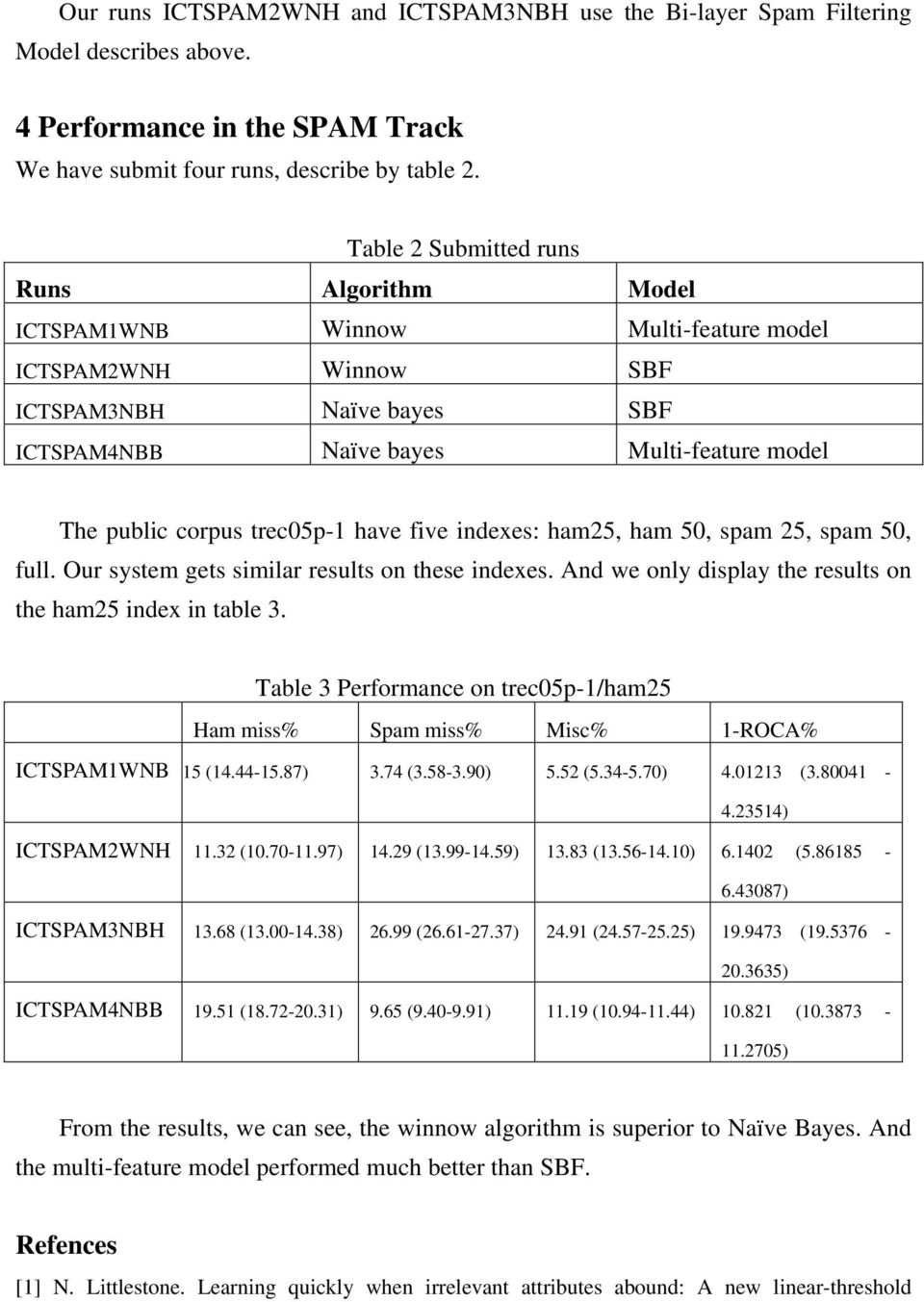
5 Our runs ICTSPAM2WNH and ICTSPAM3NBH use the Bi-layer Spam Filtering Model describes above. 4 Performance in the SPAM Track We have submit four runs, describe by table 2. Table 2 Submitted runs Runs Algorithm Model ICTSPAM1WNB Winnow Multi-feature model ICTSPAM2WNH Winnow SBF ICTSPAM3NBH Naïve bayes SBF ICTSPAM4NBB Naïve bayes Multi-feature model The public corpus trec05p-1 have five indexes: ham25, ham 50, spam 25, spam 50, full. Our system gets similar results on these indexes. And we only display the results on the ham25 index in table 3. Table 3 Performance on trec05p-1/ham25 Ham miss% Spam miss% Misc% 1-ROCA% ICTSPAM1WNB 15 ( ) 3.74 ( ) 5.52 ( ) ( ) ICTSPAM2WNH ( ) ( ) ( ) ( ) ICTSPAM3NBH ( ) ( ) ( ) ( ) ICTSPAM4NBB ( ) 9.65 ( ) ( ) ( ) From the results, we can see, the winnow algorithm is superior to Naïve Bayes. And the multi-feature model performed much better than SBF. Refences [1] N. Littlestone. Learning quickly when irrelevant attributes abound: A new linear-threshold
6 algorithm. Machine Learning, 2(4): , [2] YANG, Y. AND PEDERSEN, J. O A comparative study on feature selection in text categorization. In Proceedings of ICML-97, 14th International Conference on Machine Learning (Nashville, TN),D. H. Fisher, Ed. Morgan Kaufmann San Francisco, CA, [3] M. Sahami, S. Dumais, D. Heckerman and E. Horvitz, A Bayesian approach to filtering junk , in Proc. of AAAI Workshop on Learning for Text Categorization, pp , 1998 [4] I. Androutsopoulos, J. Koutsias, K.V. Chandrinos and C.D. Spyropoulos, An Experimental Comparison of Naive Bayesian and Keyword-Based Anti-Spam Filtering with Encrypted Personal Messages, in Proceedings of the 23rd Annual International ACM SIGIR Conference on Research and Development in Information Retrieval (SIGIR 2000), Athens, Greece, pp , 2000 [5] K. Schneider, "A Comparison of Event Models for Naive Bayes Anti-Spam Filtering", in Proc. 10th Conference of the European Chapter of the Association for Computational Linguistics (EACL 2003), Budapest, Hungary, pp , Apr [6] Pan Wenfeng. Master s dissertation, Research on Content-Based Spam Filtering.2004
![Horvitz, A Bayesian approach to filtering junk e-mail, in Proc. of AAAI Workshop on Learning for Text Categorization, pp. 55-62, 1998 [4] I. Androutsopoulos, J. Koutsias, K.V. Chandrinos and C.D.](/docs-images/43/2990939/images/page_6.jpg "Spyropoulos, An Experimental Comparison of Naive Bayesian and Keyword-Based Anti-Spam Filtering with Encrypted Personal E-mail Messages, in Proceedings of the 23rd Annual International ACM SIGIR")
A MACHINE LEARNING APPROACH TO SERVER-SIDE ANTI-SPAM E-MAIL FILTERING 1 2
 UDC 004.75 A MACHINE LEARNING APPROACH TO SERVER-SIDE ANTI-SPAM E-MAIL FILTERING 1 2 I. Mashechkin, M. Petrovskiy, A. Rozinkin, S. Gerasimov Computer Science Department, Lomonosov Moscow State University,
Simple Language Models for Spam Detection
 Simple Language Models for Spam Detection Egidio Terra Faculty of Informatics PUC/RS - Brazil Abstract For this year s Spam track we used classifiers based on language models. These models are used to
Filtering Junk Mail with A Maximum Entropy Model
 Filtering Junk Mail with A Maximum Entropy Model ZHANG Le and YAO Tian-shun Institute of Computer Software & Theory. School of Information Science & Engineering, Northeastern University Shenyang, 110004
Bayesian Spam Filtering
 Bayesian Spam Filtering Ahmed Obied Department of Computer Science University of Calgary [email protected] http://www.cpsc.ucalgary.ca/~amaobied Abstract. With the enormous amount of spam messages propagating
Naive Bayes Spam Filtering Using Word-Position-Based Attributes
 Naive Bayes Spam Filtering Using Word-Position-Based Attributes Johan Hovold Department of Computer Science Lund University Box 118, 221 00 Lund, Sweden [email protected] Abstract This paper
Detecting E-mail Spam Using Spam Word Associations
 Detecting E-mail Spam Using Spam Word Associations N.S. Kumar 1, D.P. Rana 2, R.G.Mehta 3 Sardar Vallabhbhai National Institute of Technology, Surat, India 1 [email protected] 2 [email protected]
Spam Filtering Based on Latent Semantic Indexing
 Spam Filtering Based on Latent Semantic Indexing Wilfried N. Gansterer Andreas G. K. Janecek Robert Neumayer Abstract In this paper, a study on the classification performance of a vector space model (VSM)
Impact of Feature Selection Technique on Email Classification
 Impact of Feature Selection Technique on Email Classification Aakanksha Sharaff, Naresh Kumar Nagwani, and Kunal Swami Abstract Being one of the most powerful and fastest way of communication, the popularity
1 Introductory Comments. 2 Bayesian Probability
 Introductory Comments First, I would like to point out that I got this material from two sources: The first was a page from Paul Graham s website at www.paulgraham.com/ffb.html, and the second was a paper
A Two-Pass Statistical Approach for Automatic Personalized Spam Filtering
 A Two-Pass Statistical Approach for Automatic Personalized Spam Filtering Khurum Nazir Junejo, Mirza Muhammad Yousaf, and Asim Karim Dept. of Computer Science, Lahore University of Management Sciences
Email Filters that use Spammy Words Only
 Email Filters that use Spammy Words Only Vasanth Elavarasan Department of Computer Science University of Texas at Austin Advisors: Mohamed Gouda Department of Computer Science University of Texas at Austin
An Efficient Spam Filtering Techniques for Email Account
 American Journal of Engineering Research (AJER) e-issn : 2320-0847 p-issn : 2320-0936 Volume-02, Issue-10, pp-63-73 www.ajer.org Research Paper Open Access An Efficient Spam Filtering Techniques for Email
Three-Way Decisions Solution to Filter Spam Email: An Empirical Study
 Three-Way Decisions Solution to Filter Spam Email: An Empirical Study Xiuyi Jia 1,4, Kan Zheng 2,WeiweiLi 3, Tingting Liu 2, and Lin Shang 4 1 School of Computer Science and Technology, Nanjing University
WE DEFINE spam as an e-mail message that is unwanted basically
 1048 IEEE TRANSACTIONS ON NEURAL NETWORKS, VOL. 10, NO. 5, SEPTEMBER 1999 Support Vector Machines for Spam Categorization Harris Drucker, Senior Member, IEEE, Donghui Wu, Student Member, IEEE, and Vladimir
A Personalized Spam Filtering Approach Utilizing Two Separately Trained Filters
 2008 IEEE/WIC/ACM International Conference on Web Intelligence and Intelligent Agent Technology A Personalized Spam Filtering Approach Utilizing Two Separately Trained Filters Wei-Lun Teng, Wei-Chung Teng
A Case-Based Approach to Spam Filtering that Can Track Concept Drift
 A Case-Based Approach to Spam Filtering that Can Track Concept Drift Pádraig Cunningham 1, Niamh Nowlan 1, Sarah Jane Delany 2, Mads Haahr 1 1 Department of Computer Science, Trinity College Dublin 2 School
Enrique Puertas Sánz Francisco Carrero García Universidad Europea de Madrid Villaviciosa de Odón 28670 Madrid, SPAIN 34 91 211 5611
 José María Gómez Hidalgo Universidad Europea de Madrid Villaviciosa de Odón 28670 Madrid, SPAIN 34 91 211 5670 [email protected] Content Based SMS Spam Filtering Guillermo Cajigas Bringas Group R&D - Vodafone
PSSF: A Novel Statistical Approach for Personalized Service-side Spam Filtering
 2007 IEEE/WIC/ACM International Conference on Web Intelligence PSSF: A Novel Statistical Approach for Personalized Service-side Spam Filtering Khurum Nazir Juneo Dept. of Computer Science Lahore University
A Proposed Algorithm for Spam Filtering Emails by Hash Table Approach
 International Research Journal of Applied and Basic Sciences 2013 Available online at www.irjabs.com ISSN 2251-838X / Vol, 4 (9): 2436-2441 Science Explorer Publications A Proposed Algorithm for Spam Filtering
A Three-Way Decision Approach to Email Spam Filtering
 A Three-Way Decision Approach to Email Spam Filtering Bing Zhou, Yiyu Yao, and Jigang Luo Department of Computer Science, University of Regina Regina, Saskatchewan, Canada S4S 0A2 {zhou200b,yyao,luo226}@cs.uregina.ca
Non-Parametric Spam Filtering based on knn and LSA
 Non-Parametric Spam Filtering based on knn and LSA Preslav Ivanov Nakov Panayot Markov Dobrikov Abstract. The paper proposes a non-parametric approach to filtering of unsolicited commercial e-mail messages,
2. NAIVE BAYES CLASSIFIERS
 Spam Filtering with Naive Bayes Which Naive Bayes? Vangelis Metsis Institute of Informatics and Telecommunications, N.C.S.R. Demokritos, Athens, Greece Ion Androutsopoulos Department of Informatics, Athens
IMPROVING SPAM EMAIL FILTERING EFFICIENCY USING BAYESIAN BACKWARD APPROACH PROJECT
 IMPROVING SPAM EMAIL FILTERING EFFICIENCY USING BAYESIAN BACKWARD APPROACH PROJECT M.SHESHIKALA Assistant Professor, SREC Engineering College,Warangal Email: [email protected], Abstract- Unethical
Using Biased Discriminant Analysis for Email Filtering
 Using Biased Discriminant Analysis for Email Filtering Juan Carlos Gomez 1 and Marie-Francine Moens 2 1 ITESM, Eugenio Garza Sada 2501, Monterrey NL 64849, Mexico [email protected] 2
Email Classification Using Data Reduction Method
 Email Classification Using Data Reduction Method Rafiqul Islam and Yang Xiang, member IEEE School of Information Technology Deakin University, Burwood 3125, Victoria, Australia Abstract Classifying user
Detecting Spam Bots in Online Social Networking Sites: A Machine Learning Approach
 Detecting Spam Bots in Online Social Networking Sites: A Machine Learning Approach Alex Hai Wang College of Information Sciences and Technology, The Pennsylvania State University, Dunmore, PA 18512, USA
An Efficient Three-phase Email Spam Filtering Technique
 An Efficient Three-phase Email Filtering Technique Tarek M. Mahmoud 1 *, Alaa Ismail El-Nashar 2 *, Tarek Abd-El-Hafeez 3 *, Marwa Khairy 4 * 1, 2, 3 Faculty of science, Computer Sci. Dept., Minia University,
Lan, Mingjun and Zhou, Wanlei 2005, Spam filtering based on preference ranking, in Fifth International Conference on Computer and Information
 Lan, Mingjun and Zhou, Wanlei 2005, Spam filtering based on preference ranking, in Fifth International Conference on Computer and Information Technology : CIT 2005 : proceedings : 21-23 September, 2005,
A LVQ-based neural network anti-spam email approach
 A LVQ-based neural network anti-spam email approach Zhan Chuan Lu Xianliang Hou Mengshu Zhou Xu College of Computer Science and Engineering of UEST of China, Chengdu, China 610054 [email protected]
Accelerating Techniques for Rapid Mitigation of Phishing and Spam Emails
 Accelerating Techniques for Rapid Mitigation of Phishing and Spam Emails Pranil Gupta, Ajay Nagrale and Shambhu Upadhyaya Computer Science and Engineering University at Buffalo Buffalo, NY 14260 {pagupta,
AN E-MAIL SERVER-BASED SPAM FILTERING APPROACH
 AN E-MAIL SERVER-BASED SPAM FILTERING APPROACH MUMTAZ MOHAMMED ALI AL-MUKHTAR College of Information Engineering, AL-Nahrain University IRAQ ABSTRACT The spam has now become a significant security issue
Mining E-mail Authorship
 Mining E-mail Authorship Olivier de Vel Information Technology Division Defence Science and Technology Organisation P.O. Box 1500 Salisbury 5108, Australia [email protected] ABSTRACT In
Not So Naïve Online Bayesian Spam Filter
 Not So Naïve Online Bayesian Spam Filter Baojun Su Institute of Artificial Intelligence College of Computer Science Zhejiang University Hangzhou 310027, China [email protected] Congfu Xu Institute of Artificial
How To Filter Spam Image From A Picture By Color Or Color
 Image Content-Based Email Spam Image Filtering Jianyi Wang and Kazuki Katagishi Abstract With the population of Internet around the world, email has become one of the main methods of communication among
How To Filter Spam With A Poa
 A Multiobjective Evolutionary Algorithm for Spam E-mail Filtering A.G. López-Herrera 1, E. Herrera-Viedma 2, F. Herrera 2 1.Dept. of Computer Sciences, University of Jaén, E-23071, Jaén (Spain), [email protected]
Artificial Neural Network, Decision Tree and Statistical Techniques Applied for Designing and Developing E-mail Classifier
 International Journal of Recent Technology and Engineering (IJRTE) ISSN: 2277-3878, Volume-1, Issue-6, January 2013 Artificial Neural Network, Decision Tree and Statistical Techniques Applied for Designing
Email Spam Detection Using Customized SimHash Function
 International Journal of Research Studies in Computer Science and Engineering (IJRSCSE) Volume 1, Issue 8, December 2014, PP 35-40 ISSN 2349-4840 (Print) & ISSN 2349-4859 (Online) www.arcjournals.org Email
Anti-Spam Filter Based on Naïve Bayes, SVM, and KNN model
 AI TERM PROJECT GROUP 14 1 Anti-Spam Filter Based on,, and model Yun-Nung Chen, Che-An Lu, Chao-Yu Huang Abstract spam email filters are a well-known and powerful type of filters. We construct different
Sender and Receiver Addresses as Cues for Anti-Spam Filtering Chih-Chien Wang
 Sender and Receiver Addresses as Cues for Anti-Spam Filtering Chih-Chien Wang Graduate Institute of Information Management National Taipei University 69, Sec. 2, JianGuo N. Rd., Taipei City 104-33, Taiwan
T-61.3050 : Email Classification as Spam or Ham using Naive Bayes Classifier. Santosh Tirunagari : 245577
 T-61.3050 : Email Classification as Spam or Ham using Naive Bayes Classifier Santosh Tirunagari : 245577 January 20, 2011 Abstract This term project gives a solution how to classify an email as spam or
Blocking Blog Spam with Language Model Disagreement
 Blocking Blog Spam with Language Model Disagreement Gilad Mishne Informatics Institute, University of Amsterdam Kruislaan 403, 1098SJ Amsterdam The Netherlands [email protected] David Carmel, Ronny
Spam or Not Spam That is the question
 Spam or Not Spam That is the question Ravi Kiran S S and Indriyati Atmosukarto {kiran,indria}@cs.washington.edu Abstract Unsolicited commercial email, commonly known as spam has been known to pollute the
An Imbalanced Spam Mail Filtering Method
 , pp. 119-126 http://dx.doi.org/10.14257/ijmue.2015.10.3.12 An Imbalanced Spam Mail Filtering Method Zhiqiang Ma, Rui Yan, Donghong Yuan and Limin Liu (College of Information Engineering, Inner Mongolia
Image Spam Filtering Using Visual Information
 Image Spam Filtering Using Visual Information Battista Biggio, Giorgio Fumera, Ignazio Pillai, Fabio Roli, Dept. of Electrical and Electronic Eng., Univ. of Cagliari Piazza d Armi, 09123 Cagliari, Italy
Feature Subset Selection in E-mail Spam Detection
 Feature Subset Selection in E-mail Spam Detection Amir Rajabi Behjat, Universiti Technology MARA, Malaysia IT Security for the Next Generation Asia Pacific & MEA Cup, Hong Kong 14-16 March, 2012 Feature
Abstract. Find out if your mortgage rate is too high, NOW. Free Search
 Statistics and The War on Spam David Madigan Rutgers University Abstract Text categorization algorithms assign texts to predefined categories. The study of such algorithms has a rich history dating back
An Approach to Detect Spam Emails by Using Majority Voting
 An Approach to Detect Spam Emails by Using Majority Voting Roohi Hussain Department of Computer Engineering, National University of Science and Technology, H-12 Islamabad, Pakistan Usman Qamar Faculty,
Differential Voting in Case Based Spam Filtering
 Differential Voting in Case Based Spam Filtering Deepak P, Delip Rao, Deepak Khemani Department of Computer Science and Engineering Indian Institute of Technology Madras, India [email protected],
Combining SVM classifiers for email anti-spam filtering
 Combining SVM classifiers for email anti-spam filtering Ángela Blanco Manuel Martín-Merino Abstract Spam, also known as Unsolicited Commercial Email (UCE) is becoming a nightmare for Internet users and
Filtering Spam Using Search Engines
 Filtering Spam Using Search Engines Oleg Kolesnikov, Wenke Lee, and Richard Lipton ok,wenke,rjl @cc.gatech.edu College of Computing Georgia Institute of Technology Atlanta, GA 30332 Abstract Spam filtering
An Efficient Two-phase Spam Filtering Method Based on E-mails Categorization
 International Journal of Network Security, Vol.9, No., PP.34 43, July 29 34 An Efficient Two-phase Spam Filtering Method Based on E-mails Categorization Jyh-Jian Sheu Department of Information Management,
Spam Filters: Bayes vs. Chi-squared; Letters vs. Words
 Spam Filters: Bayes vs. Chi-squared; Letters vs. Words Cormac O Brien & Carl Vogel Abstract We compare two statistical methods for identifying spam or junk electronic mail. The proliferation of spam email
6367(Print), ISSN 0976 6375(Online) & TECHNOLOGY Volume 4, Issue 1, (IJCET) January- February (2013), IAEME
 INTERNATIONAL International Journal of Computer JOURNAL Engineering OF COMPUTER and Technology ENGINEERING (IJCET), ISSN 0976-6367(Print), ISSN 0976 6375(Online) & TECHNOLOGY Volume 4, Issue 1, (IJCET)
Learning to classify e-mail
 Information Sciences 177 (2007) 2167 2187 www.elsevier.com/locate/ins Learning to classify e-mail Irena Koprinska *, Josiah Poon, James Clark, Jason Chan School of Information Technologies, The University
On Attacking Statistical Spam Filters
 On Attacking Statistical Spam Filters Gregory L. Wittel and S. Felix Wu Department of Computer Science University of California, Davis One Shields Avenue, Davis, CA 95616 USA Abstract. The efforts of anti-spammers
Filtering Spam E-Mail with Generalized Additive Neural Networks
 Filtering Spam E-Mail with Generalized Additive Neural Networks Tiny du Toit School of Computer, Statistical and Mathematical Sciences North-West University, Potchefstroom Campus Private Bag X6001, Potchefstroom,
Spam Filtering using Signed and Trust Reputation Management
 Spam Filtering using Signed and Trust Reputation Management G.POONKUZHALI 1, K.THIAGARAJAN 2,P.SUDHAKAR 3, R.KISHORE KUMAR 4, K.SARUKESI 5 1,4 Department of Computer Science and Engineering, Rajalakshmi
Multilingual Rules for Spam Detection
 Multilingual Rules for Spam Detection Minh Tuan Vu 1, Quang Anh Tran 1, Frank Jiang 2 and Van Quan Tran 1 1 Faculty of Information Technology, Hanoi University, Hanoi, Vietnam 2 School of Engineering and
DON T FOLLOW ME: SPAM DETECTION IN TWITTER
 DON T FOLLOW ME: SPAM DETECTION IN TWITTER Alex Hai Wang College of Information Sciences and Technology, The Pennsylvania State University, Dunmore, PA 18512, USA [email protected] Keywords: Abstract: social
Email Spam Detection A Machine Learning Approach
 Email Spam Detection A Machine Learning Approach Ge Song, Lauren Steimle ABSTRACT Machine learning is a branch of artificial intelligence concerned with the creation and study of systems that can learn
Spam Filtering with Naive Bayesian Classification
 Spam Filtering with Naive Bayesian Classification Khuong An Nguyen Queens College University of Cambridge L101: Machine Learning for Language Processing MPhil in Advanced Computer Science 09-April-2011
Journal of Information Technology Impact
 Journal of Information Technology Impact Vol. 8, No., pp. -0, 2008 Probability Modeling for Improving Spam Filtering Parameters S. C. Chiemeke University of Benin Nigeria O. B. Longe 2 University of Ibadan
Spam Filters: Bayes vs. Chi-squared; Letters vs. Words
 Spam Filters: Bayes vs. Chi-squared; Letters vs. Words Cormac O Brien & Carl Vogel Computational Linguistics Group & Centre for Computing and Language Studies Trinity College University of Dublin obriencevogel
Image Spam Filtering by Content Obscuring Detection
 Image Spam Filtering by Content Obscuring Detection Battista Biggio, Giorgio Fumera, Ignazio Pillai, Fabio Roli Dept. of Electrical and Electronic Eng., University of Cagliari Piazza d Armi, 09123 Cagliari,
Lasso-based Spam Filtering with Chinese Emails
 Journal of Computational Information Systems 8: 8 (2012) 3315 3322 Available at http://www.jofcis.com Lasso-based Spam Filtering with Chinese Emails Zunxiong LIU 1, Xianlong ZHANG 1,, Shujuan ZHENG 2 1
Combining Global and Personal Anti-Spam Filtering
 Combining Global and Personal Anti-Spam Filtering Richard Segal IBM Research Hawthorne, NY 10532 Abstract Many of the first successful applications of statistical learning to anti-spam filtering were personalized
Spam detection with data mining method:
 Spam detection with data mining method: Ensemble learning with multiple SVM based classifiers to optimize generalization ability of email spam classification Keywords: ensemble learning, SVM classifier,
Increasing the Accuracy of a Spam-Detecting Artificial Immune System
 Increasing the Accuracy of a Spam-Detecting Artificial Immune System Terri Oda Carleton University [email protected] Tony White Carleton University [email protected] Abstract- Spam, the electronic
A Bayesian Topic Model for Spam Filtering
 Journal of Information & Computational Science 1:12 (213) 3719 3727 August 1, 213 Available at http://www.joics.com A Bayesian Topic Model for Spam Filtering Zhiying Zhang, Xu Yu, Lixiang Shi, Li Peng,
Highly Scalable Discriminative Spam Filtering
 Highly Scalable Discriminative Spam Filtering Michael Brückner, Peter Haider, and Tobias Scheffer Max Planck Institute for Computer Science, Saarbrücken, Germany Humboldt Universität zu Berlin, Germany
The Enron Corpus: A New Dataset for Email Classification Research
 The Enron Corpus: A New Dataset for Email Classification Research Bryan Klimt and Yiming Yang Language Technologies Institute Carnegie Mellon University Pittsburgh, PA 15213-8213, USA {bklimt,yiming}@cs.cmu.edu
Partitioned Logistic Regression for Spam Filtering
 Partitioned Logistic Regression for Spam Filtering Ming-wei Chang University of Illinois 201 N Goodwin Ave Urbana, IL, USA [email protected] Wen-tau Yih Microsoft Research One Microsoft Way Redmond, WA,
Spam Filter: VSM based Intelligent Fuzzy Decision Maker
 IJCST Vo l. 1, Is s u e 1, Se p te m b e r 2010 ISSN : 0976-8491(Online Spam Filter: VSM based Intelligent Fuzzy Decision Maker Dr. Sonia YMCA University of Science and Technology, Faridabad, India E-mail
Anti Spamming Techniques
 Anti Spamming Techniques Written by Sumit Siddharth In this article will we first look at some of the existing methods to identify an email as a spam? We look at the pros and cons of the existing methods
Filtering Spam E-Mail from Mixed Arabic and English Messages: A Comparison of Machine Learning Techniques
 52 The International Arab Journal of Information Technology, Vol. 6, No. 1, January 2009 Filtering Spam E-Mail from Mixed Arabic and English Messages: A Comparison of Machine Learning Techniques Alaa El-Halees
An incremental cluster-based approach to spam filtering
 Available online at www.sciencedirect.com Expert Systems with Applications Expert Systems with Applications 34 (2008) 1599 1608 www.elsevier.com/locate/eswa An incremental cluster-based approach to spam
An Experimental Comparison of Naive Bayesian and Keyword-Based Anti-Spam Filtering with Personal E-mail Messages
 An Experimental Comparison of Naive Bayesian and Keyword-Based Anti-Spam Filtering with Personal E-mail Messages Ion Androutsopoulos, John Koutsias, Konstantinos V. Cbandrinos and Constantine D. Spyropoulos
[email protected] ** The High Institute of Zahra for Comperhensive Professions, Zahra-Libya
 AN ANTI-SPAM SYSTEM USING ARTIFICIAL NEURAL NETWORKS AND GENETIC ALGORITHMS ABDUELBASET M. GOWEDER *, TARIK RASHED **, ALI S. ELBEKAIE ***, and HUSIEN A. ALHAMMI **** * The High Institute of Surman for
Three types of messages: A, B, C. Assume A is the oldest type, and C is the most recent type.
 Chronological Sampling for Email Filtering Ching-Lung Fu 2, Daniel Silver 1, and James Blustein 2 1 Acadia University, Wolfville, Nova Scotia, Canada 2 Dalhousie University, Halifax, Nova Scotia, Canada
Utilizing Multi-Field Text Features for Efficient Email Spam Filtering
 International Journal of Computational Intelligence Systems, Vol. 5, No. 3 (June, 2012), 505-518 Utilizing Multi-Field Text Features for Efficient Email Spam Filtering Wuying Liu College of Computer, National