
ADULT DEGREE COMPLETION PROGRAM (ADCP)
|
|
|
- Millicent Sparks
- 10 years ago
- Views:
Transcription
1 ADULT DEGREE COMPLETION PROGRAM (ADCP)
2 ACCREDITATION Huntingdon College is accredited by the Commission on Colleges of the Southern Association of Colleges and Schools (1866 Southern Lane, Decatur, Georgia , ) to award the Bachelor of Arts Degree, the Bachelor of Science Degree, and the Associate of Arts Degree. NONDISCRIMINATORY POLICY Huntingdon College is committed to a policy against legally impermissible, arbitrary, or unreasonable discriminatory practices. Therefore, the College, in accordance with applicable federal and state law and stated College policy, prohibits discrimination on the basis of race, color, sex, age, religion, disability, sexual orientation, and national or ethnic origin. SUBSTANCE ABUSE POLICY To achieve its educational aims and to create an environment conducive to the full physical and personal development of students and employees, the College discourages the misuse or abuse of potentially harmful materials or substances. Huntingdon College disallows the possession of alcoholic beverages and illegal and unauthorized drugs within the bounds of the campus. Additionally, it echoes the warning of the Surgeon General on the dangers of tobacco usage. Any employee who is found in possession of or using alcoholic beverages on the campus is subject to dismissal. Possession of narcotic or hallucinogenic drugs and other agents having potential for abuse, except on a physician s prescription, is strictly prohibited. Any employee found to be possessing, using, manufacturing, dispensing, or distributing such drugs is also subject for dismissal. Huntingdon College is in full compliance with the Drug-Free Schools and Communities Act Amendments of 1989 (Public Law ). For full details on the Drug-Free Schools and Communities Act, see the Student Handbook. Cover photograph by Dr. John R. Williams, Professor of History. This Catalog presents information which, at the time of preparation for printing, most accurately described the courses, curricula, degrees, fees, policies, procedures, regulations, and requirements of the College which apply to students entering the College during the academic year. The College reserves the right to delete, substitute or supplement any statement in this Catalog without prior notice.

3 ADULT DEGREE COMPLETION PROGRAM ACADEMIC CALENDAR 2010 Fall Term August 23 Monday Session I classes begin September 24 Friday Session I classes end September 27 Monday Session II classes begin October 29 Friday Session II classes end November 1 Monday Session III classes begin December 10 Friday Session III classes end 2011 Spring Term January 10 Monday Session I classes begin February 11 Friday Session I classes end February 14 Monday Session II classes begin March 18 Friday Session II classes end March 28 Monday Session III classes begin April 29 Friday Session III classes end May 6 Friday Baccalaureate May 7 Saturday Commencement 2011 Summer Term May 9 Monday Session I classes begin June 10 Friday Session I classes end June 13 Monday Session II classes begin July 15 Friday Session II classes end July 18 Monday Session III classes begin August 19 Friday Session III classes end

4 HISTORY OF THE ADULT DEGREE COMPLETION PROGRAM (ADCP) Huntingdon College began offering the degree of Bachelor of Arts to students in the Adult Degree Completion Program (ADCP) in the Fall Semester of For the catalog year, Huntingdon began offering the degree of Bachelor of Science. The Adult Degree Completion Program (ADCP) was implemented to serve adults with professional educational needs through effective, innovative, student-centered academic opportunities. The program currently exists in partnership with Enterprise State Community College, James H. Faulkner State Community College, Jefferson State Community College, and Jefferson Davis Community College. The program also has sites in Daphne, Alabama, Bay Minette, Alabama, and on the Huntingdon College main campus in Montgomery, Alabama. In its history, the program has been known by both the ADCP (School of Business and Professional Studies) name and the SPS (School for Professional Studies) name. Beginning Fall 2008, the formal name of the program became the Adult Degree Completion Program (ADCP), which exists as a program within the College s Business Department. ADULT DEGREE COMPLETION PROGRAM (ADCP) CORRESPONDENCE DIRECTORY Academic Records and Transcripts The Registrar ABOUT ADULT DEGREE COMPLETION PROGRAM (ADCP) Admission (by location) Bay Minette Birmingham (JSCC Clanton Campus) Birmingham (JSCC Center Point Campus) Birmingham (JSCC Pell City Campus) Birmingham (JSCC Shelby Campus) Brewton (Jefferson Davis Community College) Daphne Enterprise (Enterprise State Community College) ext.2256 Montgomery (Huntingdon College Main Campus) Bookstore The Bookstore Manager Financial Aid The Director of Student Financial Services Student Accounts, Tuition, Fee Payments The Student Account Manager HUNTINGDON COLLEGE

5 ADMISSION REGULAR ADMISSION Huntingdon College s Adult Degree Completion Program (ADCP) is open to working adults, whether full-time or part-time, who have earned a minimum of a 2.00 or higher GPA on all work for which Huntingdon will or would award transfer credit at the post-secondary level, and who have accumulated at least hours of transferable college credit from regionally accredited institutions which includes successful completion of at least one three semester hour course in English Composition. Specifically: Students seeking admission at sites in Bay Minette, or Daphne, Alabama must have a minimum of 45 hours of transferable credit or a completed Associate degree from a regionally accredited institution. Students seeking admission through the Enterprise State Community College partnership must have a minimum of 30 hours of transferable credit or a completed Associate degree from a regionally accredited institution. Students seeking admission through the Jefferson Davis Community College partnership must have a minimum of 30 hours of transferable credit or a completed Associate degree from a regionally accredited institution. Students seeking admission through the Jefferson State Community College partnership must have a minimum of 30 hours of transferable credit or a completed Associate degree from a regionally accredited institution. Students seeking admission to the Montgomery campus must have a minimum of 30 hours of transferable credit or a completed Associate degree from a regionally accredited institution. ADCP ADMISSION Transferable college credit is defined as college level course work from a regionally accredited institution with a grade of D or higher. Up to 30 hours of credit earned by satisfactory scores on College Level Examination Program (CLEP) examinations, Advanced Placement (AP) examinations or Defense Activity for Non-Traditional Education Support (DANTES) may also be used for course credit. The Adult Degree Completion Program (ADCP), through the partnership with Jefferson Davis Community College and on Huntingdon s sites in Daphne and Bay Minette, Alabama, is a 59 credit hour program. Specifically, the maximum number of credit hours earned through the Adult Degree Completion Program (ADCP) at these locations for application toward the 120 hour degree requirement from Huntingdon College is 59 hours. For questions about admission qualifications, contact the Adult Degree Completion Program (ADCP) office toll-free at CONDITIONAL ADMISSION Students who wish to enroll in the program but whose academic records are incomplete (such as when official transcripts from other institutions have not been received) may be admitted on a conditional basis and allowed to register for their first semester of attendance provided their academic status can be determined from unofficial records. Students should have at least a 2.00 grade point average (on a 4.0 scale) in their previous work to be allowed to register on a conditional basis. Enrollment in a subsequent semester is contingent upon the student s academic record being complete. Specifically, a student admitted conditionally will not be permitted to register for courses after the initial semester of enrollment unless all official transcripts have been received from all previously attended post-secondary institutions. PROBATIONARY ADMISSION Students who wish to register for the program but do not meet the minimum grade point average requirement of at least a 2.00 GPA from all work for which Huntingdon will or would award transfer credit at the post-secondary level may be admitted on a probationary basis. In order to remain in the program for a subsequent semester, a student must achieve a C or better in each course for the first 6 hours in which the student is enrolled. SPECIAL STATUS (NON-DEGREE SEEKING) The Huntingdon College Adult Degree Completion Program (ADCP) will admit students who do not wish to be degree seeking, but wish to enroll for one or more courses. Students who have been denied regular admission may not be admitted as a special student. All prospective special students must provide all previous college transcripts, or be approved by the Vice President for Academic Affairs and Dean of Faculty. Upon completion of the required admission procedures and acceptance, a special student may change to degree seeking status. If a special student chooses to become degree seeking, the student must reapply 178 HUNTINGDON COLLEGE
6 as a degree seeking prospective and complete the regular admission process. Courses completed as a special student may be used to complete degree requirements at Huntingdon College. Financial aid is not available to students classified under special non-degree seeking status. READMISSION TO THE ADULT DEGREE COMPLETION PROGRAM (ADCP) Readmission is required for any former student who either missed enrollment in an entire semester (Fall or Spring) or who enrolled in a semester in which zero hours were attempted due to drops or withdrawals of all enrolled classes for a term. Students who wish to return to Huntingdon must submit an Adult Degree Completion Program (ADCP) online application which is available on the College s website. If the student has attended another institution during the absence from Huntingdon, he/she must have an official transcript sent from each institution. Students who are readmitted to the Adult Degree Completion Program (ADCP) must receive clearance from the Office of Student Financial Services before they may be officially readmitted, register and attend classes. ADMISSION TO THE ADULT DEGREE COMPLETION PROGRAM (ADCP) FROM HUNTINGDON COLLEGE Students who have previously attended Huntingdon College in the traditional day program and who are interested in admittance to the Adult Degree Completion Program (ADCP) must have been absent from Huntingdon College for a period of one year and be at least 22 years old before they will be eligible for application to the program. ADCP ADMISSION ADMISSION EXPIRATION Admission, regardless of status, is open for the period of one year. If no enrollment occurs within a full calendar year following a student s admission to the program, the application/acceptance is withdrawn, and the student will need to reapply. ACADEMIC CREDIT POLICIES ADVANCED PLACEMENT (AP) Huntingdon College participates in the Advanced Placement (AP) Program of the College Entrance Examination Board. The College reviews and evaluates AP courses on an individual basis in the context of a student s proposed area of study. Credit is awarded at the discretion of the College, and students should not assume that credit will be awarded automatically. Three to eight (3-8) semester hours of credit are granted for each AP Examination passed with a score of three or higher in courses comparable to Huntingdon College courses. The number of hours granted is determined by the corresponding academic program. Students wishing to receive credit based on AP scores should request the College Entrance Examination Board to send an official score report directly to the Office of the Registrar ( collegeboard.com). Information regarding specific AP credit granted is available on the College s web site. A $25.00 recording fee per awarded credit hour is assessed. COLLEGE LEVEL EXAMINATION PROGRAM (CLEP) Huntingdon College awards up to 30 semester hours of credit for satisfactory performance (50th percentile or higher) on the tests of the College Level Examination Program (CLEP) provided that the examination area is comparable to a course offered for credit at Huntingdon College. Although students who wish to receive credit granted on this basis are encouraged to take Subject Examinations, the 30 hours permitted may be in Subject Examinations, General Examinations, or both. However, no credit will be granted on the basis of General Examinations taken after the student has entered college. Students wishing to receive credit based on CLEP scores should request the College Entrance Examination Board to send an official score report directly to the Office of the Registrar. Information regarding specific CLEP credit granted is available on the College s web site. A $25.00 recording fee per awarded credit hour is assessed. INTERNATIONAL BACCALAUREATE PROGRAM (IB) Huntingdon College recognizes the successful achievement of students participating in the curriculum of the International Baccalaureate (IB) Program. Students are encouraged to submit their IB examination scores for review. Credit is only awarded for the IB Higher Level Examinations (not the IB Subsidiary Examinations) provided that the examination area is comparable to a course offered for credit at Huntingdon College and that a minimum score of five is earned on the examination. Credit is awarded at the discretion of the College, and students should not assume that credit will be awarded automatically. An official IB transcript should be sent to the Office of the Registrar for evaluation. A $25.00 recording fee per awarded credit hour is assessed. HUNTINGDON COLLEGE
7 DEFENSE ACTIVITY FOR NON-TRADITIONAL EDUCATION SUPPORT (DANTES) Huntingdon College recognizes the successful achievement of students participating in the curriculum of DANTES. Students are encouraged to have their official DANTES transcript submitted for review. Credit is awarded for courses in which the content is comparable to a course offered for credit at Huntingdon College. Credit is awarded at the discretion of the College, and students should not assume that credit will be awarded automatically. A DANTES transcript should be sent to the Office of the Registrar for evaluation. A $25.00 recording fee per awarded credit hour is assessed. ADCP ADMISSION TRANSFER OR CREDIT FROM OTHER INSTITUTIONS Transfer credit is granted for any course taken at a regionally accredited college or university in which the student has earned a grade of D or better, or in the case of a course taken on a Pass/Fail basis, a grade of P, provided that the course is deemed comparable to a course offered for academic credit at Huntingdon College or is of such a nature that it would carry academic credit if it were offered by the College. Courses that do not have an equivalent at Huntingdon College and are of such a nature that they would carry academic credit if it were offered by the College will receive an appropriate prefix and be numbered 000. Such courses granted as elective transfer credit will count toward the total number of academic credits required for the degree, but are normally not applicable toward the core curriculum, major or minor requirements. Transfer credit will not be granted for courses which belong in one or more of the following categories: (a) courses in professional, technical, vocational, or sectarian religious study, or (b) courses below the level of introductory courses at Huntingdon College. The College does not grant credit for attendance in service schools or training programs in the Armed Forces unless it can be demonstrated that such attendance is the equivalent of a course or courses offered at Huntingdon College. Academic courses taken while on military service at regionally accredited colleges, universities, or language institutes may be transferred in the normal manner. Based on a review of an official transcript, credit may be awarded for general military training. Academic credit will not be granted for work done while a student was placed on academic suspension or the equivalent at a previous institution. Official evaluations of credits earned from other institutions are made after a student has been selected for admission and has indicated an intention to enroll. No student may assume that credit will be given for work at other institutions until a written statement of credit accepted is received from the Office of the Registrar. Grades and credits from other institutions are not included in the student s grade point average at Huntingdon. The only grade average recorded on the student s permanent record is that which he or she earns at Huntingdon College. A maximum of 64 semester hours earned at two-year institutions may be credited toward the 120 hour degree requirement. A maximum of 90 semester hours of transfer work may be credited toward the 120 hour degree requirement. A Huntingdon student may apply a maximum of 12 semester hours in Military Science, Aerospace, or similar military credit toward the minimum of 120 hours for a Bachelor s degree. Initial transcript evaluations are subject to change for students who do not matriculate within the academic year of admission to the College. 180 HUNTINGDON COLLEGE

8 Notice: Despite a student s term of matriculation, all policies in the Adult Degree Completion Program (ADCP) catalog are applicable to all Adult Degree Completion Program (ADCP) students, unless specifically stated otherwise. Thus, this catalog should be reviewed with care by all Adult Degree Completion Program (ADCP) students. FINANCING A HUNTINGDON EDUCATION ADULT DEGREE COMPLETION PROGRAM (ADCP) EXPENSES TUITION AND FEES: TUITION Per credit hour... $ FEES (APPLIED PER EACH ACTION PROCESSED) Late add fee...$50.00 Drop fee... $50.00 Administrative Drop fee... $50.00 SPECIAL FEES AP, CLEP, IB, and DANTES Recording Fee (per awarded credit hour)...$25.00 Returned Check Fee...$50.00 Graduation Fee...$50.00 Purchase of Cap, Gown, Hood, and Invitations... cost of item(s) Transcript of Academic Credit (per request after first complimentary copy)...$5.00 BOOKS AND RELATED SUPPLIES The cost is variable and is based on the course selections of the student. A student with a financial aid credit with the College may be permitted to charge books by obtaining a book voucher from the Office of Student Financial Services. FINANCIAL TERMS ADCP FINANCING A HUNTINGDON EDUCATION BILLING PROCEDURES All charges are assessed on the first day of each semester based upon registration. Applicable fees are assessed at the time of any enrollment change. PAYMENT POLICY Tuition and fees are payable prior to the first day of classes. Payments should be sent directly to the Student Account Manager at the following address: Huntingdon College, 1500 East Fairview Avenue, Montgomery, AL The receipt of a financial aid award does not alter the responsibility for payment of tuition and fees. Financial aid grants will not be considered as payment unless all requirements have been met, an award letter has been issued, and a student has registered for a term. Financial aid loans will not be considered as payment until the loan has been guaranteed. Students are not permitted to register or attend classes until their financial affairs are satisfactorily arranged. If a student s account becomes delinquent, the College reserves the right to preclude the student from attending classes. In the event that a student s account is not paid in full by the end of the semester, the student may not be permitted to attend classes the next semester until satisfactory financial arrangements have been made. CORPORATE TUITION REIMBURSEMENT PROGRAMS Many corporate or educational institutions participate in tuition reimbursement programs for their employees. The student should determine if his or her employer will provide financial assistance (tuition reimbursement) for tuition, fees, and books. This information is usually available from the employer s Human Resources Office. A student participating in one of these programs is first and foremost responsible for all tuition and fees. Students must then follow their company s procedures for applying for tuition reimbursement. STATEMENT OF LIABILITY Should a student leave Huntingdon College owing on his/her account, he/she will be liable for all attorney s fees and other reasonable collection costs and charges necessary for collection. Students will not be permitted to receive reports or transcripts of their work until all College bills are paid, including, but not limited to library fines, traffic fines, and disciplinary fines. HUNTINGDON COLLEGE
9 REFUND POLICY AND INFORMATION REFUND POLICY 1. Prior to the beginning of a semester if a student terminates his/her enrollment, any payment made for that upcoming semester will be refunded in full. Under these circumstances, a student becomes ineligible for any financial aid. 2. After the semester begins but prior to the first class meeting, the student will be assessed appropriate fees, and a credit balance will be refunded with any drop. A student may become ineligible for financial aid for other sessions based upon enrollment changes. 3. After the first class meeting, a student will be assessed appropriate fees and all tuition in a current session; however, a student will remain eligible for financial aid for that session given that total hours of enrollment meet federal and state requirements. REFUND PROCEDURES The student initiates the change of enrollment through the drop processes described in this catalog. The Office of the Registrar reviews the completed submissions and forwards information to Student Financial Services regarding the official date of the enrollment change(s). The amount of any refund due to the student and Title IV programs, if applicable, will be resolved within 14 days of the official notification from the Office of the Registrar. ADCP FINANCING A HUNTINGDON EDUCATION 182 HUNTINGDON COLLEGE

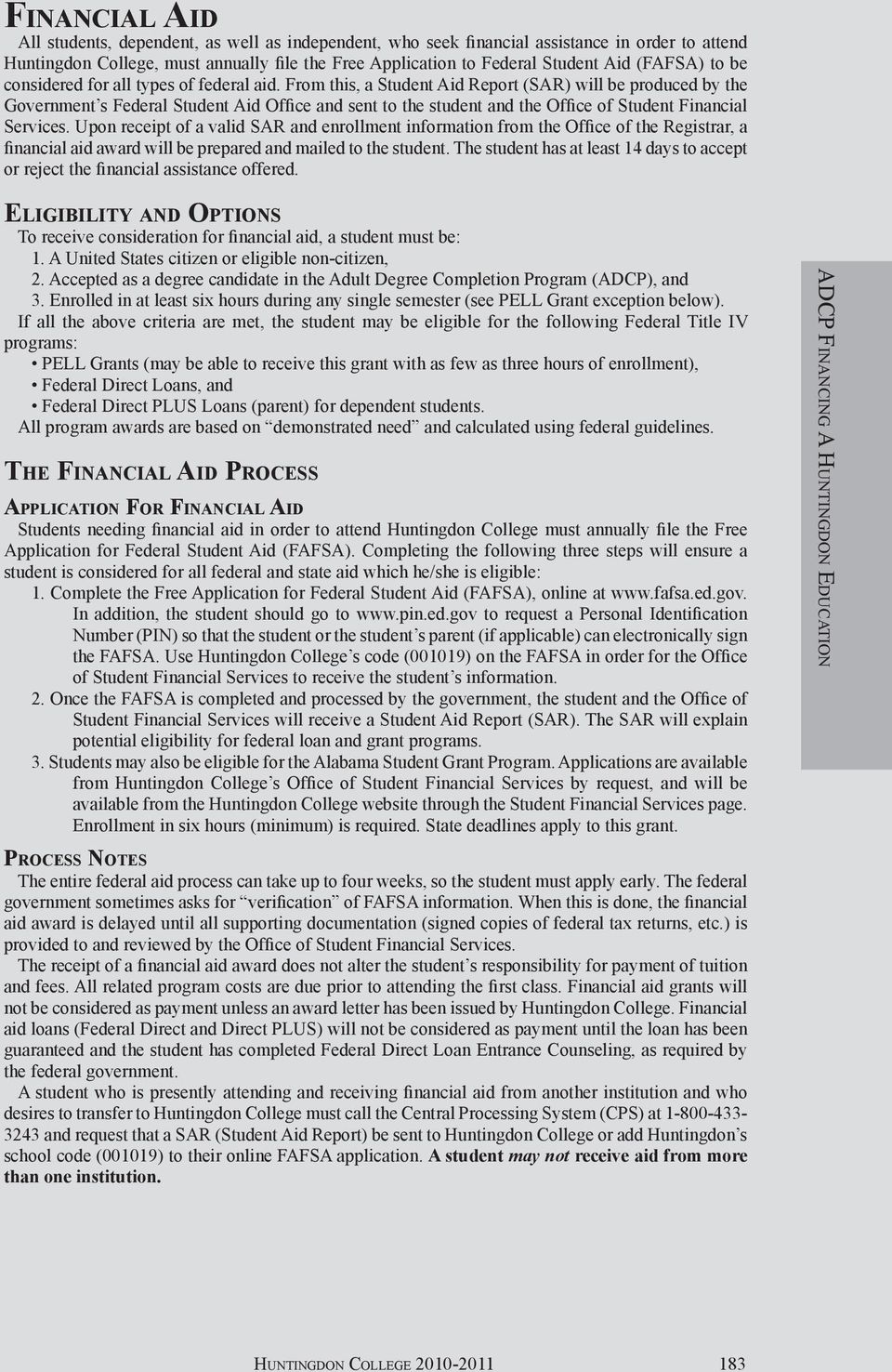
10 FINANCIAL AID All students, dependent, as well as independent, who seek financial assistance in order to attend Huntingdon College, must annually file the Free Application to Federal Student Aid (FAFSA) to be considered for all types of federal aid. From this, a Student Aid Report (SAR) will be produced by the Government s Federal Student Aid Office and sent to the student and the Office of Student Financial Services. Upon receipt of a valid SAR and enrollment information from the Office of the Registrar, a financial aid award will be prepared and mailed to the student. The student has at least 14 days to accept or reject the financial assistance offered. ELIGIBILITY AND OPTIONS To receive consideration for financial aid, a student must be: 1. A United States citizen or eligible non-citizen, 2. Accepted as a degree candidate in the Adult Degree Completion Program (ADCP), and 3. Enrolled in at least six hours during any single semester (see PELL Grant exception below). If all the above criteria are met, the student may be eligible for the following Federal Title IV programs: PELL Grants (may be able to receive this grant with as few as three hours of enrollment), Federal Direct Loans, and Federal Direct PLUS Loans (parent) for dependent students. All program awards are based on demonstrated need and calculated using federal guidelines. THE FINANCIAL AID PROCESS APPLICATION FOR FINANCIAL AID Students needing financial aid in order to attend Huntingdon College must annually file the Free Application for Federal Student Aid (FAFSA). Completing the following three steps will ensure a student is considered for all federal and state aid which he/she is eligible: 1. Complete the Free Application for Federal Student Aid (FAFSA), online at In addition, the student should go to to request a Personal Identification Number (PIN) so that the student or the student s parent (if applicable) can electronically sign the FAFSA. Use Huntingdon College s code (001019) on the FAFSA in order for the Office of Student Financial Services to receive the student s information. 2. Once the FAFSA is completed and processed by the government, the student and the Office of Student Financial Services will receive a Student Aid Report (SAR). The SAR will explain potential eligibility for federal loan and grant programs. 3. Students may also be eligible for the Alabama Student Grant Program. Applications are available from Huntingdon College s Office of Student Financial Services by request, and will be available from the Huntingdon College website through the Student Financial Services page. Enrollment in six hours (minimum) is required. State deadlines apply to this grant. ADCP FINANCING A HUNTINGDON EDUCATION PROCESS NOTES The entire federal aid process can take up to four weeks, so the student must apply early. The federal government sometimes asks for verification of FAFSA information. When this is done, the financial aid award is delayed until all supporting documentation (signed copies of federal tax returns, etc.) is provided to and reviewed by the Office of Student Financial Services. The receipt of a financial aid award does not alter the student s responsibility for payment of tuition and fees. All related program costs are due prior to attending the first class. Financial aid grants will not be considered as payment unless an award letter has been issued by Huntingdon College. Financial aid loans (Federal Direct and Direct PLUS) will not be considered as payment until the loan has been guaranteed and the student has completed Federal Direct Loan Entrance Counseling, as required by the federal government. A student who is presently attending and receiving financial aid from another institution and who desires to transfer to Huntingdon College must call the Central Processing System (CPS) at and request that a SAR (Student Aid Report) be sent to Huntingdon College or add Huntingdon s school code (001019) to their online FAFSA application. A student may not receive aid from more than one institution. HUNTINGDON COLLEGE
11 ADCP FINANCING A HUNTINGDON EDUCATION FINANCIAL AID VERIFICATION Verification of financial aid data is performed in accordance with guidelines provided in the United States Department of Education (DOE) Verification Guide. The DOE requires that all accounts selected for verification be verified. The verification process is superseded only by the requirement to resolve conflicting data that is made available to the office and which may affect financial aid awarding. The Director of Student Financial Services reserves the right to select a SAR for verification if conflicting data exists. Student Aid Reports are downloaded on a regular basis throughout the year. If a SAR is selected for verification and that student has been accepted to the College, a verification packet is sent. SARs received for students in the applied or inquired status are placed on hold until the Office of Student Financial Services is notified of acceptance. Verification packets are sent after notification of acceptance. Verification packets include a letter of documentation request with a clear explanation of the required tax returns and W-2s for the student (if applicable) and his/her parents (if applicable), as well as the Verification Worksheets offered by the U.S. Department of Education. This packet provides all applicable deadlines for completing the verification process as well as the results if the student fails to complete the process. These documents are checked for adjusted gross income, number of exemptions claimed, federal tax paid, untaxed income (including earned income credit, etc.), number of family members, number in college, and child support received. Conflicting information including, but not limited to, head of household discrepancies and duplication of exemptions claimed are also noted. If verification is accurate, federal financial aid can be awarded. If corrections are necessary, changes are made by the Office of Student Financial Services (with appropriate signed documentation). Students are not required to make changes themselves. Financial aid is then packaged based upon the new EFC generated through a corrected SAR. Students are notified by the Central Processing System (CPS) online system of a corrected SAR, which will identify changes made and the new calculated EFC. Changes in award status (if applicable) due to verification are sent via an updated award letter to the student. If further documentation is required to verify necessary items or to correct conflicting documentation, the student is notified by phone or mail of what is needed. Packaging of all federal aid is in a hold status until requested information is received. The student has until the last day of classes in a semester that they attend to complete verification if he/she wants to be considered for any federal aid that is still available. However, this does not include Direct and Direct PLUS loans which have a processing time outside that of the College s jurisdiction. The College s deadline for submission of an eligible application for these loans is 15 days prior to the last day of class of the academic year. Failure to complete verification within the above time frame may result in no federal aid being awarded. If an overpayment in the Federal programs is determined to have occurred, efforts will be made to adjust the appropriate award program during the course of the academic year. If this is not possible, the student will be requested to make immediate repayment of the overage (provided it is the student s error). Any warranted collection efforts will be made by the Department of Education after referring such matters to them. If the overpayment is caused by school error, Huntingdon College will return the funds, and the student will be allowed to repay the institution in a given time period. STANDARD OF SATISFACTORY ACADEMIC PROGRESS In order for a student to receive awards from the Federal PELL Grant Program, the Federal Direct Loan Program, the Federal Direct PLUS Loan Program, and the Alabama Student Grant Program, a student must be determined to be making satisfactory academic progress as defined by the Standards of Satisfactory Academic Progress located in this section of the catalog. A student who fails to meet the Standards of Satisfactory Academic Progress will be placed on Financial Aid Probation for the next semester of attendance by the Director of Student Financial Services and may continue to receive Federal Title IV and state funds during that semester, provided the student is allowed to continue enrollment. At the end of the Financial Aid Probation semester, the student must meet the Standards of Satisfactory Academic Progress per the respective academic catalog, or he/she will be ruled ineligible to receive Title IV and state funds for any future semesters of attendance. No student may be placed on Financial Aid Probation for two (2) consecutive semesters. A student who is deemed ineligible for a Federal PELL Grant, a Federal Direct Loan, a Federal Direct PLUS Loan, or an Alabama Student Grant because of failure to meet the Standards of Satisfactory Academic Progress, may reestablish his/ her eligibility under these programs by subsequently meeting the Standards of Satisfactory Academic Progress, provided the student is allowed to continue enrollment. Satisfactory Academic Progress must be attained at Huntingdon College. The time frame for full-time student completion of an undergraduate program cannot exceed 150% of the published length of that program. All students who exceed the 150% maximum time frame are considered to be ineligible for Title IV financial aid. Appeals of this policy must be submitted to the Director of Student Financial Services. 184 HUNTINGDON COLLEGE

12 ACADEMIC POLICIES AND PROCEDURES GENERAL ACADEMIC POLICIES It is the responsibility of the student to be familiar with and to complete the requirements for the degree being sought. The faculty and staff of Huntingdon College will assist each student, but it is the student who must ensure that all core, major, degree, and graduation requirements have been completed in the manner outlined in his/her catalog of matriculation. The College reserves the right to change its academic policies and requirements. Such changes will be publicized to minimize inconvenience to students. Huntingdon College also reserves the right to modify or discontinue any academic offerings or degree programs when necessary. In such cases, the College will make reasonable efforts to allow current students to complete the program or will assist in their transfer to other acceptable programs. ACADEMIC SCHEDULE The academic year is divided into three semesters: the first beginning in late August and ending in December (Fall Semester), the second beginning in early January and ending in late April or early May (Spring Semester), and a third beginning in May and ending in early August (Summer Semester). Each semester is composed of three five-week sessions. The normal three-credit hour class schedule calls for each class to meet for four hours one night per week for the duration of the session. The Adult Degree Completion Program (ADCP) schedule of classes is published for information and planning purposes. The College reserves the right to cancel, postpone, combine or change the time of any class for which there is not sufficient enrollment or for other reasons deemed in the best interest of the institution. The Academic Calendar and schedule of classes are available on the College s web site. CLASS ATTENDANCE All students are required to attend, at a minimum, 75% of the meetings of every class in which they are enrolled, and specifically the first class meeting. Any student who misses the first night of class will be administratively dropped from the course, and an administrative drop fee will be assessed for each administrative drop made by the College for a student s failure to attend the first class meeting. (See Tuition and Fees section for specific amount.) Failure to meet minimum attendance requirements will result in a failing grade. Students are expected to arrive for class on time. Failure to be punctual may, at the discretion of the instructor, be recorded as an absence. Individual faculty may set more stringent policies regarding prompt attendance. Students should be aware that missing any class meeting may have a negative impact on their learning and course performance. Faculty are expected to take roll at every class meeting and report absences as required on all rolls and grade sheets. Students not officially enrolled should not attend class. ADCP ACADEMIC POLICIES AND PROCEDURES COURSE LOAD Because adult students juggle the demands of work, family and community responsibilities, the Adult Degree Completion Program (ADCP) courses are designed for students to enroll in one course at a time, normally totaling nine credit hours for each semester. Students are limited to this course load during their first semester of matriculation. The accelerated courses allow students to make quick progress towards earning their degree, while ensuring that they focus on the specific content of each course. COURSE OVERLOAD A course overload is defined as more than nine (9) hours enrollment in a semester, and/or more than three (3) hours enrollment in any one session. Students seeking a course overload must have a minimum 3.0 cumulative GPA as calculated at the end of the prior semester. The maximum number of hours permitted per semester is 18 hours, with a maximum of 6 hours per session. HUNTINGDON COLLEGE

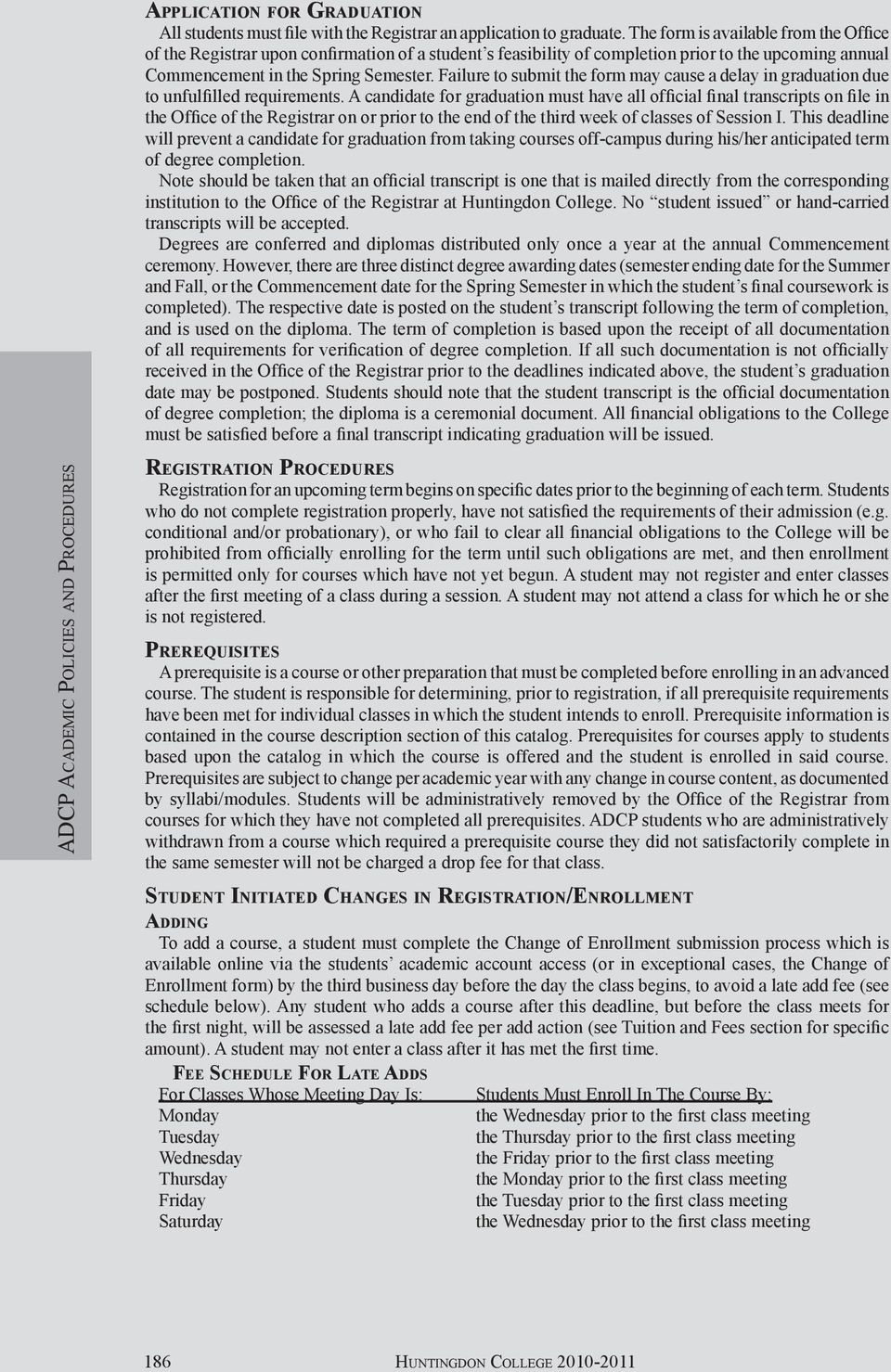
13 APPLICATION FOR GRADUATION All students must file with the Registrar an application to graduate. The form is available from the Office of the Registrar upon confirmation of a student s feasibility of completion prior to the upcoming annual Commencement in the Spring Semester. Failure to submit the form may cause a delay in graduation due to unfulfilled requirements. A candidate for graduation must have all official final transcripts on file in the Office of the Registrar on or prior to the end of the third week of classes of Session I. This deadline will prevent a candidate for graduation from taking courses off-campus during his/her anticipated term of degree completion. Note should be taken that an official transcript is one that is mailed directly from the corresponding institution to the Office of the Registrar at Huntingdon College. No student issued or hand-carried transcripts will be accepted. Degrees are conferred and diplomas distributed only once a year at the annual Commencement ceremony. However, there are three distinct degree awarding dates (semester ending date for the Summer and Fall, or the Commencement date for the Spring Semester in which the student s final coursework is completed). The respective date is posted on the student s transcript following the term of completion, and is used on the diploma. The term of completion is based upon the receipt of all documentation of all requirements for verification of degree completion. If all such documentation is not officially received in the Office of the Registrar prior to the deadlines indicated above, the student s graduation date may be postponed. Students should note that the student transcript is the official documentation of degree completion; the diploma is a ceremonial document. All financial obligations to the College must be satisfied before a final transcript indicating graduation will be issued. ADCP ACADEMIC POLICIES AND PROCEDURES REGISTRATION PROCEDURES Registration for an upcoming term begins on specific dates prior to the beginning of each term. Students who do not complete registration properly, have not satisfied the requirements of their admission (e.g. conditional and/or probationary), or who fail to clear all financial obligations to the College will be prohibited from officially enrolling for the term until such obligations are met, and then enrollment is permitted only for courses which have not yet begun. A student may not register and enter classes after the first meeting of a class during a session. A student may not attend a class for which he or she is not registered. PREREQUISITES A prerequisite is a course or other preparation that must be completed before enrolling in an advanced course. The student is responsible for determining, prior to registration, if all prerequisite requirements have been met for individual classes in which the student intends to enroll. Prerequisite information is contained in the course description section of this catalog. Prerequisites for courses apply to students based upon the catalog in which the course is offered and the student is enrolled in said course. Prerequisites are subject to change per academic year with any change in course content, as documented by syllabi/modules. Students will be administratively removed by the Office of the Registrar from courses for which they have not completed all prerequisites. ADCP students who are administratively withdrawn from a course which required a prerequisite course they did not satisfactorily complete in the same semester will not be charged a drop fee for that class. STUDENT INITIATED CHANGES IN REGISTRATION/ENROLLMENT ADDING To add a course, a student must complete the Change of Enrollment submission process which is available online via the students academic account access (or in exceptional cases, the Change of Enrollment form) by the third business day before the day the class begins, to avoid a late add fee (see schedule below). Any student who adds a course after this deadline, but before the class meets for the first night, will be assessed a late add fee per add action (see Tuition and Fees section for specific amount). A student may not enter a class after it has met the first time. FEE SCHEDULE FOR LATE ADDS For Classes Whose Meeting Day Is: Monday Tuesday Wednesday Thursday Friday Saturday Students Must Enroll In The Course By: the Wednesday prior to the first class meeting the Thursday prior to the first class meeting the Friday prior to the first class meeting the Monday prior to the first class meeting the Tuesday prior to the first class meeting the Wednesday prior to the first class meeting 186 HUNTINGDON COLLEGE
14 DROPPING To drop a course, a student must complete the Change of Enrollment submission process which is available online via the students academic account access (or in exceptional cases, the Change of Enrollment form) by 5:00 p.m. on the day of the first class meeting. Once the semester has begun, a grade of X will be indicated on the student s transcript for any course in which a drop is processed, and a drop fee will be assessed for each drop made by the student regardless of the start date of the session affected. (See Tuition and Fees section for specific amount.) The grade of X does not affect a student s grade point average. Unless course changes are made in this manner, they have no official standing and will not be recognized by the College. Students should also be aware that changes in enrollment might affect areas of financial aid, Veteran s Affairs and timing for degree completion. Students who drop all courses during a semester, either all at once or course by course, must be readmitted to the College before being permitted to enroll in subsequent semesters. ADMINISTRATIVE DROPS All students are required to attend the first class meeting of each course for which they are enrolled. Any student who misses the first class meeting will be administratively dropped from the course, and an administrative drop fee will be assessed for each administrative drop made by the College for a student s failure to attend the first class meeting. (See Tuition and Fees section for specific amount.) WITHDRAWAL FROM A COURSE A student may withdraw from a course by 5:00 p.m. on the day of the last class meeting. To withdraw from a course, a student must complete the Change of Enrollment submission process which is available online via the students academic account access (or in exceptional cases, the Change of Enrollment form). A grade of W will be indicated on the student s transcript for any course in which a withdrawal is processed. The grade of W does not affect a student s grade point average. (Refer to the Refund Policy section within the ADCP Financing a Huntingdon Education portion of this catalog with regard to how tuition is affected by a withdrawal.) Unless a course change is handled in this manner, it has no official standing and will not be recognized by the College. Students who do not officially withdraw from classes will be assigned a grade of F by their instructors if more than one absence is received (per Class Attendance Policy). Students should also be aware that changes in enrollment might affect areas of financial aid, Veteran s Affairs and timing for degree completion. REPEATING COURSES Although Huntingdon does not remove the original grade from the permanent record, the College will permit a student to repeat a course under the conditions listed below. A student: may have only one lower course grade removed in the computation of the cumulative GPA; may not repeat for a higher grade at another college or university a course initially taken at Huntingdon College; must notify the Office of the Registrar of the repeat at the time of registration (by online registration option.) Additional credit may not be earned when repeating a course for a higher grade. The College does not guarantee the availability of any course for repetition. ADCP ACADEMIC POLICIES AND PROCEDURES CATALOG OF CHOICE Each catalog presents the requirements for students entering Huntingdon during that particular academic year and is the catalog the student s academic advisor(s) and Registrar will use in verifying degree requirements for graduation. Any request to change catalogs must be submitted using the appropriate form and approved by the student s academic advisor(s), and the Registrar. A change of catalog will apply to all requirements: core, major, as well as graduation. The catalog of choice must be a catalog dated a year in which the student is or was enrolled at Huntingdon. A student may not submit a petition for a catalog change during his or her terminal semester. If there is an enrollment break of four or more consecutive years, the student must use the catalog issued for the year in which the student is readmitted and matriculates. HUNTINGDON COLLEGE

15 ADCP ACADEMIC POLICIES AND PROCEDURES ACADEMIC CREDIT POLICIES TRANSFER CREDIT (CREDIT ELSEWHERE) A currently enrolled student who wishes to take course work at another college or university and apply that work toward the requirements for a Huntingdon College degree must secure approval of the student s advisor and the Registrar. Approval to take courses at another institution for transfer to Huntingdon College may be requested by completing the Application for Approval to Earn Credit Elsewhere for Transfer to Huntingdon form, which is available online. Completed forms, including the presence of advisor s signature, should be submitted directly to the Office of the Registrar. The advisor will determine suitability of the course in relation to the student s plan of study, and the Registrar must certify the student s academic standing and course equivalency. A student must understand that: credit may not be granted at Huntingdon for any course not specifically approved in advance; they may not repeat at another college or university a course initially taken at Huntingdon College; any major courses above the Business core (ACT201, ACT202, ECO201, ECO202) must be completed at Huntingdon College after a student s matriculation into the program. those who have accumulated as many as sixty-four semester hours from a two-year institution, may only take work at a four-year college or university, or forfeit previously awarded credit; they may not receive more than 90 hours of transfer credit; they may not exceed the normal load permitted at Adult Degree Completion Program (ADCP) during the same period; they may not take courses at another college or university in the area that are equivalent to any course or courses being offered at Adult Degree Completion Program (ADCP) in the same semester or term; they may not take more than one course in the last 30 hours outside of Huntingdon College; an official transcript showing completion of coursework must be sent to the Office of the Registrar at Huntingdon College from the original institution in order for credit to be granted. Refer to the Application for Graduation and General Degree Requirement sections for further restrictions on transfer credit that apply to candidates for graduation. If not received in a timely manner, the receipt of official transcripts containing courses taken elsewhere can adversely affect a student s term of completion. Students in the Adult Degree Completion Program (ADCP) who wish to take courses at Huntingdon College (traditional day program) must complete a request to transfer credit elsewhere as outlined above. Additionally, students who choose this route are responsible for tuition and fees applicable to those students in the traditional day program. Credit may be granted for any approved course completed with a grade of D or better. COLLEGE LEVEL EXAMINATION PROGRAM (CLEP) Credit can only be granted for Subject Examinations. No credit will be granted for General Examinations taken after the student has entered college. Credit will not be granted for a lower sequence course if a more advanced course has been completed. In any one discipline a maximum of 12 semester hours may be earned. Huntingdon awards up to 30 semester hours of credit for satisfactory scores (50th percentile or higher) on the College Level Examination Program provided that the examination area is comparable to a course offered for credit at Huntingdon College. Students who wish to take courses under this agreement must secure the approval of the academic advisor and the Registrar by submitted the Application for Approval to Earn Credit Through the College Level Subject Examination Program (CLEP). A $25.00 recording fee per awarded credit hour is assessed. DEFENSE ACTIVITY FOR NON-TRADITIONAL EDUCATION SUPPORT (DANTES) Huntingdon College recognizes the successful achievement of students participating in the curriculum of DANTES. Students are encouraged to have their official DANTES transcript submitted for review. Credit is awarded for courses in which the content is comparable to a course offered for credit at Huntingdon College. Credit is awarded at the discretion of the College, and students should not assume that credit will be awarded automatically. A DANTES transcript should be sent to the Office of the Registrar for evaluation. A $25.00 recording fee per awarded credit hour is assessed. 188 HUNTINGDON COLLEGE

16 GRADING POLICIES COURSE GRADES AND POINTS The quality of achievement in a course is measured as follows: A Excellent; earns four grade points per semester hour. B Good; earns three grade points per semester hour. C Average; earns two grade points per semester hour. D Poor; earns one grade point per semester hour. F Unsatisfactory; earns no grade point per semester hour. S Satisfactory; used for required classes in which credit cannot be earned. This does not count in the grade point average. U Unsatisfactory; used for required classes in which credit cannot be earned. This does not count in the grade point average. W Withdrawal; indicates that the student withdrew from the course. This does not count in the grade point average. X Drop: indicates that the student either dropped a course prior to its first class meeting, or was administratively dropped due to nonattendance in the first class meeting. This does not count in the grade point average. At the end of each session, faculty members must report grades to the Office of the Registrar within 48 hours after the completion of the last class meeting. A grade of Incomplete is not assigned in the Adult Degree Completion Program (ADCP). GRADE REPORTS AND GRADE POINT AVERAGE All grades are entered into the student s permanent record (transcript) at the end of each session. Adult Degree Completion Program (ADCP) grades are posted to each student s online account. The grade report will indicate the final grades for all courses taken during the semester. The grade point average is computed by multiplying the quality points earned by the credit hours of each course and by dividing the total quality points earned by the total credit hours attempted as indicated by the following example: 3 semester hours of A x 4 = 12 quality points 3 semester hours of B x 3 = 9 quality points 3 semester hours of C x 2 = 6 quality points 3 semester hours of D x 1 = 3 quality points 3 semester hours of F x 0 = 0 quality points Resulting in 15 semester hours attempted and 30 quality points earned. Which yields: 30 quality points / 15 hours attempted = 2.00 GPA. CHANGE IN GRADE/GRADE APPEALS A course grade, which has been reported by the instructor to the Office of the Registrar, cannot be changed without a properly executed Adjustment of Student s Academic Record card signed by the instructor, the Vice President for Academic Affairs and the Vice President for Academic Affairs/Dean of the Faculty. Students who believe that an incorrect grade was awarded by the instructor, or who perceive that other problems may exist for which an appeal is warranted, should follow the College s grievance policy. ADCP ACADEMIC POLICIES AND PROCEDURES COURSE MODULES Course modules are regularly available from Huntingdon s Adult Degree Completion Program (ADCP) for courses taught in the Adult Degree Completion Program (ADCP). Course modules are available on the web and are posted no later than two weeks prior to the first class meeting. HUNTINGDON COLLEGE

17 ACADEMIC HONORS DEAN S LIST At the end of each semester, the Vice President for Academic Affairs/Dean of the Faculty issues a list of students who have achieved academic distinction. To be eligible for the Dean s List a student must have received letter grade evaluations on at least nine hours during the term and must have completed all course work for the term. The Dean s List of Honors recognizes those who achieve semester grade point averages of ADCP ACADEMIC POLICIES AND PROCEDURES HONORS AT GRADUATION Honors at graduation are conferred upon students who complete work for the Bachelor s degree with high distinction: Cum Laude and Magna Cum Laude. These honors are recorded on the student s transcript and diploma. (Honors determinations for all degree completion dates are made by a faculty committee just prior to the annual commencement ceremony.) To be eligible for Cum Laude and Magna Cum Laude status, a student must complete a minimum of 45 hours at Huntingdon College evaluated on a graded basis. The minimum GPA to have the honor of Cum Laude or Magna Cum Laude conferred, is based on the number of hours graded at Huntingdon College and is calculated using a linear scale. Examples of the linear scale are given in the table below. Details of the calculation process are available from the Office of the Registrar. Required GPA For Required GPA For Hours Graded Cum Laude Status Magna Cum Laude Status ACADEMIC STANDING CLASSIFICATION OF STUDENTS Class designation is based on the number of hours the degree seeking student has earned in courses offered at Huntingdon College, transferred from other accredited institutions, or awarded through AP, CLEP, IB, or DANTES credit. The following is an explanation of class designation: Freshman: A student who has earned 0-23 hours of credit. Sophomore: A student who has earned hours of credit. Junior: A student who has earned hours of credit. Senior: A student who has earned 90 or more hours of credit. Class designation does not necessarily reflect the student s readiness to graduate, progress in the chosen program of study, or the number of semesters of attendance. STANDARDS OF SATISFACTORY PROGRESS Each student is expected to maintain satisfactory academic standing and progress toward the baccalaureate degree. Continuation in college and various privileges are governed by the student s academic standing and classification. Students who do not maintain a grade average of sufficient quality to ensure meeting graduation requirements are subject to academic disciplinary action. SATISFACTORY PROGRESS Satisfactory progress toward degree completion is defined as meeting or exceeding a minimum of for both term and cumulative grade point average (GPA), and is reviewed after the end of each semester (Fall, Spring and Summer). ACADEMIC PROBATION A student will be placed on Academic Probation for the following semester if the student is not making satisfactory progress toward degree completion. ACADEMIC SUSPENSION After a student has been placed on Academic Probation, the student has one (1) semester of enrollment to restore good standing, or the student will be placed on Academic Suspension. Being placed on Academic Suspension means that the individual is not eligible to attend courses at Huntingdon until the end of the suspension period. The first suspension period will ordinarily be for the duration of one semester, the second for the duration of two semesters. Students who have been suspended must reapply for admission (please refer to the section titled Readmission ). In addition, a student must petition in the form of a written letter to the Adult Degree Completion Program (ADCP) Steering Committee. 190 HUNTINGDON COLLEGE

18 WITHDRAWAL FROM THE COLLEGE Students wishing to withdraw entirely from a term that is in progress must complete the Application for Student Withdrawal process, which is available online via the students academic account access. The Application for Student Withdrawal must be completed and on file with the Office of the Registrar before the student s official withdrawal will be processed. If a student wishes to return to Huntingdon they must complete the readmission process. TRANSCRIPTS A transcript may only be issued by the Office of the Registrar upon written request of the student or former student. One should allow five to seven working days after clearance from the Office of Student Financial Services for processing. During the busiest periods (processing of final grades, registration, graduation, etc.) transcript processing may be delayed. Official copies of Huntingdon College transcripts bear the College seal and the College Registrar s or Associate Registrar s signature and are sent directly to the schools, organizations, or individuals as indicated on the signed written request of the student or former student. Upon signed written request, an individual may also receive official copies of his or her transcript which are stamped Issued to Student. The initial transcript issued is provided free of charge as a service to students. A $5.00 processing fee is charged for each subsequent transcript request. All transcripts are sent first-class mail. Other methods of delivery (e.g. overnight, etc.) are available upon request and for an additional charge. Requests for transcripts received by FAX will be processed provided the request contains the required information and a valid credit card number with expiration date for billing purposes. (Detailed instructions are available by calling or on the College s web site.) If the FAX does not contain the correct credit card information, transcripts will not be issued until the appropriate fee is received. Copies of transcripts will not be sent as a FAX unless so stipulated in the written request. There is also a $5.00 processing fee for each faxed transcript. Huntingdon assumes no responsibility for confidentiality of records sent in this manner. Transcripts will not be provided for students, current or former, or alumni with overdue accounts or other financial obligations to the College as determined by Student Financial Services. Once a student s financial obligations to the College have been met, it is the requestor s responsibility to submit another Transcript Request and processing fee to the Office of the Registrar. The Registrar will not duplicate the transcript request if it was initially denied by Student Financial Services. CORRESPONDENCE Huntingdon College Adult Degree Completion Program (ADCP) students are individually assigned a College address for the purposes of correspondence with College faculty, staff and other students. It is the responsibility of the students to check their Huntingdon College account regularly. The HC account will be an official means of communication between the student and the College. To better serve each student and to protect student information, only student requests that are sent from the HC account will be considered official, as there is no level of security or verification of identity with other accounts (e.g. Yahoo, AOL). The student s login and password, as provided to them by the Huntingdon College Tech Team, will also be used with the student s online student account, which is where final grades for each class are posted and where students register and make enrollment changes for each semester. All other correspondence between the student and the College will be limited to the permanent address on file with the Office of the Registrar, unless otherwise requested with specific authorization. FAMILY EDUCATIONAL RIGHTS AND PRIVACY ACT (FERPA) The Adult Degree Completion Program (ADCP) complies with the provisions of the Family Educational Rights and Privacy Act of 1974, as amended. This federal law provides that an institution will maintain the confidentiality of student records, and it provides students and parents of dependent students with the right to inspect and review information contained in their educational records, to challenge the contents of their educational records, to have a hearing if the outcome of the challenge is unsatisfactory, and to submit explanatory statements for inclusion in their files if they feel the decisions of the hearing panels are unacceptable. At its discretion, in response to individual inquiry or by publication, the College will provide Directory Information in accordance with the provisions of the Act to include: student name, address, telephone number, date and place of birth, major field of study, classification, study load, dates of attendance, degrees and awards received, the most recent previous educational agency or institution attended by the student, and participation in officially recognized activities. Students may withhold Directory Information by notifying the Registrar in writing. A detailed statement of policies and procedures pertinent to Huntingdon s implementation of the Act is available on the College s web site. ADCP ACADEMIC POLICIES AND PROCEDURES HUNTINGDON COLLEGE

19 VETERANS AFFAIRS Huntingdon College is approved for the education of veterans eligible for benefits under programs of the Veterans Administration. Approval is granted by the State Approving Agency of the State Department of Education under authority of Title 38, United States Code, Chapter 36, Section The Department of Veterans Affairs (VA) regulations (Title 38, Code of Federal Regulations) determines the eligibility of veterans, service personnel, and other eligible individuals, and approves the payment of benefits. The programs under which students may be eligible for VA educational benefits are listed below. To determine specific eligibility requirements students should direct their questions to the VA Regional Office at A partial listing of entitlement programs includes: Montgomery GI Bill Active Duty Educational Assistance Program (Chapter 30) Post Vietnam Era Veterans Educational Assistance Program (VEAP) (Chapter 32) Post 9/11 GI Bill (Chapter 33) Survivors and Dependents Educational Assistance Program (Chapter 35) Montgomery GI Bill Selected Reserve (Chapter 1606) Reserve Education Assistance Program (REAP) (Chapter 1607) ADCP ACADEMIC POLICIES AND PROCEDURES Additional information can be found at: Students expecting to receive benefits must complete the Veteran Certification Information Sheet and submit it to the Office of the Registrar. Certification cannot be made until the application is on file. Students receiving benefits must adhere to the rules and regulations established by the Department of Veterans Affairs. Specific guidelines have been established in regard to admission to the College; evaluation of prior credit; matriculation and satisfactory progress; proper degree pursuit and change of program; changes in enrollment, repeated or excessive courses, and overpayment; and attendance policy. Questions concerning these areas may be addressed to the Office of the Registrar. 192 HUNTINGDON COLLEGE

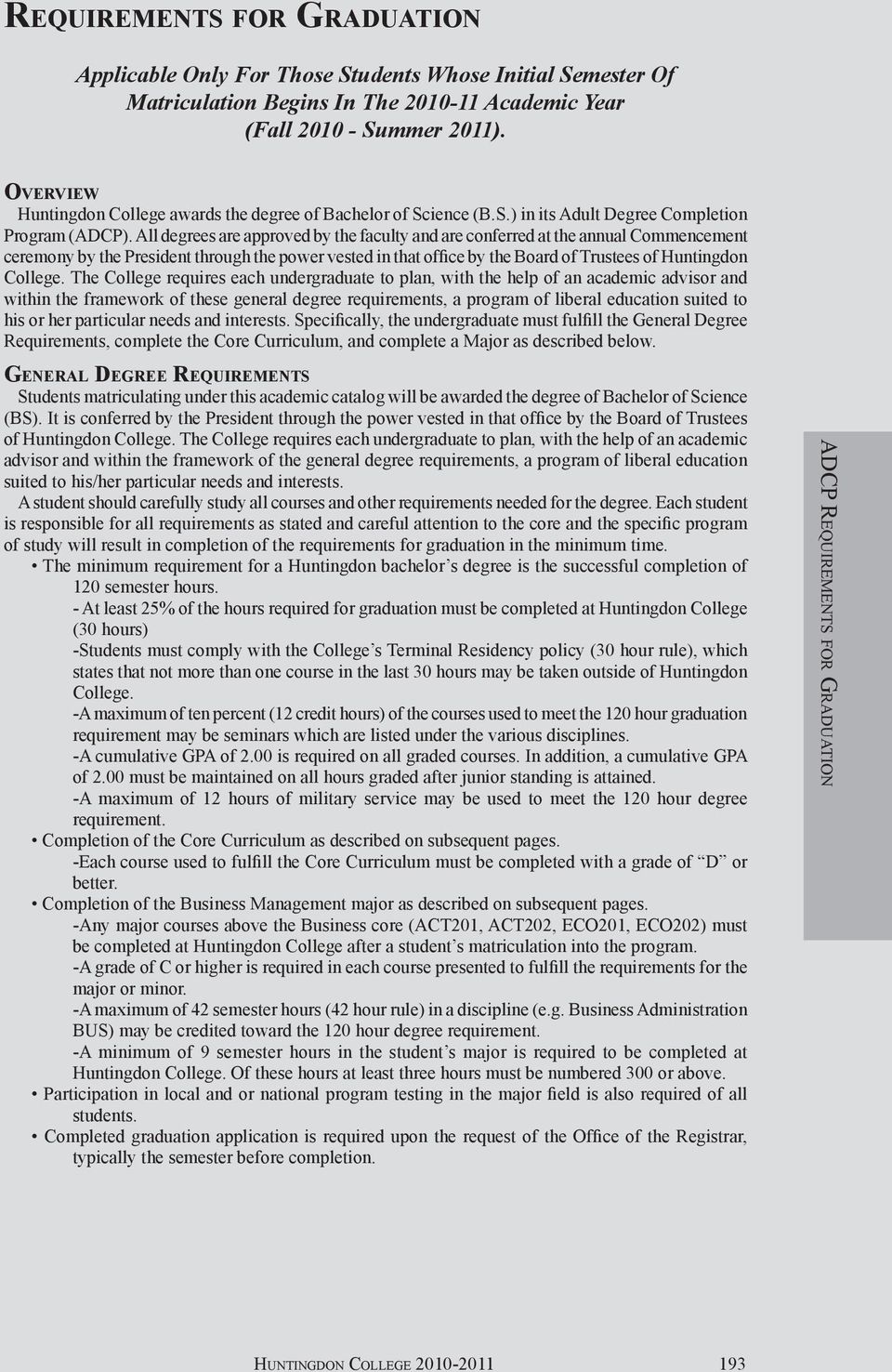
20 REQUIREMENTS FOR GRADUATION Applicable Only For Those Students Whose Initial Semester Of Matriculation Begins In The Academic Year (Fall Summer 2011). OVERVIEW Huntingdon College awards the degree of Bachelor of Science (B.S.) in its Adult Degree Completion Program (ADCP). All degrees are approved by the faculty and are conferred at the annual Commencement ceremony by the President through the power vested in that office by the Board of Trustees of Huntingdon College. The College requires each undergraduate to plan, with the help of an academic advisor and within the framework of these general degree requirements, a program of liberal education suited to his or her particular needs and interests. Specifically, the undergraduate must fulfill the General Degree Requirements, complete the Core Curriculum, and complete a Major as described below. GENERAL DEGREE REQUIREMENTS Students matriculating under this academic catalog will be awarded the degree of Bachelor of Science (BS). It is conferred by the President through the power vested in that office by the Board of Trustees of Huntingdon College. The College requires each undergraduate to plan, with the help of an academic advisor and within the framework of the general degree requirements, a program of liberal education suited to his/her particular needs and interests. A student should carefully study all courses and other requirements needed for the degree. Each student is responsible for all requirements as stated and careful attention to the core and the specific program of study will result in completion of the requirements for graduation in the minimum time. The minimum requirement for a Huntingdon bachelor s degree is the successful completion of 120 semester hours. - At least 25% of the hours required for graduation must be completed at Huntingdon College (30 hours) -Students must comply with the College s Terminal Residency policy (30 hour rule), which states that not more than one course in the last 30 hours may be taken outside of Huntingdon College. -A maximum of ten percent (12 credit hours) of the courses used to meet the 120 hour graduation requirement may be seminars which are listed under the various disciplines. -A cumulative GPA of 2.00 is required on all graded courses. In addition, a cumulative GPA of 2.00 must be maintained on all hours graded after junior standing is attained. -A maximum of 12 hours of military service may be used to meet the 120 hour degree requirement. Completion of the Core Curriculum as described on subsequent pages. -Each course used to fulfill the Core Curriculum must be completed with a grade of D or better. Completion of the Business Management major as described on subsequent pages. -Any major courses above the Business core (ACT201, ACT202, ECO201, ECO202) must be completed at Huntingdon College after a student s matriculation into the program. -A grade of C or higher is required in each course presented to fulfill the requirements for the major or minor. -A maximum of 42 semester hours (42 hour rule) in a discipline (e.g. Business Administration BUS) may be credited toward the 120 hour degree requirement. -A minimum of 9 semester hours in the student s major is required to be completed at Huntingdon College. Of these hours at least three hours must be numbered 300 or above. Participation in local and or national program testing in the major field is also required of all students. Completed graduation application is required upon the request of the Office of the Registrar, typically the semester before completion. ADCP REQUIREMENTS FOR GRADUATION HUNTINGDON COLLEGE
21 CORE CURRICULUM As a liberal arts, Methodist-related institution, Huntingdon College provides a core curriculum that supports the mission of the College. To this end the College s faculty has prescribed a curriculum which each student must complete. This curriculum consists of a combination of specifically required courses and of academic areas from which a student selects a predetermined number of courses. Furthermore, because Religion courses are so fundamental to the mission of the core curriculum, enrollment in a minimum of six hours of Religion is required. During his/her first year of attendance a student should not drop or withdraw from these courses. Also, ADCP301 Introduction to the Adult Degree Completion Program should be completed during the student s first session of attendance. The description of the core curriculum is divided into two parts: Core Overview and Core Courses. The Core Overview is a list of the eight categories in which the requirements have been sorted. In this overview, a brief statement of the academic intent of the courses is given, as well as notations regarding which courses are required during the first academic year of enrollment. The second part of the description, Core Courses, is a listing of the specific courses which fulfill the requirement in each of these eight areas of the core curriculum. ADCP REQUIREMENTS FOR GRADUATION CORE OVERVIEW I. Transition to the ADCP Program (0 hour) - A seminar designed to aid the student in adjusting to the accelerated paced environment of ADCP and introduce the program s expectations. This course is required during the first semester of enrollment for each student. II. Written and Oral Communication (9 hours) - Composition and public speaking courses designed to enhance the student s ability to communicate. III. Judeo-Christian Tradition (6-12 hours) - Biblically based courses which broaden a student s understanding of the Judeo-Christian tradition. All incoming students are required to take two courses in religion during the first academic year of enrollment. A student admitted with less than 57 hours is required to complete four courses (12 hours) of religion at Huntingdon. A student admitted with 57 or more hours is required to complete two courses (6 hours) of religion at Huntingdon. IV. Historical Foundation (6 hours) - Two courses designed to enhance the student s knowledge of the history of civilization. V. Aesthetic Expression (9 hours) - This category, designed to expand the student s understanding and appreciation of aesthetic expression, consists of a two course requirement in literature and a one course requirement in fine art. VI. Science and Mathematics (9 hours) - The science and mathematics courses, two in science and one in mathematics, are intended to expand the student s understanding of scientific knowledge and procedures and the logical thought processes related to mathematics. VII. Social Awareness (3 hours) - One course designed to increase the student s understanding of one of the stated academic areas. VIII. Technology (3 hours) One course designed to increase the student s understanding and application of technology. 194 HUNTINGDON COLLEGE
22 GENERAL CORE REQUIREMENTS (45-51 HOURS) I. TRANSITION TO THE ADCP PROGRAM (0 HOURS) First-Semester Seminar ADCP 301 Introduction to the School of Business and Professional Studies II. WRITTEN AND ORAL COMMUNICATION 9 HOURS* English Composition (6 hours*) (Only basic college composition courses are applicable.) Communication Studies (3 hours*) (Only courses equivalent to Huntingdon College s CMST 201 Introduction to Communication or CMST 233 Effective Public Communication will be accepted toward this requirement.) III. JUDEO-CHRISTIAN TRADITION 6-12 HOURS Religion (6-12 hours) Requirement must be completed through Huntingdon College. Specifically: -All incoming students are required to complete two courses in religion within their first academic year of enrollment in the program. Subsequent religion course requirements may be completed in the time-frame set by the student. -A student admitted with less than 57 initial transfer hours is required to complete four courses (12 hours) in religion at Huntingdon College. -A student admitted with 57 or more initial transfer hours is required to complete two courses (6 hours) of religion within the first academic year of enrollment at Huntingdon College. IV. HISTORICAL FOUNDATION 6 HOURS History (e.g. Western Civilization, American History) V. AESTHETIC EXPRESSION 9 HOURS Fine Arts (3 hours) (e.g. Art, Music, Theater) Literature (6 hours) VI. SCIENCE AND MATHEMATICS 9 HOURS Mathematics (3 hours) (Only college level mathematics courses comparable to courses offered at Huntingdon College are applicable.) Sciences (6 hours) (e.g. Biology, Chemistry, Physics, Physical Science, etc.) VII. SOCIAL AWARENESS 3 HOURS Social Sciences (e.g. Economics, Geography, Political Science, Psychology, Sociology, etc.) VIII. TECHNOLOGY 3 HOURS* Technology (e.g. Computer Literacy) * This course is not offered through every site of the Adult Degree Completion Program (ADCP); it should be completed at another institution, ideally at the partner community college, or at the Huntingdon College main campus, for which prior approval may be required. ADCP REQUIREMENTS FOR GRADUATION UNDUPLICATED LIBERAL ARTS (9 HOURS) Any unused courses from the areas of core, with the exception of composition and technology, can apply to this requirement. THE MAJOR Each student is expected to acquire considerable mastery of a particular discipline and achieve a breadth of intellectual experience by way of completing a major. Students are responsible for meeting the requirements of a major as stated in the catalog for the year in which they initially matriculate. Students must earn a minimum of nine semester hours within the major at Huntingdon College. Of these nine hours, at least three hours must be numbered 300 or above. A student who selects a major with a concentration should identify the area of concentration upon declaring the major. The area of concentration will also be recorded on the official transcript. MINOR An academic minor is available to students who wish to supplement their major field of study with another academic concentration. The minimum requirement for a minor is 18 semester hours. HUNTINGDON COLLEGE
23 COURSES OF STUDY BUSINESS MANAGEMENT MAJOR REQUIREMENTS (45 HOURS) I. BUSINESS CORE COURSES (12 HOURS) Accounting (ACT) 201 Foundations of Accounting I Foundations of Accounting II... 3 Economics (ECO) 201 Foundations of Microeconomics Foundations of Macroeconomics II. REQUIRED MANAGEMENT CORE COURSES (12 HOURS) Business (BUS) 303 Foundations of Marketing Foundations of Finance Legal Environment of Business... 3 Management (MGMT) 312 Foundations of Management... 3 III. REQUIRED UPPER LEVEL MANAGEMENT COURSES (21 HOURS) Business (BUS) 329 Foundations of Quantitative Methods... 3 Management (MGMT) 315 Organizational Theory and Behavior Project Management Management Information Systems Entrepreneurship Human Resource Management Business Policy and Decision Making... 3 This course is not offered through the Adult Degree Completion Program (ADCP), with the exception of the main campus; it should be completed at another institution, ideally at the partner community college, or at the Huntingdon College main campus, for which prior approval may be required. + May be used to satisfy core requirements in the Social Science area; however, hours are not duplicated. ADCP COURSES OF STUDY BUSINESS MANAGEMENT- HEALTH MANAGEMENT CONCENTRATION (54 HOURS) The Health Management concentration availability is limited to two sites (the JSCC Pell City campus and the Daphne site). I. BUSINESS CORE (15 HOURS) II. REQUIRED MANAGEMENT CORE COURSES (15 HOURS) Business (BUS) 303 Foundations of Marketing Foundations of Finance... 3 Management (MGMT) 211 Introduction to Health Care Foundations of Management Legal Issues in Health Care... 3 III. REQUIRED UPPER LEVEL MANAGEMENT COURSES (27 HOURS) Business (BUS) 329 Foundations of Quantitative Methods... 3 Management (MGMT) 315 Organizational Theory and Behavior Management of Health Care Project Management Management Information Systems Human Resource Management Ethics in Management Research and Application in Health Care Business Policy and Decision Making HUNTINGDON COLLEGE
24 MINOR IN RELIGIOUS STUDIES The minor requires completion of 18 hours. Religion (REL) 18 hours 101* Survey of Hebrew Scriptures * Survey of New Testament...3 One course chosen from * History of Christianity I * History of Christianity II * World Religions * Religion in America...3 One course chosen from * Christian Theology * Christian Ethics...3 One course chosen from * Torah (Hebrew Scriptures) * Prophets (Hebrew Scriptures) * Jesus and the Gospels * Paul and His Letters...3 Elective in Religion...3 * Course satisfies a requirement in the college s core The Adult Degree Completion Program (ADCP) at each of its sites, with the exception of the Enterprise State, Jefferson State, and Montgomery sites, is a 59 credit hour program (including any site(s) activated after the publication of this document); specifically, the maximum number of credit hours earned through the Adult Degree Completion Program (ADCP) for application toward the 120 hour graduation requirement from Huntingdon College is 59 hours. ADCP COURSES OF STUDY HUNTINGDON COLLEGE
25 COURSES OF INSTRUCTION - DEFINITIONS This section of the catalog describes all the courses currently offered by Huntingdon College s Adult Degree Completion Program (ADCP). These are listed alphabetically by the disciplinary prefix. ACADEMIC PLANNING Students planning their course of study should review the requirements listed in the previous section and the course descriptions listed here, noting particularly those courses which interest them and determining which Core Curriculum components or distribution requirements may fulfill the courses. A listing of courses offered in the Fall, Spring and Summer semesters together with time and location is published in a Schedule of Classes, which is made available on-line before each registration period. The Adult Degree Completion Program s Schedule of Classes is published on the College s web site for information purposes. The College reserves the right to cancel, postpone, combine or change the time of any class for which there is not sufficient enrollment or for other reasons deemed in the best interest of the institution. COURSE NUMBERING All courses are assigned semester credit hours, the basic unit of measurement for time spent in class per week. Courses are numbered on the following basis: Introductory courses or course sequences typically taken by freshmen or sophomores Introductory and intermediate courses or course sequences with or without prerequisites taken by freshman or sophomores Advanced courses or course sequences with specific prerequisites (courses, class standing, or special permission) ordinarily taken by juniors or seniors. PREREQUISITE POLICY STATEMENT Prerequisites for courses apply to students based upon the catalog in which the course is offered and the semester in which the student is enrolled in said course. Prerequisites are subject to change per academic year with any change in course content, as documented by syllabi/modules. ADCP COURSES OF INSTRUCTION 198 HUNTINGDON COLLEGE
26 COURSES OF INSTRUCTION ACCOUNTING (ACT) 201. Foundations of Accounting I. Cr. 3. The fundamental principles of financial accounting. An introduction to the process of accumulating, classifying, and presenting financial information Foundations of Accounting II. Cr. 3. Prerequisite: ACT 201 with a grade of C or better. The preparation and utilization of financial information for internal management purposes. Special emphasis is given to cost determination, cost control, and the development of information for decision making. ADULT DEGREE COMPLETION PROGRAM (ADCP) 301. Introduction to the Adult Degree Completion Program. Cr. 0. Designed to familiarize new students with the policies and procedures that govern the ADCP program. Students are given a copy of their current catalog and topics are highlighted to ensure proper orientation to the program. ART (ART) 303. History of Art I. Cr. 3. An historical survey of the visual arts from prehistoric times through the medieval, Gothic, Renaissance, and Baroque periods. Emphasis is on European art, but many cultures are included History of Art II. Cr. 3. A survey of major art movements and styles from Romanticism, Realism and Impressionism, through the twentieth century Art in Religion. Cr. 3. Art and its place in the Judeo-Christian culture. Biblical sources and influence emphasized. Previous training in art not required. BIOLOGY (BIOL) 101. Principles of Biology. Cr. 3. Survey course providing an introduction to all major concerns of modern biological science Environmental Science. Cr. 3. Deals with man-made and man-related environmental problems such as pollution, overpopulation, depletion of resources, forest management, endangered species, energy and food shortages. ADCP COURSES OF INSTRUCTION BUSINESS ADMINISTRATION (BUS) 303. Foundations of Marketing. Cr. 3. Prerequisite: ECO 201 recommended, but not required. An institutional and functional study of the distribution of goods and services; consumer motivation and behavior Foundations of Finance. Cr. 3. Prerequisite: ACT 201 and either ECO 201 or 202. Financing business. Special attention to internal financial structure. HUNTINGDON COLLEGE
27 322. Legal Environment of Business. Cr. 3. The philosophy and evolution of law is examined. The first part of the course focuses on the legal rights and responsibilities of individuals under and before the law: torts, property, contracts, and agency. The second part of the course focuses on the legal rights and responsibilities of the businessman and the firm: negotiable instruments, partnership and corporation law, equity, and related subjects Essentials of Quantitative Methods. Cr. 3. Presentation of quantitative methods essential to topics covered in BUS329 and MGMT330. Topics include: linear equations and inequalities; systems of linear equations and inequalities; graphical and elgebraic techniques for solving systems of linear equations; foundations of probability theory; and foundations for descriptive statistics Foundations of Quantitative Methods. Cr. 3. Descriptive statistics; probability and probability distributions; statistical inferences and hypothesis testing; simple regression analysis. Also, the course will cover various statistical applications in quality control, marketing, finance, economics and other areas of business. ADCP COURSES OF INSTRUCTION COMMUNICATION STUDIES (CMST) 201. Introduction to Communication. Cr. 3. Introduces students to communication as a process and its applications in interpersonal, group, public, and mass communication situations. Focuses on the relationship between the practice of human communication and theoretical explanations offered in the field of communication studies. Asks students to explore, question, and understand the world around us Media in Society. Cr. 3. This course focuses on the impact of the mass media on society, including television, radio, print journalism, and the Internet. Emphasis on the development of television, radio, and print journalism in our society, the way our society uses them, and how the Internet has emerged as a powerful medium. Students will focus on elements such as news, entertainment, and other functions of the media Effective Public Communication. Cr. 3. An interpersonal approach to the study of verbal persuasive communication. Traditional study of rhetoric and public speaking with regard to organization, evidence, and delivery Interpersonal Communication. Cr. 3. Studies the aspects of interpersonal communication in personal and professional dyadic and group contexts. Specially designed to impart a general understanding of the dynamics involved in interpersonal relations in both structured and unstructured situations, and to improve communication skills in negotiating within those contexts. The course considers such topics as conflict management and resolution, nonverbal communication, conversational analysis, stages and phases of interpersonal relations, and responsive listening. 200 HUNTINGDON COLLEGE
28 305. Theories of Communication and Persuasion. Cr. 3. An exploration of the evolution of persuasion theories including learning, consistency, information processing, and cognitive theories as well as structural, attitudinal, interpretive, cultural, and critical approaches to communication studies. Sites for investigation include interpersonal, mediated, campaign, and movement messages Business and Professional Communication. Cr. 3. Prerequisite: 233 or 242 recommended, but not required. A focus on acquiring the communicative competencies necessary in business and professional careers. Focuses on communicative situations and skills in the workplace, such as team building, interacting in meetings, interviewing, written communications, superior-subordinate interactions, and effective listening Leadership Principles. Cr. 3. This course looks at the evolution of leadership from a theoretical perspective with a focus on contemporary leadership. Topics of discussion include management versus leadership, gender differences, power and social influences, ethics and values, culture and the key communication competencies of leadership. Students will evaluate and enhance personal leadership skills. In addition, students will develop a personal model of leadership Decision Making/Problem Solving. Cr. 3. One of the primary functions of members of an organization or for managers of projects is to make decisions and solve problems using constructive organizational processes. When obstacles arise that may prevent the organization from achieving its goals, project managers must engage in effective problem solving to overcome these barriers. This course examines involvement of stakeholders in decision processes, models for decision-making, decision trees, risk analysis, and issues associated with implementation of decisions Persuasion, Influence and Motivation. Cr. 3. Students will examine the general theories that explain persuasion and one s ability to influence others. Discussion will identify communication skills, attitudes, and competencies associated with persuasion, influence and motivation. In-class activities will enable students to learn and practice powerful persuasion communication skills that will enhance both personal and professional success Public Relations. Cr. 3. Prerequisite: 201 recommended, but not required. Introduces students to the principles, techniques, and types of public relations. Concentrates on exploring the role of public relations in our society, analyzing the public relations audience, and examining the mass media as public relations vehicles Organizational Communication. Cr. 3. A survey of communication in various types of organizations. Selected micro- and macro-level theories of organizational behavior. Includes such topics as information flow, climate and culture, leadership and motivation, groups, conflict, and contemporary issues of workplace diversity and ethics. ADCP COURSES OF INSTRUCTION COMPUTER LITERACY (COMP) 105. Computers and Society. Cr. 3. A survey of computers and their impact on society. Includes the history of computing, philosophical and ethical issues of computer applications, basic terminology and technological concepts, and an introduction to common computer applications, computer programming, and web page construction. HUNTINGDON COLLEGE
29 ECONOMICS (ECO) 201. Foundations of Microeconomics. Cr. 3. The understanding of the economic way of thinking and decision-making related to individuals and business units. The knowledge of the theories, concepts, and tools of economic analysis such as demand and supply, elasticity, production, costs, profits, returns to scale, and their application in competitive markets. An introduction to imperfect markets Foundations of Macroeconomics. Cr. 3. Prerequisite: 201 recommended, but not required. The understanding of the theories, concepts, and tools of economic analysis related to achieving macroeconomic goals such as economic growth, price stability and full employment. The analysis of Classical and Keynesian theories as well as fiscal and monetary policies in today s global environment. ADCP COURSES OF INSTRUCTION ENGLISH (ENGL) 103. English Composition I. Cr. 3. The principles of expository writing with weekly assignments in composition English Composition II. Cr. 3. Prerequisite: 103. Critical compositions on fiction, poetry, drama, and film. This course will also include research methods and the research paper th and 19th Century British Literature. Cr. 3. Prerequisite: 104 recommended. A study of poets, novelists, essayists and/or playwrights. Writers may include Swift, Pope, Doctor Johnson, Austen, Wordsworth, Coleridge, Keats, Tennyson, Dickens, the Brontes, the Brownings, Arnold, and Hardy Literature by Women. Cr. 3. Prerequisite: 104 recommended. An examination of works by women writers. Selections vary with each offering of the course Literature of the American South. Cr. 3. Prerequisite: 104 recommended. Representative writers, artistic and cultural characteristics, and developmental trends from a regional literary tradition Contemporary Literature. Cr. 3. Prerequisite: 104 recommended. An examination and analysis of literature since World War II. In addition to European and American literature, students will interpret contemporary developments in literature and culture such as post-colonial studies, ethnic literatures from around the world, postmodernism, and debates about literature itself. HISTORY (HIST) 302. Europe, 1914 to the Present. Cr. 3. The political, social, and economic developments in Europe, from World War I to the present, with emphasis on the diplomatic backgrounds of the two world wars, the postwar recovery, and the cold war Contemporary World History. Cr. 3. The important events and movements of recent decades which have shaped today s world, with emphasis on the years since World War II. 202 HUNTINGDON COLLEGE
30 315. Alabama History. Cr. 3. The political, social, and economic development of Alabama, with concern, as well, for the interaction between Alabama and the remainder of the United States Social Justice in the Workplace. Cr. 3. Examines the sociological aspects of work from the personal viewpoint of the individual in the workplace, as well as the greater impact and implications of societal norms and expectations within the workplace History of the American Worker. Cr. 3. Explores the history of working people in the United States from cultural, political and social justice perspectives The United States Since Cr. 3. The political and cultural relations with Europe since 1900; participation in World War I; economic and political reactions to the war, culminating in depression and change of political administration; the Roosevelt Administration and the extension of social control; impact of world politics on the United States; factors working for and against solidarity of the Americas; rise and decline of isolationism; World War II; cold war History of the South. Cr. 3. A survey of the social, economic, and political development of the South. Special attention given to the plantation society of the antebellum period and its political and social consequences, and to the New South changes which continue into modern times The Civil War and Reconstruction. Cr. 3. Two crucial eras of American development: the war which sought to divide the Union and the postwar attempts to reconstruct both the South and the United States as a whole, in economic, social, political, and ideological terms Social and Intellectual History of the United States I. Cr. 3. An exploration of the important social and intellectual concerns and movements in American history from the Colonial Period to Social and Intellectual History of the United States II. Cr. 3. An exploration of the important social and intellectual concerns and movements in American history from 1860 to the present. MANAGEMENT (MGMT) 211. Introduction to Health Care. Cr. 3. Survey of various health care professions, both from an academic and from a practical perspective. This course is designed to introduce students to the various academic disciplines in health care, and to acquaint students with the different organizations that deliver health care services Foundations of Management. Cr. 3. Prerequisite: Economics 201 recommended, but not required. The fundamentals of management, such as the processes of planning, organizing, coordinating, and controlling in light of distinct schools and bodies of management thought Organizational Theory and Behavior. Cr. 3. Prerequisite: 312. Focuses on the behavior and interaction of individuals, groups, and organizations in the production of goods and services. The course uses the scientific method, is interdisciplinary, draws heavily on behavioral sciences theories, models, and concepts, is contingency oriented, and emphasizes applications in the world of work. ADCP COURSES OF INSTRUCTION HUNTINGDON COLLEGE
31 ADCP COURSES OF INSTRUCTION 318. Management of Health Care. Cr. 3. Prerequisite: 211. Review of managerial activities related to the management of human resources in the health care industry (recruiting, interviewing, firing, compensation, etc.). Also, this course will focus on the use of scheduling techniques. Finally, various operational functions such as work design and quality improvement techniques will be covered Legal Issues in Health Care. Cr. 3. Prerequisite: 211. Overview of major laws related to the heath care industry with a focus on patients rights, confidentiality, informed consent, and other human resource issues. Also, this course will cover various ethical theories and decision-making models Project Management. Cr. 3. Prerequisite: Business Administration 329 with a grade of C or better. The first part of the course will focus on scheduling techniques. CPM and Pert will be covered, including the various floats. The second part of the course will focus on linear programming. The Simplex Method in linear programming will be covered and followed by linear programming applications in Marketing, Finance and Production Management. The emphasis will be on the formulation of linear programming problems. The last part of the course will cover inventory methods and their use in business Management Information Systems. Cr. 3. Prerequisite: 312. This course provides an executive perspective on management information systems, their general design, hardware/software issues, and will develop a strategic understanding of their application in business to achieve competitive advantage Entrepreneurship. Cr. 3. Prerequisite: 312. This course introduces the concept of entrepreneurship as a component of contemporary business practice. Pathways from concept to operation and beyond are explored, including the fundamentals and management of creativity, innovation, and risk. Tools such as market and feasibility analysis are examined. Viability analysis, including development of a business model and plan are explored and practiced. Management and leveraging of funding and staffing resources, and the effective management of growth as elements of success are pursued, specifically through case analyses and completion of a team project. Financial, legal, and governmental issues of particular to concern to the entrepreneurial firm are discussed. Upon completion of the course, the student will be able to understand the strategies and fundamental elements of building a viable entrepreneurial business, more specifically outlined below Human Resource Management. Cr. 3. Prerequisite: 312. The nature of personnel administration, such as the activities of work analysis, staffing, training and development, appraisals, compensation, health and safety, and unionism Ethics in Management. Cr. 3. Prerequisite: 312 and PHIL 250 or REL 250 recommended, but not required. Ethical questions as managerial dilemmas, what is good and bad, right and wrong; moral duty and obligation in areas such as foreign bribery, truth in advertising, environmental impact of business enterprises, working conditions, and pricing levels. 204 HUNTINGDON COLLEGE
32 497. Research and Application in Health Care. Cr. 3. Prerequisite: Completion of 318 and 319 with a grade of C or better in each course and student must be in his/her terminal semester. Supervised internship with a health care organization, or investigation of an approved research topic Business Policy and Decision Making. Cr. 3. Prerequisite: Student must be in his/her terminal semester. Business Administration 303, 311, 322, Management 312 with a grade of C or better in each course. For students seeking the Health Management concentration, Management 319 with a grade of C or better substitutes for the Business Administration 322 prerequisite. The course focuses on corporate strategy. Using the case method, students are required to apply the concepts of accounting, finance, marketing and management to the development of a strategic plan. MATHEMATICS (MATH) 175. Mathematical Concepts for the Natural and Social Sciences. Cr. 3. An exploration of the nature and structure of mathematical thought from an historical and intuitive perspective using elementary mathematical models. Topics include: basic management science models such as planning and scheduling, and linear programming; basic probability and statistics; basic growth and decay models. MUSIC (MUS) 209. Introduction to Jazz History. Cr. 3. An introduction to jazz history, studying of the evolution of jazz from its origins to the present. The course emphasizes how each period developed both musically and historically, as well as an analysis of its major performers, arrangers and composers. An emphasis is also placed on developing listening skills Music in Worship. Cr. 3. A study of the Biblical sources and foundations for music in the worship life of the church. Consideration of historic liturgies, and examination of contemporary practice Music and the Christian Faith. Cr. 3. The relationships between musical art and the Christian faith. The music of the church, past and present. Christian folk music of the twentieth century in relation to the Christian musical tradition and to biblical expressions of faith. Previous study of music not required. 312A. Music of World Cultures. Cr. 3. This course is an overview of several representative cultures, including regions such as Africa, India, Asia, and cultures in the Americas History and Literature of Music of the Middle Ages to Cr. 3. A survey of the principal composers and their works, as well as the various historical styles of the music of western Europe from approximately 600 AD through the Rococo Period History and Literature of Music from 1775 to the Present. Cr. 3. A survey of the principle composers and their works, as well as the various historical styles of the music of western and eastern Europe and of the United States of America from the Classical Period to the present. ADCP COURSES OF INSTRUCTION HUNTINGDON COLLEGE
33 PHYSICAL SCIENCE (PHSC) 301. Natural Science. Cr. 3. Introduces physical geology, earth materials, history of the earth, geophysics, and geochemistry. Examines the topography and structural features of the earth soils, and soil formation and the geological processes involved in their development. ADCP COURSES OF INSTRUCTION POLITICAL SCIENCE (PSC) 201. American Government. Cr. 3. Principles of American government, framing of the United States Constitution; basic structure and functions of the federal legislature, executive and judiciary; the articulation of public opinion via interest groups and parties to political leaders and legislation American Policy System. Cr. 3. Prerequisite: 201 recommended, but not required. The system of making and implementing public policy with case studies of public policy such as foreign policy, economic policy and civil rights. State and local government with Alabama as a particular example International Relations. Cr. 3. The factors and motives underlying the political and economic relationships among nations; the basic principles guiding the foreign policies of the major nations; the instruments of power and their effect upon international relations; the United Nations and regional organizations Presidency and Congress. Cr. 3. Analysis of the two dominant federal institutions and their processes; contrasting methods of election, constituencies served, goals, staff, and time horizon. Characteristics and operation of government in foreign and domestic policy making, budgeting, and the instruments of conflict and cooperation Public Organizations. Cr. 3. Prerequisite: 201, 207 or 212 recommended, but not required. Major theories and case studies of complex public organizations in the public environment in the United States and abroad. Attention to bureaucratic rivalry, staffing and promotion, hierarchy, communications, open government, and current reform movements contrasted with classical theories Voters, Parties & Elections. Cr. 3. Influence, structure and operation of the American party system; evaluation of major parties in historical context, and factors weakening parties today. Voter behavior, electoral processes, interest groups and the mass media. PSYCHOLOGY (PSYC) 307. Theories of Personality. Cr. 3. Prerequisite: 201 recommended, but not required. Theories and constructs relating to the development of personality. Classical and neo-psychoanalytic, interpersonal, humanistic, cognitive, and behavioristic perspectives Human Relations in Organizations. Cr. 3. Prerequisite: 201 recommended, but not required. Focuses on the behavior and interaction of individuals, groups, and organizations in the production of goods and services. The course uses the scientific method, is interdisciplinary, draws heavily on behavioral sciences theories, models, and concepts, is contingency oriented, and emphasizes applications in the world of work. 206 HUNTINGDON COLLEGE
34 311. Psychology of Women. Cr. 3. Prerequisite: 201 recommended, but not required. This course will focus on areas of psychological and social functioning most relevant to women. The following topics will be discussed: child development, sexuality, work, development of self, gender and psychological disorders, relationships and friendships, violence, motherhood, and images of women in culture. Important works from psychodynamic, social learning, developmental, and cognitive perspectives will form the foundation of the course Psychology of Change. Cr. 3. Prerequisite: 201 recommended, but not required. Examines change from personal and organizational perspectives. Explores principles of change, sources of resistance and strategies for overcoming resistance Lifespan Development. Cr. 3. Prerequisite: 201 recommended, but not required. Lifespan development includes physiological, perceptual, cognitive, social, and affective change from conception to death, with an emphasis on transitions and developmental challenges throughout the lifespan. RELIGION (REL) 101. Survey of Hebrew Scriptures. Cr. 3. An overview of the biblical heritage found in the Hebrew Scriptures/Old Testament, outlined in eight periods: primal history, patriarchal history, exodus, conquest, kingdom, exile, restoration and struggle for independence. Historical, cultural, ethical and theological concerns. Relevance of Old Testament to later Jewish history and to the New Testament world. Concepts and concerns, such as creation, covenant, righteousness, holiness, wisdom, salvation, history and messianic hope Survey of New Testament Scriptures. Cr. 3. An overview of the biblical heritage found in the Christian Scriptures growing out of the Old Testament and intertestamental periods. Three basic types of literature: Gospels, Pauline letters and post-pauline works. Centers on the person and work of Jesus of Nazareth, and the interpretation of him as the Christ by the early Christian community. Theological, philosophical and ethical concerns. Concepts such as discipleship, redemptive community, self-sacrificial love, evangelism, service and mission History of Christianity I. Cr. 3. A survey examination of the history of Christianity from its start to the Reformation. The course will pay particular attention to the challenges and issues that shaped religious thought and expression in the early centuries of the Christian era History of Christianity II. Cr. 3. A survey examination of the history of Christianity from the Reformation to the present. The course will pay particular attention to the variety of Christian expressions that are found in America and the background to many of the current Christian debates World Religions. Cr. 3. An introduction to the history, traditions and beliefs of the world s major religions and to how these traditions interact with the forces of modernity and post-modernity. Christianity, Judaism, Islam, Hinduism, Buddhism, and Chinese and Japanese religions. ADCP COURSES OF INSTRUCTION HUNTINGDON COLLEGE
35 ADCP COURSES OF INSTRUCTION 234. Religion in America. Cr. 3. An inquiry into how religion has shaped and affected the American experience. Christianity and Judaism in America will be the main focus of the course, especially how the values of the Judeo-Christian tradition found expression in the panorama of the American experience. The course will examine the influence of religious faith and world-views in literature, film, and politics. Topics may include, but are not limited to, the rise of American denominations, the influence of Judeo-Christian values on the American frontier (especially the encounter with Native American traditions), and the impact of postmodernism on traditional religions, and the rise of fundamentalism in American culture Christian Theology. Cr. 3. An examination of the basic doctrines of the Christian Church as they find expression in contemporary theological dialogue. Topics will include the doctrine of God (Trinity), Christology, soteriology, eschatology and ecclesiology Torah (Hebrew Scriptures). Cr. 3. A study of the Torah with focus on its meaning and relevance today in the Judeo- Christian tradition The Prophets (Hebrew Scriptures). Cr. 3. A study of the Israelite prophetic movement with special emphasis on the classic prophets and the religious, social, political and economic background of their message and its implications for today Jesus and Gospels (New Testament Scriptures). Cr. 3. The Christ of faith/jesus of history question. Jesus and his message are examined in relation to Jewish/Israelite backgrounds. Special attention is given to the various portrayals of Jesus and his significance in the Gospels, Christian theology, literature, art and film Paul and His Letters (New Testament Scriptures). Cr. 3. An evaluation of Paul s letters, including their distinctive theological positions and interpretation of the Christ. Emphasis on the position of Paul in the history of the church and theology Christian Ethics (New Testament Scriptures). Cr. 3. An introduction to contemporary Christian ethics and to the various methodologies employed by contemporary Christian ethicists to derive their distinctive ethical standpoint. 208 HUNTINGDON COLLEGE
36 STUDENT RESOURCES LIBRARY RESOURCES The resources and services of the Houghton Memorial Library of Huntingdon College that support the Adult Degree Completion Program (ADCP) are primarily available in electronic format. However, the Library s online catalog (called Countess) will allow students and faculty to peruse its print, non-print and electronic holdings. The Library currently provides access to numerous electronic databases, all of which are available through the Huntingdon College computer network and through the Internet. Faculty who teach in the Adult Degree Completion Program (ADCP), as well as students enrolled in the degree completion program, will be authorized to access the Huntingdon College Library s electronic resources and the Alabama Virtual Library (AVL). The first step to gain authorization is to establish an account with the Library. An account allows a student to borrow (check out) physical items from the Huntingdon Library and will provide the student with the password and log-in name needed to access many of the Library s electronic resources. Upon establishing an account, the Library will send to Adult Degree Completion Program (ADCP) faculty and students a welcome letter and printed user guide that explains library policies and procedures, including instructions for accessing the collections and contacting library personnel for assistance. For those Adult Degree Completion Program (ADCP) faculty and students who are unable to physically visit the Huntingdon Library, materials may be borrowed using the Library s document delivery service. For items such as books, the Library uses United Parcel Service (UPS) or U.S. mail. For photocopies of journal articles, the Library uses fax services. LIBRARY COOPERATIVE AGREEMENTS Students and faculty of Huntingdon College also have circulation privileges at the following libraries in Montgomery: Auburn University at Montgomery, Alabama State University, Faulkner University, Troy State University Montgomery, and the Alabama Public Library Service. To take advantage of this cooperative agreement, Adult Degree Completion Program (ADCP) faculty and students must acquire a consortium sticker from the Huntingdon Library, which must then be placed on the faculty or student s Huntingdon Identification (ID) card. (Note that the Alabama Public Library Service is not the same as the Montgomery Public Library system. Anyone wishing to borrow materials from a library in the Montgomery City/County system must be a resident of the area and personally make arrangements for a Montgomery city/county library card.) Faculty and students hosted from a partner location (e.g. Enterprise) also have library privileges at that partner location. The Huntingdon Library is an affiliate of the Network of Alabama Academic Libraries, through which it has have been able to license many of its electronic databases. BOOKSTORE POLICIES Students are responsible for obtaining the correct book (e.g. edition) for classes in which they officially enroll. The e-follett bookstore maintains the book list with this information; however, students are not required to purchase books from this location. All Adult Degree Completion Program (ADCP) students can order books online with home delivery and a buyback option. Generally, courses require that students read chapters of the required text before the first class. There are several convenient ways for students to obtain textbooks. To order books through e-follett, simply go to the web site ( On the drop down bar, select Alabama, then select Huntingdon College from the next drop down bar. Then, choose Adult Degree Completion Program (ADCP) and select the appropriate courses. Complete the order with credit card information and address. e-follett will ship books within 2 business days. e-follett will make every effort to provide a used or rental copy of the requested book(s) to help save students money. Students may also call the Huntingdon College (HC) Bookstore at (334) if they have any questions. The HC Bookstore will be glad to ship the books to the student s home address. The HC Bookstore will ship the order via UPS Ground for free regardless of how many textbooks are purchased. After the course has been completed, The HC Bookstore will buy the textbooks back (provided the textbook is a current edition). If the student chooses to do so, he/she may come to the Montgomery campus HC Bookstore or mail the textbooks to the HC Bookstore. The HC Bookstore can pay up to 50% of the purchase price provided that same text will be required in the upcoming session and that the HC Bookstore has a book order at the time the book is being sold back. The HC Bookstore will provide the students with current wholesale pricing on any books. The HC Bookstore will send the buy back amount in the form of a money order directly to the student s home. Regardless of where the textbook was purchased, the e-follett Bookstore will buy them back. The e-follett Bookstore will offer buyback services every business day (during business hours) throughout the year. Please feel free to call the Huntingdon College main campus book store ( ) with any questions. Hours of operation are 8:30 to 4:30 Monday - Friday. At ESCC student may be able to purchase textbooks for their classes from the ESCC campus book store. ADCP STUDENT RESOURCES HUNTINGDON COLLEGE
37 STUDENTS WITH DISABILITIES / LEARNING ASSISTANCE Huntingdon College is strongly committed to providing equal access to all facilities, programs, and services of the College. Our goal is to foster an environment free of discrimination and bias in which all qualified students have access to educational opportunities. SECTION 504/ADA COORDINATOR Dr. Lisa Dorman is the official Section 504/ADA compliance officer for the College. The Senior Vice President and Treasurer is the contact for all matters concerning the physical plant facilities for Huntingdon and for matters relating to staff personnel at the College. Dr. Lisa Dorman is the contact person for faculty for matters relating to specific academic requests. The Dean of Students is the contact person for students with specific non-academic requests. The persons in these positions are responsible for assisting with the coordination of efforts to comply with federal regulations which require equal access to all programs and services of the College to individuals with disabilities with respect to his or her assigned area(s). Any student, faculty or staff member may contact any one of the persons in the named positions for clarification, appeal or resolution of a disability-related issue. The Director of Health Services is the Intake Coordinator for students with disabilities who request services and/or accommodations to minimize the effects of their disabilities. Students must voluntarily identify themselves and provide current, official documentation of disability in order to become eligible for reasonable accommodations. If documentation is inadequate, the student may be asked to provide additional information/evaluation. STUDENT BEHAVIORAL EXPECTATION STUDENT RESPONSIBILITIES As with any community, it is necessary to have guidelines and directions which will enable each person to achieve their optimal potential. Students are responsible for acquainting themselves with the College policies and requirements in this catalog. EXPECTATIONS OF STUDENTS All Huntingdon College students are expected to conduct themselves according to the Judeo-Christian values which reflect the commitment of the College community and to develop the personal character and social attributes that reflect full maturity. Respect for human dignity, for the rights and views of others, regardless of race, sex, religion, or social position, manifests the intellectual vision valued by Huntingdon College men and women. All members of the Huntingdon College community have an obligation for the intellectual, social and spiritual development of their fellow students. Their ultimate responsibility is to prepare themselves to work now and in the years ahead, regardless of the personal sacrifice involved, for their own good and for the good of their fellow humans. It is expected that students coming to the College will actively participate in the endeavors of the College community to reach beyond itself in the care and concern for others through education for service. Students are expected to design, to create, and to participate in educational opportunities outside of the classrooms with and for other members of the College and the civic community. It is to be clearly understood that the educational process at the Adult Degree Completion Program (ADCP) is not limited to, or confined by, classroom activity. The commitment to and the involvement in the educational process at the College means that all aspects of human living are to be viewed as opportunities to teach, to learn, and to grow. It is expected that students clearly understand that while they are enrolled at Huntingdon College, they bear the College s name. All behavior, therefore, must reflect this reality in the social, civic, educational, and living environments in which they find themselves. ADCP STUDENT RESOURCES 210 HUNTINGDON COLLEGE
38 HONOR CODE The Honor Code is founded on the principle that the ultimate responsibility of abiding by the Behavioral Expectations of Huntingdon College lies with the student. I, as a student and citizen of the Adult Degree Completion Program (ADCP), do hereby dedicate myself to the principles of the Honor Code which pervades all aspects of my life. I resolve to keep myself above reproach and to help my fellow students maintain the ideals of Huntingdon College. The following is an accepted interpretation of the Honor Code statement above: The College is dedicated to learning and the advancement of knowledge, as well as to the development of ethically sensitive and responsible persons. In accepting membership in this educational community, the student assumes personal responsibility to abide by the College s academic performance standards and social regulations. The Honor Code also impels the student to accept the social responsibility to challenge and help fellow students maintain the ideals of the College. Students are expected to confront other students who do not behave ethically or responsibly and, when necessary, ask the College to intervene for the good of the affronting student and the College community. When students conduct themselves in accord with the Honor Code, the College community has the confidence and respect necessary among its members for true learning, free expression and personal development. In those situations in which a student does not conduct him or herself in accordance with the Honor Code, the student is subject to disciplinary action through an established procedure of due process. It is not possible or desirable to outline all behavioral expectations the College has for students. It is hoped that students will be guided by an internalized set of values and principles consistent with the ideals of the College. GRIEVANCE POLICIES Inquiries regarding grievance policies should be addressed to the Adult Degree Completion Program Operations Manager. EXTRACURRICULAR ACTIVITIES As the primary purpose of the Adult Degree Completion Program is for students to focus on completing their degrees in a non-traditional format designed primarily for working adults, students enrolled in this program are not eligible for the typical extracurricular activities available through Huntingdon College, such as but not limited to, NCAA intercollegiate athletics, Greek organizations, membership in honorary societies, and other clubs and organizations. ADCP STUDENT RESOURCES HUNTINGDON COLLEGE
39 ADCP INDEX A Academic Honors 190 Academic Policies, General 185 Academic Standing 190 Adding, Registration 186 Administrative Drops 187 Admission 178 Conditional Admission 178 Expiration 179 Probationary Admission 178 Readmission 179 Regular Admission 178 Special Status (Non-Degree Seeking) 178 Advanced Placement (AP) 179 Appeals, Grade 189 Application Financial Aid 183 Graduation 186 Attendance 185 B Bachelor of Arts 193 Behavioral Expectation 210 Honor Code 211 Billing Procedures 181 Books and Related Supplies 181 C Catalog of Choice 187 Change in Grade 189 College Level Examination Program (CLEP) 179 Core Curriculum 194 Correspondence Directory 177 Correspondence, Your HC 191 Course Descriptions Accounting (ACCT) 199 Art 199 Biology 199 Business Administration 199 Communication Studies 200 Computer Literacy 201 Economics 202 English 202 History 202 Interdisciplinary 203 Index 212 HUNTINGDON COLLEGE Management 203 Mathematics 205 Music 205 Physical Science 206 Political Science 206 Psychology 206 Religion 207 SBPS 199 Theater 209 Course Load 185 Courses of Instruction 198 Courses of Study 196 Credit Elsewhere 188 CLEP 188 DANTES 188 Credit Policies, Academic 179 Advanced Placement (AP) 179 College Level Examination Program (CLEP) 179 Defense Activity for Non-Traditional Education Support (DANTES) 180 International Baccalaureate Program (IB) 179 D Dean s List 190 Defense Activity for Non-Traditional Education Support (DANTES) 180 Degree Requirements 193 Core Curriculum 194 Disabilities/ Learning Assistance 210 Dropping, Registration 187 Drops, Administrative 187 E Eligibility, Financial Aid 183 Enrollment, Change in 186 Expenses, ADCP 181 Expiration, Admission 179 Extracurricular Activities 211
40 F FERPA 191 Financial Aid 183 Eligibility 183 Verification 184 Financial Terms 181 Billing Procedures 181 Payment Policy 181 Financing a Huntingdon Education 181 Books 181 Expenses 181 Financial Aid 183 G General Academic Policies 185 Academic Schedule 185 Grading Policies 189 Graduation Application 186 Honors 190 Requirements 193 Grievance Policies 211 H Health Management Concentration 196 History of Adult Degree Completion Program (ADCP) 177 Honors, Graduation 190 I International Baccalaureate Program (IB) 179 M Major, The 195 Requirements 196 Modules 189 O Overload, Course 185 P Payment Policy 181 Planning, Academic 198 Policies and Procedures Academic Credit 179 Admission 178 Attendance Policy 185 Grading Policies 189 Readmission 179 Registration 186 Transfer Credit 180 Prerequisites 186, 198 Probation, Academic 190 R Readmission 179 Refund Policy 182 Procedures 182 Registration 186 Change in 186 Registration, Changes in 186 Adding 186 Dropping 187 Withdrawing 187 Repeating Courses 187 Requirements General Degree 193 S Satisfactory Academic Progress 184, 190 Probation 190 Suspension 190 Schedule, Academic 185 Statement of Liability 181 Student Resources Bookstore Policies 209 Disabilities/ Learning Assistance 210 Extracurricular Activities 211 Library 209 T Transcripts 191 Transfer Credit 180 Tuition Reimbursement Programs 181 V Veterans Affairs 192 W Withdrawal, course 187 Withdrawal From the College 191 ADCP INDEX HUNTINGDON COLLEGE
41
Adult Degree Completion Program
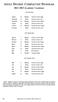 Adult Degree Completion Program 2012-2013 Academic Calendar 2012 Fall Term August 20 Monday Session I classes begin September 21 Friday Session I classes end September 24 Monday Session II classes begin
graduate academic policies and procedures
 graduate academic policies and procedures These pages contain information on policies, procedures, and regulations that are specific to graduate study at Columbia College Chicago. Students should check
Academic Policies and Procedures
 Academic Policies and Procedures Academic policies can be changed at any time by the University of North Texas Health Science Center School of Public Health (UNTHSC-SPH). Students should review the Student
Academic Information. Academic Credit. Credit Earned at Carl Sandburg College. Credit for Courses Completed at Other Colleges and Universities
 Carl Sandburg College 1 Academic Information Academic Credit Credit Earned at Carl Sandburg College The unit of credit measure is the semester hour which approximates the effort expended in 50 minutes
Academic Policies. Grading Guidelines
 Academic Policies Grading Guidelines Ashesi s grading system is modeled after University of Cape Coast as required by the National Accreditation Board. Student work is evaluated throughout the semester
Financial Aid @ Austin Grad Overview & Policies
 Financial Aid @ Austin Grad Overview & Policies Financial Aid Director Dave Arthur (512) 476-2772 x 105 [email protected] CONTENTS Financing your Austin Grad Education 2 The FAFSA 3 Helpful websites
APPLYING FOR FINANCIAL AID
 APPLYING FOR FINANCIAL AID Application Steps 1. Gather documents to complete FAFSA. a. Student, Spouse, and Parent (if dependent) Federal Tax Forms b. W-2 Forms c. Records of untaxed income d. Current
Policies and Procedures
 1 Policies and Procedures Observance of Bulletin Requirements A student, except a classified graduate student, who remains in continuous attendance in regular sessions and continuing in the same curriculum
Graduate Programs Manual Shawnee State University
 Graduate Programs Manual Shawnee State University INTRODUCTION The following is a guide to graduate programs at Shawnee State University (SSU). SSU retains the right to change its course offerings, academic
2014-2015 MSSU FINANCIAL AID HANDBOOK
 2014-2015 MSSU FINANCIAL AID HANDBOOK INTRODUCTION Thank you for your interest in the financial aid programs at Missouri Southern State University. This handbook describes various sources of federal Title
Admissions. Campus Visits and Admission Application
 Admissions Campus Visits and Admission Application Several opportunities are available for prospective students to gain a personal view of life on the Hannibal-LaGrange University campus. Tours, entertainment,
Coastal Carolina University Catalog 2004/2005 ADMISSIONS
 ADMISSIONS 25 ADMISSION INFORMATION The Office of Admissions is committed to marketing the University and attracting students who seek to attend a comprehensive liberal arts institution. As a team, we
Masters Program Handbook
 Masters Program Handbook Last Edited: November, 2014 Table of Contents I. Overview and VCU Graduate Bulletin 1 II. Mandatory Orientation 2 III. Registration 2 A. VCU e-services 2 B. Advising Requirements
Department of Computer Science Academic Policies
 Department of Computer Science Academic Policies Version 4 August 2008 This manual describes the academic policies for the Master of Science Degree in Computer Science, Master of Science Degree in Computer
How To Get A Grade At A College
 Page 1 of 21 (1) GRADING SYSTEM: ACHIEVEMENT AT COLUMBUS STATE COMMUNITY COLLEGE (CSCC) Letter grades based on student achievement will be assigned to students enrolled in individual degree-credit courses
Financial Aid. ROTC Scholarships: Applying for Financial Aid Merit Scholarships: Federal, State, and Institutional Grants: Financial Aid
 Financial Aid Students receive funding for their educational expenses from a variety of government and institutional programs. All undergraduates accepted to academic programs taught at our residential
FINANCIAL AID FEDERAL STUDENT AID. Undergraduate Students
 FINANCIAL AID Undergraduate Students FEDERAL STUDENT AID Students applying for Federal Student Aid funds must complete the Free Application for Federal Student Aid (FAFSA) at www.fafsa.gov each academic
FINANCIAL AID COAHOMA COMMUNITY COLLEGE DOES NOT PARTICIPATE IN FEDERAL FAMILY EDUCATION LOAN PROGRAMS.
 FINANCIAL AID The objective of the Student Financial Aid Office is to provide excellent customer service in assisting students in attaining their educational endeavors. The Financial Aid Office is located
Hope International University Online Undergraduate and Graduate Programs
 Hope International University Online Undergraduate and Graduate Programs Financial Options Guide Welcome to Hope International University. We are pleased you have chosen to complete your education at HIU.
Department of Computer Science Academic Policies
 Department of Computer Science Academic Policies January 2012 This manual describes the academic policies for the Master of Science Degree in Computer Science, Master of Science Degree in Computer Information
Table of Contents. Summer 2015 Calendar
 Table of Contents Important Dates: Summer 2015 Semester.......................... 2 Advising and Registration Information............................. 3 Adding and Dropping Courses...................................
Tuition and Fees 2014-2015. Academic and Registration Info
 Tuition and Fees 2014-2015 Academic and Registration Info North Idaho College 31 2014-2015 REGISTRATION Registration is the official process of enrolling in classes. NIC is on a 16-week Fall/Spring Semester,
New Student Orientation Master of Arts in Clinical Mental Health Counseling
 Master of Arts in Clinical Mental Health Counseling Page 1 New Student Orientation Master of Arts in Clinical Mental Health Counseling Contents: Welcome Academic Catalog, Courses, Registration Attendance,
AFFIRMATION OF COMMUNITY RESPONSIBILITY
 AFFIRMATION OF COMMUNITY RESPONSIBILITY Illinois College is committed to the development and welfare of every member of our community: students, faculty, staff, and administration. To achieve the working
Dear Parents, We wish your student much success here at Bergen Community College and trust this information is helpful. Sincerely,
 Dear Parents, Making the transition from high school to college may be challenging and sometimes difficult. Students must adjust to new academic standards, make new friends, and make appropriate decisions
FINANCIAL AID. Applying for Federal Financial Aid. Eligibility for Federal and State Financial Aid
 16 Financial Aid FINANCIAL AID Columbia College s financial aid program exists to make education affordable for all students who qualify. The College believes that if students desire to attend college
ACADEMIC POLICIES AND PROCEDURES
 ACADEMIC POLICIES AND PROCEDURES Governing Catalog The college catalog is the official document that describes the policies, academic programs and requirements for students attending Valencia College.
Admissions ADMISSION REQUIREMENTS
 Admissions Admission to Northwest University is granted to applicants meeting the University admissions requirements without regard to sex, race, color, age, national or ethnic origin, or physical disability.
Guide to Financial Aid at Forsyth Tech
 Important! Keep Your Financial Aid Read This Guide! Guide to Financial Aid at Forsyth Tech 2015-2016 Be aware that this guide is subject to change throughout the year if policies and regulations change.
GIRNE AMERICAN UNIVERSITY TEACHING AND EXAMINATION BY LAW FOR ASSOCIATE AND BACHELOR S DEGREES
 GIRNE AMERICAN UNIVERSITY TEACHING AND EXAMINATION BY LAW FOR ASSOCIATE AND BACHELOR S DEGREES Name 1. This by law is referred to as the Girne American University Teaching and Examination By law for Associate
2014-2015 Financial Aid Policies and Procedures
 Federal Pell Grant The Federal Pell Grant requires a new application each academic year. Applications are available online at www.fafsa.ed.gov. All potential students must meet all Lively Technical Center
Course registration Students may register for courses of study and drop or add courses only with the approval of the MLS director.
 Master of Liberal Studies (MLS) graduate students must meet the following minimums, deadlines and course or grade requirements to graduate in good standing from the university. These policies are based
Satisfactory Academic Progress (SAP) Policy for Financial Aid
 Satisfactory Academic Progress (SAP) Policy for Financial Aid GENERAL INFORMATION The federal financial aid programs at UNCP are authorized under Title IV of the Higher Education Act of 1965, as amended.
Academic Regulations & Procedures
 Academic Regulations & Procedures Academic Regulations & Procedures Student Academic Responsibility You, the student, are responsible for planning your academic program and for meeting the requirements
ACADEMIC REGULATIONS FOR MASTER'S DEGREE PROGRAMS
 Additional Requirements 1. At least six hours of electives must be completed to present a minimum total of 120 semester hours. 2. A cumulative grade point average of 2.0, including a minimum of 2.0 in
General Information Academic Regulations 49
 General Information Academic Regulations 49 Academic Regulations Students are responsible for informing themselves of the academic regulations, requirements and policies set forth in this Bulletin and
Policies and Procedures Manual
 Policies and Procedures Manual for Master of Arts in Health Promotion Candidates Office of Graduate Studies 104 Marsh Hall http://www/concord.edu/graduate [email protected] 304-384-6223 TABLE OF CONTENTS
FINANCIAL AID. Applying for Federal Financial Aid. Eligibility for Federal and State Financial Aid
 FINANCIAL AID Columbia College s financial aid program exists to make education affordable for all students who qualify. The College believes that if students desire to attend college they should not be
Life in Progress, Careers in Motion.
 FEDERAL AID @ TULSA TECH / Q&A What Federal Aid is Available @ Tulsa Tech? Tulsa Tech offers the following federal (Title IV) and state need-based aid to those who complete the Free Application for Federal
California Baptist University Online and Professional Studies
 California Baptist University Online and Professional Studies Application for Readmission $25.00 Re-Admission Fee must accompany form Payable by Check, Credit Card or Cash Please also complete a FAFSA
GRADUATE STUDENT HANDBOOK 2013-2014
 Herbert H. Lehman, CUNY THE OFFICE OF GRADUATE STUDIES GRADUATE STUDENT HANDBOOK 2013-2014 The Office of Graduate Studies: Shuster Hall, Room 279 (2 nd floor) Graduate Studies Office Assistant: Patrice
SUNY Orange Policy Manual
 BP6.9 Student Organizations As a prerequisite to operation on campus, all clubs must be chartered by the College and must agree to abide by regulations of the Board of Trustees and club rules issued by
Laralee Davenport. Students who do not meet one or more of the above requirements may be admitted as non-degree seeking.
 Dixie State University 1 Admissions Assistant Director: Office: Laralee Davenport Phone: (435) 652-7777 FAX: (435) 879-4060 Email: Website: Hours: Level 1, Holland Centennial Commons [email protected]
Upper Iowa University. Self-Paced Degree Program Financial Aid Handbook
 Upper Iowa University Self-Paced Degree Program Financial Aid Handbook What is the Self-Paced Degree Program (SPDP)? Upper Iowa University (UIU) offers self-paced correspondence courses as an option for
2005-2007. Admission. View from main gate
 Admission View from main gate 23 Wofford College admits, on a competitive basis, men and women of good character who demonstrate the potential for successful academic work at Wofford. The college seeks
ROCKLAND COMMUNITY COLLEGE NURSING REGISTRATION, PROGRESSION, GRADING AND TESTING POLICIES FOR CORE NURSING PROCESS COURSES
 ROCKLAND COMMUNITY COLLEGE NURSING REGISTRATION, PROGRESSION, GRADING AND TESTING POLICIES FOR CORE NURSING PROCESS COURSES All students enrolled in courses at Rockland Community College are required to
FINANCIAL AID POLICY
 FINANCIAL AID POLICY Debutantes School of Cosmetology and Nail Technology, LLC (Federal school code 042299) is an approved institution in disbursement of Title IV funds for our cosmetology program. A financial
Financial Aid Terms and Conditions
 Financial Aid Terms and Conditions Introduction Barstow Community College's Financial Aid programs stem from a belief that student aid services should facilitate and foster the successful academic participation
Financial Aid Consumer Information
 Financial Aid Consumer Information In accordance with federal regulations set forth by the Higher Education Act of 1965, as amended, NCE provides this Student Disclosures Schedule as means to disseminate
the doctor of jurisprudence degree
 bar review courses There are various bar review courses that are available to graduates to help them prepare for the Texas Bar Exam. Two major companies offer these courses: BAR/BRI and Kaplan PMBR. A
Fees and Financial Aid
 Fees and Financial Aid Student Costs and Student Fees All fees and all policies governing the refund of fees are subject to change by the Board of Regents, State of Iowa. Current information on tuition,
UNDERSTANDING YOUR FINANCIAL AID
 UNDERSTANDING YOUR FINANCIAL AID Understanding Your Award Letter Financial Aid consists of grants, work-study and loans to help meet your educational expenses. You may accept or reject all or part of your
ACADEMIC POLICIES AND PROCEDURES. College of Business Administration California State University, Sacramento
 ACADEMIC POLICIES AND PROCEDURES College of Business Administration California State University, Sacramento Contents 1. Introduction... 1 2. Reviewing Body... 1 2.1. The College of Business Administration
Registration and Other Procedures
 University of California, Irvine 2015-2016 1 Registration and Other Procedures On This Page: Schedule of Classes and Registration Information Registration Procedures Enrolling in Classes Payment of Tuition
Financial Aid Guide For adult and graduate online students
 Financial Aid Guide For adult and graduate online students 2015-2016 Table of Contents 2015-2016 Costs... 2-3 Federal & State Grant Programs... 3 Student Loans and Supplemental Loans... 4 How to Obtain
Admission to the College
 Admission to the College Admission of Curriculum Students College of The Albemarle follows the open door admissions policy of the State Board of Community Colleges. This policy provides for the admission
The Financial Aid Application Process and Frequently Asked Questions
 The Financial Aid Application Process and Frequently Asked Questions Step 1 - To apply for financial aid, a student must complete the Free Application for Federal Student Aid (FAFSA) each year. Students
New Student Orientation Master of Science in Management and Leadership
 Master of Science in Management and Leadership Page 1 New Student Orientation Master of Science in Management and Leadership Contents: Welcome Academic Catalog, Courses, Registration Attendance, Admin
Financial Aid Guide. School Code: 003732
 Radford University Financial Aid Guide School Code: 003732 Table of Contents The Purpose and Benefit of a Booklet... 2 Getting Started... 2 What is Financial Aid... 2 Cost of Attendance... 3 Financial
OUTDATED. 1. A completed University of Utah admission application and processing fee.
 Policy 9-6 Rev 12 Date October 14, 2002 Subject: FACULTY REGULATIONS - Chapter VI UNDERGRADUATE ADMISSION SECTION 1. APPLICATION FOR ADMISSION All prospective undergraduate students must apply through
FINANCIAL AID APPLYING FOR FINANCIAL AID ELIGIBILITY FOR FINANCIAL AID. with students by email using our address of [email protected].
 FINANCIAL AID APPLYING FOR FINANCIAL AID Application for student aid administered by the University of Maine at Machias (UMM) is made by completing the Free Application for Federal Student Aid (FAFSA)
POLICY FOR APPLICANTS FOR UNDERGRADUATE ADMISSION: Degree and Non-Degree 11/16/2015. Policy Statement
 OFFICIAL POLICY 12.1.6 POLICY FOR APPLICANTS FOR UNDERGRADUATE ADMISSION: Degree and Non-Degree 11/16/2015 Policy Statement Undergraduate Admissions Policy Statement: In support of the statement of institutional
Understanding Your Financial Aid Award
 Important information related to your financial aid award from the University of Richmond is contained in this document, including the terms and conditions of your award package. Please review this information
Graduate Programs - Withdrawal and Penalties
 GRADUATE STUDENT POLICIES Graduate Student Policies CONTENTS ACADEMIC INTEGRITY, SUMMARY... 3 ACADEMIC PROBATION... 3 ADDING AND/OR DROPPING COURSES... 4 CHANGE OF ADDRESS... 5 CHANGE OF ADVISER... 5 CHILDREN...
Financial Aid Guide. for adult and graduate online students 2014-2015. the catholic franciscan learning place
 Financial Aid Guide for adult and graduate online students 2014-2015 the catholic franciscan learning place 2014-2015 BCU Financial Aid Booklet 1 Table of Contents 2014-2015 Costs... 2-3 Federal & State
OFFICE OF THE REGISTRAR
 ACADEMIC POLICIES AND PROCEDURES 2015-2016 OFFICE OF THE REGISTRAR Donna Shelton, Interim University Registrar Julianna Wait, Interim Associate Registrar Christopher Newport Hall, First Floor (757) 594-7155
Academic Policies Graduate School of Public Health and Health Policy (GSPHHP)
 Approved by Faculty-Student Council March 4, 2016 Academic Policies Graduate School of Public Health and Health Policy (GSPHHP) Definition of a Credit Hour In compliance with policy set by the New York
Find yourself here FINANCIAL AID Y O U R G U I D E T O
 Find yourself here Application Eligibility Helpful Hints Rights & Responsibilities Verification Academic Progress Dependent/Independent Status Y O U R G U I D E T O FINANCIAL AID Bright Futures Federal
Credit Transfer Guide
 Credit Transfer Guide What is Credit Transfer? Credit transfer is the process of receiving advanced standing toward a degree program at Northwest University based upon college/university work completed
2015 2016 Financial Aid Information
 2015 2016 Financial Aid Information Federal Student Aid (FSA) is authorized under the Higher Education Act of 1965 and is facilitated through the Office of Federal Student Aid (FSA) an Office of the U.S.
FINANCIAL AID AND SCHOLARSHIPS
 102 Financial Aid and Scholarships FINANCIAL AID AND SCHOLARSHIPS FINANCIAL AID Columbia College s financial aid program exists to make education affordable for all students who qualify. The College believes
College of Engineering, Architecture, and Computer Sciences POLICIES AND PROCEDURES
 College of Engineering, Architecture, and Computer Sciences POLICIES AND PROCEDURES Academic Progress Students should track their academic progress each semester using Degree Works. Students who have completed
Florida Gulf Coast University General Graduate Academic Policies
 I. Graduate Admission Policies Florida Gulf Coast University General Graduate Academic Policies A. Graduate Admission Requirements Applicants to graduate degree programs or post-baccalaureate professional
2016-2017 FINANCIAL AID GUIDE For Graduate Students (As of 05/04/2016)
 2016-2017 FINANCIAL AID GUIDE For Graduate Students (As of 05/04/2016) HOW TO USE THIS GUIDE The purpose of this guide is to assist you with understanding important information about the financial aid
Admissions. Office of Admissions. Admission. When to Apply. How to Apply. Undergraduate Admission Directly from High School
 Iowa State University 2015-2016 1 Admissions Office of Admissions Director Katharine Johnson Suski Admission When to Apply Applicants for the fall semester are encouraged to apply during the fall of the
ADMISSION REQUIREMENTS AND PROCEDURES
 ADMISSION REQUIREMENTS AND PROCEDURES Changes to some admission requirements have occurred, edits are indicated below in red. Santa Fe University of Art and Design is an academically challenging institution
VA Certification Request Form
 VA Certification Request Form Directions Students eligible for VA benefits MUST complete and sign this form and return it to your Faulkner School Certifying Official before we will certify your enrollment.
DSU DOCTORAL PROGRAM HANDBOOK
 DSU DOCTORAL PROGRAM HANDBOOK DELTA STATE UNIVERSITY CLEVELAND, MISSISSIPPI 38733 NONDISCRIMINATION Delta State University is committed to a policy of equal employment and educational opportunity for all
NGTC Catalog / Student Handbook 2013-2014
 NGTC Catalog / Student Handbook 2013-2014 Academic Affairs Academic Affairs North Georgia Technical College strives to provide a quality education and to assist students in making progress toward graduation
Please review current Graduate College policies and procedures.
 Ph.D. Degree Requirements and Procedures Summary of Procedures for Ph.D. Students Complete every deficiency course with a grade of B or higher within the first two terms File an approved tentative program
Regulation of Florida A&M University
 Regulation of Florida A&M University 2.015 Admissions. (1) General Policies. (a) Florida A&M University (FAMU) uses the common application form for undergraduate admission to any one of the state universities.
Financial Aid. Financial Aid. Course Descriptions
 Monmouth University believes that financing a student s education should be a cooperative effort between the student and the institution. To that end, the staff of the Financial Aid Office is available
INFORMATION ABOUT YOUR FINANCIAL AID AWARD
 INFORMATION ABOUT YOUR FINANCIAL AID AWARD 2013-2014 We are pleased to offer financial assistance for your cost of attendance at the University of North Carolina at Chapel Hill. Your award information
How To Get Financial Aid At Thomas Edison State College
 THOMAS EDISON STATE COLLEGE 2014-2015 Financial Aid Handbook 101 W. State St. Trenton, NJ 08608-1176 www.tesc.edu Dear Financial Aid Applicant: Attached is the Thomas Edison State College Application for
DEGREE REQUIREMENTS & ACADEMIC GUIDELINES
 Sam Houston State University 1 DEGREE REQUIREMENTS & ACADEMIC GUIDELINES Graduate Degree Requirements (p. 1) Academic Expectations and Guidelines (p. 3) Graduate programs are typically regarded as either
Summer Semester, First Year SOPSY 660, Contemporary Social Psychology, is frequently offered during the summer.
 Sequence of Academic Activities Social Psychology* * Students completing a Double Major in Counseling and Social Psychology should also consult the Resources for Counseling Students Fall Semester, First
Self-Paced Online (Correspondence) Courses Policies and Procedures 2015-2016
 Self-Paced Online (Correspondence) Courses Policies and Procedures 2015-2016 The Nature of Self-Paced Online (Correspondence) Coursework Self-Paced Online (Correspondence) Courses are taught by instructors
DOCTORAL DEGREES ADMISSION REQUIREMENTS
 DOCTORAL DEGREES Ball State University offers programs leading to the doctor of philosophy degree (PhD), the doctor of education degree (EdD), the doctor of arts degree (DA), and the doctor of audiology
Financial Aid Handbook
 THOMAS EDISON STATE UNIVERSITY 2015-2016 Financial Aid Handbook 111 W. State St. Trenton, NJ 08608 www.tesu.edu Dear Financial Aid Applicant: Attached is the Thomas Edison State University Application
THE UNIVERSITY OF TEXAS AT EL PASO GRADUATE SCHOOL. Advisor s Handbook
 THE UNIVERSITY OF TEXAS AT EL PASO GRADUATE SCHOOL Advisor s Handbook Table of Contents General Degree Requirements.......3 Enrollment Verification....3 Registration 4 Academic Standing......5 Graduation..5