
Terms in the Glossary are indicated throughout the text with an asterisk*.
|
|
|
- Derrick Fisher
- 10 years ago
- Views:
Transcription
1

2 USER'S GUIDE Terms in the Glossary are indicated throughout the text with an asterisk*. Throughout the text there are four kinds of boxes containing tips, practical examples, views and comments, and background information, which are indicated using the following icons: Tips and practical suggestions about actions you can take, or things to remember before you start. EXAMPLE A Examples of the experiences of non-state actors who have participated in consultations, project implementation or reviews. NSA Views and comments from the non-state actors and practitioners who were consulted in preparing this guide. Background information - these boxes provide more detailed information and suggestions for further reading.
3 The Cotonou Agreement A User s Guide for Non-State Actors Compiled by the ECDPM November 2003
4 ii ACP Secretariat The ACP Secretariat coordinates the activities of the ACP Group. Its mission is to facilitate the implementation of the Cotonou Agreement. It is in this context that the ACP Secretariat took the initiative to produce and publish this User s Guide on the Cotonou Agreement for non-state actors in all ACP countries. 451 avenue Georges Henri B-1200 Brussels Belgium [email protected] Tel.: +32 (0) Fax: +32 (0) ECDPM The European Centre for Development Policy Management (ECDPM) aims to improve international cooperation between Europe and countries in Africa, the Caribbean, and the Pacific. As an independent foundation, the Centre s objectives are: to enhance the capacity of public and private actors in ACP countries; and to improve cooperation between development partners in Europe and the ACP Region. The ECDPM was entrusted to elaborate the User s Guide (based on consultations with non-state actors). Onze Lieve Vrouweplein 21 NL-6211 HE Maastricht The Netherlands [email protected] Tel.: +31 (0) Fax: +31 (0) Published by ACP Secretariat, Brussels, Belgium Copyright 2003 ACP Secretariat Conditions of use Prior permission is not required for quoting, translating or reproducing the contents of this publication, provided the source is fully acknowledged as follows: ACP Secretariat The Cotonou Agreement: A User s Guide for Non-State Actors ISBN:
5 iii Preface The role and place of non-state actors in the implementation of the Cotonou Agreement is clear. What is not clear, however, are the modalities and conditions to ensure their full and effective participation. At the initiative of the ACP Secretariat, and with the agreement of the European Commission a decision was taken to produce a user s guide for non-state actors. This initiative is rooted in the knowledge of a lack of awareness in ACP States, at the level of n0n-state actors, of the benefits and opportunities available under the Cotonou Agreement as well as the dynamic and more participatory approach to ACP-EC cooperation. The main objective of the guide is therefore to disseminate appropriate information on how the n0n-state actors can benefit from and the opportunities available under the Cotonou Agreement. It will also serve as a primary reference document for ACP non-state actors. The guide provides a comprehensive coverage of the relevant issues of interest to n0n-state actors and reflects the successful consultation process undertaken with a wide range of stakeholders from the six ACP regions and the European Commission. In particular, the guide also provides practical information and specific answers on the modalities for the enhanced engagement of n0n-state actors in ACP-EC cooperation. Special acknowledgement to the ECDPM for the professional manner in which they have completed this very difficult task.
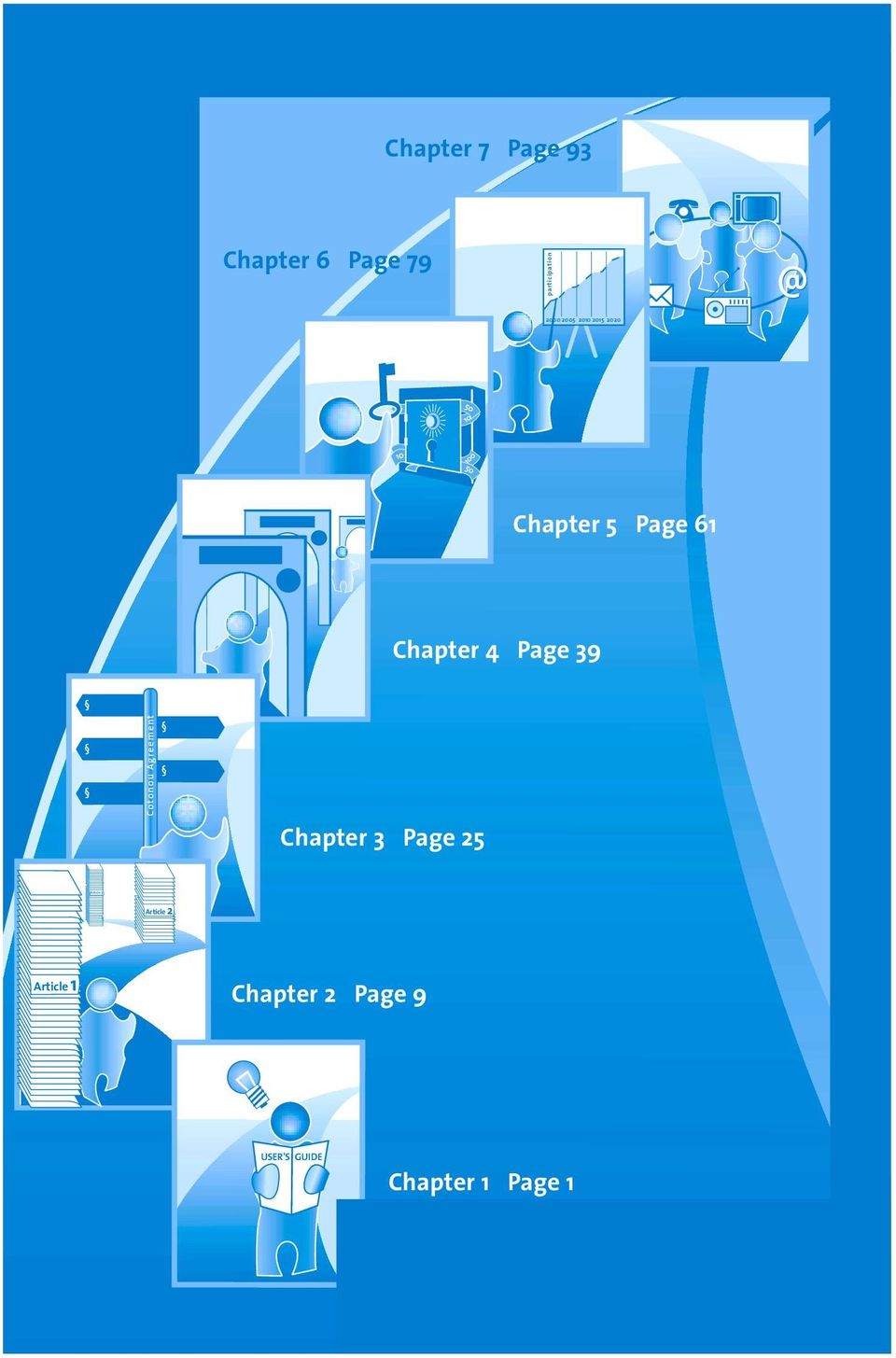
6 Article Chapter 7 Page 93 Chapter 6 Page 79 participation Chapter 5 Page 61 Chapter 4 Page 39 Cotonou Agreement Chapter 3 Page 25 Article 2 Article 1 Chapter 2 Page 9 USER'S GUIDE Chapter 1 Page 1
7 v Table of contents Chapter 1 Introduction 1.1 What is this guide about? 1.2 Who is it for? 1.3 Why the Cotonou Agreement is also your affair 1.4 How was this guide produced? 1.5 Navigating this guide 1.6 The status of this guide Page Chapter 2 The Cotonou Agreement in a nutshell 2.1 A quick look into the past 2.2 Cotonou - a new way of doing cooperation 2.3 A house built on three pillars 2.4 Key terms and acronyms Chapter 3 Opportunities for participation under the Cotonou Agreement 3.1 Participation as a fundamental principle 3.2 Legal framework for non-state actor participation 3.3 The dual role of non-state actors 3.4 Who can participate? 3.5 Facilitating participation 3.6 Some observations Chapter 4 Participation in practice 4.1 Participation: a learning process 4.2 Participation in development cooperation 4.3 Participation in trade policies 4.4 Participation in the political dimensions of partnership Chapter 5 Accessing funding: What non-state actors need to know 5.1 Funding is available, but with limitations 5.2 The two main funding routes 5.3 The three windows of the European Development Fund 5.4 Additional resources through EU budget lines 5.5 What are the procedures for accessing and managing funds?
8 vi Chapter 6 Four steps to promote the quality of participation 6.1 Clarifying the identity, missions and role of non-state actors 6.2 Promoting an effective tripartite dialogue 6.3 Improving coordination among non-state actors 6.4 Making creative use of capacity building opportunities Page Chapter 7 Translating this guide into practice 7.1 Disseminating this guide 7.2 Starting a discussion 7.3 Sustaining information flows and knowledge sharing 7.4 The role of umbrella organisations and networks 7.5 The role of information and communication technologies (ICTs) Glossary of terms List of acronyms Annexes I ACP countries and institutions in the framework of Cotonou II European Member States and institutions in the framework of Cotonou III Joint ACP-EC institutions IV The Economic Partnership Agreement (EPA) negotiations V Institutions and instruments for private sector development VI Eligibility criteria for non-state actors - Access to funding under the EDF VII The ACP Civil Society Forum VIII Contact details: National Authorising Officers IX Contact details: Delegations of the European Commission X Contact details: European Non-Governmental Organisations XI Extract from a Country Strategy Paper XII Regional Indicative Programmes under the 9th EDF XIII Resource allocation to ACP countries - Needs and performance criteria XIV European Commission preliminary assessment of non-state actor participation in programming
9 1 Introduction 1.1 What is this guide about? 1.2 Who is it for? 1.3 Why the Cotonou Agreement is also your affair 1.4 How was this guide produced? 1.5 Navigating this guide USER'S GUIDE 1.6 The status of this guide

10 In June 2000, the European Union (EU) and 77 countries in Africa, the Caribbean and the Pacific (ACP) signed a new cooperation agreement - the Cotonou Agreement. This partnership is not restricted to governments. Opportunities for participation are also provided to civil society organisations, economic and social partners and the private sector in the ACP countries. However, for these non-state actors to be fully involved in cooperation, they need to be well informed on the contents of the Agreement, and on ways and means provided for them to participate effectively. It is in that context that the initiative was taken to produce this user's guide to the Cotonou Agreement for non-state actors. 'This Cotonou Agreement seems most relevant for our communities in the rural areas. But we are only starting to discover it, to understand what it is all about and what it could mean for us. It is a world of which we had no clue so far.' Representative of a women's organisation in Fiji 'We have nearly 20,000 members across Kenya, yet we have little information about this Agreement. How can this be if civil society is supposed to be involved?' Representative of the street traders' association in Kenya
11 3 1.1 What is this guide about? International cooperation between developed and developing countries has been going on for more than 50 years. This cooperation covers diverse areas (e.g. development, trade, peace and security, environmental protection) and takes different forms (predominantly financial or technical assistance). Cotonou Agreement The European Union* (i.e. the European Community and the Member States of the Union) is also an active player in international development cooperation. It has entered into cooperation agreements with all developing regions of the world. One of the flagships of European development cooperation is its longstanding relation with countries in Africa, the Caribbean and the Pacific, known collectively as the ACP Group*. This cooperation formally began in 1975 with the signing of the Lomé I Convention - the first in a series of partnership agreements. In June 2000, the ACP countries and the EU concluded a new 20-year cooperation agreement, named the Cotonou Agreement after the capital of Benin in West Africa, where it was signed. This agreement entered into force in April countries intend to cooperate in the fields of aid, trade and political cooperation in order to fight poverty, support democracy, promote economic growth and foster sustainable development. A key feature of the Cotonou Agreement is its emphasis on the participation of 'non-state actors' in ACP countries in the implementation of the Agreement. These actors are now recognised as essential in helping to ensure the relevance and impact of cooperation policies and programmes between the ACP and the EC. Yet without adequate information on the Cotonou Agreement, the envisaged benefits from a more participatory approach may well remain elusive. It was in this context that the idea of producing a user's guide to the Cotonou Agreement arose. Two main purposes This guide has two main purposes: to inform civil society organisations, economic and social partners and the private sector in ACP countries on the most important features of the Cotonou Agreement, and The Cotonou Agreement is in many ways a unique document. It defines how the European Community* (EC) and the ACP to provide practical guidance on how and under what conditions non-state actors can participate in ACP-EC cooperation.

12 4 1.2 Who is this guide for? This guide is targeted at the different groups of non-state actors across the ACP. Non-state actors The concept of 'non-state actors' may be unfamiliar to many readers. In the formal language of the Cotonou Agreement, the term is used to refer to a wide range of development actors - other than governments - whose participation in ACP-EC cooperation is now to be promoted. The Cotonou Agreement provides a basic definition of who should be considered as non-state actors (see box). Who are non-state actors? According to Article 6 of the Cotonou Agreement, non-state actors include: the private sector; economic and social partners, including trade union organisations; and civil society in all its diversity, according to national characteristics. This is obviously a very open-ended definition. In practice, it means that participation is open to all kind of actors, such as the private sector, community-based organisations, women's groups, human rights associations, non-governmental organisations (NGOs), religious organisations, farmers' cooperatives, trade unions, universities and research institutes, the media, etc. Also included in this definition are informal groups such as grassroots organisations, informal private sector associations, etc. Some limitations A wide range of ACP non-state actors may take an interest in this guide. Their information needs are likely to be extremely diverse. Some may expect detailed information on how to write a project proposal or to obtain funding. Others may need technical information on the ongoing trade negotiations between the ACP and the EC. A short guide like this cannot possibly address all of these needs. However, whenever possible, the text includes references and links to sources of more specialised information. This guide focuses primarily on civil society organisations. The private sector is considered only in so far as it is involved in non-profit activities (e.g. private sector associations, chambers of commerce, etc.). The reason for this is that the Cotonou Agreement has developed a set of specific instruments for supporting ACP private sector actors involved in profit-oriented activities (e.g. the Investment Facility, the Centre for the Development of Enterprise) These instruments are not addressed in detail in this guide. For basic information see Annex V.
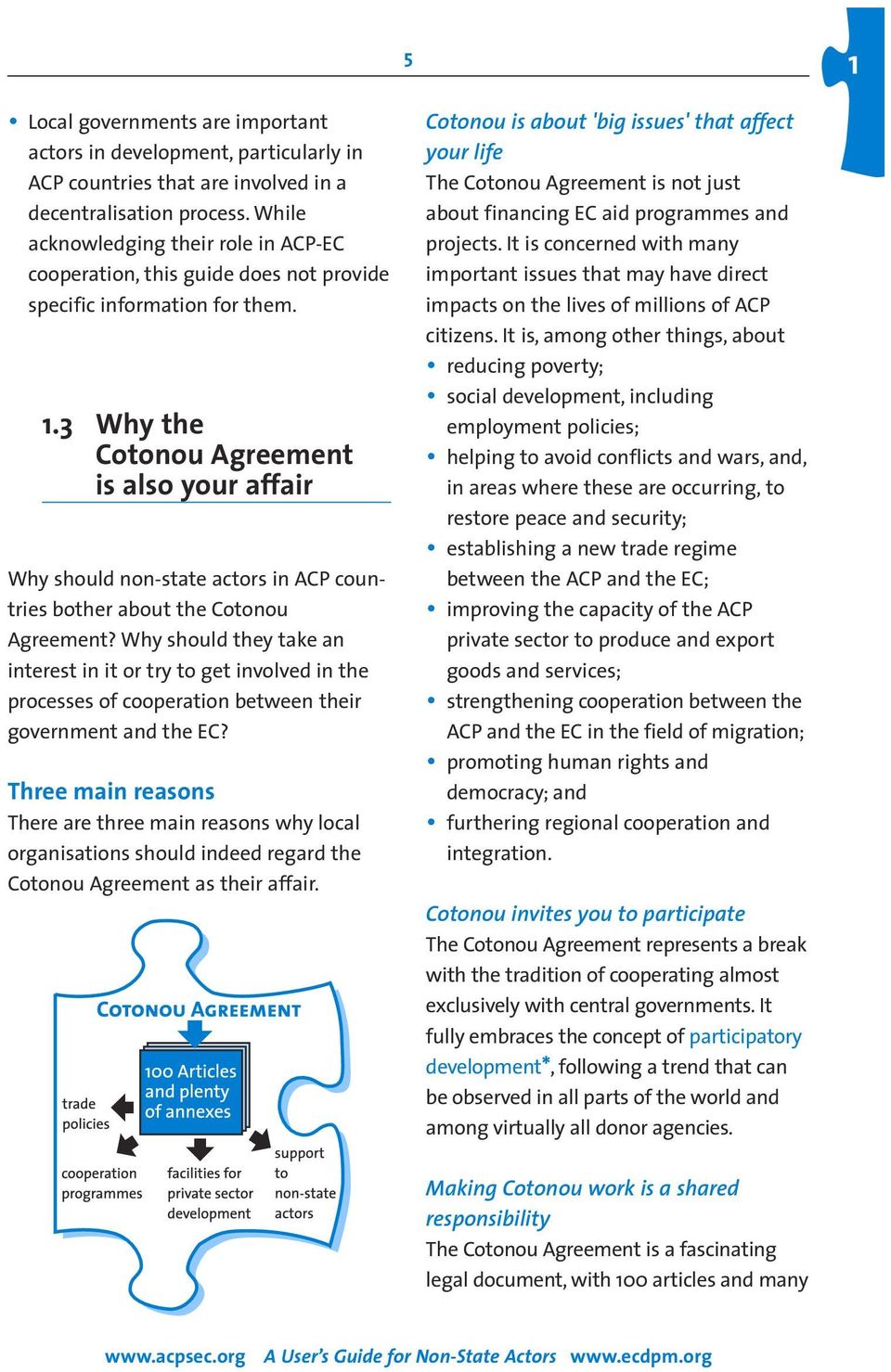
13 5 Local governments are important actors in development, particularly in ACP countries that are involved in a decentralisation process. While acknowledging their role in ACP-EC cooperation, this guide does not provide specific information for them. 1.3 Why the Cotonou Agreement is also your affair Why should non-state actors in ACP countries bother about the Cotonou Agreement? Why should they take an interest in it or try to get involved in the processes of cooperation between their government and the EC? Three main reasons There are three main reasons why local organisations should indeed regard the Cotonou Agreement as their affair. Cotonou is about 'big issues' that affect your life The Cotonou Agreement is not just about financing EC aid programmes and projects. It is concerned with many important issues that may have direct impacts on the lives of millions of ACP citizens. It is, among other things, about reducing poverty; social development, including employment policies; helping to avoid conflicts and wars, and, in areas where these are occurring, to restore peace and security; establishing a new trade regime between the ACP and the EC; improving the capacity of the ACP private sector to produce and export goods and services; strengthening cooperation between the ACP and the EC in the field of migration; promoting human rights and democracy; and furthering regional cooperation and integration. Cotonou invites you to participate The Cotonou Agreement represents a break with the tradition of cooperating almost exclusively with central governments. It fully embraces the concept of participatory development*,following a trend that can be observed in all parts of the world and among virtually all donor agencies. Making Cotonou work is a shared responsibility The Cotonou Agreement is a fascinating legal document, with 100 articles and many
14 6 annexes that together provide a framework for setting in motion all kinds of processes and programmes that can have a positive impact on a country's development. The challenge now, and in the years to come, will be to make full use of this cooperation tool, to tap its dormant potential, and to exploit all its relevant provisions and instruments. Achieving this will be the shared responsibility of all state and non-state actors. The Cotonou Agreement is too important to be left to governments alone. The active participation of non-state actors can help to transform the words of the Cotonou Agreement into an effective tool that can be used to foster the development process of a country or region. Further information about the Cotonou Agreement For the full text of the Cotonou Agreement, please visit the European Commission's website: For a copy of the Cotonou Infokit, which explains the Agreement in non-technical language, visit ECDPM's website and check under 'Publications'. 1.4 How was this guide produced? The ACP Secretariat, the body representing the interests of ACP countries in Brussels (Annex I) took the initiative to produce a guide for non-state actors, in a joint effort with the services of the European Commission. The European Centre for Development Policy Management (ECDPM), an independent foundation specialising in ACP-EC cooperation, was asked to carry out the technical work. In compiling this guide, consultations with non-state actors took place in six ACP countries - Democratic Republic of Congo, Fiji, Jamaica, Kenya, Malawi and Mali. These consultations involved information and discussion sessions with a wide range

15 7 of local actors, as well as national workshops. In each country, the process was facilitated by a local platform of non-state actors or local experts who produced a country report containing their conclusions and recommendations. To complement the consultation processes in the six countries, between May and September 2003 an interactive dialogue was conducted via the Internet, to collect the views and experiences of actors in other ACP countries. Finally, in September 2003, a validation seminar was held in Brussels at which all institutional stakeholders (the ACP Secretariat, the European Commission*, etc.) as well as non-state actors from a further ten ACP countries (representing the different ACP regions) and European organisations were able to comment on the first draft of the guide. 1.5 Navigating this guide The structure of the guide is as follows: Background information Chapters 2 and 3 provide background information. Chapter 2 describes the essential features of the Cotonou Agreement, and Chapter 3 provides an overview of the legal opportunities for non-state actor participation, as enshrined in the Agreement. Practice of participation Chapters 4 and 5 are concerned with the practice of participation. Chapter 4 is intended as a guide for non-state actors on how best to engage in the different participation processes. Chapter 5 describes how to access EC funds, and briefly explains the rules that apply in the management of ACP-EC cooperation. Wherever possible, concrete examples from the field are included. It should be remembered, however, that although the Cotonou Agreement was signed in 2000, it entered into force only in April This means that so far practical experiences involving non-state actors are limited. What next? Chapter 6 looks to the future. It provides a number of suggestions to ensure the quality of non-state actor participation. Chapter 7 reflects on ways to make this guide a dynamic and effective tool that can be adapted to the needs of each ACP country. Glossary - list of acronyms Glossary of terms (indicated throughout the text with an asterisk*).

16 8 Annexes The annexes provide further information: I ACP countries and institutions in the framework of Cotonou II European Member States and institutions in the framework of Cotonou III Joint ACP-EC institutions IV The Economic Partnership Agreement (EPA) negotiations V Institutions and instruments for private sector development VI Eligibility criteria for non-state actors - Access to funding under the EDF VII ACP Civil Society Forum VIII Contact details: National Authorising Officers IX Contact details: Delegations of the European Commission X Contact details: European Non-Governmental Organisations XI Extract from a Country Strategy Paper XII Regional Indicative Programmes under the 9th EDF XIII Resource allocation to ACP countries - Needs and performance criteria XIV European Commission preliminary assessment of non-state actor participation in programming 1.6 The status of this guide Support to non-state actors should always conform to the legal provisions of the Cotonou Agreement and the EC Financial Regulation*. This guide, by contrast, is not a legally binding document. Its main purpose is to provide accessible information to non-state actors on the Cotonou Agreement. The guide complements existing sources of information produced by the European Commission or the ACP Group. A case in point is the recent 'Communication from the Commission to the Council, the European Parliament and the Economic and Social Committee' on the Participation of Non-State Actors (NSA) in EC Development Policy, COM(2002) 598 final. ( com/cnc/2002/com2002_0598en01.pdf) Building on the Communication, the European Commission is now elaborating guidelines on principles and good practices for the participation of non-state actors in the development dialogue and consultations. These guidelines are intended to cover EU cooperation with all developing regions. ( development/index_en.htm)
17 2 2.1 A quick look into the past 2.2 Cotonou - a new way of doing cooperation The Cotonou Agreement in a nutshell 2.3 A house built on three pillars 2.4 Key terms and acronyms Article 3 Article 2 Article 1

18 The Cotonou Agreement builds on generations of cooperation agreements between the expanding ACP Group and an evolving Europe. In many ways, however, the Cotonou Agreement marks an important break with the past. Major innovations have been introduced to improve the overall impact of aid, trade and political cooperation between the ACP and the EC. This chapter summarises the most important features of this unique international cooperation agreement. 'The Cotonou Agreement will give a new momentum to the relationship between the ACP States and the European Union. It represents an important component of international efforts aimed at promoting sustainable development and reducing poverty.' Poul Nielson, European Commissioner for Development and Humanitarian Aid 1
19 A quick look into the past Before presenting the contents of the Cotonou Agreement in some detail, it may be useful to look back for a moment into the past in order to understand the origin of some of the key elements of ACP-EC cooperation. ACP-EC cooperation has been going on for more than 25 years. In the process, the two parties have developed a certain way of doing business, which some people call the 'culture of ACP-EC cooperation'. The Cotonou Agreement clearly builds on this tradition. Over time, this cooperation has evolved, with some dramatic changes. European Economic Community In 1957, six European states founded the European Economic Community (EEC), which marked the beginning of the process of European integration. The process was systematically pushed forward, culminating in the creation of the European Union (EU) in The number of EU Member States has continued to grow, and will include no less than 25 in ACP Group The ACP Group has evolved from an alliance of 46 states when it was set up in 1975, to include 79 countries in In this group, 77 countries effectively signed the Cotonou Agreement and benefit from it. Cuba is member of the ACP Group, but did not sign the Cotonou Agreement, while EC support to South Africa is funded under a special budget line. ACP-EC cooperation The idea of 'European cooperation' started in the 1960s with economic cooperation agreements, mainly with independent French-speaking African countries. In 1975, the newly constituted ACP group and Europe concluded their first major partnership agreement - the Lomé I Convention. European cooperation now reaches out to all parts of the world. The EU (the European Community and the Member States) is now the world's largest provider of aid. This is not the place to dwell on the details of past ACP-EC cooperation, but the time chart Milestones in ACP-EC cooperation indicates some key moments in the history of the partnership. 2.2 Cotonou - a new way of doing cooperation The transition from the Lomé Conventions to the Cotonou Agreement involved more than a change of name. The Cotonou Agreement provides a number of innovative approaches to cooperation, all of which aim to address more effectively the pressing and varying challenges in the development of ACP countries. The following paragraphs offer an overview of innovations introduced in the Cotonou Agreement.

20 12 Milestones in ACP-EC cooperation 1957 Belgium, France, Italy, Luxembourg, the Netherlands and West Germany sign the Treaty of Rome creating the European Economic Community (EEC). The treaty includes a legal provision for a specific European cooperation programme As African countries gain independence, the EEC develops a first generation of economic cooperation agreements, mainly with French-speaking African countries (the so called Yaoundé Conventions) The UK joins the EEC, bringing along its former colonies in Africa, the Caribbean and the Pacific Creation of the ACP group, an alliance of 46 ACP States Lomé I Convention ( ), the first major aid and trade cooperation agreement between Europe and the ACP Lomé II Convention ( ) Lomé III Convention ( ) includes for the first time a 'human rights clause' Lomé IV Convention ( ) Lomé IV bis Convention ( ) reinforces political cooperation and introduces the possibility of suspending aid in cases of grave violation of agreed values and principles The European Community (EC) starts informal consultations on the future of ACP-EC cooperation (the 'Green Paper process') Negotiations of a successor agreement to the Lomé IV bis Convention. June 2000 The Cotonou Partnership Agreement ( ) is signed in Cotonou, Benin. April 2003 The Cotonou Partnership Agreement enters into force.

21 13 Poverty reduction is the core objective Promoting dialogue and collaboration between state and non-state actors Article 1: 'The partnership shall be centred on the objective of reducing and eventually eradicating poverty' The fight against poverty has always been high on the European cooperation agenda, but under the Cotonou Agreement it is seen as the central objective and performance indicator. Rather than defining poverty in a narrow economic sense (e.g. in terms of incomes), the Cotonou Agreement aims to ensure that the political, social, cultural and environmental circumstances of people living in developing countries change for the better. Ensuring ownership Article 2:'ACP states shall determine the development strategies for their economies and societies in all sovereignty' This principle should guide all aspects of cooperation between the ACP and the EC. In practice, this calls upon the EC to support existing national development strategies, or the development of such strategies, and to work primarily with existing institutions and capacities in the ACP countries. It also implies a shift towards supporting national budgets, rather than funding 'stand-alone' projects and programmes. Article 4: ' the Parties recognise the complementary role of and potential for contributions by non-state actors to the development process' This is another major innovation of the Cotonou Agreement. For the first time, ACP-EC cooperation fully recognises the essential role that non-state actors can play in the development process of an ACP country. New opportunities are created for these actors to participate in all aspects of cooperation (formulation, implementation and evaluation). The purpose is not to oppose governments, but to foster dialogue and collaboration between governments and other actors in development, all of whom have a legitimate role to play. From trade preferences to economic cooperation Article 36: ' the Parties agree to conclude new World Trade Organization (WTO) compatible trading arrangements, removing progressively barriers to trade between them and enhancing cooperation in all areas relevant to trade' Perhaps the most radical change introduced by the Cotonou Agreement lies in the area of trade cooperation. For the past 25 years, under the Lomé Conventions, the EC has granted 'non-reciprocal trade preferences' * to ACP countries. This
22 14 means that ACP countries could export nearly all of their products to the EU market without having to pay customs duties, and without having to open up their own markets in return. Under the Cotonou Agreement, this preferential regime will be maintained until December In the meantime, the ACP countries and the EC will negotiate 'Economic Partnership Agreements' * (EPAs). These are comprehensive trade arrangements, including free trade agreements (FTAs), between the EC and regional ACP groupings. EPAs will normally take effect in 2008 (for further details see section 2.3). Priority to political cooperation Article 8: 'The Parties [to the Agreement] shall regularly engage in a comprehensive, balanced and deep political dialogue leading to commitments on both sides' Whereas the successive Lomé Conventions focused primarily on economic cooperation, the Cotonou Agreement places much more emphasis on 'politics', with support for democratisation processes and reforms to improve governance in ACP countries. There is also scope for the partners to impose sanctions (as a measure of last resort) if a party violates any of the essential elements* underpinning the Agreement, such as human rights. Performance matters Annex IV, Article 5: ' the [European] Community may revise the resource allocation in the light of the current needs and performance of the ACP state concerned' Under the Lomé Conventions, ACP countries were 'entitled' to a given amount of aid, irrespective of their development performance. The Cotonou Agreement now wants to 'reward' countries and regions if they perform well in fulfilling mutually agreed obligations. At regular intervals, this performance will be reviewed (on the basis of criteria such as sound economic policies, governance, effective implementation, support to non-state actors). Some ACP countries may see their allocation increase, while for others it may be reduced. 2.3 A house built on three pillars The Cotonou Agreement can be seen as a house built on three pillars - development cooperation, trade and the political dimensions of ACP-EC cooperation - which are closely interrelated. Remove any one of these pillars and the stability of the whole house is likely to suffer. For instance, providing vast sums of development aid to a poor country may help to
23 15 Development Cooperation Cotonou Agreement Trade Political Dimensions alleviate poverty in the short term, but in the absence of sound domestic policies (including respect for the rule of law), this may not lead to sustainable development. Similarly, aid alone will not do the job. ACP countries also need adequate trade policies, supported by a set of fair international rules. We now look at each of these three pillars and their most important features in more detail. Pillar 1 DEVELOPMENT COOPERATION This first type of support provided under the Cotonou Agreement takes the form of financial and technical assistance to support cooperation priorities, jointly agreed upon by the partners. Although much could be said about the development cooperation component of the Cotonou Agreement, only the most important elements are discussed here. Cooperation follows a five-year cycle The Cotonou Agreement may have been signed for the duration of 20 years, but every five years a 'financial protocol' * will have to be agreed and attached to it. This protocol indicates how much money the EC will put at the disposal of the ACP countries over the next five years. There is a special fund for the ACP countries The resources for development cooperation with the ACP countries do not come from the regular budget of the European Union, as do the funds for cooperation agreements with other development regions. For historical reasons, there has always been a separate funding mechanism for the ACP, known as the European Development Fund* (EDF). Every five years, the EU Member States agree on their contributions to this Fund. The amount each country has to pay into the EDF is negotiated between EU Member States. We are currently in the 9th EDF, because eight similar financial protocols have preceded it under the Yaoundé and Lomé Conventions. There is no shortage of resources There is a considerable amount of money in the 9th EDF - some EUR 13.5 billion for the current five-year period - which is to be
24 16 shared among the ACP countries and regions. In addition, the resources that remain unspent 2 from previous EDFs. Almost EUR 2.5 billion have been transferred from the old EDFs to the 9th EDF and can also be used for new commitments. There are two cooperation instruments The Cotonou Agreement drastically reduced the number of cooperation instruments that existed under the previous Lomé Conventions. From now on, all the resources of the EDF will be channelled through two facilities: A grant facility will finance a wide range of long-term development operations such as macro-economic support, sector policies (e.g. education and health), democracy programmes, debt relief, regional cooperation and integration etc. Support programmes for non-state actors will also be financed through this grant facility. An Investment Facility will finance private sector development operations. The European Investment Bank (EIB) will manage these resources (for more information see Annex V). Sharing out the pie The resources of the 9th EDF are to be shared among the 77 ACP countries and the six ACP regions. The allocation is done by the EC according to 'needs' and 'performance'. The Cotonou Agreement defines both a set of objective needs criteria (e.g. per capita income, population size) and performance indicators. (See Annex XIII of this guide.) Cotonou Agreement Financial resources (EUR in billion) 9th EDF = 13.5 Long-term envelope (1) = 10 Regional envelope = 1.3 Investment facility = 2.2 (1) including CDE = EUR 90 million CTA = EUR 70 million Joint Parliamentary Assembly = EUR 4 million
25 17 Pillar 2 TRADE Trade cooperation has been a major building block of the ACP-EC partnership. As mentioned above, it is now being fundamentally reviewed, as the EC and the ACP countries and regions seek to conclude Economic Partnership Agreements (EPAs). Trade negotiations This second pillar covers a broad and complex policy area. One should also not forget that while negotiating with the EC, most ACP countries are simultaneously engaged in other trade negotiations at bilateral, regional and multilateral levels, the outcomes of which will also influence the final outlook of the EPAs. ACP countries will need to determine a coherent and cross-cutting strategy for all of these negotiations. The EC has launched several initiatives to support ACP countries in these negotiations (see section 4.3). The following paragraphs attempt to clarify some of the main questions you may have with regard to trade cooperation. What are EPAs? Economic Partnership Agreements (EPAs) are the new trade arrangements that are due to replace the current non-reciprocal preferences enjoyed by ACP countries by They will need to be 'compatible' with the requirements of the World Trade Organization (WTO). This means that for the ACP countries to maintain or improve their EU market access, they will gradually have to open up their own markets to EU products over a period of up to 12 years. In addition to trade in goods and agricultural products, the EPAs will also regulate trade in services, as well as a range of other traderelated matters such as investment, government procurement, product standards, etc. They will be accompanied by development co-operation measures to support the adjustment process. EPAs will be negotiated with ACP regions and, depending on their legal situation, ACP countries will be invited to sign either as groups (e.g. if they form a customs union) or individually. Implementation of EPAs will focus, especially at the beginning, on deepening regional integration. Are EPAs the only way forward? No. For those countries who do not feel in a position to negotiate EPAs, alternative trade possibilities will be considered in So far, however, very little attention has been given to these alternative options. Since March 2001 the least developed countries (LDCs) have been able to benefit from the 'Everything-but-Arms' * (EBA) initiative, which grants duty-free access to all products, except for arms, from LDCs without quota restrictions. 3 What about the ACP-EC negotiating process? The negotiations for a new trade regime started in September In a first phase,
26 18 negotiations were held at an all-acp level, with the aim of establishing the main principles and objectives of the Economic Partnership Agreements. In the second phase, negotiations take place at regional level. West Africa (ECOWAS/CEDEAO) and Central Africa (CEMAC) have opened negotiations with the EC at the beginning of October Other regions are in the preparatory stage, and are holding consultations at national and regional level before stepping into the ring. The major steps in the negotiation process can be found in Annex IV. Who is negotiating the trade arrangements? On the European side, the negotiations are being conducted by the European Commission, in particular officials from the Directorate-General for Trade, liaised with the Directorate of Development and in collaboration with other services such as Agriculture or Fisheries. On the ACP side, the ACP Council of Ministers assumes the political leadership for the trade negotiations at the all-acp level. A Ministerial Trade Committee (as specified in article 38 of the Cotonou Agreement) is to offer recommendations to the Council, with a view to preserving the benefits of the ACP-EC trading arrangements. The Committee of ACP Ambassadors deals with the day-to-day negotiations. It is up to each region to decide how they organise the division of tasks among their ministers, ambassadors and organisations in the regional negotiations. Further information on trade issues More detailed, regularly updated agendas of the major trade events and ministerial meetings, and other information, can be found on the following websites. - EPA Watch, a civil society organisation that follows the trade negotiations and reports on the activities of civil society advocacy groups - ACP Secretariat - an independent website that provides information and analysis of both thematic and regional issues Trade Negotiations Insights, a bimonthly newsletter that provides regular updates on the trade negotiations
27 19 Pillar 3 POLITICAL DIMENSIONS The Cotonou Agreement puts the political dimension at the centre of the relations between the ACP and the EC. The critical importance of political dialogue Political dialogue is considered as a strategic and continuous tool in the partnership between the ACP countries and the EC. The idea is not simply to launch an ad hoc dialogue when major problems in the partnership arise, such as violations of human rights in an ACP country. Instead, the communication channels should be left open and used at all times: dialogue can now be organised on a wide range of issues, such as the arms trade, asylum and migration, etc.; dialogue can take place in either formal or informal settings and at different levels - national, regional and global; non-state actors may be involved in political dialogue; and ACP countries can also ask to discuss the coherence of EU policies, their impact on ACP countries, and related issues. Essential and fundamental elements The Lomé IV bis Convention ( ) defined human rights, democratic principles and the rule of law as 'essential elements' of the partnership between the ACP and the EC, whose violation could lead to the suspension of aid. The Cotonou Agreement goes a step further by considering 'good governance' * as a fundamental element * and by addressing specifically the fight against corruption. Focus on conflict The signatories to the Cotonou Agreement have committed themselves to pursue 'an active, comprehensive and integrated policy of peace-building, conflict prevention and resolution'. Particular emphasis is placed on targeting the root causes of conflict and on capacity building. Assessing performance The performance of ACP countries will be checked systematically through annual, mid-term and end-of-term reviews. Based on the findings of these reviews, the initial choices of the programming process can be modified. In 2004, the mid-term review of the Cotonou Agreement will take place (see section 4.2).
28 20 To be an effective player in ACP-EC cooperation, it is first necessary to master some of the jargon used by official parties*. This section lists ten key terms and acronyms for non-state actors to keep in mind Key terms and acronyms National and Regional Authorising Officers - NAOs and RAOs almost all countries outside the Union. The Delegation performs representative functions, manages day-to-day relations between the EC and the country in question, and plays an important role in the management of development cooperation. A Head of the Delegation of the European Commission in an ACP country works in close cooperation with the NAO in identifying, implementing and evaluating projects and programmes. Each ACP country appoints a senior government official as its National Authorising Officer (NAO) to represent it in all EC-supported programmes. The NAO closely cooperates with the EC Delegation officials in that country. The NAO is responsible for day-to-day tasks such as putting contracts out to tender, authorising expenses and making the necessary adjustments to ensure that projects and programmes are properly implemented. The Cotonou Agreement adds new responsibilities to this list, including managing relations with non-state actors. At the regional level, these tasks are the responsibility of the Regional Authorising Officer (RAO). The European Commission has no Delegations in some small ACP countries (often island states), in which cases relations with these countries are handled by another Delegation in the region. 3 Programming 'Programming' refers to the national (or regional) process of consultation between the EC and the ACP government (or regional organisation) to determine what type of cooperation will be provided to a given ACP country (or region). During this process, both parties need to agree on priority sectors of intervention, the type of assistance to be provided, and the most appropriate implementation strategies. 2 The Delegations of the European Commission The Delegations of the European Commission act as embassies for the EU in Two aspects are worth noting here. First, programming is not a 'one-shot exercise', to be done only at the beginning of the five-year cooperation period. The Cotonou Agreement introduces the concept of
29 21 'rolling programming' *, which means that the initial priorities and budget allocations can be revised. Second, non-state actors will be able to participate in this programming process (see chapters 3 and 4). At the regional level, the Regional Strategy Paper (RSP) is negotiated by mandated bodies in six regions: the Caribbean, the Pacific, Southern, Central, East and West Africa. The RSP includes: 4 Country and Regional Strategy Paper - CSP and RSP The Country Strategy Paper (CSP) is the document underlying all cooperation of the European Community with a given ACP country. The CSP is a strategic tool that is used to make a clear analysis of the country's situation and priorities, as well as to identify a truly coherent package of EC support measures. It is prepared through extensive dialogue with different actors. The CSP for a given ACP country includes: an analysis of the political, economic and social situation of the region; an assessment of the prospects for the integration of the region into the world economy; regional strategies and priorities, and expected financing requirements; an outline of the activities of other donors in the region to ensure complementarity and coherence; a proposal for the specific EC contribution to regional integration; and the Regional Indicative Programme, or RIP (see key term 5). an assessment of the country's political, economic and social situation; an assessment of its basic needs; an outline of the country's mediumterm development strategy; an outline of the activities of other donors in the country to ensure complementarity and coherence; response strategies detailing how the EC can contribute to the country's development; a definition of support mechanisms to implement the strategies; and the National Indicative Programme, or NIP (see key term 5). For an example of the contents of a CSP, see Annex XI. 5 National and Regional Indicative Programmes - NIPs and RIPs The National Indicative Programme (NIP) is part of the CSP, compiled by each ACP country. The NIP maps out the sectors and areas that will receive EC aid, explains how the aid will fulfil its objectives, gives a timetable for its implementation, and specifies how non-state actors will be involved in the cooperation (if applicable). The NIP is subject to annual as well as mid-term and end-of-the-term reviews. Within the last two mentioned time frames, the review may lead to adjustments of the CSP and the NIPs/RIPs.
30 22 The Regional Indicative Programme (or RIP) provides a similar framework to guide the use of resources allocated to each of the six ACP regions. For details of the resources allocated to RIPs, see Annex XII. The NIPs and RIPs can be regarded as roadmaps for action. They show what priorities have been chosen by each country or region, and where the money will be spent. 6 Focal and non-focal areas NIPs and RIPs concentrate the resources on a limited number of 'focal areas', such as transport, health or education. There is also a separate (much smaller) window for other 'non-focal areas'. In practice, possible support programmes for nonstate actors are included in the non-focal areas. 7 Budget support ownership, to achieve greater impact and to improve the sustainability of the assistance provided. Budget support means that the EC pays money directly to the budget of an ACP country (to particular sectors, jointly agreed upon). 8 Financing Proposals and Financing Agreements The priorities included in the National Indicative Programme of an ACP country have to be translated into concrete development programmes and projects. This means that a support programme needs to be identified ('what do we want to do and to achieve?'), appraised ('is it feasible?') and then approved ('will we finance it?'). For instance, if a NIP includes a support programme for non-state actors, the different parties involved will first have to elaborate a 'Financing Proposal', providing all the necessary details on how the money will be spent and managed. The Cotonou Agreement is all about supporting national development strategies and sectoral policies. In practice, this means that there are now few individual projects, and that aid is concentrated on a limited set of sectors. This change in the targeting of EC aid has also affected the ways in which it is delivered. The Cotonou Agreement actively promotes the use of 'budget support' as a tool to ensure stronger local This Financing Proposal can then be submitted for approval. If at the end of this process the green light is given to a programme, the official parties - the ACP government and the EC - sign a Financing Agreement. This document is the legal basis for the programme. It spells out the objectives of the programme, the results to be achieved, the modalities for implementation (including the management structure for the programme), and the funding involved.
31 23 9 EDF procedures EC aid is funded from public money contributed by European taxpayers. A broad set of procedures has been put in place to ensure accountability and transparency in the management of the funds. For the European Development Fund (EDF) special provisions apply, called the 'EDF procedures'. For more information about these procedures, see the financial regulation applicable to the 9th EDF, adopted in March 2003: /l_083/l_ en pdf Of course such accountability is essential, since these are public funds provided by European taxpayers, but it can slow down processes significantly. It also presents an obstacle to small or informal groups of non-state actors who would like to participate in ACP-EC cooperation, but cannot guarantee that they will be fully accountable due to their lack of experience or limited capacity. Notes 1 The Courier ACP-EU, special issue on the Cotonou Agreement, September 2000 (European Commission, Brussels). 10 Accountability The machinery of ACP-EC cooperation tends to move quite slowly, particularly when it comes to the disbursement of funding. One of the reasons for this is the need to ensure accountability at all levels of decision making. Being accountable means that a decision maker has to be able to defend everything that has been decided within his or her realm of responsibility. For example, if an EC Delegation and the NAO decide to disburse funds to a third party (such as a non-state actor organisation) they will require that third party to be fully accountable to them. They will also need to be able to defend this decision to the European Commission in Brussels. In turn, the European Commission is accountable to the EU Member States. 2 Many factors can contribute to major delays in spending resources, including bureaucratic/administrative reasons (linked to cumbersome procedures). The ongoing reform of the EC external assistance aims to speed up the process of spending EDF resources. 3 The trade in bananas will be liberalised in 2006, and in sugar and rice in 2009.
32 24 Personal notes
33 3 3.1 Participation as a fundamental principle 3.2 Legal framework for non-state actor participation Opportunities for participation under the Cotonou Agreement 3.3 The dual role of non-state actors 3.4 Who can participate? 3.5 Facilitating participation 3.6 Some observations Participation Opportunities NSA Cotonou Agreement Dialogue Criteria
34 The Cotonou Agreement recognises the essential role that nonstate actors can play, alongside governments, in fighting poverty, promoting growth, delivering social services and fostering democracy and good governance. For the first time, the ACP countries and the European Community have legally committed themselves to involving non-state actors in all phases of the cooperation process. This chapter looks in more detail at the specific provisions in the Cotonou Agreement to ensure the participation of non-state actors. 'The government has signed the Cotonou Agreement and is committed to effectively implementing all its provisions, including those related to the participation of non-state actors. We hope that this can improve the overall impact of cooperation while helping us to achieve the performance required to be able to attract additional EC support'. NAO official 'In civil society there is good and bad. At all levels, genuine change agents co-exist with opportunistic or fake organisations attracted by donor resources. How will ACP-EC cooperation manage to select the real non-state actors?' Civil society representative from West Africa
35 Participation as a fundamental principle From a legal perspective, the Cotonou Agreement offers a promising framework for the participation of non-state actors. The importance that both the ACP and the EC give to the issue of participation is clearly reflected throughout the text of the Agreement. In particular, Article 2 defines participation as a 'fundamental principle' of ACP-EC cooperation. This clearly underscores the political weight given to participation. A separate chapter on the 'Actors of Partnership' (Articles 4-7) sets out the basic rules and principles for the participation of non-state actors. Article 33 recognises the need for institutional development of non-state actors. The Agreement includes mechanisms to check whether parties are adhering to their commitment to involve non-state actors (see box). 3.2 Legal framework for non-state actor participation We now take a closer look at the entry points for non-state actor participation that are foreseen under the Cotonou Agreement. Compared with the previous Lomé Conventions, the most important innovation in the Cotonou Agreement is that the participation of non-state actors is no longer restricted to the implementation of projects. How is participation monitored? There is no ombudsman to whom non-state actors can appeal if their government does not value and uphold the principle of participation. However, there are a number of institutions and processes that may provide a helping hand: The joint ACP-EC institutions (see Annex III) will assess the progress achieved in implementing the Cotonou Agreement. The issue of participation can be discussed at high political level, for instance in the ACP-EC Council of Ministers, which meets once each year. A particularly important body is the ACP-EC Joint Parliamentary Assembly. It can call upon the official parties to account for their policies towards nonstate actors. There are also opportunities for non-state actors to attend meetings of the Assembly as observers. The European Economic and Social Committee (see Annex II) oversees the involvement of economic and social actors in ACP-EC cooperation. The quality of participation by non-state actors (including levels of financial support) will be one of the performance indicators used in the review process.
36 28 Relevant non-state actors are now to be involved in all of the important areas of the cooperation process. In the language of the development sector, this is referred to as 'mainstreaming' participation. The Cotonou Agreement provides three entry points for non-state actor participation, based on the three pillars of the ACP-EC cooperation: development cooperation, trade and the political dimensions (see section 2.3). The box below provides a basic (but not exhaustive) overview of the legal provisions in the Cotonou Agreement that deal with nonstate actor participation. Provisions of the Cotonou Agreement dealing with non-state actors Development cooperation Trade Article 4: 'Non-state actors shall, where appropriate: be informed and involved in consultation on cooperation policies and strategies, on priorities for cooperation especially in areas that concern or directly affect them, and on the political dialogue; be provided with financial resources, under the conditions laid down in this Agreement in order to support local development processes; be involved in the implementation of cooperation projects and programmes in areas that concern them or where these actors have a comparative advantage; ' Article 19: 'Governments and non-state actors in each ACP country shall initiate consultations on country development strategies and community support thereto.' Article 33:'Cooperation shall span all areas and sectors of cooperation to foster the emergence of non-state actors and the development of their capacities; and to strengthen structures for information, dialogue and consultation between them and national authorities, including at regional level.' Article 4: 'Non-state actors shall, where appropriate, be informed and involved in consultation on cooperation policies and strategies, on priorities for cooperation especially in areas that concern or directly affect them (...).' The Cotonou Agreement does not specify non-state actor involvement in the EPA negotiations. However, a policy paper issued by the ACP Committee of Ambassadors in late 2002 states that: Non-state actor participation and involvement could complement the ACP Group's negotiating obligations, position and strategy. Non-state actors should also be seen as partners that possess a wealth of knowledge, experience and expertise, and a strategy for the participation for non-state actors must include the possible utilisation of non-state actors to enhance the ACP Group's negotiating and lobbying capabilities and capacities. Non-state actors are important partners that could be effectively utilised to communicate the positions of the ACP Group to other interest groups, lobby for support, and to inform the grassroots levels of society. Political dimensions Article 8: ' representatives of civil society organisations shall be associated with this [political] dialogue.' Article 10: ' greater involvement of an active and organised civil society and the private sector' [are seen as] 'contributing to the maintenance and consolidation of a stable and democratic political environment.'
37 The dual role of non-state actors On the basis of the legal provisions listed above, the Cotonou Agreement foresees two major roles for non-state actors in ACP-EC cooperation: as service providers (or implementing agencies), and/or as partners in dialogue (or advocacy agents). Non-state actor organisations may play either or both of these roles (see figure 1). Non-state actors as service providers In many ACP countries, non-state actors have built up a tradition and considerable experience in the delivery of social services in sectors such as health and education. The Cotonou Agreement acknowledges this potential and seeks to promote stronger linkages between the efforts of non-state actor organisations and of central and local governments. One form of collaboration is the publicprivate partnership* (PPP), in which a public agency such as a ministry links up with a private agency (either a company or a non-state actor organisation) to implement a project or strategy. Jamaica's Integrated Drug Abuse Prevention Programme (see box) provides an example of a PPP in the education sector. Non-state actors as partners in dialogue The Cotonou Agreement invites and encourages non-state actors to participate EXAMPLE A The Integrated Drug Abuse Prevention Programme (IDAPP) A public-private partnership in Jamaica Under the 8th European Development Fund, the EC has sponsored the Integrated Drug Abuse Prevention Programme (IDAPP) in Jamaica, totalling EUR 1.2 million.this is the first national project in Jamaica that is being implemented jointly by a government agency, the National Council on Drug Abuse, and an NGO, the Addiction Alert Organisation. Set up in April 2000, the IDAPP focuses on education in schools (in collaboration with the Ministry of Education), rapid assessment surveys, telephone lifeline counselling, peer education, and counselling through the Adolescent Programme. In addition, six Community Drug Awareness Action Committees have been established to provide leadership and drug awareness training in collaboration with schools, churches, health centres and other related agencies, involving more than 3000 people. in dialogue with their governments and with the EC on their country's development strategy, and on the contribution the EC will make to support that strategy. In this process, non-state actors are expected to advocate the views of the group they represent (for instance, the representative of a banana growers' association would raise the concerns of banana farmers with regard to government policies).
38 30 Opportunities for non-state actors to participate in policy processes are a recent phenomenon. They are the outcome of the wave of democratisation that swept across ACP countries in the 1990s. During that decade all kinds of civil society organisations suddenly emerged, and the private sector also had more opportunities to operate. These 'new' actors have now started to make their views heard, to express their demands and to pressure for changes in the policies that affect their lives - in other words, to engage in 'advocacy' work. Figure 1: The dual role of non-state actors in ACP-EC cooperation PARTNERS IN DIALOGUE (in the formulation and evaluation of policies) SERVICE PROVIDERS (in the implementation of programmes) Objectives To represent the views of non-state actors, and to consult with decision makers on the strategic and programmatic orientation of cooperation with the EC. Objectives To improve the living conditions of populations or their access to social services by participating in tenders and calls for proposals relating to the implementation of EDF projects/programmes. Type of actors Advocacy groups (e.g. trade unions, human rights organisations). Type of actors Non-state actors involved in service provision (e.g. NGOs working in sectors such as health and education). Monitoring and evaluation of programme implementation To inform decision makers of the perceptions of non-state actors with regard to the impact and efficiency of ACP-EC cooperation.
39 Who can participate? The Cotonou Agreement does not address in detail the question of who can participate in ACP-EC cooperation, but provides for a flexible approach. The Agreement includes a set of basic rules that apply across the ACP, but the decision on the best way to apply them is left to each ACP country or region. The figure below summarises the main principles defined in the Cotonou Agreement (Article 6) with regard to the type of actors that can participate in ACP-EC cooperation. Figure 2: Who can participate in ACP-EC cooperation? Who are the actors? State actors, including actors at local, national and regional levels; Non-state actors: the private sector, economic and social partners, including trade union organisations and civil society in all its forms. What eligibility criteria* apply? To be 'eligible', non-state actors must: address the needs of the population; have specific competencies; be organised and led democratically and transparently. Who selects non-state actors? Recognition of non-state actors will be done by the official parties (ACP governments and the EC).
40 32 How should one read and understand these legal provisions? Five points are worth noting: Non-state actors are broadly defined The Cotonou Agreement provides a very broad definition of 'non-state actors' that encompasses, in addition to non-governmental organisations (NGOs), many different categories of actors, including private sector organisations, economic and social actors, as well as a diverse group of actors that fall under the general heading of 'civil society'. The Cotonou Agreement does not provide a clear-cut definition, let alone categorisation, of civil society actors. However, it explicitly recognises their diversity when it refers to 'civil society in all its forms' (Article 4). It will be a major challenge to respect this diversity in the practice of participation. A better understanding of the complex world of civil society actors is a first pre-requisite. There is no single model that can capture the reality of civil society, but some tools are available, such as the pyramid below. Figure 3: Levels of organisations of non-state actors Platforms Common dialogue fora for umbrella organisations and networks of the third level. 4th level Umbrella Organisations and thematic networks National associations, federations and thematic groupings of organisations mandated to defend common interests. 3rd level Organisations formally constituted Legally registered organisations with approved statutes, working mostly for the direct benefit of the population or in service delivery, sometimes in collaboration with grassroots organisations, (e.g. NGOs, associations). 2nd level Grassroots organisations/community-based organisations Informal groupings or ad hoc organisations working in the immediate local context. Limited geographical or thematic focus. Mostly self-financed through members fees and contributions,( e.g. cooperatives, women s associations, etc.). 1st level
41 33 Selection will take place at national/regional level The decision of the negotiators of the Cotonou Agreement to provide a minimal legal framework means that the process of identifying and selecting non-state actors will largely take place at either the country or the regional level. Thus, nonstate actors should try to be part of that process, in order to influence it. Non-state actors can be identified at several stages: during the overall country and regional programming process (in several ACP countries the programming process has been used to define, in dialogue with non-state actors, country-specific eligibility criteria); when EC support programmes to the focal sectors in a NIP/RIP are being designed; and when specific EC support programmes for non-state actors are being designed. Usually this is done following a so-called 'mapping study' at the beginning of the process and/or a feasibility study (see box). Guidelines on 'eligibility criteria' to access EDF funding As part of an ongoing effort to clarify the modalities for non-state actor participation, both the ACP and the EC have recently agreed upon a set of eligibility criteria for access to funding for non-state actors under the EDF. These guidelines should not be seen as a rigid framework. They simply provide additional recommendations on how best to identify and select non-state actors in a given ACP country. It is suggested that, in each ACP country, the general criteria are adapted to country specific circumstances following a consultative What is a mapping study? In order to understand 'who's who' in the world of non-state actors in a given ACP country, it is useful to undertake a mapping study. As the name suggests, the aims of such an exercise are: to 'map out' and identify the different categories of non-state actors; to understand the roles they play; to assess how they function and identify their capacity constraints; and to analyse the relationships between non-state actors and the government. A mapping exercise also provides an opportunity for all stakeholders to agree upon country-specific eligibility criteria for selecting non-state actors. Mapping studies are initiated either by the NAO or by EC Delegations, and are conducted by independent local and/or international consultants.
42 34 approach involving the NAO, representatives of non-state actors and the EC Delegation. For the full text of the 'Eligibility Criteria for Non-State Actors under the EDF', see Annex VI. The country's development cooperation priorities also determine who participates In most ACP countries civil society is a booming sector, with many hundreds of organisations working in all possible areas. ACP-EC cooperation cannot hope to involve all of them, but will seek to work primarily with those non-state actors that can contribute to the development cooperation priorities that have been defined for the country or region, and on which EC aid will be concentrated. Just as these priorities will differ from country to country, so will the choice of non-state partners. Do European non-state actors have a role to play? European non-state actors are not included in the formal definition of the 'actors of partnership'. This is consistent with the overall philosophy of the Cotonou Agreement, which puts local actors in ACP countries at the centre of their own development process. This does not mean, of course, that European actors have no role to play. The Cotonou Agreement recognises the support they can provide, and stresses the need for partnerships between nonstate actors from the ACP and from the different Member States of the EU. What types of capacity support are possible? The Cotonou Agreement (e.g. Article 4) provides examples of the types of capacity support that non-state actors could receive. Assistance could be envisaged to support non-state actors in critical areas in order to reinforce their capabilities, particularly with regard to: organisation and representation; the establishment of consultation mechanisms, including channels of communication and dialogue; the maintenance of non-state actor networks; and strategic alliances among non-state actors. 3.5 Facilitating participation The Cotonou Agreement recognises that it will be very difficult for many non-state actors to participate fully and effectively without capacity support. For the first time, both the ACP and the EC have explicitly committed themselves to providing resources for strengthening the capacity of non-state actors to enable them to play the new roles assigned to them. The purpose of such support is not simply to fund capacity building projects here and there, but to contribute to the emergence of an active and viable civil society, with organisations that will be independent
43 USER'S GUIDE 35 and credible partners in the development process. This support may take different forms (see box, page 34). Most of the non-state actors consulted in the compilation of this guide clearly saw capacity building as essential for ensuring their effective participation. Their list of 'top ten' capacity needs is presented in the box below. Capacity building may also be required for ACP governments and European Commission officials. For many of them promoting participatory development approaches are a fairly new experience. They may lack the knowledge, experience, skills and tools to establish balanced partnerships with a variety of non-state actors. For instance, in most EC Delegations, a junior person is in charge of relations with non-state actors (under the supervision of a senior official). This can be risky, as issues of participation are often highly political and complex. It may also hamper the 'mainstreaming' of participatory approaches in other parts of the EC Delegations (e.g. among sector specialists). NSA Top ten capacity needs 1. Better and up-to-date information on the Cotonou Agreement, as well as on WTO rules and the EPA negotiations. 2. Management skills (e.g. organisational management; financial accountability; planning ahead, etc.). 3. IT skills (e.g. how to find information on the Internet; how to disseminate information, etc.). 4. Motivational skills (e.g. how to motivate people to get involved; how to convince them that being united means being stronger). 5. Networking skills (e.g. how to link up with other organisations). 6. Leadership/dialogue skills (e.g. how to take the lead on an issue; how to link up with the authorities; how to present a case to political leaders, and to follow it up). 7. Representative structures (e.g. how to build platforms that take into account diverse organisations' views, and represent them in a common voice vis-à-vis the authorities). 8. Literacy training, writing skills (e.g. particularly in writing project proposals). 9. Analytical skills (e.g. what do policy papers/legal texts actually mean; how to improve an organisation's strategy). 10.Encouraging institutional learning (e.g. how to avoid the situation that if key persons leave, a large part of the organisation's knowledge goes with them).
44 36 While capacity building for non-state actors is a priority (see box below) it is not clear how best to provide capacity building for non-state actors. There is a danger of creating aid-dependent non-state actor structures, with limited legitimacy (in terms of representation) and viability. Why is capacity building so critical? Community-based organisations are unlikely to be able to make their voices heard on issues such as poverty reduction unless they are organised. Economic and social actors may fail to provide relevant inputs to the crucial negotiations on the Economic Partnership Agreements if they lack the capacity to analyse the proposals and develop alternatives, or if they lack the resources necessary to participate in consultation processes. Non-state actors are increasingly being invited to engage in dialogue with governments and donors on a wide variety of policy issues at different levels (local, national and regional). In order to organise such dialogue efficiently, nonstate actors need to work together and to set up representative structures, such as a forum or a platform, with minimal funding and secretarial capacity. All of this costs money and time as well expertise - resources that many nonstate actors do not necessarily have. Many non-state actors may find it difficult to obtain funding for projects if they lack the capacity to understand the procedures, to write proposals, or to provide guarantees that the money will be properly accounted for. 3.6 Some observations Three concluding observations can be made on the legal framework for participation under the Cotonou Agreement. Participation is not a matter of choice The Cotonou Agreement is a legal text with binding provisions, which ACP governments and the EC have signed and ratified. This also applies to the commitment of the parties to facilitate the participation of non-state actors. In principle, this means that participation is not a favour that governments may or may not grant to their civil society or private sector organisations. It is a legal right to which non-state actors are entitled (under certain conditions). There is no 'one size fits all' approach The Cotonou Agreement does not provide detailed provisions on how participation should be organised in each and every ACP country. The negotiators decided to formulate general principles regarding the participation of non-state actors rather than to provide exact guidelines for organising that participation. It was thought that this would make it possible for each ACP country to find the most suitable way to implement these general provisions. In view of the sometimes very different circumstances in the 77 ACP countries, such flexibility was believed to be essential.
45 USER'S GUIDE 37 Some of the ACP countries are well-established democracies, with efficient and accountable governments and a well organised civil society, while others lack both of them or are involved in armed conflict. Yet other ACP countries have little tradition or experience with dialogue and cooperation between state and non-state actors. In this context, it would have made little sense to adopt a 'one size fits all' approach, and to impose on all countries a single set of fixed rules and procedures to organise the participation of non-state actors. Non-state actors see a risk of non-compliance Several non-state actors, consulted during the compilation of this guide, have voiced their concern that the Cotonou Agreement gives too much leeway to governments in dealing with participation issues (see box). The absence of a legal possibility to fund non-state actors directly, without government interference, is a common criticism. Such flexibility brings with it the risk that some ACP countries may fail to comply with the Agreement. NSA Concerns of non-state actors participating in the NSA User s Guide interactive web space During the compilation of this guide many non-state actors were able to contribute via an interactive platform on the web ( where they voiced a number of concerns: 'The assertion that participation is not a favour but a legal right to which non-state actors are entitled could be rather hollow, as these conditions appear to be dependent on the goodwill of the parties - ACP governments and Delegations of the European Commission. If the government or the Delegation do not want certain categories of non-state actors to participate, their exclusion will follow. It will therefore be a favour, not a right.' A non-state actor from Swaziland 'All money (including for capacity building) is not directly available to non-state actors. Individual non-state actors will have to lobby their governments for funds for capacity building, projects, etc., in every ACP state. All has to be incorporated in the Country Strategy Paper and the National (or Regional) Indicative Programme Is participation really a right if every penny will have to be negotiated?' A non-state actor from Suriname
46 38 Personal notes
47 4 4.1 Participation: a learning process Participation in practice 4.2 Participation in development cooperation 4.3 Participation in trade policies 4.4 Participation in the political dimensions of partnership Development Cooperation Political Dimensions Trade
48 40 We now turn to the practice of participation. This chapter starts with a note of caution by pointing to factors that may complicate the effective implementation of participatory approaches. It then explains the different forms that participation can take (according to the text of the Cotonou Agreement) in each of the three pillars of ACP-EC cooperation (development cooperation, trade and political dimensions), and provides both examples of innovative practices and tips. 'The participation of non-state actors should be seen as a process and we're just at the beginning of that process. The rules of the game will be clarified as we move on.' ACP official 'The political space for participation has increased in our country, but as non-state actors we have not yet been able to fully use it.' Caribbean civil society actor 'We're keen to apply a multi-actor approach in managing our focal sector programme. But how should we do this in practice? We may need to bring all the actors (including the EC) together to sort out new modalities for such joint management.' Pacific NAO official
49 Participation: a learning process The Cotonou Agreement provides a legal framework for the participation of nonstate actors (see chapter 3), but this does not mean that implementation will quickly follow in all ACP countries and regions. In the first few years in particular, there is likely to be a gap between the possibilities offered in the Agreement and the reality on the ground. The following paragraphs highlight some of the factors that may complicate the effective implementation of the Agreement. Participation amounts to a 'cultural revolution' Decades of centralised management of development processes and cooperation will not be erased with the stroke of a pen. Participation is a 'new thing' for all parties involved in ACP-EC cooperation. It will take time to adapt attitudes, roles and working methods to the requirements of participatory development approaches. However, there is much good will on all sides. There are no 'blueprint' approaches There can be no standard model of how to cooperate with non-state actors. The national contexts of the 77 ACP countries are simply too different for uniform approaches. The Cotonou Agreement spells out the basic rules, but each country and region will have to find the most appropriate way to implement participation. As a result, some countries may move faster than others. Politics may interfere in the process Participation of non-state actors can be a sensitive matter. This holds particularly true for countries with fragile democratic traditions, where the government may consider non-state actors as 'opposition forces' rather than as 'partners' to be consulted and supported. But non-state actors can be part of the problem as well. In some cases, civil society can be misused as a forum for political purposes, thus creating tensions with (elected) governments. The legitimacy, governance and capacity of non-state actors In most ACP countries, the world of nonstate actors is highly diversified, dynamic and fragile. The rapid increase in donor funding has often had perverse effects, including fierce competition among nonstate actors, or the creation of 'fake' civil society organisations. All this means that the official parties should not rely on 'quick fixes' in organising the participation of non-state actors. If the process is to be genuine, time will be required to understand 'who's who' - i.e. to identify legitimate non-state actors that can provide real added value. It will also take time to put in place support programmes to improve the governance structures and capacity of non-state actor organisations.
50 USER'S GUIDE 42 Prerequisites for participation are often missing In most ACP countries, the institutional conditions necessary for the effective participation of non-state actors - including adequate information flows, structured mechanisms for dialogue, functioning platforms of non-state actors, capacity support programmes, etc. - are not (yet) in place. The existence of these implementation bottlenecks was confirmed by the non-state actors consulted in the preparation of this guide (see box below). Clearly, the promotion of participatory approaches will be a challenging learning process for all parties involved. Against this background, it can be useful for non-state actors to better understand what forms of participation are possible (and which are not) in the practice of the Cotonou Agreement. The following sections are intended to provide such guidance for non-state actors involved in each of the three pillars of ACP-EC cooperation: development cooperation, trade and political dimensions. NSA Participation in practice: the concerns of non-state actors Governments may pay only lip service to participation. The obligations of the parties are so vaguely defined that even a superficial involvement of a few compliant non-state actors could suffice to fulfil the legal requirements. Official parties may 'hand-pick' a limited number of 'trusted' non-state actors. The space for non-state actors promoting political change (e.g. human rights associations) is often limited. Ad hoc approaches to consultations with nonstate actors still largely apply. There is a danger of creating an artificial, topdown structure that claims to represent all groups of non-state actors, which may be used by official parties as the preferred interlocutor. The absence of direct funding for non-state actors may result in a dependency on the 'goodwill' of the National Authorising Officer (NAO) and the EC. There is a risk that non-state actors will be 'instrumentalised' as subcontractors. The lack of information and capacity support may prevent genuine participation. Political and technical support from the Delegation of the European Commission could turn out to be limited. Effective mechanisms to ensure compliance are lacking.
51 Participation in development cooperation According to the Cotonou Agreement this is the first major area where the participation of non-state actors needs to be promoted. It relates to the EC support (aid) provided to each ACP country or region through the National and Regional Indicative Programmes (NIPs and RIPs). As mentioned in Chapter 3, the basic principles for involving non-state actors in development cooperation are spelled out in the Cotonou Agreement: non-state actors are invited to participate in all aspects of cooperation (formulation, implementation, review and evaluation); and non-state actors can play a dual role (they can participate either as partners in dialogue processes or as implementing agencies, or both). In order to understand what this means in practice, development cooperation between the EC and a country (or region) can be conceived as a process that goes through a number of stages. Where appropriate, there are opportunities for participation of eligible non-state actors at each of these stages, as shown in the box. These avenues for non-state actor participation are briefly discussed in the following paragraphs. Six possible avenues for participation in development cooperation 1. the formulation of national/regional development policies and strategies; 2. the preparation of Country Strategy Papers (programming); 3. the definition of sector strategies; 4. the implementation of programmes and projects included in the National Indicative Programme (NIP); 5. the implementation of specific programmes in support of non-state actors; and 6.the reviews of progress achieved in implementing the Country Strategy Paper (annual, mid-term and end-ofterm), as well as evaluations of projects and sector programmes. 1 Participation in the formulation of national/regional development policies and strategies EC cooperation is not provided in a vacuum. Both the text and the spirit of the Cotonou Agreement make it clear that EC aid is there to support national/regional development strategies.
52 44 This is consistent with the principle of promoting ownership of the development process (and of external support programmes). However, if cooperation is to be based on national/regional policies, these policies should also reflect the concerns and aspirations of ordinary citizens. This explains why the participation of non-state actors in broader processes of formulating national/regional development strategies has become an important matter for ACP- EC cooperation as well. What form can non-state actor participation take? The forms of non-state actor participation will depend on country conditions and the type of processes used to formulate national/regional development strategies: Poverty Reduction Strategy Papers* (PRSPs). Many ACP countries are involved in donor-supported processes to define comprehensive PRSPs through broad-based consultations between state and non-state actors. The actual modalities of non-state actor participation will be defined through the PRSP process itself. Regional development strategies. Also at the regional level, the idea of formulating comprehensive regional development strategies through consultative processes with non-state actors has recently gained momentum. Several regional bodies, including CARICOM (for the Caribbean), the CEDEAO/ECOWAS (for West Africa) or the South Pacific Forum (for the Pacific) have made efforts to involve non-state actors in the formulation of their strategy for development. Ideally, these national or regional development strategies, whether designed in a participatory manner through PRSPs or otherwise, should serve as the basis for identifying the most relevant EC support (see box, page 45). 2 Participation in programming 'Programming' is the next stage in the cooperation process. By definition, EC aid resources are limited. They need to be targeted at specific priorities, taking into account existing national/regional development strategies (see above), as well as the efforts of other donor agencies. National development plans. Other ACP governments do not have a PRSP, but have taken initiatives to formulate coherent national development strategies. In the process, they usually also involve a wide range of non-state actors. Programming thus refers to the formal process of consultation and decision making on the substance of the development cooperation, i.e. 'what will we do with the available resources?'
53 45 This is a critical stage of the cooperation cycle, as it determines the nature and implementation strategies of EC assistance to a given ACP country/region. Non-state actors have an obvious interest in influencing the programming process, not least to ensure that it includes specific support programmes for non-state actors. Before addressing the question of the form participation of non-state actors can take, it may be useful to say a word about the programming process itself. Two main activities have to be carried out at this stage of the process: Preparation of a Country Strategy Paper (CSP) based on the country's own medium-term development objectives and strategies. The CSP also contains the EC response strategy ('what contribution can the EC provide?'). Preparation and adoption of a National Indicative Programme (NIP). This is in fact a kind of roadmap showing how the CSP will be implemented with EC funds. It specifies the focal and non-focal sectors of assistance and the (indicative) allocation of resources. In principle, it should also explain what kind of support will be provided to non-state actors. This indicative programme is to be adopted by common agreement between the official parties and annexed, as a binding document, to the CSP. EXAMPLE A Non-state actor involvement in national policies The case of education in Tanzania In Tanzania, the programming for the 9th EDF took its cue from the Poverty Reduction Strategy Paper (PRSP), in which basic education was highlighted as a key area for support. The indicative EC allocation of EUR 43.5 million will be provided in the form of sector-specific budget support for the implementation of the Education Sector Development Programme (ESDP) which receives assistance from a wider group of donors. Although transferred via the government budget, a part of the basket funding is earmarked for civil society. The National Policy Forum, a group of NGOs that have organised themselves to participate in national policy processes, have representatives in the working groups for implementation and monitoring of the Poverty Reduction Strategy. Non-state actors are also represented on the steering committee for the ESDP. Advocacy groups and networks, such as the NGOs HakiElimu and the Tanzania Education Network (TEN/MET) play a critical role in disseminating information to a broader group of non-state actors and school committees in order to broaden participation. ( It is not yet clear whether the participating non-state actors will be able to enjoy capacity building support through the NIP agreed between the Tanzanian government and the EC.
54 46 What form can non-state actor participation take? According to the Cotonou Agreement, the CSP shall be prepared by the ACP State and the EC 'following consultations with a wide range of actors in the development process' (Annex 4, Article 2). In practice, this means that non-state actors can participate in the debate on the priorities of the cooperation between their country and the EC. They can express their opinions and comment on the directions sketched out by the official parties or on the use of the funds set aside for their country by the EC. In particular, they can report on the specific needs of nonstate actors and make suggestions as to the type of support programmes that would be most relevant for them. However, they can neither decide nor impose specific directions: the final decision rests with the official parties. The only thing they can do is to influence these choices through constructive participation in the programming process. Emerging lessons from experience The programming exercise for the 9th EDF has been largely completed for the different ACP countries and regions. What lessons can be drawn from this first experience of programming under the new framework of the Cotonou Agreement as far as the participation of non-state actors is concerned? A first way to draw lessons is to look in some detail at a specific country experience. The example of Jamaica (see box) highlights the process followed to ensure participation, and the practical difficulties that were encountered. A second way to draw lessons is to make qualitative assessments of the participation of non-state actors in programming. Such analyses have recently been conducted by several organisations, including the following: the European Commission, covering most ACP countries (for a summary of the main findings, see Annex XIV); the Cotonou Monitoring Group of CONCORD (the European Federation of Development and Relief NGOs) for a selected number of ACP countries (see Annex X); the Friedrich Ebert Foundation, also for a selected number of countries; 1 and the World Confederation of Labour (WCL) for a particular set of actors (trade unions) through a questionnaire sent to its affiliates in some ACP countries. 2 Not surprisingly, the reports produced by non-state actors tend to be more critical of the quality of participation than the assessment by the EC. However, almost all of these assessments identified some key implementation challenges. In particular, improvements were needed in: (i) the timely flow of relevant information; (ii) the methods and transparency of procedures for selecting non-state actors; (iii) the feedback to constituencies; and (iv) the mechanisms for dialogue (less ad hoc) and follow-up.
55 47 3 Participation in the definition of sector strategies The focus here is on the policies defined by ACP governments for key development sectors such as health, education, natural resource management, transport, etc. These sector strategies occupy a central position in the cooperation process between ACP governments and the EC because: under the Cotonou Agreement, the idea is not to fund a multitude of projects in all kinds of sectors (as was often the case in the past), but to support sector strategies, properly designed and 'owned' by the ACP country; and it is now a general rule that EC support to a given ACP country will be concentrated on a limited number of sectors (a maximum of two or three). This also means that these sectors will attract a fairly large proportion of the funds from the NIP. EXAMPLE A Non-state actor participation in programming EC development cooperation in Jamaica Key features of the process The participation of non-state actors in Jamaica was facilitated in several ways, including through the organisation of a national conference on the Cotonou Agreement. A series of technical meetings with EC advisors and consultants in the preparation of the Country Strategy Paper (CSP) were also held, as well as two consultation workshops with non-state actors to discuss a draft version of the CSP. The government's perceptions On the whole, the government is supportive of the new, participatory approach to programming. But the novelty of the approach has brought its own complications, including the identification of actors to be consulted, the scope of their participation, time and funding constraints, as well as capacity bottlenecks (e.g. to ensure a proper information flow). Against this background, it is clear why non-state actors have a stake in participating in the formulation of sector strategies and in the design of related EC support programmes. What form can non-state actor participation take? Article 4 of the Cotonou Agreement provides the legal basis for the participation of non-state actors at this stage of the cooperation process. Sector strategies are The perceptions of non-state actors The opportunity to participate in programming acted as a trigger for many non-state actors. It helped to increase their awareness of the Cotonou Agreement and to kick off new forms of collaboration between non-state actors on policy issues.yet many non-state actors also recognise their own weaknesses, including the lack of structures for joint advocacy work, the difficulty in arriving at united positions, and their limited capacity to disseminate the results of the dialogue process to their own constituencies.
56 48 clearly cooperation priorities that concern or directly affect a wide variety of nonstate actors. In an ACP country that has decided to focus EC aid on the education sector, for example, the strategy will be of interest to parent-teacher associations. First, non-state actors are not supposed to play a role in the selection of the two or three priority sectors that will be included in the National Indicative Programme of their country, or the Regional Indicative Programme of their region. As it stands now, this decision is taken during the programming process (see point 2) by the official parties alone. In some ACP countries this may cause tensions, as non-state actors may disagree with the choices made by their government and the EC. But there is not much that can be done about this. Second, while in consultation processes on national development strategies (or PRSPs) the aim is to follow an inclusive approach to participation, a different story prevails in sector policy consultations. Whether non-state actors will be invited to participate in sector policy making will depend on the specific expertise they may be able to contribute to the process. Third, the sectors that have been included in a country's NIP still have to be translated into concrete programmes. In practice, this means deciding on the objectives of the EC sector support programme, defining priority areas for funding, or agreeing on the most appro- What else do non-state actors need to know about the modalities of participation in formulating sector strategies? EXAMPLE A Non-state actors and the design of a rural education strategy in Fiji In Fiji, it was decided to focus almost all the resources of the NIP (9th EDF) on just one focal sector - rural education. Within this sector, 15% of the resources will be allocated to non-state actors. In order to work out a concrete implementation strategy for this focal sector, a team of consultants was recruited to carry out an identification study. This should help to define clearly the objectives, priorities and management modalities of the programme, including the non-state actor component. The study was carried out using a participatory approach, which enabled the non-state actors to provide inputs at an early stage of the process, and to comment on the first draft. They were also successful in defending the need for decentralised management of the 15% allocated for nonstate actors, contrary to the initial proposal by the consultant to centralise management at the level of the Ministry of Education.
57 49 priate forms or 'modalities' of implementation. In principle, relevant non-state actors should be invited to participate in this process, as illustrated in the case of sector planning in Fiji (see box, page 48). 4 Participation in the implementation of programmes and projects Implementation is the next stage of the cooperation process. It comes logically after the formulation of a Country Some practical tips on how to get involved in sector strategies Check if any sector dialogues are currently taking place between the official parties and non-state actors in your country. If not, for when are they foreseen, and who do you need to link up with to participate? Your umbrella organisation or thematic network may have the latest information. Is anyone representing your interests in such a dialogue? If not, try to find out what issues and programmes they are discussing and see whether you have an added value to bring to the discussion. Then see if there are other non-state actors or umbrella networks with similar concerns to link up with. Contact your non-state actor representative best suited to represent your interest and views in sector consultations, or the official parties directly to express your desire to get involved. Find out about information networks on your topic of interest and how to stay informed on future opportunities to participate. Check whether there is any support programme from the government and/or donors for non-state actors who want to get involved (e.g. capacity building support). Link up with the structures and mechanisms in place for non-state actor participation in sector strategies, (e.g. working groups, dialogue platforms, information distribution channels, intermediary organisations with a networking mandate). Don't forget that the donor community as a whole has moved in the direction of supporting sector programmes. In the framework of the OECD's Development Assistance Committee* (DAC), donors have recently agreed upon a new set of guidelines. One of the key recommendations of the DAC guidelines is that non-state actors should be systematically included as development partners (see If your sector has not been identified as a focal area in the CSP for EC cooperation, you may want to explore what other donors are doing to support the participation of nonstate actors in the sector of your expertise.
58 50 Strategy Paper (CSP), the elaboration of a National Indicative Programme (NIP) specifying the focal and non-focal sectors, and the identification of concrete programmes (like the identification study for the rural education programme in Fiji, see box on page 48). What form can non-state actor participation take? The legal basis for participation is again Article 4 of the Cotonou Agreement: non-state actors shall 'be involved in the implementation of cooperation projects and programmes in areas that concern them or where these actors have a comparative advantage'. In practice, this means non-state actors can participate in the implementation of development programmes by: providing added value in terms of knowledge, skills or legitimacy; delivering services. EXAMPLE A Two forms of non-state actor participation in implementation Providing added value The implementation of a NIP programme may be entrusted to a non-state actor organisation if the official parties feel it is best placed to do the job, perhaps because of its knowledge, skills or legitimacy. In Malawi, for instance, the execution of a civic education programme (8th EDF) was initially left to a network of church organisations as they were considered to be able to reach out to the grassroots level. However, as the political climate in Malawi became more tense and churches became more involved in advocacy work, it was decided to entrust the second phase of the programme to a more neutral executing agency. Government agencies and non-state actors can also agree to jointly implement a programme and to divide up the roles and responsibilities according to their respective comparative advantages. An example is the 'Public-Private Partnership project' in Suriname, where private sector associations and the government have joined forces to create an environment that will be conducive to private sector development. Service provision Non-state actor organisations could participate in the implementation of programmes or projects involving the provision of services (e.g. road building under EC support to the transport sector, or delivering health care services for AIDS victims). Market rules (e.g. tender procedures) will usually be used to determine which non-state actors will be awarded contracts.
59 51 5 Participation in the implementation of specific support programmes for non-state actors There are two main types of support programme specifically intended for nonstate actors: Programmes to support development initiatives conceived and implemented either wholly or partially by non-state actors. A well-known example is the micro-projects programme. However, several NIPs include support for broader local development programmes (sometimes called 'decentralised cooperation ), which generally seek to promote collaboration between nonstate and local governments (see example of Madagascar in section 5.2). Programmes to support capacity building in critical areas in order to reinforce the capabilities of non-state actors to participate effectively in ACP-EC cooperation. Some practical tips for participating in implementation Non-state actors could consider the following for enhancing their participation: Clearly, in some countries the NIP may include support programmes that combine these two objectives of supporting development initiatives and capacity building. Maintain regular contacts with the official parties to obtain up-to-date information on the status of implementation of the programmes and projects. If official parties cannot provide this information, find out if there are other umbrella networks or platforms that could. Form strategic alliances. For example, non-state actors could choose to link up with a European partner that can help in carrying out the necessary administrative procedures around tendering for contracts. What form can non-state actor participation take? There are different opportunities for nonstate actors to participate in the design and implementation of development programmes or capacity building initiatives, specifically intended for them: Programming process. If non-state actors are associated with the programming process (see point 2), they can advocate the inclusion of a support programme on their own behalf in the National Indicative Programme. They can also influence the overall orientation and the level of funding.
60 52 Identification phase. Like any project funded by the EC, the support programmes for non-state actors also have to be properly identified in order to decide how the resources will actually be used. This identification stage is a very important moment for non-state actors. Ideally, they should be fully involved in the design of the programme, including the choice of the most suitable institutional arrangements for implementation. Mali offers a good example of non-state actors participating in the identification process at an early stage (see box). Decision-making and management. Decisions on the allocation and management of funds are taken by the National Authorising Officer and the EC. Different modalities can be agreed between the NAO and the EC to manage the funds reserved for non-state actors. In some countries, this may lead to a situation where the Delegation of the European Commission is in the driving seat when it comes to administering the support programme (for more details see section 5.5, point 3). Implementation. Depending on the institutional arrangements adopted, non-state actors can play an important role in the implementation of the programmes intended for them. Both the micro-projects scheme and the decentralised cooperation approach are based on the principle of delegating management responsibilities to the non-state actors involved. (for more details see section 5.5, point 6) EXAMPLE A Elaborating the terms of reference for an identification study The case of Mali In Mali, the National Authorising Officer (NAO) and the Delegation of the European Commission have adopted a participatory approach in the design of the non-state actors support programme (EUR 15 million under the 9th EDF). An 18-month preliminary programme is in the process of being identified, with a team of consultants recruited to carry out the identification study. Non-state actors have been involved at a very early stage in the design of the programme through a consultation process to draw up the terms of reference (TORs) for the identification study. Two meetings with non-state actors have been held to discuss the TORs, which were amended by the official parties taking into account the contribution of the participants.
61 53 6 Participation in reviews and evaluations Reviews and evaluations are the processes whereby cooperation is assessed throughout its implementation. The purpose is to check whether cooperation is being implemented in accordance with the commitments made, and whether it is effective. Depending on the results of these processes, the content of cooperation may be revised to respond more effectively to the needs and constraints of the country (or region) concerned. The quality of participation is one of the criteria used in the reviews. Non-state actors can contribute to an assessment of their own participation. What form can non-state actor participation take? According to the Cotonou Agreement, nonstate actors shall, where appropriate, be consulted on cooperation policies and priorities (Article 4) and in the elaboration of Country Strategy Papers (Annex 4, Article 2). The reviews are part of the overall (rolling) programming process. They can be used to modify cooperation strategies. Quite logically, this implies that non-state actors should also be involved in the review process. First, we look in some detail at what the various reviews entail, in order to help clarify where non-state actors could be involved. The Cotonou Agreement distinguishes three types of review: Annual review. In order to promote smooth and efficient implementation, it is foreseen that the NAO and the Head of the Delegation of the European Commission will undertake an annual operational review of the National or Regional Indicative Programme. In practice, this will be a joint assessment of implementation progress achieved. Note that one of the issues to be covered in the annual reviews is 'the use of resources set aside for non-state actors' (Annex 4, Article 5). Mid-term review. Since each NIP is adopted for a period of five years, the mid-term review takes place, in principle, two and a half years after the NIP is signed. The mid-term review is a key moment, for it allows an overall review of cooperation with the country concerned, in terms of its performance in implementing the programme (see box). The mid-term review The mid-term review (MTR) involves a systematic examination of programme implementation. The purposes of the MTR are: to review and adapt, if needed, the Country Strategy Paper (CSP); to introduce new objectives into the CSP to reflect changing conditions in the country; and to reallocate funding, if necessary.
62 54 End-of-term review. The final review takes place at the end of the five-year period of the NIP. It has the same purposes as the mid-term review. As in the case of programming, responsibility for carrying out these reviews lies with the National Authorising Officer and the EC. The official parties may (or may not) decide jointly on the need to adapt the CSP (e.g. to reallocate funds from one programme to another). In contrast, it is up to the EC alone to revise the overall resource allocation to a given ACP country following the completion of the mid-term and end-of-term reviews. What roles do the non-state actors play in all this? Where appropriate, they should be consulted during the mid-term and end-of-term reviews. This implies that they need to be properly informed on the issues to be discussed. It also requires a mechanism to ensure efficient dialogue. The official parties are currently working out concrete modalities for the upcoming mid-term review (due to take place mid- 2004), and will provide more details on how non-state actors will be associated with the process. Some practical tips for participating in reviews and evaluations Ensure that there is a mechanism in place for the systematic gathering and analysis of information on the implementation of the Cotonou Agreement as seen from the perspective of non-state actors. Such a mechanism would preferably be created in collaboration with national or sectoral platforms and jointly with official parties. Initiate a discussion with official parties around the development of simple, realistic evaluation indicators, especially in relation to monitoring the quality of non-state actor participation. Use the reviews to propose new projects and support programmes. The reviews can be used to start a dialogue on needs that may not have been properly identified or taken into account at the initial programming stage. Try to work out, together with official parties, joint learning mechanisms that can ensure that non-state actors are systematically involved in monitoring and evaluation on an ongoing basis rather than in an ad hoc manner during reviews.
63 Participation in trade policies Trade cooperation is the second pillar of ACP-EC cooperation. It is linked to the key development objective of ensuring the smooth and gradual integration of ACP countries into the world economy. Yet trade is a policy area that is subject to major changes, as a result of globalisation processes and worldwide trends towards liberalisation. The ACP Group and the EC are negotiating among themselves a radically new trade regime within the framework of the Cotonou Agreement (see chapter 2). The aim is to conclude Economic Partnership Agreements (EPAs), which are both development-oriented and compatible with the requirements of the WTO. Needless to say, the outcome of these negotiations is likely to have a major impact on the economies of ACP countries and the lives of its people. Hence, it is important to ensure the efficient, relevant and coherent involvement of non-state actors. This section focuses specifically on non-state actor participation in the trade negotiations under the Cotonou Agreement. What form can participation take? The Cotonou Agreement foresees that non-state actors should be consulted on 'cooperation policies and strategies, on priorities for cooperation especially in areas that concern or affect them directly' (Article 4). Trade policies clearly fall under this legal definition, as they constitute a building block of national or regional development strategies. Several opportunities for the participation of non-state actors in trade policies have emerged in recent years (see box Avenues for non-state actor engagement in trade policy, page 56). Addressing the capacity gap on trade matters Trade is a very complex, technically demanding policy area. The formulation and negotiation of trade policies takes place through processes at different levels (global, regional and national), involving a wide range of institutions and actors with different interests, and spread over a long period of time. For many non-state actors it is not clear how they would be able to participate in these kinds of trade policy processes, for a number of reasons: inadequate information flows on the trade issues involved (for each ACP country or region); the overall fragility of existing structures for representing the interests of non-state actors; their limited analytical skills to prepare inputs and position papers on crucial trade issues; and the lack of resources to participate in a systematic and coherent way in trade meetings at different levels.
64 56 EXAMPLE A Avenues for non-state actor engagement in trade policy National consultations on trade Governments can decide to organise broadbased consultations on trade policies prior to engaging in trade negotiations. South Africa provides an interesting example. The National Economic Development and Labour Council (NEDLAC), through its Chamber of Trade and Industry, brought together government, labour and the private sector in a tripartite dialogue on trade. Participation in negotiating teams Several ACP countries (e.g. Guyana, Jamaica and Mauritius) have built up a tradition of including non-state actors (particularly from the private sector) as observers in country delegations attending trade negotiations. Structured dialogue at the regional level Future EPAs will be primarily defined at the regional level. This has pushed several regional organisations from the ACP to put in place mechanisms to allow structured dialogue with non-state actors from the region. All-ACP level As mentioned in section 3.2, the ACP Group has been working on a set of guidelines to promote the effective involvement of non-state actors in the EPA negotiations with the EC. DG Trade initiatives The European Commission's DG Trade is the department responsible for trade policies. In recent years, it has made efforts to promote the timely flow of information on trade policy issues, including through a 'Civil Society Dialogue' on the web. ( global/cds/dcs_proc.htm) DG Trade also supports the execution of socalled sustainability impact assessments (SIAs). These studies assess, using a participatory approach, the likely impacts of newly proposed trade arrangements with a view to informing the negotiating process. ( global/sia/index_en.htm and European Economic and Social Committee (EESC) This institution has also been highlighting trade issues, and especially EPA negotiations, in its consultation with economic and social partners in ACP countries. The EESC organises regularly workshops and conferences with the ACP partners on both the all-acp level and the regional level.
65 57 In addition, one should not forget that trade issues are of interest not only to the formal private sector. They also concern other non-state actors such as trade unions, farmers, the informal sector as well as civil society organisations. Each of these actors may face different capacity constraints when engaging in trade talks, and may also be defending competing positions. Against this background, it is not surprising that non-state actors are often unable to fully use the space available for participation in trade talks. This 'capacity deficit' can lead to a situation in which official parties (e.g. the EC or a regional ACP body) may actively seek to involve non-state actors, yet do not receive substantial inputs from them. All of these factors mean that capacity support to non-state actors is a prerequisite for their successful participation in the area of trade. Initiatives to tackle this capacity gap on trade matters can be taken by different actors, as the examples presented in the box Initiatives to tackle the capacity gap on trade issues and economic development, (page 58). 4.4 Participation in political cooperation Compared with the successive Lomé Conventions, the Cotonou Agreement attaches much more importance to the political dimensions of cooperation (see chapter 2). Non-state actors clearly have a stake in the political agenda of the Cotonou Agreement, both in their capacity as citizens, and as potential agents of change. What form can participation take? The principle of non-state actor participation in political dialogue processes between the ACP and the EC is clearly enshrined in Articles 4 and 8 of the Cotonou Agreement. However, as in other areas of cooperation, the modalities of participation are not spelt out in any detail. This means that practice, as it evolves over time, will clarify the terms of engagement of non-state actors. So how should non-state actors envisage meaningful participation in this domain? A number of avenues for participation exist. Designing and implementing political cooperation programmes A growing number of National Indicative Programmes across the ACP include programmes to support ongoing democratisation processes or governance reforms (e.g. support to improve the rule of law). These programmes provide a first opportunity for non-state actor participation. Different
66 EXAMPLE A Initiatives to tackle the capacity gap on trade issues Jamaican Trade and Adjustment Team (JTAT) In January 2001, the Jamaican Ministry of Foreign Affairs and Foreign Trade created the Jamaican Trade and Adjustment Team (JTAT), which consists of trade experts, researchers, civil servants from the Ministry and Advisory Group leaders. The team's mission is, among other things, to assess sectoral and national plans in order to guide trade policy and negotiation strategies. These efforts should help to increase Jamaica's competitiveness during the period of adjustment provided under the Cotonou Agreement. Since it was set up, JTAT has made various attempts to initiate a national discussion on the coming changes in the global trade regime, for instance by organising meetings at the parish level or with various non-state actors. JTAT also consults with a Civil Society Advisory Group to exchange information and perspectives on trade issues with grassroots organisations. For more information on JTAT, visit the Ministry's website: Foreign%20Trade/JTAT.htm The Kenya Private Sector Alliance (KEPSA) This new initiative in Kenya seeks to develop a common voice on cross-cutting concerns of an inclusive private sector. The focus is economic development through the active participation of the private sector. This initiative is the culmination of a process which started in December 2000, during the launch of the private sector consultations on the Poverty Reduction Strategy Paper (PRSP). These consultations were carried forward through private sector participation in the formulation of the Economic Recovery Strategy for Wealth and Employment Creation, which was launched in June These consultations solidified the formation of KEPSA as a structured mechanism for private sector engagement in public policy dialogue. KEPSA brings together existing private sector groupings from various interests under one common umbrella with an established mechanism for regular consultations. It also includes members and private sector foundations with more social concerns to have more of a 'development outlook' for the country. It is an interesting example of how existing private sector organisations can overcome sector differences to participate under a common umbrella body for a more coherent approach and stronger development impact. The newly formed Alliance also intends to engage on ACP-EC cooperation issues related to private sector development and trade, and is seeking linkages with other similar platforms at the regional and international levels. Capacity Building Initiative The ACP and the EC have set-up a EUR 20 million facility to promote capacity building of ACP actors (e.g. national governments; regional organisations, non-state actors) in trade matters. The facility provides project funding for a wide range of capacity building activities related to the trade negotiating process. Under this programme, EUR 150,000 was granted to the Senegalese NGO ENDA to organise national and regional workshops of non-state actors in West Africa to discuss their role and interests in the EPA negotiations. A second programme of this type, for an amount of EUR 50 million, should be operational by early Information networks: the ACP-EU trade website Easy and timely access to relevant information is a precondition for effective non-state actors participation. Information networks can help in this. The ACP-EU trade website, for example, is a joint initiative of several organisations - including the ECDPM, the EU-LDC Network and ODI - that aims to be a non-partisan source of information, documents and links on ACP-EU trade matters (
67 59 groups of non-state actors could usefully contribute to the design and implementation of these political cooperation programmes. Such involvement would be consistent with the general principles of non-state actor participation (Article 4). Monitoring budget support As EC aid increasingly takes the form of budget support to governments, there is a growing need for a new set of accountability mechanisms. Non-state actors could play a useful role in monitoring how the government manages budget aid. They could, for instance, work together with parliament to assess whether the agreed pro-poor expenditure targets in social sectors (linked to the provision of budget support) are being effectively met. In several ACP countries, networks of nonstate actors are already performing such roles in the framework of assessing the implementation of the PRSPs. Aid suspension affects cooperation with the government. It does not exclude the continuation of support programmes for non-state actors. Thus, in Zimbabwe, the Zimbabwe Decentralised Cooperation Programme (ZDCP) has not been halted and has even been expanded (despite the sanctions). In countries where aid has been suspended, priority programmes can be redirected away from government agencies to non-state actors. This is the case, for instance, with food aid or humanitarian assistance, which are financed from EC budget lines and which can be channelled through NGO. In extreme cases, where the state has ceased to function (as in Somalia, for example), the EC directly manages aid to the country, using non-governmental channels. Non-state actors in difficult partnerships Several ACP countries are experiencing conflicts, collapsing state structures or major political instability. If there is no development cooperation with the Government, specific solutions are required. If it is not possible to use EDF finance, use of the EC budget lines should be considered (see further chapter 5.4). All this has implications for non-state actors as well. In difficult partnerships, a specific set of opportunities for participation exist: The importance of associating nonstate actors in political dialogue processes is increasingly being recognised (as foreseen in Article 8 of the Cotonou Agreement). The case of Sudan offers an interesting example, as described in the box on page 60. Political dialogue at the global ACP-EC level Political cooperation between the official parties to the Cotonou Agreement also takes place at global level, through a set of joint ACP-EC institutions responsible for the overall management of the partnership (see Annex III).
68 60 EXAMPLE A Two such institutions are worth mentioning here, as they increasingly provide opportunities for non-state actor participation on political matters. The ACP-EC Council of Ministers is the key political body of ACP-EC cooperation. It meets once a year to review the overall health of the partnership, to discuss political issues or to formulate new policies. For example, during the meeting of the ACP-EC Council of Ministers in Punta Cana, Dominican Republic, in June 2002, there was a vivid political debate on the type of eligibility criteria that should apply to non-state actors. The ACP-EC Joint Parliamentary Assembly (JPA) also monitors the implementation of the Cotonou Agreement, including issues related to the participation of non-state actors. In both cases (the Council and JPA), the participation of non-state actors is at an early stage. Yet significant progress has been made to ensure the involvement of non-state actors at this global level. Both parties to the Cotonou Agreement have agreed to a standard procedure to invite civil society representatives to the ACP-EC Council of Ministers and the Joint Parliamentary Assembly meetings. It is therefore important for non-state actors to organise themselves to ensure that they have truly representative structures at national, regional and global levels. Notes 1 R. Traub-Merz and A. Schilberg, Consultation of Non-State Actors under the New ACP-EU Partnership Agreement: Empirical survey of 17 countries in sub-saharan Africa,Friedrich Ebert Stiftung, Africa Department, Bonn ( 2 G. Fonteneau, 'Trade unions are development stakeholders!', The Courier ACP-EU,No.199 (European Commission, Brussels), pp Sudanese non-state actors contribute to the in political dialogue Sudan has been affected by civil war for decades. EC aid was suspended in 1991 as a result of the poor human rights situation. In recent years, however, the prospects for a comprehensive peace settlement have improved. In order to support this, the EU has been involved in political dialogue with the Sudanese authorities. The resumption of cooperation is being used as a tool to exercise leverage on the success of the peace process. These political debates are vital for the country as well as for future cooperation. The EU has regularly invited selected groups of non-state actors in the north and the south of the country to discuss items on the agenda of the political dialogue. These bilateral talks between the EU (in this case, the European Commission and the EU Member States present in Sudan) are rather informal, but the Sudanese government is kept informed about the meetings and is briefed on their outcomes.
69 5 5.1 Funding is available, but with limitations Accessing funding What non-state actors need to know 5.2 The two main funding routes 5.3 The three windows of the European Development Fund 5.4 Additional resources through EU budget lines 5.5 What are the procedures for accessing and managing funds?
70 Among ACP non-state actors, there is a clear expectation that the current emphasis on participatory approaches will be translated into new opportunities to access EC funding. This chapter provides an overview of the main 'funding routes' that are open to non-state actors in ACP countries. It also explains the basic procedures that are used to access and manage funds under the Cotonou Agreement. 'The participation of non-state actors in the governance structure of programmes intended for them is crucial. It helps to ensure ownership and a focus on real needs. It may also contribute to building trust among state and non-state actors and to gradually expand the scope for constructive partnerships.' East African civil society organisation 'How serious will the engagement of the Delegation of the European Commission be in terms of promoting participatory development, particularly in countries which are not keen to work with civil society?' West African civil society representative 'We don't want the money of the EC, as it means too much stress.' Caribbean civil society organisation
71 Funding is available, but with limitations Compared to the previous Lomé Conventions, the Cotonou Agreement offers a considerably wider range of opportunities for non-state actors to obtain EC funding. Before providing practical guidance on how to access these funds, however, it is important to offer some words of caution in order to avoid raising unrealistic expectations. All non-state actors should be aware of some limitations with regard to obtaining EC funding. in the National and Regional Indicative Programmes. This process of setting priorities, together with an estimation of the needs, will also help to determine the amount of funding available to non-state actors in ACP countries or regions. In addition to this, it will also be crucial to properly identify the needs of non-state actors (e.g. during a 'mapping exercise'). It is not possible just to knock on the door and get a project funded The resources available for the ACP under the Cotonou Agreement cannot be used freely for all kinds of purposes or projects. On the contrary, EDF resources are allocated and planned according to a process and set of procedures, as spelled out in the Cotonou Agreement. ACP governments have to approve non-state actor programmes The EC cannot decide on its own to fund individual projects. In accordance with the principle of partnership that underpins ACP-EC cooperation, ACP governments are in the driving seat in the process of determining and managing aid policies. Clear choices will have to be made on where EC aid resources will be spent, and specified In practice, this means that ACP states have a major say in the funding that goes to non-state actors. The procedures for managing EC aid can be complex Non-state actors should not expect a 'quick fix' when it comes to obtaining funding. There are rather complicated procedures that must be followed, and it may take quite a long time - between three and twelve months at least - for projects to be approved. To some extent, this is inevitable, since it takes time to decide on priorities or prepare projects. Such procedures are also a 'necessary evil' if transparency in decision making and accountability for the use of the money are to be promoted.
72 The two main funding routes There are two main funding routes for non-state actors who wish to obtain resources from the EC. ROUTE 1 The European Development Fund (EDF) is used for the cooperation between the ACP and the EC Key features ROUTE 2 The EU budget lines are used for projects proposed by non-state actors from the ACP and from other developing regions Key features The EDF is the source of funding for official cooperation between the ACP and the EC, as defined in the Cotonou Agreement. These resources are jointly managed by the ACP States and the EC. The EU budget lines are funded from the overall budget of the EU, and not from the EDF. These budget lines are intended to finance projects on a wide range of priority issues, such as human rights, HIV/AIDS and environmental protection. Non-state actors can access resources from the EDF. There are three 'windows' open to non-state actors to obtain funding from the EDF (see section 5.3). The resources involved are managed by the European Commission alone, and not in association with the governments of developing countries (including the ACP states). Non-state actors can access resources from the budget lines either directly or indirectly (through a partnership with a European actor) There are several thematic budget lines that may be of interest to non-state actors (see section 5.4).
73 The three windows of the European Development Fund Let us start with the first major funding route for non-state actors: the resources from the European Development Fund (EDF) that have been put aside to finance the cooperation with the 77 ACP countries and the six ACP regions under the Cotonou Agreement. Under Route 1, there are three windows of opportunity for non-state actors to get part of the EDF resources allocated to a given ACP country/region: 1 capacity building programmes for nonstate actors; 2 microprojects and decentralised cooperation programmes; and 3 standard EDF development projects. Window 1 CAPACITY BUILDING PROGRAMMES FOR NON-STATE ACTORS Purpose This new window of funding opportunities in ACP-EC cooperation was introduced in the Cotonou Agreement in order to enable non-state actors to play their role in the development process. Several ACP countries have decided to include such a specific programme of capacity building for non-state actors in their recently elaborated National Indicative Programme (9th EDF). Types of activity funded The definition of capacity building for non-state actors is quite flexible. The types of activity to be funded will depend on the country context and on the specific needs of non-state actors. Activities can include efforts to improve the organisation and representation of non-state actors; to establish consultation mechanisms among non-state actors organisations; to facilitate networking; or to build their capacity for lobbying. Who can benefit? First, a specific capacity building programme for non-state actors must be included in the National Indicative Programme of the country. If this is the case, the question of who can benefit is addressed during the so-called 'identification phase', when the content and implementation modalities of the programme are defined in detail. It is desirable for non-state actors to be involved in the design of these programmes and in definition of the eligibility criteria that will be used to select beneficiaries. Under the Cotonou Agreement private sector organisations may be supported in the same way as non-state actors from civil society, as long as they carry out relevant activities that are nonprofit making. For instance, chambers of commerce that organise seminars for private sector actors on trade-related issues could be eligible for support.
74 66 Special features Alongside a support programme for non-state actors, funded under the EDF, non-state actors in a given ACP country could also benefit from funding available under the EU budget lines (see further section 5.4). Capacity building initiatives for nonstate actors can go beyond providing organisational support to individual organisations. They can also aim at strengthening the civil society as a whole (see example of the Sudan in the box below). If the National Indicative Programme does not include a specific capacity building programme, non-state actors may be able to obtain capacity support through either of the other two windows. EXAMPLE A Capacity building for non-state actors in Sudan During the protracted civil war in Sudan all aid (except for humanitarian assistance) was suspended. As a result, the capacity building needs of Sudanese non-state actors are huge. In February 2002, the Delegation of the European Commission in Khartoum took the initiative to start a dialogue process with nonstate actors in this vast and divided country. The overall aim of the dialogue was to prepare non-state actors in the north and south of the country for the possible resumption of EC- Sudan cooperation once peace is concluded. To this end, the Delegation of the European Commission entered into extensive consultations with all relevant actors - nonstate actors, official parties, donor agencies and international non-governmental organisations - and conceived a comprehensive capacity building programme. The EUR 2 million allocated for this programme is intended not to finance a myriad of isolated projects from individual organisations, but rather to help build an active and viable civil society. The activities will typically focus on a number of priority areas: building capacity at both national and local levels; building confidence between non-state actors and governments; promoting the development of a coherent vision of the role of civil society vis-à-vis the state; helping non-state actors to make the shift from humanitarian approaches to longerterm development strategies; exploring mechanisms to ensure effective representation so that grassroots concerns are heard at higher levels of policy making; initiating capacity building and training activities that will benefit all non-state actors; and preparing non-state actors to become effective and eligible partners in future cooperation by improving their governance structures, as well as their capacities for policy analysis, advocacy and project execution.
75 67 Window 2 MICROPROJECTS AND DECENTRALISED COOPERATION PROGRAMMES Agreement. Several ACP countries have included a new microproject programme in their recently elaborated National Indicative Programmes. Beyond the capacity building programmes described above, the Cotonou Agreement (Articles 70 and 71) also makes it possible to fund two other programmes specifically intended for non-state actors - microprojects and decentralised cooperation. These two approaches existed under the Lomé Conventions. In recent years, it is possible to observe an evolution in several ACP countries whereby microprojects gradually evolve towards decentralised cooperation approaches (see box, page 68). However, both the ACP and the EC agree that the provisions with regard to decentralised cooperation in the Cotonou Agreement need further clarification. In order to avoid confusion at this stage, the guide will not deal with decentralised cooperation in any detail. MICROPROJECTS Types of activity funded small infrastructure projects, such as building a rural school or a bridge; and income-generating activities. Who can benefit? local communities; and grassroots organisations. Special features There is a strong focus on direct action with a view to alleviate poverty. The local community is expected to contribute up to 25% of the cost of a microproject. The funds are generally managed by a separate unit (often called the project management unit), under the supervision of the National Authorising Officer (NAO) and the EC. Microprojects tend to be stand-alone interventions, with limited links to other development programmes or to local governments. Purpose As the name suggests, microprojects are small-scale projects at the local level, involving limited funding, that address immediate and concrete needs. This is the oldest financing instrument for non-state actors. It was introduced under the Lomé I Convention ( ) and retained in the Cotonou Several evaluations of microprojects programmes were made. Generally, they conclude that microprojects can be a useful approach to fight poverty at local level. However, they also stress the need to better 'embed' these projects into the broader development process and the activities of other players (e.g. local governments).
76 68 This is fully consistent with the basic philosophy underpinning the Cotonou Agreement to build bridges between state and non-state actors. Madagascar offers an interesting example of an evolving microprojects programme that promotes joint action between non-state actors and local governments, based on their respective comparative advantages (see box). EXAMPLE A Support programme for local development initiatives in Madagascar The support programme for local development initiatives in Madagascar (with funding of EUR 8 million under the 8th EDF) is defined as a microprojects programme. However, it displays some specific features that clearly distinguish it from a traditional microprojects programme. In particular, it: targets both non-state actors and local governments; puts dialogue between local governments and the local population at the centre of the cooperation process; encourages the full participation of local nonstate actors in this broader partnership; and stresses the need for coordination with the deconcentrated state services, and for coherence with local development plans and sector strategies. The purpose of this new approach is to go beyond the logic of small ad hoc projects. While concrete development activities will still be funded, the programme is also being used as an instrument to promote dialogue and collaboration between local governments and non-state actors to address broader local development challenges. The programme offers two opportunities for non-state actors to access funding: local groups (e.g. grassroots organisations, women's or youth associations, small producers, etc.) can obtain funding for the execution of infrastructure projects (as in traditional microproject programmes); and non-state actor support structures (e.g. local NGOs specialised in capacity building) or local experts can be contracted to provide and facilitate a wide range of services (e.g. context analysis, capacity building for nonstate actors, promoting dialogue with local governments, etc.)
77 69 Window 3 STANDARD EDF PROGRAMMES AND PROJECTS Purpose Non-state actors can also access funds by participating in the implementation of standard EDF programmes, i.e. sector programmes or development projects promoted by their government (and included in the National Indicative Programme). In practice, this means that funds are put aside in these programmes to pay for the services provided by non-state actors in the implementation process. Types of activity funded The types of activity to be funded will depend on the nature of the sector programme or project to be implemented. Non-state actors can play different roles in the implementation process, to be agreed upon with the government for each project. Non-state actors are usually invited to provide specialised services that will contribute to the realisation of the project. The participation of non-state actors can take the form of public-private partnerships for implementing a programme or project. Implementation can also be entrusted to a non-state actor to provide services or added value (see section 4.2). Who can benefit? Different groups of non-state actors, depending on the sector programme or project. The main criteria to access this type of funding are likely to be the skills and competencies of each non-state actor. Special features The government is clearly in the driving seat, as this concerns the implementation of government programmes. When analysing the NIP of their country, non-state actors are advised to look beyond the specific programmes intended for them to see whether there are any other opportunities for them to participate and access funds through the other programmes. The involvement of non-state actors in standard EDF programmes and projects will contribute to the gradual mainstreaming of their participation in the overall cooperation process. 5.4 Additional resources through EU budget lines In addition to EDF funds under the Cotonou Agreement, the EC also provides resources through a number of special budget lines. These are managed by the European Commission, without the involvement of ACP governments, and are financed through the overall EU budget. Perhaps the best known among non-state actors is the 'Co-financing with NGOs'
78 70 budget line, through which European NGOs can support the activities of their partners in ACP countries. Over time, the number of budget lines has increased dramatically. They now provide funding for a wide range of activities, such as promoting human rights, democracy and decentralised cooperation, combating HIV/AIDS, etc. Further information on the EU budget lines on the Internet For readers who have access to the Internet, detailed information on the budget lines and the application procedures can be found on the website of the EuropeAid Cooperation Office: index-en.htm Four things There are four things that non-state actors should know about the EU budget lines: 1. The budget lines offer funding for activities proposed by non-state actors. Some funds are reserved for European non-state actors (for example, the 'Cofinancing with NGOs' line), while others are open directly to non-state actors from the ACP countries as well (for example, the 'Decentralised cooperation' line). 2. In ACP countries where the relationship between state and non-state actors is difficult, and funding for non-state actors activities through the National Indicative Programme is not forthcoming, the budget lines provide an alternative source of funding that is beyond their government's control. The EuropeAid Cooperation Office has issued an Info Guide for Co-financing with NGOs and Decentralised Cooperation Projects, which provides detailed information on the procedure for applying for funding under these and other budget lines: projects/ong_cd/info_guide_en.pdf BOND, the network of British development NGOs, also provides up-todate information on the budget lines for its member organisations: 3. Funding through the EU budget lines is increasingly made available through a process of calls for proposals* which are publicised widely. This means that, at regular intervals, the EC invites non-state actors to submit project proposals.calls for proposals are posted on the EU website and are published in the EU's Official Journal,together with guidelines on what applicants have to do to obtain funds. Note, however, that these guidelines need to be followed very strictly, processing times are often long, and competition is usually fierce, so expectations of success should not be too high.
79 71 If you want to apply for funding, it may be useful to get support from a non-state actor based in Europe who may be more familiar with the procedures. 4.The EU is currently reviewing and harmonising the system of budget lines in order to improve the coherence between them and other sources of EC aid, such as funding for the National Indicative Programmes under the EDF. Relevant budget lines The EU budget lines relevant for ACP nonstate actors are listed in the table below. To apply for project funding under one of these budget lines, first get in touch with the Delegation of the European Commission in your country for further information. Note that the European Commission is currently engaged in the process of 'deconcentrating' staff and responsibilities from Brussels to the Delegations. Once this process is completed, applications for funding under the EU budget lines will be dealt with by the Delegations of the European Commission, but for the moment, they are still managed by the EuropeAid Cooperation Office in Brussels. Table 1: EU budget lines Code Name Directly available to ACP non-state actors European partner needed B Co-financing with NGOs X B7 200 & B7 201 Food aid and food security X B7-70 Democracy and human rights X B Reproductive health X B Fight against poverty diseases (HIV/AIDS, X malaria, tuberculosis) B Decentralised cooperation X B Environment and tropical forests X B B7 641 Integrating gender issues in development cooperation Rehabilitation and reconstruction in ACP countries X To await new call for proposals to see if directly available
80 What are the procedures for accessing and managing funds? Whilst we do not wish to turn non-state actors into procedural experts, this final section offers some essential practical information on how cooperation programmes (including support to non-state actors) are managed and administered within the framework of the Cotonou Agreement. Ten questions and answers The main aspects that non-state actors need to know are summarised below in the form of 10 questions and answers. 1 Who should we contact to find out about funding opportunities for non-state actors? In order to find out about funding opportunities for non-state actors you do not need to contact European Commission staff or the ACP Secretariat in distant Brussels. There are three contact points in your own country where you should be able to obtain the necessary information: The National Authorising Officer (NAO). In some countries, NAO offices have a desk for non-state actors (for the addresses of NAO offices, see Annex VIII). officer specifically responsible for relations with non-state actors. It is this liaison officer you should ask for when you call or pay a visit (for the addresses of Delegations of the European Commission in ACP countries, see Annex IX). National or regional platforms of nonstate actors. In some countries (such as Fiji, Mali and Chad), non-state actors have begun to form their own platforms, umbrella organisations and/or networks to focus on issues related to the Cotonou Agreement. These organisations and networks can be sources of relevant information. Check whether such a body exists in your country. Some non-state actors (e.g. NGOs) have also started to organise themselves at the regional level. They can help you to find information on opportunities for participation in EC-supported regional programmes (for the regional ACP Civil Society Forum focal points, see Annex VII). 2 Can the European Commission provide funds directly from the 9th European Development Fund? There are three possible scenarios: The Delegations of the European Commission. All Delegations of the European Commission should have one In principle, no funds can be disbursed to non-state actors without the prior consent of the National Authorising
81 73 Officer. The Cotonou Agreement determines that the NAO must sign all financing agreements. This is the general rule of decentralised management (or management by the ACP state) as it is applied in ACP-EC cooperation. European Commission jointly manage programmes for the non-state actors. If the disbursement of funds to non-state actors is foreseen in the NIP, both the NAO and the EC can play a facilitating role by taking a number of initiatives. This principle of decentralised management has raised quite some concern among non-state actors, since in some countries there is no tradition of governments and non-state actors working together. In others, the NAO office may lack the capacity and sometimes also the will to deal with and support non-state actors. In such cases, the Delegation of the European Commission can discuss and seek to agree with the NAO to manage the funds within the Delegation (this is called centralised management). The NAO can decide on its own to delegate the management and administration of funds for non-state actors to the Delegation of the European Commission. This has been the case in South Africa, for example. 3 What is the role of the NAO and the Delegation of the European Commission in managing funds for non-state actors? Under the Cotonou Agreement, the NAO and the Head of Delegation of the In practice, this facilitating role may involve: identifying the relevant non-state actors in the country, and the roles they are playing or could play in implementing the national development strategy; providing non-state actors with information on the funding opportunities available to them; drawing up financing proposals for support to non-state actors; supervising the implementation of nonstate actors projects and monitoring them to ensure that the funds are used correctly; ensuring the complementarity of projects funded through the EDF and those funded from the EU budget lines (principally the task of the Delegation); and ensuring coordination between projects funded through the EDF and those supported by other donors and development partners. These are quite demanding tasks for the NAO and the Delegations of the European Commision, many of which are understaffed, and often lack expertise and expe-
82 74 rience in managing programmes for nonstate actors. In order to strengthen their capacities, Technical Assistance (TA) will generally be necessary (in the form of local or international consultants) to help with some of these functions. 4 What is the application procedure for obtaining funding through the EDF? Just as in the case of EU budget lines, the procedure of calls for proposals (see section 5.4) also applies to funding for non-state actor programmes under the EDF. In practice, this procedure works as follows: The first requirement is that a support programme for non-state actors is included in the country's NIP (and allocated a certain amount of funds). Then the programme needs to go through an identification process ('what are the priorities for support?' 'what are the selection criteria?'). Based on these priorities, the official parties launch a call for proposals and publicise it in local newspapers. Non-state actors are invited to submit project proposals according to a standard format and within certain deadlines. An evaluation committee will then be set up to judge the projects submitted in response to the call for proposals. Many non-state actors might submit proposals, in which case, depending on the amount of funding available, competition may be fierce. Thus, the better and more convincing your proposal, and the more quality it offers, the more likely it is that your project will be selected. An exception to the calls for proposal rule can be made if there is only one non-state actor organisation that is capable of delivering a particular service. For example, if your organisation is the only one specialising in delivering education on HIV/AIDS, and this is something the NAO/Delegation of the European Commission have decided to support, then the contract may be awarded directly to you. 5 Can we obtain EDF money no matter what area we work in? Whether you can obtain EDF resources depends on several factors: The priorities included in the National Indicative Programme. If, for example, you want funding for an environmental protection project, but this does not fit into any of the programmes specified in your country's NIP, it is unlikely that you will be assisted. The existence of a capacity building programme. If the NIP includes such a programme (see section 5.3) and you want to strengthen the capacity of your
83 75 organisation, it may not matter whether you work in health, environment or education. In this case, you might be able to obtain funding as long as you meet the eligibility criteria of the programme and get your project approved. 6 Do non-state actors have a say in the management of programmes intended for them? Overall policy orientation. Each support programme for non-state actors, like any other programme supported under the Cotonou Agreement, should have governance structures that give direction to and supervise the programme management team. The NAO and the Head of the Delegation of the European Commission will normaly seek to involve non-state actors in such structures. As mentioned above, responsibility for managing development programmes under the Cotonou Agreement lies with the official parties - the NAO and the Delegation of the European Commission. However, when there is a specific support programme for non-state actors, ways are generally sought to involve non-state actors in the management of the programme. This is usually sorted out during the programme identification phase, when decisions have to be made on the focus of the support programme, as well as on the institutional arrangements that will need to be put in place to manage it. Non-state actors will normally be consulted. They can thus influence the decision on the focus and most appropriate management structure for the programme. In practice, there are two main ways in which non-state actors can be involved in the management of the programme: Administration of funds.itis also possible that non-state actors may be entrusted with the administration of the funds involved in a support programme under the ultimate responsibility of the NAO (see box Non-state actors as implementing agency. The case of Tuvalu, page 77). 7 Who is responsible for the day-today management of a programme specified in the NIP? In principle, depending on the nature of the programme, any of four actors - or implementing agencies - may be responsible for day-to-day management. These are: A Ministry.For instance, if the NIP includes a programme aimed at reforming the judicial system, the implementing agency will most likely be the Ministry of Justice.
84 76 A private company. Private sector companies are often involved in managing programmes under the Cotonou Agreement. In practice, this means that a company is contracted to take care of day-to-day management, under the supervision of the NAO. The company then recruits technical assistants to staff a programme management unit (PMU) or programme implementation unit (PIU) that will carry out the work. 9 How long will it take to obtain funding? A long time can pass between getting in touch with the NAO and/or the Delegation of the European Commission and obtaining funding from EDF resources (if you are eligible). It can take anything between several months to several years, depending on where the official parties stand in their programme implementation. Non-state actors. As the example of Tuvalu illustrates (see box, page 77), the management of particular project components can be delegated to non-state actor organisations provided they meet the necessary legal, financial and any other requirements. The Delegation of the European Commission.When the Delegation acts as the implementing agency, it may recruit technical assistants to carry out some of the work (e.g. preparatory work on a call for proposals). For many non-state actors this is too long a time to be feasible. They may be fighting for the survival of their organisations on a daily basis, and so need money today rather than tomorrow. Engaging in ACP-EC cooperation requires long-term, strategic planning, and a lot of pro-active efforts on the part of the non-state actors. Yet, if you manage it, it can be a rewarding process. The EU is currently trying to speed up its procedures,to make things easier for nonstate actors and to disburse funds more quickly to needy organisations. 8 Is training available for non-state actors on how to write project proposals? Resources can be reserved in the budget of a development programme to provide training for non-state actors (e.g. to help writing project proposals). 10 Is there a deadline for finalising projects? This is regulated in the General Regulations and Conditions, as well as in the EC Financial Regulation applicable to the 9th EDF.
85 77 Because of the delays experienced in financing many projects in the past, considerable funds remain unspent. The financial regulation of the 9th EDF sets quite tight timeframes by which financing agreements must be made, projects must be implemented, etc. When participating in a project funded through the EDF, make sure you are aware of these timeframes, and stick to them, if possible. Otherwise, your funding may be cut and reallocated. EXAMPLE A Non-state actors as implementing agency The case of Tuvalu Tuvalu is a tiny island in the Pacific and member of the ACP Group. In the programming process under the 9th EDF, Tuvalu decided to devote all of its EC aid to a single sector: social development (in the areas of education, environment and water) as specified in the national budget. Within this sector framework, 90% of the EC support is allocated to government, and the remaining 10% to nonstate actors. An innovative institutional arrangement has been devised to give non-state actors a leading role in managing the 10% 'envelope' reserved for them. The following features of the scheme are worth noting: The NAO of Tuvalu has overall responsibility for the implementation of the programme through an annual work programme (AWP). The non-state actors created a structure called the Tuvalu Association of NGOs (TANGO) to act as the implementing partner. TANGO will be responsible for running, coordinating, reporting and monitoring the non-state actor component of the AWP. Specific eligibility criteria have been defined for non-state actors to access the funds under the 10% envelope. All project proposals submitted by non-state actors will be processed through TANGO. They will need to be agreed on an annual basis by the NSA Forum for Cotonou, an umbrella group of non-state actors (coordinated by TANGO) in which relevant line ministries and the Delegation of the European Commission participate. TANGO will submit approved project proposals to the NAO and the relevant line ministries for inclusion in the national budget.
86 78 Personal notes
87 6 6.1 Clarifying the identity, mission and role of non-state actors Four steps to promote the quality of participation 6.2 Promoting an effective tripartite dialogue 6.3 Improving coordination among non-state actors 6.4 Making creative use of capacity building opportunities
88 So far this guide has provided information and practical guidance for non-state actors based on the emerging experiences with participation. The challenge in the coming years will be to ensure that this participation is gradually 'mainstreamed' into all aspects of the cooperation process. Nonstate actors share the responsibility for making this happen, but first they may have to do some 'homework' in order to become credible partners. They can also pro-actively promote innovative approaches to dialogue and cooperation with their government. This chapter suggests four key steps that non-state actors can take to promote the quality of their participation. 'In a first phase, we had to fight to be heard. Now that space for engagement in policy processes has been obtained, we will have to show what we have to offer as non-state actors.' Southern African civil society representative 'The boom of participation has led to a situation in which there are too many non-state actors with no clear role to play.' West African civil society actor 'It makes little sense to strengthen the muscles of non-state actors in the absence of responsive capacity at the level of state institutions.' East African civil society actor
89 81 New doorways The Cotonou Agreement has created new doorways for non-state actors to participate in ACP-EC cooperation, but the doors will not open automatically. The processes of enhancing participation and constructing a new partnership between state and non-state actors are still young and fragile. Both ACP governments and the EC on the one hand, and the non-state actors on the other, will need to work together to unlock the development potential of the new participatory approaches. This chapter focuses on what non-state actors can do to open up the space for participation and to ensure its quality. The underlying idea is that non-state actors do not have to wait for the official parties to take the initiative. They themselves can be an agent for change, by stimulating incountry discussion or experimenting with new ways of working, and in the process improve their own credibility and impact. Four steps to consider The following sections suggest four steps that non-state actors could consider: clarifying their identity, mission and role; promoting an effective tripartite dialogue; improving coordination; and making creative use of capacity building opportunities. 6.1 Clarifying the identity, mission and role of non-state actors The 'participation boom' has undoubtedly unleashed new forces and creative ideas for generating development in many ACP societies. Yet the entry of a wide range of new actors into the development arena has also complicated the picture. In a multi-actor policy environment, a number of questions resurface: What is the basis of their legitimacy - who do they represent? What are their motivations - why do they want to participate? What specific contributions can they make to the development process? Who are these different groups of nonstate actors that are now asking to be heard and supported? How do they perceive the division of roles (or complementarity) between state and non-state actors?
90 82 These questions are also highly relevant in the context of ACP-EC cooperation. The Cotonou Agreement makes it clear that participation is not simply a question of sharing out the aid 'pie'. It is also about building a new partnership between state and nonstate actors,with due respect for the legitimate role that each of them can play. It is concerned with promoting dialogue and public-private partnerships in order to achieve greater development impact. Many non-state actors in ACP countries still have to address these fundamental questions. They are not yet properly equipped to take advantage of the new opportunities for participation, or to be credible and effective partners in policy processes. This should not be surprising. Participation is a fairly recent phenomenon. Civil society is a young, diverse and dynamic sector in most ACP countries. Non-state actors, like the states, are confronted with major political and economic transition processes taking place at national and global levels. This may help to explain the fragility of many non-state actors, yet it also puts pressure on them to start addressing these 'existential' questions related to their identity, mission and their complementary role vis-à-vis the government. How can non-state actors define their complementary role? A possible way for non-state actors to proceed is to initiate an in-depth reflection on these issues, both within their own organisation and among different groups of non-state actors. To guide this process of reflection, non-state actors may ask themselves the following questions: 1. What common values and principles do we adhere to? 2. What mission do we want to achieve as development partners? 3. To what extent do we consider ourselves as agents for social change? If so, how do we want to play this role? 4. What relationship do we have with the people/groups we claim to represent? 5. How do we define ourselves vis-à-vis the state at both central and local levels? 6. How can we build our credibility as partners in policy processes? 7. How can we best demonstrate our added value? 8. How can we safeguard our independence? 9. How can we reconcile the desire to maintain our diversity with the need for unity and joint action? 10.What can we do to ensure the long-term viability of our organisation?
91 83 The experience of non-state actors in Zimbabwe illustrates the important challenges at stake. There, non-state actors engaged in a lengthy debate to define their role in the development process. This led to the establishment of an inclusive Non-State Actors' Forum, which then had to address many of the questions mentioned above (see box). 6.2 Promoting an effective tripartite dialogue Article 2 of the Cotonou Agreement recognises 'the pivotal role of dialogue' in the ACP-EC partnership. Further, Article 4 stresses that 'non-state actors shall be informed and involved in consultation on cooperation policies and strategies'. In combination, these provisions have given EXAMPLE A Defining identity, mission and role The experience of the Non-State Actors' Forum (NSAF) in Zimbabwe The Non-State Actors' Forum (NSAF) emerged in the context of a decentralised cooperation programme in Zimbabwe funded under the 8th EDF. Non-state actors were invited to organise themselves in order to discuss with the official parties how best to manage the programme. The Forum members quickly saw the value of taking this process further, beyond the aid programme. The newly formed NSAF: sought to ensure, from the outset, that its membership was inclusive and exhaustive, including local government and private sector associations; spelled out a clear vision - to promote a coordinated approach to non-state actor participation in local, national, regional and international cooperation and development processes; agreed on a dual mission - to provide nonstate actors with a platform for dialogue and consensus building on development strategies, and to interface with public institutions and policy makers; and elaborated a constitution that defined eligibility criteria and a set of basic principles for its members. The NSAF does not want to act as a superstructure, but to facilitate the involvement of all citizens through their civil society organisations. A pool of experts has been constituted in various specialised areas of development, which can quickly be mobilised. The Forum is now focusing not only on ACP-EC cooperation, but on overall development and cooperation strategies for Zimbabwe.
92 84 birth to the concept of a 'tripartite dialogue' * involving the government, the EC and non-state actors in ACP countries. As participation is something new for all parties involved, dialogue can help to build confidence, and ensure a collective effort to search for adequate implementation strategies, as well as joint learning. Such dialogue can also enhance the overall impact of the efforts of non-state actors. There is a need to ensure a smooth and efficient tripartite dialogue at all levels - local, national, regional and global. It is highly likely that the government or the EC will take the initiative in establishing tripartite dialogue mechanisms. However, non-state actors are not passive players in this game. If properly prepared, they can influence both the nature and the functioning of such mechanisms. A concrete example may help to see what all this means in practice. In the Sudan, a tripartite dialogue was launched in 2002 between the government, the Delegation of the European Commission and nonstate actors from the north and south of the country within the framework of the Cotonou Agreement. As described in the box in section 5.3,one of the objectives of the dialogue was to prepare for the resumption of cooperation when a peace agreement was reached. It soon became clear that it was in the interests of all parties to agree on a set of principles that would guide non-state actor involvement in all areas of future cooperation (see box). Dialogue as a multi-level challenge The effective involvement of non-state actors in policy dialogue processes is important not only at the national level (around the Country Strategy Paper and How can non-state actors prepare themselves for dialogue? 1. Is there already a tripartite dialogue in this country on ACP-EC cooperation? 2. If so, what is the focus of the dialogue? 3. Is there already a relevant network of non-state actors involved in such dialogue that we can join? 4. What principles should underpin an effective dialogue? 5. How is the dialogue organised? 6. Who facilitates the dialogue? 7. Is there agreement on the expected outcomes of such a dialogue? 8. Can the dialogue be institutionalised? 9. Can the dialogue be monitored? 10. How can we ensure the quality of our participation?
93 85 the National Indicative Programme). It also represents a multi-level challenge, as illustrated in table 2. Improving the capacity for dialogue at the global level In most ACP countries, it seems that progress is being made in tripartite dialogue at the local, national and regional levels. But what about at the global ACP-EU level? In the framework of the Cotonou Agreement mechanisms exist for non-state actors to be involved in policy dialogue processes at the global ACP-EU level. As mentioned elsewhere, the Joint Parliamentary Assembly (JPA) and the European Economic and Social Committee (EESC) provide opportunities to discuss issues of participation. Their role is institutionalised in the ACP-EU dialogue. Certain categories of non-state actors, such as economic and social partners, can participate in a structured manner in the EESC. Other channels for tripartite dialogue at the global ACP-EU level have recently emerged, including informal arrangements such as the Civil Society Follow-up Committee (see box, page 87). EXAMPLE A Principles guiding non-state actor involvement in Sudan In order to ensure the coherent application of participatory approaches in all spheres and sectors of Sudan-EU cooperation, the following six principles were agreed among the different parties involved: Principle 1: Dialogue. Cooperation should systematically be underpinned by a focused, constructive and purpose-oriented tripartite dialogue. Non-state actors should have the freedom to express their views, no matter how critical. Principle 3: Transparency. Full transparency should apply to all actors involved in the consultation at all levels. Principle 4: Inclusive approach. The highest possible degree of inclusion should be sought. Principle 5: Non-partisan approach. In order to safeguard against exclusion, discrimination or manipulation, the parties agreed to involve non-state actors irrespective of their race, gender, ethnicity, religion or political affiliation. Principle 2: Involvement of relevant non-state actors. Non-state actors that are both directly concerned with the issues and able to make competent inputs should be involved in the dialogue. Principle 6: Accountability. All parties should be accountable for commitments undertaken in the framework of the tripartite dialogue.
94 86 On the basis of these initial experiences with tripartite dialogue at the global ACP-EU level, non-state actors face many challenges: It is not at all easy for non-state actors from 77 ACP countries to organise themselves into effective and representative structures that can participate in global policy talks, particularly since the processes of structuring at national and regional levels are still not completed. For the experience of the ACP Civil Society Forum, see Annex VII. Non-state actors often lack the resources and capacities necessary to establish networks or to engage in intra-acp consultations. It is difficult for non-state actors to define common positions and interests that can be articulated at the global level. The dialogue tends to be dominated by a few (regional) organisations, representing only part of the interests of non-state actors. Table 2: Dialogue on ACP-EC cooperation: a multi-level challenge Level Dialogue Possible EC Funding Local National (77 ACP countries) Grassroots views on the impacts of implementation and strategies, to be facilitated and voiced by intermediary organisations. Linkages with local governments. Non-state actors get organised; interlocutors are mandated to dialogue with official parties (NAO, Delegation of the European Commission) about the national strategy and monitoring and evaluation of the cooperation. EDF - NIP EDF - NIP Regional (6 ACP regions) Global Regional bodies lead dialogue on policy issues, transnational programmes or international negotiations (e.g. trade). Non-state actors could be represented in government delegations (e.g. in the Caribbean). Issues-oriented policy dialogue with ACP- EC institutions. Within institutional framework (e.g. EESC, JPA) or informal dialogue processes (e.g. Civil Society Follow-up Committee, intra-acp non-state actors with the ACP Civil Society Forum). EDF - RIP All-ACP funds
95 87 Non-state actors have only limited access to information on the opportunities for participation or on the outcomes of dialogue processes. Non-state actors need to define more clearly the added value of dialogue processes at the global ACP-EU level (compared to what happens at other levels). from making the best use of the opportunities available for participating in dialogue. The message is clear: in the years to come, considerable efforts will be needed to strengthen non-state actor involvement in global ACP-EU policy dialogue. Non-state actors often face overall capacity constraints that prevent them The Civil Society Follow-up Committee The Civil Society Follow-up Committee was set up at the end of a conference organised under the Belgian Presidency of the EU in July 2001 to discuss the participation of non-state actors in ACP- EC cooperation. The idea was to establish an informal channel through which the parties involved could follow up on the dialogue and exchange experiences. The committee has met several times so far. associate civil society in the upcoming trade negotiations. The committee is intended to provide an informal space for dialogue and exchange of information and practical experiences. As an informal, ad hoc structure, the committee does not pretend to be a representative body, or to have any decision-making role. The committee focuses its dialogue on progress in implementing the provisions of the Cotonou Agreement with regard to non-state actor participation. It provides an opportunity to discuss new policy documents, to take stock of structured processes of involving nonstate actors in different countries and regions, and to reflect on how best to The participants in the meetings of the Follow-up Committee have included representatives of the ACP Secretariat, the Belgian Ministry of Development Cooperation, ACP and European civil society organisations, the Economic and Social Committee, the European Commission, and the EU Presidency.
96 Improving coordination among non-state actors Coordination among non-state actors is key to enhancing the quality of participation in ACP-EC cooperation. In particular, improved coordination could: facilitate ongoing processes of information sharing, dialogue and consultation among non-state actors at all levels; top-down approaches, leading to the establishment of non-representative structures that tend to be disconnected from most non-state actors, especially those working at decentralised local levels; the politicisation of coordination structures; strengthen the collective voice and impact of non-state actors in defending their common interests in dialogue with official parties; in some cases, the coordination structure has been 'hijacked' by individuals seeking to position themselves for their own personal gain; ensure that non-state actors with specific skills and competencies are involved in the processes of programming, implementing and evaluating the CSP and the NIP; and enhance the inclusion of different groups of non-state actors. Risks There are also some risks attached to nonstate actor coordination, however. Much will depend on the process followed to create coordination structures. In some ACP countries, non-state actor coordination has been negatively affected by: power battles between different groups of non-state actors; and the pressure from official parties to deal with a single body representing all nonstate actors, which may lead to the creation of an artificial, non-viable structure that does not respect the rich diversity of the groups it claims to represent. Non-state actor coordination has taken a variety of forms in different ACP countries, reflecting national dynamics and the nature of the relations between different groups of non-state actors. The diagram illustrates four possible scenarios.
97 Figure 4: Possible scenarios for non-state actor coordination Voluntary coordination between existing networks in EDF-supported sectors Different groups of non-state actors have developed a tradition of working together on sector issues.they may decide to join forces to participate in EC-supported sectors, such as education. Sector-based coordination Coordination structure with a mandate confined to Cotonou issues In some ACP countries, nonstate actors may decide to create a new umbrella structure to work exclusively on ACP-EC cooperation, either by playing a coordinating role or by providing services to members (e.g. a Cotonou Platform or Forum). Coordination through committees focusing on ACP-EC cooperation Forum of non-state actors covering all relevant policies (including Cotonou) Non-state actors choose to create a forum to promote participation across the board (at different levels and towards the donor community as a whole). Participation under the Cotonou Agreement is added to the forum's agenda. Coordination through an umbrella platform Ad hoc collaboration between thematic networks on Cotonou issues Loose consultations can take place between a wide range of non-state actors sharing a common interest or expertise in a certain theme. The coordination is not institutionalised or linked to a specific cooperation framework, but can be mobilised for Cotonou issues. Coordination through a thematic network 89
98 90 What makes coordination effective? Developing representative, democratic and capable coordination structures will take time. The non-state actors involved will need to go through a dialogue process among themselves, in the course of which they will need to address many questions, including: 1. What coordination structures already exist? 2. Do these existing bodies have the legitimacy and capacity to ensure coordination? 3. Is there a need to create a new structure? 4. What groups of non-state actors should be included in the coordination structure? 5. What should be the governance principles of the coordination structure? 6. How can a balance be achieved between the need for centralisation (to ensure effective coordination) and decentralisation (to ensure the legitimacy and viability of the strucure)? 7. How can responsibilities be shared among non-state actors with different roles, competencies and added value? 8. What are the best ways of sharing information in a regular and cost-effective way among non-state actors? 9. How can the autonomy, democratic development and sustainability of the coordination structure be ensured? 10. What can be done to ensure coherence between the coordination efforts of nonstate actors in the framework of ACP-EC cooperation and in other key processes (such as the Poverty Reduction Strategy Papers)? 6.4 Making creative use of capacity building opportunities Capacity building is probably the most important 'key' to unlock the potential of the Cotonou Agreement as far as nonstate actors are concerned. During the consultations to produce this guide, non-state actors pointed out that the overall purpose of capacity building should be to enhance their participation in all areas of ACP-EC cooperation, and not just project implementation. In order to realise this ambitious agenda, non-state actors will need to devise and adopt creative approaches to capacity building.
99 91 How can creative approaches to capacity building be developed? Non-state actors can play a major role in pushing forward innovative approaches to capacity building that go far beyond project implementation or traditional modalities such as training or technical assistance. The success of some platforms as the Non-State Actors' Forum (NSAF) in Zimbabwe, can be attributed to the creativity they displayed, throughout the process, in coming up with new ideas on how to build sustainable capacity. For instance, in the initial years of the Zimbabwe Decentralised Cooperation Programme (ZCDP), which formed the bedrock for the emergence of the NSAF, an important part of the budget was reserved for capacity building at different levels (district, regional, national). Rather than establishing a traditional 'Project Management Unit' (PMU) to run the programme, it was preferred to put in place a 'Technical Facilitation Unit' (TFU) with a much broader mandate than managing the resources (see box). EXAMPLE A The role of the Technical Facilitation Unit (TFU) in Zimbabwe A key objective of the Zimbabwe Decentralised Cooperation Programme (ZDCP) was to put non-state actors largely in the driving seat in managing the programme. Yet this is not an easy undertaking to achieve in practice. There are complex financial accountability requirements to be respected. Non-state actors may lack the capacities to take a leading role in the initial stage. To this end, ZDCP decided to set-up a 'Technical Facilitation Unit' (TFU) as an overall support mechanism for the non-state actors involved. With regard to accountability, the TFU functions like a traditional 'Project Management Unit' (PMU). It is in charge of financial management and ensures that the programme is implemented according to EDF procedures. But in addition to this, it is explicitly mandated to act as a 'process facilitator' or an enabling structure at the service of non-state actors. Individual staff members are responsible for: carrying out capacity building activities for non-state actors; facilitating dialogue between different actors at local and national level ensuring joint learning; communicating the outcomes of the ZDCP to all stakeholders (government, the European Commission, non-state actors); and helping non-state actors to build representative structures.
100 92 In order to define a comprehensive and audacious capacity building agenda, non-state actors should consider the following questions 1. What are the most relevant strategic priorities for capacity building? 2. What can be done to avoid a fragmented approach to capacity building, such as providing ad hoc project support to a myriad of individual organisations? 3. What is the most efficient and effective way to develop the capacities needed for dialogue and advocacy? 4.What new capacities are required to operate in a multi-actor environment, including the capacity to enter into public-private partnerships, based on a division of tasks? 5. What roles can certain categories of non-state actors play in facilitating or providing capacity building services? 6.How can capacity building objectives be mainstreamed in all cooperation programmes and projects? 7. What will it mean in practice to strengthen the 'emergence of an active and organised civil society' as a whole? 8.What can be done to reinforce the sustainability of investments in capacity building?
101 7 7.1 Disseminating this guide Translating this guide into practice 7.2 Starting a discussion 7.3 Sustaining information flows and knowledge sharing 7.4 The role of umbrella organisations and networks 7.5 The role of information and communication technologies (ICTs)
102 As we have seen in previous chapters, it will be necessary for nonstate actors to work together to organise themselves, create strategic alliances and monitor progress in implementing the Cotonou Agreement. This chapter explores how this guide can serve as a catalyst in that process. If widely disseminated, the guide could contribute to ongoing discussions and sustain information flows on non-state actor participation in practice. The chapter also looks at the role of umbrella organisations and networks, and provides a brief overview of the potential role of information and communications technologies (ICTs) in this process. 'The challenge lies in translating and transforming information so that it flows from the grassroots level, via national fora, to international negotiations, and back again. It is not enough with a handful of informed individuals representing NSAs in each country. We need to invest in information brokering between these different levels.' A non-state actor in Kenya
103 Disseminating this guide The Cotonou Agreement stresses the importance of information sharing at all levels - not just in formal dialogue between ACP governments, the European Commission and non-state actors in ACP countries, but also among non-state actors themselves. This is particularly important as the EC, like many other development agencies, and ACP governments have only limited capacity when it comes to information dissemination. Non-state actors are best placed to pass on information of relevance to them - including this guide - using their own communications channels and networks. Further dissemination The ACP Secretariat will be the focal point for the distribution of printed copies of the guide. In order to be cost-effective, dissemination will be primarily organised through the official parties (NAOs, Delegations of the European Commission) and through networks of non-state actors. The guide can also be downloaded from the ACP Secretariat website ( Yetitwould be unrealistic to expect official parties to have sufficient means and mechanisms to distribute it to all the hundreds of thousands of non-state actors in the 77 ACP countries who could potentially benefit from the information it contains. is important that non-state actors take it as their own task to disseminate it further to anyone who may be interested. In doing so, non-state actors should keep in mind that this guide is intended only to provide information - it is not binding on the official parties in any way. It can serve as a useful tool for defining your own desired roles and functions in getting involved in implementing the Cotonou Agreement, and as the basis for discussions with official parties on how the guide applies to the national context. New information products A first step is to spread the word about this guide among your colleagues and networks, and ask them to download, , photocopy, translate if necessary, and distribute it further. The information it contains can also be used to create new information products that may be better suited for the needs of network members, such as: training modules; posters or pamphlets explaining relevant sections using simple terms and language; and translations of relevant sections of the guide into local languages, especially for use in rural areas. To ensure that this guide can serve as the basis and starting point for discussion,it Such information products can provide common reference points for launching a
104 96 debate on how this guide relates to your own circumstances, and what action you can take together to engage in ACP-EC cooperation. Remember that this is your product, from which you can select relevant parts to be used for influencing policy, lobbying, or simply as an organising tool. Further funding All of these activities will cost money, of course. You could therefore jointly, or via national platforms or umbrella organisations, try to obtain further funding for your planned dissemination and communication activities, either from the EC or from other donor agencies. Be creative in your fundraising campaigns. It is usually difficult to obtain funding to start up a new information and communications network, or to expand a network that is not yet well established and the benefits for its members are not clear. However, networking and information sharing processes that do take off and prove to be successful usually have little trouble in getting support from both members and donors. This highlights a common dilemma: in order to get further funding you will need to strengthen the mechanisms for networking and communicating with others, yet in order to do so, you will (most likely) need further funding. To avoid getting stuck at the outset, look for cheap solutions to get a dissemination process off the ground that could lead both to a debate about this guide and to follow-up actions afterwards. However, it is important that you make full use of existing communication channels to start up the process before investing in new technologies. Taking an active role in information dissemination and discussion fora around the Cotonou Agreement can also facilitate your access to broader national debates on policy formulation and programme implementation, including the PRSP process or other national development strategies (see section 4.2, point 1). 7.2 Starting a discussion Non-state actors are encouraged to tailor the information in this guide to meet specific needs. Discussions on how it can be adapted could take place at several levels: at the local level, on a small scale, among your partners; at the sector level, through umbrella organisations and other representative bodies; or at the national level, among the members of national platforms, which will vary from country to country, depending on national characteristics of civil society participation and the political climate.
105 97 In discussions at any of these levels, it is important to get together with others to determine what particular role and function your organisation or network would be best suited to play, and how it can complement the work of others. It will also be necessary to identify in what area of the Cotonou Agreement you wish to intervene as a non-state actor. Making this guide locally relevant Some questions to stimulate reflection on how to make this guide relevant in the context you are working could be: How does this guide relate to us? Does a platform exist in our area of operations that is currently hosting or would be willing to facilitate a dialogue on this topic? What role can we play in initiating/sustaining such a dialogue? Who else can we inform about this guide? How can we use extracts from this guide in our current communications tools - newsletters, meetings, seminars or other media? What new communications tools do we need in order to engage with organisations or platforms operating at other levels - district/local level, national, regional or international? 7.3 Sustaining information flows and knowledge sharing Following the initial dissemination and discussion phases, the next step will be to ensure that the dialogue and exchange of experiences continue once the guide is put into practice. For this non-state actors may need to set up new or strengthen existing information distribution mechanisms that will foster linkages between local, national, regional and international levels, and maintain a two-way flow of information. As the body of evidence and experience on how things work in practice increases, non-state actors will be able to monitor progress in the implementation of the Cotonou Agreement over time, as well as the quality of participation. Equipped with such evidence non-state actors will be able to intervene more effectively at key stages of the programming and review processes, such as in the mid-term and annual reviews of national implementation and policies (see section 4.2, point 5). Learn lessons based on experiences Policy makers both at the national level and in Europe are keen to understand how the provisions of the Cotonou Agreement for non-state actor participation will work in practice on the ground. Information on all aspects of their participation therefore needs to be systematically gathered and disseminated, allowing for a wide range of
106 98 examples to be put forward in the various reviews. Such information could also encourage non-state actors themselves to engage with others, to learn lessons based on experiences in other countries and regions, to share their frustrations, or to plan new ways forward. Local and/or national non-state actors in ACP countries may want to team up with European partner organisations, where such partners would provide added value in feeding their experiences to wider networks, such as decision makers in Brussels, European donors and the public at large. A number of European organisations (see box) are working to ensure that information on how implementation works in practice, and the lessons learned in the process, flows beyond national borders into the ACP-EU debate. EXAMPLE A Examples of European initiatives around non-state actor participation The Cotonou Monitoring Group is the coordinating structure for a number of European development non-governmental organisation (NGO) networks. The Group exchanges information and ideas on monitoring and advocacy approaches in the implementation of the Cotonou Agreement. The Friedrich Ebert Stiftung (FES) works in many ACP countries, where it organises training seminars on the Cotonou Agreement for decision makers, NGOs and other non-state actors, and the media. The FES also facilitates a number of dialogue processes to follow the implementation of the Agreement at the ACP country level, in order to ensure that the lessons learned are fed into the European dialogues. The European Centre for Development Policy Management (ECDPM),as well as facilitating the production of this guide, is building up a series of country case studies of non-state actor involvement in implementing the Cotonou Agreement. In the coming years the Centre will monitor the process of implementation in practice, with the aim of facilitating wide use and sharing of national experiences and evidence-based learning.
107 99 Sharing information At the national level, structures to ensure vertical information flows, both from the top down and from the bottom up needs to be put in place to ensure a two-way flow of information between central and decentralised/local non-state actors. The links between these different levels of discussion and information sharing are critical for ensuring that the approach adopted by non-state actors is coherent, and that their participation is truly representative. Similarly, sharing information with peers and partners in horizontal information flows can enhance learning, coordination and encourage coalition building among different groups of non-state actors. This, in turn, can increase their ability to influence policies, access funding, etc. Figure 5: Vertical and horizontal information flows between non-state actors Platforms Common dialogue fora for umbrella organisations and networks of the third level. 4th level Vertical information flow Umbrella Organisations and thematic networks National associations, federation and thematic groupings of organisations mandated to defend common interests. Organisations formally constituted Legally registered organisations with approved statutes, working mostly for the direct benefit of the population or in service delivery, sometimes in collaboration with grassroots organisations, e.g. NGOs, associations. 3rd level 2nd level Grassroots organisations/community-based organisations Informal groupings or ad hoc organisations working in the immediate local context. Limited geographical or thematic dimensions. Mostly self-financed through members fees and contributions, e.g. cooperatives, women s associations, etc. Horizontal information flow 1st level
108 The role of umbrella organisations and networks The implementation of the Cotonou Agreement, as with many other international development cooperation agreements, will rely heavily on the existence of well functioning networks for sharing information and keeping non-state actors up-to-date with progress. Important role Umbrella organisations and platforms have a particularly important role to play in strengthening both vertical and horizontal information flows. However, it is challenging to make a network function well, which calls for careful planning and investments, especially in making sure the information is passed up and trickles back down to the local level and rural areas. Such networks and national platforms could perform an important function in hosting dialogue processes and facilitating information sharing on how this guide can be adapted to country and sector-specific contexts. They could also be pivotal in sustaining the process over time and in building up a body of evidence and experience on how the guide can be used in practice in different settings. Get in touch with your network If such a platform exists in your country or area of operation, contact them to see what plans they have in relation to this guide, and offer your own suggestions. If you are a part of such a platform, find out what funding might be available to start a national process to adapt this guide to your country-specific context. Could such a communications process around this guide also help to strengthen existing means of sharing information among platform members? You may also want to consider what channels and technologies would be the best suited for communicating with different groups of non-state actors. Many of the non-state actors consulted in the preparation of this guide stressed the need for second-level or intermediary organisations (such as umbrella organisations, networks and other knowledge brokers) to explain in non-technical terms and in local languages what the different development cooperation frameworks, policies and programmes mean in practice. Various media outlets (such as radio bulletins, newspapers and online newsportals) could also assist by compiling 'information digests' and by 'translating' this guide for different audiences. The EC Delegations are trying to make their operations more transparent. For instance, they are increasingly using their own country-specific websites to make
109 USER'S GUIDE 101 relevant information available to a larger audience. On its own, however, this is not enough to broaden their outreach to all non-state actors in a country. Here, intermediary organisations and platforms could play an important role by gathering information from these websites, translating it into easily understandable language, and passing it on to their members. In this way they can also help to even out 'information inequalities' due to the poor connectivity in the rural areas of many ACP countries. NSA Communication and information dissemination Suggestions from non-state actors The following suggestions for improving communication and information dissemination among non-state actors were made during the online consultation with over 130 participants and at national seminars in the different ACP regions. The Internet can be used to make information - including this guide - more widely available, but it first needs to be 'digested' and forwarded by other means to potential users in areas where Internet connections are slow or non-existent. It also needs to be complemented by more participatory methods for those with minimal background knowledge (Jamaica, Cameroon). E-newsletters can be a useful and inexpensive way to disseminate information (Zimbabwe). A neutral 'information exchange point' could be created at the national level, with a directory of the activities of broad groupings/categories of non-state actors, as well as their advocacy interests and geographical scope. It should also contain a directory of what the EC and government priorities are for each area, and what support is available for capacity building. This information exchange point should ideally be managed by a neutral third party that could also match interests, send out targeted alerts to non-state actors, and identify any information gaps. This third party could also facilitate a dialogue process on how the guide can be adapted to particular working environments and in different areas of operations of non-state actors (Kenya). Work more closely with the media and specific journalists (Mali, Kenya). In particular, make good use of radio outlets for disseminating information, such as community radio (Jamaica) and Pan-African Radio (Cameroon). Radio stations could host debates between EC and non-state actor representatives on different topics that would be of interest to a wide range of listeners (Malawi). Mobilise and strengthen non-state actor networks so they can communicate better with members to inform them about this guide. (Mali, Swaziland). Invest in the information sharing function of non-state actor platforms (Fiji). Broaden knowledge about the Cotonou Agreement and the opportunities for participation beyond a handful of informed individuals using a diversity of information channels at local, national and regional levels (Fiji). Work in partnership with national knowledge institutions to build up the capacity to participate in debates in an informed manner (Kenya). Within each EC Delegation one person should be designated as non-state actor liaison officer to act as a common entry point and to respond to requests for information (Mauritius).
110 The role of information and communication technologies (ICTs) Information and communication technologies (ICTs) can play a valuable and complementary role in dissemination, discussion and sustained knowledge sharing. However, this is only the case if 'new' technologies (such as the Internet and various online tools) are integrated with existing, more traditional means of communication, such as face-to-face meetings and consultations. It is important to keep in mind, however, that technologies are just that - technologies. Just as you can get from point A to point B faster by car than if you walk, ICTs can transmit messages more efficiently. But ultimately they simply facilitate human interaction, and assist you in getting from A to B. Some initial questions to ask when choosing ICTs 1. What kind of information do we need to pass on to network members in order for us to start discussions and get involved at local, national and regional levels? 2.What channels of communication would be most effective for reaching the different groups in the network - i.e. what should the mix of ICTs look like? 3. Is there a role for new, digitally based ICTs in addition to the communications channels and tools we already use? 4. Do all of the people we want to engage with have access to and know how to use these new technologies? If they do not, would it mean that some people would be excluded from the discussions? If so, how can we overcome such information inequalities? 5. What capacities do we need to develop in order to communicate more effectively and share our experiences?
111 103 Sharing information through online communities The Internet is an efficient means of disseminating this guide to those who have online access. Yet it may not be sufficient in areas where Internet connections are slow. In many cases it may be more effective to photocopy the guide and hand it out to colleagues. As mentioned above, intermediary networks and platforms can play an important role in levelling the playing field in relation to information inequalities (see section 7.4). Although some people may have difficulties downloading big documents from the Internet due to poor connectivity, (electronic mail) requires less in terms of hardware, and is used by many non-state actors for information dissemination and networking. There are numerous electronic discussion groups organised by individual organisations or, increasingly, by communities of interest or networks. Of course, setting up an online consultation is not an easy task. It requires a lot of preparatory work, coordination and effort, not only on the technical aspects. It will also take time and effort to motivate and encourage members of a network to participate. On the other hand, online consultations can be an effective way of connecting members of a community of interest around a common goal (such as to discuss follow-up actions to this guide). They could also be particularly useful for exchanging lessons learned across borders and in enabling nonstate actors to participate in dialogue at the regional or international level. EXAMPLE A Online communities Dgroups: development through dialogue During the preparation of this guide, an online workspace and electronic discussion ran in parallel with the in-country seminars and meetings to consult the widest possible number of non-state actors and stakeholders across the ACP countries. Dgroups is one of several portals/online networking tools that enable groups and communities in international development to share information and interact online. It is targeted at low-bandwidth users in developing countries. ACP Civil Society Information Network A joint project of the ACP Civil Society Forum (represented by Environmental Development Action in the Third World, ENDA), Euforic and ECDPM, the ACP-EU Civil Society Information Network aims to extend and enhance the appropriate use of ICTs by civil society actors in ACP countries and in Europe. The Network is working to raise awareness, and to create knowledge-sharing systems and partnerships on priority issues like poverty reduction, sustainable development, and the integration of ACP economies into the world economy.
112 104 Radio As the reach of the Internet increases, it is sometimes forgotten that a more traditional ICT like radio can be a very effective communications tool. Almost everyone across the globe has access to a radio at home, at work or in public places. Radio can also be both instructive and entertaining. Many of the non-state actors consulted in the preparation of this guide stressed the value of community radio. One participant suggested that radio stations could host live debates and phone-in sessions on non-state actor participation in the Cotonou Agreement based on this guide, focusing on one chapter per week. EXAMPLE A Community radio in rural Africa Radio Galkayo, Somalia Radio Galkayo broadcasts throughout the Horn of Africa, and is the only communitybased media outlet in northeastern Somalia. It was set up in 1993 to provide an alternative to the radio stations controlled by the local warlords. Run by young people on a voluntary basis, its programmes focus on socioeconomic issues, development strategies, education, demining, sports and culture, the concerns of women, peace and reconciliation. Many NGOs and platforms now operate their own radio stations. They commission local journalists all over the world to file reports specifically for the development sector, and distribute story clips via the Internet. Video and TV Various online platforms are being launched where individuals and organisations can upload their own video clips to share with others ( This is based on the 'open documentary' concept. Stories are collectively built up, based on video clips uploaded by individuals and organisations, which can then be edited into a story and broadcast on a community TV channel. Although this is rather technologically advanced, it could be used for broadcasting interviews with nonstate actors and stories of their experiences in implementing the Cotonou Agreement. Another more traditional way to disseminate information is of course to work with local TV stations and their own reporters, keeping them informed about the involvement of non-state actors in influencing and implementing policies under the Cotonou Agreement.
113 105 Working with the media print, radio and TV Contact the local/national/regional office or correspondent for the media organisation you have in mind. Build up long-term relationships with interested journalists covering your area of operations. Find out how the media organisation can help you tell your story. For example, does the organisation have its own journalists, or can you submit your own material (video, radio clip or article)? Be aware of general news debates, and decide what story would be best suited for which media outlet (radio, TV or print).
114 Glossary Acronyms Annexes
115 107 Glossary of terms This glossary provides brief definitions of some key terms and concepts used in ACP-EC cooperation. Please note that some terms are explained in the text (see sections 2.4 and 5.5, for example), and are not repeated here. ACP Group (page 3): Established in 1975 with the signing of the Georgetown Agreement, the ACP Group now comprises 79 African, Caribbean and Pacific countries (for details see Annex I).Two members of the ACP Group have a special status. South Africa acceded to the Lomé Conventions and the Cotonou Agreement, and is represented in all joint ACP-EC institutions. However, it does not have access to the resources of the European Development Fund. European support is provided through a special EU budget line, and there is also a separate trade agreement. Cuba is also a member of the ACP group but has not signed the Cotonou Agreement. These special cases explain why the guide refers to just 77 ACP countries. Call for proposals (page 70): This refers to the procedure used to allocate funding through EU budget lines (see section 5.4) as well as through the EDF for support programmes to non-state actors (see section 5.3). In practice, non-state actors are invited (or 'called' upon), at regular intervals, to submit project proposals. Calls for proposals are publicly announced (e.g. in the major newspapers of ACP countries). Information is provided on the type of projects that will be considered for funding and on specific conditions to be met in each Call for Proposals. Only part of the proposed projects will pass the selection test. Development Assistance Committee (DAC) (page 49): The principal body trough which the OECD deals with issues related to cooperation with developing countries. It is a key forum in which bilateral donors work together to increase the effectiveness of their common efforts to support sustainable development. ( Economic Partnership Agreements (EPAs) (page 14) : These are trade agreements between the EC and ACP countries that will replace the current system of non-reciprocal trade preferences. The EPAs will be compatible with the requirements of the World Trade Organization (WTO), and will progressively remove barriers to trade between the EU and the ACP sub-regions and enhance cooperation in all areas. EPAs are designed to foster regional integration processes in the ACP. The EPA negotiations are to be concluded by December 2007 at the latest, and the agreements are expected to enter into force by January Eligibility criteria (page 31): In order to participate in ACP-EC cooperation, non-state actors need to be 'eligible'. The Cotonou Agreement defines a basic set of eligibility criteria for non-state actors (Article 6). They must address the needs of the population; have specific competencies and be organised and led democratically and transparently.
116 108 More refined eligibility criteria can be defined at country level (e.g. during the programming process or at the time of identifying a support programme for non-state actors). European Commission (page 7): As the EU's executive body, the European Commission works in close partnership with the other European institutions and the governments of EU Member States. The Commission has the right to take the initiative in proposing policies, although all major legislative decisions are taken by the Ministers of EU Member States in the Council of the European Union, and the democratically elected members of the European Parliament. The European Commission plays a key role in implementing the EU's external policies, working through its 128 Delegations and Offices around the world. The EC Delegations are gradually being strengthened to ensure the effective delivery of European external assistance. European Community (EC) (page 3): In 1957, six European states founded the European Economic Community (EEC). Since then, the process of integration has been systematically pushed forward into areas other than economic cooperation. The European Community and the Member States together form the European Union (EU). European Development Fund (EDF) (page 15): For historical reasons, ACP cooperation is not funded through the regular budget of the European Union, but through the European Development Fund (EDF), a special fund to which Member States contribute every five years. The resources available to ACP countries through each EDF (currently the 9th) are specified in a 'financial protocol' to the partnership agreement for each five-year period. European Union (EU) (page 3): The EU is the result of a process of regional cooperation that began in the early 1950s. The EU's single market, comprising 374 million consumers, is the world's largest trading bloc. The EU (i.e. the European Community and the Member States) is also the largest provider of official development assistance. The 15 EU Member States (as at the end of 2003) are: Austria, Belgium, Denmark, Finland, France, Germany, Greece, Ireland, Italy, Luxembourg, the Netherlands, Portugal, Spain, Sweden, and the United Kingdom. In 2004, ten further countries will join the Community: the Czech Republic, Cyprus, Estonia, Hungary, Latvia, Lithuania, Malta, Poland, Slovakia and Slovenia (see Annex II). Essential elements (page 14): The partnership between the ACP and the EC is underpinned by a set of shared core values. The Lomé IV bis Convention ( ) explicitly included respect for human rights, democratic principles and the rule of law as the 'essential elements' of ACP-EC cooperation, whose violation could lead to the suspension of aid. The Cotonou Agreement builds on this and refines the consultation process between the parties in cases of possible violation of these essential elements (see Article 96 of the Cotonou Agreement).
117 109 Everything but Arms (EBA) initiative (page 17): Launched by the EU in 2001, the EBA initiative extends duty free and quota free access to the European market to all products originating in the least developed countries (LDCs), except arms and ammunition. The EBA thus completes the liberalisation of trade in agricultural products, including sensitive items such as meat, dairy products, cereals, fruit and vegetables. This initiative is relevant in the context of this guide because 34 of the 49 states classified as LDCs are in Africa and are members of the ACP group. Financial protocol (page 15): The Cotonou Agreement has been concluded for 20 years and contains a clause allowing for its revision every five years. Alongside the Agreement is a financial protocol, which indicates the total resources that are available to the ACP countries through the European Development Fund (EDF) for a period of five years. Financial regulation (page 8): This term refers to a broad set of financial rules and procedures that determine how the EC should manage its development cooperation resources. These legal provisions, negotiated with the Member States, also apply to ACP-EC cooperation, and must be respected in every programme, project or contract. Fundamental element (page 19): During the negotiation of the Cotonou Agreement, the EU wanted to expand the essential elements of the partnership (see above) to include 'good governance'. The ACP countries felt that this concept was already adequately covered by the existing categories of essential elements, and were concerned that it could be applied by the EC in a discretionary manner. Under the compromise subsequently reached, good governance is a 'fundamental element' of the Cotonou Agreement. Unlike in a situation involving the violation of an 'essential element', an ACP state facing a major governance crisis need not fear the suspension of aid, with the notable exception of 'serious cases of corruption'. Good governance (page 19): The Cotonou Agreement (Article 9) defines good governance as 'the transparent and accountable management of human, natural, economic and financial resources for the purposes of equitable and sustainable development'. Non-reciprocal trade preferences (page 13): For the past 25 years, under successive Lomé Conventions, the EC has granted nonreciprocal trade preferences to ACP countries. This means that ACP countries have been able to export nearly all of their products to the European market without having to pay customs duties, and without having to open up their own markets in return. Under the Cotonou Agreement, this preferential regime will be maintained until December 2007 and should then be replaced by EPAs (see above). Official parties (page 20): The Cotonou Agreement has been concluded between ACP states and the EC. They constitute the official parties in the cooperation process. Alongside these official parties, other institutions and actors play a major role, including non-state actors.
118 110 Participatory development (page 5): Forty years of development cooperation have clearly demonstrated the limits of top-down, centralised approaches to development. The wave of democratisation that swept through the developing world after the end of the Cold War gave a further impetus to the design of more participatory approaches to development and cooperation processes. The Cotonou Agreement fully subscribes to this approach by creating space and opportunities for all possible categories of relevant nonstate actors to participate in the formulation and implementation of ACP-EC cooperation. Poverty Reduction Strategy Papers (PRSPs) (page 44): In recent years, led by the international financial institutions (the International Monetary Fund and the World Bank), many developing countries have organised national consultation processes aimed at formulating comprehensive poverty reduction strategies. The idea is not just to produce a plan, but to elaborate a framework that should guide policy-making and the allocation of resources, including joint donor contributions. EC support to ACP countries is expected to align itself to the priorities specified in the PRSP, and to facilitate their effective implementation. Public-private partnership (PPP) (page 29): The Cotonou Agreement insists on the 'complementary role' that state and nonstate actors can play in fostering the process of development. It therefore seeks to promote dialogue and collaboration between the government and other development actors, as well as partnerships between public agencies (e.g. a ministry) and private organisations (e.g. a company or non-governmental organisation) to jointly implement a policy or a programme. Rolling programming (page 21): EC support to ACP countries is programmed, or allocated to priority sectors and activities, through dialogue between the official parties and in consultation with non-state actors. Under the Cotonou Agreement, programming is no longer seen as a 'one-shot exercise', to be done only at the beginning of each five-year cooperation period. It now has to be carried out in a systematic way, through ongoing reviews of the initial priorities and budget allocations. In this sense, programming becomes a 'rolling' process. Tripartite dialogue (page 84): This term is increasingly being used in ACP countries in the context of organising the participation of non-state actors in ACP-EC cooperation. In order to avoid instrumental approaches (e.g. focusing on providing aid directly to nonstate actors), it is important to ensure that effective tripartite (three-way) dialogue takes place between the ACP government or regional body and the EC (the official parties), and representative structures of non-state actors. The relevance and effectiveness of such dialogue has been well demonstrated in some ACP countries (e.g. Uganda) that have been able to move forward in promoting nonstate actor participation.
119 111 List of acronyms ACP African, Caribbean and Pacific countries AWP Annual work programme CAP Common Agricultural Policy (EU) CARICOM Caribbean Community CDE Centre for the Development of Enterprise CEDEAO Communauté Économique des États de l'afrique de l'ouest (ECOWAS) CEMAC Communauté Économique et Monétaire de l'afrique Centrale CONCORD European Federation of Development and Relief NGOs CSP Country Strategy Paper CTA Centre for the Development of Agriculture DAC Development Assistance Committee (OECD) EBA 'Everything-but-Arms' initiative EC European Community ECDPM European Centre for Development Policy Management ECOWAS Economic Community of West African States (CEDEAO) EDF European Development Fund EEC European Economic Community EESC European Economic and Social Committee EIB European Investment Bank EPA Economic Partnership Agreement ESDP Education Sector Development Programme (Tanzania) EU European Union Euforic European Forum on International Cooperation Eurostep European Solidarity towards Equal Participation of People FES FTA GDP IDAPP JPA JTAT LDC MTR NAO NEDLAC NGO NIP NSA NSAF ODI OECD PIU PMU PPP PRSP RAO RIP RSP SIA TANGO TEN ToR UN WCL WTO ZDCP Friedrich Ebert Stiftung Free trade agreement Gross domestic product Integrated Drug Abuse Prevention Programme (Jamaica) Joint Parliamentary Assembly Jamaican Trade and Adjustment Team Least developed country Mid-term review National Authorising Officer National Economic Development and Labour Council (South Africa) Non-governmental organisation National Indicative Programme Non-state actor Non-State Actors' Forum (Zimbabwe) Overseas Development Institute (UK) Organisation for Economic Cooperation and Development Programme implementation unit Programme management unit Public-private partnership Poverty Reduction Strategy Paper Regional Authorising Officer Regional Indicative Programme Regional Strategy Paper Sustainability impact assessment Tuvalu Association of NGOs Tanzania Education Network Terms of reference United Nations World Confederation of Labour World Trade Organization Zimbabwe Decentralised Cooperation Programme
120 112 ANNEX I ACP countries and institutions in the framework of Cotonou ACP countries by region Southern Central East West Caribbean Pacific Africa Africa Africa Africa Angola Burundi* Comores* Benin* Antigua and Cook Islands Botswana Cameroon Djibouti* Burkina Faso* Barbuda East Timor Lesotho* Cape Verde* Ethiopia* Gambia* Bahamas Fiji Malawi* Central Eritrea* Ghana Barbados Kiribati* Mozambique* Namibia South Africa 1 African Republic* Chad* Kenya Madagascar* Mauritius Guinea* Guinea Bissau* Belize Cuba 2 Dominica Marshall Islands Micronesia Swaziland Democratic Seychelles Ivory Coast Dominican Nauru Zambia* Republic of Somalia* Liberia* Republic Niue Zimbabwe Congo* Sudan* Mauritania* Grenada Palau Equatorial Tanzania* Mali* Guyana Papua New Guinea* Uganda* Niger* Haiti* Guinea Gabon Nigeria Jamaica Samoa* Republic of Senegal* St-Christopher Solomon Congo Sierra Leone* and Nevis Islands* Rwanda* Togo* St Lucia Tongo Sao Tomé and St Vincent and Tuvalu* Principe* the Grenadines Vanuatu* Suriname Trinidad and Tobago * Least Developed Countries (LDCs) 1 South Africa is a member of the ACP Group and the Cotonou Agreement, however aid granted to South Africa is taken from the EU budget, not the EDF. 2 Cuba is a member of the ACP Group, but has not signed the Cotonou Agreement.
121 113 The ACP institutions ACP Secretariat The ACP Secretariat supports the activities of the ACP Group institutions (Council of Ministers, Committee of Ambassadors, Joint Assembly, Economic and Social Committee) and assists related institutions, particularly CDE and CTA. It follows up the implementation of the Cotonou Agreement and coordinates the work of the above-mentioned institutions and other related groups. ACP Council of Ministers The Council is the highest institution of the ACP Group. It determines common positions for the ACP Group in the negotiations with the EU on the ACP-EC cooperation. For more information on these institutions, their staff and activities, see The ACP Secretariat is based in Brussels and employs about 70 staff from all over the ACP. ACP Committee of Ambassadors The Committee of Ambassadors is composed of all ACP Ambassadors accreditied to the EU. It is responsible for carrying out the ACP Council decisions. It is headed by a bureau and technical subcommittees are set up to follow up on different aspects of the Cotonou Agreement. ACP Secretariat 451 Avenue Georges Henri B-1200 Brussels Belgium Tel.: +32 (0) Fax: +32 (0) [email protected]
122 114 ANNEX II European Member States and institutions in the framework of Cotonou European Member States In 1957 six countries - Belgium, France, Germany, Italy, Luxembourg and the Netherlands - signed the Treaty of Rome establishing the European Economic Community (EEC). Since then, a further nine countries have joined the Community: Denmark, the Republic of Ireland and the United Kingdom in 1973, Greece in 1981, Portugal and Spain in 1986, and Austria, Finland and Sweden in Over the years, the Member States have signed a number of treaties, the Maastricht Treaty (1992) establishing the European Union, and the Treaty of Amsterdam (1999), which led to further integration of social, political and defence policies, and the strengthening of European institutions. Currently, the EU Member States are discussing the draft for a common European constitution. New Member States The European Union is now preparing to welcome a further ten countries - Cyprus, the Czech Republic, Estonia, Hungary, Latvia, Lithuania, Malta, Poland, Slovakia, and Slovenia - which will become Member States in Possible candidates In the coming years Bulgaria and Romania are expected to follow, and Turkey and Ukraine are possible candidates, depending on their economic performance and respect for human rights. European Institutions Over the decades, a complex set of institutions has emerged to administer the European Union, most of which are based in Brussels in Belgium. Extensive information on European institutions and EU policies can be found on the website Three institutions play a role in the cooperation between ACP countries and the European Community. The Council of the European Union The Council of the European Union is the institution that represents the interests of EU Member States. This is the main legislative and decision-making body in the EU. For more information contact: The Council of the European Union 175 rue de la Loi B-1048 Brussels, Belgium Tel.: +32 (0) The European Parliament The European Parliament represents the voice of citizens of the EU Member States and is directly elected by them. The European Parliament: examines and adopts European legislation proposed by the European Commission, in some cases in association with the Council of the European Union;
123 115 The European Union Source: EU website, situation: spring 2003 Map: EU Member States (current, new and possible candidates) approves the annual EU budget; exercises democratic control over the EU institutions; and assesses the implementation of important international agreements, including the Cotonou Agreement. For more information contact: The European Parliament Rue Wiertz B-1047 Brussels, Belgium Tel.: +32 (0)
124 116 The European Commission The European Commission is the EU's administrative body, which is appointed by and is answerable to the European Parliament. The European Commission: proposes policies, although the actual power to take legislative decisions remains with the Council and the Parliament; monitors the application of Community law by Member States and other actors; and oversees and manages policies, and negotiates international agreements with third countries or regional groupings on behalf of the Community. For more information contact: The European Commission Rue de la Loi/Wetstraat 200 B-1049 Brussels, Belgium Tel.: +32 (0) Two other institutions are consulted in the formulation of Community legislation. The Committee of the Regions is consulted by the Council, Parliament and the Commission on matters affecting local and regional interests. More important in the context of this guide is the European Economic and Social Committee. The European Economic and Social Committee (EESC) The European Economic and Social Committee (EESC) is a consultative body of the European Union. The Committee: consists of representatives of the various economic and social components of organised civil society; plays an integral part in the process of policy formation and decision-making within the Community; can decide to come up with 'own-initiative opinions' or information reports; can be consulted on an exploratory basis by the European Commission (i.e. before the Commission draws up its own proposal). Since the 1970s, the EESC has been committed to ACP-EC relations and staged regular meetings with economic and social groups from the ACP countries. Since 1998, the EESC has adopted a new strategy based on closer contacts with ACP partners and on the organisation of regional seminars in the ACP. It has issued several opinions on relations with ACP countries and on a variety of development cooperation issues. It has consistently called for a greater degree of participation by civil society representatives in the development process. For more information contact: The European Economic and Social Committee 2 rue Ravenstein B-1000 Brussels, Belgium Tel.: +32 (0)
125 ANNEX III Joint ACP-EC institutions 117 There are three joint ACP-EC institutions 1 whose task it is to steer, implement and supervise the implementation of cooperation agreements between the ACP countries and the European Community. The composition and functions of these institutions are summarised in below. Institution ACP-EC Council of Ministers ACP-EC Committee of Ambassadors The ACP-EC Joint Parliamentary Assembly (JPA) Members One representative of government of each ACP country, each EU Member State, and of the European Commission. Representatives of each EU Member State to the EU, the head of mission of each ACP state to the EU, and a member of the European Commission. An equal number of EU and ACP parliamentarians. Frequency of meetings Normally once a year. About once a month. There are sub-committees that meet more frequently. Twice a year in plenary session. It has standing committees that meet more frequently. Functions engages in political dialogue adopts policy guidelines takes legally binding decisions concerning the implementation of cooperation agreements between the ACP and the EC monitors the implementation of cooperation agreements assists the ACP-EC Council of Ministers promotes democratic processes through dialogue and consultation adopts resolutions, and makes recommendations to the ACP-EC Council of Ministers raises public awareness of cooperation agreements Address 75 rue de la Loi B-1048 Brussels Belgium 451 ave. Georges Henri B-1200 Brussels Belgium Rue Wiertz B-1047 Brussels Belgium For more information about these institutions visit the website of the ACP Secretariat ( The website of the European Parliament also includes pages dedicated to the JPA: 1 There are other specialised joint ACP-EC institutions, such as the Centre for the Development of Enterprise (CDE) and the Centre for the Development of Agriculture (CTA).
126 118 ANNEX IV The Economic Partnership Agreement (EPA) negotiations The major steps in the negotiation of Economic Partnership Agreements (EPAs) between the European Union and ACP countries are summarised below. Timing Steps in the EPA negotiations Relevant trade events June 2000 March 2001 November 2001 September 2002 September 2003 Signing of the Cotonou Agreement, which included an understanding to agree, by 2008 at the latest, on new developmentoriented and WTO-compatible trading arrangements. WTO waiver granted to the EU to continue its existing Lomé preferences for ACP countries until Opening of the trade negotiations between ACP and the EU, phase I: negotiations at an all-acp level on principles, objectives and issues common to all ACP countries. Start of phase II: negotiations with those ACP regions that consider themselves ready to enter into Economic Partnership Agreements (EPAs) The EU and ACP countries study possible alternatives for non-ldc countries that decide that they are unable to enter into EPAs Both parties ensure that the calendar of negotiations permits adequate preparation. January 2008 Application of a new ACP-EC trade regime - the end of the global ACP Lomé preferential regime Implementation of trade liberalisation within the context of the EPAs. The EU launches the 'Everything-but- Arms' (EBA) initiative for least developed countries (LDCs), which provides for full duty-free access to EU markets for almost all products from LDCs. 4th Ministerial WTO meeting in Doha, referred to as the 'Doha Development Round'. 5th Ministerial WTO meeting in Cancun, which was expected to have major impacts on the form and content of the new ACP-EC trade relations, but failed to achieve results. The EU revises its Generalised System of Preferences (GSP); Reform of the EU Common Agricultural Policy (CAP); EU enlargement from 15 to 25 Member States.
127 119 More detailed information, and the updated agendas of major trade events and ministerial meetings, can be found on a number of websites: ACP Secretariat: an independent site maintained jointly by the ECDPM, the EU-LDC Network and ODI that provides relevant information and analysis, both topical and regional site maintained by the Coalition of the Flemish North-South Movement, that follows progress in the trade negotiations and civil society advocacy actions Trade Negotiations Insights,a bimonthly newsletter published jointly by ECDPM, ICSTD and ODI, provides regular updates on the EPA negotiations: CTA and non-state actors The Technical Centre for Agricultural and Rural Cooperation ACP-EU (CTA) is an ACP-EU institution linked to the Cotonou Agreement. CTA's mission is to develop and provide services to improve the access to information in ACP countries to support rural and agricultural development. It aims to build capacity of ACP countries to produce, acquire, exchange and use information in these areas. Therefore it presents a particular interest for different families of non-state actors in the agricultural sector. Agricultural trade issues are one of the top thematic priorities for CTA. Since 2001, the Centre has progressively increased its support to ACP bodies involved in agricultural trade negotiations at both multilateral level (WTO) and bilateral level (EPAs), especially with the creation of Agritrade ( one of the CTA's web portal dedicated to agricultural trade issues (with emphasis put on EPA agricultural negotiations). In addition to Agritrade which contains a monthly newsletter, several policy briefs/discussion papers, a calendar of events, a guide to electronic and internet information sources and electronic discussions on specific trade issues, the Centre is organising workshops and seminars in collaboration with international, regional and national partners. Most of these face-to-face meetings result in trade related publications which are extensively disseminated in ACP countries by CTA and its partners. For additional information see:
128 120 ANNEX V Institutions and instruments for private sector development The Cotonou Agreement provides for a range of institutions and instruments to support the development of the private sector in ACP countries. Centre for the Development of Enterprise (CDE) Founded in 1977 as the Centre for the Development of Industry, the CDE is a joint ACP-EU agency, based in Brussels. The CDE helps ACP businesses become more competitive and fosters partnerships between European and ACP businesses. It provides ACP enterprises and associations with advice and technical assistance, before, during and after the investment stage, in the form of feasibility studies, staff training, restructuring assistance, etc. The Centre will contribute up to two-thirds of the cost of assistance, but does not provide investment finance. Under the Cotonou Agreement CDE's remit has been expanded to cover service sectors such as tourism, transport and telecommunications. In addition to its wide network of contacts, CDE has established several decentralised units in ACP countries to allow for quicker interventions, greater use of local expertise, and a lower threshold for small enterprises to benefit from CDE support. CDE is also responsible for the management of the PROINVEST programme (see below). The Centre has a fiveyear budget of EUR 90 million. For further information, please contact: Centre for the Development of Enterprise (CDE) 52 avenue Hermann Debroux B-1160 Brussels, Belgium Fax: +32 (0) [email protected] Website: PROINVEST Developed in consultation with the private sector, PROINVEST was launched in October 2002 to facilitate and support investment promotion and technology flows in the ACP private sector. PROINVEST aims to increase levels of investment in ACP countries by supporting intermediary organisations and professional associations and developing long-term partnerships between North- South and South-South companies. The priority beneficiaries of this programme are small businesses, intermediary organisations and private ACP consultants. PROINVEST comprises two facilities that will function on a demand-driven and costsharing basis: INTERPOWER will address requests for institutional strengthening, in order to build the capacity of intermediary organisations to make strategic proposals for changing the investment policy environment, to support public-private dialogue on the investment climate, to organise inter-enterprise meetings, etc.
129 121 INVESTTECH will provide support to individual enterprises operating in key growth sectors. PROINVEST will be managed by CDE, and will have a budget of EUR 110 million over a seven-year period. The European Investment Bank The European Investment Bank (EIB) is an EU institution that finances capital investment projects both within the EU and in countries that have cooperation agreements with the EU. It provides loans to public and private borrowers to support productive projects and programmes or other investments aimed at promoting the private sector in all areas of the economy, such as production, transport, telecommunications; water supply and sewerage; power generation and transmission infrastructure; oil and gas development; tourism, etc. It is the principal source of investment capital for the private sector in the ACP countries. In the context of ACP-EC cooperation, the EIB manages resources totalling EUR 3.9 billion, which account for some 30% of the aggregate endowment under the first five-year financial protocol to the Cotonou Agreement. This amount is divided into a EUR 2.2 billion Investment Facility (see below) and EUR 1.7 billion of its 'own resources'. The EIB mainly finances large-scale infrastructural and industrial projects by granting individual loans (upwards of EUR 25 million) either directly to promoters or through financial intermediaries. Small- and mediumscale projects are funded indirectly through 'global loans', i.e. lines of credit extended to financial institutions operating in either the EU or ACP countries, for on-lending in smaller portions. When the EIB provides loans out of its own resources, it applies the same terms and conditions as in the past, with one main exception: the scope and extent of interest subsidies. Under the Lomé Conventions, an interest subsidy was automatically granted in all cases, except for non-acp private-sector borrowers. Under the Cotonou Convention, however, an interest subsidy is by no means automatic, although still considered a normal feature of public sector projects that are 'in principle [ ] eligible for an interest subsidy'. In the case of private sector projects, whether the borrower is ACP or non-acp, eligibility for an interest subsidy is restricted to projects falling into certain categories (i.e. 'projects [involving] restructuring operations in the framework of privatisation, or projects with substantial and clearly demonstrable social or environmental benefits'). Investment Facility The newly created Investment Facility will be managed by an autonomous unit within the EIB and is specifically oriented towards development. This facility differs considerably from previous EIB activities in terms of modus operandi, objectives and size, as a result of a greater focus on the private sector (although commercially run public sector entities will still be eligible for support).
130 122 Annex II to the Cotonou Agreement lists the key features of this facility: the Facility shall be managed as a revolving fund and aims at being financially sustainable; the Facility's operations shall be on market-related terms; the Facility shall endeavour to have a catalytic effect by encouraging the mobilisation of long-term local resources and attracting foreign private investors and lenders; and the Facility shall try to avoid displacing private sources of finance. In terms of its operations, the Investment Facility will offer a variety of instruments, including equity, quasi-equity, guarantees and ordinary loans. It is expected that a good deal of the resources will be made available in the form of loans. The lending terms will reflect the relevant cost of capital and the perceived level of risk. The risk capital will be used to enhance the capital base of projects, thereby reassuring other prospective investors, playing its catalytic role. The EIB will target potentially profitable projects with a high risk factor, and take all or part of the risk, but unlike under Lomé, the Bank will also expect an appropriate share of the rewards. Guarantees are a new instrument aimed to enhance the credit of local borrowers and to support the development of local financial markets. A major innovation in the modus operandi, is that the facility will managed as a revolving fund, operating on market terms. This implies that the investments need to be financially viable projects to enable the reinvestment in ACP countries and ensure the sustainability of the facility. In terms of objectives, special efforts will be made to improve the access of small and medium-sized enterprises to risk-sharing instruments and to finance. This implies active support to the development of local financial sector and capital markets. Viable public or private infrastructure projects will be funded with the aim of developing a sound economic environment. The projects will have to be financially and economically viable, and contribute to economic growth. An emphasis will be put on investments geared to improving income distribution, i.e. projects with a significant impact on employment. An amount of EUR 2.2 billion has been reserved for the first five-year financial protocol. For further information, please contact: European Investment Bank Department for ACP Countries 100 boulevard Konrad Adenauer LX-2950 Luxembourg, Luxembourg Fax: [email protected] Website:
131 123 ANNEX VI Eligibility criteria for non-state actors Access to funding under the EDF ACP-EC COTONOU AGREEMENT AFRICAN, CARIBBEAN AND PACIFIC GROUP OF STATES COUNCIL OF THE EUROPEAN UNION Brussels, 25 February 2003 ACP/29/002/02 REV 7 ACP-CE 2154/1/02 REV 1 ELIGIBILITY CRITERIA FOR NON-STATE ACTORS ACCESS TO FUNDING UNDER THE EDF 1. Introduction The Cotonou Agreement provides a definition for non-state actors (NSA) in Article 6. The actors of cooperation will include: State (local, national and regional); Non-State: Private Sector, Economic and Social partners, including trade union organisations; and Civil Society in all its forms according to national characteristics. Article 6 further states, "Recognition by the parties of non-governmental actors shall depend on the extent to which they address the needs of the population, on their specific competencies and whether they are organised and managed democratically and transparently". This article is extremely important as it acknowledges that ACP national characteristics are to play an important role in the identification and recognition of non-state actors, taking into account their basic and universal characteristics. The operational modalities for non-state actors access to funding in the framework of the National, Regional and All-ACP programs concluded under the Cotonou Agreement still remain to be defined. In terms of policy dialogue and access to funding, non state actors should have clearly defined interests, be representative and should operate in a transparent and accountable manner within the broader framework of national and regional programmes. It is also accepted that access to funding will be limited to non-profit non state actors. A national/regional Steering Committee should be created to take the final decision on the eligibility criteria in accordance with these guidelines. This should comprise of the NAO/RAO, the relevant ACP Government authorities, a mandated non state actor representative(s), and the EC.
132 Purpose of the paper Non-state actor participation in consultations and in the policy dialogue is a much broader issue than access to funding. The purpose of the paper is to identify the eligibility criteria for non state actors access to funding in the National and Regional Indicative Programmes. The criteria are also useful in promoting non state actor participation in policy dialogue. This joint ACP-EU document, shall form the basis for future discussion and refinement, with a view to each country or region, adapting the criteria to their specific and unique circumstances. 3. Eligibility criteria for ACP non-state actors On the basis of Article 6 in the Cotonou Agreement, the following principles should be considered as forming the key eligibility criteria for NSA. Each criterion identified in Article 6 should be translated into operational and practical principles that need to be fulfilled in order for each criterion to be satisfied. 3.1 Extent to which Non-state actors address the needs of the population (criterion of representation) 1. The interventions must promote poverty reduction and sustainable development in the ACP States, complementary to the national and regional programmes. 2. Non-state actors should demonstrate proof of activities and experience. 3. Non-state actors should not be profit making and there should be proof of a clear organisational structure which reflects the basic tenets of transparency and accountability. 4. The organisations must demonstrate a local character, predominantly through the participation and membership of ACP citizens. 5. Non-state actors should be able to prove that they are representative. 3.2 Specific competencies 1. Non-state actors should be able to prove that their competencies in working towards the key objectives of the Cotonou Agreement : address the priorities of poverty reduction, vulnerable social groups with inter alia gender specific needs, human rights and democracy, promoting good governance, enhance economic, social development as well as promote and strengthen social and political dialogue. 2. Non-state actors must operate under existing ACP State laws. 3. Non-state actors should prove the capacity to carry out projects.
133 Special attention should also be given to small and grass root organisations, which have the capacity to reach and represent, isolated and excluded parts of the population. 5. In the case of new organisations, non state actors should be able to demonstrate their know-how and potential to contribute to the objectives of the Cotonou Agreement. 3.3 Democratic and transparent organisation and management Non-state actors should be able to provide: 1. proof of a clear organisational structure which reflects the basic principles of democracy, transparency and accountability, and the organigram of the organisation; 2. information on the decision-making process of the organisation; 3. an indicative financial list reflecting sources of funding and expenditure; 4. as far as possible proof of independence from state and administrations; and 5. description of the relations, other than financial, with any government with respect to the management of the organisation and the orientation of the activities undertaken. 4. Grounds for Exclusion Natural or legal persons are not eligible if: 1. they are bankrupt or being wound up, are having their affairs administered by the courts, have entered into an arrangements with creditors, have suspended activities or are in any analogous situation arising from a similar procedure provided for in national legislation or regulations; 2. they are the subject of proceedings for a declaration of bankruptcy for winding up, for administration by the courts; for being sued or prosecuted; an arrangement with creditors, or for any similar procedure provided for in national legislation or regulations; 3. they are guilty of serious misrepresentation in supplying the information required by the contracting authorities as a condition for participation in a Call of Proposals for contract; and 4. they have been declared to be in a serious breach of contract for failure to comply with obligations in connection with another contract with the same contracting authority. 5. Political parties are not eligible.
134 126 ANNEX VII ACP Civil Society Forum The ACP Civil Society Forum In October 1997, more than 30 civil society organisations from the ACP regions met in Entebbe, Uganda, and agreed to establish a common platform to address issues relating to ACP-EU cooperation. Seven ACP NGOs, representing the four African sub-regions (Southern, Central, East and West Africa), the Caribbean and the Pacific were mandated to drive the process leading to the establishment of the platform - the ACP Civil Society Forum. The Forum is meant to be a democratic, transparent and inclusive coalition of notfor-profit organisations working on issues relating to ACP-EU development cooperation. It seeks to cater for the diverse range civil society development issues within the wide geographic coverage of the ACP group. It will benefit from, and be informed by, the diverse expertise and competencies of the membership. Objectives The objectives of the ACP Civil Society Forum are: to provide a platform for civil society actors in the ACP to formulate common positions on issues of concern relevant to ACP-EU cooperation; to articulate the views and concerns of marginalised social groups in ACP countries; to facilitate dialogue between ACP civil society organisations and official institutions of the ACP Group and the EU (e.g. the ACP Secretariat, the Joint Parliamentary Assembly and the European Commission); to support and strengthen the participation of ACP civil society organisations in the ACP-EU development cooperation framework; and to regularly access, update and share information on developments at all levels of ACP-EU cooperation. Contacts: ACP Civil Society Forum regional focal points The Caribbean Caribbean NGO Policy Development Center (CPDC) c/o Windward Farmers' Association P.O. Box 817 Kingstown, St Vincent and the Grenadines Fax: [email protected] West Africa (Senegal) Enda TM Rue Kleber, 7 B.P Dakar, Senegal Fax: [email protected] Third World Network, Africa Secretariat P.O. Box AN19452 Accra, Ghana Fax: [email protected]
135 127 Southern Africa MWENGO (Mwelekeo wa NGO) P.O. Box HG 817 Highlands Harare, Zimbabwe Fax: [email protected]; [email protected] Central Africa Confédération des ONG d'environnement et de développement de l'afrique Centrale (CONGAC) B.P New-Bell, Cameroon Fax: [email protected] East Africa Econews Africa P.O Box Nairobi Kenya Fax: [email protected]; [email protected] Horn of Africa Inter-Africa Group P.O. Box 1631 Addis Ababa, Ethiopia Fax: [email protected]; [email protected] Pacific Pacific Concerns Resource Center (PCRC) 83 Amy Street Toorak, Fiji Fax: [email protected] ACP Civil Society Plan One of the results of the Conference on the Participation of Civil Society in the implementation of the Cotonou Agreement is the elaboration of the ACP Civil Society Plan of Action. It was organised by the Belgian EU Presidency and the ACP Secretariat in July 2001 in Brussels. This document was then endorsed during the 27th ACP-EC Council of Ministers meeting in Punta Cana. This document is available at: plan.htm For more information please refer to: civilsociety/
136 128 ANNEX VIII Contact details: National Authorising Officers ANGOLA Ministro do Planeamento, Ordenador nacional Postal Ministerio do Planeamento, Largo Palacio do Povo, Cidade Alta, Cx. Postal 1205, Luanda Telephone: (244-2) Telefax: (244-2) ANGUILLA Permanent Secretary for Economic Development Postal P.O. Box 60, The Secretariat, The Valley Telephone: (1-264) Telefax: (1-264) ANTIGUA AND BARBUDA Senior Foreign Affairs Officer Ministry of Trade, Industry and Commerce, Prime Minister's Office, St. John's Telephone: (268) Telefax: (268) BAHAMAS Minister of Trade and Industry Ministry of Trade and Industry Postal P.O. Box N-4849, Nassau Telephone: (1-242) Telefax: (1-242) BARBADOS Permanent Secretary for Economic Affairs Ministry of Finance and Economic Affairs, Government Headquarters, Bay street, St. Michael Telephone: (1-246) Telefax: (1-246) BELIZE Financial Secretary, NAO Ministry of Finance, Belize City Telephone: (501) Telefax: (501) BENIN Ministre des Finances et de l'economie Postal Ministère des Finances et de l'economie, B.P. 302, Cotonou Telephone: (229) Telefax: (229) BOTSWANA Permanent Secretary for Economic Affairs Ministry of Finance, Private Bag 008, Gaborone Telephone: (267) Telefax: (267) BURKINA FASO Ministre des Finances et du Budget Postal Ministère des Finances et du Budget, 03 B.P. 712, Ouagadougou 03 Telephone: (226) /15 Telefax: (226) BURUNDI Ministre des Finances Ministère des Finances Postal B.P. 1840, Bujumbura Telephone: (257) Telefax: (257)
137 129 CAMEROON Ministre chargé des Investissements publics et de l'aménagement du Territoire Ministère des Investissements publics et de l'aménagement du Territoire, Yaoundé Telephone: (237) Telefax: (237) CAPE VERDE Ministre des Finances et du Plan Postal Ministère des Finances et du Plan de la République du Cap Vert, Praia Telephone: (238) / 01 Telefax: (238) [email protected] CENTRAL AFRICAN REPUBLIC Ministre de l'economie, du Plan et de la Coopération internationale Postal Ministère de l'economie,du Plan et de la Coopération internationale, B.P. 696, Bangui Telephone: (236) Telefax: (236) CHAD Ministre du Plan, du Développement et de la Coopération Postal Ministère du Plan, du Développement et de la Coopération, B.P. 286, N'djamena Telephone: (235) Telefax: (235) [email protected] COMOROS Ministre des Finances, du Budget et de la Privatisation Postal Ministère des Finances, du Budget et de la Privatisation, B.P. 324, Moroni Telephone: (269) Telefax: (269) CONGO, BRAZZAVILLE Ministre du Plan, de l'aménagement du Territoire et de l'intégration économique Ministère du Plan, de l'aménagement du Territoire et de l'intégration économique, 2403 Brazzaville Telephone: (242) Telefax: (242) CONGO, DEMOCRATIC REPUBLIC OF Ministre de l'economie, des Finances et du Budget Ministère de l'economie, de Finances et du Budget, 20 Av. Lubefu, Gombre - Kinshasa Telephone: (243) Telefax: (243) [email protected] COOK ISLANDS Permanent Secretary for Foreign Affairs and Immigration Ministry of Foreign Affairs and Immigration, P.O. Box 35, Rarotonga Telephone: (682) Telefax: (682) [email protected] COTE D'IVOIRE Ministre de l'economie et des Finances Ministère de l'economie et des Finances, 18 rue du Dr. Crozet, Abidjan Postal BTG 163, Abidjan 01 Telephone: (225-20) Telefax: (225-20) CUBA Ministra para la Inversión Extranjera y la Colaboración Económica Ministerio para la Inversión Extranjera y la Colaboración Económica, Calle 1, N 1803, Esquina 18, Miramar Playa, La Habana Telephone: (53-7) Telefax: (53-7) [email protected]
138 130 DJIBOUTI Ministre de l'economie, des Finances et de la Plannification Postal Ministère de l'economie, des Finances et de la Plannification, B.P. 13, Djibouti Telephone: (253) Telefax: (253) DOMINICA National Authorising Officer Ministry of Finance and Planning, 26 King George V street, Roseau Postal P.O. Box 1102, Roseau Telephone: (1-767) / 5512 Telefax: (1-767) [email protected] DOMINICAN REPUBLIC Secretario de Estado, Ordenador Nacional para los Fondos Europeos de Desarrollo Av. México esq. Dr. Delgado, Oficinas Guvernamentales, Bloque A, Santo Domingo Postal Apartado Postal 3473, Santo Domingo Telephone: (809) / Telefax: (809) / [email protected] EQUATORIAL GUINEA Ministro de Economía, Ordenador Nacional Ministerio de Economía, Malabo, Bioko Norte Telephone: (240) Telefax: (240) ERITREA Economic Adviser Postal International Cooperation and Macro Policy, Office of the President, P.O. Box 257, Asmara Telephone: (291-1) Telefax: (291-1) [email protected] ETHIOPIA State Minister Postal Ministry of Finance and Economic Development, P.O. Box 1037, Addis Abeba Telephone: (251-1) Telefax: (251-1) FEDERATED STATES OF MICRONESIA Deputy Secretary for Finance and Administration Postal Department of Finance and Administration, P.O. Box PS 158, Palikir Telephone: (691) Telefax: (691) [email protected] FIJI Permanent Secretary for Finance and National Planning Postal Permanent Secretary for Finance and National Planning, P.O. Box 2212, Government Building, Suva Telephone: (679) Telefax: (679) [email protected] GABON Ministre de la Planification et de la Programmation au Développement Postal Ministère de la Planification et de la Programmation au Développement, B.P. 2119, Libreville Telephone: (241) Telefax: (241) GAMBIA Permanent Secretary Ministry of Finance and Economic Affairs, The Quadrangle, Banjul Telephone: (220) / Telefax: (220) [email protected]
139 131 GHANA Minister of Finance Postal Ministry of Finance, P.O. Box M 40, Accra Telephone: (233-21) Telefax: (233-21) GRENADA Minister of Finance Ministry of Finance, Trade and Industry, Financial Complex, The Carenage, St.-Georges Telephone: (1-473) Telefax: (1-473) [email protected] GUINEA (Conakry) Ministre des Affaires Etrangères et de la Coopération Postal Ministère des Affaires Etrangères et de la Coopération, B.P. 2519, Conakry Telephone: (224) Telefax: (224) GUINEA-BISSAU Ministre de l'economie et des Finances Postal Ministère de l'economie et des Finances, C.P. 67, Bissau Telephone: (245) / Telefax: (245) GUYANA Minister of Finance Ministry of Finance, Main & Urquhart streets, Georgetown Telephone: (592) / Telefax: (592) HAITI Ordonnateur national du FED Bureau de l'ordonnateur national, 4 rue Morelly, Christ-Roi, Port-au-Prince Telephone: (509) Telefax: (509) [email protected] JAMAICA Director-General Planning Institute of Jamaica, Grenada Way, Kingston 5 Telephone: (1-876) Telefax: (1-876) [email protected] KENYA Adviser, Treasury Postal P.O. Box 45119, Nairobi Telephone: (254-2) Telefax: (254-2) KIRIBATI Permanent Secretary for Finance and Economy Ministry of Finance and Economic Planning, P.O. Box 66, Bairiki, Tarawa Telephone: (686) Telefax: (686) LESOTHO National Authorising Officer Postal Ministry of Finance and Development Planning, P.O. Box 360, 100 Maseru Telephone: (266) Telefax: (266) [email protected] LIBERIA Minister of Planning and Economic Affairs Ministry of Planning and Economic Affairs, Monrovia Telephone: (231) MADAGASCAR Ministre de l'economie, des Finances et du Budget Postal Ministère de l'economie, des Finances et du Budget, B.P. 674, Ampaninarenina, Ampananarivo Telephone: (261) Telefax: (261) [email protected]
140 132 MALAWI Secretary to the Treasury Postal Ministry of Finance, P.O. Box 30049, Capital City, Lilongwe 3 Telephone: (265) Telefax: (265) [email protected] MALI Ministre des Affaires Etrangères et de la Coopération Internationale Ministère des Affaires Etrangères et de la Coopération Internationale, Koulouba, Bamako Telephone: (223) Telefax: (223) / [email protected] MARSHALL ISLANDS Secretary for Foreign Affairs and Trade Postal Department for Foreign Affairs and Trade, P.O. Box 1394, Majuro, MH Telephone: (692) Telefax: (692) [email protected] MAURITANIA Ministre des Affaires Economiques et du Développement Postal Ministère des Affaires Economiques et du Développement, B.P 238, Nouakchott Telephone: (222) Telefax: (222) MAURITIUS Director Ministry of Economic Development, Finance and Trade, 9th level, Emmanuel Anquetil Building, Sir Seewoosagur Ramgoolam Street, Port-Louis Telephone: (230) Telefax: (230) [email protected] MOZAMBIQUE Vice-Ministra dos Negocios Estrangeiros e da Cooperacion Ministro dos Negocios Estrangeiros e da Cooperacion, Av. Ahmed Sekou Touré 21, 2e andar., Maputo Telephone: (258-1) Telefax: (258-1) [email protected] NAMIBIA Director of the National Planning Commission Postal National Planning Commission, Government Office Park, Private Bag 13356, Windhoek Telephone: (264-61) Telefax: (264-61) [email protected] NAURU Assistant Director Department of Foreign Affairs, Government Building, Telephone: (674) Telefax: (674) NIGER Ministre des Finances Postal Ministère des Finances et de l'economie, B.P. 389, Niamey Telephone: (227) Telefax: (227) [email protected] NIGERIA Economic Adviser to the President National Planning Commission, Federal Secretariat, Annexe 3, Shehu Shagari Way, Abuja Telephone: (2349) Telefax: (2349)
141 133 NIUE Secretary to Government Postal Office of External Affairs, Premier's Department, P.O. Box 40, Alofi, Fale Foni Telephone: (683) 4200 Telefax: (683) 4206 PALAU Financial Advisor to the Budget Office Postal Ministry of Administration, P.O. Box 6011, Koror, Telephone: (680) Telefax: (680) PAPUA NEW GUINEA Deputy Secretary and Deputy NAO Postal Department of National Planning and Mo, P.O. Box 631, Waigani Telephone: (675) Telefax: (675) RWANDA Ministre des Finances et de la Planification économique Postal Ministère des Finances et de la Planification économique, B.P. 158, Kigali Telephone: (250) Telefax: (250) SAMOA Minister for Trade, Industry and Commerce Ministry of Trade, Industry and Commerce, P.O. Box 862, Apia Telephone: (685) Telefax: (685) SAO TOME & PRINCIPE Ministre de Affaires Etrangères et de la Coopération Ministère de Affaires Etrangères et de la Coopération, Avenue Amilcar Cabral, B.P. 111, Sao Tomé Telephone: (239) Telefax: (239) SENEGAL Ministre de l'economie et des Finances Ministère de l'economie et des Finances, 20 rue René Ndiaye, Dakar Postal B.P. 4017, Dakar Telephone: (221) Telefax: (221) SEYCHELLES Ministre des Affaires Etrangères Postal Ministère des Affaires Etrangères, B.P. 656, Victoria Telephone: (248) Telefax: (248) SIERRA LEONE Director National Authorising Office Postal National Authorising Office, Tower Hill, P.O. Box 1402, Freetown Telephone: (232-22) Telefax: (232-22) SOLOMON ISLANDS Deputy Prime Minister and Minister for Development Ministry for Development, P.O. Box G 30, Honiara Telephone: (677) Telefax: (677) [email protected]
142 134 SOMALIA Economic Adviser EC Delegation in Kenya, Somalia Unit, Mogadishu Telephone: (254-2) / 1 Telefax: (254-2) [email protected] SOUTH AFRICA Deputy Minister of Finance Postal Ministry of Finance, 240 Vermeulen street, Private Bag X 115, Pretoria 001 Telephone: (27) Telefax: (27) ST KITTS AND NEVIS Permanent Secretary of Finance Ministry of Finance, Government Headquarters, Church street, Basseterre Telephone: (1-869) Telefax: (1-869) [email protected] ST LUCIA Director for Special Projects Initiatives Office of the Prime Minister, Conway Business Centre, Car park building, Castries Telephone: (1-758) Telefax: (1-758) [email protected] ST VINCENT AND THE GRENADINES Director of Planning Ministry of Finance and Planning, Government Headquarters, Bay street, Kingstown Telephone: (1-784) Telefax: (1-784) [email protected] SUDAN Minister of International Cooperation Postal Ministry of International Cooperation, P.O. Box 2092, Khartoum Telephone: (249-11) / Telefax: (249-11) / SURINAME Minister of Planning and Development Cooperation Ministry of Planning and Development Cooperation, Dr. Sophie Redmondstraat 118, Paramaribo Telephone: (597) Telefax: (597) [email protected] SWAZILAND Economic Planning and Development, Principal Ministry of Economic Planning & Development, 4th Floor, Ministry of Financing Building, Mhlambanyatsi Road, P.O. Box 602, Mbabane Telephone: (268) Telefax: (268) [email protected] TANZANIA Deputy National Authorising Officer Postal Ministry of Finance, P.O. Box 9111, Dar es Salaam Telephone: (255-22) Telefax: (255-22) [email protected] TIMOR LESTE Director Ministry of Foreign Affairs and Cooperation, Palacio do Governo, ADF 1, Avenida Presidente Nicolau Lobato, DIli Telephone: (732) 7158 / 9547 / [email protected]
143 135 TOGO Ministre de l'economie, des Finances et des Privatisations Postal Ministère de l'economie, des Finances et des Privatisations, B.P. 387, Lomé Telephone: (228) / Telefax: (228) / TONGA National Authorising Officer Ministry of Foreign Affairs, Nuku'alofa Telephone: (676) Telefax: (676) [email protected] TRINIDAD AND TOBAGO Permanent Secretary of the Ministry of Finance, Planning and Development Ministry of Finance, Planning and Development, Eric Williams Finance Building, Independence Square, Port of Spain Telephone: (1-868) Telefax: (1-868) [email protected] TUVALU Secretary for Finance and Economic Planning Ministry of Finance and Economic Planning, Funafuti Telephone: (688) Telefax: (688) VANUATU National/Regional Authorising Officer Postal Department of Trade, Industry and Investment, PMB 030, Port Vila Telephone: (678) Telefax: (678) [email protected] ZAMBIA Secretary and Treasury Postal Ministry of Finance and Economic Development, P.O. Box 50062, Lusaka Telephone: (2601) Telefax (2601) [email protected] ZIMBABWE Permanent Secretary for Finance and Economic Development Ministry of Finance and Economic Development, Munhumutapa Building, Samora Machel Avenue, Harare Postal Private Bag 7705, Causeway, Harare Telephone: (263-4) Telefax: (263-4) UGANDA Minister of Finance, Planning and Economic Development Ministry of Finance, Planning and Economic Development, 3rd Floor, Ministry of Finance Building, Plot 2-12 Apollo Kaggwa Road, Kampala Postal P.O. Box 8147, Kampala Telephone: (256-41) Telefax: (256-41)
144 136 ANNEX IX Contact details: Delegations of the European Commission Delegation of the European Commission ANGOLA, Luanda Head of Delegation: CALZUOLA Glauco Rua Rainha Ginga 45-3, Luanda Postal Caixa Postal 2669, Luanda Telefax number: (244-2) Telephone number: (244-2) Website: ANTIGUA AND BARBUDA -> BARBADOS BAHAMAS -> JAMAICA Regional Delegation BARBADOS, Bridgetown Head of Delegation: CALOGHIROU John Mervue House, Marine Gardens, Hastings, Christ Church, Barbados, West Indies Postal P.O. Box 654 C, Bridgetown Telefax number: (1-246) Telephone number: (1-246) BELIZE -> JAMAICA Delegation of the European Commission BENIN, Cotonou Head of Delegation: NULLI Franco Av. Clozel, Bâtiment Administratif, Cotonou Postal 01 B.P. 910, Cotonou Telefax number: (229) Telephone number: (229) Delegation of the European Commission BOTSWANA, Gaborone Head of Delegation: WIEDEY-NIPPOLD Claudia Northring Road, Plot 68, Gaborone Postal P.O. Box 1253, Gaborone Telefax number: (267) Telephone number: (267) Delegation of the European Commission BURKINA FASO, Ouagadougou Head of Delegation: GARCIA VELAZQUEZ Antonio Avenue Kwame N'Krumah, Ouagadougou Postal B.P. 352, Ouagadougou Telefax number: (226) Telephone number: (226) Delegation of the European Commission BURUNDI, Bujumbura Head of Delegation: ANDRE Georges Avenue du 13 Octobre, Bujumbura Postal B.P. 103, Bujumbura Telefax number: (257) Telephone number: (257) Delegation of the European Commission CAMEROON, Yaounde Head of Delegation: HUGHES Peter 105, rue 1770, Quartier Bastos, Yaounde Postal B.P. 847, Yaounde Telefax number: (237) Telephone number: (237) [email protected]
145 137 Regional Delegation CAPE VERDE, Praia Responsible Delegation: SENEGAL, Dakar Resident Adviser SORRIBES MANZANA Eduardo Achada de Santo Antonio, Praia Postal C.P. 122, Praia Telefax number: (238) Telephone number: (238) / 93 / 94 Website : [email protected] Delegation of the European Commission CENTRAL AFRICAN REPUBLIC, Bangui Head of Delegation: LLOVERAS Josep Rue de Flandre, BANGUI Postal B.P. 1298, BANGUI Telefax number: (236) Telephone number: (236) lines [email protected] Delegation of the European Commission CHAD, N'Djamena Head of Delegation: FESSAGUET Joel Concession Caisse Coton, Route de Farcha, N'Ddjamena Postal B.P. 552, N'djamena Telefax number: (235) Telephone number: (235) [email protected] Technical Office COMOROS, Moroni Responsible Delegation: MAURITIUS, Port-Louis Boulevard de la Corniche, Moroni Postal B.P. 559, Moroni Telefax number: (269) Telephone number: (871) / 8 satellite [email protected] Delegation of the European Commission CONGO, DEMOCRATIC REP., Kinshasa Head of Delegation: DE FILIPPI Carlo Immeuble BCDC, Boulevard du 30 juin, Gombre, Kinshasa Postal B.P. 2699, Gombre, Kinshasa Telefax number: (243) Telephone number: (243) / / [email protected] Delegation of the European Commission CONGO, REP., Brazzaville Head of Delegation: HOLZAPFEL Jean-Eric Avenue Lyautey (face à l'ambassade d'italie), Brazzaville Postal B.P. 2149, Brazzaville Telefax number: (242) Telephone number: (242) / Telephone number: (242) /01 [email protected] COOK ISLANDS -> FIJI Regionalised Delegation DJIBOUTI, Djibouti Responsible Delegation: ETHIOPIA, Addis Abeba Resident Adviser PHILIPPE Pierre 11 boulevard du Maréchal Joffre, Djibouti Postal B.P. 2477, Djibouti Telefax number: (253) Telephone number: (253) [email protected] DOMINICA -> BARBADOS Regional Delegation DOMINICAN REPUBLIC, Santo Domingo Head of Delegation: AMADO Miguel Edificio Plaza J.R. pisos 7, 8 y 9, Avenida Tiradentes esq. Roberto Pastoriza, Ensanche Naco, Santo Domingo
146 138 Postal Aptdo. postal 226-2, Santo Domingo Telefax number: (1-809) Telephone number: (1-809) EQUATORIAL GUINEA -> GABON Delegation of the European Commission ERITREA, Asmara Head of Delegation: LOSTELIUS Carl Zoba Dibub, Administration Dibubawi Meirab, Gainer Street, 58-60, Asmara Postal P.O. Box 5710, Asmara Telefax number: (291-1) Telephone number: (291-1) Regional Delegation ETHIOPIA, Addis Abeba Head of Delegation: GAZZO Yves Postal P.O. Box 5570, Addis Abeba Telefax number: (251-1) Telephone number: (251-1) Regional Delegation FIJI ISLANDS, REP. OF THE, Suva Head of Delegation: BAAN Marinus Development Bank Centre (4th floor), Victoria Parade, SUVA Postal Private Mail Bag, G.P.O., Suva Telefax number: (679) Telephone number: (679) Delegation of the European Commission GABON, Libreville Head of Delegation: KREBS Jochen Bas de Gué-Gué, Libreville Postal B.P. 321, Libreville Telefax number: (241) Telephone number: (241) Regionalised Delegation GAMBIA, Fajara Responsible Delegation: SENEGAL, Dakar Resident Adviser MATHISSE Thierry 10, 10th Street South, Fajara Postal P.O. Box 512, Banjul Telefax number: (220) Telephone number: (220) Delegation of the European Commission GHANA, Accra Head of Delegation: FROWEIN Stefan The Round House, 81 Cantonments Road, Accra Postal P.O. Box 9505, Kotoka Int. Airport, Accra Telefax number: (233-21) Telephone number: (233-21) GRENADA -> BARBADOS Delegation of the European Commission GUINEA REPUBLIC, Conakry Head of Delegation: DAVID Dominique Rue MA 752, Matam, Conakry Postal B.P. 730 Telefax number: (377) Telephone number: (224) Delegation of the European Commission GUINEA-BISSAU, Bissau Head of Delegation: MOREIRA MARTINS Antonio Bairro da Penha, Bissau Postal C.P. 359, 1113 Bissau Cedex Telefax number: (245)
147 139 Telephone number: (245) Regional Delegation GUYANA, Georgetown Head of Delegation: DE VISSCHER Vincent 11, Sendall Place, Stabroek, Georgetown, Guyana Postal P.O. Box 10847, Georgetown Telefax number: (592-22) Telephone number: (592-22) Website: Regional Delegation IVORY COAST, Abidjan Head of Delegation: NAGEL Friedrich 18 rue du Dr. Crozet, Abidjan Postal 01 B.P. 1821, Abidjan 01 Telefax number: (225-20) Telephone number: (225-20) Regional Delegation JAMAICA, Kingston Head of Delegation: JARCHOW Gerd 8 Olivier Road, Kingston 8, Jamaica W.I. Postal P.O. Box 463, Kingston 8, Jamaica W.I. Telefax number: (1-876) Telephone number: (1-876) / 4 / 5 / 6 / 7 Website : [email protected] Regional Delegation KENYA, Nairobi Head of Delegation: QUINCE Gary Postal Union Insurance Building, Ragati Road, P.O. Box 30475, Nairobi Telefax number: (254-2) Telephone number: (254-2) / 1 Website : [email protected] KIRIBATI & NAURU -> FIJI Regional Delegation LESOTHO, Maseru Head of Delegation: COLLINGWOOD Robert 167, Constitutional Road, Maseru West Postal P.O. Box MS 518, Maseru 100 Telefax number: (266) Telephone number: (266) [email protected] Technical Office LIBERIA, Monrovia Responsible Delegation: IVORY COAST, Abidjan Resident Adviser : Jeffrey Rudd U.N. Drive, Mamba Point, Monrovia, Liberia, West Africa Telefax number: (231) Telephone number: (231) [email protected] Delegation of the European Commission MADAGASCAR, Antananarivo Head of Delegation: PROTAR Pierre Immeuble Ny Havana, 67 HA, Antananarivo Postal B.P. 746, Antananarivo 101 Telefax number: Telephone number: [email protected] MARSHALL ISLANDS -> FIJI Delegation of the European Commission MALAWI, Lilongwe Head of Delegation: VAN DER GOOT Wiepke Europa House, Lilongwe Postal P.O. Box 30102, Capital City, Lilongwe 3 Telefax number: (265) Outgoing Telephone number: (265) / 124 / 199 / 230 Telephone number: (265) Incoming Main [email protected]
148 140 Delegation of the European Commission MALI, Bamako Head of Delegation: GOSETTI DI STURMECK Francesco Immeuble UATT, Quartier du Fleuve, BAMAKO Postal B.P. 115, BAMAKO Telefax number: (223) Telephone number: (223) Delegation of the European Commission MAURITANIA, Nouakchott Head of Delegation: PAVARD Dominique Ilot V, Lot N 24, NOUAKCHOTT Postal B.P. 213, NOUAKCHOTT Telefax number: (222) Telephone number: (222) [email protected] Delegation of the European Commission MAURITIUS, REPUBLIC OF, Port-Louis Head of Delegation: REY SALGADO Juan Carlos 8th floor, St. James Court Building, St. Denis Street, Port-Louis Postal P.O. Box 1148 Telefax number: (230) Telephone number: (230) [email protected] MICRONESIA -> FIJI Delegation of the European Commission MOZAMBIQUE, Maputo Head of Delegation: PINTO TEIXEIRA Jose Manuel Avenida Julius Nyerere 2820 MAPUTO MOZAMBIQUE Postal C.P. 1306, MAPUTO Telefax number: (258-1) Website : Telephone number: (258-1) [email protected] Delegation of the European Commission NAMIBIA, Windhoek Head of Delegation: BRUESER Antonius Sanlam Bldg. 4th floor, 154 Independence Avenue, 9000 Windhoek Postal P.O. Box 24443, Windhoek Telefax number: (264-61) Telephone number: (264-61) Website: [email protected] Delegation of the European Commission NIGER, Niamey Head of Delegation: HOREJS Irene Postal B.P , Niamey Telefax number: (227) Telephone number: (227) [email protected] Delegation of the European Commission NIGERIA, Abuja Head of Delegation: TEZAPSIDIS Leonidas Europe House, Plot 63, Usuma Street, Maitama District, ABUJA Postal P.M.B. 280, Garki, ABUJA Telefax number: (234-9) Telephone number: (234-9) [email protected] NIUE -> FIJI PALAU -> FIJI Regional Delegation PAPUA NEW GUINEA, Port Moresby Head of Delegation: CRASNER Anthony The Lodge, 3rd Floor, Bampton street, Port Moresby Postal P.O. Box 76, Port Moresby Telefax number: (675) Telephone number: (675) Website: [email protected]
149 141 Delegation of the European Commission RWANDA, Kigali Head of Delegation: LESTER Jeremy 14, rue Député Kamuzinzi, 14, Kigali Postal B.P. 515, Kigali Telefax number: (250) Telephone number: (250) Telephone number: (250) Technical Office SAMOA, Apia Responsible Delegation: FIJI ISLANDS, REP. OF THE, Suva Ioane Viliamu Building, 4th Floor, Apia Postal P.O. Box 3023, Apia Telefax number: (685) Telephone number: (685) SAO TOME & PRINCIPE -> GABON Regional Delegation SENEGAL, Dakar Head of Delegation: LOPEZ BLANCO Manuel 12, Avenue Albert Sarraut, Dakar Postal B.P. 3345, Dakar Telefax number: (221) Telephone number: (221) SEYCHELLES -> MAURITIUS Delegation of the European Commission SIERRA LEONE, Freetown Head of Delegation: TUNNACLIFFE Jeremy Wesley House, 4 George Street, Freetown Postal P.O. Box 1399, Freetown Telefax number: (232-22) Telephone number: (232-22) [email protected] Regionalised Delegation SOLOMON ISLANDS, Honiara Responsible Delegation: PAPUA NEW GUINEA, Port Moresby 2nd Floor, City Centre Building, Honiara Postal P.O.Box 844, Honiara Telefax number: (677) Telephone number: (677) [email protected] SOMALIA -> KENYA Delegation of the European Commission SOUTH AFRICA, REP., Pretoria Head of Delegation: LAKE Michael 1-2 Green Park Estates, 27 George Storrar Drive, Groenkloof 0181, Pretoria Postal P.O. Box 945, Groenkloof 0027, Pretoria Telefax number: (27-12) Telephone number: (27-12) [email protected] ST KITTS/NEVIS -> BARBADOS ST LUCIA -> BARBADOS ST VINCENT & THE GRENADINES -> BARBADOS Delegation of the European Commission SUDAN, Khartoum Head of Delegation: DEGERFELT Kent Block 1B, Plot 10, Gamhoria Street, Khartoum Postal P.O. Box 2363, Khartoum Telefax number: (249-11) Telephone number: (249-11) [email protected] Regionalised Delegation SURINAM, Paramaribo Responsible Delegation: GUYANA, Georgetown Dr. S. Redmonstraat, 239, Paramaribo Postal P.O. Box 484, Paramaribo Telefax number: (597) Telephone number: (597) Web Site: [email protected]
150 142 Regionalised Delegation SWAZILAND, Mbabane Responsible Delegation: LESOTHO, Maseru Lilunga House, 4th Floor, Gilfillan Street Mbabane Postal P.O. Box A.36, Swazi Plaza, H101 Telefax number: (268) Telephone number: (268) Delegation of the European Commission TANZANIA, Dar es Salaam Head of Delegation: HANNA William Umoja House, Garden avenue, Dar es Salaam Postal P.O. Box 9514, Dar es Salaam Telefax number: (255-22) Telephone number: (255-22) Website: Delegation of the European Commission TOGO, Lome 37, Avenue Nicolas Grunitzky, LOME Postal B.P. 1657, LOME Telefax number: (228) Telephone number: (228) TONGA -> FIJI Regionalised Delegation TRINIDAD AND TOBAGO, Port of Spain Responsible Delegation: GUYANA, Georgetown The Mutual Centre, 16 Queen's Park West, PORT OF SPAIN, Trinidad Postal P.O. Box 1144, PORT OF SPAIN, Trinidad Telefax number: (1-868) Telephone number: (1-868) TUVALU -> FIJI Delegation of the European Commission UGANDA, Kampala Head of Delegation: ILLING Sigurd 5th floor Rwenzori House; Plot 1, Lumuba Avenue; Kampala Postal P.O. Box 5244, Kampala Telefax number: (256-41) Telephone number: (256-41) Website: Regionalised Delegation VANUATU, Port Vila Resident Adviser: TSILOGIANNIS Costa Moore Stephens House, Ground Floor, Kumul Highway, Rue Higginson Street Postal P.O. Box 422, PORT-VILA Telefax number: (678) Telephone number: (678) Delegation of the European Commission ZAMBIA, Lusaka Head of Delegation: SPRIETSMA Henry Plot 4899, Los Angeles Boulevard, LUSAKA Postal P.O. Box 34871, LUSAKA Telefax number: (260-1) Telephone number: (260-1) Delegation of the European Commission ZIMBABWE, Harare Head of Delegation: MOSCA Francesca Construction House, 6th Floor, 110 Leopold Takawira St., HARARE Postal P.O. Box 4252, HARARE Telefax number: (263-4) Telephone number: (263-4)
151 143 ANNEX X Contact details: European Non-Governmental Organisations CONCORD (Confederation for Cooperation of Relief and development NGOs) This confederation aims to inform and coordinate the political actions of NGOs for development at the European level. It was created on January 2003 by networks and national platforms from the European member States. It represents over 1000 NGOs. CONCORD Secretariat 10 Square Ambiorix, B-1000 Brussels Belgium Tel.: +32 (0) Fax: +32 (0) President : Mr Frans Polman [email protected] Cotonou Working Group This group is one of the CONCORD working groups. It acts as a coordinating structure for a number of European Development NGO networks working on ACP-EC cooperation. Eurostep is the coordinator of the group, while Christian Aid and BOND are lead agencies within the group on respectively Trade and Aid. See below the contact details of some of the members. Further information For further information, including a full list of members, contact: [email protected], or to participate in the monitored group discussion, mail at: [email protected] ACTION AID ALLIANCE 10 rue de la Science B-1040 Brussels Belgium Telephone: Telefax: [email protected] Website : Representative Louise Hilditch, [email protected] Contact details ACTSA Action for Southern Africa 28 Penton Street LONDON N1 9SA United Kingdom Telephone: Telefax: [email protected] Website: Representative Alastair Fraser, [email protected]
152 144 AEFJN Africa-Europe Faith and Justice Network 174, rue Joseph II B-1000 BRUSSELS Belgium Telephone: Telefax: [email protected] Website: Representative Maru Basterrache, [email protected] APRODEV Association of World Council of Churches related Development Organisations in Europe Boulevard Charlemagne 28 B-1000 Brussels Belgium Telephone: Telefax: Website : Representatives Karine Sohet, [email protected] Karin Ulmer, [email protected] Rob van Drimmelen, [email protected] [email protected] Associazione di ONG Italiane Via Giovanni Devoti, 16 IT Roma Italy Telephone: Telefax: [email protected] Website: BOND UK NGO Platform Regent's Wharf 8 All Saint's Street LONDON N1 9RL United Kingdom Telephone: Telefax: [email protected] Website: Representative Mikaela Gavas, [email protected] CHRISTIAN AID Part of UK NGO platform PO Box 100 LONDON SE1 7RT United Kingdom Telephone: Telefax: [email protected] Website: Representative Jenny Brown, [email protected] CIDSE Coopération internationale pour le développement et la Solidarité Rue de Stévin, 16 B-1000 Brussels, Belgium Telephone: Telefax: [email protected] Website: Representative Van Dillen, [email protected] Representative [email protected]
153 145 CIPSI Italian NGO Platform Cordinamento di Iniziative Popolari di Solidarieta Viale F. Baldelli, 41 IT ROME Italy Telephone: Telefax: [email protected] Website: Representative Guido Barbera, [email protected] CNCD Walloon half of Belgian NGO platform Centre national de coopération au développement 9, Quai du Commerce B-1000 Brussels Belgium Telephone: Telefax: [email protected] Website : Representative Gerard Karlhausen [email protected] CONCORD Secretariat (see above) Representative Ester Asin, [email protected] COORDINATION SUD French NGO Platform CFSI-Comité Français pour la Solidarité Internationale 32, rue Le Peletier F Paris France Telephone : Telefax : Website: Representatives Jean-Louis Vielajus, [email protected] Régis Mabilais, [email protected] Alhassan Barry, [email protected] ERO European Research Office Grasmarkt 105, bus 46 B-1000 BRUSSELS Belgium Telephone: Telefax: [email protected] Representatives Paul Goodison, [email protected] Bernadette Nee, [email protected] EURODAD European network on Debt and Development Avenue Louise 176, 8th Floor B-1050 Brussels, Belgium Telephone: Telefax: [email protected] Website: Representatives Francis Lemoine, [email protected] Soren Kirk Jensen, [email protected]
154 146 EUROSTEP European Solidarity Towards Equal Participation of People Rue Stévin 115 B-1000 Brussels Belgium Telephone: Telefax: [email protected] Website : Representatives Simon Stocker, [email protected] Guggi Laryea, [email protected] Frini Ezunkpe, [email protected] HELPAGE International P.O. Box LONDON N1 9ZN United Kingdom Telephone: Telefax: [email protected] Website: Representative Helen Holder, [email protected] ICCO Interkerkelijke Organisatie voor Ontwikkelingssamenwerking Postbus 151 NL-3700 AD ZEIST The Netherlands Telephone: Telefax: [email protected] Website: Representative Ad Ooms, [email protected] ICDA International Coalition for Development Action Rue Stévin 115 B-1000 BRUSSELS Belgium Telephone: Telefax: [email protected] Website: Representatives Janice Foerde Angela De Tomassi Emanuel Bensah, [email protected] IPPF International Planned Parenthood Federation European Network Rue Royale 146 B-1000 BRUSSELS Belgium Telephone: Telefax : [email protected] Website: Representative Salima Chitalia, [email protected] KEHYS Finnish NGO Platform Sörnäisten rantatie 25 FI Helsinki Finland Telephone: Telefax: Website : Representatives Linus Atarah, [email protected] Maria Souheimo, [email protected]
155 NCOS Flemish half of Belgian NGO Platform Vlasfabriekstraat 11 B-1060 BRUSSELS Belgium Telephone: Telefax: Website: Representatives Marc Maes, [email protected] Rein Antonissen, [email protected] OXFAM INTERNATIONAL 2nd Floor, Prama House 267 Banbury Road OXFORD OX2 7HT United Kingdom Telephone: [email protected] Website: Representatives Jo Leadbeater [email protected] Sonia Vila Hopkins, [email protected] Saferworld 28 Charles Square London N1 6HT United Kingdom Telephone: +44 (0) Telefax: +44 (0) Website: SOLAGRAL Bâtiment 14 Parc scientifique Agropolis FR MONTPELLIER CEDEX 5 France Telephone: Telefax : [email protected] Website: Representative Karin Tavernier, [email protected] SOLIDAR Rue du Commerce, B-1000 Bruxelles Belgium Telephone: Telefax: [email protected] Website : Representative Anja Osterhaus, [email protected] TRIALOG Wohllebengasse A-1040 Vienna Austria Telephone: Telefax: [email protected] Website: Representative E Foerg, [email protected] Representative Hesta Groenewald, [email protected]
156 148 VENRO German NGO Platform Düsseldorfer Landstrasse 180 D Duisburg Germany Telephone.: Telefax: [email protected] Website: Representatives Anke Kurat, [email protected] Hildegard Hagemann, [email protected] WIDE Women in Development Europe Rue de la Science 10 B-1000 Brussels Belgium Telephone : Telefax: [email protected] Website: Representatives Karin Arts, [email protected] Maria Karadenizli, [email protected] Barbara Specht, [email protected] WEED World Economy Ecology and Development Association Bertha Von Suttner Platz 13 D BONN Germany Telephone: Telefax: [email protected] Website: Representative Klaus Schilder, [email protected]
157 149 ANNEX XI Extract from a Country Strategy Paper UNITED REPUBLIC OF TANZANIA - EUROPEAN COMMUNITY COUNTRY STRATEGY PAPER AND NATIONAL INDICATIVE PROGRAMME FOR THE PERIOD TABLE OF CONTENTS PART A- COUNTRY STRATEGY 0. Executive Summary 1. EC Co-operation Objectives 2. The National Development Agenda 2.1.Background 2.2. The Poverty Reduction Strategy (PRSP) 2.3. Donor Review of the Poverty Reduction Strategy 3. Country Analysis 3.1. Tanzania Today - An overview of the political, economic and social situation 3.2. Analysis of PRS Priority Sectors - A Review of Government Policies Macro-economic Reforms (Structural Adjustment) Governance Road Sector Education Sector Private Sector Development and Trade Agriculture, Water and Natural Resources Conservation Gender, Health and HIV/AIDS
158 An Assessment of Past and Ongoing Co-operation 4.1. EC and Donor Co-operation Programmes 4.2. Sector-specific Assessment and Lessons Learned 5. Response Strategy 5.1. CSP Areas of Co-operation 5.2. Non-state actors 5.3. Ongoing Areas of Co-operation 5.4. Coherence and complementarity All-ACP Funds Commission Budget Lines EDF Funds for Regional Programming ECHO PART B - INDICATIVE PROGRAMME 6. Presentation of Indicative Programme 6.1. Introduction 6.2. Financial Instruments 6.3. Focal sectors 6.4. Macro support 6.5. Other programmes 6.6. Indicative Work Programme Tables: - Logical framework per sector, - Government undertakings for all sectors, - Chronogramme, - Commitment and Disbursement tables ANNEXES
159 151 ANNEX XII Regional Indicative Programmes under the 9th EDF Central Africa (CEMAC and CEEAC) a RIP of EUR 55 million Focal areas 1. Regional economic integration and support to trade. 2. Transport and telecommunications sector. 3. Management of natural resources. Non focal areas Political dialogue, conflict prevention and fisheries. West Africa (UEMOA and CEDEAO) a RIP of EUR 235 million Focal areas 1. Economic integration and support to trade. 2. Transport and telecommunications sector. 3. Management of natural resources. Non focal areas Conflict prevention and good governance, human resource development and food security. East and Southern Africa, and the Indian Ocean (COMESA, EAC, IGAD and IOC) a RIP of EUR 223 million Focal areas 1. Economic integration and trade. 2. Management of natural resources. 3. Transport and communication. Southern Africa (SADC) a RIP of EUR 101 million Focal areas 1. Economic integration and trade. 2. Transport and communication. Non focal areas Peace and security, fight against AIDS and drug trafficking. Caribbean (CARIFORUM) a RIP of EUR 57 million Focal areas 1. Regional economic integration and trade support. 2. Human resource development. 3. Fisheries development. Non focal areas Drugs control and disaster management Pacific (Pacific forum) a RIP of EUR 29 million Focal areas 1. Intensification of regional integration and trade support. Non focal areas Supporting the 6 new ACP Pacific states Marshall Islands, Cook Islands, FS of Micronesia, Nauru, Niue, Palau. Non focal areas Conflict prevention and resolution, capacity building, higher education and culture.
160 152 ANNEX XIII Resource allocation to ACP countries Needs and performance criteria (Cotonou Agreement, Annex IV, Chapter 1) Article 3 Resource allocation 1. Resource allocation shall be based on needs and performance, as defined in this Agreement. In this context: (a) needs shall be assessed on the basis of criteria pertaining to per capita income, population size, social indicators and level of indebtedness, export earning losses and dependence on export earnings, in particular from the sectors of agriculture and mining. Special treatment shall be accorded to the least developed ACP States and the vulnerability of island and landlocked states shall duly be taken into account. In addition, account shall be taken of the particular difficulties of post-conflict countries; and (b) performance shall be assessed in an objective and transparent manner on the basis of the following parameters: progress in implementing institutional reforms, country performance in the use of resources, effective implementation of current operations, poverty alleviation or reduction, sustainable development measures and macro-economic and sectoral policy performance.
161 ANNEX XIV European Commission preliminary assessment of non-state actor participation in programming 153 Summary of the main findings of the European Commission Preliminary Evaluation of Non-State Actors participation in programming. This report is a first attempt to assess progress made in implementing the provisions of the Cotonou Agreement regarding the involvement of non-state actors in the programming process. The aim is to provide a preliminary quantitative and qualitative analysis of the involvement of non-state actors (NSAs) in the EU-ACP programming process undertaken for the period The initial findings of the attached analysis should be considered as provisional since 63 draft Country Strategy Papers approved by the Commission and/or signed by March 2003 were analysed. Additional information provided by the delegations is to be integrated progressively. Civil society is being involved directly in the programming exercise for the first time in almost 50 years of EU co-operation towards the South. This new approach means new partners, new modalities and even new patterns of behaviour. In the relatively short period available for the programming exercise, the official parties have followed diverse strategies to ensure the involvement of civil society. In 59 countries out of 63, a process of consultation was conducted with non State actors (NSA). Experience suggests that the EC can contribute to improving the quality of existing wider consultation processes (PRSP, others). In other countries innovative modalities have been applied and the programming process has led to the creation of new functional bodies involving state and nonstate actors. In those cases there is an evident concern for ensuring inclusiveness (e.g. by opening-up the consultation fora to new members) and transparency. In 36 countries out of 63 the draft country strategy paper was modified following the consultation process. Different types of strategies have been followed to involve NSAs in future co-operation. In a number of countries the response strategy is geared at enhancing NSA participation in all sectors of EC cooperation and by different means (mainstreaming). In others NSA involvement is mainly foreseen in the focal sectors. A third type of strategy foresees to provide support to NSAs in non-focal sectors, either as a means for targeting poor population groups or as a contribution to good governance and conflict prevention.
162 154 Out of the three possible sources of funding (access to funding, participation in the implementation of focal or nonfocal sector programmes, EC thematic budget lines) it is often unclear which source is going to be mobilised. It is also often the case that a provision for direct funding is provided but the amount proposed is not precise. However, in 39 country programs a provision of direct funding for NSA capacity building or other support is proposed. In total the proposed funds allocated directly to NSAs in those countries amount to approximately 170, 18 Meuros out of a total programming envelope (A-Envelop) for these countries of approximately 3,5 Billion Euros. This represents therefore on average 4% of A-Envelope.
163 Acknowledgements Many people have given willingly some of their time to contribute to our work on this guide. First, we consulted a wide variety of actors in six ACP countries with the precious assistance of local platforms of non-state actors or of local experts, including the Fiji Forum of Non-State Actors (FFONSA); the Forum for Social and Economic Development Partners (FOSEDEP) and the Centre for Enterprise Development and Training (CEDAT) in Kenya; the Comité National de Pilotage des Acteurs non Etatiques (Mali); Rosalea Hamilton from the Institute of Law and Economics (Jamaica); Lambert Mimpiya (Democratic Republic of Congo) and Rafiq Hajat from the Institute for Policy Interaction (Malawi). An ECDPM staff member could also attend a regional meeting of nonstate actors in the Caribbean region thanks to the support of Renwick Rose (WINFA). Second, more than 140 actors contributed to the interactive dialogue on the Internet, thus providing additional insights and experiences that greatly enriched the guide. Third, several experts helped us with specific aspects of the guide. Fourth, the validation seminar in September brought together institutional actors as well as non-state actors from ten ACP countries in order to review the guide. Finally, all along the process, staff from the ACP Secretariat and from the European Commission (DG-DEV and EuropeAid Cooperation Office) were available to attend coordination meetings, make suggestions or deliver written comments on successive drafts. The European Commission also provided the funding for this project. We would like to thank all these actors for their generous support and we hope we have done justice to their inputs. Any errors or omissions are of course entirely our own responsibility. This guide was produced in a true spirit of teamwork involving: ECDPM writing team: Jean Bossuyt (overall coordinator), Charlotte Carlsson, Gwénaëlle Corre, Nikolaï Hutchinson, Laura Schmidt and Caroline Valette Interactive webspace: Charlotte Carlsson and Ivan Kulis Translation: Evelyne Codazzi, Catherine Miginiac, Patrice Pinguet and Van Hoorn Business Translations Editorial assistance: Valerie Jones and Catherine Miginiac Design: Jos Baur (SchrijenLippertzHuntjens) and Pia Brand (ECDPM) Layout: Pia Brand (ECDPM) Printed: In the Netherlands by SchrijenLippertzHuntjens
164 In June 2000, the European Union (EU) and 77 countries in Africa, the Caribbean and the Pacific (ACP) signed a new cooperation agreement: the Cotonou Agreement. This partnership is not restricted to governments. Opportunities for participation are also provided to civil society organisations, economic and social partners and the private sector in the ACP countries. It is in that context that the initiative was taken to produce this user's guide on the Cotonou Agreement for non-state actors. This guide has two main purposes: to inform civil society organisations, economic and social partners and the private sector in ACP countries on the most important features of the Cotonou Agreement, and to provide practical guidance on how all of these non-state actors can participate in ACP-EC cooperation. This guide was not simply conceived and produced behind a desk. It is based on consultations with a wide range of actors, including civil society representatives and officials from both the ACP and Europe. ISBN: Funded by the European Commission. This is not an offical EC document.
The EU Aid Budget 2014-2020 Fit to Ensure Human Rights, Gender Equality and Women s and Girls Empowerment?
 The EU Aid Budget 2014-2020 Fit to Ensure Human Rights, Gender Equality and Women s and Girls Empowerment? Report written by Hanna Hansson (CONCORD Sweden). CONCORD S Multiannual Financial framework Steering
Diversity of Cultural Expressions INTERGOVERNMENTAL COMMITTEE FOR THE PROTECTION AND PROMOTION OF THE DIVERSITY OF CULTURAL EXPRESSIONS
 Diversity of Cultural Expressions 1.EXT.IGC Distribution limited CE/08/1.EXT.IGC/Dec. Rev. 2 Paris, 20 August 2008 Original: English / French INTERGOVERNMENTAL COMMITTEE FOR THE PROTECTION AND PROMOTION
EUROPEAN COMMISSION Employment, Social Affairs and Equal Opportunities DG COMMUNITY PROGRAMME FOR EMPLOYMENT AND SOCIAL SOLIDARITY (PROGRESS)
 EUROPEAN COMMISSION Employment, Social Affairs and Equal Opportunities DG Directorate-General General Coordination, Interinstitutional Relations Brussels, 21 December 2006 01/FB D(2006) PROGRESS/003/2006
Annotated Agenda of the Sherpa meeting. Main features of Contractual Arrangements and Associated Solidarity Mechanisms
 Annotated Agenda of the Sherpa meeting 21-11-2013 Main features of Contractual Arrangements and Associated Solidarity Mechanisms At their meeting on 26 November the Sherpas are invited to discuss: General
COMMISSION OF THE EUROPEAN COMMUNITIES. COMMISSION REGULATION (EC) No /..
 EN EN EN COMMISSION OF THE EUROPEAN COMMUNITIES Brussels, XX/XX/2007 COM(2006) XXX COMMISSION REGULATION (EC) No /.. of [ ] implementing Council Regulation (EC) No 1085/2006 establishing an instrument
International environmental governance. Bali Strategic Plan for Technology Support and Capacity-building
 UNITED NATIONS UNEP/GC.23/6/Add.1 EP Governing Council of the United Nations Environment Programme Distr.: General 23 December 2004 Original: English Twenty-third session of the Governing Council/ Global
High Representative of the Union for Foreign Policy and Security Policy/Vice-President of the European Commission
 Jean-Claude Juncker, President-elect of the European Commission Mission letter Brussels, 10 September 2014 Federica Mogherini High Representative of the Union for Foreign Policy and Security Policy/Vice-President
COUNCIL OF THE EUROPEAN UNION. Brussels, 12 December 2006 16694/06 PESC 1278 CONOP 74 CODUN 38
 COUNCIL OF THE EUROPEAN UNION Brussels, 12 December 2006 16694/06 PESC 1278 CONOP 74 CODUN 38 COVER NOTE from : General Secretariat to : Delegations Subject : EU Strategy against the proliferation of WMD:
A GLOBAL STRATEGY OF MIGRATION FOR DEVELOPMENT
 A GLOBAL STRATEGY OF MIGRATION FOR DEVELOPMENT BEYOND THE MIDA APPROACH TO MOBILIZING AND SHARING OF HUMAN AND FINANCIAL RESOURCES OF THE OVERSEAS AFRICAN COMMUNITY 2006-2010 Geneva, June 2006 FOREWORD
Framework. Australia s Aid Program to Papua New Guinea
 Framework Australia s Aid Program to Papua New Guinea 21 October 2002 Our Unique Development Partnership our close bilateral ties are reflected in our aid program Enduring ties bind Papua New Guinea with
Terms of Reference for Assessment of the Environment & Natural Resources Sector in Kenya
 Terms of Reference for Assessment of the Environment & Natural Resources Sector in Kenya REF.NO: ACT/ESS/08/2015 1. Background Act Change Transform (Act!) is a leading Kenyan Non-Governmental Organization
What would it take to make an EPA economically and politically feasible for Europe and Africa?
 No. 57 November 2013 What would it take to make an EPA economically and politically feasible for Europe and Africa? Elements for consideration ahead of the Africa-EU Summit of April 2014 Isabelle Ramdoo
I. What is the DCFTA?
 DEEP AND COMPREHENSIVE FREE TRADE AREA EU-MOLDOVA I. What is the DCFTA? Argumentaire The Deep and Comprehensive Free Trade Area (DCFTA) is an arrangement between the EU and the Republic of Moldova that
Joint Declaration. On the Establishment of the Regional Co-operation Council (RCC)
 Joint Declaration On the Establishment of the Regional Co-operation Council (RCC) Representatives of the Participating States of the South East European Co-operation Process (SEECP), the United Nations
F A C T S H E E T. EU-US Summit (Brussels, 26 March 2014) and EU-US relations
 Brussels, 24 March 2014 140324/01 F A C T S H E E T EU-US Summit (Brussels, 26 March 2014) and EU-US relations The Leaders of the European Union and the United States of America will meet on 26 March 2014
Vice-President for Budget and Human Resources
 Jean-Claude Juncker, President of the European Commission Mission Letter Brussels, 1 November 2014 Kristalina Georgieva Vice-President for Budget and Human Resources Dear Kristalina, You are becoming a
A NEW DEAL for engagement in fragile states
 A NEW DEAL for engagement in fragile states THE FACTS 1.5 billion people live in conflict-affected and fragile states. About 70% of fragile states have seen conflict since 1989. Basic governance transformations
The South Africa-European Union Strategic Partnership Joint Action Plan 1
 COUNCIL OF THE EUROPEAN UNION Brussels, 15 May 2007 9650/07 (Presse 105) The South Africa-European Union Strategic Partnership Joint Action Plan 1 Relations between South Africa and the European Union
Regulation on the implementation of the Norwegian Financial Mechanism 2009-2014
 Regulation on the implementation of the Norwegian Financial Mechanism 2009-2014 adopted by the Norwegian Ministry of Foreign Affairs pursuant to Article 8.8 of the Agreement between the Kingdom of Norway
Promoting Human Rights and Fundamental Freedoms for All : Australia s Engagement with the UN Human Rights Council
 Promoting Human Rights and Fundamental Freedoms for All : Australia s Engagement with the UN Human Rights Council Issue The work, functioning and status of the United Nations Human Rights Council will
LDC Needs Assessment under TRIPS: The ICTSD experience (2007-2011)
 Information Note Number 19. APRIL 2011 LDC Needs Assessment under TRIPS: The ICTSD experience (2007-2011) Executive Summary The experience of ICTSD with intellectual property (IP) needs assessments has
The EU as a global player: Financing EU s ambitions for 2014-2020
 Policy Recommendations EU Policy Perspectives seminar series Clingendael European Studies programme (CESP) The EU as a global player: Financing EU s ambitions for 2014-2020 By Arnout Mijs and Sarah Wolff
THE XVI GLOBAL CHILD NUTRITION FORUM ON SCHOOL FEEDING COMMUNIQUÉ
 THE XVI GLOBAL CHILD NUTRITION FORUM ON SCHOOL FEEDING COMMUNIQUÉ Post 2015 Agenda: Role of Nutrition in Sustainable School Feeding Programmes linked to Local Agriculture South Africa from 29 September
COMMUNICATION FROM THE COMMISSION TO THE EUROPEAN PARLIAMENT AND THE COUNCIL. Proposal for an Interinstitutional Agreement on Better Regulation
 EUROPEAN COMMISSION Strasbourg, 19.5.2015 COM(2015) 216 final COMMUNICATION FROM THE COMMISSION TO THE EUROPEAN PARLIAMENT AND THE COUNCIL Proposal for an Interinstitutional Agreement on Better Regulation
PROMOTION AND PROTECTION OF INVESTMENT BILL
 REPUBLIC OF SOUTH AFRICA PROMOTION AND PROTECTION OF INVESTMENT BILL (As introduced in the National Assembly (proposed section 75); explanatory summary of Bill published in Government Gazette No. 39009
Discussion Paper on Follow-up and Review of the Post-2015 Development Agenda - 12 May 2015
 Discussion Paper on Follow-up and Review of the Post-2015 Development Agenda - 12 May 2015 Introduction This discussion paper outlines some key elements on follow-up and review which have emerged from
NEGOTIATING FRAMEWORK FOR TURKEY. Principles governing the negotiations
 NEGOTIATING FRAMEWORK FOR TURKEY Principles governing the negotiations 1. The negotiations will be based on Turkey's own merits and the pace will depend on Turkey's progress in meeting the requirements
Terms of Reference 1. BACKGROUND
 Terms of Reference Review of the European Commission s Sector Policy Support Programme in Support of Ethiopia s Roads Sector Development Programme (9 ACP ET 015 + 9.ACP.ET.30, Financing Agreement No. 9527/ET)
PRINCIPLES FOR EVALUATION OF DEVELOPMENT ASSISTANCE
 PRINCIPLES FOR EVALUATION OF DEVELOPMENT ASSISTANCE DEVELOPMENT ASSISTANCE COMMITTEE PARIS, 1991 DAC Principles for Evaluation of Development Assistance Development Assistance Committee Abstract: The following
ECOWAS COMMON POSITION ON THE ARMS TRADE TREATY
 COMISSÂO DA CEDEAO ECOWAS COMMISSION COMMISSION DE LA CEDEAO ECOWAS COMMON POSITION ON THE ARMS TRADE TREATY COTONOU, DECEMBER 2010 1 BACKGROUND AND JUSTIFICATION 1. During its 55 th plenary meeting on
STRATEGIC PRIORITIES 2013-2018
 STRATEGIC PRIORITIES 2013-2018 ADOPTED BY THE EXTRAORDINARY GENERAL ASSEMBLY BRUSSELS, BELGIUM 22 APRIL 2012 1 INTRODUCTION A strategy is a combination of the goals for which an organisation strives and
Final Report High Level Working Group on Jobs and Growth
 Final Report High Level Working Group on Jobs and Growth February 11, 2013 INTRODUCTION As the United States-European Union High Level Working Group on Jobs and Growth (HLWG) noted in its June 19, 2012
Glossary of trade terms
 Glossary of trade terms ACP: African, Caribbean and Pacific States; normally used to identify the countries that are signatories of the Lomé Convention with the European Union (EU), and are now negotiating
Update on the Continental Free Trade Area (CFTA)
 AFRICAN UNION UNION AFRICAINE UNIÃO AFRICANA P. O. Box 3243, Addis Ababa, ETHIOPIA Tel.: (251-11) 5182402 Fax: (251-11) 5182400 Website: www.au.int Update on the Continental Free Trade Area (CFTA) PROGRESS
Proposed medium-term plan for the period 2002-2005
 United Nations A/55/6 (Prog. 9) General Assembly Distr.: General 18 April 2000 Original: English Fifty-fifth session Item 120 of the preliminary list* Programme planning Contents Proposed medium-term plan
Regulation on the implementation of the European Economic Area (EEA) Financial Mechanism 2009-2014
 the European Economic Area (EEA) Financial Mechanism 2009-2014 adopted by the EEA Financial Mechanism Committee pursuant to Article 8.8 of Protocol 38b to the EEA Agreement on 13 January 2011 and confirmed
Maastricht Communiqué. on the Future Priorities of Enhanced European Cooperation in Vocational Education and Training (VET)
 Maastricht Communiqué on the Future Priorities of Enhanced European Cooperation in Vocational Education and Training (VET) 14 December 2004 Maastricht Communiqué on the Future Priorities of Enhanced European
Context and Objective
 Edna dos Santos-Duisenberg ([email protected]) Chief, Creative Economy Programme Euro-African Campus for Cultural Cooperation, Maputo, June 2009 1 Context and Objective First UN multi-agency report
Energy Security: Role of Regional Cooperation
 Energy Security: Role of Regional Cooperation Traian Chebeleu Today s Conference is dedicated to a topic that has deeply preoccupied the governments and the business communities in the Emerging Europe,
Reaffirming Bearing in mind Recognizing
 AFRICAN UNION MEMORANDUM OF UNDERSTANDING ON COOPERATION IN THE AREA OF PEACE AND SECURITY BETWEEN THE AFRICAN UNION, THE REGIONAL ECONOMIC COMMUNITIES AND THE COORDINATING MECHANISMS OF THE REGIONAL STANDBY
CELAC ACTION PLAN 2015
 CELAC ACTION PLAN 2015 FOOD SECURITY AND HUNGER AND POVERTY ERADICATION 1. Implement CELAC s Plan for Food Security, Nutrition and Hunger Eradication 2025, developed by FAO, ECLAC and ALADI following up
Employment, Social Affairs & Inclusion Programme for Employment and Social Innovation
 European Union (EaSI) Work Programme 2015 Annex 1: Description of the calls for proposals to be launched in 2015 Title 1. Call for Proposals on awareness raising, dissemination and outreach activities
PROPOSED MANDATE FOR THE GLOBAL PARTNERSHIP FOR EFFECTIVE DEVELOPMENT CO-OPERATION
 PROPOSED MANDATE FOR THE GLOBAL PARTNERSHIP FOR EFFECTIVE DEVELOPMENT CO-OPERATION This document sets out the proposed mandate of the Global Partnership for Effective Development Co-operation. It was discussed
How To Help Ukraine
 SUPPORT PACKAGE FOR UKRAINE SUPPORT PACKAGE FOR UKRAINE This paper sets out the main concrete measures that the Commission is proposing for the short and medium term to help stabilise the economic and
Official Journal of the European Union
 L 132/32 COMMISSION IMPLEMTING REGULATION (EU) No 447/2014 of 2 May 2014 on the specific rules for implementing Regulation (EU) No 231/2014 of the European Parliament and of the Council establishing an
Council of the European Union Brussels, 10 November 2015 (OR. en)
 Council of the European Union Brussels, 10 November 2015 (OR. en) 13645/1/15 REV 1 CULT 76 RELEX 871 DEVG 215 NOTE From: To: General Secretariat of the Council Permanent Representatives Committee/Council
Preparation of the Informal Ministerial Meeting of Ministers responsible for Cohesion Policy, Milan 10 October 2014
 Preparation of the Informal Ministerial Meeting of Ministers responsible for Cohesion Policy, Milan 10 October 2014 Cohesion Policy and economic governance: complementing each other Background paper September
THE WESTERN BALKANS LEGAL BASIS OBJECTIVES BACKGROUND INSTRUMENTS
 THE WESTERN BALKANS The EU has developed a policy to support the gradual integration of the Western Balkan countries with the Union. On 1 July 2013, Croatia became the first of the seven countries to join,
Ensuring protection European Union Guidelines on Human Rights Defenders
 Ensuring protection European Union Guidelines on Human Rights Defenders I. PURPOSE 1. Support for human rights defenders is already a long-established element of the European Union's human rights external
OUTCOME OF THE COUNCIL MEETING. 3420th Council meeting. Foreign Affairs. Luxembourg, 26 October 2015 P R E S S
 Council of the European Union 13400/15 (OR. en) PROVISIONAL VERSION PRESSE 64 PR CO 56 OUTCOME OF THE COUNCIL MEETING 3420th Council meeting Foreign Affairs Luxembourg, 26 October 2015 President Federica
Progress The EU programme for employment and social solidarity 2007-2013
 Progress The EU programme for employment and social solidarity 2007-2013 Ensuring the Community can play its part to support Member States commitments to create more and better jobs and offer equal opportunities
reflected and translated into policy orientations and priorities as well strategy documents and a management plan.
 ECHO s main mission is to fund the co-ordinated delivery of Community humanitarian assistance and protection through partner humanitarian organisations in order to save and preserve life, reduce or prevent
ANNEX. European Fund for the Integration of third-country nationals 2007-2013 Community actions Work Programme for 2012
 ANNEX European Fund for the Integration of third-country nationals 2007-2013 Community actions Work Programme for 2012 1.1 POLICY CONTEXT On 20 July 2011, the Commission adopted a European Agenda for the
Security Council. United Nations S/2008/434
 United Nations S/2008/434 Security Council Distr.: General 3 July 2008 Original: English Special report of the Secretary-General pursuant to Security Council resolution 1806 (2008) on the United Nations
Section 1: Development of the EU s competence in the field of police and judicial cooperation in criminal matters
 CALL FOR EVIDENCE ON THE GOVERNMENT S REVIEW OF THE BALANCE OF COMPETENCES BETWEEN THE UNITED KINGDOM AND THE EUROPEAN UNION Police and Criminal Justice LEGAL ANNEX Section 1: Development of the EU s competence
Job Profile. Component Manager, Voice and Accountability Democratic Governance Facility (DGF) (Senior Adviser (N1)) Uganda
 Job Profile Component Manager, Voice and Accountability Democratic Governance Facility (DGF) (Senior Adviser (N1)) Uganda Reference number: DK-00247-2016/UGA.02 1. Preliminary 1.1. Short background: In
Declaration of the Ministerial Conference of the Khartoum Process
 Declaration of the Ministerial Conference of the Khartoum Process (EU-Horn of Africa Migration Route Initiative) Rome, 28 th November 2014 We, Ministers of the following countries: Austria, Belgium, Bulgaria,
FINAL. World Education Forum. The Dakar Framework for Action. Education For All: Meeting our Collective Commitments. Revised Final Draft
 28/04/2000, 3 P.m. FINAL The Dakar Framework for Action Education For All: Meeting our Collective Commitments Revised Final Draft World Education Forum Dakar, Senegal, 26-28 April 2000 1 1 The Dakar Framework
VACANCY ANNOUNCEMENT: EVIDENCE, LEARNING & ACCOUNTABILITY COORDINATOR NO.VA/NPCA/16/05
 VACANCY ANNOUNCEMENT: EVIDENCE, LEARNING & ACCOUNTABILITY COORDINATOR NO.VA/NPCA/16/05 The African Union (AU), established as a unique Pan African continental body, is charged with spearheading Africa
COUNCIL OF THE EUROPEAN UNION. Brussels, 2 May 2011 9564/11. Interinstitutional File: 2010/0210 (COD)
 COUNCIL OF THE EUROPEAN UNION Brussels, 2 May 2011 Interinstitutional File: 2010/0210 (COD) 9564/11 SOC 372 MIGR 99 CODEC 714 DRS 64 WTO 187 SERVICES 66 NOTE from: Council General Secretariat to: Delegations
Ways to Increase the Effectiveness of Capacity Building for Sustainable Development
 Ways to Increase the Effectiveness of Capacity Building for Sustainable Development Discussion Paper presented at the Concurrent Session 18.1 The Marrakech Action Plan and Follow-up, by United Nations
TAP Network Response to the Post-2015 Zero Draft
 [LOGOS FOR ENDORSEMENT] TAP Network Response to the Post-2015 Zero Draft The Zero Draft of the Outcome Document for the Post-2015 Development Agenda represents a critical juncture in laying out a new sustainable
EBA FINAL draft Regulatory Technical Standards
 EBA/RTS/2015/03 03 July 2015 EBA FINAL draft Regulatory Technical Standards on resolution colleges under Article 88(7) of Directive 2014/59/EU Contents 1. Executive summary 3 2. Background and rationale
A COLLABORATIVE FRAMEWORK FOR GUIDING POST-MFA ACTIONS. MFA Forum
 FOR GUIDING POST-MFA ACTIONS MFA Forum March 2005 CONTENTS The Context... 1 The MFA Forum... 1 The Need for Action... 2 Shared Responsibilities... 3 Overarching Principles... 5 The Roles of Individual
COU CIL OF THE EUROPEA U IO. Brussels, 18 May 2009 10018/09 DEVGE 150 RELEX 475 ACP 124 FI 187 WTO 106
 COU CIL OF THE EUROPEA U IO Brussels, 18 May 2009 10018/09 DEVGE 150 RELEX 475 ACP 124 FI 187 WTO 106 OTE from : General Secretariat dated : 18 May 2009 No. prev. doc. : 9310/09 Subject : Council Conclusions
Report: Southern African Peace and Security Network (SAPSnet) Workshop
 Report: Southern African Peace and Security Network (SAPSnet) Workshop General On 21-22 February 2005 the Southern African Human Security Programme (SAHSP) at the Institute for Security Studies hosted
Facilitating Remittances to Help Families and Small Businesses
 G8 ACTION PLAN: APPLYING THE POWER OF ENTREPRENEURSHIP TO THE ERADICATION OF POVERTY The UN Commission on the Private Sector and Development has stressed that poverty alleviation requires a strong private
Risk Management Strategy EEA & Norway Grants 2009-2014. Adopted by the Financial Mechanism Committee on 27 February 2013.
 Risk Management Strategy EEA & Norway Grants 2009-2014 Adopted by the Financial Mechanism Committee on 27 February 2013. Contents 1 Purpose of the strategy... 3 2 Risk management as part of managing for
16094/14 MM/mj 1 DG E - 1C
 Council of the European Union Brussels, 26 November 2014 (OR. en) 16094/14 OUTCOME OF PROCEEDINGS From: On: 25 November 2014 To: CULT 134 AUDIO 69 MI 945 RELEX 980 STATIS 128 Education, Youth, Culture
Using More for More: Incentivising Peace in the EU s Neighbourhood Policy
 Using More for More: Incentivising Peace in the EU s Neighbourhood Policy Prevention of conflict is one of the key objectives of EU external action as set out in the Lisbon Treaty and as repeatedly stated
The European Neighbourhood Policy (ENP) and health
 INFORMAL BACKGROUND DOCUMENT The European Neighbourhood Policy (ENP) and health General The European Neighbourhood Policy (ENP) was developed in 2004, with the objective of avoiding the emergence of new
I. CONTEXT II. POLITICAL PRIORITIES IDENTIFIED
 SHAPING THE FUTURE OF EQUALITY POLICIES IN THE EU JOINT HIGH LEVEL EVENT ON NON-DISCRIMINATION AND EQUALITY, ROME, 6-7 NOVEMBER 2014 SUMMARY AND MAIN CONCLUSIONS I. CONTEXT The Italian Presidency of the
Okinawa Charter on Global Information Society
 Okinawa Charter on Global Information Society 1. Information and Communications Technology (IT) is one of the most potent forces in shaping the twenty-first century. Its revolutionary impact affects the
TERMS OF REFERENCE. Development of an action plan for policy & processes reform and reintegration in migration in the IGAD region I.
 TERMS OF REFERENCE Development of an action plan for policy & processes reform and reintegration in migration in the IGAD region I. BACKGROUND IGAD together with COMESA and the East African Community (EAC)
DG Trade September 2013
 DG Trade September 2013 Trade negotiations step by step Content: 1. Who negotiates? 2. Who do we negotiate with? 3. How do we prepare for negotiations? 4. What happens in negotiations? 5. Conclusion of
COMMISSION IMPLEMENTING DECISION. of 26.11.2012
 EUROPEAN COMMISSION Brussels, 26.11.2012 C(2012) 8548 final COMMISSION IMPLEMENTING DECISION of 26.11.2012 Implementing Regulation (EU) No 492/2011 of the European Parliament and of the Council as regards
Graz Declaration on Principles of Human Rights Education and Human Security
 Graz Declaration on Principles of Human Rights Education and Human Security 5 th Ministerial Meeting of the Human Security Network Graz, 8 10 May 2003 Preamble We, the Members of the Human Security Network
THE PROCESS OF PLANNING AND INSTITUTIONAL FRAMEWORK FOR POVERTY REDUCTION STRATEGY: THE CASE OF UGANDA.
 THE PROCESS OF PLANNING AND INSTITUTIONAL FRAMEWORK FOR POVERTY REDUCTION STRATEGY: THE CASE OF UGANDA. By Margaret Kakande Poverty Analyst Ministry of Finance, Planning and Economic Development, Government
GENDER MAINSTREAMING
 GENDER MAINSTREAMING Extract from REPORT OF THE ECONOMIC AND SOCIAL COUNCIL FOR 1997 (A/52/3, 18 September 1997) Chapter IV COORDINATION SEGMENT COORDINATION OF THE POLICIES AND ACTIVITIES OF THE SPECIALIZED
Delegations will find attached the conclusions adopted by the European Council at the above meeting.
 European Council Brussels, 20 March 2015 (OR. en) EUCO 11/15 CO EUR 1 CONCL 1 COVER NOTE From: General Secretariat of the Council To: Delegations Subject: European Council meeting (19 and 20 March 2015)
CALL FOR PROPOSALS VP/2014/009 Open to partners having signed Framework Partnership Agreements for the period 2014-2017
 EU PROGRAMME FOR EMPLOYMENT AND SOCIAL INNOVATION CALL FOR PROPOSALS VP/2014/009 Open to partners having signed Framework Partnership Agreements for the period 2014-2017 EU-LEVEL NGOs NETWORKS ACTIVE IN
IMPROVING THE RESOLUTION OF TAX TREATY DISPUTES
 ORGANISATION FOR ECONOMIC CO-OPERATION AND DEVELOPMENT IMPROVING THE RESOLUTION OF TAX TREATY DISPUTES (Report adopted by the Committee on Fiscal Affairs on 30 January 2007) February 2007 CENTRE FOR TAX
Frequently Asked Questions regarding European Innovation Partnerships
 May 2012 Frequently Asked Questions regarding European Innovation Partnerships 6 December 2010 FAQs 1. What are the objectives behind European innovation partnerships? 2. What concrete benefits can be
Policy Paper on Non-Formal Education: A framework for indicating and assuring quality
 Policy Paper on Non-Formal Education: A framework for indicating and assuring quality Adopted by the Council of Members/ Extraordinary General Assembly 2-3 May 2008 (Castelldefels, Catalonia - Spain) 0.
16207/14 AD/cs 1 DGG 2B
 Council of the European Union Brussels, 28 November 2014 (OR. en) 16207/14 NOTE From: To: General Secretariat of the Council Delegations No. prev. doc.: 10154/14, 13374/14 No. Cion doc.: COM(2014) 284
A proposal for measures under Norwegian foreign and international development policy to combat the global health workforce crisis
 A proposal for measures under Norwegian foreign and international development policy to combat the global health workforce crisis Report by the workgroup headed by the Ministry of Foreign Affairs, with
STRATEGY FOR STRENGTHENING RIVER BASIN ORGANISATIONS IN SADC
 STRATEGY FOR STRENGTHENING RIVER BASIN ORGANISATIONS IN SADC PRESETATION AT THE AFRICAN NETWORK OF BASIN ORGANISATION GENERAL ASSEMBLY 5 7 MARCH 2007, KOPANONG HOTEL AND CONFERENCE CENTER JOHANNESBURG,
UN Human Rights Council UNITED KINGDOM 2014-2016 candidate
 UN Human Rights Council UNITED KINGDOM 2014-2016 candidate The UK is a passionate, committed and effective defender of human rights. We are seeking election to the UN Human Rights Council for the term
THE OECD/DAC HANDBOOK ON SSR: SUPPORTING SECURITY AND JUSTICE
 THE OECD/DAC HANDBOOK ON SSR: SUPPORTING SECURITY AND JUSTICE Enhancing International Co-operation on Conflict, Peace and Security The OECD/DAC (Development Assistance Committee) Network on Conflict, Peace
DRAFT GUIDELINES ON DECENTRALISATION AND THE STRENGTHENING OF LOCAL AUTHORITIES
 DRAFT GUIDELINES ON DECENTRALISATION AND THE STRENGTHENING OF LOCAL AUTHORITIES 1 INTRODUCTION Sustainable human settlements development can be achieved through the effective decentralization of responsibilities,
BUDGET HEADING 04.03.03.03 INFORMATION, CONSULTATION AND PARTICIPATION OF REPRESENTATIVES OF UNDERTAKINGS CALL FOR PROPOSALS
 EUROPEAN COMMISSION Employment, Social Affairs and Inclusion DG Employment and Social Legislation, Social Dialogue Labour Law BUDGET HEADING 04.03.03.03 INFORMATION, CONSULTATION AND PARTICIPATION OF REPRESENTATIVES
Ouagadougou Action Plan to Combat Trafficking In Human Beings, Especially Women and Children
 Ouagadougou Action Plan to Combat Trafficking In Human Beings, Especially Women and Children Introduction This booklet contains the Ouagadougou Action Plan to Combat Trafficking in Human Beings, Especially
The Swedish Government s action plan to implement Security Council resolution 1325 (2000) on women, peace and security
 The Swedish Government s action plan to implement Security Council resolution 1325 (2000) on women, peace and security The participation of women and their enjoyment of human rights are a prerequisite
GUIDELINES ON COMPLIANCE WITH AND ENFORCEMENT OF MULTILATERAL ENVIRONMENTAL AGREEMENTS
 GUIDELINES ON COMPLIANCE WITH AND ENFORCEMENT OF MULTILATERAL ENVIRONMENTAL AGREEMENTS 1. In its decision 21/27, dated 9 February 2001, the Governing Council of the United Nations Environment Programme
A Practical Guide to the UPR
 A Practical Guide to the UPR How NGOs can influence the Universal Periodic Review process International Rehabilitation Council for Torture Victims International Rehabilitation Council for Torture Victims
Brief on Climate Change Finance
 Brief on Climate Change Finance Introduction Climate change is a complex policy issue with major implications in terms of finance. All actions to address climate change ultimately involve costs. Funding
Council of the European Union Brussels, 30 June 2015 (OR. en)
 Council of the European Union Brussels, 30 June 2015 (OR. en) 10387/15 LIMITE ASIM 44 JAI 512 COAFR 200 RELEX 528 COPS 199 MAMA 81 DEVGEN 115 NOTE From: General Secretariat of the Council To: Permanent