
Design and implementation of health information systems
|
|
|
- Prudence Newman
- 10 years ago
- Views:
Transcription
1 Design and implementation of health information systems

2 Design and implementation of health information systems Edited by Theo Lippeveld Director of Health Information Systems, John Snow Inc., Boston, MA, USA Rainer Sauerborn Director of the Department of Tropical Hygiene and Public Health, University of Heidelberg, Germany Claude Bodart Project Director, German Development Cooperation, Manila, Philippines World Health Organization Geneva 2000

3 WHO Library Cataloguing in Publication Data Design and implementation of health information systems / edited by Theo Lippeveld, Rainer Sauerborn, Claude Bodart. 1.Information systems organization and administration 2.Data collection methods I.Lippeveld, Theo II.Sauerborn, Rainer III.Bodart, Claude ISBN (NLM classification: WA 62.5) The World Health Organization welcomes requests for permission to reproduce or translate its publications, in part or in full. Applications and enquiries should be addressed to the Office of Publications, World Health Organization, Geneva, Switzerland, which will be glad to provide the latest information on any changes made to the text, plans for new editions, and reprints and translations already available. World Health Organization 2000 Publications of the World Health Organization enjoy copyright protection in accordance with the provisions of Protocol 2 of the Universal Copyright Convention. All rights reserved. The designations employed and the presentation of the material in this publication do not imply the expression of any opinion whatsoever on the part of the Secretariat of the World Health Organization concerning the legal status of any country, territory, city or area or of its authorities, or concerning the delimitation of its frontiers or boundaries. The mention of specific companies or of certain manufacturers products does not imply that they are endorsed or recommended by the World Health Organization in preference to others of a similar nature that are not mentioned. Errors and omissions excepted, the names of proprietary products are distinguished by initial capital letters. The editors alone are responsible for the views expressed in this publication. Typeset in Hong Kong Printed in France 99/ Best-set/CD-COM/Granchamp-7000

4 Contents Foreword Acknowledgements ix x Chapter 1 Introduction 1 by Rainer Sauerborn and Theo Lippeveld Why health information systems? 1 Definitions 2 What is wrong with current health information systems? 3 Efforts to reform health information systems 5 Review of the literature on health information systems reform 7 Scope of the book 8 Organization of the book 10 References 10 Chapter 2 A framework for designing health information systems 15 by Theo Lippeveld and Rainer Sauerborn Developing a systems approach for health information systems 15 The health information system structure 16 The relationship between the health information system and the health system at large 17 Matching the health information system restructuring process with the health services system 24 Conclusion 30 References 31 Chapter 3 Using information to make decisions 33 by Rainer Sauerborn The problem 33 Defining information use 33 How are decisions made? 34 Ways to enhance the use of information in decision-making 38 Outlook and sketch of a research agenda 46 Conclusion 47 References 47 Chapter 4 Identifying information needs and indicators 49 by Claude Bodart and Laura B. Shrestha Introduction 49 A general framework for defining information needs and indicators 50 Performing a functional analysis at each management level of the health services system 51 Identifying information needs 51 Defining and classifying essential indicators 56 Selecting essential indicators 60 Summary 70 References 71 v

5 Design and implementation of health information systems Chapter 5 Assessing health information systems 73 by Steve Sapirie Introduction 73 Assessment as a step in the development and implementation of the health information system 73 A framework for assessing the health information system 74 Reasons for health information system assessment 76 Basic steps of health information system assessment 77 Conclusion 85 References 87 Chapter 6 Routine data collection methods 88 by Theo Lippeveld Use of routine versus nonroutine data collection methods 88 Types of routine data collection methods 90 Data collection instruments 95 Data collection instruments for system management 103 Design and implementation of routine data collection systems 105 Conclusion 110 References 111 Chapter 7 Nonroutine data collection methods: an overview 114 by Rainer Sauerborn Definition and classification 114 Rapid assessment procedures 115 Participant observation 117 Individual interviews 117 Focus groups 118 WHO s rapid evaluation method 119 Surveys 119 Demographic surveillance systems 121 Link between nonroutine and routine methods: triangulation 126 References 127 Chapter 8 Data transmission, data processing, and data quality 128 by Laura B. Shrestha and Claude Bodart Introduction 128 Data transmission 128 Data processing 133 Data quality 137 Threats to data quality from poor recording and reporting 138 Conclusion 144 References 145 Chapter 9 Population-based community health information systems 146 by David Marsh Introduction 146 History: population-based community approaches 150 Rationale 154 Development of population-based community health information systems 159 Conclusion 170 References 173 Chapter 10 Management of health information systems 176 by Eckhard Kleinau vi

6 Contents Introduction 176 Resource requirements 176 Resource requirements for a hospital health information system 187 Organizational rules 190 Conclusion 197 References 197 Chapter 11 Using computers in health information systems 198 by Randy Wilson Historical overview 198 Rationale for using computers in health information systems 199 Key issues to resolve with respect to computerization 200 Software and hardware options 205 References 211 Chapter 12 Geographic information systems 213 by Rainer Sauerborn and Marc Karam Why are geographic information systems a useful supplement to health information systems? 213 What are geographic information systems and how can we use them in the context of health information systems? 214 How much do geographic information systems cost? 218 Applications of geographic information systems within health information systems 219 Who uses maps? 221 Research agenda 222 Summary 223 References 223 Chapter 13 The context of health information system reform 225 by Theo Lippeveld Introduction 225 Health information system reform: a policy analysis 226 Strategies for health information system reform 236 References 241 Chapter 14 Approaches to strengthening health information systems 243 by Theo Lippeveld and Steve Sapirie Introduction 243 Restructuring routine health information systems: what works and what does not work? 244 An agenda for further health information system development experiences and research 250 References 252 Annexes Annex 1 Classes of indicators and their major attributes 253 Annex 2 National lists of indicators: the trade-off between conciseness and completeness 256 Annex 3 Health information subsystem: issue framework 258 Annex 4 Examples of assessment questions and recording formats 259 Annex 5 Examples of assessment data tables 261 Annex 6 Mother health card, Chandigarh, India 263 Annex 7 Child health register 264 vii

7 Design and implementation of health information systems Annex 8 Example of tally sheet 265 Annex 9 Hospital daily attendance sheet 266 Annex 10 Population chart of catchment area 267 Annex 11 Example of supervisory checklist 268 Annex 12 HMIS/FLCF monthly report: section on mother care activities 269 Annex 13 Data collection instrument pre-test review form 270 viii

8 Foreword This project was proposed by Theo Lippeveld and Rainer Sauerborn to address what was a huge gap in the health development literature: concepts and experiences in developing national health information systems. The editors were able quickly to agree on the basic orientation and content of the book to address the information needs of routine services management. The health professionals who were called upon to contribute chapters have extensive experience in health information systems development and use in many different situations. Yet the task proved to be more daunting than we anticipated. There was, for instance, a need for a common conceptual framework. WHO has placed emphasis on addressing priority health and service problems, but emphasis on strengthening service performance particularly at the peripheral level proved to be a common principle among the contributors to this book. Only a few conceptual nuances, terms and styles of presentation required negotiation. The development of health information systems is a fast-moving field. Not only is information technology changing rapidly, but concepts and methods for making the best use of existing data for managing health services and resources are quickly evolving. Efficiency in information management is becoming increasingly essential because of the concern for cost control in services and the way service staff spend their time. Approaches such as the use of health indicators are rapidly becoming the norm rather than the exception in order to reduce data handling, while increasing validity and timeliness. Efficient use of minimum data for managing cases, clinics and community health is essential, and it is toward this end that this book has been designed. WHO is pleased to present this collection of health information system concepts, experiences and examples. We encourage public health administrators to react to these chapters and share with us, and with each other, new methods and techniques for health information system development and use that have proved effective in their countries. Dr Stephen Sapirie Director, Information for Management Program, Management Sciences for Health, Boston, USA ix

9 Acknowledgements The editors wish to acknowledge the contributions of the co-authors, without whose efforts this unique volume would not have been possible. Particular thanks go to Ronald Wilson, Steve Sapirie and the Strengthening of Country Health Information team of WHO. Their careful review of the manuscripts was extremely helpful. The Harvard Institute for International Development in Cambridge (USA) generously provided a grant to fund some of the time of the editors and other administrative costs. The editors also wish to thank Laraine and Don Lippincott for their editorial work. Nawal Birdaha in Morocco and Sarah Newberry and Deirdre Pierotti in the USA provided copy-editing assistance. About the editors Theo Lippeveld, MD, MPH is currently Director of Health Information Systems at John Snow Inc., Boston, USA. Between 1985 and 1997 he was Research Associate and later on Development Advisor at the Harvard Institute for International Development. He lectured at the Harvard School of Public Health, USA, in courses on Health Information Systems. In the last 20 years, he assisted ministries of health in health information system restructuring in Cameroon, Chad, Pakistan, Eritrea, Niger, Palestine, and recently also in Morocco. Rainer Sauerborn, MD, MSc(MCH), MPH, DrPH is Director of the Department of Tropical Hygiene and Public Health at Heidelberg University, Germany. Until 1996, he was an Institute Associate at the Harvard Institute for International Development, USA. He lectured at the Harvard School of Public Health in courses on Health Information Systems, Community Epidemiology and Health Care Financing. In addition, he taught a course on International Health at Tufts University, Boston, USA, where he was an Associate Clinical Professor. His experience as a health practitioner at the district level dates back to the years , when he worked as a district health physician in Burkina Faso. Claude Bodart, MD, MPH, is currently working for the German Development Cooperation in the Philippines. He has been involved in health sector reform in several Central and West African countries since Between 1994 and 1996 he served as a public health specialist in the Africa Technical Department of the World Bank in Washington, DC, USA. From 1989 to 1994, as Project Associate for the Harvard Institute for International Development, USA, he assisted the Ministry of Health of Cameroon in reorganizing the country s national health care system. x

10 Acknowledgements Co-authors Steve Sapirie, DrPH, MBA, is Director of the Information for Management Program of Management Sciences for Health, Boston, MA, USA. He was formerly Chief of the Unit for Strengthening Country Health Information in the Health Situation and Trend Assessment Programme of the World Health Organization, Geneva, Switzerland. Dr. Sapirie has 30 years of experience in developing, applying and transferring methods in health planning, health programme evaluation and enhancing health information systems at global, regional and country levels. Laura B. Shrestha, PhD, is employed by the World Bank, Human Development Department, based in Washington, DC, USA, as Operations Officer for Health, Nutrition, and Population. Ms Shrestha holds a PhD in demography from the University of Pennsylvania s Population Studies Center and a degree in economics from the University of Hawaii/East West Center. Her research interests are in the areas of monitoring and evaluation, health and mortality, and ageing. David R. Marsh, MD, MPH is currently the Epidemiologist at the Health, Population and Nutrition Office for International Programs of Save the Children/USA. As a pediatrician and public health physician, he taught epidemiology and health systems development at the Aga Khan University, Karachi, Pakistan, and presently develops, monitors, evaluates, and documents primary health care programs in Africa, Asia, and Latin America. Eckhard Kleinau, DrPH, MD, MS is Deputy Director for Evaluation and Management Information Systems at the BASICS Project in Arlington, VA, USA. Dr. Kleinau has more than 15 years of experience as a manager and consultant in public health and primary health care in Africa, Asia, Central America and the USA. His work includes the analysis and development of Health Management Information Systems for the World Bank and United States Agency for International Development (USAID). Randy Wilson, MPH, is a Systems Analyst who is currently serving as the Logistics/MIS Specialist in Madagascar with the USAID-funded APPROPOP family planning support project. Over the past 20 years, his career has combined public health work and information system development in a variety of developing countries. He is one of the principal instructors in the MIS training courses organized by MSH, Boston, MA, USA. Marc Karam, MD, was involved in tropical diseases projects in West Africa in the 1970s, in association with the University of Paris VI, France. He joined the epidemiological evaluation unit of the Onchocerciasis Control Programme in West Africa in 1980 and carried out field epidemiological studies as well as biomedical research. He subsequently joined the WHO Global Programme on AIDS in Geneva, first in the epidemiological research unit and then in the clinical research and drug development unit. He is currently in charge of certification of elimination and eradication of diseases in the Communicable Diseases cluster at WHO. xi

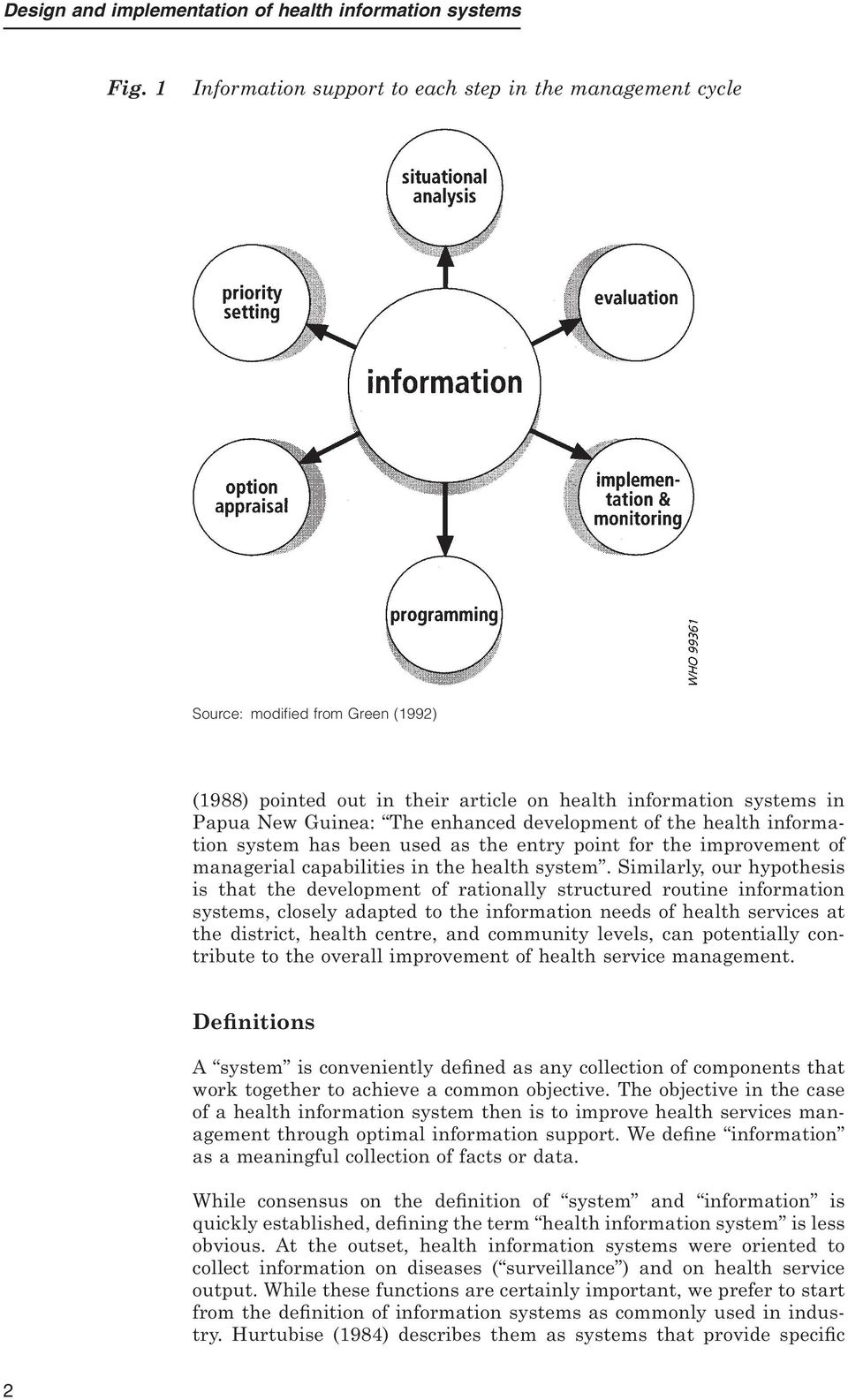
11 1 Introduction Rainer Sauerborn and Theo Lippeveld Why health information systems? Good management is a prerequisite for increasing the efficiency of health services. The need to do more with less is especially important because the health sector faces ever increasing demands while receiving stagnant or decreasing resources. Good management is also a prerequisite for increasing the effectiveness of health services. There is ample evidence that interventions lose a great deal of their theoretical effectiveness, also called efficacy, if they are delivered by poorly run health services (Tanner & Lemgeler, 1993; Tugwell et al., 1985). As an example, the effectiveness of polio vaccines may be diminished by breakdowns of the cold chain, incorrect assessment of the age of the child, failure to follow up on children who do not come for booster shots, and other such flaws. The challenge for health systems is to optimize the management of service delivery in a way that minimizes losses in effectiveness. The World Health Organization (WHO) has long identified health information systems as critical for achieving health for all by the year 2000 (Mahler, 1986). A report of a WHO meeting (1987) clearly links improved management to improved health information systems: Of the major obstacles to effective management, information support is the one most frequently cited. Unger and Dujardin (1992) and Lippeveld et al. (1992), recently stressed the need for well-designed routine information systems for ensuring that services are delivered according to standards. For information to influence management in an optimal way, it has to be used by decision-makers at each point of the management spiral. Examples of these decision points include undertaking situational analysis, setting priorities, or implementing a programmed activity (see Fig. 1). Information is crucial at all management levels of the health services, from the periphery to the centre. It is crucial for patient/client management, for health unit management, as well as for health system planning and management. This means that not only policymakers and managers need to make use of information in decision making but also care providers, including doctors, health technicians, and community health workers. Unless this occurs, the considerable opportunity costs involved in set-up and maintenance of health information systems can be difficult to justify. Helfenbein et al. (1987) rightly stated that changing the way information is gathered, processed, and used for decision-making implies changing the way an organization operates. Or as Newbrander and Thomason 1

12 Design and implementation of health information systems Fig. 1 Information support to each step in the management cycle Source: modified from Green (1992) (1988) pointed out in their article on health information systems in Papua New Guinea: The enhanced development of the health information system has been used as the entry point for the improvement of managerial capabilities in the health system. Similarly, our hypothesis is that the development of rationally structured routine information systems, closely adapted to the information needs of health services at the district, health centre, and community levels, can potentially contribute to the overall improvement of health service management. Definitions A system is conveniently defined as any collection of components that work together to achieve a common objective. The objective in the case of a health information system then is to improve health services management through optimal information support. We define information as a meaningful collection of facts or data. While consensus on the definition of system and information is quickly established, defining the term health information system is less obvious. At the outset, health information systems were oriented to collect information on diseases ( surveillance ) and on health service output. While these functions are certainly important, we prefer to start from the definition of information systems as commonly used in industry. Hurtubise (1984) describes them as systems that provide specific 2
13 Introduction information support to the decision-making process at each level of an organization. The ultimate objective of health information systems is therefore not to gain information but to improve action. Applied to the health sector, we can now define health information systems as a set of components and procedures organized with the objective of generating information which will improve health care management decisions at all levels of the health system. The widely used term health management information system could be misleading, since it may suggest that there are different information systems for different functions, for example management information systems, epidemiological surveillance systems, and administrative information systems. We consider all these as subsystems (see also Chapter 2) of a unified health information system and therefore prefer the latter term. In summary, health information systems integrate data collection, processing, reporting, and use of the information necessary for improving health service effectiveness and efficiency through better management at all levels of health services. What is wrong with current health information systems? Unfortunately, health information systems in most countries are inadequate in providing the needed management support (WHO, 1987; Lippeveld, Foltz & Mahouri, 1992). Most health care providers in developing countries equate information systems with filling endless registers with names and addresses of patients, compiling information on diseases (e.g. sex and age of patients) every week or every month, and sending out reports without adequate feedback. Furthermore, the data received are often not helpful for management decision making because they are incomplete, inaccurate, untimely, obsolete, and unrelated to priority tasks and functions of local health personnel. In other words, information systems tend to be data-driven instead of action-driven (Sandiford, Annett & Cibulskis, 1992). A large part of the data collected passes to the national level without being analysed and used, and frequently ends up on the dusty shelves of an office in the Ministry of Health (Smith, Hansen & Karim, 1988; Becht, 1986; Frere, 1987; Ho, 1985; Kiaffi, 1988; WHO, 1988a; de Kadt, 1989). Current health information systems are therefore widely seen as management obstacles rather than as tools. The reasons can be summarized in five points: Irrelevance of the information gathered According to a WHO Expert Committee (1994), Many of the data recorded and reported by the health service staff are not needed for the tasks the staff perform. Data collection tends to focus on disease reporting and only partially addresses management objectives at the health unit level or at the patient/client level. Yet data that are needed are frequently not collected. For example, appropriate indicators to monitor continuity of care of individual patients or clients are rarely included in health information systems. The common denominator of these two observations is a lack of a consensus between producers and users of data at each level of the health care system regarding the information needed. 3

14 Design and implementation of health information systems Poor quality of data Data requirements are frequently chosen without taking into account the technical skills of the health workers collecting the data, or the available diagnostic equipment in peripheral health facilities (Nordberg, 1988; Lippeveld, Foltz & Mahouri, 1992; Frere, 1987). For example, at the first level of care, auxiliary health staff without laboratory or X-ray facilities are required to report on diseases such as leishmaniasis, diphtheria, and peptic ulcer. Furthermore, health workers receive little if any training in data collection methods (Murthy & Patel, 1988; Kiaffi, 1988; Nordberg, 1988), and rarely have standardized instructions on how to collect the data (Frere, 1987; Foreit et al., 1988; Jaravaza et al., 1982; WHO, 1994). Another reason data quality is low is lack of motivation among health services personnel. Since health services supervisors and peripheral health workers rarely receive feedback on the data reported to higher levels (Smith, Hansen & Karim, 1988; de Kadt, 1989; Frere, 1987; Ho, 1985; Mitchell & Cromwell, 1982), they have little incentive to ensure the quality of the collected data and to comply with reporting requirements (Smith, Hansen & Karim, 1988; Frere, 1987; Ho, 1985; Mitchell, 1983; Helfenbein et al., 1987; Stinson, 1983; Murthy & Patel, 1988). Duplication and waste among parallel health information systems Historically, national reporting systems, even in developed countries, are rarely the result of a coordinated effort to address information needs of health planners and managers. Often, donor agencies or national programmes within the Ministry of Health developed their own specialized information system (Mitchell & Cromwell, 1982; Lippeveld, Foltz & Mahouri, 1992; Foreit et al., 1988; WHO, 1994), mostly under pressure and with financial assistance from external donor agencies. Designed as vertically structured empires, these programmes replaced line managers with programme directors who managed separate categories of personnel, facilitated separate training programmes, and created separate programme information systems which tended to focus on one specific disease (e.g. diarrhoea), a specialized service (e.g. family planning information systems ), or a management subsystem (e.g. drug management information system ) instead of addressing management functions in a comprehensive way. These programme information systems existed side by side and in addition to the general routine health information system, which was considered insufficient and incapable of delivering the data needed for programme management. While these separate systems could indeed provide real information support for programmatic decisions, and the quality of information generated tended to be better than that of the general information system (WHO, 1994), the net result was that routine health information systems became chaotic and bothersome (Ho, 1985; Foreit et al., 1988; Kiaffi, 1988; Murthy & Patel, 1988). The literature reveals several design and implementation problems. Reporting and transmission within each system is usually designed with minimal involvement of the line managers and providers of the health services (Frere, 1987; Mitchell & Cromwell, 1982; Stinson, 1983). The result is that health workers are drowned in a multitude of reports to be com- 4

15 Introduction pleted every month (Ho, 1985; Murthy & Patel, 1988; Kiaffi, 1988; Stinson, 1983). Since the data are not cross-referenced among the different systems, health care providers and systems managers spend a considerable amount of time collecting redundant and overlapping information (Smith, Hansen & Karim, 1988; Ho, 1985; Foreit et al., 1988; Rodrigues and Israel, 1995). Furthermore, data transmission does not follow the hierarchical lines of communication, so that reports often do not reach their destination (Frere, 1987; Ho, 1985; Lippeveld, Foltz & Mahouri, 1992). Elimination of duplication and waste requires a unified system rather than better coordination among the existing parallel structures. Lack of timely reporting and feedback The process of transmitting, compiling, analysing, and presenting the data is usually so tedious that by the time a report is prepared, the data are frequently obsolete and decisions are often made without any information input. Planners and managers face deadlines and time constraints in their daily decision making. Outdated information, even if of high quality, is of low value to them. Delays in data transmission and lack of feedback at the district level are often caused by the presence of strong vertical programmes. Health facilities report data directly to national programme managers, and line managers at the district level receive outdated feedback reports, if any. Poor use of information Despite the evidence that much of the generated data is irrelevant, of poor quality, redundant, or obsolete, there are nonetheless some useful data sets available. Unfortunately, researchers have not adequately evaluated or documented information use, and the prevailing sentiment that information is poorly used is based mainly on anecdotal evidence. However, a few existing studies do point to some of the culprits. For example, information use was found to be especially weak at the district, health centre, and community levels (Smith, Hansen & Karim, 1988; WHO, 1988b; de Kadt, 1989), given the centralization of many health systems and, hence, health information systems. This raises serious concerns, given the current effort to decentralize decision making and build capacity at the district level. Dunn (1980) revealed another impediment to ensuring use of information: the difference in culture between data people and decisionmakers, which is difficult to bridge. Consequently, planning and management staff rely primarily on gut feelings to formulate ad hoc decisions rather than seek pertinent data. We will explore the factors that lead to the failure to use information and provide suggestions for solving this problem in Chapter 3. Efforts to reform health information systems The chaotic status and inefficiency of most existing information systems in developing countries are linked to the structural weakness of the system and lack of integration in the overall health system. This can be explained by the fact that historically, as in most developed countries, information systems were not intentionally planned to provide management support to the health services in an integrated way. Foltz (1993) 5

16 Design and implementation of health information systems explains: They differ from country to country depending upon historical accident and the interests of policy makers, administrators and researchers. The first efforts to systematically collect, analyse, and report data for improved management in developing countries were undertaken by national programme managers of vertically structured empires, as discussed above. This was due to the fact that foreign assistance to the health sector was typically focused on programmes rather than the entire health system. Since such projects were accountable to their respective donors, information on performance had to be collected. Targeting financial resources on disease control programmes or programmes addressing a group of specific health problems was indeed attractive to the donors because the quantifiable success of these programmes justified the use of their funds. This vertical approach to health care delivery, and thus to health information systems, was considered even more justified in the early eighties because of the prevailing ideology of selective primary health care (Walsh & Warren, 1979). However, apart from their effect on health information systems, these vertical programmes were undermining the development of a sustainable primary health care-based health infrastructure. In recent years great efforts were made in many countries to integrate the Expanded Programme for Immunization, the Control of Diarrhoeal Disease Programme, onchocerciasis control, and other vertical programmes into existing health structures, thus strengthening them. The problems with health information systems were not lost on national policymakers and donors. Many countries decided to attack the information problem at its roots and planned for a more integrated approach to improving health information systems. Comprehensive restructuring efforts in countries such as Cameroon (see Sauerborn, 1991; Berg, 1988; Weber, 1989), Chad (see Lippeveld, Foltz & Mahouri, 1992; Unger, 1989), and Pakistan (see Ministry of Health, 1994) concentrated on the routine health information system for first-level care facilities. In Cameroon, health information system restructuring was complementary to an overall reform of the health services, building on a decentralized district health system based on primary health care. In Chad and Pakistan, restructuring of the health information system was done as a separate project. In other countries, health information systems reform was done using a more gradual approach which consisted of either the reform of subsystems, such as epidemic disease surveillance (e.g. Burkina Faso) or routine services reporting (e.g. Niger). Table 1 gives an illustrative list of countries where national health information systems reform efforts took place recently or are still underway. The drive for the reform of health information systems coincided with a revolution in information and communications technology. The computer has made its entry even in the most reluctant ministry of health. Doctors and nurses discuss hardware, databases, and spreadsheets. Low-cost powerful microcomputers and modems can efficiently store, process, and transmit enormous amounts of data. User-friendly desktop publishing and graphics software permit timely, specific, and action-oriented feedback to managers at different levels of the health services. With this state-of-the-art technology combined with pressure from the computer industry, most recently created or restructured health information 6

17 Introduction Table 1 Illustrative list of published reports on national health information systems reform projects Country Reference Bangladesh Reynolds, 1988 Burma Reynolds, 1988 Bolivia Cardenas, 1992 Cameroon Sauerborn, 1991; Berg, 1988; Weber, 1989 Chad Lippeveld, Foltz & Mahouri, 1992; Unger, 1989; Foltz, 1993 Eritrea Tekle et al., 1995 Ghana Campbell, Adjei & Heywood, 1996 Nigeria Lecky, 1991 Niger Kiaffi, 1988 Pakistan Ministry of Health, 1994 Papua New Guinea Campos-Outcalt, 1991 Philippines Magnani, 1990 Swaziland Ministry of Health, 1990 Thailand Reynolds, 1988 systems are computerized to various degrees. But introducing computer technology in the development of improved health information systems is not necessarily the silver bullet that solves the efficiency problem of the health services (Sandiford, Annett & Cibulskis, 1992). On the contrary, lack of appropriately trained staff, a hostile climate, and hardware and software maintenance problems sometimes result in the decay and obsolescence of expensive computer equipment. Review of the literature on health information systems reform The scientific literature on how to develop appropriate health information systems in support of basic health services is relatively scanty, despite the general consensus that these systems should be restructured. Before 1985, most of the literature on management information systems focused on the use of computer technology rather than organizational aspects of information handling, information systems for large tertiary hospitals rather than basic health services, and survey methodology rather than routine health unit-based information systems. Other publications have underlined the importance of the development of such information systems, but without detailing how they could be developed. One of these publications is the report on an international workshop on management information systems and primary heath care organized by the Aga Khan Foundation in Lisbon (Portugal) in 1987 (Wilson et al., 1988), which covers most of the issues cited. Most publications have focused on a single aspect of the development of health management information systems (see Table 2). Somewhat more comprehensive, the publications of Stinson (1983) and Helfenbein et al. (1987) provide a fair amount of detail on available methodologies and technologies for the development of routine health unit-based information systems in developing countries, but they reached a limited target audience and date from 1983 and 1987, respectively. The Aga Khan Foundation published the Primary Health Care Management Advancement Program series (Wilson & Sapanuchart, 7

18 Design and implementation of health information systems Table 2 Specific aspects of health information systems development in the literature Aspect of health information systems Reference Information needs for national White, 1977; WHO, 1981; WHO, 1994 health planning Disease surveillance systems Klaucke et al., 1988; Thacker, Parrish & Trowbridge, 1988 Development of computerized Brodman, 1986; Bussell, 1993; Rodrigues & Israel, 1995 data processing systems Programmatic information Ho, 1985; Newbrander, Carrin & Le Touze, 1994; Pelletier, systems 1994 Data collection methods Anker, 1991; Frerichs, 1988; Guhasapir, 1991; Hill, Zlotnik & Trussell 1981; Kielmann, Janovsky & Annett, 1995; Kroeger, 1983; Lanata & Black, 1991; Oranga & Nordberg, 1993; Scrimshaw et al., 1992; Seltzer, 1990; Valadez, 1991 Epidemiological techniques Vaughan & Morrow, 1995 Community involvement Husein et al., 1993; O Neill, 1993; Scott, 1988 Measurement of quality of care Garnick et al., 1994; Roemer & Montoya-Aguilar, and health information systems 1988 Politics of health information Foltz & Foltz, 1991 systems reform 1993). Conceived as a set of field guides to strengthen the quality and utility of health data organized around nine thematic modules, the Management Advancement Program series helps primary health care managers at the local level to collect and use information for managing the health services under their supervision. Also, more recently, two WHO documents on the development of district-based routine health information systems were published, the first titled Information support for new public health action at district level (1994), and the second, by the Pan American Health Organization titled Conceptual framework and guidelines for the establishment of district-based information systems (Rodrigues & Israel, 1995). The first document is a report of a WHO Expert Committee, summarizing problems and strategies related to the development of district routine health information systems. The second publication, by Rodrigues and Israel, gives an excellent treatment of the design of district-based health information systems, with a strong emphasis on computer software and hardware. Scope of the book This book responds to an urgent need in the public health community to gather in one publication the state of the art of designing and implementing health information systems, particularly in developing countries. It especially addresses the question of how to transform existing information systems into management support systems. The focus is on routine health unit-based information systems. The rationale behind this approach is based on several conditions which exist in the basic health services in most developing countries. First, the problems of inefficient and chaotic data collection and use of information in peripheral health units as previously described typically apply to routine health unit-based information systems. Many government agencies and 8

19 Introduction donors tend to use...general and special-purpose surveys to capture data that should be part of routine reporting (WHO, 1994). But these problems do not solely originate from the methodological attributes of routine information systems. They also reflect poor general management capability of the basic health services. Our hypothesis is that the development of rationally structured routine information systems will also contribute to the overall improvement of the management capability of the basic health services, particularly if a consensus-building design process is used. Second, routine health unit-managed information systems are the only way to generate data for patient and client management decisions. They are especially suited for routine managerial decisions, such as those related to ordering supplies, or supervision of health personnel. Considering the fact that data collection is performed mainly by health care providers as part of their health care tasks, marginal cost is low. Finally, the development of routine health information systems, compared with surveys and other nonroutine methods, has been less well described in the scientific literature. Most of the analysis and strategies on health information systems development discussed in this book will pertain to government-managed health services because this is the most common health services system in developing countries. Yet one of the roles of the district management team is to coordinate and supervise nongovernment and private health services within the district (WHO, 1988b). We will therefore also discuss in the following chapters means and strategies to involve private sector health care services in health information systems development. The strength of the book lies in the case material distilled from information systems which the authors have helped to design and maintain. In the last 10 years, the authors have gathered broad and varied experience in the development of health information systems through projects and advisory services in developing countries throughout the world: Bolivia, Burkina Faso, Cameroon, Chad, Costa Rica, the Democratic Republic of the Congo, Eritrea, Malawi, Niger, and Pakistan. Some of these efforts involved overall restructuring of health information systems, such as in Cameroon, Chad, Eritrea, and Pakistan. Other efforts were limited to more specific aspects of health information systems development, such as the introduction of lot quality assurance sampling as a tool to improve quality of care in Costa Rica, the use of geographic information systems in Bolivia, and production of annual feedback reports for district managers in Niger. These experiences, combined with those of the guest authors and the team of the Strengthening Country Information System unit of WHO/Geneva, provide a unique opportunity to bring together in book form lessons learned about the development of health information systems. The book targets professionals not only in the health sector but also in related sectors involved in planning and managing health services at national and intermediate levels, particularly government health services and of nongovernmental organizations. Our focus on decentralized, district level-operated health services makes it a valuable guidebook for district health managers. The presentation of case studies and the continuous link in the text between concepts presented and actual implementation in the field are intended as a resource for teachers and students in programmes related to planning and managing health services in developing countries, and more specifically to developing health information systems. 9

20 Design and implementation of health information systems Organization of the book The chapters of the book have been grouped under four parts. The theme of the first part with two chapters is information for decision making. In Chapter 2, we lay the groundwork for health information systems design by providing a health services system framework closely linked to the health information systems restructuring process. Chapter 3 deals with use of information, analysing the reasons information is rarely used by decision-makers and suggesting ways and means to improve its use. The second part of the book has six chapters examining step by step how health information systems should be structured so that they can provide information useful to decision making at all levels of the health services. Chapter 4 deals with the first step, information needs and indicators and how to define them through consensus building. In Chapter 5, the author proposes a health information system assessment methodology to identify weak elements in the existing health information system and set the agenda for the restructuring process. Chapter 6 contrasts the different routine data collection methods, while Chapter 7 gives an overview of nonroutine data collection tools. Data transmission and processing are the focus of Chapter 8, with particular emphasis on assessing and assuring data quality. Chapter 9 applies these health information systems restructuring principles to population-based community health information systems. The three chapters of the third part of the book deal with resources and tools required for a well-functioning health information system. Chapter 10 provides a comprehensive view of the health information system resource base: staffing, training, and supervision; procurement and distribution systems of printed supplies; purchase and maintenance of hardware and software; and budgeting for recurrent health information system costs. Chapter 11 analyses the strengths and weaknesses of computer use in health information systems. Chapter 12 highlights one particular computer application: geographic information systems and their potential usefulness in health services planning and management. Whereas the first three parts of the book provide the principles and technical content of health information systems for decision making, the two chapters of the last part are about the process of health information systems restructuring. Chapter 13 focuses on the politics of change, analysing how different interest groups and contextual factors can influence the design and implementation of new health information systems in a positive or negative way, and proposing health information systems design strategies to deal with these factors. Finally, in Chapter 14, the authors, based on their experience, summarize health information systems development approaches which almost certainly will fail, and those, on the contrary, which will lead most likely to successful health information systems restructuring. The chapter also identifies areas for future research and development experience. References Anker M (1991). Epidemiological and statistical methods for rapid health assessment: introduction. World health statistics quarterly, 44(3): Becht JN (1986). Management information systems: lessons from evaluations of ten private voluntary organization (PVO) health programs. In Management 10

21 Introduction issues in health in the developing world. Washington, DC, National Council for International Health: Berg H (1988). Surveys and health management information systems (prepared for the GTZ primary health care project in the North-West Province of Cameroon). Heidelberg, Heidelberg University School of Public Health. Brodman JZ (1986). Using microcomputers to improve decision-making in Third World governments. Development Discussion Papers. Cambridge, MA, Harvard Institute of International Development: 1 46 (Development Discussion Papers, No. 231). Bussell KE (1993). Computer applications for health information systems. Atlanta, GA, Centers for Disease Control and Prevention: Campos-Outcalt D (1991). Microcomputers and health information in Papua New Guinea: a two year follow-up evaluation. Health policy and planning, 6: Campbell B, Adjei S, Heywood A (1996). From data to decision making in health: the evolution of a health management information system. Amsterdam, Royal Tropical Institute. Cardenas CO et al. (1992). Bolivia information system (training manual for management of the national health information subsystem). La Paz, Ministry of Social Welfare and Public Health. de Kadt E (1989). Making health policy management intersectorial: issues of information analysis and use in less developed countries. Social science and medicine, 29: Dunn WN (1980). The two-communities metaphor and models of knowledge use: an exploratory case survey. Knowledge, 1: Foltz A, Foltz W (1991). The politics of health reform in Chad. In: Perkins D, Roemer M, eds. Reforming economic systems in developing countries. Cambridge, MA, Harvard Institute for International Development. Foltz AM (1993). Modeling technology transfer in health information systems learning from the experience of Chad. International journal of technology assessment in health care, 1993, 9: Foreit K et al. (1988). Automating Ecuador s health information system. Paper presented at the 116th Annual Meeting of the American Public Health Association, Boston: 1 7. Frere JJ (1987). Health and management information system for child survival project in Pakistan. Washington, DC, Technologies for Primary Health Care Project, United States Agency for International Development: Frerichs RR (1988). Rapid microcomputer surveys. Journal of tropical pediatrics, 34: Garnick DW, Hendricks AM, Comstock CB (1994). Measuring quality of care: fundamental information from administrative datasets. International journal for quality in health care, 6: Green A (1992). An introduction to health planning in developing countries. Oxford, Oxford University Press. Guhasapir D (1991). Rapid assessment of health needs in mass emergencies: review of current concepts and methods. World health statistics quarterly, 44: Helfenbein S et al. (1987). Technologies for management information systems in primary health care. Geneva, World Federation of Public Health Associations (Issue Paper, Information for Action Series). Hill K, Zlotnik H, Trussell J (1981). Demographic estimation: a manual on indirect techniques. Washington, DC, National Academy of Sciences: Ho TJ (1985). Managing health and family planning delivery through a management information system. Washington, DC, World Bank. Hurtubise R (1984). Managing information systems: concepts and tools. West Hartford, CT, Kumarian Press: Husein K et al. (1993). Developing a primary health care management information system that supports the pursuit of equity, effectiveness, and affordability. Social science and medicine, 36:
22 Design and implementation of health information systems 12 Jaravaza VS et al. (1982). Unified national health information system. Central African journal of medicine, 28: Kiaffi A (1988). Rapport d évaluation du nouveau système de collecte de données. [Report of the evaluation of a new data collection system.] Niamey, Ministry of Public Health: Kielmann AA, Janovsky K, Annett H (1995). Assessing district health needs, services, and systems: protocols for rapid data collection and analysis. London, Macmillan Education. Klaucke DN et al. (1988). Guidelines for evaluating surveillance systems. Morbidity and mortality weekly report, 37:1 18. Kroeger A (1983). Anthropological and socio-medical health care research in developing countries. Social science and medicine, 17: Lanata CF, Black RE (1991). Lot quality assurance sampling techniques in health surveys in developing countries: advantages and current constraints. World health statistics quarterly, 44: Lecky MY (1991). Strengthening and integrating the health information system for decision making in Nigeria. Cambridge, MA, Harvard School of Public Health (Working Paper No. 2). Lippeveld TJ, Foltz A, Mahouri YM (1992). Transforming health facility-based reporting systems into management information systems: lessons from the Chad experience. Cambridge, MA, Harvard Institute of International Development: 1 27 (Development Discussion Papers, No. 430). Magnani RJ (1990). Information systems development at the Republic of the Philippines Department of Health. Manila, Department of Health: Ministry of Health of Swaziland (1990). Swaziland outpatient health information system. Mbabane, Ministry of Health: Ministry of Health of Pakistan (1994). Health management information system for first level care facilities: instruction manual. Islamabad, Ministry of Health. Mitchell JB, Cromwell J (1982). Physician behavior under the Medicare assignment option. Journal of health economics, 1: Mitchell M (1983). Provincial health plan, Port Moresby, Papua New Guinea Division of Health. Murthy N, Patel KG (1988). A computer based information system for health and family welfare: the Bavala experiment. Ahmedabad, Indian Institute of Management. Newbrander W, Thomason JA (1988). Computerizing a national health system in Papua New Guinea. Health policy and planning, 3: Newbrander W, Carrin G, Le Touze D (1994). Health expenditure information: what exists and what is needed? Health policy and planning, 9(4): Nordberg E (1988). Household health surveys in developing countries: could more use be made of them in planning? Health policy and planning, 3: O Neill K (1993). Community based surveillance: a critical examination of nine case studies. London, London School of Hygiene and Tropical Medicine: Oranga HM, Nordberg E (1993). The Delphi panel method for generating health information. Health policy and planning, 8(4): Pelletier DL, Shrimpton R (1994). The role of information in the planning, management and evaluation of community nutrition programmes. Health policy and planning, 9: Reynolds J (1988). Overview: current perspectives on management information systems in primary health care. In: Wilson RG et al., eds. Management information systems and microcomputers in primary health care. Geneva, Aga Khan Foundation: Rodrigues RJ, Israel K (1995). Conceptual framework and guidelines for the establishment of district-based information systems. Barbados, Pan American Health Organization, Office of the Caribbean Program Coordination (document PAHO/CPC/3.1/95.1). Roemer MI, Montoya-Aguilar C (1988). Quality assessment and assurance in primary health care. Geneva, World Health Organization: 1 78 (WHO offset publication, No. 105).
23 Introduction Sandiford P, Annett H, Cibulskis R (1992). What can information systems do for primary health care? An International Perspective. Social science and medicine, 34: Sauerborn R (1991). Propositions pour un système d information pour le projet SESA. [Proposals for an information system for the SESA project.] Cambridge, MA, Harvard Institute of International Development: Scott W (1988). Community-based health reporting. World health statistics quarterly, 41: Scrimshaw NS, Gleason GR, eds. (1992). Rapid assessment procedures qualitative methodologies for planning and evaluation of health related programmes. Boston, MA, International Nutrition Foundation for Developing Countries. Seltzer JB (1990). Handbook for conducting local rapid assessments. Boston, Management Sciences for Health: Smith DL, Hansen H, and Karim MS (1988). Management information support for district health systems based on primary health care. In: Wilson RG et al., eds. Management information systems and microcomputers in primary health care. Geneva, Aga Khan Foundation: Stinson W (1983). Information systems in primary health care. Washington, DC, American Public Health Association, 1:1 76. Tanner M, Lengeler C (1993). From the efficacy of disease control tools to community effectiveness. Transactions of the Royal Society of Tropical Medicine and Hygiene, 87: Tekle DI et al. (1995). Health information system assessment study: findings and recommendations. Asmara, Ministry of Health. Thacker BS, Parrish RG, Trowbridge FL (1988). A method for evaluating systems of epidemiological surveillance. World health statistics quarterly, 41: Tugwell P et al. (1985). The measurement iterative loop: a framework for the critical appraisal of need, benefits, and costs of health interventions. Journal of chronic diseases, 38: Unger JP (1989). Evaluation du système national d information du secteur santé. [Evaluating a national information system for the health sector.] N Djamena, Ministry of Public Health: Unger JP, Dujardin B (1992). Epidemiology s contribution to health service management and planning in developing countries: a missing link. Bulletin of the World Health Organization, 70: Valadez JJ (1991). Assessing child survival programs in developing countries: testing lot quality assurance sampling. Cambridge, MA, Harvard University Press (Harvard Series on Population and International Health). Vaughan JP, Morrow RH (1995). Manual of epidemiology for district health management. Geneva, World Health Organization. Walsh JA, Warren KS (1979). Selective primary health care. Social science and medicine, 1979, 301: Weber W (1989). Health management information system: Bamenda, Cameroon. Yaounde, GTZ: White KL et al. (1977). Health services concepts and information for national planning and management. Geneva, World Health Organization: (Public Health Papers, No. 67). Wilson R, Sapanuchart T (1993). Primary health care management advancement programme. Washington, DC, Aga Khan Foundation. Wilson RG et al. (1988). Management information systems and microcomputers in primary health care. Geneva, Aga Khan Foundation. World Health Organization (1981). Information support. In: Managerial process for national health development. Geneva, World Health Organization: (Health for all series, No. 5). World Health Organization (1987). Report of the Interregional Meeting on Strengthening District Health Systems, Based on Primary Health Care, Harare, Zimbabwe 3 7 August Geneva, World Health Organization: 1 42 (unpublished document WHO/SHS/DHS/87.13; available on request 13
24 Design and implementation of health information systems from Evidence and Information for Policy, World Health Organization, 1211 Geneva 27, Switzerland). World Health Organization (1988a). The challenge of implementation: district health systems for primary care. Geneva, World Health Organization (unpublished document WHO/SHS/DHS/88.1; available on request from Evidence and Information for Policy, World Health Organization, 1211 Geneva 27, Switzerland). World Health Organization (1988b). Household surveys on health and nutrition. In: Anderson JG, Aydin CE, Jay SJ, eds. Evaluation health care information systems: methods and applications. Thousand Oaks, CA, Sage. World Health Organization (1994). Information support for new public health action at the district level. Report of a WHO Expert Committee. Geneva, World Health Organization: 1 31 (WHO Technical Report Series, No. 845). 14
25 2 A framework for designing health information systems Theo Lippeveld and Rainer Sauerborn Developing a systems approach for health information systems The need for improved routine health information systems is unequivocal and well documented (WHO, 1986; de Kadt, 1989; Sandiford, Annett & Cibulskis 1992; Lippeveld, Foltz & Mahouri, 1992). While there is a general consensus that health information systems should be restructured, very few publications have focused on how to develop such systems. It has even been argued that health information systems are idiosyncratic to the countries that develop them, and that no appropriate models exist that can be applied to all countries (Foltz, 1993). A health information system in a largely urban country with a literacy rate of more than 80%, a GNP per capita of more than US$1000, and mostly privately operated health services will certainly be different from one in an extremely poor country where the majority of the rural population is illiterate, and with predominantly government-managed health services. It is obvious that each country has to develop or restructure its own specific system, tailored to the prevailing socioeconomic, political, and administrative context. There are some common elements, however, which can be adapted to create more effective and efficient systems. Each health information system has, at the minimum, some sort of informationgenerating process whereby data are transformed into information; and to run this process, a more or less organized structure is present where persons interact with resources, such as data collection instruments, or with machines, such as computers. This chapter intends to provide public health professionals with a systems approach towards the development of health information systems. How can the common elements be combined in such a way that information is or becomes a real resource to solve health problems at all levels of the health services system? What kind of system will generate and disseminate information to support management rather than to block it? In order to answer these questions, this chapter first examines the health information system structure and its breakdown into components. We then describe an organizational model of the health services with concentration levels from the periphery to the centre. Management functions at each level are discussed. Finally, we propose a health information systems restructuring process in six steps, carefully matching each step with the proposed health services model. 15
26 Design and implementation of health information systems The health information system structure In order to explain the conceptual link between health information systems and the health services system at large, we start from the generic definition of a management information system, as we previously indicated in Chapter 1. Specifically, it is a system that provides specific information support to the decision-making process at each level of an organization (Hurtubise, 1984, p. 28). A health information system first of all is a system (Helfenbein et al., 1987, p. 2). Like each system, it has an organized set of interrelating components which can be grouped under two entities: the information process, and the health information system management structure (see Fig. 2). Through the information process, raw data (inputs) are transformed into information in a usable form for management decision making (outputs). The information process can be broken down in the following components: (i) data collection, (ii) data transmission, (iii) data processing, (iv) data analysis, and (v) presentation of information for use in planning and managing the health services. Monitoring and evaluating the process ensures that the right mixture of inputs produces the right type of outputs in a timely fashion. For example, the information needed is continuously changing with changing planning and management needs. This will in turn affect data collection and other components of the information process. A health information system can generate adequate and relevant information only insofar as each of the components of the information process has been adequately structured. Fig. 2 Components of a health information system 16
27 A framework for designing health information systems The unfolding of this stepwise process in space and time is not necessarily the same in all situations. Sometimes data collected are used immediately and locally for a decision, with little processing or analysis. For example, by asking patients how well they responded to treatment (data collection), care providers can decide if follow-up visits are necessary (use of the information). Also, the decision-making process for daily management tasks often consists of a set of routine procedures, where data are immediately linked to a series of actions. This is the case with standardized treatment guidelines, or with standard procedures for drug management. In other situations, each of the steps in the informationgenerating process takes place in a different location and at a different time. For example, data on the use of preventive services is collected at the time of the patient/client visits, aggregated every month and transmitted from the health facilities to the district, and processed at the provincial level. Each year, based on this data, coverage for preventive services is calculated and communicated to the district level for further analysis and action. In order to make the information process efficient, a health information system management structure is required to ensure that resources are used in such a way that the information process produces high-quality information in a timely fashion. This structure can be further broken down into two components: (i) health information systems resources, and (ii) a set of organizational rules. Health information system resources include persons (e.g. planners, managers, statisticians, epidemiologists, data collectors); hardware (e.g. registers, telephones, computers); software (e.g. carbon paper, report forms, data-processing programs); and financial resources. Organizational rules (e.g. the use of diagnostic and treatment standards, definition of staff responsibilities, supply management procedures, computer maintenance procedures) ensure efficient use of health information system resources. Thus designing or redesigning health information systems will need to address in a systematic manner each of these components of both the information process and the management structure. The ultimate objective is that health information systems provide specific information support to the decision-making process within the health system at large. The relationship between the health information system and the health system at large A health information system cannot exist by itself but is a functional entity within the framework of a comprehensive health system that offers integrated health services, including curative care, rehabilitative care, disease prevention, and health promotion services. The health information system structure should permit generation of the necessary information for rational decision making at each level of the health services system. This health system is composed of various levels between the centre and the periphery, each with different management functions, health services provision, and resource availability. Ideally, services and resources should be as available as possible to the periphery, to optimize access by the population. But there are limits to the degree of decentralization related to the provision of technical competence (technical limit); or to the efficient use of equipment (economic limit); or to the distribution of power (administrative limit). For example, it is neither possible nor desirable that every patient with a urinary infection be treated 17
28 Design and implementation of health information systems Fig. 3 Organizational model of the health services by a urologist; or that each first-level care clinic has ultrasound equipment. We therefore call these levels concentration levels. Classically, three concentration levels are described: the primary level, the secondary level, and the tertiary level. The primary level is the point of contact between the system and the population to whom health care is delivered. The other levels the secondary or district level, and the tertiary level provide specialized services as well as planning and management support. In many countries the tertiary level is further divided into regional (or provincial) and central levels. Each of these levels has specific functions, implicating a series of specific decisions to be made, ultimately leading to improvement of the health of the population. From a management perspective, functions can be grouped in three types of management functions, related to (i) patient/client management, (ii) health unit management, and (iii) health system management (see Fig. 3). Patient/client and health unit management functions are directly related to the delivery of promotional, preventive, and curative health services to the population. They include all interactions between the health unit staff and communities in their catchment areas. The health system management functions consist in the provision of coordination and management support to the service delivery levels. Decisions to be made under each of these types of management functions are different. The management information systems literature would call the patient/client and health unit management decisions operational, and the system management decisions strategic planning or management control decisions. The organizational model of the health services described above and depicted in Fig. 3 will allow us to identify at each concentration level what the specific management functions are, who the information users are, and what decisions they have to make. This in turn will permit us, at each level, to define information needs and to develop or restructure data collection methods and instruments, data transmission and processing procedures, as well as appropriate feedback reports. 18
29 A framework for designing health information systems Patient/client management functions The main patient/client management function is to provide quality care to patients and clients, curative as well as preventive and healthpromotional, at the first level as well as at the referral level. A vast literature has been produced on how to define quality of care. An excellent semantic discussion is given in a World Bank Technical Paper by De Geyndt (1994). Quality of care assessment, according to the conceptual model of De Geyndt, should look at the inputs ( structure ) of health care, at the process, and at the outcome. In the context of this book, we want to relate the provision of quality care to a series of decisions that care providers (and their supervisors) have to take at each level of the health services. How can an information system support these decisions in the most relevant and effective way? We prefer to focus on a process-oriented definition of quality care. As explained before, quality care will be defined differently depending on the concentration level. Quality care at the first level is comprehensive, integrated, and continuous; it focuses on patients and clients in their immediate sociocultural environment (Public Health Research and Training Unit, 1980). Quality care at the referral level is much more dependent on the input of human and technical resources, and can therefore be defined in terms of technical excellence according to the state of the art. The user of information at the patient/client level is the care provider the doctor, the health auxiliary, the midwife, but also the community health worker or the traditional birth attendant. A well-designed health information system can be a major tool in improving the quality of care delivered by care providers, by generating the information they need to make appropriate decisions, as in the following illustrations: The date, findings, and treatment prescribed during the last visit will help the care provider to make better decisions for a tuberculosis patient visiting a rural health centre (continuity of care). A child of 2 years is brought by his mother because of a skin rash and diarrhoea. Does the care provider have the necessary information support to know whether the child has already had measles or whether he was vaccinated (integration of care)? In order to decide what vaccine to administer to an 8-month-old child brought to the clinic, the health auxiliary needs to know what type of vaccines the child has already received and on what dates (continuity of care). The pathology results of a biopsy specimen of the cervix will assist the surgeon to decide whether to perform a hysterectomy. Health unit management functions The general management objective of a health unit is to provide health care to a defined population in the catchment area surrounding the health unit with a given amount of resources. Health units can be classified according to the level of concentration of resources: first-level care units, and referral-level care units. Management functions are specific for each type of health unit. They can be further subdivided into service delivery functions and administrative functions. 19
30 Design and implementation of health information systems Service delivery functions are defined based on the health needs of the communities served by the health units. First level care units provide a package of general health care services. There is a great deal of variation in the setting of a first level care health unit, as shown by the various forms of such units: dispensary, clinic, health centre, basic health unit, rural health centre, sub-health centre, first aid post, community health post, and so on. These different facilities may also cover differences in functions. Until quite recently, most of these units provided only curative care, as indicated by the name dispensary. In some instances, firstlevel care health units have been given specialized functions and activities: maternal and child health centres, tuberculosis centres, sexually transmitted disease clinics, family planning clinics. Often the availability of personnel determines the types of activities delivered at the first level. For example, if first-level care units are operated by a doctor, they probably can offer a wider range of services than if they are operated by a community-based health worker trained in 3 months. Also, material resources limitations can be at the origin of the range of services provided. For example, without refrigeration equipment, first-level care facilities cannot provide immunization services. Since the conference in Alma Ata in 1978, most countries in the world have adopted the strategy of primary health care. This implies that a package of essential health care, including curative as well as preventive and promotional activities, should be provided to as large a segment of the population as possible. This package focuses on priority health problems in the community, for which simple and effective technologies exist, and which can be solved by general health care providers with essential equipment and drugs, taking into account the available resources in the country. The World Bank in its 1993 World development report suggests that, based on cost-effectiveness studies, the minimum package should include at least the following activities: prenatal and delivery care, family planning services, management of the sick child, treatment of tuberculosis, and case management of sexually transmitted diseases (World Bank, 1993). Most of these activities are housed in a first-level care unit. At the referral level, hospitals and specialized outpatient clinics provide services and techniques for which the technical complexity and costs are not justified at first level care units. The district hospital is the first referral unit or secondary care unit. Provincial and national hospitals are mostly tertiary care units. Again, which specific services and techniques will be offered at what level will vary from country to country, or even from region to region. For example, in some countries, district hospitals do not offer ophthalmological surgery, while in other countries they do. Table 3 provides a list of service delivery functions adopted by the Ministry of Health in Chad in In support of the service delivery functions, health units also have administrative functions, such as personnel management and training, financial management, drugs and supplies management, and information management. Obviously, such functions will increase in complexity with the size of facilities, from a first-level care unit staffed by a health auxiliary and a midwife, to a tertiary care hospital with hundreds of beds and staff. Once functions and activities of the different types of health units in a given health services system have been clearly defined, we can easily identify the information needed for decision-making: 20
31 A framework for designing health information systems Table 3 Service delivery functions in health units in Chad First level (dispensaries, infirmaries): to provide curative care services for the most common health problems to provide prenatal care services to organize under-5 clinics (including immunizations) to provide follow-up services for chronic diseases to organize nutritional rehabilitation clinics to provide family planning services to ensure communication with the population in the catchment area. Secondary (or first referral) level (centres medicaux): to manage medical and surgical emergencies to provide X-ray and laboratory services to organize outpatient referral clinics to provide inpatient services (medicine, surgery, paediatrics, and gynaecology/obstetrics) to manage complicated deliveries. Tertiary level (hôpitaux de préfecture, hôpital national): In addition to the functions of secondary level, to provide all types of surgical interventions to provide specialized care. Source: Translated and adapted from Unger (1989). A health centre is supposed to provide treatment to tuberculosis patients. The officer in charge would like to know how many patients out of those who started treatment in the health centre abandoned their treatment prematurely (dropout rate). This information can prompt the health officer to improve follow-up of tuberculosis patients. One of the functions of a health centre is to provide prenatal care to all pregnant women in the catchment area, and to refer those at risk for delivery to the district hospital. In the last few months, several women from surrounding villages are reported to have died in childbirth or shortly thereafter. The officer in charge and the midwife of the health centre would like to know how many women out of the total expected pregnancies in the catchment area of the health centre receive prenatal care. This information will guide the midwife in reorganizing prenatal care activities in a more effective way. A district hospital with 200 beds provides inpatient care to a population of 200,000. For about a year, beds have been constantly full, and patients are hospitalized on improvised floor beds. The superintendent would like to know the average length of stay of the patients in each department in order to decide whether more beds are needed, or whether alternative discharge procedures could solve the problem. A tertiary hospital functions with a given annual budget. Revenues come from government subsidies, from health insurance payments, and from user fees. In order to prepare an annual budget, the financial director of the hospital will need data of the previous year on revenues by source and on expenditures by cost centre. Health systems management functions The objective of health systems management is to coordinate and provide planning and management support to the service delivery levels. Some examples of generally accepted health systems management functions are: 21
32 Design and implementation of health information systems establishment of health policies and legislation; intersectoral coordination; strategic planning and programming; budgeting and financial resource allocation; organization of the system, including referral mechanisms; personnel development including continuing education; resource management, including finance, personnel, and information; distribution and management of equipment, supplies, and drugs; disease surveillance; protection of the environment; supervision of the health services. Health system management functions vary for each concentration level. Their distribution from the periphery (classically the health district is the most peripheral health system unit) to the centre (regional and national levels) and, consequently, their decision-making power depends on the way the health system has been administratively organized in each country. The main poles between which most national health systems can be situated are centralized and decentralized systems; government and private sector-managed systems; and horizontally managed health services systems and health services systems managed predominantly by vertical programmes. For example, budgeting and decisions on financial resource allocation will be made at the national level in a centralized health system; in other health systems, these functions have been delegated to the district level. In a country with a predominantly private sector-managed health system, most of the listed functions are performed by private institutions, whereas the government has only a regulatory role, setting policies and making legislation. In a health system managed mainly through vertically organized health programmes, programme managers have taken over responsibilities in resource management and supervision from the line managers. Table 4 lists management functions at central, regional, and district levels in a decentralized health services system as proposed by WHO (1988). Again, based on the specific health system management functions at each concentration level, information needs can be rationally determined and data collection procedures developed to generate the required information. Health planners and managers can use a variety of information sources, but should be sure that the amount and nature of the data to be reported by the operational levels of the health services are reasonable to avoid burdening health care providers. Ideally, health services staff should only report data which are useful for patient/client management or for health unit management. All other information required at this level could be generated by data sources other than health unitbased reporting. Essential public health management functions More recently, as part of the health for all renewal effort and the discussions on the role of the state versus the private sector in health care provision, another group of management functions has been proposed essential public health functions. These functions have been defined as a set of fundamental and indispensable activities carried out to protect the population s health and treat disease through means which are targeted at the environment and the community (Sapirie, 1997). Typical 22
33 A framework for designing health information systems Table 4 Health system management functions in a decentralized health service system The central level (Ministry of Health) is responsible for: health policy formulation, including policy on intersectoral activities; production of national health plans and regional and local planning guidelines; advisory role on allocation of resources, particularly capital funds; source of high level technical advice for specific programmes; control over purchasing pharmaceuticals and distribution of supplies; training and regulation of health personnel development; regulation of private profit and nonprofit health organizations; control of national health organizations and research institutes; liaison with international health organizations and aid agencies. Regions and/or provinces are responsible for: regional health planning and programme monitoring; coordination of all regional health activities; employment and control of part or all of the health personnel; budgeting and auditing of health expenditure; approval and financing of large-scale capital projects; managerial and technical supervision of district health teams and district; heads of specific health programmes; provision of supplies and other logistical support. Districts are given the following main functions: organizing and running the district hospital services; managing all other government health facilities; implementing all community-based health programmes; managing and controlling local health budgets; coordinating and supervising all government, nongovernment and private health services within the district; promoting active links with local government departments; promoting community participation in local health service planning; preparing an annual health plan; raising additional local funds; in-service training of health workers; supervising and controlling all community health workers in the district; collecting and compiling routine health information and forwarding it to regions and ministries of health. Source: WHO (1988). examples of such functions are disease surveillance and protection of the environment. A working group on essential public health functions has further proposed to classify management functions according to three categories: personal health care, health system management, and public health (Sapirie, 1997). While the health system management category is very similar, the categories of this classification are difficult to compare with the one proposed earlier. As illustrated by the examples given in Box 1, this classification is particularly suited to ensure that during health system reform efforts essential public health functions are preserved somewhere in the system. The design and implementation of an effective and efficient health information system are intimately linked with and have to fit into the organization of the health system for which it generates information. In this book, when discussing the different health information system elements, we will consider different organizational structures of health services systems, particularly when presenting country cases. Nevertheless, in a 23
34 Design and implementation of health information systems Box 1 Essential public health and health system reform A recent meeting on primary health care systems provided an opportunity to introduce the concept of essential public health and to attempt to create a map of the evolving concept of overall health systems in functional terms. There are some who view public health as falling within the broadened definition of primary health care. Without debating this point, an effort has been made to present the simplest possible view of the health system in terms of three categories of functions: Health system management (health system maintenance and development) This category would include such functions as health policy formulation; programme planning; resource mobilization and allocation; programme implementation, monitoring and evaluation; human resource development and management; management of health research. Public health These functions include maintenance of information about the health of the population, protection of the environment, prevention and control of disease, health promotion and education, health legislation and regulation, and specific public health services such as school health, occupational health, veterinary health services, and public health laboratories. Personal health care This category would include all personal health care services, whether public or private, possible organized in the traditional referral levels: primary, secondary, tertiary, and specialized care. As health systems undergo reform processes, such a functional map can assist system designers in assuring that essential functions are preserved somewhere in the system. This does not belabour the question of where or what primary health care is, but instead attempts to depict specific, important health system functions. Source: Adapted from Sapirie (1997). more generic way we will base our approach for the development of health information systems on the model of a health services system as outlined above: a decentralized health system based on primary health care, with district level decision making and active involvement of the community, as put forward by WHO (1988). Matching the health information system restructuring process with the health services system Effective health information systems provide information support to the decision-making process at all levels of the health services. Thus health information systems should fit into the overall management structure of the health services system. The question then is, how, in a very practical way, can existing inadequate routine health information systems be transformed into effective management tools? 24
35 A framework for designing health information systems The health information system restructuring process itself is a challenging and complex undertaking, particularly in the context of government bureaucracies in developing countries (Sandiford, Annett & Cibulskis, 1992; de Kadt, 1989). Failures tend to be more common than successes. In addition to purely methodological factors, the actual political, sociocultural, and administrative context can influence the outcome of the reform process. In this chapter we focus particularly on the methodological aspects of health information system restructuring. An in-depth analysis of the impact of contextual factors on the health information system restructuring process is provided in Chapter 13. The previously proposed health services model based on concentration levels with different patient/client, health unit, and system management functions as explained in previous paragraphs (see Fig. 3) is an excellent framework on which to build or rebuild health information systems. All along the health information system restructuring process, this model will provide conceptual guidance on the different steps of the process. Health information system restructuring rarely involves a total overhaul of the system in a particular country or region. In fact, comprehensive restructuring efforts often fail. Rather, health information system restructuring should focus on the least functional aspects of the system, or be planned in connection with ongoing health system reforms. For example, reform of the financial management system of the health services requires particular health information system restructuring focused on financial information. Prior to any health information system restructuring process, an in-depth assessment is required to identify strengths and weaknesses of the existing system and to focus health information system restructuring on those areas that are the least functional or constitute particular country priorities. In order to undertake a systematic assessment of the existing health information system, WHO proposes to categorize the health information system under five interrelated subsystems : epidemiological surveillance for notifiable infectious diseases, certain environmental conditions, and risk factors; routine service reporting from the basic health services at community level, health centres, first referral hospitals, and tertiary hospitals; special programme reporting systems, such as tuberculosis control, maternal and child health, and school health; administrative systems, including health care financing systems, health personnel systems, drugs and logistic systems, financial management systems, health-training programmes, health research programmes, and health documentation management; vital registration systems for births, deaths, and migratory movements. Chapter 5 provides a detailed methodological description of the initial health information system assessment. The health information system restructuring process itself can be broken down into six steps addressing each of the health information system components presented earlier. The four initial steps deal with the development of the information-generating process: (i) identifying information needs and indicators, (ii) defining data sources and developing data 25
36 Design and implementation of health information systems 26 collection instruments, (iii) developing data transmission and dataprocessing procedures, and (iv) ensuring use of the information. The two last steps involve setting up the health information system management structure necessary to ensure generation and use of the information: (v) planning for the required health information system resources and (vi) developing a set of organizational rules for health information system management. The approach we propose is to carefully match each of the health information system restructuring steps with the existing health services system. Within the chosen subsystem and for each of the health information system restructuring steps, particular attention needs to be given to ensure that the information can be made available and is used for decision making at the appropriate concentration level (from the periphery to the centre) and for the identified management functions (patient/client, health unit, and health system). Step 1: Identifying information needs and feasible indicators. The amount of effort and time needed for this initial step will depend upon the degree to which management functions have been defined at the time of health information system restructuring as part of the regular health services planning and programming activities. Therefore, initial health information system assessment should include a functional analysis of the health services, focusing on patient/client management, health unit management, and system management. Based on the results of this functional analysis, it may be necessary to first agree upon a clear set of management functions. For patient/client management, this could mean, for example, establishing standardized service procedures; or for system management, delineating functions between the district, regional, and national levels. With clearly defined management functions, identifying the information needed to make appropriate decisions at each management level will become relatively easy. The real challenge at this step is to set priorities and to select a limited number of feasible indicators, or variables that measure change, taking into account the available resources at each level, and without overburdening peripheral health workers with data collection. Most important, selected indicators have to be action-oriented and contribute directly to decision-making by care providers, as well as by health planners and managers. Chapter 4 will further detail this important step in the restructuring process. Step 2: Defining data sources and developing data collection instruments for each of the indicators selected. Most data for service delivery and resource management can be collected through the routine health information system. At the system management level, for policy setting and health planning indicators, data reported by health units can be complemented with data from other sources such as surveys or from other sectors. Data collection procedures need to be standardized and adapted to the technical skills of the health workers and the diagnostic equipment available. Data collection instruments should be designed to promote, to a maximum degree, immediate use of the information at the service delivery levels. Again, it will be important to make sure that the procedural interaction between different concentration levels and for different management functions is consistent and minimizes duplication. For example, standardized case definitions will ensure that epidemiological information at the primary level and at the referral levels is comparable. Or data reported through the monthly report forms should be easily retrievable from the patient/client record cards. Chapters 6 and 7 will
37 A framework for designing health information systems provide a detailed overview of routine and nonroutine data collection sources, methods, and instruments. Step 3: Developing a data transmission and processing system. The data transmission system should respect established management channels of the health services system and be responsive to the need for intensive information exchange between different concentration levels, between the community and the health services, and between first-level care and referral-level care institutions. Data processing mechanisms will also vary depending on management needs: for example, in a small health unit, data can be processed manually, whereas in big tertiary hospitals and for system management, computers will be required. Whatever the mechanics, data processing should generate information of acceptable quality for each management function and at all concentration levels (see Chapter 8). Step 4: Ensuring use of the information generated. Using information is the ultimate objective of each information system. The combined result of the first three steps of the health information system design process should be relevant and quality information. The most important step is to ensure that, based on appropriately designed feedback mechanisms and innovative approaches in data presentation, this information will be used to provide high-quality promotional, preventive, and curative services to patients, clients, and the community; in managing of first-level care centres as well as referral hospitals; in planning and managing the health services system from the district up to the national level; and in ensuring essential public health functions such as environmental protection and disease surveillance. The main challenge of this step is to convince decision-makers at central as well as at peripheral levels that quality information really can help them to make informed decisions for patients and clients, health units, and health system management, in other words, to create an information culture. Succeeding in this endeavour, particularly at the peripheral levels, will also result in better quality of the data generated. Chapter 3 provides an in-depth discussion of potential strategies to improve information use. Steps 5 and 6: Planning for health information system resources and developing a set of organizational rules for health information system management. Health information system efficiency and sustainability will depend for a large part on the availability of human and physical resources and their organization into a well-designed management structure. This health information system management structure needs to be adapted to the physical and organizational realities of the health services system: organizational procedures; personnel planning and training; financial allocations; equipment procurement and maintenance; and stock management of printed and computer supplies. Again, the health services functions for patient/client management, for health unit management, and for system management should be the starting point for planning health information system resources and for developing organizational rules for health information system management. For example, training of health unit staff in data collection procedures should as much as possible be integrated with training in clinical procedures for patient/client management. Or, when designing a district level computerized system, the procedures for the production of feedback reports should be linked to the supervisory timetables of the district management team. As was pointed out before, health information system restructuring does not necessarily address all concentration levels or all management 27
38 Design and implementation of health information systems functions. The initial health information system assessment will reveal the particular focus of restructuring. For example, if assessment of the epidemiological surveillance system shows that case finding is functioning in a satisfactory manner, restructuring can be limited to improving the transmission and processing of case information from the health unit to the national level. As an example, Table 5 gives a list of illustrative tasks for each step of the health information system restructuring process to ensure its fit with the health services system, focusing on the routine service reporting subsystem. The third and fourth columns indicate the link of the task with a particular concentration level or management function within the health services system. Box 2 shows how practically the health information system restructuring process has been intimately linked to the existing health services Box 2 Pakistan: design of a health management information system for first level care facilities A general assessment of the existing health information system undertaken at the request of the Ministry of Health of Pakistan pointed out that the system did not provide adequate information for decision making, either to health managers for system planning and management, or to health workers for facility or patient management. The reasons were multiple: Overall health information system management was weak. Indicators did not always respond to specific information needs at different levels in the health system. Data collection in health facilities was poorly organized. Information flows were fragmented, because most national programmes had set up separate reporting systems and, often, separate supervisory systems. Data consolidation and processing, mostly done manually, were time-consuming and error-prone. Use of the information generated was greatly limited by the quality of the data collected, by the fragmented flow of information, and by the lack of feedback mechanisms. After 20 years of patching-up interventions, the ministry felt that a more structured effort was necessary to transform the existing routine data collection system into a management tool. It wanted an information system that would provide all the necessary indicators for decision making at different management levels of the health services: the patient/client management level, the health unit management level, and the health system management level. A national workshop on health information systems was organized in May 1991 in Islamabad to decide on the content and process of restructuring the health information system. A general consensus was reached between federal and provincial health officials to transform the existing routine reporting system in government-managed first-level care facilities into a comprehensive and integrated health management information system (HMIS/FLCF). Priority was given to first-level care facilities because most priority health problems of mothers and children could be resolved at this level. Also, the quality of the information system in referral-level facilities was considered acceptable. Although the private for-profit sector provides a significant portion of curative care in Pakistan, it was felt that at least in an initial phase only governmentmanaged institutions should be included. The United States Agency for International Development (USAID) and the United Nations Children s Fund (UNICEF) 28
39 A framework for designing health information systems provided funding for technical assistance during the design phase and the initial start-up costs of the system. The design phase followed a stepwise process, first revising the informationgenerating process based on the information needs for first-level care facilities, and then planning for the required resources to manage the information system. It used a consensus-building approach involving a wide range of future HMIS user groups. First the participants agreed on a standard comprehensive package of health care services and resource management activities that had to be performed in every first-level care facility. For each of these services and activities, essential indicators were defined. Relevant data collection instruments were revised or newly designed if necessary, with the help of experts. Then the participants agreed upon reporting procedures and data flows within the health services system. In addition, for the first time ever in Pakistan, participants decided to computerize the reports sent by the first-level care facilities, in an initial phase at the divisional level, and later on also at the district level. To this end, customized data processing software was developed. About a year later, after several months of field testing in a sample of health facilities, the Ministry of Health and the provincial health departments approved the newly designed HMIS/FLCF. The following are the main features of the system: HMIS/FLCF indicators were chosen based on the need for appropriate decision making related to first level care services and activities. The system called for determining catchment areas around each FLCF and collecting population data for all villages in each catchment area. This resulted in a population denominator that permitted calculation of coverage for preventive maternal and child health services in the targeted risk groups. Case definitions for the main health problems were standardized. To ensure uniformity and reliability of data, complete instructions on how to collect, record, and report data were provided to the care providers through a comprehensive instruction manual available in English and in Urdu. Data collection instruments were simplified and reduced to a strict minimum. For example, instead of 18 registers previously maintained by the FLCF staff for managing maternal and child health services, only 3 registers were needed under the new system to record preventive services for mothers and children. Only indicators needed for health system management were routinely reported through a single comprehensive monthly report. The report was designed in such a way that the health unit manager could directly use the aggregated information for better planning and management in the health facility in question. Also, whereas epidemic diseases were reported through the immediate report, the yearly report served to update demographic and infrastructural information. Feedback reports on the main health problems, on services performed, and on resources used were to be produced through simple customized database management software. A supervisory checklist was developed to assist district supervisors in assessing the quality of care given to patients and clients in the FLCFs and in providing supportive supervision to the FLCF staff. HMIS/FLCF implementation started in 1993 through a massive inservice training programme for health managers and care providers. Although it is still too early to conclusively evaluate the system, the first results are encouraging. Care providers say that the new data collection instruments are easy to use and provide the information they need for daily management of their activities. HMIS/FLCF is also an invaluable tool in ongoing implementation of a decentralized district-managed health services system in Pakistan. District managers use the information in the recently established district level-planning process. 29
40 Design and implementation of health information systems Table 5 The health information system restructuring process of the routine services reporting system Restructuring steps Fit with the health services system Illustrative tasks CL MF Step 1: Identifying information needs Identify information needs for follow-up of a pregnant woman in 1 PC and indicators a primary level clinic Identify indicators to ensure efficient drug management in a 2 HU referral hospital Identify indicators to monitor the quality of supervision by the 2 HS district management team Step 2: Defining data sources and Develop an appropriate record form for follow-up of 3 PC developing data collection haemodialysis patient in a tertiary care hospital instruments Develop a monthly reporting form for activities performed in a 1 HU primary level clinic Define data sources for a situational analysis at the district level 2 HS Step 3: Develop data transmission and Structure the information flow on pregnant women between the 1 PC data processing procedures traditional birth attendant and midwife in the health centre Ensure that monthly report forms from health centres are entered 2 HS in the district computer in a timely and accurate manner Step 4: Ensure the use of the Develop user-friendly feedback formats for regional managers on 3 HS information the utilization of inpatient services in the region Train health auxiliaries in follow-up procedures for hypertensive 1 PC patients using a standard record form Step 5: Plan for the required health Create positions of computer operators in cases where district- 2 HS information system resources level data processing is computerized Submit revised recurrent cost budgets based on proposed new 3 HS data collection procedures Step 6: Develop a set of organizational Develop standard case definitions All All rules Change the job description of doctors in cases where health 1 HU information system restructuring involves their active participation in data collection Develop an instruction manual for computer operators 2 HS CL = concentration levels, 1 = primary level, 2 = secondary level, 3 = tertiary level, MF = management function, PC = patient/client, HU = health unit, HS = health system. system framework during the design of an improved routine reporting system for first level care facilities in Pakistan in Conclusion The proposed health information system restructuring approach will assist system developers in addressing the weaknesses of existing routine health information systems in developing countries in at least three ways. First, it is adaptive to the information needs of health services at different strategic planning and operational levels, with particular consideration of care providers. If the information system provides information directly useful for patient/client and health unit management, care providers will be motivated to improve the quality of the data collected for transmission to higher levels. Second, it permits the development of a health information system in support of the health services system in its entirety, rather than fragmented systems in support of separate disease-oriented vertical programmes. Such a com- 30
41 A framework for designing health information systems prehensive information system is much more effective in ensuring a continuous and bidirectional flow of information between health services levels. This exchange of information is the basis of patient referral and counter-referral systems, supervisory systems, management support systems such as drugs and supplies distribution systems, and the organization of essential public health functions such as disease surveillance. Finally, and most important, as a result of the improved information process and health information system management structure, more relevant and better quality information will be produced that is also more likely to be used in the decision-making process at all levels and for all management functions of the health system. Using health information system development as a strategy to improve the general management environment, as mentioned in Chapter 1, makes the match of the information system with the existing or planned health services system even more imperative. For example, in Pakistan, building a population-based indicator such as maternal mortality into the newly restructured health management information system for first level care facilities motivated the health unit staff to seek more active community participation, a policy actively promoted by the national and provincial governments. Or the creation of a comprehensive monthly activity report combining previously separate report forms reinforced the effort to integrate the health services, a strategy that was part of the national health plan. Also, a well functioning intrasectoral health information system, established in a decentralized district health system with the active participation of the population, can be the starting point for the gradual development of an intersectoral health information system, as proposed by de Kadt (1989). References De Geyndt W (1994). Managing the quality of health care in developing countries. Washington, DC, World Bank (World Bank Technical Paper, No. 258). de Kadt E (1989). Making health policy management intersectorial: issues of information analysis and use in less developed countries. Social science and medicine, 29: Foltz AM (1993). Modeling technology transfer in health information systems learning from the experience of Chad. International journal of technology assessment in health care, 9: Helfenbein S et al. (1987). Technologies for management information systems in primary health care. Geneva, World Federation of Public Health Associations (Issue Paper, Information for Action Series). Hurtubise R (1984). Managing information systems: concepts and tools. West Hartfort, CT, Kumarian Press: Lippeveld TJ, Foltz A, Mahouri YM (1992). Transforming health facility-based reporting systems into management information systems: lessons from the Chad experience. Cambridge, MA, Harvard Institute of International Development: 1 27 (Development Discussion Papers, No. 430). Public Health Research and Training Unit (1980). Organisation des services de santé: résumé. Material for an international course in health promotion. Antwerp, Institute for Tropical Medicine. Sandiford P, Annett H, Cibulskis R (1992). What can information systems do for primary health care? An international perspective. Social science and medicine, 34: Sapirie S, Essential Public Health Functions Working Group (1997). Primary health care and essential public health functions: critical interactions. Paper presented at the International Conference of the Council of International Organizations of Medical Sciences, Geneva, March
42 Design and implementation of health information systems Unger JP (1989). Evaluation du système national d information du secteur santé. [Evaluating a national information system for the health sector.] N Djamena, Ministry of Public Health: World Bank (1993). World development report 1993: investing in health. New York, Oxford University Press. World Health Organization (1986). Improving health care through decisionlinked research: application in health systems and manpower development. Part II: Options for implementation. Geneva, World Health Organization (unpublished document HMD/86.4.2; available on request from Evidence and Information for Policy, World Health Organization, 1211 Geneva 27, Switzerland). World Health Organization (1988). The challenge of implementation: district health systems for primary care. Geneva, World Health Organization (unpublished document WHO/SHS/DHS/88.1; available on request from Evidence and Information for Policy, World Health Organization, 1211 Geneva 27, Switzerland). 32
43 14 Approaches to strengthening health information systems Theo Lippeveld and Steve Sapirie Introduction Information is crucial for decision-making at all levels of the health services. Policymakers need information for better allocation of scarce resources; planners for the design of more effective programmes; district managers for monitoring and evaluation of the health facilities under their responsibility; health unit managers to ensure the community equitable access to the services offered; and, most of all, care providers to provide quality care to their clients. In the last 2 decades, increasing need for efficient use of scarce resources has put information even higher in demand. Cost recovery, quality management, and the development of decentralized systems are all heavily dependent on well-functioning health information systems. The focus of this book has been on routine health unit-based information systems. Routine health information systems, more than nonroutine methods such as surveys or rapid assessment methods, are the main data source in most countries. Yet they have the infamous reputation for producing a plethora of irrelevant or low-quality data. Therefore, most health managers, as a rule, do not use the information generated and make decisions based on gut feeling. By their nature, routine health information systems are intimately linked with the health services structure. The hypothesis that restructuring routine health information systems can have a direct impact on improved service delivery served as a major impetus for the authors to write this book. Routine health information systems, to live up to this potential, need to be more responsive to information needs of the health services at all levels particularly at the service delivery levels, where the data are generated. This book, therefore, provides a health services model based on concentration levels, where, from the periphery to the centre, three types of management functions can be distinguished: patient/client management, health unit management, and system management. Restructuring of routine health information systems means better matching these management functions with the various components of the information-generating process and of the health information system management structure (see Chapter 2). Once routine health information systems fulfil their support role to the decision-making process at all levels, many expensive surveys can be eliminated, or at least redirected to generate data that are not captured by routine systems. In addition, such restructured facility-based systems can more easily be linked to population-based community health information systems as described in Chapter
44 Design and implementation of health information systems Although a clear conceptual model is helpful to the process of restructuring routine health information systems, it cannot provide all the practical approaches and strategies for successful health information system design and implementation. It is for this reason that in the subsequent chapters of the book, the authors integrate the text with country experiences in which they have been actively involved. This final chapter summarizes the lessons learned and sets an agenda for further development experiences. Restructuring routine health information systems: what works and what does not work? The materials in this book have been assembled by a number of experienced professionals who have worked within health information system development efforts around the world for over 20 years. Throughout the book, these authors make frequent references to the many difficulties that impede the development and successful use of routine health information systems or subsystems. Their collected observations confirm that a number of prerequisites must be satisfied to ensure that health data generation and use will succeed. Conversely, there are also a number of approaches and conditions that will almost certainly lead to failure. This chapter identifies both the prerequisites for success as well as the approaches that do not seem to work, and proposes alternative strategies that may increase the chances of success. Preconditions for success High-level interest and sponsorship: in search of a saint All health development efforts require the support of senior managers and decision-makers, but nowhere is it more important than for the restructuring of health information systems. Health information system development touches all Ministry of Health departments, programmes, and institutions, both technical and administrative, as well as other government departments. High-level direction and coordination are imperative for the success of a health information system development effort. Eventually, a senior decision-maker, such as a director-general or deputy minister, should be identified as the project director, or, as Peterson et al. (1994) define him, as the saint. In order to fulfil their role as system development protectors and to decrease resistance, directors should (i) be committed to the health information system restructuring process, (ii) be ready to take the necessary risks, and (iii) have the right political connections. The presence of a project director will facilitate participation and cooperation from all departments and programmes, which in turn will minimize duplication of data being recorded and reported, as well as help to establish systemwide data standards and procedures. In addition, distribution of a policy statement and strategy description can also give the development effort a certain legitimacy and clear definition of purpose. Broad agreement with the principle of information for action at all levels Early in successful health information system development efforts, managers and health workers at all levels must understand and acknowledge the importance of the linkage between management and information. One critical principle is that all information generated by 244
45 Approaches to strengthening health information systems the new system must serve the process of action taking at all levels: within communities, for case management, for health unit management, for district management, for central level programme management, and for policy and planning at higher levels of the health system. Another principle is that no data should be requested from a service level which is not necessary and useful for managing the delivery of health care and performing other public health functions. This principle will help prevent the expansion of reporting requirements and ensure relevant monitoring and evaluation of the health status and service performance by higher health system levels. Health information system development strongly linked to the overall health system development and reform process If a health information system is a functional entity within the framework of the health services as a whole, it is obvious that health information system restructuring can only succeed if it is narrowly linked with reform at other levels of the health care system. For example, effective flow of information within the health care system depends upon the organizational structure of the health care system (organizational reform). Similarly, without a clear set of priorities (programmatic reform), managers and policymakers will find it difficult to agree upon a set of essential indicators for the health information system. And, of course, it is meaningless to restructure health information system for health services that are not used by the population (systemic reform). Efforts to implement more accessible decentralized district health systems are now underway in several developed as well as developing countries. Health information system restructuring is part of this effort, as was stated by the WHO Expert Committee on Information Support for New Public Health Action at the District Level: Health information is not only an essential resource for the development of district health systems, but also an integral component of that development (WHO, 1994). Availability of a core health information system development team Successful health information system restructuring requires broad participation by future users at critical steps of the development process such as the selection of essential health indicators or the standardization of case definitions. However, successful efforts are always spearheaded by a small group of experts who carry out the staff work needed to develop standards, design criteria, and prototype databases. Moreover, high-level sponsorship and support as proposed earlier may not be available from the outset. The health information system development team may have to prove the worth of the proposed strategies by developing modest products early, even while the development plans are still being formulated. Ideally, the health information system development team is multidisciplinary and includes, at a minimum, a health planner/epidemiologist, a computer expert, and a skilled trainer. Such staff may come from institutes of public health or epidemiological units, but placing such groups within the ministry of health during the entire health information system development process is usually an advantage. In this way, they can maintain communication with all services and programmes, and help ensure institutionalization of the restructured system. It is extremely 245
46 Design and implementation of health information systems important to keep the staff of the health information system development team in position during the entire health information system reform period. Characteristics of health information system development approaches that are likely to fail The folly of pursuing the grand design Often the best-intentioned health information system projects fail because their managers and system designers are too ambitious, wanting to create an entirely new system that satisfies all user felt needs. The result is a health information system project that attempts to revise all data generation and reporting processes, whether they need improvement or not. Such efforts often attempt to integrate the generation and maintenance of health data at all levels, whether or not such integration is justified. These full system design efforts are intended to be systematic and efficient, because they are led by systems analysts who know how to normalize data. But the sheer difficulty of total system redesign and implementation normally exceeds the technical and management capabilities of most public sector health administrations. Such efforts are seen to be expensive and time-consuming, and often result in the operation of parallel systems of reporting, due to the difficulty and ineffectiveness of the new system and its procedures. Health information system restructuring for central-level data accumulation Traditionally, routine health information systems have been designed to provide epidemiological and statistical data to the central administration and programmes in the ministry of health. While it is true that central decision-makers need relevant information for policy and planning, the designers of such reporting systems often forget the important principle that all data to be recorded and reported should, first and foremost, be useful at the service delivery level. Even patient/client record forms sometimes contain data which have no use in the care process, but have been included because some central level office feels they need the data to monitor health or performance trends and produce annual reports. Often this practice is reinforced by international donor agencies which promote their own indicators while providing financial assistance in order to develop routine recording systems for capturing the necessary data. Such health information system restructuring methods wreak havoc on information use at all levels: not only do care providers, discouraged by the burden of data collection, make little use of the data for health unit and case management, but they also report incomplete and invalid data to higher levels, making them useless for policy and planning actions. Forms review and revision without confirming the service information needs Related to the previous issue, there is a tendency for many health information system development projects to review and revise registers, records, and forms used in service facilities, presumably to increase the validity, relevance, and completeness of reports to higher levels. Even if health information system developers start with proper identification of central level information needs, the result is usually only limited improvement of the information generated, in spite of the extensive resources and staff time consumed. Most important, these approaches fail to improve the relevance and usefulness of the information gen- 246
47 Approaches to strengthening health information systems erated to support service staff in delivering clinical and outreach services to their patients and communities. Designers should place forms revision late in the health information system development plan of action, after the identification of information needs at all levels, and particularly at service delivery levels. Furthermore, they should only include those recording improvements which reinforce the performance of proper clinical and outreach procedures. Information needs based on detailed decisions New systems are often referred to as management information systems which are intended to support managers in decision-making. Designers therefore try to break down functions and activities into a list of decisions for which information needs are defined. For this purpose, senior service managers are carefully interviewed, but seldom do they know what data are most useful for decision-making. In truth, specific day-today decisions are rarely made consciously, and are often based on subjective feelings and experience. In any case, the designers and planners efforts generally produce long lists of data elements which are then incorporated into the new design. The result is an overly complex system which is even more burdensome to the care providers than the inefficient system it is intended to replace. One of the main assets of a well-designed routine health information system is a simple but essential set of indicators able to identify key problems. If needed, additional data and information to solve these problems can be generated through ad hoc data collection or nonroutine methods. Mistaking computerization for health information system restructuring One of the main objectives of many typical health information system development projects is the computerization of important data to be managed, monitored and analysed, and reported. In all countries, there are always numerous opportunities to apply computers in new or improved ways. However, whenever computerization becomes the primary objective of a health information system development effort, the more important purpose of serving the data needs of the care providers may be lost. Registers and records will be redesigned for facilitating data capture and entry, rather than reinforcing proper action for planning, management, and service delivery. Computers are, first and foremost, a support tool for data processing, data analysis, and data presentation and should be employed only if it is cost-effective to do so. Donor-driven health information system restructuring In the last decade, governments of developing countries have been under pressure from multilateral and bilateral donor agencies to increase the efficiency (and, less frequently, the equity) of their health care delivery systems. Health care reforms have been imposed as conditionalities for further disbursement of funds. In several countries, such external donor pressure has been the real impetus for getting health information system restructuring on the agenda. Although health information system restructuring in these countries is, in actuality, key for improving planning and management of the health services, it is obvious that without mobilizing national support, such projects ultimately cannot be sustained and may actually damage the existing routine health information system. Most of these donor-driven health information system restructuring efforts include the redesign of the recording and reporting system, the 247
48 Design and implementation of health information systems development of integrated databases, the training of national staff locally and abroad, the abroad, the provision of computers, and the sponsorship of on-site expertise. Sometimes these projects succeed in getting a new recording and reporting system up and running within a 2-year period. But often, once the project is terminated, the situation rapidly deteriorates with accumulation of software and hardware maintenance problems, incomplete and delayed reporting, and the lack of continuity of national staff for managing the system. Part of the problem is the time constraint facing the donor agency. It must deliver its support within a fixed period of time, whether the necessary prerequisites such as national involvement and management capability are in place or not. A second problem is that such projects have to be planned in their entirety at the outset, with limited opportunity for revision in content and timing. A third problem arises when several agencies support the health information system development process. Each agency has its own approach and may find it difficult to collaborate with others. The national administration may find it difficult to act as the coordinator of the effort when most of the resources, both financial and human, are provided by the donor agencies, often as a grant. While external support can bring useful technical expertise and visibility from a political perspective, institutionalized and sustained health information system restructuring can only happen if the national administration owns the reform process, and therefore has full control over the content, the process, and the resources required. Characteristics of health information system development approaches that are likely to succeed Start every health information system development effort with the definition of indicators based on a conceptually sound health services system and specific management functions within the services If the final outcome of health information system restructuring is to ensure better information support to the health services system, then the first requirement for any health information system designer is to have a clear understanding of how a health services system is structured and which management functions are involved. The model proposed in Chapter 2 categorizes management functions in three groups: patient/client, health unit, and system management. Management functions further vary according to the concentration level: from periphery to centre. They address curative, preventive, and promotional services, personal care as well as public health services. When restructuring is based on a conceptually sound health system model, information support can be more easily translated into relevant and appropriate indicators. The first activity of health information system restructuring, therefore, is the selection of indicators for health services support, health services monitoring and management. This should be done through a consensusbuilding process involving health services managers at various levels, such as senior executives, programme managers, and district service staff. In countries where such a process has never taken place, the first step should be the development of a set of essential indicators. Such indicators address well-defined priority health problems, the services required to control those problems, and the resources critical for service delivery. They may also be used to monitor progress in health system reform and management. 248
49 Approaches to strengthening health information systems Apply an evolutionary, problem-directed approach for improving the health information system At the outset of a new initiative to strengthen the health information system, the health administration may not have a clear view of all the steps that need to be taken. In these cases, the early steps may involve different types of assessments that confirm where there are opportunities for improving the generation, use, and communication of important health data. Sometimes these assessments focus on specific types of data and communications processes, such as the disease surveillance system or the generation and use of clinic data. Planners and designers can undertake overall assessments of health information subsystems to uncover the cause of specific service and management issues or deficiencies. From such assessments, designers can use the findings to identify the information-related problems that most need early attention. They can then formulate short-term plans of action which include activities needed to address some of the problems found. As the implementation proceeds, they can extend the plan of action to include more of the components of the information system in need of strengthening. This evolutionary approach to health information system development allows for adjustment to accommodate new issues and opportunities for improvement. Include policy analysis as a full part of health information system assessment The success of health information system reform depends not only on technical improvements but also on in-depth understanding of political, sociocultural, and administrative factors. An essential question for health information system designers is how to add rationality while still accommodating the interests of diverse constituencies and value systems (Reinke, 1988). As described in Chapter 13, we suggest undertaking an in-depth policy analysis as part of any health information system restructuring process. Following the model proposed by Walt and Gilson (1994), such analysis includes (i) identification of all actors with stakes in the health information system reform (political mapping), and (ii) research on contextual political, socioeconomic, and administrative factors likely to influence the outcome of the health information system reform. Enable broad participation in the health information system design process, but ensure technical soundness throughout by the use of a health information system design team Everyone in the health sector cannot participate in all aspects of the design and implementation of health information systems, but based on careful policy analysis, the design team should at least ensure participation of key actors in the process and thereby foster their understanding and ultimate support during the implementation. Selected programme managers and service staff should be involved in the selection of essential health indicators. In addition, programme and service staff should participate in rapid assessments of health information system performance, as well as oversee specific functions such as disease surveillance and control, and clinic diagnosis and recording. The results of such assessments as well as options for improvement can be presented to larger groups of future users, and ultimately create broad ownership of the restructured health information system. This applies particularly to the establishment of standard case definitions and of standard treatment guidelines. Nevertheless, a considerable amount of health information system design and development work must be carried out by specialists 249
50 Design and implementation of health information systems belonging to the health information system development team. Report design, reporting procedures, database design, and the design of recording formats and registers need to be carried out by system analysts, epidemiologists, clinical specialists, and computer specialists, drawing on the inputs of programme and service staff. Introduce information technology in an effective, efficient, and sustainable manner Successful projects make judicious use of computer and communications technology at points in the system that will most benefit from this technology. The expansion of computer use, particularly at subnational levels, is undertaken gradually, and fully involves staff who will be required to enter data and use the resulting information. The development of databases and software is carried out within the country, with the full involvement of the staff who will be required to maintain and further develop the computer system. Hardware systems, even if financed by external sources, should take into account the local capacity to bear the recurrent costs generated by such systems. Imported software applications should be avoided. If commercial support is received in the development of the software, local firms should be used to ensure that maintenance capability is on hand. Both computer and communications hardware should have local sources of maintenance. Attempt to produce useful, new information processes and products early in the development effort The evolutionary health information system development strategy must insure that useful products are generated early in order to gain the confidence and support of senior managers, programme managers, and service staff. The confirmation of essential indicators is often one such product, and it leads naturally to others. Frequently, countries recognize that their clinicians are not applying standard case definitions in their recording of diagnoses. Sometimes such standard case definitions are not known or promulgated in the services. Establishing standard definitions for common and important health problems and conditions is a useful early product in health information system development. Frequently underuse of existing information is a major lacuna which can be addressed early through processes such as district or facility level problem-solving exercises. Before designers create solutions or interventions addressing these lacunas, they often request service staff to analyse their existing records and reports to assess performance and to understand the cause of operational problems. If carried out effectively, such activities inspire interest and ideas for further improvements of the information system. An agenda for further health information system development experiences and research While the experiences of health information system restructuring efforts in various countries have permitted the authors to propose a list of useful health information system development strategies, many questions regarding the development of relevant health information systems remain unanswered and need further experience and research. We conclude this book by inviting interested health system developers and researchers to address such questions through carefully set up health information system projects and research studies. The list of questions presented in Box 39 is certainly not exhaustive, but hopefully it will 250
51 Approaches to strengthening health information systems Box 39 Future directions General health information system development questions How can service providers and particularly communities as key information users be more actively involved in health information system development efforts? What is the ideal process and level for development of interdisciplinary social information systems, through which interactions between health, education, and economic development can be identified in an action-oriented manner? Given the benefits of a population-based community health information system, as described in Chapter 9, how can it effectively be linked to the facility-based routine health information system? Can health information system reform by itself have a direct impact on improved functioning of the health services, and if so, how? Questions on indicator selection What are relevant and operational indicators for management support systems such as financial systems, personnel planning and management systems, building and equipment management systems (in addition to health problem and health services indicators for which extensive experience is available)? How can qualitative information be operationalized in a routine health information system (e.g. the quality of interpersonal relations between the care providers and the patients)? Questions of data collection How can patient/client data recording be improved in order to help care providers to monitor and maintain the quality of their services? What innovative structural interventions can be proposed to better link routine service statistics with other nonroutine data collection systems (surveys, vital events registration, rapid assessments methods, etc.) Questions of data transmission In hierarchical vertical transmission systems (still the most common data transmission system in many countries), how can the speed of data transfer be improved? What is the most efficient way to provide feedback to lower levels in systems where data are compiled at higher levels? Questions on the use of information What is the relationship between the format in which information is displayed (maps, action-oriented graphs, etc.) and its use in management decisions? How can one design and conduct training that effectively improves the actual use of information for health services planning and management? Questions on computerization in the health sector Is there an approach for determining where computerization is likely to pay the greatest dividends? What is an efficient strategy for designing and testing computer support for important components of the health information system such as hospital data, surveillance data, and various types of administrative information such as supplies, budget, and human resources management? 251
52 Design and implementation of health information systems further contribute to establishing health information systems responsive to the management needs of effective and efficient health services systems in both developed and developing countries. References Peterson S et al. (1994). Computerizing personnel information systems in African bureaucracies: lessons from Kenya. Cambridge, MA, Harvard Institute for International Development: 1 25 (Development Discussion Paper, No. 496). Reinke WA (1988). Industrial sampling plans: prospects for public health applications. Baltimore, MD, Johns Hopkins University School of Hygiene and Public Health, Institute for International Programs: Walt G, Gilson L (1994). Reforming the health sector in developing countries: the central role of policy analysis. Health policy and planning, World Health Organization (1994). Information support for new public health action at the district level. Report of a WHO Expert Committee. Geneva, World Health Organization: 1 31 (WHO Technical Report Series, No. 845). 252
53 ANNEX 1 Classes of indicators and their major attributes The matrix below outlines the four classes of indicators, that is input, process, output, and outcome, and their major attributes. The definition and an example of an indicator are given for each attribute. Finalization of a set of indicators for a health management information system will require that the concise set of selected indicators be balanced as a set. As described by Bulatao (1995), Balance in a set of indicators requires even-handed coverage of different [health system] goals and proportionate attention to key [health system] processes. Imbalance is often easy to identify, even in a large set of indicators: the 103 proposed by Bertrand et al. (1994), for example, lack any indicator relating to reproductive health outcomes or to program costs, though these are promised for later editions of their handbook. Balance is more critical, and often more difficult to achieve, the smaller the set of indicators. A small set cannot afford to overlook important attributes. This may mean relaxing some of the criteria highlighted... for the identification of good indicators at points. Not all aspects of the [health system] are well-researched, and some weak indicators may have to be provisionally accepted. Classes of indicators Definition Example and their attributes INPUTS Availability of Inputs are the human and financial resources, physical facilities, Indicator for availability of resources equipment, operational policies, and organizational resources: trained nurses arrangements that enable services to be delivered in the per 10,000 population. health system. This definition encompasses both the availability of resources, as well as the organizational structure of the system. The organizational arrangements, in turn, reflect authority responsibility relationships, organizational design features, governance and empowerment issues, proximity of financial responsibility to operational accountability, the degree of decentralized decision making, and what kinds of decisions are delegated (De Geyndt, 1994). Donabedian (1980) considers structural inputs like physical inputs, staffing, money, and organizational arrangements as measuring quality of care. Health determinants Determinants refer to conditions that contribute to or are Indicator of risk factor: (risk factors) precursors of disease such as human behavioural factors or proportion of live-born unhealthy environmental conditions. It includes factors such infants weighing less as cigarette smoking, alcohol use, obesity, low birth weight, than 2500 g at birth. and so on which have a negative impact on health. PROCESS Service delivery and Service delivery and support activities represent the bulk of the Indicator for support support activities process indicators. In Cameroon, the information system activities: proportion of provides indicators for the following support activities at the health districts that primary health care level: have at least one trained community participation; professional for IUD supervision; (intrauterine device) insertion. 253
54 Design and implementation of health information systems Classes of indicators Definition Example and their attributes human resources (training, incentives); financial management (public funding and cost recovery); drug management; maintenance. Quality of services Quality of service indicators seek to address how well the staff Indicator of quality of and support perform their curative, preventive, and promotive tasks, as well services: proportion of activities as whether appropriate medical supplies and medications are women delivering at the available at the facilities. The quality of support activities is health centre who are checked by measuring how well the support activities are effectively immunized carried out. against tetanus. Indicator of support activities: proportion of refrigerators in the district that are out of order. Financial Financial accessibility measures the extent to which people are Indicator of financial accessibility able to pay for care. This is usually measured through a accessibility: proportion community-based willingness and ability to pay survey. of people who are able to pay for a particular service, considering both personal contributions and health insurance. Geographical Geographical accessibility measures the extent to which Indicator of geographical accessibility services are available and accessible to the population. It is, accessibility: proportion of course, linked to the distribution of infrastructure in a given of the population living region but also to the actual offering of these services at within walking distance of these facilities. Geographical accessibility will vary according less than an hour from a to local means of transportation, as well as the local health centre. topography. In developing countries, services are generally considered accessible if they can be reached within a 1-hour walk. Accessibility can also be expressed in terms of distance (population living less than 15 km from the facility). Cultural Indicators of cultural accessibility consider whether access to Indicator of cultural accessibility health services are impeded by cultural taboos. Three accessibility: proportion examples are provided: (i) Can women use reproductive of pregnant women in a health services if all of the physicians in the facility are male? catchment area who can (ii) Will persons who belong to an ethnic minority use services independently choose that are staffed by the majority population? (iii) Will persons (and afford) to go to a use health services for processes that are considered clinic for treatment of a natural, that is without the need for health intervention (such sexually transmitted as pregnancy)? disease. OUTPUT Use Use is the expression of the demand for services. Indicator of use: number of curative care episodes per 1000 population. Coverage Coverage measures the proportion of a target group that has Indicator of coverage: received a particular service. proportion of pregnant women who received at least two antenatal care visits of appropriate quality while pregnant. Financial Financial performance measures the financial viability of the Indicator of financial performance organization. performance: proportion of total costs actually recovered by the costsharing programme. Acceptability Acceptability or perceived quality considers the extent to which Indicator of perceived (perceived patients are satisfied with the services offered. A patient s quality: proportion of quality) perception of the quality of care typically reflects the patients who are satisfied congeniality of the providers and waiting times, in addition to with the service provided the technical competence of the facility staff. and would return to the provider for future care. 254
55 Annex 1 Classes of indicators Definition Example and their attributes Behavioural Indicators of behavioural output consider whether clients change Indicator of behavioural changes their health-related conduct as a result of contact with a changes: proportion of health-care facility or its information, education, and mothers breastfeeding communication campaigns. It should be noted that babies up to 18 months Donabedian (1988) classifies behavioural changes as of age, before/after an outcomes. intervention. OUTCOME Health outcomes These indicators measure the mortality and the morbidity Indicator of health (disability) for certain health conditions. Since facility-based outcome: number of health management information systems give only a limited deaths from pregnancyperspective on the health status of a population, facility related and puerperal records should be supplemented with information from causes during a given community-based surveys, vital registration, censuses, and year divided by the other data collection instruments to fully understand health number of live births outcomes within a population. Health outcome indicators from during the same year per a routine information system are important, though, because 100,000 pregnant women they monitor the conditions that impact on the management (the maternal mortality of health services and help managers to make resource ratio). allocation decisions. Effectiveness Effectiveness is the extent to which objectives are achieved. Indicator of effectiveness: proportion of children under 1 year of age that are immunized against measles (compared with the national objectives of 80% coverage). Efficiency Efficiency is the extent to which objectives are achieved by Indicator of efficiency: minimizing the use of resources. Cost is a major concern in cost per child both developed and developing countries. vaccinated. Sustainability Sustainability is the ability or prospect to continue, prolong, Indicator of sustainability: keep something up (Wilson & Sapanuchart, 1993). proportion of donor funding to total funding. Equity Equity, or whether health services are provided justly within a Indicator of equity: population, is difficult to measure since it carries moral and proportion of selected political connotations. For this reason, few indicators have categories of health been unanimously agreed upon. Indicators include personnel to the accessibility of health services, use of health services by population in different demographic groups, inequalities in mortality and morbidity provinces or districts. among different subgroups of the population, unequal distribution of health resources, and so on. References Bertrand JT et al. (1994). Handbook of indicators for family planning program evaluation. Chapel Hill, NC, University of North Carolina at Chapel Hill. Bulatao RA (1995). Key indicators for family planning projects. Washington, DC, World Bank (World Bank Technical Paper, No. 297). De Geyndt W (1994). Managing the quality of health care in developing countries. Washington, DC, World Bank (World Bank Technical Paper, No. 258). Donabedian A (1980). Exploration in quality: assessment and monitoring. Vol. 1: The definition of quality and approaches to its assessment. Ann Arbor, MI, Health Administration Press, School of Public Health, University of Michigan. Wilson R, Sapanuchart T, eds. (1993). Primary health care management advancement program. Geneva, Aga Khan Foundation. 255
56 ANNEX 2 National lists of indicators: the trade-off between conciseness and completeness We draw the attention of the reader to the fact that there is a need to make a trade-off between conciseness (limiting the number of indicators) and completeness (targeting all attributes) in the selection of indicators. As an illustration of conciseness, the following list of indicators was selected for assessing community health status and monitoring progress towards the year 2000 in the United States. Progress towards the year 2000 objectives: consensual agreement by expert committees Indicators of processes Proportion of children under 2 years of age who have been immunized with the basic series (as defined by the Immunization Practice Advisory Committee) Proportion of adults aged 65 years or older who have been immunized for pneumoccocal pneumonia and influenza Proportion of assessed rivers, lakes, and estuaries that support beneficial uses (fishing and swimming approved) Proportion of women receiving a Papanicolaou smear at an interval appropriate for their age Proportion of women receiving a mammogram at an interval appropriate for their age Proportion of the population uninsured for medical care Proportion of the population without a regular source of primary care (including dental services) Indicators of health status outcome Race/ethnicity-specific infant mortality, as measured by the rate (per 1000 live births) of deaths among infants less than 1 year of age Death rates (per 100,000 population) for: motor vehicle crashes; work-related injury; suicide; lung cancer; breast cancer; cardiovascular disease; homicide; all causes Reported incidence (per 100,000 population) of: AIDS; measles; tuberculosis; primary and secondary syphilis; percentage of children under 5 years of age who are tested and have blood lead levels exceeding 15 mg/dl; incidence of viral hepatitis B, per 100,000; proportion of children aged 6 8 and 15 years with one or more decayed primary or permanent teeth 256
57 Annex 2 Indicators of risk factors Incidence of low birth weight, as measured by percentage of total number of live-born infants weighing less than 2500 g at birth Births to adolescents (females aged years) as a percentage of total live births Prenatal care, as measured by the proportion of children under 15 years of age living in families at or near the poverty level Proportion of persons living in countries exceeding US Environmental Protection Agency standards for air quality during the previous year Indicators of risk factors (age-specific prevalence rates) Cigarette smoking; alcohol use; obesity; hypertension; hypercholesterolaemia; confirmed abuse and neglect of children Source: The Nation s Health, Journal of the American Public Health Association, September
58 ANNEX 3 Health information subsystem: issue framework HEALTH HIS components of assessment INFORMATION SUBSYSTEMS Use of Data Analysis Data Input INFORMATION SYSTEM RESOURCES Information Systems TO BE ASSESSED Information Management Transmission Recording and Financial Resources Staff Availability Material and Computer Use Coordination and Decisions and Reporting Collection and Capabilities Facilities Networking Actions Epidemiological Inadequate Inappropriateness Lack of standard Lack of a regular Inadequate staff Lack of Inadequacy of HIS management and Surveillance response to of data case definitions budget for training in established computer facilities its support to disease processing and hardware and computer use procedures for for surveillance data epidemiological outbreaks and presentation of software purchase and database equipment management and surveillance unclear notifications computer and staff training development maintenance communication software Delays in report preparation and Lack of submission supervision of surveillance activities Service Reporting Non-use of routine Problems of using Inefficiency of Inadequate and Inadequate staff Suboptional use Lack of computer Lack of a clear Case Monitoring service reports standard computer data collection uncoordinated training and job of equipment facilities for structure and Task Performance for resource applications for procedures funding for health descriptions at emergency function of the allocation data management activities all levels of the management management and analysis health system monitoring and information system performance analysis Poor data communication among health care system levels 258
59 ANNEX 4 Examples of assessment questions and recording formats Does the staff know or can they calculate the following population target groups? Yes No Size Proportion of total Purpose Women of reproductive age (15 45) No. of pregnant women expected No. of births expected Infants 0 to 11 months Infants 0 to 23 months Infants 9 to 23 months Children 0 to 3 years What is the trend in the following three diseases over the past 6 months? Increasing Decreasing Variable (no trend) True or False Don t know Diarrhoea Measles Meningitis Verify the trend in cases by extracting data from the registers Jan. Feb. Mar. Apr. May June Diarrhoea Measles Meningitis 259
60 Design and implementation of health information systems Determine whether the cases reported in the last annual report agree with the monthly registers Disease Number of cases Percentage difference Total from monthly registers Total in the annual report Malaria Diarrhoeal diseases Acute respiratory infection Meningitis Measles Anaemla Tuberculosis Awareness/availability of data on hospital personnel situation Tables/registers are available with data on Hospital Director Chief Matron Personnel Office Sanctioned posts by staff type Filled and vacant posts by staff type List of in-service training received last year List of impending retirements by year 260
61 ANNEX 5 Examples of assessment data tables Staff knowledge of target population groups Target groups Health facilities District/ Total Regional Dispensary Health Hospitals Office Yes centre No Yes No Yes No Yes No Yes No No. % No. % Total population served Women of reprod. age Number of expected births Infants 0 to 11 months Infants 0 to 23 months Infants 9 to 23 months Children 0 to 3 years Children 0 to 5 years Availability and consistency of data on disease cases and trends Variables Health facilities District/ Total Regional Dispensary Health Hospitals Office Yes centre No Yes No Yes No Yes No Yes No No. % No. % Knowledge of disease trends Data available in monthly registers and reports Data from the registers and reports agree 261
62 Design and implementation of health information systems Data on malnutrition and security stock of supplies Variables Health facilities District/ Total Regional Dispensary Health Hospital Office Yes centre No Yes No Yes No Yes No Yes No No. % No. % Data are available on the number of children found to be malnourished during growth monitoring Staff are able to calculate the percentage of children 0 to 3 who are malnourished Staff are able to calculate the amount of security stock required for: FeS and folic acid Measles vaccine 262
63 ANNEX 6 Mother health card, Chandigarh, India Source: Home-based maternal records: guidelines for development, adaptation and evaluation. Geneva, WHO (1994) 263
64 ANNEX 7 Child health register Source: Ministry of Public Health, Pakistan (1993) 264
65 ANNEX 8 Example of tally sheet Source: Primary Health Care Management Advancement Programme, Module 3, Aga Khan Foundation, Geneva (1993) 265
66 ANNEX 9 Hospital daily attendance sheet Source: Ministry of Health, Republic of Chad (1986) 266
67 ANNEX 10 Population chart of catchment area Source: Ministry of Public Health, Pakistan (1993) 267
68 ANNEX 11 Example of supervisory checklist Source: Primary Health Care Management Advancement Programme, Module 6, Aga Khan Foundation, Geneva (1993) 268
69 ANNEX 12 HMIS/FLCF monthly report: section on mother care activities Source: Ministry of Public Health, Pakistan 269
70 ANNEX 13 Data collection instrument pre-test review form Source: Pakistan Child Survival Project,
Design and implementation of health information systems
 Design and implementation of health information systems Edited by Theo Lippeveld Director of Health Information Systems, John Snow Inc., Boston, MA, USA Rainer Sauerborn Director of the Department of Tropical
Approaches to strengthening health information systems
 14 Approaches to strengthening health information systems Theo Lippeveld and Steve Sapirie Introduction Information is crucial for decision-making at all levels of the health services. Policymakers need
Guide for Documenting and Sharing Best Practices. in Health Programmes
 Guide for Documenting and Sharing Best Practices in Health Programmes Guide for Documenting and Sharing Best Practices in Health Programmes WORLD HEALTH ORGANIZATION Regional Office for Africa Brazzaville
Selecting and defining national health indicators
 WHO home page > Health topics > Health services delivery > Health information systems > Selecting and defining national health indicators The growing emphasis on national health indicators An early mention
PRINCIPLES FOR EVALUATION OF DEVELOPMENT ASSISTANCE
 PRINCIPLES FOR EVALUATION OF DEVELOPMENT ASSISTANCE DEVELOPMENT ASSISTANCE COMMITTEE PARIS, 1991 DAC Principles for Evaluation of Development Assistance Development Assistance Committee Abstract: The following
Improving the Structure and Performance of National Health Information Systems
 Improving the Structure and Performance of National Health Information Systems Operational Approach and Strategic Recommendations Information Decision Action Technical Series on Information for Decision-Making
Checklist for review of the human resource development component of national plans to control tuberculosis
 WHO/HTM/TB/2005.350 Checklist for review of the human resource development component of national plans to control tuberculosis Prepared by: Karin Bergström Stop TB Department World Health Organization
Technical guidance note for Global Fund HIV proposals in Round 11
 Technical guidance note for Global Fund HIV proposals in Round 11 UNAIDS I World Health Organization I August 2011 Rationale for including the development of a system in the proposal With the global momentum
Routine Health Information Systems: The Glue of a Unified Health System
 Routine Health Information Systems: The Glue of a Unified Health System Theo Lippeveld Vice President of International Division John Snow Inc. Abstract Individual health interventions and public health
Thinking of introducing social health insurance? Ten questions
 Thinking of introducing social health insurance? Ten questions Ole Doetinchem, Guy Carrin and David Evans World Health Report (2010) Background Paper, 26 HEALTH SYSTEMS FINANCING The path to universal
Libreville Declaration on Health and Environment in Africa
 Libreville Declaration on Health and Environment in Africa Libreville, 29 August 2008 REPUBLIQUE GABONAISE World Health Organization Regional Office for Africa Libreville Declaration on Health and Environment
PUBLIC HEALTH TRAINING IN THE WESTERN PACIFIC REGION
 WORLD HEALTH ORGANIZATION ORGANISATION MONDIALE DE LA SANTE REGIONAL OFFICE FOR THE WESTERN PACIFIC BUREAU REGIONAL DU PACIFIQUE OCCIDENTAL REGIONAL COMMITTEE Fortyfourtb session Manila 1317 September
CHALLENGES AND BARRIERS ALONG THE IN-COUNTRY SUPPLY CHAIN
 UN Commission on Life-Saving Commodities for Women and Children CHALLENGES AND BARRIERS ALONG THE IN-COUNTRY SUPPLY CHAIN To increase access to life-saving commodities for women and children, barriers
A.4.2. Challenges in the Deployment of Healthcare Information Systems and Technology
 A.4.2. Challenges in the Deployment of Healthcare Information Systems and Technology In order to support its constituent enterprise in Latin America and the Caribbean and deliver appropriate solutions,
Five-Year Strategic Plan (2011-2015) HEALTH INFORMATION SYSTEM MYANMAR
 MINISTRY OF HEALTH Five-Year Strategic Plan (2011-2015) HEALTH INFORMATION SYSTEM MYANMAR Department of Health Planning CONTENTS Acknowledgement Executive Summary i ii Introduction 1 Myanmar Health Care
DATA ANALYSIS AND USE
 CapacityDevelopment RESOURCE GUIDE DATA ANALYSIS AND USE July 2014 The s highlight the key technical areas of expertise needed to effectively influence health policy design, implementation, and monitoring
Curriculum - Doctor of Philosophy
 Curriculum - Doctor of Philosophy CORE COURSES Pharm 545-546.Pharmacoeconomics, Healthcare Systems Review. (3, 3) Exploration of the cultural foundations of pharmacy. Development of the present state of
National Health Research Policy
 National Health Research Policy The establishment of a Department of Health Research (DHR) in the Ministry of Health is recognition by the GOI of the key role that health research should play in the nation.
World Health Organization
 March 1, 2005 Proposed Networks to Support Health Decision-Making and Health Policy Formulation in Low and Lower Middle Income Countries & Considerations for Implementation World Health Organization A
Step 1: Analyze Data. 1.1 Organize
 A private sector assessment combines quantitative and qualitative methods to increase knowledge about the private health sector. In the analytic phase, the team organizes and examines information amassed
7. ASSESSING EXISTING INFORMATION SYSTEMS AND INFORMATION NEEDS: INFORMATION GAP ANALYSIS
 7. ASSESSING EXISTING INFORMATION 6. COMMUNITY SYSTEMS AND LEVEL INFORMATION MONITORING NEEDS: OF THE INFORMATION RIGHT TO ADEQUATE GAP ANALYSIS FOOD 7. ASSESSING EXISTING INFORMATION SYSTEMS AND INFORMATION
DETERMINANTS OF A HEALTHCARE INFORMATION SYSTEM
 DETERMINANTS OF A HEALTHCARE INFORMATION SYSTEM Assistant Professor PhD Alexandar Kostadinovski, Faculty of Economics, "Goce Delchev University - Stip, [email protected]; Assistant Professor
1. Title: Support for International Development Research
 Ministry of Foreign Affairs TAS File no.: 104.C.110.b. Internal Grant Committee Meeting 2 April 2014 Agenda Item no.: 2 1. Title: Support for International Development Research 2. Partners: African Economic
TIER II STANDARD FOR FINANCIAL MANAGEMENT SPECIALISTS
 Job Classification Manual Page 1 of 60 TIER II STANDARD FOR FINANCIAL MANAGEMENT SPECIALISTS INTRODUCTION 1. This grade level standard illustrates the application of the ICSC Master Standard (Tier I) to
Glossary Monitoring and Evaluation Terms
 Glossary Monitoring and Evaluation Terms This glossary includes terms typically used in the area of monitoring and evaluation (M&E) and provides the basis for facilitating a common understanding of M&E.
49th DIRECTING COUNCIL 61st SESSION OF THE REGIONAL COMMITTEE
 PAN AMERICAN HEALTH ORGANIZATION WORLD HEALTH ORGANIZATION 49th DIRECTING COUNCIL 61st SESSION OF THE REGIONAL COMMITTEE Washington, D.C., USA, 28 September-2 October 2009 CD49.R5 (Eng.) ORIGINAL: ENGLISH
U.S. President s Malaria Initiative (PMI) Approach to Health Systems Strengthening
 U.S. President s Malaria Initiative (PMI) Approach to Health Systems Strengthening What is Health System Strengthening? Strengthening health systems means supporting equitable and efficient delivery of
TIER II STANDARD FOR AUDITORS
 Job Classification Manual Page 1 of 37 TIER II STANDARD FOR AUDITORS INTRODUCTION 1. This grade level standard illustrates the application of the ICSC Master Standard (Tier I) to a specific field of work
Planning your research
 Planning your research Many students find that it helps to break their thesis into smaller tasks, and to plan when and how each task will be completed. Primary tasks of a thesis include - Selecting a research
WORLD HEALTH ORGANIZATION
 WORLD HEALTH ORGANIZATION FIFTY-SIXTH WORLD HEALTH ASSEMBLY A56/27 Provisional agenda item 14.18 24 April 2003 International Conference on Primary Health Care, Alma-Ata: twenty-fifth anniversary Report
Copyright 2015 by Postgraduate Institute of Medicine, University of Colombo, 160 Prof. Nandadasa Kodagoda Mawatha, Colombo 7, Sri Lanka.
 Copyright 2015 by Postgraduate Institute of Medicine, University of Colombo, 160 Prof. Nandadasa Kodagoda Mawatha, Colombo 7, Sri Lanka. All rights reserved. This course document is the intellectual property
BOSTON UNIVERSITY SCHOOL OF PUBLIC HEALTH PUBLIC HEALTH COMPETENCIES
 BOSTON UNIVERSITY SCHOOL OF PUBLIC HEALTH PUBLIC HEALTH COMPETENCIES Competency-based education focuses on what students need to know and be able to do in varying and complex situations. These competencies
Translating System Thinking for Health Systems Strengthening and Development. 1. The journey from real world practice to systems thinking
 Translating System Thinking for Health Systems Strengthening and Development 1. The journey from real world practice to systems thinking Marcel Tanner & Don de Savigny Swiss Tropical & Public Health Institute
Guidelines for Animal Disease Control
 Guidelines for Animal Disease Control 1. Introduction and objectives The guidelines are intended to help countries identify priorities, objectives and the desired goal of disease control programmes. Disease
The RHINO Workshop on Issues and Innovation in Routine Health Information in Developing Countries
 The RHINO Workshop on Issues and Innovation in Routine Health Information in Developing Countries March 14-16, 2001 The Bolger Center Potomac, MD, USA This document is made possible by support from USAID
GUIDELINES FOR MONITORING AND EVALUATION OF HEALTH SECTOR REFORMS IN THE AFRICAN REGION
 GUIDELINES FOR MONITORING AND EVALUATION OF HEALTH SECTOR REFORMS IN THE AFRICAN REGION World Health Organization 1 P age Contents List of Acronyms... 4 AcknowledgementForeword by the Regional Director...
IDB Jointly surveilling diseases in the Caribbean
 IDB Jointly surveilling diseases in the Caribbean Organization(s): Ministries of Health of The Bahamas, Barbados, Belize, Guyana, Jamaica and Trinidad and Tobago. The strategic partners accompanying the
Building Partnerships for Aid Effectiveness. 1. Introduction
 Building Partnerships for Aid Effectiveness 1. Introduction I would like to begin by expressing my gratitude to the Ugandan National Academy of Sciences for according me the honour of addressing this important
Evaluation of degree programs. Self-Evaluation Framework
 Evaluation of degree programs Self-Evaluation Framework COVER, December 2009 FOREWORD UNIL's approach to quality emphasizes procedures based on reflection that encourage the faculties and units concerned
SUBCOMMITTEE ON PLANNING AND PROGRAMMING OF THE EXECUTIVE COMMITTEE
 PAN AMERICAN HEALTH ORGANIZATION WORLD HEALTH ORGANIZATION SUBCOMMITTEE ON PLANNING AND PROGRAMMING OF THE EXECUTIVE COMMITTEE 31st Session, 23-24 November 1998 Provisional Agenda Item 8 SPP31/8, Rev.1
MONITORING AND EVALUATION TOOLKIT. HIV, Tuberculosis, Malaria and Health and Community Systems Strengthening
 MONITORING AND EVALUATION TOOLKIT HIV, Tuberculosis, Malaria and Health and Community Systems Strengthening Part 1: The Global Fund M&E requirements Fourth Edition November 2011 Disclaimers The geographical
INTEGRATED MANAGEMENT OF CHILDHOOD ILLNESS (IMCI) Planning, Implementing and Evaluating Pre-Service Training
 INTEGRATED MANAGEMENT OF CHILDHOOD ILLNESS (IMCI) Planning, Implementing and Evaluating Pre-Service Training WORKING DRAFT: AUGUST 2001 Department of Child and Adolescent Health and Development (CAH) Family
The University of Georgia. Gwinnett Campus
 The University of Georgia Gwinnett Campus The Association of Schools of Public Health DrPH Core Competency Model The DrPH degree is designed to prepare graduates for senior level public health practice
Costs of Maternal Health Care Serv ices in Masaka District, Uganda. Executive Summary. Special Initiatives Report 16
 Costs of Maternal Health Care Serv ices in Masaka District, Uganda Special Initiatives Report 16 Cambridge, MA Lexington, MA Hadley, MA Bethesda, MD Washington, DC Chicago, IL Cairo, Egypt Johannesburg,
Pharmacoeconomic, Epidemiology, and Pharmaceutical Policy and Outcomes Research (PEPPOR) Graduate Program
 Pharmacoeconomic, Epidemiology, and Pharmaceutical Policy and Outcomes Research (PEPPOR) Graduate Program Front from left: 2010 Graduates Rupali Nail, PhD & Pallavi Jaiswal, MS; Back from left: PEPPOR
What can China learn from Hungarian healthcare reform?
 Student Research Projects/Outputs No.031 What can China learn from Hungarian healthcare reform? Stephanie XU MBA 2009 China Europe International Business School 699, Hong Feng Road Pudong, Shanghai People
Audit Report. Audit of Global Fund Grants to the Republic of Ghana. GF-OIG-15-018 27 October 2015 Geneva, Switzerland
 Audit Report Audit of Global Fund Grants to the Republic of Ghana GF-OIG-15-018 Geneva, Switzerland Table of Contents I. Background... 3 II. Audit Objectives, Scope and Rating... 5 III. Executive Summary...
School of Public Health and Health Services. Doctor of Public Health Health Behavior Department of Prevention and Community Health.
 School of Public Health and Health Services Doctor of Public Health Health Behavior Department of Prevention and Community Health 2014 Note: All curriculum revisions will be updated immediately on the
PRISM Tools. User Guide. Performance of Routine Information System Management (PRISM) Framework. Organizational Determinants
 PRISM Tools User Guide Performance of Routine Information System Management (PRISM) Framework Inputs HIS interventions Organizational Determinants Desired Outputs Good quality data Continuous use of info
Draft Programme Document
 Draft Programme Document CHANGE MANAGEMENT, PUBLIC SECTOR DEVELOPMENT AND PROGRAMME SUPPORT A Programme under the National Agriculture Development Framework APRIL 2009 1 Table of Contents I. Executive
PROPOSED UPDATED TEXT FOR WHO GOOD MANUFACTURING PRACTICES FOR PHARMACEUTICAL PRODUCTS: MAIN PRINCIPLES (JANUARY 2013)
 January 2013 RESTRICTED PROPOSED UPDATED TEXT FOR WHO GOOD MANUFACTURING PRACTICES FOR PHARMACEUTICAL PRODUCTS: MAIN PRINCIPLES (JANUARY 2013) DRAFT FOR COMMENTS Please address any comments on this proposal
Regional workshop on the development of public health control strategies on glaucoma
 Summary report on the Regional workshop on the development of public health control strategies on glaucoma Cairo, Egypt 14 16 December 2009 Summary report on the Regional workshop on the development of
UNAIDS ISSUES BRIEF 2011 A NEW INVESTMENT FRAMEWORK FOR THE GLOBAL HIV RESPONSE
 UNAIDS ISSUES BRIEF 2011 A NEW INVESTMENT FRAMEWORK FOR THE GLOBAL HIV RESPONSE Copyright 2011 Joint United Nations Programme on HIV/AIDS (UNAIDS) All rights reserved The designations employed and the
Swiss Centre for International Health Improving Health Systems Worldwide
 Swiss Centre for International Health Improving Health Systems Worldwide Swiss Tropical and Public Health Institute Socinstrasse 57, P.O. Box, 4002 Basel, Switzerland, Telephone +41 61 284 81 11, www.swisstph.ch
14 Education of Personnel: the Key to Successful Community Based Rehabilitation
 Education of Personnel 1 14 Education of Personnel: the Key to Successful Community Based Rehabilitation Community-Based Rehabilitation (CBR) is a relatively new strategy which is increasingly being adopted
Core Skills Framework in Africa
 Core Skills Framework in Africa Tsukuba, Japan 5 September 2014 Oumar SARR Statistician ACS/UNECA Guide on the development of the human resources policies of agricultural statistics agencies Overview of
INDIVIDUAL CONSULTANT PROCUREMENT NOTICE. Description of the assignment: National Expert on Public Finance (Open to Thai National only)
 INDIVIDUAL CONSULTANT PROCUREMENT NOTICE Date: 1 July 2015 Country: UNDP CO Thailand Description of the assignment: National Expert on Public Finance (Open to Thai National only) Project name: UNDP CO-Thailand
Botswana s Integration of Data Quality Assurance Into Standard Operating Procedures
 Botswana s Integration of Data Quality Assurance Into Standard Operating Procedures ADAPTATION OF THE ROUTINE DATA QUALITY ASSESSMENT TOOL MEASURE Evaluation SPECIAL REPORT Botswana s Integration of Data
Use advanced techniques for summary and visualization of complex data for exploratory analysis and presentation.
 MS Biostatistics MS Biostatistics Competencies Study Development: Work collaboratively with biomedical or public health researchers and PhD biostatisticians, as necessary, to provide biostatistical expertise
Core Competencies for Public Health Professionals: Tier 2
 Core Competencies for Public Health Professionals: Analytical/Assessment Skills (Mid Tier) 2 1B1. Describes factors impacting the health of a community (e.g., equity, income, education, environment) [formerly
Department of Behavioral Sciences and Health Education
 ROLLINS SCHOOL OF PUBLIC HEALTH OF EMORY UNIVERSITY Core Competencies Upon graduation, a student with an MPH/MSPH should be able to: Use analytic reasoning and quantitative methods to address questions
Tools for Assessing the Operationality of District Health Systems
 AFR/DHS/03.06 Tools for Assessing the Operationality of District Health Systems GUIDELINES L.G. Sambo, R.R. Chatora, E.S.M. Goosen World Health Organization Regional Office for Africa Brazzaville inside
Continuing Medical Education in Eritrea : Need for a System
 Original Articles Continuing Medical Education in Eritrea : Need for a System Abdullahi M. Ahmed 1, Besrat Hagos 2 1. International Centre for Health Management, Istituto Superiore di Sanita, ` Rome, Italy
UNAIDS 2013 AIDS by the numbers
 UNAIDS 2013 AIDS by the numbers 33 % decrease in new HIV infections since 2001 29 % decrease in AIDS-related deaths (adults and children) since 2005 52 % decrease in new HIV infections in children since
Brief description, overall objective and project objectives with indicators
 H Indonesia: Improving Health in Nusa Tenggara Timur Ex post evaluation report OECD sector 12230 / Basic health infrastructure BMZ project ID 1998 65 049, 1998 70 122, 2001 253 Project executing agency
Summary of GAVI Alliance Investments in Immunization Coverage Data Quality
 Summary of GAVI Alliance Investments in Immunization Coverage Data Quality The GAVI Alliance strategy and business plan for 2013-2014 includes a range of activities related to the assessment and improvement
Human resources development and training
 International Labour Conference 92nd Session 2004 Report IV (1) Human resources development and training Fourth item on the agenda International Labour Office Geneva ISBN 92-2-113036-3 ISSN 0074-6681 First
TERMS OF REFERENCE N 025/2015
 TERMS OF REFERENCE N 025/2015 Ref: RedLAC CAFÉ Knowledge for Action Project Project K Specialist consultant(s) for content development and workshop moderation on the topic Negotiations with the private
Components of Geonomics and Bio-Informatics
 Components of Geonomics and Bio-Informatics Shankar Srinivasan, PhD Department of Health Informatics University of Medicine and Dentistry of New Jersey Newark, New Jersey World Health Organization (WHO)
Key Considerations for MANAGING EVALUATIONS
 Key Considerations for MANAGING EVALUATIONS Authors: (Brief Reference Guide) Dr. Rita Sonko, Addis Berhanu and Rodwell Shamu Pact South Africa June 2011 1 P age This publication is made possible by the
A TEACHER FOR EVERY CHILD: Projecting Global Teacher Needs from 2015 to 2030
 A TEACHER FOR EVERY CHILD: Projecting Global Teacher Needs from 2015 to 2030 UIS FACT SHEET OCTOBER 2013, No.27 According to new global projections from the UNESCO Institute for Statistics, chronic shortages
The History and National Application of Essential Public Health Functions (EPHF) Dr. Steve Sapirie Management Sciences for Health
 The History and National Application of Essential Public Health Functions (EPHF) Dr. Steve Sapirie Management Sciences for Health Agenda Share the origins of EPHF within the World Health Organization Discuss
FINDING MEANINGFUL PERFORMANCE MEASURES FOR HIGHER EDUCATION A REPORT FOR EXECUTIVES
 FINDING MEANINGFUL PERFORMANCE MEASURES FOR HIGHER EDUCATION A REPORT FOR EXECUTIVES .......................................................................................................................
Healthcare Administration
 University of Illinois at Chicago 1 Healthcare Administration Mailing Address: MHA Program Division of Health Policy and Administration School of Public Health (MC 923) 1603 West Taylor Street Chicago,
Health Policy and Administration (HPA)
 University of Illinois at Chicago 1 Health Policy and Administration (HPA) Courses HPA 400. Principles of Management in Public Health. 3 A detailed discussion of the conceptual and theoretical foundations
E c o n o m i c. S o c i a l A f f a i r s THE IMPACT OF AIDS. United Nations
 E c o n o m i c & THE IMPACT OF AIDS S o c i a l A f f a i r s United Nations ST/ESA/SER.A/229 Department of Economic and Social Affairs Population Division THE IMPACT OF AIDS United Nations New York,
FORMULATING HUMAN RESOURCE DEVELOPMENT POLICY FOR THE PUBLIC SERVICE (KENYAN CASE)
 CAPACITY BUILDING FOR HUMAN RESOURCE DEVELOPMENT POLICY AND STRATEGY IN PUBLIC SERVICE IN AFRICA WORKSHOP FORMULATING HUMAN RESOURCE DEVELOPMENT POLICY FOR THE PUBLIC SERVICE (KENYAN CASE) PRESENTED BY:
The BLC approach to assessing Management Information Systems for civil society organization monitoring and evaluation
 CONFERENCE PAPER SAMEA CONFERENCE - September 2013 The BLC approach to assessing Management Information Systems for civil society organization monitoring and evaluation Authors: Jerusha Govender, Pule
superseries FIFTH EDITION
 Prelims-I046413.qxd 3/19/07 1:04 PM Page i Institute of Leadership & Management superseries Motivating to Perform in the Workplace FIFTH EDITION Published for the Institute of Leadership & Management AMSTERDAM
Financing Urbanization
 Commission des finances locales pour le développement Committee on Local Finance for Development Comisión de Financiación Local para el Desarrollo 1. INTRODUCTION Think Piece on Financing Urbanization
Instructional Designer Standards: Competencies & Performance Statements
 Standards Set 2012 ibstpi Instructional Designer Standards: Competencies & Performance Statements The 2012 ibstpi Instructional Designer Competencies and Performance statements are copyrighted by the International
Master of Science in Nutrition and Wellness Curriculum
 Master of Science in Nutrition and Wellness Curriculum The online Master of Science in Nutrition and Wellness requires 66 credits of graduate-level coursework consisting of 38 credits of foundation courses
MSc Financial Risk and Investment Analysis
 School of Business, Management and Economics Department of Business and Management MSc Financial Risk and Investment Analysis Course Handbook 2013/14 2013 Entry Table of Contents School of Business, Management
SECTOR ASSESMENT (SUMMARY): EDUCATION 1
 Country Partnership Strategy: Viet Nam, 2012 2015 SECTOR ASSESMENT (SUMMARY): EDUCATION 1 Sector Road Map 1. Sector Performance, Problems, and Opportunities 1. Country context. In Viet Nam, education is
The Community Health Fund in Tanzania
 10 The Community Health Fund in Tanzania R. M. Shirima, Community Health Fund Consultant, Ministry of Health, Tanzania In collaboration with the World Bank and other donors, the government of Tanzania
UniversityHospital Heidelberg Institute of Public Health. Postgraduate Studies Master of Science & Short Courses in International Health
 UniversityHospital Heidelberg Institute of Public Health Postgraduate Studies Master of Science & Short Courses in International Health Schedule 2015 Institute of Public Health Formerly the Department
Annex II: Terms of Reference for Management and Implementation Support Consultant (Firm)
 Annex II: Terms of Reference for Management and Implementation Support Consultant (Firm) a. Background: 1. The GoB in accordance with its Public Financial Management (PFM) Strategy & Vision and Medium
Chile: Management Control Systems and Results-Based Budgeting
 Chile: Management Control Systems and Results-Based Budgeting 17 Chile: Management Control Systems and Results-Based Budgeting Author: Marcela Guzmán, Sr. Economist, Chief of Management Controls Division,
The Hospital Strategy Project in South Africa
 8 The Hospital Strategy Project in South Africa Monitor Company, Health Partners International, Center for Health Policy, and National Labor and Economic Development Institute, South Africa This chapter
Master in Health Services Management
 Master in Health Services Management International Centre for Health Management (ICHM) Istituto Superiore di Sanità, Rome In collaboration with Ministry of Foreign Affairs (Italy) Directorate General for
Professional Level Public Health Informatician
 Professional Level Public Health Informatician Sample Position Description and Sample Career Ladder April 2014 Acknowledgements Public Health Informatics Institute (PHII) wishes to thank the Association
There is strong Government. Uganda: performance contracting, budget reporting and budget monitoring SUMMARY
 COUNTRY LEARNING NOTES Uganda: performance contracting, budget reporting and budget monitoring Margaret Kakande & Natasha Sharma * July 2012 SUMMARY The Government of Uganda has introduced performance
The IIA Global Internal Audit Competency Framework
 About The IIA Global Internal Audit Competency Framework The IIA Global Internal Audit Competency Framework (the Framework) is a tool that defines the competencies needed to meet the requirements of the
GOVERNMENT RESPONSE TO THE CHILD INTERVENTION SYSTEM REVIEW
 GOVERNMENT RESPONSE TO THE CHILD INTERVENTION SYSTEM REVIEW October 2010 Closing the Gap Between Vision and Reality: Strengthening Accountability, Adaptability and Continuous Improvement in Alberta s Child
Strategic Industrial Intelligence and Governance
 Strategic Industrial Intelligence and Governance UNITED NATIONS INDUSTRIAL DEVELOPMENT ORGANIZATION UNITED NATIONS INDUSTRIAL DEVELOPMENT ORGANIZATION Strategic Industrial Intelligence and Governance The